WO2013129330A1 - 化粧料 - Google Patents
化粧料 Download PDFInfo
- Publication number
- WO2013129330A1 WO2013129330A1 PCT/JP2013/054799 JP2013054799W WO2013129330A1 WO 2013129330 A1 WO2013129330 A1 WO 2013129330A1 JP 2013054799 W JP2013054799 W JP 2013054799W WO 2013129330 A1 WO2013129330 A1 WO 2013129330A1
- Authority
- WO
- WIPO (PCT)
- Prior art keywords
- mass
- organopolysiloxane
- component
- poly
- cosmetic according
- Prior art date
- Legal status (The legal status is an assumption and is not a legal conclusion. Google has not performed a legal analysis and makes no representation as to the accuracy of the status listed.)
- Ceased
Links
Classifications
-
- A—HUMAN NECESSITIES
- A61—MEDICAL OR VETERINARY SCIENCE; HYGIENE
- A61K—PREPARATIONS FOR MEDICAL, DENTAL OR TOILETRY PURPOSES
- A61K8/00—Cosmetics or similar toiletry preparations
- A61K8/18—Cosmetics or similar toiletry preparations characterised by the composition
- A61K8/72—Cosmetics or similar toiletry preparations characterised by the composition containing organic macromolecular compounds
- A61K8/84—Cosmetics or similar toiletry preparations characterised by the composition containing organic macromolecular compounds obtained by reactions otherwise than those involving only carbon-carbon unsaturated bonds
- A61K8/89—Polysiloxanes
- A61K8/896—Polysiloxanes containing atoms other than silicon, carbon, oxygen and hydrogen, e.g. dimethicone copolyol phosphate
- A61K8/898—Polysiloxanes containing atoms other than silicon, carbon, oxygen and hydrogen, e.g. dimethicone copolyol phosphate containing nitrogen, e.g. amodimethicone, trimethyl silyl amodimethicone or dimethicone propyl PG-betaine
-
- A—HUMAN NECESSITIES
- A61—MEDICAL OR VETERINARY SCIENCE; HYGIENE
- A61K—PREPARATIONS FOR MEDICAL, DENTAL OR TOILETRY PURPOSES
- A61K8/00—Cosmetics or similar toiletry preparations
- A61K8/02—Cosmetics or similar toiletry preparations characterised by special physical form
- A61K8/0216—Solid or semisolid forms
- A61K8/022—Powders; Compacted Powders
-
- A—HUMAN NECESSITIES
- A61—MEDICAL OR VETERINARY SCIENCE; HYGIENE
- A61K—PREPARATIONS FOR MEDICAL, DENTAL OR TOILETRY PURPOSES
- A61K8/00—Cosmetics or similar toiletry preparations
- A61K8/02—Cosmetics or similar toiletry preparations characterised by special physical form
- A61K8/0241—Containing particulates characterized by their shape and/or structure
-
- A—HUMAN NECESSITIES
- A61—MEDICAL OR VETERINARY SCIENCE; HYGIENE
- A61K—PREPARATIONS FOR MEDICAL, DENTAL OR TOILETRY PURPOSES
- A61K8/00—Cosmetics or similar toiletry preparations
- A61K8/02—Cosmetics or similar toiletry preparations characterised by special physical form
- A61K8/04—Dispersions; Emulsions
- A61K8/06—Emulsions
- A61K8/064—Water-in-oil emulsions, e.g. Water-in-silicone emulsions
-
- A—HUMAN NECESSITIES
- A61—MEDICAL OR VETERINARY SCIENCE; HYGIENE
- A61K—PREPARATIONS FOR MEDICAL, DENTAL OR TOILETRY PURPOSES
- A61K8/00—Cosmetics or similar toiletry preparations
- A61K8/18—Cosmetics or similar toiletry preparations characterised by the composition
- A61K8/19—Cosmetics or similar toiletry preparations characterised by the composition containing inorganic ingredients
- A61K8/27—Zinc; Compounds thereof
-
- A—HUMAN NECESSITIES
- A61—MEDICAL OR VETERINARY SCIENCE; HYGIENE
- A61K—PREPARATIONS FOR MEDICAL, DENTAL OR TOILETRY PURPOSES
- A61K8/00—Cosmetics or similar toiletry preparations
- A61K8/18—Cosmetics or similar toiletry preparations characterised by the composition
- A61K8/30—Cosmetics or similar toiletry preparations characterised by the composition containing organic compounds
- A61K8/58—Cosmetics or similar toiletry preparations characterised by the composition containing organic compounds containing atoms other than carbon, hydrogen, halogen, oxygen, nitrogen, sulfur or phosphorus
- A61K8/585—Organosilicon compounds
-
- A—HUMAN NECESSITIES
- A61—MEDICAL OR VETERINARY SCIENCE; HYGIENE
- A61K—PREPARATIONS FOR MEDICAL, DENTAL OR TOILETRY PURPOSES
- A61K8/00—Cosmetics or similar toiletry preparations
- A61K8/18—Cosmetics or similar toiletry preparations characterised by the composition
- A61K8/72—Cosmetics or similar toiletry preparations characterised by the composition containing organic macromolecular compounds
- A61K8/84—Cosmetics or similar toiletry preparations characterised by the composition containing organic macromolecular compounds obtained by reactions otherwise than those involving only carbon-carbon unsaturated bonds
- A61K8/89—Polysiloxanes
- A61K8/896—Polysiloxanes containing atoms other than silicon, carbon, oxygen and hydrogen, e.g. dimethicone copolyol phosphate
- A61K8/897—Polysiloxanes containing atoms other than silicon, carbon, oxygen and hydrogen, e.g. dimethicone copolyol phosphate containing halogen, e.g. fluorosilicones
-
- A—HUMAN NECESSITIES
- A61—MEDICAL OR VETERINARY SCIENCE; HYGIENE
- A61Q—SPECIFIC USE OF COSMETICS OR SIMILAR TOILETRY PREPARATIONS
- A61Q1/00—Make-up preparations; Body powders; Preparations for removing make-up
-
- A—HUMAN NECESSITIES
- A61—MEDICAL OR VETERINARY SCIENCE; HYGIENE
- A61Q—SPECIFIC USE OF COSMETICS OR SIMILAR TOILETRY PREPARATIONS
- A61Q1/00—Make-up preparations; Body powders; Preparations for removing make-up
- A61Q1/02—Preparations containing skin colorants, e.g. pigments
-
- A—HUMAN NECESSITIES
- A61—MEDICAL OR VETERINARY SCIENCE; HYGIENE
- A61Q—SPECIFIC USE OF COSMETICS OR SIMILAR TOILETRY PREPARATIONS
- A61Q1/00—Make-up preparations; Body powders; Preparations for removing make-up
- A61Q1/12—Face or body powders for grooming, adorning or absorbing
-
- A—HUMAN NECESSITIES
- A61—MEDICAL OR VETERINARY SCIENCE; HYGIENE
- A61Q—SPECIFIC USE OF COSMETICS OR SIMILAR TOILETRY PREPARATIONS
- A61Q17/00—Barrier preparations; Preparations brought into direct contact with the skin for affording protection against external influences, e.g. sunlight, X-rays or other harmful rays, corrosive materials, bacteria or insect stings
- A61Q17/04—Topical preparations for affording protection against sunlight or other radiation; Topical sun tanning preparations
-
- A—HUMAN NECESSITIES
- A61—MEDICAL OR VETERINARY SCIENCE; HYGIENE
- A61K—PREPARATIONS FOR MEDICAL, DENTAL OR TOILETRY PURPOSES
- A61K2800/00—Properties of cosmetic compositions or active ingredients thereof or formulation aids used therein and process related aspects
- A61K2800/40—Chemical, physico-chemical or functional or structural properties of particular ingredients
- A61K2800/59—Mixtures
- A61K2800/592—Mixtures of compounds complementing their respective functions
- A61K2800/5922—At least two compounds being classified in the same subclass of A61K8/18
-
- A—HUMAN NECESSITIES
- A61—MEDICAL OR VETERINARY SCIENCE; HYGIENE
- A61K—PREPARATIONS FOR MEDICAL, DENTAL OR TOILETRY PURPOSES
- A61K2800/00—Properties of cosmetic compositions or active ingredients thereof or formulation aids used therein and process related aspects
- A61K2800/40—Chemical, physico-chemical or functional or structural properties of particular ingredients
- A61K2800/60—Particulates further characterized by their structure or composition
- A61K2800/61—Surface treated
- A61K2800/612—By organic compounds
-
- A—HUMAN NECESSITIES
- A61—MEDICAL OR VETERINARY SCIENCE; HYGIENE
- A61K—PREPARATIONS FOR MEDICAL, DENTAL OR TOILETRY PURPOSES
- A61K2800/00—Properties of cosmetic compositions or active ingredients thereof or formulation aids used therein and process related aspects
- A61K2800/80—Process related aspects concerning the preparation of the cosmetic composition or the storage or application thereof
- A61K2800/87—Application Devices; Containers; Packaging
-
- A—HUMAN NECESSITIES
- A61—MEDICAL OR VETERINARY SCIENCE; HYGIENE
- A61Q—SPECIFIC USE OF COSMETICS OR SIMILAR TOILETRY PREPARATIONS
- A61Q1/00—Make-up preparations; Body powders; Preparations for removing make-up
- A61Q1/02—Preparations containing skin colorants, e.g. pigments
- A61Q1/04—Preparations containing skin colorants, e.g. pigments for lips
-
- A—HUMAN NECESSITIES
- A61—MEDICAL OR VETERINARY SCIENCE; HYGIENE
- A61Q—SPECIFIC USE OF COSMETICS OR SIMILAR TOILETRY PREPARATIONS
- A61Q1/00—Make-up preparations; Body powders; Preparations for removing make-up
- A61Q1/02—Preparations containing skin colorants, e.g. pigments
- A61Q1/08—Preparations containing skin colorants, e.g. pigments for cheeks, e.g. rouge
-
- A—HUMAN NECESSITIES
- A61—MEDICAL OR VETERINARY SCIENCE; HYGIENE
- A61Q—SPECIFIC USE OF COSMETICS OR SIMILAR TOILETRY PREPARATIONS
- A61Q1/00—Make-up preparations; Body powders; Preparations for removing make-up
- A61Q1/02—Preparations containing skin colorants, e.g. pigments
- A61Q1/10—Preparations containing skin colorants, e.g. pigments for eyes, e.g. eyeliner, mascara
Definitions
- the present invention relates to cosmetics.
- Patent Document 1 describes a cosmetic containing a specific fluorine-modified silicone derivative
- Patent Document 2 describes a cosmetic containing a fluorine-modified silicone and fine zinc oxide. It has been proposed that these cosmetics are excellent in preventing makeup loss and makeup sustainability.
- the present invention includes the following components (A), (B), (C) and (D): (A) The following general formulas (1) and (2)
- Rf represents a straight-chain or branched perfluoroalkyl group having 6 carbon atoms
- R 1 , R 2 and R 3 are the same or different and represent a straight-chain or branched chain having 1 to 6 carbon atoms.
- the number average molecular weight of the poly (N-acylalkylenimine) segment is 500 to 4000
- the mass ratio (a / b) of the organopolysiloxane segment (a) constituting the main chain to the poly (N-acylalkylenimine) segment (b) is 80/20 to 95/5
- Organopolysiloxane in which the weight average molecular weight of the organopolysiloxane segment between adjacent poly (N-acylalkyleneimine) segments is 10,000 to 40,000 and the weight average molecular weight of the organopolysiloxane segment constituting the main chain is 50,000 to 150,000 0.01 to 10% by mass
- the present inventor has found a problem that, after being applied to the skin, the covering power of color unevenness such as spots and freckles is inferior, the skin is dull, pores are conspicuous, and the texture of the skin is invisible. Furthermore, since the surface free energy of a fluorine compound is low, the subject that the adhesiveness and adhesion to the skin of cosmetics were also bad was discovered.
- the present invention relates to a cosmetic that improves dullness of the skin, suppresses conspicuous pores, and makes the texture of the skin smooth, and has good adhesion to the skin and good adhesion.
- the inventor can obtain a cosmetic that solves the above problems by using a combination of specific fluorine-modified silicone, fluorine compound-treated powder, fine particle zinc oxide, and specific poly (N-acylalkylenimine) -modified organopolysiloxane.
- the cosmetic of the present invention achieves a dull finish on the skin, suppresses the conspicuous pores, and makes the texture of the skin smooth, making the cosmetic excellent in adhesion to the skin and sticking to the skin. Obtainable.
- the fluorine-modified silicone of component (A) used in the present invention has a polysiloxane unit represented by the general formulas (1) and (2).
- examples of the hydrocarbon group represented by R 1 , R 2 and R 3 include linear alkyl groups such as a methyl group, an ethyl group, a propyl group, a butyl group, a pentyl group, and a hexyl group; an isopropyl group, sec A branched alkyl group such as -butyl group, tert-butyl group, neopentyl group and 1-ethylpropyl group; and a cyclic alkyl group such as cyclopentyl and cyclohexyl.
- M represents a number of 2 to 6, preferably 2 to 5, and more preferably 3.
- n represents a number of 1 to 6, preferably 1 to 4, more preferably 2.
- p represents a number of 3 to 50, preferably 3 to 10, and more preferably 3 to 6.
- s represents a number of 1 to 5, preferably 1 to 3, and more preferably 1.
- the ratio of p and s that is, the modification rate of the polysiloxane unit p represented by the general formula (1) with respect to the total p + s of the polysiloxane units represented by the general formulas (1) and (2) is excellent. 0.66 ⁇ p / (p + s) ⁇ 0 from the viewpoint of improving the dullness of the skin, reducing the appearance of pores, making the skin texture smooth, and obtaining close contact with the skin. 0.9, and preferably 0.75 ⁇ p / (p + s) ⁇ 0.83.
- the fluorine-modified silicone of component (A) can be produced, for example, according to the method described in JP-A-6-184312.
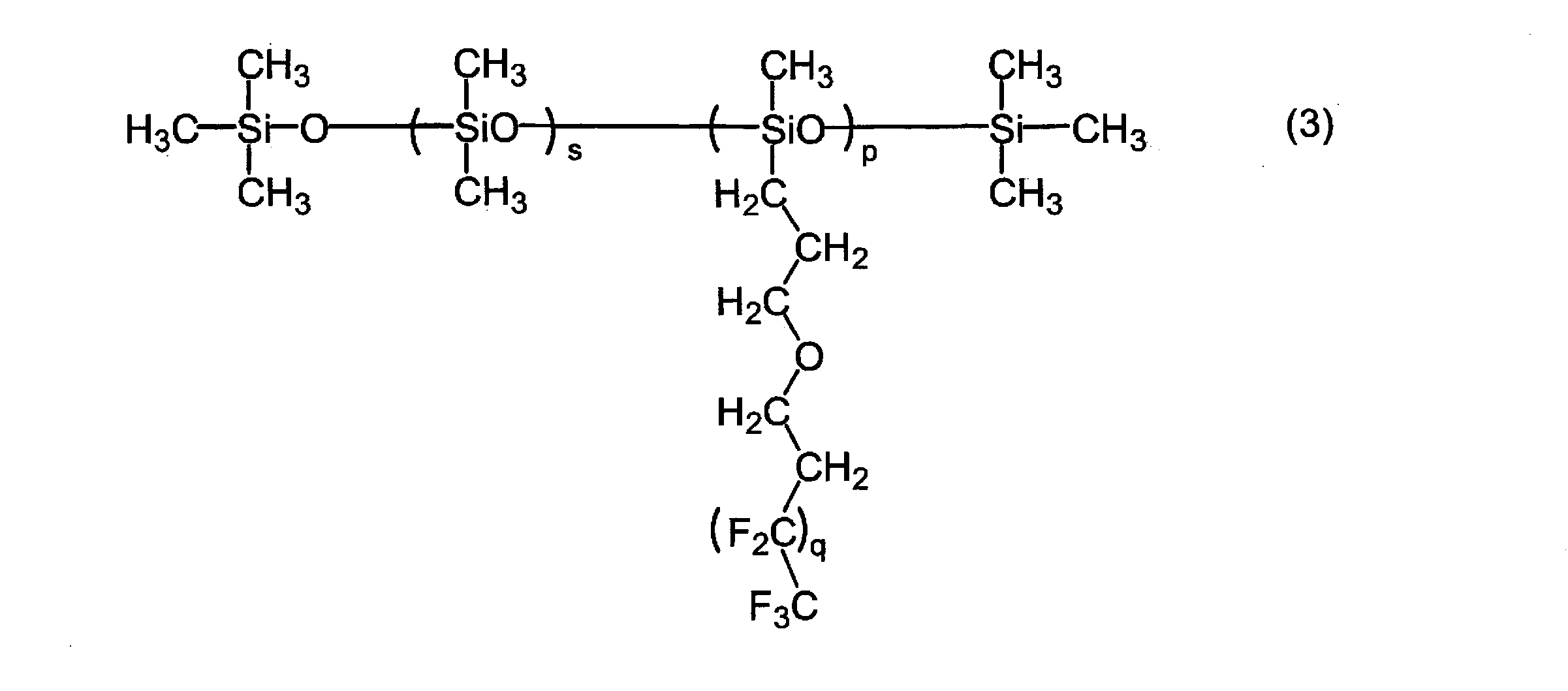
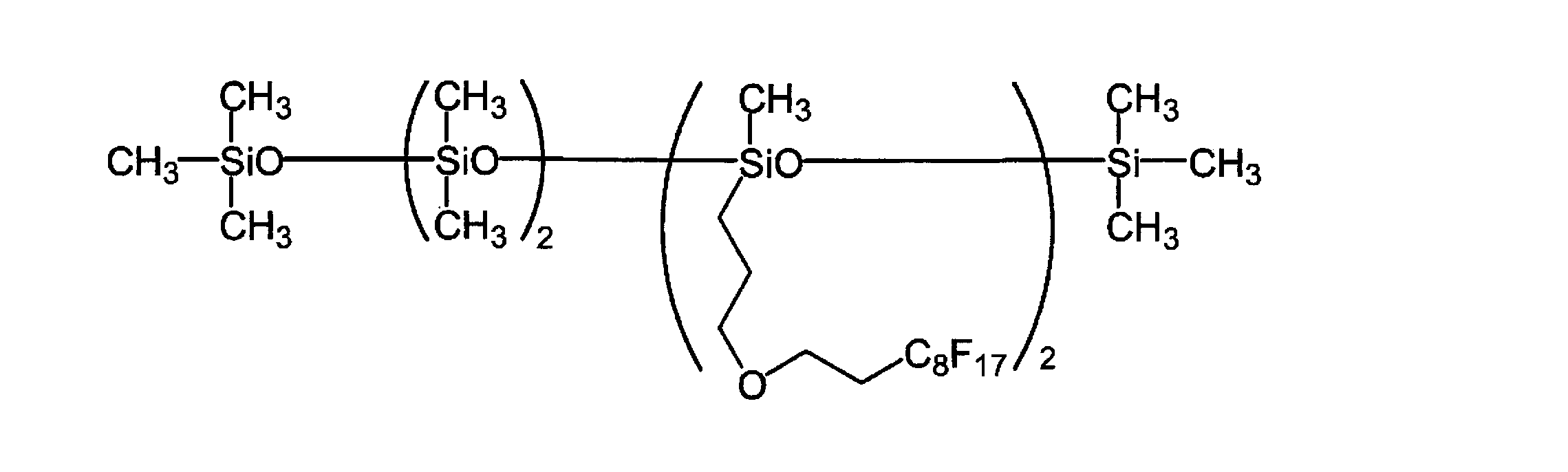
- a component (A) what is represented by following General formula (3) is preferable.
- Ingredient (A) can be used alone or in combination of two or more. From the standpoint of improving dullness of the skin, reducing the noticeability of pores and adjusting the texture of the skin, 0.01 mass% or more, preferably 0.1 mass% or more, more preferably 1 mass% or more, further preferably 4 mass% or more, 50 mass% or less, preferably 30 mass% or less, 20 mass% or less is more preferable, and 15 mass% or less is further more preferable. Further, the content of the component (A) is 0.01 to 50% by mass in the total composition, preferably 0.1 to 30% by mass, more preferably 1 to 20% by mass, and 4 to 15% by mass. Further preferred.
- the powder of component (B) used in the present invention has been surface-treated with tridecafluorooctyltriethoxysilane represented by the following formula.
- F 3 C— (CF 2 ) 5 — (CH 2 ) 2 —Si— (OCH 2 CH 3 ) 3 Among the fluorine compounds that surface-treat the powder, the powder surface-treated with tridecafluorooctyltriethoxysilane is used in combination with component (A) to improve skin dullness and brighten the skin, making pores conspicuous Suppresses skin tone and smoothes skin texture.
- FHS sold by Daito Kasei Kogyo Co., Ltd. is suitable.
- the powder to be treated is not particularly limited as long as it is an extender pigment or a color pigment used in ordinary cosmetics, for example, silicic acid, silicic anhydride, magnesium silicate, talc, sericite, mica, kaolin, Bengala, clay, bentonite, titanium coated mica, bismuth oxychloride, zirconium oxide, magnesium oxide, titanium oxide, zinc oxide, aluminum oxide, calcium sulfate, barium sulfate, magnesium sulfate, calcium carbonate, magnesium carbonate, iron oxide, ultramarine, oxidation Inorganic powders such as chromium, chromium hydroxide, calamine and carbon black, and composites thereof; polyamide, polyester, polypropylene, polystyrene, polyurethane, vinyl resin, urea resin, phenol resin, fluorine resin, silicon resin, acrylic resin, melamine Resin, epoxy Organic powders such as silicone resin, polycarbonate resin, divinylbenzene / styrene
- tridecafluorooctyltriethoxysilane As a method of surface-treating the powder with tridecafluorooctyltriethoxysilane, for example, tridecafluorooctyltriethoxysilane is dropped or added in a mixer and mixed with the powder, followed by heat treatment, and if necessary And a method in which an organic solvent liquid in which tridecafluorooctyltriethoxysilane is dissolved or dispersed and a powder are mixed, the organic solvent is removed, and the mixture is crushed after drying. Among them, tridecafluorooctyltriethoxysilane is dissolved or dispersed in an organic solvent, and while mixing the powder and the mixer in the mixer, the mixer is heated under reduced pressure to remove the organic solvent.
- organic solvent used here examples include polar organic solvents such as methanol, ethanol, isopropyl alcohol, isobutanol, acetone, ethyl acetate, butyl acetate, methyl ethyl ketone, dichloromethane, and chloroform, and normal hexane, toluene, and xylene. Hydrocarbon organic solvents are suitable.
- the treatment amount of tridecafluorooctyltriethoxysilane varies depending on the powder, but is preferably 0.05% by mass or more, more preferably 0.1% by mass or more, and more preferably 50% by mass with respect to the mass of the powder of component (B). % Or less is preferable, and 20% by mass or less is more preferable. Further, the treatment amount of tridecafluorooctyltriethoxysilane is preferably 0.05 to 50% by mass, more preferably 0.1 to 20% by mass. This treatment amount is preferable because water repellency and oil repellency are sufficiently exhibited, and feel and fluidity are good.
- Component (B) preferably has an average particle size of 0.1 to 20 ⁇ m, more preferably 0.1 to 10 ⁇ m, from the standpoint of powderiness and finish at the time of application.
- the particle diameter of the component (B) is measured with an electron microscope observation and a particle size distribution measuring device by a laser diffraction / scattering method.
- measurement is performed with a laser diffraction / scattering particle size distribution analyzer (for example, LA-920, manufactured by Horiba, Ltd.) using ethanol as a dispersion medium.
- Component (B) can be used singly or in combination of two or more. From the viewpoint of finish and stability, the content is 0.01% by mass or more, and 0.1% by mass with respect to the entire cosmetic. % Or more, preferably 1% by weight or more, more preferably 5% by weight or more, 40% by weight or less, preferably 30% by weight or less, more preferably 25% by weight or less, and further preferably 20% by weight or less. .
- the content of component (B) is 0.01 to 40% by mass, preferably 0.1 to 30% by mass, more preferably 1 to 25% by mass, and 5 to 20% by mass in the total composition. Further preferred.
- the mass ratios (A) / (B) of the components (A) and (B) are preferably 0.01 or more, more preferably 0.1 or more, from the viewpoint of feeling of use and makeup. 2 or more are more preferable, 50 or less are preferable, 20 or less are more preferable, 10 or less are more preferable, and 2 or less are more preferable.
- the mass ratio (A) / (B) of the components (A) and (B) is preferably 0.01 to 50, more preferably 0.1 to 20, still more preferably 0.1 to 10, and 2 to 2 is even more preferable.
- Particulate zinc oxide component (C) used in the present invention are those specific surface area of 10 ⁇ 100m 2 / g, preferably from 15 ⁇ 95m 2 / g. By using fine particle zinc oxide having such a specific surface area, it is excellent in longevity, suppresses the conspicuous pores, improves the dullness of the skin, and makes the skin brighter and can provide a good feeling of use.
- the component (C) used by this invention excludes a component (B), and does not contain a component (B).
- the finely divided zinc oxide of component (C) can be used as it is, but if necessary, it can be subjected to water and / or oil repellent treatment with silicone, metal soap, lecithin, N-acylamino acid, fluorine compound or the like. Can also be used. From the standpoint of preventing makeup collapse and improving the dispersibility of the fine zinc oxide in the cosmetic, a silicone-treated one is preferred, and a silicone treatment using methylhydrogenpolysiloxane is more preferred. These processes can be performed by a normal method.
- Ingredient (C) can be used singly or in combination of two or more, and the content is 0. 0% with respect to the entire cosmetic composition from the standpoint of suppressing the conspicuous pores, improving the dullness of the skin and brightening the skin. It is 01 mass% or more, 0.1 mass% or more is preferable, 1 mass% or more is more preferable, 20 mass% or less is 15 mass% or less, 10 mass% or less is more preferable.
- the content of component (C) is 0.01 to 20% by mass, preferably 0.1 to 15% by mass, more preferably 1 to 10% by mass in the total composition.
- the mass ratio (A) / (C) of the components (A) and (C) is preferably 0.1 or more from the standpoint of improving makeup, improving dullness of the skin, and brightening the skin. Is more preferable, 10 or less is preferable, and 7 or less is more preferable. Further, the mass ratio (A) / (C) of the components (A) and (C) is preferably 0.1 to 10, and more preferably 1 to 7.
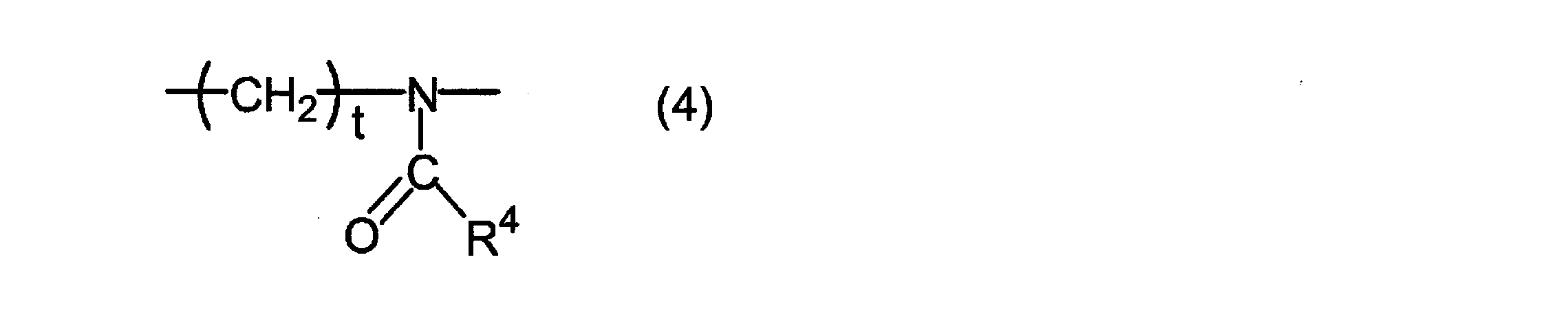
- Component (D) is represented by the following general formula (4) through an alkylene group containing a hetero atom in at least two silicon atoms of the organopolysiloxane segment constituting the main chain;
- R 4 represents a hydrogen atom or an alkyl group having 1 to 3 carbon atoms, and t represents 2 or 3, and a poly (N-acylalkylenimine) segment composed of repeating units represented by An organopolysiloxane comprising:
- the number average molecular weight of the poly (N-acylalkylenimine) segment is 500 to 4000
- the mass ratio (a / b) of the organopolysiloxane segment (a) constituting the main chain to the poly (N-acylalkylenimine) segment (b) is 80/20 to 95/5
- the adjacent poly ( N-acylalkyleneimine) segment has a weight average molecular weight of the organopolysiloxane segment of 10,000 to 40,000
- An organopolysiloxane in which the weight average molecular weight of the organopolysiloxane segment constituting the main chain is 50,000 to 150,000.
- the poly (N-acylalkyleneimine) segment is bonded to any silicon atom constituting the organopolysiloxane segment via an alkylene group containing a hetero atom. Further, it is preferably bonded to one or more silicon atoms excluding both ends of the organopolysiloxane segment via the alkylene group, and bonded to two or more silicon atoms excluding both ends via the alkylene group. More preferably. That is, the organopolysiloxane of component (D) is a graft polymer having a poly (N-acylalkyleneimine) segment composed of at least two or more repeating units represented by the general formula (4) as a side chain. is there.
- the alkylene group containing a hetero atom functions as a linking group for the poly (N-acylalkylenimine) segment.
- Examples of such an alkylene group include an alkylene group having 2 to 20 carbon atoms containing 1 to 3 nitrogen atoms, oxygen atoms or sulfur atoms, and is represented by any of the following formulas (i) to (vii).
- a group represented by the following formula (i) or (ii) is more preferred, and a group represented by the following formula (i) is more preferred.
- An ⁇ represents a counter ion of a quaternary ammonium salt, for example, ethyl sulfate ion, methyl sulfate ion, chloride ion, iodide ion, sulfate ion, p-toluenesulfonate ion, perchlorate ion. Is exemplified.
- the alkyl group having 1 to 3 carbon atoms in R 4 in the general formula (4) is, for example, a straight chain having 1 to 3 carbon atoms.
- examples include a chain alkyl group or a branched or alkyl group having 3 carbon atoms, and specific examples include a methyl group, an ethyl group, an n-propyl group, and an isopropyl group.
- t represents a number of 2 or 3, and is preferably 2 from the viewpoint of obtaining raw materials when producing the organopolysiloxane.
- the mass ratio (a / b) is in the range of 80/20 to 95/5, and is preferably 83/17 to 93 / from the viewpoint of excellent adhesion to the skin and emulsification, and the skin looks dull and bright. 7 and more preferably 85/15 to 90/10.
- the mass ratio (a / b) is determined by dissolving 5% by mass of the organopolysiloxane of component (D) in deuterated chloroform, and analyzing it by nuclear magnetic resonance ( 1 H-NMR) analysis. The value obtained from the integral ratio of the alkyl group or phenyl group in the segment and the methylene group in the poly (N-acylalkylenimine) segment.
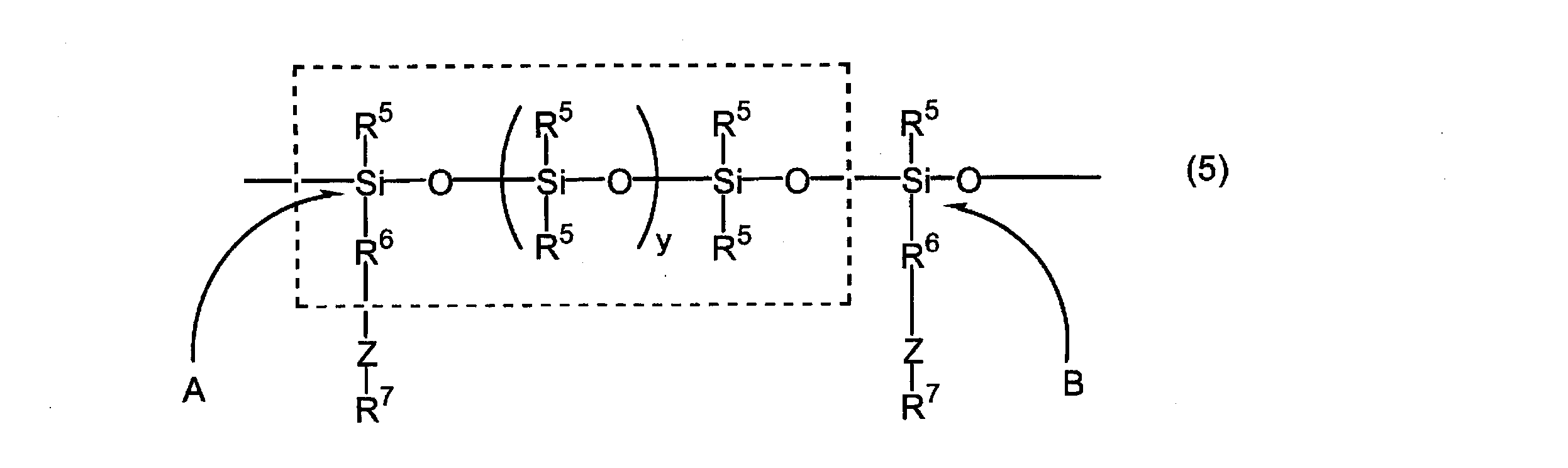
- the weight average molecular weight of the organopolysiloxane segment between adjacent poly (N-acylalkyleneimine) segments (hereinafter also simply referred to as “MWg”) is in the range of 10,000 to 40,000. From the viewpoint of the flexibility of the film and the orientation to the oil / water interface, it is more preferably 15000 to 35000, still more preferably 18000 to 32000.
- an organopolysiloxane segment between adjacent poly (N-acylalkyleneimine) segments refers to an organopolysiloxane of a poly (N-acylalkylenimine) segment as shown in the following formula (5).
- the “poly (N-acylalkylenimine) segment” refers to —ZR 7 bonded to R 6 .
- each R 5 independently represents an alkyl group having 1 to 22 carbon atoms or a phenyl group
- R 6 represents an alkylene group containing a hetero atom
- —Z—R 7 represents poly (N— An acylalkylenimine) segment
- R 7 represents a residue of a polymerization initiator
- y represents a positive number.
- MWg is the molecular weight of the portion surrounded by the broken line in the general formula (5), but is understood as the mass (g / mol) of the organopolysiloxane segment per mole of the poly (N-acylalkyleneimine) segment. Can do.
- the functional group of the modified organopolysiloxane that is the raw material compound is 100% substituted with poly (N-acylalkylenimine)
- the functional group equivalent (g / mol) of the modified organopolysiloxane coincides.
- the molecular weight of the poly (N-acylalkylenimine) segment is calculated from the molecular weight of the N-acylalkyleneimine unit and the degree of polymerization, or is measured by gel permeation chromatography (hereinafter also simply referred to as “GPC”) measurement method. be able to.
- GPC gel permeation chromatography
- MNox polystyrene-equivalent number average molecular weight measured by GPC measurement performed under the measurement conditions described later is used.
- MNox is preferably 800 to 3500, more preferably 1000 to 3000.
- the weight average molecular weight (hereinafter also simply referred to as “MWsi”) of the organopolysiloxane segment constituting the main chain is 50,000 to 150,000, and preferably from 70000 to 130,000, more preferably from the viewpoint of flexibility and adhesion to the skin. 90000-110000.
- the organopolysiloxane of component (D) can be easily blended into various products by dissolving in a polar solvent such as water. Since the organopolysiloxane segment constituting the main chain has a common skeleton with the modified organopolysiloxane that is the raw material compound, MWsi is substantially the same as the weight average molecular weight of the modified organopolysiloxane that is the raw material compound. In addition, the weight average molecular weight of the modified organopolysiloxane which is a raw material compound is measured by GPC under the measurement conditions described later, and is converted to polystyrene.
- the weight average molecular weight (hereinafter, also simply referred to as “MWt”) of the organopolysiloxane of component (D) is preferably 60000 to 160000, more preferably 80000 to 40000 from the viewpoint of achieving both adhesion to the skin and emulsion stability. 140,000, more preferably 100,000 to 120,000. MWt is a value measured by GPC under the measurement conditions described later and converted to polystyrene.
- Component (D) organopolysiloxane has a high modulus of elasticity and a large deformable amount, and when heated to a temperature range of 50 to 220 ° C, the plasticity is remarkably improved and becomes soft. It has a characteristic thermoplasticity that immediately restores elasticity.
- Component (D) organopolysiloxane is, for example, the following general formula (6)
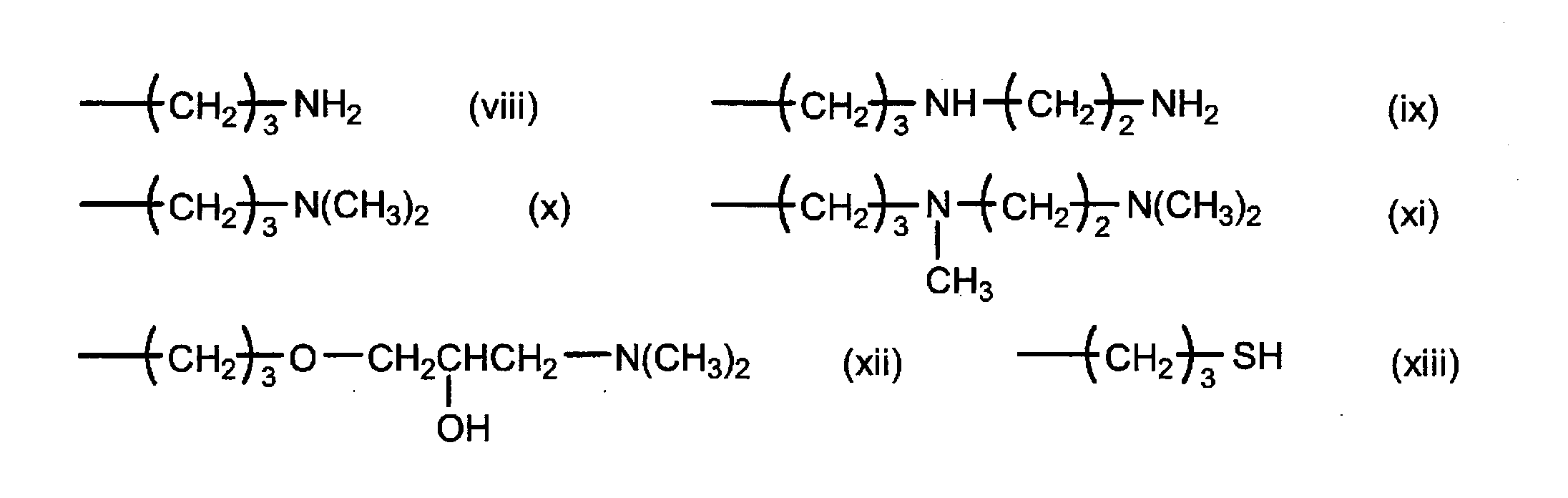
- R 5 has the same meaning as described above, and R 8 and R 9 each represent the same group as R 5 , or the following formulas (viii) to (xiii)
- R 10 represents a monovalent group represented by the above formulas (viii) to (xiii), and d represents a number from 91.5 to 1255.0.
- E represents a number from 2.0 to 62.5]
- a polymerization initiator can be used for the ring-opening polymerization of the cyclic imino ether represented by the general formula (7) (hereinafter also simply referred to as “cyclic imino ether (7)”).
- a compound having strong electrophilic reactivity for example, a strong acid such as benzenesulfonic acid alkyl ester, p-toluenesulfonic acid alkyl ester, trifluoromethanesulfonic acid alkyl ester, trifluoroacetic acid alkyl ester, sulfuric acid dialkyl ester, etc.
- Alkyl esters can be used, and among them, dialkyl sulfate is preferably used.
- the polymerization solvent examples include acetates such as ethyl acetate and propyl acetate, ethers such as diethyl ether, diisopropyl ether, dioxane and tetrahydrofuran, ketones such as acetone and methyl ethyl ketone, halogen solvents such as chloroform and methylene chloride, acetonitrile. , Nitrile solvents such as benzonitrile, aprotic polar solvents such as N, N-dimethylformamide, N, N-dimethylacetamide, dimethyl sulfoxide, etc., among which acetates are preferred Is done.
- the amount of the solvent used is usually 20 to 2000 parts by mass with respect to 100 parts by mass of the cyclic iminoether (7).
- the polymerization temperature is usually 30 to 170 ° C., preferably 40 to 150 ° C., and the polymerization time is usually 1 to 60 hours although it is not uniform depending on the polymerization temperature.
- Poly (N-acylalkylenimine) obtained by living polymerization of cyclic imino ether (7) has a reactive group at the terminal. Therefore, the reactive group at the terminal of the poly (N-acylalkylenimine) and the reactive groups represented by the above (viii) to (xiii) of the modified organopolysiloxane represented by the general formula (6) By reacting, the organopolysiloxane of component (D) can be obtained.
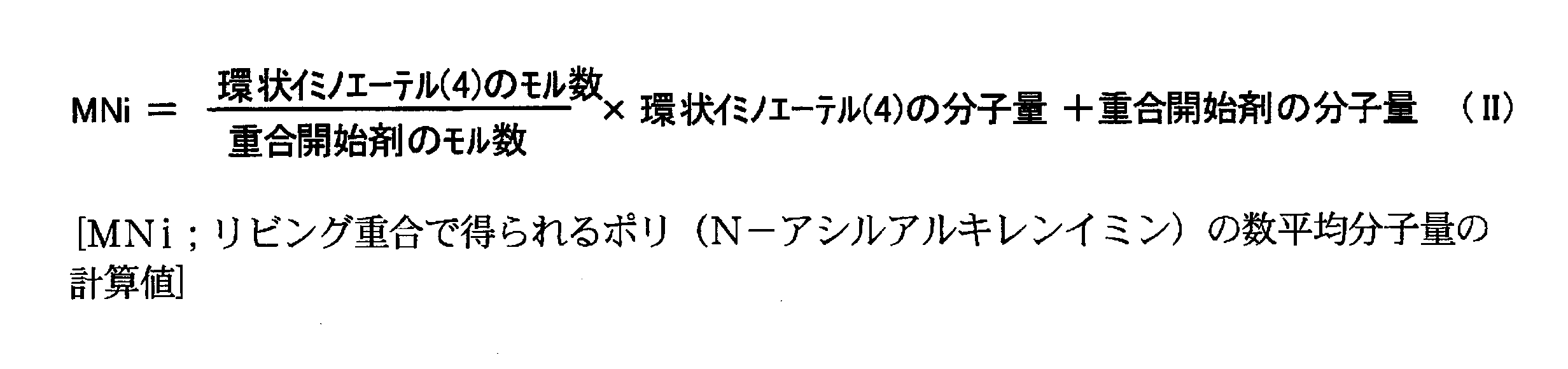
- the production method by the living polymerization can easily control the degree of polymerization by using the amount of the cyclic imino ether (7) and the polymerization initiator as shown in the following theoretical formula (II), and moreover than ordinary radical polymerization. This is effective in that a substantially monodispersed poly (N-acylalkyleneimine) having a narrow molecular weight distribution can be obtained.
- the amount of cyclic iminoether (7) and the amount of polymerization initiator used are preferably such that MNi in formula (II) is 500 to 4000, more preferably 800 to 3500, The amount is more preferably 1000 to 3000.
- the weight average molecular weight of the modified organopolysiloxane represented by the general formula (6) is preferably 50,000 to 150,000 from the viewpoint of solubility of the resulting organopolysiloxane in a polar solvent such as water and ease of handling after dissolution, More preferably, it is 70000-130,000, and more preferably 90000-110,000.
- the functional group equivalent of the modified organopolysiloxane represented by the general formula (6) has an upper limit to satisfy the mass ratio (a / b) and MWg of the organopolysiloxane of the component (D). From this viewpoint and from the viewpoint of imparting appropriate hydrophobicity to the main chain, the functional group equivalent is preferably 10,000 to 40,000, more preferably 15,000 to 35,000, and still more preferably 18,000 to 32,000.
- the functional group equivalent of the modified organopolysiloxane represented by the general formula (6) is the weight average molecular weight of the modified organopolysiloxane represented by the general formula (6). This is the value divided by the average value of the number of R 10 per unit.
- the amount of the modified organopolysiloxane represented by the general formula (6) and the terminal reactive poly (N-acylalkyleneimine) used is a mass ratio (modified organopolysiloxane / terminal reactive poly (N-acylalkylene).
- the imine)) is preferably in the range of 80/20 to 95/5 from the viewpoint of the elastic modulus and the deformable amount of the resulting organopolysiloxane. From this viewpoint, 83/17 to 93/7 is more preferable. 85/15 to 90/10 is more preferable.
- the 1 H-NMR measurement for calculating the mass ratio (a / b) was performed under the following conditions.
- component (D) organopolysiloxane examples include poly (N-formylethyleneimine) organosiloxane, poly (N-acetylethyleneimine) organosiloxane, and poly (N-propionylethyleneimine) organosiloxane.
- Component (D) can be used singly or in combination of two or more, and is excellent in adherence to skin and emulsifying properties, dull and dull, and its content is 0 with respect to the entire cosmetic. 0.01 mass% or more, preferably 0.1 mass% or more, preferably 10 mass% or less, and preferably 5 mass% or less. The content of component (D) is 0.01 to 10% by mass, preferably 0.1 to 5% by mass, based on the total composition.
- the mass ratio (A) / (D) of the components (A) and (D) is 0.1 to 100. From the standpoint of durability and stability, 1 or more is preferable, 2 or more is more preferable, 4 or more is more preferable, 60 or less is preferable, 40 or less is more preferable, and 15 or less is more preferable.
- the mass ratio (A) / (D) of the components (A) and (D) is preferably 1 to 60, more preferably 2 to 40, and even more preferably 4 to 15.
- the content of water used in the present invention is preferably 10% by mass or more, more preferably 20% by mass or more, and preferably 60% by mass or less with respect to the entire cosmetic from the viewpoint of usability and storage stability. 50 mass% or less is more preferable.
- the water content is preferably 10 to 60% by mass and more preferably 20 to 50% by mass in the total composition.
- the oil used in the present invention may be liquid at 20 ° C. When a solid or paste oil is used, it is preferably used after being dissolved in another oil or solvent.
- the oil used in the present invention include silicone oils, hydrocarbon oils, higher fatty acids, higher alcohols, ester oils (including fats and oils), ether oils, mineral oils, etc. Ester oil is more preferable, and silicone oil is more preferable. Of these, dimethylpolysiloxane and cyclopolysiloxane are more preferable. These oil agents can be used alone or in combination of two or more.
- the content of the oil used in the present invention is preferably 10% by mass or more, more preferably 20% by mass or more, and more preferably 50% by mass or less with respect to the entire cosmetic from the viewpoint of usability and storage stability. Preferably, 40 mass% or less is more preferable. Further, the content of the oil agent is preferably 10 to 50% by mass, more preferably 20 to 40% by mass in the total composition.
- the surfactant used in the present invention examples include an anionic surfactant, a cationic surfactant, an amphoteric surfactant, and a nonionic surfactant.
- nonionic surfactants are preferable, and polyether-modified silicones are more preferable.
- the HLB value is preferably 1 or more and 7 or less, and the HLB value is more preferably 2 or more and 6 or less.
- the content of the surfactant is preferably 0.1% by mass or more, more preferably 0.2% by mass or more, preferably 6% by mass or less, and more preferably 3% by mass or less with respect to the entire cosmetic.
- the content of the surfactant is preferably from 0.1 to 6% by mass, more preferably from 0.2 to 3% by mass, based on the total composition.
- HLB hydrophilic-lipophilic balance ⁇ Hydrophilic-Lypophilic Balance>
- HLB hydrophilic-lipophilic balance ⁇ Hydrophilic-Lypophilic Balance>
- Griffin Griffin
- the HLB of the mixed surfactant composed of two or more kinds of nonionic surfactants is obtained as follows.
- the HLB of the mixed surfactant is obtained by averaging the HLB values of the nonionic surfactants based on the blending ratio.
- HLB ⁇ (HLBx ⁇ Wx) / ⁇ Wx HLBx indicates the HLB value of the nonionic surfactant X.
- Wx indicates the weight (g) of the nonionic surfactant X having a value of HLBx.
- the cosmetic of the present invention is a component used in normal cosmetics in addition to the above components, for example, solid oils such as petrolatum, lanolin, ceresin, microcrystalline wax, carnauba wax, candelilla wax; water-soluble and oil-soluble polymers; Powders other than the above components: ethanol, polyhydric alcohol, preservatives, antioxidants, dyes, thickeners, pH adjusters, fragrances, ultraviolet absorbers, moisturizers, blood circulation promoters, cooling sensates, antiperspirants , Fungicides, skin activators and the like.
- solid oils such as petrolatum, lanolin, ceresin, microcrystalline wax, carnauba wax, candelilla wax
- water-soluble and oil-soluble polymers water-soluble and oil-soluble polymers
- Powders other than the above components ethanol, polyhydric alcohol, preservatives, antioxidants, dyes, thickeners, pH adjusters, fragrances, ultraviolet absorbers, moisturizers, blood circulation promoters, cooling sensates, antiperspir
- the cosmetic of the present invention can be produced according to a usual method, and may be any emulsifying type such as a water-in-oil type, an oil-in-water type, or a two-layer separation type. Of these, water-in-oil emulsified cosmetics are preferable from the viewpoint of usability. Furthermore, examples of the dosage form include liquid, emulsion, cream, and gel, and emulsion is preferred.
- the cosmetics of the present invention can be produced according to ordinary methods, and make-up cosmetics such as liquid foundations, oily foundations, powder foundations, makeup bases, lipsticks, blushers, eye shadows; sunscreen emulsions and sunscreen creams UV protective cosmetics such as Among these, a liquid foundation, a makeup base, a sunscreen emulsion, and a sunscreen cream are preferable.
- make-up cosmetics such as liquid foundations, oily foundations, powder foundations, makeup bases, lipsticks, blushers, eye shadows; sunscreen emulsions and sunscreen creams UV protective cosmetics such as Among these, a liquid foundation, a makeup base, a sunscreen emulsion, and a sunscreen cream are preferable.
- the present invention further discloses the following composition, production method, or application.
- Rf represents a straight-chain or branched perfluoroalkyl group having 6 carbon atoms
- R 1 , R 2 and R 3 are the same or different and represent a straight-chain or branched chain having 1 to 6 carbon atoms.
- the number average molecular weight of the poly (N-acylalkylenimine) segment is 500 to 4000
- the mass ratio (a / b) of the organopolysiloxane segment (a) constituting the main chain to the poly (N-acylalkylenimine) segment (b) is 80/20 to 95/5
- the weight average molecular weight of the organopolysiloxane segment between adjacent poly (N-acyl ⁇ BR> cryL remine) segments is 10,000 to 40,000
- the weight average molecular weight of the organopolysiloxane segment constituting the main chain is 50,000 to 150,000.
- component (A) is preferably 0.1 to 30% by mass, more preferably 1 to 20% by mass, and further preferably 4 to 15% by mass in the total composition ⁇ 1 > Cosmetics described.
- component (B) is preferably 0.1 to 30% by mass in the total composition, more preferably 1 to 25% by mass, and further preferably 5 to 20% by mass.
- component (B) is preferably 0.1 to 30% by mass in the total composition, more preferably 1 to 25% by mass, and further preferably 5 to 20% by mass.
- the mass ratio (A) / (B) of the components (A) and (B) is preferably 0.01 to 50, more preferably 0.1 to 20, and further preferably 0.1 to 10
- the content of the component (C) is preferably 0.1 to 15% by mass in the total composition, and more preferably 1 to 10% by mass. Any one of the above ⁇ 1> to ⁇ 4> Cosmetics described.
- the mass ratio (A) / (C) of the components (A) and (C) is preferably 0.1 to 10, more preferably 1 to 7, any one of the above ⁇ 1> to ⁇ 5> Cosmetics according to claim 1.
- ⁇ 7> The cosmetic according to any one of ⁇ 1> to ⁇ 6>, wherein the content of the component (D) is preferably 0.1 to 5% by mass in the total composition.
- the mass ratio (A) / (D) of the components (A) and (D) is preferably 1 to 60, more preferably 2 to 40, and even more preferably 4 to 15 ⁇ 1> to Cosmetics any one of ⁇ 7>.
- m is preferably 2 to 5, more preferably 3, and n is preferably 1 to 4, More preferably, p is preferably 3 to 10, more preferably 3 to 6, and s is preferably 1 to 3, and 1 is more preferably any one of the above items ⁇ 1> to ⁇ 8> 1.
- the ratio of p / (p + s) in the general formulas (1) and (2) is preferably 0.66 ⁇ p / (p + s) ⁇ 0.9, and 0
- the treatment amount of the component (B) tridecafluorooctyltriethoxysilane is preferably 0.05 to 50% by mass, more preferably 0.1 to 20% by mass.
- the component (B) preferably has an average particle diameter of 0.1 to 20 ⁇ m, and more preferably has an average particle diameter of 0.1 to 10 ⁇ m.
- the component (C) is preferably a silicon-treated fine particle zinc oxide, and a silicon-treated fine particle zinc oxide using methylhydrogenpolysiloxane is more preferred. Any one of the above items ⁇ 1> to ⁇ 12> Cosmetics described.
- the organopolysiloxane of component (D) is represented by the following general formula (6)
- R 5 has the same meaning as described above, and R 8 and R 9 each represent the same group as R 5 , or the following formulas (viii) to (xiii)
- R 10 represents a monovalent group represented by the above formulas (viii) to (xiii), and d represents a number from 91.5 to 1255.0.
- E represents a number from 2.0 to 62.5]
- a modified organopolysiloxane represented by the general formula (6) which is produced by reacting a terminal-reactive poly (N-acylalkyleneimine) obtained by ring-opening polymerization of a cyclic imino ether represented by the formula:
- the mass ratio of the terminal reactive poly (N-acylalkyleneimine) (modified organopolysiloxane / terminal reactive poly (N-acylalkyleneimine)) is preferably 80/20 to 95/5, and 83/17
- ⁇ 15> The cosmetic according to any one of ⁇ 1> to ⁇ 14>, wherein the content of water is preferably 10 to 60% by mass, and more preferably 20 to 50% by mass.
- ⁇ 16> Further, it contains a liquid oil at 20 ° C., preferably silicone oil, hydrocarbon oil, ester oil, more preferably silicone oil, and further preferably dimethylpolysiloxane and cyclopolysiloxane ⁇ 1>.
- -Cosmetics any one of ⁇ 15>.
- ⁇ 17> The cosmetic according to the above ⁇ 16>, wherein the content of the liquid oil at 20 ° C. is preferably 10 to 50% by mass, and more preferably 20 to 40% by mass.
- ⁇ 18> The cosmetic according to any one of ⁇ 1> to ⁇ 17>, further comprising a surfactant, preferably a nonionic surfactant, and more preferably a polyether-modified silicone.
- a surfactant preferably a nonionic surfactant, and more preferably a polyether-modified silicone.
- the surfactant preferably has an HLB value of 1 or more and 7 or less, and more preferably has an HLB value of 2 or more and 6 or less.
- the content of the surfactant is preferably 0.1 to 6% by mass, and more preferably 0.2 to 3% by mass.
- a water-in-oil emulsified cosmetic preferably in the form of a liquid, emulsion, cream or gel, and more preferably an emulsion. .
- the mixture was filtered through a 0.1 ⁇ m PTFE membrane filter, and the filtrate was subjected to steam distillation using 100 ° C./5 KPa and 62.5 g of water to obtain 206.3 g of the target compound (Compound A1) (yield 89%).
- Synthesis Example 6 (Synthesis of Compound D1) 12.9 g (0.13 mol) of 2-ethyl-2-oxazoline and 27.7 g of ethyl acetate were mixed, and the mixture was 2.0 g of molecular sieve (Zeoram A-4, manufactured by Tosoh Corporation) at 28 ° C. Time dehydration was performed.
- terminal reactive poly N-propionyl
- Ethyleneimine Ethyleneimine
- the number average molecular weight measured by GPC was 2700.
- the terminal-reactive poly (N-propionylethyleneimine) solution was added to the dehydrated side chain primary aminopropyl-modified polydimethylsiloxane solution all at once, and the mixture was heated to reflux at 80 ° C. for 10 hours.
- the reaction mixture was concentrated under reduced pressure to obtain an N-propionylethyleneimine-dimethylsiloxane copolymer as a white rubbery solid (108 g).
- the mass ratio of the organopolysiloxane segment in the final product was 0.87, and the weight average molecular weight of the final product was 115,000.
- Synthesis Example 8 (Synthesis of Compound D3) 3.63 g (0.036 mol) of 2-ethyl-2-oxazoline and 8.46 g of ethyl acetate were mixed, and the mixture was 0.6 g of molecular sieve (Zeoram A-4, manufactured by Tosoh Corporation) at 28 ° C. Time dehydration was performed.
- terminal reactive poly N-propionyl
- Ethyleneimine Ethyleneimine
- the number average molecular weight measured by GPC was 1200.
- the terminal-reactive poly (N-propionylethyleneimine) solution was added to the dehydrated side chain primary aminopropyl-modified polydimethylsiloxane solution all at once, and the mixture was heated to reflux at 80 ° C. for 10 hours.
- the reaction mixture was concentrated under reduced pressure to obtain N-propionylethyleneimine-dimethylsiloxane copolymer as a white rubber-like solid (102 g).
- the mass ratio of the organopolysiloxane segment in the final product was 0.96, and the weight average molecular weight of the final product was 104,000.
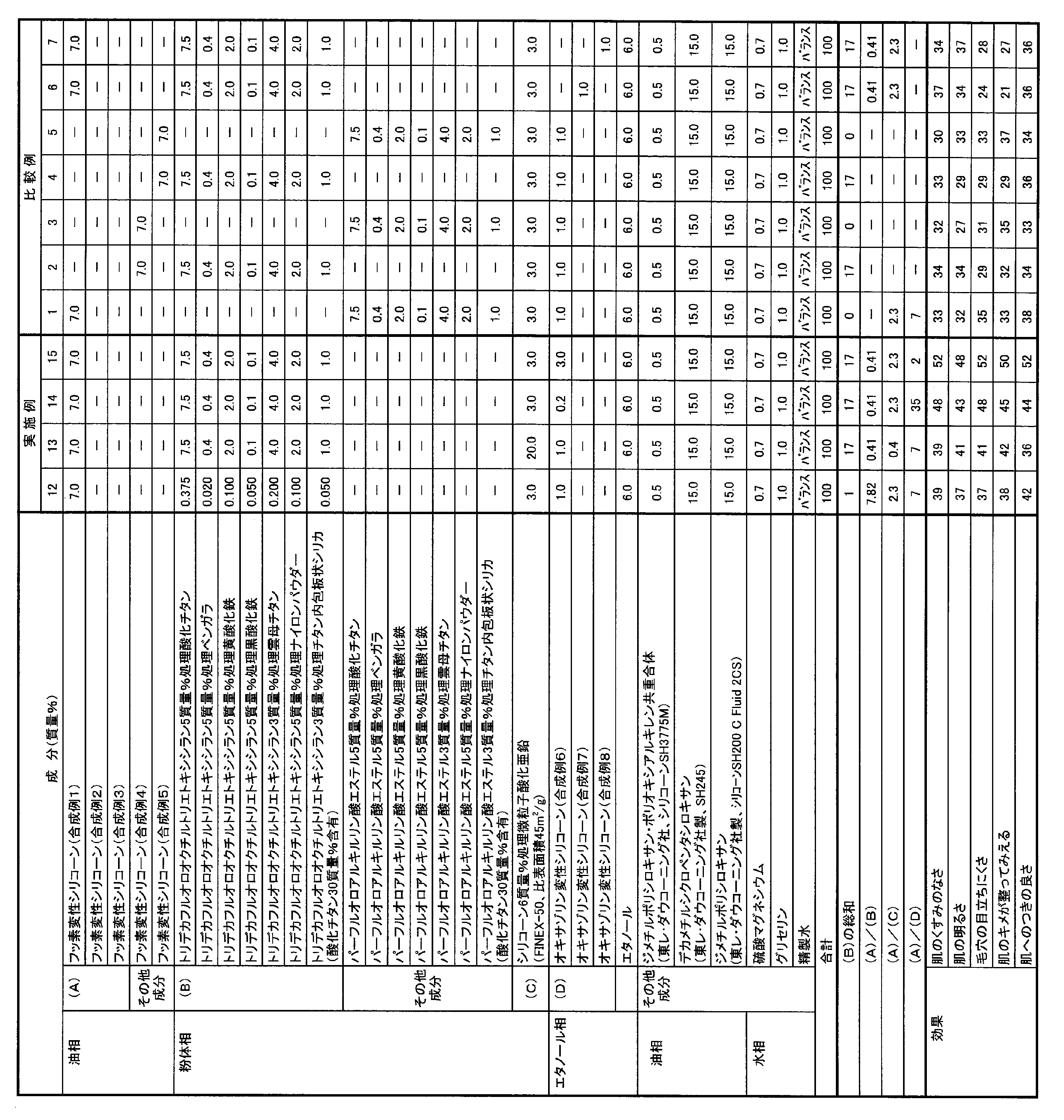
- Examples 1 to 15 and Comparative Examples 1 to 7 W / O emulsified foundations having the compositions shown in Table 2 and Table 3 were produced, and “Dullness of skin”, “Brightness of skin”, “Inconspicuousness of pores”, “Smooth skin looks good” , And “goodness to the skin” was evaluated. The results are shown in Tables 2 and 3.
- the texture of the skin looks good: 4; The texture of the skin looks good. 3; The texture of the skin looks a little well arranged. 2; The texture of the skin does not appear to be very well prepared. 1: The texture of the skin does not appear to be in order.
- Example 16 (Cream Foundation) (composition) (1) ⁇ -monoalkyl glyceryl ether (HLB1.8) 1.0 (mass%) (2) Dimethylsiloxane methyl (undecyl glyceryl ether) Siloxane copolymer (described in JP-A-4-108795) 1.0 (3) Dimethylpolysiloxane / polyoxyalkylene copolymer (manufactured by Shin-Etsu Chemical Co., Ltd., KF-6016) 1.0 (4) Fluorine-modified silicone (Synthesis Example 1) 6.0 (5) Decamethylcyclopentasiloxane (manufactured by Dow Corning Toray, Silicone SH245) 15.0 (6) Dimethylpolysiloxane (manufactured by Shin-Etsu Chemical Co., Ltd., KF-96L2CS) 20.0 (7) Dimethylpolysiloxane (manufactured by Shin-Etsu Chemical Co.
- Example 17 makeup base (composition)
- Dimethylpolysiloxane / polyoxyalkylene copolymer manufactured by Shin-Etsu Chemical Co., Ltd., KF-6016
- Fluorine-modified silicone (Synthesis Example 2) 12.0
- Decamethylcyclopentapolysiloxane Toray Dow Corning, SH245) 15.0
- Decamethyltetrasiloxane (Shin-Etsu Chemical Co., Ltd., KF-96L1.5CS) 15.0
- Dimethylpolysiloxane manufactured by Shin-Etsu Chemical Co., Ltd., KF-96L2CS
- 2-Ethylhexyl paramethoxycinnamate 0.5
- Glycerin 1.0 Purified water remaining amount (9)
- Oxazoline-modified silicone (Synthesis Example 6) 1.0 (10) Ethanol 5.0 (11) FHS 3% by mass
- Both the cosmetics obtained in Examples 16 and 17 can improve the dullness of the skin, brighten the skin, suppress the conspicuous pores, and improve the texture of the skin. Also. The skin was also excellent.
- Example 18 (sunscreen cosmetics) (composition) (1) Dimethylpolysiloxane / polyoxyalkylene copolymer (manufactured by Shin-Etsu Chemical Co., Ltd., ES-5612) 0.7 (mass%) (2) Dimethylpolysiloxane / polyoxyalkylene copolymer (Shin-Etsu Chemical Co., Ltd., KF-6015) 0.2 (3) Fluorine-modified silicone (Synthesis Example 1) 8.0 (4) Decamethylcyclopentapolysiloxane (manufactured by Momentive, TSF405A) 15.0 (5) Decamethyltetrasiloxane (manufactured by Shin-Etsu Chemical Co., Ltd., KF-96L1.5CS) 3.0 (6) Dimethylpolysiloxane (manufactured by Shin-Etsu Chemical Co., Ltd., KF-96L2CS) 15.0 (7) Dimethylpolysiloxane (
- the sunscreen cosmetic obtained in Example 18 has an excellent UV protection effect, improves the dullness of the skin, finishes the skin brightly, suppresses the conspicuous pores, and makes the skin texture smooth. Also. The skin was also excellent.
Landscapes
- Health & Medical Sciences (AREA)
- Life Sciences & Earth Sciences (AREA)
- Public Health (AREA)
- Veterinary Medicine (AREA)
- Animal Behavior & Ethology (AREA)
- General Health & Medical Sciences (AREA)
- Epidemiology (AREA)
- Birds (AREA)
- Chemical & Material Sciences (AREA)
- Inorganic Chemistry (AREA)
- Oil, Petroleum & Natural Gas (AREA)
- Dispersion Chemistry (AREA)
- Dermatology (AREA)
- Cosmetics (AREA)
Abstract
Description
例えば、特許文献1には、特定のフッ素変性シリコーン誘導体を含有する化粧料が記載され、特許文献2には、フッ素変性シリコーンと微粒子酸化亜鉛を含有する化粧料が記載されている。
これらの化粧料は、化粧くずれの防止及び化粧持続性に優れることが提案されている。
(A)下記一般式(1)及び(2)

で表されるポリシロキサン単位を有するフッ素変性シリコーン 0.01~50質量%、
(B)トリデカフルオロオクチルトリエトキシシランで表面処理した粉体 0.01~40質量%、
(C)成分(B)を除く、比表面積10~100m2/gの微粒子酸化亜鉛 0.01~20質量%、
(D)主鎖を構成するオルガノポリシロキサンセグメントのケイ素原子の少なくとも2つに、ヘテロ原子を含むアルキレン基を介して、下記一般式(4);

で表される繰り返し単位からなるポリ(N-アシルアルキレンイミン)セグメントが結合してなるオルガノポリシロキサンであって、
ポリ(N-アシルアルキレンイミン)セグメントの数平均分子量が500~4000であり、
主鎖を構成するオルガノポリシロキサンセグメント(a)と、ポリ(N-アシルアルキレンイミン)セグメント(b)との質量比(a/b)が80/20~95/5であり、
隣接するポリ(N-アシルアルキレンイミン)セグメント間におけるオルガノポリシロキサンセグメントの重量平均分子量が10000~40000であり、主鎖を構成するオルガノポリシロキサンセグメントの重量平均分子量が50000~150000であるオルガノポリシロキサン 0.01~10質量%
を含有し、成分(A)及び(D)の質量割合(A)/(D)が、0.1~100である化粧料に関する。
本発明は、肌のくすみを改善し、毛穴の目立ちを抑え、肌のキメを整えてみせることができ、肌への密着性やつきが良好な化粧料に関する。
式中、R1 、R2 及びR3 で示される炭化水素基としては、例えば、メチル基、エチル基、プロピル基、ブチル基、ペンチル基、ヘキシル基等の直鎖アルキル基;イソプロピル基、sec-ブチル基、tert-ブチル基、ネオペンチル基、1-エチルプロピル基等の分岐鎖アルキル基;シクロペンチル、シクロヘキシル等の環状アルキル基などが挙げられる。
pは3~50の数を示し、好ましくは3~10、より好ましくは3~6である。sは1~5の数を示し、好ましくは1~3、より好ましくは1である。
成分(A)としては、次の一般式(3)で表されるものが好ましい。
F3C-(CF2)5-(CH2)2-Si-(OCH2CH3)3
粉体を表面処理するフッ素化合物のうちでも、トリデカフルオロオクチルトリエトキシシランで表面処理した粉体を成分(A)と併用することにより、肌のくすみを改善し、肌を明るく仕上げ、毛穴目立ちを抑え、肌のキメを整えることができる。トリデカフルオロオクチルトリエトキシシランとしては、大東化成工業株式会社より販売されているFHSが好適である。
中でも、トリデカフルオロオクチルトリエトキシシランを有機溶剤に溶解又は分散させ、粉体とミキサー内で混合しながら、ミキサーを減圧下で加温して有機溶剤を除去した後、必要に応じて熱処理及び解砕する製造方法が好ましい。ここで用いる有機溶剤としては、例えばメタノール、エタノール、イソプロピルアルコール、イソブタノール、アセトン、酢酸エチル、酢酸ブチル、メチルエチルケトン、ジクロロメタン、クロロホルムに代表される極性有機溶剤や、ノルマルヘキサン、トルエン、キシレンのような炭化水素系有機溶剤が適当である。
なお、本発明において、成分(B)の粒子径は、電子顕微鏡観察、レーザー回折/散乱法による粒度分布測定機によって、測定される。具体的には、レーザー回折/散乱法の場合、エタノールを分散媒として、レーザー回折散乱式粒度分布測定器(例えば、堀場製作所製、LA-920)で測定する。
なお、本発明で用いる成分(C)は、成分(B)を除くものであり、成分(B)を含まない。
ポリ(N-アシルアルキレンイミン)セグメントの数平均分子量が500~4000であり、
主鎖を構成するオルガノポリシロキサンセグメント(a)と、ポリ(N-アシルアルキレンイミン)セグメント(b)との質量比(a/b)が80/20~95/5であり、隣接するポリ(N-アシルアルキレンイミン)セグメント間におけるオルガノポリシロキサンセグメントの重量平均分子量が10000~40000であり、
主鎖を構成するオルガノポリシロキサンセグメントの重量平均分子量が50000~150000であるオルガノポリシロキサンであり、当該成分を用いることにより、より優れた安定性を得ることができる。

なお、本明細書において、質量比(a/b)は、成分(D)のオルガノポリシロキサンを重クロロホルム中に5質量%溶解させ、核磁気共鳴(1H-NMR)分析により、オルガノポリシロキサンセグメント中のアルキル基又はフェニル基と、ポリ(N-アシルアルキレンイミン)セグメント中のメチレン基の積分比より求めた値をいう。
MWg=Csi×MNox/(100-Csi) (I)

で表される変性オルガノポリシロキサンと、下記一般式(7)

で表される環状イミノエーテルを開環重合して得られる末端反応性ポリ(N-アシルアルキレンイミン)とを反応させることにより製造される。
カラム:Super HZ4000+Super HZ2000(東ソー株式会社製)
溶離液:1mMトリエチルアミン/THF
流量 :0.35mL/min
カラム温度:40℃
検出器:UV
サンプル:50μL
カラム:K‐804L(東ソー社製)2つを直列につないで使用。
溶離液:1mMジメチルドデシルアミン/クロロホルム
流量 :1.0mL/min
カラム温度:40℃
検出器:RI
サンプル:50μL
<1H-NMR測定条件>
得られたポリマーの組成は1H-NMR(400MHz Varian製)により確認した。
サンプル量0.5gを測定溶剤(重クロロホルム)2gで溶解させたものを測定した。
PULSE SEQUENCE
・Relax.delay: 30秒 ・Pulse: 45degrees ・積算回数: 8回
確認ピーク 0ppm付近: ポリジメチルシロキサンのメチル基、 3.4ppm付近:エチレンイミンのメチレン部分。
各積分値よりシリコーンとポリ(N-プロピオニルエチレンイミン)の比率を算出した。
本発明で用いる油剤としては、シリコーン油、炭化水素油、高級脂肪酸、高級アルコール、エステル油(油脂を含む)、エーテル油、鉱油等が挙げられ、使用感の観点から、シリコーン油、炭化水素油、エステル油がより好ましく、シリコーン油がさらに好ましい。なかでも、ジメチルポリシロキサン、シクロポリシロキサンがよりさらに好ましい。
これら油剤は、1種又は2種以上用いることができる。
また、本発明に用いられる油剤の含有量は、使用感、保存安定性の点から、化粧料全体に対して、10質量%以上が好ましく、20質量%以上がより好ましく、50質量%以下が好ましく、40質量%以下がより好ましい。また、油剤の含有量は、全組成中に10~50質量%が好ましく、20~40質量%含有がより好ましい。
界面活性剤の含有量は、化粧料全体に対して、0.1質量%以上が好ましく、0.2質量%以上がより好ましく、6質量%以下が好ましく、3質量%以下がより好ましい。また、界面活性剤の含有量は、全組成中に0.1~6質量%が好ましく、0.2~3質量%がより好ましい。
2種以上の非イオン界面活性剤から構成される混合界面活性剤のHLBは、次のようにして求められる。混合界面活性剤のHLBは、各非イオン界面活性剤のHLB値をその配合比率に基づいて相加算平均したものである。
HLBxは、非イオン界面活性剤XのHLB値を示す。
Wxは、HLBxの値を有する非イオン界面活性剤Xの重量(g)を示す。
上述した実施形態に関し、本発明はさらに以下の組成物、製造方法、或いは用途を開示する。
次の成分(A)、(B)、(C)及び(D):
(A)下記一般式(1)及び(2)

で表されるポリシロキサン単位を有するフッ素変性シリコーン 0.01~50質量%、
(B)トリデカフルオロオクチルトリエトキシシランで表面処理した粉体 0.01~40質量%、
(C)成分(B)を除く、比表面積10~100m2/gの微粒子酸化亜鉛 0.01~20質量%、
(D)主鎖を構成するオルガノポリシロキサンセグメントのケイ素原子の少なくとも2つに、ヘテロ原子を含むアルキレン基を介して、下記一般式(4);

で表される繰り返し単位からなるポリ(N-アシルアルキレンイミン)セグメントが結合してなるオルガノポリシロキサンであって、
ポリ(N-アシルアルキレンイミン)セグメントの数平均分子量が500~4000であり、
主鎖を構成するオルガノポリシロキサンセグメント(a)と、ポリ(N-アシルアルキレンイミン)セグメント(b)との質量比(a/b)が80/20~95/5であり、
隣接するポリ(N-アシルア・BR>泣Lレンイミン)セグメント間におけるオルガノポリシロキサンセグメントの重量平均分子量が10000~40000であり、主鎖を構成するオルガノポリシロキサンセグメントの重量平均分子量が50000~150000であるオルガノポリシロキサン 0.01~10質量%
を含有し、成分(A)及び(D)の質量割合(A)/(D)が、0.1~100である化粧料。
<3>成分(B)の含有量は、好ましくは、全組成中に0.1~30質量%であって、1~25質量%がより好ましく、5~20質量%がさらに好ましい前記<1>又は<2>記載の化粧料。
<4>成分(A)及び(B)の質量割合(A)/(B)は、好ましくは0.01~50であって、0.1~20がより好ましく、0.1~10がさらに好ましく、0.2~2がよりさらに好ましい前記<1>~<3>のいずれか1記載の化粧料。
<5>成分(C)の含有量は、好ましくは、全組成中に0.1~15質量%であって、1~10質量%がより好ましい前記<1>~<4>のいずれか1記載の化粧料。
<6>成分(A)及び(C)の質量割合(A)/(C)は、好ましくは0.1~10であって、1~7がより好ましい前記<1>~<5>のいずれか1記載の化粧料。
<8>成分(A)及び(D)の質量割合(A)/(D)は、好ましくは1~60であって、2~40がより好ましく、4~15がさらに好ましい前記<1>~<7>のいずれか1記載の化粧料。
<9>成分(A)において、一般式(1)及び(2)中、mは、好ましくは2~5であって、3がより好ましく、nは、好ましくは1~4であって、2がより好ましく、pは、好ましくは3~10であって、3~6がより好ましく、sは、好ましくは1~3であって、1がより好ましい前記<1>~<8>のいずれか1記載の化粧料。
<10>成分(A)において、一般式(1)及び(2)中、p/(p+s)の割合は、好ましくは、0.66≦p/(p+s)≦0.9であって、0.75≦p/(p+s)≦0.83がより好ましい前記<1>~<9>のいずれか1記載の化粧料。
<12>成分(B)は、好ましくは、平均粒子径が0.1~20μmであって、平均粒子径が0.1~10μmがより好ましい前記<1>~<11>のいずれか1記載の化粧料。
<13>成分(C)は、好ましくはシリコーン処理した微粒子酸化亜鉛であって、メチルハイドロジェンポリシロキサンを用いたシリコーン処理した微粒子酸化亜鉛がより好ましい前記<1>~<12>のいずれか1記載の化粧料。
<14>成分(D)のオルガノポリシロキサンが、下記一般式(6)

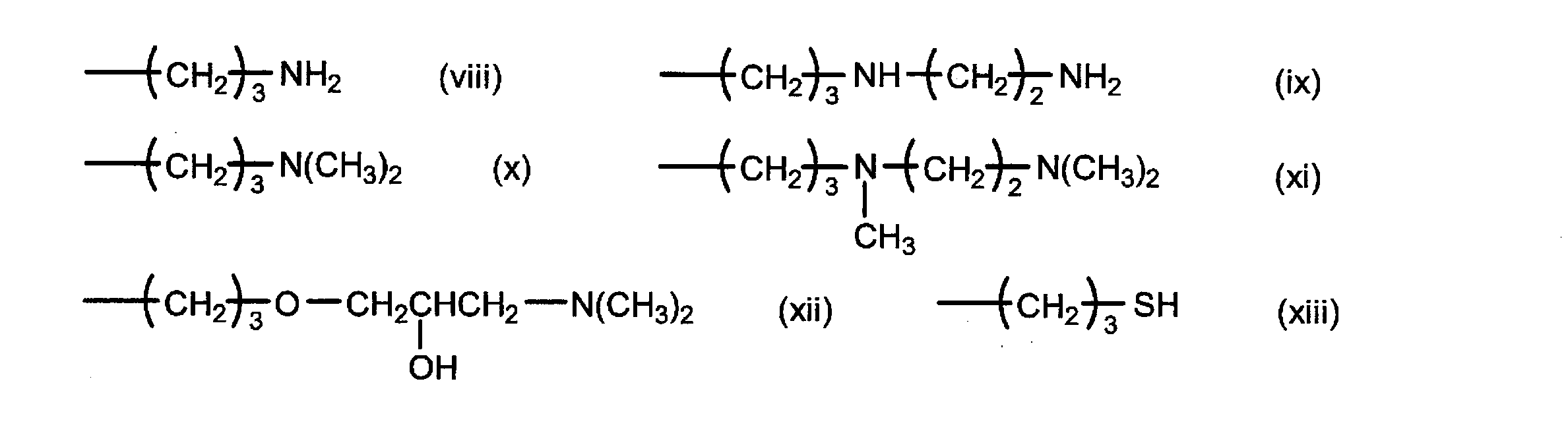
で表される変性オルガノポリシロキサンと、下記一般式(7)
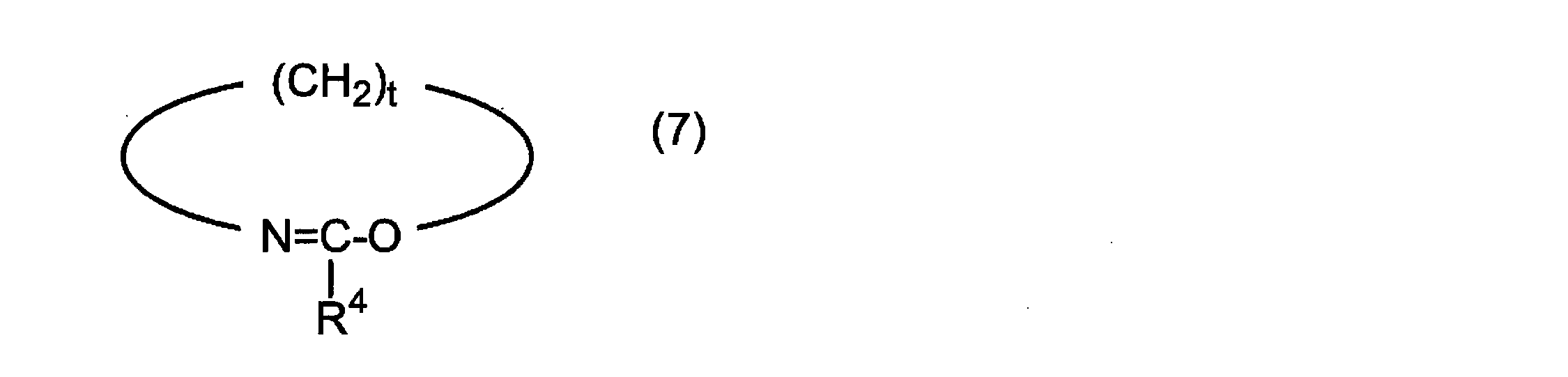
で表される環状イミノエーテルを開環重合して得られる末端反応性ポリ(N-アシルアルキレンイミン)とを反応させることにより製造され、一般式(6)で表される変性オルガノポリシロキサンと、末端反応性ポリ(N-アシルアルキレンイミン)の質量比(変性オルガノポリシロキサン/末端反応性ポリ(N-アシルアルキレンイミン))が、好ましくは80/20~95/5であって、83/17~93/7がより好ましく、85/15~90/10がさらに好ましい前記<1>~<13>のいずれか1記載の化粧料。
<16>さらに、20℃で液状の油剤を含有し、好ましくはシリコーン油、炭化水素油、エステル油であって、シリコーン油がより好ましく、ジメチルポリシロキサン、シクロポリシロキサンがさらに好ましい前記<1>~<15>のいずれか1記載の化粧料。
<17>20℃で液状の油剤の含有量は、好ましくは10~50質量%であって、20~40質量%がより好ましい前記<16>記載の化粧料。
<18>さらに、界面活性剤を含有し、好ましくは非イオン界面活性剤であって、ポリエーテル変性シリコーンがより好ましい前記<1>~<17>のいずれか1記載の化粧料。
<19>界面活性剤は、好ましくはHLB値が1以上、7以下であって、HLB値が2以上、6以下がより好ましい前記<18>記載の化粧料。
<20>界面活性剤の含有量は、好ましくは0.1~6質量%であって、0.2~3質量%がより好ましい前記<18>又は<19>記載の化粧料。
<21>好ましくは油中水型乳化化粧料であって、液状、乳液状、クリーム状、ジェル状が好ましく、乳液状がより好ましい前記<1>~<20>のいずれか1記載の化粧料。
<22>液状ファンデーション、化粧下地、日焼け止め乳液、日焼け止めクリームが好ましい前記<1>~<21>のいずれか1記載の化粧料。

温度計、冷却管を備えた2Lの四つ口フラスコに、FA-6 (ユニマッテク社製)800g(2.2mol)と粒状NaOH(和光純薬社製)175.78g(4.4mol)を加えた。窒素雰囲気下で、テフロン(登録商標)製12cm三日月攪拌翼にて200rpmにて攪拌しながら、加熱し、フラスコ内温度を60℃とした。そこへ臭化アリル(和光純薬社製)398.73g(3.3mol)を2時間かけて滴下した。滴下終了後70℃で1時間、80℃で1時間撹拌した。その後130℃に昇温し、過剰の臭化アリルを除去した。60℃まで冷却後、イオン交換水800gを入れ、30分間攪拌、その後静置して分層させた。上層の水層を抜き出し、さらにイオン交換水800gを入れ、再度攪拌、静置、水層除去を行った。60℃/5KPaにて脱水し、100℃/2KPaにて蒸留し、留分として、C6F13-CH2CH2-O-CH2CH=CH2 774.9gを得た(収率88%)。


温度計を備えた300mLの四つ口フラスコに、下式で表されるハイドロジェンポリシロキサン(信越化学社製)21.29g(51mmol)を加え、窒素雰囲気下、テフロン(登録商標)製8cm三日月翼にて200rpmで攪拌し、2質量%塩化白金酸6水和物/イソプロピルアルコール0.26gを加え、110℃に昇温した。

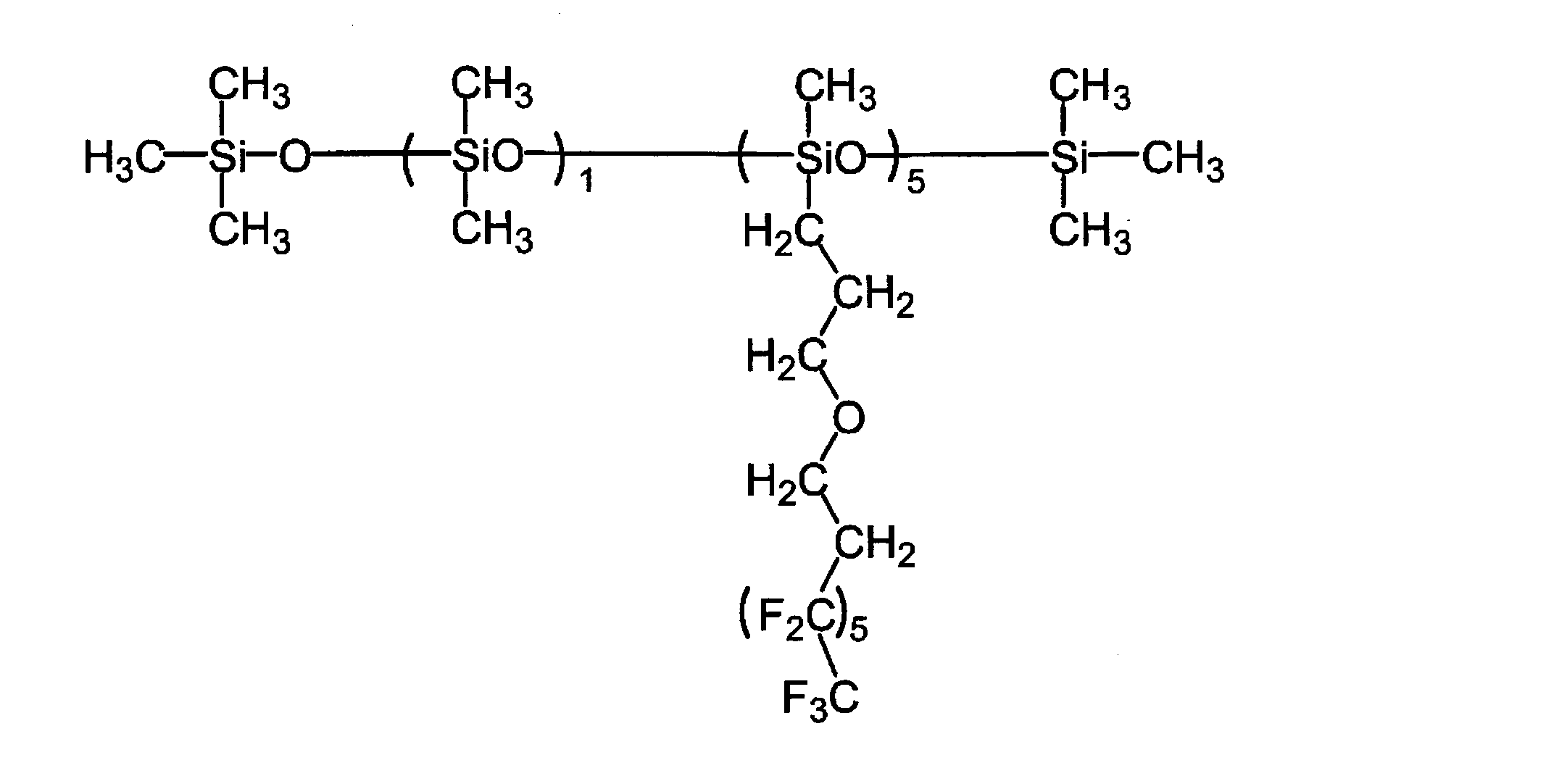
温度計を備えた300mLの四つ口フラスコに、下式で表されるハイドロジェンポリシロキサン(信越化学社製)17.61g(33mmol)を加え、窒素雰囲気下、テフロン(登録商標)製8cm三日月翼にて200rpmで攪拌し、2質量%塩化白金酸6水和物/イソプロピルアルコール0.27gを加え、110℃に昇温した。


2-エチル-2-オキサゾリン12.9g(0.13モル)と酢酸エチル27.7gとを混合し、混合液をモレキュラーシーブ(ゼオラムA-4、東ソー社製)2.0gで、28℃15時間脱水を行った。
また、側鎖一級アミノプロピル変性ポリジメチルシロキサン(KF-8015、信越シリコーン社製、重量平均分子量100000、アミン当量20000)100gと酢酸エチル203gとを混合し、混合液をモレキュラーシーブ15.2gで、28℃15時間脱水を行った。
上記の脱水2-エチル-2-オキサゾリンの酢酸エチル溶液に硫酸ジエチル0.77g(0.005モル)を加え、窒素雰囲気下8時間、80℃で加熱還流し、末端反応性ポリ(N-プロピオニルエチレンイミン)を合成した。GPCにより測定した数平均分子量は2700であった。
この末端反応性ポリ(N-プロピオニルエチレンイミン)溶液を、上記の脱水した側鎖一級アミノプロピル変性ポリジメチルシロキサン溶液を一括して加え、10時間、80℃で加熱還流した。
反応混合物を減圧濃縮し、N-プロピオニルエチレンイミン-ジメチルシロキサン共重合体を白色ゴム状固体(108g)として得た。最終生成物におけるオルガノポリシロキサンセグメントの質量比は0.87、最終生成物の重量平均分子量は115000であった。
2-エチル-2-オキサゾリン53.3g(0.54モル)と酢酸エチル127.46gとを混合し、混合液をモレキュラーシーブ(ゼオラムA-4、東ソー社製)9.0gで15時間脱水を行った。
また、側鎖一級アミノプロピル変性ポリジメチルシロキサン(KF-8003、信越シリコーン社製、重量平均分子量40000、アミン当量2000)153.7gと酢酸エチル312.06gとを混合し、混合液をモレキュラーシーブ23.29gで、28℃15時間脱水を行った。
上記の脱水2-エチル-2-オキサゾリンの酢酸エチル溶液に硫酸ジエチル9.48g(0.061モル)を加え、窒素雰囲気下8時間、80℃で加熱還流し、末端反応性ポリ(N-プロピオニルエチレンイミン)を合成した。GPCにより測定した数平均分子量は1300であった。
この末端反応性ポリ(N-プロピオニルエチレンイミン)溶液を、上記の脱水した側鎖一級アミノプロピル変性ポリジメチルシロキサン溶液を一括して加え、10時間、80℃で加熱還流した。
反応混合物を減圧濃縮し、N-プロピオニルエチレンイミン-ジメチルシロキサン共重合体を淡黄色ゴム状固体(200g)として得た。最終生成物におけるオルガノポリシロキサンセグメントの質量比は0.71、最終生成物の重量平均分子量は56000であった。
2-エチル-2-オキサゾリン3.63g(0.036モル)と酢酸エチル8.46gとを混合し、混合液をモレキュラーシーブ(ゼオラムA-4、東ソー社製)0.6gで、28℃15時間脱水を行った。
また、側鎖一級アミノプロピル変性ポリジメチルシロキサン(KF-8015、信越シリコーン社製、重量平均分子量100000、アミン当量20000)100gと酢酸エチル203gとを混合し、混合液をモレキュラーシーブ15.2gで、28℃15時間脱水を行った。
上記の脱水2-エチル-2-オキサゾリンの酢酸エチル溶液に硫酸ジエチル0.54g(0.0035モル)を加え、窒素雰囲気下8時間、80℃で加熱還流し、末端反応性ポリ(N-プロピオニルエチレンイミン)を合成した。GPCにより測定した数平均分子量は1200であった。
この末端反応性ポリ(N-プロピオニルエチレンイミン)溶液を、上記の脱水した側鎖一級アミノプロピル変性ポリジメチルシロキサン溶液を一括して加え、10時間、80℃で加熱還流した。
反応混合物を減圧濃縮し、N-プロピオニルエチレンイミン-ジメチルシロキサン共重合体を白色ゴム状固体(102g)として得た。最終生成物におけるオルガノポリシロキサンセグメントの質量比は0.96、最終生成物の重量平均分子量は104000であった。

表2及び表3に示す組成のW/O乳化ファンデーションを製造し、「肌のくすみのなさ」、「肌の明るさ」、「毛穴の目立ちにくさ」、「肌のキメが整ってみえる」、及び「肌へのつきの良さ」を評価した。結果を表2及び表3に併せて示す。
実施例1~15、比較例1~7について、全量を100gのスケールで計量を行う。成分(A)を含む油相(活性剤含)を、ディスパー(500r/min、5分)を用いて油相の予備分散を行う。次に、成分(B)及び(C)を含む粉体相を油相中に分散(1500r/min、10分)させ、粉体相が均一に分散したことを確認する。粉体相が均一になった油相を用いてプロペア(450r/min)で攪拌しながら徐々にエタノール相を添加し、約10分かけて水相成分を加えて乳化を行い、乳化保持をした後、ホモミキサーで粘度調整(3000r/min)を行い、脱泡して、W/O乳化ファンデーションを得た。
15名の専門パネラーが、各W/O乳化ファンデーションをスポンジで肌に塗布した直後の「肌のくすみのなさ」、「肌の明るさ」、「毛穴の目立ちにくさ」、「肌のキメが整ってみえる」及び「肌へのつきの良さ」を、以下の基準で評価した。表2及び表3に15名の積算値を記載する。
4;肌がくすんでいない。
3;肌があまりくすんでない。
2;肌がややくすんでいる。
1;肌がくすんでいる。
4;肌が明るくみえる。
3;肌がやや明るくみえる。
2;肌があまり明るくみえない。
1;肌が明るくみえない。
4;毛穴が目立たない。
3;毛穴があまり目立たない。
2;毛穴がやや目立つ。
1;毛穴が目立つ。
4;肌のキメが整ってみえる。
3;肌のキメがやや整ってみえる。
2;肌のキメがあまり整ってみえない。
1;肌のキメが整ってみえない。
4;肌へのつきが良い。
3;肌へのつきがやや良い。
2;肌へのつきがあまり良くない。
1;肌へのつきが良くない。

(組成)
(1)α-モノアルキルグリセリルエーテル(HLB1.8)
1.0(質量%)
(2)ジメチルシロキサン・メチル(ウンデシルグリセリルエーテル)
シロキサン共重合体(特開平4-108795号公報記載) 1.0
(3)ジメチルポリシロキサン・ポリオキシアルキレン共重合体
(信越化学工業社製、KF-6016) 1.0
(4)フッ素変性シリコーン(合成例1) 6.0
(5)デカメチルシクロペンタシロキサン
(東レ・ダウコーニング社製、シリコーンSH245) 15.0
(6)ジメチルポリシロキサン
(信越化学工業社製、KF-96L2CS) 20.0
(7)ジメチルポリシロキサン
(信越化学工業社製、KF-96A5CS) 3.0
(8)パラメトキシ桂皮酸2-エチルヘキシル 2.0
(9)香料 微量
(10)オキサゾリン変性シリコーン(合成例6) 1.0
(11)エタノール 2.0
(12)1,3-ブチレングリコール 2.0
(13)86%グリセリン 5.0
(14)精製水 残量
(15)防腐剤 適量
(16)FHS5質量%処理酸化チタン 8.0
(17)FHS5質量%処理ベンガラ 0.9
(18)FHS5質量%処理黄酸化鉄 3.0
(19)FHS5質量%処理黒酸化鉄 0.1
(20)FHS3質量%処理チタン内包シリカ(チタン含有量30%)
3.0
(21)FHS5質量%処理トスパール 4.0
(22)FHS5質量%タルク 5.0
(23)シリコーン処理微粒子酸化亜鉛
(シリコーン処理FINEX-M、比表面積40m2/g)
5.0
合計 100
粉体成分(16)~(23)を粗混合した後、アトマイザー粉砕機(不二パウダル社製)を用いて混合粉砕する。油相成分(1)~(9)を攪拌混合し、粉砕した粉体成分を添加し、ディスパーを用いて分散した。成分(10)及び(11)を混合攪拌し、油相に加える。更に水相成分(12)~(15)を混合し、油相成分に添加して乳化した。ホモミキサーで粘度調整して、クリーム状ファンデーションを得た。
(組成)
(1)ジメチルポリシロキサン・ポリオキシアルキレン共重合体
(信越化学工業社製、KF-6016) 0.4(質量%)
(2)フッ素変性シリコーン(合成例2) 12.0
(3)デカメチルシクロペンタポリシロキサン
(東レ・ダウコーニング社製、SH245) 15.0
(4)デカメチルテトラシロキサン
(信越化学工業社製、KF-96L1.5CS) 15.0
(5)ジメチルポリシロキサン
(信越化学工業社製、KF-96L2CS) 10.0
(6)パラメトキシ桂皮酸2-エチルヘキシル 0.5
(7)グリセリン 1.0
(8)精製水 残量
(9)オキサゾリン変性シリコーン(合成例6) 1.0
(10)エタノール 5.0
(11)FHS3質量%処理タルク 2.0
(12)FHS5質量%処理ナイロンパウダー 2.0
(13)FHS3質量%処理チタン内包シリカ(チタン30%)
2.0
(14)シリコーン処理微粒子酸化亜鉛
(MICRO ZINC OXIDE MZ-504R3M、比表面積40m2/g)
3.0
合計 100
粉体成分(12)~(15)を粗混合した後、アトマイザー粉砕機(不二パウダル社製)を用いて混合粉砕する。油相成分(1)~(7)を攪拌混合し、粉砕した粉体成分を添加し、ディスパーを用いて分散した。成分(10)及び(11)を攪拌混合し、油相に加える。更に、水相成分(8)~(9)を混合し、油相成分に添加して乳化した。ホモミキサーで粘度調整して、化粧下地を得た。
(組成)
(1)ジメチルポリシロキサン・ポリオキシアルキレン共重合体
(信越化学工業社製、ES-5612) 0.7(質量%)
(2)ジメチルポリシロキサン・ポリオキシアルキレン共重合体
(信越化学工業社製、KF-6015) 0.2
(3)フッ素変性シリコーン(合成例1) 8.0
(4)デカメチルシクロペンタポリシロキサン
(モメンティブ社製、TSF405A) 15.0
(5)デカメチルテトラシロキサン
(信越化学工業社製、KF-96L1.5CS) 3.0
(6)ジメチルポリシロキサン
(信越化学工業社製、KF-96L2CS) 15.0
(7)ジメチルポリシロキサン
(東レ・ダウコーニング社製、SH200C Fluid 5CS) 3.0
(8)パラメトキシ桂皮酸2-エチルヘキシル 6.0
(9)グリセリン 2.0
(10)ジプロピレングリコール 1.0
(11)精製水 残量
(12)オキサゾリン変性シリコーン(合成例6) 1.5
(13)エタノール 5.0
(14)FHS3質量%処理タルク(JA-46R) 1.0
(15)FHS5質量%処理ウレタンパウダー 2.0
(16)FHS3質量%処理チタン内包シリカ(チタン30%)
2.0
(17)FHS3質量%処理微粒子酸化チタン 5.0
(18)シリコーン処理微粒子酸化亜鉛
(MICRO ZINC OXIDE MZ-504R3M、比表面積40m2/g)
5.0
合計 100
粉体成分(14)~(18)を粗混合した後、アトマイザー粉砕機(不二パウダル社製)を用いて混合粉砕する。油相成分(1)~(8)を攪拌混合し、粉砕した粉体成分を添加し、ディスパーを用いて分散した。成分(12)及び(13)を攪拌混合し、油相に加える。更に、水相成分(9)~(11)を混合し、油相成分に添加して乳化した。ホモミキサーで粘度調整して、日焼け止め化粧料を得た。
Claims (16)
- 次の成分(A)、(B)、(C)及び(D):
(A)下記一般式(1)及び(2)

で表されるポリシロキサン単位を有するフッ素変性シリコーン 0.01~50質量%、
(B)トリデカフルオロオクチルトリエトキシシランで表面処理した粉体 0.01~40質量%、
(C)成分(B)を除く、比表面積10~100m2/gの微粒子酸化亜鉛 0.01~20質量%、
(D)主鎖を構成するオルガノポリシロキサンセグメントのケイ素原子の少なくとも2つに、ヘテロ原子を含むアルキレン基を介して、下記一般式(4);

で表される繰り返し単位からなるポリ(N-アシルアルキレンイミン)セグメントが結合してなるオルガノポリシロキサンであって、
ポリ(N-アシルアルキレンイミン)セグメントの数平均分子量が500~4000であり、
主鎖を構成するオルガノポリシロキサンセグメント(a)と、ポリ(N-アシルアルキレンイミン)セグメント(b)との質量比(a/b)が80/20~95/5であり、
隣接するポリ(N-アシルアルキレンイミン)セグメント間におけるオルガノポリシロキサンセグメントの重量平均分子量が10000~40000であり、主鎖を構成するオルガノポリシロキサンセグメントの重量平均分子量が50000~150000であるオルガノポリシロキサン 0.01~10質量%
を含有し、成分(A)及び(D)の質量割合(A)/(D)が、0.1~100である化粧料。 - 成分(A)を1~30質量%、成分(B)を1~20質量%、成分(C)を1~20質量%、成分(D)を0.1~5質量%含有する請求項1記載の化粧料。
- 成分(A)及び(C)の質量割合(A)/(C)が、0.1~10である請求項1又は2記載の化粧料。
- 成分(A)及び(B)の質量割合(A)/(B)が、0.01~50である請求項1~3のいずれか1項記載の化粧料。
- 成分(A)及び(B)の質量割合(A)/(B)が、0.1~10である請求項1~4のいずれか1項記載の化粧料。
- 成分(A)及び(D)の質量割合(A)/(D)が、2~40である請求項1~5のいずれか1項記載の化粧料。
- 成分(A)及び(D)の質量割合(A)/(D)が、4~15である請求項1~6のいずれか1項記載の化粧料。
- 成分(A)において、一般式(1)及び(2)中、p/(p+s)の割合が、0.75≦p/(p+s)≦0.83である請求項1~7のいずれか1項記載の化粧料。
- 成分(C)がシリコーン処理した微粒子酸化亜鉛である請求項1~8のいずれか1項記載の化粧料。
- 成分(D)のオルガノポリシロキサンが、下記一般式(6)

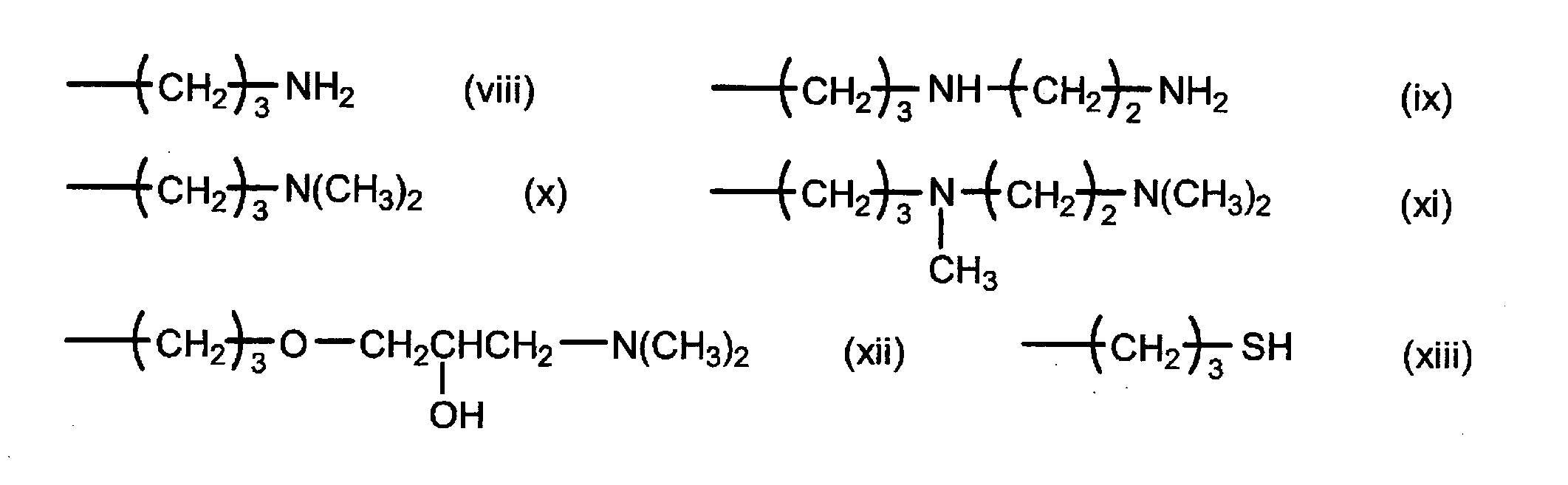
で表される変性オルガノポリシロキサンと、下記一般式(7)

で表される環状イミノエーテルを開環重合して得られる末端反応性ポリ(N-アシルアルキレンイミン)とを反応させることにより製造され、一般式(6)で表される変性オルガノポリシロキサンと、末端反応性ポリ(N-アシルアルキレンイミン)の質量比(変性オルガノポリシロキサン/末端反応性ポリ(N-アシルアルキレンイミン))が、83/17~93/7である請求項1~9のいずれか1項記載の化粧料。 - さらに、水の含有量が10~60質量%である請求項1~10のいずれか1項記載の化粧料。
- さらに、20℃で液状のシリコーン油、炭化水素油、エステル油の含有量が10~50質量%である請求項1~11のいずれか1項記載の化粧料。
- さらに、界面活性剤が、非イオン界面活性剤である請求項1~12のいずれか1項記載の化粧料。
- 非イオン界面活性剤のHLB値が1以上、7以下である請求項13記載の化粧料。
- 界面活性剤の含有量が0.1~6質量%である請求項1~14のいずれか1項記載の化粧料。
- 油中水型乳化化粧料である請求項1~15のいずれか1項記載の化粧料。
Priority Applications (4)
| Application Number | Priority Date | Filing Date | Title |
|---|---|---|---|
| US14/380,608 US9408800B2 (en) | 2012-02-28 | 2013-02-25 | Cosmetic composition |
| EP13755284.0A EP2821059B1 (en) | 2012-02-28 | 2013-02-25 | Cosmetic composition |
| JP2014502213A JP5679502B2 (ja) | 2012-02-28 | 2013-02-25 | 化粧料 |
| CN201380011512.1A CN104136001B (zh) | 2012-02-28 | 2013-02-25 | 化妆品 |
Applications Claiming Priority (2)
| Application Number | Priority Date | Filing Date | Title |
|---|---|---|---|
| JP2012-041704 | 2012-02-28 | ||
| JP2012041704 | 2012-02-28 |
Publications (1)
| Publication Number | Publication Date |
|---|---|
| WO2013129330A1 true WO2013129330A1 (ja) | 2013-09-06 |
Family
ID=49082527
Family Applications (1)
| Application Number | Title | Priority Date | Filing Date |
|---|---|---|---|
| PCT/JP2013/054799 Ceased WO2013129330A1 (ja) | 2012-02-28 | 2013-02-25 | 化粧料 |
Country Status (6)
| Country | Link |
|---|---|
| US (1) | US9408800B2 (ja) |
| EP (1) | EP2821059B1 (ja) |
| JP (1) | JP5679502B2 (ja) |
| CN (1) | CN104136001B (ja) |
| TW (1) | TWI558417B (ja) |
| WO (1) | WO2013129330A1 (ja) |
Cited By (3)
| Publication number | Priority date | Publication date | Assignee | Title |
|---|---|---|---|---|
| JP2013181008A (ja) * | 2012-03-02 | 2013-09-12 | Kao Corp | 化粧料 |
| JP2013181007A (ja) * | 2012-03-02 | 2013-09-12 | Kao Corp | 化粧料 |
| JP2015224246A (ja) * | 2014-05-30 | 2015-12-14 | 花王株式会社 | 油中水型乳化化粧料 |
Families Citing this family (3)
| Publication number | Priority date | Publication date | Assignee | Title |
|---|---|---|---|---|
| CN105581923B (zh) * | 2016-02-24 | 2019-04-05 | 汕头市奇伟实业有限公司 | 一种彩妆粉基定妆组合物及其制备方法 |
| TWI823851B (zh) * | 2017-05-30 | 2023-12-01 | 日商花王股份有限公司 | 油中水型乳化組成物 |
| JP7169813B2 (ja) * | 2018-08-09 | 2022-11-11 | 花王株式会社 | 被膜の製造方法 |
Citations (8)
| Publication number | Priority date | Publication date | Assignee | Title |
|---|---|---|---|---|
| JPS6184312A (ja) | 1984-09-28 | 1986-04-28 | Nippon Kokan Kk <Nkk> | 溶鋼のア−ク加熱方法 |
| JPH02295913A (ja) * | 1989-05-10 | 1990-12-06 | Shiseido Co Ltd | 固型粉末化粧料 |
| JPH04108795A (ja) | 1990-08-30 | 1992-04-09 | Kao Corp | 新規シロキサン誘導体、その製造方法及びこれを含有する化粧料 |
| JPH07277914A (ja) | 1994-04-04 | 1995-10-24 | Kao Corp | 化粧料 |
| JPH09249518A (ja) * | 1996-03-19 | 1997-09-22 | Kao Corp | 変性シロキサン化合物、その製造法及びこれを含有する化粧料 |
| JP2008143837A (ja) * | 2006-12-11 | 2008-06-26 | Pola Chem Ind Inc | 粉体含有化粧料 |
| JP2008143821A (ja) * | 2006-12-08 | 2008-06-26 | Kao Corp | 乳化化粧料 |
| JP2009035511A (ja) * | 2007-08-02 | 2009-02-19 | Kao Corp | 化粧料 |
Family Cites Families (12)
| Publication number | Priority date | Publication date | Assignee | Title |
|---|---|---|---|---|
| EP0640644B1 (en) | 1992-03-10 | 1999-07-07 | Kao Corporation | Fluorine-modified silicone derivative, production thereof, and cosmetic containing the same |
| JP2720134B2 (ja) * | 1992-12-15 | 1998-02-25 | 花王株式会社 | フッ素変性シリコーン及びその製造方法、並びにそれを含有する化粧料 |
| JP3040661B2 (ja) | 1994-06-07 | 2000-05-15 | 花王株式会社 | 化粧料 |
| JPH0826931A (ja) | 1994-07-08 | 1996-01-30 | Kao Corp | 化粧料 |
| JP3726843B2 (ja) | 1994-08-04 | 2005-12-14 | 花王株式会社 | 乳化化粧料 |
| JP3484303B2 (ja) | 1996-11-08 | 2004-01-06 | 花王株式会社 | 化粧料 |
| AU2003220538A1 (en) * | 2002-03-28 | 2003-10-13 | The Procter And Gamble Company | Particle stabilizing compositions |
| DE102007061701A1 (de) * | 2007-12-19 | 2009-06-25 | Eckart Gmbh | Metalleffektpigmente, Verfahren zu deren Herstellung sowie Verwendung derselben und Pulverlack |
| ES2395332T3 (es) * | 2007-12-19 | 2013-02-12 | Shiseido Company, Ltd. | Procedimiento de producción de una preparación cosmética en polvo |
| EP2289484A4 (en) | 2008-05-21 | 2014-08-13 | Miyoshi Kasei Inc | SURFACE-TREATED POWDER AND COSMETICS THEREWITH |
| TW201032832A (en) | 2009-03-03 | 2010-09-16 | Miyoshi Kasei Inc | Surface-treated powder and cosmetic incorporated with the same |
| JP5570764B2 (ja) * | 2009-07-07 | 2014-08-13 | 花王株式会社 | 化粧料 |
-
2013
- 2013-02-25 CN CN201380011512.1A patent/CN104136001B/zh not_active Expired - Fee Related
- 2013-02-25 EP EP13755284.0A patent/EP2821059B1/en not_active Not-in-force
- 2013-02-25 JP JP2014502213A patent/JP5679502B2/ja not_active Expired - Fee Related
- 2013-02-25 US US14/380,608 patent/US9408800B2/en not_active Expired - Fee Related
- 2013-02-25 WO PCT/JP2013/054799 patent/WO2013129330A1/ja not_active Ceased
- 2013-02-27 TW TW102106900A patent/TWI558417B/zh not_active IP Right Cessation
Patent Citations (8)
| Publication number | Priority date | Publication date | Assignee | Title |
|---|---|---|---|---|
| JPS6184312A (ja) | 1984-09-28 | 1986-04-28 | Nippon Kokan Kk <Nkk> | 溶鋼のア−ク加熱方法 |
| JPH02295913A (ja) * | 1989-05-10 | 1990-12-06 | Shiseido Co Ltd | 固型粉末化粧料 |
| JPH04108795A (ja) | 1990-08-30 | 1992-04-09 | Kao Corp | 新規シロキサン誘導体、その製造方法及びこれを含有する化粧料 |
| JPH07277914A (ja) | 1994-04-04 | 1995-10-24 | Kao Corp | 化粧料 |
| JPH09249518A (ja) * | 1996-03-19 | 1997-09-22 | Kao Corp | 変性シロキサン化合物、その製造法及びこれを含有する化粧料 |
| JP2008143821A (ja) * | 2006-12-08 | 2008-06-26 | Kao Corp | 乳化化粧料 |
| JP2008143837A (ja) * | 2006-12-11 | 2008-06-26 | Pola Chem Ind Inc | 粉体含有化粧料 |
| JP2009035511A (ja) * | 2007-08-02 | 2009-02-19 | Kao Corp | 化粧料 |
Cited By (3)
| Publication number | Priority date | Publication date | Assignee | Title |
|---|---|---|---|---|
| JP2013181008A (ja) * | 2012-03-02 | 2013-09-12 | Kao Corp | 化粧料 |
| JP2013181007A (ja) * | 2012-03-02 | 2013-09-12 | Kao Corp | 化粧料 |
| JP2015224246A (ja) * | 2014-05-30 | 2015-12-14 | 花王株式会社 | 油中水型乳化化粧料 |
Also Published As
| Publication number | Publication date |
|---|---|
| CN104136001A (zh) | 2014-11-05 |
| EP2821059A1 (en) | 2015-01-07 |
| US20150037418A1 (en) | 2015-02-05 |
| EP2821059B1 (en) | 2018-07-04 |
| EP2821059A4 (en) | 2015-11-11 |
| US9408800B2 (en) | 2016-08-09 |
| TW201340983A (zh) | 2013-10-16 |
| CN104136001B (zh) | 2016-11-09 |
| JPWO2013129330A1 (ja) | 2015-07-30 |
| TWI558417B (zh) | 2016-11-21 |
| JP5679502B2 (ja) | 2015-03-04 |
Similar Documents
| Publication | Publication Date | Title |
|---|---|---|
| JP5956837B2 (ja) | 油中水型乳化化粧料 | |
| JP5679501B2 (ja) | 化粧料 | |
| JP5679502B2 (ja) | 化粧料 | |
| JP6029378B2 (ja) | 油中水型乳化化粧料 | |
| JP2007532754A (ja) | シルセスキオキサン樹脂ワックス | |
| JP6029383B2 (ja) | 油中水型乳化化粧料 | |
| JP6035121B2 (ja) | 油中水型乳化化粧料 | |
| JP5679500B2 (ja) | 化粧料 | |
| JP5930775B2 (ja) | 化粧料 | |
| JP5930776B2 (ja) | 化粧料 | |
| JP2013234133A (ja) | 油中水型乳化化粧料 | |
| JP5833476B2 (ja) | 化粧料 | |
| JP6325294B2 (ja) | 油中水型乳化化粧料 | |
| JP6858504B2 (ja) | 油中水型乳化化粧料 | |
| JP6295158B2 (ja) | 水中油型乳化化粧料 | |
| JP6279315B2 (ja) | 油性化粧料 | |
| JP2013043847A (ja) | 油中水型乳化化粧料 |
Legal Events
| Date | Code | Title | Description |
|---|---|---|---|
| 121 | Ep: the epo has been informed by wipo that ep was designated in this application |
Ref document number: 13755284 Country of ref document: EP Kind code of ref document: A1 |
|
| ENP | Entry into the national phase |
Ref document number: 2014502213 Country of ref document: JP Kind code of ref document: A |
|
| WWE | Wipo information: entry into national phase |
Ref document number: 14380608 Country of ref document: US |
|
| WWE | Wipo information: entry into national phase |
Ref document number: 2013755284 Country of ref document: EP |
|
| NENP | Non-entry into the national phase |
Ref country code: DE |