WO2013129343A1 - Matériau de couverture de plaie - Google Patents
Matériau de couverture de plaie Download PDFInfo
- Publication number
- WO2013129343A1 WO2013129343A1 PCT/JP2013/054830 JP2013054830W WO2013129343A1 WO 2013129343 A1 WO2013129343 A1 WO 2013129343A1 JP 2013054830 W JP2013054830 W JP 2013054830W WO 2013129343 A1 WO2013129343 A1 WO 2013129343A1
- Authority
- WO
- WIPO (PCT)
- Prior art keywords
- wound
- layer
- covering
- opening
- wound part
- Prior art date
- Legal status (The legal status is an assumption and is not a legal conclusion. Google has not performed a legal analysis and makes no representation as to the accuracy of the status listed.)
- Ceased
Links
Images




Classifications
-
- A—HUMAN NECESSITIES
- A61—MEDICAL OR VETERINARY SCIENCE; HYGIENE
- A61F—FILTERS IMPLANTABLE INTO BLOOD VESSELS; PROSTHESES; DEVICES PROVIDING PATENCY TO, OR PREVENTING COLLAPSING OF, TUBULAR STRUCTURES OF THE BODY, e.g. STENTS; ORTHOPAEDIC, NURSING OR CONTRACEPTIVE DEVICES; FOMENTATION; TREATMENT OR PROTECTION OF EYES OR EARS; BANDAGES, DRESSINGS OR ABSORBENT PADS; FIRST-AID KITS
- A61F13/00—Bandages or dressings; Absorbent pads
- A61F13/01—Non-adhesive bandages or dressings
- A61F13/01021—Non-adhesive bandages or dressings characterised by the structure of the dressing
- A61F13/01029—Non-adhesive bandages or dressings characterised by the structure of the dressing made of multiple layers
Definitions
- the present invention relates to a wound part covering material used for covering and treating a wound part and a wound part covering material kit using the wound part covering material.
- Patent Document 1 discloses a wound covering material for absorbing and retaining exudate.
- This wound covering material has hydrophobicity, the air permeability of JISL1096 is 20 to 2000 cm 3 / cm 2 ⁇ s, and the water repellency of JISL1092 is 3 points or more, so that the function of initial water pressure resistance is achieved.
- And includes a first layer including a porous sheet facing the wound surface and a second layer that functions to absorb exudate that has exuded from the wound site and permeated through the first layer. .
- the exudate from the wound part was appropriately held in the wound part covering material, and thereby covered with the wound part covering material.
- the wound area is properly moist.
- the wound part is unnecessarily pressed by the exudate being appropriately discharged from the wound part.
- the wound part covering material adheres to the wound part or is rubbed against the wound part so that the wound part covering material itself does not cause deterioration of the wound.
- the wound covering material adheres to the wound portion, even if the wound portion has a therapeutic effect, when the wound covering material is removed, the wound covering material fixed to the wound portion is useless to the skin of the wound portion. Since an external force is applied and a possibility of another injury occurs on the surface of the wound part, it is important to avoid the sticking.
- an object of the present invention is to provide a wound covering technique that contributes to improving the covering effect of a wound.
- covering material which has a liquid-permeable 1st layer and the liquid-absorbing 2nd layer accumulated on the said 1st layer is comprised.
- Liquid permeability in the first layer includes both an aspect in which the first layer permeates all of the liquid (typically exudate from the wound part) and a part of the aspect.
- Liquid absorbency in the second layer refers to a state in which the second layer absorbs and holds the liquid (typically exudate from the wound), and absorbs and holds all of the liquid. Embodiments include both embodiments and partially absorbing and retaining embodiments.
- the “wound” in the present invention includes various cases such as burns, pressure sores, contusions, abrasions, or ulcers.
- the first layer and the second layer include both a mode in which they are directly stacked and a mode in which they are stacked in a state in which an intervening layer is provided between them.
- the intervening layer is constituted by a liquid-absorbing layer, so that the second layer and the liquid-absorbing / holding can cooperate with each other.
- both the aspect which comprises an intervening layer by a single layer, and the aspect comprised by multiple layers are included.
- the first layer in the present invention is constituted by a porous sheet in which a plurality of holes are formed.
- the porous sheet which comprises a 1st layer has the wound part coating
- the plurality of holes need only be formed in the first layer so as to correspond to at least the wound portion covering region, but may be formed over the entire surface of the first layer.
- Each of the plurality of holes in the porous sheet has a first opening formed in the wound covering surface and a second opening formed in the second layer facing surface. In other words, for each of the plurality of holes, the opening facing the wound portion covering surface corresponds to the first opening, and the opening facing the second layer facing surface corresponds to the second opening.
- the opening ratio of the said 1st opening part which occupies for a wound part covering surface is set so that it may become larger than the opening ratio of the 2nd opening part which occupies for a 2nd layer side opposing surface.
- the opening ratio in each surface is defined by the area ratio of the opening to the entire surface. That is, the opening ratio of the first opening is larger than the opening ratio of the second opening.
- the ratio of the total area of the first opening of each hole to the area (effective area) of the wound covering surface is the second layer. It means that it is set to be larger than the ratio of the total area of the second openings of each hole to the area (effective area) of the side facing surface.
- the opening ratio of the first opening occupying the wound part covering surface as described above is easily taken into the wound covering material through the first opening, and the second taken-in liquid absorbs or holds the liquid from the second layer.
- the second opening and the first layer facing the layer it is possible to prevent leakage to the outside, particularly the wound part side, as much as possible. Thereby, the appropriate wet state in the wound part covered can be maintained.
- the ratio which a wound part coating surface directly contacts a wound part can be made relatively small by setting the opening ratio by the 1st opening part in a wound part coating surface relatively large. This makes it possible to effectively prevent the wound covering surface from sticking to the wound and aggravating the symptoms of the wound, and dealing with a wide range of symptoms from mild to severe. It becomes possible.
- the present invention is particularly suitable for use as a pressure ulcer sheet because it is configured to enable maintaining a proper wet state of the wound part while reducing the ratio of direct contact with the wound part.
- the first layer and the second layer are preferably joined to each other by welding or an adhesive.
- the first layer and the second layer are formed by hot-melt fibers or partially mixed with hot-melt fibers, and the hot-melt fibers are heat-welded to form the first layer and the second layer.
- An embodiment in which the layers are welded is preferred.
- the first layer is interposed between the second layer and the wound part, thereby preventing the second layer from directly contacting the wound part.
- the first opening having a predetermined opening ratio with respect to the wound surface covering surface preferably maintains the liquid absorption amount of exudate from the wound in the second layer at a predetermined amount.
- the second opening portion having a predetermined opening ratio with respect to the second layer side facing surface maintains a predetermined amount of leakage of exudate held in the second layer to the wound portion side.
- each of the plurality of holes is preferably formed such that the cross-sectional area sequentially decreases from the first opening toward the second opening.
- the liquid absorption promotion from a wound part and suppression of the liquid leakage from a 2nd layer are implement
- “sequential reduction” can be set in various modes such as a mode in which the cross-sectional area decreases at a constant rate, a mode in which the rate of reduction changes according to the depth position, and the like.
- each of the plurality of holes is preferably formed in a substantially conical shape having the first opening and the second opening as the bottom surface and the top surface, respectively.
- “Forming in a conical shape” means that each of a plurality of holes forms an inverted cone shape (conical shape) when the wound covering material is observed from the side surface. Promotion of liquid absorption and suppression of liquid leakage from the second layer can be realized more reliably.
- the first layer is preferably set so that the ratio of the exudate absorbed by the second layer to the wound surface side is within about 5%. Thereby, it can suppress that a wound part wets excessively.
- 5 milliliters of a 0.9 percent sodium chloride solution is supplied to the second layer through the wound covering surface of the first layer and a load of 5 grams per square centimeter is applied to the wound covering surface.
- the amount of leakage when acting for a minute is preferably suppressed within a range of approximately 0 to 0.1 grams. Thereby, it can suppress that a wound part wets excessively.
- the opening ratio of the first opening occupying the wound surface is set to about 50 to 95 percent, preferably about 50 to 90 percent.
- the opening ratio of the first opening is set to about 50 to 95 percent, preferably about 50 to 90 percent.
- the opening ratio of the first opening occupying the wound covering surface is set to about 75 to 95 percent, preferably about 80 to 95 percent. This makes it possible to ultimately ensure the wettability of the wound part and reduce the contact area with the wound part.
- the opening ratio of the second opening occupying the second layer side facing surface is set to approximately 3 to 50 percent.
- the opening ratio of the second opening occupying the second layer side facing surface is set to about 3 to 20 percent, preferably about 3 to 15 percent. This makes it possible to ultimately reduce the amount of leakage of the liquid absorbed and held in the second layer to the wound part.
- the apparent thickness of the first layer is set to about 0.1 to 1.2 mm from the viewpoints of healing performance, wet state maintenance, and liquid return properties. More preferably, it is more preferably set to about 0.3 to 1.2.
- the ventilation resistance value from the wound layer covering surface of the first layer to the side surface opposite to the first layer in the second layer is set to be 0.1 Ks ⁇ s / m or less. It is preferable. By keeping the ventilation resistance value relatively low, it is possible to effectively prevent the wounded part from becoming too steamy and adversely affecting healing.
- the second layer is formed on the first layer facing surface facing the first layer and on the opposite side of the first layer facing surface, and the wound covering material is used as a wound portion.
- covering material which concerns on this invention can be used together with another dressing material, and can be applied to an affected part, and it contributes to a healing property improvement.
- the secondary dressing material for example, a diaper is preferably applicable.
- the static friction coefficient of the secondary dressing material facing surface with respect to the secondary dressing material is set to be smaller than the static friction coefficient of the wound portion covering surface with respect to the wound portion.
- the wound part covering material can be prevented from sliding and rubbing against the wound part, which contributes to effective protection of the wound part. That is, as one aspect of the present invention, when an external force is applied to the wound part covering material, the contact between the first layer and the wound part is maintained and the second layer and the secondary dressing material are maintained.
- a wound covering material is constructed that is configured to cause relative movement.
- an adhesive layer for adhering to the vicinity of the wound part is provided in the first layer adjacent to the wound part covering surface.
- the material for the adhesive layer for example, an acrylic pressure-sensitive adhesive, a urethane pressure-sensitive adhesive, or a laminate of a urethane film and an acrylic pressure-sensitive adhesive is preferably used.
- the surface portion of the adhesive layer is preferably configured so as to be substantially flush with the first layer, particularly the second layer facing surface of the first layer.
- an adhesive layer on the surface of the second layer opposite to the first layer. If comprised in this way, a wound part coating
- covering material can be easily fixed and positioned to secondary dressing materials, such as a diaper, a bandage, and gauze, and is rational.
- the adhesive layer can be composed of an adhesive urethane film or the like, and further, the adhesive layer adjacent to the wound portion covering surface and the adhesive layer on the side facing the secondary dressing material are integrally formed. Also good.
- the adhesive layer is covered with silica paper or film, and when used, the silica paper or film is peeled off and removed, and the adhesive layer is exposed for use.
- a third layer is disposed on the surface of the second layer opposite to the surface facing the first layer.
- the third layer is preferably a porous sheet having the same configuration as the first layer.
- a liquid-impervious leak-proof film is used for the third layer.
- a wound part covering kit including the wound part covering material and a secondary dressing material that receives the wound part covering material with the wound part is configured.
- the second layer in the wound covering material is formed on the first layer facing surface facing the first layer and on the side opposite to the first layer facing surface, and is capable of contacting the secondary dressing material. It is preferable that the wound dressing material and the secondary dressing material are integrally combined through the secondary dressing material facing surface.
- This wound part covering kit is one implementation configuration example corresponding to the “wound part covering kit” in the present invention.
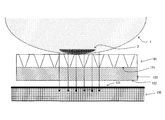
- FIG. 3 is a schematic cross-sectional view showing a detailed configuration of a wound part covering sheet 101 according to Example 1.
- FIG. 3 is a schematic cross-sectional view showing a detailed configuration of a wound part covering sheet 101 according to Example 1.
- FIG. It is typical sectional drawing which shows one embodiment of the performance evaluation of the wound part coating sheet 101 which concerns on Example 1.
- FIG. It is typical sectional drawing which shows one embodiment of the performance evaluation of the wound part coating sheet 101 which concerns on Example 1.
- FIG. It is a figure which shows the performance evaluation result of the wound part coating sheet 101 which concerns on Example 1.
- FIG. It is a figure which shows the performance evaluation result of the wound part coating sheet 101 which concerns on Example 1.
- FIG. It is a figure which shows the performance evaluation result of the wound part coating sheet 101 which concerns on Example 1.
- FIG. It is a figure which shows the performance evaluation result of the wound part coating sheet 101 which concerns on Example 1.
- FIG. It is typical sectional drawing which shows the detailed structure of the wound part coating sheet 201 which concerns on Example 2 of this invention.
- the structure of the wound part covering sheet 101 according to Example 1 of the present invention is schematically shown in FIGS.
- the wound portion covering sheet 101 is formed integrally with a first layer 110 formed in a sheet shape and a second layer 120 similarly formed in a sheet shape by spray hot-melt surface bonding to each other. . Both may be joined by heat welding.
- the said wound part coating sheet 101 is one implementation structural example corresponding to the "wound part coating
- the first layer 110 and the second layer 120 are one implementation configuration example corresponding to the “first layer” and the “second layer” in the present invention.
- the first layer 110 is a liquid-permeable porous sheet 110 a that comes into contact with the wound part 2 or the skin surface 1 (in FIG. 3, the contact state with the wound part 2 is shown).
- Water pressure resistance that is, having a predetermined air permeability and water repellency, and is suitably constituted by, for example, a perforet film.
- This liquid-permeable porous sheet 110a is one embodiment configuration example corresponding to the “porous sheet” in the present invention.
- a nonwoven fabric made of a thermoplastic polymer can be used as the material for forming the first layer.
- the first layer 110 is attached to the skin surface 1 so as to face the wound portion 2 shown in FIG. 3 and the wound portion covering surface 111 for covering the wound portion 2 and the second layer 120 facing the second layer 120.
- a two-layer facing surface 112 is provided.
- the wound portion covering surface 111 and the second layer facing surface 112 are one implementation configuration example corresponding to the “wound portion covering surface” and the “second layer facing surface” of the present invention, respectively.
- the porous sheet 110a forming the first layer 110 has a plurality of holes 113 penetrating between the wound portion covering surface 111 and the second layer body construction surface 112. This hole 113 is one implementation configuration example corresponding to the “hole” of the present invention.
- Each of the plurality of holes 113 has a first opening 114 that opens to the wound covering surface 111 and a second opening 115 that opens to the second layer body construction surface 112.
- the 1st opening part 114 and the 2nd opening part 115 are one implementation structural example corresponding to the "1st opening part” and the “2nd opening part” of this invention, respectively.
- the ratio of the total area of the first openings 114 formed in large numbers on the wound covering surface 111 to the total area of the wound covering surface 111, that is, the opening ratio of the first opening 114 is the second layer side facing surface 112 is set such that the total area of the second openings 115 formed in large numbers on the area 112 occupies the total area of the second layer side facing surface 112, that is, the opening ratio of the second openings 115. .
- the specific values of the opening ratios of both will be described in detail in the following performance evaluation items.
- the second layer 120 shown in FIGS. 1 to 3 is preferably composed of a liquid-absorbing air laid nonwoven fabric or an air-through nonwoven fabric.
- the 2nd layer 120 has the 1st layer opposing surface 121 which goes to the 1st layer 110, and the secondary dressing opposing surface 122 which goes to the diaper 130 shown in FIG.
- the second layer 120, the first layer facing surface 121, and the secondary dressing material facing surface 122 are each one of the “second layer”, “first layer facing surface”, and “secondary dressing material facing surface” in the present invention. It is an implementation structural example.
- thermo welding by heat sealing is used, but in addition, adhesion using a hot melt adhesive or the like, polymerization by embossing, etc. Is possible.
- the wound portion covering sheet 101 according to the first embodiment is applied to the wound portion 2 on the skin surface 1 of the patient after being placed on the diaper 130.
- a wound part covering sheet placement surface 131 is formed on the diaper 130, and the wound part covering sheet 101 is placed on and integrated with the wound part covering sheet placement surface 131 (FIG. 3).
- the two are shown apart from each other).
- the diaper 130 and the wound part covering sheet placement surface 131 are one implementation configuration example corresponding to the “secondary dressing material” and the “wound part covering material placement surface” in the present invention, respectively.
- the wound part covering sheet 101 is configured as described above.
- the opening ratio of the first opening 114 occupying the total area of the wound part covering surface 111 is the opening ratio of the second opening 115 occupying the total area of the second layer side facing surface 112. Is set larger than.
- the liquid (typically exudate) from the wound part 2 is easily taken into the wound part covering sheet 101 through the first opening 114, and the liquid once taken in absorbs or holds the liquid. It is possible to suppress leakage from the two layers 120 to the wound part 2 side through the second opening 115 and the first opening 114. Thereby, the appropriate wet state in the wound part 2 covered with the wound part covering sheet 101 can be maintained.
- the ratio in which the wound part covering surface 111 directly contacts the wound part 2 can be relatively reduced by setting the opening ratio of the first opening 114 in the wound covering surface 111 to be relatively large. Therefore, the situation where the wound part covering surface 111 sticks to and adheres to the wound part 2 and worsens the symptoms of the wound part 2 can be effectively suppressed.
- the performance evaluation regarding the wound part covering sheet 101 described above was performed. Specifically, for various samples, (A) confirmation evaluation of the healing state, (B) confirmation evaluation of the wet state in the wound part, (C) confirmation evaluation of liquid return to the wound part, and (D) ventilation It is a confirmation evaluation of sex.
- Performance evaluation 1 First, performance evaluation 1 will be described. As a sample, perforet film is used for the first layer, the basis weight is 24 g / m 2 (gram / square meter), and the thickness is 0.3 mm (millimeter). A wound part covering sheet 101 having a thickness of 30 g / m 2 and a thickness of 0.7 mm is prepared, and in the first layer 110, the opening ratio of the second opening 115 occupying the second layer facing surface 112 is fixed to 15%. In each of the samples 1 to 6 of the wound covering sheet 101, the opening ratio of the first opening 114 occupying the wound covering surface 111 is set to 39%, 47%, 58%, 80%, 90% and 95%. Prepared.
- each sample of the wound portion covering sheet 101 according to Example 1 is affixed to a patient having a wound on the sacrum, respectively,
- the wound healing state with the diaper worn is evaluated by a treatment specialist who mainly focuses on visual observation.
- the evaluation was “ ⁇ ”, and when the wound healing effect was remarkably obtained, the evaluation was “ ⁇ ”.
- (D) air permeability confirmation evaluation the intake air and the exhaust air are circulated for 3 seconds at an air flow rate of 4 cc / cm 2 ⁇ sec (4 cubic centimeters / square centimeter ⁇ second) with respect to the wound covering sheet.
- the ventilation resistance value (kPa ⁇ s / m) (kilopascal ⁇ second / meter) at that time was measured.
- an air permeability tester (KESF-8 manufactured by KATO TECK CO. LTD) was used.
- FIG. 6 shows the performance evaluation 1, that is, the evaluation result when the aperture ratio of the first opening 114 is changed.
- the performance evaluation For each of the samples 1 to 6 having different opening ratios of the first opening 114, as the performance evaluation, (A) confirmation evaluation of the healing state, (B) confirmation evaluation of the wet state in the wound part, (C) to the wound part
- the opening ratio of the first opening 114 to the wound part covering surface 111 is preferably set to approximately 50 to 95%, and further preferably approximately 75 to 95%. In particular, it was found that when it was set to about 80 to 95 percent, an excellent effect was achieved.
- the opening ratio of the second opening 115 to the second layer facing surface 112 is preferably set to approximately 3 to 50%, and further approximately 3 to 15%. When set to a percentage, it was recognized that an excellent effect was obtained particularly from the viewpoint of the ability to inhibit liquid return.
- the thickness of the first layer 110 is preferably set to about 0.1 to 1.2 mm, and further set to about 0.3 to 1.2. In particular, it was confirmed that excellent effects were obtained from the viewpoints of healing performance, wet state maintenance, and liquid return.
- liquid absorption performance of the wound covering sheet 101 according to the present embodiment having the above specifications is preferably set to about 1.8 g (grams).
- reference numeral I is a coefficient of static friction in the dry state of the wound covering surface 111 with respect to the wound part
- reference numeral II is a coefficient of static friction in the wet state of the wound covering surface 111 with respect to the wound part
- reference numeral III is the secondary dressing
- the coefficient of static friction in the dry state of the material structure surface 122 with respect to the diaper 130, and the symbol IV indicate the coefficient of static friction in the wet state of the secondary dressing material structure surface 122 with respect to the diaper 130, respectively.
- the sample 1 in which the opening ratio of the first opening 114 occupying the wound covering surface 111 is set to a relatively large value of 80% is in a dry state and wet compared to the other comparative examples.
- the static friction coefficient of the wound covering surface with respect to the wound portion is reduced, and the static friction coefficient of the secondary dressing material facing surface 122 with respect to the diaper 130 shows a relatively small value. Therefore, even when an external force is applied to the wound portion covering sheet 101, the adverse effect due to the friction of the wound portion covering surface 111 against the wound portion is reduced, and in a predetermined situation, a secondary having a relatively small static friction coefficient.
- the dressing material facing surface 122 slides and slides with respect to the diaper 130, and the wound portion covering surface 111 can be prevented from rubbing the wound portion and adversely affecting the medical condition.
- Example 2 relates to an assembly in which the wound part covering sheet 101 and the diaper 130 according to Example 1 described above are joined in advance to form an integrated body, that is, the wound part covering kit 201.
- the wound part covering kit 201 of Example 2 since the wound part covering sheet 101 is preliminarily incorporated into the diaper 130 at an appropriate position, the wound part covering sheet 101 automatically removes the wound part when the diaper 130 is worn. It becomes possible to cover, and even an unfamiliar patient can easily perform wound covering treatment.
- Example 3 Next, Example 3 will be described with reference to FIG.
- an adhesive layer 303 made of an acrylic adhesive, and an urethane formed by superimposing the adhesive layer 303 on the wound part covering sheet 101 described above.
- a film 304, a recycled paper 305, and a recycled film 307 are applied.
- Both end portions of the adhesive layer 303 and the urethane film 304 are arranged so as to be substantially flush with the first layer 110, particularly, flush with the second layer facing surface 112 of the first layer 110.
- the adhesive layer 303 and the urethane film 304 are disposed so as to cover the bottom surface 121a of the second layer 120.
- the pressure-sensitive adhesive layer 303 is one implementation configuration example corresponding to the “adhesive layer” in the present invention.
- the recoil film 307 is provided so as to cover the wound portion covering surface 111 of the adhesive layer 303 and the first layer 110, and to be detached from both of them.
- the waste paper 305 is detachably provided from the urethane film 304 on the bottom surface 121a side of the second layer 120.
- the ribbon film 307 and the ribbon paper 305 serve as protective sheets for the adhesive layer 303, the urethane film 304, and the wound portion covering surface 110 when not in use.
- the adhesive layer 303 By placing the adhesive layer 303 adjacent to the first layer 110, when the adhesive layer 303 is applied to the wound part 2 or the skin surface 1 (see FIG. 3) of the patient, it is accustomed to the use of the wound part covering sheet. Even a patient or a related person who has not been able to easily set the wound covering sheet in a proper position can contribute to the improvement of the therapeutic effect.
- both end portions of the adhesive layer 303 so as to be flush with the second layer facing surface 112 of the first layer 110, the wound portion is bonded to the wound portion 2 or the skin surface 1. It is possible to prevent a situation where the covering surface 111 is unnecessarily strongly bonded to the wound part 2 or conversely falls into the insufficient bonding.
- the wound dressing sheet 301 is subjected to secondary dressing such as a diaper, bandage, gauze or the like. It is reasonable to be able to easily position and fix the material.
- secondary dressing such as a diaper, bandage, gauze or the like. It is reasonable to be able to easily position and fix the material.
- the adhesive layer 303 and the urethane film 304 can be used for both the adhesion to the patient's wound or skin surface and the application to the secondary dressing material, the structure can be simplified. .
- Example 4 Next, Example 4 will be described with reference to FIG.
- the wound part covering sheet 401 according to Example 4 is equivalent to the first layer 110 on the surface opposite to the first layer 110 with respect to the second layer 120 with respect to the wound part covering sheet according to Example 1 described above.
- the third layer 410 having the structure is joined. By configuring in this way, the second layer 120 is sandwiched between the first layer 110 and the third layer 410, and is a so-called “double-sided type”. Will contribute to the improvement.
- the third layer 410 is one implementation configuration example corresponding to the “third layer” in the present invention.
- Example 5 is an aspect in which the leakage preventing film 503 is further bonded to the surface of the second layer 120 opposite to the first layer 110 in the wound part covering sheet 101 according to Example 1 described above. It is.
- the leak-proof film 503 is appropriately selected from, for example, polymer-based / resin-based materials and the like, and is one implementation configuration example corresponding to the “third layer” of the present invention.
- secondary dressing materials such as a diaper, a bandage, and a gauze, the wound part coating
- a wound covering material having a liquid-permeable first layer and a liquid-absorbing second layer superimposed on the first layer The first layer is composed of a porous sheet in which a plurality of holes are formed, The porous sheet has a wound portion covering surface that covers the wound portion, and a second layer facing surface that faces the second layer on the opposite side of the wound portion covering surface, Each of the plurality of holes has a first opening formed in the wound covering surface and a second opening formed in the second layer facing surface, A wound covering material in which an opening ratio of the first opening occupied in the wound covering surface is set larger than an opening ratio of the second opening occupied in the second layer side facing surface.
- the wound dressing material according to aspect 1 or 2 The wound dressing material according to aspect 1 or 2,
- the first opening portion having a predetermined opening ratio with respect to the wound portion covering surface maintains a predetermined amount of exudate from the wound portion in the second layer, and is opposed to the second layer side.
- the second opening having a predetermined opening ratio with respect to the surface maintains a predetermined amount of leakage of the exudate held in the second layer to the wound portion side, and exudation by the first opening
- the wound covering material, wherein the liquid absorption amount is set so as to exceed the leakage amount of exudate from the second opening.
- Each of the plurality of holes is formed in a substantially conical shape having the first opening and the second opening as a bottom surface and a top surface, respectively.
- the wound dressing material according to any one of aspects 1 to 12,
- the ventilation resistance value from the wound part covering surface of the first layer to the side surface opposite to the first layer in the second layer is set to be 0.1 Ks ⁇ s / m 2 or less. Wound covering material.
- the wound dressing material according to any one of aspects 1 to 13,
- the second layer is formed on the first layer facing surface facing the first layer and on the opposite side of the first layer facing surface, and receives the wound covering material between the wound portion and the secondary layer.
- a wound dressing material comprising a secondary dressing material facing surface capable of contacting the dressing material.
- a wound part covering kit comprising the wound part covering material according to any one of aspects 1 to 22 and a secondary dressing material that receives the wound part covering material with the wound part,
- the second layer in the wound covering material is formed on the first layer facing surface facing the first layer and on the opposite side of the first layer facing surface, and is capable of contacting the secondary dressing material.
- Adhesive urethane film (adhesive layer) 305 ... Rikei paper 307 ... Rikei film 401 ... Wound covering sheet (Example 4) 410 ... 3rd layer (3rd layer) 501 ... Wound covering sheet (Example 5) 503 ... Leak-proof film (third layer)
Landscapes
- Health & Medical Sciences (AREA)
- Engineering & Computer Science (AREA)
- Biomedical Technology (AREA)
- Heart & Thoracic Surgery (AREA)
- Vascular Medicine (AREA)
- Life Sciences & Earth Sciences (AREA)
- Animal Behavior & Ethology (AREA)
- General Health & Medical Sciences (AREA)
- Public Health (AREA)
- Veterinary Medicine (AREA)
- Materials For Medical Uses (AREA)
Applications Claiming Priority (2)
| Application Number | Priority Date | Filing Date | Title |
|---|---|---|---|
| JP2012-042545 | 2012-02-28 | ||
| JP2012042545A JP6067973B2 (ja) | 2012-02-28 | 2012-02-28 | 創傷部被覆材 |
Publications (1)
| Publication Number | Publication Date |
|---|---|
| WO2013129343A1 true WO2013129343A1 (fr) | 2013-09-06 |
Family
ID=49082540
Family Applications (1)
| Application Number | Title | Priority Date | Filing Date |
|---|---|---|---|
| PCT/JP2013/054830 Ceased WO2013129343A1 (fr) | 2012-02-28 | 2013-02-25 | Matériau de couverture de plaie |
Country Status (2)
| Country | Link |
|---|---|
| JP (1) | JP6067973B2 (fr) |
| WO (1) | WO2013129343A1 (fr) |
Cited By (7)
| Publication number | Priority date | Publication date | Assignee | Title |
|---|---|---|---|---|
| WO2019209562A1 (fr) * | 2018-04-23 | 2019-10-31 | Kci Licensing, Inc. | Pansement fournissant des ouvertures avec de multiples tailles d'orifice pour une thérapie par pression négative |
| US10736788B2 (en) | 2014-05-09 | 2020-08-11 | Kci Licensing, Inc. | Dressing with contracting layer for linear tissue sites |
| US10743900B2 (en) | 2014-05-09 | 2020-08-18 | Kci Licensing, Inc. | Disruptive dressing for use with negative pressure and fluid instillation |
| US10898217B2 (en) | 2014-05-09 | 2021-01-26 | Kci Licensing, Inc. | Dressing providing apertures with multiple orifice sizes for negative-pressure therapy |
| US12409072B2 (en) | 2019-12-05 | 2025-09-09 | Kci Manufacturing Unlimited Company | Multi-layer negative pressure incisional wound therapy dressing |
| US12447054B2 (en) | 2018-11-08 | 2025-10-21 | Solventum Intellectual Properties Company | Wound dressing with semi-rigid support to increase disruption using perforated dressing and negative pressure wound therapy |
| US12458387B2 (en) | 2014-05-09 | 2025-11-04 | Solventum Intellectual Properties Company | Debriding dressing for use with negative pressure and fluid instillation |
Families Citing this family (1)
| Publication number | Priority date | Publication date | Assignee | Title |
|---|---|---|---|---|
| GB2560513A (en) * | 2017-03-13 | 2018-09-19 | Ap Moeller Maersk As | Fuel injection system |
Citations (3)
| Publication number | Priority date | Publication date | Assignee | Title |
|---|---|---|---|---|
| JP2005510296A (ja) * | 2001-11-23 | 2005-04-21 | ジョンソン・アンド・ジョンソン・メディカル・リミテッド | ヒドロゲル層を含む吸収性創傷被覆材 |
| WO2008004380A1 (fr) * | 2006-07-06 | 2008-01-10 | Zuiko Corporation | Matériau de recouvrement d'une plaie |
| WO2011152368A1 (fr) * | 2010-06-01 | 2011-12-08 | 株式会社瑞光 | Feuille de surface pour un pansement pour plaies et pansement pour plaies |
-
2012
- 2012-02-28 JP JP2012042545A patent/JP6067973B2/ja active Active
-
2013
- 2013-02-25 WO PCT/JP2013/054830 patent/WO2013129343A1/fr not_active Ceased
Patent Citations (3)
| Publication number | Priority date | Publication date | Assignee | Title |
|---|---|---|---|---|
| JP2005510296A (ja) * | 2001-11-23 | 2005-04-21 | ジョンソン・アンド・ジョンソン・メディカル・リミテッド | ヒドロゲル層を含む吸収性創傷被覆材 |
| WO2008004380A1 (fr) * | 2006-07-06 | 2008-01-10 | Zuiko Corporation | Matériau de recouvrement d'une plaie |
| WO2011152368A1 (fr) * | 2010-06-01 | 2011-12-08 | 株式会社瑞光 | Feuille de surface pour un pansement pour plaies et pansement pour plaies |
Cited By (10)
| Publication number | Priority date | Publication date | Assignee | Title |
|---|---|---|---|---|
| US10736788B2 (en) | 2014-05-09 | 2020-08-11 | Kci Licensing, Inc. | Dressing with contracting layer for linear tissue sites |
| US10743900B2 (en) | 2014-05-09 | 2020-08-18 | Kci Licensing, Inc. | Disruptive dressing for use with negative pressure and fluid instillation |
| US10898217B2 (en) | 2014-05-09 | 2021-01-26 | Kci Licensing, Inc. | Dressing providing apertures with multiple orifice sizes for negative-pressure therapy |
| US12409076B2 (en) | 2014-05-09 | 2025-09-09 | Solventum Intellectual Properties Company | Dressing providing apertures with multiple orifice sizes for negative-pressure therapy |
| US12409075B2 (en) | 2014-05-09 | 2025-09-09 | Solventum Intellectual Properties Company | Dressing with contracting layer for linear tissue sites |
| US12408939B2 (en) | 2014-05-09 | 2025-09-09 | Solventum Intellectual Properties Company | Disruptive dressing for use with negative pressure and fluid instillation |
| US12458387B2 (en) | 2014-05-09 | 2025-11-04 | Solventum Intellectual Properties Company | Debriding dressing for use with negative pressure and fluid instillation |
| WO2019209562A1 (fr) * | 2018-04-23 | 2019-10-31 | Kci Licensing, Inc. | Pansement fournissant des ouvertures avec de multiples tailles d'orifice pour une thérapie par pression négative |
| US12447054B2 (en) | 2018-11-08 | 2025-10-21 | Solventum Intellectual Properties Company | Wound dressing with semi-rigid support to increase disruption using perforated dressing and negative pressure wound therapy |
| US12409072B2 (en) | 2019-12-05 | 2025-09-09 | Kci Manufacturing Unlimited Company | Multi-layer negative pressure incisional wound therapy dressing |
Also Published As
| Publication number | Publication date |
|---|---|
| JP6067973B2 (ja) | 2017-01-25 |
| JP2013176473A (ja) | 2013-09-09 |
Similar Documents
| Publication | Publication Date | Title |
|---|---|---|
| JP6067973B2 (ja) | 創傷部被覆材 | |
| JP4560415B2 (ja) | 吸収性物品 | |
| EP1374813B1 (fr) | Pansement adhesif avec une couche placée séléctivement | |
| KR101693953B1 (ko) | 탈색 구조를 갖는 흡수성 용품 | |
| KR101724762B1 (ko) | 흡수성 물품 | |
| US20180344533A1 (en) | Wound dressing | |
| KR101778808B1 (ko) | 흡수성 물품 | |
| JP6271186B2 (ja) | 吸収性物品 | |
| JP2004130079A5 (fr) | ||
| WO2005070362A1 (fr) | Article absorbant et article absorbant interne | |
| US20160213526A1 (en) | Absorbent article | |
| JP6067974B2 (ja) | 創傷部被覆材を備える二次ドレッシング材 | |
| JP2019088465A (ja) | 吸収性積層体および吸収性物品 | |
| KR20130101024A (ko) | 실금용 라이너 | |
| JP2004033348A (ja) | 多層吸収性物品 | |
| JP6744211B2 (ja) | 吸収性物品 | |
| US10426669B2 (en) | Wound dressing and a method for manufacturing a wound dressing | |
| WO2019130565A1 (fr) | Article absorbant | |
| JP4657196B2 (ja) | 吸収性物品 | |
| JP4444757B2 (ja) | 吸収性物品のバックシート | |
| JP4939903B2 (ja) | 創傷被覆材 | |
| JP3890342B2 (ja) | 吸収性物品及びインナー吸収性物品 | |
| JP2001258930A (ja) | 吸収性物品 | |
| JP2009119279A (ja) | 吸収性物品のバックシート | |
| KR200242189Y1 (ko) | 반창고 |
Legal Events
| Date | Code | Title | Description |
|---|---|---|---|
| 121 | Ep: the epo has been informed by wipo that ep was designated in this application |
Ref document number: 13755871 Country of ref document: EP Kind code of ref document: A1 |
|
| NENP | Non-entry into the national phase |
Ref country code: DE |
|
| 122 | Ep: pct application non-entry in european phase |
Ref document number: 13755871 Country of ref document: EP Kind code of ref document: A1 |