WO2013129347A1 - 繊維構造体 - Google Patents
繊維構造体 Download PDFInfo
- Publication number
- WO2013129347A1 WO2013129347A1 PCT/JP2013/054834 JP2013054834W WO2013129347A1 WO 2013129347 A1 WO2013129347 A1 WO 2013129347A1 JP 2013054834 W JP2013054834 W JP 2013054834W WO 2013129347 A1 WO2013129347 A1 WO 2013129347A1
- Authority
- WO
- WIPO (PCT)
- Prior art keywords
- fabric
- fiber
- fiber structure
- cross
- hygroscopic polymer
- Prior art date
- Legal status (The legal status is an assumption and is not a legal conclusion. Google has not performed a legal analysis and makes no representation as to the accuracy of the status listed.)
- Ceased
Links
Images


Classifications
-
- D—TEXTILES; PAPER
- D06—TREATMENT OF TEXTILES OR THE LIKE; LAUNDERING; FLEXIBLE MATERIALS NOT OTHERWISE PROVIDED FOR
- D06M—TREATMENT, NOT PROVIDED FOR ELSEWHERE IN CLASS D06, OF FIBRES, THREADS, YARNS, FABRICS, FEATHERS OR FIBROUS GOODS MADE FROM SUCH MATERIALS
- D06M15/00—Treating fibres, threads, yarns, fabrics, or fibrous goods made from such materials, with macromolecular compounds; Such treatment combined with mechanical treatment
- D06M15/19—Treating fibres, threads, yarns, fabrics, or fibrous goods made from such materials, with macromolecular compounds; Such treatment combined with mechanical treatment with synthetic macromolecular compounds
- D06M15/21—Macromolecular compounds obtained by reactions only involving carbon-to-carbon unsaturated bonds
- D06M15/356—Macromolecular compounds obtained by reactions only involving carbon-to-carbon unsaturated bonds of other unsaturated compounds containing nitrogen, sulfur, silicon or phosphorus atoms
-
- D—TEXTILES; PAPER
- D03—WEAVING
- D03D—WOVEN FABRICS; METHODS OF WEAVING; LOOMS
- D03D1/00—Woven fabrics designed to make specified articles
-
- D—TEXTILES; PAPER
- D03—WEAVING
- D03D—WOVEN FABRICS; METHODS OF WEAVING; LOOMS
- D03D27/00—Woven pile fabrics
- D03D27/02—Woven pile fabrics wherein the pile is formed by warp or weft
- D03D27/10—Fabrics woven face-to-face, e.g. double velvet
-
- D—TEXTILES; PAPER
- D04—BRAIDING; LACE-MAKING; KNITTING; TRIMMINGS; NON-WOVEN FABRICS
- D04B—KNITTING
- D04B1/00—Weft knitting processes for the production of fabrics or articles not dependent on the use of particular machines; Fabrics or articles defined by such processes
- D04B1/14—Other fabrics or articles characterised primarily by the use of particular thread materials
- D04B1/16—Other fabrics or articles characterised primarily by the use of particular thread materials synthetic threads
-
- D—TEXTILES; PAPER
- D04—BRAIDING; LACE-MAKING; KNITTING; TRIMMINGS; NON-WOVEN FABRICS
- D04B—KNITTING
- D04B21/00—Warp knitting processes for the production of fabrics or articles not dependent on the use of particular machines; Fabrics or articles defined by such processes
- D04B21/14—Fabrics characterised by the incorporation by knitting, in one or more thread, fleece, or fabric layers, of reinforcing, binding, or decorative threads; Fabrics incorporating small auxiliary elements, e.g. for decorative purposes
- D04B21/16—Fabrics characterised by the incorporation by knitting, in one or more thread, fleece, or fabric layers, of reinforcing, binding, or decorative threads; Fabrics incorporating small auxiliary elements, e.g. for decorative purposes incorporating synthetic threads
-
- D—TEXTILES; PAPER
- D06—TREATMENT OF TEXTILES OR THE LIKE; LAUNDERING; FLEXIBLE MATERIALS NOT OTHERWISE PROVIDED FOR
- D06M—TREATMENT, NOT PROVIDED FOR ELSEWHERE IN CLASS D06, OF FIBRES, THREADS, YARNS, FABRICS, FEATHERS OR FIBROUS GOODS MADE FROM SUCH MATERIALS
- D06M15/00—Treating fibres, threads, yarns, fabrics, or fibrous goods made from such materials, with macromolecular compounds; Such treatment combined with mechanical treatment
- D06M15/19—Treating fibres, threads, yarns, fabrics, or fibrous goods made from such materials, with macromolecular compounds; Such treatment combined with mechanical treatment with synthetic macromolecular compounds
- D06M15/21—Macromolecular compounds obtained by reactions only involving carbon-to-carbon unsaturated bonds
- D06M15/227—Macromolecular compounds obtained by reactions only involving carbon-to-carbon unsaturated bonds of hydrocarbons, or reaction products thereof, e.g. afterhalogenated or sulfochlorinated
-
- D—TEXTILES; PAPER
- D06—TREATMENT OF TEXTILES OR THE LIKE; LAUNDERING; FLEXIBLE MATERIALS NOT OTHERWISE PROVIDED FOR
- D06M—TREATMENT, NOT PROVIDED FOR ELSEWHERE IN CLASS D06, OF FIBRES, THREADS, YARNS, FABRICS, FEATHERS OR FIBROUS GOODS MADE FROM SUCH MATERIALS
- D06M15/00—Treating fibres, threads, yarns, fabrics, or fibrous goods made from such materials, with macromolecular compounds; Such treatment combined with mechanical treatment
- D06M15/19—Treating fibres, threads, yarns, fabrics, or fibrous goods made from such materials, with macromolecular compounds; Such treatment combined with mechanical treatment with synthetic macromolecular compounds
- D06M15/21—Macromolecular compounds obtained by reactions only involving carbon-to-carbon unsaturated bonds
- D06M15/227—Macromolecular compounds obtained by reactions only involving carbon-to-carbon unsaturated bonds of hydrocarbons, or reaction products thereof, e.g. afterhalogenated or sulfochlorinated
- D06M15/233—Macromolecular compounds obtained by reactions only involving carbon-to-carbon unsaturated bonds of hydrocarbons, or reaction products thereof, e.g. afterhalogenated or sulfochlorinated aromatic, e.g. styrene
-
- D—TEXTILES; PAPER
- D06—TREATMENT OF TEXTILES OR THE LIKE; LAUNDERING; FLEXIBLE MATERIALS NOT OTHERWISE PROVIDED FOR
- D06M—TREATMENT, NOT PROVIDED FOR ELSEWHERE IN CLASS D06, OF FIBRES, THREADS, YARNS, FABRICS, FEATHERS OR FIBROUS GOODS MADE FROM SUCH MATERIALS
- D06M15/00—Treating fibres, threads, yarns, fabrics, or fibrous goods made from such materials, with macromolecular compounds; Such treatment combined with mechanical treatment
- D06M15/19—Treating fibres, threads, yarns, fabrics, or fibrous goods made from such materials, with macromolecular compounds; Such treatment combined with mechanical treatment with synthetic macromolecular compounds
- D06M15/21—Macromolecular compounds obtained by reactions only involving carbon-to-carbon unsaturated bonds
- D06M15/263—Macromolecular compounds obtained by reactions only involving carbon-to-carbon unsaturated bonds of unsaturated carboxylic acids; Salts or esters thereof
-
- D—TEXTILES; PAPER
- D06—TREATMENT OF TEXTILES OR THE LIKE; LAUNDERING; FLEXIBLE MATERIALS NOT OTHERWISE PROVIDED FOR
- D06M—TREATMENT, NOT PROVIDED FOR ELSEWHERE IN CLASS D06, OF FIBRES, THREADS, YARNS, FABRICS, FEATHERS OR FIBROUS GOODS MADE FROM SUCH MATERIALS
- D06M15/00—Treating fibres, threads, yarns, fabrics, or fibrous goods made from such materials, with macromolecular compounds; Such treatment combined with mechanical treatment
- D06M15/19—Treating fibres, threads, yarns, fabrics, or fibrous goods made from such materials, with macromolecular compounds; Such treatment combined with mechanical treatment with synthetic macromolecular compounds
- D06M15/21—Macromolecular compounds obtained by reactions only involving carbon-to-carbon unsaturated bonds
- D06M15/263—Macromolecular compounds obtained by reactions only involving carbon-to-carbon unsaturated bonds of unsaturated carboxylic acids; Salts or esters thereof
- D06M15/27—Macromolecular compounds obtained by reactions only involving carbon-to-carbon unsaturated bonds of unsaturated carboxylic acids; Salts or esters thereof of alkylpolyalkylene glycol esters of unsaturated carboxylic acids
-
- D—TEXTILES; PAPER
- D06—TREATMENT OF TEXTILES OR THE LIKE; LAUNDERING; FLEXIBLE MATERIALS NOT OTHERWISE PROVIDED FOR
- D06M—TREATMENT, NOT PROVIDED FOR ELSEWHERE IN CLASS D06, OF FIBRES, THREADS, YARNS, FABRICS, FEATHERS OR FIBROUS GOODS MADE FROM SUCH MATERIALS
- D06M15/00—Treating fibres, threads, yarns, fabrics, or fibrous goods made from such materials, with macromolecular compounds; Such treatment combined with mechanical treatment
- D06M15/19—Treating fibres, threads, yarns, fabrics, or fibrous goods made from such materials, with macromolecular compounds; Such treatment combined with mechanical treatment with synthetic macromolecular compounds
- D06M15/21—Macromolecular compounds obtained by reactions only involving carbon-to-carbon unsaturated bonds
- D06M15/285—Macromolecular compounds obtained by reactions only involving carbon-to-carbon unsaturated bonds of unsaturated carboxylic acid amides or imides
-
- D—TEXTILES; PAPER
- D06—TREATMENT OF TEXTILES OR THE LIKE; LAUNDERING; FLEXIBLE MATERIALS NOT OTHERWISE PROVIDED FOR
- D06M—TREATMENT, NOT PROVIDED FOR ELSEWHERE IN CLASS D06, OF FIBRES, THREADS, YARNS, FABRICS, FEATHERS OR FIBROUS GOODS MADE FROM SUCH MATERIALS
- D06M15/00—Treating fibres, threads, yarns, fabrics, or fibrous goods made from such materials, with macromolecular compounds; Such treatment combined with mechanical treatment
- D06M15/19—Treating fibres, threads, yarns, fabrics, or fibrous goods made from such materials, with macromolecular compounds; Such treatment combined with mechanical treatment with synthetic macromolecular compounds
- D06M15/21—Macromolecular compounds obtained by reactions only involving carbon-to-carbon unsaturated bonds
- D06M15/327—Macromolecular compounds obtained by reactions only involving carbon-to-carbon unsaturated bonds of unsaturated alcohols or esters thereof
- D06M15/333—Macromolecular compounds obtained by reactions only involving carbon-to-carbon unsaturated bonds of unsaturated alcohols or esters thereof of vinyl acetate; Polyvinylalcohol
-
- D—TEXTILES; PAPER
- D06—TREATMENT OF TEXTILES OR THE LIKE; LAUNDERING; FLEXIBLE MATERIALS NOT OTHERWISE PROVIDED FOR
- D06M—TREATMENT, NOT PROVIDED FOR ELSEWHERE IN CLASS D06, OF FIBRES, THREADS, YARNS, FABRICS, FEATHERS OR FIBROUS GOODS MADE FROM SUCH MATERIALS
- D06M15/00—Treating fibres, threads, yarns, fabrics, or fibrous goods made from such materials, with macromolecular compounds; Such treatment combined with mechanical treatment
- D06M15/19—Treating fibres, threads, yarns, fabrics, or fibrous goods made from such materials, with macromolecular compounds; Such treatment combined with mechanical treatment with synthetic macromolecular compounds
- D06M15/21—Macromolecular compounds obtained by reactions only involving carbon-to-carbon unsaturated bonds
- D06M15/356—Macromolecular compounds obtained by reactions only involving carbon-to-carbon unsaturated bonds of other unsaturated compounds containing nitrogen, sulfur, silicon or phosphorus atoms
- D06M15/3566—Macromolecular compounds obtained by reactions only involving carbon-to-carbon unsaturated bonds of other unsaturated compounds containing nitrogen, sulfur, silicon or phosphorus atoms containing sulfur
-
- D—TEXTILES; PAPER
- D06—TREATMENT OF TEXTILES OR THE LIKE; LAUNDERING; FLEXIBLE MATERIALS NOT OTHERWISE PROVIDED FOR
- D06M—TREATMENT, NOT PROVIDED FOR ELSEWHERE IN CLASS D06, OF FIBRES, THREADS, YARNS, FABRICS, FEATHERS OR FIBROUS GOODS MADE FROM SUCH MATERIALS
- D06M15/00—Treating fibres, threads, yarns, fabrics, or fibrous goods made from such materials, with macromolecular compounds; Such treatment combined with mechanical treatment
- D06M15/19—Treating fibres, threads, yarns, fabrics, or fibrous goods made from such materials, with macromolecular compounds; Such treatment combined with mechanical treatment with synthetic macromolecular compounds
- D06M15/37—Macromolecular compounds obtained otherwise than by reactions only involving carbon-to-carbon unsaturated bonds
- D06M15/53—Polyethers
-
- D—TEXTILES; PAPER
- D10—INDEXING SCHEME ASSOCIATED WITH SUBLASSES OF SECTION D, RELATING TO TEXTILES
- D10B—INDEXING SCHEME ASSOCIATED WITH SUBLASSES OF SECTION D, RELATING TO TEXTILES
- D10B2401/00—Physical properties
- D10B2401/02—Moisture-responsive characteristics
- D10B2401/022—Moisture-responsive characteristics hydrophylic
-
- D—TEXTILES; PAPER
- D10—INDEXING SCHEME ASSOCIATED WITH SUBLASSES OF SECTION D, RELATING TO TEXTILES
- D10B—INDEXING SCHEME ASSOCIATED WITH SUBLASSES OF SECTION D, RELATING TO TEXTILES
- D10B2403/00—Details of fabric structure established in the fabric forming process
- D10B2403/01—Surface features
- D10B2403/011—Dissimilar front and back faces
- D10B2403/0111—One hairy surface, e.g. napped or raised
-
- D—TEXTILES; PAPER
- D10—INDEXING SCHEME ASSOCIATED WITH SUBLASSES OF SECTION D, RELATING TO TEXTILES
- D10B—INDEXING SCHEME ASSOCIATED WITH SUBLASSES OF SECTION D, RELATING TO TEXTILES
- D10B2403/00—Details of fabric structure established in the fabric forming process
- D10B2403/01—Surface features
- D10B2403/011—Dissimilar front and back faces
- D10B2403/0114—Dissimilar front and back faces with one or more yarns appearing predominantly on one face, e.g. plated or paralleled yarns
-
- D—TEXTILES; PAPER
- D10—INDEXING SCHEME ASSOCIATED WITH SUBLASSES OF SECTION D, RELATING TO TEXTILES
- D10B—INDEXING SCHEME ASSOCIATED WITH SUBLASSES OF SECTION D, RELATING TO TEXTILES
- D10B2505/00—Industrial
- D10B2505/08—Upholstery, mattresses
-
- D—TEXTILES; PAPER
- D10—INDEXING SCHEME ASSOCIATED WITH SUBLASSES OF SECTION D, RELATING TO TEXTILES
- D10B—INDEXING SCHEME ASSOCIATED WITH SUBLASSES OF SECTION D, RELATING TO TEXTILES
- D10B2505/00—Industrial
- D10B2505/12—Vehicles
-
- Y—GENERAL TAGGING OF NEW TECHNOLOGICAL DEVELOPMENTS; GENERAL TAGGING OF CROSS-SECTIONAL TECHNOLOGIES SPANNING OVER SEVERAL SECTIONS OF THE IPC; TECHNICAL SUBJECTS COVERED BY FORMER USPC CROSS-REFERENCE ART COLLECTIONS [XRACs] AND DIGESTS
- Y10—TECHNICAL SUBJECTS COVERED BY FORMER USPC
- Y10T—TECHNICAL SUBJECTS COVERED BY FORMER US CLASSIFICATION
- Y10T442/00—Fabric [woven, knitted, or nonwoven textile or cloth, etc.]
- Y10T442/20—Coated or impregnated woven, knit, or nonwoven fabric which is not [a] associated with another preformed layer or fiber layer or, [b] with respect to woven and knit, characterized, respectively, by a particular or differential weave or knit, wherein the coating or impregnation is neither a foamed material nor a free metal or alloy layer
- Y10T442/2484—Coating or impregnation is water absorbency-increasing or hydrophilicity-increasing or hydrophilicity-imparting
Definitions
- the present invention relates to a fiber structure whose temperature changes due to moisture absorption and desorption.
- Patent Document 1 uses a knitted fabric having a function of adsorbing a lot of water using a synthetic fiber multifilament having a single fiber fineness larger than that of a layer opposite to the skin surface on the skin surface side.
- Patent Document 2 proposes an interior material that is a sheet-like structure to which fine particles having high hygroscopicity are fixed, and the temperature rise due to moisture absorption is 3 ° C. or more.
- the temperature drop due to the release of water vapor by the fabric, the structure of the woven fabric and the structure of the knitted fabric that easily release water vapor have not been studied.
- An object of the present invention is to provide a fiber structure that can further change the surface temperature of the fabric by moisture absorption or moisture release.
- the present invention employs the following means.
- the present invention adopts the following configuration.
- [1] A fiber structure in which a hygroscopic polymer is fixed to a fiber of a fabric, and the fiber density of the surface layer on the front side and the back layer on the back side are different with the center line of the cross section of the fiber structure as a boundary.
- Group a warp knitted fabric manufactured from a knitting machine having two or more ridges, and the structure of the back layer is a two-needle or three-needle swing structure
- b group a weft knitted fabric knitted by a double-sided knitting machine
- the surface layer structure is a handle structure.
- Group c Pile fabric having a ground structure. [7] A vehicle interior material having the fiber structure according to any one of [1] to [6].
- a fiber structure having a woven fabric or knitted fabric in which the temperature of the fabric is greatly changed by moisture absorption or moisture release.
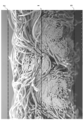
- FIG. 1 is a cross-sectional photograph of the fiber structure of Example 1.
- FIG. FIG. 2 is a cross-sectional photograph of the fiber structure of Example 2.
- FIG. 3 is a cross-sectional photograph of the fiber structure of Example 3.
- 4 is a cross-sectional photograph of the fiber structure of Comparative Example 1.
- FIG. 5 is a cross-sectional photograph of the fiber structure of Comparative Example 2.
- the fabric of the present invention is preferably in the form of a nonwoven fabric, a woven fabric, or a knitted fabric, but is preferably in the form of a woven fabric or a knitted fabric.
- the back layer preferably has a ground texture that affects physical properties such as tensile strength and tear strength of the fabric.
- the surface layer generally gives a comfortable texture, touch, appearance and the like of the fabric.
- the fiber density of the surface layer on the front surface side and the back layer on the back surface side are different with the center line of the cross section of the fiber structure as a boundary.
- the ground structure is a structure that largely governs physical properties such as tensile strength and tear strength of a fabric, unlike piles and patterns in woven fabrics and knitted fabrics. If it is a warp knitted fabric manufactured by two or more wrinkles, it has a 2-needle or 3-needle swing structure. In the case of a weft knitted fabric, it is an organization knitted by a double-sided knitting machine. In the case of a woven fabric, it is a structure for fixing a pile in a woven fabric having a pile such as a moquette pile woven fabric. In the present invention, the ground tissue is used as the back layer on the skin surface side, and the portion having a high fiber density is used as the back layer of the fabric.
- the hygroscopic polymer or the liquid containing the hygroscopic polymer raw material is impregnated between the fibers by capillary action. Many can be fixed.
- the fibers constituting the back layer preferably have a total fineness in the range of 30 to 500 dtex.
- the total fineness is less than 30 dtex, the mechanical strength of the ground structure is lowered, and thread breakage may occur when it is actually used as a vehicle interior material, for example, a sheet fabric.
- the total fineness is larger than 500 dtex, the amount of fibers per unit volume on the back layer side becomes too large, so that when the hygroscopic polymer is fixed to the fabric, the texture of the entire fabric tends to be hard.
- the single fiber fineness is preferably 0.8 to 5 dtex.
- the strength of the fiber used for this back layer is preferably 2.0 cN / dtex or more, more preferably 2.5 cN / dtex or more.
- the single fiber fineness is 0.5 to 5.0 dtex, more preferably 0.8 dtex or more, and further 5.0 dtex or less.
- multifilament and spun yarn are suitable.
- the value obtained by dividing the number of fiber cross-sections in the back layer by the number of fiber cross-sections in the surface layer (fiber cross-section number ratio) is in the range of 2-10. Is preferred. A more preferable range of the fiber cross-section number ratio is 2.5 or more, further 3.0 or more, and on the other hand, a range of 9.5 or less, further 9.0 or less.
- FIGS. 1 to 5 are cross-sectional photographs of the fiber structure cut in a direction perpendicular to the weaving or knitting direction.
- the number of fibers contained in each back layer is counted, and the number of fibers is defined as the number of fiber cross sections.
- the more hygroscopic polymer is fixed between the fibers as the number of fibers existing in the unit volume is larger. Therefore, if the number of fiber cross sections of the back layer is larger than the number of fiber cross sections of the surface layer, the hygroscopic polymer is present in the back layer more than the surface layer. Since the back layer contains more hygroscopic polymer, more water vapor is released from the back layer. The water vapor released from the hygroscopic polymer of the back layer is also released from the hail surface of the back layer, but also passes between the fibers of the fabric.
- the surface layer has fewer fibers and more space than the back layer, water vapor easily passes through, and water vapor is likely to be released from the surface of the surface layer to the atmosphere. Water vapor reaching the surface layer from the back layer is released to the atmosphere from the surface of the surface layer. As a result, the humidity in the fabric is lowered, and the temperature of the fabric is further lowered by the heat of vaporization of water vapor released to the atmosphere.
- the surface layer polymer and the back layer polymer fixed to the fabric have the same degree. Therefore, the difference in the amount of water vapor released between the back layer and the surface layer is reduced, and the difference in the space volume that is the water vapor passage between the back layer and the surface layer is also reduced, so that the water vapor released from the back layer is vaporized from the top surface of the surface layer. It becomes difficult. Furthermore, since the water vapor supplied from the back layer is absorbed by the polymer in the surface layer, the temperature of the fabric is unlikely to decrease.
- the ratio of the number of fiber cross sections (the number of fiber cross sections in the back layer / the number of fiber cross sections in the surface layer) is preferably 2 to 10.
- a more preferable range of the fiber cross-section number ratio is 2.5 or more, further 3.0 or more, and on the other hand, a range of 9.5 or less, further 9.0 or less.
- An embodiment of the fiber structure of the present invention is characterized in that one of the structures is selected from the following groups a to c. Also in this fiber structure, the fiber density of the surface layer on the front surface side and the back layer on the back surface side are different with the center line of the cross section of the fiber structure as a boundary.
- Group a A warp knitted fabric manufactured from a knitting machine having two or more wrinkles, and the structure as the back layer is a 2-needle or 3-needle swing structure.
- Group b a weft knitted fabric knitted by a double-sided knitting machine, and the surface layer is a patterned structure.
- Group c Pile fabric having a ground texture.
- This fiber structure also preferably has a fiber cross section number ratio of 2 to 10, and a more preferable range of the fiber cross section number ratio is 2.5 or more, further 3.0 or more, while 9.5 or less, Furthermore, it is the range of 9.0 or less.
- This fiber structure also has a temperature lower than the environmental temperature due to a decrease in the relative humidity of the environment. The reason for this is the same as described above.
- Group a is a warp knitted fabric manufactured from a knitting machine having two or more ridges, and the back layer serving as the ground texture is preferably a 2-needle or 3-needle swing structure.
- the ground organization include 1-0 / 2-3, 2-3 / 1-0, 0-1 / 3-2, 3-2 / 0-1 and the like.
- the three-needle swing structure include 1-0 / 3-4, 3-4 / 1-0, 0-1 / 4-3, 0-1 / 3-4, and the like.
- the ground organization may be a combination with other organizations as long as it contains at least one of these organizations.
- the surface layer constituting the group a may be a 1-to-3 needle swing structure, an atlas structure, or other changed structures, and a thread-removed structure that does not pass through all the needles is also preferable.
- Group b is a weft knitted fabric knitted by a double-sided knitting machine, and the surface layer is a patterned structure.
- the ground structure constituting the back layer is a dense structure such as a flat knitting or a rubber knitting structure, and a weft knitted fabric having a pattern structure which is a slightly sparse structure as the surface layer is preferable.
- Group c is preferably a moquette pile fabric or a double velvet fabric using rayon fibers as a ground fabric having a ground texture.
- the fiber structure of the present invention starts to use an air conditioner in an atmosphere of 80% relative humidity at 40 ° C., assuming the interior of a car in summer, and within 10 minutes from the atmospheric conditions, warms to an atmosphere of 70% relative humidity at 35 ° C.
- the surface temperature drop of the fabric when the humidity condition is changed is preferably 1.5 ° C. to 4 ° C.
- the fiber structure to which the hygroscopic polymer of the present invention is fixed is hygroscopic.
- the surface temperature is preferably 1.5 ° C. to 4.0 ° C. lower than the fiber structure to which the conductive polymer is not fixed, and the lower limit is preferably 1.7 ° C. or higher and 1.9 ° C. or higher.
- the hygroscopic polymer fixed to the fibers of the fabric of the present invention is changed from an atmospheric condition of 65% relative humidity at 20 ° C. to an atmospheric condition of 90% relative humidity at 30 ° C.
- the degree of increase in mass due to moisture absorption (hereinafter referred to as moisture absorption rate) is preferably 10 to 75%, more preferably 15% or more, and even more preferably 20% or more. On the other hand, it is preferably 70% or less, and more preferably 65% or less.
- the hygroscopic polymer satisfying such hygroscopicity is selected from monomers having a vinyl group having a sulfo group, a carboxyl group, a hydroxyl group, an amide group, or an alkali metal salt (preferably a sodium salt) thereof as a functional group. It is preferable that it is a polymer or a copolymer containing at least one monomer.
- the polymer having a sulfo group is preferably poly (sodium amide-2-propanesulfonate), sodium polystyrenesulfonate, sodium polyisoprenesulfonate, sodium polyallylsulfonate, sodium polymethallylsulfonate, or the like.
- polymer having a carboxyl group sodium polyacrylate is preferred.
- polymer having a hydroxyl group polyethylene glycol, polyvinyl alcohol and the like are preferable.
- polymer having an amide group poly-N-methylolacrylamide, polyacrylamide and the like are preferable.
- sodium 2-acrylamido-2-methylsulfonate is particularly preferred from the viewpoint of high hygroscopicity.
- a copolymer in which another monomer unit is contained in the polymer can also be used.
- a copolymer in which another monomer unit is contained in the polymer can also be used.
- a hygroscopic polymer in order to improve the adhesiveness to the fiber of a hygroscopic polymer, it is preferable to make a hygroscopic polymer have a crosslinked structure using a crosslinking agent.
- the crosslinking agent include polyfunctional epoxy compounds, polyfunctional isocyanate compounds, urea resins, melamine resins, and compounds having at least two polymerizable double bonds.
- Examples of the compound having a polymerizable double bond include compounds in which (meth) acrylic acid is esterified to the terminal hydroxyl group of polyethylene glycol (for example, number average repeatability 250).
- polyethylene glycol for example, number average repeatability 250.
- ethylene oxide having an average repetition frequency of 9 to 23 and two methacrylic acids esterified can be used.
- the fiber constituting the fabric can be impregnated with a monomer that becomes a hygroscopic polymer and, if necessary, a polymerization initiator. If necessary, a crosslinking agent can also be included.
- polymerization initiator examples include inorganic polymerization initiators such as ammonium persulfate, potassium persulfate, and hydrogen peroxide, 2,2′-azobis (2-amidinopropane) dihydrochloride, 2,2′- Organic polymerization initiators such as azobis (N, N-dimethyleneisobutyramide) dihydrochloride and 2- (carbamoylazo) isobutyronitrile are preferably used.
- inorganic polymerization initiators such as ammonium persulfate, potassium persulfate, and hydrogen peroxide
- 2,2′-azobis (2-amidinopropane) dihydrochloride 2,2′- Organic polymerization initiators such as azobis (N, N-dimethyleneisobutyramide) dihydrochloride and 2- (carbamoylazo) isobutyronitrile are preferably used.
- a treatment liquid containing a monomer, a crosslinking agent (if necessary), a polymerization initiator (if necessary) and a solvent or a dispersion medium was applied to the fiber by a padding method. Then, heat and dry. Subsequently, the monomer and the like are polymerized by being placed in a high temperature state such as steam application, and the resulting hygroscopic polymer is fixed to the fiber surface.
- the method of impregnating the fabric with a polymer solution such as sodium polyacrylamido-2-propanesulfonate, sodium styrenesulfonate, sodium isoprenesulfonate, sodium allylsulfonate, sodium methallylsulfonate, and drying is hygroscopic. It is exemplified as a method for fixing the polymer to the fiber.
- the concentration of the treatment liquid in the padding method is preferably 20 to 150 g / L of the monomer serving as a hygroscopic polymer.
- the concentration is preferably 20 to 150 g / L.
- a polymerization initiator is used, its concentration is preferably 1 to 10 g / L, more preferably 3 g / L or more, and still more preferably 5 g / L or more.
- a concentration of 20 to 150 g / L is preferred. Whether the polymerization is performed or the polymer solution is used, if the concentration is low, the amount of the hygroscopic polymer fixed becomes low and the cooling performance is lowered. If the concentration is high, the amount of the hygroscopic polymer fixed is too high, and the texture of the fiber structure becomes hard.
- the heat treatment temperature is preferably from 80 ° C to 170 ° C.
- the heat treatment time is arbitrary, but it is preferable to treat for 5 to 15 minutes. More preferably, it is 6 to 15 minutes, and further preferably 7 to 15 minutes.
- the steam pressure is arbitrary, but is preferably in the range of 0.09 to 0.50 MPa in order to promote polymerization.
- a processing method for fixing the hygroscopic polymer to the fibers of the fabric it is preferable to fix the hygroscopic polymer by a padding method, a spray method, a roll coating method, or the like. preferable.
- the fixing rate of the hygroscopic polymer fixed to the fibers of the fabric is preferably in the range of 4 to 20% by mass with respect to the fabric.
- the amount is less than 4% by mass, sufficient moisture absorption performance cannot be obtained, and as a result, a large temperature change cannot be obtained.
- the adhesion rate of the hygroscopic polymer to the fabric fiber is more preferably in the range of 5 to 18% by mass.
- fibers constituting the fabric of the present invention for example, synthetic fibers such as polyester fibers and polyamide fibers, natural fibers such as cotton, rayon, or the like can be used alone or in combination of two or more.
- biomass fibers such as polyethylene terephthalate fibers, polytrimethylene terephthalate fibers, polyamide fibers, and other polylactic acid fibers using plant-derived raw materials are preferably used.
- polytrimethylene terephthalate fiber has a low Young's modulus, it has a good texture, hand feeling, and sitting comfort and is preferably used.
- the polylactic acid fiber is preferably a fiber that can be produced from 100% plant as a raw material and can contribute most to the reduction of the use of petroleum resources.
- multifilaments and spun yarns are used, but multifilaments are suitable when fabric strength and wear resistance are required.
- the preferred total fineness and single fiber fineness of the biomass fiber are as described in the above paragraph [0013].
- the above-mentioned fibers include dulling agents such as titanium oxide powder, dyes, pigments, flame retardants, hygroscopic agents, heat stabilizers, ultraviolet absorbers, antibacterial agents, fungicides, as long as the effects of the present invention are not impaired.
- An agent, a deodorant, etc. may be included.
- the light fastness of the fiber structure of the present invention is preferably 4th or higher. After irradiating with a fade meter at 83 ° C. for 200 hours, if the level is lower than the fourth grade as judged by the gray scale for color fading, problems such as fading occur when used as a car seat.
- the fiber structure of the present invention is preferably used as a vehicular interior material application, as well as used for clothing such as underwear, sports clothing, and shirts, and interior goods such as chairs.
- a vehicle interior material application As a particularly preferable application, it is a vehicle interior material application, and particularly as a vehicle application, it is a seat.
- a seat When used for a seat, it is preferable for a main material, a gusset part, a back part, a headrest, a seat cover, a headrest cover, etc. Can be used.
- the micrograph is divided into two on the front surface 2 side and the back surface 3 side with respect to the center line 1, and the surface layer and the center line that range from the center line 1 to the surface 2
- the number of fibers contained in each of the back layers in the range from 1 to the back surface 3 was counted, and the number of fibers was defined as the number of fiber cross sections.
- the surface temperatures of the fabric (A) and the fabric (B) were measured with a thermography camera (manufactured by NEC AVIO Infrared Technology Co., Ltd., model number: TH7102MX).
- the fabric of the present invention is laminated to a car seat so that a person touches the surface, and the car seat is placed in a constant temperature and humidity room set at 40 ° C. and assuming a relative humidity of 80% assuming a car interior in summer. After installing the subject and sitting on the car seat for 5 minutes, the temperature and humidity setting conditions were changed to a relative humidity of 40% at 25 ° C., and the coolness of the seat surface after sitting for 3 minutes was subjected to sensory evaluation. The number of subjects who were evaluated by 10 subjects and who felt that they were cool displayed 8 or more as “very good”, 4 to 7 as “good”, and 3 or less as “poor”.
- the core-sheath composite drawn yarn had a tensile strength of 3.3 cN / dtex and an elongation of 45%.
- the tensile strength of the 84T36F polyethylene terephthalate false twisted yarn is 3.6 cN / dtex and the elongation is 23%, and the tensile strength of the 167T48F polyethylene terephthalate false twisted yarn is 4.0 cN / dtex and the elongation is 22%. It was.
- Example 1 A 28 gauge tricot knitting machine was used. Supply the core-sheath composite drawn yarn of 84 dtex-48f (filament) of Reference Example 1 in a full set of yarn arrangement to L1 (becomes a ground texture) using 4 scissors, and reference to L2 (becomes a ground texture) 84 dtex-36f (filament) polyethylene terephthalate false twisted yarn of Example 2 is supplied in a full set of yarn arrangement, and 84 dtex-48f (filament) core-sheath composite drawn yarn of Reference Example 1 is threaded into L3 and L4. The drawn machine was fed in an alternating yarn arrangement, and the raw machine was knitted in the form of the following structure 1 at a density of an on-machine course of 42 C / 2.54 cm.
- the resulting warp knitted fabric was dyed “Dianix” (registered trademark, the same shall apply hereinafter) as a dye.
- the warp knitted fabric dyed as described above is immersed in a treatment liquid of the following prescription 1 and impregnated with a hygroscopic polymer, and then the fabric is squeezed with mangles so that the pickup rate becomes 90%, and 120% in a drier. Drying was performed at 2 ° C. for 2 minutes.
- the warp knitted fabric dyed as described above was impregnated with a hygroscopic polymer, dried, then treated with a normal pressure steamer heated to 105 ° C. for 10 minutes, washed with hot water and then dried. Next, the dried product is further dried at 160 ° C. for 1 minute with a dryer, the basis weight is 310 g / m 2 , the hygroscopic polymer fixing rate is 7.3%, the fabric hygroscopic rate is 2.4%, and the hygroscopic rate is A fiber structure of Example 1 in which the moisture absorption rate of the conductive polymer was 32.8% was obtained.
- FIG. 1 is an electron micrograph (50 ⁇ ). According to the observation results, the number of cross-sectional fibers in the surface layer was 235, the number of cross-sectional fibers in the back layer was 850, and the ratio of the number of fiber cross-sections was 3.62. Furthermore, it was observed that the hygroscopic polymer was fixed to the fibers of the knitted fabric.
- Table 1 shows the results of performance evaluation.
- the surface temperature drop of the fabric is 2.1 ° C
- the coolness at the time of sitting is “very good”
- the texture is “very good”
- the light fastness is 4th grade
- the comfort when the person is seated is very good It was excellent.
- Example 2 Using a 28-gauge tricot knitting machine, supply 167 dtex-48f (filament) polyethylene terephthalate false twisted yarn of Reference Example 2 to L1 (ground texture) using four rivets in a full set yarn arrangement, L2 and L3 are supplied with 84 dtex-48f (filament) core-sheath composite drawn yarn of Reference Example 1 in an alternating yarn arrangement, and the on-machine course has a density of 50 C / 2.54 cm and the following structure Two forms of knitted fabric were produced.
- Example 2 After dyeing the knitted fabric in the same manner as in Example 1, the hygroscopic polymer was fixed, the basis weight was 275 g / m 2 , the hygroscopic polymer fixing rate was 12.3%, and the fabric hygroscopic rate was 3.0%. Thus, a fiber structure of Example 2 in which the moisture absorption rate of the hygroscopic polymer was 24.3% was obtained.
- FIG. 2 is an electron micrograph (100 times). According to the observation results, the number of fiber cross-sections in the surface layer was 121, the number of fiber cross-sections in the back layer was 485, and the ratio of fiber cross-sections was 4.01. Furthermore, it was observed that a large amount of hygroscopic polymer adhered to the ground structure of the knitted fabric.
- Table 1 shows the results of performance evaluation.
- the surface temperature drop of the fabric is 1.9 ° C, the coolness when sitting is “very good”, the texture is “very good”, the light fastness is 4th class, and the comfort when sitting is very good It was excellent.
- Example 3 A 28-gauge tricot knitting machine was used, and a full set of 84 dtex-48f (filament) core-sheath composite drawn yarn of Reference Example 1 was used for L1 (ground texture) and L2 (ground texture) using three scissors.
- L3 is supplied with 84 dtex-36f (filament) polyethylene terephthalate false twisted yarn of Reference Example 2 in full set, and the on-machine course has a density of 64C / 2.54 cm and the following structure 3 We knitted live machines.
- Example 3 A fiber structure of Example 3 was obtained in which the moisture absorption rate of the hygroscopic polymer was 12.5%, the moisture absorption rate of the fabric was 3.0%, and the moisture absorption rate of the hygroscopic polymer was 24.0%.
- FIG. 3 is an electron micrograph (50 ⁇ ). According to the observation results, the number of fiber cross-sections in the surface layer was 220, the number of fiber cross-sections in the back layer was 1380, and the fiber cross-section ratio was 6.27. Furthermore, it was observed that the hygroscopic polymer was fixed on the knitted fabric.
- Table 1 shows the results of performance evaluation.
- the surface temperature drop of the fabric is 2.3 ° C
- the coolness at the time of sitting is “very good”
- the texture is “very good”
- the light fastness is 4th grade
- the comfort when the person is seated is very good It was excellent.
- Example 4 Example 1 except that a 28-gauge tricot knitting machine was used and 84 dtex-48f (filament) polyethylene terephthalate drawn yarn of Reference Example 3 was used for L1 (ground texture), L3, and L4 using four scissors. The knitting machine was knitted in the form of the following organization 4 under the same conditions as above.
- Example 4 After dyeing the knitted fabric in the same manner as in Example 1, the hygroscopic polymer was fixed, the basis weight was 318 g / m 2 , the hygroscopic polymer fixing rate was 7.0%, and the fabric hygroscopic rate was 2.3%.
- This fiber structure was cut in a direction perpendicular to the knitting direction and observed with an electron microscope. According to the observation results, the number of cross-sectional fibers in the surface layer was 245, the number of cross-sectional fibers in the back layer was 854, and the ratio of the number of fiber cross-sections was 3.49.
- Table 1 shows the results of performance evaluation.
- the surface temperature drop of the fabric is 2.0 ° C., the coolness when sitting is “very good”, the texture is “good”, the light fastness is 4th grade, and the comfort when sitting is excellent .
- Example 5 Example using a 28-gauge tricot knitting machine, except that 84 dtex-48f (filament) polyethylene terephthalate drawn yarn of Reference Example 3 was used for L1 (ground texture) and L2 (ground texture) using three scissors. 3 was knitted in the form of the following organization 5 under the same conditions as in No. 3.
- Example 5 A fiber structure of Example 5 was obtained in which the moisture absorption rate of the hygroscopic polymer was 12.6%, the moisture absorption rate of the fabric was 2.9%, and the moisture absorption rate of the hygroscopic polymer was 23.0%.
- This fiber structure was cut in a direction perpendicular to the knitting direction and observed with an electron microscope. According to the observation results, the number of fiber cross-sections in the surface layer was 231, the number of fiber cross-sections in the back layer was 1417, and the ratio of the number of fiber cross-sections was 6.13.
- Table 1 shows the results of performance evaluation.
- the surface temperature drop of the fabric was 2.4 ° C., the coolness at the time of sitting was “very good”, the texture was “good”, the light fastness was 4th class, and the comfort when sitting by a person was excellent .
- Example 6 A 28 gauge double-sided circular knitting machine was used.
- the lining (ground texture) is supplied with 84 dtex-72f (filament) polyethylene terephthalate false twisted yarn, the outer surface is supplied with 84 dtex-36f (filament) polyethylene terephthalate false twisted yarn of Reference Example 2, and the outer surface is patterned.
- the lining was a flat knitted structure, and a live machine with an on-machine course of 38 courses / 2.54 cm was knitted.
- the structure of this knitted fabric belongs to group b.
- Example 6 After dyeing the knitted fabric in the same manner as in Example 1, the hygroscopic polymer was fixed, the basis weight was 232 g / m 2 , the hygroscopic polymer fixing rate was 8.6%, and the fabric hygroscopic rate was 2.0%.
- This fiber structure was cut in a direction perpendicular to the knitting direction and observed with an electron microscope. According to the observation results, the number of fiber cross-sections in the surface layer was 161, the number of fiber cross-sections in the back layer was 322, and the ratio of fiber cross-section numbers was 2.00.
- Table 1 shows the results of performance evaluation.
- the surface temperature drop of the fabric was 2.6 ° C., the coolness when sitting was “very good”, the texture was “good”, the light fastness was 4th grade, and the comfort when a person sat down was excellent .
- Example 7 A polyethylene terephthalate drawn yarn of 167 dtex-72f (filament) was used for warp and weft, and a double woven fabric having a weaving density of 250 cm / cm for warp and 220 weft / cm for both the ground structure and pile was woven. The obtained woven fabric was dyed under the same conditions as in Example 1, and then a velvet woven fabric having a pile length of 1.8 mm was prepared with a shaving machine.
- Example 7 A fiber structure of Example 7 that was .3% was obtained.
- the structure of this fabric belongs to group c.
- the fiber structure was cut in a direction perpendicular to the weaving direction and observed with an electron microscope. According to the observation results, the number of fiber cross-sections in the surface layer was 230, the number of fiber cross-sections in the back layer was 980, and the ratio of fiber cross-sections was 4.26.
- Table 1 shows the results of performance evaluation.
- the surface temperature drop of the knitted fabric is 2.3 ° C, the coolness at the time of sitting is “very good”, the texture is “very good”, the light fastness is 4th grade, and the comfort when the person is seated is excellent It was.
- Example 6 the structure of the outer material and the lining material was changed, and the outer surface was supplied with 84 dtex-72f (filament) polyethylene terephthalate false twisted yarn with a 28-gauge double-sided circular knitting machine.
- 84 dtex-36f (filament) polyethylene terephthalate false twisted yarn was supplied, the outer fabric was made into a flat knitted structure, the lining was made into a patterned structure, and a raw machine with an on-machine course of 38 courses / 2.54 cm was knitted.
- Example 2 After dyeing the knitted fabric in the same manner as in Example 1, the hygroscopic polymer was fixed, the basis weight was 232 g / m 2 , the hygroscopic polymer fixing rate was 8.6%, and the fabric hygroscopic rate was 2.0%.
- a fiber structure of Comparative Example 1 having a hygroscopic polymer moisture absorption of 23.2% was obtained.
- FIG. 4 is an electron micrograph (50 ⁇ ). According to the observation results, the number of fiber cross sections of the surface layer is 319, the number of fiber cross sections of the back layer is 162, and the number of fiber cross sections of the back layer / the number of fiber cross sections of the surface layer (fiber cross section number ratio) is 0.51. there were. Furthermore, it was observed that the hygroscopic polymer was fixed on the knitted fabric.
- Table 1 shows the results of performance evaluation.
- the surface temperature drop of the fabric was 0.5 ° C., the coolness at the time of sitting was “inferior”, the texture was “possible”, the light fastness was grade 4, and the comfort when a person was seated was inferior.
- FIG. 5 is an electron micrograph (150 times). According to the observation results, the number of fiber cross-sections in the surface layer was 107, the number of fiber cross-sections in the back layer was 133, and the ratio of fiber cross-sections was 1.24. In addition, the hygroscopic polymer was fixed to the ground texture of the fabric.
- Table 1 shows the results of performance evaluation.
- the surface temperature drop of the fabric was 1.3 ° C., the coolness at the time of sitting was “inferior”, the texture was “good”, the light fastness was 4th grade, and the comfort when a person sat down was inferior.
Landscapes
- Engineering & Computer Science (AREA)
- Textile Engineering (AREA)
- Chemical & Material Sciences (AREA)
- Chemical Kinetics & Catalysis (AREA)
- Knitting Of Fabric (AREA)
- Woven Fabrics (AREA)
Abstract
Description
例えば特許文献1では、肌面とは反対側の層よりも単繊維繊度が大きい合成繊維マルチフィラメントを肌面側に用い、布帛が水を多く吸着する機能を有する編地が使用されている。
一方、布帛が水蒸気を放出することによる温度降下やより水蒸気を放出しやすい織物の構造および編物の構造については検討されていなかった。
前記課題を解決するために、本発明は以下の構成を採用する。
[1]布帛の繊維に吸湿性ポリマーが固着している繊維構造体であって、繊維構造体断面の中心線を境界として表面側である表層と裏面側である裏層の繊維密度が異なっていることを特徴とする繊維構造体。
[2]布帛が織物または編物の形態を有し、布帛の地組織が裏層側にあることを特徴とする前記[1]に記載の繊維構造体。
[3]吸湿性ポリマーがアクリル酸アミド-2-プロパンスルホン酸ナトリウム、スチレンスルホン酸ナトリウム、イソプレンスルホン酸ナトリウム、アリルスルホン酸ナトリウム、メタリルスルホン酸ナトリウムから選ばれる1種以上のモノマーの重合体又はこれら1種以上のモノマーおよび前記以外のモノマーとの共重合体であることを特徴とする前記[1]または[2]に記載の繊維構造体。
[4]吸湿性ポリマーの布帛への固着率が4~20質量%であることを特徴とする前記[1]ないし[3]のいずれかに記載の繊維構造体。
[5]前記[1]ないし[4]のいずれかに記載の繊維構造体であって、繊維構造体を製織又は製編方向に対して垂直方向に切断して、断面の中心線を境界として表面側である表層と裏面側である裏層にそれぞれ含まれる繊維断面本数を算出したとき、裏層の繊維断面本数を表層の繊維断面本数で除した数値(繊維断面本数比)が2~10の範囲であることを特徴とする繊維構造体。
[6]布帛の組織が以下のa~c群から選ばれるものであることを特徴とする前記[1]ないし[5]のいずれかに記載の繊維構造体。
a群:2枚以上の筬を有する編み機から製造された経編物であって、裏層となる組織が2針振り又は3針振り組織であるもの
b群:両面編機で編成された緯編物であって表層となる組織が柄組織であるもの
c群:地組織を有するパイル織物
[7]前記[1]ないし[6]のいずれかに記載の繊維構造体を有する車両内装材。
布帛の引張強力、引裂強力などの物性に影響を与える地組織が裏層にあることが好ましい。そうなると表層は一般的に布帛の心地よい風合い、手触り、外観などを与えるものとなる。
図1~5は、繊維構造体を製織又は製編方向に対して垂直方向に切断した断面写真である。繊維構造体断面の中心線1に対して表面2側と裏面3側に2分割し、中心線1から表面2に至るまでの範囲である表層と中心線1から裏面3に至るまでの範囲である裏層にそれぞれ含まれる繊維本数を数えて、その繊維本数を繊維断面本数とするものである。
a群:2枚以上の筬を有する編み機から製造された経編物であって、裏層となる組織が2針振り又は3針振り組織であるもの。
b群:両面編機で編成された緯編物であって表層となる組織が柄組織であるもの。
c群:地組織を有するパイル織物。
また、本発明においては、吸湿性ポリマーの繊維への固着性を向上させるために、架橋剤を使用して吸湿性ポリマーに架橋構造をとらせるのが好ましい。架橋剤としては、多官能のエポキシ化合物、多官能のイソシアネート化合物、尿素樹脂、メラミン樹脂、重合性二重結合を少なくとも2個有する化合物が例示される。
(1)引張強度(cN/dtex)と伸度(%)
JIS L 1013(8.5.1)(2010)に示される定速伸長条件に準じ、オリエンテック(株)社製TENSILON(登録商標)UCT-100を用いて、糸の引張強度(cN/dtex)および伸度(%)を測定した。このとき、試料長200mm、引張速度200m/分として、引張強度は応力-歪み曲線における最大強力を示した点の強力を総繊度で除することにより求め、伸度は応力-歪み曲線における最大強力を示した点の伸びから求めた。
JIS L 1096(8.4.2)(2010)に規定された方法により、布帛の単位面積当たりの質量(g/m2)を求めた。
吸湿性ポリマーが固着していない布帛から30cm×30cmの正方形状の試片を切り取り、温度が24℃で、相対湿度が60%に設定された恒温恒湿室に24時間放置し、加工前(吸湿性ポリマー固着前)の布帛重量(g)を測定した。その後、吸湿性ポリマーを固着させた加工後の布帛重量(g)も加工前布帛と同じ恒温恒湿条件で測定し、下式の通り吸湿性ポリマーの固着率を算出した。
吸湿性ポリマーの固着率(%)=[加工後の布帛重量(g)-加工前の布帛重量(g)]/加工前の布帛重量(g)×100
加工前(吸湿性ポリマー固着前)の布帛から約1.0gの試料を採取して、を熱風乾燥機中で105℃、24時間乾燥して重量を測定した(W1)。次に、該試料を20℃で相対湿度65%に調整した恒温恒湿器に24時間入れた後の試料重量を測定した。(W2)。さらに、30℃で×相対湿度90%調整した恒温恒湿器に24時間入れた後の試料重量を測定した(W3)。以上の測定結果から、次式によって布帛の吸湿率を算出した。
布帛の吸湿率(%)=[(W3-W1)/W1-(W2-W1)/W1]×100
加工後(吸湿性ポリマー固着後)の布帛についても段落[0047]に記載した条件と同様に、W1とW2とW3から加工後の布帛の吸湿率を算出した。その加工後の布帛の吸湿率と、段落[0047]で算出した加工前の布帛の吸湿率と、段落[0046]で算出した吸湿性ポリマーの固着率とに基づいて、次式によって吸湿性ポリマーの吸湿率を算出した。
吸湿性ポリマーの吸湿率(%)=(加工後の布帛吸湿率-加工前の布帛吸湿率)×100/吸湿性ポリマーの固着率
布帛の製織又は製編方向に対して垂直方向に切断した。切断した測定試料に対して日立製の金属蒸着装置(商品名E1010)を用いて金属蒸着した後、その試料を日立製の走査型電子顕微鏡(商品名S-3500)に装着し、30倍~100倍の倍率で写真撮影した。その顕微鏡写真を図1から図5に示したように、中心線1に対して表面2側と裏面3側に2分割し、中心線1から表面2に至るまでの範囲である表層と中心線1から裏面3に至るまでの範囲である裏層にそれぞれ含まれる繊維本数を数えて、その繊維本数を繊維断面本数とした。繊維断面本数比の算出式を下式に示す。
繊維断面本数比=(裏層の繊維断面本数)/(表層の繊維断面本数)
吸湿性ポリマーを固着させた布帛(A)と、吸湿性ポリマーを固着させる前の布帛(B)から25cm×25cmの正方形状の試片を角切り取り、温度が40℃で相対湿度80%に設定された恒温恒湿室内に吊り下げ、3時間静置した。その後、35℃で相対湿度70%に恒温恒湿室の温湿度設定条件を変更し、恒温恒湿室の温湿度表示が35℃で相対湿度70%に達したところで恒温恒湿室に固定したサーモグラフィーカメラ(NEC AVIO赤外線テクノロジー(株)製、型番:TH7102MX)にて布帛(A)と、布帛(B)それぞれの表面温度を測定した。布帛の表面温度降下量は下式で算出した。
布帛の表面温度降下量=(B)の表面温度-(A)の表面温度
表面に人が接するようにカーシートに本発明の布帛を張り合わせ、そのカーシートを夏場の車内を想定した40℃で相対湿度80%に設定した恒温恒湿室内に設置し、被験者がそのカーシートに5分間着座した後、25℃で相対湿度40%に温湿度設定条件を変更し、さらに3分間着座後のシート表面の涼しさを官能評価した。10人の被験者に評価してもらい、涼しいと感じた人が、8人以上を「非常に良好」、4~7人を「可」、3人以下を「劣る」でそれぞれ表示した。
本発明の布帛を用い、10人のパネラーにより布帛の触感を評価した。そして、各人の評価の合計点により、総合評価した。
<評価基準>
3点:ソフトタッチで、表面の平滑性も高い。
2点:標準的な柔らかさであり、表面の平滑性も標準である。
1点:粗硬感があり、表面にざらつきがある。
<総合評価>
非常に良好 :25~30点
可 :17~24点
劣る :10~16点。
紫外線オートフェードメーター(スガ試験機(株)製、型式:U48AUHB)を用い、ブラックパネル温度が83℃の条件で200時間照射した後、JIS L 0804(2010)に準じ、変退色用グレースケールにより変退色を1級~5級で判定した。
(芯鞘複合延伸糸)
芯部がポリエチレンテレフタレート(PET)で鞘部がポリトリメチレンテレフタレート(PTT)であり、それぞれの質量比が3対7である84T48Fの芯鞘複合延伸糸を製造した。具体的には以下のとおりである。
上記の分率で溶融紡糸機に供給し、口金内で単芯の芯鞘構造に複合させ、紡糸温度280℃で紡糸し、第1ロール回転速度2700m/分、ロール温度40℃で紡出糸を予熱し、第2ロール回転速度4050m/分、ロール温度150℃で熱処理延伸し、巻取速度3700m/分で巻取を行い、84dtex-48f(フィラメント)の芯鞘複合延伸糸を得た。この芯鞘複合延伸糸の引張強度は3.3cN/dtexであり、伸度は45%であった。
(ポリエチレンテレフタレート仮撚加工糸)
84T36Fのポリエチレンテレフタレート仮撚加工糸、167T48Fのポリエチレンテレフタレート仮撚加工糸の製造方法について説明する。紡糸口金の大きさと形状はそれぞれの仮撚加工糸に適したものを採用し、紡糸温度284℃、紡糸速度3000m/分で溶融紡糸を行い、未延伸糸を巻き取った。次いで、第1ヒーター(非接触タイプ)温度230℃、オーバーフィード率0.9、第2ヒーター(非接触タイプ)温度200℃、延伸倍率1.69倍、加工速度600m/分で仮撚加工を行い、84dtex-36f(フィラメント)のポリエチレンテレフタレート仮撚加工糸と、167dtex-48f(フィラメント)のポリエチレンテレフタレート仮撚加工糸を得た。84T36Fのポリエチレンテレフタレート仮撚加工糸の引張強度は3.6cN/dtex、伸度は23%であり、167T48Fのポリエチレンテレフタレート仮撚加工糸の引張強度は4.0cN/dtex、伸度は22%あった。
(ポリエチレンテレフタレート延伸糸)
84T48F(84dtex-48f(フィラメント))のポリエチレンテレフタレート延伸糸の製造方法について説明する。紡糸温度290℃、紡糸速度1500m/分で溶融紡糸を行い、未延伸糸を巻き取った。次いで、延伸加工装置を用い、予熱ローラー温度90℃、熱処理ローラー温度150℃、延伸倍率3.01倍、加工速度970m/分で延伸を行い、84dtex-48fのポリエチレンテレフタレート延伸糸を得た。この延伸糸の引張強度は4.0cN/dtex、伸度は35%であった。
28ゲージのトリコット編機を用いた。4枚の筬を用いてL1(地組織となる)に参考例1の84dtex-48f(フィラメント)の芯鞘複合延伸糸をフルセットの糸配列で供給し、L2(地組織となる)に参考例2の84dtex-36f(フィラメント)のポリエチレンテレフタレート仮撚加工糸をフルセットの糸配列で供給し、L3、L4に参考例1の84dtex-48f(フィラメント)の芯鞘複合延伸糸を糸入糸抜1本交互の糸配列で供給し、機上コースが42C/2.54cmとなる密度で下記組織1の形態で生機を製編した。
L1:84dtex-48f(PET/PTT芯鞘複合延伸糸)、1-2/1-0(糸通し:フルセット)
L2:84dtex-36f(PET仮撚加工糸)、3-4/1-0(糸通し:フルセット)
L3:84dtex-48f(PET/PTT芯鞘複合延伸糸)、2-3/2-1 1-0/1-2(糸通し:糸入糸抜1本交互)
L4:84dtex-48f(PET/PTT芯鞘複合延伸糸)、1-0/1-2 2-3/2-1(糸通し:糸入糸抜1本交互)
その後、上記のように染色した経編地を下記の処方1の処理液に浸漬して吸湿性ポリマーを含浸後、ピックアップ率が90%になるように布帛をマングルで絞り、乾燥機中で120℃、2分間の条件で乾燥させた。
・2-アクリルアミド-2-メチルプロパンスルホン酸ナトリウム(商品名:グラセットT505、メーカー:北広ケミカル(株)):120g/L
・架橋剤として「数平均重合度23のポリエチレングリコール」のジメタクリレート(商品名:グラセットT303 メーカー: 北広ケミカル(株)):120g/L)
・重合開始剤として過硫酸アンモニウム(メーカー:ナカライテスク(株)):5g/L
・水
28ゲージのトリコット編機を用い、4枚の筬を用いてL1(地組織)に参考例2の167dtex-48f(フィラメント)のポリエチレンテレフタレート仮撚加工糸をフルセットの糸配列で供給し、またL2、L3に参考例1の84dtex-48f(フィラメント)の芯鞘複合延伸糸を糸入糸抜1本交互の糸配列で供給し、機上コースが50C/2.54cmの密度で、下記組織2の形態の編物を製造した。
L1:167dtex-48f(PET仮撚加工糸)、1-0/3-4(糸通し:フルセット)
L2:84dtex-48f(PET/PTT芯鞘複合延伸糸)、2-3/2-1 1-0/1-2(糸通し:糸入糸抜1本交互)
L3:84dtex-48f(PET/PTT芯鞘複合延伸糸)、1-0/1-2 2-3/2-1(糸通し:糸入糸抜1本交互)
28ゲージのトリコット編機を用い、3枚の筬を用いてL1(地組織)、L2(地組織)に参考例1の84dtex-48f(フィラメント)の芯鞘複合延伸糸をフルセットの糸配列で供給し、L3に参考例2の84dtex-36f(フィラメント)のポリエチレンテレフタレート仮撚加工糸をフルセットの糸配列で供給し、機上コースが64C/2.54cmの密度で下記組織3の形態で生機を製編した。
L1:84dtex-48f(PET/PTT芯鞘複合延伸糸)、2-3/1-0(糸通し:フルセット)
L2:84dtex-48f(PET/PTT芯鞘複合延伸糸)、1-0/1-2(糸通し:フルセット)
L3:84dtex-36f(PET仮撚加工糸)、1-0/3-4(糸通し:フルセット)
28ゲージのトリコット編機を用い、4枚の筬を用いてL1(地組織)、L3、L4に、参考例3の84dtex-48f(フィラメント)のポリエチレンテレフタレート延伸糸を用いた以外は実施例1と同様の条件で下記組織4の形態で生機を製編した。
L1:84dtex-48f(PET延伸糸)、1-2/1-0(糸通し:フルセット)
L2:84dtex-36f(PET仮撚加工糸)、3-4/1-0(糸通し:フルセット)
L3:84dtex-48f(PET延伸糸)、2-3/2-1 1-0/1-2(糸通し:糸入糸抜1本交互)
L4:84dtex-48f(PET延伸糸)、1-0/1-2 2-3/2-1(糸通し:糸入糸抜1本交互)
28ゲージのトリコット編機を用い、3枚の筬を用いてL1(地組織)、L2(地組織)に参考例3の84dtex-48f(フィラメント)のポリエチレンテレフタレート延伸糸を用いた以外は実施例3と同様の条件で下記組織5の形態で生機を製編した。
L1:84dtex-48f(PET延伸糸)、2-3/1-0(糸通し:フルセット)
L2:84dtex-48f(PET延伸糸)、1-0/1-2(糸通し:フルセット)
L3:84dtex-36f(PET仮撚加工糸)、1-0/3-4(糸通し:フルセット)
28ゲージの両面丸編機を使用した。裏地(地組織)は84dtex-72f(フィラメント)のポリエチレンテレフタレート仮撚加工糸を供給し、表地は参考例2の84dtex-36f(フィラメント)のポリエチレンテレフタレート仮撚加工糸を供給し、表地を柄組織、裏地は平編組織とし、機上コースが38コース/2.54cmの生機を製編した。この編物の構造はb群に属する。
167dtex-72f(フィラメント)のポリエチレンテレフタレート延伸糸を経糸と緯糸に用い、織密度が地組織及びパイルともに経糸は250cm/cm、緯糸は220本/cmの二重織物を製織した。
得られた織物を実施例1と同条件で染色した後、剪毛機にてパイル長さを1.8mmとしたベルベット織物を作成した。その後、上記織物に実施例1と同様の方法で吸湿性ポリマーを固着させ、吸湿性ポリマーの固着率が10.5%、布帛の吸湿率が3.5%、吸湿性ポリマーの吸湿率が33.3%である実施例7の繊維構造体を得た。この織物の構造はc群に属する。
実施例6において表地と裏地の組織を変え、28ゲージの両面丸編機にて表地は84dtex-72f(フィラメント)のポリエチレンテレフタレート仮撚加工糸を供給し、裏地(地組織)は参考例2の84dtex-36f(フィラメント)のポリエチレンテレフタレート仮撚加工糸を供給し、表地は平編組織、裏地は柄組織とし、機上コースが38コース/2.54cmの生機を製編した。
ウォータージェットルーム織機を用い、タテ糸とヨコ糸に、参考例2の167dtex-48f(フィラメント)のポリエチレンテレフタレート仮撚加工糸を供給し、織上密度がタテ128本/2.54cm、ヨコ81本/2.54cmであるツイル組織で製織した。

Claims (7)
- 布帛の繊維に吸湿性ポリマーが固着している繊維構造体であって、繊維構造体断面の中心線を境界として表面側である表層と裏面側である裏層の繊維密度が異なっていることを特徴とする繊維構造体。
- 布帛が織物または編物の形態を有し、布帛の地組織が裏層側にあることを特徴とする請求項1に記載の繊維構造体。
- 吸湿性ポリマーがアクリル酸アミド-2-プロパンスルホン酸ナトリウム、スチレンスルホン酸ナトリウム、イソプレンスルホン酸ナトリウム、アリルスルホン酸ナトリウム、メタリルスルホン酸ナトリウムから選ばれる1種以上のモノマーの重合体又はこれら1種以上のモノマーおよび前記以外のモノマーとの共重合体であることを特徴とする請求項1または2に記載の繊維構造体。
- 吸湿性ポリマーの布帛への固着率が4~20質量%であることを特徴とする請求項1ないし3のいずれかに記載の繊維構造体。
- 請求項1ないし4のいずれかに記載の繊維構造体であって、繊維構造体を製織又は製編方向に対して垂直方向に切断して、断面の中心線を境界として表面側である表層と裏面側である裏層にそれぞれ含まれる繊維断面本数を算出したとき、裏層の繊維断面本数を表層の繊維断面本数で除した数値(繊維断面本数比)が2~10の範囲であることを特徴とする繊維構造体。
- 布帛の組織が以下のa~c群から選ばれるものであることを特徴とする請求項1ないし5のいずれかに記載の繊維構造体。
a群:2枚以上の筬を有する編み機から製造された経編物であって、裏層となる組織が2針振り又は3針振り組織であるもの
b群:両面編機で編成された緯編物であって表層となる組織が柄組織であるもの
c群:地組織を有するパイル織物 - 請求項1ないし6のいずれかに記載の繊維構造体を有する車両内装材。
Priority Applications (3)
| Application Number | Priority Date | Filing Date | Title |
|---|---|---|---|
| US14/380,573 US20150038035A1 (en) | 2012-02-28 | 2013-02-26 | Fiber structure |
| EP13755717.9A EP2821535A4 (en) | 2012-02-28 | 2013-02-26 | FIBER STRUCTURE |
| JP2013510153A JP6007898B2 (ja) | 2012-02-28 | 2013-02-26 | 繊維構造体 |
Applications Claiming Priority (2)
| Application Number | Priority Date | Filing Date | Title |
|---|---|---|---|
| JP2012040816 | 2012-02-28 | ||
| JP2012-040816 | 2012-02-28 |
Publications (1)
| Publication Number | Publication Date |
|---|---|
| WO2013129347A1 true WO2013129347A1 (ja) | 2013-09-06 |
Family
ID=49082544
Family Applications (1)
| Application Number | Title | Priority Date | Filing Date |
|---|---|---|---|
| PCT/JP2013/054834 Ceased WO2013129347A1 (ja) | 2012-02-28 | 2013-02-26 | 繊維構造体 |
Country Status (4)
| Country | Link |
|---|---|
| US (1) | US20150038035A1 (ja) |
| EP (1) | EP2821535A4 (ja) |
| JP (1) | JP6007898B2 (ja) |
| WO (1) | WO2013129347A1 (ja) |
Families Citing this family (1)
| Publication number | Priority date | Publication date | Assignee | Title |
|---|---|---|---|---|
| EP2991460B1 (en) * | 2014-08-29 | 2018-11-21 | Nokia Technologies OY | An apparatus and associated methods for deformable electronics |
Citations (6)
| Publication number | Priority date | Publication date | Assignee | Title |
|---|---|---|---|---|
| JP2002088653A (ja) * | 2000-09-12 | 2002-03-27 | Komatsu Seiren Co Ltd | 吸湿発熱性/放湿冷却性布帛 |
| JP2002180308A (ja) * | 2000-09-29 | 2002-06-26 | Toray Ind Inc | 保温衣料 |
| JP2002212880A (ja) * | 2000-11-10 | 2002-07-31 | Toray Ind Inc | 高吸湿保温性繊維構造物 |
| JP2002327316A (ja) | 2001-02-16 | 2002-11-15 | Toray Ind Inc | 運動着 |
| JP2003096672A (ja) | 2001-09-25 | 2003-04-03 | Toyobo Co Ltd | 内装材 |
| JP2003278050A (ja) * | 2002-03-19 | 2003-10-02 | Ventex Co Ltd | 防水機能を有する超高速吸湿速乾性織編物 |
Family Cites Families (4)
| Publication number | Priority date | Publication date | Assignee | Title |
|---|---|---|---|---|
| GB1300268A (en) * | 1970-06-04 | 1972-12-20 | Toray Industries | A pile sheet material and a process of manufacturing the same |
| JPS63145457A (ja) * | 1986-12-03 | 1988-06-17 | 旭化成株式会社 | 内装用パイル布帛原布 |
| US5855125A (en) * | 1995-07-26 | 1999-01-05 | Malden Mills Industries, Inc. | Method for constructing a double face fabric and fabric produced thereby |
| EP1520918B1 (en) * | 1996-05-14 | 2006-12-06 | Toray Industries, Inc. | Spontaneously degradable fibers |
-
2013
- 2013-02-26 US US14/380,573 patent/US20150038035A1/en not_active Abandoned
- 2013-02-26 EP EP13755717.9A patent/EP2821535A4/en not_active Withdrawn
- 2013-02-26 JP JP2013510153A patent/JP6007898B2/ja not_active Expired - Fee Related
- 2013-02-26 WO PCT/JP2013/054834 patent/WO2013129347A1/ja not_active Ceased
Patent Citations (6)
| Publication number | Priority date | Publication date | Assignee | Title |
|---|---|---|---|---|
| JP2002088653A (ja) * | 2000-09-12 | 2002-03-27 | Komatsu Seiren Co Ltd | 吸湿発熱性/放湿冷却性布帛 |
| JP2002180308A (ja) * | 2000-09-29 | 2002-06-26 | Toray Ind Inc | 保温衣料 |
| JP2002212880A (ja) * | 2000-11-10 | 2002-07-31 | Toray Ind Inc | 高吸湿保温性繊維構造物 |
| JP2002327316A (ja) | 2001-02-16 | 2002-11-15 | Toray Ind Inc | 運動着 |
| JP2003096672A (ja) | 2001-09-25 | 2003-04-03 | Toyobo Co Ltd | 内装材 |
| JP2003278050A (ja) * | 2002-03-19 | 2003-10-02 | Ventex Co Ltd | 防水機能を有する超高速吸湿速乾性織編物 |
Non-Patent Citations (1)
| Title |
|---|
| See also references of EP2821535A4 |
Also Published As
| Publication number | Publication date |
|---|---|
| JPWO2013129347A1 (ja) | 2015-07-30 |
| EP2821535A1 (en) | 2015-01-07 |
| JP6007898B2 (ja) | 2016-10-19 |
| US20150038035A1 (en) | 2015-02-05 |
| EP2821535A4 (en) | 2015-11-25 |
Similar Documents
| Publication | Publication Date | Title |
|---|---|---|
| JP5596886B1 (ja) | 布帛および繊維製品 | |
| JP6577589B2 (ja) | 布帛および繊維製品 | |
| TW593819B (en) | Insulated knitted fabric | |
| TWI830821B (zh) | 布帛及纖維製品 | |
| WO2018216572A1 (ja) | 多層構造布帛および繊維製品 | |
| JP5612702B2 (ja) | 織物および衣料 | |
| JP5584297B2 (ja) | 多層構造布帛および繊維製品 | |
| JP2019127672A (ja) | 多層構造織編物および繊維製品 | |
| JP6689293B2 (ja) | 編地および繊維製品 | |
| JP5599661B2 (ja) | ストレッチコート編地 | |
| JP2008297657A (ja) | キルテイング生地および寝具およびダウンジャケット | |
| JP6007898B2 (ja) | 繊維構造体 | |
| JP5180053B2 (ja) | 保温編地 | |
| JP5770983B2 (ja) | 側地用織物および繊維製品 | |
| JP2013049929A (ja) | 発汗時に快適な衣料用編物 | |
| JPWO2018198846A1 (ja) | 布帛および繊維製品 | |
| JP4567500B2 (ja) | 吸水により立体的に構造変化する布帛および繊維製品 | |
| JP2004124316A (ja) | 着用快適性に優れた布帛 | |
| JP2008138313A (ja) | 皮革様シートおよびその製造方法 | |
| JP3197820U (ja) | 側地 | |
| JP6227777B2 (ja) | 快適性に優れる薄地織物 | |
| JP4110447B2 (ja) | 高吸放湿性ポリエステル繊維及びそれより構成されてなる布帛 | |
| JP6469152B2 (ja) | 布団側地 | |
| TW202441045A (zh) | 布帛及纖維製品 | |
| JP2002309483A (ja) | 婦人衣服 |
Legal Events
| Date | Code | Title | Description |
|---|---|---|---|
| ENP | Entry into the national phase |
Ref document number: 2013510153 Country of ref document: JP Kind code of ref document: A |
|
| 121 | Ep: the epo has been informed by wipo that ep was designated in this application |
Ref document number: 13755717 Country of ref document: EP Kind code of ref document: A1 |
|
| WWE | Wipo information: entry into national phase |
Ref document number: 2013755717 Country of ref document: EP |
|
| WWE | Wipo information: entry into national phase |
Ref document number: 14380573 Country of ref document: US |
|
| NENP | Non-entry into the national phase |
Ref country code: DE |