WO2013129517A1 - Procédé de préparation de composition de résine d'émulsion pour revêtement par électrodéposition cationique - Google Patents
Procédé de préparation de composition de résine d'émulsion pour revêtement par électrodéposition cationique Download PDFInfo
- Publication number
- WO2013129517A1 WO2013129517A1 PCT/JP2013/055223 JP2013055223W WO2013129517A1 WO 2013129517 A1 WO2013129517 A1 WO 2013129517A1 JP 2013055223 W JP2013055223 W JP 2013055223W WO 2013129517 A1 WO2013129517 A1 WO 2013129517A1
- Authority
- WO
- WIPO (PCT)
- Prior art keywords
- emulsion
- curing agent
- resin
- cationic
- blocked isocyanate
- Prior art date
- Legal status (The legal status is an assumption and is not a legal conclusion. Google has not performed a legal analysis and makes no representation as to the accuracy of the status listed.)
- Ceased
Links
Images


Classifications
-
- C—CHEMISTRY; METALLURGY
- C08—ORGANIC MACROMOLECULAR COMPOUNDS; THEIR PREPARATION OR CHEMICAL WORKING-UP; COMPOSITIONS BASED THEREON
- C08L—COMPOSITIONS OF MACROMOLECULAR COMPOUNDS
- C08L63/00—Compositions of epoxy resins; Compositions of derivatives of epoxy resins
-
- C—CHEMISTRY; METALLURGY
- C08—ORGANIC MACROMOLECULAR COMPOUNDS; THEIR PREPARATION OR CHEMICAL WORKING-UP; COMPOSITIONS BASED THEREON
- C08G—MACROMOLECULAR COMPOUNDS OBTAINED OTHERWISE THAN BY REACTIONS ONLY INVOLVING UNSATURATED CARBON-TO-CARBON BONDS
- C08G18/00—Polymeric products of isocyanates or isothiocyanates
- C08G18/06—Polymeric products of isocyanates or isothiocyanates with compounds having active hydrogen
- C08G18/70—Polymeric products of isocyanates or isothiocyanates with compounds having active hydrogen characterised by the isocyanates or isothiocyanates used
- C08G18/72—Polyisocyanates or polyisothiocyanates
- C08G18/80—Masked polyisocyanates
- C08G18/8061—Masked polyisocyanates masked with compounds having only one group containing active hydrogen
- C08G18/807—Masked polyisocyanates masked with compounds having only one group containing active hydrogen with nitrogen containing compounds
- C08G18/8077—Oximes
-
- C—CHEMISTRY; METALLURGY
- C08—ORGANIC MACROMOLECULAR COMPOUNDS; THEIR PREPARATION OR CHEMICAL WORKING-UP; COMPOSITIONS BASED THEREON
- C08G—MACROMOLECULAR COMPOUNDS OBTAINED OTHERWISE THAN BY REACTIONS ONLY INVOLVING UNSATURATED CARBON-TO-CARBON BONDS
- C08G18/00—Polymeric products of isocyanates or isothiocyanates
- C08G18/003—Polymeric products of isocyanates or isothiocyanates with epoxy compounds having no active hydrogen
-
- C—CHEMISTRY; METALLURGY
- C08—ORGANIC MACROMOLECULAR COMPOUNDS; THEIR PREPARATION OR CHEMICAL WORKING-UP; COMPOSITIONS BASED THEREON
- C08G—MACROMOLECULAR COMPOUNDS OBTAINED OTHERWISE THAN BY REACTIONS ONLY INVOLVING UNSATURATED CARBON-TO-CARBON BONDS
- C08G18/00—Polymeric products of isocyanates or isothiocyanates
- C08G18/06—Polymeric products of isocyanates or isothiocyanates with compounds having active hydrogen
- C08G18/28—Polymeric products of isocyanates or isothiocyanates with compounds having active hydrogen characterised by the compounds used containing active hydrogen
- C08G18/2805—Compounds having only one group containing active hydrogen
- C08G18/2815—Monohydroxy compounds
- C08G18/282—Alkanols, cycloalkanols or arylalkanols including terpenealcohols
- C08G18/2825—Alkanols, cycloalkanols or arylalkanols including terpenealcohols having at least 6 carbon atoms
-
- C—CHEMISTRY; METALLURGY
- C08—ORGANIC MACROMOLECULAR COMPOUNDS; THEIR PREPARATION OR CHEMICAL WORKING-UP; COMPOSITIONS BASED THEREON
- C08G—MACROMOLECULAR COMPOUNDS OBTAINED OTHERWISE THAN BY REACTIONS ONLY INVOLVING UNSATURATED CARBON-TO-CARBON BONDS
- C08G18/00—Polymeric products of isocyanates or isothiocyanates
- C08G18/06—Polymeric products of isocyanates or isothiocyanates with compounds having active hydrogen
- C08G18/28—Polymeric products of isocyanates or isothiocyanates with compounds having active hydrogen characterised by the compounds used containing active hydrogen
- C08G18/2805—Compounds having only one group containing active hydrogen
- C08G18/285—Nitrogen containing compounds
- C08G18/2855—Lactams
-
- C—CHEMISTRY; METALLURGY
- C08—ORGANIC MACROMOLECULAR COMPOUNDS; THEIR PREPARATION OR CHEMICAL WORKING-UP; COMPOSITIONS BASED THEREON
- C08G—MACROMOLECULAR COMPOUNDS OBTAINED OTHERWISE THAN BY REACTIONS ONLY INVOLVING UNSATURATED CARBON-TO-CARBON BONDS
- C08G18/00—Polymeric products of isocyanates or isothiocyanates
- C08G18/06—Polymeric products of isocyanates or isothiocyanates with compounds having active hydrogen
- C08G18/70—Polymeric products of isocyanates or isothiocyanates with compounds having active hydrogen characterised by the isocyanates or isothiocyanates used
- C08G18/72—Polyisocyanates or polyisothiocyanates
- C08G18/73—Polyisocyanates or polyisothiocyanates acyclic
-
- C—CHEMISTRY; METALLURGY
- C08—ORGANIC MACROMOLECULAR COMPOUNDS; THEIR PREPARATION OR CHEMICAL WORKING-UP; COMPOSITIONS BASED THEREON
- C08G—MACROMOLECULAR COMPOUNDS OBTAINED OTHERWISE THAN BY REACTIONS ONLY INVOLVING UNSATURATED CARBON-TO-CARBON BONDS
- C08G18/00—Polymeric products of isocyanates or isothiocyanates
- C08G18/06—Polymeric products of isocyanates or isothiocyanates with compounds having active hydrogen
- C08G18/70—Polymeric products of isocyanates or isothiocyanates with compounds having active hydrogen characterised by the isocyanates or isothiocyanates used
- C08G18/72—Polyisocyanates or polyisothiocyanates
- C08G18/74—Polyisocyanates or polyisothiocyanates cyclic
- C08G18/75—Polyisocyanates or polyisothiocyanates cyclic cycloaliphatic
- C08G18/751—Polyisocyanates or polyisothiocyanates cyclic cycloaliphatic containing only one cycloaliphatic ring
- C08G18/752—Polyisocyanates or polyisothiocyanates cyclic cycloaliphatic containing only one cycloaliphatic ring containing at least one isocyanate or isothiocyanate group linked to the cycloaliphatic ring by means of an aliphatic group
- C08G18/753—Polyisocyanates or polyisothiocyanates cyclic cycloaliphatic containing only one cycloaliphatic ring containing at least one isocyanate or isothiocyanate group linked to the cycloaliphatic ring by means of an aliphatic group containing one isocyanate or isothiocyanate group linked to the cycloaliphatic ring by means of an aliphatic group having a primary carbon atom next to the isocyanate or isothiocyanate group
- C08G18/755—Polyisocyanates or polyisothiocyanates cyclic cycloaliphatic containing only one cycloaliphatic ring containing at least one isocyanate or isothiocyanate group linked to the cycloaliphatic ring by means of an aliphatic group containing one isocyanate or isothiocyanate group linked to the cycloaliphatic ring by means of an aliphatic group having a primary carbon atom next to the isocyanate or isothiocyanate group and at least one isocyanate or isothiocyanate group linked to a secondary carbon atom of the cycloaliphatic ring, e.g. isophorone diisocyanate
-
- C—CHEMISTRY; METALLURGY
- C08—ORGANIC MACROMOLECULAR COMPOUNDS; THEIR PREPARATION OR CHEMICAL WORKING-UP; COMPOSITIONS BASED THEREON
- C08G—MACROMOLECULAR COMPOUNDS OBTAINED OTHERWISE THAN BY REACTIONS ONLY INVOLVING UNSATURATED CARBON-TO-CARBON BONDS
- C08G18/00—Polymeric products of isocyanates or isothiocyanates
- C08G18/06—Polymeric products of isocyanates or isothiocyanates with compounds having active hydrogen
- C08G18/70—Polymeric products of isocyanates or isothiocyanates with compounds having active hydrogen characterised by the isocyanates or isothiocyanates used
- C08G18/72—Polyisocyanates or polyisothiocyanates
- C08G18/74—Polyisocyanates or polyisothiocyanates cyclic
- C08G18/76—Polyisocyanates or polyisothiocyanates cyclic aromatic
- C08G18/7657—Polyisocyanates or polyisothiocyanates cyclic aromatic containing two or more aromatic rings
- C08G18/7664—Polyisocyanates or polyisothiocyanates cyclic aromatic containing two or more aromatic rings containing alkylene polyphenyl groups
-
- C—CHEMISTRY; METALLURGY
- C08—ORGANIC MACROMOLECULAR COMPOUNDS; THEIR PREPARATION OR CHEMICAL WORKING-UP; COMPOSITIONS BASED THEREON
- C08G—MACROMOLECULAR COMPOUNDS OBTAINED OTHERWISE THAN BY REACTIONS ONLY INVOLVING UNSATURATED CARBON-TO-CARBON BONDS
- C08G18/00—Polymeric products of isocyanates or isothiocyanates
- C08G18/06—Polymeric products of isocyanates or isothiocyanates with compounds having active hydrogen
- C08G18/70—Polymeric products of isocyanates or isothiocyanates with compounds having active hydrogen characterised by the isocyanates or isothiocyanates used
- C08G18/72—Polyisocyanates or polyisothiocyanates
- C08G18/74—Polyisocyanates or polyisothiocyanates cyclic
- C08G18/76—Polyisocyanates or polyisothiocyanates cyclic aromatic
- C08G18/7657—Polyisocyanates or polyisothiocyanates cyclic aromatic containing two or more aromatic rings
- C08G18/7664—Polyisocyanates or polyisothiocyanates cyclic aromatic containing two or more aromatic rings containing alkylene polyphenyl groups
- C08G18/7671—Polyisocyanates or polyisothiocyanates cyclic aromatic containing two or more aromatic rings containing alkylene polyphenyl groups containing only one alkylene bisphenyl group
-
- C—CHEMISTRY; METALLURGY
- C08—ORGANIC MACROMOLECULAR COMPOUNDS; THEIR PREPARATION OR CHEMICAL WORKING-UP; COMPOSITIONS BASED THEREON
- C08G—MACROMOLECULAR COMPOUNDS OBTAINED OTHERWISE THAN BY REACTIONS ONLY INVOLVING UNSATURATED CARBON-TO-CARBON BONDS
- C08G18/00—Polymeric products of isocyanates or isothiocyanates
- C08G18/06—Polymeric products of isocyanates or isothiocyanates with compounds having active hydrogen
- C08G18/70—Polymeric products of isocyanates or isothiocyanates with compounds having active hydrogen characterised by the isocyanates or isothiocyanates used
- C08G18/72—Polyisocyanates or polyisothiocyanates
- C08G18/80—Masked polyisocyanates
- C08G18/8061—Masked polyisocyanates masked with compounds having only one group containing active hydrogen
- C08G18/8064—Masked polyisocyanates masked with compounds having only one group containing active hydrogen with monohydroxy compounds
-
- C—CHEMISTRY; METALLURGY
- C08—ORGANIC MACROMOLECULAR COMPOUNDS; THEIR PREPARATION OR CHEMICAL WORKING-UP; COMPOSITIONS BASED THEREON
- C08G—MACROMOLECULAR COMPOUNDS OBTAINED OTHERWISE THAN BY REACTIONS ONLY INVOLVING UNSATURATED CARBON-TO-CARBON BONDS
- C08G18/00—Polymeric products of isocyanates or isothiocyanates
- C08G18/06—Polymeric products of isocyanates or isothiocyanates with compounds having active hydrogen
- C08G18/70—Polymeric products of isocyanates or isothiocyanates with compounds having active hydrogen characterised by the isocyanates or isothiocyanates used
- C08G18/72—Polyisocyanates or polyisothiocyanates
- C08G18/80—Masked polyisocyanates
- C08G18/8061—Masked polyisocyanates masked with compounds having only one group containing active hydrogen
- C08G18/807—Masked polyisocyanates masked with compounds having only one group containing active hydrogen with nitrogen containing compounds
- C08G18/8074—Lactams
-
- C—CHEMISTRY; METALLURGY
- C08—ORGANIC MACROMOLECULAR COMPOUNDS; THEIR PREPARATION OR CHEMICAL WORKING-UP; COMPOSITIONS BASED THEREON
- C08G—MACROMOLECULAR COMPOUNDS OBTAINED OTHERWISE THAN BY REACTIONS ONLY INVOLVING UNSATURATED CARBON-TO-CARBON BONDS
- C08G59/00—Polycondensates containing more than one epoxy group per molecule; Macromolecules obtained by polymerising compounds containing more than one epoxy group per molecule using curing agents or catalysts which react with the epoxy groups
- C08G59/18—Macromolecules obtained by polymerising compounds containing more than one epoxy group per molecule using curing agents or catalysts which react with the epoxy groups ; e.g. general methods of curing
- C08G59/40—Macromolecules obtained by polymerising compounds containing more than one epoxy group per molecule using curing agents or catalysts which react with the epoxy groups ; e.g. general methods of curing characterised by the curing agents used
- C08G59/4007—Curing agents not provided for by the groups C08G59/42 - C08G59/66
- C08G59/4014—Nitrogen containing compounds
- C08G59/4028—Isocyanates; Thioisocyanates
-
- C—CHEMISTRY; METALLURGY
- C09—DYES; PAINTS; POLISHES; NATURAL RESINS; ADHESIVES; COMPOSITIONS NOT OTHERWISE PROVIDED FOR; APPLICATIONS OF MATERIALS NOT OTHERWISE PROVIDED FOR
- C09D—COATING COMPOSITIONS, e.g. PAINTS, VARNISHES OR LACQUERS; FILLING PASTES; CHEMICAL PAINT OR INK REMOVERS; INKS; CORRECTING FLUIDS; WOODSTAINS; PASTES OR SOLIDS FOR COLOURING OR PRINTING; USE OF MATERIALS THEREFOR
- C09D163/00—Coating compositions based on epoxy resins; Coating compositions based on derivatives of epoxy resins
-
- C—CHEMISTRY; METALLURGY
- C09—DYES; PAINTS; POLISHES; NATURAL RESINS; ADHESIVES; COMPOSITIONS NOT OTHERWISE PROVIDED FOR; APPLICATIONS OF MATERIALS NOT OTHERWISE PROVIDED FOR
- C09D—COATING COMPOSITIONS, e.g. PAINTS, VARNISHES OR LACQUERS; FILLING PASTES; CHEMICAL PAINT OR INK REMOVERS; INKS; CORRECTING FLUIDS; WOODSTAINS; PASTES OR SOLIDS FOR COLOURING OR PRINTING; USE OF MATERIALS THEREFOR
- C09D175/00—Coating compositions based on polyureas or polyurethanes; Coating compositions based on derivatives of such polymers
- C09D175/04—Polyurethanes
-
- C—CHEMISTRY; METALLURGY
- C09—DYES; PAINTS; POLISHES; NATURAL RESINS; ADHESIVES; COMPOSITIONS NOT OTHERWISE PROVIDED FOR; APPLICATIONS OF MATERIALS NOT OTHERWISE PROVIDED FOR
- C09D—COATING COMPOSITIONS, e.g. PAINTS, VARNISHES OR LACQUERS; FILLING PASTES; CHEMICAL PAINT OR INK REMOVERS; INKS; CORRECTING FLUIDS; WOODSTAINS; PASTES OR SOLIDS FOR COLOURING OR PRINTING; USE OF MATERIALS THEREFOR
- C09D5/00—Coating compositions, e.g. paints, varnishes or lacquers, characterised by their physical nature or the effects produced; Filling pastes
- C09D5/02—Emulsion paints including aerosols
- C09D5/022—Emulsions, e.g. oil in water
-
- C—CHEMISTRY; METALLURGY
- C09—DYES; PAINTS; POLISHES; NATURAL RESINS; ADHESIVES; COMPOSITIONS NOT OTHERWISE PROVIDED FOR; APPLICATIONS OF MATERIALS NOT OTHERWISE PROVIDED FOR
- C09D—COATING COMPOSITIONS, e.g. PAINTS, VARNISHES OR LACQUERS; FILLING PASTES; CHEMICAL PAINT OR INK REMOVERS; INKS; CORRECTING FLUIDS; WOODSTAINS; PASTES OR SOLIDS FOR COLOURING OR PRINTING; USE OF MATERIALS THEREFOR
- C09D5/00—Coating compositions, e.g. paints, varnishes or lacquers, characterised by their physical nature or the effects produced; Filling pastes
- C09D5/44—Coating compositions, e.g. paints, varnishes or lacquers, characterised by their physical nature or the effects produced; Filling pastes for electrophoretic applications
- C09D5/4419—Coating compositions, e.g. paints, varnishes or lacquers, characterised by their physical nature or the effects produced; Filling pastes for electrophoretic applications with polymers obtained otherwise than by polymerisation reactions only involving carbon-to-carbon unsaturated bonds
- C09D5/443—Polyepoxides
- C09D5/4434—Polyepoxides characterised by the nature of the epoxy binder
- C09D5/4438—Binder based on epoxy/amine adducts, i.e. reaction products of polyepoxides with compounds containing amino groups only
Definitions
- the present invention relates to a method for preparing a novel emulsion resin composition for cationic electrodeposition coatings.
- Liquid coating compositions can generally be roughly divided into two types: organic solvent-based coating compositions and aqueous coating compositions.
- Water-based paint compositions are generally said to have a low organic solvent content and a low environmental impact.
- organic solvents are used for the purpose of adjusting the viscosity at the time of preparing the film-forming resin and the curing agent resin and at the time of producing the paint, and for facilitating the paint production work. There are many cases that are reported.
- the organic solvent used at the time of preparing the paint is also discharged into the environment, it causes a burden on the environment, which is not preferable.
- a step of adding an organic solvent for dilution to the resin component has been essential.
- the organic solvent is added in order to reduce the viscosity of the resin component by adding the organic solvent to the resin component, thereby improving handling properties such as stirring and mixing at the time of preparing the emulsion and transferring the varnish.
- an organic solvent for dilution methyl isobutyl ketone (hereinafter referred to as “MIBK”) and / or xylene is generally preferably used.
- MIBK and xylene have good compatibility with the cationic epoxy resin, and have an advantage that they do not react with the epoxy group during the synthesis of the cationic epoxy resin.
- the dilution MIBK and xylene used in this way if the residual amount in the paint is large, the stability of the paint and the texture of the paint are extremely reduced. In general, it is removed by the solvent removal step, which is one of the causes of increasing the time required for the emulsion resin preparation step and the use of unnecessary solvents in the product. Yes.
- Patent Document 1 discloses a method for producing a cationic electrodeposition paint from a resin composition for a cationic paint comprising a base resin, a curing agent, an additive, and an organic solvent. Cation characterized by blending additives during water dispersion and solvent removal, (2) Cation characterized in that after completion of neutralization treatment, deionized water is added to start depressurization, and the steps of water dispersion and vacuum desolvation are performed simultaneously.
- a method for producing an electrodeposition paint is described (claim 1).
- the method described in Patent Document 1 requires a large amount of an organic solvent, which is not preferable from the viewpoint of reducing VOC (volatile organic compounds).
- VOC volatile organic compounds
- a method for reducing the organic solvent and lowering the viscosity of the resin component to improve the handling property for example, a method of performing a mixing operation at a high temperature of 100 ° C. or higher can be considered.
- the viscosity of the resin component decreases as the temperature increases.
- the epoxy resin as the resin component and the curing agent resin have a reactive group, a part of the reactive group reacts when the temperature exceeds a certain temperature.
- the molecular weight of the resin component is increased, the viscosity is increased, and the smoothness of the resulting coating film also becomes defective.
- the technique of lowering the viscosity of the resin component by increasing the temperature cannot generally be used simply when preparing a coating composition having thermosetting properties.
- Patent Document 2 describes (a) an amine-modified epoxy resin, (b) a thermosetting agent, and (c) a first step of emulsifying an acrylic monomer to prepare a pre-emulsion. A second step of adding a polymerization initiator to the emulsion to polymerize the acrylic monomer (c) to obtain an emulsion containing an acrylic resin, and the emulsion obtained in the second step and the pigment dispersion paste are mixed to produce a cationic charge.
- a method for producing a cationic electrodeposition coating composition comprising the step of preparing a coating composition is described (claim 1 etc.).
- An object of the present invention is to provide a method for preparing an emulsion resin composition for a cationic electrodeposition coating composition, which makes it possible to prepare a cationic electrodeposition coating composition while shortening the time of the solvent removal process or omitting the process itself.
- the present invention A method for preparing an emulsion resin composition for a cationic electrodeposition paint comprising a cationic resin and a blocked isocyanate curing agent, the method comprising the following steps: Mixing cationic resin and water to prepare a W / O emulsion, W / O emulsion preparation step (1), Curing agent-containing W / O emulsion preparation step (2) for preparing the curing agent-containing W / O emulsion by mixing the obtained W / O emulsion and the blocked isocyanate curing agent, The obtained curing agent-containing W / O emulsion and water are mixed and an O / W emulsion is prepared through a phase inversion point from the W / O emulsion to the O / W emulsion.
- This cationic resin includes a cationic epoxy resin
- the solid content mass concentration X W / O (%) of this curing agent-containing W / O emulsion and the solid content mass concentration X tra (%) at the phase inversion point from the W / O emulsion to the O / W emulsion are: X W / O -X tra > 3% Satisfy the relationship
- the present invention provides a method for preparing an emulsion resin composition for cationic electrodeposition coatings, which solves the above problems.
- Step (1) is to prepare a W / O emulsion by mixing a cationic resin and water with part or all of the blocked isocyanate curing agent (b1), and the step (2)
- the obtained W / O emulsion, the rest of the blocked isocyanate curing agent (b1), and the blocked isocyanate curing agent (b2) are preferably mixed to prepare a curing agent-containing W / O emulsion.
- the cationic epoxy resin preferably has a number average molecular weight of 800 to 5,000.
- the curing is performed with respect to the total resin solid content of the cationic resin and the blocked isocyanate curing agent contained in the curing agent-containing W / O emulsion prepared in the curing agent-containing W / O emulsion preparation step (2).
- the total amount of methyl isobutyl ketone and xylene contained in the agent-containing W / O emulsion is preferably 8% by mass or less, more preferably 4% by mass or less, and further preferably 3% by mass or less. preferable.
- the solid content mass concentration X W / O (%) of the curing agent-containing W / O emulsion and the solid content mass concentration X tra (%) at the phase inversion point from the W / O emulsion to the O / W emulsion are: X W / O -X tra > 8% It is more preferable to satisfy this relationship.
- an organic solvent such as MIBK or xylene is added to lower the viscosity, thereby improving the handling property. It was.
- a W / O emulsion is prepared using a cationic resin, mixed with a blocked isocyanate curing agent, and then phase-converted into an O / W emulsion to prepare an emulsion. It is characterized by preparing an emulsion resin composition for cationic electrodeposition coatings by a very original process. Thus, it became possible to handle a liquid cationic resin at a high temperature of 100 ° C.
- the handling depending on the dissociation temperature of the blocked isocyanate curing agent it is preferable to change the handling depending on the dissociation temperature of the blocked isocyanate curing agent.
- a blocked isocyanate curing agent having a dissociation temperature of 230 ° C. or higher it can be added in the W / O emulsion preparation step (1), but a blocked isocyanate curing agent having a dissociation temperature of less than 230 ° C.
- it is obtained when added to the curing agent-containing W / O emulsion preparation step (2) to suppress unnecessary curing reaction and applied to the stability of the emulsion resin and the cationic electrodeposition coating composition. Without reducing the smoothness of the coating film, the number of steps can be reduced or greatly shortened, and the burden on the environment can be reduced.
- the method of the present invention relates to a method for preparing an emulsion resin composition for a cationic electrodeposition coating composition comprising a cationic resin and a blocked isocyanate curing agent.
- This preparation method comprises the following steps: Mixing cationic resin and water to prepare W / O emulsion, W / O emulsion preparation step (1), Curing agent-containing W / O emulsion preparation step (2) for preparing the curing agent-containing W / O emulsion by mixing the obtained W / O emulsion and the blocked isocyanate curing agent, The obtained curing agent-containing W / O emulsion and water are mixed and an O / W emulsion is prepared through a phase inversion point from the W / O emulsion to the O / W emulsion. ), Is included. First, each component used in the preparation process is described.
- the cationic resin used in the present invention includes a cationic epoxy resin having a hydroxyl group.
- This cationic resin may further contain a cationic acrylic resin having a hydroxyl group, if necessary.
- Cationic Epoxy Resin Cationic epoxy resin is not particularly limited as long as it is an epoxy resin modified with an amine generally used in electrodeposition coating compositions, and is known to those skilled in the art (for example, Japanese Examined Patent Publication 54). -4978, Japanese Examined Patent Publication No. 56-34186) and commercially available epoxy resins modified with amines can be used.
- a cationic epoxy resin is an amine-modified epoxy resin obtained by modifying an oxirane ring in a resin skeleton with an amino group-containing compound.
- an amine-modified epoxy resin is produced by opening a ring of an oxirane ring in a starting material resin molecule by a reaction with an amino group-containing compound such as a primary amine, secondary amine or tertiary amine and / or its acid salt.
- the A typical example of the starting material resin is a polyphenol polyglycidyl ether type epoxy resin which is a reaction product of a polycyclic phenol compound such as bisphenol A, bisphenol F, bisphenol S, phenol novolak, cresol novolak, and epichlorohydrin.
- Examples of other starting material resins include xylene resin-modified epoxy resins, polypropylene glycol-modified epoxy resins, and oxazolidone ring-containing epoxy resins described in JP-A-5-306327. These epoxy resins are obtained by reaction of a diisocyanate compound or a bisurethane compound obtained by blocking an NCO group of a diisocyanate compound with a lower alcohol such as methanol or ethanol, and epichlorohydrin.
- the above starting material resin can be used by extending the chain with a bifunctional polyester polyol, polyether polyol, bisphenol, dibasic carboxylic acid or the like before the ring opening reaction of the oxirane ring by the amino group-containing compound. .
- oxirane ring-opening reaction with an amino group-containing compound, 2-ethylhexanol, nonylphenol, a part of the oxirane ring, for the purpose of adjusting the molecular weight or amine equivalent, improving the heat flow, etc.
- Monohydroxy compounds such as ethylene glycol mono-2-ethylhexyl ether, ethylene glycol mono n-butyl ether, and propylene glycol mono-2-ethylhexyl ether can also be added and used.
- monobasic acids such as butyric acid, valeric acid, caproic acid, enanthic acid, caprylic acid, octylic acid, pelargonic acid, capric acid, lauric acid, myristic acid, palmitic acid and stearic acid can be added and used.
- ketimine block primary amino group-containing secondary amine such as aminoethylethanolamine methyl isobutyl ketimine, diethylenetriamine diketimine can also be used.
- These amino group-containing compounds must be reacted with at least an equivalent amount relative to the oxirane ring in order to open all the oxirane rings.
- the number average molecular weight of the cationic epoxy resin is preferably 800 to 5,000. If the number average molecular weight is less than 800, the cured electrodeposition coating film obtained by electrodeposition coating may have poor physical properties such as solvent resistance and corrosion resistance. On the other hand, when the number average molecular weight of the cationic epoxy resin exceeds 5,000, there is a possibility that the handling property in operation such as emulsification dispersion of the obtained resin is lowered. Furthermore, since it has a high viscosity, the flowability at the time of heat curing is lowered, and the appearance of the coating film may be inferior.
- the number average molecular weight of the cationic epoxy resin is more preferably 1,000 to 3,000.
- the number average molecular weight in this specification can be measured by GPC (gel permeation chromatography) and obtained using a conversion value based on polystyrene standards.
- the cationic epoxy resin preferably has a resin solid content hydroxyl value in the range of 50 to 250 mgKOH / g.
- the resin solid content hydroxyl value is less than 50 mgKOH / g, the resulting coating film may be poorly cured.
- the resin solid content hydroxyl value exceeds 250 mgKOH / g, excessive hydroxyl groups remain in the coating film after heat curing, and the water resistance of the resulting coating film may be lowered.
- the cationic epoxy resin preferably has a resin solid content amine value in the range of 40 to 150 mgKOH / g.
- the resin solid content amine value is less than 40 mgKOH / g, there is a risk of poor emulsification dispersion in an aqueous medium due to acid treatment.
- the resin solid content amine value exceeds 150 mgKOH / g, excess amino groups remain in the coating film after heat curing, and the water resistance of the resulting coating film may be lowered.
- the cationic resin in the present invention may contain a cationic acrylic resin, if necessary.
- the cationic acrylic resin can be prepared by adding an amino group-containing compound to a copolymer resin obtained by radical copolymerization of a hydroxyl group-containing monomer, a glycidyl group-containing monomer, and other monomers.
- the number average molecular weight of the cationic acrylic resin is preferably in the range of 1,500 to 7,000. If the number average molecular weight is less than 1,500, the physical properties such as solvent resistance of the resulting cured electrodeposition coating film may be inferior. On the other hand, when the number average molecular weight exceeds 7,000, the flowability at the time of heat curing is lowered, and the appearance of the obtained cured electrodeposition coating film may be inferior.
- the blocked isocyanate curing agent is a component that cures by reacting with the hydroxyl group of the cationic resin at the time of heat curing after coating the cationic electrodeposition coating composition.
- the blocked isocyanate curing agent is not particularly limited, and examples thereof include those prepared by blocking polyisocyanate with a blocking agent.
- Polyisocyanate refers to a compound having two or more isocyanate groups in one molecule.
- examples of polyisocyanates include aliphatic, alicyclic, aromatic and aromatic-aliphatic polyisocyanates.
- Aromatic diisocyanates and aromatic polyisocyanates such as tolylene diisocyanate (TDI), diphenylmethane diisocyanate (MDI), p-phenylene diisocyanate, polymethylene polyphenyl polyisocyanate, and naphthalene diisocyanate;
- TDI tolylene diisocyanate
- MDI diphenylmethane diisocyanate
- p-phenylene diisocyanate polymethylene polyphenyl polyisocyanate
- naphthalene diisocyanate naphthalene diisocyanate
- Aliphatic diisocyanates having 3 to 12 carbon atoms such as hexamethylene diisocyanate (HDI), 2,2,4-trimethylhexane diisocyanate, and lysine diisocyanate;
- HDI hexamethylene diisocyanate
- 2,2,4-trimethylhexane diisocyanate 2,2,4-trimethylhexane diisocyanate
- lysine diisocyanate hexamethylene diisocyanate
- 1,4-cyclohexane diisocyanate CDI
- isophorone diisocyanate IPDI
- 4,4′-dicyclohexylmethane diisocyanate hydrogenated MDI
- methylcyclohexane diisocyanate isopropylidene dicyclohexyl-4,4′-diisocyanate
- 1,3- Diisocyanatomethylcyclohexane hydrogenated TDI, 2,5- or 2,6-bis (isocyanatomethyl) -bicyclo [2.2.1] heptane (also called norbornane diisocyanate), etc.
- An alicyclic diisocyanate having 5 to 18 carbon atoms such as
- An aliphatic diisocyanate having an aromatic ring such as xylylene diisocyanate (XDI) and tetramethylxylylene diisocyanate (TMXDI); and Modified products of these diisocyanates (such as urethanized products, carbodiimides, uretdiones, uretonimines, burettes and / or isocyanurate modified products); Etc.
- XDI xylylene diisocyanate
- TXDI tetramethylxylylene diisocyanate
- Modified products of these diisocyanates such as urethanized products, carbodiimides, uretdiones, uretonimines, burettes and / or isocyanurate modified products
- polyisocyanates may be used alone or in combination of two or more.
- a mixture of diphenylmethane diisocyanate (MDI) and polymethylene polyphenyl polyisocyanate is generally expressed as crude MDI.
- Examples of such commercially available crude MDI include Sumidur 44V10, 44V20, 44V40, etc. (manufactured by Sumitomo Bayer Urethane Co., Ltd.); MR-200, MR-200S, MR-400 (manufactured by Nippon Polyurethane), etc. it can.
- Adducts or prepolymers obtained by reacting polyisocyanates with polyhydric alcohols such as ethylene glycol, propylene glycol, trimethylolpropane and hexanetriol at an NCO / OH ratio of 2 or more are also used as block isocyanate curing agents. be able to.
- the blocked isocyanate curing agent is prepared by blocking the polyisocyanate with a blocking agent.
- the blocking agent is a compound that is added to an isocyanate group and is stable at normal temperature, but can be dissociated when heated to a dissociation temperature or higher to regenerate a free isocyanate group.
- a blocking agent used for preparing a blocked isocyanate curing agent for example,
- Lactam blocking agents such as ⁇ -caprolactam, ⁇ -valerolactam, ⁇ -butyrolactam and ⁇ -propiolactam;
- Ethylene glycol monoalkyl ether blocking agents such as ethylene glycol monomethyl ether, ethylene glycol monoethyl ether, ethylene glycol monobutyl ether, ethylene glycol mono-2-ethylhexyl ether;
- Propylene glycol monoalkyl ether blocking agents such as propylene glycol monomethyl ether and propylene glycol monoethyl ether;
- Diethylene glycol monoalkyl ether-based blocking agents such as diethylene glycol monomethyl ether and diethylene glycol monoethyl ether;
- Phenolic blocking agents such as phenol, cresol, xylenol, chlorophenol and ethylphenol;
- Active methylene blocking agents such as ethyl acetoacetate and acetylacetone
- Alcohol-based blocking agents such as methanol, ethanol, propanol, butanol, amyl alcohol, benzyl alcohol, methyl glycolate, butyl glycolate, diacetone alcohol, methyl lactate and ethyl lactate, 2-ethylhexanol; Glycol-based blocking agents such as ethylene glycol and propylene glycol; Oxime blocking agents such as formaldoxime, acetaldoxime, acetoxime, methyl ethyl ketoxime, diacetyl monooxime, cyclohexane oxime;
- Mercaptan blocking agents such as butyl mercaptan, hexyl mercaptan, t-butyl mercaptan, thiophenol, methylthiophenol, ethylthiophenol;
- Acid amide blocking agents such as acetic acid amide and benzamide
- Imide blocking agents such as succinimide and maleic imide
- Imidazole-based blocking agents such as imidazole and 2-ethylimidazole
- Pyrazole block agent triazole block agent
- Etc Etc.
- blocking agents used for the preparation of the blocked isocyanate curing agent are generally used in an equivalent amount to the isocyanate group of the polyisocyanate.
- one or more aromatic, aliphatic, and alicyclic isocyanate compounds are selected from the group consisting of oxime-based blocking agents and pyrazole-based blocking agents. Those blocked by a blocking agent, and those obtained by blocking an aromatic isocyanate compound with one or more blocking agents selected from the group consisting of a lactam blocking agent, a propylene glycol blocking agent, and a phenol blocking agent Is mentioned. As blocked isocyanate curing agents with a dissociation temperature of 230 ° C.
- aromatic, aliphatic and alicyclic isocyanate compounds are ethylene glycol monoalkyl ether block agents, propylene glycol monoalkyl ether block agents, diethylene glycol monoalkyl ether block materials.
- Those blocked by one or more blocking agents selected from the group consisting of agents, and aliphatic and alicyclic isocyanate compounds from the group consisting of lactam blocking agents, propylene glycol blocking agents, and phenol blocking agents examples thereof include those blocked with one or more selected blocking agents. Since such a blocked isocyanate curing agent has a curing temperature (100 to 180 ° C.) suitable for use in the preparation method of the present invention, it can be more preferably used in the preparation method of the present invention.
- the dissociation temperature of the blocked isocyanate curing agent can be measured by a thermal mass meter. Specifically, since the blocking agent dissociates near the dissociation temperature and the mass decreases with respect to the initial mass, the dissociation temperature can be obtained, for example, the mass decreases linearly with the straight line of the initial mass. The intersection of the going lines can be determined as the dissociation temperature.
- a thermal mass measuring device As a thermal mass measuring device, TG / DTA220 (made by Seiko Instruments Inc.) etc. are mentioned, for example.
- the dissociation temperature required by this method is higher than the drying / curing temperature of the coating film because it is measured without using a catalyst and without a cationic epoxy resin that reacts instead of a blocking agent.
- the dissociation temperature of a pure blocked isocyanate curing agent can be determined.
- the dissociation temperature of the blocked isocyanate curing agent is an important factor in carrying out the preparation method of the present invention.
- the dissociation temperature of the blocked isocyanate curing agent is 230 ° C. or higher, the blocked isocyanate curing agent is used in both the W / O emulsion preparation step (1) and the curing agent-containing W / O emulsion preparation step (2) of the present invention. Can be mixed.
- the dissociation temperature of the blocked isocyanate curing agent is less than 230 ° C., it is preferable to mix the blocked isocyanate curing agent in the curing agent-containing W / O emulsion preparation step (2).
- the total content of MIBK and xylene contained in the curing agent-containing W / O emulsion is preferably 8% by mass or less, more preferably 4% by mass or less, and 3% by mass or less. Is more preferable.
- the method for preparing an emulsion resin composition for a cationic electrodeposition paint composition containing a cationic resin and a blocked isocyanate curing agent in the present invention includes the following steps: Mixing cationic resin and water to prepare W / O emulsion, W / O emulsion preparation step (1), Curing agent-containing W / O emulsion preparation step (2) for preparing the curing agent-containing W / O emulsion by mixing the obtained W / O emulsion and the blocked isocyanate curing agent, The obtained curing agent-containing W / O emulsion and water are mixed and an O / W emulsion is prepared through a phase inversion point from the W / O emulsion to the O / W emulsion. ), Is included.
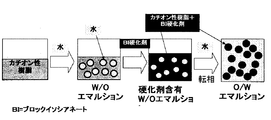
- FIG. 1 is a schematic explanatory diagram showing an outline of a method for preparing an emulsion resin composition for a cationic electrodeposition paint according to the present invention.
- a cationic resin and water are mixed, and water is dispersed in the cationic resin in which the dispersion medium is an oil phase.
- a dispersed W / O emulsion As a dispersed W / O emulsion.
- a blocked isocyanate curing agent is mixed. Since the blocked isocyanate curing agent is a hydrophobic compound, it is in a state compatible with a cationic resin that is an oil phase.
- the emulsion is phase-inverted by adding water to form an O / W emulsion.
- the cationic resin is preferably preliminarily heated to 100 to 180 ° C. to reduce the viscosity before mixing with water.
- the viscosity here is preferably lowered to 10,000 mPa ⁇ s or less, more preferably 6,000 mPa ⁇ s or less.
- the blocked isocyanate curing agent contains a blocked isocyanate curing agent (b1) having a dissociation temperature of 230 ° C. or higher and a blocked isocyanate curing agent (b2) having a dissociation temperature of less than 230 ° C. Then, a part or all of the blocked isocyanate curing agent (b1) having a dissociation temperature of 230 ° C. or higher may be added and mixed.
- a blocked isocyanate curing agent has a viscosity lower than that of a cationic resin, so that it can be reduced in viscosity when mixed, and there is no need to reduce the viscosity by heating.
- the blocked isocyanate curing agent (b1) having a dissociation temperature of less than 230 ° C. is preferably not mixed since an unnecessary curing reaction occurs in the step (1) when added and mixed in the step (1).
- Examples of water to be mixed include pure water, distilled water, ion exchange water, and deionized water.
- the amount of water used in this step (1) is preferably 10 to 100 parts by mass with respect to 100 parts by mass of the cationic resin.
- an appropriate amount of acid is added in order to disperse water well in the cationic resin.
- the acid to be added include inorganic acids such as hydrochloric acid, nitric acid, and hypophosphorous acid, and organic acids such as formic acid, acetic acid (including acetic anhydride and glacial acetic acid), lactic acid, sulfamic acid, and acetylglycine acid.
- the amount of acid added is preferably such that the milligram equivalent of acid per 100 g of resin solid content of the cationic resin is 10 to 50, more preferably 15 to 45.
- a W / O emulsion in which water is dispersed in the cationic resin is obtained.
- water having a large specific heat as a dispersoid is dispersed in a resin component of an oil phase as a dispersion medium.
- the temperature of the W / O emulsion obtained falls to 80 degrees C or less. Therefore, the temperature of the W / O emulsion can be lowered before mixing the blocked isocyanate curing agent having a low dissociation temperature, and when the blocked isocyanate curing agent is mixed in the next curing agent-containing W / O emulsion preparation step (2).
- Hardener-containing W / O emulsion preparation process (2) Next, the W / O emulsion obtained by the above step (1) and the blocked isocyanate curing agent are mixed.
- the blocked isocyanate curing agent includes the blocked isocyanate curing agent (b1) and the blocked isocyanate curing agent (b2)
- (B1) and all the blocked isocyanate curing agents (b2) are mixed.
- this step (2) since the temperature of the W / O emulsion is lowered to 80 ° C. or less, unnecessary curing reaction between the cationic resin and the blocked isocyanate curing agent can be suppressed, and the mixed blocked isocyanate curing is performed.
- the blocked isocyanate curing agent is a hydrophobic compound, it is in a state compatible with the oil phase cationic resin as the dispersion medium.
- a stable emulsion can be prepared without the need to raise the temperature at which both the organic solvent and the high viscosity cationic resin and the blocked isocyanate curing agent are mixed, even when both are cross-linked. can do.
- a curing agent-containing W / O emulsion is obtained.
- the total amount of MIBK and xylene at this time is the same as the total amount of MIBK and xylene contained in the cationic resin and the blocked isocyanate curing agent as constituent elements.
- the mixing ratio (based on the solid content) of the cationic resin and the blocked isocyanate curing agent is a cationic resin / blocked isocyanate curing agent, which is generally 90/10 to 40/60 and 85/15 to 45/55. Is more preferable, and 80/20 to 50/50 is more preferable.
- the proportion of the blocked isocyanate curing agent exceeds the above range, the blocked isocyanate curing agent has higher hydrophobicity, and therefore the stability of the O / W emulsion obtained in the subsequent O / W emulsion preparation step (3). May decrease.
- curing agent is less than the said range, there exists a possibility that the sclerosis
- O / W emulsion preparation process (3) Subsequently, the curing agent-containing W / O emulsion obtained in the above step (2) is mixed with water, and the amount of water contained in the curing agent-containing W / O emulsion is increased to cause phase inversion, and O / W emulsion is obtained.
- phase inversion point is a point at which the dispersion medium (that is, the continuous phase) changes from a resin component that is an oil phase to water that is an aqueous phase.
- the phase inversion point in the present specification when 25 ° C. ion-exchanged water is dropped into an emulsion set at 25 ° C., the ion-exchanged water spreads on the emulsion, then becomes cloudy, and finally slowly dissolves in the emulsion. .
- This phase inversion point can be obtained quantitatively by measuring the viscosity of the emulsion.
- the viscosity is continuously measured every 0.5 to 1.0% of the solid content mass concentration, and the rate of change of the viscosity with respect to the solid content mass concentration of the emulsion is The point at which the pressure becomes 300 mPa ⁇ s /% or less is defined as the above phase inversion point.
- the above viscosity is a value measured with a B-type viscometer at 25 ° C., 10 rpm, and rotor numbers 1-5.
- the solid content mass concentration (%) of the curing agent-containing W / O emulsion obtained in the curing agent-containing W / O emulsion preparation step (2) is expressed as “X W / O (%)”. is defined as, and in the case of solid mass concentration of phase inversion point from the curing agent-containing W / O emulsion to O / W emulsion (%) was defined as "X tra (%)", these X W / O (%) and X tra (%) are X W / O ⁇ X tra > 3% It is characterized by satisfying the relationship.
- X W / O (%) and X tra (%) satisfy the above relationship, an O / W emulsion excellent in storage stability and the like can be obtained.
- an O / W emulsion having an average particle size suitable for the preparation of a cationic electrodeposition coating composition can be obtained.
- X W / O (%) and X tra (%) are X W / O -X tra > 8% It is more preferable to satisfy this relationship.
- the upper limit of X W / O ⁇ X tra is preferably 50% from the viewpoint of viscosity, and more preferably 40%.
- phase inversion point itself is substantially determined by the raw materials, and is almost the same as the phase inversion point in the conventional method of emulsifying the cationic resin and the blocked isocyanate curing agent after mixing them in the resin state. Therefore, since X tra is predicted in advance, it is necessary to adjust X W / O in order for X W / O ⁇ X tra to satisfy the above range.
- the amount of the blocked isocyanate curing agent added X W / O - X tra calculates the solid mass concentration of the W / O emulsion such that the above range is obtained from the calculation the amount of water added .
- X W / O is preferably 35 to 85%. If it exceeds 85%, the amount of water is small, so the temperature does not drop sufficiently, and the cationic resin and the blocked isocyanate curing agent may react. If it is less than 35%, the amount of water is large, so The formation of the continuous phase may be incomplete, and the compatibility between the cationic resin and the blocked isocyanate curing agent may be insufficient. Therefore, there is a possibility that the particle size of the obtained particles is increased and the storage stability of the emulsion resin is lowered. More preferably, it is 35 to 80% or less.
- the blocked isocyanate curing agent When the blocked isocyanate curing agent is added, if the state of the cationic resin is already an O / W emulsion, the blocked isocyanate curing agent immediately precipitates and the emulsion itself cannot be obtained.
- the emulsion resin composition for cationic electrodeposition paint having the form of O / W emulsion can be prepared by the preparation method of the present invention described above.
- the average particle size of the obtained emulsion is preferably 100 nm or less, and more preferably 90 nm or less. If it exceeds 100 nm, the storage stability of the emulsion may be inferior.
- the average particle diameter of the emulsion in this specification is a median particle diameter in terms of volume. Measurement is performed by a dynamic light scattering method such as Microtrac UPA-150 (manufactured by Nikkiso Co., Ltd.). In measurement and calculation, the refractive index of the solvent (water) is 1.33 and the refractive index of the resin is 1.59. Use.
- the emulsion resin composition thus obtained is suitably used for the production of a cationic electrodeposition coating composition.
- the solvent removal process for removing MIBK and xylene contained in the obtained emulsion resin composition out of the system can be performed.
- the total content of MIBK and xylene contained in the curing agent-containing W / O emulsion is preferably controlled.
- a cationic electrodeposition coating composition can be suitably produced by using the emulsion resin composition for cationic electrodeposition coating obtained by the preparation method of the present invention.
- the cationic electrodeposition coating composition is generally an aqueous coating composition containing a cationic resin, a blocked isocyanate curing agent, and optionally pigments and additives.
- the emulsion resin composition for a cationic electrodeposition paint obtained by the preparation method of the present invention is used as a so-called binder resin in the production of a cationic electrodeposition paint composition.
- pigments that can be used in the production of the pigment cationic electrodeposition coating composition those usually used in coatings can be used without particular limitation.
- pigments that can be used include commonly used inorganic pigments, for example colored pigments such as titanium white, carbon black and bengara; extender pigments such as kaolin, talc, aluminum silicate, calcium carbonate, mica and clay; And iron phosphate, aluminum phosphate, calcium phosphate, aluminum tripolyphosphate, and rust preventive pigments such as aluminum phosphomolybdate and zinc aluminum phosphomolybdate.
- the pigment is preferably mixed with a resin, which is called a pigment dispersion resin, previously dispersed in an aqueous medium at a high concentration into a paste to be mixed into the electrodeposition coating composition.
- a resin which is called a pigment dispersion resin
- Such a paste is generally called a pigment dispersion paste.
- the pigment dispersion paste is prepared by dispersing a pigment in an aqueous medium together with a pigment dispersion resin.
- a pigment dispersion resin generally, a modified epoxy having a cationic or nonionic low molecular weight surfactant, a primary amino group, a secondary amino group, a tertiary amino group, a quaternary ammonium group and / or a tertiary sulfonium group.
- a cationic polymer such as a resin is used.
- As the aqueous medium ion-exchanged water, water containing a small amount of alcohol, or the like is used.
- the pigment dispersion paste is generally prepared by adding 5 to 40 parts by mass of the pigment dispersion resin to 100 parts by mass of the pigment.
- This pigment dispersion paste is mixed with the above-mentioned pigment dispersion resin and the pigment, and a commonly used dispersing device such as a ball mill or a sand grind mill is used until the pigment in the mixture has a predetermined uniform particle size. It can be obtained by dispersing.
- the pigment is preferably used in an amount of 1 to 50 parts by mass with respect to 100 parts by mass of the resin solid content contained in the cationic electrodeposition coating composition.
- the amount of the pigment is less than 1 part by mass, the amount of the pigment may be small, which may reduce the blocking of corrosion factors such as oxygen, water or ions of the obtained cured electrodeposition coating film, and may deteriorate the corrosion resistance. is there.
- the quantity of a pigment exceeds 50 mass parts, there exists a possibility that the flow property at the time of heat-curing may fall by containing an excessive amount of pigment, and a coating-film external appearance may be inferior.
- the cationic electrodeposition coating composition may contain a catalyst for dissociating the blocking agent of the blocked isocyanate curing agent in addition to the above components.
- a catalyst for dissociating the blocking agent of the blocked isocyanate curing agent in addition to the above components.
- examples of such a catalyst include organic tin compounds such as dibutyltin laurate, dibutyltin oxide and dioctyltin oxide, amines such as N-methylmorpholine, and metal salts such as strontium, cobalt, copper and bismuth.
- the concentration of the catalyst is preferably 0.1 to 6 parts by mass with respect to 100 parts by mass of the total of the cationic resin and the blocked isocyanate curing agent in the cationic electrodeposition coating composition.
- the cationic electrodeposition coating composition may contain additives well known by those skilled in the coating compositions, such as plasticizers, surfactants, coating surface smoothing agents, antioxidants and UV absorbers.
- the cationic electrodeposition coating composition can be produced by mixing the emulsion resin composition for cationic electrodeposition coating obtained by the preparation method of the present invention, a pigment dispersion paste, additives and the like.
- the emulsion resin composition for cationic electrodeposition coating obtained by the preparation method of the present invention is a conventional method for reducing the viscosity of the resin component and improving handling properties by using MIBK or xylene.
- MIBK or xylene MIBK or xylene.
- Electrodeposition coating and formation of cured electrodeposition coating film The cationic electrodeposition coating composition thus produced is immersed in an object to be electrodeposited, and then cured by heating to form a cured electrodeposition coating film. Can be formed.
- the object to be used for electrodeposition coating can be used without particular limitation as long as it is a conductive base material capable of electrodeposition coating.
- a conductive base material capable of electrodeposition coating examples include metals (for example, iron, steel, copper, aluminum, magnesium, tin, zinc, and the like and alloys containing these metals), iron plates, steel plates, aluminum plates, and surface treatments (for example, , Chemical conversion treatment using phosphate, zirconium salt and the like, and molded products thereof.
- Electrodeposition coating is usually performed by applying a voltage of 50 to 450 V between the object to be coated as the cathode and the anode. If the applied voltage is less than 50V, electrodeposition may be insufficient. On the other hand, when the applied voltage exceeds 450 V, the coating film may be destroyed and an abnormal appearance may be obtained. In electrodeposition coating, the bath temperature of the cationic electrodeposition coating composition is usually adjusted to 10 to 45 ° C.
- the electrodeposition coating step of the cationic electrodeposition coating composition includes a step of immersing the coating in the cationic electrodeposition coating composition, and applying a voltage between the anode to the anode with the coating to be coated as an uncured A step of depositing an electrodeposition coating film.
- the voltage application time varies depending on the electrodeposition conditions, but can generally be 2 to 4 minutes.
- the film thickness of the electrodeposition coating can generally be formed in the range of 5 to 25 ⁇ m. If the film thickness is less than 5 ⁇ m, the rust prevention property may be insufficient.
- the electrodeposition coating film obtained as described above is electrodeposited, washed with water as necessary, and heated at 120 to 260 ° C. for 10 to 30 minutes to cure the uncured electrodeposition coating film. Thus, a cured electrodeposition coating film is obtained.
- the reaction started from room temperature and was heated to 60 ° C. due to heat generation. Thereafter, after the reaction was continued for 30 minutes, the reaction was further carried out mainly in the range of 60 ° C. to 65 ° C. and continued until the isocyanate group disappeared while measuring the IR spectrum.
- EPON 829 manufactured by Shell Chemical Company, bisphenol A type epoxy resin, epoxy equivalent 193 to 203
- 289.6 parts of bisphenol A were charged in a suitable reaction vessel, and a nitrogen atmosphere Under heating at 150 to 160 ° C., an initial exothermic reaction occurred.
- the reaction mixture was reacted at 150-160 ° C. for about 1 hour, then cooled to 120 ° C., and 498.8 parts of the previously prepared 2-ethylhexanol half-blocked IPDI (MIBK solution) was added.
- reaction mixture is kept at 110-120 ° C. for about 1 hour, then 463.4 parts of ethylene glycol mono n-butyl ether are added and the mixture is cooled to 85-95 ° C., homogenized and then quaternized as previously prepared. 196.7 parts of agent were added.
- the reaction mixture was kept at 85 to 95 ° C. until the acid value became 1, and then 964 parts of deionized water was added to obtain a pigment dispersion resin having a quaternary ammonium salt portion (solid content 50% by mass).
- Production Example 8 Production of Pigment Dispersion Paste Into a sand grind mill, 120 parts of the pigment dispersion resin obtained in Production Example 7, 2.0 parts of carbon black, 100.0 parts of kaolin, 80.0 parts of titanium dioxide, aluminum phosphomolybdate 18.0 parts and 221.7 parts of ion-exchanged water were added and dispersed until the particle size became 10 ⁇ m or less to obtain a pigment dispersion paste (solid content 48% by mass).
- Example 1 Preparation of emulsion resin composition for cationic electrodeposition coating
- the temperature of the amine-modified epoxy resin (A) obtained in Production Example 1 was adjusted to 6,000 mPa ⁇ s, which was 150 ° C.
- the viscosity after maintaining for 30 minutes in that state was 6,000 mPa ⁇ s, and there was no change.
- glacial acetic acid corresponding to 35 milligram equivalents of acid per 602 parts by mass of ion-exchanged water and 100 parts by mass of amine-modified epoxy resin solids was added to another container.
- 900 parts by mass of an amine-modified epoxy resin (A) was added with stirring to obtain a W / O emulsion.
- the blocked isocyanate curing agent (b2-1) obtained in Production Example 4 is added in an amount such that the amine-modified epoxy resin / curing agent ratio is 70/30 in terms of solid content and mixed until uniform.
- a curing agent-containing W / O emulsion was obtained.
- Solids mass concentration X w / O of the resulting curing agent containing W / O emulsion was 65%.
- the temperature of the curing agent-containing W / O emulsion at this point was adjusted to 80 ° C.
- the total content of MIBK and xylene was 6 parts by mass with respect to 100 parts by mass of the total resin solids of the amine-modified epoxy resin (A) and the blocked isocyanate curing agent (b2-1).
- the phase was changed to an emulsion (phase inversion point).
- ion exchange water was further slowly added to dilute the solid mass concentration to 36%.
- the emulsion resin composition for cationic electrodeposition paint having a solid content mass concentration of 36% was obtained by adjusting with ion exchange water.
- the time taken to remove MIBK was 45 minutes.
- the particle diameter of the obtained emulsion was measured and found to be 80 nm.
- Example 1 the point at which the curing agent-containing W / O emulsion was phase-inverted to the O / W emulsion was determined by measuring the viscosity of the emulsion.
- the viscosity was sampled and continuously measured every 1.0%.
- the rate of change was determined from the value of the viscosity of the obtained emulsion, and the point at which 300 mPa ⁇ s /% was obtained was used as the phase inversion point.
- the viscosity was measured using a B-type viscometer at 25 ° C. and 10 rpm.
- FIGS. 2 and 3 are graphs showing the viscosity and the rate of change in the preparation of the emulsion resin composition for cationic electrodeposition coatings.
- the viscosity initially increases, but from a certain point, the viscosity rapidly decreases with the solid mass concentration, and thereafter the change in viscosity gradually decreases.
- the change rate of the viscosity is 47% of the solid content mass concentration, it becomes 300 mPa ⁇ s /%, which is set as the phase inversion point.
- the particle size of the obtained emulsion was determined by calculating the median particle size in terms of volume using Microtrac UPA-150 (particle size distribution measuring device by dynamic light scattering method manufactured by Nikkiso Co., Ltd.).
- a zinc phosphate-treated steel sheet JIS G3134, SPCC-SD Surfdyne SD-5000 (Nihon Paint Co., Ltd.)-Treated steel sheet
- Electrodeposition coating was performed at a voltage of 200 V for 180 seconds. After coating and washing with water, baking was performed at 160 ° C. for 25 minutes and air cooling was performed to obtain a cured electrodeposition coating film having a thickness of 15 ⁇ m.
- Example 2 A hardener-containing W / O emulsion was obtained in the same manner as in Example 1 except that the amount of ion-exchanged water used in the preparation of the W / O emulsion was 955 parts by mass. Solids mass concentration X w / O of the resulting curing agent containing W / O emulsion was 55%. At this time, the total content of MIBK and xylene was 6 parts by mass with respect to 100 parts by mass of the total resin solids of the amine-modified epoxy resin (A) and the blocked isocyanate curing agent (b2-1).
- a cationic electrodeposition coating composition and a cured electrodeposition coating film were prepared in the same manner as in Example 1.
- Example 3 A hardener-containing W / O emulsion was obtained in the same manner as in Example 1 except that the amount of ion-exchanged water used when preparing the W / O emulsion was 1184 parts by mass. Solids mass concentration X w / O of the resulting curing agent containing W / O emulsion was 50%. At this time, the total content of MIBK and xylene was 6 parts by mass with respect to 100 parts by mass of the total resin solids of the amine-modified epoxy resin (A) and the blocked isocyanate curing agent (b2-1).
- the phase was changed to an emulsion (phase inversion point).
- ion exchange water was further slowly added to dilute the solid mass concentration to 36%.
- the emulsion resin composition for cationic electrodeposition paint having a solid content mass concentration of 36% was obtained by adjusting with ion exchange water.
- the time taken to remove MIBK was 45 minutes.
- the particle diameter of the obtained emulsion was measured and found to be 95 nm.
- a cationic electrodeposition coating composition and a cured electrodeposition coating film were prepared in the same manner as in Example 1.
- Example 4 In place of the amine-modified epoxy resin (A) obtained in Production Example 1, the preparation was performed in the same manner as in Example 1 except that the amine-modified epoxy resin (B) obtained in Production Example 2 was used. A hardener-containing W / O emulsion was obtained. Solids mass concentration X w / O of the resulting curing agent containing W / O emulsion was 65%. At this time, the total content of MIBK and xylene was 6 parts by mass with respect to 100 parts by mass of the total resin solid content of the amine-modified epoxy resin (B) and the blocked isocyanate curing agent (b2-1).
- the phase was changed to an emulsion (phase inversion point).
- ion exchange water was further slowly added to dilute the solid mass concentration to 36%.
- the emulsion resin composition for cationic electrodeposition paint having a solid content mass concentration of 36% was obtained by adjusting with ion exchange water.
- the time taken to remove MIBK was 45 minutes.
- the particle diameter of the obtained emulsion was measured and found to be 77 nm.
- a cationic electrodeposition coating composition and a cured electrodeposition coating film were prepared in the same manner as in Example 1.
- Example 5 Instead of the blocked isocyanate curing agent (b2-1) obtained in Production Example 4, the blocked isocyanate curing agent (b1-1) obtained in Production Example 3 was used, and when preparing a W / O emulsion. Preparation was carried out in the same manner as in Example 1 except that the amount of ion-exchanged water was changed to 517 parts by mass to obtain a curing agent-containing W / O emulsion. Solid content of the resulting curing agent containing W / O emulsion concentration X w / O was 68%. At this time, the total content of MIBK and xylene was 6 parts by mass with respect to 100 parts by mass of the total amount of resin solids of the amine-modified epoxy resin (A) and the blocked isocyanate curing agent (b1-1).
- the phase was changed to an emulsion (phase inversion point).
- ion exchange water was further slowly added to dilute the solid mass concentration to 36%.
- the emulsion resin composition for cationic electrodeposition paint having a solid content mass concentration of 36% was obtained by adjusting with ion exchange water.
- the time taken to remove MIBK was 45 minutes.
- the particle diameter of the obtained emulsion was measured to be 84 nm.
- a cationic electrodeposition coating composition and a cured electrodeposition coating film were prepared in the same manner as in Example 1.
- Example 6 Addition of the blocked isocyanate curing agent (b1-2) obtained in Production Example 5 to the amine-modified epoxy resin (B) obtained in Production Example 2 in an amount of 70/15 in terms of solid content mass ratio makes it uniform.
- a blocked isocyanate-containing cationic resin When the temperature of this product was adjusted to 6,000 mPa ⁇ s, it was 140 ° C., and the viscosity after maintaining in that state for 30 minutes was unchanged at 6,000 mPa ⁇ s. Thereafter, glacial acetic acid corresponding to 35 milligram equivalents of acid per 602 parts by mass of ion-exchanged water and 100 parts by mass of amine-modified epoxy resin solids was added to another container.
- the temperature of the curing agent-containing W / O emulsion at this point was adjusted to 80 ° C.
- the total content of MIBK and xylene is 4 parts by mass with respect to 100 parts by mass of the total amount of resin solids of the amine-modified epoxy resin (B) and blocked isocyanate curing agents (b1-2) and (b2-1) at this time.
- the amine-modified epoxy resin / curing agent ratio was 70/30 in terms of solid mass ratio.
- the phase was changed to an emulsion (phase inversion point).
- ion exchange water was further slowly added to dilute the solid mass concentration to 36%.
- the emulsion resin composition for cationic electrodeposition paint having a solid content mass concentration of 36% was obtained by adjusting with ion exchange water.
- the time taken to remove MIBK was 10 minutes.
- the particle diameter of the obtained emulsion was measured and found to be 80 nm.
- a cationic electrodeposition coating composition and a cured electrodeposition coating film were prepared in the same manner as in Example 1.
- Example 7 The temperature was adjusted to 150 ° C. when the amine-modified epoxy resin (B) obtained in Production Example 2 was adjusted to 6,000 mPa ⁇ s. The viscosity after maintaining for 30 minutes in that state was 6,000 mPa ⁇ s, and there was no change. Thereafter, glacial acetic acid corresponding to 35 milligram equivalents of acid per 602 parts by mass of ion-exchanged water and 100 parts by mass of amine-modified epoxy resin solids was added to another container. To the container, 900 parts by mass of amine-modified epoxy resin (B) was added with stirring to obtain a W / O emulsion.
- the amine-modified epoxy resin (B), the blocked isocyanate curing agent (b1-2) obtained in Production Example 5 and the blocked isocyanate curing agent (b2-2) obtained in Production Example 6 were in a solid content mass ratio of 70.
- the mixture was mixed until it became uniform to obtain / 15/15 to obtain a W / O emulsion containing a curing agent.
- Solids mass concentration X w / O of the resulting curing agent containing W / O emulsion was 65%.
- the temperature of the curing agent-containing W / O emulsion at this point was adjusted to 80 ° C.
- the total content of MIBK and xylene is 3 parts by mass with respect to 100 parts by mass of the total amount of resin solids of the amine-modified epoxy resin (B) and blocked isocyanate curing agents (b1-2) and (b2-2) at this time. Met.
- the phase was changed to an emulsion (phase inversion point).
- ion exchange water was further slowly added to dilute the solid mass concentration to 36%.
- the solvent removal step was not performed.
- the particle diameter of the obtained emulsion was measured to be 83 nm.
- a cationic electrodeposition coating composition and a cured electrodeposition coating film were prepared in the same manner as in Example 1.
- Comparative Example 1 The block-modified isocyanate curing agent (b2-1) obtained in Production Example 4 is mixed with the amine-modified epoxy resin (C) obtained in Comparative Production Example 1 so as to be uniform at a solid content mass ratio of 70/30.
- the temperature was adjusted to 6,000 mPa ⁇ s, it was 80 ° C.
- the solid content mass concentration at this time point was 85%, and the viscosity after maintaining in that state for 30 minutes was unchanged at 6,000 mPa ⁇ s.
- the mixture at this point is a resin solution, and the total content of MIBK and xylene is 19 parts by mass with respect to 100 parts by mass of the total resin solids of the amine-modified epoxy resin (C) and the blocked isocyanate curing agent (b2-1). Was part.
- the mixture was transferred to another container, and glacial acetic acid was added so that the milligram equivalent of the acid per 100 g of the amine-modified epoxy resin solid content was 35, and further ion-exchanged water was slowly added to dilute.
- the phase was changed from a W / O emulsion to an O / W emulsion at a solid content mass concentration of 42%.
- ion-exchanged water was further slowly added to dilute the solid mass concentration to 36%.
- the emulsion resin composition for cationic electrodeposition paint having a solid content mass concentration of 36% was obtained by adjusting with ion exchange water. The time taken to remove MIBK was 140 minutes. The particle diameter of the obtained emulsion was measured and found to be 81 nm.
- a cationic electrodeposition coating composition and a cured electrodeposition coating film were prepared in the same manner as in Example 1.
- Comparative Example 2 The blocked isocyanate curing agent (b2-1) obtained in Production Example 4 was mixed with the amine-modified epoxy resin (A) obtained in Production Example 1 so as to be uniform at a solid content mass ratio of 70/30.
- the viscosity at this time was 120,000 mPa ⁇ s at 80 ° C., and the solid content mass concentration at this time was 96%.
- the viscosity after maintaining at 80 ° C. for 30 minutes was 120,000 mPa ⁇ s, and there was no change.
- the mixture at this point is a resin solution, and the total content of MIBK and xylene is 6 parts by mass with respect to 100 parts by mass of the total resin solids of the amine-modified epoxy resin (A) and the blocked isocyanate curing agent (b2-1). Was part.
- a cationic electrodeposition coating composition and a cured electrodeposition coating film were prepared in the same manner as in Example 1.
- the mixture was transferred to another container, and glacial acetic acid was added so that the milligram equivalent of the acid per 100 g of the amine-modified epoxy resin solid content was 35, and further ion-exchanged water was slowly added to dilute.
- the phase was changed from a W / O emulsion to an O / W emulsion at a solid content mass concentration of 45%.
- ion exchange water was further slowly added to dilute the solid content mass concentration to 36%.
- the emulsion resin composition for cationic electrodeposition paint having a solid content mass concentration of 36% was obtained by adjusting with ion exchange water. The time taken to remove MIBK was 30 minutes. The particle diameter of the obtained emulsion was measured and found to be 82 nm.
- a cationic electrodeposition coating composition and a cured electrodeposition coating film were prepared in the same manner as in Example 1.
- Comparative Example 4 A hardener-containing W / O emulsion was obtained in the same manner as in Example 1 except that the amount of ion-exchanged water used in preparing the W / O emulsion was 1289 parts by mass. Solids mass concentration X w / O of the resulting curing agent containing W / O emulsion was 48%. At this time, the total content of MIBK and xylene was 6 parts by mass with respect to 100 parts by mass of the total resin solids of the amine-modified epoxy resin (A) and the blocked isocyanate curing agent (b2-1).
- the phase was changed to an emulsion (phase inversion point).
- ion exchange water was further slowly added to dilute the solid mass concentration to 36%.
- the emulsion resin composition for cationic electrodeposition paint having a solid content mass concentration of 36% was obtained by adjusting with ion exchange water.
- the time taken to remove MIBK was 45 minutes.
- the particle diameter of the obtained emulsion was measured and found to be 170 nm.
- a cationic electrodeposition coating composition and a cured electrodeposition coating film were prepared in the same manner as in Example 1.
- the blocked isocyanate curing agent (b2-1) obtained in Production Example 4 was added in an amount such that the epoxy resin / curing agent ratio was 70/30 in terms of the solid content mass ratio. It added to O / W emulsion of resin (A). At this time, the total content of MIBK and xylene was 6 parts by mass with respect to 100 parts by mass of the total resin solids of the amine-modified epoxy resin (A) and the blocked isocyanate curing agent (b2-1).
- the obtained emulsion was already an O / W emulsion, and the added blocked isocyanate curing agent was precipitated, and a uniform O / W emulsion could not be obtained.
- the obtained preparation was an O / W emulsion in a non-uniform state in which a blocked isocyanate curing agent was precipitated. Therefore, it was not possible to prepare a cationic electrodeposition coating composition.
- the block-modified isocyanate curing agent (b2-2) obtained in Production Example 6 was mixed with the amine-modified epoxy resin (B) obtained in Production Example 2 so as to be uniform at a solid content mass ratio of 70/15, It was 140 degreeC when the temperature was adjusted so that it might become 3,000 mPa * s. The solid content mass concentration at this time was 99%. Further, the viscosity after maintaining at 140 ° C. for 30 minutes increased to a viscosity that could not be measured, and became semi-solid and could not be dispersed in water. Therefore, it was not possible to prepare a cationic electrodeposition coating composition. Therefore, the blocked isocyanate curing agent (b1-2) obtained in Production Example 5 prepared for mixing was not used.
- the amine-modified epoxy resin (B) was added to the container with stirring to obtain a W / O emulsion.
- Solids mass concentration X w / O of the resulting curing agent containing W / O emulsion was 65%.
- the temperature of the curing agent-containing W / O emulsion at this point was adjusted to 80 ° C.
- the total content of MIBK and xylene is 3 parts by mass with respect to 100 parts by mass of the total amount of resin solids of the amine-modified epoxy resin (B) and blocked isocyanate curing agents (b1-2) and (b2-2) at this time.
- a cationic electrodeposition coating composition and a cured electrodeposition coating film were prepared in the same manner as in Example 1.
- emulsion resin composition for cationic electrodeposition paint Storage stability of emulsion resin composition for cationic electrodeposition paint
- the emulsion resin composition for cationic electrodeposition paint was stored at 40 ° C. for 12 weeks, and the presence or absence of sedimentation was confirmed visually. The time until the precipitation was confirmed was defined as follows. 1. Sedimentation immediately after emulsion adjustment 2. Sedimentation the next day after emulsion adjustment 3. Sedimentation after 4 weeks of emulsion adjustment 4. Sedimentation after 12 weeks of emulsion adjustment 5. No sedimentation even after 12 weeks of emulsion adjustment.
- the emulsion resin composition for cationic electrodeposition coatings prepared by the method of the present invention has an extremely small amount of MIBK added at the time of preparation or does not need to be added. As a result, the time required for the solvent removal process can be shortened and the process itself can be omitted, and the load on the environment can be greatly reduced. Furthermore, in the method of the present invention, the amount of MIBK added is extremely small, or even if it is not added, uniform stirring and mixing can be performed. Therefore, the obtained emulsion resin has an average particle size of 100 nm or less. The emulsion resin had good storage stability. Moreover, the cured electrodeposition coating film obtained using the cationic electrodeposition coating composition manufactured using the emulsion resin obtained according to the examples was excellent in smoothness and had a good coating film appearance.
- Comparative Example 1 is a preparation example of an emulsion resin composition for a cationic electrodeposition coating by a conventional method.
- an amine-modified epoxy resin containing MIBK or xylene and a blocked isocyanate curing agent are mixed until uniform, and then ion-exchanged water is added to invert the phase into an O / W emulsion. Since the emulsion resin obtained by this method contains a large amount of MIBK and xylene at 19% by mass, it takes a long time to remove MIBK and xylene by the solvent removal step, and it is not economical and environmentally friendly. The load of was great.
- Comparative Example 2 is an example in which an emulsion resin composition was prepared using an amine-modified epoxy resin containing almost no MIBK or xylene by a procedure based on the conventional method.
- Comparative Example 2 since the content of MIBK and xylene was small, the viscosity was very high, and the uniform stirring property and mixing property were inferior. For this reason, there is a problem that the particle diameter of the obtained emulsion resin is increased and storage stability is poor.
- Comparative Example 3 is an example in which an emulsion resin composition was prepared by a procedure based on a conventional method using an amine-modified epoxy resin containing almost no MIBK or xylene.
- this comparative example 3 in order to improve handling property, it prepares by heating to 120 degreeC and high temperature.
- the blocking agent since it is necessary to heat to a high temperature even in a state where the amine-modified epoxy resin and the blocked isocyanate curing agent are mixed, the blocking agent is dissociated from the blocked isocyanate curing agent, resulting in an amine-modified epoxy resin. And the blocked isocyanate curing agent react in the emulsion resin, resulting in a problem that the smoothness of the obtained coating film is lowered and the appearance is lowered.
- Comparative Example 5 is a preparation example in which an O / W emulsion of an amine-modified epoxy resin was prepared and then a blocked isocyanate curing agent was mixed. In Comparative Example 5, the blocked isocyanate curing agent was precipitated, and a uniform O / W emulsion could not be obtained.
- step (1) an amine-modified epoxy resin and a blocked isocyanate curing agent (b2-2) having a dissociation temperature of 200 ° C. were mixed at 140 ° C., and then a W / O emulsion was prepared.
- the blocked isocyanate curing agent from which the blocking agent was dissociated and the amine-modified epoxy resin caused a curing reaction to become high molecular weight and semi-solid, so that it could not be dispersed in water and produced a cationic electrodeposition coating composition. I could't.
- step (1) an amine-modified epoxy resin, a blocked isocyanate curing agent (b1-2) having a dissociation temperature of 255 ° C., and a blocked isocyanate curing agent (b2-2) having a dissociation temperature of 200 ° C.
- a W / O emulsion was prepared.
- the blocked isocyanate curing agent from which the blocking agent was dissociated and the amine-modified epoxy resin caused a curing reaction to increase the molecular weight, it was possible to produce a cationic electrodeposition coating composition, but the obtained cured electrodeposition As for the coating film, flow property fell and smoothness fell.
- the emulsion resin composition for cationic electrodeposition paints of the present invention can be used as a binder resin for undercoat paint compositions for automobile bodies.
- it is useful as an electrodeposition coating composition in consideration of the environment in an automobile body production factory.
Landscapes
- Chemical & Material Sciences (AREA)
- Organic Chemistry (AREA)
- Chemical Kinetics & Catalysis (AREA)
- Health & Medical Sciences (AREA)
- Medicinal Chemistry (AREA)
- Polymers & Plastics (AREA)
- Life Sciences & Earth Sciences (AREA)
- Engineering & Computer Science (AREA)
- Materials Engineering (AREA)
- Wood Science & Technology (AREA)
- Molecular Biology (AREA)
- Oil, Petroleum & Natural Gas (AREA)
- Dispersion Chemistry (AREA)
- Paints Or Removers (AREA)
- Polyurethanes Or Polyureas (AREA)
Abstract
Priority Applications (6)
| Application Number | Priority Date | Filing Date | Title |
|---|---|---|---|
| ES13755158.6T ES2585005T3 (es) | 2012-02-28 | 2013-02-27 | Método para preparar una composición de resina de emulsión para revestimiento por electrodeposición catiónica |
| KR1020147016320A KR101486706B1 (ko) | 2012-02-28 | 2013-02-27 | 양이온 전착 도료용 에멀션 수지 조성물의 조제 방법 |
| CN201380010330.2A CN104114653B (zh) | 2012-02-28 | 2013-02-27 | 制备用于阳离子电沉积涂料的乳液树脂组合物的方法 |
| US14/345,674 US8937117B2 (en) | 2012-02-28 | 2013-02-27 | Method for preparing emulsion resin composition for cationic electrodeposition paint |
| EP13755158.6A EP2752467B1 (fr) | 2012-02-28 | 2013-02-27 | Procédé de préparation de composition de résine d'émulsion pour revêtement par électrodéposition cationique |
| JP2014502332A JP5615458B2 (ja) | 2012-02-28 | 2013-02-27 | カチオン電着塗料用エマルション樹脂組成物の調製方法 |
Applications Claiming Priority (2)
| Application Number | Priority Date | Filing Date | Title |
|---|---|---|---|
| JP2012-041893 | 2012-02-28 | ||
| JP2012041893 | 2012-02-28 |
Publications (1)
| Publication Number | Publication Date |
|---|---|
| WO2013129517A1 true WO2013129517A1 (fr) | 2013-09-06 |
Family
ID=49082711
Family Applications (1)
| Application Number | Title | Priority Date | Filing Date |
|---|---|---|---|
| PCT/JP2013/055223 Ceased WO2013129517A1 (fr) | 2012-02-28 | 2013-02-27 | Procédé de préparation de composition de résine d'émulsion pour revêtement par électrodéposition cationique |
Country Status (7)
| Country | Link |
|---|---|
| US (1) | US8937117B2 (fr) |
| EP (1) | EP2752467B1 (fr) |
| JP (1) | JP5615458B2 (fr) |
| KR (1) | KR101486706B1 (fr) |
| CN (1) | CN104114653B (fr) |
| ES (1) | ES2585005T3 (fr) |
| WO (1) | WO2013129517A1 (fr) |
Cited By (2)
| Publication number | Priority date | Publication date | Assignee | Title |
|---|---|---|---|---|
| US20160298250A1 (en) * | 2013-11-18 | 2016-10-13 | Basf Coatings Gmbh | Two-stage method for dip-coating electrically conductive substrates using a bi (iii) -containing composition |
| US20160297976A1 (en) * | 2013-11-19 | 2016-10-13 | Basf Coatings Gmbh | Aqueous dip-coating composition for electroconductive substrates, comprising aluminum oxide |
Families Citing this family (8)
| Publication number | Priority date | Publication date | Assignee | Title |
|---|---|---|---|---|
| EP3950149A4 (fr) * | 2019-03-29 | 2022-12-07 | Kansai Paint Co., Ltd | Composition de matériau de revêtement par électrodéposition cationique |
| BR112022011789A2 (pt) | 2019-12-20 | 2022-08-30 | Ppg Ind Ohio Inc | Composição de revestimento eletrodepositável incluindo um pigmento de filossilicato e um agente de dispersão |
| CA3190972A1 (fr) * | 2020-08-07 | 2022-02-10 | Basf Se | Mdi liquide modifie par caprolactame et son utilisation dans des polyurethanes |
| CN112266687A (zh) * | 2020-10-29 | 2021-01-26 | 浩力森化学科技(江苏)有限公司 | 一种季铵盐型研磨树脂的制备方法及免研磨阳离子型彩色电泳色浆 |
| PL4074805T3 (pl) * | 2021-04-15 | 2024-01-22 | SWISS KRONO Tec AG | Kompozycja spoiwa i sposób produkcji tworzywa drewnopochodnego i tworzywo drewnopochodne |
| EP4426762A1 (fr) * | 2021-11-04 | 2024-09-11 | BASF Coatings GmbH | Procédé de dispersion d'un agent de réticulation auto-émulsifiant, dispersion d'agent de réticulation obtenue et application associée dans un revêtement par électrodéposition ayant une température de cuisson faible |
| WO2023078670A1 (fr) * | 2021-11-04 | 2023-05-11 | Basf Coatings Gmbh | Dispersion de polyisocyanate bloqué auto-émulsifiante et son procédé de préparation |
| CN120442129B (zh) * | 2025-06-10 | 2026-02-10 | 广州昊特建材有限公司 | 一种耐盐雾水性工业漆及其制备方法 |
Citations (10)
| Publication number | Priority date | Publication date | Assignee | Title |
|---|---|---|---|---|
| JPS544978B2 (fr) | 1975-08-01 | 1979-03-12 | ||
| JPS5634186A (en) | 1979-08-29 | 1981-04-06 | Hitachi Ltd | Bipolar memory circuit |
| JPH04279679A (ja) * | 1991-03-07 | 1992-10-05 | Kansai Paint Co Ltd | カチオン電着塗料の製造方法 |
| JPH05306327A (ja) | 1991-12-06 | 1993-11-19 | Nippon Paint Co Ltd | オキサゾリドン環含有水性樹脂および塗料 |
| JPH09132737A (ja) * | 1995-11-08 | 1997-05-20 | Nippon Paint Co Ltd | カチオン電着塗料用樹脂組成物およびカチオン電着塗料 |
| JP2004307774A (ja) | 2003-04-01 | 2004-11-04 | Dupont Shinto Automotive Systems Kk | 新規なカチオン電着塗料の製造方法 |
| JP2007313420A (ja) * | 2006-05-25 | 2007-12-06 | Nippon Paint Co Ltd | カチオン電着塗装方法 |
| JP2008018320A (ja) * | 2006-07-12 | 2008-01-31 | Nippon Paint Co Ltd | エマルションの製造方法およびその製造方法から得られる水性塗料組成物 |
| JP2008080257A (ja) * | 2006-09-28 | 2008-04-10 | Nippon Paint Co Ltd | 振動ミキサーを用いたエマルションの製造方法およびそれから得られる水性塗料組成物 |
| JP2009138126A (ja) | 2007-12-07 | 2009-06-25 | Nippon Paint Co Ltd | カチオン電着塗料組成物およびその製造方法 |
Family Cites Families (11)
| Publication number | Priority date | Publication date | Assignee | Title |
|---|---|---|---|---|
| CA1277059C (fr) | 1986-07-18 | 1990-11-27 | Richard A. Hickner | Enduit epoxy en epaisseur de feuil controlee applique par electrodeposition cathodique |
| DE3738219A1 (de) | 1987-11-11 | 1989-05-24 | Basf Lacke & Farben | Verfahren zur herstellung kathodisch abscheidbarer bindemitteldispersionen mit vernetzern auf der basis von mit hydroxylgruppen verkappten polyisocyanaten |
| US6313218B1 (en) * | 1997-02-28 | 2001-11-06 | Cytec Technology Corp. | Low VOC, isocyanate based aqueous curable compositions |
| DE69805165T2 (de) * | 1997-02-28 | 2002-11-28 | Cytec Technology Corp., Wilmington | Isocyanat-vernetzbare, wässrige zusammensetzungen niedrigen gehalts an flüchtigen organischen verbindungen |
| JP2003138202A (ja) * | 2001-11-07 | 2003-05-14 | Nippon Paint Co Ltd | 抗菌性無鉛性カチオン電着塗料組成物 |
| JP4334806B2 (ja) * | 2002-03-05 | 2009-09-30 | 日本ペイント株式会社 | 多層塗膜形成方法および多層塗膜 |
| KR20040084779A (ko) * | 2003-03-25 | 2004-10-06 | 닛뽕 뻬인또 가부시키가이샤 | 미소 수지 입자 함유 수중유 형 에멀전을 제조하는 방법,내부 가교한 미소 수지 입자 함유 수중유 형 에멀전,양이온 전착 도료 조성물 및 도장물 |
| US20070244226A1 (en) | 2004-01-14 | 2007-10-18 | Yusuke Ninomiya | Cationic Electrodeposition Coating Composition |
| JP4378222B2 (ja) | 2004-05-31 | 2009-12-02 | デュポン神東・オートモティブ・システムズ株式会社 | 新規なカチオン電着塗料組成物及びそれを使用する塗装方法 |
| JP2006002001A (ja) * | 2004-06-16 | 2006-01-05 | Nippon Paint Co Ltd | カチオン電着塗料組成物 |
| JP2006342239A (ja) * | 2005-06-08 | 2006-12-21 | Nippon Paint Co Ltd | カチオン電着塗料組成物 |
-
2013
- 2013-02-27 WO PCT/JP2013/055223 patent/WO2013129517A1/fr not_active Ceased
- 2013-02-27 JP JP2014502332A patent/JP5615458B2/ja active Active
- 2013-02-27 EP EP13755158.6A patent/EP2752467B1/fr active Active
- 2013-02-27 KR KR1020147016320A patent/KR101486706B1/ko active Active
- 2013-02-27 CN CN201380010330.2A patent/CN104114653B/zh active Active
- 2013-02-27 US US14/345,674 patent/US8937117B2/en active Active
- 2013-02-27 ES ES13755158.6T patent/ES2585005T3/es active Active
Patent Citations (10)
| Publication number | Priority date | Publication date | Assignee | Title |
|---|---|---|---|---|
| JPS544978B2 (fr) | 1975-08-01 | 1979-03-12 | ||
| JPS5634186A (en) | 1979-08-29 | 1981-04-06 | Hitachi Ltd | Bipolar memory circuit |
| JPH04279679A (ja) * | 1991-03-07 | 1992-10-05 | Kansai Paint Co Ltd | カチオン電着塗料の製造方法 |
| JPH05306327A (ja) | 1991-12-06 | 1993-11-19 | Nippon Paint Co Ltd | オキサゾリドン環含有水性樹脂および塗料 |
| JPH09132737A (ja) * | 1995-11-08 | 1997-05-20 | Nippon Paint Co Ltd | カチオン電着塗料用樹脂組成物およびカチオン電着塗料 |
| JP2004307774A (ja) | 2003-04-01 | 2004-11-04 | Dupont Shinto Automotive Systems Kk | 新規なカチオン電着塗料の製造方法 |
| JP2007313420A (ja) * | 2006-05-25 | 2007-12-06 | Nippon Paint Co Ltd | カチオン電着塗装方法 |
| JP2008018320A (ja) * | 2006-07-12 | 2008-01-31 | Nippon Paint Co Ltd | エマルションの製造方法およびその製造方法から得られる水性塗料組成物 |
| JP2008080257A (ja) * | 2006-09-28 | 2008-04-10 | Nippon Paint Co Ltd | 振動ミキサーを用いたエマルションの製造方法およびそれから得られる水性塗料組成物 |
| JP2009138126A (ja) | 2007-12-07 | 2009-06-25 | Nippon Paint Co Ltd | カチオン電着塗料組成物およびその製造方法 |
Cited By (3)
| Publication number | Priority date | Publication date | Assignee | Title |
|---|---|---|---|---|
| US20160298250A1 (en) * | 2013-11-18 | 2016-10-13 | Basf Coatings Gmbh | Two-stage method for dip-coating electrically conductive substrates using a bi (iii) -containing composition |
| US10435805B2 (en) * | 2013-11-18 | 2019-10-08 | Basf Coatings Gmbh | Two-stage method for dip-coating electrically conductive substrates using a Bi (III)-containing composition |
| US20160297976A1 (en) * | 2013-11-19 | 2016-10-13 | Basf Coatings Gmbh | Aqueous dip-coating composition for electroconductive substrates, comprising aluminum oxide |
Also Published As
| Publication number | Publication date |
|---|---|
| US20140235756A1 (en) | 2014-08-21 |
| CN104114653B (zh) | 2016-02-10 |
| US8937117B2 (en) | 2015-01-20 |
| CN104114653A (zh) | 2014-10-22 |
| KR20140090262A (ko) | 2014-07-16 |
| JPWO2013129517A1 (ja) | 2015-07-30 |
| EP2752467A1 (fr) | 2014-07-09 |
| EP2752467B1 (fr) | 2016-07-13 |
| KR101486706B1 (ko) | 2015-01-26 |
| ES2585005T3 (es) | 2016-10-03 |
| EP2752467A4 (fr) | 2014-11-19 |
| JP5615458B2 (ja) | 2014-10-29 |
Similar Documents
| Publication | Publication Date | Title |
|---|---|---|
| JP5615458B2 (ja) | カチオン電着塗料用エマルション樹脂組成物の調製方法 | |
| CN107969130B (zh) | 制备阳离子电沉积涂料组合物的方法 | |
| CN110431202B (zh) | 阳离子电沉积涂料组合物 | |
| JP6483816B2 (ja) | 2,2−ジメチル−1,3−ジオキソラン−4−メタノールブロック化ポリイソシアネートに基づく架橋剤を含む、陰極電着材料用の水性バインダー分散液 | |
| JP2008231142A (ja) | カチオン電着塗料組成物、補給用カチオン電着塗料組成物および電着塗料組成物の補給方法 | |
| US20080173216A1 (en) | Process for forming electrodeposition coating film | |
| JP4088371B2 (ja) | カチオン電着塗料組成物 | |
| JP2006342303A (ja) | カチオン電着塗料用ハジキ防止剤およびこれを含む塗料組成物 | |
| JP2006002001A (ja) | カチオン電着塗料組成物 | |
| CN114040947B (zh) | 阳离子电沉积涂料组合物 | |
| JP7333198B2 (ja) | カチオン電着塗料組成物の調製方法 | |
| WO2008050797A1 (fr) | Composition de revêtement pour électrodéposition cationique et son application | |
| JP2002129100A (ja) | カチオン電着塗料組成物 | |
| JP2004231989A (ja) | 環境対応型電着塗装方法及び塗装物品 | |
| JP5595131B2 (ja) | カチオン電着塗料組成物 | |
| JP2001192606A (ja) | 可塑剤を含むカチオン電着塗料組成物 | |
| JP2022183490A (ja) | カチオン電着塗料組成物、電着塗装物および電着塗装物の製造方法 | |
| US20070244226A1 (en) | Cationic Electrodeposition Coating Composition | |
| JP2015187197A (ja) | カチオン電着塗料組成物 | |
| JP2000281944A (ja) | 電着塗料組成物 | |
| JP2015193684A (ja) | カチオン電着塗料組成物 | |
| CN111819010A (zh) | 阳离子电沉积涂料组合物和固化电沉积涂膜的形成方法 | |
| JP2002069358A (ja) | 顔料分散ペースト、及びカチオン電着塗料組成物 | |
| JP2002294145A (ja) | 無鉛性カチオン電着塗料組成物 | |
| JP2002294144A (ja) | 無鉛性カチオン電着塗料組成物 |
Legal Events
| Date | Code | Title | Description |
|---|---|---|---|
| 121 | Ep: the epo has been informed by wipo that ep was designated in this application |
Ref document number: 13755158 Country of ref document: EP Kind code of ref document: A1 |
|
| ENP | Entry into the national phase |
Ref document number: 2014502332 Country of ref document: JP Kind code of ref document: A |
|
| WWE | Wipo information: entry into national phase |
Ref document number: 14345674 Country of ref document: US |
|
| REEP | Request for entry into the european phase |
Ref document number: 2013755158 Country of ref document: EP |
|
| WWE | Wipo information: entry into national phase |
Ref document number: 2013755158 Country of ref document: EP |
|
| WWE | Wipo information: entry into national phase |
Ref document number: 1020147016320 Country of ref document: KR |
|
| NENP | Non-entry into the national phase |
Ref country code: DE |