WO2013132801A1 - 医用画像表示装置および医用画像表示方法、並びに、医用画像表示プログラム - Google Patents
医用画像表示装置および医用画像表示方法、並びに、医用画像表示プログラム Download PDFInfo
- Publication number
- WO2013132801A1 WO2013132801A1 PCT/JP2013/001234 JP2013001234W WO2013132801A1 WO 2013132801 A1 WO2013132801 A1 WO 2013132801A1 JP 2013001234 W JP2013001234 W JP 2013001234W WO 2013132801 A1 WO2013132801 A1 WO 2013132801A1
- Authority
- WO
- WIPO (PCT)
- Prior art keywords
- image
- region
- interest
- tomographic image
- tomographic
- Prior art date
- Legal status (The legal status is an assumption and is not a legal conclusion. Google has not performed a legal analysis and makes no representation as to the accuracy of the status listed.)
- Ceased
Links
Images



Classifications
-
- A—HUMAN NECESSITIES
- A61—MEDICAL OR VETERINARY SCIENCE; HYGIENE
- A61B—DIAGNOSIS; SURGERY; IDENTIFICATION
- A61B6/00—Apparatus or devices for radiation diagnosis; Apparatus or devices for radiation diagnosis combined with radiation therapy equipment
- A61B6/46—Arrangements for interfacing with the operator or the patient
- A61B6/461—Displaying means of special interest
- A61B6/463—Displaying means of special interest characterised by displaying multiple images or images and diagnostic data on one display
-
- A—HUMAN NECESSITIES
- A61—MEDICAL OR VETERINARY SCIENCE; HYGIENE
- A61B—DIAGNOSIS; SURGERY; IDENTIFICATION
- A61B5/00—Measuring for diagnostic purposes; Identification of persons
- A61B5/74—Details of notification to user or communication with user or patient; User input means
- A61B5/742—Details of notification to user or communication with user or patient; User input means using visual displays
-
- G—PHYSICS
- G06—COMPUTING OR CALCULATING; COUNTING
- G06T—IMAGE DATA PROCESSING OR GENERATION, IN GENERAL
- G06T11/00—Two-dimensional [2D] image generation
- G06T11/60—Creating or editing images; Combining images with text
-
- G—PHYSICS
- G06—COMPUTING OR CALCULATING; COUNTING
- G06T—IMAGE DATA PROCESSING OR GENERATION, IN GENERAL
- G06T12/00—Tomographic reconstruction from projections
- G06T12/30—Image post-processing, e.g. metal artefact correction
-
- G—PHYSICS
- G06—COMPUTING OR CALCULATING; COUNTING
- G06T—IMAGE DATA PROCESSING OR GENERATION, IN GENERAL
- G06T19/00—Manipulating three-dimensional [3D] models or images for computer graphics
- G06T19/20—Editing of three-dimensional [3D] images, e.g. changing shapes or colours, aligning objects or positioning parts
-
- G—PHYSICS
- G06—COMPUTING OR CALCULATING; COUNTING
- G06T—IMAGE DATA PROCESSING OR GENERATION, IN GENERAL
- G06T7/00—Image analysis
- G06T7/0002—Inspection of images, e.g. flaw detection
- G06T7/0012—Biomedical image inspection
- G06T7/0014—Biomedical image inspection using an image reference approach
-
- G—PHYSICS
- G06—COMPUTING OR CALCULATING; COUNTING
- G06T—IMAGE DATA PROCESSING OR GENERATION, IN GENERAL
- G06T7/00—Image analysis
- G06T7/0002—Inspection of images, e.g. flaw detection
- G06T7/0012—Biomedical image inspection
- G06T7/0014—Biomedical image inspection using an image reference approach
- G06T7/0016—Biomedical image inspection using an image reference approach involving temporal comparison
-
- G—PHYSICS
- G06—COMPUTING OR CALCULATING; COUNTING
- G06T—IMAGE DATA PROCESSING OR GENERATION, IN GENERAL
- G06T7/00—Image analysis
- G06T7/30—Determination of transform parameters for the alignment of images, i.e. image registration
- G06T7/38—Registration of image sequences
-
- A—HUMAN NECESSITIES
- A61—MEDICAL OR VETERINARY SCIENCE; HYGIENE
- A61B—DIAGNOSIS; SURGERY; IDENTIFICATION
- A61B6/00—Apparatus or devices for radiation diagnosis; Apparatus or devices for radiation diagnosis combined with radiation therapy equipment
- A61B6/02—Arrangements for diagnosis sequentially in different planes; Stereoscopic radiation diagnosis
- A61B6/03—Computed tomography [CT]
- A61B6/032—Transmission computed tomography [CT]
-
- A—HUMAN NECESSITIES
- A61—MEDICAL OR VETERINARY SCIENCE; HYGIENE
- A61B—DIAGNOSIS; SURGERY; IDENTIFICATION
- A61B6/00—Apparatus or devices for radiation diagnosis; Apparatus or devices for radiation diagnosis combined with radiation therapy equipment
- A61B6/02—Arrangements for diagnosis sequentially in different planes; Stereoscopic radiation diagnosis
- A61B6/03—Computed tomography [CT]
- A61B6/037—Emission tomography
-
- A—HUMAN NECESSITIES
- A61—MEDICAL OR VETERINARY SCIENCE; HYGIENE
- A61B—DIAGNOSIS; SURGERY; IDENTIFICATION
- A61B6/00—Apparatus or devices for radiation diagnosis; Apparatus or devices for radiation diagnosis combined with radiation therapy equipment
- A61B6/46—Arrangements for interfacing with the operator or the patient
- A61B6/467—Arrangements for interfacing with the operator or the patient characterised by special input means
- A61B6/469—Arrangements for interfacing with the operator or the patient characterised by special input means for selecting a region of interest [ROI]
-
- A—HUMAN NECESSITIES
- A61—MEDICAL OR VETERINARY SCIENCE; HYGIENE
- A61B—DIAGNOSIS; SURGERY; IDENTIFICATION
- A61B6/00—Apparatus or devices for radiation diagnosis; Apparatus or devices for radiation diagnosis combined with radiation therapy equipment
- A61B6/52—Devices using data or image processing specially adapted for radiation diagnosis
- A61B6/5211—Devices using data or image processing specially adapted for radiation diagnosis involving processing of medical diagnostic data
- A61B6/5229—Devices using data or image processing specially adapted for radiation diagnosis involving processing of medical diagnostic data combining image data of a patient, e.g. combining a functional image with an anatomical image
- A61B6/5235—Devices using data or image processing specially adapted for radiation diagnosis involving processing of medical diagnostic data combining image data of a patient, e.g. combining a functional image with an anatomical image combining images from the same or different ionising radiation imaging techniques, e.g. PET and CT
-
- G—PHYSICS
- G06—COMPUTING OR CALCULATING; COUNTING
- G06T—IMAGE DATA PROCESSING OR GENERATION, IN GENERAL
- G06T2207/00—Indexing scheme for image analysis or image enhancement
- G06T2207/10—Image acquisition modality
- G06T2207/10072—Tomographic images
-
- G—PHYSICS
- G06—COMPUTING OR CALCULATING; COUNTING
- G06T—IMAGE DATA PROCESSING OR GENERATION, IN GENERAL
- G06T2207/00—Indexing scheme for image analysis or image enhancement
- G06T2207/20—Special algorithmic details
- G06T2207/20212—Image combination
- G06T2207/20221—Image fusion; Image merging
-
- G—PHYSICS
- G06—COMPUTING OR CALCULATING; COUNTING
- G06T—IMAGE DATA PROCESSING OR GENERATION, IN GENERAL
- G06T2207/00—Indexing scheme for image analysis or image enhancement
- G06T2207/30—Subject of image; Context of image processing
- G06T2207/30004—Biomedical image processing
-
- G—PHYSICS
- G06—COMPUTING OR CALCULATING; COUNTING
- G06T—IMAGE DATA PROCESSING OR GENERATION, IN GENERAL
- G06T2219/00—Indexing scheme for manipulating 3D models or images for computer graphics
- G06T2219/20—Indexing scheme for editing of 3D models
- G06T2219/2016—Rotation, translation, scaling
Definitions
- the present invention relates to a medical image display device, a medical image display method, and a medical image display program for displaying two images so that a region of interest can be comparatively interpreted in two images acquired by photographing the same subject at different times.
- a medical image display program for displaying two images so that a region of interest can be comparatively interpreted in two images acquired by photographing the same subject at different times.
- a non-rigid registration technique that estimates a conversion function with a matching position and deforms one image using the estimated conversion function to align two types of images has attracted attention.
- this non-rigid registration technique control points that divide the image space at predetermined intervals are set, and the similarity between the pixel values of one image and the other image that are deformed by displacing the positions of the control points is evaluated.
- the deformation amount of the control point that maximizes the evaluation function is determined, and the conversion function is estimated based on the deformation amount of the control point at this time.
- Patent Documents 1 to 3 in the comparative display of medical images representing organs at a plurality of time points, the interest of the medical image at another time point corresponding to the region of interest of the medical image at one time point using the non-rigid registration technique.
- a region is specified, and one of the medical images representing the region of interest is transformed so that medical images representing the organs at a plurality of points of time coincide with each other.
- a medical image display method for displaying a medical image at another time point to be displayed an image obtained by deforming medical images representing organs at a plurality of time points so as to match each other is presented.
- Patent Document 4 in a comparative display of medical images representing bronchi at a plurality of time points, corresponding landmarks (bronchial bifurcations) are extracted from each medical image, and corresponding landmarks match with each other. Parameters are calculated by a linear optimization technique, and based on the calculated coordinate transformation parameters, a medical image at one time point representing the region of interest and a medical image at another time point representing the corresponding region of interest (coordinates by the coordinate transformation parameter) This presents a medical image display method in which images generated by conversion are displayed in a comparable manner.
- the corresponding tomographic images at different time points are used for comparative interpretation, and the tomographic images at different time points can be observed accurately so that the actual shape of the organ or region of interest can be observed accurately.
- a tomographic image representing a region of interest at a corresponding position is more accurately specified based on a conversion function or a coordinate conversion parameter for alignment. It is required to display the tomographic image for comparison without deformation.
- the present invention provides a medical image display device capable of displaying a comparative tomographic image at a corresponding position more accurately between two images obtained by photographing the same subject at different points in time.
- a medical image display device includes an image acquisition unit that acquires a first image and a second image that are three-dimensional images obtained by imaging the same patient at different points in time.
- First tomographic image information that is information for specifying a first tomographic image that is a tomographic image included in one image and first region-of-interest information that is information for specifying a first region of interest on the first tomographic image are acquired.
- a first tomographic image information acquisition unit that performs deformation for calculating an image deformation amount of one image for deforming one of the first image and the second image so that the first image and the second image coincide with each other.
- the calculated image deformation amount of one image and the first region-of-interest information image deformation amounts of a plurality of positions included in the region of interest of one image are acquired, and the plurality of positions Based on the image deformation amount and the first tomographic image information, the first The tomographic image in the second image corresponding to the layer image is specified as the second tomographic image, and corresponds to the first region of interest based on the calculated image deformation amount of the one image and the first region of interest information.
- the second tomographic image specifying unit that specifies the region of interest in the second image as the second region of interest, the first tomographic image and the specified second tomographic image are comparatively displayed on the display device, and on the second tomographic image
- a display control unit that projects and identifies and displays the second region of interest specified in (1).
- the medical image display method includes a medical image display device including an image acquisition unit, a first tomographic image information acquisition unit, a deformation amount calculation unit, a second tomographic image specification unit, and a display control unit.
- Image deformation of one calculated image Based on the first region-of-interest information and the first region-of-interest information, image deformation amounts at a plurality of positions included in the region of interest of one image are acquired, A tomographic image in the second image corresponding to one tomographic image is specified as the second tomographic image, and the first region of interest is handled based on the calculated image deformation amount of the one image and the first region of interest information.
- a display control step for projecting and identifying the second region of interest specified above is executed.
- the medical image display program includes an image acquisition unit that acquires a first image and a second image, which are three-dimensional images obtained by imaging the same patient at different times, and a first image.
- First to acquire first tomographic image information that is information for specifying a first tomographic image that is a tomographic image included, and first region-of-interest information that is information for specifying a first region of interest on the first tomographic image.
- a tomographic image information acquisition unit and a deformation amount calculation unit that calculates an image deformation amount of one image for deforming one of the first image and the second image so that the first image and the second image coincide with each other.
- the tomographic image in the second image corresponding to the layer image is specified as the second tomographic image, and corresponds to the first region of interest based on the calculated image deformation amount of the one image and the first region of interest information.
- the second tomographic image specifying unit that specifies the region of interest in the second image as the second region of interest, the first tomographic image and the specified second tomographic image are comparatively displayed on the display device, and on the second tomographic image
- the second region of interest specified in (2) is projected and functioned as a display control unit for identifying and displaying.
- the first image and the second image in the present invention may be images representing the same subject photographed at different timings, and may be photographed with different modalities. However, in order to perform comparative interpretation with high accuracy. It is preferable that the images are taken with the same modality.
- modalities applicable as the modality of the present invention include CT, MRI, PET, SPECT, ultrasound image, and the like.
- the “first tomographic image information” may be information for specifying the first tomographic image by any method capable of specifying the first tomographic image.
- the first tomographic image information can be information representing the series name of the first tomographic image, the coordinates of one or more positions on the first tomographic image, and the normal vector of the first tomographic image.
- the first image is a CT image and the first tomographic image is an axial (axial position) image
- the series name and slice number of the first tomographic image are used as the first tomographic image information. It can be.
- the “first region of interest information” may identify the first region of interest by any method that can identify the first region of interest.
- the first region of interest may be defined by an arbitrary method.
- the first region of interest includes a plurality of regions on the boundary of the first region of interest. It may be a predetermined polyhedral region defined based on the position, and further, based on two positions on the boundary of the first region of interest where the first region of interest faces each other across the first region of interest. May be specified.
- a sphere or a rectangular parallelepiped can be used as the polyhedral area.
- the first region of interest may be constituted by an arbitrary curved surface.
- the second tomographic image specifying unit has an angle formed between the second tomographic image and the patient's body axis equal to an angle formed between the first tomographic image and the patient's body axis, and
- the position of the second image having the same coordinates as the at least one position in the first tomographic image includes a position moved by the average value or the median of the image deformation amounts of the plurality of positions included in the first region of interest.
- the second tomographic image is specified.
- the first region-of-interest information is information representing a plurality of positions on the boundary of the first region of interest
- the second tomographic image specifying unit has a short distance from the plurality of positions on the boundary of the first region of interest. It is desirable to calculate the image deformation amount of the first region of interest by performing weighted averaging of the image deformation amounts corresponding to the respective positions included in the first region of interest so as to increase the weight.
- the display control unit projects only the contour of the second region of interest on the second tomographic image, and identifies and displays the projected contour index on the second tomographic image. It is preferable that
- an image acquisition unit that acquires a first image and a second image that are three-dimensional images obtained by imaging the same patient at different times, and a first tomogram that is included in the first image.
- a first tomographic image information acquisition unit that acquires first tomographic image information that is information for specifying a tomographic image and first region-of-interest information that is information for specifying a first region of interest on the first tomographic image;
- a deformation amount calculating unit for calculating an image deformation amount of one image for deforming one image of the first image or the second image so that one image matches the second image, and the calculated one image Based on the image deformation amount and the first region-of-interest information, image deformation amounts at a plurality of positions included in the region of interest of one image are acquired, and the image deformation amounts at the plurality of positions and the first tomographic image information are obtained.
- the region of interest in the second image corresponding to the first region of interest is specified as the second region of interest based on the calculated image deformation amount of the one image and the first region of interest information.
- the second tomographic image specifying unit, the first tomographic image and the specified second tomographic image are displayed in comparison on the display device, and the specified second region of interest is projected and identified on the second tomographic image.
- a display control unit is provided. In the follow-up observation, an area having a certain extent such as a lesion is often used as a region of interest.
- the position of the second tomographic image is determined using information on deformation amounts of a plurality of positions in the first region of interest.
- the position of the second tomographic image corresponding to the first tomographic image can be appropriately specified and compared and displayed. For this reason, it is possible to provide support for accurately performing comparative interpretation.
- 1 is an electrical schematic block diagram of a medical image display apparatus in an embodiment of the present invention. It is a figure for demonstrating the input method of the region of interest on the 1st tomographic image in embodiment of this invention. It is a figure for demonstrating the acquisition method of the region of interest on the 1st tomographic image in embodiment of this invention. It is a figure for demonstrating the identification method of the 2nd tomographic image in embodiment of this invention. It is a figure which shows the example of a display of the 1st tomographic image and 2nd tomographic image in embodiment of this invention. It is a flowchart which shows operation
- FIG. 1 shows a schematic configuration of a medical image display apparatus realized by installing a medical image display program on a workstation used by a doctor.
- the medical image display apparatus 1 includes a processor and a memory (both not shown) as a standard workstation configuration, and further includes a storage 2 such as an HDD (Hard Disk Drive).
- the medical image display device 1 is connected to a display 3 and an input device 4 such as a mouse and a keyboard.
- the medical image display program and the data referred to by the medical image display program are stored in the storage 2 at the time of installation and loaded into the memory at the time of activation.
- the medical image display program defines an image acquisition process, a first tomographic image information acquisition process, a deformation amount calculation process, a second tomographic image identification process, and a display control process as processes to be executed by the CPU. .
- the general-purpose workstation executes an image acquisition unit 11, a first tomographic image information acquisition unit 12, a deformation amount calculation unit 13, described later, The second tomographic image specifying unit 14 and the display control unit 15 function.
- the storage 2 stores the first image VA and the second image VB transferred from the inspection department in charge of photographing, or the first image VA and the second image VB acquired by database search.
- the same patient was obtained by photographing with the CT device at the first photographing time point and the second photographing time point after the first photographing time point.
- the first image VA and the second image VB are respectively transferred from the inspection department and stored in the storage 2.
- Both images VA and VB are obtained by photographing a patient in the same posture with the same photographing method for comparative interpretation of medication results.
- the patient's body axis and body orientation are mutually different. It is assumed that they are approximately the same.
- both images VA and VB are based on the pixel size (Pixel Spacing) and slice interval (Slice Spacing) obtained by a known method from arbitrary information such as header information of both images VA and VB. It is assumed that processing for unifying the scales of both the images VA and VB is performed on one of the VBs.
- the image acquisition unit 11 acquires the first image VA and the second image VB from the storage 2.
- the medical image display apparatus 1 detects that a predetermined comparison display function is selected in the selection menu, the medical image display apparatus 1 prompts the user to select or input information necessary for specifying the first and second images. .
- the image acquisition unit 11 loads the first image VA and the second image VB from the storage 2 to the memory.
- the first tomographic image information acquisition unit 12 obtains first tomographic image information that is information for specifying the first tomographic image SA that is a tomographic image included in the first image VA and a first region of interest on the first tomographic image.
- First region-of-interest information that is information to be identified is acquired.
- 2A and 2B are image diagrams for explaining a method of acquiring region-of-interest information, and both drawings show the same first tomographic image SA.
- the first tomographic image SA represents an xy cross section of the first image VA and is an axial image of the patient.
- the image interpretation doctor sequentially displays tomographic images (axial images) included in the first image VA, and determines an observation image representing a region of interest as the first tomographic image SA by selection using a predetermined selection button or the like. Then, the first tomographic image information acquisition unit 12 acquires the series name and slice number of the first tomographic image as information for identifying the first tomographic image SA (first tomographic image information) and stores it in the memory.
- the first tomographic image information acquisition unit 12 sandwiches a first region of interest such as an abnormal shadow region on the first tomographic image SA by an input from the input device 4 by a user operation.
- the input of the positions of the two pixels PA1 and PA2 on the boundary of the first region of interest RA facing each other is received, and the coordinates of the pixels PA1 and PA2 input by the input device 4 are acquired.
- the first tomographic image information acquisition unit 12 acquires the first region of interest as a rectangular parallelepiped region that is specified based on the positions of the acquired pixels PA1 and PA2.
- a rectangle whose diagonal line is a line connecting pixels PA and PB is a rectangle that is translated by a predetermined length in the normal direction of the first tomogram (positive direction of the z-axis, front side in FIG. 2B).
- a rectangle whose upper surface is a diagonal line connecting the pixels PA1 and PA2 is a rectangle that is translated by a predetermined length in the normal direction of the first tomogram (the negative direction of the z-axis, the back side in FIG. 2B).
- the rectangular parallelepiped to be identified is specified as the first region of interest RA.
- the length of each side of the rectangle defined by the diagonal line and the predetermined length in the z direction of the rectangular parallelepiped are respectively calculated in advance at a predetermined ratio corresponding to the length of the diagonal line. Then, the first tomographic image information acquisition unit 12 acquires the coordinates of each vertex of the cubic region that is the first region of interest RA and the acquired coordinate information of the pixels PA1 and PA2 as the first region of interest specifying information.
- the deformation amount calculation unit 13 deforms the first image VA, and the degree of similarity between the deformed first image VA and the second image VB corresponds to the pixel value of the deformed first image VA and the second image VB.
- a deformation amount (image deformation amount) of the first image in which the first image and the second image that have been evaluated and deformed by an evaluation function that represents a similarity measure of pixel values coincides with each other is calculated.
- the deformation amount calculation unit 13 sets a set X including control points x1, x2,..., Xn that divide the image space at predetermined intervals in the first image VA and the second image VB.
- a set of control points x1, x2,..., Xn is referred to as a control point X.
- the deformation amount calculation unit 13 deforms the first image VA by displacing the control point X of the first image VA by the deformation amount ⁇ using a known conversion function g.
- a control point obtained by displacing the control point X of the first image VA by the transformation function g by the deformation amount ⁇ is described as g (X, ⁇ ), and the control point X of the first image VA is transformed by the transformation function g.
- An image obtained by deforming the first image VA by being displaced by ⁇ is referred to as a deformed first image VA ′.
- the deformation amount calculation unit 13 obtains the pixel value M (g (X, ⁇ )) at the control point g (X, ⁇ ) of the deformed first image VA ′ and sets the control point X of the second image VB. Pixel value F (X) is acquired. The similarity between the pixel value M (g (X, ⁇ )) at each control point g (X, ⁇ ) of the deformed first image VA ′ and the pixel value F (X) of each control point X of the second image VB.
- the deformation amount ⁇ of the control point X that maximizes the evaluation function (registration function) representing the measure of sex is determined, and the conversion function for the first image VA is estimated based on the deformation amount ⁇ of the control point X at this time.
- the evaluation value of this embodiment assumes that an evaluation value becomes large, so that it is similar.
- the deformation amount calculation unit 13 calculates a deformation amount of the first image in which the subjects of the first image and the second image match, and in order to estimate a conversion function based on the deformation amount, a known non-rigid registration method
- a known non-rigid registration method David Mattes, David R. Haynor, Hubert Vesselle, Thomas K. It is assumed that the described non-rigid registration technique is used.
- the second tomographic image specifying unit 14 calculates the image deformation amounts at a plurality of positions included in the first region of interest RA among the calculated image deformation amounts based on the first region of interest information, and the first Based on the tomographic image information, the tomographic image in the second image VB corresponding to the first tomographic image SA is specified as the second tomographic image SB, and the interest in the VB in the second image corresponding to the first region of interest RA.
- the region is specified as the second region of interest RB.
- the second tomographic image specifying unit 14 converts the first image VA using the conversion function estimated by the deformation amount calculating unit 13, and sets corresponding pixels of the first image VA and the second image VB. Identify. Then, based on the first region-of-interest information, the amount of deformation at each position in the first region of interest RA for deforming the first image VA so as to match the second image VB is calculated. Next, the second tomographic image specifying unit 14 averages T (Tx, Tx, deformation amount of all pixels included in the first region of interest in the x, y, and z directions of the three-dimensional coordinate system of the first image VA. Ty, Tz) is obtained.
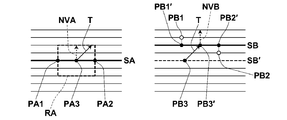
- FIG. 3 is a diagram illustrating a method for specifying the second tomographic image.
- the left side of FIG. 3 is a diagram illustrating an xz cross-section showing the first image VA from a direction perpendicular to FIGS. 2A and 2B.
- the tomographic images constituting the first image VA are indicated by horizontal lines
- the first tomographic images SA are indicated by horizontal thick lines.
- the right side of FIG. 3 is a diagram showing an xz cross section of the second image VB, and a plurality of tomographic images constituting the second image VB are indicated by horizontal lines
- the second tomographic image SB is indicated by horizontal thick lines.
- the second tomographic image specifying unit 14 calculates the coordinates of the pixel PA3 located at the midpoint between PA1 and PA2 on the first tomographic image SA, and determines the position of the pixel PB3 that is the same coordinate as PA3 in the second image VB.
- the coordinates of PB3 ′ moved by the average value T of the deformation amount of all the pixels in one region of interest are acquired.
- the axial image in the second image VB including PB3 ' is specified as the second tomographic image SB.
- both the first tomographic image SA and the second tomographic image SB are axial images (a tomographic image representing a patient in a predetermined orientation)
- the normal vector NVA of the first tomographic image SA (the broken line on the left side of FIG. 3).
- the angle formed by the arrow) and the patient's body axis is equal to the angle formed by the normal vector NVB (the broken line arrow on the right side of FIG. 3) of the second tomographic image SB and the patient's body axis.
- PB3 ′ is included from two axial images adjacent in the z direction across PB3 ′.
- An axial image in the second image VB is complemented and generated, and this is defined as a second tomographic image SB.
- the first image VA is compared with the plane including the first tomographic image SA in the coordinate system of the first image VA.
- a plane located at the same position as the plane including the first tomographic image SA in the coordinate system in the two images VB is specified, and the specified plane is moved in the z direction by an average value Tz of the movement amount in the z direction. May be the second tomographic image SB.
- the second tomographic image specifying unit 14 specifies a region composed of each pixel of the VB in the second image corresponding to all the pixels included in the first region of interest RA as the second region of interest RB. Further, the second tomographic image specifying unit calculates coordinates obtained by projecting the coordinates of the pixels located on the contour of the second region of interest RB perpendicularly to the second tomographic image.
- PB1 and PB2 in the second image VB shown on the right in FIG. 3 are pixels corresponding to PA1 and PA2 of the first tomographic image SA, respectively.
- PA1 and PA2 are included in the first tomographic image SA.
- both PB1 and PB2 are the second due to a change over time or a slight difference in the posture of the patient at the time of imaging. It exists at a position not included in the tomographic image SB.
- the outline of the first region of interest RA is projected and displayed on the second tomographic image SB. Therefore, as shown in the right diagram of FIG. 3, PB1 ′ and PB2 ′ obtained by projecting the pixels PB1 and PB2 corresponding to the pixels PA1 and PA2 on the contour of the first region of interest RA onto the second tomographic image SB. Find the coordinates of.
- the display control unit 15 displays the first tomographic image SA and the second tomographic image SB on the display 3 so that they can be compared.
- the second region of interest RB is projected onto the second tomographic image SB for identification display.
- the display control unit 15 displays the acquired first image VA and second image VB and / or each image generated in the execution process of the medical image display program of the present embodiment according to the user's input or the like. 3 may be displayed.
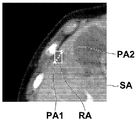
- FIG. 4 shows an example of comparative display of the first tomographic image SA and the second tomographic image SB.
- the display control unit 15 identifies and displays the outline of the second region of interest RB projected on the second tomographic image SB using the white index MA.
- the display control unit 15 includes, on the first tomographic image SA, two pixels PA1 and PA1 on the boundary between the first region of interest RA and the first region of interest RA designated by the user operation.
- PA2 is displayed in an identifiable manner, and pixels PB1 ′ and PB2 ′ at positions where the positions of the pixels PB1 and PB2 corresponding to the two pixels PA1 and PA2 are projected on the second tomographic image SB are also displayed in an identifiable manner.
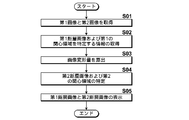
- FIG. 5 is a flowchart showing a preferred embodiment of the medical image display method of the present invention. With reference to FIG. 5, the medical image display of this embodiment is demonstrated.
- the image acquisition unit 11 acquires a first image (first image data) VA and a second image (second image data) VB obtained by imaging a subject (S01).
- the first tomographic image information acquisition unit 12 acquires information for specifying the first tomographic image SA and information for specifying the first region of interest RA included in the first tomographic image SA (S02).
- the deformation amount calculation unit 13 calculates a deformation amount ⁇ that maximizes the evaluation function based on an evaluation function that represents a similarity measure between the pixel value of the first image VA and the pixel value of the second image VB.
- a conversion function is calculated so that the pixel value of the first image VA matches the second image VB based on the calculated deformation amount (S03).
- the second tomographic image specifying unit 14 specifies the second tomographic image SB and the second region of interest RB based on the image deformation amounts at a plurality of positions in the first region of interest RA (S04). Then, as shown in FIG. 4, the display control unit 15 displays the first tomographic image SA and the second tomographic image SB in parallel so that they can be compared, and uses the contour index MB for the region of interest on the second tomographic image SB. And display the identification (S05).
- the second tomographic image specifying unit specifies the corresponding second tomographic image SB based on the deformation amounts of a plurality of positions included in the first region of interest RA.
- a region having a certain extent such as a lesion is often used as a region of interest. Therefore, the position of the second tomographic image is specified using information on deformation amounts of a plurality of positions in the first region of interest. By doing so, it is possible to appropriately specify and compare and display the position of the second tomographic image SB corresponding to the first tomographic image SA by using the deformation amounts of a plurality of positions in the first region of interest for determination. As a result, it is possible to provide support for performing comparative interpretation with high accuracy.
- the corresponding second tomographic image SB is specified based on the deformation amounts of all positions included in the first region of interest RA, and thus the above effect is more remarkable.
- the present invention is not limited to this embodiment, and the corresponding second tomographic image SB may be specified based on the deformation amount of some positions included in the first region of interest RA.
- Patent Documents 1 to 4 when an image obtained by deforming one of the images is generated and displayed, according to the present embodiment, at two points in time for follow-up observation. Since the tomographic images that have not been deformed at the corresponding positions are displayed in a comparable manner, the tomographic images are displayed without deformation so that the actual shape of the organ or region of interest in the diagnostic practice can be observed accurately. It is possible to display an image corresponding to the desire to perform. Further, the processing cost for generating a deformed image in the methods described in Patent Documents 1 to 4 can be omitted.
- the second tomographic image specifying unit 14 determines that the angle formed between the second tomographic image SB and the patient's body axis is equal to the angle formed between the first tomographic image SA and the patient's body axis.
- the position of the second image having the same coordinates as the at least one point in the first tomographic image includes the position moved by the average value of the image deformation amounts of the plurality of positions included in the first region of interest. Since the two tomographic images are specified, the slopes of the cross sections represented by the first tomographic image and the second tomographic image correspond to each other suitably.
- the same effect can be obtained when the median deformation amount of the images at the plurality of positions in the first region of interest is used instead of the average deformation amount of the images at the plurality of positions in the first region of interest. can get.
- the first tomographic image and the second tomographic image are axial images used in the current follow-up observation practice, it is easy for medical personnel to observe and effectively increases the interpretation efficiency. be able to.
- the second tomographic image specifying unit 14 is configured such that the angle formed between the second tomographic image SB and the patient's body axis is equal to the angle formed between the first tomographic image SA and the patient's body axis, and Specifying the second tomographic image so as to include a position where the position of the second image having the same coordinates as the at least one point is moved by the average value of the image deformation amounts of the plurality of positions included in the first region of interest If so, the second tomographic image may be specified by any method.
- the position of the pixel PA3 located at the midpoint between the positions PA1 and PA2 designated by the user in the first tomographic image is made to correspond to the position of the pixel PB3 ′ on the second tomographic image SB, and this PA3 ′
- the second tomographic image SB is specified based on the above, the present invention is not limited to this, and a pair of a position in the first tomographic image and a position corresponding to this in the second tomographic image may be arbitrarily determined.
- the second tomographic image preferably includes the position in the region of interest.
- the second tomographic image is the first region of interest. Since the position corresponding to the center (or center of gravity) of the second tomographic image can be included, there is a high possibility that the second tomographic image more appropriately represents the region of interest.
- the second tomographic image SB for comparison and the second region of interest are displayed only by designating the region of interest on one of the images.
- tomographic images for comparative interpretation are extracted from the first image and the second images VA and VB by operation, and the regions of interest corresponding to each other are set on the extracted tomographic images, the burden of user work is reduced. be able to.
- the first region of interest RA is a rectangular parallelepiped region that is a predetermined polyhedral region defined based on the positions of the plurality of pixels PA1 and PA2 on the boundary of the first region of interest, the first interest of the user
- the area input operation is simple.
- a polyhedron region having an arbitrary shape such as a sphere or a cube can be applied as the predetermined polyhedron region.
- any method can be used as a method for specifying a predetermined polyhedral region by a user operation.
- the first region of interest RA is specified based on the positions of the two pixels PA1 and PA2 on the boundary of the first region of interest facing each other across the first region of interest, the user's The input operation of the first region of interest is simple.
- the present invention is not limited to this embodiment, and the first region of interest may be a two-dimensional region on the first tomographic image.
- the first region of interest may be configured by a curved surface, or may be configured by a combination of a curved surface and a plane.
- the first region of interest may not be acquired by receiving a user operation by the input device, but may be acquired by a known image recognition technique.
- the display control unit 15 projects only the contour of the second region of interest RB on the second tomographic image SB, and the projected contour index MB is identified and displayed on the second tomographic image SB. It is easy to grasp the second region of interest SB. Further, when the user measures a region of interest such as a lesion on the second tomographic image, information serving as a measurement guideline can be obtained using the size of the displayed index. For example, the size of the rectangular index of the present embodiment is used as a measure of the size of the region of interest, or the length of the diagonal line connecting PA1 and PA2 of the rectangular indexes of the present embodiment is used as a measure of the diameter of the region of interest. Can be considered.
- the second region of interest RB may be represented using a known technique as long as the second region of interest RB can be projected and displayed on the second tomographic image SB in an identifiable manner.
- the projection image of the second region of interest RB may be displayed translucently.
- the contour of the second region of interest RB is projected and identified on the second tomographic image SB, and the contour of the first region of interest RA is also displayed on the first tomographic image SA. In this case, it is easy to compare the regions of interest and the interpretation efficiency can be improved.
- the positions of the two pixels PA1 and PA2 on the boundary facing each other across the region of interest specified by the user operation are displayed on the first tomographic image SA, and the positions corresponding to PA1 and PA2 are displayed on the second tomographic image. Since the pixels PB1 ′ and PB2 ′ at the positions projected on the image SB are displayed on the second tomographic image SB, it is easier to compare the regions of interest.
- the first region-of-interest information is information representing a plurality of positions on the boundary of the first region of interest
- the second tomographic image specifying unit 14 performs the first interest-of-interest.
- An image of the first region of interest is obtained by weighted averaging the image deformation amounts corresponding to the respective positions included in the first region of interest so that the weight is increased as the distance from the plurality of positions of the boundary of the region is closer.
- the amount of deformation may be calculated.
- a plurality of positions on the boundary are positions designated by the user operation, it is determined that the user is the region of interest by using a weighted average of the deformation amount obtained by increasing the weight of the deformation amount of the boundary of the region of interest.
- the amount of movement of the second tomographic image relative to the first tomographic image can be calculated in accordance with the position and the amount of deformation around this position, and the deformation of the position determined as the user's region of interest can be calculated.
- the second tomographic image at the position corresponding to the amount can be appropriately identified and displayed.
- the conversion function of the first image VA is estimated based on an image deformation amount that deforms the first image VA so that the first image VA and the second image VB match, and the first image is used using the estimated conversion function.
- the corresponding pixels of the first image VA and the second image VB may be determined, and image deformation that deforms the second image VB so that the first image VA and the second image VB coincide with each other.
- the corresponding function of the first image VA and the second image VB is determined by estimating the conversion function of the second image VB based on the amount and converting the second image VB using the estimated conversion function.
- any known non-rigid registration method may be applied as the non-rigid registration method for matching the first image VA and the second image VB.
- either the deformation amount calculation process or the first region-of-interest acquisition process may be performed first or simultaneously.
- the medical image display device 1 may be configured to share functions as means by a plurality of computers.
- a device constituting the system such as an input device and a display, all known devices can be employed.
Landscapes
- Engineering & Computer Science (AREA)
- Physics & Mathematics (AREA)
- Health & Medical Sciences (AREA)
- General Physics & Mathematics (AREA)
- Theoretical Computer Science (AREA)
- Life Sciences & Earth Sciences (AREA)
- Medical Informatics (AREA)
- General Health & Medical Sciences (AREA)
- Radiology & Medical Imaging (AREA)
- Nuclear Medicine, Radiotherapy & Molecular Imaging (AREA)
- Computer Vision & Pattern Recognition (AREA)
- Biomedical Technology (AREA)
- Public Health (AREA)
- Veterinary Medicine (AREA)
- Pathology (AREA)
- Heart & Thoracic Surgery (AREA)
- Molecular Biology (AREA)
- Surgery (AREA)
- Animal Behavior & Ethology (AREA)
- Biophysics (AREA)
- Quality & Reliability (AREA)
- High Energy & Nuclear Physics (AREA)
- Optics & Photonics (AREA)
- Human Computer Interaction (AREA)
- Architecture (AREA)
- Computer Graphics (AREA)
- Computer Hardware Design (AREA)
- General Engineering & Computer Science (AREA)
- Software Systems (AREA)
- Apparatus For Radiation Diagnosis (AREA)
Priority Applications (2)
| Application Number | Priority Date | Filing Date | Title |
|---|---|---|---|
| EP13758049.4A EP2823765B1 (de) | 2012-03-05 | 2013-02-28 | Vorrichtung zur anzeige medizinischer bilder, verfahren zur anzeige medizinischer bilder und programm zur anzeige medizinischer bilder |
| US14/476,487 US9119599B2 (en) | 2012-03-05 | 2014-09-03 | Medical image display apparatus, medical image display method and non-transitory computer-readable recording medium having stored therein medical image display program |
Applications Claiming Priority (2)
| Application Number | Priority Date | Filing Date | Title |
|---|---|---|---|
| JP2012-047538 | 2012-03-05 | ||
| JP2012047538A JP5745444B2 (ja) | 2012-03-05 | 2012-03-05 | 医用画像表示装置および医用画像表示方法、並びに、医用画像表示プログラム |
Related Child Applications (1)
| Application Number | Title | Priority Date | Filing Date |
|---|---|---|---|
| US14/476,487 Continuation US9119599B2 (en) | 2012-03-05 | 2014-09-03 | Medical image display apparatus, medical image display method and non-transitory computer-readable recording medium having stored therein medical image display program |
Publications (1)
| Publication Number | Publication Date |
|---|---|
| WO2013132801A1 true WO2013132801A1 (ja) | 2013-09-12 |
Family
ID=49116297
Family Applications (1)
| Application Number | Title | Priority Date | Filing Date |
|---|---|---|---|
| PCT/JP2013/001234 Ceased WO2013132801A1 (ja) | 2012-03-05 | 2013-02-28 | 医用画像表示装置および医用画像表示方法、並びに、医用画像表示プログラム |
Country Status (4)
| Country | Link |
|---|---|
| US (1) | US9119599B2 (de) |
| EP (1) | EP2823765B1 (de) |
| JP (1) | JP5745444B2 (de) |
| WO (1) | WO2013132801A1 (de) |
Cited By (1)
| Publication number | Priority date | Publication date | Assignee | Title |
|---|---|---|---|---|
| JP2015512312A (ja) * | 2012-04-03 | 2015-04-27 | イントラセンスIntrasense | 医用画像間のトポロジー保存roiリマッピング方法 |
Families Citing this family (37)
| Publication number | Priority date | Publication date | Assignee | Title |
|---|---|---|---|---|
| WO2007095330A2 (en) | 2006-02-15 | 2007-08-23 | Hologic Inc | Breast biopsy and needle localization using tomosynthesis systems |
| CN102481146B (zh) | 2009-10-08 | 2016-08-17 | 霍罗吉克公司 | 乳房的穿刺活检系统及其使用方法 |
| US9075903B2 (en) | 2010-11-26 | 2015-07-07 | Hologic, Inc. | User interface for medical image review workstation |
| US9020579B2 (en) | 2011-03-08 | 2015-04-28 | Hologic, Inc. | System and method for dual energy and/or contrast enhanced breast imaging for screening, diagnosis and biopsy |
| JP2014534042A (ja) | 2011-11-27 | 2014-12-18 | ホロジック, インコーポレイテッドHologic, Inc. | マンモグラフィーおよび/またはトモシンセシス画像データを使用して2d画像を生成するためのシステムおよび方法 |
| WO2013111813A1 (ja) * | 2012-01-27 | 2013-08-01 | 株式会社 東芝 | 医用画像処理装置 |
| CN104135935A (zh) | 2012-02-13 | 2014-11-05 | 霍罗吉克公司 | 用于利用合成图像数据导航层析堆的系统和方法 |
| AU2014233687B2 (en) | 2013-03-15 | 2018-12-06 | Hologic, Inc. | Tomosynthesis-guided biopsy in prone |
| US10624598B2 (en) | 2013-03-15 | 2020-04-21 | Hologic, Inc. | System and method for navigating a tomosynthesis stack including automatic focusing |
| JP6026932B2 (ja) * | 2013-03-22 | 2016-11-16 | 富士フイルム株式会社 | 医用画像表示制御装置および方法並びにプログラム |
| KR102244258B1 (ko) * | 2013-10-04 | 2021-04-27 | 삼성전자주식회사 | 디스플레이 장치 및 이를 이용한 영상표시방법 |
| CN106170255A (zh) | 2013-10-24 | 2016-11-30 | 安德鲁·P·史密斯 | 用于导航x射线引导的乳房活检的系统和方法 |
| EP3417786B1 (de) | 2014-02-28 | 2021-04-14 | Hologic, Inc. | System und verfahren zur erzeugung und anzeige von tomosynthesebildplatten |
| JP6128691B2 (ja) * | 2014-07-10 | 2017-05-17 | 富士フイルム株式会社 | 医用画像計測装置および方法並びにプログラム |
| JP6528386B2 (ja) * | 2014-11-04 | 2019-06-12 | 富士通株式会社 | 画像処理装置、画像処理方法及び画像処理プログラム |
| US10255697B2 (en) * | 2014-11-20 | 2019-04-09 | Koninklijke Philips N.V. | Method for generation of synthetic mammograms from tomosynthesis data |
| US10607334B2 (en) * | 2014-12-09 | 2020-03-31 | Asml Netherlands B.V. | Method and apparatus for image analysis |
| US10437157B2 (en) | 2014-12-09 | 2019-10-08 | Asml Netherlands B.V. | Method and apparatus for image analysis |
| JP6840481B2 (ja) * | 2016-07-19 | 2021-03-10 | キヤノン株式会社 | 画像処理装置および画像処理方法 |
| JP6934734B2 (ja) * | 2017-03-17 | 2021-09-15 | キヤノン株式会社 | 画像処理装置、画像処理装置の制御方法およびプログラム |
| CN110662489B (zh) | 2017-03-30 | 2024-08-02 | 豪洛捷公司 | 用于靶向对象增强以生成合成乳房组织图像的系统和方法 |
| WO2018183549A1 (en) | 2017-03-30 | 2018-10-04 | Hologic, Inc. | System and method for synthesizing low-dimensional image data from high-dimensional image data using an object grid enhancement |
| JP7277053B2 (ja) | 2017-03-30 | 2023-05-18 | ホロジック, インコーポレイテッド | 階層式マルチレベル特徴画像合成および提示のためのシステムおよび方法 |
| EP3641635A4 (de) | 2017-06-20 | 2021-04-07 | Hologic, Inc. | Dynamisches selbstlernendes medizinisches bildverfahren und -system |
| CN107545564A (zh) * | 2017-07-20 | 2018-01-05 | 广东工业大学 | 电网输电线路绝缘子伞裙缺陷检测方法 |
| JP7237454B2 (ja) * | 2018-04-12 | 2023-03-13 | キヤノン株式会社 | 画像処理装置、画像処理装置の制御方法、及びプログラム |
| AU2019349684B2 (en) | 2018-09-24 | 2025-04-10 | Hologic, Inc. | Breast mapping and abnormality localization |
| MX2022004070A (es) | 2019-10-03 | 2022-05-18 | Univ Cornell | Optimización de la talla de brasier de acuerdo con la forma 3d de los senos. |
| EP3832602A1 (de) * | 2019-12-03 | 2021-06-09 | Koninklijke Philips N.V. | Vorrichtung, verfahren und computerprogramm zur überwachung einer person während eines medizinischen bildgebungsverfahrens |
| JP7323128B2 (ja) * | 2020-03-12 | 2023-08-08 | 東芝エネルギーシステムズ株式会社 | 医用画像処理装置、医用装置、治療システム、医用画像処理方法、およびプログラム |
| WO2021195084A1 (en) | 2020-03-27 | 2021-09-30 | Hologic, Inc. | Systems and methods for identifying regions of interest in multiple imaging modalities |
| CN115334973A (zh) | 2020-03-27 | 2022-11-11 | 豪洛捷公司 | 用于关联多成像模态中的关注区域的系统和方法 |
| US20220164951A1 (en) | 2020-11-20 | 2022-05-26 | Hologic, Inc. | Systems and methods for using ai to identify regions of interest in medical images |
| CN113469972B (zh) * | 2021-06-30 | 2024-04-23 | 沈阳东软智能医疗科技研究院有限公司 | 标注医学切片图像的方法、装置、存储介质及电子设备 |
| US12254586B2 (en) | 2021-10-25 | 2025-03-18 | Hologic, Inc. | Auto-focus tool for multimodality image review |
| IL313196A (en) | 2021-11-29 | 2024-07-01 | Hologic Inc | Systems and methods for correlating objects of interest |
| CN116580071A (zh) * | 2022-01-29 | 2023-08-11 | 佳能医疗系统株式会社 | 医用图像配准方法、医用图像处理装置、存储介质及程序产品 |
Citations (11)
| Publication number | Priority date | Publication date | Assignee | Title |
|---|---|---|---|---|
| JPH10137231A (ja) * | 1996-11-13 | 1998-05-26 | Toshiba Iyou Syst Eng Kk | 医用画像処理装置 |
| JP2006314778A (ja) * | 2005-04-15 | 2006-11-24 | Toshiba Corp | 医用画像処理装置及び医用画像処理方法 |
| JP2007021193A (ja) * | 2005-06-15 | 2007-02-01 | Toshiba Corp | 画像処理装置及び画像処理プログラム |
| JP2008043736A (ja) * | 2006-07-18 | 2008-02-28 | Toshiba Corp | 医用画像処理装置及び医用画像処理方法 |
| JP2008086400A (ja) | 2006-09-29 | 2008-04-17 | Gifu Univ | 乳房画像診断システム |
| JP2009522005A (ja) | 2005-12-29 | 2009-06-11 | ケアストリーム ヘルス インク | 時間横断的かつモダリティ横断的な医療診断 |
| JP2009160045A (ja) * | 2007-12-28 | 2009-07-23 | Toshiba Corp | 医用画像表示装置および画像表示方法 |
| JP2009195306A (ja) | 2008-02-19 | 2009-09-03 | Toshiba Corp | 医用画像表示装置および画像表示方法 |
| JP2010057532A (ja) * | 2008-09-01 | 2010-03-18 | Hitachi Medical Corp | 磁気共鳴イメージング装置 |
| JP2011024763A (ja) * | 2009-07-24 | 2011-02-10 | Hitachi Ltd | 画像処理方法および画像処理装置 |
| JP2011092677A (ja) | 2009-09-30 | 2011-05-12 | Fujifilm Corp | 肝臓造影像を用いた医用画像診断装置および方法、並びにプログラム |
Family Cites Families (5)
| Publication number | Priority date | Publication date | Assignee | Title |
|---|---|---|---|---|
| US7903849B2 (en) | 2005-04-15 | 2011-03-08 | Kabushiki Kaisha Toshiba | Medical image processing apparatus |
| US7676072B2 (en) * | 2005-06-15 | 2010-03-09 | Kabushiki Kaisha Toshiba | Image processing apparatus and image processing method |
| EP1881453A3 (de) | 2006-07-18 | 2009-07-22 | Kabushiki Kaisha Toshiba | Medizinische Bildbearbeitungsvorrichtung und Verfahren zur Bearbeitung medizinischer Bilder |
| EP2098991A1 (de) * | 2008-03-06 | 2009-09-09 | Agfa HealthCare NV | Verfahren zur Regisrierung und Anzeige medizinischer Bilder |
| US8452126B2 (en) * | 2011-06-17 | 2013-05-28 | General Electric Company | Method for automatic mismatch correction of image volumes |
-
2012
- 2012-03-05 JP JP2012047538A patent/JP5745444B2/ja active Active
-
2013
- 2013-02-28 WO PCT/JP2013/001234 patent/WO2013132801A1/ja not_active Ceased
- 2013-02-28 EP EP13758049.4A patent/EP2823765B1/de active Active
-
2014
- 2014-09-03 US US14/476,487 patent/US9119599B2/en active Active
Patent Citations (11)
| Publication number | Priority date | Publication date | Assignee | Title |
|---|---|---|---|---|
| JPH10137231A (ja) * | 1996-11-13 | 1998-05-26 | Toshiba Iyou Syst Eng Kk | 医用画像処理装置 |
| JP2006314778A (ja) * | 2005-04-15 | 2006-11-24 | Toshiba Corp | 医用画像処理装置及び医用画像処理方法 |
| JP2007021193A (ja) * | 2005-06-15 | 2007-02-01 | Toshiba Corp | 画像処理装置及び画像処理プログラム |
| JP2009522005A (ja) | 2005-12-29 | 2009-06-11 | ケアストリーム ヘルス インク | 時間横断的かつモダリティ横断的な医療診断 |
| JP2008043736A (ja) * | 2006-07-18 | 2008-02-28 | Toshiba Corp | 医用画像処理装置及び医用画像処理方法 |
| JP2008086400A (ja) | 2006-09-29 | 2008-04-17 | Gifu Univ | 乳房画像診断システム |
| JP2009160045A (ja) * | 2007-12-28 | 2009-07-23 | Toshiba Corp | 医用画像表示装置および画像表示方法 |
| JP2009195306A (ja) | 2008-02-19 | 2009-09-03 | Toshiba Corp | 医用画像表示装置および画像表示方法 |
| JP2010057532A (ja) * | 2008-09-01 | 2010-03-18 | Hitachi Medical Corp | 磁気共鳴イメージング装置 |
| JP2011024763A (ja) * | 2009-07-24 | 2011-02-10 | Hitachi Ltd | 画像処理方法および画像処理装置 |
| JP2011092677A (ja) | 2009-09-30 | 2011-05-12 | Fujifilm Corp | 肝臓造影像を用いた医用画像診断装置および方法、並びにプログラム |
Non-Patent Citations (1)
| Title |
|---|
| D. MATTES ET AL.: "Nonrigid multimodality image registration", PROCEEDINGS OF THE SPIE, vol. 4322, 2001, pages 1609 - 1620 |
Cited By (1)
| Publication number | Priority date | Publication date | Assignee | Title |
|---|---|---|---|---|
| JP2015512312A (ja) * | 2012-04-03 | 2015-04-27 | イントラセンスIntrasense | 医用画像間のトポロジー保存roiリマッピング方法 |
Also Published As
| Publication number | Publication date |
|---|---|
| EP2823765B1 (de) | 2017-02-01 |
| EP2823765A4 (de) | 2015-11-11 |
| JP5745444B2 (ja) | 2015-07-08 |
| US9119599B2 (en) | 2015-09-01 |
| EP2823765A1 (de) | 2015-01-14 |
| JP2013180153A (ja) | 2013-09-12 |
| US20150002547A1 (en) | 2015-01-01 |
Similar Documents
| Publication | Publication Date | Title |
|---|---|---|
| JP5745444B2 (ja) | 医用画像表示装置および医用画像表示方法、並びに、医用画像表示プログラム | |
| US9035941B2 (en) | Image processing apparatus and image processing method | |
| US10417517B2 (en) | Medical image correlation apparatus, method and storage medium | |
| US20110262015A1 (en) | Image processing apparatus, image processing method, and storage medium | |
| US10008048B2 (en) | Information processing apparatus and information processing method | |
| CN103460245B (zh) | 信息处理设备和信息处理方法 | |
| CN102727258B (zh) | 图像处理装置、超声波摄影系统及图像处理方法 | |
| JP6541363B2 (ja) | 画像処理装置、画像処理方法およびプログラム | |
| JP6541334B2 (ja) | 画像処理装置、画像処理方法、およびプログラム | |
| JP5706389B2 (ja) | 画像処理装置および画像処理方法、並びに、画像処理プログラム | |
| US9576361B2 (en) | Image processing apparatus and image processing method | |
| US10395380B2 (en) | Image processing apparatus, image processing method, and storage medium | |
| JP5631453B2 (ja) | 画像処理装置、画像処理方法 | |
| US10762648B2 (en) | Image processing apparatus, image processing method, image processing system, and program | |
| JP2013146541A (ja) | 画像処理装置および画像処理方法、並びに、画像処理プログラム | |
| US20180268547A1 (en) | Image processing apparatus, control method of image processing apparatus, and storage medium | |
| JP2016047217A (ja) | 画像処理方法および装置並びにプログラム | |
| US10319102B2 (en) | Image processing apparatus, image processing system, image processing method, and storage medium | |
| WO2017130263A1 (en) | Image processing apparatus, image processing method, image processing system, and program | |
| JP2023057859A (ja) | 画像処理装置、画像処理方法及びプログラム | |
| JP2017136242A (ja) | 画像抽出システム、画像抽出方法 |
Legal Events
| Date | Code | Title | Description |
|---|---|---|---|
| 121 | Ep: the epo has been informed by wipo that ep was designated in this application |
Ref document number: 13758049 Country of ref document: EP Kind code of ref document: A1 |
|
| NENP | Non-entry into the national phase |
Ref country code: DE |
|
| REEP | Request for entry into the european phase |
Ref document number: 2013758049 Country of ref document: EP |
|
| WWE | Wipo information: entry into national phase |
Ref document number: 2013758049 Country of ref document: EP |