WO2013135824A2 - Ionenleitende polymere verbindung für elektrochemische zellen - Google Patents
Ionenleitende polymere verbindung für elektrochemische zellen Download PDFInfo
- Publication number
- WO2013135824A2 WO2013135824A2 PCT/EP2013/055258 EP2013055258W WO2013135824A2 WO 2013135824 A2 WO2013135824 A2 WO 2013135824A2 EP 2013055258 W EP2013055258 W EP 2013055258W WO 2013135824 A2 WO2013135824 A2 WO 2013135824A2
- Authority
- WO
- WIPO (PCT)
- Prior art keywords
- group
- lithium
- pyrazolide
- alkyl
- trifluoromethyl
- Prior art date
- Legal status (The legal status is an assumption and is not a legal conclusion. Google has not performed a legal analysis and makes no representation as to the accuracy of the status listed.)
- Ceased
Links
Classifications
-
- C—CHEMISTRY; METALLURGY
- C08—ORGANIC MACROMOLECULAR COMPOUNDS; THEIR PREPARATION OR CHEMICAL WORKING-UP; COMPOSITIONS BASED THEREON
- C08G—MACROMOLECULAR COMPOUNDS OBTAINED OTHERWISE THAN BY REACTIONS ONLY INVOLVING UNSATURATED CARBON-TO-CARBON BONDS
- C08G61/00—Macromolecular compounds obtained by reactions forming a carbon-to-carbon link in the main chain of the macromolecule
- C08G61/12—Macromolecular compounds containing atoms other than carbon in the main chain of the macromolecule
- C08G61/122—Macromolecular compounds containing atoms other than carbon in the main chain of the macromolecule derived from five- or six-membered heterocyclic compounds, other than imides
- C08G61/123—Macromolecular compounds containing atoms other than carbon in the main chain of the macromolecule derived from five- or six-membered heterocyclic compounds, other than imides derived from five-membered heterocyclic compounds
- C08G61/124—Macromolecular compounds containing atoms other than carbon in the main chain of the macromolecule derived from five- or six-membered heterocyclic compounds, other than imides derived from five-membered heterocyclic compounds with a five-membered ring containing one nitrogen atom in the ring
-
- C—CHEMISTRY; METALLURGY
- C07—ORGANIC CHEMISTRY
- C07D—HETEROCYCLIC COMPOUNDS
- C07D231/00—Heterocyclic compounds containing 1,2-diazole or hydrogenated 1,2-diazole rings
- C07D231/02—Heterocyclic compounds containing 1,2-diazole or hydrogenated 1,2-diazole rings not condensed with other rings
- C07D231/10—Heterocyclic compounds containing 1,2-diazole or hydrogenated 1,2-diazole rings not condensed with other rings having two or three double bonds between ring members or between ring members and non-ring members
- C07D231/12—Heterocyclic compounds containing 1,2-diazole or hydrogenated 1,2-diazole rings not condensed with other rings having two or three double bonds between ring members or between ring members and non-ring members with only hydrogen atoms, hydrocarbon or substituted hydrocarbon radicals, directly attached to ring carbon atoms
-
- C—CHEMISTRY; METALLURGY
- C07—ORGANIC CHEMISTRY
- C07D—HETEROCYCLIC COMPOUNDS
- C07D231/00—Heterocyclic compounds containing 1,2-diazole or hydrogenated 1,2-diazole rings
- C07D231/02—Heterocyclic compounds containing 1,2-diazole or hydrogenated 1,2-diazole rings not condensed with other rings
- C07D231/10—Heterocyclic compounds containing 1,2-diazole or hydrogenated 1,2-diazole rings not condensed with other rings having two or three double bonds between ring members or between ring members and non-ring members
- C07D231/14—Heterocyclic compounds containing 1,2-diazole or hydrogenated 1,2-diazole rings not condensed with other rings having two or three double bonds between ring members or between ring members and non-ring members with hetero atoms or with carbon atoms having three bonds to hetero atoms with at the most one bond to halogen, e.g. ester or nitrile radicals, directly attached to ring carbon atoms
-
- H—ELECTRICITY
- H01—ELECTRIC ELEMENTS
- H01M—PROCESSES OR MEANS, e.g. BATTERIES, FOR THE DIRECT CONVERSION OF CHEMICAL ENERGY INTO ELECTRICAL ENERGY
- H01M10/00—Secondary cells; Manufacture thereof
- H01M10/05—Accumulators with non-aqueous electrolyte
- H01M10/052—Li-accumulators
-
- H—ELECTRICITY
- H01—ELECTRIC ELEMENTS
- H01M—PROCESSES OR MEANS, e.g. BATTERIES, FOR THE DIRECT CONVERSION OF CHEMICAL ENERGY INTO ELECTRICAL ENERGY
- H01M10/00—Secondary cells; Manufacture thereof
- H01M10/05—Accumulators with non-aqueous electrolyte
- H01M10/056—Accumulators with non-aqueous electrolyte characterised by the materials used as electrolytes, e.g. mixed inorganic/organic electrolytes
- H01M10/0564—Accumulators with non-aqueous electrolyte characterised by the materials used as electrolytes, e.g. mixed inorganic/organic electrolytes the electrolyte being constituted of organic materials only
- H01M10/0565—Polymeric materials, e.g. gel-type or solid-type
-
- C—CHEMISTRY; METALLURGY
- C08—ORGANIC MACROMOLECULAR COMPOUNDS; THEIR PREPARATION OR CHEMICAL WORKING-UP; COMPOSITIONS BASED THEREON
- C08G—MACROMOLECULAR COMPOUNDS OBTAINED OTHERWISE THAN BY REACTIONS ONLY INVOLVING UNSATURATED CARBON-TO-CARBON BONDS
- C08G2261/00—Macromolecular compounds obtained by reactions forming a carbon-to-carbon link in the main chain of the macromolecule
- C08G2261/30—Monomer units or repeat units incorporating structural elements in the main chain
- C08G2261/32—Monomer units or repeat units incorporating structural elements in the main chain incorporating heteroaromatic structural elements in the main chain
- C08G2261/322—Monomer units or repeat units incorporating structural elements in the main chain incorporating heteroaromatic structural elements in the main chain non-condensed
- C08G2261/3221—Monomer units or repeat units incorporating structural elements in the main chain incorporating heteroaromatic structural elements in the main chain non-condensed containing one or more nitrogen atoms as the only heteroatom, e.g. pyrrole, pyridine or triazole
-
- C—CHEMISTRY; METALLURGY
- C08—ORGANIC MACROMOLECULAR COMPOUNDS; THEIR PREPARATION OR CHEMICAL WORKING-UP; COMPOSITIONS BASED THEREON
- C08G—MACROMOLECULAR COMPOUNDS OBTAINED OTHERWISE THAN BY REACTIONS ONLY INVOLVING UNSATURATED CARBON-TO-CARBON BONDS
- C08G2261/00—Macromolecular compounds obtained by reactions forming a carbon-to-carbon link in the main chain of the macromolecule
- C08G2261/50—Physical properties
- C08G2261/51—Charge transport
- C08G2261/516—Charge transport ion-conductive
-
- C—CHEMISTRY; METALLURGY
- C08—ORGANIC MACROMOLECULAR COMPOUNDS; THEIR PREPARATION OR CHEMICAL WORKING-UP; COMPOSITIONS BASED THEREON
- C08G—MACROMOLECULAR COMPOUNDS OBTAINED OTHERWISE THAN BY REACTIONS ONLY INVOLVING UNSATURATED CARBON-TO-CARBON BONDS
- C08G2261/00—Macromolecular compounds obtained by reactions forming a carbon-to-carbon link in the main chain of the macromolecule
- C08G2261/90—Applications
-
- Y—GENERAL TAGGING OF NEW TECHNOLOGICAL DEVELOPMENTS; GENERAL TAGGING OF CROSS-SECTIONAL TECHNOLOGIES SPANNING OVER SEVERAL SECTIONS OF THE IPC; TECHNICAL SUBJECTS COVERED BY FORMER USPC CROSS-REFERENCE ART COLLECTIONS [XRACs] AND DIGESTS
- Y02—TECHNOLOGIES OR APPLICATIONS FOR MITIGATION OR ADAPTATION AGAINST CLIMATE CHANGE
- Y02E—REDUCTION OF GREENHOUSE GAS [GHG] EMISSIONS, RELATED TO ENERGY GENERATION, TRANSMISSION OR DISTRIBUTION
- Y02E60/00—Enabling technologies; Technologies with a potential or indirect contribution to GHG emissions mitigation
- Y02E60/10—Energy storage using batteries
Definitions
- the invention relates to electrolytes for electrochemical cells and energy storage devices, in particular lithium-ion batteries.
- a central component in lithium batteries is the electrolyte layer, which in addition to the important for performance and efficiency minimum conductivity and long-term stability during charging / discharging and the safety against short circuits between the anode and cathode and against uncontrollable reactions and decomposition must guarantee during heating.
- Lithium-ion batteries are currently manufactured and operated with different electrolyte systems.
- the electrolyte system is composed here of the separator and the electrolyte, usually a solution of a conductive salt in a solvent.
- a solution of the lithium salt LiPF 6 in linear and cyclic organic carbonates such as diethyl carbonate and ethylene carbonate usually serves as the base electrolyte.
- LiPF 6 is still used almost exclusively as a conductive salt in combination with organic solvents UD 40464 / SAM: AL used. So far, no competitive alternative lithium salts have come into the application. LiPF 6 has a high electrochemical stability and good ionic conductivity, but has significant disadvantages, because it forms under the influence of traces of moisture hydrogen fluoride (HF) and phosphoryl fluoride POF 3 , which destroys the lithium-ion batteries from the inside.
- HF moisture hydrogen fluoride
- POF 3 phosphoryl fluoride
- Lithium salts of sulfonylimides such as LiN (S0 2 CF 3 ) 2 (LiTFSI) and LiN (S0 2 C 2 F 5 ) 2 (LiBETI) are corrosive and non-passivating on aluminum current collectors. In addition, they are too expensive for commercial use.
- Borates, for example, the lithium bis (oxalato) borate (LiBOB) disclosed in DE 198 29 030 C1, and oxo-phosphates are characterized by large anions, which greatly increase the viscosity of liquid electrolytes and have a low degree of dissociation of anion and cation, usually too low an ionic conductivity.
- the conductivity is lowered by the formation of poorly ion-conducting electrode solid electrolyte interphase boundaries (SEI).
- SEI poorly ion-conducting electrode solid electrolyte interphase boundaries
- Electrolyte solutions are used with different separators between anode, such as graphite, and cathode, such as lithium cobalt oxide, the battery and thus allow the lithium ion transport while spatial separation of the electrodes.
- the disadvantage of this structure is that leakage of the electrolyte can not be prevented by penetration of the battery by objects of any kind from the outside. When using LiPF 6, it may become more toxic in the event of penetration in contact with the humid ambient air or in the case of fire
- Separators used are, for example, multilayer, microporous polyethylene / polypropylene composites or polymer carrier films coated with ceramic composite materials, as disclosed in DE 102009002680. Their disadvantage is that these separators do not prevent leakage of the battery in case of damage.
- polymer electrolytes for example electrolyte systems for leakproof electrolytes based on polyethylene oxide (PEO) and conductive salts incorporated therein.
- PEO polyethylene oxide
- conductive salts incorporated therein.
- a major disadvantage of these systems is the comparably low conductivity at room temperature and below, based on liquid electrolyte systems and the associated need for this Heat systems for adequate conductivities to temperatures well above 25 ° C.
- these systems have a low transfer coefficient, which is sometimes well below 0.5 on.
- PVDF-HFP Polyvinylidene fluoride Hexafluoropropylene separators
- the present invention was therefore based on the object to provide a compound which overcomes at least one of the aforementioned disadvantages of the prior art.
- the object of the present invention was to provide a compound suitable for electrolytes.
- M is selected from the group consisting of Li, Na, K and / or Mg;
- X is at least one heterocycle having a ring size of 4 to 7 atoms
- X comprises a plurality of fused, directly bridged or C 1 -C 10 -alkyl-linked heterocycles, where X is monosubstituted or polysubstituted, each independently or identically, with a substituent selected from the group comprising: - linear or branched alkyl or cycloalkyl groups having 1 up to 12 carbon atoms, linear or branched, singly or multiply fluorinated or perfluorinated alkyl and cycloalkyl groups having 1 to 12 carbon atoms,
- alkyl groups having from 1 to 12 carbon atoms or cycloalkyl groups containing from 3 to 7 carbon atoms, selected from the group consisting of chlorine, bromine and / or iodine,
- R is selected equal to or independently from the group comprising CI_ 5 alkyl and / or CI_ 5 - alkanoyl, aryl groups and / or aryl groups substituted by one or more substituents selected from the group comprising Ci_io-alkanyl, Ci_io-perfluoroalkyl, d_ ⁇ -alkoxyl, Ci_io-alkanamidyl, nitrile, SF 5 , amidinyl, sulfonyl, sulfonylimidyl, nitro -, fluorine, chlorine, bromine, iodine, NH 2 and / or NHR or NR 2 wherein R is the same or independently selected from the group comprising Ci_ 5 alkyl and / or Ci_ 5 alkanoyl;
- n is an integer of between 1 and 2;
- n is an integer between 1 and 2.
- the object is achieved by an ion-conducting polymeric compound obtainable by polymerization of a compound according to the general formula (1) as indicated below:
- M is selected from the group consisting of Li, Na, K and / or Mg;
- X is a nitrogen-containing heterocycle comprising at least two conjugated
- Double bonds selected from the group comprising pyrazolides, pyrrolides, 1, 2,3-Triazo lide and / or 1, 2,4-triazolides, or
- X comprises a plurality of fused heterocycles directly linked or linked by C 1 -C 10 -alkyl groups
- X is monosubstituted or polysubstituted in each case identically or independently of one another by a substituent selected from the group comprising:
- linear or branched alkyl or cycloalkyl groups having 1 to 12 carbon atoms linear or branched, singly or multiply fluorinated or perfluorinated alkyl and cycloalkyl groups having 1 to 12 carbon atoms,
- Ci.io-alkoxyl Ci_i 0 alkanoyl, nitrile, SF 5 , sulfonyl, sulfonylimidyl, nitro, NH 2 , NHR or NR 2 groups wherein R is the same or independently selected from the group comprising Ci_ 5 alkyl and / or Ci_ 5 alkanoyl, aryl groups and / or aryl groups substituted with one or more substituents selected from the group comprising Ci_io-alkanyl, Ci_io-perfluoroalkyl, Ci_io-alkoxyl, nitrile, SF 5 , sulfonyl, sulfonylimidyl,
- R is the same or independently selected from the group comprising Ci_ 5 alkyl and / or Ci_ 5 alkanoyl; m is an integer of between 1 and 2;
- n is an integer between 1 and 2.
- the ion-conductive polymeric compound obtainable by polymerization of the anions of the compound of the general formula M n + m X m " n (1) has a lithium ion-conducting polymer-based electrolyte and gel polyelectrolyte with a high molecular weight
- Lithium ion conductivity even at low temperatures and a high transfer coefficient of lithium ions can provide.
- the ion-conducting polymeric compound has a high chemical, electrochemical and thermal stability.
- the ion-conductive polymeric compound may further combine the properties of a polymer electrolyte having the functions of a separator and a conducting salt.
- Anions example of lithium salts can be produced, provides a novel principle available.
- the anions X.sub.m ⁇ allow an anionic polyelectrolyte skeleton to be built up by activatable polymerization, in which the cations M.sub.n + , for example lithium ions, already present in the salt can remain in particularly high concentration in situ.
- Of particular advantage is the low drop in ionic conductivity with decreasing temperature, resulting in a high ionic
- the ion-conductive polymeric compound is obtainable by polymerization of the anions of
- the ion-conductive polymeric compound therefore includes in particular
- polymeric compound in the sense of the present application thus comprises in particular dimers, trimers, oligomers and / or polymers of the compound according to the general formula (1).
- the ion-conductive polymeric compound preferably comprises polymers of the compound according to the general formula (1).
- the term "oligomer” is used to describe a polymeric compound formed from four and up to seven or eight anion units, whereas the term “polymers” as used herein refers to polymeric compounds consisting of a higher number of monomeric units are formed.
- the ion-conductive polymeric compound comprises polymers of the anions, which may further comprise dimers, trimers and / or oligomers.
- the cation M n + is a metal cation selected from the group comprising Li + , Na + , K + and / or Mg 2+ .
- the alkali metal cations can provide good ionic conductivities enabling use in alkali metal ion batteries.
- the cation M n + is preferably a lithium ion.
- the compound of the general formula (1) is preferably a lithium salt.
- Lithium salts and compounds polymerizable from lithium salts can in particular provide polymers having a very high lithium ion conductivity.
- Li + , Na + , K + and / or Mg + are small and not strongly coordinated cations which can compensate for repulsion of the anions to one another and additionally perform a template function.
- large cations such as ammonium ions, methyl n-butylpyrrolidinium and methyl n-propyl piperidinium ions, on the other hand
- the metal cation M n + selected from Li + , Na + , K + and / or Mg 2+ may be charged once or twice.
- n is 1 or 2, in particular 1.
- m is also 1 or 2, in particular 1.
- X comprises at least one heterocycle having a ring size of 4 to 7 atoms and at least two conjugated double bonds.
- the conjugated double bonds allow one
- X is formed from a heterocycle.
- X may comprise a plurality of fused, directly bridged or C 1 -C 10 alkyl-linked heterocycles having a ring size of 4 to 7 atoms.
- the condensed, directly bridged or bonded by alkyl heterocycles have at least two conjugated double bonds and allow polymerization.
- condensed heterocycles are meant compounds consisting of at least two contiguous heterocycles X, the adjacent rings having two common atoms
- Preferred condensed heterocycles are selected from the group comprising
- Benzoindazolides naphthoindazolides, anthraindazolides, phenathroindazolides, indazolides and / or indolides.
- heterocycles compounds which consist of at least two heterocycles X which are linked by a direct bond, the adjacent rings having no common atoms
- Preferred heterocycles directly linked are selected from the group comprising pyrazolides, pyrrolides, 1,2,3-triazolides and / or 1,2,4-triazolides.
- the heterocycle X may have one, two, three or four heteroatoms selected from the group comprising N, B, O and / or S.
- X comprises one, two, three or four heteroatoms selected from the group comprising N, B and / or S, in particular selected from N and / or B.
- Nitrogen, boron and sulfur are preferred since these cations, in particular lithium, are less strongly per se bind as oxygen atoms. This leads to a weaker coordination sphere between the anions and the cation, which thereby causes less restriction of the mobility of the cation, in particular lithium, in the polymer.
- the heterocyclic anion X m is selected from the group comprising pyrazolides, imidazolides, pyrrolides, 1,2,3-triazolides, 1, 2,4-triazolides, tetrazolides, 1,2-azaborolides, 1,3-azaborolides
- the heterocyclic anion X m is selected from the group comprising pyrazolides, pyrrolides, 1,2,3-triazolides, 1,2,4-triazolides, tetrazolides, 1,2-azaborolides, 1,3- Azaboroluides and / or Borininuide.
- the heterocycle X is selected from the group of nitrogen-containing heterocycles comprising pyrazolides, imidazolides, pyrrolides, 1,2,3-triazolides, 1,2,4-triazolides, tetrazolides, 1,2-Azaboroluide and / or 1,3-Azaboroluide
- the heterocyclic anion X m may be a nitrogen-containing heterocycle selected from pyrazolides, imidazolides, pyrrolides, 1,2,3-triazolides, 1, 2,4-triazolides and / or tetrazolides
- the heterocyclic anion X m is a pyrazolide
- nitrogen-containing heterocycles can in an ion-conducting polymeric compound the
- Coordination capacity of the anions to a cation for example, a lithium cation decrease, resulting in a high ionic conductivity, especially at low temperatures.
- heterocyclic anion X m may be a boron-containing heterocycle selected from 1,2-azaboroluene, 1,3-azaboroluides and / or borini nuisanceds
- borininuide refers to benzene having a boron atom in the ring.
- An advantage of boron-containing heterocycles is that boron-containing heterocycles do not need to be deprotonated for a negative charge.
- the heterocycle X may be monosubstituted or polysubstituted.
- Preferred substituents are linear or branched, mono- or polyfluorinated or perfluorinated alkyl and cycloalkyl groups having 1 to 12 carbon atoms. Particularly preferred substituents are linear or branched, mono- or polyfluorinated or perfluorinated alkyl groups having 1 to 12
- perfluorinated alkyl groups are preferred.
- the use of perfluorinated side chains has the advantage that they have a deactivating effect on the heterocycle. This becomes thereby more inert and stable.
- perfluorinated side chains are strongly electron withdrawing and stabilize the negative charge of the heterocycles of, for example, a pyrazole anion. The deprotonation to the stabilized base form is favored thereby.
- perfluorinated alkyl groups are more stable than their hydrocarbon analogs.
- perfluorinated C 1 -C 10 -alkyl groups in particular perfluorinated C 1 -C 5 -alkyl groups, selected from the group comprising CF 3 , C 2 F 5 , C 3 F 7 , C 4 F 7 and / or C 5 F 9 , Preferred are linear trifluoromethyl, pentafluoroethyl, perfluoropropyl, perfluorobutyl and perfluoropentyl groups.
- C 1 -C 10 -alkyl includes, unless otherwise indicated, straight-chain or branched one
- Ci_io-alkoxyl and “Ci_io-alkanoyl” include alkoxyl or alkanoyl groups having 1 to 10 carbon atoms.
- aryl for the purposes of the present invention includes a substituent having an aromatic backbone, including heterocyclic aromatic substituents. Preferred aryls are selected from the group comprising phenyl, naphthyl and / or pyridyl.
- substituents are nitrile, SF 5 and BF 3 groups.
- Substituents can stabilize the salt compound and suppress unwanted, for example, not indicated by temperature increase polymerization of the compounds according to the general formula (1) or increase the initiation temperature. This is advantageous, for example, if compounds according to the general formula (1) are used as conductive salt in electrolytes or the initiation of the polymerization is to take place at higher temperatures.
- electron-withdrawing substituents may also contribute to stabilization of the ion-conducting polymeric compound.
- Further suitable substituents are linear or branched alkyl or cycloalkyl groups having 1 to 12 carbon atoms.
- linear or branched alkyl groups having 1 to 10, in particular 1 to 5, carbon atoms preferably selected from the group comprising methyl, ethyl, propyl, isopropyl, butyl, isobutyl, pentyl, isopentyl, neopentyl, hexyl, isohexyl heptyl, isoheptyl , Octyl, isooctyl, 2-ethylhexyl, neooctyl, nonyl, isononyl, neononyl, decyl, isodecyl and / or neodecyl.
- the compound is a heterocyclic lithium salt according to the general formula M n + X m m 'n (1) in particular a Lithiumpyrazolid.
- the Lithiumpyrazolid is preferably monosubstituted, disubstituted or trisubstituted in each case the same or independently substituted with one
- Substituents selected from the group comprising linear or branched alkyl having 1 to 5 carbon atoms, perfluorinated alkyl groups having 1 to 5 carbon atoms, nitrile, SF 5 and / or BF 3 groups.
- the compound according to the general formula (1) is a heterocyclic lithium salt, in particular a lithium pyrazolide selected from the group comprising:
- Lithium [5- (perfluoroethyl) -3- (trifluoromethyl) pyrazolide],
- Lithium [4-cyano-5-heptyl-3- (trifluoromethyl) pyrazolide] and / or
- Lithium [4-cyano-5-isopentyl-3- (trifluoromethyl) pyrazolide].
- the heterocyclic lithium salt is particularly preferably a lithium pyrazolide selected from the group consisting of lithium [3,5-bis (trifluoromethyl) pyrazolide], lithium [5- (perfluoroethyl) -3- (trifluoromethyl) pyrazolide], lithium [5- (perfluoropropyl) - 3- (trifluoromethyl) pyrazolide] and / or
- lithium [3,5-bis (trifluoromethyl) pyrazolide] lithium [5- (perfluoroethyl) -3- (trifluoromethyl) pyrazolide]
- lithium [5- (perfluoropropyl) -3- (trifluoromethyl) pyrazolide] lithium [5- (perfluorobutyl) -3-
- the salts are furthermore not susceptible to hydrolysis and show no formation of HF.
- the compound according to the general formula (1) is a pyrazolide selected from the group comprising:
- the compound according to the general formula (1) in particular their lithium salts show in non-aqueous solvents, for example in propylene carbonate, as well as those of their
- the ion-conductive polymeric compound has a structure d indicated:
- A, A, A are carbon or nitrogen, each A 1 , A 1 and A 3 , or A 2 and A 3
- R 1 , R 2 , R 3 , R 4 are selected from the group comprising:
- alkyl groups having from 1 to 12 carbon atoms or cycloalkyl groups containing from 3 to 7 carbon atoms, selected from the group consisting of chlorine, bromine and / or iodine,
- Ci.io-alkoxyl Ci_i 0 alkanoyl, nitrile, SF 5 , sulfonyl, sulfonylimidyl, nitro, NH 2 , NHR or NR 2 groups wherein R is the same or independently selected from the group comprising Ci_ 5 alkyl and / or Ci_ 5 alkanoyl, aryl groups and / or aryl groups substituted by one or more substituents selected from the group comprising Ci_i 0 alkanyl, Ci_i 0 perfluoroalkyl, Ci_i 0 alkoxyl, Nitrile, SF 5 , sulfonyl, sulfonylimidyl,
- R is selected equal to or independently from the group comprising CI_ 5 alkyl and / or CI_ 5 alkanoyl; o is a half-integer or integer of between 0.5 and 100,000, preferably between 0.5 and 1000, preferably between 0.5 and 10, more preferably between 0.5 and 3.5.
- the structure preferably has half-integer units o, for example o can be 0.5, 1.5, 2.5 or 3.5.
- o is 3.5 eight monomer units.
- Preferred substituents R 1 , R 2 , R 3 and R 4 are fluorinated or perfluorinated alkyl groups having 1 to 5 carbon atoms, in particular trifluoromethyl groups.
- the possibilities that A 1 , A 1 and A 3 , or A 2 and A 3 may be nitrogen, correspond to a heterocycle selected from the group comprising pyrazolides, 1,2,3-triazolides and 1,2,4-triazolides. In the case of the pyrazolides, for example, A 1 is nitrogen, while A 2 and A 3 are carbon.
- the ion-conductive polymeric compound when the ion-conductive polymeric compound is a pyrazole, the ion-conductive polymeric compound may further comprise dimers, trimers, oligomers and / or polymers of a structure represented by the general formula (3) as shown below:
- R 1 , R 2 , R 3 are selected from the above substituents.
- This structure may correspond to a ring-opening product of the polymerization of the pyrazolides.
- Another object of the invention therefore relates to an electrolyte comprising at least one compound according to the general formula (1) as indicated below: M n + m X m 'n (1)
- M is selected from the group consisting of Li, Na, K and / or Mg;
- X is at least one heterocycle having a ring size of 4 to 7 atoms
- X comprises a plurality of fused, directly bridged or heterocycles linked by C 1 -C 10 -alkyl groups, where X is monosubstituted or polysubstituted in each case identically or independently of one another by a substituent selected from the group comprising:
- alkyl groups having from 1 to 12 carbon atoms or cycloalkyl groups containing from 3 to 7 carbon atoms, selected from the group consisting of chlorine, bromine and / or iodine,
- R is selected equal to or independently from the group comprising CI_ 5 alkyl and / or CI_ 5 - alkanoyl, aryl groups and / or aryl groups substituted by one or more substituents selected from the group comprising Ci_i 0 alkanyl, Ci_i 0 perfluoroalkyl, Q_ ⁇ -alkoxyl, Ci_i 0 -Alkanamidyl-, nitrile, SF 5 , amidinyl, sulfonyl, sulfonylimidyl -, nitro, fluoro, chloro, bromo, iodo, NH 2 and / or NHR or NR 2 where R is the same or independently selected from the group comprising Ci_ 5 alkyl and / or Ci_ 5 alkanoyl
- n is an integer of between 1 and 2;
- n is an integer between 1 and 2
- the electrolyte may comprise an ion-conductive polymeric compound obtainable by polymerization of a compound of the general formula (1) as shown below:
- M is selected from the group consisting of Li, Na, K and / or Mg;
- X is a nitrogen-containing heterocycle comprising at least two conjugated
- Double bonds selected from the group comprising pyrazolides, pyrrolides, 1, 2,3-
- X comprises a plurality of fused heterocycles directly linked or linked by C 1 -C 10 -alkyl groups
- X is monosubstituted or polysubstituted in each case identically or independently of one another by a substituent selected from the group comprising:
- alkyl groups having from 1 to 12 carbon atoms or cycloalkyl groups containing from 3 to 7 carbon atoms, selected from the group consisting of chlorine, bromine and / or iodine,
- R is the same or independently selected from group comprising CI_ 5 alkyl and / or CI_ 5 alkanoyl, aryl groups and / or aryl groups substituted with one or more substituents selected from the group comprising Ci_io-alkanyl, Ci_io-perfluoroalkyl, Ci_io-alkoxyl, nitrile, SF 5, sulfonyl, Sulfonylimidyl-, nitro, fluorine, chlorine, bromine, iodine, NH 2 and / or NHR or NR 2 where R is selected equal to or independently from the group comprising CI_ 5 alkyl and / or CI_ 5 - alkanoyl
- n is an integer between 1 and 2.
- the electrolyte may comprise a conductive salt according to the general formula (1) as given below:
- M is selected from the group consisting of Li, Na, K and / or Mg;
- X is a nitrogen-containing heterocycle comprising at least two conjugated
- Double bonds selected from the group comprising pyrazolides, pyrrolides, 1, 2,3-Triazo lide and / or 1, 2,4-triazolides, or
- X comprises a plurality of fused heterocycles directly linked or linked by C 1 -C 10 -alkyl groups
- X is monosubstituted or polysubstituted in each case identically or independently of one another by a substituent selected from the group comprising:
- alkyl groups having from 1 to 12 carbon atoms or cycloalkyl groups containing from 3 to 7 carbon atoms, selected from the group consisting of chlorine, bromine and / or iodine,
- R is the same or independently selected from group comprising CI_ 5 alkyl and / or CI_ 5 alkanoyl, aryl groups and / or aryl groups substituted with one or more substituents selected from the group comprising Ci_i -Alkanyl- 0, 0 Ci_i perfluoroalkyl, alkoxyl Ci_i 0 , nitrile, SF 5, sulfonyl, Sulfonylimidyl-, nitro, fluorine, chlorine, bromine, iodine, NH 2 and / or NHR or NR 2 where R is selected equal to or independently from the group comprising CI_ 5 alkyl and / or Ci_ 5 alkanoyl
- n is an integer between 1 and 2.
- the electrolytes comprising monomeric salts according to the general formula (1), in particular their lithium salts, as well as the ion-conducting polymers obtainable from their polymerization Compounds have a significantly higher electrochemical stability and allow high-voltage batteries of up to 5 V cell voltage. Li / Li + . Also with respect to anode materials is long-term stability. Even in the case of elemental lithium, a stable SEI boundary layer is advantageously formed which, with suitable additives to prevent the formation of lithium needles, can even enable the use of lithium metal anodes.
- the cation M n + is a metal cation selected from the group comprising Li + , Na + , K + and / or Mg 2+ .
- the alkali metal cations can provide good ionic conductivities enabling use in alkali metal ion batteries.
- the cation M n + is preferably a lithium ion.
- the compound of the general formula (1) is preferably a lithium salt.
- n is 1 or 2, in particular 1.
- m is also 1 or 2, in particular 1.
- X is formed from a heterocycle.
- X may comprise a plurality of fused, directly bridged or heterocycles linked by C 1 -C 10 -alkyl groups.
- the heterocycle X may have one, two, three or four heteroatoms selected from the group comprising N, B, O and / or S.
- X comprises one, two, three or four heteroatoms selected from the group comprising N, B and / or S, in particular selected from N and / or B.
- the heterocyclic anion X m is selected from the group comprising pyrazolides, imidazolides, pyrrolides, 1,2,3-triazolides, 1, 2,4-triazolides, tetrazolides, 1,2-azaborolides, 1,3-azaborolides
- the heterocyclic anion X m is selected from the group comprising pyrazolides, pyrrolides, 1,2,3-triazolides, 1,2,4-triazolides, tetrazolides, 1,2-azaborolides, 1,3- Azaboroluides and / or Borininuide.
- the heterocycle X is selected from the group of nitrogen-containing heterocycles comprising pyrazolides, imidazolides, pyrrolides, 1,2,3-triazolides, 1,2,4-triazolides, tetrazolides, 1,2-Azaboroluide and / or 1,3-Azaboroluide
- the heterocyclic anion X m may be a nitrogen-containing heterocycle selected from pyrazolides, imidazohdene, pyrrolides, 1,2,3-triazolides, 1, 2,4-triazolides and / or tetrazolides
- the heterocyclic anion X m" is a pyrazolide
- the heterocyclic anion X m may be a boron-containing heterocycle selected from 1,2-azaboroluides, 1,3-azaboroluides and / or borininides.
- the heterocycle X may be monosubstituted or polysubstituted.
- Preferred substituents are linear or branched, mono- or polyfluorinated or perfluorinated alkyl and cycloalkyl groups having 1 to 12 carbon atoms. Further preferred substituents are linear or branched, mono- or polyfluorinated or perfluorinated alkyl groups having 1 to 12
- perfluorinated alkyl groups are preferred.
- perfluorinated C 1 -C 10 -alkyl groups in particular perfluorinated C 1 -C 5 -alkyl groups, selected from the group comprising CF 3 , C 2 F 5 , C 3 F 7 , C 4 F 7 and / or C 5 F 9 , Preferred are linear trifluoromethyl, pentafluoroethyl, perfluoropropyl, perfluorobutyl and perfluoropentyl groups.
- substituents are nitrile, SF 5 and BF 3 groups. Furthermore suitable substituents are nitrile, SF 5 and BF 3 groups. Furthermore suitable substituents are nitrile, SF 5 and BF 3 groups. Furthermore suitable substituents are nitrile, SF 5 and BF 3 groups. Furthermore suitable substituents are nitrile, SF 5 and BF 3 groups. Furthermore suitable substituents are nitrile, SF 5 and BF 3 groups. Furthermore suitable
- Substituents are linear or branched alkyl or cycloalkyl groups of 1 to 12
- Carbon atoms Preference is given to linear or branched alkyl groups having 1 to 10, in particular 1 to 5, carbon atoms, preferably selected from the group comprising methyl, ethyl, propyl, isopropyl, butyl, isobutyl, pentyl, isopentyl, neopentyl, hexyl, isohexyl heptyl, isoheptyl , Octyl, isooctyl, 2-ethylhexyl, neooctyl, nonyl, isononyl, neononyl, decyl, isodecyl and / or neodecyl.
- the compound is a heterocyclic lithium salt according to the general formula M n + X m m 'n (1) in particular a Lithiumpyrazolid.
- the Lithiumpyrazolid is preferably monosubstituted, disubstituted or trisubstituted in each case the same or independently substituted with one
- the compound according to the general formula (1) is a heterocyclic lithium salt, in particular a lithium pyrazolide selected from the group comprising:
- Lithium [5- (perfluoroethyl) -3- (trifluoromethyl) pyrazolide]
- Lithium [4-cyano-5-isopentyl-3- (trifluoromethyl) pyrazolide].
- the heterocyclic lithium salt is particularly preferably a lithium pyrazolide selected from the group consisting of lithium [3,5-bis (trifluoromethyl) pyrazolide], lithium [5- (perfluoroethyl) -3- (trifluoromethyl) pyrazolide], lithium [5- (perfluoropropyl) - 3- (trifluoromethyl) pyrazolide] and / or
- the ion-conductive polymeric compound is obtainable by polymerization of the anions of
- the ion-conductive polymeric compound therefore includes, in particular
- Polymerization products of the anions of the compound according to the general formula (1) for example, dimers, trimers, oligomers and / or polymers of the anions, preferably polymers.
- the anion can be fully or partially polymerized in situ. The resulting obtained
- the ion-conductive polymeric compound has a structure according to the general formula (2) as given below:
- a 1 , A 2 , A 3 are carbon or nitrogen, wherein in each case A 1 , A 1 and A 3 , or A 2 and A 3
- R 1 , R 2 , R 3 , R 4 are selected from the group comprising:
- alkyl groups having from 1 to 12 carbon atoms or cycloalkyl groups containing from 3 to 7 carbon atoms, selected from the group consisting of chlorine, bromine and / or iodine,
- Ci_io-alkoxyl Ci_i 0 alkanoyl, nitrile, SF 5 , sulfonyl, sulfonylimidyl, nitro, NH 2 , NHR or NR 2 groups
- R is the same or independently selected from the group comprising Ci_ 5- alkyl and / or Ci_ 5 alkanoyl, aryl groups and / or aryl groups substituted by one or more substituents selected from the group comprising Ci_io-alkanyl, Ci_io-perfluoroalkyl, Ci_io-alkoxyl, nitrile, SF 5 , Sulfonyl, sulfonylimidyl, nitro, fluoro, chloro, bromo, iodo, NH 2 and / or NHR or NR ' 2 wherein R is the same or independently selected from the group comprising Ci_ 5 alkyl and / or Ci_ 5 alkano
- 0.5 and 1000 preferably between 0.5 and 10, more preferably between 0.5 and 3.5.
- the structure preferably has half-integer units o, in particular o is 0.5, 1.5, 2.5 or 3.5.
- o is 3.5 eight monomer units.
- Preferred substituents R 1 , R 2 , R 3 and R 4 are fluorinated or perfluorinated alkyl groups having 1 to 5 carbon atoms, in particular
- a 1 , A 1 and A 3 , or A 2 and A 3 may be nitrogen, correspond to a heterocycle selected from the group comprising pyrazolides, 1,2,3-triazolides and 1,2,4-triazolides.
- a 1 is nitrogen
- a 2 and A 3 are carbon.
- the ion-conductive polymeric compound when the ion-conductive polymeric compound is a pyrazole, the ion-conductive polymeric compound may further comprise dimers, trimers, oligomers and / or polymers of a structure represented by the general formula (3) as shown below:
- This structure may correspond to a ring-opening product of the polymerization of the pyrazolides.
- the electrolyte preferably comprises at least one salt M n + m X m " n according to formula (1) or an ion-conducting polymeric compound obtainable by polymerization of the anions of the salt M n + m X m" according to formula (1).
- electrolytes comprising monomeric salts M n + m X m " n, in particular their lithium salts as well as electrolytes comprising the ion-conducting polymers obtainable from their polymerization
- an electrolyte comprising a salt M n + m X m " n is useful as a conducting salt by its thermal and electrochemical stability in electrochemical cells and energy storage devices.
- solutions of the lithium salts are also stable to metallic lithium. Thus, even after prolonged contact no progressive decomposition of elemental lithium was found.
- Lithium salts are polymerizable and in particular by a possible in situ polymerization directly a complete electrolyte, in particular a lithium-ion electrolyte for use in lithium-ion batteries, can provide.
- an electrolyte comprising an ion-conductive polymeric compound obtainable by polymerizing the salt M n + m X m " n conductive salt and polymer in one unites the electrolyte with the properties of a polymer electrolyte having a function of a conducting salt through the ion-conducting polymeric compound
- the ion-conductive polymeric compound may provide, by the cation, for example, a lithium ion and the polymer formed from the anion a solid polymer electrolyte The ion flow occurs by movement of the cations in the polymer Such a solid polymer electrolyte has good mechanical strength.
- a polymer gel electrolyte or gel polymer electrolyte usually comprises a polymeric component and a conducting salt in a
- the anionic Polyelektrolytgerüst the already existing cations in particular lithium ions are present with a particularly high concentration.
- the mobility of the cations in particular lithium ions by low molecular weight additives, for example by low-viscosity siloxanes, can be significantly increased.
- a liquid electrolyte comprising a salt M n + m X m " n as a conducting salt or a gel polymer electrolyte comprising an ion-conducting polymeric compound may contain conventional non-aqueous solvents used in electrolytes, for example cyclic or linear carbonates, nitriles or lactones, in particular selected from the group comprising propylene carbonate, ethylene carbonate, diethyl carbonate, dimethyl carbonate, ethyl methyl carbonate, acetonitrile, glutaronitrile, adiponitrile, pimelonitrile, gamma-butyrolactone and / or gamma-valerolactone, preferably propylene carbonate.
- cyclic or linear carbonates for example cyclic or linear carbonates, nitriles or lactones, in particular selected from the group comprising propylene carbonate, ethylene carbonate, diethyl carbonate, dimethyl carbonate, ethyl
- a polymerization of the salt M n + m X m " n also takes place with addition or solution of the salt M n + m X m" n in liquid solvents such as propylene carbonate or low molecular weight siloxanes.
- liquid solvents such as propylene carbonate or low molecular weight siloxanes.
- the proportion of the salt M n + m X m " n is preferably in a carbonate solvent in the range of 1 wt .-% to 50 wt .-%, preferably in the range of 5 wt .-% to 20 % By weight, in particular in the range from 5% by weight to 15% by weight.
- concentrations can be made available by polymerization of the lithium salts in carbonate solvents, in particular solid gel polymers which are readily usable in lithium-ion battery technology put.
- a liquid electrolyte comprising a salt M n + m X m " n as a conductive salt for example a solution of a lithium salt in nonaqueous solvents such as propylene carbonate, or a gel polymer electrolyte comprising an ion-conducting polymeric compound can have a high electrochemical stability of up to 5 V vs Li / Li +
- Polyanionic polymer backbones can also be used to avoid salt concentration gradients that result in degradation of solid salt deposits in the electrodes in current batteries.
- the electrolyte may contain further customary additives, as well as further molecular additives, for example SILI formers, flame retardants or overcharge protection additives.
- Another object of the invention relates to a method for the polymerization of a compound according to the general formula (1) as indicated below:
- M is selected from the group consisting of Li, Na, K and / or Mg;
- X is a nitrogen-containing heterocycle comprising at least two conjugated
- Double bonds selected from the group comprising pyrazolides, pyrrolides, 1, 2,3-Triazo lide and / or 1, 2,4-triazolides, or
- X comprises a plurality of fused heterocycles directly linked or linked by C 1 -C 10 -alkyl groups
- X is monosubstituted or polysubstituted in each case identically or independently of one another by a substituent selected from the group comprising:
- alkyl groups having from 1 to 12 carbon atoms or cycloalkyl groups containing from 3 to 7 carbon atoms, selected from the group consisting of chlorine, bromine and / or iodine,
- R is the same or independently selected from group comprising CI_ 5 alkyl and / or CI_ 5 alkanoyl, aryl groups and / or aryl groups substituted with one or more substituents selected from the group comprising Ci_io-alkanyl, Ci_io-perfluoroalkyl, Ci_io-alkoxyl, nitrile, SF 5, sulfonyl, Sulfonylimidyl-, nitro, fluorine, chlorine, bromine, iodine, NH 2 and / or NHR or NR 2 where R is selected equal to or independently from the group comprising CI_ 5 alkyl and / or CI_ 5 - alkanoyl
- the conjugated double bonds of the pyrazolides, pyrrolides, 1,2,3-triazolides and 1, 2,4-triazolides allow polymerization of the anion via a Diels-Alder mechanism.
- polymerization via a Diels-Alder mechanism can be activated only via the temperature, but in particular without an initiator or initiator.
- Another object of the invention relates to an ion-conductive polymeric compound obtainable by the inventive method for the polymerization of a compound of formula (1).
- Another object of the invention relates to a method for producing a
- the ion-conducting polymeric compound according to the invention by polymerization of the anions of the compound of formula (1).
- the polymerization preferably takes place as in situ polymerization, for example in an electrochemical cell.
- the anions X.sub.m ⁇ allow an anionic polyelectrolyte skeleton to be built up by activatable polymerization, in which the cations M.sub.n + , for example lithium ions, already present in the salt can remain in particularly high concentration in situ.
- a particular advantage is that a possible in situ polymerization, for example of the lithium salts, can directly provide a complete lithium ion electrolyte comprising conductive salt and polymer in one for use in lithium ion batteries. Due to the conjugated double bond within the heterocycles they are able to polymerize with each other under the influence of heat.
- the polymerization is carried out at a temperature in the range of> 10 ° C to ⁇ 170 ° C, preferably in the range of> 15 ° C to ⁇ 60 ° C, preferably in the range of> 20 ° C to ⁇ 40 ° C. by. These temperatures can be achieved in situ in an electrochemical cell, for example in a lithium-ion battery.
- the crosslinking can be done, for example, via a Diels-Alder mechanism.
- polymerization can combine the advantages without interfering condensation products such as water and being easily thermally inducible.
- the polymerization can be carried out by heating the compound according to formula (1), for example in a solvent-free environment.
- the polymerization can also be carried out with the addition of
- Solvents or by dissolving the compound of formula (1) in liquid solvents such as propylene carbonate or low molecular weight siloxanes are examples of liquid solvents such as propylene carbonate or low molecular weight siloxanes.
- a polymerization in particular of the pyrazolides in a solvent-free environment, without the presence of solvent molecules which can coordinate the cation, for example lithium, can already proceed at 20 ° C. to 25 ° C. In a temperature range of 30 to 40 ° C, a polymerization can take place for about 30 minutes.
- a rapid exothermic polymerization, which can proceed in the range of less than 10 seconds, can pyrazoliden in a
- the polymeric compound is therefore by particular solvent-free polymerization at a temperature in the range of> 20 ° C to ⁇ 150 ° C, preferably in the range of> 30 ° C to ⁇ 100 ° C, preferably in the range of> 50 ° C to ⁇ 70 ° C available.
- the compounds in particular pyrazolide salts, can be stored at room temperature or stably used in electrolytes without polymerization, since the lithium ion is coordinated by ethereal solvents or organic carbonates.
- solutions of the pyrazolides in solvents commonly used in batteries such as tetrahydrofuran, diethyl ether, tetraglyme, propylene carbonate, diethyl carbonate, dimethyl carbonate, ethylene carbonate and mixtures of carbonates such as dimethyl carbonate and ethylene carbonate in a ratio of 1: 1 even after a period of several, for example three months at
- the ion-conductive polymeric compound is therefore by polymerization in a solvent, in a range of> 50 ° C to ⁇ 200 ° C, preferably in the range of> 70 ° C to ⁇ 150 ° C, preferably in the range of> 80 ° C to ⁇ 100 ° C, available.
- a polymerization of the pyrazolides in a solvent is particularly preferably carried out at a temperature in the range of> 80 ° C to ⁇ 100 ° C. This has the advantage that a rapid exothermic polymerization, which can take place in the range of less than 10 seconds takes place.
- Preferred solvents are selected from the group comprising alkane ethers such as heptane, tetrahydrofuran, diethyl ether, tetraglyme, propylene carbonate, diethyl carbonate, dimethyl carbonate, ethylene carbonate and mixtures of the carbonates. Particularly preferred is propylene carbonate.
- alkane ethers such as heptane, tetrahydrofuran, diethyl ether, tetraglyme
- propylene carbonate diethyl carbonate, dimethyl carbonate, ethylene carbonate and mixtures of the carbonates.
- propylene carbonate is selected from the group comprising alkane ethers such as heptane, tetrahydrofuran, diethyl ether, tetraglyme
- propylene carbonate diethyl carbonate, dimethyl carbonate, ethylene carbonate and mixtures of the carbonates.
- propylene carbonate particularly preferred polymerization temperatures for a
- Propylene carbonate at 90 ° C.
- the polymerization can be carried out for 90 minutes.
- solvent and salt are mixed well.
- the polymerization can be carried out at atmospheric pressure or in vacuo. Furthermore, the
- the polymerization is preferably carried out in an anhydrous or nearly anhydrous environment, in particular at a water content of the environment or the solvent of less than 5 ppm, preferably less than 1 ppm.
- the proportion of the salt M n + m X m " n for example, in a carbonate
- Solvents in the range of 1 wt .-% to 50 wt .-%, preferably in the range of 5 wt .-% to 20 wt .-%, in particular in the range of 5 wt .-% to 15 wt .-%, are.
- these concentrations can provide solid gel polymers that are well-suited to lithium ion battery technology by polymerizing the lithium salts in carbonate solvents.
- Another object of the invention relates to an electrochemical cell comprising a positive electrode and a negative electrode and an electrolyte according to the invention.
- the invention relates to an electrochemical cell comprising an ion-conducting polymeric compound according to the invention, wherein the electrochemical cell preferably does not comprise a separator.
- the ion-conductive polymeric compound can further combine the properties of a polymer electrolyte and a conducting salt having the functions of a separator.
- the ion-conductive polymeric compound can separate the electrodes. This allows an electrochemical cell not to contain a separate separator.
- the polymer or gel polymer electrolyte additionally contains, for example, spherical glass particles, preferably with a middle one
- Diameter in the range of 2 ⁇ to 20 ⁇ which act as separators and can keep the anode and cathode at a distance.
- Solvent for example, propylene carbonate is usable.
- an electrochemical energy storage device or battery arrangement containing at least one electrochemical cell is also provided. Another object of the invention
- the invention relates to an electrochemical energy storage device, in particular alkali metal ion battery, lithium-based energy storage, dual-ion cell or supercapacitor containing an electrolyte according to the invention.
- electrochemical energy storage device includes batteries (primary storage) and accumulators (secondary storage) .These are usually one or more
- Lithium-based energy stores are preferably selected from the group comprising lithium batteries, lithium-ion batteries, lithium-ion secondary batteries, lithium-polymer batteries or lithium-ion capacitors. Preference is given to lithium-ion batteries and lithium ions
- Another object of the invention relates to the use of an inventive
- Energy storage devices as an ion-conducting layer or as a metal ion permeable membrane in sensors, in particular as alkali ions, preferably lithium-permeable membrane.
- the ion-conductive polymeric compounds of the invention are useful in electrochemical cells and energy storage devices, particularly lithium-based energy storage devices such as lithium-ion batteries and lithium-ion batteries.
- the ion-conductive polymeric compounds of the invention are also usable independently of electrochemical cells and batteries.
- the ionically conductive polymeric compounds of the invention may also be useful in other electrochemical devices, for example, as an ion conducting layer or metal ion permeable membrane in sensors, in electrochemical displays, ion exchange matrices, for example, in desalination plants, galvanic cells and supercapacitors.
- the ion-conductive polymeric compounds of the invention are also useful as an additive in dye-sensitive solar cells.
- Another object of the invention relates to a compound according to the general formula (1) as indicated below:
- M is selected from the group consisting of Li, Na, K and / or Mg;
- X is at least one heterocycle having a ring size of 4 to 7 atoms comprising at least two conjugated double bonds and one, two, three or four heteroatoms selected from the group comprising N, B, O and / or S, or
- X comprises a plurality of fused heterocycles directly bridged or linked by C 1 -C 10 -alkyl groups, where X is monosubstituted or polysubstituted in each case identically or independently of one another by a substituent selected from the group comprising:
- alkyl groups having from 1 to 12 carbon atoms or cycloalkyl groups containing from 3 to 7 carbon atoms, selected from the group consisting of chlorine, bromine and / or iodine,
- n is an integer of between 1 and 2;
- n is an integer between 1 and 2.
- the cation M n + is a metal cation selected from the group comprising Li + , Na + , K + and / or Mg 2+ .
- the alkali metal cations can provide good ionic conductivities enabling use in alkali metal ion batteries.
- the cation M n + is preferably one Lithium ion.
- the compound of the general formula (1) is preferably a lithium salt.
- n is 1 or 2, in particular 1.
- m is also 1 or 2, in particular 1.
- X is formed from a heterocycle.
- X may comprise a plurality of fused, directly bridged or heterocycles linked by C 1 -C 10 -alkyl groups.
- the heterocycle X may have one, two, three or four heteroatoms selected from the group comprising N, B, O and / or S.
- X comprises one, two, three or four heteroatoms selected from the group comprising N, B and / or S, in particular selected from N and / or B.
- the heterocyclic anion X m is selected from the group comprising pyrazolides, Imidazolides, pyrrolides, 1, 2,3-triazolides, 1, 2,4-triazolides, tetrazolides, 1, 2-azaborolides, 1, 3-Azaboroluide and / or borininuide
- the heterocyclic anion X m is selected from the group comprising pyrazolides, pyrrolides, 1, 2,3-triazolides, 1,2,4-triazolides, tetrazolides, 1, 2-azaborolides, 1, 3-Azaboroluide and / or borininuide.
- the heterocycle X is selected from the group of nitrogen-containing heterocycles comprising pyrazolides,
- the heterocyclic anion X m may be a nitrogen-containing heterocycle selected from pyrazolides, imidazohdene, pyrrolides, 1, 2,3-triazolides, 1, 2,4-triazolides and / or tetrazolides
- the heterocyclic anion X m is a pyrazolide
- the heterocyclic anion X m may be a boron-containing heterocycle selected from 1,2-azaboroluides, 1,3-azaboroluides and / or borininides.
- the heterocycle X may be monosubstituted or polysubstituted.
- Preferred substituents are linear or branched, mono- or polyfluorinated or perfluorinated alkyl and cycloalkyl groups having 1 to 12 carbon atoms. Further preferred substituents are linear or branched, mono- or polyfluorinated or perfluorinated alkyl groups having 1 to 12
- perfluorinated alkyl groups are preferred.
- perfluorinated C 1 -C 10 -alkyl groups in particular perfluorinated C 1 -C 5 -alkyl groups, selected from the group comprising CF 3 , C 2 F 5 , C 3 F 7 , C 4 F 7 and / or C 5 F 9 , Preferred are linear trifluoromethyl, pentafluoroethyl, perfluoropropyl, perfluorobutyl and perfluoropentyl groups.
- Further preferred substituents are nitrile, SF 5 and BF 3 groups.
- Substituents are linear or branched alkyl or cycloalkyl groups of 1 to 12
- Carbon atoms Preference is given to linear or branched alkyl groups having 1 to 10, in particular 1 to 5, carbon atoms, preferably selected from the group comprising methyl, ethyl, propyl, isopropyl, butyl, isobutyl, pentyl, isopentyl, neopentyl, hexyl, isohexyl heptyl, isoheptyl , Octyl, isooctyl, 2-ethylhexyl, neooctyl, nonyl, isononyl, neononyl, decyl, isodecyl and / or neodecyl.
- the compound according to the general formula M n + m X m " n (1) is a heterocyclic
- Lithium salt in particular lithium pyrazolide.
- the lithium pyrazolide is preferably monosubstituted, disubstituted or trisubstituted, each same or independently, with a substituent selected from the group consisting of linear or branched alkyl of 1 to 5 carbon atoms, perfluorinated alkyl groups of 1 to 5 carbon atoms, nitrile, SF 5 - and / or BF 3 groups.
- the compound according to the general formula (1) is a heterocyclic lithium salt, in particular a lithium pyrazolide selected from the group comprising:
- Lithium [5- (perfluoroethyl) -3- (trifluoromethyl) pyrazolide]
- Lithium [4-cyano-5-heptyl-3- (trifluoromethyl) pyrazolide] and / or
- the compound is selected from the group comprising:
- Lithium [5- (perfluoroethyl) -3- (trifluoromethyl) pyrazolide]
- Lithium [5-teri-butyl-3- (trifluoromethyl) pyrazolide].
- the heterocyclic lithium salt is particularly preferably a lithium pyrazolide selected from the group consisting of lithium [5- (perfluoroethyl) -3- (trifluoromethyl) pyrazolide], lithium [5- (perfluoropropyl) -3- (trifluoromethyl) pyrazolide] and / or lithium [5 - (perfluorobutyl) -3- (trifluoromethyl) pyrazolide].
- the lithium salts of the compound according to the general formula (1) are advantageously stable to strong oxidizing agents such as potassium permanganate and cerium (IV) sulfate and especially against common cathode materials to lithium nickel manganese cobalt oxides (NMC) and manganese spinels.
- the lithium salts of the compound represented by the general formula (1) of nonaqueous solvents such as propylene carbonate exhibit high electrochemical stability. These are therefore useful as conductive salt or additive in electrolytes for electrochemical cells and energy storage devices.
- Another object of the invention relates to the use of a compound according to the general formula (1) as indicated below
- M is selected from the group consisting of Li, Na, K and / or Mg;
- X is at least one heterocycle having a ring size of 4 to 7 atoms
- X comprises a plurality of fused, directly bridged or heterocycles linked by C 1 -C 10 -alkyl groups, where X is monosubstituted or polysubstituted in each case identically or independently of one another by a substituent selected from the group comprising: linear or branched alkyl or cycloalkyl groups having 1 to 12 carbon atoms,
- alkyl groups having from 1 to 12 carbon atoms or cycloalkyl groups containing from 3 to 7 carbon atoms, selected from the group consisting of chlorine, bromine and / or iodine,
- R is selected equal to or independently from the group comprising CI_ 5 alkyl and / or CI_ 5 - alkanoyl, aryl groups and / or aryl groups substituted by one or more substituents selected from the group comprising Ci_io-alkanyl, Ci_io-perfluoroalkyl, d_ ⁇ -alkoxyl, Ci_io-alkanamidyl, nitrile, SF 5 , amidinyl, sulfonyl, sulfonylimidyl, nitro -, fluorine, chlorine, bromine, iodine, NH 2 and / or NHR or NR 2 wherein R is the same or independently selected from the group comprising Ci_ 5 alkyl and / or Ci_ 5 alkanoyl;
- n is an integer of between 1 and 2;
- n is an integer between 1 and 2
- M is selected from the group consisting of Li, Na, K and / or Mg;
- X is a nitrogen-containing heterocycle comprising at least two conjugated
- Double bonds selected from the group comprising pyrazolides, pyrrolides, 1, 2,3-
- X comprises a plurality of fused heterocycles directly linked or linked by C 1 -C 10 -alkyl groups
- X is monosubstituted or polysubstituted in each case identically or independently of one another by a substituent selected from the group comprising: linear or branched alkyl or cycloalkyl groups having 1 to 12 carbon atoms,
- Ci.io-alkoxyl Ci_i 0 alkanoyl, nitrile, SF 5 , sulfonyl, sulfonylimidyl, nitro, NH 2 , NHR or NR 2 groups
- R is the same or independently selected from the group comprising Ci_ 5 alkyl and / or Ci_ 5 alkanoyl, aryl groups and / or aryl groups substituted with one or more substituents selected from the group comprising Ci_io-alkanyl, Ci_io-perfluoroalkyl, Ci_io-alkoxyl, nitrile, SF 5 , sulfonyl, sulfonylimidyl, nitro, fluorine, chlorine, bromine, iodine, NH 2 and / or NHR or NR 2 wherein R is the same or independently selected from the group comprising Ci_ 5 alkyl and / or Ci_ 5 alkanoyl
- n is an integer between 1 and 2
- conductive salt for electrochemical cells and energy storage devices.
- the cation M n + is a metal cation selected from the group comprising Li + , Na + , K + and / or Mg 2+ .
- the alkali metal cations can provide good ionic conductivities enabling use in alkali metal ion batteries.
- the cation M n + is preferably a lithium ion.
- the compound of the general formula (1) is preferably a lithium salt.
- n is 1 or 2, in particular 1.
- m is also 1 or 2, in particular 1.
- X is formed from a heterocycle.
- X may comprise a plurality of fused, directly bridged or heterocycles linked by C 1 -C 10 -alkyl groups.
- the heterocycle X may have one, two, three or four heteroatoms selected from the group comprising N, B, O and / or S.
- X comprises one, two, three or four heteroatoms selected from the group comprising N, B and / or S, in particular selected from N and / or B.
- the heterocyclic anion X m is selected from the group comprising pyrazolides, imidazolides, pyrrolides, 1,2,3-triazolides, 1, 2,4-triazolides, tetrazolides, 1,2-azaborolides, 1,3-azaborolides
- the heterocyclic anion X m is selected from the group comprising pyrazolides, pyrrolides, 1,2,3-triazolides, 1,2,4-triazolides, tetrazolides, 1,2-azaborolides, 1,3- Azaboroluides and / or Borininuide.
- the heterocycle X is selected from the group of nitrogen-containing heterocycles comprising pyrazolides, imidazolides, pyrrolides, 1,2,3-triazolides, 1,2,4-triazolides, tetrazolides, 1,2-Azaboroluide and / or 1,3-Azaboroluide
- the heterocyclic anion X m may be a nitrogen-containing heterocycle selected from pyrazolides, imidazohdene, pyrrolides, 1,2,3-triazolides, 1, 2,4-triazolides and / or tetrazolides
- the heterocyclic anion X m" is a pyrazolide
- the heterocyclic anion X m may be a boron-containing heterocycle selected from 1,2-azaboroluides, 1,3-azaboroluides and / or borininides.
- the heterocycle X may be monosubstituted or polysubstituted.
- Preferred substituents are linear or branched, mono- or polyfluorinated or perfluorinated alkyl and cycloalkyl groups having 1 to 12 carbon atoms. Further preferred substituents are linear or branched, mono- or polyfluorinated or perfluorinated alkyl groups having 1 to 12
- perfluorinated alkyl groups are preferred.
- perfluorinated C 1 -C 10 -alkyl groups in particular perfluorinated C 1 -C 5 -alkyl groups, selected from the group comprising CF 3 , C 2 F 5 , C 3 F 7 , C 4 F 7 and / or C 5 F 9 .
- Preferred are linear trifluoromethyl, pentafluoroethyl, perfluoropropyl, perfluorobutyl and perfluoropentyl groups.
- substituents are nitrile, SF 5 and BF 3 groups. Furthermore suitable substituents are nitrile, SF 5 and BF 3 groups. Furthermore suitable substituents are nitrile, SF 5 and BF 3 groups. Furthermore suitable substituents are nitrile, SF 5 and BF 3 groups. Furthermore suitable substituents are nitrile, SF 5 and BF 3 groups. Furthermore suitable substituents are nitrile, SF 5 and BF 3 groups. Furthermore suitable
- Substituents are linear or branched alkyl or cycloalkyl groups of 1 to 12
- Carbon atoms Preference is given to linear or branched alkyl groups having 1 to 10, in particular 1 to 5, carbon atoms, preferably selected from the group comprising methyl, ethyl, propyl, isopropyl, butyl, isobutyl, pentyl, isopentyl, neopentyl, hexyl, isohexyl heptyl, isoheptyl , Octyl, isooctyl, 2-ethylhexyl, neooctyl, nonyl, isononyl, neononyl, decyl, isodecyl and / or neodecyl.
- the compound of the general formula M n + m X m " n (1) is a heterocyclic lithium salt, in particular lithium pyrazolide
- the lithium pyrazolide is preferably monosubstituted, disubstituted or trisubstituted by identical or independent substituents selected from the group consisting of linear or branched Alkyl having 1 to 5 carbon atoms, perfluorinated alkyl groups having 1 to 5 carbon atoms, nitrile, SF 5 and / or BF 3 groups
- the compound according to the general formula (1) is a heterocyclic lithium salt, in particular a lithium pyrazolide selected from the group comprising:
- Lithium [5- (perfluoroethyl) -3- (trifluoromethyl) pyrazolide]
- Lithium [4-cyano-5-heptyl-3- (trifluoromethyl) pyrazolide] and / or
- Lithium [4-cyano-5-isopentyl-3- (trifluoromethyl) pyrazolide].
- the heterocyclic lithium salt is particularly preferably a lithium pyrazolide selected from the group consisting of lithium [3,5-bis (trifluoromethyl) pyrazolide], lithium [5- (perfluoroethyl) -3- (trifluoromethyl) pyrazolide], lithium [5- (perfluoropropyl) - 3- (trifluoromethyl) pyrazolide] and / or
- the compounds according to the general formula (1) can be used as the sole conductive salt in electrochemical cells and energy storage devices or as an additive, for example together with known conductive salts.
- the use as an additive can advantageously for Contribute to building a stable SEI and / or prevent further oxidation or reduction processes and thereby increase the electrochemical stability of the other components and of the entire electrolyte system
- the compounds according to the general formula (1) can be prepared by conventional methods.
- Heterocycles X can be containing basic metal salts and / or organometallic
- Metal cations M n + selected from the group comprising Li + , Na + , K + and / or Mg 2+ to
- Heterocycles X can likewise be prepared by customary synthesis methods. Preferred is a process for producing a substituted pyrazole by reacting a diketone represented by the general formula (5) as shown below.
- the process is a process for the preparation of a pyrazole having perfluorinated substituents, for example in the 3- and 5-position of the pyrazole or in the 3-, 4- and 5-position.
- R F1 and R F2 are each the same or independently of one another a linear or branched, mono- or polyfluorinated, in particular perfluorinated alkyl and cycloalkyl group having 1 to 12 carbon atoms. More preferably, R F1 and R F2 are each the same or independently of one another, a linear or branched, mono- or polyfluorinated, in particular perfluorinated, alkyl group having 1 to 12 carbon atoms.
- R F1 and R F2 are each the same or independently of one another a perfluorinated C 1 -C 10 -alkyl group, in particular perfluorinated C 1 -C 5 -alkyl group selected from the group comprising CF 3 , C 2 F 5 , C 3 F 7, C 4 F 7 and / or C 5 F 9 .
- R F1 and R F2 are each the same or independently of one another a linear trifluoromethyl-,
- R 5 may be hydrogen or a linear or branched alkyl or cycloalkyl group having 1 to 12 carbon atoms.
- R 5 may be a linear or branched, mono- or polyfluorinated, in particular perfluorinated, alkyl or cycloalkyl groups having 1 to 12 carbon atoms, nitrile or SF 5 , preferably a perfluorinated C 1 -C 10 -alkyl group, in particular a perfluorinated C i C 5 alkyl group selected from the group comprising CF 3 , C 2 F 5 , C 3 F 7 , C 4 F 7 and / or C 5 F 9 .
- the diketone according to the general formula (5) may be selected from the group comprising 3H3H-perfluoropentane-2,4-dione, 3H3H-perfluorohexane-2,4-dione, 3H3H-perfluoroheptane-2,4-dione and / or 3H3H- perfluorooctane-2,4-dione.
- Hydrazine hydrate in the presence of equivalent amounts of phosphorus pentoxide takes place preferably with heating, in particular under reflux.
- the reaction is carried out in chloroform.
- the reaction gives advantageously a much higher yield than, for example, a reaction in methanolic hydrazine solution.
- the formation of unwanted by-products is reduced or in particular completely avoided, which could contaminate the product.
- the reaction solution of phosphorus pentoxide and / or its reaction products can be easily decanted, since this is insoluble in chlorine. This allows easy separation.
- the desired product can advantageously be crystallized directly and completely from the reaction solution at -32 ° C.
- Chloroform is very suitable as a solvent for complete and clean crystallization. Chloroform is well suited for large and very large scales because only one solvent must be used to make the clean end product. This does not have to be distilled off, whereby no use of heat and thus of much energy is necessary.
- the obtained substituted pyrazole derivative may be further metal-metalated or organometallic such as n-butyllithium or lithium amide bases containing metal cations M n + selected from the group consisting of Li + , Na + , K + and / or Mg 2+ to a metal pyrazolide, for example Lithium pyrazolide be implemented
- FIG. 1 shows the DSC measurement of lithium [3,5-bis (trifluoromethyl) pyrazolide] (Li [3,5-
- T c exothermic peaks of the polymerization.
- FIG. 2 shows the DSC measurement of lithium [5- (perfluoroethyl) -3- (trifluoromethyl) pyrazolide]
- FIG. 3 shows the DSC measurement of lithium [5- (perfluorobutyl) -3- (trifluoromethyl) pyrazolide]
- FIG. 4 shows the glass transition temperatures of the respective first and second passes of the DSC
- FIG. 5 shows the impedance measurement of lithium [3,5-bis (trifluoromethyl) pyrazolide] (Li [3,5-
- Figure 6 shows impedance measurements for each polymerized lithium [3,5-bis (trifluoromethyl) pyrazolide] (side chain perfluoromethyl), lithium [5- (perfluoroethyl) -3- (trifluoromethyl) pyrazolide] (side chain perfluoroethyl) and lithium [5- (perfluorobutyl ) -3- (trifluoromethyl) pyrazolide] (side chain perfluorobutyl) for each one pass with increasing temperature.
- Figure 7 shows the stability window of lithium [3,5-bis (trifluoromethyl) pyrazolide].
- Figure 8 shows the stability window of lithium [5- (perfluoroethyl) -3- (trifluoromethyl) pyrazolide].
- Figure 9 shows the stability window of lithium [5- (perfluoropropyl) -3- (trifluoromethyl) pyrazolide].
- Figure 10 shows the stability window of lithium [5- (perfluorobutyl) -3- (trifluoromethyl) pyrazolide].
- Figure 11 shows the first and second cycle of cyclic voltammetry of L1-PFAP 13 in EC / DMC.
- Figure 12 shows the specific capacity of a lithium iron phosphate electrode in a lithium [5- (perfluoropropyl) -3- (trifluoromethyl) pyrazolide] (Li-PFAPi 3 ) electrolyte. Plotted is the Charging and discharging capacity (left ordinate axis) and efficiency (right ordinate axis) against the number of charge / discharge cycles
- n-pentane was dried and distilled over benzophenone / sodium and under an N 2 blanket gas atmosphere before each use. The required amount was removed under protective gas with a dry and clean cannula, the solvent used for the crystallization chloroform pa (Sigma-Aldrich, 99.9%) was used directly without further pretreatment.
- Propylene carbonate (Merck, 99.9%) was stored in a glove box at 4 ° C and taken there the required quantities.
- Example 1 As described in Example 1 in a 100 mL two-necked flask 1 equiv. Dissolve 3H3H-perfluoroheptane-2,4-dione (2.00 g, 6.49 mmol) in 15 mL chloroform and then add 1.07 equiv. Slowly with good stirring. Hydrazine hydrate (0.347 g 6.94 mmol) (64% hydrazine) was added dropwise through the septum. The reaction conditions, purification steps and crystallization are carried out as described in Example 1. 5- (Perfluoropropyl) -3- (trifluoromethyl) pyrazole was obtained as white crystals. The yield was 1.79 g, which was 91%.
- the reaction mixture was stirred for 30 minutes at -78 ° C, then exchanged the isopropanol / dry ice cooling bath for an ice bath and the reaction mixture stirred for a further 30 minutes at 0 ° C.
- the failed white salt was cannulated in one
- the in-situ polymerization of lithium salts can be monitored by differential scanning calorimetry (DSC).
- DSC differential scanning calorimetry
- the energy consumption of a sample and a reference crucible is measured at a given temperature feed.
- the recorded "reference energies" are then subtracted from those of the sample, and chemical reactions or phase transitions are noticeable by changing the slope of the curve.
- the salts lithium [3,54ois (trifluoromethyl) pyrazolide] (Li [3,5-DiMe F Pz]), lithium [5- (perfluoroethyl) -3- (trifluoromethyl) pyrazolide] (Li [3,5-Me F Et F Pz]) and lithium [5- (perfluorobutyl) -3- (trifluoromethyl) pyrazolide] (Li [3.5-Me F Bu F Pz]) under inert gas in a glove box in DSC
- Table 1 shows the weights and temperature ramps used:
- Table 1 Weights and temperature program of the DSC measurements Temperature temperature range Wieder ⁇
- Figures 1, 2 and 3 each show three runs of DSC measurements for lithium [3,5-bis (trifluoromethyl) pyrazolide] (Li [3,5-DiMe F Pz]), lithium [5- (perfluoroethyl) -3 - (trifluoromethyl) pyrazolide] (Li [3,5-Me F Et F Pz]) and lithium [5- (perfluorobutyl) -3- (trifluoromethyl) pyrazolide] (Li [3,5-Me F Bu F Pz]) ,
- Figure 4 shows enlarged details of the glass transition points of the respective first and second passes of the DSC measurements of lithium [3,5-bis (trifluoromethyl) pyrazolide] (Li [3,5-DiMe F Pz]), lithium [5- (perfluoroethyl ) -3- (trifluoromethyl) pyrazolide] (Li [3,5-Me F Et F Pz]) and lithium [5- (perfluorobutyl) -3- (trifluoromethyl) pyrazolide] (Li [3,5-Me F Bu F Pz]).
- the glass transition temperatures used were the inflection points of the curves. In the figure 4 it can be seen that the
- Lithium [5- (perfluoroethyl) -3- (trifluoromethyl) pyrazolide] Li [3,5-Me F Et F Pz]
- lithium [5- (perfluorobutyl) -3- (trifluoromethyl) pyrazolide] Li [3, 5-Me F Bu F Pz]
- lithium salt solutions of 1% by weight, 5% by weight, 10% by weight and 15% by weight, based on the total weight of the solution, of lithium [3,5-bis (trifluoromethyl ) pyrazolide] in propylene carbonate (PC) under argon inert gas atmosphere, then filled into a NMR tubes and hermetically locked by welding to exclude oxygen and water.
- Propylene carbonate is a widely used solvent in research in lithium ion battery technology. Subsequently, the polymerization was carried out at about 30 ° C over a period of 12 weeks.
- the salts synthesized according to Examples 5 and 7 and cooled until use at -20 ° C lithium [3,5-bis (trifluoromethyl) pyrazolide] (Li [3,5-DiMe F Pz]) and lithium [ 5- (perfluorobutyl) -3- (trifluoromethyl) pyrazolide] (Li [3,5-Me F Bu F Pz]) dissolved under argon protective gas in propylene carbonate and filled in a self-developed three-electrode measuring cell and well sealed.
- WE Working electrode
- CE counterelectrode
- RE fully isolated reference electrode
- the correct function and calibration were performed by default on a ferrocene solution (0.0001 mol / L in propylene carbonate). All measurements were carried out at 22 ° C (room temperature).
- the measurements were carried out against a lithium pseudo reference electrode (self-assembly) and a platinum net counterelectrode (self-assembly).
- the salts were measured anodically against a platinum working electrode (self-assembly) and cathodic against a copper working electrode (self-assembly).
- the measurements were carried out at a temperature of 22 ° C.
- the measurements were performed with a potentiostat (Autolab PGSTAT302N ®, German Metrohm).
- the data was acquired with the program NOVA ® 1.6.013 and saved as ASCII files.
- the evaluation was done with the program OriginPro 8 SRO v8.0724.
- the electrochemical oxidation stability of lithium [3,5-bis (trifluoromethyl) pyrazolide] and lithium [5- (perfluorobutyl) -3- (trifluoromethyl) pyrazolide] is thus comparable to commercial conductive salts such as LiPF 6 , LiBF 4 , L1CIO 4 and LiTFSI. Moreover, the salts are thus stable to strong oxidizing agents such as cerium (IV) sulfate and alkaline potassium permanganate solution.
- lithium salts did not show continuous decomposition in solution, either to metallic lithium at the reference electrode or to deposited lithium at the working electrode. Furthermore, the decrease of the peak intensities of the individual scans showed the formation of a passivation layer (SEI).
- SEI passivation layer
- Tablet diameter of 6 mm pressed For this purpose, first with a pressing pressure of 5 kN and a pressing time of 5 minutes, then pressed with a pressing pressure of 12 kN and a pressing time of 15 minutes and finally again with a pressing pressure of 5 kN and a pressing time of 5 minutes.
- the tablet was clamped in a gas-tight solid-state impedance measuring cell (self-assembly) between two stainless steel electrodes separated by a Teflon spacer.
- the impedance measurements were carried out with the Impedance / Gain-Phase Analyzer 1260 (Solartron Instruments Ltd.) with thermostat FP88-ME (Julabo Labortechnik GmbH).
- the data acquisition and evaluation was done with the programs ZPlot Version 2.9c ® , ZView Version 2.9c ® , and OriginPro ® 8 SRO v8.0724.
- the frequency range of the impedance measurement was in the range of 0, 1 to 100,000 Hz, the
- Voltage amplitude was 40 mV.
- the temperature program provided that the sample started at a temperature of -20 ° C. Subsequently, the sample was heated in 10 ° C increments up to 90 ° C, then cooled again to -20 ° C and heated again to 90 ° C. In each case 1 hour of waiting time was observed before each measurement and at each temperature.
- the polymer had a temperature after the polymerization process from -20 ° C has a good ionic conductivity of 3.3 - 10 "5 S / cm
- the measurement was repeated twice with almost identical results It was found that at temperatures in the range of 20 ° C to 40 ° C already After a short polymerization time, conductivities of 0.1 mS / cm were achieved, which is particularly advantageous in comparison with polyethylene oxide-based electrolyte systems which exhibit a rapid non-linear decrease (Vogel-Fulcher-Tammann behavior) of the ionic conductivity with decreasing temperature and, for example, 20 ° C have an ionic conductivity of only about 10 "8 S / cm.
- the impedance measurement was carried out for the lithium pyrazolides lithium [3,5-bis (trifluoromethyl) pyrazolide] (side chain perfluoromethyl), lithium [5- (perfluoroethyl) -3- (trifluoromethyl) pyrazolide] (side chain perfluoroethyl) and lithium [5- (perfluorobutyl) -3- (trifluoromethyl) pyrazolide] (side chain perfluorobutyl) as described in Example 1 1, except that the polymerization was carried out at 100 ° C and the waiting time was about 10 hours.
- the polymerized lithium [3,5-bis (trifluoromethyl) pyrazolide] had an ionic conductivity of 1-10 5 S / cm at a temperature of 22 ° C.
- Lithium [3,5-bis (trifluoromethyl) pyrazolide] was stable to at least 4.5 V, while the stability of lithium [5- (perfluoroethyl) -, 5- (perfluorobutyl) -, and 5- (perfluoropropyl) -3- ( trifluoromethyl) pyrazolide] even in the range of 5V to 7V.
- the electrochemical oxidation stability is thus comparable to the commercial electrolyte salts.
- Electrode composition was based on the total weight 85 wt .-%
- Lithium iron phosphate LiFePO / t, LFP
- 10 wt% carbon 5 wt% binder.
- Lithium foil 99.99%, Rockwood Lithium was punched round electrodes with a diameter of 12 mm and a thickness of 0.5 mm and used as a counter electrode (CE).
- the cyclization was carried out in three-electrode Swagelok ® cells with lithium metal foils as the counter and reference electrodes (CE, RE) and lithium iron phosphate (LFP) electrode as a working electrode (WE).
- the assembly of the cell was carried out in a glove box filled with an inert gas atmosphere of argon with an oxygen content below 0.6 ppm and a water content of less than 0.2 ppm.
- the experiments were carried out using a Series 4000 battery tester (Maccor) and an Autolab PGSTAT302N (Metrohm).
- the electrolyte used was a 0.7 M solution of (lithium [3- (perfluoropropyl) -5- (trifluoromethyl) pyrazolide] (Li-PFAP 13 ) in a 1: 1 by weight mixture of ethylene carbonate (EC). and
- DMC Dimethyl carbonate
- Cells were between 2.8 and 4.2 V vs. Li / Li + cyclized, the potential being observed using the lithium reference. Cycing was carried out at various discharge rates, constantly charging at 0.1 C and discharging at 0, 1, 0.5, 1, 2, 3, 4, 5, and 0, 1 C for 3 cycles each. Subsequently, the constant current was set to IC charge / discharge.
- FIG. 11 shows the cyclic voltammogram of the first and second cycle of a slow one
- Figure 12 shows the specific capacitance of the LFP electrode using a 0.7M electrolyte (lithium [5- (perfluoropropyl) -3- (trifluoromethyl) pyrazolide] (Li-PFAP 13 ).) On the left-hand axis of the ordinate is plotted The first cycles show the performance of the electrode at different C rates: Charging at 0.1 C resulted in a capacity of 116 mAh g "1 The average capacity was 42 mAh g "1 at IC The long cyclization with an efficiency of about 100% shows that the capacity was constant for more than 150 cycles.
- electrolyte lithium [5- (perfluoropropyl) -3- (trifluoromethyl) pyrazolide]
Landscapes
- Chemical & Material Sciences (AREA)
- Organic Chemistry (AREA)
- Chemical Kinetics & Catalysis (AREA)
- Manufacturing & Machinery (AREA)
- General Chemical & Material Sciences (AREA)
- Electrochemistry (AREA)
- Engineering & Computer Science (AREA)
- Polymers & Plastics (AREA)
- Health & Medical Sciences (AREA)
- Medicinal Chemistry (AREA)
- Physics & Mathematics (AREA)
- Condensed Matter Physics & Semiconductors (AREA)
- Dispersion Chemistry (AREA)
- General Physics & Mathematics (AREA)
- Inorganic Chemistry (AREA)
- Secondary Cells (AREA)
- Addition Polymer Or Copolymer, Post-Treatments, Or Chemical Modifications (AREA)
Description
Ionenleitende polymere Verbindung für elektrochemische Zellen
Die Erfindung betrifft Elektrolyte für elektrochemische Zellen und Energiespeichervorrichtungen insbesondere Lithium-Ionen-Batterien.
In den letzten zwanzig Jahren haben sich Lithium-Ionen-Batterien im Vergleich zu anderen
Batteriekonzepten als das effizienteste und leistungsfähigste Batteriekonzept erwiesen, das es zurzeit auf dem Markt gibt. Durch die geringe molare Masse des Lithiums bzw. Lithiumions und dem dazu hohen Normal-Redoxpotential von E0 = -3,04 V gegen Standard Wasserstoffelektrode ist das Erzielen hoher Energiedichten für Lithium-Ionen-Batterien möglich. Dadurch finden Lithium-Ionen-Batterien große Anwendung als kompakte und leichte Energiespeichermedien für beispielsweise Laptops und Mobiltelefone. Ein weiteres wachsendes Anwendungsgebiet für Lithium-Ionen-Batterien ist die
Anwendung als Energiespeicher für Automobile mit Elektroantrieb und Automobil-Hybridsysteme mit Elektroantrieb und Verbrennungsmotor.
Eine zentrale Komponente in Lithiumbatterien ist die Elektrolytschicht, die neben der für Leistung und Wirkungsgrad wichtigen Mindestleitfähigkeit und der Langzeitstabilität beim Laden/Entladen auch die Sicherheit gegen Kurzschlüsse zwischen Anode und Kathode und gegen unkontrollierbare Reaktionen und Zersetzung bei Aufheizen garantieren muss. Lithium-Ionen-Batterien werden derzeit mit verschiedenen Elektrolytsystemen hergestellt und betrieben. Das Elektrolytsystem setzt sich hierbei aus dem Separator und dem Elektrolyten, meist eine Lösung eines Leitsalzes in einem Lösungsmittel zusammen. Als Grundelektrolyt dient derzeit meist eine Lösung des Lithiumsalzes LiPF6 in linearen und zyklischen organischen Carbonaten wie Diethylcarbonat und Ethylencarbonat.
Es gibt zwar viele Ansätze zur Verbesserung gegenwärtiger Elektrolytkomponenten, jedoch wird immer noch fast ausschließlich LiPF6 als Leitsalz in Kombination mit organischen Lösungsmitteln UD 40464 / SAM:AL
verwendet. Bisher sind keine konkurrenzfähigen alternativen Lithiumsalze in die Anwendung gelangt. LiPF6 weist eine hohe elektrochemische Stabilität und gute Ionenleitfähigkeit auf, besitzt jedoch deutliche Nachteile, denn es bildet unter Einwirkung von Feuchtigkeitsspuren Fluorwasserstoff (HF) und Phosphorylfluorid POF3, welches die Lithium-Ionen-Batterien von innen zerstört. Lithium-Salze von Sulfonylimiden wie LiN(S02CF3)2 (LiTFSI) und LiN(S02C2F5)2 (LiBETI) wirken korrosiv und nicht passivierend auf Aluminium-Stromkollektoren. Zudem sind sie für den kommerziellen Einsatz zu teuer. Borate, beispielsweise das in der DE 198 29 030 Cl offenbarte Lithium-Bis(oxalato)borat (LiBOB), und Oxo-Phosphate weisen bedingt durch große Anionen, die die Viskosität flüssiger Elektrolyte stark erhöhen und einen niedrigen Dissoziationsgrad von Anion und Kation aufweisen, meist eine zu geringe ionische Leitfähigkeit auf. Zusätzlich wird die Leitfähigkeit durch Bildung schlecht ionenleitender Elektroden-Festkörperelektrolytphasengrenzen (engl, solid electrolyte interphase = SEI) erniedrigt.
Elektrolytlösungen werden mit verschiedenen Separatoren zwischen Anode, beispielsweise Graphit, und Kathode, beispielsweise Lithiumcobaltoxid, der Batterie eingesetzt und ermöglichen damit den Lithiumionentransport bei gleichzeitiger räumlicher Trennung der Elektroden. Der Nachteil dieses Aufbaus besteht darin, dass ein Auslaufen des Elektrolyten bei Penetration der Batterie durch Gegenstände jeglicher Art von außen nicht verhindert werden kann. Bei Verwendung von LiPF6 kann im Penetrationsfall in Kontakt mit der feuchten Umgebungsluft oder bei Bränden giftiger
Fluorwasserstoff (HF) entstehen.
Als Separatoren werden beispielsweise mehrlagige, mikroporöse Polyethylen / Polypropylenverbünde oder mit keramischen Kompositmaterialien belegte Polymer-Trägerfolien wie in der Schrift DE 102009002680 offenbart verwendet. Ihr Nachteil besteht darin, dass diese Separatoren ein Auslaufen der Batterie bei Beschädigung nicht verhindern.
Eine Alternative bieten Polymerelektrolyte, beispielsweise Elektrolytsysteme für auslaufsichere Elektrolyte auf Basis von Polyethylenoxid (PEO) und darin inkorporierten Leitsalzen. Ein großer Nachteil dieser Systeme ist jedoch die vergleichbar niedrige Leitfähigkeit bei Raumtemperatur und darunter, bezogen auf Flüssig-Elektrolyt- Systeme und die damit verbundene Notwendigkeit diese
Systeme für adäquate Leitfähigkeiten auf Temperaturen deutlich über 25 °C zu heizen. Darüber hinaus weisen diese Systeme eine geringe Überführungszahl, die teilweise deutlich unter 0,5 liegt, auf.
Kommerzielle Lithium-Ionen-Polymerzellen basieren zum Teil auch auf Mischungen von
Polyvinylidenfluorid Hexafluorpropylen-Separatoren (PVDF-HFP) mit flüssigen Elektrolyten. Bei Zugabe des Elektrolyten zur Batterie quillt das Polymer auf und ein Gel entsteht. Die Lithium- Überführungszahlen der flüssigen Elektrolyte liegen hier im Bereich um 0,4 und können daher bei Lade/Entladevorgängen zu Konzentrationsgradienten innerhalb der Zelle führen, welche ein Ausfallen des Leitsalzes hervorrufen können. Trotz einer Vielzahl an Ansätzen für Elektrolytkomponenten besteht ein Bedarf an alternativen Elektrolyten für die Verwendung in Lithium-Ionen Batterien.
Der vorliegenden Erfindung lag daher die Aufgabe zu Grunde, eine Verbindung zur Verfügung zu stellen, die mindestens einen der vorgenannten Nachteile des Standes der Technik überwindet.
Insbesondere lag der vorliegenden Erfindung die Aufgabe zu Grunde, eine für Elektrolyte geeignete Verbindung zur Verfügung zu stellen.
Diese Aufgabe wird gelöst durch eine ionenleitende polymere Verbindung erhältlich durch
Polymerisation einer Verbindung gemäß der allgemeinen Formel (1) wie nachstehend angegeben:
Mn+ mXm" n (1)
worin:
M ist ausgewählt aus der Gruppe umfassend Li, Na, K und/oder Mg;
X ist wenigstens ein Heterozyklus mit einer Ringgröße von 4 bis 7 Atomen umfassend
wenigstens zwei konjugierte Doppelbindungen und ein, zwei, drei oder vier Heteroatome ausgewählt aus der Gruppe umfassend N, B, O und/oder S, oder
X umfasst mehrere kondensierte, direkt verbrückte oder durch Ci-Cio-Alkylgruppen verbundenen Heterozyklen, wobei X einfach oder mehrfach jeweils gleich oder unabhängig voneinander substituiert ist mit einem Substituenten ausgewählt aus der Gruppe umfassend: - lineare oder verzweigte Alkyl- oder Cycloalkyl-Gruppen mit 1 bis 12 Kohlenstoffatomen,
- lineare oder verzweigte, einfach oder mehrfach fluorierte oder perfluorierte Alkyl- und Cycloalkyl-Gruppen mit 1 bis 12 Kohlenstoffatomen,
- lineare oder verzweigte einfach, mehrfach oder vollständig mit einem Halogen ausgewählt aus der Gruppe umfassend Chlor, Brom und/oder lod halogenierte Alkyl-Gruppen mit 1 bis 12 Kohlenstoffatomen oder Cycloalkyl-Gruppen mit 3 bis 7 Kohlenstoffatomen,
- Ci_io-Alkoxyl-, Ci_io-Alkanoyl-, Ci_io-Alkanamidyl-, Nitril-, SF5-, BF3-, Guanidinyl-,
Amidinyl-, Sulfonyl-, Sulfonylimidyl, Nitro-, NH2-, NHR- oder NR2-Gruppen wobei R gleich oder unabhängig ausgewählt ist aus der Gruppe umfassend Ci_5-Alkyl und/oder Ci_5- Alkanoyl, Aryl-Gruppen und/oder Aryl-Gruppen substituiert mit einem oder mehreren Substituenten ausgewählt aus der Gruppe umfassend Ci_io-Alkanyl-, Ci_io-Perfluoralkyl, d_ ιο-Alkoxyl-, Ci_io-Alkanamidyl-, Nitril, SF5, Amidinyl-, Sulfonyl-, Sulfonylimidyl-, Nitro-, Fluor, Chlor, Brom, lod, NH2 und/oder NHR oder NR2 wobei R gleich oder unabhängig ausgewählt ist aus der Gruppe umfassend Ci_5-Alkyl und/oder Ci_5-Alkanoyl;
m ist eine ganze Zahl von zwischen 1 und 2;
n ist eine ganze Zahl von zwischen 1 und 2.
In einer bevorzugten Ausfuhrungsform wird die Aufgabe gelöst durch eine ionenleitende polymere Verbindung erhältlich durch Polymerisation einer Verbindung gemäß der allgemeinen Formel (1) wie nachstehend angegeben:
Mn+ mXm" n (1)
worin:
M ist ausgewählt aus der Gruppe umfassend Li, Na, K und/oder Mg;
X ist ein Stickstoffhaltiger Heterozyklus umfassend wenigstens zwei konjugierte
Doppelbindungen ausgewählt aus der Gruppe umfassend Pyrazolide, Pyrrolide, 1 ,2,3- Triazo lide und/oder 1 ,2,4-Triazolide, oder
X umfasst mehrere kondensierte, direkt verbundene oder durch Ci-Cio-Alkylgruppen verbundenen Heterozyklen,
wobei X einfach oder mehrfach jeweils gleich oder unabhängig voneinander substituiert ist mit einem Substituenten ausgewählt aus der Gruppe umfassend:
- lineare oder verzweigte Alkyl- oder Cycloalkyl-Gruppen mit 1 bis 12 Kohlenstoffatomen,
- lineare oder verzweigte, einfach oder mehrfach fluorierte oder perfluorierte Alkyl- und Cycloalkyl-Gruppen mit 1 bis 12 Kohlenstoffatomen,
- lineare oder verzweigte einfach, mehrfach oder vollständig mit einem Halogen ausgewählt aus der Gruppe umfassend Chlor, Brom und/oder Iod halogenierte Alkyl-Gruppen mit 1 bis 12 Kohlenstoffatomen oder Cycloalkyl-Gruppen mit 3 bis 7 Kohlenstoffatomen,
- Ci.io-Alkoxyl-, Ci_i0-Alkanoyl-, Nitril-, SF5-, Sulfonyl-, Sulfonylimidyl, Nitro-, NH2-, NHR- oder NR2-Gruppen wobei R gleich oder unabhängig ausgewählt ist aus der Gruppe umfassend Ci_5-Alkyl und/oder Ci_5-Alkanoyl, Aryl-Gruppen und/oder Aryl-Gruppen substituiert mit einem oder mehreren Substituenten ausgewählt aus der Gruppe umfassend Ci_io-Alkanyl-, Ci_io-Perfluoralkyl, Ci_io-Alkoxyl-, Nitril, SF5, Sulfonyl-, Sulfonylimidyl-,
Nitro-, Fluor, Chlor, Brom, Iod, NH2 und/oder NHR oder NR'2 wobei R gleich oder unabhängig ausgewählt ist aus der Gruppe umfassend Ci_5-Alkyl und/oder Ci_5-Alkanoyl; m ist eine ganze Zahl von zwischen 1 und 2;
n ist eine ganze Zahl von zwischen 1 und 2.
Überraschend wurde gefunden, dass die ionenleitende polymere Verbindung erhältlich durch Polymerisation der Anionen der Verbindung gemäß der allgemeinen Formel Mn+ mXm" n (1) einen Lithiumionen-leitenden polymerbasierten Elektrolyten und Gel-Polyelektrolyten mit hoher
Lithiumionen-Leitfähigkeit auch bei niedrigen Temperaturen und einer hohen Überführungszahl der Lithiumionen zur Verfügung stellen kann. Insbesondere ist von Vorteil, dass die ionenleitende polymere Verbindung eine hohe chemische, elektrochemische und thermische Stabilität aufweist.
Die ionenleitende polymere Verbindung kann ferner die Eigenschaften eines Polymerelektrolyts mit den Funktionen eines Separators und eines Leitsalzes miteinander vereinen. Ein entsprechender beispielsweise Lithiumionen leitender Gel-Polyelektrolyt, der durch in-situ Polymerisation der
Anionen beispielsweise von Lithiumsalzen herstellbar ist, stellt ein neuartiges Prinzip zur Verfügung.
In vorteilhafter Weise ermöglichen die Anionen Xm~, durch eine aktivierbare Polymerisation ein anionisches Polyelektrolytgerüst aufzubauen, in dem in-situ die bereits im Salz vorhandenen Kationen Mn+, beispielsweise Lithiumionen, mit besonders hoher Konzentration verbleiben können. Die
ionenleitende polymere Verbindung weist eine hohe Ionen-Leitfähigkeit beispielsweise von 3- 10" 5 S/cm bei -20 °C und gegenüber klassischen Salz-in-Polymerelektrolyten eine hohe Überfuhrungszahl auf, die bei t+ = 1 liegen kann, wenn die Verbindung vollständig polymerisiert. Dieses kann ebenfalls Salzkonzentrationsgradienten, die in gegenwärtigen Batterien zur Degradation durch feste
Salzablagerungen in den Elektroden führen, verhindern. Von besonderem Vorteil ist der geringe Abfall der ionischen Leitfähigkeit mit sinkender Temperatur, wodurch eine hohe ionische
Leitfähigkeit bei niedrigen Temperaturen resultiert.
Die ionenleitende polymere Verbindung ist erhältlich durch Polymerisation der Anionen der
Verbindung Mn+ mXm" n. Die ionenleitende polymere Verbindung umfasst daher insbesondere
Polymerisationsprodukte der Verbindung gemäß der allgemeinen Formel (1) beispielsweise Dimere, Trimere, Oligomere und/oder Polymere der Anionen. Der Begriff "polymere Verbindung" im Sinne der vorliegenden Anmeldung umfasst somit insbesondere Dimere, Trimere, Oligomere und/oder Polymere der Verbindung gemäß der allgemeinen Formel (1). Die ionenleitende polymere Verbindung umfasst bevorzugt Polymere der Verbindung gemäß der allgemeinen Formel (1). Im Sinne der vorliegenden Erfindung wird der Begriff "Oligomer" verwendet, um eine polymere Verbindung zu beschreiben, die aus vier und bis zu sieben oder acht Anioneneinheiten ausgebildet ist, wohingegen der Ausdruck "Polymere", wie hier verwendet, polymere Verbindungen bezeichnet, die aus einer höheren Anzahl von monomeren Einheiten ausgebildet sind. Vorzugsweise umfasst die ionenleitende polymere Verbindung Polymere der Anionen, wobei diese weiterhin Dimere, Trimere und/oder Oligomere aufweisen kann.
Das Kation Mn+ ist ein Metallkation ausgewählt aus der Gruppe umfassend Li+, Na+, K+ und/oder Mg2+. Insbesondere die Alkalimetallkationen können gute Ionenleitfähigkeiten zur Verfügung stellen, die eine Verwendung in Alkalimetall-Ionenbatterien ermöglicht. Das Kation Mn+ ist bevorzugt ein Lithiumion. Die Verbindung gemäß der allgemeinen Formel (1) ist bevorzugt ein Lithiumsalz.
Lithiumsalze und aus Lithiumsalzen polymerisierbare Verbindungen können insbesondere Polymere mit einer sehr hohen Lithiumionen-Leitfähigkeit zur Verfügung stellen.
In vorteilhafter Weise sind Li+, Na+, K+ und/oder Mg + kleine und nicht stark koordinierte Kationen, die eine Abstoßung der Anionen zueinander kompensieren und zusätzlich eine Templat-Funktion ausüben können. Bei Vorhandensein großer Kationen, wie Ammoniumionen, Methy-n- Butylpyrrolidinium- und Methyl-n-Propyl-Piperidiniumionen, wird demgegenüber eine
Polymerisation bis zu einer Temperatur von 200 °C vollständig unterbunden.
Das Metallkation Mn+ ausgewählt aus Li+, Na+, K+ und/oder Mg2+ kann einfach oder zweifach geladen sein. Vorzugsweise ist n 1 oder 2, insbesondere 1. Vorzugsweise ist m ebenfalls 1 oder 2, insbesondere 1.
X umfasst wenigstens einen Heterozyklus mit einer Ringgröße von 4 bis 7 Atomen und wenigstens zwei konjugierte Doppelbindungen. Die konjugierten Doppelbindungen ermöglichen eine
Polymerisation des Anions, beispielsweise über einen Diels-Alder-Mechanismus. Nachfolgende Diels- Alder-Reaktionen können so zu einer polymeren Struktur führen.
Es ist bevorzugt, dass X aus einem Heterozyklus ausgebildet wird. Alternativ kann X mehrere kondensierte, direkt verbrückte oder durch Ci-Cio-Alkylgruppen verbundene Heterozyklen mit einer Ringgröße von 4 bis 7 Atomen umfassen. Auch die kondensierten, direkt verbrückten oder durch Alkylgruppen verbundenen Heterozyklen weisen wenigstens zwei konjugierte Doppelbindungen auf und ermöglichen eine Polymerisation.
Unter dem Begriff„kondensierte" Heterocyclen sind Verbindungen zu verstehen, die aus mindestens zwei benachbarten Heterocyclen X bestehen, wobei die benachbarten Ringe zwei gemeinsame Atome besitzen. Bevorzugte kondensierte Heterocyclen sind ausgewählt aus der Gruppe umfassend
Benzoindazolide, Naphtoindazolide, Anthraindazolide, Phenathroindazolide, Indazolide und/oder Indolide.
Unter dem Begriff„direkt verbundene" Heterocyclen sind Verbindungen zu verstehen, die aus mindestens zwei Heterocyclen X bestehen, die über eine direkte Bindung verbunden sind, wobei die benachbarten Ringe keine gemeinsamen Atome besitzen. Bevorzugte direkt verbundene Heterocyclen
sind ausgewählt aus der Gruppe umfassend Pyrazolide, Pyrrolide, 1,2,3-Triazolide und/oder 1,2,4- Triazolide.
Der Heterozyklus X kann ein, zwei, drei oder vier Heteroatome ausgewählt aus der Gruppe umfassend N, B, O und/oder S aufweisen. Vorzugsweise umfasst X ein, zwei, drei oder vier Heteroatome ausgewählt aus der Gruppe umfassend N, B und/oder S, insbesondere ausgewählt aus N und/oder B. Stickstoff, Bor und Schwefel sind bevorzugt, da diese Kationen insbesondere Lithium weniger stark an sich binden als Sauerstoffatome. Dies führt zu einer schwächeren Koordinationssphäre zwischen den Anionen und dem Kation, welches dadurch eine geringere Einschränkung der Beweglichkeit des Kations insbesondere Lithiums im Polymer bedingt.
In bevorzugten Ausführungsformen ist das heterozyklische Anion Xm" ausgewählt aus der Gruppe umfassend Pyrazolide, Imidazolide, Pyrrolide, 1,2,3-Triazolide, 1 ,2,4-Triazolide, Tetrazolide, 1,2- Azaboroluide, 1,3-Azaboroluide und/oder Borininuide. Vorzugsweise ist das heterozyklische Anion Xm" ausgewählt aus der Gruppe umfassend Pyrazolide, Pyrrolide, 1,2,3-Triazolide, 1,2,4-Triazolide, Tetrazolide, 1,2-Azaboroluide, 1,3-Azaboroluide und/oder Borininuide. Weiter bevorzugt ist der Heterozyklus X ausgewählt aus der Gruppe stickstoffhaltiger Heterozyklen umfassend Pyrazolide, Imidazolide, Pyrrolide, 1,2,3-Triazolide, 1,2,4-Triazolide, Tetrazolide, 1,2-Azaboroluide und/oder 1,3- Azaboroluide. Insbesondere kann das heterozyklische Anion Xm" ein stickstoffhaltiger Heterozyklus ausgewählt aus Pyrazoliden, Imidazoliden, Pyrroliden, 1,2,3-Triazoliden, 1 ,2,4-Triazoliden und/oder Tetrazoliden sein. Bevorzugt ist das heterozyklische Anion Xm" ein Pyrazolid. Insbesondere stickstoffhaltige Heterozyklen können in einer ionenleitenden polymeren Verbindung das
Koordinationsvermögen der Anionen an ein Kation beispielsweise ein Lithiumkation verringern, was zu einer hohen ionischen Leitfähigkeit insbesondere auch bei niedrigen Temperaturen führt.
Weiter kann das heterozyklische Anion Xm" ein borhaltiger Heterozyklus ausgewählt aus 1 ,2- Azaboroluiden, 1,3-Azaboroluiden und/oder Borininuiden sein. Der Begriff„Borininuid" bezeichnet vorliegend Benzol, das ein Boratom im Ring aufweist. Ein Vorteil borhaltiger Heterozyklen liegt darin, dass Bor-haltige Heterozyklen für eine negative Ladung nicht deprotoniert werden müssen.
Der Heterozyklus X kann einfach oder mehrfach substituiert sein. Bevorzugte Substituenten sind lineare oder verzweigte, einfach oder mehrfach fluorierte oder perfluorierte Alkyl- und Cycloalkyl- Gruppen mit 1 bis 12 Kohlenstoffatomen. Insbesondere bevorzugte Substituenten sind lineare oder verzweigte, einfach oder mehrfach fluorierte oder perfluorierte Alkyl-Gruppen mit 1 bis 12
Kohlenstoffatomen. Insbesondere perfluorierte Alkyl-Gruppen sind bevorzugt. Die Verwendung perfluorierter Seitenketten bietet den Vorteil, dass diese deaktivierend auf den Heterozyklus wirken. Dieser wird dadurch reaktionsträger und stabiler. Weiterhin sind perfluorierte Seitenketten stark elektronenziehend und stabilisieren die negative Ladung des Heterozyklen beispielsweise eines Pyrazolanions. Die Deprotonierung zur stabilisierten Basenform ist dadurch begünstigt. Darüber hinaus sind perfluorierte Alkyl-Gruppen stabiler als ihre Kohlenwasserstoffanaloga. Bevorzugt sind perfluorierte Ci-Cio-Alkyl-Gruppen, insbesondere perfluorierte Ci-C5-Alkyl-Gruppen ausgewählt aus der Gruppe umfassend CF3, C2F5, C3F7, C4F7 und/oder C5F9. Bevorzugt sind lineare trifluormethyl-, pentafluorethyl-, perfluorproyl-, perfluorbutyl- und perfluorpentyl-Gruppen. Der Begriff "Ci-Cio-Alkyl" umfasst, wenn nicht anders angegeben, geradkettige oder verzweigte
Alkylgruppen mit 1 bis 10 Kohlenstoffatomen. Entsprechend umfassen die Begriffe "Ci_io-Alkoxyl" und "Ci_io-Alkanoyl" Alkoxyl- oder Alkanoyl-Gruppen mit 1 bis 10 Kohlenstoffatomen.
Der Begriff "Aryl" umfasst im Sinne der vorliegenden Erfindung einen Substituenten mit einem aromatischen Grundgerüst, einschließlich heterocyclischer aromatischer Substituenten. Bevorzugte Aryle sind ausgewählt aus der Gruppe umfassend Phenyl, Naphthyl und/oder Pyridyl.
Weitere bevorzugte Substituenten sind Nitril-, SF5- und BF3-Gruppen. Elektronenziehende
Substituenten können die Salzverbindung stabilisieren und eine ungewollte beispielsweise nicht durch Temperaturerhöhung indizierte Polymerisation der Verbindungen gemäß der allgemeinen Formel (1) unterdrücken oder die Initiationstemperatur erhöhen. Dies ist beispielsweise von Vorteil, wenn Verbindungen gemäß der allgemeinen Formel (1) als Leitsalz in Elektrolyten verwendet werden oder die Initiation der Polymerisation bei höheren Temperaturen stattfinden soll. Zudem können elektronenziehende Substituenten ebenfalls zu einer Stabilisierung der ionenleitenden polymeren Verbindung beitragen.
Weiterhin geeignete Substituenten sind lineare oder verzweigte Alkyl- oder Cycloalkyl-Gruppen mit 1 bis 12 Kohlenstoffatomen. Bevorzugt sind lineare oder verzweigte Alkyl-Gruppen mit 1 bis 10, insbesondere 1 bis 5, Kohlenstoffatomen, vorzugsweise ausgewählt aus der Gruppe umfassend Methyl, Ethyl, Propyl, Isopropyl, Butyl, Isobutyl, Pentyl, Isopentyl, Neopentyl, Hexyl, Isohexyl Heptyl, Isoheptyl, Octyl, Isooctyl, 2-Ethylhexyl, Neooctyl, Nonyl, Isononyl, Neononyl, Decyl, Isodecyl und/oder Neodecyl.
Bevorzugt ist die Verbindung gemäß der allgemeinen Formel Mn+ mXm" n (1) ein heterozyklisches Lithiumsalz insbesondere ein Lithiumpyrazolid. Das Lithiumpyrazolid ist vorzugsweise einfach, zweifach oder dreifach jeweils gleich oder unabhängig voneinander substituiert mit einem
Substituenten ausgewählt aus der Gruppe umfassend lineares oder verzweigtes Alkyl mit 1 bis 5 Kohlenstoffatomen, perfluorierte Alkyl-Gruppen mit 1 bis 5 Kohlenstoffatomen, Nitril-, SF5- und/oder BF3-Gruppen.
In bevorzugten Ausführungsformen ist die Verbindung gemäß der allgemeinen Formel (1) ein heterozyklisches Lithiumsalz insbesondere ein Lithiumpyrazolid ausgewählt aus der Gruppe umfassend:
Lithium[3,5-bis(trifluormethyl)pyrazolid],
- Lithium[5-(perfluorethyl)-3-(trifluormethyl)pyrazolid],
Lithium[5-(perfluorproyl)-3-(trifluormethyl)pyrazolid],
Lithium[5-(perfluorbutyl)-3-(trifluormethyl)pyrazolid],
Lithium[4-cyano-5-heptyl-3-(trifluormethyl)pyrazolid] und/oder
Lithium[4-cyano-5-isopentyl-3-(trifluormethyl)pyrazolid].
Besonders bevorzugt ist das heterozyklische Lithiumsalz ein Lithiumpyrazolid ausgewählt aus der Gruppe umfassend Lithium[3,5-bis(trifluormethyl)pyrazolid], Lithium[5-(perfluorethyl)-3- (trifluormethyl)pyrazolid], Lithium[5-(perfluorproyl)-3-(trifluormethyl)pyrazolid] und/oder
Lithium[5-(perfluorbutyl)-3-(trifluormethyl)pyrazolid]. Insbesondere Lithium[3,5- bis(trifluormethyl)pyrazolid], Lithium[5-(perfluorethyl)-3-(trifluormethyl)pyrazolid], Lithium[5-
(perfluorproyl)-3-(trifluormethyl)pyrazolid] und Lithium[5-(perfluorbutyl)-3-
(trifluormethyl)pyrazolid] weisen den Vorteil auf, dass aus diesen Verbindungen erhältliche Polymere eine hohe ionische Leitfähigkeit bei niedrigen Temperaturen aufweisen. In vorteilhafter Weise sind die Salze weiterhin im Gegensatz zu den kommerziellen Lithiumsalzen LiPF6 und LiBF4 nicht hydrolyseempfindlich und zeigen keine Bildung von HF. In vorteilhafter Weise sind die Salze ferner vorzugsweise bis mindestens T = 150 °C nicht dissoziierbar, da ausschließlich chemisch inerte C-F- Bindungen vorhanden sind. Eine derartige Zersetzung wurde an diesen Lithiumsalzen nicht beobachtet. In weiteren Ausfuhrungsformen ist die Verbindung gemäß der allgemeinen Formel (1) ein Pyrazolid ausgewählt aus der Gruppe umfassend:
- Natrium[3,5-(bistrifluormethyl)pyrazolid],
- Kalium[3,5-(bistrifluormethyl)pyrazolid],
- Magnesium-di [3 , 5 -(bistrifluormethyl)pyrazolid] ,
- Natrium[5-(perfluorpropyl)-3-(trifluormethyl)pyrazolid],
- Lithium[5-Phenyl-3-(trifluormethyl)pyrazolid] und/oder
- Lithium[5-teri-Butyl-3-(trifluormethyl)pyrazolid].
Neben Lithium[5-Phenyl-3-(trifluormethyl)pyrazolid] sind weiterhin 5-(2-Pyridyl)- und 5-(2- Naphtyl)-substituierte Pyrazolide bevorzugt. Neben Lithium[5-tert-Butyl-3-(trifluormethyl)pyrazolid] sind weiterhin 5-Methyl, 5-Ethyl, 5-Butyl, 5-Isobutyl und 5-Phenyl-substituierte Pyrazolide bevorzugt.
Die Verbindung gemäß der allgemeinen Formel (1) insbesondere deren Lithiumsalze zeigen in nicht wässrigen Lösungsmitteln, beispielsweise in Propylencarbonat, ebenso wie die aus deren
Polymerisation erhältlichen Gelpolymere eine hohe elektrochemische Stabilität, die bis zu 5 V oder höher vs. Li/Li+ betragen kann. Darüber hinaus weist das Polymer eine hohe ionische Leitfähigkeit auch bei niedrigen Temperaturen auf. Insbesondere die Lithiumsalze zeigen eine hohe chemische Stabilität gegen Oxidationsmittel, wie Kaliumpermanganat oder Cer(IV)sulfat und insbesondere auch gegenüber gängigen Kathodenmaterialien bis hin zu Lithium-Nickel-Mangan-Cobalt-Oxiden (NMC) und Mangan-Spinellen.
In einer bevorzugten Ausführungsform weist die ionenleitende polymere Verbindung eine Struktur d angegeben auf:

worin:
A , A , A sind Kohlenstoff oder Stickstoff, wobei jeweils A1, A1 und A3, oder A2 und A3
Stickstoff sein können, und wobei die Stickstoffatome keinen Substituenten R1, R2, R3 oder R4 aufweisen,
R1, R2, R3, R4 sind ausgewählt aus der Gruppe umfassend:
- lineare oder verzweigte Alkyl- oder Cycloalkyl-Gruppen mit 1 bis 12 Kohlenstoffatomen,
- lineare oder verzweigte, einfach oder mehrfach fluorierte oder perfluorierte Alkyl- und Cycloalkyl-Gruppen mit 1 bis 12 Kohlenstoffatomen,
- lineare oder verzweigte einfach, mehrfach oder vollständig mit einem Halogen ausgewählt aus der Gruppe umfassend Chlor, Brom und/oder lod halogenierte Alkyl-Gruppen mit 1 bis 12 Kohlenstoffatomen oder Cycloalkyl-Gruppen mit 3 bis 7 Kohlenstoffatomen,
- Ci.io-Alkoxyl-, Ci_i0-Alkanoyl-, Nitril-, SF5-, Sulfonyl-, Sulfonylimidyl, Nitro-, NH2-, NHR- oder NR2-Gruppen wobei R gleich oder unabhängig ausgewählt ist aus der Gruppe umfassend Ci_5-Alkyl und/oder Ci_5-Alkanoyl, Aryl-Gruppen und/oder Aryl-Gruppen substituiert mit einem oder mehreren Substituenten ausgewählt aus der Gruppe umfassend Ci_i0-Alkanyl-, Ci_i0-Perfluoralkyl, Ci_i0-Alkoxyl-, Nitril, SF5, Sulfonyl-, Sulfonylimidyl-,
Nitro-, Fluor, Chlor, Brom, lod, NH2 und/oder NHR oder NR'2 wobei R gleich oder unabhängig ausgewählt ist aus der Gruppe umfassend Ci_5-Alkyl und/oder Ci_5-Alkanoyl;
o ist eine halbzahlige oder ganze Zahl von zwischen 0,5 und 100.000, bevorzugt von zwischen 0,5 und 1.000, vorzugsweise von zwischen 0,5 und 10, weiter bevorzugt von zwischen 0,5 und 3,5.
Die Struktur weist vorzugsweise halbzahlige Einheiten o auf, beisielsweise kann o 0,5, 1,5, 2,5 oder 3,5 sein. Hierbei entspricht o ist 3,5 acht Monomereinheiten. Bevorzugte Substituenten R1, R2, R3 und R4 sind fluorierte oder perfluorierte Alkylgruppen mit 1 bis 5 Kohlenstoffatomen, insbesondere Trifluormethylgruppen. Die Möglichkeiten, dass A1, A1 und A3, oder A2 und A3 Stickstoff sein können, entsprechen einem Heterozyklus ausgewählt aus der Gruppe umfassend Pyrazolide, 1,2,3- Triazolide und 1,2,4-Triazolide. Im Falle der Pyrazolide ist beispielsweise A1 Stickstoff, während A2 und A3 Kohlenstoff sind.
Ist die ionenleitende polymere Verbindung ausgebildet einem Pyrazol, kann die ionenleitende polymere Verbindung weiterhin Dimere, Trimere, Oligomere und/oder Polymere einer Struktur gemäß der allgemeinen Formel (3) wie nachstehend angegeben aufweisen:

worin p eine ganze Zahl von zwischen 1 und 100.000, bevorzugt von zwischen 1 und 1.000, vorzugsweise von zwischen 1 und 10, ist und R1, R2, R3 aus den vorstehenden Substituenten ausgewählt sind. Diese Struktur kann einem Ringöffnungsprodukt der Polymerisation der Pyrazolide entsprechen.
Ein weiterer Gegenstand der Erfindung betrifft daher einen Elektrolyten umfassend wenigstens eine Verbindung gemäß der allgemeinen Formel (1) wie nachstehend angegeben:
Mn+ mXm" n (1)
worin:
M ist ausgewählt aus der Gruppe umfassend Li, Na, K und/oder Mg;
X ist wenigstens ein Heterozyklus mit einer Ringgröße von 4 bis 7 Atomen umfassend
wenigstens zwei konjugierte Doppelbindungen und ein, zwei, drei oder vier Heteroatome ausgewählt aus der Gruppe umfassend N, B, O und/oder S, oder
X umfasst mehrere kondensierte, direkt verbrückte oder durch Ci-Cio-Alkylgruppen verbundenen Heterozyklen, wobei X einfach oder mehrfach jeweils gleich oder unabhängig voneinander substituiert ist mit einem Substituenten ausgewählt aus der Gruppe umfassend:
- lineare oder verzweigte Alkyl- oder Cycloalkyl-Gruppen mit 1 bis 12 Kohlenstoffatomen,
- lineare oder verzweigte, einfach oder mehrfach fluorierte oder perfluorierte Alkyl- und Cycloalkyl-Gruppen mit 1 bis 12 Kohlenstoffatomen,
- lineare oder verzweigte einfach, mehrfach oder vollständig mit einem Halogen ausgewählt aus der Gruppe umfassend Chlor, Brom und/oder lod halogenierte Alkyl-Gruppen mit 1 bis 12 Kohlenstoffatomen oder Cycloalkyl-Gruppen mit 3 bis 7 Kohlenstoffatomen,
- Ci_io-Alkoxyl-, Ci_io-Alkanoyl-, Ci_io-Alkanamidyl-, Nitril-, SF5-, BF3-, Guanidinyl-,
Amidinyl-, Sulfonyl-, Sulfonylimidyl, Nitro-, NH2-, NHR- oder NR2-Gruppen wobei R gleich oder unabhängig ausgewählt ist aus der Gruppe umfassend Ci_5-Alkyl und/oder Ci_5- Alkanoyl, Aryl-Gruppen und/oder Aryl-Gruppen substituiert mit einem oder mehreren Substituenten ausgewählt aus der Gruppe umfassend Ci_i0-Alkanyl-, Ci_i0-Perfluoralkyl, Q_ ιο-Alkoxyl-, Ci_i0-Alkanamidyl-, Nitril, SF5, Amidinyl-, Sulfonyl-, Sulfonylimidyl-, Nitro-, Fluor, Chlor, Brom, lod, NH2 und/oder NHR oder NR2 wobei R gleich oder unabhängig ausgewählt ist aus der Gruppe umfassend Ci_5-Alkyl und/oder Ci_5-Alkanoyl;
m ist eine ganze Zahl von zwischen 1 und 2;
n ist eine ganze Zahl von zwischen 1 und 2,
und/oder eine ionenleitende polymere Verbindung erhältlich durch Polymerisation einer Verbindung gemäß der allgemeinen Formel (1).
In einer Ausführungsform kann der Elektrolyt eine ionenleitende polymere Verbindung umfassen, erhältlich durch Polymerisation einer Verbindung gemäß der allgemeinen Formel (1) wie nachstehend angegeben:
Mn+ mXm" n (1)
worin:
M ist ausgewählt aus der Gruppe umfassend Li, Na, K und/oder Mg;
X ist ein Stickstoffhaltiger Heterozyklus umfassend wenigstens zwei konjugierte
Doppelbindungen ausgewählt aus der Gruppe umfassend Pyrazolide, Pyrrolide, 1 ,2,3-
Triazo lide und/oder 1 ,2,4-Triazolide, oder
X umfasst mehrere kondensierte, direkt verbundene oder durch Ci-Cio-Alkylgruppen verbundenen Heterozyklen,
wobei X einfach oder mehrfach jeweils gleich oder unabhängig voneinander substituiert ist mit einem Substituenten ausgewählt aus der Gruppe umfassend:
- lineare oder verzweigte Alkyl- oder Cycloalkyl-Gruppen mit 1 bis 12 Kohlenstoffatomen,
- lineare oder verzweigte, einfach oder mehrfach fluorierte oder perfluorierte Alkyl- und Cycloalkyl-Gruppen mit 1 bis 12 Kohlenstoffatomen,
- lineare oder verzweigte einfach, mehrfach oder vollständig mit einem Halogen ausgewählt aus der Gruppe umfassend Chlor, Brom und/oder lod halogenierte Alkyl-Gruppen mit 1 bis 12 Kohlenstoffatomen oder Cycloalkyl-Gruppen mit 3 bis 7 Kohlenstoffatomen,
- Ci.io-Alkoxyl-, C^o-Alkanoyl-, Nitril-, SF5-, Sulfonyl-, Sulfonylimidyl, Nitro-, NH2-, NHR- oder NR2-Gruppen wobei R gleich oder unabhängig ausgewählt ist aus der Gruppe umfassend Ci_5-Alkyl und/oder Ci_5-Alkanoyl, Aryl-Gruppen und/oder Aryl-Gruppen substituiert mit einem oder mehreren Substituenten ausgewählt aus der Gruppe umfassend Ci_io-Alkanyl-, Ci_io-Perfluoralkyl, Ci_io-Alkoxyl-, Nitril, SF5, Sulfonyl-, Sulfonylimidyl-, Nitro-, Fluor, Chlor, Brom, lod, NH2 und/oder NHR oder NR2 wobei R gleich oder unabhängig ausgewählt ist aus der Gruppe umfassend Ci_5-Alkyl und/oder Ci_5-Alkanoyl; m ist eine ganze Zahl von zwischen 1 und 2;
n ist eine ganze Zahl von zwischen 1 und 2.
In einer anderen Ausführungsform kann der Elektrolyt ein Leitsalz umfassen gemäß der allgemeinen Formel (1) wie nachstehend angegeben:
Mn+ mXm" n (1)
worin:
M ist ausgewählt aus der Gruppe umfassend Li, Na, K und/oder Mg;
X ist ein Stickstoffhaltiger Heterozyklus umfassend wenigstens zwei konjugierte
Doppelbindungen ausgewählt aus der Gruppe umfassend Pyrazolide, Pyrrolide, 1 ,2,3- Triazo lide und/oder 1 ,2,4-Triazolide, oder
X umfasst mehrere kondensierte, direkt verbundene oder durch Ci-Cio-Alkylgruppen verbundenen Heterozyklen,
wobei X einfach oder mehrfach jeweils gleich oder unabhängig voneinander substituiert ist mit einem Substituenten ausgewählt aus der Gruppe umfassend:
- lineare oder verzweigte Alkyl- oder Cycloalkyl-Gruppen mit 1 bis 12 Kohlenstoffatomen,
- lineare oder verzweigte, einfach oder mehrfach fluorierte oder perfluorierte Alkyl- und Cycloalkyl-Gruppen mit 1 bis 12 Kohlenstoffatomen,
- lineare oder verzweigte einfach, mehrfach oder vollständig mit einem Halogen ausgewählt aus der Gruppe umfassend Chlor, Brom und/oder lod halogenierte Alkyl-Gruppen mit 1 bis 12 Kohlenstoffatomen oder Cycloalkyl-Gruppen mit 3 bis 7 Kohlenstoffatomen,
- Ci.io-Alkoxyl-, C^o-Alkanoyl-, Nitril-, SF5-, Sulfonyl-, Sulfonylimidyl, Nitro-, NH2-, NHR- oder NR2-Gruppen wobei R gleich oder unabhängig ausgewählt ist aus der Gruppe umfassend Ci_5-Alkyl und/oder Ci_5-Alkanoyl, Aryl-Gruppen und/oder Aryl-Gruppen substituiert mit einem oder mehreren Substituenten ausgewählt aus der Gruppe umfassend Ci_i0-Alkanyl-, Ci_i0-Perfluoralkyl, Ci_i0-Alkoxyl-, Nitril, SF5, Sulfonyl-, Sulfonylimidyl-, Nitro-, Fluor, Chlor, Brom, lod, NH2 und/oder NHR oder NR2 wobei R gleich oder unabhängig ausgewählt ist aus der Gruppe umfassend Ci_5-Alkyl und/oder Ci_5-Alkanoyl; m ist eine ganze Zahl von zwischen 1 und 2;
n ist eine ganze Zahl von zwischen 1 und 2.
Die Elektrolyte umfassend monomere Salze gemäß der allgemeinen Formel (1) insbesondere deren Lithiumsalze ebenso wie die aus deren Polymerisation erhältlichen ionenleitenden polymeren
Verbindungen weisen eine deutlich höhere elektrochemische Stabilität auf und erlauben Hochvoltbatterien von bis zu 5 V Zellspannung vs. Li/Li+. Auch gegenüber Anodenmaterialien liegt Langzeitstabilität vor. Sogar an elementarem Lithium bildet sich in vorteilhafter Weise eine stabile SEI-Grenzschicht, die mit geeigneten Zusätzen zur Vermeidung der Bildung von Lithiumnadeln sogar den Einsatz von Lithiummetallanoden ermöglichen kann.
Das Kation Mn+ ist ein Metallkation ausgewählt aus der Gruppe umfassend Li+, Na+, K+ und/oder Mg2+. Insbesondere die Alkalimetallkationen können gute Ionenleitfähigkeiten zur Verfügung stellen, die eine Verwendung in Alkalimetall-Ionenbatterien ermöglicht. Das Kation Mn+ ist bevorzugt ein Lithiumion. Die Verbindung gemäß der allgemeinen Formel (1) ist bevorzugt ein Lithiumsalz.
Vorzugsweise ist n 1 oder 2, insbesondere 1. Vorzugsweise ist m ebenfalls 1 oder 2, insbesondere 1.
Es ist bevorzugt, dass X aus einem Heterozyklus ausgebildet wird. Alternativ kann X mehrere kondensierte, direkt verbrückte oder durch Ci-Cio-Alkylgruppen verbundene Heterozyklen umfassen. Der Heterozyklus X kann ein, zwei, drei oder vier Heteroatome ausgewählt aus der Gruppe umfassend N, B, O und/oder S aufweisen. Vorzugsweise umfasst X ein, zwei, drei oder vier Heteroatome ausgewählt aus der Gruppe umfassend N, B und/oder S, insbesondere ausgewählt aus N und/oder B.
In bevorzugten Ausführungsformen ist das heterozyklische Anion Xm" ausgewählt aus der Gruppe umfassend Pyrazolide, Imidazolide, Pyrrolide, 1,2,3-Triazolide, 1 ,2,4-Triazolide, Tetrazolide, 1,2- Azaboroluide, 1,3-Azaboroluide und/oder Borininuide. Vorzugsweise ist das heterozyklische Anion Xm" ausgewählt aus der Gruppe umfassend Pyrazolide, Pyrrolide, 1,2,3-Triazolide, 1,2,4-Triazolide, Tetrazolide, 1,2-Azaboroluide, 1,3-Azaboroluide und/oder Borininuide. Weiter bevorzugt ist der Heterozyklus X ausgewählt aus der Gruppe stickstoffhaltiger Heterozyklen umfassend Pyrazolide, Imidazolide, Pyrrolide, 1,2,3-Triazolide, 1,2,4-Triazolide, Tetrazolide, 1,2-Azaboroluide und/oder 1,3- Azaboroluide. Insbesondere kann das heterozyklische Anion Xm" ein stickstoffhaltiger Heterozyklus ausgewählt aus Pyrazoliden, Imidazohden, Pyrroliden, 1,2,3-Triazoliden, 1 ,2,4-Triazoliden und/oder Tetrazoliden sein. Bevorzugt ist das heterozyklische Anion Xm" ein Pyrazolid. Weiter kann das heterozyklische Anion Xm" ein borhaltiger Heterozyklus ausgewählt aus 1 ,2-Azaboroluiden, 1,3- Azaboroluiden und/oder Borininuiden sein.
Der Heterozyklus X kann einfach oder mehrfach substituiert sein. Bevorzugte Substituenten sind lineare oder verzweigte, einfach oder mehrfach fluorierte oder perfluorierte Alkyl- und Cycloalkyl- Gruppen mit 1 bis 12 Kohlenstoffatomen. Weiter bevorzugte Substituenten sind lineare oder verzweigte, einfach oder mehrfach fluorierte oder perfluorierte Alkyl-Gruppen mit 1 bis 12
Kohlenstoffatomen. Insbesondere perfluorierte Alkyl-Gruppen sind bevorzugt. Bevorzugt sind perfluorierte Ci-Cio-Alkyl-Gruppen, insbesondere perfluorierte Ci-C5-Alkyl-Gruppen ausgewählt aus der Gruppe umfassend CF3, C2F5, C3F7, C4F7 und/oder C5F9. Bevorzugt sind lineare trifluormethyl-, pentafluorethyl-, perfluorproyl-, perfluorbutyl- und perfluorpentyl-Gruppen.
Weitere bevorzugte Substituenten sind Nitril-, SF5- und BF3-Gruppen. Weiterhin geeignete
Substituenten sind lineare oder verzweigte Alkyl- oder Cycloalkyl-Gruppen mit 1 bis 12
Kohlenstoffatomen. Bevorzugt sind lineare oder verzweigte Alkyl-Gruppen mit 1 bis 10, insbesondere 1 bis 5, Kohlenstoffatomen, vorzugsweise ausgewählt aus der Gruppe umfassend Methyl, Ethyl, Propyl, Isopropyl, Butyl, Isobutyl, Pentyl, Isopentyl, Neopentyl, Hexyl, Isohexyl Heptyl, Isoheptyl, Octyl, Isooctyl, 2-Ethylhexyl, Neooctyl, Nonyl, Isononyl, Neononyl, Decyl, Isodecyl und/oder Neodecyl.
Bevorzugt ist die Verbindung gemäß der allgemeinen Formel Mn+ mXm" n (1) ein heterozyklisches Lithiumsalz insbesondere ein Lithiumpyrazolid. Das Lithiumpyrazolid ist vorzugsweise einfach, zweifach oder dreifach jeweils gleich oder unabhängig voneinander substituiert mit einem
Substituenten ausgewählt aus der Gruppe umfassend lineares oder verzweigtes Alkyl mit 1 bis 5 Kohlenstoffatomen, perfluorierte Alkyl-Gruppen mit 1 bis 5 Kohlenstoffatomen, Nitril-, SF5- und/oder BF3-Gruppen. In bevorzugten Ausführungsformen ist die Verbindung gemäß der allgemeinen Formel (1) ein heterozyklisches Lithiumsalz insbesondere ein Lithiumpyrazolid ausgewählt aus der Gruppe umfassend:
Lithium[3,5-bis(trifluormethyl)pyrazolid],
Lithium[5-(perfluorethyl)-3-(trifluormethyl)pyrazolid],
Lithium[5-(perfluorproyl)-3-(trifluormethyl)pyrazolid],
- Lithium[5-(perfluorbutyl)-3-(trifluormethyl)pyrazolid],
Lithium[4-cyano-5-heptyl-3-(trifluormethyl)pyrazolid] und/oder
Lithium[4-cyano-5-isopentyl-3-(trifluormethyl)pyrazolid].
Besonders bevorzugt ist das heterozyklische Lithiumsalz ein Lithiumpyrazolid ausgewählt aus der Gruppe umfassend Lithium[3,5-bis(trifluormethyl)pyrazolid], Lithium[5-(perfluorethyl)-3- (trifluormethyl)pyrazolid], Lithium[5-(perfluorproyl)-3-(trifluormethyl)pyrazolid] und/oder
Lithium[5-(perfluorbutyl)-3-(trifluormethyl)pyrazolid]. Weiter bevorzugte Pyrazolid- Salze sind ausgewählt aus der Gruppe umfassend Natrium[3,5-(bistrifluormethyl)pyrazolid], Kalium[3,5- (bistrifluormethyl)pyrazolid], Magnesium-di[3,5-(bistrifluormethyl)pyrazolid], Natrium[5- (perfluorpropyl)-3-(trifluormethyl)pyrazolid], Lithium[5-Phenyl-3-(trifluormethyl)pyrazolid] und/oder Lithium[5-teri-Butyl-3-(trifluormethyl)pyrazolid]. Neben Lithium[5-Phenyl-3- (trifluormethyl)pyrazolid] sind weiterhin 5-(2-Pyridyl)- und 5-(2-Naphtyl)-substituierte Pyrazolide bevorzugt. Neben Lithium[5-tert-Butyl-3-(trifluormethyl)pyrazolid] sind weiterhin 5-Methyl, 5-Ethyl, 5-Butyl, 5-Isobutyl und 5-Phenyl-substituierte Pyrazolide bevorzugt.
Die ionenleitende polymere Verbindung ist erhältlich durch Polymerisation der Anionen der
Verbindung Mn+ mXm" n Die ionenleitende polymere Verbindung umfasst daher insbesondere
Polymerisationsprodukte der Anionen der Verbindung gemäß der allgemeinen Formel (1) beispielsweise Dimere, Trimere, Oligomere und/oder Polymere der Anionen, bevorzugt Polymere. Das Anion lässt sich in-situ vollständig oder teilweise polymerisieren. Die dadurch erhaltene
Immobilisierung der Anionen führt in vorteilhafter Weise zu hohen Kationenüberführungszahlen
In einer bevorzugten Ausführungsform weist die ionenleitende polymere Verbindung eine Struktur gemäß der allgemeinen Formel (2) wie nachstehend angegeben auf:

worin:
A1, A2, A3 sind Kohlenstoff oder Stickstoff, wobei jeweils A1, A1 und A3, oder A2 und A3
Stickstoff sein können, und wobei die Stickstoffatome keinen Substituenten R1, R2, R3 oder R4 aufweisen,
R1, R2, R3, R4 sind ausgewählt aus der Gruppe umfassend:
- lineare oder verzweigte Alkyl- oder Cycloalkyl-Gruppen mit 1 bis 12 Kohlenstoffatomen,
- lineare oder verzweigte, einfach oder mehrfach fluorierte oder perfluorierte Alkyl- und Cycloalkyl-Gruppen mit 1 bis 12 Kohlenstoffatomen,
- lineare oder verzweigte einfach, mehrfach oder vollständig mit einem Halogen ausgewählt aus der Gruppe umfassend Chlor, Brom und/oder lod halogenierte Alkyl-Gruppen mit 1 bis 12 Kohlenstoffatomen oder Cycloalkyl-Gruppen mit 3 bis 7 Kohlenstoffatomen,
- Ci_io-Alkoxyl-, Ci_i0-Alkanoyl-, Nitril-, SF5-, Sulfonyl-, Sulfonylimidyl, Nitro-, NH2-, NHR- oder NR2-Gruppen wobei R gleich oder unabhängig ausgewählt ist aus der Gruppe umfassend Ci_5-Alkyl und/oder Ci_5-Alkanoyl, Aryl-Gruppen und/oder Aryl-Gruppen substituiert mit einem oder mehreren Substituenten ausgewählt aus der Gruppe umfassend Ci_io-Alkanyl-, Ci_io-Perfluoralkyl, Ci_io-Alkoxyl-, Nitril, SF5, Sulfonyl-, Sulfonylimidyl-, Nitro-, Fluor, Chlor, Brom, lod, NH2 und/oder NHR oder NR'2 wobei R gleich oder unabhängig ausgewählt ist aus der Gruppe umfassend Ci_5-Alkyl und/oder Ci_5-Alkanoyl; o ist eine halbzahlige oder ganze Zahl von zwischen 0,5 und 100.000, bevorzugt von zwischen
0,5 und 1.000, vorzugsweise von zwischen 0,5 und 10, weiter bevorzugt von zwischen 0,5 und 3,5.
Die Struktur weist vorzugsweise halbzahlige Einheiten o auf, insbesondere o ist 0,5, 1,5, 2,5 oder 3,5. Hierbei entspricht o ist 3,5 acht Monomereinheiten. Bevorzugte Substituenten R1, R2, R3 und R4 sind fluorierte oder perfluorierte Alkylgruppen mit 1 bis 5 Kohlenstoffatomen, insbesondere
Trifluormethylgruppen. Die Möglichkeiten, dass A1, A1 und A3, oder A2 und A3 Stickstoff sein können, entsprechen einem Heterozyklus ausgewählt aus der Gruppe umfassend Pyrazolide, 1,2,3- Triazolide und 1,2,4-Triazolide. Im Falle der Pyrazolide ist beispielsweise A1 Stickstoff, während A2 und A3 Kohlenstoff sind.
Ist die ionenleitende polymere Verbindung ausgebildet einem Pyrazol, kann die ionenleitende polymere Verbindung weiterhin Dimere, Trimere, Oligomere und/oder Polymere einer Struktur gemäß der allgemeinen Formel (3) wie nachstehend angegeben aufweisen:

ausgewählt sind. Diese Struktur kann einem Ringöffnungsprodukt der Polymerisation der Pyrazolide entsprechen.
Der Elektrolyten umfasst vorzugsweise wenigstens ein Salz Mn+ mXm" n gemäß Formel (1) oder eine ionenleitende polymere Verbindung erhältlich durch Polymerisation der Anionen des Salzes Mn+ mXm" gemäß Formel (1).
Sowohl Elektrolyte umfassend monomere Salze Mn+ mXm" n insbesondere deren Lithiumsalze wie auch Elektrolyte umfassend die aus deren Polymerisation erhältlichen ionenleitenden polymeren
Verbindungen weisen eine deutlich höhere elektrochemische Stabilität auf und erlauben
Hochvoltbatterien von bis zu 5 V oder höher Zellspannung vs. Li/Li+. Damit ist ein Elektrolyt umfassend ein Salz Mn+ mXm" n als Leitsalz durch dessen thermische und elektrochemische Stabilität hervorragend in elektrochemischen Zellen und Energiespeichervorrichtungen verwendbar.
Insbesondere Lösungen der Lithiumsalze sind darüber hinaus gegenüber metallischem Lithium stabil. So zeigte sich auch nach längerem Kontakt keine fortschreitende Zersetzung an elementarem Lithium.
Ein besonderer Vorteil liegt insbesondere darin, dass die Salze Mn+ mXm" n insbesondere deren
Lithiumsalze polymerisierbar sind und insbesondere durch eine damit mögliche in-situ Polymerisation direkt einen vollständigen Elektrolyten, insbesondere einen Lithiumionen-Elektrolyt für den Einsatz in Lithiumionen-Batterien, zur Verfügung stellen können. Insbesondere vereint ein Elektrolyt umfassend eine ionenleitende polymere Verbindung erhältlich durch Polymerisation des Salzes Mn+ mXm" n Leitsalz und Polymer in einem. Durch die ionenleitende polymere Verbindung vereint der Elektrolyt die Eigenschaften eines Polymerelektrolyts mit der Funktion eines Leitsalzes. Der Elektrolyt kann ein Polymerelektrolyt und insbesondere ein Gel-Polymer-Elektrolyt sein. Die ionenleitende polymere Verbindung kann durch das Kation beispielsweise ein Lithiumion und das aus dem Anion ausgebildete Polymer einen festen Polymer-Elektrolyten zur Verfügung stellen. Der Ionenfluss kommt durch Bewegung der Kationen in dem Polymer bzw. durch das Polymernetz zustande. Ein solch fester Polymer-Elektrolyt besitzt eine gute mechanische Festigkeit. Ein polymerischer Gel-Elektrolyt oder Gel-Polymer-Elektrolyt umfasst üblicherweise eine polymerischen Komponente und ein Leitsalz in einem flüssigen Lösungsmittel. Gelpolymere weisen im Vergleich zu lösungsmittelfreien Polymerelektrolyten üblicherweise eine höhere ionische Leitfähigkeit auf.
Von Vorteil ist insbesondere, dass in dem anionischen Polyelektrolytgerüst die bereits vorhandenen Kationen insbesondere Lithiumionen mit besonders hoher Konzentration vorhanden sind. In anderen Ausführungsformen kann die Beweglichkeit der Kationen insbesondere Lithiumionen durch niedermolekulare Zusätze, beispielsweise durch niedrigviskose Siloxane, noch deutlich gesteigert werden.
Ein flüssiger Elektrolyt umfassend ein Salz Mn+ mXm" n als Leitsalz oder ein Gel-Polymer- Elektrolyt umfassend eine ionenleitende polymere Verbindung kann übliche in Elektrolyten verwendete nicht wässrige Lösungsmittel enthalten, beispielsweise cyclische oder lineare Carbonate, Nitrile oder Lactone, insbesondere ausgewählt aus der Gruppe umfassend Propylencarbonat, Ethylencarbonat, Diethylcarbonat, Dimethylcarbonat, Ethylmethylcarbonat, Acetonitril, Glutaronitril, Adiponitril, Pimelonitril, gamma- Butyrolacton und/oder gamma- Valerolacton, vorzugsweise Propylencarbonat.
In vorteilhafter Weise erfolgt eine Polymerisation des Salzes Mn+ mXm" n auch unter Zusatz oder Lösung des Salzes Mn+ mXm" n in flüssigen Lösungsmitteln wie Propylencarbonat oder niedermolekularen Siloxanen. Dadurch ist die Herstellung von Gelpolymeren sehr einfach möglich.
Für eine Herstellung von Gelpolymeren liegt vorzugsweise der Anteil des Salzes Mn+ mXm" n beispielsweise in einem Carbonat-Lösungsmittel im Bereich von 1 Gew.-% bis 50 Gew.-%, vorzugsweise im Bereich von 5 Gew.-% bis 20 Gew.-%, insbesondere im Bereich von 5 Gew.-% bis 15 Gew.-%. Diese Konzentrationen können durch eine Polymerisation der Lithiumsalze in Carbonat- Lösungsmitteln insbesondere feste, gut in der Lithiumionen-Batterie-Technologie verwendbare Gel- Polymere zur Verfügung stellen.
Ein flüssiger Elektrolyt umfassend ein Salz Mn+ mXm" n als Leitsalz beispielsweise eine Lösung eines Lithiumsalzes in nicht wässrigen Lösungsmitteln wie Propylencarbonat, oder ein Gel-Polymer- Elektrolyt umfassend eine ionenleitende polymere Verbindung können eine hohe elektrochemische Stabilität von bis zu 5 V vs. Li/Li+ aufweisen. Ein Elektrolyt, beispielsweise ein flüssiger Elektrolyt, ein Polymer-Elektrolyt oder ein Gel-Polymer-Elektrolyt, ist vorzugsweise ein hochvoltstabiler Elektrolyt.
Insbesondere Gel-Polyelektrolyte können eine hohe Lithiumionen-Leitfähigkeit von 3- 10"5 S/cm bei - 20 °C und gegenüber klassischen Salz-in-Polymerelektrolyten eine hohe Überführungszahl von bis zu t+ = 1 wenn die Verbindung vollständig polymerisiert aufweisen. Durch das resultierende
polyanionische Polymergerüst können ferner Salzkonzentrationsgradienten, die in gegenwärtigen Batterien zur Degradation durch feste Salzablagerungen in den Elektroden führen, vermieden werden.
Der Elektrolyt kann weitere übliche Additive, wie als auch weitere molekulare Additive, enthalten, beispielsweise SEI-Bildner, Flammschutzmittel oder Überladeschutzadditive. Ein weiterer Gegenstand der Erfindung betrifft ein Verfahren zur Polymerisation einer Verbindung gemäß der allgemeinen Formel (1) wie nachstehend angegeben:
Mn+ mXm" n (1)
worin:
M ist ausgewählt aus der Gruppe umfassend Li, Na, K und/oder Mg;
X ist ein Stickstoffhaltiger Heterozyklus umfassend wenigstens zwei konjugierte
Doppelbindungen ausgewählt aus der Gruppe umfassend Pyrazolide, Pyrrolide, 1 ,2,3- Triazo lide und/oder 1 ,2,4-Triazolide, oder
X umfasst mehrere kondensierte, direkt verbundene oder durch Ci-Cio-Alkylgruppen verbundenen Heterozyklen,
wobei X einfach oder mehrfach jeweils gleich oder unabhängig voneinander substituiert ist mit einem Substituenten ausgewählt aus der Gruppe umfassend:
- lineare oder verzweigte Alkyl- oder Cycloalkyl-Gruppen mit 1 bis 12 Kohlenstoffatomen,
- lineare oder verzweigte, einfach oder mehrfach fluorierte oder perfluorierte Alkyl- und Cycloalkyl-Gruppen mit 1 bis 12 Kohlenstoffatomen,
- lineare oder verzweigte einfach, mehrfach oder vollständig mit einem Halogen ausgewählt aus der Gruppe umfassend Chlor, Brom und/oder lod halogenierte Alkyl-Gruppen mit 1 bis 12 Kohlenstoffatomen oder Cycloalkyl-Gruppen mit 3 bis 7 Kohlenstoffatomen,
- Ci.io-Alkoxyl-, C^o-Alkanoyl-, Nitril-, SF5-, Sulfonyl-, Sulfonylimidyl, Nitro-, NH2-, NHR- oder NR2-Gruppen wobei R gleich oder unabhängig ausgewählt ist aus der Gruppe umfassend Ci_5-Alkyl und/oder Ci_5-Alkanoyl, Aryl-Gruppen und/oder Aryl-Gruppen substituiert mit einem oder mehreren Substituenten ausgewählt aus der Gruppe umfassend Ci_io-Alkanyl-, Ci_io-Perfluoralkyl, Ci_io-Alkoxyl-, Nitril, SF5, Sulfonyl-, Sulfonylimidyl-, Nitro-, Fluor, Chlor, Brom, lod, NH2 und/oder NHR oder NR2 wobei R gleich oder unabhängig ausgewählt ist aus der Gruppe umfassend Ci_5-Alkyl und/oder Ci_5-Alkanoyl; m ist eine ganze Zahl von zwischen 1 und 2;
n ist eine ganze Zahl von zwischen 1 und 2,
wobei die Polymerisation im Wege einer Diels-Alder-Reaktion durchgeführt wird.
Die konjugierten Doppelbindungen der Pyrazolide, Pyrrolide, 1,2,3-Triazolide und 1 ,2,4-Triazolide ermöglichen eine Polymerisation des Anions über einen Diels-Alder-Mechanismus. In vorteilhafter Weise kann eine Polymerisation über einen Diels-Alder-Mechanismus lediglich über die Temperatur, insbesondere jedoch ohne einen Initiator oder Starter, aktiviert werden.
Ein weiterer Gegenstand der Erfindung betrifft eine ionenleitende polymere Verbindung erhältlich durch das erfindungsgemäße Verfahren zur Polymerisation einer Verbindung gemäß Formel (1).
Ein weiterer Gegenstand der Erfindung betrifft ein Verfahren zur Herstellung einer
erfindungsgemäßen ionenleitenden polymeren Verbindung durch Polymerisation der Anionen der Verbindung gemäß Formel (1). Die Polymerisation erfolgt vorzugsweise als in-situ-Polymerisation beispielsweise in einer elektrochemischen Zelle.
In vorteilhafter Weise ermöglichen die Anionen Xm~, durch eine aktivierbare Polymerisation ein anionisches Polyelektrolytgerüst aufzubauen, in dem in-situ die bereits im Salz vorhandenen Kationen Mn+, beispielsweise Lithiumionen, mit besonders hoher Konzentration verbleiben können.
Ein besonderer Vorteil liegt darin, dass eine mögliche in-situ Polymerisation beispielsweise der Lithiumsalze direkt einen vollständigen Lithiumionen-Elektrolyt umfassend Leitsalz und Polymer in einem für den Einsatz in Lithiumionen-Batterien zur Verfügung stellen kann. Durch die konjugierte Doppelbindung innerhalb der Heterozyklen sind diese in der Lage, miteinander unter Einfluss von Wärme zu polymerisieren. In bevorzugten Ausführungsformen führt man die Polymerisation bei einer Temperatur im Bereich von > 10°C bis < 170°C, bevorzugt im Bereich von > 15°C bis < 60°C, vorzugsweise im Bereich von > 20°C bis < 40°C durch. Diese Temperaturen sind in- situ in einer elektrochemischen Zelle beispielsweise in einer Lithiumionen-Batterie erzielbar.
Die Vernetzung kann beispielsweise über einen Diels-Alder-Mechanismus erfolgen. Von Vorteil in Bezug auf eine Verwendung in Lithium-Ionen Batterien ist hierbei insbesondere, dass die
Polymerisation ohne Entstehung störender Nebenprodukte wie Wasser erfolgen kann. Die
Polymerisation kann insbesondere die Vorteile kombinieren ohne störende Kondensationsprodukte wie Wasser zu erfolgen und einfach thermisch induzierbar zu sein.
Die Polymerisation kann durch Erwärmen der Verbindung gemäß Formel (1) beispielsweise in einer lösungsmittelfreien Umgebung erfolgen. Die Polymerisation kann auch unter Zusatz von
Lösungsmitteln oder unter Lösen der Verbindung gemäß Formel (1) in flüssigen Lösungsmitteln wie Propylencarbonat oder niedermolekularen Siloxanen erfolgen.
Eine Polymerisation insbesondere der Pyrazolide in einer lösungsmittelfreien Umgebung, ohne Anwesenheit von Lösungsmittelmolekülen, die das Kation beispielsweise Lithium koordinieren können, kann bereits bei 20°C bis 25 °C ablaufen. In einem Temperaturbereich von 30 bis 40 °C kann eine Polymerisation während ca. 30 Minuten ablaufen. Eine schnelle exotherme Polymerisation, die im Bereich von weniger als 10 Sekunden ablaufen kann, kann bei Pyrazoliden in einer
lösungsmittelfreien Umgebung bei Temperaturen ab ca. 50 °C eintreten. Die
Polymerisationsbedingungen sind hierbei in vorteilhafter Weise unabhängig von den Substituenten. In Ausführungsformen ist die polymere Verbindung daher durch insbesondere lösungsmittelfreie Polymerisation bei einer Temperatur im Bereich von > 20°C bis < 150°C, bevorzugt im Bereich von > 30°C bis < 100 °C, vorzugsweise im Bereich von > 50°C bis < 70 °C erhältlich.
In vorteilhafter Weise können die Verbindungen, insbesondere Pyrazolid- Salze bei Raumtemperatur gelagert oder in Elektrolyten stabil verwendet werden ohne dass eine Polymerisation eintritt, da das Lithiumion durch etherische Lösungsmittel oder organische Carbonate koordiniert wird. Insbesondere zeigten Lösungen der Pyrazolide in üblicherweise in Batterien verwendeten Lösungsmitteln wie Tetrahydrofuran, Diethylether, Tetraglyme, Propylencarbonat, Diethylcarbonat, Dimethylcarbonat, Ethylencarbonat und Mischungen der Carbonate wie Dimethylcarbonat und Ethylencarbonat im Verhältnis 1 : 1 auch nach einem Zeitraum von mehreren beispielsweise drei Monaten bei
Raumtemperatur keine Änderung.
In anderen Ausführungsformen ist die ionenleitende polymere Verbindung daher durch Polymerisation in einem Lösungsmittel, in einem Bereich von > 50°C bis < 200 °C, bevorzugt im Bereich von > 70°C bis < 150 °C, vorzugsweise im Bereich von > 80°C bis < 100 °C, erhältlich. Eine Polymerisation der Pyrazolide in einem Lösungsmittel erfolgt besonders bevorzugt bei einer Temperatur im Bereich von > 80°C bis < 100 °C. Dies hat den Vorteil, dass eine schnelle exotherme Polymerisation, die im Bereich von weniger als 10 Sekunden ablaufen kann, stattfindet. Bevorzugte Lösungsmittel sind ausgewählt aus der Gruppe umfassend Alkanether wie Heptan, Tetrahydrofuran, Diethylether, Tetraglyme, Propylencarbonat, Diethylcarbonat, Dimethylcarbonat, Ethylencarbonat und Mischungen der Carbonate. Insbesondere bevorzugt ist Propylencarbonat. Beispielsweise liegen bevorzugte Polymerisationstemperaturen für eine Lösung von 0,5 M Pyrazolid-Salz in beispielsweise
Propylencarbonat, bei 90 °C. Die Polymerisation kann über 90 Minuten durchgeführt werden.
Vorzugsweise werden Lösungsmittel und Salz gut vermischt. Die Polymerisation kann bei Normaldruck oder im Vakuum erfolgen. Weiterhin kann die
Polymerisation unter Schutzgasatmosphäre beispielsweise Argon erfolgen, oder ohne
Schutzgasatmosphäre. Eine Polymerisation unter Schutzgasatmosphäre hat den Vorteil, dass hierdurch erhältliche Polymere ohne weitere Aufreinigung verwendet werden können, insbesondere in Lithium- Batterien.
Die Polymerisation erfolgt vorzugsweise in wasserfreien oder nahezu wasserfreier Umgebung, insbesondere bei einem Wassergehalt der Umgebung oder des Lösungsmittels von unter 5 ppm, vorzugsweise unter 1 ppm. Für eine Polymerisation kann der Anteil des Salzes Mn+ mXm" n beispielsweise in einem Carbonat-
Lösungsmittel im Bereich von 1 Gew.-% bis 50 Gew.-%, vorzugsweise im Bereich von 5 Gew.-% bis 20 Gew.-%, insbesondere im Bereich von 5 Gew.-% bis 15 Gew.-%, liegen. Diese Konzentrationen können durch eine Polymerisation der Lithiumsalze in Carbonat-Lösungsmitteln insbesondere feste, gut in der Lithiumionen-Batterie-Technologie verwendbare Gel-Polymere zur Verfügung stellen.
Ein weiterer Gegenstand der Erfindung betrifft eine elektrochemische Zelle, umfassend eine positive Elektrode und eine negative Elektrode und einen erfindungsgemäßen Elektrolyten. Insbesondere betrifft die Erfindung eine elektrochemische Zelle umfassend eine erfindungsgemäße ionenleitende polymere Verbindung, wobei die elektrochemische Zelle vorzugsweise keinen Separator umfasst.
Es stellt einen weiteren besonderen Vorteil dar, dass die ionenleitende polymere Verbindung ferner die Eigenschaften eines Polymerelektrolyten und eines Leitsalzes mit den Funktionen eines Separators miteinander vereinen kann. So kann die ionenleitende polymere Verbindung die Elektroden voneinander trennen. Dies erlaubt, dass eine elektrochemische Zelle keinen gesonderten Separator enthalten muss. Es kann alternativ vorgesehen sein, dass der Polymer- oder Gel-Polymerelektrolyt zusätzlich beispielsweise sphärische Glaspartikel enthält, vorzugsweise mit einem mittleren
Durchmesser im Bereich von 2 μηι bis 20 μηι, die als Separatoren fungieren und Anode und Kathode auf Abstand halten können. Grundsätzlich sind alle dem Fachmann bekannten Lösungsmittel und Elektrodenmaterialien, die insbesondere in Lithium-Ionen Batterien gewöhnlich verwendet werden verwendbar. Als
Lösungsmittel ist beispielsweise Propylencarbonat verwendbar.
Erfindungsgemäß ist auch eine elektrochemische Energiespeichervorrichtung bzw. Batterieanordnung enthaltend wenigstens eine elektrochemische Zelle vorgesehen. Ein weiterer Gegenstand der
Erfindung betrifft eine elektrochemische Energiespeichervorrichtung insbesondere Alkalimetall- Ionenbatterie, Lithium-basierter Energiespeicher, Dual-lonen-Zelle oder Superkondensator enthaltend einen erfindungsgemäßen Elektrolyten. Der Begriff„elektrochemische Energiespeichervorrichtung" umfasst Batterien (Primärspeicher) und Akkumulatoren (Sekundärspeicher). Diese sind üblicherweise aus einer oder mehreren
elektrochemischen Zellen aufgebaut. Primärspeicher werden in der Regel nur ein Mal aufgeladen und nach ihrer Entladung entsorgt, während Sekundärspeicher mehrere, insbesondere einige hundert Zyklen von Aufladung und Entladung erlauben. Im allgemeinen Sprachgebrauch werden jedoch
Akkumulatoren häufig ebenfalls mit dem vielfach als Oberbegriff verwendeten Terminus Batterie bezeichnet.
Lithium-basierte Energiespeicher sind vorzugsweise ausgewählt aus der Gruppe umfassend Lithium- Batterien, Lithium-Ionen-Batterien, Lithium-Ionen-Akkumulatoren, Lithium-Polymer-Batterien oder Lithium-Ionen-Kondensatoren. Bevorzugt sind Lithium-Ionen Batterien und Lithium-Ionen
Akkumulatoren.
Ein weiterer Gegenstand der Erfindung betrifft die Verwendung einer erfindungsgemäßen
ionenleitenden polymeren Verbindung als Elektrolyt für elektrochemische Zellen und
Energiespeichervorrichtungen, als ionenleitende Schicht oder als Metallionen permeable Membran in Sensoren, insbesondere als Alkaliionen vorzugsweise Lithium permeable Membran.
Insbesondere sind die ionenleitenden polymeren Verbindungen der Erfindung in elektrochemische Zellen und Energiespeichervorrichtungen, insbesondere Lithium-basierten Energiespeichern wie Lithium-Ionen Batterien und Lithium-Ionen Akkumulatoren verwendbar.
Darüber hinaus sind die ionenleitenden polymeren Verbindungen der Erfindung jedoch auch unabhängig von elektrochemischer Zellen und Batterien verwendbar. Die ionenleitenden polymeren Verbindungen der Erfindung können auch in anderen elektrochemischen Vorrichtungen beispielsweise als ionenleitende Schicht oder als Metallionen permeable Membran in Sensoren, in elektrochemischen Anzeigen, Ionenaustauscher-Matrizes beispielsweise in Entsalzungsanlagen, galvanischen Zellen und Superkondensatoren verwendbar sein. Insbesondere sind die ionenleitenden polymeren Verbindungen der Erfindung auch als Additiv in farbstoffsensitiven Solarzellen verwendbar.
Ferner betrifft ein weiterer Gegenstand der Erfindung eine Verbindung gemäß der allgemeinen Formel (1) wie nachstehend angegeben:
Mn+ mXm" n (1)
worin:
M ist ausgewählt aus der Gruppe umfassend Li, Na, K und/oder Mg;
X ist wenigstens ein Heterozyklus mit einer Ringgröße von 4 bis 7 Atomen umfassend wenigstens zwei konjugierte Doppelbindungen und ein, zwei, drei oder vier Heteroatome ausgewählt aus der Gruppe umfassend N, B, O und/oder S, oder
X umfasst mehrere kondensierte, direkt verbrückte oder durch Ci-Ci0-Alkylgruppen verbundenen Heterozyklen, wobei X einfach oder mehrfach jeweils gleich oder unabhängig voneinander substituiert ist mit einem Substituenten ausgewählt aus der Gruppe umfassend:
- lineare oder verzweigte Alkyl- oder Cycloalkyl-Gruppen mit 1 bis 12 Kohlenstoffatomen,
- lineare oder verzweigte, einfach oder mehrfach fluorierte oder perfluorierte Alkyl- und Cycloalkyl-Gruppen mit 1 bis 12 Kohlenstoffatomen,
- lineare oder verzweigte einfach, mehrfach oder vollständig mit einem Halogen ausgewählt aus der Gruppe umfassend Chlor, Brom und/oder lod halogenierte Alkyl-Gruppen mit 1 bis 12 Kohlenstoffatomen oder Cycloalkyl-Gruppen mit 3 bis 7 Kohlenstoffatomen,
- Ci_io-Alkoxyl-, Ci_io-Alkanoyl-, Ci_io-Alkanamidyl-, Nitril-, SF5-, BF3-, Guanidinyl-,
Amidinyl-, Sulfonyl-, Sulfonylimidyl, Nitro-, NH2-, NHR- oder NR2-Gruppen wobei R gleich oder unabhängig ausgewählt ist aus der Gruppe umfassend Ci_5-Alkyl und/oder Ci_5-
Alkanoyl, Aryl-Gruppen und/oder Aryl-Gruppen substituiert mit einem oder mehreren Substituenten ausgewählt aus der Gruppe umfassend Ci_io-Alkanyl-, Ci_io-Perfluoralkyl, d_ ιο-Alkoxyl-, Ci_io-Alkanamidyl-, Nitril, SF5, Amidinyl-, Sulfonyl-, Sulfonylimidyl-, Nitro-, Fluor, Chlor, Brom, lod, NH2 und/oder NHR oder NR2 wobei R gleich oder unabhängig ausgewählt ist aus der Gruppe umfassend Ci_5-Alkyl und/oder Ci_5-Alkanoyl;
m ist eine ganze Zahl von zwischen 1 und 2;
n ist eine ganze Zahl von zwischen 1 und 2.
Die Verbindungen gemäß der allgemeinen Formel (1) sind nach dem Fachmann geläufigen
Standardverfahren herstellbar.
Das Kation Mn+ ist ein Metallkation ausgewählt aus der Gruppe umfassend Li+, Na+, K+ und/oder Mg2+. Insbesondere die Alkalimetallkationen können gute Ionenleitfähigkeiten zur Verfügung stellen, die eine Verwendung in Alkalimetall-Ionenbatterien ermöglicht. Das Kation Mn+ ist bevorzugt ein
Lithiumion. Die Verbindung gemäß der allgemeinen Formel (1) ist bevorzugt ein Lithiumsalz.
Vorzugsweise ist n 1 oder 2, insbesondere 1. Vorzugsweise ist m ebenfalls 1 oder 2, insbesondere 1.
Es ist bevorzugt, dass X aus einem Heterozyklus ausgebildet wird. Alternativ kann X mehrere kondensierte, direkt verbrückte oder durch Ci-Ci0-Alkylgruppen verbundene Heterozyklen umfassen. Der Heterozyklus X kann ein, zwei, drei oder vier Heteroatome ausgewählt aus der Gruppe umfassend N, B, O und/oder S aufweisen. Vorzugsweise umfasst X ein, zwei, drei oder vier Heteroatome ausgewählt aus der Gruppe umfassend N, B und/oder S, insbesondere ausgewählt aus N und/oder B. In bevorzugten Ausführungsformen ist das heterozyklische Anion Xm" ausgewählt aus der Gruppe umfassend Pyrazolide, Imidazolide, Pyrrolide, 1 ,2,3-Triazolide, 1 ,2,4-Triazolide, Tetrazolide, 1 ,2- Azaboroluide, 1 ,3-Azaboroluide und/oder Borininuide. Vorzugsweise ist das heterozyklische Anion Xm" ausgewählt aus der Gruppe umfassend Pyrazolide, Pyrrolide, 1 ,2,3-Triazolide, 1,2,4-Triazolide, Tetrazolide, 1 ,2-Azaboroluide, 1 ,3-Azaboroluide und/oder Borininuide. Weiter bevorzugt ist der Heterozyklus X ausgewählt aus der Gruppe stickstoffhaltiger Heterozyklen umfassend Pyrazolide,
Imidazolide, Pyrrolide, 1 ,2,3-Triazolide, 1 ,2,4-Triazolide, Tetrazolide, 1 ,2-Azaboroluide und/oder 1 ,3- Azaboroluide. Insbesondere kann das heterozyklische Anion Xm" ein stickstoffhaltiger Heterozyklus ausgewählt aus Pyrazoliden, Imidazohden, Pyrroliden, 1 ,2,3-Triazoliden, 1 ,2,4-Triazoliden und/oder Tetrazoliden sein. Bevorzugt ist das heterozyklische Anion Xm" ein Pyrazolid. Weiter kann das heterozyklische Anion Xm" ein borhaltiger Heterozyklus ausgewählt aus 1 ,2-Azaboroluiden, 1,3- Azaboroluiden und/oder Borininuiden sein.
Der Heterozyklus X kann einfach oder mehrfach substituiert sein. Bevorzugte Substituenten sind lineare oder verzweigte, einfach oder mehrfach fluorierte oder perfluorierte Alkyl- und Cycloalkyl- Gruppen mit 1 bis 12 Kohlenstoffatomen. Weiter bevorzugte Substituenten sind lineare oder verzweigte, einfach oder mehrfach fluorierte oder perfluorierte Alkyl-Gruppen mit 1 bis 12
Kohlenstoffatomen. Insbesondere perfluorierte Alkyl-Gruppen sind bevorzugt. Bevorzugt sind perfluorierte Ci-Cio-Alkyl-Gruppen, insbesondere perfluorierte Ci-C5-Alkyl-Gruppen ausgewählt aus der Gruppe umfassend CF3, C2F5, C3F7, C4F7 und/oder C5F9. Bevorzugt sind lineare trifluormethyl-, pentafluorethyl-, perfluorproyl-, perfluorbutyl- und perfluorpentyl-Gruppen.
Weitere bevorzugte Substituenten sind Nitril-, SF5- und BF3-Gruppen. Weiterhin geeignete
Substituenten sind lineare oder verzweigte Alkyl- oder Cycloalkyl-Gruppen mit 1 bis 12
Kohlenstoffatomen. Bevorzugt sind lineare oder verzweigte Alkyl-Gruppen mit 1 bis 10, insbesondere 1 bis 5, Kohlenstoffatomen, vorzugsweise ausgewählt aus der Gruppe umfassend Methyl, Ethyl, Propyl, Isopropyl, Butyl, Isobutyl, Pentyl, Isopentyl, Neopentyl, Hexyl, Isohexyl Heptyl, Isoheptyl, Octyl, Isooctyl, 2-Ethylhexyl, Neooctyl, Nonyl, Isononyl, Neononyl, Decyl, Isodecyl und/oder Neodecyl. Bevorzugt ist die Verbindung gemäß der allgemeinen Formel Mn+ mXm" n (1) ein heterozyklisches
Lithiumsalz insbesondere Lithiumpyrazolid. Das Lithiumpyrazolid ist vorzugsweise einfach, zweifach oder dreifach jeweils gleich oder unabhängig voneinander substituiert mit einem Substituenten ausgewählt aus der Gruppe umfassend lineares oder verzweigtes Alkyl mit 1 bis 5 Kohlenstoffatomen, perfluorierte Alkyl-Gruppen mit 1 bis 5 Kohlenstoffatomen, Nitril-, SF5- und/oder BF3-Gruppen. In bevorzugten Ausführungsformen ist die Verbindung gemäß der allgemeinen Formel (1) ein heterozyklisches Lithiumsalz insbesondere ein Lithiumpyrazolid ausgewählt aus der Gruppe umfassend:
Lithium[3,5-bis(trifluormethyl)pyrazolid],
Lithium[5-(perfluorethyl)-3-(trifluormethyl)pyrazolid],
- Lithium[5-(perfluorproyl)-3-(trifluormethyl)pyrazolid],
Lithium[5-(perfluorbutyl)-3-(trifluormethyl)pyrazolid],
Lithium[4-cyano-5-heptyl-3-(trifluormethyl)pyrazolid] und/oder
Lithium[4-cyano-5-isopentyl-3-(trifluormethyl)pyrazolid]. In einer Ausführungsform ist die Verbindung ausgewählt aus der Gruppe umfassend:
Lithium[5-(perfluorethyl)-3-(trifluormethyl)pyrazolid],
Lithium[5-(perfluorproyl)-3-(trifluormethyl)pyrazolid],
Lithium[5-(perfluorbutyl)-3-(trifluormethyl)pyrazolid],
Lithium[4-cyano-5-heptyl-3-(trifluormethyl)pyrazolid],
- Lithium[4-cyano-5-isopentyl-3-(trifluormethyl)pyrazolid],
Natrium[3,5-(bistrifluormethyl)pyrazolid],
Kalium[3,5-(bistrifluormethyl)pyrazolid],
Magnesium-di[3,5-(bistrifluormethyl)pyrazolid],
Natrium[5(perfluorpropyl)-3-(trifluormethyl)pyrazolid],
Lithium[5-Phenyl-3-(trifluormethyl)pyrazolid] und/oder
Lithium[5-teri-Butyl-3-(trifluormethyl)pyrazolid].
Besonders bevorzugt ist das heterozyklische Lithiumsalz ein Lithiumpyrazolid ausgewählt aus der Gruppe umfassend Lithium[5-(perfluorethyl)-3-(trifluormethyl)pyrazolid], Lithium[5-(perfluorproyl)- 3-(trifluormethyl)pyrazolid] und/oder Lithium[5-(perfluorbutyl)-3-(trifluormethyl)pyrazolid].
Insbesondere die Lithiumsalze der Verbindung gemäß der allgemeinen Formel (1) sind in vorteilhafter Weise stabil gegenüber starken Oxidationsmitteln wie Kaliumpermanganat und Cer(IV)sulfat und insbesondere auch gegenüber gängigen Kathodenmaterialien bis hin zu Lithium-Nickel-Mangan- Cobalt-Oxiden (NMC) und Mangan-Spinellen. Weiter zeigen insbesondere die Lithiumsalze der Verbindung gemäß der allgemeinen Formel (1) nicht wässrigen Lösungsmitteln wie Propylencarbonat eine hohe elektrochemische Stabilität. Diese sind daher als Leitsalz oder Additiv in Elektrolyten für elektrochemische Zellen und Energiespeichervorrichtungen verwendbar.
Ein weiterer Gegenstand der Erfindung betrifft die Verwendung einer Verbindung gemäß der allgemeinen Formel (1) wie nachstehend angegeben
Mn+ mXm" n (1)
worin:
M gewählt aus der Gruppe umfassend Li, Na, K und/oder Mg;
X ist wenigstens ein Heterozyklus mit einer Ringgröße von 4 bis 7 Atomen umfassend
wenigstens zwei konjugierte Doppelbindungen und ein, zwei, drei oder vier Heteroatome ausgewählt aus der Gruppe umfassend N, B, O und/oder S, oder
X umfasst mehrere kondensierte, direkt verbrückte oder durch Ci-Cio-Alkylgruppen verbundenen Heterozyklen, wobei X einfach oder mehrfach jeweils gleich oder unabhängig voneinander substituiert ist mit einem Substituenten ausgewählt aus der Gruppe umfassend:
- lineare oder verzweigte Alkyl- oder Cycloalkyl-Gruppen mit 1 bis 12 Kohlenstoffatomen,
- lineare oder verzweigte, einfach oder mehrfach fluorierte oder perfluorierte Alkyl- und Cycloalkyl-Gruppen mit 1 bis 12 Kohlenstoffatomen,
- lineare oder verzweigte einfach, mehrfach oder vollständig mit einem Halogen ausgewählt aus der Gruppe umfassend Chlor, Brom und/oder lod halogenierte Alkyl-Gruppen mit 1 bis 12 Kohlenstoffatomen oder Cycloalkyl-Gruppen mit 3 bis 7 Kohlenstoffatomen,
- Ci_io-Alkoxyl-, Ci_io-Alkanoyl-, Ci_io-Alkanamidyl-, Nitril-, SF5-, BF3-, Guanidinyl-,
Amidinyl-, Sulfonyl-, Sulfonylimidyl, Nitro-, NH2-, NHR- oder NR2-Gruppen wobei R gleich oder unabhängig ausgewählt ist aus der Gruppe umfassend Ci_5-Alkyl und/oder Ci_5- Alkanoyl, Aryl-Gruppen und/oder Aryl-Gruppen substituiert mit einem oder mehreren Substituenten ausgewählt aus der Gruppe umfassend Ci_io-Alkanyl-, Ci_io-Perfluoralkyl, d_ ιο-Alkoxyl-, Ci_io-Alkanamidyl-, Nitril, SF5, Amidinyl-, Sulfonyl-, Sulfonylimidyl-, Nitro-, Fluor, Chlor, Brom, lod, NH2 und/oder NHR oder NR2 wobei R gleich oder unabhängig ausgewählt ist aus der Gruppe umfassend Ci_5-Alkyl und/oder Ci_5-Alkanoyl;
m ist eine ganze Zahl von zwischen 1 und 2;
n ist eine ganze Zahl von zwischen 1 und 2,
als Leitsalz oder Additiv für elektrochemische Zellen und Energiespeichervorrichtungen.
In einer bevorzugten Ausführungsform ist eine Verwendung einer Verbindung gemäß der allgemeinen Formel (1) wie nachstehend angegeben
Mn+ mXm" n (1)
worin:
M ist ausgewählt aus der Gruppe umfassend Li, Na, K und/oder Mg;
X ist ein Stickstoffhaltiger Heterozyklus umfassend wenigstens zwei konjugierte
Doppelbindungen ausgewählt aus der Gruppe umfassend Pyrazolide, Pyrrolide, 1 ,2,3-
Triazo lide und/oder 1 ,2,4-Triazolide, oder
X umfasst mehrere kondensierte, direkt verbundene oder durch Ci-Cio-Alkylgruppen verbundenen Heterozyklen,
wobei X einfach oder mehrfach jeweils gleich oder unabhängig voneinander substituiert ist mit einem Substituenten ausgewählt aus der Gruppe umfassend:
- lineare oder verzweigte Alkyl- oder Cycloalkyl-Gruppen mit 1 bis 12 Kohlenstoffatomen,
- lineare oder verzweigte, einfach oder mehrfach fluorierte oder perfluorierte Alkyl- und Cycloalkyl-Gruppen mit 1 bis 12 Kohlenstoffatomen,
- lineare oder verzweigte einfach, mehrfach oder vollständig mit einem Halogen ausgewählt aus der Gruppe umfassend Chlor, Brom und/oder Iod halogenierte Alkyl-Gruppen mit 1 bis 12 Kohlenstoffatomen oder Cycloalkyl-Gruppen mit 3 bis 7 Kohlenstoffatomen,
- Ci.io-Alkoxyl-, Ci_i0-Alkanoyl-, Nitril-, SF5-, Sulfonyl-, Sulfonylimidyl, Nitro-, NH2-, NHR- oder NR2-Gruppen wobei R gleich oder unabhängig ausgewählt ist aus der Gruppe umfassend Ci_5-Alkyl und/oder Ci_5-Alkanoyl, Aryl-Gruppen und/oder Aryl-Gruppen substituiert mit einem oder mehreren Substituenten ausgewählt aus der Gruppe umfassend Ci_io-Alkanyl-, Ci_io-Perfluoralkyl, Ci_io-Alkoxyl-, Nitril, SF5, Sulfonyl-, Sulfonylimidyl-, Nitro-, Fluor, Chlor, Brom, Iod, NH2 und/oder NHR oder NR2 wobei R gleich oder unabhängig ausgewählt ist aus der Gruppe umfassend Ci_5-Alkyl und/oder Ci_5-Alkanoyl; m ist eine ganze Zahl von zwischen 1 und 2;
n ist eine ganze Zahl von zwischen 1 und 2,
als Leitsalz für elektrochemische Zellen und Energiespeichervorrichtungen vorgesehen.
Das Kation Mn+ ist ein Metallkation ausgewählt aus der Gruppe umfassend Li+, Na+, K+ und/oder Mg2+. Insbesondere die Alkalimetallkationen können gute Ionenleitfähigkeiten zur Verfügung stellen, die eine Verwendung in Alkalimetall-Ionenbatterien ermöglicht. Das Kation Mn+ ist bevorzugt ein Lithiumion. Die Verbindung gemäß der allgemeinen Formel (1) ist bevorzugt ein Lithiumsalz.
Vorzugsweise ist n 1 oder 2, insbesondere 1. Vorzugsweise ist m ebenfalls 1 oder 2, insbesondere 1.
Es ist bevorzugt, dass X aus einem Heterozyklus ausgebildet wird. Alternativ kann X mehrere kondensierte, direkt verbrückte oder durch Ci-Cio-Alkylgruppen verbundene Heterozyklen umfassen. Der Heterozyklus X kann ein, zwei, drei oder vier Heteroatome ausgewählt aus der Gruppe umfassend N, B, O und/oder S aufweisen. Vorzugsweise umfasst X ein, zwei, drei oder vier Heteroatome ausgewählt aus der Gruppe umfassend N, B und/oder S, insbesondere ausgewählt aus N und/oder B.
In bevorzugten Ausführungsformen ist das heterozyklische Anion Xm" ausgewählt aus der Gruppe umfassend Pyrazolide, Imidazolide, Pyrrolide, 1,2,3-Triazolide, 1 ,2,4-Triazolide, Tetrazolide, 1,2- Azaboroluide, 1,3-Azaboroluide und/oder Borininuide. Vorzugsweise ist das heterozyklische Anion Xm" ausgewählt aus der Gruppe umfassend Pyrazolide, Pyrrolide, 1,2,3-Triazolide, 1,2,4-Triazolide, Tetrazolide, 1,2-Azaboroluide, 1,3-Azaboroluide und/oder Borininuide. Weiter bevorzugt ist der Heterozyklus X ausgewählt aus der Gruppe stickstoffhaltiger Heterozyklen umfassend Pyrazolide, Imidazolide, Pyrrolide, 1,2,3-Triazolide, 1,2,4-Triazolide, Tetrazolide, 1,2-Azaboroluide und/oder 1,3- Azaboroluide. Insbesondere kann das heterozyklische Anion Xm" ein stickstoffhaltiger Heterozyklus ausgewählt aus Pyrazoliden, Imidazohden, Pyrroliden, 1,2,3-Triazoliden, 1 ,2,4-Triazoliden und/oder Tetrazoliden sein. Bevorzugt ist das heterozyklische Anion Xm" ein Pyrazolid. Weiter kann das heterozyklische Anion Xm" ein borhaltiger Heterozyklus ausgewählt aus 1 ,2-Azaboroluiden, 1,3- Azaboroluiden und/oder Borininuiden sein.
Der Heterozyklus X kann einfach oder mehrfach substituiert sein. Bevorzugte Substituenten sind lineare oder verzweigte, einfach oder mehrfach fluorierte oder perfluorierte Alkyl- und Cycloalkyl- Gruppen mit 1 bis 12 Kohlenstoffatomen. Weiter bevorzugte Substituenten sind lineare oder verzweigte, einfach oder mehrfach fluorierte oder perfluorierte Alkyl-Gruppen mit 1 bis 12
Kohlenstoffatomen. Insbesondere perfluorierte Alkyl-Gruppen sind bevorzugt. Bevorzugt sind perfluorierte Ci-Ci0-Alkyl-Gruppen, insbesondere perfluorierte Ci-C5-Alkyl-Gruppen ausgewählt aus der Gruppe umfassend CF3, C2F5, C3F7, C4F7 und/oder C5F9. Bevorzugt sind lineare trifluormethyl-, pentafluorethyl-, perfluorproyl-, perfluorbutyl- und perfluorpentyl-Gruppen.
Weitere bevorzugte Substituenten sind Nitril-, SF5- und BF3-Gruppen. Weiterhin geeignete
Substituenten sind lineare oder verzweigte Alkyl- oder Cycloalkyl-Gruppen mit 1 bis 12
Kohlenstoffatomen. Bevorzugt sind lineare oder verzweigte Alkyl-Gruppen mit 1 bis 10, insbesondere 1 bis 5, Kohlenstoffatomen, vorzugsweise ausgewählt aus der Gruppe umfassend Methyl, Ethyl, Propyl, Isopropyl, Butyl, Isobutyl, Pentyl, Isopentyl, Neopentyl, Hexyl, Isohexyl Heptyl, Isoheptyl, Octyl, Isooctyl, 2-Ethylhexyl, Neooctyl, Nonyl, Isononyl, Neononyl, Decyl, Isodecyl und/oder Neodecyl.
Bevorzugt ist die Verbindung gemäß der allgemeinen Formel Mn+ mXm" n (1) ein heterozyklisches Lithiumsalz insbesondere Lithiumpyrazolid. Das Lithiumpyrazolid ist vorzugsweise einfach, zweifach oder dreifach jeweils gleich oder unabhängig voneinander substituiert mit einem Substituenten ausgewählt aus der Gruppe umfassend lineares oder verzweigtes Alkyl mit 1 bis 5 Kohlenstoffatomen, perfluorierte Alkyl-Gruppen mit 1 bis 5 Kohlenstoffatomen, Nitril-, SF5- und/oder BF3-Gruppen. In bevorzugten Ausführungsformen ist die Verbindung gemäß der allgemeinen Formel (1) ein heterozyklisches Lithiumsalz insbesondere ein Lithiumpyrazolid ausgewählt aus der Gruppe umfassend:
Lithium[3,5-bis(trifluormethyl)pyrazolid],
Lithium[5-(perfluorethyl)-3-(trifluormethyl)pyrazolid],
Lithium[5-(perfluorproyl)-3-(trifluormethyl)pyrazolid],
Lithium[5-(perfluorbutyl)-3-(trifluormethyl)pyrazolid],
Lithium[4-cyano-5-heptyl-3-(trifluormethyl)pyrazolid] und/oder
Lithium[4-cyano-5-isopentyl-3-(trifluormethyl)pyrazolid].
Besonders bevorzugt ist das heterozyklische Lithiumsalz ein Lithiumpyrazolid ausgewählt aus der Gruppe umfassend Lithium[3,5-bis(trifluormethyl)pyrazolid], Lithium[5-(perfluorethyl)-3- (trifluormethyl)pyrazolid], Lithium[5-(perfluorproyl)-3-(trifluormethyl)pyrazolid] und/oder
Lithium[5-(perfluorbutyl)-3-(trifluormethyl)pyrazolid]. Weiter bevorzugte Pyrazolide sind ausgewählt aus der Gruppe umfassend Natrium[3,5-(bistrifluormethyl)pyrazolid], Kalium[3,5- (bistrifluormethyl)pyrazolid], Magnesium-di[3,5-(bistrifluormethyl)pyrazolid], Natrium[5- (perfluorpropyl)-3-(trifluormethyl)pyrazolid], Lithium[5-Phenyl-3-(trifluormethyl)pyrazolid] und/oder Lithium[5-teri-Butyl-3-(trifluormethyl)pyrazolid]. Neben Lithium[5-Phenyl-3- (trifluormethyl)pyrazolid] sind weiterhin 5-(2-Pyridyl)- und 5-(2-Naphtyl)-substituierte Pyrazolide bevorzugt. Neben Lithium[5-tert-Butyl-3-(trifluormethyl)pyrazolid] sind weiterhin 5-Methyl, 5-Ethyl, 5-Butyl, 5-Isobutyl und 5-Phenyl-substituierte Pyrazolide bevorzugt.
Die Verbindungen gemäß der allgemeinen Formel (1) sind als alleiniges Leitsalz in elektrochemische Zellen und Energiespeichervorrichtungen verwendbar oder auch als Additiv, beispielsweise gemeinsam mit bekannten Leitsalzen. Die Verwendung als Additiv kann in vorteilhafter Weise zum
Aufbau einer stabilen SEI beitragen und/oder weitere Oxidations- bzw. Reduktionsprozesse unterbinden und dadurch die elektrochemische Stabilität der anderen Komponenten und des gesamten Elektrolytsystems erhöhen Die Verbindungen gemäß der allgemeinen Formel (1) sind nach üblichen Methoden herstellbar. Heterozyklen X können mit basischen Metallsalzen und/oder Metallorganylen enthaltend
Metallkationen Mn+ ausgewählt aus der Gruppe umfassend Li+, Na+, K+ und/oder Mg2+ zu
Verbindungen Mn+ mXm" n umgesetzt werden.
Heterozyklen X sind ebenfalls nach üblichen Synthesemethoden herstellbar. Bevorzugt ist ein Verfahren zur Herstellung eines substituierten Pyrazols, durch Umsetzung eines Diketons gemäß allgemeinen Formel (5) wie nachstehend angegeben:

ist jeweils gleich oder unabhängig voneinander ausgewählt aus der Gruppe umfassend lineare oder verzweigte, einfach oder mehrfach fluorierte oder perfluorierte Alkyl- oder Cycloalkyl-Gruppen mit 1 bis 12 Kohlenstoffatomen, Nitril und/oder SF5, ist ausgewählt aus der Gruppe umfassend H, lineare oder verzweigte, nicht fluorierte, einfach oder mehrfach fluorierte oder perfluorierte Alkyl- oder Cycloalkyl-Gruppen mit 1 bis 12 Kohlenstoffatomen, Nitril und/oder SF5,
mit Hydrazinhydrat unter Zugabe von Phosphorpentoxid.
Vorzugsweise erfolgt die Umsetzung eines Diketons mit Hydrazinhydrat unter Zugabe von
Phosphorpentoxid in Chloroform als Lösungsmittel.
Überraschend wurde festgestellt, dass die Zugabe von Phosphorpentoxid, die sonst im Fall der Herstellung von Pyrazolen mit perfluorierten Substituenten RF1 und RF2 in großer Menge entstehenden Nebenprodukte vermindert und insbesondere vollständig vermeiden kann. Vorzugsweise ist das Verfahren ein Verfahren zur Herstellung eines Pyrazols mit perfluorierten Substituenten, beispielsweise in 3- und 5-Position des Pyrazols oder in 3-, 4-und 5-Position.
Bevorzugt sind RF1 und RF2 jeweils gleich oder unabhängig voneinander eine lineare oder verzweigte, einfach oder mehrfach fluorierte insbesondere perfluorierte Alkyl- und Cycloalkyl-Gruppe mit 1 bis 12 Kohlenstoffatomen. Weiter bevorzugt sind RF1 und RF2 jeweils gleich oder unabhängig voneinander eine lineare oder verzweigte, einfach oder mehrfach fluorierte insbesondere perfluorierte Alkyl- Gruppe mit 1 bis 12 Kohlenstoffatomen. Insbesondere bevorzugt sind RF1 und RF2 jeweils gleich oder unabhängig voneinander eine perfluorierte Ci-Cio-Alkyl-Gruppe, insbesondere perfluorierte C1-C5- Alkyl-Gruppe ausgewählt aus der Gruppe umfassend CF3, C2F5, C3F7, C4F7 und/oder C5F9. Bevorzugt sind RF1 und RF2 jeweils gleich oder unabhängig voneinander eine lineare trifluormethyl-,
pentafluorethyl-, perfluorproyl-, perfluorbutyl- und perfluorpentyl-Gruppe.
R5 kann Wasserstoff oder eine lineare oder verzweigte Alkyl- oder Cycloalkyl-Gruppe mit 1 bis 12 Kohlenstoffatomen sein. Alternativ kann R5 eine lineare oder verzweigte, einfach oder mehrfach fluorierte insbesondere perfluorierte Alkyl- oder Cycloalkyl-Gruppen mit 1 bis 12 Kohlenstoffatomen, Nitril oder SF5 sein, vorzugsweise eine perfluorierte C1-C10- Alkyl-Gruppe, insbesondere eine perfluorierte Ci-C5-Alkyl-Gruppe ausgewählt aus der Gruppe umfassend CF3, C2F5, C3F7, C4F7 und/oder C5F9. Das Diketon gemäß der allgemeinen Formel (5) kann ausgewählt sein aus der Gruppe umfassend 3H3H-Perfluorpentan-2,4-dion, 3H3H-Perfluorhexan-2,4-dion, 3H3H-Perfluorheptan-2,4-dion und/oder 3H3H-Perfluoroktan-2,4-dion.
Bevorzugt erfolgt die Umsetzung der Verbindung gemäß der allgemeinen Formel (5) mit
Hydrazinhydrat in Gegenwart äquivalenter Mengen an Phosphorpentoxid. Die Umsetzung erfolgt
vorzugsweise unter Erwärmen, insbesondere unter Rückfluss. Vorzugsweise erfolgt die Umsetzung in Chloroform. Die Umsetzung ergibt in vorteilhafter Weise eine wesentlich höhere Ausbeute als beispielsweise eine Umsetzung in methanolischer Hydrazinlösung. Zudem wird die Entstehung von unerwünschten Nebenprodukten vermindert oder insbesondere vollständig vermieden, die das Produkt verunreinigen könnten. Zudem lässt sich die Reaktionslösung von Phosphorpentoxid und/oder dessen Reaktionsprodukten einfach abdekantieren, da dieses in Chlorform unlöslich ist. Dies ermöglicht eine einfache Trennung. Weiterhin kann das gewünschte Produkt in vorteilhafter Weise direkt und vollständig aus der Reaktionslösung bei -32 °C auskristallisiert werden, ohne vorher das Rohprodukt vom Lösungsmittel zu befreien, es über Chromatographie reinigen zu müssen, oder mit weiteren verschiedenen Lösungsmitteln auszuschütteln. Chloroform ist als Lösungsmittel für eine vollständige und saubere Kristallisation sehr gut geeignet. Chloroform ist gut verwendbar für große und sehr große Maßstäbe, da zur Herstellung des sauberen Endproduktes nur ein Lösungsmittel verwendet werden muss. Dieses muss auch nicht abdestilliert werden, wodurch kein Einsatz von Hitze und damit von viel Energie notwendig wird.
Beispielsweise sind durch das erfindungsgemäße Verfahren 3,5-Bis(trifluormethyl)pyrazol, 5- (Perfluorethyl)-3-(trifluormethyl)pyrazol, 5-(Perfluorpropyl)-3-(trifluormethyl)pyrazol oder 5- (Perfluorbutyl)-3-(trifluormethyl)pyrazol jeweils durch Umsetzen von 3H3H-Perfluorpentan-2,4-dion, 3H3H-Perfluorhexan-2,4-dion, 3H3H-Perfluorheptan-2,4-dion oder 3H3H-Perfluoroktan-2,4-dion mit Hydrazinhydrat erhältlich.
Das erhaltene substituierte Pyrazolderivat kann in einem weiteren Schritt mit Metallsalzen oder Metallorganylen, wie n-Butyllithium oder Lithiumamidbasen, enthaltend Metallkationen Mn+ ausgewählt aus der Gruppe umfassend Li+, Na+, K+ und/oder Mg2+ zu einem Metallpyrazolid, beispielsweise einem Lithiumpyrazolid umgesetzt werden
Beispiele und Figuren, die der Veranschaulichung der vorliegenden Erfindung dienen, sind nachstehend angegeben.
Hierbei zeigen die Figuren:
Figur 1 zeigt die DSC-Messung von Lithium[3,5-bis(trifluormethyl)pyrazolid] (Li[3,5-
DiMeFPz]) für drei Durchläufe 1, 2 und 3. Ta = Beginn der Polymerisation, Tb und
Tc = exotherme Peaks der Polymeriation..
Figur 2 zeigt die DSC-Messung von Lithium[5-(perfluorethyl)-3-(trifluormethyl)-pyrazolid]
(Li[3,5-MeFEtFPz]) für drei Durchläufe 1, 2 und 3. Ta = Beginn der Polymerisation,
Ii, = exotherme Peaks der Polymeriation.
Figur 3 zeigt die DSC-Messung von Lithium[5-(perfluorbutyl)-3-(trifluormethyl)-pyrazolid]
(Li[3,5-MeFBuFPz]) für drei Durchläufe 1, 2 und 3. Ta = Beginn der Polymerisation,
Ii, = exotherme Peaks der Polymeriation.
Figur 4 zeigt die Glasübergangstemperaturen des jeweils ersten und zweiten Durchlaufs der DSC-
Messungen von Lithium[3,5-bis(trifluormethyl)pyrazolid] (Li[3,5-DiMeFPz]), Lithium[5-
(perfluorethyl)-3-(trifluormethyl)pyrazolid] (Li[3,5-MeFEtFPz]) und Lithium[5-
(perfluorbutyl)-3-(trifluormethyl)pyrazolid] (Li[3,5-MeFBuFPz]).
Figur 5 zeigt die Impedanzmessung von Lithium[3,5-bis(trifluormethyl)pyrazolid] (Li[3,5-
DiMeFPz]) für drei Durchläufe 1 mit aufsteigender Temperatur, 2 absteigend und 3 erneut aufsteigend.
Figur 6 zeigt Impedanzmessungen für jeweils polymerisiertes Lithium[3,5- bis(trifluormethyl)pyrazolid] (Seitenkette perfluormethyl), Lithium[5-(perfluorethyl)-3- (trifluormethyl)pyrazolid] (Seitenkette perfluorethyl) und Lithium[5-(perfluorbutyl)-3- (trifluormethyl)pyrazolid] (Seitenkette perfluorbutyl) für jeweils einen Durchlauf mit aufsteigender Temperatur.
Figur 7 zeigt das Stabilitätsfenster von Lithium[3,5-bis(trifluormethyl)pyrazolid].
Figur 8 zeigt das Stabilitätsfenster von Lithium[5-(perfluorethyl)-3-(trifluormethyl)pyrazolid].
Figur 9 zeigt das Stabilitätsfenster von Lithium[5-(perfluorpropyl)-3-(trifluormethyl)pyrazolid].
Figur 10 zeigt das Stabilitätsfenster von Lithium[5-(perfluorbutyl)-3-(trifluormethyl)pyrazolid].
Figur 1 1 zeigt den ersten und zweiten Zyklus der Zyklovoltametrie von L1-PFAP13 in EC/DMC.
Figur 12 zeigt die spezifische Kapazität einer Lithiumeisenphosphat-Elektrode in einem Lithium[5- (perfluorpropyl)-3-(trifluormethyl)pyrazolid] (Li-PFAPi3)-Elektrolyten. Aufgetragen ist die
Lade- und Entlade-Kapazität (linke Ordinatenachse) und Effizienz (rechte Ordinatenachse) gegen die Anzahl der Lade-/Entladezyklen
Lösungsmittel
Zur Synthese wurde n-Pentan jeweils vor Gebrauch über Benzophenon/Natrium und unter einer N2- Schutzgasatmosphäre getrocknet und destilliert. Die benötigte Menge wurden unter Schutzgas mit einer trockenen und sauberen Kanüle entnommen, das zur Kristallisation eingesetzten Lösungsmittel Chloroform p.a. (Sigma-Aldrich, 99,9%) wurde ohne weitere Vorbehandlung direkt eingesetzt.
Propylencarbonat (Merck, 99,9%) wurde in einer Glovebox bei 4 °C gelagert und dort die benötigten Mengen entnommen.
Edukte und Reagenzien
Hydrazinhydrat (64% Hydrazin, 100% Hydrazinhydrat, Acros), 3H3H-Perfluorpentan-2,4-dion (aber, 99%), 3H,3H-Perfluorhexan-2,4-dion (Acros 90%), 3H3H-Perfluorheptan-2,4-dion (aber, 97%), 3H3H-Perfluoroctan-2,4-dion (aber, 97%), und 3,5-Bis(trifluormethyl)pyrazol (Sigma-Aldrich, 99%) wurden bei einer Temperatur von 4 °C gelagert und ohne weitere Aufreinigung direkt verwendet, n- Butyllithium (1,6 M in n- Hexan, Acros) wurde bei einer Temperatur von 4 °C gelagert und die eingesetzten Volumina unter Argon-Schutzgasatmosphäre entnommen. Beispiel 1
Darstellung von 3,5-Bis(trifluormethyl)pyrazol
Es wurden in einem 100 mL Zweihalskolben mit Magnetrührstäbchen, Septum und Rückflusskühler 1 Äquivalent (5,00 g, 24,03 mmol) 3H3H-Perfluorpentan-2,4-dion vorgelegt und in 15 mL
Chloroform gelöst. Zu dieser Lösung wurden langsam und unter Rühren 1,07 Äquiv. (1,287 g,
25,71 mmol) Hydrazinhydrat (64% Hydrazin) durch das Septum zugetropft. Die Reaktionsmischung eine Stunde unter Rückfluss erhitzt. Nach dem Erkalten der Reaktionsmischung wurden 6 g
Phosphorpentoxid zur Reaktionsmischung gegeben, der Kolben wieder verschlossen (Lösung erhitzt sich nach der Phosphorpentoxid-Zugabe) und weitere sechs Stunden unter Rückfluss erhitzt. Im Anschluss wurde die leicht gelbe Reaktionsmischung noch heiß vom weißen bis gelartigen Bodensatz
in einen sauberen Kolben dekantiert und der Bodensatz noch einmal mit 5 mL Chloroform gewaschen. Die Vereinigten Reaktionslösungen wurden dann im Tiefkühlfach bei -32 °C für drei Tage zur Kristallisation gebracht. Die Kristalle wurden im Vakuum abfiltriert, mit etwas eiskaltem Chloroform (-32 °C) gewaschen und im Vakuum 2 Minuten getrocknet, da die Kristalle bereits bei
Raumtem eratur merklich sublimieren. 3,5-Bis(trifluormethyl)pyrazol wurde in Form weißer
Kristallnadeln erhalten. Die Ausbeute betrug 4,44 g, was 92% entsprach.
Beispiel 2
Darstellung von 5-(Perfluorethyl)-3-(trifluormethyl)pyrazol
In einem 100 mL Zweihalskolben wurden 1 Äquiv. 3H3H-Perfluorhexan-2,4-dion (6,76 g,
26, 19 mmol) in 15 mL Chloroform gelöst und anschließend langsam und unter gutem Rühren
1,07 Äquiv. (1,403 g 28,03 mmol) Hydrazinhydrat (64% Hydrazin) durch das Septum zugetropft. Die Reaktionsbedingungen, Aufreinigungsschritte und Kristallisation erfolgten wie in Beispiel 1 beschrieben. 5-(Perfluorethyl)-3-(trifluormethyl)pyrazol wurde in Form weißer Kristalle erhalten. Die Ausbeute betrug 6,65 g, was 96,5 % entsprach.
Beispiel 3
Darstellung von 5-(Perfluorpropyl)-3-(trifluormethyl)pyrazol
Wie in Beispiel 1 beschrieben wurden in einem 100 mL Zweihalskolben 1 Äquiv. 3H3H- Perfluorheptan-2,4-dion (2,00 g, 6,49 mmol) in 15 mL Chloroform gelöst und anschließend langsam und unter gutem Rühren 1,07 Äquiv. (0,347 g 6,94 mmol) Hydrazinhydrat (64% Hydrazin) durch das Septum zugetropft. Die Reaktionsbedingungen, Aufreinigungsschritte und Kristallisation erfolgen wie in Beispiel 1 beschrieben. 5-(Perfluorpropyl)-3-(trifluormethyl)pyrazol wurde in Form weißer Kristalle erhalten. Die Ausbeute betrug 1,79 g, was 91% entsprach.
Beispiel 4
Darstellung von 5-(Perfluorbutyl)-3-(trifluormethyl)pyrazol
Es wurden in einem 100 mL Schlenkkolben 1 Äquiv. 3H3H-Perfluoroktan-2,4-dion (2,95 g, 8,24 mmol) in 15 mL Chloroform gelöst und anschließend langsam und unter gutem Rühren
1,07 Äquiv. (0,44 g 8,82 mmol) Hydrazinhydrat (64% Hydrazin) durch das Septum zugetropft. Die Reaktionsbedingungen, Aufreinigungsschritte und Kristallisation erfolgen wie in Beispiel 1 beschrieben. 5-(Perfluorbutyl)-3-(trifluormethyl)pyrazol wurde in Form weißer Kristalle erhalten. Die Ausbeute betrug 2,57 g, was 90% entsprach.
Beispiel 5
Darstellung von Lithium[3,5-Bis(trifluormethyl)pyrazolid]
In einem ausgeheizten 100 mL Schlenkkolben mit Magnetrührstäbchen wurden unter Argon- Schutzgas 1,0 Äquiv. (0,74 g, 3,61 mmol) 3,5-Bis(trifluormethyl)pyrazol eingewogen und mit einem Septum verschlossen. Die eingewogene Substanz wurde anschließend in 25 mL wasserfreiem n- Pentan gelöst. Nach vollständigem Auflösen wurde die Lösung unter weiterem Rühren auf eine Temperatur von -78 °C in einem Isopropanol/Trockeneis-Kältebad abgekühlt. Nach dem Abkühlen wurde durch das Septum langsam 1,0 Äquiv. (2,25 mL, 3,61 mmol) n-Butyllithium (1,6 M in n- Hexan) zugetropft. Die Reaktionsmischung wurde 30 Minuten bei -78 °C gerührt, anschließend das Isopropanol/Trockeneis-Kältebad gegen ein Eisbad ausgetauscht und die Reaktionsmischung weitere 30 Minuten bei 0 °C gerührt. Das ausgefallene weiße Salz wurde mit einer Kanüle in eine
Umkehrfritte überführt und vom dort vom Lösungsmittel getrennt. Das Salz wurde noch zweimal mit 10 mL wasserfreiem n-Pentan gewaschen, im Vakuum getrocknet und innerhalb einer Glovebox aufbewahrt. Lithium[3,5-Bis(trifluormethyl)pyrazolid] wurde in Form eines weißen Pulvers erhalten. Die Ausbeute betrug 0,55 g, was 73% entsprach. Beispiel 6
Darstellung von Lithium[5-(perfluorethyl)-3-(trifluormethyl)pyrazolid]
Die Herstellung erfolgte wie in Beispiel 5 beschrieben, wobei abweichend 1,0 Äquiv. (0,83 g, 3.27 mmol) 5-(Perfluorethyl)-3-(trifluormethyl)pyrazol, mit 1,0 Äquiv. (2,04 mL, 3,27 mmol) n- Butyllithium (1,6 M in n-Hexan) versetzt und 20 mL wasserfreies n-Pentan als Lösungsmittel
verwendet wurden. Lithium[5-(perfluorethyl)-3-(trifluormethyl)pyrazolid] wurde in Form eines weißen Pulvers erhalten. Die Ausbeute betrug 0,43 g, was 50% entsprach.
Beispiel 7
Darstellung von Lithium[5-(Perfluorbutyl)-3-(trifluormethyl)pyrazolid]
Die Herstellung erfolgte wie in Beispiel 5 beschrieben, wobei abweichend 1,0 Äquiv. (0,95 g, 2,69 mmol) 5-(Perfluorbutyl)-3-(trifluormethyl)pyrazol, mit 1,0 Äquiv. (1,68 mL, 2,69 mmol) n- Butyllithium (1,6 M in n-Hexan) versetzt und 20 mL wasserfreies n-Pentan als Lösungsmittel verwendet wurden. Lithium[5-(Perfluorbutyl)-3-(trifluormethyl)pyrazolid] wurde in Form eines weißen Pulvers erhalten. Die Ausbeute betrug 0,24 g, was 25% entsprach.
Beispiel 8
Thermoanalytische Untersuchungen der Polymerisation
Die in-situ Polymerisation der Lithiumsalze lässt sich über dynamische Differenzkalorimetrie (DSC) verfolgen. Dabei wird bei einem gegebenen Temperaturvorschub gleichzeitig die Energieaufnahme einer Probe und eines Referenztiegels gemessen. Die aufgenommenen„Referenzenergien" werden anschließend von denen der Probe subtrahiert. Chemische Reaktionen oder Phasenübergänge machen sich dabei durch Veränderung der Kurvensteigung bemerkbar.
Die Messungen wurden in einem NETSCH DSC 204F1 (Phoenix*) durchgeführt. Hierfür wurden die Salze Lithium[3,54ois(trifluormethyl)pyrazolid] (Li[3,5-DiMeFPz]), Lithium[5-(perfluorethyl)-3- (trifluormethyl)pyrazolid] (Li[3,5-MeFEtFPz]) und Lithium[5-(perfluorbutyl)-3- (trifluormethyl)pyrazolid] (Li[3,5-MeFBuFPz]) unter Schutzgas in einer Glovebox in DSC-
Aluminiumtiegel eingewogen. In der nachfolgenden Tabelle 1 sind die Einwaagen und benutzten Temperaturrampen aufgeführt:
Tabelle 1 : Einwaagen und Temperaturprogramm der DSC-Messungen
TemperaturTemperaturbereich Wieder¬
Substanz Einwaage / mg
vorschub / K-min"1 / °C holungen
Li[3,5-DiMeFPz] 8,0 10 -150 bis +150 5
Li[3,5-MeFEtFPz] 6,0 10 -150 bis +150 3
Li[3,5-MeFBuFPz] 9,0 10 -150 bis +150 3
Die Figuren 1, 2 und 3 zeigen jeweils drei Durchläufe der DSC-Messungen für Lithium[3,5- bis(trifluormethyl)pyrazolid] (Li[3,5-DiMeFPz]), Lithium[5-(perfluorethyl)-3- (trifluormethyl)pyrazolid] (Li[3,5-MeFEtFPz]) und Lithium[5-(perfluorbutyl)-3- (trifluormethyl)pyrazolid] (Li[3,5-MeFBuFPz]).
In den Figuren ist zu erkennen, dass die Lithiumsalze eine exotherme chemische Reaktion eingehen, wobei der Figur 1 zu entnehmen ist, dass Lithium[3,5-bis(trifluormethyl)pyrazolid] (Li[3,5-DiMeFPz]) zwei exotherme Reaktionen bei Tb = 75,7°C und Tc = 107,9°C, d.h. Reaktion mit Folgereaktion, einging. Bei allen Lithiumsalzen begann die Reaktion im Bereich um Ta = 50 °C und erreichte ihr Maximum im Bereich um TR = 100 °C bis 125 °C. Anschließend klangen die Reaktionen ab. Die zweiten und dritten Durchläufe der DSC-Messungen lagen bis einschließlich 150 °C nahezu übereinander, zeigten keine weiteren chemischen Reaktionen und wiesen jeweils alle einen
Glasübergangspunkt auf. Dies ist typisch für Polymere.
Die Figur 4 zeigt vergrößerte Ausschnitte der Glasübergangspunkte des jeweils ersten und zweiten Durchlaufs der DSC-Messungen von Lithium[3,5-bis(trifluormethyl)pyrazolid] (Li[3,5-DiMeFPz]), Lithium[5-(perfluorethyl)-3-(trifluormethyl)pyrazolid] (Li[3,5-MeFEtFPz]) und Lithium[5- (perfluorbutyl)-3-(trifluormethyl)pyrazolid] (Li[3,5-MeFBuFPz]). Als Glasübergangstemperaturen wurden jeweils die Wendepunkte der Kurven gewählt. In der Figur 4 ist zu erkennen, dass die
Glasübergangstemperatur des Salzes Li[DiMeFPz] bei Tg = 46 °C lag, die des zweiten homologen Lithiumsalzes (Li [MeFEtFPz] ) bei Tg = 15 °C und die des Salzes (Li [MeFBuFPz] ) bei Tg = 2 °C. Damit wurde festgestellt, dass die Glasübergangstemperatur mit zunehmender Kettenlänge der
polymerisierten Lithiumsalze sank. Es wird vermutet, dass vorhandene Hauptketten durch die perfluorierten Seitenketten auf Abstand gehalten wurden und dadurch einen größeren Bewegungsraum ermöglichten.
Die erhaltenen Polymere von Lithium[3,5-bis(trifluormethyl)pyrazolid] (Li[3,5-DiMeFPz]),
Lithium[5-(perfluorethyl)-3-(trifluormethyl)pyrazolid] (Li[3,5-MeFEtFPz]) und Lithium[5- (perfluorbutyl)-3-(trifluormethyl)pyrazolid] (Li[3,5-MeFBuFPz]) wiesen jeweils einen harzähnlichen Charakter auf.
Beispiel 9
Herstellung von Gel-Polymeren
Zur Herstellung von Gel-Polymersysteme wurden Lithiumsalzlösungen von 1 Gew.-%, 5 Gew.-%, 10 Gew.-% und 15 Gew.-%, bezogen auf das Gesamtgewicht der Lösung, von Lithium[3,5- bis(trifluormethyl)pyrazolid] in Propylencarbonat (PC) unter Argon-Schutzgasatmosphäre hergestellt, anschließend in ein NMR- Rohre gefüllt und durch Abschweißen zum Ausschluss von Sauerstoff und Wasser hermetisch verriegelt. Propylencarbonat ist ein in der Forschung im Bereich der Lithiumionen- Batterie-Technologie häufig eingesetztes Lösungsmittel. Anschließend wurde die Polymerisation bei ca. 30 °C über einen Zeitraum von 12 Wochen durchgeführt.
Es wurde festgestellt, dass die Lösung von 1 Gew.-% Lithium[3,5-bis(trifluormethyl)pyrazolid] ein zähflüssiges Gel ergab, während die Lösungen von 5 Gew.-%, 10 Gew.-% und 15 Gew.-% ein festes Gelpolymer ergaben. Dies zeigt, dass durch Polymerisation der Lithiumsalze in Carbonat- Lösungsmitteln in der Lithiumionen-Batterie-Technologie verwendbare Gel-Polymere herstellbar sind.
Beispiel 10
Stabilitätsmessungen der Elektrolytlösungen von Lithium[3,5-bis(trifluormethyl)pyrazolid] und Lithium[5-(perfluorbutyl)-3-(trifluormethyl)pyrazolid]
Zur Herstellung der Elektrolytlösungen wurden die gemäß Beispiel 5 und 7 synthetisierten und bis zur Verwendung bei -20°C gekühlten Salze Lithium[3,5-bis(trifluormethyl)pyrazolid] (Li[3,5-DiMeFPz]) und Lithium[5-(perfluorbutyl)-3-(trifluormethyl)pyrazolid] (Li[3,5-MeFBuFPz]) unter Argon- Schutzgas in Propylencarbonat gelöst und in eine selbst-entwickelte Dreielektrodenmesszelle gefüllt und gut verschlossen. Die Dreielektrodenmesszelle enthielt eine mit Epoxidharz mantelisolierte
Arbeitselektrode (WE), deren Kopfende freilag (Durchmesser der kreisrunden Arbeitselektrode = 2 mm), als Gegenelektrode (CE) ein uniisoliertes Platinnetz und eine vollisolierte Referenzelektrode (RE) mit Aussparungen zum einbringen von metallischem Lithium (als Lithium-Pseudo-Referenz). Die richtige Funktion und die Kalibrierung wurden standardmäßig an einer Ferrocen-Lösung (0,0001 mol/L in Propylencarbonat) durchgeführt. Alle Messungen wurden bei 22 °C (Raumtemperatur) durchgeführt.
Die Messungen erfolgten gegen eine Lithium-Pseudo-Referenzelektrode (selbstbau) und eine Platinnetz-Gegenelektrode (selbstbau). Die Salze wurden anodisch gegen eine Platin-Arbeitselektrode (selbstbau) gemessen und kathodisch gegen eine Kupfer- Arbeitselektrode (selbstbau). Die Messungen wurden bei einer Temperatur von 22°C durchgeführt. Die Messungen wurden durchgeführt mit einem Potentiostaten (Autolab PGSTAT302N®, Deutsche Metrohm). Die Daten wurden mit dem Programm NOVA® 1.6.013 akquiriert und als ASCII-Dateien gespeichert. Die Auswertung erfolgte mit dem Programm OriginPro 8 SRO v8.0724.
Es wurden Lösungen mit einer Konzentration von 0,1 M Li[DiMeFPz] und 0,25 M Li[MeFBuFPz] in Propylencarbonat (PC) verwendet. Durchgeführt wurde jeweils eine lineare Vorschubvoltammetrie (engl, linear sweep voltammetry = LSV) an den frisch angesetzten Proben, gefolgt von einer zyklischen Voltametrie-Messung (CV-Messung, CV = cyclic voltammetry). Es wurde jeweils an zwei getrennten Proben oxidativ und reduktiv gemessen, damit vorhandene Oxidationsprodukte bzw. Reduktionsprodukte in der nachfolgenden CV-Messung keinen Einfluss auf den jeweils anderen Bereich nehmen konnten. Hierfür wurde für die reduktive Messung jeweils eine Kupfer- Arbeitselektrode und für die oxidative Messung jeweils eine Platin- Arbeitselektrode verwendet. In der nachfolgenden Tabelle 2 sind die eingesetzten Elektrolytkonzentrationen und Messparameter aufgeführt:
Tabelle 2: Salzkonzentrationen und Messparameter de CV- und LSV-Messungen
c / LeerlaufEndspanEndspanSpannun
Zyklenan¬
Substanz Messung mol- spannung nung nung gs- zahl (CV)
L / V oxidativ / V reduktiv / vorschub

Lithium[3,5-bis(trifluormethyl)pyrazolid] zeigte eine elektrochemische Oxidationsst abilität von 4,4 V vs. Li/Li+ (j = 0,012 mA/cm2) und Lithium[5-(perfluorbutyl)-3-(trifluormethyl)-pyrazolid] elektrochemische Oxidationsstabilität von 5 V vs. Li/Li+ (j = 0,0045 mA/cm2).
Die elektrochemische Oxidationsstabilität von Lithium[3,5-bis(trifluormethyl)pyrazolid] und Lithium[5-(perfluorbutyl)-3-(trifluormethyl)-pyrazolid] ist somit vergleichbar mit der kommerzieller Leitsalze wie LiPF6, LiBF4, L1CIO4 und LiTFSI. Darüber hinaus sind die Salze somit gegenüber starken Oxidationsmitteln, wie Cer(IV)sulfat- und alkalischer Kaliumpermanganat Lösung stabil.
Weiter waren die Stromdichten in den reduktiven Bereichen bis Lithiumabscheidung (0 V vs. Li/Li+) verschwindend gering und die Salze zeigten keine Zersetzungsreaktionen bis zur Abscheidung von metallischem Lithium.
Desweiteren zeigten beide Lithiumsalze in Lösung keine fortwährenden Zersetzungen, weder gegenüber metallischem Lithium an der Referenzelektrode, noch gegenüber abgeschiedenem Lithium an der Arbeitselektrode. Weiter zeigte sich durch die Abnahme der Peak-Intensitäten der einzelnen Scans die Ausbildung einer Passivierungsschicht (SEI).
Somit zeigen Lithium[3,5-bis(trifluormethyl)pyrazolid] und Lithium[5-(perfluorbutyl)-3- (trifluormethyl)pyrazolid] bereits als unpolymerisierte Lithiumsalze eine hohe elektrochemische Stabilität und damit große elektrochemische Stabilitätsfenster. Beispiel 1 1
Messung der temperaturabhängigen ionischen Leitfähigkeit über Impedanz
Das gemäß Beispiel 5 hergestellte Salz Lithium[3,5-bis(trifluormethyl)pyrazolid] wurde unter Argon- Schutzgas zu einer zylinderförmigen Tablette mit einer Höhe von 1535 μηι und einem
Tablettendurchmesser von 6 mm gepresst. Hierzu wurde zunächst mit einem Pressdruck von 5 kN und einer Pressdauer von 5 Minuten, anschließend mit einem Pressdruck von 12 kN und einer Pressdauer von 15 Minuten und abschließend erneut mit einem Pressdruck von 5 kN und einer Pressdauer von 5 Minuten verpresst. Die Tablette wurde in einer gasdichten Festkörperimpedanzmesszelle (selbstbau) zwischen zwei durch einen Teflon- Abstandshalter getrennte Edelstahlelektroden gespannt. Die Impedanzmessungen wurden durchgeführt mit dem Impedance/Gain- Phase Analyser 1260 (Solartron Instruments Ltd.) mit Thermostat FP88-ME (Julabo Labortechnik GmbH). Die Datenakquisition und Auswertung wurde mit den Programmen ZPlot Version 2.9c®, ZView Version 2.9c®, und OriginPro® 8 SRO v8.0724 gemacht. Der Frequenzbereich der Impedanzmessung lag im Bereich von 0, 1 bis 100.000 Hz, die
Spannungsamplitude lag bei 40 mV. Das Temperaturprogramm sah vor, dass die Probe bei einer Temperatur von -20 °C startete. Anschließend wurde die Probe in 10 °C-Schritten bis auf 90 °C aufgeheizt, dann wieder auf -20 °C abgekühlt und erneut auf 90 °C aufgeheizt wurde. Hierbei wurden jeweils 1 Stunden Wartezeit vor jeder Messung und bei jeder Temperatur eingehalten. Die
Gesamtmesszeit betrug 64 Stunden.
Die temperaturabhängige ionische Leitfähigkeiten des Salzes von Lithium[3,5- bis(trifluormethyl)pyrazolid] (Li[3,5-DiMeFPz]) und des in-situ generierten Polymers ist in der Figur gezeigt. Im ersten Durchlauf der Impedanzmessung erfolgte die Polymerisation. Wie der Figur 5 entnommen werden kann, wies das Polymer nach dem Polymerisationsprozess bei einer Temperatur
von -20 °C eine gute ionische Leitfähigkeit von 3,3 - 10"5 S/cm auf. Die Messung wurde zweimal mit nahezu gleichen Ergebnissen wiederholt. Es wurde festgestellt, dass bei Temperaturen im Bereich von 20°C bis 40 °C bereits nach kurzer Polymerisationszeit Leitfähigkeiten von 0, 1 mS/cm erzielt wurden. Dies ist insbesondere vorteilhaft im Vergleich zu Polyethylenoxid basierten Elektrolytsystemen, die mit sinkender Temperatur einen raschen nicht linearen Abfall (Vogel-Fulcher-Tammann- Verhalten) der ionischen Leitfähigkeit zeigen und beispielsweise bei 20 °C eine ionische Leitfähigkeit von nur ca. 10"8 S/cm aufweisen. Beispiel 12
Messung der temperaturabhängigen ionischen Leitfähigkeit polymerer Lithiumpyrazolide
Die Impedanzmessung wurde für die Lithiumpyrazolide Lithium[3,5-bis(trifluormethyl)pyrazolid] (Seitenkette perfluormethyl), Lithium[5-(perfluorethyl)-3-(trifluormethyl)pyrazolid] (Seitenkette perfluorethyl) und Lithium[5-(perfluorbutyl)-3-(trifluormethyl)pyrazolid] (Seitenkette perfluorbutyl) wie in Beispiel 1 1 beschrieben wiederholt, wobei abweichend die Polymerisation bei 100 °C erfolgte und die Wartezeit ca. 10 Stunden lag.
In der Figur 6 ist der dritte Durchlauf der Impedanzmessungen dargestellt, der jeweils die
temperaturabhängige ionische Leitfähigkeiten der in-situ generierten Polymere zeigt. Wie der Figur 6 entnommen werden kann, wies das polymerisierte Lithium[3,5-bis(trifluormethyl)pyrazolid] bei einer Temperatur von 22 °C eine ionische Leitfähigkeit von 1 - 10^ S/cm auf, das polymerisierte Lithium[5- (perfluorethyl)-3-(trifluormethyl)pyrazolid] von 2,7· 10"4 S/cm und das polymerisierte Lithium[5- (perfluorbutyl)-3-(trifluormethyl)-pyrazolid] von 5- 10"4 S/cm.
Beispiel 13
Stabilitätsmessungen der Elektrolytlösungen weiterer Lithiumpyrazolide
Wie in Beispiel 1 1 beschrieben, wurden linear sweep voltammetry (LSV) und cyclic voltammetry (CV) an gemäß den Beispielen 5 bis 7 synthetisierten und bis zur Verwendung bei -20°C gekühlten
Salzen Lithium[3,5-bis(trifluormethyl)pyrazolid], Lithium[5-(perfluorethyl)-3- (trifluormethyl)pyrazolid], Lithium[5-(perfluorbutyl)-3-(trifluormethyl)pyrazolid] und Lithium[5- (perfluorpropyl)-3-(trifluormethyl)pyrazolid] durchgeführt, wobei abweichend jeweils Lösungen mit einer Konzentration von 0,5 mol/1 der Lithiumsalze in Propylencarbonat (PC) verwendet wurden. Der Spannungsvorschub betrug 1 mV/s.
Die Ergebnisse der LSV- und CV-Messungen zeigten, dass die Lithiumpyrazolide reduktiv stabil bis zur Abscheidung von metallischem Lithium waren. Lithium[3,5-bis(trifluormethyl)pyrazolid] war stabil bis mindestens 4,5 V, während die Stabilität von Lithium[5-(perfluorethyl)-, 5-(perfluorbutyl)- und 5-(perfluorpropyl)-3-(trifluormethyl)pyrazolid] sogar im Bereich von 5 V bis 7 V lag. Die elektrochemische Oxidationsstabilität ist somit vergleichbar mit der kommerzieller Leitsalze.
Beispiel 14
Korrosionsmessungen an Aluminium Stromkollektoren
Es wurde untersucht, ob die Lithiumpyrazolide die Korrosion von Aluminiumkollektoren unterbinden.
Hierzu wurde jeweils eine lineare Vorschubvoltammetrie (engl, linear sweep voltammetry = LSV) gefolgt von einer zyklischen Voltametrie-Messung (CV-Messung, CV = cyclic voltammetry) wie in Beispiel 10 beschrieben, durchgeführt, wobei jeweils 0,5 M von Lithium[3,5- bis(trifluormethyl)pyrazolid], Lithium[5-(perfluorethyl)-3-(trifluormethyl)pyrazolid], Lithium[5- (perfluorbutyl)-3-(trifluormethyl)pyrazolid] und Lithium[5-(perfluorpropyl)-3- (trifluormethyl)pyrazolid] in Propylencarbonat verwendet wurde. Es zeigte sich, dass durch alle gemessenen Lithiumpyrazolide ab dem zweiten Zyklus mit jedem weiteren Zyklus eine fortwährende Korrosion der Aluminiumstromkollektoren inhibiert wurde.
Beispiel 15
Zyklisierung einer Lithiumeisenphosphat-Elektrode in einem Lithium[5-(perfluorpropyl)-3- (trifluormethyl)pyrazolid]-Elektrolyten
Zur Herstellung einer Lithiumeisenphosphat-Elektrode wurden zunächst 0,15 g Natrium- Carboxymethylcellulose (Na-CMC, WALOCEL™ CRT 2000 PPA 12, Dow Wolff Cellulosics) in 3 ml deionisiertem Wasser gelöst und 2 Stunden gerührt. Zu dieser Binderlösung wurden 300 mg leitfähiger Kohlenstoff„carbon black" (Super P®, Timcal) gegeben und erneut für 15 Stunden gerührt. Anschließend wurden 2,6 g Lithiumeisenphosphat (Life Power® P2, Süd-Chemie) zugefügt und bis zur Homogenität der Suspension gerührt. Diese wurde abschließend für eine Stunde bei 5000 rpm mit einem Hochenergierührer (T 18 ULTRA-TURRAX®, IKA) dispergiert. Die
Elektrodenzusammensetzung betrug bezogen auf das Gesamtgewicht 85 Gew.-%
Lithiumeisenphosphat (LiFePO/t, LFP), 10 Gew.-% Kohlenstoff und 5 Gew.-% Binder.
Aluminumfolie wurde in 5 Gew.-% KOH (60 °C, 60 s, d = 20 μηι) geätzt, mit Reinwasser (Millipore) gespült und sofort anschließend mittels einer Rakel mit der Suspension mit einer Nassfilmdicke von 120 μηι beschichtet. Die Dicke der getrockneten Schicht betrug 22 μηι bis 24 μηι. Die Elektrode wurde für 15 Stunden bei 80°C getrocknet. Anschließend wurden runde Elektroden mit einem
Durchmesser von 12 mm ausgestanzt und für 48 Stunden bei 120°C und 10"3 mbar getrocknet. Die Flächenbeladung betrug ca. 2,85 mg cm"2, ensprechend 2,42 mg cm"2 LiFePC^ (LFP). Aus
Lithiumfolie (99,99 %, Rockwood Lithium) wurden runde Elektroden mit einem Durchmesser von 12 mm und einer Dicke von 0,5 mm ausgestanzt und als Gegenelektrode (CE) verwendet.
Die Zyklisierung erfolgte in Drei-Elektroden Swagelok®-Zellen mit Lithiummetallfolien als Gegen- und Referenzelektroden (CE, RE) und der Lithiumeisenphosphat(LFP)-Elektrode als Arbeitselektrode (WE). Der Zusammenbau der Zelle erfolgte in einer mit einer Inertgasatmosphäre an Argon gefüllten Glovebox mit einem Sauerstoffgehelt unter 0,6 ppm und Wassergehalt kleiner als 0,2 ppm. Die Versuche erfolgten unter Verwendung eines Series 4000 battery tester (Maccor) und eines Autolab PGSTAT302N (Metrohm). Die Zellen wurden unter Verwendung von sechs Vliesen FS 2190 (d ~ 1,2 mm, 0 = 13 mm, Freudenberg) als Separator und 50 μΐ flüssigem Elektrolyten gebaut. Als Elektrolyt wurde eine 0,7 M Lösung von (Lithium[3-(perfluorpropyl)-5-(trifluormethyl)pyrazolid] (Li- PFAP13) in einer 1 : 1 -Mischung, bezogen auf das Gewicht, von Ethylencarbonat (EC) und
Dimethylcarbonat (DMC) verwendet.
Zunächst wurde eine Zyklovoltametrie der Zelle durchgeführt, um die Elektrodenkinetik und elektrochemische Stabilität gegen das Aktivmaterial zu testen. Der Konstantstrom (CC) wurde zum LFP-Gehalt der Elektrode in Bezug gesetzt und die spezifische Kapazität von 170 mAh g
berücksichtigt. Die Zellen wurden zwischen 2,8 and 4,2 V vs. Li/Li+ zyklisiert, wobei das Potential unter Verwendung der Lithiumreferenz beobachtet wurde. Die Zykhsierung wurde bei verschiedenen Entladeraten durchgeführt, wobei konstant bei 0,1 C geladen und bei 0, 1, 0,5, 1, 2, 3, 4, 5, und 0, 1 C für jeweils 3 Zyklen entladen wurde. Anschließend wurde der Konstantstrom auf IC Laden/Entladen gesetzt.
Die Figur 1 1 zeigt das Zyklovoltamogramm des ersten und zweiten Zyklus einer langsamen
Zyklovoltametrie von 0,7 M (Lithium[5-(perfluorpropyl)-3-(trifluormethyl)pyrazolid] (L1-PFAP13) in EC/DMC. Das erste Signal der Delithiierung (Positivstrom 3,58 V vs. Li/Li+) ist breit, was zeigt das Oxidation von LiFePÜ4 langsam abläuft. Die Reduktion begann bei 3,5 V, wobei ebenfalls ein breites Signal detektiert wurde. Im zweiten Zyklus verengten sich die Signale der Oxidation, was auf eine schnellere Elektrode/Elektrolyt- Antwort hindeutet, während das Signal der Reduktion breit blieb. Die Effizienz des ersten Zyklus lag bei 74%.
Die Figur 12 zeigt die spezifische Kapazität der LFP-Elektrode unter Verwendung eines Elektrolyten mit 0,7 M (Lithium[5-(perfluorpropyl)-3-(trifluormethyl)pyrazolid] (Li-PFAP13). Aufgetragen ist auf der linken Ordinatenachse die Lade- und Entladekapazität und auf der rechten Ordinatenachse die Effizienz gegen die Anzahl der Lade/Entladezyklen. Die ersten Zyklen zeigen die Leistung der Elektrode bei verschiedenen C-Raten. Ein Laden mit 0, 1 C führte zu einer Kapazität von 116 mAh g"1. Die mittlere Kapazität lag bei 42 mAh g"1 bei IC. Die lange Zyklisierung mit einer Effizienz von ca. 100% zeigt, dass die Kapazität über mehr als 150 Zyklen konstant war.
Die Zelle zeigte bei Verwendung eines Elektrolyten von 0,7 M Lithium[5-(perfluorpropyl)-3- (trifluormethyl)pyrazolid] (L1-PFAP13) in EC/DMC somit ein sehr stabiles Kapazitätsverhalten.
Claims
PATENTANSPRÜCHE
1. Ionenleitende polymere Verbindung erhältlich durch Polymerisation einer Verbindung gemäß der allgemeinen Formel (1) wie nachstehend angegeben:
Mn+ mXm" n (1)
worin:
M ist ausgewählt aus der Gruppe umfassend Li, Na, K und/oder Mg;
X ist ein Stickstoffhaltiger Heterozyklus umfassend wenigstens zwei konjugierte
Doppelbindungen ausgewählt aus der Gruppe umfassend Pyrazolide, Pyrrolide, 1 ,2,3- Triazo lide und/oder 1 ,2,4-Triazolide, oder
X umfasst mehrere kondensierte, direkt verbundene oder durch Ci-Cio-Alkylgruppen verbundenen Heterozyklen,
wobei X einfach oder mehrfach jeweils gleich oder unabhängig voneinander substituiert ist mit einem Substituenten ausgewählt aus der Gruppe umfassend:
- lineare oder verzweigte Alkyl- oder Cycloalkyl-Gruppen mit 1 bis 12 Kohlenstoffatomen,
- lineare oder verzweigte, einfach oder mehrfach fluorierte oder perfluorierte Alkyl- und Cycloalkyl-Gruppen mit 1 bis 12 Kohlenstoffatomen,
- lineare oder verzweigte einfach, mehrfach oder vollständig mit einem Halogen ausgewählt aus der Gruppe umfassend Chlor, Brom und/oder lod halogenierte Alkyl-Gruppen mit 1 bis 12 Kohlenstoffatomen oder Cycloalkyl-Gruppen mit 3 bis 7 Kohlenstoffatomen,
- Ci.io-Alkoxyl-, C^o-Alkanoyl-, Nitril-, SF5-, Sulfonyl-, Sulfonylimidyl, Nitro-, NH2-, NHR- oder NR2-Gruppen wobei R gleich oder unabhängig ausgewählt ist aus der Gruppe umfassend Ci_5-Alkyl und/oder Ci_5-Alkanoyl, Aryl-Gruppen und/oder Aryl-Gruppen substituiert mit einem oder mehreren Substituenten ausgewählt aus der Gruppe umfassend Ci_io-Alkanyl-, Ci_io-Perfluoralkyl, Ci_io-Alkoxyl-, Nitril, SF5, Sulfonyl-, Sulfonylimidyl-,
Nitro-, Fluor, Chlor, Brom, lod, NH2 und/oder NHR oder NR'2 wobei R gleich oder unabhängig ausgewählt ist aus der Gruppe umfassend Ci_5-Alkyl und/oder Ci_5-Alkanoyl; m ist eine ganze Zahl von zwischen 1 und 2;
n ist eine ganze Zahl von zwischen 1 und 2.
2. Ionenleitende polymere Verbindung Anspruch 1 , dadurch gekennzeichnet, dass die ionenleitende polymere Verbindung eine Struktur gemäß der allgemeinen Formel (2) wie nachstehend
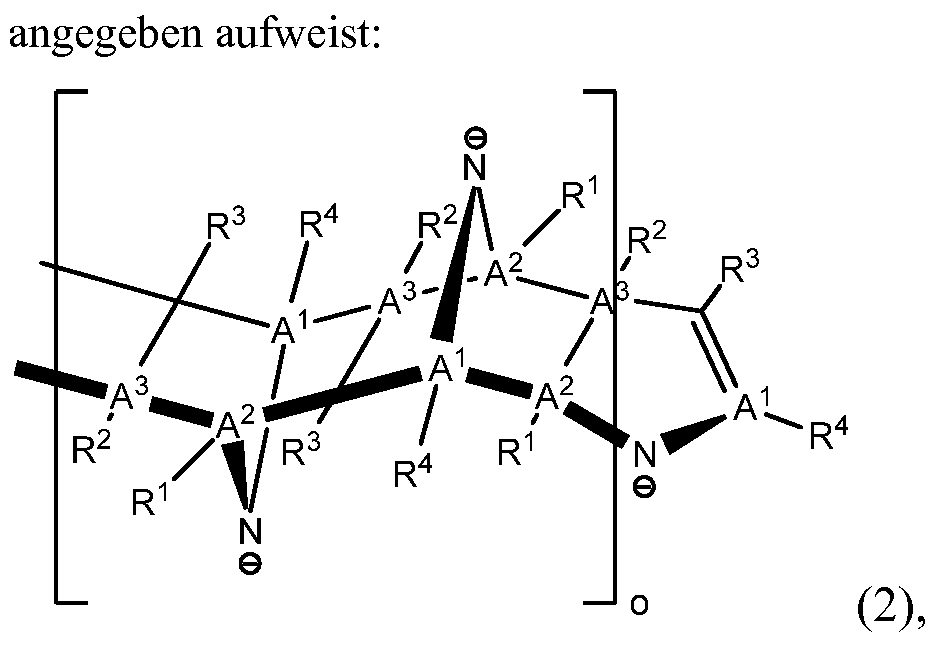
worin:
A1, A2, A3 sind Kohlenstoff oder Stickstoff, wobei jeweils A1, A1 und A3, oder A2 und A3
Stickstoff sein können, und wobei die Stickstoffatome keinen Substituenten R1, R2, R3 oder R4 aufweisen,
R1, R2, R3, R4 sind ausgewählt aus der Gruppe umfassend:
- lineare oder verzweigte Alkyl- oder Cycloalkyl-Gruppen mit 1 bis 12 Kohlenstoffatomen,
- lineare oder verzweigte, einfach oder mehrfach fluorierte oder perfluorierte Alkyl- und Cycloalkyl-Gruppen mit 1 bis 12 Kohlenstoffatomen,
- lineare oder verzweigte einfach, mehrfach oder vollständig mit einem Halogen ausgewählt aus der Gruppe umfassend Chlor, Brom und/oder Iod halogenierte Alkyl-Gruppen mit 1 bis 12 Kohlenstoffatomen oder Cycloalkyl-Gruppen mit 3 bis 7 Kohlenstoffatomen,
- Ci_i0-Alkoxyl-, Ci_i0-Alkanoyl-, Nitril-, SF5-, Sulfonyl-, Sulfonylimidyl, Nitro-, NH2-, NHR- oder NR2-Gruppen wobei R gleich oder unabhängig ausgewählt ist aus der Gruppe umfassend Ci_5-Alkyl und/oder Ci_5-Alkanoyl, Aryl-Gruppen und/oder Aryl-Gruppen substituiert mit einem oder mehreren Substituenten ausgewählt aus der Gruppe umfassend Ci_io-Alkanyl-, Ci_io-Perfluoralkyl, Ci_io- Alkoxyl-, Nitril, SF5, Sulfonyl-, Sulfonylimidyl-, Nitro-, Fluor, Chlor, Brom, Iod,
NH2 und/oder NHR' oder NR'2 wobei R' gleich oder unabhängig ausgewählt ist aus der Gruppe umfassend Ci_5-Alkyl und/oder Ci_5-Alkanoyl;
o ist eine halbzahlige oder ganze Zahl von zwischen 0,5 und 100.000, bevorzugt von zwischen 0,5 und 1.000, vorzugsweise von zwischen 0,5 und 10, weiter bevorzugt von zwischen 0,5 und 3,5.
3. Ionenleitende polymere Verbindung nach Anspruch 1 oder 2, dadurch gekennzeichnet, dass die Verbindung gemäß der allgemeinen Formel (1) ein heterozyklisches Lithiumsalz ist ausgewählt aus der Gruppe umfassend:
- Lithium[3,5-bis(trifluormethyl)pyrazolid],
Lithium[5-(perfluorethyl)-3-(trifluormethyl)pyrazolid],
Lithium[5-(perfluorproyl)-3-(trifluormethyl)pyrazolid],
Lithium[5-(perfluorbutyl)-3-(trifluormethyl)pyrazolid],
Lithium[4-cyano-5-heptyl-3-(trifluormethyl)pyrazolid] und/oder
- Lithium[4-cyano-5-isopentyl-3-(trifluormethyl)pyrazolid].
4. Ionenleitende polymere Verbindung nach Anspruch 1 oder 2, dadurch gekennzeichnet, dass die Verbindung gemäß der allgemeinen Formel (1) ein heterozyklisches Pyrazolid ist ausgewählt aus der Gruppe umfassend:
- Natrium[3,5-(bistrifluormethyl)pyrazolid],
- Kalium[3,5-(bistrifluormethyl)pyrazolid],
- Magnesium-di [3 , 5 -(bistrifluormethyl)pyrazolid] ,
- Natrium[5-(perfluorpropyl)-3-(trifluormethyl)pyrazolid],
- Lithium[5-Phenyl-3-(trifluormethyl)pyrazolid] und/oder
- Lithium[5-teri-Butyl-3-(trifluormethyl)pyrazolid].
5. Verfahren zur Polymerisation einer Verbindung gemäß der allgemeinen Formel (1) nachstehend angegeben
Mn+ mXm" n (1)
worin:
M ist ausgewählt aus der Gruppe umfassend Li, Na, K und/oder Mg;
X ist ein Stickstoffhaltiger Heterozyklus umfassend wenigstens zwei konjugierte
Doppelbindungen ausgewählt aus der Gruppe umfassend Pyrazolide, Pyrrolide, 1 ,2,3-
Triazo lide und/oder 1 ,2,4-Triazolide, oder
X umfasst mehrere kondensierte, direkt verbundene oder durch Ci-Qo-Alkylgruppen verbundenen Heterozyklen,
wobei X einfach oder mehrfach jeweils gleich oder unabhängig voneinander substituiert ist mit einem Substituenten ausgewählt aus der Gruppe umfassend:
- lineare oder verzweigte Alkyl- oder Cycloalkyl-Gruppen mit 1 bis 12 Kohlenstoffatomen,
- lineare oder verzweigte, einfach oder mehrfach fluorierte oder perfluorierte Alkyl- und Cycloalkyl-Gruppen mit 1 bis 12 Kohlenstoffatomen,
- lineare oder verzweigte einfach, mehrfach oder vollständig mit einem Halogen ausgewählt aus der Gruppe umfassend Chlor, Brom und/oder lod halogenierte Alkyl-Gruppen mit 1 bis 12 Kohlenstoffatomen oder Cycloalkyl-Gruppen mit 3 bis 7 Kohlenstoffatomen,
- Ci.io-Alkoxyl-, Ci_i0-Alkanoyl-, Nitril-, SF5-, Sulfonyl-, Sulfonylimidyl, Nitro-, NH2-, NHR- oder NR2-Gruppen wobei R gleich oder unabhängig ausgewählt ist aus der Gruppe umfassend Ci_5-Alkyl und/oder Ci_5-Alkanoyl, Aryl-Gruppen und/oder Aryl-Gruppen substituiert mit einem oder mehreren Substituenten ausgewählt aus der Gruppe umfassend Ci_i0-Alkanyl-, Ci_i0-Perfluoralkyl, Ci_i0-Alkoxyl-, Nitril, SF5, Sulfonyl-, Sulfonylimidyl-, Nitro-, Fluor, Chlor, Brom, lod, NH2 und/oder NHR oder NR2 wobei R gleich oder unabhängig ausgewählt ist aus der Gruppe umfassend Ci_5-Alkyl und/oder Ci_5-Alkanoyl; m ist eine ganze Zahl von zwischen 1 und 2;
n ist eine ganze Zahl von zwischen 1 und 2,
wobei die Polymerisation im Wege einer Diels-Alder-Reaktion durchgeführt wird.
6. Ionenleitende polymere Verbindung erhältlich durch das Verfahren nach Anspruch 5.
7. Elektrolyt, umfassend eine ionenleitende polymere Verbindung erhältlich durch
Polymerisation einer Verbindung gemäß der allgemeinen Formel (1) wie nachstehend angegeben
Mn+ mXm" n (1) ist ausgewählt aus der Gruppe umfassend Li, Na, K und/oder Mg;
ist ein Stickstoffhaltiger Heterozyklus umfassend wenigstens zwei konjugierte
Doppelbindungen ausgewählt aus der Gruppe umfassend Pyrazolide, Pyrrolide, 1 ,2,3- Triazo lide und/oder 1 ,2,4-Triazolide, oder
X umfasst mehrere kondensierte, direkt verbundene oder durch Ci-Cio-Alkylgruppen verbundenen Heterozyklen,
wobei X einfach oder mehrfach jeweils gleich oder unabhängig voneinander substituiert ist mit einem Substituenten ausgewählt aus der Gruppe umfassend:
- lineare oder verzweigte Alkyl- oder Cycloalkyl-Gruppen mit 1 bis 12 Kohlenstoffatomen,
- lineare oder verzweigte, einfach oder mehrfach fluorierte oder perfluorierte Alkyl- und Cycloalkyl-Gruppen mit 1 bis 12 Kohlenstoffatomen,
- lineare oder verzweigte einfach, mehrfach oder vollständig mit einem Halogen ausgewählt aus der Gruppe umfassend Chlor, Brom und/oder lod halogenierte Alkyl-Gruppen mit 1 bis 12 Kohlenstoffatomen oder Cycloalkyl-Gruppen mit 3 bis 7 Kohlenstoffatomen,
- Ci.io-Alkoxyl-, Ci_i0-Alkanoyl-, Nitril-, SF5-, Sulfonyl-, Sulfonylimidyl, Nitro-, NH2-, NHR- oder NR2-Gruppen wobei R gleich oder unabhängig ausgewählt ist aus der Gruppe umfassend Ci_5-Alkyl und/oder Ci_5-Alkanoyl, Aryl-Gruppen und/oder Aryl-Gruppen substituiert mit einem oder mehreren Substituenten ausgewählt aus der Gruppe umfassend Ci_i0-Alkanyl-, Ci_i0-Perfluoralkyl, Ci_i0-Alkoxyl-, Nitril, SF5, Sulfonyl-, Sulfonylimidyl-, Nitro-, Fluor, Chlor, Brom, lod, NH2 und/oder NHR oder NR2 wobei R gleich oder unabhängig ausgewählt ist aus der Gruppe umfassend Ci_5-Alkyl und/oder Ci_5-Alkanoyl; ist eine ganze Zahl von zwischen 1 und 2;
ist eine ganze Zahl von zwischen 1 und 2.
Elektrolyt, umfassend ein Leitsalz gemäß der allgemeinen Formel (1) wie nachstehend eben:
Mn+ mXm" n (1)
M ist ausgewählt aus der Gruppe umfassend Li, Na, K und/oder Mg;
X ist ein Stickstoffhaltiger Heterozyklus umfassend wenigstens zwei konjugierte
Doppelbindungen ausgewählt aus der Gruppe umfassend Pyrazolide, Pyrrolide, 1,2,3-
Triazo lide und/oder 1 ,2,4-Triazolide, oder
X umfasst mehrere kondensierte, direkt verbundene oder durch Ci-Qo-Alkylgruppen verbundenen Heterozyklen,
wobei X einfach oder mehrfach jeweils gleich oder unabhängig voneinander substituiert ist mit einem Substituenten ausgewählt aus der Gruppe umfassend:
- lineare oder verzweigte Alkyl- oder Cycloalkyl-Gruppen mit 1 bis 12 Kohlenstoffatomen,
- lineare oder verzweigte, einfach oder mehrfach fluorierte oder perfluorierte Alkyl- und Cycloalkyl-Gruppen mit 1 bis 12 Kohlenstoffatomen,
- lineare oder verzweigte einfach, mehrfach oder vollständig mit einem Halogen ausgewählt aus der Gruppe umfassend Chlor, Brom und/oder Iod halogenierte Alkyl-Gruppen mit 1 bis 12 Kohlenstoffatomen oder Cycloalkyl-Gruppen mit 3 bis 7 Kohlenstoffatomen,
- Ci.io-Alkoxyl-, Ci_i0-Alkanoyl-, Nitril-, SF5-, Sulfonyl-, Sulfonylimidyl, Nitro-, NH2-, NHR- oder NR2-Gruppen wobei R gleich oder unabhängig ausgewählt ist aus der Gruppe umfassend Ci_5-Alkyl und/oder Ci_5-Alkanoyl, Aryl-Gruppen und/oder Aryl-Gruppen substituiert mit einem oder mehreren Substituenten ausgewählt aus der Gruppe umfassend Ci_i0-Alkanyl-, Ci_i0-Perfluoralkyl, Ci_i0-Alkoxyl-, Nitril, SF5, Sulfonyl-, Sulfonylimidyl-, Nitro-, Fluor, Chlor, Brom, Iod, NH2 und/oder NHR oder NR2 wobei R gleich oder unabhängig ausgewählt ist aus der Gruppe umfassend Ci_5-Alkyl und/oder Ci_5-Alkanoyl; m ist eine ganze Zahl von zwischen 1 und 2;
n ist eine ganze Zahl von zwischen 1 und 2.
9. Verfahren zur Herstellung einer ionenleitenden polymeren Verbindung gemäß Anspruch 1 durch Polymerisation der Anionen der Verbindung gemäß Formel (1), vorzugsweise als in-situ- Polymerisation in einer elektrochemischen Zelle.
10. Elektrochemische Zelle, umfassend eine positive Elektrode und eine negative Elektrode und einen Elektrolyten gemäß Anspruch 7 oder 8, insbesondere umfassend eine ionenleitende polymere
Verbindung gemäß Anspruch 1 , wobei die elektrochemische Zelle vorzugsweise keinen Separator umfasst.
11. Elektrochemische Energiespeichervorrichtung insbesondere Alkalimetall-Ionenbatterie, Lithium-basierter Energiespeicher, Dual-Ionen-Zelle oder Superkondensator enthaltend einen
Elektrolyten gemäß Anspruch 7 oder 8.
12. Verwendung einer ionenleitenden polymeren Verbindung gemäß Anspruch 1 als Elektrolyt für elektrochemische Zellen und Energiespeichervorrichtungen, als ionenleitende Schicht oder als Metallionen permeable Membran in Sensoren, insbesondere als Alkaliionen vorzugsweise Lithum permeable Membran, in elektrochemischen Anzeigen, Ionenaustauscher- Matrizes, galvanischen Zellen und Superkondensatoren, oder als Additiv in farbstoffsensitiven Solarzellen.
13. Verbindung gemäß der allgemeinen Formel (1) wie nachstehend angegeben: Mn+ mXm" n (1), wobei die Verbindung ausgewählt ist aus der Gruppe umfassend:
Lithium[5-(perfluorethyl)-3-(trifluormethyl)pyrazolid],
Lithium[5-(perfluorproyl)-3-(trifluormethyl)pyrazolid],
Lithium[5-(perfluorbutyl)-3-(trifluormethyl)pyrazolid],
Lithium[4-cyano-5-heptyl-3-(trifluormethyl)pyrazolid],
Lithium[4-cyano-5-isopentyl-3-(trifluormethyl)pyrazolid],
Natrium[3,5-(bistrifluormethyl)pyrazolid],
Kalium[3,5-(bistrifluormethyl)pyrazolid],
Magnesium-di[3,5-(bistrifluormethyl)pyrazolid],
Natrium[5-(perfluorpropyl)-3-(trifluormethyl)pyrazolid],
Lithium[5-Phenyl-3-(trifluormethyl)pyrazolid] und/oder
Lithium[5-teri-Butyl-3-(trifluormethyl)pyrazolid].
14. Verwendung einer Verbindung gemäß der allgemeinen Formel (1) wie nachstehend angegeben
Mn+ mXm" n (1)
worin:
M ist ausgewählt aus der Gruppe umfassend Li, Na, K und/oder Mg;
X ist ein Stickstoffhaltiger Heterozyklus umfassend wenigstens zwei konjugierte
Doppelbindungen ausgewählt aus der Gruppe umfassend Pyrazolide, Pyrrolide, 1 ,2,3-
Triazo lide und/oder 1 ,2,4-Triazolide, oder
X umfasst mehrere kondensierte, direkt verbundene oder durch Ci-Qo-Alkylgruppen verbundenen Heterozyklen,
wobei X einfach oder mehrfach jeweils gleich oder unabhängig voneinander substituiert ist mit einem Substituenten ausgewählt aus der Gruppe umfassend:
- lineare oder verzweigte Alkyl- oder Cycloalkyl-Gruppen mit 1 bis 12 Kohlenstoffatomen,
- lineare oder verzweigte, einfach oder mehrfach fluorierte oder perfluorierte Alkyl- und Cycloalkyl-Gruppen mit 1 bis 12 Kohlenstoffatomen,
- lineare oder verzweigte einfach, mehrfach oder vollständig mit einem Halogen ausgewählt aus der Gruppe umfassend Chlor, Brom und/oder lod halogenierte Alkyl-Gruppen mit 1 bis 12 Kohlenstoffatomen oder Cycloalkyl-Gruppen mit 3 bis 7 Kohlenstoffatomen,
- Ci.io-Alkoxyl-, Ci_i0-Alkanoyl-, Nitril-, SF5-, Sulfonyl-, Sulfonylimidyl, Nitro-, NH2-, NHR- oder NR2-Gruppen wobei R gleich oder unabhängig ausgewählt ist aus der Gruppe umfassend Ci_5-Alkyl und/oder Ci_5-Alkanoyl, Aryl-Gruppen und/oder Aryl-Gruppen substituiert mit einem oder mehreren Substituenten ausgewählt aus der Gruppe umfassend Ci_i0-Alkanyl-, Ci_i0-Perfluoralkyl, Ci_i0-Alkoxyl-, Nitril, SF5, Sulfonyl-, Sulfonylimidyl-, Nitro-, Fluor, Chlor, Brom, lod, NH2 und/oder NHR oder NR2 wobei R gleich oder unabhängig ausgewählt ist aus der Gruppe umfassend Ci_5-Alkyl und/oder Ci_5-Alkanoyl; m ist eine ganze Zahl von zwischen 1 und 2;
n ist eine ganze Zahl von zwischen 1 und 2,
als Leitsalz für elektrochemische Zellen und Energiespeichervorrichtungen.
15. Verfahren zur Herstellung eines substituierten Pyrazols, durch Umsetzung eines Diketons gemäß der allgemeinen Formel (5) wie nachstehend angegeben:

worin:
RF1, RF2 ist jeweils gleich oder unabhängig voneinander ausgewählt aus der Gruppe umfassend lineare oder verzweigte, einfach oder mehrfach fluorierte oder perfluorierte Alkyl- oder Cycloalkyl-Gruppen mit 1 bis 12 Kohlenstoffatomen, Nitril und/oder SF5,
R5 ist ausgewählt aus der Gruppe umfassend H, lineare oder verzweigte, nicht fluorierte, einfach oder mehrfach fluorierte oder perfluorierte Alkyl- oder Cycloalkyl-Gruppen mit 1 bis 12 Kohlenstoffatomen, Nitril und/oder SF5,
Hydrazinhydrat unter Zugabe von Phosphorpentoxid.
Applications Claiming Priority (2)
| Application Number | Priority Date | Filing Date | Title |
|---|---|---|---|
| DE102012102162A DE102012102162A1 (de) | 2012-03-14 | 2012-03-14 | Ionenleitende polymere Verbindung für elektrochemische Zellen |
| DE102012102162.7 | 2012-03-14 |
Publications (2)
| Publication Number | Publication Date |
|---|---|
| WO2013135824A2 true WO2013135824A2 (de) | 2013-09-19 |
| WO2013135824A3 WO2013135824A3 (de) | 2014-04-10 |
Family
ID=47913392
Family Applications (1)
| Application Number | Title | Priority Date | Filing Date |
|---|---|---|---|
| PCT/EP2013/055258 Ceased WO2013135824A2 (de) | 2012-03-14 | 2013-03-14 | Ionenleitende polymere verbindung für elektrochemische zellen |
Country Status (2)
| Country | Link |
|---|---|
| DE (1) | DE102012102162A1 (de) |
| WO (1) | WO2013135824A2 (de) |
Cited By (5)
| Publication number | Priority date | Publication date | Assignee | Title |
|---|---|---|---|---|
| WO2015185660A1 (de) * | 2014-06-06 | 2015-12-10 | Westfälische Wilhelms-Universität Münster | Trifluorborat-substituierte lithium pyrazole und deren verwendung als leitsalz für lithium-basierte energiespeicher |
| EP3015458A1 (de) * | 2014-11-03 | 2016-05-04 | Bayer CropScience AG | Verfahren zur Herstellung von 3,5-bis(haloalkyl)pyrazolderivaten aus alpha,alpha-Dihaloaminen und Ketiminen |
| US9701640B2 (en) | 2014-03-24 | 2017-07-11 | Bayer Cropscience Aktiengesellschaft | Process for preparing 3,5-bis(haloalkyl)pyrazole derivatives from α,α-dihaloamines and ketimines |
| US11220492B2 (en) | 2017-05-17 | 2022-01-11 | Arcus Biosciences, Inc. | Quinazoline-pyrazole derivatives for the treatment of cancer-related disorders |
| US11643398B2 (en) | 2018-11-15 | 2023-05-09 | Samsung Electronics Co., Ltd. | Metallic salt containing anion having heterocyclic aromatic structure, method of preparing the metallic salt, and electrolyte and electrochemical device each including the metallic salt |
Family Cites Families (6)
| Publication number | Priority date | Publication date | Assignee | Title |
|---|---|---|---|---|
| US5538812A (en) * | 1994-02-04 | 1996-07-23 | Moltech Corporation | Electrolyte materials containing highly dissociated metal ion salts |
| CA2704986C (fr) * | 1996-12-30 | 2013-04-09 | Hydro-Quebec | Utilisation d'un compose ionique derive du malononitrile comme photoinitiateur, amorceur radicalaire ou catalyseur dans les procedes de polymerisation, ou comme colorant cationique |
| DE19829030C1 (de) | 1998-06-30 | 1999-10-07 | Metallgesellschaft Ag | Lithium-bisoxalatoborat, Verfahren zu dessen Herstellung und dessen Verwendung |
| CA2483015A1 (en) * | 2002-04-25 | 2003-11-06 | Pemeas Gmbh | Multilayer electrolyte membrane |
| KR20100104799A (ko) * | 2009-03-19 | 2010-09-29 | 한국전기연구원 | 전해액 첨가제로 피라졸을 사용한 리튬이차전지 |
| DE102009002680A1 (de) | 2009-04-28 | 2010-11-04 | Evonik Litarion Gmbh | Herstellung und Verwendung keramischer Kompositmaterialien basierend auf Polymer-Trägerfolie |
-
2012
- 2012-03-14 DE DE102012102162A patent/DE102012102162A1/de not_active Withdrawn
-
2013
- 2013-03-14 WO PCT/EP2013/055258 patent/WO2013135824A2/de not_active Ceased
Cited By (5)
| Publication number | Priority date | Publication date | Assignee | Title |
|---|---|---|---|---|
| US9701640B2 (en) | 2014-03-24 | 2017-07-11 | Bayer Cropscience Aktiengesellschaft | Process for preparing 3,5-bis(haloalkyl)pyrazole derivatives from α,α-dihaloamines and ketimines |
| WO2015185660A1 (de) * | 2014-06-06 | 2015-12-10 | Westfälische Wilhelms-Universität Münster | Trifluorborat-substituierte lithium pyrazole und deren verwendung als leitsalz für lithium-basierte energiespeicher |
| EP3015458A1 (de) * | 2014-11-03 | 2016-05-04 | Bayer CropScience AG | Verfahren zur Herstellung von 3,5-bis(haloalkyl)pyrazolderivaten aus alpha,alpha-Dihaloaminen und Ketiminen |
| US11220492B2 (en) | 2017-05-17 | 2022-01-11 | Arcus Biosciences, Inc. | Quinazoline-pyrazole derivatives for the treatment of cancer-related disorders |
| US11643398B2 (en) | 2018-11-15 | 2023-05-09 | Samsung Electronics Co., Ltd. | Metallic salt containing anion having heterocyclic aromatic structure, method of preparing the metallic salt, and electrolyte and electrochemical device each including the metallic salt |
Also Published As
| Publication number | Publication date |
|---|---|
| WO2013135824A3 (de) | 2014-04-10 |
| DE102012102162A1 (de) | 2013-09-19 |
Similar Documents
| Publication | Publication Date | Title |
|---|---|---|
| KR102328454B1 (ko) | 비스(플루오로술포닐)이미드 알칼리 금속염의 제조 방법 및 비스(플루오로술포닐)이미드 알칼리 금속염 조성물 | |
| Niedzicki et al. | New type of imidazole based salts designed specifically for lithium ion batteries | |
| EP2737568B1 (de) | Lithium-2-methoxy-1,1,2,2-tetrafluor-ethansulfonat und dessen verwendung als leitsalz in lithium-basierten energiespeichern | |
| KR100361273B1 (ko) | 전기 화학적 장치용 전해질 | |
| EP2819951B1 (de) | Leitsalz für lithium-basierte energiespeicher | |
| CA2100075A1 (fr) | Derives de bis(perfluorosulfonyl)methanes, leur procede de preparation, et leurs utilisations | |
| EP1088814A1 (de) | Fluorierte Sulfonamide als schwer entflammbare Lösungsmittel zum Einsatz in elektrochemischen Zellen | |
| EP1894267A1 (de) | Filmbildner freies elektrolyt-separator-system sowie dessen verwendung in elektrochemischen energiespeichern | |
| EP4037056B1 (de) | Auf so2-basierender elektrolyt für eine wiederaufladbare batteriezelle und wiederaufladbare batteriezelle | |
| EP2820711B1 (de) | Leitsalz für lithium-basierte energiespeicher | |
| WO2013135824A2 (de) | Ionenleitende polymere verbindung für elektrochemische zellen | |
| DE10055811A1 (de) | Tetrakisfluoroalkylborat-Salze und deren Verwendung als Leitsalze | |
| DE10103189A1 (de) | Boratsalze zur Anwendung in elektrochemischen Zellen | |
| WO2002068432A1 (de) | Borchelatkomplexe | |
| DE102014108012B4 (de) | Substituierte Pyrazole und deren Verwendung als Leitsalz für Lithium-basierte Energiespeicher | |
| EP1236732A1 (de) | Fluoralkylphosphat-Salze und Verfahren zur Herstellung dieser Substanzen | |
| EP1726061B1 (de) | Leitsalze fur galvanische zellen, deren herstellung und verwendung | |
| DE102018006111A1 (de) | Festkörperelektrolyte sowie deren Herstellung | |
| DE19951804A1 (de) | Komplexsalze zur Anwendung in elektrochemischen Zellen | |
| EP2975684B1 (de) | Elektrolytsystem für den einsatz in elektrochemischen bauteilen | |
| DE102011055028A1 (de) | Elektrolyt-Zusatz für Lithium-basierte Energiespeicher | |
| EP2834250A1 (de) | Lithiumsilikate | |
| EP3560023B1 (de) | Elektrolyt für lithium-ionen-batterien | |
| EP3834246A1 (de) | Flüssigelektrolyt umfassend organische carbonate und zyklische sulfoxide für anwendungen in lithium-sekundärbatterien | |
| EP4576301A1 (de) | Elektrolytzusammensetzung, elektrolyt und batterie |
Legal Events
| Date | Code | Title | Description |
|---|---|---|---|
| 121 | Ep: the epo has been informed by wipo that ep was designated in this application |
Ref document number: 13711000 Country of ref document: EP Kind code of ref document: A2 |
|
| 122 | Ep: pct application non-entry in european phase |
Ref document number: 13711000 Country of ref document: EP Kind code of ref document: A2 |