WO2013137400A1 - 石膏用分散剤 - Google Patents
石膏用分散剤 Download PDFInfo
- Publication number
- WO2013137400A1 WO2013137400A1 PCT/JP2013/057226 JP2013057226W WO2013137400A1 WO 2013137400 A1 WO2013137400 A1 WO 2013137400A1 JP 2013057226 W JP2013057226 W JP 2013057226W WO 2013137400 A1 WO2013137400 A1 WO 2013137400A1
- Authority
- WO
- WIPO (PCT)
- Prior art keywords
- gypsum
- dispersant
- acid
- alkylene oxide
- polyamine
- Prior art date
- Legal status (The legal status is an assumption and is not a legal conclusion. Google has not performed a legal analysis and makes no representation as to the accuracy of the status listed.)
- Ceased
Links
Classifications
-
- C—CHEMISTRY; METALLURGY
- C04—CEMENTS; CONCRETE; ARTIFICIAL STONE; CERAMICS; REFRACTORIES
- C04B—LIME, MAGNESIA; SLAG; CEMENTS; COMPOSITIONS THEREOF, e.g. MORTARS, CONCRETE OR LIKE BUILDING MATERIALS; ARTIFICIAL STONE; CERAMICS; REFRACTORIES; TREATMENT OF NATURAL STONE
- C04B24/00—Use of organic materials as active ingredients for mortars, concrete or artificial stone, e.g. plasticisers
- C04B24/24—Macromolecular compounds
- C04B24/26—Macromolecular compounds obtained by reactions only involving carbon-to-carbon unsaturated bonds
-
- C—CHEMISTRY; METALLURGY
- C04—CEMENTS; CONCRETE; ARTIFICIAL STONE; CERAMICS; REFRACTORIES
- C04B—LIME, MAGNESIA; SLAG; CEMENTS; COMPOSITIONS THEREOF, e.g. MORTARS, CONCRETE OR LIKE BUILDING MATERIALS; ARTIFICIAL STONE; CERAMICS; REFRACTORIES; TREATMENT OF NATURAL STONE
- C04B24/00—Use of organic materials as active ingredients for mortars, concrete or artificial stone, e.g. plasticisers
- C04B24/24—Macromolecular compounds
- C04B24/28—Macromolecular compounds obtained otherwise than by reactions only involving carbon-to-carbon unsaturated bonds
- C04B24/287—Polyamides
-
- C—CHEMISTRY; METALLURGY
- C04—CEMENTS; CONCRETE; ARTIFICIAL STONE; CERAMICS; REFRACTORIES
- C04B—LIME, MAGNESIA; SLAG; CEMENTS; COMPOSITIONS THEREOF, e.g. MORTARS, CONCRETE OR LIKE BUILDING MATERIALS; ARTIFICIAL STONE; CERAMICS; REFRACTORIES; TREATMENT OF NATURAL STONE
- C04B24/00—Use of organic materials as active ingredients for mortars, concrete or artificial stone, e.g. plasticisers
- C04B24/24—Macromolecular compounds
- C04B24/26—Macromolecular compounds obtained by reactions only involving carbon-to-carbon unsaturated bonds
- C04B24/2641—Polyacrylates; Polymethacrylates
- C04B24/2647—Polyacrylates; Polymethacrylates containing polyether side chains
-
- C—CHEMISTRY; METALLURGY
- C04—CEMENTS; CONCRETE; ARTIFICIAL STONE; CERAMICS; REFRACTORIES
- C04B—LIME, MAGNESIA; SLAG; CEMENTS; COMPOSITIONS THEREOF, e.g. MORTARS, CONCRETE OR LIKE BUILDING MATERIALS; ARTIFICIAL STONE; CERAMICS; REFRACTORIES; TREATMENT OF NATURAL STONE
- C04B24/00—Use of organic materials as active ingredients for mortars, concrete or artificial stone, e.g. plasticisers
- C04B24/24—Macromolecular compounds
- C04B24/26—Macromolecular compounds obtained by reactions only involving carbon-to-carbon unsaturated bonds
- C04B24/2664—Macromolecular compounds obtained by reactions only involving carbon-to-carbon unsaturated bonds of ethylenically unsaturated dicarboxylic acid polymers, e.g. maleic anhydride copolymers
-
- C—CHEMISTRY; METALLURGY
- C04—CEMENTS; CONCRETE; ARTIFICIAL STONE; CERAMICS; REFRACTORIES
- C04B—LIME, MAGNESIA; SLAG; CEMENTS; COMPOSITIONS THEREOF, e.g. MORTARS, CONCRETE OR LIKE BUILDING MATERIALS; ARTIFICIAL STONE; CERAMICS; REFRACTORIES; TREATMENT OF NATURAL STONE
- C04B40/00—Processes, in general, for influencing or modifying the properties of mortars, concrete or artificial stone compositions, e.g. their setting or hardening ability
- C04B40/0028—Aspects relating to the mixing step of the mortar preparation
- C04B40/0039—Premixtures of ingredients
-
- C—CHEMISTRY; METALLURGY
- C08—ORGANIC MACROMOLECULAR COMPOUNDS; THEIR PREPARATION OR CHEMICAL WORKING-UP; COMPOSITIONS BASED THEREON
- C08F—MACROMOLECULAR COMPOUNDS OBTAINED BY REACTIONS ONLY INVOLVING CARBON-TO-CARBON UNSATURATED BONDS
- C08F220/00—Copolymers of compounds having one or more unsaturated aliphatic radicals, each having only one carbon-to-carbon double bond, and only one being terminated by only one carboxyl radical or a salt, anhydride ester, amide, imide or nitrile thereof
- C08F220/02—Monocarboxylic acids having less than ten carbon atoms; Derivatives thereof
- C08F220/04—Acids; Metal salts or ammonium salts thereof
-
- C—CHEMISTRY; METALLURGY
- C08—ORGANIC MACROMOLECULAR COMPOUNDS; THEIR PREPARATION OR CHEMICAL WORKING-UP; COMPOSITIONS BASED THEREON
- C08F—MACROMOLECULAR COMPOUNDS OBTAINED BY REACTIONS ONLY INVOLVING CARBON-TO-CARBON UNSATURATED BONDS
- C08F220/00—Copolymers of compounds having one or more unsaturated aliphatic radicals, each having only one carbon-to-carbon double bond, and only one being terminated by only one carboxyl radical or a salt, anhydride ester, amide, imide or nitrile thereof
- C08F220/02—Monocarboxylic acids having less than ten carbon atoms; Derivatives thereof
- C08F220/10—Esters
- C08F220/26—Esters containing oxygen in addition to the carboxy oxygen
- C08F220/28—Esters containing oxygen in addition to the carboxy oxygen containing no aromatic rings in the alcohol moiety
- C08F220/285—Esters containing oxygen in addition to the carboxy oxygen containing no aromatic rings in the alcohol moiety and containing a polyether chain in the alcohol moiety
- C08F220/286—Esters containing oxygen in addition to the carboxy oxygen containing no aromatic rings in the alcohol moiety and containing a polyether chain in the alcohol moiety and containing polyethylene oxide in the alcohol moiety, e.g. methoxy polyethylene glycol (meth)acrylate
-
- C—CHEMISTRY; METALLURGY
- C08—ORGANIC MACROMOLECULAR COMPOUNDS; THEIR PREPARATION OR CHEMICAL WORKING-UP; COMPOSITIONS BASED THEREON
- C08G—MACROMOLECULAR COMPOUNDS OBTAINED OTHERWISE THAN BY REACTIONS ONLY INVOLVING UNSATURATED CARBON-TO-CARBON BONDS
- C08G69/00—Macromolecular compounds obtained by reactions forming a carboxylic amide link in the main chain of the macromolecule
- C08G69/02—Polyamides derived from amino-carboxylic acids or from polyamines and polycarboxylic acids
- C08G69/26—Polyamides derived from amino-carboxylic acids or from polyamines and polycarboxylic acids derived from polyamines and polycarboxylic acids
-
- C—CHEMISTRY; METALLURGY
- C08—ORGANIC MACROMOLECULAR COMPOUNDS; THEIR PREPARATION OR CHEMICAL WORKING-UP; COMPOSITIONS BASED THEREON
- C08G—MACROMOLECULAR COMPOUNDS OBTAINED OTHERWISE THAN BY REACTIONS ONLY INVOLVING UNSATURATED CARBON-TO-CARBON BONDS
- C08G73/00—Macromolecular compounds obtained by reactions forming a linkage containing nitrogen with or without oxygen or carbon in the main chain of the macromolecule, not provided for in groups C08G12/00 - C08G71/00
- C08G73/02—Polyamines
- C08G73/028—Polyamidoamines
-
- C—CHEMISTRY; METALLURGY
- C08—ORGANIC MACROMOLECULAR COMPOUNDS; THEIR PREPARATION OR CHEMICAL WORKING-UP; COMPOSITIONS BASED THEREON
- C08K—Use of inorganic or non-macromolecular organic substances as compounding ingredients
- C08K3/00—Use of inorganic substances as compounding ingredients
- C08K3/30—Sulfur-, selenium- or tellurium-containing compounds
-
- C—CHEMISTRY; METALLURGY
- C08—ORGANIC MACROMOLECULAR COMPOUNDS; THEIR PREPARATION OR CHEMICAL WORKING-UP; COMPOSITIONS BASED THEREON
- C08L—COMPOSITIONS OF MACROMOLECULAR COMPOUNDS
- C08L29/00—Compositions of homopolymers or copolymers of compounds having one or more unsaturated aliphatic radicals, each having only one carbon-to-carbon double bond, and at least one being terminated by an alcohol, ether, aldehydo, ketonic, acetal or ketal radical; Compositions of hydrolysed polymers of esters of unsaturated alcohols with saturated carboxylic acids; Compositions of derivatives of such polymers
- C08L29/02—Homopolymers or copolymers of unsaturated alcohols
-
- C—CHEMISTRY; METALLURGY
- C08—ORGANIC MACROMOLECULAR COMPOUNDS; THEIR PREPARATION OR CHEMICAL WORKING-UP; COMPOSITIONS BASED THEREON
- C08L—COMPOSITIONS OF MACROMOLECULAR COMPOUNDS
- C08L33/00—Compositions of homopolymers or copolymers of compounds having one or more unsaturated aliphatic radicals, each having only one carbon-to-carbon double bond, and only one being terminated by only one carboxyl radical, or of salts, anhydrides, esters, amides, imides or nitriles thereof; Compositions of derivatives of such polymers
- C08L33/02—Homopolymers or copolymers of acids; Metal or ammonium salts thereof
-
- C—CHEMISTRY; METALLURGY
- C08—ORGANIC MACROMOLECULAR COMPOUNDS; THEIR PREPARATION OR CHEMICAL WORKING-UP; COMPOSITIONS BASED THEREON
- C08L—COMPOSITIONS OF MACROMOLECULAR COMPOUNDS
- C08L33/00—Compositions of homopolymers or copolymers of compounds having one or more unsaturated aliphatic radicals, each having only one carbon-to-carbon double bond, and only one being terminated by only one carboxyl radical, or of salts, anhydrides, esters, amides, imides or nitriles thereof; Compositions of derivatives of such polymers
- C08L33/04—Homopolymers or copolymers of esters
- C08L33/06—Homopolymers or copolymers of esters of esters containing only carbon, hydrogen and oxygen, which oxygen atoms are present only as part of the carboxyl radical
- C08L33/10—Homopolymers or copolymers of methacrylic acid esters
-
- C—CHEMISTRY; METALLURGY
- C08—ORGANIC MACROMOLECULAR COMPOUNDS; THEIR PREPARATION OR CHEMICAL WORKING-UP; COMPOSITIONS BASED THEREON
- C08L—COMPOSITIONS OF MACROMOLECULAR COMPOUNDS
- C08L55/00—Compositions of homopolymers or copolymers, obtained by polymerisation reactions only involving carbon-to-carbon unsaturated bonds, not provided for in groups C08L23/00 - C08L53/00
- C08L55/005—Homopolymers or copolymers obtained by polymerisation of macromolecular compounds terminated by a carbon-to-carbon double bond
-
- C—CHEMISTRY; METALLURGY
- C08—ORGANIC MACROMOLECULAR COMPOUNDS; THEIR PREPARATION OR CHEMICAL WORKING-UP; COMPOSITIONS BASED THEREON
- C08L—COMPOSITIONS OF MACROMOLECULAR COMPOUNDS
- C08L77/00—Compositions of polyamides obtained by reactions forming a carboxylic amide link in the main chain; Compositions of derivatives of such polymers
- C08L77/10—Polyamides derived from aromatically bound amino and carboxyl groups of amino-carboxylic acids or of polyamines and polycarboxylic acids
-
- C—CHEMISTRY; METALLURGY
- C08—ORGANIC MACROMOLECULAR COMPOUNDS; THEIR PREPARATION OR CHEMICAL WORKING-UP; COMPOSITIONS BASED THEREON
- C08L—COMPOSITIONS OF MACROMOLECULAR COMPOUNDS
- C08L79/00—Compositions of macromolecular compounds obtained by reactions forming in the main chain of the macromolecule a linkage containing nitrogen with or without oxygen or carbon only, not provided for in groups C08L61/00 - C08L77/00
- C08L79/02—Polyamines
-
- C—CHEMISTRY; METALLURGY
- C04—CEMENTS; CONCRETE; ARTIFICIAL STONE; CERAMICS; REFRACTORIES
- C04B—LIME, MAGNESIA; SLAG; CEMENTS; COMPOSITIONS THEREOF, e.g. MORTARS, CONCRETE OR LIKE BUILDING MATERIALS; ARTIFICIAL STONE; CERAMICS; REFRACTORIES; TREATMENT OF NATURAL STONE
- C04B2103/00—Function or property of ingredients for mortars, concrete or artificial stone
- C04B2103/40—Surface-active agents, dispersants
- C04B2103/408—Dispersants
-
- C—CHEMISTRY; METALLURGY
- C04—CEMENTS; CONCRETE; ARTIFICIAL STONE; CERAMICS; REFRACTORIES
- C04B—LIME, MAGNESIA; SLAG; CEMENTS; COMPOSITIONS THEREOF, e.g. MORTARS, CONCRETE OR LIKE BUILDING MATERIALS; ARTIFICIAL STONE; CERAMICS; REFRACTORIES; TREATMENT OF NATURAL STONE
- C04B2111/00—Mortars, concrete or artificial stone or mixtures to prepare them, characterised by specific function, property or use
- C04B2111/00474—Uses not provided for elsewhere in C04B2111/00
- C04B2111/00612—Uses not provided for elsewhere in C04B2111/00 as one or more layers of a layered structure
- C04B2111/0062—Gypsum-paper board like materials
Definitions
- the present invention relates to a gypsum dispersant added for the purpose of improving the fluidity of a gypsum slurry composed of gypsum and water when producing various gypsum molded products such as gypsum board.
- Gypsum board is widely used as an interior material for buildings, because it has excellent fireproof, soundproof, and heat insulation properties and is inexpensive.
- Gypsum board is generally manufactured by a casting method.
- a gypsum slurry consisting of calcined gypsum, water, a dispersant, and other additives and foamed foam are stirred and mixed in a mixer, and then poured into a base paper and sandwiched. And after adjusting the width, it is obtained by curing, cutting and drying.
- plasterboard such as ordinary board, hard board, reinforced board, and decorative board. Depending on the required characteristics of each board, the type of additive, blending amount, addition of reinforcing material, etc. can be changed. Is the same.
- the dispersant used in the above gypsum slurry preparation is used for the purpose of increasing the malleability of the gypsum board to the base paper.
- the unit moisture content during slurry preparation is reduced, the drying efficiency is increased, and the density of the molding board is increased. It is also used for the purpose of obtaining a strength board.
- a dispersant for gypsum naphthalene sulfonate formaldehyde condensate, melamine sulfonate formaldehyde condensate, and formaldehyde condensate of bisphenol and aminobenzene sulfonic acid are widely used. (See Patent Document 1 and Patent Document 2).
- Patent Document 3 proposes to make a self-leveling gypsum aqueous composition having a high flow value and excellent self-leveling properties by including a polycarboxylic acid-based dispersant in the gypsum aqueous composition. Yes.
- Patent Document 4 includes a structural unit containing a nitrogen atom selected from an amide group, an amino group and an imino group, a structural unit having a carboxylic acid group, and a structural unit having a polyalkylene glycol group, and is obtained by polymerization.
- a gypsum dispersant characterized by comprising the water-soluble amphoteric polymer compound as a main component has been proposed. However, the effect may not be stably exhibited due to the influence of impurities contained in the raw material gypsum, and improvement has been demanded.
- the polycarboxylic acid-based dispersants proposed so far can exhibit excellent dispersion performance with respect to gypsum slurry by appropriately selecting the use conditions such as pH, but at the same time delay the curing. As a result, it has a problem of reducing the productivity of gypsum board.
- raw materials for gypsum are diverse and separated from by-product gypsum and gypsum board waste materials such as imported natural gypsum, flue gas desulfurization gypsum discharged from power plant and smelter desulfurization equipment, phosphate gypsum and hydrofluoric acid gypsum.
- the collected recycled gypsum and the like are blended and used at various ratios for each factory for the purpose of reducing transportation costs.
- the impurities contained in gypsum differ from factory to factory, and as a result, the performance of the water reducing agent for gypsum cannot be fully exhibited.
- the present invention has been made in view of the above circumstances, and the problem to be solved is excellent in the improvement effect of the fluidity of the gypsum slurry even when raw gypsum having different quality is used, and It is an object of the present invention to provide a gypsum dispersant and a gypsum additive that do not cause a set delay.
- the present invention contains (A) a polycarboxylic acid polymer, (B) a polyamide polyamine obtained by reacting a polyalkylene polyamine and a dibasic acid as essential components and / or an alkylene oxide adduct thereof. It is related with the dispersing agent for gypsum characterized by doing.
- the present invention also includes a polyamide polyamine obtained by reacting a polyalkylene polyamine and dibasic acids as essential components and / or an alkylene oxide adduct thereof, which is blended for the purpose of improving the fluidity of the gypsum slurry. It relates to an additive for gypsum.
- the dispersant for gypsum of the present invention comprises (A) a polycarboxylic acid polymer, (B) a polyamide polyamine obtained by condensing a polyalkylene polyamine and a dibasic acid, and / or an alkylene oxide adduct thereof. Even if raw material gypsum having different quality is used, sufficient fluidity can be stably imparted regardless of the type. And a gypsum board can be manufactured, without reducing productivity by containing the said dispersing agent for gypsum in a gypsum slurry.
- the (A) polycarboxylic acid polymer has a structural unit derived from the polyalkylene glycol unsaturated monomer (a) and a structural unit derived from the unsaturated carboxylic acid monomer (b).
- a polymer can be preferably used.
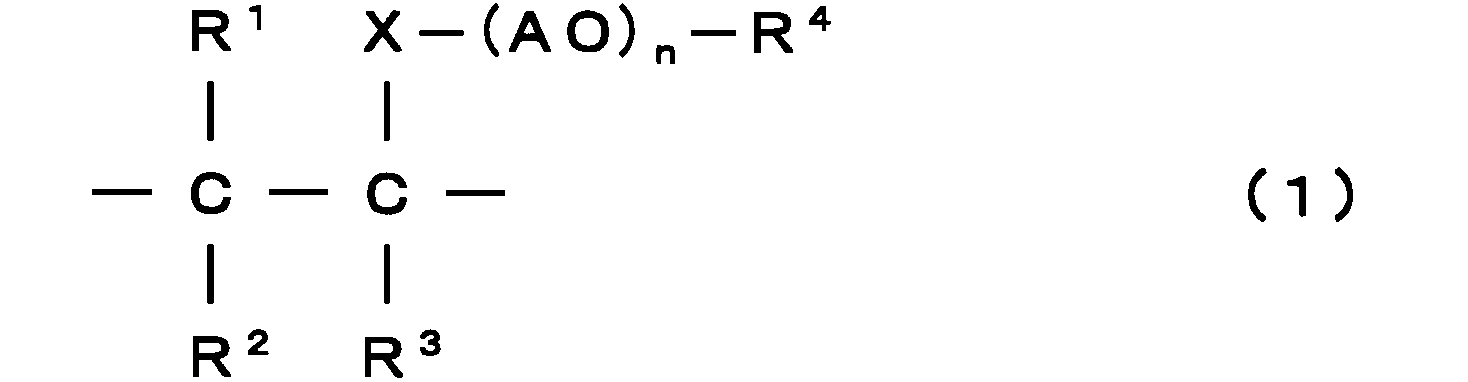
- the structural unit derived from the polyalkylene glycol unsaturated monomer (a) can be represented by the following general formula (1).
- R 1 , R 2 , R 3 and R 4 each independently represents a hydrogen atom or a hydrocarbon group having 1 to 22 carbon atoms, and X represents —COO— or — (CH 2 ) a O—
- A represents an integer of 1 to 20.
- AO represents an alkyleneoxy group having 2 to 4 carbon atoms, and n represents an added mole number of the alkyleneoxy group and represents a number of 1 to 200.
- R 1 , R 2 , R 3 and R 4 each independently represents a hydrogen atom or a hydrocarbon group having 1 to 22 carbon atoms, preferably a hydrogen atom or 1 to 8 carbon atoms. More preferably a hydrogen atom, a methyl group, an ethyl group, a propyl group or a butyl group.
- AO represents an alkyleneoxy group having 2 to 4 carbon atoms, and specific examples include an ethyleneoxy group, a propyleneoxy group, and a butyleneoxy group. When composed of two or more types of alkyleneoxy groups, these alkyleneoxy groups may be either block addition or random addition.
- n represents a number of 1 to 200 in terms of the number of added moles of the alkyleneoxy group. Preferably it is 5 to 120, more preferably 10 to 100, still more preferably 40 to 100.
- polyalkylene glycol unsaturated monomer (a) examples include the following. Methoxy polyethylene glycol mono (meth) acrylate, methoxy ⁇ polyethylene glycol (poly) propylene glycol ⁇ mono (meth) acrylate, ethoxypolyethylene glycol mono (meth) acrylate, ethoxy ⁇ polyethylene glycol (poly) propylene glycol ⁇ mono (meth) acrylate, Propoxy polyethylene glycol mono (meth) acrylate, propoxy ⁇ polyethylene glycol (poly) propylene glycol ⁇ mono (meth) acrylate, butoxy polyethylene glycol mono (meth) acrylate, butoxy ⁇ polyethylene glycol (poly) propylene glycol ⁇ mono (meth) acrylate, etc.
- (meth) acrylate refers to both acrylate and methacrylate
- (meth) allyl alcohol refers to both allyl alcohol and methallyl alcohol.
- unsaturated carboxylic acid monomer (b) examples include acrylic acid, methacrylic acid, maleic acid, fumaric acid, itaconic acid and unsaturated fatty acids, and acid anhydrides thereof such as maleic anhydride. To express. Of these, methacrylic acid is particularly preferred.
- examples of the monomer (c) that can be copolymerized other than the monomers (a) and (b) include the following known monomers; (1) (Non) aqueous monomers: methyl (meth) acrylate, ethyl (meth) acrylate, butyl (meth) acrylate, styrene, etc .; (2) anionic monomers: vinyl sulfonate, styrene sulfone Acid salts, methacrylic acid phosphates, etc .; (3) Amide monomers: acrylamide, alkylene oxide adducts of acrylamide, etc. (4) Polyamide polyamine monomers: Polyamide polyamine and (meth) described later A compound in which an alkylene oxide is added to a condensate of acrylic acid as necessary.
- the method for producing the (A) polycarboxylic acid polymer is not particularly limited, and for example, a known polymerization method such as solution polymerization or bulk polymerization using a polymerization initiator can be used.
- the molecular weight is not particularly limited, but is preferably in the range of 5,000 to 100,000 in terms of weight average molecular weight (gel permeation chromatography method, converted to polyethylene glycol) from the viewpoint of good dispersibility expression.
- the (A) polycarboxylic acid polymer is preliminarily partially neutralized or completely neutralized with a neutralizing agent such as lithium hydroxide, potassium hydroxide, sodium hydroxide, ammonia, alkylamine, or organic amines. It is preferable that it is contained in the dispersing agent for gypsum of this invention as a made form.
- the polyamide polyamine and / or its alkylene oxide adduct obtained by reacting the (B) polyalkylene polyamine and dibasic acids as essential components will be described below.
- polyalkylene polyamine examples include diethylenetriamine, triethylenetetramine, tetraethylenepentamine, pentaethylenehexamine, dipropylenetriamine, tripropylenetetramine, tetrapropylenepentamine, and other high molecular weight polyalkylenepolyamine mixtures. it can.
- dibasic acids examples include dibasic acids based on malonic acid, succinic acid, fumaric acid, maleic acid, glutaric acid, adipic acid, pimelic acid, phthalic acid, azelaic acid or sebacic acid, and these dibasic acids.
- dibasic acids include acid alkyl esters and dibasic acid halides.
- the reaction molar ratio of the polyalkylene polyamine and the dibasic acid constituting the polyamide polyamine is preferably in the range of 2: 1 to 21:20.
- the polyamide polyamine has a molecular weight having an appropriate viscosity, and good dispersibility is obtained.
- the weight average molecular weight of the polyamide polyamine is usually 500 to 100,000, preferably 1,000 to 50,000, more preferably 1,000 to 30,000, particularly preferably 1,000 to 10,000. is there.
- a polyamide polyamine (alkylene oxide adduct) to which an alkylene oxide is added can also be used.
- a polyamide polyamine the same kind as the above-mentioned polyamide polyamine can be used.
- the alkylene oxide used for the polyamide polyamine to which the alkylene oxide is added is an alkylene oxide having 2 to 4 carbon atoms.
- the alkylene oxide having 2 to 4 carbon atoms is ethylene oxide, propylene oxide, or butylene oxide. These alkylene oxides may be used alone or in combination of two or more. When two or more alkylene oxides are added, the addition form may be either block or random.
- the polyamide polyamine to which the alkylene oxide is added can be obtained by either a method in which the alkylene oxide is directly added to the polyamide polyamine or a method in which it is obtained in an aqueous solution.
- the amount of the alkylene oxide is preferably 0 to 8 mol per 1 equivalent of the amino residue (amino group, imino group, amide group) of the polyamide polyamine.
- the component (B) includes a mixture of the polyamide polyamine and a polyamide polyamine added with the alkylene oxide.
- component (B) is selectively adsorbed on impurities in the raw gypsum that inhibits the function of the dispersant. I guess that. Accordingly, with component (B) as an additive for gypsum, dispersants other than component (A), such as lignin sulfonate, naphthalene sulfonate formalin high condensate salt, melamine sulfonate formalin high condensate salt, polystyrene sulfonate It can also be used with a water-soluble vinyl copolymer.
- dispersants other than component (A) such as lignin sulfonate, naphthalene sulfonate formalin high condensate salt, melamine sulfonate formalin high condensate salt, polystyrene sulfonate It can also be used with a water-soluble vinyl copolymer.
- the gypsum dispersant of the present invention can be used by adding 0.01 to 5% by mass (dispersant solid content mass ratio) to the raw material gypsum.
- dispersant There are various methods of adding the dispersant, but a method of preparing a gypsum slurry by diluting and adding to water before kneading with gypsum is common.
- (A) component and (B) component may be mixed and added previously, and you may add separately, without mixing. When adding separately, the addition order may be any.
- Examples of gypsum include anhydrous gypsum, hemihydrate gypsum, and dihydrate gypsum.
- raw material gypsum natural gypsum, chemical gypsum such as neutralized gypsum or by-product gypsum, or a mixture of two or more types thereof can be used.
- main chemical gypsum include phosphate gypsum, hydrofluoric acid gypsum, titanium gypsum, and flue gas desulfurization gypsum.
- the raw gypsum may include recycled gypsum.
- the recycled gypsum may be any recycled gypsum that is recovered from waste gypsum board generated by a gypsum board manufacturer, waste gypsum board generated at the time of new construction or dismantling, and the like.
- the dispersant for gypsum of the present invention can be suitably used for any of these raw material gypsums, and excellent effects can be obtained for those blended at various ratios.
- Additives used for gypsum board etc. together with the gypsum dispersant of the present invention include general-purpose water reducing agents, foaming agents such as alkyl sulfates, alkyl ether sulfates, alkyl sulfonates, antifoaming agents, foam stabilizers, There are curing regulators, water repellents, adhesives, retarders, etc., and glass fibers, carbon fibers, waste paper, virgin pulp, etc. are added as reinforcing fibers, or gypsum with lightweight aggregates such as perlite and foamed steel Boards are also made. Note that the dispersant of the present invention can also be easily applied to plaster for plaster used for coating finish.
- copolymerization ratio and mixing ratio are based on mass unless otherwise indicated.
- (A) Polycarboxylic acid polymer The (A) polycarboxylic acid polymer used in this example is shown below.
- Synthesis example 1 103 g of diethylenetriamine was charged into a glass reaction vessel equipped with a thermometer, a nitrogen introduction tube, a stirrer, and a condenser with a water test tube, and stirred while introducing nitrogen into the liquid. While stirring, 121 g of adipic acid (polyalkylenepolyamine / dibasic acid molar ratio was 6 mol / 5 mol) was added, the temperature was raised to 150 ° C., and the reaction was continued at the same temperature for 5 hours while removing the effluent water. After completion of the reaction, 138 g of ion-exchanged water was charged to obtain 345 g of a 60 mass% aqueous solution of polyamide polyamine (Compound B1; weight average molecular weight 1,300).
- adipic acid polyalkylenepolyamine / dibasic acid molar ratio was 6 mol / 5 mol
- Synthesis example 2 It carried out similarly until the amidation reaction of Compound B1, and then charged with 230 g of ion-exchanged water and stirred for 30 minutes. It moved to the glass pressure-resistant container provided with the nitrogen inlet tube and the ethylene oxide inlet tube, fully substituted with nitrogen, and temperature was heated up to 60 degreeC. While maintaining 60 ° C. to 70 ° C., 146 g of ethylene oxide was gradually blown in, and then aging was carried out at the same temperature for 1 hour. 570 g of a 60% by mass aqueous solution of polyethylene oxide-added polyamide polyamine (Compound B2; weight average molecular weight 2,000) was obtained.
- Synthesis example 3 134 g of pentaethylenehexamine was charged into a glass reaction vessel equipped with a thermometer, a nitrogen inlet tube, a stirrer, and a condenser with a water test tube, and stirred while introducing nitrogen into the liquid. While stirring, 50 g of adipic acid (polyalkylene polyamine / dibasic acid molar ratio was 5 mol / 3 mol) was added, the temperature was raised to 150 ° C., and the reaction was continued at the same temperature for 5 hours while removing the effluent water. After completion of the reaction, 115 g of ion-exchanged water was charged to obtain 288 g of a 60 mass% aqueous solution of polyamide polyamine (Compound B3; weight average molecular weight 1,500).
- adipic acid polyalkylene polyamine / dibasic acid molar ratio was 5 mol / 3 mol
- Synthesis example 4 It carried out similarly until the amidation reaction of compound B3, and then charged with 197 g of ion-exchanged water and stirred for 30 minutes. It moved to the glass pressure-resistant container provided with the nitrogen inlet tube and the ethylene oxide inlet tube, fully substituted with nitrogen, and temperature was heated up to 60 degreeC. While maintaining 60 ° C. to 70 ° C., 122 g of ethylene oxide was gradually blown in, and then aged for 1 hour at the same temperature. 504 g of 60 mass% aqueous solution of polyethylene oxide-added polyamide polyamine (Compound B4; weight average molecular weight 1,900) was obtained.
- Synthesis example 5 A glass reaction vessel equipped with a thermometer, a nitrogen introduction tube, a stirrer, and a condenser with a test tube was charged with 128 g of tetraethylenepentamine and stirred while introducing nitrogen into the solution. While stirring, 89 g of adipic acid (polyalkylene polyamine / dibasic acid molar ratio: 10 mol / 9 mol) was charged, the temperature was raised to 150 ° C., and the reaction was continued at the same temperature for 5 hours while removing the effluent water. After completion of the reaction, 131 g of ion-exchanged water was charged to obtain 328 g of a 60 mass% aqueous solution of polyamide polyamine (Compound B5; weight average molecular weight 2,900).
- adipic acid polyalkylene polyamine / dibasic acid molar ratio: 10 mol / 9 mol
- Synthesis Example 6 It carried out similarly until the amide formation reaction of compound B5, and then charged with 330 g of ion-exchanged water and stirred for 30 minutes. It moved to the glass pressure-resistant container provided with the nitrogen inlet tube and the ethylene oxide inlet tube, fully substituted with nitrogen, and temperature was heated up to 60 degreeC. While maintaining 60 ° C. to 70 ° C., 300 g of ethylene oxide was gradually blown in, and then aged for 1 hour at the same temperature. 850 g of a 60% by mass aqueous solution of polyethylene oxide-added polyamide polyamine (Compound B6; weight average molecular weight 4,800) was obtained.
- Compound B6 weight average molecular weight 4,800
- Synthesis example 7 199 g of polyalkylene polyamine (product name: Polyate) manufactured by Tosoh Corporation was charged in a glass reaction vessel equipped with a thermometer, a nitrogen introduction tube, a stirrer, and a condenser with a test tube, and stirred while introducing nitrogen into the solution. While stirring, 68 g of adipic acid (polyalkylene polyamine / dibasic acid molar ratio: 4 mol / 3 mol) was added, the temperature was raised to 150 ° C., and the reaction was continued at the same temperature for 5 hours while removing the effluent water. After completion of the reaction, 125 g of ion-exchanged water was charged to obtain 412 g of a 60 mass% aqueous solution of polyamide polyamine (Compound B7; weight average molecular weight 2,200).
- adipic acid polyalkylene polyamine / dibasic acid molar ratio: 4 mol / 3 mol
- Synthesis example 8 It carried out similarly until the amidation reaction of compound B7, and then charged with 290 g of ion-exchanged water and stirred for 30 minutes. It moved to the glass pressure-resistant container provided with the nitrogen inlet tube and the ethylene oxide inlet tube, fully substituted with nitrogen, and temperature was heated up to 60 degreeC. While maintaining 60 ° C. to 70 ° C., 180 g of ethylene oxide was gradually blown in, and then ripened at the same temperature for 1 hour. As a result, 716 g of a 60 mass% aqueous solution of polyethylene oxide-added polyamide polyamine (Compound B8; weight average molecular weight 2,500) was obtained.
- Compound B8 weight average molecular weight 2,500
- Table 1 shows the composition of the raw gypsum used in the performance test.
- the gypsum dispersants of Examples 1 to 51 and Comparative Examples 1 to 3 were prepared at the composition ratios shown in Table 2, and the gypsum dispersibility and the gypsum set retardance were tested by the following test methods.
- a cylindrical hollow cylinder with an upper inner diameter of 75 mm, a lower inner diameter of 85 mm, and a height of 40 mm is prepared in advance in the center of a urethane board (35 cm x 35 cm), and the container (cylindrical hollow cylinder) is filled with gypsum slurry that has been kneaded. Poured immediately until Thereafter, the hollow cylinder was pulled up in a direction perpendicular to the urethane board, and the spread of the gypsum slurry was measured. The diameter that was considered to be the maximum spread and the diameter perpendicular to it were measured, and the average value was used as an index of dispersibility. The obtained results (average diameter) are shown in Table 2 (Table 2-1 and Table 2-2).
- thermometer A digital thermometer is inserted here, and the exothermic temperature associated with the setting of the gypsum is measured in units of 10 seconds. And used as an index of cure retardance.
- the results (temperature rise peak time) obtained are shown in Table 2 (Table 2-1 and Table 2-2).
Landscapes
- Chemical & Material Sciences (AREA)
- Organic Chemistry (AREA)
- Chemical Kinetics & Catalysis (AREA)
- Medicinal Chemistry (AREA)
- Polymers & Plastics (AREA)
- Health & Medical Sciences (AREA)
- Engineering & Computer Science (AREA)
- Ceramic Engineering (AREA)
- Structural Engineering (AREA)
- Materials Engineering (AREA)
- Polyamides (AREA)
- Macromonomer-Based Addition Polymer (AREA)
- Emulsifying, Dispersing, Foam-Producing Or Wetting Agents (AREA)
- Compositions Of Macromolecular Compounds (AREA)
- Curing Cements, Concrete, And Artificial Stone (AREA)
- Addition Polymer Or Copolymer, Post-Treatments, Or Chemical Modifications (AREA)
Description
従来、石膏用の分散剤としては、ホルムアルデヒドを原料とするナフタレンスルホン酸塩ホルムアルデヒド縮合物、メラミンスルホン酸塩ホルムアルデヒド縮合物、及び、ビスフェノール類とアミノベンゼンスルホン酸のホルムアルデヒド縮合物などの化合物が広く使用されてきた(特許文献1及び特許文献2参照)。
また特許文献3には、ポリカルボン酸系の分散剤を石膏水性組成物に含有させることによって、高いフロー値と優れたセルフレベリング性を有するセルフレベリング性石膏水性組成物を為すことが提案されている。
また、石膏原料は多様であり、輸入される天然石膏、発電所や精錬所の脱硫装置から排出される排煙脱硫石膏、リン酸石膏、フッ酸石膏等の副産石膏、石膏ボード廃材から分離回収されたリサイクル石膏などが輸送コストの低減を図る目的等で工場毎に種々の比率でブレンドされ使用されている。これにより石膏に含まれる不純物なども各工場で異なり、その影響で石膏用減水剤の性能が充分に発揮できない場面が生じている。
すなわち本発明は、(A)ポリカルボン酸系重合体と、(B)ポリアルキレンポリアミンと二塩基酸類を必須成分として反応させることにより得られるポリアマイドポリアミン及び/又はそのアルキレンオキサイド付加物とを含有することを特徴とする石膏用分散剤に関する。
そして上記石膏用分散剤を石膏スラリーに含有させることにより、生産性を低下させることなく石膏ボードを製造することができる。
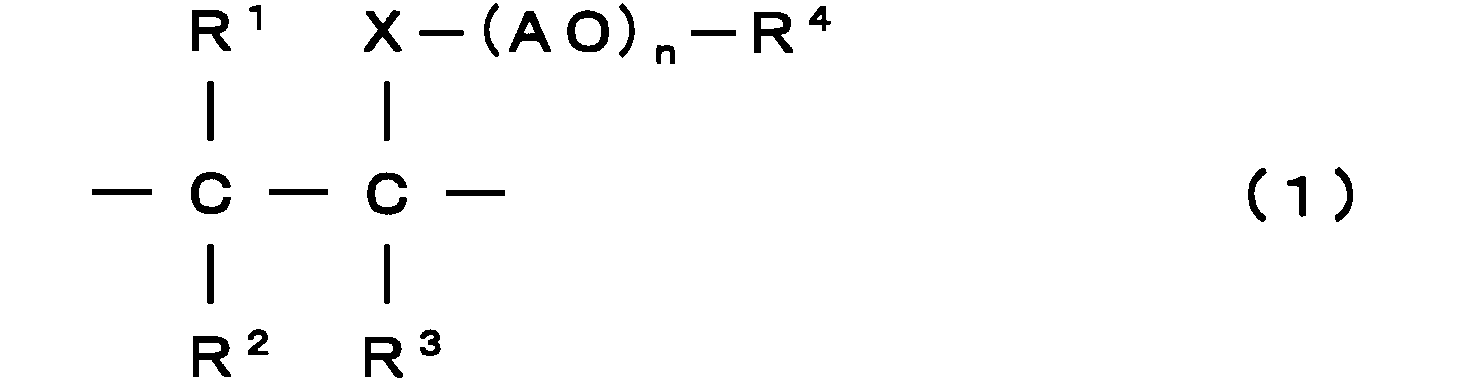
AOは炭素原子数2乃至4のアルキレンオキシ基を表し、具体的にはエチレンオキシ基、プロピレンオキシ基、ブチレンオキシ基が挙げられる。二種以上のアルキレンオキシ基から構成される場合、これらアルキレンオキシ基はブロック付加又はランダム付加の何れでも良い。
nは上記アルキレンオキシ基の付加モル数で1乃至200の数を表す。好ましくは5乃至120、より好ましくは10乃至100、更に好ましくは40乃至100である。
メトキシポリエチレングリコールモノ(メタ)アクリレート、メトキシ{ポリエチレングリコール(ポリ)プロピレングリコール}モノ(メタ)アクリレート、エトキシポリエチレングリコールモノ(メタ)アクリレート、エトキシ{ポリエチレングリコール(ポリ)プロピレングリコール}モノ(メタ)アクリレート、プロポキシポリエチレングリコールモノ(メタ)アクリレート、プロポキシ{ポリエチレングリコール(ポリ)プロピレングリコール}モノ(メタ)アクリレート、ブトキシポリエチレングリコールモノ(メタ)アクリレート、ブトキシ{ポリエチレングリコール(ポリ)プロピレングリコール}モノ(メタ)アクリレート等のアルコキシポリアルキレングリコールモノ(メタ)アクリレート;ビニルアルコールアルキレンオキシド付加物、(メタ)アリルアルコールアルキレンオキシド付加物、3-ブテン-1-オールアルキレンオキシド付加物、イソプレンアルコール(3-メチル-3-ブテン-1-オール)アルキレンオキシド付加物、3-メチル-2-ブテン-1-オールアルキレンオキシド付加物、2-メチル-3-ブテン-2-オールアルキレンオキシド付加物、2-メチル-2-ブテン-1-オールアルキレンオキシド付加物、2-メチル-3-ブテン-1-オールアルキレンオキシド付加物等の不飽和アルコールポリアルキレングリコール付加物。なお本発明では、(メタ)アクリレートとはアクリレートとメタクリレートの両方をいい、(メタ)アリルアルコールとはアリルアルコールとメタリルアルコールの両方をいう。
また、上記(A)ポリカルボン酸系重合体は、水酸化リチウム、水酸化カリウム、水酸化ナトリウム、アンモニア、アルキルアミン、有機アミン類などの中和剤によって、予め部分中和、或いは完全中和された形態として、本発明の石膏用分散剤に含有されることが好ましい。
上記アルキレンオキサイドを付加したポリアマイドポリアミンは、前記ポリアマイドポリアミンに直接アルキレンオキサイドを付加し得る方法と、水溶液中で得る方法の何れによっても得られる。
また、上記アルキレンオキサイドの量は上記ポリアマイドポリアミンのアミノ残基(アミノ基、イミノ基、アミド基)1当量に対し0~8モルが好ましい。
石膏は無水石膏、半水石膏、二水石膏などがある。原料石膏としては、天然石膏または中和石膏もしくは副産石膏などの化学石膏を単独で、あるいはそれらの二種以上を混合したものが使用できる。主な化学石膏としてはリン酸石膏、フッ酸石膏、チタン石膏または排煙脱硫石膏などが例示される。また、原料石膏には、リサイクル石膏を含んでもよい。リサイクル石膏は、石膏ボードメーカーで自家発生する廃石膏ボード、新築時及び解体時に発生する廃石膏ボード等から回収されるリサイクル石膏であればいずれでも良い。本発明の石膏用分散剤はこれらのいずれの原料石膏に対しても好適に用いることができ、また種々の割合でブレンドされたものに対しても優れた効果が得られる。
なお、本発明の分散剤を塗り仕上げに用いる石膏用プラスターに適用することもまた容易に為し得る。
本実施例で用いた(A)ポリカルボン酸系重合体を以下に示す。
<A1>(a1)ポリエチレングリコール(46モル)モノメチルエーテルのメタクリル酸エステルと(b1)メタクリル酸の共重合物((a1):(b1)=9:1;重量平均分子量25,000)
<A2>(a2)ポリエチレングリコール(90モル)モノメチルエーテルのメタクリル酸エステルと、(b1)メタクリル酸と、(c1)ポリアマイドポリアミン系単量体の共重合物((a2):(b1):(c1)=77:13:10;重量平均分子量44,000;特開2007-320786号公報記載の実施例2の共重合体)
<A3>(a3)3-メチル-3-ブテン-1-オール50EO2PO付加物と(b2)フマル酸の共重合物((a3):(b2)=8:2;重量平均分子量30,000)
本実施例で用いた(B)ポリアマイドポリアミン(B1~B8)を以下の手順にて製造した。
〈分子量測定条件〉
カラム:OHpacSB-806MHQ、OHpacSB-804HQ、OHpacSB-803HQ(昭和電工(株)製)
溶離液:0.5M酢酸 硝酸ナトリウム水溶液
検出器:示差屈折計
検量線:プルラン基準
温度計、窒素導入管、撹拌機、検水管付コンデンサーを備えたガラス製反応容器にジエチレントリアミン103gを仕込み、窒素を液中に導入しながら撹拌した。撹拌しながらアジピン酸121g(ポリアルキレンポリアミン/二塩基酸のモル比は6モル/5モル)を仕込み、150℃まで昇温し、流出水を除去しながら同温度で5時間反応を継続した。反応終了後、イオン交換水138gを仕込み、ポリアマイドポリアミンの60質量%水溶液345g(化合物B1;重量平均分子量1,300)を得た。
化合物B1のアマイド化反応までは同様に行い、次に、イオン交換水230gを仕込み30分撹拌を行った。窒素導入管、エチレンオキサイド導入管を備えたガラス製耐圧容器に移し窒素で充分に置換し温度を60℃まで昇温した。60℃~70℃を維持しながらエチレンオキサイド146gを徐々に吹き込み、その後1時間同温度で熟成させた。ポリエチレンオキサイド付加ポリアマイドポリアミンの60質量%水溶液570g(化合物B2;重量平均分子量2,000)を得た。
温度計、窒素導入管、撹拌機、検水管付コンデンサーを備えたガラス製反応容器にペンタエチレンヘキサミン134gを仕込み、窒素を液中に導入しながら撹拌した。撹拌しながらアジピン酸50g(ポリアルキレンポリアミン/二塩基酸のモル比は5モル/3モル)を仕込み、150℃まで昇温し、流出水を除去しながら同温度で5時間反応を継続した。反応終了後、イオン交換水115gを仕込み、ポリアマイドポリアミンの60質量%水溶液288g(化合物B3;重量平均分子量1,500)を得た。
化合物B3のアマイド化反応までは同様に行い、次に、イオン交換水197gを仕込み30分撹拌を行った。窒素導入管、エチレンオキサイド導入管を備えたガラス製耐圧容器に移し窒素で充分に置換し温度を60℃まで昇温した。60℃~70℃を維持しながらエチレンオキサイド122gを徐々に吹き込み、その後1時間同温度で熟成させた。ポリエチレンオキサイド付加ポリアマイドポリアミンの60質量%水溶液504g(化合物B4;重量平均分子量1,900)を得た。
温度計、窒素導入管、撹拌機、検水管付コンデンサーを備えたガラス製反応容器にテトラエチレンペンタミン128gを仕込み、窒素を液中に導入しながら撹拌した。撹拌しながらアジピン酸89g(ポリアルキレンポリアミン/二塩基酸のモル比は10モル/9モル)を仕込み、150℃まで昇温し、流出水を除去しながら同温度で5時間反応を継続した。反応終了後、イオン交換水131gを仕込み、ポリアマイドポリアミンの60質量%水溶液328g(化合物B5;重量平均分子量2,900)を得た。
化合物B5のアマイド化反応までは同様に行い、次に、イオン交換水330gを仕込み30分撹拌を行った。窒素導入管、エチレンオキサイド導入管を備えたガラス製耐圧容器に移し窒素で充分に置換し温度を60℃まで昇温した。60℃~70℃を維持しながらエチレンオキサイド300gを徐々に吹き込み、その後1時間同温度で熟成させた。ポリエチレンオキサイド付加ポリアマイドポリアミンの60質量%水溶液850g(化合物B6;重量平均分子量4,800)を得た。
温度計、窒素導入管、撹拌機、検水管付コンデンサーを備えたガラス製反応容器にポリアルキレンポリアミン(東ソー社製 品名:ポリエイト)199gを仕込み、窒素を液中に導入しながら撹拌した。撹拌しながらアジピン酸68g(ポリアルキレンポリアミン/二塩基酸のモル比は4モル/3モル)を仕込み、150℃まで昇温し、流出水を除去しながら同温度で5時間反応を継続した。反応終了後、イオン交換水125gを仕込み、ポリアマイドポリアミンの60質量%水溶液412g(化合物B7;重量平均分子量2,200)を得た。
化合物B7のアマイド化反応までは同様に行い、次に、イオン交換水290gを仕込み30分撹拌を行った。窒素導入管、エチレンオキサイド導入管を備えたガラス製耐圧容器に移し窒素で充分に置換し温度を60℃まで昇温した。60℃~70℃を維持しながらエチレンオキサイド180gを徐々に吹き込み、その後1時間同温度で熟成した。ポリエチレンオキサイド付加ポリアマイドポリアミンの60質量%水溶液716g(化合物B8;重量平均分子量2,500)を得た。
表2に示す組成割合で実施例1~51及び比較例1~3の石膏用分散剤を調製し、石膏分散性と石膏硬化遅延性を以下の試験方法にて試験した。

<石膏分散性>
表2(表2-1及び表2-2)に示す(A)成分及び(B)成分を同表に示す配合比(質量比)にて混合した実施例1~51、比較例1~3の各石膏用分散剤を、固形分基準で0.18g(対石膏0.06質量%)となるように秤量し、水を加え総量で195gになるように練り水を調整した。これに表1に示す配合組成の焼石膏又は市販品の焼石膏(No.6)300gを加え(水石膏比65%)、小型ジューサーミキサーで10秒間練り混ぜを行った。
ウレタン製ボード(35cm×35cm)中央に上部内径75mm、下部内径85mm、高さ40mmの円筒形中空筒を事前に準備し、練り混ぜを行った石膏スラリーを容器(円筒形中空筒)が一杯になるまで直ちに流し込んだ。その後中空筒をウレタンボードと垂直な方向に引き上げ、石膏スラリーの広がりを測定した。広がりの最大とみられる径とそれと垂直な径を測定し、その平均値を分散性の指標とした。
得られた結果(径の平均値)を表2(表2-1及び表2-2)に示す。
分散性試験と同様に、実施例1~51、比較例1~3の各石膏用分散剤を固形分基準で0.18g(対石膏0.06質量%)となるように正秤し、練り水を添加し合計で195gになるように調整した。これに表1に示す配合組成の焼石膏又は市販品の焼石膏(No.6)300gを加え(水石膏比65%)、小型ジューサーミキサーで10秒間練り混ぜを行った。
練り混ぜ後、出来上がった石膏スラリーを直ちに紙コップに移し変え、ここにデジタル温度計を差し込み、石膏の硬化に伴う発熱温度を10秒単位で測定し、最大温度に到達した時間を昇温ピーク時間とし、硬化遅延性の指標とした。
得られた結果(昇温ピーク時間)を表2(表2-1及び表2-2)に示す。


一方、ポリアマイドポリアミンを用いない比較例1乃至3では、市販品であるNo.6の焼石膏を用いた場合には実施例と同程度の結果を示すものもあったが、実際の石膏ボードの製造において工場で種々の石膏をブレンドし使用することを想定したNo.1~No.5の焼石膏では、分散性、硬化遅延性ともに実施例と比べて劣る結果となった。
Claims (5)
- (A)ポリカルボン酸系重合体と、(B)ポリアルキレンポリアミンと二塩基酸類を必須成分として反応させることにより得られるポリアマイドポリアミン及び/又はそのアルキレンオキサイド付加物とを含有することを特徴とする石膏用分散剤。
- 前記(A)ポリカルボン酸系重合体が、ポリアルキレングリコール系不飽和単量体(a)に由来する構成単位と、不飽和カルボン酸系単量体(b)に由来する構成単位を有するものである、請求項1に記載の石膏用分散剤。
- 前記ポリアルキレングリコール系不飽和単量体(a)に由来する構成単位が、下記一般式(1)で表されるものである、請求項2に記載の石膏用分散剤。
- 前記(A)成分と(B)成分の割合が、質量比で(A):(B)=1:1~30:1である、請求項1~3のいずれか1項に記載の石膏用分散剤。
- ポリアルキレンポリアミンと二塩基酸類を必須成分として反応させることにより得られるポリアマイドポリアミン及び/又はそのアルキレンオキサイド付加物からなる石膏用添加剤。
Priority Applications (13)
| Application Number | Priority Date | Filing Date | Title |
|---|---|---|---|
| AU2013233152A AU2013233152B2 (en) | 2012-03-14 | 2013-03-14 | Gypsum dispersant |
| US14/385,208 US20150031836A1 (en) | 2012-03-14 | 2013-03-14 | Gypsum dispersant |
| KR1020147028406A KR102006667B1 (ko) | 2012-03-14 | 2013-03-14 | 석고용 분산제 |
| JP2014504998A JP6095644B2 (ja) | 2012-03-14 | 2013-03-14 | 石膏用分散剤 |
| IN7670DEN2014 IN2014DN07670A (ja) | 2012-03-14 | 2013-03-14 | |
| RU2014141155A RU2648781C2 (ru) | 2012-03-14 | 2013-03-14 | Диспергирующая добавка для гипса |
| MX2014011018A MX374204B (es) | 2012-03-14 | 2013-03-14 | Dispersante de yeso. |
| HK15106421.9A HK1205734A1 (en) | 2012-03-14 | 2013-03-14 | Gypsum dispersant |
| CN201380013778.XA CN104271531A (zh) | 2012-03-14 | 2013-03-14 | 石膏用分散剂 |
| BR112014022608A BR112014022608A8 (pt) | 2012-03-14 | 2013-03-14 | Dispersante de gesso |
| EP13760629.9A EP2826759A4 (en) | 2012-03-14 | 2013-03-14 | GIPSDISPERGIERMITTEL |
| CA2867283A CA2867283A1 (en) | 2012-03-14 | 2013-03-14 | Gypsum dispersant |
| US15/093,441 US20160244365A1 (en) | 2012-03-14 | 2016-04-07 | Gypsum dispersant |
Applications Claiming Priority (2)
| Application Number | Priority Date | Filing Date | Title |
|---|---|---|---|
| JP2012058029 | 2012-03-14 | ||
| JP2012-058029 | 2012-03-14 |
Related Child Applications (2)
| Application Number | Title | Priority Date | Filing Date |
|---|---|---|---|
| US14/385,208 A-371-Of-International US20150031836A1 (en) | 2012-03-14 | 2013-03-14 | Gypsum dispersant |
| US15/093,441 Continuation US20160244365A1 (en) | 2012-03-14 | 2016-04-07 | Gypsum dispersant |
Publications (1)
| Publication Number | Publication Date |
|---|---|
| WO2013137400A1 true WO2013137400A1 (ja) | 2013-09-19 |
Family
ID=49161303
Family Applications (1)
| Application Number | Title | Priority Date | Filing Date |
|---|---|---|---|
| PCT/JP2013/057226 Ceased WO2013137400A1 (ja) | 2012-03-14 | 2013-03-14 | 石膏用分散剤 |
Country Status (13)
| Country | Link |
|---|---|
| US (2) | US20150031836A1 (ja) |
| EP (1) | EP2826759A4 (ja) |
| JP (1) | JP6095644B2 (ja) |
| KR (1) | KR102006667B1 (ja) |
| CN (1) | CN104271531A (ja) |
| AU (1) | AU2013233152B2 (ja) |
| BR (1) | BR112014022608A8 (ja) |
| CA (1) | CA2867283A1 (ja) |
| HK (1) | HK1205734A1 (ja) |
| IN (1) | IN2014DN07670A (ja) |
| MX (1) | MX374204B (ja) |
| RU (1) | RU2648781C2 (ja) |
| WO (1) | WO2013137400A1 (ja) |
Cited By (5)
| Publication number | Priority date | Publication date | Assignee | Title |
|---|---|---|---|---|
| JP2017078018A (ja) * | 2015-10-20 | 2017-04-27 | 株式会社日本触媒 | 非水硬性粉体含有組成物用添加剤およびコンクリート組成物 |
| WO2017069214A1 (ja) * | 2015-10-20 | 2017-04-27 | 株式会社日本触媒 | 非水硬性粉体含有組成物用添加剤およびコンクリート組成物 |
| JP2020007685A (ja) * | 2018-07-12 | 2020-01-16 | セントラル硝子株式会社 | ガラスチョップドストランド及びそれを用いた石膏ボードの製造方法 |
| JP2022537503A (ja) * | 2019-06-05 | 2022-08-26 | シルクロード シーアンドティー | 石膏ボード用混和剤の製造方法及びそれによる混和剤、それを含む石膏ボード形成用組成物 |
| WO2023127776A1 (ja) * | 2021-12-28 | 2023-07-06 | 吉野石膏株式会社 | 石膏組成物の製造方法、石膏組成物、石膏組成物用の鉱物原料及び硬化体の製造方法 |
Families Citing this family (2)
| Publication number | Priority date | Publication date | Assignee | Title |
|---|---|---|---|---|
| US10442732B2 (en) | 2016-05-20 | 2019-10-15 | United States Gypsum Company | Gypsum slurries with linear polycarboxylate dispersants |
| CN115651113B (zh) * | 2022-11-15 | 2023-09-01 | 江苏尼高科技有限公司 | 一种石膏缓凝剂的制备工艺 |
Citations (6)
| Publication number | Priority date | Publication date | Assignee | Title |
|---|---|---|---|---|
| JPS641426B2 (ja) | 1983-04-28 | 1989-01-11 | Ube Kosan Kk | |
| JP3067811B2 (ja) | 1990-12-28 | 2000-07-24 | 花王株式会社 | 石膏スラリー用減水剤 |
| JP3733821B2 (ja) | 2000-02-03 | 2006-01-11 | 日本製紙株式会社 | 分散剤 |
| JP2007320786A (ja) | 2006-05-30 | 2007-12-13 | Toho Chem Ind Co Ltd | 石膏用分散剤及び石膏用分散剤組成物 |
| WO2008032799A1 (fr) * | 2006-09-13 | 2008-03-20 | Toho Chemical Industry Co., Ltd. | Nouveau polymère d'acide polycarboxylique |
| JP2009161621A (ja) * | 2007-12-28 | 2009-07-23 | Toho Chem Ind Co Ltd | 新規なポリカルボン酸系重合体 |
Family Cites Families (7)
| Publication number | Priority date | Publication date | Assignee | Title |
|---|---|---|---|---|
| JPS641426A (en) | 1987-06-22 | 1989-01-05 | Giichiro Kato | High sensitivity and low tension lightning arrester of multi-function type |
| JP3336456B2 (ja) * | 1998-12-25 | 2002-10-21 | 日本シーカ株式会社 | セメント分散剤および該分散剤を含むコンクリート組成物 |
| US7662884B2 (en) * | 2002-04-25 | 2010-02-16 | Nippon Shokubai Co., Ltd. | Cement admixture and production method thereof |
| JP4348963B2 (ja) * | 2003-02-13 | 2009-10-21 | 日油株式会社 | セメント用添加剤 |
| US20060280898A1 (en) * | 2005-06-14 | 2006-12-14 | United States Gypsum Company | Modifiers for gypsum slurries and method of using them |
| CN101516801B (zh) * | 2006-09-13 | 2012-07-18 | 东邦化学工业株式会社 | 水泥分散剂 |
| JP5713524B2 (ja) * | 2008-07-11 | 2015-05-07 | ダブリュー・アール・グレイス・アンド・カンパニー−コネチカット | コンクリートにおける粘土活性を改善するためのスランプ保持混和剤 |
-
2013
- 2013-03-14 KR KR1020147028406A patent/KR102006667B1/ko not_active Expired - Fee Related
- 2013-03-14 IN IN7670DEN2014 patent/IN2014DN07670A/en unknown
- 2013-03-14 EP EP13760629.9A patent/EP2826759A4/en not_active Withdrawn
- 2013-03-14 CA CA2867283A patent/CA2867283A1/en not_active Abandoned
- 2013-03-14 WO PCT/JP2013/057226 patent/WO2013137400A1/ja not_active Ceased
- 2013-03-14 JP JP2014504998A patent/JP6095644B2/ja active Active
- 2013-03-14 MX MX2014011018A patent/MX374204B/es active IP Right Grant
- 2013-03-14 AU AU2013233152A patent/AU2013233152B2/en not_active Ceased
- 2013-03-14 US US14/385,208 patent/US20150031836A1/en not_active Abandoned
- 2013-03-14 BR BR112014022608A patent/BR112014022608A8/pt not_active Application Discontinuation
- 2013-03-14 RU RU2014141155A patent/RU2648781C2/ru not_active IP Right Cessation
- 2013-03-14 HK HK15106421.9A patent/HK1205734A1/xx unknown
- 2013-03-14 CN CN201380013778.XA patent/CN104271531A/zh active Pending
-
2016
- 2016-04-07 US US15/093,441 patent/US20160244365A1/en not_active Abandoned
Patent Citations (6)
| Publication number | Priority date | Publication date | Assignee | Title |
|---|---|---|---|---|
| JPS641426B2 (ja) | 1983-04-28 | 1989-01-11 | Ube Kosan Kk | |
| JP3067811B2 (ja) | 1990-12-28 | 2000-07-24 | 花王株式会社 | 石膏スラリー用減水剤 |
| JP3733821B2 (ja) | 2000-02-03 | 2006-01-11 | 日本製紙株式会社 | 分散剤 |
| JP2007320786A (ja) | 2006-05-30 | 2007-12-13 | Toho Chem Ind Co Ltd | 石膏用分散剤及び石膏用分散剤組成物 |
| WO2008032799A1 (fr) * | 2006-09-13 | 2008-03-20 | Toho Chemical Industry Co., Ltd. | Nouveau polymère d'acide polycarboxylique |
| JP2009161621A (ja) * | 2007-12-28 | 2009-07-23 | Toho Chem Ind Co Ltd | 新規なポリカルボン酸系重合体 |
Non-Patent Citations (1)
| Title |
|---|
| See also references of EP2826759A4 |
Cited By (10)
| Publication number | Priority date | Publication date | Assignee | Title |
|---|---|---|---|---|
| JP2017078018A (ja) * | 2015-10-20 | 2017-04-27 | 株式会社日本触媒 | 非水硬性粉体含有組成物用添加剤およびコンクリート組成物 |
| WO2017069214A1 (ja) * | 2015-10-20 | 2017-04-27 | 株式会社日本触媒 | 非水硬性粉体含有組成物用添加剤およびコンクリート組成物 |
| JP2020007685A (ja) * | 2018-07-12 | 2020-01-16 | セントラル硝子株式会社 | ガラスチョップドストランド及びそれを用いた石膏ボードの製造方法 |
| JP7057502B2 (ja) | 2018-07-12 | 2022-04-20 | セントラル硝子株式会社 | ガラスチョップドストランド及びそれを用いた石膏ボードの製造方法 |
| JP2022537503A (ja) * | 2019-06-05 | 2022-08-26 | シルクロード シーアンドティー | 石膏ボード用混和剤の製造方法及びそれによる混和剤、それを含む石膏ボード形成用組成物 |
| JP7326490B2 (ja) | 2019-06-05 | 2023-08-15 | シルクロード シーアンドティー | 石膏ボード用混和剤の製造方法及びそれによる混和剤、それを含む石膏ボード形成用組成物 |
| US12454484B2 (en) | 2019-06-05 | 2025-10-28 | Silkroad C&T | Preparation method for admixture for plasterboard, admixture prepared thereby, and composition for forming plasterboard comprising same |
| WO2023127776A1 (ja) * | 2021-12-28 | 2023-07-06 | 吉野石膏株式会社 | 石膏組成物の製造方法、石膏組成物、石膏組成物用の鉱物原料及び硬化体の製造方法 |
| JPWO2023127776A1 (ja) * | 2021-12-28 | 2023-07-06 | ||
| JP7722739B2 (ja) | 2021-12-28 | 2025-08-13 | 吉野石膏株式会社 | 石膏組成物の製造方法、石膏組成物、石膏組成物用の鉱物原料及び硬化体の製造方法 |
Also Published As
| Publication number | Publication date |
|---|---|
| RU2648781C2 (ru) | 2018-03-28 |
| AU2013233152A1 (en) | 2014-10-09 |
| EP2826759A4 (en) | 2015-11-18 |
| RU2014141155A (ru) | 2016-05-10 |
| HK1205734A1 (en) | 2015-12-24 |
| JP6095644B2 (ja) | 2017-03-15 |
| IN2014DN07670A (ja) | 2015-06-26 |
| EP2826759A1 (en) | 2015-01-21 |
| KR20150004341A (ko) | 2015-01-12 |
| AU2013233152B2 (en) | 2016-12-08 |
| JPWO2013137400A1 (ja) | 2015-08-03 |
| CN104271531A (zh) | 2015-01-07 |
| CA2867283A1 (en) | 2013-09-19 |
| KR102006667B1 (ko) | 2019-08-02 |
| BR112014022608A2 (ja) | 2017-08-22 |
| US20160244365A1 (en) | 2016-08-25 |
| MX2014011018A (es) | 2015-06-04 |
| US20150031836A1 (en) | 2015-01-29 |
| MX374204B (es) | 2025-03-05 |
| BR112014022608A8 (pt) | 2018-06-12 |
Similar Documents
| Publication | Publication Date | Title |
|---|---|---|
| JP6095644B2 (ja) | 石膏用分散剤 | |
| JP5610244B2 (ja) | 新規なポリカルボン酸系重合体 | |
| US7393886B2 (en) | Cement dispersant and concrete composition containing the dispersant | |
| JP4993149B2 (ja) | 共重合体及び該共重合体からなるセメント分散剤 | |
| JP2013082560A (ja) | 水硬性組成物用混和剤 | |
| JP4844878B2 (ja) | 石膏用分散剤及び石膏用分散剤組成物 | |
| JP6091486B2 (ja) | 石膏用分散剤 | |
| JP2011116587A (ja) | 水硬性組成物用早強剤 | |
| AU2004318289A1 (en) | Cement dispersant and concrete composition containing the dispersant | |
| CN104271532B (zh) | 石膏用分散剂 | |
| HK1205733B (en) | Gypsum dispersant | |
| KR20070019523A (ko) | 시멘트 분산제 및 이 분산제를 포함하는 콘크리트 조성물 |
Legal Events
| Date | Code | Title | Description |
|---|---|---|---|
| 121 | Ep: the epo has been informed by wipo that ep was designated in this application |
Ref document number: 13760629 Country of ref document: EP Kind code of ref document: A1 |
|
| ENP | Entry into the national phase |
Ref document number: 2014504998 Country of ref document: JP Kind code of ref document: A |
|
| ENP | Entry into the national phase |
Ref document number: 2867283 Country of ref document: CA |
|
| WWE | Wipo information: entry into national phase |
Ref document number: MX/A/2014/011018 Country of ref document: MX |
|
| WWE | Wipo information: entry into national phase |
Ref document number: 14385208 Country of ref document: US |
|
| WWE | Wipo information: entry into national phase |
Ref document number: 2013760629 Country of ref document: EP |
|
| NENP | Non-entry into the national phase |
Ref country code: DE |
|
| ENP | Entry into the national phase |
Ref document number: 20147028406 Country of ref document: KR Kind code of ref document: A |
|
| ENP | Entry into the national phase |
Ref document number: 2013233152 Country of ref document: AU Date of ref document: 20130314 Kind code of ref document: A |
|
| WWE | Wipo information: entry into national phase |
Ref document number: IDP00201406120 Country of ref document: ID |
|
| ENP | Entry into the national phase |
Ref document number: 2014141155 Country of ref document: RU Kind code of ref document: A |
|
| REG | Reference to national code |
Ref country code: BR Ref legal event code: B01A Ref document number: 112014022608 Country of ref document: BR |
|
| ENP | Entry into the national phase |
Ref document number: 112014022608 Country of ref document: BR Kind code of ref document: A2 Effective date: 20140912 |