WO2013141157A1 - 熱可塑性樹脂組成物、樹脂成形品、及びメッキ層付樹脂成形品の製造方法 - Google Patents
熱可塑性樹脂組成物、樹脂成形品、及びメッキ層付樹脂成形品の製造方法 Download PDFInfo
- Publication number
- WO2013141157A1 WO2013141157A1 PCT/JP2013/057431 JP2013057431W WO2013141157A1 WO 2013141157 A1 WO2013141157 A1 WO 2013141157A1 JP 2013057431 W JP2013057431 W JP 2013057431W WO 2013141157 A1 WO2013141157 A1 WO 2013141157A1
- Authority
- WO
- WIPO (PCT)
- Prior art keywords
- thermoplastic resin
- resin composition
- weight
- parts
- composition according
- Prior art date
- Legal status (The legal status is an assumption and is not a legal conclusion. Google has not performed a legal analysis and makes no representation as to the accuracy of the status listed.)
- Ceased
Links
Images

Classifications
-
- C—CHEMISTRY; METALLURGY
- C08—ORGANIC MACROMOLECULAR COMPOUNDS; THEIR PREPARATION OR CHEMICAL WORKING-UP; COMPOSITIONS BASED THEREON
- C08K—Use of inorganic or non-macromolecular organic substances as compounding ingredients
- C08K3/00—Use of inorganic substances as compounding ingredients
- C08K3/18—Oxygen-containing compounds, e.g. metal carbonyls
- C08K3/20—Oxides; Hydroxides
- C08K3/22—Oxides; Hydroxides of metals
-
- C—CHEMISTRY; METALLURGY
- C08—ORGANIC MACROMOLECULAR COMPOUNDS; THEIR PREPARATION OR CHEMICAL WORKING-UP; COMPOSITIONS BASED THEREON
- C08K—Use of inorganic or non-macromolecular organic substances as compounding ingredients
- C08K3/00—Use of inorganic substances as compounding ingredients
-
- C—CHEMISTRY; METALLURGY
- C08—ORGANIC MACROMOLECULAR COMPOUNDS; THEIR PREPARATION OR CHEMICAL WORKING-UP; COMPOSITIONS BASED THEREON
- C08K—Use of inorganic or non-macromolecular organic substances as compounding ingredients
- C08K3/00—Use of inorganic substances as compounding ingredients
- C08K3/18—Oxygen-containing compounds, e.g. metal carbonyls
- C08K3/20—Oxides; Hydroxides
- C08K3/22—Oxides; Hydroxides of metals
- C08K3/2279—Oxides; Hydroxides of metals of antimony
-
- C—CHEMISTRY; METALLURGY
- C08—ORGANIC MACROMOLECULAR COMPOUNDS; THEIR PREPARATION OR CHEMICAL WORKING-UP; COMPOSITIONS BASED THEREON
- C08K—Use of inorganic or non-macromolecular organic substances as compounding ingredients
- C08K3/00—Use of inorganic substances as compounding ingredients
- C08K3/40—Glass
-
- C—CHEMISTRY; METALLURGY
- C08—ORGANIC MACROMOLECULAR COMPOUNDS; THEIR PREPARATION OR CHEMICAL WORKING-UP; COMPOSITIONS BASED THEREON
- C08K—Use of inorganic or non-macromolecular organic substances as compounding ingredients
- C08K7/00—Use of ingredients characterised by shape
- C08K7/02—Fibres or whiskers
- C08K7/04—Fibres or whiskers inorganic
- C08K7/14—Glass
-
- C—CHEMISTRY; METALLURGY
- C08—ORGANIC MACROMOLECULAR COMPOUNDS; THEIR PREPARATION OR CHEMICAL WORKING-UP; COMPOSITIONS BASED THEREON
- C08K—Use of inorganic or non-macromolecular organic substances as compounding ingredients
- C08K9/00—Use of pretreated ingredients
- C08K9/02—Ingredients treated with inorganic substances
-
- C—CHEMISTRY; METALLURGY
- C08—ORGANIC MACROMOLECULAR COMPOUNDS; THEIR PREPARATION OR CHEMICAL WORKING-UP; COMPOSITIONS BASED THEREON
- C08L—COMPOSITIONS OF MACROMOLECULAR COMPOUNDS
- C08L101/00—Compositions of unspecified macromolecular compounds
- C08L101/12—Compositions of unspecified macromolecular compounds characterised by physical features, e.g. anisotropy, viscosity or electrical conductivity
-
- C—CHEMISTRY; METALLURGY
- C08—ORGANIC MACROMOLECULAR COMPOUNDS; THEIR PREPARATION OR CHEMICAL WORKING-UP; COMPOSITIONS BASED THEREON
- C08L—COMPOSITIONS OF MACROMOLECULAR COMPOUNDS
- C08L23/00—Compositions of homopolymers or copolymers of unsaturated aliphatic hydrocarbons having only one carbon-to-carbon double bond; Compositions of derivatives of such polymers
- C08L23/02—Compositions of homopolymers or copolymers of unsaturated aliphatic hydrocarbons having only one carbon-to-carbon double bond; Compositions of derivatives of such polymers not modified by chemical after-treatment
- C08L23/04—Homopolymers or copolymers of ethene
- C08L23/06—Polyethylene
-
- C—CHEMISTRY; METALLURGY
- C08—ORGANIC MACROMOLECULAR COMPOUNDS; THEIR PREPARATION OR CHEMICAL WORKING-UP; COMPOSITIONS BASED THEREON
- C08L—COMPOSITIONS OF MACROMOLECULAR COMPOUNDS
- C08L77/00—Compositions of polyamides obtained by reactions forming a carboxylic amide link in the main chain; Compositions of derivatives of such polymers
- C08L77/06—Polyamides derived from polyamines and polycarboxylic acids
-
- C—CHEMISTRY; METALLURGY
- C08—ORGANIC MACROMOLECULAR COMPOUNDS; THEIR PREPARATION OR CHEMICAL WORKING-UP; COMPOSITIONS BASED THEREON
- C08L—COMPOSITIONS OF MACROMOLECULAR COMPOUNDS
- C08L91/00—Compositions of oils, fats or waxes; Compositions of derivatives thereof
- C08L91/06—Waxes
-
- C—CHEMISTRY; METALLURGY
- C23—COATING METALLIC MATERIAL; COATING MATERIAL WITH METALLIC MATERIAL; CHEMICAL SURFACE TREATMENT; DIFFUSION TREATMENT OF METALLIC MATERIAL; COATING BY VACUUM EVAPORATION, BY SPUTTERING, BY ION IMPLANTATION OR BY CHEMICAL VAPOUR DEPOSITION, IN GENERAL; INHIBITING CORROSION OF METALLIC MATERIAL OR INCRUSTATION IN GENERAL
- C23C—COATING METALLIC MATERIAL; COATING MATERIAL WITH METALLIC MATERIAL; SURFACE TREATMENT OF METALLIC MATERIAL BY DIFFUSION INTO THE SURFACE, BY CHEMICAL CONVERSION OR SUBSTITUTION; COATING BY VACUUM EVAPORATION, BY SPUTTERING, BY ION IMPLANTATION OR BY CHEMICAL VAPOUR DEPOSITION, IN GENERAL
- C23C18/00—Chemical coating by decomposition of either liquid compounds or solutions of the coating forming compounds, without leaving reaction products of surface material in the coating; Contact plating
- C23C18/16—Chemical coating by decomposition of either liquid compounds or solutions of the coating forming compounds, without leaving reaction products of surface material in the coating; Contact plating by reduction or substitution, e.g. electroless plating
- C23C18/1601—Process or apparatus
- C23C18/1603—Process or apparatus coating on selected surface areas
- C23C18/1607—Process or apparatus coating on selected surface areas by direct patterning
- C23C18/1608—Process or apparatus coating on selected surface areas by direct patterning from pretreatment step, i.e. selective pre-treatment
-
- C—CHEMISTRY; METALLURGY
- C23—COATING METALLIC MATERIAL; COATING MATERIAL WITH METALLIC MATERIAL; CHEMICAL SURFACE TREATMENT; DIFFUSION TREATMENT OF METALLIC MATERIAL; COATING BY VACUUM EVAPORATION, BY SPUTTERING, BY ION IMPLANTATION OR BY CHEMICAL VAPOUR DEPOSITION, IN GENERAL; INHIBITING CORROSION OF METALLIC MATERIAL OR INCRUSTATION IN GENERAL
- C23C—COATING METALLIC MATERIAL; COATING MATERIAL WITH METALLIC MATERIAL; SURFACE TREATMENT OF METALLIC MATERIAL BY DIFFUSION INTO THE SURFACE, BY CHEMICAL CONVERSION OR SUBSTITUTION; COATING BY VACUUM EVAPORATION, BY SPUTTERING, BY ION IMPLANTATION OR BY CHEMICAL VAPOUR DEPOSITION, IN GENERAL
- C23C18/00—Chemical coating by decomposition of either liquid compounds or solutions of the coating forming compounds, without leaving reaction products of surface material in the coating; Contact plating
- C23C18/16—Chemical coating by decomposition of either liquid compounds or solutions of the coating forming compounds, without leaving reaction products of surface material in the coating; Contact plating by reduction or substitution, e.g. electroless plating
- C23C18/1601—Process or apparatus
- C23C18/1603—Process or apparatus coating on selected surface areas
- C23C18/1607—Process or apparatus coating on selected surface areas by direct patterning
- C23C18/1612—Process or apparatus coating on selected surface areas by direct patterning through irradiation means
-
- C—CHEMISTRY; METALLURGY
- C23—COATING METALLIC MATERIAL; COATING MATERIAL WITH METALLIC MATERIAL; CHEMICAL SURFACE TREATMENT; DIFFUSION TREATMENT OF METALLIC MATERIAL; COATING BY VACUUM EVAPORATION, BY SPUTTERING, BY ION IMPLANTATION OR BY CHEMICAL VAPOUR DEPOSITION, IN GENERAL; INHIBITING CORROSION OF METALLIC MATERIAL OR INCRUSTATION IN GENERAL
- C23C—COATING METALLIC MATERIAL; COATING MATERIAL WITH METALLIC MATERIAL; SURFACE TREATMENT OF METALLIC MATERIAL BY DIFFUSION INTO THE SURFACE, BY CHEMICAL CONVERSION OR SUBSTITUTION; COATING BY VACUUM EVAPORATION, BY SPUTTERING, BY ION IMPLANTATION OR BY CHEMICAL VAPOUR DEPOSITION, IN GENERAL
- C23C18/00—Chemical coating by decomposition of either liquid compounds or solutions of the coating forming compounds, without leaving reaction products of surface material in the coating; Contact plating
- C23C18/16—Chemical coating by decomposition of either liquid compounds or solutions of the coating forming compounds, without leaving reaction products of surface material in the coating; Contact plating by reduction or substitution, e.g. electroless plating
- C23C18/1601—Process or apparatus
- C23C18/1633—Process of electroless plating
- C23C18/1635—Composition of the substrate
- C23C18/1639—Substrates other than metallic, e.g. inorganic or organic or non-conductive
- C23C18/1641—Organic substrates, e.g. resin, plastic
-
- C—CHEMISTRY; METALLURGY
- C23—COATING METALLIC MATERIAL; COATING MATERIAL WITH METALLIC MATERIAL; CHEMICAL SURFACE TREATMENT; DIFFUSION TREATMENT OF METALLIC MATERIAL; COATING BY VACUUM EVAPORATION, BY SPUTTERING, BY ION IMPLANTATION OR BY CHEMICAL VAPOUR DEPOSITION, IN GENERAL; INHIBITING CORROSION OF METALLIC MATERIAL OR INCRUSTATION IN GENERAL
- C23C—COATING METALLIC MATERIAL; COATING MATERIAL WITH METALLIC MATERIAL; SURFACE TREATMENT OF METALLIC MATERIAL BY DIFFUSION INTO THE SURFACE, BY CHEMICAL CONVERSION OR SUBSTITUTION; COATING BY VACUUM EVAPORATION, BY SPUTTERING, BY ION IMPLANTATION OR BY CHEMICAL VAPOUR DEPOSITION, IN GENERAL
- C23C18/00—Chemical coating by decomposition of either liquid compounds or solutions of the coating forming compounds, without leaving reaction products of surface material in the coating; Contact plating
- C23C18/16—Chemical coating by decomposition of either liquid compounds or solutions of the coating forming compounds, without leaving reaction products of surface material in the coating; Contact plating by reduction or substitution, e.g. electroless plating
- C23C18/18—Pretreatment of the material to be coated
- C23C18/20—Pretreatment of the material to be coated of organic surfaces, e.g. resins
- C23C18/2006—Pretreatment of the material to be coated of organic surfaces, e.g. resins by other methods than those of C23C18/22 - C23C18/30
- C23C18/2026—Pretreatment of the material to be coated of organic surfaces, e.g. resins by other methods than those of C23C18/22 - C23C18/30 by radiant energy
- C23C18/204—Radiation, e.g. UV, laser
-
- C—CHEMISTRY; METALLURGY
- C23—COATING METALLIC MATERIAL; COATING MATERIAL WITH METALLIC MATERIAL; CHEMICAL SURFACE TREATMENT; DIFFUSION TREATMENT OF METALLIC MATERIAL; COATING BY VACUUM EVAPORATION, BY SPUTTERING, BY ION IMPLANTATION OR BY CHEMICAL VAPOUR DEPOSITION, IN GENERAL; INHIBITING CORROSION OF METALLIC MATERIAL OR INCRUSTATION IN GENERAL
- C23C—COATING METALLIC MATERIAL; COATING MATERIAL WITH METALLIC MATERIAL; SURFACE TREATMENT OF METALLIC MATERIAL BY DIFFUSION INTO THE SURFACE, BY CHEMICAL CONVERSION OR SUBSTITUTION; COATING BY VACUUM EVAPORATION, BY SPUTTERING, BY ION IMPLANTATION OR BY CHEMICAL VAPOUR DEPOSITION, IN GENERAL
- C23C18/00—Chemical coating by decomposition of either liquid compounds or solutions of the coating forming compounds, without leaving reaction products of surface material in the coating; Contact plating
- C23C18/16—Chemical coating by decomposition of either liquid compounds or solutions of the coating forming compounds, without leaving reaction products of surface material in the coating; Contact plating by reduction or substitution, e.g. electroless plating
- C23C18/31—Coating with metals
- C23C18/32—Coating with nickel, cobalt or mixtures thereof with phosphorus or boron
-
- C—CHEMISTRY; METALLURGY
- C23—COATING METALLIC MATERIAL; COATING MATERIAL WITH METALLIC MATERIAL; CHEMICAL SURFACE TREATMENT; DIFFUSION TREATMENT OF METALLIC MATERIAL; COATING BY VACUUM EVAPORATION, BY SPUTTERING, BY ION IMPLANTATION OR BY CHEMICAL VAPOUR DEPOSITION, IN GENERAL; INHIBITING CORROSION OF METALLIC MATERIAL OR INCRUSTATION IN GENERAL
- C23C—COATING METALLIC MATERIAL; COATING MATERIAL WITH METALLIC MATERIAL; SURFACE TREATMENT OF METALLIC MATERIAL BY DIFFUSION INTO THE SURFACE, BY CHEMICAL CONVERSION OR SUBSTITUTION; COATING BY VACUUM EVAPORATION, BY SPUTTERING, BY ION IMPLANTATION OR BY CHEMICAL VAPOUR DEPOSITION, IN GENERAL
- C23C18/00—Chemical coating by decomposition of either liquid compounds or solutions of the coating forming compounds, without leaving reaction products of surface material in the coating; Contact plating
- C23C18/16—Chemical coating by decomposition of either liquid compounds or solutions of the coating forming compounds, without leaving reaction products of surface material in the coating; Contact plating by reduction or substitution, e.g. electroless plating
- C23C18/31—Coating with metals
- C23C18/38—Coating with copper
-
- C—CHEMISTRY; METALLURGY
- C23—COATING METALLIC MATERIAL; COATING MATERIAL WITH METALLIC MATERIAL; CHEMICAL SURFACE TREATMENT; DIFFUSION TREATMENT OF METALLIC MATERIAL; COATING BY VACUUM EVAPORATION, BY SPUTTERING, BY ION IMPLANTATION OR BY CHEMICAL VAPOUR DEPOSITION, IN GENERAL; INHIBITING CORROSION OF METALLIC MATERIAL OR INCRUSTATION IN GENERAL
- C23C—COATING METALLIC MATERIAL; COATING MATERIAL WITH METALLIC MATERIAL; SURFACE TREATMENT OF METALLIC MATERIAL BY DIFFUSION INTO THE SURFACE, BY CHEMICAL CONVERSION OR SUBSTITUTION; COATING BY VACUUM EVAPORATION, BY SPUTTERING, BY ION IMPLANTATION OR BY CHEMICAL VAPOUR DEPOSITION, IN GENERAL
- C23C18/00—Chemical coating by decomposition of either liquid compounds or solutions of the coating forming compounds, without leaving reaction products of surface material in the coating; Contact plating
- C23C18/16—Chemical coating by decomposition of either liquid compounds or solutions of the coating forming compounds, without leaving reaction products of surface material in the coating; Contact plating by reduction or substitution, e.g. electroless plating
- C23C18/31—Coating with metals
- C23C18/42—Coating with noble metals
-
- F—MECHANICAL ENGINEERING; LIGHTING; HEATING; WEAPONS; BLASTING
- F21—LIGHTING
- F21V—FUNCTIONAL FEATURES OR DETAILS OF LIGHTING DEVICES OR SYSTEMS THEREOF; STRUCTURAL COMBINATIONS OF LIGHTING DEVICES WITH OTHER ARTICLES, NOT OTHERWISE PROVIDED FOR
- F21V7/00—Reflectors for light sources
- F21V7/22—Reflectors for light sources characterised by materials, surface treatments or coatings, e.g. dichroic reflectors
-
- H—ELECTRICITY
- H05—ELECTRIC TECHNIQUES NOT OTHERWISE PROVIDED FOR
- H05K—PRINTED CIRCUITS; CASINGS OR CONSTRUCTIONAL DETAILS OF ELECTRIC APPARATUS; MANUFACTURE OF ASSEMBLAGES OF ELECTRICAL COMPONENTS
- H05K1/00—Printed circuits
- H05K1/02—Details
- H05K1/03—Use of materials for the substrate
- H05K1/0313—Organic insulating material
- H05K1/0353—Organic insulating material consisting of two or more materials, e.g. two or more polymers, polymer + filler, + reinforcement
- H05K1/0373—Organic insulating material consisting of two or more materials, e.g. two or more polymers, polymer + filler, + reinforcement containing additives, e.g. fillers
-
- H—ELECTRICITY
- H05—ELECTRIC TECHNIQUES NOT OTHERWISE PROVIDED FOR
- H05K—PRINTED CIRCUITS; CASINGS OR CONSTRUCTIONAL DETAILS OF ELECTRIC APPARATUS; MANUFACTURE OF ASSEMBLAGES OF ELECTRICAL COMPONENTS
- H05K3/00—Apparatus or processes for manufacturing printed circuits
- H05K3/10—Apparatus or processes for manufacturing printed circuits in which conductive material is applied to the insulating support in such a manner as to form the desired conductive pattern
- H05K3/105—Apparatus or processes for manufacturing printed circuits in which conductive material is applied to the insulating support in such a manner as to form the desired conductive pattern by conversion of non-conductive material on or in the support into conductive material, e.g. by using an energy beam
-
- C—CHEMISTRY; METALLURGY
- C08—ORGANIC MACROMOLECULAR COMPOUNDS; THEIR PREPARATION OR CHEMICAL WORKING-UP; COMPOSITIONS BASED THEREON
- C08K—Use of inorganic or non-macromolecular organic substances as compounding ingredients
- C08K3/00—Use of inorganic substances as compounding ingredients
- C08K3/18—Oxygen-containing compounds, e.g. metal carbonyls
- C08K3/20—Oxides; Hydroxides
- C08K3/22—Oxides; Hydroxides of metals
- C08K2003/2231—Oxides; Hydroxides of metals of tin
-
- C—CHEMISTRY; METALLURGY
- C08—ORGANIC MACROMOLECULAR COMPOUNDS; THEIR PREPARATION OR CHEMICAL WORKING-UP; COMPOSITIONS BASED THEREON
- C08K—Use of inorganic or non-macromolecular organic substances as compounding ingredients
- C08K3/00—Use of inorganic substances as compounding ingredients
- C08K3/18—Oxygen-containing compounds, e.g. metal carbonyls
- C08K3/20—Oxides; Hydroxides
- C08K3/22—Oxides; Hydroxides of metals
- C08K2003/2237—Oxides; Hydroxides of metals of titanium
- C08K2003/2241—Titanium dioxide
-
- H—ELECTRICITY
- H05—ELECTRIC TECHNIQUES NOT OTHERWISE PROVIDED FOR
- H05K—PRINTED CIRCUITS; CASINGS OR CONSTRUCTIONAL DETAILS OF ELECTRIC APPARATUS; MANUFACTURE OF ASSEMBLAGES OF ELECTRICAL COMPONENTS
- H05K2201/00—Indexing scheme relating to printed circuits covered by H05K1/00
- H05K2201/01—Dielectrics
- H05K2201/0104—Properties and characteristics in general
- H05K2201/0129—Thermoplastic polymer, e.g. auto-adhesive layer; Shaping of thermoplastic polymer
-
- H—ELECTRICITY
- H05—ELECTRIC TECHNIQUES NOT OTHERWISE PROVIDED FOR
- H05K—PRINTED CIRCUITS; CASINGS OR CONSTRUCTIONAL DETAILS OF ELECTRIC APPARATUS; MANUFACTURE OF ASSEMBLAGES OF ELECTRICAL COMPONENTS
- H05K2201/00—Indexing scheme relating to printed circuits covered by H05K1/00
- H05K2201/02—Fillers; Particles; Fibers; Reinforcement materials
- H05K2201/0203—Fillers and particles
- H05K2201/0206—Materials
- H05K2201/0209—Inorganic, non-metallic particles
-
- H—ELECTRICITY
- H05—ELECTRIC TECHNIQUES NOT OTHERWISE PROVIDED FOR
- H05K—PRINTED CIRCUITS; CASINGS OR CONSTRUCTIONAL DETAILS OF ELECTRIC APPARATUS; MANUFACTURE OF ASSEMBLAGES OF ELECTRICAL COMPONENTS
- H05K2201/00—Indexing scheme relating to printed circuits covered by H05K1/00
- H05K2201/02—Fillers; Particles; Fibers; Reinforcement materials
- H05K2201/0203—Fillers and particles
- H05K2201/0206—Materials
- H05K2201/0221—Insulating particles having an electrically conductive coating
-
- H—ELECTRICITY
- H05—ELECTRIC TECHNIQUES NOT OTHERWISE PROVIDED FOR
- H05K—PRINTED CIRCUITS; CASINGS OR CONSTRUCTIONAL DETAILS OF ELECTRIC APPARATUS; MANUFACTURE OF ASSEMBLAGES OF ELECTRICAL COMPONENTS
- H05K2201/00—Indexing scheme relating to printed circuits covered by H05K1/00
- H05K2201/02—Fillers; Particles; Fibers; Reinforcement materials
- H05K2201/0203—Fillers and particles
- H05K2201/0242—Shape of an individual particle
- H05K2201/0245—Flakes, flat particles or lamellar particles
-
- H—ELECTRICITY
- H05—ELECTRIC TECHNIQUES NOT OTHERWISE PROVIDED FOR
- H05K—PRINTED CIRCUITS; CASINGS OR CONSTRUCTIONAL DETAILS OF ELECTRIC APPARATUS; MANUFACTURE OF ASSEMBLAGES OF ELECTRICAL COMPONENTS
- H05K2201/00—Indexing scheme relating to printed circuits covered by H05K1/00
- H05K2201/02—Fillers; Particles; Fibers; Reinforcement materials
- H05K2201/0203—Fillers and particles
- H05K2201/0242—Shape of an individual particle
- H05K2201/0254—Microballoons or hollow filler particles
-
- H—ELECTRICITY
- H05—ELECTRIC TECHNIQUES NOT OTHERWISE PROVIDED FOR
- H05K—PRINTED CIRCUITS; CASINGS OR CONSTRUCTIONAL DETAILS OF ELECTRIC APPARATUS; MANUFACTURE OF ASSEMBLAGES OF ELECTRICAL COMPONENTS
- H05K2201/00—Indexing scheme relating to printed circuits covered by H05K1/00
- H05K2201/02—Fillers; Particles; Fibers; Reinforcement materials
- H05K2201/0275—Fibers and reinforcement materials
- H05K2201/0293—Non-woven fibrous reinforcement
-
- H—ELECTRICITY
- H05—ELECTRIC TECHNIQUES NOT OTHERWISE PROVIDED FOR
- H05K—PRINTED CIRCUITS; CASINGS OR CONSTRUCTIONAL DETAILS OF ELECTRIC APPARATUS; MANUFACTURE OF ASSEMBLAGES OF ELECTRICAL COMPONENTS
- H05K2201/00—Indexing scheme relating to printed circuits covered by H05K1/00
- H05K2201/03—Conductive materials
- H05K2201/0332—Structure of the conductor
- H05K2201/0335—Layered conductors or foils
- H05K2201/0347—Overplating, e.g. for reinforcing conductors or bumps; Plating over filled vias
-
- H—ELECTRICITY
- H05—ELECTRIC TECHNIQUES NOT OTHERWISE PROVIDED FOR
- H05K—PRINTED CIRCUITS; CASINGS OR CONSTRUCTIONAL DETAILS OF ELECTRIC APPARATUS; MANUFACTURE OF ASSEMBLAGES OF ELECTRICAL COMPONENTS
- H05K2201/00—Indexing scheme relating to printed circuits covered by H05K1/00
- H05K2201/09—Shape and layout
- H05K2201/09009—Substrate related
- H05K2201/09118—Moulded substrate
-
- H—ELECTRICITY
- H05—ELECTRIC TECHNIQUES NOT OTHERWISE PROVIDED FOR
- H05K—PRINTED CIRCUITS; CASINGS OR CONSTRUCTIONAL DETAILS OF ELECTRIC APPARATUS; MANUFACTURE OF ASSEMBLAGES OF ELECTRICAL COMPONENTS
- H05K2201/00—Indexing scheme relating to printed circuits covered by H05K1/00
- H05K2201/10—Details of components or other objects attached to or integrated in a printed circuit board
- H05K2201/10007—Types of components
- H05K2201/10106—Light emitting diode [LED]
-
- H—ELECTRICITY
- H05—ELECTRIC TECHNIQUES NOT OTHERWISE PROVIDED FOR
- H05K—PRINTED CIRCUITS; CASINGS OR CONSTRUCTIONAL DETAILS OF ELECTRIC APPARATUS; MANUFACTURE OF ASSEMBLAGES OF ELECTRICAL COMPONENTS
- H05K2201/00—Indexing scheme relating to printed circuits covered by H05K1/00
- H05K2201/20—Details of printed circuits not provided for in H05K2201/01 - H05K2201/10
- H05K2201/2054—Light-reflecting surface, e.g. conductors, substrates, coatings, dielectrics
-
- H—ELECTRICITY
- H05—ELECTRIC TECHNIQUES NOT OTHERWISE PROVIDED FOR
- H05K—PRINTED CIRCUITS; CASINGS OR CONSTRUCTIONAL DETAILS OF ELECTRIC APPARATUS; MANUFACTURE OF ASSEMBLAGES OF ELECTRICAL COMPONENTS
- H05K2203/00—Indexing scheme relating to apparatus or processes for manufacturing printed circuits covered by H05K3/00
- H05K2203/07—Treatments involving liquids, e.g. plating, rinsing
- H05K2203/0703—Plating
- H05K2203/0723—Electroplating, e.g. finish plating
-
- H—ELECTRICITY
- H05—ELECTRIC TECHNIQUES NOT OTHERWISE PROVIDED FOR
- H05K—PRINTED CIRCUITS; CASINGS OR CONSTRUCTIONAL DETAILS OF ELECTRIC APPARATUS; MANUFACTURE OF ASSEMBLAGES OF ELECTRICAL COMPONENTS
- H05K2203/00—Indexing scheme relating to apparatus or processes for manufacturing printed circuits covered by H05K3/00
- H05K2203/10—Using electric, magnetic and electromagnetic fields; Using laser light
- H05K2203/107—Using laser light
Definitions
- the present invention relates to a thermoplastic resin composition, and more particularly to a thermoplastic resin composition for radar direct structuring. Furthermore, it is related with the manufacturing method of the resin molded product formed by shape
- LEDs light-emitting diodes
- organic ELs organic ELs
- LEDs are used in various applications such as mobile communication devices such as mobile phones, displays, automobile console panels, signal devices, and other household appliances.
- mobile communication devices such as mobile phones, displays, automobile console panels, signal devices, and other household appliances.
- Such electrical and electronic equipment products are increasingly becoming lighter, thinner, and smaller due to demands for design and portability.
- SMT Surface mounting technology
- the mounting density of the electronic substrate has been dramatically improved, and a light, thin, and small size that has not been realized in the past has been achieved.
- a heat-resistant resin composition is known as a material that can be used for such applications (for example, Patent Document 1).
- LDS laser direct structuring
- irradiates the surface of a resin molded product containing an LDS additive with a laser activates only the portion irradiated with the laser, and forms a plating layer by applying metal to the activated portion.
- a feature of this technique is that a metal structure can be manufactured on the surface of a resin base material without using an adhesive or the like.
- Such LDS technology is disclosed in, for example, Patent Documents 2 to 4.
- the LED is generally composed of a semiconductor part that emits light, a lead wire, a reflector that also serves as a housing, and a transparent sealing agent that seals the semiconductor.
- the reflector part has been commercialized with various materials such as ceramics and heat-resistant resin compositions, but with ceramics the productivity is high, with heat-resistant resin compositions the injection molding process, the sealant thermosetting process, In an actual use environment, a decrease in light reflectance due to discoloration is a problem.
- it is required to add a glass filler to the composition from the viewpoint of improving mechanical strength and dimensional accuracy.
- the present invention aims to provide a resin composition that satisfies the above requirements and solves the problems, and includes a glass filler, has high soldering heat resistance, and has plating characteristics (plating appearance). It is an object of the present invention to provide a thermoplastic resin composition that is excellent in resistance and has a high reflectance even after heat aging.
- thermoplastic resin composition that satisfies the above-mentioned problems can be provided, and the present invention has been completed.
- thermoplastic resin composition comprising, by weight, (C) 1 to 30 parts by weight of a laser direct structuring additive having a reflectance of 25% or more at a wavelength of 450 nm, and (D) 20 to 150 parts by weight of titanium oxide.
- thermoplastic resin composition according to ⁇ 1>, wherein the crystalline thermoplastic resin is a polyamide resin.
- the laser direct structuring additive contains antimony and tin, and the content of tin is higher than that of antimony.
- the laser direct structuring additive is mainly composed of a composition having a reflectance of 50% or more at a wavelength of 450 nm, and part or all of its surface contains antimony and tin.
- thermoplastic resin composition according to any one of ⁇ 1> to ⁇ 7> further comprising 1 to 20 parts by weight of talc with respect to 100 parts by weight of the thermoplastic resin composition
- the thermoplastic resin composition according to any one of ⁇ 1> to ⁇ 8> wherein the average primary particle diameter of titanium oxide is 1 ⁇ m or less.
- D The thermoplastic resin composition according to any one of ⁇ 1> to ⁇ 9>, wherein the titanium oxide is a rutile type.
- glass filler is at least one selected from chopped fibers, milled fibers, flakes, beads, and balloons.
- thermoplastic resin composition according to any one of ⁇ 1> to ⁇ 11>, wherein the glass filler is E glass.
- thermoplastic resin composition according to any one of ⁇ 1> to ⁇ 14>, further comprising an organic or / and inorganic light stabilizer in a proportion of 0.01 to 5 parts by weight with respect to 100 parts by weight of the thermoplastic resin composition.
- ⁇ 16> (A) The crystalline thermoplastic resin is a polyamide resin containing an aromatic ring in the molecule, and a ratio of carbon atoms constituting the aromatic ring in the polyamide resin molecule is 30 mol% or more.
- ⁇ 17> A resin molded product obtained by molding the thermoplastic resin composition according to any one of ⁇ 1> to ⁇ 16>.
- ⁇ 22> Forming a plating layer by applying a metal to a surface of a resin molded product obtained by molding the thermoplastic resin composition according to any one of ⁇ 1> to ⁇ 16> after laser irradiation The manufacturing method of the resin molded product with a plating layer containing.
- ⁇ 24> The method for producing a resin molded article with a plating layer according to ⁇ 23>, wherein the plating is used in a multilayer structure.
- a method for producing a light-emitting diode device part having a conductive circuit comprising the method for producing a resin-molded article with a plated layer according to any one of ⁇ 22> to ⁇ 24>.
- the present invention makes it possible to provide a thermoplastic resin composition having high solder heat resistance, excellent plating characteristics (plating appearance), and high reflectivity even after heat aging.
- FIG. 1 indicates a resin molded product
- 2 indicates a laser
- 3 indicates a portion irradiated with the laser
- 4 indicates a plating solution
- 5 indicates a plating layer.
- the reflectance in this specification refers to the reflectance at a wavelength of 450 nm.
- the thermoplastic resin composition of the present invention comprises 10 to 10 glass fillers per 100 parts by weight of a crystalline thermoplastic resin having a melting point of 250 ° C. or higher measured by differential scanning calorimetry (DSC) at a temperature rising rate of 10 ° C./min. 80 parts by weight, 1 to 30 parts by weight of a laser direct structuring additive having a reflectance at a wavelength of 450 nm of 25% or more, and 20 to 150 parts by weight of titanium oxide.
- DSC differential scanning calorimetry
- thermoplastic resin composition of the present invention has a melting point measured by differential scanning calorimetry (DSC) at a rate of temperature increase of 10 ° C./min of 250 ° C. or more, and the melting point is 255 ° C. or more. preferable.
- the upper limit is not particularly defined, but is usually 350 ° C. or lower.
- a crystalline thermoplastic resin is a thermoplastic resin that has a distinct crystal structure or crystallizable molecular structure and exhibits non-glass-like properties, and has a measurable heat of fusion and a distinct melting point.
- the melting point and heat of fusion can be measured using a differential scanning calorimeter, for example, DSC-II manufactured by PERKIN-ELMER. That is, a resin having a heat of fusion of 1 calorie / gram or more measured using this apparatus is defined as a crystalline thermoplastic resin.
- the melting point is determined by using a differential scanning calorimeter and heating the sample to a temperature above the expected melting point at a rate of 10 ° C. per minute, and then lowering the sample at a rate of 10 ° C. per minute. The temperature can be measured by cooling to 20 ° C., leaving it for about 1 minute, and then heating again at a rate of 10 ° C. per minute.
- the crystalline thermoplastic resin examples include polyolefin resin, polyester resin, polyacetal resin, polyphenylene sulfide resin, polyamide resin, liquid crystal polymer, and the like, and polyamide resin is preferable.
- the crystalline thermoplastic resin may be a single type or a mixture of two types of resins.
- the description of paragraph numbers 0013 to 0016 of JP 2010-174223 A can be referred to.
- the description of paragraph No. 0011 of JP-A-2003-003041 and paragraph Nos. 0018 to 0020 of JP-A No. 2003-220667 can be referred to.
- the description in paragraph numbers 0011 to 0013 of JP2011-132550A can be referred to.
- 50 mol% or more of the diamine structural unit is a polyamide resin derived from xylylenediamine. More than 50 mol% of the diamine is derived from xylylenediamine and is a xylylenediamine-based polyamide resin polycondensed with a dicarboxylic acid.
- 70 mol% or more, more preferably 80 mol% or more of the diamine structural unit is derived from metaxylylenediamine and / or paraxylylenediamine, and preferably a dicarboxylic acid structural unit (a structural unit derived from dicarboxylic acid).
- a dicarboxylic acid structural unit a structural unit derived from dicarboxylic acid.
- ⁇ -linear aliphatic dibasic acid, adipic acid, sebacic acid, suberic acid, dodecanedioic acid, eicodioic acid and the like can be preferably used.
- a polyamide resin containing an aromatic ring in the molecule and having a ratio of carbon atoms constituting the aromatic ring to the polyamide resin molecule is preferably 30 mol% or more.
- the glass transition point of the crystalline thermoplastic resin used in the present invention is preferably 40 to 180 ° C., and more preferably 60 to 130 ° C.
- the number average molecular weight of the crystalline thermoplastic resin used in the present invention is preferably 5000 to 45000, and more preferably 10,000 to 25000.
- the compounding amount of the crystalline thermoplastic resin in the thermoplastic resin composition of the present invention is preferably 50 to 100% by weight, and more preferably 70 to 100% by weight.
- the thermoplastic resin composition of the present invention contains a glass filler.
- the glass filler is at least one selected from chopped fibers, milled fibers, flakes, beads, and balloons, and chopped fibers, milled fibers, and flakes are preferable.
- the chopped strand is obtained by cutting glass fibers into 1 to 10 mm, and the milled fiber is obtained by grinding glass fibers to a length of about 10 to 500 ⁇ m.
- the glass fiber is commercially available from Nippon Electric Glass Co., Ltd. and can be easily obtained.
- Glass flake is a scale-like one having a thickness of 1 to 20 ⁇ m and a side length of 0.05 to 1.0 mm. For example, it is commercially available from Nippon Sheet Glass Co., Ltd. under the trade name “Fureka”. Is available.
- the glass beads are spherical ones having an outer diameter of 10 to 100 ⁇ m, and are commercially available, for example, from Toshiba Barotini under the trade name “EGB731”.
- the balloon is a hollow glass bead, which is commercially available from Tokai Kogyo under the trade name “PZ6000” and is easily available.
- the composition of the raw glass is preferably non-alkali, and examples thereof include E glass, C glass, S glass, R glass and the like.
- E glass is preferably used.
- the glass filler may be surface-treated with a silane coupling agent such as ⁇ -methacryloxypropyltrimethoxysilane, ⁇ -glycidoxypropyltrimethoxysilane, ⁇ -aminopropyltriethoxysilane, etc.
- a silane coupling agent such as ⁇ -methacryloxypropyltrimethoxysilane, ⁇ -glycidoxypropyltrimethoxysilane, ⁇ -aminopropyltriethoxysilane, etc.
- the amount is usually from 0.01 to 1% by weight of the glass filler.
- a lubricant such as a fatty acid amide compound, silicone oil, an antistatic agent such as a quaternary ammonium salt, a resin having a film forming ability such as an epoxy resin or a urethane resin, a resin having a film forming ability and a heat. What was surface-treated with a mixture of a stabilizer,
- the blending amount of the glass filler in the thermoplastic resin composition of the present invention is 10 to 80 parts by weight, preferably 10 to 60 parts by weight, and more preferably 15 parts by weight with respect to 100 parts by weight of the crystalline thermoplastic resin. -50 parts by weight, more preferably 15-40 parts by weight.
- the crystalline thermoplastic resin and the glass filler usually occupy 50% by weight or more of the total components.
- the LDS additive contained in the thermoplastic resin composition of the present invention is characterized in that the reflectance at a wavelength of 450 nm is 25% or more, the reflectance is preferably 50 to 100%, and the reflectance is 60 to More preferably, it is 100%. Only one type of LDS additive may be used, or two or more types may be used in combination.
- the LDS additive in the present invention is 4 parts by weight of an additive considered to be an LDS additive with respect to 100 parts by weight of PAMP6 manufactured by Mitsubishi Gas Chemical Co., Ltd. (PAMP6 synthesized in Examples described later), and has a wavelength of 1064 nm.
- PAMP6 manufactured by Mitsubishi Gas Chemical Co., Ltd.
- irradiation was performed at an output of 10 W, a frequency of 80 kHz, and a speed of 3 m / s.
- the subsequent plating process was performed in an electroless MacDermid M-Copper85 plating tank, and metal was applied to the laser irradiation surface. Refers to a compound that can form a plating.
- the LDS additive used in the present invention may be a synthetic product or a commercial product. Moreover, as long as the commercially available product satisfies the requirements for the LDS additive in the present invention, it may be a material sold for other uses as well as those marketed as LDS additives. Although many known LDS additives are black, in the present invention, non-black LDS additives can also be widely used, so that it becomes possible to color resin molded products.
- the LDS additive used in the present invention preferably contains at least one of copper, tin and antimony, more preferably contains antimony and tin, contains antimony and tin, and the content of tin is higher than that of antimony. More preferably, it contains antimony and tin oxide, and it is particularly preferable that the content of tin is higher than that of antimony. Moreover, the aspect which contains an antimony oxide and a tin oxide and tin has more content than an antimony is illustrated preferably. When antimony and tin are included, the weight ratio is preferably 3.5: 96.5 to 25:75, and more preferably 7.5: 92.5 to 20:80.
- the LDS additive used in the present invention has a composition having a reflectance of 50% or more at a wavelength of 450 nm as a central portion, and contains at least one of copper, tin, and antimony in part or all of the surface of the central portion. It is preferable that the composition is coated. More preferably, a composition having a reflectivity of 50% or more in the center is coated with a composition containing at least one of copper, tin and antimony in an area of 60% or more of the surface area of the center. is there.
- the ratio of the composition containing at least one of copper, tin and antimony to the surface increases, and even a composition containing a small amount of at least one of copper, tin and antimony has a high LDS. It becomes possible to show the effect.
- the high reflectance of the thermoplastic resin composition of this invention can be achieved by employ
- the reflectance of the composition constituting the central part is more preferably 80% or more.
- the composition constituting the central portion and having a reflectance of 50% or more preferably contains a metal oxide, more preferably contains at least one of silicon dioxide, mica and titanium oxide, and contains titanium dioxide. Further preferred.
- a composition having a reflectance of 50% or more constituting the central portion is an embodiment in which 20% by weight or more of the composition is composed of a metal oxide (preferably substantially only a metal oxide). Is mentioned. Such metal oxide is preferably titanium oxide.
- the composition containing at least one of copper, tin and antimony to be coated is preferably a composition containing antimony and tin.
- the composition contains antimony and tin, and the content of tin is higher than that of antimony. More preferably, the composition contains antimony and tin oxide, and more preferably a composition containing more tin than antimony. Further, a composition containing antimony oxide and tin oxide, in which the content of tin is higher than that of antimony is also preferably exemplified.
- the weight ratio is preferably 3.5: 96.5 to 25:75, and more preferably 7.5: 92.5 to 20:80.
- the LDS additive has a composition having a reflectance of 50% or more as a central part, and a part or all of the surface of the central part is coated with a composition containing at least one of copper, tin and antimony.
- the weight ratio of the central composition to the coating composition is preferably 40 to 90:60 to 10, more preferably 70 to 90:30 to 10.
- antimony-doped tin, antimony-doped tin oxide and antimony oxide-doped tin oxide and one of these has a reflectance of 50% or more
- a composition coated with the surface of the above composition at the center can be preferably used.
- the average particle size of the LDS additive is preferably 0.01 to 50 ⁇ m, more preferably 0.05 to 30 ⁇ m.
- the blending amount of the LDS additive in the thermoplastic resin composition of the present invention is 1 to 30 parts by weight, preferably 3 to 25 parts by weight, more preferably 100 parts by weight of the crystalline thermoplastic resin.
- the amount is 5 to 22 parts by weight, and more preferably 8 to 20 parts by weight.
- the thermoplastic resin composition of the present invention contains (D) at least one titanium oxide.
- the total amount of (D) titanium oxide in the thermoplastic resin composition of the present invention is 20 to 150 parts by weight, preferably 30 to 120 parts by weight, based on 100 parts by weight of (A) crystalline thermoplastic resin. More preferably, it is 50 to 100 parts by weight, and particularly preferably 50 to 80 parts by weight. When the blending amount of titanium oxide is less than 20 parts by weight, the reflectance after the heat treatment is inferior.
- titanium oxide it is preferable to use titanium oxide containing 80% by weight or more of titanium oxide from the viewpoint of whiteness and hiding properties among those commercially available.
- examples of the titanium oxide used in the present invention include titanium monoxide (TiO), titanium trioxide (Ti 2 O 3 ), titanium dioxide (TiO 2 ), and any of these may be used. Titanium dioxide is preferred. Further, as the titanium oxide, those having a rutile type crystal structure are preferably used.
- the average primary particle diameter of titanium oxide is preferably 1 ⁇ m or less, more preferably in the range of 0.001 to 0.5 ⁇ m, and still more preferably in the range of 0.002 to 0.1 ⁇ m. .
- titanium oxide a surface-treated one may be used.
- surface treatment agent inorganic materials and / or organic materials are preferable. Specific examples include metal oxides such as silica, alumina, and zinc oxide, silane coupling agents, titanium coupling agents, organic materials such as organic acids, polyols, and silicones. Moreover, what is marketed can be used as a titanium oxide. Furthermore, it is also possible to use a material obtained by pulverizing a lump-shaped material or a material having a large average particle size, and classifying the material with a sieve or the like as necessary to obtain the above-mentioned average particle size.
- thermoplastic resin composition of the present invention may further contain various additives as long as the effects of the present invention are not impaired.
- additives include talc, heat stabilizer, light stabilizer, alkali, mold release agent, antioxidant, ultraviolet absorber, flame retardant, dye / pigment, fluorescent whitening agent, anti-dripping agent, and antistatic agent.
- these components may use only 1 type and may use 2 or more types together.
- the thermoplastic resin composition of the present invention may contain talc.
- talc it exists in the tendency for the plating performance of the part irradiated with the laser to improve by mix
- the amount of talc is preferably 1 to 20 parts by weight, more preferably 1.5 to 20 parts by weight with respect to 100 parts by weight of the thermoplastic resin composition. It is preferably 2 to 15 parts by weight, more preferably 2 to 10 parts by weight.
- the thermoplastic resin composition of the present invention may further contain an organic and / or inorganic heat stabilizer, and more preferably contains an organic heat stabilizer. It is preferable that the heat stabilizer used in the present invention does not substantially contain copper. “Substantially” means below the detection limit. Thus, it becomes possible to suppress discoloration by reducing the compounding quantity of copper.
- the organic heat stabilizer is preferably at least one selected from the group consisting of phenolic compounds, phosphite compounds, hindered amine compounds, triazine compounds, and sulfur compounds. One type of heat stabilizer may be used, or two or more types may be used in combination.
- a hindered phenolic compound can be mentioned.
- the hindered phenol compound include N, N′-hexane-1,6-diylbis [3- (3,5-di-t-butyl-4-hydroxyphenylpropionamide), pentaerythrityl-tetrakis.
- the phosphite compound is not particularly limited, and examples thereof include trioctyl phosphite, trilauryl phosphite, tridecyl phosphite, octyl diphenyl phosphite, trisisodecyl phosphite, phenyl diisodecyl phosphite, phenyl diphosphite.
- Tridecyl phosphite, diphenylisooctyl phosphite, diphenylisodecyl phosphite, diphenyl (tridecyl) phosphite, triphenyl phosphite, tris (nonylphenyl) phosphite, tris (2,4-di-t-butylphenyl) ) Phosphite, tris (2,4-di-t-butyl-5-methylphenyl) phosphite, tris (butoxyethyl) phosphite, 4,4′-butylidene-bis (3-methyl-6-t-butylphenol) Ru-tetra-tridecyl) diphosphite, tetra (C12-C15 mixed alkyl) -4,4'-isopropylidene diphenyl diphosphite, 4,4'-isopropyliden
- the phosphite compound is not particularly limited, and examples thereof include a pentaerythritol phosphite compound.
- pentaerythritol-type phosphite compounds include 2,6-di-t-butyl-4-methylphenyl phenyl, pentaerythritol diphosphite, 2,6-di-t-butyl-4-methylphenyl, Methyl pentaerythritol diphosphite, 2,6-di-t-butyl-4-methylphenyl 2-ethylhexyl pentaerythritol diphosphite, 2,6-di-t-butyl-4-methylphenyl isodecyl Pentaerythritol diphosphite, 2,6-di-t-butyl-4-methylphenyl lauryl pentaerythritol diphosphite, 2,6-di-t-but
- Pentaerythritol phosphite compounds include bis (2,6-di-t-butyl-4-methylphenyl) pentaerythritol diphosphite, bis (2,6-di-t-butyl-4-ethylphenyl) Pentaerythritol diphosphite, bis (2,6-di-t-amyl-4-methylphenyl) pentaerythritol diphosphite, and bis (2,6-di-t-octyl-4-methylphenyl) pentaerythritol di Phosphites and the like are preferred, and bis (2,6-di-t-butyl-4-methylphenyl) pentaerythritol diphosphite is more preferred.
- the hindered amine compound is not particularly limited, and examples thereof include 4-acetoxy-2,2,6,6-tetramethylpiperidine, 4-stearoyloxy-2,2,6,6-tetramethylpiperidine, 4-acryloyloxy-2,2,6,6-tetramethylpiperidine, 4- (phenylacetoxy) -2,2,6,6-tetramethylpiperidine, 4-benzoyloxy-2,2,6,6-tetra Methylpiperidine, 4-methoxy-2,2,6,6-tetramethylpiperidine, 4-stearyloxy-2,2,6,6-tetramethylpiperidine, 4-cyclohexyloxy-2,2,6,6-tetra Methylpiperidine, 4-benzyloxy-2,2,6,6-tetramethylpiperidine, 4-phenoxy-2,2,6,6-teto Methylpiperidine, 4- (ethylcarbamoyloxy) -2,2,6,6-tetramethylpiperidine, 4- (cyclo
- hydroxyphenyl triazine is mentioned.
- hydroxyphenyltriazines include 2,4,6-tris (2′-hydroxy-4′-octyloxy-phenyl) -1,3,5-triazine, 2- (2′-hydroxy-4′- Hexyloxy-phenyl) -4,6-diphenyl-1,3,5-triazine, 2- (2′-hydroxy-4′-octyloxyphenyl) -4,6-bis (2 ′, 4′-dimethylphenyl) ) -1,3,5-triazine, 2- (2 ′, 4′-dihydroxyphenyl) -4,6-bis (2 ′, 4′-dimethylphenyl) -1,3,5-triazine, 2,4 -Bis (2'-hydroxy-4'-propyloxy-phenyl) -6- (2 ', 4'-dimethylphenyl) -1,3,
- the sulfur-based compound is not particularly limited.
- metal hydroxide is preferable, and magnesium hydroxide, calcium hydroxide, and antimony trioxide are exemplified.
- an alkali when added as an inorganic heat stabilizer when the LDS additive is an acidic substance, it can also serve as an alkali component for making the color of the LDS additive described later uniform. Moreover, such an alkali may also work as a heat stabilizer.
- the content of the heat stabilizer is preferably 0.01 to 5 parts by weight and more preferably 0.01 to 3 parts by weight with respect to 100 parts by weight of the thermoplastic resin composition of the present invention.
- the amount is preferably 0.01 to 2.5 parts by weight, more preferably 0.03 to 2 parts by weight. If the amount of the heat stabilizer is too small, the heat stabilization effect may be insufficient. If the amount of the heat stabilizer is too large, the effect may reach a peak and may not be economical.
- the thermoplastic resin composition of the present invention preferably contains an organic and / or inorganic light stabilizer, and more preferably contains an organic light stabilizer.
- organic light stabilizers include radicals such as benzophenone compounds, salicylate compounds, benzotriazole compounds, and cyanoacrylate compounds, and compounds that have an ultraviolet absorption effect, and hindered amine compounds and hindered phenol compounds. Examples thereof include compounds having a capturing ability.
- a light stabilizer a higher stabilizing effect can be exhibited by using a compound having an ultraviolet absorption effect and a compound having a radical scavenging ability in combination.
- the light stabilizer one kind may be used, or two or more kinds may be used in combination.
- the benzophenone-based compound is not particularly limited.
- 2-hydroxy-4-n-octoxybenzophenone, 2,2′-dihydroxy-4-methoxybenzophenone, 2,2′-dihydroxy-4 examples include 4′-dimethoxybenzophenone, 2,2′4,4′-tetrahydroxybenzophenone, 2-hydroxy-4-methoxybenzophenone, 2,4-dihydroxybenzophenone, and 2-hydroxy-4-octyloxybenzophenone.
- the salicylate compound is not particularly limited, and examples thereof include phenyl salicylate, pt-butylphenyl salicylate, and p-octylphenyl salicylate.
- the benzotriazole-based compound is not particularly limited, and examples thereof include 2- (2′-hydroxy-5′-methylphenyl) benzotriazole, 2- (3-t-butyl-5-methyl-2- Hydroxyphenyl) -5-chlorobenzotriazole, 2- (2′-hydroxy-3 ′, 5′-di-t-butylphenyl) benzotriazole, 2- (2′-hydroxy-5′-t-octylphenyl) Benzotriazole, 2- (2′-hydroxy-3′-t-butyl-5′-methylphenyl) -5-chlorobenzotriazole, 2- (2′-hydroxy-3 ′, 5′-di-t-butyl) Phenyl) -5-chlorobenzotriazole, 2- (2′-hydroxy-3 ′, 5′-di-t-aminophenyl) benzotriazole, 2- ⁇ 2′-hydroxy-3 ′-(3 ′′, ′′, 5 ′′, 6 ′′ -t
- the cyanoacrylate compound is not particularly limited, and examples thereof include 2-ethylhexyl-2-cyano-3,3′-diphenyl acrylate and ethyl-2-cyano-3,3′-diphenyl acrylate. Can be mentioned.
- the hindered amine compound is not particularly limited, and examples thereof include bis (2,2,6,6-tetramethyl-4-piperidyl) sebacate and bis (2,2,6,6-tetramethyl-4).
- -Piperidyl) succinate bis (1,2,2,6,6-pentamethyl-4-piperidyl) sebacate, bis (1-octyloxy-2,2,6,6-tetramethyl-4-piperidyl) sebacate, bis (1,2,2,6,6-pentamethyl-4-piperidyl) n-butyl-3,5-di-t-butyl-4-hydroxybenzyl malonate, 1- (2-hydroxyethyl) -2,2 , 6,6-Tetramethyl-4-hydroxypiperidine and succinic acid condensate, N, N′-bis (2,2,6,6-tetramethyl-4-piperidyl) hexamethylenediamine And cyclic condensate of 4-tertiary octylamin
- the hindered phenol-based compound is not particularly limited.
- the content of the light stabilizer is preferably 0.01 to 5 parts by weight, more preferably 0.01 to 3 parts by weight, with respect to 100 parts by weight of the thermoplastic resin composition of the present invention.
- the amount is preferably 0.03 to 2 parts by weight.
- the thermoplastic resin composition of the present invention may contain an alkali.
- the LDS additive used in the present invention is an acidic substance (for example, pH 6 or less)
- the color becomes a mottled pattern by reducing itself by the combination, but the resin molding obtained by adding an alkali
- the color of the product can be made more uniform.
- the kind of alkali is not particularly defined, and calcium hydroxide, magnesium hydroxide and the like can be used. Only one type of alkali may be used, or two or more types may be used in combination.
- the blending amount of alkali in the thermoplastic resin composition of the present invention is preferably 0.01 to 10% by weight of the blending amount of the LDS additive, although it depends on the kind of LDS additive and the kind of alkali. More preferably, it is 0.05 to 5% by weight.
- the thermoplastic resin composition of the present invention may contain a release agent.
- the release agent include aliphatic carboxylic acids, esters of aliphatic carboxylic acids and alcohols, aliphatic hydrocarbon compounds having a number average molecular weight of 200 to 15,000, and polysiloxane silicone oils.
- the aliphatic carboxylic acid examples include saturated or unsaturated aliphatic monovalent, divalent, or trivalent carboxylic acids.
- the aliphatic carboxylic acid includes alicyclic carboxylic acid.
- preferred aliphatic carboxylic acids are monovalent or divalent carboxylic acids having 6 to 36 carbon atoms, and aliphatic saturated monovalent carboxylic acids having 6 to 36 carbon atoms are more preferred.
- aliphatic carboxylic acids include palmitic acid, stearic acid, caproic acid, capric acid, lauric acid, arachidic acid, behenic acid, lignoceric acid, serotic acid, mellicic acid, tetrariacontanoic acid, montanic acid, adipine Examples include acids and azelaic acid.
- the aliphatic carboxylic acid in the ester of an aliphatic carboxylic acid and an alcohol for example, the same one as the aliphatic carboxylic acid can be used.
- the alcohol include saturated or unsaturated monohydric or polyhydric alcohols. These alcohols may have a substituent such as a fluorine atom or an aryl group. Among these, a monovalent or polyvalent saturated alcohol having 30 or less carbon atoms is preferable, and an aliphatic or alicyclic saturated monohydric alcohol or aliphatic saturated polyhydric alcohol having 30 or less carbon atoms is more preferable.
- alcohols include octanol, decanol, dodecanol, stearyl alcohol, behenyl alcohol, ethylene glycol, diethylene glycol, glycerin, pentaerythritol, 2,2-dihydroxyperfluoropropanol, neopentylene glycol, ditrimethylolpropane, dipentaerythritol and the like. Is mentioned.
- esters of aliphatic carboxylic acids and alcohols include beeswax (a mixture based on myricyl palmitate), stearyl stearate, behenyl behenate, stearyl behenate, glycerin monopalmitate, glycerin monostearate
- esters of aliphatic carboxylic acids and alcohols include beeswax (a mixture based on myricyl palmitate), stearyl stearate, behenyl behenate, stearyl behenate, glycerin monopalmitate, glycerin monostearate
- examples thereof include rate, glycerol distearate, glycerol tristearate, pentaerythritol monopalmitate, pentaerythritol monostearate, pentaerythritol distearate, pentaerythritol tristearate, pentaerythritol tetrastea
- Examples of the aliphatic hydrocarbon having a number average molecular weight of 200 to 15,000 include liquid paraffin, paraffin wax, microwax, polyethylene wax, Fischer-Tropsch wax, and ⁇ -olefin oligomer having 3 to 12 carbon atoms.
- the aliphatic hydrocarbon includes alicyclic hydrocarbons.
- the number average molecular weight of the aliphatic hydrocarbon is preferably 5,000 or less.
- paraffin wax, polyethylene wax, or a partial oxide of polyethylene wax is preferable, and paraffin wax and polyethylene wax are more preferable.
- the content of the release agent is preferably 0.001 to 2 parts by weight, and more preferably 0.01 to 1 part by weight with respect to 100 parts by weight of the total of the thermoplastic resin and the glass filler.
- the content of the release agent is less than the lower limit of the range, the effect of releasability may not be sufficient, and when the content of the release agent exceeds the upper limit of the range, hydrolysis resistance And mold contamination during injection molding may occur.
- thermoplastic resin composition ⁇ Method for producing thermoplastic resin composition> Arbitrary methods are employ
- melt-kneading with a vented extruder in advance, melt-kneading with a vented extruder to produce pellets, mixing the pellets and glass filler, and then venting
- the method of melt-kneading with an extruder is mentioned.
- the components other than the glass filler, etc., mixed sufficiently with a V-type blender, etc. are prepared in advance, and supplied from the first chute of the vented twin-screw extruder.
- a method of supplying from two chutes and melt-kneading and pelletizing can be mentioned.
- the element that promotes kneading is arranged on the upstream side, and the element having a boosting ability is arranged on the downstream side.
- elements that promote kneading include a progressive kneading disk element, an orthogonal kneading disk element, a wide kneading disk element, and a progressive mixing screw element.
- the heating temperature at the time of melt kneading can be appropriately selected from the range of usually 180 to 360 ° C. If the temperature is too high, decomposition gas is likely to be generated, which may cause opacity. Therefore, it is desirable to select a screw configuration in consideration of shear heat generation. In order to suppress decomposition during kneading or molding in the subsequent process, it is desirable to use an antioxidant or a heat stabilizer.
- the method for producing the resin molded product is not particularly limited, and a molding method generally adopted for the thermoplastic resin composition can be arbitrarily adopted.
- a molding method generally adopted for the thermoplastic resin composition can be arbitrarily adopted.
- injection molding method, ultra-high speed injection molding method, injection compression molding method, two-color molding method, hollow molding method such as gas assist, molding method using heat insulating mold, rapid heating mold were used.
- a molding method using a hot runner method can also be used.
- FIG. 1 is a schematic view showing a process of forming plating on the surface of a resin molded product 1 by a laser direct structuring technique.
- the resin molded product 1 is a flat substrate.
- the resin molded product 1 is not necessarily a flat substrate, and may be a resin molded product having a partially or entirely curved surface. Further, the resin molded product is not limited to the final product, and includes various parts.
- the resin molded product 1 is irradiated with a laser 2.
- the laser here is not particularly defined, and can be appropriately selected from known lasers such as a YAG laser, an excimer laser, and electromagnetic radiation, and a YGA laser is preferable.
- the wavelength of the laser is not particularly defined. A preferred wavelength range is 200 nm to 1200 nm. Particularly preferred is 800 to 1200 nm.
- the resin molded product 1 is activated only in the portion 3 irradiated with the laser. In this activated state, the resin molded product 1 is applied to the plating solution 4.
- the plating solution 4 is not particularly defined, and a known plating solution can be widely used.
- a plating solution comprising at least one of copper, nickel, silver, gold, and palladium (in particular, Electroless plating solution) is preferred, plating solution comprising at least one of copper, nickel, silver, and gold (especially electroless plating solution) is more preferred, and plating solution containing copper (especially electroless plating solution).
- Plating solution is more preferable. That is, the plating layer in the present invention preferably has a metal component made of at least one of the above metals.
- the method of applying the resin molded product 1 to the plating solution 4 is not particularly defined, but for example, a method of introducing the resin molded product 1 into a solution containing the plating solution.
- the plating layer 5 is formed only in the portion irradiated with the laser.
- a line interval (a lower limit value is not specifically defined, for example, 30 ⁇ m or more) having a width of 1 mm or less, and further 150 ⁇ m or less.
- the plating can be further protected with nickel or gold after performing electroless plating, for example.
- a necessary film thickness can be formed in a short time by using electroplating after electroless plating.
- Molded articles obtained from the thermoplastic resin composition of the present invention include, for example, electronic parts such as connectors, switches, relays and conductive circuits, reflectors such as lamp reflectors, sliding parts such as gears and cams, air intakes, and the like. It can be used for various parts such as automobile parts such as manifolds, water-borne parts such as sinks, various decorative parts, or films, sheets, and fibers.
- the thermoplastic resin composition of the present invention depends on the molding method, it gives a molded product having high whiteness and excellent reflectance.
- the whiteness (Hunter type) of the molded product obtained from the thermoplastic resin composition of the present invention is usually 92 or more, preferably 94 or more.
- the molded product obtained from the thermoplastic resin composition of the present invention is excellent in heat resistance and light stability in an actual use environment. Therefore, the molded product obtained from the thermoplastic resin composition of the present invention functions as a component having a function of reflecting light, particularly an LED device component, preferably an LED reflector or a conductive circuit. Only one layer may be sufficient as a plating layer, and a multilayered structure may be sufficient as it.
- JP2011-219620A, JP2011-195820A, JP2011-178873A, JP2011-168705A, JP2011-148267A JP2011-219620A, JP2011-195820A, JP2011-178873A, JP2011-168705A, JP2011-148267A.
- the description of the publication can be taken into consideration.
- the temperature inside the reaction vessel was raised to 296 ° C. Thereafter, the internal pressure of the reaction vessel was reduced from 0.42 MPa to 0.12 MPa over 30 minutes. During this time, the internal temperature rose to 298 ° C. Thereafter, the pressure was reduced at a rate of 0.002 MPa / minute, the pressure was reduced to 0.08 MPa over 20 minutes, and the amount of the component having a molecular weight of 1,000 or less was adjusted.
- the temperature in the reaction vessel at the time of completion of decompression was 301 ° C.
- the inside of the system was pressurized with nitrogen, the temperature in the reaction vessel was 301 ° C., the resin temperature was 301 ° C., the polymer was taken out from the strand die into a strand shape, cooled with 20 ° C. cooling water, pelletized, and about 13 kg. A polyamide resin was obtained.
- the cooling time in cooling water was 5 seconds, and the strand take-up speed was 100 m / min. Hereinafter, it is referred to as “PAP10”.
- the melting point was 290 ° C.
- the pressure was reduced to 0.06 MPa and the reaction was continued for 10 minutes to adjust the amount of the component having a molecular weight of 1,000 or less. Thereafter, the contents were taken out in a strand shape and pelletized with a pelletizer to obtain polyamide. Hereinafter, it is referred to as “PAMP6”.
- the melting point was 257 ° C.
- Polyamide resin polymetaxylylene adipamide: manufactured by Mitsubishi Gas Chemical Co., Ltd., trade name “MX Nylon S6007”, melting point 240 ° C.
- this polyamide resin is referred to as “PAMXD”.
- GF fibrous
- E glass glass flake Nippon Sheet Glass
- REG302 E glass glass beads: Toshiba Ballotini, EGB731A-PN, E glass
- the above reflectance was measured using a UV-3100PC made by placing a powder of LDS additive in a polyethylene bag having a thickness of about 100 ⁇ m and using a visible ultraviolet spectrometer, Shimadzu Corporation.
- Titanium dioxide CR-63 (manufactured by Ishihara Sangyo), rutile type, average particle size 0.21 ⁇ m
- Molding was performed by filling a cavity of 60 mm ⁇ 60 mm and a thickness of 2 mm as a mold from a fan gate having a side of 60 mm and a thickness of 1.5 mm. The gate portion was cut to obtain a plate test piece.
- an LP-Z SERIES laser irradiation device (YAG laser maximum output 13 W at a wavelength of 1064 nm) manufactured by SUNX Co., Ltd., in the range of 10 ⁇ 10 mm of the obtained plate test piece, output 80%, pulse period 20 ⁇ s (microseconds) ) And irradiation at a speed of 4 m / s.
- the subsequent plating process was performed in a plating bath at 60 ° C.
- ⁇ Reflectance (450 nm)> A test piece of 60 mm ⁇ 60 mm ⁇ 2 mmt was produced by injection molding. The reflectance at a wavelength of 450 nm was measured using a UV-3100PC, a visible ultraviolet spectrometer, manufactured by Shimadzu Corporation. 450 nm is a wavelength region of a blue light emitting diode. If the molded product has an initial reflectance of 50% or more, it is judged that the reflectance is good, and it can be judged that there is a possibility that it can be used for applications requiring reflectance.
- a test piece of 60 mm ⁇ 60 mm ⁇ 2 mmt was produced by injection molding. The test piece was held in a hot air oven at 170 ° C. for 100 hours, and a heat aging test was performed. After the test, the reflectance was measured in the same manner as described above. Those having a reflectance of 30% or more can be expected to be used for a long time.
- ⁇ Solder heat resistance> The test piece of the said plate test piece (0.8mmt) was produced, the test piece was immersed for 1 minute using the soldering bath of 240 degreeC, and the degree of deformation
- thermoplastic resin composition of the present invention was excellent in all of the plating appearance, reflectance, reflectance after thermal aging, and solder heat resistance (Examples 1 to 19).
- the reflectivity was further improved by using an LDS additive containing antimony and tin as the LDS additive (Examples 1 to 6, 8 to 21).
Landscapes
- Chemical & Material Sciences (AREA)
- Organic Chemistry (AREA)
- Chemical Kinetics & Catalysis (AREA)
- Health & Medical Sciences (AREA)
- Engineering & Computer Science (AREA)
- Medicinal Chemistry (AREA)
- Polymers & Plastics (AREA)
- Mechanical Engineering (AREA)
- Metallurgy (AREA)
- Materials Engineering (AREA)
- General Chemical & Material Sciences (AREA)
- Microelectronics & Electronic Packaging (AREA)
- Toxicology (AREA)
- General Engineering & Computer Science (AREA)
- Manufacturing & Machinery (AREA)
- Oil, Petroleum & Natural Gas (AREA)
- Inorganic Chemistry (AREA)
- Physics & Mathematics (AREA)
- Optics & Photonics (AREA)
- Compositions Of Macromolecular Compounds (AREA)
- Led Device Packages (AREA)
Abstract
Description
このような軽薄短小化を実現するための鍵となる技術として、表面実装技術(SMT)が普及し、多くの電気電子機器製品に使用されている。これにより電子基板の実装密度が飛躍的に向上し、従来では実現できなかったような軽薄短小化が達成されている。
本発明は上記要求を満たしおよび問題点を解決した樹脂組成物を提供することを目的としたものであって、ガラスフィラーを含み、かつ、高いハンダ耐熱性を有し、メッキ特性(Plating外観)に優れ、かつ、熱エージング後も反射率が高い熱可塑性樹脂組成物を提供することを目的とする。
<1>(A)示差走査熱量測定(DSC)により昇温速度10℃/分にて測定した融点が250℃以上の結晶性熱可塑性樹脂100重量部に対し、(B)ガラスフィラー10~80重量部、(C)波長450nmにおける反射率が25%以上であるレーザーダイレクトストラクチャリング添加剤1~30重量部、および、(D)酸化チタン20~150重量部を含む、熱可塑性樹脂組成物。
<2>(A)結晶性熱可塑性樹脂がポリアミド樹脂である、<1>に記載の熱可塑性樹脂組成物。
<3>(C)レーザーダイレクトストラクチャリング添加剤が、アンチモンおよび錫を含むことを特徴とする、<1>または<2>に記載の熱可塑性樹脂組成物。
<4>(C)レーザーダイレクトストラクチャリング添加剤が、アンチモンおよび錫を含み、アンチモンよりも錫の方が含有量が多いことを特徴とする、<1>または<2>に記載の熱可塑性樹脂組成物。
<5>(C)レーザーダイレクトストラクチャリング添加剤が、アンチモンおよび酸化錫を含み、アンチモンよりも錫の方が含有量が多いことを特徴とする、<1>または<2>に記載の熱可塑性樹脂組成物。
<6>(C)レーザーダイレクトストラクチャリング添加剤が、波長450nmにおける反射率が50%以上の組成物を中心部とし、その表面の一部または全部に、アンチモンおよび錫を含み、アンチモンよりも錫の方が含有量が多い組成物がコーティングされたものであることを特徴とする、<1>または<2>に記載の熱可塑性樹脂組成物。
<7>前記中心部の組成物が、金属酸化物を含む、<6>に記載の熱可塑性樹脂組成物。
<8>さらに、タルクを熱可塑性樹脂組成物100重量部に対し1~20重量部の割合で含む<1>~<7>のいずれかに記載の熱可塑性樹脂組成物
<9>(D)酸化チタンの平均一次粒子径が、1μm以下である、<1>~<8>のいずれかに記載の熱可塑性樹脂組成物。
<10>(D)酸化チタンがルチル型である、<1>~<9>のいずれかに記載の熱可塑性樹脂組成物。
<11>(B)ガラスフィラーが、チョップドファイバー、ミルドファイバー、フレーク、ビーズおよびバルーンから選択される少なくとも1種である、<1>~<10>のいずれかに記載の熱可塑性樹脂組成物。
<12>(B)ガラスフィラーがEガラスである、<1>~<11>のいずれかに記載の熱可塑性樹脂組成物。
<13>さらに、有機系または/および無機系熱安定剤を熱可塑性樹脂組成物100重量部に対し0.01~5重量部の割合で含む、<1>~<12>のいずれかに記載の熱可塑性樹脂組成物。
<14>前記有機系または/および無機系熱安定剤が実質的に銅元素を含まないことを特徴とする、<13>に記載の熱可塑性樹脂組成物。
<15>さらに、有機系または/および無機系光安定剤を熱可塑性樹脂組成物100重量部に対し0.01~5重量部の割合で含む、<1>~<14>のいずれかに記載の熱可塑性樹脂組成物。
<16>(A)結晶性熱可塑性樹脂が、分子内に芳香環を含み、芳香環を構成する炭素原子のポリアミド樹脂分子中に対する割合が30モル%以上であるポリアミド樹脂である、<1>~<15>のいずれかに記載の熱可塑性樹脂組成物。
<17><1>~<16>のいずれかに記載の熱可塑性樹脂組成物を成形してなる樹脂成形品。
<18>さらに、表面にメッキ層を有する、<17>に記載の樹脂成形品。
<19>発光ダイオード機器部品である、<17>または<18>に記載の樹脂成形品。
<20>前記発光ダイオード機器部品が反射板としての機能を有する、<19>に記載の樹脂成形品。
<21>前記メッキ層が導電回路としての性能を保有する、<18>または<19>に記載の樹脂成形品。
<22><1>~<16>のいずれかに記載の熱可塑性樹脂組成物を成形してなる樹脂成形品の表面に、レーザーを照射後、金属を適用して、メッキ層を形成することを含む、メッキ層付樹脂成形品の製造方法。
<23>前記メッキが、銅、ニッケル、銀、および金の少なくとも1種を含む、<22>に記載のメッキ層付樹脂成形品の製造方法。
<24>前記メッキを多層構造で使用する<23>に記載のメッキ層付樹脂成形品の製造方法。
<25><22>~<24>のいずれかに記載のメッキ層付樹脂成形品の製造方法を含む、導電回路を有する発光ダイオード機器部品の製造方法。
以下、本発明の各構成成分について説明する。
本発明の熱可塑性樹脂組成物は、示差走査熱量測定(DSC)により昇温速度10℃/分にて測定した融点が250℃以上であることを特徴とし、融点が255℃以上であることが好ましい。上限は特に定めるものではないが、通常、350℃以下である。このような樹脂を採用することにより、リフローハンダ工程時の製品寸法がより効果的に保持される。
ポリアセタール樹脂としては、特開2003-003041号公報の段落番号0011、特開2003-220667号公報の段落番号0018~0020の記載を参酌することができる。
好ましくは、ジアミン構成単位の70モル%以上、より好ましくは80モル%以上がメタキシリレンジアミンおよび/またはパラキシリレンジアミンに由来し、ジカルボン酸構成単位(ジカルボン酸に由来する構成単位)の好ましくは50モル%以上、より好ましくは70モル%以上、特には80モル%以上が、炭素原子数が好ましくは4~20の、α,ω-直鎖脂肪族ジカルボン酸に由来するキシリレンジアミン系ポリアミド樹脂である。4~20のα、ω-直鎖脂肪族二塩基酸は、アジピン酸、セバシン酸、スベリン酸、ドデカン二酸、エイコジオン酸などが好適に使用できる。
本発明では特に、分子内に芳香環を含み、芳香環を構成する炭素原子のポリアミド樹脂分子中に対する割合が30モル%以上であるポリアミド樹脂が好ましい。このような樹脂を採用することにより、吸水率の減少し、結果として、吸水寸法変化がより効果的に抑えられる。
本発明で用いる結晶性熱可塑性樹脂の数平均分子量は、5000~45000であることが好ましく、10000~25000であることがより好ましい。
本発明の熱可塑性樹脂組成物は、ガラスフィラーを含む。ガラスフィラーは、チョップドファイバー、ミルドファイバー、フレーク、ビーズおよびバルーンから選択される少なくとも1種であり、チョップドファイバー、ミルドファイバー、フレークが好ましい。
ガラスフレークとは、厚さ1~20μm、一辺の長さ0.05~1.0mmの鱗片状のものであり、例えば、日本板硝子社より、「フレカ」の商品名で市販されており、容易に入手可能である。
また、ガラスビーズとは、外径10~100μmの球状のものであり、例えば、東芝バロティーニ社より、商品名「EGB731」として市販されており、容易に入手可能である。
バルーンとは、中空のガラスビーズであり、東海工業社より、「PZ6000」の商品名で市販されており、容易に入手可能である。
本発明の熱可塑性樹脂組成物では、通常、結晶性熱可塑性樹脂とガラスフィラーで、全成分の50重量%以上を占める。
本発明の熱可塑性樹脂組成物に含まれるLDS添加剤は、波長450nmにおける反射率が25%以上であることを特徴とし、反射率が50~100%であることが好ましく、反射率が60~100%であることがさらに好ましい。LDS添加剤は、1種類のみを用いてもよいし、2種類以上を併用してもよい。
本発明で用いるLDS添加剤は、合成品であってもよいし、市販品を用いてもよい。また、市販品はLDS添加剤として市販されているものの他、本発明におけるLDS添加剤の要件を満たす限り、他の用途として販売されている物質であってもよい。公知のLDS添加剤は、黒色のものが多かったが、本発明では、黒色でないLDS添加剤も広く採用できるので、樹脂成形品に色をつけることが可能になる。
アンチモンと錫を含む場合、その重量比は、3.5:96.5~25:75が好ましく、7.5:92.5~20:80がより好ましい。
中心部を構成する、反射率が50%以上の組成物は、金属酸化物を含むことが好ましく、二酸化ケイ素、マイカおよび酸化チタンの少なくとも1種を含むことがより好ましく、二酸化チタンを含むことがさらに好ましい。本発明実施形態として、中心部を構成する反射率が50%以上の組成物が、その20重量%以上が金属酸化物(好ましくは実質的に金属酸化物のみ)からなる組成物である実施形態が挙げられる。かかる金属酸化物は、酸化チタンが好ましい。
アンチモンと錫を含む場合、その重量比は、3.5:96.5~25:75が好ましく、7.5:92.5~20:80がより好ましい。
本発明の熱可塑性樹脂組成物は、(D)酸化チタンを少なくとも1種を含む。
本発明の熱可塑性樹脂組成物における(D)酸化チタンの配合量は合計で、(A)結晶性熱可塑性樹脂100重量部に対し、20~150重量部であり、好ましくは30~120重量部であり、さらに好ましくは、50~100重量部であり、特に好ましくは、50~80重量部である。酸化チタンの配合量が20重量部未満では、加熱処理後の反射率が劣る。
本発明で使用する酸化チタンとしては、例えば、一酸化チタン(TiO)、三酸化ニチタン(Ti2O3)、二酸化チタン(TiO2)などが挙げられ、これらのいずれを使用してもよいが、二酸化チタンが好ましい。また、酸化チタンとしては、ルチル型の結晶構造を有するものが好ましく使用される。
また、酸化チタンとして、市販されているものを使用することができる。さらには、塊状のものや平均粒径が大きなものを適宜粉砕し、必要に応じて篩い等によって分級して、上記した平均粒径となるようにしたものを使用してもよい。
また、これらの成分は、1種類のみを用いてもよいし、2種類以上を併用してもよい。
本発明の熱可塑性樹脂組成物はタルクを含んでいてもよい。本発明では、タルクを配合することにより、レーザーを照射した部分のメッキ性能が向上する傾向にある。
本発明の熱可塑性樹脂組成物における、タルクの配合量は、熱可塑性樹脂組成物100重量部に対し、1~20重量部であることが好ましく、1.5~20重量部であることがより好ましく、2~15重量部であることがさらに好ましく、2~10重量部であることが特に好ましい。
本発明の熱可塑性樹脂組成物は、有機系および/または無機系熱安定剤をさらに含有していてもよく、有機系熱安定剤を含むことがより好ましい。
本発明で用いる熱安定剤は、実質的に、銅を含まないことが好ましい。実質的にとは、検出限界以下であることをいう。このように銅の配合量を少なくすることにより、変色を抑えることが可能になる。
有機系熱安定剤としては、フェノール系化合物、ホスファイト系化合物、ヒンダードアミン系化合物、トリアジン系化合物、及びイオウ系化合物よりなる群から選ばれる少なくとも1種であることが好ましい。
熱安定剤としては、1種類で用いてもよいし、2種類以上を組み合わせて用いてもよい。
ヒドロキシフェニルトリアジン類としては、例えば、2,4,6-トリス(2'-ヒドロキシ-4'-オクチルオキシ-フェニル)-1,3,5-トリアジン、2-(2'-ヒドロキシ-4'-ヘキシルオキシ-フェニル)-4,6-ジフェニル-1,3,5-トリアジン、2-(2'-ヒドロキシ-4'-オクチルオキシフェニル)-4,6-ビス(2',4'-ジメチルフェニル)-1,3,5-トリアジン、2-(2',4'-ジヒドロキシフェニル)-4,6-ビス(2',4'-ジメチルフェニル)-1,3,5-トリアジン、2,4-ビス(2'-ヒドロキシ-4'-プロピルオキシ-フェニル)-6-(2',4'-ジメチルフェニル)-1,3,5-トリアジン、2-(2-ヒドロキシ-4-オクチルオキシフェニル)-4,6-ビス(4'-メチルフェニル)-1,3,5-トリアジン、2-(2'-ヒドロキシ-4'-ドデシルオキシフェニル)-4,6-ビス(2',4'-ジメチルフェニル)-1,3,5-トリアジン、2,4,6-トリス(2'-ヒドロキシ-4'-イソプロピルオキシフェニル)-1,3,5-トリアジン、2,4,6-トリス(2'-ヒドロキシ-4'-n-ヘキシルオキシフェニル)-1,3,5-トリアジン、及び2,4,6-トリス(2'-ヒドロキシ-4'-エトキシカルボニルメトキシフェニル)-1,3,5-トリアジンなどが挙げられる。
本発明の熱可塑性樹脂組成物は、有機系および/または無機系光安定剤を含むことが好ましく、有機系光安定剤を含むことがより好ましい。
有機系光安定剤としては、例えば、ベンゾフェノン系化合物、サリシレート系化合物、ベンゾトリアゾール系化合物、及びシアノアクリレート系化合物などの紫外線吸収効果のある化合物、並びにヒンダードアミン系化合物及びヒンダードフェノール系化合物などのラジカル捕捉能力のある化合物などが挙げられる。
光安定剤としては、紫外線吸収効果のある化合物とラジカル捕捉能力のある化合物を併用することにより、より高い安定化効果を発揮させることができる。
光安定剤としては、1種類で用いてもよいし、2種類以上を組み合わせて用いてもよい。
本発明の熱可塑性樹脂組成物はアルカリを含んでいてもよい。本発明で用いるLDS添加剤が酸性物質(例えば、pH6以下)の場合に、組み合わせによって自身が還元することで色目がまだら模様となるケースがあるが、アルカリを添加することにより、得られる樹脂成形品の色あいをより均一にすることができる。アルカリの種類は特に定めるものではなく、水酸化カルシウム、水酸化マグネシウム等を用いることができる。アルカリは、1種類のみを用いてもよいし、2種類以上を併用してもよい。
本発明の熱可塑性樹脂組成物における、アルカリの配合量は、LDS添加剤の種類及びアルカリの種類にもよるが、LDS添加剤の配合量の、好ましくは0.01~10重量%であり、より好ましくは0.05~5重量%である。
本発明の熱可塑性樹脂組成物は、離型剤を含んでいてもよい。
離型剤としては、例えば、脂肪族カルボン酸、脂肪族カルボン酸とアルコールとのエステル、数平均分子量200~15,000の脂肪族炭化水素化合物、ポリシロキサン系シリコーンオイルなどが挙げられる。
これらの中では、パラフィンワックス、ポリエチレンワックスまたはポリエチレンワックスの部分酸化物が好ましく、パラフィンワックス、ポリエチレンワックスがさらに好ましい。
本発明の熱可塑性樹脂組成物の製造方法としては、任意の方法が採用される。
例えば、熱可塑性樹脂、ガラスフィラー、LDS添加剤等をV型ブレンダー等の混合手段を用いて混合し、一括ブレンド品を調整した後、ベント付き押出機で溶融混練してペレット化する方法が挙げられる。あるいは、二段階練込法として、予め、ガラスフィラー以外の成分等を、十分混合後、ベント付き押出機で溶融混練りしてペレットを製造した後、そのペレットとガラスフィラーを混合後、ベント付き押出機で溶融混練りする方法が挙げられる。
更に、ガラスフィラー以外の成分等を、V型ブレンダー等で十分混合したものを予め調整しておき、それをベント付き二軸押出機の第一シュートより供給し、ガラスフィラーは押出機途中の第二シュートより供給して溶融混練、ペレット化する方法が挙げられる。
混練を促進するエレメントとしては、順送りニーディングディスクエレメント、直交ニーディングディスクエレメント、幅広ニーディングディスクエレメント、および順送りミキシングスクリューエレメント等が挙げられる。
レーザーが照射されると、レーザーが照射された部分3のみ、樹脂成形品1が活性化される。この活性化された状態で、樹脂成形品1をメッキ液4に適用する。メッキ液4としては、特に定めるものではなく、公知のメッキ液を広く採用することができ、金属成分として、銅、ニッケル、銀、金、およびパラジウムの少なくとも1種以上からなるメッキ液(特に、無電解のメッキ液)が好ましく、銅、ニッケル、銀、および金の少なくとも1種以上からなるメッキ液(特に、無電解のメッキ液)がより好ましく、銅を含むメッキ液(特に、無電解のメッキ液)がさらに好ましい。すなわち、本発明におけるメッキ層は、金属成分が、上記金属の少なくとも1種からなることが好ましい。
樹脂成形品1をメッキ液4に適用する方法についても、特に定めるものではないが、例えば、メッキ液を配合した液中に投入する方法が挙げられる。メッキ液を適用後の樹脂成形品は、レーザー照射した部分のみ、メッキ層5が形成される。
本発明の方法では、1mm以下、さらには、150μm以下の幅の回線間隔(下限値は特に定めるものではないが、例えば、30μm以上)を形成することができる。メッキは、形成した回路の腐食や劣化を抑えるために、例えば無電解メッキを実施した後にニッケル、金で更に保護することも出来る。また、同様に無電解メッキ後に電解メッキを用い、必要な膜厚を短時間で形成することも出来る。
本発明の熱可塑性樹脂組成物は、成形方法にもよるが、白色度が高く、反射率に優れた成形品を与える。本発明の熱可塑性樹脂組成物から得られる成形品の白色度(ハンター式)は、通常92以上、好ましくは94以上である。また、本発明の熱可塑性樹脂組成物から得られる成形品は、耐熱性に優れるとともに、実際の使用環境下での光安定性に優れている。従って、本発明の熱可塑性樹脂組成物から得られる成形品は、光を反射する機能を有する部品、特に、LED機器部品、好ましくは、LEDの反射板や導電回路として働く。メッキ層は、1層のみであってもよいし、多層構造であってもよい。
(ポリアミド(PAP10)の合成)
撹拌機、分縮器、冷却器、温度計、滴下装置及び窒素導入管、ストランドダイを備えた内容積50リットルの反応容器に、精秤したセバシン酸(伊藤製油(株)製、製品名セバシン酸TA)8950g(44.25mol)、次亜リン酸カルシウム12.54g(0.074mol)、酢酸ナトリウム6.45g(0.079mol)を秤量して仕込んだ。反応容器内を十分に窒素置換した後、窒素で0.4MPaに加圧し、撹拌しながら20℃から190℃に昇温して55分間でセバシン酸を均一に溶融した。次いでパラキシリレンジアミン(三菱瓦斯化学(株)製)5960g(43.76mol)を撹拌下で110分を要して滴下した。この間、反応容器内温は293℃まで連続的に上昇させた。滴下工程では圧力を0.42MPaに制御し、生成水は分縮器及び冷却器を通して系外に除いた。分縮器の温度は145~147℃の範囲に制御した。パラキシリレンジアミン滴下終了後、反応容器内圧力0.42MPaにて20分間重縮合反応を継続した。この間、反応容器内温は296℃まで上昇させた。その後、30分間で反応容器内圧力を0.42MPaから0.12MPaまで減圧した。この間に内温は298℃まで昇温した。その後0.002MPa/分の速度で減圧し、20分間で0.08MPaまで減圧し、分子量1,000以下の成分量を調整した。減圧完了時の反応容器内の温度は301℃であった。その後、系内を窒素で加圧し、反応容器内温度301℃、樹脂温度301℃で、ストランドダイからポリマーをストランド状に取出して20℃の冷却水にて冷却し、これをペレット化し、約13kgのポリアミド樹脂を得た。なお、冷却水中での冷却時間は5秒、ストランドの引き取り速度は100m/分とした。以下、「PAP10」という。融点は、290℃であった。
(ポリアミド(PAMP6)の合成)
アジピン酸を窒素雰囲気下の反応缶内で加熱溶解した後、内容物を攪拌しながら、パラキシリレンジアミン(三菱瓦斯化学(株)製)とメタキシリレンジアミン(三菱瓦斯化学(株)製)のモル比が3:7の混合ジアミンを、加圧(0.35Mpa)下でジアミンとアジピン酸(ローディア社製)とのモル比が約1:1になるように徐々に滴下しながら、温度を270℃まで上昇させた。滴下終了後、滴下終了後、0.06MPaまで減圧し10分間反応を続け分子量1,000以下の成分量を調整した。その後、内容物をストランド状に取り出し、ペレタイザーにてペレット化し、ポリアミドを得た。以下、「PAMP6」という。融点は、257℃であった。
GF(繊維状):日本電気硝子製、03T-296GH、Eガラス
ガラスフレーク:日本板硝子製、REG302、Eガラス
ガラスビーズ:東芝バロティーニ、EGB731A-PN、Eガラス
(1)Black 1G:CuCr2O4(Shephred color company製)、反射率7.2%
(2)Lazerflair8840:Cu3(PO4)2Cu(OH)2(メルク製)、反射率69.4%
(3)Lazerflair820:(Sb/Sn)O2(36~50重量%)からなる組成物をコーティングした、マイカ+SiO2(合計35~53重量%)およびTiO2(11~15重量%)混合物(メルク製)、反射率56.9%
(4)W-1:SnO2(18重量%)およびSb2O5(3重量%)からなる組成物をコーティングしたTiO2(79重量%)(三菱マテリアル製)、反射率83%
(5)Minatec 40CM: (Sb/Sn)O2(43重量%)からなる組成物をコーティングした、マイカ+SiO2(合計57重量%)(メルク製)、反射率51.1%
(6)STANOSTAT CP5C:STANOSTAT:SnO2およびSb2O5からなる組成物(Keeling&Walker製)、反射率61.7%
二酸化チタン:CR-63(石原産業製)、ルチル型、平均粒子径0.21μm
タルク:林化成製、ミクロンホワイト5000S
Irganox1098:BASF製
Nylostab S-EED、クラリアントジャパン製
Ca(OH)2
Mg(OH)2
405MP:三井化学製(ポリエチレンワックス)
後述する下記表に示す組成となるように、各成分をそれぞれ秤量し、ガラスフィラーを除く成分をタンブラーにてブレンドし、二軸押出機(東芝機械社製、TEM26SS)の根元から投入し、溶融した後で、ガラスフィラーをサイドフィードして樹脂ペレットを作成した。押出機の温度設定は、一律同温度とし、樹脂の種類により設定を変更した。PAMP6およびPAMXD6では280℃、PAP10では300℃にて実施した。
金型として60×60mmで厚みの2mmのキャビティに、一辺60mmが1.5mm厚みのファンゲートから樹脂を充填して成形を行った。ゲート部分をカットし、プレート試験片を得た。
得られたプレート試験片の10×10mmの範囲に、SUNX(株)製LP-Z SERIESのレーザー照射装置(波長1064nmのYAGレーザー最大出力13W)を用い、出力80%、パルス周期20μs(マイクロ秒)、速度4m/sにて照射した。その後のメッキ工程は無電解のMacDermid社製、MIDCopper100XB Strikeを用い、60℃のメッキ槽にて実施した。メッキ性能は20分間にメッキされた銅の厚みを目視にて判断した。
以下の通り評価した。結果を下記表に示す。
◎:非常に良好な外観(銅の色も濃くメッキが厚く乗っている様子が確認された)
○:良好な外観
△:メッキは乗っているが若干薄い様子(実用レベル)
×:全くメッキが乗らない様子
射出成形により、60mm×60mm×2mmtの試験片を作製した。可視紫外分光器、島津製作所製、UV-3100PCを用いて、波長450nmにおける反射率を測定した。450nmは青色発光ダイオードの波長領域である。成形品の初期反射率50%以上であるものは、良好な反射率であると判断され、反射率が要求される用途に使用できる可能性があると判断できる。
射出成形により、60mm×60mm×2mmtの試験片を作製した。上記試験片を170℃、100時間熱風オーブンで保持し、熱老化試験を実施した。かかる試験後に、上記と同様に反射率を測定した。該反射率が30%以上ある物は長期での使用が期待できる。
上記プレート試験片(0.8mmt)の試験片を作製し、240℃のハンダ浴を用い、試験片を1分間浸漬し、変形の度合いを目視にて確認した。以下の通り評価した。
○:1分間の浸漬においても変形がなく良好な外観である
△:1分以内に若干試験片の角に変形が見られる
×:1分以内に試験片が確実に変形した

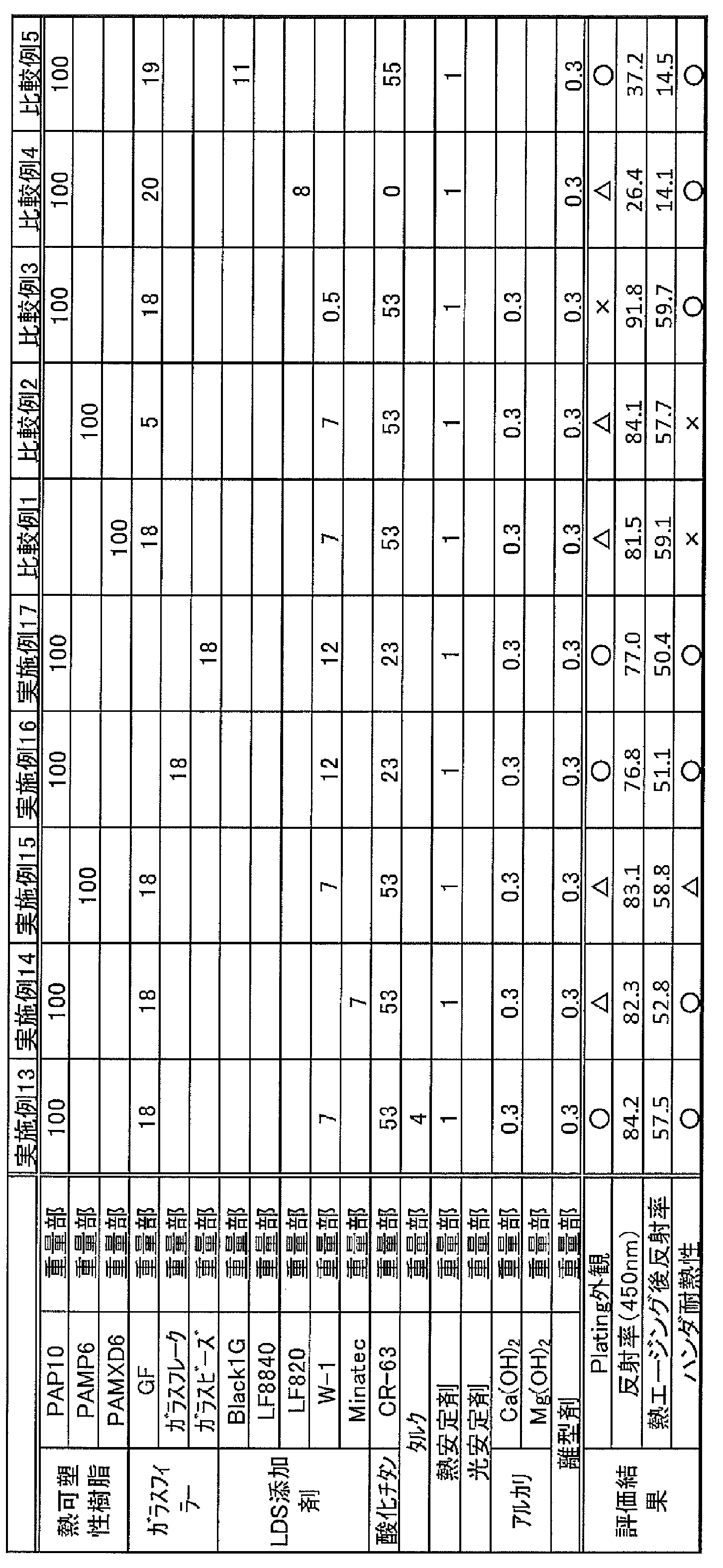
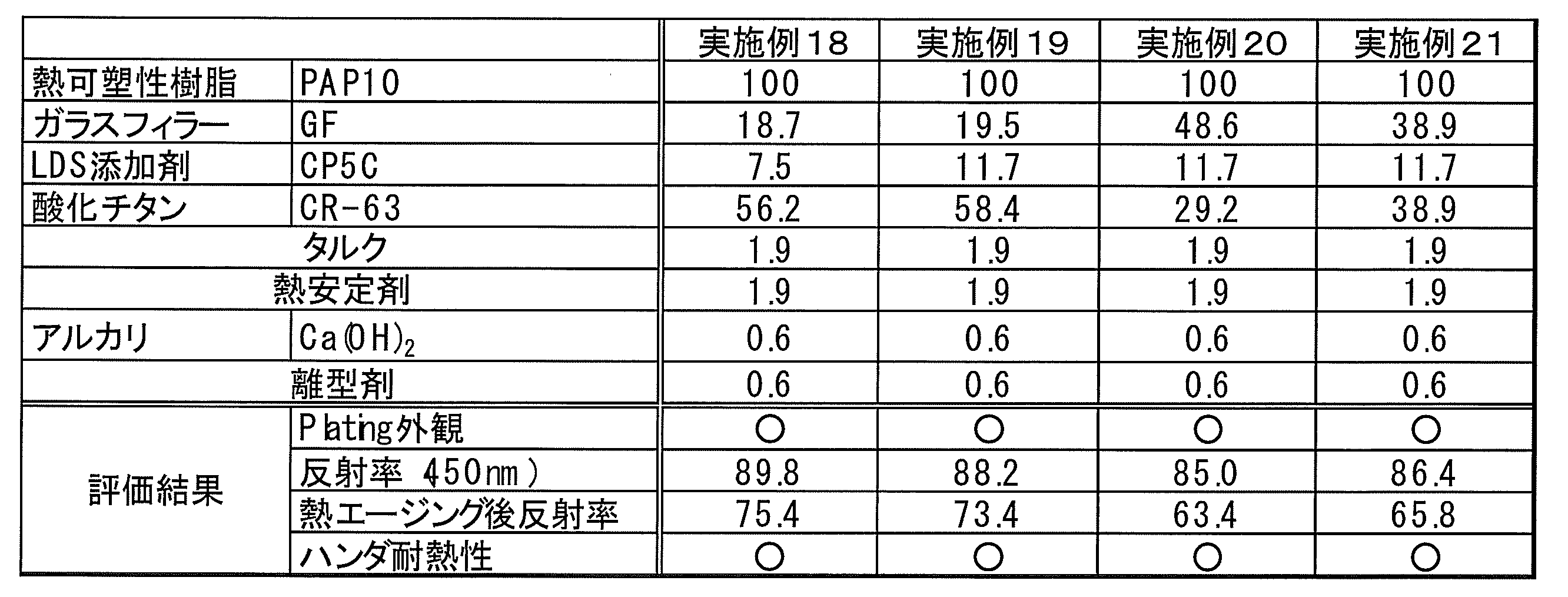
Claims (25)
- (A)示差走査熱量測定(DSC)により昇温速度10℃/分にて測定した融点が250℃以上の結晶性熱可塑性樹脂100重量部に対し、(B)ガラスフィラー10~80重量部、(C)波長450nmにおける反射率が25%以上であるレーザーダイレクトストラクチャリング添加剤1~30重量部、および、(D)酸化チタン20~150重量部を含む、熱可塑性樹脂組成物。
- (A)結晶性熱可塑性樹脂がポリアミド樹脂である、請求項1に記載の熱可塑性樹脂組成物。
- (C)レーザーダイレクトストラクチャリング添加剤が、アンチモンおよび錫を含むことを特徴とする、請求項1または2に記載の熱可塑性樹脂組成物。
- (C)レーザーダイレクトストラクチャリング添加剤が、アンチモンおよび錫を含み、アンチモンよりも錫の方が含有量が多いことを特徴とする、請求項1または2に記載の熱可塑性樹脂組成物。
- (C)レーザーダイレクトストラクチャリング添加剤が、アンチモンおよび酸化錫を含み、アンチモンよりも錫の方が含有量が多いことを特徴とする、請求項1または2に記載の熱可塑性樹脂組成物。
- (C)レーザーダイレクトストラクチャリング添加剤が、波長450nmにおける反射率が50%以上の組成物を中心部とし、その表面の一部または全部に、アンチモンおよび錫を含み、アンチモンよりも錫の方が含有量が多い組成物がコーティングされたものであることを特徴とする、請求項1または2に記載の熱可塑性樹脂組成物。
- 前記中心部の組成物が、金属酸化物を含む、請求項6に記載の熱可塑性樹脂組成物。
- さらに、タルクを熱可塑性樹脂組成物100重量部に対し1~20重量部の割合で含む請求項1~7のいずれか1項に記載の熱可塑性樹脂組成物
- (D)酸化チタンの平均一次粒子径が、1μm以下である、請求項1~8のいずれか1項に記載の熱可塑性樹脂組成物。
- (D)酸化チタンがルチル型である、請求項1~9のいずれか1項に記載の熱可塑性樹脂組成物。
- (B)ガラスフィラーが、チョップドファイバー、ミルドファイバー、フレーク、ビーズおよびバルーンから選択される少なくとも1種である、請求項1~10のいずれか1項に記載の熱可塑性樹脂組成物。
- (B)ガラスフィラーがEガラスである、請求項1~11のいずれか1項に記載の熱可塑性樹脂組成物。
- さらに、有機系または/および無機系熱安定剤を熱可塑性樹脂組成物100重量部に対し0.01~5重量部の割合で含む、請求項1~12のいずれか1項に記載の熱可塑性樹脂組成物。
- 前記有機系または/および無機系熱安定剤が実質的に銅元素を含まないことを特徴とする、請求項13に記載の熱可塑性樹脂組成物。
- さらに、有機系または/および無機系光安定剤を熱可塑性樹脂組成物100重量部に対し0.01~5重量部の割合で含む、請求項1~14のいずれか1項に記載の熱可塑性樹脂組成物。
- (A)結晶性熱可塑性樹脂が、分子内に芳香環を含み、芳香環を構成する炭素原子のポリアミド樹脂分子中に対する割合が30モル%以上であるポリアミド樹脂である、請求項1~15のいずれか1項に記載の熱可塑性樹脂組成物。
- 請求項1~16のいずれか1項に記載の熱可塑性樹脂組成物を成形してなる樹脂成形品。
- さらに、表面にメッキ層を有する、請求項17に記載の樹脂成形品。
- 発光ダイオード機器部品である、請求項17または18に記載の樹脂成形品。
- 前記発光ダイオード機器部品が反射板としての機能を有する、請求項19に記載の樹脂成形品。
- 前記メッキ層が導電回路としての性能を保有する、請求項18または19に記載の樹脂成形品。
- 請求項1~16のいずれか1項に記載の熱可塑性樹脂組成物を成形してなる樹脂成形品の表面に、レーザーを照射後、金属を適用して、メッキ層を形成することを含む、メッキ層付樹脂成形品の製造方法。
- 前記メッキが、銅、ニッケル、銀、および金の少なくとも1種を含む、請求項22に記載のメッキ層付樹脂成形品の製造方法。
- 前記メッキを多層構造で使用する請求項23に記載のメッキ層付樹脂成形品の製造方法。
- 請求項22~24のいずれか1項に記載のメッキ層付樹脂成形品の製造方法を含む、導電回路を有する発光ダイオード機器部品の製造方法。
Priority Applications (4)
| Application Number | Priority Date | Filing Date | Title |
|---|---|---|---|
| JP2013523407A JP5340513B1 (ja) | 2012-03-23 | 2013-03-15 | 熱可塑性樹脂組成物、樹脂成形品、及びメッキ層付樹脂成形品の製造方法 |
| US14/129,183 US9365693B2 (en) | 2012-03-23 | 2013-03-15 | Thermoplastic resin composition, resin article, and method of manufacturing resin article with plated layer |
| CN201380001611.1A CN103597037B (zh) | 2012-03-23 | 2013-03-15 | 热塑性树脂组合物、树脂成型品和带镀层的树脂成型品的制造方法 |
| EP13764808.5A EP2711399B1 (en) | 2012-03-23 | 2013-03-15 | Thermoplastic resin composition, resin article, and method of manufacturing resin article with plated layer |
Applications Claiming Priority (2)
| Application Number | Priority Date | Filing Date | Title |
|---|---|---|---|
| JP2012068281 | 2012-03-23 | ||
| JP2012-068281 | 2012-03-23 |
Publications (1)
| Publication Number | Publication Date |
|---|---|
| WO2013141157A1 true WO2013141157A1 (ja) | 2013-09-26 |
Family
ID=49222616
Family Applications (1)
| Application Number | Title | Priority Date | Filing Date |
|---|---|---|---|
| PCT/JP2013/057431 Ceased WO2013141157A1 (ja) | 2012-03-23 | 2013-03-15 | 熱可塑性樹脂組成物、樹脂成形品、及びメッキ層付樹脂成形品の製造方法 |
Country Status (5)
| Country | Link |
|---|---|
| US (1) | US9365693B2 (ja) |
| EP (1) | EP2711399B1 (ja) |
| JP (1) | JP5340513B1 (ja) |
| CN (1) | CN103597037B (ja) |
| WO (1) | WO2013141157A1 (ja) |
Cited By (14)
| Publication number | Priority date | Publication date | Assignee | Title |
|---|---|---|---|---|
| WO2014106503A3 (de) * | 2013-01-02 | 2014-10-30 | Lpkf Laser & Electronics Ag | Verfahren zur herstellung einer elektrisch leitfähigen struktur auf einem nichtleitenden trägermaterial sowie ein hierzu bestimmtes additiv und trägermaterial |
| WO2015033955A1 (ja) * | 2013-09-05 | 2015-03-12 | 三菱エンジニアリングプラスチックス株式会社 | 熱可塑性樹脂組成物、樹脂成形品、及びメッキ層付樹脂成形品の製造方法 |
| CN104725837A (zh) * | 2013-12-20 | 2015-06-24 | Ems专利股份公司 | 塑料模塑复合物及其用途 |
| EP2886606A1 (de) * | 2013-12-20 | 2015-06-24 | Ems-Patent Ag | Kunststoffformmasse und deren Verwendung |
| CN105849197A (zh) * | 2013-12-20 | 2016-08-10 | Ems 专利股份公司 | 聚酰胺模塑料和其应用 |
| JP2017531046A (ja) * | 2014-06-23 | 2017-10-19 | メルク パテント ゲゼルシャフト ミット ベシュレンクテル ハフツングMerck Patent Gesellschaft mit beschraenkter Haftung | Ldsプラスチックのための添加剤 |
| JP2017206590A (ja) * | 2016-05-17 | 2017-11-24 | 三菱エンジニアリングプラスチックス株式会社 | 熱可塑性樹脂組成物、樹脂成形品、メッキ付樹脂成形品の製造方法、および携帯電子機器部品の製造方法 |
| EP3108034A4 (en) * | 2014-01-27 | 2017-12-20 | BYD Company Limited | Method for metalizing polymer substrate and polymer article prepared thereof |
| JP2018525502A (ja) * | 2015-08-24 | 2018-09-06 | ロッテ アドバンスト マテリアルズ カンパニー リミテッド | 熱可塑性樹脂組成物及びこれから製造された成形品 |
| KR20190055792A (ko) | 2016-09-26 | 2019-05-23 | 도레이 카부시키가이샤 | 액정성 폴리에스테르 수지 조성물, 성형품 및 성형품의 제조 방법 |
| WO2019187578A1 (ja) * | 2018-03-28 | 2019-10-03 | 大日精化工業株式会社 | レーザーマーキング用インキ組成物及び包装材 |
| US10604649B2 (en) * | 2015-09-03 | 2020-03-31 | Mitsubishi Engineering-Plastics Corporation | Polyester resin composition for laser direct structuring |
| JP2020180280A (ja) * | 2019-04-16 | 2020-11-05 | エーエムエス−パテント アクチェンゲゼルシャフト | 強化熱可塑性成形用組成物 |
| JP2023515416A (ja) * | 2020-02-20 | 2023-04-13 | エスエイチピーピー グローバル テクノロジーズ べスローテン フェンノートシャップ | 高い熱、反射率およびレーザー直接構造化機能を有する物品および構造体 |
Families Citing this family (22)
| Publication number | Priority date | Publication date | Assignee | Title |
|---|---|---|---|---|
| EP2706092B1 (de) * | 2012-08-28 | 2014-12-24 | Ems-Patent Ag | Polyamidformmasse und deren Verwendung |
| KR102058261B1 (ko) | 2012-09-14 | 2019-12-20 | 미쓰비시 엔지니어링-플라스틱스 코포레이션 | 열가소성 수지 조성물 및 수지 성형품 |
| CN104583330B (zh) * | 2012-09-14 | 2016-09-21 | 三菱工程塑料株式会社 | 热塑性树脂组合物、树脂成型品和带镀层的树脂成型品的制造方法 |
| WO2014042069A1 (ja) * | 2012-09-14 | 2014-03-20 | 三菱エンジニアリングプラスチックス株式会社 | 熱可塑性樹脂組成物、樹脂成形品、及びメッキ層付樹脂成形品の製造方法 |
| US10148006B2 (en) | 2012-09-14 | 2018-12-04 | Mitsubishi Engineering-Plastics Corporation | Thermoplastic resin composition, resin molded article, and method for manufacturing resin molded article having a plated layer |
| KR102050410B1 (ko) * | 2013-04-01 | 2019-11-29 | 사빅 글로벌 테크놀러지스 비.브이. | 고모듈러스 레이저 직접 구조화 복합체 |
| US20160298242A1 (en) * | 2013-11-18 | 2016-10-13 | Mitsubishi Engineering-Plastics Corporation | Processes for manufacturing resin molded articles |
| JP6488486B2 (ja) | 2014-03-25 | 2019-03-27 | ディーエスエム アイピー アセッツ ビー.ブイ.Dsm Ip Assets B.V. | ポリマー組成物、その物品、及びそれを調製するためのプロセス |
| DK2927263T3 (en) | 2014-04-01 | 2016-05-09 | Ems Patent Ag | Polyamide castings, especially for the manufacture of molded parts in the drinking water field |
| WO2016003588A1 (en) | 2014-07-01 | 2016-01-07 | Ticona Llc | Laser activatable polymer composition |
| JP6266852B2 (ja) * | 2015-10-08 | 2018-01-24 | 三菱エンジニアリングプラスチックス株式会社 | 樹脂組成物、樹脂成形品、メッキ付樹脂成形品の製造方法およびアンテナを有する携帯電子機器部品の製造方法 |
| WO2018130970A1 (en) * | 2017-01-11 | 2018-07-19 | Sabic Global Technologies B.V. | Laser platable thermoplastic compositions with a laser activatable metal compound and shaped articles therefrom |
| US20220064402A1 (en) * | 2018-12-18 | 2022-03-03 | Sumitomo Bakelite Co., Ltd. | Thermosetting resin composition for lds and method for manufacturing semiconductor device |
| KR20200129867A (ko) | 2019-05-10 | 2020-11-18 | 안상정 | 반도체 발광소자 |
| US12107194B2 (en) | 2018-12-27 | 2024-10-01 | Wavelord Co., Ltd. | Semiconductor light-emitting device |
| CN109627712B (zh) * | 2018-12-28 | 2022-09-09 | 江西中塑新材料科技有限公司 | 一种pbt组合物及其制备方法和用途 |
| JP7500916B2 (ja) * | 2019-07-23 | 2024-06-18 | 住友電工ファインポリマー株式会社 | 光学部品 |
| US12294185B2 (en) | 2019-09-10 | 2025-05-06 | Ticona Llc | Electrical connector formed from a polymer composition having a low dielectric constant and dissipation factor |
| US11555113B2 (en) * | 2019-09-10 | 2023-01-17 | Ticona Llc | Liquid crystalline polymer composition |
| JP6984782B1 (ja) * | 2020-07-10 | 2021-12-22 | 東洋インキScホールディングス株式会社 | 射出成形用磁性樹脂組成物および磁性シールド用射出成形体 |
| US11876042B2 (en) | 2020-08-03 | 2024-01-16 | Feit Electric Company, Inc. | Omnidirectional flexible light emitting device |
| WO2023013650A1 (ja) * | 2021-08-05 | 2023-02-09 | 旭化成株式会社 | アンテナ部材 |
Citations (17)
| Publication number | Priority date | Publication date | Assignee | Title |
|---|---|---|---|---|
| JP2000503817A (ja) | 1997-07-22 | 2000-03-28 | ナウンドルフ・ゲルハルト | 非導電性支持体材料の上に配置されたパターン導体構造物、特に微細なパターン導体構造物およびそれの製造方法 |
| JP2003003041A (ja) | 2001-06-26 | 2003-01-08 | Mitsubishi Engineering Plastics Corp | ポリアセタール樹脂組成物およびそれを用いた押出し成形品 |
| JP2003220667A (ja) | 2002-01-31 | 2003-08-05 | Mitsubishi Engineering Plastics Corp | 複合成形体及びその製造方法 |
| JP2004075994A (ja) | 2002-06-21 | 2004-03-11 | Kuraray Co Ltd | ポリアミド組成物 |
| JP2004534408A (ja) * | 2001-07-05 | 2004-11-11 | エル・ピー・ケー・エフ・レーザー・ウント・エレクトロニクス・アクチエンゲゼルシヤフト | コンダクタートラック構造物およびその製造方法 |
| JP2006124701A (ja) * | 2004-10-20 | 2006-05-18 | E I Du Pont De Nemours & Co | 選択的メタライゼーションを受容するための、光活性化可能なポリイミド組成物ならびにそれに関する方法および組成物 |
| WO2009141800A2 (en) | 2008-05-23 | 2009-11-26 | Sabic Innovative Plastics Ip B.V. | High dielectric constant laser direct structuring materials |
| JP2010174223A (ja) | 2009-02-02 | 2010-08-12 | Mitsubishi Engineering Plastics Corp | 難燃性熱可塑性ポリエステル樹脂組成物 |
| JP2010536947A (ja) * | 2007-08-17 | 2010-12-02 | ミツビシ ケミカル ヨーロッパ ゲーエムベーハー | 芳香族ポリカーボネート組成物 |
| JP2010274530A (ja) * | 2009-05-28 | 2010-12-09 | Dainippon Printing Co Ltd | 積層フィルムおよびそれを用いた包装用フィルム |
| JP2011132550A (ja) | 2011-04-07 | 2011-07-07 | Mitsubishi Engineering Plastics Corp | ポリアミド樹脂組成物および導電性軸状成形品 |
| JP2011148267A (ja) | 2010-01-25 | 2011-08-04 | Mitsubishi Engineering Plastics Corp | ポリアミド樹脂成形品の製造方法 |
| JP2011168705A (ja) | 2010-02-19 | 2011-09-01 | Mitsubishi Engineering Plastics Corp | ポリカーボネート樹脂組成物及び成形体 |
| JP2011178873A (ja) | 2010-03-01 | 2011-09-15 | Mitsubishi Engineering Plastics Corp | 芳香族ポリカーボネート樹脂組成物および成形体 |
| JP2011195820A (ja) | 2010-02-26 | 2011-10-06 | Mitsubishi Engineering Plastics Corp | ポリアルキレンテレフタレート系樹脂組成物および成形体 |
| JP2011219620A (ja) | 2010-04-09 | 2011-11-04 | Mitsubishi Engineering Plastics Corp | 熱可塑性樹脂組成物及びそれを使用する成形品 |
| WO2012128219A1 (ja) * | 2011-03-18 | 2012-09-27 | ミツビシ ケミカル ヨーロッパ ゲーエムベーハー | 熱可塑性樹脂組成物、樹脂成形品、及びメッキ層付樹脂成形品の製造方法 |
Family Cites Families (8)
| Publication number | Priority date | Publication date | Assignee | Title |
|---|---|---|---|---|
| US4018746A (en) * | 1972-04-05 | 1977-04-19 | Hoechst Aktiengesellschaft | Transparent copolyamides from m-xylylene diamine, an aliphatic diamine and terephthalic acid |
| DE4415802A1 (de) | 1994-05-05 | 1995-11-09 | Merck Patent Gmbh | Lasermarkierbare Kunststoffe |
| DE4431829A1 (de) * | 1994-09-07 | 1996-03-14 | Merck Patent Gmbh | Leitfähige Pigmentzubereitung |
| DE19522397A1 (de) * | 1995-06-23 | 1997-01-02 | Merck Patent Gmbh | Lasermarkierbare Kunststoffe |
| DE10132092A1 (de) | 2001-07-05 | 2003-01-23 | Lpkf Laser & Electronics Ag | Leiterbahnstrukturen und Verfahren zu ihrer Herstellung |
| KR100886524B1 (ko) | 2005-04-15 | 2009-03-02 | 미쓰이 가가쿠 가부시키가이샤 | 반사판용 수지 조성물 및 반사판 |
| US8492464B2 (en) * | 2008-05-23 | 2013-07-23 | Sabic Innovative Plastics Ip B.V. | Flame retardant laser direct structuring materials |
| EP2233519B1 (de) * | 2009-03-27 | 2011-08-31 | LANXESS Deutschland GmbH | Glühdrahtbeständige Polyester |
-
2013
- 2013-03-15 CN CN201380001611.1A patent/CN103597037B/zh active Active
- 2013-03-15 WO PCT/JP2013/057431 patent/WO2013141157A1/ja not_active Ceased
- 2013-03-15 US US14/129,183 patent/US9365693B2/en active Active
- 2013-03-15 EP EP13764808.5A patent/EP2711399B1/en active Active
- 2013-03-15 JP JP2013523407A patent/JP5340513B1/ja active Active
Patent Citations (17)
| Publication number | Priority date | Publication date | Assignee | Title |
|---|---|---|---|---|
| JP2000503817A (ja) | 1997-07-22 | 2000-03-28 | ナウンドルフ・ゲルハルト | 非導電性支持体材料の上に配置されたパターン導体構造物、特に微細なパターン導体構造物およびそれの製造方法 |
| JP2003003041A (ja) | 2001-06-26 | 2003-01-08 | Mitsubishi Engineering Plastics Corp | ポリアセタール樹脂組成物およびそれを用いた押出し成形品 |
| JP2004534408A (ja) * | 2001-07-05 | 2004-11-11 | エル・ピー・ケー・エフ・レーザー・ウント・エレクトロニクス・アクチエンゲゼルシヤフト | コンダクタートラック構造物およびその製造方法 |
| JP2003220667A (ja) | 2002-01-31 | 2003-08-05 | Mitsubishi Engineering Plastics Corp | 複合成形体及びその製造方法 |
| JP2004075994A (ja) | 2002-06-21 | 2004-03-11 | Kuraray Co Ltd | ポリアミド組成物 |
| JP2006124701A (ja) * | 2004-10-20 | 2006-05-18 | E I Du Pont De Nemours & Co | 選択的メタライゼーションを受容するための、光活性化可能なポリイミド組成物ならびにそれに関する方法および組成物 |
| JP2010536947A (ja) * | 2007-08-17 | 2010-12-02 | ミツビシ ケミカル ヨーロッパ ゲーエムベーハー | 芳香族ポリカーボネート組成物 |
| WO2009141800A2 (en) | 2008-05-23 | 2009-11-26 | Sabic Innovative Plastics Ip B.V. | High dielectric constant laser direct structuring materials |
| JP2010174223A (ja) | 2009-02-02 | 2010-08-12 | Mitsubishi Engineering Plastics Corp | 難燃性熱可塑性ポリエステル樹脂組成物 |
| JP2010274530A (ja) * | 2009-05-28 | 2010-12-09 | Dainippon Printing Co Ltd | 積層フィルムおよびそれを用いた包装用フィルム |
| JP2011148267A (ja) | 2010-01-25 | 2011-08-04 | Mitsubishi Engineering Plastics Corp | ポリアミド樹脂成形品の製造方法 |
| JP2011168705A (ja) | 2010-02-19 | 2011-09-01 | Mitsubishi Engineering Plastics Corp | ポリカーボネート樹脂組成物及び成形体 |
| JP2011195820A (ja) | 2010-02-26 | 2011-10-06 | Mitsubishi Engineering Plastics Corp | ポリアルキレンテレフタレート系樹脂組成物および成形体 |
| JP2011178873A (ja) | 2010-03-01 | 2011-09-15 | Mitsubishi Engineering Plastics Corp | 芳香族ポリカーボネート樹脂組成物および成形体 |
| JP2011219620A (ja) | 2010-04-09 | 2011-11-04 | Mitsubishi Engineering Plastics Corp | 熱可塑性樹脂組成物及びそれを使用する成形品 |
| WO2012128219A1 (ja) * | 2011-03-18 | 2012-09-27 | ミツビシ ケミカル ヨーロッパ ゲーエムベーハー | 熱可塑性樹脂組成物、樹脂成形品、及びメッキ層付樹脂成形品の製造方法 |
| JP2011132550A (ja) | 2011-04-07 | 2011-07-07 | Mitsubishi Engineering Plastics Corp | ポリアミド樹脂組成物および導電性軸状成形品 |
Non-Patent Citations (2)
| Title |
|---|
| See also references of EP2711399A4 * |
| WOLFGANG JOHN: "Seisan Cost o Sakugen suru Sanjigen Component", INDUSTRIAL LASER SOLUTIONS JAPAN, September 2011 (2011-09-01), pages 18 - 22, XP008170859 * |
Cited By (27)
| Publication number | Priority date | Publication date | Assignee | Title |
|---|---|---|---|---|
| WO2014106503A3 (de) * | 2013-01-02 | 2014-10-30 | Lpkf Laser & Electronics Ag | Verfahren zur herstellung einer elektrisch leitfähigen struktur auf einem nichtleitenden trägermaterial sowie ein hierzu bestimmtes additiv und trägermaterial |
| WO2015033955A1 (ja) * | 2013-09-05 | 2015-03-12 | 三菱エンジニアリングプラスチックス株式会社 | 熱可塑性樹脂組成物、樹脂成形品、及びメッキ層付樹脂成形品の製造方法 |
| CN105518180A (zh) * | 2013-09-05 | 2016-04-20 | 三菱工程塑料株式会社 | 热塑性树脂组合物、树脂成型品、以及带有镀敷层的树脂成型品的制造方法 |
| JPWO2015033955A1 (ja) * | 2013-09-05 | 2017-03-02 | 三菱エンジニアリングプラスチックス株式会社 | 熱可塑性樹脂組成物、樹脂成形品、及びメッキ層付樹脂成形品の製造方法 |
| CN104725837A (zh) * | 2013-12-20 | 2015-06-24 | Ems专利股份公司 | 塑料模塑复合物及其用途 |
| EP2886606A1 (de) * | 2013-12-20 | 2015-06-24 | Ems-Patent Ag | Kunststoffformmasse und deren Verwendung |
| JP2015120908A (ja) * | 2013-12-20 | 2015-07-02 | エーエムエス−パテント アクチェンゲゼルシャフト | プラスチック成形材料及びその使用 |
| CN105849197A (zh) * | 2013-12-20 | 2016-08-10 | Ems 专利股份公司 | 聚酰胺模塑料和其应用 |
| US10633538B2 (en) | 2013-12-20 | 2020-04-28 | Ems-Patent Ag | Plastics moulding composition and use thereof |
| TWI651367B (zh) * | 2013-12-20 | 2019-02-21 | 恩斯 專利股份有限公司 | 塑膠模製組成物及其用途 |
| CN105849197B (zh) * | 2013-12-20 | 2018-11-09 | Ems 专利股份公司 | 聚酰胺模塑料和其应用 |
| EP3108033A4 (en) * | 2014-01-27 | 2017-12-20 | BYD Company Limited | Method for metalizing polymer substrate and polymer article prepared thereof |
| EP3108034A4 (en) * | 2014-01-27 | 2017-12-20 | BYD Company Limited | Method for metalizing polymer substrate and polymer article prepared thereof |
| EP3108035A4 (en) * | 2014-01-27 | 2017-12-20 | BYD Company Limited | Method for metalizing polymer substrate and polymer article prepared thereof |
| JP2017531046A (ja) * | 2014-06-23 | 2017-10-19 | メルク パテント ゲゼルシャフト ミット ベシュレンクテル ハフツングMerck Patent Gesellschaft mit beschraenkter Haftung | Ldsプラスチックのための添加剤 |
| JP2018525502A (ja) * | 2015-08-24 | 2018-09-06 | ロッテ アドバンスト マテリアルズ カンパニー リミテッド | 熱可塑性樹脂組成物及びこれから製造された成形品 |
| US10604649B2 (en) * | 2015-09-03 | 2020-03-31 | Mitsubishi Engineering-Plastics Corporation | Polyester resin composition for laser direct structuring |
| JP2017206590A (ja) * | 2016-05-17 | 2017-11-24 | 三菱エンジニアリングプラスチックス株式会社 | 熱可塑性樹脂組成物、樹脂成形品、メッキ付樹脂成形品の製造方法、および携帯電子機器部品の製造方法 |
| KR20190055792A (ko) | 2016-09-26 | 2019-05-23 | 도레이 카부시키가이샤 | 액정성 폴리에스테르 수지 조성물, 성형품 및 성형품의 제조 방법 |
| WO2019187578A1 (ja) * | 2018-03-28 | 2019-10-03 | 大日精化工業株式会社 | レーザーマーキング用インキ組成物及び包装材 |
| JPWO2019187578A1 (ja) * | 2018-03-28 | 2020-07-02 | 大日精化工業株式会社 | レーザーマーキング用インキ組成物及び包装材 |
| CN111936316A (zh) * | 2018-03-28 | 2020-11-13 | 大日精化工业株式会社 | 激光标记用墨组合物和包装材料 |
| CN111936316B (zh) * | 2018-03-28 | 2021-05-11 | 大日精化工业株式会社 | 激光标记用墨组合物和包装材料 |
| JP2020180280A (ja) * | 2019-04-16 | 2020-11-05 | エーエムエス−パテント アクチェンゲゼルシャフト | 強化熱可塑性成形用組成物 |
| JP7568418B2 (ja) | 2019-04-16 | 2024-10-16 | エーエムエス-パテント アクチェンゲゼルシャフト | 強化熱可塑性成形用組成物 |
| JP2023515416A (ja) * | 2020-02-20 | 2023-04-13 | エスエイチピーピー グローバル テクノロジーズ べスローテン フェンノートシャップ | 高い熱、反射率およびレーザー直接構造化機能を有する物品および構造体 |
| JP7568732B2 (ja) | 2020-02-20 | 2024-10-16 | エスエイチピーピー グローバル テクノロジーズ べスローテン フェンノートシャップ | 高い熱、反射率およびレーザー直接構造化機能を有する物品および構造体 |
Also Published As
| Publication number | Publication date |
|---|---|
| EP2711399A4 (en) | 2014-04-16 |
| US9365693B2 (en) | 2016-06-14 |
| EP2711399B1 (en) | 2014-12-31 |
| US20140147682A1 (en) | 2014-05-29 |
| CN103597037A (zh) | 2014-02-19 |
| JP5340513B1 (ja) | 2013-11-13 |
| CN103597037B (zh) | 2015-08-19 |
| EP2711399A1 (en) | 2014-03-26 |
| JPWO2013141157A1 (ja) | 2015-08-03 |
Similar Documents
| Publication | Publication Date | Title |
|---|---|---|
| JP5340513B1 (ja) | 熱可塑性樹脂組成物、樹脂成形品、及びメッキ層付樹脂成形品の製造方法 | |
| JP5912704B2 (ja) | 熱可塑性樹脂組成物、樹脂成形品、及びメッキ層付樹脂成形品の製造方法 | |
| WO2015033955A1 (ja) | 熱可塑性樹脂組成物、樹脂成形品、及びメッキ層付樹脂成形品の製造方法 | |
| JP5947577B2 (ja) | 熱可塑性樹脂組成物、樹脂成形品、及びメッキ層付樹脂成形品の製造方法 | |
| JP6363885B2 (ja) | 熱可塑性樹脂組成物、樹脂成形品、及びメッキ層付樹脂成形品の製造方法 | |
| US10148006B2 (en) | Thermoplastic resin composition, resin molded article, and method for manufacturing resin molded article having a plated layer | |
| US9587316B2 (en) | Thermoplastic resin composition, resin molded article, and method for manufacturing resin molded article having a plated layer | |
| JP6131151B2 (ja) | ポリアミド樹脂組成物、樹脂成形品、及びメッキ層付樹脂成形品の製造方法 | |
| JP6266852B2 (ja) | 樹脂組成物、樹脂成形品、メッキ付樹脂成形品の製造方法およびアンテナを有する携帯電子機器部品の製造方法 | |
| KR20160129713A (ko) | 폴리카보네이트 수지 조성물 및 이를 이용한 성형품 |
Legal Events
| Date | Code | Title | Description |
|---|---|---|---|
| ENP | Entry into the national phase |
Ref document number: 2013523407 Country of ref document: JP Kind code of ref document: A |
|
| 121 | Ep: the epo has been informed by wipo that ep was designated in this application |
Ref document number: 13764808 Country of ref document: EP Kind code of ref document: A1 |
|
| WWE | Wipo information: entry into national phase |
Ref document number: 2013764808 Country of ref document: EP |
|
| WWE | Wipo information: entry into national phase |
Ref document number: 14129183 Country of ref document: US |
|
| NENP | Non-entry into the national phase |
Ref country code: DE |