WO2013141189A1 - 断熱材組成物、これを用いた断熱材、及び断熱材の製造方法 - Google Patents
断熱材組成物、これを用いた断熱材、及び断熱材の製造方法 Download PDFInfo
- Publication number
- WO2013141189A1 WO2013141189A1 PCT/JP2013/057591 JP2013057591W WO2013141189A1 WO 2013141189 A1 WO2013141189 A1 WO 2013141189A1 JP 2013057591 W JP2013057591 W JP 2013057591W WO 2013141189 A1 WO2013141189 A1 WO 2013141189A1
- Authority
- WO
- WIPO (PCT)
- Prior art keywords
- heat insulating
- insulating material
- silica airgel
- heat
- raw material
- Prior art date
- Legal status (The legal status is an assumption and is not a legal conclusion. Google has not performed a legal analysis and makes no representation as to the accuracy of the status listed.)
- Ceased
Links
Images


Classifications
-
- C—CHEMISTRY; METALLURGY
- C04—CEMENTS; CONCRETE; ARTIFICIAL STONE; CERAMICS; REFRACTORIES
- C04B—LIME, MAGNESIA; SLAG; CEMENTS; COMPOSITIONS THEREOF, e.g. MORTARS, CONCRETE OR LIKE BUILDING MATERIALS; ARTIFICIAL STONE; CERAMICS; REFRACTORIES; TREATMENT OF NATURAL STONE
- C04B35/00—Shaped ceramic products characterised by their composition; Ceramics compositions; Processing powders of inorganic compounds preparatory to the manufacturing of ceramic products
- C04B35/71—Ceramic products containing macroscopic reinforcing agents
- C04B35/78—Ceramic products containing macroscopic reinforcing agents containing non-metallic materials
- C04B35/80—Fibres, filaments, whiskers, platelets, or the like
-
- B—PERFORMING OPERATIONS; TRANSPORTING
- B29—WORKING OF PLASTICS; WORKING OF SUBSTANCES IN A PLASTIC STATE IN GENERAL
- B29C—SHAPING OR JOINING OF PLASTICS; SHAPING OF MATERIAL IN A PLASTIC STATE, NOT OTHERWISE PROVIDED FOR; AFTER-TREATMENT OF THE SHAPED PRODUCTS, e.g. REPAIRING
- B29C43/00—Compression moulding, i.e. applying external pressure to flow the moulding material; Apparatus therefor
- B29C43/003—Compression moulding, i.e. applying external pressure to flow the moulding material; Apparatus therefor characterised by the choice of material
-
- B—PERFORMING OPERATIONS; TRANSPORTING
- B32—LAYERED PRODUCTS
- B32B—LAYERED PRODUCTS, i.e. PRODUCTS BUILT-UP OF STRATA OF FLAT OR NON-FLAT, e.g. CELLULAR OR HONEYCOMB, FORM
- B32B18/00—Layered products essentially comprising ceramics, e.g. refractory products
-
- C—CHEMISTRY; METALLURGY
- C04—CEMENTS; CONCRETE; ARTIFICIAL STONE; CERAMICS; REFRACTORIES
- C04B—LIME, MAGNESIA; SLAG; CEMENTS; COMPOSITIONS THEREOF, e.g. MORTARS, CONCRETE OR LIKE BUILDING MATERIALS; ARTIFICIAL STONE; CERAMICS; REFRACTORIES; TREATMENT OF NATURAL STONE
- C04B14/00—Use of inorganic materials as fillers, e.g. pigments, for mortars, concrete or artificial stone; Treatment of inorganic materials specially adapted to enhance their filling properties in mortars, concrete or artificial stone
- C04B14/02—Granular materials, e.g. microballoons
- C04B14/04—Silica-rich materials; Silicates
- C04B14/06—Quartz; Sand
- C04B14/064—Silica aerogel
-
- C—CHEMISTRY; METALLURGY
- C04—CEMENTS; CONCRETE; ARTIFICIAL STONE; CERAMICS; REFRACTORIES
- C04B—LIME, MAGNESIA; SLAG; CEMENTS; COMPOSITIONS THEREOF, e.g. MORTARS, CONCRETE OR LIKE BUILDING MATERIALS; ARTIFICIAL STONE; CERAMICS; REFRACTORIES; TREATMENT OF NATURAL STONE
- C04B35/00—Shaped ceramic products characterised by their composition; Ceramics compositions; Processing powders of inorganic compounds preparatory to the manufacturing of ceramic products
- C04B35/01—Shaped ceramic products characterised by their composition; Ceramics compositions; Processing powders of inorganic compounds preparatory to the manufacturing of ceramic products based on oxide ceramics
- C04B35/14—Shaped ceramic products characterised by their composition; Ceramics compositions; Processing powders of inorganic compounds preparatory to the manufacturing of ceramic products based on oxide ceramics based on silica
-
- C—CHEMISTRY; METALLURGY
- C04—CEMENTS; CONCRETE; ARTIFICIAL STONE; CERAMICS; REFRACTORIES
- C04B—LIME, MAGNESIA; SLAG; CEMENTS; COMPOSITIONS THEREOF, e.g. MORTARS, CONCRETE OR LIKE BUILDING MATERIALS; ARTIFICIAL STONE; CERAMICS; REFRACTORIES; TREATMENT OF NATURAL STONE
- C04B35/00—Shaped ceramic products characterised by their composition; Ceramics compositions; Processing powders of inorganic compounds preparatory to the manufacturing of ceramic products
- C04B35/622—Forming processes; Processing powders of inorganic compounds preparatory to the manufacturing of ceramic products
- C04B35/626—Preparing or treating the powders individually or as batches ; preparing or treating macroscopic reinforcing agents for ceramic products, e.g. fibres; mechanical aspects section B
- C04B35/62605—Treating the starting powders individually or as mixtures
- C04B35/6269—Curing of mixtures
-
- C—CHEMISTRY; METALLURGY
- C04—CEMENTS; CONCRETE; ARTIFICIAL STONE; CERAMICS; REFRACTORIES
- C04B—LIME, MAGNESIA; SLAG; CEMENTS; COMPOSITIONS THEREOF, e.g. MORTARS, CONCRETE OR LIKE BUILDING MATERIALS; ARTIFICIAL STONE; CERAMICS; REFRACTORIES; TREATMENT OF NATURAL STONE
- C04B35/00—Shaped ceramic products characterised by their composition; Ceramics compositions; Processing powders of inorganic compounds preparatory to the manufacturing of ceramic products
- C04B35/622—Forming processes; Processing powders of inorganic compounds preparatory to the manufacturing of ceramic products
- C04B35/626—Preparing or treating the powders individually or as batches ; preparing or treating macroscopic reinforcing agents for ceramic products, e.g. fibres; mechanical aspects section B
- C04B35/63—Preparing or treating the powders individually or as batches ; preparing or treating macroscopic reinforcing agents for ceramic products, e.g. fibres; mechanical aspects section B using additives specially adapted for forming the products, e.g.. binder binders
- C04B35/632—Organic additives
- C04B35/634—Polymers
-
- C—CHEMISTRY; METALLURGY
- C04—CEMENTS; CONCRETE; ARTIFICIAL STONE; CERAMICS; REFRACTORIES
- C04B—LIME, MAGNESIA; SLAG; CEMENTS; COMPOSITIONS THEREOF, e.g. MORTARS, CONCRETE OR LIKE BUILDING MATERIALS; ARTIFICIAL STONE; CERAMICS; REFRACTORIES; TREATMENT OF NATURAL STONE
- C04B35/00—Shaped ceramic products characterised by their composition; Ceramics compositions; Processing powders of inorganic compounds preparatory to the manufacturing of ceramic products
- C04B35/71—Ceramic products containing macroscopic reinforcing agents
- C04B35/78—Ceramic products containing macroscopic reinforcing agents containing non-metallic materials
- C04B35/80—Fibres, filaments, whiskers, platelets, or the like
- C04B35/82—Asbestos; Glass; Fused silica
-
- C—CHEMISTRY; METALLURGY
- C04—CEMENTS; CONCRETE; ARTIFICIAL STONE; CERAMICS; REFRACTORIES
- C04B—LIME, MAGNESIA; SLAG; CEMENTS; COMPOSITIONS THEREOF, e.g. MORTARS, CONCRETE OR LIKE BUILDING MATERIALS; ARTIFICIAL STONE; CERAMICS; REFRACTORIES; TREATMENT OF NATURAL STONE
- C04B38/00—Porous mortars, concrete, artificial stone or ceramic ware; Preparation thereof
- C04B38/08—Porous mortars, concrete, artificial stone or ceramic ware; Preparation thereof by adding porous substances
-
- F—MECHANICAL ENGINEERING; LIGHTING; HEATING; WEAPONS; BLASTING
- F16—ENGINEERING ELEMENTS AND UNITS; GENERAL MEASURES FOR PRODUCING AND MAINTAINING EFFECTIVE FUNCTIONING OF MACHINES OR INSTALLATIONS; THERMAL INSULATION IN GENERAL
- F16L—PIPES; JOINTS OR FITTINGS FOR PIPES; SUPPORTS FOR PIPES, CABLES OR PROTECTIVE TUBING; MEANS FOR THERMAL INSULATION IN GENERAL
- F16L59/00—Thermal insulation in general
-
- C—CHEMISTRY; METALLURGY
- C04—CEMENTS; CONCRETE; ARTIFICIAL STONE; CERAMICS; REFRACTORIES
- C04B—LIME, MAGNESIA; SLAG; CEMENTS; COMPOSITIONS THEREOF, e.g. MORTARS, CONCRETE OR LIKE BUILDING MATERIALS; ARTIFICIAL STONE; CERAMICS; REFRACTORIES; TREATMENT OF NATURAL STONE
- C04B2111/00—Mortars, concrete or artificial stone or mixtures to prepare them, characterised by specific function, property or use
- C04B2111/00474—Uses not provided for elsewhere in C04B2111/00
- C04B2111/00612—Uses not provided for elsewhere in C04B2111/00 as one or more layers of a layered structure
-
- C—CHEMISTRY; METALLURGY
- C04—CEMENTS; CONCRETE; ARTIFICIAL STONE; CERAMICS; REFRACTORIES
- C04B—LIME, MAGNESIA; SLAG; CEMENTS; COMPOSITIONS THEREOF, e.g. MORTARS, CONCRETE OR LIKE BUILDING MATERIALS; ARTIFICIAL STONE; CERAMICS; REFRACTORIES; TREATMENT OF NATURAL STONE
- C04B2235/00—Aspects relating to ceramic starting mixtures or sintered ceramic products
- C04B2235/02—Composition of constituents of the starting material or of secondary phases of the final product
- C04B2235/30—Constituents and secondary phases not being of a fibrous nature
- C04B2235/32—Metal oxides, mixed metal oxides, or oxide-forming salts thereof, e.g. carbonates, nitrates, (oxy)hydroxides, chlorides
- C04B2235/3205—Alkaline earth oxides or oxide forming salts thereof, e.g. beryllium oxide
- C04B2235/3208—Calcium oxide or oxide-forming salts thereof, e.g. lime
-
- C—CHEMISTRY; METALLURGY
- C04—CEMENTS; CONCRETE; ARTIFICIAL STONE; CERAMICS; REFRACTORIES
- C04B—LIME, MAGNESIA; SLAG; CEMENTS; COMPOSITIONS THEREOF, e.g. MORTARS, CONCRETE OR LIKE BUILDING MATERIALS; ARTIFICIAL STONE; CERAMICS; REFRACTORIES; TREATMENT OF NATURAL STONE
- C04B2235/00—Aspects relating to ceramic starting mixtures or sintered ceramic products
- C04B2235/02—Composition of constituents of the starting material or of secondary phases of the final product
- C04B2235/30—Constituents and secondary phases not being of a fibrous nature
- C04B2235/32—Metal oxides, mixed metal oxides, or oxide-forming salts thereof, e.g. carbonates, nitrates, (oxy)hydroxides, chlorides
- C04B2235/3231—Refractory metal oxides, their mixed metal oxides, or oxide-forming salts thereof
- C04B2235/3232—Titanium oxides or titanates, e.g. rutile or anatase
- C04B2235/3237—Substoichiometric titanium oxides, e.g. Ti2O3
-
- C—CHEMISTRY; METALLURGY
- C04—CEMENTS; CONCRETE; ARTIFICIAL STONE; CERAMICS; REFRACTORIES
- C04B—LIME, MAGNESIA; SLAG; CEMENTS; COMPOSITIONS THEREOF, e.g. MORTARS, CONCRETE OR LIKE BUILDING MATERIALS; ARTIFICIAL STONE; CERAMICS; REFRACTORIES; TREATMENT OF NATURAL STONE
- C04B2235/00—Aspects relating to ceramic starting mixtures or sintered ceramic products
- C04B2235/02—Composition of constituents of the starting material or of secondary phases of the final product
- C04B2235/30—Constituents and secondary phases not being of a fibrous nature
- C04B2235/34—Non-metal oxides, non-metal mixed oxides, or salts thereof that form the non-metal oxides upon heating, e.g. carbonates, nitrates, (oxy)hydroxides, chlorides
- C04B2235/3418—Silicon oxide, silicic acids or oxide forming salts thereof, e.g. silica sol, fused silica, silica fume, cristobalite, quartz or flint
-
- C—CHEMISTRY; METALLURGY
- C04—CEMENTS; CONCRETE; ARTIFICIAL STONE; CERAMICS; REFRACTORIES
- C04B—LIME, MAGNESIA; SLAG; CEMENTS; COMPOSITIONS THEREOF, e.g. MORTARS, CONCRETE OR LIKE BUILDING MATERIALS; ARTIFICIAL STONE; CERAMICS; REFRACTORIES; TREATMENT OF NATURAL STONE
- C04B2235/00—Aspects relating to ceramic starting mixtures or sintered ceramic products
- C04B2235/02—Composition of constituents of the starting material or of secondary phases of the final product
- C04B2235/30—Constituents and secondary phases not being of a fibrous nature
- C04B2235/34—Non-metal oxides, non-metal mixed oxides, or salts thereof that form the non-metal oxides upon heating, e.g. carbonates, nitrates, (oxy)hydroxides, chlorides
- C04B2235/3427—Silicates other than clay, e.g. water glass
- C04B2235/3436—Alkaline earth metal silicates, e.g. barium silicate
- C04B2235/3454—Calcium silicates, e.g. wollastonite
-
- C—CHEMISTRY; METALLURGY
- C04—CEMENTS; CONCRETE; ARTIFICIAL STONE; CERAMICS; REFRACTORIES
- C04B—LIME, MAGNESIA; SLAG; CEMENTS; COMPOSITIONS THEREOF, e.g. MORTARS, CONCRETE OR LIKE BUILDING MATERIALS; ARTIFICIAL STONE; CERAMICS; REFRACTORIES; TREATMENT OF NATURAL STONE
- C04B2235/00—Aspects relating to ceramic starting mixtures or sintered ceramic products
- C04B2235/02—Composition of constituents of the starting material or of secondary phases of the final product
- C04B2235/30—Constituents and secondary phases not being of a fibrous nature
- C04B2235/38—Non-oxide ceramic constituents or additives
- C04B2235/3817—Carbides
- C04B2235/3826—Silicon carbides
-
- C—CHEMISTRY; METALLURGY
- C04—CEMENTS; CONCRETE; ARTIFICIAL STONE; CERAMICS; REFRACTORIES
- C04B—LIME, MAGNESIA; SLAG; CEMENTS; COMPOSITIONS THEREOF, e.g. MORTARS, CONCRETE OR LIKE BUILDING MATERIALS; ARTIFICIAL STONE; CERAMICS; REFRACTORIES; TREATMENT OF NATURAL STONE
- C04B2235/00—Aspects relating to ceramic starting mixtures or sintered ceramic products
- C04B2235/02—Composition of constituents of the starting material or of secondary phases of the final product
- C04B2235/50—Constituents or additives of the starting mixture chosen for their shape or used because of their shape or their physical appearance
-
- C—CHEMISTRY; METALLURGY
- C04—CEMENTS; CONCRETE; ARTIFICIAL STONE; CERAMICS; REFRACTORIES
- C04B—LIME, MAGNESIA; SLAG; CEMENTS; COMPOSITIONS THEREOF, e.g. MORTARS, CONCRETE OR LIKE BUILDING MATERIALS; ARTIFICIAL STONE; CERAMICS; REFRACTORIES; TREATMENT OF NATURAL STONE
- C04B2235/00—Aspects relating to ceramic starting mixtures or sintered ceramic products
- C04B2235/02—Composition of constituents of the starting material or of secondary phases of the final product
- C04B2235/50—Constituents or additives of the starting mixture chosen for their shape or used because of their shape or their physical appearance
- C04B2235/52—Constituents or additives characterised by their shapes
- C04B2235/5208—Fibers
- C04B2235/5212—Organic
-
- C—CHEMISTRY; METALLURGY
- C04—CEMENTS; CONCRETE; ARTIFICIAL STONE; CERAMICS; REFRACTORIES
- C04B—LIME, MAGNESIA; SLAG; CEMENTS; COMPOSITIONS THEREOF, e.g. MORTARS, CONCRETE OR LIKE BUILDING MATERIALS; ARTIFICIAL STONE; CERAMICS; REFRACTORIES; TREATMENT OF NATURAL STONE
- C04B2235/00—Aspects relating to ceramic starting mixtures or sintered ceramic products
- C04B2235/02—Composition of constituents of the starting material or of secondary phases of the final product
- C04B2235/50—Constituents or additives of the starting mixture chosen for their shape or used because of their shape or their physical appearance
- C04B2235/52—Constituents or additives characterised by their shapes
- C04B2235/5208—Fibers
- C04B2235/5216—Inorganic
- C04B2235/522—Oxidic
- C04B2235/5232—Silica or silicates other than aluminosilicates, e.g. quartz
-
- C—CHEMISTRY; METALLURGY
- C04—CEMENTS; CONCRETE; ARTIFICIAL STONE; CERAMICS; REFRACTORIES
- C04B—LIME, MAGNESIA; SLAG; CEMENTS; COMPOSITIONS THEREOF, e.g. MORTARS, CONCRETE OR LIKE BUILDING MATERIALS; ARTIFICIAL STONE; CERAMICS; REFRACTORIES; TREATMENT OF NATURAL STONE
- C04B2235/00—Aspects relating to ceramic starting mixtures or sintered ceramic products
- C04B2235/02—Composition of constituents of the starting material or of secondary phases of the final product
- C04B2235/50—Constituents or additives of the starting mixture chosen for their shape or used because of their shape or their physical appearance
- C04B2235/52—Constituents or additives characterised by their shapes
- C04B2235/5208—Fibers
- C04B2235/526—Fibers characterised by the length of the fibers
-
- C—CHEMISTRY; METALLURGY
- C04—CEMENTS; CONCRETE; ARTIFICIAL STONE; CERAMICS; REFRACTORIES
- C04B—LIME, MAGNESIA; SLAG; CEMENTS; COMPOSITIONS THEREOF, e.g. MORTARS, CONCRETE OR LIKE BUILDING MATERIALS; ARTIFICIAL STONE; CERAMICS; REFRACTORIES; TREATMENT OF NATURAL STONE
- C04B2235/00—Aspects relating to ceramic starting mixtures or sintered ceramic products
- C04B2235/02—Composition of constituents of the starting material or of secondary phases of the final product
- C04B2235/50—Constituents or additives of the starting mixture chosen for their shape or used because of their shape or their physical appearance
- C04B2235/52—Constituents or additives characterised by their shapes
- C04B2235/5208—Fibers
- C04B2235/5264—Fibers characterised by the diameter of the fibers
-
- C—CHEMISTRY; METALLURGY
- C04—CEMENTS; CONCRETE; ARTIFICIAL STONE; CERAMICS; REFRACTORIES
- C04B—LIME, MAGNESIA; SLAG; CEMENTS; COMPOSITIONS THEREOF, e.g. MORTARS, CONCRETE OR LIKE BUILDING MATERIALS; ARTIFICIAL STONE; CERAMICS; REFRACTORIES; TREATMENT OF NATURAL STONE
- C04B2235/00—Aspects relating to ceramic starting mixtures or sintered ceramic products
- C04B2235/70—Aspects relating to sintered or melt-casted ceramic products
- C04B2235/74—Physical characteristics
- C04B2235/77—Density
-
- C—CHEMISTRY; METALLURGY
- C04—CEMENTS; CONCRETE; ARTIFICIAL STONE; CERAMICS; REFRACTORIES
- C04B—LIME, MAGNESIA; SLAG; CEMENTS; COMPOSITIONS THEREOF, e.g. MORTARS, CONCRETE OR LIKE BUILDING MATERIALS; ARTIFICIAL STONE; CERAMICS; REFRACTORIES; TREATMENT OF NATURAL STONE
- C04B2235/00—Aspects relating to ceramic starting mixtures or sintered ceramic products
- C04B2235/70—Aspects relating to sintered or melt-casted ceramic products
- C04B2235/74—Physical characteristics
- C04B2235/78—Grain sizes and shapes, product microstructures, e.g. acicular grains, equiaxed grains, platelet-structures
-
- C—CHEMISTRY; METALLURGY
- C04—CEMENTS; CONCRETE; ARTIFICIAL STONE; CERAMICS; REFRACTORIES
- C04B—LIME, MAGNESIA; SLAG; CEMENTS; COMPOSITIONS THEREOF, e.g. MORTARS, CONCRETE OR LIKE BUILDING MATERIALS; ARTIFICIAL STONE; CERAMICS; REFRACTORIES; TREATMENT OF NATURAL STONE
- C04B2235/00—Aspects relating to ceramic starting mixtures or sintered ceramic products
- C04B2235/70—Aspects relating to sintered or melt-casted ceramic products
- C04B2235/96—Properties of ceramic products, e.g. mechanical properties such as strength, toughness, wear resistance
-
- C—CHEMISTRY; METALLURGY
- C04—CEMENTS; CONCRETE; ARTIFICIAL STONE; CERAMICS; REFRACTORIES
- C04B—LIME, MAGNESIA; SLAG; CEMENTS; COMPOSITIONS THEREOF, e.g. MORTARS, CONCRETE OR LIKE BUILDING MATERIALS; ARTIFICIAL STONE; CERAMICS; REFRACTORIES; TREATMENT OF NATURAL STONE
- C04B2235/00—Aspects relating to ceramic starting mixtures or sintered ceramic products
- C04B2235/70—Aspects relating to sintered or melt-casted ceramic products
- C04B2235/96—Properties of ceramic products, e.g. mechanical properties such as strength, toughness, wear resistance
- C04B2235/9607—Thermal properties, e.g. thermal expansion coefficient
-
- C—CHEMISTRY; METALLURGY
- C04—CEMENTS; CONCRETE; ARTIFICIAL STONE; CERAMICS; REFRACTORIES
- C04B—LIME, MAGNESIA; SLAG; CEMENTS; COMPOSITIONS THEREOF, e.g. MORTARS, CONCRETE OR LIKE BUILDING MATERIALS; ARTIFICIAL STONE; CERAMICS; REFRACTORIES; TREATMENT OF NATURAL STONE
- C04B2237/00—Aspects relating to ceramic laminates or to joining of ceramic articles with other articles by heating
- C04B2237/30—Composition of layers of ceramic laminates or of ceramic or metallic articles to be joined by heating, e.g. Si substrates
- C04B2237/32—Ceramic
- C04B2237/34—Oxidic
- C04B2237/341—Silica or silicates
-
- C—CHEMISTRY; METALLURGY
- C04—CEMENTS; CONCRETE; ARTIFICIAL STONE; CERAMICS; REFRACTORIES
- C04B—LIME, MAGNESIA; SLAG; CEMENTS; COMPOSITIONS THEREOF, e.g. MORTARS, CONCRETE OR LIKE BUILDING MATERIALS; ARTIFICIAL STONE; CERAMICS; REFRACTORIES; TREATMENT OF NATURAL STONE
- C04B2237/00—Aspects relating to ceramic laminates or to joining of ceramic articles with other articles by heating
- C04B2237/30—Composition of layers of ceramic laminates or of ceramic or metallic articles to be joined by heating, e.g. Si substrates
- C04B2237/32—Ceramic
- C04B2237/38—Fiber or whisker reinforced
-
- Y—GENERAL TAGGING OF NEW TECHNOLOGICAL DEVELOPMENTS; GENERAL TAGGING OF CROSS-SECTIONAL TECHNOLOGIES SPANNING OVER SEVERAL SECTIONS OF THE IPC; TECHNICAL SUBJECTS COVERED BY FORMER USPC CROSS-REFERENCE ART COLLECTIONS [XRACs] AND DIGESTS
- Y10—TECHNICAL SUBJECTS COVERED BY FORMER USPC
- Y10T—TECHNICAL SUBJECTS COVERED BY FORMER US CLASSIFICATION
- Y10T428/00—Stock material or miscellaneous articles
- Y10T428/24—Structurally defined web or sheet [e.g., overall dimension, etc.]
- Y10T428/24479—Structurally defined web or sheet [e.g., overall dimension, etc.] including variation in thickness
- Y10T428/24612—Composite web or sheet
-
- Y—GENERAL TAGGING OF NEW TECHNOLOGICAL DEVELOPMENTS; GENERAL TAGGING OF CROSS-SECTIONAL TECHNOLOGIES SPANNING OVER SEVERAL SECTIONS OF THE IPC; TECHNICAL SUBJECTS COVERED BY FORMER USPC CROSS-REFERENCE ART COLLECTIONS [XRACs] AND DIGESTS
- Y10—TECHNICAL SUBJECTS COVERED BY FORMER USPC
- Y10T—TECHNICAL SUBJECTS COVERED BY FORMER US CLASSIFICATION
- Y10T428/00—Stock material or miscellaneous articles
- Y10T428/24—Structurally defined web or sheet [e.g., overall dimension, etc.]
- Y10T428/24628—Nonplanar uniform thickness material
-
- Y—GENERAL TAGGING OF NEW TECHNOLOGICAL DEVELOPMENTS; GENERAL TAGGING OF CROSS-SECTIONAL TECHNOLOGIES SPANNING OVER SEVERAL SECTIONS OF THE IPC; TECHNICAL SUBJECTS COVERED BY FORMER USPC CROSS-REFERENCE ART COLLECTIONS [XRACs] AND DIGESTS
- Y10—TECHNICAL SUBJECTS COVERED BY FORMER USPC
- Y10T—TECHNICAL SUBJECTS COVERED BY FORMER US CLASSIFICATION
- Y10T428/00—Stock material or miscellaneous articles
- Y10T428/249921—Web or sheet containing structurally defined element or component
- Y10T428/249953—Composite having voids in a component [e.g., porous, cellular, etc.]
- Y10T428/249967—Inorganic matrix in void-containing component
- Y10T428/249969—Of silicon-containing material [e.g., glass, etc.]
Definitions
- the present invention relates to a heat-insulating material composition that can be molded, a novel heat-insulating material molded using the composition, and a method for producing the same, and in particular, has fire resistance and heat resistance of 400 ° C. or higher, and reforms of fuel cells
- Glass wool which is generally used as a heat insulating material, does not have moldability by itself, and has a drawback that original excellent heat insulating properties are impaired when compressed for thinning.
- a high-porosity airgel having a porosity of 60% or more has attracted attention as an excellent heat insulating material to replace such glass wool.
- the airgel particles or powder is usually sold as a heat insulating material of a sheet-like material filled and dispersed in a fiber assembly or a nonwoven fabric (for example, “pyrogel (registered trademark)” (URL: http: //www.aerogel.com/markets/industrial-hot-products.html).
- the shape as the heat insulating material is a sheet shape and a plate shape.
- the site to be worn is limited. That is, for heat insulation applications of thermal equipment having a complicated shape, it is only possible to construct and install a sheet by combining it with a sheet, or by cutting and punching it into a predetermined shape, and furthermore, a thermal equipment having a spherical surface such as a hemisphere. It is difficult to cope with a heat apparatus having a shape with or unevenness.
- Patent Document 2 As a heat insulating material that can be formed into a shape other than a sheet shape, for example, Japanese Patent No. 4361602 (Patent Document 2) contains 10 to 95% by volume of airgel and cement, lime and / or gypsum as an inorganic binder. A composite material is disclosed. Since the composite material disclosed in Patent Document 2 uses a hydraulic substance as an inorganic binder, it becomes a composition having plasticity when mixed with water, and can be formed into a shape other than a sheet. Such a composite material is useful as a building material having heat insulation properties.
- JP 2009-299893 A Japanese Patent No. 4361602
- the hydraulic substances used in the composite material proposed in Patent Document 2 that is, cement, lime, and gypsum are generally poor in heat insulation.
- the thickness is about 30 times that of glass wool.
- hydraulic substances such as cement, lime, and gypsum are inferior in heat resistance compared to glass wool and airgel, and therefore cannot be used as a heat insulating material for thermal equipment of 400 ° C. or higher such as a fuel cell.
- the present invention has been made in view of the above circumstances, and its purpose is to utilize the high heat insulating property of airgel, to have heat resistance and heat insulating properties that can be applied to high-temperature heat equipment, and to have a complicated shape. It is providing the heat insulating material composition which can provide the heat insulating material which can respond also to the apparatus which has, the heat insulating material manufactured using the said heat insulating material composition, and its manufacturing method.
- the heat insulating material composition of the present invention comprises (A) a silica airgel having a porosity of 60% or more, (B) a ceramic raw material liquid (hereinafter referred to as “hydrothermal synthesis raw material liquid”) capable of forming crystals by a hydrothermal reaction, and (C).
- a moldable composition comprising a surfactant and (D) a reinforcing fiber.
- This invention also includes the method of manufacturing a heat insulating material using the heat insulating material composition of the said invention. That is, the method for producing a heat insulating material of the present invention includes a step of injecting and dehydrating the heat insulating material composition of the present invention into a mold having a predetermined shape to obtain a primary molded body; and heating and pressurizing the primary molded body. And (B) a step of synthesizing or growing ceramic crystals from the hydrothermal synthetic raw material liquid.
- the present invention also includes a heat insulating material produced using the heat insulating material composition of the present invention. That is, the heat insulating material of the present invention is a molded heat insulating material containing silica airgel having a porosity of 60% or more, ceramic crystals, and reinforcing fibers.
- the heat insulating material composition of the present invention is a slurry having fluidity, it can be molded according to the equipment to be mounted.
- the heat insulating material obtained by molding retains the high pores of silica airgel, so it is lightweight and has excellent heat insulating properties, fire resistance, and heat resistance.
- Example No. It is an electron micrograph (magnification: 10,000 times) of the heat insulating material (before baking) produced using 10 heat insulating material compositions. It is a figure for demonstrating the measuring method employ
- the heat insulating material composition of the present invention comprises (A) a silica airgel having a porosity of 60% or more, (B) a ceramic raw material liquid capable of forming crystals by a hydrothermal reaction (hereinafter referred to as “hydrothermal synthesis raw material liquid”). , (C) a surfactant, and (D) a moldable heat insulating material composition containing reinforcing fibers.
- hydrothermal reaction hereinafter referred to as “hydrothermal synthesis raw material liquid”.
- C a surfactant
- D a moldable heat insulating material composition containing reinforcing fibers.
- E an infrared active material.
- each component will be described.
- silica airgel used in the present invention has a porosity of 60% by volume or more, preferably 80% by volume or more, more preferably 90% by volume or more, and a particle size of 50 nm to 5 mm, preferably 90% or more of the silica airgel used is a gel particle having a particle size in the range of 1 ⁇ m to 5 mm, more preferably in the range of 5 ⁇ m to 1 mm, and still more preferably in the range of 10 ⁇ m to 500 ⁇ m.
- a silica airgel having a particle size of 500 ⁇ m or less the dispersibility in the composition is improved, or the strength of the heat insulating material obtained by molding is increased.
- silica airgel having such a particle size a commercially available product having the particle size range may be used, or a silica airgel having a particle size larger than the above range may be appropriately pulverized.
- the silica airgel used in the present invention has nano-sized pores (about 10 to 50 nm), air is contained in the pores, and the density is very light, about 0.1 to 0.4 g / cm 3 .
- the silica airgel used in the present invention is preferably a hydrophobic airgel having a hydrophobic group on the surface.
- the surface is made hydrophobic by bonding a trisubstituted silyl group represented by the following formula to the particle surface.
- R 1 , R 2 and R 3 may be the same or different and are selected from an alkyl group having 1 to 18 carbon atoms or an aryl group having 6 to 18 carbon atoms, preferably a methyl group, An ethyl group, a cyclohexyl group, and a phenyl group.
- Airgel has several tens of nanometers of air holes that obstruct the free electron path as the porosity increases, so the thermal conductivity decreases. Since it has a hydrophobic group on the particle surface, water can be prevented from entering the pores even when dispersed in an aqueous medium. This means that even in the state of the composition, and also in the state of the heat insulating material after molding, it is possible to maintain the inherent high porosity of the airgel, and thus to exhibit excellent heat insulating properties.
- a silica airgel having a hydrophobic group on the surface cannot be uniformly dispersed in an aqueous medium by itself, but can be dispersed in an aqueous medium in the presence of a surfactant.
- the hydrothermal synthesis raw material liquid is a solution or suspension obtained by dissolving or dispersing a ceramic raw material capable of synthesizing or growing ceramic crystals by a hydrothermal reaction in an aqueous medium.
- the formed ceramic crystal may be any crystal that can be crystallized by a hydrothermal reaction.
- calcium silicate hydrate, sodium silicate and other silicates, barium titanate and other titanates, and alumina hydrate And hydroxyapatite are examples of calcium silicate hydrate, sodium silicate and other silicates, barium titanate and other titanates, and alumina hydrate And hydroxyapatite.
- calcium silicate hydrate is capable of crystal formation and growth under conditions that do not affect the chemical structure of silica aerogel, particularly the porous structure, and also from the viewpoint of availability of raw materials. It is advantageous.
- calcium silicate hydrate itself is excellent in heat resistance and has heat insulation properties, it can play a role as a partial heat insulation material for silica airgel.
- the hydrothermal synthesis raw material is appropriately selected according to the ceramic crystal to be formed.
- the hydrothermal synthesis raw material is appropriately selected according to the ceramic crystal to be formed.
- quick lime or slaked lime and silicic acid or silica sand as the raw material
- sodium silicate is used as the hydrothermal synthesis raw material
- silicon dioxide and sodium carbonate or sodium hydroxide are used as hydrothermal synthesis raw materials.
- a barium titanate raw material for example, a barium source such as barium carbonate and a titanium source such as titanium dioxide can be used.
- the hydrothermal synthesis raw material is a mixture of two or three components, and the mixing ratio of the components is appropriately set according to the type of crystals to be formed.
- the crystal form to be formed may be any of a needle shape, a fiber shape, a strip shape, a layer shape, a plate shape, a particle shape, etc., but preferably a fiber shape or a needle crystal is formed.
- Fibrous or acicular crystals have a small influence on the porous structure of the airgel and can be entangled with each other, or they tend to have excellent bonding strength, contributing to increasing the strength of molded products of heat insulating materials. Can do.
- the type and shape of crystals can be controlled by the composition of the hydrothermal synthesis raw material used and the hydrothermal reaction conditions described below.
- zonotlite crystals (6CaO ⁇ 6SiO 2 ⁇ H 2 O), necoite (Ca 3 (Si 6 O 15 ) ⁇ 8H 2 O), okenite (Ca 3 (Si 6 O 15 ) ⁇ 6H 2 O), Wollastonites such as Forsha guide (Ca 4 (Si 3 O 9 ) (OH) 2 ); 11 ⁇ Tobermorite (Ca 5 ⁇ (Si 6 O 18 H 2 ) ⁇ 4H 2 O), 9 ⁇ Tobermorite (Ca 5 ⁇ (Si 6 O 18 H 2 ) and other tobermorites; Turkishlite (Ca 14 ⁇ (Si 8 O 20 ) ⁇ (Si 16 O 38 ) 8 ⁇ 2H 2 O) and other gliolites
- wollastonites that are fibrous crystals and tobermorites that are strip-shaped are preferable, wollastonites are more preferable, and zono
- the mixing ratio of quick lime or slaked lime and silicic acid (or silica sand as the raw material) is such that Ca and Si in the calcium silicate hydrate crystal to be formed It is preferable to set the mixing ratio according to the content ratio.
- particularly preferred zonotlite crystals 6CaO ⁇ 6SiO 2 ⁇ H 2 O
- slaked lime as a Ca source and quartzite as a Si source may be mixed at a ratio of 1: 1. preferable.
- the hydrothermal synthesis raw material liquid is a suspension obtained by dissolving or suspending the hydrothermal synthesis raw material as described above in an aqueous medium.
- the aqueous medium include water, a mixed solution of water and a lower alcohol, and water is preferable from the viewpoint of environment, handleability, and workability.
- the concentration of the hydrothermal synthesis raw material in the hydrothermal synthesis raw material liquid, that is, the solid content is not particularly limited, and is usually 1 to 30% by mass, preferably 1 to 10% by mass.
- the hydrothermal synthesis raw material liquid may contain already formed crystals, seed crystals, etc. in addition to the hydrothermal synthesis raw material.
- the mixing mass ratio of (A) silica aerogel and (B) hydrothermal synthesis raw material liquid should just be a range which can be shape
- the mass ratio (A: B solid content) can usually be selected from the range of 8: 2 to 3: 7, preferably 7: 3 to 5: 5. From these ranges, it is appropriately selected according to the required characteristics and the type of hydrothermal synthetic raw material to be used. Silica airgel itself does not have curability and tackiness.
- the content ratio of (B) hydrothermal synthesis raw material to the total amount of solids of (A) silica airgel and (B) hydrothermal synthesis raw material liquid ( B / (A + B)) is required to be about 20% by mass, and is preferably 30% by mass or more from the viewpoint of the binding force of the Republic carelogel in the molded body.
- a ceramic crystal formed from a hydrothermal synthesis raw material itself has a certain degree of heat insulation, but usually tends to be inferior to a highly porous silica airgel.
- (B) hydrothermal synthesis raw material content ratio (B / (A + B)) with respect to the total amount of solids of silica airgel (A) and (B) hydrothermal synthesis raw material liquid Preferably about 70% by mass or less, more preferably 60% by mass or less, and still more preferably 50% by mass or less.
- (C) Surfactant The surfactant further enhances the miscibility with the hydrothermal synthesis raw material contained in (B) the hydrothermal synthesis raw material liquid so that the silica airgel can be stably dispersed in the aqueous medium.
- the silica airgel used in the present invention cannot be uniformly dispersed in an aqueous medium by itself because the particle surface is hydrophobized, but in the presence of a surfactant, Can be uniformly dispersed, and can be uniformly mixed with the hydrothermal synthesis raw material liquid.
- a surfactant that dissolves in an aqueous medium used in the composition is preferably used.
- a cationic surfactant, an anionic surfactant, a nonionic surfactant, and an amphoteric surfactant can be used, and there is no particular limitation, but preferably a nonionic surfactant is used.
- a nonionic surfactant is used. More preferably, it is a nonionic surfactant having polypropylene glycol as a hydrophobic part and ethylene oxide as a hydrophilic part in relation to solubility in an aqueous medium, and preferably a polymer block of ethylene oxide (polyoxyethylene in a surfactant molecule). The block) is 20 to 60% by mass. Further, it is preferable to use those having a weight average molecular weight of about 2000 to 7000.
- the surfactant is preferably contained in an amount of 0.1% by mass to 20% by mass of the silica airgel content, more preferably 0.3% by mass to 10% by mass. When there is too little surfactant, it will become difficult to disperse
- composition of this invention can improve the moldability of a composition by containing a reinforcing fiber, and can raise the intensity
- ceramic fibers such as glass fibers, silica fibers, and alumina fibers, inorganic fibers such as carbon fibers, and organic fibers excellent in heat resistance such as aramid fibers and pulp fibers can be used.
- the size of the fiber contained in the composition of the present invention is not particularly limited, but the diameter is preferably 2 to 20 ⁇ m, more preferably 5 to 15 ⁇ m.
- the fiber length is preferably about 2 to 20 mm, more preferably about 3 to 15 mm.
- Such fibers can be contained in a maximum of 10 parts by mass, preferably 1 part by mass to 5 parts by mass with respect to 100 parts by mass of the total solid content of (A) silica aerogel and (B) hydrothermal synthesis raw material liquid. It is. As the content of the reinforcing fiber increases, the moldability improves and the strength of the molded body increases, but the heat insulating property decreases.
- An infrared action material is a substance which can absorb or reflect infrared rays. Specific examples include silicon carbide, titanium oxide, carbon black, zircon, (Fe, Mn) (Fe, Mn) 2 O 4 : CuO (“AX9912” from Aspen). These can be used alone or in combination.
- the heat energy can be reduced by absorbing the heat energy from the heat source or repeating the reflection in the heat insulating material, so that the heat insulating property can be increased.
- the type of the infrared acting material to be used is appropriately selected according to the use of the heat insulating material (the temperature of the heat source to be heat-insulated).
- a carbon material such as carbon black is suitable for a heat insulating specification at 150 ° C. or lower because it is oxidized and deteriorated at 150 ° C. or higher.
- Inorganic compounds such as silicon carbide and titanium oxide are effective in reducing radiant heat energy, and are therefore preferably used in specifications that insulate high temperatures of 200 ° C. or higher.
- the content of the infrared ray active material is 0 mass relative to the total amount of the composition (total amount of components (A), (B), (C), (D), and (E)), although it depends on the type of the infrared ray active material. More than 50% by mass to 50% by mass, preferably 5 to 40% by mass, more preferably 10 to 35% by mass. This is because if the content exceeds 50% by mass, the content of the silica airgel is relatively reduced, so that the effect of improving the heat insulation tends to be small, and the cost increases.
- composition of this invention is prepared by mix
- the blending method, the blending order of each component, etc. are not particularly limited, but the surface of the silica airgel is hydrophobic, and in the absence of a surfactant, (A) silica airgel and (B) hydrothermal synthesis raw material liquid Considering that it is difficult to mix uniformly, a) a method of adding a surfactant to a hydrothermal synthesis raw material liquid and then adding and mixing silica aerogel; b) a silica aerogel in the presence of a surfactant in advance And a method of preparing a silica airgel dispersion liquid dispersed in an aqueous medium and mixing the silica airgel dispersion liquid with a hydrothermal synthesis raw material liquid.
- the addition mixing may be either a method of adding a predetermined amount at a time and mixing, or a method of adding and mixing a small amount, but preferably a method of adding and mixing a small amount.
- a composition having a predetermined solid content concentration may be prepared by preparing a composition having a high solid content concentration and then diluting the composition with an aqueous medium.
- the reinforcing fibers may be i) preliminarily mixed with (B) hydrothermal synthesis raw material liquid, ii) preliminarily mixed with reinforcing fibers in the silica airgel dispersion, or iii) silica airgel dispersion.
- Reinforcing fibers may be added to the liquid mixture of the liquid and (B) hydrothermal synthesis raw material liquid, or iv) When the silica airgel dispersion liquid or hydrothermal synthetic raw material liquid is added and mixed, the reinforcing fibers are added together V) A part of the fibers to be contained may be contained in (B) the hydrothermal synthesis raw material liquid and / or the silica airgel dispersion, and the remaining reinforcing fibers may be (B) the hydrothermal synthesis raw material. It may be added after mixing the liquid and the silica airgel dispersion or after mixing.
- the addition and mixing are preferably performed while stirring the solution, and may be performed in a state where the solution is vibrated ultrasonically.
- an infrared ray active material When an infrared ray active material is contained, it may be added and mixed together with the reinforcing fiber, or in the above methods i) to v), an infrared ray active material may be added and mixed instead of the reinforcing fiber.
- composition obtained as described above is an aqueous medium slurry in which (A) silica airgel, (B) hydrothermal synthesis raw material liquid, and fibers added as necessary are uniformly dispersed, and used as a molding material. Can do.
- a composition having a high solid content concentration may be diluted by adding an aqueous medium at a molding site.
- the method for producing a heat insulating material of the present invention includes a step of injecting and dehydrating the heat insulating material composition of the present invention into a mold having a predetermined shape to obtain a primary molded body; and heating and pressurizing the primary molded body, (B) a step of synthesizing or growing ceramic crystals from the hydrothermal synthesis raw material solution.
- the primary molded body is preferably produced by injecting the heat insulating material composition into a mold having a drainage section.
- the process of producing a primary molded body from the prepared heat insulating material composition involves injecting the slurry-like heat insulating material composition into a mold having a filling portion of the shape to be molded. Do by dehydrating excess water. Specifically, the heat insulating material composition is injected into a molding die provided with a large number of drainage holes to be a drainage section, and pressed. For example, as shown in FIG. 1A, the slurry-like heat insulating material composition is injected into the filling portion 2 of the mold 1 whose bottom surface is the mesh 3 for drainage. Water is drained from the drain hole 3a through the drainage mesh 3.
- the press body 4 corresponding to the filling part 2 of the mold 1 is pushed into the filling part 2, and the heat insulating material composition 10 in the filling part 2 is compressed in the direction of the white arrow in the figure (FIG. 1 (b)), Further, by dehydrating, a primary molded body having the shape of the filling portion 2 of the mold 1 is obtained.
- the primary molded body is obtained by dehydrating the aqueous medium of the heat insulating material composition, and is a clay-like molded body.
- Dehydration during pressing can be performed not only from one side of the mold as shown in FIG. 1, but also from a plurality of locations on the mold.
- FIG. 2 by using the press body 5 in which a plurality of vent holes 5 a serving as a drainage portion are opened, the drainage mesh 3 on the bottom surface of the mold 1 and the vent holes 5 a of the press body 5 are compressed. It dehydrates from both and a primary molded object is obtained.
- the white arrow shows the press direction and the black arrow has shown the drainage direction.
- a mold having a filling portion corresponding to the shape of the heat insulating material to be molded is used. 1 and 2, the shape of the filling portion is cylindrical.
- a mold 1 ′ having a filling portion 2 ′ having a U-shaped cross section as shown in FIG. 3 a U-shaped cross section is used.
- a drainage mesh 3 'serving as a drainage part is laid on the bottom surface of the mold 1'.
- This heating and pressing step is a step of synthesizing or growing ceramic crystals from a hydrothermal synthesis raw material, and is usually performed using an autoclave. Accordingly, the heating temperature, heating time, and pressure are appropriately set according to the composition of the hydrothermal synthesis raw material to be used and the type of crystals to be formed.
- the pressure of the primary molded body is about 3 to 20 atm, preferably about 8 to 15 atm, and the heating temperature is about 100 to 250 ° C., preferably 150 to 200.
- the heating and pressing time is not particularly limited, but is preferably about 1 to 10 hours.
- the heating temperature is 150 to 250 ° C.
- the pressing pressure is 8 to 15 atm
- the heating and pressing time is about 1 to 8 hours. It is preferable.
- the synthesis of ceramic crystals by hydrothermal reaction proceeds on the surface of silica airgel and reinforcing fibers, and the formed ceramic crystals are crystallized on the surface of silica airgel particles, between silica airgel particles, and the gap between silica airgel and reinforcing material.
- the crystals obtained vary depending on the conditions of the heating and pressurizing step, the composition of the hydrothermal synthesis raw material used, and the type of crystals formed, but usually the particle size (major diameter or length in the case of needles or fibers) It is about 1 to 50 ⁇ m. Therefore, it is considered that the ceramic powder crystal synthesized in this way acts as a binder for the airgel particles and enables the shape to be maintained as a molded body.
- the high-porosity silica airgel does not have caking properties by itself and cannot retain its shape even when molded, and it collapses due to pressurization, but with a heat insulating material molded using the composition of the present invention
- the hydrothermal synthesis raw material is crystallized, and at this time, the formed crystal powders are bound to each other, and further, can be bound to silica airgel and reinforcing fibers. It is believed that it can act as a binder for silica airgel particles. That is, it is considered that the molded heat insulating material is prevented from being crushed.
- the secondary molded body may be further dried if desired. Drying may be simple air drying, hot air drying, or leaving in an oven. Moreover, it is preferable to bake at 400 degreeC or more. By baking, heat resistance, heat insulation, and strength can be improved.
- the shape thereof is not limited to a sheet shape and a plate shape, but includes a cup shape, a cylindrical shape, a prismatic shape, a bulk shape, and a molding die.
- the heat insulating material of the present invention is a molded heat insulating material containing silica aerogel having a porosity of 60% or more, ceramic crystals, and reinforcing fibers. Further, an infrared action material may be included.
- the heat insulating material having the above-described configuration is not particularly limited, it can be manufactured using the heat insulating material composition of the present invention, and more specifically, can be manufactured by the method of manufacturing a heat insulating material of the present invention. Therefore, since the ceramic crystal is a crystal formed from the hydrothermal synthesis raw material in the heat insulating material composition, the particle size (major diameter or length in the case of fibrous or needle-like crystals) is usually 1 to It is about 50 ⁇ m. The content ratio between the silica airgel and the ceramic crystal is approximately the same as that of the heat insulating material composition as a raw material.
- the heat insulating material composition which is a heat insulating material raw material, contains a surfactant, but since the surfactant is an organic compound, it is usually a heating and pressing step that is a ceramic crystal forming step. Some or all of them are thought to have been burned down.
- the ceramic crystal plays a role of holding silica airgel particles. That is, the silica airgel does not have caking properties. For this reason, even if the silica airgel alone or the slurry dispersed and suspended in the aqueous medium together with the reinforcing fiber is placed in a mold and heated and pressurized, a molded article having shape retention cannot be obtained.
- the ceramic crystal is formed so as to surround the periphery of the silica airgel, and further, by binding the ceramic crystal to each other, a shaped body (heat insulating material) having shape retention can be obtained. Ceramic powder crystals are formed so as to bind silica aerogels by using ceramic raw materials that can be hydrothermally synthesized even under heat and pressure conditions that do not destroy the structure of silica aerogels. Can act as
- the ceramic crystal is a calcium silicate hydrate crystal that is preferably used, especially a zonolite crystal
- the ceramic crystal itself has a heat insulating property of about 40 mW / m ⁇ K at 0 ° C. and about 80 mW / m ⁇ K at 400 ° C. is doing. Therefore, even if the content of calcium silicate hydrate with respect to the total amount of silica airgel and calcium silicate is 20% by weight or more, it is possible to suppress a decrease in excellent heat insulation properties based on silica airgel.
- acicular or fibrous crystals including zonolite crystals, are more easily entangled with silica airgel and reinforcing fibers than plate-like and spherical crystals, and can exhibit excellent bonding strength in a small amount. Since the amount of reinforcing fibers and the amount of silica airgel in the material can be increased, the strength and heat insulating performance of the molded heat insulating material can be increased.
- the heat insulating material having the above-described configuration has excellent heat insulating properties, heat resistance, and fire resistance based on the characteristics of silica airgel. Specifically, although it depends on the composition, it has heat resistance of 200 ° C. or higher, 400 ° C. or higher, or 600 ° C. or higher, and achieves thermal conductivity at 25 ° C. of 25 mW / mK or less, preferably 20 mW / mK or less. can do. Further, even after a baking treatment at 400 ° C. or higher or exposure to a temperature of 400 ° C. or higher for a long time, the heat insulating property at 25 ° C. of 30 mW / mK or less, preferably 28 mW / mK or less can be maintained.
- the heat insulating material of the present invention can have such excellent heat insulating properties because the high porosity of silica airgel particles is maintained even in the state of the heat insulating material. And since it is lightweight based on the high porosity of the particle
- the heat insulating material of the present invention may be one in which the surface of the molded body is coated. By applying the coating, when the surface of the heat insulating material comes into contact with or is rubbed, it is possible to prevent the silica airgel particles on the surface from spilling or scattering of the silica airgel powder not captured on the surface.
- Thermal insulation is manufactured as described above, as 3N / cm 2 or more flexural strength is measured according to JIS A9510, preferably 5N / cm 2 or more, more preferably has a 7N / cm 2 or more strength ing.
- Such bending strength is lower than that of calcium silicate board and gypsum board, but since the heat insulating material of the present invention has already been formed into a desired shape, post-processing with high breakage such as punching or cutting is unnecessary.
- the strength of 3 N / cm 2 or more is sufficiently satisfactory for preventing damage in transportation, carrying, and mounting work on a material to be insulated.
- the heat insulating material according to the present invention is not limited to a single-layer structure.
- a combination of heat insulating material layers formed of heat insulating material compositions having different compositions may be used.
- a multilayer heat insulating material in which heat insulating material layers having different silica airgel content, ceramic crystal content, and reinforcing fiber content may be combined.
- a preferred embodiment of the multilayer heat insulating material is a heat insulating material having a multilayer structure (multilayer heat insulating material) including a first heat insulating layer made of a heat insulating material not containing an infrared ray active material and a second heat insulating layer made of a heat insulating material containing an infrared ray active material. It is.
- ⁇ / ⁇ examples thereof include a three-layer structure of ⁇ / ⁇ and ⁇ / ⁇ / ⁇ .
- layers ⁇ 1 and ⁇ 2 including different infrared absorbing materials may be combined. For example, they may be combined as ⁇ 1 / ⁇ / ⁇ 2.
- the heat insulating material layer ( ⁇ layer) that does not contain an infrared ray active material is excellent in heat dissipation. Therefore, it is preferable to use the ⁇ layer on the low temperature side.
- the heat insulating material layer containing the infrared ray acting material is considered to have an effect of reducing the heat energy by absorbing the heat energy itself or reflecting the heat energy in the layer. Therefore, it is preferable to use the ⁇ layer on the heat source side.
- the heat insulating material of the present invention is excellent in heat resistance, fire resistance, and flame retardancy in addition to excellent heat insulating properties, it can be suitably used in applications and places where high temperature heat insulation is required. Specifically, it is suitable for heat insulation of high temperature heat equipment. Moreover, since it can respond to various shapes by selecting a mold, it is effective as a heat insulating material that can be attached to a part or device that has conventionally only been filled with an intangible material such as glass wool.
- Typical applications include heat-insulating materials that are mounted on thermal equipment of 600 ° C or higher, such as fuel cell reformers, building materials used in high-temperature parts, heat-insulating materials for home appliances, and general-purpose calcium silicate boards.
- heat-insulating materials that are mounted on thermal equipment of 600 ° C or higher, such as fuel cell reformers, building materials used in high-temperature parts, heat-insulating materials for home appliances, and general-purpose calcium silicate boards.
- a general-purpose heat insulating plate that requires a lower thermal conductivity.
- the heat source side is preferably a ⁇ layer. Therefore, for example, in a multilayer heat insulating material attached to a columnar or prismatic thermal device, the inner peripheral surface on the heat source side is configured with a ⁇ layer, and the outer peripheral surface on the room temperature side is configured with a ⁇ layer, A hemispherical, prismatic multilayer heat insulating material having an insertion portion into which a thermal device is inserted is preferably used.
- Thermal insulation composition No. 1-8 (A) Silica airgel (“silica airgel A”) obtained by pulverizing a 1.2 to 4.0 mm silica airgel powder (“silica airgel A ′”) manufactured by CABOT with a mixer was used as the silica airgel. The particle size of the silica airgel A was measured with a laser diffraction / scattering particle size distribution analyzer LA-920 (manufactured by Horiba, Ltd., dispersion: ethanol) and found to be 10 to 400 ⁇ m.
- LA-920 laser diffraction / scattering particle size distribution analyzer
- a nonionic surfactant polyethylene glycol having a hydrophobic group and an ethylene oxide polymer block as a hydrophilic part
- ethylene oxide content 40% by mass in the total molecular weight was used.
- glass fibers average fiber diameter 13 ⁇ m, average fiber length 6 mm
- silica fibers and / or pulp fibers were used.
- the above components (A) to (D) were mixed in the proportions shown in Table 1, and the insulation composition No. 1-8 were prepared.
- the composition was prepared by adding a predetermined amount of surfactant and fiber to the calcium silicate hydrate raw material solution, and then adding the silica airgel in small portions.
- the quantity of the calcium silicate raw material liquid in Table 1 has shown the quantity as solid content (calcium silicate raw material).
- the prepared composition was poured into a mold having a drainage section to form a primary molded body, and then heated and pressurized in an autoclave at 10.5 atm for 4 hours at 180 ° C. Thereafter, the plate-like heat insulating material having a thickness of 20 to 30 mm was obtained by standing in a dryer at 180 ° C. for 10 hours. With respect to the obtained plate-like heat insulating material, the thermal conductivity (mW / mK) at 25 ° C. was measured using HC-074 (Eihiro Seiki Co., Ltd., “thermal conductivity 1” in Table 1). After the measurement, it was calcined at 650 ° C. for 2 hours.
- the bending strength (N / cm 2 ) was measured in accordance with JIS A9510, and was evaluated in four stages from “ ⁇ ”to“ ⁇ ”based on the following criteria. Further, after firing, the heat insulating material No. 1 returned to room temperature. For 1-3, the thermal conductivity (mW / mK) was measured (in Table 1, “thermal conductivity 2”). The results are shown in Table 1. ⁇ : 7 N / cm 2 or more ⁇ : 5-7 N / cm 2 ⁇ : 3 to 5 N / cm 2 ⁇ : Less than 3 N / cm 2
- Thermal insulation composition No. 9 In place of the silica airgel A, no silica airgel A ′ before pulverization was used. In the same manner as in No. 1, a heat insulating material composition was prepared. In the same manner as in No. 1, the thermal conductivity (before firing) and the bending strength were measured. The results are shown in Table 1.
- Reference example 1 Table 1 shows the results of a similar evaluation of a commercially available calcium silicate board (Reference Example 1).
- the silica aerogel powder was added to the calcium silicate aqueous solution without adding the surfactant, the silica airgel powder and the calcium silicate aqueous solution were separated, and the composition itself could not be prepared. (No. 8).
- SiC: E1 silicon carbide
- TiO: E2 titanium oxide
- CB: E3 carbon black
- silica airgel As (A) silica airgel, (B) calcium silicate hydrate raw material liquid, (C) surfactant, (D) reinforcing fiber, 1 was used.
- a heat insulating material composition No. 11-18 are prepared.
- the composition was prepared by adding a predetermined amount of a surfactant, a reinforcing fiber, and an infrared ray agent to a calcium silicate hydrate raw material liquid, and then adding the silica airgel in small portions.
- a heat insulating material composition No. that does not contain an infrared ray active material is used.
- 10 was prepared.
- the prepared thermal insulation composition No. In 10-18, the mass ratio (A: B) of (A) silica aerogel and (B) calcium silicate raw material is 8: 2. Further, the content ratio (D / (A + B)) of the reinforcing fiber to the total content of the silica airgel and the calcium silicate raw material is 8% by mass.
- silica airgel particles shown as A in FIG. 4 as a lump and acicular or fibrous crystals of calcium silicate hydrate formed by hydrothermal reaction (shown as B in FIG. 4). ) Is allowed. It can be seen from the size of the needle-like or fiber-like that it is a zonolite crystal of calcium silicate hydrate. The formed zonolite crystals are present while many zonolite crystals are entangled so as to fill the gaps between the silica airgel particles, and are considered to play a role as a binder.
- the thermal insulation composition No. 11-18 is a heat insulating material composition no. Compared to 10, the heat insulation performance was improved by about 50 ° C. or more. Furthermore, when ceramic particles were used as the infrared ray acting material, it was possible to contribute to an increase in strength (No. 13, 14, 16).
- Thermal insulation composition No. containing an infrared ray active material 13 Insulating material composition No. 10, plate-like heat insulating materials p1 and p2 each having a thickness of 20 mm were produced.
- a heater 12 is set on an IBIDEN heat shield board (thickness 150 mm) 11, and the multilayer heat insulating material p ⁇ b> 1 or p ⁇ b> 2 is stacked on the heater 12 in the order shown in Table 3.
- Heat insulation materials (thickness 60 mm) L1 and L2 having a three-layer structure (13a, 13b, 13c) were produced.
- the four side surfaces of the heater 12 and the heat insulating material 13 were surrounded by a heat shield board 14 manufactured by Ibiden.
- the heater 12 was heated to 650 ° C., and the temperature (T 2 ) at the uppermost surface of the produced multilayer heat insulating materials L1 and L2 was measured. Further, as shown in FIG. 7, a Porextherm heat shield board (thickness 25 mm) 16 is placed on the third layer 13c of each multilayer heat insulating material as a room temperature heat shield board. The temperature (T 3 ) at the contact surface with the thermal board 16 was measured. Table 3 shows the measurement results.
- the heat insulation layer p1 containing an infrared ray action material on the heat source side and the heat insulation layer p2 containing no infrared ray action material on the room temperature side of the multilayer heat insulation material L2 This is lower than the heat insulating material L1 consisting only of the heat insulating material layer p1 containing the infrared ray acting material, and it is understood that the heat insulating property is excellent.
- the heat insulating material composition of the present invention can be molded, it is possible to provide a heat insulating material that can be used for heat insulation of various thermal equipment, and is useful. In addition, since it is lightweight, excellent in heat resistance and fire resistance, and has high heat insulation properties, it is useful as a heat insulating material for high-temperature thermal equipment such as a reformer of a fuel cell.
Landscapes
- Chemical & Material Sciences (AREA)
- Engineering & Computer Science (AREA)
- Ceramic Engineering (AREA)
- Materials Engineering (AREA)
- Structural Engineering (AREA)
- Organic Chemistry (AREA)
- Manufacturing & Machinery (AREA)
- Inorganic Chemistry (AREA)
- Chemical Kinetics & Catalysis (AREA)
- General Engineering & Computer Science (AREA)
- Mechanical Engineering (AREA)
- Dispersion Chemistry (AREA)
- Civil Engineering (AREA)
- Thermal Insulation (AREA)
- Compositions Of Oxide Ceramics (AREA)
- Porous Artificial Stone Or Porous Ceramic Products (AREA)
Description
複合材料における水硬性物質の含有割合を減らすことで、複合材料としての断熱性の低下を抑制することができるものの、成形性を満足できる量の水硬性物質を混合した複合材料では、小型化、薄型化が求められるような機器に関して、代表的な断熱材であるグラスウールの代替として不十分である。
すなわち、本発明の断熱材の製造方法は、上記本発明の断熱材組成物を、所定形状を有する金型内に注入及び脱水して一次成形体を得る工程;及び一次成形体を加熱加圧して、前記(B)水熱合成性原料液からセラミックス結晶を合成ないし育成させる工程を含む。
(1)組成
本発明の断熱材組成物は、(A)気孔率60%以上のシリカエアロゲル、(B)水熱反応により結晶を形成できるセラミックス原料液(以下「水熱合成原料液」という)、(C)界面活性剤、及び(D)補強繊維を含有する成形可能な断熱材組成物である。
必須成分として含有する上記(A)(B)(C)(D)成分の他、さらに、(E)赤外線作用材を含有することが好ましい。
以下、各成分について説明する。
本発明で使用するシリカエアロゲルとは、気孔率60体積%以上、好ましくは80体積%以上、より好ましくは90体積%以上の気孔を有する、粒径50nm~5mm、好ましくは、使用するシリカエアロゲルの90%以上が粒径1μm~5mmの範囲内、より好ましくは5μm~1mm、さらに好ましくは10μm~500μmの範囲内にあるゲル粒子ある。粒径が500μm以下のシリカエアロゲルを使用することにより、組成物における分散性が良好となるためか、成形により得られる断熱材の強度が高められる。

水熱合成原料液とは、水熱反応によりセラミックス結晶を合成ないし成長させることができるセラミックス原料を水性媒体に溶解ないし分散させてなる溶液ないし懸濁液である。
界面活性剤は、シリカエアロゲルが水性媒体中で安定的に分散できるように、さらには、(B)水熱合成原料液に含まれる水熱合成原料との混合性を高めるために、添加されている。
すなわち、本発明で使用するシリカエアロゲルは、粒子表面が疎水化処理されていることから、単独では、水性媒体中に均一に分散することができないが、界面活性剤の共存下で、水性媒体中に均一に分散することが可能となり、水熱合成原料液と均一に混ざりあうことが可能となる。
より好ましくは、水性媒体に対する溶解性との関係で、ポリプロピレングリコールを疎水部とし、エチレンオキシドを親水部とするノニオン系界面活性剤であり、好ましくは界面活性剤分子におけるエチレンオキシドのポリマーブロック(ポリオキシエチレンブロック)が20~60質量%のものが用いられる。また、重量平均分子量が、2000~7000程度のものを使用することが好ましい。
本発明の組成物は、補強繊維を含有することで、組成物の成形性が改善され、さらに成形された断熱材の強度を高めることができる。
赤外線作用材とは、赤外線を吸収又は反射することができる物質である。具体的には炭化ケイ素、酸化チタン、カーボンブラック、ジルコン、(Fe,Mn)(Fe,Mn)2O4:CuO(アスペン社の「AX9912」)等が挙げられる。これらは、1種又は2種以上混合して用いることができる。
本発明の組成物は、以上のような成分を、所定比率で配合することにより調製される。配合方法、各成分の配合順序などは特に限定しないが、シリカエアロゲルの表面が疎水性であること、界面活性剤の不在下では、(A)シリカエアロゲルと(B)水熱合成原料液とを均一に混合させることは困難であることに鑑みて、a)水熱合成原料液に界面活性剤を添加した後、シリカエアロゲルを添加混合する方法;b)予めシリカエアロゲルを界面活性剤の存在下で水性媒体中に分散させてなるシリカエアロゲル分散液を調製し、このシリカエアロゲル分散液と水熱合成原料液を混合する方法などが挙げられる。添加混合は、所定量を一度に添加して混合する方法、少量ずつ添加混合する方法のいずれもよいが、好ましくは少量ずつ添加混合する方法である。また、固形分濃度が高い組成物を調製した後、水性媒体で希釈することにより、所定の固形分濃度の組成物を調製するようにしてもよい。
本発明の断熱材の製造方法は、上記本発明の断熱材組成物を、所定形状を有する金型内に注入及び脱水して一次成形体を得る工程;及び一次成形体を加熱加圧して、前記(B)水熱合成原料液からセラミックス結晶を合成ないし育成させる工程を含む。
調製した断熱材組成物から一次成形体を作製する工程は、成形しようとする形状の充填部を有する金型内に、スラリー状の断熱材組成物を注入し、余分な水を脱水することにより行う。具体的には、濾水部となる多数の排水孔を設けた成形用金型に、断熱材組成物を注入し、プレスすることにより行う。例えば、図1(a)に示すような、底面が濾水用メッシュ3となっている金型1の充填部2にスラリー状断熱材組成物を注入する。水分が濾水用メッシュ3を通じて、排水孔3aから排水される。次いで、金型1の充填部2に対応したプレス体4を充填部2に押入れ、充填部2内の断熱材組成物10を図中の白矢印方向に圧縮し(図1(b))、さらに脱水をすることで、金型1の充填部2の形状を有する一次成形体を得る。一次成形体は、断熱材組成物の水性媒体を脱水したもので、粘土状の成形体となっている。
作製した一次成形体を加熱加圧する。この加熱加圧工程は、水熱合成原料からセラミックス結晶を合成ないし育成する工程であり、通常、オートクレーブを用いて行う。従って、加熱温度、加熱時間、加圧圧力は、使用する水熱合成原料の組成、形成しようとする結晶の種類に応じて適宜設定される。
本発明の断熱材は、気孔率60%以上のシリカエアロゲル、セラミックス結晶、及び補強繊維を含有する成形された断熱材である。さらに赤外線作用材が含まれていてもよい。
本発明に係る断熱材は、1層構造体に限定しない。例えば、異なる組成を有する断熱材組成物で形成される断熱材層を組み合わせたものであってもよい。例えば、シリカエアロゲルの含有量、セラミックス結晶の含有量、補強繊維の含有量が異なる断熱材層を組み合わせた多層断熱材であってもよい。好ましい多層断熱材の態様は、赤外線作用材を含まない断熱材からなる第1の断熱層と赤外線作用材を含む断熱材からなる第2の断熱層を含む多層構造の断熱材(多層断熱材)である。
本発明の断熱材は、優れた断熱性に加えて、耐熱性、耐火性、難燃性に優れているので、高温の断熱を要する用途、箇所に好適に用いることができる。具体的には高温の熱機器の断熱に適している。また、型を選択することによって、種々の形状に対応可能であることから、従来、グラスウールのような無形物を充填するしかなかったような部位、機器にも装着できる断熱材として有効である。
断熱材組成物No.1-8:
(A)シリカエアロゲルとして、CABOT社の1.2~4.0mmのシリカエアロゲルの粉末(「シリカエアロゲルA’」)をミキサーで粉砕したシリカエアロゲル(「シリカエアロゲルA」)を用いた。シリカエアロゲルAの粒度を、レーザー回折/散乱式粒度分布測定装置LA-920(堀場製作所製、分散液:エタノール)で測定したところ、10~400μmであった。
得られた板状断熱材について、25℃の熱伝導率(mW/mK)を、英弘精機(株)HC-074を用いて測定した(表1中、「熱伝導率1」)。測定後、650℃で2時間、焼成した。焼成後、室温に冷却した断熱材について、JIS A9510に準じて曲げ強度(N/cm2)を測定し、下記基準に基づいて、「◎」~「×」の4段階で評価した。また、焼成後、室温にもどした断熱材No.1-3について、熱伝導率(mW/mK)を測定した(表1中、「熱伝導率2」)。結果を表1にあわせて示す。
◎:7N/cm2以上
○:5~7N/cm2
△:3~5N/cm2
×:3N/cm2未満
シリカエアロゲルAに代えて、粉砕前のシリカエアロゲルA’を用いた以外は、No.1と同様にして、断熱材組成物を調製し、さらにNo.1と同様にして、熱伝導率(焼成前)及び曲げ強度を測定した。結果を表1に示す。
市販のケイ酸カルシウムボード(参考例1)について、同様に評価した結果を表1に示す。

一方、No.3とNo.4との比較から、シリカエアロゲル量に対する界面活性剤量が同じであっても、補強繊維量を増大することで、成形体の強度を改善できることがわかる。補強繊維量を調節することで、ケイ酸カルシウムボード(参考例1)に匹敵する強度を確保することも可能である(No.5)。
(E)赤外線作用材として、炭化ケイ素(SiC:E1)、酸化チタン(TiO:E2)、カーボンブラック(CB:E3)のいずれか1種又は2種の組み合わせを用いた。(A)シリカエアロゲル,(B)ケイ酸カルシウム水和物原料液,(C)界面活性剤,(D)補強繊維としては、No.1と同様のものを使用した。
断熱性能=700-T1

赤外線作用材を含有する断熱材組成物No.13、赤外線作用材を含有しない断熱材組成物No.10を用いて、それぞれ厚み20mmの板状断熱材p1、p2を作製した。図6に示すように、イビデン社製遮熱ボード(厚み150mm)11上にヒータ12をセットし、ヒータ12上に、作製した多層断熱材p1又はp2を、表3に示す順番で積層して、3層構造(13a,13b,13c)の断熱材(厚み60mm)L1及びL2を作製した。次いで、ヒータ12及び断熱材13の4側面をイビデン社製遮熱ボード14で囲んだ。
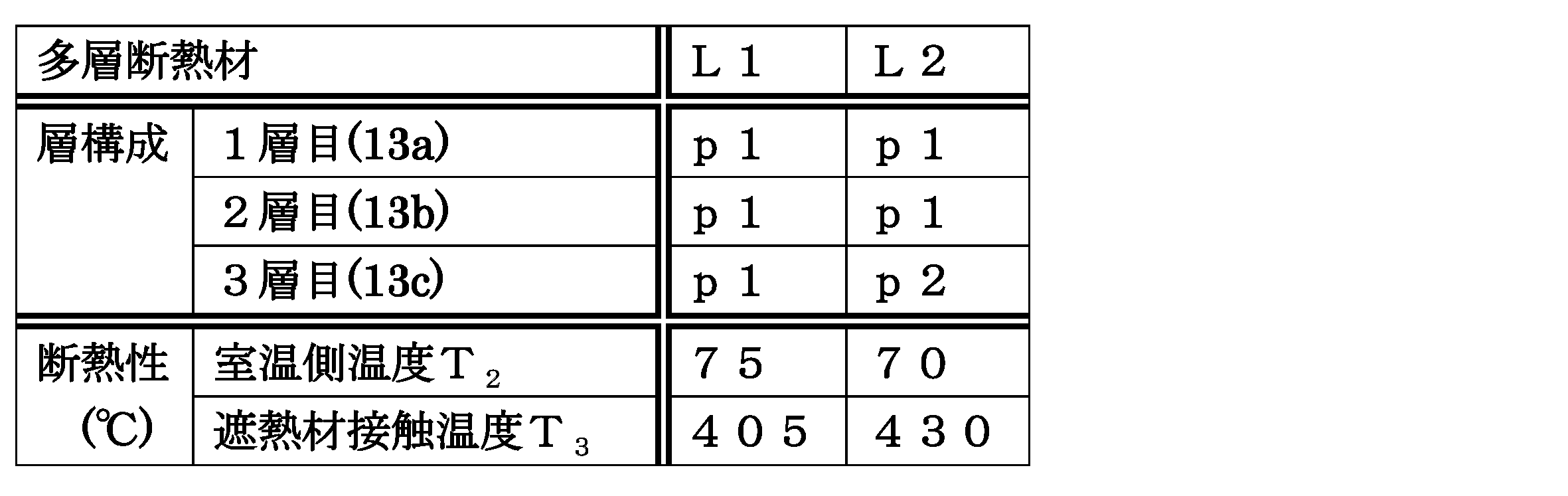
これらの結果から、赤外線作用材を含有した断熱材層と赤外線作用材を含有しない断熱材層とを組み合わせた多層断熱材を、熱源側が赤外線作用材を含有する断熱材層となるように用いることで、より優れた断熱性能を得られることがわかる。
2,2’ 充填部
3,3’ 濾水用メッシュ
4,5 プレス体
10 断熱材組成物
Claims (17)
- (A)気孔率60%以上のシリカエアロゲル、(B)水熱反応により結晶を形成できるセラミックス原料液(以下「水熱合成原料液」という)、(C)界面活性剤、及び(D)補強繊維を含有する成形可能な断熱材組成物。
- 前記(B)水熱合成原料液は、ケイ酸カルシウム水和物原料液である請求項1に記載の断熱材組成物。
- 前記(A)気孔率60%以上のシリカエアロゲルと前記(B)水熱反応により結晶を形成できるセラミックス原料液の固形分との含有質量比率(A:B固形分)は、3:7~8:2である請求項1又は2に記載の断熱材組成物。
- 前記シリカエアロゲルは、表面が疎水性処理されたシリカエアロゲルである請求項1~3のいずれか1項に記載の断熱材組成物。
- 前記(D)補強繊維を、前記(A)シリカエアロゲルと前記(B)水熱合成原料液固形分との総和に対して最大10質量%含有する請求項1~4のいずれか1項に記載の断熱材組成物。
- 前記界面活性剤は、ポリオキシエチレンブロックを親水部とし、ポリオキシプロピレンブロックを疎水部とするノニオン系界面活性剤である請求項1~5のいずれか1項に記載の断熱材組成物。
- さらに(F)赤外線作用物質を含む請求項1~6のいずれか1項に記載の断熱材組成物。
- 請求項1~7のいずれか1項に記載の断熱材組成物を、所定形状を有する金型内に注入及び脱水して一次成形体を得る工程;及び
一次成形体を加熱加圧して、前記(B)水熱合成性原料液からセラミックス結晶を合成ないし育成させる工程
を含む断熱材の製造方法。 - 前記一次成形体は、前記断熱材組成物を、濾水部を有する金型に充填することにより作製する請求項8に記載の製造方法。
- 前記セラミックス結晶は、針状又は繊維状結晶である請求項8又は9に記載の断熱材の製造方法。
- 請求項1~7のいずれか1項に記載の断熱材組成物を、成形金型を用いて成形してなる断熱材。
- 気孔率60%以上のシリカエアロゲル、セラミックス結晶、及び補強繊維を含有する成形された断熱材。
- 前記セラミックス結晶は、針状又は繊維状の結晶である請求項12に記載の断熱材。
- さらに赤外線作用材を含んでいる請求項12又は13に記載の断熱材
- 600℃における熱伝導率が50mW/mK以下である請求項11~14のいずれか1項に記載の断熱材。
- 請求項12に記載の断熱材からなる第1の断熱層、及び請求項14に記載の断熱材からなる第2の断熱層を含む多層断熱材。
- 円筒状若しくは角柱状の熱源に装着される多層断熱材であって、前記熱源に接する内周層が前記第2の断熱層で構成され、外周層が前記第1の断熱層で構成される請求項16に記載の多層断熱材。
Priority Applications (3)
| Application Number | Priority Date | Filing Date | Title |
|---|---|---|---|
| EP13764831.7A EP2829527A4 (en) | 2012-03-23 | 2013-03-18 | THERMAL INSULATOR COMPOSITION, HEAT INSULATOR THEREFOR AND METHOD FOR PRODUCING THE HEAT INSULATOR |
| JP2014506216A JP6026504B2 (ja) | 2012-03-23 | 2013-03-18 | 断熱材組成物、これを用いた断熱材、及び断熱材の製造方法 |
| US14/113,031 US20140057083A1 (en) | 2012-03-23 | 2013-03-18 | Heat insulating composition, heat insulator using same, and method for manufacturing heat insulator |
Applications Claiming Priority (2)
| Application Number | Priority Date | Filing Date | Title |
|---|---|---|---|
| JP2012-066788 | 2012-03-23 | ||
| JP2012066788 | 2012-03-23 |
Publications (1)
| Publication Number | Publication Date |
|---|---|
| WO2013141189A1 true WO2013141189A1 (ja) | 2013-09-26 |
Family
ID=49222646
Family Applications (1)
| Application Number | Title | Priority Date | Filing Date |
|---|---|---|---|
| PCT/JP2013/057591 Ceased WO2013141189A1 (ja) | 2012-03-23 | 2013-03-18 | 断熱材組成物、これを用いた断熱材、及び断熱材の製造方法 |
Country Status (4)
| Country | Link |
|---|---|
| US (1) | US20140057083A1 (ja) |
| EP (1) | EP2829527A4 (ja) |
| JP (1) | JP6026504B2 (ja) |
| WO (1) | WO2013141189A1 (ja) |
Cited By (21)
| Publication number | Priority date | Publication date | Assignee | Title |
|---|---|---|---|---|
| DE102013223171A1 (de) * | 2013-11-14 | 2015-05-21 | Aktiebolaget Skf | Bauteil und Verfahren zu seiner Herstellung |
| JP2015163815A (ja) * | 2014-01-30 | 2015-09-10 | オゾンセーブ株式会社 | 断熱材及び断熱材の製造方法 |
| WO2016035562A1 (ja) * | 2014-09-03 | 2016-03-10 | 株式会社豊田自動織機 | 化学蓄熱装置 |
| JP2016211637A (ja) * | 2015-05-07 | 2016-12-15 | 日立アプライアンス株式会社 | 真空断熱材および真空断熱材の製造方法 |
| JP2017031386A (ja) * | 2015-07-30 | 2017-02-09 | 現代自動車株式会社Hyundai Motor Company | 断熱コーティング組成物および断熱コーティング層 |
| JP2018043927A (ja) * | 2016-09-12 | 2018-03-22 | 株式会社Kri | 疎水性シリカエアロゲル粒子の水分散液並びに固体複合材料、断熱材及び吸音材 |
| JP2018145331A (ja) * | 2017-03-07 | 2018-09-20 | 日立化成株式会社 | エアロゲルパウダー分散液 |
| JP2018527220A (ja) * | 2015-07-27 | 2018-09-20 | ビーエーエスエフ ソシエタス・ヨーロピアBasf Se | 断熱材用複合材料のための接着剤としてのフォーム |
| JP2019189519A (ja) * | 2018-04-23 | 2019-10-31 | オゾンセーブ株式会社 | 断熱材および断絶材の製造方法 |
| WO2020013042A1 (ja) * | 2018-07-09 | 2020-01-16 | 井前工業株式会社 | 高温用断熱材及びその三次元成形体の製造方法 |
| WO2020040171A1 (ja) * | 2018-08-24 | 2020-02-27 | 住友理工株式会社 | 断熱材用塗料および断熱材 |
| JP2021501113A (ja) * | 2017-11-21 | 2021-01-14 | エルジー・ケム・リミテッド | 高断熱及び高強度シリカエアロゲルブランケットの製造方法 |
| JP2021046886A (ja) * | 2019-09-17 | 2021-03-25 | 明星工業株式会社 | 断熱パネル |
| WO2021181951A1 (ja) * | 2020-03-12 | 2021-09-16 | 住友理工株式会社 | バッテリーパック用断熱材およびバッテリーパック |
| WO2021181932A1 (ja) * | 2020-03-12 | 2021-09-16 | 住友理工株式会社 | 断熱材およびその製造方法 |
| JP2022006520A (ja) * | 2020-06-24 | 2022-01-13 | サンアロー株式会社 | シリカ含有成形体およびシリカ含有組成物 |
| CN114180984A (zh) * | 2021-11-10 | 2022-03-15 | 安徽壹石通材料科学研究院有限公司 | 一种羟基磷灰石/氧化硅复合气凝胶及其制备方法 |
| JPWO2022259930A1 (ja) * | 2021-06-09 | 2022-12-15 | ||
| JPWO2023181443A1 (ja) * | 2022-03-25 | 2023-09-28 | ||
| JP7641340B1 (ja) | 2023-09-21 | 2025-03-06 | 住友理工株式会社 | バッテリーパック用断熱材およびその製造方法 |
| PL447338A1 (pl) * | 2023-12-28 | 2025-06-30 | Politechnika Częstochowska | Izolator termiczny oraz sposób izolacji termicznej form |
Families Citing this family (10)
| Publication number | Priority date | Publication date | Assignee | Title |
|---|---|---|---|---|
| EP3176917A4 (en) * | 2014-08-01 | 2017-08-23 | Panasonic Intellectual Property Management Co., Ltd. | Thermal insulation structure for electronic device, motor provided with said thermal insulation structure, and method for forming thermal insulation member for electronic device |
| FR3050013B1 (fr) * | 2016-04-11 | 2019-08-02 | Saint-Gobain Isover | Fours et produits d'isolation pour fours |
| CN106630930B (zh) * | 2016-09-28 | 2019-01-25 | 泰州浩纳新材料科技有限公司 | 一种连续制备气凝胶保温隔热毡的方法 |
| CN110668789A (zh) * | 2019-10-26 | 2020-01-10 | 中材江西电瓷电气有限公司 | 纤维增强细高棒形支柱瓷绝缘子及其试验试样制备方法 |
| WO2021106563A1 (ja) * | 2019-11-29 | 2021-06-03 | 東レ株式会社 | サンドイッチ構造体およびその製造方法 |
| US12072140B2 (en) * | 2020-12-30 | 2024-08-27 | Whirlpool Corporation | Insulation materials for a heat and sound insulated structure and methods of forming with a mold that is gas and liquid permeable |
| CN112708293A (zh) * | 2021-01-12 | 2021-04-27 | 上海涂固安高科技有限公司 | 一种油水二用的保温绝热复合材料粉料配方 |
| CN114392334A (zh) * | 2022-03-03 | 2022-04-26 | 北京蜜蜂堂生物医药股份有限公司 | 一种祛湿通络蜂胶蜂蜡制品及其制备方法与应用 |
| CN117585977B (zh) * | 2023-12-06 | 2025-09-23 | 浙江阿斯克建材科技股份有限公司 | 一种高强度绝热硅酸钙材料的制备方法 |
| WO2025132956A1 (en) * | 2023-12-20 | 2025-06-26 | Orkli S. Coop | Method and system for producing a thermal insulator |
Citations (7)
| Publication number | Priority date | Publication date | Assignee | Title |
|---|---|---|---|---|
| JPS5849654A (ja) * | 1981-09-17 | 1983-03-23 | 日本酸素株式会社 | 珪酸カルシウムを主成分とする断熱成型体 |
| JPH10509941A (ja) * | 1994-11-23 | 1998-09-29 | ヘキスト・アクチェンゲゼルシャフト | エーロゲルを含む複合材料、その調製法およびその使用 |
| JP2002533286A (ja) * | 1998-12-19 | 2002-10-08 | レドコ ナムローゼ フェンノートシャップ | 微孔性断熱体 |
| JP2003179011A (ja) * | 2001-12-10 | 2003-06-27 | Asahi Kasei Corp | 半導体基板の製造方法 |
| JP4361602B2 (ja) | 1994-11-23 | 2009-11-11 | キャボット コーポレイション | エアロゲル含有複合材料、その製造方法及びその使用 |
| JP2009299893A (ja) | 2008-05-15 | 2009-12-24 | Nichias Corp | 断熱材、これを用いた断熱構造及びその製造方法 |
| JP2012131684A (ja) * | 2010-12-24 | 2012-07-12 | Japan Insulation Co Ltd | 断熱材用組成物及び断熱材用成形体 |
Family Cites Families (7)
| Publication number | Priority date | Publication date | Assignee | Title |
|---|---|---|---|---|
| US2888377A (en) * | 1954-03-25 | 1959-05-26 | Columbia Southern Chem Corp | Calcium silicate and method of producing same |
| EP0682206B1 (en) * | 1993-11-22 | 1999-02-10 | Mitsubishi Chemical Corporation | Vacuum heat-insulator |
| CA2452938A1 (en) * | 2003-12-15 | 2005-06-15 | Alberta Research Council Inc. | Heat exchanger for solid oxide fuel cell stack |
| US7635411B2 (en) * | 2004-12-15 | 2009-12-22 | Cabot Corporation | Aerogel containing blanket |
| JP5351527B2 (ja) * | 2009-01-11 | 2013-11-27 | 東京瓦斯株式会社 | 燃料電池用円筒型水蒸気改質器 |
| EP2429948A4 (en) * | 2009-04-27 | 2017-09-06 | Cabot Corporation | Aerogel compositions and methods of making and using them |
| DE102010029513A1 (de) * | 2010-05-31 | 2011-02-24 | Wacker Chemie Ag | Dämmung mit Schichtaufbau |
-
2013
- 2013-03-18 JP JP2014506216A patent/JP6026504B2/ja active Active
- 2013-03-18 EP EP13764831.7A patent/EP2829527A4/en not_active Withdrawn
- 2013-03-18 WO PCT/JP2013/057591 patent/WO2013141189A1/ja not_active Ceased
- 2013-03-18 US US14/113,031 patent/US20140057083A1/en not_active Abandoned
Patent Citations (7)
| Publication number | Priority date | Publication date | Assignee | Title |
|---|---|---|---|---|
| JPS5849654A (ja) * | 1981-09-17 | 1983-03-23 | 日本酸素株式会社 | 珪酸カルシウムを主成分とする断熱成型体 |
| JPH10509941A (ja) * | 1994-11-23 | 1998-09-29 | ヘキスト・アクチェンゲゼルシャフト | エーロゲルを含む複合材料、その調製法およびその使用 |
| JP4361602B2 (ja) | 1994-11-23 | 2009-11-11 | キャボット コーポレイション | エアロゲル含有複合材料、その製造方法及びその使用 |
| JP2002533286A (ja) * | 1998-12-19 | 2002-10-08 | レドコ ナムローゼ フェンノートシャップ | 微孔性断熱体 |
| JP2003179011A (ja) * | 2001-12-10 | 2003-06-27 | Asahi Kasei Corp | 半導体基板の製造方法 |
| JP2009299893A (ja) | 2008-05-15 | 2009-12-24 | Nichias Corp | 断熱材、これを用いた断熱構造及びその製造方法 |
| JP2012131684A (ja) * | 2010-12-24 | 2012-07-12 | Japan Insulation Co Ltd | 断熱材用組成物及び断熱材用成形体 |
Non-Patent Citations (1)
| Title |
|---|
| See also references of EP2829527A4 * |
Cited By (49)
| Publication number | Priority date | Publication date | Assignee | Title |
|---|---|---|---|---|
| DE102013223171A1 (de) * | 2013-11-14 | 2015-05-21 | Aktiebolaget Skf | Bauteil und Verfahren zu seiner Herstellung |
| JP2015163815A (ja) * | 2014-01-30 | 2015-09-10 | オゾンセーブ株式会社 | 断熱材及び断熱材の製造方法 |
| WO2016035562A1 (ja) * | 2014-09-03 | 2016-03-10 | 株式会社豊田自動織機 | 化学蓄熱装置 |
| JP2016053431A (ja) * | 2014-09-03 | 2016-04-14 | 株式会社豊田自動織機 | 化学蓄熱装置 |
| JP2016211637A (ja) * | 2015-05-07 | 2016-12-15 | 日立アプライアンス株式会社 | 真空断熱材および真空断熱材の製造方法 |
| JP2018527220A (ja) * | 2015-07-27 | 2018-09-20 | ビーエーエスエフ ソシエタス・ヨーロピアBasf Se | 断熱材用複合材料のための接着剤としてのフォーム |
| JP6997925B2 (ja) | 2015-07-27 | 2022-02-10 | ビーエーエスエフ ソシエタス・ヨーロピア | 断熱材用複合材料のための接着剤としてのフォーム |
| JP2017031386A (ja) * | 2015-07-30 | 2017-02-09 | 現代自動車株式会社Hyundai Motor Company | 断熱コーティング組成物および断熱コーティング層 |
| JP2018043927A (ja) * | 2016-09-12 | 2018-03-22 | 株式会社Kri | 疎水性シリカエアロゲル粒子の水分散液並びに固体複合材料、断熱材及び吸音材 |
| JP2018145331A (ja) * | 2017-03-07 | 2018-09-20 | 日立化成株式会社 | エアロゲルパウダー分散液 |
| JP7024191B2 (ja) | 2017-03-07 | 2022-02-24 | 昭和電工マテリアルズ株式会社 | エアロゲルパウダー分散液 |
| US11485892B2 (en) | 2017-11-21 | 2022-11-01 | Lg Chem, Ltd. | Method for producing silica aerogel blanket having high thermal insulation and high strength |
| JP7105881B2 (ja) | 2017-11-21 | 2022-07-25 | エルジー・ケム・リミテッド | 高断熱及び高強度シリカエアロゲルブランケットの製造方法 |
| JP2021501113A (ja) * | 2017-11-21 | 2021-01-14 | エルジー・ケム・リミテッド | 高断熱及び高強度シリカエアロゲルブランケットの製造方法 |
| JP2019189519A (ja) * | 2018-04-23 | 2019-10-31 | オゾンセーブ株式会社 | 断熱材および断絶材の製造方法 |
| JP2023164450A (ja) * | 2018-07-09 | 2023-11-10 | 井前工業株式会社 | 高温用断熱材 |
| JP7602285B2 (ja) | 2018-07-09 | 2024-12-18 | 井前工業株式会社 | 高温用断熱材 |
| WO2020013042A1 (ja) * | 2018-07-09 | 2020-01-16 | 井前工業株式会社 | 高温用断熱材及びその三次元成形体の製造方法 |
| JP7343189B2 (ja) | 2018-07-09 | 2023-09-12 | 井前工業株式会社 | 高温用断熱材及びその三次元成形体の製造方法 |
| JPWO2020013042A1 (ja) * | 2018-07-09 | 2021-07-08 | 井前工業株式会社 | 高温用断熱材及びその三次元成形体の製造方法 |
| WO2020040171A1 (ja) * | 2018-08-24 | 2020-02-27 | 住友理工株式会社 | 断熱材用塗料および断熱材 |
| JP2020029528A (ja) * | 2018-08-24 | 2020-02-27 | 住友理工株式会社 | 断熱材用塗料および断熱材 |
| JP2021046886A (ja) * | 2019-09-17 | 2021-03-25 | 明星工業株式会社 | 断熱パネル |
| JP7429508B2 (ja) | 2019-09-17 | 2024-02-08 | 明星工業株式会社 | 断熱パネルの製造方法 |
| JP2021143733A (ja) * | 2020-03-12 | 2021-09-24 | 住友理工株式会社 | 断熱材およびその製造方法 |
| JP7584898B2 (ja) | 2020-03-12 | 2024-11-18 | 住友理工株式会社 | 断熱材およびその製造方法 |
| DE112021000020T5 (de) | 2020-03-12 | 2021-12-02 | Sumitomo Riko Company Limited | Wärmeisolierendes Material und Verfahren zu seiner Herstellung |
| JP7009534B2 (ja) | 2020-03-12 | 2022-01-25 | 住友理工株式会社 | バッテリーパック用断熱材およびバッテリーパック |
| WO2021181932A1 (ja) * | 2020-03-12 | 2021-09-16 | 住友理工株式会社 | 断熱材およびその製造方法 |
| WO2021181951A1 (ja) * | 2020-03-12 | 2021-09-16 | 住友理工株式会社 | バッテリーパック用断熱材およびバッテリーパック |
| US11655931B2 (en) | 2020-03-12 | 2023-05-23 | Sumitomo Riko Company Limited | Heat insulating material and manufacturing method thereof |
| JP2021144879A (ja) * | 2020-03-12 | 2021-09-24 | 住友理工株式会社 | バッテリーパック用断熱材およびバッテリーパック |
| US12388133B2 (en) | 2020-03-12 | 2025-08-12 | Sumitomo Riko Company Limited | Thermal insulation material for battery pack and battery pack |
| JP2022006520A (ja) * | 2020-06-24 | 2022-01-13 | サンアロー株式会社 | シリカ含有成形体およびシリカ含有組成物 |
| CN116917655A (zh) * | 2021-06-09 | 2023-10-20 | 住友理工株式会社 | 绝热片 |
| WO2022259930A1 (ja) * | 2021-06-09 | 2022-12-15 | 住友理工株式会社 | 断熱シート |
| JPWO2022259930A1 (ja) * | 2021-06-09 | 2022-12-15 | ||
| JP7594669B2 (ja) | 2021-06-09 | 2024-12-04 | 住友理工株式会社 | 断熱シート |
| CN114180984B (zh) * | 2021-11-10 | 2022-10-11 | 安徽壹石通材料科学研究院有限公司 | 一种羟基磷灰石/氧化硅复合气凝胶及其制备方法 |
| CN114180984A (zh) * | 2021-11-10 | 2022-03-15 | 安徽壹石通材料科学研究院有限公司 | 一种羟基磷灰石/氧化硅复合气凝胶及其制备方法 |
| WO2023181443A1 (ja) | 2022-03-25 | 2023-09-28 | 住友理工株式会社 | 断熱材 |
| JP7603158B2 (ja) | 2022-03-25 | 2024-12-19 | 住友理工株式会社 | 断熱材 |
| JPWO2023181443A1 (ja) * | 2022-03-25 | 2023-09-28 | ||
| EP4400757A4 (en) * | 2022-03-25 | 2025-08-27 | Sumitomo Riko Co Ltd | THERMAL INSULATION MATERIAL |
| JP7641340B1 (ja) | 2023-09-21 | 2025-03-06 | 住友理工株式会社 | バッテリーパック用断熱材およびその製造方法 |
| WO2025063173A1 (ja) * | 2023-09-21 | 2025-03-27 | 住友理工株式会社 | バッテリーパック用断熱材およびその製造方法 |
| JP2025047292A (ja) * | 2023-09-21 | 2025-04-03 | 住友理工株式会社 | バッテリーパック用断熱材およびその製造方法 |
| PL447338A1 (pl) * | 2023-12-28 | 2025-06-30 | Politechnika Częstochowska | Izolator termiczny oraz sposób izolacji termicznej form |
| PL248198B1 (pl) * | 2023-12-28 | 2025-11-03 | Politechnika Czestochowska | Izolator termiczny oraz sposób izolacji termicznej form |
Also Published As
| Publication number | Publication date |
|---|---|
| EP2829527A1 (en) | 2015-01-28 |
| JPWO2013141189A1 (ja) | 2015-08-03 |
| JP6026504B2 (ja) | 2016-11-16 |
| EP2829527A4 (en) | 2015-10-28 |
| US20140057083A1 (en) | 2014-02-27 |
Similar Documents
| Publication | Publication Date | Title |
|---|---|---|
| JP6026504B2 (ja) | 断熱材組成物、これを用いた断熱材、及び断熱材の製造方法 | |
| CN107438588B (zh) | 含二氧化硅气凝胶的毡及其制备方法 | |
| JP4903625B2 (ja) | エーロゲルを含む複合材料 | |
| JP6960044B2 (ja) | 疎水性のシリカエアロゲル顆粒の製造方法 | |
| CN113939487B (zh) | 绝热材料及其制造方法 | |
| JP5190399B2 (ja) | けい酸カルシウム板の製造方法 | |
| US20110108241A1 (en) | Method for making phase change products from an encapsulated phase change material | |
| JP5871685B2 (ja) | けい酸カルシウム成形体およびその製造方法 | |
| CN110759691B (zh) | 一种环保的相变石膏板及其制备方法 | |
| JPS58145652A (ja) | 珪酸カルシウム成形体 | |
| JP2012081701A (ja) | 断熱材および断熱材の製造方法 | |
| JP2001262067A (ja) | 鱗片状シリカ粒子を含有する断熱性コーティング材用硬化性組成物及び断熱性硬化体 | |
| CN103073237A (zh) | 一种玄武岩纤维与气凝胶粉体复合隔热材料及其制备方法 | |
| JP7641340B1 (ja) | バッテリーパック用断熱材およびその製造方法 | |
| JP2571993B2 (ja) | トベルモライト結晶球状二次粒子の製造方法 | |
| Yun et al. | Strategic fabrication of robust spherical hexagonal boron nitride particles for thermally conductive applications | |
| JP7603158B2 (ja) | 断熱材 | |
| JP5503377B2 (ja) | 化学蓄熱材構造物の製造方法 | |
| JP6052981B2 (ja) | けい酸カルシウム成形体及びその製造法 | |
| JP2010235691A (ja) | 被覆された多孔性無機粒子及びそれを用いた成形体 | |
| JP2782198B2 (ja) | 珪酸カルシウム成形体 | |
| EP4688692A1 (en) | Microporous powder composition and insulation product | |
| JP3207819B2 (ja) | 断熱材組成物 | |
| JP2519075B2 (ja) | 珪酸カルシウム結晶のボ―ド | |
| TW200927689A (en) | Glass-containing sphere-like particles, porous plates and methods for fabricating the same |
Legal Events
| Date | Code | Title | Description |
|---|---|---|---|
| WWE | Wipo information: entry into national phase |
Ref document number: 14113031 Country of ref document: US |
|
| 121 | Ep: the epo has been informed by wipo that ep was designated in this application |
Ref document number: 13764831 Country of ref document: EP Kind code of ref document: A1 |
|
| WWE | Wipo information: entry into national phase |
Ref document number: 2013764831 Country of ref document: EP |
|
| ENP | Entry into the national phase |
Ref document number: 2014506216 Country of ref document: JP Kind code of ref document: A |
|
| NENP | Non-entry into the national phase |
Ref country code: DE |