WO2013146586A1 - Ctpフレキソ印刷原版用感光性樹脂組成物およびそれから得られる印刷原版 - Google Patents
Ctpフレキソ印刷原版用感光性樹脂組成物およびそれから得られる印刷原版 Download PDFInfo
- Publication number
- WO2013146586A1 WO2013146586A1 PCT/JP2013/058284 JP2013058284W WO2013146586A1 WO 2013146586 A1 WO2013146586 A1 WO 2013146586A1 JP 2013058284 W JP2013058284 W JP 2013058284W WO 2013146586 A1 WO2013146586 A1 WO 2013146586A1
- Authority
- WO
- WIPO (PCT)
- Prior art keywords
- photosensitive resin
- resin composition
- mass
- hydroxyl group
- acrylate
- Prior art date
- Legal status (The legal status is an assumption and is not a legal conclusion. Google has not performed a legal analysis and makes no representation as to the accuracy of the status listed.)
- Ceased
Links
Classifications
-
- G—PHYSICS
- G03—PHOTOGRAPHY; CINEMATOGRAPHY; ANALOGOUS TECHNIQUES USING WAVES OTHER THAN OPTICAL WAVES; ELECTROGRAPHY; HOLOGRAPHY
- G03F—PHOTOMECHANICAL PRODUCTION OF TEXTURED OR PATTERNED SURFACES, e.g. FOR PRINTING, FOR PROCESSING OF SEMICONDUCTOR DEVICES; MATERIALS THEREFOR; ORIGINALS THEREFOR; APPARATUS SPECIALLY ADAPTED THEREFOR
- G03F7/00—Photomechanical, e.g. photolithographic, production of textured or patterned surfaces, e.g. printing surfaces; Materials therefor, e.g. comprising photoresists; Apparatus specially adapted therefor
- G03F7/004—Photosensitive materials
- G03F7/027—Non-macromolecular photopolymerisable compounds having carbon-to-carbon double bonds, e.g. ethylenic compounds
- G03F7/032—Non-macromolecular photopolymerisable compounds having carbon-to-carbon double bonds, e.g. ethylenic compounds with binders
- G03F7/033—Non-macromolecular photopolymerisable compounds having carbon-to-carbon double bonds, e.g. ethylenic compounds with binders the binders being polymers obtained by reactions only involving carbon-to-carbon unsaturated bonds, e.g. vinyl polymers
-
- B—PERFORMING OPERATIONS; TRANSPORTING
- B41—PRINTING; LINING MACHINES; TYPEWRITERS; STAMPS
- B41N—PRINTING PLATES OR FOILS; MATERIALS FOR SURFACES USED IN PRINTING MACHINES FOR PRINTING, INKING, DAMPING, OR THE LIKE; PREPARING SUCH SURFACES FOR USE AND CONSERVING THEM
- B41N1/00—Printing plates or foils; Materials therefor
- B41N1/12—Printing plates or foils; Materials therefor non-metallic other than stone, e.g. printing plates or foils comprising inorganic materials in an organic matrix
-
- G—PHYSICS
- G03—PHOTOGRAPHY; CINEMATOGRAPHY; ANALOGOUS TECHNIQUES USING WAVES OTHER THAN OPTICAL WAVES; ELECTROGRAPHY; HOLOGRAPHY
- G03F—PHOTOMECHANICAL PRODUCTION OF TEXTURED OR PATTERNED SURFACES, e.g. FOR PRINTING, FOR PROCESSING OF SEMICONDUCTOR DEVICES; MATERIALS THEREFOR; ORIGINALS THEREFOR; APPARATUS SPECIALLY ADAPTED THEREFOR
- G03F7/00—Photomechanical, e.g. photolithographic, production of textured or patterned surfaces, e.g. printing surfaces; Materials therefor, e.g. comprising photoresists; Apparatus specially adapted therefor
- G03F7/004—Photosensitive materials
- G03F7/027—Non-macromolecular photopolymerisable compounds having carbon-to-carbon double bonds, e.g. ethylenic compounds
-
- G—PHYSICS
- G03—PHOTOGRAPHY; CINEMATOGRAPHY; ANALOGOUS TECHNIQUES USING WAVES OTHER THAN OPTICAL WAVES; ELECTROGRAPHY; HOLOGRAPHY
- G03F—PHOTOMECHANICAL PRODUCTION OF TEXTURED OR PATTERNED SURFACES, e.g. FOR PRINTING, FOR PROCESSING OF SEMICONDUCTOR DEVICES; MATERIALS THEREFOR; ORIGINALS THEREFOR; APPARATUS SPECIALLY ADAPTED THEREFOR
- G03F7/00—Photomechanical, e.g. photolithographic, production of textured or patterned surfaces, e.g. printing surfaces; Materials therefor, e.g. comprising photoresists; Apparatus specially adapted therefor
- G03F7/20—Exposure; Apparatus therefor
- G03F7/24—Curved surfaces
Definitions
- the present invention relates to a photosensitive resin composition used for producing a flexographic printing plate by a computer plate making (Computer to Plate) technology.
- CTP technology known as digital image forming technology has become extremely common.
- the CTP technique is a method for obtaining a relief uneven pattern by directly outputting information processed on a computer onto a printing plate. This technique eliminates the need for a negative film manufacturing process, thereby reducing costs and the time required to create the negative.
- Patent Document 1 As a CTP photosensitive flexographic printing original plate, a water-developable photosensitive flexographic printing original plate in which a protective layer (barrier layer) is provided on a photosensitive resin layer and a thermal mask layer is further provided thereon has been proposed.
- Patent Document 1 can provide a photosensitive flexographic printing original plate having excellent laser ablation properties, but causes printing blur at the relief edge, which was not a problem with the negative method. In the first place, the ablation layer provided for CTP is easily deformed compared to the negative film. For this reason, it has the fault that the shape of a relief top part deform
- the photosensitive resin composition for CTP photosensitive flexographic printing original plate of Patent Document 1 has a drawback that it lacks mechanical strength and printing durability at the time of printing, and its improvement has been demanded.
- the CTP flexographic printing original plate using the conventional water-developable photosensitive resin composition is all about the laser ablation performance, water developability, printing durability, and the solution of printing blur caused by the relief top shape change. It wasn't to satisfy.
- the present invention was devised in view of the current state of the prior art, and its purpose is to develop a conventional CTP water-developable flexographic plate containing a water-dispersible latex in a photosensitive resin composition.
- a high-performance CTP photosensitive flexographic printing plate and a photosensitive resin composition therefor that suppresses printing blur due to the rise of the relief edge, which is a problem unique to the CTP plate, while maintaining image reproducibility, and also satisfies printing durability To provide things.
- the present inventors have found that a desired effect can be obtained by using a specific hydroxyl group-containing photopolymerizable monomer as a crosslinking component of the photosensitive resin layer, The present invention has been completed.
- a photosensitive resin composition comprising at least (A) a hydrophobic polymer obtained from an aqueous dispersion latex, (B) a hydrophilic polymer, (C) a photopolymerizable unsaturated compound, and (D) a photopolymerization initiator.
- a photosensitive resin composition for a CTP flexographic printing original plate which is 1 to 20% by mass.
- the hydroxyl group concentration derived from the hydroxyl group-containing photopolymerizable monomer is 0.1 to 1.5 equivalent mol / kg, according to any one of (1) to (3)
- the photosensitive resin composition of the present invention contains a specific hydroxyl group-containing photopolymerizable monomer in the photopolymerizable unsaturated compound to be used, and further uses a specific amount of rubber. It is possible to provide a CTP photosensitive flexographic printing plate having excellent properties, heat-sensitive mask layer resistance, mechanical strength, and developability.
- the photosensitive resin composition for CTP flexographic printing plate precursor of the present invention comprises at least (A) a hydrophobic polymer obtained from an aqueous dispersion latex, (B) a hydrophilic polymer, (C) a photopolymerizable unsaturated compound, (D ) A photopolymerization initiator, and optionally (E) rubber, and in particular (C) the use of a specific (C-2) hydroxyl group-containing photopolymerizable monomer as a photopolymerizable unsaturated compound, and a specific amount of rubber There is a feature in using.
- Hydrophobic polymers obtained from water-dispersed latex include polybutadiene (BR) latex, natural rubber latex, styrene-butadiene copolymer latex, acrylonitrile-butadiene copolymer (NBR) latex, polychloroprene latex, poly Water-dispersed latex polymers such as isoprene latex, polyurethane latex, methyl methacrylate-butadiene copolymer latex, vinyl pyridine polymer latex, butyl polymer latex, thiocol polymer latex and acrylate polymer latex, and acrylic acid or Examples thereof include a polymer obtained by copolymerizing other components such as methacrylic acid.
- an aqueous dispersion latex polymer containing a butadiene skeleton or an isoprene skeleton in the molecular chain is preferably used from the viewpoint of hardness and rubber elasticity.
- polybutadiene latex, styrene-butadiene copolymer latex, acrylonitrile-butadiene copolymer latex, methyl methacrylate-butadiene copolymer latex, and polyisoprene latex are preferable.
- Latex needs to be confirmed as independent fine particles.
- the blending amount of the component (A) in the photosensitive resin composition is preferably 40 to 80% by mass. If it is less than 40% by mass, the strength as a printing plate is insufficient, and if it exceeds 80% by mass, it may take time for water development.
- hydrophilic polymers examples include —COOH, —COOM (M is a monovalent, divalent or trivalent metal ion or a substituted or unsubstituted ammonium ion), —OH, —NH 2 , —SO 3 H.
- hydrophilic group such as a phosphoric acid ester group
- the blending amount of the component (B) in the photosensitive resin composition is preferably 2 to 10% by mass. If it is less than 2% by mass, the developability is deteriorated. If it exceeds 10% by mass, the water resistance of the relief may be deteriorated.
- (C) a photopolymerizable unsaturated compound includes (C-1) a hydroxyl group-free photopolymerizable oligomer, (C-2) a hydroxyl group-containing photopolymerizable monomer, and optionally (C-3) a hydroxyl group-free photopolymerizable monomer. Consists of monomers.
- the blending amount of the component (C) in the photosensitive resin composition is preferably 25 to 45% by mass. If it is less than 25% by mass, the developability is deteriorated, and if it exceeds 45% by mass, the toughness may be deteriorated.
- a hydroxyl group-free photopolymerizable oligomer is a polymer in which an ethylenically unsaturated group is bonded to the terminal and / or side chain of a conjugated diene polymer and has a number average molecular weight of 1,000 or more and 10,000 or less. It is preferable that.
- the conjugated diene polymer constituting the conjugated diene ethylenic polymer is composed of a homopolymer of a conjugated diene unsaturated compound or a copolymer of a conjugated diene unsaturated compound and a monoethylenically unsaturated compound.
- Such copolymers include butadiene polymers, isoprene polymers, chloroprene polymers, styrene-chloroprene copolymers, acrylonitrile-butadiene copolymers, acrylonitrile-isoprene copolymers, methyl methacrylate-isoprene copolymers, acrylonitrile.
- the blending amount of the component (C-1) in the photosensitive resin composition is preferably 10 to 30% by mass. If it is less than 10% by mass, the solvent resistance of the relief is deteriorated. If it exceeds 30% by mass, the adhesiveness of the resin is increased and the handling may be deteriorated.
- the hydroxyl group-containing photopolymerizable monomer is an ethylenically unsaturated hydrocarbon compound having at least one hydroxyl group in the molecule. As a structure, it has at least one skeleton among a pentaerythritol skeleton, a dipentaerythritol skeleton, or a glycerin skeleton, and has a hydroxyl group derived from the skeleton in the molecule.
- a dihydric alcohol such as ethylene glycol or propylene glycol may be added to these skeletons.
- the hydroxyl group concentration derived from the hydroxyl group-containing photopolymerizable monomer in the photosensitive resin composition is preferably 0.01 to 5 equivalent mol / kg, more preferably 0.05 to 2 equivalent mol / kg, More preferably, ⁇ 1.5 equivalent mol / kg.
- the weight average molecular weight of the hydroxyl group-containing photopolymerizable monomer is 200 to 1500, preferably 200 to 1000, and more preferably 210 to 900.
- This component (C-2) is a photosensitive resin component that oozes out from the non-dew posterior part to the exposed part during the main exposure to the photosensitive resin plate surface layer, and swells the structure of the photosensitive resin plate surface layer such as a heat-sensitive mask layer and a protective layer. , Have a role to prevent from dissolving and increasing the tackiness of the release part.
- hydroxyl group-containing photopolymerizable monomer examples include pentaerythritol (poly) acrylate, ethoxylated pentaerythritol (poly) acrylate, propoxylated pentaerythritol (poly) acrylate, and (poly) glycidyl ether pentaerythritol (poly) acrylate.
- the blending amount of the component (C-2) in the photosensitive resin composition is 1 to 20% by mass, preferably 1.5 to 18% by mass. If the component (C-2) is less than the above range, printing blur will occur, and if it exceeds the above range, the toughness of the relief may be impaired.
- the hydroxyl group-free photopolymerizable monomer is an ethylenically unsaturated hydrocarbon compound having no hydroxyl group in the molecule.
- the component (C-3) can be added in a range that does not impair the effects of the present invention in order to increase the crosslinking density on the plate surface.
- the hydroxyl group-free photopolymerizable monomer is preferably a compound having a molecular weight of 100 to 500 and having at least two or more ethylenically unsaturated groups at the terminal or side chain.
- the (C-3) hydroxyl group-free photopolymerizable monomer is at least one alkyl methacrylate other than the above.
- alkyl methacrylate having 8 to 18 carbon atoms and being linear is preferable.
- the photopolymerization initiator is not particularly limited as long as it can polymerize a polymerizable carbon-carbon unsaturated group by light. Especially, what has the function to produce
- the blending amount of the component (D) in the photosensitive resin composition is preferably 0.1 to 10% by mass, and more preferably 0.2 to 5% by mass. When the component (D) is less than the above range, the polymerization effect is not sufficiently obtained. When the component exceeds the above range, the transparency of the resin is impaired and a sharp relief may not be obtained.
- (E) Rubber is used for imparting rubber elasticity to the photosensitive resin composition.
- Specific examples of the component (E) include butadiene rubber (BR), nitrile rubber (NBR), acrylic rubber, epichlorohydrin rubber, urethane rubber, isoprene rubber, styrene isoprene rubber, styrene butadiene rubber, and ethylene-propylene copolymer. And chlorinated polyethylene. These may be used alone or in combination of two or more. Among these, butadiene rubber (BR) and nitrile rubber (NBR) are preferable, and butadiene rubber (BR) is most preferable.
- the hydrophobic polymer obtained from the water-dispersed latex of the component (A) and the rubber of the component (E) have a common skeleton structure.
- the amount of the component (E) in the photosensitive resin composition is preferably 0.5 to 15% by mass, more preferably 1 to 10% by mass, and further preferably 1 to 7% by mass.
- the blending ratio of the (A) component and the (E) component in the photosensitive resin composition is the ratio of the mass of the (E) component to the total mass of the (A) component and the (E) component (E / (A + E)
- the mass ratio is preferably in the range of 0.5 to 35%. A more preferred range is 3 to 25%, and a further more preferred range is 5 to 20%. When the mass ratio is less than the above range, the mechanical strength and elongation are lowered. When the above range is exceeded, there are problems such as a reduction in fine image reproducibility and time required for water development.
- an anti-aggregation agent a plasticizer, a polymerization inhibitor, an ultraviolet absorber, a dye, a pigment, an antifoam are used for the purpose of improving various properties within the range not impairing the effects of the present invention.
- Other components such as an agent and a fragrance
- the photosensitive resin composition of the present invention is for use in a photosensitive resin layer of a CTP flexographic printing original plate.
- the CTP flexographic printing original plate of the present invention comprises at least a support, a photosensitive resin layer, a protective layer, and a thermal mask layer.
- the support used in the original plate of the present invention is flexible but is preferably a material having excellent dimensional stability.
- a metal support such as steel, aluminum, copper, nickel, polyethylene terephthalate film, polyethylene
- thermoplastic resin supports such as phthalate films, polybutylene terephthalate films, or polycarbonate films.
- a polyethylene terephthalate film having excellent dimensional stability and sufficiently high viscoelasticity is particularly preferable.
- the thickness of the support is preferably from 50 to 350 ⁇ m, preferably from 100 to 250 ⁇ m, from the viewpoint of mechanical properties, shape stability, or handleability during plate making.
- the protective layer used in the original plate of the present invention is provided to prevent mass transfer between the photosensitive resin layer and the heat-sensitive mask layer and polymerization inhibition due to oxygen in the photosensitive resin layer.
- the protective layer is not particularly limited, and can be constructed using any polymer that is soluble or insoluble in water.
- the polymer constituting the protective layer include soluble polyamide, polyvinyl alcohol, polyacrylic acid, polyethylene oxide, alkyl cellulose, cellulose polymers (particularly hydroxypropyl cellulose, hydroxyethyl cellulose, nitrocellulose), cellulose acetate butyrate, polybutyral, Examples include butyl rubber, NBR rubber, acrylic rubber, styrene-butadiene rubber, latex, and soluble polyester.
- the protective layer a layer having a higher thermal decomposition temperature than the thermal mask layer is preferable. This is because if the thermal decomposition temperature of the protective layer is lower than that of the thermal mask layer, the protective layer may also be thermally decomposed during ablation of the thermal mask layer.
- the layer thickness of the protective layer is preferably 0.2 ⁇ m to 3.0 ⁇ m, more preferably 0.2 m to 1.5 ⁇ m. If it is less than the above lower limit, the oxygen barrier property is insufficient and the relief plate surface may be roughened. If the above upper limit is exceeded, there is a risk that fine line reproduction failure will occur.
- the heat-sensitive mask layer used in the original plate of the present invention is composed of carbon black which is a material having a function of absorbing infrared laser and converting it into heat and a function of blocking ultraviolet light, and a dispersion binder thereof.
- a pigment dispersant, a filler, a surfactant, a coating aid, or the like can be contained within a range that does not impair the effects of the present invention.
- the thermal mask layer preferably has an optical density of 2.0 or more with respect to actinic radiation, more preferably an optical density of 2.0 to 3.0, and particularly preferably an optical density of 2.2 to 2.5. Concentration.
- the layer thickness of the heat sensitive mask layer is preferably 0.5 to 2.5 ⁇ m, more preferably 1.0 to 2.0 ⁇ m. If it is more than the said minimum, a high coating technique is not required but an optical density more than fixed can be obtained. Moreover, if it is below the said upper limit, high energy is not required for evaporation of a thermal mask layer, and it is advantageous in cost.
- a peelable flexible cover film on the thermal mask layer.
- Suitable examples of the peelable flexible cover film include a polyethylene terephthalate film, a polyethylene naphthalate film, and a polybutylene terephthalate film.
- a protective film is not absolutely necessary.
- the protective film is first removed from the photosensitive printing plate. Thereafter, the thermal mask layer is irradiated imagewise with an IR laser to form a mask on the photosensitive resin layer.
- suitable IR lasers include ND / YAG laser (1064 nm) or diode laser (eg, 830 nm).
- Laser systems suitable for computer plate making technology are commercially available, and for example, CDI SpArk (Esco Graphics) can be used. This laser system includes a rotating cylindrical drum that holds a printing original, an IR laser irradiation device, and a layout computer, and image information is directly transferred from the layout computer to the laser device.
- the photosensitive printing original plate is irradiated with actinic rays through the mask.
- actinic rays having a wavelength of 150 to 500 nm, particularly 300 to 400 nm can be used.
- a low-pressure mercury lamp, a high-pressure mercury lamp, an ultrahigh-pressure mercury lamp, a metal halide lamp, a xenon lamp, a zirconium lamp, a carbon arc lamp, an ultraviolet fluorescent lamp, or the like can be used. Thereafter, the irradiated plate is developed to obtain a printing plate.
- the development step can be performed with a conventional development unit.
- the photosensitive resin composition obtained in each of the Examples and Comparative Examples was coated on a polyethylene terephthalate film having a thickness of 250 ⁇ m and a polyester adhesive layer coated with a thickness of 10 ⁇ m, and on a polyethylene terephthalate film having a thickness of 125 ⁇ m.
- a cover film coated with a protective layer (polyvinyl alcohol) and a heat-sensitive mask layer (carbon black dispersed in butyral resin) is sandwiched between the adhesive layer and the protective layer so as to come into contact with the photosensitive resin composition.
- a photosensitive resin original plate having a photosensitive resin layer thickness of 1.0 mm was produced by heating and pressurizing at a pressure of 15 ° C. for 1 minute.
- the photosensitive resin original plate was subjected to back exposure for 10 seconds using a fluorescent lamp for ultraviolet rays (PHILIPS 10R) having an illuminance of 8.0 w / m 2 at 350 nm, and the cover film was peeled off.
- a fluorescent lamp for ultraviolet rays PILIPS 10R
- an image including at least a thin line having a line width of 300 ⁇ m was ablated on the resin thermal mask layer with an IR laser irradiation machine.
- main exposure was performed with the same fluorescent lamp for ultraviolet rays, and development was performed for 7 minutes with a developing device.
- neutral water at 40 ° C. containing 4% by mass of sodium alkylnaphthalene sulfonate was used.
- the developed plate is drained, dried at 60 ° C. for 10 minutes, subjected to post-exposure for 5 minutes using the same ultraviolet fluorescent lamp, and then subjected to surface treatment by irradiating a germicidal lamp for 5 minutes, and the evaluation relief Got.
- the evaluation relief created by the above method was fixed to a metal board using a magnet, and a 300 ⁇ m fine line of the evaluation relief was photographed in 3D with a KEIENCE ultra-deep color 3D shape measurement microscope (VK-9500). The distance ( ⁇ m) from the lowest point to the highest point of the 300 ⁇ m fine wire top was taken as the cupping value. The cupping value indicates that the lower the value, the better.
- the height difference (relief depth) between the light-irradiated part and the non-irradiated part of the evaluation relief prepared by the above method is x when the height is less than 0.2 mm, ⁇ when the height is 0.2 mm or more and less than 0.4 mm, 0.4 mm The above was marked as ⁇ .
- Example 1A (A) component butadiene latex (Nipol LX111NF, manufactured by Nippon Zeon Co., Ltd.) 45 parts by mass (solid content), acrylonitrile-butadiene latex (Nipol SX1503, manufactured by Nippon Zeon Co., Ltd.) 10 parts by mass (solid content), (B) component hydrophilic polymer (PFT-3, manufactured by Kyoeisha Chemical Co., Ltd.) 12 parts by mass (solid content), (C) component (C-1) component includes oligobutadiene acrylate (ABU) -4, manufactured by Kyoeisha Chemical Co., Ltd.) 12 parts by mass, (C-2) component, glycerol monomethacrylate (G101P, manufactured by Kyoeisha Chemical Co., Ltd.) 7.5 parts by mass, , 7.5 parts by weight of lauryl methacrylate, 0.7 parts by weight of the photopolymerization initiator as component (D), hydroquinone monomethyl ether as a poly
- a resin original plate was prepared from the obtained photosensitive resin composition in accordance with the method for preparing the photosensitive resin plate.
- the obtained original plate was evaluated for cupping, cover film peelability, and heat-sensitive mask layer (coat layer) resistance by the above methods.
- Table 1 shows the details of the photosensitive resin composition (only component (C)) and the evaluation results.
- Examples 2A-6A, Comparative Examples 1A-6A Examples 2A to 6A and Comparative Examples 1A to 6A were the same as Example 1A except that only the components (C-2) and (C-3) were changed as shown in Table 1. Was created and evaluated. Table 1 shows the details of the photosensitive resin composition (only component (C)) and the evaluation results.
- Example 1B Component polybutadiene latex (Nipol LX111NF, manufactured by Nippon Zeon Co., Ltd.) 42 parts by mass (solid content), acrylonitrile-butadiene copolymer latex (Nipol SX1503, manufactured by Nippon Zeon Co., Ltd.) 8 parts by mass (solid) Min), 5 parts by mass (solid content) of BR rubber (Nippol BR1220 manufactured by Nippon Zeon Co., Ltd.) and 80 parts by mass of toluene were heated at 60 ° C. to prepare a rubber solution.
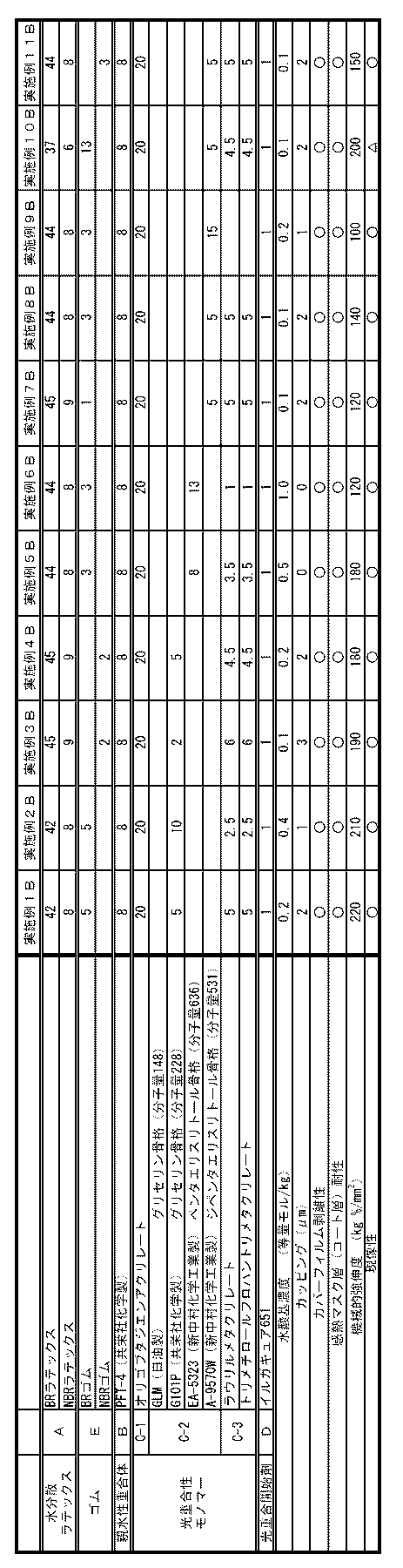
- Examples 2B to 11B, Comparative Examples 1B to 10B Examples 2B to 11B and Comparative Examples 1B to 10B are the same as Example 1B except that only the components (A), (E), (C-2), and (C-3) are changed as shown in Tables 2 and 3.
- a photosensitive resin composition and a resin original plate were prepared and evaluated. Details of the photosensitive resin composition (only components (A) to (E)) and evaluation results are shown in Tables 2 and 3.
- the flexographic printing plate using the photosensitive resin composition of the present invention is excellent in image reproducibility and developability, and also prevents printing scum by minimizing the bulge of the relief edge, and also has printing durability. Since it is satisfied, it can be effectively used as a CTP photosensitive flexographic printing original plate.
Landscapes
- Physics & Mathematics (AREA)
- Spectroscopy & Molecular Physics (AREA)
- General Physics & Mathematics (AREA)
- Chemical & Material Sciences (AREA)
- Chemical Kinetics & Catalysis (AREA)
- Materials For Photolithography (AREA)
- Photosensitive Polymer And Photoresist Processing (AREA)
Description
(1)少なくとも(A)水分散ラテックスから得られる疎水性重合体、(B)親水性重合体、(C)光重合性不飽和化合物、及び(D)光重合開始剤を含む感光性樹脂組成物であって、(C)光重合性不飽和化合物が、(C-1)水酸基非含有光重合性オリゴマー、(C-2)ペンタエリスリトール骨格、ジペンタエリスリトール骨格又はグリセリン骨格を持つ重量平均分子量200~1500の水酸基含有光重合性モノマー、及び所望により(C-3)水酸基非含有光重合性モノマーからなり、(C-2)水酸基含有光重合性モノマーの含有量が感光性樹脂組成物の1~20質量%であることを特徴とするCTPフレキソ印刷原版用感光性樹脂組成物。
(2)(E)ゴムをさらに含有し、(E)ゴムの含有量が感光性樹脂組成物の0.5~15質量%であることを特徴とする(1)に記載のCTPフレキソ印刷原版用感光性樹脂組成物。
(3)(E)ゴムの含有量が感光性樹脂組成物の1~7質量%であることを特徴とする(2)に記載のCTPフレキソ印刷原版用感光性樹脂組成物。
(4)(C-2)水酸基含有光重合性モノマー由来の水酸基濃度が0.1~1.5等量モル/kgであることを特徴とする(1)~(3)のいずれかに記載のCTPフレキソ印刷原版用感光性樹脂組成物。
(5)(1)~(4)のいずれかに記載の感光性樹脂組成物からなる感光性樹脂層の表面に、感熱マスク層を設けたことを特徴とするCTPフレキソ印刷原版。
実施例及び比較例のそれぞれで得られた感光性樹脂組成物を、厚さ250μmのポリエチレンテレフタレートフィルム上にポリエステル系接着層を10μm厚でコーティングした支持体と、厚さ125μmのポリエチレンテレフタレートフィルム上に保護層(ポリビニルアルコール)と感熱マスク層(ブチラール樹脂にカーボンブラックを分散)をコーティングしたカバーフィルムとで、接着層、保護層が感光性樹脂組成物と接触するように挟み、ヒートプレス機で100℃、15MPaの圧力で1分間加温加圧することにより、感光性樹脂層の厚みが1.0mmの感光性樹脂原版を作製した。
感光性樹脂原版を350nmにおける照度8.0w/m2の紫外線用蛍光灯(PHILIPS社製 10R)を用いて、10秒の裏露光を行い、カバーフィルムを剥離した。次にIRレーザー照射機で少なくとも線幅300μmの細線を含む画像を樹脂版感熱マスク層にアブレーションした。その後、同様の紫外線用蛍光灯で主露光し、現像装置で7分間現像した。現像液としては、アルキルナフタレンスルホン酸ソーダを4質量%含有する40℃の中性水を使用した。次いで現像された版の水切りを行い、60℃で10分間乾燥し、同様の紫外線用蛍光灯を用いて5分間後露光を行い、その後殺菌灯を5分間照射して表面処理をし、評価レリーフを得た。
上記方法で作成した評価レリーフを金属製ボードに磁石を使って固定し、KEIENCE製超深度カラー3D形状測定顕微鏡(VK‐9500)で評価レリーフの300μm細線を3D撮影した。300μm細線トップ部の最も低い所から最も高いところまでの距離(μm)をカッピング値とした。カッピング値は、数値が低いほど良好であることを示す。
カバーフィルム剥離性は、上記方法で作成した感光性樹脂原版を24時間遮光条件で放置した後、カバーフィルムを剥離できるものを○、カバーフィルムを剥離できないものを×とした。
(C)光重合性不飽和化合物に対する感熱マスク層(コート層)耐性の評価は、厚さ125μmのポリエチレンテレフタレートフィルム上に保護層(ポリビニルアルコール)と感熱マスク層(ブチラール樹脂にカーボンブラックを分散)をコーティングしたカバーフィルムのコート表面に、(C)光重合性不飽和化合物を含ませたガーゼを貼り付けた。10分後に(C)光重合性不飽和化合物を含ませたガーゼを外して新しいガーゼでコート面を擦り、その時点でコートがはがれるものを×とし、24時間後に(C)光重合性不飽和化合物を含ませたガーゼを外して新しいガーゼでコート面を擦り、その時点でコートが剥がれるものを△とした。なお、×にも△にも該当するものは×とし、×にも△にも該当しないものを○とした。
厚み1mmにヒートプレスした感光性樹脂組成物を光硬化させたのち、金型で抜き取り、テンシロン(クロスヘッド100kg使用)の引っ張り試験により、試験速度200mm/分で測定した伸度と強度を掛け合わせた(kg%/mm2)。
上記方法で作成した評価レリーフの光照射部と非照射部の高さの差(レリーフ深度)が0.2mm未満のものを×、0.2mm以上0.4mm未満のものを△、0.4mm以上のものを○とした。
(A)成分であるブタジエンラテックス(Nipol LX111NF、日本ゼオン(株)製)45質量部(固形分)、アクリロニトリル-ブタジエンラテックス(Nipol SX1503、日本ゼオン(株)製)10質量部(固形分)、(B)成分である親水性重合体(PFT-3、共栄社化学(株)製)12質量部(固形分)、(C)成分である(C-1)成分としては、オリゴブタジエンアクリレート(ABU-4、共栄社化学(株)製)12質量部、(C-2)成分としては、グリセリンモノメタクリレート(G101P、共栄社化学(株)製)7.5質量部、(C-3)成分としては、ラウリルメタクリレート7.5質量部、(D)成分である光重合開始剤0.7質量部、重合禁止剤としてハイドロキノンモノメチルエーテル0.03質量部、その他の添加剤としてカルボン酸系共重合体0.04質量部をトルエン15質量部とともに容器中で混合し、ニーダーを用いて80℃で混練しながら、トルエンと水を減圧除去した。得られた感光性樹脂組成物を上記感光性樹脂版の作成法のとおり樹脂原版を作成した。得られた原版を上記の方法でカッピング、カバーフィルム剥離性、感熱マスク層(コート層)耐性について評価した。感光性樹脂組成物の詳細((C)成分のみ)と評価結果を表1に示す。
実施例2A~6A、比較例1A~6Aは、(C-2)、(C-3)成分のみを表1のように変更した以外は実施例1Aと同様に感光性樹脂組成物、樹脂原版を作成し、評価した。感光性樹脂組成物の詳細((C)成分のみ)と評価結果を表1に示す。

(A)成分であるポリブタジエンラテックス(Nipol LX111NF、日本ゼオン(株)製)42質量部(固形分)、アクリロニトリル-ブタジエン共重合体ラテックス(Nipol SX1503、日本ゼオン(株)製)8質量部(固形分)、(E)成分であるBRゴム(Nippol BR1220 日本ゼオン(株)製)5質量部(固形分)、トルエン80質量部を60℃で加熱し、ゴム溶解液を作成した。これを室温まで放冷し、さらに(B)成分である親水性重合体(PFT-4、共栄社化学(株)製)8質量部(固形分)、(C-1)成分であるオリゴブタジエンアクリレート(ABU-4、共栄社化学(株)製)20質量部、(C-2)成分であるグリセリンジメタクリレート(G101P、共栄社化学(株)製)5質量部、(C-3)成分であるラウリルメタクリレート5質量部、トリメチロールプロパントリメタクリレート5質量部、(D)成分である光重合開始剤(イルガキュア651)1質量部、重合禁止剤としてハイドロキノンモノメチルエーテル0.05質量部、その他の添加剤としてカルボン酸系共重合体0.05質量部をトルエン15質量部とともに容器中で混合し、ニーダーを用いて80℃で混練しながら、トルエンと水を減圧除去した。得られた感光性樹脂組成物を用いて上記の感光性樹脂原版の作成に従って樹脂原版を作成した。得られた原版を上記の評価項目の全てについて評価した。感光性樹脂組成物の詳細((A)~(E)成分のみ)と評価結果を表2に示す。
実施例2B~11B、比較例1B~10Bは、(A)、(E)、(C-2)、(C-3)成分のみを表2,3のように変更した以外は実施例1Bと同様に感光性樹脂組成物、樹脂原版を作成し、評価した。感光性樹脂組成物の詳細((A)~(E)成分のみ)と評価結果を表2、表3に示す。

Claims (5)
- 少なくとも(A)水分散ラテックスから得られる疎水性重合体、(B)親水性重合体、(C)光重合性不飽和化合物、及び(D)光重合開始剤を含む感光性樹脂組成物であって、(C)光重合性不飽和化合物が、(C-1)水酸基非含有光重合性オリゴマー、(C-2)ペンタエリスリトール骨格、ジペンタエリスリトール骨格又はグリセリン骨格を持つ重量平均分子量200~1500の水酸基含有光重合性モノマー、及び所望により(C-3)水酸基非含有光重合性モノマーからなり、(C-2)水酸基含有光重合性モノマーの含有量が感光性樹脂組成物の1~20質量%であることを特徴とするCTPフレキソ印刷原版用感光性樹脂組成物。
- (E)ゴムをさらに含有し、(E)ゴムの含有量が感光性樹脂組成物の0.5~15質量%であることを特徴とする請求項1に記載のCTPフレキソ印刷原版用感光性樹脂組成物。
- (E)ゴムの含有量が感光性樹脂組成物の1~7質量%であることを特徴とする請求項2に記載のCTPフレキソ印刷原版用感光性樹脂組成物。
- (C-2)水酸基含有光重合性モノマー由来の水酸基濃度が0.1~1.5等量モル/kgであることを特徴とする請求項1~3のいずれかに記載のCTPフレキソ印刷原版用感光性樹脂組成物。
- 請求項1~4のいずれかに記載の感光性樹脂組成物からなる感光性樹脂層の表面に、感熱マスク層を設けたことを特徴とするCTPフレキソ印刷原版。
Priority Applications (6)
| Application Number | Priority Date | Filing Date | Title |
|---|---|---|---|
| ES13769719T ES2735628T3 (es) | 2012-03-30 | 2013-03-22 | Composición de resina fotosensible para placa original de impresión flexográfica CTP, y placa original de impresión flexográfica preparada a partir de ella |
| US14/375,518 US9709888B2 (en) | 2012-03-30 | 2013-03-22 | Photosensitive resin composition for CTP flexographic printing original plate and printing original plate prepared therefrom |
| PL13769719T PL2833202T3 (pl) | 2012-03-30 | 2013-03-22 | Kompozycja żywicy światłoczułej dla fleksograficznej pierwotnej płyty drukowej CTP i wytworzona z niej pierwotna płyta drukowa |
| EP13769719.9A EP2833202B1 (en) | 2012-03-30 | 2013-03-22 | Photosensitive resin composition for ctp flexographic printing original plate and printing original plate prepared therefrom |
| JP2013513439A JP6079625B2 (ja) | 2012-03-30 | 2013-03-22 | Ctpフレキソ印刷原版用感光性樹脂組成物およびそれから得られる印刷原版 |
| CN201380017365.9A CN104246604A (zh) | 2012-03-30 | 2013-03-22 | 用于ctp柔版印刷原版的感光性树脂组合物及由其制得的印刷原版 |
Applications Claiming Priority (4)
| Application Number | Priority Date | Filing Date | Title |
|---|---|---|---|
| JP2012-080265 | 2012-03-30 | ||
| JP2012080265 | 2012-03-30 | ||
| JP2013-016562 | 2013-01-31 | ||
| JP2013016562 | 2013-01-31 |
Publications (1)
| Publication Number | Publication Date |
|---|---|
| WO2013146586A1 true WO2013146586A1 (ja) | 2013-10-03 |
Family
ID=49259841
Family Applications (1)
| Application Number | Title | Priority Date | Filing Date |
|---|---|---|---|
| PCT/JP2013/058284 Ceased WO2013146586A1 (ja) | 2012-03-30 | 2013-03-22 | Ctpフレキソ印刷原版用感光性樹脂組成物およびそれから得られる印刷原版 |
Country Status (7)
| Country | Link |
|---|---|
| US (1) | US9709888B2 (ja) |
| EP (1) | EP2833202B1 (ja) |
| JP (1) | JP6079625B2 (ja) |
| CN (1) | CN104246604A (ja) |
| ES (1) | ES2735628T3 (ja) |
| PL (1) | PL2833202T3 (ja) |
| WO (1) | WO2013146586A1 (ja) |
Cited By (3)
| Publication number | Priority date | Publication date | Assignee | Title |
|---|---|---|---|---|
| US9575230B2 (en) | 2010-05-03 | 2017-02-21 | Basf Se | Color filter for low temperature applications |
| CN110462519A (zh) * | 2017-03-31 | 2019-11-15 | 东洋纺株式会社 | 感光性ctp柔性版印刷原版 |
| JPWO2020090978A1 (ja) * | 2018-10-31 | 2021-09-24 | 富士フイルム株式会社 | フレキソ印刷版原版及びフレキソ印刷版 |
Families Citing this family (5)
| Publication number | Priority date | Publication date | Assignee | Title |
|---|---|---|---|---|
| EP3401732B1 (de) | 2017-05-11 | 2020-02-05 | Folex AG | Hochauflösende flexodruckplatte und mittel zu deren herstellung |
| EP3657255A4 (en) | 2017-07-20 | 2020-08-19 | Asahi Kasei Kabushiki Kaisha | PHOTOSENSITIVE RESIN STRUCTURE FOR PRINTING PLATE AND ASSOCIATED PRODUCTION PROCESS |
| EP3650239B1 (en) * | 2017-12-26 | 2023-04-19 | Sumitomo Riko Company Limited | Flexographic printing plate precursor |
| EP4019254A4 (en) * | 2019-08-23 | 2023-04-19 | Toyobo Co., Ltd. | ORIGINAL FLEXOGRAPHIC PRINTING PLATE |
| EP3832389A1 (de) | 2019-12-06 | 2021-06-09 | Folex AG | Hochauflösende flexodruckplatte und mittel zu deren herstellung mit verbesserter sperrschicht und haftungsmodulierende schicht |
Citations (6)
| Publication number | Priority date | Publication date | Assignee | Title |
|---|---|---|---|---|
| JP2001356493A (ja) * | 2000-06-16 | 2001-12-26 | Toyobo Co Ltd | 感光性樹脂組成物 |
| JP2007086152A (ja) * | 2005-09-20 | 2007-04-05 | Toyobo Co Ltd | 感光性樹脂積層体 |
| JP2008250055A (ja) * | 2007-03-30 | 2008-10-16 | Toyobo Co Ltd | 感光性樹脂組成物及びそれを用いた感光性樹脂印刷原版 |
| WO2008156115A1 (ja) * | 2007-06-18 | 2008-12-24 | Asahi Kasei E-Materials Corporation | 感光性樹脂組成物、フレキソ印刷版、及びフレキソ印刷版の製造方法 |
| JP4332865B1 (ja) | 2008-05-23 | 2009-09-16 | 東洋紡績株式会社 | フレキソ印刷原版 |
| JP2009288700A (ja) * | 2008-05-30 | 2009-12-10 | Toray Ind Inc | フレキソ印刷版の製造方法 |
Family Cites Families (11)
| Publication number | Priority date | Publication date | Assignee | Title |
|---|---|---|---|---|
| US4517278A (en) * | 1981-01-13 | 1985-05-14 | Nippon Paint Co., Ltd. | Flexographic printing plates and process for making the same |
| JP4211141B2 (ja) * | 1998-06-26 | 2009-01-21 | 東レ株式会社 | 感光性樹脂組成物、感光性樹脂組成物の製造方法および印刷版材 |
| US6197479B1 (en) * | 1998-06-26 | 2001-03-06 | Toray Industries, Inc. | Photosensitive resin composition, method for producing photosensitive resin composition, and printing plate material |
| JP2000214594A (ja) * | 1999-01-25 | 2000-08-04 | Toray Ind Inc | フレキソ版材 |
| JP2003107680A (ja) * | 2001-09-28 | 2003-04-09 | Toray Ind Inc | フレキソ版材の露光方法 |
| JP2004163532A (ja) * | 2002-11-11 | 2004-06-10 | Toyobo Co Ltd | 感光性樹脂積層体 |
| JP2004295120A (ja) * | 2003-03-13 | 2004-10-21 | Toray Ind Inc | 感光性樹脂積層体およびそれを用いた印刷版材 |
| JP4487208B2 (ja) * | 2003-04-07 | 2010-06-23 | 東洋紡績株式会社 | 感光性樹脂組成物、それを用いた感光層および感光性樹脂印刷用原版 |
| JP5228572B2 (ja) * | 2008-03-31 | 2013-07-03 | 東洋紡株式会社 | レーザー彫刻可能なフレキソ印刷原版 |
| JP4258786B1 (ja) * | 2008-06-18 | 2009-04-30 | 東洋紡績株式会社 | レーザー彫刻可能なフレキソ印刷原版 |
| JP4247725B1 (ja) | 2008-07-16 | 2009-04-02 | 東洋紡績株式会社 | 感光性凸版印刷原版 |
-
2013
- 2013-03-22 EP EP13769719.9A patent/EP2833202B1/en active Active
- 2013-03-22 US US14/375,518 patent/US9709888B2/en active Active
- 2013-03-22 ES ES13769719T patent/ES2735628T3/es active Active
- 2013-03-22 PL PL13769719T patent/PL2833202T3/pl unknown
- 2013-03-22 JP JP2013513439A patent/JP6079625B2/ja active Active
- 2013-03-22 CN CN201380017365.9A patent/CN104246604A/zh active Pending
- 2013-03-22 WO PCT/JP2013/058284 patent/WO2013146586A1/ja not_active Ceased
Patent Citations (6)
| Publication number | Priority date | Publication date | Assignee | Title |
|---|---|---|---|---|
| JP2001356493A (ja) * | 2000-06-16 | 2001-12-26 | Toyobo Co Ltd | 感光性樹脂組成物 |
| JP2007086152A (ja) * | 2005-09-20 | 2007-04-05 | Toyobo Co Ltd | 感光性樹脂積層体 |
| JP2008250055A (ja) * | 2007-03-30 | 2008-10-16 | Toyobo Co Ltd | 感光性樹脂組成物及びそれを用いた感光性樹脂印刷原版 |
| WO2008156115A1 (ja) * | 2007-06-18 | 2008-12-24 | Asahi Kasei E-Materials Corporation | 感光性樹脂組成物、フレキソ印刷版、及びフレキソ印刷版の製造方法 |
| JP4332865B1 (ja) | 2008-05-23 | 2009-09-16 | 東洋紡績株式会社 | フレキソ印刷原版 |
| JP2009288700A (ja) * | 2008-05-30 | 2009-12-10 | Toray Ind Inc | フレキソ印刷版の製造方法 |
Cited By (5)
| Publication number | Priority date | Publication date | Assignee | Title |
|---|---|---|---|---|
| US9575230B2 (en) | 2010-05-03 | 2017-02-21 | Basf Se | Color filter for low temperature applications |
| US10690825B2 (en) | 2010-05-03 | 2020-06-23 | Basf Se | Color filter for low temperature applications |
| CN110462519A (zh) * | 2017-03-31 | 2019-11-15 | 东洋纺株式会社 | 感光性ctp柔性版印刷原版 |
| CN110462519B (zh) * | 2017-03-31 | 2023-05-02 | 东洋纺株式会社 | 感光性ctp柔性版印刷原版 |
| JPWO2020090978A1 (ja) * | 2018-10-31 | 2021-09-24 | 富士フイルム株式会社 | フレキソ印刷版原版及びフレキソ印刷版 |
Also Published As
| Publication number | Publication date |
|---|---|
| JP6079625B2 (ja) | 2017-02-15 |
| US9709888B2 (en) | 2017-07-18 |
| US20140370440A1 (en) | 2014-12-18 |
| EP2833202A4 (en) | 2015-12-16 |
| ES2735628T3 (es) | 2019-12-19 |
| EP2833202B1 (en) | 2019-06-05 |
| EP2833202A1 (en) | 2015-02-04 |
| PL2833202T3 (pl) | 2019-11-29 |
| CN104246604A (zh) | 2014-12-24 |
| JPWO2013146586A1 (ja) | 2015-12-14 |
Similar Documents
| Publication | Publication Date | Title |
|---|---|---|
| JP6079625B2 (ja) | Ctpフレキソ印刷原版用感光性樹脂組成物およびそれから得られる印刷原版 | |
| JP5325823B2 (ja) | 感光性樹脂組成物、印刷版原版およびフレキソ印刷版 | |
| CN102016720B (zh) | 柔版印刷原版 | |
| JP5710961B2 (ja) | フレキソ印刷版原版 | |
| US8663808B2 (en) | Flexographic printing original plate | |
| WO2009153932A1 (ja) | レーザー彫刻可能なフレキソ印刷原版 | |
| EP2894515B1 (en) | Photosensitive resin composition for flexographic printing original plate | |
| JP6238100B2 (ja) | フレキソ印刷原版用感光性樹脂組成物 | |
| JP2011033690A (ja) | フレキソ印刷版及びフレキソ印刷版作成方法 | |
| EP0501312B1 (en) | Process for treating periphery of unexposed photosensitive resin plate | |
| JPWO2008120468A1 (ja) | フレキソ印刷用感光性樹脂組成物 | |
| JP2017181781A (ja) | Ctpフレキソ印刷原版用感光性樹脂組成物およびそれから得られる印刷原版 | |
| JP2003035955A (ja) | 感光性印刷用原版 | |
| JP2004170597A (ja) | 感光性印刷用原版 | |
| JP2004163532A (ja) | 感光性樹脂積層体 | |
| JP2004317660A (ja) | 感光性樹脂用水性現像液組成物 | |
| JP2009006601A (ja) | レーザー彫刻可能な印刷原版用樹脂組成物、及びかかる組成物から得られるレーザー彫刻可能な印刷原版 | |
| JP6299073B2 (ja) | フレキソ印刷原版用感光性樹脂組成物 | |
| JP2023049236A (ja) | 感光性フレキソ印刷版原版 | |
| JP2007086152A (ja) | 感光性樹脂積層体 | |
| JP2023049238A (ja) | 感光性フレキソ印刷版原版、それを用いたフレキソ印刷版および印刷物の製造方法 | |
| JP2004004628A (ja) | 感光性樹脂組成物、これを用いた感光性フレキソ印刷版原版およびフレキソ印刷版 | |
| JP2004309985A (ja) | 感光性樹脂積層体 |
Legal Events
| Date | Code | Title | Description |
|---|---|---|---|
| ENP | Entry into the national phase |
Ref document number: 2013513439 Country of ref document: JP Kind code of ref document: A |
|
| 121 | Ep: the epo has been informed by wipo that ep was designated in this application |
Ref document number: 13769719 Country of ref document: EP Kind code of ref document: A1 |
|
| WWE | Wipo information: entry into national phase |
Ref document number: 14375518 Country of ref document: US |
|
| WWE | Wipo information: entry into national phase |
Ref document number: 2013769719 Country of ref document: EP |
|
| NENP | Non-entry into the national phase |
Ref country code: DE |