WO2013146836A1 - 乳酸菌培養物およびその製造方法 - Google Patents
乳酸菌培養物およびその製造方法 Download PDFInfo
- Publication number
- WO2013146836A1 WO2013146836A1 PCT/JP2013/058911 JP2013058911W WO2013146836A1 WO 2013146836 A1 WO2013146836 A1 WO 2013146836A1 JP 2013058911 W JP2013058911 W JP 2013058911W WO 2013146836 A1 WO2013146836 A1 WO 2013146836A1
- Authority
- WO
- WIPO (PCT)
- Prior art keywords
- lactic acid
- acid bacteria
- tea
- culture
- medium
- Prior art date
- Legal status (The legal status is an assumption and is not a legal conclusion. Google has not performed a legal analysis and makes no representation as to the accuracy of the status listed.)
- Ceased
Links
Classifications
-
- C—CHEMISTRY; METALLURGY
- C12—BIOCHEMISTRY; BEER; SPIRITS; WINE; VINEGAR; MICROBIOLOGY; ENZYMOLOGY; MUTATION OR GENETIC ENGINEERING
- C12N—MICROORGANISMS OR ENZYMES; COMPOSITIONS THEREOF; PROPAGATING, PRESERVING, OR MAINTAINING MICROORGANISMS; MUTATION OR GENETIC ENGINEERING; CULTURE MEDIA
- C12N1/00—Microorganisms; Compositions thereof; Processes of propagating, maintaining or preserving microorganisms or compositions thereof; Processes of preparing or isolating a composition containing a microorganism; Culture media therefor
- C12N1/20—Bacteria; Culture media therefor
-
- A—HUMAN NECESSITIES
- A23—FOODS OR FOODSTUFFS; TREATMENT THEREOF, NOT COVERED BY OTHER CLASSES
- A23C—DAIRY PRODUCTS, e.g. MILK, BUTTER OR CHEESE; MILK OR CHEESE SUBSTITUTES; PREPARATION THEREOF
- A23C9/00—Milk preparations; Milk powder or milk powder preparations
- A23C9/12—Fermented milk preparations; Treatment using microorganisms or enzymes
- A23C9/123—Fermented milk preparations; Treatment using microorganisms or enzymes using only microorganisms of the genus lactobacteriaceae; Yoghurt
- A23C9/1234—Fermented milk preparations; Treatment using microorganisms or enzymes using only microorganisms of the genus lactobacteriaceae; Yoghurt characterised by using a Lactobacillus sp. other than Lactobacillus Bulgaricus, including Bificlobacterium sp.
-
- C—CHEMISTRY; METALLURGY
- C12—BIOCHEMISTRY; BEER; SPIRITS; WINE; VINEGAR; MICROBIOLOGY; ENZYMOLOGY; MUTATION OR GENETIC ENGINEERING
- C12N—MICROORGANISMS OR ENZYMES; COMPOSITIONS THEREOF; PROPAGATING, PRESERVING, OR MAINTAINING MICROORGANISMS; MUTATION OR GENETIC ENGINEERING; CULTURE MEDIA
- C12N1/00—Microorganisms; Compositions thereof; Processes of propagating, maintaining or preserving microorganisms or compositions thereof; Processes of preparing or isolating a composition containing a microorganism; Culture media therefor
- C12N1/38—Chemical stimulation of growth or activity by addition of chemical compounds which are not essential growth factors; Stimulation of growth by removal of a chemical compound
-
- A—HUMAN NECESSITIES
- A23—FOODS OR FOODSTUFFS; TREATMENT THEREOF, NOT COVERED BY OTHER CLASSES
- A23C—DAIRY PRODUCTS, e.g. MILK, BUTTER OR CHEESE; MILK OR CHEESE SUBSTITUTES; PREPARATION THEREOF
- A23C2240/00—Use or particular additives or ingredients
- A23C2240/15—Use of plant extracts, including purified and isolated derivatives thereof, as ingredient in dairy products
-
- A—HUMAN NECESSITIES
- A23—FOODS OR FOODSTUFFS; TREATMENT THEREOF, NOT COVERED BY OTHER CLASSES
- A23V—INDEXING SCHEME RELATING TO FOODS, FOODSTUFFS OR NON-ALCOHOLIC BEVERAGES AND LACTIC OR PROPIONIC ACID BACTERIA USED IN FOODSTUFFS OR FOOD PREPARATION
- A23V2400/00—Lactic or propionic acid bacteria
- A23V2400/11—Lactobacillus
- A23V2400/125—Casei
-
- A—HUMAN NECESSITIES
- A23—FOODS OR FOODSTUFFS; TREATMENT THEREOF, NOT COVERED BY OTHER CLASSES
- A23V—INDEXING SCHEME RELATING TO FOODS, FOODSTUFFS OR NON-ALCOHOLIC BEVERAGES AND LACTIC OR PROPIONIC ACID BACTERIA USED IN FOODSTUFFS OR FOOD PREPARATION
- A23V2400/00—Lactic or propionic acid bacteria
- A23V2400/11—Lactobacillus
- A23V2400/145—Gasseri
Definitions
- the present invention relates to a lactic acid bacteria culture obtained by culturing lactic acid bacteria and a method for producing the same.
- lactic acid bacteria The cultivation of lactic acid bacteria is carried out in various forms, and is most often carried out using animal milk as a medium for the production of lactic acid bacteria preparations and the production of fermented milk, lactic acid bacteria beverages, cheese and the like.
- animal milk As a medium for the production of lactic acid bacteria preparations and the production of fermented milk, lactic acid bacteria beverages, cheese and the like.
- lactic acid bacteria have different nutritional requirements depending on the type of the lactic acid bacteria, so that they do not grow so much in a medium consisting only of animal milk.
- culturing for several days In order to obtain a fermented product having sufficient acidity in producing fermented milk, lactic acid bacteria beverages, etc., it is said that culturing for several days must be performed.
- chlorella extract in general, chlorella extract, iron salts, vitamins, proteolysates containing amino acids and peptides, yeast extract and the like can be mentioned as examples of substances that are effective as growth promoting substances.
- Patent Document 1 The present applicant has also reported that strawberry tea extract or the like is added in order to enhance the growth and survival in culturing lactic acid bacteria.
- an object of the present invention is to provide a technique for improving the flavor while maintaining the effect of strawberry tea extract to increase the growth and survival of lactic acid bacteria.
- the present invention is a lactic acid bacterium culture characterized by being obtained by cultivating lactic acid bacteria in a medium containing strawberry tea essence obtained by electrodialysis of a strawberry tea extract to which an inorganic salt is added, and being obtained as a concentrate.
- the present invention is obtained by electrodialyzing a strawberry tea extract to which an inorganic salt is added, and blending the strawberry tea essence obtained as a concentrate into the medium at any stage.
- a method for producing a lactic acid bacteria culture is obtained by electrodialyzing a strawberry tea extract to which an inorganic salt is added, and blending the strawberry tea essence obtained as a concentrate into the medium at any stage.
- the present invention is a method for promoting the growth of lactic acid bacteria, comprising electrodialyzing a tea medium extract with an inorganic salt added to a medium, blending a tea tea essence obtained as a concentrate, and culturing the lactic acid bacteria.
- the lactic acid bacterium culture of the present invention is obtained by electrodialyzing a strawberry tea extract with an inorganic salt added during culturing of lactic acid bacteria, and adding a strawberry tea essence obtained as a concentrated solution. Since it is increasing, the number of viable bacteria is large, it is maintained, and there is no bitterness derived from strawberry tea, and the flavor is good.
- the lactic acid bacteria culture of the present invention has no problem with flavor and can be used for various fermented milk foods. And this fermented milk food is highly useful with little deterioration in flavor and decrease in the number of viable bacteria during storage, and is useful for promoting health.
- the lactic acid bacteria fermented product of the present invention is obtained by electrodialyzing a tea tea extract added with an inorganic salt and culturing lactic acid bacteria in a medium containing a tea tea essence obtained as a concentrate.
- the tea essence obtained as a concentrate by electrodialyzing a tea extract obtained by adding an inorganic salt to the lactic acid bacteria fermented product is obtained as follows. First, the leaves, stems, and preferably leaves of the strawberry genus strawberry genus (Rubus suavissimus S. Lee (Rosaceae)) were subjected to treatments such as washing, molting, drying and crushing as they are or as needed. Thereafter, extraction with a solvent yields a tea extract.
- the strawberry genus strawberry genus Rubus suavissimus S. Lee (Rosaceae)
- the solvent used for the production of the above tea extract is not particularly limited, and examples thereof include water, lower alcohols having 1 to 5 carbon atoms such as ethanol, and organic solvents such as ethyl acetate, glycerin and propylene glycol. May be used alone or in combination of two or more. Among these solvents, water or an aqueous solvent such as water-lower alcohol is particularly preferable.
- the extraction method of the tea extract using the above solvent is not particularly limited, but for example, the acid extraction method is preferable.
- the acid extraction is more preferably carried out under acidic conditions of pH 4.0 or less, preferably pH 3.0 to 4.0.
- the acid component used to adjust the pH of the solvent can be used without particular limitation as long as it is acidic, but preferred are citric acid, Mention may be made of organic acids such as malic acid, tartaric acid, succinic acid, lactic acid, acetic acid.
- the extraction conditions of the strawberry tea extract using the above solvent are not particularly limited.
- the extraction is performed at a temperature of 0 ° C. or higher and 100 ° C. or lower, more preferably 10 ° C. or higher and 40 ° C. or lower for about 30 to 60 minutes. It is preferable to carry out the treatment.
- the tea extract obtained in this way is filtered, centrifuged, etc., if necessary, and further added with an inorganic salt and subjected to electrodialysis.
- the inorganic salt added to the tea extract is not particularly limited as long as it is a salt composed of an inorganic acid and an inorganic base.
- potassium salts such as potassium chloride
- sodium salts such as sodium chloride
- calcium salts such as calcium chloride
- the 1 type (s) or 2 or more types chosen from magnesium salts, such as magnesium chloride are mentioned.
- magnesium salts are preferable, and magnesium chloride is more preferable.
- the addition amount of the inorganic salt is not particularly limited, but is preferably 0.01 to 0.5 mol / L, more preferably 0.02 to 0.2 mol / L in terms of anhydride.
- These inorganic salts may be hydrates or anhydrides.
- an electrodialysis treatment apparatus used for electrodialysis for example, a cathode and an anode are alternately partitioned by a plurality of cation exchange membranes and anion exchange membranes, and a cathode chamber, an anode chamber, and a plurality of desalting salts. And a room equipped with a chamber and a plurality of concentration chambers.
- a liquid in which an ionic substance is concentrated concentrated
- a liquid in which the ionic substance is removed desalted liquid
- the portion partitioned by the cation exchange membrane on the anode side and the anion exchange membrane on the cathode side is the concentration chamber, and the liquid refluxed to the concentration chamber is the concentrate.
- the portion partitioned by the anion exchange membrane on the anode side and the cation exchange membrane on the cathode side is a desalting chamber, and the liquid refluxed to the desalting chamber is a desalting solution. Since the electrodialysis apparatus is also marketed with names such as an acylizer (Astom Co., Ltd.), these can also be used.
- the above tea tea essence can be obtained by refluxing the tea extract obtained by adding inorganic salt to the desalting chamber of the electrodialysis apparatus, refluxing water or the like to the concentration chamber, performing electrodialysis treatment, and collecting the concentrate.
- the conditions for the electrodialysis are not particularly limited. For example, water corresponding to 5 to 50% by mass (hereinafter simply referred to as “%”) of the tea extract in the concentration chamber, preferably equivalent to 10 to 30% of water.
- % water corresponding to 5 to 50% by mass (hereinafter simply referred to as “%”) of the tea extract in the concentration chamber, preferably equivalent to 10 to 30% of water.
- a voltage of 10 to 200 V, preferably 50 to 100 V is applied between the cathode and the anode, and the electric conductivity of the desalting chamber is balanced (2) through a current of 10 to 200 A, preferably 50 to 100 A.
- An example is a method obtained by performing electrodialysis treatment until millisiemens per centimeter (mS / cm)) and collecting the concentrate.
- an electrolyte solution such as saline and citric acid can be used in addition to water.
- the tea tea essence obtained as described above can be used as it is after being electrodialyzed, or the obtained tea tea essence can be purified or concentrated by means of ultrafiltration, centrifugation, or the like, or Further, it may be used in the form of powder further dried by means such as spray drying or freeze drying.
- the addition amount of the above tea tea essence to the medium in which lactic acid bacteria can grow is not particularly limited.
- Brix.12 tea tea essence has a concentration in the medium of 0.01 to 1.0%, preferably 0. 0.01 to 0.5%, more preferably 0.02 to 0.2%.
- Brix is a value measured with a digital refractometer such as RX-7000 ⁇ (Atago Co., Ltd.).
- the addition time of the above tea tea essence to the medium is before fermentation of lactic acid bacteria, but is not limited thereto, and it may be added during the fermentation of lactic acid bacteria or after completion of fermentation of lactic acid bacteria. Good. It is also possible to add in multiple times. In particular, it is preferable to add the above tea essence before fermentation of lactic acid bacteria because the number of bacteria at the end of the culture and the viability of the bacteria can be maintained in a high state.
- milk such as cow's milk, goat's milk, horse milk, and sheep milk
- animal milk medium consisting of dairy products such as skim milk powder, whole milk powder, and fresh cream, and soy milk, etc.
- dairy products such as skim milk powder, whole milk powder, and fresh cream, and soy milk
- plant-derived liquid milk and various synthetic media examples include plant-derived liquid milk and various synthetic media.
- this culture medium may add the component used for a normal lactic acid bacteria culture medium. Examples of such components include vitamins such as vitamin A, vitamin Bs, vitamin C, and vitamin E, and salts such as various peptides, amino acids, calcium, and magnesium.
- oleic acids may be added to the medium.
- examples of such oleic acids include oleic acid, oleic acid salts such as sodium oleate and potassium oleate, oleic acid esters such as glycerin oleic acid ester, polyglycerin oleic acid ester, and sucrose oleic acid ester. Examples include acid derivatives.
- These oleic acids may be added so that the concentration in terms of oleic acid is generally 5 to 50 ppm, preferably 5 to 25 ppm in the medium.
- the lactic acid bacteria to be cultured for obtaining the fermented lactic acid bacteria of the present invention are not particularly limited as long as they are usually lactic acid bacteria used for food production.
- Lactobacillus casei Lactobacillus gasseri (Lactobacillus gasseri), Lactobacillus acidophilus, Lactobacillus cremoris, Lactobacillus helveticus, Lactobacillus salivarium, Lactobacillus salivarium , Lactobacillus yoghurti, Lactobacillus delbrukki Subspecies.
- Bulgaricus Lactobacillus delbrueckii subsp. Bulgaricus
- Lactobacillus delbrukii subspecies Lactobacillus delbrukii subspecies.
- lactic acid bacteria at least one lactic acid bacterium selected from the group consisting of Lactobacillus bacteria, Streptococcus bacteria and Lactococcus bacteria is preferable, among which Lactobacillus casei or Lactobacillus gasseri are preferable, Bacillus Kasei YIT9029 (FERM BP-1366, date of consignment: January 12, 1986, National Institute of Technology and Evaluation, Patent Biological Deposit Center (1 Chuo 1-chome, Tsukuba, Ibaraki, 305-8566, Japan) 6)) is preferred.
- a lactic acid bacterium refers to a facultative anaerobic bacterium and does not include a Bifidobacterium genus bacterium that is an obligate anaerobic bacterium.
- the culture conditions of the lactic acid bacteria for obtaining the fermented lactic acid bacteria of the present invention are not particularly limited.
- lactic acid bacteria are used in the medium, and the number of bacteria in the medium is about 1.0 ⁇ 10 3 to 1.0 ⁇ 10 9 cfu / ml. And incubating it at a temperature of about 30 to 40 ° C. for about 1 to 7 days.
- a method suitable for culturing lactic acid bacteria used from standing, stirring, shaking, aeration, etc. may be appropriately selected.
- the fermented lactic acid bacterium thus obtained has a large number of viable bacteria, is maintained, has no bitterness derived from strawberry tea, and has a good flavor. And this lactic-acid-bacteria fermented material can be made into fermented milk food by mixing this with the other by-product in which this thing is individual or it is normally recognized adding to fermented milk food.
- fermented milk foods include fermented soy milk or beverages such as fermented milk, dairy lactic acid bacteria beverages, hard yogurt, soft yogurt, plain yogurt, kefir, cheese, etc. It is.
- the fermented milk food of the present invention includes foods and drinks using various lactic acid bacteria, such as plain type, flavored type, fruit type, sweetness type, soft type, drink type, solid (hard) type, frozen type, etc. Fermented milk, lactic acid bacteria beverages, kefir, cheese and the like.
- These fermented milk foods include the above-described fermented lactic acid bacteria, as well as sweeteners such as syrup, and other food materials such as various sugars, thickeners, emulsifiers, various vitamins, etc. It is obtained by blending optional components. Specific examples of these food materials include sugars such as sucrose, glucose, fructose, palatinose, trehalose, lactose, xylose, maltose, sorbitol, xylitol, erythritol, lactitol, palatinit, reduced starch syrup, reduced maltose starch syrup, etc.
- sweeteners such as syrup
- other food materials such as various sugars, thickeners, emulsifiers, various vitamins, etc. It is obtained by blending optional components. Specific examples of these food materials include sugars such as sucrose, glucose, fructose, palatinose, trehalose, lactose, xylose, maltose, sorbitol, x
- High-sweetness sweeteners such as sugar alcohol, aspartame, thaumatin, sucralose, acesulfame K, stevia, agar, gelatin, carrageenan, guar gum, xanthan gum, pectin, locust bean gum, gellan gum, carboxymethylcellulose, soy polysaccharide, propylene glycol alginate, etc.
- Various thickeners stable), sucrose fatty acid ester, glycerin fatty acid ester, polyglycerin fatty acid ester, sorbitan fatty acid ester, lecithin emulsifier, etc.
- Milk fat such as cream, butter, sour cream
- acidulants such as citric acid, lactic acid, acetic acid, malic acid, tartaric acid, gluconic acid
- various vitamins such as vitamin A, vitamin B, vitamin C, vitamin E, calcium , Magnesium, zinc, iron, manganese and other minerals, yogurt, berry, orange, pear, perilla, citrus, apple, mint, grape, apricot, pair, custard cream, peach, Flavors such as melon, banana, tropical, herbal, tea and coffee can be listed.
- the fermented milk food obtained in this way has a good flavor and is highly useful even when stored with little deterioration in flavor and a decrease in the number of viable bacteria, which is useful for promoting health.
- Reference example 1 Manufactured tea extract: After processing the tea leaves, such as crushing, add 15 times the amount of water of the tea leaves and 5% of citric acid equivalent to the tea leaves to adjust the pH to 3.8. Extraction was performed. Furthermore, the obtained extract was concentrated 5 times with an evaporator to obtain a brown tea extract of Brix.
- Example 1 Production of culture (1): A 10% non-fat dry milk solution was used as a basic medium, and 0.2% of strawberry tea essence 1 prepared in Example 1 was added thereto, followed by heat sterilization at 100 ° C. for 15 minutes to prepare a culture medium. These media were inoculated with 0.1% of a starter of Lactobacillus casei (YIT9029) (initial number of bacteria: 1.5 ⁇ 10 6 cfu / ml), cultured at 37 ° C. for 24 hours, and then to 10 ° C. or less. Cooled to obtain a culture. For comparison, a culture produced in the same manner as described above was also obtained using a medium in which 0.2% of strawberry tea extract was added instead of strawberry tea essence 1.
- YIT9029 starter of Lactobacillus casei
- the pH of the culture was measured using a pH meter (HORIBA F-52), and the number of lactic acid bacteria was measured using a BCP medium (Eiken Chemical Co., Ltd.). Further, the acidity of the culture (9 g of the culture was taken and the titration value when the organic acid in the culture was titrated with 0.1 N sodium hydroxide until pH was 8.5: unit ml) was measured. Furthermore, the result of having evaluated the flavor of the obtained dairy product by the 3 expert panels according to the following evaluation criteria was shown in Table 1.
- Example 2 Production of culture (2): A culture was obtained in the same manner as in Example 1 except that the same amount of the tea tea essence 2 to 5 produced in Production Example 2 was used instead of the tea tea essence 1 (number of initial bacteria: 1.5 ⁇ 10 6 cfu / ml). ). For these cultures, the pH, acidity, and viable cell count of the cultures were measured in the same manner as in Example 1 to evaluate the flavor. These results are shown in Table 2.
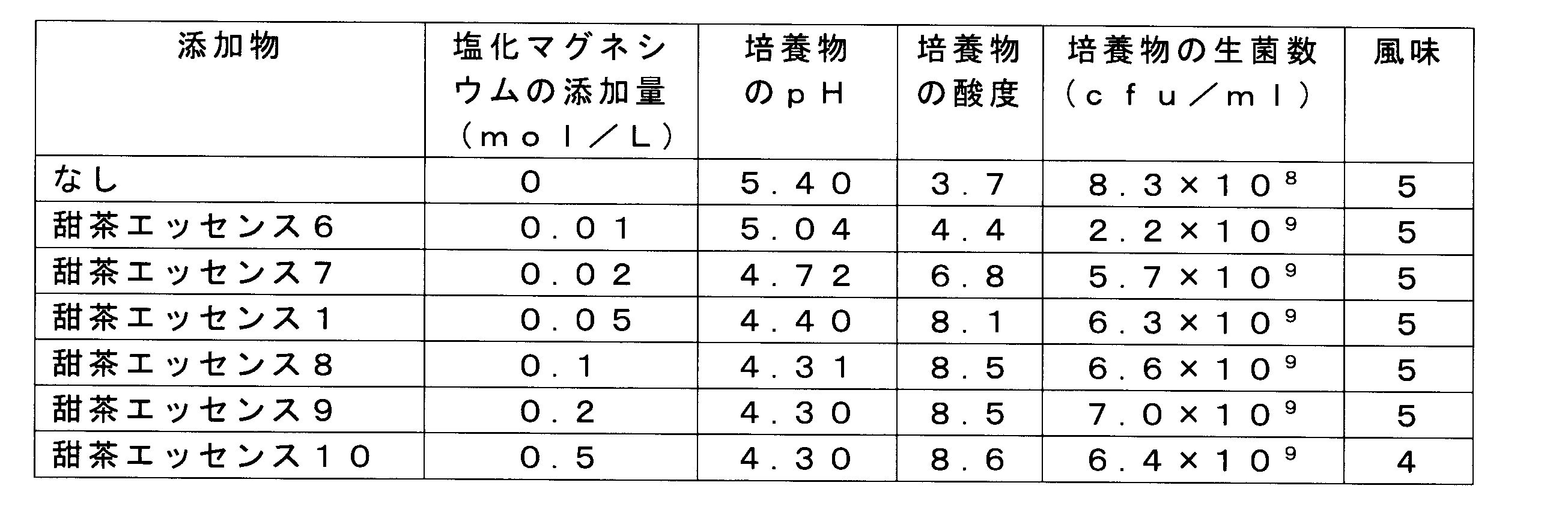
- Example 3 Production of culture (3): A culture was obtained in the same manner as in Example 1 except that the same amount of the tea tea essence 6 to 10 produced in Example 5 was used instead of the tea tea essence 1 (number of initial bacteria: 1.5 ⁇ 10 6 cfu / ml). ). For these cultures, the pH, acidity, and viable cell count of the cultures were measured in the same manner as in Example 1 to evaluate the flavor. These results are shown in Table 3.
- the effect of promoting the growth of lactic acid bacteria is that the tea essence obtained by adding magnesium chloride to the tea extract and electrodialyzing it to obtain a concentrated liquid, especially the tea essence containing 0.02% or more of magnesium chloride.
- the tendency which becomes remarkable by using was recognized.
- magnesium chloride was added, it was found that if it was 0.2% or less, the flavor was not adversely affected.
- Example 4 Production of culture (4): A culture was obtained in the same manner as in Example 1 except that the amount of strawberry tea essence 1 was 0.01, 0.02, 0.05, 0.1, and 0.5% (number of initial bacteria: 1 0.5 ⁇ 10 6 cfu / ml). For these cultures, the pH, acidity, and viable cell count of the culture were measured in the same manner as in Example 2 to evaluate the flavor. These results are shown in Table 4. In addition, the culture medium 5 of Table 4 is the same as the culture medium which added the tea tea essence 1 of Example 1. FIG.
- Example 5 Production of culture (5): Lactobacillus casei (YIT9029) or Lactobacillus gasseri (YIT0192) is used as a lactic acid bacterium, and culture is carried out in the same manner as in Example 1 using a basic medium and a medium (culture medium 5) containing 0.2% of strawberry tea essence. (Number of initial bacteria: Lactobacillus casei 1.5 ⁇ 10 6 cfu / ml, Lactobacillus gasseri 4.5 ⁇ 10 5 cfu / ml). For these cultures, the pH, acidity, and viable cell count of the cultures were measured in the same manner as in Example 1 to evaluate the flavor. These results are shown in Table 5.
- Example 6 Production of culture (6): 15% nonfat dry milk containing 4% glucose and 3% fructose is used as a basic medium, 0.2% of strawberry tea essence 1 prepared in Production Example 1 is added thereto, and the medium is sterilized by heating at 100 ° C. for 60 minutes. Was prepared. These media were inoculated with 0.5% of a starter of Lactobacillus casei (YIT9029) (the initial number of bacteria: 7.6 ⁇ 10 7 cfu / ml) and cultured at 37 ° C. until pH 3.7 was reached. The culture was obtained by cooling to below. For these cultures, the time required for the culture and the number of viable bacteria in the culture were measured in the same manner as in Example 1. These results are shown in Table 6.
- Example 7 Production of lactic acid bacteria beverages: 25% by weight of the culture produced in Example 6 at 15 MPa, 30% glucose fructose liquid sugar, 25% reduced starch syrup, 0.3% vitamin C, 0.3% soybean polysaccharide 75 parts by weight of an aqueous solution containing 0.03% of sucralose and sterilized at 100 ° C. for 10 minutes was added, and 0.1% of yogurt flavor (manufactured by Yakult Materials Co., Ltd.) was added to produce a lactic acid bacteria beverage.
- the lactic acid bacteria beverage was filled into a 65 mL polystyrene container, and the number of viable bacteria was measured in the same manner as in Example 1 immediately after the production of the obtained lactic acid bacteria beverage (when commercialized) and after storage at 10 ° C. for 21 days. The flavor was evaluated. The results are shown in Table 7. Further, the survival rate of this lactic acid bacteria beverage after storage at 10 ° C. for 21 days was determined by the following formula.
- the lactic acid bacteria beverage produced in the medium containing the tea tea essence has a reduced number of viable bacteria after storage compared to the lactic acid bacteria drink produced in the medium not containing this. It has been shown.
- the lactic acid bacteria culture of the present invention can be used for fermented milk foods and drinks that are useful for improving health.
Landscapes
- Life Sciences & Earth Sciences (AREA)
- Chemical & Material Sciences (AREA)
- Engineering & Computer Science (AREA)
- Health & Medical Sciences (AREA)
- Biotechnology (AREA)
- Organic Chemistry (AREA)
- Zoology (AREA)
- Bioinformatics & Cheminformatics (AREA)
- Wood Science & Technology (AREA)
- Genetics & Genomics (AREA)
- Microbiology (AREA)
- Tropical Medicine & Parasitology (AREA)
- Biomedical Technology (AREA)
- Virology (AREA)
- Biochemistry (AREA)
- General Engineering & Computer Science (AREA)
- General Health & Medical Sciences (AREA)
- Medicinal Chemistry (AREA)
- Food Science & Technology (AREA)
- Polymers & Plastics (AREA)
- General Chemical & Material Sciences (AREA)
- Dairy Products (AREA)
- Micro-Organisms Or Cultivation Processes Thereof (AREA)
- Coloring Foods And Improving Nutritive Qualities (AREA)
- Tea And Coffee (AREA)
- Seasonings (AREA)
Abstract
Description
甜茶エキスの製造:
甜茶葉に粉砕等の処理を施した後、甜茶葉の15倍量の水と甜茶葉の5%相当量のクエン酸を添加してpHを3.8に調整し、20℃で60分間の抽出を行った。更に、得られた抽出液をエバポレーターで5倍濃縮し、ブリックス(Brix.)13の甜茶エキスを得た。
甜茶エッセンスの製造(1):
上記の20℃、60分間の抽出後に得た甜茶エキスに、0.05mol/Lの濃度となるように塩化マグネシウム六水和物を添加した。次に、これを電気透析装置(電気透析膜:AC220-50、製品名:マイクロアシライザーS-3、装置メーカー:株式会社アストム社)の脱塩室に入れ、濃縮室にエキスの17%に相当する水を入れて、脱塩室の電気伝導度が平衡になるまで、具体的には電気伝導度が2ミリジーメンス毎センチメートル(mS/cm)となるまで電気透析処理し、濃縮液を回収した。更に、この濃縮液をエバポレーターで5倍に濃縮し、ブリックス12の甜茶エッセンス1を得た。
培養物の製造(1):
10%脱脂粉乳溶液を基本培地とし、これに実施例1で調製した甜茶エッセンス1を、0.2%添加し、100℃で15分間加熱殺菌して培養培地を調製した。これらの培地にラクトバチルス・カゼイ(YIT9029)のスターターを0.1%接種して(初発菌数:1.5×10⁶cfu/ml)37℃で24時間培養を行った後に10℃以下まで冷却し、培養物を得た。また、比較のため、基本培地に、甜茶エッセンス1に代えて甜茶エキスを0.2%添加した培地で上記と同様に製造した培養物も得た。
評点 内容
5 : 苦みを全く感じない
4 : 苦みをほとんど感じない
3 : 苦みをやや感じる
2 : 苦みを感じる
1 : 苦みを強く感じる

甜茶エッセンスの製造(2):
製造例1において、塩化マグネシウム六水和物に代えて塩化ナトリウム、塩化カリウム、塩化カルシウムまたはクエン酸三カリウムを同量用いる以外は同様にして甜茶エッセンス2~5を製造した。
培養物の製造(2):
実施例1において、甜茶エッセンス1に代えて製造例2で製造した甜茶エッセンス2~5を同量用いる以外は同様にして培養物を得た(初発菌数:1.5×10⁶cfu/ml)。これらの培養物について、実施例1と同様にして培養物のpH、酸度、生菌数を測定し、風味を評価した。これらの結果を表2に示した。

甜茶エッセンスの製造(3):
製造例1において、塩化マグネシウム0.05mol/Lに代えて、塩化マグネシウムを0.01、0.02、0.1、0.2または0.5mol/L用いる以外は同様にして甜茶エッセンス6~10を製造した。
培養物の製造(3):
実施例1において、甜茶エッセンス1に代えて実施例5で製造した甜茶エッセンス6~10を同量用いる以外は同様にして培養物を得た(初発菌数:1.5×10⁶cfu/ml)。これらの培養物について、実施例1と同様にして培養物のpH、酸度、生菌数を測定し、風味を評価した。これらの結果を表3に示した。
培養物の製造(4):
実施例1において、甜茶エッセンス1の添加量を0.01、0.02、0.05、0.1、0.5%とする以外は同様にして培養物を得た(初発菌数:1.5×10⁶cfu/ml)。これらの培養物について、実施例2と同様にして培養物のpH、酸度、生菌数を測定し、風味を評価した。これらの結果を表4に示した。なお、表4の培養培地5は実施例1の甜茶エッセンス1を添加した培地と同一である。

培養物の製造(5):
乳酸菌としてラクトバチルス・カゼイ(YIT9029)またはラクトバチルス・ガセリ(YIT0192)を用い、基本培地と、甜茶エッセンスを0.2%含有する培地(培養培地5)を用いて実施例1と同様にして培養物を得た(初発菌数:ラクトバチルス・カゼイ1.5×10⁶cfu/ml、ラクトバチルス・ガセリ4.5×105cfu/ml)。これらの培養物について、実施例1と同様にして培養物のpH、酸度、生菌数を測定し、風味を評価した。これらの結果を表5に示した。

培養物の製造(6):
4%のぶどう糖と3%の果糖を含む15%脱脂粉乳を基本培地とし、これに製造例1で調製した甜茶エッセンス1を0.2%添加し、100℃で60分間加熱殺菌して培養培地を調製した。これらの培地にラクトバチルス・カゼイ(YIT9029)のスターターを0.5%接種して(初発菌数:7.6×10⁷cfu/ml)37℃でpH3.7となるまで培養した後、10℃以下まで冷却し、培養物を得た。これらの培養物について、培養に要した時間と、実施例1と同様にして培養物の生菌数を測定した。これらの結果を表6に示した。

乳酸菌飲料の製造:
実施例6で製造した培養物を15MPaで均質化したもの25重量部に、30%のぶどう糖果糖液糖、25%の還元水あめ、0.3%のビタミンC、0.3%の大豆多糖類および0.03%のスクラロースを含む水溶液を100℃で10分間殺菌したものを75重量部加え、ヨーグルト香料((株)ヤクルトマテリアル製)を0.1%添加して乳酸菌飲料を製造した。この乳酸菌飲料を65mL容のポリスチレン製容器に充填し、得られた乳酸菌飲料の製造直後(製品化時)と、10℃で21日間保存した後の生菌数を実施例1と同様に測定し、風味を評価した。この結果を表7に示した。また、この乳酸菌飲料の10℃で21日間保存後の生残率を以下の式により求めた。

生残率(%)=10℃、21日間保存後の生菌数/製品化時の生菌数×100
Claims (7)
- 甜茶エキスに無機塩を添加したものを電気透析し、濃縮液として得られる甜茶エッセンスを含有する培地で、乳酸菌を培養して得られることを特徴とする乳酸菌培養物。
- 無機塩が、カリウム塩、ナトリウム塩、カルシウム塩およびマグネシウム塩から選ばれる1種または2種以上である請求項1記載の乳酸菌培養物。
- 無機塩が、マグネシウム塩である請求項1記載の乳酸菌培養物。
- 無機塩の添加量が、0.02~0.2mol/Lである請求項1~3の何れか1項に記載の乳酸菌培養物。
- 請求項1~4の何れか1項に記載の乳酸菌培養物を含有する発酵乳食品。
- 培地で乳酸菌を培養して得られる乳酸菌培養物の製造において、甜茶エキスに無機塩を添加したものを電気透析し、濃縮液として得られる甜茶エッセンスを任意の段階で培地に配合することを特徴とする乳酸菌培養物の製造方法。
- 培地に、甜茶エキスに無機塩を添加したものを電気透析し、濃縮液として得られる甜茶エッセンスを配合し、乳酸菌で培養することを特徴とする乳酸菌の増殖促進方法。
Priority Applications (6)
| Application Number | Priority Date | Filing Date | Title |
|---|---|---|---|
| US14/388,655 US9265270B2 (en) | 2012-03-27 | 2013-03-27 | Lactobacillus culture and method for producing same |
| EP13768123.5A EP2843038B1 (en) | 2012-03-27 | 2013-03-27 | Lactobacillus culture and method of producing same |
| KR1020147029485A KR102021802B1 (ko) | 2012-03-27 | 2013-03-27 | 유산균 배양물 및 그 제조 방법 |
| MX2014011663A MX349245B (es) | 2012-03-27 | 2013-03-27 | Cultivo de lactobacillus y metodo para producir el mismo. |
| CN201380017224.7A CN104379728B (zh) | 2012-03-27 | 2013-03-27 | 乳酸菌培养物以及其制造方法 |
| ES13768123.5T ES2630065T3 (es) | 2012-03-27 | 2013-03-27 | Cultivo de Lactobacillus y procedimiento de producción del mismo |
Applications Claiming Priority (2)
| Application Number | Priority Date | Filing Date | Title |
|---|---|---|---|
| JP2012070473A JP5923360B2 (ja) | 2012-03-27 | 2012-03-27 | 乳酸菌培養物およびその製造方法 |
| JP2012-070473 | 2012-03-27 |
Publications (1)
| Publication Number | Publication Date |
|---|---|
| WO2013146836A1 true WO2013146836A1 (ja) | 2013-10-03 |
Family
ID=49260085
Family Applications (1)
| Application Number | Title | Priority Date | Filing Date |
|---|---|---|---|
| PCT/JP2013/058911 Ceased WO2013146836A1 (ja) | 2012-03-27 | 2013-03-27 | 乳酸菌培養物およびその製造方法 |
Country Status (10)
| Country | Link |
|---|---|
| US (1) | US9265270B2 (ja) |
| EP (1) | EP2843038B1 (ja) |
| JP (1) | JP5923360B2 (ja) |
| KR (1) | KR102021802B1 (ja) |
| CN (1) | CN104379728B (ja) |
| ES (1) | ES2630065T3 (ja) |
| MX (1) | MX349245B (ja) |
| MY (1) | MY166042A (ja) |
| TW (1) | TWI578913B (ja) |
| WO (1) | WO2013146836A1 (ja) |
Cited By (1)
| Publication number | Priority date | Publication date | Assignee | Title |
|---|---|---|---|---|
| WO2016152828A1 (ja) * | 2015-03-23 | 2016-09-29 | 株式会社ヤクルト本社 | 甜茶抽出エッセンスおよびその用途 |
Families Citing this family (2)
| Publication number | Priority date | Publication date | Assignee | Title |
|---|---|---|---|---|
| MY187271A (en) * | 2015-02-17 | 2021-09-17 | Yakult Honsha Kk | Method for producing fermented milk food |
| WO2024018950A1 (ja) | 2022-07-19 | 2024-01-25 | 株式会社ヤクルト本社 | 乳酸菌生菌含有酸性乳飲料 |
Citations (5)
| Publication number | Priority date | Publication date | Assignee | Title |
|---|---|---|---|---|
| JPH08116872A (ja) * | 1994-09-01 | 1996-05-14 | Snow Brand Milk Prod Co Ltd | 乳酸菌スターター用培養基およびこれを用いたチーズの製造方法 |
| JP2000197468A (ja) * | 1999-01-06 | 2000-07-18 | Snow Brand Rolly Co Ltd | ビフィズス菌含有飲食物/素材 |
| WO2006126476A1 (ja) | 2005-05-27 | 2006-11-30 | Kabushiki Kaisha Yakult Honsha | 乳酸菌発酵物およびそれを含有してなる発酵乳食品 |
| WO2006129508A1 (ja) * | 2005-06-02 | 2006-12-07 | Kabushiki Kaisha Yakult Honsha | ビフィドバクテリウム属細菌含有発酵食品およびその製造方法 |
| WO2012043532A1 (ja) * | 2010-10-01 | 2012-04-05 | 株式会社ヤクルト本社 | 発酵食品およびその製造方法 |
Family Cites Families (3)
| Publication number | Priority date | Publication date | Assignee | Title |
|---|---|---|---|---|
| CN101184837A (zh) * | 2005-05-27 | 2008-05-21 | 株式会社益力多本社 | 乳酸菌发酵物及含有该发酵物的发酵乳食品 |
| CN101184398A (zh) * | 2005-06-02 | 2008-05-21 | 株式会社益力多本社 | 含有双歧杆菌属细菌的发酵食品及其制造方法 |
| JP4927137B2 (ja) * | 2009-09-03 | 2012-05-09 | 花王株式会社 | 茶抽出物 |
-
2012
- 2012-03-27 JP JP2012070473A patent/JP5923360B2/ja not_active Expired - Fee Related
-
2013
- 2013-03-27 CN CN201380017224.7A patent/CN104379728B/zh not_active Expired - Fee Related
- 2013-03-27 MX MX2014011663A patent/MX349245B/es active IP Right Grant
- 2013-03-27 KR KR1020147029485A patent/KR102021802B1/ko active Active
- 2013-03-27 US US14/388,655 patent/US9265270B2/en active Active
- 2013-03-27 EP EP13768123.5A patent/EP2843038B1/en active Active
- 2013-03-27 TW TW102110897A patent/TWI578913B/zh not_active IP Right Cessation
- 2013-03-27 MY MYPI2014702778A patent/MY166042A/en unknown
- 2013-03-27 WO PCT/JP2013/058911 patent/WO2013146836A1/ja not_active Ceased
- 2013-03-27 ES ES13768123.5T patent/ES2630065T3/es active Active
Patent Citations (5)
| Publication number | Priority date | Publication date | Assignee | Title |
|---|---|---|---|---|
| JPH08116872A (ja) * | 1994-09-01 | 1996-05-14 | Snow Brand Milk Prod Co Ltd | 乳酸菌スターター用培養基およびこれを用いたチーズの製造方法 |
| JP2000197468A (ja) * | 1999-01-06 | 2000-07-18 | Snow Brand Rolly Co Ltd | ビフィズス菌含有飲食物/素材 |
| WO2006126476A1 (ja) | 2005-05-27 | 2006-11-30 | Kabushiki Kaisha Yakult Honsha | 乳酸菌発酵物およびそれを含有してなる発酵乳食品 |
| WO2006129508A1 (ja) * | 2005-06-02 | 2006-12-07 | Kabushiki Kaisha Yakult Honsha | ビフィドバクテリウム属細菌含有発酵食品およびその製造方法 |
| WO2012043532A1 (ja) * | 2010-10-01 | 2012-04-05 | 株式会社ヤクルト本社 | 発酵食品およびその製造方法 |
Non-Patent Citations (1)
| Title |
|---|
| See also references of EP2843038A4 |
Cited By (4)
| Publication number | Priority date | Publication date | Assignee | Title |
|---|---|---|---|---|
| WO2016152828A1 (ja) * | 2015-03-23 | 2016-09-29 | 株式会社ヤクルト本社 | 甜茶抽出エッセンスおよびその用途 |
| JP2016174589A (ja) * | 2015-03-23 | 2016-10-06 | 株式会社ヤクルト本社 | 甜茶抽出エッセンスおよびその用途 |
| EP3275316A4 (en) * | 2015-03-23 | 2018-11-14 | Kabushiki Kaisha Yakult Honsha | Tien-cha extract essence and application therefor |
| US11406113B2 (en) | 2015-03-23 | 2022-08-09 | Kabushiki Kaisha Yakult Honsha | Tien-cha extract essence and application therefor |
Also Published As
| Publication number | Publication date |
|---|---|
| EP2843038A1 (en) | 2015-03-04 |
| EP2843038A4 (en) | 2015-11-18 |
| US20150056683A1 (en) | 2015-02-26 |
| MY166042A (en) | 2018-05-22 |
| MX2014011663A (es) | 2014-10-24 |
| JP2013201898A (ja) | 2013-10-07 |
| EP2843038B1 (en) | 2017-06-14 |
| KR102021802B1 (ko) | 2019-09-17 |
| TWI578913B (zh) | 2017-04-21 |
| KR20140148428A (ko) | 2014-12-31 |
| US9265270B2 (en) | 2016-02-23 |
| TW201345428A (zh) | 2013-11-16 |
| JP5923360B2 (ja) | 2016-05-24 |
| CN104379728A (zh) | 2015-02-25 |
| ES2630065T3 (es) | 2017-08-17 |
| CN104379728B (zh) | 2016-09-28 |
| MX349245B (es) | 2017-07-18 |
Similar Documents
| Publication | Publication Date | Title |
|---|---|---|
| CN114025615B (zh) | 乳酸菌发酵食品的制造方法 | |
| JP5654824B2 (ja) | 発酵食品およびその製造方法 | |
| KR102675263B1 (ko) | 첨차 추출 에센스 및 그 용도 | |
| JP5923360B2 (ja) | 乳酸菌培養物およびその製造方法 | |
| JP6770874B2 (ja) | 乳酸菌数低下抑制剤およびこれを含有する発酵乳製品 | |
| JP7535493B2 (ja) | 乳酸菌及び/又はビフィドバクテリウム属細菌培養物の製造方法 | |
| JP5329924B2 (ja) | 乳酸菌含有発酵食品およびその製造方法 | |
| JP7602478B2 (ja) | オリゴ糖を含む発酵乳の製造方法 | |
| HK1250605A1 (zh) | 甜茶提取精华及其用途 | |
| HK40061760A (en) | Method for producing culture of lactic acid bacterium and/or bacterium belonging to genus bifidobacterium | |
| HK40074833B (zh) | 包含寡糖的发酵乳的制造方法 | |
| HK40060804B (zh) | 乳酸菌发酵食品的制造方法 |
Legal Events
| Date | Code | Title | Description |
|---|---|---|---|
| 121 | Ep: the epo has been informed by wipo that ep was designated in this application |
Ref document number: 13768123 Country of ref document: EP Kind code of ref document: A1 |
|
| REEP | Request for entry into the european phase |
Ref document number: 2013768123 Country of ref document: EP |
|
| WWE | Wipo information: entry into national phase |
Ref document number: 2013768123 Country of ref document: EP |
|
| WWE | Wipo information: entry into national phase |
Ref document number: 14388655 Country of ref document: US Ref document number: MX/A/2014/011663 Country of ref document: MX |
|
| ENP | Entry into the national phase |
Ref document number: 20147029485 Country of ref document: KR Kind code of ref document: A |
|
| REG | Reference to national code |
Ref country code: BR Ref legal event code: B01A Ref document number: 112014024010 Country of ref document: BR |
|
| NENP | Non-entry into the national phase |
Ref country code: DE |
|
| ENP | Entry into the national phase |
Ref document number: 112014024010 Country of ref document: BR Kind code of ref document: A2 Effective date: 20140926 |