WO2013146860A1 - 溶接継手の製造方法及び溶接継手 - Google Patents
溶接継手の製造方法及び溶接継手 Download PDFInfo
- Publication number
- WO2013146860A1 WO2013146860A1 PCT/JP2013/058954 JP2013058954W WO2013146860A1 WO 2013146860 A1 WO2013146860 A1 WO 2013146860A1 JP 2013058954 W JP2013058954 W JP 2013058954W WO 2013146860 A1 WO2013146860 A1 WO 2013146860A1
- Authority
- WO
- WIPO (PCT)
- Prior art keywords
- less
- content
- weld metal
- welding
- base material
- Prior art date
- Legal status (The legal status is an assumption and is not a legal conclusion. Google has not performed a legal analysis and makes no representation as to the accuracy of the status listed.)
- Ceased
Links
Images


Classifications
-
- B—PERFORMING OPERATIONS; TRANSPORTING
- B23—MACHINE TOOLS; METAL-WORKING NOT OTHERWISE PROVIDED FOR
- B23K—SOLDERING OR UNSOLDERING; WELDING; CLADDING OR PLATING BY SOLDERING OR WELDING; CUTTING BY APPLYING HEAT LOCALLY, e.g. FLAME CUTTING; WORKING BY LASER BEAM
- B23K9/00—Arc welding or cutting
- B23K9/23—Arc welding or cutting taking account of the properties of the materials to be welded
-
- B—PERFORMING OPERATIONS; TRANSPORTING
- B23—MACHINE TOOLS; METAL-WORKING NOT OTHERWISE PROVIDED FOR
- B23K—SOLDERING OR UNSOLDERING; WELDING; CLADDING OR PLATING BY SOLDERING OR WELDING; CUTTING BY APPLYING HEAT LOCALLY, e.g. FLAME CUTTING; WORKING BY LASER BEAM
- B23K35/00—Rods, electrodes, materials, or media, for use in soldering, welding, or cutting
- B23K35/02—Rods, electrodes, materials, or media, for use in soldering, welding, or cutting characterised by mechanical features, e.g. shape
- B23K35/0255—Rods, electrodes, materials, or media, for use in soldering, welding, or cutting characterised by mechanical features, e.g. shape for use in welding
- B23K35/0288—Welding studs
-
- B—PERFORMING OPERATIONS; TRANSPORTING
- B23—MACHINE TOOLS; METAL-WORKING NOT OTHERWISE PROVIDED FOR
- B23K—SOLDERING OR UNSOLDERING; WELDING; CLADDING OR PLATING BY SOLDERING OR WELDING; CUTTING BY APPLYING HEAT LOCALLY, e.g. FLAME CUTTING; WORKING BY LASER BEAM
- B23K35/00—Rods, electrodes, materials, or media, for use in soldering, welding, or cutting
- B23K35/22—Rods, electrodes, materials, or media, for use in soldering, welding, or cutting characterised by the composition or nature of the material
- B23K35/24—Selection of soldering or welding materials proper
- B23K35/30—Selection of soldering or welding materials proper with the principal constituent melting at less than 1550°C
- B23K35/302—Cu as the principal constituent
-
- B—PERFORMING OPERATIONS; TRANSPORTING
- B23—MACHINE TOOLS; METAL-WORKING NOT OTHERWISE PROVIDED FOR
- B23K—SOLDERING OR UNSOLDERING; WELDING; CLADDING OR PLATING BY SOLDERING OR WELDING; CUTTING BY APPLYING HEAT LOCALLY, e.g. FLAME CUTTING; WORKING BY LASER BEAM
- B23K35/00—Rods, electrodes, materials, or media, for use in soldering, welding, or cutting
- B23K35/22—Rods, electrodes, materials, or media, for use in soldering, welding, or cutting characterised by the composition or nature of the material
- B23K35/24—Selection of soldering or welding materials proper
- B23K35/30—Selection of soldering or welding materials proper with the principal constituent melting at less than 1550°C
- B23K35/3053—Fe as the principal constituent
-
- B—PERFORMING OPERATIONS; TRANSPORTING
- B23—MACHINE TOOLS; METAL-WORKING NOT OTHERWISE PROVIDED FOR
- B23K—SOLDERING OR UNSOLDERING; WELDING; CLADDING OR PLATING BY SOLDERING OR WELDING; CUTTING BY APPLYING HEAT LOCALLY, e.g. FLAME CUTTING; WORKING BY LASER BEAM
- B23K35/00—Rods, electrodes, materials, or media, for use in soldering, welding, or cutting
- B23K35/22—Rods, electrodes, materials, or media, for use in soldering, welding, or cutting characterised by the composition or nature of the material
- B23K35/24—Selection of soldering or welding materials proper
- B23K35/30—Selection of soldering or welding materials proper with the principal constituent melting at less than 1550°C
- B23K35/3053—Fe as the principal constituent
- B23K35/308—Fe as the principal constituent with Cr as next major constituent
-
- B—PERFORMING OPERATIONS; TRANSPORTING
- B23—MACHINE TOOLS; METAL-WORKING NOT OTHERWISE PROVIDED FOR
- B23K—SOLDERING OR UNSOLDERING; WELDING; CLADDING OR PLATING BY SOLDERING OR WELDING; CUTTING BY APPLYING HEAT LOCALLY, e.g. FLAME CUTTING; WORKING BY LASER BEAM
- B23K35/00—Rods, electrodes, materials, or media, for use in soldering, welding, or cutting
- B23K35/22—Rods, electrodes, materials, or media, for use in soldering, welding, or cutting characterised by the composition or nature of the material
- B23K35/24—Selection of soldering or welding materials proper
- B23K35/30—Selection of soldering or welding materials proper with the principal constituent melting at less than 1550°C
- B23K35/3053—Fe as the principal constituent
- B23K35/308—Fe as the principal constituent with Cr as next major constituent
- B23K35/3086—Fe as the principal constituent with Cr as next major constituent containing Ni or Mn
-
- B—PERFORMING OPERATIONS; TRANSPORTING
- B23—MACHINE TOOLS; METAL-WORKING NOT OTHERWISE PROVIDED FOR
- B23K—SOLDERING OR UNSOLDERING; WELDING; CLADDING OR PLATING BY SOLDERING OR WELDING; CUTTING BY APPLYING HEAT LOCALLY, e.g. FLAME CUTTING; WORKING BY LASER BEAM
- B23K35/00—Rods, electrodes, materials, or media, for use in soldering, welding, or cutting
- B23K35/22—Rods, electrodes, materials, or media, for use in soldering, welding, or cutting characterised by the composition or nature of the material
- B23K35/38—Selection of media, e.g. special atmospheres for surrounding the working area
-
- B—PERFORMING OPERATIONS; TRANSPORTING
- B23—MACHINE TOOLS; METAL-WORKING NOT OTHERWISE PROVIDED FOR
- B23K—SOLDERING OR UNSOLDERING; WELDING; CLADDING OR PLATING BY SOLDERING OR WELDING; CUTTING BY APPLYING HEAT LOCALLY, e.g. FLAME CUTTING; WORKING BY LASER BEAM
- B23K9/00—Arc welding or cutting
- B23K9/02—Seam welding; Backing means; Inserts
- B23K9/025—Seam welding; Backing means; Inserts for rectilinear seams
-
- B—PERFORMING OPERATIONS; TRANSPORTING
- B23—MACHINE TOOLS; METAL-WORKING NOT OTHERWISE PROVIDED FOR
- B23K—SOLDERING OR UNSOLDERING; WELDING; CLADDING OR PLATING BY SOLDERING OR WELDING; CUTTING BY APPLYING HEAT LOCALLY, e.g. FLAME CUTTING; WORKING BY LASER BEAM
- B23K9/00—Arc welding or cutting
- B23K9/02—Seam welding; Backing means; Inserts
- B23K9/028—Seam welding; Backing means; Inserts for curved planar seams
-
- B—PERFORMING OPERATIONS; TRANSPORTING
- B23—MACHINE TOOLS; METAL-WORKING NOT OTHERWISE PROVIDED FOR
- B23K—SOLDERING OR UNSOLDERING; WELDING; CLADDING OR PLATING BY SOLDERING OR WELDING; CUTTING BY APPLYING HEAT LOCALLY, e.g. FLAME CUTTING; WORKING BY LASER BEAM
- B23K9/00—Arc welding or cutting
- B23K9/16—Arc welding or cutting making use of shielding gas
- B23K9/173—Arc welding or cutting making use of shielding gas and of a consumable electrode
-
- C—CHEMISTRY; METALLURGY
- C22—METALLURGY; FERROUS OR NON-FERROUS ALLOYS; TREATMENT OF ALLOYS OR NON-FERROUS METALS
- C22C—ALLOYS
- C22C38/00—Ferrous alloys, e.g. steel alloys
- C22C38/001—Ferrous alloys, e.g. steel alloys containing N
-
- C—CHEMISTRY; METALLURGY
- C22—METALLURGY; FERROUS OR NON-FERROUS ALLOYS; TREATMENT OF ALLOYS OR NON-FERROUS METALS
- C22C—ALLOYS
- C22C38/00—Ferrous alloys, e.g. steel alloys
- C22C38/002—Ferrous alloys, e.g. steel alloys containing In, Mg, or other elements not provided for in one single group C22C38/001 - C22C38/60
-
- C—CHEMISTRY; METALLURGY
- C22—METALLURGY; FERROUS OR NON-FERROUS ALLOYS; TREATMENT OF ALLOYS OR NON-FERROUS METALS
- C22C—ALLOYS
- C22C38/00—Ferrous alloys, e.g. steel alloys
- C22C38/004—Very low carbon steels, i.e. having a carbon content of less than 0,01%
-
- C—CHEMISTRY; METALLURGY
- C22—METALLURGY; FERROUS OR NON-FERROUS ALLOYS; TREATMENT OF ALLOYS OR NON-FERROUS METALS
- C22C—ALLOYS
- C22C38/00—Ferrous alloys, e.g. steel alloys
- C22C38/005—Ferrous alloys, e.g. steel alloys containing rare earths, i.e. Sc, Y, Lanthanides
-
- C—CHEMISTRY; METALLURGY
- C22—METALLURGY; FERROUS OR NON-FERROUS ALLOYS; TREATMENT OF ALLOYS OR NON-FERROUS METALS
- C22C—ALLOYS
- C22C38/00—Ferrous alloys, e.g. steel alloys
- C22C38/02—Ferrous alloys, e.g. steel alloys containing silicon
-
- C—CHEMISTRY; METALLURGY
- C22—METALLURGY; FERROUS OR NON-FERROUS ALLOYS; TREATMENT OF ALLOYS OR NON-FERROUS METALS
- C22C—ALLOYS
- C22C38/00—Ferrous alloys, e.g. steel alloys
- C22C38/04—Ferrous alloys, e.g. steel alloys containing manganese
-
- C—CHEMISTRY; METALLURGY
- C22—METALLURGY; FERROUS OR NON-FERROUS ALLOYS; TREATMENT OF ALLOYS OR NON-FERROUS METALS
- C22C—ALLOYS
- C22C38/00—Ferrous alloys, e.g. steel alloys
- C22C38/06—Ferrous alloys, e.g. steel alloys containing aluminium
-
- C—CHEMISTRY; METALLURGY
- C22—METALLURGY; FERROUS OR NON-FERROUS ALLOYS; TREATMENT OF ALLOYS OR NON-FERROUS METALS
- C22C—ALLOYS
- C22C38/00—Ferrous alloys, e.g. steel alloys
- C22C38/18—Ferrous alloys, e.g. steel alloys containing chromium
-
- C—CHEMISTRY; METALLURGY
- C22—METALLURGY; FERROUS OR NON-FERROUS ALLOYS; TREATMENT OF ALLOYS OR NON-FERROUS METALS
- C22C—ALLOYS
- C22C38/00—Ferrous alloys, e.g. steel alloys
- C22C38/18—Ferrous alloys, e.g. steel alloys containing chromium
- C22C38/40—Ferrous alloys, e.g. steel alloys containing chromium with nickel
- C22C38/42—Ferrous alloys, e.g. steel alloys containing chromium with nickel with copper
-
- C—CHEMISTRY; METALLURGY
- C22—METALLURGY; FERROUS OR NON-FERROUS ALLOYS; TREATMENT OF ALLOYS OR NON-FERROUS METALS
- C22C—ALLOYS
- C22C38/00—Ferrous alloys, e.g. steel alloys
- C22C38/18—Ferrous alloys, e.g. steel alloys containing chromium
- C22C38/40—Ferrous alloys, e.g. steel alloys containing chromium with nickel
- C22C38/44—Ferrous alloys, e.g. steel alloys containing chromium with nickel with molybdenum or tungsten
-
- C—CHEMISTRY; METALLURGY
- C22—METALLURGY; FERROUS OR NON-FERROUS ALLOYS; TREATMENT OF ALLOYS OR NON-FERROUS METALS
- C22C—ALLOYS
- C22C38/00—Ferrous alloys, e.g. steel alloys
- C22C38/18—Ferrous alloys, e.g. steel alloys containing chromium
- C22C38/40—Ferrous alloys, e.g. steel alloys containing chromium with nickel
- C22C38/46—Ferrous alloys, e.g. steel alloys containing chromium with nickel with vanadium
-
- C—CHEMISTRY; METALLURGY
- C22—METALLURGY; FERROUS OR NON-FERROUS ALLOYS; TREATMENT OF ALLOYS OR NON-FERROUS METALS
- C22C—ALLOYS
- C22C38/00—Ferrous alloys, e.g. steel alloys
- C22C38/18—Ferrous alloys, e.g. steel alloys containing chromium
- C22C38/40—Ferrous alloys, e.g. steel alloys containing chromium with nickel
- C22C38/54—Ferrous alloys, e.g. steel alloys containing chromium with nickel with boron
-
- C—CHEMISTRY; METALLURGY
- C22—METALLURGY; FERROUS OR NON-FERROUS ALLOYS; TREATMENT OF ALLOYS OR NON-FERROUS METALS
- C22C—ALLOYS
- C22C38/00—Ferrous alloys, e.g. steel alloys
- C22C38/18—Ferrous alloys, e.g. steel alloys containing chromium
- C22C38/40—Ferrous alloys, e.g. steel alloys containing chromium with nickel
- C22C38/58—Ferrous alloys, e.g. steel alloys containing chromium with nickel with more than 1.5% by weight of manganese
-
- F—MECHANICAL ENGINEERING; LIGHTING; HEATING; WEAPONS; BLASTING
- F16—ENGINEERING ELEMENTS AND UNITS; GENERAL MEASURES FOR PRODUCING AND MAINTAINING EFFECTIVE FUNCTIONING OF MACHINES OR INSTALLATIONS; THERMAL INSULATION IN GENERAL
- F16B—DEVICES FOR FASTENING OR SECURING CONSTRUCTIONAL ELEMENTS OR MACHINE PARTS TOGETHER, e.g. NAILS, BOLTS, CIRCLIPS, CLAMPS, CLIPS OR WEDGES; JOINTS OR JOINTING
- F16B13/00—Dowels or other devices fastened in walls or the like by inserting them in holes made therein for that purpose
-
- B—PERFORMING OPERATIONS; TRANSPORTING
- B23—MACHINE TOOLS; METAL-WORKING NOT OTHERWISE PROVIDED FOR
- B23K—SOLDERING OR UNSOLDERING; WELDING; CLADDING OR PLATING BY SOLDERING OR WELDING; CUTTING BY APPLYING HEAT LOCALLY, e.g. FLAME CUTTING; WORKING BY LASER BEAM
- B23K2101/00—Articles made by soldering, welding or cutting
- B23K2101/04—Tubular or hollow articles
- B23K2101/06—Tubes
-
- B—PERFORMING OPERATIONS; TRANSPORTING
- B23—MACHINE TOOLS; METAL-WORKING NOT OTHERWISE PROVIDED FOR
- B23K—SOLDERING OR UNSOLDERING; WELDING; CLADDING OR PLATING BY SOLDERING OR WELDING; CUTTING BY APPLYING HEAT LOCALLY, e.g. FLAME CUTTING; WORKING BY LASER BEAM
- B23K2101/00—Articles made by soldering, welding or cutting
- B23K2101/04—Tubular or hollow articles
- B23K2101/10—Pipe-lines
-
- B—PERFORMING OPERATIONS; TRANSPORTING
- B23—MACHINE TOOLS; METAL-WORKING NOT OTHERWISE PROVIDED FOR
- B23K—SOLDERING OR UNSOLDERING; WELDING; CLADDING OR PLATING BY SOLDERING OR WELDING; CUTTING BY APPLYING HEAT LOCALLY, e.g. FLAME CUTTING; WORKING BY LASER BEAM
- B23K2101/00—Articles made by soldering, welding or cutting
- B23K2101/18—Sheet panels
-
- B—PERFORMING OPERATIONS; TRANSPORTING
- B23—MACHINE TOOLS; METAL-WORKING NOT OTHERWISE PROVIDED FOR
- B23K—SOLDERING OR UNSOLDERING; WELDING; CLADDING OR PLATING BY SOLDERING OR WELDING; CUTTING BY APPLYING HEAT LOCALLY, e.g. FLAME CUTTING; WORKING BY LASER BEAM
- B23K2103/00—Materials to be soldered, welded or cut
- B23K2103/02—Iron or ferrous alloys
- B23K2103/04—Steel or steel alloys
-
- B—PERFORMING OPERATIONS; TRANSPORTING
- B23—MACHINE TOOLS; METAL-WORKING NOT OTHERWISE PROVIDED FOR
- B23K—SOLDERING OR UNSOLDERING; WELDING; CLADDING OR PLATING BY SOLDERING OR WELDING; CUTTING BY APPLYING HEAT LOCALLY, e.g. FLAME CUTTING; WORKING BY LASER BEAM
- B23K2103/00—Materials to be soldered, welded or cut
- B23K2103/02—Iron or ferrous alloys
- B23K2103/04—Steel or steel alloys
- B23K2103/05—Stainless steel
-
- B—PERFORMING OPERATIONS; TRANSPORTING
- B23—MACHINE TOOLS; METAL-WORKING NOT OTHERWISE PROVIDED FOR
- B23K—SOLDERING OR UNSOLDERING; WELDING; CLADDING OR PLATING BY SOLDERING OR WELDING; CUTTING BY APPLYING HEAT LOCALLY, e.g. FLAME CUTTING; WORKING BY LASER BEAM
- B23K35/00—Rods, electrodes, materials, or media, for use in soldering, welding, or cutting
- B23K35/22—Rods, electrodes, materials, or media, for use in soldering, welding, or cutting characterised by the composition or nature of the material
- B23K35/38—Selection of media, e.g. special atmospheres for surrounding the working area
- B23K35/383—Selection of media, e.g. special atmospheres for surrounding the working area mainly containing noble gases or nitrogen
-
- C—CHEMISTRY; METALLURGY
- C22—METALLURGY; FERROUS OR NON-FERROUS ALLOYS; TREATMENT OF ALLOYS OR NON-FERROUS METALS
- C22C—ALLOYS
- C22C38/00—Ferrous alloys, e.g. steel alloys
- C22C38/18—Ferrous alloys, e.g. steel alloys containing chromium
- C22C38/40—Ferrous alloys, e.g. steel alloys containing chromium with nickel
Definitions
- the present invention relates to a method for manufacturing a welded joint and a welded joint.
- Patent Document 1 JP-A-5-132741
- Patent Document 2 High nitrogen duplex stainless steel disclosed in International Publication No. 2008/026594
- Martensitic stainless steel containing 12 to 13% by mass of Cr is applied.
- the weld metal is also required to have high strength. Furthermore, the weld metal is also required to have high toughness.
- Gas shielded arc welding provides good welding characteristics. Therefore, gas shielded arc welding is used for welding various steel materials.
- Gas shield arc welding includes a GTA welding method (Gas Tungsten Arc weld) and a GMA welding method (Gas Metal Arc weld).
- the GTA welding method is also called non-consumable gas shielded arc welding, in which the base material is mainly melted and joined using tungsten as an electrode.
- the GMA welding method is also called consumable electrode type gas shielded arc welding, and uses a welding wire as an electrode.
- GTA welding method is usually applied to stainless steel welding. This is because the GTA welding method is easy to form a weld metal of good quality.
- Patent Document 3 Japanese Patent Application Laid-Open No. 2001-9589 (Patent Document 3) and Japanese Patent Application Laid-Open No. 8-260101 (Patent Document 4) describe a high-nitrogen metal alloy welding material for obtaining a weld metal having high strength and high toughness. The GTA welding used is proposed.
- the welding speed of the GTA welding method is slow and the welding efficiency is low.
- the welding speed of the GMA welding method is faster than that of the GTA welding method. Therefore, in order to increase the welding efficiency, it is preferable to apply the GMA welding method instead of the GTA welding method.
- An object of the present invention is to provide a method for manufacturing a welded joint having a weld metal having high strength and high toughness and having few blow holes.
- the method for manufacturing a welded joint includes a step of preparing a base material containing 10.5% or more of Cr by mass%, and 1 to 2% by volume or 35 to 50% by volume of the base material GMA welding was performed using a shielding gas containing CO 2 and the balance being an inert gas.
- GMA welding was performed using a shielding gas containing CO 2 and the balance being an inert gas.
- mass% C: 0.080% or less, Si: 0.20 to 1.00%, Mn: 8 0.000% or less, P: 0.040% or less, S: 0.0100% or less, Cu: 2.0% or less, Cr: 20.0 to 30.0%, Ni: 7.00 to 12.00% , N: 0.100 to 0.350%, O: 0.02 to 0.14%, sol.
- a weld metal comprising Al: 0.040% or less, and Mo: 1.00 to 4.00% and W: 1.00 to 4.00%, with the balance being Fe and impurities. Forming a step.
- the weld joint according to this embodiment includes a base material and a weld metal.
- the base material contains 10.5% or more of Cr by mass%.
- the weld metal is in mass%, C: 0.080% or less, Si: 0.20 to 1.00%, Mn: 8.00% or less, P: 0.040% or less, S: 0.0100% or less Cu: 2.0% or less, Cr: 20.0-30.0%, Ni: 7.00-12.00%, N: 0.100-0.350%, O: 0.02-0. 14%, sol. Al: 0.040% or less, and Mo: 1.00 to 4.00% and W: 1.00 to 4.00%, and the balance is Fe and impurities.
- the number of blow holes having a size of 0.5 mm or more is 5/100 mm or less.
- FIG. 1 shows the number of blowholes (pieces / 100 mm) and oxygen content (%) with respect to the content (volume%) of CO 2 gas in shield gas when a weld metal is produced by GMA welding. ).
- FIG. 2 is a graph showing the relationship between the oxygen content (%) in the weld metal and the absorbed energy (J) at ⁇ 30 ° C.
- FIG. 3 is a perspective view of a welded joint for explaining a blowhole measuring method.
- FIG. 4 is a diagram illustrating a position where a Charpy impact test piece is collected from the weld joint.
- % regarding an element of chemical composition means “% by mass”.
- the inventors of the present invention conducted various experiments and detailed investigations on the weld metal when producing a stainless steel welded joint by GMA welding, and obtained the following knowledge.
- the weld metal is preferably duplex stainless steel. Furthermore, the nitrogen content of the weld metal is preferably as high as 0.100 to 0.350%. If the N content is high, the strength of the weld metal increases, and the weld joint can obtain excellent strength.
- FIG. 1 shows the number of blowholes (pieces / 100 mm) and oxygen content (%) with respect to the content (volume%) of CO 2 gas in shield gas when a weld metal is produced by GMA welding. ).
- FIG. 1 was obtained by the following method.
- a plurality of shielding gases made of Ar containing various volume fractions of CO 2 and the balance being an inert gas were prepared. GMA welding was performed using each shielding gas, and a weld joint including a weld metal made of high nitrogen duplex stainless steel having the above chemical composition was manufactured. As the base material, martensitic stainless steel or duplex stainless steel within the chemical composition range described later was used.
- the number of blowholes in the weld metal of the manufactured welded joint was counted by the method described later. Furthermore, the oxygen content in the manufactured weld metal was quantified by a gas analysis method based on JIS Z2613, and FIG. 1 was obtained.
- the horizontal axis in FIG. 1 represents the content (volume%) of CO 2 in the shielding gas.
- “ ⁇ ” in FIG. 1 indicates the number of blow holes in the weld metal (pieces / 100 mm).
- ⁇ indicates the oxygen content (mass%) in the weld metal.
- Such a phenomenon is considered because the volume ratio of CO 2 in the shielding gas affects the arc stability and the weld metal viscosity. Specifically, when CO 2 is 1 to 2% by volume, since the arc is stabilized, the generation of blow holes is suppressed. If the CO 2 gas is higher than 2% by volume, the arc becomes unstable, and the blowholes increase rapidly. However, when CO 2 exceeds 10% by volume, the carbon (C) content contained in the weld metal increases as the amount of CO 2 increases. Therefore, the viscosity in the weld metal is lowered, and bubbles generated during melting are easily released to the outside. As a result, the number of blowholes decreases again. When the CO 2 is more than 35 vol%, blowholes number is equal to or less than 5 / 100mm again.
- the volume ratio of CO 2 in the shielding gas is 1 to 2% or 35% or more, the number of blow holes in the weld metal can be suppressed to be 5/100 mm or less.
- FIG. 2 is a graph showing the relationship between the oxygen content (%) of the weld metal and the absorbed energy (J) at ⁇ 30 ° C. in the welded joint manufactured by the test of FIG. FIG. 2 was obtained by performing the Charpy impact test described later.
- the absorbed energy of the weld metal decreases.
- a ductile fracture surface was confirmed. Therefore, the decrease in absorbed energy is not caused by embrittlement but is considered to be caused by oxygen in the weld metal. It is estimated that if the amount of oxygen in the weld metal increases, the amount of oxide that is the starting point of fracture increases and the absorbed energy decreases.
- the weld metal has toughness sufficiently excellent in practical use.
- the oxygen content of the weld metal is 0.14% or less, the absorbed energy is 27 J or more.
- the oxygen content in the weld metal depends on the CO 2 content in the shield gas during GMA welding. Referring to “ ⁇ ” in FIG. 1, if the content of CO 2 in the shielding gas is 50% or less, the oxygen content in the manufactured weld metal is 0.14% or less, and good toughness is obtained. Is obtained.
- the weld joint includes a base material and a weld metal.
- the welded joint is obtained by welding steel pipes or steel plates to each other at their ends.
- the steel pipe may be a seamless steel pipe or a welded steel pipe.
- the method for manufacturing a welded joint includes a step of preparing a base material (preparation step) and a step of performing GMA welding on the base material (welding step).
- a base material containing 10.5% or more of Cr by mass% is prepared.
- the reason why the Cr content is 10.5% or more is to obtain corrosion resistance.
- the base material is martensitic stainless steel or duplex stainless steel.
- the base material is martensitic stainless steel
- the base material preferably has the following chemical composition.
- C 0.001 to 0.100% Carbon (C) increases the strength of the steel. However, if the C content is too high, the hardness of the weld heat-affected zone after welding becomes too high, and the toughness and stress corrosion cracking resistance deteriorate. Therefore, the C content is 0.001 to 0.100% or less.
- the minimum with preferable C content is 0.002%, More preferably, it is 0.003%.
- the upper limit with preferable C content is 0.07%, More preferably, it is 0.05%.
- Si 0.050 to 1.00% Silicon (Si) deoxidizes steel. However, if the Si content is too high, the toughness of the steel decreases. Therefore, the Si content is 0.050 to 1.00% or less.
- the minimum with preferable Si content is 0.10%, More preferably, it is 0.15%.
- the upper limit with preferable Si content is 0.80%, More preferably, it is 0.60%.
- Mn 0.10 to 1.50%
- Manganese (Mn) deoxidizes steel in the same manner as Si. Mn further strengthens the steel. However, if the Mn content is too high, the stress corrosion cracking resistance decreases. Therefore, the Mn content is 0.10 to 1.50%.
- the minimum with preferable Mn content is 0.13%, More preferably, it is 0.15%.
- the upper limit with preferable Mn content is 1.40%, More preferably, it is 1.30%.
- Phosphorus (P) is an impurity. P decreases the hot workability and increases the hot cracking susceptibility during welding. Therefore, it is preferable that the P content is small.
- the P content is 0.040% or less.
- P content is preferably 0.030% or less, more preferably 0.025% or less.
- S 0.0100% or less Sulfur (S) is an impurity. S, like P, decreases the hot workability and increases the hot cracking susceptibility during welding. Therefore, it is preferable that the S content is small.
- the S content is 0.0100% or less.
- the preferable S content is 0.0050% or less, and more preferably 0.0020% or less.
- Ni 0.50 to 10.00%
- Cu 0.01 to 2.00%
- Ni nickel (Ni) and copper (Cu) enhance the toughness of the base material and the corrosion resistance in a wet carbon dioxide environment.
- Ni is preferably 0.50 to 10.00%
- Cu is preferably 0.01 to 2.00%.
- the minimum with preferable Ni content is 1.00%, More preferably, it is 2.00%.
- the upper limit with preferable Ni content is 9.50%, More preferably, it is 9.00%.
- the minimum with preferable Cu content is 0.013%, More preferably, it is 0.015%.
- the upper limit with preferable Cu content is 1.95%, More preferably, it is 1.90%.
- Chromium (Cr) increases the corrosion resistance of steel in a carbon dioxide environment.
- the Cr content is 10.50 to 14.00%.
- the minimum with preferable Cr content is 11.00%, More preferably, it is 11.50%.
- the upper limit with preferable Cr content is 13.80%, More preferably, it is 13.50%.
- Mo 0.10 to 4.00%
- W 0.20 to 6.00%
- Molybdenum (Mo) and tungsten (W) increase the corrosion resistance and stress corrosion cracking resistance of steel in a wet carbon dioxide environment.
- Mo molybdenum
- W tungsten
- the minimum with preferable Mo content is 0.30%, More preferably, it is 0.50%.
- the upper limit with preferable Mo content is 3.80%, More preferably, it is 3.50%.
- the minimum with preferable W content is 0.30%, More preferably, it is 0.50%.
- the upper limit with preferable W content is 5.50%, More preferably, it is 5.00%.
- the base material contains one or more of Mo and W.
- sol. Al 0.040% or less
- Aluminum (Al) deoxidizes steel in the same manner as Si. However, if the Al content is too high, aluminum nitride (AlN) is formed, and the toughness and corrosion resistance of the steel are reduced. Therefore, sol.
- the Al content is 0.040% or less.
- the minimum with preferable Al content is 0.003%, More preferably, it is 0.005%.
- the upper limit with preferable Al content is 0.035%, More preferably, it is 0.030%.
- N 0.1% or less
- nitrogen (N) is an impurity. N decreases the toughness of the steel. Therefore, it is preferable that the N content is low. N content is 0.1% or less.
- the balance of the base material consists of Fe and impurities.
- the impurities here mean ores and scraps used as raw materials for steel, or elements mixed in due to various factors in the manufacturing process.
- the base material is duplex stainless steel
- the base material has the following chemical composition.
- the upper limit with preferable C content is 0.025%, More preferably, it is 0.02%.
- Si 0.20 to 1.00%
- Silicon (Si) suppresses the decrease in fluidity of the molten metal during welding and suppresses the generation of weld defects.
- the Si content is 0.20 to 1.00%.
- the minimum with preferable Si content is 0.25%, More preferably, it is 0.30%.
- the upper limit with preferable Si content is 0.80%, More preferably, it is 0.60%.
- Mn 8.00% or less
- Manganese (Mn) is an essential element. Mn desulfurizes and deoxidizes steel and improves the hot workability of the steel. Mn further increases the solubility of nitrogen (N). However, if the Mn content is too high, the corrosion resistance decreases. Therefore, the Mn content is 8.00% or less.
- the minimum with preferable Mn content is 0.03%, More preferably, it is 0.05%.
- the upper limit with preferable Mn content is 7.50%, More preferably, it is 5.00%.
- Phosphorus (P) is an impurity. P decreases the corrosion resistance and toughness of the steel. Therefore, a lower P content is preferable.
- the P content is 0.040% or less.
- P content is preferably 0.030% or less, more preferably 0.025% or less.
- S 0.0100% or less Sulfur (S) is an impurity. S decreases the hot workability of steel. S further forms sulfides. Since sulfide is a starting point of pitting corrosion, it reduces the pitting corrosion resistance of steel. Accordingly, a lower S content is preferable.
- the S content is 0.0100% or less.
- the preferable S content is 0.0050% or less, more preferably 0.0020% or less.
- Cu 0.20 to 4.00% Copper (Cu) reinforces the passive film and enhances the corrosion resistance including SCC resistance in a high-temperature chloride environment. Furthermore, Cu precipitates very finely in the base metal during high heat input welding, and suppresses the precipitation of the ⁇ phase at the ferrite / austenite phase boundary. However, if the Cu content is too high, the hot workability of the steel decreases. Therefore, the Cu content is 0.20 to 4.00%. The minimum with preferable Cu content is 0.23%, More preferably, it is 0.25%. The upper limit with preferable Cu content is 3.50%, More preferably, it is 3.00%.
- Ni 4.00 to 8.00%
- Nickel (Ni) stabilizes austenite. Ni further increases the toughness of the steel and the corrosion resistance including the SCC resistance of the steel. However, if the Ni content is too high, intermetallic compounds represented by the ⁇ phase are likely to be generated. Therefore, the Ni content is 4.00 to 8.00%.
- the minimum with preferable Ni content is 4.50%, More preferably, it is 5.00%.
- the upper limit with preferable Ni content is 7.80%, More preferably, it is 7.50%.
- Chromium (Cr) increases the corrosion resistance of the steel, and in particular, enhances the SCC resistance of the steel in a high temperature chloride environment. However, if the Cr content is too high, an intermetallic compound represented by the ⁇ phase is produced. Therefore, the weldability of steel is lowered and the hot workability is lowered. Therefore, the Cr content is 20.0 to 30.0%.
- the minimum with preferable Cr content is 21.0%, More preferably, it is 22.0%.
- the upper limit with preferable Cr content is 29.0%, More preferably, it is 28.0%.
- Mo 0.50 to 4.00%
- W 0.01 to 4.00%
- Molybdenum (Mo) and tungsten (W) enhance the corrosion resistance and stress corrosion cracking resistance of the base material in a wet carbon dioxide environment.
- Mo content is 0.50 to 4.00%.
- W content is preferably 0.01 to 4.00%.
- N 0.100 to 0.350%
- Nitrogen (N) is a strong austenite forming element and enhances the thermal stability and corrosion resistance of steel.
- the base material which is a duplex stainless steel contains Cr and Mo which are ferrite forming elements. Considering the balance between the ferrite content and the austenite content in the base material, the N content is 0.100% or more. However, if the N content is too high, blow holes, which are welding defects, are generated. If the N content is too high, nitrides are more likely to be generated during welding, and the toughness and corrosion resistance of the steel are reduced. Therefore, the N content is 0.100 to 0.350%.
- the minimum with preferable N content is 0.130%, More preferably, it is 0.160%.
- the upper limit with preferable N content is 0.340%, More preferably, it is 0.330%.
- sol. Al 0.040% or less
- Aluminum (Al) is an essential element. Al deoxidizes steel. On the other hand, if Al is contained excessively, aluminum nitride (AlN) is formed, and the toughness and corrosion resistance of the steel are lowered. Therefore, sol.
- the Al content is 0.040% or less. sol.
- the minimum with preferable Al content is 0.003%, More preferably, it is 0.005%. sol.
- the upper limit with preferable Al content is 0.035%, More preferably, it is 0.030%.
- the balance of the base material consists of Fe and impurities.
- the base material made of duplex stainless steel may contain one or more elements selected from at least one of the following first to third groups, instead of Fe. That is, the elements of the first group to the third group are selective elements that can be contained as necessary.
- Group 1 V: 1.50% or less
- Group 2 Ca: 0.0200% or less, Mg: 0.0200% or less, and B: 0.0200% or less
- Group 3 Rare earth elements (REM): 0. 2000% or less
- V Vanadium
- V is a selective element. V increases the corrosion resistance of steel, and in particular increases the corrosion resistance in an acidic environment. More specifically, if V is contained together with Mo and Cu, the crevice corrosion resistance of the steel is increased. If V is contained even a little, the above effect can be obtained. However, if the V content is too high, the amount of ferrite in the steel increases excessively, and the corrosion resistance of the steel decreases. Therefore, the V content is 1.50% or less.
- the upper limit with preferable V content is 1.30%.
- the minimum with preferable V content is 0.05% or more.
- [Second group] Ca: 0.0200% or less Mg: 0.0200% or less B: 0.0200% or less Calcium (Ca), magnesium (Mg), and boron (B) are all selective elements. All of Ca, Mg, and B fix S and O (oxygen) in the steel to enhance the hot workability of the steel.
- the S content of the base material is small. Therefore, even if Ca, Mg and B are not contained, the hot workability of steel is high. However, for example, when producing a seamless steel pipe by a tilt rolling method, higher hot workability may be required. When one or more selected from the group consisting of Ca, Mg and B are contained, higher hot workability can be obtained. If any of these elements is contained, the above effect can be obtained.
- non-metallic inclusions such as Ca, Mg and B oxides and sulfides
- the Ca content is 0.0200% or less
- the Mg content is 0.0200% or less
- the B content is 0.0200% or less.
- the content of at least one of Ca, Mg and B or the total content of two or more is S (mass%) + 1/2 ⁇ O (mass%) or more.
- the above effect can be obtained particularly effectively.
- the preferred total content of these elements is 0.04% or less.
- the preferred total content of these elements is 0.06% or less.
- Rare earth element (REM) 0.2000% or less
- Rare earth element (REM) is a selective element. REM, like Ca, Mg, and B, fixes S and O (oxygen) in steel and improves hot workability of steel.
- the REM content is 0.2000% or less.
- the REM content is preferably S (mass%) + 1/2 ⁇ O (mass%) or more.
- the above effect can be obtained to some extent.
- REM is a generic name including 15 lanthanoid elements, Y and Sc. One or more of these elements are contained. The content of REM means the total content of one or more elements described above.
- the welding material is, for example, a wire.
- a GMA welder is prepared.
- the GMA welder includes a feeding device and a welding torch.
- the feeding device supplies a shielding gas and a welding material to the welding torch.
- a welding torch generates an arc between a welding material (wire) and a base material. At this time, the welding material is melted to form a weld metal.
- the shielding gas used for GMA welding contains 1 to 2% by volume or 35 to 50% by volume of CO 2 gas, with the balance being an inert gas.
- the inert gas is Ar, for example.
- the shield gas may contain impurities in addition to the above composition.
- a welded joint including a base material and a weld metal is manufactured.
- the weld metal formed by the welding process is duplex stainless steel and has the following chemical composition.
- C content is 0.080% or less.
- the upper limit with preferable C content is 0.075%, More preferably, it is 0.070%.
- Si 0.20 to 1.00% Silicon (Si) deoxidizes the molten metal during welding. Si further increases the strength of the weld metal. On the other hand, if the Si content is too high, the toughness of the weld metal decreases. Therefore, the Si content is 0.20 to 1.00%.
- the minimum with preferable Si content is 0.25%, More preferably, it is 0.30%.
- the upper limit with preferable Si content is 0.80%, More preferably, it is 0.60%.
- Mn 8.00% or less
- Mn Manganese
- Mn is an essential element. Mn deoxidizes the molten metal during welding. Mn further increases the strength of the weld metal. On the other hand, if the Mn content is too high, the corrosion resistance of the weld metal decreases. Therefore, the Mn content is 8.00% or less.
- the minimum with preferable Mn content is 0.25%, More preferably, it is 0.50%.
- the upper limit with preferable Mn content is 7.00%, More preferably, it is 6.00%.
- Phosphorus (P) is an impurity. P reduces the toughness of the weld metal and increases the hot cracking susceptibility of the weld metal. Therefore, it is preferable that the P content is small.
- the P content is 0.040% or less.
- P content is preferably 0.030% or less, more preferably 0.020% or less.
- S 0.0100% or less Sulfur (S) is an impurity. S decreases the ductility and corrosion resistance of the weld metal and increases the hot cracking susceptibility of the weld metal. Therefore, it is preferable that the S content is small.
- the S content is 0.0100% or less.
- the preferable S content is 0.005% or less, and more preferably 0.002% or less.
- Cu 2.0% or less Copper (Cu) is an essential element.
- Cu enhances the passive film and enhances the corrosion resistance including SCC resistance in a high-temperature chloride environment.
- the Cu content is 2.0% or less.
- a preferable Cu content is less than 2.0%.
- the minimum with preferable Cu content is 0.1%, More preferably, it is 0.15%.
- the upper limit with preferable Cu content is 1.0%, More preferably, it is 0.8%.
- Ni 7.00 to 12.00%
- Nickel (Ni) stabilizes austenite in the weld metal and enhances the toughness of the weld metal.
- Ni nickel
- the ferrite content in the weld metal decreases excessively, and it becomes difficult to obtain the basic mechanical properties of the duplex stainless steel.
- the Ni content is 7.00 to 12.00%.
- a preferable lower limit of the Ni content is 8.00%, and more preferably, the Ni content is higher than 8.00%.
- the upper limit with preferable Ni content is 11.00%, More preferably, it is 10.00%.
- Chromium (Cr) increases the corrosion resistance of the weld metal, and in particular, enhances the SCC resistance of the weld metal in a high-temperature chloride environment.
- the Cr content is 20.0 to 30.0%.
- a preferable lower limit of the Cr content is 21.0%.
- the upper limit with preferable Cr content is 29.0%, More preferably, it is 28.0%.
- Mo 1.00 to 4.00%
- W 1.00 to 4.00%
- Molybdenum (Mo) and tungsten (W) improve the corrosion resistance and stress corrosion cracking resistance of the base material in a wet carbon dioxide environment.
- Mo content is 1.00 to 4.00%
- W content is 1.00 to 4.00%.
- the weld metal according to the present embodiment contains at least one of Mo and W.
- N 0.100 to 0.350%
- Nitrogen (N) increases the strength of the steel by solid solution strengthening. N is also a strong austenite-forming element and enhances the corrosion resistance of the weld metal. On the other hand, if the N content is too high, blow holes, which are welding defects, are generated. Therefore, the N content is 0.100 to 0.350%.
- the upper limit with preferable N content is 0.300%, More preferably, it is 0.250%.
- sol. Al 0.040% or less
- Aluminum (Al) is an essential element. Al deoxidizes the molten metal during welding. On the other hand, sol. If the Al content is too high, Al forms coarse oxide inclusions and lowers the toughness of the weld metal. Therefore, sol.
- the Al content is 0.040% or less. sol.
- the minimum with preferable Al content is 0.003%, More preferably, it is 0.005%. sol.
- the upper limit with preferable Al content is 0.035%, More preferably, it is 0.030%.
- Oxygen (O) is an impurity. O forms oxidative inclusions and lowers the toughness of the weld metal. Therefore, it is preferable that the O content is as small as possible.
- the shield gas does not contain an oxygen component
- the arc is not stable and a good weld metal cannot be obtained.
- the weld metal contains 0.02% or more oxygen.
- the balance of the weld metal of this embodiment is made of Fe and impurities.
- the weld metal manufactured by the above manufacturing method has a tensile strength of 700 MPa or more, and the absorbed energy at ⁇ 30 ° C. is 27 J or more. Further, in the weld metal, the number of blow holes having a size of 0.5 mm or more is 5/100 mm or less.
- the measurement method for blowholes is as follows. Referring to FIG. 3, a region in the range of 100 mm in the axial direction Y (longitudinal direction, that is, the direction in which the weld metal extends) of the weld metal 30 of the weld joint 10 (that is, the region area is 100 mm in the axial direction ⁇ weld metal Width W30 (mm)) is selected. A radiation transmission test based on JIS Z3104 is performed on the selected area to obtain a transmission image. In the obtained transmission image, the number of blow holes having a size of 0.5 mm or more is counted.
- a blow hole of 0.5 mm or more means that each blow hole in the transmission image has a maximum diameter (major diameter) of 0.5 mm or more.
- the base material has a thickness (plate thickness or wall thickness) of 5 to 50 mm. Particularly within this thickness range, the number of blow holes in the weld metal can be kept low by the above-described manufacturing method.
- GMA welding is performed using a shield gas containing a specific content of CO 2 gas and an inert gas as described above. Thereby, the number of blowholes in the weld metal of the manufactured welded joint is suppressed, and excellent strength and toughness are obtained.
- a plurality of base materials having a chemical composition shown in Table 1 and having a thickness of 10 to 30 mm were prepared.
- the base material of base material numbers 1 to 3 was duplex stainless steel.
- the duplex stainless steel was a so-called super duplex stainless steel and duplex stainless steel (equivalent to JIS SUS329J2L) used for oil well pipes and line pipes for petroleum-related applications.
- Base material numbers 4 and 5 are martensitic stainless steels, 13Cr steels used for petroleum related applications.
- the chemical composition of each base material was within the range of the above-mentioned preferable chemical composition.
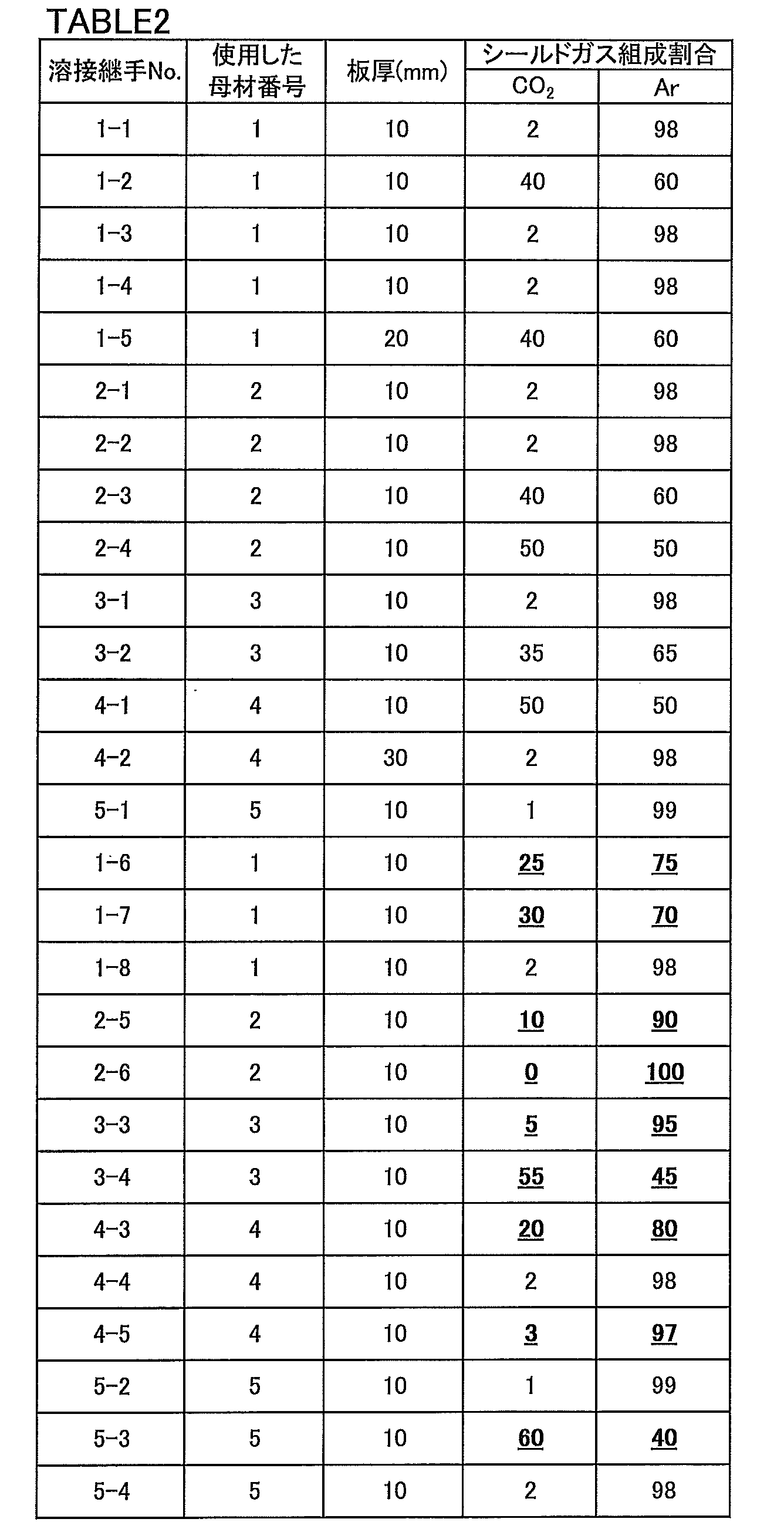
- a groove was provided in the base material of each base material number, and GMA welding was performed under the welding conditions shown in Table 2 to obtain a weld joint of each joint number provided with a weld metal having a chemical composition shown in Table 3. All the welding wires were wires having an outer diameter of 1.2 mm. Various welding conditions were set, and the heat input was set to 8 kJ / cm.
- V notch test piece The toughness of the weld metal of each weld joint was evaluated by the following method. From the welded joint, a Charpy impact test piece (V notch test piece) shown in FIG. 4 was collected. As shown in FIG. 4, the V notch 20 of the test piece was located at the center of the weld metal 30 of the weld joint 10. The V-notch test piece had a width of 10 mm, a thickness of 10 mm, a length of 55 mm, and a notch depth of 2 mm.
- a Charpy impact test was performed at ⁇ 30 ° C. based on JIS Z2242, using a V-notch test piece, and the absorbed energy was determined.
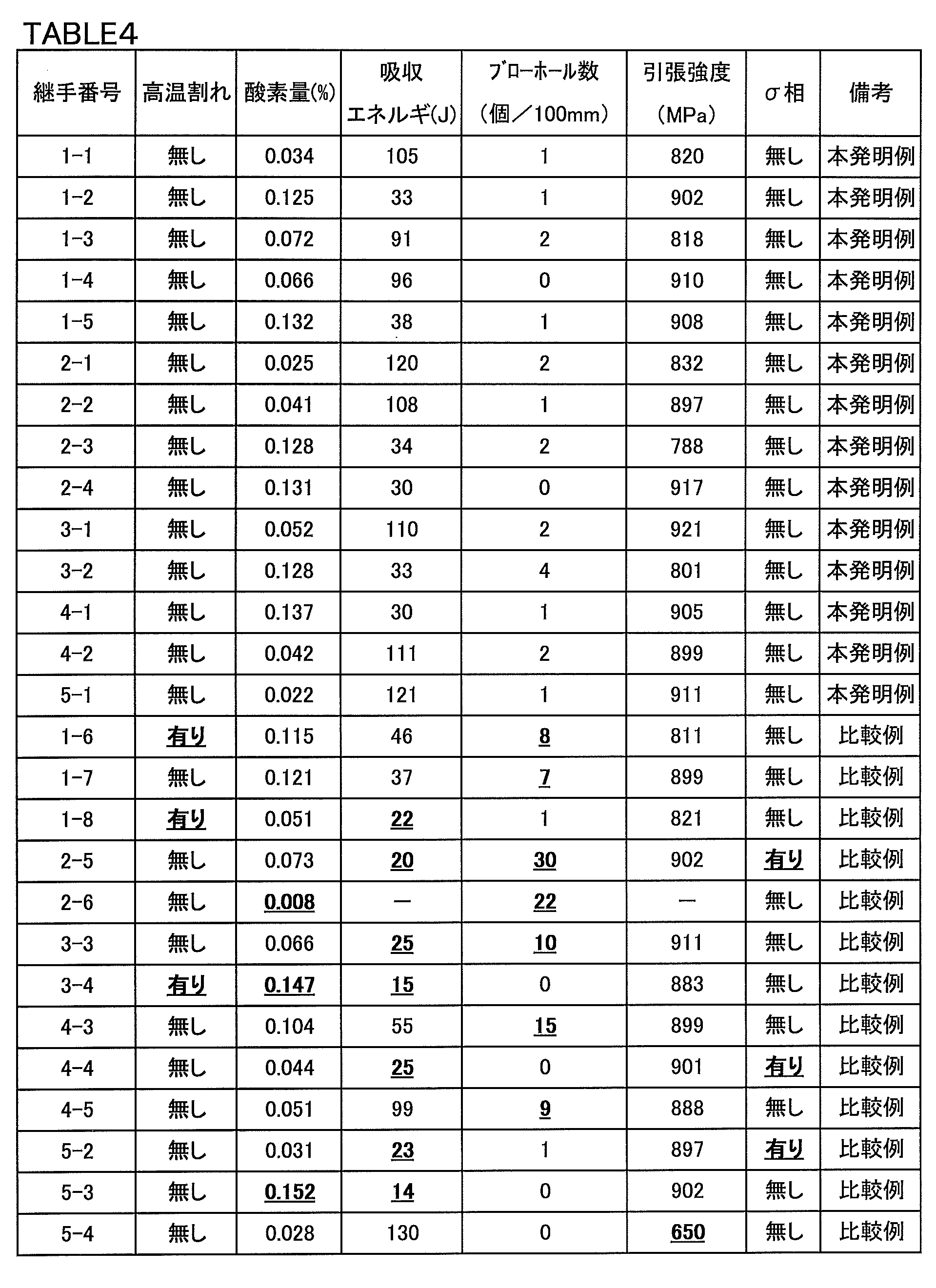
- the composition of the shielding gas was appropriate. Therefore, as shown in Table 3, the chemical composition of the weld metal of these joint numbers was appropriate. Furthermore, the number of blow holes was 5/100 mm or less. Furthermore, the tensile strength was 700 MPa or more, and the absorbed energy at ⁇ 30 ° C. was 27 J or more. Furthermore, no sigma phase or hot cracking was observed.
- joint numbers 1-7 the chemical composition of the weld metal was appropriate. However, the CO 2 content in the shielding gas was not appropriate. Therefore, the number of blow holes exceeded 5/100 mm.
- joint numbers 2-6 the shielding gas did not contain CO 2 . Therefore, the number of blow holes exceeded 5/100 mm. The oxygen content in the weld metal of joint number 2-6 was low.
- joint number 3-3 the Ni content was low. Therefore, the absorbed energy was low. Furthermore, the CO 2 content in the shielding gas was not appropriate. Therefore, the number of blow holes exceeded 5/100 mm.
- joint number 4-3 the chemical composition of the weld metal was appropriate, but the CO 2 content in the shield gas was not appropriate. Therefore, the number of blow holes exceeded 5/100 mm.
- joint number 5-2 the Cr content was high. Therefore, a ⁇ phase was observed. Furthermore, the absorbed energy was low. It is considered that the toughness was low because the ⁇ phase was generated.
- joint number 5-4 the Ni content of the weld metal was high and the N content was low. Therefore, the weld metal of the joint number 5-4 was not a duplex stainless steel but an austenitic stainless steel. In joint No. 5-4, the blowhole was suppressed because the N content was low, but the tensile strength was as low as less than 700 MPa.
Landscapes
- Engineering & Computer Science (AREA)
- Chemical & Material Sciences (AREA)
- Mechanical Engineering (AREA)
- Materials Engineering (AREA)
- Metallurgy (AREA)
- Organic Chemistry (AREA)
- Physics & Mathematics (AREA)
- Plasma & Fusion (AREA)
- General Engineering & Computer Science (AREA)
- Arc Welding In General (AREA)
- Nonmetallic Welding Materials (AREA)
Abstract
Description
溶接継手は、母材と、溶接金属とを備える。溶接継手はたとえば、鋼管同士又は鋼板同士を互いの端部で溶接したものである。鋼管は継目無鋼管であってもよいし、溶接鋼管であってもよい。
質量%で10.5%以上のCrを含有する母材を準備する。Cr含有量を10.5%以上としたのは、耐食性を得るためである。好ましくは、母材は、マルテンサイト系ステンレス鋼、又は、二相ステンレス鋼である。
母材がマルテンサイト系ステンレス鋼である場合、好ましくは、母材は次の化学組成を有する。
炭素(C)は鋼の強度を高める。しかしながら、C含有量が高すぎれば、溶接後の溶接熱影響部の硬さが高くなりすぎ、靭性および耐応力腐食割れ性が低下する。したがってC含有量は0.001~0.100%以下である。C含有量の好ましい下限は0.002%であり、さらに好ましくは0.003%である。C含有量の好ましい上限は0.07%であり、さらに好ましくは0.05%である。
珪素(Si)は、鋼を脱酸する。しかしながら、Si含有量が高すぎれば、鋼の靭性が低下する。したがって、Si含有量は0.050~1.00%以下である。Si含有量の好ましい下限は0.10%であり、さらに好ましくは0.15%である。Si含有量の好ましい上限は0.80%であり、さらに好ましくは0.60%である。
マンガン(Mn)は上記のSiと同様に、鋼を脱酸する。Mnはさらに、鋼を強化する。しかしながら、Mn含有量が高すぎれば、耐応力腐食割れ性が低下する。このため、Mn含有量は、0.10~1.50%である。Mn含有量の好ましい下限は0.13%であり、さらに好ましくは0.15%である。Mn含有量の好ましい上限は、1.40%であり、さらに好ましくは1.30%である。
燐(P)は不純物である。Pは、熱間加工性を低下したり、溶接時の高温割れ感受性を高めたりする。したがって、P含有量は少ない方が好ましい。P含有量は、0.040%以下である。好ましいP含有量は0.030%以下であり、さらに好ましくは0.025%以下である。
硫黄(S)は不純物である。SはPと同様に、熱間加工性を低下したり、溶接時の高温割れ感受性を高めたりする。したがって、S含有量は少ない方が好ましい。S含有量は、0.0100%以下である。好ましいS含有量は0.0050%以下であり、さらに好ましくは0.0020%以下である。
Cu:0.01~2.00%
ニッケル(Ni)及び銅(Cu)はいずれも、母材の靭性と湿潤炭酸ガス環境下での耐食性を高める。しかしながら、これらの元素の含有量が高すぎれば、その効果が飽和し製造コストが高くなる。したがって、Niは0.50~10.00%、Cuは0.01~2.00%とするのがよい。Ni含有量の好ましい下限は1.00%であり、さらに好ましくは2.00%である。Ni含有量の好ましい上限は9.50%であり、さらに好ましくは9.00%である。Cu含有量の好ましい下限は0.013%であり、さらに好ましくは0.015%である。Cu含有量の好ましい上限は1.95%であり、さらに好ましくは1.90%である。
クロム(Cr)は炭酸ガス環境下における鋼の耐食性を高める。一方、Cr含有量が高すぎれば、鋼の強度を調整しにくい。したがって、Cr含有量は10.50~14.00%である。Cr含有量の好ましい下限は11.00%であり、さらに好ましくは11.50%である。Cr含有の好ましい上限は13.80%であり、さらに好ましくは13.50%である。
W:0.20~6.00%
モリブデン(Mo)、タングステン(W)は、湿潤炭酸ガス環境下における鋼の耐食性と耐応力腐食割れ性とを高める。しかしながら、これらの元素含有量が高すぎれば、上記効果は飽和し、製造コストが高くなる。したがって、Mo含有量は0.10~4.00%であり、W含有量は0.20~6.00%である。Mo含有量の好ましい下限は0.30%であり、さらに好ましくは0.50%である。Mo含有量の好ましい上限は3.80%であり、さらに好ましくは3.50%である。W含有量の好ましい下限は0.30%であり、さらに好ましくは0.50%である。W含有量の好ましい上限は5.50%であり、さらに好ましくは5.00%である。母材は、Mo及びWのうちの1種以上を含有する。
アルミニウム(Al)はSiと同様に鋼を脱酸する。しかしながら、Al含有量が高すぎれば、窒化アルミニウム(AlN)が形成され、鋼の靭性及び耐食性が低下する。したがって、sol.Al含有量は0.040%以下である。sol.Al含有量の好ましい下限は0.003%であり、さらに好ましくは0.005%である。sol.Al含有量の好ましい上限は0.035%であり、さらに好ましくは0.030%である。
母材がマルテンサイト系ステンレス鋼である場合、窒素(N)は不純物である。Nは、鋼の靭性を低下する。したがって、N含有量は低い方が好ましい。N含有量は、0.1%以下である。
母材が二相ステンレス鋼である場合、好ましくは、母材は次の化学組成を有する。
炭素(C)は、オーステナイトを安定化する。しかしながら、C含有量が高すぎれば、炭化物が析出しやすくなり、耐食性が低下する。したがって、C含有量は、0.03%以下である。C含有量の好ましい上限は、0.025%であり、さらに好ましくは0.02%である。
珪素(Si)は、溶接時の溶融金属の流動性の低下を抑制し、溶接欠陥の生成を抑制する。しかしながら、Si含有量が高すぎれば、シグマ相(σ相)に代表される金属間化合物が生成されやすくなる。したがって、Si含有量は、0.20~1.00%である。Si含有量の好ましい下限は0.25%であり、さらに好ましくは、0.30%である。Si含有量の好ましい上限は0.80%であり、さらに好ましくは、0.60%である。
マンガン(Mn)は、必須元素である。Mnは鋼を脱硫及び脱酸し、鋼の熱間加工性を高める。Mnはさらに、窒素(N)の溶解度を高める。しかしながら、Mn含有量が高すぎれば、耐食性が低下する。したがって、Mn含有量は、8.00%以下である。Mn含有量の好ましい下限は、0.03%であり、さらに好ましくは、0.05%である。Mn含有量の好ましい上限は7.50%であり、さらに好ましくは、5.00%である。
燐(P)は不純物である。Pは、鋼の耐食性及び靭性を低下する。したがって、P含有量は低い方が好ましい。P含有量は、0.040%以下である。好ましいP含有量は0.030%以下であり、さらに好ましくは0.025%以下である。
硫黄(S)は不純物である。Sは、鋼の熱間加工性を低下する。Sはさらに、硫化物を形成する。硫化物は、孔食の発生起点となるため、鋼の耐孔食性を低下する。したがって、S含有量は低い方が好ましい。S含有量は、0.0100%以下である。好ましいS含有量は、0.0050%以下であり、さらに好ましくは0.0020%以下である。
銅(Cu)は、高温塩化物環境下において、不動態皮膜を強化し、耐SCC性を含む耐食性を高める。Cuはさらに、大入熱溶接時に、母材中に極微細に析出し、フェライト/オーステナイト相境界でのσ相の析出を抑制する。しかしながら、Cu含有量が高すぎれば、鋼の熱間加工性が低下する。したがって、Cu含有量は0.20~4.00%である。Cu含有量の好ましい下限は0.23%であり、さらに好ましくは0.25%である。Cu含有量の好ましい上限は3.50%であり、さらに好ましくは3.00%である。
ニッケル(Ni)はオーステナイトを安定化する。Niはさらに、鋼の靭性を高め、鋼の耐SCC性を含む耐食性を高める。しかしながら、Ni含有量が高すぎれば、σ相に代表される金属間化合物が生成されやすくなる。したがって、Ni含有量は、4.00~8.00%である。Ni含有量の好ましい下限は4.50%であり、さらに好ましくは、5.00%である。Ni含有量の好ましい上限は7.80%であり、さらに好ましくは7.50%である。
クロム(Cr)は、鋼の耐食性を高め、特に、高温塩化物環境下において、鋼の耐SCC性を高める。しかしながら、Cr含有量が高すぎれば、σ相に代表される金属間化合物が生成される。そのため、鋼の溶接性が低下し、熱間加工性が低下する。したがって、Cr含有量は、20.0~30.0%である。Cr含有量の好ましい下限は21.0%であり、さらに好ましくは、22.0%である。Cr含有量の好ましい上限は29.0%であり、さらに好ましくは、28.0%である。
W:0.01~4.00%
モリブデン(Mo)、タングステン(W)は母材の湿潤炭酸ガス環境下での耐食性と耐応力腐食割れ性を高める。しかしながら、Mo含有量が高すぎれば、σ相に代表される金属間化合物が生成される。そのため、鋼の溶接性が低下し、熱間加工性が低下する。したがって、Mo含有量は、0.50~4.00%である。W含有量が高すぎれば、その効果は飽和し、製造コストが高くなる。したがって、W含有量は0.01~4.00%とするのがよい。なおこれらの元素は、いずれか一種を単独または2種以上を複合添加してもよい。
窒素(N)は、強力なオーステナイト形成元素であり、鋼の熱的安定性及び耐食性を高める。二相ステンレス鋼である母材は、フェライト形成元素であるCrとMoとを含有する。母材内のフェライト量とオーステナイト量のバランスを考慮すれば、N含有量は0.100%以上である。しかしながら、N含有量が高すぎれば、溶接欠陥であるブローホールが発生する。N含有量が高すぎればさらに、溶接時に窒化物が生成されやすくなり、鋼の靭性及び耐食性が低下する。したがって、N含有量は、0.100~0.350%である。N含有量の好ましい下限は0.130%であり、さらに好ましくは、0.160%である。N含有量の好ましい上限は0.340%であり、さらに好ましくは0.330%である。
アルミニウム(Al)は必須元素である。Alは鋼を脱酸する。一方、Alが過剰に含有されれば、窒化アルミニウム(AlN)を形成し、鋼の靭性及び耐食性を低下する。したがって、sol.Al含有量は、0.040%以下である。sol.Al含有量の好ましい下限は0.003%であり、さらに好ましくは0.005%である。sol.Al含有量の好ましい上限は0.035%であり、さらに好ましくは、0.030%である。
二相ステンレス鋼である母材は、Feに代えて、以下の第1群~第3群のうちの少なくとも1群から選択される1種又は2種以上の元素を含有してもよい。つまり、第1群~第3群の元素は、必要に応じて含有可能な選択元素である。
第2群:Ca:0.0200%以下、Mg:0.0200%以下及びB:0.0200%以下
第3群:希土類元素(REM):0.2000%以下
以下、これらの選択元素について詳述する。
V:1.50%以下
バナジウム(V)は、選択元素である。Vは、鋼の耐食性を高め、特に、酸性環境下での耐食性を高める。より具体的には、VがMo及びCuと共に含有されれば、鋼の耐隙間腐食性が高まる。Vが少しでも含有されれば、上記効果が得られる。しかしながら、V含有量が高すぎれば、鋼中のフェライト量が過剰に増加し、鋼の耐食性が低下する。したがって、V含有量は1.50%以下である。V含有量の好ましい上限は、1.30%である。V含有量の好ましい下限は、0.05%以上である。
Ca:0.0200%以下
Mg:0.0200%以下
B:0.0200%以下
カルシウム(Ca)、マグネシウム(Mg)及びボロン(B)は、いずれも選択元素である。Ca、Mg及びBはいずれも、鋼中のS及びO(酸素)を固定して、鋼の熱間加工性を高める。母材のS含有量は少ない。したがって、Ca、Mg及びBが含有されていなくても、鋼の熱間加工性は高い。しかしながら、たとえば、傾斜圧延法により継目無鋼管を製造する場合、さらに高い熱間加工性が求められる場合がある。Ca、Mg及びBからなる群から選択される1種又は2種以上を含有すれば、さらに高い熱間加工性が得られる。これらの元素のいずれかが少しでも含有されれば、上記効果が得られる。
希土類元素(REM):0.2000%以下
希土類元素(REM)は、選択元素である。REMは、Ca、Mg及びBと同様に、鋼中のS及びO(酸素)を固定して、鋼の熱間加工性を高める。しかしながら、REM含有量が高すぎる場合、非金属介在物(希土類元素の酸化物及び硫化物等)が増加し、鋼の耐食性が低下する。したがって、REM含有量は、0.2000%以下である。上記効果を顕著に得るためには、REM含有量がS(質量%)+1/2×O(質量%)以上であるのが好ましい。しかしながら、REMが少しでも含有されれば、上記効果はある程度得られる。
上述の母材を準備した後、母材に対してGMA溶接を実施して、溶接金属を形成する。
炭素(C)は、溶接金属中のオーステナイトを安定化する。一方、C含有量が高すぎれば、炭化物が析出しやすくなり、耐食性が低下する。したがって、C含有量は、0.080%以下である。C含有量の好ましい上限は0.075%であり、さらに好ましくは0.070%である。
珪素(Si)は、溶接時に溶融金属を脱酸する。Siはさらに、溶接金属の強度を高める。一方、Si含有量が高すぎれば、溶接金属の靭性が低下する。したがって、Si含有量は、0.20~1.00%である。Si含有量の好ましい下限は0.25%であり、さらに好ましくは、0.30%である。Si含有量の好ましい上限は0.80%であり、さらに好ましくは、0.60%である。
マンガン(Mn)は必須元素である。Mnは、溶接時に溶融金属を脱酸する。Mnはさらに、溶接金属の強度を高める。一方、Mn含有量が高すぎれば、溶接金属の耐食性が低下する。したがって、Mn含有量は、8.00%以下である。Mn含有量の好ましい下限は0.25%であり、さらに好ましくは、0.50%である。Mn含有量の好ましい上限は7.00%であり、さらに好ましくは、6.00%である。
燐(P)は不純物である。Pは、溶接金属の靭性を低下し、溶接金属の高温割れ感受性を高める。したがって、P含有量は少ない方が好ましい。P含有量は、0.040%以下である。好ましいP含有量は、0.030%以下であり、さらに好ましくは0.020%以下である。
硫黄(S)は不純物である。Sは、溶接金属の延性と耐食性を低下し、溶接金属の高温割れ感受性を高める。したがって、S含有量は少ない方が好ましい。S含有量は、0.0100%以下である。好ましいS含有量は0.005%以下であり、さらに好ましくは、0.002%以下である。
銅(Cu)は、必須元素である。Cuは、高温塩化物環境下において、不動態皮膜を強化し、耐SCC性を含む耐食性を高める。一方、Cu含有量が高すぎれば、溶接金属の高温割れ感受性が高まる。したがって、Cu含有量は、2.0%以下である。好ましいCu含有量は、2.0%未満である。Cu含有量の好ましい下限は0.1%であり、さらに好ましくは、0.15%である。Cu含有量の好ましい上限は1.0%であり、さらに好ましくは、0.8%である。
ニッケル(Ni)は溶接金属中のオーステナイトを安定化し、溶接金属の靭性を高める。一方、Ni含有量が高すぎれば、溶接金属中のフェライト量が過剰に低下し、二相ステンレス鋼の基本的な機械特性が得られにくくなる。Ni含有量が高すぎればさらに、σ相が析出しやすくなる。したがって、Ni含有量は、7.00~12.00%である。Ni含有量の好ましい下限は、8.00%であり、さらに好ましくは、Ni含有量は8.00%よりも高い。Ni含有量の好ましい上限は11.00%であり、さらに好ましくは、10.00%である。
クロム(Cr)は、溶接金属の耐食性を高め、特に、高温塩化物環境下において、溶接金属の耐SCC性を高める。一方、Cr含有量が高すぎれば、σ相が析出しやすくなる。したがって、Cr含有量は、20.0~30.0%である。Cr含有量の好ましい下限は21.0%である。Cr含有量の好ましい上限は29.0%であり、さらに好ましくは、28.0%である。
W:1.00~4.00%
モリブデン(Mo)及びタングステン(W)は母材の湿潤炭酸ガス環境下での耐食性と耐応力腐食割れ性とを向上する。一方、Mo含有量が高すぎれば、溶接金属にシグマ相(σ相)が析出しやすくなる。したがって、Mo含有量は、1.00~4.00%である。W含有量が高すぎればその効果は飽和し、これ以上の含有はコスト上昇を招くだけである。したがって、W含有量は1.00~4.00%である。本実施形態による溶接金属は、Mo及びWのうち、少なくとも1種以上を含有する。
窒素(N)は、固溶強化により鋼の強度を高める。Nはさらに、強力なオーステナイト形成元素であり、溶接金属の耐食性を高める。一方、N含有量が高すぎれば、溶接欠陥であるブローホールが発生する。したがって、N含有量は、0.100~0.350%である。N含有量の好ましい上限は0.300%であり、さらに好ましくは、0.250%である。
アルミニウム(Al)は、必須元素である。Alは、溶接時に溶融金属を脱酸する。一方、sol.Al含有量が高すぎれば、Alは粗大な酸化物系の介在物を形成し、溶接金属の靭性を低下する。したがって、sol.Al含有量は、0.040%以下である。sol.Al含有量の好ましい下限は0.003%であり、さらに好ましくは0.005%である。sol.Al含有量の好ましい上限は0.035%であり、さらに好ましくは、0.030%である。
酸素(O)は、不純物である。Oは、酸化系介在物を形成し、溶接金属の靭性を低下する。したがって、O含有量はなるべく少ない方が好ましい。
上述の製造方法により製造された溶接金属は、700MPa以上の引張強度を有し、-30℃の吸収エネルギは27J以上になる。さらに、溶接金属中において、0.5mm以上の大きさのブローホールは5個/100mm以下である。


溶接後、各継手番号の溶接継手の溶接金属に対して、上述した放射線透過試験を実施し、ブローホールの個数(個/100mm)をカウントした。
各溶接継手の溶接金属の靭性を、次の方法で評価した。溶接継手から、図4に示すシャルピー衝撃試験片(Vノッチ試験片)を採取した。図4に示すとおり、試験片のVノッチ20は、溶接継手10の溶接金属30の中央部に位置した。Vノッチ試験片は、幅10mm、厚さ10mm、長さ55mm、ノッチ深さ2mmであった。
各溶接継手から、JIS Z2201に規定される5号試験片を採取した。試験片の長手方向は、溶接進行方向と直行する方向であった。また、試験片の平行部の中央は、溶接金属が位置し、その両側に溶接熱影響部と母材が順次位置した。室温(25℃)において引張試験を実施し、引張強度(MPa)を得た。
各溶接継手の断面を鏡面研磨し、エッチングした。エッチングした後、500倍の光学顕微鏡を用いて、エッチングされた断面のうち、溶接金属を画像解析した。画像解析に利用された溶接金属の面積は1視野あたり40000μm2であった。4視野について、画像解析を実施した。画像解析により、各視野の溶接金属内のσ相の面積率(%)を求めた。4視野のσ相の面積率の平均を、継手番号のσ相の面積率(%)と定義した。σ相の面積率が0.5%以上である場合、σ相が析出したと判断した。σ相の面積率が0.5%未満である場合、σ相が析出していないと判断した。
各溶接継手から、溶接線と直交する断面ミクロ組織観察用試験片を採取した。採取された試験片の表面を鏡面研磨し、エッチングした。エッチングされた試験片の表面を、500倍の光学顕微鏡を用いて観察した。そして、溶接金属内に高温割れが発生したか否かを目視により判断した。
表4の上述の評価試験の結果を示す。
Claims (9)
- 質量%で10.5%以上のCrを含有する母材を準備する工程と、
前記母材に対して、1~2体積%又は35~50体積%のCO2を含有し、残部が不活性ガスからなるシールドガスを用いてGMA(Gas Metal Arc)溶接を実施し、質量%で、C:0.080%以下、Si:0.20~1.00%、Mn:8.00%以下、P:0.040%以下、S:0.0100%以下、Cu:2.0%以下、Cr:20.0~30.0%、Ni:7.00~12.00%、N:0.100~0.350%、O(酸素):0.02~0.14%、sol.Al:0.040%以下、並びに、Mo:1.00~4.00%及びW:1.00~4.00%のうちの1種以上を含有し、残部はFe及び不純物からなる溶接金属を形成する工程とを備える、溶接継手の製造方法。 - 質量%で、10.5%以上のCrを含有する母材と、
質量%で、C:0.080%以下、Si:0.20~1.00%、Mn:8.00%以下、P:0.040%以下、S:0.0100%以下、Cu:2.0%以下、Cr:20.0~30.0%、Ni:7.00~12.00%、N:0.100~0.350%、O(酸素):0.02~0.14%、sol.Al:0.040%以下、並びに、Mo:1.00~4.00%及びW:1.00~4.00%のうちの1種以上を含有し、残部はFe及び不純物からなる溶接金属とを備え、
前記溶接金属中において、0.5mm以上の大きさのブローホールが5個/100mm以下である、溶接継手。 - 請求項2に記載の溶接継手であって、
前記溶接金属は、GMA(Gas Metal Arc)溶接により形成される、溶接継手。 - 請求項3に記載の溶接継手であって、
前記GMA溶接では、1~2体積%又は35~50体積%のCO2を含有し、残部が不活性ガスからなるシールドガスが利用される、溶接継手。 - 請求項2~請求項4のいずれか1項に記載の溶接継手であって、
前記母材は、質量%で、C:0.001~0.100%、Si:0.050~1.00%、Mn:0.10~1.50%、P:0.040%以下、S:0.0100%以下、Cu:0.01~2.00%、Cr:10.50~14.00%、Ni:0.50~10.00%、N:0.1%以下、sol.Al:0.040%以下、ならびに、Mo:0.10~4.00%及びW:0.20~6.00%のうちの1種以上を含有し、残部はFe及び不純物からなるマルテンサイト系ステンレス鋼である、溶接継手。 - 請求項2~請求項4のいずれか1項に記載の溶接継手であって、
前記母材は、質量%で、C:0.03%以下、Si:0.20~1.00%、Mn:8.00%以下、P:0.040%以下、S:0.0100%以下、Cu:0.20~4.00%、Cr:20.0~30.0%、Ni:4.00~8.00%、N:0.100~0.350%、sol.Al:0.040%以下、ならびに、Mo:0.50~4.00%及びW:0.01~4.00%のうちの1種以上を含有し、残部はFe及び不純物からなる二相ステンレス鋼である、溶接継手。 - 請求項6に記載の溶接継手であって、
前記母材はさらに、前記Feの一部に代えて、V:1.50%以下を含有する、溶接継手。 - 請求項6又は請求項7に記載の溶接継手であって、
前記母材はさらに、前記Feの一部に代えて、Ca:0.0200%以下、Mg:0.0200%以下及びB:0.0200%以下からなる群から選択される1種又は2種以上を含有する、溶接継手。 - 請求項6~請求項8のいずれか1項に記載の溶接継手であって、
前記母材はさらに、記Feの一部に代えて、希土類元素(REM):0.2000%以下を含有する、溶接継手。
Priority Applications (10)
| Application Number | Priority Date | Filing Date | Title |
|---|---|---|---|
| BR112014022886-8A BR112014022886B1 (pt) | 2012-03-30 | 2013-03-27 | Processo para produzir junta soldada e junta soldada |
| CN201380018070.3A CN104245211B (zh) | 2012-03-30 | 2013-03-27 | 焊接接头的制造方法 |
| MX2014010898A MX353661B (es) | 2012-03-30 | 2013-03-27 | Procedimiento para producir junta por soldadura y la junta por soldadura. |
| CA2867673A CA2867673C (en) | 2012-03-30 | 2013-03-27 | Process for producing welded joint, and welded joint |
| JP2013515434A JP5382266B1 (ja) | 2012-03-30 | 2013-03-27 | 溶接継手の製造方法及び溶接継手 |
| EP13767380.2A EP2832487B1 (en) | 2012-03-30 | 2013-03-27 | Process for producing welded joint |
| IN7791DEN2014 IN2014DN07791A (ja) | 2012-03-30 | 2013-03-27 | |
| US14/388,836 US9555496B2 (en) | 2012-03-30 | 2013-03-27 | Process for producing welded joint using GMA welding and CO2 as a shielding gas |
| AU2013241368A AU2013241368B2 (en) | 2012-03-30 | 2013-03-27 | Process for producing welded joint, and welded joint |
| ES13767380T ES2709028T3 (es) | 2012-03-30 | 2013-03-27 | Proceso para la producción de junta soldada |
Applications Claiming Priority (2)
| Application Number | Priority Date | Filing Date | Title |
|---|---|---|---|
| JP2012082023 | 2012-03-30 | ||
| JP2012-082023 | 2012-03-30 |
Publications (1)
| Publication Number | Publication Date |
|---|---|
| WO2013146860A1 true WO2013146860A1 (ja) | 2013-10-03 |
Family
ID=49260109
Family Applications (1)
| Application Number | Title | Priority Date | Filing Date |
|---|---|---|---|
| PCT/JP2013/058954 Ceased WO2013146860A1 (ja) | 2012-03-30 | 2013-03-27 | 溶接継手の製造方法及び溶接継手 |
Country Status (11)
| Country | Link |
|---|---|
| US (1) | US9555496B2 (ja) |
| EP (1) | EP2832487B1 (ja) |
| JP (2) | JP5382266B1 (ja) |
| CN (1) | CN104245211B (ja) |
| AU (1) | AU2013241368B2 (ja) |
| BR (1) | BR112014022886B1 (ja) |
| CA (1) | CA2867673C (ja) |
| ES (1) | ES2709028T3 (ja) |
| IN (1) | IN2014DN07791A (ja) |
| MX (1) | MX353661B (ja) |
| WO (1) | WO2013146860A1 (ja) |
Families Citing this family (10)
| Publication number | Priority date | Publication date | Assignee | Title |
|---|---|---|---|---|
| JP6466734B2 (ja) * | 2014-02-21 | 2019-02-06 | 新日鐵住金株式会社 | 高圧水素ガスおよび液体水素用オーステナイト系高Mnステンレス鋼溶接継手およびその製造方法 |
| JP6492811B2 (ja) * | 2015-03-13 | 2019-04-03 | 新日鐵住金株式会社 | 溶接材料並びにそれを用いて形成される溶接金属及び溶接継手 |
| GB2546661B (en) * | 2015-12-23 | 2018-04-25 | Goodwin Plc | A welding consumable, a method of welding, and a welded product |
| CN106011669B (zh) * | 2016-07-07 | 2018-01-19 | 德召尼克(常州)焊接科技有限公司 | 一种用于塑料超声波焊接的焊头材料及制备方法 |
| JP7053688B2 (ja) * | 2017-06-30 | 2022-04-12 | アペラム | マルテンサイトステンレス鋼シートをスポット溶接する方法 |
| KR102511652B1 (ko) * | 2018-08-23 | 2023-03-17 | 제이에프이 스틸 가부시키가이샤 | 가스 메탈 아크 용접용 솔리드 와이어 |
| JP2019026940A (ja) * | 2018-10-01 | 2019-02-21 | 新日鐵住金株式会社 | 二相ステンレス鋼溶接継手 |
| CN112475532B (zh) * | 2020-10-10 | 2022-03-25 | 东方电气集团东方锅炉股份有限公司 | 用于高压氢环境奥氏体不锈钢316l材料的焊接工艺 |
| US20240175113A1 (en) * | 2021-03-31 | 2024-05-30 | Nippon Steel Corporation | Duplex stainless steel welded joint |
| CN116749103B (zh) * | 2023-07-13 | 2025-08-01 | 沪东中华造船(集团)有限公司 | 用于焊接接头冲击试样长度及缺口中心定位的装置及方法 |
Citations (11)
| Publication number | Priority date | Publication date | Assignee | Title |
|---|---|---|---|---|
| JPS53127336A (en) * | 1977-04-14 | 1978-11-07 | Nippon Metal Ind | Method of preventing welding blow hole of stainless steel containing large quantity of nitrogen or heat resisting steel |
| JPS62286677A (ja) * | 1986-06-03 | 1987-12-12 | Sumitomo Metal Ind Ltd | 2相ステンレス鋼材の溶接方法 |
| JPH05132741A (ja) | 1991-11-11 | 1993-05-28 | Sumitomo Metal Ind Ltd | 耐食性に優れた高強度二相ステンレス鋼 |
| JPH08260101A (ja) | 1995-03-20 | 1996-10-08 | Sumitomo Metal Ind Ltd | 高耐食高靱性二相ステンレス鋼溶接用溶接材料 |
| WO1998010888A1 (fr) * | 1996-09-13 | 1998-03-19 | Sumitomo Metal Industries, Ltd. | Materiau d'apport pour la soudure d'aciers inoxydables |
| JP2000288775A (ja) * | 1999-04-06 | 2000-10-17 | Sumitomo Metal Ind Ltd | マルテンサイト系ステンレス鋼の溶接継手 |
| JP2001009589A (ja) | 1999-06-25 | 2001-01-16 | Sumikin Welding Ind Ltd | オーステナイト・フェライト系二相ステンレス鋼溶接材料およびそれを用いた高Cr鋼の溶接方法 |
| JP2006026651A (ja) * | 2004-07-13 | 2006-02-02 | Iwatani Industrial Gases Corp | ステンレス鋼溶接用シールドガス |
| JP2007245225A (ja) * | 2006-03-20 | 2007-09-27 | Iwatani Industrial Gases Corp | ステンレス鋼の溶接方法及びステンレス鋼用溶接ワイヤ |
| WO2008026594A1 (fr) | 2006-08-31 | 2008-03-06 | Sumitomo Metal Industries, Ltd. | Acier inoxydable martensitique pour structure soudee |
| WO2011030709A1 (ja) * | 2009-09-10 | 2011-03-17 | 住友金属工業株式会社 | 二相ステンレス鋼 |
Family Cites Families (12)
| Publication number | Priority date | Publication date | Assignee | Title |
|---|---|---|---|---|
| JPS56122669A (en) * | 1980-03-05 | 1981-09-26 | Hitachi Ltd | Member having high errosion-corrosion resistance |
| JPH079144A (ja) * | 1993-06-25 | 1995-01-13 | Iwatani Gas Kk | ガスシールド消耗電極式アーク溶接用のシールドガス |
| FR2719514B1 (fr) * | 1994-05-04 | 1996-06-07 | Air Liquide | Mélange gazeux de protection et procédé de soudage à l'arc de pièces en aciers inoxydables. |
| MY114984A (en) * | 1995-01-13 | 2003-03-31 | Hitachi Metals Ltd | High hardness martensitic stainless steel with good pitting corrosion resistance |
| US6042782A (en) * | 1996-09-13 | 2000-03-28 | Sumikin Welding Industries Ltd. | Welding material for stainless steels |
| JP3854440B2 (ja) * | 2000-02-07 | 2006-12-06 | 三菱重工業株式会社 | 溶接材料およびガスメタルアーク溶接方法並びに溶接構造物 |
| KR100352644B1 (ko) * | 2000-07-28 | 2002-09-12 | 고려용접봉 주식회사 | 내응력 부식균열, 내공식 성능 및 용접성이 우수한 2상스테인레스강용 플럭스 코어드 와이어 |
| FR2813544B1 (fr) * | 2000-09-06 | 2002-10-18 | Air Liquide | Procede de soudage mig du nickel et des alliages de nickel avec gaz de protection a base d'argon et de co2 |
| FR2872825B1 (fr) * | 2004-07-12 | 2007-04-27 | Industeel Creusot | Acier inoxydable martensitique pour moules et carcasses de moules d'injection |
| FR2887558B1 (fr) * | 2005-06-28 | 2007-08-17 | Aubert & Duval Soc Par Actions | Composition d'acier inoxydable martensitique, procede de fabrication d'une piece mecanique a partir de cet acier et piece ainsi obtenue |
| US20070170164A1 (en) * | 2006-01-24 | 2007-07-26 | Lincoln Global, Inc. | Outer-loop control for use with nickel and duplex stainless steel filler alloys and carbon dioxide containing shielding gas |
| EP2676763B1 (en) * | 2011-02-14 | 2018-01-17 | Nippon Steel & Sumitomo Metal Corporation | Line pipe having a welded joint of duplex stainless steel |
-
2013
- 2013-03-27 IN IN7791DEN2014 patent/IN2014DN07791A/en unknown
- 2013-03-27 CA CA2867673A patent/CA2867673C/en not_active Expired - Fee Related
- 2013-03-27 US US14/388,836 patent/US9555496B2/en not_active Expired - Fee Related
- 2013-03-27 BR BR112014022886-8A patent/BR112014022886B1/pt active IP Right Grant
- 2013-03-27 WO PCT/JP2013/058954 patent/WO2013146860A1/ja not_active Ceased
- 2013-03-27 JP JP2013515434A patent/JP5382266B1/ja active Active
- 2013-03-27 CN CN201380018070.3A patent/CN104245211B/zh not_active Expired - Fee Related
- 2013-03-27 EP EP13767380.2A patent/EP2832487B1/en active Active
- 2013-03-27 ES ES13767380T patent/ES2709028T3/es active Active
- 2013-03-27 MX MX2014010898A patent/MX353661B/es active IP Right Grant
- 2013-03-27 AU AU2013241368A patent/AU2013241368B2/en not_active Ceased
- 2013-08-12 JP JP2013167392A patent/JP5751292B2/ja active Active
Patent Citations (11)
| Publication number | Priority date | Publication date | Assignee | Title |
|---|---|---|---|---|
| JPS53127336A (en) * | 1977-04-14 | 1978-11-07 | Nippon Metal Ind | Method of preventing welding blow hole of stainless steel containing large quantity of nitrogen or heat resisting steel |
| JPS62286677A (ja) * | 1986-06-03 | 1987-12-12 | Sumitomo Metal Ind Ltd | 2相ステンレス鋼材の溶接方法 |
| JPH05132741A (ja) | 1991-11-11 | 1993-05-28 | Sumitomo Metal Ind Ltd | 耐食性に優れた高強度二相ステンレス鋼 |
| JPH08260101A (ja) | 1995-03-20 | 1996-10-08 | Sumitomo Metal Ind Ltd | 高耐食高靱性二相ステンレス鋼溶接用溶接材料 |
| WO1998010888A1 (fr) * | 1996-09-13 | 1998-03-19 | Sumitomo Metal Industries, Ltd. | Materiau d'apport pour la soudure d'aciers inoxydables |
| JP2000288775A (ja) * | 1999-04-06 | 2000-10-17 | Sumitomo Metal Ind Ltd | マルテンサイト系ステンレス鋼の溶接継手 |
| JP2001009589A (ja) | 1999-06-25 | 2001-01-16 | Sumikin Welding Ind Ltd | オーステナイト・フェライト系二相ステンレス鋼溶接材料およびそれを用いた高Cr鋼の溶接方法 |
| JP2006026651A (ja) * | 2004-07-13 | 2006-02-02 | Iwatani Industrial Gases Corp | ステンレス鋼溶接用シールドガス |
| JP2007245225A (ja) * | 2006-03-20 | 2007-09-27 | Iwatani Industrial Gases Corp | ステンレス鋼の溶接方法及びステンレス鋼用溶接ワイヤ |
| WO2008026594A1 (fr) | 2006-08-31 | 2008-03-06 | Sumitomo Metal Industries, Ltd. | Acier inoxydable martensitique pour structure soudee |
| WO2011030709A1 (ja) * | 2009-09-10 | 2011-03-17 | 住友金属工業株式会社 | 二相ステンレス鋼 |
Non-Patent Citations (1)
| Title |
|---|
| See also references of EP2832487A4 |
Also Published As
| Publication number | Publication date |
|---|---|
| JP5382266B1 (ja) | 2014-01-08 |
| EP2832487B1 (en) | 2019-01-09 |
| US9555496B2 (en) | 2017-01-31 |
| JP2014000607A (ja) | 2014-01-09 |
| MX353661B (es) | 2018-01-19 |
| MX2014010898A (es) | 2014-11-25 |
| JPWO2013146860A1 (ja) | 2015-12-14 |
| US20150056005A1 (en) | 2015-02-26 |
| AU2013241368A1 (en) | 2014-10-02 |
| CN104245211A (zh) | 2014-12-24 |
| JP5751292B2 (ja) | 2015-07-22 |
| AU2013241368B2 (en) | 2015-04-02 |
| CA2867673C (en) | 2017-06-06 |
| CN104245211B (zh) | 2018-11-20 |
| IN2014DN07791A (ja) | 2015-05-15 |
| BR112014022886B1 (pt) | 2018-06-12 |
| ES2709028T3 (es) | 2019-04-12 |
| EP2832487A4 (en) | 2016-01-06 |
| CA2867673A1 (en) | 2013-10-03 |
| EP2832487A1 (en) | 2015-02-04 |
Similar Documents
| Publication | Publication Date | Title |
|---|---|---|
| JP5382266B1 (ja) | 溶接継手の製造方法及び溶接継手 | |
| JP6338028B2 (ja) | フェライト系耐熱鋼用溶接材料、フェライト系耐熱鋼用溶接継手及びフェライト系耐熱鋼用溶接継手の製造方法 | |
| JP5013030B1 (ja) | 二相ステンレス溶接継手 | |
| JP5170351B1 (ja) | 二相ステンレス鋼 | |
| WO2012111537A1 (ja) | 二相ステンレス鋼 | |
| JP6492811B2 (ja) | 溶接材料並びにそれを用いて形成される溶接金属及び溶接継手 | |
| WO2013118585A1 (ja) | 二重管およびそれを用いた溶接構造体 | |
| WO2012108517A1 (ja) | クリープ特性に優れた溶接金属 | |
| WO2016088364A1 (ja) | 低炭素マルテンサイト系ステンレス鋼管の円周溶接継手の製造方法 | |
| JP6256655B2 (ja) | 構造管用鋼板、構造管用鋼板の製造方法、および構造管 | |
| WO2019070002A1 (ja) | オーステナイト系耐熱鋼用溶接材料、溶接金属および溶接構造物ならびに溶接金属および溶接構造物の製造方法 | |
| JP5014831B2 (ja) | 拡管性能及び耐食性に優れた拡管油井用電縫鋼管及びその製造方法 | |
| JP2016216819A (ja) | 厚鋼板及び溶接継手 | |
| JP2017082267A (ja) | 厚鋼板 | |
| JP7436821B2 (ja) | 二相ステンレス鋼材 | |
| KR20140127870A (ko) | 대입열 용접용 강재 | |
| JP6107170B2 (ja) | オーステナイト系耐熱鋼用溶接材料ならびにそれを用いて製造される溶接金属及び溶接継手 | |
| JP2003201535A (ja) | 電子ビーム溶接用鋼板、鋼管および溶接金属部の低温靱性に優れたパイプライン | |
| KR102892582B1 (ko) | 2상 스테인리스강 용접 조인트 | |
| JP5218201B2 (ja) | 溶接金属および溶接材料 | |
| WO2016190150A1 (ja) | 厚鋼板及び溶接継手 | |
| JP2017202492A (ja) | オーステナイト系耐熱鋼溶接金属およびそれを有する溶接継手 |
Legal Events
| Date | Code | Title | Description |
|---|---|---|---|
| ENP | Entry into the national phase |
Ref document number: 2013515434 Country of ref document: JP Kind code of ref document: A |
|
| 121 | Ep: the epo has been informed by wipo that ep was designated in this application |
Ref document number: 13767380 Country of ref document: EP Kind code of ref document: A1 |
|
| WWE | Wipo information: entry into national phase |
Ref document number: MX/A/2014/010898 Country of ref document: MX |
|
| WWE | Wipo information: entry into national phase |
Ref document number: 2013767380 Country of ref document: EP |
|
| WWE | Wipo information: entry into national phase |
Ref document number: IDP00201405528 Country of ref document: ID |
|
| ENP | Entry into the national phase |
Ref document number: 2867673 Country of ref document: CA |
|
| WWE | Wipo information: entry into national phase |
Ref document number: 14388836 Country of ref document: US |
|
| NENP | Non-entry into the national phase |
Ref country code: DE |
|
| ENP | Entry into the national phase |
Ref document number: 2013241368 Country of ref document: AU Date of ref document: 20130327 Kind code of ref document: A |
|
| REG | Reference to national code |
Ref country code: BR Ref legal event code: B01A Ref document number: 112014022886 Country of ref document: BR |
|
| ENP | Entry into the national phase |
Ref document number: 112014022886 Country of ref document: BR Kind code of ref document: A2 Effective date: 20140916 |