WO2013153824A1 - Dispositif de codage d'images, procédé de codage d'images, programme de codage d'images, dispositif d'émission, procédé d'émission, programme d'émission, dispositif de décodage d'images, procédé de décodage d'images, programme de décodage d'images, dispositif de réception, procédé de réception et programme de réception - Google Patents
Dispositif de codage d'images, procédé de codage d'images, programme de codage d'images, dispositif d'émission, procédé d'émission, programme d'émission, dispositif de décodage d'images, procédé de décodage d'images, programme de décodage d'images, dispositif de réception, procédé de réception et programme de réception Download PDFInfo
- Publication number
- WO2013153824A1 WO2013153824A1 PCT/JP2013/002514 JP2013002514W WO2013153824A1 WO 2013153824 A1 WO2013153824 A1 WO 2013153824A1 JP 2013002514 W JP2013002514 W JP 2013002514W WO 2013153824 A1 WO2013153824 A1 WO 2013153824A1
- Authority
- WO
- WIPO (PCT)
- Prior art keywords
- sub
- block
- significant
- difference coefficient
- information
- Prior art date
- Legal status (The legal status is an assumption and is not a legal conclusion. Google has not performed a legal analysis and makes no representation as to the accuracy of the status listed.)
- Ceased
Links
Images








Classifications
-
- H—ELECTRICITY
- H04—ELECTRIC COMMUNICATION TECHNIQUE
- H04N—PICTORIAL COMMUNICATION, e.g. TELEVISION
- H04N19/00—Methods or arrangements for coding, decoding, compressing or decompressing digital video signals
- H04N19/10—Methods or arrangements for coding, decoding, compressing or decompressing digital video signals using adaptive coding
- H04N19/169—Methods or arrangements for coding, decoding, compressing or decompressing digital video signals using adaptive coding characterised by the coding unit, i.e. the structural portion or semantic portion of the video signal being the object or the subject of the adaptive coding
- H04N19/17—Methods or arrangements for coding, decoding, compressing or decompressing digital video signals using adaptive coding characterised by the coding unit, i.e. the structural portion or semantic portion of the video signal being the object or the subject of the adaptive coding the unit being an image region, e.g. an object
- H04N19/176—Methods or arrangements for coding, decoding, compressing or decompressing digital video signals using adaptive coding characterised by the coding unit, i.e. the structural portion or semantic portion of the video signal being the object or the subject of the adaptive coding the unit being an image region, e.g. an object the region being a block, e.g. a macroblock
-
- G—PHYSICS
- G06—COMPUTING OR CALCULATING; COUNTING
- G06T—IMAGE DATA PROCESSING OR GENERATION, IN GENERAL
- G06T9/00—Image coding
- G06T9/40—Tree coding, e.g. quadtree, octree
-
- H—ELECTRICITY
- H04—ELECTRIC COMMUNICATION TECHNIQUE
- H04N—PICTORIAL COMMUNICATION, e.g. TELEVISION
- H04N19/00—Methods or arrangements for coding, decoding, compressing or decompressing digital video signals
- H04N19/10—Methods or arrangements for coding, decoding, compressing or decompressing digital video signals using adaptive coding
- H04N19/102—Methods or arrangements for coding, decoding, compressing or decompressing digital video signals using adaptive coding characterised by the element, parameter or selection affected or controlled by the adaptive coding
- H04N19/13—Adaptive entropy coding, e.g. adaptive variable length coding [AVLC] or context adaptive binary arithmetic coding [CABAC]
-
- H—ELECTRICITY
- H04—ELECTRIC COMMUNICATION TECHNIQUE
- H04N—PICTORIAL COMMUNICATION, e.g. TELEVISION
- H04N19/00—Methods or arrangements for coding, decoding, compressing or decompressing digital video signals
- H04N19/10—Methods or arrangements for coding, decoding, compressing or decompressing digital video signals using adaptive coding
- H04N19/134—Methods or arrangements for coding, decoding, compressing or decompressing digital video signals using adaptive coding characterised by the element, parameter or criterion affecting or controlling the adaptive coding
- H04N19/136—Incoming video signal characteristics or properties
- H04N19/137—Motion inside a coding unit, e.g. average field, frame or block difference
-
- H—ELECTRICITY
- H04—ELECTRIC COMMUNICATION TECHNIQUE
- H04N—PICTORIAL COMMUNICATION, e.g. TELEVISION
- H04N19/00—Methods or arrangements for coding, decoding, compressing or decompressing digital video signals
- H04N19/10—Methods or arrangements for coding, decoding, compressing or decompressing digital video signals using adaptive coding
- H04N19/169—Methods or arrangements for coding, decoding, compressing or decompressing digital video signals using adaptive coding characterised by the coding unit, i.e. the structural portion or semantic portion of the video signal being the object or the subject of the adaptive coding
- H04N19/18—Methods or arrangements for coding, decoding, compressing or decompressing digital video signals using adaptive coding characterised by the coding unit, i.e. the structural portion or semantic portion of the video signal being the object or the subject of the adaptive coding the unit being a set of transform coefficients
-
- H—ELECTRICITY
- H04—ELECTRIC COMMUNICATION TECHNIQUE
- H04N—PICTORIAL COMMUNICATION, e.g. TELEVISION
- H04N19/00—Methods or arrangements for coding, decoding, compressing or decompressing digital video signals
- H04N19/44—Decoders specially adapted therefor, e.g. video decoders which are asymmetric with respect to the encoder
-
- H—ELECTRICITY
- H04—ELECTRIC COMMUNICATION TECHNIQUE
- H04N—PICTORIAL COMMUNICATION, e.g. TELEVISION
- H04N19/00—Methods or arrangements for coding, decoding, compressing or decompressing digital video signals
- H04N19/46—Embedding additional information in the video signal during the compression process
-
- H—ELECTRICITY
- H04—ELECTRIC COMMUNICATION TECHNIQUE
- H04N—PICTORIAL COMMUNICATION, e.g. TELEVISION
- H04N19/00—Methods or arrangements for coding, decoding, compressing or decompressing digital video signals
- H04N19/50—Methods or arrangements for coding, decoding, compressing or decompressing digital video signals using predictive coding
- H04N19/593—Methods or arrangements for coding, decoding, compressing or decompressing digital video signals using predictive coding involving spatial prediction techniques
-
- H—ELECTRICITY
- H04—ELECTRIC COMMUNICATION TECHNIQUE
- H04N—PICTORIAL COMMUNICATION, e.g. TELEVISION
- H04N19/00—Methods or arrangements for coding, decoding, compressing or decompressing digital video signals
- H04N19/70—Methods or arrangements for coding, decoding, compressing or decompressing digital video signals characterised by syntax aspects related to video coding, e.g. related to compression standards
-
- H—ELECTRICITY
- H04—ELECTRIC COMMUNICATION TECHNIQUE
- H04N—PICTORIAL COMMUNICATION, e.g. TELEVISION
- H04N19/00—Methods or arrangements for coding, decoding, compressing or decompressing digital video signals
- H04N19/90—Methods or arrangements for coding, decoding, compressing or decompressing digital video signals using coding techniques not provided for in groups H04N19/10-H04N19/85, e.g. fractals
- H04N19/91—Entropy coding, e.g. variable length coding [VLC] or arithmetic coding
Definitions
- the present invention relates to image coding and decoding technology, and more particularly to residual signal entropy coding and decoding technology.
- CABAC context-switching arithmetic coding
- MPEG-4 AVC which is an international standard for moving picture coding
- CABAC context-switching arithmetic coding
- CABAC has a plurality of variables called contexts that store the probability of occurrence of information to be encoded. An optimum context is selected from surrounding coding information and used for coding. Also, since the occurrence probability is updated by the encoding process in each context, the occurrence probability of the encoded information can be estimated with high accuracy, and efficient encoding is possible.
- MPEG-4 AVC in addition to estimating the probability of occurrence of information by switching contexts based on peripheral decoded information, learning of the probability of occurrence based on the decoding result is performed.
- the probability of occurrence of information to be decoded for each context can be optimized, and the encoding efficiency is improved.
- Patent Document 1 discloses a technique for reducing a processing delay related to decoding by arranging a context for a frequently occurring syntax element on a memory having a small access latency.
- the method of Patent Document 1 does not eliminate the dependency between the calculation of the context index and the decoding of the syntax element, and is not an essential solution to the processing delay in that these cannot be executed in parallel.
- the present invention has been made in view of such a situation, and an object of the present invention is to realize a context index calculation method that can be processed in parallel and has a small amount of calculation in differential coefficient encoding / decoding, and has a simple circuit configuration and real time.
- An object is to provide an image coding technique suitable for processing.
- Another object is to provide an image encoding and decoding technique with high encoding efficiency by realizing calculation of a context index with reference to a peripheral difference coefficient appropriate for correlation.
- an image encoding device divides difference information between an image to be encoded and an image to be predicted into a plurality of sub-blocks, and An image encoding apparatus that encodes sub-blocks in a predetermined order, wherein the significant sub-block encodes significant sub-block information indicating whether or not all the values of the difference coefficients belonging to the sub-block are all zero.
- An index is derived based on significant sub-block information of the encoded sub-block to be encoded, and the encoding target is determined based on the index and the position of the difference coefficient that is the encoding target in the sub-block that is the encoding target.
- Another aspect of the present invention is an image encoding method.
- This method is an image encoding method in which difference information between an image to be encoded and an image to be predicted is divided into a plurality of sub blocks, and the divided sub blocks are encoded in a predetermined order.
- a significant difference coefficient information encoding step for encoding significant difference coefficient information indicating whether or not, a difference coefficient value encoding step for encoding the value of the difference coefficient, and a horizontal direction to the sub-block to be encoded Deriving an index based on significant sub-block information of adjacent encoded sub-blocks and significant sub-block information of encoded sub-blocks adjacent in the vertical direction, A context for deriving a context for encoding the significant difference coefficient information of the difference coefficient to be encoded based on the index and the position of the difference coefficient to be encoded in the sub-block to be encoded A derivation step.
- Still another aspect of the present invention is a transmission device.
- This apparatus divides difference information between an image to be encoded and an image to be predicted into a plurality of subblocks, and encodes the divided subblocks in a predetermined order.
- a packet processing unit that packetizes the encoded stream and obtains encoded data; and a transmission unit that transmits the packetized encoded data.
- the image encoding method includes a significant sub-block information encoding step for encoding significant sub-block information indicating whether or not all the values of the difference coefficients belonging to the sub-block are zero, and the value of the difference coefficient
- An index is derived based on significant sub-block information of an encoded sub-block adjacent to the block in the horizontal direction and significant sub-block information of an encoded sub-block adjacent in the vertical direction, and the index and the encoding
- the significant difference coefficient information of the difference coefficient to be encoded based on the position of the difference coefficient to be encoded in the target sub-block And a context derivation step of deriving the context for encoding.
- Still another aspect of the present invention is a transmission method.
- difference information between an image to be encoded and an image to be predicted is divided into a plurality of sub-blocks, and the divided sub-blocks are encoded in a predetermined order.
- An index is derived based on significant sub-block information of the encoded sub-block adjacent in the horizontal direction and significant sub-block information of the encoded sub-block adjacent in the vertical direction, and the index, the
- difference information between an image to be decoded and an image to be predicted is divided into a plurality of sub-blocks, and the divided sub-blocks are encoded in a predetermined order.
- a significant sub-block information decoding unit that decodes significant sub-block information indicating whether or not all of the values of the difference coefficients belonging to the sub-block are all zero.
- the numerical decoding unit (1007, 1001) and the significant sub-block information of the decoded sub-block adjacent to the sub-block to be decoded in the horizontal direction are adjacent in the vertical direction.
- An index is derived based on the significant sub-block information of the decoded sub-block, and based on the index and the position of the difference coefficient that is the decoding target in the sub-block that is the decoding target, the difference coefficient that is the decoding target
- Another aspect of the present invention is an image decoding method.
- difference information between an image to be decoded and an image to be predicted is divided into a plurality of sub-blocks, and an encoded stream in which the divided sub-blocks are encoded in a predetermined order is decoded.
- the index is derived based on the significant sub-block information of the decoded sub-block to be decoded and the significant sub-block information of the decoded sub-block adjacent in the vertical direction.
- Still another aspect of the present invention is a receiving device.
- This apparatus is a receiving apparatus that receives an encoded stream in which a moving image is encoded and decodes the received encoded stream, and includes difference information between an image to be decoded and an image to be predicted Is divided into a plurality of sub-blocks, and a reception unit that receives encoded data obtained by packetizing an encoded stream in which the divided sub-blocks are encoded in a predetermined order; and the received packetized data
- a restoration unit that packet-processes the coded data and restores the coded stream, and indicates whether or not all the values of the difference coefficients belonging to the sub-block are zero from the restored coded stream
- a significant sub-block information decoding unit (1008, 1001) that decodes significant sub-block information, and the difference coefficient value is zero from the restored encoded stream.
- Context derivation for deriving a context for decoding the significant difference coefficient information of the difference coefficient to be decoded based on the index and the position of the difference coefficient to be decoded in the sub-block to be decoded Part (1003).
- Still another aspect of the present invention is a receiving method.
- This method is a receiving method for receiving an encoded stream in which a moving image is encoded and decoding the received encoded stream, and includes difference information between an image to be decoded and an image to be predicted Is divided into a plurality of sub-blocks, and a reception step of receiving encoded data obtained by packetizing an encoded stream in which the divided sub-blocks are encoded in a predetermined order; and the received packetized data
- a significant difference coefficient information decoding step for decoding significant difference coefficient information indicating whether or not, a difference coefficient value decoding step for decoding the value of the difference coefficient from the restored encoded stream, and the sub-block
- FIG. 1st Example of the image decoding apparatus of FIG. It is a figure for demonstrating the definition of the periphery difference coefficient in the decoding procedure of the significant difference coefficient of FIG. It is a figure for demonstrating the definition of the periphery difference coefficient in the decoding procedure of the significant difference coefficient of FIG. It is a figure for demonstrating the context definition in the decoding procedure of the significant difference coefficient of FIG. It is a figure for demonstrating the subblock division
- a method of associating a plurality of contexts with each coding syntax and selecting a context based on the correlation of syntax elements can optimize code allocation, and thus can be efficiently coded.
- FIG. 12 shows quantized orthogonal transform coefficients to be processed.
- the quantized orthogonal transform coefficient is referred to as a difference coefficient.
- the 16 ⁇ 16 difference coefficient to be processed is divided into 4 ⁇ 4 size sub-blocks 401 to 416, and scanning in units of sub-blocks is preferentially performed.
- the sub-block to be processed is determined according to the scanning order described later (S101). If all the sub-blocks have been scanned, the differential coefficient decoding process ends. Reference numeral 902 in FIG. 7 shows the scanning order of the sub-blocks. If all the sub-blocks have been scanned, the differential coefficient decoding process ends. Reference numeral 902 in FIG. 7 shows the scanning order of the sub-blocks. In this procedure, scanning is started from the lower right sub-block of the difference coefficient area, scanning is performed according to the rule from lower right to upper left, and further from upper right to upper left, and scanning is performed in the upper left sub-block. Finish. Reference numeral 901 in FIG. 7 represents the sub-block scanning order using arrows. When the scanning order shown in FIG. 7 is followed, in all the processing target sub-blocks, scanning of the sub-blocks spatially located on the right side and the lower side is completed.
- step S102 the decoding process for all the difference coefficient values of the processing target sub-block is performed (S102). After decoding of the sub-block difference coefficient value is completed, the process proceeds to step S101.
- Significant sub-block information is decoded (S201).
- the significant sub-block information is a 1-bit flag for indicating that a non-zero difference coefficient exists in the processing target sub-block.
- Significant sub-block information of 1 indicates that there is at least one non-zero difference coefficient in the processing target sub-block.
- Significant sub-block information of 0 indicates that all the difference coefficients of the processing target sub-block are 0.
- the value of significant sub-block information is determined (S202). When the significant sub-block information is 0, all difference coefficient values of the processing target sub-block are set to 0 (S209), and the sub-block difference coefficient value decoding process is terminated.
- the significant difference coefficient information is a 1-bit flag for indicating that the difference coefficient value at the processing target position is not 0.
- Significant coefficient information of 1 indicates that the difference coefficient value at the processing target position is not 0, and significance coefficient information of 0 indicates that the difference coefficient value at the processing target position is 0. Details of the decoding procedure of the sub block significant difference coefficient information will be described later. After decoding of all significant difference coefficient information of the sub-block, the process proceeds to decoding of the difference coefficient value in step S204.
- the decoding process of the difference coefficient value is performed (S204). Details of the differential coefficient value decoding process will be described later. After completing the decoding process of the difference coefficient value, the process proceeds to step S101, and the next sub-block is scanned.
- the sub-block to be processed is determined according to a predetermined scanning order (S301). It is assumed that the scanning order of the difference coefficients in the sub-block follows the rules shown in FIG. 7 as the scanning order of the sub-blocks in the difference coefficient area.
- FIG. 9 shows an example of the difference coefficient position for calculating the peripheral significant difference coefficient sum countCoeff.
- Reference numeral 202 denotes a peripheral difference coefficient when the processing target position is the reference numeral 201
- reference numeral 204 denotes a peripheral difference coefficient when the processing target position is the reference numeral 203.
- five difference coefficients that are on the right side and the lower side of the processing target difference coefficient position and adjacent to the processing target difference coefficient position are set as peripheral difference coefficients. Since the scanning order of the difference coefficients follows FIG.
- the peripheral difference coefficient sum countCoeff is a variable for estimating the occurrence probability of a significant difference coefficient. In terms of image characteristics and visual characteristics, significant difference coefficients tend to concentrate 1 in the low frequency range and concentrate 0 in the high frequency range. Since the significant difference coefficient has a spatial correlation, the difference coefficient adjacent to the processing target position is set as the calculation target of the peripheral difference coefficient sum countCoeff. The peripheral difference coefficient indicating the outside of the difference coefficient area is excluded from the calculation of the peripheral significant coefficient sum countCoeff.
- the marginal significant coefficient sum countCoeff is 0 (S303). If the peripheral significant coefficient sum countCoeff is 0, the context index ctxIdx for decoding the significant difference coefficient information is set to 0 (S304), and the significant difference coefficient information is decoded using the context corresponding to the context index ctxIdx. . Then, significant difference coefficient information is set in the difference coefficient value (S308).
- the marginal significant coefficient sum countCoeff is not 0, it is determined whether the marginal significant coefficient sum countCoeff is 2 or less (S305).
- the context index ctxIdx for decoding the significant difference coefficient information is set to 1 (S306), and the significant difference coefficient information is decoded using the context corresponding to the context index ctxIdx. To do. Then, significant difference coefficient information is set in the difference coefficient value (S308).
- the context index ctxIdx for decoding the significant difference coefficient information is set to 2 (S307), and the context index ctxIdx Significant difference coefficient information is decoded using the context corresponding to. Then, significant difference coefficient information is set in the difference coefficient value (S308).
- the context is a variable for storing the occurrence probability of the information to be decoded, and the codeword assignment is switched based on the occurrence probability indicated by the context.
- three contexts for encoding significant difference coefficients are defined, and the context for decoding significant difference coefficients is determined by the size of the peripheral significant difference coefficient sum.
- the occurrence probability of significant coefficient information of 1 is set high. For information with a high probability of occurrence, the amount of codes can be shortened, so that the coding efficiency can be improved by increasing the accuracy of estimating the probability of occurrence.
- MPEG-4 AVC in addition to estimating the probability of occurrence of information by switching contexts based on peripheral decoded information, learning of the probability of occurrence based on the decoding result is performed.
- the probability of occurrence of information to be decoded for each context can be optimized, and the encoding efficiency is improved.
- the orthogonal transform component of an image tends to concentrate information in a low frequency range.
- the high frequency component is often roughly quantized in practice. Therefore, the significant coefficient information tends to concentrate on the low frequency components.
- Significant coefficient information has a high correlation with surrounding significant coefficients, and it is reasonable from the viewpoint of coding efficiency to switch contexts depending on the number of surrounding significant coefficient information.
- the sub-block to be processed is determined according to a predetermined scanning order (S501). It is assumed that the scanning order of the difference coefficients within the sub-block follows the rules shown in FIG. If all the difference coefficients of the sub-block have been scanned, the decoding process of the difference coefficient value is completed, and the process proceeds to the next sub-block determination procedure (S101).
- the absolute value of the difference coefficient at the processing target difference coefficient position is decoded (S503).
- this procedure is executed, it is determined that the difference coefficient value is not 0, and a code word corresponding to a value obtained by subtracting 1 from the absolute value of the difference coefficient is encoded as an encoded sequence. Therefore, a value obtained by adding 1 to the value obtained by entropy decoding the code word is set as the absolute value of the difference coefficient.
- the code of the difference coefficient at the processing target difference coefficient position is decoded (S504).
- the difference coefficient value is determined from the absolute value of the difference coefficient and the sign of the difference coefficient.
- 201 in FIG. 9 is scanned last in the sub-block as shown in the scanning order of 902 in FIG. 7, and the scanning order is 16 as shown in 902 in FIG.
- the scanning order of the position adjacent to 201 is 15, and scanning is performed immediately before 201. Since the context index ctxIdx necessary for decoding 201 significant difference coefficient information is calculated based on the sum of 202 significant difference coefficient information, until the decoding of 202 significant difference coefficient information is completed, the context of 201 Intex ctxIdx cannot be determined.
- Patent Document 1 discloses a technique for reducing a processing delay related to decoding by arranging a context for a frequently occurring syntax element on a memory having a small access latency.
- the method of Patent Document 1 does not eliminate the dependency between the calculation of the context index and the decoding of the syntax element, and is not an essential solution to the processing delay in that these cannot be executed in parallel.
- the difference coefficient encoding / decoding in the difference coefficient encoding / decoding, the dependency between the calculation of the context index and the encoding / decoding of the significant difference coefficient information is eliminated, and the context index can be processed in parallel and has a small amount of calculation.
- an image encoding technique with high encoding efficiency is provided by realizing calculation of a context index with reference to a peripheral difference coefficient appropriate for correlation.
- processing target block refers to an encoding target block in the case of encoding processing by an image encoding device, and refers to a decoding target block in the case of decoding processing by an image decoding device. is there.
- Processed block refers to a decoded block that has been encoded in the case of encoding processing by the image encoding device, and a decoded block in the case of decoding processing by the image decoding device. is there.
- this meaning is used.
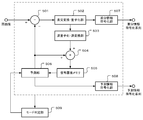
- FIG. 5 is a block diagram showing a configuration of the image coding apparatus according to the embodiment.
- the image coding apparatus according to the embodiment includes a subtracting unit 501, an orthogonal transform / quantization unit 502, an inverse quantization / inverse transform unit 503, an adder 504, a decoded image memory 505, a prediction unit 506, A difference information encoding unit 507, a prediction information encoding unit 508, and a mode determination unit 509 are provided.
- the mode determination unit 509 attempts to encode all prediction candidates and determines optimal prediction information for each block of the image.
- the prediction information includes a prediction mode indicating a divided block size and inter-frame prediction / intra-screen prediction. Further, when the prediction mode is inter-screen prediction, motion information such as a motion vector and a reference picture index is included in the prediction mode. In the case of intra prediction, the intra prediction mode is included.
- the determined prediction information is provided to the prediction unit 506 and the prediction information encoding unit 508.
- the prediction information coding unit 508 performs variable length coding on the input prediction information and outputs a coded sequence of prediction information.
- the prediction unit 506 generates a prediction image using the input prediction information and the already decoded image stored in the decoded image memory 505, and gives the generated prediction image to the subtraction unit 501.
- the subtraction unit 501 generates a difference image by subtracting the predicted image from the original image to be encoded, and gives the generated difference signal to the orthogonal transform / quantization unit 502.
- the orthogonal transform / quantization unit 502 generates a difference coefficient by performing orthogonal transform / quantization on the difference image, and provides the generated difference coefficient to the inverse quantization / inverse transform unit 503 and the difference information encoding unit 507.
- the difference information encoding unit 507 entropy-encodes the difference coefficient and outputs an encoded sequence of difference information.
- the inverse quantization / inverse transform unit 503 generates a decoded differential signal by performing inverse quantization / inverse orthogonal transformation on the difference coefficient received from the orthogonal transform / quantization unit 502, and adds the generated decoded differential signal to the addition unit 504. To give.
- the addition unit 504 generates a decoded image by adding the predicted image and the decoded differential signal, and stores the generated decoded image in the decoded image memory 505.
- FIG. 6 is a block diagram showing the configuration of the video decoding apparatus according to the embodiment.
- the image decoding apparatus according to the embodiment includes a difference information decoding unit 801, an inverse quantization / inverse conversion unit 802, a prediction information decoding unit 803, an addition unit 804, a decoded image memory 805, and a prediction unit 806. .
- each of the configurations of the decoded image memory 805 and the prediction unit 806 is the same as each configuration of the inverse quantization / inverse conversion unit 503, the addition unit 504, the decoded image memory 505, and the prediction unit 506 of the image encoding device in FIG. Has a corresponding function.
- the prediction information decoding unit 803 generates prediction information by entropy decoding the input prediction information encoded sequence, and provides the generated prediction information to the prediction unit 806.
- the prediction unit 806 generates a prediction image using the input prediction information and the already decoded image stored in the decoded image memory 805, and gives the generated prediction image to the addition unit 804.
- the difference information decoding unit 801 generates difference information by entropy decoding the difference information.
- the generated difference information is given to the inverse quantization / inverse transform unit 802.
- the inverse quantization / inverse transform unit 802 performs inverse quantization / inverse orthogonal transform on the difference information received from the difference information decoding unit 801 to generate a decoded differential signal, and provides the generated decoded differential signal to the adding unit 804 .
- the addition unit 804 generates a decoded image by adding the predicted image and the decoded differential signal, stores the generated decoded image in the decoded image memory 805, and outputs the decoded image.
- the difference coefficient encoding and decoding processing according to the embodiment of the present invention is performed in the difference information encoding unit 507 of the moving image encoding device in FIG. 5 and the difference information decoding unit 801 of the moving image decoding device in FIG. .
- the details of the difference information encoding and decoding process according to the embodiment will be described below.
- Encoding block In the embodiment, as shown in FIG. 14, the screen is hierarchically divided into rectangular blocks, and each block is sequentially processed in a predetermined processing order. Each block to be divided is called a coding block.
- a block 1817 in FIG. 18 is a maximum unit of division in the embodiment, and this is called a maximum encoding block.
- a block 1816 in FIG. 14 is a minimum unit of division in the embodiment, and this is called a minimum coding block. In the following description, the minimum encoding block is 4 ⁇ 4 pixels and the maximum encoding block is 16 ⁇ 16 pixels.
- a unit for performing intra prediction is called a prediction block.
- the prediction block has a size of not less than the minimum coding block and not more than the maximum coding block.
- blocks 1802, 1803 and 1804 are 16 ⁇ 16 blocks
- blocks 1805, 1810, 1811 and 1801 are 8 ⁇ 8 blocks
- blocks 1806, 1807, 1808 and 1809 are 4 ⁇ 4 blocks.
- Blocks 1812, 1813, 1814, and 1815 are unprocessed blocks, and the encoding block size is not fixed.
- an optimal prediction block size is determined, and the prediction block size is encoded.
- the predicted block size is obtained from the bit stream.
- the prediction block is described as a processing unit.
- the unit for performing the quantization / orthogonal transform is the same as the unit of the prediction block. However, in the encoding / decoding process, the difference coefficient region is divided into a plurality of sub-blocks and scanned. The size of the sub-block is 4 ⁇ 4 size. FIG. 12 shows a 16 ⁇ 16 size difference coefficient region. 401 to 416 are sub-blocks. However, the unit for performing the quantization / orthogonal transformation may be determined independently of the unit of the prediction block.
- FIG. 15 is a block diagram of a detailed configuration of the first embodiment of the difference information encoding unit 507 of FIG.
- the difference information encoding unit 507 according to the first embodiment includes an arithmetic encoding unit 701, a difference coefficient buffer 702, an encoding control unit 703, a context memory 704, and a scanning control unit 705.
- the encoding control unit 703 further includes: , A significant coefficient information encoding control unit 706, a differential coefficient value encoding control unit 707, and a significant sub-block information encoding control unit 708.
- the scanning control unit 705 determines a processing target sub-block (S601). If all the sub-blocks have been scanned, the differential coefficient decoding process ends.
- the scanning order of the sub-blocks is shown at 902 in FIG. In this procedure, scanning is started from the lower right sub-block of the difference coefficient area, scanning is performed according to the rule from lower right to upper left, and further from upper right to upper left, and scanning is performed in the upper left sub-block. Finish.
- the context is updated by the encoding process. Taking this scan order is a process of improving the estimation accuracy of the occurrence probability of the low frequency component difference coefficient by performing the coding of the low frequency component in which the differential coefficient is likely to occur after the high frequency component. There are advantages.
- FIG. 7 represents the sub-block scanning order using arrows.
- scanning order shown in FIG. 7 is followed, scanning of sub-blocks spatially located on the right side and the lower side of the processing target sub-block is completed.
- a sub-block encoding process is performed on the processing target sub-block (S602).
- the significant subblock information encoding control unit 708 acquires the processing target subblock from the difference coefficient buffer 702. When all the difference coefficients of the sub-block are scanned and all the difference coefficient values are 0, the significant sub-block information is set to 0. Otherwise (when there is at least one non-zero difference coefficient value), significant sub-block information is set to 1 (S701).
- the significant sub-block information encoding control unit 708 refers to the difference coefficient included in the sub-block that is adjacent to the processing target sub-block and has been decoded from the difference coefficient buffer 702, and encodes the significant sub-block information. Determine the context index ctxIdx. A context corresponding to the context index ctxIdx is read from the context memory 704. Significant sub-block information and context are sent to the arithmetic coding unit 701. The arithmetic encoding unit 701 encodes significant sub-block information using the context (S702).
- the significant subblock information encoding control unit 708 determines the value of the significant subblock information (S703). If the significant sub-block information is 0, the sub-block difference coefficient value encoding process is terminated, and the process proceeds to step S601.
- the difference coefficient value encoding control unit 707 performs an encoding process on all the difference coefficient values of the processing target sub-block (S705). Details of the encoding procedure of the sub block difference coefficient values will be described later. After encoding all the difference coefficient values of the sub-block, the process proceeds to step S601.
- the significant coefficient information encoding control unit 706 calculates the sum of the number of non-zero difference coefficients around the processing target sub-block, that is, the peripheral significant coefficient sum countCoeff (S801).
- a difference coefficient that belongs to a sub-block spatially on the right side and lower side of the processing target sub-block and is adjacent to the processing target sub-block is defined as a peripheral difference coefficient.
- Figure 10 shows the position of the peripheral difference coefficient.
- Reference numeral 301 denotes a processing target sub-block
- reference numeral 302 denotes a peripheral difference coefficient.
- the peripheral difference coefficient indicating the outside of the difference coefficient area is excluded from the calculation of the peripheral significant coefficient sum countCoeff.
- the difference coefficient 303 belonging to the right side and lower side sub-block of the processing target sub-block can take either a configuration included in the peripheral difference coefficient or a configuration not included.
- the code 303 is included in the peripheral difference coefficient
- the number of the peripheral difference coefficients is increased, and the significant difference coefficient information occurrence probability can be estimated with high accuracy.
- the code 303 is not included in the peripheral difference coefficient
- the amount of calculation and the circuit scale can be reduced by reducing the addition processing related to countCoeff and the boundary determination processing of the difference coefficient region.
- the significant coefficient information encoding control unit 706 determines a difference coefficient to be processed (S802).
- the scanning order of the difference coefficients in the sub-block follows the rules shown in FIG. 7 as the scanning order of the sub-blocks in the difference coefficient area. If all the significant difference coefficients of the sub-block have been scanned, the encoding process of the significant difference coefficient is terminated, and the process proceeds to the difference coefficient value encoding procedure (S704).
- the significant coefficient information encoding control unit 706 determines whether or not the peripheral significant coefficient sum countCoeff is 0 (S803).
- the processing target difference coefficient position in the processing target sub-block is determined (S804).
- the horizontal difference coefficient position is posX
- the vertical difference coefficient position is posY
- the context index ctxIdx for decoding the significant coefficient information is set to 2 (S815).
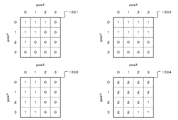
- the definition of the context index ctxIdx when countCoeff> 2 is indicated by reference numeral 605 in FIG.
- the significant coefficient information encoding control unit 706 acquires the difference coefficient at the processing target position from the difference coefficient buffer 702. If the difference coefficient value is not 0, the significant difference coefficient information is set to 1, and if not (when the difference coefficient value is 0), the significant difference coefficient information is set to 0 (S816).
- the significant coefficient information encoding control unit 706 reads the context corresponding to the determined context index ctxIdx from the context memory 704, and then sends the significant difference coefficient information and the context to the arithmetic encoding unit 701.
- the arithmetic encoding unit 701 encodes significant difference coefficient information using the context (S817).
- the difference coefficient value encoding control unit 707 determines a difference coefficient to be processed (S901). It is assumed that the scanning order of the difference coefficients within the sub-block follows the rules shown in FIG. 7 as the scanning order of the significant difference coefficients. If all the difference coefficients of the subblock have been scanned, the encoding process of the difference coefficient value ends, and the process proceeds to the next subblock determination procedure (S601).
- the difference coefficient value encoding control unit 707 determines whether or not the difference coefficient value at the processing target difference coefficient position is 0 (S902). If the difference coefficient value at the processing target difference coefficient position is 0, the encoding of the difference coefficient value at the processing target difference coefficient position is completed, and the process proceeds to step S901.
- the encoded difference coefficient absolute value and the code at the processing target difference coefficient position are calculated (S903, S904). Since it is determined that the difference coefficient value is not 0 when this procedure is executed, the encoded difference coefficient absolute value is a value obtained by subtracting 1 from the absolute value of the difference coefficient. If the difference coefficient is positive, the sign is set to 0, and if the difference coefficient is negative, the sign is set to 1.
- the difference coefficient value encoding control unit 707 reads the context from the context memory 704, and then sends the encoded absolute value and the context to the arithmetic encoding unit 701.
- the arithmetic encoding unit 701 encodes the encoded absolute value using the context (S905).
- the difference coefficient value encoding control unit 707 reads the context from the context memory 704, and then sends the code and context to the arithmetic encoding unit 701.
- the arithmetic encoding unit 701 encodes the encoded absolute value using the context (S905).
- FIG. 8 is a block diagram of a detailed configuration of the first embodiment of the difference information decoding unit 801 in FIG.
- the difference information decoding unit 801 according to the first embodiment includes an arithmetic decoding unit 1001, a difference coefficient buffer 1002, a decoding control unit 1003, a context memory 1004, and a scanning control unit 1005.
- the decoding control unit 1003 further includes significant coefficient information.
- a decoding control unit 1006, a difference coefficient value decoding control unit 1007, and a significant sub-block information decoding control unit 1008 are provided.
- the difference coefficient buffer in the difference information encoding unit in FIG. 8 corresponds to the difference information encoding process in the difference information encoding unit 507 in FIG. 5, the difference coefficient buffer in the difference information encoding unit in FIG.
- Each configuration of 1002, the context memory 1004, and the scan control unit 1005 has a function corresponding to each configuration of the difference coefficient buffer 702, the context memory 704, and the scan control unit 705 in FIG.
- Scan control unit 1005 determines a processing target sub-block (S101). If all the sub-blocks have been scanned, the differential coefficient decoding process ends.
- the scanning order of the sub-blocks is shown at 902 in FIG. In this procedure, scanning is started from the lower right sub-block of the difference coefficient area, scanning is performed according to the rule from lower right to upper left, and further from upper right to upper left, and scanning is performed in the upper left sub-block. Finish.
- reference numeral 901 represents the sub-block scanning order using arrows. When the scanning order shown in FIG. 7 is followed, scanning of sub-blocks spatially located on the right side and the lower side of the processing target sub-block is completed. A sub-block decoding process is performed on the processing target sub-block (S102).
- the significant sub-block information decoding control unit 1008 refers to the difference coefficient included in the sub-block that is adjacent to the processing target sub-block and has been decoded from the difference coefficient buffer 1002, and sets a context for decoding the significant sub-block information.
- the determined context is read from the context memory 1004.
- a decoding instruction is sent together with the context to the arithmetic decoding unit 1001.
- the arithmetic decoding unit 1001 performs decoding processing of the encoded sequence using the context, and decodes significant sub-block information (S201).
- the significant sub-block information decoding control unit 1008 determines the value of significant sub-block information (S202). When the significant subblock information is 0, all the difference coefficient values of the processing target subblock of the difference coefficient buffer 1002 are set to 0 (S209), and the subblock difference coefficient value decoding process is terminated.
- Decoding of all difference coefficient values of the processing target sub-block is performed (S204). Details of the decoding procedure of the sub block difference coefficient value will be described later. After decoding all the difference coefficient values of the sub-block, the process proceeds to step S101.
- the significant coefficient information decoding control unit 1006 calculates the sum countCoeff of the number of significant difference coefficients around the processing target difference coefficient position (S401).
- a difference coefficient that belongs to a sub-block spatially on the right side and lower side of the processing target sub-block and is adjacent to the processing target sub-block is defined as a peripheral difference coefficient.
- Figure 10 shows the position of the peripheral difference coefficient.
- Reference numeral 301 denotes a processing target sub-block
- reference numeral 302 denotes a peripheral difference coefficient.
- the peripheral difference coefficient indicating the outside of the difference coefficient area is excluded from the calculation of the peripheral significant coefficient sum countCoeff.
- the difference coefficient 303 belonging to the right side and lower side sub-block of the processing target sub-block can take either a configuration included in the peripheral difference coefficient or a configuration not included.
- the code 303 is included in the peripheral difference coefficient
- the number of the peripheral difference coefficients is increased, and the significant difference coefficient information occurrence probability can be estimated with high accuracy.
- the code 303 is not included in the peripheral difference coefficient
- the amount of calculation and the circuit scale can be reduced by reducing the addition processing related to countCoeff and the boundary determination processing of the difference coefficient region.
- the significant coefficient information decoding control unit 1006 determines a difference coefficient to be processed (S402). It is assumed that the scanning order of the difference coefficients in the sub-block follows the rules shown in FIG. 7 as the scanning order of the sub-blocks in the difference coefficient area. If all the significant difference coefficients of the sub-block have been scanned, the significant difference coefficient decoding process is completed, and the process proceeds to the difference coefficient value decoding procedure (S204). The significant coefficient information decoding control unit 1006 determines whether or not the peripheral significant coefficient sum countCoeff is 0 (S403). When the peripheral significant coefficient sum countCoeff is 0, the processing target difference coefficient position in the processing target sub-block is determined (S404).
- the horizontal difference coefficient position is posX
- the vertical difference coefficient position is posY
- pos ⁇ 2
- the context ctxIdx for decoding significant coefficient information is set to 1 (S405), otherwise (pos> 2)
- the context ctxIdx is set to 0 (S406).
- a decoding instruction is sent to the arithmetic decoding unit 1001 along with the context.
- the arithmetic decoding unit 1001 performs decoding processing of the encoded sequence using the context, and decodes significant difference coefficient information (S416).
- the context index ctxIdx for decoding the significant coefficient information is set to 2 (S415).
- the definition of the context when countCoeff> 2 is indicated by reference numeral 605 in FIG.
- a decoding instruction is sent to the arithmetic decoding unit 1001 along with the context.
- the arithmetic decoding unit 1001 performs decoding processing of the encoded sequence using the context, and decodes significant difference coefficient information (S416).
- the calculation of the context index ctxIdx for significant difference coefficient information refers to the sum of the number of significant coefficient information of decoded adjacent subblocks and the position in the subblock of the processing target difference coefficient. The reason for adopting such a configuration will be described below.
- the orthogonal transform coefficients of an image tend to concentrate on low-frequency components, and the significance coefficient information is likely to be 1. Furthermore, since the high frequency component of the orthogonal transform coefficient is not easily affected by visual effects, it is often coarsely quantized. Therefore, the coefficient value of the high frequency component can be 0, and the significant coefficient information of the high frequency component can be 0. High nature. This property is not limited to the entire difference coefficient region, but is the same for each sub-block. The component on the low frequency side of the sub block has significant coefficient information compared to the component on the high frequency side of the same sub block. It can be said that the possibility of becoming 1 becomes high.
- the context index There is no dependency in the sub-block in the calculation of. Since the context index for all significant difference coefficients can be calculated at the head of the sub-block, the calculation of the context index can be calculated in parallel with the decoding process of the significant difference coefficient information. It is possible to reduce a processing delay related to decoding significant coefficient information having a high occurrence frequency in the encoded sequence.
- FIG. 20 shows an example in which the difference coefficient area is classified into two areas, a low-frequency area and a high-frequency area. Reference numerals 1101, 1102, 1103, 1104, 1105, and 1109 in FIG.
- reference numerals 1106, 1107, 1108, 1110, 1111, 1112, 1113, 1114, 1115, and 1116 are high-frequency areas.
- the context index ctxIdx is calculated by the procedure described above, and for the low frequency region, an offset corresponding to a predetermined sub-block position is added to the context index ctxIdx described above.
- the low frequency region it is possible to adopt a configuration in which a conditional branch depending on the sub-block position is added during the calculation of the context index ctxIdx described above.
- the context index can be calculated using the peripheral coefficient absolute value sum instead of the peripheral significant difference coefficient sum. Since the absolute value of the difference coefficient of the low frequency component is generally large, the coding efficiency can be improved by setting a context that increases the probability of occurrence of significant difference coefficient information when the sum of the absolute values of the peripheral difference coefficients is large. .
- the significant coefficient information decoding control unit 1006 determines a difference coefficient to be processed (S501). It is assumed that the scanning order of the difference coefficients within the sub-block follows the rules shown in FIG. 7 as the scanning order of the significant difference coefficients. If all the difference coefficients of the sub-block have been scanned, the decoding process of the difference coefficient value is completed, and the process proceeds to the next sub-block determination procedure (S101).
- the significant coefficient information decoding control unit 1006 determines whether or not the difference coefficient value at the processing target difference coefficient position is 0 (S502). When the difference coefficient value at the processing target difference coefficient position is 0, the decoding of the difference coefficient value at the processing target difference coefficient position is completed, and the process proceeds to step S501.
- the absolute value of the difference coefficient at the processing target difference coefficient position is decoded (S503).
- this procedure is executed, it is determined that the difference coefficient value is not 0, and a code word corresponding to a value obtained by subtracting 1 from the absolute value of the difference coefficient is decoded as an encoded sequence. Therefore, a value obtained by adding 1 to the value obtained by entropy decoding the code word is set as the absolute value of the difference coefficient.
- the code of the difference coefficient at the processing target difference coefficient position is decoded (S504).
- the difference coefficient value is determined from the absolute value of the difference coefficient and the sign of the difference coefficient.
- the context index for decoding significant difference coefficient information is calculated from the significant difference coefficient information of the decoded sub-block, but the same procedure is applied to the calculation of the context index of the difference coefficient value.
- the difference coefficient value has a correlation with the peripheral coefficient value and the concentration to the low frequency component, so when the peripheral significant difference coefficient sum or the peripheral difference coefficient absolute value sum is large, a large difference coefficient Set a context index that indicates that the probability of occurrence of a numerical value is high, and if the peripheral significant difference coefficient sum or the peripheral difference coefficient absolute value sum is small, set a context index that indicates that the probability of occurrence of a small difference coefficient value is high.
- the difference coefficient value can be efficiently encoded.
- the image encoding device and image decoding device of the first embodiment described above have the following operational effects.
- the context index of the processing target difference coefficient can be calculated from the difference coefficient belonging to the decoded sub block adjacent to the sub block to which the processing target difference coefficient belongs.
- the occurrence probability of the significant difference coefficient information 1 is high, and when the peripheral significant difference coefficient sum is small, by setting a context for estimating the occurrence probability of the significant difference coefficient information 0 high, An appropriate probability model can be set based on the peripheral correlation of significant difference coefficient information. Therefore, significant difference coefficient information can be efficiently encoded.
- a context index is calculated based on the position within the sub-block of the processing target difference coefficient.
- the difference coefficient in the low band within the sub-block sets a context for estimating the occurrence probability of the significant difference coefficient 1 higher than the difference coefficient in the high band within the sub-block.
- An appropriate probability model can be set based on the property of the significant difference coefficient information on the frequency domain, and the significant difference coefficient information can be efficiently encoded.
- the calculation of the peripheral significant difference coefficient sum and the position of the processing target difference coefficient in the sub-block do not depend on the decoding result of the significant difference coefficient information in the sub-block. Therefore, since it is possible to adopt a configuration in which the calculation of the context index in the sub-block and the decoding of the significant difference coefficient information can be performed in parallel, the processing delay related to the decoding process of the significant difference coefficient information can be reduced.
- the difference coefficient has a high ratio of occupying the encoded sequence, and by reducing the processing delay of the significant difference coefficient information having a large number of processes, a decoding apparatus suitable for real-time processing can be realized. Similarly, the encoding apparatus can reduce the processing delay of the significant difference coefficient information encoding.
- peripheral significant difference coefficient sum related to the calculation of the context index of the significant difference coefficient information does not depend on the position of the processing target difference coefficient, it only needs to be calculated once in the sub-block. Compared to a configuration in which individual peripheral significant difference coefficient sums are calculated according to processing target difference coefficient positions, it is possible to reduce the amount of calculation related to context index calculation.
- the difference information encoding unit 507 of the second embodiment is similar to the difference information encoding unit 507 of the first embodiment illustrated in FIG. 15, and includes an arithmetic encoding unit 701, a difference coefficient buffer 702, and an encoding control unit 703. , A context memory 704, and a scanning control unit 705.
- the encoding control unit 703 further includes a significant coefficient information encoding control unit 706, a difference coefficient value encoding control unit 707, and a significant sub-block information encoding control unit 708. Prepare.
- the difference information encoding procedure in this embodiment is the same as that of the first embodiment except for the significant difference coefficient information encoding processing procedure (S704 in FIG. 17). However, the encoding process procedure of significant difference coefficient information in the present embodiment will be described.
- the significant coefficient information encoding control unit 706 acquires significant sub-block information of decoded sub-blocks adjacent to the right side and the lower side of the processing target sub-block. Significant sub-block information of the sub-block adjacent on the right side is sigGroupRight, and significant sub-block information of the sub-block adjacent on the lower side is sigGroupBottom (S1001).
- the significant coefficient information encoding control unit 706 determines a difference coefficient to be processed (S1002).
- the scanning order of the difference coefficients in the sub-block follows the rules shown in FIG. 7 as the scanning order of the sub-blocks in the difference coefficient area. If all the significant difference coefficients of the sub-block have been scanned, the encoding process of the significant difference coefficient is terminated, and the process proceeds to the difference coefficient value encoding procedure (S704).
- the significant coefficient information encoding control unit 706 evaluates sigGroupRight and sigGroupBottom (S1003).
- the processing target difference coefficient position in the processing target sub-block is determined (S1004).
- the horizontal difference coefficient position is posX
- the vertical difference coefficient position is posY
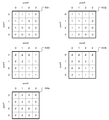
- the definition of the context index ctxIdx when both sigGroupRight and sigGroupBottom are 0 is shown by reference numeral 1201 in FIG.
- the definition of the context index ctxIdx when sigGroupRight is 0 and sigGroupBottom is 1 is indicated by reference numeral 1203 in FIG.
- the context index ctxIdx setting procedure when sigGroupRight is 0 and sigGroupBottom is 1 is a process in which the process in the X direction and the process in the Y direction are switched when sigGroupRight is 1 and sigGroupBottom is 0. .
- the processing can be easily shared, and the hardware circuit scale and the software code amount can be reduced.
- the definition of the context index ctxIdx when sigGroupRight is 0 and sigGroupBottom is 1 is shown by reference numeral 1204 in FIG.
- the significant coefficient information encoding control unit 706 acquires the difference coefficient at the processing target position from the difference coefficient buffer 702. If the difference coefficient value is not 0, the significant difference coefficient information is set to 1, and if not (when the difference coefficient value is 0), the significant difference coefficient information is set to 0 (S1018).
- the significant coefficient information encoding control unit 706 reads the context corresponding to the determined context index ctxIdx from the context memory 704, and then sends the significant difference coefficient information and the context to the arithmetic encoding unit 701.
- the arithmetic encoding unit 701 encodes significant difference coefficient information using the context (S1019).
- the difference information decoding unit 801 according to the second embodiment is similar to the difference information decoding unit 801 according to the first embodiment illustrated in FIG. 8.
- the arithmetic decoding unit 1001, the difference coefficient buffer 1002, the decoding control unit 1003, and the context memory 1004 And the scanning control unit 1005, and the decoding control unit 1003 further includes a significant coefficient information decoding control unit 1006, a difference coefficient value decoding control unit 1007, and a significant sub-block information decoding control unit 1008.
- the difference coefficient buffer in the difference information encoding unit in FIG. 8 corresponds to the difference information encoding process in the difference information encoding unit 507 in FIG. 5, the difference coefficient buffer in the difference information encoding unit in FIG.
- Each configuration of 1002, the context memory 1004, and the scan control unit 1005 has a function corresponding to each configuration of the difference coefficient buffer 702, the context memory 704, and the scan control unit 705 in FIG.
- the difference information decoding procedure in this embodiment is the same as that of the first embodiment except for the significant difference coefficient information encoding processing procedure (S203 in FIG. 2), and therefore, referring to the flowchart in FIG.
- the decoding process procedure of significant difference coefficient information in the present embodiment will be described.
- the significant coefficient information decoding control unit 1006 acquires significant sub-block information of decoded sub-blocks adjacent to the right side and the lower side of the processing target sub-block. Significant subblock information of the subblock adjacent on the right side is sigGroupRight, and significant subblock information of the subblock adjacent on the lower side is sigGroupBottom (S1101).
- the significant coefficient information decoding control unit 1006 determines a difference coefficient to be processed (S1102). It is assumed that the scanning order of the difference coefficients in the sub-block follows the rules shown in FIG. 7 as the scanning order of the sub-blocks in the difference coefficient area. If all the significant difference coefficients of the sub-block have been scanned, the significant difference coefficient decoding process is completed, and the process proceeds to the difference coefficient value decoding procedure (S204).
- the definition of the context when sigGroupRight is 0 and sigGroupBottom is 0 is indicated by reference numeral 1201 in FIG.
- a decoding instruction is sent to the arithmetic decoding unit 1001 along with the context.
- the arithmetic decoding unit 1001 performs decoding processing of the encoded sequence using the context, and decodes significant difference coefficient information (S1116).
- sigGroupRight is 0 and sigGroupBottom is not 0, it is determined whether sigGroupRight is 1 and sigGroupBottom is 0 (S1107).
- a definition of the context when sigGroupRight is 1 and sigGroupBottom is 0 is indicated by reference numeral 1202 in FIG.
- a decoding instruction is sent to the arithmetic decoding unit 1001 along with the context.
- the arithmetic decoding unit 1001 performs decoding processing of the encoded sequence using the context, and decodes significant difference coefficient information (S1116).
- sigGroupRight is 1 and sigGroupBottom is not 0, it is determined whether sigGroupRight is 0 and sigGroupBottom is 1 (S1111).
- sigGroupRight is 0 and sigGroupBottom is 1, the processing target difference coefficient position in the processing target sub-block is determined (S1112).
- the definition of the context when sigGroupRight is 0 and sigGroupBottom is 1 is indicated by reference numeral 1203 in FIG.
- a decoding instruction is sent to the arithmetic decoding unit 1001 along with the context.
- the arithmetic decoding unit 1001 performs decoding processing of the encoded sequence using the context, and decodes significant difference coefficient information (S1116).
- the definition of the context when both sigGroupRight and sigGroupBottom are 1 is shown by reference numeral 1204 in FIG.
- the orthogonal transform coefficients of an image tend to concentrate on low-frequency components, and the significance coefficient information is likely to be 1. Furthermore, since the high frequency component of the orthogonal transform coefficient is not easily affected by visual effects, it is often coarsely quantized. Therefore, the coefficient value of the high frequency component can be 0, and the significant coefficient information of the high frequency component can be 0. High nature. This property is not limited to the entire difference coefficient region, but is the same for each sub-block. The component on the low frequency side of the sub block has significant coefficient information compared to the component on the high frequency side of the same sub block. It can be said that the possibility of becoming 1 becomes high.
- this embodiment refers to a sub-block adjacent to the right side of the decoding target sub-block and a sub-block adjacent to the lower side as decoded adjacent sub-blocks from the viewpoint of reducing the processing amount.
- the decoded adjacent sub-blocks are not limited to these.
- the sub-block adjacent to the lower right of the decoding target sub-block is close to the decoding target sub-block, and has high correlation with the decoding target sub-block. Therefore, by adding the significant sub-block information sigGroupBottomRight of the sub-block adjacent to the lower right to the determination target for calculating the context index ctxIndex, the accuracy of the occurrence probability of the significant difference coefficient can be improved.
- the sub-block adjacent to the lower right side of the decoding target sub-block is compared with the sub-block adjacent to the right side of the decoding target sub-block and the sub-block adjacent to the lower side, and the distance to the decoding target sub-block is far away
- the reflection degree of the significant difference coefficient of sigGroupBottomRight is preferably lower than the sigGroupRight .
- the right significant sub-block information sigGroupRight, the lower significant sub-block information sigGroupBottom, and the processing target coefficient position are referred to.
- the right significant sub-block information sigGroupRight and the lower significant sub-block information are referred to. Since the information sigGroupBottom does not target the difference coefficient belonging to the processing target sub-block, there is no dependency in the sub-block for calculating the context index. Since the context index for all significant difference coefficients can be calculated at the head of the sub-block, the calculation of the context index can be calculated in parallel with the decoding process of the significant difference coefficient information. It is possible to reduce a processing delay related to decoding significant coefficient information having a high occurrence frequency in the encoded sequence.
- a context index for decoding significant difference coefficient information is calculated from significant subblock information of a decoded subblock, but the same procedure is applied to the calculation of the context index of a difference coefficient value.
- the difference coefficient value has a correlation with the peripheral coefficient value and the concentration to the low frequency component, so when the peripheral significant difference coefficient sum or the peripheral difference coefficient absolute value sum is large, a large difference coefficient Set a context index that indicates that the probability of occurrence of a numerical value is high, and if the peripheral significant difference coefficient sum or the peripheral difference coefficient absolute value sum is small, set a context index that indicates that the probability of occurrence of a small difference coefficient value is high.
- the difference coefficient value can be efficiently encoded.
- the image encoding apparatus and the image decoding apparatus of the second embodiment described above further exhibit the following operational effects.
- a context index is calculated based on the combination of the significant sub-block information on the right side and the significant sub-block information on the lower side.
- the difference information encoding unit 507 of the third embodiment is similar to the difference information encoding unit 507 of the first embodiment illustrated in FIG. 15, and includes an arithmetic encoding unit 701, a difference coefficient buffer 702, and an encoding control unit 703. , A context memory 704, and a scanning control unit 705.
- the encoding control unit 703 further includes a significant coefficient information encoding control unit 706, a difference coefficient value encoding control unit 707, and a significant sub-block information encoding control unit 708. Prepare.
- the difference information encoding procedure in this embodiment is the same as that of the first embodiment except for the significant difference coefficient information encoding processing procedure (S704 in FIG. 17). However, the encoding process procedure of significant difference coefficient information in the present embodiment will be described.
- the significant coefficient information encoding control unit 706 calculates a marginal significant index sigCoeffIndex from significant subblock information of decoded subblocks adjacent to the right side and the lower side of the processing target subblock.
- Significant sub-block information of the sub-block adjacent on the right side is sigGroupRight
- significant sub-block information of the sub-block adjacent on the lower side is sigGroupBottom
- the marginal significance index sigCoeffIndex sigGroupRight + 2 ⁇ sigGroupBottom (S120).
- the significant coefficient information encoding control unit 706 determines a difference coefficient to be processed (S1202).
- the scanning order of the difference coefficients in the sub-block follows the rules shown in FIG. 7 as the scanning order of the sub-blocks in the difference coefficient area. If all the significant difference coefficients of the sub-block have been scanned, the encoding process of the significant difference coefficient is terminated, and the process proceeds to the difference coefficient value encoding procedure (S704).
- the significant coefficient information encoding control unit 706 evaluates the peripheral significant index sigCoeffIndex (S1203).
- the processing target difference coefficient position in the processing target sub-block is determined (S1204).
- the marginal significance index sigCoeffIndex being 0 represents that sigGroupRight is 0 and sigGroupBottom is 0.
- the horizontal difference coefficient position is posX
- the vertical difference coefficient position is posY
- the definition of the context index ctxIdx when the marginal significant index sigCoeffIndex is 0 is indicated by reference numeral 1201 in FIG.
- the marginal significance index sigCoeffIndex When the marginal significance index sigCoeffIndex is not 0, it is determined whether the marginal significance index sigCoeffIndex is 1 (S1207).
- the definition of the context index ctxIdx when the marginal significant index sigCoeffIndex is 1 is indicated by reference numeral 1202 in FIG.
- the definition of the context index ctxIdx when the marginal significant index sigCoeffIndex is 2 is indicated by reference numeral 1203 in FIG. That is, the context index ctxIdx setting procedure when the peripheral significant index sigCoeffIndex is 2 is a process in which the X-direction processing and the Y-direction processing when the peripheral significant index sigCoeffIndex is 1 are interchanged. For this reason, the processing can be easily shared, and the hardware circuit scale and the software code amount can be reduced.
- the processing target difference coefficient position in the processing target sub-block is determined (S1215).
- the marginal significance index sigCoeffIndex being 3 represents that both sigGroupRight and sigGroupBottom are 1.
- the definition of the context index ctxIdx when the marginal significant index sigCoeffIndex is 3 is shown by reference numeral 1204 in FIG.
- the significant coefficient information encoding control unit 706 acquires the difference coefficient at the processing target position from the difference coefficient buffer 702. If the difference coefficient value is not 0, the significant difference coefficient information is set to 1. If not (when the difference coefficient value is 0), the significant difference coefficient information is set to 0 (S1218).
- the significant coefficient information encoding control unit 706 reads the context corresponding to the determined context index ctxIdx from the context memory 704, and then sends the significant difference coefficient information and the context to the arithmetic encoding unit 701.
- the arithmetic encoding unit 701 encodes significant difference coefficient information using the context (S1219).
- the difference information decoding unit 801 according to the third embodiment is similar to the difference information decoding unit 801 according to the first embodiment illustrated in FIG. 8.
- the arithmetic decoding unit 1001, the difference coefficient buffer 1002, the decoding control unit 1003, and the context memory 1004 And the scanning control unit 1005, and the decoding control unit 1003 further includes a significant coefficient information decoding control unit 1006, a difference coefficient value decoding control unit 1007, and a significant sub-block information decoding control unit 1008.
- the difference coefficient buffer in the difference information encoding unit in FIG. 8 corresponds to the difference information encoding process in the difference information encoding unit 507 in FIG. 5, the difference coefficient buffer in the difference information encoding unit in FIG.
- Each configuration of 1002, the context memory 1004, and the scan control unit 1005 has a function corresponding to each configuration of the difference coefficient buffer 702, the context memory 704, and the scan control unit 705 in FIG.
- the difference information decoding procedure in this embodiment is the same as that of the first embodiment except for the significant difference coefficient information encoding processing procedure (S203 in FIG. 2), and therefore, referring to the flowchart in FIG.
- the decoding process procedure of significant difference coefficient information in the present embodiment will be described.
- the significant coefficient information decoding control unit 1006 calculates a peripheral significant index sigCoeffIndex from significant subblock information of decoded subblocks adjacent to the right side and the lower side of the processing target subblock.
- Significant subblock information of the subblock adjacent on the right side is sigGroupRight
- significant subblock information of the subblock adjacent on the lower side is sigGroupBottom
- the marginal significance index sigCoeffIndex sigGroupRight + 2 ⁇ sigGroupBottom (S1301).
- the significant coefficient information decoding control unit 1006 determines a difference coefficient to be processed (S1302). It is assumed that the scanning order of the difference coefficients in the sub-block follows the rules shown in FIG. 7 as the scanning order of the sub-blocks in the difference coefficient area. If all the significant difference coefficients of the sub-block have been scanned, the significant difference coefficient decoding process is completed, and the process proceeds to the difference coefficient value decoding procedure (S204).
- the significant coefficient information decoding control unit 1006 evaluates the peripheral significant index sigCoeffIndex (S1303).
- the processing target difference coefficient position in the processing target sub-block is determined (S1304).
- the marginal significance index sigCoeffIndex being 0 represents that both sigGroupRight and sigGroupBottom are 0.
- the horizontal difference coefficient position is posX
- the vertical difference coefficient position is posY
- the definition of the context when the marginal significance index sigCoeffIndex is 0 is indicated by reference numeral 1201 in FIG.
- a decoding instruction is sent to the arithmetic decoding unit 1001 along with the context.
- the arithmetic decoding unit 1001 performs decoding processing of the encoded sequence using the context, and decodes significant difference coefficient information (S1316).
- the marginal significance index sigCoeffIndex is 1 (S1307).
- the definition of the context when the marginal significance index sigCoeffIndex is 1 is indicated by reference numeral 1202 in FIG.
- a decoding instruction is sent to the arithmetic decoding unit 1001 along with the context.
- the arithmetic decoding unit 1001 performs decoding processing of the encoded sequence using the context, and decodes significant difference coefficient information (S1316).
- the definition of the context when the marginal significance index sigCoeffIndex is 2 is indicated by reference numeral 1203 in FIG.
- a decoding instruction is sent to the arithmetic decoding unit 1001 along with the context.
- the arithmetic decoding unit 1001 performs decoding processing of the encoded sequence using the context, and decodes significant difference coefficient information (S1316).
- the processing target difference coefficient position in the processing target sub-block is determined (S1317).
- the definition of the context when the marginal significance index sigCoeffIndex is 3 is indicated by reference numeral 1204 in FIG.
- a decoding instruction is sent to the arithmetic decoding unit 1001 along with the context.
- the arithmetic decoding unit 1001 performs decoding processing of the encoded sequence using the context, and decodes significant difference coefficient information (S1316).
- the context index ctxIdx is calculated by referring to the marginal significant index sigCoeffIndex. Therefore, it is possible to reduce the number of times of determination processing related to the peripheral significance index sigCoeffIndex context index.
- the image encoding device and the image decoding device of the third embodiment described above are in addition to the operation effects (1) to (4) of the first embodiment and the operation effect (5) of the second embodiment. In addition, the following effects are achieved.
- the encoded stream of the image output from the image encoding device according to the embodiment described above has a specific data format so that it can be decoded according to the encoding method used in the embodiment.
- the image decoding device corresponding to the image encoding device can decode the encoded stream of this specific data format.
- an image transmission apparatus that converts the encoded stream output from the image encoding apparatus into encoded data in a data format suitable for the transmission form of the communication path and transmits the encoded data to the network, and receives the encoded data from the network
- an image receiving apparatus that restores the encoded stream and supplies the encoded stream to the image decoding apparatus.
- An image transmission device includes a memory that buffers an encoded stream output from the image encoding device, a packet processing unit that packetizes the encoded stream, and a transmission unit that transmits packetized encoded data via a network.
- the image reception device receives a packetized encoded data via a network, a memory for buffering the received encoded data, packetizes the encoded data to generate an encoded stream, And a packet processing unit provided to the image decoding device.
- the above processing relating to encoding and decoding can be realized as a transmission, storage, and reception device using hardware, and is stored in a ROM (Read Only Memory), a flash memory, or the like. It can also be realized by firmware or software such as a computer.
- the firmware program and software program can be recorded on a computer-readable recording medium, provided from a server through a wired or wireless network, or provided as a data broadcast of terrestrial or satellite digital broadcasting Is also possible.
- the present invention can be used for image encoding and decoding techniques.
Landscapes
- Engineering & Computer Science (AREA)
- Multimedia (AREA)
- Signal Processing (AREA)
- Physics & Mathematics (AREA)
- General Physics & Mathematics (AREA)
- Theoretical Computer Science (AREA)
- Compression Or Coding Systems Of Tv Signals (AREA)
- Compression, Expansion, Code Conversion, And Decoders (AREA)
- Compression Of Band Width Or Redundancy In Fax (AREA)
- Data Exchanges In Wide-Area Networks (AREA)
- Mobile Radio Communication Systems (AREA)
Abstract
Priority Applications (45)
| Application Number | Priority Date | Filing Date | Title |
|---|---|---|---|
| MYPI2017000011A MY162892A (en) | 2012-04-13 | 2013-04-12 | Picture coding device, picture coding method, and picture coding program |
| CN201380018023.9A CN104247419B (zh) | 2012-04-13 | 2013-04-12 | 图像解码装置、图像解码方法、接收装置及接收方法 |
| EP19161411.4A EP3515077B1 (fr) | 2012-04-13 | 2013-04-12 | Dispositif de décodage d'images, procédé de décodage d'images, programme de décodage d'images, dispositif de codage d'images, procédé de codage d'images et programme de codage d'images |
| CA2869637A CA2869637C (fr) | 2012-04-13 | 2013-04-12 | Dispositif de decodage d'image, methode de decodage d'image et programmede decodage d'image |
| EP19161418.9A EP3515078B1 (fr) | 2012-04-13 | 2013-04-12 | Dispositif de décodage d'images, procédé de décodage d'images, programme de décodage d'images, dispositif de codage d'images, procédé de codage d'images et programme de codage d'images |
| PE2019001895A PE20191435A1 (es) | 2012-04-13 | 2013-04-12 | Dispositivo de codificacion de imagenes, metodo de codificacion de imagenes, y programa de codificacion de imagenes, y dispositivos de codificacion de imagenes, metodo de decodificacion de imagenes, y programa de decodificacion de imagenes |
| EP19161421.3A EP3515079B1 (fr) | 2012-04-13 | 2013-04-12 | Dispositif de décodage d'images, procédé de décodage d'images, programme de décodage d'images, dispositif de codage d'images, procédé de codage d'images et programme de codage d'images |
| EP24167855.6A EP4376413A1 (fr) | 2012-04-13 | 2013-04-12 | Dispositif de décodage d'image, procédé de décodage d'image, programme de décodage d'image, dispositif de codage d'image, procédé de codage d'image et programme de codage d'image |
| MX2014012155A MX339686B (es) | 2012-04-13 | 2013-04-12 | Dispositivo de codificacion de imagen, metodo de codificacion de imagen, y programa de codificacion de imagen y dispositivo de decodificacion de imagen, metodo de decodificacion de imagen y programa de decodificacion de imagen. |
| EP19161423.9A EP3515080B1 (fr) | 2012-04-13 | 2013-04-12 | Dispositif de codage d'images, procédé de codage d'images et programme de codage d'images |
| PL19161411T PL3515077T3 (pl) | 2012-04-13 | 2013-04-12 | Urządzenie do dekodowania obrazu, sposób dekodowania obrazu, program do dekodowania obrazu, urządzenie do kodowania obrazu, sposób kodowania obrazu i program do kodowania obrazu |
| EP13775455.2A EP2838260B1 (fr) | 2012-04-13 | 2013-04-12 | Dispositif de décodage d'images, procédé de décodage d'images, programme de décodage d'images |
| MYPI2017000010A MY166213A (en) | 2012-04-13 | 2013-04-12 | Picture coding device, picture coding method, and picture coding program |
| AU2013247974A AU2013247974B2 (en) | 2012-04-13 | 2013-04-12 | Image coding device, image coding method, image coding program, transmission device, transmission method, transmission program, image decoding device, image decoding method, image decoding program, reception device, reception method, and reception program |
| PL19161423T PL3515080T3 (pl) | 2012-04-13 | 2013-04-12 | Urządzenie do kodowania obrazu, sposób kodowania obrazu i program do kodowania obrazu |
| BR112014023933A BR112014023933B1 (pt) | 2012-04-13 | 2013-04-12 | dispositivo de decodificação de imagens, método de decodificação de imagens e dispositivo de recepção |
| MX2016007154A MX346521B (es) | 2012-04-13 | 2013-04-12 | Dispositivo de codificación de imagen, método de codificación de imagen y programa de codificación de imagen, y dispositivo de decodificación de imagen, método de decodificación de imagen y programa de decodificación de imagen. |
| SI201331477T SI2838260T1 (sl) | 2012-04-13 | 2013-04-12 | Naprava za dekodiranje videa, postopek za dekodiranje videa, program za dekodiranje videa |
| PL19161421T PL3515079T3 (pl) | 2012-04-13 | 2013-04-12 | Urządzenie do dekodowania obrazu, sposób dekodowania obrazu, program do dekodowania obrazu, urządzenie do kodowania obrazu, sposób kodowania obrazu i program do kodowania obrazu |
| MYPI2017000009A MY162891A (en) | 2012-04-13 | 2013-04-12 | Picture coding device, picture coding method, and picture coding program |
| MYPI2014002669A MY183790A (en) | 2012-04-13 | 2013-04-12 | Picture decoding device, picture decoding method, and picture decoding program |
| MX2019003952A MX386960B (es) | 2012-04-13 | 2013-04-12 | Dispositivo de decodificación de imagen y método de decodificación de imagen. |
| EP20189847.5A EP3754991B1 (fr) | 2012-04-13 | 2013-04-12 | Dispositif de décodage d'images, procédé de décodage d'images, programme de décodage d'images, dispositif de codage d'images, procédé de codage d'images et programme de codage d'images |
| SG11201405947YA SG11201405947YA (en) | 2012-04-13 | 2013-04-12 | Picture coding device, picture coding method, and picture coding program, and picture decoding device, picture decoding method, and picture decoding program |
| ES13775455T ES2733057T3 (es) | 2012-04-13 | 2013-04-12 | Dispositivo de decodificación de imágenes, procedimiento de decodificación de imágenes, programa de decodificación de imágenes |
| MX2017003502A MX363851B (es) | 2012-04-13 | 2013-04-12 | Dispositivo de decodificación de imagen y método de decodificación de imagen. |
| DK13775455.2T DK2838260T3 (da) | 2012-04-13 | 2013-04-12 | Billede-dekodningsapparat, billede-dekodningsfremgangsmåde, billede-dekodningsprogram |
| PL13775455T PL2838260T3 (pl) | 2012-04-13 | 2013-04-12 | Urządzenie do dekodowania obrazu, sposób dekodowania obrazu i program do dekodowania obrazu |
| RU2014145618A RU2633175C9 (ru) | 2012-04-13 | 2013-04-12 | Устройство кодирования изображения, способ кодирования изображения и программа кодирования изображения, а также устройство декодирования изображения, способ декодирования изображения и программа декодирования изображения |
| CN201510583771.2A CN105187830B (zh) | 2012-04-13 | 2013-04-12 | 图像解码装置、图像解码方法、接收装置及接收方法 |
| PL19161418T PL3515078T3 (pl) | 2012-04-13 | 2013-04-12 | Urządzenie do dekodowania obrazu, sposób dekodowania obrazu, program do dekodowania obrazu, urządzenie do kodowania obrazu, sposób kodowania obrazu i program do kodowania obrazu |
| PH12014502137A PH12014502137B1 (en) | 2012-04-13 | 2014-09-24 | Image coding device, image coding method, image coding program, transmission device, transmission method, transmission program, image decoding device, image decoding method, image decoding program, reception device, reception method, and reception program |
| US14/495,430 US9615109B2 (en) | 2012-04-13 | 2014-09-24 | Picture coding device, picture coding method, and picture coding program, and picture decoding device, picture decoding method, and picture decoding program |
| AU2016210589A AU2016210589B2 (en) | 2012-04-13 | 2016-08-01 | Picture decoding device, picture decoding method, and picture decoding program |
| US15/435,369 US9706211B2 (en) | 2012-04-13 | 2017-02-17 | Picture coding device, picture coding method, and picture coding program, and picture decoding device, picture decoding method, and picture decoding program |
| PH12017500788A PH12017500788B1 (en) | 2012-04-13 | 2017-04-27 | Image coding device, image coding method, image coding program, transmission device, transmission method, transmission program, image decoding device, image decoding method, image decoding program, reception device, reception method, and reception program |
| PH12017500789A PH12017500789B1 (en) | 2012-04-13 | 2017-04-27 | Image coding device, image coding method, image coding program, transmission device, transmission method, transmission program, image decoding device, image decoding method, image decoding program, reception device, reception method, and reception program |
| PH12017500791A PH12017500791A1 (en) | 2012-04-13 | 2017-04-27 | Image coding device, image coding method, image coding program, transmission device, transmission method, transmission program, image decoding device, image decoding method, image decoding program, reception device, reception method, and reception program |
| PH12017500790A PH12017500790B1 (en) | 2012-04-13 | 2017-04-27 | Image coding device, image coding method, image coding program, transmission device, transmission method, transmission program, image decoding device, image decoding method, image decoding program, reception device, reception method, and reception program |
| US15/613,864 US9872030B2 (en) | 2012-04-13 | 2017-06-05 | Picture coding device, picture coding method, and picture coding program, and picture decoding device, picture decoding method, and picture decoding program |
| US15/613,902 US9872031B2 (en) | 2012-04-13 | 2017-06-05 | Picture coding device, picture coding method, and picture coding program, and picture decoding device, picture decoding method, and picture decoding program |
| US15/613,776 US9872029B2 (en) | 2012-04-13 | 2017-06-05 | Picture coding device, picture coding method, and picture coding program, and picture decoding device, picture decoding method, and picture decoding program |
| AU2017245338A AU2017245338B2 (en) | 2012-04-13 | 2017-10-11 | Picture decoding device, picture decoding method, and picture decoding program |
| AU2019200733A AU2019200733B2 (en) | 2012-04-13 | 2019-02-04 | Picture decoding device, picture decoding method, and picture decoding program |
| AU2020202671A AU2020202671B2 (en) | 2012-04-13 | 2020-04-21 | Picture Decoding Device, Picture Decoding Method, and Picture Decoding Program |
Applications Claiming Priority (4)
| Application Number | Priority Date | Filing Date | Title |
|---|---|---|---|
| JP2012092078A JP5696684B2 (ja) | 2012-04-13 | 2012-04-13 | 画像符号化装置、画像符号化方法、画像符号化プログラム、送信装置、送信方法及び送信プログラム |
| JP2012092077A JP5696683B2 (ja) | 2012-04-13 | 2012-04-13 | 画像復号装置、画像復号方法、画像復号プログラム、受信装置、受信方法及び受信プログラム |
| JP2012-092077 | 2012-04-13 | ||
| JP2012-092078 | 2012-04-13 |
Related Child Applications (1)
| Application Number | Title | Priority Date | Filing Date |
|---|---|---|---|
| US14/495,430 Continuation US9615109B2 (en) | 2012-04-13 | 2014-09-24 | Picture coding device, picture coding method, and picture coding program, and picture decoding device, picture decoding method, and picture decoding program |
Publications (1)
| Publication Number | Publication Date |
|---|---|
| WO2013153824A1 true WO2013153824A1 (fr) | 2013-10-17 |
Family
ID=49327408
Family Applications (1)
| Application Number | Title | Priority Date | Filing Date |
|---|---|---|---|
| PCT/JP2013/002514 Ceased WO2013153824A1 (fr) | 2012-04-13 | 2013-04-12 | Dispositif de codage d'images, procédé de codage d'images, programme de codage d'images, dispositif d'émission, procédé d'émission, programme d'émission, dispositif de décodage d'images, procédé de décodage d'images, programme de décodage d'images, dispositif de réception, procédé de réception et programme de réception |
Country Status (22)
| Country | Link |
|---|---|
| US (5) | US9615109B2 (fr) |
| EP (7) | EP2838260B1 (fr) |
| CN (6) | CN107087202B (fr) |
| AU (5) | AU2013247974B2 (fr) |
| BR (1) | BR112014023933B1 (fr) |
| CA (5) | CA3114391C (fr) |
| CL (1) | CL2014002748A1 (fr) |
| DK (3) | DK3515079T3 (fr) |
| ES (6) | ES2980447T3 (fr) |
| HR (1) | HRP20201461T1 (fr) |
| HU (6) | HUE050514T2 (fr) |
| MX (4) | MX339686B (fr) |
| MY (5) | MY166213A (fr) |
| PE (2) | PE20191435A1 (fr) |
| PH (5) | PH12014502137B1 (fr) |
| PL (6) | PL3515077T3 (fr) |
| RU (5) | RU2668399C9 (fr) |
| SG (4) | SG10201505293UA (fr) |
| SI (3) | SI3515078T1 (fr) |
| TR (1) | TR201908450T4 (fr) |
| TW (5) | TWI666917B (fr) |
| WO (1) | WO2013153824A1 (fr) |
Families Citing this family (6)
| Publication number | Priority date | Publication date | Assignee | Title |
|---|---|---|---|---|
| US10887626B2 (en) * | 2016-05-13 | 2021-01-05 | Sharp Kabushiki Kaisha | Image decoding device and image encoding device |
| US10827186B2 (en) * | 2016-08-25 | 2020-11-03 | Intel Corporation | Method and system of video coding with context decoding and reconstruction bypass |
| EP4213096B1 (fr) | 2018-01-18 | 2026-04-22 | Malikie Innovations Limited | Procédés et dispositifs pour le codage entropique de nuages de points |
| EP3937132B1 (fr) * | 2018-04-09 | 2025-05-28 | BlackBerry Limited | Procédés et dispositifs de codage entropique binaire de nuages de points |
| GB2585044A (en) | 2019-06-25 | 2020-12-30 | Sony Corp | Image data encoding and decoding |
| CN115916471B (zh) * | 2020-05-19 | 2026-03-13 | 捷普有限公司 | 用于可变幅宽末端执行器的装置、系统和方法 |
Citations (1)
| Publication number | Priority date | Publication date | Assignee | Title |
|---|---|---|---|---|
| JP2007300517A (ja) | 2006-05-02 | 2007-11-15 | Sony Corp | 動画像処理方法、動画像処理方法のプログラム、動画像処理方法のプログラムを記録した記録媒体及び動画像処理装置 |
Family Cites Families (35)
| Publication number | Priority date | Publication date | Assignee | Title |
|---|---|---|---|---|
| US6480537B1 (en) * | 1999-02-25 | 2002-11-12 | Telcordia Technologies, Inc. | Active techniques for video transmission and playback |
| EP1478190B1 (fr) * | 2002-04-26 | 2013-01-02 | NTT DoCoMo, Inc. | Codeur d'image, dispositif de codage, et programme de codage |
| US7379608B2 (en) * | 2003-12-04 | 2008-05-27 | Fraunhofer-Gesellschaft Zur Foerderung Der Angewandten Forschung, E.V. | Arithmetic coding for transforming video and picture data units |
| US7460725B2 (en) * | 2006-11-09 | 2008-12-02 | Calista Technologies, Inc. | System and method for effectively encoding and decoding electronic information |
| KR101356733B1 (ko) * | 2007-03-07 | 2014-02-05 | 삼성전자주식회사 | 컨텍스트 기반 적응적 이진 산술 부호화, 복호화 방법 및장치 |
| US7813567B2 (en) * | 2007-04-26 | 2010-10-12 | Texas Instruments Incorporated | Method of CABAC significance MAP decoding suitable for use on VLIW data processors |
| US8204327B2 (en) * | 2007-10-01 | 2012-06-19 | Cisco Technology, Inc. | Context adaptive hybrid variable length coding |
| KR20090095317A (ko) * | 2008-03-05 | 2009-09-09 | 삼성전자주식회사 | 영상 부호화 및 복호화 방법 및 장치 |
| WO2009110160A1 (fr) * | 2008-03-07 | 2009-09-11 | 株式会社 東芝 | Procédé et dispositif de codage/décodage dynamique d'une image |
| KR101511082B1 (ko) * | 2008-05-09 | 2015-04-13 | 삼성전자주식회사 | 최하위 비트를 이용한 엔트로피 부호화 방법과 그 장치 및엔트로피 복호화 방법과 그 장치 |
| US8138956B2 (en) * | 2008-06-02 | 2012-03-20 | Mediatek Inc. | CABAC encoder and CABAC encoding method |
| CN102132566B (zh) * | 2008-10-07 | 2015-05-20 | 株式会社Ntt都科摩 | 图像加工装置及方法、动态图像编码装置及方法、动态图像解码装置及方法、以及编码解码系统和方法 |
| CN101394565B (zh) * | 2008-10-20 | 2011-08-17 | 成都九洲电子信息系统有限责任公司 | 一种帧内预测方法 |
| WO2010087157A1 (fr) * | 2009-01-29 | 2010-08-05 | パナソニック株式会社 | Procédé de codage d'image et procédé de décodage d'image |
| TW201041405A (en) * | 2009-03-06 | 2010-11-16 | Sony Corp | Image processing device and method |
| JP2010258741A (ja) * | 2009-04-24 | 2010-11-11 | Sony Corp | 画像処理装置および方法、並びにプログラム |
| JP2010258739A (ja) * | 2009-04-24 | 2010-11-11 | Sony Corp | 画像処理装置および方法、並びにプログラム |
| JP5492206B2 (ja) * | 2009-07-27 | 2014-05-14 | 株式会社東芝 | 画像符号化方法および画像復号方法、ならびに、画像符号化装置および画像復号装置 |
| WO2011052142A1 (fr) * | 2009-10-29 | 2011-05-05 | パナソニック株式会社 | Procédé de codage d'image et procédé de décodage d'image |
| HUE037656T2 (hu) * | 2010-04-13 | 2018-09-28 | Fraunhofer Ges Forschung | Valószínûség intervallum partícionáló kódoló és dekódoló |
| US8908755B2 (en) * | 2010-07-16 | 2014-12-09 | Sony Corporation | Multi-parameter motion for efficient prediction in video compression |
| US9154801B2 (en) * | 2010-09-30 | 2015-10-06 | Texas Instruments Incorporated | Method and apparatus for diagonal scan and simplified coding of transform coefficients |
| US8902988B2 (en) * | 2010-10-01 | 2014-12-02 | Qualcomm Incorporated | Zero-out of high frequency coefficients and entropy coding retained coefficients using a joint context model |
| US9497472B2 (en) * | 2010-11-16 | 2016-11-15 | Qualcomm Incorporated | Parallel context calculation in video coding |
| US8976861B2 (en) * | 2010-12-03 | 2015-03-10 | Qualcomm Incorporated | Separately coding the position of a last significant coefficient of a video block in video coding |
| US20120163448A1 (en) * | 2010-12-22 | 2012-06-28 | Qualcomm Incorporated | Coding the position of a last significant coefficient of a video block in video coding |
| US20120163456A1 (en) * | 2010-12-22 | 2012-06-28 | Qualcomm Incorporated | Using a most probable scanning order to efficiently code scanning order information for a video block in video coding |
| US20120207400A1 (en) * | 2011-02-10 | 2012-08-16 | Hisao Sasai | Image coding method, image coding apparatus, image decoding method, image decoding apparatus, and image coding and decoding apparatus |
| US10499059B2 (en) * | 2011-03-08 | 2019-12-03 | Velos Media, Llc | Coding of transform coefficients for video coding |
| US8446301B2 (en) * | 2011-04-15 | 2013-05-21 | Research In Motion Limited | Methods and devices for coding and decoding the position of the last significant coefficient |
| US9807426B2 (en) * | 2011-07-01 | 2017-10-31 | Qualcomm Incorporated | Applying non-square transforms to video data |
| US9584812B2 (en) * | 2012-01-20 | 2017-02-28 | Blackberry Limited | Methods and devices for context set selection |
| US9008189B2 (en) * | 2012-01-20 | 2015-04-14 | Blackberry Limited | Methods and devices for context modeling to enable modular processing |
| US20130195200A1 (en) * | 2012-01-28 | 2013-08-01 | Research In Motion Limited | Methods and devices for context modeling to enable modular processing |
| PL3515073T3 (pl) * | 2012-03-26 | 2021-03-08 | Jvckenwood Corporation | Urządzenie do kodowania obrazu, sposób kodowania obrazu i program do kodowania obrazu |
-
2013
- 2013-04-12 MY MYPI2017000010A patent/MY166213A/en unknown
- 2013-04-12 ES ES20189847T patent/ES2980447T3/es active Active
- 2013-04-12 DK DK19161421.3T patent/DK3515079T3/da active
- 2013-04-12 ES ES19161423T patent/ES2820322T3/es active Active
- 2013-04-12 TR TR2019/08450T patent/TR201908450T4/tr unknown
- 2013-04-12 MY MYPI2017000011A patent/MY162892A/en unknown
- 2013-04-12 SI SI201331784T patent/SI3515078T1/sl unknown
- 2013-04-12 CA CA3114391A patent/CA3114391C/fr active Active
- 2013-04-12 PL PL19161411T patent/PL3515077T3/pl unknown
- 2013-04-12 EP EP13775455.2A patent/EP2838260B1/fr active Active
- 2013-04-12 ES ES19161418T patent/ES2820332T3/es active Active
- 2013-04-12 PL PL20189847.5T patent/PL3754991T3/pl unknown
- 2013-04-12 TW TW107136525A patent/TWI666917B/zh active
- 2013-04-12 TW TW102113230A patent/TWI566581B/zh active
- 2013-04-12 HU HUE19161421A patent/HUE050514T2/hu unknown
- 2013-04-12 CA CA3191379A patent/CA3191379A1/fr active Pending
- 2013-04-12 EP EP19161418.9A patent/EP3515078B1/fr active Active
- 2013-04-12 PE PE2019001895A patent/PE20191435A1/es unknown
- 2013-04-12 CN CN201710085119.7A patent/CN107087202B/zh active Active
- 2013-04-12 PE PE2014001633A patent/PE20150373A1/es not_active Application Discontinuation
- 2013-04-12 PL PL19161423T patent/PL3515080T3/pl unknown
- 2013-04-12 HU HUE19161418A patent/HUE050469T2/hu unknown
- 2013-04-12 EP EP24167855.6A patent/EP4376413A1/fr active Pending
- 2013-04-12 RU RU2017133607A patent/RU2668399C9/ru active
- 2013-04-12 MY MYPI2016000985A patent/MY177865A/en unknown
- 2013-04-12 CN CN201510582521.7A patent/CN105245906B/zh active Active
- 2013-04-12 TW TW106116702A patent/TWI613908B/zh active
- 2013-04-12 ES ES13775455T patent/ES2733057T3/es active Active
- 2013-04-12 MY MYPI2017000009A patent/MY162891A/en unknown
- 2013-04-12 CA CA3191369A patent/CA3191369A1/fr active Pending
- 2013-04-12 EP EP19161423.9A patent/EP3515080B1/fr active Active
- 2013-04-12 SI SI201331477T patent/SI2838260T1/sl unknown
- 2013-04-12 CN CN201510583843.3A patent/CN105187843B/zh active Active
- 2013-04-12 CN CN201510583247.5A patent/CN105245907B/zh active Active
- 2013-04-12 MX MX2014012155A patent/MX339686B/es active IP Right Grant
- 2013-04-12 EP EP19161421.3A patent/EP3515079B1/fr active Active
- 2013-04-12 MY MYPI2014002669A patent/MY183790A/en unknown
- 2013-04-12 DK DK13775455.2T patent/DK2838260T3/da active
- 2013-04-12 EP EP20189847.5A patent/EP3754991B1/fr active Active
- 2013-04-12 CN CN201510583771.2A patent/CN105187830B/zh active Active
- 2013-04-12 PL PL13775455T patent/PL2838260T3/pl unknown
- 2013-04-12 SG SG10201505293UA patent/SG10201505293UA/en unknown
- 2013-04-12 PL PL19161421T patent/PL3515079T3/pl unknown
- 2013-04-12 MX MX2019003952A patent/MX386960B/es unknown
- 2013-04-12 HU HUE19161411A patent/HUE050470T2/hu unknown
- 2013-04-12 DK DK19161418.9T patent/DK3515078T3/da active
- 2013-04-12 MX MX2017003502A patent/MX363851B/es unknown
- 2013-04-12 SG SG10201806313VA patent/SG10201806313VA/en unknown
- 2013-04-12 SI SI201331783T patent/SI3515079T1/sl unknown
- 2013-04-12 BR BR112014023933A patent/BR112014023933B1/pt active IP Right Grant
- 2013-04-12 ES ES19161411T patent/ES2820316T3/es active Active
- 2013-04-12 RU RU2014145618A patent/RU2633175C9/ru active
- 2013-04-12 EP EP19161411.4A patent/EP3515077B1/fr active Active
- 2013-04-12 WO PCT/JP2013/002514 patent/WO2013153824A1/fr not_active Ceased
- 2013-04-12 CA CA2869637A patent/CA2869637C/fr active Active
- 2013-04-12 HU HUE19161423A patent/HUE050468T2/hu unknown
- 2013-04-12 MX MX2016007154A patent/MX346521B/es unknown
- 2013-04-12 SG SG10202002472RA patent/SG10202002472RA/en unknown
- 2013-04-12 SG SG11201405947YA patent/SG11201405947YA/en unknown
- 2013-04-12 CA CA2960604A patent/CA2960604C/fr active Active
- 2013-04-12 ES ES19161421T patent/ES2820318T3/es active Active
- 2013-04-12 HU HUE13775455 patent/HUE044347T2/hu unknown
- 2013-04-12 TW TW106144428A patent/TWI642296B/zh active
- 2013-04-12 HU HUE20189847A patent/HUE066407T2/hu unknown
- 2013-04-12 TW TW105133274A patent/TWI592010B/zh active
- 2013-04-12 PL PL19161418T patent/PL3515078T3/pl unknown
- 2013-04-12 AU AU2013247974A patent/AU2013247974B2/en active Active
- 2013-04-12 CN CN201380018023.9A patent/CN104247419B/zh active Active
-
2014
- 2014-09-24 PH PH12014502137A patent/PH12014502137B1/en unknown
- 2014-09-24 US US14/495,430 patent/US9615109B2/en active Active
- 2014-10-13 CL CL2014002748A patent/CL2014002748A1/es unknown
-
2016
- 2016-08-01 AU AU2016210589A patent/AU2016210589B2/en active Active
-
2017
- 2017-02-17 US US15/435,369 patent/US9706211B2/en active Active
- 2017-04-27 PH PH12017500789A patent/PH12017500789B1/en unknown
- 2017-04-27 PH PH12017500788A patent/PH12017500788B1/en unknown
- 2017-04-27 PH PH12017500791A patent/PH12017500791A1/en unknown
- 2017-04-27 PH PH12017500790A patent/PH12017500790B1/en unknown
- 2017-06-05 US US15/613,864 patent/US9872030B2/en active Active
- 2017-06-05 US US15/613,902 patent/US9872031B2/en active Active
- 2017-06-05 US US15/613,776 patent/US9872029B2/en active Active
- 2017-10-11 AU AU2017245338A patent/AU2017245338B2/en active Active
-
2018
- 2018-09-17 RU RU2018132866A patent/RU2689808C9/ru active
-
2019
- 2019-02-04 AU AU2019200733A patent/AU2019200733B2/en active Active
- 2019-02-28 RU RU2019105775A patent/RU2713848C1/ru active
- 2019-02-28 RU RU2019105780A patent/RU2705650C9/ru active
-
2020
- 2020-04-21 AU AU2020202671A patent/AU2020202671B2/en active Active
- 2020-09-14 HR HRP20201461TT patent/HRP20201461T1/hr unknown
Patent Citations (1)
| Publication number | Priority date | Publication date | Assignee | Title |
|---|---|---|---|---|
| JP2007300517A (ja) | 2006-05-02 | 2007-11-15 | Sony Corp | 動画像処理方法、動画像処理方法のプログラム、動画像処理方法のプログラムを記録した記録媒体及び動画像処理装置 |
Non-Patent Citations (3)
| Title |
|---|
| C. ROSEWARNE ET AL.: "Non-CEll: Modified context selection for Significant Coefficient Flags with Diagonal sub-block scan", JOINT COLLABORATIVE TEAM ON VIDEO CODING (JCT-VC) OF ITU-T SG16 WP3 AND ISO/IEC JTC1/SC29/WG11 7TH MEETING, 21 November 2011 (2011-11-21), GENEVA, CH, XP030110942 * |
| NGUYEN NGUYEN ET AL.: "Multi-level significance maps for Large Transform Units", JOINT COLLABORATIVE TEAM ON VIDEO CODING (JCT- VC) OF ITU-T SG16 WP3 AND ISO/IEC JTC1/SC29/ WG11 7TH MEETING, 21 November 2011 (2011-11-21), GENEVA, XP055016838 * |
| See also references of EP2838260A4 |
Also Published As
Similar Documents
| Publication | Publication Date | Title |
|---|---|---|
| RU2705650C9 (ru) | Устройство декодирования изображения, способ декодирования изображения и устройство приема | |
| JP5696683B2 (ja) | 画像復号装置、画像復号方法、画像復号プログラム、受信装置、受信方法及び受信プログラム | |
| WO2013179675A1 (fr) | Dispositif de codage d'image, procédé de codage d'image, programme de codage d'image, dispositif de transmission, procédé de transmission, programme de transmission, dispositif de décodage d'image, procédé de décodage d'image, programme de décodage d'image, dispositif de réception, procédé de réception et programme de réception | |
| JP5696684B2 (ja) | 画像符号化装置、画像符号化方法、画像符号化プログラム、送信装置、送信方法及び送信プログラム | |
| JP5835518B1 (ja) | 画像符号化装置、画像符号化方法、及び画像符号化プログラム、並びに、送信装置、送信方法、及び送信プログラム | |
| JP5835520B1 (ja) | 画像符号化装置、画像符号化方法、及び画像符号化プログラム、並びに、送信装置、送信方法、及び送信プログラム | |
| JP5835519B1 (ja) | 画像符号化装置、画像符号化方法、及び画像符号化プログラム、並びに、送信装置、送信方法、及び送信プログラム | |
| JP5696759B2 (ja) | 画像復号装置、画像復号方法、及び画像復号プログラム、並びに、受信装置、受信方法、及び受信プログラム | |
| JP5696760B2 (ja) | 画像復号装置、画像復号方法、及び画像復号プログラム、並びに、受信装置、受信方法、及び受信プログラム | |
| JP5696757B2 (ja) | 画像復号装置、画像復号方法、及び画像復号プログラム、並びに、受信装置、受信方法、及び受信プログラム | |
| JP5696758B2 (ja) | 画像復号装置、画像復号方法、及び画像復号プログラム、並びに、受信装置、受信方法、及び受信プログラム | |
| JP5835507B2 (ja) | 画像復号装置、画像復号方法、及び画像符号化プログラム、並びに、受信装置、受信方法、及び受信プログラム | |
| JP2016036168A (ja) | 画像符号化装置、画像符号化方法、及び画像符号化プログラム、並びに、送信装置、送信方法、及び送信プログラム | |
| JP2013251754A (ja) | 画像復号装置、画像復号方法、画像復号プログラム、受信装置、受信方法及び受信プログラム | |
| JP2013251755A (ja) | 画像符号化装置、画像符号化方法、画像符号化プログラム、送信装置、送信方法及び送信プログラム |
Legal Events
| Date | Code | Title | Description |
|---|---|---|---|
| 121 | Ep: the epo has been informed by wipo that ep was designated in this application |
Ref document number: 13775455 Country of ref document: EP Kind code of ref document: A1 |
|
| WWE | Wipo information: entry into national phase |
Ref document number: 2013775455 Country of ref document: EP |
|
| ENP | Entry into the national phase |
Ref document number: 2869637 Country of ref document: CA |
|
| WWE | Wipo information: entry into national phase |
Ref document number: MX/A/2014/012155 Country of ref document: MX |
|
| WWE | Wipo information: entry into national phase |
Ref document number: P1089/2014 Country of ref document: AE |
|
| WWE | Wipo information: entry into national phase |
Ref document number: 001633-2014 Country of ref document: PE |
|
| NENP | Non-entry into the national phase |
Ref country code: DE |
|
| WWE | Wipo information: entry into national phase |
Ref document number: 2014002748 Country of ref document: CL |
|
| REG | Reference to national code |
Ref country code: BR Ref legal event code: B01A Ref document number: 112014023933 Country of ref document: BR |
|
| ENP | Entry into the national phase |
Ref document number: 2014145618 Country of ref document: RU Kind code of ref document: A |
|
| WWE | Wipo information: entry into national phase |
Ref document number: IDP00201407045 Country of ref document: ID |
|
| ENP | Entry into the national phase |
Ref document number: 2013247974 Country of ref document: AU Date of ref document: 20130412 Kind code of ref document: A |
|
| ENP | Entry into the national phase |
Ref document number: 112014023933 Country of ref document: BR Kind code of ref document: A2 Effective date: 20140926 |