WO2013154006A1 - Matière d'enregistrement thermosensible - Google Patents
Matière d'enregistrement thermosensible Download PDFInfo
- Publication number
- WO2013154006A1 WO2013154006A1 PCT/JP2013/060211 JP2013060211W WO2013154006A1 WO 2013154006 A1 WO2013154006 A1 WO 2013154006A1 JP 2013060211 W JP2013060211 W JP 2013060211W WO 2013154006 A1 WO2013154006 A1 WO 2013154006A1
- Authority
- WO
- WIPO (PCT)
- Prior art keywords
- compound
- acid
- bis
- recording material
- phenol
- Prior art date
- Legal status (The legal status is an assumption and is not a legal conclusion. Google has not performed a legal analysis and makes no representation as to the accuracy of the status listed.)
- Ceased
Links
Images
Classifications
-
- B—PERFORMING OPERATIONS; TRANSPORTING
- B41—PRINTING; LINING MACHINES; TYPEWRITERS; STAMPS
- B41M—PRINTING, DUPLICATING, MARKING, OR COPYING PROCESSES; COLOUR PRINTING
- B41M5/00—Duplicating or marking methods; Sheet materials for use therein
- B41M5/26—Thermography ; Marking by high energetic means, e.g. laser otherwise than by burning, and characterised by the material used
- B41M5/30—Thermography ; Marking by high energetic means, e.g. laser otherwise than by burning, and characterised by the material used using chemical colour formers
- B41M5/333—Colour developing components therefor, e.g. acidic compounds
- B41M5/3331—Macromolecular compounds
-
- B—PERFORMING OPERATIONS; TRANSPORTING
- B41—PRINTING; LINING MACHINES; TYPEWRITERS; STAMPS
- B41M—PRINTING, DUPLICATING, MARKING, OR COPYING PROCESSES; COLOUR PRINTING
- B41M5/00—Duplicating or marking methods; Sheet materials for use therein
- B41M5/26—Thermography ; Marking by high energetic means, e.g. laser otherwise than by burning, and characterised by the material used
- B41M5/30—Thermography ; Marking by high energetic means, e.g. laser otherwise than by burning, and characterised by the material used using chemical colour formers
- B41M5/323—Organic colour formers, e.g. leuco dyes
- B41M5/327—Organic colour formers, e.g. leuco dyes with a lactone or lactam ring
- B41M5/3275—Fluoran compounds
-
- B—PERFORMING OPERATIONS; TRANSPORTING
- B41—PRINTING; LINING MACHINES; TYPEWRITERS; STAMPS
- B41M—PRINTING, DUPLICATING, MARKING, OR COPYING PROCESSES; COLOUR PRINTING
- B41M5/00—Duplicating or marking methods; Sheet materials for use therein
- B41M5/26—Thermography ; Marking by high energetic means, e.g. laser otherwise than by burning, and characterised by the material used
- B41M5/30—Thermography ; Marking by high energetic means, e.g. laser otherwise than by burning, and characterised by the material used using chemical colour formers
- B41M5/333—Colour developing components therefor, e.g. acidic compounds
- B41M5/3333—Non-macromolecular compounds
- B41M5/3335—Compounds containing phenolic or carboxylic acid groups or metal salts thereof
-
- B—PERFORMING OPERATIONS; TRANSPORTING
- B41—PRINTING; LINING MACHINES; TYPEWRITERS; STAMPS
- B41M—PRINTING, DUPLICATING, MARKING, OR COPYING PROCESSES; COLOUR PRINTING
- B41M5/00—Duplicating or marking methods; Sheet materials for use therein
- B41M5/26—Thermography ; Marking by high energetic means, e.g. laser otherwise than by burning, and characterised by the material used
- B41M5/30—Thermography ; Marking by high energetic means, e.g. laser otherwise than by burning, and characterised by the material used using chemical colour formers
- B41M5/333—Colour developing components therefor, e.g. acidic compounds
- B41M5/3333—Non-macromolecular compounds
- B41M5/3335—Compounds containing phenolic or carboxylic acid groups or metal salts thereof
- B41M5/3336—Sulfur compounds, e.g. sulfones, sulfides, sulfonamides
Definitions
- the present invention relates to a heat-sensitive recording material.
- a heat-sensitive recording material generally has a structure in which a heat-sensitive coloring layer containing a colorless or light-colored dye and a developer as main components is formed on a support such as paper, film, or synthetic paper.
- the heat-sensitive color forming layer develops color by a chemical reaction that occurs when the dye and the developer are melted and brought into contact with heating to obtain a color record.
- thermosensitive recording material for labels, tickets and coupons has become widespread.
- high storage stability of the thermosensitive recording material is desired.
- Patent Documents 1 and 2 So far, studies have been made on the developer of heat-sensitive recording materials (for example, Patent Documents 1 and 2).
- heat-sensitive recording materials tend to cause fading of the image area (colored portion) due to light, or color development on the background portion (portion other than the colored portion), particularly in terms of light resistance. Further improvement is required.
- the main object of the present invention is to further improve the light resistance of the thermosensitive recording material.
- thermosensitive recording material comprising a thermosensitive coloring layer containing a leuco dye, a developer, and a phenol novolac resin formed from a phenol compound containing 4-t-butylphenol and formaldehyde.
- the developer may include at least one compound selected from a phenol compound having a phenolic hydroxyl group and different from the phenol novolac resin, and a urea compound having a urea group.
- the combination of the color developer containing these compounds and the color development aid can provide a particularly remarkable effect of improving light resistance as compared with the conventional color developer.
- the light resistance of the thermosensitive recording material can be further improved.
- the heat-sensitive recording material according to the present invention also has good heat resistance and water resistance.
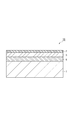
- thermosensitive recording material It is sectional drawing which shows one Embodiment of a thermosensitive recording material.
- FIG. 1 is a cross-sectional view showing an embodiment of a heat-sensitive recording material.
- a heat-sensitive recording material 10 shown in FIG. 1 mainly includes a sheet-like support 1 and a heat-sensitive color developing layer 3 provided on one surface side of the support 1.
- An intermediate layer 5 may be further provided between the thermosensitive coloring layer 3 and the support 1.
- the thermosensitive coloring layer 3 contains a leuco dye as a coloring compound, a developer, a phenol novolac resin formed from a phenol compound containing 4-t-butylphenol and formaldehyde.
- the above phenol novolac resin is contained in the heat-sensitive color developing layer as a color developing aid used for improving the color developing performance in combination with the color developing agent.
- This phenol novolac resin can be synthesized, for example, from 4-t-butylphenol and phenol and formaldehyde in the presence of an acid catalyst.
- the proportion of the condensate having 6 or more nuclei (benzene rings) may be 20% by mass or more, or 50% by mass or more. Thereby, the effect by this invention is show
- thermosensitive color former As the developer contained in the thermosensitive color former, various electron-accepting compounds, for example, phenol compounds having a phenolic hydroxyl group and different from the phenol novolak resin, thiophenol compounds having a thiol group bonded to a phenyl group, Urea compounds having a urea group, thiourea compounds having a thiourea group, organic acids and metal salts thereof can be used.
- phenol compounds having a phenolic hydroxyl group and different from the phenol novolak resin thiophenol compounds having a thiol group bonded to a phenyl group
- Urea compounds having a urea group thiourea compounds having a thiourea group
- organic acids and metal salts thereof organic acids and metal salts thereof
- the phenol compound as the developer is a phenol resin formed from a phenol compound not containing 4-t-butylphenol and formaldehyde (for example, a phenol novolak resin formed from phenol and formaldehyde), bisphenol A, bisphenol S, etc.
- the bisphenol compound may be used.
- phenol compound examples include ⁇ -naphthol, ⁇ -naphthol, p-octylphenol, 4-t-octylphenol, pt-butylphenol, p-phenylphenol, 1,1-bis (p-hydroxyphenyl) propane, 2, 2-bis (p-hydroxyphenyl) propane (also known as bisphenol A or BPA), 2,2-bis (p-hydroxyphenyl) butane, 1,1-bis (p-hydroxyphenyl) cyclohexane, 1,1-bis (4-hydroxyphenyl) -1-phenylethane, 2,2-bis (4-hydroxy-3-methylphenyl) propane, 2,2-bis (3-phenyl-4-hydroxyphenyl) propane 4,4'- Cyclohexylidene diphenol, 2,2-bis (3,5-dibromo-4-hydroxypheny ) Propane (also known as tetrabromobisphenol A), 4,4′-isopropylidenebis (2-t-
- thiophenol compound as the developer examples include 4,4′-thiobisphenol, 4,4′-thiobis (6-tertiarybutyl-2-methylphenol), 1,3-bis (4-hydroxyphenylthio). ) -Propane and 1,8-bis (4-hydroxyphenylthio) -2-hydroxypropane.
- the urea compound as the developer is selected from, for example, a urea resin and a sulfonylurea compound represented by the following formula (3).
- the thiourea compound as the developer is selected from, for example, N, N′-diphenylthiourea and N, N′-di (m-chlorophenyl) thiourea.
- organic acid metal salt as the developer examples include zinc 1-acetyloxy-2-naphthoate, 2-acetyloxy-1, zinc naphthoate, zinc 2-acetyloxy-3-naphthoate, ⁇ , ⁇ - It is selected from bis (4-hydroxydiphenyl) - ⁇ -methyltoluene, an antipyrine complex of zinc thiocyanate, and 3,5-di ( ⁇ -methylbenzyl) salicylic acid zinc salt.
- Another compound that can be used as a developer is, for example, 2,4'-diphenylsulfone.
- the bisphenol compound of formula (1) includes, for example, a step of reacting phenol and glyoxylic acid in an acidic reaction solution to produce a hydroxycarboxylic acid compound represented by the following formula (1A), Adjusting the aqueous liquid obtained by mixing to alkaline, extracting the impurities from the aqueous liquid with an organic solvent, adjusting the aqueous liquid to acidic, and extracting the hydroxycarboxylic acid compound from the aqueous liquid with an organic solvent;
- the step of esterifying the hydroxycarboxylic acid compound extracted from the aqueous liquid to produce the bisphenol compound represented by the formula (1) can be obtained by a method comprising in this order.
- the leuco dye used as the color forming compound in the heat sensitive color developing layer can be appropriately selected from compounds generally used for pressure sensitive recording paper or heat sensitive recording paper.
- the leuco dye (color-forming compound) is, for example, at least one selected from the group consisting of fluorane compounds, triarylmethane compounds, spiro compounds, diphenylmethane compounds, thiazine compounds, lactam compounds, and fluorane compounds. It is a compound of this.
- fluorane compound examples include 3-diethylamino-6-methyl-7-anilinofluorane, 3-dibutylamino-6-methyl-7-anilinofluorane, 3-dipentylamino-6-methyl-7-ani Linofluorane, 3- (N-methyl-N-cyclohexylamino) -6-methyl-7-anilinofluorane, 3- (N-ethyl-N-isopentylamino) -6-methyl-7-anilino Fluorane, 3- (N-ethyl-N-isobutylamino) -6-methyl-7-anilinofluorane, 3- [N-ethyl-N- (3-ethoxypropyl) amino] -6-methyl-7 -Anilinofluorane, 3- (N-ethyl-N-hexylamino) -6-methyl-7-anilinofluorane, 3- (N-methyl-N-propyla
- triarylmethane compounds examples include 3,3-bis (p-dimethylaminophenyl) -6-dimethylaminophthalide (also known as crystal violet lactone or CVL) and 3,3-bis (p-dimethylaminophenyl).
- spiro compounds include 3-methylspirodinaphthopyran, 3-ethylspirodinaphthopyran, 3,3′-dichlorospirodinaphthopyrans, 3-benzylspirodinaphthopyrans, 3-propylspirodinaphthopyrans, -Methylnaphtho- (3-methoxybenzo) spiropyran and 1,3,3-trimethyl-6-nitro-8'-methoxyspiro (indoline-2,2'-benzopyran).
- diphenylmethane compound examples include N-halophenyl-leucooramine, 4,4-bis-dimethylaminophenylbenzhydrylbenzyl ether, and N-2,4,5-trichlorophenylleucooramine.
- thiazine compounds examples include benzoyl leucomethylene blue and p-nitrobenzoyl leucomethylene blue.
- lactam compound examples include rhodamine B anilinolactam and rhodamine Bp-chloroanilinolactam.
- fluorene compound examples include 3,6-bis (dimethylamino) fluorene spiro (9,3 ′)-6′-dimethylaminophthalide and 3,6-bis (dimethylamino) fluorene spiro (9,3 ′).
- -6'-pyrrolidinophthalide and 3-dimethylamino-6-diethylaminofluorene spiro (9,3 ')-6'-pyrrolidinophthalide examples include 3,6-bis (dimethylamino) fluorene spiro (9,3 ′)-6′-dimethylaminophthalide and 3,6-bis (dimethylamino) fluorene spiro (9,3 ′).
- chromophoric compounds as leuco dyes may be used alone or in combination.
- the thermosensitive coloring layer preferably further contains a binder.
- a binder a water-soluble compound, a water-dispersible compound or an emulsion is used.
- the water-soluble compound include methyl cellulose, ethyl cellulose, methoxy cellulose, hydroxyethyl cellulose, carboxymethyl cellulose, acetyl cellulose, polyvinyl alcohol (PVA), carboxyl group-modified polyvinyl alcohol, sulfonic acid group-modified polyvinyl alcohol, silyl group-modified polyvinyl alcohol, and polyvinylpyrrolidone.
- Polyacrylamide Polyacrylic acid, starch and derivatives thereof, casein, gelatin, water-soluble isoprene rubber, styrene / maleic anhydride copolymer, and iso (or diiso) butylene / maleic anhydride copolymer.
- Water dispersible compounds or emulsions include, for example, styrene / butadiene latex, carboxylated styrene / butadiene latex, acrylic acid ester copolymers, styrene / acrylic acid copolymers, ethylene / vinyl acetate copolymers, acrylic / It is selected from urethane copolymers, acrylic / polyester copolymers, and acrylic / silicon copolymers.
- the amount of phenol novolac resin formed from a phenol compound containing 4-t-butylphenol and formaldehyde may be 1 to 50% by mass, or 1 to 30% by mass based on the mass of the thermosensitive coloring layer.
- the amount of the leuco dye is usually 1 to 50% by mass, and may be 5 to 30% by mass.
- the amount of the developer is usually 1 to 70% by mass, and may be 10 to 50% by mass.
- the amount of the binder in the thermosensitive coloring layer is usually 1 to 90% by mass.
- the mass ratio of the developer to the leuco dye is usually 0.5 to 20 times, and may be 1 to 5 times. When the amount of each component is within these numerical ranges, the effects of the present invention are more remarkably exhibited.
- the thermosensitive coloring layer may contain a sensitizer, a stabilizer, a filler, a surfactant, and other additives as necessary.
- the amount of the sensitizer, stabilizer and filler is usually 0 to 80% by mass.
- Surfactant and other additives are added to the thermosensitive coloring layer in an arbitrary ratio, for example, usually in the range of 0 to 30% by mass.
- the sensitizer is preferably solid at room temperature and has a melting point.
- the melting point of the sensitizer is preferably about 70 ° C or higher.
- the sensitizer include waxes such as animal and vegetable waxes and synthetic waxes, higher fatty acids, higher fatty acid amides, higher fatty acid anilides, naphthalene derivatives, aromatic ethers, aromatic carboxylic acid derivatives, aromatic sulfonic acid ester derivatives, carbonic acid or Oxalic acid diester derivatives, biphenyl derivatives, terphenyl derivatives, and sulfone derivatives are used.
- Examples of the wax include wood wax, carnauba wax, shellac, paraffin, montan wax, oxidized paraffin, polyethylene wax, and oxidized polyethylene.
- Examples of higher fatty acids include stearic acid and behenic acid.
- Examples of higher fatty acid amides include stearic acid amide, oleic acid amide, N-methyl stearic acid amide, erucic acid amide, methylol behenic acid amide, methylene bis stearic acid amide, and ethylene bis stearic acid amide.
- Examples of the higher fatty acid anilide include stearic acid anilide and linoleic acid anilide.
- naphthalene derivatives include 1-benzyloxynaphthalene, 2-benzyloxynaphthalene, 1-hydroxynaphthoic acid phenyl ester, and the like.
- aromatic ether examples include 1,2-diphenoxyethane, 1,4-diphenoxybutane, 1,2-bis (3-methylphenoxy) ethane, 1,2-bis (4-methoxyphenoxy) ethane, 1 , 2-bis (3,4-dimethylphenyl) ethane, 1-phenoxy-2- (4-chlorophenoxy) ethane, 1-phenoxy-2- (4-methoxyphenoxy) ethane, 1,2-diphenoxymethylbenzene Is mentioned.
- aromatic carboxylic acid derivative examples include p-benzyloxybenzoic acid benzyl ester and terephthalic acid dibenzyl ester.
- aromatic sulfonic acid ester derivative examples include p-toluenesulfonic acid phenyl ester, phenyl mesitylene sulfonate, and 4-methylphenyl mesitylene sulfonate.
- carbonic acid or oxalic acid diester derivative examples include diphenyl carbonate, dibenzyl oxalate, di (4-chlorobenzyl) oxalate, and di (4-methylbenzyl) oxalate.
- Examples of the biphenyl derivative include p-benzylbiphenyl, p-acetylbiphenyl, and p-allyloxybiphenyl.
- Examples of the terphenyl derivative include m-terphenyl and a terphenyl isomer mixture.
- Examples of the sulfone derivative include diphenyl sulfone, 4-methyldiphenyl sulfone, and chlorinated diphenyl sulfone. These sensitizers are appropriately used by selecting one or two or more of these sensitizers.
- the stabilizer for example, a phenol derivative and an amine derivative imparting an antioxidant or antiaging effect, or a benzotriazole compound and a benzophenone compound as an ultraviolet absorber can be used.
- phenol derivative and amine derivative examples include 2,2′-methylenebis (4-methyl-6-tert-butylphenol), 2,2′-methylenebis (4-ethyl-6-tert-butylphenol), 4,4 ′.
- benzotriazole compounds include 2- (2′-hydroxy-5′-methyl-phenyl) -benzotriazole and 2- (2′-hydroxy-3 ′, 5′-di-t-butylphenyl) -5. -Chlorobenzotriazole, 2- (2'-hydroxy-3'-t-butyl-5'-methylphenyl) -5-chlorobenzotriazole, 2- (2'-hydroxy-5'-t-octylphenyl)- Benzotriazole, 2- (2′-hydroxy-4′-octoxyphenyl) -benzotriazole, 2- (2′-hydroxy-3 ′, 5′-di-t-butylphenyl) -benzotriazole, 2- ( 2'-hydroxy-3 ', 5'-di-t-amylphenyl) -benzotriazole, methylene-bis [2- (2'-hydroxy-5'-dodecanyl) Yl) benzotriazole], and the like.
- benzophenone compounds examples include 2,4-dihydroxybenzophenone, 2-hydroxy-4-methoxybenzophenone, 2,2′-dihydroxy-4,4′-methoxybenzophenone, 2-hydroxy-4-methoxy-5-sulfobenzophenone. Bis (2-methoxy-4-hydroxy-5-benzoylphenylmethane).
- filler examples include calcium carbonate, silica, white carbon, talc, clay, alumina, titanium oxide, zinc oxide, aluminum hydroxide, aluminum oxide, magnesium carbonate, magnesium oxide, magnesium hydroxide, barium sulfate, polystyrene resin, urea -Formalin resins, hollow plastic pigments, foamable hollow plastic pigments.
- Surfactants include, for example, fatty acid metal soaps, polycarboxylic acid type polymer activators, sulfates of higher alcohols, sulfates of alkyl polyethers, ethylene oxide adducts of higher alcohols, alkylaryls.
- alkyl sulfonic acids alkyl sulfonic acids, aryl sulfonic acids, phosphate esters, aliphatic phosphate esters, aromatic phosphate esters, polyoxyethylene alkyl sulfate esters, polyoxyethylene aryl sulfate esters, polyoxyethylene Alkylaryl sulfates, dialkylsulfosuccinates, alkylbenzenesulfonates, polyoxyalkylene alkyl ether phosphates, polyoxyalkylene aryl ether phosphates, polyoxyalkylenes Alkyl aryl ether phosphate, sodium alkyl sulfate, dioctyl sulfosuccinate sodium salt, polyalkylene glycol 9 (eg, polyoxyethylene nonylphenyl ether), acetylene glycol, ethylene oxide adduct of acetylene glycol, propylene oxide addition of acetylene glycol Products,
- lubricants for example, higher fatty acid metal salts such as zinc stearate and calcium stearate
- water resistance agents for example, glyoxal, glutaraldehyde, dialdehyde, ethylenediamine, urea-formaldehyde resin, melamine-formaldehyde resin, polyamide
- Resin polyamidoamine-epichlorohydrin resin, adipic acid dihydrazide, phthalic acid dihydrazide, boric acid, borax, titanium lactate, ammonium zirconium carbonate and potassium zirconium carbonate
- thickener eg xanthan gum, carboxymethylcellulose
- Foaming agents and antifoaming agents for example, silicon oil, mineral oil
- fluorescent whitening agents for example, fluorescent dyes, colored dyes, colored pigments and the like can be used.
- the thermosensitive coloring layer is, for example, a leuco dye, a developer, and the phenol novolak resin, separately with a binder and, if necessary, a sensitizer, a stabilizer, a filler, other additives, and the like.
- a step of preparing a dispersion liquid in which each component is dispersed by wet pulverization using the above medium a step of preparing a coating liquid by mixing each dispersion liquid, and applying the coating liquid on the intermediate layer And a step of drying the applied coating solution.
- the wet dispersion for obtaining the dispersion liquid can be performed using a disperser such as a ball mill, an attritor or a sand mill.
- the dry mass of the thermosensitive coloring layer is usually 2 to 20 g / m 2 and may be 4 to 10 g / m 2 .
- the intermediate layer 5 may be a foam or may contain fine hollow particles dispersed in the intermediate layer 5. Further, the intermediate layer 5 may be a foam containing hollow particles.
- Hollow particles are particles in which voids are formed, and are made of, for example, plastic, glass, or ceramic.
- the material forming the hollow particles is preferably a plastic, and among them, a thermoplastic resin is particularly preferable.
- the hollow particles are preferably spherical.
- the average particle diameter of the hollow particles is usually 0.2 to 10 ⁇ m, preferably 0.5 to 3 ⁇ m.
- the hollow ratio may be limited depending on the particle diameter.
- the hollow ratio of the hollow particles is preferably 30 to 90% by volume, more preferably 50 to 90% by volume.
- the amount of hollow particles contained in the intermediate layer is usually 10 to 90% by mass, preferably 40 to 80% by mass, based on the mass of the intermediate layer.
- the foam as the intermediate layer is formed, for example, by foaming foamable hollow particles having a shell made of a thermoplastic resin and containing a low boiling point solvent as a foaming agent.
- the intermediate layer may contain other components selected from binders, fillers, stabilizers, dispersants, antifoaming agents and other additives. These components can be appropriately selected from those generally used for pressure-sensitive recording paper and heat-sensitive recording paper. For example, the same materials as those for a heat-sensitive coloring layer described later are used.
- the amount of the binder is 10 to 50% by mass, and the amount of the filler is 10 to 50% by mass.
- Stabilizers, surfactants and other additives that are added as necessary are added to the intermediate layer in arbitrary proportions, for example, usually in the range of 0 to 30% by mass.
- the intermediate layer is prepared by, for example, mixing and dispersing hollow particles, a binder and a filler, and if necessary, a surfactant and other additives in water to prepare a coating solution for the intermediate layer. Is formed on the support and the coating film is dried.
- the dry mass of the intermediate layer is usually 2 to 20 g / m 2 , preferably 5 to 10 g / m 2 .
- the coating solution for the intermediate layer can be applied using a bar coater, a doctor blade, a gravure coater or the like.
- the intermediate layer which is a foam is prepared by mixing and dispersing, for example, expandable hollow particles, a binder and a filler, and, if necessary, a surfactant and other additives in water to form a coating solution for the intermediate layer.
- the coating liquid is applied onto a support, the coating film is dried, and further foamed to form.
- the foaming treatment is performed, for example, by bringing the coating film into close contact with the surface of a drum dryer having a heater and heating to a temperature (100 to 150 ° C.) at which the thermoplastic resin forming the foamed hollow particle shell is softened. Done.
- the heat-sensitive recording material according to this embodiment may further include layers other than the intermediate layer and the heat-sensitive color forming layer as necessary.
- another intermediate layer may be provided between the intermediate layer and the thermosensitive coloring layer, or an overcoat layer may be provided on the thermosensitive coloring layer.
- Another intermediate layer and overcoat layer contain, for example, binders and fillers as described above, and other additives added as needed. These additional layers can be formed by applying a coating solution containing each component and drying it, as in the case of the intermediate layer and the thermosensitive coloring layer.
- the overcoat layer includes, for example, a binder, a filler, and a lubricant, and a surfactant, a water resistant agent and other additives which are added as necessary.
- the dry weight of the overcoat layer is usually 1 to 10 g / m 2 .
- thermosensitive coloring layer Formation of thermosensitive coloring layer
- the solids in the three kinds of mixtures containing the following materials were dispersed while being pulverized using a bead mill until the average particle diameter became 1 ⁇ m, and the [A] liquid, [B] liquid and [ C] solution was obtained.
- thermosensitive coloring layer having the following composition containing the above [A] solution, [B] solution and [C] solution was prepared.
- the coating solution is applied onto the intermediate layer, and the coating film is dried to form a thermosensitive coloring layer of 6 g / m 2 , and a thermosensitive recording material composed of fine paper, the intermediate layer, and the thermosensitive coloring layer is obtained. Obtained.
- [A] liquid 50 parts [B] liquid 100 parts
- thermosensitive coloring layer was formed in the same manner as above to obtain a thermosensitive recording material.
- the developer of the [B] solution was changed to bisphenol S (BPS), 4-hydroxy-4′-isopropoxydiphenyl sulfone, or a bisphenol compound (MBHA) represented by the following formula (10).
- BPS bisphenol S
- MBHA bisphenol compound
- each heat-sensitive recording material was subjected to a heat resistance test in which it was left for 24 hours in a thermostat at 90 ° C.
- the reflection density (Macbeth reflection density) of the image portion and the background portion before and after the test was measured using a Macbeth reflection densitometer (SpectroEyeLT, manufactured by Sakata Engineering Co., Ltd.).
- Light resistance After the image was formed, each heat-sensitive recording material was subjected to a light resistance test in which light of 5000 lux was irradiated for 100 hours with a fluorescent lamp.
- the reflection density (Macbeth reflection density) of the image part and the background part before and after the test was measured using a Macbeth reflection densitometer.
- the measurement results are shown in Tables 1 and 2.
- the residual ratio is a ratio of the reflection density after the test to the reflection density before the test.
- the heat-sensitive recording material using 4-t-butylphenol and phenol resin (963P) formed from phenol and formaldehyde as the color development aid was found to be bisphenol S as the color development aid in the light resistance test. It was confirmed that the density of the image area was maintained better than the case where the derivative was used, and the color development of the background area was effectively suppressed. Moreover, practically sufficient level was maintained also about heat resistance and water resistance.
Landscapes
- Chemical & Material Sciences (AREA)
- Chemical Kinetics & Catalysis (AREA)
- General Chemical & Material Sciences (AREA)
- Physics & Mathematics (AREA)
- Optics & Photonics (AREA)
- Heat Sensitive Colour Forming Recording (AREA)
Applications Claiming Priority (2)
| Application Number | Priority Date | Filing Date | Title |
|---|---|---|---|
| JP2012091295 | 2012-04-12 | ||
| JP2012-091295 | 2012-04-12 |
Publications (1)
| Publication Number | Publication Date |
|---|---|
| WO2013154006A1 true WO2013154006A1 (fr) | 2013-10-17 |
Family
ID=49327574
Family Applications (1)
| Application Number | Title | Priority Date | Filing Date |
|---|---|---|---|
| PCT/JP2013/060211 Ceased WO2013154006A1 (fr) | 2012-04-12 | 2013-04-03 | Matière d'enregistrement thermosensible |
Country Status (2)
| Country | Link |
|---|---|
| JP (1) | JPWO2013154006A1 (fr) |
| WO (1) | WO2013154006A1 (fr) |
Citations (5)
| Publication number | Priority date | Publication date | Assignee | Title |
|---|---|---|---|---|
| JPS4852245A (fr) * | 1971-10-30 | 1973-07-23 | ||
| JPS5317347A (en) * | 1976-07-31 | 1978-02-17 | Mitsubishi Paper Mills Ltd | Heat sensitive recording paper of which long period image stability is improved |
| JP2002120460A (ja) * | 2000-08-11 | 2002-04-23 | Oji Paper Co Ltd | 感熱記録体 |
| JP2002160458A (ja) * | 2000-11-22 | 2002-06-04 | Oji Paper Co Ltd | 感熱記録体 |
| JP2003025739A (ja) * | 2001-07-23 | 2003-01-29 | Oji Paper Co Ltd | 感熱記録体 |
Family Cites Families (6)
| Publication number | Priority date | Publication date | Assignee | Title |
|---|---|---|---|---|
| JPS5945193A (ja) * | 1982-09-09 | 1984-03-13 | Mitsui Petrochem Ind Ltd | 感熱記録材料 |
| JP3160882B2 (ja) * | 1996-02-02 | 2001-04-25 | 日本製紙株式会社 | 感熱記録シート |
| JPH1111023A (ja) * | 1997-06-23 | 1999-01-19 | Nippon Kayaku Co Ltd | 感熱記録材料 |
| JP2003182238A (ja) * | 2001-12-17 | 2003-07-03 | Nippon Kayaku Co Ltd | 感熱記録材料 |
| AU2003212273A1 (en) * | 2002-03-06 | 2003-09-16 | Ciba Specialty Chemicals Holding Inc. | Mixture of colour developers |
| JP2010131763A (ja) * | 2008-12-02 | 2010-06-17 | Nicca Chemical Co Ltd | 感熱記録材料 |
-
2013
- 2013-04-03 WO PCT/JP2013/060211 patent/WO2013154006A1/fr not_active Ceased
- 2013-04-03 JP JP2014510126A patent/JPWO2013154006A1/ja active Pending
Patent Citations (5)
| Publication number | Priority date | Publication date | Assignee | Title |
|---|---|---|---|---|
| JPS4852245A (fr) * | 1971-10-30 | 1973-07-23 | ||
| JPS5317347A (en) * | 1976-07-31 | 1978-02-17 | Mitsubishi Paper Mills Ltd | Heat sensitive recording paper of which long period image stability is improved |
| JP2002120460A (ja) * | 2000-08-11 | 2002-04-23 | Oji Paper Co Ltd | 感熱記録体 |
| JP2002160458A (ja) * | 2000-11-22 | 2002-06-04 | Oji Paper Co Ltd | 感熱記録体 |
| JP2003025739A (ja) * | 2001-07-23 | 2003-01-29 | Oji Paper Co Ltd | 感熱記録体 |
Also Published As
| Publication number | Publication date |
|---|---|
| JPWO2013154006A1 (ja) | 2015-12-17 |
Similar Documents
| Publication | Publication Date | Title |
|---|---|---|
| JP2016068418A (ja) | 感熱記録材料 | |
| JP2008296436A (ja) | 感熱記録材料 | |
| JP2008188926A (ja) | 感熱記録材料 | |
| JP2008168499A (ja) | 感熱記録材料 | |
| JP2008296427A (ja) | 感熱記録材料 | |
| WO2013154006A1 (fr) | Matière d'enregistrement thermosensible | |
| JP4535503B2 (ja) | 感熱記録材料 | |
| JP4148792B2 (ja) | 感熱記録材料 | |
| JPWO2013035700A1 (ja) | 感熱記録材料 | |
| JP2008296426A (ja) | 感熱記録材料 | |
| JP2009126067A (ja) | 感熱記録材料 | |
| JP2005014559A (ja) | 感熱記録材料 | |
| JP2008049482A (ja) | 感熱記録材料 | |
| JP2006289741A (ja) | 感熱記録材料 | |
| JP2006341487A (ja) | 感熱記録材料 | |
| JP2008080620A (ja) | 感熱記録材料 | |
| JP2015110286A (ja) | 感熱記録材料 | |
| JPH10157304A (ja) | 感熱記録材料 | |
| JP2015058630A (ja) | 感熱記録材料 | |
| JP2008080549A (ja) | 感熱記録材料 | |
| JP2014205255A (ja) | 感熱記録材料 | |
| JP2008012840A (ja) | 感熱記録材料 | |
| JP2006240162A (ja) | 感熱記録材料 | |
| JP2007098748A (ja) | 感熱記録材料 | |
| JPWO2015125861A1 (ja) | 感熱記録材料 |
Legal Events
| Date | Code | Title | Description |
|---|---|---|---|
| 121 | Ep: the epo has been informed by wipo that ep was designated in this application |
Ref document number: 13775879 Country of ref document: EP Kind code of ref document: A1 |
|
| ENP | Entry into the national phase |
Ref document number: 2014510126 Country of ref document: JP Kind code of ref document: A |
|
| NENP | Non-entry into the national phase |
Ref country code: DE |
|
| 122 | Ep: pct application non-entry in european phase |
Ref document number: 13775879 Country of ref document: EP Kind code of ref document: A1 |