WO2013154064A1 - 有機発光素子ならびにそれに用いる発光材料および化合物 - Google Patents
有機発光素子ならびにそれに用いる発光材料および化合物 Download PDFInfo
- Publication number
- WO2013154064A1 WO2013154064A1 PCT/JP2013/060582 JP2013060582W WO2013154064A1 WO 2013154064 A1 WO2013154064 A1 WO 2013154064A1 JP 2013060582 W JP2013060582 W JP 2013060582W WO 2013154064 A1 WO2013154064 A1 WO 2013154064A1
- Authority
- WO
- WIPO (PCT)
- Prior art keywords
- group
- substituted
- unsubstituted
- general formula
- light emitting
- Prior art date
- Legal status (The legal status is an assumption and is not a legal conclusion. Google has not performed a legal analysis and makes no representation as to the accuracy of the status listed.)
- Ceased
Links
- 0 C*1c2c(*)c(*)c(*)c(N)c2C(*2=CCC2)=C1* Chemical compound C*1c2c(*)c(*)c(*)c(N)c2C(*2=CCC2)=C1* 0.000 description 8
- OJXMLNBTIJVABO-UHFFFAOYSA-N CC(C)(C)c(cc1)cc2c1[n](C)c1ccc(C(C)(C)C)cc21 Chemical compound CC(C)(C)c(cc1)cc2c1[n](C)c1ccc(C(C)(C)C)cc21 OJXMLNBTIJVABO-UHFFFAOYSA-N 0.000 description 1
- OYFFSPILVQLRQA-UHFFFAOYSA-N CC(C)(C)c1ccc2[nH]c3ccc(C(C)(C)C)cc3c2c1 Chemical compound CC(C)(C)c1ccc2[nH]c3ccc(C(C)(C)C)cc3c2c1 OYFFSPILVQLRQA-UHFFFAOYSA-N 0.000 description 1
- MKOPNVBJQODOGY-UHFFFAOYSA-N CC[n]1c(ccc(N(c2ccccc2)c(cc2)cc(c3cc(N(c4ccccc4)c4ccc5[n](CC)c6ccccc6c5c4)ccc33)c2[n]3-c2ccccc2)c2)c2c2ccccc12 Chemical compound CC[n]1c(ccc(N(c2ccccc2)c(cc2)cc(c3cc(N(c4ccccc4)c4ccc5[n](CC)c6ccccc6c5c4)ccc33)c2[n]3-c2ccccc2)c2)c2c2ccccc12 MKOPNVBJQODOGY-UHFFFAOYSA-N 0.000 description 1
- PCRSJGWFEMHHEW-UHFFFAOYSA-N N#Cc(c(F)c(c(C#N)c1F)F)c1F Chemical compound N#Cc(c(F)c(c(C#N)c1F)F)c1F PCRSJGWFEMHHEW-UHFFFAOYSA-N 0.000 description 1
Images








Classifications
-
- C—CHEMISTRY; METALLURGY
- C07—ORGANIC CHEMISTRY
- C07D—HETEROCYCLIC COMPOUNDS
- C07D209/00—Heterocyclic compounds containing five-membered rings, condensed with other rings, with one nitrogen atom as the only ring hetero atom
- C07D209/56—Ring systems containing three or more rings
- C07D209/80—[b, c]- or [b, d]-condensed
- C07D209/82—Carbazoles; Hydrogenated carbazoles
- C07D209/86—Carbazoles; Hydrogenated carbazoles with only hydrogen atoms, hydrocarbon or substituted hydrocarbon radicals, directly attached to carbon atoms of the ring system
-
- C—CHEMISTRY; METALLURGY
- C07—ORGANIC CHEMISTRY
- C07D—HETEROCYCLIC COMPOUNDS
- C07D209/00—Heterocyclic compounds containing five-membered rings, condensed with other rings, with one nitrogen atom as the only ring hetero atom
- C07D209/02—Heterocyclic compounds containing five-membered rings, condensed with other rings, with one nitrogen atom as the only ring hetero atom condensed with one carbocyclic ring
- C07D209/04—Indoles; Hydrogenated indoles
- C07D209/08—Indoles; Hydrogenated indoles with only hydrogen atoms or radicals containing only hydrogen and carbon atoms, directly attached to carbon atoms of the hetero ring
-
- C—CHEMISTRY; METALLURGY
- C07—ORGANIC CHEMISTRY
- C07D—HETEROCYCLIC COMPOUNDS
- C07D209/00—Heterocyclic compounds containing five-membered rings, condensed with other rings, with one nitrogen atom as the only ring hetero atom
- C07D209/02—Heterocyclic compounds containing five-membered rings, condensed with other rings, with one nitrogen atom as the only ring hetero atom condensed with one carbocyclic ring
- C07D209/04—Indoles; Hydrogenated indoles
- C07D209/10—Indoles; Hydrogenated indoles with substituted hydrocarbon radicals attached to carbon atoms of the hetero ring
- C07D209/18—Radicals substituted by carbon atoms having three bonds to hetero atoms with at the most one bond to halogen, e.g. ester or nitrile radicals
-
- C—CHEMISTRY; METALLURGY
- C09—DYES; PAINTS; POLISHES; NATURAL RESINS; ADHESIVES; COMPOSITIONS NOT OTHERWISE PROVIDED FOR; APPLICATIONS OF MATERIALS NOT OTHERWISE PROVIDED FOR
- C09K—MATERIALS FOR MISCELLANEOUS APPLICATIONS, NOT PROVIDED FOR ELSEWHERE
- C09K11/00—Luminescent materials, e.g. electroluminescent or chemiluminescent
- C09K11/06—Luminescent materials, e.g. electroluminescent or chemiluminescent containing organic luminescent materials
-
- H—ELECTRICITY
- H10—SEMICONDUCTOR DEVICES; ELECTRIC SOLID-STATE DEVICES NOT OTHERWISE PROVIDED FOR
- H10K—ORGANIC ELECTRIC SOLID-STATE DEVICES
- H10K50/00—Organic light-emitting devices
-
- H—ELECTRICITY
- H10—SEMICONDUCTOR DEVICES; ELECTRIC SOLID-STATE DEVICES NOT OTHERWISE PROVIDED FOR
- H10K—ORGANIC ELECTRIC SOLID-STATE DEVICES
- H10K85/00—Organic materials used in the body or electrodes of devices covered by this subclass
- H10K85/60—Organic compounds having low molecular weight
- H10K85/649—Aromatic compounds comprising a hetero atom
- H10K85/657—Polycyclic condensed heteroaromatic hydrocarbons
- H10K85/6572—Polycyclic condensed heteroaromatic hydrocarbons comprising only nitrogen in the heteroaromatic polycondensed ring system, e.g. phenanthroline or carbazole
-
- C—CHEMISTRY; METALLURGY
- C09—DYES; PAINTS; POLISHES; NATURAL RESINS; ADHESIVES; COMPOSITIONS NOT OTHERWISE PROVIDED FOR; APPLICATIONS OF MATERIALS NOT OTHERWISE PROVIDED FOR
- C09K—MATERIALS FOR MISCELLANEOUS APPLICATIONS, NOT PROVIDED FOR ELSEWHERE
- C09K2211/00—Chemical nature of organic luminescent or tenebrescent compounds
- C09K2211/10—Non-macromolecular compounds
- C09K2211/1003—Carbocyclic compounds
- C09K2211/1007—Non-condensed systems
-
- C—CHEMISTRY; METALLURGY
- C09—DYES; PAINTS; POLISHES; NATURAL RESINS; ADHESIVES; COMPOSITIONS NOT OTHERWISE PROVIDED FOR; APPLICATIONS OF MATERIALS NOT OTHERWISE PROVIDED FOR
- C09K—MATERIALS FOR MISCELLANEOUS APPLICATIONS, NOT PROVIDED FOR ELSEWHERE
- C09K2211/00—Chemical nature of organic luminescent or tenebrescent compounds
- C09K2211/10—Non-macromolecular compounds
- C09K2211/1018—Heterocyclic compounds
- C09K2211/1025—Heterocyclic compounds characterised by ligands
- C09K2211/1029—Heterocyclic compounds characterised by ligands containing one nitrogen atom as the heteroatom
-
- H—ELECTRICITY
- H10—SEMICONDUCTOR DEVICES; ELECTRIC SOLID-STATE DEVICES NOT OTHERWISE PROVIDED FOR
- H10K—ORGANIC ELECTRIC SOLID-STATE DEVICES
- H10K2101/00—Properties of the organic materials covered by group H10K85/00
- H10K2101/10—Triplet emission
-
- H—ELECTRICITY
- H10—SEMICONDUCTOR DEVICES; ELECTRIC SOLID-STATE DEVICES NOT OTHERWISE PROVIDED FOR
- H10K—ORGANIC ELECTRIC SOLID-STATE DEVICES
- H10K50/00—Organic light-emitting devices
- H10K50/10—OLEDs or polymer light-emitting diodes [PLED]
- H10K50/11—OLEDs or polymer light-emitting diodes [PLED] characterised by the electroluminescent [EL] layers
-
- H—ELECTRICITY
- H10—SEMICONDUCTOR DEVICES; ELECTRIC SOLID-STATE DEVICES NOT OTHERWISE PROVIDED FOR
- H10K—ORGANIC ELECTRIC SOLID-STATE DEVICES
- H10K85/00—Organic materials used in the body or electrodes of devices covered by this subclass
- H10K85/30—Coordination compounds
- H10K85/341—Transition metal complexes, e.g. Ru(II)polypyridine complexes
- H10K85/342—Transition metal complexes, e.g. Ru(II)polypyridine complexes comprising iridium
-
- H—ELECTRICITY
- H10—SEMICONDUCTOR DEVICES; ELECTRIC SOLID-STATE DEVICES NOT OTHERWISE PROVIDED FOR
- H10K—ORGANIC ELECTRIC SOLID-STATE DEVICES
- H10K85/00—Organic materials used in the body or electrodes of devices covered by this subclass
- H10K85/60—Organic compounds having low molecular weight
- H10K85/615—Polycyclic condensed aromatic hydrocarbons, e.g. anthracene
- H10K85/622—Polycyclic condensed aromatic hydrocarbons, e.g. anthracene containing four rings, e.g. pyrene
-
- H—ELECTRICITY
- H10—SEMICONDUCTOR DEVICES; ELECTRIC SOLID-STATE DEVICES NOT OTHERWISE PROVIDED FOR
- H10K—ORGANIC ELECTRIC SOLID-STATE DEVICES
- H10K85/00—Organic materials used in the body or electrodes of devices covered by this subclass
- H10K85/60—Organic compounds having low molecular weight
- H10K85/649—Aromatic compounds comprising a hetero atom
- H10K85/654—Aromatic compounds comprising a hetero atom comprising only nitrogen as heteroatom
-
- H—ELECTRICITY
- H10—SEMICONDUCTOR DEVICES; ELECTRIC SOLID-STATE DEVICES NOT OTHERWISE PROVIDED FOR
- H10K—ORGANIC ELECTRIC SOLID-STATE DEVICES
- H10K85/00—Organic materials used in the body or electrodes of devices covered by this subclass
- H10K85/60—Organic compounds having low molecular weight
- H10K85/649—Aromatic compounds comprising a hetero atom
- H10K85/657—Polycyclic condensed heteroaromatic hydrocarbons
- H10K85/6576—Polycyclic condensed heteroaromatic hydrocarbons comprising only sulfur in the heteroaromatic polycondensed ring system, e.g. benzothiophene
Definitions
- the present invention relates to an organic light emitting device having high luminous efficiency.
- the present invention also relates to a light emitting material and a compound used for the organic light emitting element.
- organic light emitting devices such as organic electroluminescence devices (organic EL devices)
- organic electroluminescence devices organic electroluminescence devices
- various efforts have been made to increase the light emission efficiency by newly developing and combining electron transport materials, hole transport materials, light emitting materials, and the like constituting the organic electroluminescence element.
- studies on organic electroluminescence devices using compounds containing a carbazole structure or an indole structure have been found, and several proposals have been made so far.
- Patent Document 1 describes that a compound containing a carbazole structure and an indole structure represented by the following general formula is used as a host material for a light emitting layer of an organic light emitting element.
- m and n are each an integer of 1 to 5
- the sum of m and n is an integer of 2 to 6
- X is an m + n-valent organic group which may have a substituent.
- R 1 to R 14 are defined as a hydrogen atom, a halogen atom, an alkyl group, an aryl group, or a heterocyclic group.
- Patent Document 2 describes that a compound containing two or more carbazole structures is used as a host material for a light emitting layer of an organic light emitting device. Furthermore, Patent Document 3 describes that a compound containing two or more indole structures is used as a host material for a light emitting layer of an organic light emitting device.
- the present inventors have revealed that a specific cyanobenzene derivative containing a carbazole structure, an indole structure, or the like is extremely useful as a light emitting material for an organic electroluminescence device. I made it. In particular, it has been found that there are compounds useful as delayed fluorescent materials among cyanobenzene derivatives containing a carbazole structure, an indole structure, etc., and it has been clarified that an organic light-emitting device with high emission efficiency can be provided at low cost. Based on these findings, the present inventors have provided the following present invention as means for solving the above problems.
- a light emitting material comprising a compound represented by the following general formula (1).
- at least one of R 1 ⁇ R 5 represents a cyano group
- at least one of R 1 ⁇ R 5 represents a group represented by the following general formula (11)
- the remaining R 1 to R 5 each represents a hydrogen atom or a substituent.
- R 21 to R 28 each independently represents a hydrogen atom or a substituent.
- ⁇ A> or ⁇ B> is satisfied.
- ⁇ B> R 27 and R 28 together represent an atomic group necessary for forming a substituted or unsubstituted benzene ring.
- R 1 to R 5 are substituted or unsubstituted 9-carbazolyl group, substituted or unsubstituted 1,2,3,4-tetrahydro-9-carbazolyl group, substituted or unsubstituted 1-indolyl
- R 1 to R 5 is a cyano group, and the remaining R 1 to R 5 are each independently a hydroxy group, a halogen atom, a substituted or unsubstituted 9-carbazolyl group, a substituted or unsubstituted group.
- the luminescent material of description is any one of 1,2,3,4-tetrahydro-9-carbazolyl group, substituted or unsubstituted 1-indolyl group, or substituted or unsubstituted diarylamino group.
- R 1 to R 5 is a cyano group, and the remaining R 1 to R 5 are each independently a substituted or unsubstituted 9-carbazolyl group, a substituted or unsubstituted 1,2,3,3,
- R 1 to R 5 is a cyano group, and the remaining R 1 to R 5 are a substituted or unsubstituted 9-carbazolyl group Luminescent material.
- At least one of R 1 to R 5 is a hydroxy group, at least one of R 1 to R 5 is a cyano group, and the remaining R 1 to R 5 are substituted or unsubstituted 9-carbazolyl groups.
- R 31 to R 38 each independently represents a hydrogen atom or a substituent.
- R 41 to R 46 each independently represents a hydrogen atom or a substituent.
- R 51 to R 62 each independently represents a hydrogen atom or a substituent.
- R 71 to R 80 each independently represents a hydrogen atom or a substituent.
- at least one of R 11 , R 12 , R 14 and R 15 represents a cyano group, and at least three of R 11 to R 15 are substituted or unsubstituted 9-carbazolyl groups, substituted Or an unsubstituted 1,2,3,4-tetrahydro-9-carbazolyl group, a substituted or unsubstituted 1-indolyl group, or a substituted or unsubstituted diarylamino group, and the remaining R 11 to R 15 are hydroxy Represents a group.
- the organic light emitting device of the present invention is characterized by high luminous efficiency.
- the delayed fluorescent material of the present invention is characterized in that when used as a light emitting layer of an organic light emitting device, the organic light emitting device can emit delayed fluorescence and the luminous efficiency can be dramatically increased.
- the compound of the present invention is extremely useful as a light emitting material for these organic light emitting devices.
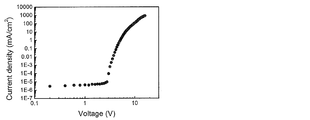
- FIG. 4 is a graph showing current density-voltage characteristics of an organic electroluminescence device using Compound 1 of Example 3.
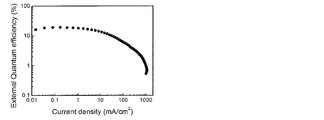
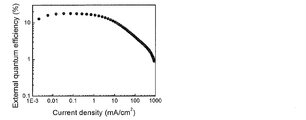
- 4 is a graph showing external quantum efficiency-current density characteristics of an organic electroluminescence device using Compound 1 of Example 3.
- 6 is a graph showing external quantum efficiency-current density characteristics of an organic electroluminescence device using the compound 6 of Example 4.
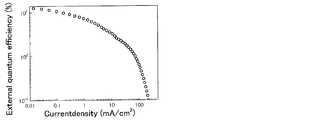
- 6 is a graph showing external quantum efficiency-current density characteristics of an organic electroluminescence device using the compound 301 of Example 5.
- 6 is a graph showing current density-voltage characteristics of an organic electroluminescence device using the compound 501 of Example 6.
- 6 is a graph showing external quantum efficiency-current density characteristics of an organic electroluminescence device using the compound 501 of Example 6.
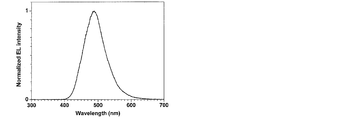
- 6 is an emission spectrum of an organic electroluminescence device using the compound 252 of Example 7.
- 10 is a graph showing current density-voltage characteristics of an organic electroluminescence device using the compound 252 of Example 7.
- 6 is a graph showing external quantum efficiency-current density characteristics of an organic electroluminescence device using the compound 252 of Example 7.
- 6 is an emission spectrum of an organic electroluminescence device using the compound 523 of Example 8.
- 6 is a graph showing current density-voltage characteristics of an organic electroluminescence device using the compound 523 of Example 8.
- 6 is a graph showing the external quantum efficiency-current density characteristics of an organic electroluminescence device using the compound 523 of Example 8.
- 6 is an emission spectrum of an organic electroluminescence device using the compound 31 of Example 9.
- 10 is a graph showing current density-voltage characteristics of an organic electroluminescence device using the compound 31 of Example 9.
- 10 is a graph showing external quantum efficiency-current density characteristics of an organic electroluminescence device using the compound 31 of Example 9.
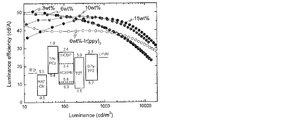
- 6 is a graph showing luminance-luminous efficiency characteristics of an organic electroluminescence device using the compound 301 of Example 10. It is a graph which shows the luminance degradation characteristic of the organic electroluminescent element using the compound 301 of Example 10.
- a numerical range represented by using “to” means a range including numerical values described before and after “to” as a lower limit value and an upper limit value.
- the luminescent material of the present invention is characterized by comprising a compound represented by the following general formula (1).
- the organic light-emitting device of the present invention is characterized by containing a compound represented by the following general formula (1) as a light-emitting material of the light-emitting layer. Therefore, first, the compound represented by the general formula (1) will be described.
- R 1 to R 5 represents a cyano group.
- any one is a cyano group
- any of R 1 to R 3 may be used.
- any two are cyano groups
- a combination of R 1 and R 3 or a combination of R 2 and R 4 can be exemplified.
- any three are cyano groups, combinations of R 1 , R 3 and R 4 can be exemplified.
- R 1 to R 5 represents a group represented by the following general formula (11).
- groups represented by the general formula (11) may be the same or different, but are more preferably the same.
- R 21 to R 28 each independently represents a hydrogen atom or a substituent. However, at least one of the following ⁇ A> or ⁇ B> is satisfied. More preferably, both are satisfied.
- ⁇ A> R 25 and R 26 together form a single bond.
- ⁇ B> R 27 and R 28 together represent an atomic group necessary for forming a substituted or unsubstituted benzene ring.
- the group represented by the general formula (11) is a substituted or unsubstituted 9-carbazolyl group, a substituted or unsubstituted 1,2,3,4-tetrahydro-9-carbazolyl group, a substituted or unsubstituted 1-indolyl group. It is preferably a group or a substituted or unsubstituted diarylamino group.
- any one of R 1 to R 5 in the general formula (1) is a substituted or unsubstituted 9-carbazolyl group, a substituted or unsubstituted 1,2,3,4-tetrahydro-9-carbazolyl group, A substituted or unsubstituted 1-indolyl group or a substituted or unsubstituted diarylamino group is preferable.
- R 1 to R 5 in the general formula (1) are substituted or unsubstituted 9-carbazolyl group, substituted or unsubstituted 1,2,3,4-tetrahydro-9-carbazolyl group, substituted Or it is more preferably an unsubstituted 1-indolyl group or a substituted or unsubstituted diarylamino group.
- the group represented by the general formula (11) preferably has, for example, a structure represented by any of the following general formulas (12) to (15). In particular, it is preferable to have a structure represented by the following general formula (12).
- R 31 to R 38 , R 41 to R 46 , R 51 to R 62 and R 71 to R 80 each independently represent a hydrogen atom or a substituent.
- the substitution position and the number of substitutions when the groups represented by the general formulas (12) to (15) have a substituent are not particularly limited.
- the number of substitutions for each group is preferably 0 to 6, more preferably 0 to 4, for example, 0 to 2 is also preferable.
- they may be the same or different from each other, but are preferably the same.
- any of R 32 to R 37 is preferably a substituent.
- R 32 and R 37 are substituents
- R 33 and R 36 are substituents
- R 34 and R 35 are substituents
- any of R 42 to R 46 is preferably a substituent.
- R 42 is a substituent
- R 43 is a substituent
- any of R 52 to R 60 is preferably a substituent.
- any of R 52 to R 54 is a substituent and a case where any of R 55 to R 60 is a substituent can be preferably exemplified.
- the group represented by the general formula (15) has a substituent
- any of R 72 to R 74 and R 77 to R 79 is preferably a substituent.
- R 73 and R 78 are substituents
- R 74 and R 77 are substituents
- R 72 , R 74 , R 77 and R 79 are The case where it is a substituent can be illustrated preferably.
- R 74 and R 77 are substituents
- the substituent at this time is particularly preferably a substituted or unsubstituted alkyl group having 1 to 20 carbon atoms, or a substituted or unsubstituted aryl group having 6 to 40 carbon atoms, and preferably has 1 to 6 carbon atoms.
- alkylthio group having 1 to 20 carbon atoms an acyl group having 2 to 20 carbon atoms, an aryl group having 6 to 40 carbon atoms, a heteroaryl group having 3 to 40 carbon atoms, and a diaryl having 12 to 40 carbon atoms
- Amino group, substituted or unsubstituted carbazolyl group having 12 to 40 carbon atoms alkenyl group having 2 to 10 carbon atoms, alkynyl group having 2 to 10 carbon atoms, alkoxycarbonyl group having 2 to 10 carbon atoms, 1 to 10 carbon atoms Alkylsulfonyl group, haloalkyl group having 1 to 10 carbon atoms, amide group, alkylamide group having 2 to 10 carbon atoms, trialkylsilyl group having 3 to 20 carbon atoms, trialkylsilylalkyl group having 4 to 20 carbon atoms, carbon Examples thereof include a trialkylsilylalkenyl group having 5 to 20 carbon
- substituents are a halogen atom, a cyano group, a substituted or unsubstituted alkyl group having 1 to 20 carbon atoms, an alkoxy group having 1 to 20 carbon atoms, a substituted or unsubstituted aryl group having 6 to 40 carbon atoms, carbon A substituted or unsubstituted heteroaryl group having 3 to 40 carbon atoms, a substituted or unsubstituted diarylamino group having 12 to 40 carbon atoms, and a substituted or unsubstituted carbazolyl group having 12 to 40 carbon atoms.
- substituents are a fluorine atom, a chlorine atom, a cyano group, a substituted or unsubstituted alkyl group having 1 to 10 carbon atoms, a substituted or unsubstituted alkoxy group having 1 to 10 carbon atoms, and a substituted group having 1 to 10 carbon atoms.
- the alkyl group in the present specification may be linear, branched or cyclic, and more preferably has 1 to 6 carbon atoms. Specific examples thereof include a methyl group, an ethyl group, a propyl group, and butyl. Group, t-butyl group, pentyl group, hexyl group and isopropyl group.
- the aryl group may be a single ring or a fused ring, and specific examples thereof include a phenyl group and a naphthyl group.
- the alkoxy group may be linear, branched or cyclic, and more preferably has 1 to 6 carbon atoms, and specific examples include methoxy group, ethoxy group, propoxy group, butoxy group, t-butoxy group. A group, a pentyloxy group, a hexyloxy group, and an isopropyloxy group.
- the two alkyl groups of the dialkylamino group may be the same or different from each other, but are preferably the same.
- the two alkyl groups of the dialkylamino group may each independently be linear, branched or cyclic, and more preferably have 1 to 6 carbon atoms.
- Specific examples include a methyl group, an ethyl group, Examples thereof include a propyl group, a butyl group, a pentyl group, a hexyl group, and an isopropyl group.
- the aryl group may be a single ring or a fused ring, and specific examples thereof include a phenyl group and a naphthyl group.
- the heteroaryl group may be a monocyclic ring or a fused ring, and specific examples include a pyridyl group, a pyridazyl group, a pyrimidyl group, a triazyl group, a triazolyl group, and a benzotriazolyl group. These heteroaryl groups may be a group bonded through a hetero atom or a group bonded through a carbon atom constituting a heteroaryl ring.
- any one of R 1 to R 5 is a group represented by the general formula (11)
- any of R 1 to R 3 may be used.
- a combination of R 1 and R 3 or a combination of R 2 and R 4 can be exemplified.
- combinations of R 1 , R 3 and R 4 can be exemplified.
- Any one of the two ortho positions of the benzene ring to which the group represented by the general formula (11) is bonded is preferably a cyano group. Both of the two ortho positions may be a cyano group.
- two or more groups represented by the general formula (11) are bonded to the benzene ring, at least two of them are bonded to the group represented by the general formula (11). It is preferable to satisfy the condition that any one of the two ortho positions of the ring is a cyano group.
- At least one of R 1 ⁇ R 5 represents a cyano group
- at least one of R 1 ⁇ R 5 represents a group represented by the above general formula (11)
- the remaining R 1 to R 5 each represents a hydrogen atom or a substituent.
- R 1 to R 5 can take include, for example, a hydroxy group, a halogen atom, an alkyl group having 1 to 20 carbon atoms, an alkoxy group having 1 to 20 carbon atoms, an alkylthio group having 1 to 20 carbon atoms, and 1 carbon atom.
- substituents are a hydroxy group, a halogen atom, a substituted or unsubstituted alkyl group having 1 to 20 carbon atoms, a substituted or unsubstituted alkoxy group having 1 to 20 carbon atoms, and a substituted or unsubstituted group having 1 to 20 carbon atoms.
- substituents are a hydroxy group, a fluorine atom, a chlorine atom, a substituted or unsubstituted alkyl group having 1 to 10 carbon atoms, a substituted or unsubstituted alkoxy group having 1 to 10 carbon atoms, and a substituted group having 1 to 10 carbon atoms.
- the number of hydrogen atoms is preferably 3 or less, more preferably 2 or less, still more preferably 1 or less, and 0 It is also preferable.
- R 1 to R 5 in the general formula (1) is a cyano group
- the remaining R 1 to R 5 are each independently a hydroxy group, a halogen atom, a substituted or unsubstituted 9
- a carbazolyl group a substituted or unsubstituted 1,2,3,4-tetrahydro-9-carbazolyl group, a substituted or unsubstituted 1-indolyl group, or a substituted or unsubstituted diarylamino group
- a carbazolyl group a substituted or unsubstituted 1,2,3,4-tetrahydro-9-carbazolyl group
- a substituted or unsubstituted 1-indolyl group or a substituted or unsubstituted diarylamino group
- R 1 to R 5 is a cyano group
- the remaining R 1 to R 5 are each independently a substituted or unsubstituted 9-carbazolyl group, substituted or unsubstituted 1,2 , 3,4-tetrahydro-9-carbazolyl group, a substituted or unsubstituted 1-indolyl group, or a substituted or unsubstituted diarylamino group.
- At least one of R 1 to R 5 in the general formula (1) is a cyano group, and the remaining R 1 to R 5 are each independently a hydroxy group, a halogen atom, a substituted or unsubstituted 9 A case where any one of carbazolyl groups can be mentioned.
- Another preferred combination is that at least one of R 1 to R 5 in the general formula (1) is a cyano group, and the remaining R 1 to R 5 are substituted or unsubstituted 9-carbazolyl groups. it can.
- At least one of R 1 to R 5 in the general formula (1) is a cyano group, at least one of R 1 to R 5 is a hydroxy group, and the remaining R 1 to R 5 are substituted or The case of an unsubstituted 9-carbazolyl group can also be mentioned.
- at least one of R 1 to R 5 in the general formula (1) is a cyano group, at least one of R 1 to R 5 is a halogen atom, and the remaining R 1 to R 5 are substituted or The case of an unsubstituted 9-carbazolyl group can also be mentioned.
- the molecular weight of the compound represented by the general formula (1) is, for example, 1500 or less when the organic layer containing the compound represented by the general formula (1) is intended to be formed by vapor deposition. Preferably, it is preferably 1200 or less, more preferably 1000 or less, and even more preferably 800 or less. The lower limit of the molecular weight is usually 247 or more, preferably 290 or more.
- the compound represented by the general formula (1) may be formed by a coating method regardless of the molecular weight. If a coating method is used, a film can be formed even with a compound having a relatively large molecular weight.
- a compound containing a plurality of structures represented by the general formula (1) in the molecule may be used for the light emitting layer of the organic light emitting device.
- a polymer obtained by polymerizing a polymerizable monomer having a structure represented by the general formula (1) for a light emitting layer of an organic light emitting device.
- a monomer having a polymerizable functional group in any of R 1 to R 5 of the general formula (1) and polymerizing it alone or copolymerizing with other monomers, It is considered that a polymer having a repeating unit is obtained and the polymer is used for a light emitting layer of an organic light emitting device.
- dimers and trimers are obtained by coupling compounds having a structure represented by the general formula (1) and used in the light emitting layer of the organic light emitting device.
- any one of R 1 to R 5 in the general formula (1) is represented by the following general formula (17) or (18). The thing which is a structure represented can be mentioned.
- L 1 and L 2 each represent a linking group.
- the linking group preferably has 0 to 20 carbon atoms, more preferably 1 to 15 carbon atoms, and still more preferably 2 to 10 carbon atoms. And preferably has a structure represented by - linking group -X 11 -L 11.
- X 11 represents an oxygen atom or a sulfur atom, and is preferably an oxygen atom.
- L 11 represents a linking group, and is preferably a substituted or unsubstituted alkylene group, or a substituted or unsubstituted arylene group, and is a substituted or unsubstituted alkylene group having 1 to 10 carbon atoms, or a substituted or unsubstituted group A phenylene group is more preferable.
- R 101 , R 102 , R 103 and R 104 each independently represent a substituent.
- it is a substituted or unsubstituted alkyl group having 1 to 6 carbon atoms, a substituted or unsubstituted alkoxy group having 1 to 6 carbon atoms, or a halogen atom, more preferably an unsubstituted alkyl group having 1 to 3 carbon atoms.
- An unsubstituted alkoxy group having 1 to 3 carbon atoms, a fluorine atom, and a chlorine atom and more preferably an unsubstituted alkyl group having 1 to 3 carbon atoms and an unsubstituted alkoxy group having 1 to 3 carbon atoms.
- R 1 to R 5 in the general formula (1) is represented by the following formulas (21) to (24).
- R 1 to R 5 may be represented by the following formulas (21) to (24), but preferably one of R 1 to R 5 is represented by the following formulas (21) to (24 ).
- the polymer having a repeating unit containing the formulas (21) to (24) at least one of R 1 to R 5 in the general formula (1) is made into a hydroxy group, and the following compounds are reacted using it as a linker. It can be synthesized by introducing a polymerizable group and polymerizing the polymerizable group.
- the polymer containing the structure represented by the general formula (1) in the molecule may be a polymer composed only of repeating units having the structure represented by the general formula (1), or other structures may be used. It may be a polymer containing repeating units.
- the repeating unit having a structure represented by the general formula (1) contained in the polymer may be a single type or two or more types. Examples of the repeating unit not having the structure represented by the general formula (1) include those derived from monomers used in ordinary copolymerization. Examples thereof include a repeating unit derived from a monomer having an ethylenically unsaturated bond such as ethylene and styrene.
- R 11 , R 12 , R 14 and R 15 is a cyano group
- at least three of R 11 to R 15 are substituted or unsubstituted 9-carbazolyl groups, substituted or An unsubstituted 1,2,3,4-tetrahydro-9-carbazolyl group, a substituted or unsubstituted 1-indolyl group, or a substituted or unsubstituted diarylamino group, and the remaining R 11 to R 15 are hydroxy groups Represents.
- R 11 to R 15 in the general formula (2) it is preferable that any one of R 11 and R 12 is a cyano group. At least three of R 11 to R 15 are the 9-carbazolyl group, etc., and these three substituents may be the same or different. Preferred is when all are the same. At least three of R 11 to R 15 are preferably groups having a structure represented by any one of the general formulas (12) to (15). For specific examples and preferred ranges of the general formulas (12) to (15), the corresponding descriptions in the general formula (1) can be referred to. Of R 11 to R 15 in the general formula (2), zero or one is a hydroxy group. If one is a hydroxy group, it is preferably R 14. For example, a case where R 12 is a cyano group and R 14 is a hydroxy group can be mentioned.
- the method for synthesizing the compound represented by the general formula (2) is not particularly limited.
- the synthesis of the compound represented by the general formula (2) can be performed by appropriately combining known synthesis methods and conditions.
- a preferred synthesis method there can be mentioned a method in which tetrafluorodicyanobenzene is prepared and reacted with carbazole, indole, diarylamine or the like.
- a compound in which any one of R 11 to R 15 in the general formula (2) is a cyano group and the rest is a carbazolyl group, an indolyl group, or a diarylamino group can be synthesized.
- R 81 to R 85 is a cyano group
- two of R 81 to R 85 are substituted or unsubstituted 9-carbazolyl groups
- the other two are hydrogen atoms.
- Cz in the following specific examples represents a 9-carbazolyl group.
- a compound in which Cz is a 3-methylcarbazol-9-yl group or a 3,6-dimethylcarbazol-9-yl group can also be exemplified.
- the compound represented by the general formula (1) of the present invention is useful as a light emitting material of an organic light emitting device. For this reason, the compound represented by General formula (1) of this invention can be effectively used as a luminescent material for the light emitting layer of an organic light emitting element.
- the compound represented by the general formula (1) includes a delayed fluorescent material (delayed phosphor) that emits delayed fluorescence. That is, the present invention relates to a delayed phosphor having a structure represented by the general formula (1), an invention using a compound represented by the general formula (1) as a delayed phosphor, and a general formula (1).
- An invention of a method for emitting delayed fluorescence using the represented compound is also provided.
- An organic light emitting device using such a compound as a light emitting material emits delayed fluorescence and has a feature of high luminous efficiency. The principle will be described below by taking an organic electroluminescence element as an example.
- the organic electroluminescence element carriers are injected into the light emitting material from both positive and negative electrodes to generate an excited light emitting material and emit light.
- 25% of the generated excitons are excited to the excited singlet state, and the remaining 75% are excited to the excited triplet state. Therefore, the use efficiency of energy is higher when phosphorescence, which is light emission from an excited triplet state, is used.
- the excited triplet state has a long lifetime, energy saturation occurs due to saturation of the excited state and interaction with excitons in the excited triplet state, and in general, the quantum yield of phosphorescence is often not high.
- delayed fluorescent materials after energy transition to an excited triplet state due to intersystem crossing, etc., are then crossed back to an excited singlet state due to triplet-triplet annihilation or absorption of thermal energy, and emit fluorescence.
- a thermally activated delayed fluorescent material by absorption of thermal energy is particularly useful.
- excitons in the excited singlet state emit fluorescence as usual.
- excitons in the excited triplet state absorb heat generated by the device and cross between the excited singlets to emit fluorescence.
- the light is emitted from the excited singlet, the light is emitted at the same wavelength as the fluorescence, but the lifetime of light generated (emission life) due to the reverse intersystem crossing from the excited triplet state to the excited singlet state is normal. Since the fluorescence becomes longer than the fluorescence and phosphorescence, it is observed as fluorescence delayed from these. This can be defined as delayed fluorescence. If such a heat-activated exciton transfer mechanism is used, the ratio of the compound in an excited singlet state, which normally generated only 25%, is increased to 25% or more by absorbing thermal energy after carrier injection. It can be raised.
- the heat of the device will sufficiently cause intersystem crossing from the excited triplet state to the excited singlet state and emit delayed fluorescence. Efficiency can be improved dramatically.
- organic light-emitting devices such as an organic photoluminescence device (organic PL device) and an organic electroluminescence device (organic EL device) can be provided.
- the organic photoluminescence element has a structure in which at least a light emitting layer is formed on a substrate.
- the organic electroluminescence element has a structure in which an organic layer is formed at least between an anode, a cathode, and an anode and a cathode.
- the organic layer includes at least a light emitting layer, and may consist of only the light emitting layer, or may have one or more organic layers in addition to the light emitting layer.
- Examples of such other organic layers include a hole transport layer, a hole injection layer, an electron blocking layer, a hole blocking layer, an electron injection layer, an electron transport layer, and an exciton blocking layer.
- the hole transport layer may be a hole injection / transport layer having a hole injection function
- the electron transport layer may be an electron injection / transport layer having an electron injection function.
- FIG. 1 A specific example of the structure of an organic electroluminescence element is shown in FIG. In FIG. 1, 1 is a substrate, 2 is an anode, 3 is a hole injection layer, 4 is a hole transport layer, 5 is a light emitting layer, 6 is an electron transport layer, and 7 is a cathode. Below, each member and each layer of an organic electroluminescent element are demonstrated. In addition, description of a board
- the organic electroluminescence device of the present invention is preferably supported on a substrate.
- the substrate is not particularly limited and may be any substrate conventionally used for organic electroluminescence elements.
- a substrate made of glass, transparent plastic, quartz, silicon, or the like can be used.
- an electrode material made of a metal, an alloy, an electrically conductive compound, or a mixture thereof having a high work function (4 eV or more) is preferably used.
- electrode materials include metals such as Au, and conductive transparent materials such as CuI, indium tin oxide (ITO), SnO 2 and ZnO.
- conductive transparent materials such as CuI, indium tin oxide (ITO), SnO 2 and ZnO.
- an amorphous material such as IDIXO (In 2 O 3 —ZnO) capable of forming a transparent conductive film may be used.
- a thin film may be formed by vapor deposition or sputtering of these electrode materials, and a pattern of a desired shape may be formed by photolithography, or when pattern accuracy is not so high (about 100 ⁇ m or more) ), A pattern may be formed through a mask having a desired shape at the time of vapor deposition or sputtering of the electrode material.
- wet film-forming methods such as a printing system and a coating system, can also be used.
- the transmittance be greater than 10%, and the sheet resistance as the anode is preferably several hundred ⁇ / ⁇ or less.
- the film thickness depends on the material, it is usually selected in the range of 10 to 1000 nm, preferably 10 to 200 nm.
- cathode a material having a low work function (4 eV or less) metal (referred to as an electron injecting metal), an alloy, an electrically conductive compound, and a mixture thereof as an electrode material is used.
- electrode materials include sodium, sodium-potassium alloy, magnesium, lithium, magnesium / copper mixture, magnesium / silver mixture, magnesium / aluminum mixture, magnesium / indium mixture, aluminum / aluminum oxide (Al 2 O 3 ) Mixtures, indium, lithium / aluminum mixtures, rare earth metals and the like.
- a mixture of an electron injecting metal and a second metal which is a stable metal having a larger work function value than this for example, a magnesium / silver mixture, Magnesium / aluminum mixtures, magnesium / indium mixtures, aluminum / aluminum oxide (Al 2 O 3 ) mixtures, lithium / aluminum mixtures, aluminum and the like are preferred.
- the cathode can be produced by forming a thin film of these electrode materials by a method such as vapor deposition or sputtering.
- the sheet resistance as the cathode is preferably several hundred ⁇ / ⁇ or less, and the film thickness is usually selected in the range of 10 nm to 5 ⁇ m, preferably 50 to 200 nm.
- the emission luminance is advantageously improved.
- a transparent or semi-transparent cathode can be produced. By applying this, an element in which both the anode and the cathode are transparent is used. Can be produced.
- the light emitting layer is a layer that emits light after excitons are generated by recombination of holes and electrons injected from each of the anode and the cathode, and the light emitting material may be used alone for the light emitting layer. , Preferably including a luminescent material and a host material.
- a luminescent material the 1 type (s) or 2 or more types chosen from the compound group of this invention represented by General formula (1) can be used.
- a host material in addition to the light emitting material in the light emitting layer.
- the host material an organic compound having at least one of excited singlet energy and excited triplet energy higher than that of the light emitting material of the present invention can be used.
- singlet excitons and triplet excitons generated in the light emitting material of the present invention can be confined in the molecules of the light emitting material of the present invention, and the light emission efficiency can be sufficiently extracted.
- high luminous efficiency can be obtained, so that host materials that can achieve high luminous efficiency are particularly limited. And can be used in the present invention.
- the organic light emitting device or organic electroluminescent device of the present invention light emission is generated from the light emitting material of the present invention contained in the light emitting layer. This emission includes both fluorescence and delayed fluorescence. However, light emission from the host material may be partly or partly emitted.
- the amount of the compound of the present invention, which is a light emitting material is preferably 0.1% by weight or more, more preferably 1% by weight or more, and 50% or more. It is preferably no greater than wt%, more preferably no greater than 20 wt%, and even more preferably no greater than 10 wt%.
- the host material in the light-emitting layer is preferably an organic compound that has a hole transporting ability and an electron transporting ability, prevents the emission of longer wavelengths, and has a high glass transition temperature.
- the injection layer is a layer provided between the electrode and the organic layer for lowering the driving voltage and improving the luminance of light emission.
- the injection layer can be provided as necessary.
- the blocking layer is a layer that can prevent diffusion of charges (electrons or holes) and / or excitons existing in the light emitting layer to the outside of the light emitting layer.
- the electron blocking layer can be disposed between the light emitting layer and the hole transport layer and blocks electrons from passing through the light emitting layer toward the hole transport layer.
- a hole blocking layer can be disposed between the light emitting layer and the electron transporting layer to prevent holes from passing through the light emitting layer toward the electron transporting layer.
- the blocking layer can also be used to block excitons from diffusing outside the light emitting layer. That is, each of the electron blocking layer and the hole blocking layer can also function as an exciton blocking layer.
- the term “electron blocking layer” or “exciton blocking layer” as used herein is used in the sense of including a layer having the functions of an electron blocking layer and an exciton blocking layer in one layer.
- the hole blocking layer has a function of an electron transport layer in a broad sense.
- the hole blocking layer has a role of blocking holes from reaching the electron transport layer while transporting electrons, thereby improving the recombination probability of electrons and holes in the light emitting layer.
- the material for the hole blocking layer the material for the electron transport layer described later can be used as necessary.
- the electron blocking layer has a function of transporting holes in a broad sense.
- the electron blocking layer has a role to block electrons from reaching the hole transport layer while transporting holes, thereby improving the probability of recombination of electrons and holes in the light emitting layer. .
- the exciton blocking layer is a layer for preventing excitons generated by recombination of holes and electrons in the light emitting layer from diffusing into the charge transport layer. It becomes possible to efficiently confine in the light emitting layer, and the light emission efficiency of the device can be improved.
- the exciton blocking layer can be inserted on either the anode side or the cathode side adjacent to the light emitting layer, or both can be inserted simultaneously.
- the layer when the exciton blocking layer is provided on the anode side, the layer can be inserted adjacent to the light emitting layer between the hole transport layer and the light emitting layer, and when inserted on the cathode side, the light emitting layer and the cathode Between the luminescent layer and the light-emitting layer.
- a hole injection layer, an electron blocking layer, or the like can be provided between the anode and the exciton blocking layer adjacent to the anode side of the light emitting layer, and the excitation adjacent to the cathode and the cathode side of the light emitting layer can be provided.
- an electron injection layer, an electron transport layer, a hole blocking layer, and the like can be provided.
- the blocking layer is disposed, at least one of the excited singlet energy and the excited triplet energy of the material used as the blocking layer is preferably higher than the excited singlet energy and the excited triplet energy of the light emitting material.
- the hole transport layer is made of a hole transport material having a function of transporting holes, and the hole transport layer can be provided as a single layer or a plurality of layers.
- the hole transport material has any one of hole injection or transport and electron barrier properties, and may be either organic or inorganic.
- hole transport materials that can be used include, for example, triazole derivatives, oxadiazole derivatives, imidazole derivatives, carbazole derivatives, indolocarbazole derivatives, polyarylalkane derivatives, pyrazoline derivatives and pyrazolone derivatives, phenylenediamine derivatives, arylamine derivatives, Examples include amino-substituted chalcone derivatives, oxazole derivatives, styrylanthracene derivatives, fluorenone derivatives, hydrazone derivatives, stilbene derivatives, silazane derivatives, aniline copolymers, and conductive polymer oligomers, particularly thiophene oligomers.
- An aromatic tertiary amine compound and an styrylamine compound are preferably used, and an aromatic tertiary amine compound is more preferably used.
- the electron transport layer is made of a material having a function of transporting electrons, and the electron transport layer can be provided as a single layer or a plurality of layers.
- the electron transport material (which may also serve as a hole blocking material) may have a function of transmitting electrons injected from the cathode to the light emitting layer.
- Examples of the electron transport layer that can be used include nitro-substituted fluorene derivatives, diphenylquinone derivatives, thiopyran dioxide oxide derivatives, carbodiimides, fluorenylidenemethane derivatives, anthraquinodimethane and anthrone derivatives, oxadiazole derivatives, and the like.
- a thiadiazole derivative in which the oxygen atom of the oxadiazole ring is substituted with a sulfur atom, and a quinoxaline derivative having a quinoxaline ring known as an electron withdrawing group can also be used as an electron transport material.
- a polymer material in which these materials are introduced into a polymer chain or these materials are used as a polymer main chain can also be used.
- the compound represented by the general formula (1) may be used not only for the light emitting layer but also for layers other than the light emitting layer.
- the compound represented by General formula (1) used for a light emitting layer and the compound represented by General formula (1) used for layers other than a light emitting layer may be same or different.
- the compound represented by the general formula (1) may be used for the injection layer, blocking layer, hole blocking layer, electron blocking layer, exciton blocking layer, hole transporting layer, electron transporting layer, and the like. .
- the method for forming these layers is not particularly limited, and the layer may be formed by either a dry process or a wet process.
- the preferable material which can be used for an organic electroluminescent element is illustrated concretely.
- the material that can be used in the present invention is not limited to the following exemplary compounds.
- R, R ′, and R 1 to R 10 in the structural formulas of the following exemplary compounds each independently represent a hydrogen atom or a substituent.
- X represents a carbon atom or a hetero atom forming a ring skeleton
- n represents an integer of 3 to 5
- Y represents a substituent
- m represents an integer of 0 or more.
- the organic electroluminescence device produced by the above-described method emits light by applying an electric field between the anode and the cathode of the obtained device. At this time, if the light is emitted by excited singlet energy, light having a wavelength corresponding to the energy level is confirmed as fluorescence emission and delayed fluorescence emission. In addition, in the case of light emission by excited triplet energy, a wavelength corresponding to the energy level is confirmed as phosphorescence. Since normal fluorescence has a shorter fluorescence lifetime than delayed fluorescence, the emission lifetime can be distinguished from fluorescence and delayed fluorescence.
- the excited triplet energy is unstable and is converted into heat and the like, and the lifetime is short and it is immediately deactivated.
- the excited triplet energy of a normal organic compound it can be measured by observing light emission under extremely low temperature conditions.
- the organic electroluminescence element of the present invention can be applied to any of a single element, an element having a structure arranged in an array, and a structure in which an anode and a cathode are arranged in an XY matrix. According to the present invention, an organic light emitting device with greatly improved light emission efficiency can be obtained by containing the compound represented by the general formula (1) in the light emitting layer.
- the organic light emitting device such as the organic electroluminescence device of the present invention can be further applied to various uses. For example, it is possible to produce an organic electroluminescence display device using the organic electroluminescence element of the present invention.
- organic electroluminescence device of the present invention can be applied to organic electroluminescence illumination and backlights that are in great demand.
- the obtained solid was purified by silica gel column chromatography. In column chromatography, chloroform was first used as a developing solvent, and then acetone was used as a developing solvent. The solid obtained by concentrating the obtained fraction was washed with a mixed solvent of chloroform and acetone to obtain 120 mg of an orange powdery solid in a yield of 7.4%.
- reaction product was dissolved in chloroform, impurities were removed by filtration, washed with water, and dried over magnesium sulfate. Thereafter, the residue was purified by column chromatography (chloroform) to obtain a yellow powder in a yield of 0.53 g and a yield of 23%.
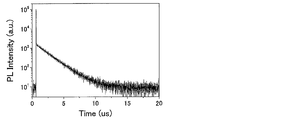
- Example 1 In this example, a toluene solution of Compound 1 synthesized in Synthesis Example 1 was prepared and irradiated with light at 280 nm at 300 K while bubbling nitrogen, and the emission wavelengths shown in Table 7 were observed.
- a time-resolved spectrum was performed using a C4334 type streak camera manufactured by Hamamatsu Photonics Co., Ltd., and a component having a short emission lifetime was determined to be fluorescence, and a component having a long emission lifetime was determined to be delayed fluorescence (FIG. 2).
- Table 7 shows the lifetimes of the fluorescent component and the delayed fluorescent component. Table 7 also shows the results of similar evaluations using the compounds synthesized in Synthesis Examples 2 to 11 instead of Compound 1. However, Compound 392 and Compound 901 were measured without bubbling with nitrogen.
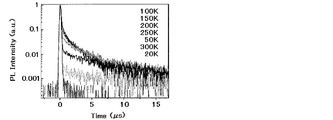
- Example 2 an organic photoluminescence device having a light-emitting layer composed of Compound 1 and a host material was prepared, and the characteristics were evaluated.
- a thin film having a concentration of Compound 1 of 6.0% by weight on a silicon substrate by vapor deposition of Compound 1 and mCP from different vapor deposition conditions under a vacuum degree of 5.0 ⁇ 10 ⁇ 4 Pa. was formed at a thickness of 100 nm at 0.3 nm / second to obtain an organic photoluminescence device.
- a component having a short emission lifetime was determined to be fluorescence, and a component having a long emission lifetime was determined to be delayed fluorescence.
- a fluorescence component and a delayed fluorescence component were observed between 50 and 500 K (FIG. 3).
- the fluorescent component was 12 to 16 ns, and the delayed fluorescent component was 11 ⁇ s at 100K and 8.8 ⁇ s at 150K.
- Example 3 an organic electroluminescence device having a light-emitting layer composed of compound 1 and CBP was prepared and evaluated for characteristics. Each thin film was laminated at a vacuum degree of 5.0 ⁇ 10 ⁇ 4 Pa by a vacuum deposition method on a glass substrate on which an anode made of indium tin oxide (ITO) having a thickness of 100 nm was formed. First, ⁇ -NPD was formed on ITO to a thickness of 35 nm. Next, Compound 1 and CBP were co-deposited from different vapor deposition sources to form a layer having a thickness of 15 nm as a light emitting layer. At this time, the concentration of Compound 1 was 6.0% by weight.
- ITO indium tin oxide
- TPBi is formed to a thickness of 65 nm
- further lithium fluoride (LiF) is vacuum-deposited to 0.8 nm
- aluminum (Al) is evaporated to a thickness of 80 nm to form a cathode.
- a luminescence element was obtained.
- a semiconductor parameter analyzer manufactured by Agilent Technologies: E5273A
- an optical power meter measuring device manufactured by Newport: 1930C
- an optical spectrometer manufactured by Ocean Optics: USB2000
- FIG. 4 shows current density-voltage (JV) characteristics
- FIG. 5 shows current density-external quantum efficiency characteristics.
- the organic electroluminescence device using Compound 1 as the light emitting material achieved a high external quantum efficiency of 17.06%.
- Example 4 As a result of producing an organic photoluminescence device using the compound 6 instead of the compound 1 of Example 3 and conducting the same test, emission of 553 nm was observed.
- FIG. 6 shows the current density-external quantum efficiency characteristics.
- Example 5 As a result of producing an organic photoluminescence device using Compound 301 instead of Compound 1 of Example 3 and conducting the same test, emission of 513 nm was observed.
- FIG. 7 shows the current density-external quantum efficiency characteristics.
- the organic electroluminescence device using the compound 301 as the light emitting material achieved a high external quantum efficiency of 19.32%.
- Example 6 An organic photoluminescence device was produced using the compound 501 instead of the compound 1 of Example 3, and the same test was performed. As a result, emission of 530 nm was observed.
- FIG. 8 shows current density-voltage (JV) characteristics
- FIG. 9 shows current density-external quantum efficiency characteristics.
- the organic electroluminescence device using the compound 501 as the light emitting material achieved a high external quantum efficiency of 17.84%.
- Example 7 an organic electroluminescent element having a light-emitting layer containing the compound 252 synthesized in Synthesis Example 9 as a light-emitting material was manufactured, and the characteristics were evaluated.
- Each thin film was laminated at a vacuum degree of 5.0 ⁇ 10 ⁇ 4 Pa by a vacuum deposition method on a glass substrate on which an anode made of indium tin oxide (ITO) having a thickness of 100 nm was formed.
- ITO indium tin oxide
- ⁇ -NPD was formed on ITO to a thickness of 35 nm.
- the compound 252 and CBP were co-deposited from different deposition sources to form a layer having a thickness of 15 nm as a light emitting layer.
- the concentration of the compound 252 was 6.0% by weight.
- TPBi is formed to a thickness of 65 nm, further lithium fluoride (LiF) is vacuum-deposited to 0.8 nm, and then aluminum (Al) is evaporated to a thickness of 80 nm to form a cathode.
- Al aluminum
- a luminescence element was obtained.
- a semiconductor parameter analyzer manufactured by Agilent Technologies: E5273A
- an optical power meter measuring device manufactured by Newport: 1930C
- an optical spectrometer manufactured by Ocean Optics: USB2000
- FIG. 11 shows current density-voltage (JV) characteristics
- FIG. 12 shows current density-external quantum efficiency characteristics.
- Example 8 an organic electroluminescent element having a light-emitting layer containing the compound 523 synthesized in Synthesis Example 10 as a light-emitting material was manufactured, and the characteristics were evaluated.
- Each thin film was laminated at a vacuum degree of 5.0 ⁇ 10 ⁇ 4 Pa by a vacuum deposition method on a glass substrate on which an anode made of indium tin oxide (ITO) having a thickness of 100 nm was formed.
- ITO indium tin oxide
- ⁇ -NPD was formed on ITO to a thickness of 40 nm, and then mCP was formed to a thickness of 10 nm.
- the compound 523 and PPT were co-deposited from different vapor deposition sources to form a 20 nm thick layer as a light emitting layer. At this time, the concentration of the compound 523 was 6.0% by weight.
- PPT is formed to a thickness of 40 nm, lithium fluoride (LiF) is further vacuum-deposited to 0.8 nm, and then aluminum (Al) is evaporated to a thickness of 80 nm to form a cathode. A luminescence element was obtained.
- FIG. 13 shows current density-voltage (JV) characteristics
- FIG. 15 shows current density-external quantum efficiency characteristics
- Example 9 an organic electroluminescence device having a light emitting layer containing the compound 31 synthesized in Synthesis Example 11 as a light emitting material was produced, and the characteristics were evaluated.
- Each thin film was laminated at a vacuum degree of 5.0 ⁇ 10 ⁇ 4 Pa by a vacuum deposition method on a glass substrate on which an anode made of indium tin oxide (ITO) having a thickness of 100 nm was formed.
- ITO indium tin oxide
- ⁇ -NPD was formed to a thickness of 35 nm on ITO, and then mCP was formed to a thickness of 10 nm.
- the compound 31 and mCP were co-deposited from different vapor deposition sources to form a layer having a thickness of 15 nm to form a light emitting layer. At this time, the concentration of the compound 31 was 3.0% by weight.
- PPT is formed to a thickness of 10 nm
- TPBi is formed thereon to a thickness of 40 nm
- lithium fluoride (LiF) is further vacuum-deposited to 0.8 nm
- aluminum (Al) is then deposited to a thickness of 100 nm.
- the cathode was formed by vapor deposition to obtain an organic electroluminescence element.
- FIG. 16 shows current density-voltage (JV) characteristics
- FIG. 18 shows current density-external quantum efficiency characteristics.
- Example 10 organic electroluminescent elements having light emitting layers containing Compound 1 at various concentrations as the light emitting material were prepared and the characteristics were evaluated. Each thin film was laminated at a vacuum degree of 5.0 ⁇ 10 ⁇ 4 Pa by a vacuum deposition method on a glass substrate on which an anode made of indium tin oxide (ITO) having a thickness of 100 nm was formed. First, HAT-CN was formed to a thickness of 10 nm on ITO, and then Tris-PCz was formed to a thickness of 30 nm. Next, Compound 1 and mCBP were co-evaporated from different vapor deposition sources to form a 30 nm thick layer as a light emitting layer.
- ITO indium tin oxide
- the concentration of Compound 1 was 3% by weight, 6% by weight, 10% by weight or 15% by weight.
- T2T is formed to a thickness of 10 nm
- BPy-TP2 is formed to a thickness of 40 nm
- lithium fluoride (LiF) is further vacuum-deposited by 0.8 nm
- aluminum (Al) is then deposited to a thickness of 100 nm.
- the cathode was formed by vapor deposition to obtain an organic electroluminescence element.
- an organic electroluminescent device in which Compound 1 of the light emitting layer was changed to 6 wt% Ir (ppy) 3 was also produced. About each organic electroluminescent element, it measured using the same apparatus as Example 3.
- the luminance-luminous efficiency characteristic is shown in FIG. 19, and the luminance deterioration characteristic is shown in FIG.
- the concentration of Compound 1 is 3% by weight
- the external quantum efficiency is 17.0%
- the concentration of Compound 1 is 10% by weight
- the external quantum efficiency is 15.6%
- the external quantum efficiency is 14.2%, 15% by weight. In this case, the external quantum efficiency of 14.0% was achieved.
- high external quantum efficiency (13.8%) was achieved even at 1000 cd / m 2 .
- the organic light emitting device of the present invention can realize high luminous efficiency.
- the compound of the present invention is useful as a light emitting material for such an organic light emitting device. For this reason, this invention has high industrial applicability.
Landscapes
- Chemical & Material Sciences (AREA)
- Organic Chemistry (AREA)
- Engineering & Computer Science (AREA)
- Materials Engineering (AREA)
- Physics & Mathematics (AREA)
- Optics & Photonics (AREA)
- Spectroscopy & Molecular Physics (AREA)
- Electroluminescent Light Sources (AREA)
- Indole Compounds (AREA)
Priority Applications (8)
| Application Number | Priority Date | Filing Date | Title |
|---|---|---|---|
| EP13775410.7A EP2851408B1 (en) | 2012-04-09 | 2013-04-08 | Organic light emitting device, and light emitting material and compound used therefor |
| US14/391,228 US9502668B2 (en) | 2012-04-09 | 2013-04-08 | Organic light-emitting device, and light-emitting material and compound used therefor |
| KR1020147030961A KR102082528B1 (ko) | 2012-04-09 | 2013-04-08 | 유기 발광 소자 그리고 그것에 사용하는 발광 재료 및 화합물 |
| ES13775410T ES2712825T3 (es) | 2012-04-09 | 2013-04-08 | Dispositivo orgánico de emisión de luz y material de emisión de luz y compuesto usado para el mismo |
| KR1020207004986A KR102168905B1 (ko) | 2012-04-09 | 2013-04-08 | 유기 발광 소자 그리고 그것에 사용하는 발광 재료 및 화합물 |
| CN201380019213.2A CN104204132B (zh) | 2012-04-09 | 2013-04-08 | 有机发光元件及用于其的发光材料以及化合物 |
| US15/293,889 US10276803B2 (en) | 2012-04-09 | 2016-10-14 | Organic light-emitting device, and light-emitting material and compound used therefor |
| US16/394,055 US20190252625A1 (en) | 2012-04-09 | 2019-04-25 | Organic light-emitting device, and light-emitting material and compound used therefor |
Applications Claiming Priority (6)
| Application Number | Priority Date | Filing Date | Title |
|---|---|---|---|
| JP2012-088615 | 2012-04-09 | ||
| JP2012088615 | 2012-04-09 | ||
| JP2012173277 | 2012-08-03 | ||
| JP2012-173277 | 2012-08-03 | ||
| JP2012274111 | 2012-12-14 | ||
| JP2012-274111 | 2012-12-14 |
Related Child Applications (2)
| Application Number | Title | Priority Date | Filing Date |
|---|---|---|---|
| US14/391,228 A-371-Of-International US9502668B2 (en) | 2012-04-09 | 2013-04-08 | Organic light-emitting device, and light-emitting material and compound used therefor |
| US15/293,889 Continuation US10276803B2 (en) | 2012-04-09 | 2016-10-14 | Organic light-emitting device, and light-emitting material and compound used therefor |
Publications (1)
| Publication Number | Publication Date |
|---|---|
| WO2013154064A1 true WO2013154064A1 (ja) | 2013-10-17 |
Family
ID=49327627
Family Applications (1)
| Application Number | Title | Priority Date | Filing Date |
|---|---|---|---|
| PCT/JP2013/060582 Ceased WO2013154064A1 (ja) | 2012-04-09 | 2013-04-08 | 有機発光素子ならびにそれに用いる発光材料および化合物 |
Country Status (8)
| Country | Link |
|---|---|
| US (3) | US9502668B2 (ko) |
| EP (1) | EP2851408B1 (ko) |
| JP (1) | JP2014135466A (ko) |
| KR (2) | KR102082528B1 (ko) |
| CN (2) | CN104204132B (ko) |
| ES (1) | ES2712825T3 (ko) |
| TW (1) | TWI580760B (ko) |
| WO (1) | WO2013154064A1 (ko) |
Cited By (104)
| Publication number | Priority date | Publication date | Assignee | Title |
|---|---|---|---|---|
| WO2014146752A1 (de) * | 2013-03-22 | 2014-09-25 | Merck Patent Gmbh | Materialien für elektronische vorrichtungen |
| WO2014157619A1 (ja) | 2013-03-29 | 2014-10-02 | 国立大学法人九州大学 | 有機エレクトロルミネッセンス素子 |
| WO2014208698A1 (ja) * | 2013-06-26 | 2014-12-31 | 出光興産株式会社 | 化合物、有機エレクトロルミネッセンス素子用材料、有機エレクトロルミネッセンス素子、および電子機器 |
| WO2015022974A1 (ja) | 2013-08-14 | 2015-02-19 | 国立大学法人九州大学 | 有機エレクトロルミネッセンス素子 |
| WO2015022987A1 (ja) * | 2013-08-16 | 2015-02-19 | コニカミノルタ株式会社 | 有機エレクトロルミネッセンス素子、電子デバイス、発光装置及び発光材料 |
| WO2015070944A1 (en) * | 2013-11-15 | 2015-05-21 | Merck Patent Gmbh | Compound with novel six-membered ring structure for use in organic electronic devices |
| WO2015080183A1 (ja) * | 2013-11-28 | 2015-06-04 | 国立大学法人九州大学 | 発光材料、有機発光素子および化合物 |
| JP2015106659A (ja) * | 2013-11-29 | 2015-06-08 | 出光興産株式会社 | 有機エレクトロルミネッセンス素子および電子機器 |
| WO2015118936A1 (ja) * | 2014-02-07 | 2015-08-13 | 国立大学法人九州大学 | 発光層の製造方法、発光層および有機発光素子 |
| WO2015129715A1 (ja) * | 2014-02-28 | 2015-09-03 | 国立大学法人九州大学 | 発光材料、有機発光素子および化合物 |
| WO2015137136A1 (ja) * | 2014-03-12 | 2015-09-17 | 国立大学法人九州大学 | 発光材料及びそれを用いた有機el素子 |
| WO2015135625A1 (de) | 2014-03-13 | 2015-09-17 | Merck Patent Gmbh | Formulierungen lumineszierender verbindungen |
| WO2015139808A1 (de) | 2014-03-18 | 2015-09-24 | Merck Patent Gmbh | Organische elektrolumineszenzvorrichtung |
| WO2015180524A1 (zh) * | 2014-05-30 | 2015-12-03 | 广州华睿光电材料有限公司 | 有机混合物、包含其的组合物、有机电子器件及应用 |
| WO2015195837A1 (en) * | 2014-06-17 | 2015-12-23 | Nitto Denko Corporation | Emissive material for organic emitting diodes |
| US20160093813A1 (en) * | 2013-04-08 | 2016-03-31 | Merck Patent Gmbh | Organic electroluminescent device |
| US20160149139A1 (en) * | 2014-11-25 | 2016-05-26 | Universal Display Corporation | Organic electroluminescent materials and devices |
| JP2016129262A (ja) * | 2013-12-26 | 2016-07-14 | 出光興産株式会社 | 有機エレクトロルミネッセンス素子および電子機器 |
| JP2016522579A (ja) * | 2013-06-06 | 2016-07-28 | メルク パテント ゲーエムベーハー | 有機エレクトロルミネッセント素子 |
| DE102015101767A1 (de) * | 2015-02-06 | 2016-08-11 | Technische Universität Dresden | Blaue Fluoreszenzemitter |
| EP3075737A1 (en) | 2015-03-31 | 2016-10-05 | Idemitsu Kosan Co., Ltd | Benzimidazolo[1,2-a]benzimidazole carrying aryl- or heteroarylnitril groups for organic light emitting diodes |
| WO2016181846A1 (ja) * | 2015-05-08 | 2016-11-17 | コニカミノルタ株式会社 | π共役系化合物、有機エレクトロルミネッセンス素子材料、発光材料、発光性薄膜、有機エレクトロルミネッセンス素子、表示装置及び照明装置 |
| JP2016539182A (ja) * | 2013-10-30 | 2016-12-15 | 日東電工株式会社 | 発光デバイス用発光化合物 |
| CN106687563A (zh) * | 2014-09-05 | 2017-05-17 | 默克专利有限公司 | 制剂和电子器件 |
| WO2017115834A1 (ja) * | 2015-12-28 | 2017-07-06 | 株式会社Kyulux | 化合物、発光材料および有機発光素子 |
| JP2017119663A (ja) * | 2015-12-28 | 2017-07-06 | 株式会社Kyulux | 化合物、発光材料および有機発光素子 |
| JP2017152585A (ja) * | 2016-02-25 | 2017-08-31 | 株式会社ジャパンディスプレイ | 有機エレクトロルミネッセンス表示装置用材料及び有機エレクトロルミネッセンス表示装置 |
| US20170250363A1 (en) * | 2014-09-16 | 2017-08-31 | Cynora Gmbh | Light-emitting layer suitable for bright luminescence |
| JP2017197481A (ja) * | 2016-04-28 | 2017-11-02 | コニカミノルタ株式会社 | π共役系化合物、有機エレクトロルミネッセンス素子材料、発光材料、電荷輸送材料、発光性薄膜、有機エレクトロルミネッセンス素子、表示装置及び照明装置 |
| WO2017194435A1 (de) | 2016-05-11 | 2017-11-16 | Merck Patent Gmbh | Zusammensetzungen für elektrochemische zellen |
| WO2018047948A1 (ja) * | 2016-09-09 | 2018-03-15 | 東洋紡株式会社 | 有機発光素子ならびにそれに用いる発光材料および化合物 |
| WO2018095381A1 (zh) | 2016-11-23 | 2018-05-31 | 广州华睿光电材料有限公司 | 印刷油墨组合物及其制备方法和用途 |
| WO2018095395A1 (zh) | 2016-11-23 | 2018-05-31 | 广州华睿光电材料有限公司 | 高聚物、包含其的混合物、组合物和有机电子器件以及用于聚合的单体 |
| WO2018095392A1 (zh) | 2016-11-23 | 2018-05-31 | 广州华睿光电材料有限公司 | 有机混合物、组合物以及有机电子器件 |
| WO2018103744A1 (zh) | 2016-12-08 | 2018-06-14 | 广州华睿光电材料有限公司 | 混合物、组合物及有机电子器件 |
| WO2018117241A1 (ja) * | 2016-12-21 | 2018-06-28 | 国立大学法人九州大学 | 発光材料、化合物および有機発光素子 |
| WO2018113785A1 (zh) | 2016-12-22 | 2018-06-28 | 广州华睿光电材料有限公司 | 含呋喃交联基团的聚合物及其应用 |
| KR20180099713A (ko) | 2015-12-28 | 2018-09-05 | 신닛테츠 수미킨 가가쿠 가부시키가이샤 | 유기 전계 발광 소자 |
| US10131632B2 (en) | 2015-05-06 | 2018-11-20 | Samsung Sdi Co., Ltd. | Dopant for organic optoelectronic device, organic optoelectronic device and display device |
| JP2018200999A (ja) * | 2017-05-30 | 2018-12-20 | 株式会社Kyulux | 膜、膜の製造方法、有機発光素子、照明装置および化合物 |
| JP2018200995A (ja) * | 2017-05-30 | 2018-12-20 | 株式会社Kyulux | トップエミッション方式の有機エレクトロルミネッセンス素子および有機発光ディスプレイ装置 |
| WO2019117571A1 (ko) * | 2017-12-15 | 2019-06-20 | 주식회사 두산 | 유기 화합물 및 이를 포함하는 유기 전계 발광 소자 |
| US10329483B2 (en) | 2014-12-30 | 2019-06-25 | Dow Global Technologies Llc | Fluorene derivatives as light emitting elements for electroluminescent devices |
| US10388888B2 (en) | 2014-12-29 | 2019-08-20 | University Court Of The University Of St Andrews | Light emitting electrochemical cells and compounds |
| US10497883B2 (en) | 2014-03-11 | 2019-12-03 | Kyulux, Inc. | Organic light-emitting device, host material, light-emitting material, and compound |
| US10559757B2 (en) | 2014-09-03 | 2020-02-11 | Kyulux, Inc. | Host material for delayed fluorescent materials, organic light-emitting device and compound |
| WO2020059520A1 (ja) * | 2018-09-21 | 2020-03-26 | コニカミノルタ株式会社 | ベンゾニトリル誘導体及びその製造方法、インク組成物、有機エレクトロルミネッセンス素子材料、発光材料、電荷輸送材料、発光性薄膜及び有機エレクトロルミネッセンス素子 |
| WO2020059862A1 (ja) * | 2018-09-21 | 2020-03-26 | 出光興産株式会社 | 化合物、有機エレクトロルミネッセンス素子用材料、有機エレクトロルミネッセンス素子、および電子機器 |
| WO2020076796A1 (en) | 2018-10-09 | 2020-04-16 | Kyulux, Inc. | Novel composition of matter for use in organic light-emitting diodes |
| JP2020525438A (ja) * | 2017-06-23 | 2020-08-27 | 株式会社Kyulux | 有機発光ダイオードに用いられる組成物 |
| WO2020178230A1 (en) | 2019-03-04 | 2020-09-10 | Merck Patent Gmbh | Ligands for nano-sized materials |
| US10804470B2 (en) | 2016-11-23 | 2020-10-13 | Guangzhou Chinaray Optoelectronic Materials Ltd | Organic compound |
| WO2020208051A1 (en) | 2019-04-11 | 2020-10-15 | Merck Patent Gmbh | Materials for organic electroluminescent devices |
| US10811616B2 (en) | 2013-12-26 | 2020-10-20 | Idemitsu Kosan Co., Ltd. | Organic electroluminescent element and electronic device |
| WO2020250851A1 (ja) | 2019-06-14 | 2020-12-17 | 国立大学法人九州大学 | イソフタロニトリル化合物、発光材料およびそれを用いた発光素子 |
| US10934248B2 (en) | 2013-11-28 | 2021-03-02 | Kyulux, Inc. | Light-emitting material, organic light-emitting device, and compound |
| US10968243B2 (en) | 2015-12-04 | 2021-04-06 | Guangzhou Chinaray Optoelectronic Materials Ltd. | Organometallic complex and application thereof in electronic devices |
| WO2021089450A1 (en) | 2019-11-04 | 2021-05-14 | Merck Patent Gmbh | Materials for organic electroluminescent devices |
| WO2021094269A1 (en) | 2019-11-12 | 2021-05-20 | Merck Patent Gmbh | Materials for organic electroluminescent devices |
| WO2021110741A1 (en) | 2019-12-04 | 2021-06-10 | Merck Patent Gmbh | Materials for organic electroluminescent devices |
| WO2021157593A1 (ja) | 2020-02-04 | 2021-08-12 | 株式会社Kyulux | 組成物、膜、有機発光素子、発光組成物を提供する方法およびプログラム |
| US11101440B2 (en) | 2015-07-01 | 2021-08-24 | Kyushu University, National University Corporation | Organic electroluminescent device |
| WO2021191058A1 (en) | 2020-03-23 | 2021-09-30 | Merck Patent Gmbh | Materials for organic electroluminescent devices |
| US11161933B2 (en) | 2016-12-13 | 2021-11-02 | Guangzhou Chinaray Optoelectronic Materials Ltd. | Conjugated polymer and use thereof in organic electronic device |
| WO2021235549A1 (ja) | 2020-05-22 | 2021-11-25 | 株式会社Kyulux | 化合物、発光材料および発光素子 |
| US11239428B2 (en) | 2016-11-23 | 2022-02-01 | Guangzhou Chinaray Optoelectronic Materials Ltd. | Boron-containing organic compound and applications thereof, organic mixture, and organic electronic device |
| WO2022025248A1 (ja) | 2020-07-31 | 2022-02-03 | 株式会社Kyulux | 化合物、発光材料および発光素子 |
| US11292875B2 (en) | 2016-12-22 | 2022-04-05 | Guangzhou Chinaray Optoelectronic Materials Ltd. | Cross-linkable polymer based on Diels-Alder reaction and use thereof in organic electronic device |
| US11335872B2 (en) | 2016-09-06 | 2022-05-17 | Kyulux, Inc. | Organic light-emitting device |
| WO2022124365A1 (ja) * | 2020-12-11 | 2022-06-16 | 日鉄ケミカル&マテリアル株式会社 | 有機電界発光素子 |
| WO2022124366A1 (ja) * | 2020-12-11 | 2022-06-16 | 日鉄ケミカル&マテリアル株式会社 | 有機電界発光素子 |
| US11404651B2 (en) | 2017-12-14 | 2022-08-02 | Guangzhou Chinaray Optoelectronic Materials Ltd. | Transition metal complex material and application thereof in electronic devices |
| WO2022168956A1 (ja) | 2021-02-04 | 2022-08-11 | 株式会社Kyulux | 化合物、発光材料および有機発光素子 |
| US11447496B2 (en) | 2016-11-23 | 2022-09-20 | Guangzhou Chinaray Optoelectronic Materials Ltd. | Nitrogen-containing fused heterocyclic ring compound and application thereof |
| US11476435B2 (en) | 2017-08-24 | 2022-10-18 | Kyushu University, National University Corporation | Film and organic light-emitting device containing perovskite-type compound and organic light-emitting material |
| US11482679B2 (en) | 2017-05-23 | 2022-10-25 | Kyushu University, National University Corporation | Compound, light-emitting lifetime lengthening agent, use of n-type compound, film and light-emitting device |
| WO2022244503A1 (ja) | 2021-05-20 | 2022-11-24 | 株式会社Kyulux | 有機発光素子 |
| US11512039B2 (en) | 2016-11-23 | 2022-11-29 | Guangzhou Chinaray Optoelectronic Materials Ltd. | Aromatic amine derivatives, preparation methods therefor, and uses thereof |
| US11518723B2 (en) | 2016-11-23 | 2022-12-06 | Guangzhou Chinaray Optoelectronic Materials Ltd. | Fused ring compound, high polymer, mixture, composition and organic electronic component |
| WO2022270354A1 (ja) | 2021-06-23 | 2022-12-29 | 株式会社Kyulux | 化合物、発光材料および有機発光素子 |
| WO2022270602A1 (ja) | 2021-06-23 | 2022-12-29 | 株式会社Kyulux | 有機発光素子および膜 |
| WO2022270113A1 (ja) | 2021-06-23 | 2022-12-29 | 株式会社Kyulux | 有機エレクトロルミネッセンス素子 |
| WO2023282224A1 (ja) | 2021-07-06 | 2023-01-12 | 株式会社Kyulux | 有機発光素子およびその設計方法 |
| US11555128B2 (en) | 2015-11-12 | 2023-01-17 | Guangzhou Chinaray Optoelectronic Materials Ltd. | Printing composition, electronic device comprising same and preparation method for functional material thin film |
| US11594690B2 (en) | 2017-12-14 | 2023-02-28 | Guangzhou Chinaray Optoelectronic Materials Ltd. | Organometallic complex, and polymer, mixture and formulation comprising same, and use thereof in electronic device |
| WO2023036976A1 (en) | 2021-09-13 | 2023-03-16 | Merck Patent Gmbh | Materials for organic electroluminescent devices |
| US11611046B2 (en) | 2014-03-13 | 2023-03-21 | Merck Patent Gmbh | Organic electroluminescent device |
| WO2023053835A1 (ja) | 2021-09-28 | 2023-04-06 | 株式会社Kyulux | 化合物、組成物、ホスト材料、電子障壁材料および有機発光素子 |
| US11634444B2 (en) | 2016-11-23 | 2023-04-25 | Guangzhou Chinaray Optoelectronic Materials Ltd. | Metal organic complex, high polymer, composition, and organic electronic component |
| WO2023090288A1 (ja) | 2021-11-19 | 2023-05-25 | 株式会社Kyulux | 化合物、発光材料および発光素子 |
| US11672174B2 (en) | 2016-12-08 | 2023-06-06 | Guangzhou Chinaray Optoelectronic Materials Ltd. | Pyrene-triazine derivative and applications thereof in organic electronic component |
| US11674080B2 (en) | 2017-12-14 | 2023-06-13 | Guangzhou Chinaray Optoelectronic Materials Ltd. | Transition metal complex, polymer, mixture, formulation and use thereof |
| US11680059B2 (en) | 2017-12-21 | 2023-06-20 | Guangzhou Chinaray Optoelectronic Materials Ltd. | Organic mixture and application thereof in organic electronic devices |
| WO2023140130A1 (ja) | 2022-01-19 | 2023-07-27 | 株式会社Kyulux | 化合物、発光材料および有機発光素子 |
| WO2024033282A1 (en) | 2022-08-09 | 2024-02-15 | Merck Patent Gmbh | Materials for organic electroluminescent devices |
| US11930654B2 (en) | 2017-07-06 | 2024-03-12 | Kyulux, Inc. | Organic light-emitting element |
| WO2024105066A1 (en) | 2022-11-17 | 2024-05-23 | Merck Patent Gmbh | Materials for organic electroluminescent devices |
| WO2024111223A1 (ja) | 2022-11-22 | 2024-05-30 | 株式会社Kyulux | 化合物、発光材料および発光素子 |
| US12048175B2 (en) | 2015-12-28 | 2024-07-23 | Kyushu University, National University Corporation | Organic electroluminescent device |
| WO2024166785A1 (ja) | 2023-02-10 | 2024-08-15 | 株式会社Kyulux | 化合物、発光材料および発光素子 |
| US12077699B2 (en) | 2015-05-15 | 2024-09-03 | Samsung Sdi Co., Ltd. | Dopant for organic optoelectronic device, organic optoelectronic device, and display device |
| WO2024181526A1 (ja) | 2023-03-01 | 2024-09-06 | 株式会社Kyulux | 化合物、発光材料および発光素子 |
| WO2024204430A1 (ja) | 2023-03-27 | 2024-10-03 | 株式会社Kyulux | 有機発光素子 |
| US12540275B2 (en) | 2021-01-13 | 2026-02-03 | Zhejiang Brilliant Optoelectronic Technology Co., Ltd. | Organic compounds, mixtures and applications thereof in organic electronic devices |
Families Citing this family (71)
| Publication number | Priority date | Publication date | Assignee | Title |
|---|---|---|---|---|
| KR102256770B1 (ko) * | 2013-03-22 | 2021-05-26 | 메르크 파텐트 게엠베하 | 유기 전계발광 소자용 재료의 제조를 위한 합성 빌딩 블록 |
| JP6573442B2 (ja) * | 2013-07-30 | 2019-09-11 | 出光興産株式会社 | 有機エレクトロルミネッセンス素子および電子機器 |
| WO2016017684A1 (ja) * | 2014-07-31 | 2016-02-04 | コニカミノルタ株式会社 | 有機エレクトロルミネッセンス素子材料、有機エレクトロルミネッセンス素子、発光性薄膜、表示装置及び照明装置 |
| CN110233206B (zh) * | 2014-10-07 | 2021-07-30 | 出光兴产株式会社 | 有机电致发光元件、以及电子设备 |
| CN104387369B (zh) * | 2014-10-28 | 2017-09-08 | 南京工业大学 | 一种热激活延迟荧光材料的合成方法及其应用 |
| WO2016116497A1 (de) * | 2015-01-20 | 2016-07-28 | Cynora Gmbh | Organische moleküle, insbesondere zur verwendung in optoelektronischen bauelementen |
| WO2016152605A1 (ja) * | 2015-03-23 | 2016-09-29 | 保土谷化学工業株式会社 | 有機エレクトロルミネッセンス素子用材料、発光材料および有機エレクトロルミネッセンス素子 |
| CN104829520B (zh) * | 2015-03-24 | 2017-10-24 | 吉林奥来德光电材料股份有限公司 | 有机电致发光材料及其使用这个有机电致发光材料制备的器件 |
| CN104710343B (zh) * | 2015-03-24 | 2017-10-27 | 吉林奥来德光电材料股份有限公司 | 一种有机电致发光材料及其制备的器件 |
| KR101772548B1 (ko) * | 2015-05-29 | 2017-08-30 | 성균관대학교산학협력단 | 화합물 및 이를 포함하는 유기전계 발광소자 |
| CN106316924B (zh) * | 2015-06-16 | 2020-01-24 | 清华大学 | 一种热活化延迟荧光材料 |
| GB201513037D0 (en) * | 2015-07-23 | 2015-09-09 | Merck Patent Gmbh | Phenyl-derived compound for use in organic electronic devices |
| KR102572294B1 (ko) * | 2015-09-25 | 2023-08-30 | 덕산네오룩스 주식회사 | 유기전기 소자용 화합물, 이를 이용한 유기전기소자 및 그 전자 장치 |
| KR102541267B1 (ko) | 2015-10-05 | 2023-06-12 | 삼성전자주식회사 | 축합환 화합물 및 이를 포함한 유기 발광 소자 |
| JP6647514B2 (ja) * | 2015-12-04 | 2020-02-14 | 東洋紡株式会社 | 有機発光素子ならびにそれに用いる発光材料および化合物 |
| TWI594476B (zh) * | 2015-12-11 | 2017-08-01 | 友達光電股份有限公司 | 螢光有機發光材料及有機電激發光裝置 |
| CN106892857B (zh) * | 2015-12-18 | 2020-02-18 | 昆山国显光电有限公司 | 热活化延迟荧光材料及其在有机电致发光器件中的应用 |
| JP6668152B2 (ja) * | 2015-12-28 | 2020-03-18 | 株式会社Kyulux | 化合物、発光材料および有機発光素子 |
| JP6783059B2 (ja) * | 2016-03-02 | 2020-11-11 | 株式会社Kyulux | 化合物、キャリア輸送材料および有機発光素子 |
| KR102727643B1 (ko) | 2016-12-07 | 2024-11-08 | 삼성디스플레이 주식회사 | 축합환 화합물 및 이를 포함한 유기 발광 소자 |
| EP4492949A3 (en) * | 2017-02-24 | 2025-10-15 | Kyulux, Inc. | Compound, light-emitting material and light-emitting element |
| US11283027B1 (en) | 2017-03-03 | 2022-03-22 | Kyulux, Inc. | Composition of matter for use in organic light-emitting diodes |
| US10892425B1 (en) | 2017-03-03 | 2021-01-12 | Kyulux, Inc. | Composition of matter for use in organic light-emitting diodes |
| JP6900514B2 (ja) * | 2017-06-06 | 2021-07-07 | サイノラ ゲゼルシャフト ミット ベシュレンクテル ハフツング | 有機分子、特に光電子デバイスに用いる有機分子 |
| US10547014B2 (en) | 2017-06-23 | 2020-01-28 | Kyulux, Inc. | Composition of matter for use in organic light-emitting diodes |
| WO2019004254A1 (ja) * | 2017-06-27 | 2019-01-03 | 株式会社Kyulux | 発光材料、化合物、遅延蛍光体および発光素子 |
| JP7267563B2 (ja) * | 2017-06-27 | 2023-05-02 | 株式会社Kyulux | 発光材料、化合物、遅延蛍光体および発光素子 |
| US11069860B2 (en) | 2017-08-21 | 2021-07-20 | Kyulux, Inc. | Composition of matter for use in organic light-emitting diodes |
| KR102181841B1 (ko) * | 2017-11-28 | 2020-11-23 | 주식회사 엘지화학 | 화합물 및 이를 포함하는 유기 발광 소자 |
| WO2019107932A1 (ko) * | 2017-11-28 | 2019-06-06 | 주식회사 엘지화학 | 화합물 및 이를 포함하는 유기 발광 소자 |
| WO2019107933A1 (ko) * | 2017-11-28 | 2019-06-06 | 주식회사 엘지화학 | 화합물 및 이를 포함하는 유기 발광 소자 |
| WO2019107934A1 (ko) * | 2017-11-28 | 2019-06-06 | 주식회사 엘지화학 | 화합물 및 이를 포함하는 유기 발광 소자 |
| KR102160860B1 (ko) * | 2017-11-28 | 2020-10-06 | 주식회사 엘지화학 | 화합물 및 이를 포함하는 유기 발광 소자 |
| KR102123745B1 (ko) * | 2017-11-28 | 2020-06-16 | 주식회사 엘지화학 | 화합물 및 이를 포함하는 유기 발광 소자 |
| US11444250B2 (en) | 2017-12-05 | 2022-09-13 | Kyulux, Inc. | Composition of matter for use in organic light-emitting diodes |
| CN108048077B (zh) * | 2017-12-11 | 2019-04-30 | 中节能万润股份有限公司 | 一种热活化延迟荧光材料及其应用 |
| KR20190070586A (ko) | 2017-12-13 | 2019-06-21 | 엘지디스플레이 주식회사 | 전자수송 재료용 화합물 및 이를 포함하는 유기 발광 다이오드 |
| CN109912591B (zh) * | 2017-12-13 | 2021-12-28 | 江苏三月科技股份有限公司 | 一种含有氰基苯或者硫氰基苯的化合物及其在有机电致发光器件上的应用 |
| US10644249B2 (en) | 2017-12-22 | 2020-05-05 | Kyulux, Inc. | Composition of matter for use in organic light-emitting diodes |
| US11575088B2 (en) | 2017-12-22 | 2023-02-07 | Kyulux, Inc. | Composition of matter for use in organic light-emitting diodes |
| CN108586318B (zh) * | 2018-01-16 | 2020-09-18 | 东南大学 | 一种可溶液加工的热激活延迟荧光材料及其制备方法 |
| US11542260B2 (en) | 2018-01-31 | 2023-01-03 | Kyulux, Inc. | Composition of matter for use in organic light-emitting diodes |
| US11104669B2 (en) | 2018-02-02 | 2021-08-31 | Kyulux, Inc. | Composition of matter for use in organic light-emitting diodes |
| US11608333B2 (en) | 2018-03-20 | 2023-03-21 | Kyulux, Inc. | Composition of matter for use in organic light-emitting diodes |
| KR102187989B1 (ko) | 2018-03-28 | 2020-12-07 | 주식회사 엘지화학 | 화합물 및 이를 포함하는 유기 발광 소자 |
| KR102187980B1 (ko) | 2018-03-28 | 2020-12-07 | 주식회사 엘지화학 | 화합물 및 이를 포함하는 유기 발광 소자 |
| US11498914B2 (en) | 2018-03-30 | 2022-11-15 | Kyulux, Inc. | Composition of matter for use in organic light-emitting diodes |
| WO2019195104A1 (en) * | 2018-04-02 | 2019-10-10 | Kyulux, Inc. | Composition of matter for use in organic light-emitting diodes |
| CN112585239A (zh) | 2018-04-11 | 2021-03-30 | 纳米技术有限公司 | 具有量子点和热活化延迟荧光分子的顶发射型印刷显示器 |
| KR20200142554A (ko) | 2018-04-11 | 2020-12-22 | 나노코 테크놀로지스 리미티드 | 형광 공여체 지원 oled 장치를 위한 양자점 아키텍처 |
| US11778904B2 (en) | 2018-05-09 | 2023-10-03 | Kyulux, Inc. | Composition of matter for use in organic light-emitting diodes |
| CN111372918B (zh) | 2018-07-27 | 2023-09-05 | 出光兴产株式会社 | 化合物、用于有机电致发光元件的材料、有机电致发光元件以及电子设备 |
| KR102533313B1 (ko) * | 2018-09-05 | 2023-05-16 | 고쿠리쓰다이가쿠호진 규슈다이가쿠 | 벤조니트릴 유도체, 발광 재료 및 그것을 사용한 발광 소자 |
| US12365759B2 (en) * | 2018-09-28 | 2025-07-22 | Resonac Corporation | Organic electronic material and organic electronic element |
| WO2020085765A1 (ko) * | 2018-10-22 | 2020-04-30 | 주식회사 엘지화학 | 다환 화합물 및 이를 포함하는 유기발광소자 |
| KR102278235B1 (ko) * | 2018-10-26 | 2021-07-16 | 주식회사 엘지화학 | 중수소 함유 화합물 및 이를 포함하는 유기 발광 소자 |
| EP3651225A1 (en) | 2018-11-09 | 2020-05-13 | Idemitsu Kosan Co., Ltd. | Novel organic compounds and an organic electroluminescence device comprising the same |
| KR102772386B1 (ko) | 2018-11-16 | 2025-02-26 | 삼성디스플레이 주식회사 | 유기 전계 발광 소자 및 유기 전계 발광 소자용 화합물 |
| US11884853B2 (en) | 2018-11-16 | 2024-01-30 | Kyulux, Inc. | Electroluminescent display devices and methods of making the same |
| KR102686121B1 (ko) * | 2019-09-04 | 2024-07-17 | 엘지디스플레이 주식회사 | 유기발광다이오드 및 이를 포함하는 유기발광장치 |
| KR102793989B1 (ko) | 2019-11-08 | 2025-04-15 | 삼성디스플레이 주식회사 | 유기 전계 발광 소자 및 유기 전계 발광 소자용 방향족 화합물 |
| CN112500298B (zh) * | 2019-12-27 | 2022-03-04 | 陕西莱特光电材料股份有限公司 | 芳胺化合物和有机电致发光器件 |
| WO2021157599A1 (ja) * | 2020-02-05 | 2021-08-12 | 株式会社Kyulux | 化合物、発光材料、遅延蛍光材料および有機光デバイス |
| KR102776384B1 (ko) | 2020-05-06 | 2025-03-10 | 삼성디스플레이 주식회사 | 발광 소자 및 이를 포함하는 전자 장치 |
| KR102797538B1 (ko) | 2020-05-19 | 2025-04-21 | 삼성디스플레이 주식회사 | 유기 발광 소자 및 이를 포함한 전자 장치 |
| KR20220034512A (ko) * | 2020-09-11 | 2022-03-18 | 엘지디스플레이 주식회사 | 유기 화합물, 이를 포함하는 유기발광다이오드 및 유기발광장치 |
| CN116391456A (zh) | 2020-09-18 | 2023-07-04 | 三星显示有限公司 | 有机电致发光器件 |
| KR102889905B1 (ko) * | 2020-09-28 | 2025-11-21 | 엘지디스플레이 주식회사 | 유기발광다이오드 및 유기발광장치 |
| CN112679414B (zh) * | 2020-10-30 | 2022-07-19 | 苏州大学 | 基于热激活延迟荧光材料的超厚非掺杂电致发光器件及其制备方法 |
| CN113582908B (zh) * | 2021-09-08 | 2023-09-26 | 华南理工大学 | 一类基于苯氰基的近紫外有机电致发光材料及其制备方法与在制备oled中的应用 |
| CN118993940B (zh) * | 2024-08-09 | 2025-10-21 | 吉林大学 | 一种低温加工的柔性有机晶体化合物及其制备方法 |
Citations (5)
| Publication number | Priority date | Publication date | Assignee | Title |
|---|---|---|---|---|
| JP2005174917A (ja) | 2003-11-21 | 2005-06-30 | Canon Inc | 有機発光素子、有機化合物及び表示装置 |
| JP2008133225A (ja) * | 2006-11-29 | 2008-06-12 | Toyo Ink Mfg Co Ltd | インドール誘導体およびその用途 |
| JP2009076834A (ja) | 2006-11-27 | 2009-04-09 | Fujifilm Corp | 有機電界発光素子および新規なインドール誘導体 |
| JP2009094486A (ja) | 2007-09-18 | 2009-04-30 | Fujifilm Corp | 有機電界発光素子 |
| KR20100123172A (ko) * | 2009-05-14 | 2010-11-24 | 덕산하이메탈(주) | 아릴아미노 구조를 포함하는 화합물 및 이를 이용한 유기전기소자, 그 단말 |
Family Cites Families (2)
| Publication number | Priority date | Publication date | Assignee | Title |
|---|---|---|---|---|
| KR101195863B1 (ko) * | 2009-09-29 | 2012-10-30 | 에스에프씨 주식회사 | 방향족 화합물 및 이를 이용한 유기전계발광소자 |
| KR101195865B1 (ko) | 2009-09-29 | 2012-10-30 | 에스에프씨 주식회사 | 방향족 화합물 및 이를 이용한 유기전계발광소자 |
-
2013
- 2013-04-05 JP JP2013079937A patent/JP2014135466A/ja active Pending
- 2013-04-08 US US14/391,228 patent/US9502668B2/en active Active
- 2013-04-08 CN CN201380019213.2A patent/CN104204132B/zh active Active
- 2013-04-08 EP EP13775410.7A patent/EP2851408B1/en active Active
- 2013-04-08 CN CN201710742496.3A patent/CN107522652B/zh active Active
- 2013-04-08 ES ES13775410T patent/ES2712825T3/es active Active
- 2013-04-08 KR KR1020147030961A patent/KR102082528B1/ko active Active
- 2013-04-08 WO PCT/JP2013/060582 patent/WO2013154064A1/ja not_active Ceased
- 2013-04-08 KR KR1020207004986A patent/KR102168905B1/ko active Active
- 2013-04-09 TW TW102112555A patent/TWI580760B/zh active
-
2016
- 2016-10-14 US US15/293,889 patent/US10276803B2/en active Active
-
2019
- 2019-04-25 US US16/394,055 patent/US20190252625A1/en not_active Abandoned
Patent Citations (5)
| Publication number | Priority date | Publication date | Assignee | Title |
|---|---|---|---|---|
| JP2005174917A (ja) | 2003-11-21 | 2005-06-30 | Canon Inc | 有機発光素子、有機化合物及び表示装置 |
| JP2009076834A (ja) | 2006-11-27 | 2009-04-09 | Fujifilm Corp | 有機電界発光素子および新規なインドール誘導体 |
| JP2008133225A (ja) * | 2006-11-29 | 2008-06-12 | Toyo Ink Mfg Co Ltd | インドール誘導体およびその用途 |
| JP2009094486A (ja) | 2007-09-18 | 2009-04-30 | Fujifilm Corp | 有機電界発光素子 |
| KR20100123172A (ko) * | 2009-05-14 | 2010-11-24 | 덕산하이메탈(주) | 아릴아미노 구조를 포함하는 화합물 및 이를 이용한 유기전기소자, 그 단말 |
Non-Patent Citations (1)
| Title |
|---|
| See also references of EP2851408A4 |
Cited By (164)
| Publication number | Priority date | Publication date | Assignee | Title |
|---|---|---|---|---|
| CN107739352A (zh) * | 2013-03-22 | 2018-02-27 | 默克专利有限公司 | 用于电子器件的材料 |
| WO2014146752A1 (de) * | 2013-03-22 | 2014-09-25 | Merck Patent Gmbh | Materialien für elektronische vorrichtungen |
| CN107739352B (zh) * | 2013-03-22 | 2024-05-14 | 默克专利有限公司 | 用于电子器件的材料 |
| EP3375785A1 (de) * | 2013-03-22 | 2018-09-19 | Merck Patent GmbH | Materialien für elektronische vorrichtungen |
| US10193079B2 (en) | 2013-03-22 | 2019-01-29 | Merck Patent Gmbh | Materials for electronic devices |
| WO2014157619A1 (ja) | 2013-03-29 | 2014-10-02 | 国立大学法人九州大学 | 有機エレクトロルミネッセンス素子 |
| US10249828B2 (en) * | 2013-04-08 | 2019-04-02 | Merck Patent Gmbh | Organic electroluminescent device |
| US20160093813A1 (en) * | 2013-04-08 | 2016-03-31 | Merck Patent Gmbh | Organic electroluminescent device |
| JP2016522579A (ja) * | 2013-06-06 | 2016-07-28 | メルク パテント ゲーエムベーハー | 有機エレクトロルミネッセント素子 |
| US10590080B2 (en) | 2013-06-26 | 2020-03-17 | Idemitsu Kosan Co., Ltd. | Compound, material for organic electroluminescent elements, organic electroluminescent element, and electronic device |
| US12077500B2 (en) | 2013-06-26 | 2024-09-03 | Idemitsu Kosan Co., Ltd | Compound, material for organic electroluminescent elements, organic electroluminescent element, and electronic device |
| WO2014208698A1 (ja) * | 2013-06-26 | 2014-12-31 | 出光興産株式会社 | 化合物、有機エレクトロルミネッセンス素子用材料、有機エレクトロルミネッセンス素子、および電子機器 |
| US11059781B2 (en) | 2013-06-26 | 2021-07-13 | Idemitsu Kosan Co., Ltd. | Compound, material for organic electroluminescent elements, organic electroluminescent element, and electronic device |
| US10851055B2 (en) | 2013-06-26 | 2020-12-01 | Idemitsu Kosan Co., Ltd. | Compound, material for organic electroluminescent elements, organic electroluminescent element, and electronic device |
| US11739061B2 (en) | 2013-06-26 | 2023-08-29 | Idemitsu Kosan Co., Ltd | Compound, material for organic electroluminescent elements, organic electroluminescent element, and electronic device |
| US11944010B2 (en) | 2013-08-14 | 2024-03-26 | Kyulux, Inc. | Organic electroluminescent device |
| EP3706182A1 (en) | 2013-08-14 | 2020-09-09 | Kyushu University National University Corporation | Organic electroluminescent device |
| US10862047B2 (en) | 2013-08-14 | 2020-12-08 | Kyushu University, National University Corporation | Organic electroluminescent device |
| US11450817B2 (en) | 2013-08-14 | 2022-09-20 | Kyulux, Inc. | Organic electroluminescent device |
| WO2015022974A1 (ja) | 2013-08-14 | 2015-02-19 | 国立大学法人九州大学 | 有機エレクトロルミネッセンス素子 |
| EP4152910A1 (en) | 2013-08-14 | 2023-03-22 | Kyulux, Inc. | Organic electroluminescent device |
| WO2015022987A1 (ja) * | 2013-08-16 | 2015-02-19 | コニカミノルタ株式会社 | 有機エレクトロルミネッセンス素子、電子デバイス、発光装置及び発光材料 |
| JP2016539182A (ja) * | 2013-10-30 | 2016-12-15 | 日東電工株式会社 | 発光デバイス用発光化合物 |
| KR20160086916A (ko) * | 2013-11-15 | 2016-07-20 | 메르크 파텐트 게엠베하 | 유기 전자 소자에서 사용하기 위한 새로운 6-원 고리 구조를 갖는 화합물 |
| CN105706260A (zh) * | 2013-11-15 | 2016-06-22 | 默克专利有限公司 | 用于有机电子器件中的具有新型六元环结构的化合物 |
| US10374167B2 (en) | 2013-11-15 | 2019-08-06 | Merck Patent Gmbh | Compound with novel six-membered ring structure for use in organic electronic devices |
| CN105706260B (zh) * | 2013-11-15 | 2019-08-13 | 默克专利有限公司 | 用于有机电子器件中的具有新型六元环结构的化合物 |
| WO2015070944A1 (en) * | 2013-11-15 | 2015-05-21 | Merck Patent Gmbh | Compound with novel six-membered ring structure for use in organic electronic devices |
| KR102357442B1 (ko) * | 2013-11-15 | 2022-01-28 | 메르크 파텐트 게엠베하 | 유기 전자 소자에서 사용하기 위한 새로운 6-원 고리 구조를 갖는 화합물 |
| JP2016539938A (ja) * | 2013-11-15 | 2016-12-22 | メルク パテント ゲーエムベーハー | 有機電子素子での使用のための新規6員環構造を持つ化合物 |
| US10381573B2 (en) | 2013-11-28 | 2019-08-13 | Kyulux, Inc. | Light-emitting material, organic light-emitting device, and compound |
| CN106029829A (zh) * | 2013-11-28 | 2016-10-12 | 九州有机光材股份有限公司 | 发光材料、有机发光元件及化合物 |
| WO2015080183A1 (ja) * | 2013-11-28 | 2015-06-04 | 国立大学法人九州大学 | 発光材料、有機発光素子および化合物 |
| EP3093326A4 (en) * | 2013-11-28 | 2017-11-01 | Kyulux, Inc. | Light-emitting material, organic light-emitting element, and compound |
| US10934248B2 (en) | 2013-11-28 | 2021-03-02 | Kyulux, Inc. | Light-emitting material, organic light-emitting device, and compound |
| CN106029829B (zh) * | 2013-11-28 | 2019-04-12 | 九州有机光材股份有限公司 | 发光材料、有机发光元件及化合物 |
| JP2015106659A (ja) * | 2013-11-29 | 2015-06-08 | 出光興産株式会社 | 有機エレクトロルミネッセンス素子および電子機器 |
| US10811616B2 (en) | 2013-12-26 | 2020-10-20 | Idemitsu Kosan Co., Ltd. | Organic electroluminescent element and electronic device |
| JP2019054262A (ja) * | 2013-12-26 | 2019-04-04 | 出光興産株式会社 | 有機エレクトロルミネッセンス素子および電子機器 |
| US11569456B2 (en) | 2013-12-26 | 2023-01-31 | Idemitsu Kosan Co., Ltd. | Organic electroluminescent element and electronic device |
| JP2016129262A (ja) * | 2013-12-26 | 2016-07-14 | 出光興産株式会社 | 有機エレクトロルミネッセンス素子および電子機器 |
| WO2015118936A1 (ja) * | 2014-02-07 | 2015-08-13 | 国立大学法人九州大学 | 発光層の製造方法、発光層および有機発光素子 |
| CN106062126A (zh) * | 2014-02-28 | 2016-10-26 | 九州有机光材股份有限公司 | 发光材料、有机发光元件及化合物 |
| WO2015129715A1 (ja) * | 2014-02-28 | 2015-09-03 | 国立大学法人九州大学 | 発光材料、有機発光素子および化合物 |
| US10050215B2 (en) | 2014-02-28 | 2018-08-14 | Kyulux, Inc. | Light-emitting material, organic light-emitting device, and compound |
| US10497883B2 (en) | 2014-03-11 | 2019-12-03 | Kyulux, Inc. | Organic light-emitting device, host material, light-emitting material, and compound |
| WO2015137136A1 (ja) * | 2014-03-12 | 2015-09-17 | 国立大学法人九州大学 | 発光材料及びそれを用いた有機el素子 |
| JP2015172166A (ja) * | 2014-03-12 | 2015-10-01 | 株式会社カネカ | 発光材料及びそれを用いた有機el素子 |
| WO2015135625A1 (de) | 2014-03-13 | 2015-09-17 | Merck Patent Gmbh | Formulierungen lumineszierender verbindungen |
| US11611046B2 (en) | 2014-03-13 | 2023-03-21 | Merck Patent Gmbh | Organic electroluminescent device |
| US10734587B2 (en) | 2014-03-13 | 2020-08-04 | Merck Patent Gmbh | Formulations of luminescent compounds |
| WO2015139808A1 (de) | 2014-03-18 | 2015-09-24 | Merck Patent Gmbh | Organische elektrolumineszenzvorrichtung |
| WO2015180524A1 (zh) * | 2014-05-30 | 2015-12-03 | 广州华睿光电材料有限公司 | 有机混合物、包含其的组合物、有机电子器件及应用 |
| WO2015195837A1 (en) * | 2014-06-17 | 2015-12-23 | Nitto Denko Corporation | Emissive material for organic emitting diodes |
| US10559757B2 (en) | 2014-09-03 | 2020-02-11 | Kyulux, Inc. | Host material for delayed fluorescent materials, organic light-emitting device and compound |
| CN106687563A (zh) * | 2014-09-05 | 2017-05-17 | 默克专利有限公司 | 制剂和电子器件 |
| US20170250363A1 (en) * | 2014-09-16 | 2017-08-31 | Cynora Gmbh | Light-emitting layer suitable for bright luminescence |
| US11367848B2 (en) * | 2014-09-16 | 2022-06-21 | Cynora Gmbh | Light-emitting layer suitable for bright luminescence |
| US10381569B2 (en) * | 2014-11-25 | 2019-08-13 | Universal Display Corporation | Organic electroluminescent materials and devices |
| US12156464B2 (en) | 2014-11-25 | 2024-11-26 | Universal Display Corporation | Organic electroluminescent materials and devices |
| US20160149139A1 (en) * | 2014-11-25 | 2016-05-26 | Universal Display Corporation | Organic electroluminescent materials and devices |
| US10388888B2 (en) | 2014-12-29 | 2019-08-20 | University Court Of The University Of St Andrews | Light emitting electrochemical cells and compounds |
| US10329483B2 (en) | 2014-12-30 | 2019-06-25 | Dow Global Technologies Llc | Fluorene derivatives as light emitting elements for electroluminescent devices |
| DE102015101767A1 (de) * | 2015-02-06 | 2016-08-11 | Technische Universität Dresden | Blaue Fluoreszenzemitter |
| EP3075737A1 (en) | 2015-03-31 | 2016-10-05 | Idemitsu Kosan Co., Ltd | Benzimidazolo[1,2-a]benzimidazole carrying aryl- or heteroarylnitril groups for organic light emitting diodes |
| WO2016157113A1 (en) | 2015-03-31 | 2016-10-06 | Idemitsu Kosan Co., Ltd. | Benzimidazolo[1,2-a]benzimidazole carrying aryl- or heteroarylnitril groups for organic light emitting diodes |
| US10131632B2 (en) | 2015-05-06 | 2018-11-20 | Samsung Sdi Co., Ltd. | Dopant for organic optoelectronic device, organic optoelectronic device and display device |
| WO2016181846A1 (ja) * | 2015-05-08 | 2016-11-17 | コニカミノルタ株式会社 | π共役系化合物、有機エレクトロルミネッセンス素子材料、発光材料、発光性薄膜、有機エレクトロルミネッセンス素子、表示装置及び照明装置 |
| JPWO2016181846A1 (ja) * | 2015-05-08 | 2018-02-22 | コニカミノルタ株式会社 | π共役系化合物、有機エレクトロルミネッセンス素子材料、発光材料、発光性薄膜、有機エレクトロルミネッセンス素子、表示装置及び照明装置 |
| US11358951B2 (en) | 2015-05-08 | 2022-06-14 | Merck Patent Gmbh | Π(PI)-conjugated compound, organic electroluminescence element material, light-emitting material, light-emitting thin film, organic electroluminescence element, display device, and illumination device |
| US12077699B2 (en) | 2015-05-15 | 2024-09-03 | Samsung Sdi Co., Ltd. | Dopant for organic optoelectronic device, organic optoelectronic device, and display device |
| US11101440B2 (en) | 2015-07-01 | 2021-08-24 | Kyushu University, National University Corporation | Organic electroluminescent device |
| US11555128B2 (en) | 2015-11-12 | 2023-01-17 | Guangzhou Chinaray Optoelectronic Materials Ltd. | Printing composition, electronic device comprising same and preparation method for functional material thin film |
| US10968243B2 (en) | 2015-12-04 | 2021-04-06 | Guangzhou Chinaray Optoelectronic Materials Ltd. | Organometallic complex and application thereof in electronic devices |
| US11038118B2 (en) | 2015-12-28 | 2021-06-15 | Kyulux, Inc. | Compound, light-emitting material, and organic light-emitting device |
| KR20180099713A (ko) | 2015-12-28 | 2018-09-05 | 신닛테츠 수미킨 가가쿠 가부시키가이샤 | 유기 전계 발광 소자 |
| US12048175B2 (en) | 2015-12-28 | 2024-07-23 | Kyushu University, National University Corporation | Organic electroluminescent device |
| JP2017119663A (ja) * | 2015-12-28 | 2017-07-06 | 株式会社Kyulux | 化合物、発光材料および有機発光素子 |
| WO2017115834A1 (ja) * | 2015-12-28 | 2017-07-06 | 株式会社Kyulux | 化合物、発光材料および有機発光素子 |
| JP2017152585A (ja) * | 2016-02-25 | 2017-08-31 | 株式会社ジャパンディスプレイ | 有機エレクトロルミネッセンス表示装置用材料及び有機エレクトロルミネッセンス表示装置 |
| JP2017197481A (ja) * | 2016-04-28 | 2017-11-02 | コニカミノルタ株式会社 | π共役系化合物、有機エレクトロルミネッセンス素子材料、発光材料、電荷輸送材料、発光性薄膜、有機エレクトロルミネッセンス素子、表示装置及び照明装置 |
| WO2017194435A1 (de) | 2016-05-11 | 2017-11-16 | Merck Patent Gmbh | Zusammensetzungen für elektrochemische zellen |
| US11335872B2 (en) | 2016-09-06 | 2022-05-17 | Kyulux, Inc. | Organic light-emitting device |
| JP7028176B2 (ja) | 2016-09-09 | 2022-03-02 | 東洋紡株式会社 | 有機発光素子ならびにそれに用いる発光材料および化合物 |
| WO2018047948A1 (ja) * | 2016-09-09 | 2018-03-15 | 東洋紡株式会社 | 有機発光素子ならびにそれに用いる発光材料および化合物 |
| JPWO2018047948A1 (ja) * | 2016-09-09 | 2019-07-18 | 東洋紡株式会社 | 有機発光素子ならびにそれに用いる発光材料および化合物 |
| US11618730B2 (en) | 2016-09-09 | 2023-04-04 | Toyobo Co., Ltd. | Organic light-emitting element, and light-emitting material and compound for use therein |
| WO2018095381A1 (zh) | 2016-11-23 | 2018-05-31 | 广州华睿光电材料有限公司 | 印刷油墨组合物及其制备方法和用途 |
| US11248138B2 (en) | 2016-11-23 | 2022-02-15 | Guangzhou Chinaray Optoelectronic Materials Ltd. | Printing ink formulations, preparation methods and uses thereof |
| WO2018095395A1 (zh) | 2016-11-23 | 2018-05-31 | 广州华睿光电材料有限公司 | 高聚物、包含其的混合物、组合物和有机电子器件以及用于聚合的单体 |
| WO2018095392A1 (zh) | 2016-11-23 | 2018-05-31 | 广州华睿光电材料有限公司 | 有机混合物、组合物以及有机电子器件 |
| US10804470B2 (en) | 2016-11-23 | 2020-10-13 | Guangzhou Chinaray Optoelectronic Materials Ltd | Organic compound |
| US11512039B2 (en) | 2016-11-23 | 2022-11-29 | Guangzhou Chinaray Optoelectronic Materials Ltd. | Aromatic amine derivatives, preparation methods therefor, and uses thereof |
| US11634444B2 (en) | 2016-11-23 | 2023-04-25 | Guangzhou Chinaray Optoelectronic Materials Ltd. | Metal organic complex, high polymer, composition, and organic electronic component |
| US11447496B2 (en) | 2016-11-23 | 2022-09-20 | Guangzhou Chinaray Optoelectronic Materials Ltd. | Nitrogen-containing fused heterocyclic ring compound and application thereof |
| US11518723B2 (en) | 2016-11-23 | 2022-12-06 | Guangzhou Chinaray Optoelectronic Materials Ltd. | Fused ring compound, high polymer, mixture, composition and organic electronic component |
| US11453745B2 (en) | 2016-11-23 | 2022-09-27 | Guangzhou Chinaray Optoelectronic Materials Ltd. | High polymer, mixture containing same, composition, organic electronic component, and monomer for polymerization |
| US11239428B2 (en) | 2016-11-23 | 2022-02-01 | Guangzhou Chinaray Optoelectronic Materials Ltd. | Boron-containing organic compound and applications thereof, organic mixture, and organic electronic device |
| US10978642B2 (en) | 2016-12-08 | 2021-04-13 | Guangzhou Chinaray Optoelectronic Materials Ltd. | Mixture, composition and organic electronic device |
| US11672174B2 (en) | 2016-12-08 | 2023-06-06 | Guangzhou Chinaray Optoelectronic Materials Ltd. | Pyrene-triazine derivative and applications thereof in organic electronic component |
| WO2018103744A1 (zh) | 2016-12-08 | 2018-06-14 | 广州华睿光电材料有限公司 | 混合物、组合物及有机电子器件 |
| US11161933B2 (en) | 2016-12-13 | 2021-11-02 | Guangzhou Chinaray Optoelectronic Materials Ltd. | Conjugated polymer and use thereof in organic electronic device |
| WO2018117241A1 (ja) * | 2016-12-21 | 2018-06-28 | 国立大学法人九州大学 | 発光材料、化合物および有機発光素子 |
| US11637244B2 (en) | 2016-12-21 | 2023-04-25 | Kyushu University, National University Corporation | Light-emitting material, compound, and organic light-emitting element |
| WO2018113785A1 (zh) | 2016-12-22 | 2018-06-28 | 广州华睿光电材料有限公司 | 含呋喃交联基团的聚合物及其应用 |
| US11292875B2 (en) | 2016-12-22 | 2022-04-05 | Guangzhou Chinaray Optoelectronic Materials Ltd. | Cross-linkable polymer based on Diels-Alder reaction and use thereof in organic electronic device |
| US11289654B2 (en) | 2016-12-22 | 2022-03-29 | Guangzhou Chinaray Optoelectronic Materials Ltd. | Polymers containing furanyl crosslinkable groups and uses thereof |
| US11482679B2 (en) | 2017-05-23 | 2022-10-25 | Kyushu University, National University Corporation | Compound, light-emitting lifetime lengthening agent, use of n-type compound, film and light-emitting device |
| JP2018200999A (ja) * | 2017-05-30 | 2018-12-20 | 株式会社Kyulux | 膜、膜の製造方法、有機発光素子、照明装置および化合物 |
| JP7085176B2 (ja) | 2017-05-30 | 2022-06-16 | 株式会社Kyulux | 膜、膜の製造方法、有機発光素子、照明装置および化合物 |
| JP2018200995A (ja) * | 2017-05-30 | 2018-12-20 | 株式会社Kyulux | トップエミッション方式の有機エレクトロルミネッセンス素子および有機発光ディスプレイ装置 |
| JP7226806B2 (ja) | 2017-06-23 | 2023-02-21 | 株式会社Kyulux | 有機発光ダイオードに用いられる組成物 |
| US11638390B2 (en) | 2017-06-23 | 2023-04-25 | Kyulux, Inc. | Composition of matter for use in organic light-emitting diodes |
| JP2020525438A (ja) * | 2017-06-23 | 2020-08-27 | 株式会社Kyulux | 有機発光ダイオードに用いられる組成物 |
| US11930654B2 (en) | 2017-07-06 | 2024-03-12 | Kyulux, Inc. | Organic light-emitting element |
| US11476435B2 (en) | 2017-08-24 | 2022-10-18 | Kyushu University, National University Corporation | Film and organic light-emitting device containing perovskite-type compound and organic light-emitting material |
| US11594690B2 (en) | 2017-12-14 | 2023-02-28 | Guangzhou Chinaray Optoelectronic Materials Ltd. | Organometallic complex, and polymer, mixture and formulation comprising same, and use thereof in electronic device |
| US11404651B2 (en) | 2017-12-14 | 2022-08-02 | Guangzhou Chinaray Optoelectronic Materials Ltd. | Transition metal complex material and application thereof in electronic devices |
| US11674080B2 (en) | 2017-12-14 | 2023-06-13 | Guangzhou Chinaray Optoelectronic Materials Ltd. | Transition metal complex, polymer, mixture, formulation and use thereof |
| KR102508485B1 (ko) | 2017-12-15 | 2023-03-08 | 솔루스첨단소재 주식회사 | 유기 화합물 및 이를 포함하는 유기 전계 발광 소자 |
| WO2019117571A1 (ko) * | 2017-12-15 | 2019-06-20 | 주식회사 두산 | 유기 화합물 및 이를 포함하는 유기 전계 발광 소자 |
| KR20190071889A (ko) * | 2017-12-15 | 2019-06-25 | 주식회사 두산 | 유기 화합물 및 이를 포함하는 유기 전계 발광 소자 |
| US11680059B2 (en) | 2017-12-21 | 2023-06-20 | Guangzhou Chinaray Optoelectronic Materials Ltd. | Organic mixture and application thereof in organic electronic devices |
| US11944009B2 (en) | 2018-09-21 | 2024-03-26 | Idemitsu Kosan Co., Ltd. | Compound, material for organic electroluminescent element, organic electroluminescent element, and electronic device |
| WO2020059520A1 (ja) * | 2018-09-21 | 2020-03-26 | コニカミノルタ株式会社 | ベンゾニトリル誘導体及びその製造方法、インク組成物、有機エレクトロルミネッセンス素子材料、発光材料、電荷輸送材料、発光性薄膜及び有機エレクトロルミネッセンス素子 |
| WO2020059862A1 (ja) * | 2018-09-21 | 2020-03-26 | 出光興産株式会社 | 化合物、有機エレクトロルミネッセンス素子用材料、有機エレクトロルミネッセンス素子、および電子機器 |
| WO2020076796A1 (en) | 2018-10-09 | 2020-04-16 | Kyulux, Inc. | Novel composition of matter for use in organic light-emitting diodes |
| WO2020178230A1 (en) | 2019-03-04 | 2020-09-10 | Merck Patent Gmbh | Ligands for nano-sized materials |
| WO2020208051A1 (en) | 2019-04-11 | 2020-10-15 | Merck Patent Gmbh | Materials for organic electroluminescent devices |
| KR20220004707A (ko) | 2019-06-14 | 2022-01-11 | 고쿠리쓰다이가쿠호진 규슈다이가쿠 | 이소프탈로니트릴 화합물, 발광 재료 및 그것을 사용한 발광 소자 |
| EP3985081A4 (en) * | 2019-06-14 | 2024-01-24 | Kyushu University, National University Corporation | ISOPHTHALONITRILE COMPOUNDS, LUMINESCENT MATERIAL AND LUMINESCENT ELEMENT THEREFROM |
| US12497363B2 (en) | 2019-06-14 | 2025-12-16 | Kyushu University, National University Corporation | Isophthalonitrile compound, luminescent material and luminescent element using the same |
| WO2020250851A1 (ja) | 2019-06-14 | 2020-12-17 | 国立大学法人九州大学 | イソフタロニトリル化合物、発光材料およびそれを用いた発光素子 |
| WO2021089450A1 (en) | 2019-11-04 | 2021-05-14 | Merck Patent Gmbh | Materials for organic electroluminescent devices |
| WO2021094269A1 (en) | 2019-11-12 | 2021-05-20 | Merck Patent Gmbh | Materials for organic electroluminescent devices |
| WO2021110741A1 (en) | 2019-12-04 | 2021-06-10 | Merck Patent Gmbh | Materials for organic electroluminescent devices |
| WO2021157642A1 (ja) | 2020-02-04 | 2021-08-12 | 株式会社Kyulux | ホスト材料、組成物および有機発光素子 |
| WO2021157593A1 (ja) | 2020-02-04 | 2021-08-12 | 株式会社Kyulux | 組成物、膜、有機発光素子、発光組成物を提供する方法およびプログラム |
| WO2021191058A1 (en) | 2020-03-23 | 2021-09-30 | Merck Patent Gmbh | Materials for organic electroluminescent devices |
| WO2021235549A1 (ja) | 2020-05-22 | 2021-11-25 | 株式会社Kyulux | 化合物、発光材料および発光素子 |
| WO2022025248A1 (ja) | 2020-07-31 | 2022-02-03 | 株式会社Kyulux | 化合物、発光材料および発光素子 |
| WO2022124366A1 (ja) * | 2020-12-11 | 2022-06-16 | 日鉄ケミカル&マテリアル株式会社 | 有機電界発光素子 |
| WO2022124365A1 (ja) * | 2020-12-11 | 2022-06-16 | 日鉄ケミカル&マテリアル株式会社 | 有機電界発光素子 |
| US12540275B2 (en) | 2021-01-13 | 2026-02-03 | Zhejiang Brilliant Optoelectronic Technology Co., Ltd. | Organic compounds, mixtures and applications thereof in organic electronic devices |
| WO2022168956A1 (ja) | 2021-02-04 | 2022-08-11 | 株式会社Kyulux | 化合物、発光材料および有機発光素子 |
| WO2022244503A1 (ja) | 2021-05-20 | 2022-11-24 | 株式会社Kyulux | 有機発光素子 |
| WO2022270354A1 (ja) | 2021-06-23 | 2022-12-29 | 株式会社Kyulux | 化合物、発光材料および有機発光素子 |
| WO2022270602A1 (ja) | 2021-06-23 | 2022-12-29 | 株式会社Kyulux | 有機発光素子および膜 |
| WO2022270113A1 (ja) | 2021-06-23 | 2022-12-29 | 株式会社Kyulux | 有機エレクトロルミネッセンス素子 |
| WO2023282224A1 (ja) | 2021-07-06 | 2023-01-12 | 株式会社Kyulux | 有機発光素子およびその設計方法 |
| WO2023036976A1 (en) | 2021-09-13 | 2023-03-16 | Merck Patent Gmbh | Materials for organic electroluminescent devices |
| WO2023053835A1 (ja) | 2021-09-28 | 2023-04-06 | 株式会社Kyulux | 化合物、組成物、ホスト材料、電子障壁材料および有機発光素子 |
| WO2023090288A1 (ja) | 2021-11-19 | 2023-05-25 | 株式会社Kyulux | 化合物、発光材料および発光素子 |
| WO2023140130A1 (ja) | 2022-01-19 | 2023-07-27 | 株式会社Kyulux | 化合物、発光材料および有機発光素子 |
| WO2024033282A1 (en) | 2022-08-09 | 2024-02-15 | Merck Patent Gmbh | Materials for organic electroluminescent devices |
| WO2024105066A1 (en) | 2022-11-17 | 2024-05-23 | Merck Patent Gmbh | Materials for organic electroluminescent devices |
| EP4624468A1 (en) | 2022-11-22 | 2025-10-01 | Kyulux, Inc. | Compound, light-emitting material and light-emitting element |
| WO2024111223A1 (ja) | 2022-11-22 | 2024-05-30 | 株式会社Kyulux | 化合物、発光材料および発光素子 |
| WO2024166785A1 (ja) | 2023-02-10 | 2024-08-15 | 株式会社Kyulux | 化合物、発光材料および発光素子 |
| EP4663634A1 (en) | 2023-02-10 | 2025-12-17 | Kyulux, Inc. | Compound, light-emitting material, and light-emitting element |
| WO2024181526A1 (ja) | 2023-03-01 | 2024-09-06 | 株式会社Kyulux | 化合物、発光材料および発光素子 |
| EP4674848A1 (en) | 2023-03-01 | 2026-01-07 | Kyulux, Inc. | Compound, light-emitting material, and light-emitting element |
| WO2024204430A1 (ja) | 2023-03-27 | 2024-10-03 | 株式会社Kyulux | 有機発光素子 |
| EP4694635A1 (en) | 2023-03-27 | 2026-02-11 | Kyulux, Inc. | Organic light emitting element |
Also Published As
| Publication number | Publication date |
|---|---|
| CN104204132A (zh) | 2014-12-10 |
| EP2851408A1 (en) | 2015-03-25 |
| US10276803B2 (en) | 2019-04-30 |
| US20190252625A1 (en) | 2019-08-15 |
| CN107522652B (zh) | 2021-01-05 |
| CN104204132B (zh) | 2017-09-08 |
| ES2712825T3 (es) | 2019-05-14 |
| US20170256720A1 (en) | 2017-09-07 |
| JP2014135466A (ja) | 2014-07-24 |
| US20150105564A1 (en) | 2015-04-16 |
| EP2851408A4 (en) | 2016-06-08 |
| KR20150005583A (ko) | 2015-01-14 |
| KR102168905B1 (ko) | 2020-10-22 |
| KR20200023493A (ko) | 2020-03-04 |
| US9502668B2 (en) | 2016-11-22 |
| KR102082528B1 (ko) | 2020-02-27 |
| EP2851408B1 (en) | 2018-11-21 |
| CN107522652A (zh) | 2017-12-29 |
| TWI580760B (zh) | 2017-05-01 |
| TW201402776A (zh) | 2014-01-16 |
Similar Documents
| Publication | Publication Date | Title |
|---|---|---|
| JP5366106B1 (ja) | 有機発光素子ならびにそれに用いる発光材料および化合物 | |
| KR102168905B1 (ko) | 유기 발광 소자 그리고 그것에 사용하는 발광 재료 및 화합물 | |
| JP6293417B2 (ja) | 化合物、発光材料および有機発光素子 | |
| JP6326050B2 (ja) | 化合物、発光材料および有機発光素子 | |
| JP6277182B2 (ja) | 化合物、発光材料および有機発光素子 | |
| JP6225111B2 (ja) | 発光材料、化合物、およびそれらを用いた有機発光素子 | |
| JP5594750B2 (ja) | 化合物、発光材料および有機発光素子 | |
| JP5679496B2 (ja) | 有機発光素子ならびにそれに用いる遅延蛍光材料および化合物 | |
| JP6262711B2 (ja) | 化合物、発光材料および有機発光素子 | |
| JPWO2013161437A1 (ja) | 発光材料および有機発光素子 | |
| JPWO2015002213A1 (ja) | 発光材料、遅延蛍光体、有機発光素子および化合物 | |
| JPWO2015133501A1 (ja) | 発光材料、有機発光素子および化合物 | |
| JP6249150B2 (ja) | 発光材料およびそれを用いた有機発光素子 | |
| JP2014009352A (ja) | 発光材料、化合物および有機発光素子 | |
| WO2015137244A1 (ja) | 発光材料、有機発光素子および化合物 | |
| JP6647514B2 (ja) | 有機発光素子ならびにそれに用いる発光材料および化合物 | |
| WO2014126076A1 (ja) | 化合物、発光材料および有機発光素子 | |
| JP6249151B2 (ja) | 発光材料およびそれを用いた有機発光素子 | |
| JP2018111751A (ja) | 発光材料、化合物および有機発光素子 | |
| JP2016084283A (ja) | 化合物、発光材料および有機発光素子 | |
| JP2016084284A (ja) | 化合物、発光材料および有機発光素子 |
Legal Events
| Date | Code | Title | Description |
|---|---|---|---|
| 121 | Ep: the epo has been informed by wipo that ep was designated in this application |
Ref document number: 13775410 Country of ref document: EP Kind code of ref document: A1 |
|
| WWE | Wipo information: entry into national phase |
Ref document number: 14391228 Country of ref document: US |
|
| NENP | Non-entry into the national phase |
Ref country code: DE |
|
| WWE | Wipo information: entry into national phase |
Ref document number: 2013775410 Country of ref document: EP |
|
| ENP | Entry into the national phase |
Ref document number: 20147030961 Country of ref document: KR Kind code of ref document: A |