WO2013157162A1 - Complet et procédé de sa fabrication - Google Patents
Complet et procédé de sa fabrication Download PDFInfo
- Publication number
- WO2013157162A1 WO2013157162A1 PCT/JP2012/079681 JP2012079681W WO2013157162A1 WO 2013157162 A1 WO2013157162 A1 WO 2013157162A1 JP 2012079681 W JP2012079681 W JP 2012079681W WO 2013157162 A1 WO2013157162 A1 WO 2013157162A1
- Authority
- WO
- WIPO (PCT)
- Prior art keywords
- suit
- stretchability
- trousers
- fabric
- vertical direction
- Prior art date
- Legal status (The legal status is an assumption and is not a legal conclusion. Google has not performed a legal analysis and makes no representation as to the accuracy of the status listed.)
- Ceased
Links
Images


Classifications
-
- A—HUMAN NECESSITIES
- A41—WEARING APPAREL
- A41D—OUTERWEAR; PROTECTIVE GARMENTS; ACCESSORIES
- A41D1/00—Garments
- A41D1/02—Jackets
-
- A—HUMAN NECESSITIES
- A41—WEARING APPAREL
- A41H—APPLIANCES OR METHODS FOR MAKING CLOTHES, e.g. FOR DRESS-MAKING OR FOR TAILORING, NOT OTHERWISE PROVIDED FOR
- A41H43/00—Other methods, machines or appliances
-
- A—HUMAN NECESSITIES
- A41—WEARING APPAREL
- A41D—OUTERWEAR; PROTECTIVE GARMENTS; ACCESSORIES
- A41D1/00—Garments
-
- A—HUMAN NECESSITIES
- A41—WEARING APPAREL
- A41D—OUTERWEAR; PROTECTIVE GARMENTS; ACCESSORIES
- A41D1/00—Garments
- A41D1/06—Trousers
-
- A—HUMAN NECESSITIES
- A41—WEARING APPAREL
- A41D—OUTERWEAR; PROTECTIVE GARMENTS; ACCESSORIES
- A41D1/00—Garments
- A41D1/14—Skirts
-
- A—HUMAN NECESSITIES
- A41—WEARING APPAREL
- A41D—OUTERWEAR; PROTECTIVE GARMENTS; ACCESSORIES
- A41D31/00—Materials specially adapted for outerwear
-
- D—TEXTILES; PAPER
- D03—WEAVING
- D03D—WOVEN FABRICS; METHODS OF WEAVING; LOOMS
- D03D1/00—Woven fabrics designed to make specified articles
-
- D—TEXTILES; PAPER
- D10—INDEXING SCHEME ASSOCIATED WITH SUBLASSES OF SECTION D, RELATING TO TEXTILES
- D10B—INDEXING SCHEME ASSOCIATED WITH SUBLASSES OF SECTION D, RELATING TO TEXTILES
- D10B2211/00—Protein-based fibres, e.g. animal fibres
- D10B2211/01—Natural animal fibres, e.g. keratin fibres
- D10B2211/02—Wool
-
- D—TEXTILES; PAPER
- D10—INDEXING SCHEME ASSOCIATED WITH SUBLASSES OF SECTION D, RELATING TO TEXTILES
- D10B—INDEXING SCHEME ASSOCIATED WITH SUBLASSES OF SECTION D, RELATING TO TEXTILES
- D10B2501/00—Wearing apparel
- D10B2501/04—Outerwear; Protective garments
Definitions
- the present invention relates to a suit having a uniform top and bottom, and a suit and a manufacturing method for the suit which have different stretch directions and stretchability in a jacket and trousers and / or a skirt.
- a suit is a pair of top and bottom clothing that is manufactured using the same fabric for both outerwear and trousers and / or a skirt, and what is called a set-up suit or coordinated suit is manufactured with different designs on the top and bottom.
- the clothes can be freely combined, and the fabric may be the same or different.
- those made of the same fabric will be dresses with the same color pattern on the top and bottom, so it will be formal, but the stretchability will be the same, so it cannot be said that it is easy to move.
- products made of different fabrics can be made into a combination that is excellent in stretchability and easy to move, but the color pattern is different and it cannot be said that it is suitable for formal use.
- Patent Documents 1 and 2 propose that stretchability is obtained by using wool and polyester filament yarn together.
- Patent Document 3 proposes that stretchability is produced by a core spun yarn in which wool is wound around the surface of an elastomer fiber such as polyurethane.
- Patent Document 4 proposes treating wool with ethylenediamine to provide stretch properties.
- Patent Documents 1 to 4 have not been devised with respect to the directionality of stretchability in accordance with the movement of the human body, and further improvements have been demanded.
- the present invention improves the above-mentioned conventional problems, and provides a suit having a function of being easy to move while being a vertically aligned suit and a method for manufacturing the same.
- the suit of the present invention is a suit of top and bottom that includes an outer garment made of woven fabric made of animal hair fibers and / or synthetic fibers, and trousers and / or a skirt, and the outer garment has a horizontal direction compared to the vertical direction.
- the trousers and / or the skirt are characterized by having a high stretchability in the vertical direction compared to the horizontal direction.
- the manufacturing method of the suit of the present invention is to fabricate a woven fabric by dyeing yarns of the same quality on the upper and lower sides in the same way, and weaving them in the same structure.
- Fabrics for overwear and trousers and / or skirts are manufactured with different stretchability, and the outerwear has a higher stretchability in the horizontal direction than in the vertical direction, and the trousers and / or skirt in the horizontal direction. It is characterized by being cut so that the stretchability in the vertical direction is high and then sewing and tailoring it into a suit.
- the outerwear has a high stretchability in the horizontal direction compared to the vertical direction
- the trousers and / or the skirt have a high stretchability in the vertical direction compared to the horizontal direction, and has a stretchability that follows the movement of the human body.
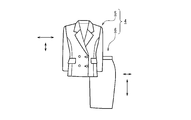
- FIG. 1 is a front view of a woman's suit in one embodiment of the present invention.
- FIG. 2 is a front view of a women's suit in another embodiment of the present invention.
- FIG. 3 is a front view of a women's suit in still another embodiment of the present invention.
- the present inventors are more likely to move in a laterally stretchable manner with the action of crossing arms or stretching hands, Alternatively, the present invention was completed based on the idea that the skirt is easier to move if it is rich in the longitudinal stretch associated with the movement of standing or sitting.
- the suit of the present invention is composed of a fabric made of animal hair fibers and / or synthetic fibers.
- the animal hair fiber is typically wool, but also includes lamb wool, cashmere, mohair, alpaca, camel, and angora.
- Synthetic fibers are typically polyester fibers, but also include nylon fibers and acrylic fibers.
- the fiber composition is preferably 70% or more of wool, more preferably 100% of wool, and when adding other fibers, it is of the order of decorative yarn. In this way, the fabric with the highest quality can be obtained.
- the present invention is a vertically aligned suit including a jacket and trousers and / or a skirt (hereinafter also simply referred to as “upper and lower”). Outerwear and pants, outerwear and skirt are essential components of the suit. In addition, when the best is included, it is the same composition as a jacket.
- the outer garment is higher in the stretchability in the horizontal direction than in the vertical direction, and the trousers and / or the skirt is higher in the stretchability in the vertical direction than in the horizontal direction. If it does in this way, it can be set as the suit of the up-and-down alignment which has the stretch property which followed the motion of the human body, and provided the function which is easy to move.
- the jacket is also called a jacket. Trousers are also called pants, and women's pants are also called Amsterdams.
- the textiles constituting the suit preferably have the same fiber material and the same fabric structure (including woven pattern), the same color in the case of a solid color, and the same pattern in the case of a colored pattern.
- “identical” means substantially the same, and refers to the extent that the difference cannot be seen at first glance with the naked eye. More specifically, in the case of color, delta ( ⁇ ) E is preferably within 1 and more preferably within 0.5 as measured by a colorimeter.
- the pitch of a striped pattern which is a kind of color pattern, is preferably 0.9 to 1.1 times the pitch of the trousers or the skirt with respect to the pitch of the jacket.
- the textile used for the suit of the present invention is preferably a dyed product.
- the pre-dyed product is obtained by cotton dyeing (also called top dyeing) or yarn dyeing.
- a pre-dyed product By using a pre-dyed product, a pattern such as a stripe pattern can be expressed, and there is no color shift between fabrics.
- cotton dyeing a high-quality fabric can be produced because colors are expressed using a plurality of colored cotton.
- the plain fabric may be post-dyeing (also referred to as anti-dyeing or fabric dyeing) after producing the fabric.
- the fabric used for the suit of the present invention may be any known fabric structure such as twill weave, plain weave, and satin weave. Of these, the plain weave structure or the 2/1 and 2/2 twill fabric structures are preferred because of their high quality.
- the stretchability (JX) in the horizontal direction of the outer coat is preferably 10 to 16%, more preferably 12 to 14% at an elongation of 500 gf / cm.
- the stretchability (JY) in the vertical direction is preferably 2 to 8%, more preferably 4 to 6% at an elongation of a load of 500 gf / cm.
- the stretchability (PX) in the horizontal direction of the trousers and / or the skirt is preferably 3 to 10%, more preferably 4 to 6% at an elongation of 500 gf / cm.
- the stretchability (PY) in the vertical direction is preferably 8 to 14%, more preferably 10 to 12% at an elongation of 500 gf / cm, and PX ⁇ PY.
- the woven fabric used for the suit of the present invention preferably does not contain stretchable synthetic fibers such as polyurethane fibers. If elastic synthetic fibers such as polyurethane fibers are included, the quality of the wool fabric tends to be lowered.
- the suit manufacturing method of the present invention manufactures fabrics for overwear and trousers and / or skirts by varying the stretch properties in the vertical and horizontal directions in the drying process of the dryer or heatset in the final finishing step. To do. That is, in the finishing process of the heatset in the final finishing step, the stretchability in the vertical direction is increased when pulled in the horizontal direction (width direction), and the stretchability is decreased when relaxed. Further, when the overfeed rate is increased, the stretchability in the warp direction is increased, and when it is decreased, the stretchability is decreased. The same applies to the vertical direction (length direction). In this way, the respective doughs are manufactured with different stretch properties in the vertical and horizontal directions.
- the tentering may be performed with a tenter.
- the fabric before the final finishing step has stretchability in two directions.
- the production method of the stretch fabric in the two-way direction is such that when the animal fiber is 70% or more of the woven fabric, the stretch fabric in the two-way direction is produced by reduction treatment, and when the synthetic fiber is 30% or more, the water-soluble
- a stretch fabric in two directions of warp by a technique using a highly shrinkable yarn such as vinylon, polyethylene terephthalate or polybutylene terephthalate, it is not limited to these methods.
- the temperature for the tentering is preferably 100 to 150 ° C., more preferably 110 to 130 ° C.
- the time is preferably 1 to 10 minutes, more preferably 3 to 8 minutes. If it is the said range, it can heat-set, changing the stretch property of a length direction and a horizontal direction, and can maintain dimensional stability. After tailoring into a suit, it does not deform at temperatures as high as an iron.
- the outerwear is cut so that the stretchability in the horizontal direction is higher than that in the vertical direction
- the trousers and / or the skirt is cut so that the stretchability in the vertical direction is higher than that in the horizontal direction.
- the cutting may be performed by an automatic cutting machine using a computer, or may be cut one by one with a scissors or a cutter. After cutting, follow the usual method and sew and tailor the suit.
- the stretchability of the suit of the present invention is measured by the KES test.
- the KES test is based on an objective evaluation method for the texture of clothing fabrics, proposed by Prof. Katsuo Kawabata, Kyoto University, by the “Texture Measurement and Standardization Research Committee” established in the Japanese textile mechanics world.
- the product name is “KES-FB2-AUTO-A”, manufactured by Kato Tech Co., Ltd.
- the stretch EM of 10% or more in this evaluation is surprising for fabrics that do not contain spandex fibers. When the stretchability is high as described above, human movement is not restricted when tailored to a suit, and comfort is improved.
- the suit of the present invention is suitable for suits including individuals and uniforms worn as work clothes in companies and public offices, formal wear for use by members of police officers, self-defense forces, fire brigades, etc. for modified work. is there.
- FIG. 1 is a front view of a woman's suit in one embodiment of the present invention.
- This company's suit 1 is composed of a jacket 2 and a pair of trousers 3 and is a uniform suit with the same fiber material, fabric structure and color pattern.
- the jacket 2 is stretched in the horizontal direction compared to the vertical direction.
- the trousers 3 are highly stretchable in the vertical direction compared to the horizontal direction. Stretch is indicated by vertical and horizontal arrows.
- FIG. 2 is a front view of a women's suit in another embodiment of the present invention.
- This ladies suit 4 is a uniform suit composed of an outer garment 5 and a skirt 6, with the same fiber material, fabric structure and color pattern.
- the outer garment 5 is stretched in the horizontal direction compared to the vertical direction.
- the skirt 6 is more stretchable in the vertical direction than in the horizontal direction. Stretch is indicated by vertical and horizontal arrows.
- FIG. 3 is a front view of a women's suit in still another embodiment of the present invention.
- This women's suit 7 is a uniform suit composed of an outer garment 8 and a skirt 9, and the fiber material, the fabric structure and the color pattern are the same.
- the outer garment 8 is stretched in the horizontal direction compared to the vertical direction.
- the trousers 9 are highly stretchable in the vertical direction compared to the horizontal direction. Stretch is indicated by vertical and horizontal arrows.
- the present invention will be specifically described with reference to examples.
- the present invention is not limited to the following examples.
- ⁇ Stretchability> The stretchability was measured by the stretchability (EM1 and EM2) in the warp direction and the weft direction in the KES test. Specifically, the maximum elongation when a maximum load of 500 g is applied at a constant rate of strain rate of 4 ⁇ 10 ⁇ 3 / sec using a tensile shear tester (KES-FB1AUTO manufactured by Kato Tech), that is, the maximum load Evaluation was made with a maximum elongation of 500 gf / cm.
- KES-FB1AUTO tensile shear tester
- Example 1 Woven fabric The fabric used is 100% wool from Australian Merino and is dyed with cotton, using a 72-meter double yarn for warp and weft, 2/2 twill fabric, weight per unit area (weight) 190 g / m 2 .
- Reduction treatment Using an anti-dyeing machine, treatment was performed for 40 minutes at 65 ° C with a bath ratio of 1:20 using the following recipe.
- Reduction treatment Recipe sodium sulfite (reducing agent): 10% owf Texport SN-10 (manufactured by Nikka Chemical, penetrant): 0.1 g / L
- Final finishing process Top worn fabric Tentering was performed using the tenter dryer under the following conditions.
- Width -2% dryer width setting from the width before supply to the dryer Overfeed rate: 0% Temperature: 120 ° C Time: 4 minutes Fabric for trousers: A tenter dryer was used for tentering under the following conditions. Width: + 13% dryer width setting from the width before supply to dryer Overfeed rate: 30% Temperature: 120 ° C Time: 6 minutes
- Comparative Example 1 The same woven fabric as in the example was used, the reduction treatment was not performed, and tentering was performed using the tenter dryer under the following conditions. There is no distinction between outerwear and pants in Comparative Example 1. Width: + 2% dryer width setting from the width before supply to dryer Overfeed rate: 10% Temperature: 120 ° C Time: 5 minutes
- the unit (%) of each part is the size of the back, arms, knees, and hips when the wearer is standing upright.
- the buttocks determined the ratio of dimensional change in the squatting posture (Example 1 / Comparative Example 1). When this ratio is larger than 100%, the stretchability of Example 1 is high, indicating that it follows the movement.
- the example products of the present invention have high stretchability in the horizontal direction and the trousers have high stretchability in the vertical direction. I was able to confirm.
- Example 2 The top woven fabric used is the same as in Example 1, and the trouser fabric is determined from the width before supply to the dryer in the final finishing step (width-developing), and the dryer width set value and overfeed rate as follows: The same procedure as in Example 1 was performed except that Conditions and results are summarized in Table 3. Pants fabric: Tentering was performed using a tenter dryer under the following conditions. Width: + 10% dryer width setting from the width before supply to dryer Overfeed rate: 25% Temperature: 120 ° C Time: 6 minutes
- Example 3 The top woven fabric used is the same as in Example 1, and the trouser fabric is determined from the width before supply to the dryer in the final finishing step (width-developing), and the dryer width set value and overfeed rate as follows: The same procedure as in Example 1 was performed except that Conditions and results are summarized in Table 3. Pants fabric: Tentering was performed using a tenter dryer under the following conditions. Width: + 15% of dryer width setting from the width before supply to dryer Overfeed rate: 30% Temperature: 120 ° C Time: 7 minutes
- Example 4 The trouser fabric is the same as that of Example 1, and the upper woven fabric is set to the dryer width setting value and the overfeed rate from the width before the supply to the dryer in the final finishing process (the tentering process) as follows.
- the same procedure as in Example 1 was performed except that Conditions and results are summarized in Table 3.
- Example 5 The trouser fabric is the same as that of Example 1, and the upper woven fabric is set to the dryer width setting value and the overfeed rate from the width before the supply to the dryer in the final finishing process (the tentering process) as follows.
- the same procedure as in Example 1 was performed except that Conditions and results are summarized in Table 3.
- each example product of the present invention has high stretchability in the horizontal direction and the trousers have high stretchability in the vertical direction. It has been confirmed that it has stretchability following the movement of the human body and is easy to move and wear. Further, the fabrics of Examples 1 to 5 were applied to the women's jacket and skirt shown in FIG. Similar to the example of the jacket and trousers, this also has stretchability following the movement of the human body, and it was confirmed that it was easy to wear.
Landscapes
- Engineering & Computer Science (AREA)
- Textile Engineering (AREA)
- Woven Fabrics (AREA)
- Outer Garments And Coats (AREA)
- Professional, Industrial, Or Sporting Protective Garments (AREA)
- Treatment Of Fiber Materials (AREA)
Priority Applications (4)
| Application Number | Priority Date | Filing Date | Title |
|---|---|---|---|
| JP2013519906A JP5322336B1 (ja) | 2012-04-19 | 2012-11-15 | スーツ及びその製造方法 |
| CN201280039531.0A CN103732091B (zh) | 2012-04-19 | 2012-11-15 | 套装及其制造方法 |
| EP12874636.9A EP2740372B1 (fr) | 2012-04-19 | 2012-11-15 | Procédé de fabrication d'un complet |
| US14/241,376 US9642399B2 (en) | 2012-04-19 | 2012-11-15 | Suit and method for manufacturing same |
Applications Claiming Priority (2)
| Application Number | Priority Date | Filing Date | Title |
|---|---|---|---|
| JP2012-095747 | 2012-04-19 | ||
| JP2012095747 | 2012-04-19 |
Publications (1)
| Publication Number | Publication Date |
|---|---|
| WO2013157162A1 true WO2013157162A1 (fr) | 2013-10-24 |
Family
ID=49383138
Family Applications (1)
| Application Number | Title | Priority Date | Filing Date |
|---|---|---|---|
| PCT/JP2012/079681 Ceased WO2013157162A1 (fr) | 2012-04-19 | 2012-11-15 | Complet et procédé de sa fabrication |
Country Status (5)
| Country | Link |
|---|---|
| US (1) | US9642399B2 (fr) |
| EP (1) | EP2740372B1 (fr) |
| JP (1) | JP5322336B1 (fr) |
| CN (1) | CN103732091B (fr) |
| WO (1) | WO2013157162A1 (fr) |
Cited By (2)
| Publication number | Priority date | Publication date | Assignee | Title |
|---|---|---|---|---|
| JP2016035115A (ja) * | 2014-08-01 | 2016-03-17 | 株式会社チクマ | 上着 |
| JP2016117970A (ja) * | 2014-12-22 | 2016-06-30 | 公立大学法人 滋賀県立大学 | 女性用背広上衣 |
Families Citing this family (1)
| Publication number | Priority date | Publication date | Assignee | Title |
|---|---|---|---|---|
| US10844525B2 (en) * | 2019-03-20 | 2020-11-24 | Raffi Ohanians | Thermal insulating fabric |
Citations (9)
| Publication number | Priority date | Publication date | Assignee | Title |
|---|---|---|---|---|
| JPH0225521U (fr) * | 1988-08-03 | 1990-02-20 | ||
| JP2002155467A (ja) * | 2000-11-21 | 2002-05-31 | Japan Wool Textile Co Ltd | 羊毛繊維製品のストレッチ加工方法 |
| JP2002317348A (ja) * | 2001-04-24 | 2002-10-31 | Asahi Kasei Corp | ボトム用ストレッチ織物 |
| JP2006257632A (ja) | 2006-05-25 | 2006-09-28 | Toray Ind Inc | 複合布帛 |
| JP2007231437A (ja) * | 2006-02-28 | 2007-09-13 | Asahi Kasei Fibers Corp | 裏地の製造方法 |
| JP2008274505A (ja) | 2007-04-28 | 2008-11-13 | Masukazu Mori | 蛋白質繊維品の恒久的セット方法 |
| JP2009001951A (ja) | 2007-06-20 | 2009-01-08 | Central Textiles (Hk) Ltd | コアスパンヤーン及びストレッチ織物 |
| JP2009235655A (ja) | 2008-03-28 | 2009-10-15 | Unitika Textiles Ltd | 織物 |
| JP3163375U (ja) * | 2010-07-30 | 2010-10-14 | 株式会社ファシック | 上着及びスーツ |
Family Cites Families (11)
| Publication number | Priority date | Publication date | Assignee | Title |
|---|---|---|---|---|
| FR2331295A1 (fr) * | 1975-11-17 | 1977-06-10 | Lannaud Bernard | Vetement elastique et procede de fabrication |
| CN1036608C (zh) * | 1993-02-11 | 1997-12-03 | 河南省滑县纺织印染总厂 | 绒面织物扎染方法 |
| US6076187A (en) * | 1998-05-15 | 2000-06-20 | Wallerstein; Robert | Elacticized form fitting shirt |
| CN2785388Y (zh) * | 2004-06-28 | 2006-06-07 | 上海莽原天骠国际贸易有限公司 | 一种服装 |
| GB2435397B (en) * | 2006-02-22 | 2008-07-30 | Castlecrafts Ltd | Clothing |
| CN1920159A (zh) * | 2006-08-31 | 2007-02-28 | 徐维青 | 羊毛及其混纺织物的化学定型剂的制备方法 |
| JP3134796U (ja) | 2007-06-13 | 2007-08-23 | 財団法人日本ユニフォームセンター | 作業に適した上衣 |
| US8769712B2 (en) * | 2010-03-25 | 2014-07-08 | Massachusetts Institute Of Technology | Gravity-loading body suit |
| CN102058174A (zh) * | 2010-10-28 | 2011-05-18 | 江苏法诗菲服饰有限公司 | 保暖色彩针织衫 |
| US20130101781A1 (en) * | 2011-10-24 | 2013-04-25 | Bestkey Textiles Limited | Woven and knitted fabrics with improved properties and core spun yarns for producing the same |
| US10194703B2 (en) * | 2012-09-14 | 2019-02-05 | Abc Global, Llc. | Cool comfort suit |
-
2012
- 2012-11-15 WO PCT/JP2012/079681 patent/WO2013157162A1/fr not_active Ceased
- 2012-11-15 EP EP12874636.9A patent/EP2740372B1/fr active Active
- 2012-11-15 CN CN201280039531.0A patent/CN103732091B/zh active Active
- 2012-11-15 US US14/241,376 patent/US9642399B2/en active Active
- 2012-11-15 JP JP2013519906A patent/JP5322336B1/ja active Active
Patent Citations (9)
| Publication number | Priority date | Publication date | Assignee | Title |
|---|---|---|---|---|
| JPH0225521U (fr) * | 1988-08-03 | 1990-02-20 | ||
| JP2002155467A (ja) * | 2000-11-21 | 2002-05-31 | Japan Wool Textile Co Ltd | 羊毛繊維製品のストレッチ加工方法 |
| JP2002317348A (ja) * | 2001-04-24 | 2002-10-31 | Asahi Kasei Corp | ボトム用ストレッチ織物 |
| JP2007231437A (ja) * | 2006-02-28 | 2007-09-13 | Asahi Kasei Fibers Corp | 裏地の製造方法 |
| JP2006257632A (ja) | 2006-05-25 | 2006-09-28 | Toray Ind Inc | 複合布帛 |
| JP2008274505A (ja) | 2007-04-28 | 2008-11-13 | Masukazu Mori | 蛋白質繊維品の恒久的セット方法 |
| JP2009001951A (ja) | 2007-06-20 | 2009-01-08 | Central Textiles (Hk) Ltd | コアスパンヤーン及びストレッチ織物 |
| JP2009235655A (ja) | 2008-03-28 | 2009-10-15 | Unitika Textiles Ltd | 織物 |
| JP3163375U (ja) * | 2010-07-30 | 2010-10-14 | 株式会社ファシック | 上着及びスーツ |
Non-Patent Citations (1)
| Title |
|---|
| See also references of EP2740372A4 |
Cited By (2)
| Publication number | Priority date | Publication date | Assignee | Title |
|---|---|---|---|---|
| JP2016035115A (ja) * | 2014-08-01 | 2016-03-17 | 株式会社チクマ | 上着 |
| JP2016117970A (ja) * | 2014-12-22 | 2016-06-30 | 公立大学法人 滋賀県立大学 | 女性用背広上衣 |
Also Published As
| Publication number | Publication date |
|---|---|
| US20140223633A1 (en) | 2014-08-14 |
| JP5322336B1 (ja) | 2013-10-23 |
| EP2740372B1 (fr) | 2016-03-02 |
| EP2740372A1 (fr) | 2014-06-11 |
| EP2740372A4 (fr) | 2014-06-25 |
| CN103732091A (zh) | 2014-04-16 |
| CN103732091B (zh) | 2016-01-06 |
| JPWO2013157162A1 (ja) | 2015-12-21 |
| US9642399B2 (en) | 2017-05-09 |
Similar Documents
| Publication | Publication Date | Title |
|---|---|---|
| EP3009020B1 (fr) | Article d'habillement et son procédé de production | |
| CN106400264B (zh) | 服装及其制作方法 | |
| US12252818B2 (en) | Woven fabric, method for producing same, and fiber product containing said woven fabric | |
| CN106757656A (zh) | 如针织物那样的机织物及其制造方法 | |
| JP5322336B1 (ja) | スーツ及びその製造方法 | |
| JP5929100B2 (ja) | ストレッチ織物 | |
| CN113272485A (zh) | 分区弹力编织的服装 | |
| JP5768329B2 (ja) | ストレッチ織物 | |
| JP6711494B1 (ja) | 織物を備える物品、織物、織物の製造方法及び衣服の製造方法 | |
| US20150259833A1 (en) | Knitting fabric | |
| CN208136427U (zh) | 一种多光泽细旦防绒面料 | |
| JP2010138496A (ja) | ストレッチ織物 | |
| KR101667340B1 (ko) | 나일론-폴리에스테르-폴리우레탄 혼합사의 제조방법 | |
| YOKOYAMA et al. | Changes in Physical and Geometrical Properties of Cotton Crepe Fabrics Taken from Worn Undershirts | |
| JP2016186137A (ja) | 防透け性を有する織編物 | |
| JP2024051962A (ja) | 織物製品 | |
| CN208490891U (zh) | 一种透气且可保持皮肤舒爽的跑步t恤 | |
| Cooke et al. | Elastic Properties of Twill and Modified Twill Warp Knitted Elastic Fabrics: Part I: Fabric Production and Testing | |
| JP2017115271A (ja) | ボトム用織物および衣料用ボトム製品 | |
| El-Sayed et al. | Using design elements to meet Back Irregularities fashion challenge via biofinished fabrics | |
| TR2021011919T (tr) | Dokunmuş kumaş, aynisinin üreti̇mi̇ i̇çi̇n yöntem ve adi geçen dokunmuş kumaşi i̇çeren fi̇ber ürün | |
| JP2009185403A (ja) | 和装品 |
Legal Events
| Date | Code | Title | Description |
|---|---|---|---|
| ENP | Entry into the national phase |
Ref document number: 2013519906 Country of ref document: JP Kind code of ref document: A |
|
| 121 | Ep: the epo has been informed by wipo that ep was designated in this application |
Ref document number: 12874636 Country of ref document: EP Kind code of ref document: A1 |
|
| WWE | Wipo information: entry into national phase |
Ref document number: 2012874636 Country of ref document: EP |
|
| WWE | Wipo information: entry into national phase |
Ref document number: 14241376 Country of ref document: US |
|
| NENP | Non-entry into the national phase |
Ref country code: DE |