WO2013157256A1 - Dispositif d'interfonctionnement, procédé, et support non transitoire lisible par ordinateur pour le stockage d'un programme - Google Patents
Dispositif d'interfonctionnement, procédé, et support non transitoire lisible par ordinateur pour le stockage d'un programme Download PDFInfo
- Publication number
- WO2013157256A1 WO2013157256A1 PCT/JP2013/002587 JP2013002587W WO2013157256A1 WO 2013157256 A1 WO2013157256 A1 WO 2013157256A1 JP 2013002587 W JP2013002587 W JP 2013002587W WO 2013157256 A1 WO2013157256 A1 WO 2013157256A1
- Authority
- WO
- WIPO (PCT)
- Prior art keywords
- mac
- provider
- frame
- address
- vpls
- Prior art date
- Legal status (The legal status is an assumption and is not a legal conclusion. Google has not performed a legal analysis and makes no representation as to the accuracy of the status listed.)
- Ceased
Links
Images



Classifications
-
- H—ELECTRICITY
- H04—ELECTRIC COMMUNICATION TECHNIQUE
- H04L—TRANSMISSION OF DIGITAL INFORMATION, e.g. TELEGRAPHIC COMMUNICATION
- H04L12/00—Data switching networks
- H04L12/28—Data switching networks characterised by path configuration, e.g. LAN [Local Area Networks] or WAN [Wide Area Networks]
- H04L12/46—Interconnection of networks
- H04L12/4633—Interconnection of networks using encapsulation techniques, e.g. tunneling
-
- H—ELECTRICITY
- H04—ELECTRIC COMMUNICATION TECHNIQUE
- H04L—TRANSMISSION OF DIGITAL INFORMATION, e.g. TELEGRAPHIC COMMUNICATION
- H04L2101/00—Indexing scheme associated with group H04L61/00
- H04L2101/60—Types of network addresses
- H04L2101/618—Details of network addresses
- H04L2101/622—Layer-2 addresses, e.g. medium access control [MAC] addresses
Definitions
- the present invention relates to interworking between a MAC (Media Access Control) -in-MAC network and a VPLS (Virtual Private LAN Service) network.
- MAC Media Access Control
- VPLS Virtual Private LAN Service
- Ethernet registered trademark
- Patent Document 1 discloses a layer framing technique that enables a network architecture to recognize a local area network layer inside a network.
- a first local area network hierarchy is defined by communication in a first frame format between a first set of network devices and a second set of network devices.
- the second local area network hierarchy is defined by communication in a second frame format between members of the second set of network devices.
- the second frame format includes all fields of a frame of the first frame format used for communication between the first set of communication devices and the second set of communication devices.
- Patent Document 2 discloses a network including a plurality of MPLS networks and an Ethernet network interconnected by an Ethernet network.
- the Ethernet network provides a plurality of paths established to interconnect pairs of MPLS networks.
- An Ethernet encapsulated LSP (Label Switched Path) frame received from one of the MPLS networks at the entrance to the Ethernet network is mapped to a path at the entrance to the Ethernet network according to the classification identifier associated with the Ethernet encapsulated LSP frame.
- LSP Label Switched Path
- Patent Document 3 discloses a method for allowing a nomadic terminal to access a home network on the layer 2 level.
- the method comprises the steps of connecting the terminal to a remote access network via an access point, and connecting the remote access network to an operator backbone network via a remote access router. .
- signaling is exchanged between the access point and the authentication server in the backbone network.
- a layer 2 tunnel across the backbone network is established to connect the terminal to the home network.
- the high load of the core network LAN switch is regarded as a problem.
- the LAN switch in the core network needs to learn the MAC addresses of all terminals at all bases. For this reason, the number of registered MAC addresses becomes enormous, and the load in address search increases.
- Typical technologies for solving such problems include L2 switch-based MAC-in-MAC technology and MPLS (Multi-Protocol Label-Switching) router-based VPLS technology.
- L2 switch-based MAC-in-MAC technology and MPLS (Multi-Protocol Label-Switching) router-based VPLS technology.
- MPLS Multi-Protocol Label-Switching
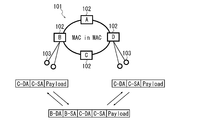
- FIG. 7 illustrates a general MAC-in-MAC network 101.
- the relay apparatus (provider) 102 can conceal the MAC address of the user terminal 103 by encapsulating the packet from the user terminal 103 with the provider MAC frame. Thereby, the wide area Ethernet service can be provided without imposing an excessive load on the relay apparatus 102.
- the user MAC frame is encapsulated with an MPLS frame and transferred. Therefore, the relay apparatus can transfer a frame with low load and high efficiency without being aware of the MAC address of the user terminal.
- VPLS technology has the advantage of having a traffic management function, a high-speed failure recovery function, etc., compared to the MAC-in-MAC technology.
- the traffic management function makes it possible to provide a guaranteed bandwidth service that cannot be handled by the MAC-in-MAC technology.
- the high-speed failure recovery function realizes further improvement in network quality.
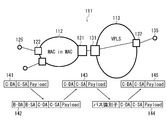
- FIG. 8 exemplifies a communication network 111 generally considered when the MAC-in-MAC network 112 and the VPLS network 113 are interconnected.
- the communication network 111 according to this example, there is no interworking device between the two networks 112 and 113, and the MAC-in-MAC device 121 and the VPLS device which are UNI (User Network Interface) of both the networks 112 and 113. 131 is connected.
- the MAC-in-MAC device 121 and the VPLS device 131 perform interworking between the networks 112 and 113.
- the MAC-in-MAC device 122 connected to the MAC terminal 125 encapsulates the Ethernet frame 141 into the MAC frame 142 and performs the above interworking.
- the MAC-in-MAC device 121 receives the Ethernet frame 141 from the MAC terminal 125 to the VPLS terminal 135.
- the MAC-in-MAC device 121 Upon receiving the MAC frame 142, the MAC-in-MAC device 121 receives the provider MAC address (B-SA) indicating the MAC address of the source provider (MAC-in-MAC device 122) and the source MAC terminal 125. The terminal MAC address (C-SA) indicating the MAC address is learned. Thereafter, the MAC-in-MAC device 121 extracts the internal Ethernet frame 143 to generate a VPLS frame 144, and transmits this to the interworking VPLS device 131.
- B-SA provider MAC address
- C-SA terminal MAC address
- the MAC-in-MAC device 121 transmits the MAC address of the transmission source VPLS terminal 135 included in the Ethernet frame 143 inside the VPLS frame 144.
- C-SA indicating Further, the MAC-in-MAC device 121 encapsulates the provider MAC address B-DA of the provider (MAC-in-MAC device 122) corresponding to C-DA indicating the MAC address of the destination MAC terminal 125 to obtain the MAC.
- a frame 142 is generated and transmitted to the MAC-in-MAC network 112.
- the MAC-in-MAC device 121 and the VPLS device 131 that are arranged between the MAC-in-MAC network 112 and the VPLS network 113 and perform interworking are provided. It is necessary to learn the MAC addresses of all the terminals 125 and 135. Therefore, there is a concern that the number of MAC addresses registered in the MAC-in-MAC device 121 and the VPLS device 131 becomes enormous and the load in address search becomes large.
- an object of the present invention is to reduce a load for learning a MAC address of a terminal in interworking between a MAC-in-MAC network and a VPLS network.
- a MAC processing means for transmitting / receiving a MAC frame to / from a MAC-in-MAC network, a label processing means for transmitting / receiving a VPLS frame to / from a VPLS network, and the MAC-in- A provider MAC address indicating an address of a provider connected to a MAC terminal in the MAC network, a virtual provider MAC address indicating an address of a virtual provider connected to the provider in the MAC-in-MAC network, and a path identifier in the VPLS network Included in the received MAC frame with reference to the conversion table when the MAC frame is received from the MAC processing unit.
- the conversion table is detected when the path identifier corresponding to the provider MAC address of the transmission source is detected, the VPLS frame is generated based on the detected path identifier, and the VPLS frame is received from the label processing means.
- the provider MAC address and the virtual provider address corresponding to the path identifier included in the received VPLS frame are detected, and the MAC frame is generated based on the detected provider MAC address and virtual provider address. It is an interworking apparatus provided with the frame conversion means to do.
- the second aspect of the present invention provides a MAC processing means for transmitting / receiving a MAC frame to / from a MAC-in-MAC network, a label processing means for transmitting / receiving a VPLS frame to / from a VPLS network, and the MAC- a conversion table holding means for holding a conversion table prepared in advance for associating a virtual provider MAC address indicating a virtual provider address in an in-MAC network with a path identifier in the VPLS network; and the MAC frame from the MAC processing means.
- a MAC learning table is generated that associates the terminal MAC address indicating the MAC terminal address included in the received MAC frame with the provider MAC address indicating the address of the provider connected to the MAC terminal.
- the conversion table is referenced to correspond to the virtual provider MAC address.
- the VPLS frame is generated based on the detected path identifier, and the VPLS frame is received from the label processing means, it is included in the received VPLS frame with reference to the conversion table And detecting the provider MAC address corresponding to the destination MAC address of the transmission destination included in the received VPLS frame with reference to the MAC learning table. This On the basis of the detected virtual provider MAC address and provider MAC address is the interworking unit and a frame conversion unit for generating a MAC frame.
- Another aspect of the present invention is a method and a program based on the same technical idea as the first or second aspect.
- the present invention it is possible to reduce a load for learning a MAC address of a terminal in interworking between a MAC-in-MAC network and a VPLS network.
- FIG. 1 is a diagram illustrating a communication network in which a MAC-in-MAC network and a VPLS network are interconnected and an interworking apparatus according to Embodiment 1 is applied.
- FIG. 6 is a diagram illustrating a conversion table according to Embodiment 1.
- FIG. 6 It is a figure which shows the structure of the interworking apparatus which concerns on Embodiment 2 of this invention.
- FIG. 6 is a diagram illustrating a communication network in which a MAC-in-MAC network and a VPLS network are interconnected and an interworking apparatus according to a second embodiment is applied.
- FIG. 1 is a diagram illustrating a general configuration of a communication network in which a MAC-in-MAC network and a VPLS network are interconnected.
- FIG. 1 is a diagram illustrating a general configuration of a communication network in which a MAC-in-MAC network and a VPLS network are interconnected.
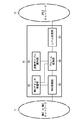
- FIG. 1 shows a configuration of an interworking apparatus 1 according to Embodiment 1 of the present invention.
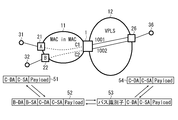
- FIG. 2 illustrates a communication system to which the interworking apparatus 1 is applied.
- the interworking device 1 in the communication system includes the MAC-in-MAC devices 21 and 22 and the VPLS network 12 so that all the MAC-in-MAC devices 21 and 22 and all the VPLS devices 26 are connected by a full mesh.
- Virtual provider MAC addresses C1 and C2 that connect the path identifiers 1001 and 1002 are set.
- the interworking apparatus 1 includes a MAC processing unit 2, a level processing unit 3, a conversion table holding unit 4, and a frame conversion unit 5.
- Each of these functional units 2 to 5 includes a computer including a central processing unit, a storage device, an input / output device, a program for controlling the computer, various databases used for the control, and a logic configured by a combination of various semiconductor devices. This is realized by cooperation of a circuit or the like.
- the MAC processing unit 2 is an interface that transmits and receives MAC frames to and from the MAC-in-MAC network 11.
- the MAC processing unit 2 determines whether the MAC frame received from the MAC-in-MAC network 11 is to be processed by itself.
- the MAC processing unit 2 transfers the MAC frame to the frame conversion unit 5, and when it determines that the received MAC frame is not to be processed, Discard the frame.
- the destination provider MAC address (B-DA) included in the received MAC frame is included in the list of virtual provider MAC addresses handled by the own device. This is the case. If the B-DA is a broadcast address, multicast address, etc., transfer or discard is performed according to the network operation policy.
- the level processing unit 3 is an interface that transmits and receives VPLS frames to and from the VPLS network 12. Similarly to the MAC processing unit 2, the level processing unit 3 also receives the received VPLS frame based on whether or not the path identifier included in the received VPLS frame is included in the list of path identifiers handled by the own device. It is determined whether or not it should be processed by itself.
- the conversion table holding unit 4 includes a provider MAC address (A, B) indicating the addresses of the MAC-in-MAC devices 21 and 22 connected to the MAC terminals 31 and 32 in the MAC-in-MAC network 11, and MAC-in- A conversion table prepared in advance that associates virtual provider addresses (C1, C2) indicating the addresses of virtual providers in the MAC network 11 with path identifiers in the VPLS network 12 is held.
- A, B provider MAC address
- C1, C2 virtual provider addresses
- FIG. 3 illustrates the conversion tables 41 and 42 described above.
- the first conversion table 41 is a table used when data is transmitted from the MAC terminals 31 and 32 connected to the MAC-in-MAC network 11 to the VPLS terminal 36 connected to the VPLS network 12.
- the second conversion table 42 is a table used when data is transmitted from the VPLS terminal 36 to the MAC terminals 31 and 32.
- B-SA is a source provider MAC address (A, B) in the MAC-in-MAC network 11
- B-DA is a destination virtual provider MAC address (C1, C1). C2).
- B-DA is a destination provider MAC address (A, B)
- B-SA is a source virtual provider MAC address (C1, C2).
- the frame conversion unit 5 When the frame conversion unit 5 receives the MAC frame 52 from the MAC processing unit 2, the frame conversion unit 5 refers to the first conversion table 41 and transmits the provider MAC address B-SA (A of the transmission source included in the received MAC frame 52 , B), the path identifier (1001, 1002) is detected. Thereafter, the frame conversion unit 5 generates a VPLS frame 53 based on the detected path identifier.
- B-SA A of the transmission source included in the received MAC frame 52 , B
- the path identifier (1001, 1002
- the frame conversion unit 5 when the frame conversion unit 5 receives the VPLS frame 53 from the label processing unit 3, the frame conversion unit 5 refers to the second conversion table 42 and corresponds to the path identifiers (1001 and 1002) included in the received VPLS frame 53.
- the transmission destination provider MAC address B-DA (A, B) and the transmission source virtual provider MAC address B-SA (C1, C2) are detected. Thereafter, the frame conversion unit 5 generates a MAC frame 52 based on the detected MAC address.
- the MAC terminal 31 generates an Ethernet frame 51 in which the MAC address of the VPLS terminal 36 is C-DA and the MAC address of its own device is C-SA, and is sent to the MAC-in-MAC device 21. Send.
- the MAC frame 52 having the broadcast MAC address as B-DA and its own MAC address as B-SA (A). Generate and send.
- the interworking apparatus 1 When the interworking apparatus 1 receives the broadcast MAC frame 52 from the MAC-in-MAC network 11, the interworking apparatus 1 refers to the first conversion table 41 shown in FIG. 3 and refers to the path identifier (B-SA (A)). 1001) is detected. At this time, if the B-SA included in the received MAC frame is not in the first conversion table 41, the MAC frame is discarded.
- the interworking apparatus 1 decapsulates the B-DA and B-SA of the MAC frame 52, extracts the internal Ethernet frame, and encapsulates the detected path identifier (1001), thereby encapsulating the VPLS frame 53. It is generated and transmitted to the VPLS device 26.
- the VPLS device 26 When receiving the VPLS frame 53 from the VPLS network 12, the VPLS device 26 learns the path identifier (1001) and C-SA (the MAC address of the MAC terminal 31 that is the transmission source) as usual. Thereafter, the VPLS device 26 decapsulates the VPLS frame 53 to generate an Ethernet frame 54 and transmits it to the VPLS terminal 36.
- the VPLS terminal 36 generates an Ethernet frame 54 having the MAC address of the MAC terminal 31 as C-DA and its own MAC address as C-SA, and transmits the Ethernet frame 54 to the VPLS apparatus 26.
- the VPLS apparatus 26 Since the VPLS apparatus 26 has learned the MAC address of the MAC terminal 31, it can detect the path identifier (1001) corresponding to C-DA. Based on the path identifier (1001) corresponding to the C-DA, the VPLS device 26 encapsulates the Ethernet frame 54 to generate a VPLS frame 53, and transmits this to the interworking device 1.
- the interworking apparatus 1 When the interworking apparatus 1 receives the VPLS frame 53 from the VPLS network 12, the interworking apparatus 1 refers to the second conversion table 42 shown in FIG. 3, and B-DA (A) and B- corresponding to the path identifier (1001). SA (C1) is detected. At this time, when the path identifier included in the received VPLS frame is not in the second conversion table 42, the VPLS frame is discarded.
- the interworking apparatus 1 decapsulates the path identifier (1001) of the VPLS frame 53, extracts the internal Ethernet frame, and encapsulates the detected B-DA and B-SA, thereby encapsulating the MAC frame 52. It is generated and transmitted to the MAC-in-MAC device 21.
- the MAC-in-MAC device 21 When receiving the MAC frame 52 from the MAC-in-MAC network 11, the MAC-in-MAC device 21 learns B-SA and C-SA, and then decapsulates the MAC frame 52 and Ethernet frame 51. Is transmitted to the MAC terminal 31.
- FIG. 4 shows the configuration of the interworking device 61 according to Embodiment 2 of the present invention.
- FIG. 5 illustrates a communication system to which the interwork apparatus 61 is applied.
- the interworking apparatus 1 connects all the MAC-in-MAC apparatuses 21 and 22 and all the VPLS apparatuses 26 with END-to-END and full mesh, so that the terminals 31, 32, 36 MAC address learning is completely unnecessary.
- the interworking device 61 learns only the MAC addresses of the MAC terminals 31 and 32 connected to the MAC-in-MAC network 11, thereby enabling END-to-END and full mesh. Even if it is not a connection, it is possible to provide a service.
- the load for learning the MAC address is increased as compared with the first embodiment, but the MAC addresses of all the terminals of the MAC-in-MAC network 11 and the VPLS network 12 are set as in the conventional case. The load can be greatly reduced compared to the case of learning.
- the interworking device 61 includes a MAC processing unit 62, a level processing unit 63, a conversion table holding unit 64, a MAC learning unit 65, and a frame conversion unit 66. These functional units 62 to 66 are realized by the cooperation of a computer, a program, a database, a logic circuit, and the like, as in the first embodiment.
- the MAC processing unit 62 transmits and receives MAC frames to and from the MAC-in-MAC network 11.
- the label processing means 62 transmits and receives VPLS frames to and from the VPLS network 12.
- the conversion table holding unit 64 is prepared in advance to associate the virtual provider MAC address (C, D) indicating the address of the virtual provider in the MAC-in-MAC network 11 with the path identifier (1001, 1003) in the VPLS network 12. Hold the conversion table.
- the MAC address learning unit 65 When the MAC address learning unit 65 receives a MAC frame from the MAC processing unit 62, the MAC address learning unit 65 is connected to the terminal MAC address indicating the address of the MAC terminal 31, 32 included in the received MAC frame, and to the MAC terminal 31, 32.
- a MAC learning table that associates the provider MAC addresses (A, B) indicating the addresses of the MAC-in-MAC devices (providers) 21 and 22 to be generated is generated.
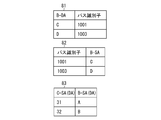
- FIG. 6 illustrates the conversion tables 81 and 82 and the MAC learning table 83.
- the first conversion table 81 is a table used when data is transmitted from the MAC terminals 31 and 32 connected to the MAC-in-MAC network 11 to the VPLS terminals 36 and 37 connected to the VPLS network 12.
- the second conversion table 42 is a table used when data is transmitted from the VPLS terminals 36 and 37 to the MAC terminals 31 and 32.
- B-DA is the destination virtual provider MAC address (C, D).
- B-SA is the source virtual provider MAC address (C, D).
- C-SA (DA) is the MAC address (31, 32) of the MAC terminal 31, 32 of the transmission source (transmission destination), and B-SA (DA) is the transmission source (transmission destination).
- the frame conversion unit 66 refers to the first conversion table 81 when receiving the MAC frame 72 including the virtual provider MAC address (C, D) as the destination provider MAC address B-DA from the MAC processing unit 62.
- the path identifier (1001, 1003) corresponding to the virtual provider MAC address (C, D) is detected. Thereafter, the frame conversion unit 66 generates a VPLS frame 73 based on the detected path identifier.
- the frame conversion unit 66 when the frame conversion unit 66 receives the VPLS frame 73 from the label processing unit 63, the frame conversion unit 66 refers to the second conversion table 82 and corresponds to the path identifiers (1001, 1003) included in the received VPLS frame 73.
- the virtual provider MAC address (C, D) to be detected is detected.
- the frame conversion unit 66 refers to the MAC learning table 83 and detects the provider MAC address (A, B) corresponding to the destination terminal MAC address (31, 32) included in the received VPLS frame 73.
- the MAC frame 72 is generated based on the detected provider MAC address.
- the MAC terminal 32 generates an Ethernet frame 71 having the MAC address of the VPLS terminal 37 as C-DA and the MAC address of its own device as C-SA (32) to generate MAC-in-MAC. To the device 21.
- the MAC frame 72 having the broadcast MAC address B-DA and its own MAC address B-SA (A). Generate and send.
- the interwork apparatus 61 When the interwork apparatus 61 receives the broadcast MAC frame 72 from the MAC-in-MAC network 11, the interwork apparatus 61 refers to the first MAC learning table 83 shown in FIG. If the C-SA (32) included in the MAC frame 72 is not registered in the MAC learning table 83, the C-SA (32) and B-SA (B) are registered in association with each other. .
- B-DA is a broadcast address
- all path identifiers (1001, 1003) registered in the first conversion table 81 are encapsulated, and a VPLS frame 73 is generated.
- the MAC frame 72 is a unicast frame and the C-SA (32) is not registered in the MAC learning table 83, the C-SA (32) and the B-SA (B) are displayed. Registered in association. If B-DA is not a broadcast address and is not registered in the first conversion table 81, the MAC frame 72 is discarded.
- the VPLS device 26 that has received the VPLS frame 73 does not have a connection with the C-DA (37) included in the VPLS frame 73, and therefore discards the VPLS frame 73.
- the VPLS device 27 learns the path identifier (1003) and the C-SA (32), and then decapsulates the VPLS frame 73 to generate an Ethernet frame 74. Transmit to the VPLS terminal 37.
- the VPLS terminal 37 generates an Ethernet frame 74 having the MAC address of the MAC terminal 32 as C-DA (32) and the MAC address of its own device as C-SA (37), and transmits the Ethernet frame 74 to the VPLS device 27.
- the VPLS device 27 Since the VPLS device 27 has learned the MAC address of the MAC terminal 32, the VPLS device 27 can detect the path identifier (1003) corresponding to the C-DA (32). The VPLS device 27 encapsulates the path identifier (1003) in the Ethernet frame 74 to generate a VPLS frame 73, and transmits this to the interworking device 61.
- the interworking device 61 When the interworking device 61 receives the VPLS frame 73, the interworking device 61 refers to the second conversion table 82 and detects the B-SA (D) corresponding to the path identifier (1003). At this time, when the path identifier included in the received VPLS frame is not in the second conversion table 72, the VPLS frame is discarded.
- the interworking device 61 decapsulates the path identifier (1003) of the VPLS frame 73, extracts the internal Ethernet frame, and refers to the MAC learning table 83 to the destination terminal MAC address C-DA (32).
- the corresponding destination provider MAC address B-DA (B) is detected.
- the interworking device 61 encapsulates the destination provider MAC address B-DA (B) and the corresponding virtual provider MAC address B-SA (D) in the internal Ethernet frame to generate a MAC frame 72 This is transmitted to the MAC-in-MAC device 22.
- the MAC-in-MAC device 22 Upon receiving the MAC frame 72, the MAC-in-MAC device 22 learns B-SA (D) and C-SA (32) as usual, and then decapsulates the MAC frame 72 to generate an Ethernet frame 71. This is transmitted to the MAC terminal 32.
- B-SA B-SA
- C-SA C-SA
- the load for learning the MAC address is increased as compared with the first embodiment, but the MAC addresses of all terminals of the MAC-in-MAC network 11 and the VPLS network 12 as in the past.
- the load can be greatly reduced as compared with the case of learning.
- an interworking service is provided even if the connection is not END-to-END and full mesh. It becomes possible to do.
- the frame overhead can be minimized. . This is because the header of the frame is switched depending on whether the frame is transmitted from the MAC-in-MAC network 11 to the VPLS network 12 or the frame is transmitted from the VPLS network 12 to the MAC-in-MAC network 11.
- the present invention has been described as a hardware configuration, but the present invention is not limited to this.
- the present invention can also realize arbitrary processing by causing a CPU (Central Processing Unit) to execute a computer program.
- the above-described program can be stored and supplied to a computer using various types of non-transitory computer readable media.
- Non-transitory computer readable media include various types of tangible storage media.
- non-transitory computer-readable media examples include magnetic recording media (for example, flexible disks, magnetic tapes, hard disk drives), magneto-optical recording media (for example, magneto-optical disks), CD-ROMs (Read Only Memory) CD-R, CD -R / W, including semiconductor memory (for example, mask ROM, PROM (Programmable ROM), EPROM (Erasable PROM), flash ROM, RAM (Random Access Memory)).
- the program may also be supplied to the computer by various types of transitory computer readable media. Examples of transitory computer readable media include electrical signals, optical signals, and electromagnetic waves.
- the temporary computer-readable medium can supply the program to the computer via a wired communication path such as an electric wire and an optical fiber, or a wireless communication path.
Landscapes
- Engineering & Computer Science (AREA)
- Computer Networks & Wireless Communication (AREA)
- Signal Processing (AREA)
- Data Exchanges In Wide-Area Networks (AREA)
Priority Applications (1)
| Application Number | Priority Date | Filing Date | Title |
|---|---|---|---|
| JP2014511109A JP5733473B2 (ja) | 2012-04-18 | 2013-04-17 | インターワーク装置、方法、及びプログラム |
Applications Claiming Priority (2)
| Application Number | Priority Date | Filing Date | Title |
|---|---|---|---|
| JP2012094852 | 2012-04-18 | ||
| JP2012-094852 | 2012-04-18 |
Publications (1)
| Publication Number | Publication Date |
|---|---|
| WO2013157256A1 true WO2013157256A1 (fr) | 2013-10-24 |
Family
ID=49383226
Family Applications (1)
| Application Number | Title | Priority Date | Filing Date |
|---|---|---|---|
| PCT/JP2013/002587 Ceased WO2013157256A1 (fr) | 2012-04-18 | 2013-04-17 | Dispositif d'interfonctionnement, procédé, et support non transitoire lisible par ordinateur pour le stockage d'un programme |
Country Status (2)
| Country | Link |
|---|---|
| JP (1) | JP5733473B2 (fr) |
| WO (1) | WO2013157256A1 (fr) |
Cited By (2)
| Publication number | Priority date | Publication date | Assignee | Title |
|---|---|---|---|---|
| JP2018533794A (ja) * | 2015-10-30 | 2018-11-15 | ニュー・エイチ・3・シィ・テクノロジーズ・カンパニー・リミテッドNew H3C Technologies Co., Ltd. | パケット転送 |
| CN109803031A (zh) * | 2019-01-14 | 2019-05-24 | 烽火通信科技股份有限公司 | 一种mac地址快速撤销的方法及系统 |
Families Citing this family (1)
| Publication number | Priority date | Publication date | Assignee | Title |
|---|---|---|---|---|
| JP3154114B2 (ja) | 1995-10-26 | 2001-04-09 | 株式会社ケーヒン | 電磁弁 |
Citations (3)
| Publication number | Priority date | Publication date | Assignee | Title |
|---|---|---|---|---|
| US20070116045A1 (en) * | 2005-11-02 | 2007-05-24 | Nortel Networks Limited | Method and apparatus for transporting ethernet services |
| US20080212595A1 (en) * | 2007-01-25 | 2008-09-04 | Hammerhead Systems, Inc. | Mapping PBT and PBB-TE traffic to VPLS and other services |
| US20100235914A1 (en) * | 2009-03-13 | 2010-09-16 | Alcatel Lucent | Intrusion detection for virtual layer-2 services |
-
2013
- 2013-04-17 WO PCT/JP2013/002587 patent/WO2013157256A1/fr not_active Ceased
- 2013-04-17 JP JP2014511109A patent/JP5733473B2/ja active Active
Patent Citations (3)
| Publication number | Priority date | Publication date | Assignee | Title |
|---|---|---|---|---|
| US20070116045A1 (en) * | 2005-11-02 | 2007-05-24 | Nortel Networks Limited | Method and apparatus for transporting ethernet services |
| US20080212595A1 (en) * | 2007-01-25 | 2008-09-04 | Hammerhead Systems, Inc. | Mapping PBT and PBB-TE traffic to VPLS and other services |
| US20100235914A1 (en) * | 2009-03-13 | 2010-09-16 | Alcatel Lucent | Intrusion detection for virtual layer-2 services |
Cited By (3)
| Publication number | Priority date | Publication date | Assignee | Title |
|---|---|---|---|---|
| JP2018533794A (ja) * | 2015-10-30 | 2018-11-15 | ニュー・エイチ・3・シィ・テクノロジーズ・カンパニー・リミテッドNew H3C Technologies Co., Ltd. | パケット転送 |
| US10430364B2 (en) | 2015-10-30 | 2019-10-01 | New H3C Technologies Co., Ltd. | Packet forwarding |
| CN109803031A (zh) * | 2019-01-14 | 2019-05-24 | 烽火通信科技股份有限公司 | 一种mac地址快速撤销的方法及系统 |
Also Published As
| Publication number | Publication date |
|---|---|
| JP5733473B2 (ja) | 2015-06-10 |
| JPWO2013157256A1 (ja) | 2015-12-21 |
Similar Documents
| Publication | Publication Date | Title |
|---|---|---|
| US10666459B1 (en) | System and method to facilitate interoperability between virtual private LAN service (VPLS) and ethernet virtual private network (EVPN) with all-active multi-homing | |
| CN101964746B (zh) | 在多宿的传统网桥节点的最短路径计算机网络中路由帧 | |
| CN102301648B (zh) | 用于网格以及中心辐射网络的缩放式以太网oam | |
| WO2019129236A1 (fr) | Procédé et dispositif de transmission de données à base de tunnel | |
| WO2013182059A1 (fr) | Procédé et dispositif pour établir un tunnel d'ingénierie de trafic de commutation multiprotocole par étiquette | |
| CN105376154A (zh) | 渐进式mac地址学习 | |
| CN102170385A (zh) | 一种以太树业务中以太网帧的发送方法和运营商边缘设备 | |
| US8724454B2 (en) | System and method for summarizing alarm indications in a network environment | |
| US9049030B1 (en) | Methods and apparatus for efficient multicast | |
| WO2009092241A1 (fr) | Procédé de transmission de message, système de réseau et équipement de nœud en boucle | |
| US10587508B2 (en) | Ethernet frame transmission method in software defined networks (SDN) | |
| WO2011063678A1 (fr) | Procédé de mise en œuvre et dispositif permettant à une pile de réseaux locaux virtuels d'accéder à un service filaire privé virtuel | |
| CN112822097B (zh) | 报文转发的方法、第一网络设备以及第一设备组 | |
| US10033636B1 (en) | Ethernet segment aware MAC address learning | |
| US10158567B1 (en) | PBB-EVPN customer MAC synchronization among all-active multi-homing PEs | |
| CN105743780A (zh) | 报文传输方法及装置 | |
| JP6070700B2 (ja) | パケット転送システム、制御装置、パケット転送方法及びプログラム | |
| CN110199504B (zh) | 用于中心局递送点内的交换结构的增强使用的方法和系统 | |
| CN104219149B (zh) | 一种基于虚连接的报文传输方法和设备 | |
| JP5733473B2 (ja) | インターワーク装置、方法、及びプログラム | |
| JP5840211B2 (ja) | オフセットを用いてインバンド制御チャネルを提供する疑似ワイヤ | |
| CN101702664B (zh) | 虚拟局域网的数据传输方法、设备与系统 | |
| CN107547347B (zh) | 基于vni的路径调整方法和装置 | |
| WO2011011934A1 (fr) | Procede et appareil de protection de segmentation de tunnel ethernet | |
| WO2009097796A1 (fr) | Procédé de multidiffusion d'anneau de transport d'infrastructure de fournisseur et réseau en anneau de multidiffusion et dispositif de nœud |
Legal Events
| Date | Code | Title | Description |
|---|---|---|---|
| 121 | Ep: the epo has been informed by wipo that ep was designated in this application |
Ref document number: 13778772 Country of ref document: EP Kind code of ref document: A1 |
|
| ENP | Entry into the national phase |
Ref document number: 2014511109 Country of ref document: JP Kind code of ref document: A |
|
| NENP | Non-entry into the national phase |
Ref country code: DE |
|
| 122 | Ep: pct application non-entry in european phase |
Ref document number: 13778772 Country of ref document: EP Kind code of ref document: A1 |