WO2013157459A1 - Composition de résine photosensible, procédé de fabrication de film durci, film durci, dispositif d'affichage électroluminescent (el) organique et dispositif d'affichage à cristaux liquides - Google Patents
Composition de résine photosensible, procédé de fabrication de film durci, film durci, dispositif d'affichage électroluminescent (el) organique et dispositif d'affichage à cristaux liquides Download PDFInfo
- Publication number
- WO2013157459A1 WO2013157459A1 PCT/JP2013/060816 JP2013060816W WO2013157459A1 WO 2013157459 A1 WO2013157459 A1 WO 2013157459A1 JP 2013060816 W JP2013060816 W JP 2013060816W WO 2013157459 A1 WO2013157459 A1 WO 2013157459A1
- Authority
- WO
- WIPO (PCT)
- Prior art keywords
- group
- resin composition
- photosensitive resin
- structural unit
- acid
- Prior art date
- Legal status (The legal status is an assumption and is not a legal conclusion. Google has not performed a legal analysis and makes no representation as to the accuracy of the status listed.)
- Ceased
Links
Images
Classifications
-
- G—PHYSICS
- G03—PHOTOGRAPHY; CINEMATOGRAPHY; ANALOGOUS TECHNIQUES USING WAVES OTHER THAN OPTICAL WAVES; ELECTROGRAPHY; HOLOGRAPHY
- G03F—PHOTOMECHANICAL PRODUCTION OF TEXTURED OR PATTERNED SURFACES, e.g. FOR PRINTING, FOR PROCESSING OF SEMICONDUCTOR DEVICES; MATERIALS THEREFOR; ORIGINALS THEREFOR; APPARATUS SPECIALLY ADAPTED THEREFOR
- G03F7/00—Photomechanical, e.g. photolithographic, production of textured or patterned surfaces, e.g. printing surfaces; Materials therefor, e.g. comprising photoresists; Apparatus specially adapted therefor
- G03F7/004—Photosensitive materials
- G03F7/039—Macromolecular compounds which are photodegradable, e.g. positive electron resists
- G03F7/0392—Macromolecular compounds which are photodegradable, e.g. positive electron resists the macromolecular compound being present in a chemically amplified positive photoresist composition
-
- G—PHYSICS
- G03—PHOTOGRAPHY; CINEMATOGRAPHY; ANALOGOUS TECHNIQUES USING WAVES OTHER THAN OPTICAL WAVES; ELECTROGRAPHY; HOLOGRAPHY
- G03F—PHOTOMECHANICAL PRODUCTION OF TEXTURED OR PATTERNED SURFACES, e.g. FOR PRINTING, FOR PROCESSING OF SEMICONDUCTOR DEVICES; MATERIALS THEREFOR; ORIGINALS THEREFOR; APPARATUS SPECIALLY ADAPTED THEREFOR
- G03F7/00—Photomechanical, e.g. photolithographic, production of textured or patterned surfaces, e.g. printing surfaces; Materials therefor, e.g. comprising photoresists; Apparatus specially adapted therefor
- G03F7/004—Photosensitive materials
- G03F7/085—Photosensitive compositions characterised by adhesion-promoting non-macromolecular additives
-
- G—PHYSICS
- G03—PHOTOGRAPHY; CINEMATOGRAPHY; ANALOGOUS TECHNIQUES USING WAVES OTHER THAN OPTICAL WAVES; ELECTROGRAPHY; HOLOGRAPHY
- G03F—PHOTOMECHANICAL PRODUCTION OF TEXTURED OR PATTERNED SURFACES, e.g. FOR PRINTING, FOR PROCESSING OF SEMICONDUCTOR DEVICES; MATERIALS THEREFOR; ORIGINALS THEREFOR; APPARATUS SPECIALLY ADAPTED THEREFOR
- G03F7/00—Photomechanical, e.g. photolithographic, production of textured or patterned surfaces, e.g. printing surfaces; Materials therefor, e.g. comprising photoresists; Apparatus specially adapted therefor
- G03F7/26—Processing photosensitive materials; Apparatus therefor
- G03F7/40—Treatment after imagewise removal, e.g. baking
-
- H—ELECTRICITY
- H10—SEMICONDUCTOR DEVICES; ELECTRIC SOLID-STATE DEVICES NOT OTHERWISE PROVIDED FOR
- H10K—ORGANIC ELECTRIC SOLID-STATE DEVICES
- H10K59/00—Integrated devices, or assemblies of multiple devices, comprising at least one organic light-emitting element covered by group H10K50/00
- H10K59/10—OLED displays
- H10K59/12—Active-matrix OLED [AMOLED] displays
- H10K59/124—Insulating layers formed between TFT elements and OLED elements
Definitions
- the present invention relates to a photosensitive resin composition.
- it relates to a chemically amplified positive photosensitive resin composition.
- it is related with the manufacturing method of the cured film using the photosensitive resin composition, the cured film formed by hardening
- a positive photosensitive resin composition suitable for forming a flattening film, a protective film and an interlayer insulating film of electronic parts such as a liquid crystal display device, an organic EL display device, an integrated circuit element, and a solid-state imaging device, and the same
- the present invention relates to a method for producing a cured film using the above.
- Organic EL display devices, liquid crystal display devices, and the like are provided with an interlayer insulating film from the viewpoint of improving luminance and reducing power consumption.
- photosensitive resin compositions are widely used because the number of steps for obtaining a required pattern shape is small and sufficient flatness is obtained.
- the interlayer insulating film patterned using the photosensitive resin composition as described above is a highly reliable effect film that has excellent adhesion and excellent heat-resistant transparency after development and after heat curing. Is required.
- high sensitivity of the photosensitive resin composition is required.
- Patent Document 1 using a binder having an acetal structure or a ketal structure is known.
- a silane coupling agent has been found as an adhesion improver, these compositions have not been able to achieve satisfactory adhesion.
- the adhesion is improved by using amines, but there is a drawback that the sensitivity decreases as the addition amount increases, the sensitivity and adhesion of The balance was not achieved.
- a binder having an acetal structure is generally not so high in storage stability, and therefore, it has been desired to find an adhesion improving agent that does not impair the stability.
- the present invention aims to solve the above-mentioned problems, and an object thereof is to provide a photosensitive resin composition excellent in all of sensitivity, adhesion and heat-resistant transparency.
- ⁇ 1> (A) a polymer component containing a polymer that satisfies at least one of the following (1) and (2): (1) (a1) a structural unit having a residue in which an acid group is protected with an acid-decomposable group, and (a2) a polymer having a structural unit having a crosslinkable group, (2) (a1) a polymer having a structural unit having a residue in which an acid group is protected with an acid-decomposable group, and (a2) a polymer having a structural unit having a crosslinkable group, (B) a photoacid generator, (C) a compound represented by the following general formula (I), and (D) A photosensitive resin composition containing a solvent.
- R 11 and R 12 each represents a group containing at least one of an aliphatic hydrocarbon group, an aromatic hydrocarbon group and a heterocyclic group, and n represents an integer of 2 to 4)
- n represents an integer of 2 to 4
- R 11 and R 12 in the general formula (I) are each an aliphatic hydrocarbon group or an aromatic hydrocarbon group.
- R 11 and R 12 are each an alkyl group having 1 to 10 carbon atoms or an aryl group having 6 to 11 carbon atoms. .
- Formula (A2 ′) (Wherein R 1 and R 2 each represent a hydrogen atom, an alkyl group or an aryl group, at least one of R 1 and R 2 is an alkyl group or an aryl group, and R 3 is an alkyl group or Represents an aryl group, and R 1 or R 2 and R 3 may be linked to form a cyclic ether, R 4 represents a hydrogen atom or a methyl group, and X represents a single bond or an arylene group.
- the crosslinkable group is at least one selected from an epoxy group, an oxetanyl group, and —NH—CH 2 —OR (where R is an alkyl group having 1 to 20 carbon atoms).
- the photosensitive resin composition in any one.
- the (B) photoacid generator is an oxime sulfonate compound or an onium salt compound.
- the method for producing a cured film according to ⁇ 10> including a step of exposing the entire surface after the development step and before the post-bake step.
- ⁇ 12> The method for producing a cured film according to ⁇ 10> or ⁇ 11>, wherein the substrate is a metal substrate.
- ⁇ 13> A cured film obtained by curing the photosensitive resin composition according to any one of ⁇ 1> to ⁇ 9>.
- ⁇ 14> The cured film according to ⁇ 13>, which is an interlayer insulating film.
- ⁇ 15> A liquid crystal display device or an organic EL display device having the cured film according to ⁇ 13> or ⁇ 14>.
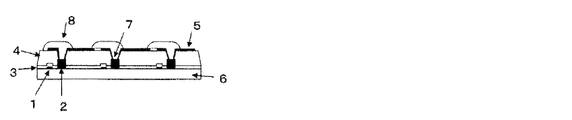
- FIG. 1 shows a conceptual diagram of a configuration of an example of an organic EL display device.
- a schematic cross-sectional view of a substrate in a bottom emission type organic EL display device is shown, and a planarizing film 4 is provided.
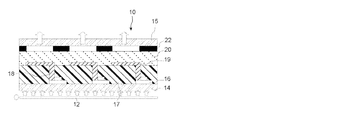
- 1 is a conceptual diagram of a configuration of an example of a liquid crystal display device.
- the schematic sectional drawing of the active matrix substrate in a liquid crystal display device is shown, and it has the cured film 17 which is an interlayer insulation film.
- the photosensitive resin composition of the present invention comprises (A) a polymer component containing a polymer satisfying at least one of the following (1) and (2), (B) a photoacid generator, (C) the following general formula (I) And a compound represented by (D) It contains a solvent.
- the photosensitive resin composition of the present invention is a positive photosensitive resin composition.
- the photosensitive resin composition of the present invention is preferably a chemically amplified positive photosensitive resin composition (chemically amplified positive photosensitive resin composition).
- chemically amplified positive photosensitive resin composition chemically amplified positive photosensitive resin composition
- the photosensitive resin composition of this invention contains the polymer component which satisfy
- (1) (a1) a structural unit having a residue in which an acid group is protected with an acid-decomposable group, and (a2) a polymer having a structural unit having a crosslinkable group, (2) (a1) a polymer having a structural unit having a residue in which an acid group is protected by an acid-decomposable group, and (a2) a polymer having a structural unit having a crosslinkable group.
- the polymer comprises at least one polymer, the polymer comprising (a1) a structural unit having a residue in which an acid group is protected with an acid-decomposable group, and (a2) a structural unit having a crosslinkable group. It is the aspect which has. Such a polymer may further contain other repeating units.
- Each of the structural unit (a1) and the structural unit (a2) may include two or more types.
- at least two types of polymers are included, at least one of the polymers has the structural unit (a1), and at least one other type of the polymer is the structural unit (a2). ).
- the polymer containing the structural unit (a1) may further contain the structural unit (a2) and other structural units.
- the polymer containing the structural unit (a2) may contain the structural unit (a1) or another structural unit.
- the aspect satisfies both (1) and (2).
- component A refers to any of the above polymer components without particular notice.
- the component (A) contains two or more types of polymers, and at least one of the polymers has a residue in which at least an acid group is protected with an acid-decomposable group. It is a polymer having a structural unit, and at least one other kind of the above polymer is a polymer having a structural unit having at least a crosslinkable group. From the viewpoint of the degree of freedom in molecular design, the polymer having a structural unit having a residue in which at least an acid group is protected with an acid-decomposable group is substantially free of the structural unit (a2) and is at least crosslinkable. More preferably, the polymer having a structural unit having a group does not substantially contain the structural unit (a1).
- a preferred second embodiment of the present invention includes an aspect in which the polymer containing the structural unit (a1) contains the structural unit (a2) from the viewpoint of compatibility. Furthermore, as the third aspect, an aspect in which the polymer of the first embodiment and the polymer of the second embodiment coexist can be considered as the polymer component (A).
- the component (A) is preferably an addition polymerization type resin, and more preferably a polymer containing a structural unit derived from (meth) acrylic acid and / or an ester thereof.
- a polymer containing a structural unit derived from (meth) acrylic acid and / or an ester thereof you may have structural units other than the structural unit derived from (meth) acrylic acid and / or its ester, for example, the structural unit derived from styrene, the structural unit derived from a vinyl compound, etc.
- the component (A) preferably contains 50 mol% or more, and 90 mol% or more of the structural unit derived from (meth) acrylic acid and / or its ester, with respect to all the structural units in the polymer.
- a polymer composed of only structural units derived from (meth) acrylic acid and / or its ester is particularly preferable.
- the “structural unit derived from (meth) acrylic acid and / or its ester” is also referred to as “acrylic structural unit”.
- (meth) acrylic acid means “methacrylic acid and / or acrylic acid”.
- the component (A) is preferably alkali-insoluble, and is preferably a resin that becomes alkali-soluble when the acid-decomposable group of the structural unit (a1) is decomposed.
- the acid-decomposable group means a functional group that can be decomposed in the presence of an acid. That is, the structural unit having a protected carboxyl group in which the carboxyl group is protected with an acid-decomposable group can generate a carboxyl group by the decomposition of the protective group with an acid, and the phenolic hydroxyl group is an acid-decomposable group.
- the structural unit having a protected phenolic hydroxyl group protected with can generate a phenolic hydroxyl group by the decomposition of the protecting group with an acid.
- alkali-soluble means a coating film (thickness) of the compound (resin) formed by applying a solution of the compound (resin) on a substrate and heating at 90 ° C. for 2 minutes. 3 ⁇ m) is a dissolution rate in a 0.4% tetramethylammonium hydroxide aqueous solution at 23 ° C. of 0.01 ⁇ m / second or more.
- Alkali insoluble means that the solution of the compound (resin) is a substrate.
- the dissolution rate in a 0.4% tetramethylammonium hydroxide aqueous solution at 23 ° C of the coating film (thickness 3 ⁇ m) of the compound (resin) formed by applying the coating on 90 ° C for 2 minutes It means less than 0.01 ⁇ m / second.
- the (A) copolymer may have a carboxyl group described later, a structure derived from a carboxylic anhydride, and / or other structural units having a phenolic hydroxyl group. However, when introducing an acidic group, it is preferable to introduce it in a range that keeps the whole (A) copolymer insoluble in alkali.
- the component (A) has (a1) at least a structural unit having a residue in which an acid group is protected with an acid-decomposable group.
- the structural unit (a1) in the present invention preferably contains a structural unit having a protected carboxyl group protected with an acid-decomposable group or a structural unit having a protected phenolic hydroxyl group protected with an acid-decomposable group.
- the structural unit (a1-1) having a protected carboxyl group protected with an acid-decomposable group is a protected carboxyl in which the carboxyl group of the structural unit having a carboxyl group is protected by an acid-decomposable group described in detail below.
- a structural unit having a group is not particularly limited, and a known structural unit can be used.
- a structural unit (a1-1-1) derived from an unsaturated carboxylic acid having at least one carboxyl group in the molecule, such as an unsaturated monocarboxylic acid, an unsaturated dicarboxylic acid, or an unsaturated tricarboxylic acid
- a structural unit (a1-1-2) having both an ethylenically unsaturated group and a structure derived from an acid anhydride.
- the structural units having both the unsaturated group and the structure derived from the acid anhydride will be described in order.
- ⁇ (a1-1-1) Structural Unit Derived from Unsaturated Carboxylic Acid Having at least One Carboxyl Group in the Molecule >>>>>>>>
- the unsaturated carboxylic acid used in the present invention as the structural unit (a1-1-1) derived from an unsaturated carboxylic acid having at least one carboxyl group in the molecule include those listed below. . That is, examples of the unsaturated monocarboxylic acid include acrylic acid, methacrylic acid, crotonic acid, ⁇ -chloroacrylic acid, cinnamic acid, and the like.
- the unsaturated dicarboxylic acid examples include maleic acid, fumaric acid, itaconic acid, citraconic acid, and mesaconic acid.
- the acid anhydride may be sufficient as unsaturated polycarboxylic acid used in order to obtain the structural unit which has a carboxyl group. Specific examples include maleic anhydride, itaconic anhydride, citraconic anhydride, and the like.
- the unsaturated polyvalent carboxylic acid may be a mono (2-methacryloyloxyalkyl) ester of a polyvalent carboxylic acid, such as succinic acid mono (2-acryloyloxyethyl), succinic acid mono (2 -Methacryloyloxyethyl), mono (2-acryloyloxyethyl) phthalate, mono (2-methacryloyloxyethyl) phthalate and the like.
- the unsaturated polyvalent carboxylic acid may be a mono (meth) acrylate of a dicarboxy polymer at both ends, and examples thereof include ⁇ -carboxypolycaprolactone monoacrylate and ⁇ -carboxypolycaprolactone monomethacrylate.
- unsaturated carboxylic acid acrylic acid-2-carboxyethyl ester, methacrylic acid-2-carboxyethyl ester, maleic acid monoalkyl ester, fumaric acid monoalkyl ester, 4-carboxystyrene and the like can also be used.
- the structural unit (a1-1-1) derived from an unsaturated carboxylic acid having at least one carboxyl group in the molecule acrylic acid, methacrylic acid, Alternatively, an unsaturated polycarboxylic acid anhydride or the like is preferably used, and acrylic acid or methacrylic acid is more preferably used.
- the structural unit (a1-1-1) derived from an unsaturated carboxylic acid having at least one carboxyl group in the molecule may be composed of one kind alone or two or more kinds. May be.
- the structural unit (a1-1-2) having both an ethylenically unsaturated group and a structure derived from an acid anhydride is obtained by reacting a hydroxyl group present in the structural unit having an ethylenically unsaturated group with an acid anhydride. It is preferably a unit derived from the obtained monomer.
- the acid anhydride known ones can be used, specifically, maleic anhydride, succinic anhydride, itaconic anhydride, phthalic anhydride, tetrahydrophthalic anhydride, hexahydrophthalic anhydride, chlorendic anhydride and the like.
- phthalic anhydride, tetrahydrophthalic anhydride, or succinic anhydride is preferable from the viewpoint of developability.
- the reaction rate of the acid anhydride with respect to the hydroxyl group is preferably 10 to 100 mol%, more preferably 30 to 100 mol% from the viewpoint of developability.
- acid-decomposable group that can be used for the structural unit (a1-1) >>>>>
- the acid-decomposable group that can be used for the structural unit (a1-1) having a protected carboxyl group protected by the acid-decomposable group can be any known acid-decomposable group, and is not particularly limited.
- an acid-decomposable group a group that is relatively easily decomposed by an acid (for example, an acetal functional group such as a tetrahydropyranyl group) or a group that is relatively difficult to be decomposed by an acid (for example, a tert-butyl ester group, a tert-butyl ester group, -Tert-butyl functional groups such as butyl carbonate groups) are known.
- an acetal functional group is preferable from the viewpoint of basic physical properties of the photosensitive resin composition, particularly sensitivity, pattern shape, contact hole formability, and storage stability of the photosensitive resin composition.
- the carboxyl group is more preferably a protected carboxyl group protected in the form of an acetal represented by the following general formula (a1-1) from the viewpoint of sensitivity.
- the carboxyl group is a protected carboxyl group protected in the form of an acetal represented by the following general formula (a1-1)
- the entire protected carboxyl group is — (C ⁇ O) —O—CR 101
- the structure is R 102 (OR 103 ).
- R 101 and R 102 each independently represent a hydrogen atom or an alkyl group, except that R 101 and R 102 are both hydrogen atoms, and R 103 represents an alkyl group.
- R 101 or R 102 and R 103 may be linked to form a cyclic ether.
- R 101 to R 103 each independently represents a hydrogen atom or an alkyl group, and the alkyl group may be linear, branched or cyclic.
- both R 101 and R 102 do not represent a hydrogen atom, and at least one of R 101 and R 102 represents an alkyl group.
- R 101 , R 102 and R 103 represent an alkyl group
- the alkyl group may be linear, branched or cyclic.
- the linear or branched alkyl group preferably has 1 to 12 carbon atoms, more preferably 1 to 6 carbon atoms, and still more preferably 1 to 4 carbon atoms.
- methyl group, ethyl group, n-propyl group, i-propyl group, n-butyl group, i-butyl group, sec-butyl group, tert-butyl group, n-pentyl group, neopentyl group, n examples include -hexyl group, texyl group (2,3-dimethyl-2-butyl group), n-heptyl group, n-octyl group, 2-ethylhexyl group, n-nonyl group, n-decyl group and the like.
- the cyclic alkyl group preferably has 3 to 12 carbon atoms, more preferably 4 to 8 carbon atoms, and still more preferably 4 to 6 carbon atoms.
- Examples of the cyclic alkyl group include a cyclopropyl group, a cyclobutyl group, a cyclopentyl group, a cyclohexyl group, a cycloheptyl group, a cyclooctyl group, a norbornyl group, and an isobornyl group.
- the alkyl group may have a substituent, and examples of the substituent include a halogen atom, an aryl group, and an alkoxy group.
- R 101 , R 102 and R 103 are haloalkyl groups
- R 101 , R 102 and R 103 are aralkyl groups.
- the halogen atom include a fluorine atom, a chlorine atom, a bromine atom, and an iodine atom, and among these, a fluorine atom or a chlorine atom is preferable.
- the aryl group is preferably an aryl group having 6 to 20 carbon atoms, more preferably 6 to 12 carbon atoms, and specific examples thereof include a phenyl group, an ⁇ -methylphenyl group, and a naphthyl group.
- the alkoxy group is preferably an alkoxy group having 1 to 6 carbon atoms, more preferably 1 to 4 carbon atoms, and more preferably a methoxy group or an ethoxy group.
- the cycloalkyl group may have a linear or branched alkyl group having 1 to 10 carbon atoms as a substituent. Or a branched alkyl group, it may have a cycloalkyl group having 3 to 12 carbon atoms as a substituent. These substituents may be further substituted with the above substituents.
- R 101 , R 102 and R 103 represent an aryl group
- the aryl group preferably has 6 to 12 carbon atoms, more preferably 6 to 10 carbon atoms. preferable.
- the aryl group may have a substituent, and preferred examples of the substituent include an alkyl group having 1 to 6 carbon atoms. Examples of the aryl group include a phenyl group, a tolyl group, a silyl group, a cumenyl group, and a 1-naphthyl group.
- R 101 , R 102 and R 103 can be bonded to each other to form a ring together with the carbon atom to which they are bonded.
- Examples of the ring structure when R 101 and R 102 , R 101 and R 103 or R 102 and R 103 are bonded include a cyclobutyl group, a cyclopentyl group, a cyclohexyl group, a cycloheptyl group, a tetrahydrofuranyl group, an adamantyl group, and a tetrahydropyrani group. And the like.
- any one of R 101 and R 102 is preferably a hydrogen atom or a methyl group.
- a preferred embodiment of the structural unit (a1-1) having a protected carboxyl group protected by the acid-decomposable group is a structural unit represented by the formula (A2 ′).
- Formula (A2 ′) (Wherein R 1 and R 2 each represent a hydrogen atom, an alkyl group or an aryl group, at least one of R 1 and R 2 is an alkyl group or an aryl group, and R 3 is an alkyl group or Represents an aryl group, and R 1 or R 2 and R 3 may be linked to form a cyclic ether, R 4 represents a hydrogen atom or a methyl group, and X represents a single bond or an arylene group.
- R 1 and R 2 are alkyl groups, alkyl groups having 1 to 10 carbon atoms are preferable. When R 1 and R 2 are aryl groups, a phenyl group is preferred. R 1 and R 2 are each preferably a hydrogen atom or an alkyl group having 1 to 4 carbon atoms. R 3 represents an alkyl group or an aryl group, preferably an alkyl group having 1 to 10 carbon atoms, more preferably an alkyl group having 1 to 6 carbon atoms. X represents a single bond or an arylene group, and a single bond is preferred.
- the radical polymerizable monomer used for forming the structural unit having a protected carboxyl group represented by the general formula (a1-1) a commercially available one may be used, or it may be synthesized by a known method. Things can also be used.
- Preferable specific examples of the structural unit (a1-1) having a protected carboxyl group protected with an acid-decomposable group include the following structural units.
- R represents a hydrogen atom or a methyl group.
- the structural unit (a1-2) having a protected phenolic hydroxyl group protected with an acid-decomposable group is a protected phenolic group in which the structural unit having a phenolic hydroxyl group is protected by an acid-decomposable group described in detail below.
- ⁇ (a1-2-1) Structural unit having phenolic hydroxyl group examples include a hydroxystyrene structural unit and a structural unit in a novolac resin.
- a structural unit derived from hydroxystyrene or ⁇ -methylhydroxystyrene is, It is preferable from the viewpoint of transparency.
- the structural units having a phenolic hydroxyl group the structural unit represented by the following general formula (a1-2) is preferable from the viewpoints of transparency and sensitivity.
- R 220 represents a hydrogen atom or a methyl group
- R 221 represents a single bond or a divalent linking group
- R 222 represents a halogen atom or a straight chain having 1 to 5 carbon atoms or Represents a branched alkyl group
- a represents an integer of 1 to 5
- b represents an integer of 0 to 4
- a + b is 5 or less
- R 222 is 2 or more, these R 222 may be different from each other or the same.
- R 220 represents a hydrogen atom or a methyl group, and is preferably a methyl group.
- R 221 represents a single bond or a divalent linking group. A single bond is preferable because the sensitivity can be improved and the transparency of the cured film can be further improved.
- the divalent linking group of R 221 may be exemplified alkylene groups, specific examples R 221 is an alkylene group, a methylene group, an ethylene group, a propylene group, isopropylene group, n- butylene group, isobutylene group, tert -Butylene group, pentylene group, isopentylene group, neopentylene group, hexylene group and the like.
- R 221 is preferably a single bond, a methylene group, or an ethylene group.
- the divalent linking group may have a substituent, and examples of the substituent include a halogen atom, a hydroxyl group, and an alkoxy group.
- A represents an integer of 1 to 5, but a is preferably 1 or 2 and more preferably 1 from the viewpoint of the effects of the present invention and the ease of production.
- the bonding position of the hydroxyl group in the benzene ring is preferably bonded to the 4-position when the carbon atom bonded to R 221 is taken as a reference (first position).
- R 222 is a halogen atom or a linear or branched alkyl group having 1 to 5 carbon atoms.
- a chlorine atom, a bromine atom, a methyl group, or an ethyl group is preferable from the viewpoint of easy production.
- B represents 0 or an integer of 1 to 4;
- the acid-decomposable group that can be used in the structural unit (a1-2) having a protected phenolic hydroxyl group protected with the acid-decomposable group includes a structure having a protected carboxyl group protected with the acid-decomposable group. Similar to the acid-decomposable group that can be used for the unit (a1-1), known ones can be used and are not particularly limited.
- the structural unit having a protected phenolic hydroxyl group protected in the form of an acetal is the basic physical properties of the resist, especially the sensitivity and pattern shape, the storage stability of the photosensitive resin composition, the contact hole It is preferable from the viewpoint of formability. Furthermore, among the acid-decomposable groups, it is more preferable from the viewpoint of sensitivity that the phenolic hydroxyl group is a protected phenolic hydroxyl group protected in the form of an acetal represented by the general formula (a1-1).
- the entire protected phenolic hydroxyl group is —Ar—O—CR 101 R 102 (OR 103 ).
- Ar represents an arylene group.
- Examples of the radical polymerizable monomer used to form a structural unit having a protected phenolic hydroxyl group in which the phenolic hydroxyl group is protected in the form of an acetal include paragraph number 0042 of JP2011-215590A. And the like.
- a 1-alkoxyalkyl protector of 4-hydroxyphenyl methacrylate and a tetrahydropyranyl protector of 4-hydroxyphenyl methacrylate are preferable from the viewpoint of transparency.
- acetal protecting group for the phenolic hydroxyl group examples include a 1-alkoxyalkyl group, such as a 1-ethoxyethyl group, a 1-methoxyethyl group, a 1-n-butoxyethyl group, and a 1-isobutoxyethyl group.
- 1- (2-chloroethoxy) ethyl group, 1- (2-ethylhexyloxy) ethyl group, 1-n-propoxyethyl group, 1-cyclohexyloxyethyl group, 1- (2-cyclohexylethoxy) ethyl group, 1 -A benzyloxyethyl group etc. can be mentioned, These can be used individually or in combination of 2 or more types.
- the radical polymerizable monomer used for forming the structural unit (a1-2) having a protected phenolic hydroxyl group protected by the acid-decomposable group a commercially available one may be used, or a known method may be used. What was synthesize
- combined by can also be used. For example, it can be synthesized by reacting a compound having a phenolic hydroxyl group with vinyl ether in the presence of an acid catalyst. In the above synthesis, a monomer having a phenolic hydroxyl group may be previously copolymerized with another monomer, and then reacted with vinyl ether in the presence of an acid catalyst.
- the structural unit (a1-2) having a protected phenolic hydroxyl group protected with an acid-decomposable group the following structural units can be exemplified, but the present invention is not limited thereto.
- the structural unit (a1) is 5 to 90% in the polymer containing the structural unit (a1).
- the mol% is preferable, and 20 to 80 mol% is more preferable.
- the polymer containing the structural unit (a1) contains the structural unit (a2)
- the single structural unit (a1) is contained in the polymer containing the structural unit (a1) and the structural unit (a2). From the viewpoint of sensitivity, it is preferably 3 to 70 mol%, more preferably 10 to 60 mol%.
- the acid-decomposable group that can be used in the structural unit (a1) is a structural unit having a protected carboxyl group in which the carboxyl group is protected in the form of an acetal, 10 to 40 mol% is more preferable.
- the structural unit (a1) is preferably contained in an amount of 3 to 70 mol%, more preferably 10 to 60 mol% in all the structural units of the component (A), regardless of any embodiment. preferable.
- the structural unit (a1-1) having a protected carboxyl group protected with an acid-decomposable group is more developed than the structural unit (a1-2) having a protected phenolic hydroxyl group protected with the acid-decomposable group. Is characterized by being fast. Therefore, when it is desired to develop quickly, the structural unit (a1-1) having a protected carboxyl group protected with an acid-decomposable group is preferred. Conversely, when it is desired to delay the development, it is preferable to use the structural unit (a1-2) having a protected phenolic hydroxyl group protected with an acid-decomposable group.
- the component (A) has a structural unit (a2) having a crosslinking group.
- the crosslinking group is not particularly limited as long as it is a group that causes a curing reaction by heat treatment.
- Preferred embodiments of the structural unit having a bridging group were selected from the group consisting of an oxiranyl group, an oxetanyl group, —NH—CH 2 —OR (where R is an alkyl group having 1 to 20 carbon atoms) and an ethylenically unsaturated group.
- Examples of the structural unit include at least one.
- the component (A) preferably contains a structural unit containing at least one of an oxiranyl group and an oxetanyl group, and contains a structural unit containing an oxetanyl group. Is particularly preferred. In more detail, the following are mentioned.
- the copolymer (A) preferably contains a structural unit (structural unit (a2-1)) having an oxiranyl group and / or an oxetanyl group.
- the 3-membered cyclic ether group is also called an oxiranyl group, and the 4-membered cyclic ether group is also called an oxetanyl group.
- the structural unit (a2-1) having an oxiranyl group and / or oxetanyl group is preferably a structural unit having an alicyclic oxiranyl group and / or oxetanyl group, more preferably a structural unit having an oxetanyl group. preferable.
- the structural unit (a2-1) having an oxiranyl group and / or oxetanyl group may have at least one oxiranyl group or oxetanyl group in one structural unit.
- It may have an oxetanyl group, two or more oxiranyl groups, or two or more oxetanyl groups, and is not particularly limited, but preferably has a total of 1 to 3 oxiranyl groups and / or oxetanyl groups. It is more preferable to have a total of 1 or 2 oxiranyl groups and / or oxetanyl groups, and it is even more preferable to have one oxiranyl group or oxetanyl group.
- radical polymerizable monomer used for forming the structural unit having an oxiranyl group include, for example, glycidyl acrylate, glycidyl methacrylate, glycidyl ⁇ -ethyl acrylate, and glycidyl ⁇ -n-propyl acrylate.
- radical polymerizable monomer used for forming the structural unit having an oxetanyl group include (meth) having an oxetanyl group described in paragraph Nos. 0011 to 0016 of JP-A No. 2001-330953, for example. An acrylic ester etc. can be mentioned.
- Specific examples of the radical polymerizable monomer used for forming the structural unit (a2-1) having the oxiranyl group and / or oxetanyl group include a monomer having a methacrylate structure and an acrylate structure. It is preferable that it is a monomer to contain.
- acrylic acid esters having an oxetanyl group described in (1) and (meth) acrylic acid esters having an oxetanyl group described in paragraph Nos. 0011 to 0016 of JP-A No. 2001-330953 are particularly preferable.
- glycidyl methacrylate 3,4-epoxycyclohexylmethyl acrylate, 3,4-epoxycyclohexylmethyl methacrylate, methyl (3-ethyloxetane-3-yl) methacrylate, and methacrylic acid ( 3-ethyloxetane-3-yl) methyl
- acrylic acid 3-ethyloxetane-3-yl
- methacrylic acid 3-ethyloxetane-3-yl
- R represents a hydrogen atom or a methyl group.
- an oxetanyl group is preferable from the viewpoint of sensitivity. From the viewpoint of transmittance (transparency), an alicyclic oxiranyl group and an oxetanyl group are preferred. From the above, in the present invention, as the oxiranyl group and / or oxetanyl group, an alicyclic oxiranyl group and an oxetanyl group are preferable, and an oxetanyl group is particularly preferable.
- (a2-2) Structural unit having an ethylenically unsaturated group >>>
- One example of the structural unit (a2) having a crosslinking group is a structural unit (a2-2) having an ethylenically unsaturated group (hereinafter also referred to as “structural unit (a2-2)”).
- the structural unit (a2-2) having an ethylenically unsaturated group is preferably a structural unit having an ethylenically unsaturated group in the side chain, having an ethylenically unsaturated group at the terminal, and having 3 to 16 carbon atoms.
- a structural unit having a side chain is more preferred, and a structural unit having a side chain represented by the following general formula (a2-2-1) is more preferred.
- R 301 represents a divalent linking group having 1 to 13 carbon atoms
- R 302 represents a hydrogen atom or a methyl group
- * represents a structural unit having a bridging group (a2 ) Represents a site linked to the main chain of.
- R 301 is a divalent linking group having 1 to 13 carbon atoms and includes an alkenyl group, a cycloalkenyl group, an arylene group, or a combination of these, and includes an ester bond, an ether bond, an amide bond, a urethane bond, and the like. Bonds may be included.
- the divalent linking group may have a substituent such as a hydroxy group or a carboxyl group at an arbitrary position. Specific examples of R 301 include the following divalent linking groups.
- an aliphatic side chain including the divalent linking group represented by R 301 is preferable.
- the copolymer used in the present invention is also preferably a structural unit (a2-3) having a partial structure represented by —NH—CH 2 —O—R (R is an alkyl group having 1 to 20 carbon atoms).
- R is preferably an alkyl group having 1 to 9 carbon atoms, and more preferably an alkyl group having 1 to 4 carbon atoms.
- the alkyl group may be a linear, branched or cyclic alkyl group, but is preferably a linear or branched alkyl group.
- the structural unit (a2) is more preferably a structural unit having a group represented by the following general formula (1).
- General formula (1) (In the above formula, R 1 represents a hydrogen atom or a methyl group, and R 2 represents an alkyl group having 1 to 20 carbon atoms.) R 2 is preferably an alkyl group having 1 to 9 carbon atoms, and more preferably an alkyl group having 1 to 4 carbon atoms.
- the alkyl group may be a linear, branched or cyclic alkyl group, but is preferably a linear or branched alkyl group.
- R 2 examples include a methyl group, an ethyl group, an n-butyl group, an i-butyl group, a cyclohexyl group, and an n-hexyl group. Of these, i-butyl, n-butyl and methyl are preferred.
- ⁇ Preferred Aspect of Structural Unit (a2) >>>
- the structural unit (a1) is 5 to 90% in the polymer containing the structural unit (a1).
- the mol% is preferable, and 20 to 80 mol% is more preferable.
- the polymer containing the structural unit (a2) contains the structural unit (a1)
- the single structural unit (a1) is contained in the polymer containing the structural unit (a1) and the structural unit (a2). From the viewpoint of sensitivity, it is preferably 3 to 70 mol%, more preferably 10 to 60 mol%.
- the structural unit (a2) is preferably contained in an amount of 3 to 70 mol%, more preferably 10 to 60 mol% in all the structural units of the component (A), regardless of any embodiment. preferable.
- the cured film obtained from the photosensitive resin composition has good transparency and ITO sputtering resistance.
- the component (A) may have another structural unit (a3) in addition to the structural units (a1) and (a2).
- a monomer used as another structural unit (a3) For example, styrenes, (meth) acrylic acid alkyl esters, (meth) acrylic acid cyclic alkyl esters, (meth) acrylic acid aryl esters, unsaturated dicarboxylic acid diesters, bicyclounsaturated compounds, maleimide compounds, unsaturated aromatics
- examples thereof include compounds, conjugated diene compounds, unsaturated monocarboxylic acids, unsaturated dicarboxylic acids, unsaturated dicarboxylic acid anhydrides, and other unsaturated compounds.
- the structural unit (a2) or other structural unit (a3) having a group that reacts with a separately added crosslinking agent in the (final) heat treatment is preferable from the viewpoint of film strength.
- a group having an alcoholic hydroxyl group is preferable, and 2-hydroxyethyl methacrylate is particularly preferable.
- the proportion of the structural unit (a2) and other structural unit (a3) having a group that reacts with a separately added crosslinking agent in the (final) heat treatment is 1 to 50 mol% with respect to all components (A). Is more preferably 5 to 40 mol%, and particularly preferably 10 to 30 mol%.
- the component (A) contains 1 to 50 mol% of a structural unit having an unprotected carboxyl group or a structural unit having an unprotected phenolic hydroxyl group based on the total amount of the component (A). Is preferable from the viewpoint of sensitivity, more preferably from 3 to 40 mol%, particularly preferably from 5 to 20 mol%.
- the structural unit having an unprotected carboxyl group or phenolic hydroxyl group include monomers having a known acidic group, among which hydroxystyrenes and (meth) acrylic acid are preferable, and methacrylic acid is more preferable. preferable.
- the monomer which becomes said other structural unit (a3) can be used individually or in combination of 2 or more types.
- styrenes and groups having an aliphatic cyclic skeleton are preferable from the viewpoint of electrical characteristics.
- Specific examples include styrene, tert-butoxystyrene, methylstyrene, hydroxystyrene, ⁇ -methylstyrene, dicyclopentanyl (meth) acrylate, cyclohexyl (meth) acrylate, and benzyl (meth) acrylate.
- (meth) acrylic acid alkyl ester is preferable as the other structural unit (a3) from the viewpoint of adhesion.
- Specific examples include methyl (meth) acrylate, ethyl (meth) acrylate, propyl (meth) acrylate, and n-butyl (meth) acrylate.
- the structural unit (a3) component can be included, and a plurality of types can be used in combination.
- both a structural unit having a carboxyl group or a phenolic hydroxyl group protected in the form of an acetal and a structural unit having an unprotected carboxyl group or a phenolic hydroxyl group are included.
- the (A) polymer component preferably accounts for 70% by weight or more, more preferably 90% by weight or more of the component excluding the solvent.
- the molecular weight of the copolymer (A) is a polystyrene-equivalent weight average molecular weight, preferably in the range of 1,000 to 200,000, more preferably in the range of 2,000 to 50,000. Within the above numerical range, the sensitivity and ITO suitability are good.
- the ratio (dispersity) between the number average molecular weight and the weight average molecular weight is preferably 1.0 to 5.0, more preferably 1.5 to 3.5.
- the component (A) is used to form at least the structural units represented by (a1) and (a2). It can be synthesized by polymerizing a radical polymerizable monomer mixture containing a radical polymerizable monomer in an organic solvent using a radical polymerization initiator. It can also be synthesized by a so-called polymer reaction.
- copolymer (A) examples include those satisfying (1): 1-ethoxyethyl methacrylate / methacrylic acid / methacrylic acid (3-ethyloxetan-3-yl) methyl / 2-hydroxyethyl methacrylate Polymer (45/8/35/12), 1-ethoxyethyl methacrylate / methacrylic acid / glycidyl methacrylate / allyl methacrylate / dicyclopentanyl methacrylate / styrene copolymer (35/10/30/5/15/15), 1-cyclohexyloxyethyl methacrylate / methacrylic acid / glycidyl methacrylate / 2-hydroxyethyl methacrylate / styrene copolymer (40/8/35/12/5), Tetrahydrofuran-2-yl methacrylate / methacrylic acid / methacrylic acid (3-ethyloxetan-3
- the photoacid generator used in the present invention is preferably a compound that reacts with actinic rays having a wavelength of 300 nm or more, preferably 300 to 450 nm, and generates an acid, but is not limited to its chemical structure. Further, a photoacid generator that is not directly sensitive to an actinic ray having a wavelength of 300 nm or more can be used as a sensitizer as long as it is a compound that reacts with an actinic ray having a wavelength of 300 nm or more and generates an acid when used in combination with a sensitizer. It can be preferably used in combination.
- the photoacid generator used in the present invention is preferably a photoacid generator that generates an acid having a pKa of 4 or less, and more preferably a photoacid generator that generates an acid having a pKa of 3 or less.
- the component (B) is preferably an onium salt compound or an oxime sulfonate compound from the viewpoint of sensitivity. Among these, oxime sulfonate is more preferable from the viewpoint of electrical characteristics.
- an oxime sulfonate compound is used as an acid generator, a compound in which imine dimerizes as a by-product to be colored is by-produced. Although it is only an estimate, it is considered that coloring is suppressed by attacking the radical generated by the decomposition of SS of the compound represented by the general formula (C).
- photoacid generator examples include trichloromethyl-s-triazines, sulfonium salts and iodonium salts, quaternary ammonium salts, diazomethane compounds, imide sulfonate compounds, and oxime sulfonate compounds. Among these, it is preferable to use an oxime sulfonate compound from the viewpoint of insulation.
- photoacid generators can be used singly or in combination of two or more.
- trichloromethyl-s-triazines diaryliodonium salts, triarylsulfonium salts, quaternary ammonium salts, and diazomethane derivatives include the compounds described in paragraph numbers 0077 to 0078 of JP2011-212494A. It can be illustrated.
- Preferred examples of the oxime sulfonate compound that is, a compound having an oxime sulfonate structure include compounds having an oxime sulfonate structure represented by the following general formula (B1).
- R 21 represents an alkyl group, an aryl group, a fluorinated alkyl group, or a fluorinated alkyl group.
- the wavy line represents a bond with another group.
- the alkyl group for R 21 is preferably a linear or branched alkyl group having 1 to 10 carbon atoms.
- the alkyl group represented by R 21 is an aryl group having 6 to 11 carbon atoms, an alkoxy group having 1 to 10 carbon atoms, or a cycloalkyl group (7,7-dimethyl-2-oxonorbornyl group or the like). It may be substituted with a cyclic group, preferably a bicycloalkyl group or the like.
- the aryl group for R 21 is preferably an aryl group having 6 to 11 carbon atoms, and more preferably a phenyl group or a naphthyl group.
- the aryl group of R 21 may be substituted with a lower alkyl group, an alkoxy group, or a halogen atom.
- the above compound containing an oxime sulfonate structure represented by the above general formula (B1) is also preferably an oxime sulfonate compound represented by the following general formula (B2).
- R 42 represents an alkyl group, an aryl group, a fluorinated alkyl group, or a fluorinated alkyl group
- X represents an alkyl group, an alkoxy group, or a halogen atom
- m4 represents 0 to 3 represents an integer of 3 and when m4 is 2 or 3, a plurality of X may be the same or different.
- the alkyl group as X is preferably a linear or branched alkyl group having 1 to 4 carbon atoms.
- the alkoxy group as X is preferably a linear or branched alkoxy group having 1 to 4 carbon atoms.
- the halogen atom as X is preferably a chlorine atom or a fluorine atom.
- m4 is preferably 0 or 1. In the above general formula (B2), m4 is 1, X is a methyl group, the substitution position of X is the ortho position, R 42 is a linear alkyl group having 1 to 10 carbon atoms, 7,7- A compound that is a dimethyl-2-oxonorbornylmethyl group or a p-toluyl group is particularly preferred.
- the compound containing an oxime sulfonate structure represented by the general formula (B1) is more preferably an oxime sulfonate compound represented by the following general formula (B3).
- R 43 has the same meaning as R 42 in the formula (B2), and X 1 represents a halogen atom, a hydroxyl group, an alkyl group having 1 to 4 carbon atoms, an alkoxy group having 1 to 4 carbon atoms, cyano Represents a group or a nitro group, and n4 represents an integer of 0 to 5.
- R 43 in the above general formula (B3) is methyl group, ethyl group, n-propyl group, n-butyl group, n-octyl group, trifluoromethyl group, pentafluoroethyl group, perfluoro-n-propyl group.
- Perfluoro-n-butyl group, p-tolyl group, 4-chlorophenyl group or pentafluorophenyl group is preferable, and n-octyl group is particularly preferable.
- X 1 is preferably an alkoxy group having 1 to 5 carbon atoms, and more preferably a methoxy group.
- n4 is preferably from 0 to 2, particularly preferably from 0 to 1.
- Specific examples of the compound represented by the general formula (B3) include ⁇ - (methylsulfonyloxyimino) benzyl cyanide, ⁇ - (ethylsulfonyloxyimino) benzyl cyanide, ⁇ - (n-propylsulfonyloxyimino).
- Benzyl cyanide ⁇ - (n-butylsulfonyloxyimino) benzyl cyanide, ⁇ - (4-toluenesulfonyloxyimino) benzyl cyanide, ⁇ -[(methylsulfonyloxyimino) -4-methoxyphenyl] acetonitrile, ⁇ -[(ethylsulfonyloxyimino) -4-methoxyphenyl] acetonitrile, ⁇ -[(n-propylsulfonyloxyimino) -4-methoxyphenyl] acetonitrile, ⁇ -[(n-butylsulfonyloxyimino) -4- Methoxyphenyl] acetonitrile, ⁇ -[(4 It can be given toluenesulfonyl) -4-methoxyphenyl] acetonitrile.
- preferable oxime sulfonate compounds include the following compounds (i) to (viii), and the like can be used singly or in combination of two or more. Compounds (i) to (viii) can be obtained as commercial products. Moreover, it can also be used in combination with another kind of (B) photo-acid generator.
- the compound containing an oxime sulfonate structure represented by the above general formula (B1) is also preferably a compound represented by the following general formula (OS-1).
- R 101 represents a hydrogen atom, an alkyl group, an alkenyl group, an alkoxy group, an alkoxycarbonyl group, an acyl group, a carbamoyl group, a sulfamoyl group, a sulfo group, a cyano group, an aryl group, or Represents a heteroaryl group.
- R 102 represents an alkyl group or an aryl group.
- X 101 represents —O—, —S—, —NH—, —NR 105 —, —CH 2 —, —CR 106 H—, or —CR 105 R 107 —, wherein R 105 to R 107 are alkyl groups.
- R 121 to R 124 each independently represents a hydrogen atom, a halogen atom, an alkyl group, an alkenyl group, an alkoxy group, an amino group, an alkoxycarbonyl group, an alkylcarbonyl group, an arylcarbonyl group, an amide group, a sulfo group, a cyano group, Or an aryl group is represented. Two of R 121 to R 124 may be bonded to each other to form a ring.
- R 121 to R 124 a hydrogen atom, a halogen atom, and an alkyl group are preferable, and an embodiment in which at least two of R 121 to R 124 are bonded to each other to form an aryl group is also preferable. Among these, an embodiment in which all of R 121 to R 124 are hydrogen atoms is preferable from the viewpoint of sensitivity. Any of the aforementioned functional groups may further have a substituent.
- Preferred examples of the compound represented by the above general formula (OS-1) include the general formulas described in paragraph numbers 0194 to 0202 of JP2011-2221496 and examples thereof.
- the compound containing the oxime sulfonate structure represented by the above general formula (B1) includes the following general formula (OS-3), the following general formula (OS-4), or the following general formula (OS-5). It is preferable that it is an oxime sulfonate compound represented by these.
- R 22 , R 25 and R 28 each independently represents an alkyl group, an aryl group or a heteroaryl group
- R 23 , R 26 and R 29 Each independently represents a hydrogen atom, an alkyl group, an aryl group or a halogen atom
- R 24 , R 27 and R 30 each independently represent a halogen atom, an alkyl group, an alkyloxy group, a sulfonic acid group, an aminosulfonyl group or an alkoxysulfonyl group.
- X 1 to X 3 each independently represents an oxygen atom or a sulfur atom
- n 1 to n 3 each independently represents 1 or 2
- m 1 to m 3 each independently represents an integer of 0 to 6 Represents.
- the alkyl group, aryl group or heteroaryl group in R 22 , R 25 and R 28 may have a substituent.
- the alkyl group in R 22 , R 25 and R 28 is an alkyl group having 1 to 30 carbon atoms which may have a substituent. Is preferred.
- the aryl group in R 22 , R 25 and R 28 is an aryl group having 6 to 30 carbon atoms which may have a substituent. preferable.
- the heteroaryl group in R 1 is preferably a heteroaryl group having 4 to 30 carbon atoms which may have a substituent.
- At least one ring of the heteroaryl group in R 22 , R 25 and R 28 may be a heteroaromatic ring.
- a heteroaromatic ring and benzene The ring may be condensed.
- R 23 , R 26 and R 29 are preferably a hydrogen atom, an alkyl group or an aryl group, and more preferably a hydrogen atom or an alkyl group. preferable.
- one or two of R 23 , R 26 and R 29 present in the compound are an alkyl group, an aryl group or a halogen atom. It is more preferable that one is an alkyl group, an aryl group or a halogen atom, and it is particularly preferable that one is an alkyl group and the rest is a hydrogen atom.
- the alkyl group or aryl group in R 23 , R 26 and R 29 may have a substituent.
- the substituent which the alkyl group or aryl group in R 23 , R 26 and R 29 may have may be the alkyl group or aryl group in R 22 , R 25 and R 28 described above. Examples of the same group as a good substituent can be given.
- the alkyl group for R 23 , R 26 and R 29 is preferably an alkyl group having 1 to 12 carbon atoms which may have a substituent, and 1 to 1 carbon atoms which may have a substituent. More preferred is an alkyl group of 6.
- the aryl group for R 23 , R 26 and R 29 is preferably an aryl group having 6 to 30 carbon atoms which may have a substituent.
- Examples of the halogen atom in R 23 , R 26 and R 29 include a fluorine atom, a chlorine atom, a bromine atom and an iodine atom. Among these, a chlorine atom and a bromine atom are preferable.
- X 1 to X 3 each independently represents O or S, and is preferably O.
- the ring containing X 1 to X 3 as a ring member is a 5-membered ring or a 6-membered ring.
- n 1 to n 3 each independently represents 1 or 2, and when X 1 to X 3 are O, n 1 to n 3 are each independently In addition, when X 1 to X 3 are S, n 1 to n 3 are each preferably 2 independently.
- R 24 , R 27 and R 30 each independently represent a halogen atom, an alkyl group, an alkyloxy group, a sulfonic acid group, an aminosulfonyl group or an alkoxysulfonyl group.
- R 24 , R 27 and R 30 are preferably each independently an alkyl group or an alkyloxy group.
- the alkyl group, alkyloxy group, sulfonic acid group, aminosulfonyl group and alkoxysulfonyl group in R 24 , R 27 and R 30 may have a substituent.
- the alkyl group in R 24 , R 27 and R 30 is an alkyl group having 1 to 30 carbon atoms which may have a substituent. It is preferable.
- the alkyloxy group in R 24 , R 27 and R 30 is an alkyloxy group having 1 to 30 carbon atoms which may have a substituent. Preferably there is.
- the description in paragraph numbers 0171 to 0200 of JP2011-227449A can be referred to.
- the photoacid generator is added to 100 parts by mass of all resin components (preferably solid content, more preferably (A) copolymer) in the photosensitive resin composition.
- resin components preferably solid content, more preferably (A) copolymer
- the photosensitive resin composition of the present invention may contain a 1,2-quinonediazide compound as a photoacid generator sensitive to actinic rays.
- a 1,2-quinonediazide compound generates a carboxyl group by a sequential photochemical reaction, but its quantum yield is always 1 or less.
- the photosensitive resin composition of the present invention includes (C) a compound represented by the following general formula (I).
- R 11 and R 12 each represents a group containing at least one of an aliphatic hydrocarbon group, an aromatic hydrocarbon group and a heterocyclic group, and n represents an integer of 2 to 4) To express.
- R 11 and R 12 each represent a group containing at least one of an aliphatic hydrocarbon group, an aromatic hydrocarbon group and a heterocyclic group, and are preferably an aliphatic hydrocarbon group or an aromatic hydrocarbon group.
- An alkyl group or an aryl group is preferable.
- the aliphatic hydrocarbon group and the aromatic hydrocarbon group may have a substituent.
- the aliphatic hydrocarbon group is preferably an alkyl group.
- the alkyl group may have a substituent, and may be any linear, branched or cyclic alkyl group.
- the alkyl group preferably has 1 to 10 carbon atoms, preferably 1 to 6 carbon atoms, and more preferably 1 to 3 carbon atoms, excluding any substituents.
- the substituent that the alkyl group may have is not particularly defined unless departing from the gist of the present invention, but —OH, —C ( ⁇ O) —OR (where R is a hydrogen atom or a substituent), -NHCOR (R is a hydrogen atom or a substituent), a halogen atom, a cyano group, a sulfide group and an aryl group are exemplified.
- R is preferably a hydrogen atom or an alkyl group, preferably a hydrogen atom or an alkyl group having 1 to 10 carbon atoms, more preferably a hydrogen atom or a methyl group, and further preferably a methyl group.
- the aromatic hydrocarbon group is preferably an aryl group.
- the aryl group may have a substituent and may be a single ring or a condensed ring.
- the aryl group preferably has 6 to 11 carbon atoms, more preferably 6 carbon atoms.
- the aryl group is preferably a phenyl group or a naphthyl group, and more preferably a phenyl group.
- the aryl group may have, —OH, —C ( ⁇ O) —OR (R is a hydrogen atom or a substituent), —NHCOR (R is a hydrogen atom or a substituent), an alkyl group, Illustrative are halogen atoms, cyano groups, sulfide groups and aryl groups.
- R is preferably a hydrogen atom or an alkyl group, preferably a hydrogen atom or an alkyl group having 1 to 10 carbon atoms, more preferably a hydrogen atom or a methyl group, and further preferably a methyl group.
- the group containing a heterocyclic group preferably contains a nitrogen atom.
- the heterocyclic ring may be an aromatic heterocyclic ring or an aliphatic heterocyclic ring, and is preferably a 5-membered ring or a 6-membered ring. Further, it may be a single ring or a condensed ring.
- N is preferably 2 or 3, more preferably 2.
- R 21 and R 22 each represent a hydrogen atom, an alkyl group, or an aryl group
- L 1 and L 2 each represent an alkylene group or an arylene group
- L 11 and L 22 Represents * —O—C ( ⁇ O) — or * —NH—C ( ⁇ O) —, respectively, and binds to L 1 or L 2 on the * side.
- R 21 and R 22 are preferably a hydrogen atom or an alkyl group, more preferably an alkyl group, and still more preferably an alkyl group having 1 to 10 carbon atoms.
- L 1 and L 2 each represents an alkylene group or an arylene group, and an alkylene group is preferred.
- the alkylene group preferably has 1 to 10 carbon atoms, more preferably 2 to 4 carbon atoms, and particularly preferably 2 carbon atoms.
- the alkylene group may be substituted with an alkyl group, a hydroxyl group, an alkoxy group, a halogen atom, a cyano group, a sulfide group, a carbonyl group, or the like.
- the alkylene group is represented by — (CH 2 ) m —, and m is preferably represented by an integer of 2 or more. More preferably, m is 2-4.
- the carbon number of the arylene group is preferably 6 to 12, and more preferably 6.
- the arylene group may be substituted with an unsubstituted alkyl group, hydroxyl group, alkoxy group, halogen atom, cyano group, sulfide group, carbonyl group or the like.
- the arylene group is preferably a phenylene group.
- L 11 and L 22 each represent * —O—C ( ⁇ O) — or * —NH—C ( ⁇ O) —, and more preferably * —O—C ( ⁇ O) —.
- the specific sulfur-containing compound used in the present invention preferably has a molecular weight of 100 to 1000, more preferably 200 to 800, and even more preferably 200 to 600. By setting it as such a range, it becomes possible to accelerate
- the specific sulfur-containing compound (C) is preferably used in an amount of 0.1 to 10 parts by mass with respect to 100 parts by mass of the solid content in the photosensitive resin composition. It is more preferable to use 5 to 5 parts by mass, and it is most preferable to use 1.0 to 4.0 parts by mass. Two or more kinds can be used in combination. In the case of 2 or more types, the total amount falls within the above range.
- the photosensitive resin composition of the present invention contains (D) a solvent.
- the photosensitive resin composition of the present invention comprises the above-mentioned components (A) to (D) as essential components, the following components (E) to (I) as preferred components, and the optional components described below as (D) solvent. It is preferable to be prepared as a solution dissolved in.
- known solvents can be used, such as ethylene glycol monoalkyl ethers, ethylene glycol dialkyl ethers, ethylene glycol monoalkyl ether acetates, propylene.
- the solvent (D) used in the photosensitive resin composition of the present invention for example, the description of paragraph numbers 0166 to 0169 in JP 2011-215580 A can be referred to. These solvents can be used alone or in combination of two or more.
- the solvent that can be used in the present invention is a single type or a combination of two types, more preferably a combination of two types, propylene glycol monoalkyl ether acetates or dialkyl ethers, diacetates.
- diethylene glycol dialkyl ethers, or esters and butylene glycol alkyl ether acetates are more preferably used in combination, and propylene glycol monomethyl ether acetate and diethylene glycol ethyl methyl ether are most preferably used in combination.
- Component D is preferably a solvent having a boiling point of 130 ° C. or more and less than 160 ° C., a solvent having a boiling point of 160 ° C. or more, or a mixture thereof, a solvent having a boiling point of 130 ° C. or more and less than 160 ° C., a boiling point of 160 ° C. or more and 200 ° C.
- a solvent having a boiling point of 130 ° C. or lower or a mixture thereof is more preferable, and a solvent having a boiling point of 130 ° C. or higher and lower than 160 ° C. and a solvent having a boiling point of 160 ° C. or higher and 200 ° C. or lower is more preferable.
- propylene glycol monomethyl ether acetate (boiling point 146 ° C.), propylene glycol monoethyl ether acetate (boiling point 158 ° C.), propylene glycol methyl-n-butyl ether (boiling point 155 ° C.), propylene glycol
- An example is methyl-n-propyl ether (boiling point 131 ° C.).
- Solvents having a boiling point of 160 ° C or higher include ethyl 3-ethoxypropionate (boiling point 170 ° C), diethylene glycol methyl ethyl ether (boiling point 176 ° C), propylene glycol monomethyl ether propionate (boiling point 160 ° C), dipropylene glycol methyl ether acetate.
- the content of the solvent (D) in the photosensitive resin composition of the present invention is 100 parts by mass of all resin components (preferably solid content, more preferably the (A) copolymer) in the photosensitive resin composition.
- the amount is preferably 50 to 3,000 parts by mass, more preferably 100 to 2,000 parts by mass, and still more preferably 150 to 1,500 parts by mass.
- the positive photosensitive resin composition of the present invention includes (E) a sensitizer, F) A crosslinking agent, (G) an adhesion improver, (H) a basic compound, and (I) a surfactant can be preferably added.
- the positive photosensitive resin composition of the present invention includes a plasticizer, a thermal radical generator, an antioxidant, a thermal acid generator, an ultraviolet absorber, a thickener, a development accelerator, and an organic or inorganic precipitate.
- Known additives such as inhibitors can be added.
- the photosensitive resin composition of the present invention preferably contains a sensitizer in order to promote its decomposition in combination with (B) a photoacid generator.
- the sensitizer absorbs actinic rays or radiation and enters an electronically excited state.
- the sensitizer in an electronically excited state comes into contact with the photoacid generator, and effects such as electron transfer, energy transfer, and heat generation occur.
- a photo-acid generator raise
- Examples of preferred sensitizers include compounds belonging to the following compounds and having an absorption wavelength in any of the wavelength ranges from 350 nm to 450 nm.
- Polynuclear aromatics eg, pyrene, perylene, triphenylene, anthracene, 9,10-dibutoxyanthracene, 9,10-diethoxyanthracene, 3,7-dimethoxyanthracene, 9,10-dipropyloxyanthracene
- xanthenes Eg, fluorescein, eosin, erythrosine, rhodamine B, rose bengal
- xanthones eg, xanthone, thioxanthone, dimethylthioxanthone, diethylthioxanthone
- cyanines eg, thiacarbocyanine, oxacarbocyanine
- merocyanines For example, merocyanine, carbomerocyanine), rhodocyanines, oxonols, thiazines (eg, thionine, methylene blue, to
- polynuclear aromatics polynuclear aromatics, acridones, styryls, base styryls, and coumarins are preferable, and polynuclear aromatics are more preferable.
- polynuclear aromatics anthracene derivatives are most preferred.
- the addition amount of the sensitizer in the photosensitive resin composition of the present invention is preferably 0 to 1000 parts by weight with respect to 100 parts by weight of the photoacid generator of the photosensitive resin composition. More preferred is 50 to 200 parts by weight. Two or more kinds can be used in combination.
- the photosensitive resin composition of this invention contains a crosslinking agent as needed.
- a crosslinking agent is not limited as long as a crosslinking reaction is caused by heat.
- Excluding component A For example, a compound having two or more epoxy groups or oxetanyl groups in the molecule described below, an alkoxymethyl group-containing crosslinking agent, or a compound having at least one ethylenically unsaturated double bond can be added. .
- these crosslinking agents compounds having two or more epoxy groups or oxetanyl groups in the molecule are preferable, and epoxy resins are particularly preferable.
- the addition amount of the crosslinking agent in the photosensitive resin composition of the present invention is preferably 0.01 to 50 parts by weight with respect to 100 parts by weight of the total solid content of the photosensitive resin composition, and preferably 0.5 to 30 parts. More preferred are parts by weight, and even more preferred is 2 to 10 parts by weight. By adding in this range, a cured film having excellent mechanical strength and solvent resistance can be obtained.
- a plurality of crosslinking agents may be used in combination. In that case, the content is calculated by adding all the crosslinking agents.
- bisphenol A type epoxy resins bisphenol F type epoxy resins, phenol novolac type epoxy resins, aliphatic epoxies, and aliphatic epoxy resins are more preferable, and bisphenol A type epoxy resins are particularly preferable.
- Aron oxetane OXT-121, OXT-221, OX-SQ, PNOX above, manufactured by Toagosei Co., Ltd.
- alkoxymethyl group-containing crosslinking agents described in paragraphs 0107 to 0108 of JP2012-8223A and compounds having at least one ethylenically unsaturated double bond are also preferably used. be able to.
- the photosensitive resin composition of the present invention may contain (G) an adhesion improving agent.
- the adhesion improver (G) that can be used in the photosensitive resin composition of the present invention includes an inorganic substance serving as a substrate, for example, a silicon compound such as silicon, silicon oxide, and silicon nitride, a metal such as gold, copper, and aluminum. It is a compound that improves adhesion to an insulating film. Specific examples include silane coupling agents and thiol compounds.
- the silane coupling agent (G) used as an adhesion improver used in the present invention is for the purpose of modifying the interface, and any known silane coupling agent can be used without any particular limitation.
- Preferred silane coupling agents include, for example, ⁇ -aminopropyltrimethoxysilane, ⁇ -aminopropyltriethoxysilane, ⁇ -glycidoxypropyltriacoxysilane, ⁇ -glycidoxypropylalkyldialkoxysilane, ⁇ - Methacryloxypropyltrialkoxysilane, ⁇ -methacryloxypropylalkyldialkoxysilane, ⁇ -chloropropyltrialkoxysilane, ⁇ -mercaptopropyltrialkoxysilane, ⁇ - (3,4-epoxycyclohexyl) ethyltrialkoxysilane, vinyltri An alkoxysilane is mentioned.
- ⁇ -glycidoxypropyltrialkoxysilane and ⁇ -methacryloxypropyltrialkoxysilane are more preferable, ⁇ -glycidoxypropyltrialkoxysilane is more preferable, and 3-glycidoxypropyltrimethoxysilane is more preferable. Further preferred. These can be used alone or in combination of two or more. These are effective for improving the adhesion to the substrate and also for adjusting the taper angle with the substrate.
- the content of the (G) adhesion improving agent in the photosensitive resin composition of the present invention is preferably 0.1 to 30 parts by mass with respect to 100 parts by mass of the total solid content in the photosensitive resin composition. More preferable is 10 parts by mass.
- the photosensitive resin composition of the present invention may contain (H) a basic compound.
- the basic compound can be arbitrarily selected from those used in chemically amplified resists. Examples include aliphatic amines, aromatic amines, heterocyclic amines, quaternary ammonium hydroxides, quaternary ammonium salts of carboxylic acids, and the like. Specific examples thereof include compounds described in paragraph numbers 0204 to 0207 of JP2011-221494A.
- the basic compounds that can be used in the present invention may be used singly or in combination of two or more. However, it is preferable to use two or more in combination, and it is more preferable to use two in combination. It is preferable to use two kinds of heterocyclic amines in combination.
- the content of the basic compound (H) in the photosensitive resin composition of the present invention is preferably 0.001 to 1 part by mass with respect to 100 parts by mass of the total solid content in the photosensitive resin composition. More preferred is 0.005 to 0.2 part by mass.
- the photosensitive resin composition of the present invention may contain (I) a surfactant.
- a surfactant any of anionic, cationic, nonionic or amphoteric can be used, but a preferred surfactant is a nonionic surfactant.
- nonionic surfactants include polyoxyethylene higher alkyl ethers, polyoxyethylene higher alkyl phenyl ethers, higher fatty acid diesters of polyoxyethylene glycol, silicone-based and fluorine-based surfactants. .
- the addition amount of (I) surfactant in the photosensitive resin composition of the present invention is preferably 10 parts by mass or less with respect to 100 parts by mass of the total solid content in the photosensitive resin composition, 0.001 Is more preferably from 10 to 10 parts by weight, still more preferably from 0.01 to 10 parts by weight, even more preferably from 0.01 to 3 parts by weight, and from 0.01 to 1 part by weight. Is particularly preferred.
- the photosensitive resin composition of the present invention may contain an antioxidant.
- an antioxidant a well-known antioxidant can be contained. By adding an antioxidant, there is an advantage that coloring of the cured film can be prevented, or a decrease in film thickness due to decomposition can be reduced, and heat-resistant transparency is excellent.
- an antioxidant for example, the description of paragraph number 0104 of JP2012-073609A can be referred to, and the contents thereof are incorporated in the present specification.
- the content of the antioxidant is preferably 0.1 to 10% by mass, more preferably 0.2 to 5% by mass, based on the total solid content of the photosensitive resin composition. It is particularly preferably 5 to 4% by mass. By setting it in this range, sufficient transparency of the formed film can be obtained, and the sensitivity at the time of pattern formation can be improved.
- additives other than antioxidants various ultraviolet absorbers described in “New Development of Polymer Additives (Nikkan Kogyo Shimbun Co., Ltd.)”, metal deactivators, and the like are used in the present invention. You may add to a resin composition.
- a sulfonic acid ester that does not substantially generate an acid upon exposure to exposure light and generates an acid by heat.
- the fact that acid is not substantially generated by exposure light exposure can be determined by no change in the spectrum by IR spectrum or NMR spectrum measurement before and after the exposure of the compound.
- the molecular weight of the sulfonic acid ester is preferably 230 to 1,000, and more preferably 230 to 800.
- a commercially available one may be used, or one synthesized by a known method may be used.
- the sulfonic acid ester can be synthesized, for example, by reacting sulfonyl chloride or sulfonic acid anhydride with a corresponding polyhydric alcohol under basic conditions.
- the content of the thermal acid generator in the photosensitive resin composition is preferably 0.5 to 20 parts by weight, more preferably 1 to 15 parts by weight, when the total content of the component (A) is 100 parts by weight. .
- an acid proliferating agent in the photosensitive resin composition of the present invention, can be used for the purpose of improving sensitivity.
- the acid proliferating agent that can be used in the present invention is a compound that can further generate an acid by an acid-catalyzed reaction to increase the acid concentration in the reaction system, and is a compound that exists stably in the absence of an acid. is there.
- the acid strength is preferably 3 or less as an acid dissociation constant, pKa, and particularly preferably 2 or less.
- the acid proliferating agent include paragraph numbers 0203 to 0223 of JP-A-10-1508, paragraphs 0016 to 0055 of JP-A-10-282642, and page 39 of JP-T 9-512498.
- the compounds described on the 12th line to the 47th line on page 2 can be mentioned. In particular Etc.
- the acid proliferating agent that can be used in the present invention include pKa such as dichloroacetic acid, trichloroacetic acid, methanesulfonic acid, benzenesulfonic acid, trifluoromethanesulfonic acid, and phenylphosphonic acid, which are decomposed by an acid generated from the acid generator. Examples include compounds that generate 3 or less acids.
- the content of the acid multiplication agent in the photosensitive resin composition is 10 to 1,000 parts by weight with respect to 100 parts by weight of the photoacid generator. From the viewpoint of the dissolution contrast between the exposed part and the unexposed part. And preferably 20 to 500 parts by weight.
- the photosensitive resin composition of the present invention can contain a development accelerator.
- a development accelerator any compound having a development acceleration effect can be used, but it is preferably a compound having at least one structure selected from the group of a carboxyl group, a phenolic hydroxyl group, and an alkyleneoxy group. Alternatively, a compound having a phenolic hydroxyl group is more preferable, and a compound having a phenolic hydroxyl group is most preferable.
- the molecular weight of the (M) development accelerator is preferably 100 to 2000, more preferably 100 to 1000, and most preferably 100 to 800.
- a development accelerator may be used individually by 1 type, and can also use 2 or more types together.
- the addition amount of the development accelerator in the photosensitive resin composition of the present invention is preferably 0 to 30 parts by mass, preferably 0.1 to 30 parts by mass, when the component (A) is 100 parts by mass, from the viewpoint of sensitivity and remaining film ratio. 20 parts by mass is more preferable, and 0.5-10 parts by mass is most preferable.
- thermal radical generators and thermal acid generators described in paragraphs 0120 to 0121 of JP2012-8223A can also be used.
- the method for producing a cured film of the present invention preferably includes the following steps (1) to (5).
- the positive photosensitive resin composition of the present invention is preferably applied onto a substrate to form a wet film containing a solvent.
- the solvent removing step (2) the solvent is removed from the applied film by vacuum (vacuum) and / or heating to form a dry coating film on the substrate.
- the obtained coating film is irradiated with an actinic ray having a wavelength of 300 nm to 450 nm.
- the photoacid generator is decomposed to generate an acid.
- the acid-decomposable group contained in the copolymer (A) is hydrolyzed to produce a carboxyl group or a phenolic hydroxyl group.
- PEB Post Exposure Bake
- the temperature for performing PEB is preferably 30 ° C. or higher and 130 ° C. or lower, more preferably 40 ° C. or higher and 110 ° C. or lower, and particularly preferably 50 ° C. or higher and 100 ° C. or lower.
- the acid-decomposable group in the structural unit represented by the formula (a1-1) in the present invention has a low activation energy for acid decomposition and is easily decomposed by an acid derived from an acid generator upon exposure to a carboxyl group or a phenol.
- a positive image can also be formed by development without necessarily carrying out PEB, since a functional hydroxyl group is generated.
- the photosensitive resin composition of the present invention is used. By performing the post-bake process, the obtained cured film can reduce heat flow.
- thermal flow means that the cross-sectional shape of a patterned cured film formed by exposure and development steps is to heat the cured film (preferably 180 ° C. or more, more preferably 200 ° C. to 240 ° C. ) When deformed and the dimensions, taper angle, etc. deteriorate.
- a copolymer having a liberated carboxyl group or phenolic hydroxyl group is developed using an alkaline developer.
- a positive image is formed by removing an exposed area containing a resin composition having a carboxyl group or a phenolic hydroxyl group that is easily dissolved in an alkaline developer.
- the obtained positive image is heated to thermally decompose the acid-decomposable group in the structural unit (a1) to generate a carboxyl group or a phenolic hydroxyl group, thereby forming the structural unit (a2).
- a cured film can be formed by crosslinking with a crosslinking group, a crosslinking agent, or the like.
- This heating is preferably performed at a high temperature of 150 ° C. or more, more preferably 180 to 250 ° C., and particularly preferably 200 to 240 ° C.
- the heating time can be appropriately set depending on the heating temperature or the like, but is preferably in the range of 10 to 120 minutes. If a step of irradiating the development pattern with actinic rays, preferably ultraviolet rays, is added before the post-baking step, the crosslinking reaction can be promoted by an acid generated by actinic ray irradiation. Furthermore, the cured film obtained from the photosensitive resin composition of the present invention can also be used as a dry etching resist.
- dry etching treatment such as ashing, plasma etching, ozone etching, etc. can be performed as the etching treatment.
- the photosensitive resin composition is prepared by mixing the essential components (A) to (D) in a predetermined ratio and by any method, and stirring and dissolving.
- a resin composition by mixing the components (A) to (C) with a solution in which each of the components (A) to (C) is previously dissolved in the solvent (D) and mixing them at a predetermined ratio.
- the composition solution prepared as described above can be used after being filtered using a filter having a pore size of 0.2 ⁇ m or the like.
- a desired dry coating film can be formed by applying the photosensitive resin composition to a predetermined substrate and removing the solvent by reducing pressure and / or heating (prebaking).
- the substrate include, for example, a glass plate in which a polarizing plate, a black matrix layer and a color filter layer are provided as necessary, and a transparent conductive circuit layer is further provided in the production of a liquid crystal display element.
- substrate is not specifically limited, For example, methods, such as a slit coat method, a spray method, a roll coat method, a spin coat method, can be used. Among them, the slit coating method is preferable from the viewpoint of being suitable for a large substrate. Manufacturing with a large substrate is preferable because of high productivity.
- the large substrate means a substrate having a size of 1 m or more and 5 m or less on each side.
- the heating conditions in the solvent removal step are such that the acid-decomposable group is decomposed in the structural unit (a1) in the component (A) in the unexposed area, and the component (A) is not soluble in the alkaline developer.
- the type and blending ratio of each component it is preferably 80 to 130 ° C. for 30 to 120 seconds.
- the substrate provided with the coating film is irradiated with actinic rays through a mask having a predetermined pattern.
- heat treatment PEB
- the exposed area is removed using an alkaline developer to form an image pattern.
- actinic light a low-pressure mercury lamp, a high-pressure mercury lamp, an ultrahigh-pressure mercury lamp, a chemical lamp, an LED light source, an excimer laser generator, or the like can be used.
- Actinic rays having a wavelength of 300 nm to 450 nm can be preferably used.
- irradiation light can also be adjusted through spectral filters, such as a long wavelength cut filter, a short wavelength cut filter, and a band pass filter, as needed.
- the developer used in the development step preferably contains a basic compound.
- the basic compound include alkali metal hydroxides such as lithium hydroxide, sodium hydroxide and potassium hydroxide; alkali metal carbonates such as sodium carbonate and potassium carbonate; alkalis such as sodium bicarbonate and potassium bicarbonate Metal bicarbonates; ammonium hydroxides such as tetramethylammonium hydroxide, tetraethylammonium hydroxide and choline hydroxide; aqueous solutions such as sodium silicate and sodium metasilicate can be used.
- An aqueous solution obtained by adding an appropriate amount of a water-soluble organic solvent such as methanol or ethanol or a surfactant to the alkaline aqueous solution can also be used as a developer.
- the pH of the developer is preferably 10.0 to 14.0.
- the developing time is preferably 30 to 180 seconds, and the developing method may be any of a liquid piling method and a dipping method.
- washing with running water is performed for 30 to 90 seconds to form a desired pattern.
- a rinsing step can also be performed after development. In the rinsing step, the developed substrate and the development residue are removed by washing the developed substrate with pure water or the like.
- a known method can be used as the rinsing method. For example, shower rinse and dip rinse can be mentioned.
- ⁇ Post-bake process (crosslinking process)>
- a heating device such as a hot plate or an oven
- a predetermined time for example, 180 to 250 ° C., for example, 5 to 90 minutes on the hot plate
- a protective film and an interlayer insulating film having excellent heat resistance, hardness, etc. can be formed by carrying out a heat treatment for 30 to 120 minutes to cause a crosslinking reaction.
- transparency can be improved by performing the heat treatment in a nitrogen atmosphere.
- post-baking can be performed after baking at a relatively low temperature (addition of a middle baking process).
- middle baking and post-baking can be heated in three or more stages.
- the taper angle of the pattern can be adjusted by devising such middle baking and post baking.
- These heating methods can use a known heating method such as a hot plate, an oven, or an infrared heater.
- the substrate on which the pattern is formed is re-exposed with actinic rays and then post-baked (re-exposure / post-bake) to generate an acid from the component (B) present in the unexposed portion, thereby crosslinking.
- the method for forming a cured film of the present invention includes a re-exposure step in which re-exposure is performed with active light between the development step and the post-bake step.
- the exposure in the re-exposure step may be performed by the same means as in the exposure step.
- the entire surface of the substrate on which the film is formed by the photosensitive resin composition of the present invention is exposed. It is preferable.
- a preferable exposure amount in the re-exposure step is 100 to 1,000 mJ / cm 2 .
- the cured film of the present invention is a cured film obtained by curing the photosensitive resin composition of the present invention.
- the cured film of the present invention can be suitably used as an interlayer insulating film.
- the cured film of this invention is a cured film obtained by the formation method of the cured film of this invention.
- an interlayer insulating film having excellent insulation and high transparency even when baked at high temperatures can be obtained. Since the interlayer insulating film using the photosensitive resin composition of the present invention has high transparency and excellent cured film physical properties, it is useful for applications of organic EL display devices and liquid crystal display devices.
- the organic EL display device and the liquid crystal display device of the present invention are characterized by including the cured film of the present invention.
- the organic EL display device or liquid crystal display device of the present invention is not particularly limited except that it has a planarizing film or an interlayer insulating film formed using the photosensitive resin composition of the present invention, and has various structures.
- Various known organic EL display devices and liquid crystal display devices can be used.
- the photosensitive resin composition of this invention and the cured film of this invention are not limited to the said use, It can be used for various uses.
- a protective film for the color filter in addition to the planarization film and interlayer insulating film, a protective film for the color filter, a spacer for keeping the thickness of the liquid crystal layer in the liquid crystal display device constant, a microlens provided on the color filter in the solid-state imaging device, etc. Can be suitably used.
- FIG. 1 is a conceptual diagram illustrating an example of an organic EL display device.
- a schematic cross-sectional view of a substrate in a bottom emission type organic EL display device is shown, and a planarizing film 4 is provided.
- a bottom gate type TFT 1 is formed on a glass substrate 6, and an insulating film 3 made of Si 3 N 4 is formed so as to cover the TFT 1.
- a contact hole (not shown) is formed in the insulating film 3, and then a wiring 2 (height: 1.0 ⁇ m) connected to the TFT 1 through the contact hole is formed on the insulating film 3.
- the wiring 2 is for connecting the TFT 1 with an organic EL element formed between the TFTs 1 or in a later process.
- the flattening layer 4 is formed on the insulating film 3 in a state where the unevenness due to the wiring 2 is embedded.
- a bottom emission type organic EL element is formed on the planarizing film 4. That is, the first electrode 5 made of ITO is formed on the planarizing film 4 so as to be connected to the wiring 2 through the contact hole 7.
- the first electrode 5 corresponds to the anode of the organic EL element.
- An insulating film 8 having a shape covering the periphery of the first electrode 5 is formed. By providing the insulating film 8, a short circuit between the first electrode 5 and the second electrode formed in the subsequent process is prevented. can do. Further, although not shown in FIG.
- a hole transport layer, an organic light emitting layer, and an electron transport layer are sequentially deposited through a desired pattern mask, and then a first layer made of Al is formed on the entire surface above the substrate.
- An active matrix organic material in which two electrodes are formed and sealed by bonding using a sealing glass plate and an ultraviolet curable epoxy resin, and each organic EL element is connected to a TFT 1 for driving it.
- An EL display device is obtained.
- FIG. 2 is a conceptual cross-sectional view showing an example of the active matrix type liquid crystal display device 10.
- the color liquid crystal display device 10 is a liquid crystal panel having a backlight unit 12 on the back surface, and the liquid crystal panel includes all pixels disposed between two glass substrates 14 and 15 having a polarizing film attached thereto.
- the elements of the TFT 16 corresponding to are arranged.
- Each element formed on the glass substrate is wired with an ITO transparent electrode 19 that forms a pixel electrode through a contact hole 18 formed in the cured film 17.
- an RGB color filter 22 in which a liquid crystal 20 layer and a black matrix are arranged is provided.
- the numerical values not particularly given in the table are in mol%.
- the numerical value of the polymerization initiator is mol% when the monomer component is 100 mol%.
- the solid content concentration is shown as monomer weight / (monomer weight + solvent weight) ⁇ 100 (unit weight%).
- B Photoacid generator B-1: Irgacure PAG-103 (manufactured by BASF)
- B-1 B-2 B-3 B-4 Ts represents a tosyl group (p-toluenesulfonyl group).
- C Specified sulfur-containing compound (compound represented by general formula (I))
- C-2 Dibutyl disulfide, Aldrich C-5: Diisopentyl disulfide, Tokyo Kasei Co., Ltd.
- C-10 Dithiodipropionate dimethyl, Wako Pure Chemical Industries, Ltd.
- C-11 Dithio Dipropionic acid, Tokyo Kasei Co., Ltd.
- C-16 Diphenyl disulfide, Aldrich C-20: Bis (2-benzamidophenyl) disulfide, Tokyo Kasei Co., Ltd.
- C-31 Dipropyl trisulfide
- Synthetic product C-32 diphenyl trisulfide
- synthetic product C-33 diphenyl tetrasulfide
- synthetic product C-31 is J. Am. Chem. Soc. 1952, 74, 3982
- C-32 is J. Org. Chem. 1980, 45, 5155 and C-33 were synthesized by the method described in J. Org. Chem. 2003, 68, 2489.
- F Crosslinking agent
- F-1 JER157S65 (trade name, phenol novolac type epoxy resin, manufactured by Japan Epoxy Resins Co., Ltd.)
- F-2 Nikarac MW-100LM (manufactured by Sanwa Chemical Co., Ltd.)
- F-3 Trimethylolpropane triacrylate (manufactured by Toagosei)
- Adhesion improver G-1 KBM-403 (trade name, 3-glycidoxypropyltrimethoxysilane, structure shown below, manufactured by Shin-Etsu Chemical Co., Ltd.)
- Surfactant I-1 Polyoxyethylene sorbitan fatty acid ester type surfactant (Solgen 90, manufactured by Daiichi Kogyo Seiyaku)
- I-2 Silicone surfactant SH-8400 (Toray Dow Corning Silicone)
- R-1 Dibutylthiourea, manufactured by Wako Pure Chemical Industries, Ltd.
- R-2 Diortophenylthiourea, Wako Pure Chemical Industries, Ltd.
- R-3 Methyl-3-mercaptopropionate, manufactured by SC Organic Chemical Co., Ltd.
- Product name MPM R-4 Dimethyl thiodipropionate, manufactured by SC Organic Chemical Co., Ltd.
- TDM R-5 diphenyl sulfide, manufactured by Wako Pure Chemical Industries, Ltd.
- R-6 dibutyl sulfide, manufactured by Wako Pure Chemical Industries, Ltd.
- R-7 thiodipropionic acid, manufactured by Wako Pure Chemical Industries, Ltd.
- Example 1 Each component was dissolved and mixed so as to have the composition shown in the table, and filtered through a polytetrafluoroethylene filter having a diameter of 0.2 ⁇ m to obtain a photosensitive resin composition of Example 1.
- Example 1 Except having changed each compound used in Example 1 into the compound shown in the following table
- Each photosensitive resin composition was slit-coated on a glass substrate (Corning 1737, 0.7 mm thickness (manufactured by Corning)) treated with hexamethyldisilazane vapor for 1 minute, and then heated at 85 ° C. for 150 seconds. Pre-baking was performed to volatilize the solvent, and a photosensitive resin composition layer having a film thickness of 4.0 ⁇ m was formed. Next, the obtained photosensitive resin composition layer was exposed through a 9 ⁇ m hole pattern mask using a PLA-501F exposure machine (extra-high pressure mercury lamp) manufactured by Canon Inc.
- PLA-501F exposure machine extra-high pressure mercury lamp
- the exposed photosensitive composition layer was developed with an alkali developer (0.4 mass% tetramethylammonium hydroxide aqueous solution) at 24 ° C./60 seconds, and then rinsed with ultrapure water for 20 seconds.
- the optimum exposure dose (Eopt) when a 9 ⁇ m hole pattern was formed by these operations was defined as sensitivity.
- the evaluation criteria are as follows. A larger value is preferable, and 6 to 4 is a practical range.
- a coating film having a thickness of 3.0 ⁇ m was formed on a glass substrate (Corning 1737, 0.7 mm thick (manufactured by Corning)). Next, exposure was performed through a predetermined mask using an i-line stepper (FPA-3000i5 + manufactured by Canon Inc.). After liquid development with an alkaline developer (2.38 wt% tetramethylammonium hydroxide aqueous solution) at 23 ° C. for 65 seconds, the resultant was rinsed with ultrapure water for 1 minute. The developed coating film was irradiated with 300 mJ / cm 2 light at a wavelength of 365 nm using an ultrahigh pressure mercury lamp, and then heated in an oven at 220 ° C.
- the transmittance of the cured film was measured at a wavelength of 400 nm using a spectrophotometer (U-3000: manufactured by Hitachi, Ltd.). The minimum transmittance is shown in the table (Fresh transparency). Furthermore, it heated at 230 degreeC for 2 hours in oven. The transmittance of this cured film was measured in the same manner (permeability after heat resistance).
- the photosensitive resin composition of the present invention was excellent in all of sensitivity, heat-resistant transparency, adhesion, and storage stability.
- the photosensitive resin composition of the comparative example one of the characteristics was significantly inferior. Specifically, the sensitivity decreases when a basic compound is added. Moreover, since the thiourea compound is basic, the sensitivity is lowered, and the thiol compound has a problem that the sensitivity varies due to an acetal exchange reaction with a resin having an acetal structure.
- Example 30 An organic EL display device using a thin film transistor (TFT) was produced by the following method (see FIG. 1).
- a bottom gate type TFT 1 was formed on a glass substrate 6, and an insulating film 3 made of Si 3 N 4 was formed so as to cover the TFT 1.
- a contact hole (not shown) is formed in the insulating film 3, and then a wiring 2 (height 1.0 ⁇ m) connected to the TFT 1 through the contact hole is formed on the insulating film 3. .
- the wiring 2 is used to connect the TFT 1 with an organic EL element formed between TFTs 1 or in a later process.
- the planarizing film 4 was formed on the insulating film 3 in a state where the unevenness due to the wiring 2 was embedded.
- the planarization film 4 is formed on the insulating film 3 by spin-coating the photosensitive resin composition of Example 16 on the substrate, pre-baking on a hot plate (90 ° C. ⁇ 2 minutes), and then applying high pressure from above the mask. After irradiation with i-line (365 nm) using a mercury lamp at 45 mJ / cm 2 (illuminance 20 mW / cm 2 ), development was performed with an aqueous alkaline solution to form a pattern, and a heat treatment was performed at 230 ° C.
- the average step of the wiring 2 was 500 nm, and the thickness of the prepared planarizing film 4 was 2,000 nm.
- a bottom emission type organic EL element was formed on the obtained flattening film 4.
- a first electrode 5 made of ITO was formed on the planarizing film 4 so as to be connected to the wiring 2 through the contact hole 7.
- a resist was applied, prebaked, exposed through a mask having a desired pattern, and developed.
- pattern processing was performed by wet etching using an ITO etchant.
- the resist pattern was stripped at 50 ° C. using a resist stripper (remover 100, manufactured by AZ Electronic Materials).
- the first electrode 5 thus obtained corresponds to the anode of the organic EL element.
- an insulating film 8 having a shape covering the periphery of the first electrode 5 was formed.
- the photosensitive resin composition of Example 18 was used, and the insulating film 8 was formed by the same method as described above. By providing this insulating film 8, it is possible to prevent a short circuit between the first electrode 5 and the second electrode formed in the subsequent process.
- a hole transport layer, an organic light emitting layer, and an electron transport layer were sequentially deposited through a desired pattern mask in a vacuum deposition apparatus.
- a second electrode made of Al was formed on the entire surface above the substrate.
- substrate was taken out from the vapor deposition machine, and it sealed by bonding together using the glass plate for sealing, and an ultraviolet curable epoxy resin.
- Example 31 In the active matrix liquid crystal display device described in FIG. 1 of Japanese Patent No. 3321003, a cured film 17 was formed as an interlayer insulating film as follows, and a liquid crystal display device of Example 31 was obtained. That is, using the photosensitive resin composition of Example 18, the cured film 17 was formed as an interlayer insulating film by the same method as the method for forming the planarizing film 4 of the organic EL display device in the above Example.
- liquid crystal display device When a driving voltage was applied to the obtained liquid crystal display device, it was found that the liquid crystal display device showed good display characteristics and high reliability.
- TFT Thin Film Transistor
- Wiring 3 Insulating film 4: Flattened film 5: First electrode 6: Glass substrate 7: Contact hole 8: Insulating film 10: Liquid crystal display device 12: Backlight unit 14, 15: Glass substrate 16: TFT 17: Cured film 18: Contact hole 19: ITO transparent electrode 20: Liquid crystal 22: Color filter
Landscapes
- Physics & Mathematics (AREA)
- General Physics & Mathematics (AREA)
- Spectroscopy & Molecular Physics (AREA)
- Engineering & Computer Science (AREA)
- Microelectronics & Electronic Packaging (AREA)
- Materials For Photolithography (AREA)
- Liquid Crystal (AREA)
- Electroluminescent Light Sources (AREA)
Priority Applications (2)
| Application Number | Priority Date | Filing Date | Title |
|---|---|---|---|
| KR1020147029422A KR20140147847A (ko) | 2012-04-16 | 2013-04-10 | 감광성 수지 조성물, 경화막의 제조 방법, 경화막, 유기 el 표시 장치 및 액정 표시 장치 |
| CN201380019967.8A CN104246608A (zh) | 2012-04-16 | 2013-04-10 | 感光性树脂组合物、硬化膜的制造方法、硬化膜、有机el显示装置及液晶显示装置 |
Applications Claiming Priority (2)
| Application Number | Priority Date | Filing Date | Title |
|---|---|---|---|
| JP2012-092814 | 2012-04-16 | ||
| JP2012092814 | 2012-04-16 |
Publications (1)
| Publication Number | Publication Date |
|---|---|
| WO2013157459A1 true WO2013157459A1 (fr) | 2013-10-24 |
Family
ID=49383418
Family Applications (1)
| Application Number | Title | Priority Date | Filing Date |
|---|---|---|---|
| PCT/JP2013/060816 Ceased WO2013157459A1 (fr) | 2012-04-16 | 2013-04-10 | Composition de résine photosensible, procédé de fabrication de film durci, film durci, dispositif d'affichage électroluminescent (el) organique et dispositif d'affichage à cristaux liquides |
Country Status (5)
| Country | Link |
|---|---|
| JP (1) | JPWO2013157459A1 (fr) |
| KR (1) | KR20140147847A (fr) |
| CN (1) | CN104246608A (fr) |
| TW (1) | TW201348865A (fr) |
| WO (1) | WO2013157459A1 (fr) |
Cited By (4)
| Publication number | Priority date | Publication date | Assignee | Title |
|---|---|---|---|---|
| KR101755423B1 (ko) | 2013-09-30 | 2017-07-10 | 후지필름 가부시키가이샤 | 감광성 수지 조성물, 경화막의 제조 방법, 경화막, 액정 표시 장치 및 유기 el 표시 장치 |
| JP2019158990A (ja) * | 2018-03-09 | 2019-09-19 | 東レ株式会社 | 着色樹脂組成物、カラーフィルター基板および反射型液晶表示装置 |
| WO2020121967A1 (fr) * | 2018-12-12 | 2020-06-18 | Jsr株式会社 | Composition de résine photosensible, procédé de production d'un film de motif de réserve, et procédé de production d'une structure de placage façonnée |
| WO2020194612A1 (fr) * | 2019-03-27 | 2020-10-01 | 日立化成株式会社 | Composition de résine, produit durci, élément semi-conducteur et dispositif électronique |
Families Citing this family (2)
| Publication number | Priority date | Publication date | Assignee | Title |
|---|---|---|---|---|
| KR102653479B1 (ko) * | 2020-08-24 | 2024-03-29 | 삼성에스디아이 주식회사 | 감광성 수지 조성물, 이를 이용한 감광성 수지막 및 반도체 소자 |
| CN114276239B (zh) * | 2021-12-29 | 2023-10-27 | 徐州博康信息化学品有限公司 | 一种含缩酮结构酸敏感光刻胶树脂单体的制备方法 |
Citations (4)
| Publication number | Priority date | Publication date | Assignee | Title |
|---|---|---|---|---|
| JP2000066398A (ja) * | 1998-08-17 | 2000-03-03 | Fuji Photo Film Co Ltd | ポジ型感光性樹脂組成物 |
| JP2002303986A (ja) * | 2001-01-22 | 2002-10-18 | Shin Etsu Chem Co Ltd | レジスト材料及びパターン形成方法 |
| WO2007122929A1 (fr) * | 2006-03-30 | 2007-11-01 | Jsr Corporation | Composition de résine isolante sensible aux rayonnements |
| WO2009119878A1 (fr) * | 2008-03-28 | 2009-10-01 | 富士フイルム株式会社 | Composition de résine photosensible positive et procédé de formation d'un film durci à partir de celle-ci |
Family Cites Families (4)
| Publication number | Priority date | Publication date | Assignee | Title |
|---|---|---|---|---|
| US6815143B2 (en) * | 2001-01-22 | 2004-11-09 | Shin-Etsu Chemical Co., Ltd. | Resist material and pattern forming method |
| JP5061435B2 (ja) * | 2005-08-01 | 2012-10-31 | 東レ株式会社 | 耐熱樹脂前駆体組成物およびそれを用いた半導体装置 |
| CN102792227B (zh) * | 2010-03-11 | 2014-11-12 | 富士胶片株式会社 | 正型感光性树脂组合物、固化膜的形成方法、固化膜、液晶显示装置、以及有机el显示装置 |
| JP5454321B2 (ja) * | 2010-04-14 | 2014-03-26 | Jsr株式会社 | ポジ型感放射線性組成物、層間絶縁膜及びその形成方法 |
-
2013
- 2013-04-10 WO PCT/JP2013/060816 patent/WO2013157459A1/fr not_active Ceased
- 2013-04-10 CN CN201380019967.8A patent/CN104246608A/zh active Pending
- 2013-04-10 JP JP2014511181A patent/JPWO2013157459A1/ja not_active Ceased
- 2013-04-10 KR KR1020147029422A patent/KR20140147847A/ko not_active Withdrawn
- 2013-04-15 TW TW102113214A patent/TW201348865A/zh unknown
Patent Citations (4)
| Publication number | Priority date | Publication date | Assignee | Title |
|---|---|---|---|---|
| JP2000066398A (ja) * | 1998-08-17 | 2000-03-03 | Fuji Photo Film Co Ltd | ポジ型感光性樹脂組成物 |
| JP2002303986A (ja) * | 2001-01-22 | 2002-10-18 | Shin Etsu Chem Co Ltd | レジスト材料及びパターン形成方法 |
| WO2007122929A1 (fr) * | 2006-03-30 | 2007-11-01 | Jsr Corporation | Composition de résine isolante sensible aux rayonnements |
| WO2009119878A1 (fr) * | 2008-03-28 | 2009-10-01 | 富士フイルム株式会社 | Composition de résine photosensible positive et procédé de formation d'un film durci à partir de celle-ci |
Cited By (13)
| Publication number | Priority date | Publication date | Assignee | Title |
|---|---|---|---|---|
| KR101755423B1 (ko) | 2013-09-30 | 2017-07-10 | 후지필름 가부시키가이샤 | 감광성 수지 조성물, 경화막의 제조 방법, 경화막, 액정 표시 장치 및 유기 el 표시 장치 |
| JP2019158990A (ja) * | 2018-03-09 | 2019-09-19 | 東レ株式会社 | 着色樹脂組成物、カラーフィルター基板および反射型液晶表示装置 |
| KR20240090788A (ko) * | 2018-12-12 | 2024-06-21 | 제이에스알 가부시끼가이샤 | 감광성 수지 조성물, 레지스트 패턴막의 제조 방법, 및 도금 조형물의 제조 방법 |
| KR20210101219A (ko) * | 2018-12-12 | 2021-08-18 | 제이에스알 가부시끼가이샤 | 감광성 수지 조성물, 레지스트 패턴막의 제조 방법, 및 도금 조형물의 제조 방법 |
| JPWO2020121967A1 (ja) * | 2018-12-12 | 2021-11-11 | Jsr株式会社 | 感光性樹脂組成物、レジストパターン膜の製造方法、およびメッキ造形物の製造方法 |
| JP7331867B2 (ja) | 2018-12-12 | 2023-08-23 | Jsr株式会社 | 感光性樹脂組成物、レジストパターン膜の製造方法、およびメッキ造形物の製造方法 |
| WO2020121967A1 (fr) * | 2018-12-12 | 2020-06-18 | Jsr株式会社 | Composition de résine photosensible, procédé de production d'un film de motif de réserve, et procédé de production d'une structure de placage façonnée |
| KR102776115B1 (ko) | 2018-12-12 | 2025-03-07 | 제이에스알 가부시키가이샤 | 감광성 수지 조성물, 레지스트 패턴막의 제조 방법, 및 도금 조형물의 제조 방법 |
| KR102822118B1 (ko) | 2018-12-12 | 2025-06-18 | 제이에스알 가부시키가이샤 | 감광성 수지 조성물, 레지스트 패턴막의 제조 방법, 및 도금 조형물의 제조 방법 |
| US12449731B2 (en) | 2018-12-12 | 2025-10-21 | Isr Corporation | Photosensitive resin composition, method for producing resist pattern film, and method for producing plated formed product |
| WO2020194612A1 (fr) * | 2019-03-27 | 2020-10-01 | 日立化成株式会社 | Composition de résine, produit durci, élément semi-conducteur et dispositif électronique |
| JPWO2020194612A1 (ja) * | 2019-03-27 | 2021-10-28 | 昭和電工マテリアルズ株式会社 | 樹脂組成物、硬化物、半導体素子及び電子デバイス |
| JP7151874B2 (ja) | 2019-03-27 | 2022-10-12 | 昭和電工マテリアルズ株式会社 | 樹脂組成物、硬化物、半導体素子及び電子デバイス |
Also Published As
| Publication number | Publication date |
|---|---|
| TW201348865A (zh) | 2013-12-01 |
| JPWO2013157459A1 (ja) | 2015-12-21 |
| CN104246608A (zh) | 2014-12-24 |
| KR20140147847A (ko) | 2014-12-30 |
Similar Documents
| Publication | Publication Date | Title |
|---|---|---|
| JP5542851B2 (ja) | 感光性樹脂組成物、硬化膜の製造方法、硬化膜、有機el表示装置および液晶表示装置 | |
| JP5531034B2 (ja) | 感光性樹脂組成物、硬化膜の形成方法、硬化膜、有機el表示装置及び液晶表示装置 | |
| JP5846622B2 (ja) | 感光性樹脂組成物、硬化膜、硬化膜の形成方法、有機el表示装置、及び、液晶表示装置 | |
| JP5528493B2 (ja) | ポジ型感光性樹脂組成物、硬化膜の製造方法、硬化膜、有機el表示装置および液晶表示装置 | |
| JP6240147B2 (ja) | 感光性樹脂組成物、これを用いた硬化膜の製造方法、硬化膜、液晶表示装置および有機el表示装置 | |
| JP5642578B2 (ja) | 感光性樹脂組成物、硬化膜の製造方法、硬化膜、有機el表示装置および液晶表示装置 | |
| JP6038951B2 (ja) | 感光性樹脂組成物、硬化膜の製造方法、硬化膜、有機el表示装置および液晶表示装置 | |
| JP2013171101A (ja) | ポジ型感光性樹脂組成物、硬化膜の製造方法、硬化膜、有機el表示装置および液晶表示装置 | |
| JP5795748B2 (ja) | 感光性樹脂組成物、硬化膜の製造方法、硬化膜、有機el表示装置および液晶表示装置 | |
| JP2013210558A (ja) | 化学増幅型ポジ型感光性樹脂組成物、硬化膜の製造方法、硬化膜、有機el表示装置および液晶表示装置 | |
| JP5941543B2 (ja) | 感光性樹脂組成物、硬化膜の製造方法、硬化膜、有機el表示装置および液晶表示装置 | |
| KR101932449B1 (ko) | 포지티브형 감광성 수지 조성물, 경화막의 형성 방법, 경화막, 액정 표시 장치, 및 유기 el 표시 장치 | |
| WO2013125624A1 (fr) | Composition de résine photosensible, procédé de production de film durci, dispositif d'affichage électroluminescent (el) organique, et dispositif d'affichage à cristaux liquides | |
| WO2013157459A1 (fr) | Composition de résine photosensible, procédé de fabrication de film durci, film durci, dispositif d'affichage électroluminescent (el) organique et dispositif d'affichage à cristaux liquides | |
| JP6017301B2 (ja) | 感光性樹脂組成物、硬化膜の製造方法、硬化膜、液晶表示装置および有機el表示装置 | |
| JP5589101B2 (ja) | 感光性樹脂組成物、これを用いたパターンの製造方法 | |
| JP2014071308A (ja) | 感光性樹脂組成物、これを用いた硬化膜の製造方法、硬化膜、液晶表示装置および有機el表示装置 | |
| JPWO2014088018A1 (ja) | 硬化膜の製造方法、硬化膜、液晶表示装置および有機el表示装置 | |
| JP5546568B2 (ja) | ポジ型感光性樹脂組成物、硬化膜の製造方法、硬化膜、有機el表示装置および液晶表示装置 | |
| JP5546567B2 (ja) | 感光性樹脂組成物、硬化膜の製造方法、硬化膜、有機el表示装置および液晶表示装置 | |
| JP2014010200A (ja) | 感光性樹脂組成物、硬化膜の製造方法、硬化膜、有機el表示装置および液晶表示装置 | |
| WO2014050730A1 (fr) | Composition de résine photosensible, procédé de production d'une pellicule vulcanisée, pellicule vulcanisée, dispositif d'affichage el organique et dispositif d'affichage à cristaux liquides |
Legal Events
| Date | Code | Title | Description |
|---|---|---|---|
| 121 | Ep: the epo has been informed by wipo that ep was designated in this application |
Ref document number: 13779043 Country of ref document: EP Kind code of ref document: A1 |
|
| ENP | Entry into the national phase |
Ref document number: 2014511181 Country of ref document: JP Kind code of ref document: A |
|
| NENP | Non-entry into the national phase |
Ref country code: DE |
|
| ENP | Entry into the national phase |
Ref document number: 20147029422 Country of ref document: KR Kind code of ref document: A |
|
| 122 | Ep: pct application non-entry in european phase |
Ref document number: 13779043 Country of ref document: EP Kind code of ref document: A1 |