WO2013157569A1 - ゴムグラフト共重合体とゴムグラフト共重合体を含む熱可塑性樹脂組成物 - Google Patents
ゴムグラフト共重合体とゴムグラフト共重合体を含む熱可塑性樹脂組成物 Download PDFInfo
- Publication number
- WO2013157569A1 WO2013157569A1 PCT/JP2013/061374 JP2013061374W WO2013157569A1 WO 2013157569 A1 WO2013157569 A1 WO 2013157569A1 JP 2013061374 W JP2013061374 W JP 2013061374W WO 2013157569 A1 WO2013157569 A1 WO 2013157569A1
- Authority
- WO
- WIPO (PCT)
- Prior art keywords
- graft copolymer
- rubber graft
- mass
- rubber
- parts
- Prior art date
- Legal status (The legal status is an assumption and is not a legal conclusion. Google has not performed a legal analysis and makes no representation as to the accuracy of the status listed.)
- Ceased
Links
Classifications
-
- C—CHEMISTRY; METALLURGY
- C08—ORGANIC MACROMOLECULAR COMPOUNDS; THEIR PREPARATION OR CHEMICAL WORKING-UP; COMPOSITIONS BASED THEREON
- C08F—MACROMOLECULAR COMPOUNDS OBTAINED BY REACTIONS ONLY INVOLVING CARBON-TO-CARBON UNSATURATED BONDS
- C08F279/00—Macromolecular compounds obtained by polymerising monomers on to polymers of monomers having two or more carbon-to-carbon double bonds as defined in group C08F36/00
- C08F279/02—Macromolecular compounds obtained by polymerising monomers on to polymers of monomers having two or more carbon-to-carbon double bonds as defined in group C08F36/00 on to polymers of conjugated dienes
-
- C—CHEMISTRY; METALLURGY
- C08—ORGANIC MACROMOLECULAR COMPOUNDS; THEIR PREPARATION OR CHEMICAL WORKING-UP; COMPOSITIONS BASED THEREON
- C08F—MACROMOLECULAR COMPOUNDS OBTAINED BY REACTIONS ONLY INVOLVING CARBON-TO-CARBON UNSATURATED BONDS
- C08F279/00—Macromolecular compounds obtained by polymerising monomers on to polymers of monomers having two or more carbon-to-carbon double bonds as defined in group C08F36/00
- C08F279/02—Macromolecular compounds obtained by polymerising monomers on to polymers of monomers having two or more carbon-to-carbon double bonds as defined in group C08F36/00 on to polymers of conjugated dienes
- C08F279/06—Vinyl aromatic monomers and methacrylates as the only monomers
-
- C—CHEMISTRY; METALLURGY
- C08—ORGANIC MACROMOLECULAR COMPOUNDS; THEIR PREPARATION OR CHEMICAL WORKING-UP; COMPOSITIONS BASED THEREON
- C08F—MACROMOLECULAR COMPOUNDS OBTAINED BY REACTIONS ONLY INVOLVING CARBON-TO-CARBON UNSATURATED BONDS
- C08F6/00—Post-polymerisation treatments
- C08F6/14—Treatment of polymer emulsions
- C08F6/22—Coagulation
-
- C—CHEMISTRY; METALLURGY
- C08—ORGANIC MACROMOLECULAR COMPOUNDS; THEIR PREPARATION OR CHEMICAL WORKING-UP; COMPOSITIONS BASED THEREON
- C08L—COMPOSITIONS OF MACROMOLECULAR COMPOUNDS
- C08L67/00—Compositions of polyesters obtained by reactions forming a carboxylic ester link in the main chain; Compositions of derivatives of such polymers
- C08L67/02—Polyesters derived from dicarboxylic acids and dihydroxy compounds
-
- C—CHEMISTRY; METALLURGY
- C08—ORGANIC MACROMOLECULAR COMPOUNDS; THEIR PREPARATION OR CHEMICAL WORKING-UP; COMPOSITIONS BASED THEREON
- C08L—COMPOSITIONS OF MACROMOLECULAR COMPOUNDS
- C08L69/00—Compositions of polycarbonates; Compositions of derivatives of polycarbonates
-
- C—CHEMISTRY; METALLURGY
- C08—ORGANIC MACROMOLECULAR COMPOUNDS; THEIR PREPARATION OR CHEMICAL WORKING-UP; COMPOSITIONS BASED THEREON
- C08L—COMPOSITIONS OF MACROMOLECULAR COMPOUNDS
- C08L2201/00—Properties
- C08L2201/08—Stabilised against heat, light or radiation or oxydation
-
- C—CHEMISTRY; METALLURGY
- C08—ORGANIC MACROMOLECULAR COMPOUNDS; THEIR PREPARATION OR CHEMICAL WORKING-UP; COMPOSITIONS BASED THEREON
- C08L—COMPOSITIONS OF MACROMOLECULAR COMPOUNDS
- C08L2205/00—Polymer mixtures characterised by other features
- C08L2205/03—Polymer mixtures characterised by other features containing three or more polymers in a blend
-
- C—CHEMISTRY; METALLURGY
- C08—ORGANIC MACROMOLECULAR COMPOUNDS; THEIR PREPARATION OR CHEMICAL WORKING-UP; COMPOSITIONS BASED THEREON
- C08L—COMPOSITIONS OF MACROMOLECULAR COMPOUNDS
- C08L2205/00—Polymer mixtures characterised by other features
- C08L2205/08—Polymer mixtures characterised by other features containing additives to improve the compatibility between two polymers
-
- C—CHEMISTRY; METALLURGY
- C08—ORGANIC MACROMOLECULAR COMPOUNDS; THEIR PREPARATION OR CHEMICAL WORKING-UP; COMPOSITIONS BASED THEREON
- C08L—COMPOSITIONS OF MACROMOLECULAR COMPOUNDS
- C08L2207/00—Properties characterising the ingredient of the composition
- C08L2207/53—Core-shell polymer
Definitions
- the present invention relates to a rubber graft copolymer useful for improving the impact resistance of a thermoplastic resin.
- the present invention relates to a rubber graft copolymer that can impart thermal stability to a composition containing a resin having an ester bond such as a polycarbonate resin.
- the present invention relates to an impact modifier.
- the present invention relates to an impact resistance improver capable of improving the compatibility and dispersibility of alloy components in addition to impact resistance and appearance of the surface of a molded article, and a thermoplastic resin composition containing the same.
- an impact modifier containing a rubber component is added.
- a large difference in thermal stability is often observed when the molding temperature is increased and when a long-term heat resistance test is performed.
- aromatic polycarbonate-containing resin composition is becoming thinner.
- fluidity of the aromatic polycarbonate-containing resin composition it is not possible to obtain a satisfactory molded product unless the fluidity of the aromatic polycarbonate-containing resin composition is increased when performing thin-wall molding. It is necessary to increase the molding temperature.
- aromatic polycarbonate-containing resin compositions to which an impact modifier containing a rubber component is added are prone to deterioration of the rubber component at high temperatures, and appearance defects due to deterioration of mechanical properties or discoloration may occur. There are many.
- an emulsifier other than a fatty acid emulsifier is used as a polymerization emulsifier to be used when producing an impact modifier that can impart impact resistance without lowering mechanical properties when molding an aromatic polycarbonate-containing resin composition. It is considered good (for example, Patent Documents 1 and 2).
- an impact resistance improver produced by using a sulfonate-based polymerization emulsifier is disclosed.
- the aromatic polycarbonate resin composition containing the impact modifier disclosed in these prior arts does not necessarily have thermal stability (mechanical characteristics, discoloration) and impact resistance, particularly when molded in a high temperature range. Expression was not sufficient. Moreover, the quality retention when a long-term wet heat test was conducted was not satisfactory.
- Patent Document 3 for the purpose of improving impact resistance, heat resistance, and surface appearance, the melt viscosity ratio of a polylactic acid resin and a thermoplastic resin other than the polylactic acid resin is adjusted, and the outermost layer has a glycidyl group.
- a technique using a core-shell type rubber is disclosed.
- the quantity of the glycidyl group of outermost layer is unknown, and the ratio of a shell layer and a core layer is also unknown.
- the subject of the present invention is any of the following or an appropriate combination thereof. That is, one of the objects of the present invention is to provide a rubber graft copolymer useful for achieving both the impact resistance of a thermoplastic resin and the appearance of a molded body at a higher level. Another object of the present invention is to provide heat stability to a molded product obtained by high-temperature molding a composition containing a resin having an ester bond such as polycarbonate, and to provide long-term wet heat aging resistance. Another object of the present invention is to provide an impact modifier that can be used and a thermoplastic resin composition containing the same.
- Another object of the present invention is to improve the compatibility and dispersibility of the alloy components in addition to the impact resistance of the molded body and the surface appearance with reduced pearly luster by adding it to the alloy resin.
- An object of the present invention is to provide an obtained impact modifier and a thermoplastic resin composition containing the same.
- the present inventors have used a specific rubber graft copolymer, whereby the impact resistance of a composition containing a resin having an ester bond such as polycarbonate and a molded product are obtained. It was found that the appearance can be compatible at a higher level.
- heat stability is imparted to a molded product obtained by high-temperature molding of a composition containing a resin having an ester bond such as polycarbonate, and long-term moisture and heat resistance. It has been found that an impact modifier capable of imparting aging properties and a thermoplastic resin composition containing the same can be provided.
- a rubber graft copolymer composed of a rubber-like polymer core layer and a shell layer grafted on the core layer, and a thermoplastic resin composed of a polycarbonate resin and an aliphatic polyester resin.
- the shell layer is a layer obtained by homopolymerization or copolymerization of a (meth) acrylate monomer having an epoxy group, and the amount of the (meth) acrylate monomer having an epoxy group is the amount of rubber graft copolymer.
- a thermoplastic resin composition characterized by being 3 parts by mass or more and less than 29 parts by mass with respect to 100 parts by mass of the polymer.
- the monomer forming the shell layer includes one or more selected from a (meth) acrylate monomer having no epoxy group and a styrene monomer [1] or [2] The thermoplastic resin composition described in 1.
- the amount of the (meth) acrylate monomer having an epoxy group is 10 parts by mass or more and 100 parts by mass or less with respect to 100 parts by mass of the shell layer.
- the thermoplastic resin composition as described.
- thermoplastic resin composition according to any one of [1] to [4], wherein the amount of the shell layer is 20 parts by mass or more and 55 parts by mass or less with respect to 100 parts by mass of the core layer.
- thermoplastic resin composition according to any one of [1] to [5], wherein the rubber-like polymer is a diene polymer.
- thermoplastic resin composition according to any one of [1] to [6], wherein the aliphatic polyester resin is polylactic acid.
- a shell layer obtained by homopolymerization or copolymerization of a (meth) acrylate monomer having an epoxy group is grafted to a core layer of a rubber-like polymer, and a phosphorus content is 10 ppm (mass basis) or more.
- a rubber graft copolymer satisfying all of the following (1) to (3) Rubber graft copolymer polymerized in the presence of an alkali metal salt of a phosphoric acid compound (2) The phosphoric acid compound does not remain as an alkaline earth metal salt or remains in the rubber graft copolymer
- the graft portion has one or more reactive groups selected from epoxy groups, hydroxy groups, carboxy groups, alkoxy groups, isocyanate groups, acid anhydride groups, and acid chloride groups [9] to [9] [15]
- the rubber graft copolymer according to any one of [15].
- thermoplastic resin composition including one or more resins selected from the group consisting of aliphatic polyester resins, aromatic polyester resins, and polycarbonate resins, [9] to [9] [19] The rubber graft copolymer according to any one of [19].
- thermoplastic resin composition comprising an aliphatic polyester resin, a polycarbonate resin, and the rubber graft copolymer according to any one of [9] to [19].
- thermoplastic resin composition comprising an aromatic polyester resin, a polycarbonate resin, and the rubber graft copolymer according to any one of [9] to [19].
- thermoplastic resin composition comprising an ABS resin (acrylonitrile-butadiene-styrene resin), a polycarbonate resin, and the rubber graft copolymer according to any one of [9] to [19].
- ABS resin acrylonitrile-butadiene-styrene resin
- polycarbonate resin acrylonitrile-butadiene-styrene resin
- rubber graft copolymer according to any one of [9] to [19].
- thermoplastic resin composition Any one of [21] to [23], wherein at least one of aliphatic polyester resin, aromatic polyester resin, polycarbonate resin, or ABS resin (acrylonitrile-butadiene-styrene resin) is recycled.
- thermoplastic resin composition containing a rubber graft copolymer, which is molded at 240 ° C. or higher from the thermoplastic resin composition according to any one of [1] to [7].
- a rubber graft copolymer useful for achieving a higher level of impact resistance and molded body appearance of a thermoplastic resin and (2) containing a resin having an ester bond such as polycarbonate.
- thermoplastic resin composition of the present invention comprises a rubber graft copolymer composed of a rubbery polymer core layer and a shell layer grafted on the core layer, a polycarbonate resin and an aliphatic polyester resin.
- a thermoplastic resin comprising a rubber graft copolymer / thermoplastic resin in a mass ratio of 3/100 or more,
- the shell layer is a layer obtained by homopolymerization or copolymerization of a (meth) acrylate monomer having an epoxy group, and the amount of the (meth) acrylate monomer having an epoxy group is the amount of rubber graft copolymer.
- the amount is 3 parts by mass or more and less than 29 parts by mass with respect to 100 parts by mass of the polymer.
- the rubber graft copolymer is obtained by grafting a shell layer to a core layer of a rubber-like polymer, and preferably has a core-shell structure. is there.
- Rubber polymer core layer
- examples of the rubbery polymer used in the rubber graft copolymer of the present invention include polyene, poly (styrene-butadiene), poly (acrylonitrile-butadiene), diene polymers such as butadiene-acrylate copolymer, Examples thereof include acrylic rubber polymers such as butyl acrylate, butyl acrylate-acrylic acid 2-ethylhexyl copolymer, and polyorganosiloxane rubber polymers such as silicon and silicon-acryl.
- the glass transition temperature (Tg) of the rubber-like polymer is preferably ⁇ 50 ° C.
- a diene polymer is preferred from the viewpoint of high impact strength improvement effect and raw material cost, and polybutadiene is particularly preferred.
- the type and amount of the vinyl monomer copolymerized with the diene monomer are not particularly limited, but the copolymer of 1,3-butadiene 50 to 100% by weight and vinyl monomer 0 to 50% by weight (copolymer ) A polymer is preferable, and a 1,3-butadiene homopolymer is particularly preferable.
- vinyl monomer examples include aromatic vinyl monomers such as styrene and ⁇ -methylstyrene; acrylic acid, methacrylic acid, ethyl acrylate, butyl acrylate, 2-ethylhexyl acrylate, methyl methacrylate, methacrylic acid.
- (Meth) acrylic acid and (meth) acrylic acid alkyl esters such as ethyl acetate, butyl methacrylate, 2-hydroxyethyl methacrylate and glycidyl methacrylate; unsaturated nitrile monomers such as acrylonitrile and methacrylonitrile; Can be mentioned.
- a polyfunctional monomer such as divinylbenzene, allyl methacrylate, ethylene glycol dimethacrylate, or 1,3-butylene dimethacrylate can be appropriately used.
- methyl methacrylate, or methyl methacrylate and other vinyl monomers, vinyl cyanide monomer and aromatic vinyl monomer, or vinyl cyanide monomer and aromatic vinyl are added to the rubber-like polymer.
- the core layer may be formed by graft polymerization of a monomer and another vinyl monomer, it is better not to contain these monomers in order to improve impact resistance.
- the shell layer is a layer that is homopolymerized or copolymerized with a monomer containing a predetermined amount of (meth) acrylate having an epoxy group.
- the (meth) acrylate includes methacrylate and acrylate.
- Examples of the (meth) acrylate having an epoxy group include glycidyl methacrylate, 1-methyl-1,2-epoxy-ethyl methacrylate, 4-hydroxybutyl methacrylate glycidyl ether, glycidyl acrylate, 1-methyl-1,2-epoxy Examples thereof include ethyl acrylate and 4-hydroxybutyl acrylate glycidyl ether.
- glycidyl methacrylate is particularly preferable from the viewpoint of improving the appearance and impact resistance of the surface of the molded body or the fluidity of the thermoplastic resin composition.
- the amount of the (meth) acrylate monomer having an epoxy group is 3 parts by mass or more and less than 29 parts by mass, preferably 6 parts by mass or more and 28 parts by mass or less, with respect to 100 parts by mass of the rubber graft copolymer. More preferably, it is 9 to 25 mass parts. If it is less than 3 parts by mass, the pearl luster on the surface of the molded article cannot be sufficiently reduced, and there is a possibility that the impact resistance cannot be sufficiently exhibited, and there is a possibility that the fluidity of the thermoplastic resin composition cannot be improved. is there. If it is 29 parts by mass or more, rubber graft copolymers may be aggregated in the latex, and impact resistance may not be sufficiently exhibited.
- the amount of the (meth) acrylate monomer having an epoxy group is preferably 10 parts by mass or more and 100 parts by mass or less with respect to 100 parts by mass of the shell layer from the viewpoint of reducing impact resistance or pearly luster. Preferably they are 20 mass parts or more and 100 mass parts or less, More preferably, they are 30 mass parts or more and 80 mass parts or less.
- the amount of the (meth) acrylate monomer having an epoxy group may be 100 parts by mass, but from the viewpoint of developing impact resistance, the amount with respect to the core layer includes other monomers constituting the shell layer. It needs to be less than the case.
- the monomer forming the shell layer may contain a vinyl monomer other than the (meth) acrylate having an epoxy group.
- vinyl monomer examples include aromatic vinyl compounds, vinyl cyanide compounds, unsaturated carboxylic acids and unsaturated carboxylic acid esters.
- aromatic vinyl compounds styrene, ⁇ -methylstyrene, o-methylstyrene, m-methylstyrene, p-methylstyrene, t-butylstyrene, ⁇ -methylvinyltoluene, dimethylstyrene, chlorostyrene, dichlorostyrene , Bromostyrene, dibromostyrene and the like are preferable.
- vinyl cyanide compounds acrylonitrile and methacrylonitrile are preferable.
- ester (meth) acrylates having an alkyl group having 1 to 22 carbon atoms and having a hydroxyl group such as 2-hydroxyethyl (meth) acrylate and 4-hydroxybutyl (meth) acrylate; methoxymethyl (meth) Vinyl
- ester (meth) acrylates having an alkyl group having 1 to 22 carbon atoms and having an alkoxyl group such as acrylate, methoxyethyl (meth) acrylate, ethoxymethyl (meth) acrylate, ethoxyethyl (meth) acrylate, etc.
- thermoplastic resin to be blended and modified with the obtained rubber graft copolymer may be considered.
- compatibility with the thermoplastic resin, after blending In view of the refractive index of the thermoplastic resin composition, two or more kinds may be combined at an arbitrary mixing ratio.
- a preferred vinyl monomer is one or more selected from a (meth) acrylate monomer having no epoxy group (also referred to as monomer A) and a styrene monomer (also referred to as monomer B). It is.
- (meth) acrylate monomers having no epoxy group include carbon such as acrylate, methyl acrylate, ethyl acrylate, propyl acrylate, butyl acrylate, 2-ethylhexyl acrylate, octyl acrylate, dodecyl acrylate, stearyl acrylate, and behenyl acrylate.
- Alkyl ester acrylates having an alkyl group of 1 to 22 such as methacrylate, methyl methacrylate, ethyl methacrylate, propyl methacrylate, butyl methacrylate, 2-ethylhexyl methacrylate, octyl methacrylate, dodecyl methacrylate, stearyl methacrylate, behenyl methacrylate, etc.
- Alkyl such as alkyl ester methacrylates having 1 to 22 alkyl groups Meth) acrylate monomer. Of these, methyl methacrylate is preferably used from the viewpoint of reducing the pearly luster on the surface of the molded body. In addition, these may be used independently and may be combined 2 or more types.
- the styrene monomer those mentioned for the aromatic vinyl compound may be used.
- the content of the monomer A or B is preferably as follows with respect to 100 parts by mass of glycidyl (meth) acrylate.
- Monomer A is preferably 0 to 700 parts by mass, more preferably 0 to 400 parts by mass, and even more preferably 0.1 to 100 parts by mass with respect to 100 parts by mass of glycidyl (meth) acrylate. It is 150 parts by mass or less.
- the monomer B is preferably 0 to 250 parts by mass, more preferably 0 to 150 parts by mass, and even more preferably 0 to 100 parts by mass with respect to 100 parts by mass of glycidyl (meth) acrylate. Part or less, still more preferably 0.1 parts by weight or more and 50 parts by weight or less.
- the graft part (shell layer) is one or more selected from an epoxy group, a hydroxy group, a carboxy group, an alkoxy group, an isocyanate group, an acid anhydride group, and an acid chloride group. It is preferable to have two or more reactive groups. Thereby, compared with the case where the rubber graft copolymer which does not contain a reactive group is used, it becomes possible to improve impact resistance further. Furthermore, by adding a rubber graft copolymer having a reactive group to an alloy resin such as a polycarbonate resin and a polyester resin, the rubber graft copolymer functions as a compatibilizing agent and improves the dispersibility of the alloy resin.
- an alloy resin such as a polycarbonate resin and a polyester resin
- the amount of the shell layer is preferably 20 parts by mass or more and 55 parts by mass or less with respect to 100 parts by mass of the core layer from the viewpoint of compatibility with the thermoplastic resin, impact resistance, and reduction of pearly luster. It is 25 to 50 mass parts, More preferably, it is 30 to 45 mass parts. If the shell layer is less than 20 parts by mass, it becomes difficult to improve the compatibility with the thermoplastic resin, and the pearl luster on the surface of the molded article may not be reduced. When the shell layer exceeds 55 parts by mass, the amount of the core layer in the rubber graft copolymer is decreased, and there is a possibility that the impact resistance cannot be sufficiently exhibited.
- any of bulk polymerization, solution polymerization, suspension polymerization, and emulsion polymerization may be adopted, but emulsion polymerization, that is, emulsion graft polymerization is preferable.
- emulsion polymerization that is, emulsion graft polymerization is preferable.
- a reaction vessel equipped with a stirrer add latex, further add a vinyl monomer, a polymerization initiator, water, and if necessary, add a chain transfer agent and a redox agent and stir with heating. Good.
- a known polymerization initiator that is, a thermal decomposition type polymerization initiator such as 2,2′-azobisisobutyronitrile, hydrogen peroxide, potassium persulfate, or ammonium persulfate should be used.
- a thermal decomposition type polymerization initiator such as 2,2′-azobisisobutyronitrile, hydrogen peroxide, potassium persulfate, or ammonium persulfate
- organic peroxides such as t-butylperoxyisopropyl carbonate, paramentane hydroperoxide, cumene hydroperoxide, dicumyl peroxide, t-butyl hydroperoxide, di-t-butyl peroxide, t-hexyl peroxide, etc.
- Oxides or peroxides such as inorganic peroxides such as hydrogen peroxide, potassium persulfate, and ammonium persulfate, and reducing agents such as sodium formaldehyde sulfoxylate and glucose as necessary, and iron sulfate (if necessary) II) transition metal salts, etc., if necessary, a chelating agent such as disodium ethylenediaminetetraacetate, and if necessary, a redox type polymerization initiator combined with a phosphorus flame retardant such as sodium pyrophosphate. You can also.
- inorganic peroxides such as hydrogen peroxide, potassium persulfate, and ammonium persulfate
- reducing agents such as sodium formaldehyde sulfoxylate and glucose as necessary, and iron sulfate (if necessary) II) transition metal salts, etc.
- a chelating agent such as disodium ethylenediaminetetraacetate
- the polymerization can be carried out even at a low temperature at which the peroxide is not substantially thermally decomposed, so that the polymerization temperature can be set in a wide range, which is preferable.
- an aromatic ring-containing peroxide such as cumene hydroperoxide and dicumyl peroxide
- the amount of the polymerization initiator used and the amount of the reducing agent / transition metal salt / chelating agent used in the case of using a redox type polymerization initiator can be used within a known range.
- Examples include (b) a step of coagulating by adding an alkaline earth metal chloride solution to the latex, and (c) a step of washing and drying the obtained coagulated product.
- the phosphorus content and the alkaline earth metal content in the graft copolymer can be adjusted within a predetermined range, The heat stability, wet heat aging resistance, color tone and the like of the plastic resin composition can be ensured.
- the latex preparation step (a) usually comprises a core layer forming step (a1) in which a predetermined monomer is polymerized in water in the presence of a polymerization emulsifier to form a rubbery polymer (core) layer, It comprises a graft layer forming step (a2) in which a predetermined monomer is grafted onto the rubber-like polymer (core) in water in the presence of an emulsifier.
- the alkali metal salt of the phosphoric acid compound is used as a polymerization emulsifier in at least one of the core layer forming step (a1) and the graft layer forming step (a2), and the core layer forming step (a1) and graft It is preferable to use both in the layer forming step (a2).
- an alkali metal salt of a phosphoric acid type compound A conventionally well-known thing can be used if it is a salt of a phosphoric acid type compound and an alkali metal. Examples thereof include alkyl phosphates and alkylaryl phosphates.
- Alkali metal salts of phosphoric acid compounds are polyoxyalkylene alkylphenyl ether phosphates, polyoxyalkylene alkyl ether phosphoruss from the viewpoint of ensuring stability during polymerization.
- An acid salt is preferably present, more preferably a polyoxyethylene alkylphenyl ether phosphate, a polyoxyethylene alkyl ether phosphate, and still more preferably a polyoxyethylene alkyl ether phosphate.
- the alkyl group of the polyoxyethylene alkyl ether phosphate has, for example, 1 to 20 carbon atoms, and the alkyl group preferably has 5 to 18 carbon atoms, more preferably 7 to 16 carbon atoms, and still more preferably 10 to 16 carbon atoms. .
- the number of units of oxyethylene units in the polyoxyethylene alkyl ether phosphate is, for example, 2 to 14, preferably 2 to 10, more preferably 2 to 8, and further preferably 2 to 6.
- emulsifiers do not easily deteriorate the polycarbonate resin or the polyester resin, and can be easily removed from the rubber graft copolymer by washing with water or a solvent. Also, these strong acids have been found to degrade especially polycarbonate resins and polyester resins when they remain as salts with alkaline earth metals.
- the alkaline earth metal content in the rubber graft copolymer is preferably 3000 ppm (mass basis) or less in order to ensure good thermal stability without deteriorating the polycarbonate resin or the polyester resin. More preferably, it is 2000 ppm (mass basis) or less, More preferably, it is 1000 ppm (mass basis) or less.
- the lower limit of the content of alkaline earth metal in this rubber graft copolymer is to use a coagulant of alkaline earth metal salt and then wash the alkaline earth metal salt of phosphate compound with water or the like.
- 400 ppm (mass basis) or more preferably 500 ppm (mass basis) or more, more preferably 600 ppm (mass basis) or more, still more preferably 700 ppm (mass basis) or more, still more preferably 800 ppm ( (Mass basis) or more.
- the phosphoric acid compound used in the production of the graft copolymer does not remain or remains as an alkaline earth metal salt, it may be within the above range. And even if it does not remain or remains within the above range, the thermal stability, color tone, and wet heat aging resistance of the rubber graft copolymer will be good.
- the phosphorus content in the rubber graft copolymer is from the viewpoint of improving the thermal stability, moist heat aging resistance, and color tone of the rubber graft copolymer emulsion-polymerized using a polymerization emulsifier of an alkali metal salt of a phosphoric acid compound.
- it is 10 ppm (mass basis) or more, preferably 30 ppm (mass basis) or more, more preferably 50 ppm (mass basis) or more.
- the upper limit of the phosphorus content in the rubber graft copolymer is not particularly limited, but may be, for example, 1500 ppm (mass basis) or less, preferably 1000 ppm (mass basis) or less.
- the rubber graft copolymer of the present invention is produced under the condition that the pH of the polymerization solution is 4.6 to 9.4, and preferably during the production of the rubbery polymer (core layer forming step (a1 )) And / or the polymerization solution at the time of the graft layer formation step (a2) is produced under the condition that the pH is 4.6 to 9.4.
- the rubber graft copolymer of the present invention is preferably produced under the condition that the pH of the polymerization solution is 5.0 to 9.0, and more preferably at the time of production of the rubbery polymer and / or Alternatively, it is produced under the condition that the pH of the polymerization solution at the time of forming the graft layer is 5.0 to 9.0.
- the rubber graft copolymer of the present invention is more preferably produced under conditions where the polymerization solution has a pH of 5.5 to 8.5, and more preferably during production of the rubbery polymer. / Or produced under the condition that the pH of the polymerization solution at the time of forming the graft layer is 5.5 to 8.5.
- the concentration of the polymerization emulsifier is not particularly limited as long as it can stably emulsion-polymerize the rubber graft copolymer.
- the concentration of the polymerization emulsifier is 0.1 with respect to 100 parts by mass of the total amount of monomers constituting the rubber-like polymer. It is not less than 5 parts by mass and not more than 5 parts by mass, preferably not less than 0.3 parts by mass and not more than 3 parts by mass, and more preferably not less than 0.5 parts by mass and not more than 2 parts by mass.
- the monomer concentration at the time of polymerizing the rubbery polymer may be, for example, 100% by mass of butadiene in 100% by mass of the rubbery polymer constituent component.
- the monomer concentration when polymerizing the graft polymer is, for example, (1) 60-80% by weight of methyl methacrylate, 20-40% by weight of styrene, or (2) in 100% by weight of the constituents of the graft polymer.
- Methyl methacrylate may be 70 to 99% by mass, butyl acrylate may be 1 to 30% by mass, or (3) glycidyl methacrylate 30 to 40% by mass, methyl methacrylate 45 to 55% by mass, and styrene 5 to 25% by mass.
- the solvent used at the time of polymerization is not particularly limited as long as it allows emulsion polymerization to proceed stably.
- water or the like can be suitably used.
- the temperature at the time of emulsion polymerization is not particularly limited as long as the polymerization emulsifier is uniformly dissolved in the solvent, but is, for example, 40 to 75 ° C, preferably 45 to 70 ° C, more preferably 49 to 65 ° C.
- the rubber graft copolymer of the present invention may be obtained by bringing a latex containing a rubber graft copolymer obtained by emulsion polymerization into contact with an alkaline earth metal chloride solution and coagulating it.
- the rubber graft copolymer used in the present invention is obtained by emulsion polymerization, for example, the latex of the graft copolymer and a bivalent or higher metal such as calcium chloride, magnesium chloride, magnesium sulfate, aluminum chloride, calcium acetate, etc.
- the graft copolymer After solidifying by mixing the salt, the graft copolymer can be separated from the aqueous medium by heat treatment, dehydration, washing and drying according to a known method (also referred to as coagulation method).
- a known method also referred to as coagulation method.
- divalent or higher metal salt calcium chloride and magnesium chloride are preferable because they are particularly economically available at low cost and are easy to handle.
- magnesium sulfate can be suitably used as the above-mentioned divalent or higher metal salt.
- the rubber graft copolymer is preferably washed with water and / or a solvent.
- the slurry is preferably diluted 20 times, more preferably 30 times, and even 50 times or more before the dehydration before dehydration, or after dehydration.
- the solid content of the rubber graft copolymer is preferably 3 times, more preferably 5 times, and further 10 times or more, preferably by spraying water from the viewpoint of environmental load or washing, or after dehydration
- the dehydrated resin is preferably redispersed in the above-mentioned solvent having a solid content of 5 times or more, preferably water, and then dehydrated again to reduce the metal salt remaining in the rubber graft copolymer. This is preferable because problems such as burning and decomposition during molding can be reduced and good thermal stability can be imparted.
- an alcohol such as methanol, ethanol or propanol
- a water-soluble organic solvent such as acetone
- latex can be directly powdered by spray drying.
- the same effect can be obtained by washing the obtained powder with a solvent in the same manner as in the solidification method described above.
- calcium chloride, magnesium chloride, magnesium sulfate, aluminum chloride or the like is added to the obtained powder, preferably in a solution such as an aqueous solution, and the same effect can be obtained by re-drying as necessary.
- the rubber graft copolymer of the present invention satisfies the following (1) to (3).
- Rubber graft copolymer polymerized in the presence of an alkali metal salt of a phosphoric acid compound (2) The phosphoric acid compound does not remain as an alkaline earth metal salt or remains in the rubber graft copolymer
- the rubber graft copolymer (3) in which the residual amount of alkaline earth metal salt of the phosphoric acid compound is 3000 ppm (mass basis) or less as alkaline earth metal, and the pH is 4.6 to 9.4. Rubber graft copolymer obtained by polymerization below.
- the rubber graft copolymer of the present invention is obtained by grafting a shell layer obtained by homopolymerization or copolymerization of a (meth) acrylate monomer having an epoxy group to a core layer of a rubber-like polymer.
- the phosphorus content is 10 ppm (mass basis) or more, and the alkaline earth metal content is 3000 ppm (mass basis) or more.
- the volume average particle diameter of the rubber graft copolymer is preferably 10 nm or more and 1 ⁇ m or less, more preferably 20 nm or more and 800 nm or less, more preferably 50 nm or more and 600 nm from the viewpoint of exhibiting good dispersibility in the thermoplastic resin. It is as follows.
- thermoplastic resin The rubber graft copolymer of this invention can be mix
- thermoplastic resins include hard, semi-rigid, and soft chlorine-containing resins such as vinyl chloride resin (PVC), chlorinated polyethylene resin, chlorinated vinyl chloride resin, and vinylidene chloride resin; polypropylene (PP), polyethylene Olefin resins such as (PE); polystyrene (PS), high impact polystyrene (HIPS), (meth) acrylate-styrene copolymer (MS), styrene-acrylonitrile copolymer (AS), styrene-maleic anhydride copolymer Polymer (SMA), styrene resin (St resin) such as acrylonitrile-butadiene-styrene resin (ABS), acrylate-styrene-acrylonitrile resin (ASA), acrylonitrile-ethylene
- PVC vinyl chlor
- thermoplastic resins in particular, when at least one selected from polycarbonate resins and polyester resins is used, it is preferable because the heat stability effect of the rubber graft copolymer of the present invention is exhibited.
- thermoplastic resins may be virgin materials or recycled materials.
- the recycled resin of polycarbonate or polyester and the rubber graft copolymer of the present invention having a reactive group are combined, the recycled resin having a low molecular weight can be restored (high molecular weight), and the physical properties of the recycled resin Can be recovered, which is preferable.
- the rubber graft copolymer of the present invention having a reactive group to an alloy resin such as a polycarbonate resin and a polyester resin, the rubber graft copolymer functions as a compatibilizing agent, thereby dispersing the alloy resin. It is possible to improve the property, which is preferable.
- the rubber graft copolymer of the present invention is preferably used for one or more resins selected from aliphatic polyester resins, aromatic polyester resins, and polycarbonate resins.
- a rubber graft copolymer may be used for ABS resin (acrylonitrile-butadiene-styrene resin) and polycarbonate resin, and at least one of aliphatic polyester resin, aromatic polyester resin, polycarbonate resin, or ABS resin is used.
- the recycled material may be used as a rubber graft copolymer.
- polyester resin examples include polylactic acid, polyglycolic acid, poly-3-hydroxybutyric acid, poly-4-hydroxybutyric acid, poly-4-hydroxyvaleric acid, poly-3-hydroxyhexanoic acid, polycaprolactone, polyethylene adipate, and polyethylene succinate. , Polybutylene adipate, polybutylene succinate and the like.
- the polylactic acid resin that can be used as the alloy resin in the present invention is a polymer mainly composed of L-lactic acid and / or D-lactic acid, but may contain a copolymer component other than lactic acid.
- Other monomer units include ethylene glycol, propylene glycol, butanediol, heptanediol, hexanediol, octanediol, nonanediol, decanediol, 1,4-cyclohexanedimethanol, neopentyl glycol, glycerin, pentaerythritol.
- Glycol compounds such as bisphenol A, polyethylene glycol, polypropylene glycol and polytetramethylene glycol, oxalic acid, adipic acid, sebacic acid, azelaic acid, dodecanedioic acid, malonic acid, glutaric acid, cyclohexanedicarboxylic acid, terephthalic acid, Isophthalic acid, phthalic acid, naphthalenedicarboxylic acid, bis (p-carboxyphenyl) methane, anthracene dicarboxylic acid, 4,4'-diphenyl ether dicarbo Acids, dicarboxylic acids such as 5-sodium sulfoisophthalic acid, 5-tetrabutylphosphonium isophthalic acid, hydroxycarboxylic acids such as glycolic acid, hydroxypropionic acid, hydroxybutyric acid, hydroxyvaleric acid, hydroxycaproic acid, hydroxybenzoic acid, and caprol
- a modified polylactic acid resin may be used.
- a maleic anhydride-modified polylactic acid resin an epoxy-modified polylactic acid resin, an amine-modified polylactic acid resin, etc.
- heat resistance but also mechanical properties are obtained. It tends to improve, which is preferable.
- a method for producing the polylactic acid resin a known polymerization method can be used, and examples thereof include a direct polymerization method from lactic acid and a ring-opening polymerization method via lactide.
- the aromatic polyester resin is not particularly limited as long as it is a polyester resin having an aromatic ring.
- polyethylene terephthalate, polybutylene terephthalate, polytrimethylene terephthalate, polyethylene naphthalate, polybutylene naphthalate and the like can be appropriately selected.
- the polycarbonate resin may be any resin obtained by reacting a divalent or higher valent phenolic compound with a carbonic acid diester compound such as phosgene or diphenyl carbonate.
- the divalent or higher phenolic compound is not particularly limited.
- 2,2-bis (4-hydroxyphenyl) propane (commonly called bisphenol A), bis (4-hydroxyphenyl) methane, bis (4- Hydroxyphenyl) phenylmethane, bis (4-hydroxyphenyl) naphthylmethane, bis (4-hydroxyphenyl)-(4-isopropylphenyl) methane, bis (3,5-dichloro-4-hydroxyphenyl) methane, bis (3 , 5-dimethyl-4-hydroxyphenyl) methane, 1,1-bis (4-hydroxyphenyl) ethane, 1-naphthyl-1,1-bis (4-hydroxyphenyl) ethane, 1-phenyl-1,1- Bis (4-hydroxyphenyl) ethane, 1,2-bis (4-hydroxyphenyl) ethane, 2 Methyl-1,1-bis (4-hydroxyphenyl) propane, 2,2-bis (3,5-dimethyl-4-
- Dihydroxydiaryl sulfones such as arylcycloalkanes, bis (4-hydroxyphenyl) sulfone, bis (3,5-dimethyl-4-hydroxyphenyl) sulfone, bis (3-chloro-4-hydroxyphenyl) sulfone, bis ( 4-hydroxyphenyl) ether, dihydroxyaryl ethers such as bis (3,5-dimethyl-4-hydroxyphenyl) ether, 4,4′-dihydroxybenzophenone, 3,3 ′, 5,5′-tetramethyl-4 Dihydroxydiaryl ketones such as 4,4'-dihydroxybenzophenone, bis (4-hydroxyphenyl) sulfide, bis (3-methyl-4-hydroxyphenyl) sulfide, bis (3,5-dimethyl-4-hydroxyphenyl) sulfide, etc.
- arylcycloalkanes bis (4-hydroxyphenyl) sulfone, bis (3,5-dimethyl-4-hydroxy
- Dihydroxy Aryl sulfides dihydroxydiaryl sulfoxides such as bis (4-hydroxyphenyl) sulfoxide, dihydroxydiphenyls such as 4,4′-dihydroxydiphenyl, dihydroxyaryl fluorenes such as 9,9-bis (4-hydroxyphenyl) fluorene Etc.
- dihydroxybenzenes such as hydroquinone, resorcinol and methylhydroquinone
- dihydroxynaphthalenes such as 1,5-dihydroxynaphthalene and 2,6-dihydroxynaphthalene are used as divalent phenolic compounds. it can.
- trivalent or higher valent phenolic compounds can be used as long as the obtained polycarbonate resin maintains thermoplasticity.
- examples of the trivalent or higher valent phenolic compound include 2,4,4′-trihydroxybenzophenone, 2,2 ′, 4,4′-tetrahydroxybenzophenone, 2,4,4′-trihydroxyphenyl ether, 2,2 ′, 4,4′-tetrahydroxyphenyl ether, 2,4,4′-trihydroxydiphenyl-2-propane, 2,2′-bis (2,4-dihydroxy) propane, 2,2 ′, 4,4′-tetrahydroxydiphenylmethane, 2,4,4′-trihydroxydiphenylmethane, 1- [ ⁇ -methyl- ⁇ - (4′-dihydroxyphenyl) ethyl] -3- [ ⁇ ′, ⁇ ′-bis ( 4 "-hydroxyphenyl) ethyl] benzene, 1- [ ⁇ -methyl- ⁇ - (4'-dihydroxyphenyl) eth
- divalent or higher valent phenolic compounds may be used alone or in combination of two or more.
- the polycarbonate resin can contain components other than trihydric or higher phenolic compounds in order to make the branched polycarbonate-based resin within a range not impairing the effects of the present invention.
- components (branching agents) other than trihydric or higher phenolic compounds used to obtain the branched polycarbonate resin include phloroglucin, merit acid, trimellitic acid, trimellitic chloride, trimellitic anhydride, gallic acid.
- Acid n-propyl gallate, protocatechuic acid, pyromellitic acid, pyromellitic dianhydride, ⁇ -resorcinic acid, ⁇ -resorcinic acid, resorcinaldehyde, trimethyl chloride, isatin bis (o-cresol), trimethyltrichloride, 4 -Chloroformyl phthalic anhydride, benzophenone tetracarboxylic acid and the like.
- a linear aliphatic divalent carboxylic acid such as adipic acid, pimelic acid, suberic acid, azelaic acid, sebacic acid, decanedicarboxylic acid and the like may be used.
- various known materials used as a terminal terminator at the time of polymerization can be used as long as they do not impair the effects of the present invention.
- Specific examples include monohydric phenol compounds such as phenol, p-cresol, pt-butylphenol, pt-octylphenol, p-cumylphenol, bromophenol, tribromophenol, and nonylphenol.
- Examples of the carbonic acid diester compound used as a raw material for the polycarbonate resin include diaryl carbonates such as diphenyl carbonate, and dialkyl carbonates such as dimethyl carbonate and diethyl carbonate.
- the polycarbonate resin include a polycarbonate resin obtained by an interfacial polycondensation method in which bisphenol A and phosgene are reacted, a polycarbonate resin obtained by a melt polymerization method in which bisphenol A and diphenyl carbonate are reacted, and the like. .
- the alloy resin that may be used in the present invention is, for example, polycarbonate resin and polylactic acid.
- the mass ratio of the polycarbonate resin to polylactic acid is preferably 50 to 95/5 to 50, more preferably 60 to 90/10 to 40, and still more preferably 60 to 80/20 to 40. .
- the mass ratio of the rubber graft copolymer to the thermoplastic resin is 3/100 or more, preferably 4/100 or more, more preferably 5/100 or more.
- the upper limit of this mass ratio is, for example, 30/100 or less, preferably 25/100 or less, more preferably 20/100 or less. If the mass ratio is less than 3/100, impact resistance, surface appearance and the like may not be sufficiently exhibited. If the mass ratio exceeds 30/100, the viscosity of the thermoplastic resin composition may increase and the rubber graft copolymer may not be sufficiently dispersed.
- thermoplastic resin when a rubber graft copolymer does not contain phosphorus, the (meth) acrylate which has an epoxy group of a shell layer is not essential, You may use the monomer mentioned above suitably. Further, any thermoplastic resin can be used, and the ratio of the graft copolymer to the thermoplastic resin is not particularly limited.
- the content of the rubber graft copolymer is 1 to 60% by mass, and the content of the thermoplastic resin Is preferably 99 to 40% by mass.
- the content of the rubber graft copolymer is more preferably 1 to 40% by mass, still more preferably 1 to 20% by mass. Within such a range, impact resistance can be imparted without influencing the thermal stability of the thermoplastic resin.
- thermoplastic resin composition a dye, a pigment, a stabilizer, a reinforcing agent, a filler, a flame retardant, a foaming agent, a lubricant, a plasticizer, and the like can be blended in the thermoplastic resin composition as necessary.
- the method for producing the thermoplastic resin composition of the present invention is not particularly limited.
- a Henschel mixer or a tumbler mixer can be used.
- melt kneading a single-screw or twin-screw extruder, a Banbury mixer, A kneader such as a pressure kneader or a mixing roll can be used.
- thermoplastic resin composition thus produced can be produced for various uses, and can be used for architectural use, electrical / electronic use, vehicle use, etc.
- a personal computer a liquid crystal display, a projector, a PDA, a printer, Electric and electronic applications such as photocopiers, fax machines, video cameras, digital cameras, mobile phones (smartphones), portable audio devices, game machines, DVD recorders, microwave ovens, rice cookers, road translucent boards, lighting windows, carports, Use for lighting lenses, lighting covers, building material sizing, doors, etc .; automobiles such as handles, shift levers, anti-vibration materials, etc., vehicles such as train windows, displays, lighting, driver's seat panels, etc. Can do.
- thermoplastic resin composition containing the rubber graft copolymer of the present invention has a higher thermal stability and moisture resistance than a thermoplastic resin composition containing a conventional rubber graft copolymer, particularly when molded at a high temperature.
- the effect of improving heat aging becomes remarkable.
- the improvement effect becomes remarkable at a molding temperature of 240 ° C. or higher, and becomes more remarkable at 260 ° C. or higher. Further, when it is molded at 280 ° C. or higher, it becomes particularly remarkable.
- the shell layer may be formed from a monomer other than the (meth) acrylate monomer having an epoxy group.
- volume average particle diameter The volume average particle diameter of the rubber-like polymer and the graft copolymer was measured in a latex state.
- the volume average particle diameter ( ⁇ m) was measured using MICROTRAC UPA150 manufactured by Nikkiso Co., Ltd. as a measuring device.
- Thermal stability A plate with a thickness of 2 mm is left in a dry oven at 120 ° C. for a predetermined time, and the color tone / YI is measured by a measuring method using a color difference meter (model: SE-2000) manufactured by Nippon Denshoku Industries Co., Ltd. according to ASTM-E1925. It was measured.
- MFR Melt flow rate
- IRGANOX-1076 [n-octadecyl-3- (3 ′, 5 ′, di-t-butyl-4′-hydroxyphenyl) propionate], a phenolic antioxidant, is added to the graft copolymer latex. Thereafter, coagulation was carried out with an aqueous calcium chloride solution, washing with water, dehydration and drying to obtain a powdered graft copolymer (1c) having a pH of 6.5 to 7.5. Remaining amounts of phosphorus, sulfur, calcium and chlorine in the obtained powdered graft copolymer (1c) were 550 ppm, ⁇ 5 ppm, 850 ppm and 350 ppm, respectively.
- Remaining amounts of phosphorus, sulfur, calcium and chlorine in the obtained powdered graft copolymers (4c) and (5c) were 4c: 540 ppm, ⁇ 5 ppm, 900 ppm, 410 ppm, 5c: 550 ppm, ⁇ They were 5 ppm, 890 ppm, and 400 ppm.
- the graft copolymer produced using 14 parts of methyl acid and 5 parts of styrene is designated as a powdery graft copolymer (7c).
- Remaining amounts of phosphorus, sulfur, calcium and chlorine in the obtained powdered graft copolymers (6c) and (7c) were 6c: 540 ppm, ⁇ 5 ppm, 870 ppm, 360 ppm, 7c: 530 ppm, ⁇ They were 5 ppm, 880 ppm, and 420 ppm.
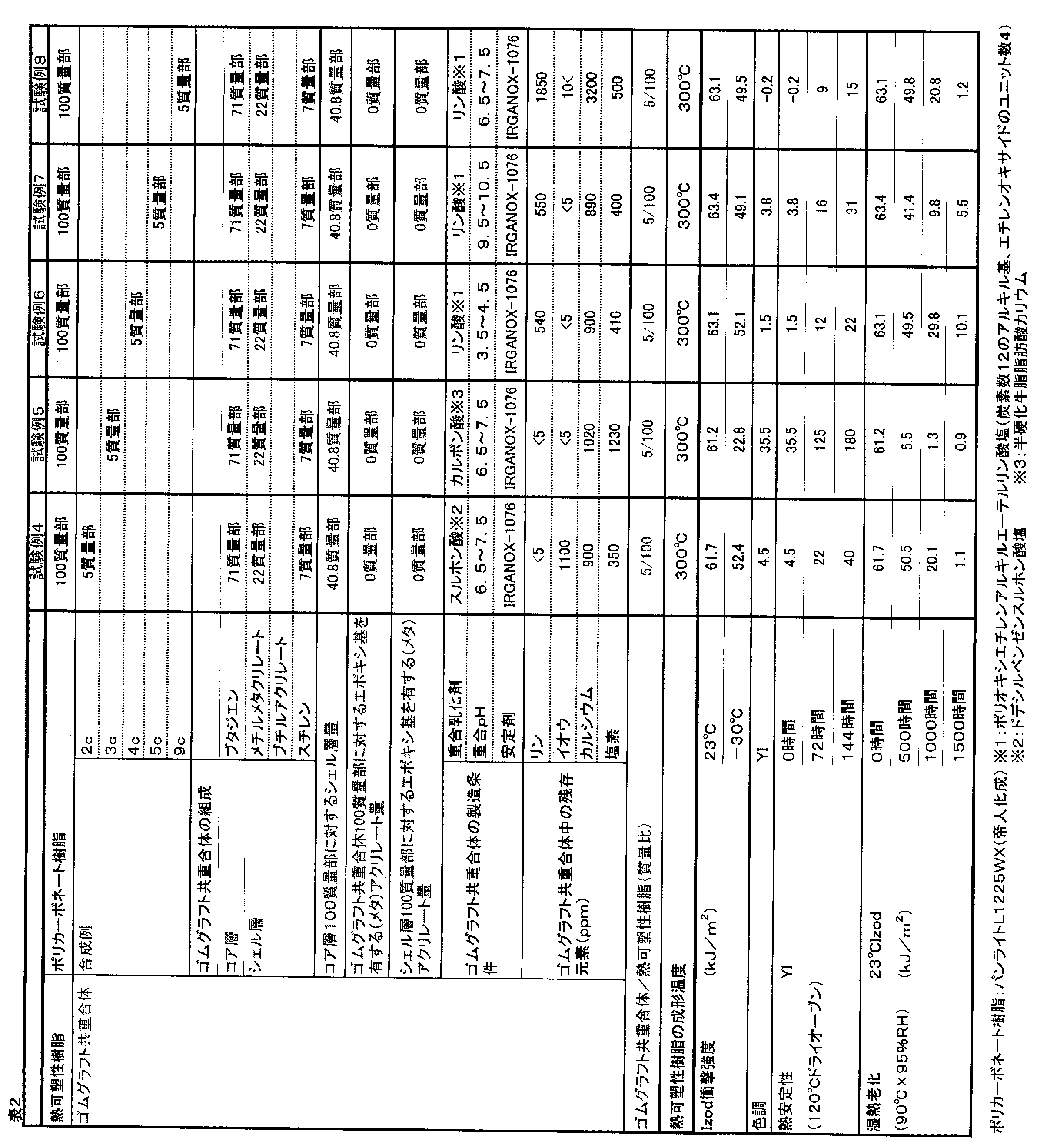
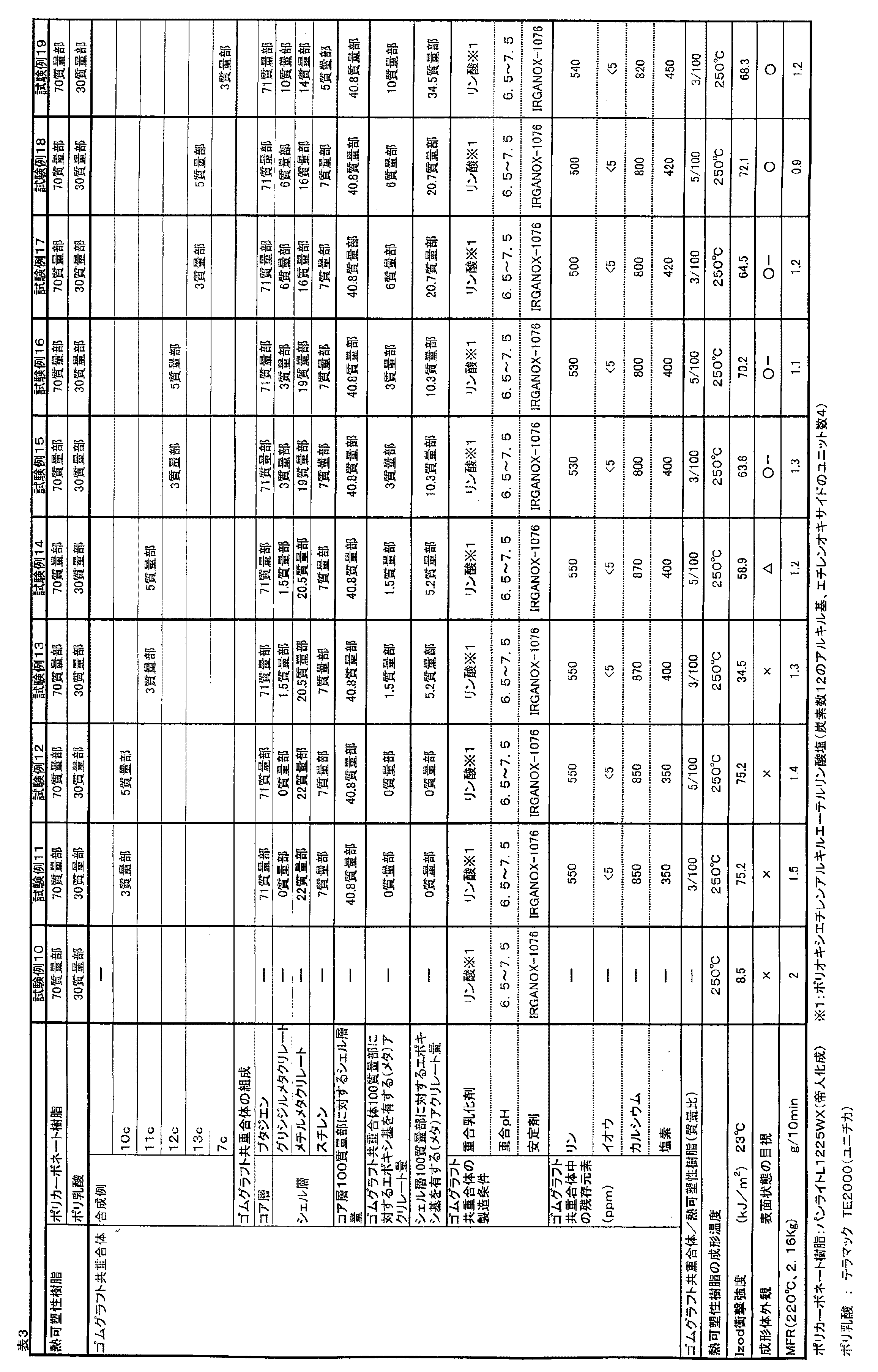
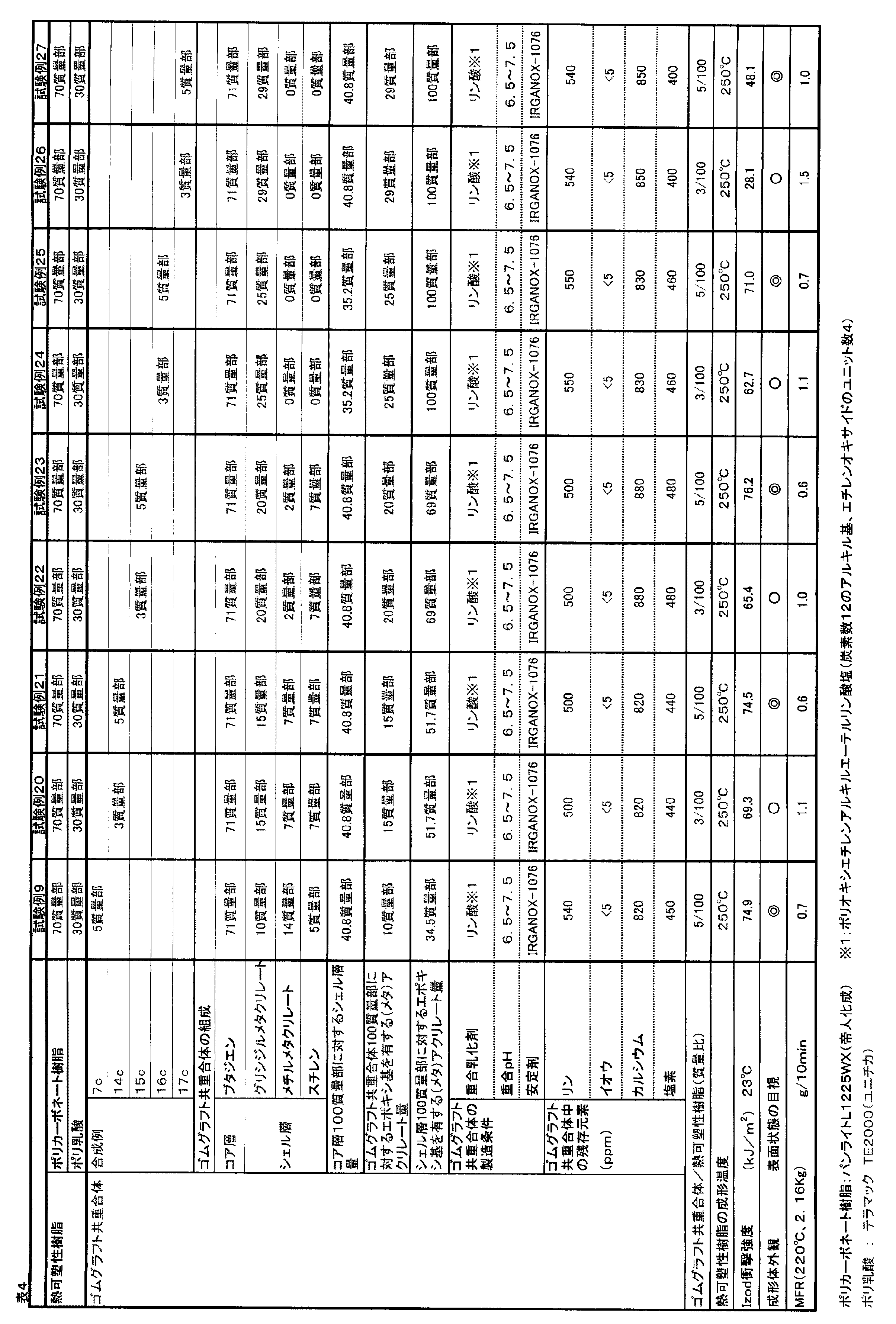
- thermoplastic resin compositions shown in Table 1, Table 2, Table 3, and Table 4 were prepared.
- the obtained evaluation results are shown in Table 1, Table 2, Table 3, and Table 4.
- thermoplastic resin composition using the rubber graft copolymer of the present invention has good thermal stability and little color change (variation in YI value) even after storage at high temperature. I understand. Further, it can be seen that the retention rate of Izod strength after the wet heat aging test is high, and the physical properties are hardly lowered.
- the polycarbonate resin / polylactic acid resin alloy composition using the rubber graft copolymer of the present invention has not only good impact resistance but also pearl luster. As a result, the surface state becomes uniform and the compatibility (dispersibility) of the polycarbonate resin and the polylactic acid resin is improved.
- the present invention includes, for example, a personal computer, a liquid crystal display, a projector, a PDA, a printer, a copier, a fax machine, a video camera, a digital camera, a mobile phone (smartphone), a portable audio device, a game machine, a DVD recorder, a microwave oven, a rice cooker, and the like.
- Electrical / electronic applications road translucent plates, daylighting windows, carports, lighting lenses, lighting covers, building material sizing, doors, and other building applications; handles, shift levers, anti-vibration automobiles, train windows It can be used for vehicle applications such as display, lighting, and driver's seat panel.
Landscapes
- Chemical & Material Sciences (AREA)
- Health & Medical Sciences (AREA)
- Chemical Kinetics & Catalysis (AREA)
- Medicinal Chemistry (AREA)
- Polymers & Plastics (AREA)
- Organic Chemistry (AREA)
- Compositions Of Macromolecular Compounds (AREA)
- Graft Or Block Polymers (AREA)
- Addition Polymer Or Copolymer, Post-Treatments, Or Chemical Modifications (AREA)
Description
[1] ゴム状重合体のコア層およびこのコア層にグラフトするシェル層から構成されるゴムグラフト共重合体と、ポリカーボネート樹脂および脂肪族ポリエステル樹脂から構成される熱可塑性樹脂とを、ゴムグラフト共重合体/熱可塑性樹脂の質量比が3/100以上となる範囲で含み、
前記シェル層がエポキシ基を有する(メタ)アクリレート系単量体の単独重合又は共重合によって得られる層であり、かつこのエポキシ基を有する(メタ)アクリレート系単量体の量が、ゴムグラフト共重合体100質量部に対して、3質量部以上29質量部未満であることを特徴とする熱可塑性樹脂組成物。
(b)前記ラテックスに、アルカリ土類金属の塩化物溶液を添加して凝固を行う工程、および
(c)得られた凝固物を洗浄および乾燥する工程
を含むゴムグラフト共重合体の製造方法。
(1)リン酸系化合物のアルカリ金属塩の存在下で重合されたゴムグラフト共重合体
(2)ゴムグラフト共重合体中に前記リン酸系化合物がアルカリ土類金属塩として残留しない、あるいは残留する場合はリン酸系化合物のアルカリ土類金属塩の残存量が、アルカリ土類金属として3000ppm(質量基準)以下であるゴムグラフト共重合体
(3)pHが4.6~9.4の条件下での重合により得られたゴムグラフト共重合体
本発明の熱可塑性樹脂組成物は、ゴム状重合体のコア層およびこのコア層にグラフトするシェル層から構成されるゴムグラフト共重合体と、ポリカーボネート樹脂および脂肪族ポリエステル樹脂から構成される熱可塑性樹脂とを、ゴムグラフト共重合体/熱可塑性樹脂の質量比が3/100以上となる範囲で含み、
前記シェル層がエポキシ基を有する(メタ)アクリレート系単量体の単独重合又は共重合によって得られる層であり、かつこのエポキシ基を有する(メタ)アクリレート系単量体の量が、ゴムグラフト共重合体100質量部に対して、3質量部以上29質量部未満であることを特徴とする。シェル層としてエポキシ基を有する(メタ)アクリレート系単量体を上記量でグラフト重合すると、成形体の耐衝撃性、パール光沢が低減した表面外観性、または熱可塑性樹脂組成物の流動性、熱可塑性樹脂の相溶性を改善することができる。
ゴムグラフト共重合体は、後述される通りに、ゴム状重合体のコア層に、シェル層がグラフト結合したものであり、コア-シェル構造を有することが好適である。
本発明のゴムグラフト共重合体に用いられるゴム状重合体としては、ポリブタジエン、ポリ(スチレン-ブタジエン)、ポリ(アクリロニトリル-ブタジエン)、ブタジエン-アクリル酸エステル共重合体などのジエン系重合体、ポリアクリル酸ブチル、アクリル酸ブチル-アクリル酸2-エチルヘキシル共重合体などのアクリル系ゴム重合体、シリコン、シリコン-アクリルなどのポリオルガノシロキサン系ゴム重合体等が挙げられる。ゴム状重合体のガラス転移温度(Tg)が-50℃以下であることが好ましく、衝撃強度の改善効果が高いこと、および原料コストの観点からジエン系重合体が好ましく、ポリブタジエンが特に好ましい。ジエン系単量体と共重合されるビニル系単量体の種類や量は特に制限されないが、1,3-ブタジエン50~100重量%とビニル系単量体0~50重量%との(共)重合体であることが好ましく、1,3-ブタジエンホモポリマーであることが特に好ましい。
シェル層は、エポキシ基を有する(メタ)アクリレートを所定量含む単量体で単独重合又は共重合された層である。前記(メタ)アクリレートには、メタアクリレートおよびアクリレートが含まれる。
エポキシ基を有する(メタ)アクリレートとしては、グリシジルメタアクリレート、1-メチル-1,2-エポキシ-エチルメタクリレート、4-ヒドロキシブチルメタアクリレートグリシジルエーテル、グリシジルアクリレート、1-メチル-1,2-エポキシ-エチルアクリレート、4-ヒドロキシブチルアクリレートグリシジルエーテル等が挙げられる。なかでも、成形体表面の外観性および耐衝撃性、または熱可塑性樹脂組成物の流動性を改善する観点から、グリシジルメタクリレートが特に好ましい。
エポキシ基を有さない(メタ)アクリレート系単量体としては、アクリレート、メチルアクリレート、エチルアクリレート、プロピルアクリレート、ブチルアクリレート、2-エチルヘキシルアクリレート、オクチルアクリレート、ドデシルアクリレート、ステアリルアクリレート、ベヘニルアクリレート等の炭素数が1~22のアルキル基を有するアルキルエステルアクリレート類;メタクリレート、メチルメタクリレート、エチルメタクリレート、プロピルメタクリレート、ブチルメタクリレート、2-エチルヘキシルメタクリレート、オクチルメタクリレート、ドデシルメタクリレート、ステアリルメタクリレート、ベヘニルメタクリレート等の炭素数が1~22のアルキル基を有するアルキルエステルメタクリレート類等のアルキル(メタ)アクリレート単量体が挙げられる。なかでも、成形体表面のパール光沢低減の観点から、メチルメタクリレートを使用することが好ましい。なお、これらは単独で用いても良く、2種以上組み合わせても良い。
スチレン系単量体は、上記芳香族ビニル化合物で挙げられたものを使用してもよい。
単量体Aは、グリシジル(メタ)アクリレート100質量部に対して、好ましくは0質量部以上700質量部以下、より好ましくは0質量部以上400質量部以下、さらに好ましくは0.1質量部以上150質量部以下である。
単量体Bは、グリシジル(メタ)アクリレート100質量部に対して、好ましくは0質量部以上250質量部以下、より好ましくは0質量部以上150質量部以下、さらに好ましくは0質量部以上100質量部以下、さらにより好ましくは0.1質量部以上50質量部以下である。
(a)リン酸系化合物のアルカリ金属塩の存在下、pHを4.6~9.4の条件で重合させることでゴムグラフト共重合体を含むラテックスを調製する工程、
(b)前記ラテックスに、アルカリ土類金属の塩化物溶液を添加して凝固を行う工程、および
(c)得られた凝固物を洗浄および乾燥する工程
を含むものが挙げられる。上記(a)~(c)の工程を経てゴムグラフト共重合体を調製すれば、グラフト共重合体中のリン含有量およびアルカリ土類金属含有量を所定の範囲に調節することができ、熱可塑性樹脂組成物の熱安定性、耐湿熱老化性、色調等を確保することができる。
より具体的には、グラフト共重合体の製造時に使用するリン酸系化合物がアルカリ土類金属塩として残留しない、あるいは残留する場合には、上記の範囲内であればよい。
そして、残留しないまたは残留しても上記の範囲内であれば、ゴムグラフト共重合体の熱安定性、色調、耐湿熱老化性が良好となる。
(1)リン酸系化合物のアルカリ金属塩の存在下で重合されたゴムグラフト共重合体
(2)ゴムグラフト共重合体中に前記リン酸系化合物がアルカリ土類金属塩として残留しない、あるいは残留する場合はリン酸系化合物のアルカリ土類金属塩の残存量が、アルカリ土類金属として3000ppm(質量基準)以下であるゴムグラフト共重合体
(3)pHが4.6~9.4の条件下での重合により得られたゴムグラフト共重合体。
本発明のゴムグラフト共重合体は、耐衝撃性改質剤として、種々の熱可塑性樹脂に配合することができる。このような熱可塑性樹脂としては、塩化ビニル樹脂(PVC)、塩素化ポリエチレン樹脂、塩素化塩化ビニル樹脂、塩化ビニリデン樹脂等の硬質、半硬質、軟質の含塩素系樹脂;ポリプロピレン(PP)、ポリエチレン(PE)等のオレフィン系樹脂;ポリスチレン(PS)、ハイインパクトポリスチレン(HIPS)、(メタ)アクリレート-スチレン共重合体(MS)、スチレン-アクリロニトリル共重合体(AS)、スチレン-無水マレイン酸共重合体(SMA)、アクリロニトリル-ブタジエン-スチレン樹脂(ABS)、アクリレート-スチレン-アクリロニトリル樹脂(ASA)、アクリロニトリル-エチレンプロピレンゴム-スチレン樹脂(AES)等のスチレン系樹脂(St系樹脂);ポリメチルメタクリレート(PMMA)等のアクリル系樹脂(Ac系樹脂);ポリカーボネート系樹脂(PC系樹脂);ポリアミド系樹脂(PA系樹脂);ポリエチレンテレフタレート(PET)、ポリブチレンテレフタレート(PBT)等のポリエステル系樹脂(PEs系樹脂);ポリ乳酸樹脂、熱可塑性ポリビニルアルコール樹脂、ポリブチレンサクシネート、その他生分解性を有する天然原料、石油原料由来の環境適応樹脂(一般に生分解性樹脂と称されるもの);(変性)ポリフェニレンエーテル系樹脂(PPE系樹脂)、ポリオキシメチレン系樹脂(POM系樹脂)、ポリスルフォン系樹脂(PSO系樹脂)、ポリアリレート系樹脂(PAr系樹脂)、ポリフェニレン系樹脂(PPS系樹脂)、熱可塑性ポリウレタン系樹脂(PU系樹脂)等のエンジニアリングプラスチックス;スチレン系エラストマー、オレフィン系エラストマー、塩化ビニル系エラストマー、ウレタン系エラストマー、ポリエステル系エラストマー、ポリアミド系エラストマー、フッ素系エラストマー、1,2-ポリブタジエン、トランス1,4-ポリイソプレン等の熱可塑性エラストマー(TPE);PC/ABS等のPC系樹脂/St系樹脂アロイ、PVC/ABS等のPVC系樹脂/St系樹脂アロイ、PA/ABS等のPA系樹脂/St系樹脂アロイ、PA系樹脂/TPEアロイ、PA/PP等のPA系樹脂/ポリオレフィン系樹脂アロイ、PBT系樹脂/TPE、PC/PBT等のPC系樹脂/PEs系樹脂アロイ、ポリオレフィン系樹脂/TPE、PP/PE等のオレフィン系樹脂同士のアロイ、PPE/HIPS、PPE/PBT、PPE/PA等のPPE系樹脂アロイ、PVC/PMMA等のPVC系樹脂/Ac系樹脂アロイ等のポリマーアロイが挙げられる。これらは1種単独で使用しても、2種以上を混合して使用してもよい。これら熱可塑性樹脂の中でも、特にポリカーボネート樹脂、及びポリエステル樹脂からから選択される少なくとも一種を用いた時、本発明のゴムグラフト共重合体の熱安定性の効果が発現することから好適である。
なお、ゴムグラフト共重合体がリンを含有しない場合、シェル層のエポキシ基を有する(メタ)アクリレートは必須ではなく、上述した単量体を適宜使用してもよい。また、熱可塑性樹脂としても任意のものが使用でき、熱可塑性樹脂に対するグラフト共重合体の割合も特に限定されない。
本発明の熱可塑性樹脂組成物の製造方法には特に制限がなく、原料の混合には、ヘンシェルミキサーやタンブラーミキサーなどが利用でき、溶融混練には、単軸または二軸押出機、バンバリーミキサー、加圧ニーダー、ミキシングロールなどの混練機を利用することができる。このようにして製造された熱可塑性樹脂組成物は各種用途に製造でき、建築用途、電気・電子用途、車輌用途等に利用することができ、例えば、パソコン、液晶ディスプレイ、プロジェクター、PDA、プリンター、コピー機、ファックス、ビデオカメラ、デジタルカメラ、携帯電話(スマートフォン)、携帯オーディオ機器、ゲーム機、DVDレコーダー、電子レンジ、炊飯器等の電気・電子用途;道路透光板、採光窓、カーポート、照明用レンズ、照明用カバー、建材用サイジング、ドア等の建築用途;ハンドル、シフトレバー、防振材等の自動車、電車の窓、表示、照明、運転席パネル等の車輌用途等に利用することができる。
得られた粉体状グラフト共重合体中のアルカリ土類金属(カルシウム)、リン、イオウ、塩素の濃度を蛍光X線分析装置(XEPOS SPECTRO社)により測定した。
重合中のラテックスの一部を採取しpHを測定した。pHの測定はpHメーター(D-21 HORIBA社)により行った。
得られたラテックスの一部を採取・精秤し、それを熱風乾燥器中で120℃、1時間乾燥し、その乾燥後の重量を固形分量として精秤した。次に、乾燥前後の精秤結果の比率をラテックス中の固形成分比率として求めた。最後に、この固形成分比率を用いて、以下の式1により重合転化率を算出した。
(式1)
重合転化率=(仕込み原料総重量×固形成分比率-単量体以外の原料総重量)/仕込み単量体重量×100(%)
ゴム状重合体、及びグラフト共重合体の体積平均粒子径はラテックスの状態で測定した。測定装置として、日機装株式会社製のMICROTRAC UPA150を用いて体積平均粒子径(μm)を測定した。
ASTM D-256に準じて、1/8インチノッチ付きアイゾット衝撃強度を測定した。
ASTM-E1925に準じ、日本電色工業社製の色差計(型式:SE-2000)を用いて、厚さ2mmのプレートの色調/YIを測定した。
120℃のドライオーブンに厚さ2mmのプレートを所定時間静置し、ASTM-E1925に準じ、日本電色工業社製の色差計(型式:SE-2000)を用いた測定方法で色調/YIを測定した。
1/8インチノッチ付アイゾット用試験片を90℃×95%RHの恒温恒湿器に所定時間静置し、ASTM D-256に準じた測定方法で、アイゾット衝撃強度を測定した。
目視により成形体の表面状態を観察した。均一の場合は最良(◎)、極一部がパール光沢のようにまだら模様を呈する場合は良好(○)、一部がパール光沢のようにまだら模様を呈する場合は(○-)、全体がパール光沢のようにまだら模様を呈する場合は不良(×)とした。
ASTMD1238に準じ、MFRを測定した。
(製造例1a) ゴム状重合体の製造
撹拌機付耐圧容器に
純水 200部、
エチレンジアミン4酢酸2ナトリウム塩 0.002部、
硫酸第一鉄 0.0012部、
エチレンジアミンテトラ酢酸ジナトリウム塩 0.008部、
ポリオキシエチレンアルキルエーテルリン酸ナトリウム 0.03部、
を仕込み、脱酸した後に、
ブタジエン 100部、
ナトリウムホルムアルデヒドスルホキシレート 0.05部、
パラメンタンハイドロパーオキサイド 0.2部、
を添加し、それから6時間かけてポリオキシエチレンアルキルエーテルリン酸ナトリウムを1.4部滴下した後、反応溶液中のpH6.5~7.5において50℃で124時間保持し、転化率98重量%で、体積平均粒子径180nmのジエン系ゴムラテックス(1a)を得た。
上記で得られたゴムラテックス(1a)(固形分約71部)を60℃に保持しながら、単量体としての
メタクリル酸メチル 22部、
スチレン 7部、
を1時間にわたって添加した。
また上記単量体の添加と同時に、
t-ブチルハイドロパーオキサイド 0.07部、
ナトリウムホルムアルデヒドスルホキシレート 0.1部、
の添加を開始し、それから反応溶液中のpHを6.5~7.5、温度を約60℃に保ちながら2時間かけて全量を添加した。さらに反応溶液を、約60℃で1時間保持して、体積平均粒子径200nmのグラフト共重合体ラテックス(1b)を得た。
ゴム状重合体製造の際、ポリオキシエチレンアルキルエーテルリン酸ナトリウムの代わりに他の乳化剤を用いたこと以外は合成例1と同様にして、粉体状のグラフト共重合体(2c、3c)を得た。ここでドデシルベンゼンスルホン酸ナトリウム(強酸のアルカリ金属塩)を用いて製造したグラフト共重合体を、粉体状グラフト共重合体(2c)と、半硬化牛脂脂肪酸カリウム(脂肪酸のアルカリ金属塩)を用いて製造したグラフト共重合体を、粉体状グラフト共重合体(3c)とする。得られた粉体状グラフト共重合体(2c)および(3c)中の、リン、イオウ、カルシウム、塩素のそれぞれの残存量は、2c:<5ppm、1100ppm、900ppm、350ppm、3c:<5ppm、<5ppm、1020ppm、1230ppmであった。
ゴム状重合体およびグラフト共重合体の製造の際、反応溶液中のpHを変更した以外は合成例1と同様にして、粉体状のグラフト共重合体(4c、5c)を得た。ここでpH3.5-4.5の条件でゴム状重合体を製造しグラフト層を形成して得られたグラフト共重合体を、粉体状グラフト共重合体(4c)と、pH9.5-10.5の条件でゴム状重合体を製造しグラフト層を形成して得られたグラフト共重合体を、粉体状グラフト共重合体(5c)とする。得られた粉体状グラフト共重合体(4c)および(5c)中の、リン、イオウ、カルシウム、塩素のそれぞれの残存量は、4c:540ppm、<5ppm、900ppm、410ppm、5c:550ppm、<5ppm、890ppm、400ppmであった。
グラフト共重合体の製造において、合成例1で用いた単量体(メタクリル酸メチル 22部、スチレン 7部)と異なる単量体を用いた以外は、合成例1と同様にして、粉体状のグラフト共重合体(6c、7c)を得た。ここで「メタクリル酸メチル 26.1部、アクリル酸ブチル 2.9部」を用いて製造したグラフト共重合体を、粉体状グラフト共重合体(6c)と、「メタクリル酸グリシジル 10部、メタクリル酸メチル 14部、スチレン 5部」を用いて製造したグラフト共重合体を、粉体状グラフト共重合体(7c)とする。得られた粉体状グラフト共重合体(6c)および(7c)中の、リン、イオウ、カルシウム、塩素のそれぞれの残存量は、6c:540ppm、<5ppm、870ppm、360ppm、7c:530ppm、<5ppm、880ppm、420ppmであった。
グラフト共重合体の製造において、固形分71重量部のゴム状重合体の代わりに固形分78重量部のゴム状重合体を、単量体として「メタクリル酸メチル 22部、スチレン 7部」の代わりに「メタクリル酸メチル 19.8部、アクリル酸ブチル 2.2部」を用いた以外は、合成例1と同様にして、粉体状のグラフト共重合体(8c)を得た。得られた粉体状グラフト共重合体(8c)中の、リン、イオウ、カルシウム、塩素のそれぞれの残存量は、570ppm、<5ppm、930ppm、430ppmであった。
グラフト共重合体の製造において、塩化カルシウム水溶液で凝析を行った後に、水洗を行わなかったこと以外は、合成例1と同様にして、粉体状のグラフト共重合体(9c)を得た。得られた粉体状グラフト共重合体(9c)中の、リン、イオウ、カルシウム、塩素のそれぞれの残存量は、1850ppm、<10ppm、3200ppm、500ppmであった。
グラフト共重合体の製造において、合成例1で用いた単量体(メタクリル酸メチル 22部、スチレン 7部)と異なる単量体を用いた以外は、合成例1と同様にして、粉体状のグラフト共重合体(10c)を得た。ここで「メタクリル酸グリシジル 0部、メタクリル酸メチル 22部、スチレン 7部」を用いて製造したグラフト共重合体を、粉体状グラフト共重合体(10c)とする。得られた粉体状グラフト共重合体(10c)中の、リン、イオウ、カルシウム、塩素のそれぞれの残存量は、10c:550ppm、<5ppm、850ppm、350ppmであった。
グラフト共重合体の製造において、合成例1で用いた単量体(メタクリル酸メチル 22部、スチレン 7部)と異なる単量体を用いた以外は、合成例1と同様にして、粉体状のグラフト共重合体(11c)を得た。ここで「メタクリル酸グリシジル 1.5部、メタクリル酸メチル 20.5部、スチレン 7部」を用いて製造したグラフト共重合体を、粉体状グラフト共重合体(11c)とする。得られた粉体状グラフト共重合体(11c)中の、リン、イオウ、カルシウム、塩素のそれぞれの残存量は、11c:550ppm、<5ppm、870ppm、400ppmであった。
グラフト共重合体の製造において、合成例1で用いた単量体(メタクリル酸メチル 22部、スチレン 7部)と異なる単量体を用いた以外は、合成例1と同様にして、粉体状のグラフト共重合体(12c)を得た。ここで「メタクリル酸グリシジル 3部、メタクリル酸メチル 19部、スチレン 7部」を用いて製造したグラフト共重合体を、粉体状グラフト共重合体(12c)とする。得られた粉体状グラフト共重合体(12c)中の、リン、イオウ、カルシウム、塩素のそれぞれの残存量は、12c:530ppm、<5ppm、800ppm、400ppmであった。
グラフト共重合体の製造において、合成例1で用いた単量体(メタクリル酸メチル 22部、スチレン 7部)と異なる単量体を用いた以外は、合成例1と同様にして、粉体状のグラフト共重合体(13c)を得た。ここで「メタクリル酸グリシジル 6部、メタクリル酸メチル 16部、スチレン 7部」を用いて製造したグラフト共重合体を、粉体状グラフト共重合体(13c)とする。得られた粉体状グラフト共重合体(13c)中の、リン、イオウ、カルシウム、塩素のそれぞれの残存量は、13c:500ppm、<5ppm、800ppm、420ppmであった。
グラフト共重合体の製造において、合成例1で用いた単量体(メタクリル酸メチル 22部、スチレン 7部)と異なる単量体を用いた以外は、合成例1と同様にして、粉体状のグラフト共重合体(14c)を得た。ここで「メタクリル酸グリシジル 15部、メタクリル酸メチル 7部、スチレン 7部」を用いて製造したグラフト共重合体を、粉体状グラフト共重合体(14c)とする。得られた粉体状グラフト共重合体(14c)中の、リン、イオウ、カルシウム、塩素のそれぞれの残存量は、14c:500ppm、<5ppm、820ppm、440ppmであった。
グラフト共重合体の製造において、合成例1で用いた単量体(メタクリル酸メチル 22部、スチレン 7部)と異なる単量体を用いた以外は、合成例1と同様にして、粉体状のグラフト共重合体(15c)を得た。ここで「メタクリル酸グリシジル 20部、メタクリル酸メチル 2部、スチレン 7部」を用いて製造したグラフト共重合体を、粉体状グラフト共重合体(15c)とする。得られた粉体状グラフト共重合体(15c)中の、リン、イオウ、カルシウム、塩素のそれぞれの残存量は、15c:500ppm、<5ppm、880ppm、480ppmであった。
グラフト共重合体の製造において、合成例1で用いた単量体(メタクリル酸メチル 22部、スチレン 7部)と異なる単量体を用いた以外は、合成例1と同様にして、粉体状のグラフト共重合体(16c)を得た。ここで「メタクリル酸グリシジル 25部、メタクリル酸メチル 0部、スチレン 0部」を用いて製造したグラフト共重合体を、粉体状グラフト共重合体(16c)とする。得られた粉体状グラフト共重合体(16c)中の、リン、イオウ、カルシウム、塩素のそれぞれの残存量は、16c:550ppm、<5ppm、830ppm、460ppmであった。
グラフト共重合体の製造において、合成例1で用いた単量体(メタクリル酸メチル 22部、スチレン 7部)と異なる単量体を用いた以外は、合成例1と同様にして、粉体状のグラフト共重合体(17c)を得た。ここで「メタクリル酸グリシジル 29部、メタクリル酸メチル 0部、スチレン 0部」を用いて製造したグラフト共重合体を、粉体状グラフト共重合体(17c)とする。得られた粉体状グラフト共重合体(17c)中の、リン、イオウ、カルシウム、塩素のそれぞれの残存量は、17c:540ppm、<5ppm、850ppm、400ppmであった。

Claims (19)
- ゴム状重合体のコア層およびこのコア層にグラフトするシェル層から構成されるゴムグラフト共重合体と、ポリカーボネート樹脂および脂肪族ポリエステル樹脂から構成される熱可塑性樹脂とを、ゴムグラフト共重合体/熱可塑性樹脂の質量比が3/100以上となる範囲で含み、
前記シェル層がエポキシ基を有する(メタ)アクリレート系単量体の単独重合又は共重合によって得られる層であり、かつこのエポキシ基を有する(メタ)アクリレート系単量体の量が、ゴムグラフト共重合体100質量部に対して、3質量部以上29質量部未満であることを特徴とする熱可塑性樹脂組成物。 - 前記ゴムグラフト共重合体において、リン含有量が10ppm(質量基準)以上であり、アルカリ土類金属の含有量が3000ppm(質量基準)以下である請求項1に記載の熱可塑性樹脂組成物。
- 前記シェル層を形成する単量体に、エポキシ基を有さない(メタ)アクリレート系単量体およびスチレン系単量体から選ばれる1種以上が含まれる請求項1または2に記載の熱可塑性樹脂組成物。
- 前記エポキシ基を有する(メタ)アクリレート系単量体の量が、シェル層100質量部に対して、10質量部以上100質量部以下である請求項1~3のいずれかに記載の熱可塑性樹脂組成物。
- 前記シェル層の量が、コア層100質量部に対して、20質量部以上55質量部以下である請求項1~4のいずれかに記載の熱可塑性樹脂組成物。
- 前記ゴム状重合体がジエン系重合体である請求項1~5のいずれかに記載の熱可塑性樹脂組成物。
- 前記脂肪族ポリエステル樹脂がポリ乳酸である請求項1~6のいずれかに記載の熱可塑性樹脂組成物。
- (a)リン酸系化合物のアルカリ金属塩の存在下、pHを4.6~9.4の条件で重合させることでゴムグラフト共重合体を含むラテックスを調製する工程、
(b)前記ラテックスに、アルカリ土類金属の塩化物溶液を添加して凝固を行う工程、および
(c)得られた凝固物を洗浄および乾燥する工程
を含むゴムグラフト共重合体の製造方法。 - エポキシ基を有する(メタ)アクリレート系単量体の単独重合又は共重合によって得られるシェル層がゴム状重合体のコア層にグラフトしており、リン含有量が10ppm(質量基準)以上であり、アルカリ土類金属の含有量が3000ppm(質量基準)以上であるゴムグラフト共重合体。
- 下記の(1)~(3)を全て満たすゴムグラフト共重合体。
(1)リン酸系化合物のアルカリ金属塩の存在下で重合されたゴムグラフト共重合体
(2)ゴムグラフト共重合体中に前記リン酸系化合物がアルカリ土類金属塩として残留しない、あるいは残留する場合はリン酸系化合物のアルカリ土類金属塩の残存量が、アルカリ土類金属として3000ppm(質量基準)以下であるゴムグラフト共重合体
(3)pHが4.6~9.4の条件下での重合により得られたゴムグラフト共重合体 - リン含有量が10ppm(質量基準)以上である請求項10に記載のゴムグラフト共重合体。
- 前記ゴムグラフト共重合体中のゴム状重合体がポリブタジエンもしくはポリ(ブタジエン‐スチレン)である請求項9~11のいずれか1項に記載のゴムグラフト共重合体。
- 前記ゴム状重合体にメタクリル酸メチル、あるいはメタクリル酸メチルと他のビニル単量体、あるいはシアン化ビニル単量体と芳香族ビニル単量体、あるいはシアン化ビニル単量体と芳香族ビニル単量体と他のビニル単量体をグラフト重合させた請求項9~12のいずれか1項に記載のゴムグラフト共重合体。
- 前記リン酸系化合物のアルカリ金属塩がアルキルリン酸塩類、および/またはアルキルアリールリン酸塩類である請求項9~13のいずれか1項に記載のゴムグラフト共重合体。
- 前記リン酸系化合物のアルカリ金属塩がポリオキシアルキレンアルキルエーテルリン酸塩である請求項9~14のいずれか1項に記載のゴムグラフト共重合体。
- グラフト部にエポキシ基、ヒドロキシ基、カルボキシ基、アルコキシ基、イソシアネート基、酸無水物基、および酸塩化物基から選ばれる1種または2種以上の反応性基を有する請求項9~15のいずれか1項に記載のゴムグラフト共重合体。
- 乳化重合により得られたゴムグラフト共重合体を含むラテックスに、アルカリ土類金属の塩化物溶液を接触させ凝固させて得られる請求項9~16のいずれか1項に記載のゴムグラフト共重合体。
- 脂肪族ポリエステル樹脂、芳香族ポリエステル樹脂、およびポリカーボネート樹脂からなる群より選ばれる1種または2種以上の樹脂を含む熱可塑性樹脂組成物に使用されるものである、請求項9~17のいずれか1項に記載のゴムグラフト共重合体。
- 請求項1~7のいずれか1項に記載の熱可塑性樹脂組成物を240℃以上で成形した、ゴムグラフト共重合体を含む熱可塑性樹脂組成物の成形体。
Priority Applications (5)
| Application Number | Priority Date | Filing Date | Title |
|---|---|---|---|
| KR1020147025311A KR102025455B1 (ko) | 2012-04-18 | 2013-04-17 | 고무 그래프트 공중합체와 고무 그래프트 공중합체를 함유하는 열가소성 수지 조성물 |
| EP13778689.3A EP2840116B1 (en) | 2012-04-18 | 2013-04-17 | Rubber graft copolymer, and thermoplastic resin composition containing rubber graft copolymer |
| CN201380020468.0A CN104704051B (zh) | 2012-04-18 | 2013-04-17 | 橡胶接枝共聚物和包含橡胶接枝共聚物的热塑性树脂组合物 |
| US14/394,703 US10138314B2 (en) | 2012-04-18 | 2013-04-17 | Rubber graft copolymer, and thermoplastic resin composition containing rubber graft copolymer |
| JP2014511231A JP6185910B2 (ja) | 2012-04-18 | 2013-04-17 | ゴムグラフト共重合体の製造方法 |
Applications Claiming Priority (2)
| Application Number | Priority Date | Filing Date | Title |
|---|---|---|---|
| JP2012-094701 | 2012-04-18 | ||
| JP2012094701 | 2012-04-18 |
Publications (1)
| Publication Number | Publication Date |
|---|---|
| WO2013157569A1 true WO2013157569A1 (ja) | 2013-10-24 |
Family
ID=49383524
Family Applications (1)
| Application Number | Title | Priority Date | Filing Date |
|---|---|---|---|
| PCT/JP2013/061374 Ceased WO2013157569A1 (ja) | 2012-04-18 | 2013-04-17 | ゴムグラフト共重合体とゴムグラフト共重合体を含む熱可塑性樹脂組成物 |
Country Status (6)
| Country | Link |
|---|---|
| US (1) | US10138314B2 (ja) |
| EP (1) | EP2840116B1 (ja) |
| JP (1) | JP6185910B2 (ja) |
| KR (1) | KR102025455B1 (ja) |
| CN (2) | CN105646791B (ja) |
| WO (1) | WO2013157569A1 (ja) |
Cited By (4)
| Publication number | Priority date | Publication date | Assignee | Title |
|---|---|---|---|---|
| WO2018212062A1 (ja) | 2017-05-17 | 2018-11-22 | 三菱ケミカル株式会社 | ポリオルガノシロキサン含有ゴムラテックス及びその製造方法、ポリオルガノシロキサン含有ゴムグラフト重合体、粉体、樹脂組成物並びに成形体 |
| WO2019103092A1 (ja) | 2017-11-27 | 2019-05-31 | 三菱ケミカル株式会社 | ゴム含有グラフト重合体、ゴム含有グラフト重合体含有樹脂組成物およびその成形体 |
| JP2021021028A (ja) * | 2019-07-30 | 2021-02-18 | 株式会社カネカ | ゴムグラフト共重合体の製造方法 |
| WO2024024353A1 (ja) * | 2022-07-28 | 2024-02-01 | 三菱エンジニアリングプラスチックス株式会社 | ポリカーボネート樹脂組成物および成形品 |
Families Citing this family (14)
| Publication number | Priority date | Publication date | Assignee | Title |
|---|---|---|---|---|
| KR101910689B1 (ko) * | 2014-10-08 | 2018-10-22 | 주식회사 엘지화학 | 비닐계 열가소성 수지 조성물, 이의 제조방법 및 이로부터 제조된 비닐계 열가소성 수지 |
| CN106273602B (zh) * | 2016-08-28 | 2019-01-18 | 杭州伊纳可模具模型有限公司 | 一种基于透明塑料的变速箱壳体制作工艺 |
| CN109689701B (zh) | 2016-09-22 | 2022-07-19 | 罗门哈斯公司 | 制备含有磷酸盐的聚合物组合物 |
| BR112019003767A2 (pt) | 2016-09-22 | 2019-05-21 | Rohm And Haas Company | composições de polímero e de resina de matriz. |
| JP6938266B2 (ja) * | 2017-08-03 | 2021-09-22 | 旭化成株式会社 | ポリオキシメチレン樹脂組成物及び成形体 |
| JP6938267B2 (ja) * | 2017-08-03 | 2021-09-22 | 旭化成株式会社 | ポリオキシメチレン樹脂組成物 |
| KR102244956B1 (ko) * | 2017-11-16 | 2021-04-27 | 주식회사 엘지화학 | 그라프트 공중합체의 제조방법 |
| KR102284111B1 (ko) * | 2018-12-21 | 2021-08-02 | 주식회사 엘지화학 | 열가소성 수지의 제조방법, 이로부터 제조된 열가소성 수지 및 이를 포함하는 열가소성 수지 조성물 |
| KR102490390B1 (ko) * | 2019-04-29 | 2023-01-19 | 주식회사 엘지화학 | 고분자 응집제 및 이를 포함하는 그라프트 공중합체 |
| KR102726516B1 (ko) * | 2019-09-04 | 2024-11-06 | 주식회사 엘지화학 | 코어-쉘 공중합체 및 이를 포함하는 폴리유산 수지 조성물 |
| KR102501598B1 (ko) | 2019-10-21 | 2023-02-20 | 주식회사 엘지화학 | 열가소성 수지 조성물 |
| JP6935045B1 (ja) * | 2020-01-15 | 2021-09-15 | デンカ株式会社 | 毛状体を有する樹脂シート及びその成形品 |
| CN113321878B (zh) * | 2021-06-02 | 2022-07-12 | 万华化学集团股份有限公司 | 一种abs树脂组合物及其制备方法 |
| KR20240115649A (ko) * | 2023-01-19 | 2024-07-26 | 주식회사 엘지화학 | 수지 조성물 및 이를 포함하는 성형품 |
Citations (9)
| Publication number | Priority date | Publication date | Assignee | Title |
|---|---|---|---|---|
| JPH11158365A (ja) | 1997-09-04 | 1999-06-15 | General Electric Co <Ge> | 改善された劣化抵抗性および改善された熱安定性を有する耐衝撃性改良カーボネートポリマー組成物 |
| JPH11240995A (ja) * | 1998-02-24 | 1999-09-07 | Techno Polymer Kk | 熱可塑性樹脂組成物 |
| JP2000204128A (ja) * | 1999-01-01 | 2000-07-25 | Mitsubishi Rayon Co Ltd | 耐衝撃性アクリル系重合体 |
| JP2005048067A (ja) * | 2003-07-29 | 2005-02-24 | Teijin Chem Ltd | 芳香族ポリカーボネート樹脂組成物 |
| JP2007112829A (ja) * | 2005-10-18 | 2007-05-10 | Kaneka Corp | 熱可塑性ポリエステル樹脂組成物および成形体 |
| JP2007211108A (ja) * | 2006-02-08 | 2007-08-23 | Mitsubishi Chemicals Corp | 熱可塑性樹脂組成物および樹脂成形品 |
| JP2007277368A (ja) | 2006-04-05 | 2007-10-25 | Mitsubishi Rayon Co Ltd | ジエン系ゴムグラフト共重合体とこれを含む熱可塑性樹脂組成物およびジエン系ゴムグラフト共重合体の製造方法 |
| WO2008102536A1 (ja) * | 2007-02-23 | 2008-08-28 | Unitika Ltd. | 樹脂組成物及びそれから得られる成形体 |
| JP2010222553A (ja) | 2009-02-26 | 2010-10-07 | Toray Ind Inc | 熱可塑性樹脂組成物ならびにそれらからなる成形品 |
Family Cites Families (9)
| Publication number | Priority date | Publication date | Assignee | Title |
|---|---|---|---|---|
| DE69101435T2 (de) | 1991-06-19 | 1994-10-06 | Ge Plastics Abs Europ Bv | Verfahren zur Herstellung von Copolymeren mit Einheiten abgeleitet von Glycidylestern oder Glycidylethern. |
| DE4306831A1 (de) * | 1993-03-04 | 1994-09-08 | Wacker Chemie Gmbh | Kern-Hülle-Copolymerisat-Dispersionen, deren Hülle hydrolisierbare, siliciumorganische Comonomere enthält |
| TW444041B (en) | 1998-02-13 | 2001-07-01 | Gen Electric | Flame retardant carbonate polymer composition with improved hydrolytic stability |
| JP2003155416A (ja) | 2001-11-22 | 2003-05-30 | Teijin Chem Ltd | 難燃性熱可塑性樹脂組成物およびその射出成形品 |
| JP5347238B2 (ja) * | 2007-05-15 | 2013-11-20 | 三菱化学株式会社 | 熱可塑性樹脂組成物および樹脂成形品 |
| EP2927252B1 (en) | 2008-08-29 | 2018-10-10 | Arkema, Inc. | Functionalized bimodal impact modifiers |
| EP2189497B2 (en) * | 2008-11-21 | 2018-09-26 | Rohm and Haas Company | Polymer compositions containing phosphates |
| DE102008060536A1 (de) * | 2008-12-04 | 2010-06-10 | Bayer Materialscience Ag | Saure Phosphorverbindungen enthaltende schlagzähmodifizierte Polycarbonat-Zusammensetzungen mit basisch gefälltem Emulsionspfropfpolymersiat |
| KR101268660B1 (ko) * | 2009-09-22 | 2013-05-29 | 주식회사 엘지화학 | 분무 건조 방식을 이용한 열가소성 폴리에스테르 수지용 충격 보강제의 제조방법, 이로부터 제조된 충격 보강제 및 이를 포함하는 열가소성 폴리에스테르 수지 조성물 |
-
2013
- 2013-04-17 CN CN201610216708.XA patent/CN105646791B/zh active Active
- 2013-04-17 US US14/394,703 patent/US10138314B2/en active Active
- 2013-04-17 WO PCT/JP2013/061374 patent/WO2013157569A1/ja not_active Ceased
- 2013-04-17 KR KR1020147025311A patent/KR102025455B1/ko active Active
- 2013-04-17 JP JP2014511231A patent/JP6185910B2/ja active Active
- 2013-04-17 EP EP13778689.3A patent/EP2840116B1/en active Active
- 2013-04-17 CN CN201380020468.0A patent/CN104704051B/zh active Active
Patent Citations (9)
| Publication number | Priority date | Publication date | Assignee | Title |
|---|---|---|---|---|
| JPH11158365A (ja) | 1997-09-04 | 1999-06-15 | General Electric Co <Ge> | 改善された劣化抵抗性および改善された熱安定性を有する耐衝撃性改良カーボネートポリマー組成物 |
| JPH11240995A (ja) * | 1998-02-24 | 1999-09-07 | Techno Polymer Kk | 熱可塑性樹脂組成物 |
| JP2000204128A (ja) * | 1999-01-01 | 2000-07-25 | Mitsubishi Rayon Co Ltd | 耐衝撃性アクリル系重合体 |
| JP2005048067A (ja) * | 2003-07-29 | 2005-02-24 | Teijin Chem Ltd | 芳香族ポリカーボネート樹脂組成物 |
| JP2007112829A (ja) * | 2005-10-18 | 2007-05-10 | Kaneka Corp | 熱可塑性ポリエステル樹脂組成物および成形体 |
| JP2007211108A (ja) * | 2006-02-08 | 2007-08-23 | Mitsubishi Chemicals Corp | 熱可塑性樹脂組成物および樹脂成形品 |
| JP2007277368A (ja) | 2006-04-05 | 2007-10-25 | Mitsubishi Rayon Co Ltd | ジエン系ゴムグラフト共重合体とこれを含む熱可塑性樹脂組成物およびジエン系ゴムグラフト共重合体の製造方法 |
| WO2008102536A1 (ja) * | 2007-02-23 | 2008-08-28 | Unitika Ltd. | 樹脂組成物及びそれから得られる成形体 |
| JP2010222553A (ja) | 2009-02-26 | 2010-10-07 | Toray Ind Inc | 熱可塑性樹脂組成物ならびにそれらからなる成形品 |
Non-Patent Citations (1)
| Title |
|---|
| See also references of EP2840116A4 |
Cited By (7)
| Publication number | Priority date | Publication date | Assignee | Title |
|---|---|---|---|---|
| WO2018212062A1 (ja) | 2017-05-17 | 2018-11-22 | 三菱ケミカル株式会社 | ポリオルガノシロキサン含有ゴムラテックス及びその製造方法、ポリオルガノシロキサン含有ゴムグラフト重合体、粉体、樹脂組成物並びに成形体 |
| WO2019103092A1 (ja) | 2017-11-27 | 2019-05-31 | 三菱ケミカル株式会社 | ゴム含有グラフト重合体、ゴム含有グラフト重合体含有樹脂組成物およびその成形体 |
| KR20200062343A (ko) | 2017-11-27 | 2020-06-03 | 미쯔비시 케미컬 주식회사 | 고무 함유 그래프트 중합체, 고무 함유 그래프트 중합체 함유 수지 조성물 및 그의 성형체 |
| KR20220158288A (ko) | 2017-11-27 | 2022-11-30 | 미쯔비시 케미컬 주식회사 | 고무 함유 그래프트 중합체, 고무 함유 그래프트 중합체 함유 수지 조성물 및 그의 성형체 |
| US11634526B2 (en) | 2017-11-27 | 2023-04-25 | Mitsubishi Chemical Corporation | Rubber-containing graft polymer, resin composition containing rubber-containing graft polymer, and shaped article of same |
| JP2021021028A (ja) * | 2019-07-30 | 2021-02-18 | 株式会社カネカ | ゴムグラフト共重合体の製造方法 |
| WO2024024353A1 (ja) * | 2022-07-28 | 2024-02-01 | 三菱エンジニアリングプラスチックス株式会社 | ポリカーボネート樹脂組成物および成形品 |
Also Published As
| Publication number | Publication date |
|---|---|
| EP2840116A4 (en) | 2016-04-06 |
| EP2840116A1 (en) | 2015-02-25 |
| US20150065651A1 (en) | 2015-03-05 |
| CN104704051B (zh) | 2017-09-12 |
| US10138314B2 (en) | 2018-11-27 |
| EP2840116B1 (en) | 2019-01-02 |
| JP6185910B2 (ja) | 2017-08-23 |
| KR20150002604A (ko) | 2015-01-07 |
| CN105646791B (zh) | 2018-11-09 |
| CN104704051A (zh) | 2015-06-10 |
| KR102025455B1 (ko) | 2019-09-25 |
| JPWO2013157569A1 (ja) | 2015-12-21 |
| CN105646791A (zh) | 2016-06-08 |
Similar Documents
| Publication | Publication Date | Title |
|---|---|---|
| JP6185910B2 (ja) | ゴムグラフト共重合体の製造方法 | |
| JP6024757B2 (ja) | 天然ゴム含有熱可塑性樹脂組成物およびその成形品 | |
| CN101775201A (zh) | 具有高熔合线强度的聚碳酸酯树脂组合物 | |
| KR20100078850A (ko) | 폴리유산 수지 조성물 | |
| JP7386159B2 (ja) | 熱可塑性樹脂組成物およびこれから形成された成形品 | |
| KR102351503B1 (ko) | 열가소성 수지 조성물 및 이를 이용한 성형품 | |
| JP7459283B2 (ja) | 熱可塑性樹脂組成物、その製造方法及びそれを含む成形品 | |
| JP6181938B2 (ja) | ゴムグラフト共重合体およびゴムグラフト共重合体を含む熱可塑性樹脂組成物 | |
| JP7509750B2 (ja) | 熱可塑性樹脂組成物及び成形体 | |
| US7776966B2 (en) | Thermoplastic resin composition | |
| JPWO2018043021A1 (ja) | ポリカーボネート樹脂組成物およびその成形体 | |
| JPWO2019103092A1 (ja) | ゴム含有グラフト重合体、ゴム含有グラフト重合体含有樹脂組成物およびその成形体 | |
| JPWO2006004058A1 (ja) | ゴム強化樹脂及びその製造方法並びにゴム強化樹脂組成物 | |
| JP5059308B2 (ja) | 透明熱可塑性樹脂組成物および透明樹脂成形品 | |
| JP2016094518A (ja) | 熱可塑性樹脂組成物及びその成形品 | |
| JP2007321096A (ja) | ポリ乳酸系熱可塑性樹脂組成物およびその成形品 | |
| JP2007224105A (ja) | 摺動性に優れた熱可塑性樹脂組成物 |
Legal Events
| Date | Code | Title | Description |
|---|---|---|---|
| 121 | Ep: the epo has been informed by wipo that ep was designated in this application |
Ref document number: 13778689 Country of ref document: EP Kind code of ref document: A1 |
|
| ENP | Entry into the national phase |
Ref document number: 2014511231 Country of ref document: JP Kind code of ref document: A |
|
| ENP | Entry into the national phase |
Ref document number: 20147025311 Country of ref document: KR Kind code of ref document: A |
|
| WWE | Wipo information: entry into national phase |
Ref document number: 14394703 Country of ref document: US |
|
| NENP | Non-entry into the national phase |
Ref country code: DE |
|
| WWE | Wipo information: entry into national phase |
Ref document number: 2013778689 Country of ref document: EP |