WO2013157895A1 - Réduction de puissance d'afficheur au moyen d'informations sei - Google Patents
Réduction de puissance d'afficheur au moyen d'informations sei Download PDFInfo
- Publication number
- WO2013157895A1 WO2013157895A1 PCT/KR2013/003363 KR2013003363W WO2013157895A1 WO 2013157895 A1 WO2013157895 A1 WO 2013157895A1 KR 2013003363 W KR2013003363 W KR 2013003363W WO 2013157895 A1 WO2013157895 A1 WO 2013157895A1
- Authority
- WO
- WIPO (PCT)
- Prior art keywords
- display
- video segment
- pixel brightness
- brightness
- adaptation information
- Prior art date
- Legal status (The legal status is an assumption and is not a legal conclusion. Google has not performed a legal analysis and makes no representation as to the accuracy of the status listed.)
- Ceased
Links
Images




Classifications
-
- G—PHYSICS
- G06—COMPUTING OR CALCULATING; COUNTING
- G06F—ELECTRIC DIGITAL DATA PROCESSING
- G06F1/00—Details not covered by groups G06F3/00 - G06F13/00 and G06F21/00
- G06F1/26—Power supply means, e.g. regulation thereof
- G06F1/32—Means for saving power
- G06F1/3203—Power management, i.e. event-based initiation of a power-saving mode
- G06F1/3234—Power saving characterised by the action undertaken
- G06F1/325—Power saving in peripheral device
- G06F1/3265—Power saving in display device
-
- G—PHYSICS
- G06—COMPUTING OR CALCULATING; COUNTING
- G06F—ELECTRIC DIGITAL DATA PROCESSING
- G06F3/00—Input arrangements for transferring data to be processed into a form capable of being handled by the computer; Output arrangements for transferring data from processing unit to output unit, e.g. interface arrangements
- G06F3/14—Digital output to display device ; Cooperation and interconnection of the display device with other functional units
- G06F3/147—Digital output to display device ; Cooperation and interconnection of the display device with other functional units using display panels
-
- G—PHYSICS
- G09—EDUCATION; CRYPTOGRAPHY; DISPLAY; ADVERTISING; SEALS
- G09G—ARRANGEMENTS OR CIRCUITS FOR CONTROL OF INDICATING DEVICES USING STATIC MEANS TO PRESENT VARIABLE INFORMATION
- G09G5/00—Control arrangements or circuits for visual indicators common to cathode-ray tube indicators and other visual indicators
- G09G5/10—Intensity circuits
-
- H—ELECTRICITY
- H04—ELECTRIC COMMUNICATION TECHNIQUE
- H04N—PICTORIAL COMMUNICATION, e.g. TELEVISION
- H04N19/00—Methods or arrangements for coding, decoding, compressing or decompressing digital video signals
- H04N19/46—Embedding additional information in the video signal during the compression process
-
- H—ELECTRICITY
- H04—ELECTRIC COMMUNICATION TECHNIQUE
- H04N—PICTORIAL COMMUNICATION, e.g. TELEVISION
- H04N19/00—Methods or arrangements for coding, decoding, compressing or decompressing digital video signals
- H04N19/70—Methods or arrangements for coding, decoding, compressing or decompressing digital video signals characterised by syntax aspects related to video coding, e.g. related to compression standards
-
- H—ELECTRICITY
- H04—ELECTRIC COMMUNICATION TECHNIQUE
- H04N—PICTORIAL COMMUNICATION, e.g. TELEVISION
- H04N21/00—Selective content distribution, e.g. interactive television or video on demand [VOD]
- H04N21/20—Servers specifically adapted for the distribution of content, e.g. VOD servers; Operations thereof
- H04N21/23—Processing of content or additional data; Elementary server operations; Server middleware
- H04N21/236—Assembling of a multiplex stream, e.g. transport stream, by combining a video stream with other content or additional data, e.g. inserting a URL [Uniform Resource Locator] into a video stream, multiplexing software data into a video stream; Remultiplexing of multiplex streams; Insertion of stuffing bits into the multiplex stream, e.g. to obtain a constant bit-rate; Assembling of a packetised elementary stream
- H04N21/23614—Multiplexing of additional data and video streams
-
- H—ELECTRICITY
- H04—ELECTRIC COMMUNICATION TECHNIQUE
- H04N—PICTORIAL COMMUNICATION, e.g. TELEVISION
- H04N21/00—Selective content distribution, e.g. interactive television or video on demand [VOD]
- H04N21/40—Client devices specifically adapted for the reception of or interaction with content, e.g. set-top-box [STB]; Operations thereof
- H04N21/43—Processing of content or additional data, e.g. demultiplexing additional data from a digital video stream; Elementary client operations, e.g. monitoring of home network or synchronising decoder's clock; Client middleware
- H04N21/435—Processing of additional data, e.g. decrypting of additional data, reconstructing software from modules extracted from the transport stream
-
- H—ELECTRICITY
- H04—ELECTRIC COMMUNICATION TECHNIQUE
- H04N—PICTORIAL COMMUNICATION, e.g. TELEVISION
- H04N21/00—Selective content distribution, e.g. interactive television or video on demand [VOD]
- H04N21/40—Client devices specifically adapted for the reception of or interaction with content, e.g. set-top-box [STB]; Operations thereof
- H04N21/43—Processing of content or additional data, e.g. demultiplexing additional data from a digital video stream; Elementary client operations, e.g. monitoring of home network or synchronising decoder's clock; Client middleware
- H04N21/443—OS processes, e.g. booting an STB, implementing a Java virtual machine in an STB or power management in an STB
- H04N21/4436—Power management, e.g. shutting down unused components of the receiver
-
- H—ELECTRICITY
- H04—ELECTRIC COMMUNICATION TECHNIQUE
- H04N—PICTORIAL COMMUNICATION, e.g. TELEVISION
- H04N21/00—Selective content distribution, e.g. interactive television or video on demand [VOD]
- H04N21/60—Network structure or processes for video distribution between server and client or between remote clients; Control signalling between clients, server and network components; Transmission of management data between server and client, e.g. sending from server to client commands for recording incoming content stream; Communication details between server and client
- H04N21/65—Transmission of management data between client and server
- H04N21/654—Transmission by server directed to the client
- H04N21/6547—Transmission by server directed to the client comprising parameters, e.g. for client setup
-
- G—PHYSICS
- G06—COMPUTING OR CALCULATING; COUNTING
- G06F—ELECTRIC DIGITAL DATA PROCESSING
- G06F3/00—Input arrangements for transferring data to be processed into a form capable of being handled by the computer; Output arrangements for transferring data from processing unit to output unit, e.g. interface arrangements
- G06F3/14—Digital output to display device ; Cooperation and interconnection of the display device with other functional units
-
- G—PHYSICS
- G09—EDUCATION; CRYPTOGRAPHY; DISPLAY; ADVERTISING; SEALS
- G09G—ARRANGEMENTS OR CIRCUITS FOR CONTROL OF INDICATING DEVICES USING STATIC MEANS TO PRESENT VARIABLE INFORMATION
- G09G2320/00—Control of display operating conditions
- G09G2320/06—Adjustment of display parameters
- G09G2320/0613—The adjustment depending on the type of the information to be displayed
-
- G—PHYSICS
- G09—EDUCATION; CRYPTOGRAPHY; DISPLAY; ADVERTISING; SEALS
- G09G—ARRANGEMENTS OR CIRCUITS FOR CONTROL OF INDICATING DEVICES USING STATIC MEANS TO PRESENT VARIABLE INFORMATION
- G09G2320/00—Control of display operating conditions
- G09G2320/06—Adjustment of display parameters
- G09G2320/0626—Adjustment of display parameters for control of overall brightness
-
- G—PHYSICS
- G09—EDUCATION; CRYPTOGRAPHY; DISPLAY; ADVERTISING; SEALS
- G09G—ARRANGEMENTS OR CIRCUITS FOR CONTROL OF INDICATING DEVICES USING STATIC MEANS TO PRESENT VARIABLE INFORMATION
- G09G2320/00—Control of display operating conditions
- G09G2320/06—Adjustment of display parameters
- G09G2320/0626—Adjustment of display parameters for control of overall brightness
- G09G2320/0646—Modulation of illumination source brightness and image signal correlated to each other
-
- G—PHYSICS
- G09—EDUCATION; CRYPTOGRAPHY; DISPLAY; ADVERTISING; SEALS
- G09G—ARRANGEMENTS OR CIRCUITS FOR CONTROL OF INDICATING DEVICES USING STATIC MEANS TO PRESENT VARIABLE INFORMATION
- G09G2330/00—Aspects of power supply; Aspects of display protection and defect management
- G09G2330/02—Details of power systems and of start or stop of display operation
- G09G2330/021—Power management, e.g. power saving
-
- G—PHYSICS
- G09—EDUCATION; CRYPTOGRAPHY; DISPLAY; ADVERTISING; SEALS
- G09G—ARRANGEMENTS OR CIRCUITS FOR CONTROL OF INDICATING DEVICES USING STATIC MEANS TO PRESENT VARIABLE INFORMATION
- G09G2340/00—Aspects of display data processing
- G09G2340/02—Handling of images in compressed format, e.g. JPEG, MPEG
-
- G—PHYSICS
- G09—EDUCATION; CRYPTOGRAPHY; DISPLAY; ADVERTISING; SEALS
- G09G—ARRANGEMENTS OR CIRCUITS FOR CONTROL OF INDICATING DEVICES USING STATIC MEANS TO PRESENT VARIABLE INFORMATION
- G09G2360/00—Aspects of the architecture of display systems
- G09G2360/16—Calculation or use of calculated indices related to luminance levels in display data
-
- G—PHYSICS
- G09—EDUCATION; CRYPTOGRAPHY; DISPLAY; ADVERTISING; SEALS
- G09G—ARRANGEMENTS OR CIRCUITS FOR CONTROL OF INDICATING DEVICES USING STATIC MEANS TO PRESENT VARIABLE INFORMATION
- G09G2370/00—Aspects of data communication
- G09G2370/02—Networking aspects
- G09G2370/022—Centralised management of display operation, e.g. in a server instead of locally
-
- G—PHYSICS
- G09—EDUCATION; CRYPTOGRAPHY; DISPLAY; ADVERTISING; SEALS
- G09G—ARRANGEMENTS OR CIRCUITS FOR CONTROL OF INDICATING DEVICES USING STATIC MEANS TO PRESENT VARIABLE INFORMATION
- G09G3/00—Control arrangements or circuits, of interest only in connection with visual indicators other than cathode-ray tubes
- G09G3/20—Control arrangements or circuits, of interest only in connection with visual indicators other than cathode-ray tubes for presentation of an assembly of a number of characters, e.g. a page, by composing the assembly by combination of individual elements arranged in a matrix no fixed position being assigned to or needed to be assigned to the individual characters or partial characters
- G09G3/34—Control arrangements or circuits, of interest only in connection with visual indicators other than cathode-ray tubes for presentation of an assembly of a number of characters, e.g. a page, by composing the assembly by combination of individual elements arranged in a matrix no fixed position being assigned to or needed to be assigned to the individual characters or partial characters by control of light from an independent source
- G09G3/3406—Control of illumination source
- G09G3/3413—Details of control of colour illumination sources
-
- G—PHYSICS
- G09—EDUCATION; CRYPTOGRAPHY; DISPLAY; ADVERTISING; SEALS
- G09G—ARRANGEMENTS OR CIRCUITS FOR CONTROL OF INDICATING DEVICES USING STATIC MEANS TO PRESENT VARIABLE INFORMATION
- G09G3/00—Control arrangements or circuits, of interest only in connection with visual indicators other than cathode-ray tubes
- G09G3/20—Control arrangements or circuits, of interest only in connection with visual indicators other than cathode-ray tubes for presentation of an assembly of a number of characters, e.g. a page, by composing the assembly by combination of individual elements arranged in a matrix no fixed position being assigned to or needed to be assigned to the individual characters or partial characters
- G09G3/34—Control arrangements or circuits, of interest only in connection with visual indicators other than cathode-ray tubes for presentation of an assembly of a number of characters, e.g. a page, by composing the assembly by combination of individual elements arranged in a matrix no fixed position being assigned to or needed to be assigned to the individual characters or partial characters by control of light from an independent source
- G09G3/36—Control arrangements or circuits, of interest only in connection with visual indicators other than cathode-ray tubes for presentation of an assembly of a number of characters, e.g. a page, by composing the assembly by combination of individual elements arranged in a matrix no fixed position being assigned to or needed to be assigned to the individual characters or partial characters by control of light from an independent source using liquid crystals
- G09G3/3611—Control of matrices with row and column drivers
-
- Y—GENERAL TAGGING OF NEW TECHNOLOGICAL DEVELOPMENTS; GENERAL TAGGING OF CROSS-SECTIONAL TECHNOLOGIES SPANNING OVER SEVERAL SECTIONS OF THE IPC; TECHNICAL SUBJECTS COVERED BY FORMER USPC CROSS-REFERENCE ART COLLECTIONS [XRACs] AND DIGESTS
- Y02—TECHNOLOGIES OR APPLICATIONS FOR MITIGATION OR ADAPTATION AGAINST CLIMATE CHANGE
- Y02D—CLIMATE CHANGE MITIGATION TECHNOLOGIES IN INFORMATION AND COMMUNICATION TECHNOLOGIES [ICT], I.E. INFORMATION AND COMMUNICATION TECHNOLOGIES AIMING AT THE REDUCTION OF THEIR OWN ENERGY USE
- Y02D10/00—Energy efficient computing, e.g. low power processors, power management or thermal management
Definitions
- the present disclosure relates generally to reduction of energy consumption in wireless mobile communication devices and, more specifically, to content-based display adaptation control for video content displayed on a wireless mobile communication device.
- power consumption is a monotonic function of the backlighting brightness level; for OLED displays, power consumption is controlled by the supply voltage as well as the display content itself. While a brightness control is already implemented on some mobile devices, those controls typically must be adjusted prior to issuing a new job that is, before starting playback of a video. For example, brightness may be set at 100%, 50%, or even 25% prior to watching a video, but cannot be changed dynamically without interrupting playback of the video. In addition, since power consumption is determined by the supply voltage and input image for OLED displays, current implementations do not provide a mechanism for adapting the voltage.
- the present invention has been made to solve the above-mentioned problems occurring in the prior art, and the present invention provides a method and apparatus for reducing display power efficiently.
- a method comprising receiving data for a video segment, the received data including a supplemental enhancement information (SEI) message containing display adaptation information for adapting one or more display parameters affecting display brightness and power consumption, and during display of the video segment, adapting at least one display parameter for a display based upon the display adaptation information from the SEI message.
- SEI Supplemental Enhancement Information
- a system comprising a receiver configured to receive data for a video segment, the received data including a supplemental enhancement information (SEI) message containing display adaptation information for adapting one or more display parameters affecting display brightness and power consumption, and a processor configured, during display of the video segment, to adapt at least one display parameter for a display based upon the display adaptation information from the SEI message.
- SEI Supplemental Enhancement Information
- a method comprising formatting data for a video segment for transmission, the formatted data including a supplemental enhancement information (SEI) message containing display adaptation information for adapting one or more display parameters affecting display brightness and power consumption, and one or more payload units containing data for displaying the video segment.
- SEI Supplemental Enhancement Information
- a system comprising a video server configured to format data for a video segment for transmission, the formatted data including a supplemental enhancement information (SEI) message containing display adaptation information for adapting one or more display parameters affecting display brightness and power consumption, and one or more payload units containing data for displaying the video segment.
- SEI Supplemental Enhancement Information
- a method comprising receiving data for a video segment for transmission, the data including a supplemental enhancement information (SEI) message containing display adaptation information for adapting one or more display parameters affecting display brightness and power consumption, and one or more payload units containing data for displaying the video segment, and transmitting the data to a device on which the video segment is to be displayed.
- SEI Supplemental Enhancement Information
- Segments for a video are transmitted in payload units with a supplemental enhancement information (SEI) message within which is embedded display adaptation information that may be employed to control display brightness and thereby reduce power consumption during display of the respective segment.
- the display adaptation information includes at least a maximum pixel brightness that may be used to scale pixel brightness to maximum and correspondingly reduce backlighting for liquid crystal displays, or to adjust the supply voltage for OLED displays.
- the display adaptation information may optionally include a minimum pixel brightness, a pixel histogram step size, and an indicator of scaling method.
- FIGURE 1A is a high level diagram illustrating a network within which devices may implement dynamic, content-based display power reduction according to one or more embodiments of the present disclosure
- FIGURE 1B is a front view of wireless device from the network of FIGURE 1A within which dynamic, content-based display adaptation and corresponding power reduction may be implemented according to one embodiment of the present disclosure
- FIGURE 1C is a high level block diagram of the functional components of the wireless device illustrated in FIGURE 1B;
- FIGURES 2A and 2B illustrate display adaptation preserving brightness using display adaptation information embedded within SEI messages for dynamic, content-based display adaptation and corresponding power reduction according to one embodiment of the present disclosure
- FIGURES 3A and 3B illustrate SEI message insertion within a video data bitstream for dynamic, content-based display adaptation and corresponding power reduction according to one embodiment of the present disclosure
- FIGURE 4 is a high level flow diagram for a process of encoding video using SEI message insertion for dynamic, content-based display adaptation and corresponding power reduction according to one embodiment of the present disclosure.
- FIGURE 5 is a high level flow diagram for a process of video decoding and display based on SEI messages inserted for dynamic, content-based display adaptation and corresponding power reduction according to one embodiment of the present disclosure.
- FIGURES 1 through 5 discussed below, and the various embodiments used to describe the principles of the present disclosure in this patent document are by way of illustration only and should not be construed in any way to limit the scope of the disclosure. Those skilled in the art will understand that the principles of the present disclosure may be implemented in any suitably arranged wireless communication system.
- the metadata used for display adaptation can be embedded into the video stream as the supplemental enhancement information (SEI) message.
- SEI Supplemental Enhancement Information
- display adaptation is embedded within the video content information using a Supplemental Enhancement Information (SEI) message, which is then parsed at the decoder to help with display power reduction.
- SEI Supplemental Enhancement Information
- the display brightness is adjusted, while for OLED displays, the display supply voltage is adapted.
- Elements in this extended SEI message can be derived at the encoder during video encoding.
- Display adaptation is defined by enabling an SEI message (i.e., display_adaptation() ) that can be inserted into stream frame by frame, or group of pictures (GOP) by GOP, scene by scene, or even time interval by time interval, depending on the underlying applications and the hardware capability.
- SEI message i.e., display_adaptation()
- GOP group of pictures
- time interval time interval
- FIGURE 1A is a high level diagram illustrating a network within which devices may implement dynamic, content-based display adaptation and corresponding power reduction according to one or more embodiments of the present disclosure.
- the network 100 includes a content encoder data processing system 101 including an encoder controller configured to encode video content in accordance existing procedures, but with display adaptation information embedded within NALU header(s) as described in further detail below.
- the content encoder 101 is communicably coupled to (or alternatively integrated with) a content server data processing system 102, which delivers video content to user devices.
- the content server 102 is coupled by a communications network, such as the Internet 103 and a wireless communications system including a base station (BS) 104, for delivery of the video content to a user device 105, which may also be referred to as user equipment (UE) or a mobile station (MS).
- a user device 105 which may also be referred to as user equipment (UE) or a mobile station (MS).
- BS base station
- the user device 105 may be a "smart" phone or tablet device capable of functions other than wireless voice communications, including at least playing video content.
- the user device 105 may be a laptop computer or other wireless device having an LCD or OLED display and benefitting from dynamic, content-based display power reduction during playback of videos, such as any device that is primarily battery-powered during at least periods of typical operation.
- FIGURE 1B is a front view of wireless device from the network of FIGURE 1 within which dynamic, content-based display adaptation and corresponding power reduction may be implemented according to one embodiment of the present disclosure
- FIGURE 1C is a high level block diagram of the functional components of that wireless device.
- User device 105 is a mobile phone and includes a backlit LCD (which includes the optional luminance source depicted in FIGURE 1C) or OLED display 106.
- a processor 107 coupled to the display 106 controls content displayed on the display.
- the processor 107 and other components within the user device 105 are powered by a battery (not shown), which may be recharged by an external power source (also not shown), or alternatively may be powered by the external power source.
- a memory 108 coupled to the processor 107 may store or buffer video content for playback by the processor 107 and display on the display 106, and may also store a video player application (or "app") 109 for performing such video playback.
- the video content being played may be received, either contemporaneously (e.g., overlapping in time) with the playback of the video content or prior to the playback, via transceiver 110 connected to antenna 111.
- the video content may be received in wireless communications from a base station 104.
- the video content received by mobile device 105 for playback therein and display on display 106 includes display adaptation information embedded within SEI message(s).
- the display adaptation information is employed by processor 107 to set display controls 112 for the optional luminance source and display 106.
- each SEI message(s) are inserted in the payload bitstream as described in further detail below.
- the decoder parses that SEI message and enables the frame-level, GOP-level, scene-level or time interval-level display adaptation as defined in TABLE 2.
- TABLE 2 shows the display adaptation SEI message syntax in H.264/AVC (modifications shown in italics in TABLE 2):
- Display adaptation preserving brightness takes a single value as a parameter: the maximum pixel brightness value ("max_pixel_value”) within a histogram of pixel brightness values for a reconstructed frame encoded with the respective NALU header.
- Display adaptation preserving contrast rightness takes as parameter both the maximum pixel brightness value and the minimum pixel brightness value (“min_pixel_value”) within the histogram of pixel brightness values for the reconstructed frame.
- Perceptually lossless display adaptation preserving both brightness and contrast, takes three parameters: the maximum and minimum pixel brightness values ("max_pixel_value”) within the histogram and the step size ("pixel_hist_stepsize”) of pixel brightness values used in generating the histogram.
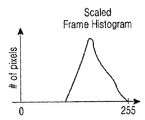
- FIGURES 2A and 2B illustrate display adaptation preserving brightness using display adaptation information embedded within SEI messages for dynamic, content-based display adaptation and corresponding power reduction according to one embodiment of the present disclosure.
- the SEI message is parsed to extract the maximum pixel value used to scale up a current reconstructed frame by (255/max_pixel_value).
- p(i) indicate the original brightness of an i-th pixel value (in raster scan order) in a histogram of pixel brightness for a reconstructed frame as illustrated in FIGURE 2A
- the scaled pixel brightness pnew(i) for that pixel in the scaled frame histogram illustrated in FIGURE 2B is (for 8-bit pixel brightness values):
- a lower brightness backlighting for LCD displays
- a lower supply voltage for OLED displays
- the scaled value may be set at the ratio (max_pixel_value/255)*100%. That is, the scaled backlighting brightness bnew is:
- Vnew V/Y, (3)
- V is the original supply voltage.
- the maximum pixel value may be further altered to allow some pixel distortion (i.e., saturated after scaling), but without any perceptual difference, i.e.,
- max_pixel_value (1-distortion_percentage)*max_pixel_value. (4)
- the parameter min_pixel_value may be similarly employed, together with max_pixel_value, for adaptation when scaling in CONTRAST_PRESERVED mode.
- the range between maximum and minimum pixel brightness may both be adjusted to maintain contrast.
- the range between maximum and minimum pixel brightness and the distribution of pixel brightness may all be adjusted. While linear scaling of backlight brightness and supply voltage are assumed above, in actual implementations the scaling could be non-linear. Either linear or non-linear adjustment may be implemented through a look-up table, which may be constructed by measuring the display power at different levels of the backlight brightness or supply voltage.
- FIGURES 3A and 3B illustrate SEI message insertion within a video data bitstream for dynamic, content-based display adaptation and corresponding power reduction according to one embodiment of the present disclosure.
- FIGURE 3A illustrates frame-based SEI message insertion
- FIGURE 3B illustrates GOP-based SEI message insertion. Similar insertion schemes may be employed for scene-based or time interval-based SEI message insertion.
- pixel brightness scaling and backlighting brightness reduction as described above may be implemented separately for the pixel and backlighting brightness of each of the RGB colors individually.
- pixel brightness scaling and supply voltage reduction as described above may be implemented separately for each RGB color. In that manner, different color components may be individually adapted.
- FIGURE 4 is a high level flow diagram for a process of encoding video using SEI message insertion for dynamic, content-based display adaptation and corresponding power reduction according to one embodiment of the present disclosure.
- the process is performed by the encoder controller within encoder 101.
- the same process may be employed for encoding video regardless of whether intended for delivery to a device supporting display adaptation, since devices not supporting display adaptation may simply ignore display adaptation information embedded in the SEI messages.
- the process 400 begins with receiving pixel data for a frame, GOP, scene or time interval segment of the video being encoded (step 401).
- the histogram of pixel brightness is determined for the video data of the segment being processed (step 402), including determination of at least max_pixel_value, and optionally also min_pixel_value and pixel_hist_stepsize.
- An SEI message is generated for the segment of video data being processed (step 403), with the scaling method and appropriate parameters included. The SEI message is then inserted into the payload stream in association with the corresponding segment data, and the encoded video data is transmitted (step 404). If the video encoding is incomplete (step 405), another iteration of the process is performed for the pixel data for the next frame, GOP, scene or time interval segment of the video being encoded.
- FIGURE 5 is a high level flow diagram for a process of video decoding and display based on SEI messages inserted for dynamic, content-based display adaptation and corresponding power reduction according to one embodiment of the present disclosure.
- the process is performed by user equipment 105.
- the process 500 begins with receiving an SEI message and associated payload for a frame, GOP, scene or time interval segment of the video being decoded (step 501).
- the scaling method and parameter(s) are extracted from the SEI message (step 502), and the pixel brightness and the supply voltage is adapted (for an OLED display) or the pixel and backlighting brightness are adapted (for an LCD display) based on the scaling method and parameter(s) (step 503).
- the video content decoded from the payload for the corresponding frame, GOP, scene or time interval segment is displayed with the adapted display settings (step 504). If the video decoding is incomplete (step 505), another iteration of the process is performed for the next frame, GOP, scene or time interval segment of the video being decoded.
- Display adaptation using an SEI message based on a brightness preserved algorithm is exemplified in the above disclosure.
- Such an algorithm requires the maximum pixel value to remain the same as in the embedded information.
- the principles disclosed are not limited to only such implementation.
- any information derived from the video encoder may be embedded as part of the SEI message to help the display adaptation, such as both minimum and maximum pixel brightness values, or even the histogram distribution.
- the present disclosure will make products, such as smartphones and tablets, much more power efficient while reducing the data cost, thus improving the user experience for mobile streaming applications.
Landscapes
- Engineering & Computer Science (AREA)
- Multimedia (AREA)
- Signal Processing (AREA)
- Theoretical Computer Science (AREA)
- Physics & Mathematics (AREA)
- General Engineering & Computer Science (AREA)
- General Physics & Mathematics (AREA)
- Human Computer Interaction (AREA)
- Software Systems (AREA)
- Computer Hardware Design (AREA)
- Control Of Indicators Other Than Cathode Ray Tubes (AREA)
- Electroluminescent Light Sources (AREA)
- Control Of El Displays (AREA)
- Liquid Crystal Display Device Control (AREA)
Abstract
Priority Applications (3)
| Application Number | Priority Date | Filing Date | Title |
|---|---|---|---|
| EP13778254.6A EP2839456A4 (fr) | 2012-04-20 | 2013-04-19 | Réduction de puissance d'afficheur au moyen d'informations sei |
| CN201380020811.1A CN104246866A (zh) | 2012-04-20 | 2013-04-19 | 利用辅助增强信息的显示功率降低 |
| JP2015506908A JP2015520406A (ja) | 2012-04-20 | 2013-04-19 | Sei情報を用いたディスプレイ電力低減 |
Applications Claiming Priority (8)
| Application Number | Priority Date | Filing Date | Title |
|---|---|---|---|
| US201261636543P | 2012-04-20 | 2012-04-20 | |
| US201261636561P | 2012-04-20 | 2012-04-20 | |
| US201261636549P | 2012-04-20 | 2012-04-20 | |
| US61/636,543 | 2012-04-20 | ||
| US61/636,549 | 2012-04-20 | ||
| US61/636,561 | 2012-04-20 | ||
| US13/793,576 | 2013-03-11 | ||
| US13/793,576 US20140253601A1 (en) | 2013-03-11 | 2013-03-11 | Display power reduction using sei information |
Publications (1)
| Publication Number | Publication Date |
|---|---|
| WO2013157895A1 true WO2013157895A1 (fr) | 2013-10-24 |
Family
ID=49383766
Family Applications (1)
| Application Number | Title | Priority Date | Filing Date |
|---|---|---|---|
| PCT/KR2013/003363 Ceased WO2013157895A1 (fr) | 2012-04-20 | 2013-04-19 | Réduction de puissance d'afficheur au moyen d'informations sei |
Country Status (4)
| Country | Link |
|---|---|
| EP (1) | EP2839456A4 (fr) |
| JP (1) | JP2015520406A (fr) |
| CN (1) | CN104246866A (fr) |
| WO (1) | WO2013157895A1 (fr) |
Cited By (4)
| Publication number | Priority date | Publication date | Assignee | Title |
|---|---|---|---|---|
| WO2016200576A1 (fr) * | 2015-06-09 | 2016-12-15 | Technicolor Usa, Inc. | Procédé, appareil, et système de rendu de contenu |
| EP3025213A4 (fr) * | 2013-07-24 | 2017-03-22 | Samsung Electronics Co., Ltd. | Réduction de puissance d'affichage à l'aide de métadonnées d'histogramme |
| EP3123735A4 (fr) * | 2014-03-26 | 2017-11-15 | Samsung Electronics Co., Ltd. | Stockage et transport de métadonnées vertes pour adaptation d'affichage |
| CN107436673A (zh) * | 2016-05-25 | 2017-12-05 | 韩国电子通信研究院 | 用于提供视频的方法和系统 |
Families Citing this family (2)
| Publication number | Priority date | Publication date | Assignee | Title |
|---|---|---|---|---|
| US12236902B2 (en) * | 2020-04-02 | 2025-02-25 | Dolby Laboratories Licensing Corporation | Metadata-based power management |
| TWI864660B (zh) * | 2023-03-30 | 2024-12-01 | 宏碁股份有限公司 | 顯示器功率消耗與色彩最佳化方法及應用其之電子裝置與顯示器 |
Citations (5)
| Publication number | Priority date | Publication date | Assignee | Title |
|---|---|---|---|---|
| WO2007043746A1 (fr) * | 2005-10-11 | 2007-04-19 | Samsung Electronics Co., Ltd. | Procede et appareil de codage de contenus multimedia et procede et systeme d'application des contenus multimedia codes |
| US20080218585A1 (en) * | 2007-03-09 | 2008-09-11 | Polycom, Inc | Appearance matching for videoconferencing |
| US20080253456A1 (en) * | 2004-09-16 | 2008-10-16 | Peng Yin | Video Codec With Weighted Prediction Utilizing Local Brightness Variation |
| US20090002565A1 (en) * | 2007-06-26 | 2009-01-01 | Apple Inc. | Dynamic backlight adaptation for black bars with subtitles |
| US20090265603A1 (en) * | 2008-04-21 | 2009-10-22 | Samsung Electronics Co., Ltd. | Apparatus and method for composing scenes using rich media contents |
Family Cites Families (7)
| Publication number | Priority date | Publication date | Assignee | Title |
|---|---|---|---|---|
| US7873229B2 (en) * | 2006-02-08 | 2011-01-18 | Moxair, Inc. | Distributed processing for video enhancement and display power management |
| WO2009126124A1 (fr) * | 2008-04-09 | 2009-10-15 | Moxair, Inc. | Commande de rétroéclairage dynamique pour afficheurs vidéo |
| JP5611054B2 (ja) * | 2008-01-31 | 2014-10-22 | トムソン ライセンシングThomson Licensing | ルックデータの定義及び送信方法及びシステム |
| US20090226152A1 (en) * | 2008-03-10 | 2009-09-10 | Hanes Brett E | Method for media playback optimization |
| JP5343785B2 (ja) * | 2009-09-17 | 2013-11-13 | ソニー株式会社 | 画像信号処理装置、送信装置、画像信号処理方法、プログラム、および画像信号処理システム |
| EP2378508A1 (fr) * | 2010-04-15 | 2011-10-19 | Koninklijke Philips Electronics N.V. | Contrôle d'affichage pour affichage multiple primaire |
| US20110299604A1 (en) * | 2010-06-04 | 2011-12-08 | Apple Inc. | Method and apparatus for adaptive video sharpening |
-
2013
- 2013-04-19 WO PCT/KR2013/003363 patent/WO2013157895A1/fr not_active Ceased
- 2013-04-19 JP JP2015506908A patent/JP2015520406A/ja not_active Withdrawn
- 2013-04-19 EP EP13778254.6A patent/EP2839456A4/fr not_active Withdrawn
- 2013-04-19 CN CN201380020811.1A patent/CN104246866A/zh active Pending
Patent Citations (5)
| Publication number | Priority date | Publication date | Assignee | Title |
|---|---|---|---|---|
| US20080253456A1 (en) * | 2004-09-16 | 2008-10-16 | Peng Yin | Video Codec With Weighted Prediction Utilizing Local Brightness Variation |
| WO2007043746A1 (fr) * | 2005-10-11 | 2007-04-19 | Samsung Electronics Co., Ltd. | Procede et appareil de codage de contenus multimedia et procede et systeme d'application des contenus multimedia codes |
| US20080218585A1 (en) * | 2007-03-09 | 2008-09-11 | Polycom, Inc | Appearance matching for videoconferencing |
| US20090002565A1 (en) * | 2007-06-26 | 2009-01-01 | Apple Inc. | Dynamic backlight adaptation for black bars with subtitles |
| US20090265603A1 (en) * | 2008-04-21 | 2009-10-22 | Samsung Electronics Co., Ltd. | Apparatus and method for composing scenes using rich media contents |
Cited By (8)
| Publication number | Priority date | Publication date | Assignee | Title |
|---|---|---|---|---|
| EP3025213A4 (fr) * | 2013-07-24 | 2017-03-22 | Samsung Electronics Co., Ltd. | Réduction de puissance d'affichage à l'aide de métadonnées d'histogramme |
| US10165218B2 (en) | 2013-07-24 | 2018-12-25 | Samsung Electronics Co., Ltd. | Display power reduction using histogram metadata |
| EP3123735A4 (fr) * | 2014-03-26 | 2017-11-15 | Samsung Electronics Co., Ltd. | Stockage et transport de métadonnées vertes pour adaptation d'affichage |
| WO2016200576A1 (fr) * | 2015-06-09 | 2016-12-15 | Technicolor Usa, Inc. | Procédé, appareil, et système de rendu de contenu |
| CN107436673A (zh) * | 2016-05-25 | 2017-12-05 | 韩国电子通信研究院 | 用于提供视频的方法和系统 |
| EP3249937A3 (fr) * | 2016-05-25 | 2017-12-27 | Electronics and Telecommunications Research Institute | Procédé et système de fourniture de vidéo |
| US10187691B2 (en) | 2016-05-25 | 2019-01-22 | Electronics And Telecommunications Research Institute | Method and system for providing video |
| CN107436673B (zh) * | 2016-05-25 | 2020-04-14 | 韩国电子通信研究院 | 用于提供视频的方法和系统 |
Also Published As
| Publication number | Publication date |
|---|---|
| EP2839456A1 (fr) | 2015-02-25 |
| JP2015520406A (ja) | 2015-07-16 |
| CN104246866A (zh) | 2014-12-24 |
| EP2839456A4 (fr) | 2016-02-24 |
Similar Documents
| Publication | Publication Date | Title |
|---|---|---|
| WO2013157896A1 (fr) | Réduction de puissance d'affichage sans perte perceptible | |
| WO2013157895A1 (fr) | Réduction de puissance d'afficheur au moyen d'informations sei | |
| US10460699B2 (en) | Transitioning between video priority and graphics priority | |
| WO2016208939A1 (fr) | Procédé et appareil pour générer et transmettre des métadonnées de réalité virtuelle | |
| WO2015012609A1 (fr) | Réduction de puissance d'affichage à l'aide de métadonnées d'histogramme | |
| CN106791865A (zh) | 基于高动态范围视频的自适应格式转换的方法 | |
| US20140253601A1 (en) | Display power reduction using sei information | |
| KR20150002440A (ko) | 영상처리장치 및 영상처리방법 | |
| WO2016047912A1 (fr) | Appareil d'affichage, procédé de commande associé et procédé de transmission de données d'appareil d'affichage | |
| WO2015167313A1 (fr) | Procédé et dispositif de compression adaptative de données d'image | |
| WO2012144815A2 (fr) | Appareil et procédé permettant d'ajuster une résolution d'une application dans un terminal sans fil | |
| US20170064156A1 (en) | Method for generating a bitstream relative to image/video signal, bitstream carrying specific information data and method for obtaining such specific information | |
| EP4637162A1 (fr) | Réduction d'énergie de contenu visuel basée sur une carte d'atténuation à l'aide de métadonnées mpeg vertes interactives | |
| EP4637148A1 (fr) | Procédé et dispositif de codage et de décodage de carte d'atténuation pour des images sensibles à l'énergie | |
| EP4637165A1 (fr) | Procédé et dispositif de réduction d'énergie de contenu visuel sur la base d'une atténuation par pixel | |
| EP4736442A1 (fr) | Réduction d'énergie de contenu visuel basée sur une carte d'atténuation au moyen de métadonnées mpeg vertes interactives | |
| KR20250121583A (ko) | 에너지 인식 이미지에 대한 감쇠 맵을 인코딩 및 디코딩하는 방법 및 디바이스 | |
| KR20250171385A (ko) | 에너지 인식 이미지에 대한 그린 mpeg에 기초한 감쇠 맵을 인코딩 및 디코딩하기 위한 방법 및 디바이스 | |
| WO2024213421A1 (fr) | Procédé et dispositif de réduction d'énergie de contenu visuel sur la base d'une carte d'atténuation à l'aide d'une adaptation d'affichage mpeg | |
| US20200365098A1 (en) | Packing of subpixel rendered data for display stream compression |
Legal Events
| Date | Code | Title | Description |
|---|---|---|---|
| 121 | Ep: the epo has been informed by wipo that ep was designated in this application |
Ref document number: 13778254 Country of ref document: EP Kind code of ref document: A1 |
|
| ENP | Entry into the national phase |
Ref document number: 2015506908 Country of ref document: JP Kind code of ref document: A |
|
| NENP | Non-entry into the national phase |
Ref country code: DE |
|
| REEP | Request for entry into the european phase |
Ref document number: 2013778254 Country of ref document: EP |
|
| WWE | Wipo information: entry into national phase |
Ref document number: 2013778254 Country of ref document: EP |