WO2013161433A1 - 芳香族ポリカーボネート系複合樹脂組成物及び成形品 - Google Patents
芳香族ポリカーボネート系複合樹脂組成物及び成形品 Download PDFInfo
- Publication number
- WO2013161433A1 WO2013161433A1 PCT/JP2013/057377 JP2013057377W WO2013161433A1 WO 2013161433 A1 WO2013161433 A1 WO 2013161433A1 JP 2013057377 W JP2013057377 W JP 2013057377W WO 2013161433 A1 WO2013161433 A1 WO 2013161433A1
- Authority
- WO
- WIPO (PCT)
- Prior art keywords
- aromatic polycarbonate
- resin composition
- mass
- acid
- parts
- Prior art date
- Legal status (The legal status is an assumption and is not a legal conclusion. Google has not performed a legal analysis and makes no representation as to the accuracy of the status listed.)
- Ceased
Links
Classifications
-
- C—CHEMISTRY; METALLURGY
- C08—ORGANIC MACROMOLECULAR COMPOUNDS; THEIR PREPARATION OR CHEMICAL WORKING-UP; COMPOSITIONS BASED THEREON
- C08L—COMPOSITIONS OF MACROMOLECULAR COMPOUNDS
- C08L69/00—Compositions of polycarbonates; Compositions of derivatives of polycarbonates
-
- C—CHEMISTRY; METALLURGY
- C08—ORGANIC MACROMOLECULAR COMPOUNDS; THEIR PREPARATION OR CHEMICAL WORKING-UP; COMPOSITIONS BASED THEREON
- C08L—COMPOSITIONS OF MACROMOLECULAR COMPOUNDS
- C08L51/00—Compositions of graft polymers in which the grafted component is obtained by reactions only involving carbon-to-carbon unsaturated bonds; Compositions of derivatives of such polymers
- C08L51/04—Compositions of graft polymers in which the grafted component is obtained by reactions only involving carbon-to-carbon unsaturated bonds; Compositions of derivatives of such polymers grafted on to rubbers
-
- C—CHEMISTRY; METALLURGY
- C08—ORGANIC MACROMOLECULAR COMPOUNDS; THEIR PREPARATION OR CHEMICAL WORKING-UP; COMPOSITIONS BASED THEREON
- C08L—COMPOSITIONS OF MACROMOLECULAR COMPOUNDS
- C08L67/00—Compositions of polyesters obtained by reactions forming a carboxylic ester link in the main chain; Compositions of derivatives of such polymers
- C08L67/02—Polyesters derived from dicarboxylic acids and dihydroxy compounds
-
- B—PERFORMING OPERATIONS; TRANSPORTING
- B29—WORKING OF PLASTICS; WORKING OF SUBSTANCES IN A PLASTIC STATE IN GENERAL
- B29C—SHAPING OR JOINING OF PLASTICS; SHAPING OF MATERIAL IN A PLASTIC STATE, NOT OTHERWISE PROVIDED FOR; AFTER-TREATMENT OF THE SHAPED PRODUCTS, e.g. REPAIRING
- B29C45/00—Injection moulding, i.e. forcing the required volume of moulding material through a nozzle into a closed mould; Apparatus therefor
- B29C45/0001—Injection moulding, i.e. forcing the required volume of moulding material through a nozzle into a closed mould; Apparatus therefor characterised by the choice of material
-
- C—CHEMISTRY; METALLURGY
- C08—ORGANIC MACROMOLECULAR COMPOUNDS; THEIR PREPARATION OR CHEMICAL WORKING-UP; COMPOSITIONS BASED THEREON
- C08K—Use of inorganic or non-macromolecular organic substances as compounding ingredients
- C08K3/00—Use of inorganic substances as compounding ingredients
- C08K3/34—Silicon-containing compounds
-
- C—CHEMISTRY; METALLURGY
- C08—ORGANIC MACROMOLECULAR COMPOUNDS; THEIR PREPARATION OR CHEMICAL WORKING-UP; COMPOSITIONS BASED THEREON
- C08K—Use of inorganic or non-macromolecular organic substances as compounding ingredients
- C08K5/00—Use of organic ingredients
- C08K5/49—Phosphorus-containing compounds
- C08K5/51—Phosphorus bound to oxygen
- C08K5/52—Phosphorus bound to oxygen only
- C08K5/521—Esters of phosphoric acids, e.g. of H3PO4
-
- C—CHEMISTRY; METALLURGY
- C08—ORGANIC MACROMOLECULAR COMPOUNDS; THEIR PREPARATION OR CHEMICAL WORKING-UP; COMPOSITIONS BASED THEREON
- C08L—COMPOSITIONS OF MACROMOLECULAR COMPOUNDS
- C08L2201/00—Properties
- C08L2201/02—Flame or fire retardant/resistant
-
- C—CHEMISTRY; METALLURGY
- C08—ORGANIC MACROMOLECULAR COMPOUNDS; THEIR PREPARATION OR CHEMICAL WORKING-UP; COMPOSITIONS BASED THEREON
- C08L—COMPOSITIONS OF MACROMOLECULAR COMPOUNDS
- C08L2205/00—Polymer mixtures characterised by other features
- C08L2205/03—Polymer mixtures characterised by other features containing three or more polymers in a blend
-
- Y—GENERAL TAGGING OF NEW TECHNOLOGICAL DEVELOPMENTS; GENERAL TAGGING OF CROSS-SECTIONAL TECHNOLOGIES SPANNING OVER SEVERAL SECTIONS OF THE IPC; TECHNICAL SUBJECTS COVERED BY FORMER USPC CROSS-REFERENCE ART COLLECTIONS [XRACs] AND DIGESTS
- Y10—TECHNICAL SUBJECTS COVERED BY FORMER USPC
- Y10T—TECHNICAL SUBJECTS COVERED BY FORMER US CLASSIFICATION
- Y10T428/00—Stock material or miscellaneous articles
- Y10T428/13—Hollow or container type article [e.g., tube, vase, etc.]
- Y10T428/1352—Polymer or resin containing [i.e., natural or synthetic]
- Y10T428/1397—Single layer [continuous layer]
Definitions
- the present invention relates to an aromatic polycarbonate-based composite resin composition, and in particular, an aromatic polycarbonate-based composite resin that is excellent in impact resistance, heat resistance, moldability, chemical resistance, and suitable as a molding material for mobile terminal housings.
- the present invention relates to a composition and a molded article formed by molding this aromatic polycarbonate composite resin composition.
- Aromatic polycarbonate resin has excellent impact resistance, heat resistance, rigidity, dimensional stability, etc., and is therefore used in a wide range of applications such as electrical equipment, communication equipment, precision machinery, and automotive parts.
- Patent Document 1 discloses high chemical resistance while maintaining good fluidity.
- an aromatic polycarbonate having a viscosity average molecular weight of 16,000 to 23,000, and a logarithmic viscosity value (IV value) of 0.45 to 0.00.
- a thermoplastic resin composition including a polyethylene terephthalate resin having a terminal dl of 57 dl / g and a terminal carboxyl group content of 20 to 35 eq / ton and a rubbery polymer has been proposed.
- Patent Document 2 includes an aromatic polycarbonate resin, a polybutylene terephthalate resin, and a rubbery polymer as a material having excellent balance of fluidity, rigidity, heat resistance, impact resistance, chemical resistance, and fatigue characteristics.
- An aromatic polycarbonate resin composition having a titanium compound content in a polybutylene terephthalate resin of more than 1 ppm and 75 ppm or less and a terminal carboxyl group concentration of 39 ⁇ eq / g or less has been proposed.
- thermoplastic resin composition as a molding material for a portable terminal casing.
- Formability that is excellent in fluidity and can be molded with high accuracy even in a thin and complex housing.
- moldability a short molding cycle is also required to improve productivity.
- Impact resistance that does not break even when dropped during handling. With respect to this impact resistance, not only the normal temperature but also the impact resistance in a low temperature environment in winter or in a cold region is required.
- Chemical resistance that does not deteriorate even when cosmetics, detergents, chemicals, etc. are attached.
- Durability to the surrounding environment during use High heat resistance especially in high-temperature conditions in midsummer (for example, in a passenger compartment parked under hot weather). Heat resistance is also required for durability against baking during painting. In addition, regarding this heat resistance, it is required to exhibit a sufficiently high heat resistance (this heat resistance is referred to as “residence heat resistance” in this specification) even when subjected to a heat history for a long time during molding.
- Patent Documents 1 and 2 describe that the resin composition can be used in the OA equipment field, the electronic / electrical equipment field, etc., but satisfy all the characteristics required for the molding material of the mobile terminal casing as described above. However, the required properties were not satisfied with respect to impact resistance, particularly low temperature impact resistance, and heat resistance, particularly residence heat resistance.
- the present invention solves the above-mentioned conventional problems, is excellent in impact resistance, heat resistance, moldability, chemical resistance, particularly excellent in low temperature impact resistance and retention heat resistance, and is used as a molding material for portable terminal housings, etc. It is an object of the present invention to provide an aromatic polycarbonate composite resin composition that can be suitably used as a molded article and a molded product formed by molding the aromatic polycarbonate composite resin composition.
- the present inventor for the resin component consisting of an aromatic polycarbonate resin and a polyester resin, a graft copolymer having a specific sulfur content and an average particle diameter, It has been found that the above problem can be solved by blending a specific stabilizer in a predetermined ratio.
- the present invention has been achieved on the basis of such knowledge, and the gist thereof is as follows.
- a (meth) acrylic acid ester compound is added to a diene rubber with respect to 100 parts by mass of a resin component composed of 60 to 90 parts by mass of an aromatic polycarbonate resin (A) and 10 to 40 parts by mass of a polyester resin (B).
- An aromatic polycarbonate based composite resin composition containing 3 to 20 parts by weight of a graft copolymer (C) obtained by graft polymerization and 0.005 to 0.1 parts by weight of a stabilizer (D),
- the graft copolymer (C) has (i) a sulfur content of 100 to 1500 ppm, (ii) an average particle size of 70 to 240 nm, and the stabilizer (D) is represented by the following general formula (I):
- An aromatic polycarbonate composite resin composition which is an organic phosphate compound.
- O P (OH) m (OR) 3-m (I)
- R is an alkyl group or an aryl group, which may be the same or different.
- M is an integer of 0 to 2.
- the graft copolymer (C) is a core / shell graft copolymer having a diene rubber as a core and a (meth) acrylate compound as a shell.
- An aromatic polycarbonate composite resin composition characterized by being a coalescence.
- the aromatic polycarbonate-based composite resin composition of the present invention is excellent in impact resistance, heat resistance, moldability, chemical resistance, particularly excellent in low temperature impact resistance and retention heat resistance, molding materials for portable terminal cases, etc. Can be suitably used.
- the aromatic polycarbonate-based composite resin composition of the present invention is not limited to a portable terminal case due to its excellent impact resistance, heat resistance, moldability, and chemical resistance, and various electrical / electronic equipment components, OA equipment,
- the present invention can also be applied to various other uses such as machine parts, vehicle parts, building members, various containers, leisure goods and miscellaneous goods.
- the aromatic polycarbonate composite resin composition of the present invention is a diene based on 100 parts by mass of a resin component comprising 60 to 90 parts by mass of an aromatic polycarbonate resin (A) and 10 to 40 parts by mass of a polyester resin (B).
- the molded article of the present invention is formed by molding the aromatic polycarbonate composite resin composition of the present invention, and is particularly suitable as a portable terminal casing.
- the aromatic polycarbonate resin (A) is an aromatic polycarbonate polymer which may be branched, obtained by reacting an aromatic hydroxy compound with a phosgene or carbonic acid diester.
- the method for producing the aromatic polycarbonate resin is not particularly limited, and may be a conventional method such as a phosgene method (interfacial polymerization method) or a melting method (transesterification method). Further, it may be an aromatic polycarbonate resin produced by a melting method and produced by adjusting the amount of terminal OH groups.
- polyhydric phenols having three or more hydroxy groups in the molecule such as 1,1,1-tris (4-hydroxylphenyl) ethane (THPE), 1,3,5-tris (4-hydroxyphenyl) benzene Etc. can be used together in small amounts as a branching agent.
- THPE 1,1,1-tris (4-hydroxylphenyl) ethane
- 1,3,5-tris (4-hydroxyphenyl) benzene Etc. can be used together in small amounts as a branching agent.
- 2,2-bis (4-hydroxyphenyl) propane (bisphenol A) is preferable.
- bisphenol A 2,2-bis (4-hydroxyphenyl) propane
- These aromatic dihydroxy compounds can be used alone or in admixture of two or more.
- carbonic acid diester is used as a monomer instead of phosgene.
- Representative examples of the carbonic acid diester include substituted diaryl carbonates typified by diphenyl carbonate and ditolyl carbonate, and dialkyl carbonates typified by dimethyl carbonate, diethyl carbonate, di-tert-butyl carbonate and the like. These carbonic acid diesters can be used alone or in admixture of two or more. Among these, diphenyl carbonate and substituted diphenyl carbonate are preferable.
- the carbonic acid diester may be substituted with dicarboxylic acid or dicarboxylic acid ester in an amount of preferably 50 mol% or less, more preferably 30 mol% or less.
- Representative dicarboxylic acids or dicarboxylic acid esters include terephthalic acid, isophthalic acid, diphenyl terephthalate, and diphenyl isophthalate. When substituted with such a dicarboxylic acid or dicarboxylic acid ester, a polyester carbonate is obtained.
- a catalyst When producing an aromatic polycarbonate by a transesterification method, a catalyst is usually used.
- the catalyst type is not limited, but generally, basic compounds such as alkali metal compounds, alkaline earth metal compounds, basic boron compounds, basic phosphorus compounds, basic ammonium compounds, and amine compounds are used. Of these, alkali metal compounds and / or alkaline earth metal compounds are particularly preferred. These may be used alone or in combination of two or more.
- the polymerization catalyst is generally deactivated with p-toluenesulfonic acid ester or the like.
- the aromatic polycarbonate resin (A) is preferably an aromatic polycarbonate resin derived from 2,2-bis (4-hydroxyphenyl) propane or 2,2-bis (4-hydroxyphenyl) propane and other aromatics. Aromatic polycarbonate resins derived from dihydroxy compounds. Further, for the purpose of imparting flame retardancy and the like, a polymer or oligomer having a siloxane structure can be copolymerized.
- the aromatic polycarbonate resin (A) may be a mixture of two or more polymers and / or copolymers having different raw materials, and may contain a branched structure in a range of 0.5 mol% or less.
- the terminal hydroxyl group content of the aromatic polycarbonate resin (A) greatly affects the thermal stability, hydrolysis stability, color tone, etc. of the molded product.
- the terminal hydroxyl group content of the aromatic polycarbonate resin (A) is usually 30 to 2000 ppm, preferably 100 to 1500 ppm, and more preferably 200 to 1000 ppm.
- the capping terminator for adjusting the terminal hydroxyl group content p-tert-butylphenol, phenol, cumylphenol, p-long chain alkyl-substituted phenol and the like can be used.
- the aromatic dihydroxy compound is 150 ppm or less, preferably 100 ppm or less, and more preferably 50 ppm or less.
- the residual amount of carbonic acid diester is 300 ppm or less, preferably 200 ppm or less, more preferably 150 ppm or less.
- the molecular weight of the aromatic polycarbonate resin (A) is not particularly limited, but it is a viscosity average molecular weight converted from the solution viscosity measured at a temperature of 20 ° C. using methylene chloride as a solvent, preferably 10,000 to 50,000. It is in the range, more preferably in the range of 11,000 to 40,000, particularly preferably in the range of 12,000 to 30,000.
- the viscosity average molecular weight is set to 10,000 or more, the mechanical properties are more effectively exhibited, and by setting the viscosity average molecular weight to 50,000 or less, the molding process becomes easier.
- aromatic polycarbonate resin (A) used in the present invention may be used by mixing two or more aromatic polycarbonate resins having different viscosity average molecular weights, and the aromatic polycarbonate whose viscosity average molecular weight is outside the above preferred range. You may mix and use resin within the range of the said molecular weight.
- polyester resin (B) As the polyester resin (B) used in the aromatic polycarbonate composite resin composition of the present invention, any conventionally known polyester resin can be used, and among them, the aromatic polyester resin is preferable.
- the aromatic polyester resin refers to a polyester resin having an aromatic ring in a polymer chain unit, and includes, for example, an aromatic dicarboxylic acid component and a diol (and / or its ester or halide) component as main components. These are polymers or copolymers obtained by polycondensation of these.
- aromatic dicarboxylic acid component examples include phthalic acid, terephthalic acid, isophthalic acid, orthophthalic acid, 1,5-naphthalenedicarboxylic acid, 2,5-naphthalenedicarboxylic acid, 2,6-naphthalenedicarboxylic acid, biphenyl-2, 2'-dicarboxylic acid, biphenyl-3,3'-dicarboxylic acid, biphenyl-4,4'-dicarboxylic acid, diphenyl ether-4,4'-dicarboxylic acid, diphenylmethane-4,4'-dicarboxylic acid, diphenylsulfone-4 , 4′-dicarboxylic acid, diphenylisopropylidene-4,4′-dicarboxylic acid, anthracene-2,5-dicarboxylic acid, anthracene-2,6-dicarboxylic acid, p-terphenylene-4,4′-dicarboxylic acid,
- aromatic dicarboxylic acid components may be used alone or in combination of two or more in any proportion, and among these aromatic dicarboxylic acids, terephthalic acid is preferred. As long as the effects of the present invention are not impaired, an alicyclic dicarboxylic acid such as adipic acid, pimelic acid, suberic acid, azelaic acid, dodecanedioic acid, sebacic acid, dimer acid or the like is used in combination with these aromatic dicarboxylic acids. May be.
- diol component examples include aliphatic glycols, polyoxyalkylene glycols, alicyclic diols, aromatic diols, and the like.
- Aliphatic glycols include, for example, ethylene glycol, trimethylene glycol, propylene glycol, 1,4-butanediol, 1,3-butanediol, neopentyl glycol, hexanediol, octanediol, decanediol, etc.
- aliphatic glycols having 2 to 12 carbon atoms, particularly 2 to 10 carbon atoms are preferable.
- polyoxyalkylene glycols examples include glycols having an alkylene group having 2 to 4 carbon atoms and a plurality of oxyalkylene units such as diethylene glycol, dipropylene glycol, ditetramethylene glycol, triethylene glycol, tripropylene glycol, Examples include tritetramethylene glycol.
- Examples of the alicyclic diols include 1,4-cyclohexanediol, 1,4-cyclohexanedimethylol, hydrogenated bisphenol A, and the like.
- Examples of aromatic diols include 2,2-bis- (4- (2-hydroxyethoxy) phenyl) propane and xylylene glycol.
- diol components include esters of the diols described above, and halogenated diols such as halides such as adducts of tetrabromobisphenol A and alkylene oxides (such as ethylene oxide and propylene oxide) of tetrabromobisphenol A.
- halogenated diols such as halides such as adducts of tetrabromobisphenol A and alkylene oxides (such as ethylene oxide and propylene oxide) of tetrabromobisphenol A.
- diol components may be used alone or in combination of two or more in any proportion. If the amount is small, long chain diols having a molecular weight of 400 to 6000, such as polyethylene glycol, poly-1,3-propylene glycol, polytetramethylene glycol, etc. may be used.
- polyalkylene terephthalate As the aromatic polyester resin used in the present invention, polyalkylene terephthalate is preferable.
- the polyalkylene terephthalate refers to a resin containing an alkylene terephthalate structural unit, and may be a copolymer of an alkylene terephthalate structural unit and another structural unit.
- polyalkylene terephthalate examples include polybutylene terephthalate (PBT), polyethylene terephthalate (PET), polypropylene terephthalate, polyethylene naphthalate (PEN), polybutylene naphthalate (PBN), and poly (cyclohexane-1,4).
- PBT polybutylene terephthalate
- PET polyethylene terephthalate
- PEN polypropylene terephthalate
- PEN polyethylene naphthalate
- PBN polybutylene naphthalate
- poly (cyclohexane-1,4) examples include polybutylene terephthalate (PBT), polyethylene terephthalate (PET), polypropylene terephthalate, polyethylene naphthalate (PEN), polybutylene naphthalate (PBN), and poly (cyclohexane-1,4).
- -Dimethylene-terephthalate polytrimethylene terephthalate and the like.
- the polyalkylene terephthalate used in the present invention includes an alkylene terephthalate copolymer having an alkylene terephthalate structural unit as a main structural unit, and a polyalkylene terephthalate mixture having polyalkylene terephthalate as a main component.
- alkylene terephthalate copolymer having an alkylene terephthalate structural unit as a main structural unit
- polyalkylene terephthalate mixture having polyalkylene terephthalate as a main component.
- PTMG polyoxytetramethylene glycol
- alkylene terephthalate copolyester examples include a copolyester composed of two or more diol components and terephthalic acid, and a copolyester composed of a diol component, terephthalic acid, and a dicarboxylic acid other than terephthalic acid.
- diol components when two or more kinds of diol components are used, they may be selected and determined as appropriate from the above-mentioned diol components, but the monomer unit copolymerized with alkylene terephthalate which is the main constituent unit is within 25% by mass. It is preferable because the heat resistance becomes good.
- ethylene glycol / isophthalic acid / terephthalic acid copolymer (isophthalic acid copolymerized polyethylene terephthalate), 1,4-butanediol / isophthalic acid / terephthalic acid copolymer (isophthalic acid copolymerized polybutylene terephthalate),
- 1,4-butanediol / isophthalic acid / decanedicarboxylic acid copolymer and the like can be mentioned.
- alkylene terephthalate copolyester is preferred.
- polyester resin (B) used in the present invention when an alkylene terephthalate copolyester is used, the above-mentioned isophthalic acid copolymerized polybutylene terephthalate, isophthalic acid copolymerized polyethylene terephthalate, and the like are preferable. From the viewpoint of properties, those having an isophthalic acid component within 25% by mass are preferred.
- polyester resin (B) it is particularly preferable to use polybutylene terephthalate.
- polybutylene terephthalate refers to a resin having a structure in which a terephthalic acid unit and a 1,4-butanediol unit are ester-bonded.
- polybutylene terephthalate in which 50 mol% or more of dicarboxylic acid units are terephthalic acid units and 50 mol% or more of diol components are 1,4-butanediol units.
- the proportion of terephthalic acid units in all dicarboxylic acid units is preferably 70 mol% or more, more preferably 80 mol% or more, particularly preferably 95 mol% or more, and optimally 98 mol% or more.
- the proportion of 1,4-butanediol units in all diol units is preferably 70 mol% or more, more preferably 80 mol% or more, particularly preferably 95 mol% or more, and optimally 98 mol% or more.
- polybutylene terephthalate may contain dicarboxylic acid units other than terephthalic acid.
- dicarboxylic acids other than terephthalic acid such as phthalic acid, isophthalic acid, 4,4′-diphenyldicarboxylic acid, 4,4′-diphenylether dicarboxylic acid, 4,4′-benzophenone dicarboxylic acid, 4, Aromatic dicarboxylic acids such as 4′-diphenoxyethanedicarboxylic acid, 4,4′-diphenylsulfone dicarboxylic acid, 2,6-naphthalenedicarboxylic acid; 1,2-cyclohexanedicarboxylic acid, 1,3-cyclohexanedicarboxylic acid, 1 Alicyclic dicarboxylic acids such as 1,4-cyclohexanedicarboxylic acid; aliphatic dicarboxylic acids such as malonic acid, succinic acid, glutaric acid
- dicarboxylic acid units can be introduced into the polymer skeleton by using a dicarboxylic acid or a dicarboxylic acid derivative such as a dicarboxylic acid ester or a dicarboxylic acid halide as a raw material.
- polybutylene terephthalate may contain a diol unit other than 1,4-butanediol.
- Diols other than 1,4-butanediol are not particularly limited.
- the polybutylene terephthalate further contains hydroxycarboxylic acids such as lactic acid, glycolic acid, m-hydroxybenzoic acid, p-hydroxybenzoic acid, 6-hydroxy-2-naphthalenecarboxylic acid, p- ⁇ -hydroxyethoxybenzoic acid; Monofunctional compounds such as acid, stearyl alcohol, benzyl alcohol, stearic acid, benzoic acid, t-butylbenzoic acid, benzoylbenzoic acid; tricarbaric acid, trimellitic acid, trimesic acid, pyromellitic acid, gallic acid, trimethylolethane , Trimethylolpropane, glycerol, pentaerythritol and the like trifunctional or higher polyfunctional compounds; and the like.
- hydroxycarboxylic acids such as lactic acid, glycolic acid, m-hydroxybenzoic acid, p-hydroxybenzoic acid, 6-hydroxy-2-naphthalenecarboxylic acid,
- the intrinsic viscosity of polybutylene terephthalate is preferably 0.70 to 3.0 dl / g, more preferably 0.80 to 1.5 dl / g, and particularly preferably 0.80 to 1.2 dl / g. .
- two or more polybutylene terephthalates having different intrinsic viscosities may be used in combination.
- the terminal carboxyl group concentration of the polybutylene terephthalate used in the present invention is preferably 120 eq / Ton or less, more preferably 2 to 80 eq / Ton, and particularly preferably 5 to 60 eq / Ton.
- the terminal carboxyl group concentration can be obtained by dissolving polybutylene terephthalate in benzyl alcohol and titrating with an aqueous solution of 0.1N (mol / L) sodium hydroxide, and the above value is the carboxyl per 10 6 g. It is a group equivalent.
- Polyethylene terephthalate may be used as the polyester resin (B).
- the polyethylene terephthalate is a ratio of oxyethyleneoxyterephthaloyl units (hereinafter sometimes referred to as “ET units”) composed of terephthalic acid and ethylene glycol to all the structural repeating units (hereinafter referred to as “ET ratio”).
- the polyethylene terephthalate resin is preferably 90 equivalent% or more, and the polyethylene terephthalate in the present invention may contain constituent repeating units other than ET units in a range of less than 10 equivalent%.
- the polyethylene terephthalate in the present invention is produced using terephthalic acid or its lower alkyl ester and ethylene glycol as main raw materials, but other acid components and / or other glycol components may be used together as raw materials.
- Acid components other than terephthalic acid include phthalic acid, isophthalic acid, naphthalenedicarboxylic acid, 4,4'-diphenylsulfone dicarboxylic acid, 4,4'-biphenyldicarboxylic acid, 1,4-cyclohexanedicarboxylic acid, 1,3- Examples thereof include phenylenedioxydiacetic acid and structural isomers thereof, dicarboxylic acids such as malonic acid, succinic acid and adipic acid and derivatives thereof, and oxyacids such as p-hydroxybenzoic acid and glycolic acid or derivatives thereof.
- diol components other than ethylene glycol examples include 1,2-propanediol, 1,3-propanediol, 1,4-butanediol, aliphatic glycols such as pentamethylene glycol, hexamethylene glycol, and neopentyl glycol, cyclohexane Examples include alicyclic glycols such as dimethanol, and aromatic dihydroxy compound derivatives such as bisphenol A and bisphenol S.
- a raw material containing terephthalic acid or an ester-forming derivative thereof and ethylene glycol as described above is subjected to esterification or transesterification in the presence of an esterification catalyst or transesterification catalyst, and bis ( ⁇ -hydroxyethyl) terephthalate and Then, an oligomer thereof is formed, and then a melt polycondensation is performed under high temperature and reduced pressure in the presence of a polycondensation catalyst and a stabilizer to obtain a polymer.
- the esterification catalyst is not particularly required because terephthalic acid serves as an autocatalyst for the esterification reaction.
- the esterification reaction can be carried out in the presence of an esterification catalyst and a polycondensation catalyst described later, and can be carried out in the presence of a small amount of an inorganic acid or the like.
- the transesterification catalyst alkali metal salts such as sodium and lithium, alkaline earth metal salts such as magnesium and calcium, and metal compounds such as zinc and manganese are preferably used. Compounds are particularly preferred.
- the polycondensation catalyst compounds soluble in a reaction system such as a germanium compound, an antimony compound, a titanium compound, a cobalt compound, and a tin compound are used alone or in combination.
- germanium dioxide is particularly preferable from the viewpoints of color tone and transparency.
- These polycondensation catalysts may be used in combination with a stabilizer in order to suppress the decomposition reaction during polymerization.
- the stabilizer include phosphate esters such as trimethyl phosphate, triethyl phosphate and triphenyl phosphate, and triphenyl phosphate.
- Phosphites such as phyto, trisdodecyl phosphite, methyl acid phosphate, dibutyl phosphate, monobutyl phosphate acidic phosphate, phosphorous compounds such as phosphoric acid, phosphorous acid, hypophosphorous acid, polyphosphoric acid Or 2 or more types are preferable.
- the use ratio of the above catalyst is usually in the range of 1 to 2000 ppm, preferably 3 to 500 ppm as the weight of the metal in the total polymerization raw material, and the use ratio of the stabilizer is the stabilizer in the total polymerization raw material.
- the weight of the phosphorus atom is usually in the range of 10 to 1000 ppm, preferably 20 to 200 ppm.
- the catalyst and the stabilizer can be supplied at any stage of the esterification reaction or transesterification reaction in addition to the preparation of the raw slurry. Further, it can be supplied at the beginning of the polycondensation reaction step.
- the reaction temperature during the esterification reaction or transesterification reaction is usually 240 to 280 ° C., and the reaction pressure is usually 0.2 to 3 kg / cm 2 G (20 to 300 kPa) as a relative pressure to the atmosphere.
- the reaction temperature during polycondensation is usually 250 to 300 ° C., and the reaction pressure is usually 500 to 0.1 mmHg (67 to 0.013 kPa) as an absolute pressure.
- Such esterification or transesterification reaction and polycondensation reaction may be performed in one step or in multiple steps.
- the polyethylene terephthalate thus obtained has an intrinsic viscosity of usually 0.45 to 0.70 dl / g, and is chipped by a conventional method.
- the average particle diameter of this chip is usually in the range of 2.0 to 5.5 mm, preferably 2.2 to 4.0 mm.
- a polymer chip subjected to solid phase polymerization may be subjected to solid phase polymerization after preliminarily crystallizing by heating to a temperature lower than the temperature at which solid phase polymerization is performed in advance.
- Such precrystallization includes (a) a method in which a dry polymer chip is heated at a temperature of usually 120 to 200 ° C., preferably 130 to 180 ° C. for 1 minute to 4 hours, and (b) a dry polymer chip.
- a polymer chip that absorbs moisture and adjusts the humidity in a water, water vapor or water vapor-containing inert gas atmosphere Can usually be carried out by heating at a temperature of 120 to 200 ° C. for 1 minute or longer.
- the humidity control of the polymer chip is carried out so that the moisture content is usually in the range of 100 to 10000 ppm, preferably 1000 to 5000 ppm.
- the solid phase polymerization step consists of at least one stage, usually at a polymerization temperature of 190 to 230 ° C., preferably 195 to 225 ° C., usually 1 kg / cm 2 G to 10 mmHg (absolute pressure 200 to 1.3 kPa), preferably 0.
- the reaction is carried out under conditions of a polymerization pressure of 5 kg / cm 2 G to 100 mmHg (150 to 13 kPa as an absolute pressure) under an inert gas flow such as nitrogen, argon or carbon dioxide.
- the solid phase polymerization time may be shorter as the temperature is higher, but is usually 1 to 50 hours, preferably 5 to 30 hours, and more preferably 10 to 25 hours.
- the intrinsic viscosity of the polymer obtained by solid phase polymerization is usually in the range of 0.70 to 0.90 dl / g.
- the intrinsic viscosity of the polyethylene terephthalate used in the present invention may be appropriately selected and determined, but is usually 0.5 to 2 dl / g, particularly 0.6 to 1.5 dl / g, particularly 0.7 to 1.0 dl. / G is preferable.
- the intrinsic viscosity By setting the intrinsic viscosity to 0.5 dl / g or more, particularly 0.7 dl / g or more, the mechanical properties, residence heat stability, chemical resistance, and heat and humidity resistance in the resin composition (A) of the present invention are improved. It tends to improve and is preferable.
- the intrinsic viscosity is 2 dl / g or less, particularly 1.0 dl / g or less because the fluidity of the resin composition tends to be improved.
- the intrinsic viscosity of polyethylene terephthalate is a value measured at 30 ° C. using a mixed solvent of phenol / tetrachloroethane (weight ratio 1/1).
- the concentration of the terminal carboxyl group of the polyethylene terephthalate used in the present invention is usually 1 to 60 eq / Ton, preferably 3 to 50 eq / Ton, more preferably 5 to 40 eq / Ton.
- the terminal carboxyl group concentration is 60 eq / Ton or less, the mechanical properties of the resin composition tend to be improved.
- the terminal carboxyl group concentration is 1 eq / Ton or more, the heat resistance of the resin composition is increased. It is preferable because the thermal stability and hue tend to be improved.
- the terminal carboxyl group concentration of polyethylene terephthalate can be determined by dissolving 0.5 g of polyethylene terephthalate resin in 25 mL of benzyl alcohol and titrating with a 0.01 mol / L benzyl alcohol solution of sodium hydroxide. .
- the polyethylene terephthalate used in the present invention is preferably one obtained by subjecting the polyethylene terephthalate as described above to a deactivation treatment of a polycondensation catalyst. That is, the resin composition obtained by compounding the polyester resin (B) with the aromatic polycarbonate resin (A) has poor thermal stability, and the aromatic polycarbonate resin ( A) causes a transesterification reaction between the polyester resin (B) and the generation of decomposition gas due to the reaction causes the appearance of foams and molded products called silver; the molecular weight of the aromatic polycarbonate resin (A) decreases.
- the viscosity change of the aromatic polycarbonate-based composite resin composition occurs due to retention at high temperature, so that molding stability during injection molding is achieved. Will be damaged, and short shots and burrs will occur in the molded product.
- the problem of this thermal degradation is due to the polycondensation catalyst contained in the polyethylene terephthalate used in the production process of polyethylene terephthalate and provided as a product. Therefore, this polycondensation catalyst is used as polyethylene terephthalate. By using deactivated polyethylene terephthalate, it is possible to suppress residence heat deterioration.
- deactivation processing method of the polycondensation catalyst of a polyethylene terephthalate A conventionally well-known deactivation process can be given according to the used polycondensation catalyst.
- deactivation treatment method include the following methods.
- Deactivation treatment method of polycondensation catalyst 1 Hot water (steam) treatment of germanium catalyst A method of deactivating germanium catalyst in polyethylene terephthalate by treating polyethylene terephthalate with hot water (steam). Specifically, polyethylene terephthalate is filled into a container, and steam at 70 to 150 ° C., for example, about 100 ° C., is steamed at a rate of 1 to 100% by mass per hour for 5 to 6000 minutes with respect to polyethylene terephthalate to perform steam treatment. After done, dry.
- Polyethylene terephthalate is immersed in distilled water 0.3 to 10 times the weight of polyethylene terephthalate in the container, and then the container containing polyethylene terephthalate and distilled water is heated from the outside to control the internal temperature to 70 to 110 ° C. Then, it is kept for 3 to 3000 minutes and subjected to hot water treatment, and then dehydrated and dried. The drying is usually performed in an inert gas such as nitrogen at 120 to 180 ° C. for 3 to 8 hours.
- an inert gas such as nitrogen at 120 to 180 ° C. for 3 to 8 hours.
- Deactivation treatment method 2 of polycondensation catalyst Addition of phosphorus compound to titanium catalyst A phosphorus compound is added to polyethylene terephthalate to deactivate the titanium catalyst in the polyethylene terephthalate.
- the addition amount of the phosphorus compound is preferably in the range of 7 to 145 ppm in terms of phosphorus atom based on the weight of polyethylene terephthalate.
- the catalyst can be sufficiently deactivated to obtain the intended effect, and the addition amount of the phosphorus compound is 145 ppm or less in terms of phosphorus atoms. Then, the phosphorus compound itself becomes coarse agglomerated particles, thereby preventing problems such as poor appearance and reduced impact resistance.
- phosphonate compounds represented by the following general formula (II) are preferable.
- R 1 OC (O) XP (O) (OR 2 ) 2 (II) (In the general formula (II), R 1 and R 2 are alkyl groups having 1 to 4 carbon atoms, X is —CH 2 — or —CH (Y) — (Y represents a phenyl group), and R 1 And R 2 may be the same or different.
- alkyl phosphonate compounds are preferred, and among these, triethylphosphonoacetic acid is particularly preferred. These may be used alone or in combination of two or more.
- the deactivation treatment method for the polycondensation catalyst of polyethylene terephthalate is an example of the deactivation treatment that can be employed in the present invention, and the deactivation treatment according to the present invention is not limited to the above method.
- deactivated PET polyethylene terephthalate subjected to the deactivation treatment of the polycondensation catalyst
- untreated PET untreated polyethylene terephthalate
- the deactivated PET used in the present invention is subjected to the deactivation treatment of the polycondensation catalyst in the polyethylene terephthalate as described above, so that the solid phase polymerization rate Ks calculated by the following formula (1) is 0.006 (dl / G ⁇ hr) or less, particularly 0.005 (dl / g ⁇ hr) or less, and particularly preferably about 0.001 to 0.004 (dl / g ⁇ hr).
- Solid phase polymerization rate Ks ([ ⁇ ] s ⁇ [ ⁇ ] m) / T (1)
- [ ⁇ ] s is the intrinsic viscosity (dl / g) of the polyethylene terephthalate after the polyethylene terephthalate is held at 210 ° C. for 3 hours under a nitrogen stream
- [ ⁇ ] m is the polyethylene terephthalate converted to nitrogen. It is the intrinsic viscosity (dl / g) of the polyethylene terephthalate after being held at 210 ° C. for 2 hours under an air stream.
- T is 1 (hour). That is, in the present invention, the intrinsic viscosity after holding at 210 ° C.
- the solid phase polymerization rate Ks of the deactivated PET is 0.006 (dl / g ⁇ hr) or less, the deactivation treatment of the polycondensation catalyst is sufficient, and the effect of suppressing the residence heat deterioration can be sufficiently obtained. .
- the resin component of the aromatic polycarbonate composite resin composition of the present invention is composed of one or more of the aforementioned aromatic polycarbonate resins (A) and one or more of the aforementioned polyester resins (B).
- the aromatic polycarbonate composite resin composition of the present invention comprises 100 parts by mass in total of 60 to 90 parts by mass of the aromatic polycarbonate resin (A) and 10 to 40 parts by mass of the polyester resin (B) as resin components. Including.
- the preferred content of the aromatic polycarbonate resin (A) and the polyester resin (B) is 15 to 35 parts by mass of the polyester resin (B) with respect to 65 to 85 parts by mass of the aromatic polycarbonate resin (A) (however, the aromatic 100 parts by mass in total of the group polycarbonate resin (A) and the polyester resin).
- the graft copolymer (C) used in the present invention is a graft copolymer obtained by graft polymerization of a (meth) acrylic acid ester compound to a diene rubber, and (i) a sulfur content of 100 to 1500 ppm, ( ii) The average particle size is 70 to 240 nm.
- a specific graft copolymer (C) is blended at a predetermined ratio with a resin component comprising an aromatic polycarbonate resin (A) and a polyester resin (B), thereby providing impact resistance.
- low temperature impact resistance can be improved.
- Examples of the diene rubber in the graft copolymer (C) used in the present invention include polybutadiene, (partially) hydrogenated polybutadiene, butadiene-styrene copolymer, (partially) hydrogenated polybutadiene-styrene copolymer, and butadiene-styrene.
- Copolymers of butadiene and butadiene such as block copolymers, (partial) hydrogenated polybutadiene-styrene block copolymers, butadiene-acrylonitrile copolymers, and acrylic rubber copolymers based on butadiene-isobutyl acrylate.
- butadiene-based copolymers such as copolymers with one or more vinyl monomers capable of being copolymerized (hereinafter referred to as “copolymerizable vinyl monomers”).
- Rubber, polyisobutylene, polyisobutylene-styrene copolymer, polyisobutylene-styrene block copolymer Isobutylene rubber such as body, and among others, butadiene rubber are preferable.
- butadiene rubbers examples include those obtained by polymerizing or copolymerizing 75 to 100% by mass of 1,3-butadiene and 0 to 25% by mass of a copolymerizable vinyl monomer, particularly polybutadiene and butadiene.
- -Styrene copolymers and butadiene-styrene block copolymers are preferred, but if the styrene content of the copolymer is high, the impact resistance of the aromatic polycarbonate composite resin composition of the present invention tends to be reduced. Therefore, it is preferable that the styrene content is small.
- 1,3-butadiene is 80 to 100% by mass, preferably 95 to 100% by mass, and 0 to 20% by mass, preferably 0 to 20% by mass, of a copolymerizable vinyl monomer such as styrene. More preferred is polybutadiene obtained by copolymerization of ⁇ 5% by mass, or butadiene-copolymerizable vinyl monomer copolymer such as butadiene-styrene copolymer, butadiene-styrene block copolymer, Polybutadiene consisting essentially of 100% by weight of 3-butadiene is particularly preferred.
- the polybutadiene consisting essentially of 100% by mass of 1,3-polybutadiene means a rubber consisting only of butadiene, but the purpose is to increase the thermal stability of the graft copolymer (C) and to control the particle size.
- a trace amount of other components may be included.
- the other component is usually 5% by mass or less, preferably 3% by mass or less, more preferably 1% by mass or less in the butadiene rubber.
- the diene rubber may be used alone or in combination of two or more.
- (meth) acrylic acid ester compounds to be graft-polymerized on diene rubber that is, acrylic acid ester compounds and methacrylic acid ester compounds include methacrylic acid alkyl esters such as methyl methacrylate, ethyl methacrylate and n-butyl acrylate; Aryl methacrylates such as naphthyl methacrylate; glycidyl group-containing methacrylates such as glycidyl acrylate and glycidyl methacrylate; alkyl methacrylates are preferred, and methyl methacrylate is most preferred.
- the (meth) acrylic acid ester compound may use only 1 type, and may use 2 or more types.
- the graft copolymer (C) used in the present invention in addition to the (meth) acrylic ester compound, other vinyl monomers may be used as desired.
- the other vinyl monomer may be graft-polymerized with respect to the above-mentioned diene rubber, or may be polymerized with vinyl monomers, and the graft copolymer ( There is no restriction
- vinyl monomers examples include aromatic vinyls such as styrene and ⁇ -methylstyrene; unsaturated nitriles such as acrylonitrile and methacrylonitrile; vinyl ethers such as methyl vinyl ether and butyl vinyl ether; maleimide, N -Maleimide compounds such as methylmaleimide and N-phenylmaleimide; ⁇ , ⁇ -unsaturated carboxylic acid compounds such as maleic acid, phthalic acid and itaconic acid, and their anhydrides (eg, maleic anhydride); and the like.
- aromatic vinyls such as styrene and ⁇ -methylstyrene
- unsaturated nitriles such as acrylonitrile and methacrylonitrile
- vinyl ethers such as methyl vinyl ether and butyl vinyl ether
- maleimide, N -Maleimide compounds such as methylmaleimide and N-phenylmaleimide
- the graft copolymer (C) of the present invention may contain an aromatic polyfunctional vinyl compound such as divinylbenzene and divinyltoluene as required; a polyvalent compound such as ethylene glycol dimethacrylate and 1,3-butanediol diacrylate.
- Alcohol carboxylic acid allyl esters such as trimethacrylate, triacrylate, allyl acrylate, allyl methacrylate
- crosslinkable monomers such as di- and triallyl compounds such as diallyl phthalate, diallyl sebacate, triallyl triazine It can also be used together.
- the graft copolymer (C) used in the present invention is a diene rubber and a (meth) acrylic acid ester compound. It is preferable that it is comprised.
- the content of the diene rubber in the graft copolymer (C) used in the present invention is as follows: diene rubber, (meth) acrylic acid ester compound, other monomers and crosslinkable monomers used as necessary Is usually 50 to 95% by mass, preferably 70 to 90% by mass, more preferably 75 to 85% by mass.
- diene rubber is less than the above lower limit, the impact resistance of the aromatic polycarbonate composite resin composition of the present invention may be lowered. Further, when the content of the diene rubber exceeds the above upper limit, the impact resistance may also be lowered.
- the (meth) acrylic acid ester compound to be graft copolymerized with the diene rubber is usually 50 to 100% in a total of 100% by mass of the (meth) acrylic acid ester compound, the other monomer and the crosslinkable monomer. %, Preferably 75 to 100% by mass, more preferably 90 to 100% by mass, particularly preferably substantially 100% by mass.
- content of a (meth) acrylic acid ester compound is less than the said lower limit, the impact resistance of the aromatic polycarbonate-type composite resin composition of this invention may be reduced.
- the graft copolymer (C) used in the present invention is a core having a diene rubber as a core and a (meth) acrylic acid ester compound as a shell from the viewpoint that the impact resistance and the surface appearance of a molded product are easily improved.
- / Shell type graft copolymer type is preferable.
- the method for producing the graft copolymer (C) of the present invention is not particularly limited, and may be any production method such as bulk polymerization, solution polymerization, suspension polymerization, and emulsion polymerization.
- a single-stage graft or a multi-stage graft may be used, but an emulsion polymerization method is preferable and a multi-stage emulsion polymerization method is more preferable in terms of easy control of productivity and particle size. Examples of this multistage emulsion polymerization method include polymerization methods described in JP-A No. 2003-261629.
- the graft copolymer (C) used in the present invention has a sulfur content of usually 100 to 1500 ppm.
- the sulfur content is less than the above lower limit, the graft copolymer (C) tends to be inferior in heat resistance, and therefore the aromatic polycarbonate system of the present invention formed by blending the graft copolymer (C).
- the heat resistance of the composite resin composition may be inferior, and if the upper limit is exceeded, the intended impact resistance improvement effect cannot be obtained, and the aromatic polycarbonate system of the present invention
- the hue, discoloration resistance, and wet heat stability of the composite resin composition tend to decrease.
- the sulfur content is more preferably 200 to 1000 ppm, further preferably 300 to 800 ppm, and most preferably 400 to 700 ppm.
- the sulfur content of the graft copolymer (C) used in the present invention is the sulfur contained in the emulsifier, dispersant, polymerization initiator, heat stabilizer, etc. used in the pulverization process when the graft copolymer is produced.
- the sulfur content can be determined by combustion ion chromatography. Specifically, using AQF-100 manufactured by Mitsubishi Chemical Analytech, temperature: 900 to 1000 ° C., purge gas: oxygen 600 ml / min, combustion time: 8 min, absorbing solution 0.09% hydrogen peroxide solution 25 ml In an ICS-90 type ion chromatograph manufactured by Dionex, column: IonPacAS12A, eluent: 2.7 mM Na 2 CO 3 +0.3 mM NaHCO 3 , regeneration solution: 15 mM H 2 SO 4 , flow rate: 1. It can be determined by measuring the amount of sulfate ion (SO 4 2 ⁇ ) under conditions of 3 ml / min and analysis time: 20 min and converting it to the amount of sulfur (S).
- the graft copolymer (C) used in the present invention has an average particle size of 70 to 240 nm.
- the average particle size is smaller than the lower limit, the impact resistance of the aromatic polycarbonate composite resin composition of the present invention becomes insufficient, which is not preferable.
- the average particle diameter exceeds the above upper limit, the impact resistance at the time of high-temperature molding of the aromatic polycarbonate composite resin composition of the present invention is lowered and the initial hue is also deteriorated, which is not preferable.
- the average particle size of the graft copolymer (C) is more preferably 80 to 220 nm, further preferably 90 to 190 nm, particularly preferably 100 to 170 nm, and most preferably 120 to 160 nm.
- the average particle diameter of the graft copolymer (C) is obtained from the volume average particle diameter D50 when measured by a dynamic light scattering method with respect to the graft copolymer solution after completion of polymerization.
- a dynamic light scattering method with respect to the graft copolymer solution after completion of polymerization.
- a dynamic light scattering method for example, “Microtrac particle size analyzer 9230UPA” manufactured by Nikkiso Co., Ltd. can be used.
- the content of the graft copolymer (C) is usually based on 100 parts by mass of the resin component composed of the aromatic polycarbonate resin (A) and the polyester resin (B). 3 parts by mass or more, preferably 4 parts by mass or more, more preferably 5 parts by mass or more. Moreover, it is 20 mass parts or less normally with respect to 100 mass parts of resin components, Preferably it is 17 mass parts or less, More preferably, it is 15 mass parts or less.
- the content of the graft copolymer (C) is less than the above lower limit value, the impact resistance of the aromatic polycarbonate composite resin composition of the present invention may be insufficient, exceeding the above upper limit value. However, it is not preferable because it causes a decrease in impact resistance and hue.
- the aromatic polycarbonate composite resin composition of the present invention further contains an organic phosphate compound represented by the following general formula (I) as a stabilizer (D) for inhibiting hydrolysis of the polyester resin (B). It is characterized by.
- R is an alkyl group or an aryl group, which may be the same or different.
- M is an integer of 0 to 2.
- R is preferably an alkyl group having 1 to 30 carbon atoms or an aryl group having 6 to 30 carbon atoms, more preferably an alkyl group having 2 to 25 carbon atoms. is there.
- M is preferably 1 or 2.
- organic phosphate compound as the stabilizer (D) one kind may be used alone, or two or more kinds may be mixed and used.
- such a stabilizer (D) is added in an amount of 0.005 to 100 parts by mass with respect to 100 parts by mass of the resin component comprising the aromatic polycarbonate resin (A) and the polyester resin (B).
- the content is 0.1 parts by mass, preferably 0.01 to 0.07 parts by mass. Even if the content of the stabilizer (D) is less than the above lower limit value or exceeds the above upper limit value, the heat resistance, particularly the residence heat resistance of the aromatic polycarbonate composite resin composition of the present invention is preferably reduced. Absent.
- the aromatic polycarbonate-based composite resin composition of the present invention preferably further contains a silicate compound (E) such as talc, mica, kaolinite, sepiolite, attabargite, montmorillonite, bentonite, smectite, and the like.
- a silicate compound (E) such as talc, mica, kaolinite, sepiolite, attabargite, montmorillonite, bentonite, smectite, and the like.
- a silicate compound (E) such as talc, mica, kaolinite, sepiolite, attabargite, montmorillonite, bentonite, smectite, and the like.
- the silicate compound (E) is preferably talc, and the average particle diameter is preferably 0.1 to 30 ⁇ m, more preferably 1 to 20 ⁇ m, and particularly preferably 2 to 10 ⁇ m.
- the average particle diameter refers to D 50 measured by a laser diffraction particle size distribution measuring device, and is measured using, for example, “Laser diffraction particle size distribution measuring device SALD-2100” manufactured by Shimadzu Corporation.
- the silicate compound (E) such as talc is 0.01 to 100 parts by mass of the resin component composed of the aromatic polycarbonate resin (A) and the polyester resin (B).
- the content is preferably 0.5 to 0.5 parts by mass, particularly 0.05 to 0.2 parts by mass.
- the aromatic polycarbonate composite resin composition of the present invention includes: You may contain the other various additive contained in a normal polycarbonate resin composition as needed.
- additives that the aromatic polycarbonate composite resin composition of the present invention may contain include antioxidants, mold release agents, ultraviolet absorbers, dyes and pigments, reinforcing agents, flame retardants, anti-dripping agents, and improved impact resistance.
- Agents, antistatic agents, antifogging agents, lubricants / antiblocking agents, fluidity improvers, plasticizers, dispersants, antibacterial agents and the like Two or more of these may be used in combination.
- an additive suitable for the aromatic polycarbonate composite resin composition of the present invention will be specifically described.
- the release agent includes at least one compound selected from the group consisting of aliphatic carboxylic acids, esters of aliphatic carboxylic acids and alcohols, aliphatic hydrocarbon compounds having a number average molecular weight of 200 to 15000, and polysiloxane silicone oils. Can be mentioned.
- the aliphatic carboxylic acid examples include saturated or unsaturated aliphatic monovalent, divalent or trivalent carboxylic acid.
- the aliphatic carboxylic acid includes alicyclic carboxylic acid.
- preferable aliphatic carboxylic acids are monovalent or divalent carboxylic acids having 6 to 36 carbon atoms, and aliphatic saturated monovalent carboxylic acids having 6 to 36 carbon atoms are more preferable.
- aliphatic carboxylic acids include palmitic acid, stearic acid, caproic acid, capric acid, lauric acid, arachidic acid, behenic acid, lignoceric acid, serotic acid, mellicic acid, tetrariacontanoic acid, montanic acid, adipine Examples include acids and azelaic acid.
- aliphatic carboxylic acid in the ester of an aliphatic carboxylic acid and an alcohol examples of the alcohol include saturated or unsaturated monovalent or polyhydric alcohols. These alcohols may have a substituent such as a fluorine atom or an aryl group. Among these, a monovalent or polyvalent saturated alcohol having 30 or less carbon atoms is preferable, and an aliphatic saturated monohydric alcohol or polyhydric alcohol having 30 or less carbon atoms is more preferable.
- aliphatic includes alicyclic compounds.
- alcohols include octanol, decanol, dodecanol, stearyl alcohol, behenyl alcohol, ethylene glycol, diethylene glycol, glycerin, pentaerythritol, 2,2-dihydroxyperfluoropropanol, neopentylene glycol, ditrimethylolpropane, dipentaerythritol and the like. Is mentioned.
- the ester compound may contain an aliphatic carboxylic acid and / or alcohol as an impurity, or may be a mixture of a plurality of compounds.
- esters of aliphatic carboxylic acids and alcohols include beeswax (a mixture based on myricyl palmitate), stearyl stearate, behenyl behenate, stearyl behenate, glycerin monopalmitate, glycerin monostearate
- esters of aliphatic carboxylic acids and alcohols include beeswax (a mixture based on myricyl palmitate), stearyl stearate, behenyl behenate, stearyl behenate, glycerin monopalmitate, glycerin monostearate
- examples thereof include rate, glycerol distearate, glycerol tristearate, pentaerythritol monopalmitate, pentaerythritol monostearate, pentaerythritol distearate, pentaerythritol tristearate, pentaerythritol tetrastea
- Examples of the aliphatic hydrocarbon having a number average molecular weight of 200 to 15000 include liquid paraffin, paraffin wax, microwax, polyethylene wax, Fischer-Tropsch wax, and ⁇ -olefin oligomer having 3 to 12 carbon atoms.
- the aliphatic hydrocarbon alicyclic hydrocarbon is also included.
- these hydrocarbon compounds may be partially oxidized.
- paraffin wax, polyethylene wax or a partial oxide of polyethylene wax is preferable, paraffin wax and polyethylene wax are more preferable, and the number average molecular weight is preferably 200 to 5,000.
- These aliphatic hydrocarbons may be a single substance, or may be a mixture of various constituent components and molecular weights, as long as the main component is within the above range.
- polysiloxane silicone oil examples include dimethyl silicone oil, phenylmethyl silicone oil, diphenyl silicone oil, and fluorinated alkyl silicone. Two or more of these may be used in combination.
- its content in the aromatic polycarbonate composite resin composition of the present invention is usually 0 with respect to 100 parts by mass of the resin component comprising the aromatic polycarbonate resin (A) and the polyester resin (B). .05 to 2 parts by mass, preferably 0.1 to 1 part by mass. If the content of the release agent is not less than the above lower limit value, the effect of improving the releasability can be sufficiently obtained, and if it is not more than the above upper limit value, degradation of hydrolysis resistance due to excessive mixing of the release agent, injection Problems such as mold contamination during molding can be prevented.
- UV absorber examples include organic ultraviolet absorbers such as benzotriazole compounds, benzophenone compounds, and triazine compounds in addition to inorganic ultraviolet absorbers such as cerium oxide and zinc oxide. Of these, organic ultraviolet absorbers are preferred.
- benzotriazole compounds 2- (4,6-diphenyl-1,3,5-triazin-2-yl) -5-[(hexyl) oxy] -phenol, 2- [4,6-bis (2, 4-Dimethylphenyl) -1,3,5-triazin-2-yl] -5- (octyloxy) phenol, 2,2 ′-(1,4-phenylene) bis [4H-3,1-benzoxazine-4- On], at least one selected from the group of [(4-methoxyphenyl) -methylene] -propanedioic acid-dimethyl ester is preferred.
- benzotriazole compound examples include condensates of methyl-3- [3-tert-butyl-5- (2H-benzotriazol-2-yl) -4-hydroxyphenyl] propionate-polyethylene glycol.
- benzotriazole compounds include 2-bis (5-methyl-2-hydroxyphenyl) benzotriazole, 2- (3,5-di-tert-butyl-2-hydroxyphenyl) benzotriazole, 2- (3 ′, 5′-di-tert-butyl-2′-hydroxyphenyl) -5-chlorobenzotriazole, 2- (3-tert-butyl-5-methyl-2-hydroxyphenyl) -5-chloro Benzotriazole, 2- (2′-hydroxy-5′-tert-octylphenyl) benzotriazole, 2- (3,5-di-tert-amyl-2-hydroxyphenyl) benzotriazole, 2- [2-hydroxy- 3,5-bis ( ⁇ , ⁇ -d
- 2- (2′-hydroxy-5′-tert-octylphenyl) benzotriazole 2- [2-hydroxy-3,5-bis ( ⁇ , ⁇ -dimethylbenzyl) phenyl]- 2H-benzotriazole, 2- (4,6-diphenyl-1,3,5-triazin-2-yl) -5-[(hexyl) oxy] -phenol, 2- [4,6-bis (2,4 -Dimethylphenyl) -1,3,5-triazin-2-yl] -5- (octyloxy) phenol, 2,2'-methylene-bis [4- (1,1,3,3-tetramethylbutyl)- 6- (2N-benzotriazol-2-yl) phenol].
- an ultraviolet absorber When an ultraviolet absorber is used, its content in the aromatic polycarbonate composite resin composition of the present invention is usually 0 with respect to 100 parts by mass of the resin component comprising the aromatic polycarbonate resin (A) and the polyester resin (B). .05 to 2 parts by mass, preferably 0.1 to 1 part by mass.
- the content of the ultraviolet absorber is not less than the above lower limit value, the effect of improving weather resistance can be sufficiently obtained, and by being not more than the above upper limit value, problems such as mold deposit can be reliably prevented. it can.
- the dye / pigment examples include inorganic pigments, organic pigments, and organic dyes.
- inorganic pigments include sulfide pigments such as carbon black, cadmium red, and cadmium yellow; silicate pigments such as ultramarine blue; zinc white, petal, chromium oxide, titanium oxide, iron black, titanium yellow, and zinc- Oxide pigments such as iron-based brown, titanium cobalt-based green, cobalt green, cobalt blue, copper-chromium black, copper-iron-based black; chromic pigments such as yellow lead, molybdate orange; Examples include Russian pigments.
- organic pigments and organic dyes include phthalocyanine dyes such as copper phthalocyanine blue and copper phthalocyanine green; azo dyes such as nickel azo yellow; thioindigo, perinone, perylene, quinacridone, dioxazine, and isoindolinone. And condensed polycyclic dyes such as quinophthalone; anthraquinone, heterocyclic, and methyl dyes and the like. Two or more of these may be used in combination. Among these, carbon black, titanium oxide, cyanine-based, quinoline-based, anthraquinone-based, and phthalocyanine-based compounds are preferable from the viewpoint of thermal stability.
- the content in the aromatic polycarbonate composite resin composition of the present invention is usually 5 masses per 100 mass parts of the resin component comprising the aromatic polycarbonate resin (A) and the polyester resin (B). Part or less, preferably 3 parts by weight or less, more preferably 2 parts by weight or less. When the content of the dye / pigment exceeds 5 parts by mass, the impact resistance may not be sufficient.
- the flame retardant examples include halogenated bisphenol A polycarbonate, brominated bisphenol epoxy resin, brominated bisphenol phenoxy resin, halogenated flame retardant such as brominated polystyrene, phosphate ester flame retardant, diphenylsulfone-3,3 ′.
- halogenated flame retardant such as brominated polystyrene, phosphate ester flame retardant, diphenylsulfone-3,3 ′.
- -Organic metal salt flame retardants such as dipotassium disulfonate, potassium diphenylsulfone-3-sulfonate, potassium perfluorobutane sulfonate, polyorganosiloxane flame retardants, etc., but phosphate ester flame retardants are particularly preferred .
- phosphate ester flame retardants include triphenyl phosphate, resorcinol bis (dixylenyl phosphate), hydroquinone bis (dixylenyl phosphate), 4,4′-biphenol bis (dixylenyl phosphate), bisphenol A
- examples thereof include bis (dixylenyl phosphate), resorcinol bis (diphenyl phosphate), hydroquinone bis (diphenyl phosphate), 4,4′-biphenol bis (diphenyl phosphate), bisphenol A bis (diphenyl phosphate), and the like. Two or more of these may be used in combination. In these, resorcinol bis (dixylenyl phosphate) and bisphenol A bis (diphenyl phosphate) are preferable.
- These flame retardants may be used alone or in combination of two or more.
- the content in the aromatic polycarbonate-based composite resin composition of the present invention is usually 0.00 with respect to 100 parts by mass of the resin component composed of the aromatic polycarbonate resin (A) and the polyester resin (B). 05 to 30 parts by mass, preferably 0.1 to 20 parts by mass, and more preferably 0.3 to 15 parts by mass.
- Sufficient flame retardancy can be obtained when the content of the flame retardant is equal to or higher than the above lower limit value, and reliably lowering of heat resistance due to excessive blending of the flame retardant can be prevented by being equal to or lower than the upper limit value. Can do.
- anti-dripping agent examples include fluorinated polyolefins such as polyfluoroethylene, and polytetrafluoroethylene having fibril forming ability is particularly preferable. This shows the tendency to disperse
- Polytetrafluoroethylene having fibril-forming ability is classified as type 3 according to the ASTM standard. Polytetrafluoroethylene can be used in solid form or in the form of an aqueous dispersion.
- polytetrafluoroethylene having fibril-forming ability examples include “Teflon (registered trademark) 6J” or “Teflon (registered trademark) 30J” from Mitsui DuPont Fluorochemical Co., Ltd. and “Polyflon (trade name) from Daikin Industries, Ltd. Is commercially available. These anti-dripping agents may be used alone or in combination of two or more.
- the dripping inhibitor When the dripping inhibitor is used, its content in the aromatic polycarbonate composite resin composition of the present invention is usually 0 with respect to 100 parts by mass of the resin component comprising the aromatic polycarbonate resin (A) and the polyester resin (B). .1 to 2 parts by mass, preferably 0.2 to 1 part by mass. When there are too many compounding quantities of a dripping prevention agent, the fall of a molded article appearance may arise.
- the aromatic polycarbonate composite resin composition of the present invention may contain other resin components and rubber components other than the aromatic polycarbonate resin (A), the polyester resin (B), and the graft copolymer (C). Good.
- other resin or rubber component for example, acrylonitrile-styrene copolymer, acrylonitrile-butadiene-styrene copolymer, styrene resin such as polystyrene resin, polyolefin resin such as polyethylene resin and polypropylene resin, polyamide resin , Polyimide resin, polyetherimide resin, polyurethane resin, polyphenylene ether resin, polyphenylene sulfide resin, polysulfone resin, polymethacrylate resin, phenol resin, epoxy resin, etc., but the content of these other resins or rubber components is In order to sufficiently secure the effect of the combined use of the aromatic polycarbonate resin (A) and the polyester resin (B), a resin component comprising acrylonitrile-styren
- the aromatic polycarbonate-based composite resin composition of the present invention includes an aromatic polycarbonate resin (A), a polyester resin (B), a graft copolymer (C), a stabilizer (D), and a silicate compound used as necessary. (E) Using other additives, any conventionally known method can be appropriately selected and produced.
- the resin composition is melt-kneaded with a Banbury mixer, roll, brabender, single-screw kneading extruder, twin-screw kneading extruder, kneader, etc. Can be manufactured.
- MVR Melt volume rate of the aromatic polycarbonate composite resin composition of the present invention, as a value measured by a method described in the Examples section below, 10 ⁇ 40cm 3 / 10min, among them 15 ⁇ 35 cm 3 / 10 min is preferable.
- the MVR of the aromatic polycarbonate composite resin composition of the present invention is not more than the above upper limit value, the impact resistance and heat resistance are good, and when it is not less than the above lower limit value, the fluidity becomes good and the residual strain. It is possible to obtain a molded product excellent in chemical resistance by suppressing the above. Therefore, when the aromatic polycarbonate composite resin composition of the present invention is produced, it is preferable to appropriately adjust the mixing ratio so as to obtain an appropriate MVR within the blending range of the aforementioned components.
- the method for producing the molded article of the present invention from the aromatic polycarbonate composite resin composition of the present invention is not particularly limited, and a molding method generally employed for thermoplastic resins, that is, a general injection molding method. , Ultra-high speed injection molding method, injection compression molding method, multicolor injection molding method, gas assist injection molding method, molding method using heat insulation mold, molding method using rapid heating / cooling mold, foam molding (supercritical fluid) Insert molding, IMC (in-mold coating molding) molding method, extrusion molding method, sheet molding method, thermoforming method, rotational molding method, laminate molding method, press molding method, and the like. Also, in various injection molding methods, a molding method using a hot runner method can be selected.
- aromatic polycarbonate-based composite resin composition of the present invention can be multi-color composite molded with other thermoplastic resin compositions to form composite molded products.
- the aromatic polycarbonate-based composite resin composition of the present invention is suitable for injection molding, particularly for forming a hollow molded product by gas-assisted injection molding because of its excellent fluidity.
- Butadiene-based elastomer 1 Core / shell type graft copolymer consisting of a core made of polybutadiene rubber whose actual mass is 1,3-butadiene and a shell made of methyl methacrylate, sulfur content: 620 ppm, average particle diameter : 135nm
- Butadiene-based elastomer 2 Core / shell type graft copolymer consisting of a core made of polybutadiene rubber whose actual mass is 1,3-butadiene and a shell made of methyl methacrylate, sulfur content: 1790 ppm, average particle diameter : 200nm
- SEBS Kuraray Plastics "Septon 8006”, hydrogenated styrene-butadiene block copolymer
- Modified ethylene elastomer Mitsui-DuPont Fluorochemicals "Elvalloy AS", ethylene-n-butyl acrylate-glycidin methacrylate ternary Copolymer
- Acrylic elastomer “Staffyroid MG1011” manufactured by Ganz Kasei Co., Ltd., core / shell type copolymer consisting of alkyl acrylate polymer (core) / acrylonitrile-sty
- Mold release agent 1 “VPG861” manufactured by Cocnis Japan
- Pentaerystole tetrastearate Release agent 2 “Unistar M9676” manufactured by NOF Corporation, stearyl stearyl
- Examples 1 to 20 containing the butadiene elastomer 1 which is the graft copolymer (C) according to the present invention and the stabilizer (D) in a predetermined ratio are impact resistance and low temperature impact resistance. Excellent in heat resistance, heat resistance, residence heat resistance, and fluidity (moldability). In particular, in Examples 11 to 20 containing talc, the cooling time is short and the productivity is excellent.
- the aromatic polycarbonate-based composite resin composition of the present invention in which the polyester resin (B) is blended with the aromatic polycarbonate resin (A) at a predetermined ratio is effective in improving the chemical resistance by the polyester resin (B), Group polycarbonate resin (A) has excellent original rigidity, dimensional stability, and the like.
Landscapes
- Chemical & Material Sciences (AREA)
- Health & Medical Sciences (AREA)
- Chemical Kinetics & Catalysis (AREA)
- Medicinal Chemistry (AREA)
- Polymers & Plastics (AREA)
- Organic Chemistry (AREA)
- Compositions Of Macromolecular Compounds (AREA)
- Injection Moulding Of Plastics Or The Like (AREA)
- Polyesters Or Polycarbonates (AREA)
Abstract
Description
また、特許文献2には、流動性、剛性、耐熱性、耐衝撃性、耐薬品性、疲労特性がバランス良く優れた材料として、芳香族ポリカーボネート樹脂、ポリブチレンテレフタレート樹脂、ゴム性重合体からなる樹脂組成物であって、ポリブチレンテレフタレート樹脂におけるチタン化合物含有量がチタン原子として1ppmを超え75ppm以下で、末端カルボキシル基濃度が39μeq/g以下である芳香族ポリカーボネート樹脂組成物が提案されている。
(1) 流動性に優れ、薄肉かつ複雑な形状の筐体であっても精度良く成形し得る成形性。成形性については、生産性の向上のために、成形サイクルが短いことも要求される。
(2) 取り扱い時に過まって落下させた際にも割れることのない耐衝撃性。この耐衝撃性については、常温のみならず、冬期や寒冷地などでの低温環境下における耐衝撃性も必要とされる。
(3) 化粧品、洗剤、薬品等が付着しても劣化することのない耐薬品性。
(4) 使用時の周囲環境に対する耐久性。特に真夏の高温条件(例えば炎天下に駐車された車室内)における高い耐熱性。耐熱性は、塗装時のベーキングに対する耐久性においても必要となる。また、この耐熱性については、成形時に長時間熱履歴を受けた場合にも十分に高い耐熱性(本明細書において、この耐熱性を「滞留耐熱性」と称す。)を示すことが要求される。
O=P(OH)m(OR)3-m …(I)
(一般式(I)中、Rはアルキル基またはアリール基であり、それぞれ同一であっても異
なっていてもよい。mは0~2の整数である。)
本発明の芳香族ポリカーボネート系複合樹脂組成物は、その優れた耐衝撃性、耐熱性、成形性、耐薬品性から、携帯端末筐体に限らず、各種の電気・電子機器部品、OA機器、機械部品、車輌部品、建築部材、各種容器、レジャー用品・雑貨類など、他の様々な用途にも適用することができる。
本発明の芳香族ポリカーボネート系複合樹脂組成物は、芳香族ポリカーボネート樹脂(A)60~90質量部と、ポリエステル樹脂(B)10~40質量部とからなる樹脂成分100質量部に対して、ジエン系ゴムに(メタ)アクリル酸エステル化合物をグラフト重合させてなるグラフト共重合体(C)3~20質量部と、安定剤(D)0.005~0.1質量部とを含有する芳香族ポリカーボネート系複合樹脂組成物であって、該グラフト共重合体(C)が、(i)硫黄含有量100~1500ppm、(ii)平均粒径70~240nmであり、該安定剤(D)が、下記一般式(I)で表される有機ホスフェート化合物であることを特徴とするものであり、必要に応じて更に珪酸塩化合物(E)、その他の成分を含有していてもよい。
O=P(OH)m(OR)3-m …(I)
(一般式(I)中、Rはアルキル基またはアリール基であり、それぞれ同一であっても異
なっていてもよい。mは0~2の整数である。)
また、本発明の成形品はこのような本発明の芳香族ポリカーボネート系複合樹脂組成物を成形してなるものであり、特に携帯端末筐体として好適である。
芳香族ポリカーボネート樹脂(A)は、芳香族ヒドロキシ化合物と、ホスゲン又は炭酸のジエステルとを反応させることによって得られる、分岐していてもよい芳香族ポリカーボネート重合体である。芳香族ポリカーボネート樹脂の製造方法は、特に限定されるものではなく、ホスゲン法(界面重合法)、溶融法(エステル交換法)等の従来法によることができる。また、溶融法で製造され、末端基のOH基量を調整して製造された芳香族ポリカーボネート樹脂であってもよい。
さらに、1,1,1-トリス(4-ヒドロキシルフェニル)エタン(THPE)、1,3,5-トリス(4-ヒドロキシフェニル)ベンゼン等の分子中に3個以上のヒドロキシ基を有する多価フェノール等を分岐化剤として少量併用することもできる。
これらの芳香族ジヒドロキシ化合物のなかでも、2,2-ビス(4-ヒドロキシフェニル)プロパン(ビスフェノールA)が好ましい。これらの芳香族ジヒドロキシ化合物は、単独で、又は2種以上を混合して用いることができる。
また、本発明で用いる芳香族ポリカーボネート樹脂(A)は、粘度平均分子量の異なる2種以上の芳香族ポリカーボネート樹脂を混合して用いてもよく、粘度平均分子量が上記好適範囲外である芳香族ポリカーボネート樹脂を混合して上記分子量の範囲内として用いてもよい。
本発明の芳香族ポリカーボネート系複合樹脂組成物に用いられるポリエステル樹脂(B)としては、従来公知の任意のポリエステル樹脂を使用できるが、中でも芳香族ポリエステル樹脂が好ましい。ここで芳香族ポリエステル樹脂とは、芳香環を重合体の連鎖単位に有するポリエステル樹脂を示し、例えば、芳香族ジカルボン酸成分と、ジオール(及び/又はそのエステルやハロゲン化物)成分とを主成分とし、これらを重縮合して得られる重合体又は共重合体である。
また芳香族ジオール類としては、2,2-ビス-(4-(2-ヒドロキシエトキシ)フェニル)プロパン、キシリレングリコール等が挙げられる。
ポリエステル樹脂(B)としては、特に、ポリブチレンテレフタレートを用いることが好ましい。ここで、ポリブチレンテレフタレートとは、テレフタル酸単位及び1,4-ブタンジオール単位がエステル結合した構造を有する樹脂をいう。本発明では、ジカルボン酸単位の50モル%以上がテレフタル酸単位であり、ジオール成分の50モル%以上が1,4-ブタンジオール単位であるポリブチレンテレフタレートを用いるのが好ましい。全ジカルボン酸単位中のテレフタル酸単位の割合は、好ましくは70モル%以上、更に好ましくは80モル%以上、特に好ましくは95モル%以上、最適には98モル%以上である。全ジオール単位中の1,4-ブタンジオール単位の割合は、好ましくは70モル%以上、更に好ましくは80モル%以上、特に好ましくは95モル%以上、最適には98モル%以上である。テレフタル酸単位又は1,4-ブタンジオール単位が上記下限以上であると、結晶化速度が適切な範囲であるので、成形性が良好となる。
本発明では、固有粘度の異なる2種以上のポリブチレンテレフタレートを併用してもよい。
ポリエステル樹脂(B)としては、ポリエチレンテレフタレートを用いてもよい。ここで、ポリエチレンテレフタレートとは、全構成繰り返し単位に対するテレフタル酸及びエチレングリコールからなるオキシエチレンオキシテレフタロイル単位(以下「ET単位」と称す場合がある。)の比率(以下「ET比率」と称す場合がある。)が好ましくは90当量%以上であるポリエチレンテレフタレート樹脂であり、本発明におけるポリエチレンテレフタレートはET単位以外の構成繰り返し単位を10当量%未満の範囲で含んでいてもよい。本発明におけるポリエチレンテレフタレートは、テレフタル酸又はその低級アルキルエステルとエチレングリコールとを主たる原料として製造されるが、他の酸成分及び/又は他のグリコール成分を併せて原料として用いてもよい。
即ち、芳香族ポリカーボネート樹脂(A)にポリエステル樹脂(B)を複合化して得られる樹脂組成物は熱安定性が悪く、成形工程においてシリンダー内で高温に保持されることにより、芳香族ポリカーボネート樹脂(A)とポリエステル樹脂(B)とでエステル交換反応を起こし、反応による分解ガスの発生で泡、シルバーと称される成形品の外観不良の原因となる;芳香族ポリカーボネート樹脂(A)の分子量低下により芳香族ポリカーボネート樹脂本来の耐衝撃性、耐熱変形性等が損なわれる;更には、高温下での滞留により芳香族ポリカーボネート系複合樹脂組成物の粘度変化が生じることにより射出成形時の成形安定性が損なわれ、成形品のショートショットやバリが発生する;といった問題が起こる。
この滞留熱劣化の問題は、ポリエチレンテレフタレートの製造工程で使用され、製品として提供されるポリエチレンテレフタレート中に含有される重縮合触媒に起因するものであり、従って、ポリエチレンテレフタレートとして、この重縮合触媒を失活させたポリエチレンテレフタレートを用いることにより、滞留熱劣化を抑制することができる。
ポリエチレンテレフタレートを熱水(蒸気)処理してポリエチレンテレフタレート中のゲルマニウム触媒を失活させる方法。
具体的には、ポリエチレンテレフタレートを容器に充填し、70~150℃、例えば約100℃の水蒸気をポリエチレンテレフタレートに対して毎時1~100質量%の量で5~6000分間通蒸して、蒸気処理を行った後乾燥する。
ポリエチレンテレフタレートを容器内でポリエチレンテレフタレートの0.3~10重量倍の蒸留水に浸漬させ、次に、ポリエチレンテレフタレート及び蒸留水が入った容器を外部より加熱し、内温を70~110℃にコントロールし、3~3000分間保持して熱水処理を行なった後、脱水し、乾燥する。
上記乾燥は、通常、窒素等の不活性ガス中、120~180℃で3~8時間行われる。
ポリエチレンテレフタレートにリン化合物を添加して、ポリエチレンテレフタレート中のチタニウム触媒を失活させる。この場合、リン化合物の添加量は、ポリエチレンテレフタレートの重量を基準としてリン原子換算で7~145ppmの範囲であることが好ましい。リン化合物の添加量がリン原子換算で7ppm以上であると、触媒の失活を十分に行って、目的とする効果を得ることができ、リン化合物の添加量がリン原子換算で145ppm以下であると、リン化合物自体が粗大凝集粒子となって、外観不良や耐衝撃性の低下といった問題が生じることが防止される。
(一般式(II)中、R1及びR2は炭素数1~4のアルキル基、Xは-CH2-又は-CH(Y)-(Yはフェニル基を示す。)であり、R1及びR2はそれぞれ同一でも異なっていてもよい。)
固相重合速度Ks=([η]s-[η]m)/T …(1)
ここで、[η]sは、当該ポリエチレンテレフタレートを窒素気流下210℃で3時間保持した後の該ポリエチレンテレフタレートの固有粘度(dl/g)であり、[η]mは、当該ポリエチレンテレフタレートを窒素気流下210℃で2時間保持した後の該ポリエチレンテレフタレートの固有粘度(dl/g)である。Tは1(時間)である。即ち、本発明では、窒素気流下210℃にて3時間保持した後の固有粘度を[η]s、そして同条件下で2時間保持した後の固有粘度を[η]mとし、これらの値を用いて、上述した(1)式により算出した固相重合速度Ksを、固相重合速度Ksとした。そしてTは1時間となる。
本発明の芳香族ポリカーボネート系複合樹脂組成物の樹脂成分は、前述の芳香族ポリカーボネート樹脂(A)の1種又は2種以上と、上述のポリエステル樹脂(B)の1種又は2種以上とからなり、本発明の芳香族ポリカーボネート系複合樹脂組成物は、樹脂成分として、芳香族ポリカーボネート樹脂(A)60~90質量部とポリエステル樹脂(B)10~40質量部を合計で100質量部となるように含む。
本発明に用いるグラフト共重合体(C)は、ジエン系ゴムに、(メタ)アクリル酸エステル化合物をグラフト重合させてなるグラフト共重合体であり、(i)硫黄含有量が100~1500ppm、(ii)平均粒径が70~240nmであることを特徴とする。
本発明によれば、このような特定のグラフト共重合体(C)を芳香族ポリカーボネート樹脂(A)及びポリエステル樹脂(B)とからなる樹脂成分に所定の割合で配合することにより、耐衝撃性、特に低温耐衝撃性を改善することができる。
なお、(メタ)アクリル酸エステル化合物は1種のみを用いてもよく2種以上を用いてもよい。
さらに、本発明のグラフト共重合体(C)には、必要に応じてジビニルベンゼン、ジビニルトルエン等の芳香族多官能ビニル化合物;エチレングリコールジメタクリレート、1,3-ブタンジオールジアクリレート等の多価アルコール;トリメタクリル酸エステル、トリアクリル酸エステル、アクリル酸アリル、メタクリル酸アリル等のカルボン酸アリルエステル;ジアリルフタレート、ジアリルセバケート、トリアリルトリアジン等のジ及びトリアリル化合物等の架橋性単量体を併用することもできる。
ただし、後述の如く、これら他のビニル系単量体や架橋性単量体は併用することなく、本発明で用いるグラフト共重合体(C)は、ジエン系ゴムと(メタ)アクリル酸エステル化合物で構成されることが好ましい。
ジエン系ゴムの含有量が、上記下限値未満の場合は、本発明の芳香族ポリカーボネート系複合樹脂組成物の耐衝撃性の低下を招く可能性がある。またジエン系ゴムの含有量が、上記上限値を越える場合もやはり耐衝撃性の低下を招く可能性がある。
(メタ)アクリル酸エステル化合物の含有量が、上記下限値未満の場合は、本発明の芳香族ポリカーボネート系複合樹脂組成物の耐衝撃性の低下を招く可能性がある。
従って、グラフト共重合体製造後、洗浄や粉体化等の後処理工程で上記硫黄含有成分を除去することで上述の範囲の硫黄含有量のグラフト共重合体(C)を得ることができる。
本発明の芳香族ポリカーボネート系複合樹脂組成物は、更にポリエステル樹脂(B)の加水分解抑制のための安定剤(D)として、下記一般式(I)で表される有機ホスフェート化合物を含有することを特徴とする。
(一般式(I)中、Rはアルキル基またはアリール基であり、それぞれ同一であっても異なっていてもよい。mは0~2の整数である。)
本発明の芳香族ポリカーボネート系複合樹脂組成物は、更に、タルク、マイカ、カオリナイト、セピオライト、アタバルジャイト、モンモリロナイト、ベントナイト、スメクタイトなどの珪酸塩化合物(E)を含有することが好ましく、珪酸塩化合物(E)を含有することにより、ポリエステル樹脂(B)の結晶化を促進して成形サイクルを短縮し、生産性を高めることができる。これらの珪酸塩化合物(E)は1種を単独で用いてもよく、2種以上を混合して用いてもよい。
本発明の芳香族ポリカーボネート系複合樹脂組成物は、芳香族ポリカーボネート樹脂(A)、ポリエステル樹脂(B)、グラフト共重合体(C)、安定剤(D)及び珪酸塩化合物(E)のほか、必要に応じて通常のポリカーボネート樹脂組成物に含有される他の種々の添加剤を含有していてもよい。
以下、本発明の芳香族ポリカーボネート系複合樹脂組成物に好適な添加剤の一例について具体的に説明する。
離型剤としては、脂肪族カルボン酸、脂肪族カルボン酸とアルコールとのエステル、数平均分子量200~15000の脂肪族炭化水素化合物、ポリシロキサン系シリコーンオイルの群から選ばれる少なくとも1種の化合物が挙げられる。
紫外線吸収剤の具体例としては、酸化セリウム、酸化亜鉛などの無機紫外線吸収剤の他、ベンゾトリアゾール化合物、ベンゾフェノン化合物、トリアジン化合物などの有機紫外線吸収剤が挙げられる。これらの中では有機紫外線吸収剤が好ましい。特に、ベンゾトリアゾール化合物、2-(4,6-ジフェニル-1,3,5-トリアジン-2-イル)-5-[(ヘキシル)オキシ]-フェノール、2-[4,6-ビス(2,4-ジメチルフェニル)-1,3,5-トリアジン-2-イル]-5-(オクチロキシ)フェノール、2,2’-(1,4-フェニレン)ビス[4H-3,1-ベンゾキサジン-4-オン]、[(4-メトキシフェニル)-メチレン]-プロパンジオイックアシッド-ジメチルエステルの群から選ばれる少なくとも1種が好ましい。
染顔料としては、無機顔料、有機顔料、有機染料などが挙げられる。無機顔料としては、例えば、カーボンブラック、カドミウムレッド、カドミウムイエロー等の硫化物系顔料;群青などの珪酸塩系顔料;亜鉛華、弁柄、酸化クロム、酸化チタン、鉄黒、チタンイエロー、亜鉛-鉄系ブラウン、チタンコバルト系グリーン、コバルトグリーン、コバルトブルー、銅-クロム系ブラック、銅-鉄系ブラック等の酸化物系顔料;黄鉛、モリブデートオレンジ等のクロム酸系顔料;紺青などのフェロシアン系顔料が挙げられる。有機顔料及び有機染料としては、銅フタロシアニンブルー、銅フタロシアニングリーン等のフタロシアニン系染顔料;ニッケルアゾイエロー等のアゾ系染顔料;チオインジゴ系、ペリノン系、ペリレン系、キナクリドン系、ジオキサジン系、イソインドリノン系、キノフタロン系などの縮合多環染顔料;アンスラキノン系、複素環系、メチル系の染顔料などが挙げられる。これらは2種以上を併用してもよい。これらの中では、熱安定性の点から、カーボンブラック、酸化チタン、シアニン系、キノリン系、アンスラキノン系、フタロシアニン系化合物などが好ましい。
難燃剤としては、ハロゲン化ビスフェノールAのポリカーボネート、ブロム化ビスフェノール系エポキシ樹脂、ブロム化ビスフェノール系フェノキシ樹脂、ブロム化ポリスチレンなどのハロゲン系難燃剤、リン酸エステル系難燃剤、ジフェニルスルホン-3,3’-ジスルホン酸ジカリウム、ジフェニルスルホン-3-スルホン酸カリウム、パーフルオロブタンスルホン酸カリウム等の有機金属塩系難燃剤、ポリオルガノシロキサン系難燃剤などが挙げられるが、リン酸エステル系難燃剤が特に好ましい。
滴下防止剤としては、例えば、ポリフルオロエチレン等のフッ素化ポリオレフィンが挙げられ、特にフィブリル形成能を有するポリテトラフルオロエチレンが好ましい。これは、重合体中に容易に分散し、且つ、重合体同士を結合して繊維状材料を作る傾向を示す。フィブリル形成能を有するポリテトラフルオロエチレンはASTM規格でタイプ3に分類される。ポリテトラフルオロエチレンは、固体形状の他、水性分散液形態のものも使用可能である。フィブリル形成能を有するポリテトラフルオロエチレンとしては、例えば三井・デュポンフロロケミカル社より、「テフロン(登録商標)6J」又は「テフロン(登録商標)30J」として、ダイキン工業社より「ポリフロン(商品名)」として市販されている。これらの滴下防止剤は、1種を単独で用いてもよく、2種以上を混合して用いてもよい。
本発明の芳香族ポリカーボネート系複合樹脂組成物には、芳香族ポリカーボネート樹脂(A)、ポリエステル樹脂(B)及びグラフト共重合体(C)以外の他の樹脂成分やゴム成分が含まれていてもよい。この場合、他の樹脂ないしゴム成分としては、例えば、アクリロニトリル-スチレン共重合体、アクリロニトリル-ブタジエン-スチレン共重合体、ポリスチレン樹脂などのスチレン系樹脂、ポリエチレン樹脂、ポリプロピレン樹脂などのポリオレフィン樹脂、ポリアミド樹脂、ポリイミド樹脂、ポリエーテルイミド樹脂、ポリウレタン樹脂、ポリフェニレンエーテル樹脂、ポリフェニレンスルフィド樹脂、ポリスルホン樹脂、ポリメタクリレート樹脂、フェノール樹脂、エポキシ樹脂などが挙げられるが、これらの他の樹脂ないしゴム成分の含有量は、芳香族ポリカーボネート樹脂(A)とポリエステル樹脂(B)との併用による効果を十分に確保する上で、芳香族ポリカーボネート樹脂(A)とポリエステル樹脂(B)よりなる樹脂成分100質量部に対して30質量部以下とすることが好ましい。
本発明の芳香族ポリカーボネート系複合樹脂組成物は、芳香族ポリカーボネート樹脂(A)、ポリエステル樹脂(B)、グラフト共重合体(C)、安定剤(D)、必要に応じて用いられる珪酸塩化合物(E)、その他の添加剤を用いて、従来公知の任意の方法を適宜選択して製造することができる。
本発明の芳香族ポリカーボネート系複合樹脂組成物のMVR(メルトボリュームレート)は、後述の実施例の項に記載される方法で測定された値として、10~40cm3/10min、中でも15~35cm3/10minであることが好ましい。
従って、本発明の芳香族ポリカーボネート系複合樹脂組成物を製造する際には、前述の各成分の配合範囲内で適当なMVRとなるようにその混合割合を適宜調整することが好ましい。
本発明の芳香族ポリカーボネート系複合樹脂組成物から本発明の成形品を製造する方法は、特に限定されるものではなく、熱可塑性樹脂について一般に採用されている成形法、すなわち一般的な射出成形法、超高速射出成形法、射出圧縮成形法、多色射出成形法、ガスアシスト射出成形法、断熱金型を用いた成形法、急速加熱冷却金型を用いた成形法、発泡成形(超臨界流体も含む)、インサート成形、IMC(インモールドコーティング成形)成形法、押出成形法、シート成形法、熱成形法、回転成形法、積層成形法、プレス成形法などを採用することができる。また、各種射出成形法においてはホットランナー方式を用いた成形法を選択することもできる。
芳香族ポリカーボネート樹脂(PC):三菱エンジニアリングプラスチックス(株)製「ユーピロン(登録商標)S-2000」、界面重合法で製造されたビスフェノールA型芳香族ポリカーボネート、粘度平均分子量:23,000、末端ヒドロキシル基含有量:150ppm
ポリブチレンテレフタレート(PBT):三菱エンジニアリングプラスチックス(株)製「ノバデュラン(登録商標)5008」、固有粘度:0.85dl/g、末端カルボキシル基濃度:12eq/Ton
ポリエチレンテレフタレート(PET):三菱化学社製「ノバペックスGG501H」、固有粘度:0.75dl/g
ブタジエン系エラストマー1:実質100質量%が1,3-ブタジエンであるポリブタジエンゴムからなるコアと、メチルメタクリレートからなるシェルとからなるコア/シェル型グラフト共重合体、硫黄含有量:620ppm、平均粒径:135nm
ブタジエン系エラストマー2:実質100質量%が1,3-ブタジエンであるポリブタジエンゴムからなるコアと、メチルメタクリレートからなるシェルとからなるコア/シェル型グラフト共重合体、硫黄含有量:1790ppm、平均粒径:200nm
SEBS:クラレプラスチックス社製「セプトン8006」、水添スチレン-ブタジエンブロック共重合体
変性エチレン系エラストマー:三井・デュポンフロロケミカル社製「エルバロイAS」、エチレン-n-ブチルアクリレート-グリシジンメタクリレート3元共重合体
アクリル系エラストマー:ガンツ化成社製「スタフィロイドMG1011」、アクリル酸アルキル重合体(コア)/アクリロニトリル-スチレン共重合体(シェル)からなるコア/シェル型共重合体
有機ホスフェート化合物:アデカ社製「AX71」、前記一般式(I)において、R=C18H37、m=1~3の混合物
タルク:林化成社製「ミクロンホワイト♯5000S」、平均粒径5μm
離型剤1:コクニスジャパン社製「VPG861」、ペンタエリストールテトラステアレート
離型剤2:日油社製「ユニスターM9676」、ステアリル酸ステアリル
樹脂組成物のペレットを80℃で5時間乾燥させた後、住友重機械工業社製のSG75MII、型締め力75Tを用いて、シリンダー温度280℃、金型温度80℃の条件でISO多目的試験片(3mm)を射出成形した。
得られたISO多目的試験片(3mm)を用い、ISO179に準拠し、R=0.25のVノッチを入れ、23℃の条件で、ノッチ有りシャルピー耐衝撃強度(単位:kJ/m2)を測定した。この値を常温耐衝撃性の評価値とする。また、-30℃の条件で上記と同様にしてノッチ有りシャルピー耐衝撃強度を測定し、この値を低温耐衝撃性の評価値とした。
上記耐衝撃性の評価におけるISO多目的試験片と同様にして、ISO多目的試験片(4mm)を成形サイクル1分で射出成形し、このISO多目的試験片について、ISO75-1及びISO75-2に準拠して荷重1.80MPaの条件で荷重たわみ温度を測定した。この値を通常耐熱性の評価値とした。
また、ISO多目的試験片を作成する際に成形サイクルを10分としてISO多目的試験片(4mm)を射出成型し、上記と同様に荷重たわみ温度を測定し、この値を滞留耐熱性の評価値とした。
樹脂組成物のペレットを120℃で4時間以上乾燥した後、ISO1133に準拠して、測定温度300℃、測定荷重1.2kgf(11.8N)の条件で測定した。
樹脂組成物のペレットを80℃で5時間乾燥させた後、住友重機械工業社製のSG75MII、型締め力75Tを用いて、シリンダー温度280℃、金型温度50℃の条件で箱型成形品(50mm×30mm×30mm)を射出成形した。冷却時間を短くしていき、成形品が正常に金型より離型しなくなる秒数を冷却秒数の評価値とした。
冷却秒数は短い程、成形サイクルを短縮することができ、生産性に優れる。
表1に示す各成分を表1に示す割合にて、タンブラ-ミキサ-で均一に混合した後、二軸押出機(日本製鋼所製「TEX30XCT」、L/D=42、バレル数12)を用いて、シリンダー温度260℃、スクリュー回転数200rpmにてバレル1より押出機にフィードして溶融混練した。溶融混練した組成物を水槽にて急冷し、ペレタイザーを用いてペレット化し、樹脂組成物のペレットを得た。得られた樹脂組成物のペレットを用いて各評価を行い、結果を表1~4に示した。

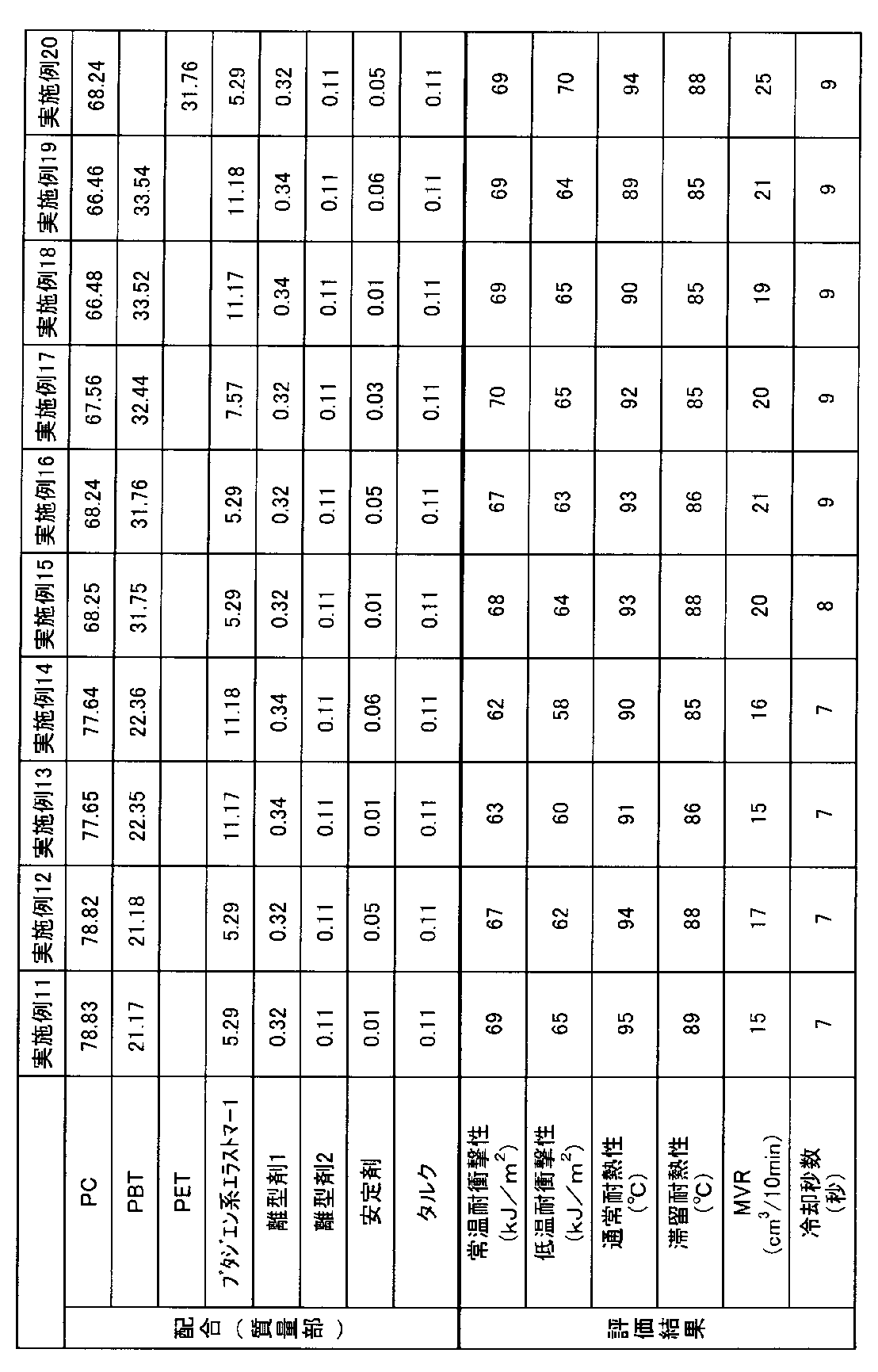

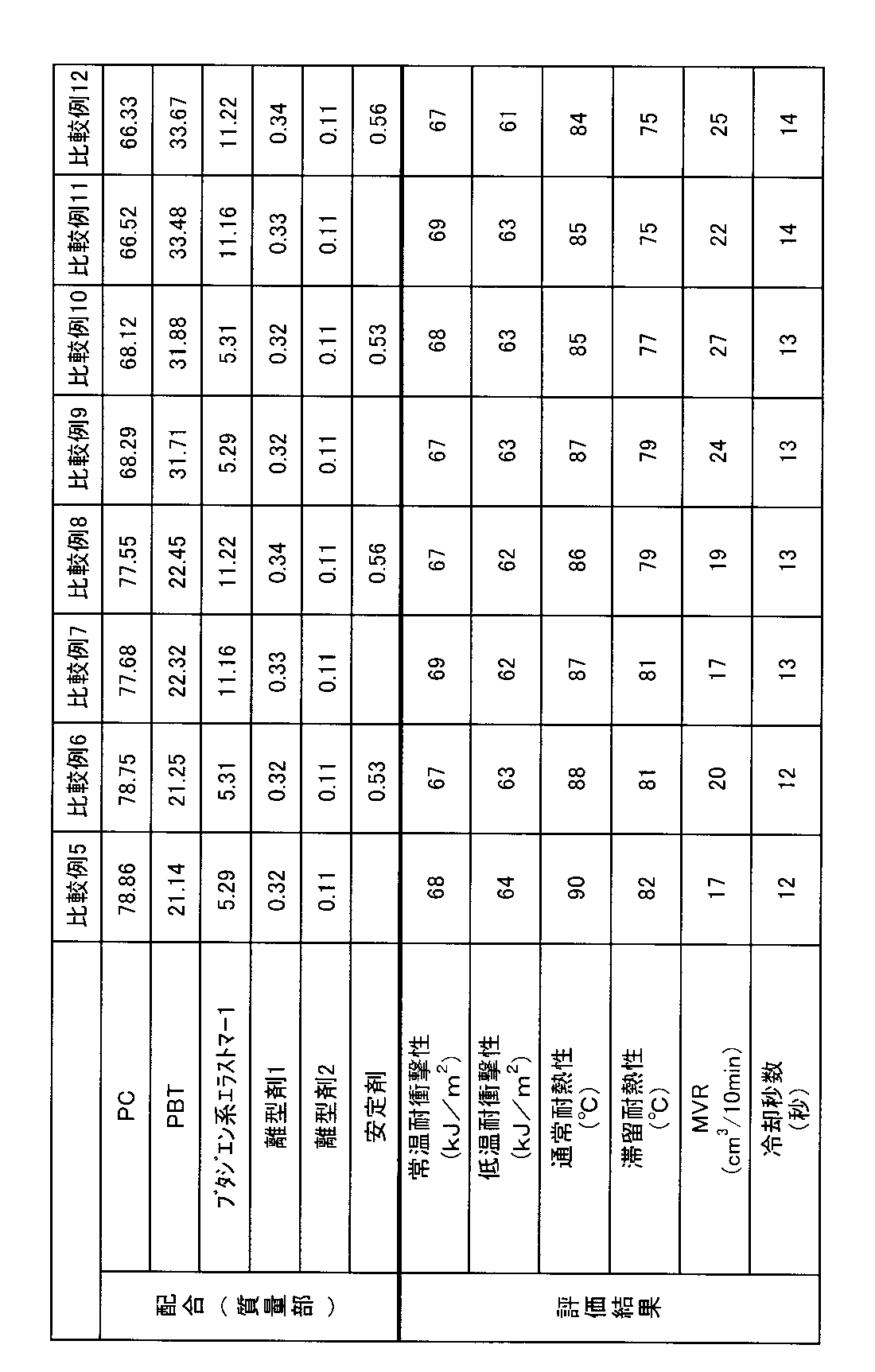
本発明のグラフト共重合体(C)に該当するブタジエン系エラストマー1以外のエラストマーを用いた比較例1~4では、いずれも耐衝撃性、特に低温耐衝撃性が劣る結果となった。
本発明のグラフト共重合体(C)に該当するブタジエン系エラストマー1を用いていても、安定剤(D)を用いていない比較例5,7,9,11や、安定剤(D)の配合量が多過ぎる比較例6,8,10,12では、耐熱性が十分でなく、特に滞留耐熱性が劣る結果となった。
なお、芳香族ポリカーボネート樹脂(A)に所定の割合でポリエステル樹脂(B)を配合した本発明の芳香族ポリカーボネート系複合樹脂組成物は、ポリエステル樹脂(B)による耐薬品性の改善効果と、芳香族ポリカーボネート樹脂(A)本来の剛性、寸法安定性等にも優れるものである。
なお、本出願は、2012年4月23日付で出願された日本特許出願(特願2012-097805)に基づいており、その全体が引用により援用される。
Claims (8)
- 芳香族ポリカーボネート樹脂(A)60~90質量部と、ポリエステル樹脂(B)10~40質量部とからなる樹脂成分100質量部に対して、ジエン系ゴムに(メタ)アクリル酸エステル化合物をグラフト重合させてなるグラフト共重合体(C)3~20質量部と、安定剤(D)0.005~0.1質量部とを含有する芳香族ポリカーボネート系複合樹脂組成物であって、
該グラフト共重合体(C)が、
(i)硫黄含有量100~1500ppm、
(ii)平均粒径70~240nm
であり、該安定剤(D)が、下記一般式(I)で表される有機ホスフェート化合物であることを特徴とする芳香族ポリカーボネート系複合樹脂組成物。
O=P(OH)m(OR)3-m …(I)
(一般式(I)中、Rはアルキル基またはアリール基であり、それぞれ同一であっても異
なっていてもよい。mは0~2の整数である。) - 請求項1において、更に珪酸塩化合物(E)を前記樹脂成分100質量部に対して0.01~0.5質量部含有することを特徴とする芳香族ポリカーボネート系複合樹脂組成物。
- 請求項2において、前記珪酸塩化合物(E)がタルクであることを特徴とする芳香族ポリカーボネート系複合樹脂組成物。
- 請求項1ないし3のいずれか1項において、前記ジエン系ゴムがブタジエン含有率80質量%以上のブタジエン系ゴムであることを特徴とする芳香族ポリカーボネート系複合樹脂組成物。
- 請求項1ないし4のいずれか1項において、前記グラフト共重合体(C)は、ジエン系ゴムをコアとし、(メタ)アクリル酸エステル化合物をシェルとするコア/シェル型グラフト共重合体であることを特徴とする芳香族ポリカーボネート系複合樹脂組成物。
- 請求項1ないし5のいずれか1項において、該樹脂組成物のペレットを120℃で4時間以上乾燥した後、ISO1133に準拠して、測定温度300℃、測定荷重1.2kgf(11.8N)の条件で測定したメルトボリュームレートが10~40cm3/10minであることを特徴とする芳香族ポリカーボネート系複合樹脂組成物。
- 請求項1ないし6のいずれか1項に記載の芳香族ポリカーボネート系複合樹脂組成物を成形してなる成形品。
- 請求項7において、携帯端末筐体であることを特徴とする成形品。
Priority Applications (4)
| Application Number | Priority Date | Filing Date | Title |
|---|---|---|---|
| EP13781920.7A EP2842999B1 (en) | 2012-04-23 | 2013-03-15 | Aromatic polycarbonate composite resin composition and molded article |
| US14/387,690 US9534115B2 (en) | 2012-04-23 | 2013-03-15 | Aromatic polycarbonate composite resin composition and molded article |
| KR1020147026021A KR101485338B1 (ko) | 2012-04-23 | 2013-03-15 | 방향족 폴리카보네이트계 복합 수지 조성물 및 성형품 |
| CN201380013644.8A CN104169365B (zh) | 2012-04-23 | 2013-03-15 | 芳香族聚碳酸酯系复合树脂组合物及成型品 |
Applications Claiming Priority (2)
| Application Number | Priority Date | Filing Date | Title |
|---|---|---|---|
| JP2012-097805 | 2012-04-23 | ||
| JP2012097805A JP5360259B2 (ja) | 2012-04-23 | 2012-04-23 | 芳香族ポリカーボネート系複合樹脂組成物及び成形品 |
Publications (1)
| Publication Number | Publication Date |
|---|---|
| WO2013161433A1 true WO2013161433A1 (ja) | 2013-10-31 |
Family
ID=49482770
Family Applications (1)
| Application Number | Title | Priority Date | Filing Date |
|---|---|---|---|
| PCT/JP2013/057377 Ceased WO2013161433A1 (ja) | 2012-04-23 | 2013-03-15 | 芳香族ポリカーボネート系複合樹脂組成物及び成形品 |
Country Status (6)
| Country | Link |
|---|---|
| US (1) | US9534115B2 (ja) |
| EP (1) | EP2842999B1 (ja) |
| JP (1) | JP5360259B2 (ja) |
| KR (1) | KR101485338B1 (ja) |
| CN (1) | CN104169365B (ja) |
| WO (1) | WO2013161433A1 (ja) |
Cited By (4)
| Publication number | Priority date | Publication date | Assignee | Title |
|---|---|---|---|---|
| JP2017149038A (ja) * | 2016-02-25 | 2017-08-31 | マーベリックパートナーズ株式会社 | 押出積層による3次元造形物作成用樹脂フィラメント及びその造形品 |
| CN107531987A (zh) * | 2015-04-30 | 2018-01-02 | 乐天尖端材料株式会社 | 聚碳酸酯树脂组合物及使用其的模制品 |
| CN110546204A (zh) * | 2017-04-18 | 2019-12-06 | 三菱工程塑料株式会社 | 光学部件用聚碳酸酯树脂组合物和光学部件 |
| JP2021025032A (ja) * | 2019-08-06 | 2021-02-22 | 東レ株式会社 | ポリブチレンフタレート樹脂組成物、成形品、および複合構造体 |
Families Citing this family (9)
| Publication number | Priority date | Publication date | Assignee | Title |
|---|---|---|---|---|
| JP2016008278A (ja) * | 2014-06-25 | 2016-01-18 | 三菱レイヨン株式会社 | ポリカーボネート樹脂組成物、及び成形品 |
| JP6284863B2 (ja) * | 2014-09-19 | 2018-02-28 | 三菱エンジニアリングプラスチックス株式会社 | 超臨界発泡成形用熱可塑性樹脂組成物及び成形品 |
| EP3556809B1 (en) * | 2016-12-19 | 2021-02-03 | Mitsubishi Engineering-Plastics Corporation | Polycarbonate resin composition and molded article |
| KR102041595B1 (ko) | 2016-12-30 | 2019-11-06 | 롯데첨단소재(주) | 내열성 및 절연성이 우수한 수지 조성물 및 이로부터 제조된 성형품 |
| JP6646186B1 (ja) | 2018-05-23 | 2020-02-14 | 住友化学株式会社 | ポリカーボネート樹脂組成物及びその成形体 |
| JP7233962B2 (ja) * | 2019-02-26 | 2023-03-07 | 帝人株式会社 | ポリアリーレンスルフィド樹脂組成物 |
| CN112409772A (zh) * | 2020-11-19 | 2021-02-26 | 中山市嘉宝日用制品有限公司 | 一种抗uv高透抑菌的pc材料及其制备方法 |
| CN114481682B (zh) * | 2022-02-16 | 2023-04-21 | 东莞市伟邦新材料科技有限公司 | 一种浸胶工艺用抗菌防粘剂及其制备方法 |
| JP2024049858A (ja) * | 2022-09-29 | 2024-04-10 | 三菱エンジニアリングプラスチックス株式会社 | ポリカーボネート樹脂組成物 |
Citations (9)
| Publication number | Priority date | Publication date | Assignee | Title |
|---|---|---|---|---|
| JP2003261629A (ja) | 2002-03-07 | 2003-09-19 | Mitsubishi Rayon Co Ltd | グラフト共重合体、耐衝撃性改良剤、熱可塑性樹脂組成物、グラフト共重合体の製造方法 |
| JP2005048067A (ja) * | 2003-07-29 | 2005-02-24 | Teijin Chem Ltd | 芳香族ポリカーボネート樹脂組成物 |
| JP2007023118A (ja) | 2005-07-14 | 2007-02-01 | Teijin Chem Ltd | 熱可塑性樹脂組成物 |
| JP2007176970A (ja) | 2005-12-27 | 2007-07-12 | Mitsubishi Chemicals Corp | 芳香族ポリカーボネート樹脂組成物および樹脂成形品 |
| JP2008285529A (ja) * | 2007-05-15 | 2008-11-27 | Mitsubishi Chemicals Corp | 塗装部品製造用樹脂組成物及び塗装部品 |
| JP2010229305A (ja) * | 2009-03-27 | 2010-10-14 | Mitsubishi Engineering Plastics Corp | 熱可塑性樹脂組成物の製造方法 |
| JP2012077242A (ja) * | 2010-10-05 | 2012-04-19 | Mitsubishi Engineering Plastics Corp | 導電性熱可塑性樹脂組成物及びその成形品 |
| JP2012097805A (ja) | 2010-11-01 | 2012-05-24 | Jtekt Corp | 電磁クラッチ |
| JP2012219177A (ja) * | 2011-04-08 | 2012-11-12 | Mitsubishi Engineering Plastics Corp | ポリカーボネート樹脂組成物及び成形体 |
Family Cites Families (7)
| Publication number | Priority date | Publication date | Assignee | Title |
|---|---|---|---|---|
| KR0129486B1 (ko) * | 1994-06-30 | 1998-04-07 | 하기주 | 내충격성 폴리에스테르 수지조성물 |
| KR100700428B1 (ko) * | 1998-08-31 | 2007-03-27 | 제너럴 일렉트릭 캄파니 | 포스포르아미드를 함유하는 난연성 수지 조성물 및 그의제조 방법 |
| KR100560151B1 (ko) * | 2004-12-30 | 2006-03-10 | 제일모직주식회사 | 난연성 폴리카보네이트 수지 조성물 |
| JP2007176969A (ja) | 2005-12-27 | 2007-07-12 | Mitsubishi Chemicals Corp | 芳香族ポリカーボネート樹脂組成物および樹脂成形品 |
| KR101134018B1 (ko) * | 2008-12-24 | 2012-04-05 | 제일모직주식회사 | 상용성이 향상된 난연 내스크래치 열가소성 수지 조성물 및이를 이용한 성형품 |
| JP2010229300A (ja) * | 2009-03-27 | 2010-10-14 | Toyo Ink Mfg Co Ltd | オーバープリントニス組成物 |
| JP5569131B2 (ja) * | 2010-04-30 | 2014-08-13 | 株式会社カネカ | ポリカーボネート系樹脂組成物、及びその射出成型体 |
-
2012
- 2012-04-23 JP JP2012097805A patent/JP5360259B2/ja active Active
-
2013
- 2013-03-15 US US14/387,690 patent/US9534115B2/en active Active
- 2013-03-15 WO PCT/JP2013/057377 patent/WO2013161433A1/ja not_active Ceased
- 2013-03-15 KR KR1020147026021A patent/KR101485338B1/ko active Active
- 2013-03-15 CN CN201380013644.8A patent/CN104169365B/zh active Active
- 2013-03-15 EP EP13781920.7A patent/EP2842999B1/en active Active
Patent Citations (9)
| Publication number | Priority date | Publication date | Assignee | Title |
|---|---|---|---|---|
| JP2003261629A (ja) | 2002-03-07 | 2003-09-19 | Mitsubishi Rayon Co Ltd | グラフト共重合体、耐衝撃性改良剤、熱可塑性樹脂組成物、グラフト共重合体の製造方法 |
| JP2005048067A (ja) * | 2003-07-29 | 2005-02-24 | Teijin Chem Ltd | 芳香族ポリカーボネート樹脂組成物 |
| JP2007023118A (ja) | 2005-07-14 | 2007-02-01 | Teijin Chem Ltd | 熱可塑性樹脂組成物 |
| JP2007176970A (ja) | 2005-12-27 | 2007-07-12 | Mitsubishi Chemicals Corp | 芳香族ポリカーボネート樹脂組成物および樹脂成形品 |
| JP2008285529A (ja) * | 2007-05-15 | 2008-11-27 | Mitsubishi Chemicals Corp | 塗装部品製造用樹脂組成物及び塗装部品 |
| JP2010229305A (ja) * | 2009-03-27 | 2010-10-14 | Mitsubishi Engineering Plastics Corp | 熱可塑性樹脂組成物の製造方法 |
| JP2012077242A (ja) * | 2010-10-05 | 2012-04-19 | Mitsubishi Engineering Plastics Corp | 導電性熱可塑性樹脂組成物及びその成形品 |
| JP2012097805A (ja) | 2010-11-01 | 2012-05-24 | Jtekt Corp | 電磁クラッチ |
| JP2012219177A (ja) * | 2011-04-08 | 2012-11-12 | Mitsubishi Engineering Plastics Corp | ポリカーボネート樹脂組成物及び成形体 |
Non-Patent Citations (1)
| Title |
|---|
| See also references of EP2842999A4 |
Cited By (8)
| Publication number | Priority date | Publication date | Assignee | Title |
|---|---|---|---|---|
| CN107531987A (zh) * | 2015-04-30 | 2018-01-02 | 乐天尖端材料株式会社 | 聚碳酸酯树脂组合物及使用其的模制品 |
| US10793714B2 (en) | 2015-04-30 | 2020-10-06 | Lotte Advanced Materials Co., Ltd. | Polycarbonate resin composition and molded product using same |
| CN107531987B (zh) * | 2015-04-30 | 2020-12-18 | 乐天尖端材料株式会社 | 聚碳酸酯树脂组合物及使用其的模制品 |
| JP2017149038A (ja) * | 2016-02-25 | 2017-08-31 | マーベリックパートナーズ株式会社 | 押出積層による3次元造形物作成用樹脂フィラメント及びその造形品 |
| CN110546204A (zh) * | 2017-04-18 | 2019-12-06 | 三菱工程塑料株式会社 | 光学部件用聚碳酸酯树脂组合物和光学部件 |
| CN110546204B (zh) * | 2017-04-18 | 2021-08-17 | 三菱工程塑料株式会社 | 光学部件用聚碳酸酯树脂组合物和光学部件 |
| JP2021025032A (ja) * | 2019-08-06 | 2021-02-22 | 東レ株式会社 | ポリブチレンフタレート樹脂組成物、成形品、および複合構造体 |
| JP7505286B2 (ja) | 2019-08-06 | 2024-06-25 | 東レ株式会社 | ポリブチレンフタレート樹脂組成物、成形品、および複合構造体 |
Also Published As
| Publication number | Publication date |
|---|---|
| EP2842999A4 (en) | 2015-11-18 |
| US20150079324A1 (en) | 2015-03-19 |
| EP2842999B1 (en) | 2017-09-20 |
| KR101485338B1 (ko) | 2015-01-23 |
| KR20140117702A (ko) | 2014-10-07 |
| EP2842999A1 (en) | 2015-03-04 |
| CN104169365A (zh) | 2014-11-26 |
| JP5360259B2 (ja) | 2013-12-04 |
| US9534115B2 (en) | 2017-01-03 |
| CN104169365B (zh) | 2016-08-24 |
| JP2013224380A (ja) | 2013-10-31 |
Similar Documents
| Publication | Publication Date | Title |
|---|---|---|
| JP5360259B2 (ja) | 芳香族ポリカーボネート系複合樹脂組成物及び成形品 | |
| JP6252181B2 (ja) | 芳香族ポリカーボネート樹脂組成物及びその成形品 | |
| WO2010116920A1 (ja) | ポリカーボネート/ポリエチレンテレフタレート複合樹脂組成物及び成形品 | |
| JP5392224B2 (ja) | ガスインジェクション用ポリカーボネート−ポリエステル複合樹脂組成物及び成形品 | |
| JP5671605B2 (ja) | 難燃性ポリカーボネート組成物 | |
| JP2015096569A (ja) | ポリカーボネート樹脂組成物及びポリカーボネート樹脂成形品 | |
| JP5003227B2 (ja) | 樹脂組成物および樹脂成形品 | |
| JP5316507B2 (ja) | 導電性熱可塑性樹脂組成物及びその成形品 | |
| JP2018119082A (ja) | 芳香族ポリカーボネート樹脂組成物及びその成形品 | |
| JP2015048465A (ja) | ポリカーボネート樹脂組成物及びポリカーボネート樹脂成形品 | |
| JP6672987B2 (ja) | 熱可塑性樹脂組成物及びその成形品 | |
| JP5500033B2 (ja) | ポリカーボネート−ポリエステル複合樹脂組成物及び成形品 | |
| JP5500032B2 (ja) | ポリカーボネート−ポリエステル複合樹脂組成物及び成形品 | |
| JP5293721B2 (ja) | ポリカーボネート−ポリエステル複合樹脂組成物及び成形品 | |
| JP5696368B2 (ja) | ポリカーボネート/ポリエチレンテレフタレート複合樹脂組成物及び成形品 | |
| JP6264901B2 (ja) | ポリカーボネート樹脂組成物の製造方法 | |
| JP6810636B2 (ja) | ポリカーボネート樹脂組成物及び成形品 | |
| JP2020084037A (ja) | 熱可塑性樹脂組成物及び成形体 | |
| MXPA05008746A (es) | Uso de composiciones basadas en mezclas de tereftalato de polialquileno/policarbonatos modificadas, resistentes al impacto para producir cuerpos moldeados. | |
| JP2013112752A (ja) | 芳香族ポリカーボネート樹脂組成物及びそれからなる成形品 | |
| KR20170007778A (ko) | 가수분해-안정성 폴리카르보네이트-폴리에스테르 조성물 | |
| JP5696371B2 (ja) | ポリカーボネート/ポリエチレンテレフタレート複合樹脂組成物及び成形品 | |
| JP5696370B2 (ja) | ポリカーボネート/ポリエチレンテレフタレート複合樹脂組成物及び成形品 |
Legal Events
| Date | Code | Title | Description |
|---|---|---|---|
| 121 | Ep: the epo has been informed by wipo that ep was designated in this application |
Ref document number: 13781920 Country of ref document: EP Kind code of ref document: A1 |
|
| ENP | Entry into the national phase |
Ref document number: 20147026021 Country of ref document: KR Kind code of ref document: A |
|
| WWE | Wipo information: entry into national phase |
Ref document number: 14387690 Country of ref document: US |
|
| REEP | Request for entry into the european phase |
Ref document number: 2013781920 Country of ref document: EP |
|
| WWE | Wipo information: entry into national phase |
Ref document number: 2013781920 Country of ref document: EP |
|
| NENP | Non-entry into the national phase |
Ref country code: DE |