WO2013168813A1 - エッチング液及びこれを用いたシリコン系基板の製造方法 - Google Patents
エッチング液及びこれを用いたシリコン系基板の製造方法 Download PDFInfo
- Publication number
- WO2013168813A1 WO2013168813A1 PCT/JP2013/063222 JP2013063222W WO2013168813A1 WO 2013168813 A1 WO2013168813 A1 WO 2013168813A1 JP 2013063222 W JP2013063222 W JP 2013063222W WO 2013168813 A1 WO2013168813 A1 WO 2013168813A1
- Authority
- WO
- WIPO (PCT)
- Prior art keywords
- wafer
- acid
- etching solution
- group
- silicon
- Prior art date
- Legal status (The legal status is an assumption and is not a legal conclusion. Google has not performed a legal analysis and makes no representation as to the accuracy of the status listed.)
- Ceased
Links
Images


Classifications
-
- C—CHEMISTRY; METALLURGY
- C09—DYES; PAINTS; POLISHES; NATURAL RESINS; ADHESIVES; COMPOSITIONS NOT OTHERWISE PROVIDED FOR; APPLICATIONS OF MATERIALS NOT OTHERWISE PROVIDED FOR
- C09K—MATERIALS FOR MISCELLANEOUS APPLICATIONS, NOT PROVIDED FOR ELSEWHERE
- C09K13/00—Etching, surface-brightening or pickling compositions
- C09K13/02—Etching, surface-brightening or pickling compositions containing an alkali metal hydroxide
-
- C—CHEMISTRY; METALLURGY
- C07—ORGANIC CHEMISTRY
- C07C—ACYCLIC OR CARBOCYCLIC COMPOUNDS
- C07C309/00—Sulfonic acids; Halides, esters, or anhydrides thereof
- C07C309/01—Sulfonic acids
- C07C309/28—Sulfonic acids having sulfo groups bound to carbon atoms of six-membered aromatic rings of a carbon skeleton
- C07C309/33—Sulfonic acids having sulfo groups bound to carbon atoms of six-membered aromatic rings of a carbon skeleton of six-membered aromatic rings being part of condensed ring systems
-
- H—ELECTRICITY
- H10—SEMICONDUCTOR DEVICES; ELECTRIC SOLID-STATE DEVICES NOT OTHERWISE PROVIDED FOR
- H10F—INORGANIC SEMICONDUCTOR DEVICES SENSITIVE TO INFRARED RADIATION, LIGHT, ELECTROMAGNETIC RADIATION OF SHORTER WAVELENGTH OR CORPUSCULAR RADIATION
- H10F71/00—Manufacture or treatment of devices covered by this subclass
- H10F71/121—The active layers comprising only Group IV materials
-
- H—ELECTRICITY
- H10—SEMICONDUCTOR DEVICES; ELECTRIC SOLID-STATE DEVICES NOT OTHERWISE PROVIDED FOR
- H10F—INORGANIC SEMICONDUCTOR DEVICES SENSITIVE TO INFRARED RADIATION, LIGHT, ELECTROMAGNETIC RADIATION OF SHORTER WAVELENGTH OR CORPUSCULAR RADIATION
- H10F77/00—Constructional details of devices covered by this subclass
- H10F77/70—Surface textures, e.g. pyramid structures
- H10F77/703—Surface textures, e.g. pyramid structures of the semiconductor bodies, e.g. textured active layers
-
- Y—GENERAL TAGGING OF NEW TECHNOLOGICAL DEVELOPMENTS; GENERAL TAGGING OF CROSS-SECTIONAL TECHNOLOGIES SPANNING OVER SEVERAL SECTIONS OF THE IPC; TECHNICAL SUBJECTS COVERED BY FORMER USPC CROSS-REFERENCE ART COLLECTIONS [XRACs] AND DIGESTS
- Y02—TECHNOLOGIES OR APPLICATIONS FOR MITIGATION OR ADAPTATION AGAINST CLIMATE CHANGE
- Y02E—REDUCTION OF GREENHOUSE GAS [GHG] EMISSIONS, RELATED TO ENERGY GENERATION, TRANSMISSION OR DISTRIBUTION
- Y02E10/00—Energy generation through renewable energy sources
- Y02E10/50—Photovoltaic [PV] energy
-
- Y—GENERAL TAGGING OF NEW TECHNOLOGICAL DEVELOPMENTS; GENERAL TAGGING OF CROSS-SECTIONAL TECHNOLOGIES SPANNING OVER SEVERAL SECTIONS OF THE IPC; TECHNICAL SUBJECTS COVERED BY FORMER USPC CROSS-REFERENCE ART COLLECTIONS [XRACs] AND DIGESTS
- Y02—TECHNOLOGIES OR APPLICATIONS FOR MITIGATION OR ADAPTATION AGAINST CLIMATE CHANGE
- Y02E—REDUCTION OF GREENHOUSE GAS [GHG] EMISSIONS, RELATED TO ENERGY GENERATION, TRANSMISSION OR DISTRIBUTION
- Y02E10/00—Energy generation through renewable energy sources
- Y02E10/50—Photovoltaic [PV] energy
- Y02E10/547—Monocrystalline silicon PV cells
Definitions
- the present invention relates to an alkaline etching solution for solar cell production suitable for the production of a silicon-based substrate mainly composed of silicon having a concavo-convex structure on the surface, which is useful as a semiconductor substrate for solar cells, and silicon using the etching solution.
- the present invention relates to a method for manufacturing a silicon-based substrate for manufacturing a solar cell, which comprises etching a wafer containing as a main component and forming an uneven structure on the surface of the wafer.
- the conversion efficiency is a value representing the percentage of energy that can be extracted by converting light energy into electric energy, and is the most important characteristic as a solar cell.
- the surface of the silicon wafer is subjected to fine irregularities to form a textured structure with fine irregularities, and sunlight irradiated on the surface is irradiated. It is necessary to increase the Jsc (short-circuit current density) characteristics by repeatedly reflecting at the uneven portions and improve the conversion efficiency.
- an anisotropic etching is performed using an aqueous solution containing sodium hydroxide and isopropyl alcohol to form a concavo-convex structure on the surface of a silicon wafer (for example, Patent Document 1, Non-Patent Document 1, etc.).
- a technique for wet etching a silicon single crystal substrate using an aqueous solution containing 30% by weight or more of potassium hydroxide and an anionic surfactant for example, Patent Document 2
- an alkaline etching solution containing carboxylic acid and silicon A technique for forming a concavo-convex structure on the surface of a semiconductor substrate using an etching solution (for example, Patent Document 3), an etching solution containing alkylsulfonic acid or the like and 0.1 wt% or more and 30 wt% or less alkali hydroxide
- Patent Document 4 A technique for forming pyramidal irregularities on the surface of a silicon substrate is known.
- the above-described technique has the following problems. That is, in the techniques of Patent Document 1 and Non-Patent Document 1, the composition ratio of the etchant changes during etching due to the high volatility of isopropyl alcohol, and the uneven structure formed on the surface of the wafer. The shape and size of the wafer can be uneven, and a uniform uneven structure cannot be formed on the entire wafer.
- the concentration of potassium hydroxide in the etching solution is too high to form a uniform uneven structure, and since the etching rate is high, the wafer after etching becomes too thin and the solar cell It will not be suitable for the circuit board. Furthermore, in the technique of Patent Document 3, it is difficult to form a uniform concavo-convex structure unless the etching amount is increased, and there may be a difference in the size of the concavo-convex structure. Furthermore, in the technique of Patent Document 4, bubbles of the etching solution during etching are intense, and bubbles adhering to the wafer surface are poor when the wafer is pulled up, which causes bubbles to remain on the wafer surface. Thus, the appearance of the wafer is liable to occur due to the watermark.
- the present invention has been made in view of the situation as described above, and a fine concavo-convex structure can be uniformly formed on the entire surface of a wafer containing silicon as a main component. Furthermore, the present invention can be applied to various wafers. It is an object of the present invention to provide an applicable alkaline etching solution for manufacturing a solar cell and a method for manufacturing a silicon-based substrate for manufacturing a solar cell using the etching solution. As a result of intensive research on the development of such an alkaline etching solution for producing solar cells, the present inventors have added an etching solution that has solved the above-mentioned problems by adding a sulfonic acid having a specific structure to an alkaline aqueous solution. The present invention has been found out and the present invention has been completed.
- the present invention has the following configuration.
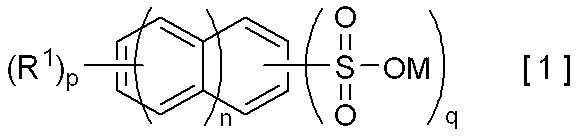
- An alkaline etching solution for solar cell production comprising (A) mono- or disulfonic acid represented by the general formula [1] or a salt thereof, (B) an alkali compound, and (C) water.
- p R 1 s each independently represent a hydrogen atom, a hydroxyl group or an alkyl group having 1 to 10 carbon atoms
- q Ms each independently represent a hydrogen atom, an alkali metal atom, ammonium (NH 4 ) group or tetraalkylammonium (R 2 4 N) group (wherein R 2 represents an alkyl group having 1 to 4 carbon atoms), n represents 0 or 1, p and q Each independently represents 1 or 2.
- a method of manufacturing a silicon-based substrate for manufacturing a solar cell comprising etching a wafer containing silicon as a main component using the etching solution of (1) to form an uneven structure on the surface of the wafer.
- the alkaline etching solution for solar cell production of the present invention is an etching solution that can form a pyramidal (quadrangular pyramidal) concavo-convex structure on the surface of a wafer mainly composed of silicon, compared with a conventional alkaline etching solution, (1) A finer (small pyramid-shaped) concavo-convex structure can be formed on the entire wafer surface, and there is almost no flat portion. The structure can be formed. (3) Since there is little foaming and the foam attached to the wafer surface is good when the wafer is pulled up, the foam disappears from the wafer surface in a short time, and the foam remains on the wafer surface. There are effects such as poor appearance of the wafer (watermark and the like).
- the alkaline etching liquid for solar cell production of the present invention can effectively produce a substrate having a high light confinement effect (high light absorption rate and low light reflectance) suitable for solar cells.
- an uneven structure having a pyramid shape (quadrangular pyramid shape) can be effectively formed without causing manufacturing defects.
- the method for producing a silicon-based substrate for producing solar cells according to the present invention is an effective method for forming a concavo-convex structure on the surface of a wafer containing silicon as a main component.
- the wafer A pyramidal (quadrangular pyramidal) concavo-convex structure can be formed on the entire surface of the wafer, and a fine concavo-convex structure with a maximum side length of the bottom surface of the pyramid of 0.1 ⁇ m or more and 25 ⁇ m or less can be formed. .
- FIG. 2 is a laser micrograph (magnification 3000 times) of the wafer surface after etching obtained in Example 1.
- FIG. 3 is a laser micrograph (magnification 3000 times) of the wafer surface after etching obtained in Comparative Example 1.
- 7 is a laser micrograph (magnification 3000 times) of the wafer surface after etching obtained in Example 7.
- FIG. 10 is a laser micrograph (magnification 3000 times) of the wafer surface after etching obtained in Example 9.
- FIG. 3 is a laser micrograph (magnification 3000 times) of the wafer surface after etching obtained in Example 1.
- the alkaline etching solution for producing a solar cell of the present invention is (A) a mono- or disulfonic acid represented by the general formula [1] or a salt thereof (hereinafter sometimes abbreviated as mono- or disulfonic acids according to the present invention). , (B) an alkali compound, and (C) water.
- p R 1 s each independently represent a hydrogen atom, a hydroxyl group or an alkyl group having 1 to 10 carbon atoms
- q Ms each independently represent a hydrogen atom, an alkali metal atom, ammonium (NH 4 ) group or tetraalkylammonium (R 2 4 N) group (wherein R 2 represents an alkyl group having 1 to 4 carbon atoms), n represents 0 or 1, p and q Each independently represents 1 or 2.
- Examples of the alkyl group having 1 to 10 carbon atoms represented by R 1 in the general formula [1] include linear, branched, or cyclic groups. Specific examples include a methyl group, an ethyl group, n-propyl group, isopropyl group, n-butyl group, isobutyl group, s-butyl group, t-butyl group, cyclobutyl group, n-pentyl group, isopentyl group, s-pentyl group, t-pentyl group, neopentyl group, 2-methylbutyl group, 1,2-dimethylpropyl group, 1-ethylpropyl group, cyclopentyl group, n-hexyl group, isohexyl group, s-hexyl group, t-hexyl group, neohexyl group, 2-methylpentyl group, 1 , 2-dimethylbutyl group, 2,
- alkyl groups having 1 to 10 carbon atoms for example, methyl group, ethyl group, n-propyl group, isopropyl group, n-butyl group, isobutyl group, s-butyl group, t-butyl group, cyclobutyl group , N-pentyl group, isopentyl group, s-pentyl group, t-pentyl group, neopentyl group, 2-methylbutyl group, 1,2-dimethylpropyl group, 1-ethylpropyl group, cyclopentyl group, etc.
- a linear, branched, or cyclic alkyl group is preferable, and among them, a linear or branched alkyl group having 1 to 3 carbon atoms, such as a methyl group, an ethyl group, an n-propyl group, An isopropyl group is more preferable, and a methyl group that is an alkyl group having 1 carbon atom is particularly preferable.
- n- represents a normal isomer
- s- represents a sec isomer
- t- represents a tert isomer.
- R 1 in the general formula [1] is more preferably a hydrogen atom or an alkyl group having 1 to 10 carbon atoms, and an alkyl group having 1 to 10 carbon atoms is particularly preferable.
- the mono- or disulfonic acid according to the present invention is a monosulfonic acid (monosulfonic acid or a salt thereof)
- the carbon atom on the benzene ring to which the sulfonic acid group is bonded is the first position
- At least one of p R 1 in the formula [1] is preferably bonded to the carbon atom at the 2nd, 4th or 6th position on the benzene ring, and among them, the 4th position is preferred. Those bonded are more preferable.
- Examples of the alkali metal atom represented by M in the general formula [1] include a sodium atom, a potassium atom, and a lithium atom. Of these, a sodium atom and a potassium atom are preferable.
- the alkyl group having 1 to 4 carbon atoms represented by R 2 in the tetraalkylammonium group represented by R 2 4 N group is linear, branched or cyclic. Specific examples include methyl group, ethyl group, n-propyl group, isopropyl group, n-butyl group, isobutyl group, s-butyl group, t-butyl group, cyclobutyl group and the like. Of these, a methyl group which is an alkyl group having 1 carbon atom is preferable. In the specific examples described above, n- represents a normal isomer, s- represents a sec isomer, and t- represents a tert isomer.
- tetraalkylammonium group represented by the R 2 4 N group in M of the general formula [1] include, for example, a tetramethylammonium group, a tetraethylammonium group, a tetra-n-propylammonium group, a tetraisopropylammonium group, Examples include a tetra-n-butylammonium group, a tetraisobutylammonium group, a tetra-s-butylammonium group, a tetra-t-butylammonium group, a tetracyclobutylammonium group, and the like, and among them, a tetramethylammonium group is preferable.
- n- represents a normal isomer
- s- represents a sec isomer
- t- represents a tert isomer.
- N in the general formula [1] is usually 0 or 1, preferably 0.
- P in the general formula [1] is usually 1 or 2, preferably 1.
- Q in the general formula [1] is usually 1 or 2, and preferably 1.
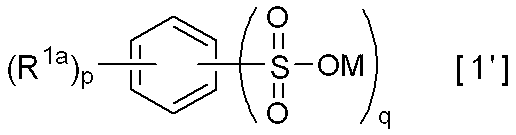
- mono- or disulfonic acids according to the present invention in the alkaline etching solution for solar cell production of the present invention include, for example, mono- or disulfonic acids represented by the following general formula [1 ′] or salts thereof, and the following general formula Mono or disulfonic acid represented by [1 ′′] or a salt thereof.
- the mono- or disulfonic acid represented by the general formula [1 '] or a salt thereof is a mono- or disulfonic acid or a salt thereof (wherein n is 0 in the general formula [1])
- the mono- or disulfonic acid represented by the general formula [1 ′′] or a salt thereof is a mono- or disulfonic acid or a salt thereof in which n is 1 in the general formula [1] (naphthalene) Mono- or disulfonic acid derivatives).
- each of p R 1a independently represents a hydrogen atom, a hydroxyl group or an alkyl group having 1 to 10 carbon atoms, and M, p and q are the same as above).
- p R 1b each independently represents a hydrogen atom, a hydroxyl group, or an alkyl group having 1 to 5 carbon atoms, and M, p, and q are the same as above).
- alkyl group having 1 to 10 carbon atoms represented by R 1a in the general formula [1 ′] include those similar to those listed as specific examples of R 1 in the general formula [1]. .
- the carbon atom on the benzene ring to which the sulfonic acid group is bonded is defined as the first position.
- at least one of p R 1a in the general formula [1 ′] is a carbon atom at the 2-position, 6-position (o-position) or 4-position (p-position) on the benzene ring. Those bonded are preferred, and among them, those bonded to the 4-position (p-position) are more preferred.
- alkyl group having 1 to 5 carbon atoms represented by R 1b in the general formula [1 ′′] examples include linear, branched, or cyclic groups. Specific examples include, for example, methyl group, ethyl Group, n-propyl group, isopropyl group, n-butyl group, isobutyl group, s-butyl group, t-butyl group, cyclobutyl group, n-pentyl group, isopentyl group, s-pentyl group, t-pentyl group, neopentyl group Group, 2-methylbutyl group, 1,2-dimethylpropyl group, 1-ethylpropyl group, cyclopentyl group, etc., among which a straight-chain or branched alkyl group having 1 to 3 carbon atoms, A methyl group, an ethyl group, an n-propyl group, and an isopropyl group are preferable, and
- the carbon atom on the benzene ring to which the sulfonic acid group is bonded is defined as the 1-position.
- at least one of p R 1b in the general formula [1 ′′] is preferably bonded to the carbon atom at the 2nd, 4th or 6th position on the benzene ring, Among these, those bonded to the 4-position are more preferable.
- benzene mono- or disulfonic acid derivative examples include, for example, benzene (mono) sulfonic acid, toluenesulfonic acid (for example, o-, m-, or p-toluenesulfonic acid, etc.), ethylbenzenesulfonic acid, propylbenzenesulfonic acid, butylbenzenesulfonic acid, pentylbenzenesulfonic acid, hexylbenzenesulfonic acid, heptylbenzenesulfonic acid, octylbenzenesulfonic acid, nonylbenzenesulfonic acid Decylbenzenesulfonic acid, benzenedisulfonic acid (for example, 1,2-benzenedisulfonic acid, 1,3-benzenedisulfonic acid, 1,4-benzene mono- or disulfonic acid derivative) include, for example, benzene (mono)
- benzene mono- or disulfonic acid derivatives represented by the general formula [1 ′] for example, benzene (mono) sulfonic acid, toluenesulfonic acid, ethylbenzenesulfonic acid, propylbenzenesulfonic acid, butylbenzenesulfonic acid, pentylbenzene Carbons such as sulfonic acids or tetraalkylammonium salts such as alkali metal salts such as sodium salts, potassium salts and lithium salts thereof, ammonium salts, tetramethylammonium salts, tetraethylammonium salts, tetrapropylammonium salts and tetrabutylammonium salts
- tetraalkylammonium salts such as alkali metal salts, ammonium salts, tetramethylammonium salts, tetraethylammonium salts, tetrapropylammonium salts, tetrabutylammonium salts, and the like.
- sulfonic acid and p-toluenesulfonic acid are particularly preferred. These benzene mono- or disulfonic acid derivatives may be used alone or in combination of two or more. These benzene mono- or disulfonic acid derivatives may be commercially available.
- naphthalene mono- or disulfonic acid derivative examples include, for example, naphthalene (mono) sulfonic acid, methylnaphthalenesulfonic acid (for example, 2-3, -, 4-, 5-, 6-, 7- or 8-methyl-1-naphthalenesulfonic acid, 1-, 3-, 4-, 5-, 6-, 7- or 8-methyl-2-naphthalenesulfone Acid naphthalene sulfonic acid, propyl naphthalene sulfonic acid, butyl naphthalene sulfonic acid, pentyl naphthalene sulfonic acid, naphthalene disulfonic acid (for example, 1,2-naphthalene disulfonic acid, 1,3-naphthalene disulfonic acid, 1 , 4-Naphthalenedisulfonic
- naphthalene mono- or disulfonic acid derivatives represented by the general formula [1 ′′] naphthalene (mono) sulfonic acid, or alkali metal salts such as sodium, potassium, and lithium salts thereof, ammonium salts, Unsubstituted naphthalene monosulfonic acid derivatives such as tetraalkylammonium salts such as tetramethylammonium salt, tetraethylammonium salt, tetrapropylammonium salt, tetrabutylammonium salt and the like are preferable, and naphthalene (mono) sulfonic acid is particularly preferable. . Moreover, these naphthalene mono or disulfonic acid derivatives may be used alone or in combination of two or more thereof. Note that these naphthalene mono- or disulfonic acid derivatives may be commercially available.
- the mono- or disulfonic acids represented by the general formula [1 ′] and the general formula [1 ′′] or a salt thereof are preferred.
- the mono- or disulfonic acid according to the present invention was mono- or disulfonic acid (so-called acid itself) at the stage before the preparation of the etching solution of the present invention. It may be a salt (mono or disulfonate). That is, a salt may be formed by the alkali compound of the alkaline etching solution for solar cell production of the present invention, or other components and the mono- or disulfonic acids according to the present invention. Naturally, an etching solution containing mono- or disulfonic acid is also included in the alkaline etching solution for solar cell production of the present invention.
- the content of the mono- or disulfonic acids according to the present invention in the alkaline etching solution for producing a solar cell of the present invention is usually 0.05% by weight or less, preferably 0.00% or less as the weight percent with respect to the total weight of the etching solution.
- the upper limit is usually 30% by weight or less, preferably 10% by weight or less.
- the content of mono- or disulfonic acids according to the present invention is extremely small, there may be a case where a uniform uneven structure cannot be formed on the surface of the wafer mainly composed of silicon, and the content of mono- or disulfonic acids according to the present invention
- the mono- or disulfonic acids according to the present invention may be precipitated as a solid in the etching solution, which is not desirable.
- the mono- or disulfonic acids according to the present invention are used as one of the components in the etching solution.
- any sulfonic acid may be used to effectively form, for example, a pyramidal (quadrangular pyramid) fine concavo-convex structure on the surface of a silicon-based wafer without manufacturing defects. Instead, it requires mono- or disulfonic acids according to the present invention. This reason is related to the etching mechanism using mono- or disulfonic acids according to the present invention, and the mechanism is considered as follows.
- the sulfonic acid group of the mono- or disulfonic acid adheres to the surface of the wafer to be etched.
- the aryl group of mono- or disulfonic acid prevents etching of the alkali compound described later on the wafer surface.
- anisotropic etching with an alkali compound proceeds with a portion (point) to which mono- or disulfonic acid is attached as a base point (vertex), and a pyramidal (square pyramid) uneven structure is formed on the wafer surface.
- Preferred specific examples of the (B) alkali compound in the alkaline etching solution for solar cell production of the present invention include alkali metal hydroxides such as sodium hydroxide, potassium hydroxide and lithium hydroxide, such as sodium carbonate and potassium carbonate. And alkali metal carbonates such as lithium carbonate, and tetraalkylammonium hydroxides such as tetramethylammonium hydroxide, tetraethylammonium hydroxide, tetrapropylammonium hydroxide, and tetrabutylammonium hydroxide.
- alkali metal hydroxides such as sodium hydroxide, potassium hydroxide and lithium hydroxide, such as sodium carbonate and potassium carbonate.
- alkali metal carbonates such as lithium carbonate
- tetraalkylammonium hydroxides such as tetramethylammonium hydroxide, tetraethylammonium hydroxide, tetrapropylammonium hydro
- sodium hydroxide, potassium hydroxide, sodium carbonate, potassium carbonate, and tetramethylammonium hydroxide are preferable, and sodium hydroxide and potassium hydroxide are more preferable.
- sodium hydroxide and potassium hydroxide are particularly preferable because they can effectively etch the surface of a wafer containing silicon as a main component.
- these alkali compounds may be used individually by 1 type in these, and may be used in combination of 2 or more type. In addition, what is necessary is just to use a commercially available thing for these alkali compounds.
- the content of (B) the alkali compound is usually 0.1% by weight or more, preferably 0.5% by weight, as the weight percent with respect to the total weight of the etching solution. Above, more preferably 1% by weight or more, and the upper limit is usually 15% by weight or less, preferably 10% by weight or less, more preferably 7% by weight or less.
- the content of the alkali compound is extremely small, it is not desirable because the surface of the wafer containing silicon as a main component may not be effectively etched.
- (D) carboxylic acid, (E) silicic acid or silicate may be included.
- the carboxylic acid may be added as appropriate from the viewpoint of being able to etch the surface of the wafer containing silicon as a main component in a shorter time and effectively.
- Examples of the (D) carboxylic acid include formic acid, acetic acid, trifluoroacetic acid, propionic acid, butyric acid, valeric acid, caproic acid, enanthic acid, caprylic acid, pelargonic acid, capric acid, lauric acid, and isomers thereof.
- Saturated aliphatic monocarboxylic acids such as acrylic acid, butenoic acid, pentenoic acid, hexenoic acid, heptenoic acid, pentadienoic acid, hexadienoic acid, heptadienoic acid, acetylenecarboxylic acid or isomers thereof
- Saturated aliphatic dicarboxylic acids such as acids such as oxalic acid, malonic acid, succinic acid, glutaric acid, adipic acid, pimelic acid, cyclopentanedicarboxylic acid, cyclohexanedicarboxylic acid or isomers thereof such as maleic acid, fumaric acid, dimethyl Maleic acid, dimethyl fumaric acid, ethyl maleic acid, ethyl Unsaturated aliphatic dicarboxylic acids such as formic acid, citraconic acid, mesaconic acid, itaconic acid or their isomers, for example saturated
- carboxylic acids having at least one hydroxyl group in the molecule are classified as hydroxycarboxylic acids regardless of the number of carboxyl groups. Moreover, these carboxylic acids may be used individually by 1 type, and may be used in combination of 2 or more type. Note that these carboxylic acids may be commercially available.
- content of the said carboxylic acid in the case of adding carboxylic acid as a weight% with respect to the total weight of etching liquid, a minimum is usually 0.1 weight% or more, and an upper limit is usually 15 weight% or less. .
- (E) Silicic acid or silicate may be added as appropriate from the viewpoint that the surface of a wafer containing silicon as a main component can be etched in a shorter time and effectively.
- Examples of such (E) silicic acid or silicate include orthosilicic acid (H 4 SiO 4 ), metasilicic acid (H 2 SiO 3 ), metadisilicic acid (H 2 Si 2 O 5 ), and silicic anhydride.
- Silicic acid such as (SiO 2 : silica), for example, sodium orthosilicate (Na 4 SiO 4 ), sodium metasilicate (Na 2 SiO 3 ), sodium metadisilicate (Na 2 Si 2 O 5 ), Na 2 Si 4
- sodium silicate such as O 9
- silicate such as potassium silicate (K 2 SiO 3 ).
- these silicic acid or silicate may be used individually by 1 type, and may be used in combination of 2 or more type. In addition, what is necessary is just to use these commercially available silicic acid or silicate.
- the alkali for manufacturing the solar cell of the present invention is used.
- the etching solution substantially contains silicic acid or silicate.
- the alkaline etching liquid for solar cell manufacture of this invention is an etching liquid which can be used repeatedly.
- the content of the silicic acid or silicate is usually 0.5% by weight or more as the weight% with respect to the total weight of the etching solution, and the upper limit. Is usually 50% by weight or less.
- the alkaline etching solution for solar cell production of the present invention comprises (A) mono- or disulfonic acid represented by the general formula [1] or a salt thereof and (B) an alkali compound, and (D) a carboxylic acid or / and if necessary. (E) Silicic acid or a silicate can be prepared by dissolving in (C) water so that it may become the weight% mentioned above.
- the preparation method is not particularly limited, and (A) a mono- or disulfonic acid represented by the general formula [1] or a salt thereof dissolved in an appropriate amount (C) water, and (B) an alkali compound in an appropriate amount (C) What was dissolved in water, if necessary (D) Carboxylic acid was dissolved in an appropriate amount of (C) Water, and if necessary (E) Silica or silicate was added in an appropriate amount of (C) What was dissolved in water may be mixed as appropriate, (A) mono- or disulfonic acid represented by the general formula [1] or a salt thereof and (B) an alkali compound, and (D) if necessary.
- Carboxylic acid and / or (E) silicic acid or silicate may be sequentially added and dissolved in (C) water in an appropriate order.
- the alkaline etching solution for solar cell production of the present invention thus prepared is an aqueous solution and may be subjected to a filtration treatment or the like before use.
- the (C) water used here is not particularly limited as long as it does not adversely affect the etching of a wafer containing silicon as a main component.
- purified water such as distilled water or deionized water is used.
- Water for example, ultrapure water can be used, and ultrapure water is particularly preferable. Ultrapure water is preferable in that it hardly contaminates the wafer after etching because it contains almost no impurities.
- a stirrer or a disperser usually used in this field can be used.
- the stirrer include a mechanical stirrer and a magnetic stirrer.
- the disperser include a homogenizer, an ultrasonic disperser, a ball mill, and a bead mill.
- the alkaline etchant for solar cell production of the present invention thus prepared has a pH in the alkaline region at 25 ° C.
- the surface of the wafer containing silicon as a main component can be made in a shorter time and
- the alkaline etching solution for producing a solar cell of the present invention preferably has a pH of 12 or higher at 25 ° C., and more preferably has a pH of 14 or higher.
- the pH of the alkaline etching solution for solar cell production of the present invention is 7 or less (neutral or less), it is not desirable because the surface of the wafer containing silicon as a main component cannot be etched.
- the pH of the alkaline etching solution for producing a solar cell of the present invention is measured using a commercially available pH meter in accordance with JIS Z8802-1984 without dilution.
- the alkaline etching liquid for solar cell production of the present invention may contain other components such as (D) carboxylic acid or / and (E) silicic acid or silicate.
- (D) carboxylic acid or / and (E) silicic acid or silicate when forming a pyramidal (quadrangular pyramidal) concave-convex structure on the surface of a wafer containing silicon as a main component, in order to form a fine concave-convex structure with an average side length of the pyramid (quadrangular pyramid) bottom of 7 ⁇ m or less.
- the alkaline etching liquid for solar cell production of the present invention comprises (A) mono- or disulfonic acid represented by the general formula [1] or a salt thereof, (B) an alkali compound, and (C) a component other than water (this In some cases, it is desirable that the fourth component other than (A) to (C) constituting the alkaline etching solution for producing a solar cell of the invention is substantially not contained.
- the term “substantially free of the fourth component” as used herein means that the fourth component does not contain more than an amount that may adversely affect the etching of the surface of the wafer containing silicon as a main component. However, it does not exclude the presence (contamination) of trace amounts, and it also excludes that the etching solution contains silicic acid or silicate generated from the wafer by etching the wafer. Absent.
- a cationic surfactant Even when a cationic surfactant or / and a nonionic surfactant are added only in an amount expressed in units of several ppm to the alkaline etching solution for solar cell production of the present invention, silicon is mainly used. In some cases, the surface of the wafer as a component cannot be etched. Moreover, when an organic solvent is added to the alkaline etching solution for solar cell production of the present invention, a concavo-convex structure (texture structure) cannot be formed, and the object of the present invention may not be achieved. For this reason, it is not desirable to add a cationic surfactant, a nonionic surfactant or / and an organic solvent to the alkaline etching solution for solar cell production of the present invention.
- the silicon-based wafer according to the present invention refers to a silicon-based wafer such as a silicon (Si) wafer or a silicon carbide (SiC) wafer
- the silicon (Si) wafer includes, for example, phosphorus (P), N-type silicon (Si) wafer doped with pentavalent atoms such as arsenic (As) and antimony (Sb), and silicon (Si) wafer doped with trivalent atoms such as boron (B) and gallium (Ga)
- P phosphorus
- Si N-type silicon
- Si doped with pentavalent atoms
- Al arsenic
- Sb antimony
- silicon (Si) wafer doped with trivalent atoms such as boron (B) and gallium (Ga)
- It may be a wafer such as a p-type silicon (Si) wafer.
- a wafer mainly composed of silicon to be etched is obtained by mixing, for example, a coolant and abrasive fine particles (polishing abrasive grains) in a contact portion between a wire row and a silicon ingot.
- a wafer produced by supplying slurry and polishing and cutting the silicon ingot, a wafer produced by a so-called free abrasive grain method, for example, abrasive fine particles (abrasive grains) made of diamond or the like were fixed to the surface of a wire.
- It may be any of a wafer produced by running a wire row, pressing a silicon ingot against the wire row, and polishing and cutting the silicon ingot, that is, a wafer produced by a so-called fixed abrasive method.
- a wafer produced by the fixed abrasive method is difficult to form a concavo-convex structure (texture structure) due to the high flatness of the wafer surface, but the alkaline etching solution for solar cell production of the present invention is not used. If used, even with a wafer produced by such a fixed abrasive method, it is possible to effectively form an uneven structure on the surface of the wafer.
- the wafer mainly composed of silicon according to the present invention may be a mirror wafer having a highly flat mirror surface by further polishing the surface of the wafer as described above. If the alkaline etching solution for solar cell production of the present invention is used, an uneven structure can be effectively formed even on a wafer with high flatness (mirror wafer or the like). It is a highly versatile etching solution. Especially when anisotropic etching is performed for the purpose of increasing the surface area, the alkaline etching solution for solar cell production of the present invention is effective.
- the silicon-based wafer according to the present invention may be either single crystal or polycrystalline. However, in order to form a concavo-convex structure on the entire surface of the wafer, a single crystal wafer is preferable, and a solar cell is used. A single crystal wafer having a (100) plane is particularly preferable in that a suitable substrate having a high light confinement effect (a high light absorption rate and a low light reflectance) can be effectively produced.
- the method for producing a silicon-based substrate for producing a solar cell of the present invention includes (A) the mono- or disulfonic acid represented by the general formula [1] or a salt thereof, (B) an alkali compound, and (C) water.
- a wafer mainly composed of silicon is etched using an alkaline etching solution for manufacturing a solar cell, and a concavo-convex structure is formed on the surface of the wafer.
- the alkaline etching solution for producing a solar cell of the present invention is heated to a desired temperature as necessary, and the sun of the present invention is heated.
- Examples include a method in which an alkaline etching solution for battery production is brought into contact with the above-described wafer containing silicon as a main component.
- the contact method is not particularly limited as long as it is a method usually carried out in this field, such as an immersion method, a spin (dropping) method, or a spraying method.
- the method for producing a silicon-based substrate for producing solar cells of the present invention may employ either a single wafer method or a batch method.
- the single wafer method is generally referred to as a method in which a wafer containing silicon as a main component is rotated one by one and etched while injecting an alkaline etching solution for manufacturing a solar cell of the present invention.
- the batch system is generally referred to as a system in which a plurality of silicon-based wafers are etched by being immersed in the alkaline etching solution for manufacturing a solar cell of the present invention.
- a batch method capable of simultaneously etching a plurality of wafers is preferable in terms of production cost.
- the temperature of the heated alkaline etching solution for manufacturing a solar cell of the present invention is set on the surface of a wafer containing silicon as a main component.
- the temperature is not particularly limited as long as it is a temperature at which etching can be achieved (a temperature at which an uneven structure can be formed).
- the lower limit is usually 50 ° C or higher, preferably 60 ° C or higher
- the upper limit is usually 100 ° C or lower, preferably 95 ° C or lower. is there.
- the etching temperature is less than 50 ° C., etching of the surface of the wafer containing silicon as a main component tends to be difficult to proceed.
- the solar cell production of the present invention is performed at the time of etching.
- the evaporation of water in the alkaline etching solution for use in the etching may cause a drastic change in the composition ratio of the mono- or disulfonic acid according to the present invention and the alkali compound in the etching solution, which may adversely affect the etching performance. Absent.
- the contact time (etching time) of the alkaline etchant for producing a solar cell of the present invention and a wafer containing silicon as a main component is for producing the solar cell of the present invention. Since it depends on factors such as the weight percent concentration of (A) to (C) or (A) to (E), which are components of the alkaline etching solution, and the etching temperature, it cannot be generally stated, but silicon is the main component.
- the lower limit is usually 5 minutes or more, preferably 10 minutes or more, and the upper limit is usually 50 minutes or less, in that the surface of the wafer can be effectively etched and a silicon-based substrate for solar cells can be efficiently produced. Preferably it is 30 minutes or less.
- the alkaline etching solution for solar cell production and the method for producing a silicon-based substrate for solar cell production according to the present invention can form a concavo-convex structure on the surface of a wafer containing silicon as a main component.
- the concavo-convex structure refers to a pyramid-shaped (quadrangular pyramid) structure, and the maximum side length of the bottom of the pyramid (quadrangular pyramid) is obtained by using the alkaline etching solution for solar cell production of the present invention.
- a concavo-convex structure having a lower limit of usually 0.1 ⁇ m or more and an upper limit of 25 ⁇ m or less, preferably 7 ⁇ m or less can be formed.
- a uniform uneven structure is formed on the entire wafer without causing a flat portion and hardly forming a defective uneven structure.
- a substrate can be manufactured.
- the etching rate of the alkaline etching solution for solar cell production of the present invention is stable, so-called aging treatment (addition of silicic acid or silicate to the etching solution in advance and preheating to remove the co-residue
- aging treatment addition of silicic acid or silicate to the etching solution in advance and preheating to remove the co-residue
- the process that removes and stabilizes the etching rate is not necessary, there is little foaming, and the foam that adheres to the wafer surface when the wafer is pulled up is good, so the foam disappears from the wafer surface in a short time
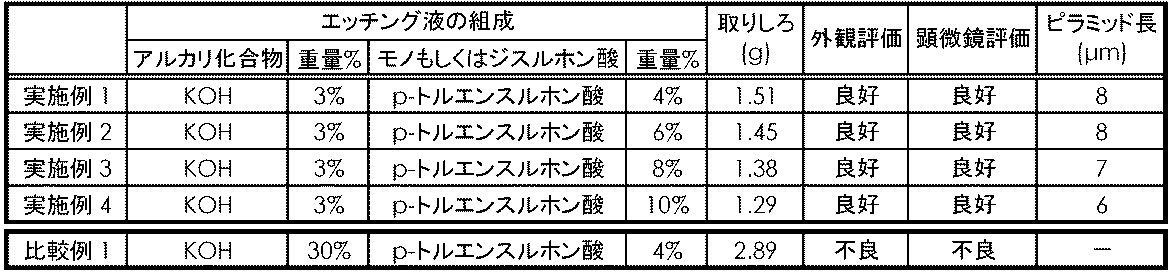
- Examples 1 to 4 and Comparative Example 1 Etching test of silicon-based wafers using various alkaline etching solutions
- ultrapure water an amount of water such that the concentration in the etching solution becomes% shown in Table 1.
- potassium oxide manufactured by Wako Pure Chemical Industries, Ltd.
- p-toluenesulfonic acid manufactured by Wako Pure Chemical Industries, Ltd.
- each etching solution was heated and held at 80 ° C., and then the n-type single crystal silicon wafer having a (100) plane whose weight was measured in advance (prepared by a free abrasive method). : Specific resistance 3.0 to 6.0 ⁇ : 156 mm ⁇ 156 mm: thickness 200 ⁇ m) and immersed for 20 minutes while gently mixing with a stirrer to etch the wafer surface. Thereafter, the wafer was taken out from the solution, overflow rinsed with ultrapure water for 20 minutes, and then naturally dried. The weight of the wafer thus etched was measured, and the change in weight before and after the etching was calculated (the reduced wafer weight is expressed as “take off”).
- the wafer surface after etching was visually observed to confirm whether the appearance was good or bad, and the presence or absence of an uneven structure on the wafer surface was observed with a laser microscope (VK-9700 manufactured by Keyence Corporation). In the visual appearance observation, the case where the wafer surface had no spots or unevenness was evaluated as “good”, and the case where the wafer surface had spots or unevenness was evaluated as “bad”.
- Table 1 shows the composition of the etching solution of each Example and Comparative Example, the calculation result of the margin, the evaluation result of the appearance, the evaluation result by the laser microscope, and the calculation result of the pyramid length (square pyramid length).
- FIG. 1 shows a laser micrograph (magnification 3000 times) of the wafer surface after etching obtained in FIG. 1
- FIG. 2 shows a laser micrograph (magnification 3000 times) of the wafer surface after etching obtained in Comparative Example 1.
- the alkaline etching solution for producing a solar cell of the present invention is an effective etching solution for forming a pyramidal (quadrangular pyramidal) uneven structure.
- the alkaline etching solution for solar cell production according to the present invention can form not only a concavo-convex structure on the entire wafer, but also a pyramid (quadrangular pyramid) with a short one side length, that is, a small pyramid (quadrangle pyramid). It was found that can be formed.
- Such a small-shaped pyramid has a high light confinement effect and can increase the light absorption rate (it can keep the light reflectance low), so that the alkaline etching solution for solar cell production of the present invention is used.
- the wafer is etched with an etching solution containing a high concentration alkali compound such as 30% by weight of potassium hydroxide as in Comparative Example 1, the etching rate is too high. It was found that a uniform pyramidal (square pyramid) uneven structure could not be formed.
- the amount of removal decreases, and therefore the aryl group of mono- or disulfonic acid attached to the wafer surface may inhibit etching of the alkali compound. It is suggested. It can also be seen that as the content of mono- or disulfonic acids according to the present invention is increased, a pyramid (quadrangular pyramid) having a shorter one side of the bottom surface, that is, a pyramid (quadrangular pyramid) having a smaller shape can be formed.
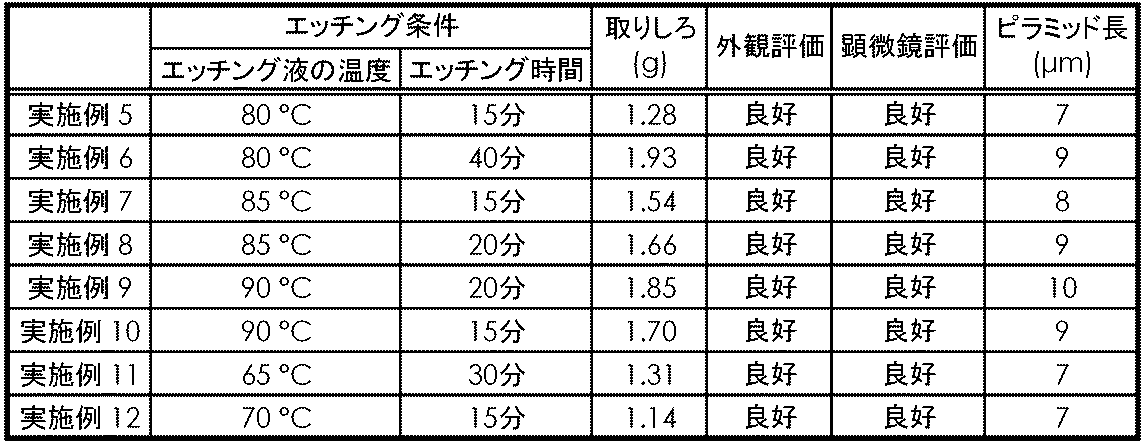
- Example 2 shows the etching conditions, margin calculation results, appearance evaluation results, laser microscope evaluation results, and pyramid length (quadrangular pyramid length) calculation results of each example, and the etching obtained in Example 7
- a laser micrograph (magnification 3000 times) of the wafer surface after is shown in FIG. 3, and a laser micrograph (magnification 3000 times) of the wafer surface after etching obtained in Example 9 is shown in FIG.
- a pyramidal (quadrangular pyramidal) concavo-convex structure can be formed on the entire wafer by using the alkaline etching liquid for solar cell production of the present invention.
- a pyramid (quadrangular pyramid) having a short side on one side that is, a pyramid (quadrangular pyramid) having a small shape can be formed.
- the etching time is the same, the higher the etching temperature, the more the allowance tends to increase.
- the etching temperature is the same, the longer the etching time, the more the allowance tends to increase. It has been found that the etching temperature and the etching time may be appropriately set from the above ranges according to the margin.
- Examples 13 to 15 Etching test of silicon-based wafer with different etching conditions Potassium hydroxide in an amount of 3% in an etching solution in ultrapure water (Wako Pure Chemical Industries, Ltd.) And p-toluenesulfonic acid (manufactured by Wako Pure Chemical Industries, Ltd.) in an amount such that the concentration in the etching solution is 4%, and then stirred appropriately to prepare 5000 g of a clear pH 14 etching solution. .
- the surface of the silicon wafer was etched using the etching solution in the same manner as in Example 1 under the conditions shown in Table 3.
- the silicon wafer after etching was rinsed and dried, and the method for evaluating the wafer was also performed in accordance with Example 1.
- Table 3 shows the etching conditions, margin calculation results, appearance evaluation results, laser microscope evaluation results, and pyramid length (square pyramid length) calculation results for each example.
- each wafer shown in Table 4 is put into this heated and held etching solution and immersed for 20 minutes while gently stirring with a stirrer to etch the wafer surface. did.
- the rinsing and drying of the silicon wafer after etching and the method for evaluating the wafer were performed in accordance with Example 1.
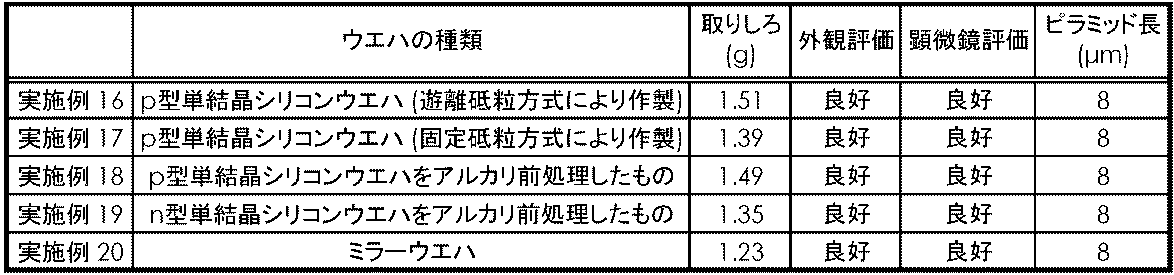
- Table 4 shows the wafer type, margin calculation results, appearance evaluation results, laser microscope evaluation results, and pyramid length (square pyramid length) calculation results for each example.
- the alkaline etching liquid for solar cell production of the present invention can be applied to various wafers other than the n-type wafer produced by the free abrasive grain method used in Example 1. It was. In particular, with the conventional method, it is difficult to form a pyramidal (quadrangular pyramidal) uneven structure on the entire wafer with respect to a wafer or mirror wafer manufactured by a fixed abrasive method that tends to increase the flatness of the wafer surface.
- the alkaline etching solution for manufacturing a solar cell of the present invention can form a fine pyramidal (quadrangular pyramidal) concavo-convex structure on the entire wafer even for such a wafer with high flatness.
- Table 5 shows the wafer type, margin calculation results, appearance evaluation results, laser microscope evaluation results, and pyramid length (square pyramid length) calculation results for each comparative example.
- Examples 21 to 22 Etching test of wafer mainly composed of silicon due to difference in composition of etching solution
- potassium hydroxide (Wako Pure Chemical Industries, Ltd.) was added in such an amount that the concentration in the etching solution was 3%.
- P-toluenesulfonic acid (manufactured by Wako Pure Chemical Industries, Ltd.) in an amount such that the concentration in the etching solution becomes 6% and the concentration in the etching solution becomes 2% or 4%.
- sodium silicate 5000 g of a clear pH 14 etching solution was prepared by appropriately stirring.
- Example 6 The composition of the etching solution of each example is shown in Table 6, and the calculation result of the margin, the appearance evaluation result, the evaluation result by the laser microscope, and the calculation result of the pyramid length (square pyramid length) are shown in Table 7.
- the mono- or disulfonic acids according to the present invention which are constituents of the present invention, such as silicates, and other components other than the alkali compounds (fourth component) It has been found that a pyramidal (quadrangular pyramidal) concavo-convex structure can be formed on the entire surface of a wafer containing silicon as a main component even with an etching solution containing a large amount of silicon.
- potassium hydroxide (Wako Pure Chemical Industries, Ltd.) was added in such an amount that the concentration in the etching solution was 4%.
- various sulfonic acids or sulfonates (all manufactured by Wako Pure Chemical Industries, Ltd.) shown in Table 8 in such an amount that the concentration in the etching solution is 1%, and then stirred appropriately to clarify. 20 mL of an etching solution having a pH of 14 was prepared.
- each etching solution was shaken for 1 minute at room temperature (20 ° C.), and the volume of bubbles derived from the etching solution generated after the shaking was measured, and the disappearance degree of the bubbles was observed.
- the degree of disappearance of the foam was determined as “ ⁇ ” if the foam generated after shaking almost disappeared after 1 minute, and “x” if almost remained.
- Table 8 shows the compositions of the etching solutions of the examples and comparative examples, the measurement results of the volume of bubbles derived from the etching solutions, and the observation results of the degree of disappearance of the bubbles derived from the etching solutions.
- the etching solution containing mono- or disulfonic acids according to the present invention as mono- or disulfonic acid (salt) has little foaming and the bubbles attached to the wafer surface when the wafer is lifted are removed. Therefore, it was found that bubbles disappear from the wafer surface in a short time. That is, during etching, since the etching solution is bubbled by hydrogen generated from the wafer surface, the surface of the etching solution is covered with bubbles. For this reason, bubbles covering the surface of the etching solution adhere to the wafer surface when the wafer is pulled up.
- the etching solution containing mono- or disulfonic acids according to the present invention has less foaming, and the bubbles are removed from the wafer surface in a short time.
- the wafer is etched with the alkaline etching solution for solar cell production of the present invention, no bubbles remain on the surface of the pulled wafer, and it is suggested that poor appearance of the wafer hardly occurs.
- an etching solution containing alkyl sulfonic acid (salt) such as sodium n-octane sulfonate or sodium n-decane sulfonate as mono- or disulfonic acid has strong foaming and adheres to the wafer surface when the wafer is pulled up.
- the alkaline etching solution for solar cell production of the present invention is an excellent etching solution capable of forming a pyramidal (quadrangular pyramidal) concavo-convex structure on the entire surface of a silicon-based wafer. It turns out that there is.
- the alkaline etching solution for solar cell production of the present invention is suitable for wafers and mirror wafers produced by a fixed abrasive method, in which it has been difficult to form a uniform uneven structure on the entire wafer by conventional etching.
- it is possible to effectively form a pyramidal (quadrangular pyramidal) concavo-convex structure it was found to be an excellent etching solution applicable to various wafers.
- the alkaline etching solution for solar cell production of the present invention is applied to a single crystal wafer, a fine pyramid-shaped (quadrangular pyramid) uneven structure suitable for a texture structure can be formed on the wafer surface.
- the alkaline etching solution for producing a solar cell of the present invention is an etching solution suitable for producing a wafer suitable for a solar cell having excellent conversion efficiency (photoelectric conversion efficiency).
- the alkaline etching solution for solar cell production of the present invention has less foaming and the foam attached to the wafer surface is good when the wafer is pulled up, the foam disappears from the wafer surface in a short time, and the foam is removed from the wafer. It has also been found that the etching solution is unlikely to cause poor appearance of the wafer caused by remaining on the surface.
- the alkaline etching solution for manufacturing a solar cell of the present invention is an etching solution that can form an uneven structure on the entire surface of a wafer containing silicon as a main component. More specifically, the alkaline etching solution for producing a solar cell of the present invention can form a pyramidal (square pyramid) fine concavo-convex structure on the surface of the wafer, and is used for producing a silicon substrate particularly suitable for a solar cell. It is something that can be done.
- the method for producing a silicon-based substrate for producing a solar cell according to the present invention is an effective method for forming a pyramidal (square pyramid) concavo-convex structure on the surface of a wafer containing silicon as a main component. This is a preferred method for producing a silicon-based substrate for solar cells that is excellent in (photoelectric conversion efficiency).
Landscapes
- Chemical & Material Sciences (AREA)
- Organic Chemistry (AREA)
- Engineering & Computer Science (AREA)
- Materials Engineering (AREA)
- Photovoltaic Devices (AREA)
- Weting (AREA)
Description
(1)(A)一般式[1]で示されるモノもしくはジスルホン酸又はこれらの塩、(B)アルカリ化合物、並びに(C)水を含む、太陽電池製造用アルカリエッチング液。


超純水に、エッチング液中の濃度が表1に示す%となるような量の水酸化カリウム(和光純薬工業(株)製)とエッチング液中の濃度が表1に示す%となるような量のp-トルエンスルホン酸(和光純薬工業(株)製)を添加後、適宜攪拌して澄明なpH14のエッチング液5000gを調製した。次いで、各エッチング液を80℃に加熱保持した後、加熱保持したこれらのエッチング液に、あらかじめ重量を測定した(100)面を有するn型単結晶シリコンウエハ(遊離砥粒方式で作製されたもの:比抵抗3.0~6.0Ω:156mm×156mm:厚さ200μm)を投入し、攪拌子でゆるやかに混合しながら20分間浸漬して、ウエハ表面をエッチングした。その後、溶液からウエハを取り出し、超純水で20分間オーバーフローリンスした後、該ウエハを自然乾燥させた。このようにしてエッチングしたウエハの重量を測定し、エッチング前後の重量変化を算出した(減少したウエハの重量を「取りしろ」と表記する)。また、エッチング後のウエハ表面を目視観察して、外観の良不良を確認するとともに、レーザー顕微鏡(キーエンス社製VK-9700)でウエハ表面の凹凸構造の有無を観察した。なお、目視による外観の観察にあたっては、ウエハ表面にしみやむらがない場合を「良好」、ウエハ表面にしみやむらがある場合を「不良」と評価した。また、レーザー顕微鏡による凹凸構造の観察にあたっては、ウエハ表面の任意の5箇所を観察し、観察した5箇所すべてにピラミッド状(四角錐状)の凹凸ができていれば「良好」、一部でも平坦部が存在する場合には「平坦有り」(不良)、ピラミッド(四角錐)が完全に形成できていない稜線が不明確な凹凸(テクスチャ)が全体の50%以上存在する場合には「未形成」(不良)と評価した。更に、レーザー顕微鏡で観察したうちの任意の1箇所内で、ピラミッド形状(四角錐形状)が最も大きい方から順に10個抽出し、これらピラミッド(四角錐)の底面の一辺の長さをそれぞれ測定して平均化したものをピラミッド長(四角錐長)として算出した。各実施例及び比較例のエッチング液の組成、取りしろの算出結果、外観の評価結果、レーザー顕微鏡による評価結果、並びにピラミッド長(四角錐長)の算出結果を表1に示すとともに、実施例1で得られたエッチング後のウエハ表面のレーザー顕微鏡写真(倍率3000倍)を図1に、比較例1で得られたエッチング後のウエハ表面のレーザー顕微鏡写真(倍率3000倍)を図2に示す。
超純水に、エッチング液中の濃度が3%となるような量の水酸化カリウム(和光純薬工業(株)製)とエッチング液中の濃度が6%となるような量のp-トルエンスルホン酸(和光純薬工業(株)製)を添加後、適宜攪拌して澄明なpH14のエッチング液5000gを調製した。次いで、上記エッチング液を用いて、表2に示す各条件で実施例1と同様にしてシリコンウエハ表面をエッチングした。エッチング後のシリコンウエハのリンス及び乾燥、並びに該ウエハの評価方法も実施例1に準じて行った。各実施例のエッチング条件、取りしろの算出結果、外観の評価結果、レーザー顕微鏡による評価結果、並びにピラミッド長(四角錐長)の算出結果を表2に示すとともに、実施例7で得られたエッチング後のウエハ表面のレーザー顕微鏡写真(倍率3000倍)を図3に、実施例9で得られたエッチング後のウエハ表面のレーザー顕微鏡写真(倍率3000倍)を図4に示す。
超純水に、エッチング液中の濃度が3%となるような量の水酸化カリウム(和光純薬工業(株)製)とエッチング液中の濃度が4%となるような量のp-トルエンスルホン酸(和光純薬工業(株)製)を添加後、適宜攪拌して澄明なpH14のエッチング液5000gを調製した。次いで、上記エッチング液を用いて、表3に示す各条件で実施例1と同様にしてシリコンウエハ表面をエッチングした。エッチング後のシリコンウエハのリンス及び乾燥、並びに該ウエハの評価方法も実施例1に準じて行った。各実施例のエッチング条件、取りしろの算出結果、外観の評価結果、レーザー顕微鏡による評価結果、並びにピラミッド長(四角錐長)の算出結果を表3に示す。

超純水に、エッチング液中の濃度が3%となるような量の水酸化カリウム(和光純薬工業(株)製)とエッチング液中の濃度が4%となるような量のp-トルエンスルホン酸(和光純薬工業(株)製)を添加後、適宜攪拌して澄明なpH14のエッチング液5000gを調製した。次いで、上記エッチング液を80℃に加熱保持した後、加熱保持したこのエッチング液に、表4に示す各ウエハを投入し、攪拌子でゆるやかに攪拌しながら20分間浸漬して、ウエハ表面をエッチングした。エッチング後のシリコンウエハのリンス及び乾燥、並びに該ウエハの評価方法は実施例1に準じて行った。各実施例のウエハの種類、取りしろの算出結果、外観の評価結果、レーザー顕微鏡による評価結果、並びにピラミッド長(四角錐長)の算出結果を表4に示す。なお、表中のアルカリ前処理したものとは、48%水酸化カリウム水溶液:35%過酸化水素水:水=1:1:5となるように調製した溶液を70℃に加熱保持し、この溶液に、エッチング対象であるウエハを10分間浸漬処理したものを意味し、これにより不純物が吸着したウエハの表面が清浄化される。
超純水に、エッチング液中の濃度が4%となるような量の水酸化カリウム(和光純薬工業(株)製)とエッチング液中の濃度が2%となるような量のイソプロピルアルコール(和光純薬工業(株)製)を添加後、適宜攪拌して澄明なpH14のエッチング液5000gを調製した。次いで、上記エッチング液を80℃に加熱保持した後、加熱保持したこのエッチング液に、表5に示す各ウエハを投入し、攪拌子でゆるやかに攪拌しながら20分間浸漬して、ウエハ表面をエッチングした。エッチング後のシリコンウエハのリンス及び乾燥、並びに該ウエハの評価方法は実施例1に準じて行った。各比較例のウエハの種類、取りしろの算出結果、外観の評価結果、レーザー顕微鏡による評価結果、並びにピラミッド長(四角錐長)の算出結果を表5に示す。

超純水に、エッチング液中の濃度が3%となるような量の水酸化カリウム(和光純薬工業(株)製)とエッチング液中の濃度が6%となるような量のp-トルエンスルホン酸(和光純薬工業(株)製)とエッチング液中の濃度が2%又は4%となるようなケイ酸ナトリウムを添加後、適宜攪拌して澄明なpH14のエッチング液5000gを調製した。次いで、各エッチング液を80℃に加温保持した後、加熱保持したこのエッチング液に、実施例1と同様のシリコンウエハを投入し、攪拌子でゆるやかに混合しながら20分間浸漬して、ウエハ表面をエッチングした。エッチング後のシリコンウエハのリンス及び乾燥、並びに該ウエハの評価方法も実施例1に準じて行った。各実施例のエッチング液の組成を表6に示すとともに、取りしろの算出結果、外観の評価結果、レーザー顕微鏡による評価結果、並びにピラミッド長(四角錐長)の算出結果を表7に示す。


超純水に、エッチング液中の濃度が4%となるような量の水酸化カリウム(和光純薬工業(株)製)とエッチング液中の濃度が1%となるような量の表8に示す各種スルホン酸またはスルホン酸塩(すべて和光純薬工業(株)製)を添加後、適宜攪拌して澄明なpH14のエッチング液20mLを調製した。次いで、各エッチング液を室温(20℃)下で1分間振盪し、振盪後に生じたエッチング液由来の泡の体積を測定するとともに、泡の消失度合いを観察した。なお、泡の消失度合いは、振盪後に生じた泡が1分後にほとんど消失していれば「○」、ほとんど残っていれば「×」と判定した。各実施例及び比較例のエッチング液の組成、各エッチング液由来の泡の体積の測定結果、並びに各エッチング液由来の泡の消失度合いの観察結果を表8に示す。

Claims (12)
- (A)一般式[1]で示されるモノもしくはジスルホン酸又はこれらの塩、(B)アルカリ化合物、並びに(C)水を含む、太陽電池製造用アルカリエッチング液。
{式中、p個のR1はそれぞれ独立して、水素原子、ヒドロキシル基又は炭素数1~10のアルキル基を表し、q個のMはそれぞれ独立して、水素原子、アルカリ金属原子、アンモニウム(NH4)基又はテトラアルキルアンモニウム(R2 4N)基(式中、R2は炭素数1~4のアルキル基を表す。)を表し、nは、0又は1を表し、p及びqはそれぞれ独立して、1又は2を表す。}
- 前記(A)一般式[1]で示されるモノもしくはジスルホン酸又はこれらの塩の含有量が、0.05重量%~30重量%である、請求項1記載のエッチング液。
- 前記(B)アルカリ化合物の含有量が、0.1重量%~15重量%である、請求項1記載のエッチング液。
- 前記(A)一般式[1]で示されるモノもしくはジスルホン酸又はこれらの塩が、一般式[1']で示されるモノもしくはジスルホン酸又はこれらの塩である、請求項1記載のエッチング液。
(式中、p個のR1aはそれぞれ独立して、水素原子、ヒドロキシル基又は炭素数1~10のアルキル基を表し、M、p及びqは、前記に同じ。)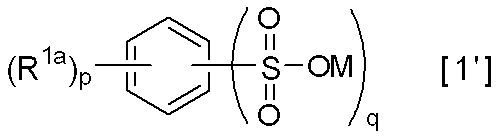
- 前記(A)一般式[1]で示されるモノもしくはジスルホン酸又はこれらの塩が、トルエンスルホン酸又はその塩である、請求項1記載のエッチング液。
- 前記(B)アルカリ化合物が、アルカリ金属水酸化物、アルカリ金属炭酸塩又はテトラアルキルアンモニウムヒドロキシドである、請求項1記載のエッチング液。
- 前記(B)アルカリ化合物が、水酸化ナトリウム、水酸化カリウム、炭酸ナトリウム、炭酸カリウム又はテトラメチルアンモニウムヒドロキシドである、請求項1記載のエッチング液。
- 前記(B)アルカリ化合物が、水酸化ナトリウム又は水酸化カリウムである、請求項1記載のエッチング液。
- 請求項1記載のエッチング液を用いてシリコンを主成分とするウエハをエッチングし、該ウエハの表面に凹凸構造を形成することを特徴とする、太陽電池製造用シリコン系基板の製造方法。
- 50℃~100℃の前記エッチング液を用いて前記ウエハをエッチングする、請求項9記載のシリコン系基板の製造方法。
- 前記凹凸構造がピラミッド状のものであって、その底面の最大辺長が0.1μm~25μmである、請求項9記載のシリコン系基板の製造方法。
- 前記ウエハが、単結晶ウエハである、請求項9記載のシリコン系基板の製造方法。
Priority Applications (5)
| Application Number | Priority Date | Filing Date | Title |
|---|---|---|---|
| US14/400,106 US20150125985A1 (en) | 2012-05-11 | 2013-05-10 | Etching fluid and production method for silicon-based substrate using same |
| EP13787729.6A EP2849211A4 (en) | 2012-05-11 | 2013-05-10 | LIQUID FLUID AND MANUFACTURING PROCESS FOR SILICONE-BASED SUBSTRATES THEREWITH |
| CN201380024603.9A CN104303317A (zh) | 2012-05-11 | 2013-05-10 | 蚀刻液和使用了该蚀刻液的硅系基板的制造方法 |
| KR1020147034420A KR20150020186A (ko) | 2012-05-11 | 2013-05-10 | 에칭액 및 이를 이용한 실리콘계 기판의 제조방법 |
| PH12014502518A PH12014502518A1 (en) | 2012-05-11 | 2014-11-11 | Etching fluid and production method for silicon-based substrate using same |
Applications Claiming Priority (2)
| Application Number | Priority Date | Filing Date | Title |
|---|---|---|---|
| JP2012108967 | 2012-05-11 | ||
| JP2012-108967 | 2012-05-11 |
Publications (1)
| Publication Number | Publication Date |
|---|---|
| WO2013168813A1 true WO2013168813A1 (ja) | 2013-11-14 |
Family
ID=49550844
Family Applications (1)
| Application Number | Title | Priority Date | Filing Date |
|---|---|---|---|
| PCT/JP2013/063222 Ceased WO2013168813A1 (ja) | 2012-05-11 | 2013-05-10 | エッチング液及びこれを用いたシリコン系基板の製造方法 |
Country Status (8)
| Country | Link |
|---|---|
| US (1) | US20150125985A1 (ja) |
| EP (1) | EP2849211A4 (ja) |
| JP (1) | JPWO2013168813A1 (ja) |
| KR (1) | KR20150020186A (ja) |
| CN (1) | CN104303317A (ja) |
| PH (1) | PH12014502518A1 (ja) |
| TW (1) | TW201402785A (ja) |
| WO (1) | WO2013168813A1 (ja) |
Families Citing this family (3)
| Publication number | Priority date | Publication date | Assignee | Title |
|---|---|---|---|---|
| CN108987497A (zh) * | 2018-07-23 | 2018-12-11 | 宁夏大学 | 一种单晶硅太阳能电池用新型陷光结构的制备方法 |
| JP7307861B2 (ja) * | 2021-06-09 | 2023-07-12 | 株式会社日立ハイテク | 半導体製造方法及び半導体製造装置 |
| CN114296297A (zh) * | 2022-01-05 | 2022-04-08 | 大连交通大学 | 一种手机镜头遮光片通光孔内孔壁消光方法 |
Citations (5)
| Publication number | Priority date | Publication date | Assignee | Title |
|---|---|---|---|---|
| JPS6196772A (ja) | 1984-10-17 | 1986-05-15 | Toshiba Corp | 太陽電池用半導体基板の表面処理方法 |
| JPS6442824A (en) | 1987-08-11 | 1989-02-15 | Kyushu Electron Metal | Wet etching |
| JP2007258656A (ja) * | 2006-02-23 | 2007-10-04 | Sanyo Electric Co Ltd | 凹凸基板の製造方法及び光起電力素子の製造方法 |
| WO2007129555A1 (ja) | 2006-05-02 | 2007-11-15 | Mimasu Semiconductor Industry Co., Ltd. | 半導体基板の製造方法、ソーラー用半導体基板及びエッチング液 |
| JP2012004528A (ja) | 2010-05-18 | 2012-01-05 | Shinryo Corp | エッチング液およびシリコン基板の表面加工方法 |
Family Cites Families (5)
| Publication number | Priority date | Publication date | Assignee | Title |
|---|---|---|---|---|
| DE102007058876A1 (de) * | 2007-12-06 | 2009-06-10 | Fraunhofer-Gesellschaft zur Förderung der angewandten Forschung e.V. | Verfahren und Vorrichtung zur Bearbeitung von Waferoberflächen |
| JP2011515872A (ja) * | 2008-03-25 | 2011-05-19 | アプライド マテリアルズ インコーポレイテッド | 結晶太陽電池の表面クリーニング及び凹凸形成プロセス |
| US8110535B2 (en) * | 2009-08-05 | 2012-02-07 | Air Products And Chemicals, Inc. | Semi-aqueous stripping and cleaning formulation for metal substrate and methods for using same |
| WO2012023613A1 (ja) * | 2010-08-20 | 2012-02-23 | 株式会社トクヤマ | テクスチャー形成用組成物、シリコン基板の製造方法、及びテクスチャー形成用組成物調製キット |
| JP2013089629A (ja) * | 2011-10-13 | 2013-05-13 | Shinryo Corp | エッチング液およびシリコン基板の表面加工方法 |
-
2013
- 2013-05-10 US US14/400,106 patent/US20150125985A1/en not_active Abandoned
- 2013-05-10 JP JP2014514768A patent/JPWO2013168813A1/ja active Pending
- 2013-05-10 KR KR1020147034420A patent/KR20150020186A/ko not_active Withdrawn
- 2013-05-10 TW TW102116727A patent/TW201402785A/zh unknown
- 2013-05-10 CN CN201380024603.9A patent/CN104303317A/zh active Pending
- 2013-05-10 WO PCT/JP2013/063222 patent/WO2013168813A1/ja not_active Ceased
- 2013-05-10 EP EP13787729.6A patent/EP2849211A4/en not_active Withdrawn
-
2014
- 2014-11-11 PH PH12014502518A patent/PH12014502518A1/en unknown
Patent Citations (5)
| Publication number | Priority date | Publication date | Assignee | Title |
|---|---|---|---|---|
| JPS6196772A (ja) | 1984-10-17 | 1986-05-15 | Toshiba Corp | 太陽電池用半導体基板の表面処理方法 |
| JPS6442824A (en) | 1987-08-11 | 1989-02-15 | Kyushu Electron Metal | Wet etching |
| JP2007258656A (ja) * | 2006-02-23 | 2007-10-04 | Sanyo Electric Co Ltd | 凹凸基板の製造方法及び光起電力素子の製造方法 |
| WO2007129555A1 (ja) | 2006-05-02 | 2007-11-15 | Mimasu Semiconductor Industry Co., Ltd. | 半導体基板の製造方法、ソーラー用半導体基板及びエッチング液 |
| JP2012004528A (ja) | 2010-05-18 | 2012-01-05 | Shinryo Corp | エッチング液およびシリコン基板の表面加工方法 |
Non-Patent Citations (2)
| Title |
|---|
| PROGRESS IN PHOTOVOLTAICS: RESEARCH AND APPLICATIONS, vol. 4, 1996, pages 435 - 438 |
| See also references of EP2849211A4 |
Also Published As
| Publication number | Publication date |
|---|---|
| CN104303317A (zh) | 2015-01-21 |
| TW201402785A (zh) | 2014-01-16 |
| EP2849211A1 (en) | 2015-03-18 |
| EP2849211A4 (en) | 2015-07-08 |
| PH12014502518A1 (en) | 2015-01-12 |
| US20150125985A1 (en) | 2015-05-07 |
| KR20150020186A (ko) | 2015-02-25 |
| JPWO2013168813A1 (ja) | 2016-01-07 |
Similar Documents
| Publication | Publication Date | Title |
|---|---|---|
| US8759231B2 (en) | Silicon texture formulations with diol additives and methods of using the formulations | |
| KR101362913B1 (ko) | 실리콘 웨이퍼의 텍스쳐링을 위한 조성물 및 방법 | |
| KR101407988B1 (ko) | 에칭액 및 실리콘 기판의 표면가공 방법 | |
| US20100269903A1 (en) | Process for producing polycrystalline silicon substrate and polycrystalline silicon substrate | |
| TWI498421B (zh) | 水性鹼性蝕刻與清潔組合物及處理矽基板表面之方法 | |
| TWI445073B (zh) | 半導體基板之製造方法、太陽能用半導體基板及蝕刻液 | |
| US20110059570A1 (en) | Process For The Rough-Etching of Silicon Solar Cells | |
| CN103426744A (zh) | 用于硅片制绒的组合物和方法 | |
| CN102656250A (zh) | 含水酸性蚀刻溶液和使单晶和多晶硅衬底的表面纹理化的方法 | |
| JP6477990B1 (ja) | Iii−v族化合物半導体基板およびエピタキシャル層付iii−v族化合物半導体基板 | |
| WO2013168813A1 (ja) | エッチング液及びこれを用いたシリコン系基板の製造方法 | |
| US8986559B2 (en) | Compositions and methods for texturing polycrystalline silicon wafers | |
| JP2013236027A (ja) | エッチング液及びこれを用いたシリコン系基板の製造方法 | |
| JPWO2012023613A1 (ja) | テクスチャー形成用組成物、シリコン基板の製造方法、及びテクスチャー形成用組成物調製キット | |
| JP5575822B2 (ja) | テクスチャー形成用エッチング液 | |
| JP2013089629A (ja) | エッチング液およびシリコン基板の表面加工方法 | |
| TW201348406A (zh) | 紋理化矽晶圓的組合物及方法 | |
| JP2015088712A (ja) | テクスチャエッチング液、テクスチャエッチング液用添加剤液、テクスチャ形成基板及びテクスチャ形成基板の製造方法並びに太陽電池 | |
| JP2013168619A (ja) | テクスチャー形成用組成物 | |
| KR20120127308A (ko) | 기판의 텍스처링 조성물 및 이를 이용하는 방법 | |
| JP2012038830A (ja) | テクスチャー形成用組成物 | |
| JP2013126924A (ja) | 周期表第13族金属窒化物半導体基板の製造方法 | |
| WO2012057132A1 (ja) | シリコン基板の製造方法 |
Legal Events
| Date | Code | Title | Description |
|---|---|---|---|
| 121 | Ep: the epo has been informed by wipo that ep was designated in this application |
Ref document number: 13787729 Country of ref document: EP Kind code of ref document: A1 |
|
| ENP | Entry into the national phase |
Ref document number: 2014514768 Country of ref document: JP Kind code of ref document: A |
|
| WWE | Wipo information: entry into national phase |
Ref document number: 14400106 Country of ref document: US |
|
| NENP | Non-entry into the national phase |
Ref country code: DE |
|
| REEP | Request for entry into the european phase |
Ref document number: 2013787729 Country of ref document: EP |
|
| WWE | Wipo information: entry into national phase |
Ref document number: 2013787729 Country of ref document: EP |
|
| ENP | Entry into the national phase |
Ref document number: 20147034420 Country of ref document: KR Kind code of ref document: A |