WO2013172157A1 - Dispositif de recherche de trajet et programme d'ordinateur - Google Patents
Dispositif de recherche de trajet et programme d'ordinateur Download PDFInfo
- Publication number
- WO2013172157A1 WO2013172157A1 PCT/JP2013/061896 JP2013061896W WO2013172157A1 WO 2013172157 A1 WO2013172157 A1 WO 2013172157A1 JP 2013061896 W JP2013061896 W JP 2013061896W WO 2013172157 A1 WO2013172157 A1 WO 2013172157A1
- Authority
- WO
- WIPO (PCT)
- Prior art keywords
- route
- destination
- battery
- information
- amount
- Prior art date
- Legal status (The legal status is an assumption and is not a legal conclusion. Google has not performed a legal analysis and makes no representation as to the accuracy of the status listed.)
- Ceased
Links
Images





Classifications
-
- G—PHYSICS
- G01—MEASURING; TESTING
- G01C—MEASURING DISTANCES, LEVELS OR BEARINGS; SURVEYING; NAVIGATION; GYROSCOPIC INSTRUMENTS; PHOTOGRAMMETRY OR VIDEOGRAMMETRY
- G01C21/00—Navigation; Navigational instruments not provided for in groups G01C1/00 - G01C19/00
- G01C21/26—Navigation; Navigational instruments not provided for in groups G01C1/00 - G01C19/00 specially adapted for navigation in a road network
- G01C21/34—Route searching; Route guidance
- G01C21/3453—Special cost functions, i.e. other than distance or default speed limit of road segments
- G01C21/3469—Fuel consumption; Energy use; Emission aspects
Definitions
- the present invention relates to a route search device and a computer program for searching for a route to a destination.
- a computer is searched for a route to the destination.
- a route search technique there is one described in Patent Document 1.
- a driver who drives a car inputs a destination to an in-vehicle device
- information on the destination and a departure location (current location) is transmitted to the server device by communication, and the server device stores roads stored in the database.
- the link cost of the link a process for searching for a route from the departure place to the destination is executed by a predetermined search algorithm.
- the recommended route is determined, information on the recommended route is transmitted to the in-vehicle device, and the in-vehicle device that has received this information notifies the driver of the recommended route and can start route guidance along the recommended route. It becomes possible.
- the computer is searched for a route to the destination.
- a route search technique there is one described in Patent Document 1.
- a user who owns an electric vehicle inputs a destination to the in-vehicle device
- information on the destination and the departure location (current location) is transmitted to a server device that functions as a route search device.
- the server device searches for a route from the departure point to the destination based on a predetermined search algorithm and determines a recommended route
- the server device transmits information indicating the recommended route to the in-vehicle device.
- the in-vehicle device that has received this information can display the recommended route on a display or the like to notify the user, and can start route guidance along the recommended route.
- an object of the present invention is to prevent the occurrence of such troubles.
- the present invention is a route search device that searches for a recommended route from a starting point to a destination where an electric vehicle using battery power as a driving power should travel, and is a candidate for a route from the starting point to the destination.
- a search unit that performs a search and estimates a remaining power amount of the battery when arriving at the destination, and determines a recommended route to the destination based on the remaining power amount estimated by the search unit And a deciding unit to perform.
- the present invention is a computer program for causing a computer to execute a process of searching for a recommended route from a starting point to a destination where an electric vehicle using battery power as a driving power is to travel. Searching for a route candidate to the destination, estimating a remaining power amount of the battery when arriving at the destination, and a recommended route to the destination based on the estimated remaining power amount Determining the step.
- the present invention is an apparatus for searching for a route to a destination for a vehicle that can be driven by a motor that uses a battery as a power source, and that is necessary power for traveling from the destination to the battery charging facility.
- a first processing unit for obtaining the amount, and a route search to the destination, and a remaining battery level when the vehicle arrives at the destination by traveling along a route based on the route search is the required power
- a second processing unit that generates warning information for the user when the amount is insufficient.
- the present invention is a computer program for causing a computer to function as a route search device for searching for a route to a destination for a vehicle that can run by a motor that uses a battery as a power source. And obtaining a necessary amount of electric power necessary for traveling to the charging facility and searching for a route to the destination and arriving at the destination by traveling along a route based on the route search. Generating a warning information for the user when the remaining battery charge is insufficient with respect to the required power amount.
- the present invention even if the electric vehicle can arrive at the destination, it is possible to prevent a trouble that the battery power is insufficient due to necessary movement from the destination.
- the present invention prevents the occurrence of troubles in the electric vehicle after arriving at the destination such that even if it arrives at the destination, it becomes impossible to move next due to insufficient battery power, for example. With the goal.
- the present invention provides a route search device for searching for a recommended route from a starting point to a destination where an electric vehicle using battery power as a driving power should travel.
- a search unit that searches for a candidate for a route from the departure point to the destination, and that estimates a remaining power amount of the battery when arriving at the destination, and the remaining power estimated by the search unit And a determining unit that determines a recommended route to the destination based on the amount.
- the recommended route to the destination is determined based on the remaining amount of power of the battery when it arrives at the destination, even if it arrives at the destination, for example, due to insufficient battery power, It is possible to prevent the occurrence of troubles in the electric vehicle after arriving at the destination such that it becomes impossible to move next.
- the determining unit determines, as a recommended route, a route in which the estimated remaining power amount is closest to the specified specified power amount. In this case, a route in which the remaining power amount of the battery when arriving at the destination is close to the specified power amount is determined as the recommended route.
- the route search apparatus further includes a power amount setting unit that sets the designated power amount to be changeable. In this case, it is possible to change the designated power amount, and it is possible to respond to a request from the driver or the like regarding the remaining power amount of the battery when it arrives at the destination.
- the search unit can search for a route including a charging station that charges the battery as a route point as a candidate route to the destination. In this case, even if the travel distance from the departure place to the destination is longer than the cruising distance of the electric vehicle, it is possible to arrive at the destination by charging the battery via the charging station. .
- the route search device preferably further includes a charge amount setting unit for designating a charge amount in the charging station.
- a charge amount setting unit for designating a charge amount in the charging station.
- the remaining amount of electric power of the battery when arriving at the destination is to be as close as possible to a predetermined value (for example, 50%).
- a predetermined value for example, 50%
- the charge amount setting unit designates a lower charge amount (for example, 80%) and performs charging to the lower charge amount, whereby the remaining power amount of the battery when arriving at the destination is determined as the predetermined amount. It becomes possible to approach the value (50%).
- the search unit as a route candidate to the destination, a route that passes through a charging station on the way because the remaining power amount of the battery is less than a predetermined lower limit, and the battery It is preferable to be able to search for a route that does not go through the charging station if the remaining battery power becomes less than the predetermined lower limit value and the battery does not run out.
- a predetermined lower limit for example, 20%
- the present invention provides a computer that searches for a recommended route from a starting point to a destination where an electric vehicle using battery power as a driving power should run. And a step of searching for a candidate for a route from the departure place to the destination, and estimating a remaining power amount of the battery when arriving at the destination. And determining a recommended route to the destination based on the remaining power amount. According to the present invention, it is possible to achieve the same effects as the route search device described in (1-1).
- the recommended route to the destination is determined based on the remaining amount of power of the battery when it arrives at the destination.
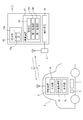
- FIG. 1 is a block diagram showing an example of a traffic information system provided with a route search device of the present invention.
- the traffic information system includes a vehicle, a vehicle-mounted device 3 mounted on the vehicle, a roadside communication device 4 that communicates wirelessly with the vehicle-mounted device 3, and can communicate with the roadside communication device 4 to collect various information and collect various information.
- the server device 5 to be generated is included.
- the vehicle-mounted device 3 can be a mobile terminal such as a smartphone carried by a driver (passenger) other than a device fixed to the vehicle.
- the roadside communication device 4 is a base station device that performs wireless communication with the mobile terminal.
- the vehicle according to the present embodiment includes a rechargeable battery 7 and is an electric vehicle 2 that uses the power of the battery 7 as travel power.
- the in-vehicle device 3 includes an in-vehicle computer, acquires probe information (also referred to as floating car information) of the electric vehicle 2 on which the in-vehicle device 3 is mounted, and transmits the probe information to the server device 5 through the roadside communication device 4. Furthermore, information generated by the server device 5 (information on recommended routes to be described later) is transmitted to the in-vehicle device 3 through the roadside communication device 4.
- the in-vehicle device 3 includes an input unit 3a that receives an operation of a driver (passenger) and inputs various information, and a position acquisition unit 3b that can acquire information on the current position.
- the input unit 3a is composed of, for example, a touch panel operated by a driver, and a destination is input by character input or the like.
- the input destination is used as destination information, is included in the transmission information i1 together with the identification information (vehicle ID) of the electric vehicle 2, and is transmitted to the server device 5.
- the transmission information i1 is a recommended route search request signal for the server device 5.
- the position acquisition unit 3b is composed of a device having a GPS function, for example, and acquires information on the current position.
- the acquired current position information is included in the transmission information i1 and transmitted to the server device 5.
- the vehicle-mounted apparatus 3 can acquire the information of the remaining electric energy in the battery 7 of the own vehicle, and this information is also included in the transmission information i1.
- Each roadside communication device 4 includes a communication device and a communication controller, can wirelessly communicate with the in-vehicle device 3, and can communicate with the server device 5 by wire (or wirelessly).
- the server device 5 includes a server computer, a storage device 15 including a hard disk storing a computer program and various information, a communication device 16 including a communication interface for communicating with the roadside communication device 4, and arithmetic processing. And an arithmetic unit 17 having a function of performing the above. Further, the server device 5 includes an information input unit (interface) 18 for adding information to a later-described database stored in the storage device 15 for storage.
- an information input unit (interface) 18 for adding information to a later-described database stored in the storage device 15 for storage.
- the storage device 15 exists in each area, a road network database 15a storing map information of road maps in each area, a traffic information database 15b storing link cost information for each road link, and each area. It has a charging station database 15c that stores charging stations (included in the road map) and their attribute information.
- the link cost of the traffic information database 15b is travel time, and the information on the power consumption of the battery 7 of the electric vehicle 2 required to travel each road link is stored in the database 15b. It is set for each road link.
- the map information includes, for example, road link information formed by a combination of nodes and road links, where a road map is divided into meshes.
- the map information includes information on charging stations (charging facilities) for charging batteries of electric vehicles installed in each region. It is associated with attribute information described later in the database 15c.
- the link cost information in the traffic information database 15b is associated with the road link set in the map information. Further, the link cost for each road link is also divided for each time zone, and the travel time for each time zone is reflected. This travel time is generated based on statistical values such as past performance values. Since this travel time is affected by the traffic congestion of the road link, this travel time information can be used as traffic jam information.
- the traffic jam information may be traffic information other than the travel time.
- the storage device 15 stores dynamic information that changes with time, such as travel time for each time zone.
- the traffic information database 15b also stores information about the length and gradient for each road link.
- the charging station database 15c includes attribute information indicating the location of the charging station, the time required for staying at the charging station, the presence / absence of a quick charging function at the charging station, and the usable time zone (business hours) of the charging station. Accumulated for each charging station.
- the location of the charging station is associated with the road link set in the map information.
- the time required for staying at the charging station includes time required for charging, set-up time for charging work, and work time after the end of charging, such as a time for paying a fee.
- the server device 5 has a plurality of functional units having various functions, and one of these functional units is the route search device 1.
- the arithmetic device 17 included in the server device 5 includes a computer having a CPU and an internal memory, and a computer program for causing the server device 5 to function as the route search device 1 is installed in the storage device 15.
- Each function (search unit 10, determination unit 13, power amount setting unit 14, and charge amount setting unit 20) provided in the route search device 1 is exhibited when the computer program is executed by the arithmetic device 17. .
- the search unit 10 includes a first search unit 11 and a second search unit 12.
- the computer program can be stored in a storage medium such as a magnetic disk, an optical disk, or a semiconductor memory.
- the route search device 1 when the transmission information i1 is transmitted from the in-vehicle device 3 and is received by the route search device 1, the route search device 1 causes the electric vehicle 2 to travel from the departure place to the destination (via the waypoint). A process of searching for a recommended route to be performed using the link cost of the road link is started. Note that the departure place is based on the current position information included in the transmission information i1, and the destination is based on the destination information included in the transmission information i1. As will be described later, the waypoint is included in the recommended route and automatically determined by the route search device 1. Then, when the recommended route is determined, the route search device 1 includes the recommended route information in the response information i2 and transmits it to the in-vehicle device 3.
- the in-vehicle device 3 Upon receiving this response information i2, the in-vehicle device 3 can output a recommended route to the driver, and can perform route guidance along the recommended route.
- the waypoint is a charging station that charges the battery 7 of the electric vehicle 2.
- the route search device 1 it is recommended that the electric vehicle 2 can reach the destination by way of the charging station. A route is obtained.
- the search unit 10 includes a first search unit 11 and a second search unit 12, and each of the first search unit 11 and the second search unit 12 is from one point (first point) to another point (second point).
- the electric vehicle 2 has a function of searching for a section route to be traveled by a predetermined search algorithm using the link cost of the road link.
- the link cost of the road link is accumulated in the traffic information database 15b, and the first search unit 11 and the second search unit 12 refer to this database 15b.
- each of the first search unit 11 and the second search unit 12 obtains a charging station as a transit point and a section route to the charging station based on a cruising range (setting range).
- This cruising range is based on the remaining power amount of the battery 7. That is, the cruising range is determined by the amount of remaining power obtained by subtracting the amount of power consumed with traveling from the amount of power of the battery 7 at the starting point (departure point or charging station). For example, the cruising range is until the remaining power amount becomes less than a predetermined value (for example, 20%).
- the first search unit 11 and the second The search unit 12 can obtain one or a plurality of charging stations within the cruising range and a section route to the charging station by executing a route search process while referring to the database 15b.
- the present embodiment is a Dijkstra method, and each of the first search unit 11 and the second search unit 12 has a small sum of link costs of road links.
- a simulation for searching for a section route (which is the minimum) is performed.
- the route search apparatus 1 can determine a recommended route that shortens the travel time as much as possible from the departure point to the destination.
- the search unit 10 a section route to the charging station is obtained, and based on this section route, the departure from the departure place and the arrival via the waypoint can be achieved. It is possible to search all routes to the destination that can be performed, and the determination unit 13 determines the recommended route based on the processing result of the search unit 10 (second search unit 12).
- the search unit 10 may search for a plurality of all routes, and in this case, an optimal all route is selected from these all routes by the determination unit 13, One whole route is determined as the recommended route.
- the total route is a candidate route from the starting point to the destination.
- the second search unit 12 of the search unit 10 searches for a candidate route to the destination, and also estimates a remaining power amount of the battery 7 when arriving at the destination (estimation function). )have.
- the traffic information database 15b stores the amount of power of the battery 7 consumed by each road link. For example, from the amount of power of the battery 7 at the charging station to the destination. Thus, the remaining power amount obtained by subtracting the consumed power amount can be estimated as the remaining power amount of the battery 7 when arriving at this destination.
- the determination unit 13 determines a recommended route to the destination based on the estimated remaining power amount. For example, the determination unit 13 determines a route whose estimated remaining power amount is closest to the specified specified power amount as a recommended route.
- the estimation function by the second search unit 12 and the recommended route determination function by the determination unit 13 will be described in a specific example later.
- the first search unit 11 and the second search unit 12 search the section route based on the attribute information of the charging station by referring to the charging station database 15c. For example, if the section route is searched based on the information indicating the stay required time at the charging station or the information indicating the presence or absence of the quick charge function as the attribute information, the stay time spent at the charging station can be more strictly linked cost. Can be reflected. In addition, if the arrival time at the charging station is out of the usable time zone (out of business hours) by searching the section route based on the information indicating the usable time zone of the charging station, the charging is performed. Stations are never set as transit points.
- the information input unit 18 can add and store attribute information of other charging stations in the charging station database 15c.
- charging stations are often installed in electric vehicle stores.
- Such a charging station is generally an open charging station and can be said to be a public charging station.
- the route search device 1 it is relatively easy for the route search device 1 to collect attribute information (information indicating the presence or absence of the quick charging function and information indicating the usable time zone) and create a database. It is. However, it is necessary to additionally register the attribute information of the charging station (charging facility) installed privately in the database 15c.
- the driver transmits the transmission information i1 including the attribute information of the charging station and the request information for requesting registration from the in-vehicle device 3, and when the route search device 1 receives the request information, the information input unit By 18, the attribute information of such a private charging station is added to the database 15 c.
- the determination unit 13 determines the route whose remaining power amount estimated by the second search unit 12 is closest to the specified “specified power amount” as the recommended route.
- the “amount” is set by the power amount setting unit 14.
- the “specified power amount” as an initial value is set in the power amount setting unit 14, but this “specified power amount” can be changed.
- the driver transmits through the in-vehicle device 3, that is, the information “designated power amount” is included in the transmission information i 1, and when the route search device 1 receives this information, the driver information includes “ The information on “designated power amount” is set by the power amount setting unit 14 as “designated power amount” which is a condition for the determining unit 13 to determine a recommended route.
- the search unit 10 when all routes including the charging station as a waypoint are searched and the recommended route is determined by the determination unit 13, the amount of charge to the battery 7 in the charging station included in the recommended route is determined.
- the charge amount setting unit 20 has a function to designate. In the present embodiment, in particular, the amount of charge to the battery 7 at the last charging station is designated before arriving at the destination. For example, when the remaining power amount of the battery 7 when it arrives at the charging station is 30%, the charge amount (80%) is set to the charge amount setting so that the charge amount at the charge station is 80% charge. Specified by part 20.
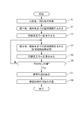
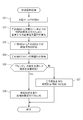
- FIG. 2 is a flowchart for explaining this route search method.
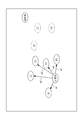
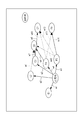
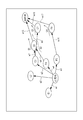
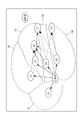
- 3 to 6 are explanatory diagrams for explaining the route search in order.
- charging stations that can be transit points are E1 to E8.
- the transmission information i1 (see FIG. 1) is transmitted from the in-vehicle device 3, and when the route search device 1 receives the transmission information i1, in addition to the ID information of the electric vehicle 2 included in the transmission information i1, this Information on the current position (starting place) of the electric vehicle 2, information on the destination, and information on the remaining electric energy of the battery 7 are acquired (step S1 in FIG. 2). Thereby, as shown in FIG. 3, the starting point and the destination are set on the map based on the road network database 15a (see FIG. 1).
- the first search unit 11 refers to each database, and performs processing for obtaining a charging station included in a cruising range starting from the departure point and a section route from the departure point to the charging station based on the Dijkstra method. Perform (step S2).
- the 1st search part 11 finds the reachable charging station, subtracting the electric energy of the battery 7 consumed every time it follows a road link from the electric energy of the battery 7 in the starting point (starting place).
- charging stations E1 to E5 are obtained, and section routes w1 to w5 from the departure place to the charging stations E1 to E5 are obtained.
- These charging stations E1 to E5 are charging stations (candidates) that pass through first.
- Such processing for obtaining a charging station is performed individually in parallel. That is, the calculation for obtaining the charging stations E1 to E5 and the calculation for obtaining the section paths w1 to w5 are individually executed in parallel (progressed simultaneously).
- step S2 a section route is obtained using dynamic information that changes over time.
- dynamic information that changes over time for example, there is traffic information related to traffic congestion on a road.
- traffic information is accumulated in the traffic information database 15b.
- the first search unit 11 calculates the link cost of the section route using the dynamic information.
- the first search unit 11 cannot obtain these charging stations E6 to E8 as the first waypoints. That is, in an electric vehicle, the distance that can be traveled by one cruising is limited, for example, 200 km when the battery 7 is fully charged. Therefore, in the case of an electric vehicle, a range having a radius of 200 km centering on the departure point is the maximum of one cruising range. The cruising range changes according to the gradient of the road link on the way.
- a section route that minimizes the sum of the link costs of road links is included in the final recommended route.
- the section routes remaining as candidates are w1 to w5, and information on these section routes w1 to w5 and information on charging stations E1 to E5 that pass through are stored in the storage device 15 ( Step S3).
- the second search unit 12 refers to each database, and based on the Dijkstra method, another charging station included in the cruising range starting from each of the charging stations E1 to E5 obtained by the first search unit 11, and Then, a section route search process (first time) for obtaining a section route from each of these starting points (E1 to E5) to another charging station is performed (step S4).
- the second search unit 12 finds a reachable charging station by subtracting the amount of power of the battery 7 that is consumed every time it travels on the road link from the amount of power of the battery 7 at the starting point (each of the charging stations E1 to E5). In the present embodiment, as shown in FIG.
- charging stations E6 to E8 are obtained, and section routes w6 to w14 from the charging stations E1 to E5 to the charging stations E6 to E8 are obtained.
- the charging station obtained by the section route search process (first time) is a charging station (candidate) that passes through the second time.
- the charging stations obtained by the section route search processing are charging stations E6 to E8 different from the charging stations E1 to E5 that are the starting points, and further charging stations E6 to E8 that have not been obtained so far.
- requiring such a charging station is advanced separately in parallel. That is, the calculation for obtaining the charging stations E6 to E8 and the calculation for obtaining the section paths w6 to w14 are individually executed in parallel (progressed simultaneously).
- a section route is obtained using dynamic information that changes over time.
- dynamic information that changes over time for example, there is traffic information related to traffic congestion on a road.
- traffic information is accumulated in the traffic information database 15b, and by referring to this database 15b, the second search unit 12 calculates the link cost of the section route using the dynamic information.
- this section route search process (step S4), if there are a plurality of section routes from one charging station to one other charging station, the section route that minimizes the sum of the link costs of road links is selected. And leave as a candidate of the section route included in the final recommended route. For example, when there are a plurality of section routes that reach the charging station E6 from the charging station E3, only the section route w7 that minimizes the sum of the link costs is left as a candidate.
- this section route search process (step S4), if there are a plurality of section routes (candidates) that reach each other charging station from each of the plurality of charging stations as the starting points, The section route that minimizes the sum of the link costs of road links is left as a candidate section route included in the final recommended route.
- the section route w8 starting from the charging station E3, the section route w10 starting from the charging station E4, and the section path w13 starting from the charging station E5 are the section routes reaching the charging station E7.
- the section route (w8 in this embodiment) with the minimum link cost is left as a candidate, and the section route w10 and the section route w13 are sections included in the final recommended route.
- the section routes remaining as candidates are the section routes w7, w8, w9, and w14, information on these section routes w7, w8, w9, and w14, and the charging stations E6 to E8 that pass therethrough. Is stored in the storage device 15 (step S5).
- section routes for which the sum of link costs is not minimized are deleted one after another from the candidates, and section routes w7, w8, w9, and w14 that are superior when link costs are compared are left as candidates.
- the range in which becomes redundant is reduced. This will be described with reference to the drawings.
- a plurality of charging stations included in the cruising range starting from each of the charging stations E1 to E5 are required.
- the search range from each of the charging stations E1 to E5 is shown in FIG. As shown in FIG.
- the search range starting from the charging station E1 is within the range of a circle (ellipse) indicated by the symbol Q1
- the search range of the charging stations E2 to E5 is the circle indicated by the symbols Q2 to Q5, respectively ( Within the range of an ellipse).
- the reason why the search range is an ellipse is that, in the present embodiment, a search range determination method that prioritizes the direction of the destination is employed.
- this section route search process when the section route search from each of the charging stations E1 to E5 is individually executed in parallel, an area where search ranges overlap is generated as shown in FIG.
- the search in the area becomes redundant.
- the link cost (sum) of the route starting from one charging station is the link cost (sum) of the route starting from the other charging station on the intermediate line of the overlapping region. )
- the other route is deleted and only one route is removed, so that no redundant area is generated.
- the image of the search range from each of the charging stations E1 to E5 in the present embodiment in which no redundant area is generated is as shown in FIG.
- the processing time for searching for a section route is proportional to the number of elements (roads / intersections) to be searched, and the number of elements is generally proportional to the total area to be searched (search range). Therefore, in the present embodiment, the overlapping search range is reduced, which greatly contributes to shortening the processing time.
- the section route search process will be further described. As shown in FIG. 4, since the first search unit 11 obtains the section routes w1 to w5, the power consumption when the electric vehicle 2 travels on each of the section routes w1 to w5, that is, the charging stations E1 to E5. It is possible to calculate (estimate) the remaining power amount when arriving at. In each of the charging stations E1 to E5, charging is performed according to the power consumption due to traveling on each of the section routes w1 to w5, so that the charging time until reaching a predetermined charging amount (for example, 80% charging) is performed. It can be different.
- a predetermined charging amount for example, 80% charging
- the second search unit 12 obtains the charging time required to reach a predetermined charging amount (for example, 80% charging) from the remaining battery level when arriving at the charging stations E1 to E5, and uses this charging time as a link cost. Including the process for obtaining the section route.
- a predetermined charging amount for example, 80% charging
- step S4 in consideration of the difference in link cost due to the difference in charging time for each charging station, only the section route having the minimum link cost is left as a candidate.
- the charging time in each charging station is calculated
- the second search unit 12 includes the time spent in the charging stations E1 to E5 in the link cost, and as the dynamic information that changes over time, the second searching unit 12 spent in each of the charging stations E1 to E5.
- the section route is obtained using the traffic information after the elapse of time. For example, when traveling on the section route w3, charging at the charging station E3, and traveling on the section route w8, the section route w8 is congested at the time of arrival at the charging station E3, and the section route w8 has the lowest link cost. Even in such a case, when the charging time at the charging station E3 elapses (for example, one hour after the arrival time), the congestion of the section route w8 may be resolved. .
- the link cost of the section route w8 can be minimized.
- the second search unit 12 The link cost can be calculated by referring to the database.
- the charging station E6 (see FIG. 5) is in business hours (chargeable time), but referring to the traffic information database 15b.
- traffic congestion is expected at the scheduled time of travel, and if this traffic congestion causes the arrival time at the charging station E6 to be out of business hours, the charging is performed. It is necessary to prevent the station E6 from being set as a transit point. Therefore, the second search unit 12 uses the dynamic information that changes over time, that is, the traffic information of the scheduled time zone that passes the road link on the way to the charging station E6, to obtain the section route, It is possible to prevent the charging station E6 from being set as a transit point.
- the business hours of the charging station E6 can be determined by referring to the attribute information related to the usable time zone stored in the charging station database 15c. In the following embodiment, a case will be described in which E6 is included as a charging station via.
- step S6 when the information on the charging stations E6 to E8 and the information on the section routes w7, w8, w9, and w14 are stored in the storage device 15, the second search unit 12 It is determined whether or not the search has reached the destination (step S6). In this embodiment (FIG. 5), since it has not yet reached (“No” in step S6), the process returns to step S4, and the second search unit 12 executes the section route search process (second time).
- the second search unit 12 refers to each database and, based on the Dijkstra method, is included in the cruising range starting from each of the charging stations E6 to E8 determined by the section route search process (first time). And a section route search process (second time) for obtaining a section route from each of the charging stations and the starting points (E6 to E8) to each of the other charging stations (step S4).
- the second search unit 12 calculates the power amount of the battery 7 consumed every time the road link is traveled from the power amount of the battery 7 at the starting point (each of the charging stations E6 to E8). While subtracting, it tries to find another charging station within range.
- the section route that minimizes the sum of the link costs of the road links is the final one. It remains as a candidate for a section route included in the recommended route. For example, when there are a plurality of section routes reaching the destination from the charging station E6, only the section route w15 having the minimum sum of link costs is left as a candidate.
- the section routes remaining as candidates are the section routes w15 to w17, and information on these section routes w15 to w17 is stored in the storage device 15 (step S5).
- the second search unit 12 includes a plurality of different waypoints within the cruising range starting from each of the plurality of charging stations obtained by the first search unit 11 or the second search unit 12, and The section route search process (step S4) for obtaining the section route to each of these other waypoints is repeated until the destination is reached.
- the second search unit 12 estimates (calculates) the remaining electric energy of the battery 7 when arriving at the destination when traveling on each of the section routes w15 to w17.
- the 2nd search part 12 is computable based on the information memorize
- step S7 determines a recommended route
- step S8 transmits to the vehicle equipment 3
- the first route G1 passing through the charging stations E3 and E6 and the charging stations E3 and E7 are taken as all routes from the starting point to the destination.
- the second whole path G2, the third whole path G3 via the charging stations E4 and E6, and the fourth whole path G4 via the charging stations E5 and E8 are acquired, and all these four paths are obtained.
- G1 to G4 are stored in the storage device 15. Furthermore, for each of the routes G1 to G4, since the remaining power amount of the battery 7 when the second search unit 12 arrives at the destination is estimated by the second search unit 12, The information is stored in the storage device 15 in association with the paths G1 to G4.
- the section route search process (step S4) by the second search unit 12 is performed, all four routes from the departure point to the destination are obtained. Among these four routes G1 to G4, one optimum route is determined as the recommended route. This determination is made based on conditions initially set in the route search device 1 or based on conditions set by the driver. When the driver sets conditions, the transmission information i1 includes setting information indicating conditions for the determination unit 13 to determine a recommended route.
- the “remaining electric energy of the battery 7 of the electric vehicle 2 when it arrives at the destination” is set as a condition for selecting one optimum recommended route from all the plurality of routes G1 to G4.
- the determination unit 13 uses a plurality of remaining power amounts based on the estimated remaining power amount.
- One of the candidate routes G1 to G4 is determined as a recommended route to the destination.
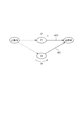
- FIG. 6 is an explanatory diagram in which the entire route G1 and the entire route G2 in FIG. 6 are simplified.
- the charging is performed at the charging station E6.
- the section route w15 is long and the power consumption of the battery 7 is increased. It is assumed that the remaining power amount of the battery 7 when arriving at the ground is estimated to be 20%.
- the battery 7 consumes less power than the section route w15, and the battery 7 arrives at the destination. It is assumed that the remaining power amount is estimated to be 50%. Then, when arriving at the destination and considering returning from the destination back to the departure place, in order to reach the charging station E7 closest to the destination, the battery is charged at the time of departure from the destination. Assume that 40% of the remaining power amount of 7 is necessary.
- the entire route G1 with the shortest travel distance is selected as the recommended route, and the remaining power amount of the battery 7 when arriving at the destination is 20%.
- the electric vehicle 2 may not be able to reach the charging station E7 closest to the destination. Therefore, in this specific example 1, although the travel distance from the departure place to the destination is not the shortest, the remaining electric energy of the battery 7 when arriving at the destination is necessary for arriving at the next charging station E7.
- the entire route G2 that exceeds 40% of the charged amount is determined as the recommended route by the determination unit 13.
- the search unit 10 searches all routes from the departure point to the destination, and estimates the remaining power amount of the battery 7 when arriving at the destination, so that the remaining power estimated by the search unit 10
- the determination unit 13 determines a route whose amount is closest to the designated “specified power amount” as a recommended route. And this "designated electric energy" should just be set to the said recommended charge depth, and the recommended charge depth is 50%.
- the estimation function by the second search unit 12 is used to arrive at the destination. It is assumed that the remaining power amount of the battery 7 is estimated to be 75%.
- the determination unit 13 determines all routes G4 whose estimated remaining power amount is closest to 50% which is the specified specified power amount as recommended routes.
- the information on the designated power amount is set by the power amount setting unit 14 and stored in the internal memory of the arithmetic unit 17, but the value of “specified power amount” is set by the power amount setting unit 14. Can do. That is, the “specified power amount” can be changed to an arbitrary value.
- the “designated power amount” information may be set (input) by the driver to the in-vehicle device 3 and the “designated power amount” information may be included in the transmission information i1.
- the power amount setting unit 14 In the route search device 1 that has received the transmission information i1, the power amount setting unit 14 newly sets the information on the “designated power amount”, and based on this, the determination unit 13 determines a recommended route. .
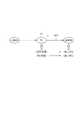
- the remaining power amount of the battery 7 when arriving at the destination is 70%, 80%, 75%, and 75%, respectively. This value is obtained when full charging (100% charging) is performed at the charging station that stops before arrival at the destination in each of all routes G1 to G4. In this way, when the remaining power amount of the battery 7 when arriving at the destination is largely different from the “specified power amount (50%)”, as shown in FIG.
- the charge amount setting unit 20 designates the charge amount at the charging station E6 that stops before reaching the destination in the entire route G1.
- the charge amount setting unit 20 does not perform full charge at the charging station E6, but is charged so that the remaining power amount of the battery 7 becomes the specified power amount (50%) when arriving at the destination.
- the amount the amount of charge at which the amount of power of the battery 7 after charging is 80% is specified.
- the remaining electric energy of the battery 7 becomes 50% at the destination.
- the remaining power amount of the battery when it arrives at the destination can be brought close to the specified power amount (50%).
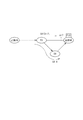
- FIG. 12 is an explanatory diagram in which the entire route G4 is simplified.
- the battery 7 is charged at the charging station E8 and travels on the section route w17 toward the destination.
- the remaining power amount of the battery 7 when arriving at the destination becomes 10%, It is assumed that it is estimated by the estimation function of the search unit 10.
- this route search device 1 as “normal setting”, it is set that charging is required when the remaining power amount of the battery 7 is less than 20%.
- the remaining electric energy of the battery 7 is less than 20% in the middle of traveling before arriving at the destination. Therefore, in the “normal setting”, the route via the charging station E9 is 10, and it is considered that the determination unit 13 determines the entire route G 4-1 via the charging station E 9 as a recommended route.
- the search unit 10 searches for a route that does not pass through the charging station E9 as “exception setting”. Then, the determination unit 13 can prioritize “exception setting” and determine all routes G4-2 including the section route w17 not passing through the charging station E9 as recommended routes.
- the search unit 10 selects all routes G4- that pass through the charging station E9 on the way because the remaining power amount of the battery 7 is less than the predetermined lower limit (20%) as candidates for the route to the destination. 1 can be searched based on “normal setting”, and as “exception setting”, if the remaining power amount of the battery 7 is less than the predetermined lower limit (20%), the charging station E9 It is possible to search all routes G4-2 that do not pass through.
- the route search device 1 As described above, according to the route search device 1 according to the present embodiment, since the recommended route to the destination is determined based on the remaining power amount of the battery 7 when the destination is reached, the destination has arrived. However, for example, it is possible to prevent the occurrence of a problem in the electric vehicle 2 after arriving at the destination such that the remaining power of the battery necessary for moving next time becomes insufficient. In addition, as in the specific example 4 shown in FIG.
- the remaining electric energy of the battery 7 is set to a predetermined lower limit (for example, If the battery does not run out even if it is less than 20%), the entire route G4-2 that does not pass through the charging station E9 that should pass through in the “normal setting” can be set as the recommended route.
- the search part 10 can search the whole path
- a plurality of charging stations E1 to E5 within the cruising range starting from the departure point are obtained, and the second search unit According to the section route search processing by 12, a plurality of other charging stations E6 to E8 within the cruising range starting from each of the charging stations E1 to E5 are obtained. Since such section route search processing is repeatedly performed until the destination is reached, all routes from the departure point to the destination are automatically searched while obtaining the charging station. In addition, all routes that have the smallest number of times of passing through the charging station are searched, and further, it is not necessary to calculate the total combination of routes between points that can become charging stations, and the processing time can be shortened.
- the 1st search part 11 and the 2nd search part 12 are travel time (traffic information) for every time slot as dynamic information which changes over time for the search of a section course.
- the dynamic information may be other than this.
- traffic regulation such as road closure (road link) and speed regulation
- information on power at each charging station information on factors affecting power consumption of the battery 7 of the electric vehicle 2, and the like.
- the information on the factor includes, for example, information on the weather in the area from the starting point to the destination because the wiper is operated by the electric power of the battery 7 during rain.
- the headlight is turned on by the power of the battery 7 according to the degree of sunshine or traveling in the tunnel, there is information on lighting / illuminance of the headlight and the like. Further, as information on factors affecting the power consumption of the battery 7, there is information on weather (temperature). Ambient temperature affects the operating load of on-board air conditioners (air-conditioning equipment), especially in the case of electric vehicles, and is not equipped with heaters that use waste heat like gasoline cars. When the temperature is low, it is necessary to operate the air conditioner for heating. Thus, since the air conditioner is operated regardless of whether the ambient temperature is high or low, power of the battery 7 is largely consumed.
- the electric power of the battery 7 will also fall if ambient temperature becomes low, it is preferable to include the information about a weather (temperature) as information of the factor which affects the power consumption of the battery 7.
- FIG. Such dynamic information is stored in the storage device 15 as a database, and the first search unit 11 and the second search unit 12 refer to this database to determine the battery 7 in each road link and each section route.
- the power consumption can be dynamically calculated separately from the power consumption of the running itself, and this can be reflected in the search for the section route (the cruising range).
- the first search unit 11 and the second search unit 12 may refer to static information for searching for a section route.
- static information for example, there is information regarding the gradient (road gradient) of each road link. This road gradient information is important when calculating the power consumption of the battery 7 when traveling on each road link. For example, in the case of a road link with a large upward gradient, the power consumption of the battery 7 increases.
- static information regarding the road gradient is stored in a database in the storage device 15, and the first search unit 11 and the second search unit 12 refer to this database. Thereby, static information can be reflected in the search for the section route (the cruising range).
- ⁇ Chapter 2> [Description of Embodiment of the Present Invention]
- ⁇ Problem 2> Regarding the background art 2, as described above, in the case of an electric vehicle, since the cruising distance is short due to the performance of the battery to be mounted, when the server device searches for a route to the destination for the electric vehicle, Management is important. Therefore, the server device sets a battery charge amount (remaining battery amount) at the time of arrival at the destination, and searches for a route that can reach the destination while leaving the set battery charge amount. For example, if the battery charge amount at the time of arrival at the destination (battery remaining amount) is set to a value that is half of the battery charge amount at the departure location such as at home, the shuttle between the departure location and the destination is made. It is thought that you can.
- the battery charge amount at the time of arrival at the destination is set as the battery charge amount (battery remaining amount) at the time of arrival at the destination and the route search process to the destination is executed.
- an object of the present invention is to prevent the occurrence of trouble that even if the vehicle can arrive at the destination, it cannot return from the destination due to insufficient battery power.
- the present invention is an apparatus for searching for a route to a destination for a vehicle that can be driven by a motor that uses a battery as a power source.
- a first processing unit that acquires a necessary amount of electric power necessary for traveling to a battery charging facility, and a route search to the destination, and the purpose by traveling along a route based on the route search
- a second processing unit that generates warning information for the user when the remaining battery capacity when arriving at the ground is insufficient with respect to the required power amount.
- the charging facility may be a departure location (current location).
- the second processing unit by the route search device according to (2-1), as the route search, has a remaining battery capacity exceeding the required power amount when arriving at the destination. It is preferable to search for a route that satisfies the following condition. In this case, the remaining battery level when the vehicle arrives at the destination by traveling along the route based on the route search is insufficient with respect to the required power amount necessary for traveling from the destination to the battery charging facility. It is possible to search for a route based on whether or not it is a criterion.
- the second processing unit by the route search device according to (2-1) or (2-2) is configured to use the battery consumed by traveling on a route toward the destination. If the remaining amount of battery is less than the required amount of power before arriving at the destination, the warning information is displayed. Preferably it is produced. In this case, the case where the remaining battery level becomes less than the required power amount before arriving at the destination is a case where the remaining battery level is insufficient with respect to the required power amount as described in (2-1) above. In this case, warning information is generated.
- the second processing unit by the route search device calculates the required power amount and a set power amount set as a remaining battery amount at the destination. In comparison, if the required power amount exceeds the set power amount, the set power amount is changed to a larger value, and the remaining battery level when arriving at the destination is changed to the changed set power amount. It is preferable to search for a route that satisfies the condition of exceeding. In this case, when the required power amount is compared with the set power amount and the required power amount exceeds the set power amount, the remaining battery capacity described in (2-1) is insufficient with respect to the required power amount. A case.
- the second processing unit In the case of (2-4), it is preferable that the second processing unit generates the warning information when a route satisfying the condition is not found. In this case, the set power amount is changed, and the route to the destination that satisfies the condition that the remaining battery level when the destination arrives exceeds the changed set power amount is searched, and the route that satisfies this condition is not found. In some cases, warning information is generated.
- the present invention provides a computer as a route search device for searching a route to a destination for a vehicle that can be driven by a motor that uses a battery as a power source.
- the same function and effect as those of the route search apparatus of (2-1) can be achieved.
- the present invention by traveling along the route to the destination based on the route search, the remaining battery level when arriving at the destination is necessary for traveling from the destination to the battery charging facility.
- warning information for the user is generated. For this reason, by notifying the user of this warning information, even if the user can arrive at the destination, the trouble that the user cannot return from the destination due to insufficient battery power is prevented. Is possible.
- FIG. 13 shows an example of an information system.
- the information system according to the present embodiment includes an in-vehicle device 3 and a server device 5.
- the in-vehicle device 3 is a device that is mounted on the vehicle 2 and has a wireless communication function.
- the server device 5 can communicate with the in-vehicle device 3 via the roadside communication device 4 that performs wireless communication.
- the in-vehicle device 3 is not limited to a device fixedly mounted on the vehicle 2, and may be any device used on the vehicle 2, for example, a smartphone owned by a user such as a driver (passenger) of the vehicle 2. It may be a portable terminal such as.
- the vehicle 2 has a rechargeable battery 7 and is an electric vehicle that is driven by a motor 8 that is driven by using the battery 7 as a power source.
- a user who receives a service provided by the information system is a driver of the vehicle (electric vehicle) 2.
- the charge amount and the remaining amount of the battery 7 mean the amount of power.
- the in-vehicle device 3 has a function as a computer that processes input information in addition to a wireless communication function. Then, the processed information is transmitted to the server device 5 via the roadside communication device 4. Furthermore, information generated by the server device 5 (processing result information i2 described later) is transmitted to the in-vehicle device 3 via the roadside communication device 4.
- the in-vehicle device 3 includes an input unit 3a for the driver to input various information, a position acquisition unit 3b that can acquire information on the current position, and a display unit 3c.
- the input unit 3a includes, for example, a touch panel operated by a driver, and can input various information such as information on a departure place and a destination to the in-vehicle device 3 by an operation such as character input by the driver.
- the position acquisition unit 3b is made of, for example, a device having a GPS function, and can acquire information on the current position of the in-vehicle device 3 (vehicle 2).
- the display unit 3c can display various information on the screen.
- the display unit 3c includes a display having a function as the input unit 3a (touch panel).
- the in-vehicle device 3 acquires battery information such as the remaining amount (remaining power amount) of the battery 7 of the vehicle 2 and the power consumption amount and other information by performing wireless or wired communication with the in-vehicle device. Is possible.
- Each roadside communication device 4 includes a communication device and a communication controller, and can communicate with the in-vehicle device 3 wirelessly, and can communicate with the server device 5 by wire (or wireless).
- the in-vehicle device 3 is a mobile terminal such as a smartphone
- the roadside communication device 4 is a radio base station that performs radio communication with the mobile terminal.
- the server device 5 includes a computer, a storage unit 15 including a hard disk for storing a computer program and various information, a communication device 16 including a communication interface for communicating with the roadside communication device 4, and a function of performing arithmetic processing. And an arithmetic unit 17 having
- the storage unit 15 includes a road network database 15a that stores road map data (road network data) of each region, and a traffic information database 15b that stores traffic data and the like. Note that the storage unit 15 may be anything that can be acquired by the arithmetic unit 17 via the internal bus or the external interface of the computer (server device 5), and need not be built in the computer.
- the road network database 15a includes the length of each road section (hereinafter referred to as road link), the gradient, the type of road, etc. constituting the road network. Static traffic data necessary for calculating (estimating) the power consumption of the battery 7 required for traveling the vehicle.
- the road map data included in the database 15a includes information on charging facilities (hereinafter referred to as charging stations) that charge the battery 7 of the vehicle 2.
- Information on the charging station includes information on the installation position, information on available time zones, and the like.
- the traffic information database 15b stores dynamic traffic data that changes over time.
- the dynamic traffic data includes, for example, information on road congestion, temperature, weather, occurrence of accidents, traffic regulations, and the like.
- the dynamic traffic data is also used to calculate (estimate) the amount of power consumption of the battery 7 required for traveling on the road link.
- the server device 5 has a plurality of functional units having various functions, and one of these functional units is the route search device 1.
- the server device 5 includes a computer having a CPU, an internal memory, and the like, and a computer program for causing the server device 5 to function as the route search device 1 is installed in the storage unit 15.
- Each function (the functions of the acquisition unit 18, the first processing unit 19a, and the second processing unit 19b) provided in the route search device 1 is exhibited when the computer program is executed by the server device 5 (computer).
- the computer program can be stored in a storage medium such as a magnetic disk, an optical disk, or a semiconductor memory.
- the in-vehicle device 3 transmits request information i1 (see FIG. 13) in order to acquire information such as a route from the departure point (current location) to the destination from the server device 5.
- the request information i1 may be transmitted based on an operation performed by the driver through the input unit 3a, or may be transmitted periodically.
- the in-vehicle device 3 includes processing information used for searching for a route to the destination in the request information i1, and transmits the processing information to the server device 5.
- the processing information includes the departure location (current location), destination, time (current time (departure time) or arrival time at the destination) of the vehicle 2, remaining amount of battery 7 (current charge amount), vehicle Information of 2 vehicle IDs (model of vehicle 2) etc. is included.
- the current location to be transmitted to the server device 5 is acquired by the position acquisition unit 3b. Instead of the current location, another departure location may be used. In this case, the departure location is input by the driver through the input unit 3a. The time is acquired from time information output by the clock function of the in-vehicle device 3. The destination is acquired from information input by the driver through the input unit 3a. The remaining amount of the battery 7 (current charge amount) is acquired from a battery remaining amount monitoring function unit (not shown) of the battery 7.
- the server device 5 knows the remaining battery level of the vehicle 2 in the past, the in-vehicle device 3 transmits information indicating the power consumption from the past time to the server device 5. It may be. In this case, the server device 5 can obtain the remaining battery level of the vehicle 2 at the present time by subtracting the power consumption from the remaining battery level at the past time.
- the acquisition unit 18 includes the departure location (current location), destination, and time (current time (current time ( 14 (departure time) or arrival time at the destination), processing information such as the remaining amount of the battery 7 (current charge amount), the vehicle ID of the vehicle 2 (model of the vehicle 2), and the like are acquired (step S1 in FIG. 14). ).
- the server device 5 uses the processing information included in the request information i1 to search for a route on which the vehicle 2 should travel from the departure point (current location) to the destination (step S2). This process is performed by the second processing unit 19b.
- the first processing unit 19a also searches for a route from the destination to the charging station in the background.
- This charging station can be the closest to the destination.
- the second processing unit 19b searches for a route from the departure point to the destination based on a predetermined search algorithm (for example, Dijkstra method).
- the first processing unit 19a searches for a route from the destination to the charging station based on a predetermined search algorithm (for example, Dijkstra method).
- the server apparatus 5 will produce
- the in-vehicle device 3 When the in-vehicle device 3 receives the processing result information i2 from the server device 5, the in-vehicle device 3 generates a display image using the information i2 and displays it on the display unit 3c. For example, the in-vehicle device 3 displays a route (recommended route) to be traveled from the departure point (current location) to the destination on the display unit 3c. Further, in the present embodiment, there is a possibility that it is possible to arrive at the destination together with this recommended route or instead of this recommended route, but it is not possible to return to the starting point (current location) due to insufficient power of the battery 7. Information indicating that it exists (warning information) can be displayed on the display unit 3c.
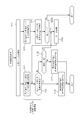
- FIG. 15 shows a procedure of processing for route search by the arithmetic unit 17.
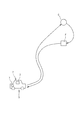
- FIG. 16 is an image diagram showing a route searched for by the route search apparatus 1.
- the subject of processing is the second processing unit 19b unless otherwise specified.
- the acquisition unit 18 acquires information for processing such as information on the departure place S, information on the destination G, and information on the charge amount (remaining amount) Ps of the battery 7 at the departure place S ( Step S1) in FIG.
- the first processing unit 19a extracts (closest) the charging station E close to the destination G from the road map data in the road network database 15a (see FIG. 13) (step S21 in FIG. 15).
- the process of extracting the charging station E is a background process in the arithmetic device 17 and does not attract the user's attention.
- the first processing unit 19a searches for a route from the destination G to the charging station E, and further acquires a required power amount Q2 of the battery 7 necessary for traveling from the destination G to the charging station E. (Step S22).
- This required power amount Q2 can be obtained by integrating the power consumption amount at each road link included in the route from the destination G to the charging station E.
- the process of searching for a route from the destination G to the charging station E and the process of acquiring the required power amount Q2 to the charging station E are processes in the background and do not attract the user's attention.
- the route from the destination G to the departure point S in the background may be acquired, and the required power amount Q3 may be used instead of the necessary power amount Q2 in the subsequent processing.
- the amount of power consumed by the battery 7 by traveling on each road link is the road map data stored in the databases 15a and 15b, the static traffic data, and the dynamic traffic. It is calculated as an estimated value based on the data. For example, since the road map data stored in the road network database 15a includes length information indicating the length of each road link, the road map data travels based on the length of each road link. It is possible to calculate an estimated value of the power consumption at the time. The calculation of the power consumption for each road link is not only the length of each road link, but also the static traffic data and dynamic traffic data, and information obtained from the in-vehicle device 3 (departure time or arrival time, vehicle ID (Vehicle type)).
- the power consumption of the battery 7 by the motor 8 changes not only by the travel distance of the vehicle 2 but also by the road gradient, the power consumption amount is also taken into consideration in the road gradient information included in the static traffic data. Is calculated. Thereby, more accurate power consumption can be acquired.
- the power consumption of the battery 7 is also affected by the type of the vehicle 2, the operating state of the auxiliary equipment (headlights, wipers, air conditioner) mounted on the vehicle 2, and the number of passengers of the vehicle 2. Then, the power consumption may be calculated.
- the second processing unit 19b starts a search process for a route from the departure point S to the destination G in consideration of the cruising distance based on the remaining amount of the battery 7.
- the route search from the departure point S to the destination G is a foreground process in the arithmetic unit 17.
- the power consumption consumed by traveling on each road link is subtracted from the charge amount Ps of the battery 7 at the departure point S, and this calculation is performed until the destination G is reached.
- the remaining amount Pg of the battery 7 when it arrives is acquired (step S24).
- the battery 7 may be charged by the regenerative braking of the vehicle 2 as in a downhill road link. In this case, the power consumption is a negative value.
- the remaining amount Pg of the battery 7 when it arrives at the destination G is compared with the required power amount Q2 to the charging station E, and the remaining battery amount Pg determines the required power amount Q2.
- a route search from the departure point S to the destination G that satisfies the condition of exceeding (Pg> Q2) is performed (step S25).
- step S25 If there is a route that satisfies the conditions (Yes in step S25), the route is determined as a route that can be reached from the departure point S to the destination G (recommended route), and information indicating the recommended route is generated. This is included in the processing result information i2 (step S26). And this process result information i2 is transmitted from the communication apparatus 16 (step S3 of FIG. 14), and the vehicle-mounted apparatus 3 acquires this process result information i2. Then, the in-vehicle device 3 displays and outputs the recommended route together with the road map on the display unit 3c (display) based on the recommended route information included in the processing result information i2.
- the second processing unit 19b warns the user.
- Information is generated, and the generated warning information is included in the processing result information i2 (step S27).
- the warning information informs the driver that although the amount of charge of the battery 7 at the departure point S can reach the destination G, there is a possibility that the destination G may not be returned (to the departure point S). It is information to do.
- the processing result information i2 is transmitted from the communication device 16 (step S3 in FIG. 14), and the in-vehicle device 3 acquires the processing result information i2.
- the in-vehicle device 3 outputs an image display indicating that there is a possibility that it cannot be returned to the display unit 3c (display) based on the warning information included in the acquired processing result information i2.
- the second processing unit 19b can acquire the power consumption amount of the battery 7 consumed by traveling on the route from the departure point S to the destination G.
- the remaining amount of the battery 7 can be obtained from the consumed power amount.
- warning information is generated (step S27 in FIG. 15). Then, the warning information is transmitted to the in-vehicle device 3, and the warning information is notified to the driver.
- the processing for route search by the computing device 17 can be performed by other procedures besides the above embodiment.
- FIG. 17 shows another procedure.
- the subject of processing is the second processing unit 19b unless otherwise specified.
- the acquisition unit 18 acquires processing information such as information on the departure place S, information on the destination G, and information on the charge amount Ps of the battery 7 at the departure place S (step in FIG. 14). S1).
- the first processing unit 19a extracts (closest) the charging station E close to the destination G from the road map data in the road network database 15a (see FIG. 13) (step S121 in FIG. 17). Note that the process of searching for the charging station E is a background process in the arithmetic unit 17 and does not attract attention from the user.
- the second processing unit 19b performs a search process for a route from the departure point S (see FIG. 16) to the destination G in consideration of the cruising distance based on the remaining amount of the battery 7, and further, The route search from the destination G to the charging station E (step S222) is also performed by the processing unit 19a.
- the search processing for the route to the destination G by the second processing unit 19b is processing in the foreground in the arithmetic device 17, whereas the processing for searching for the route to the charging station E by the first processing unit 19a is performed. , Background processing.
- the departure time at which the vehicle starts from the destination G to the charging station E is a time later than the time at which the vehicle arrives at the destination G from the departure point S.
- Calculation of power consumption is performed using the traffic data.
- the second processing unit 19b In the route search from the departure point S to the destination G by the second processing unit 19b, first, the consumption consumed by traveling on each road section (hereinafter referred to as road link) from the battery charge amount Ps at the departure point S.
- the power amount pn is subtracted and this calculation is performed until the destination G arrives, and the remaining amount Pg of the battery 7 when the destination G is reached is obtained (step S122).
- the battery 7 may be charged by regenerative braking of the vehicle 2 like a downhill road link. In this case, the power consumption pn is a negative value.
- the second processing unit 19b may acquire the necessary power amount Q1 of the battery 7 necessary for traveling from the departure point S to the destination G. In this case, when the second processing unit 19b arrives at the destination G
- the battery remaining amount Pg of the battery 7 can also be obtained by subtracting the required power amount Q1 from the charge amount Ps of the battery at the departure place S.
- the remaining amount Pg of the battery 7 when arriving at the destination G is required to exceed the set power amount Pk ⁇ n.
- a route to the destination G that satisfies (Pg> Pk ⁇ n) is obtained as a recommended route (step S123).
- the first processing unit 19a searches for a route from the destination G to the charging station E (step S222), and a battery necessary for traveling from the destination G to the charging station E. Is obtained (step S223).
- the required power amount Q2 is “15%”.
- the required power amount Q2 is acquired by integrating the power consumption amount of each road link included in the route to the charging station E as described above.
- the required power amount Q2 is compared with the set power amount Pk-1 by the second processing unit 19b (step S224). As a result, the set power amount Pk-1 is insufficient with respect to the required power amount Q2. In other words, if the required power amount Q2 exceeds the set power amount Pk-1 (Yes in step S225), the set power amount Pk-1 is set to a value Pk- greater than the required power amount Q2. (Step S225). In the present embodiment, the required power amount Q2 is “15%”, whereas the set power amount Pk ⁇ 1 is “12%”. Therefore, the set power amount Pk-1 is less than the required power amount Q2. For example, Pk-1 “12%” is updated to Pk-2 “20%” as a value larger than the required power amount Q2 “15%”.
- the second processing unit 19b searches for a route to the destination G based on the updated set power amount Pk-2 “20%”. That is, in this search process, the condition is that the remaining amount Pg of the battery 7 when arriving at the destination G from the departure point S exceeds the updated set power amount Pk ⁇ 2 “20%”. A route to the destination G that satisfies the condition is searched (step S123).
- step S224 the required power amount Q2 “15%” from the destination G to the charging station E and the set power set as the remaining amount of the battery 7 at the destination G
- step S224 the amount Pk-1 “12%” is compared (step S224).
- the set power amount Pk-1 “12%” is changed to a larger value (“12%” ⁇ “20%”) (step S225).
- a search is made for a route to the destination G that satisfies the condition that the remaining power Pg of the battery 7 when the changed set power amount Pk-2 “20%” reaches the destination G exceeds the remaining amount Pg (step S123). .
- step S123 When a route from the starting point S to the destination G that satisfies the above conditions is obtained (Yes in step S123), the route is determined as a route that can be reached from the starting point S to the destination G (recommended route). Then, information indicating the recommended route is generated and included in the processing result information i2 (step S124). And this process result information i2 is transmitted from the communication apparatus 16 (step S3 of FIG. 14), and the vehicle-mounted apparatus 3 acquires this process result information i2. Then, the in-vehicle device 3 displays and outputs the recommended route together with the road map on the display unit 3c (display) based on the recommended route information included in the processing result information i2.
- step S123 if the above condition is not satisfied (No in step S123), the value of the set power amount Pk-2 “20%” is larger than the required power amount Q2 “15%” and the previous time The set power amount Pk-2 is updated to a value smaller than “20%” (step S225). For example, Pk-2 “20%” is updated to Pk-3 “18%”.
- the second processing unit 19b performs the route searching process to the destination G again based on the updated set power amount Pk-3 “18%”. That is, in this search process, the condition is that the remaining amount Pg of the battery 7 when arriving at the destination G from the departure point S exceeds the updated set power amount Pk-3 “18%”. A route from the starting point S to the destination G that satisfies the condition is searched (step S123).
- step S123 When a route from the starting point S to the destination G that satisfies the above conditions is obtained (Yes in step S123), the route is determined as a route that can be reached from the starting point S to the destination G (recommended route). Then, information indicating the recommended route is generated and included in the processing result information i2 (step S124). Subsequent processing is the same as described above.
- step S123 if the above condition is not satisfied (No in step S123), the value of the set power amount Pk-3 “18%” is larger than the required power amount Q2 “15%” and the previous time The set power amount Pk-3 is updated to a value smaller than “18%” (step S225). For example, Pk-3 “18%” is updated to Pk-4 “17%”.
- the route search process to the destination G is performed again based on the updated set power amount Pk-4 “17%”. That is, in this search process, it is a condition that the remaining amount Pg of the battery 7 when arriving at the destination G from the departure point S exceeds the updated set power amount Pk-4 “17%”. A route from the starting point S to the destination G that satisfies the condition is searched (step S123).
- step S123 When a route from the starting point S to the destination G that satisfies the above conditions is obtained (Yes in step S123), the route is set as a recommended route, information indicating the recommended route is generated, and this is processed result information. It is included in i2 (step S124). Subsequent processing is the same as described above.
- the route satisfying the above condition is changed by changing the set power amount value (Pk ⁇ n) (step S225). ), Repeatedly. And even if it repeats predetermined times, when the search of the path
- the warning information informs the driver that although the amount of charge of the battery 7 at the departure point S can reach the destination G, there is a possibility that the destination G may not be returned (to the departure point S). It is information to do.
- the processing result information i2 is transmitted from the communication device 16 (step S3 in FIG. 14), and the in-vehicle device 3 acquires the processing result information i2.
- the in-vehicle device 3 outputs an image display indicating that there is a possibility that it cannot be returned to the display unit 3c (display) based on the warning information included in the acquired processing result information i2.
- step S222 when the route search to the charging station E near the destination G is performed, the departure time starting from the destination G to the charging station E varies depending on the stay time at the destination G.
- the departure time is changed according to the type of destination G. For example, when the destination G is an amusement facility such as an amusement park and a route search for a day trip is performed, the closing time of the amusement facility is set as the departure time. In addition, when the destination G is an accommodation facility such as a hotel, and when a route search for a trip involving accommodation is performed, the checkout time in the morning is set as the departure time.
- a plurality of patterns of departure times are set every required time from the arrival time of the destination G. Then, on the basis of each departure time, using the dynamic traffic data, a route search to the charging station E and a calculation (simulation) such as a power consumption amount (required power amount Q2) to the charging station E are performed.
- the route search device is configured so that alarm information for the user indicating that fact is generated. 1 may be configured.
- the information is transmitted to the in-vehicle device 3 as in the above embodiment. That is, a process for notifying the driver of information to that effect is performed.
- the route search device 1 acquires information indicating such road regulations, the route search device 1 may be configured so that alarm information for the user indicating that fact is generated. When such warning information is generated, the information is transmitted to the in-vehicle device 3 as in the above embodiment. That is, a process for notifying the driver of information to that effect is performed.
- the route search is performed with respect to the required electric energy Q2 of the battery 7 that is necessary for traveling from the destination G to the nearby charging station E. If the remaining amount of the battery 7 when the vehicle arrives at the destination G by traveling along the route to the destination G based on the above, warning information for the user is generated. For this reason, by notifying the user of the warning information, even if the user can arrive at the destination G, the user recognizes that there is a possibility that the power shortage of the battery 7 may occur thereafter. Can do. As a result, even if the vehicle can arrive at the destination G, it is possible to prevent the occurrence of trouble that it is impossible to return from the destination G to the departure point S due to insufficient power of the battery 7. It becomes.
- the information system includes a vehicle-mounted device (device mounted on a vehicle).
- the information system does not necessarily have to be a vehicle-mounted device (device mounted on the vehicle), and is used in a home or office. It may be a personal computer installed in a mobile terminal or a mobile terminal such as a smartphone owned by the user. In this case, the user operates a personal computer or a portable terminal at home or office, transmits request information i1 from the personal computer or portable terminal, and receives information i2 from the server device 5.
Landscapes
- Engineering & Computer Science (AREA)
- Radar, Positioning & Navigation (AREA)
- Remote Sensing (AREA)
- Automation & Control Theory (AREA)
- Physics & Mathematics (AREA)
- General Physics & Mathematics (AREA)
- Navigation (AREA)
Applications Claiming Priority (4)
| Application Number | Priority Date | Filing Date | Title |
|---|---|---|---|
| JP2012-114699 | 2012-05-18 | ||
| JP2012114699A JP5953630B2 (ja) | 2012-05-18 | 2012-05-18 | 経路探索装置及びコンピュータプログラム |
| JP2013-033242 | 2013-02-22 | ||
| JP2013033242A JP6075111B2 (ja) | 2013-02-22 | 2013-02-22 | 経路探索装置及びコンピュータプログラム |
Publications (1)
| Publication Number | Publication Date |
|---|---|
| WO2013172157A1 true WO2013172157A1 (fr) | 2013-11-21 |
Family
ID=49583571
Family Applications (1)
| Application Number | Title | Priority Date | Filing Date |
|---|---|---|---|
| PCT/JP2013/061896 Ceased WO2013172157A1 (fr) | 2012-05-18 | 2013-04-23 | Dispositif de recherche de trajet et programme d'ordinateur |
Country Status (1)
| Country | Link |
|---|---|
| WO (1) | WO2013172157A1 (fr) |
Cited By (8)
| Publication number | Priority date | Publication date | Assignee | Title |
|---|---|---|---|---|
| CN104972914A (zh) * | 2015-05-29 | 2015-10-14 | 小米科技有限责任公司 | 燃料补给提示方法及装置 |
| CN104165632B (zh) * | 2014-04-15 | 2016-12-07 | 达维信息技术(大连)有限公司 | 利用移动终端预警路线偏离的方法及装置 |
| US20210232144A1 (en) * | 2020-01-28 | 2021-07-29 | Lg Electronics Inc. | Method of controlling artificial intelligence robot device |
| JP2022023573A (ja) * | 2020-07-27 | 2022-02-08 | いすゞ自動車株式会社 | 運転支援装置 |
| US11326893B2 (en) * | 2017-11-01 | 2022-05-10 | Mazda Motor Corporation | Display device for vehicle |
| CN115675178A (zh) * | 2021-07-28 | 2023-02-03 | 瑞伟安知识产权控股有限公司 | 智能电动车辆行程规划器算法 |
| JP2023018846A (ja) * | 2021-07-28 | 2023-02-09 | トヨタ自動車株式会社 | 運行システム、運行方法、および運行プログラム |
| US20240118098A1 (en) * | 2022-10-06 | 2024-04-11 | Rivian Ip Holdings, Llc | High-definition energy consumption map for vehicles |
Citations (3)
| Publication number | Priority date | Publication date | Assignee | Title |
|---|---|---|---|---|
| JP2006275596A (ja) * | 2005-03-28 | 2006-10-12 | Sanyo Electric Co Ltd | ナビゲーション装置 |
| JP2011158322A (ja) * | 2010-01-29 | 2011-08-18 | Fujitsu Ten Ltd | 情報処理装置および目的地検索方法 |
| JP2012026768A (ja) * | 2010-07-20 | 2012-02-09 | Clarion Co Ltd | ナビゲーション装置およびナビゲーションシステム |
-
2013
- 2013-04-23 WO PCT/JP2013/061896 patent/WO2013172157A1/fr not_active Ceased
Patent Citations (3)
| Publication number | Priority date | Publication date | Assignee | Title |
|---|---|---|---|---|
| JP2006275596A (ja) * | 2005-03-28 | 2006-10-12 | Sanyo Electric Co Ltd | ナビゲーション装置 |
| JP2011158322A (ja) * | 2010-01-29 | 2011-08-18 | Fujitsu Ten Ltd | 情報処理装置および目的地検索方法 |
| JP2012026768A (ja) * | 2010-07-20 | 2012-02-09 | Clarion Co Ltd | ナビゲーション装置およびナビゲーションシステム |
Cited By (13)
| Publication number | Priority date | Publication date | Assignee | Title |
|---|---|---|---|---|
| CN104165632B (zh) * | 2014-04-15 | 2016-12-07 | 达维信息技术(大连)有限公司 | 利用移动终端预警路线偏离的方法及装置 |
| CN104972914B (zh) * | 2015-05-29 | 2018-08-07 | 小米科技有限责任公司 | 燃料补给提示方法及装置 |
| CN104972914A (zh) * | 2015-05-29 | 2015-10-14 | 小米科技有限责任公司 | 燃料补给提示方法及装置 |
| US11326893B2 (en) * | 2017-11-01 | 2022-05-10 | Mazda Motor Corporation | Display device for vehicle |
| US20210232144A1 (en) * | 2020-01-28 | 2021-07-29 | Lg Electronics Inc. | Method of controlling artificial intelligence robot device |
| JP7302542B2 (ja) | 2020-07-27 | 2023-07-04 | いすゞ自動車株式会社 | 運転支援装置 |
| JP2022023573A (ja) * | 2020-07-27 | 2022-02-08 | いすゞ自動車株式会社 | 運転支援装置 |
| CN115675178A (zh) * | 2021-07-28 | 2023-02-03 | 瑞伟安知识产权控股有限公司 | 智能电动车辆行程规划器算法 |
| US20230038012A1 (en) * | 2021-07-28 | 2023-02-09 | Rivian Ip Holdings, Llc | Smart electric vehicle trip planner algorithm |
| JP2023018846A (ja) * | 2021-07-28 | 2023-02-09 | トヨタ自動車株式会社 | 運行システム、運行方法、および運行プログラム |
| US12146753B2 (en) * | 2021-07-28 | 2024-11-19 | Rivian Ip Holdings, Llc | Smart electric vehicle trip planner algorithm |
| US20240118098A1 (en) * | 2022-10-06 | 2024-04-11 | Rivian Ip Holdings, Llc | High-definition energy consumption map for vehicles |
| US12287216B2 (en) * | 2022-10-06 | 2025-04-29 | Rivian Ip Holdings, Llc | High-definition energy consumption map for vehicles |
Similar Documents
| Publication | Publication Date | Title |
|---|---|---|
| US11880206B2 (en) | Power management, dynamic routing and memory management for autonomous driving vehicles | |
| JP5953630B2 (ja) | 経路探索装置及びコンピュータプログラム | |
| WO2013172157A1 (fr) | Dispositif de recherche de trajet et programme d'ordinateur | |
| US9739624B2 (en) | Vehicle power management utilizing operator schedule data | |
| CN105424052B (zh) | 随机可行驶里程 | |
| JP5553106B2 (ja) | 電力供給制御装置 | |
| US9604633B2 (en) | Travel support device, travel support method, and drive support system | |
| US10048083B2 (en) | Vehicle information providing device | |
| US9487208B2 (en) | Travel support device, travel support method, and drive support system | |
| US9476721B2 (en) | Travel support device, travel support method, and drive support system | |
| JP2013242198A (ja) | 経路探索装置及びコンピュータプログラム | |
| KR101500362B1 (ko) | 전기차의 주행 정보 제공 시스템 및 방법 | |
| US9857183B2 (en) | Travel support device, travel support method, and drive support system | |
| US20130261953A1 (en) | Route search system and method for electric automobile | |
| JP5920309B2 (ja) | 移動支援装置、移動支援方法、及び運転支援システム | |
| CN110418940A (zh) | 用于预测车辆的未来驾驶条件的方法 | |
| CN111912421B (zh) | 信息提供装置和计算机可读记录介质 | |
| JP6075111B2 (ja) | 経路探索装置及びコンピュータプログラム | |
| JP2013068590A (ja) | 電動車両 | |
| JP2021018608A (ja) | アグリゲーションシステム、アグリゲーション装置、およびアグリゲーション方法 | |
| JP5565104B2 (ja) | 情報提供システム | |
| WO2014120849A2 (fr) | Système et procédé permettant d'éviter à un conducteur de véhicule électrique de s'échouer le long d'une route | |
| De Nunzio et al. | A time-and energy-optimal routing strategy for electric vehicles with charging constraints | |
| GB2556876A (en) | Vehicle route guidance | |
| WO2024057750A1 (fr) | Dispositif de recherche de chargeur, procédé de recherche de chargeur et programme informatique |
Legal Events
| Date | Code | Title | Description |
|---|---|---|---|
| 121 | Ep: the epo has been informed by wipo that ep was designated in this application |
Ref document number: 13791529 Country of ref document: EP Kind code of ref document: A1 |
|
| NENP | Non-entry into the national phase |
Ref country code: DE |
|
| 122 | Ep: pct application non-entry in european phase |
Ref document number: 13791529 Country of ref document: EP Kind code of ref document: A1 |