WO2013180134A1 - Adhésif, et substrat transparent l'utilisant - Google Patents
Adhésif, et substrat transparent l'utilisant Download PDFInfo
- Publication number
- WO2013180134A1 WO2013180134A1 PCT/JP2013/064788 JP2013064788W WO2013180134A1 WO 2013180134 A1 WO2013180134 A1 WO 2013180134A1 JP 2013064788 W JP2013064788 W JP 2013064788W WO 2013180134 A1 WO2013180134 A1 WO 2013180134A1
- Authority
- WO
- WIPO (PCT)
- Prior art keywords
- adhesive
- thermoplastic resin
- glass
- catalyst
- resin
- Prior art date
- Legal status (The legal status is an assumption and is not a legal conclusion. Google has not performed a legal analysis and makes no representation as to the accuracy of the status listed.)
- Ceased
Links
Images
Classifications
-
- C—CHEMISTRY; METALLURGY
- C09—DYES; PAINTS; POLISHES; NATURAL RESINS; ADHESIVES; COMPOSITIONS NOT OTHERWISE PROVIDED FOR; APPLICATIONS OF MATERIALS NOT OTHERWISE PROVIDED FOR
- C09J—ADHESIVES; NON-MECHANICAL ASPECTS OF ADHESIVE PROCESSES IN GENERAL; ADHESIVE PROCESSES NOT PROVIDED FOR ELSEWHERE; USE OF MATERIALS AS ADHESIVES
- C09J201/00—Adhesives based on unspecified macromolecular compounds
-
- B—PERFORMING OPERATIONS; TRANSPORTING
- B32—LAYERED PRODUCTS
- B32B—LAYERED PRODUCTS, i.e. PRODUCTS BUILT-UP OF STRATA OF FLAT OR NON-FLAT, e.g. CELLULAR OR HONEYCOMB, FORM
- B32B17/00—Layered products essentially comprising sheet glass, or glass, slag, or like fibres
- B32B17/06—Layered products essentially comprising sheet glass, or glass, slag, or like fibres comprising glass as the main or only constituent of a layer, next to another layer of a specific material
- B32B17/10—Layered products essentially comprising sheet glass, or glass, slag, or like fibres comprising glass as the main or only constituent of a layer, next to another layer of a specific material of synthetic resin
-
- B—PERFORMING OPERATIONS; TRANSPORTING
- B32—LAYERED PRODUCTS
- B32B—LAYERED PRODUCTS, i.e. PRODUCTS BUILT-UP OF STRATA OF FLAT OR NON-FLAT, e.g. CELLULAR OR HONEYCOMB, FORM
- B32B17/00—Layered products essentially comprising sheet glass, or glass, slag, or like fibres
- B32B17/06—Layered products essentially comprising sheet glass, or glass, slag, or like fibres comprising glass as the main or only constituent of a layer, next to another layer of a specific material
- B32B17/10—Layered products essentially comprising sheet glass, or glass, slag, or like fibres comprising glass as the main or only constituent of a layer, next to another layer of a specific material of synthetic resin
- B32B17/10005—Layered products essentially comprising sheet glass, or glass, slag, or like fibres comprising glass as the main or only constituent of a layer, next to another layer of a specific material of synthetic resin laminated safety glass or glazing
- B32B17/1055—Layered products essentially comprising sheet glass, or glass, slag, or like fibres comprising glass as the main or only constituent of a layer, next to another layer of a specific material of synthetic resin laminated safety glass or glazing characterized by the resin layer, i.e. interlayer
- B32B17/10733—Layered products essentially comprising sheet glass, or glass, slag, or like fibres comprising glass as the main or only constituent of a layer, next to another layer of a specific material of synthetic resin laminated safety glass or glazing characterized by the resin layer, i.e. interlayer containing epoxy
-
- B—PERFORMING OPERATIONS; TRANSPORTING
- B32—LAYERED PRODUCTS
- B32B—LAYERED PRODUCTS, i.e. PRODUCTS BUILT-UP OF STRATA OF FLAT OR NON-FLAT, e.g. CELLULAR OR HONEYCOMB, FORM
- B32B27/00—Layered products comprising a layer of synthetic resin
- B32B27/36—Layered products comprising a layer of synthetic resin comprising polyesters
-
- C—CHEMISTRY; METALLURGY
- C08—ORGANIC MACROMOLECULAR COMPOUNDS; THEIR PREPARATION OR CHEMICAL WORKING-UP; COMPOSITIONS BASED THEREON
- C08J—WORKING-UP; GENERAL PROCESSES OF COMPOUNDING; AFTER-TREATMENT NOT COVERED BY SUBCLASSES C08B, C08C, C08F, C08G or C08H
- C08J5/00—Manufacture of articles or shaped materials containing macromolecular substances
- C08J5/12—Bonding of a preformed macromolecular material to the same or other solid material such as metal, glass, leather, e.g. using adhesives
- C08J5/124—Bonding of a preformed macromolecular material to the same or other solid material such as metal, glass, leather, e.g. using adhesives using adhesives based on a macromolecular component
-
- C—CHEMISTRY; METALLURGY
- C09—DYES; PAINTS; POLISHES; NATURAL RESINS; ADHESIVES; COMPOSITIONS NOT OTHERWISE PROVIDED FOR; APPLICATIONS OF MATERIALS NOT OTHERWISE PROVIDED FOR
- C09J—ADHESIVES; NON-MECHANICAL ASPECTS OF ADHESIVE PROCESSES IN GENERAL; ADHESIVE PROCESSES NOT PROVIDED FOR ELSEWHERE; USE OF MATERIALS AS ADHESIVES
- C09J11/00—Features of adhesives not provided for in group C09J9/00, e.g. additives
- C09J11/02—Non-macromolecular additives
- C09J11/06—Non-macromolecular additives organic
-
- C—CHEMISTRY; METALLURGY
- C09—DYES; PAINTS; POLISHES; NATURAL RESINS; ADHESIVES; COMPOSITIONS NOT OTHERWISE PROVIDED FOR; APPLICATIONS OF MATERIALS NOT OTHERWISE PROVIDED FOR
- C09J—ADHESIVES; NON-MECHANICAL ASPECTS OF ADHESIVE PROCESSES IN GENERAL; ADHESIVE PROCESSES NOT PROVIDED FOR ELSEWHERE; USE OF MATERIALS AS ADHESIVES
- C09J163/00—Adhesives based on epoxy resins; Adhesives based on derivatives of epoxy resins
-
- C—CHEMISTRY; METALLURGY
- C09—DYES; PAINTS; POLISHES; NATURAL RESINS; ADHESIVES; COMPOSITIONS NOT OTHERWISE PROVIDED FOR; APPLICATIONS OF MATERIALS NOT OTHERWISE PROVIDED FOR
- C09J—ADHESIVES; NON-MECHANICAL ASPECTS OF ADHESIVE PROCESSES IN GENERAL; ADHESIVE PROCESSES NOT PROVIDED FOR ELSEWHERE; USE OF MATERIALS AS ADHESIVES
- C09J171/00—Adhesives based on polyethers obtained by reactions forming an ether link in the main chain; Adhesives based on derivatives of such polymers
- C09J171/08—Polyethers derived from hydroxy compounds or from their metallic derivatives
- C09J171/10—Polyethers derived from hydroxy compounds or from their metallic derivatives from phenols
-
- C—CHEMISTRY; METALLURGY
- C09—DYES; PAINTS; POLISHES; NATURAL RESINS; ADHESIVES; COMPOSITIONS NOT OTHERWISE PROVIDED FOR; APPLICATIONS OF MATERIALS NOT OTHERWISE PROVIDED FOR
- C09J—ADHESIVES; NON-MECHANICAL ASPECTS OF ADHESIVE PROCESSES IN GENERAL; ADHESIVE PROCESSES NOT PROVIDED FOR ELSEWHERE; USE OF MATERIALS AS ADHESIVES
- C09J171/00—Adhesives based on polyethers obtained by reactions forming an ether link in the main chain; Adhesives based on derivatives of such polymers
- C09J171/08—Polyethers derived from hydroxy compounds or from their metallic derivatives
- C09J171/10—Polyethers derived from hydroxy compounds or from their metallic derivatives from phenols
- C09J171/12—Polyphenylene oxides
-
- C—CHEMISTRY; METALLURGY
- C09—DYES; PAINTS; POLISHES; NATURAL RESINS; ADHESIVES; COMPOSITIONS NOT OTHERWISE PROVIDED FOR; APPLICATIONS OF MATERIALS NOT OTHERWISE PROVIDED FOR
- C09J—ADHESIVES; NON-MECHANICAL ASPECTS OF ADHESIVE PROCESSES IN GENERAL; ADHESIVE PROCESSES NOT PROVIDED FOR ELSEWHERE; USE OF MATERIALS AS ADHESIVES
- C09J173/00—Adhesives based on macromolecular compounds obtained by reactions forming a linkage containing oxygen or oxygen and carbon in the main chain, not provided for in groups C09J159/00 - C09J171/00; Adhesives based on derivatives of such polymers
-
- C—CHEMISTRY; METALLURGY
- C09—DYES; PAINTS; POLISHES; NATURAL RESINS; ADHESIVES; COMPOSITIONS NOT OTHERWISE PROVIDED FOR; APPLICATIONS OF MATERIALS NOT OTHERWISE PROVIDED FOR
- C09J—ADHESIVES; NON-MECHANICAL ASPECTS OF ADHESIVE PROCESSES IN GENERAL; ADHESIVE PROCESSES NOT PROVIDED FOR ELSEWHERE; USE OF MATERIALS AS ADHESIVES
- C09J201/00—Adhesives based on unspecified macromolecular compounds
- C09J201/02—Adhesives based on unspecified macromolecular compounds characterised by the presence of specified groups, e.g. terminal or pendant functional groups
- C09J201/06—Adhesives based on unspecified macromolecular compounds characterised by the presence of specified groups, e.g. terminal or pendant functional groups containing oxygen atoms
-
- C—CHEMISTRY; METALLURGY
- C09—DYES; PAINTS; POLISHES; NATURAL RESINS; ADHESIVES; COMPOSITIONS NOT OTHERWISE PROVIDED FOR; APPLICATIONS OF MATERIALS NOT OTHERWISE PROVIDED FOR
- C09J—ADHESIVES; NON-MECHANICAL ASPECTS OF ADHESIVE PROCESSES IN GENERAL; ADHESIVE PROCESSES NOT PROVIDED FOR ELSEWHERE; USE OF MATERIALS AS ADHESIVES
- C09J201/00—Adhesives based on unspecified macromolecular compounds
- C09J201/02—Adhesives based on unspecified macromolecular compounds characterised by the presence of specified groups, e.g. terminal or pendant functional groups
- C09J201/10—Adhesives based on unspecified macromolecular compounds characterised by the presence of specified groups, e.g. terminal or pendant functional groups containing hydrolysable silane groups
-
- B—PERFORMING OPERATIONS; TRANSPORTING
- B32—LAYERED PRODUCTS
- B32B—LAYERED PRODUCTS, i.e. PRODUCTS BUILT-UP OF STRATA OF FLAT OR NON-FLAT, e.g. CELLULAR OR HONEYCOMB, FORM
- B32B2307/00—Properties of the layers or laminate
- B32B2307/40—Properties of the layers or laminate having particular optical properties
- B32B2307/412—Transparent
-
- B—PERFORMING OPERATIONS; TRANSPORTING
- B32—LAYERED PRODUCTS
- B32B—LAYERED PRODUCTS, i.e. PRODUCTS BUILT-UP OF STRATA OF FLAT OR NON-FLAT, e.g. CELLULAR OR HONEYCOMB, FORM
- B32B2457/00—Electrical equipment
- B32B2457/20—Displays, e.g. liquid crystal displays, plasma displays
-
- C—CHEMISTRY; METALLURGY
- C08—ORGANIC MACROMOLECULAR COMPOUNDS; THEIR PREPARATION OR CHEMICAL WORKING-UP; COMPOSITIONS BASED THEREON
- C08J—WORKING-UP; GENERAL PROCESSES OF COMPOUNDING; AFTER-TREATMENT NOT COVERED BY SUBCLASSES C08B, C08C, C08F, C08G or C08H
- C08J2367/00—Characterised by the use of polyesters obtained by reactions forming a carboxylic ester link in the main chain; Derivatives of such polymers
- C08J2367/02—Polyesters derived from dicarboxylic acids and dihydroxy compounds
- C08J2367/03—Polyesters derived from dicarboxylic acids and dihydroxy compounds the dicarboxylic acids and dihydroxy compounds having the hydroxy and the carboxyl groups directly linked to aromatic rings
-
- C—CHEMISTRY; METALLURGY
- C08—ORGANIC MACROMOLECULAR COMPOUNDS; THEIR PREPARATION OR CHEMICAL WORKING-UP; COMPOSITIONS BASED THEREON
- C08J—WORKING-UP; GENERAL PROCESSES OF COMPOUNDING; AFTER-TREATMENT NOT COVERED BY SUBCLASSES C08B, C08C, C08F, C08G or C08H
- C08J2369/00—Characterised by the use of polycarbonates; Derivatives of polycarbonates
-
- C—CHEMISTRY; METALLURGY
- C08—ORGANIC MACROMOLECULAR COMPOUNDS; THEIR PREPARATION OR CHEMICAL WORKING-UP; COMPOSITIONS BASED THEREON
- C08J—WORKING-UP; GENERAL PROCESSES OF COMPOUNDING; AFTER-TREATMENT NOT COVERED BY SUBCLASSES C08B, C08C, C08F, C08G or C08H
- C08J2467/00—Characterised by the use of polyesters obtained by reactions forming a carboxylic ester link in the main chain; Derivatives of such polymers
- C08J2467/02—Polyesters derived from dicarboxylic acids and dihydroxy compounds
- C08J2467/03—Polyesters derived from dicarboxylic acids and dihydroxy compounds the dicarboxylic acids and dihydroxy compounds having the hydroxy and the carboxyl groups directly linked to aromatic rings
-
- C—CHEMISTRY; METALLURGY
- C09—DYES; PAINTS; POLISHES; NATURAL RESINS; ADHESIVES; COMPOSITIONS NOT OTHERWISE PROVIDED FOR; APPLICATIONS OF MATERIALS NOT OTHERWISE PROVIDED FOR
- C09J—ADHESIVES; NON-MECHANICAL ASPECTS OF ADHESIVE PROCESSES IN GENERAL; ADHESIVE PROCESSES NOT PROVIDED FOR ELSEWHERE; USE OF MATERIALS AS ADHESIVES
- C09J2203/00—Applications of adhesives in processes or use of adhesives in the form of films or foils
- C09J2203/318—Applications of adhesives in processes or use of adhesives in the form of films or foils for the production of liquid crystal displays
-
- Y—GENERAL TAGGING OF NEW TECHNOLOGICAL DEVELOPMENTS; GENERAL TAGGING OF CROSS-SECTIONAL TECHNOLOGIES SPANNING OVER SEVERAL SECTIONS OF THE IPC; TECHNICAL SUBJECTS COVERED BY FORMER USPC CROSS-REFERENCE ART COLLECTIONS [XRACs] AND DIGESTS
- Y10—TECHNICAL SUBJECTS COVERED BY FORMER USPC
- Y10T—TECHNICAL SUBJECTS COVERED BY FORMER US CLASSIFICATION
- Y10T428/00—Stock material or miscellaneous articles
- Y10T428/31504—Composite [nonstructural laminate]
- Y10T428/31511—Of epoxy ether
- Y10T428/31515—As intermediate layer
- Y10T428/31518—Next to glass or quartz
Definitions
- the present invention relates to an adhesive and a transparent substrate.
- display elements such as flat panel displays (FPDs: for example, liquid crystal display elements, organic EL display elements) have been reduced in weight and thickness from the viewpoints of transportability, storage properties, design properties, etc.
- FPDs flat panel displays
- a glass substrate is often used as a transparent substrate used for a display element.
- the glass substrate is excellent in transparency, solvent resistance, gas barrier properties, and heat resistance.
- the glass material constituting the glass substrate is reduced in weight and thickness, it exhibits a certain degree of flexibility, but is not sufficient, and there is a problem that handling is difficult due to insufficient impact resistance.
- Patent Documents 1 and 2 In order to improve the handleability of a thin glass substrate, a substrate having a resin layer formed on the glass surface is disclosed (for example, see Patent Documents 1 and 2). However, these substrates have insufficient adhesion between the glass and the resin layer, and there is a problem in reliability when exposed to high temperature and high humidity in the manufacturing process and evaluation process of the display device.
- Patent Document 3 when a thermoplastic resin film is covered and sealed from both surfaces of glass, the thermoplastic resin films are pasted together with an adhesive containing a resin having substantially the same composition as the thermoplastic resin. Disclosure technology is disclosed. However, the adhesive of Patent Document 3 does not have sufficient adhesion to glass, and is insufficient in adhesion when glass and a resin film are bonded.
- the conventional transparent substrate has a problem that durability against various solvents (for example, a process solvent and a cleaning solvent in manufacturing a display element) is not sufficient. More specifically, the conventional transparent substrate has a problem that it dissolves or a solvent crack occurs when it comes into contact with various solvents.
- the inventor of the present application has found that the durability of the transparent substrate with respect to various solvents cannot be sufficiently achieved only by improving the solvent resistance of the resin layer, and the adhesive also needs to have solvent resistance. That is, when the solvent resistance of the adhesive is insufficient, the glass and the resin layer are peeled as a result of the adhesive being dissolved by various solvents or solvent cracks being generated in the adhesive.
- the present invention has been made in order to solve the above-described conventional problems, and the object of the present invention is to exhibit excellent adhesiveness when glass or a thermoplastic resin is used as an adherend, and An object of the present invention is to provide an adhesive having excellent solvent resistance.
- the adhesive of the present invention is an adhesive in which the adherend is a resin layer containing glass and / or thermoplastic resin (A), and has a glass transition temperature (Tg) exceeding 200 ° C. ) And —SiR ′ x (OR) y (R represents a linear or branched alkyl group having 1 to 5 carbon atoms, R ′ represents a linear or branched alkyl group having 1 to 5 carbon atoms) X represents an integer of 0 to 2, y represents an integer of 1 to 3, and x + y is 3, and a thermosetting monomer (c) having at least one substituent represented by —SiR ′ x (OR) y and a catalyst (d) acting on a substituent represented by y .
- the catalyst (d) acts on a substituent represented by —SiR ′ x (OR) y of the thermosetting monomer (c) to form a bond represented by —SiOSi—. Generate.
- the catalyst (d) is a tin-based catalyst or a titanium-based catalyst.
- the thermoplastic resin (b) is compatible with the thermosetting monomer (c).
- the thermoplastic resin (b) is compatible with the thermoplastic resin (A).
- the content of the thermosetting monomer (c) is 5 to 50 parts by weight with respect to 100 parts by weight of the thermoplastic resin (b).
- the thermosetting monomer (c) further includes at least one functional group selected from an epoxy group and an oxetanyl group.
- the adhesive of the present invention further comprises a second catalyst capable of reacting the epoxy group or oxetanyl group contained in the thermosetting monomer (c), wherein the second catalyst is a thermal latent. It is sex.
- the content ratio of the second catalyst is 0.1 to 10 parts by weight with respect to 100 parts by weight of the thermoplastic resin (b).
- the adhesive agent of this invention further contains the solvent which melt
- the solvent is a ketone solvent and / or an aromatic solvent.
- a transparent substrate includes glass, an adhesive layer, and a resin layer containing a thermoplastic resin (A), and the adhesive layer is formed of the adhesive according to any one of claims 1 to 12.
- the haze value is 10% or less.
- thermoplastic resin by including a specific thermoplastic resin, a thermosetting monomer and a catalyst, excellent adhesion can be obtained when either glass or thermoplastic resin is used as an adherend, and solvent resistance
- An adhesive having excellent properties can be provided.
- the adhesive of this invention is excellent also in transparency and heat resistance.
- the adhesive of the present invention is an adhesive having a glass and / or resin layer as an adherend.
- the resin layer as the adherend contains a thermoplastic resin (A). That is, the adhesive of the present invention can be used for bonding glass and a resin layer including the thermoplastic resin layer (A). Moreover, the adhesive agent of this invention may be used also when adhere
- A. Glass As long as the glass is plate-shaped, any appropriate one can be adopted. Examples of the glass include soda lime glass, borate glass, aluminosilicate glass, and quartz glass according to the classification according to the composition. Moreover, according to the classification
- the content of alkali metal components (for example, Na 2 O, K 2 O, Li 2 O) in the glass is preferably 15% by weight or less, more preferably 10% by weight or less.
- the glass forming method is obtained by melting a mixture containing main raw materials such as silica and alumina, an antifoaming agent such as sodium nitrate and antimony oxide, and a reducing agent such as carbon at a temperature of 1400 ° C to 1600 ° C. After being formed into a thin plate shape, it is produced by cooling.
- the glass sheet forming method include a slot down draw method, a fusion method, and a float method.
- the glass formed into a plate shape by these methods may be chemically polished with a solvent such as hydrofluoric acid, if necessary, in order to reduce the thickness or improve the smoothness.
- the glass may be subjected to a coupling treatment.
- the coupling agent used in the coupling treatment include an epoxy terminal coupling agent, an amino group-containing coupling agent, a methacrylic group-containing coupling agent, and a thiol group-containing coupling agent.
- a commercially available glass may be used as it is, or a commercially available glass may be polished to have a desired thickness.
- Examples of commercially available glasses include “7059”, “1737” or “EAGLE 2000” manufactured by Corning, “AN100” manufactured by Asahi Glass, “NA-35” manufactured by NH Techno Glass, and “OA-10” manufactured by Nippon Electric Glass. ”,“ D263 ”or“ AF45 ”manufactured by Schott.
- thermoplastic resin (A) Any appropriate thermoplastic resin can be adopted as the thermoplastic resin (A) as long as the effects of the present invention are obtained.
- the thermoplastic resin include polyarylate resins; polyethersulfone resins; polycarbonate resins; epoxy resins; acrylic resins; polyester resins such as polyethylene terephthalate and polyethylene naphthalate; Examples thereof include cycloolefin resins such as norbornene resins, polyimide resins, polyamide resins, polyamideimide resins, polysulfone resins, polyetherimide resins, and polyurethane resins. These thermoplastic resins can be used alone or in admixture of two or more.
- the glass transition temperature (Tg) of the thermoplastic resin (A) is preferably more than 200 ° C., more preferably more than 200 ° C. and not more than 350 ° C., further preferably 210 ° C. to 330 ° C., and particularly preferably 230 ° C. Between °C and 300 °C. Since the adhesive of the present invention is excellent in heat resistance, for example, a resin layer containing a thermoplastic resin having a high glass transition temperature is adopted as an adherend, and a laminated body (for example, a transparent substrate described later) after bonding has a high temperature. It is useful in applications that are exposed to the environment (for example, 200 ° C. or higher).
- the thermoplastic resin (A) has a weight average molecular weight in terms of polystyrene of preferably 2.0 ⁇ 10 4 to 150 ⁇ 10 4 , more preferably 3.0 ⁇ 10 4 to 120 ⁇ 10 4 , Particularly preferred is 3.5 ⁇ 10 4 to 90 ⁇ 10 4 . If it is a resin layer containing the thermoplastic resin (A) which has a weight average molecular weight of such a range, it is excellent in compatibility with an adhesive agent and can be firmly bonded. In addition, the weight average molecular weight in this specification can be calculated
- GPC gel permeation chromatography
- Adhesive The adhesive of the present invention comprises a thermoplastic resin (b), a thermosetting monomer (c) and a catalyst (d).
- thermoplastic resin (b) Any appropriate thermoplastic resin may be employed as the thermoplastic resin (b) as long as the effects of the present invention are obtained.
- thermoplastic resin (b) include polyarylate resins, polycarbonate resins, polyphenylene ether resins, aromatic polyester resins, polysulfone resins, polyether sulfone resins, polyether ether ketone resins, and polyimides. Resin, polyamideimide resin, polyetherimide resin, polyurethane resin and the like. Moreover, alicyclic thermoplastic resins, such as norbornene-type resin, are also mentioned.
- the thermoplastic resin (b) may have a hydroxyl group at the terminal.
- the thermoplastic resin (b) having a hydroxyl group at the terminal can be obtained by modifying the terminal hydroxyl group of the thermoplastic resin (b) by any appropriate method. You may use together the thermoplastic resin (b) which has a hydroxyl group at the terminal, and the thermoplastic resin (b) which does not have a hydroxyl group at the terminal. If the thermoplastic resin (b) having a hydroxyl group at the terminal is used, strong adhesion is obtained by the interaction between the thermoplastic resin (b) and the thermosetting monomer (c) (or a resin obtained by curing the thermosetting monomer). Sex is expressed.
- the hydroxyl group in the thermoplastic resin (b) is preferably a phenolic hydroxyl group. It is because stronger adhesiveness can be expressed.
- thermoplastic resin (b) is compatible with the thermosetting monomer (c). If an adhesive containing such a thermoplastic resin (b) is used, a strong adhesive force can be obtained and an adhesive having excellent transparency can be obtained.
- thermoplastic resin (b) is compatible with the thermoplastic resin (A) in the resin layer (adhered body).
- the adhesive component and the adherend component are not phase-separated on the adhesive surface, and a strong adhesive force can be obtained.
- the weight average molecular weight of the thermoplastic resin (b) is preferably 18 ⁇ 10 4 or less, more preferably 1 ⁇ 10 4 to 17 ⁇ 10 4 , and particularly preferably 2 ⁇ 10 4 to 4 in terms of polystyrene. 15 ⁇ 10 4 .
- the weight average molecular weight of the thermoplastic resin (b) exceeds 18 ⁇ 10 4 , the compatibility of the adhesive with the thermoplastic resin (A) is lowered, and the adhesive force may be lowered.
- the glass transition temperature (Tg) of the thermoplastic resin (b) exceeds 200 ° C., preferably 200 ° C. to 350 ° C., more preferably 210 ° C. to 330 ° C., particularly preferably 230 ° C. to 300 ° C. is there. If the thermoplastic resin (b) having a glass transition temperature (Tg) in such a range is used, an adhesive having excellent heat resistance and exhibiting strong adhesive force even at high temperatures (eg, 200 ° C. or higher) is obtained. be able to.
- thermosetting monomer (c) is —SiR ′ x (OR) y (R represents a linear or branched alkyl group having 1 to 5 carbon atoms, and R ′ is a linear chain having 1 to 5 carbon atoms. And x represents an integer of 0 to 2, y represents an integer of 1 to 3, and x + y is 3.
- R represents a linear or branched alkyl group having 1 to 5 carbon atoms
- R ′ is a linear chain having 1 to 5 carbon atoms.
- x represents an integer of 0 to 2
- y represents an integer of 1 to 3
- x + y is 3.
- thermosetting monomer (c) examples include 3-glycidoxypropyltrimethoxysilane, 3-glycidoxypropyltriethoxysilane, 3-glycidoxypropylmethyldimethoxysilane, 3-glycidoxy Examples include propylmethyldiethoxysilane and oxetanyl group-containing silsesquioxane.
- the molecular weight of the thermosetting monomer (c) is preferably 1 ⁇ 10 4 or less, more preferably 5 ⁇ 10 3 or less. If the thermosetting monomer (c) has a molecular weight in such a range, an adhesive having excellent compatibility with the thermoplastic resin (b) and excellent transparency can be obtained.
- thermosetting monomer (c) Commercially available products may be used as the thermosetting monomer (c).
- examples of the commercially available thermosetting monomer (c) include trade name “KBM-403”, trade name “KBE-403” manufactured by Shin-Etsu Chemical Co., Ltd., and trade name “OX-SQ” manufactured by Toa Gosei Co., Ltd. It is done.
- the content of the thermosetting monomer (c) is preferably 5 to 50 parts by weight, more preferably 10 to 40 parts by weight with respect to 100 parts by weight of the thermoplastic resin (b). Particularly preferred is 15 to 38 parts by weight.
- the content ratio of the thermosetting monomer (c) to 100 parts by weight of the thermoplastic resin (b) is less than 5 parts by weight, there is a possibility that sufficient adhesive force may not be obtained. There is a risk of cloudiness.
- the adhesive of the present invention contains a catalyst (d) that acts on a substituent represented by —SiR ′ x (OR) y of the thermosetting monomer (c).
- a catalyst (d) include a tin-based catalyst, a titanium-based catalyst, and an Al complex-based catalyst. Of these, tin-based catalysts and titanium-based catalysts are preferable.
- the catalyst (d) may preferably act on a substituent represented by —SiR ′ x (OR) y of the thermosetting monomer (c) to form a bond represented by —SiOSi—. It is a catalyst. If such a catalyst is used, an adhesive having excellent solvent resistance can be obtained.
- catalysts include tin-based catalysts such as dibutyltin dilaurate, dibutyltin diacetate, dioctyltin dilaurate, and bis (acetoxydibutyltin) oxide; trade names “TA-25”, “ And titanium-based catalysts such as “TC-750”.
- the content of the catalyst (d) is preferably 0.1 to 5 parts by weight, more preferably 0.15 to 4 parts by weight, particularly 100 parts by weight of the thermoplastic resin (b).
- the amount is preferably 0.2 to 3 parts by weight. If it is such a range, the adhesive agent excellent in adhesiveness and solvent resistance can be obtained.
- the adhesive of the present invention preferably contains a second catalyst capable of reacting the epoxy group or oxetanyl group contained in the thermosetting monomer (c).
- the second catalyst preferably has thermal potential.
- the 2nd catalyst can start hardening reaction at the temperature of 150 degrees C or less. If the 2nd catalyst which can start hardening reaction at the temperature of 150 degrees C or less is used, a thermosetting monomer can be hardened simultaneously with the removal of the solvent in an adhesive agent, and more firm adhesion can be made.
- the second catalyst examples include an imidazole catalyst, a triphenylphosphine catalyst, an Al complex catalyst, a triarylsulfonium salt catalyst, and a Lewis acid catalyst such as BF 3 ⁇ OEt 3 .
- an imidazole catalyst is preferable. If an imidazole catalyst is used, the curing reaction rate of the thermosetting monomer (c) and the compatibility rate of the thermoplastic resin (A) and the adhesive can be matched by an appropriate activation temperature of the imidazole catalyst. It is possible to firmly bond the adhesive component and the adherend component.
- the imidazole catalyst examples include 2-methylimidazole, 1,3-dimethylimidazole, 1,2-dimethylimidazole, 2-ethyl-4-methylimidazole, 2-undecylimidazole, 2-heptadecylimidazole, 2-phenylimidazole, 2-phenyl-4-methylimidazole, 1-benzyl-2-methylimidazole, 1-benzyl-2-phenylimidazole, 1-cyanoethyl-2-methylimidazole, 1-cyanoethyl-2-ethyl-4 -Methylimidazole and the like.
- the content ratio of the second catalyst is preferably 0.1 to 10 parts by weight, more preferably 0.5 to 8 parts by weight with respect to 100 parts by weight of the thermoplastic resin (b). Particularly preferred is 1 to 5 parts by weight.
- the adhesive may be colored.
- the second catalyst is added. The effect may not be obtained.
- the adhesive may further contain a solvent.
- a solvent capable of dissolving the thermoplastic resin (A) in the resin layer (adhered body) is preferable. With such a solvent, the adhesive penetrates into the resin layer (adhered body) and exhibits a strong adhesive force.
- an aromatic solvent or a ketone solvent is preferably used.
- An aromatic solvent and a ketone solvent may be used in combination.
- the ketone solvent include methyl ethyl ketone, methyl isobutyl ketone, cyclopentanone, cyclohexanone and the like.
- Specific examples of the aromatic solvent include xylene, toluene, benzene, phenol and the like.
- the solvent may be a mixed solvent of an aromatic solvent and / or a ketone solvent and another solvent.
- the amount of the solvent used is preferably such that the viscosity of the adhesive is 0.1 mPa ⁇ s to 1000000 mPa ⁇ s.
- the viscosity of the adhesive is more preferably 0.2 mPa ⁇ s to 500,000 mPa ⁇ s, and particularly preferably 0.3 mPa ⁇ s to 300,000 mPa ⁇ s.
- the adhesive may further contain any appropriate additive depending on the purpose.
- the additives include diluents, anti-aging agents, denaturing agents, surfactants, dyes, pigments, anti-discoloring agents, ultraviolet absorbers, softeners, stabilizers, plasticizers, antifoaming agents, reinforcing agents, and the like. Is mentioned.
- the kind, number, and amount of the additive contained in the resin layer can be appropriately set according to the purpose.
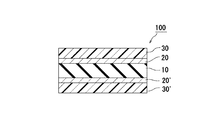
- FIG. 1 is a schematic cross-sectional view of a transparent substrate according to a preferred embodiment of the present invention.
- the transparent substrate 100 includes a glass 10 and resin layers 30 and 30 ′ disposed on one side or both sides of the glass 10 (preferably on both sides as in the illustrated example) via adhesive layers 20 and 20 ′.
- the transparent substrate may include any appropriate other layer on the opposite side of the resin layer from the inorganic glass, if necessary. Examples of the other layers include a transparent conductive layer and a hard coat layer.
- the adhesive of the present invention is excellent in transparency as described above, and can suppress the influence on the transparency of the adherend. Therefore, if the adhesive of the present invention is used, the transparent substrate having excellent transparency Can be obtained.
- the glass described in the above section A is used.
- the thickness of the glass is preferably 80 ⁇ m or less, more preferably 20 ⁇ m to 80 ⁇ m, and particularly preferably 30 ⁇ m to 70 ⁇ m. Since the transparent substrate has a resin layer on one side or both sides of the glass, a transparent substrate having excellent impact resistance can be obtained even if the thickness of the glass is reduced.
- the light transmittance of the glass 10 at a wavelength of 550 nm is preferably 85% or more.
- the refractive index of the glass 10 at a wavelength of 550 nm is preferably 1.4 to 1.65.
- the density of the glass 10 is preferably 2.3 g / cm 3 to 3.0 g / cm 3 , more preferably 2.3 g / cm 3 to 2.7 g / cm 3 . If it is the glass of the said range, a lightweight transparent substrate will be obtained.
- the adhesive layers 20 and 20 ′ can be formed by attaching the glass 10 and the resin layers 30 and 30 ′ with the adhesive described in the above section C, and then heating the adhesive.
- the heating temperature is preferably 80 ° C. to 200 ° C.
- the thickness of the adhesive layers 20, 20 ′ is preferably 0.001 ⁇ m to 20 ⁇ m, more preferably 0.001 ⁇ m to 15 ⁇ m, and particularly preferably 0.01 ⁇ m to 10 ⁇ m. Within such a range, the glass 10 and the resin layers 30 and 30 'can be firmly bonded even under high temperature and high humidity, and a transparent substrate having excellent transparency can be obtained.
- the resin layers 30 and 30 ' are made of the material described in the above section B.
- the resin layers 30 and 30 ' may be formed by sticking a resin film on the glass 10 through the adhesive layers 20 and 20', and a resin solution is applied on the glass 10 coated with the adhesive. Then, it may be formed by heating.
- the thickness of the resin layers 30 and 30 ′ is preferably 5 ⁇ m to 100 ⁇ m, more preferably 10 ⁇ m to 80 ⁇ m, and particularly preferably 15 ⁇ m to 60 ⁇ m.
- the thickness of each resin layer may be the same or different.
- the thickness of each resin layer is the same.
- each resin layer may be composed of the same resin or a resin having the same characteristics, or may be composed of different resins.
- each resin layer is made of the same resin. Therefore, most preferably, each resin layer is comprised so that it may become the same thickness with the same resin. With such a configuration, even if heat treatment is performed, thermal stress is evenly applied to both surfaces of the glass, and thus warpage and undulation are extremely unlikely to occur.
- the light transmittance of the resin layers 30 and 30 ′ at a wavelength of 550 nm is preferably 80% or more.
- the refractive index of the resin layers 30 and 30 ′ at a wavelength of 550 nm is preferably 1.3 to 1.7.
- the total thickness of the transparent substrate 100 is preferably 150 ⁇ m or less, more preferably 140 ⁇ m or less, and particularly preferably 80 ⁇ m to 130 ⁇ m.
- the light transmittance at a wavelength of 550 nm of the transparent substrate 100 is preferably 80% or more, more preferably 85% or more.
- the transparent substrate 100 has a light transmittance reduction rate of 5% or less after heat treatment at 180 ° C. for 2 hours. This is because, with such a reduction rate, a practically acceptable light transmittance can be ensured even when heat treatment necessary for the manufacturing process of the display element and the solar cell is performed.
- the haze value of the transparent substrate 100 is preferably 10% or less, more preferably 5% or less.
- the transparent substrate has such characteristics, for example, when used for a display element, good visibility can be obtained.
- the transparent substrate may be provided with any appropriate other layer on the opposite side of the resin layer from the glass, if necessary.
- a transparent conductive layer, a hard-coat layer, etc. are mentioned, for example.
- the transparent conductive layer can function as an electrode or an electromagnetic wave shield when the transparent substrate is used as a display element, a (touch) input element, or a solar cell substrate.
- Examples of materials that can be used for the transparent conductive layer include metals such as copper and silver; metal oxides such as indium tin oxide (ITO) and indium zinc oxide (IZO); and conductive materials such as polythiophene and polyaniline.
- Examples of the polymer include a composition containing carbon nanotubes.
- the hard coat layer has a function of imparting chemical resistance, scratch resistance and surface smoothness to the transparent substrate.
- any appropriate material can be adopted as the material constituting the hard coat layer.
- the material constituting the hard coat layer include an epoxy resin, an acrylic resin, a silicone resin, and a mixture thereof. Among these, an epoxy resin excellent in heat resistance is preferable.
- the hard coat layer can be obtained by curing these resins with heat or active energy rays.
- the thickness was measured using an Anritsu digital micrometer “KC-351C type”.
- thermoplastic resin (b) In a reaction vessel equipped with a stirrer, 3.88 g (0,4,4 '-(1,3-dimethylbutylidene) bis (2,6-dimethylphenol) .012 mol), 4.18 g (0.012 mol) of 4,4 ′-(diphenylmethylene) bisphenol, 5.17 g (0.018 mol) of 4,4 ′-(1-phenylethylidene) bisphenol, 4.07 g of bisphenol A (0 .018 mol) and 0.384 g of benzyltriethylammonium chloride were dissolved in 160 g of 1M sodium hydroxide solution.
- a solution prepared by dissolving 12.05 g (0.059 mol) of terephthalic acid chloride in 181 g of chloroform was added to this solution all at once with stirring, and the mixture was stirred at room temperature for 120 minutes. Thereafter, the polymerization solution was allowed to stand to separate the chloroform solution containing the polymer, then washed with acetic acid water, washed with ion-exchanged water, and then poured into methanol to precipitate the polymer. The precipitated polymer was filtered and dried under reduced pressure to obtain 23 g of a white polymer.
- the obtained polymer had a glass transition temperature (Tg) of 260 ° C. and a weight average molecular weight of 6 ⁇ 10 4 .
- thermoplastic resin (b) In a reaction vessel equipped with a stirrer, 5.46 g (0.02 mol) of 4,4 '-(1,3-dimethylbutylidene) bisphenol, 4,4' -(1-methylbutylidene) bis (2,6-dimethylphenol) 5.09 g (0.017 mol), 4,4 ′-(1-phenylethylidene) bisphenol 12.34 g (0.042 mol), benzyltriethylammonium 0.508 g of chloride was dissolved in 212 g of 1M sodium hydroxide solution.
- a solution prepared by dissolving 17.3 g (0.085 mol) of terephthalic acid chloride in 260 g of chloroform was added to this solution all at once with stirring, and the mixture was stirred at room temperature for 120 minutes. Thereafter, the polymerization solution was allowed to stand to separate the chloroform solution containing the polymer, then washed with acetic acid water, washed with ion-exchanged water, and then poured into methanol to precipitate the polymer. The precipitated polymer was filtered and dried under reduced pressure to obtain 28 g of a white polymer.
- the obtained polymer had a glass transition temperature (Tg) of 240 ° C. and a weight average molecular weight of 8 ⁇ 10 4 .
- thermoplastic resin (b) In a reaction vessel equipped with a stirring device, 3.88 g (0,4 '-(1,3-dimethylbutylidene) bis (2,6-dimethylphenol) (0 0.012 mol), 4.18 g (0.012 mol) of 4,4 ′-(diphenylmethylene) bisphenol, 5.17 g (0.018 mol) of 4,4 ′-(1-phenylethylidene) bisphenol, 2.15 g of bisphenol A (0 0.011 mol) was partially dissolved / partially dispersed in 200 ml of 2M potassium hydroxide solution.
- thermoplastic resin (A) In a reaction vessel equipped with a stirrer, 7.65 g (0.028 mol) of 4,4 '-(1,3-dimethylbutylidene) bisphenol, 4,4' 12.35 g (0.043 mol) of-(1-phenylethylidene) bisphenol, 0.444 g of benzyltriethylammonium chloride and 0.022 g of pt-butylphenol were dissolved in 185 g of 1M sodium hydroxide solution.
- Example 1 Adhesive adjustment 10 g of the white polymer obtained in Production Example 1 as the thermoplastic resin (b) and an epoxy group terminal coupling agent as the thermosetting monomer (c) (trade name “KBM403” manufactured by Shin-Etsu Chemical Co., Ltd .; (OCH 3 ) having 3 groups) 2.5 g and 3-ethyl-3 (((3-ethyloxetane-3-yl) methoxy) methyl) oxetane (manufactured by Toa Gosei Co., Ltd., trade name “Aronoxetane OXT-221”) ) 0.6 g, 0.05 g of dibutyltin dilaurate as the catalyst (d), and 0.4 g of 1,2-dimethylimidazole as the second catalyst were dissolved in 30 g of cyclopentanone to obtain an adhesive.
- Resin film (resin layer)
- the polymer cyclopentanone solution (concentration 9% by weight) obtained in Reference Example 1 was coated on a polyethylene terephthalate (PET) film (trade name “Lumirror” manufactured by Toray Industries, Inc.), A resin film of 27 ⁇ m and a residual solvent amount of 13% by weight was obtained.
- PET polyethylene terephthalate
- the resin film on the PET film was adhered to the glass through the adhesive to obtain a laminate.
- the laminate was heated at 90 ° C. for 4 minutes, 130 ° C. for 4 minutes, and 150 ° C. for 4 minutes. Subsequently, the PET film was peeled off and further heated at 150 ° C.
- Example 2 In the preparation of the adhesive, a transparent substrate was obtained in the same manner as in Example 1, except that the white polymer obtained in Production Example 2 was used instead of the white polymer obtained in Production Example 1 as the thermoplastic resin (b). Got.
- Example 3 A transparent substrate was prepared in the same manner as in Example 1 except that the white polymer obtained in Production Example 3 was used instead of the white polymer obtained in Production Example 1 as the thermoplastic resin (b) in the preparation of the adhesive. Got.
- Example 4 In the preparation of the adhesive, 10 g of polyarylate (“M-4000” manufactured by Unitika Ltd., weight average molecular weight: 5 ⁇ 10 4 ) as the thermoplastic resin (b) and the end of the epoxy group as the thermosetting monomer (c) Coupling agent (manufactured by Shin-Etsu Chemical Co., Ltd., trade name “KBM403”; -Si (OCH 3 ) having 3 groups) 2.0 g and 3-ethyl-3 (((3-ethyloxetane-3-yl) methoxy) Methyl) oxetane (trade name “Aronoxetane OXT-221” manufactured by Toagosei Co., Ltd.), 0.2 g of dibutyltin dilaurate as the catalyst (d), and 1,2-dimethylimidazole as the second catalyst 0.15 g was dissolved in 37.61 g of cyclopentanone to obtain an adhesive.
- Example 5 Polypentylate (trade name “U-100”, manufactured by Unitika Ltd., glass transition temperature (Tg): 193 ° C.) cyclopentanone solution (concentration 5% by weight) in polyethylene terephthalate (PET) film (trade name, manufactured by Toray Industries, Inc.) The resin film having a thickness of 27 ⁇ m and a residual solvent amount of 13% by weight was obtained on PET. A transparent substrate was obtained in the same manner as in Example 1 except that the resin layer was formed from the resin film.
- PET polyethylene terephthalate
- PET film (trade name, manufactured by Toray Industries, Inc.) polycarbonate (Bayer Material Science, trade name “APEC 1897”, glass transition temperature (Tg): 182 ° C.) cyclopentanone solution (concentration 5% by weight)
- the resin film having a thickness of 27 ⁇ m and a residual solvent amount of 13% by weight was obtained on PET.
- a transparent substrate was obtained in the same manner as in Example 1 except that the resin layer was formed from the resin film.
- Example 1 A transparent substrate was obtained in the same manner as in Example 1 except that dibutyltin dilaurate was not used in the preparation of the adhesive.
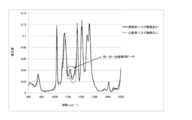
- the adhesive layer of the transparent substrate was analyzed by FT-IR, as shown in FIG. 2, the adhesive layer did not have a bond represented by —SiOSi—.
- the transparent substrate of the present invention can be widely used for display elements such as liquid crystal displays, organic EL displays, and plasma displays, solar cells, and illumination elements.
Landscapes
- Chemical & Material Sciences (AREA)
- Organic Chemistry (AREA)
- Chemical Kinetics & Catalysis (AREA)
- Engineering & Computer Science (AREA)
- Manufacturing & Machinery (AREA)
- Materials Engineering (AREA)
- Health & Medical Sciences (AREA)
- Medicinal Chemistry (AREA)
- Polymers & Plastics (AREA)
- Laminated Bodies (AREA)
- Adhesives Or Adhesive Processes (AREA)
Abstract
Priority Applications (4)
| Application Number | Priority Date | Filing Date | Title |
|---|---|---|---|
| EP13796478.9A EP2857473A4 (fr) | 2012-05-29 | 2013-05-28 | Adhésif, et substrat transparent l'utilisant |
| CN201380028449.2A CN104350122A (zh) | 2012-05-29 | 2013-05-28 | 粘合剂和使用所述粘合剂的透明基板 |
| US14/400,442 US20150175858A1 (en) | 2012-05-29 | 2013-05-28 | Adhesive, and transparent substrate using same |
| KR1020147033454A KR20150027068A (ko) | 2012-05-29 | 2013-05-28 | 접착제 및 그것을 사용한 투명 기판 |
Applications Claiming Priority (2)
| Application Number | Priority Date | Filing Date | Title |
|---|---|---|---|
| JP2012121893 | 2012-05-29 | ||
| JP2012-121893 | 2012-05-29 |
Publications (1)
| Publication Number | Publication Date |
|---|---|
| WO2013180134A1 true WO2013180134A1 (fr) | 2013-12-05 |
Family
ID=49673326
Family Applications (1)
| Application Number | Title | Priority Date | Filing Date |
|---|---|---|---|
| PCT/JP2013/064788 Ceased WO2013180134A1 (fr) | 2012-05-29 | 2013-05-28 | Adhésif, et substrat transparent l'utilisant |
Country Status (7)
| Country | Link |
|---|---|
| US (1) | US20150175858A1 (fr) |
| EP (1) | EP2857473A4 (fr) |
| JP (1) | JP2014005455A (fr) |
| KR (1) | KR20150027068A (fr) |
| CN (1) | CN104350122A (fr) |
| TW (1) | TW201406902A (fr) |
| WO (1) | WO2013180134A1 (fr) |
Families Citing this family (3)
| Publication number | Priority date | Publication date | Assignee | Title |
|---|---|---|---|---|
| JP6571946B2 (ja) * | 2014-03-24 | 2019-09-04 | 日東電工株式会社 | 透明基板 |
| JP2015193797A (ja) * | 2014-03-24 | 2015-11-05 | 日東電工株式会社 | 透明樹脂フィルム |
| CN110028918A (zh) * | 2019-03-11 | 2019-07-19 | 常州新之雅装饰材料有限公司 | 一种高强度玻璃胶及其制备方法 |
Citations (6)
| Publication number | Priority date | Publication date | Assignee | Title |
|---|---|---|---|---|
| JPH11329715A (ja) | 1998-04-02 | 1999-11-30 | Cambridge Display Technol Ltd | 有機デバイスのための可撓性基体、有機デバイスおよびその製造方法 |
| JP2007010834A (ja) | 2005-06-29 | 2007-01-18 | Sumitomo Chemical Co Ltd | ディスプレイ用基板及びそれを用いたディスプレイ素子 |
| JP2008107510A (ja) | 2006-10-25 | 2008-05-08 | Nitto Denko Corp | 表示素子用基板およびその製造方法 |
| JP2010284964A (ja) * | 2009-05-14 | 2010-12-24 | Nitto Denko Corp | 透明基板ならびに透明基板を用いた表示素子、太陽電池および照明素子 |
| JP2011245843A (ja) * | 2010-04-30 | 2011-12-08 | Nitto Denko Corp | 透明基板の製造方法 |
| JP2012052031A (ja) * | 2010-09-01 | 2012-03-15 | Jsr Corp | 被加工層の加工方法および剥離方法ならびに仮固定用組成物 |
Family Cites Families (3)
| Publication number | Priority date | Publication date | Assignee | Title |
|---|---|---|---|---|
| KR100563509B1 (ko) * | 1998-09-25 | 2006-03-23 | 신에쓰 가가꾸 고교 가부시끼가이샤 | 에폭시 수지 조성물 및 이 에폭시 수지 조성물을 사용한 적층 필름 및 반도체 장치 |
| WO2010053092A1 (fr) * | 2008-11-07 | 2010-05-14 | 日東電工株式会社 | Substrat transparent et son procédé de fabrication |
| KR101811893B1 (ko) * | 2009-10-22 | 2017-12-22 | 닛토덴코 가부시키가이샤 | 투명 기판 |
-
2013
- 2013-05-28 WO PCT/JP2013/064788 patent/WO2013180134A1/fr not_active Ceased
- 2013-05-28 US US14/400,442 patent/US20150175858A1/en not_active Abandoned
- 2013-05-28 EP EP13796478.9A patent/EP2857473A4/fr not_active Withdrawn
- 2013-05-28 JP JP2013112058A patent/JP2014005455A/ja active Pending
- 2013-05-28 KR KR1020147033454A patent/KR20150027068A/ko not_active Withdrawn
- 2013-05-28 CN CN201380028449.2A patent/CN104350122A/zh active Pending
- 2013-05-29 TW TW102118996A patent/TW201406902A/zh unknown
Patent Citations (6)
| Publication number | Priority date | Publication date | Assignee | Title |
|---|---|---|---|---|
| JPH11329715A (ja) | 1998-04-02 | 1999-11-30 | Cambridge Display Technol Ltd | 有機デバイスのための可撓性基体、有機デバイスおよびその製造方法 |
| JP2007010834A (ja) | 2005-06-29 | 2007-01-18 | Sumitomo Chemical Co Ltd | ディスプレイ用基板及びそれを用いたディスプレイ素子 |
| JP2008107510A (ja) | 2006-10-25 | 2008-05-08 | Nitto Denko Corp | 表示素子用基板およびその製造方法 |
| JP2010284964A (ja) * | 2009-05-14 | 2010-12-24 | Nitto Denko Corp | 透明基板ならびに透明基板を用いた表示素子、太陽電池および照明素子 |
| JP2011245843A (ja) * | 2010-04-30 | 2011-12-08 | Nitto Denko Corp | 透明基板の製造方法 |
| JP2012052031A (ja) * | 2010-09-01 | 2012-03-15 | Jsr Corp | 被加工層の加工方法および剥離方法ならびに仮固定用組成物 |
Non-Patent Citations (1)
| Title |
|---|
| See also references of EP2857473A4 |
Also Published As
| Publication number | Publication date |
|---|---|
| JP2014005455A (ja) | 2014-01-16 |
| TW201406902A (zh) | 2014-02-16 |
| CN104350122A (zh) | 2015-02-11 |
| US20150175858A1 (en) | 2015-06-25 |
| KR20150027068A (ko) | 2015-03-11 |
| EP2857473A4 (fr) | 2016-01-20 |
| EP2857473A1 (fr) | 2015-04-08 |
Similar Documents
| Publication | Publication Date | Title |
|---|---|---|
| JP5883333B2 (ja) | 透明シートおよびその製造方法 | |
| JP5325005B2 (ja) | 透明基板 | |
| JP5480774B2 (ja) | 透明基板 | |
| CN102574736A (zh) | 透明基板 | |
| WO2013180133A1 (fr) | Adhésif, et substrat transparent l'utilisant | |
| WO2013180134A1 (fr) | Adhésif, et substrat transparent l'utilisant | |
| JP5567314B2 (ja) | 透明基板およびその製造方法 | |
| JP5330966B2 (ja) | 透明基板ならびに透明基板を用いた表示素子、太陽電池および照明素子 | |
| JP2009282509A (ja) | 表示素子用基板およびその製造方法 | |
| JP6113555B2 (ja) | 光学フィルム |
Legal Events
| Date | Code | Title | Description |
|---|---|---|---|
| 121 | Ep: the epo has been informed by wipo that ep was designated in this application |
Ref document number: 13796478 Country of ref document: EP Kind code of ref document: A1 |
|
| WWE | Wipo information: entry into national phase |
Ref document number: 14400442 Country of ref document: US |
|
| WWE | Wipo information: entry into national phase |
Ref document number: 2013796478 Country of ref document: EP |
|
| ENP | Entry into the national phase |
Ref document number: 20147033454 Country of ref document: KR Kind code of ref document: A |
|
| NENP | Non-entry into the national phase |
Ref country code: DE |