WO2013180139A1 - Substrat facilement adhésif et son procédé de fabrication, feuille de protection de cellule solaire dotée du substrat facilement adhésif, son procédé de fabrication et module de cellule solaire - Google Patents
Substrat facilement adhésif et son procédé de fabrication, feuille de protection de cellule solaire dotée du substrat facilement adhésif, son procédé de fabrication et module de cellule solaire Download PDFInfo
- Publication number
- WO2013180139A1 WO2013180139A1 PCT/JP2013/064802 JP2013064802W WO2013180139A1 WO 2013180139 A1 WO2013180139 A1 WO 2013180139A1 JP 2013064802 W JP2013064802 W JP 2013064802W WO 2013180139 A1 WO2013180139 A1 WO 2013180139A1
- Authority
- WO
- WIPO (PCT)
- Prior art keywords
- easy
- adhesive
- layer
- sealing material
- solar cell
- Prior art date
- Legal status (The legal status is an assumption and is not a legal conclusion. Google has not performed a legal analysis and makes no representation as to the accuracy of the status listed.)
- Ceased
Links
Images




Classifications
-
- H—ELECTRICITY
- H10—SEMICONDUCTOR DEVICES; ELECTRIC SOLID-STATE DEVICES NOT OTHERWISE PROVIDED FOR
- H10F—INORGANIC SEMICONDUCTOR DEVICES SENSITIVE TO INFRARED RADIATION, LIGHT, ELECTROMAGNETIC RADIATION OF SHORTER WAVELENGTH OR CORPUSCULAR RADIATION
- H10F19/00—Integrated devices, or assemblies of multiple devices, comprising at least one photovoltaic cell covered by group H10F10/00, e.g. photovoltaic modules
- H10F19/80—Encapsulations or containers for integrated devices, or assemblies of multiple devices, having photovoltaic cells
- H10F19/85—Protective back sheets
-
- C—CHEMISTRY; METALLURGY
- C09—DYES; PAINTS; POLISHES; NATURAL RESINS; ADHESIVES; COMPOSITIONS NOT OTHERWISE PROVIDED FOR; APPLICATIONS OF MATERIALS NOT OTHERWISE PROVIDED FOR
- C09J—ADHESIVES; NON-MECHANICAL ASPECTS OF ADHESIVE PROCESSES IN GENERAL; ADHESIVE PROCESSES NOT PROVIDED FOR ELSEWHERE; USE OF MATERIALS AS ADHESIVES
- C09J7/00—Adhesives in the form of films or foils
- C09J7/20—Adhesives in the form of films or foils characterised by their carriers
- C09J7/22—Plastics; Metallised plastics
-
- C—CHEMISTRY; METALLURGY
- C09—DYES; PAINTS; POLISHES; NATURAL RESINS; ADHESIVES; COMPOSITIONS NOT OTHERWISE PROVIDED FOR; APPLICATIONS OF MATERIALS NOT OTHERWISE PROVIDED FOR
- C09J—ADHESIVES; NON-MECHANICAL ASPECTS OF ADHESIVE PROCESSES IN GENERAL; ADHESIVE PROCESSES NOT PROVIDED FOR ELSEWHERE; USE OF MATERIALS AS ADHESIVES
- C09J7/00—Adhesives in the form of films or foils
- C09J7/30—Adhesives in the form of films or foils characterised by the adhesive composition
-
- H—ELECTRICITY
- H10—SEMICONDUCTOR DEVICES; ELECTRIC SOLID-STATE DEVICES NOT OTHERWISE PROVIDED FOR
- H10F—INORGANIC SEMICONDUCTOR DEVICES SENSITIVE TO INFRARED RADIATION, LIGHT, ELECTROMAGNETIC RADIATION OF SHORTER WAVELENGTH OR CORPUSCULAR RADIATION
- H10F19/00—Integrated devices, or assemblies of multiple devices, comprising at least one photovoltaic cell covered by group H10F10/00, e.g. photovoltaic modules
- H10F19/80—Encapsulations or containers for integrated devices, or assemblies of multiple devices, having photovoltaic cells
- H10F19/804—Materials of encapsulations
-
- B—PERFORMING OPERATIONS; TRANSPORTING
- B32—LAYERED PRODUCTS
- B32B—LAYERED PRODUCTS, i.e. PRODUCTS BUILT-UP OF STRATA OF FLAT OR NON-FLAT, e.g. CELLULAR OR HONEYCOMB, FORM
- B32B2457/00—Electrical equipment
- B32B2457/12—Photovoltaic modules
-
- C—CHEMISTRY; METALLURGY
- C09—DYES; PAINTS; POLISHES; NATURAL RESINS; ADHESIVES; COMPOSITIONS NOT OTHERWISE PROVIDED FOR; APPLICATIONS OF MATERIALS NOT OTHERWISE PROVIDED FOR
- C09J—ADHESIVES; NON-MECHANICAL ASPECTS OF ADHESIVE PROCESSES IN GENERAL; ADHESIVE PROCESSES NOT PROVIDED FOR ELSEWHERE; USE OF MATERIALS AS ADHESIVES
- C09J2203/00—Applications of adhesives in processes or use of adhesives in the form of films or foils
- C09J2203/322—Applications of adhesives in processes or use of adhesives in the form of films or foils for the production of solar panels
-
- C—CHEMISTRY; METALLURGY
- C09—DYES; PAINTS; POLISHES; NATURAL RESINS; ADHESIVES; COMPOSITIONS NOT OTHERWISE PROVIDED FOR; APPLICATIONS OF MATERIALS NOT OTHERWISE PROVIDED FOR
- C09J—ADHESIVES; NON-MECHANICAL ASPECTS OF ADHESIVE PROCESSES IN GENERAL; ADHESIVE PROCESSES NOT PROVIDED FOR ELSEWHERE; USE OF MATERIALS AS ADHESIVES
- C09J2301/00—Additional features of adhesives in the form of films or foils
- C09J2301/30—Additional features of adhesives in the form of films or foils characterized by the chemical, physicochemical or physical properties of the adhesive or the carrier
- C09J2301/312—Additional features of adhesives in the form of films or foils characterized by the chemical, physicochemical or physical properties of the adhesive or the carrier parameters being the characterizing feature
-
- C—CHEMISTRY; METALLURGY
- C09—DYES; PAINTS; POLISHES; NATURAL RESINS; ADHESIVES; COMPOSITIONS NOT OTHERWISE PROVIDED FOR; APPLICATIONS OF MATERIALS NOT OTHERWISE PROVIDED FOR
- C09J—ADHESIVES; NON-MECHANICAL ASPECTS OF ADHESIVE PROCESSES IN GENERAL; ADHESIVE PROCESSES NOT PROVIDED FOR ELSEWHERE; USE OF MATERIALS AS ADHESIVES
- C09J2459/00—Presence of polyacetal
-
- C—CHEMISTRY; METALLURGY
- C09—DYES; PAINTS; POLISHES; NATURAL RESINS; ADHESIVES; COMPOSITIONS NOT OTHERWISE PROVIDED FOR; APPLICATIONS OF MATERIALS NOT OTHERWISE PROVIDED FOR
- C09J—ADHESIVES; NON-MECHANICAL ASPECTS OF ADHESIVE PROCESSES IN GENERAL; ADHESIVE PROCESSES NOT PROVIDED FOR ELSEWHERE; USE OF MATERIALS AS ADHESIVES
- C09J2467/00—Presence of polyester
- C09J2467/006—Presence of polyester in the substrate
-
- Y—GENERAL TAGGING OF NEW TECHNOLOGICAL DEVELOPMENTS; GENERAL TAGGING OF CROSS-SECTIONAL TECHNOLOGIES SPANNING OVER SEVERAL SECTIONS OF THE IPC; TECHNICAL SUBJECTS COVERED BY FORMER USPC CROSS-REFERENCE ART COLLECTIONS [XRACs] AND DIGESTS
- Y02—TECHNOLOGIES OR APPLICATIONS FOR MITIGATION OR ADAPTATION AGAINST CLIMATE CHANGE
- Y02E—REDUCTION OF GREENHOUSE GAS [GHG] EMISSIONS, RELATED TO ENERGY GENERATION, TRANSMISSION OR DISTRIBUTION
- Y02E10/00—Energy generation through renewable energy sources
- Y02E10/50—Photovoltaic [PV] energy
Definitions
- the present invention relates to an easy-adhesive substrate and a method for producing the same, a protective sheet for solar cells comprising such an easy-adhesive substrate and used as a surface protective sheet or a back surface protective sheet for a solar cell module, and a method for producing the same, and
- the present invention relates to a solar cell module using such a solar cell protective sheet.
- Solar cell modules that convert solar light energy into electrical energy are attracting attention as a clean energy source that can generate electricity without discharging carbon dioxide in response to environmental problems such as air pollution and global warming.
- a solar cell module is made of a crystalline silicon, amorphous silicon, or the like that performs photoelectric conversion, a sealing material that includes an electrical insulator that seals the solar cell, and a surface (light-receiving surface) of the sealing material. It is comprised from the surface protection sheet (front sheet) laminated
- the solar cells and sealing material are protected from wind, rain, moisture, dust, mechanical shock, etc. It is necessary to keep the inside of the battery module sealed from the outside air. For this reason, the protection sheet for solar cells is required to have moisture resistance and weather resistance that can withstand long-term use.
- the main constituent material (main material) of the sealing material is a polyolefin resin
- the main material of the solar cell protective sheet is polyethylene terephthalate (PET).
- PET polyethylene terephthalate
- polyester resins such as polyethylene naphthalate (PEN) are used. In this case, it may be required to adhere the polyolefin resin and the polyester resin, but these resins tend to be difficult to adhere because of different resin types.
- an easy-adhesion coat layer is formed on the surface of the sealing material side of the base material mainly composed of polyester resin in the protective sheet for solar cell, and is adhered to the sealing material mainly composed of polyolefin resin. Sometimes it is done to improve the sex.
- Patent Document 1 discloses a sheet for sealing a back surface of a solar cell, which includes an easy-adhesion coat layer formed from a coating composition comprising a specific ionomer-type polyurethane resin, a crosslinking agent, and polyacrylic acid or a derivative thereof. Yes.
- Patent Document 2 discloses an adhesive layer formed of a urethane-based adhesive on the surface of the base polyester film on the sealing material side, and an ethylene-vinyl acetate copolymer (EVA) on the adhesive layer.
- EVA ethylene-vinyl acetate copolymer
- Patent Document 3 discloses a polyester film for solar cells containing an organosilane compound on at least one side.
- Patent Document 4 includes (i) one or more electronically interconnected solar cells, a solar cell layer having a light receiving side and a back side, and (ii) poly (vinyl butyral). Disclosed is a solar cell laminate comprising one sublayer and at least one preformed bilayer sheet comprising a second sublayer comprising a metal or polymer film.
- JP 2009-81394 A International Publication No. 08/069024 JP 2011-77533 A Special table 2010-512027
- the present invention includes an easy-adhesive base material including an easy-adhesive coating layer that includes various types of thermoplastic materials and is excellent in adhesiveness to a layer having thermoplasticity as a whole, and such an easy-adhesive base material. It is an object to provide a manufacturing method. Moreover, this invention also makes it a subject to provide the protection sheet for solar cells provided with such a base material, and its manufacturing method. Furthermore, this invention also makes it a subject to provide a solar cell module provided with such a protection sheet for solar cells.
- the present invention provided to achieve the above object is, firstly, an easy-adhesive base material comprising a base material and an easy-adhesion coat layer laminated on at least one surface of the base material,
- the easy-adhesion coat layer is formed from a coating solution containing polyvinyl butyral having a softening point of 150 ° C. or less and a crosslinking agent, and the cross-linking structure of the polyvinyl butyral and the cross-linking agent has the easy-adhesion coat layer.
- thermocompression bonding is performed to produce a solar cell module using the solar cell protective sheet provided with the easy-adhesive substrate according to the present invention.
- An easy-adhesion coat layer, and a member or a component that contacts the easy-adhesion coat layer such as a sealing material in this specification, a member and a component that touches the easy-adhesion coat layer such as a sealing material May be generically referred to as “)”.
- the easy-adhesion coat layer has a cross-linked structure, cohesive failure hardly occurs. Therefore, the solar cell protective sheet incorporated in the solar cell module is difficult to peel off from the sealing material.
- the content of the crosslinking agent contained in the coating liquid is such that the crosslinking reactive group of the crosslinking agent is equivalent to 1 equivalent of the amount of active hydrogen contained in the coating liquid.
- the amount of the active hydrogen is preferably 0.1 equivalent or more and 1.5 equivalent or less, and the active hydrogen preferably contains active hydrogen which the hydroxyl group of the polyvinyl butyral has (Invention 2).
- the function of the easy-adhesion coat layer that reduces the possibility that the base material is peeled off from the sealing material or the like is appropriately exhibited, and the easy-adhesive base material has excellent blocking resistance. It is easy to achieve both.
- the degree of butyralization of polyvinyl butyral in the easy-adhesion coat layer is preferably 75 mol% or less (Invention 3).
- the degree of butyralization is in the above range, it becomes easy for the easy adhesion coat layer to have a crosslinked structure of polyvinyl butyral and a crosslinking agent.
- the crosslinking agent contains an isocyanate-based crosslinking agent (Invention 4).
- the thickness of the easy-adhesion coat layer is preferably 0.01 ⁇ m or more and 2.0 ⁇ m or less (Invention 5). In this case, it becomes easy to make it compatible that the function of the easy-adhesion coat layer is appropriately exhibited and the easy-adhesive substrate has excellent blocking resistance.
- the base material is preferably made of a film containing a polyester resin (Invention 6). It becomes easy to obtain a substrate having excellent hydrolysis resistance stably and inexpensively.
- the said coating liquid further contains the 1 type, or 2 or more types of component chosen from the group which consists of the monomer and oligomer which have group which has an ethylenically unsaturated bond ( Invention 7).
- the component preferably further has a group having active hydrogen (Invention 8).
- this invention is a manufacturing method of an easily-adhesive base material provided with a base material and the easily-adhesive coating layer laminated
- the manufacturing method of the easily-adhesive base material characterized by doing is provided (invention 9).
- the easily adhesive substrate according to the above invention (Inventions 1 to 8) can be obtained easily and with high productivity.
- the content of the crosslinking agent contained in the coating liquid is such that the crosslinking reactive group of the crosslinking agent is equivalent to 1 equivalent of the amount of active hydrogen contained in the coating liquid.
- the amount of the active hydrogen is preferably 0.1 equivalent or more and 1.5 equivalent or less, and the active hydrogen preferably contains active hydrogen contained in the hydroxyl group of the polyvinyl butyral (Invention 10). In this case, it becomes easy to make the easy-adhesion coat layer of the obtained easy-adhesive substrate have a crosslinked structure at an appropriate density.
- the degree of butyralization of the polyvinyl butyral contained in the coating liquid is 75 mol% or less (Invention 11).
- the degree of butyralization is in the above range, it becomes easy for the easy adhesion coat layer to have a crosslinked structure of polyvinyl butyral and a crosslinking agent.
- the crosslinking agent preferably contains an isocyanate-based crosslinking agent (Invention 12).
- the coating solution preferably further contains one or more components selected from the group consisting of monomers and oligomers containing a group having an ethylenically unsaturated bond. (Invention 13).
- the component preferably further has a group having active hydrogen (Invention 14).
- this invention is a protection sheet for solar cells provided with the easily-adhesive base material which concerns on the said invention (invention 1-8), Comprising: The surface on the opposite side to the said base material in the said easily-adhesive coating layer is sealed.
- a protective sheet for a solar cell that is a surface for contacting a stopper (Invention 15).
- the surface of the easy-adhesion coat layer serves as an adhesive surface with the sealing material, in the solar cell module in which the solar cell protective sheet is incorporated, the substrate of the solar cell protective sheet is sealed. The possibility of peeling from the stop material is reduced.
- the present invention provides an easy-adhesive base material according to the invention described above (Inventions 1 to 8), and a sealing material adhesive layer laminated on the surface of the easy-adhesive base material on the easy-adhesive coat layer side.
- the surface on the opposite side to the said easily bonding coat layer in the said sealing material contact bonding layer is a surface for contact
- the solar cell protective sheet characterized by the above-mentioned is provided (invention 16).
- the sealing material adhesive layer contains polyvinyl butyral (Invention 17).
- the sealing material adhesive layer contains the same type of material as the easy-adhesion coat layer, these delaminations are less likely to occur.
- the sealing material adhesive layer preferably has a multilayer structure (Invention 18).
- the difference in thermal expansion coefficient between the sealing material and the substrate can be eliminated in a stepwise manner in the multilayer structure of the sealing material adhesive layer. The possibility of the substrate peeling off from the encapsulant is further reduced.
- this invention is a manufacturing method of the protection sheet for solar cells which concerns on the said invention (invention 16 or 17), Comprising:
- the thermoplastic material for forming the said sealing material contact bonding layer is more than the softening point. Heating, supplying the heated thermoplastic material to the surface of the easy-adhesive substrate on the side of the easy-adhesive coating layer, cooling the thermoplastic material on the easy-adhesive substrate, and sealing the sealing material
- a manufacturing method characterized by forming an adhesive layer is provided (Invention 19).
- the adhesion between the easy-adhesion coat layer and the sealing material adhesive layer can be further improved.
- the crosslinking reaction in the easy-adhesion coat layer can be advanced by heat from the thermoplastic material for forming the sealing material adhesive layer.
- this invention is a manufacturing method of the protection sheet for solar cells which concerns on the said invention (invention 18), Comprising: Plural for forming the several layer which comprises the sealing material contact bonding layer provided with the said multilayer structure
- Plural for forming the several layer which comprises the sealing material contact bonding layer provided with the said multilayer structure Each of the thermoplastic materials is heated above the softening point, and the heated thermoplastic materials are simultaneously or sequentially supplied to the surface of the easy-adhesive substrate on the side of the easy-adhesive coat layer, and the easy-adhesion
- a manufacturing method is provided, wherein the plurality of thermoplastic materials on a porous substrate are cooled simultaneously or individually to form a sealing material adhesive layer having the multilayer structure (Invention 20).
- the adhesiveness between the easy-adhesion coat layer and the sealing material adhesive layer can be further increased, and the adhesiveness between a plurality of layers constituting the sealing material adhesive layer can be further improved. it can.
- the crosslinking reaction in the easy-adhesion coat layer can be advanced by heat from the thermoplastic material for forming the sealing material adhesive layer.
- the heat sealing material adhesive layer is preferably formed by extrusion coating of the thermoplastic material onto the easily adhesive substrate (Invention 21). Such a manufacturing method is excellent in productivity.
- the present invention is a solar cell module comprising a solar cell, a sealing material that encloses the solar cell, and two protective members stacked on each of the main surfaces of the sealing material, At least one of the protective members is provided with a solar cell protective sheet according to the invention (Inventions 15 to 18) (Invention 22).
- the sealing material preferably contains polyvinyl butyral (Invention 23).
- the element in contact with the sealing material in the solar cell protective sheet and the sealing material can contain the same type of material. At this time, the solar cell protective sheet is peeled off from the sealing material. The possibility of doing so is particularly reduced.
- the easy-adhesive substrate according to the present invention is excellent in adhesion to a layer made of a thermoplastic resin other than EVA such as polyvinyl butyral (PVB). Therefore, the solar cell protective sheet provided with such an easy-adhesive substrate is less likely to peel off the encapsulant and the sheet even when the encapsulant is mainly a thermoplastic resin other than EVA.
- the solar cell module comprising the solar cell protective sheet having the excellent moisture resistance and weather resistance, and the easy-adhesive substrate according to the present invention is less likely to deteriorate in quality even when used for a long period of time. There is expected.
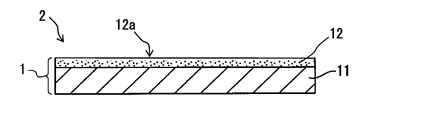
- the easy-adhesive base material 1 includes a base material 11 and an easy-adhesion coat layer 12 on one surface (upper surface in FIG. 1) of the base material 11. It has.
- the easy-adhesion coat layer 12 included in the easy-adhesive substrate 1 according to the present invention is excellent in adhesiveness with a thermoplastic sealing material.
- the base material 11 has only to be electrically insulative and can be laminated with the easy-adhesion coat layer 12, and usually a resin film is mainly used.
- a resin film generally used as a resin film in a solar cell module back sheet is selected.
- a resin film include polyolefin resins such as polyethylene and polypropylene; polyester resins such as polyethylene terephthalate (PET) and polyethylene naphthalate (PEN); polyamide resins such as nylon (trade name);
- a resin film such as a resin, a polystyrene resin, a polyacrylonitrile resin, a polyvinyl chloride resin, a polyvinyl acetal resin, a polyphenylene sulfide resin, or a polyphenylene ether resin is used.
- PET film which is a kind of the above-mentioned resin film, improves the hydrolysis resistance of the film when the oligomer content in the film is small.
- PET films having excellent hydrolysis resistance include Lumirror (registered trademark) X10S (manufactured by Toray Industries, Inc.) and Melinex (registered trademark) 238 (manufactured by Teijin DuPont Films).
- the said resin film may contain various additives, such as a pigment, a ultraviolet absorber, a ultraviolet stabilizer, a flame retardant, a plasticizer, an antistatic agent, a lubricant, and an antiblocking agent, as needed.
- a pigment examples include titanium dioxide and carbon black.
- the ultraviolet absorber examples include benzophenone, benzotriazole, oxalic anilide, cyanoacrylate, and triazine.
- the resin film when using the protective sheet for solar cells including the easy-adhesive substrate 1 according to the present embodiment as the back surface protective sheet of the solar cell module, the resin film contains a pigment that reflects visible light. Is preferred. Moreover, when using the protective sheet for solar cells provided with the easily adhesive base material 1 which concerns on this embodiment as a surface protective sheet of a solar cell module, it does not contain the pigment which reduces the transmittance
- the surface of the resin film on the side where the easy-adhesion coat layer 12 is laminated is to improve the adhesion between the easy-adhesion coat layer 12 and the base material 11. It is preferable to perform surface treatment (easy adhesion treatment) such as corona treatment or plasma treatment. Among these surface treatments, corona treatment is particularly preferable from the viewpoints of easy treatment and less damage to the substrate 11.
- the thickness of the base material 11 is appropriately set based on electrical insulation required for the solar cell module.
- the thickness is preferably 10 ⁇ m or more and 300 ⁇ m or less. More specifically, when the substrate 11 is a PET film, the thickness is preferably 30 ⁇ m or more and 250 ⁇ m or less, and 40 ⁇ m or more and 200 ⁇ m or less from the viewpoint of electrical insulation and weight reduction. It is more preferable that it is 50 ⁇ m or more and 150 ⁇ m or less.
- the easy-adhesion base material 1 which concerns on this embodiment is equipped with the easy-adhesion coat layer 12 on the one surface of the base material 11, Preferably the surface where the above surface treatments were given. .
- the easy-adhesion coat layer 12 is formed from a coating liquid containing polyvinyl butyral having a softening point of 150 ° C. or less and a crosslinking agent, and has a crosslinked structure of the polyvinyl butyral and the crosslinking agent.
- Polyvinyl butyral Polyvinyl butyral is a resin in which the hydroxyl group of polyvinyl alcohol (PVA) reacts with butyraldehyde. It is technically difficult to convert all the hydroxyl groups of PVA into a butyral, and since saponification of polyvinyl acetate is not completely performed in the production process of PVA, the amount of total hydroxyl groups that PVA can have However, the degree of butyralization, which is the ratio of the amount of butyralized hydroxyl group, is less than 80 mol%. The degree of butyralization (mol%) is obtained by calculating vinyl alcohol content (mass%) and vinyl acetate content (mass%) according to ASTM 1396-92, converting the unit to mol%, and subtracting from 100 mol%.
- the property of PVB can be controlled by adjusting the degree of butyralization.
- the degree of butyralization of PVB according to the easy-adhesion coat layer 12 of this embodiment is preferably 75 mol% or less.
- the degree of butyralization exceeds 75 mol%, PVB has a small amount of hydroxyl group, and depending on the type of crosslinking agent described later, there is a concern that the reactivity between the crosslinking agent and the hydroxyl group may be reduced.
- this reactivity decreases, the density of the crosslinked structure in the easy-adhesion coat layer 12 decreases, the strength of the easy-adhesion coat layer 12 decreases, and the adhesion of the easy-adhesive substrate 1 to the sealing material decreases.
- the lower limit of the degree of butyralization of PVB related to the easy-adhesion coat layer 12 of the present embodiment is not particularly limited, but when it is excessively low, the solubility of PVB in the coating liquid for forming the easy-adhesion coat layer 12 is lowered. Thus, there is a concern that the controllability of the thickness of the easy-adhesion coat layer 12 is lowered.
- the degree of butyralization of PVB is preferably 40 mol% or more, and more preferably 60 mol% or more.
- the softening point of PVB according to the easy-adhesion coat layer 12 of this embodiment is 150 ° C. or less.
- the softening point of PVB can be controlled by its molecular weight. When the softening point is 150 ° C. or lower, it becomes easy to improve the adhesiveness by thermal fusion with the sealing material in contact with the easy-adhesion coat layer 12. Moreover, when the softening point of PVB is high, the solubility with respect to a solvent may become low, and at this time, the controllability of the thickness of the easy-adhesion coat layer 12 falls. From the viewpoint of further improving the adhesiveness with the above-described sealing material, the softening point of PVB is preferably 150 ° C.
- the softening point of PVB is not particularly limited, but when it is too low, the easy-adhesion coat layer 12 becomes excessively soft and blocking may occur when winding the easy-adhesive substrate 1. From the viewpoint of stably avoiding such problems, the softening point of PVB is preferably 90 ° C. or higher.
- the softening point is a flow start temperature measured using a Shimadzu capillary rheometer (device name: CFT-500D) based on a reference test described in JIS K7210: 1995.
- (Ii) Crosslinking agent The kind of the crosslinking agent contained in the coating liquid for forming the easy-adhesion coat layer 12 of this embodiment is not particularly limited as long as it can react with the hydroxyl group contained in PVB.
- hydrogen having a functional group capable of reacting with a crosslinking agent such as hydrogen having a hydroxyl group
- active hydrogen Specific examples of active hydrogen other than hydrogen having a hydroxyl group include hydrogen possessed by an amino group and hydrogen possessed by a carboxyl group.
- crosslinking agent examples include dialdehydes such as glyoxal; polymer aldehydes such as dialdehyde starch; N-methylol compounds such as N-methylol urea and N-methylol melamine; dicarboxylic acids such as oxalic acid and maleic acid; Polycarboxylic acids such as polyacrylic acid, methyl vinyl ether-maleic acid copolymer, isobutylene-maleic anhydride copolymer; epoxy crosslinking agent; isocyanate crosslinking agent such as diisocyanate compound; polyvalent metal compound such as ammonium zirconium carbonate However, it is not limited to this.
- crosslinking agents include isocyanate-based crosslinking agents containing polyisocyanate compounds.
- the polyisocyanate compound is a compound having two or more isocyanate groups per molecule.
- Specific examples thereof include 2,4-tolylene diisocyanate, 2,6-tolylene diisocyanate, 4,4′-diphenylmethane diisocyanate, 1, Aromatic polyisocyanates such as 4-diphenylmethane diisocyanate, xylylene diisocyanate, tetramethylxylene diisocyanate, tolidine isocyanate, 1,5-naphthalene diisocyanate, triphenylmethane triisocyanate; dicyclohexylmethane-4,4′-diisocyanate, bicycloheptane triisocyanate , Cyclopentylene diisocyanate, cyclohexylene diisocyanate, methylcyclohexylene diisocyanate
- biuret, isocyanurate, urethane-modified products of these compounds, and reaction products of these compounds with non-aromatic low molecular active hydrogen-containing compounds such as ethylene glycol, trimethylolpropane, castor oil, etc.
- Modified bodies such as certain adduct bodies can also be used as a crosslinking agent.
- the polyisocyanate compound according to the easy-adhesion coat layer 12 of this embodiment preferably contains a xylylene diisocyanate compound, and xylylene diisocyanate.
- the trimethylolpropane adduct is particularly preferred.
- the cross-linking agent for forming the cross-linking structure of the easy-adhesion coat layer 12 in this embodiment may be used alone or in combination of a plurality of types.
- the content of the crosslinking agent contained in the coating liquid for forming the easy-adhesion coat layer 12 is set to be 0.1. 0 with respect to 1 equivalent of the amount of active hydrogen contained in the coating liquid.
- the amount is preferably 1 equivalent or more and 1.5 equivalent or less.
- the ratio (equivalent ratio) of the amount of the crosslinking reactive group contained in the coating solution to the amount of active hydrogen is also referred to as “CL / AH ratio”.
- the CL / AH ratio is the ratio (equivalent ratio) of the amount of crosslinking reactive groups in the crosslinking agent to the amount of hydroxyl groups in PVB.
- the CL / AH ratio is preferably 0.2 or more, more preferably 0.5 or more, and 0.8 or more.
- the CL / AH ratio is preferably 1.4 or less, more preferably 1.3 or less, and particularly preferably 1.2 or less.
- the existence density of the crosslinked structure of the easy-adhesion coat layer 12 of the present embodiment is not particularly limited. When this density is excessively high, the easy-adhesion coat layer 12 loses its thermoplasticity and the adhesiveness with the sealing material is lowered. When the density is excessively low, the easy-adhesion coat layer 12 becomes excessively soft. Thus, it may be set as appropriate according to the characteristics required for the easy-adhesion coat layer 12 while taking into consideration that the adhesiveness to the sealing material is reduced or blocking is likely to occur.
- the easy-adhesion coat layer 12 of this embodiment preferably contains a crosslinking accelerator from the viewpoint of accelerating the crosslinking reaction of the crosslinking agent.
- the crosslinking accelerator which consists of a metal organic compound is mentioned.
- the “metal organic compound” includes an organic metal compound having at least one metal-carbon bond and a metal organic compound having at least one metal-heteroatom bond.
- an organometallic compound such as dibutyltin dichloride, a fatty acid salt of an organometallic compound such as dimethyltin dilaurate, and a thioglycolic acid of an organometallic compound such as dimethyltin bis (octylthioglycolate) salt
- Metal salts such as ester salts and bismuth octylate are included in the concept of metal organic compounds.
- the metal soap refers to a metal salt other than an alkali metal salt of fatty acid (soap in a narrow sense).
- the metal contained in the metal organic compound is not particularly limited, but is preferably at least one selected from tin, zinc, lead, and bismuth.
- metal organic compounds containing tin include organic tin compounds such as dimethyltin dichloride; fatty acid salts of organic tin compounds such as dihexyltin diacetate and dioctyltin dilaurate; dimethyltin bis (isooctylthioglycolate) salt; Thioglycolic acid ester salts of organic tin compounds such as dimethyltin bis (isooctylthioglycolic acid ester) salt and dioctyltin bis (isooctylthioglycolic acid ester) salt; metal soaps such as tin octylate and tin decanoate; etc.
- Examples of the metal organic compound containing zinc include zinc 2-ethylhexylate and zinc naphthenate.
- Examples of the metal organic compound containing lead include lead stearate, lead 2-ethylhexylate, lead naphthenate and the like.
- Examples of the metal organic compound containing bismuth include bismuth 2-ethylhexylate and bismuth naphthenate. Among these organometallic compounds, those containing bismuth are preferable because of their excellent curing accelerating ability.
- content of a crosslinking accelerator is not specifically limited, 1 ppm or more and 5 mass% or less are preferable with respect to the easily bonding coating layer 12 whole, 10 ppm or more and 1 mass% or less are more preferable, and 50 ppm or more and 0.5 mass% or less are preferable. Particularly preferred.
- the coating liquid for forming the easy-adhesion coat layer 12 of the present embodiment contains one or more components selected from the group consisting of monomers and oligomers having a group having an ethylenically unsaturated bond. Also good. In the present specification, the above component is also referred to as “component (A)”.
- the sealing material disposed so as to be in contact with the easy-adhesion coat layer 12 in use contains a component capable of reacting with the ethylenically unsaturated bond
- the component (A) is a group having the ethylenically unsaturated bond. It can react with said component contained in a sealing material by. Therefore, the possibility of delamination between the easy-adhesion coat layer 12 and the sealing material is further reduced. As a result, it is not necessary to perform easy adhesion treatment such as corona treatment on the surface of the substrate 11 facing the easy adhesion coating layer, and production is facilitated (the number of steps is reduced). The above advantages can also be enjoyed.
- a specific example of the sealing material having a component capable of reacting with the ethylenically unsaturated bond is a case where the sealing material is mainly composed of an ethylene-vinyl acetate copolymer (EVA).
- component (A) examples include a vinyl group, an allyl group, and a (meth) acryloyl group.
- Component (A) may have one or more groups having an ethylenically unsaturated bond. From the viewpoint of high reactivity, the component (A) preferably has a plurality of groups having an ethylenically unsaturated bond.
- the specific structure of the component (A) is not particularly limited. Taking the case where the group having an ethylenically unsaturated bond as component (A) is a (meth) acryloyl group as an example, as a specific example of component (A), pentaerythritol tetra (meth) acrylate, 1,4- Butanediol di (meth) acrylate, 1,6-hexanediol di (meth) acrylate, neopentyl glycol di (meth) acrylate, polyethylene glycol di (meth) acrylate, hydroxypivalate neopentyl glycol di (meth) acrylate, di Cyclopentanyl di (meth) acrylate, caprolactone modified dicyclopentenyl di (meth) acrylate, ethylene oxide modified di (meth) acrylate phosphate, allylated cyclohexyl di (me
- Component (A) may further have a group having active hydrogen.
- the group having active hydrogen include a hydroxyl group, an amino group, and a carboxyl group.
- the number of the group having active hydrogen in the component (A) may be one or plural.
- the active hydrogen of the component (A) is expected to interact physically and chemically with other components contained in the easy adhesion coat layer 12. Most typically, the case where the active hydrogen of component (A) reacts with the crosslinking reactive group of the crosslinking agent and is linked to PVB (chemical interaction) is exemplified.
- the above-mentioned CL / AH ratio is calculated in consideration of the active hydrogen of the hydroxyl group of PVB and the active hydrogen of component (A).
- the specific structure of the component (A) further having a group having active hydrogen is not particularly limited. Taking the case where the group having active hydrogen is a hydroxyl group as an example, as specific examples of the component (A), pentaerythritol tri (meth) acrylate, dipentaerythritol penta (meth) acrylate, propionic acid-modified dipentaerythritol tri ( And (meth) acrylate, 2-hydroxyethyl acrylate (HEA), 2-hydroxypropyl acrylate (HPA), 4-hydroxybutyl acrylate (4-HBA), and the like.
- the easy-adhesion coat layer 12 of the present embodiment includes coloring materials such as dyes and pigments, antioxidants such as anilides and phenols, ultraviolet absorbers such as benzophenone and benzotriazole, talc, You may contain filler components, such as titanium dioxide, a silica, and starch, a plasticizer, antioxidant, a light stabilizer, a dispersing agent, a leveling agent. Although content of these components is arbitrary, it is preferable that these components do not exceed 10 mass% with respect to the whole easy-adhesion coat layer 12 as a whole. When reducing the thickness of the easy-adhesion coat layer 12, it is preferable not to contain such components.
- the thickness of the easy-adhesion coat layer 12 of this embodiment is not particularly limited, but is preferably 0.001 ⁇ m or more and 2.0 ⁇ m or less.
- the easy-adhesion coat layer 12 is excessively thin, there is a concern that the adhesiveness to the sealing material is reduced, and when it is excessively thick, the productivity is reduced or the blocking resistance is reduced. Concern about potential problems.
- the preferred thickness of the easy-adhesion coat layer 12 is 0.01 ⁇ m or more and 1.5 ⁇ m or less, More preferably, it is 0.03 ⁇ m or more and 1.0 ⁇ m or less, and particularly preferably 0.05 ⁇ m or more and 0.3 ⁇ m or less.
- the manufacturing method of the easily-adhesive base material The manufacturing method of the easily-adhesive base material 1 which concerns on this embodiment is not specifically limited.
- a preferred example is as follows. That is, a coating liquid containing PVB and a crosslinking agent is applied to one surface of the substrate 11 to form a coating liquid layer, and the coating liquid layer is dried and heated to form an easy-adhesion coating layer on the substrate 11. 12 is formed.
- a coating liquid containing PVB and a crosslinking agent is prepared.
- the preparation method is arbitrary.
- a coating liquid can be obtained by dissolving PVB, a crosslinking agent, and, if necessary, other components such as a crosslinking accelerator in an organic solvent. From the viewpoint of improving the controllability of the thickness of the resulting easy-adhesion coat layer 12, it is preferable to dissolve all soluble components.
- the preferred range of the degree of butyralization of PVB contained in the coating solution is the same as the preferred range of the degree of butyralization of PVB in the resulting easy-adhesion coat layer 12, and is preferably 75 mol% or less.
- the type of organic solvent used for preparing the coating solution is not particularly limited. Alcohols such as methanol, ethanol, isopropyl alcohol (IPA) and n-butanol; ketones such as methyl ethyl ketone (MEK) and methyl isobutyl ketone (MIBK); and solvents having high polarity such as esters such as ethyl acetate may be used. Solvents with low polarity such as aromatic compounds such as toluene and xylene; aliphatic compounds such as cyclohexane and solvent naphtha may be used. The compound constituting the solvent may be one kind or plural kinds.
- Alcohols such as methanol, ethanol, isopropyl alcohol (IPA) and n-butanol
- ketones such as methyl ethyl ketone (MEK) and methyl isobutyl ketone (MIBK)
- solvents having high polarity such as esters such as ethy
- the volume ratio of the alcohol solvent and the aromatic solvent may be set as appropriate. Usually, this volume ratio is preferably in the range of 2: 8 to 6: 4, more preferably in the range of 3: 7 to 5: 5.
- the thickness of the liquid layer made of the coating liquid is increased, for example, to make the easy adhesion coat layer 12 thick, the resulting easy adhesion coat layer 12 may be whitened. When this whitening becomes a problem, it is preferable to contain about 5% by volume of n-butanol with respect to the total volume of the solvent.
- the content of the crosslinking agent in the coating solution may be set in consideration of the preferred range of the above-mentioned CL / AH ratio.
- the content is not specifically limited. Usually, if it contains about 1 mass part or more with respect to 100 mass parts of PVB, the effect which contained the component (A) can be acquired. From the viewpoint of obtaining such effects more stably, the content of the component (A) in the coating liquid is preferably about 2 parts by mass or more, and 6 parts by mass or more with respect to 100 parts by mass of PVB. It is more preferable that the content be 8 parts by mass or more.
- the content of the component (A) in the coating liquid is excessively large, the function of the easy-adhesive coat layer 12 tends to decrease due to the relative decrease in the content of PVB and the like.
- it is preferably about 200 parts by mass or less, more preferably 150 parts by mass or less, and particularly preferably 100 parts by mass or less with respect to 100 parts by mass of PVB.
- the obtained coating solution is applied on the substrate 11, preferably on the surface of the substrate 11 that has been subjected to a surface treatment such as corona treatment to form a coating solution layer on the substrate 11.
- This coating method is arbitrary, and examples thereof include a rod coater, a knife coater, a gravure coater, and a die coater.
- the coating liquid layer on the obtained base material 11 is dried.
- the drying method is arbitrary.
- the coating liquid layer may be dried together with the base material 11 in an oven heated to about 100 ° C., or the solvent contained in the coating liquid layer is volatilized by setting the atmosphere as a reduced pressure environment. May be. Or you may leave the base material 11 in air
- the easy-adhesion coat layer 12 can be obtained by drying the coating liquid layer on the substrate 11.
- the cross-linking reaction between PVB and the cross-linking agent may be sufficiently advanced, or a step for causing the cross-linking reaction to proceed may be provided after the drying.
- the conditions of this process are not limited, and it may be cured for about 7 to 14 days in a normal temperature environment of about 23 ° C., or put in a constant temperature bath of 40 to 60 ° C. for about 1 to 3 days to promote the crosslinking reaction. May be.
- the heating for causing the crosslinking reaction to proceed may be carried out as a single heating step, or the easy-adhesion coat layer 12 is formed by heating the easy-adhesion coat layer 12 during the implementation of other steps. May be.
- a thermoplastic material for forming a sealing material adhesive layer (details will be described later) is supplied in a molten state on the easy-adhesion coat layer 12 formed on the substrate 11, For example, the easy-adhesion coat layer 12 is heated with a thermoplastic material to cause a crosslinking reaction in the easy-adhesion coat layer 12 to proceed.
- the protective sheet for solar cell includes the above-described easy-adhesive substrate 1.
- the protective sheet for solar cell includes the above-described easy-adhesive substrate 1.
- the solar cell protective sheet 2 includes the above-described easy-adhesive substrate 1, and the surface 12 a opposite to the substrate 11 in the easy-adhesion coat layer 12 is It is a surface (adhesion surface) for adhering with a sealing material. That is, in this example, the easy-adhesion coat layer 12 of the solar cell protective sheet 2 is for being directly adhered to the sealing material.
- the sealing material may be mainly made of a polyolefin-based resin.
- the sealing material since the easy-adhesion coat layer 12 of the present embodiment contains a component based on PVB, the sealing material is mainly made of a polyolefin-based resin. Has heat-fusibility to the material.
- the hydroxyl group and / or the crosslinking reactive group of the crosslinking agent in PVB can remain as they are, or even after forming a crosslinked structure, it can chemically interact with the polyolefin resin.
- the easily-adhesive substrate 1 can be firmly bonded to the sealing material.
- the encapsulant is mainly a polymer having a carbonyl group or a hydroxyl group such as EVA or PVB, such chemical interaction is likely to occur.
- the solar cell protective sheet 3 is provided on the surface of the above-mentioned easy-adhesive substrate 1 and the easy-adhesive substrate 1 on the easy-adhesive coat layer 12 side.
- a laminated sealing material adhesive layer 31 may be provided.
- the surface 31 a opposite to the easy-adhesion coat layer 12 in the sealing material adhesive layer 31 is a surface (adhesive surface) for adhering to the sealing material in the solar cell protective sheet 3.
- the “sealing material adhesive layer” is a layer that is closest to the sealing material when incorporated in the solar cell module in the solar cell protective sheet 3, and has an adhesive property to the sealing material.
- the sealing material adhesive layer 31 By providing the sealing material adhesive layer 31, the possibility that the solar cell protective sheet 3 is peeled off from the sealing material can be further reduced.
- the easy-adhesion coat layer 12 is used to reduce the possibility that the base material 11 is peeled off from the sealing material. Therefore, a kind of so-called tie layer is used. It can be said.
- the easy-adhesion coat layer 12 of the easy-adhesive substrate 1 has heat-fusibility and can cause chemical interaction due to the hydroxyl group of PVB, the easy-adhesive substrate 1 is sealed.
- the material adhesion layer 31 can be firmly adhered.
- suitable ranges such as the composition and thickness of the easy-adhesion coat layer 12 are shown in FIG. 2 is the same as in the case of the easy-adhesion coat layer 12 in the solar cell protective sheet 2 shown in FIG. 2 (that is, the surface of the easy-adhesion coat layer 12 opposite to the substrate 11 is a surface for contacting the sealing material). Therefore, the description is omitted.
- the solar cell module includes a glass on the front surface side of the sealing material and includes a protective sheet having a member mainly made of resin on the back surface side of the sealing material
- a thermal cycle test of the module is performed. Since the thermal expansion coefficient of each component in the module is different from each other, a strong shearing force may be applied between the sealing material and the protective sheet.
- the protective sheet has a structure in which the base material and the sealing material adhesive layer are directly laminated, the shear stress in the vicinity of these interfaces in the entire solar cell module is relatively lowest, and this Destruction may occur in the area.
- the easy-adhesive base material 1 has the easy-adhesion coat layer 12. The possibility that the material 11 peels from the sealing material adhesive layer 31 is reduced.
- the sealing material adhesive layer 31 may contain a material that can function as a sealing material.
- a material that can function as a sealing material include polyolefin resins such as EVA and PVB.
- the sealing material adhesive layer 31 contains PVB, it is preferable because it has excellent adhesion to the easy-adhesion coat layer 12.
- the sealing material adhesive layer 31 contains the above-mentioned material, the sealing material is sealed.
- the easily adhesive substrate 1 can be firmly adhered to the sealing material adhesive layer 31 in the same manner. Therefore, the possibility that the base material 11 of the solar cell protective sheet 3 according to this example is peeled off from the sealing material is particularly reduced.
- the sealing material adhesive layer 31 may have a multilayer structure.
- the specific configuration is arbitrary.
- the layers constituting the multilayer structure have different thermal expansion coefficients, and the difference in thermal expansion coefficient between the sealing material and the base material 11 is sealed. You may make it eliminate in steps by the layer which comprises the material adhesion layer 31. FIG. In this case, the possibility that the base material 11 of the solar cell protective sheet 3 is peeled from the sealing material can be further reduced, which is preferable.
- the sealing material adhesive layer 31 has thermoplasticity as a whole, and its softening point is higher than the upper limit of the normal use temperature of the solar cell protective sheet, and the heat of the sealing material and the sealing material adhesive layer 31 is higher. Below the temperature normally applied for fusing. In many cases, the softening point of the sealing material adhesive layer 31 is usually set in the range of about 90 ° C to about 130 ° C.
- the composition of the sealing material adhesive layer 31 is not particularly limited.
- a polyolefin-based resin is preferably used as the main material of the sealing material adhesive layer 31 because of the ease with which the above thermal characteristics are satisfied.
- Specific examples thereof include high-density polyethylene (HDPE, density: 942kg / m 3 or more), medium density polyethylene (MDPE, density: 930 kg / m 3 or more and less than 942kg / m 3), low density polyethylene (LDPE, density: 910 kg / m 3 or more and less than 930 kg / m 3), very low density polyethylene (VLDPE, density: 870 kg / m 3 or more, 910 kg / m less than 3) such as a polyethylene resin, a polypropylene resin (PP), polyethylene - polypropylene polymer, Olefin elastomer (TPO), cycloolefin resin, ethylene-vinyl acetate copolymer (EVA),
- HDPE high
- resin which makes the main material of the sealing material contact bonding layer 31 may be comprised from one type, and may be comprised from multiple types. Further, the sealing material adhesive layer 31 may have a cross-linked structure, but the density of the cross-linked structure should be limited to a range satisfying the above thermal characteristics.
- the sealing material adhesive layer 31 may contain components other than the resin-based material forming the main material. Specific examples of the components are the same as those of the other components that may be contained in the substrate 11 described above, and are coloring materials such as dyes and pigments, antioxidants such as anilides and phenols, benzophenones, and benzotriazoles.
- UV absorbers such as those, filler components such as talc, titanium dioxide, silica, and starch, plasticizers, antioxidants, light stabilizers, dispersants, leveling agents and the like. Although content of these components is arbitrary, it is preferable that these components do not exceed 10 mass% with respect to the sealing material contact bonding layer 31 whole as a whole.
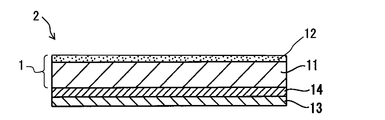
- the solar cell protective sheet 2 or 3 has a surface on the side where the easy-adhesive coat layer 12 of the base material 11 of the easy-adhesive base material 11 is not laminated (the lower surface in FIG. 4). ) May be provided with a fluororesin layer 13.
- the fluororesin layer 13 is provided in the protection sheet 2 for solar cells shown in FIG. 2 is shown as a specific example.
- the base material 11 consists of a resin film
- stacked has a corona treatment and a plasma treatment. It is preferable that surface treatment (easy adhesion treatment) such as primer treatment is performed.
- the fluororesin layer 13 is not particularly limited as long as it contains fluorine.
- the fluororesin layer 13 is constituted by a sheet having a fluorine-containing resin (fluorine-containing resin sheet), a coating film formed by applying a paint containing the fluorine-containing resin, or the like. Is done.
- a coating film formed by applying a paint having a fluorine-containing resin is preferable.
- the fluorine-containing resin sheet for example, a sheet obtained by processing a resin mainly composed of polyvinyl fluoride (PVF), ethylene chlorotrifluoroethylene (ECTFE), or ethylene tetrafluoroethylene (ETFE) is used.
- PVF polyvinyl fluoride
- ECTFE ethylene chlorotrifluoroethylene
- ETFE ethylene tetrafluoroethylene
- the fluororesin layer 13 is a fluorine-containing resin sheet
- the fluororesin layer 13 is laminated on the substrate 11 through an adhesive layer.
- the layer having adhesiveness is composed of an adhesive having adhesiveness to the substrate 11 and the fluorine-containing resin sheet.
- adhesives include acrylic adhesives, polyurethane adhesives, epoxy adhesives, polyester adhesives, and polyester polyurethane adhesives. These adhesives may be used individually by 1 type, and may be used in combination of 2 or more types.
- the fluororesin layer 13 is a coating film formed by applying a paint having a fluorine-containing resin
- the paint containing the fluorine-containing resin is directly applied to the substrate 11 without using an adhesive layer. By doing so, the fluororesin layer 13 is laminated on the substrate 11.
- the coating material containing a fluorine-containing resin is not particularly limited as long as it is dissolved in a solvent or dispersed in water and can be applied.
- the fluorine-containing resin contained in the paint is not particularly limited as long as it does not impair the effects of the present invention and contains fluorine. However, it is usually soluble in a paint solvent (organic solvent or water) and can be crosslinked. Things are used.
- a fluoroolefin resin having a crosslinkable functional group examples include a hydroxyl group, a carboxyl group, an amino group, and a glycidyl group.
- the fluoroolefin resin include chlorotrifluoroethylene, tetrafluoroethylene, hexafluoropropylene, and pentafluoropropylene.
- fluoroolefin resin having a crosslinkable functional group examples include “LUMIFLON” (product name) manufactured by Asahi Glass Co., Ltd., “CEFRAL COAT” (product name) manufactured by Central Glass Co., Ltd., and “FLUONATE” (product manufactured by DIC Corporation). Name) and other polymers based on chlorotrifluoroethylene (CTFE) as a main component, and polymers based on tetrafluoroethylene (TFE) such as “ZEFFLE” (trade name) manufactured by Daikin Industries, Ltd. .
- CTFE chlorotrifluoroethylene
- TFE tetrafluoroethylene
- the coating material may contain a crosslinking agent, a curing catalyst, a solvent and the like in addition to the fluorine-containing resin described above, and may further contain an inorganic compound such as a pigment and a filler, if necessary.
- the coating film of fluorine-containing resin is preferably cross-linked with a cross-linking agent in order to improve weather resistance and scratch resistance.
- the crosslinking agent is not particularly limited as long as the effects of the present invention are not impaired, and metal chelates, silanes, isocyanates, or melamines are preferably used. Assuming that the solar cell protective sheet 2 is used outdoors for a long period of time, aliphatic isocyanates are preferable as the crosslinking agent from the viewpoint of weather resistance.
- the fluororesin layer 13 to be obtained is desired by a bar coating method, a die coating method, a gravure coating method, or the like. What is necessary is just to apply
- the drying temperature of the paint applied to the easy-adhesive substrate 1 or the substrate 11 may be any temperature that does not impair the effects of the present invention. From the viewpoint of reducing the influence on the easy-adhesive substrate 1 or the substrate 11. Is preferably in the range of 50 to 130 ° C.
- the thickness of the fluororesin layer 13 is set in consideration of weather resistance, chemical resistance, weight reduction, and the like, and is preferably 5 ⁇ m or more and 50 ⁇ m or less, and particularly preferably 10 ⁇ m or more and 30 ⁇ m or less.
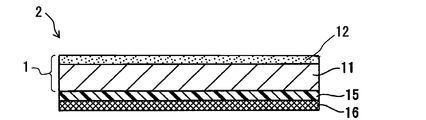
- the solar cell protective sheet 2 or 3 is provided on the surface of the base 11 of the easy-adhesive base 1 on which the easy-adhesion coat layer 12 is not laminated, as shown in FIG.
- a fluororesin layer 13 may be provided with a vapor deposition layer 14, or a metal sheet 16 may be laminated via an adhesive layer 15 as shown in FIG.
- the fluororesin layer 13 described above may be provided on the surface (the lower surface in FIGS. 5 and 6) of the sheet 16. 5 and 6 show an example in which the vapor deposition layer 14 and the like are provided on the solar cell protective sheet 2 shown in FIG.
- the “metal sheet” means a sheet-like member made of a metal-based material (that is, a material containing a metal element).
- stacked is a corona.
- Surface treatment such as treatment, plasma treatment, and primer treatment is preferably performed.
- the vapor deposition layer 14 is comprised from inorganic materials, such as a metal or a semimetal, or an oxide, nitride, silicide, etc. of a metal or a semimetal, By comprising such a material, the easily-adhesive base material 1 (solar cell)
- the protective sheet 2) can be given moisture resistance (water vapor barrier property) and weather resistance.
- Examples of the vapor deposition method for forming the vapor deposition layer 14 include chemical vapor deposition such as plasma chemical vapor deposition, thermal chemical vapor deposition, and photochemical vapor deposition, or vacuum vapor deposition, sputtering, and ion plating.
- a physical vapor phase method such as a method is used.
- the sputtering method is preferable in consideration of operability and controllability of the layer thickness.
- Examples of the metal used as the raw material of the vapor deposition layer 14 include aluminum (Al), magnesium (Mg), calcium (Ca), potassium (K), tin (Sn), sodium rim (Na), titanium (Ti), and lead. (Pb), zirconium (Zr), yttrium (Y) and the like.
- Examples of the semimetal include silicon (Si) and boron (B).
- Examples of these metal or metalloid oxides, nitrides, and oxynitrides include aluminum oxide, tin oxide, silicon oxide, silicon nitride, silicon oxynitride, and aluminum oxynitride.
- the vapor deposition layer 14 may be made of one kind of inorganic material or may be made of a plurality of kinds of inorganic materials.
- the vapor deposition layer 14 may be a vapor deposition layer having a laminated structure in which the layers made of the respective inorganic materials are sequentially vapor deposited, or may be a vapor deposition layer in which a plurality of types of inorganic materials are vapor deposited simultaneously. May be.
- the thickness of the vapor deposition layer 14 is appropriately set in consideration of the water vapor barrier property, and is changed depending on the type of inorganic material used, vapor deposition density, and the like. Usually, the thickness of the vapor deposition layer 14 is preferably 5 nm or more and 200 nm or less, and particularly preferably 10 nm or more and 100 nm or less.
- the metal sheet 16 can also impart moisture resistance (water vapor barrier property) and weather resistance to the solar cell protective sheet 2 in the same manner as the vapor deposition layer 14.
- the material of the metal sheet 16 is not particularly limited as long as it has such a function, and examples thereof include metals such as aluminum and aluminum alloys such as aluminum-iron alloys.
- the thickness of the metal sheet 16 is not particularly limited as long as the effects of the present invention are not impaired, but from the viewpoint of low pinhole occurrence frequency, high mechanical strength, high water vapor barrier properties, and weight reduction, etc. It is preferably 5 ⁇ m or more and 100 ⁇ m or less, and particularly preferably 10 ⁇ m or more and 50 ⁇ m or less.
- the adhesive layer 15 is composed of an adhesive having adhesiveness to the base material 11 and the metal sheet 16.
- an acrylic adhesive, a polyurethane adhesive, an epoxy adhesive, a polyester adhesive, a polyester polyurethane adhesive, or the like is used as the adhesive constituting the adhesive layer 15. These adhesives may be used individually by 1 type, and may be used in combination of 2 or more type.
- the thickness of the adhesive layer 15 is not particularly limited as long as the effects of the present invention are not impaired, but it is usually preferably 1 ⁇ m or more and 20 ⁇ m or less, and particularly preferably 3 ⁇ m or more and 10 ⁇ m or less.
- the solar cell protective sheet 2 in which the easy-adhesion coat layer 12 was laminated on one surface of the base material 11 in the easy-adhesive base material 1 was illustrated, the solar cell protection according to the present invention.
- the sheet is not limited to this, and an easy-adhesion coat layer may be laminated on the other surface of the substrate 11 (the surface opposite to the one surface).
- the manufacturing method of the protection sheet for solar cells The method to manufacture the protection sheet for solar cells which concerns on this embodiment is not specifically limited. If the easily adhesive base material 1 is manufactured, the solar cell protective sheet 2 shown in FIG. 2 becomes a solar cell protective sheet as it is. For the solar cell protective sheet 3 shown in FIG. 3, the easy-adhesive substrate 1 and the sealing material adhesive layer 31 constituting the protective sheet 3 are appropriately laminated using methods such as thermocompression bonding, coating / drying, and extrusion coating. That's fine.
- a method for forming the solar cell protective sheet 3 by extrusion coating will be described.
- thermoplastic material for forming the sealing material adhesive layer 31 is heated to the softening point or higher, and the heated thermoplastic material is supplied to the surface of the easy-adhesive substrate 1 on the easy-adhesive coating layer 12 side.
- protective material for solar cells shown in FIG. 3 which has the structure where the sealing material adhesion layer 31 was laminated
- the temperature at which the thermoplastic material (which may be plural as described later) for forming the sealing material adhesion layer 31 is melted is the temperature of this material in the molten state.
- the base 11 is not deformed by (heat) and is preferably 80 ° C. or higher and 350 ° C. or lower, and particularly preferably 150 ° C. or higher and 300 ° C. or lower. Further, when the thermoplastic material is easily deteriorated, it is preferable to lower the upper limit of the temperature so as to minimize the influence of the deterioration.
- the discharge amount from the T-die extruder (T-die film forming machine) of the material for forming the sealing material adhesive layer 31 is the thickness of the target sealing material adhesive layer 31 and the easily adhesive substrate 1. It adjusts suitably according to the moving speed of.
- the easy-adhesive substrate 1 is conveyed in the longitudinal direction at a constant speed by, for example, a roll-to-roll method, and the conveyance speed is from a T-die extruder of a material for forming the sealing material adhesive layer 31. It adjusts suitably according to the discharge amount.
- the roll to be fed becomes the base material 11.
- the adhesive base material can be obtained by simply extruding and laminating the above thermoplastic material from the T-die extruder on the surface of the easy adhesive base layer 1 on the easy adhesive base layer 12 side. 1 can be firmly joined to the sealing material adhesive layer 31, and the solar cell protective sheet 3 can be manufactured with high productivity.
- the thermoplastic material corresponding to each layer is heated to the softening point or higher, and the easy-adhesive substrate 1 on the easy-adhesive substrate 1 is applied. They may be supplied simultaneously or sequentially and the plurality of thermoplastic materials may be cooled simultaneously or individually.
- An example of the method for supplying sequentially is as follows. First, one of a plurality of layers constituting the sealing material adhesive layer 31 is formed on the surface of the easy-adhesive substrate 1 on the side of the easy-adhesion coat layer 12 by the extrusion coating, and the easy-adhesion coat layer 12 in the layer is formed. Another one of the plurality of layers constituting the sealing material adhesive layer 31 is laminated on the surface opposite to the surface by supplying the thermoplastic material while extruding it. By appropriately repeating this laminating operation, the sealing material adhesive layer 31 having a multilayer structure can be obtained.
- An example of a method for supplying simultaneously is coextrusion coating. Specifically, a plurality of thermoplastic materials are extruded together through parallel slits (at this time, a material discharge port for forming a layer in direct contact with the easy-adhesion coat layer 12 is proximal to the substrate 11. Thus, a layer made of each material is simultaneously formed on the easy-adhesion coat layer 12 of the easy-adhesive substrate 1.
- This coextrusion coating has an advantage in the manufacturing process that the protective sheet 3 for solar cells can be obtained by a single lamination process. Further, immediately after the co-extrusion, a plurality of thermoplastic materials are in contact with each other in a molten state, and thus an interaction between them easily occurs, and an adhesive force between the layers constituting the sealing material adhesive layer 31. There is also an advantage that increases.
- the productivity is particularly enhanced.
- the coating liquid for forming the easy-adhesion coat layer 12 is applied, the coating liquid layer made of this coating liquid is dried to form an easy-adhesion coat layer 12, and an encapsulant adhesive layer is formed on the easy-adhesion coat layer 12
- a material for forming 31 may be supplied.
- the cross-linking reaction of the cross-linking agent contained in the easy-adhesion coat layer 12 is advanced by contacting this material during extrusion coating. be able to.
- a crosslinking reaction between the crosslinking agent contained in the easy-adhesion coat layer 12 and the molten thermoplastic material may occur.
- the adhesive force between the sealing material adhesive layer 31 and the easy-adhesion coat layer 12 may be increased. Is more likely to increase.
- the crosslinking reaction of the crosslinking agent in the easy-adhesion coat layer 12 after the crosslinking reaction of the crosslinking agent in the easy-adhesion coat layer 12 is sufficiently advanced in the drying step of the coating liquid layer, it may be brought into contact with the thermoplastic material supplied from the discharge port. In this case, since the controllability of the thickness of the easy-adhesion coat layer 12 is likely to increase, it is expected that variations in the adhesive force between the sealing material adhesive layer 31 and the easy-adhesion coat layer 12 are reduced.
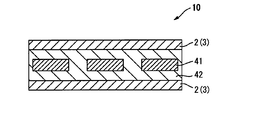
- FIG. 7 is a schematic cross-sectional view of a solar cell module according to an embodiment of the present invention.
- the solar cell module 10 according to this embodiment includes a plurality of solar cells 41 made of crystalline silicon, amorphous silicon, or the like, which are photoelectric conversion elements, and a sealing material 42 made of an electrical insulator that seals the solar cells 41.
- the solar cell protective sheet is the solar cell protective sheet 2 or 3 according to the above-described present embodiment.
- the solar cell protective sheet 2 or 3 is disposed such that the easy-adhesion coat layer 12 directly contacts the sealing material 42 directly or via the sealing material adhesive layer 31. Since the easy-adhesion coat layer 12 is provided, even if the solar cell module 10 repeats thermal expansion / contraction during use, the possibility that the base material 11 is peeled from the sealing material 42 is sufficiently reduced.
- the material of the sealing material 42 is not particularly limited. From the viewpoint of productivity, ethylene-vinyl acetate copolymer (EVA) is often used as the main material, but in recent years, it has the property of being easily altered by ultraviolet rays and responds to the demand for higher productivity. In some cases, a material other than EVA is used as a main material. Examples of such materials other than EVA include polyvinyl butyral (PVB), urethane resin, ionomer resin, styrene resin, and silicone material. Even when the main material of the sealing material 42 is made of such a material, the easy-adhesion coat layer 12 of the easy-adhesive substrate 11 according to this embodiment can be firmly bonded to the sealing material 42. .
- PVB polyvinyl butyral
- the coating liquid for forming the easy-adhesion coat layer 12 may contain the component (A). preferable.
- the easy-adhesion coat layer 12 of the easy-adhesive substrate 11 according to the present embodiment can be more firmly bonded to the sealing material 42.
- the method for manufacturing the solar cell module 10 is not particularly limited.
- the solar battery cell 41 is sandwiched between two sheets constituting the sealing material 42, the solar battery protective sheet 2 or 3 is disposed on one surface of the stack, and the glass plate 43 is disposed on the other surface.
- the solar cell module 10 can be manufactured by performing the lamination process which presses and integrates the whole stack obtained in this way, heating.
- the solar cell protective sheet 2 or 3 is adhered to the encapsulant 42 by thermal fusion and chemical interaction between the easy adhesion coat layer 12 or encapsulant adhesive layer 31 and the encapsulant 42.
- vacuum lamination may be performed in which the atmosphere is heated in a reduced pressure environment instead of or in addition to the heat lamination only by heating.
- the possibility that bubbles remain at the interface between the members to be crimped can be reduced.
- the generated shearing force is relaxed / absorbed by the sealing material 42 or the like, and then the heating temperature is raised to sufficiently advance the thermal crosslinking of the sealing material 42. If it does in this way, possibility that the peeling between members and the destruction inside a member will generate
- Example 1 Vacuum lamination (135 ° C, 3 minutes), Temporarily fixed thermal lamination (135 ° C, 3 minutes), Mainly fixed thermal lamination (150 ° C, 30 minutes)
- Example 2 Thermal lamination (150 ° C, 20 minutes)
- Example 3 Vacuum lamination (150 ° C., 5 minutes), thermal lamination (150 ° C., 20 minutes)
- the flexible solar cell module 10 can be obtained.
- the flexible solar cell module 10 can be fitted to an object having an arched or parabolic wall surface, it can be installed on a dome-shaped building or a soundproof wall of a highway. Become.
- Example 1 (1) Preparation of coating solution Solid content concentration with respect to 100 parts by weight of polyvinyl butyral (Sekisui Chemical Co., Ltd., ESREC BL-10) having a softening point of 100 ° C. and a butyralization degree of 71 ⁇ 3 mol% was mixed with xylylene diisocyanate-based crosslinking agent (Mitsui Chemicals, Takenate D-110N, isocyanate group content 11.5% by mass).
- the ratio (CL / AH ratio) of the amount of isocyanate group of the crosslinking agent in the coating solution to the amount of active hydrogen contained in the hydroxyl group of PVB was 1.0.
- a solar cell protective sheet comprising an easy-adhesive base material provided with an easy-adhesion coat layer having a thickness of 0.2 ⁇ m on the base material was obtained.
- the thickness of the easy-adhesion coat layer was measured by Test Example 1 described later.
- Sealing material 1 Ethylene-vinyl acetate copolymer (EVA) based sealing material (manufactured by SANVIC, ULTRA PEARL, thickness 400 ⁇ m), lamination step: the above-mentioned lamination step example 1
- Sealing material 2 Polyvinyl butyral sealing material (manufactured by Kuraray Co., Ltd., TROSIFOL SOLAR, thickness 700 ⁇ m)
- lamination process the above-mentioned lamination process example 3
- Sealing material 3 Silicone-based sealing material (manufactured by Wacker Chemie AG, silicone elastomer, TECTOSIL, thickness 460 ⁇ m)
- lamination process the above-mentioned lamination process example 3
- Sealing material 4 Urethane
- Example 2 The same operation as in Example 1 was performed except that the thickness of the easy-adhesion coat layer was adjusted to 0.05 ⁇ m by adjusting the coating amount of the coating liquid in Example 1, and four types of sealing materials were different. A solar cell pseudo module was obtained.
- Example 3 The same operation as in Example 1 was performed except that the coating amount of the coating liquid in Example 1 was adjusted so that the thickness of the easy-adhesion coat layer was 1.5 ⁇ m. A solar cell pseudo module was obtained.
- Example 4 The same operation as in Example 1 was performed except that the molecular weight distribution of PVB contained in the coating liquid in Example 1 was changed to set the softening point of PVB to 150 ° C. A solar cell pseudo module was obtained.
- Example 5 The same operation as in Example 1 was performed except that the content of the crosslinking agent contained in the coating liquid in Example 1 was reduced to obtain a coating liquid having a CL / AH ratio of 0.2, and sealing was performed. Four types of solar cell pseudo modules with different materials were obtained.
- Example 6 The same operation as in Example 1 was performed except that the content of the crosslinking agent contained in the coating liquid in Example 1 was reduced to obtain a coating liquid having a CL / AH ratio of 0.5, and sealing was performed. Four types of solar cell pseudo modules with different materials were obtained.
- Example 7 Using a T-die extruder (cylinder temperature: 230 to 280 ° C., T-die temperature: 300 ° C.), 70 parts by mass of a first thermoplastic resin made of polyethylene having a density of 900 kg / m 3 and polyethylene having a density of 940 kg / m 3
- a first thermoplastic resin made of polyethylene having a density of 900 kg / m 3 and polyethylene having a density of 940 kg / m 3
- an encapsulant adhesive layer was formed by extrusion coating to a thickness of 100 ⁇ m to obtain a solar cell protective sheet having the configuration shown in FIG. Operation similar to Example 1 was performed with respect to the obtained protection sheet for solar cells, and the solar cell pseudo module using the sealing material 1 was
- Example 8 In Example 1, except that the corona treatment was not performed on the base material, the same operation as in Example 1 was performed to obtain two types (EVA, PVB) of solar cell pseudo modules with different types of sealing materials. It was.
- Example 9 In the coating liquid used in Example 8, NK ester A-TMM-3LM-N (available from Shin-Nakamura Chemical Co., Ltd., active ingredient) in an amount of 5 parts by mass as a component containing component (A) with respect to 100 parts by mass of PVB. : Pentaerythritol triacrylate monomer, triester: 57%) The same operation as in Example 8 was performed except that a coating liquid was obtained, and two types of sealing materials (EVA, PVB) ) was obtained.
- NK ester A-TMM-3LM-N available from Shin-Nakamura Chemical Co., Ltd., active ingredient
- Example 10 The same procedure as in Example 9 was performed, except that the amount of NK ester A-TMM-3LM-N added in Example 9 was 10 parts by mass with respect to 100 parts by mass of PVB. Two types (EVA, PVB) of solar cell pseudo-modules with different types were obtained.
- Example 11 The same procedure as in Example 9 was performed, except that the amount of NK ester A-TMM-3LM-N added in Example 9 was 50 parts by mass with respect to 100 parts by mass of PVB, and a sealing material was obtained. Two types (EVA, PVB) of solar cell pseudo-modules with different types were obtained.
- Example 12 The same procedure as in Example 9 was performed except that the amount of NK ester A-TMM-3LM-N added in Example 9 was 100 parts by mass with respect to 100 parts by mass of PVB, and a sealing material was obtained. Two types (EVA, PVB) of solar cell pseudo-modules with different types were obtained.
- Example 13 In the coating solution used in Example 8, 5 parts by mass of NK ester A-TMMT (made by Shin-Nakamura Chemical Co., Ltd., active ingredient: pentaerythritol tetra) as a component containing component (A) with respect to 100 parts by mass of PVB. Except that the coating liquid was obtained by adding (acrylate monomer), the same operation as in Example 8 was performed to obtain two types (EVA, PVB) of solar cell pseudo modules having different types of sealing materials.
- NK ester A-TMMT made by Shin-Nakamura Chemical Co., Ltd., active ingredient: pentaerythritol tetra
- Example 1 instead of the surface of the easy-adhesive substrate in Example 7 on the side of the easy-adhesion coat layer side, it is one surface of a substrate made of a polyethylene terephthalate (PET) film (Lumirror X10S manufactured by Toray Industries Inc., thickness 125 ⁇ m) and corona Except that the surface subjected to the treatment (output 2000 W) was subjected to extrusion coating, the same operation as in Example 7 was performed to obtain a solar cell pseudo module having EVA as the type of the sealing material.
- PET polyethylene terephthalate
- Sealing material 1 Ethylene-vinyl acetate copolymer (EVA) based sealing material (manufactured by SANVIC, ULTRA PEARL, thickness 400 ⁇ m), lamination step: the above-mentioned lamination step example 1
- Sealing material 2 Polyvinyl butyral sealing material (manufactured by Kuraray Co., Ltd., TROSIFOL SOLAR, thickness 700 ⁇ m), lamination process: the above-mentioned lamination process example 3
- Example 1 The same operation as in Example 1 was performed except that the molecular weight distribution of PVB contained in the coating liquid in Example 1 was changed to set the softening point of PVB to 190 ° C. A solar cell pseudo module was obtained.
- Example 2 The same operation as in Example 1 was performed except that the molecular weight distribution of PVB contained in the coating liquid in Example 1 was changed to set the softening point of PVB to 220 ° C. A solar cell pseudo module was obtained.
- Example 3 The same operation as in Example 1 was carried out except that the content of the crosslinking agent contained in the coating solution in Example 1 was increased to obtain a coating solution having a CL / AH ratio of 1.7. Four types of solar cell pseudo modules with different materials were obtained.
- Example 4 The same operation as in Example 1 was performed except that the content of the crosslinking agent contained in the coating liquid in Example 1 was increased to obtain a coating liquid having a CL / AH ratio of 2.0, and sealing was performed. Four types of solar cell pseudo modules with different materials were obtained.
- each of an end portion made of only an easily-adhesive base material (the base material in Reference Examples 1 and 2) and an end portion made only of a sealing material was subjected to a tensile tester (manufactured by Shimadzu Corporation, Autograph AG- 50 kNX).
- the value was defined as the peel adhesion strength between the easy-adhesive substrate (the substrate for Reference Examples 1 and 2) and the sealing material.
- Table 1 Examples 1 to 7, Comparative Examples 1 to 4, Reference Example 1
- Table 2 Examples 8 to 13, Reference Example 2.
- a cellophane pressure-sensitive adhesive tape manufactured by Nichiban Co., Ltd.
- a cellophane pressure-sensitive adhesive tape was cut into a length of 75 mm, and this was pasted on the portion of the easy-adhesive base material in which cuts were formed in the above-mentioned 100 square grid pattern.
- the cellophane pressure-sensitive adhesive tape was uniformly crimped onto the easily adhesive substrate using a squeegee. Before 1 minute had passed since the cellophane adhesive tape was applied, the cellophane adhesive tape was peeled off from the easy-adhesive substrate at an isolation angle of 120 °.
- the easy-adhesive base material of the example satisfying the conditions of the present invention has high adhesion strength to the sealing material, excellent adhesion between the base material and the easy-adhesive coat layer, and further blocking. Is less likely to occur.
- the solar cell protective sheet provided with the easily adhesive substrate according to the present invention is suitably used, for example, as a back sheet or a front sheet of a solar cell module.
- SYMBOLS 1 Easy-adhesive base material 11 ... Base material 12 ; Easy-adhesion coat layer 12a ... Adhesive surface 2 with a sealing material ... Protective sheet for solar cells 13 ... Fluorine resin layer 14 ... Deposition layer 15 . Adhesive layer 16 ... Metal sheet DESCRIPTION OF SYMBOLS 3 ... Solar cell protective sheet 31 ... Sealing material adhesion layer 31a ... Adhesive surface 10 with a sealing material ... Solar cell module 41 ... Solar cell 42 ... Sealing material 43 ... Glass plate
Landscapes
- Chemical & Material Sciences (AREA)
- Organic Chemistry (AREA)
- Laminated Bodies (AREA)
- Photovoltaic Devices (AREA)
- Application Of Or Painting With Fluid Materials (AREA)
- Coating Of Shaped Articles Made Of Macromolecular Substances (AREA)
- Adhesive Tapes (AREA)
- Adhesives Or Adhesive Processes (AREA)
Priority Applications (1)
| Application Number | Priority Date | Filing Date | Title |
|---|---|---|---|
| JP2014518686A JP5820068B2 (ja) | 2012-05-29 | 2013-05-28 | 易接着性基材およびその製造方法、当該易接着性基材を備える太陽電池用保護シートおよびその製造方法、ならびに太陽電池モジュール |
Applications Claiming Priority (2)
| Application Number | Priority Date | Filing Date | Title |
|---|---|---|---|
| JP2012-122225 | 2012-05-29 | ||
| JP2012122225 | 2012-05-29 |
Publications (1)
| Publication Number | Publication Date |
|---|---|
| WO2013180139A1 true WO2013180139A1 (fr) | 2013-12-05 |
Family
ID=49673331
Family Applications (1)
| Application Number | Title | Priority Date | Filing Date |
|---|---|---|---|
| PCT/JP2013/064802 Ceased WO2013180139A1 (fr) | 2012-05-29 | 2013-05-28 | Substrat facilement adhésif et son procédé de fabrication, feuille de protection de cellule solaire dotée du substrat facilement adhésif, son procédé de fabrication et module de cellule solaire |
Country Status (2)
| Country | Link |
|---|---|
| JP (1) | JP5820068B2 (fr) |
| WO (1) | WO2013180139A1 (fr) |
Cited By (4)
| Publication number | Priority date | Publication date | Assignee | Title |
|---|---|---|---|---|
| JP2015196269A (ja) * | 2014-03-31 | 2015-11-09 | 大日本印刷株式会社 | 樹脂シートおよびそれを用いた保護層形成体の製造方法 |
| JP2016182791A (ja) * | 2015-03-26 | 2016-10-20 | リンテック株式会社 | 支持シート |
| JP2023053617A (ja) * | 2021-10-01 | 2023-04-13 | リンテック株式会社 | セラミックグリーンシート製造工程用剥離フィルム |
| WO2026014288A1 (fr) * | 2024-07-12 | 2026-01-15 | Agc株式会社 | Verre feuilleté et son procédé de fabrication |
Citations (6)
| Publication number | Priority date | Publication date | Assignee | Title |
|---|---|---|---|---|
| JP2004269024A (ja) * | 2003-03-11 | 2004-09-30 | Kamoi Kakoshi Kk | 保護シート |
| WO2010143684A1 (fr) * | 2009-06-11 | 2010-12-16 | 富士フイルム株式会社 | Réflecteur de lumière infrarouge, verre stratifié réfléchissant la lumière infrarouge et verre stratifié et stratifié comportant des couches stratifiées de cristaux liquides cholestériques |
| JP2010286643A (ja) * | 2009-06-11 | 2010-12-24 | Fujifilm Corp | 赤外光反射板、及び赤外光反射性合わせガラス |
| JP2011062977A (ja) * | 2009-09-18 | 2011-03-31 | Toppan Printing Co Ltd | ガスバリア性積層フィルム |
| JP2011136550A (ja) * | 2009-12-02 | 2011-07-14 | Toyobo Co Ltd | 太陽電池用易接着性ポリエステルフィルムおよびそれを用いたバックシート |
| JP2011154215A (ja) * | 2010-01-27 | 2011-08-11 | Fujifilm Corp | 赤外光反射板、合わせガラス用積層中間膜シート及びその製造方法、並びに合わせガラス |
-
2013
- 2013-05-28 WO PCT/JP2013/064802 patent/WO2013180139A1/fr not_active Ceased
- 2013-05-28 JP JP2014518686A patent/JP5820068B2/ja not_active Expired - Fee Related
Patent Citations (6)
| Publication number | Priority date | Publication date | Assignee | Title |
|---|---|---|---|---|
| JP2004269024A (ja) * | 2003-03-11 | 2004-09-30 | Kamoi Kakoshi Kk | 保護シート |
| WO2010143684A1 (fr) * | 2009-06-11 | 2010-12-16 | 富士フイルム株式会社 | Réflecteur de lumière infrarouge, verre stratifié réfléchissant la lumière infrarouge et verre stratifié et stratifié comportant des couches stratifiées de cristaux liquides cholestériques |
| JP2010286643A (ja) * | 2009-06-11 | 2010-12-24 | Fujifilm Corp | 赤外光反射板、及び赤外光反射性合わせガラス |
| JP2011062977A (ja) * | 2009-09-18 | 2011-03-31 | Toppan Printing Co Ltd | ガスバリア性積層フィルム |
| JP2011136550A (ja) * | 2009-12-02 | 2011-07-14 | Toyobo Co Ltd | 太陽電池用易接着性ポリエステルフィルムおよびそれを用いたバックシート |
| JP2011154215A (ja) * | 2010-01-27 | 2011-08-11 | Fujifilm Corp | 赤外光反射板、合わせガラス用積層中間膜シート及びその製造方法、並びに合わせガラス |
Cited By (4)
| Publication number | Priority date | Publication date | Assignee | Title |
|---|---|---|---|---|
| JP2015196269A (ja) * | 2014-03-31 | 2015-11-09 | 大日本印刷株式会社 | 樹脂シートおよびそれを用いた保護層形成体の製造方法 |
| JP2016182791A (ja) * | 2015-03-26 | 2016-10-20 | リンテック株式会社 | 支持シート |
| JP2023053617A (ja) * | 2021-10-01 | 2023-04-13 | リンテック株式会社 | セラミックグリーンシート製造工程用剥離フィルム |
| WO2026014288A1 (fr) * | 2024-07-12 | 2026-01-15 | Agc株式会社 | Verre feuilleté et son procédé de fabrication |
Also Published As
| Publication number | Publication date |
|---|---|
| JPWO2013180139A1 (ja) | 2016-01-21 |
| JP5820068B2 (ja) | 2015-11-24 |
Similar Documents
| Publication | Publication Date | Title |
|---|---|---|
| KR101271497B1 (ko) | 태양전지 모듈용 보호시트 및 그의 제조 방법, 및 태양전지 모듈 | |
| JP5769723B2 (ja) | 太陽電池用保護シートおよびその製造方法、ならびに太陽電池モジュール | |
| JP5714959B2 (ja) | 太陽電池用保護シートおよびその製造方法、ならびに太陽電池モジュール | |
| JP5710451B2 (ja) | 太陽電池用バックシート及びその製造方法、並びに、太陽電池モジュール | |
| EP2413377A1 (fr) | Feuille protectrice pour module de cellule solaire et module de cellule solaire la comprenant | |
| JP5623325B2 (ja) | 太陽電池用保護シートおよびその製造方法、ならびに太陽電池モジュール | |
| WO2011118727A1 (fr) | Feuille de protection pour module de cellule solaire, et module de cellule solaire | |
| KR20140113659A (ko) | 보호 시트 | |
| JP5820068B2 (ja) | 易接着性基材およびその製造方法、当該易接着性基材を備える太陽電池用保護シートおよびその製造方法、ならびに太陽電池モジュール | |
| CN103210503A (zh) | 太阳能电池用背板及太阳能电池组件 | |
| JP2010232513A (ja) | 太陽電池モジュール用裏面保護シート及び太陽電池モジュール | |
| JP2009158778A (ja) | 太陽電池モジュールバックシート用積層体 | |
| CN103079823A (zh) | 透明保护片及使用了该透明保护片的太阳能电池组件 | |
| EP2800149A1 (fr) | Matériau protecteur pour cellules solaires | |
| WO2013121838A1 (fr) | Feuille protectrice pour cellule solaire, son procédé de fabrication et module de cellule solaire | |
| JP5696172B2 (ja) | 太陽電池用保護シートおよびその製造方法、ならびに太陽電池モジュール | |
| CN103855235B (zh) | 图案化透明光伏背片 | |
| KR20110099361A (ko) | 태양전지모듈용 이면 보호시트의 제조방법 | |
| JP2014127672A (ja) | 太陽電池用保護シートおよびその製造方法、ならびに太陽電池モジュール | |
| JP2012089632A (ja) | 太陽電池用保護シートおよびその製造方法、ならびに太陽電池モジュール | |
| JP5449312B2 (ja) | 太陽電池用保護材 | |
| TWI546976B (zh) | A protective sheet for a solar cell and a method for manufacturing the same, and a solar cell module | |
| JP2014117831A (ja) | 積層体の製造方法 | |
| JP2013207205A (ja) | 太陽電池表面保護シートおよびそれを用いた太陽電池モジュール | |
| JP2018166144A (ja) | 太陽電池モジュール用裏面保護シートの製造方法 |
Legal Events
| Date | Code | Title | Description |
|---|---|---|---|
| 121 | Ep: the epo has been informed by wipo that ep was designated in this application |
Ref document number: 13797300 Country of ref document: EP Kind code of ref document: A1 |
|
| ENP | Entry into the national phase |
Ref document number: 2014518686 Country of ref document: JP Kind code of ref document: A |
|
| NENP | Non-entry into the national phase |
Ref country code: DE |
|
| 122 | Ep: pct application non-entry in european phase |
Ref document number: 13797300 Country of ref document: EP Kind code of ref document: A1 |