WO2013182389A2 - Hauptgruppenmetallkomplexe als p-dotanden für organische elektronische matrixmaterialien - Google Patents

Hauptgruppenmetallkomplexe als p-dotanden für organische elektronische matrixmaterialien Download PDF

Info

Publication number
WO2013182389A2
WO2013182389A2 PCT/EP2013/059911 EP2013059911W WO2013182389A2 WO 2013182389 A2 WO2013182389 A2 WO 2013182389A2 EP 2013059911 W EP2013059911 W EP 2013059911W WO 2013182389 A2 WO2013182389 A2 WO 2013182389A2
Authority
WO
WIPO (PCT)
Prior art keywords
group
groups
alkyl
aryl
acid
Prior art date
Legal status (The legal status is an assumption and is not a legal conclusion. Google has not performed a legal analysis and makes no representation as to the accuracy of the status listed.)
Ceased
Application number
PCT/EP2013/059911
Other languages
English (en)
French (fr)
Other versions
WO2013182389A3 (de
Inventor
Anna Maltenberger
Marina A. Petrukhina
Günter Schmid
Jan Hauke Wemken
Current Assignee (The listed assignees may be inaccurate. Google has not performed a legal analysis and makes no representation or warranty as to the accuracy of the list.)
Siemens AG
Ams Osram International GmbH
Siemens Corp
Original Assignee
Osram Opto Semiconductors GmbH
Siemens AG
Siemens Corp
Priority date (The priority date is an assumption and is not a legal conclusion. Google has not performed a legal analysis and makes no representation as to the accuracy of the date listed.)
Filing date
Publication date
Priority to EP13723470.4A priority Critical patent/EP2845239B1/de
Application filed by Osram Opto Semiconductors GmbH, Siemens AG, Siemens Corp filed Critical Osram Opto Semiconductors GmbH
Priority to HK15111791.1A priority patent/HK1211136B/xx
Priority to KR1020147033972A priority patent/KR101736560B1/ko
Priority to JP2015515450A priority patent/JP6091606B2/ja
Priority to CN201380037752.9A priority patent/CN104685647B/zh
Priority to KR1020167032995A priority patent/KR101793136B1/ko
Priority to EP17173800.8A priority patent/EP3246960B1/de
Priority to US14/406,041 priority patent/US10411197B2/en
Publication of WO2013182389A2 publication Critical patent/WO2013182389A2/de
Publication of WO2013182389A3 publication Critical patent/WO2013182389A3/de
Anticipated expiration legal-status Critical
Priority to US15/383,579 priority patent/US10305047B2/en
Ceased legal-status Critical Current

Links

Classifications

    • CCHEMISTRY; METALLURGY
    • C07ORGANIC CHEMISTRY
    • C07FACYCLIC, CARBOCYCLIC OR HETEROCYCLIC COMPOUNDS CONTAINING ELEMENTS OTHER THAN CARBON, HYDROGEN, HALOGEN, OXYGEN, NITROGEN, SULFUR, SELENIUM OR TELLURIUM
    • C07F9/00Compounds containing elements of Groups 5 or 15 of the Periodic Table
    • C07F9/94Bismuth compounds
    • CCHEMISTRY; METALLURGY
    • C09DYES; PAINTS; POLISHES; NATURAL RESINS; ADHESIVES; COMPOSITIONS NOT OTHERWISE PROVIDED FOR; APPLICATIONS OF MATERIALS NOT OTHERWISE PROVIDED FOR
    • C09KMATERIALS FOR MISCELLANEOUS APPLICATIONS, NOT PROVIDED FOR ELSEWHERE
    • C09K11/00Luminescent materials, e.g. electroluminescent or chemiluminescent
    • C09K11/06Luminescent materials, e.g. electroluminescent or chemiluminescent containing organic luminescent materials
    • HELECTRICITY
    • H10SEMICONDUCTOR DEVICES; ELECTRIC SOLID-STATE DEVICES NOT OTHERWISE PROVIDED FOR
    • H10KORGANIC ELECTRIC SOLID-STATE DEVICES
    • H10K50/00Organic light-emitting devices
    • HELECTRICITY
    • H10SEMICONDUCTOR DEVICES; ELECTRIC SOLID-STATE DEVICES NOT OTHERWISE PROVIDED FOR
    • H10KORGANIC ELECTRIC SOLID-STATE DEVICES
    • H10K71/00Manufacture or treatment specially adapted for the organic devices covered by this subclass
    • H10K71/30Doping active layers, e.g. electron transporting layers
    • HELECTRICITY
    • H10SEMICONDUCTOR DEVICES; ELECTRIC SOLID-STATE DEVICES NOT OTHERWISE PROVIDED FOR
    • H10KORGANIC ELECTRIC SOLID-STATE DEVICES
    • H10K85/00Organic materials used in the body or electrodes of devices covered by this subclass
    • H10K85/30Coordination compounds
    • HELECTRICITY
    • H10SEMICONDUCTOR DEVICES; ELECTRIC SOLID-STATE DEVICES NOT OTHERWISE PROVIDED FOR
    • H10KORGANIC ELECTRIC SOLID-STATE DEVICES
    • H10K85/00Organic materials used in the body or electrodes of devices covered by this subclass
    • H10K85/30Coordination compounds
    • H10K85/321Metal complexes comprising a group IIIA element, e.g. Tris (8-hydroxyquinoline) gallium [Gaq3]
    • HELECTRICITY
    • H10SEMICONDUCTOR DEVICES; ELECTRIC SOLID-STATE DEVICES NOT OTHERWISE PROVIDED FOR
    • H10KORGANIC ELECTRIC SOLID-STATE DEVICES
    • H10K85/00Organic materials used in the body or electrodes of devices covered by this subclass
    • H10K85/30Coordination compounds
    • H10K85/361Polynuclear complexes, i.e. complexes comprising two or more metal centers
    • CCHEMISTRY; METALLURGY
    • C09DYES; PAINTS; POLISHES; NATURAL RESINS; ADHESIVES; COMPOSITIONS NOT OTHERWISE PROVIDED FOR; APPLICATIONS OF MATERIALS NOT OTHERWISE PROVIDED FOR
    • C09KMATERIALS FOR MISCELLANEOUS APPLICATIONS, NOT PROVIDED FOR ELSEWHERE
    • C09K2211/00Chemical nature of organic luminescent or tenebrescent compounds
    • C09K2211/18Metal complexes
    • C09K2211/188Metal complexes of other metals not provided for in one of the previous groups
    • HELECTRICITY
    • H10SEMICONDUCTOR DEVICES; ELECTRIC SOLID-STATE DEVICES NOT OTHERWISE PROVIDED FOR
    • H10KORGANIC ELECTRIC SOLID-STATE DEVICES
    • H10K2102/00Constructional details relating to the organic devices covered by this subclass
    • HELECTRICITY
    • H10SEMICONDUCTOR DEVICES; ELECTRIC SOLID-STATE DEVICES NOT OTHERWISE PROVIDED FOR
    • H10KORGANIC ELECTRIC SOLID-STATE DEVICES
    • H10K2102/00Constructional details relating to the organic devices covered by this subclass
    • H10K2102/301Details of OLEDs
    • HELECTRICITY
    • H10SEMICONDUCTOR DEVICES; ELECTRIC SOLID-STATE DEVICES NOT OTHERWISE PROVIDED FOR
    • H10KORGANIC ELECTRIC SOLID-STATE DEVICES
    • H10K50/00Organic light-emitting devices
    • H10K50/10OLEDs or polymer light-emitting diodes [PLED]
    • H10K50/14Carrier transporting layers
    • H10K50/15Hole transporting layers
    • H10K50/155Hole transporting layers comprising dopants
    • YGENERAL TAGGING OF NEW TECHNOLOGICAL DEVELOPMENTS; GENERAL TAGGING OF CROSS-SECTIONAL TECHNOLOGIES SPANNING OVER SEVERAL SECTIONS OF THE IPC; TECHNICAL SUBJECTS COVERED BY FORMER USPC CROSS-REFERENCE ART COLLECTIONS [XRACs] AND DIGESTS
    • Y02TECHNOLOGIES OR APPLICATIONS FOR MITIGATION OR ADAPTATION AGAINST CLIMATE CHANGE
    • Y02EREDUCTION OF GREENHOUSE GAS [GHG] EMISSIONS, RELATED TO ENERGY GENERATION, TRANSMISSION OR DISTRIBUTION
    • Y02E10/00Energy generation through renewable energy sources
    • Y02E10/50Photovoltaic [PV] energy
    • Y02E10/549Organic PV cells
    • YGENERAL TAGGING OF NEW TECHNOLOGICAL DEVELOPMENTS; GENERAL TAGGING OF CROSS-SECTIONAL TECHNOLOGIES SPANNING OVER SEVERAL SECTIONS OF THE IPC; TECHNICAL SUBJECTS COVERED BY FORMER USPC CROSS-REFERENCE ART COLLECTIONS [XRACs] AND DIGESTS
    • Y02TECHNOLOGIES OR APPLICATIONS FOR MITIGATION OR ADAPTATION AGAINST CLIMATE CHANGE
    • Y02PCLIMATE CHANGE MITIGATION TECHNOLOGIES IN THE PRODUCTION OR PROCESSING OF GOODS
    • Y02P70/00Climate change mitigation technologies in the production process for final industrial or consumer products
    • Y02P70/50Manufacturing or production processes characterised by the final manufactured product

Definitions

  • the invention relates to the use of bi- or polynuclear main group metal complexes as p-dopants for organic electronic matrix materials.
  • the first field of technology deals with applications of organic matrix materials for the conversion of light into electricity and vice versa, and the other field focuses on the construction of electrical components by means of organic semiconductor material.
  • Examples of the former category are, for example, photodetectors and organic solar cells, schematically illustrated in FIG. 1, which convert light into an electrical signal or into electric current, and organic light-emitting diodes (OLEDs), which can generate light by means of organic electronic materials (see FIG. 2).
  • OLEDs organic light-emitting diodes
  • the second area of technology fall, for example, organic field effect transistors, shown schematically in Figure 3, in which a doping reduces the contact resistance between the electrode and semiconductor material or bipolar transistors.
  • WO 2005 086251 describes dopants for the production of n-type layers, which may, inter alia, also have the following structure:
  • n-dopants The structure of this class of compounds is also referred to in the literature as a paddle wheel complex, in particular the publication describes the use of a metal complex as an n-dopant for doping an organic semiconductive matrix material to alter its electrical properties of the matrix material can be used as n-dopants.
  • an organic electronic component with a matrix wherein the matrix contains as p-dopant a main group metal complex of groups 13 to 15, which in turn contains at least one ligand L of the following structure:
  • R 1 and R 2 independently of one another oxygen, sulfur,
  • R 4 is selected from the group consisting of alkyl or aryl and may be linked to R 3 ; and R 3 is selected from the group consisting of alkyl, long chain alkyl, alkoxy, long chain alkoxy, cycloalkyl, haloalkyl, aryl, arylenes, haloaryl, heteroaryl, heteroaryls, heterocycloalkylenes, heterocycloalkyl, halohaloaryl, alkenyl, haloalkenyl, alkynyl , Haloalkynyl, ketoaryl, haloketoaryl, ketoheteroaryl, ketoalkyl, haloketoalkyl,
  • Ketoalkenyl, halo-ketoalkenyl, with suitable radicals one or more non-adjacent CH 2 groups independently of each other by -O-, -S-, -NH-, -NR ° -, -SiR ° R ° 0 -, -CO-, - C00-, -0C0-, -0C0-0, -SO2, -S-CO-, -CO-S-, -CY1 CY2 or -C ⁇ C- can be replaced in such a way that 0 and / or S atoms are not directly connected are also optionally substituted with aryl or heteroaryl preferably containing 1 to 30 C atoms are replaced (terminal CH 3 groups are understood as CH 2 groups in the sense of CH 2 -H).
  • these materials are suitable as p-dopants for matrix materials in organic electronic components. In particular, these materials often have one or more of the following advantages
  • the doping strength is adaptable to the matrix
  • the conductivity can be adjusted by the concentration and the type of substance.
  • organic electronic component means and / or comprises in particular organic transistors, organic light-emitting diodes, light-emitting electrochemical cells, organic solar cells, photodiodes and organic photovoltaics in general.
  • p-dopant in particular comprises or means materials which have a Lewis acidity and / or are able to form complexes with the matrix material in which these materials (albeit only formally) Lewis acids act.
  • a main group metal complex matrix material such as
  • Hole conductor may e.g. have the following structure (interpreted here with bismuth as metal and a coordination via nitrogen):
  • main group metal complex of groups 13 to 15 are the metals of the 13th to 15th group according to IUPAC, that is aluminum, gallium, indium, silicon, germanium, tin,
  • alkyl linear and branched C 1 -C 8 -alkyls
  • long-chain alkyls linear and branched C 5 -C 20 -alkyls
  • Alkenyl C 2 -C 6 -alkenyl
  • Cycloalkyl C 3 -C 8 cycloalkyl
  • Alkoxy Cl-C6-alkoxy, long-chain alkoxy: linear and branched C5-C20 alkoxy
  • Alkylenes selected from the group comprising:
  • methylenes 1, 1 -ethylene; 1, 2-ethylenes; 1, 1 -propylidenes; 1,2-propylene; 1,3-propylene; 2, 2 -propylidenes; butan-2-ol-1,4-diyl; propan-2-ol-1,3-diyl; 1, 4-butylenes; cyclohexane-1,1-diyl; cyclohexane-1,2-diyl; cyclohexane-1, 3-diyl; cyclohexane
  • aryl selected from aromatics having a molecular weight below 300Da.
  • Arylenes selected from the group comprising: 1, 2-phenylenes; 1,3-phenylenes; 1,4-phenylenes; 1,2-naphthylenes; 1,3-naphthalenylenes; 1,4-naphthylenes; 2, 3 -naphthylenes; 1-hydroxy-2,3-phenylenes; 1-hydroxy-2, 4-phenylene; 1-hydroxy-2, 5-phenylene; and 1-hydroxy-2, 6-phenylene,
  • Heteroaryl selected from the group comprising: pyridinyl; pyrimidinyl; pyrazinyl; triazolyl; pyridazinyl; 1,3,5-triazinyl; quinoninyl; isoquinoninyl; quinoxalinyl; imidazolyl; pyrazolyl; benzimidazolyl; thiazolyl; oxazolidinyl; pyrrolyl; thiophenyl; carbazolyl; indolyl; and isoindolyl, wherein the heteroaryl may be linked to the compound via any atom in the ring of the selected heteroaryl.
  • Heteroarylenes selected from the group comprising: pyridinoxynyl; quinolinediyl; pyrazodiyl; pyrazolediyl; triazolediyl; pyrazinediyl, thiophenediyl; and imidazolediyl, wherein the heteroarylene serves as a bridge in the compound via any one of
  • Atom in the ring of the selected heteroaryl functions especially preferred are: pyridine-2, 3-diyl; pyridine-2, 4-diyl; pyridine
  • -diyl pyrazole-3,5-diyl; triazole-3, 5-diyl; triazole-1, 3-diyl; pyrazine-2, 5-diyl; and imidazoles-2, 4-diyl, thiophene-2, 5-diyl, thiophene-3, 5-diyl; a -CC-C6 heterocycloalkyl selected from the group comprising: piperidinyl; piperidines;
  • heteroaryl may be linked to the C 1 -C 6 alkyl via any atom in the ring of the selected heteroaryl.
  • Heterocycloalkylenes selected from the group comprising: piperidin-1, 2-ylene; piperidine-2, 6-ethylenes; piperidine-4,4-ylidenes; 1,4-piperazine-1, 4-ethylene; 1, 4 -piperazine-2, 3 -ylene; 1,4-piperazin-2, 5-ylene; 1,4-piperazine-2,6-ethylene; 1,4-piperazine-1,2-ylene; 1,4-piperazine-1, 3-ethylene; 1,4-piperazine-1,4-ethylene; tetrahydrothiophene-2, 5-ylene; tetrahydrothiophene-3, 4-ethylene; tetrahydrothiophene-2, 3-ethylene; tetrahydrofuran-2, 5-ylene; tetrahydrofuran-3, 4-ethylene; tetrahydrofuran-2,3-ethylene; pyrrolidin-2, 5-ylene; pyrrolidine-3, 4-butylene; pyrrolidine-2, 3-ylene; Pyrrolidine
  • Heterocycloalkyl selected from the group comprising: pyrrolinyl; pyrrolidinyl; morpholinyl; piperidinyl; piperazinyl; hexamethylene imine; 1,4-piperazinyl; tetrahydrothiophenyl; tetrahydrofuranyl; 1,4,7-triazacyclononanyl; 1,4,8,11-tetraazacyclotetradecanyl; 1,4,7,10,13-pentaazacyclopentadecane; 1, 4-diaza- 7 -thiacyclononanyl; 1,4-diaza- 7-oxacyclo-nonanyl; 1, 4, 7, 10-tetraazacyclododecanyl; 1, 4-dioxanyl;
  • 1,4,7-trithiacyclononanyl 1,4,7-trithiacyclononanyl; tetrahydropyranyl; and oxazolidinyl, wherein the heterocycloalkyl may be linked to the compound via any atom in the ring of the selected heterocycloalkyl.
  • Amines the group -N (R) 2 wherein each R is independently selected from: hydrogen; Cl-C6-alkyl; Cl -C6 -alkyl -C6H5; and phenyl, wherein when both R 'are C1-C6 alkyl, both R' can form a - NC3 to NC5 heterocyclic ring wherein the remaining alkyl chain forms an alkyl substituent on the heterocyclic ring.
  • Halogen selected from the group consisting of: F; Cl; Br and I
  • Haloalkyl selected from the group consisting of mono, di, tri-, poly- and perhalogenated linear and branched C1-C8 alkyl, particularly preferably -CF 3 pseudo halogen: selected from the group consisting of -CN, - SCN, -OCN, N3, -CNO, -SeCN
  • Carboxylate the group -C (O) OR, wherein R is selected from: hydrogen; Cl-C6-alkyl; phenyl; Cl -C6 -alkyl -C6H5;
  • Carbonyl the group -C (O) R, wherein R is selected from: hydrogen; C1-C6-alkyl; phenyl; C 1 -C 6 -alkyl C 6 H 5 and amines selected from the group: -NR '2, wherein each R' is independently selected from: hydrogen; Cl-C6-alkyl; Cl-C6-alkyl- C6H5; and phenyl, when both R 'are C1-C6 alkyl, both R' can form a -NC3 to NC5 heterocyclic ring with the remaining alkyl chain forming an alkyl substituent on the heterocyclic ring.
  • alkyl linear and branched C 1 -C 6 -alkyl
  • long-chain alkyls linear and branched C 5 -C 10 -alkyl, preferably C 6 -C 8 -alkyls
  • alkenyl C 3 -C 6 -alkenyl
  • cycloalkyl C 6 -C 8 -cycloalkyl
  • alkoxy Cl -C4 alkoxy
  • long-chain alkoxy linear and branched C5-C10 alkoxy, preferably linear C6-C8 alkoxy
  • Alkylenes selected from the group comprising: methylenes;
  • Aryl selected from the group comprising: phenyl; biphenyl; naphthalenyl; anthracenyl; and phenanthrenyl, arylenes: selected from the group consisting of: 1, 2-phenylenes;
  • Heteroaryl selected from the group comprising:
  • heteroaryl may be linked to the compound via any atom in the ring of the selected heteroaryl, heteroarylenes: selected from the group comprising: pyridine
  • Heterocycloalkyl selected from the group comprising:
  • pyrrolidinyl morpholinyl; piperidinyl; piperidinyl; 1,4-piperazinyl; tetrahydrofuranyl; 1, 4, 7-triazacyclononanyl;
  • heteroaryl may be linked to the compound via any atom in the ring of the selected heteroaryl
  • Heterocycloalkylenes selected from the group comprising: piperidine-2, 6-ethylenes; piperidine-4, 4-ylidenes; 1, 4 -piperazine-
  • Amine the group -N (R) 2, wherein each R is independently selected from: hydrogen; Cl-C6-alkyl; and benzyl,
  • Halogen selected from the group comprising: F and Cl,
  • Carboxylate the group -C (O) OR wherein R is selected from hydrogen; C1-C6-alkyl; and benzyl,
  • R 3 is haloalkyl, particularly preferably perfluoroalkyl having 1 to 8 carbons, more preferably 1 to 4, haloaryl, more preferably perfluoroaryl, haloalkylaryl, particularly preferred
  • fluorinated benzoic acids such as e.g. 2
  • 2,3,4,5-tetrafluorobenzoic acid fluorinated or non-fluorinated phenylacetic acid, e.g. 2-fluoro-phenylacetic acid; 3-fluoro-phenylacetic acid; 4-fluoro-
  • Trifluoroethyl trifluoroacetate Difluoroacetic acid; Trifluoroacetic acid; Methyl chlorodifluoroacetate; Ethyl bromodifluoroacetate; Chlorodifluoroacetic acid; Ethyl chlorofluoroacetate; Ethyl difluoroacetate; (3-chlorophenyl) difluoroacetic acid; (3, 5-difluorophenyl) -difluoroacetic acid; (4-butylphenyl) difluoroacetic acid; (4-tert-butylphenyl) difluoroacetic acid; (3, 4-dimethylphenyl) difluoroacetic acid; (3-chloro-4-fluorophenyl) difluoroacetic acid; (4-chlorophenyl) -difluoroacetic acid; 2-biphenyl-3 ', 5'-difluoroacetic acid; 3-bi
  • R 3 is selected from the group comprising:
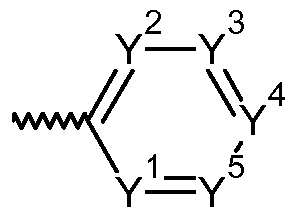
  • Y 1 - Y 5 are independently selected from the group consisting of CF, C-CF 3 C-NO 2 , C-CN, C-halogen, C-pseudohalogen or N.
  • R 3 is selected from the group comprising:
  • Y 1 - Y 7 are independently selected from the group consisting of CF, C-CF 3 , C-NO 2 , C-CN, C-halogen, C-pseudohalogen or N.
  • R 3 is selected from the group comprising:
  • Y 1 - Y 7 are independently selected from the group consisting of CF, CF 3 , C-NO 2 , C-CN, C-halogen, C-pseudohalogen or N.
  • R 3 is selected from the group comprising:
  • R 3 is selected from the group comprising halogenated, preferably perhalogenated and / or pseudohalogenated pteridines, isopteridines, naphthyridines, quinoxalines, azaquinoxalines.
  • the metal complex (without the presence of matrix material) is Lewis acid, i. he acts as an electron pair acceptor. This has proven to be particularly preferred for interaction with the matrix materials.
  • the metal complex (without the presence of matrix material) has at least one open or partially accessible coordination site. This has also been found to be particularly preferred for interaction with the matrix materials.
  • the compounds can be processed in both the gas phase and the liquid phase. In the vapor deposition both dopant and matrix material are common, preferably from vaporizes different sources in a high vacuum and deposited as a layer. During processing from the liquid phase, the metal complex and the matrix material are dissolved in a solvent and deposited by means of printing techniques, spin coating, knife coating, slot coating, etc. The finished layer is obtained by evaporation of the solvent. It can be adjusted by the different mass ratios of metal complex to the matrix material any doping ratios.
  • the following hole conductors can be processed by means of a solvent process:
  • matrix materials which are referred to as "small molecules" can be processed by means of a solvent process and are known to those skilled in the art and include, for example, spiro-TAD (2, 2 ', 7, 7' tetrakis (N, -diphenylamino) -9,9'-spirobifluorene) and spiro-TTB (2, 2 ', 7, 7' tetrakis (N, '-di-p-methylphenylamino) -9,9'-spirobifluorene and other materials such as they are listed in this application as matrix materials.
  • spiro-TAD 2, 2 ', 7, 7' tetrakis (N, -diphenylamino) -9,9'-spirobifluorene
  • spiro-TTB 2, 2 ', 7, 7' tetrakis (N, '-di-p-methylphenylamino) -9,9'-spirobifluor
  • the metal complex is a mono- or bi- or polynuclear metal complex.
  • the metal complex can be present in the solid state as a polynuclear metal complex.
  • the solid state poly-nuclear metal complex can de-polymerize during evaporation and may advantageously be monocrystalline in the gas phase. This embodiment is particularly advantageous because it provides a particularly thorough mixing and good binding of the complexes to the matrix materials.
  • the metal complex may contain the metal atom M Sn, Sb, Pb or bismuth. More preferably, the metal complexes may be either mononuclear, as specified below
  • the mononuclear complexes undergo terminal coordination of the metal over the ligand (s).
  • ligand s
  • the main group metal complex contains bismuth.
  • Bismuth main group metal complexes are particularly preferred here:
  • the oxidation states II which without ge by theory as a function of the selected ligands following paddle wheel structure may have.
  • the oxidation state V in which, in a particular embodiment, the main group metal complex bismuth of the oxidation state V may be contained with the following structure:
  • the aryls may be selected independently of one another from the group of substituted or unsubstituted aromatics or heteroaromatics. In a particular embodiment, these are partially or perfluorinated aromatics or heteroaromatics. Furthermore, particularly preferably, the aryls can be selected from the group of non-fluorinated or fluorinated carboxylates or generally from the group of ligands L, as listed in this application.
  • M metal
  • L ligand
  • m 1 to 10
  • M metal
  • L ligand
  • L' a ligand not identical to L selected from the group aryl, heteroaryl, Haloaryl and halo heteroaryl
  • n can be from 0 to 3
  • the matrix material of the opto-electronic component comprises one or more of the following materials:
  • NPB ⁇ , ⁇ '-bis (naphthalen-l-yl) - ⁇ , ⁇ '-bis (phenyl) -benzidine
  • ⁇ -NPB ⁇ , ⁇ '-bis (naphthalen-2-yl) - ⁇ , ⁇ ' -bis (phenyl) -benzidine
  • TPD ⁇ , ⁇ '-bis (3-methylphenyl) - ⁇ , ⁇ '-bis (phenyl) -benzidine
  • spiro TPD ⁇ , ⁇ '-bis (3-methylphenyl) - ⁇ , ⁇ '-bis (phenyl) benzidine
  • DMFL-NPB ⁇ , ⁇ '-bis (naphthalen-l-yl) - ⁇ , ⁇ '-bis (phenyl) -9,9-dimethyl-fluorene
  • DPFL-TPD ( ⁇ , ⁇ '-bis (3-methylphenyl) - ⁇ , ⁇ '-bis (phenyl) -9,9-diphenyl-fluorene)
  • DPFL-NPB ⁇ , ⁇ '-bis (naphthalen-1-yl) - ⁇ , ⁇ '-bis (phenyl) -9,9-diphenyl-fluorene
  • Spiro-TTB (2, 2 ', 7,7'-tetrakis ( ⁇ , ⁇ '-di-p-methylphenylamino) -9,9'-spirobifluorene). These materials have proven themselves as matrix materials in (opto) electronic components.
  • the degree of doping in moles of metal complex based on moles of matrix material is from 0.1% to 50%. This has proven to be useful.
  • the degree of doping is from> 0.5% to ⁇ 15%, more preferably> 1% to ⁇ 5%.
  • R 3 is selected from the group comprising halogenated, preferably perhalogenated and / or pseudohalogenated pteridines, isopteridines, naphthyridines, quinoxalines, azaquinoxalines.
  • the metal complex may contain at least one ligand L selected from the group of unsubstituted, partially fluorinated or perfluorinated organic carboxylic acids.
  • Organic carboxylic acids can generally be selected from the Groups of the aliphatic, saturated monocarboxylic acids;
  • aliphatic, unsaturated monocarboxylic acids aliphatic, saturated dicarboxylic acids; aliphatic, saturated tricarboxylic acids; aliphatic, unsaturated dicarboxylic acids; aromatic carboxylic acids; heterocyclic carboxylic acids; aliphatic, unsaturated, cyclic monocarboxylic acids.
  • Particularly preferred partial or perfluorinated ligands L are selected from substituted or unsubstituted compounds of acetic acid, phenylacetic acid and / or benzoic acid and are exemplified above. Particularly preferred is non-fluorinated, partially fluorinated or perfluorinated acetic acid.
  • one or more multidentate ligands L may be bridged between the metal atoms of the complex.
  • the present invention further relates to the use of a group 13-15 metal complex containing at least one ligand L of the following structure:
  • R 1 and R 2 may independently be oxygen, sulfur, selenium, NH or NR 4 , wherein R 4 is selected from the group consisting of alkyl or aryl and may be linked to R 3 ;
  • R 3 is selected from the group consisting of alkyl, long-chain alkyl, alkoxy, long-chain alkoxy, cycloalkyl, haloalkyl, aryl, arylenes, haloaryl, heteroaryl, heteroarylene, heterocycloalkylenes, heterocycloalkyl, haloheteroaryl, alkenyl, haloalkenyl, alkynyl, Haloalkynyl, ketoaryl, haloketoaryl, ketoheteroaryl, ketoalkyl, halo-ketoalkyl, ketoalkenyl, halo-ketoalkenyl, where, with suitable radicals, one or more non-adjacent CH 2 groups independently of one another by -O-, -S-, -NH-, -NR ° -, - SiR ° R ° 0 -, -CO-, - C00-, -0C0-, -0C0-0
  • Fig. 1 shows schematically the structure of an organic light emitting diode (10).
  • the light-emitting diode is constructed from a glass layer (1); Transparent Conductive oxide (TCO) or PEDOTrPPS or PANI layer (2); Hole injector layer (3); Hole transport layer (HTL) (4); Emitter layer (EML) (5); Hole blocker layer (HBL) (6); Electron Transport Layer (ETL) (7); Electron injector layer (8) and a cathode layer (9);
  • Fig. 2 shows schematically the structure of an organic solar cell with PIN structure (20), which converts light (21) into electricity.
  • the solar cell consists of a layer of indium tin oxide (22); a p-doped layer (23); an absorption layer (24); an n-doped layer (25) and a metal layer (26);
  • Fig. 3 shows schematically a possible cross section of an organic field effect transistor (30).
  • a gate electrode (32), a gate dielectric (33), a source and drain contact (34 + 35), and an organic semiconductor (36) are deposited.
  • the hatched areas show the places where a contact doping is helpful.
  • Fig. 4 shows the current density versus the voltage for an undoped matrix material and for a doped matrix material according to a first embodiment of the invention
  • Fig. 5 shows the absorption versus wavelength for the materials of Fig. 4;
  • FIG. 6 shows the photoluminescence versus wavelength for the materials of FIG. 4.
  • FIG. 7 shows the reflection against the wavelength for the doped material of FIG. 4.
  • FIG. 8 shows the current density versus the voltage for an undoped matrix material and for a plurality of doped matrix materials according to a second embodiment of the invention
  • FIG. 9 shows the absorption versus wavelength for the materials of FIG. 8;
  • FIG. 10 shows the photoluminescence versus wavelength for the doped materials of FIG. 8.
  • FIG. 11 shows the reflection against the wavelength for the materials from FIG. 8
  • 13 shows the current density versus the voltage for an undoped matrix material and for a plurality of doped matrix materials according to a fourth embodiment of the invention
  • 14 shows the current density versus the voltage for an undoped matrix material and for a plurality of doped matrix materials according to a fifth embodiment of the invention
  • FIG. 15 shows the luminescence versus voltage for the doped materials of FIG. 14;
  • FIG. 16 shows the current density versus the voltage for an undoped matrix material and for a plurality of doped matrix materials according to a sixth embodiment of the invention
  • FIG. 17 shows the luminescence versus voltage for the doped materials of FIG. 16;
  • Example I relates to Bi (O 2 CCF 3 ) 3, which was prepared according to literature, s. Bo Li "Heterometallic Carboxylates Incorperating Bismuth", PhD Thesis State University of New York at Albany, Chair M. Petrukhina 2007, UMI Number 3277252 and Vera Reiland “Chemistry and Coordination Chemistry of Bismuth Trifluoroacetate and Related Compounds", Dissertation D368, University of Kaiserslautern 2000 ,
  • ITO prestructured glass substrates were heated for 10 min. subjected to an oxygen plasma treatment and then subsequently transferred to the evaporator as quickly as possible.
  • the evaporator was transferred to an argon glovebox in which the oxygen and water concentration is less than 2 ppm. All evaporations were carried out at a vacuum of less than 2 x 10 "6 mbar base pressure is performed (during the evaporation the pressure then rises). First, both matrix and dopant were heated to just before the evaporation point, then heated until a constant evaporation could be observed.
  • the total evaporation rate was about 1 A / s, with the evaporation rate of the dopant adjusted above the evaporation rate of the matrix material. After the shutters were closed, it was cooled to 40 ° C, flooded with argon, changed the mask for the deposition of the cathode and then evacuated again.
  • the electrode consisted of a 150 nm thick layer of aluminum which was deposited at an initial evaporation rate of 0.5 A / s, which was slowly increased to 5 A / s.
  • FIGS. 4 to 7 relate to HTM-014 doped with Bi (O 2 CCF 3 ) 3 and undoped (matrix material, Merck
  • Fig. 4 shows the current density versus the applied voltage for the two materials. It can already be seen in the doped layer, an increase in the current density against the applied voltage.
  • the absorption, the photoluminescence and the reflection were measured (FIGS. 5 to 7). It can be seen that the complexes are almost transparent, which makes them suitable for use in (opto) -electronic components.
  • Example II refers to Bi (O 2 CC 6 H 2 (2, 3, 4 -F 3 )) 3 which was prepared as follows: A 50 ml Schlenk flask was charged with 0.251 g (0.57 mmol) of triphenylbismuth (III) , then made up to 10-15 ml of freshly distilled benzene and with an excess (about 3 mmol) of 2, 3, 4-trifluorobenzoic acid added. The mixture is heated under reflux for one hour and then cooled to room temperature, then the solvent is removed under reduced pressure until a white solid precipitates. The crude product (yield 85-88%) is washed with a little hexane and dried in vacuo overnight. For cleaning can be sublimated.
  • Example II In analogy to Example I, four layers, once consisting of an undoped matrix material (HTM-014, Merck) and with 5%, 13% and 15% Bi (0 2 CC 6 H 2 (2, 3, 4 -F 3 )) 3 doped layers HTM-014 applied.
  • the layer thickness was 200nm each.
  • Fig. 8 shows the current density versus the applied voltage for the three materials. It can already be seen in the 5% doped layer, an increase in the current density against the applied voltage.
  • HIL-012 matrix material, Merck KGaA
  • Bi (0 2 C 2 F 3) 3 and BipFbz are used.
  • Bi (0 2 C 2 F 3) 3 and bismuth tris-pentafluorobenzoat (BipFBz) spiked solutions are processed.
  • the total solids content in these embodiments is a total of 2% by weight and the proportion of dopants in the total solids content is 15% by weight.
  • the parameters for the spin coating are found to be 1500 rpm for the element with Bi (O 2 C 2 F 3 ) 3 as dopant and 1000 rpm for the element with BipFBz. Total is coated for a period of 40 seconds and the layer thickness after drying under the above parameters is 100 nm for both elements.
  • the measurements are carried out in each case on 4 mm 2 large elements.
  • Fig. 12 shows the obtained current density-voltage characteristics for the different components of this example. It can be clearly stated that the doping results in a conductivity increased by several orders of magnitude.
  • Example IV In the context of a solvent process, a majority charge carrier component is produced, the spiro-TTB being used as the polymeric hole conductor and the metal complexes Bi (O 2 C 2 F 3) 3 and BipFbz according to the invention being used as dopants.
  • Fig. 13 shows the obtained current density-voltage characteristics for the different components of this example.
  • the undoped and doped hole conductor layers described in Example III are incorporated into red OLEDs.
  • the red OLEDs have the following layer structure glass / ITO / 100nm HTL varies / lOnm NPB / 20nm emitter layer of 20% NPB, 70% TPBi, 10% ADS076 / 60nm TPBi / 0.7nm LiF / 200nm AI.
  • the dopants are bismuth tris-trifluoroacetate
  • Spiro-TTB is used as a hole conductor and doped with BipFBz.
  • Spiro-TTB and BipFBz can be produced both according to the solvent (characteristic curve BipFBz) and the evaporation process (characteristic curve BipFBz (ev)).
  • the characteristic current density-voltage characteristic or luminance-voltage characteristic are shown in FIGS. 16 and 16
  • the doped hole conductor layers produced in Examples III and IV can also be used as hole conductor layers for organic solar cells, in particular those with a p-i-n structure.

Landscapes

  • Chemical & Material Sciences (AREA)
  • Engineering & Computer Science (AREA)
  • Materials Engineering (AREA)
  • Organic Chemistry (AREA)
  • Inorganic Chemistry (AREA)
  • Physics & Mathematics (AREA)
  • High Energy & Nuclear Physics (AREA)
  • Manufacturing & Machinery (AREA)
  • Optics & Photonics (AREA)
  • Electroluminescent Light Sources (AREA)
  • Organic Low-Molecular-Weight Compounds And Preparation Thereof (AREA)
  • Photovoltaic Devices (AREA)
  • Plural Heterocyclic Compounds (AREA)
  • Nitrogen Condensed Heterocyclic Rings (AREA)

Description

Beschreibung
Hauptgruppenmetallkomplexe als p-Dotanden für organische elektronische Matrixmaterialien
Die Erfindung betrifft die Verwendung bi- oder polynuklearer Hauptgruppenmetallkomplexe als p-Dotanden für organisch elektronische Matrixmaterialien. Innerhalb der organischen Elektronik lassen sich im Wesentlichen zwei wichtige kommerzielle Technologiefelder herausarbeiten. Das erste Technologiefeld beschäftigt sich dabei mit Anwendungen organischer Matrixmaterialien zur Umwandlung von Licht in elektrischen Strom und umgekehrt und das andere Feld fokussiert sich auf den Aufbau elektrischer Bauteile mittels organischem Halbleitermaterial. Beispiele für die erstgenannte Kategorie liefern zum Beispiel Fotodetektoren und organische Solarzellen, schematisch dargestellt in Figur 1, welche Licht in ein elektrisches Signal oder in elektrischen Strom umwandeln und organische Leuchtdioden (OLEDs) , welche Licht mittels organischer elektronischer Materialien erzeugen können (siehe Figur 2) . In den zweiten Technologiebereich fallen zum Beispiel organische Feldeffekt-Transistoren, schematisch dargestellt in Figur 3, bei denen eine Dotierung den Kontakt- widerstand zwischen Elektrode und Halbleitermaterial verringert oder bipolare Transistoren.
Allen Anwendungen ist gemein, dass sie als wesentliche, funktionale Komponente elektrische Transportschichten beinhalten, welche in Abhängigkeit ihrer Zusammensetzung unterschiedliche Leitungsmechanismen aufweisen. Allgemein unterscheidet man eine intrinsische p- (Loch) - oder eine n- (Elektronen) - Leitfähigkeit der organischen Materialien. Da die elektrischen Eigenschaften dieser organischen Substanzklassen in der Regel für eine hoch effiziente Nutzung der Bauteile unzureichend sind, werden diese mit zusätzlichen Verbindungen versetzt, welche die elektrischen Eigenschaften der Schichten verbessern sollen. Üblicherweise erfolgt dies durch Dotieren mit metallischen oder weiteren organischen Verbindungen. Ein Ansatz zur Erzielung signifikanter Verbesserungen der Leitfähigkeiten ist der Zusatz von Metallkomplexen und insbesondere der Zusatz von Übergangsmetallkomplexen.
So beschreibt zum Beispiel die WO 2005 086251 Dotanden zur Herstellung von n- leitenden Schichten, welche unter anderem auch folgende Struktur aufweisen können:
Figure imgf000004_0001
Die Struktur dieser Verbindungsklasse wird in der Literatur auch als Schaufelradkomplex „paddle wheel complex" bezeichnet. Insbesondere beschreibt die Veröffentlichung die Verwen- dung eines Metallkomplexes als n-Dotand zur Dotierung eines organischen halbleitenden Matrixmaterials zur Veränderung der elektrischen Eigenschaften desselben. Die vorgestellten Verbindungen sollen bezüglich des Matrixmaterials als n-Dotanden einsetzbar sein.
Einen anderen Weg unter Verwendung Lewis-saurer Metallkomplexe zur Dotierung von p- leitenden Transportschichten gibt dagegen Endo et al . (Jpn. J. Appl . Phys . Vol. 41 (2002) L358- L360) an. In dieser Literaturestelle werden organische elektrolumineszierende Vorrichtungen beschrieben, welche eine p-leitende Schicht aufweisen, die mittels einer Co-Dotierung aus FeC13 und Arylamin-Derivaten, wie z.B. N, " -dinapthyl - N, -diphenyl benzidine ( -NPD) , hergestellt werden. Allerdings werden dort auch signifikante Nachteile für das Bau- teil, wie Löschung der Lumineszenz und Erhöhung der Eigenabsorption beschrieben. Eine weitere Möglichkeit zu Ausgestaltung organischer Halbleiter für bipolare Transistoren durch Dotierung wird zudem in der DE 102010041331 offenbart. Desweiteren sind mehrkernige Metallkomplexe z.B. aus der WO 2008/154915 bekannt.
Es stellt sich jedoch die Aufgabe, weitere Materialien zu finden, welche als sich als p-Dotanden in organisch elektro- nische Matrixmaterialien, insbesondere Lochtransportern eignen und die Effizienz von Bauteilen enthaltend diese Schichten erhöhen.
Gelöst wird diese Aufgabe durch ein organisches elektroni- sches Bauteil gemäß Anspruch 1 der vorliegenden Erfindung.
Demgemäß wird ein organisches elektronisches Bauteil mit einer Matrix vorgeschlagen, wobei die Matrix als p-Dotand einen Hauptgruppen-Metallkomplex der Gruppen 13 bis 15 enthält, der wiederum mindestens einen Liganden L der folgenden Struktur enthält :
Figure imgf000005_0001
wobei R1 und R2 unabhängig voneinander Sauerstoff, Schwefel,
Selen, NH oder NR4 sein können, wobei R4 ausgewählt ist aus der Gruppe enthaltend Alkyl oder Aryl und mit R3 verbunden sein kann; und R3 ausgewählt ist aus der Gruppe enthaltend Alkyl, langketti- ges Alkyl, Alkoxy, langkettiges Alkoxy, Cycloalkyl, Haloge- nalkyl, Aryl, Arylene, Halogenaryl, Heteroaryl, Heteroaryle- ne, Heterocycloalkylene , Heterocycloalkyl , Halogenheteroaryl , Alkenyl, Halogenalkenyl , Alkinyl, Halogenalkinyl , Ketoaryl, Halogenketoaryl , Ketoheteroaryl , Ketoalkyl, Halogenketoalkyl ,
Ketoalkenyl, Halogenketoalkenyl , wobei bei geeigneten Resten eine oder mehrere nicht-benachbarte CH2-Gruppen unabhängig voneinander durch -0-, -S-, -NH-, -NR°-, -SiR°R° 0 - , -CO-, - C00-, -0C0-, -0C0-0-, -S02-, -S-CO-, -CO-S-, -CY1=CY2 oder - C^C- ersetzt sein können und zwar derart, dass 0 und/oder S Atome nicht direkt miteinander verbunden sind, ebenfalls optional mit Aryl- oder Heteroaryl bevorzugt enthaltend 1 bis 30 C Atome ersetzt sind (endständige CH3-Gruppen werden wie CH2-Gruppen im Sinne von CH2-H verstanden) . Überraschend hat sich herausgestellt, dass diese Materialien als p-Dotanden für Matrixmaterialien in organischen elektronischen Bauteilen geeignet sind. Insbesondere weisen diese Materialien oftmals einen oder mehrere der folgenden Vorteile auf
- Die Materialien sind gut aus verschiedenen Quellen zusammen mit dem Matrixmaterial co-evaporierbar, so dass sich dotierte Matrixschichten definierter Zusammensetzung bilden
- Die Materialien sind auf einfachem Wege erhältlich und benötigen keine aufwendigen Herstellungsprozesse
- Die Dotierstärke ist der Matrix anpassbar
- Die Leitfähigkeit kann über die Konzentration und die Art des Stoffes eingestellt werden.
Im Sinne der vorliegenden Erfindung bedeutet und/oder umfasst die Bezeichnung „organisches elektronisches Bauteil" insbesondere organische Transistoren, organische lichtemittierende Dioden, lichtemittierende elektrochemische Zellen, organische Solarzellen, Photodioden sowie organische Photovoltaik allgemein .
Im Sinne der vorliegenden Erfindung umfasst oder bedeutet die Bezeichnung „p-Dotand" insbesondere Materialien, die eine Le- wis-Acidität aufweisen und /oder in der Lage sind, Komplexe mit dem Matrixmaterial auszubilden, in denen diese Materialien (wenn auch nur formal) Lewis-acide wirken. Ein derartiges Hauptgruppenmetallkomplex-Matrixmaterial
(Lochleiter) kann z.B. die folgende Struktur haben (hier gedeutet mit Bismut als Metall und eine Koordination über Stickstoff ) :
Figure imgf000007_0001
Unter dem Begriff „Hauptgruppen-Metallkomplex der Gruppen 13 bis 15" werden die Metalle der 13. bis 15. Gruppe lt. IUPAC, d.h Aluminium, Gallium, Indium, Silizium, Germanium, Zinn,
Blei, Thallium, Arsen, Antimon, Bismut oder Mischungen daraus verstanden. Bevorzugt sind die Metalle der Gruppe 14 und 15, d.h. Silizium, Germanium, Zinn, Blei, Arsen, Antimon, Bismut, besonders bevorzugt Zinn und/oder Bismut.
Allgemeine Gruppendefinition: Innerhalb der Beschreibung und den Ansprüchen werden allgemeine Gruppen, wie z.B: Alkyl, Al- koxy, Aryl etc. beansprucht und beschrieben. Wenn nicht anders beschrieben, werden bevorzugt die folgenden Gruppen in- nerhalb der allgemein beschriebenen Gruppen im Rahmen der vorliegenden Erfindung verwendet: alkyl: lineare und verzweigte Cl -C8 -Alkyle , langkettige Alkyle: lineare und verzweigte C5-C20 Alkyle
Alkenyl: C2 -C6 -alkenyl , Cycloalkyl: C3 -C8 -cycloalkyl ,
Alkoxy: Cl-C6-alkoxy, langkettig Alkoxy: lineare und verzweigte C5-C20 Alkoxy
Alkylene: ausgewählt aus der Gruppe enthaltend:
methylene ; 1 , 1 -ethylene ; 1 , 2 -ethylene ; 1 , 1 -propylidene ; 1,2- propylene; 1,3- propylene; 2 , 2 -propylidene ; butan-2 -ol - 1 , 4 - diyl ; propan-2-ol-l, 3-diyl; 1, 4-butylene; cyclohexane- 1 , 1 - diyl ; cyclohexan- 1 , 2 -diyl ; cyclohexan- 1 , 3 - diyl; cyclohexan-
1.4 -diyl; cyclopentane-1 , 1-diyl ; cyclopentan- 1 , 2 -diyl ; und cyclopentan- 1 , 3-diyl , Aryl : ausgewählt aus Aromaten mit einem Molekulargewicht unter 300Da.
Arylene: ausgewählt aus der Gruppe enthaltend: 1 , 2 -phenylene ; 1,3- phenylene; 1 , 4 -phenylene ; 1 , 2 -naphthylene ; 1,3- naphtalenylene ; 1,4- naphthylene; 2 , 3 -naphthylene ; 1-hydroxy- 2 , 3 -phenylene ; l-hydroxy-2 , 4- phenylene; l-hydroxy-2 , 5- phenylene; und l-hydroxy-2 , 6 -phenylene,
Heteroaryl: ausgewählt aus der Gruppe enthaltend: pyridinyl ; pyrimidinyl ; pyrazinyl; triazolyl; pyridazinyl; 1,3,5- triazinyl; chinoninyl ; isochinoninyl ; chinoxalinyl ; imidazo- lyl ; pyrazolyl ; benzimidazolyl ; thiazolyl; oxazolidinyl ; pyr- rolyl ; thiophenyl ; carbazolyl ; indolyl ; und isoindolyl, wobei das Heteroaryl mit der Verbindung über jedes Atom im Ring des ausgewählten Heteroaryls verbunden sein kann.
Heteroarylene : ausgewählt aus der Gruppe enthaltend: pyridin- diyl ; quinolindiyl ; pyrazodiyl ; pyrazoldiyl ; triazolediyl ; pyrazindiyl, thiophendiyl ; und imidazolediyl , wobei das hete- roarylene als Brücke in der Verbindung über ein beliebiges
Atom im Ring des ausgewählten Heteroaryls fungiert, speziell bevorzugt sind: pyridin-2, 3-diyl; pyridin-2 , 4 -diyl ; pyridin-
2.5 -diyl; pyridin-2 , 6 -diyl ; pyridin-3,4- diyl; pyridin-3,5- diyl ; quinolin-2 , 3 -diyl ; quinolin-2 , 4 -diyl ; quinolin-2, 8- diyl ; isoquinolin- 1,3 -diyl; isoquinolin- 1 , 4 -diyl ; pyrazol-
1.3 -diyl; pyrazol-3,5- diyl; triazole-3 , 5-diyl ; triazole- 1 , 3 - diyl; pyrazin-2 , 5-diyl ; und imidazole-2 , 4 -diyl , thiophen-2 , 5- diyl, thiophen-3 , 5-diyl ; ein -Cl -C6 -heterocycloalkyl , ausgewählt aus der Gruppe enthaltend: piperidinyl ; piperidine;
1.4 -piperazine , tetrahydrothiophene ; tetrahydrofuran; 1,4,7- triazacyclononane ; 1,4,8,11- tetraazacyclotetradecane ;
1 , 4 , 7 , 10 , 13 -pentaazacyclopentadecane ; 1,4-diaza- 7-thia- cyclononane; 1,4- diaza- 7 -oxa-cyclononane ; 1,4,7,10- tetraazacyclododecane ; 1,4-dioxane; 1,4, 7-trithia- cyclononane; Pyrrolidine; und tetrahydropyran, wobei das He- teroaryl mit dem Cl-C6-Alkyl über jedes Atom im Ring des ausgewählten Heteroaryls verbunden sein kann.
Heterocycloalkylene : ausgewählt aus der Gruppe enthaltend: piperidin-1, 2-ylene; piperidin-2 , 6 -ylene ; piperidin-4 , 4 - ylidene; 1 , 4 -piperazin- 1 , 4 -ylene ; 1 , 4 -piperazin-2 , 3 -ylene ; 1 , 4 -piperazin-2 , 5-ylene ; 1 , 4 -piperazin-2 , 6 -ylene ; 1,4- piperazin- 1, 2-ylene; 1 , 4 -piperazin- 1 , 3 -ylene ; 1 , 4 -piperazin- 1,4 -ylene; tetrahydrothiophen-2 , 5-ylene; tetrahydrothiophen- 3, 4 -ylene; tetrahydrothiophen-2 , 3 -ylene ; tetrahydrofuran-2 , 5- ylene; tetrahydrofuran- 3, 4 -ylene; tetrahydrofuran-2 , 3 -ylene ; pyrrolidin-2 , 5-ylene; pyrrolidin-3 , 4 -ylene ; pyrrolidin-2 , 3 - ylene; Pyrrolidin- 1 , 2 -ylene ; Pyrrolidin- 1 , 3 -ylene ; pyrrolidin-2 , 2 -ylidene ; 1 , 4 , 7 -triazacyclonon- 1 , 4 -ylene ; 1,4,7- tria- zacyclonon-2 , 3 -ylene ; 1 , 4 , 7 -triazacyclonon-2 , 9 -ylene ; 1,4,7- triazacyclonon-3 , 8-ylene; 1 , 4 , 7 -triazacyclonon-2 , 2 - ylidene; 1 , 4 , 8 , 11-tetraazacyclotetradec-1 , 4 -ylene ; 1,4,8,11- tetraaza- cyclotetradec-1 , 8-ylene ; 1,4,8, 11-tetraazacyclotetradec-2 , 3 - ylene; 1 , 4 , 8 , 11 -tetraazacyclotetradec-2 , 5 -ylene ; 1,4,8,11- tetraazacyclotetradec-1, 2-ylene; 1,4,8,11- tetraazacyclotetradec-2 , 2 -ylidene ; 1,4,7, 10-tetraazacyclododec-1 , 4 -ylene ; 1,4,7, 10-tetraazacyclododec-1 , 7 -ylene ; 1,4,7,10- tetraazacyclododec-1, 2- ylene; 1 , 4 , 7 , 10-tetraazacyclododec- 2,3- ylene; 1 , 4 , 7 , 10 -tetraazacyclododec-2 , 2 -ylidene ;
1,4,7,10,13 pentaazacyclopentadec-1, 4-ylene; 1,4,7,10,13- pentaazacyclopentadec-1 , 7 -ylene ; 1,4,7,10,13- pentaazacyclopentadec-2 , 3 - ylene; 1,4,7,10,13- pentaazacyclopentadec-1 , 2 -ylene ; 1,4,7,10,13- pentaazacyclopentadec-2 , 2 -ylidene ; 1 , 4 -diaza- 7 -thia-cyclonon- 1,4 -ylene; 1 , 4 -diaza- 7 -thia-cyclonon- 1 , 2 -ylene ; 1,4-diaza- 7thia-cyclonon- 2,3-ylene; 1 , 4 -diaza- 7 -thia-cyclonon- 6 , 8 - ylene; 1 , 4 -diaza- 7 -thia-cyclonon- 2,2-ylidene; l,4-diaza-7- oxacyclonon- 1 , 4 -ylene ; 1 , 4 -diaza- 7 -oxa-cyclonon- 1,2 -ylene; 1 , 4diaza- 7 -oxa-cyclonon-2 , 3 -ylene ; 1 , 4 -diaza- 7 -oxa-cyclonon- 6, 8-ylene; 1 , 4 -diaza- 7 -oxa-cyclonon-2 , 2 -ylidene ; 1,4-dioxan- 2,3-ylene; 1,4- dioxan-2 , 6 -ylene ; 1 , 4 -dioxan-2 , 2 -ylidene ; tetrahydropyran-2 , 3 -ylene ; tetrahydropyran-2 , 6 -ylene ; tetra- hydropyran-2 , 5 -ylene; tetrahydropyran-2 , 2 - ylidene; 1,4,7- trithia-cyclonon-2 , 3 -ylene ; 1 , 4 , 7-trithia-cyclonon-2 , 9- ylene; und 1 , 4 , 7 -trithia-cyclonon-2 , 2 -ylidene ,
Heterocycloalkyl: ausgewählt aus der Gruppe enthaltend: pyr- rolinyl; pyrrolidinyl ; morpholinyl ; piperidinyl ; piperazinyl; hexamethylene imine; 1 , 4 -piperazinyl ; tetrahydrothiophenyl ; tetrahydrofuranyl ; 1,4,7- triazacyclononanyl ; 1,4,8,11- tetraazacyclotetradecanyl ; 1,4,7,10,13- pentaazacyclopentade- canyl ; 1 , 4 -diaza- 7 -thiacyclononanyl ; 1 , 4 -diaza- 7 -oxa- cyclo- nonanyl ; 1 , 4 , 7 , 10-tetraazacyclododecanyl ; 1 , 4 -dioxanyl ;
1,4,7- trithiacyclononanyl ; tetrahydropyranyl ; und oxazolidi- nyl , wobei das Heterocycloalkyl mit der Verbindung über jedes Atom im Ring des ausgewählten Heterocycloalkyls verbunden sein kann.
Amine: die Gruppe -N(R)2 wobei jedes R unabhängig ausgewählt ist aus: Wasserstoff; Cl-C6-alkyl; Cl -C6 -alkyl -C6H5 ; und phe- nyl , wobei wenn beide R' C1-C6 alkyl sind, beide R' einen - NC3 bis NC5 heterocyclischen Ring bilden können, wobei die restliche Alkylkette einen Alkylsubstituenten am heterocyclischen Ring bildet Halogen: ausgewählt aus der Gruppe enthaltend: F; Cl ; Br und I Halogenalkyl : ausgewählt aus der Gruppe enthaltend mono, di , tri-, poly- und perhalogenierte lineare und verzweigte C1-C8- alkyl, besonders bevorzugt -CF3 Pseudohalogen : ausgewählt aus der Gruppe enthaltend -CN, - SCN, -OCN, N3, -CNO, -SeCN
Carboxylat: die Gruppe -C(0)OR, wobei R ausgewählt ist aus: Wasserstoff; Cl-C6-alkyl ; phenyl ; Cl -C6 -alkyl -C6H5 ;
Carbonyl : die Gruppe -C(0)R, wobei R ausgewählt ist aus: Wasserstoff; C1-C6 -alkyl; phenyl; Cl -C6 -alkyl -C6H5 und amine ausgewählt aus der Gruppe: -NR' 2, wobei jedes R' unabhängig ausgewählt ist aus: Wasserstoff; Cl- C6-alkyl; Cl-C6-alkyl- C6H5 ; und phenyl, wobei wenn beide R' C1-C6 alkyl sind, beide R' einen -NC3 bis NC5 heterocyclischen Ring bilden können, wobei die restliche Alkylkette einen Alkylsubstituenten am heterocyclischen Ring bildet Soweit nicht anders erwähnt, sind die folgenden Gruppen mehr bevorzugte Gruppen innerhalb der allgemeinen Gruppendefinition : alkyl: lineare und verzweigte Cl-C6-alkyl, langkettige Alkyle: lineare und verzweigte C5-C10 alkyl, vorzugsweise C6-C8 alkyle alkenyl : C3 -C6 -alkenyl , cycloalkyl: C6 -C8 -cycloalkyl , alkoxy: Cl -C4 -alkoxy, langkettig Alkoxy: lineare und verzweigte C5-C10 alkoxy, vorzugsweise lineare C6-C8 alkoxy Alkylene: ausgewählt aus der Gruppe enthaltend: methylene ;
1.2 -ethylene ; 1 , 3 -propylene ; butan-2 -ol-l , 4 -diyl ; 1,4- butylene; cyclohexane- 1 , 1 -diyl ; cyclohexan- 1 , 2 -diyl ; cyclo- hexan- 1 , 4 -diyl ; cyclopentane- 1 , 1 -diyl ; und cyclopentan- 1 , 2 - diyl,
Aryl : ausgewählt aus der Gruppe enthaltend: phenyl ; biphenyl ; naphthalenyl ; anthracenyl ; und phenanthrenyl , arylene: ausgewählt aus der Gruppe enthaltend: 1 , 2 -phenylene ;
1.3- phenylene; 1 , 4 -phenylene ; 1 , 2 -naphthylene ; 1,4- naphtalenylene ; 2,3- naphthylene und l-hydroxy-2 , 6 -phenylene,
Heteroaryl: ausgewählt aus der Gruppe enthaltend:
pyridinyl ; pyrimidinyl ; chinoninyl ; pyrazolyl ; triazolyl; isochinoninyl ; imidazolyl ; und oxazolidinyl , wobei das Heteroaryl mit der Verbindung über jedes Atom im Ring des ausgewählten Heteroaryls verbunden sein kann, Heteroarylene : ausgewählt aus der Gruppe enthaltend: pyridin
2.3 -diyl; pyridin-2 , 4 -diyl ; pyridin-2 , 6 -diyl ; pyridin-3,5- diyl ; quinolin-2 , 3 -diyl ; quinolin-2 , 4 -diyl ; isoquinolin- 1 , 3 - diyl; isoquinolin-1 , 4 -diyl ; pyrazol-3 , 5-diyl ; und imidazole-
2.4 -diyl,
Heterocycloalkyl : ausgewählt aus der Gruppe enthaltend:
pyrrolidinyl ; morpholinyl; piperidinyl ; piperidinyl ; 1,4 pi- perazinyl; tetrahydrofuranyl ; 1 , 4 , 7-triazacyclononanyl ;
1 , 4 , 8 , 11-tetraazacyclotetradecanyl ; 1,4,7,10,13- pentaazacyc- lopentadecanyl ; 1 , 4 , 7 , 10-tetraazacyclododecanyl ; und pipera- zinyl, wobei das Heteroaryl mit der Verbindung über jedes Atom im Ring des ausgewählten Heteroaryls verbunden sein kann
Heterocycloalkylene : ausgewählt aus der Gruppe enthaltend: piperidin-2 , 6 -ylene ; piperidin-4 , 4 -ylidene ; 1 , 4 -piperazin-
1,4-ylene; 1 , 4 -piperazin-2 , 3 -ylene ; 1 , 4 -piperazin-2 , 6 -ylene ; tetrahydrothiophen-2 , 5 -ylene; tetrahydrothiophen-3 , 4 -ylene; tetrahydrofuran-2 , 5 -ylene; tetrahydrofuran-3 , 4 -ylene ; pyrro- lidin-2 , 5-ylene; pyrrolidin-2 , 2 -ylidene ; 1,4,7- triazacyclonon- 1 , 4 - ylene; 1 , 4 , 7 -triazacyclonon-2 , 3 -ylene ; 1 , 4 , 7 -triazacyclonon-2 , 2 -ylidene ; 1,4,8,11- tetraazacyclo- tetradec- 1,4 -ylene; 1,4,8,11- tetraazacyclotetradec-1 , 8- ylene; 1 , 4 , 8 , 11 -tetraazacyclotetradec-2 , 3 -ylene ; 1,4,8,11- tetraazacyclotetradec-2 , 2 -ylidene ; 1,4,7,10- tetraazacyclododec-1, 4-ylene; 1,4,7,10- tetraazacyclododec- 1,7-ylene; 1 , 4 , 7 , 10 -tetraazacyclododec-2 , 3 -ylene ; 1,4,7,10- tetraazacyclododec-2 , 2 -ylidene ; 1,4,7,10,13- pentaazacyclo- pentadec-1, 4-ylene; 1,4,7,10,13- pentaazacyclopentadec-1 , 7- ylene; 1 , 4 -diaza- 7 -thia-cyclonon- 1 , 4 ylene; 1 , 4 -diaza- 7 -thia- cyclonon-2 , 3 -ylene ; 1 , 4 -diaza- 7 -thiein cyclonon-2 , 2 -ylidene ; 1 , 4 -diaza- 7 -oxa-cyclonon- 1 , 4 -ylene ; 1,4 diaza- 7 -oxa-cyclonon- 2 , 3 -ylene ; 1 , 4 -diaza- 7 -oxa-cyclonon-2 , 2 - ylidene; 1,4-dioxan- 2, 6 -ylene; 1 , 4 -dioxan-2 , 2 -ylidene ; tetrahydropyran-2 , 6 -ylene ; tetrahydropyran-2 , 5-ylene; und tetrahydropyran- 2, 2 -ylidene, ein -Cl -C6 -alkyl -heterocycloalkyl , wobei das Heterocycloalkyl ausgewählt aus der Gruppe enthaltend: piperidinyl ; 1,4- piperazinyl; tetrahydrofuranyl ; 1,4,7- triazacyclononanyl ; 1 , 4 , 8 , 11-tetraazacyclotetradecanyl ; 1,4,7,10,13- pentaazacyc- lopentadecanyl ; 1 , 4 , 7 , 10-tetraazacyclododecanyl ; und pyrroli- dinyl, wobei das Heterocycloalkyll mit der Verbindung über jedes Atom im Ring des ausgewählten Heterocycloalkyls verbunden sein kann
Amin: die Gruppe -N (R) 2, wobei jedes R unabhängig ausgewählt ist aus: Wasserstoff; Cl-C6-alkyl; und Benzyl ,
Halogen: ausgewählt aus der Gruppe enthaltend: F und Cl,
Carboxylat: die Gruppe -C(0)0R, wobei R ausgewählt ist aus Wasserstoff; C1-C6 -alkyl; und benzyl,
Carbonyl : die Gruppe: -C(0)R, wobei R ausgewählt ist aus: Wasserstoff; Cl-C6-alkyl; Benzyl und Amine ausgewählt aus der Gruppe: -NR' 2, wobei jedes R' unabhängig ausgewählt ist aus: Wasserstoff; C1-C6 -alkyl; und Benzyl, Gemäß einer bevorzugten Ausführungsform ist R3 Halogenalkyl , besonders bevorzugt Perfluoralkyl mit 1 bis 8 Kohlenstoffen, noch bevorzugt 1 bis 4, Halogenaryl, besonders bevorzugt Perfluoraryl , Halogenalkylaryl , besonders bevorzugt
(Per) fluoralkylaryl und Halogenheteroaryl , besonders bevorzugt Perfluorheteroaryl .
Desweiteren seien beispielhaft als Liganden L bevorzugt angeführt
fluorierter Benzoesäuren wie z.B. 2-
(Trifluoromethyl ) benzoesäure ; 3 , 5 -Difluorobenzoesäure ; 3- Hydroxy-2 , 4 , 6 -triiodobenzoesäure ; 3 -Fluoro-4 - methylbenzoesäure ; 3 - (Trifluoromethoxy) benzoesäure ; 4- (Trifluoromethoxy) benzoesäure; 4-Chloro-2 , 5- difluorobenzoesäure ; 2 -Chloro-4 , 5 -difluorobenzoesäure ; 2,4,5- Trifluorobenzoesäure ; 2 -Fluorobenzoesäure ; 4- Fluorobenzoesäure ; 2 , 3 , 4 -Trifluorobenzoesäure ; 2,3,5- Trifluorobenzoesäure ; 2 , 3 -Difluorobenzoesäure ; 2,4- Bis (trifluoromethyl) benzoesäure; 2 , 4 -Difluorobenzoesäure ; 2 , 5 -Difluorobenzoesäure ; 2 , 6-Bis (trifluoromethyl) benzoesäure; 2 , 6 -Difluorobenzoesäure ; 2 -Chloro- 6 - fluorobenzoesäure ; 2- Fluoro-4- (trifluoromethyl) benzoesäure; 2-Fluoro-5- (trifluoromethyl) benzoesäure; 2-Fluoro-6-
(trifluoromethyl) benzoesäure; 3,4, 5 -Trifluorobenzoesäure ; 3 , 4 -Difluorobenzoesäure ; 3 , 5-Bis (trifluoromethyl) benzoesäure; 3 - (Trifluoromethyl ) benzoesäure ; 3 -Chloro-4 - fluorobenzoesäure ;
3-Fluoro-5- (trifluoromethyl) benzoesäure; 3 -Fluorobenzoesäure ;
4-Fluoro-2- (trifluoromethyl) benzoesäure; 4-Fluoro-3-
(trifluoromethyl ) benzoesäure ; 5 -Fluoro-2 -methylbenzoesäure ; 2- (Trifluoromethoxy) benzoesäure ; 2 , 3 , 5 -Trichlorobenzoesäure ; 4- (Trifluoromethyl ) benzoesäure ; Pentafluorobenzoesäure ;
2,3,4, 5 -Tetrafluorobenzoesäure , fluorierte oder nicht-fluorierte Phenylessigsäure wie z.B. 2- Fluor-Phenylessigsäure ; 3 -Fluor-Phenylessigsäure ; 4-Fluor-
Phenylessigsäure ; 2 , 3 -Difluor-Phenylessigsäure ; 2,4-Difluor- Phenylessigsäure ; 2 , 6 -Difluor-Phenylessigsäure ; 3, 4 -Difluor- Phenylessigsäure ; 3 , 5-Difluor-Phenylessigsäure; Pentafluor- Phenylessigsäure ; 2 -Chloro- 6 - fluor-Phenylessigsäure ; 2- Chloro-3 , 6 -difluor-Phenylessigsäure ; 3 -Chloro-2 , 6 -difluor- Phenylessigsäure ; 3-Chloro-4-fluor-Phenylessigsäure; 5- Chloro-2-fluor-Phenylessigsäure; 2,3, 4-Trifluor- Phenylessigsäure; 2 , 3 , 5-Trifluor-Phenylessigsäure; 2,3,6- Trifluor-Phenylessigsäure ; 2,4, 5-Trifluor-Phenylessigsäure; 2,4, 6 -Trifluor-Phenylessigsäure ; 3,4, 5-Trifluor- Phenylessigsäure ; 3-Chloro-2-fluor-Phenylessigsäure; -Fluor- Phenylessigsäure ; 4-Chloro-2-fluor-Phenylessigsäure; 2- Chloro-4-fluor-Phenylessigsäure; , -Difluor- Phenylessigsäure ; Ethyl 2 , 2 -Difluor-2 -phenylacetate ; und fluorierte oder nicht-fluorierte Essigsäure wie z.B. Methyl - trifluoroacetat ; Allyl-trifluoroacetat ; Ethyl - trifluoroacetat ; Isopropyl-trifluoroacetat ; 2,2,2-
Trifluoroethyl-trifluoroacetat ; Difluoroessigsäure ; Trifluo- roessigsäure ; Methyl -chlorodifluoroacetat ; Ethyl - bromodifluoroacetat ; Chlorodifluoroessigsäure ; Ethyl - chlorofluoroacetat ; Ethyl -difluoroacetat ; (3-Chlorophenyl) - difluoroessigsäure ; (3 , 5 -Difluorophenyl ) -difluoroessigsäure ; (4-Butylphenyl) difluoroessigsäure ; (4-tert- Butylphenyl) difluoroessigsäure; (3 , 4 -Dimethylphenyl ) - difluoroessigsäure ; (3-Chloro-4-fluorophenyl) - difluoroessigsäure ; (4-Chlorophenyl) -difluoroessigsäure; 2- Biphenyl-3 ', 5 ' -difluoroessigsäure; 3-Biphenyl-3 ' , 5 ' - difluoroessigsäure ; 4-Biphenyl-3 ', 5 ' -difluoroessigsäure; 2- Biphenyl-3 ' , 4 ' -difluoroessigsäure ; 3-Biphenyl-3 ' , 4 ' - difluoroessigsäure ; 4-Biphenyl-3 ', 4 ' -difluoroessigsäure und 2 , 2 -Difluoro-propionsäure bzw. deren höheren Homologen. Falls die Liganden L saure Gruppen aufweisen, können die Gruppen in einer bevorzugten Ausführungsform deprotoniert vorliegen.
Gemäß einer alternativen bevorzugten Ausführungsform ist R3 ausgewählt aus der Gruppe enthaltend:
Figure imgf000015_0001
wobei Y1 - Y5 unabhängig voneinander ausgewählt sind aus der Gruppe enthaltend C-F, C-CF3 C-N02, C-CN, C-Halogen, C- Pseudohalogen oder N.
Gemäß einer bevorzugten Ausführungsform ist R3 ausgewählt aus der Gruppe enthaltend:
Figure imgf000016_0001
wobei Y1 - Y7 unabhängig voneinander ausgewählt sind aus der Gruppe enthaltend C-F, C-CF3, C-N02, C-CN, C-Halogen, C- Pseudohalogen oder N.
Gemäß einer bevorzugten Ausführungsform ist R3 ausgewählt aus der Gruppe enthaltend:
Figure imgf000016_0002
wobei Y1 - Y7 unabhängig voneinander ausgewählt sind aus der Gruppe enthaltend C-F,CF3, C-N02, C-CN, C-Halogen, C- Pseudohalogen oder N.
Gemäß einer bevorzugten Ausführungsform ist R3 ausgewählt aus der Gruppe enthaltend:
Figure imgf000017_0001
Figure imgf000017_0002
Gemäß einer bevorzugten Ausführungsform ist R3 ausgewählt aus der Gruppe enthaltend halogenierte , bevorzugt perhalogenierte und/oder pseudohalogenierte Pteridine, Isopteridine, Naphty- ridine, Chinoxaline, Azachinoxaline .
Gemäß einer bevorzugten Ausführungsform ist der Metallkomplex (ohne Anwesenheit von Matrixmaterial) lewis-sauer, d.h. er agiert als Elektronenpaarakzeptor . Dies hat sich für eine Interaktion mit den Matrixmaterialien als besonders bevorzugt herausgestellt .
Gemäß einer bevorzugten Ausführungsform besitzt der Metall - komplex (ohne Anwesenheit von Matrixmaterial) mindestens eine offene oder teilweise zugängliche Koordinationsstelle. Dies hat sich ebenfalls für eine Interaktion mit den Matrixmaterialien als besonders bevorzugt herausgestellt. Gemäß einer bevorzugten Ausführungsform können die Verbindungen sowohl in der Gasphase, als auch der Flüssigphase verarbeitet werden. Bei der Gasphasenabscheidung werden sowohl Dotierstoff als auch Matrixmaterial gemeinsam, bevorzugt aus unterschiedlichen Quellen im Hochvakuum verdampft und als Schicht abgeschieden. Bei der Verarbeitung aus der Flüssigphase werden der Metallkomplex und das Matrixmaterial in einem Lösungsmittel gelöst und mittels Drucktechniken, Spincoa- ting, Rakeln, Slotcoating etc. abgeschieden. Die fertige Schicht wird durch Verdampfen des Lösungsmittels erhalten. Dabei lassen sich durch die unterschiedlichen Massenverhältnisse von Metallkomplex zum Matrixmaterial beliebige Dotierungsverhältnisse einstellen.
Besonders bevorzugt lassen sich mittels eines Lösemittelprozesses folgende Lochleiter verarbeiten:
Figure imgf000018_0001
PDOT= Po- PVK=
ly (3 , 4ethylendioxythiophen) Poly ( 9 -vinylcarbazol )
Figure imgf000018_0002
PTPD= PA I=
Poly ( , 4 -bis (4-butylphenyl) - Polyanilin
N, λ -bis (phenyl ) benzidin
Figure imgf000019_0001
P3HT=
Poly (3 -hexylthiophen)
Desweiteren können sich mittels eines Lösemittelprozesses besonders bevorzugt Matrixmaterialien verarbeiten, welche als „small molecules" bezeichnet werden. Diese Substanzklasse ist dem Fachmann bekannt und darunter fallen zum Beispiel Spiro- TAD (2, 2 ' , 7, 7 ' -Tetrakis- (N, -diphenylamino) -9,9'- spirobifluoren) und Spiro-TTB (2 , 2 ' , 7 , 7 ' -Tetrakis- (N, ' -di -p- methylphenylamino) - 9 , 9 ' - spirobifluoren und weitere Materialien wie sie in dieser Anmeldung als Matrixmaterialien aufge- führt sind.
Gemäß einer bevorzugten Ausführungsform ist der Metallkomplex ein mono- oder bi- oder polynuklearer Metallkomplex. Insbesondere kann der Metallkomplex im Festkörper als polynuklea- rer Metallkomplex vorliegen. Der im Festkörper poly-nukleare Metallkomplex kann während der Verdampfung de-polymerisieren und kann vorteilshafterweise in der Gasphase mono-nuklear vorliegen. Diese Ausführungsform ist besonders vorteilhaft, da so eine besonders innige Durchmischung und gute Bindung der Komplexe an die Matrixmaterialien erfolgt.
Gemäß einer bevorzugten Ausführungsform ist mindestens einer der Liganden L zwischen zwei Metallen verbrückend angeordnet. Gemäß einer bevorzugten Ausführungsform besitzt der Metallkomplex die Summenformel M2L4, (mit M = Metall und L = Li- gand) , wobei sowohl die Metalle wie die einzelnen Liganden unabhängig voneinander gemäß der obigen Definition ausgewählt sein können. Gemäß einer weiteren bevorzugten Ausführungsform kann der Metallkomplex das Metallatom M Sn, Sb, Pb oder Bismut enthalten. Besonders bevorzugt können die Metallkomplexe nach unten angegebenen Strukturen entweder ein-kernig
Figure imgf000020_0001
oder nach weiter unten angegebenen Strukturen zwei -kernig aufgebaut sein:
Figure imgf000020_0002
Ohne durch die Theorie gebunden zu sein ergibt sich bei den ein-kernigen Komplexen eine terminale Koordination des Me- talls über den/die Liganden. Im Falle eines zwei -kernigen
Komplexes ergibt sich eine zwei- oder drei -zähnige Koordination des Metallatoms. Werden zum Aufbau eines zwei-zähnigen Komplexes unterschiedliche Metallatome herangezogen ergibt sich ein hetero-bimetallischer Komplex.
Besonders bevorzugt enthält der Hauptgruppenmetallkomplex Bismut. Hierbei sind besonders bevorzugt Bismut- Hauptgruppenmetallkomplexe :
Der Oxidationsstufen II, welcher ohne durch die Theorie ge bunden als Funktion der gewählten Liganden folgende paddle wheel -Struktur aufweisen können.
Figure imgf000021_0001
Der Oxidationsstufe III (MLn = 3), welche ohne durch die Theorie gebunden zu sein keine paddle-wheel -Struktur aufweisen. Diese Verbindungen liegen in der Regel Festkörper mono- bis poly-nuklear vor und können während des Verdampfungsprozesses depolymerisieren .
Der Oxidationsstufe V, in welcher in einer besonderen Ausführungsform der Hauptgruppenmetallkomplex Bismut der Oxidati - onsstufe V mit folgendem Aufbau enthalten sei kann:
Figure imgf000021_0002
Die Ari können in diesem bevorzugten Falle unabhängig voneinander aus der Gruppe der substituierten oder unsubstituierten Aromaten oder Heteroaromaten ausgewählt sein. In einer besonderen Ausführungsform handelt es sich um partiell oder perfluorierte Aromaten oder Heteroaromaten. Desweiteren besonders bevorzugt können die Ari ausgewählt werden aus der Gruppe der nicht-fluorierten oder fluorierten Carboxylate oder allgemein aus der Gruppe der Liganden L, wie sie in dieser Anmeldung aufgeführt sind.
Gemäß einer alternativen Ausführungsform besitzt der Metall - komplex die Struktur MLm, mit M = Metall, L = Ligand und m = 1 bis 10, wobei wenn m > 1 alle L unabhängig voneinander sind. Diese Metallkomplexe sind insbesondere bei Zinn und Bismut bevorzugt; in diesem Fall ist m bevorzugt m = 2 für Zinn bzw. 2, 4, und 3 oder 5 für Bismut, je nach Oxidations- stufe.
Gemäß einer alternativen Ausführungsform der Erfindung ist besitzt der Metallkomplex die Struktur ML2L'n, mit M = Metall, L = Ligand, wie oben definiert und L' = ein zu L nicht identischer Ligand ausgewählt aus der Gruppe Aryl , Heteroa- ryl , Halogenaryl und Halogenheteroaryl , wobei n von 0 bis 3 betragen kann und für den Fall, dass n > 1 ist, jedes L' unabhängig von den anderen ausgewählt ist. Diese Metallkomplexe sind insbesondere bei Zinn und Bismut bevorzugt; in diesem Fall ist n = 2 für Zinn bzw. 1 oder 3 für Bismut, je nach Oxidationsstufe sowie n = 0 bevorzugt.
Gemäß einer bevorzugten Ausführungsform umfasst das Matrixmaterial des opto-elektronischen Bauteils eines oder mehrere der folgenden Materialien:
NPB (Ν,Ν' -Bis (naphthalen-l-yl) -Ν,Ν' -bis (phenyl) -benzidin) , ß-NPB Ν,Ν' -Bis (naphthalen-2-yl) -Ν,Ν' -bis (phenyl) -benzidin) TPD (Ν,Ν' -Bis (3-methylphenyl) -Ν,Ν' -bis (phenyl) -benzidin) Spiro TPD (Ν,Ν' -Bis (3-methylphenyl) -Ν,Ν' -bis (phenyl) - benzidin)
Spiro-NPB (Ν,Ν' -Bis (naphthalen-l-yl) -Ν,Ν' -bis (phenyl) -spiro) DMFL-TPD Ν,Ν' -Bis (3-methylphenyl) -Ν,Ν' -bis (phenyl) -9,9- dimethyl - fluoren)
DMFL-NPB (Ν,Ν' -Bis (naphthalen-l-yl) -Ν,Ν' -bis (phenyl) -9,9- dimethyl - fluoren)
DPFL-TPD (Ν,Ν' -Bis (3-methylphenyl) -Ν,Ν' -bis (phenyl) -9,9- diphenyl - fluoren) DPFL-NPB (Ν,Ν' -Bis (naphthalen- 1 -yl ) -Ν,Ν' -bis (phenyl) -9,9- diphenyl - fluoren)
Spiro-TAD (2 , 2 ' , 7 , 7 ' -Tetrakis (n, n-diphenylamino) - 9,9 ' - spirobifluoren)
9,9-Bis[4- (N, -bis-biphenyl-4 -yl-amino) phenyl] -9H-fluoren 9, 9-Bis [4- (N, -bis-naphthalen-2 -yl -amino) phenyl] - 9H- fluoren 9, 9-Bis [4- (Ν,Ν' -bis-naphthalen-2 -yl -N, ' -bis-phenyl -amino) - phenyl] -9H-fluoren
N, ' -bis (phenanthren- 9-yl) -Ν,Ν' -bis (phenyl ) -benzidin
2, 7-Bis [N,N-bis (9, 9 - spiro-bifluorene-2 -yl ) -amino] -9, 9-spiro- bifluoren
2,2'-Bis[N,N-bis (biphenyl -4 -yl ) amino] 9,9- spiro-bifluoren 2 , 2 ' -Bis (N, -di -phenyl -amino) 9,9- spiro-bifluoren
Di - [4 - (N, -ditolyl -amino) -phenyl] cyclohexan
2 , 2 ' , 7 , 7 ' -tetra (N, N-di-tolyl) amino- spiro-bifluoren
N, Ν,Ν' ,Ν' -tetra-naphthalen-2-yl-benzidin
Spiro-TTB (2, 2 ' ,7,7' -Tetrakis- (Ν,Ν' -di -p-methylphenylamino) - 9,9' -spirobifluoren) . Diese Materialien haben sich als Matrixmaterialien in (opto) - elektronischen Bauteilen bewährt.
Gemäß einer bevorzugten Ausführungsform der Erfindung beträgt der Dotierungsgrad in mol Metallkomplex bezogen auf mol Mat- rixmaterial von 0,1% bis ^50%. Dies hat sich als zweckmäßig herausgestellt. Bevorzugt beträgt der Dotierungsgrad von >0,5% bis <15%, noch bevorzugt >1% bis <5%.
Gemäß einer bevorzugten Ausführungsform ist R3 ausgewählt aus der Gruppe enthaltend halogenierte , bevorzugt perhalogenierte und/oder pseudohalogenierte Pteridine, Isopteridine, Naphty- ridine, Chinoxaline, Azachinoxaline .
In einer weiteren bevorzugten Ausführungsform kann der Me- tallkomplex mindestens einen Liganden L ausgewählt aus der Gruppe der nicht substituierten, partiell fluorierten oder per- fluorierten organischen Carbonsäuren enthalten. Organische Carbonsäuren können generell ausgewählt werden aus den Gruppen der aliphatisch, gesättigten Monocarbonsäuren;
aliphatisch, ungesättigten Monocarbonsäuren; aliphatisch, gesättigten Dicarbonsäuren; aliphatisch, gesättigte Tricarbon- säuren; aliphatisch, ungesättigten Dicarbonsäuren; aromatischen Carbonsäuren; heterocyclischen Carbonsäuren; aliphatisch, ungesättigten, cyclischen Monocarbonsäuren. Besonders bevorzugte partielle oder perfluorierte Liganden L werden ausgewählt aus substituierten oder unsubstituierten Verbindungen der Essigsäure, Phenylessigsäure und/oder Benzoesäure und sind beispielhaft oben angeführt. Besonders bevorzugt ist nicht-fluorierte, partiell fluorierte oder perfluorierte Essigsäure. In einer weiteren bevorzugten Ausführungsform können ein oder mehrere mehrzähnige Liganden L verbrückend zwischen den Metallatomen des Komplexes angeordnet sein.
Die vorliegende Erfindung bezieht sich ausserdem auf die Verwendung eines Gruppe 13 - 15 Metallkomplexes, enthaltend mindestens einen Liganden L der folgenden Struktur:
Figure imgf000024_0001
wobei R1 und R2 unabhängig voneinander Sauerstoff, Schwefel, Selen, NH oder NR4 sein können, wobei R4 ausgewählt ist aus der Gruppe enthaltend Alkyl oder Aryl und mit R3 verbunden sein kann; und
R3 ausgewählt ist aus der Gruppe enthaltend Alkyl, langketti- ges Alkyl, Alkoxy, langkettiges Alkoxy, Cycloalkyl, Haloge- nalkyl, Aryl, Arylene, Halogenaryl, Heteroaryl, Heteroaryle- ne, Heterocycloalkylene , Heterocycloalkyl , Halogenheteroaryl , Alkenyl, Halogenalkenyl , Alkinyl, Halogenalkinyl , Ketoaryl, Halogenketoaryl , Ketoheteroaryl , Ketoalkyl, Halogenketoalkyl , Ketoalkenyl, Halogenketoalkenyl , wobei bei geeigneten Resten eine oder mehrere nicht-benachbarte CH2 -Gruppen unabhängig voneinander durch -0-, -S-, -NH-, -NR°-, -SiR°R° 0 - , -CO-, - C00-, -0C0-, -0C0-0-, -S02-, -S-CO-, -CO-S-, -CY1=CY2 oder - C^C- ersetzt sein können und zwar derart, dass 0 und/oder S Atome nicht direkt miteinander verbunden sind, ebenfalls optional mit Aryl- oder Heteroaryl bevorzugt enthaltend 1 bis 30 C Atome ersetzt sind (endständige CH3-Gruppen werden wie CH2-Gruppen im Sinne von CH2-H verstanden) als p-
Dotierungsmittel für Matrixmaterialien elektronischer Bauteile.
Die vorgenannten sowie die beanspruchten und in den Ausfüh- rungsbeispielen beschriebenen erfindungsgemäß zu verwendenden Bauteile unterliegen in ihrer Größe, Formgestaltung, Materialauswahl und technischen Konzeption keinen besonderen Ausnahmebedingungen, so dass die in dem Anwendungsgebiet bekannten Auswahlkriterien uneingeschränkt Anwendung finden können.
Weitere Einzelheiten, Merkmale und Vorteile des Gegenstandes der Erfindung ergeben sich aus den Unteransprüchen sowie aus der nachfolgenden Beschreibung der Figuren und der zugehörigen Beispiele. In den Figuren zeigt:
Fig. 1 schematisch den Aufbau einer organischen Leuchtdiode (10) . Die Leuchtdiode ist aufgebaut aus einer Glas-Schicht (1); Transparent Conductive oxide (TCO)- oder PEDOTrPPS- oder PANI-Schicht (2) ; Loch- Inj ektor-Schicht (3) ; Loch- Transportschicht (HTL) (4) ; Emitter-Schicht (EML) (5) ; Loch- Blocker-Schicht (HBL) (6) ; Elektronen-Transportschicht (ETL) (7); Elektronen- Inj ektorschicht (8)und einer Kathoden-Schicht (9) ; Fig. 2 schematisch den Aufbau einer organischen Solarzelle mit PIN-Struktur (20) , welche Licht (21) in elektrischen Strom umwandelt. Die Solarzelle besteht aus einer Schicht aus Indium-Zinn-Oxid (22); einer p-dotierten Schicht (23 ) ; einer Absorptions-Schicht (24); einer n-dotierten Schicht (25) und einer Metall -Schicht (26) ;
Fig. 3 schematisch einen möglichen Querschnitt eines organischen Feld-Effekt-Transistors (30) . Auf einem Substrat (31) ist eine Gate-Elektrode (32), ein Gate-Dielektrikum (33), eine Source and Drain-Kontakt (34 + 35) und ein organischer Halbleiter (36) aufgebracht. Die schraffierten Stellen zeigen die Stellen an denen eine Kontaktdotierung hilfreich ist.
Fig. 4 die Stromdichte gegen die Spannung für ein undotiertes Matrixmaterial sowie für ein dotiertes Matrixmaterial gemäß einer ersten Ausführungsform der Erfindung; Fig. 5 die Absorption gegen die Wellenlänge für die Materialien aus Fig. 4;
Fig. 6 die Photolumineszenz gegen die Wellenlänge für die Materialien aus Fig. 4
Fig. 7 die Reflektion gegen die Wellenlänge für das dotierte Material aus Fig. 4
Fig. 8 die Stromdichte gegen die Spannung für ein undo- tiertes Matrixmaterial sowie für mehrere dotierte Matrixmaterialien gemäß einer zweiten Ausführungsform der Erfindung;
Fig. 9 die Absorption gegen die Wellenlänge für die Materialien aus Fig. 8;
Fig. 10 die Photolumineszenz gegen die Wellenlänge für die dotierten Materialien aus Fig. 8
Fig. 11 die Reflektion gegen die Wellenlänge für die Mate- rialien aus Fig. 8
Fig. 12 die Stromdichte gegen die Spannung für ein undotiertes Matrixmaterial sowie für mehrere dotierte Matrixmaterialien gemäß einer dritten Ausführungsform der Erfindung;
Fig. 13 die Stromdichte gegen die Spannung für ein undotiertes Matrixmaterial sowie für mehrere dotierte Matrixmaterialien gemäß einer vierten Ausführungsform der Erfindung; Fig. 14 die Stromdichte gegen die Spannung für ein undotiertes Matrixmaterial sowie für mehrere dotierte Matrixmaterialien gemäß einer fünften Ausführungsform der Erfindung;
Fig. 15 die Lumineszenz gegen die Spannung für die dotierten Materialien aus Fig. 14;
Fig. 16 die Stromdichte gegen die Spannung für ein undo- tiertes Matrixmaterial sowie für mehrere dotierte Matrixmaterialien gemäß einer sechsten Ausführungsform der Erfindung;
Fig. 17 die Lumineszenz gegen die Spannung für die dotierten Materialien aus Fig. 16;
Beispiel I
Beispiel I bezieht sich auf Bi(02CCF3) 3, welches gemäß Litera- tur hergestellt wurde, s. Bo Li "Heterometallic Carboxylates Incorperating Bismuth", PhD Thesis State University of New York at Albany, Chair M. Petrukhina 2007, UMI Number 3277252 sowie Vera Reiland „Chemie und Koordinationschemie von Bis- muttrifluoracetat und verwandten Verbindungen", Dissertation D368, Universität Kaiserslautern 2000.
Verdampfung
ITO-vorstrukturierte Glassubstrate wurden 10 min. einer Sau- erstoffplasmabehandlung unterzogen und dann anschließend so schnell als möglich in den Verdampfer überführt. Der Verdampfer wurde in eine Argon-Glovebox überführt, in der die Sauerstoff- und Wasserkonzentration weniger als 2ppm beträgt. Alle Verdampfungen wurden bei einem Vakuum von weniger als 2 x 10"6 mbar Basisdruck durchgeführt (bei der Verdampfung steigt der Druck dann an) . Zunächst wurden sowohl Matrix- wie Dotiermaterial bis kurz vor den Verdampfungspunkt erhitzt, anschließend wurde solange erhitzt, bis eine konstante Verdampfung beobachtet werden konnte .
Die gesamte Verdampfungsrate war ungefähr 1 Ä/s, wobei die Verdampfungsrate des Dotiermaterials über die Verdampfungsrate des Matrixmaterials eingestellt wurde. Nachdem die Shutter geschlossen waren, wurde auf 40°C abgekühlt, mit Argon geflutet, die Maske für die Abscheidung der Kathode gewechselt und anschließend wieder evakuiert.
Die Elektrode bestand aus einer 150nm dicken Schicht Alumini- um, welche mit einer anfänglichen Verdampfungsrate von 0,5 Ä/s, welche langsam auf 5 Ä/s gesteigert wurde, aufgebracht wurde .
Die Figuren 4 bis 7 beziehen sich auf mit Bi(02CCF3)3 dotier- tes sowie undotiertes HTM-014 (Matrixmaterial, Fa. Merck
KGaA) . Dabei wurden jeweils 200 nm dicke Schichten von HTM- 014 (Merck KGaA) einerseits sowie mit 15% Bi(02CCF3)3 dotiertes HTM-014 andererseits hergestellt. Fig. 4 zeigt die Stromdichte gegen die angelegte Spannung für die beiden Materialien. Man sieht schon bei der dotierten Schicht eine Erhöhung der Stromdichte gegen die angelegte Spannung . Zur Untersuchung der optischen Eigenschaften des erfindungsgemäßen Dotiermaterials wurden die Absorption, die Photolumineszenz und die Reflektion gemessen (Figuren 5 bis 7) . Man sieht, dass die Komplexe nahezu transparent sind, was sie geeignet für einen Einsatz in (opto) -elektronischen Bauteilen macht.
Beispiel II: Beispiel II bezieht sich auf Bi (02CC6H2 (2 , 3 , 4 -F3) ) 3 , welches folgendermaßen hergestellt wurde: Ein 50 ml Schlenkkolben wurde mit 0,251 g (0.57mmol) Triphe- nylbismuth (III) gefüllt, anschließend wurde mit 10-15 ml frisch destilliertem Benzol aufgefüllt und mit einem Über- schuss (ca. 3 mmol) 2 , 3 , 4 -Trifluorbenzoesäure versetzt. Die Mischung wird eine Stunde unter Rückfluss erhitzt und dann auf Raumtemperatur abgekühlt, anschließend wird mit Unterdruck das Lösemittel abgezogen, bis ein weißer Feststoff ausfällt. Das Rohprodukt (Ausbeute 85-88%) wird mit wenig Hexan gewaschen und über Nacht im Vakuum getrocknet . Zur Reinigung kann sublimiert werden.
In Analogie zu Beispiel I wurden vier Schichten, einmal bestehend aus einem undotierten Matrixmaterial (HTM- 014, Fa. Merck) sowie mit 5%, 13% und 15% Bi (02CC6H2 (2 , 3 , 4 -F3) ) 3 dotierten Schichten HTM-014 aufgebracht. Die Schichtdicke war je- weils 200nm.
Fig. 8 zeigt die Stromdichte gegen die angelegte Spannung für die drei Materialien. Man sieht schon bei der 5% dotierten Schicht eine Erhöhung der Stromdichte gegen die angelegte Spannung.
Zur Untersuchung der optischen Eigenschaften des erfindungsgemäßen Dotiermaterials wurden die Absorption, die Photolumineszenz und die Reflektion gemessen (Figuren 9 bis 11) . Man sieht, dass die Komplexe nahezu transparent sind, was sie geeignet für einen Einsatz in (opto) -elektronischen Bauteilen macht .
Beispiel III:
Im Rahmen eines Lösemittelprozesses wird ein Majoritätsladungsträgerbauelement hergestellt, wobei als polymerer Lochleiter HIL-012 (Matrixmaterial, Fa. Merck KGaA) und als Do- tierungsmittel die erfindungsgemäßen Metallkomplexe
Bi(02C2F3) 3 und BipFbz verwendet werden.
Zur Herstellung eines undotierten Lochleiters wird eine
2 Gew.%-Lösung des HIL-012 in Anisol und Xylol (Volumenverhältnis der Lösemittel 1:1) mittels eines Spincoaters auf eine ITO-beschichtete Glasplatte aufgebracht. Das Aufbringen erfolgt für 40 s mit einer Schleuderdrehzahl von 1200 upm (Umdrehungen pro Minute) und nach 1 h trocknen bei 120 °C (Normaldruck) wird eine 120 nm dicke Schicht HIL-012 erhalten. Für die obere Elektrode wird mittels eines Vakuum- Verdampfungsverfahrens eine 200 nm dicke Aluminiumschicht aufgebracht . Die Herstellung der mit den erfindungsgemäßen Metallkomplexen dotierten Schichten erfolgt analog, mit der Ausnahme, dass die mit den Dotierstoffen Bismut-tris-trifluoroacetat
Bi(02C2F3) 3 bzw. Bismut-tris-pentafluorobenzoat (BipFBz) versetzten Lösungen verarbeitet werden. Der Gesamtfeststoffan- teil beträgt bei diesen Ausführungsformen insgesamt 2 Gew.% und der Anteil der Dotanden am Gesamtfeststoffanteil beträgt 15 Gew.%.
Die Parameter für das Spincoating ergeben sich zu 1500 upm für das Element mit Bi(02C2F3)3 als Dotand und 1000 upm für das Element mit BipFBz . Insgesamt wird für eine Zeitdauer von 40 s beschichtet und die Schichtdicke nach Trocknung unter den oben genannten Parametern beträgt 100 nm für beide Elemente .
Die Messungen erfolgen jeweils an 4 mm2 großen Elementen.
Die Fig. 12 zeigt die erhaltenen Stromdichte- Spannungskennlinien für die unterschiedlichen Bauelemente dieses Beispiels. Es lässt sich deutlich feststellen, dass durch die Dotierung eine um mehrere Größenordnungen erhöhte Leitfähigkeit resultiert.
Beispiel IV: Im Rahmen eines Lösemittelprozesses wird ein Majoritätsladungsträgerbauelement hergestellt, wobei als polymerer Lochleiter spiro-TTB und als Dotierungsmittel die erfindungsgemä- ßen Metallkomplexe Bi(02C2F3) 3 und BipFbz verwendet werden.
Die Verarbeitung der Dotierstoffe mit dem „small molecule" Lochleitermaterial spiro-TTB erfolgt in analoger Weise zum Beispiel III. Für die Herstellung von 100 nm dicken Schichten werden insgesamt 3,5 Gew.% Lösungen herstellt (Anisol : Xylol Lösungsmittelgemisch Verhältnis 1:2), welche 1,6 mol%, 2 mol % und 10 mol% Dotierstoff bezogen auf die Menge an Matrixmaterial enthalten. Die Lösungen werden mit 750 upm für 40s aufgeschleudert und bei 120°C für 1 h getrocknet.
Die Fig. 13 zeigt die erhaltenen Stromdichte- Spannungskennlinien für die unterschiedlichen Bauelemente dieses Beispiels. Durch die Dotierung lässt sich wiederum eine sehr deutliche Erhöhung der Leitfähigkeit gegenüber dem reinen Lochleitermaterial erreichen. Es zeigt sich zudem, dass ca. 10 mol% an Dotierung notwendig sind, um einen ausreichenden Einfluss auf die Leitfähigkeit zu erzielen.
Beispiel V:
Die in Beispiel III beschriebenen undotierten und dotierten Lochleiterschichten werden in rote OLEDs eingebaut. Die roten OLEDs besitzen folgende Schichtstruktur Glas/ITO/100nm HTL variiert/lOnm NPB/20 nm Emitterschicht aus 20%NPB, 70% TPBi, 10% ADS076/60nm TPBi/0,7nm LiF/ 200nm AI.
Als Dotierstoffe werden Bismut-tris-trifluoroacetat
Bi(02C2F3) 3 und Bismut-tris-pentafluorobenzoat (BipFBz) in den in Fig. 14 und Fig. 15 angegebenen Konzentrationen eingesetzt. Es zeigt sich, dass die mittels Lösemittelprozess er- haltenen, erfindungsgemäßen OLEDs bezüglich der Leuchtdichte (Fig. 15) und der Strom-Spannungskennlinie (Fig. 14) besser sind als Referenz -OLEDs mit PEDOT-PSS. Beispiel VI:
Anstelle der HIL-012 basierten HIL aus Beispiel V wird Spiro- TTB als Lochleiter benutzt und mit BipFBz dotiert. Spiro-TTB und BipFBz lassen sich dabei sowohl nach dem Lösemittel - (Kennlinienbezeichnung BipFBz) als auch nach dem Verdampfungsverfahren (Kennlinienbezeichnung BipFBz (ev) ) herstellen. Die charakteristischen Stromdichte-Spannungs-Kennlinie bzw. Luminanz -Spannungskennlinie sind in den Figuren 16 und
17 abgebildet. Es zeigt sich, dass die Eigenschaften von nach dem Verdampfungsverfahren hergestellter Schichten besser sind als die aus Lösung abgeschiedener. Die Differenzen sind jedoch gering.
Beispiel VII:
Die in den Beispielen III und IV hergestellten, dotierten Lochleiterschichten können auch als Lochleiterschichten für organische Solarzellen, insbesondere diejenigen mit p-i-n Struktur, genutzt werden.
Die einzelnen Kombinationen der Bestandteile und der Merkmale von den bereits erwähnten Ausführungen sind exemplarisch; der Austausch und die Substitution dieser Lehren mit anderen Lehren, die in dieser Druckschrift enthalten sind mit den zitierten Druckschriften werden ebenfalls ausdrücklich erwogen. Der Fachmann erkennt, dass Variationen, Modifikationen und andere Ausführungen, die hier beschrieben werden, ebenfalls auftreten können ohne von dem Erfindungsgedanken und dem Umfang der Erfindung abzuweichen.
Entsprechend ist die obengenannte Beschreibung beispielhaft und nicht als beschränkend anzusehen. Das in den Ansprüchen verwendete Wort umfassen schließt nicht andere Bestandteile oder Schritte aus. Der unbestimmte Artikel „ein" schließt nicht die Bedeutung eines Plurals aus. Die bloße Tatsache, dass bestimmte Maße in gegenseitig verschiedenen Ansprüchen rezitiert werden, verdeutlicht nicht, dass eine Kombination von diesen Maßen nicht zum Vorteil benutzt werden kann. Der Umfang der Erfindung ist in den folgenden Ansprüchen defi- niert und den dazugehörigen Äquivalenten.

Claims

Patentansprüche
Organisches elektronisches Bauteil mit einer Matrix, wo bei die Matrix als p-Dotand einen Hauptgruppen- Metallkomplex der Gruppen 13 bis 15 enthält, der wieder um mindestens einen Liganden L der folgenden Struktur enthält :
Figure imgf000034_0001
wobei R1 und R2 unabhängig voneinander Sauerstoff,
Schwefel, Selen, NH oder NR4 sein können, wobei R4 ausgewählt ist aus der Gruppe enthaltend Alkyl oder Aryl und mit R3 verbunden sein kann; und
R3 ausgewählt ist aus der Gruppe enthaltend Alkyl, lang- kettiges Alkyl, Alkoxy, langkettiges Alkoxy, Cycloalkyl, Halogenalkyl , Aryl, Arylene, Halogenaryl, Heteroaryl, Heteroarylene , Heterocycloalkylene , Heterocycloalkyl , Halogenheteroaryl , Alkenyl, Halogenalkenyl , Alkinyl, Ha- logenalkinyl , Ketoaryl, Halogenketoaryl , Ketoheteroaryl , Ketoalkyl, Halogenketoalkyl , Ketoalkenyl, Halogenketoal - kenyl , wobei bei geeigneten Resten eine oder mehrere nicht-benachbarte CH2-Gruppen unabhängig voneinander durch -0-, -S-, -NH-, -NR°-, -SiR°R° 0 - , -CO-, -C00-, - 0C0-, -0C0-0-, -S02-, -S-CO-, -CO-S-, -CY1=CY2 oder - C^C- ersetzt sein können und zwar derart, dass 0 und/oder S Atome nicht direkt miteinander verbunden sind, ebenfalls optional mit Aryl- oder Heteroaryl bevorzugt enthaltend 1 bis 30 C Atome ersetzt sind (endständige CH3-Gruppen werden wie CH2-Gruppen im Sinne von CH2-H verstanden.) Bauteil nach Anspruch 1, wobei das Metall ausgewählt ist aus der Gruppe enthaltend Bismut, Zinn oder Mischungen daraus .
Bauteil nach Anspruch 1 oder 2, wobei der Metallkomplex die Struktur die Struktur MLm, mit M = Metall, L = Li- gand und m = 1 bis 10 besitzt, wobei wenn m>l alle L unabhängig voneinander sind.
Bauteil nach einem der Ansprüche 1 bis 3, wobei R3 ausgewählt ist aus der Gruppe enthaltend Halogenalkyl, Ha- logenaryl, und Halogenheteroaryl .
Bauteil nach einem der Ansprüche 1 bis 4, wobei R3 ausgewählt ist aus der Gruppe enthaltend:
Figure imgf000035_0001
wobei Y1 - Y5 unabhängig voneinander ausgewählt sind aus der Gruppe enthaltend C-F, C-CF3, C-N02, C-CN, C- Halogen, C-Pseudohalogen oder N.
6. Bauteil nach einem der Ansprüche 1 bis 5, wobei R3 ausgewählt ist aus der Gruppe enthaltend:
Figure imgf000035_0002
wobei Y1 - Y7 unabhängig voneinander ausgewählt sind aus der Gruppe enthaltend C-F, C-CF3, C-N02, C-CN, C- Halogen, C-Pseudohalogen oder N.
7. Bauteil nach einem der Ansprüche 1 bis 6, wobei R3 ausgewählt ist aus der Gruppe enthaltend:
Figure imgf000036_0001
wobei Y1 - Y7 unabhängig voneinander ausgewählt sind aus der Gruppe enthaltend C-F, CF3, C-N02, C-CN, C-Halogen, C-Pseudohalogen oder N.
8. Bauteil nach einem der Ansprüche 1 bis 7, wobei der Metallkomplex mindestens einen Liganden L ausgewählt aus der Gruppe der nicht substituierten, partiell fluorierten oder per- fluorierten organischen Carbonsäuren enthält .
9. Bauteil nach einem der Ansprüche 1 bis 8, wobei der Metallkomplex mindestens einen Liganden L ausgewählt aus der Gruppe der nicht substituierten, partiell fluorierten oder per- fluorierten Essigsäure enthält.
10. Verwendung eines Hauptgruppen-Metallkomplexes der Gruppen 13 bis 16, enthaltend mindestens einen Liganden L der folgenden Struktur:
Figure imgf000036_0002
wobei R1 und R2 unabhängig voneinander Sauerstoff, Schwefel, Selen, NH oder NR4 sein können, wobei R4 aus- gewählt ist aus der Gruppe enthaltend Alkyl oder Aryl und mit R3 verbunden sein kann; und
R3 ausgewählt ist aus der Gruppe enthaltend Alkyl, lang- kettiges Alkyl, Alkoxy, langkettiges Alkoxy, Cycloalkyl, Halogenalkyl , Aryl, Arylene, Halogenaryl, Heteroaryl, Heteroarylene , Heterocycloalkylene , Heterocycloalkyl , Halogenheteroaryl , Alkenyl, Halogenalkenyl , Alkinyl, Halogenalkinyl , Ketoaryl, Halogenketoaryl , Ketoheteroa- ryl , Ketoalkyl, Halogenketoalkyl , Ketoalkenyl, Halogen- ketoalkenyl, wobei bei geeigneten Resten eine oder mehrere nicht-benachbarte CH2-Gruppen unabhängig voneinander durch -0-, -S-, -NH-, -NR°-, -SiR°R° 0 - , -CO-, -C00-, -0C0-, -0C0-0-, -S02-, -S-CO-, -CO-S-, -CY1=CY2 oder - C^C- ersetzt sein können und zwar derart, dass 0
und/oder S Atome nicht direkt miteinander verbunden sind, ebenfalls optional mit Aryl- oder Heteroaryl bevorzugt enthaltend 1 bis 30 C Atome ersetzt sind (endständige CH3-Gruppen werden wie CH2-Gruppen im Sinne von CH2-H verstanden) , als p-Dotierungsmittel für Matrixmaterialien elektronischer Bauteile.
PCT/EP2013/059911 2012-06-06 2013-05-14 Hauptgruppenmetallkomplexe als p-dotanden für organische elektronische matrixmaterialien Ceased WO2013182389A2 (de)

Priority Applications (9)

Application Number Priority Date Filing Date Title
US14/406,041 US10411197B2 (en) 2012-06-06 2013-05-14 Main group metal complexes as P-dopants for organic electronic matrix materials
HK15111791.1A HK1211136B (en) 2012-06-06 2013-05-14 Main group metal complexes as p-dopants for organic electronic matrix materials
KR1020147033972A KR101736560B1 (ko) 2012-06-06 2013-05-14 유기 전자 매트릭스 물질을 위한 p-도펀트로서의 주족 금속 착물
JP2015515450A JP6091606B2 (ja) 2012-06-06 2013-05-14 有機電子マトリクス材料のためのp−ドーパントとしての主族金属錯体
CN201380037752.9A CN104685647B (zh) 2012-06-06 2013-05-14 用作有机电子基体材料的p‑掺杂剂的主族金属络合物
EP13723470.4A EP2845239B1 (de) 2012-06-06 2013-05-14 Hauptgruppenmetallkomplexe als p-dotanden für organische elektronische matrixmaterialien
EP17173800.8A EP3246960B1 (de) 2012-06-06 2013-05-14 Hauptgruppenmetallkomplexe als p-dotanden für organische elektronische matrixmaterialien
KR1020167032995A KR101793136B1 (ko) 2012-06-06 2013-05-14 유기 전자 매트릭스 물질을 위한 p-도펀트로서의 주족 금속 착물
US15/383,579 US10305047B2 (en) 2012-06-06 2016-12-19 Main group metal complexes as p-dopants for organic electronic matrix materials

Applications Claiming Priority (2)

Application Number Priority Date Filing Date Title
DE102012209523A DE102012209523A1 (de) 2012-06-06 2012-06-06 Hauptgruppenmetallkomplexe als p-Dotanden für organische elektronische Matrixmaterialien
DE102012209523.3 2012-06-06

Related Child Applications (2)

Application Number Title Priority Date Filing Date
US14/406,041 A-371-Of-International US10411197B2 (en) 2012-06-06 2013-05-14 Main group metal complexes as P-dopants for organic electronic matrix materials
US15/383,579 Division US10305047B2 (en) 2012-06-06 2016-12-19 Main group metal complexes as p-dopants for organic electronic matrix materials

Publications (2)

Publication Number Publication Date
WO2013182389A2 true WO2013182389A2 (de) 2013-12-12
WO2013182389A3 WO2013182389A3 (de) 2014-01-30

Family

ID=48463971

Family Applications (1)

Application Number Title Priority Date Filing Date
PCT/EP2013/059911 Ceased WO2013182389A2 (de) 2012-06-06 2013-05-14 Hauptgruppenmetallkomplexe als p-dotanden für organische elektronische matrixmaterialien

Country Status (9)

Country Link
US (2) US10411197B2 (de)
EP (3) EP2845239B1 (de)
JP (2) JP6091606B2 (de)
KR (2) KR101793136B1 (de)
CN (3) CN107681052B (de)
DE (1) DE102012209523A1 (de)
ES (1) ES2667521T3 (de)
HK (1) HK1246968B (de)
WO (1) WO2013182389A2 (de)

Cited By (16)

* Cited by examiner, † Cited by third party
Publication number Priority date Publication date Assignee Title
DE202014106226U1 (de) 2014-09-30 2015-10-28 Osram Oled Gmbh Organisches elektronisches Bauteil
DE102014114224A1 (de) 2014-09-30 2016-03-31 Osram Oled Gmbh Organisches elektronisches Bauteil, Verwendung eines Zinkkomplexes als p-Dotierungsmittel für organische elektronische Matrixmaterialien
US20160111662A1 (en) * 2013-07-02 2016-04-21 Osram Oled Gmbh Optoelectronic Component, Organic Functional Layer, and Method for Producing an Optoelectronic Component
WO2016062368A1 (de) * 2014-10-24 2016-04-28 Merck Patent Gmbh Materialien für elektronische vorrichtungen
WO2016062371A1 (de) * 2014-10-24 2016-04-28 Merck Patent Gmbh Materialien für elektronische vorrichtungen
WO2016188609A1 (en) 2015-05-22 2016-12-01 Merck Patent Gmbh Formulation containing an organic semiconductor and a metal complex
US9670163B2 (en) 2005-12-28 2017-06-06 Vertex Pharmaceuticals Incorporated Solid forms of N-[2,4-bis(1,1-dimethylethyl)-5-hydroxyphenyl]-1,4-dihydro-4-oxoquinoline-3-carboxamide
US9701639B2 (en) 2014-10-07 2017-07-11 Vertex Pharmaceuticals Incorporated Co-crystals of modulators of cystic fibrosis transmembrane conductance regulator
DE102016101710A1 (de) 2016-02-01 2017-08-03 Osram Oled Gmbh OLED und Verfahren zur Herstellung einer OLED
CN107207549A (zh) * 2015-01-19 2017-09-26 西门子公司 含氮二环磷碱作为有机电子产品中的n型掺杂剂
WO2017216271A1 (de) * 2016-06-16 2017-12-21 Osram Oled Gmbh Vernetzende p-dotanden zur p-dotierung organischer lochleiter
JP2018502959A (ja) * 2014-12-30 2018-02-01 メルク、パテント、ゲゼルシャフト、ミット、ベシュレンクテル、ハフツングMerck Patent GmbH 少なくとも1つのポリマーおよび少なくとも1つの金属錯体を含んでなる組成物、ならびにその組成物を含むエレクトロルミネッセンス素子
WO2018065357A1 (en) 2016-10-06 2018-04-12 Merck Patent Gmbh Materials for organic electroluminescent devices
WO2018158232A1 (en) 2017-03-01 2018-09-07 Merck Patent Gmbh Organic electroluminescent device
US10305047B2 (en) 2012-06-06 2019-05-28 Siemens Aktiengesellschaft Main group metal complexes as p-dopants for organic electronic matrix materials
US10483466B2 (en) * 2014-06-03 2019-11-19 Siemens Aktiengesellschaft P-doping cross-linking of organic hole transporters

Families Citing this family (129)

* Cited by examiner, † Cited by third party
Publication number Priority date Publication date Assignee Title
DE102012209520A1 (de) * 2012-06-06 2013-12-12 Osram Opto Semiconductors Gmbh Metallkomplexe als p-Dotanden für organische elektronische Matrixmaterialien
DE102012211869A1 (de) 2012-07-06 2014-01-09 Osram Opto Semiconductors Gmbh Organisches Licht emittierendes Bauelement
US9882150B2 (en) 2012-09-24 2018-01-30 Arizona Board Of Regents For And On Behalf Of Arizona State University Metal compounds, methods, and uses thereof
WO2014109814A2 (en) 2012-10-26 2014-07-17 Arizona Board Of Regents Acting For And On Behalf Of Arizona State University Metal complexes, methods, and uses thereof
JP6804823B2 (ja) 2013-10-14 2020-12-23 アリゾナ・ボード・オブ・リージェンツ・オン・ビハーフ・オブ・アリゾナ・ステイト・ユニバーシティーArizona Board of Regents on behalf of Arizona State University 白金錯体およびデバイス
US10020455B2 (en) 2014-01-07 2018-07-10 Arizona Board Of Regents On Behalf Of Arizona State University Tetradentate platinum and palladium complex emitters containing phenyl-pyrazole and its analogues
US9941479B2 (en) 2014-06-02 2018-04-10 Arizona Board Of Regents On Behalf Of Arizona State University Tetradentate cyclometalated platinum complexes containing 9,10-dihydroacridine and its analogues
EP2960315A1 (de) 2014-06-27 2015-12-30 cynora GmbH Organische Elektrolumineszenzvorrichtung
US9923155B2 (en) 2014-07-24 2018-03-20 Arizona Board Of Regents On Behalf Of Arizona State University Tetradentate platinum (II) complexes cyclometalated with functionalized phenyl carbene ligands and their analogues
WO2016025921A1 (en) 2014-08-15 2016-02-18 Arizona Board Of Regents On Behalf Of Arizona State University Non-platinum metal complexes for excimer based single dopant white organic light emitting diodes
US11329244B2 (en) 2014-08-22 2022-05-10 Arizona Board Of Regents On Behalf Of Arizona State University Organic light-emitting diodes with fluorescent and phosphorescent emitters
KR102251715B1 (ko) 2014-09-17 2021-05-12 시노라 게엠베하 이미터로서 사용하기 위한 유기 분자
US10033003B2 (en) 2014-11-10 2018-07-24 Arizona Board Of Regents On Behalf Of Arizona State University Tetradentate metal complexes with carbon group bridging ligands
JP6781714B2 (ja) * 2015-05-13 2020-11-04 メルク、パテント、ゲゼルシャフト、ミット、ベシュレンクテル、ハフツングMerck Patent GmbH 金属錯体およびこれらの金属錯体を含んでなるエレクトロルミネッセンス素子
US9879039B2 (en) 2015-06-03 2018-01-30 Arizona Board Of Regents On Behalf Of Arizona State University Tetradentate and octahedral metal complexes containing naphthyridinocarbazole and its analogues
KR102660538B1 (ko) 2015-07-22 2024-04-24 메르크 파텐트 게엠베하 유기 전계발광 소자용 재료
JP6983754B2 (ja) 2015-07-29 2021-12-17 メルク パテント ゲーエムベーハー 有機エレクトロルミネッセンス素子のための材料
US10211411B2 (en) 2015-08-25 2019-02-19 Arizona Board Of Regents On Behalf Of Arizona State University Thermally activated delayed fluorescent material based on 9,10-dihydro-9,9-dimethylacridine analogues for prolonging device longevity
DE102015119778A1 (de) 2015-11-16 2017-05-18 Osram Oled Gmbh Organisches elektronisches Bauelement, Verwendung eines p-Dotierstoffs für ein Matrixmaterial
DE102015121844A1 (de) 2015-12-15 2017-06-22 Osram Oled Gmbh Organisches elektronisches Bauelement und Verwendung eines fluorierten Sulfonimid-Metallsalzes
JP7051691B2 (ja) 2016-02-05 2022-04-11 メルク パテント ゲーエムベーハー 電子素子のための材料
US11335865B2 (en) 2016-04-15 2022-05-17 Arizona Board Of Regents On Behalf Of Arizona State University OLED with multi-emissive material layer
EP3464244B1 (de) 2016-06-03 2021-11-17 Merck Patent GmbH Materialien für organische elektrolumineszente vorrichtungen
KR102078435B1 (ko) * 2016-07-14 2020-02-17 주식회사 엘지화학 유기 전계 발광 소자 및 이의 제조 방법
TWI764942B (zh) 2016-10-10 2022-05-21 德商麥克專利有限公司 電子裝置
KR102888327B1 (ko) 2016-10-12 2025-11-18 아리조나 보드 오브 리젠츠 온 비하프 오브 아리조나 스테이트 유니버시티 협대역 적색 인광성 4좌 백금(ii) 착물
DE102017008794A1 (de) 2016-10-17 2018-04-19 Merck Patent Gmbh Materialien zur Verwendung in elektronischen Vorrichtungen
KR102683884B1 (ko) 2016-11-02 2024-07-11 메르크 파텐트 게엠베하 전자 소자용 재료
JP7073388B2 (ja) 2016-11-08 2022-05-23 メルク パテント ゲーエムベーハー 電子デバイスのための化合物
US11183670B2 (en) 2016-12-16 2021-11-23 Arizona Board Of Regents On Behalf Of Arizona State University Organic light emitting diode with split emissive layer
WO2018140765A1 (en) 2017-01-27 2018-08-02 Jian Li Metal-assisted delayed fluorescent emitters employing pyrido-pyrrolo-acridine and analogues
WO2018141706A1 (de) 2017-02-02 2018-08-09 Merck Patent Gmbh Materialien für elektronische vorrichtungen
EP3583636B1 (de) * 2017-02-20 2023-05-24 Novaled GmbH Elektronisches halbleiterbauteil, dessen herstellung und verbidnung
CN110325524A (zh) 2017-03-02 2019-10-11 默克专利有限公司 用于有机电子器件的材料
US11101435B2 (en) 2017-05-19 2021-08-24 Arizona Board Of Regents On Behalf Of Arizona State University Tetradentate platinum and palladium complexes based on biscarbazole and analogues
US10516117B2 (en) 2017-05-19 2019-12-24 Arizona Board Of Regents On Behalf Of Arizona State University Metal-assisted delayed fluorescent emttters employing benzo-imidazo-phenanthridine and analogues
US10615349B2 (en) 2017-05-19 2020-04-07 Arizona Board Of Regents On Behalf Of Arizona State University Donor-acceptor type thermally activated delayed fluorescent materials based on imidazo[1,2-F]phenanthridine and analogues
US10392387B2 (en) 2017-05-19 2019-08-27 Arizona Board Of Regents On Behalf Of Arizona State University Substituted benzo[4,5]imidazo[1,2-a]phenanthro[9,10-c][1,8]naphthyridines, benzo[4,5]imidazo[1,2-a]phenanthro[9,10-c][1,5]naphthyridines and dibenzo[f,h]benzo[4,5]imidazo[2,1-a]pyrazino[2,3-c]isoquinolines as thermally assisted delayed fluorescent materials
DE102017111425A1 (de) 2017-05-24 2018-11-29 Osram Oled Gmbh Organisches elektronisches Bauelement und Verfahren zur Herstellung eines organischen elektronischen Bauelements
US12098157B2 (en) 2017-06-23 2024-09-24 Universal Display Corporation Organic electroluminescent materials and devices
US11767299B2 (en) 2017-06-23 2023-09-26 Merck Patent Gmbh Materials for organic electroluminescent devices
WO2019002190A1 (en) 2017-06-28 2019-01-03 Merck Patent Gmbh MATERIALS FOR ELECTRONIC DEVICES
US11228010B2 (en) 2017-07-26 2022-01-18 Universal Display Corporation Organic electroluminescent materials and devices
US20200212301A1 (en) 2017-07-28 2020-07-02 Merck Patent Gmbh Spirobifluorene derivatives for use in electronic devices
US11744142B2 (en) 2017-08-10 2023-08-29 Universal Display Corporation Organic electroluminescent materials and devices
EP3679024B1 (de) 2017-09-08 2022-11-02 Merck Patent GmbH Materialien für elektronische vorrichtungen
US11647643B2 (en) 2017-10-17 2023-05-09 Arizona Board Of Regents On Behalf Of Arizona State University Hole-blocking materials for organic light emitting diodes
WO2019079508A2 (en) 2017-10-17 2019-04-25 Jian Li PREFERRED MOLECULAR ORIENTATED PHOSPHORESCENT EXCIMERS AS MONOCHROMATIC TRANSMITTERS FOR DISPLAY AND LIGHTING APPLICATIONS
KR20250035612A (ko) 2017-11-23 2025-03-12 메르크 파텐트 게엠베하 전자 디바이스용 재료
US12180230B2 (en) 2017-11-28 2024-12-31 University Of Southern California Carbene compounds and organic electroluminescent devices
US11937503B2 (en) 2017-11-30 2024-03-19 Universal Display Corporation Organic electroluminescent materials and devices
KR20250086794A (ko) 2017-12-15 2025-06-13 메르크 파텐트 게엠베하 유기 전계 발광 디바이스용 치환된 방향족 아민
JP7402800B2 (ja) 2017-12-20 2023-12-21 メルク パテント ゲゼルシャフト ミット ベシュレンクテル ハフツング ヘテロ芳香族化合物
US11542289B2 (en) 2018-01-26 2023-01-03 Universal Display Corporation Organic electroluminescent materials and devices
US12037348B2 (en) 2018-03-09 2024-07-16 Arizona Board Of Regents On Behalf Of Arizona State University Blue and narrow band green and red emitting metal complexes
US11165028B2 (en) 2018-03-12 2021-11-02 Universal Display Corporation Organic electroluminescent materials and devices
EP3765444B1 (de) 2018-03-16 2026-01-14 Merck Patent GmbH Materialien für organische elektrolumineszente vorrichtungen
US11716900B2 (en) 2018-05-30 2023-08-01 Universal Display Corporation Host materials for electroluminescent devices
US12453279B2 (en) 2018-08-22 2025-10-21 Universal Display Corporation Organic electroluminescent materials and devices
US11737349B2 (en) 2018-12-12 2023-08-22 Universal Display Corporation Organic electroluminescent materials and devices
US11878988B2 (en) 2019-01-24 2024-01-23 Arizona Board Of Regents On Behalf Of Arizona State University Blue phosphorescent emitters employing functionalized imidazophenthridine and analogues
US11594691B2 (en) 2019-01-25 2023-02-28 Arizona Board Of Regents On Behalf Of Arizona State University Light outcoupling efficiency of phosphorescent OLEDs by mixing horizontally aligned fluorescent emitters
US11780829B2 (en) 2019-01-30 2023-10-10 The University Of Southern California Organic electroluminescent materials and devices
US12477890B2 (en) 2019-02-01 2025-11-18 Universal Display Corporation Organic electroluminescent materials and devices
JP2020158491A (ja) 2019-03-26 2020-10-01 ユニバーサル ディスプレイ コーポレイション 有機エレクトロルミネセンス材料及びデバイス
US12281128B2 (en) 2019-07-30 2025-04-22 Universal Display Corporation Organic electroluminescent materials and devices
US12139501B2 (en) 2019-08-16 2024-11-12 Universal Display Corporation Organic electroluminescent materials and devices
US11785838B2 (en) 2019-10-02 2023-10-10 Arizona Board Of Regents On Behalf Of Arizona State University Green and red organic light-emitting diodes employing excimer emitters
US20210135130A1 (en) 2019-11-04 2021-05-06 Universal Display Corporation Organic electroluminescent materials and devices
US12538698B2 (en) 2020-01-06 2026-01-27 Universal Display Corporation Organic electroluminescent materials and devices
US12426495B2 (en) 2020-01-28 2025-09-23 Universal Display Corporation Organic electroluminescent materials and devices
US12168661B2 (en) 2020-02-21 2024-12-17 Arizona Board Of Regents On Behalf Of Arizona State University Functional materials based on stable chemical structure
CN113683625B (zh) 2020-05-19 2025-06-10 亚利桑那州立大学董事会 用于有机发光二极管的金属辅助延迟荧光发射体
US11945985B2 (en) 2020-05-19 2024-04-02 Arizona Board Of Regents On Behalf Of Arizona State University Metal assisted delayed fluorescent emitters for organic light-emitting diodes
EP3937268B1 (de) 2020-07-10 2025-05-07 Universal Display Corporation Plasmonische oleds und vertikale dipolstrahler
US12545678B2 (en) 2020-09-09 2026-02-10 Arizona Board Of Regents On Behalf Of Arizon State University Blue thermally activated delayed fluorescent emitters and hosts based on functionalized imidazolyl groups
US12497420B2 (en) 2020-10-02 2025-12-16 Universal Display Corporation Organic electroluminescent materials and devices
US12187748B2 (en) 2020-11-02 2025-01-07 Universal Display Corporation Organic electroluminescent materials and devices
US20220158096A1 (en) 2020-11-16 2022-05-19 Universal Display Corporation Organic electroluminescent materials and devices
US12325717B2 (en) 2020-11-24 2025-06-10 Universal Display Corporation Organic electroluminescent materials and devices
US20220165967A1 (en) 2020-11-24 2022-05-26 Universal Display Corporation Organic electroluminescent materials and devices
US12575316B2 (en) 2021-02-03 2026-03-10 Universal Display Corporation Organic electroluminescent materials and devices
EP4060758A3 (de) 2021-02-26 2023-03-29 Universal Display Corporation Organische elektrolumineszente materialien und vorrichtungen
EP4723858A2 (de) 2021-02-26 2026-04-08 Universal Display Corporation Organische elektrolumineszente materialien und vorrichtungen
US12606582B2 (en) 2021-03-05 2026-04-21 Universal Display Corporation Organic electroluminescent materials and devices
US12428599B2 (en) 2021-03-09 2025-09-30 Universal Display Corporation Organic electroluminescent materials and devices
US20220298190A1 (en) 2021-03-12 2022-09-22 Universal Display Corporation Organic electroluminescent materials and devices
US12421262B2 (en) 2021-03-15 2025-09-23 Universal Display Corporation Organic electroluminescent materials and devices
US20220340607A1 (en) 2021-04-05 2022-10-27 Universal Display Corporation Organic electroluminescent materials and devices
US12480042B2 (en) 2021-04-09 2025-11-25 Universal Display Corporation Organic electroluminescent materials and devices
EP4075531A1 (de) 2021-04-13 2022-10-19 Universal Display Corporation Plasmonische oleds und vertikale dipolstrahler
US20220352478A1 (en) 2021-04-14 2022-11-03 Universal Display Corporation Organic eletroluminescent materials and devices
US20230006149A1 (en) 2021-04-23 2023-01-05 Universal Display Corporation Organic electroluminescent materials and devices
US20220407020A1 (en) 2021-04-23 2022-12-22 Universal Display Corporation Organic electroluminescent materials and devices
US20230133787A1 (en) 2021-06-08 2023-05-04 University Of Southern California Molecular Alignment of Homoleptic Iridium Phosphors
US12550611B2 (en) 2021-08-03 2026-02-10 Universal Display Corporation Organic electroluminescent materials and devices
EP4151699A1 (de) 2021-09-17 2023-03-22 Universal Display Corporation Organische elektrolumineszente materialien und vorrichtungen
EP4410074B1 (de) 2021-09-28 2025-05-21 Merck Patent GmbH Materialien für elektronische vorrichtungen
CN118056486A (zh) 2021-09-28 2024-05-17 默克专利有限公司 用于电子器件的材料
EP4410071A1 (de) 2021-09-28 2024-08-07 Merck Patent GmbH Materialien für elektronische vorrichtungen
WO2023052272A1 (de) 2021-09-28 2023-04-06 Merck Patent Gmbh Materialien für elektronische vorrichtungen
US12473318B2 (en) 2021-10-08 2025-11-18 Universal Display Corporation Organic electroluminescent materials and devices
EP4437814A1 (de) 2021-11-25 2024-10-02 Merck Patent GmbH Materialien für elektronische vorrichtungen
US12509628B2 (en) 2021-12-16 2025-12-30 Universal Display Corporation Organic electroluminescent materials and devices
KR20240128020A (ko) 2021-12-21 2024-08-23 메르크 파텐트 게엠베하 중수소화 유기 화합물의 제조 방법
EP4479385A1 (de) 2022-02-14 2024-12-25 Merck Patent GmbH Materialien für elektronische vorrichtungen
EP4231804A3 (de) 2022-02-16 2023-09-20 Universal Display Corporation Organische elektrolumineszente materialien und vorrichtungen
US20230292592A1 (en) 2022-03-09 2023-09-14 Universal Display Corporation Organic electroluminescent materials and devices
US20230337516A1 (en) 2022-04-18 2023-10-19 Universal Display Corporation Organic electroluminescent materials and devices
CN119156361A (zh) 2022-05-18 2024-12-17 默克专利有限公司 用于氘化的有机化合物的制备方法
US20230389421A1 (en) 2022-05-24 2023-11-30 Universal Display Corporation Organic electroluminescent materials and devices
EP4293001A1 (de) 2022-06-08 2023-12-20 Universal Display Corporation Organische elektrolumineszente materialien und vorrichtungen
US20240016051A1 (en) 2022-06-28 2024-01-11 Universal Display Corporation Organic electroluminescent materials and devices
CN119452060A (zh) 2022-07-11 2025-02-14 默克专利有限公司 用于电子器件的材料
US20240107880A1 (en) 2022-08-17 2024-03-28 Universal Display Corporation Organic electroluminescent materials and devices
US20240180025A1 (en) 2022-10-27 2024-05-30 Universal Display Corporation Organic electroluminescent materials and devices
US20240188319A1 (en) 2022-10-27 2024-06-06 Universal Display Corporation Organic electroluminescent materials and devices
US20240196730A1 (en) 2022-10-27 2024-06-13 Universal Display Corporation Organic electroluminescent materials and devices
US20240188419A1 (en) 2022-10-27 2024-06-06 Universal Display Corporation Organic electroluminescent materials and devices
US20240188316A1 (en) 2022-10-27 2024-06-06 Universal Display Corporation Organic electroluminescent materials and devices
US20240247017A1 (en) 2022-12-14 2024-07-25 Universal Display Corporation Organic electroluminescent materials and devices
WO2024133366A1 (en) 2022-12-23 2024-06-27 Merck Patent Gmbh Electronic device
KR20250151490A (ko) 2023-02-17 2025-10-21 메르크 파텐트 게엠베하 유기 전계발광 디바이스용 재료
KR20260015809A (ko) 2023-04-20 2026-02-03 메르크 파텐트 게엠베하 전자 디바이스들을 위한 재료들
CN121487940A (zh) 2023-07-12 2026-02-06 默克专利有限公司 用于电子器件的材料
KR20260044229A (ko) 2023-07-27 2026-04-01 메르크 파텐트 게엠베하 유기 발광 디바이스 및 유기 센서를 위한 재료
US20250204238A1 (en) 2023-12-15 2025-06-19 Universal Display Corporation Organic electroluminscent materials and devices
US20250204239A1 (en) 2023-12-15 2025-06-19 Universal Display Corporation Organic electroluminescent materials and devices
WO2025195961A1 (de) 2024-03-19 2025-09-25 Merck Patent Gmbh Organische lichtemittierende vorrichtungen

Citations (3)

* Cited by examiner, † Cited by third party
Publication number Priority date Publication date Assignee Title
WO2005086251A2 (de) 2004-03-03 2005-09-15 Novaled Gmbh Verwendung von metallkomplexen als n-dotanden für organische halbleiter und die darstellung derselbigen inkl. ihrer liganden
WO2008154915A1 (de) 2007-06-20 2008-12-24 Osram Opto Semiconductors Gmbh Verwendung eines metallkomplexes als p-dotand für ein organisches halbleitendes matrixmaterial, organisches halbleitermaterial und elektronisches bauteil
DE102010041331A1 (de) 2010-09-24 2012-03-29 Siemens Aktiengesellschaft Ladungsträgermodulation zur Farb- und Helligkeitsabstimmung in organischen Leuchtdioden

Family Cites Families (27)

* Cited by examiner, † Cited by third party
Publication number Priority date Publication date Assignee Title
US4622355A (en) 1984-07-16 1986-11-11 The United States Of America As Represented By The United States Department Of Energy Radiation-hardened polymeric films
JP2998268B2 (ja) 1991-04-19 2000-01-11 三菱化学株式会社 有機電界発光素子
JPH0585060A (ja) * 1991-09-30 1993-04-06 Asahi Denka Kogyo Kk 感熱記録材料
JPH0596860A (ja) 1991-10-11 1993-04-20 Toyo Ink Mfg Co Ltd Cdまたはcd−rom対応の追記型光デイスク
JP2998708B2 (ja) 1997-07-11 2000-01-11 日本電気株式会社 有機エレクトロルミネッセンス素子
JPH11251067A (ja) 1998-03-02 1999-09-17 Junji Kido 有機エレクトロルミネッセント素子
TW474114B (en) 1999-09-29 2002-01-21 Junji Kido Organic electroluminescent device, organic electroluminescent device assembly and method of controlling the emission spectrum in the device
JP2002008741A (ja) * 2000-06-23 2002-01-11 Fuji Photo Film Co Ltd 光電変換素子および光電池
JP4211211B2 (ja) * 2000-09-29 2009-01-21 コニカミノルタホールディングス株式会社 有機エレクトロルミネッセンス素子および有機エレクトロルミネッセンス素子用金属錯体の形成方法
TW545080B (en) 2000-12-28 2003-08-01 Semiconductor Energy Lab Light emitting device and method of manufacturing the same
US6891330B2 (en) 2002-03-29 2005-05-10 General Electric Company Mechanically flexible organic electroluminescent device with directional light emission
AU2002323418A1 (en) * 2002-04-08 2003-10-27 The University Of Southern California Doped organic carrier transport materials
DE10350722A1 (de) * 2003-10-30 2005-05-25 Covion Organic Semiconductors Gmbh Metallkomplexe
DE10360681A1 (de) * 2003-12-19 2005-07-14 Basf Ag Verwendung von Hauptgruppenmetall-Diketonatokomplexen als lumineszierende Materialien in organischen Leuchtdioden (OLEDs)
JP4915544B2 (ja) 2005-05-11 2012-04-11 パナソニック株式会社 有機エレクトロルミネッセンス素子
US7632703B2 (en) 2005-12-22 2009-12-15 Xerox Corporation Organic thin-film transistors
DE102007028236A1 (de) 2007-06-20 2009-01-02 Siemens Ag Halbleitendes Material und organische Gleichrichterdiode
DE102007028238A1 (de) 2007-06-20 2008-12-24 Osram Opto Semiconductors Gmbh Verwendung eines Metallkomplexes als p-Dotand für ein organisches halbleitendes Matrixmaterial, organisches Halbleitermaterial und organische Leuchtdiode
KR101509283B1 (ko) 2008-04-28 2015-04-06 다이니폰 인사츠 가부시키가이샤 정공 주입 수송층을 갖는 디바이스, 및 그 제조 방법, 및 정공 주입 수송층 형성용 잉크
GB0814954D0 (en) * 2008-08-18 2008-09-24 Oled T Ltd Compounds having electron transport properties and their preparation and use
US7804130B1 (en) * 2008-08-26 2010-09-28 Taiwan Semiconductor Manufacturing Co., Ltd. Self-aligned V-channel MOSFET
CN102227439B (zh) 2008-10-02 2015-08-19 巴斯夫欧洲公司 络盐
EP2478576B9 (de) 2009-09-18 2017-09-06 OSRAM OLED GmbH Organische elektronische vorrichtung und dotierstoff zur dotierung eines organischen halbleitermatrixmaterials
DE102010013495A1 (de) 2010-03-31 2011-10-06 Siemens Aktiengesellschaft Dotierstoff für eine Lochleiterschicht für organische Halbleiterbauelemente und Verwendung dazu
DE102010027316A1 (de) * 2010-07-16 2012-01-19 Merck Patent Gmbh Metallkomplexe
DE102012209523A1 (de) 2012-06-06 2013-12-12 Osram Opto Semiconductors Gmbh Hauptgruppenmetallkomplexe als p-Dotanden für organische elektronische Matrixmaterialien
DE102012209520A1 (de) 2012-06-06 2013-12-12 Osram Opto Semiconductors Gmbh Metallkomplexe als p-Dotanden für organische elektronische Matrixmaterialien

Patent Citations (3)

* Cited by examiner, † Cited by third party
Publication number Priority date Publication date Assignee Title
WO2005086251A2 (de) 2004-03-03 2005-09-15 Novaled Gmbh Verwendung von metallkomplexen als n-dotanden für organische halbleiter und die darstellung derselbigen inkl. ihrer liganden
WO2008154915A1 (de) 2007-06-20 2008-12-24 Osram Opto Semiconductors Gmbh Verwendung eines metallkomplexes als p-dotand für ein organisches halbleitendes matrixmaterial, organisches halbleitermaterial und elektronisches bauteil
DE102010041331A1 (de) 2010-09-24 2012-03-29 Siemens Aktiengesellschaft Ladungsträgermodulation zur Farb- und Helligkeitsabstimmung in organischen Leuchtdioden

Non-Patent Citations (3)

* Cited by examiner, † Cited by third party
Title
BO LI; CHAIR M. PETRUKHINA: "Heterometallic Carboxylates Incorperating Bismuth", PHD THESIS STATE UNIVERSITY OF NEW YORK AT ALBANY, 2007
ENDO ET AL., JPN. J. APPL. PHYS., vol. 41, 2002, pages L358 - L360
VERA REILAND: "Chemie und Koordinationschemie von Bismuttrifluoracetat und verwandten Verbindungen", DISSERTATION, 2000

Cited By (46)

* Cited by examiner, † Cited by third party
Publication number Priority date Publication date Assignee Title
US9670163B2 (en) 2005-12-28 2017-06-06 Vertex Pharmaceuticals Incorporated Solid forms of N-[2,4-bis(1,1-dimethylethyl)-5-hydroxyphenyl]-1,4-dihydro-4-oxoquinoline-3-carboxamide
US10305047B2 (en) 2012-06-06 2019-05-28 Siemens Aktiengesellschaft Main group metal complexes as p-dopants for organic electronic matrix materials
US12302747B2 (en) 2013-07-02 2025-05-13 Osram Oled Gmbh Optoelectronic component, organic functional layer, and method for producing an optoelectronic component
US20160111662A1 (en) * 2013-07-02 2016-04-21 Osram Oled Gmbh Optoelectronic Component, Organic Functional Layer, and Method for Producing an Optoelectronic Component
US11038127B2 (en) 2013-07-02 2021-06-15 Osram Oled Gmbh Optoelectronic component, organic functional layer, and method for producing an optoelectronic component
US10483466B2 (en) * 2014-06-03 2019-11-19 Siemens Aktiengesellschaft P-doping cross-linking of organic hole transporters
DE102014114231A1 (de) 2014-09-30 2016-03-31 Osram Oled Gmbh Verfahren zur Herstellung eines organischen elektronischen Bauteils und ein organisches elektronisches Bauteil
JP2017206533A (ja) * 2014-09-30 2017-11-24 オスラム オーエルイーディー ゲゼルシャフト ミット ベシュレンクテル ハフツングOSRAM OLED GmbH 有機電子素子の製造方法及び有機電子素子
DE102014114224A1 (de) 2014-09-30 2016-03-31 Osram Oled Gmbh Organisches elektronisches Bauteil, Verwendung eines Zinkkomplexes als p-Dotierungsmittel für organische elektronische Matrixmaterialien
US10256422B2 (en) 2014-09-30 2019-04-09 Osram Oled Gmbh Organic electronic component, use of a zinc complex as a p-dopant for organic electronic matrix materials
US11040988B2 (en) 2014-09-30 2021-06-22 Novaled Gmbh Method for producing an organic electronic component, and organic electronic component
DE202014106226U1 (de) 2014-09-30 2015-10-28 Osram Oled Gmbh Organisches elektronisches Bauteil
CN107078214A (zh) * 2014-09-30 2017-08-18 欧司朗Oled股份有限公司 用于制造有机电子组件的方法和有机电子组件
US11731988B2 (en) 2014-09-30 2023-08-22 Novaled Gmbh Method for producing an organic electronic component, and organic electronic component
US9701639B2 (en) 2014-10-07 2017-07-11 Vertex Pharmaceuticals Incorporated Co-crystals of modulators of cystic fibrosis transmembrane conductance regulator
JP2018501664A (ja) * 2014-10-24 2018-01-18 メルク パテント ゲーエムベーハー 電子素子のための材料
WO2016062371A1 (de) * 2014-10-24 2016-04-28 Merck Patent Gmbh Materialien für elektronische vorrichtungen
JP2018501635A (ja) * 2014-10-24 2018-01-18 メルク パテント ゲーエムベーハー 電子素子のための材料
CN107074797A (zh) * 2014-10-24 2017-08-18 默克专利有限公司 用于电子器件的材料
KR20210003949A (ko) * 2014-10-24 2021-01-12 메르크 파텐트 게엠베하 전자 소자용 물질
CN107074797B (zh) * 2014-10-24 2022-04-15 默克专利有限公司 用于电子器件的材料
KR102324717B1 (ko) * 2014-10-24 2021-11-10 메르크 파텐트 게엠베하 전자 소자용 물질
EP3210248B2 (de) 2014-10-24 2024-04-10 Merck Patent GmbH Materialien für elektronische vorrichtungen
EP3210248B1 (de) 2014-10-24 2018-08-15 Merck Patent GmbH Materialien für elektronische vorrichtungen
KR20170077169A (ko) * 2014-10-24 2017-07-05 메르크 파텐트 게엠베하 전자 소자용 재료
KR20170076748A (ko) * 2014-10-24 2017-07-04 메르크 파텐트 게엠베하 전자 소자용 물질
KR102198980B1 (ko) * 2014-10-24 2021-01-06 메르크 파텐트 게엠베하 전자 소자용 물질
TWI696601B (zh) * 2014-10-24 2020-06-21 德商麥克專利有限公司 電子裝置用材料
US10388884B2 (en) * 2014-10-24 2019-08-20 Merck Patent Gmbh Materials for electronic devices
US10396297B2 (en) 2014-10-24 2019-08-27 Merck Patent Gmbh Materials for electronic devices
WO2016062368A1 (de) * 2014-10-24 2016-04-28 Merck Patent Gmbh Materialien für elektronische vorrichtungen
KR102059791B1 (ko) * 2014-10-24 2019-12-27 메르크 파텐트 게엠베하 전자 소자용 재료
US10651388B2 (en) 2014-12-30 2020-05-12 Merck Patent Gmbh Compositions comprising at least one polymer and at least one metal complex and to electroluminescent devices containing said compositions
JP2018502959A (ja) * 2014-12-30 2018-02-01 メルク、パテント、ゲゼルシャフト、ミット、ベシュレンクテル、ハフツングMerck Patent GmbH 少なくとも1つのポリマーおよび少なくとも1つの金属錯体を含んでなる組成物、ならびにその組成物を含むエレクトロルミネッセンス素子
US10361376B2 (en) 2015-01-19 2019-07-23 Siemens Aktiengesellschaft Proazaphosphatranes as n-dopants in organic electronics
CN107207549A (zh) * 2015-01-19 2017-09-26 西门子公司 含氮二环磷碱作为有机电子产品中的n型掺杂剂
JP2018518837A (ja) * 2015-05-22 2018-07-12 メルク パテント ゲーエムベーハー 有機半導体と金属錯体を含む調合物
WO2016188609A1 (en) 2015-05-22 2016-12-01 Merck Patent Gmbh Formulation containing an organic semiconductor and a metal complex
US9911934B2 (en) 2016-02-01 2018-03-06 Osram Oled Gmbh OLED and method for producing an OLED
DE102016101710A1 (de) 2016-02-01 2017-08-03 Osram Oled Gmbh OLED und Verfahren zur Herstellung einer OLED
DE102016101710B4 (de) 2016-02-01 2025-02-06 Pictiva Displays International Limited OLED und Verfahren zur Herstellung einer OLED
US11258020B2 (en) 2016-06-16 2022-02-22 Osram Oled Gmbh Crosslinking p-dopants for p-doping organic hole conductors
WO2017216271A1 (de) * 2016-06-16 2017-12-21 Osram Oled Gmbh Vernetzende p-dotanden zur p-dotierung organischer lochleiter
WO2018065357A1 (en) 2016-10-06 2018-04-12 Merck Patent Gmbh Materials for organic electroluminescent devices
WO2018158232A1 (en) 2017-03-01 2018-09-07 Merck Patent Gmbh Organic electroluminescent device
US11393987B2 (en) 2017-03-01 2022-07-19 Merck Patent Gmbh Organic electroluminescent device

Also Published As

Publication number Publication date
CN107681052B (zh) 2020-03-24
CN106967122B (zh) 2019-08-30
US10305047B2 (en) 2019-05-28
CN107681052A (zh) 2018-02-09
JP2015526882A (ja) 2015-09-10
EP3057151A1 (de) 2016-08-17
KR20160138588A (ko) 2016-12-05
EP2845239B1 (de) 2016-05-25
US20150123047A1 (en) 2015-05-07
JP6284607B2 (ja) 2018-02-28
ES2667521T3 (es) 2018-05-11
HK1211136A1 (en) 2016-05-13
KR101736560B1 (ko) 2017-05-16
KR101793136B1 (ko) 2017-11-03
DE102012209523A1 (de) 2013-12-12
KR20150027075A (ko) 2015-03-11
JP6091606B2 (ja) 2017-03-08
WO2013182389A3 (de) 2014-01-30
JP2017075156A (ja) 2017-04-20
US10411197B2 (en) 2019-09-10
US20170098787A1 (en) 2017-04-06
EP3246960B1 (de) 2018-10-24
HK1246968B (zh) 2019-09-06
CN104685647A (zh) 2015-06-03
CN106967122A (zh) 2017-07-21
EP3246960A1 (de) 2017-11-22
EP2845239A2 (de) 2015-03-11
CN104685647B (zh) 2017-09-08
EP3057151B1 (de) 2018-01-31

Similar Documents

Publication Publication Date Title
EP2845239B1 (de) Hauptgruppenmetallkomplexe als p-dotanden für organische elektronische matrixmaterialien
EP2845240B1 (de) Metallkomplexe als p-dotanden für organische elektronische matrixmaterialien
EP1990847B1 (de) Verwendung von chinoiden Bisimidazolen und deren Derivaten als Dotand zur Dotierung eines organischen halbleitenden Matrixmaterials
EP3201959B1 (de) Organisches elektronisches bauteil
DE102006054523B4 (de) Dithiolenübergangsmetallkomplexe und Selen-analoge Verbindungen, deren Verwendung als Dotand, organisches halbleitendes Material enthaltend die Komplexe, sowie elektronische oder optoelektronisches Bauelement enthaltend einen Komplex
WO2009089821A1 (de) Dithiolenübergangsmetallkomplexe und elektronische oder optoelektronische bauelemente
EP3230295B1 (de) Aminophosphazen-basen als n-dotierstoffe in der organischen elektronik
DE102014114224A1 (de) Organisches elektronisches Bauteil, Verwendung eines Zinkkomplexes als p-Dotierungsmittel für organische elektronische Matrixmaterialien
WO2017055283A1 (de) Organisches elektronisches bauteil mit ladungsträger-generationsschicht und verwendung eines zinkkomplexes als p-dotierstoff in ladungsträgergenerationsschichten
HK1236535A1 (en) Main group metal complexes as p-dopants for organic electronic matrix materials
HK1211136B (en) Main group metal complexes as p-dopants for organic electronic matrix materials
HK1236535B (zh) 用作有机电子基体材料的p-掺杂剂的主族金属络合物

Legal Events

Date Code Title Description
121 Ep: the epo has been informed by wipo that ep was designated in this application

Ref document number: 13723470

Country of ref document: EP

Kind code of ref document: A2

ENP Entry into the national phase

Ref document number: 20147033972

Country of ref document: KR

Kind code of ref document: A

WWE Wipo information: entry into national phase

Ref document number: 2013723470

Country of ref document: EP

ENP Entry into the national phase

Ref document number: 2015515450

Country of ref document: JP

Kind code of ref document: A

WWE Wipo information: entry into national phase

Ref document number: 14406041

Country of ref document: US