WO2013183456A1 - 食肉包装用シート及び食肉包装用ケーシング - Google Patents
食肉包装用シート及び食肉包装用ケーシング Download PDFInfo
- Publication number
- WO2013183456A1 WO2013183456A1 PCT/JP2013/064390 JP2013064390W WO2013183456A1 WO 2013183456 A1 WO2013183456 A1 WO 2013183456A1 JP 2013064390 W JP2013064390 W JP 2013064390W WO 2013183456 A1 WO2013183456 A1 WO 2013183456A1
- Authority
- WO
- WIPO (PCT)
- Prior art keywords
- layer
- casing
- meat
- sheet
- fiber
- Prior art date
- Legal status (The legal status is an assumption and is not a legal conclusion. Google has not performed a legal analysis and makes no representation as to the accuracy of the status listed.)
- Ceased
Links
Classifications
-
- A—HUMAN NECESSITIES
- A22—BUTCHERING; MEAT TREATMENT; PROCESSING POULTRY OR FISH
- A22C—PROCESSING MEAT, POULTRY, OR FISH
- A22C13/00—Sausage casings
- A22C13/0013—Chemical composition of synthetic sausage casings
-
- A—HUMAN NECESSITIES
- A22—BUTCHERING; MEAT TREATMENT; PROCESSING POULTRY OR FISH
- A22C—PROCESSING MEAT, POULTRY, OR FISH
- A22C13/00—Sausage casings
-
- B—PERFORMING OPERATIONS; TRANSPORTING
- B32—LAYERED PRODUCTS
- B32B—LAYERED PRODUCTS, i.e. PRODUCTS BUILT-UP OF STRATA OF FLAT OR NON-FLAT, e.g. CELLULAR OR HONEYCOMB, FORM
- B32B5/00—Layered products characterised by the non- homogeneity or physical structure, i.e. comprising a fibrous, filamentary, particulate or foam layer; Layered products characterised by having a layer differing constitutionally or physically in different parts
- B32B5/02—Layered products characterised by the non- homogeneity or physical structure, i.e. comprising a fibrous, filamentary, particulate or foam layer; Layered products characterised by having a layer differing constitutionally or physically in different parts characterised by structural features of a fibrous or filamentary layer
- B32B5/022—Non-woven fabric
-
- B—PERFORMING OPERATIONS; TRANSPORTING
- B32—LAYERED PRODUCTS
- B32B—LAYERED PRODUCTS, i.e. PRODUCTS BUILT-UP OF STRATA OF FLAT OR NON-FLAT, e.g. CELLULAR OR HONEYCOMB, FORM
- B32B5/00—Layered products characterised by the non- homogeneity or physical structure, i.e. comprising a fibrous, filamentary, particulate or foam layer; Layered products characterised by having a layer differing constitutionally or physically in different parts
- B32B5/22—Layered products characterised by the non- homogeneity or physical structure, i.e. comprising a fibrous, filamentary, particulate or foam layer; Layered products characterised by having a layer differing constitutionally or physically in different parts characterised by the presence of two or more layers which are next to each other and are fibrous, filamentary, formed of particles or foamed
- B32B5/24—Layered products characterised by the non- homogeneity or physical structure, i.e. comprising a fibrous, filamentary, particulate or foam layer; Layered products characterised by having a layer differing constitutionally or physically in different parts characterised by the presence of two or more layers which are next to each other and are fibrous, filamentary, formed of particles or foamed one layer being a fibrous or filamentary layer
- B32B5/26—Layered products characterised by the non- homogeneity or physical structure, i.e. comprising a fibrous, filamentary, particulate or foam layer; Layered products characterised by having a layer differing constitutionally or physically in different parts characterised by the presence of two or more layers which are next to each other and are fibrous, filamentary, formed of particles or foamed one layer being a fibrous or filamentary layer another layer next to it also being fibrous or filamentary
-
- D—TEXTILES; PAPER
- D04—BRAIDING; LACE-MAKING; KNITTING; TRIMMINGS; NON-WOVEN FABRICS
- D04H—MAKING TEXTILE FABRICS, e.g. FROM FIBRES OR FILAMENTARY MATERIAL; FABRICS MADE BY SUCH PROCESSES OR APPARATUS, e.g. FELTS, NON-WOVEN FABRICS; COTTON-WOOL; WADDING ; NON-WOVEN FABRICS FROM STAPLE FIBRES, FILAMENTS OR YARNS, BONDED WITH AT LEAST ONE WEB-LIKE MATERIAL DURING THEIR CONSOLIDATION
- D04H1/00—Non-woven fabrics formed wholly or mainly of staple fibres or like relatively short fibres
- D04H1/40—Non-woven fabrics formed wholly or mainly of staple fibres or like relatively short fibres from fleeces or layers composed of fibres without existing or potential cohesive properties
- D04H1/42—Non-woven fabrics formed wholly or mainly of staple fibres or like relatively short fibres from fleeces or layers composed of fibres without existing or potential cohesive properties characterised by the use of certain kinds of fibres insofar as this use has no preponderant influence on the consolidation of the fleece
- D04H1/4382—Stretched reticular film fibres; Composite fibres; Mixed fibres; Ultrafine fibres; Fibres for artificial leather
- D04H1/43825—Composite fibres
- D04H1/43828—Composite fibres sheath-core
-
- D—TEXTILES; PAPER
- D04—BRAIDING; LACE-MAKING; KNITTING; TRIMMINGS; NON-WOVEN FABRICS
- D04H—MAKING TEXTILE FABRICS, e.g. FROM FIBRES OR FILAMENTARY MATERIAL; FABRICS MADE BY SUCH PROCESSES OR APPARATUS, e.g. FELTS, NON-WOVEN FABRICS; COTTON-WOOL; WADDING ; NON-WOVEN FABRICS FROM STAPLE FIBRES, FILAMENTS OR YARNS, BONDED WITH AT LEAST ONE WEB-LIKE MATERIAL DURING THEIR CONSOLIDATION
- D04H1/00—Non-woven fabrics formed wholly or mainly of staple fibres or like relatively short fibres
- D04H1/40—Non-woven fabrics formed wholly or mainly of staple fibres or like relatively short fibres from fleeces or layers composed of fibres without existing or potential cohesive properties
- D04H1/42—Non-woven fabrics formed wholly or mainly of staple fibres or like relatively short fibres from fleeces or layers composed of fibres without existing or potential cohesive properties characterised by the use of certain kinds of fibres insofar as this use has no preponderant influence on the consolidation of the fleece
- D04H1/4382—Stretched reticular film fibres; Composite fibres; Mixed fibres; Ultrafine fibres; Fibres for artificial leather
- D04H1/43835—Mixed fibres, e.g. at least two chemically different fibres or fibre blends
-
- D—TEXTILES; PAPER
- D04—BRAIDING; LACE-MAKING; KNITTING; TRIMMINGS; NON-WOVEN FABRICS
- D04H—MAKING TEXTILE FABRICS, e.g. FROM FIBRES OR FILAMENTARY MATERIAL; FABRICS MADE BY SUCH PROCESSES OR APPARATUS, e.g. FELTS, NON-WOVEN FABRICS; COTTON-WOOL; WADDING ; NON-WOVEN FABRICS FROM STAPLE FIBRES, FILAMENTS OR YARNS, BONDED WITH AT LEAST ONE WEB-LIKE MATERIAL DURING THEIR CONSOLIDATION
- D04H1/00—Non-woven fabrics formed wholly or mainly of staple fibres or like relatively short fibres
- D04H1/40—Non-woven fabrics formed wholly or mainly of staple fibres or like relatively short fibres from fleeces or layers composed of fibres without existing or potential cohesive properties
- D04H1/42—Non-woven fabrics formed wholly or mainly of staple fibres or like relatively short fibres from fleeces or layers composed of fibres without existing or potential cohesive properties characterised by the use of certain kinds of fibres insofar as this use has no preponderant influence on the consolidation of the fleece
- D04H1/4382—Stretched reticular film fibres; Composite fibres; Mixed fibres; Ultrafine fibres; Fibres for artificial leather
- D04H1/43838—Ultrafine fibres, e.g. microfibres
-
- D—TEXTILES; PAPER
- D04—BRAIDING; LACE-MAKING; KNITTING; TRIMMINGS; NON-WOVEN FABRICS
- D04H—MAKING TEXTILE FABRICS, e.g. FROM FIBRES OR FILAMENTARY MATERIAL; FABRICS MADE BY SUCH PROCESSES OR APPARATUS, e.g. FELTS, NON-WOVEN FABRICS; COTTON-WOOL; WADDING ; NON-WOVEN FABRICS FROM STAPLE FIBRES, FILAMENTS OR YARNS, BONDED WITH AT LEAST ONE WEB-LIKE MATERIAL DURING THEIR CONSOLIDATION
- D04H1/00—Non-woven fabrics formed wholly or mainly of staple fibres or like relatively short fibres
- D04H1/40—Non-woven fabrics formed wholly or mainly of staple fibres or like relatively short fibres from fleeces or layers composed of fibres without existing or potential cohesive properties
- D04H1/54—Non-woven fabrics formed wholly or mainly of staple fibres or like relatively short fibres from fleeces or layers composed of fibres without existing or potential cohesive properties by welding together the fibres, e.g. by partially melting or dissolving
- D04H1/541—Composite fibres, e.g. sheath-core, sea-island or side-by-side; Mixed fibres
- D04H1/5412—Composite fibres, e.g. sheath-core, sea-island or side-by-side; Mixed fibres sheath-core
-
- D—TEXTILES; PAPER
- D04—BRAIDING; LACE-MAKING; KNITTING; TRIMMINGS; NON-WOVEN FABRICS
- D04H—MAKING TEXTILE FABRICS, e.g. FROM FIBRES OR FILAMENTARY MATERIAL; FABRICS MADE BY SUCH PROCESSES OR APPARATUS, e.g. FELTS, NON-WOVEN FABRICS; COTTON-WOOL; WADDING ; NON-WOVEN FABRICS FROM STAPLE FIBRES, FILAMENTS OR YARNS, BONDED WITH AT LEAST ONE WEB-LIKE MATERIAL DURING THEIR CONSOLIDATION
- D04H1/00—Non-woven fabrics formed wholly or mainly of staple fibres or like relatively short fibres
- D04H1/40—Non-woven fabrics formed wholly or mainly of staple fibres or like relatively short fibres from fleeces or layers composed of fibres without existing or potential cohesive properties
- D04H1/54—Non-woven fabrics formed wholly or mainly of staple fibres or like relatively short fibres from fleeces or layers composed of fibres without existing or potential cohesive properties by welding together the fibres, e.g. by partially melting or dissolving
- D04H1/541—Composite fibres, e.g. sheath-core, sea-island or side-by-side; Mixed fibres
- D04H1/5418—Mixed fibres, e.g. at least two chemically different fibres or fibre blends
-
- D—TEXTILES; PAPER
- D04—BRAIDING; LACE-MAKING; KNITTING; TRIMMINGS; NON-WOVEN FABRICS
- D04H—MAKING TEXTILE FABRICS, e.g. FROM FIBRES OR FILAMENTARY MATERIAL; FABRICS MADE BY SUCH PROCESSES OR APPARATUS, e.g. FELTS, NON-WOVEN FABRICS; COTTON-WOOL; WADDING ; NON-WOVEN FABRICS FROM STAPLE FIBRES, FILAMENTS OR YARNS, BONDED WITH AT LEAST ONE WEB-LIKE MATERIAL DURING THEIR CONSOLIDATION
- D04H1/00—Non-woven fabrics formed wholly or mainly of staple fibres or like relatively short fibres
- D04H1/40—Non-woven fabrics formed wholly or mainly of staple fibres or like relatively short fibres from fleeces or layers composed of fibres without existing or potential cohesive properties
- D04H1/54—Non-woven fabrics formed wholly or mainly of staple fibres or like relatively short fibres from fleeces or layers composed of fibres without existing or potential cohesive properties by welding together the fibres, e.g. by partially melting or dissolving
- D04H1/559—Non-woven fabrics formed wholly or mainly of staple fibres or like relatively short fibres from fleeces or layers composed of fibres without existing or potential cohesive properties by welding together the fibres, e.g. by partially melting or dissolving the fibres being within layered webs
-
- D—TEXTILES; PAPER
- D04—BRAIDING; LACE-MAKING; KNITTING; TRIMMINGS; NON-WOVEN FABRICS
- D04H—MAKING TEXTILE FABRICS, e.g. FROM FIBRES OR FILAMENTARY MATERIAL; FABRICS MADE BY SUCH PROCESSES OR APPARATUS, e.g. FELTS, NON-WOVEN FABRICS; COTTON-WOOL; WADDING ; NON-WOVEN FABRICS FROM STAPLE FIBRES, FILAMENTS OR YARNS, BONDED WITH AT LEAST ONE WEB-LIKE MATERIAL DURING THEIR CONSOLIDATION
- D04H3/00—Non-woven fabrics formed wholly or mainly of yarns or like filamentary material of substantial length
- D04H3/08—Non-woven fabrics formed wholly or mainly of yarns or like filamentary material of substantial length characterised by the method of strengthening or consolidating
- D04H3/14—Non-woven fabrics formed wholly or mainly of yarns or like filamentary material of substantial length characterised by the method of strengthening or consolidating with bonds between thermoplastic yarns or filaments produced by welding
- D04H3/147—Composite yarns or filaments
-
- A—HUMAN NECESSITIES
- A22—BUTCHERING; MEAT TREATMENT; PROCESSING POULTRY OR FISH
- A22C—PROCESSING MEAT, POULTRY, OR FISH
- A22C13/00—Sausage casings
- A22C2013/0053—Sausage casings multilayer casings
-
- A—HUMAN NECESSITIES
- A22—BUTCHERING; MEAT TREATMENT; PROCESSING POULTRY OR FISH
- A22C—PROCESSING MEAT, POULTRY, OR FISH
- A22C13/00—Sausage casings
- A22C2013/0059—Sausage casings thermoplastic casings, casings with at least one layer of thermoplastic material
-
- A—HUMAN NECESSITIES
- A22—BUTCHERING; MEAT TREATMENT; PROCESSING POULTRY OR FISH
- A22C—PROCESSING MEAT, POULTRY, OR FISH
- A22C13/00—Sausage casings
- A22C2013/0093—Sausage casings textile casings, casings with at least one layer of textile material
-
- B—PERFORMING OPERATIONS; TRANSPORTING
- B32—LAYERED PRODUCTS
- B32B—LAYERED PRODUCTS, i.e. PRODUCTS BUILT-UP OF STRATA OF FLAT OR NON-FLAT, e.g. CELLULAR OR HONEYCOMB, FORM
- B32B2250/00—Layers arrangement
- B32B2250/02—2 layers
-
- B—PERFORMING OPERATIONS; TRANSPORTING
- B32—LAYERED PRODUCTS
- B32B—LAYERED PRODUCTS, i.e. PRODUCTS BUILT-UP OF STRATA OF FLAT OR NON-FLAT, e.g. CELLULAR OR HONEYCOMB, FORM
- B32B2262/00—Composition or structural features of fibres which form a fibrous or filamentary layer or are present as additives
- B32B2262/02—Synthetic macromolecular fibres
- B32B2262/0253—Polyolefin fibres
-
- B—PERFORMING OPERATIONS; TRANSPORTING
- B32—LAYERED PRODUCTS
- B32B—LAYERED PRODUCTS, i.e. PRODUCTS BUILT-UP OF STRATA OF FLAT OR NON-FLAT, e.g. CELLULAR OR HONEYCOMB, FORM
- B32B2262/00—Composition or structural features of fibres which form a fibrous or filamentary layer or are present as additives
- B32B2262/02—Synthetic macromolecular fibres
- B32B2262/0276—Polyester fibres
-
- B—PERFORMING OPERATIONS; TRANSPORTING
- B32—LAYERED PRODUCTS
- B32B—LAYERED PRODUCTS, i.e. PRODUCTS BUILT-UP OF STRATA OF FLAT OR NON-FLAT, e.g. CELLULAR OR HONEYCOMB, FORM
- B32B2262/00—Composition or structural features of fibres which form a fibrous or filamentary layer or are present as additives
- B32B2262/12—Conjugate fibres, e.g. core/sheath or side-by-side
-
- B—PERFORMING OPERATIONS; TRANSPORTING
- B32—LAYERED PRODUCTS
- B32B—LAYERED PRODUCTS, i.e. PRODUCTS BUILT-UP OF STRATA OF FLAT OR NON-FLAT, e.g. CELLULAR OR HONEYCOMB, FORM
- B32B2307/00—Properties of the layers or laminate
- B32B2307/50—Properties of the layers or laminate having particular mechanical properties
- B32B2307/54—Yield strength; Tensile strength
-
- B—PERFORMING OPERATIONS; TRANSPORTING
- B32—LAYERED PRODUCTS
- B32B—LAYERED PRODUCTS, i.e. PRODUCTS BUILT-UP OF STRATA OF FLAT OR NON-FLAT, e.g. CELLULAR OR HONEYCOMB, FORM
- B32B2307/00—Properties of the layers or laminate
- B32B2307/70—Other properties
- B32B2307/718—Weight, e.g. weight per square meter
-
- B—PERFORMING OPERATIONS; TRANSPORTING
- B32—LAYERED PRODUCTS
- B32B—LAYERED PRODUCTS, i.e. PRODUCTS BUILT-UP OF STRATA OF FLAT OR NON-FLAT, e.g. CELLULAR OR HONEYCOMB, FORM
- B32B2439/00—Containers; Receptacles
- B32B2439/70—Food packaging
-
- Y—GENERAL TAGGING OF NEW TECHNOLOGICAL DEVELOPMENTS; GENERAL TAGGING OF CROSS-SECTIONAL TECHNOLOGIES SPANNING OVER SEVERAL SECTIONS OF THE IPC; TECHNICAL SUBJECTS COVERED BY FORMER USPC CROSS-REFERENCE ART COLLECTIONS [XRACs] AND DIGESTS
- Y10—TECHNICAL SUBJECTS COVERED BY FORMER USPC
- Y10T—TECHNICAL SUBJECTS COVERED BY FORMER US CLASSIFICATION
- Y10T442/00—Fabric [woven, knitted, or nonwoven textile or cloth, etc.]
- Y10T442/60—Nonwoven fabric [i.e., nonwoven strand or fiber material]
- Y10T442/608—Including strand or fiber material which is of specific structural definition
-
- Y—GENERAL TAGGING OF NEW TECHNOLOGICAL DEVELOPMENTS; GENERAL TAGGING OF CROSS-SECTIONAL TECHNOLOGIES SPANNING OVER SEVERAL SECTIONS OF THE IPC; TECHNICAL SUBJECTS COVERED BY FORMER USPC CROSS-REFERENCE ART COLLECTIONS [XRACs] AND DIGESTS
- Y10—TECHNICAL SUBJECTS COVERED BY FORMER USPC
- Y10T—TECHNICAL SUBJECTS COVERED BY FORMER US CLASSIFICATION
- Y10T442/00—Fabric [woven, knitted, or nonwoven textile or cloth, etc.]
- Y10T442/60—Nonwoven fabric [i.e., nonwoven strand or fiber material]
- Y10T442/637—Including strand or fiber material which is a monofilament composed of two or more polymeric materials in physically distinct relationship [e.g., sheath-core, side-by-side, islands-in-sea, fibrils-in-matrix, etc.] or composed of physical blend of chemically different polymeric materials or a physical blend of a polymeric material and a filler material
- Y10T442/641—Sheath-core multicomponent strand or fiber material
Definitions
- the present invention relates to a meat packaging sheet and a meat packaging casing.
- Sheets for wrapping so-called meat such as ham, sausage, and fish paste products are generally processed as follows. First, the sheet is cut into a predetermined size. Next, the ends of the cut sheets are heat-sealed to form a tubular casing. Thereafter, one open end (tip) of the casing is sealed with a clip or the like to form a bag. After filling the casing with meat, the other open end (base end) is clipped to seal the casing with the meat filled therein.
- the meat packaging sheet and the meat packaging casing formed into a tubular shape need to have sufficient strength to withstand the filling pressure so as not to be torn or torn (hereinafter referred to as “rupture”) when filling the meat. is there.
- meat is processed and aged in a state where it is hung on a hook or the like after being filled in a casing.
- the filled meat moves downward due to its own weight and increases the internal pressure of the lower portion of the casing.
- the lower part of the casing cannot withstand the increase in internal pressure and may expand.
- Patent Document 1 a casing paper (sheet) for meat packaging that has solved the above-mentioned problems in Patent Document 1.
- the sheet described in Patent Document 1 is formed from copolyester composite fiber and hydrophilic fiber without using viscose, and has a meat filling pressure of 1.4 to 2.8 kg / cm 2. Assumed.
- the dough is peeled off from the meat after processing the product (so-called peeling), but when the filling pressure is increased, the adhesion between the meat and the dough increases, so the dough becomes difficult to peel from the meat or peeled off. There is also a problem with peeling properties such as meat sticking to the dough.
- an object of the present invention is to provide a meat packaging sheet and a meat packaging casing suitable for filling meat at a higher pressure.
- the A layer has (a) a first core-sheath fiber whose core is made of polyester and a sheath is made of polyethylene, (b) a second core-sheath fiber whose core is made of polyester and whose sheath is made of low-melting polyester, and (C) A wet nonwoven fabric produced by mixing ultrafine polyester fibers.
- the B layer is a spunbonded nonwoven fabric formed of third core-sheath fibers whose core is made of polyester and whose sheath is made of polyethylene.
- the low melting point polyester of the fiber (b) has a melting point of 110 ° C. or higher and lower than 140 ° C.
- the thickness of the fiber (c) is preferably 0.11 to 0.55 dtex (dtx).
- the basis weight of the meat packaging sheet is preferably 25 to 90 g / m 2 .
- the value of toughness of the meat packaging sheet is preferably 150 or more and 400 or less when calculated by the following formula.
- Toughness value
- a tubular meat packaging casing formed from the meat packaging sheet, and a meat packaging casing in which an A layer is disposed inside is provided.
- the sheet for meat packaging is in the form of a flat sheet
- the casing for meat packaging means a tube formed from the sheet for meat packaging.
- the meat packaging sheet of the present embodiment (hereinafter simply referred to as “sheet”) has a multilayer structure. Specifically, the sheet has an A layer and a B layer that are thermally bonded.
- a layer is a wet nonwoven fabric.
- the A layer is produced by mixing three types of fibers (a), (b), and (c) and then forming them into a sheet using a paper machine.
- Fiber (a) is a first core-sheath fiber whose core is made of polyester and whose sheath is made of polyethylene.
- the core portion does not melt and the sheath portion melts to exhibit adhesiveness.
- the fiber (a) can be favorably bonded to the fiber constituting the B layer while maintaining the function as the fiber.
- the thickness of the fiber (a) is preferably 0.55 to 5.5 dtx, and the length of the fiber (a) is preferably about 2 to 12 mm.
- the content of the fiber (a) in the A layer is preferably 15% by mass to 60% by mass.
- fiber (a) examples include “Melty (registered trademark)” manufactured by Unitika Ltd., “NBF (registered trademark) (SH)” manufactured by Daiwabo Polytech Co., Ltd., “ETC” manufactured by JNC Corporation, and the like.
- Fiber (b) is a second core-sheath fiber whose core is made of polyester and whose sheath is low-melting polyester.
- the fiber (b) is used for the purpose of maintaining the strength of the entire A layer.
- the polyester at the core of the fiber (b) does not melt, but the low melting point polyester at the sheath melts to bond the fibers together.
- the low melting point polyester needs to have a melting point equal to or lower than the heating temperature at the time of heat bonding.
- the melting point of the low-melting polyester is preferably 110 ° C. or higher and lower than 140 ° C.
- the thickness of the fiber (b) is preferably 0.55 to 5.5 dtx, and the length of the fiber (b) is preferably about 2 to 12 mm.
- the content of the fiber (b) in the layer A is preferably in the range of 20% by mass to 80% by mass.
- Specific examples of the fiber (b) include “Sophit (registered trademark) N720, N721” manufactured by Kuraray Co., Ltd., “Melty (registered trademark) 3880” and “Melty (registered trademark) 4080” manufactured by Unitika Co., Ltd., and Teijin Limited. “TJ04CN” may be mentioned.
- Fiber (c) is an extra fine polyester fiber.
- the fiber (c) enables the transfer of the fiber material on the felt of the paper machine and between the felts by entanglement of the fibers when the fiber material constituting the A layer is processed by the paper machine. Therefore, the thickness of the fiber (c) is preferably 0.11 to 0.55 dtx, and the length of the fiber (c) is preferably about 2 to 5 mm.
- the content of the fiber (c) in the layer A is preferably in the range of 5% by mass to 20% by mass.
- a specific example of the fiber (c) is “TA04PN” manufactured by Teijin Limited.
- the paper machine used for the production of the A layer may be a paper machine generally used for paper production.
- a circular net paper machine, a short net paper machine, and a long net paper machine can be used.
- the B layer is a spunbonded nonwoven fabric formed from third core-sheath fibers whose core is made of polyester and whose sheath is made of polyethylene.
- the third core-sheath fiber may be the same as or different from the first core-sheath fiber used as the fiber (a) of the A layer.
- a specific example of the spunbond nonwoven fabric that can be used for the B layer is “Elves (registered trademark)” manufactured by Unitika Ltd.
- casing By forming a casing for meat packaging (hereinafter, simply referred to as “casing”) from a sheet in which the A layer and the B layer are laminated, the casing has a sufficient strength so that the casing does not rupture at the time of meat filling or subsequent clip fastening. Obtainable.
- the strength of the casing becomes insufficient.
- the casing is formed from a single-layer sheet consisting only of the B layer, the spunbond nonwoven fabric that constitutes the B layer is easy to stretch, and therefore the meat that has moved downward while the casing filled with meat is suspended. There is a possibility that the casing may be deformed by the pressure received from the casing.
- the basis weight of the entire sheet including the A layer and the B layer is preferably 25 to 90 g / m 2 .
- the sheet can be easily heat-sealed. Further, the casing and the filled meat can be sufficiently adhered.
- the basis weight of the A layer is preferably 10 to 40 g / m 2 .
- the basis weight of the B layer is preferably 15 to 50 g / m 2 .
- the toughness value is calculated by the following formula.
- Toughness value
- the toughness of the sheet is determined in consideration of the tensile strength and the elongation. The reason is that the deformation of the casing after filling the meat (mainly due to the large elongation of the sheet) cannot be evaluated only by the tensile strength. This is because it is not possible to evaluate only by elongation.
- the toughness value is preferably 150 or more and 400 or less. When the value of toughness is within the above range, it is possible to suitably prevent the sheet from being ruptured at the time of meat filling or clipping and the casing from being deformed after the meat filling.
- Tensile strength and elongation are numerical values in the width direction of the sheet, that is, the direction perpendicular to the paper making direction (corresponding to the width direction or circumferential direction in the casing), and mean values measured in accordance with Japanese Industrial Standard (JIS) P8113.
- a sheet is formed by heating.
- the heating can be performed using, for example, a heat roller.
- the heat roller is preferably operated at a surface temperature of 140 to 190 ° C., a linear pressure of 3 to 40 kgf / cm, and a processing speed of 10 to 30 m / min. Further, either side of the A layer and the B layer may be brought into contact with the heat roller.
- the sheet formed by this thermal processing may be wound around a winding roller.
- Additional processing may be performed in which a colorant, flavor, spice, or the like is attached to the sheet. This additional processing is performed after the sheet is formed and before the casing is formed.
- the A layer forms the inner surface of the casing, that is, when the A layer is brought into contact with meat, a pigment, flavor, or the like is attached to the surface of the A layer.
- printing processing such as transfer may be performed on the surface of the A layer.
- the B layer may form the inner surface of the casing.
- the sheet is subsequently formed into a tubular casing.
- both sides extending in the longitudinal direction of a sheet that is long in the paper making direction are sealed with a heat sealer to form a continuous tubular casing.
- a method of performing sealing by superimposing inner surfaces of both sides of a sheet (Method I)
- a method of performing sealing by superimposing an inner surface of one side of the sheet and an outer surface of the other side of the sheet Method II. That is, in Method I, when the A layers are inside, the A layers are sealed. In Method II, the A layer and the B layer are sealed.
- the adhesive part formed by sealing may be continuous, or may be a discontinuous form such as a dot shape.
- the length in the width direction of the bonded portion is preferably selected in the range of 3 to 15 mm depending on the diameter of the casing to be formed.
- the heat sealer is preferably operated at a temperature of 150 to 230 ° C., a sealing pressure of 3.0 to 6.5 kgf / cm 2 , and a sealing time of 0.3 to 0.6 seconds.
- the manufactured casing is filled with meat and the casing is sealed.
- a meat filling machine is used for filling meat.
- the meat filling machine includes a filling pipe equipped with a discharge nozzle for discharging meat. After covering the filling pipe with the casing, the meat is discharged from the discharge nozzle, and the inside of the casing is continuously filled with the meat. After the casing is filled with meat until a predetermined filling pressure is reached, the base end of the casing is squeezed and sealed with a clip. At this time, by sealing two portions of the base end portion of the casing (so-called double clip), the casing that has been filled with meat is sealed, and at the same time, the tip of the casing that is next filled with meat is sealed. Can do.
- the meat filled in the casing and sealed is subjected to necessary processes such as drying, smoking, aging, etc., depending on the use such as for ham, sausage, salami and the like.
- Elves registered trademark
- the A layer and the B layer were laminated, and the B layer was faced up and heated by a heat roller under the conditions of a temperature of 185 ° C., a linear pressure of 3.0 kgf / cm, and a processing speed of 13 m / min. Thereby, the A layer and the B layer were integrated, and a sheet having a basis weight of 41 g / m 2 was formed.
- Example 2 A wet nonwoven fabric having a basis weight of 23 g / m 2 was produced as the A layer under the same conditions as in Example 1.
- B layer a nonwoven fabric sheet (Elves (registered trademark) T0303WDO) having a basis weight of 30 g / m 2 was used.
- a layer and B layer were laminated
- FIG. Thereby, a sheet having a basis weight of 53 g / m 2 was formed.
- Example 3 A wet nonwoven fabric having a basis weight of 33 g / m 2 was produced as the A layer under the same conditions as in Example 1.
- B layer a nonwoven fabric sheet (Elves (registered trademark) T0203WDO) having a basis weight of 20 g / m 2 was used.
- a layer and B layer were laminated
- FIG. Thereby, a sheet having a basis weight of 53 g / m 2 was formed.
- Example 4 A wet nonwoven fabric having a basis weight of 30 g / m 2 was produced as the A layer under the same conditions as in Example 1.
- a nonwoven fabric sheet (Elves (registered trademark) T0303WDO) having a basis weight of 30 g / m 2 was used.
- a layer and B layer were laminated
- FIG. Thereby, a sheet having a basis weight of 60 g / m 2 was formed.
- Example 5 A wet nonwoven fabric having a basis weight of 31 g / m 2 was produced as the A layer under the same conditions as in Example 1.
- B layer a nonwoven fabric sheet (Elves (registered trademark) T0153WDO) having a basis weight of 15 g / m 2 was used.
- a layer and B layer were laminated
- FIG. As a result, a sheet having a basis weight of 46 g / m 2 was formed.
- a layer and B layer were laminated
- FIG. Thereby, the A layer and the B layer were integrated, and a sheet having a basis weight of 49 g / m 2 was formed.
- Example 1 A wet nonwoven fabric having a basis weight of 30 g / m 2 was produced as the A layer under the same conditions as in Example 1. This A layer was used as a single layer sheet.
- Example 3 A sheet equivalent to Example 1 described in Patent Document 1 was produced. That is, softwood pulp SR20 °, Kuraray Sophit (registered trademark) N720 (2.2 dtx ⁇ 10 mm), and Kuraray Sophit (registered trademark) N721 (1.7 dtx ⁇ 5 mm) in a mass ratio of 10:25:65 And a wet nonwoven fabric having a basis weight of 56 g / m 2 was produced using a circular net paper machine. This wet nonwoven fabric was used as a single layer sheet.
- the toughness value is in the range of 150 to 400.
- the tensile strength is small in Comparative Example 1
- the elongation is large in Comparative Example 2
- the elongation is small in Comparative Example 3.
- the toughness values are all out of the range of 150 to 400.
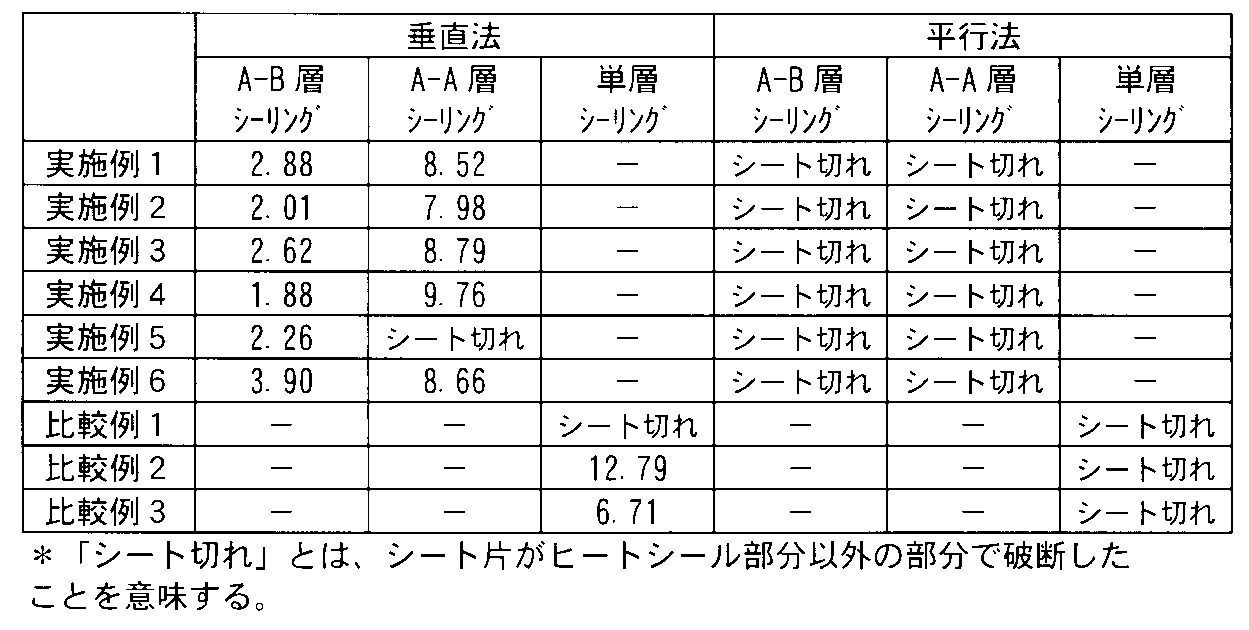
- a plurality of sheet pieces having a predetermined shape were cut out from the sheet of each example. Two sheet pieces are assembled into a set, and the A layer of one sheet piece and the B layer of the other sheet piece are superposed and heat sealed (AB layer sealing), and the A layer of two sheet pieces A heat seal (AA-layer sealing) was prepared by superimposing each other.
- the AB layer sealing corresponds to the heat-sealed portion of the casing manufactured by the above-described method II (either the A layer or the B layer may be inside).
- the AA layer sealing corresponds to the heat seal portion of the casing produced by Method I described above with the A layer of the sheet on the inside.
- each sheet of each comparative example has a single layer structure, two sheet pieces were laminated without distinction of the outer surface and the inner surface and heat sealed (single layer sealing).
- the heat sealing was performed along the paper making direction in the same manner as in the manufacture of the casing at a width of 15 mm under conditions of a temperature of 220 ° C., a sealing pressure of 3.5 kgf / cm 2 , and a sealing time of 0.5 seconds.
- the heat-sealed test piece was shaped into a rectangle with a length of 15 mm in the papermaking direction and a length of several centimeters in the direction perpendicular to the papermaking direction.
- the heat seal part was positioned at the center of the rectangle.
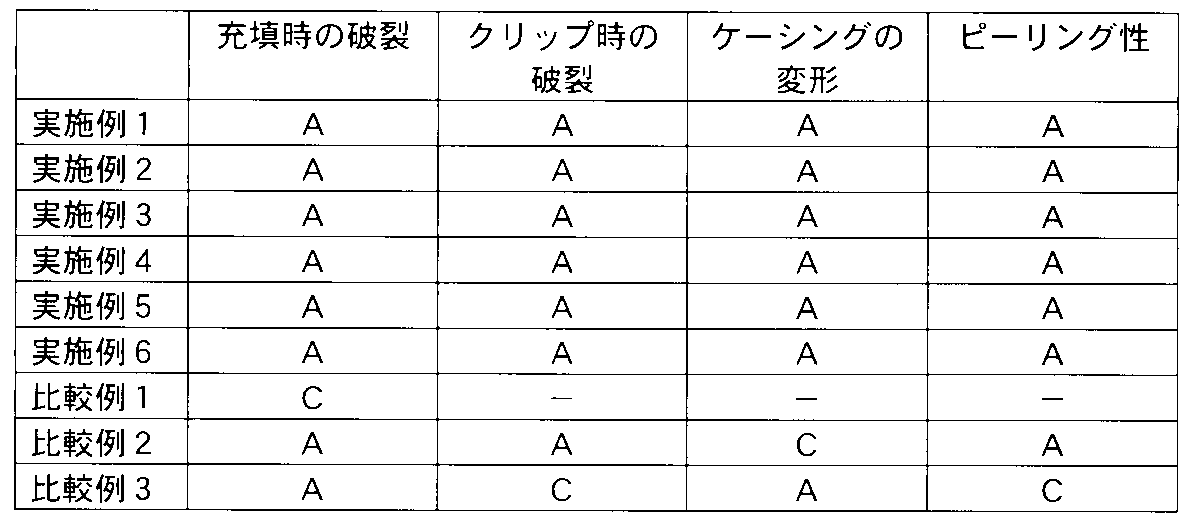
- ⁇ Meat filling test> After mounting the casing on the meat filling machine, the casing was filled with meat. A pickle solution and starch were mixed with pork and pork fat applied to a chopper to form a kneaded meat, which was used as meat. Kneaded meat was discharged from the discharge nozzle into the casing at a rate of 20 kg / min and filled to a total length of 1 m with a filling pressure of 5.0 kgf / cm 2 . The presence or absence of rupture of the casing during filling was evaluated by “A” or “C”. “A” represents that the casing did not rupture during filling, and “C” represents that the casing ruptured during filling.
- ⁇ Case deformation test> The meat-filled casing, clipped at both ends, was suspended in the vertical direction, heated for 60 minutes under the conditions of 75 ° C. and 99% humidity, and then dried for 40 minutes under the conditions of 65 ° C. and 15% humidity. After this drying step, the meat-filled casing was suspended and aged for 3 weeks under conditions of 16 ° C. and 85% humidity to complete salami.
- Comparative Example 3 the casing could be filled with meat, but the casing ruptured around the clip stop. For this reason, in Comparative Example 3, after meat filling, the clip was manually clipped using pliers, and this test was performed after confirming that the casing did not rupture around the clip stopper.
- the casings using the sheets of Examples 1 to 6 do not rupture even when the meat is filled with a filling pressure of 5.0 kgf / cm 2 , and does not rupture at the time of subsequent clip fastening. It was. Further, the casings of Examples 1 to 6 were hardly deformed even when suspended for a certain time due to salami processing, and were easily peeled off from meat. Therefore, it became clear that the sheets and casings of Examples 1 to 6 are suitable for high-pressure filling of meat. On the other hand, the casing of Comparative Example 1 burst during meat filling. The casing of Comparative Example 2 was deformed when suspended after meat filling. The casing of Comparative Example 3 was ruptured when clipped and was inferior in peelability. Therefore, it became clear that the sheets and casings of Comparative Examples 1 to 3 are not suitable for high-pressure filling of meat.
Landscapes
- Engineering & Computer Science (AREA)
- Textile Engineering (AREA)
- Life Sciences & Earth Sciences (AREA)
- Wood Science & Technology (AREA)
- Zoology (AREA)
- Food Science & Technology (AREA)
- Processing Of Meat And Fish (AREA)
- Wrappers (AREA)
- Laminated Bodies (AREA)
- Paper (AREA)
- Packging For Living Organisms, Food Or Medicinal Products That Are Sensitive To Environmental Conditiond (AREA)
- Meat, Egg Or Seafood Products (AREA)
Description
また、前記食肉包装用シートから形成された管状の食肉包装用ケーシングであって、A層が内側に配置された食肉包装用ケーシングが提供される。
本実施形態の食肉包装用シート(以下、単に「シート」という)は多層構造である。具体的には、シートは熱接着されたA層及びB層を有する。
すなわち、本発明において、シートの強靭性は引張強さ及び伸びを考慮して決定される。その理由は、食肉充填後のケーシングの変形(主としてシートの伸びが大きいことによる)は引張強さのみで評価することができず、また、食肉充填時やクリップ止め時のケーシングの破裂(主としてシートの引張強さが小さいことによる)は伸びのみで評価することができないためである。
A層とB層とを厚み方向に積層した後に加熱することによりシートを形成する。加熱は、例えば熱ローラを用いて行うことができる。A層及びB層を積層した状態で熱ローラに通すことにより、A層に含有されるポリエチレン及び低融点ポリエステル、ならびにB層に含有されるポリエチレンが溶融して各繊維同士が接着する。その結果、A層とB層とが接着され、一体化したシートが形成される。熱ローラは、表面温度140~190℃、線圧3~40kgf/cm、加工速度10~30m/分の範囲で運転されることが好ましい。また、A層及びB層のいずれの側を熱ローラと接触させてもよい。この熱加工により形成されたシートは、巻き取りローラに巻き取ってもよい。
製品の外観や風味を向上させるため、シートに着色料、フレーバー、香辛料等を付着させる付加加工を行ってもよい。この付加加工は、シートの形成後かつケーシングの形成前に行う。A層がケーシングの内面を形成する場合、すなわちA層を食肉と接触させる場合、A層の表面に色素やフレーバー等を付着させる。必要に応じてA層の表面に転写等の印刷加工を行ってもよい。ケーシングが無地である場合には、B層がケーシングの内面を形成してもよい。
シートは、続いて管状のケーシングに成形される。具体的には、抄紙方向に長尺なシートの長手方向に延びる両側部をヒートシーラーにより互いにシーリングし、連続した管状のケーシングを形成する。シーリングの具体例として、シートの両側部の内面同士を重ね合わせてシーリングを行う方法(方法I)と、シートの一方の側部の内面と他方の側部の外面とを重ね合わせてシーリングする方法(方法II)とがある。すなわち、方法Iでは、A層が内側にある場合にはA層同士をシーリングする。方法IIでは、A層とB層とをシーリングする。シーリングによって形成される接着部は連続していてもよいし、ドット状等の不連続な形態でもよい。接着部の幅方向の長さは、形成されるケーシングの直径等に応じて3~15mmの範囲で選択されることが好ましい。ヒートシーラーは、温度150~230℃、シール圧3.0~6.5kgf/cm2、シーリング時間0.3~0.6秒の範囲で運転されることが好ましい。
製造したケーシング内に食肉を充填し、ケーシングを封止する。一般的に、食肉の充填には食肉充填機を使用する。食肉充填機は、食肉を吐出する吐出ノズルが装着された充填管を備える。充填管にケーシングを被せた後、吐出ノズルから食肉を吐出し、ケーシングの内部に食肉を連続的に充填する。所定の充填圧に達するまでケーシングに食肉を充填した後、ケーシングの基端部を絞り、クリップで封止する。このとき、ケーシングの基端部の2箇所をクリップ止め(いわゆるダブルクリップ)することにより、食肉充填が完了したケーシングを密封し、同時に、次に食肉が充填されるケーシングの先端を封止することができる。
A層の繊維(a)、繊維(b)、及び繊維(c)として、ユニチカ製のメルティ(登録商標)6080(2.2dtx×5mm)、クラレ製のソフィット(登録商標)N720(2.2dtx×5mm)、及び帝人製のTA04PN(0.1dtx×3mm)をそれぞれ使用した。繊維(a):繊維(b):繊維(c)=30:65:5の質量比でこれらの繊維を混合し、円網抄紙機を用いて坪量21g/m2の湿式不織布を製造した。B層として、坪量20g/m2の不織布シート(ユニチカ製のエルベス(登録商標)T0203WDO)を用いた。
A層として、実施例1と同様の条件で坪量23g/m2の湿式不織布を製造した。B層として、坪量30g/m2の不織布シート(エルベス(登録商標)T0303WDO)を用いた。次に、A層とB層とを積層し、実施例1と同じ条件で熱ローラにより加熱した。これにより、坪量53g/m2のシートが形成された。
A層として、実施例1と同様の条件で坪量33g/m2の湿式不織布を製造した。B層として、坪量20g/m2の不織布シート(エルベス(登録商標)T0203WDO)を用いた。次に、A層とB層とを積層し、実施例1と同じ条件で熱ローラにより加熱した。これにより、坪量53g/m2のシートが形成された。
A層として、実施例1と同様の条件で坪量30g/m2の湿式不織布を製造した。B層として、坪量30g/m2の不織布シート(エルベス(登録商標)T0303WDO)を用いた。次に、A層とB層とを積層し、実施例1と同じ条件で熱ローラにより加熱した。これにより、坪量60g/m2のシートが形成された。
A層として、実施例1と同様の条件で坪量31g/m2の湿式不織布を製造した。B層として、坪量15g/m2の不織布シート(エルベス(登録商標)T0153WDO)を用いた。次に、A層とB層とを積層し、実施例1と同じ条件で熱ローラにより加熱した。これにより、坪量46g/m2のシートが形成された。
A層の繊維(a)、繊維(b)、及び繊維(c)として、ユニチカ製のメルティ(登録商標)6080(2.2dtx×5mm)、クラレ製のソフィット(登録商標)N720(2.2dtx×5mm)、及び帝人製のTA04PN(0.1dtx×3mm)をそれぞれ使用した。繊維(a):繊維(b):繊維(c)=45:50:5の質量比でこれらの繊維を混合し、円網抄紙機を用いて坪量19g/m2の湿式不織布を製造した。B層として、坪量30g/m2の不織布シート(ユニチカ製のエルベス(登録商標)T0303WDO)を用いた。
A層として、実施例1と同様の条件で坪量30g/m2の湿式不織布を製造した。このA層を単層のシートとして使用した。
坪量50g/m2の不織布シート(ユニチカ製のエルベス(登録商標)T0503WDO)を、B層のみからなる単層のシートとして使用した。
特許文献1に記載の実施例1と同等のシートを製造した。すなわち、針葉樹パルプSR20゜、クラレ製のソフィット(登録商標)N720(2.2dtx×10mm)、及びクラレ製のソフィット(登録商標)N721(1.7dtx×5mm)を10:25:65の質量比で混合し、円網抄紙機を用いて坪量56g/m2の湿式不織布を製造した。この湿式不織布を単層のシートとして使用した。

シートに対するヒートシールの強度試験を以下のように行った。
ヒートシールした2枚のシート片の同じ側の端部(例えば、一方のシート片の右側端部と他方のシート片の右側端部)をそれぞれチャックし、チャックした端部を徐々に離間させ、試験片が破断する時の荷重(N/15mm)を測定した。
ヒートシールした2枚のシート片の対向する側の端部(例えば、一方のシート片の右側端部と他方のシート片の左側端部)をそれぞれチャックし、チャックした端部を徐々に離間させ、試験片が破断する時の荷重(N/15mm)を測定した。
各実施例及び比較例のシートに135mm幅で抄紙方向の切込みを形成し、抄紙方向に長尺なシート片を得た。各実施例のシート片については、A層が内側になるように管状に巻き、上記方法IIにしたがって、一方の側部のA層と他方の側部のB層とを15mm重ね合わせた。西部機械製のHSP-400-SA型センタープレスシール製袋機に付属のヒートシールバーを使用し、10mm幅、温度180℃、シール圧6.0kgf/cm2、シーリング時間0.55秒の条件下、シーリングによって形成される接着部がドット状となるようにヒートシールした。このヒートシールにより、平面状態で60mm幅のケーシングを形成した。一方、比較例については、シートの外面及び内面を区別しなかったこと以外は上記実施例と同様にケーシングを形成した。
ケーシングを食肉充填機に装着した後、ケーシングへ食肉を充填した。チョッパーに掛けた豚肉及び豚脂にピックル液及び澱粉を混合して練り肉を形成し、これを食肉として使用した。吐出ノズルからケーシング内に20kg/分の速度で練り肉を吐出し、5.0kgf/cm2の充填圧で全長1mになるまで充填した。充填中のケーシングの破裂の有無を“A”又は“C”で評価した。“A”は充填中にケーシングが破裂しなかったことを表し、“C”は充填中にケーシングが破裂したことを表す。
ケーシングへの食肉充填後、ダブルクリッパー(Poly Clip社製FCA3430)を用いてケーシングの端部を絞り、クリップ(Poly Clip社製15-8 5×1.75)で封止した。クリップ止め時のケーシング内の圧力は6kgf/cm2であった。
両端をクリップ止めした食肉充填ケーシングを垂直方向に吊り下げ、75℃、湿度99%の条件下で60分間加熱し、続けて65℃、湿度15%の条件下で40分間乾燥させた。この乾燥工程の後、食肉充填ケーシングを吊り下げた状態のまま16℃、湿度85%の条件下で3週間熟成させ、サラミを完成させた。
完成したサラミからのケーシングの剥離容易性及び剥離したケーシングへの食肉の付着の程度を“A”、“B”又は“C”で評価した。“A”は食肉からケーシングが容易に剥離し、かつ剥離したケーシングに食肉が付着しなかったことを表し、“B”は食肉からケーシングが容易に剥離するが、剥離したケーシングに食肉が付着したことを表し、“C”は食肉からケーシングが剥離しにくかったことを表す。
Claims (6)
- A層とB層とを熱接着した食肉包装用シートであって、
A層は、(a)芯がポリエステルからなり、鞘がポリエチレンからなる第1芯鞘繊維、(b)芯がポリエステルからなり、鞘が低融点ポリエステルからなる第2芯鞘繊維、及び(c)極細ポリエステル繊維を混合して製造された湿式不織布であり、
B層は、芯がポリエステルからなり、鞘がポリエチレンからなる第3芯鞘繊維から形成されたスパンボンド不織布である
食肉包装用シート。 - 繊維(b)の低融点ポリエステルの融点が110℃以上140℃未満である請求項1に記載の食肉包装用シート。
- 繊維(c)の太さが0.11~0.55デシテックス(dtx)である請求項1又は2に記載の食肉包装用シート。
- 坪量が25~90g/m2である請求項1~3のいずれか一項に記載の食肉包装用シート。
- 下記式により求められる食肉包装用シートの強靭性の値が150以上400以下である請求項1~4のいずれか一項に記載の食肉包装用シート。
強靭性の値=|引張強さ(N/15mm)×伸び(%)/2| - 請求項1~5のいずれか一項に記載の食肉包装用シートから形成された管状の食肉包装用ケーシングであって、A層が内側に配置された食肉包装用ケーシング。
Priority Applications (3)
| Application Number | Priority Date | Filing Date | Title |
|---|---|---|---|
| CA2863202A CA2863202C (en) | 2012-06-05 | 2013-05-23 | Sheet for packaging edible meat, and casing for packaging edible meat |
| EP13800840.4A EP2856881B1 (en) | 2012-06-05 | 2013-05-23 | Sheet for packaging edible meat, and casing for packaging edible meat |
| US14/375,286 US9918483B2 (en) | 2012-06-05 | 2013-05-23 | Sheet for packaging edible meat, and casing for packaging edible meat |
Applications Claiming Priority (2)
| Application Number | Priority Date | Filing Date | Title |
|---|---|---|---|
| JP2012128189A JP6026783B2 (ja) | 2012-06-05 | 2012-06-05 | 食肉包装用シート及び食肉包装用ケーシング |
| JP2012-128189 | 2012-06-05 |
Publications (1)
| Publication Number | Publication Date |
|---|---|
| WO2013183456A1 true WO2013183456A1 (ja) | 2013-12-12 |
Family
ID=49711854
Family Applications (1)
| Application Number | Title | Priority Date | Filing Date |
|---|---|---|---|
| PCT/JP2013/064390 Ceased WO2013183456A1 (ja) | 2012-06-05 | 2013-05-23 | 食肉包装用シート及び食肉包装用ケーシング |
Country Status (5)
| Country | Link |
|---|---|
| US (1) | US9918483B2 (ja) |
| EP (1) | EP2856881B1 (ja) |
| JP (1) | JP6026783B2 (ja) |
| CA (1) | CA2863202C (ja) |
| WO (1) | WO2013183456A1 (ja) |
Cited By (1)
| Publication number | Priority date | Publication date | Assignee | Title |
|---|---|---|---|---|
| JP2015077095A (ja) * | 2013-10-16 | 2015-04-23 | Oci株式会社 | 食肉包装用ケーシング及び食肉包装用ケーシングの製造方法 |
Families Citing this family (1)
| Publication number | Priority date | Publication date | Assignee | Title |
|---|---|---|---|---|
| WO2023036625A1 (en) * | 2021-09-07 | 2023-03-16 | Low & Bonar B.V. | Material for a primary carpet backing |
Citations (6)
| Publication number | Priority date | Publication date | Assignee | Title |
|---|---|---|---|---|
| JPH04253653A (ja) * | 1990-12-28 | 1992-09-09 | Unitika Ltd | ハム・ソーセージケーシング用包装材 |
| JPH06153772A (ja) * | 1992-11-18 | 1994-06-03 | Kuraray Co Ltd | 食肉用ケーシング |
| JPH06312494A (ja) * | 1993-04-30 | 1994-11-08 | Towa Kako Kk | ハム、ソーセージまたは魚肉練製品等の包装材ならびにその製造法 |
| JPH1018183A (ja) * | 1996-07-02 | 1998-01-20 | Teijin Ltd | 不織布積層体 |
| JP3142677B2 (ja) | 1993-02-19 | 2001-03-07 | 大福製紙株式会社 | ヒートシール性ケーシング及びケーシング用紙 |
| JP2003237826A (ja) * | 2002-02-19 | 2003-08-27 | Asahi Kasei Corp | 練り製品用包装材および製造方法 |
Family Cites Families (16)
| Publication number | Priority date | Publication date | Assignee | Title |
|---|---|---|---|---|
| JPS5665879U (ja) * | 1979-10-29 | 1981-06-02 | ||
| US4292360A (en) * | 1980-03-05 | 1981-09-29 | Minnesota Mining And Manufacturing Company | Pressure sensitive adhesive tape |
| EP0043555A1 (en) * | 1980-07-07 | 1982-01-13 | Teijin Limited | Paper-like polyester fiber sheet and process for producing the same |
| DK245488D0 (da) * | 1988-05-05 | 1988-05-05 | Danaklon As | Syntetisk fiber samt fremgangsmaade til fremstilling deraf |
| US5167764A (en) * | 1990-07-02 | 1992-12-01 | Hoechst Celanese Corporation | Wet laid bonded fibrous web |
| JP2636972B2 (ja) * | 1990-12-28 | 1997-08-06 | ユニチカ株式会社 | ハム・ソーセージケーシング用包装材 |
| US5393599A (en) * | 1992-01-24 | 1995-02-28 | Fiberweb North America, Inc. | Composite nonwoven fabrics |
| US5631073A (en) * | 1992-02-03 | 1997-05-20 | Minnesota Mining And Manufacturing Company | Nonwoven sheet materials, tapes and methods |
| US5269994A (en) * | 1992-04-10 | 1993-12-14 | Basf Corporation | Nonwoven bonding technique |
| US20060252332A9 (en) * | 1998-09-14 | 2006-11-09 | Ortega Albert E | Nonwoven fabrics with two or more filament cross sections |
| US6368609B1 (en) * | 1999-04-12 | 2002-04-09 | Kimberly-Clark Worldwide, Inc. | Absorbent structure including a thin, calendered airlaid composite and a process for making the composite |
| US6383958B1 (en) * | 1999-06-18 | 2002-05-07 | David P. Swanson | Nonwoven sheets, adhesive articles, and methods for making the same |
| DE102004022974A1 (de) * | 2004-05-10 | 2005-12-08 | Kalle Gmbh | Nahrungsmittelhülle auf Cellulosebasis mit imprägnierter Fasermaterialverstärkung |
| CN101310063A (zh) | 2005-11-15 | 2008-11-19 | 金星制纸株式会社 | 食品提取用气流铺置片材 |
| US9056697B2 (en) * | 2008-12-15 | 2015-06-16 | Exopack, Llc | Multi-layered bags and methods of manufacturing the same |
| JP5888812B2 (ja) * | 2012-04-13 | 2016-03-22 | ユニチカ株式会社 | 積層不織布 |
-
2012
- 2012-06-05 JP JP2012128189A patent/JP6026783B2/ja active Active
-
2013
- 2013-05-23 CA CA2863202A patent/CA2863202C/en active Active
- 2013-05-23 EP EP13800840.4A patent/EP2856881B1/en not_active Not-in-force
- 2013-05-23 US US14/375,286 patent/US9918483B2/en not_active Expired - Fee Related
- 2013-05-23 WO PCT/JP2013/064390 patent/WO2013183456A1/ja not_active Ceased
Patent Citations (6)
| Publication number | Priority date | Publication date | Assignee | Title |
|---|---|---|---|---|
| JPH04253653A (ja) * | 1990-12-28 | 1992-09-09 | Unitika Ltd | ハム・ソーセージケーシング用包装材 |
| JPH06153772A (ja) * | 1992-11-18 | 1994-06-03 | Kuraray Co Ltd | 食肉用ケーシング |
| JP3142677B2 (ja) | 1993-02-19 | 2001-03-07 | 大福製紙株式会社 | ヒートシール性ケーシング及びケーシング用紙 |
| JPH06312494A (ja) * | 1993-04-30 | 1994-11-08 | Towa Kako Kk | ハム、ソーセージまたは魚肉練製品等の包装材ならびにその製造法 |
| JPH1018183A (ja) * | 1996-07-02 | 1998-01-20 | Teijin Ltd | 不織布積層体 |
| JP2003237826A (ja) * | 2002-02-19 | 2003-08-27 | Asahi Kasei Corp | 練り製品用包装材および製造方法 |
Non-Patent Citations (1)
| Title |
|---|
| See also references of EP2856881A4 * |
Cited By (1)
| Publication number | Priority date | Publication date | Assignee | Title |
|---|---|---|---|---|
| JP2015077095A (ja) * | 2013-10-16 | 2015-04-23 | Oci株式会社 | 食肉包装用ケーシング及び食肉包装用ケーシングの製造方法 |
Also Published As
| Publication number | Publication date |
|---|---|
| EP2856881A1 (en) | 2015-04-08 |
| JP6026783B2 (ja) | 2016-11-16 |
| EP2856881A4 (en) | 2016-03-16 |
| US9918483B2 (en) | 2018-03-20 |
| EP2856881B1 (en) | 2017-07-12 |
| JP2013252072A (ja) | 2013-12-19 |
| CA2863202A1 (en) | 2013-12-12 |
| CA2863202C (en) | 2016-04-26 |
| US20150004386A1 (en) | 2015-01-01 |
Similar Documents
| Publication | Publication Date | Title |
|---|---|---|
| TWI757236B (zh) | 紙巾、紙張、餐巾及抹布產品 | |
| CN103507373B (zh) | 具有粘附其上的可收缩薄膜的纸板坯件与由此制成的纸板容器 | |
| JP2004503688A (ja) | スパンボンデッド熱シール材 | |
| WO2013183456A1 (ja) | 食肉包装用シート及び食肉包装用ケーシング | |
| JP3295488B2 (ja) | ハム、ソーセージまたは魚肉練製品等の包装材ならびにその製造法 | |
| JP4468622B2 (ja) | 練り製品用包装材および製造方法 | |
| CN104837755B (zh) | 易移除纸管、使用该纸管的制品和连续使用该制品的方法 | |
| JP6091307B2 (ja) | 食品用ネット付ケーシング、及び食品用ネット付ケーシングの製造方法 | |
| JP6185362B2 (ja) | 食肉包装用ケーシング及び食肉包装用ケーシングの製造方法 | |
| JP2829181B2 (ja) | 通気性撥油紙及びその製造方法 | |
| US10316445B2 (en) | Extensible non-woven, method for producing an extensible non-woven and use of same | |
| JP2002225919A (ja) | 食品用包装被覆体及びその製造方法 | |
| US20040219264A1 (en) | Packaging wrap | |
| JP4238477B2 (ja) | 生分解性スモーカブルケーシング、及び食品のくん煙処理方法 | |
| JPH06153772A (ja) | 食肉用ケーシング | |
| JPH04253653A (ja) | ハム・ソーセージケーシング用包装材 | |
| JP5936420B2 (ja) | 燻製シート | |
| US20020081355A1 (en) | Packaging wrap for meat products | |
| JP6410894B2 (ja) | 食品用ネット付ケーシング | |
| JPH04253654A (ja) | ハム・ソーセージケーシング用包装材 | |
| JP6273325B2 (ja) | 食品用ネット付ケーシング | |
| JP6664667B2 (ja) | ヒートシール性帯封シート | |
| JP4694329B2 (ja) | 調理用成型容器及びその製造方法 | |
| PL234233B1 (pl) | Elastyczny arkusz opakowaniowy i sposób jego wytwarzania oraz osłonka do produktów spożywczych wytworzona z takiego arkusza | |
| JP2016068958A (ja) | ヒートシール用フィルターバック用紙 |
Legal Events
| Date | Code | Title | Description |
|---|---|---|---|
| 121 | Ep: the epo has been informed by wipo that ep was designated in this application |
Ref document number: 13800840 Country of ref document: EP Kind code of ref document: A1 |
|
| ENP | Entry into the national phase |
Ref document number: 2863202 Country of ref document: CA |
|
| REEP | Request for entry into the european phase |
Ref document number: 2013800840 Country of ref document: EP |
|
| WWE | Wipo information: entry into national phase |
Ref document number: 2013800840 Country of ref document: EP |
|
| WWE | Wipo information: entry into national phase |
Ref document number: 14375286 Country of ref document: US |
|
| NENP | Non-entry into the national phase |
Ref country code: DE |