WO2013187303A1 - 樹脂組成物、プリプレグ、金属箔張積層板及びプリント配線板 - Google Patents
樹脂組成物、プリプレグ、金属箔張積層板及びプリント配線板 Download PDFInfo
- Publication number
- WO2013187303A1 WO2013187303A1 PCT/JP2013/065678 JP2013065678W WO2013187303A1 WO 2013187303 A1 WO2013187303 A1 WO 2013187303A1 JP 2013065678 W JP2013065678 W JP 2013065678W WO 2013187303 A1 WO2013187303 A1 WO 2013187303A1
- Authority
- WO
- WIPO (PCT)
- Prior art keywords
- resin composition
- mass
- parts
- composition according
- epoxy resin
- Prior art date
- Legal status (The legal status is an assumption and is not a legal conclusion. Google has not performed a legal analysis and makes no representation as to the accuracy of the status listed.)
- Ceased
Links
Classifications
-
- H—ELECTRICITY
- H05—ELECTRIC TECHNIQUES NOT OTHERWISE PROVIDED FOR
- H05K—PRINTED CIRCUITS; CASINGS OR CONSTRUCTIONAL DETAILS OF ELECTRIC APPARATUS; MANUFACTURE OF ASSEMBLAGES OF ELECTRICAL COMPONENTS
- H05K1/00—Printed circuits
- H05K1/02—Details
- H05K1/03—Use of materials for the substrate
- H05K1/0313—Organic insulating material
- H05K1/0353—Organic insulating material consisting of two or more materials, e.g. two or more polymers, polymer + filler, + reinforcement
- H05K1/0366—Organic insulating material consisting of two or more materials, e.g. two or more polymers, polymer + filler, + reinforcement reinforced, e.g. by fibres, fabrics
-
- B—PERFORMING OPERATIONS; TRANSPORTING
- B32—LAYERED PRODUCTS
- B32B—LAYERED PRODUCTS, i.e. PRODUCTS BUILT-UP OF STRATA OF FLAT OR NON-FLAT, e.g. CELLULAR OR HONEYCOMB, FORM
- B32B15/00—Layered products comprising a layer of metal
- B32B15/14—Layered products comprising a layer of metal next to a fibrous or filamentary layer
-
- B—PERFORMING OPERATIONS; TRANSPORTING
- B32—LAYERED PRODUCTS
- B32B—LAYERED PRODUCTS, i.e. PRODUCTS BUILT-UP OF STRATA OF FLAT OR NON-FLAT, e.g. CELLULAR OR HONEYCOMB, FORM
- B32B15/00—Layered products comprising a layer of metal
- B32B15/20—Layered products comprising a layer of metal comprising aluminium or copper
-
- B—PERFORMING OPERATIONS; TRANSPORTING
- B32—LAYERED PRODUCTS
- B32B—LAYERED PRODUCTS, i.e. PRODUCTS BUILT-UP OF STRATA OF FLAT OR NON-FLAT, e.g. CELLULAR OR HONEYCOMB, FORM
- B32B5/00—Layered products characterised by the non- homogeneity or physical structure, i.e. comprising a fibrous, filamentary, particulate or foam layer; Layered products characterised by having a layer differing constitutionally or physically in different parts
- B32B5/02—Layered products characterised by the non- homogeneity or physical structure, i.e. comprising a fibrous, filamentary, particulate or foam layer; Layered products characterised by having a layer differing constitutionally or physically in different parts characterised by structural features of a fibrous or filamentary layer
- B32B5/022—Non-woven fabric
-
- B—PERFORMING OPERATIONS; TRANSPORTING
- B32—LAYERED PRODUCTS
- B32B—LAYERED PRODUCTS, i.e. PRODUCTS BUILT-UP OF STRATA OF FLAT OR NON-FLAT, e.g. CELLULAR OR HONEYCOMB, FORM
- B32B5/00—Layered products characterised by the non- homogeneity or physical structure, i.e. comprising a fibrous, filamentary, particulate or foam layer; Layered products characterised by having a layer differing constitutionally or physically in different parts
- B32B5/02—Layered products characterised by the non- homogeneity or physical structure, i.e. comprising a fibrous, filamentary, particulate or foam layer; Layered products characterised by having a layer differing constitutionally or physically in different parts characterised by structural features of a fibrous or filamentary layer
- B32B5/024—Woven fabric
-
- C—CHEMISTRY; METALLURGY
- C08—ORGANIC MACROMOLECULAR COMPOUNDS; THEIR PREPARATION OR CHEMICAL WORKING-UP; COMPOSITIONS BASED THEREON
- C08G—MACROMOLECULAR COMPOUNDS OBTAINED OTHERWISE THAN BY REACTIONS ONLY INVOLVING UNSATURATED CARBON-TO-CARBON BONDS
- C08G59/00—Polycondensates containing more than one epoxy group per molecule; Macromolecules obtained by polymerising compounds containing more than one epoxy group per molecule using curing agents or catalysts which react with the epoxy groups
- C08G59/18—Macromolecules obtained by polymerising compounds containing more than one epoxy group per molecule using curing agents or catalysts which react with the epoxy groups ; e.g. general methods of curing
- C08G59/40—Macromolecules obtained by polymerising compounds containing more than one epoxy group per molecule using curing agents or catalysts which react with the epoxy groups ; e.g. general methods of curing characterised by the curing agents used
- C08G59/4007—Curing agents not provided for by the groups C08G59/42 - C08G59/66
- C08G59/4014—Nitrogen containing compounds
-
- C—CHEMISTRY; METALLURGY
- C08—ORGANIC MACROMOLECULAR COMPOUNDS; THEIR PREPARATION OR CHEMICAL WORKING-UP; COMPOSITIONS BASED THEREON
- C08J—WORKING-UP; GENERAL PROCESSES OF COMPOUNDING; AFTER-TREATMENT NOT COVERED BY SUBCLASSES C08B, C08C, C08F, C08G or C08H
- C08J5/00—Manufacture of articles or shaped materials containing macromolecular substances
- C08J5/24—Impregnating materials with prepolymers which can be polymerised in situ, e.g. manufacture of prepregs
- C08J5/241—Impregnating materials with prepolymers which can be polymerised in situ, e.g. manufacture of prepregs using inorganic fibres
- C08J5/244—Impregnating materials with prepolymers which can be polymerised in situ, e.g. manufacture of prepregs using inorganic fibres using glass fibres
-
- C—CHEMISTRY; METALLURGY
- C08—ORGANIC MACROMOLECULAR COMPOUNDS; THEIR PREPARATION OR CHEMICAL WORKING-UP; COMPOSITIONS BASED THEREON
- C08J—WORKING-UP; GENERAL PROCESSES OF COMPOUNDING; AFTER-TREATMENT NOT COVERED BY SUBCLASSES C08B, C08C, C08F, C08G or C08H
- C08J5/00—Manufacture of articles or shaped materials containing macromolecular substances
- C08J5/24—Impregnating materials with prepolymers which can be polymerised in situ, e.g. manufacture of prepregs
- C08J5/249—Impregnating materials with prepolymers which can be polymerised in situ, e.g. manufacture of prepregs characterised by the additives used in the prepolymer mixture
-
- C—CHEMISTRY; METALLURGY
- C08—ORGANIC MACROMOLECULAR COMPOUNDS; THEIR PREPARATION OR CHEMICAL WORKING-UP; COMPOSITIONS BASED THEREON
- C08K—Use of inorganic or non-macromolecular organic substances as compounding ingredients
- C08K3/00—Use of inorganic substances as compounding ingredients
- C08K3/01—Use of inorganic substances as compounding ingredients characterized by their specific function
- C08K3/013—Fillers, pigments or reinforcing additives
-
- C—CHEMISTRY; METALLURGY
- C08—ORGANIC MACROMOLECULAR COMPOUNDS; THEIR PREPARATION OR CHEMICAL WORKING-UP; COMPOSITIONS BASED THEREON
- C08K—Use of inorganic or non-macromolecular organic substances as compounding ingredients
- C08K9/00—Use of pretreated ingredients
- C08K9/02—Ingredients treated with inorganic substances
-
- C—CHEMISTRY; METALLURGY
- C08—ORGANIC MACROMOLECULAR COMPOUNDS; THEIR PREPARATION OR CHEMICAL WORKING-UP; COMPOSITIONS BASED THEREON
- C08L—COMPOSITIONS OF MACROMOLECULAR COMPOUNDS
- C08L63/00—Compositions of epoxy resins; Compositions of derivatives of epoxy resins
-
- H—ELECTRICITY
- H05—ELECTRIC TECHNIQUES NOT OTHERWISE PROVIDED FOR
- H05K—PRINTED CIRCUITS; CASINGS OR CONSTRUCTIONAL DETAILS OF ELECTRIC APPARATUS; MANUFACTURE OF ASSEMBLAGES OF ELECTRICAL COMPONENTS
- H05K1/00—Printed circuits
- H05K1/02—Details
- H05K1/03—Use of materials for the substrate
- H05K1/0313—Organic insulating material
- H05K1/0353—Organic insulating material consisting of two or more materials, e.g. two or more polymers, polymer + filler, + reinforcement
- H05K1/0373—Organic insulating material consisting of two or more materials, e.g. two or more polymers, polymer + filler, + reinforcement containing additives, e.g. fillers
-
- H—ELECTRICITY
- H05—ELECTRIC TECHNIQUES NOT OTHERWISE PROVIDED FOR
- H05K—PRINTED CIRCUITS; CASINGS OR CONSTRUCTIONAL DETAILS OF ELECTRIC APPARATUS; MANUFACTURE OF ASSEMBLAGES OF ELECTRICAL COMPONENTS
- H05K1/00—Printed circuits
- H05K1/02—Details
- H05K1/03—Use of materials for the substrate
- H05K1/05—Insulated conductive substrates, e.g. insulated metal substrate
- H05K1/056—Insulated conductive substrates, e.g. insulated metal substrate the metal substrate being covered by an organic insulating layer
-
- B—PERFORMING OPERATIONS; TRANSPORTING
- B32—LAYERED PRODUCTS
- B32B—LAYERED PRODUCTS, i.e. PRODUCTS BUILT-UP OF STRATA OF FLAT OR NON-FLAT, e.g. CELLULAR OR HONEYCOMB, FORM
- B32B2260/00—Layered product comprising an impregnated, embedded, or bonded layer wherein the layer comprises an impregnation, embedding, or binder material
- B32B2260/02—Composition of the impregnated, bonded or embedded layer
- B32B2260/021—Fibrous or filamentary layer
-
- B—PERFORMING OPERATIONS; TRANSPORTING
- B32—LAYERED PRODUCTS
- B32B—LAYERED PRODUCTS, i.e. PRODUCTS BUILT-UP OF STRATA OF FLAT OR NON-FLAT, e.g. CELLULAR OR HONEYCOMB, FORM
- B32B2260/00—Layered product comprising an impregnated, embedded, or bonded layer wherein the layer comprises an impregnation, embedding, or binder material
- B32B2260/04—Impregnation, embedding, or binder material
- B32B2260/046—Synthetic resin
-
- B—PERFORMING OPERATIONS; TRANSPORTING
- B32—LAYERED PRODUCTS
- B32B—LAYERED PRODUCTS, i.e. PRODUCTS BUILT-UP OF STRATA OF FLAT OR NON-FLAT, e.g. CELLULAR OR HONEYCOMB, FORM
- B32B2262/00—Composition or structural features of fibres which form a fibrous or filamentary layer or are present as additives
- B32B2262/10—Inorganic fibres
- B32B2262/101—Glass fibres
-
- B—PERFORMING OPERATIONS; TRANSPORTING
- B32—LAYERED PRODUCTS
- B32B—LAYERED PRODUCTS, i.e. PRODUCTS BUILT-UP OF STRATA OF FLAT OR NON-FLAT, e.g. CELLULAR OR HONEYCOMB, FORM
- B32B2307/00—Properties of the layers or laminate
- B32B2307/30—Properties of the layers or laminate having particular thermal properties
- B32B2307/304—Insulating
-
- B—PERFORMING OPERATIONS; TRANSPORTING
- B32—LAYERED PRODUCTS
- B32B—LAYERED PRODUCTS, i.e. PRODUCTS BUILT-UP OF STRATA OF FLAT OR NON-FLAT, e.g. CELLULAR OR HONEYCOMB, FORM
- B32B2307/00—Properties of the layers or laminate
- B32B2307/30—Properties of the layers or laminate having particular thermal properties
- B32B2307/306—Resistant to heat
-
- B—PERFORMING OPERATIONS; TRANSPORTING
- B32—LAYERED PRODUCTS
- B32B—LAYERED PRODUCTS, i.e. PRODUCTS BUILT-UP OF STRATA OF FLAT OR NON-FLAT, e.g. CELLULAR OR HONEYCOMB, FORM
- B32B2307/00—Properties of the layers or laminate
- B32B2307/50—Properties of the layers or laminate having particular mechanical properties
- B32B2307/582—Tearability
- B32B2307/5825—Tear resistant
-
- B—PERFORMING OPERATIONS; TRANSPORTING
- B32—LAYERED PRODUCTS
- B32B—LAYERED PRODUCTS, i.e. PRODUCTS BUILT-UP OF STRATA OF FLAT OR NON-FLAT, e.g. CELLULAR OR HONEYCOMB, FORM
- B32B2307/00—Properties of the layers or laminate
- B32B2307/70—Other properties
- B32B2307/726—Permeability to liquids, absorption
-
- B—PERFORMING OPERATIONS; TRANSPORTING
- B32—LAYERED PRODUCTS
- B32B—LAYERED PRODUCTS, i.e. PRODUCTS BUILT-UP OF STRATA OF FLAT OR NON-FLAT, e.g. CELLULAR OR HONEYCOMB, FORM
- B32B2457/00—Electrical equipment
- B32B2457/08—PCBs, i.e. printed circuit boards
-
- C—CHEMISTRY; METALLURGY
- C08—ORGANIC MACROMOLECULAR COMPOUNDS; THEIR PREPARATION OR CHEMICAL WORKING-UP; COMPOSITIONS BASED THEREON
- C08J—WORKING-UP; GENERAL PROCESSES OF COMPOUNDING; AFTER-TREATMENT NOT COVERED BY SUBCLASSES C08B, C08C, C08F, C08G or C08H
- C08J2363/00—Characterised by the use of epoxy resins; Derivatives of epoxy resins
- C08J2363/02—Polyglycidyl ethers of bis-phenols
-
- C—CHEMISTRY; METALLURGY
- C08—ORGANIC MACROMOLECULAR COMPOUNDS; THEIR PREPARATION OR CHEMICAL WORKING-UP; COMPOSITIONS BASED THEREON
- C08J—WORKING-UP; GENERAL PROCESSES OF COMPOUNDING; AFTER-TREATMENT NOT COVERED BY SUBCLASSES C08B, C08C, C08F, C08G or C08H
- C08J2363/00—Characterised by the use of epoxy resins; Derivatives of epoxy resins
- C08J2363/04—Epoxynovolacs
-
- C—CHEMISTRY; METALLURGY
- C08—ORGANIC MACROMOLECULAR COMPOUNDS; THEIR PREPARATION OR CHEMICAL WORKING-UP; COMPOSITIONS BASED THEREON
- C08K—Use of inorganic or non-macromolecular organic substances as compounding ingredients
- C08K3/00—Use of inorganic substances as compounding ingredients
- C08K3/10—Metal compounds
- C08K3/14—Carbides
-
- H—ELECTRICITY
- H05—ELECTRIC TECHNIQUES NOT OTHERWISE PROVIDED FOR
- H05K—PRINTED CIRCUITS; CASINGS OR CONSTRUCTIONAL DETAILS OF ELECTRIC APPARATUS; MANUFACTURE OF ASSEMBLAGES OF ELECTRICAL COMPONENTS
- H05K1/00—Printed circuits
- H05K1/02—Details
- H05K1/03—Use of materials for the substrate
- H05K1/0313—Organic insulating material
- H05K1/0353—Organic insulating material consisting of two or more materials, e.g. two or more polymers, polymer + filler, + reinforcement
-
- H—ELECTRICITY
- H05—ELECTRIC TECHNIQUES NOT OTHERWISE PROVIDED FOR
- H05K—PRINTED CIRCUITS; CASINGS OR CONSTRUCTIONAL DETAILS OF ELECTRIC APPARATUS; MANUFACTURE OF ASSEMBLAGES OF ELECTRICAL COMPONENTS
- H05K2201/00—Indexing scheme relating to printed circuits covered by H05K1/00
- H05K2201/02—Fillers; Particles; Fibers; Reinforcement materials
- H05K2201/0203—Fillers and particles
- H05K2201/0206—Materials
- H05K2201/0209—Inorganic, non-metallic particles
-
- H—ELECTRICITY
- H05—ELECTRIC TECHNIQUES NOT OTHERWISE PROVIDED FOR
- H05K—PRINTED CIRCUITS; CASINGS OR CONSTRUCTIONAL DETAILS OF ELECTRIC APPARATUS; MANUFACTURE OF ASSEMBLAGES OF ELECTRICAL COMPONENTS
- H05K2201/00—Indexing scheme relating to printed circuits covered by H05K1/00
- H05K2201/02—Fillers; Particles; Fibers; Reinforcement materials
- H05K2201/0203—Fillers and particles
- H05K2201/0206—Materials
- H05K2201/0224—Conductive particles having an insulating coating
-
- H—ELECTRICITY
- H05—ELECTRIC TECHNIQUES NOT OTHERWISE PROVIDED FOR
- H05K—PRINTED CIRCUITS; CASINGS OR CONSTRUCTIONAL DETAILS OF ELECTRIC APPARATUS; MANUFACTURE OF ASSEMBLAGES OF ELECTRICAL COMPONENTS
- H05K2201/00—Indexing scheme relating to printed circuits covered by H05K1/00
- H05K2201/02—Fillers; Particles; Fibers; Reinforcement materials
- H05K2201/0203—Fillers and particles
- H05K2201/0206—Materials
- H05K2201/0227—Insulating particles having an insulating coating
-
- Y—GENERAL TAGGING OF NEW TECHNOLOGICAL DEVELOPMENTS; GENERAL TAGGING OF CROSS-SECTIONAL TECHNOLOGIES SPANNING OVER SEVERAL SECTIONS OF THE IPC; TECHNICAL SUBJECTS COVERED BY FORMER USPC CROSS-REFERENCE ART COLLECTIONS [XRACs] AND DIGESTS
- Y10—TECHNICAL SUBJECTS COVERED BY FORMER USPC
- Y10T—TECHNICAL SUBJECTS COVERED BY FORMER US CLASSIFICATION
- Y10T428/00—Stock material or miscellaneous articles
- Y10T428/24—Structurally defined web or sheet [e.g., overall dimension, etc.]
- Y10T428/24802—Discontinuous or differential coating, impregnation or bond [e.g., artwork, printing, retouched photograph, etc.]
- Y10T428/24893—Discontinuous or differential coating, impregnation or bond [e.g., artwork, printing, retouched photograph, etc.] including particulate material
-
- Y—GENERAL TAGGING OF NEW TECHNOLOGICAL DEVELOPMENTS; GENERAL TAGGING OF CROSS-SECTIONAL TECHNOLOGIES SPANNING OVER SEVERAL SECTIONS OF THE IPC; TECHNICAL SUBJECTS COVERED BY FORMER USPC CROSS-REFERENCE ART COLLECTIONS [XRACs] AND DIGESTS
- Y10—TECHNICAL SUBJECTS COVERED BY FORMER USPC
- Y10T—TECHNICAL SUBJECTS COVERED BY FORMER US CLASSIFICATION
- Y10T442/00—Fabric [woven, knitted, or nonwoven textile or cloth, etc.]
- Y10T442/20—Coated or impregnated woven, knit, or nonwoven fabric which is not [a] associated with another preformed layer or fiber layer or, [b] with respect to woven and knit, characterized, respectively, by a particular or differential weave or knit, wherein the coating or impregnation is neither a foamed material nor a free metal or alloy layer
- Y10T442/2631—Coating or impregnation provides heat or fire protection
- Y10T442/2721—Nitrogen containing
-
- Y—GENERAL TAGGING OF NEW TECHNOLOGICAL DEVELOPMENTS; GENERAL TAGGING OF CROSS-SECTIONAL TECHNOLOGIES SPANNING OVER SEVERAL SECTIONS OF THE IPC; TECHNICAL SUBJECTS COVERED BY FORMER USPC CROSS-REFERENCE ART COLLECTIONS [XRACs] AND DIGESTS
- Y10—TECHNICAL SUBJECTS COVERED BY FORMER USPC
- Y10T—TECHNICAL SUBJECTS COVERED BY FORMER US CLASSIFICATION
- Y10T442/00—Fabric [woven, knitted, or nonwoven textile or cloth, etc.]
- Y10T442/30—Woven fabric [i.e., woven strand or strip material]
- Y10T442/3382—Including a free metal or alloy constituent
- Y10T442/3415—Preformed metallic film or foil or sheet [film or foil or sheet had structural integrity prior to association with the woven fabric]
- Y10T442/3423—Plural metallic films or foils or sheets
-
- Y—GENERAL TAGGING OF NEW TECHNOLOGICAL DEVELOPMENTS; GENERAL TAGGING OF CROSS-SECTIONAL TECHNOLOGIES SPANNING OVER SEVERAL SECTIONS OF THE IPC; TECHNICAL SUBJECTS COVERED BY FORMER USPC CROSS-REFERENCE ART COLLECTIONS [XRACs] AND DIGESTS
- Y10—TECHNICAL SUBJECTS COVERED BY FORMER USPC
- Y10T—TECHNICAL SUBJECTS COVERED BY FORMER US CLASSIFICATION
- Y10T442/00—Fabric [woven, knitted, or nonwoven textile or cloth, etc.]
- Y10T442/60—Nonwoven fabric [i.e., nonwoven strand or fiber material]
- Y10T442/654—Including a free metal or alloy constituent
- Y10T442/656—Preformed metallic film or foil or sheet [film or foil or sheet had structural integrity prior to association with the nonwoven fabric]
Definitions
- the present invention relates to a resin composition, a prepreg, a metal foil-clad laminate, and a printed wiring board, and more particularly to a resin composition that can be suitably used as a prepreg for a printed wiring board.
- cyanate ester resins are known as resins for printed wiring boards having excellent heat resistance.
- resin compositions for highly functional printed wiring boards such as semiconductor plastic packages
- resin compositions in which bisphenol A type cyanate ester resin is mixed with other thermosetting resins or thermoplastic resins are widely used.
- this bisphenol A type cyanate ester resin has excellent properties such as electrical properties, mechanical properties, chemical resistance, and adhesiveness, it is considered insufficient in water absorption and moisture absorption heat resistance under severe conditions. There was a case. Therefore, the development of cyanate ester resins having other structures has been promoted with the aim of further improving the characteristics.
- a laminated board having high heat resistance, low water absorption, and high thermal conductivity is desired.
- a flame-retardant resin composition for halogen-free laminates with improved curability, water absorption, moisture absorption heat resistance, and insulation reliability a cyanate ester resin (A) having a specific structure and a non-halogen epoxy resin A resin composition containing (B) and an inorganic filler (C) as essential components has been proposed (see Patent Document 1).
- the flame retardant resin composition described in Patent Document 1 has insufficient heat dissipation.
- the water absorption rate of the electrically insulating resin composition of the electrically insulating resin composition described in Patent Document 2 increases due to high blending of the inorganic filler, it is possible to achieve both high heat dissipation and low water absorption. It was difficult.
- the present invention has been made in view of the above problems, and its purpose is to provide a resin composition capable of realizing a printed wiring board having excellent heat dissipation, water absorption, copper foil peel strength and moisture absorption heat resistance, and the like. It is to provide a prepreg, a laminate, a metal foil-clad laminate, a printed wiring board and the like using the above.
- the present inventors have at least an inorganic filler in which at least a part of the surface of the epoxy resin, cyanate ester compound, and silicon carbide powder is treated with an inorganic oxide.
- the knowledge that a metal foil-clad laminate such as a printed wiring board capable of solving the above problems can be obtained by using the resin composition contained has been obtained, and the present invention has been completed. That is, the present invention provides the following ⁇ 1> to ⁇ 21>.
- An epoxy resin (A), a cyanate ester compound (B), and an inorganic filler (C) are contained at least, and the inorganic filler (C) is an inorganic oxide in which at least a part of the surface of the silicon carbide powder is oxidized.
- a resin composition comprising at least surface-treated silicon carbide (C-1) treated with a product. ⁇ 2> The above-mentioned ⁇ 1>, wherein the surface-treated silicon carbide (C-1) has core particles made of the silicon carbide powder and an inorganic oxide formed on at least a part of the surface of the core particles. The resin composition described in 1.
- ⁇ 3> The resin composition according to ⁇ 2>, wherein the core particles have an average particle diameter of 0.5 to 20 ⁇ m.
- ⁇ 4> The resin composition according to any one of ⁇ 1> to ⁇ 3>, wherein the inorganic oxide is at least one selected from the group consisting of silica, titania, alumina, and zirconium oxide. .
- ⁇ 5> The resin composition according to any one of ⁇ 1> to ⁇ 4>, wherein the inorganic oxide has a thickness of 10 to 70 nm.
- the inorganic filler (C) is at least one second selected from the group consisting of alumina, magnesium oxide, boron nitride and aluminum nitride in addition to the surface-treated silicon carbide (C-1).
- the epoxy resin (A) is a biphenyl aralkyl type epoxy resin, a polyoxynaphthylene type epoxy resin, a triphenolmethane type epoxy resin, a bisphenol A type epoxy resin, a bisphenol F type epoxy resin, a phenol novolac type epoxy resin, Select from the group consisting of cresol novolac epoxy resin, bisphenol A novolak epoxy resin, brominated bisphenol A epoxy resin, brominated phenol novolac epoxy resin, biphenyl epoxy resin, phenol aralkyl epoxy resin and naphthol aralkyl epoxy resin.
- the resin composition according to any one of ⁇ 1> to ⁇ 9>, wherein the resin composition is at least one selected from the above.
- the cyanate ester compound (B) is a naphthol aralkyl cyanate ester compound represented by the following general formula (1), a novolak cyanate ester compound represented by the following general formula (2), and the following general formula
- each R independently represents a hydrogen atom or a methyl group, and n represents an integer of 1 or more.
- each R independently represents a hydrogen atom or a methyl group, and n represents an integer of 0 or more.
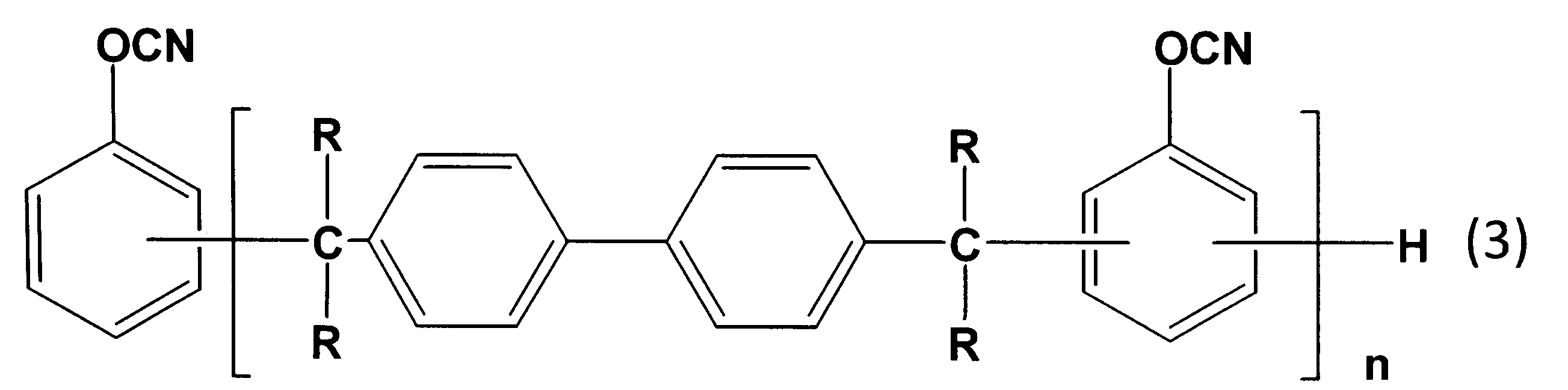
- each R independently represents a hydrogen atom or a methyl group, and n represents an integer of 1 or more.
- ⁇ 12> The above ⁇ 1> to ⁇ 11>, wherein the epoxy resin (A) is contained in an amount of 10 to 90 parts by mass with respect to a total of 100 parts by mass of the epoxy resin (A) and the cyanate ester compound (B). The resin composition as described in any one of these.
- the maleimide compound (D) is bis (4-maleimidophenyl) methane, 2,2-bis (4- (4-maleimidophenoxy) -phenyl) propane, bis (3-ethyl-5-methyl-4) -Maleimide phenyl)
- the resin composition according to ⁇ 14> which is at least one selected from the group consisting of methane and a maleimide compound represented by the following general formula (4).
- each R independently represents a hydrogen atom or a methyl group, and n represents an integer of 1 to 10 as an average value.
- the maleimide compound (D) is contained in an amount of 5 to 50 parts by mass with respect to a total of 100 parts by mass of the epoxy resin (A), the cyanate ester compound (B) and the maleimide compound (D). > Or ⁇ 15>.
- the epoxy resin (A) is contained in an amount of 10 to 90 parts by mass with respect to a total of 100 parts by mass of the epoxy resin (A), the cyanate ester compound (B) and the maleimide compound (D).
- the resin composition according to any one of> to ⁇ 16>.
- cyanate ester compound (B) is contained in an amount of 10 to 90 parts by mass with respect to a total of 100 parts by mass of the epoxy resin (A), the cyanate ester compound (B) and the maleimide compound (D). ⁇ 14> to the resin composition according to any one of ⁇ 17>.
- a prepreg comprising a ⁇ 19> substrate and the resin composition according to any one of ⁇ 1> to ⁇ 18> impregnated or attached to the substrate.
- a metal foil-clad laminate comprising the prepreg according to the above ⁇ 19> as an insulating layer and a metal foil disposed on one or both surfaces of the prepreg.
- a printed wiring board including an insulating layer and a conductor layer formed on a surface of the insulating layer, wherein the insulating layer is the resin composition according to any one of the above items ⁇ 1> to ⁇ 18> Printed wiring boards including objects.
- the present invention it is possible to provide a resin composition that can realize a prepreg, a metal foil-clad laminate, a printed wiring board, and the like having excellent heat dissipation, water absorption, copper foil peel strength, and moisture absorption heat resistance. And its industrial practicality is extremely high.
- the resin composition of this embodiment is a resin composition containing at least an epoxy resin (A), a cyanate ester compound (B), and an inorganic filler (C), and carbonization is performed as the inorganic filler (C).
- At least a part of the surface of the silicon powder contains at least surface-treated silicon carbide (C-1) treated with an inorganic oxide.
- epoxy resin (A) used in the resin composition of the present embodiment known compounds can be appropriately used as long as they are compounds having two or more epoxy groups in one molecule, and the kind thereof is not particularly limited.
- the above epoxy resin (A) includes bisphenol A type epoxy resin, bisphenol F type epoxy resin, phenol novolac type epoxy resin, Cresol novolak type epoxy resin, bisphenol A novolak type epoxy resin, brominated bisphenol A type epoxy resin, brominated phenol novolak type epoxy resin, biphenyl type epoxy resin, phenol aralkyl type epoxy resin, biphenyl aralkyl type epoxy resin, naphthol aralkyl type epoxy resin Aralkyl type epoxy resins such as resins are preferred.
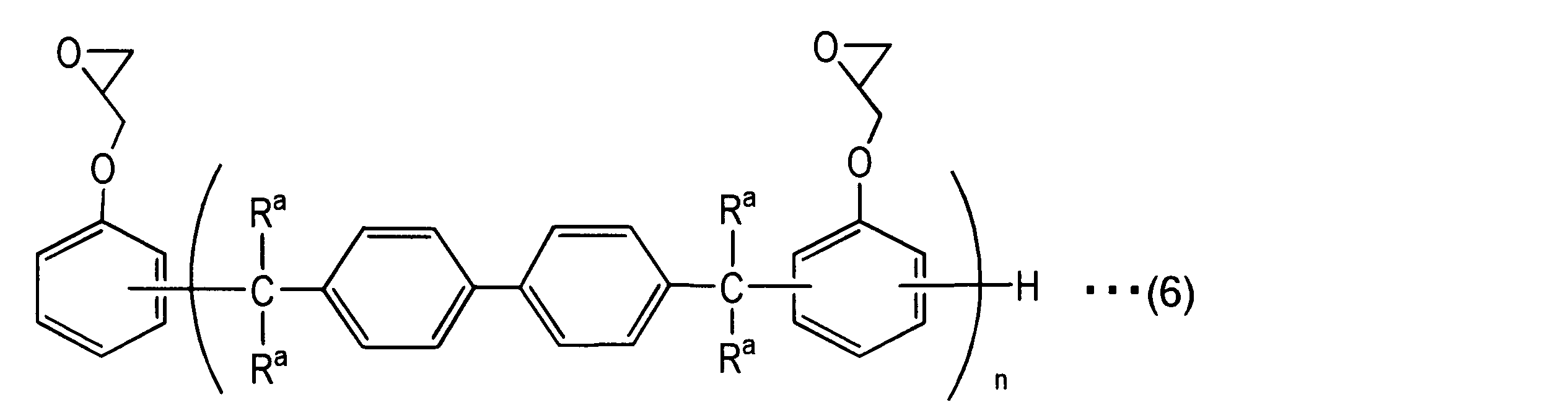
- aralkyl type epoxy resin examples include a phenyl aralkyl type epoxy resin represented by the following general formula (5), a biphenyl aralkyl type epoxy resin represented by the following general formula (6), and the following general formula (7 Naphthol aralkyl type epoxy resin represented by Examples of the epoxy resin product represented by the following general formula (6) include NC-3000-FH manufactured by Nippon Kayaku Co., Ltd.
- each R a independently represents a hydrogen atom or a methyl group, and n represents an integer of 1 to 50.
- each R a independently represents a hydrogen atom or a methyl group, and n represents an integer of 1 to 50.
- each R a independently represents a hydrogen atom or a methyl group, and n represents an integer of 1 to 50.
- the content of the epoxy resin (A) in the resin composition of the present embodiment can be appropriately set according to the desired performance, and is not particularly limited, but the epoxy resin (A) and the cyanate ester compound (B).
- the total amount is preferably 10 to 90 parts by weight, and more preferably 30 to 70 parts by weight.
- the cyanate ester compound (B) used in the resin composition of the present embodiment is generally known as long as it is a compound represented by the general formula R—O—CN (wherein R is an organic group). Can be used as appropriate, and the type is not particularly limited. Specific examples thereof include a naphthol aralkyl cyanate ester compound represented by the above general formula (1), a novolac cyanate ester compound represented by the above general formula (2), and the above general formula (3).
- Biphenylaralkyl type cyanate ester compound 1,3-dicyanatobenzene, 1,4-dicyanatobenzene, 1,3,5-tricyanatobenzene, bis (3,5-dimethyl4-cyanatophenyl) methane, 1,3-dicyanatonaphthalene, 1,4-dicyanatonaphthalene, 1,6-dicyanatonaphthalene, 1,8-dicyanatonaphthalene, 2,6-dicyanatonaphthalene, 2,7-dicyanatonaphthalene, 1, 3,6-tricyanatonaphthalene, 4,4'-dicyanatobiphenyl, bis (4-cyanatophenyl) methane, bis (4-sia Tophenyl) propane, bis (4-cyanatophenyl) ether, bis (4-cyanatophenyl) thioether, bis (4-cyanatophenyl) sulfone, 2,2′-bis (4-cyanatophenyl) propane, bis Examples include (3
- the naphthol aralkyl cyanate compound represented by the above general formula (1), the novolak cyanate ester compound represented by the above general formula (2), and the above general A biphenylaralkyl cyanate compound represented by the formula (3) is preferred.
- These cyanate ester compounds (B) can be used individually by 1 type or in combination of 2 or more types according to desired performance.
- the above-mentioned cyanate ester compound (B) can be a commercially available product, or can be obtained by producing by a known method.
- the naphthol aralkyl cyanate ester compound represented by the general formula (1) can be produced by, for example, a method described in JP-A-2007-277102.
- what is marketed from Lonza Japan Ltd. etc. can be used suitably as a novolak-type cyanate ester compound represented by the said General formula (2).
- the biphenylaralkyl cyanate compound represented by the general formula (3) can be produced by, for example, a method described in JP 2010-174242 A.
- the content of the cyanate ester compound (B) in the resin composition of the present embodiment can be appropriately set according to desired performance, and is not particularly limited, but from the viewpoint of heat resistance and curability, the epoxy resin
- the amount is preferably 10 to 90 parts by mass, more preferably 30 to 70 parts by mass with respect to 100 parts by mass in total of (A) and the cyanate ester compound (B).
- the inorganic filler (C) used in the resin composition of the present embodiment contains at least surface-treated silicon carbide (C-1) in which at least a part of the surface of the silicon carbide powder is treated with an inorganic oxide.
- the surface-treated silicon carbide (C-1) has core particles made of silicon carbide powder and an inorganic oxide formed on at least a part of the surface of the core particles.
- silicon carbide powder having high thermal conductivity is used as the core particles, and furthermore, an inorganic oxide is formed on the surface of the core particles.
- the powder surface is modified to be insulating. Therefore, by using this surface-treated silicon carbide (C-1) as a filler such as a laminate, it is possible to achieve both high heat dissipation and insulation.
- the average particle diameter (D50) of the silicon carbide powder used as the core particles can be appropriately set according to desired performance, and is not particularly limited. From the viewpoints of moldability, thermal conductivity, dispersibility, etc., the average particle size is preferably 0.5 to 20 ⁇ m, more preferably 3.0 to 18 ⁇ m. In the present specification, the average particle diameter (D50) means the median diameter, and is a value in which the larger side and the smaller side are equivalent when the particle size distribution of the measured powder is divided into two. This average particle size (D50) is determined by measuring the particle size distribution of a predetermined amount of powder introduced into the dispersion medium using a laser diffraction / scattering particle size distribution measuring device and integrating the volume from small particles to 50% of the total volume. Means the value when reached.
- the above silicon carbide powder can be produced by various known methods such as a pulverization method and a granulation method, and the production method is not particularly limited. Moreover, the commercial item can be obtained easily commercially. As a commercial item, the Shinano Electric Smelting Co., Ltd. brand name Shinano random CP / GP etc. are mentioned.
- the inorganic oxide formed on the surface of the silicon carbide powder serving as the core particles may be applied to at least a part of the surface of the silicon carbide powder. That is, the inorganic oxide may be applied partially to the surface of the silicon carbide powder or may be applied so as to cover the entire surface of the silicon carbide powder. From the viewpoint of forming a uniform and strong film and imparting high insulation, the inorganic oxide is applied substantially uniformly so as to cover the entire surface of the silicon carbide powder. It is preferable that an inorganic oxide film is formed on the surface substantially uniformly.
- the kind of the inorganic oxide covering the silicon carbide powder is not particularly limited, but a metal oxide is preferable.
- the metal oxide include silica, titania, alumina, zirconium oxide and the like.
- alumina is particularly preferable from the viewpoints of thermal conductivity, heat resistance, and insulation.
- an inorganic oxide can be used individually by 1 type or in combination of 2 or more types according to desired performance.
- the thickness of the inorganic oxide covering the silicon carbide powder can be appropriately set according to desired performance, and is not particularly limited. From the viewpoint of forming a uniform and strong film and imparting high insulation, the thickness of the inorganic oxide is preferably 10 to 70 nm, more preferably 15 to 50 nm.
- the method for producing the surface-treated silicon carbide (C-1) is not particularly limited.
- inorganic oxide by various known methods such as sol-gel method, liquid phase deposition method, dip coating method, spray coating method, printing method, electroless plating method, sputtering method, vapor deposition method, ion plating method, CVD method, etc.
- surface-treated silicon carbide (C-1) can be obtained by applying a precursor thereof to the surface of the above-described silicon carbide powder. Therefore, the method of applying the inorganic oxide or its precursor to the surface of the silicon carbide powder may be either a wet method or a dry method.
- silicon carbide having semiconductivity is insulated, so that the thermal conductivity of the resin composition, printed wiring board, etc. can be improved. It can be used as a composite material.
- a preferred method for producing the surface-treated silicon carbide (C-1) is to disperse silicon carbide powder in an alcohol solution in which a metal alkoxide such as silicon alkoxide or aluminum alkoxide is dissolved and stir the water, alcohol or catalyst. And an alkoxide is hydrolyzed to form an insulating film such as silicon oxide or aluminum oxide on the powder surface, and then the powder is solid-liquid separated, vacuum dried, and then subjected to heat treatment. .
- the surface-treated silicon carbide (C-1) has an inorganic oxide content of 0.1% with respect to 100 parts by mass of the total amount of silicon carbide powder from the viewpoint of forming a uniform and strong film and imparting high insulation.
- the content is preferably 5 to 15 parts by mass, more preferably 1.0 to 10.0 parts by mass, and still more preferably 1.0 to 5.0 parts by mass.
- the surface-treated silicon carbide (C-1) described above is preferably further treated with a coupling agent or the like from the viewpoint of further improving the affinity with the resin and insulation.
- a surface coating layer is further formed on the coating layer (inorganic oxide). Enhanced.
- the surface-treated silicon carbide (C-1) is dispersed in a solvent to prepare a slurry, and a coupling agent that is a precursor of the surface coating layer, for example, a hydrolyzed liquid such as a silanol compound is added, By collecting and drying the powder by a technique such as a filter, surface-treated silicon carbide (C-1) having a surface coating layer on the inorganic oxide can be obtained.
- a wet method is used suitably from a viewpoint of uniform coating and insulation.
- the content of the surface-treated silicon carbide (C-1) in the resin composition of the present embodiment can be appropriately set according to desired performance, and is not particularly limited. From the viewpoint of heat dissipation, insulation, heat resistance, curability, flame retardancy, etc., the content of the surface-treated silicon carbide (C-1) is 150 to 600 parts by mass with respect to a total of 100 parts by mass of the resin solid components. It is preferably 200 to 500 parts by mass, more preferably 250 to 400 parts by mass.
- the resin solid component means an epoxy resin (A) and a cyanate ester compound, provided that the resin composition of this embodiment is a maleimide compound (D) described below and / or heat other than these. In the case of containing a polymer compound such as a curable resin, a thermoplastic resin, or an elastomer, all of them are included.
- the resin composition of the present embodiment has a second inorganic filler (C) other than the surface-treated silicon carbide (C-1) as the inorganic filler (C) from the viewpoint of further improving heat dissipation and insulation. -2) may be contained.
- the second inorganic filler (C-2) known materials can be used as appropriate, and the type thereof is not particularly limited. Generally, what is used for the resin composition for laminated boards or an electrical wiring board can be used conveniently.
- silicas such as natural silica, fused silica, synthetic silica, amorphous silica and hollow silica
- molybdenum compounds such as boehmite, molybdenum oxide and zinc molybdate, alumina, clay, kaolin, talc, calcined talc, calcined Clay, calcined kaolin, mica
- E-glass, A-glass, NE-glass, C-glass, L-glass, D-glass, S-glass, M-glass G20 short glass fiber
- E glass, T glass Including fine glass powders such as D glass, S glass, and Q glass
- hollow glass spherical glass, magnesium oxide, magnesium hydroxide, aluminum hydroxide, zinc oxide, zirconium oxide, barium sulfate, boron nitride, and the like.
- These second inorganic fillers (C-2) can be used singly or in appropriate combination of two or more depending on the desired performance.
- alumina, magnesium oxide, boron nitride, and aluminum nitride are preferable from the viewpoint of achieving higher heat dissipation and insulation, and alumina is particularly preferable.
- alumina suitable as the second inorganic filler (C-2) a commercially available product can be used, for example, Sumiko Random AA-03, AA-04, AA-05, AA manufactured by Sumitomo Chemical Co., Ltd. -07, AA-1, AA-2, AA-3, AA-10, AA-18, ASFP-20, DAW-03, DAW-05, DAW-07, manufactured by Denki Kagaku Kogyo Co., Ltd. Admatechs AO-502, AO-802, Nippon Steel Materials Co., Ltd.
- Micron AX3-32, AX3-15, AX10-32, Showa Denki Kogyo CB-P02, CB-P05, CB-P10, CBP-P10, CB-A09S, CB-A10S, CB-A10, CB-P15, CB-A20X, etc. are preferably used. These can be used individually by 1 type or in combination of 2 or more types as appropriate.
- the average particle diameter (D50) of the second inorganic filler (C-2) can be appropriately set according to desired performance, and is not particularly limited. Considering moldability, thermal conductivity, dispersibility, etc., the average particle size of the second inorganic filler (C-2) is preferably 0.2 to 20 ⁇ m. Further, from the viewpoint of increasing the filling rate into the resin composition and reducing molding defects such as void generation during prepreg molding, two or more types of second inorganic fillers (C-2) having different average particle diameters are used. It is preferable.
- the content of the second inorganic filler (C-2) in the resin composition of the present embodiment can be appropriately set according to desired performance, and is not particularly limited. From the viewpoint of heat dissipation, insulation, heat resistance, flame retardancy, etc., the content of the second inorganic filler (C-2) is 150 to 500 mass with respect to the total 100 mass parts of the resin solid component described above. Parts, preferably 200 to 450 parts by weight, more preferably 250 to 400 parts by weight.
- the total content of the inorganic filler (C) in the resin composition of the present embodiment that is, the surface-treated silicon carbide (C-1) and the second inorganic filler (C-2) blended as necessary.
- the total content can be appropriately set according to the desired performance, and is not particularly limited, but from the viewpoint of heat dissipation, insulation, heat resistance, curability, flame retardancy, etc., the total of the resin solid components described above
- the amount is preferably 150 to 900 parts by weight, more preferably 200 to 800 parts by weight, and still more preferably 250 to 750 parts by weight with respect to 100 parts by weight.
- the content of the surface-treated silicon carbide (C-1) in the inorganic filler (C) can be appropriately set according to the desired performance, but is not particularly limited, but from the viewpoint of heat dissipation characteristics, the inorganic filler
- the total amount of (C) is preferably 30 to 100 parts by mass, and more preferably 50 to 100 parts by mass.
- the resin composition of the present embodiment may further contain a silane coupling agent or a dispersant as necessary.
- a silane coupling agent or a dispersant By containing a silane coupling agent or a dispersant, the dispersibility of the surface-treated silicon carbide (C-1) or the second inorganic filler (C-2) described above can be improved.
- a silane coupling agent what is generally used for the surface treatment of an inorganic substance can be used, and the kind is not specifically limited.
- aminosilanes such as ⁇ -aminopropyltriethoxysilane, N- ⁇ - (aminoethyl) - ⁇ -aminopropyltrimethoxysilane, epoxysilanes such as ⁇ -glycidoxypropyltrimethoxysilane
- vinyl silanes such as ⁇ -methacryloxypropyltrimethoxysilane
- cationic silanes such as N- ⁇ - (N-vinylbenzylaminoethyl) - ⁇ -aminopropyltrimethoxysilane hydrochloride
- phenylsilanes it is not particularly limited to these.
- a silane coupling agent can be used individually by 1 type or in combination of 2 or more types as appropriate.
- a dispersing agent what is generally used for coating materials can be used, The kind is not specifically limited.
- a copolymer-based wetting and dispersing agent is used, and specific examples thereof include Disperbyk-110, 111, 180, 161, BYK-W996, BYK-W9010, BYK-W903 manufactured by Big Chemie Japan Co., Ltd. , BYK-W940 and the like.
- Wet dispersants can be used alone or in combination of two or more.
- the resin composition of the present embodiment may further contain a maleimide compound (D) as necessary.
- a maleimide compound (D) By containing the maleimide compound (D), heat resistance, moisture absorption heat resistance, and flame resistance tend to be further improved.
- this maleimide compound (D) any known compound can be used as long as it is a compound having a maleimide group, and the kind thereof is not particularly limited.
- N-phenylmaleimide N-hydroxyphenylmaleimide, bis (4-maleimidophenyl) methane, 2,2-bis ⁇ 4- (4-maleimidophenoxy) -phenyl ⁇ propane, bis (3,5 -Dimethyl-4-maleimidophenyl) methane, bis (3-ethyl-5-methyl-4-maleimidophenyl) methane, bis (3,5-diethyl-4-maleimidophenyl) methane, represented by the above general formula (4)
- Maleimide compounds, prepolymers of these maleimide compounds, or prepolymers of maleimide compounds and amine compounds but are not particularly limited thereto.
- bis (4-maleimidophenyl) methane, 2,2-bis ⁇ 4- (4-maleimidophenoxy) -phenyl ⁇ propane, bis (3- Ethyl-5-methyl-4-maleimidophenyl) methane and the maleimide compound represented by the general formula (4) are preferred.
- these can be used individually by 1 type or in combination of 2 or more types as appropriate.
- the content of the maleimide compound (D) in the resin composition of the present embodiment can be appropriately set according to desired performance, and is not particularly limited. From the viewpoint of moisture absorption heat resistance and flame resistance, the content of maleimide compound (D) is 5 to 5 parts per 100 parts by mass in total of epoxy resin (A), cyanate ester compound (B) and maleimide compound (D). 50 parts by mass is preferable, and 5 to 20 parts by mass is more preferable.
- the content of the epoxy resin (A) is that of the epoxy resin (A), the cyanate ester compound (B), and the maleimide compound (D).
- the amount is preferably 10 to 90 parts by mass, more preferably 30 to 70 parts by mass with respect to 100 parts by mass in total.
- the content of the cyanate ester compound (B) is such that the epoxy resin (A), the cyanate ester compound (B) and the maleimide compound (
- the total amount of D) is preferably 10 to 90 parts by mass, more preferably 30 to 70 parts by mass with respect to 100 parts by mass in total.
- the resin composition of the present embodiment may contain a curing accelerator in order to adjust the curing rate as needed.
- a hardening accelerator what is generally used as a hardening accelerator of a cyanate ester compound or an epoxy resin can be used, and the kind is not specifically limited. Specific examples thereof include organic metal salts such as copper, zinc, cobalt and nickel, imidazoles and derivatives thereof, and tertiary amines, but are not particularly limited thereto.
- a hardening accelerator can be used individually by 1 type or in combination of 2 or more types as appropriate.
- the resin composition of the present embodiment may contain components other than those described above as long as the desired properties are not impaired.
- examples of such an arbitrary compound include various thermosetting compounds other than those described above, thermoplastic resins and oligomers thereof, elastomers, and other high molecular compounds, flame retardant compounds other than those described above, and various additives. Can be mentioned.
- these arbitrary blends those generally used in the art can be appropriately used, and the kind thereof is not particularly limited.
- flame retardant compounds include bromine compounds such as 4,4′-dibromobiphenyl, phosphate esters, melamine phosphate, phosphorus-containing epoxy resins, nitrogen-containing compounds such as melamine and benzoguanamine, and oxazine ring-containing compounds.
- silicone compounds include ultraviolet absorbers, antioxidants, photopolymerization initiators, fluorescent brighteners, photosensitizers, dyes, pigments, thickeners, lubricants, antifoaming agents, dispersants, and leveling agents. , Brighteners, polymerization inhibitors and the like, but are not particularly limited thereto. These arbitrary formulations can be used singly or in appropriate combination of two or more.
- the resin composition of the present embodiment can be prepared according to a conventional method, and the preparation method is not particularly limited.
- the resin composition of this embodiment can be easily prepared by stirring and mixing the epoxy resin (A), cyanate ester compound (B), inorganic filler (C), and the like described above.
- known processes such as stirring, mixing, and kneading for uniformly mixing the components can be performed.
- the above stirring, mixing, and kneading treatment can be appropriately performed using a known apparatus for mixing such as a ball mill, a bead mill, or a homomixer.
- the resin composition of the present embodiment is used as a solution of a resin composition dissolved in an organic solvent, if necessary, from the viewpoints of lowering the viscosity, improving the handleability and increasing the impregnation property into the glass cloth.
- the resin composition of the present embodiment can be used as an aspect (resin varnish) in which at least a part, preferably all, of each component described above is dissolved or compatible with an organic solvent.
- the organic solvent any resin solid component such as the above-described epoxy resin (A), cyanate ester compound (B), maleimide compound (D), etc. can be dissolved or compatible.
- Well-known ones can be used as appropriate, and the type is not particularly limited.
- ketones such as acetone, methyl ethyl ketone, and methyl isobutyl ketone
- polar solvents such as dimethylacetamide and dimethylformamide
- aromatic hydrocarbons such as toluene and xylene, but are not particularly limited thereto.
- An organic solvent can be used individually by 1 type or in combination of 2 or more types as appropriate.
- the prepreg of this embodiment is obtained by impregnating or attaching the above resin composition to a base material.
- This prepreg can be produced according to a conventional method, and the production method is not particularly limited.
- a resin varnish obtained by adding an organic solvent to the resin composition is impregnated or coated on a base material, and then semi-cured (B stage) by heating in a dryer at 100 to 200 ° C. for 1 to 60 minutes.
- the prepreg of the present embodiment can be obtained.
- the amount of the resin composition attached to the substrate that is, the amount of the resin composition (including the inorganic filler (C)) relative to the total amount of the prepreg after semi-curing is not particularly limited, but is in the range of 20 to 95% by mass. Is preferred.
- drying conditions are not specifically limited, Generally, it is made to dry so that the content rate of the organic solvent in a resin composition may be 10 mass% or less, Preferably it is 5 mass% or less.
- a resin varnish containing 30 to 60% by mass of an organic solvent can be dried at 50 to 150 ° C. for about 3 to 10 minutes.
- the base material used in the prepreg of the present embodiment is not particularly limited, and for example, known materials used for various printed wiring board materials are appropriately selected and used depending on the intended use and performance. be able to. Specific examples include E glass, D glass, S glass, T glass, NE glass, quartz, woven fabric or non-woven fabric such as polyimide, polyamide, polyester, and liquid crystal polyester, but are not particularly limited thereto. These can be used individually by 1 type or in combination of 2 or more types as appropriate.
- the thickness of the substrate is not particularly limited, but is preferably in the range of 0.01 to 0.3 mm.
- a woven fabric subjected to a super-opening process and a plugging process, which are widely used for laminate applications, is preferable from the viewpoint of dimensional stability.
- the glass woven fabric surface-treated with a silane coupling agent such as epoxy silane treatment or amino silane treatment is preferable from the viewpoint of moisture absorption heat resistance.
- a liquid crystal polyester woven fabric is preferable from the viewpoint of electrical characteristics.
- the metal foil-clad laminate of this embodiment is obtained by laminating and molding the above-described prepreg and metal foil. Specifically, it can be produced by laminating one or a plurality of the above-described prepregs, placing a metal foil such as copper or aluminum on one side or both sides thereof, and laminating.
- the molding conditions are not particularly limited, and can be an ordinary laminate method for printed wiring boards and multilayer boards. For example, a multi-stage press machine, a multi-stage vacuum press machine, a continuous molding machine, an autoclave molding machine, etc.
- the metal foil used here will not be specifically limited if it is used for printed wiring board material, Copper foil, such as a rolled copper foil and an electrolytic copper foil, is preferable. Considering the conductor loss in the high frequency region, an electrolytic copper foil having a small mat surface roughness is more suitable.
- the thickness of the metal foil is not particularly limited, but is preferably 2 to 70 ⁇ m, more preferably 3 to 35 ⁇ m.
- a 35 ⁇ m copper foil is arranged on both surfaces of one prepreg, and after the lamination is formed under the above conditions, an inner layer circuit is formed, and the blackening process is performed on this circuit.
- a multilayer board can be obtained by stacking and molding the inner layer circuit board and the prepreg.
- a multilayer board can also be obtained by laminating the above prepreg and a separately produced wiring board for an inner layer and performing lamination molding.
- the above metal foil-clad laminate can be used as a printed wiring board by forming a predetermined wiring pattern. Since this metal foil-clad laminate is excellent in heat dissipation, water absorption, copper foil peel strength, moisture absorption heat resistance, and the like, it is particularly useful in semiconductor package applications that require such performance.
- the above printed wiring board can be manufactured, for example, by the following method. First, a metal foil clad laminate such as the copper clad laminate described above is prepared. Next, an etching process is performed on the surface of the metal foil-clad laminate to form an inner layer circuit, thereby producing an inner layer substrate. The inner layer circuit surface of the inner layer substrate is subjected to a surface treatment to increase the adhesive strength as necessary, then the required number of the prepregs are stacked on the inner layer circuit surface, and a metal foil for the outer layer circuit is stacked on the outer surface. Then, it is integrally molded by heating and pressing.
- a metal foil clad laminate such as the copper clad laminate described above is prepared.
- an etching process is performed on the surface of the metal foil-clad laminate to form an inner layer circuit, thereby producing an inner layer substrate.
- the inner layer circuit surface of the inner layer substrate is subjected to a surface treatment to increase the adhesive strength as necessary, then the required number of the prepregs are stacked
- a multilayer laminate is produced in which an insulating layer made of a cured product of the base material and the resin composition of the present embodiment described above is formed between the inner layer circuit and the metal foil for the outer layer circuit. .
- a plated metal film is formed on the wall surface of the hole to connect the inner layer circuit and the metal foil for the outer layer circuit. Etching is performed on the metal foil for forming an outer layer circuit, and a printed wiring board is manufactured.
- the inner layer circuit and the outer layer circuit laminate are used as the conductor layer, the prepreg (the base material and the resin composition of this embodiment impregnated or attached thereto) and the metal foil tension as the insulating layer.
- the laminate has a resin composition layer (a layer made of a cured product of the resin composition of the present embodiment).
- Softening point 86 ° C., Nippon Steel Chemical Co., Ltd.
- a solution prepared by dissolving 20 g (0.0935 mol) and 14.16 g (0.14 mol) of triethylamine in 92 ml of methylene chloride was added dropwise over 1 hour using a dropping funnel. After completion of the dropwise addition, 4.72 g (0.047 mol) of triethylamine was further added dropwise over 15 minutes. After completion of the dropwise addition, the reaction solution was separated after stirring at the same temperature for 15 minutes, and the organic layer was separated.
- Production Example 1 Production of Alumina-Coated Silicon Carbide Powder 3.5 g of aluminum diisopropylate monosecondary butyrate was dissolved in 1000 ml of isopropyl alcohol. 100 g of silicon carbide powder (GP # 800, manufactured by Shinano Denki Smelting Co., Ltd., average particle size 14 ⁇ m) is added to this solution, and the silicon carbide powder is stirred so that the silicon carbide powder is dispersed throughout the solution. The powder and the solution were mixed to obtain a slurry solution. Next, while maintaining the slurry state, 5 g of pure water was added to the obtained slurry solution, stirred, and aged at 30 ° C. for 60 minutes to perform a hydrolysis reaction.
- GP # 800 manufactured by Shinano Denki Smelting Co., Ltd., average particle size 14 ⁇ m
- the treated silicon carbide powder was taken out and washed with several tens mL of acetone. Thereafter, drying was performed to evaporate acetone, thereby obtaining an alumina-coated silicon carbide powder in which an alumina coating layer was uniformly formed on the surface of the silicon carbide powder.
- Example 1 40 parts by mass of the ⁇ -naphthol aralkyl-type cyanate compound obtained in Synthesis Example 1 and 20 parts by mass of bis (3-ethyl-5-methyl-4-maleimidophenyl) methane (BMI-70, manufactured by KAI Kasei Co., Ltd.) 40 parts by mass of a biphenyl aralkyl type epoxy resin (NC-3000-FH, manufactured by Nippon Kayaku Co., Ltd.), 15 parts by mass of a silane coupling agent (Z6040, manufactured by Toray Dow Corning Co., Ltd.), and an acid group 5 parts by mass of a wetting and dispersing agent (BYK-W903, manufactured by Big Chemie Japan Co., Ltd.) was dissolved and mixed with methyl ethyl ketone, and 290 parts by mass of the alumina-coated silicon carbide powder obtained in Production Example 1, Manganese octylate (Nikka Octix Mn, manufactured by Nippon
- the obtained resin varnish was diluted with methyl ethyl ketone to a solid content concentration of 65 wt%, and this was impregnated into E glass cloth (manufactured by Asahi Kasei E-Materials Co., Ltd.) having a thickness of 0.1 mm and a mass of 47.2 g / m 2.
- the prepreg having a resin composition amount of 80% by mass was obtained by coating and drying by heating at 160 ° C. for 3 minutes.
- Thermal conductivity The density of the obtained metal foil-clad laminate is measured, the specific heat is measured by DSC (TA Instrument Q100 type), and further, thermal diffusion is performed by a xenon flash analyzer (Bruker: LFA447 Nanoflash). The rate was measured. And thermal conductivity was computed from the following formula
- Thermal conductivity (W / m ⁇ K) density (kg / m 3 ) ⁇ specific heat (kJ / kg ⁇ K) ⁇ thermal diffusivity (m 2 / S) ⁇ 1000
- Copper foil peel strength Measured according to JIS C6481 copper clad laminate test method for printed wiring boards (see 5.7 Peel strength).
- Example 2 As inorganic fillers, 215 parts by mass of non-spherical alumina (AA-3, manufactured by Sumitomo Chemical Co., Ltd., average particle size: 3 ⁇ m) and alumina (ASFP-20, manufactured by Denki Kagaku Kogyo Co., Ltd., average particle size: 0.3 ⁇ m) ) A resin composition and a double-sided copper clad laminate were obtained in the same manner as in Example 1 except that 85 parts by mass and 300 parts by mass of the alumina-coated silicon carbide powder used in Example 1 were used.
- AA-3 non-spherical alumina
- ASFP-20 manufactured by Denki Kagaku Kogyo Co., Ltd., average particle size: 0.3 ⁇ m
- Example 3 Other than using 190 parts by mass of non-spherical alumina (AA-3), 140 parts by mass of alumina (ASFP-20), and 350 parts by mass of the alumina-coated silicon carbide powder used in Example 1 as the inorganic filler. Were performed in the same manner as in Example 1 to obtain a resin composition and a double-sided copper-clad laminate.
- Example 4 The blending amount of the ⁇ -naphthol aralkyl type cyanate ester compound was changed to 50 parts by mass and the blending amount of the biphenyl aralkyl type epoxy resin was changed to 50 parts by mass to obtain bis (3-ethyl-5-methyl-4-maleimidophenyl).
- a resin composition and a double-sided copper-clad laminate were obtained in the same manner as in Example 3 except that the blending of methane was omitted.
- Comparative Example 1 Except for using 500 parts by weight of spherical alumina (AX3-15, manufactured by Nippon Steel Materials Co., Ltd., average particle size 3 ⁇ m) as the inorganic filler, and changing the blending amount of the silane coupling agent to 13 parts by weight. The same procedure as in Example 1 was performed to obtain a resin composition and a double-sided copper-clad laminate.
- AX3-15 spherical alumina
- Comparative Example 2 Resin composition and double-sided copper-clad laminate, except that 800 parts by weight of non-spherical alumina (AA-3) and 200 parts by weight of alumina (ASFP-20) are used as the inorganic filler. Got.
- Comparative Example 3 The same procedure as in Example 1 was conducted except that 290 parts by mass of silicon carbide powder (GP # 800, manufactured by Shinano Denki Smelting Co., Ltd., average particle size: 14 ⁇ m) was used as the inorganic filler. A copper clad laminate was obtained.
- silicon carbide powder GP # 800, manufactured by Shinano Denki Smelting Co., Ltd., average particle size: 14 ⁇ m
- Comparative Example 4 As inorganic fillers, 310 parts by mass of non-spherical alumina (AA-3), 125 parts by mass of alumina (ASFP-20), 125 parts by mass of aggregated boron nitride (SGPS, manufactured by Denki Kagaku Kogyo Co., Ltd., 12 ⁇ m) Except having used, it carried out similarly to Example 1 and obtained the resin composition and the double-sided copper clad laminated board.
- AA-3 non-spherical alumina
- ASFP-20 125 parts by mass of alumina
- SGPS aggregated boron nitride
- the laminated plates of Examples 1 to 4 have a heat dissipation property, copper foil peel strength, moisture absorption heat resistance, water absorption, insulation resistance and molding as compared with the laminated plates of Comparative Examples 1 to 4. It was confirmed that all the performances of sex are compatible at a high level.
- the present invention can be widely and effectively used in laminated materials, electrical insulating materials, build-up laminated board materials, printed wiring boards, semiconductor plastic packages, and the like.
Landscapes
- Chemical & Material Sciences (AREA)
- Engineering & Computer Science (AREA)
- Organic Chemistry (AREA)
- Health & Medical Sciences (AREA)
- Chemical Kinetics & Catalysis (AREA)
- Medicinal Chemistry (AREA)
- Polymers & Plastics (AREA)
- Materials Engineering (AREA)
- Microelectronics & Electronic Packaging (AREA)
- Manufacturing & Machinery (AREA)
- Inorganic Chemistry (AREA)
- Textile Engineering (AREA)
- Reinforced Plastic Materials (AREA)
- Compositions Of Macromolecular Compounds (AREA)
- Laminated Bodies (AREA)
- Epoxy Resins (AREA)
Description
<2>前記表面処理炭化ケイ素(C-1)が、前記炭化ケイ素粉体からなるコア粒子と、該コア粒子の表面の少なくとも一部に形成された無機酸化物とを有する、上記<1>に記載の樹脂組成物。
<3>前記コア粒子は、0.5~20μmの平均粒子径を有する、上記<2>に記載の樹脂組成物。
<4>前記無機酸化物が、シリカ、チタニア、アルミナ及びジルコニウムオキサイドからなる群から選択される少なくとも1種以上である、上記<1>~<3>のいずれか一項に記載の樹脂組成物。
<5>前記無機酸化物は、10~70nmの厚みを有する、上記<1>~<4>のいずれか一項に記載の樹脂組成物。
<6>前記無機充填材(C)が、樹脂固形成分の合計100質量部に対し、150~900質量部含まれる、上記<1>~<5>のいずれか一項に記載の樹脂組成物。
<7>前記表面処理炭化ケイ素(C-1)が、樹脂固形成分の合計100質量部に対し、150~600質量部含まれる、上記<1>~<6>のいずれか一項に記載の樹脂組成物。
<8>前記無機充填材(C)は、前記表面処理炭化ケイ素(C-1)の他に、アルミナ、酸化マグネシウム、窒化ホウ素及び窒化アルミニウムからなる群から選択される少なくとも1種以上の第2の無機充填材(C-2)をさらに含む、上記<1>~<7>のいずれか一項に記載の樹脂組成物。
<9>前記第2の無機充填材(C-2)が、樹脂固形成分の合計100質量部に対し、150~500質量部含まれる、上記<8>に記載の樹脂組成物。
<11>前記シアン酸エステル化合物(B)が、下記一般式(1)で表されるナフトールアラルキル型シアン酸エステル化合物、下記一般式(2)で表されるノボラック型シアン酸エステル化合物及び下記一般式(3)で表されるビフェニルアラルキル型シアン酸エステル化合物からなる群から選択される少なくとも1種以上である、上記<1>~<10>のいずれか一項に記載の樹脂組成物。

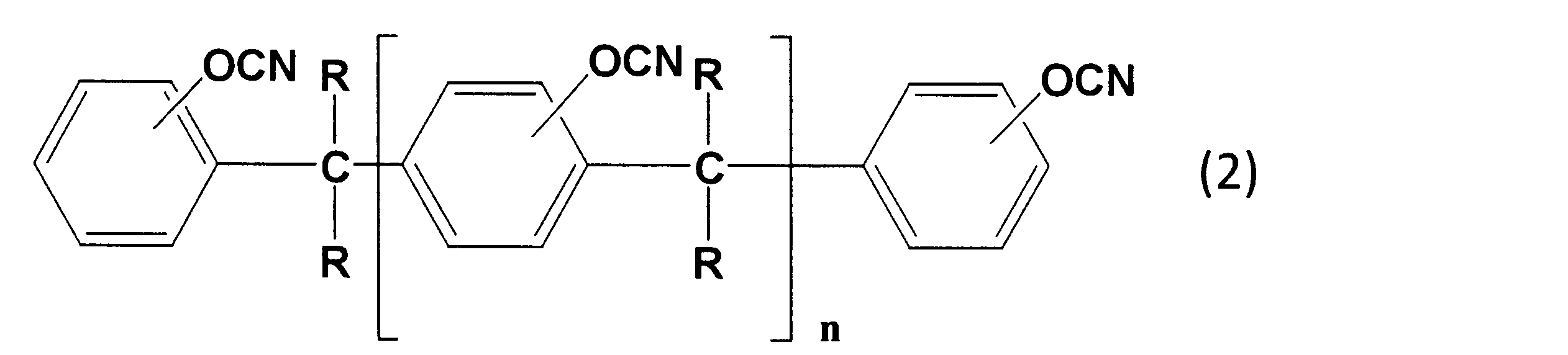
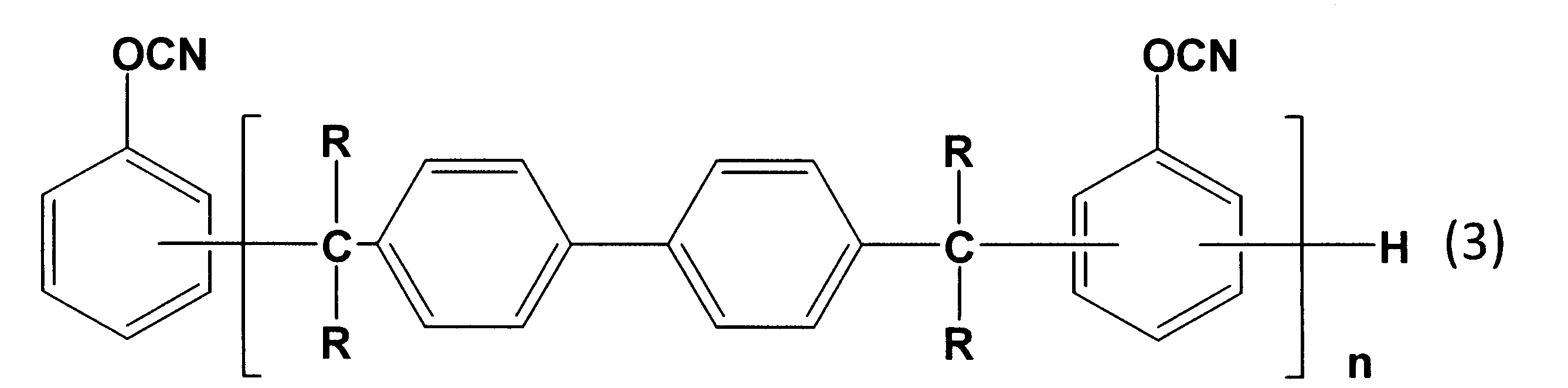
<12>前記エポキシ樹脂(A)が、前記エポキシ樹脂(A)及び前記シアン酸エステル化合物(B)の合計100質量部に対し、10~90質量部含まれる、上記<1>~<11>のいずれか一項に記載の樹脂組成物。
<13>前記シアン酸エステル化合物(B)が、前記エポキシ樹脂(A)及び前記シアン酸エステル化合物(B)の合計100質量部に対し、10~90質量部含まれる、上記<1>~<12>のいずれか一項に記載の樹脂組成物。
<15>前記マレイミド化合物(D)が、ビス(4-マレイミドフェニル)メタン、2,2-ビス(4-(4-マレイミドフェノキシ)-フェニル)プロパン、ビス(3-エチル-5-メチル-4-マレイミドフェニル)メタン及び下記一般式(4)で表されるマレイミド化合物からなる群から選択される少なくとも1種以上である、上記<14>に記載の樹脂組成物。
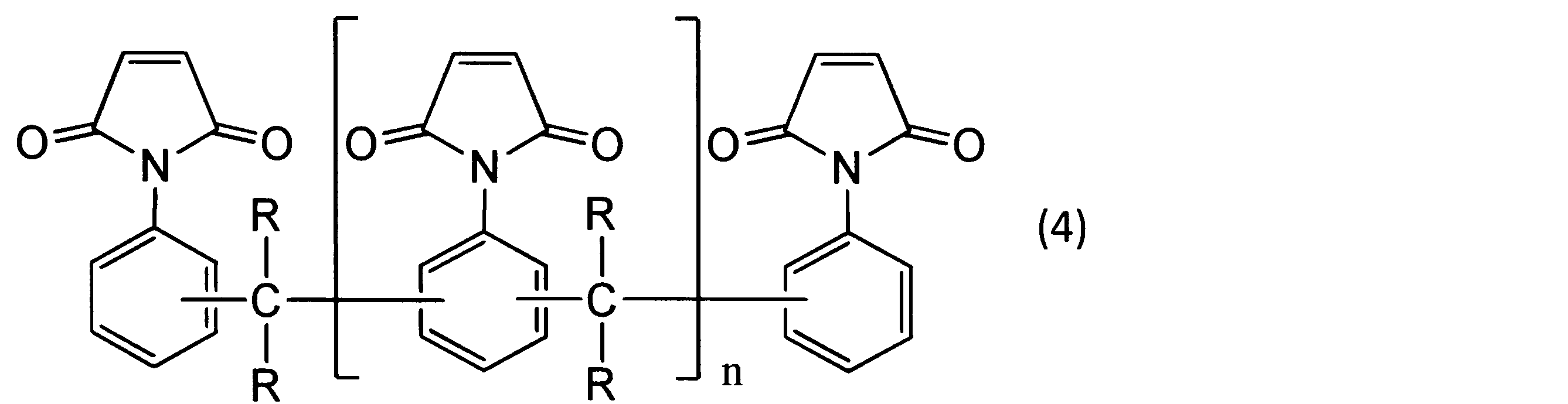
<16>前記マレイミド化合物(D)が、前記エポキシ樹脂(A)、シアン酸エステル化合物(B)及びマレイミド化合物(D)の合計100質量部に対し、5~50質量部含まれる、上記<14>又は<15>に記載の樹脂組成物。
<17>前記エポキシ樹脂(A)が、前記エポキシ樹脂(A)、シアン酸エステル化合物(B)及びマレイミド化合物(D)の合計100質量部に対し、10~90質量部含まれる、上記<14>~<16>のいずれか一項に記載の樹脂組成物。
<18>前記シアン酸エステル化合物(B)が、前記エポキシ樹脂(A)、シアン酸エステル化合物(B)及びマレイミド化合物(D)の合計100質量部に対し、10~90質量部含まれる、上記<14>~<17>のいずれか一項に記載の樹脂組成物。
<20>絶縁層として上記<19>に記載のプリプレグと、該プリプレグの片面又は両面に配設された金属箔とを含む、金属箔張積層板。
<21>絶縁層と、前記絶縁層の表面に形成された導体層とを含むプリント配線板であって、前記絶縁層が上記<1>~<18>のいずれか一項に記載の樹脂組成物を含む、プリント配線板。


同様に、本実施形態の樹脂組成物がマレイミド化合物(D)を含有する場合、シアン酸エステル化合物(B)の含有量は、エポキシ樹脂(A)、シアン酸エステル化合物(B)及びマレイミド化合物(D)の合計100質量部に対し、10~90質量部であることが好ましく、30~70質量部であることがより好ましい。
温度計、攪拌器、滴下漏斗及び還流冷却器を取りつけた反応器を予めブラインにより0~5℃に冷却しておき、そこへ塩化シアン7.47g(0.122mol)、35%塩酸9.75g(0.0935mol)、水76ml、及び塩化メチレン44mlを仕込んだ。この反応器内の温度を-5~+5℃、pHを1以下に保ちながら、撹拌下、α-ナフトールアラルキル樹脂(SN485、OH基当量:214g/eq.軟化点:86℃、新日鐵化学(株)製)20g(0.0935mol)、及びトリエチルアミン14.16g(0.14mol)を塩化メチレン92mlに溶解した溶液を滴下漏斗により1時間かけて滴下した。滴下終了後、さらにトリエチルアミン4.72g(0.047mol)を15分間かけて滴下した。
滴下終了後、同温度で15分間撹拌後、反応液を分液して、有機層を分取した。得られた有機層を水100mlで2回洗浄した後、エバポレーターにより減圧下で塩化メチレンを留去し、最終的に80℃で1時間濃縮乾固させることにより、上記一般式(1)で表されるα-ナフトールアラルキル樹脂のシアン酸エステル化物(α-ナフトールアラルキル型シアン酸エステル化合物、式中のRはすべて水素原子であり、nは1~5のものが含まれる。)23.5gを得た。
得られたシアン酸エステル化合物を、液体クロマトグラフィー及びIRスペクトルにより分析したところ、原料ピークは検出されず、2264cm-1付近のシアン酸エステル基の吸収が確認された。また、13C-NMR及び1H-NMRにより、構造を同定した。水酸基からシアネート基への転化率は、99%以上であった。
イソプロピルアルコール1000mlにアルミニウムジイソプロピレートモノセカンダリブチレート3.5gを溶解した。この溶解液に炭化ケイ素粉体(GP#800、信濃電気製錬(株)製、平均粒子径14μm)100gを投入し、溶液全体に炭化ケイ素粉体が分散するように攪拌しつつ、炭化ケイ素粉体と溶液とを混合して、スラリー状溶液を得た。次に、スラリー状態を維持しつつ、得られたスラリー状溶液へ純水5gを加え、攪拌し、30℃で60分間熟成して加水分解反応を行った。次いで、処理後の炭化ケイ素粉体を取り出し、数10mLのアセトンにより洗浄した。その後、乾燥してアセトンを蒸発させることで、アルミナ被覆層が炭化ケイ素粉体の表面に均一に形成された、アルミナ被覆炭化ケイ素粉体を得た。
合成例1で得たα-ナフトールアラルキル型シアン酸エステル化合物40質量部、ビス(3-エチル-5-メチル-4-マレイミドフェニル)メタン(BMI-70、ケイアイ化成(株)製)20質量部、ビフェニルアラルキル型エポキシ樹脂(NC-3000-FH、日本化薬(株)製)40質量部、シランカップリング剤(Z6040、東レダウコーニング(株)製)15質量部、及び、酸基を含む湿潤分散剤(BYK-W903、ビッグケミー・ジャパン(株)製)5質量部を、メチルエチルケトンで溶解混合し、得られた混合液に、製造例1で得たアルミナ被覆炭化ケイ素粉体290質量部、オクチル酸マンガン(ニッカオクチックスMn、日本化学産業(株)製、Mn含有量8%)0.01質量部、2,4,5-トリフェニルイミダゾール(東京化成工業(株)製)0.5質量部を混合して、樹脂組成物(樹脂ワニス)を得た。
得られた樹脂ワニスをメチルエチルケトンで希釈して固形分濃度を65wt%とし、これを厚さ0.1mm及び質量47.2g/m2のEガラスクロス(旭化成イーマテリアルズ(株)製)に含浸塗工し、160℃で3分間加熱乾燥することにより、樹脂組成物量が80質量%のプリプレグを得た。次に、このプリプレグを8枚重ね、得られた積層体の両面に厚さ12μmの電解銅箔(3EC-III、三井金属鉱業(株)製)を配置し、圧力30kgf/cm2、温度220℃、120分間の真空プレスを行い積層成形することで、厚さ0.8mmの金属箔張積層板(両面銅張積層板)を得た。
1)熱伝導率:得られた金属箔張積層板の密度を測定し、また、比熱をDSC(TA Instrumen Q100型)により測定し、さらに、キセノンフラッシュアナライザ(Bruker:LFA447Nanoflash)により熱拡散率を測定した。そして、熱伝導率を以下の式から算出した。
熱伝導率(W/m・K)=密度(kg/m3)×比熱(kJ/kg・K)×熱拡散率(m2/S)×1000
2)銅箔ピール強度:JIS C6481のプリント配線板用銅張積層板試験方法(5.7引き剥がし強さ参照。)に準拠して測定した。
3)吸湿耐熱性:得られた金属箔張積層板をダイシングソーで50mm×50mm×厚さ0.8mmのサイズに切断後、片面の半分以外の銅箔をすべてエッチング除去して、片面にのみ銅箔が半分残された試験片を得た。この試験片を用い、プレシッヤークッカー試験機(平山製作所製、PC-3型)で121℃、2気圧で3時間処理後、260℃の半田槽の中に60秒浸漬した後の外観変化を目視で観察した(フクレ発生数/試験数)。
4)吸水率:プレシッヤークッカー試験機(平山製作所製、PC-3型)で121℃、2気圧で5時間処理し、処理前後における重量変化率を算出した。
5)電気抵抗:JIS K-6911に準拠して、500Vを電極に印加後、1分後の電気抵抗値を絶縁抵抗計により測定した。
6)外観評価:得られた金属張り積層板を520mm×340mm×0.8mmのサイズに切断後、両面の銅箔をすべてエッチング除去して、表面の銅箔がすべて除去されたサンプル(積層板)を得た。この積層板を目視で観察し、外観が良好なものを「○」、色むらが発生したものを「×」と評価した。
無機充填材として、非球状アルミナ(AA-3、住友化学(株)製、平均粒子径3μm)215質量部と、アルミナ(ASFP-20、電気化学工業(株)製、平均粒子径0.3μm)85質量部と、実施例1で使用したアルミナ被覆処理炭化ケイ素粉体300質量部とを用いること以外は、実施例1と同様に行ない、樹脂組成物及び両面銅張積層板を得た。
無機充填材として、非球状アルミナ(AA-3)190質量部と、アルミナ(ASFP-20)140質量部と、実施例1で使用したアルミナ被覆処理炭化ケイ素粉体350質量部とを用いること以外は、実施例1と同様に行ない、樹脂組成物及び両面銅張積層板を得た。
α-ナフトールアラルキル型シアン酸エステル化合物の配合量を50質量部に、ビフェニルアラルキル型エポキシ樹脂の配合量を50質量部にそれぞれ変更し、ビス(3-エチル-5-メチル-4-マレイミドフェニル)メタンの配合を省略すること以外は、実施例3と同様に行ない、樹脂組成物及び両面銅張積層板を得た。
無機充填材として、球状アルミナ(AX3-15、新日鉄マテリアルズ(株)マイクロン社製、平均粒子径3μm)500質量部を用い、シランカップリング剤の配合量を13質量部に変更すること以外は、実施例1と同様に行ない、樹脂組成物及び両面銅張積層板を得た。
無機充填材として、非球状アルミナ(AA-3)800質量部とアルミナ(ASFP-20)200質量部とを用いること以外は、実施例1と同様に行ない、樹脂組成物及び両面銅張積層板を得た。
無機充填材として、炭化ケイ素粉体(GP#800、信濃電気製錬(株)製、平均粒子径14μm)290質量部を用いること以外は、実施例1と同様に行ない、樹脂組成物及び両面銅張積層板を得た。
無機充填材として、非球状アルミナ(AA-3)310質量部と、アルミナ(ASFP-20)125質量部と、凝集窒化ほう素(SGPS、電気化学工業(株)製、12μm)125質量部とを用いること以外は、実施例1と同様に行ない、樹脂組成物及び両面銅張積層板を得た。

Claims (21)
- エポキシ樹脂(A)、シアン酸エステル化合物(B)及び無機充填材(C)を少なくとも含有し、該無機充填材(C)は、炭化ケイ素粉体の表面の少なくとも一部が無機酸化物で処理された表面処理炭化ケイ素(C-1)を少なくとも含む、
樹脂組成物。 - 前記表面処理炭化ケイ素(C-1)が、前記炭化ケイ素粉体からなるコア粒子と、該コア粒子の表面の少なくとも一部に形成された無機酸化物とを有する、
請求項1に記載の樹脂組成物。 - 前記コア粒子は、0.5~20μmの平均粒子径を有する、
請求項2に記載の樹脂組成物。 - 前記無機酸化物が、シリカ、チタニア、アルミナ及びジルコニウムオキサイドからなる群から選択される少なくとも1種以上である、
請求項1~3のいずれか一項に記載の樹脂組成物。 - 前記無機酸化物は、10~70nmの厚みを有する、
請求項1~4のいずれか一項に記載の樹脂組成物。 - 前記無機充填材(C)が、樹脂固形成分の合計100質量部に対し、150~900質量部含まれる、
請求項1~5のいずれか一項に記載の樹脂組成物。 - 前記表面処理炭化ケイ素(C-1)が、樹脂固形成分の合計100質量部に対し、150~600質量部含まれる、
請求項1~6のいずれか一項に記載の樹脂組成物。 - 前記無機充填材(C)は、前記表面処理炭化ケイ素(C-1)の他に、アルミナ、酸化マグネシウム、窒化ホウ素及び窒化アルミニウムからなる群から選択される少なくとも1種以上の第2の無機充填材(C-2)をさらに含む、
請求項1~7のいずれか一項に記載の樹脂組成物。 - 前記第2の無機充填材(C-2)が、樹脂固形成分の合計100質量部に対し、150~500質量部含まれる、
請求項8に記載の樹脂組成物。 - 前記エポキシ樹脂(A)が、ビフェニルアラルキル型エポキシ樹脂、ポリオキシナフチレン型エポキシ樹脂、トリフェノールメタン型エポキシ樹脂、ビスフェノールA型エポキシ樹脂、ビスフェノールF型エポキシ樹脂、フェノールノボラック型エポキシ樹脂、クレゾールノボラック型エポキシ樹脂、ビスフェノールAノボラック型エポキシ樹脂、臭素化ビスフェノールA型エポキシ樹脂、臭素化フェノールノボラック型エポキシ樹脂、ビフェニル型エポキシ樹脂、フェノールアラルキル型エポキシ樹脂及びナフトールアラルキル型エポキシ樹脂からなる群から選択される少なくとも1種以上である、
請求項1~9のいずれか一項に記載の樹脂組成物。 - 前記シアン酸エステル化合物(B)が、下記一般式(1)で表されるナフトールアラルキル型シアン酸エステル化合物、下記一般式(2)で表されるノボラック型シアン酸エステル化合物及び下記一般式(3)で表されるビフェニルアラルキル型シアン酸エステル化合物からなる群から選択される少なくとも1種以上である、
請求項1~10のいずれか一項に記載の樹脂組成物。


- 前記エポキシ樹脂(A)が、前記エポキシ樹脂(A)及び前記シアン酸エステル化合物(B)の合計100質量部に対し、10~90質量部含まれる、
請求項1~11のいずれか一項に記載の樹脂組成物。 - 前記シアン酸エステル化合物(B)が、前記エポキシ樹脂(A)及び前記シアン酸エステル化合物(B)の合計100質量部に対し、10~90質量部含まれる、
請求項1~12のいずれか一項に記載の樹脂組成物。 - マレイミド化合物(D)をさらに含有する、
請求項1~13のいずれか一項に記載の樹脂組成物。 - 前記マレイミド化合物(D)が、ビス(4-マレイミドフェニル)メタン、2,2-ビス(4-(4-マレイミドフェノキシ)-フェニル)プロパン、ビス(3-エチル-5-メチル-4-マレイミドフェニル)メタン及び下記一般式(4)で表されるマレイミド化合物からなる群から選択される少なくとも1種以上である、
請求項14に記載の樹脂組成物。

- 前記マレイミド化合物(D)が、前記エポキシ樹脂(A)、シアン酸エステル化合物(B)及びマレイミド化合物(D)の合計100質量部に対し、5~50質量部含まれる、
請求項14又は15に記載の樹脂組成物。 - 前記エポキシ樹脂(A)が、前記エポキシ樹脂(A)、シアン酸エステル化合物(B)及びマレイミド化合物(D)の合計100質量部に対し、10~90質量部含まれる、
請求項14~16のいずれか一項に記載の樹脂組成物。 - 前記シアン酸エステル化合物(B)が、前記エポキシ樹脂(A)、シアン酸エステル化合物(B)及びマレイミド化合物(D)の合計100質量部に対し、10~90質量部含まれる、
請求項14~17のいずれか一項に記載の樹脂組成物。 - 基材と、該基材に含浸又は添着された請求項1~18のいずれか一項に記載の樹脂組成物とを含む、
プリプレグ。 - 絶縁層として請求項19に記載のプリプレグと、該プリプレグの片面又は両面に配設された金属箔とを含む、
金属箔張積層板。 - 絶縁層と、前記絶縁層の表面に形成された導体層とを含むプリント配線板であって、前記絶縁層が請求項1~18のいずれか一項に記載の樹脂組成物を含む、
プリント配線板。
Priority Applications (6)
| Application Number | Priority Date | Filing Date | Title |
|---|---|---|---|
| EP13804513.3A EP2860219B1 (en) | 2012-06-12 | 2013-06-06 | Resin composition, prepreg, metal foil-clad laminate and printed wiring board |
| JP2014521290A JP6168308B2 (ja) | 2012-06-12 | 2013-06-06 | 樹脂組成物、プリプレグ、金属箔張積層板及びプリント配線板 |
| US14/407,190 US9832870B2 (en) | 2012-06-12 | 2013-06-06 | Resin composition, prepreg, metal foil-clad laminate and printed wiring board |
| SG11201407874QA SG11201407874QA (en) | 2012-06-12 | 2013-06-06 | Resin composition, prepreg, metal foil-clad laminate and printed wiring board |
| CN201380030928.8A CN104379668B (zh) | 2012-06-12 | 2013-06-06 | 树脂组合物、预浸料、覆金属箔层叠板及印刷布线板 |
| KR1020147033826A KR20150032663A (ko) | 2012-06-12 | 2013-06-06 | 수지 조성물, 프리프레그, 금속박 피복 적층판 및 프린트 배선판 |
Applications Claiming Priority (2)
| Application Number | Priority Date | Filing Date | Title |
|---|---|---|---|
| JP2012132685 | 2012-06-12 | ||
| JP2012-132685 | 2012-06-12 |
Publications (1)
| Publication Number | Publication Date |
|---|---|
| WO2013187303A1 true WO2013187303A1 (ja) | 2013-12-19 |
Family
ID=49758128
Family Applications (1)
| Application Number | Title | Priority Date | Filing Date |
|---|---|---|---|
| PCT/JP2013/065678 Ceased WO2013187303A1 (ja) | 2012-06-12 | 2013-06-06 | 樹脂組成物、プリプレグ、金属箔張積層板及びプリント配線板 |
Country Status (8)
| Country | Link |
|---|---|
| US (1) | US9832870B2 (ja) |
| EP (1) | EP2860219B1 (ja) |
| JP (1) | JP6168308B2 (ja) |
| KR (1) | KR20150032663A (ja) |
| CN (1) | CN104379668B (ja) |
| SG (1) | SG11201407874QA (ja) |
| TW (1) | TWI577722B (ja) |
| WO (1) | WO2013187303A1 (ja) |
Cited By (13)
| Publication number | Priority date | Publication date | Assignee | Title |
|---|---|---|---|---|
| JP2015147869A (ja) * | 2014-02-06 | 2015-08-20 | 三菱瓦斯化学株式会社 | プリント配線板用樹脂組成物、プリプレグ、積層板及びプリント配線板 |
| JP2015209454A (ja) * | 2014-04-24 | 2015-11-24 | 三菱瓦斯化学株式会社 | 樹脂組成物、プリプレグ、樹脂シート及び金属箔張積層板 |
| JP2017084913A (ja) * | 2015-10-26 | 2017-05-18 | 京セラ株式会社 | 印刷配線板およびその製造方法 |
| JP2017154937A (ja) * | 2016-03-03 | 2017-09-07 | 株式会社大豊化成 | 熱伝導性複合フィラー、熱伝導性複合フィラーの製造方法、熱伝導性樹脂および熱伝導性樹脂の製造方法 |
| CN107205625A (zh) * | 2015-01-15 | 2017-09-26 | 奥林巴斯株式会社 | 内窥镜和摄像装置 |
| JP2018104631A (ja) * | 2016-12-28 | 2018-07-05 | 三菱瓦斯化学株式会社 | 樹脂組成物、プリプレグ、金属箔張積層板、樹脂シート、及びプリント配線板 |
| JP2019108517A (ja) * | 2017-12-15 | 2019-07-04 | 住友ベークライト株式会社 | 熱硬化性樹脂組成物、その硬化物、積層板、金属ベース基板およびパワーモジュール |
| JP2019108412A (ja) * | 2017-12-15 | 2019-07-04 | 株式会社フジミインコーポレーテッド | フィラー及びフィラーの製造方法、並びに成形体の製造方法 |
| WO2020066049A1 (ja) * | 2018-09-28 | 2020-04-02 | 太陽インキ製造株式会社 | 硬化性樹脂組成物、ドライフィルム、硬化物、積層構造体、および、電子部品 |
| JP2020057668A (ja) * | 2018-09-28 | 2020-04-09 | 太陽インキ製造株式会社 | 硬化性樹脂組成物、ドライフィルム、硬化物、および、電子部品 |
| EP3240655B1 (en) | 2014-12-30 | 2022-09-28 | Saint-Gobain Abrasives, Inc. | Abrasive articles and methods for forming same |
| WO2022249999A1 (ja) * | 2021-05-28 | 2022-12-01 | 三菱瓦斯化学株式会社 | 樹脂組成物、プリプレグ、樹脂シート、積層板、金属箔張積層板、及びプリント配線板 |
| WO2023190321A1 (ja) * | 2022-03-30 | 2023-10-05 | 古河電気工業株式会社 | 熱伝導性フィルム状接着剤用組成物及び熱伝導性フィルム状接着剤、並びに、熱伝導性フィルム状接着剤を用いた半導体パッケージ及びその製造方法 |
Families Citing this family (21)
| Publication number | Priority date | Publication date | Assignee | Title |
|---|---|---|---|---|
| KR101640218B1 (ko) * | 2014-06-26 | 2016-07-18 | 파낙스 이텍(주) | 전도성 실리콘 수지 조성물 및 이로부터 제조된 전자파 차폐용 가스켓 |
| CN105802127B (zh) * | 2014-12-29 | 2018-05-04 | 广东生益科技股份有限公司 | 一种无卤热固性树脂组合物及使用它的预浸料以及印制电路用层压板 |
| CN107535050B (zh) * | 2015-02-18 | 2021-01-29 | 怡得乐工业有限公司 | 多层总线板 |
| CN107532281B (zh) * | 2015-04-28 | 2020-01-24 | 三井金属矿业株式会社 | 表面处理铜箔及其制造方法、印刷电路板用覆铜层叠板、以及印刷电路板 |
| US10550228B2 (en) * | 2015-07-06 | 2020-02-04 | Mitsubishi Gas Chemical Company, Inc. | Resin composition, prepreg, metal foil-clad laminate, and printed circuit board |
| CN108431133B (zh) * | 2016-08-24 | 2019-06-14 | 三菱瓦斯化学株式会社 | 树脂组合物、预浸料、覆金属箔层叠板、树脂片及印刷电路板 |
| US11098195B2 (en) | 2017-02-07 | 2021-08-24 | Mitsubishi Gas Chemical Company, Inc. | Resin composition, prepreg, metal foil-clad laminate, resin sheet, and printed circuit board |
| JP6414260B2 (ja) * | 2017-03-23 | 2018-10-31 | 三菱マテリアル株式会社 | 放熱回路基板 |
| JP6868203B2 (ja) * | 2018-04-27 | 2021-05-12 | 三菱瓦斯化学株式会社 | 熱硬化性組成物、プリプレグ、金属箔張積層板、樹脂シート及びプリント配線板 |
| CN112469758B (zh) * | 2018-07-26 | 2025-10-28 | 三菱瓦斯化学株式会社 | 固化性组合物、预浸料、树脂片、覆金属箔层叠板和印刷电路板 |
| TWI869354B (zh) * | 2018-10-19 | 2025-01-11 | 日商三菱瓦斯化學股份有限公司 | 熱硬化性樹脂組成物、預浸體、樹脂片、覆金屬箔疊層板及印刷配線板 |
| KR102311641B1 (ko) * | 2018-11-23 | 2021-10-13 | 주식회사 엘지화학 | 수지 조성물, 이를 포함하는 프리프레그, 이를 포함하는 적층판, 및 이를 포함하는 수지 부착 금속박 |
| KR102059418B1 (ko) * | 2018-12-19 | 2019-12-27 | 한성크린텍주식회사 | 고내화학성, 고내열성 및 부식방지용 코팅조성물 |
| CN110423433B (zh) * | 2019-07-03 | 2022-06-10 | 江西品升电子有限公司 | 高导热环氧树脂组合物及制备方法 |
| EP4026865B1 (en) * | 2019-09-06 | 2023-08-09 | Panasonic Intellectual Property Management Co., Ltd. | Resin composition, prepreg, resin-equipped film, resin-equipped metal foil, metal-cladded laminated plate, and printed wiring board |
| KR102158938B1 (ko) * | 2019-09-18 | 2020-09-23 | (주) 매그나텍 | 에폭시 수지 조성물 및 이를 이용한 방열회로기판 |
| JP7346279B2 (ja) * | 2019-12-23 | 2023-09-19 | 株式会社オートネットワーク技術研究所 | ワイヤーハーネス |
| CN111187508B (zh) * | 2020-02-25 | 2021-12-31 | 江苏卧尔康家居用品有限公司 | 一种耐热性聚氨酯弹性体的制备方法 |
| CN115926224B (zh) * | 2022-10-20 | 2024-05-14 | 电子科技大学 | 一种高导热的封装载板用半固化片及使用其的覆铜板的制作 |
| CN116100917B (zh) * | 2022-10-20 | 2025-05-13 | 安徽鸿海新材料股份有限公司 | 一种高导热覆铜板及其制备工艺 |
| CN121157497B (zh) * | 2025-11-19 | 2026-02-27 | 深圳市凌航达电子有限公司 | 一种高性能高频柔性聚酰亚胺基覆铜板及其制备方法 |
Citations (9)
| Publication number | Priority date | Publication date | Assignee | Title |
|---|---|---|---|---|
| JPS5525461A (en) * | 1978-08-15 | 1980-02-23 | Toshiba Corp | Resin composition for encapsulation of semiconductor |
| JPS5922974A (ja) * | 1982-07-29 | 1984-02-06 | Toshiba Corp | 耐熱性接着剤 |
| JPS63201047A (ja) * | 1987-02-14 | 1988-08-19 | 住友セメント株式会社 | 特性付与型被覆層を有する微小材 |
| JPH07202364A (ja) | 1993-12-30 | 1995-08-04 | Hitachi Chem Co Ltd | 金属ベース基板及びその製造方法 |
| JP2007045984A (ja) | 2005-08-12 | 2007-02-22 | Mitsubishi Gas Chem Co Inc | 難燃性樹脂組成物、並びにこれを用いたプリプレグ及び積層板 |
| JP2007277102A (ja) | 2006-04-03 | 2007-10-25 | Mitsubishi Gas Chem Co Inc | 高純度シアン酸エステルの製造方法 |
| JP2010174242A (ja) | 2009-12-28 | 2010-08-12 | Sumitomo Bakelite Co Ltd | ビフェニルアラルキル型シアン酸エステル樹脂、並びにビフェニルアラルキル型シアン酸エステル樹脂を含む樹脂組成物、及び、当該樹脂組成物を用いてなるプリプレグ、積層板、樹脂シート、多層プリント配線板、並びに半導体装置 |
| WO2011152402A1 (ja) * | 2010-06-02 | 2011-12-08 | 三菱瓦斯化学株式会社 | 樹脂組成物およびこれを用いたプリプレグ及び積層板 |
| JP2012106888A (ja) * | 2010-11-18 | 2012-06-07 | Shinano Denki Seiren Kk | 高絶縁性炭化ケイ素粉体及び該粉体を含有する組成物 |
Family Cites Families (3)
| Publication number | Priority date | Publication date | Assignee | Title |
|---|---|---|---|---|
| DE1956066A1 (de) | 1968-12-10 | 1971-04-08 | Pumpen & Verdichter Veb K | Verfahren zum Herstellen von haertbaren Giessharzen fuer verschleissfeste,korrosionsbestaendige selbsttragende Bauteile |
| JP4810875B2 (ja) * | 2004-06-09 | 2011-11-09 | 三菱瓦斯化学株式会社 | 硬化性樹脂組成物 |
| US7601429B2 (en) | 2007-02-07 | 2009-10-13 | Mitsubishi Gas Chemical Company, Inc. | Prepreg and laminate |
-
2013
- 2013-06-06 KR KR1020147033826A patent/KR20150032663A/ko not_active Ceased
- 2013-06-06 CN CN201380030928.8A patent/CN104379668B/zh active Active
- 2013-06-06 US US14/407,190 patent/US9832870B2/en active Active
- 2013-06-06 EP EP13804513.3A patent/EP2860219B1/en active Active
- 2013-06-06 WO PCT/JP2013/065678 patent/WO2013187303A1/ja not_active Ceased
- 2013-06-06 JP JP2014521290A patent/JP6168308B2/ja active Active
- 2013-06-06 SG SG11201407874QA patent/SG11201407874QA/en unknown
- 2013-06-13 TW TW102120911A patent/TWI577722B/zh active
Patent Citations (9)
| Publication number | Priority date | Publication date | Assignee | Title |
|---|---|---|---|---|
| JPS5525461A (en) * | 1978-08-15 | 1980-02-23 | Toshiba Corp | Resin composition for encapsulation of semiconductor |
| JPS5922974A (ja) * | 1982-07-29 | 1984-02-06 | Toshiba Corp | 耐熱性接着剤 |
| JPS63201047A (ja) * | 1987-02-14 | 1988-08-19 | 住友セメント株式会社 | 特性付与型被覆層を有する微小材 |
| JPH07202364A (ja) | 1993-12-30 | 1995-08-04 | Hitachi Chem Co Ltd | 金属ベース基板及びその製造方法 |
| JP2007045984A (ja) | 2005-08-12 | 2007-02-22 | Mitsubishi Gas Chem Co Inc | 難燃性樹脂組成物、並びにこれを用いたプリプレグ及び積層板 |
| JP2007277102A (ja) | 2006-04-03 | 2007-10-25 | Mitsubishi Gas Chem Co Inc | 高純度シアン酸エステルの製造方法 |
| JP2010174242A (ja) | 2009-12-28 | 2010-08-12 | Sumitomo Bakelite Co Ltd | ビフェニルアラルキル型シアン酸エステル樹脂、並びにビフェニルアラルキル型シアン酸エステル樹脂を含む樹脂組成物、及び、当該樹脂組成物を用いてなるプリプレグ、積層板、樹脂シート、多層プリント配線板、並びに半導体装置 |
| WO2011152402A1 (ja) * | 2010-06-02 | 2011-12-08 | 三菱瓦斯化学株式会社 | 樹脂組成物およびこれを用いたプリプレグ及び積層板 |
| JP2012106888A (ja) * | 2010-11-18 | 2012-06-07 | Shinano Denki Seiren Kk | 高絶縁性炭化ケイ素粉体及び該粉体を含有する組成物 |
Non-Patent Citations (1)
| Title |
|---|
| See also references of EP2860219A4 |
Cited By (17)
| Publication number | Priority date | Publication date | Assignee | Title |
|---|---|---|---|---|
| JP2015147869A (ja) * | 2014-02-06 | 2015-08-20 | 三菱瓦斯化学株式会社 | プリント配線板用樹脂組成物、プリプレグ、積層板及びプリント配線板 |
| JP2015209454A (ja) * | 2014-04-24 | 2015-11-24 | 三菱瓦斯化学株式会社 | 樹脂組成物、プリプレグ、樹脂シート及び金属箔張積層板 |
| EP3240655B1 (en) | 2014-12-30 | 2022-09-28 | Saint-Gobain Abrasives, Inc. | Abrasive articles and methods for forming same |
| CN107205625B (zh) * | 2015-01-15 | 2019-08-16 | 奥林巴斯株式会社 | 内窥镜和摄像装置 |
| CN107205625A (zh) * | 2015-01-15 | 2017-09-26 | 奥林巴斯株式会社 | 内窥镜和摄像装置 |
| JP2017084913A (ja) * | 2015-10-26 | 2017-05-18 | 京セラ株式会社 | 印刷配線板およびその製造方法 |
| JP2017154937A (ja) * | 2016-03-03 | 2017-09-07 | 株式会社大豊化成 | 熱伝導性複合フィラー、熱伝導性複合フィラーの製造方法、熱伝導性樹脂および熱伝導性樹脂の製造方法 |
| JP2018104631A (ja) * | 2016-12-28 | 2018-07-05 | 三菱瓦斯化学株式会社 | 樹脂組成物、プリプレグ、金属箔張積層板、樹脂シート、及びプリント配線板 |
| JP2019108517A (ja) * | 2017-12-15 | 2019-07-04 | 住友ベークライト株式会社 | 熱硬化性樹脂組成物、その硬化物、積層板、金属ベース基板およびパワーモジュール |
| JP2019108412A (ja) * | 2017-12-15 | 2019-07-04 | 株式会社フジミインコーポレーテッド | フィラー及びフィラーの製造方法、並びに成形体の製造方法 |
| JP7236211B2 (ja) | 2017-12-15 | 2023-03-09 | 株式会社フジミインコーポレーテッド | フィラー及びフィラーの製造方法、並びに成形体の製造方法 |
| JP2020057668A (ja) * | 2018-09-28 | 2020-04-09 | 太陽インキ製造株式会社 | 硬化性樹脂組成物、ドライフィルム、硬化物、および、電子部品 |
| WO2020066049A1 (ja) * | 2018-09-28 | 2020-04-02 | 太陽インキ製造株式会社 | 硬化性樹脂組成物、ドライフィルム、硬化物、積層構造体、および、電子部品 |
| WO2022249999A1 (ja) * | 2021-05-28 | 2022-12-01 | 三菱瓦斯化学株式会社 | 樹脂組成物、プリプレグ、樹脂シート、積層板、金属箔張積層板、及びプリント配線板 |
| JPWO2022249999A1 (ja) * | 2021-05-28 | 2022-12-01 | ||
| WO2023190321A1 (ja) * | 2022-03-30 | 2023-10-05 | 古河電気工業株式会社 | 熱伝導性フィルム状接着剤用組成物及び熱伝導性フィルム状接着剤、並びに、熱伝導性フィルム状接着剤を用いた半導体パッケージ及びその製造方法 |
| JP7383206B1 (ja) * | 2022-03-30 | 2023-11-17 | 古河電気工業株式会社 | 熱伝導性フィルム状接着剤用組成物及び熱伝導性フィルム状接着剤、並びに、熱伝導性フィルム状接着剤を用いた半導体パッケージ及びその製造方法 |
Also Published As
| Publication number | Publication date |
|---|---|
| JP6168308B2 (ja) | 2017-07-26 |
| TW201402672A (zh) | 2014-01-16 |
| TWI577722B (zh) | 2017-04-11 |
| EP2860219A1 (en) | 2015-04-15 |
| US20150181707A1 (en) | 2015-06-25 |
| JPWO2013187303A1 (ja) | 2016-02-04 |
| SG11201407874QA (en) | 2014-12-30 |
| CN104379668A (zh) | 2015-02-25 |
| EP2860219B1 (en) | 2018-01-10 |
| KR20150032663A (ko) | 2015-03-27 |
| EP2860219A4 (en) | 2015-12-09 |
| CN104379668B (zh) | 2016-12-07 |
| US9832870B2 (en) | 2017-11-28 |
Similar Documents
| Publication | Publication Date | Title |
|---|---|---|
| JP6168308B2 (ja) | 樹脂組成物、プリプレグ、金属箔張積層板及びプリント配線板 | |
| JP6103486B2 (ja) | 樹脂組成物、これを用いたプリプレグ及び積層板 | |
| JP6066118B2 (ja) | 樹脂組成物、プリプレグ及び積層板 | |
| JP5999369B2 (ja) | 樹脂組成物ならびにこれを用いたプリプレグおよび積層板 | |
| JP6157121B2 (ja) | 樹脂組成物、プリプレグ、および積層板 | |
| JP5614048B2 (ja) | 熱硬化性絶縁樹脂組成物、並びにこれを用いたプリプレグ、積層板及び多層プリント配線板 | |
| JP6536565B2 (ja) | 樹脂組成物、プリプレグ、樹脂シート、金属箔張積層板及びプリント配線板 | |
| EP3170868B1 (en) | Resin composition, prepreg, metal foil-clad laminate and printed wiring board | |
| WO2011152402A1 (ja) | 樹脂組成物およびこれを用いたプリプレグ及び積層板 | |
| TWI565752B (zh) | 樹脂組成物、預浸體及疊層板 | |
| WO2013047203A1 (ja) | モリブデン化合物粉体、プリプレグ及び積層板 | |
| JP6405981B2 (ja) | 樹脂組成物、プリプレグ、金属箔張積層板及びプリント配線板 | |
| JP6817529B2 (ja) | 樹脂組成物、プリプレグ、金属箔張積層板、樹脂シート、樹脂複合シート及びプリント配線板 | |
| JP2019119812A (ja) | 樹脂組成物、プリプレグ、金属箔張積層板、樹脂シート及びプリント配線板 |
Legal Events
| Date | Code | Title | Description |
|---|---|---|---|
| 121 | Ep: the epo has been informed by wipo that ep was designated in this application |
Ref document number: 13804513 Country of ref document: EP Kind code of ref document: A1 |
|
| ENP | Entry into the national phase |
Ref document number: 2014521290 Country of ref document: JP Kind code of ref document: A |
|
| ENP | Entry into the national phase |
Ref document number: 20147033826 Country of ref document: KR Kind code of ref document: A |
|
| WWE | Wipo information: entry into national phase |
Ref document number: 14407190 Country of ref document: US Ref document number: 2013804513 Country of ref document: EP |
|
| NENP | Non-entry into the national phase |
Ref country code: DE |