WO2013190103A1 - Sialinsäurederivate - Google Patents

Sialinsäurederivate Download PDF

Info

Publication number
WO2013190103A1
WO2013190103A1 PCT/EP2013/063020 EP2013063020W WO2013190103A1 WO 2013190103 A1 WO2013190103 A1 WO 2013190103A1 EP 2013063020 W EP2013063020 W EP 2013063020W WO 2013190103 A1 WO2013190103 A1 WO 2013190103A1
Authority
WO
WIPO (PCT)
Prior art keywords
group
formula
groups
optionally
replaced
Prior art date
Legal status (The legal status is an assumption and is not a legal conclusion. Google has not performed a legal analysis and makes no representation as to the accuracy of the status listed.)
Ceased
Application number
PCT/EP2013/063020
Other languages
English (en)
French (fr)
Inventor
Reinhard Brossmer
Horst Prescher
Current Assignee (The listed assignees may be inaccurate. Google has not performed a legal analysis and makes no representation or warranty as to the accuracy of the list.)
Individual
Original Assignee
Individual
Priority date (The priority date is an assumption and is not a legal conclusion. Google has not performed a legal analysis and makes no representation as to the accuracy of the date listed.)
Filing date
Publication date
Application filed by Individual filed Critical Individual
Priority to CA2878865A priority Critical patent/CA2878865A1/en
Priority to AU2013279241A priority patent/AU2013279241A1/en
Priority to US14/409,704 priority patent/US9539336B2/en
Priority to EP13730264.2A priority patent/EP2863925B1/de
Publication of WO2013190103A1 publication Critical patent/WO2013190103A1/de
Anticipated expiration legal-status Critical
Ceased legal-status Critical Current

Links

Classifications

    • AHUMAN NECESSITIES
    • A61MEDICAL OR VETERINARY SCIENCE; HYGIENE
    • A61KPREPARATIONS FOR MEDICAL, DENTAL OR TOILETRY PURPOSES
    • A61K31/00Medicinal preparations containing organic active ingredients
    • A61K31/16Amides, e.g. hydroxamic acids
    • A61K31/165Amides, e.g. hydroxamic acids having aromatic rings, e.g. colchicine, atenolol, progabide
    • A61K31/167Amides, e.g. hydroxamic acids having aromatic rings, e.g. colchicine, atenolol, progabide having the nitrogen of a carboxamide group directly attached to the aromatic ring, e.g. lidocaine, paracetamol
    • AHUMAN NECESSITIES
    • A61MEDICAL OR VETERINARY SCIENCE; HYGIENE
    • A61KPREPARATIONS FOR MEDICAL, DENTAL OR TOILETRY PURPOSES
    • A61K31/00Medicinal preparations containing organic active ingredients
    • A61K31/33Heterocyclic compounds
    • A61K31/395Heterocyclic compounds having nitrogen as a ring hetero atom, e.g. guanethidine or rifamycins
    • A61K31/40Heterocyclic compounds having nitrogen as a ring hetero atom, e.g. guanethidine or rifamycins having five-membered rings with one nitrogen as the only ring hetero atom, e.g. sulpiride, succinimide, tolmetin, buflomedil
    • A61K31/407Heterocyclic compounds having nitrogen as a ring hetero atom, e.g. guanethidine or rifamycins having five-membered rings with one nitrogen as the only ring hetero atom, e.g. sulpiride, succinimide, tolmetin, buflomedil condensed with other heterocyclic ring systems, e.g. ketorolac, physostigmine
    • AHUMAN NECESSITIES
    • A61MEDICAL OR VETERINARY SCIENCE; HYGIENE
    • A61KPREPARATIONS FOR MEDICAL, DENTAL OR TOILETRY PURPOSES
    • A61K31/00Medicinal preparations containing organic active ingredients
    • A61K31/70Carbohydrates; Sugars; Derivatives thereof
    • A61K31/7028Compounds having saccharide radicals attached to non-saccharide compounds by glycosidic linkages
    • A61K31/7034Compounds having saccharide radicals attached to non-saccharide compounds by glycosidic linkages attached to a carbocyclic compound, e.g. phloridzin
    • A61K31/704Compounds having saccharide radicals attached to non-saccharide compounds by glycosidic linkages attached to a carbocyclic compound, e.g. phloridzin attached to a condensed carbocyclic ring system, e.g. sennosides, thiocolchicosides, escin, daunorubicin
    • AHUMAN NECESSITIES
    • A61MEDICAL OR VETERINARY SCIENCE; HYGIENE
    • A61KPREPARATIONS FOR MEDICAL, DENTAL OR TOILETRY PURPOSES
    • A61K47/00Medicinal preparations characterised by the non-active ingredients used, e.g. carriers or inert additives; Targeting or modifying agents chemically bound to the active ingredient
    • A61K47/50Medicinal preparations characterised by the non-active ingredients used, e.g. carriers or inert additives; Targeting or modifying agents chemically bound to the active ingredient the non-active ingredient being chemically bound to the active ingredient, e.g. polymer-drug conjugates
    • A61K47/51Medicinal preparations characterised by the non-active ingredients used, e.g. carriers or inert additives; Targeting or modifying agents chemically bound to the active ingredient the non-active ingredient being chemically bound to the active ingredient, e.g. polymer-drug conjugates the non-active ingredient being a modifying agent
    • A61K47/54Medicinal preparations characterised by the non-active ingredients used, e.g. carriers or inert additives; Targeting or modifying agents chemically bound to the active ingredient the non-active ingredient being chemically bound to the active ingredient, e.g. polymer-drug conjugates the non-active ingredient being a modifying agent the modifying agent being an organic compound
    • A61K47/549Sugars, nucleosides, nucleotides or nucleic acids
    • AHUMAN NECESSITIES
    • A61MEDICAL OR VETERINARY SCIENCE; HYGIENE
    • A61PSPECIFIC THERAPEUTIC ACTIVITY OF CHEMICAL COMPOUNDS OR MEDICINAL PREPARATIONS
    • A61P31/00Antiinfectives, i.e. antibiotics, antiseptics, chemotherapeutics
    • A61P31/04Antibacterial agents
    • AHUMAN NECESSITIES
    • A61MEDICAL OR VETERINARY SCIENCE; HYGIENE
    • A61PSPECIFIC THERAPEUTIC ACTIVITY OF CHEMICAL COMPOUNDS OR MEDICINAL PREPARATIONS
    • A61P33/00Antiparasitic agents
    • CCHEMISTRY; METALLURGY
    • C07ORGANIC CHEMISTRY
    • C07HSUGARS; DERIVATIVES THEREOF; NUCLEOSIDES; NUCLEOTIDES; NUCLEIC ACIDS
    • C07H15/00Compounds containing hydrocarbon or substituted hydrocarbon radicals directly attached to hetero atoms of saccharide radicals
    • C07H15/02Acyclic radicals, not substituted by cyclic structures
    • C07H15/12Acyclic radicals, not substituted by cyclic structures attached to a nitrogen atom of the saccharide radical
    • CCHEMISTRY; METALLURGY
    • C07ORGANIC CHEMISTRY
    • C07HSUGARS; DERIVATIVES THEREOF; NUCLEOSIDES; NUCLEOTIDES; NUCLEIC ACIDS
    • C07H15/00Compounds containing hydrocarbon or substituted hydrocarbon radicals directly attached to hetero atoms of saccharide radicals
    • C07H15/18Acyclic radicals, substituted by carbocyclic rings
    • CCHEMISTRY; METALLURGY
    • C07ORGANIC CHEMISTRY
    • C07HSUGARS; DERIVATIVES THEREOF; NUCLEOSIDES; NUCLEOTIDES; NUCLEIC ACIDS
    • C07H15/00Compounds containing hydrocarbon or substituted hydrocarbon radicals directly attached to hetero atoms of saccharide radicals
    • C07H15/26Acyclic or carbocyclic radicals, substituted by hetero rings
    • AHUMAN NECESSITIES
    • A61MEDICAL OR VETERINARY SCIENCE; HYGIENE
    • A61KPREPARATIONS FOR MEDICAL, DENTAL OR TOILETRY PURPOSES
    • A61K31/00Medicinal preparations containing organic active ingredients
    • A61K31/70Carbohydrates; Sugars; Derivatives thereof
    • A61K31/7008Compounds having an amino group directly attached to a carbon atom of the saccharide radical, e.g. D-galactosamine, ranimustine
    • AHUMAN NECESSITIES
    • A61MEDICAL OR VETERINARY SCIENCE; HYGIENE
    • A61KPREPARATIONS FOR MEDICAL, DENTAL OR TOILETRY PURPOSES
    • A61K31/00Medicinal preparations containing organic active ingredients
    • A61K31/70Carbohydrates; Sugars; Derivatives thereof
    • A61K31/7012Compounds having a free or esterified carboxyl group attached, directly or through a carbon chain, to a carbon atom of the saccharide radical, e.g. glucuronic acid, neuraminic acid

Definitions

  • the invention relates to derivatives of sialic acid, to processes for their preparation and to their use for the preparation of conjugates.
  • Sialic acid is the generic term for a family of 9-carbon sugars that are all derivatives of neuraminic acid (new) and keto-deoxy-nonulosonic acid (KDN). Typically, these are located on the exposed non-reducing ends of oligosaccharide chains. Sialic acids play diverse roles in mammals and in the human organism (Schauer (2004) Zoology, 107, 49-64, Varki (2008) Trends in Mol Med, 14, 8, 351-360). Furthermore, they are used by many pathogens, e.g. to achieve efficient infection or to escape the host's immune system (Glycoconjugate J. 2006, vol. 23, issue 1-2, all articles). Many such functions are regulated by proteins that recognize sialic acids (Lehmann et al (2006) Cell-Mol. Life Sci. 63, 1331-1354).
  • Siglecs are Ig-type lectins characterized by an N-terminal V-Set domain which allows specific recognition of sialic acids.
  • An overview of the types of siglec proteins known to date and diseases potentially treatable with siglec inhibitors can be found in Trends in "Pharmacological Sciences 2009, 30 (5), 240-248" and “Current Medicinal Chemistry 2011, 18, 3537 -3550 "and the references included.
  • CD22 (Siglec-2) is strongly expressed on B cells. It is known that B cell-based diseases, in particular lymphomas and autoimmune diseases, can be treated by means of CD22 ligands (Tedder et al (2005) Advances in Immunology 88, 1-50; Fiorina et al (2008) Diabetis 57, 3013-3024) ,
  • sialic acid-containing siglec trisaccharide ligands have already been developed for the production of cargo-carrying polymers (Collins et al (2006) Journal of Immunology 177, 2994-3003 and WO 2007056525). It is also known that monovalent sialic acid-containing siglec trisaccharide ligands and anti-siglec antibodies are suitable for the production of siglec-specific transport vehicles, in particular liposomes and virsukapsids (O'Donnell et al. (2010) Invest.
  • sialic acid-containing trisaccharide siglec ligands have been developed for attachment to a cargo for the preparation of non-covalently linked oligomers (O'Reilly (2011) J. Immunol., 186, 1554-1563).
  • polymeric CD22 ligands have been linked to an antigen to provide tolerance to the antigen (Mihaylova et al., (2009), Mol. Immunol., 47, 1, 123-130; Courtney et al., (2009) PNAS 106, 8; 2500-2505; Duong et al. (2010) J. Exp. Medicine 207, 1, 173-187). Also, liposomes were simultaneously occupied with CD22 ligands or anti-CD22 antibodies and antigens to induce tolerance to the antigen (WO 2012018380).
  • sialic acid all contain galactose, making them potential ligands for the asialoglycoprotein receptor and for galectins (Steirer et al. (2009) J. Biol. Chem. 284, 6, 3777-3783).
  • the object of the invention is to provide compounds with which advantages are achieved in the areas mentioned at least in some areas. It has been found that certain dimeric sialic acid derivatives have an increased affinity for CD22 and at the same time are suitable for linking to a cargo.
  • the invention therefore provides a sialic acid derivative of the formula (I)
  • Y 3 is equal to -C (O) -, -C (O) -NH- or -NH-C (O) -, wherein ⁇ denotes the bond to group A 3 ;
  • A is 3
  • Ci-Cs alkanetriyl wherein optionally a plurality of non-terminal CH 2 groups are replaced by O, S, S (O), S (0) 2 , NR X and / or C (O) and wherein in said Groups optionally one or more H atoms are replaced by a group X 2 , is a saturated, partially unsaturated or aromatic, mono- or polycyclic hydrocarbon radical having 3 to 14 carbon atoms or a three- to eight-membered, aromatic, partially unsaturated or saturated mono or polycyclic heterocyclic radical, wherein said groups are each optionally substituted by one or more groups X 2 , c) a tertiary nitrogen; is equal to fluorine, chlorine, alkyl, haloalkyl or alkyloxy wherein the alkyl groups in these radicals contain 1 to 2 carbon atoms;
  • W is -Y 5 -T 2 -V or -V;
  • R is equal to C (0) OM
  • R 2 , R 3 are H; R 4 , R 6 , R 7 are identical or different OH or OR z ; is equal to C (O) CH 3 or C (O) CH 2 OH;
  • M is a Ci-C 4 alkyl, C 3 -C 4 cycloalkyl or a cation
  • R x is the same or different H, R y or R z ;
  • R y is identical or different C 1 -C 4 -alkyl, C 3 -C 4 -cycloalkyl, phenyl or benzyl and R z is identical or different -C (0) -C 1 -C 4 -alkyl, -C (0) - C 3 -C 4 -cycloalkyl, -C (O) -phenyl or C (O) -CH 2 -phenyl.
  • the invention also provides the use of a sialic acid derivative of the formula (I) in a process for linking to a cargo.
  • low molecular weight drugs low molecular weight pharmacologically active substances
  • radioactively labeled substances cytostatics
  • RNA DNA
  • proteins or other therapeutically applicable cargo are linked.
  • Preference is given to a low molecular weight, pharmacologically active substance, a cytostatic agent, a protein, an antigenic protein, an enzyme, an antigen, a low molecular weight antigen, a DNA, an RNA, an oligonucleotide, a radioactive material, an organometallic complex or a peptide.
  • the conjugates may be for use in a method of regulating the immune system, for example in vaccinations or transplants, and for treating diseases, especially allergies, autoimmune diseases, chronic inflammation, paraplegia, multiple sclerosis, viral diseases, for example, AIDS, bacterial diseases, infestations, diseases in which the immune response is disrupted as part of B-cell activation, such as common variable immunodeficiency (CVID) and IgA deficiency, in diseases of the blood-forming organs and the blood and in cancer, for example, lymphomas and myelomas are used.
  • diseases especially allergies, autoimmune diseases, chronic inflammation, paraplegia, multiple sclerosis, viral diseases, for example, AIDS, bacterial diseases, infestations, diseases in which the immune response is disrupted as part of B-cell activation, such as common variable immunodeficiency (CVID) and IgA deficiency, in diseases of the blood-forming organs and the blood and in cancer, for example, lymphomas and myelomas are used.
  • Another object of the invention is also the use of a Sialinklarederivates of formula (I) in a method for linking to a cargo, preferably a cargo selected from the group consisting of RNA, DNA, peptides, low molecular weight antigens, antigenic proteins, enzymes and low molecular weight pharmacologically active substances, in particular for the regulation of metabolic processes, immune reactions, immunizations or desensitizations of the target organism.
  • a cargo selected from the group consisting of RNA, DNA, peptides, low molecular weight antigens, antigenic proteins, enzymes and low molecular weight pharmacologically active substances, in particular for the regulation of metabolic processes, immune reactions, immunizations or desensitizations of the target organism.
  • the invention further relates to the use of a pharmacologically active conjugate of a sialic acid derivative of the formula (I) according to the invention and a cargo, preferably selected from the group consisting of RNA, DNA, peptides, cytostatics, enzymes, organometallic complexes and low molecular weight pharmacologically active substances a method of treating infections, tumors or allergies.
  • a pharmacologically active conjugate of a sialic acid derivative of the formula (I) according to the invention and a cargo, preferably selected from the group consisting of RNA, DNA, peptides, cytostatics, enzymes, organometallic complexes and low molecular weight pharmacologically active substances a method of treating infections, tumors or allergies.
  • Another object of the invention is also the use of a Sialinklarederivates of formula (I) in a method for linking to a cargo, preferably selected from the group consisting of RNA, DNA, peptides, enzymes, organometallic complexes and low molecular weight pharmacologically active substances, for the treatment from allergies and immune reactions.
  • a cargo preferably selected from the group consisting of RNA, DNA, peptides, enzymes, organometallic complexes and low molecular weight pharmacologically active substances, for the treatment from allergies and immune reactions.
  • Another object of the invention is also the use of a pharmacologically active conjugate of a sialic acid derivative of the formula (I) and a cargo, preferably selected from the group consisting of RNA, DNA, peptides, enzymes, organometallic complexes and low molecular weight pharmacologically active substances in a process for the treatment of allergies and immune reactions.
  • a sialic acid derivative of the formula (I) in a process for linking with liposomes, nanoparticles, organometallic complexes, metal nanoparticles, such as. Gold nanoparticles, micro-miscelles, carbon nanotubes and other transport vehicles.
  • the vehicle may include pharmacologically active substances, proteins, antigens or vaccines as well as vaccine adjuvants.
  • sialic acid derivative of the formula (I) in a process for the preparation of liposomes, nanoparticles, micro-miscelles, carbon nanotubes and other transport vehicles.
  • a sialic acid derivative of the formula (I) in a method for linking with molecules for diagnostic purposes.
  • a sialic acid derivative of formula (I) may be linked to a fluorescent molecule, a positron emitter or other diagnostically useful cargo.
  • a sialic acid derivative of the formula (I) in a process for the preparation of polyvalent ligands.
  • effective substances having improved properties can be produced.
  • These substances can be positively influenced for use in a method for regulating the immune system, for example in vaccinations and for the treatment of diseases, their course or activity by the siglec inhibitors, in particular allergies, autoimmune diseases, chronic inflammations, paraplegia, multiple sclerosis , Cancers, viral diseases such as AIDS, bacterial diseases such as streptococci, parasitic diseases such as Chagas disease, diseases in which the immune response is disrupted in the context of B cell activation, such as common variable immunodeficiency (CVID) and IgA deficiency, in diseases the blood-forming organs and the blood and in cancer, for example, lymphomas and myelomas are used.
  • CVID common variable immunodeficiency
  • IgA deficiency in diseases the blood-forming organs and the blood and in cancer, for example, lymphomas and myel
  • the invention furthermore relates to the use of a sialic acid derivative of the formula (I) according to the invention for linking to a cargo-carrying polymer, wherein the cargo is preferably selected from the group consisting of RNA, DNA, cytostatics, peptides, low molecular weight antigens, antigenic proteins, enzymes, organometallic complexes and low-molecular pharmacologically active substances, "Cargo" in the context of the invention, a low molecular weight, pharmacologically active substance, a cytostatic agent, a protein, an antigenic protein, an enzyme, an antigen, a low molecular weight antigen, a DNA, an RNA, an oligonucleotide, a radioactive substance, an organometallic A complex or a peptide, preferably a low molecular weight, pharmacologically active substance, a protein, an antigen, an oligonucleotide, a radioactive substance or a peptide, which is
  • the sialic acid derivatives of the formula (I) have surprisingly high affinity for CD22. They contain no sialic acid other carbohydrates. They contain a reactive group that is easy to vary, allowing conjugation with a variety of cargo molecules. The reactive group can also introduce additional new reactive groups to link to a cargo. They may contain a cleavable group. In contrast to antibodies, chemical production is possible without the use of cell cultures.
  • the sialic acid derivatives of the formula (I) can be linked via cleavable or unsolvable linkers.
  • the ligands can be linked to the cargo in such a way that the activity of the cargo is not impaired or is only restored in the target cell. Uniform and structurally definable conjugates of the sialic acid derivatives of the formula (I) can be prepared.
  • sialic acid derivative of the formula (I) encompasses all stereoisomeric forms of the compound of the formula (I), in particular E / Z or cis / trans isomers with substituted double bonds or rings and also stereoisomers which extend through the chiral centers of the compounds of the formula (I), in particular enantiomers and diastereoisomers in pure form or in the form of mixtures of any composition, wherein the individual chiral centers are each in the (S) or (R) form.
  • the preparation of the individual stereoisomers can be carried out, for example, by improving the isomer mixtures by customary methods, such as chromatography or crystallization, or by using isomeric pure starting materials.
  • the improvement of the isomers can be carried out at the stage of the starting materials, intermediates or end products of the formula (I).
  • the isomers included according to the invention also include all tautomeric forms of compounds of the formula (I) and all mesomorphic forms.
  • the salts of those cations or the acid addition salts of those acids are suitable whose cations, or anions, do not adversely affect the use for the preparation of conjugates with the compounds (I).
  • ions of the alkali metals preferably lithium, sodium and potassium, the alkaline earth metals, preferably calcium and magnesium, and the transition metals, preferably manganese, copper, zinc and iron, and ammonium
  • R Y preferably ammonium, dimethylammonium, diisopropylammonium, tetramethylammonium, triethylammonium, tetrabutylammonium, 2- (2-hydroxyeth-1-oxy) eth-1-yl-ammonium, di (2-hydroxyeth-1-yl) -ammonium, Trimethylbenzylammonium, further phosphonium ions, sulfonium ions, preferably tri (Ci-C 4 alkyl) sulfonium and Sulfoxoniumionen, preferably tri (Ci-C 4 alkyl) sulfoxonium, into consideration.
  • Preference is given to Na,
  • Anions of acid addition salts are, for example, chloride, bromide, fluoride, hydrogen sulfate, sulfate, dihydrogen phosphate, hydrogen phosphate, nitrate, hydrogencarbonate, carbonate, hexafluorosilicate, hexafluorophosphate, benzoate, the anions of C 1 -C 4 -alkanoic acids, preferably formate, acetate, propionate and Butyrate, and other organic acids such as pivalic acid, maleic acid, succinic acid, pimelic acid, fumaric acid, malic acid, sulfamic acid, phenylpropionic acid, gluconic acid, ascorbic acid, nicotinic acid, citric acid and adipic acid.
  • sialic acid derivative of the formula (I) comprises solvates, for example hydrates or adducts with alcohols, as well as all crystal modifications.
  • Halogen fluorine, chlorine
  • Alkyl saturated, straight-chain or branched hydrocarbon radicals having, for example, 1 to 4 carbon atoms, such as methyl, ethyl, propyl, 1-methylethyl, butyl, 1-methylpropyl, 2-methylpropyl or 1, 1-dimethylethyl; Cycloalkyl: saturated cyclic hydrocarbons having 3 or 4 carbon atoms, such as cyclopropyl, cyclobutyl and 1-methylcyclopropyl;
  • Haloalkyl an alkyl group, preferably methyl group, wherein in this group hydrogen atoms are partially or completely replaced by halogen atoms: such as chloromethyl, fluoromethyl or trifluoromethyl;
  • Alkyloxy alkyloxy groups having a saturated alkyl group, which is selected from the above group of alkyls and contains 1 to 2 carbon atoms;
  • Haloalkyloxy haloalkyloxy groups having a haloalkyl radical, this being from the abovementioned group of haloalkyls;
  • Alkylcarbonyloxy alkylcarbonyloxy groups having a saturated, straight-chain, branched or cyclic alkyl radical, the latter being selected from the abovementioned group of the alkyls and containing from 1 to 4 carbon atoms;
  • Alkylaminocarbonyl Alkylaminocarbonyl phenomenon with saturated, straight-chain, branched or cyclic alkyl radical, wherein this is from the aforementioned group of alkyls and containing 1 to 4 carbon atoms;
  • Alkylamino alkylamino groups having a saturated, straight-chain, branched or cyclic alkyl radical, this being from the abovementioned group of the alkyls and containing from 1 to 4 carbon atoms;
  • Dialkylamino dialkylamino groups having saturated, straight-chain, branched or cyclic alkyl radicals, where this is from the abovementioned group of the alkyls and contains 1 to 4 carbon atoms;
  • Alkylcarbonylamino Alkylcarbonylamino groups having a saturated, straight-chain, branched or cyclic alkyl radical, where this is selected from the abovementioned group of the alkyls and contains 1 to 4 carbon atoms;
  • Alkane triyl for residue A 3 denotes saturated, straight-chain alkanetriyl group having, for example, 1 to 6 carbon atoms, such as methane-1,1,1-triyl, ethane-1,1,2-triyl, propane-1,2,3-triyl, propane -l, l, 3-triyl, butane-1,2,4-triyl, butane-1,1,4-triyl, pentane-1,1,5-triyl, pentane-1,2,5-triyl, pentane -l, 3,5-triyl, hexane-1,1,6-triyl, hexane-l, 2,6-triyl or hexane-l, 3,6-triyl;
  • Alkanediyl means for radical T 1 : saturated, straight-chain or branched alkanediyl group having, for example, 3 to 10 carbon atoms, such as propan-1, 3-diyl, butane-1,4-diyl, pentane-1,5-diyl, hexane-1,6 -diyl, heptane-l, 7-diyl, octane-l, 8-diyl, nonane-l, 9-diyl or decane-l, 10-diyl;
  • Alkanediyl means for radical T 2 : saturated, straight-chain alkanediyl group having, for example, 1 to 200 carbon atoms, such as methane-1,1-diyl, ethane-1, 2-diyl, propane-1,3-diyl, butane-1,4-diyl , Pentane-1,5-diyl, hexane-1, 6-diyl, heptane-l, 7-diyl, octane-l, 8-diyl, nonane-l, 9-diyl, decane-l, 10-diyl, undecane -1,11-diyl, dodecane-1, 12-diyl, tridecane-1,13- diyl, tetradecane-1,14-diyl, pentadecane-1,15-diyl, hexadecane-1,16-diyl,
  • Mono- or polycyclic, aromatic, partially unsaturated or saturated C 3 -C 14 -hydrocarbon radical denotes for A 3, for example: a) identical or different C 6 -C 14 -aryltriyl, in particular phenylene-1, 2,4-triyl, phenylene-1,3, 5-triyl and naphthalene-1,2,4-triyl;
  • Cs-Cs-Cycloalkyltriyl for example cyclopropane-l, 2,3-triyl, cyclohexane-1,2,4-triyl and cyclohexane-l, 3,5-triyl;
  • Three to eight-membered saturated, partially unsaturated or aromatic heterocyclic radical for A 3 is, for example: a) 5-membered heteroaryltriyl containing one to four nitrogen atoms or one to three nitrogen atoms and / or one sulfur or oxygen atom, in particular thiophene-2,3 , 5-triyl and 1H (l, 2,3) triazole-l, 4,5-triyl;
  • a 1 is advantageously equal to a group of 4-biphenyl, 1-naphthyl and 2-naphthyl, where said groups are unsubstituted or substuiert by one or more groups X 1 .
  • X 1 is advantageously identical or different fluorine, chlorine, hydroxyl, alkyl, haloalkyl, alkoxy, haloalkyloxy, alkylcarbonyloxy, wherein the alkyl groups in these radicals contain 1 to 2 carbon atoms.
  • Y 1 is equal to ⁇ C (0) - or ⁇ CH 2 C (O) -, where ⁇ denotes the bond to the group A 1 .
  • Z 2 is advantageously equal to -0-.
  • T 1 is advantageously equal to a straight-chain or branched alkanediyl group having 4 to 8 C atoms, wherein
  • Y 3 is a bond, ⁇ C (O) -NH- or -NH-C (O) -, wherein ⁇ denotes the bond to group A 3 .
  • a 3 is advantageously a) Ci-Cs-alkanetriyl, wherein optionally one or more non-terminal CH 2 groups are replaced by O, S, NR X and / or C (O) and wherein in said groups optionally one or more H atoms are replaced by a group X 2 , b) phenylene-l, 2,4-triyl or lH (l, 2,3) triazole-l, 4,5-triyl, wherein said groups are each optionally substituted by one or more several groups X 2 are substituted, c) tertiary nitrogen.
  • X 2 is advantageously fluorine, chlorine, methyl, methyloxy.
  • W is advantageously -Y 5 -T 2 -V or -V.
  • Y 5 is advantageously a bond, -O-, -NH-, -C (O) -, ⁇ C (0) -NH- or -NH-C (O) -, wherein ⁇ denotes the bond to group A 3 .
  • T 2 is advantageously a straight-chain or branched alkanediyl group having 1 to 200 carbon atoms, where
  • R 1 is advantageously equal to C (0) OM.
  • R 2 , R 3 are advantageously equal to H.
  • R 4 , R 6 , R 7 are advantageously the same or different OH or OR z .
  • R 5 is advantageously equal to C (O) CH 3 .
  • M is advantageously equal to a C 1 -C 2 -alkyl or a cation.
  • R x is advantageously the same or different H, R y or R z .
  • R y is advantageously identical or different C 1 -C 3 -alkyl, cyclopropyl, phenyl or benzyl.
  • R z is advantageously identical or different -C (0) -Ci-C4-alkyl, -C (0) -phenyl or - C (0) -CH 2 -phenyl.
  • halogen fluorine, chlorine
  • Alkyl saturated, straight-chain or branched hydrocarbon radicals having, for example, 1 to 3 carbon atoms, such as methyl, ethyl, propyl and 1-methylethyl;
  • Cycloalkyl cyclopropyl
  • Haloalkyl chloromethyl, fluoromethyl and trifluoromethyl
  • Alkyloxy alkyloxy groups having a saturated alkyl group, which is selected from the above group of alkyls and contains 1 to 2 carbon atoms;
  • Haloalkyloxy haloalkyloxy groups having a haloalkyl radical, this being from the abovementioned group of haloalkyls;
  • Alkylcarbonyloxy alkylcarbonyloxy groups having a saturated, straight-chain or branched alkyl radical, where this is selected from the abovementioned group of the alkyls and contains 1 to 3 carbon atoms;
  • Alkanetriyl means for radical A 3 : saturated, straight-chain alkanetriyl group having, for example, 1 to 5 carbon atoms, such as methane-1,1,1-triyl, ethane-1,1,2-triyl, propane-1,2,3-triyl, propane -l, l, 3-triyl, butane-1,2,4-triyl, butane-1,1,4-triyl, pentane-1,1, 5-triyl, pentane-1, 2, 5-triyl or pentane -l, 3,5-triyl;
  • Alkanediyl means for radical T 1 : saturated, straight-chain or branched alkanediyl group having, for example, 4 to 8 carbon atoms, such as butane-1,4-diyl, pentane-1,5-diyl, hexane-1,6-diyl, heptane-1,17 -diyl or octane-l, 8-diyl;
  • Alkanediyl means for radical T 2 : saturated, straight-chain alkanediyl group having, for example, 1 to 200 carbon atoms, such as methane-1,1-diyl, ethane-1, 2-diyl, propane-1,3-diyl, butane-1,4-diyl , Pentane-1,5-diyl, hexane-1, 6-diyl, heptane-l, 7-diyl, octane-l, 8-diyl, nonane-l, 9-diyl, decane-l, 10-diyl, undecane -1,11-diyl, dodecane-1, 12-diyl, tridecane-1,13-diyl, tetradecane-1,14-diyl, pentadecane-1,15-diyl, hexadecane-1,16-diyl
  • Advantageous compounds of the formula (I) are those in which all symbols, definitions and indices have the advantageous meanings.
  • a 1 is preferably 4-biphenyl, wherein said group is unsubstituted or substuiert by one or more hydroxyl groups.
  • Y is preferably equal to ⁇ C (0) -, where ⁇ denotes the bond to group A. is preferably equal to -0-.
  • T is preferably equal to hexane-1,6-diyl, wherein optionally a non-terminal CH 2 groups is replaced by -S-. is preferably equal to ⁇ C (O) -NH-, where ⁇ denotes the bond to group A 3 .
  • a 3 is preferably propan-1, l, 3-triyl or phenyl-1,2,4-triyl.
  • W is preferably -Y 5 -T 2 -V or -V.
  • Y 5 is preferably a bond, -O- or -NHCO-, wherein ⁇ denotes the bond to the group A 3 .
  • T 2 is preferably a straight-chain or branched alkanediyl group having 1 to 200 carbon atoms, where (i) optionally one or more non-terminal CH 2 groups are replaced by ⁇ 0- and / or
  • R 1 is preferably equal to C (O) OM.
  • R 2 , R 3 are preferably equal to H.
  • R 4 , R 6 , R 7 are preferably equal to OH or OC (O) CH 3 .
  • R 5 is preferably equal to C (O) CH 3 .
  • M is preferably CH 3 or sodium.
  • Alkanediyl is preferred for radical T 2 : saturated, straight-chain alkanediyl group having, for example, 1 to 200 carbon atoms, such as methane-1, 1-diyl, ethane-1, 2-diyl, propane-1,3-diyl, butane-1,4- diyl, pentane-l, 5-diyl, hexane-1, 6-diyl, heptane-l, 7-diyl, octane-l, 8-diyl, nonane-l, 9-diyl, decane-l, 10-diyl, Undecan-1,11-diyl, dodecane-1,1,2-diyl, tridecane-1,13-diyl, tetradecane-1,14-diyl, pentadecane-1,15-diyl, hexadecane-1,16-diyl, h
  • sialic acid derivatives (I) according to the invention are obtainable using synthesis methods known in principle.
  • the compounds are preferably obtained by the preparation processes according to the invention which are explained in more detail below, in particular the synthetic schemes I-IX:
  • K 1 is alkyl, in particular C 1 -C 3 -alkyl
  • K 2 is alkenyl, protected aminoalkyl
  • Z 2 is O, S or CH 2.
  • Compounds of the formula (III) can be prepared by introducing an azido group from the compounds of the formula (II) (Scheme I). The introduction of azido groups is described for example in Angewandte Chemie 2005, 1 17, 5320-5 5374 and Chem Rev 1988, 88 (2), 297-368. For example, compound 6 was prepared. Scheme II
  • K 1 is alkyl, in particular C 1 -C 3 -alkyl
  • K 2 is, for example: alkenyl, protected aminoalkyl
  • Z 2 is O, S or CH 2
  • K 1 is an alkyl, in particular C 1 -C 3 -alkyl
  • K 2 is, for example: alkenyl, protected aminoalkyl
  • Z 2 is O, S or CH 2
  • Compounds of formula (V) may be prepared by forming an amide linkage from the amine into compounds of formula (IV) (Scheme III). Reactions of amines to amides are described for example in Tetrahedron 2005, 61, 10827-10852.
  • K 1 is alkyl, in particular C 1 -C 3 -alkyl
  • K 2 is an alkenyl, protected aminoalkyl
  • Compounds of formula (VII) may be prepared by reaction of a terminal double bond of the compounds of formula (VI) with a reactive group (Scheme IV). Reactions of double bond are described, for example, in J. Org. Chem. 2000, 65, 958-963. Furthermore, compounds of the formula (VII) can be prepared by deprotection of the amino group in compounds of the formula (IV) (Scheme VI). Protecting groups and reactions for deprotecting amino groups are described, for example, in "Protecting Groups” Philip J. Kocienski, 3rd Edition, Thieme 2005 and Chem. Rev. 2009, 109, 2455-2504.
  • K 1 is alkyl, especially methyl
  • K 2 is the same as a protecting group for W.
  • Compounds of formula (IX) can be prepared by reaction of the amino group in compounds of formula (VIII) with divalent reactive compounds (Scheme V). Reactions of amines with reactive compounds are described, for example, in Tetrahedron 2005, 61, 10827-10852 and Chem. Eur. J. 2009, 15, 9404-9416. The reaction can also be carried out by the use of coupling reagents or by in situ activations of a divalent compound. Coupling reagents and their reactions are described in Tetrahedron 2005, 61, 10827-10852 and Chem. Eur. J. 2009, 15, 9404-9416.
  • K 1 is alkyl, especially methyl
  • K 2 is a protecting group for W
  • K 3 is K 1 or M
  • K 1 is alkyl, especially methyl
  • K 2 is K 1 or M
  • Compounds of the formula (I ") can be prepared by reaction of the amino group in compounds of the formula (VIII) with divalent reactive compounds (Scheme VII) Reactions of amines with reactive compounds are described, for example, in Tetrahedron 2005, 61, 10827-10852 and Eur. J. 2009, 15, 9404-9416 The reaction can also be carried out by the use of coupling reagents or by in situ activations of a divalent compound Coupling reagents and their reactions are described in Tetrahedron 2005, 61, 10827-10852 and Chem. Eur. J. 2009, 15, 9404-9416.
  • K 1 is alkyl or M
  • V 1 is a reactive group, especially an amine
  • V 2 is another reactive group
  • Compounds of formula ( ⁇ ") can be prepared by reactions of group V 1 in compounds of formula (I") with a substance containing group V 2 (Scheme VIII).
  • Group V 1 forms part of T 2 after the reaction.
  • the group V 2 can also be formed during the reaction or provided with a protective group which can subsequently be deprotected.
  • Protecting groups and deprotecting reactions are described, for example, in "Protecting Groups” Philip J. Kocienski, 3rd Edition, Thieme 2005 and Chem. Rev. 2009, 109, 2455-2504.
  • Y 6 is the linker formed by the linkage
  • Compounds of the formula (X) can be prepared by reacting the group W in compounds of the formula (I) with a cargo (Scheme IX). The cargo can react one or more times with a compound of formula (I).
  • sialic acid derivatives of the formula (I) are suitable for the preparation of pharmacologically active compounds and active compounds for pharmaceutical preparations.
  • Pharmacologically active compounds and active ingredients prepared from sialic acid derivatives of the formula (I) are effective for treating diseases whose course or activity is influenced by siglec-carrying cells, in particular allergies, autoimmune diseases, chronic inflammation, paraplegia, multiple sclerosis, cancer, viral diseases, for example AIDS , as well as bacterial diseases, for example, streptococci, parasitic diseases, diseases in which the immune response in the context of B-cell activation is disturbed, such as common variable immunodeficiency (CVID) and IgA deficiency.
  • CVID common variable immunodeficiency
  • IgA deficiency IgA deficiency
  • Preferred indications are allergies, cancer, autoimmune diseases and vaccinations.
  • Treatment in the sense of the invention means a therapeutic treatment, both for the healing and for the alleviation of symptoms, as well as a preventive treatment.
  • Pharmacologically active compounds and active ingredients prepared from sialic acid derivatives of the formula (I) can be used in combination with other pharmacologically active substances, in particular those which enhance the activity of the pharmacologically active compounds and active ingredients prepared from sialic acid derivatives of the formula (I).
  • the invention also provides a method for treating a B-cell mediated disease, in particular from the group of allergies, autoimmune diseases, chronic inflammation, paraplegia, multiple sclerosis, cancer, viral diseases, for example AIDS, diseases in which the immune response in the context of B Cell activation, such as common variable immunodeficiency (CVID) and IgA deficiency, wherein a subject of the disease is administered a preferably therapeutically effective amount of a pharmacologically active compound prepared from one of the sialic acid derivatives of formula (I).
  • a B-cell mediated disease in particular from the group of allergies, autoimmune diseases, chronic inflammation, paraplegia, multiple sclerosis, cancer, viral diseases, for example AIDS, diseases in which the immune response in the context of B Cell activation, such as common variable immunodeficiency (CVID) and IgA deficiency
  • CVID common variable immunodeficiency
  • IgA deficiency IgA deficiency
  • sialic acid derivatives of the formula (I) can also be used for producing a conjugate for purposes other than those mentioned, for example as diagnostics, in methods for determining the activity of Siglec ligands, as biochemical probes or as intermediates for the preparation of further, in particular pharmacological active, connections.
  • Silica gel Si60 43-60 ⁇ was used for purifications with silica gel. Per gram of substance about 100g of silica gel was used. For purifications via RP-18 silica gel (YMC CO LTD., YMC ODS-AQ), this was suspended in ethanol, filled into a column, prewashed with water and the substance was applied as a solution or suspension with water. The column volume was about 5cm in height and about 1cm in diameter. The solvent was at low pressure, generated by a hand-operated pressure ball, pushed through the column. Eluents are given in parentheses.
  • Lyophilized was, unless otherwise stated, from water or a water-dioxane mixture.
  • Photochemical reactions were carried out by Photochemical Reactor, Model # RPR-100, The Souther New England Ultraviolet Company. The reactions and substances were monitored by thin layer chromatography. For this purpose, silica gel coated aluminum plates with fluorescence indicator were used (Merck TLC silica gel 60 F254). The substance was detected under UV light at 366 and 254nm. The chromatograms were then sprayed with dilute sulfuric acid and heated to detect the carbohydrates. Amines were sprayed and heated with ninhydrin solution for detection, thiols with nitroprusside solution. Details and other detection methods are discussed in "Thin Film and Paper Chromatography Reagent Reagents", Merck, 1970.
  • Method B 55 mg of compound 13 were dissolved in 5 ml MeOH, treated with 0.35 ml of 20% HAc and a latex spike Pd on carbon (10%) and hydrogenated for 4 h. The suspension was filtered, the solvent removed, the residue with water to a RP18 column applied, the column washed with dil. HCl, eluting the substance with H 2 0 »EtOH, concentrated and freeze-dried.
  • 6-maleimidohexanoic acid NHS were dissolved in 1 ml of DMF and added to 15 mg of compound 16 after addition of 3.5 mg HATU and 3.5 mg DIPEA. The solution was concentrated after 5 min and purified via RP18.
  • Table I lists the sialic acid derivatives of the formula (I) prepared.
  • Table II shows the affinities of the reference compounds 45, 46 and of the compounds BPC-Neu5Ac, BPC-NeuAc-LN, BPA-NeuGc-LN and a sialic acid derivative of the formula (I) (Compound 16) to CD22 (Siglec-2).
  • Table (V) describes the rIP values of some conjugates of sialic acid derivatives of formula (I) and a carrier molecule. The values are set with respect to connection 45.
  • the sialic acid derivatives of formula (I) may be coupled to a polymeric carrier and may carry a cell coupled to that carrier, expressing cargo in CD22.
  • the conjugate 43 was prepared with polylysine as the polymeric carrier and biotin as the cargo.
  • the CD22 positive cell line Nalm-6 and the CD22 negative cell line HL-60 were harvested, incubated at 0 ° C with compound 43 for 1 h. It was then washed and the cells suspended in 37 ° C RPMI medium with 10% FCS. After various time points, cells were removed and washed with low pH buffer (0.2 M glycine HCl, pH 2.4) to remove cell surface bound conjugate residues. After fixation with paraformaldehyde, the cells were permeabilized with 70% MeOH. After washing twice with FACS buffer, the internalized conjugate was stained with streptavidin-phycoerythrin and determined in FACS. An uptake of compound 43 into CD22 positive cells was detected, no linkage was recorded in the CD22 negative cell line.
  • low pH buffer 0.2 M glycine HCl, pH 2.4

Landscapes

  • Health & Medical Sciences (AREA)
  • Chemical & Material Sciences (AREA)
  • Life Sciences & Earth Sciences (AREA)
  • General Health & Medical Sciences (AREA)
  • Organic Chemistry (AREA)
  • Veterinary Medicine (AREA)
  • Molecular Biology (AREA)
  • Animal Behavior & Ethology (AREA)
  • Public Health (AREA)
  • Pharmacology & Pharmacy (AREA)
  • Medicinal Chemistry (AREA)
  • Epidemiology (AREA)
  • Biochemistry (AREA)
  • Engineering & Computer Science (AREA)
  • Biotechnology (AREA)
  • Genetics & Genomics (AREA)
  • Pain & Pain Management (AREA)
  • Crystallography & Structural Chemistry (AREA)
  • Bioinformatics & Cheminformatics (AREA)
  • Chemical Kinetics & Catalysis (AREA)
  • General Chemical & Material Sciences (AREA)
  • Nuclear Medicine, Radiotherapy & Molecular Imaging (AREA)
  • Communicable Diseases (AREA)
  • Oncology (AREA)
  • Tropical Medicine & Parasitology (AREA)
  • Pharmaceuticals Containing Other Organic And Inorganic Compounds (AREA)

Description

Sialinsäurederivate
Die Erfindung betrifft Derivate der Sialinsäure, Verfahren zur deren Herstellung und deren Verwendung zur Herstellung von Konjugaten.
Sialinsäure ist der Oberbegriff für eine Familie von 9-Kohlenstoffatom-Zuckern, die sämtliche Derivate der Neuraminsäure (Neu) und der Keto-desoxy-nonuloson-Säure (KDN) darstellen. Typischerweise befinden sich diese an den exponierten nicht- reduzierenden Enden von Oligosaccharidketten. Sialinsäuren spielen vielfältige Rollen in Säugetieren und im menschlichen Organismus (Schauer (2004) Zoology, 107, 49-64; Varki (2008) Trends in Mol Med, 14, 8, 351- 360). Desweiteren werden sie von vielen Pathogenen genutzt um z.B. eine effiziente Infektion zu erreichen oder um dem Immunsystem des Wirtes zu entkommen (Glycoconjugate J. 2006, vol. 23, issue 1-2, alle Artikel). Viele solcher Funktionen werden über Proteine reguliert, welche Sialinsäuren erkennen (Lehmann et al (2006) Cell- Mol. Life Sei. 63, 1331-1354).
Eine Untergruppe solcher Proteine sind die Siglecs. Sie sind Lektine vom Ig-Typ, die durch eine N-terminale V-Set Domäne gekennzeichnet sind, welche eine spezifische Erkennung von Sialinsäuren ermöglicht. Ein Überblick über die bis heute bekannt gewordenen Typen von Siglec-Proteinen und mit Siglec-Inhibitoren potentiell behandelbare Krankheiten findet sich in Trends in„Pharmacological Sciences 2009, 30 (5), 240-248" und „Current Medicinal Chemistry 2011, 18, 3537-3550" und den enthaltenen Referenzen.
CD22 (Siglec-2) ist stark auf B-Zellen exprimiert. Es ist bekannt dass B-Zell basierte Erkrankungen, insbesondere Lymphome und Autoimmunkrankheiten mittels CD22 Liganden behandelt werden können (Tedder et al (2005) Advances in Immuno logy 88, 1- 50; Fiorina et al (2008) Diabetis 57, 3013-3024).
Weiter ist bekannt, dass über die Verknüpfung von einem CD22-Liganden mit einem pharmakologisch wirksamen Molekül Konjugate zur Behandlung von CD22 und B-Zell vermittelten Krankheiten hergestellt werden können. Es wurden beispielweise bereits sialinsäurehaltige Siglec Trisaccharid-Liganden zur Herstellung von Cargo tragenden Polymeren entwickelt (Collins et al (2006) Journal of Immunology 177, 2994-3003 und WO 2007056525). Ebenfalls ist bekannt, dass sich monovalente sialinsäurehaltige Siglec Trisaccharid-Liganden und anti-Siglec- Antikörper zur Herstellung von Siglec spezifischen Transportvehikeln, insbesondere von Liposomen und Virsukapsiden, eignen (O'Donnell et al. (2010) Invest. New Drugs 28, 260-267; Chen et al. (2010) Blood 115, 23 4778-4786; Kaltgrad et al. (2008) J. Am. Chem Soc. 130, 4578-4579; Rhee (2011) Biomacromolecules 12, 3977-3981; WO 2012018377). Weiter wurden sialinsäurehaltige trisaccharid Siglec- Liganden zur Verknüpfung mit einem Cargo zur Herstellung von nicht-kovalent verknüpften Oligomeren entwickelt (O'Reilly (2011) J. Immunol. 186, 1554-1563). Weiter wurde an sialinsäurehaltige Siglec Trisaccharid-Liganden ein Cargo geknüpft, welches auf der Zelloberfläche eine Immunreaktion gegen das Cargo und die Siglec tragende Zelle auslöst (O'Reilly (2008) J. Am. Chem Soc. 130, 7736-7745; WO 2007056870).
Weiter wurden polymere CD22 Liganden mit einem Antigen verbunden, um Toleranz gegen das Antigen zu erzielen (Mihaylova et al. (2009), Mol. Immunol. 47, 1, 123-130; Courtney et al. (2009) PNAS 106, 8, 2500-2505; Duong et al. (2010) J. Exp. Medicine 207, 1, 173-187). Auch wurden Liposomen gleichzeitig mit CD22 Liganden oder anti-CD22- Antikörpern und Antigenen besetzt um Toleranz gegen das Antigen zu induzieren (WO 2012018380).
Die beschriebenen Derivate der Sialinsäure enthalten alle Galaktose, wodurch sie als potentielle Liganden für den Asialoglycoprotein-Rezeptor und für Galektine sind (Steirer et al. (2009) J. Biol. Chem. 284, 6, 3777-3783).
Obwohl die bekannten Derivate sich zur Verknüpfung mit einem Cargo eignen und die hergestellten Konjugate die gewünschten Eigenschaften haben, besteht doch ein breiter Raum für Verbesserungen, insbesondere was Affinität und Selektivität betrifft. Weiter besteht Raum für Verbesserungen bezüglich der notwendigen Anzahl an Liganden pro Cargo um ein Konjugat mit gewünschten Eigenschaften zu erhalten. Ebenso besteht Raum für Verbesserungen bezüglich der möglichen Verknüpfungsmöglichkeiten mit einem Cargo. Weiter besteht Raum für Verbesserungen bezüglich pharmakologischer Verträglichkeit und Verabreichungsformen sowie der Stabilität in Plasma und Leber.
Aufgabe der Erfindung ist es, Verbindungen bereitzustellen, mit denen zumindest in Teilbereichen Vorteile in den genannten Bereichen erzielt werden. Es wurde gefunden, dass sich bestimmte dimere Sialinsäurederivate eine erhöhte Affinität zu CD22 aufweisen und sich gleichzeitig zur Verknüpfung mit einem Cargo eignen.
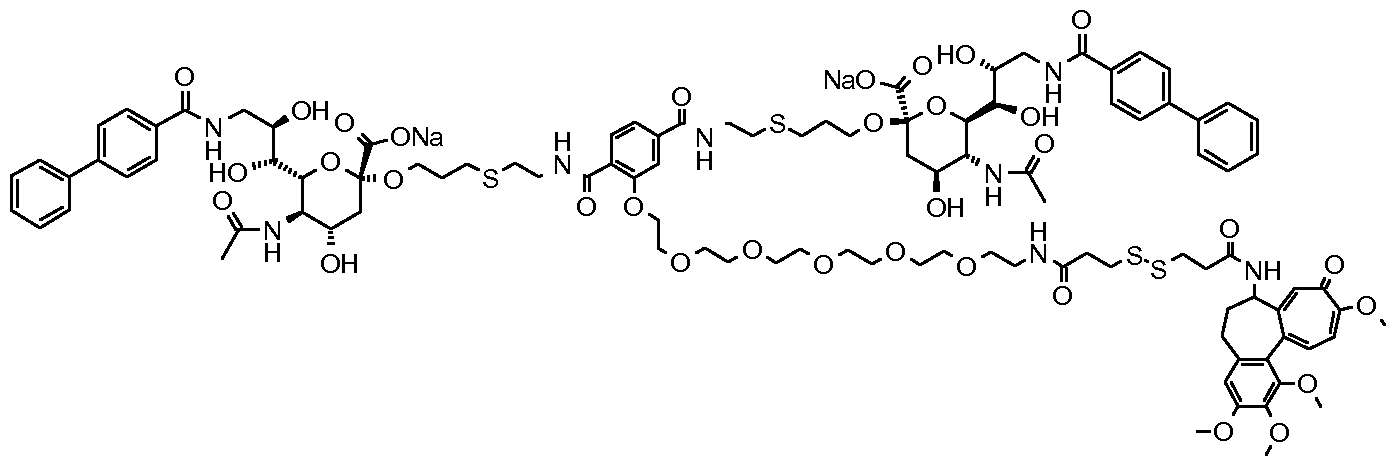
Gegenstand der Erfindung ist daher ein Sialinsäurederivat der Formel (I),
Figure imgf000004_0001
wobei die Symbole folgende Bedeutungen haben: ist gleich 4-Biphenyl, 4-(2-Thienyl)benzoyl, 4-(3-Thienyl)benzoyl, 1 -Naphtyl und 2- Naphtyl, wobei die genannten Reste unsubstituiert oder ein- oder mehrfach durch eine Gruppe X1 substituiert sind; ist gleich oder verschieden Fluor, Chlor, Hydroxy, Carboxy, S03M, OSO3M, SO2NH2, SO2CF3, Alkyl, Cycloalkyl, Halogenalkyl, Alkyloxy, Halogenalkyloxy, Alkylcarbonyloxy, Alkylcyclocarbonyloxy, Aminocarbonyl, Alkylaminocarbonyl, Cyclo alkylaminocarbonyl, Alkylcarbonylamino, Cyclo alkylcarbonylamino, Alkyl- amino, Cyclo alkylamino, Dialkylamino, Dicycloalkylamino oder Alkylcyclo- alkylamino wobei die Alkylgruppen in diesen Resten 1 bis 4 und die Cyclo- alkylgruppen 3 oder 4 Kohlenstoffatome enthalten; ist gleich ~(Ci-C2-Alkyl)-, ~C(0)- oder ~CH2C(0)- wobei ~ die Bindung zur Gruppe A1 bezeichnet; ist gleich -O-, -S- oder -CH2-; ist gleich eine geradkettige oder verzweigte Alkandiylgruppe mit 3 bis 10 C-Atomen, wobei
(i) gegebenenfalls eine oder mehrere nicht terminale CH2-Gruppen durch -O- und/oder -S- ersetzt sind und/oder (ii) gegebenenfalls ein oder mehrere H-Atome durch F und/oder Cl ersetzt sind und/oder
(iii) gegebenenfalls eine nicht terminale -CH2CH2- Gruppe durch -NHCO- ersetzt ist;
Y3 ist gleich -C(O)-, ~C(0)-NH- oder -NH-C(O)-, wobei ~ die Bindung zu Gruppe A3 bezeichnet;
A3 ist
a) ein Ci-Cs-Alkantriyl, wobei gegebenenfalls mehrere nicht terminale CH2- Gruppen durch O, S, S(O), S(0)2, NRX und/oder C(O) ersetzt sind und wobei in den genannten Gruppen gegebenenfalls ein oder mehrere H-Atome durch eine Gruppe X2 ersetzt sind, ist ein gesättigter, partiell ungesättigter oder aromatischer, mono- oder polycyclischer Kohlenwasserstoffrest mit 3 bis 14 C- Atomen oder ein drei- bis achtgliedriger, aromatischer, partiell ungesättigter oder gesättigter mono oder polycyclischer heterocyclischer Rest, wobei die genannten Gruppen jeweils gegebenenfalls durch eine oder mehrere Gruppen X2 substituiert sind, c) ein tertiärer Stickstoff; ist gleich Fluor, Chlor, Alkyl, Halogenalkyl oder Alkyloxy wobei die Alkylgruppen in diesen Resten 1 bis 2 Kohlenstoffatome enthalten;
W ist -Y5-T2-V oder -V;
V ist ~C(0)0-4-Nitrophenyl, ~C(0)0-Pentafluorphenyl, Malein-2-yl-säureanhydrid, ~C(0)-l-Azetidin-2-on, ~4-0-Phenyl-C(0)-l-Azetidin-2-on, ~N=C=0, ~N=S=0, ~C(0)N2, ~S(0)2C1, ~C(NH2)ORy, ~P(CH2OH)3, ~SH, ~SC(0)CH3, ~NH2, ~OH, ~CH=CH2, ~C=CH, -COOM, ~C(0)H, ~C(0)CH3, ~C(0)C(0)H, ~I, ~N3, Ethyl- 2-(3-Indol)amin-l~, ~S(0)2N3, Phenyl-CH=CH-C(N2)-C(0)0~,
~CH=CHCH2OC(0)Ry, ~CH=CHCH2OC(0)NHRy, ~OC(0)ORy, ~C(0)NHNH2, ~N-Maleinimid, Aziridin-2~, Pyridin-2-S-S~, Phenyl-l-Carboxy-2-Nitro-5-S-S~, ~S(0)2CH=CH2, ~C(0)-S-Phenyl, ~C(0)CH=N2, ~C(0)0-N-Succinimidyl, oder C(0)0-N-Sulfosuccinimidyl; ist eine Bindung, -O-, -S-, -NRX-, -C(O)-, ~C(0)-NRx- oder ~NRx-C(0)-, wobei ~ die Bindung zu Gruppe A3 bezeichnet; ist eine geradkettige oder verzweigte Alkandiylgruppe mit 1 bis 200 C-Atomen, wobei gegebenenfalls eine oder mehrere nicht terminale CH2-Gruppen durch -O-, NH und/oder -S- ersetzt sind und/oder gegebenenfalls ein oder mehrere nicht terminale H-Atome durch F, Cl, (=0), NRZ und/oder NRy, ersetzt sind und/oder gegebenenfalls eine oder mehrere nicht terminale -CH2CH2- Gruppe durch - NHCO- oder -S-S- ersetzt ist;
R ist gleich C(0)OM;
R2, R3 sind gleich H; R4, R6, R7 sind gleich oder verschieden OH oder ORz; ist gleich C(0)CH3 oder C(0)CH2OH;
M ist gleich ein Ci-C4-Alkyl, C3-C4-Cycloalkyl oder ein Kation;
Rx ist gleich oder verschieden H, Ry oder Rz;
Ry ist gleich oder verschieden Ci-C4-Alkyl, C3-C4-Cycloalkyl, Phenyl oder Benzyl und Rz ist gleich oder verschieden -C(0)-Ci-C4-Alkyl, -C(0)-C3-C4-Cycloalkyl, -C(O)- Phenyl oder C(0)-CH2-Phenyl.
Gegenstand der Erfindung ist auch die Verwendung eines Sialinsäurederivates der Formel (I) in einem Verfahren zur Verknüpfung mit einem Cargo. Beispielsweise werden niedermolekulare Wirkstoffe (niedermolekulare pharmakologisch wirksame Substanzen), radioaktiv markierte Stoffe, Zytostatika, RNA, DNA, Proteine oder ein anderes therapeutisch anwendbares Cargo verknüpft. Bevorzugt sind eine niedermolekulare, pharmakologisch wirksame Substanz, ein Zytostatikum, ein Protein, ein antigenes Protein, ein Enzym, ein Antigen, ein niedermolekulares Antigen, eine DNA, eine RNA, ein Oligonucleotid, eine radioaktiver Stoff, eine metallorganischer Komplex oder ein Peptid. Beispielsweise können die Konjugate zur Verwendung in einem Verfahren zur Regulation des Immunsystems, beispielsweise bei Impfungen oder Transplantationen sowie zur Behandlung von Krankheiten, insbesondere Allergien, Autoimmunerkrankungen, chronischen Entzündungen, Querschnittslähmung, multipler Sklerose, Viruserkrankungen, beispielsweise AIDS, bakterielle Erkrankungen, parasitäre Erkrankungen, Krankheiten, bei denen die Immunantwort im Rahmen der B-Zellenaktivierung gestört ist, wie Common Variable Immunodeficiency (CVID) und lgA-Defizienz, bei Krankheiten der blutbildenden Organe und des Blutes sowie bei Krebs, beispielsweise Lymphome und Myelome genutzt werden.
Ein weiterer Gegenstand der Erfindung ist auch die Verwendung eines Sialinsäurederivates der Formel (I) in einem Verfahren zur Verknüpfung mit einem Cargo, bevorzugt einem Cargo ausgewählt aus der Gruppe bestehend aus RNA, DNA, Peptiden, niedermolekularen Antigenen, antigenen Proteinen, Enzymen und niedermolekularen pharmakologisch wirksamen Substanzen, insbesondere zur Regulierung von Stoffwechselvorgängen, Immunreaktionen, Immunisierungen oder Desensibilisierungen des Zielorganismus. Ein weiterer Gegenstand der Erfindung ist die Verwendung eines pharmakologisch wirksamen Konjugates eines erfindungsgemäßen Sialinsäurederivates der Formel (I) und eines Cargo, vorzugsweise ausgewählt aus der Gruppe bestehend aus RNA, DNA, Peptiden, Zytostatika, Enzymen, metallorganischen Komplexen und niedermolekularen pharmakologisch wirksamen Substanzen, in einem Verfahren zur Behandlung von Infektionen, Tumorerkrankungen oder Allergien.
Ein weiterer Gegenstand der Erfindung ist auch die Verwendung eines Sialinsäurederivates der Formel (I) in einem Verfahren zur Verknüpfung mit einem Cargo, vorzugsweise ausgewählt aus der Gruppe bestehend aus RNA, DNA, Peptiden, Enzymen, metallorganischen Komplexen und niedermolekularen pharmakologisch wirksamen Substanzen, zur Behandlung von Allergien und Immunreaktionen.
Ein weiterer Gegenstand der Erfindung ist auch die Verwendung eines pharmakologisch wirksamen Konjugates eines Sialinsäurederivates der Formel (I) und eines Cargo, vorzugsweise ausgewählt aus der Gruppe bestehend aus RNA, DNA, Peptiden, Enzymen, metallorganischen Komplexen und niedermolekularen pharmakologisch wirksamen Substanzen, in einem Verfahren zur Behandlung von Allergien und Immunreaktionen. Ebenfalls Gegenstand der Erfindung ist auch die Verwendung eines Sialinsäurederivates der Formel (I) in einem Verfahren zur Verknüpfung mit Liposomen, Nanopartikeln, metallorganischen Komplexen, Metallnanopartikeln wie zB. Goldanopartikeln, Micro- Miscelles, Kohlenstofmanoröhrchen und anderen Transportvehikeln. Das Vehikel kann pharmakologisch wirksame Substanzen, Proteine, Antigene oder Impfstoffe sowie Impf- Adjuvantien beinhalten.
Ebenfalls Gegenstand der Erfindung ist auch die Verwendung eines Sialinsäurederivates der Formel (I) in einem Verfahren zur Herstellung von Liposomen, Nanopartikeln, Micro- Miscelles, Kohlenstoffnanoröhrchen und anderen Transportvehikeln.
Ebenfalls Gegenstand der Erfindung ist auch die Verwendung eines Sialinsäurederivates der Formel (I) in einem Verfahren zur Verknüpfung mit Molekülen zu diagnostischen Zwecken. Beispielsweise kann ein Sialinsäurederivat der Formel (I) mit einem fluoreszentem Molekül, einem Positronenemitter oder einem anderem diagnostisch nutzbarem Cargo verknüpft werden.
Ebenfalls Gegenstand der Erfindung ist auch die Verwendung eines Sialinsäurederivates der Formel (I) in einem Verfahren zur Herstellung von polyvalenten Liganden. Durch Verknüpfung mit einem polyvalenten Trägermolekül können wirksame Substanzen mit verbesserten Eigenschaften hergestellt werden. Diese Substanzen können zur Verwendung in einem Verfahren zur Regulation des Immunsystems, beispielsweise bei Impfungen sowie zur Behandlung von Krankheiten, deren Verlauf oder Aktivität durch die Siglec- Inhibitoren positiv beeinflusst werden kann, insbesondere Allergien, Autoimmun- erkrankungen, chronischen Entzündungen, Querschnittslähmung, multipler Sklerose, Krebs, Viruserkrankungen, beispielsweise AIDS, Bakterielle Erkrankungen, bespielsweise Streptokokken, parasitären Erkrankungen, beispielsweise Chagas Krankheit, Krankheiten, bei denen die Immunantwort im Rahmen der B-Zellenaktivierung gestört ist, wie Common Variable Immunodeficiency (CVID) und lgA-Defizienz, bei Krankheiten der blutbildenden Organe und des Blutes sowie bei Krebs, beispielsweise Lymphome und Myelome genutzt werden.
Weiterhin Gegenstand der Erfindung ist die Verwendung eines erfindungsgemäßen Sialinsäurederviates der Formel (I) zur Verknüpfung mit einem Cargo tragenden Polymer, wobei das Cargo bevorzugt ausgewählt ist aus der Gruppe bestehend aus RNA, DNA, Zytostatika, Peptiden, niedermolekularen Antigenen, antigenen Proteinen, Enzymen, metallorganischen Komplexen und niedermolekularen pharmakologisch wirksamen Substanzen, "Cargo" bezeichnet im Sinne der Erfindung eine niedermolekulare, pharmakologisch wirksame Substanz, ein Zytostatikum, ein Protein, ein antigenes Protein, ein Enzym, ein Antigen, ein niedermolekulares Antigen, eine DNA, eine RNA, ein Oligonucleotid, einen radioaktiven Stoff, einen metallorganischen Komplex oder ein Peptid, bevorzugt eine niedermolekulare, pharmakologisch wirksame Substanz, ein Protein, ein Antigen, ein Oligonucleotid, einen radioaktiven Stoff oder ein Peptid, wobei dieses an die Gruppe W der Verbindung der Formel (I) gebunden ist. Die Sialinsäurederivate der Formel (I) weisen überraschend hohe Affinität zu CD22 auf. Sie enthalten außer Sialinsäure keine weiteren Kohlenhydrate. Sie enthalten eine reaktive Gruppe, welche einfach zu variieren ist und so die Konjugation mit einer Vielzahl von Cargo-Molekülen ermöglicht. Über die reaktive Gruppe können ebenfalls weitere neue reaktive Gruppen zur Verknüpfung mit einem Cargo eingeführt werden. Sie beinhalten gegebenenfalls eine spaltbare Gruppe. Im Gegensatz zu Antikörpern ist eine chemische Herstellung ohne den Einsatz von Zellkulturen möglich. Die Sialinsäurederivate der Formel (I) können je nach Cargo über spaltbare oder unspaltbare Linker verknüpft werden. Die Liganden können mit dem Cargo so verknüpft werden, dass die Aktivität des Cargo nicht beeinträchtigt wird oder erst in der Zielzelle wieder hergestellt wird. Es können einheitliche und in ihrer Struktur definierbare Konjugate der Sialinsäurederivate der Formel (I) hergestellt werden.
Der Begriff„Sialinsäurederivat der Formel (I)" umfasst alle stereoisomeren Formen der Verbindung der Formel (I), insbesondere E/Z oder Cis/trans-Isomere bei substituierten Doppelbindungen oder Ringen und sowie Stereoisomere, die sich durch die Chiralitätszentren der Verbindungen der Formel (I) ergeben, insbesondere Enantiomere und Diastereoisomere in reiner Form oder in Form von Gemischen jeglicher Zusammensetzung, wobei die einzelnen Chiralitätszentren jeweils in der (S)- oder (R)- Form vorliegen.
Die Herstellung der einzelnen Stereoisomeren kann beispielsweise durch Aufbesserung der Isomerengemische nach üblichen Methoden, wie Chromatographie oder Kristallisation, oder durch Verwendung von isomeren reinen Ausgangsstoffen erfolgen. Die Aufbesserung der Isomere kann auf Stufe der Edukte, Zwischenprodukte oder Endprodukte der Formel (I) erfolgen. Zu den erfindungsgemäß umfassten Isomeren zählen auch alle tautomeren Formen von Verbindungen der Formel (I) und alle mesomorphen Formen. Im Allgemeinen kommen die Salze derjenigen Kationen oder die Säureadditionssalze derjenigen Säuren in Betracht, deren Kationen, beziehungsweise Anionen, die Verwendung zur Herstellung von Konjugaten mit den Verbindungen (I) nicht negativ beeinträchtigen.
Es kommen als Kationen insbesondere Ionen der Alkalimetalle, vorzugsweise Lithium, Natrium und Kalium, der Erdalkalimetalle, vorzugsweise Calcium und Magnesium, und der Übergangsmetalle, vorzugsweise Mangan, Kupfer, Zink und Eisen, sowie Ammonium, wobei hier gewünschtenfalls ein bis vier Wasserstoffatome durch RY ersetzt sein können, vorzugsweise Ammonium, Dimethylammonium, Diisopropylammonium, Tetramethylammonium, Triethylammonium, Tetrabutylammonium, 2-(2-Hydroxyeth-l-oxy)eth-l-yl- ammonium, Di-(2-hydroxyeth-l-yl)-ammonium, Trimethylbenzylammonium, des weiteren Phosphoniumionen, Sulfoniumionen, vorzugsweise Tri(Ci-C4-alkyl)sulfonium und Sulfoxoniumionen, vorzugsweise Tri(Ci-C4-alkyl)-sulfoxonium, in Betracht. Bevorzugt sind Na, Li, K, Ca, Mg und Ammonium (gegebenenfalls substituiert), besonders bevorzugt sind Na, Li und K, insbesondere bevorzugt ist Na.
Anionen von Säureadditionsalzen sind beispielsweise Chlorid, Bromid, Fluorid, Hydrogensulfat, Sulfat, Dihydrogenphosphat, Hydrogenphosphat, Nitrat, Hydrogen- carbonat, Carbonat, Hexafluorosilikat, Hexafluorophosphat, Benzoat, die Anionen von Ci- C4-Alkansäuren, vorzugsweise Formiat, Acetat, Propionat und Butyrat, und anderen organischen Säuren, wie Pivalinsäure, Maleinsäure, Bernsteinsäure, Pimelinsäue, Fumarsäure, Apfelsäure, Sulfaminsäure, Phenylpropionsäure, Gluconsäure, Ascorbinsäure, Nicotinsäure, Zitronensäure und Adipinsäure.
Weiterhin umfasst der Begriff„Sialinsäurederivat der Formel (I)" Solvate, beispielsweise Hydrate oder Addukte mit Alkoholen, sowie alle Kristallmodifikationen.
Soweit nicht anders angegeben können Symbole, die mehrfach verwendet werden, unabhängig voneinander gleiche oder verschiedene Bedeutungen haben.
Bei den in der Formel (I) angegebenen Definitionen der Symbole bedeuten:
Halogen: Fluor, Chlor;
Alkyl: gesättigte, geradkettige oder verzweigte Kohlenwasserstoffreste mit beispielsweise 1 bis 4 Kohlenstoffatomen, wie Methyl, Ethyl, Propyl, 1-Methylethyl, Butyl, 1-Methyl- propyl, 2-Methylpropyl oder 1 , 1-Dimethylethyl; Cycloalkyl: gesättigte cyclische Kohlenwasserstoffe mit 3 oder 4 Kohlenstoffatomen, wie Cyclopropyl, Cyclo butyl und 1-Methylcyclopropyl;
Halogenalkyl: eine Alkylgruppe, bevorzugt Methylgruppe, wobei in dieser Gruppe Wasserstoffatome teilweise oder vollständig durch Halogenatome ersetzt sind: wie Chlormethyl, Fluormethyl oder Trifluormethyl;
Alkyloxy: Alkyloxygruppen mit gesättigtem Alkylrest, wobei dieser aus der vorstehend genannten Gruppe der Alkyle ist und 1 bis 2 Kohlenstoffatome enthält;
Halogenalkyloxy: Halogenalkyloxygruppen mit Halogenalkylrest, wobei dieser aus der vorstehend genannten Gruppe der Halogenalkyle ist;
Alkylcarbonyloxy: Alkylcarbonyloxygruppen mit gesättigtem, geradkettigem, verzweigtem oder cyclischem Alkylrest, wobei dieser aus der vorstehend genannten Gruppe der Alkyle ist und 1 bis 4 Kohlenstoffatome enthält;
Alkylaminocarbonyl: Alkylaminocarbonylgruppen mit gesättigtem, geradkettigem, verzweigtem oder cyclischem Alkylrest, wobei dieser aus der vorstehend genannten Gruppe der Alkyle ist und 1 bis 4 Kohlenstoffatome enthält;
Alkylamino: Alkylaminogruppen mit gesättigtem, geradkettigem, verzweigtem oder cyclischem Alkylrest, wobei dieser aus der vorstehend genannten Gruppe der Alkyle ist und 1 bis 4 Kohlenstoffatome enthält;
Dialkylamino: Dialkylaminogruppen mit gesättigtem, geradkettigem, verzweigtem oder cyclischem Alkylresten, wobei dieser aus der vorstehend genannten Gruppe der Alkyle ist und 1 bis 4 Kohlenstoffatome enthält;
Alkylcarbonylamino: Alkylcarbonylaminogruppen mit gesättigtem, geradkettigem, verzweigtem oder cyclischem Alkylrest, wobei dieser aus der vorstehend genannten Gruppe der Alkyle ist und 1 bis 4 Kohlenstoffatome enthält;
Alkantriyl bedeutet für Rest A3: gesättigte, geradkettige Alkantriylgruppe mit beispielsweise 1 bis 6 Kohlenstoffatomen, wie Methan- 1,1,1-triyl, Ethan-l,l,2-triyl, Propan-l,2,3-triyl, Propan-l,l,3-triyl, Butan- 1,2,4-triyl, Butan- 1,1,4-triyl, Pentan- 1,1, 5- triyl, Pentan- 1, 2, 5-triyl, Pentan-l,3,5-triyl, Hexan- 1,1,6-triyl, Hexan-l,2,6-triyl oder Hexan-l,3,6-triyl;
Alkandiyl bedeutet für Rest T1 : gesättigte, geradkettige oder verzweigte Alkandiylgruppe mit beispielsweise 3 bis 10 Kohlenstoffatomen, wie Propan-l,3-diyl, Butan- 1,4-diyl, Pentan- 1,5-diyl, Hexan- 1,6-diyl, Heptan-l,7-diyl, Octan-l,8-diyl, Nonan-l,9-diyl oder Decan-l,10-diyl;
Alkandiyl bedeutet für Rest T2: gesättigte, geradkettige Alkandiylgruppe mit beispielsweise 1 bis 200 Kohlenstoffatomen, wie Methan- 1,1-diyl, Ethan-l,2-diyl, Propan- 1,3-diyl, Butan- 1,4-diyl, Pentan- 1,5-diyl, Hexan- 1 ,6-diyl, Heptan-l,7-diyl, Octan-l,8-diyl, Nonan-l,9-diyl, Decan-l,10-diyl, Undecan-1,11-diyl, Dodecan-l,12-diyl, Tridecan-1,13- diyl, Tetradecan-l,14-diyl, Pentadecan-l,15-diyl, Hexadecan-l,16-diyl, Heptadecan-1,17- diyl, Octadecan-l,18-diyl;
Mono- oder polycyclischer, aromatischer, partiell ungesättiger oder gesättiger C3-C14- Kohlenwasserstoffrest bedeutet für A3 beispielsweise: a) gleich oder verschieden C6-Ci4-Aryltriyl, insbesondere Phenylen-l,2,4-triyl, Phenylen- 1,3,5-triyl und Naphthalin- 1,2,4-triyl;
b) Cs-Cs-Cycloalkyltriyl, beispielseise Cyclopropan-l,2,3-triyl, Cyclo hexan- 1,2,4-triyl und Cyclohexan-l,3,5-triyl;
Drei- bis achtgliedriger gesättigter, partiell ungesättigter oder aromatischer heterocyclischer Rest bedeutet für A3 beispielsweise: a) 5-gliedriges Heteroaryltriyl, enthaltend ein bis vier Stickstoffatome oder ein bis drei Stickstoffatome und/oder ein Schwefel- oder Sauerstoffatom, insbesondere Thiophen-2,3,5-triyl und lH(l,2,3)Triazol-l,4,5-triyl;
Vorteilhaft haben die Symbole in der Formel (I) folgende Bedeutungen:
A1 ist vorteilhaft gleich eine Gruppe 4-Biphenyl, 1-Naphtyl und 2-Naphtyl wobei die genannten Gruppen unsubstituiert oder durch eine oder mehrere Gruppen X1 substuiert sind.
X1 ist vorteilhaft gleich oder verschieden Fluor, Chlor, Hydroxy, Alkyl, Halogenalkyl, Alkyloxy, Halogenalkyloxy, Alkylcarbonyloxy, wobei die Alkylgruppen in diesen Resten 1 bis 2 Kohlenstoffatome enthalten.
Y1 ist vorteilhaft gleich ~C(0)- oder ~CH2C(0)-, wobei ~ die Bindung zur Gruppe A1 bezeichnet.
Z2 ist vorteilhaft gleich -0-.
T1 ist vorteilhaft gleich eine geradkettige oder verzweigte Alkandiylgruppe mit 4 bis 8 C-Atomen, wobei
(i) gegebenenfalls eine oder mehrere nicht terminale CH2-Gruppen durch -O- und/oder -S- ersetzt sind und/oder (ii)gegebenenfalls eine nicht terminale -CH2CH2- Gruppe durch -NHCO- ersetzt ist.
Y3 ist vorteilhaft gleich eine Bindung, ~C(0)-NH- oder -NH-C(O)-, wobei ~ die Bindung zu Gruppe A3 bezeichnet.
A3 ist vorteilhaft ein a) Ci-Cs-Alkantriyl, wobei gegebenenfalls eine oder mehrere nicht terminale CH2-Gruppen durch O, S, NRX und/oder C(O) ersetzt sind und wobei in den genannten Gruppen gegebenenfalls ein oder mehrere H-Atome durch eine Gruppe X2 ersetzt sind, b) Phenylen-l,2,4-triyl oder lH(l,2,3)Triazol-l,4,5-triyl, wobei die genannten Gruppen jeweils gegebenenfalls durch eine oder mehrere Gruppen X2 substituiert sind, c) tertiärer Stickstoff.
X2 ist vorteilhaft gleich Fluor, Chlor, Methyl, Methyloxy. W ist vorteilhaft -Y5-T2-V oder -V.
V ist vorteilhaft ist ~C(0)0-4-Nitrophenyl, ~C(0)0-Pentafluorphenyl, Malein-2-yl- säureanhydrid, ~N=C=0, ~N=S=0, ~C(0)N2, ~P(CH2OH)3, ~SH, ~NH2, ~OH, ~CH=CH2, ~C=CH, -COOM, ~C(0)H, ~C(0)CH3, ~C(0)C(0)H, ~I, ~N3, ~C(0)NHNH2, ~N-Maleinimid, Aziridin-2~, Pyridin-2-S-S~, Phenyl-l-Carboxy- 2-Nitro-5-S-S~, ~C(0)0-N-Succinimidyl.
Y5 ist vorteilhaft eine Bindung, -O-, -NH-, -C(O)-, ~C(0)-NH- oder -NH-C(O)-, wobei ~ die Bindung zu Gruppe A3 bezeichnet.
T2 ist vorteilhaft eine geradkettige oder verzweigte Alkandiylgruppe mit 1 bis 200 C- Atomen, wobei
(i) gegebenenfalls eine oder mehrere nicht terminale CH2-Gruppen durch -O- oder -NH- ersetzt sind und/oder (ii) gegebenenfalls ein oder mehrere nicht terminale H-Atome durch F oder (=0) ersetzt sind und/oder (iii) gegebenenfalls eine oder mehrere nicht terminale -CH2CH2- Gruppe durch -
NHCO- oder -S-S- ersetzt ist.
R1 ist vorteilhaft gleich C(0)OM. R2, R3 sind vorteilhaft gleich H.
R4, R6, R7 sind vorteilhaft gleich oder verschieden OH oder ORz.
R5 ist vorteilhaft gleich C(0)CH3.
M ist vorteilhaft gleich ein C1-C2- Alkyl oder ein Kation.
Rx ist vorteilhaft gleich oder verschieden H, Ry oder Rz. Ry ist vorteilhaft gleich oder verschieden Ci-C3-Alkyl, Cyclopropyl, Phenyl oder Benzyl.
Rz ist vorteilhaft gleich oder verschieden -C(0)-Ci-C4- Alkyl, -C(0)-Phenyl oder - C(0)-CH2-Phenyl.
Vorteilhaft bedeuten die in der Formel (I) angegebenen Definitionen der Symbole: Halogen: Fluor, Chlor;
Alkyl: gesättigte, geradkettige oder verzweigte Kohlenwasserstoffreste mit beispielsweise 1 bis 3 Kohlenstoffatomen, wie Methyl, Ethyl, Propyl und 1-Methylethyl;
Cycloalkyl: Cyclopropyl;
Halogenalkyl: Chlormethyl, Fluormethyl und Trifluormethyl;
Alkyloxy: Alkyloxygruppen mit gesättigtem Alkylrest, wobei dieser aus der vorstehend genannten Gruppe der Alkyle ist und 1 bis 2 Kohlenstoffatome enthält;
Halogenalkyloxy: Halogenalkyloxygruppen mit Halogenalkylrest, wobei dieser aus der vorstehend genannten Gruppe der Halogenalkyle ist; Alkylcarbonyloxy: Alkylcarbonyloxygruppen mit gesättigtem, geradkettigem oder verzweigtem Alkylrest, wobei dieser aus der vorstehend genannten Gruppe der Alkyle ist und 1 bis 3 Kohlenstoffatome enthält;
Alkantriyl bedeutet für Rest A3: gesättigte, geradkettige Alkantriylgruppe mit beispielsweise 1 bis 5 Kohlenstoffatomen, wie Methan- 1,1,1-triyl, Ethan-l,l,2-triyl, Propan-l,2,3-triyl, Propan-l,l,3-triyl, Butan- 1,2,4-triyl, Butan- 1,1,4-triyl, Pentan- 1,1, 5- triyl, Pentan- 1, 2, 5-triyl oder Pentan-l,3,5-triyl;
Alkandiyl bedeutet für Rest T1 : gesättigte, geradkettige oder verzweigte Alkandiylgruppe mit beispielsweise 4 bis 8 Kohlenstoffatomen, wie Butan- 1,4-diyl, Pentan- 1,5-diyl, Hexan- 1,6-diyl, Heptan-l,7-diyl oder Octan-l,8-diyl;
Alkandiyl bedeutet für Rest T2: gesättigte, geradkettige Alkandiylgruppe mit beispielsweise 1 bis 200 Kohlenstoffatomen, wie Methan- 1,1-diyl, Ethan-l,2-diyl, Propan- 1,3-diyl, Butan- 1,4-diyl, Pentan- 1,5-diyl, Hexan- 1 ,6-diyl, Heptan-l,7-diyl, Octan-l,8-diyl, Nonan-l,9-diyl, Decan-l,10-diyl, Undecan-1,11-diyl, Dodecan-l,12-diyl, Tridecan-1,13- diyl, Tetradecan-l,14-diyl, Pentadecan-l,15-diyl, Hexadecan-l,16-diyl, Heptadecan-1,17- diyl, Octadecan-l,18-diyl;
Vorteilhaft sind Verbindungen der Formel (I), bei denen alle Symbole, Definitionen und Indizes die vorteilhaften Bedeutungen haben.
Bevorzugt haben die Symbole in der Formel (I) folgende Bedeutungen:
A1 ist bevorzugt gleich 4-Biphenyl, wobei die genannte Gruppe unsubstituiert oder durch eine oder mehrere Hydroxylgruppen substuiert ist.
Y ist bevorzugt gleich ~C(0)-, wobei ~ die Bindung zur Gruppe A bezeichnet. ist bevorzugt gleich -0-.
T ist bevorzugt gleich Hexan- 1,6-diyl, wobei gegebenenfalls eine nicht terminale CH2-Gruppen durch -S- ersetzt ist. ist bevorzugt gleich ~C(0)-NH-, wobei ~ die Bindung zu Gruppe A3 bezeichnet. A3 ist bevorzugt Propan-l,l,3-triyl oder Phenyl- 1,2,4-triyl.
W ist bevorzugt -Y5-T2-V oder -V. V ist vorteilhaft ist ~SH, ~NH2, ~CH=CH2, ~C=CH, -COOM, ~I, ~N3, ~C(0)NHNH2, ~N-Maleinimid, ~C(0)0-N-Succinimidyl.
Y5 ist bevorzugt eine Bindung, -O- oder -NHCO-, wobei ~ die Bindung zur Gruppe A3 bezeichnet.
T2 ist bevorzugt eine geradkettige oder verzweigte Alkandiylgruppe mit 1 bis 200 C- Atomen, wobei (i) gegebenenfalls eine oder mehrere nicht terminale CH2-Gruppen durch ~0- ersetzt sind und/oder
(ii) gegebenenfals eine oder mehrere nicht terminale -CH2CH2-Gruppen durch -NHCO- oder -S-S- ersetzt sind.
R1 ist bevorzugt gleich C(0)OM. R2, R3 sind bevorzugt gleich H. R4, R6, R7 sind bevorzugt gleich OH oder OC(0)CH3. R5 ist bevorzugt gleich C(0)CH3. M ist bevorzugt CH3 oder Natrium.
Bevorzugt bedeuten die in der Formel (I) angegebenen Definitionen der Symbole:
Alkandiyl bedeutet für Rest T2 bevorzugt: gesättigte, geradkettige Alkandiylgruppe mit beispielsweise 1 bis 200 Kohlenstoffatomen, wie Methan- 1, 1-diyl, Ethan-l,2-diyl, Propan- 1,3-diyl, Butan- 1,4-diyl, Pentan-l,5-diyl, Hexan- 1 ,6-diyl, Heptan-l,7-diyl, Octan-l,8-diyl, Nonan-l,9-diyl, Decan-l,10-diyl, Undecan-1,11-diyl, Dodecan-l,12-diyl, Tridecan-1,13- diyl, Tetradecan-l,14-diyl, Pentadecan-l,15-diyl, Hexadecan-l,16-diyl, Heptadecan-1,17- diyl, Octadecan-l,18-diyl. Bevorzugt sind Verbindungen der Formel (I), bei denen alle Symbole, Definitionen und Indizes die bevorzugten Bedeutungen haben. Weiterhin bevorzugte Sialinsäurederivate der Formel (I) sind solche der Formeln (Ia) - (Ib), wobei die Symbole die in der Formel (I) angegebenen Bedeutungen und Bevorzugungen haben.
Figure imgf000017_0001
Besonders bevorzugt sind weiterhin Sialinsäurederivate der Formeln (Iaa)-(Iba), wobei die Symbole die in der Formel (I) angegebenen Bedeutungen haben:
Figure imgf000017_0002
Ebenso besonders bevorzugt sind Sialinsäurederivate der Formeln (Iac)-(Iaf), wobei die Symbole die in der Formel (I) angegebenen Bedeutungen haben:
Figure imgf000017_0003
Figure imgf000018_0001
Die erfindungsgemäßen Sialinsäurederivate (I) sind unter Anwendung im Prinzip bekannter Syntheseverfahren erhältlich. Bevorzugt werden die Verbindungen nach den nachfolgend näher erläuterten erfindungsgemäßen Herstellungsverfahren, insbesondere den Syntheseschemata I - IX, erhalten:
Schema I
Figure imgf000018_0002
K1 ist Alkyl, insbesondere Ci-C3-Alkyl
K2 ist Alkenyl, geschütztes Aminoalkyl
Z2 ist gleich O, S oder CH2 Verbindungen der Formel (III) können durch Einführung einer Azidogruppe aus den Verbindungen der Formel (II) hergestellt werden (Schema I). Die Einführung von Azidogruppen ist beispielsweise beschrieben in Angewandte Chemie 2005, 1 17, 5320- 5374 und Chem Rev 1988, 88 (2), 297-368. Beispielhaft wurde Verbindung 6 hergestellt. Schema II
Figure imgf000019_0001
K1 ist Alkyl, insbesondere Ci-C3-Alkyl
K2 ist z.B.: Alkenyl, geschütztes Aminoalkyl
Z2 ist gleich O, S oder CH2
Verbindungen der Formel (IV) können durch Reduzierung der Azidogruppe in den Verbindungen der Formel (III) hergestellt werden (Schema II). Die Reduktion von Azidogruppen ist beispielsweise beschrieben in Angewandte Chemie 2005, 117, 5320- 5374 und Chem Rev 1988, 88 (2), 297-368
Beispielhaft wurde Verbindung 7 hergestellt.
Schema III
Figure imgf000019_0002
K1 ist ein Alkyl, insbesondere Ci-C3-Alkyl
K2 ist z.B.: Alkenyl, geschütztes Aminoalkyl
Z2 ist gleich O, S oder CH2
Verbindungen der Formel (V) können durch Bildung einer Amid-Bindung aus dem Amin in Verbindungen der Formel (IV) hergestellt werden (Schema III). Reaktionen von Aminen zu Amiden sind beispielsweise beschrieben in Tetrahedron 2005, 61, 10827-10852.
Beispielhaft wurde Verbindung 8 und 30 hergestellt.
Schema IV
Figure imgf000020_0001
K1 ist Alkyl, insbesondere Ci-C3-Alkyl
K2 ist ein Alkenyl, geschütztes Aminoalkyl
Verbindungen der Formel (VII) können durch Reaktion einer terminalen Doppelbindung der Verbindungen der Formel (VI) mit einer reaktiven Gruppe hergestellt werden (Schema IV). Reaktionen von Doppelbindung sind beispielsweise beschrieben in J. Org. Chem. 2000, 65, 958-963. Weiter können Verbindungen der Formel (VII) durch Entschützen der Aminogruppe in Verbindungen der Formel (IV) hergestellt werden (Schema VI). Schutzgruppen und Reaktionen zum Entschützen von Aminogruppen sind beispielsweise beschrieben in„Protecting Groups" Philip J. Kocienski, 3rd Edition, Thieme 2005 und Chem. Rev. 2009, 109, 2455-2504.
Beispielhaft wurde Verbindung 9 und 31 hergestellt.
Die Herstellung von dimeren Ausgangsprodukten ist beispielhaft in Schema V beschrieben.
Schema V
Figure imgf000020_0002
K1 ist Alkyl, insbesondere Methyl
K2 ist gleich eine Schutzgruppe für W
Verbindungen der Formel (IX) können durch Reaktion der Aminogruppe in Verbindungen der Formel (VIII) mit divalenten, reaktiven Verbindungen hergestellt werden (Schema V). Reaktionen von Aminen mit reaktiven Verbindungen sind beispielsweise beschrieben in Tetrahedron 2005, 61 , 10827-10852 und Chem. Eur. J. 2009, 15, 9404-9416. Die Reaktion kann auch durch den Einsatz von Kupplungsreagenzien oder durch in situ Aktivierungen einer divalenten Verbindung durchgeführt werden. Kupplungsreagenzien und deren Reaktionen sind beschrieben in Tetrahedron 2005, 61, 10827-10852 und Chem. Eur. J. 2009, 15, 9404-9416.
Beispielhaft wurden Verbindungen 10, 14, 17, 20 und 21 hergestellt.
Die Herstellung von Sialinsäurederivaten der Formel (I) ist beispielhaft in den Schemata VI bis VIII beschrieben.
Figure imgf000021_0001
K1 ist Alkyl, insbesondere Methyl
K2 ist eine Schutzgruppe für W
K3 ist K1 oder M
Verbindungen der Formel (Γ) können durch Entschützen der Gruppen W in Verbindungen der Formel (IX) hergestellt werden (Schema VI). Schutzgruppen und Reaktionen zum Entschützen sind beispielsweise beschrieben in„Protecting Groups" Philip J. Kocienski, 3rd Edition, Thieme 2005 und Chem. Rev. 2009, 109, 2455-2504.
Beispielhaft wurden Verbindungen 15, 11, 28 und 29 hergestellt.
Schema VII
Figure imgf000021_0002
K1 ist Alkyl, insbesondere Methyl
K2 ist K1 oder M
Verbindungen der Formel (I") können durch Reaktion der Aminogruppe in Verbindungen der Formel (VIII) mit divalenten, reaktiven Verbindungen hergestellt werden (Schema VII). Reaktionen von Aminen mit reaktiven Verbindungen sind beispielsweise beschrieben in Tetrahedron 2005, 61, 10827-10852 und Chem. Eur. J. 2009, 15, 9404-9416. Die Reaktion kann auch durch den Einsatz von Kupplungsreagenzien oder durch in situ Aktivierungen einer divalenten Verbindung durchgeführt werden. Kupplungsreagenzien und deren Reaktionen sind beschrieben in Tetrahedron 2005, 61, 10827-10852 und Chem. Eur. J. 2009, 15, 9404-9416.
Beispielhaft wurden Verbindungen 13, 18 und 32 hergestellt.
Schema VIII
Figure imgf000022_0001
K1 ist Alkyl oder M
V1 ist ein eine reaktive Gruppe, insbensondere ein Amin
V2 ist eine weitere reaktive Gruppe
Verbindungen der Formel (Γ") können durch Reaktionen der Gruppe V1 in Verbindungen der Formel (I") mit einer Gruppe V2 enthaltenden Substanz hergestellt werden (Schema VIII). Die Gruppe V1 bildet nach der Reaktion einen Teil von T2. Die Gruppe V2 kann auch während der Reaktion entstehen oder mit einer Schutzgruppe versehen sein, welche im Anschluss entschützt werden kann. Schutzgruppen und Reaktionen zum Entschützen sind beispielsweise beschrieben in„Protecting Groups" Philip J. Kocienski, 3rd Edition, Thieme 2005 und Chem. Rev. 2009, 109, 2455-2504.
Beispielhaft wurden Verbindungen 23, 24, 26, 27, 28 und 41 hergestellt. Die Herstellung von Konjugaten mit Sialinsäurederivaten der Formel (I) ist beispielhaft Schema IX beschrieben.
Schema IX
Figure imgf000023_0001
Y6 ist der durch die Verknüpfung entstandene Linker Verbindungen der Formel (X) können durch Reaktion der Gruppe W in Verbindungen der Formel (I) mit einem Cargo hergestellt werden (Schema IX). Dabei kann das Cargo ein oder mehrfach mit einer Verbindung der Formel (I) reagieren.
Beispielhaft wurden Verbindungen 35, 36, 37, 38, 39 und 40 hergestellt. Die Sialinsäurederivate der Formel (I) eignen sich zur Herstellung von pharmakologisch wirksamen Verbindungen und Wirkstoffen für Arzneimittelzubereitungen. Aus Sialinsäurederivaten der Formel (I) hergestellte pharmakologisch wirksame Verbindungen und Wirkstoffe wirken zur Behandlung von Krankheiten, deren Verlauf oder Aktivität durch Siglec-tragende Zellen beeinflusst werden, insbesondere Allergien, Autoimmunerkrankungen, chronische Entzündungen, Querschnittslähmung, multiple Sklerose, Krebs, Viruserkrankungen, beispielsweise AIDS, sowie bei bakterielle Erkrankungen, bespielsweise Streptokokken, parasitären Erkrankungen, Krankheiten, bei denen die Immunantwort im Rahmen der B-Zellenaktivierung gestört ist, wie Common Variable Immunodeficiency (CVID) und lgA-Defizienz.
Bevorzugte Indikationen sind Allergien, Krebs, Autoimmunerkrankungen und Impfungen.
Behandlung bedeutet im Sinne der Erfindung eine therapeutische Behandlung, sowohl zur Heilung als auch zur Linderung von Symptomen, wie auch eine vorbeugende Behandlung. Aus Sialinsäurederivaten der Formel (I) hergestellte pharmakologisch wirksame Verbindungen und Wirkstoffe können in Kombination mit anderen pharmakologisch wirksamen Substanzen, insbesondere solchen, welche die Wirksamkeit der aus Sialinsäurederivaten der Formel (I) hergestellten pharmakologisch wirksamen Verbindungen und Wirkstoffe verstärken, eingesetzt werden.
Gegenstand der Erfindung ist auch ein Verfahren zur Behandlung einer B-Zell vermittelten Krankheit, insbesondere aus der Gruppe der Allergien, Autoimmunerkrankungen, chronischen Entzündungen, Querschnittslähmung, multipler Sklerose, Krebs, Viruserkrankungen, beispielsweise AIDS, Krankheiten, bei denen die Immunantwort im Rahmen der B-Zellenaktivierung gestört ist, wie Common Variable Immunodeficiency (CVID) und lgA-Defizienz, wobei man einer von der Krankheit betroffenen Person eine vorzugsweise therapeutisch wirksame Menge einer aus einem der Sialinsäurederivate der Formel (I) hergestellten pharmakologisch wirksamen Verbindung verabreicht.
Die Sialinsäurederivate der Formel (I) können auch zur Herstellung ein Konjugates für andere als die genannten Zwecke eingesetzt werden, beispielsweise als Diagnostika, in Verfahren zur Bestimmung der Aktivität von Siglec-Liganden, als biochemische Sonden oder als Zwischenprodukte zur Herstellung von weiteren, insbesondere pharmakologisch aktiven, Verbindungen.
Die Erfindung wird durch die Beispiele näher erläutert ohne sie dadurch zu beschränken. Beispiele
A. Synthesebeispiele werden in Schemata 1 bis 6 dargestellt.
Schema 1
Figure imgf000025_0001
Verbindung 13
Schema 2
Figure imgf000025_0002
Schema 3
Verbindung 44
Figure imgf000026_0001
Verbindung 23 -* Verbindung 11 »- Verbindung 12
Verbindung 25
Schema 4
Verbindung 2
Figure imgf000026_0002
Verbindung 15 Verbindung 16 Verbindung 26, 27
Verbindung 41
Verbindung 28
Schema 5
Figure imgf000027_0001
Verbindung 21
Schema 6
Verbindung 7
Verbindung 33
Verbindung 32
Figure imgf000027_0002
Die Verbindungen wurden wie im Folgenden beschrieben erhalten:
Alle verwendeten aber nicht beschriebenen Verbindungen wurden gekauft oder nach bekannten Literaturvorschriften hergestellt.
Für Reinigungen mit Kieselgel wurde Kieselgel Si60 43-60μιη verwendet. Pro Gramm Substanz wurden ca. 100g Kieselgel benutzt. Für Reinigungen über RP-18-Kieselgel (YMC CO LTD., YMC ODS-AQ) wurde dieses in Ethanol suspendiert, in eine Säule gefüllt, mit Wasser vorgewaschen und die Substanz als Lösung oder Suspension mit Wasser aufgetragen. Das Säulenvolumen betrug ca. 5cm in der Höhe und ca. 1cm im Durchmesser. Das Lösungsmittel wurde mit geringem Druck, erzeugt durch einen handbetriebenen Druckball, durch die Säule gedrückt. Laufmittel sind in Klammern angegeben. Gradienten sind mit dem Zeichen » ausgedrückt z.B.:„(H20 » EtOH)" bedeutet, dass ein Gradient von Wasser zu Ethanol benutzt wurde). Lösungsmittel wurden mittels eines Vakuumrotationsverdampfers bei reduziertem Druck und einer Badtemperatur von 40°C vollständig entfernt. In den folgenden Synthesen ist dieser Arbeitschritt, als„entfernen des Lösungmittels" oder„Konzentration" benannt.
Lyophilisiert wurde, wenn nicht anders erwähnt, aus Wasser oder einer Wasser-Dioxan Mischung.
Photochemische Reaktionen wurden mittels des Photochemical Reactor, Model #RPR-100, The Souther New England Ultraviolet Company, durchgeführt. Die Reaktionen und Substanzen wurden mit Dünnschichtchromatographie kontrolliert. Hierfür wurden kieselgelbeschichtete Aluminiumplatten mit Fluorescenceindikator verwendet (Merck TLC Silica gel 60 F254). Die Substanzdetektion erfolgte unter UV-Licht bei 366 und 254nm. Die Chromatogramme wurden anschließend mit verdünnter Schwefelsäure besprüht und erhitzt, um die Kohlenhydrate nachzuweisen. Amine wurden zum Nachweis mit Ninhydrin-Lösung besprüht und erhitzt, Thiole mit Nitroprussid- Lösung. Einzelheiten und weitere Nachweisverfahren sind in „Anfärbereagenzien für Dünnschicht- und Papierchromatographie" Merck, 1970 erläutert.
Alle Substanzen wurden mit Massenspektrometrie geprüft.
Maldi-TOF: Matrix: 2,5 Dihydroxybenzoesäure Methode
Gerät: Bruker BIFLEX III
ESI: Bruker ApexQe hybrid 9.4 T FT-ICR (ESI) NMR: Varian 500MHz or 300MHz System
Abkürzungen
abs. absolut (wasserfrei)
AIBN Azaisobutyronitril
CH3CN Acetonitril
DMAP Dimethylaminopyridin
DMF N,N-Dimethylformamid
DIAD Diisopropylazodicarboxylat DIPEA N,N-Diisopropylethylamin
EE Ethylacetat
EtOH Ethanol
Fmoc Fluorenylmethyloxycarbonyl
HAc Essigsäure
HATU 0-(7- Azabenzotriazo 1- 1 -yl)-N,N,N ' ,N ' -tetramethyluronium
Fmoc (9H-Fluoren-9-ylmethoxy)carbonyl
MeOH Methanol
RT Raumtemperatur
RF Rückfluss
TEA Triethylamin
Z Benzyloxycarbonyl
» Gradient
eq Equivalente
2-(18-azido-l,4,7,10,13,16-hexaoxa-octadecyl)-Terephthalsäure (Verbindung 1)
300 mg (leq) Terephthalsäuredimethylester und 658 mg (leq) l-Tosyl-17-azido- 3,6,9, 12, 15-pentaoxa-heptadecyl wurden in 5ml abs. DMF gelöst, mit 1971 mg (lOeq) K2CO3 versetzt und bei 65°C über Nacht gerührt. Unter Rühren wurde 2 M Citronensäure zugegeben, die saure Lösung mit CH2CI2 ausgeschüttelt, die org. Phase mit MgS04 getrocknet, filtriert und eingeengt. Der Rückstand wurde mit Wasser versetzt und MeOH zugegeben bis eine klare Lösung erhalten wurde. Die Lösung wurde durch Zugabe von 2 M NaOH für 2 h bei einem pH 12-13 gehalten, dann wurde mit 2 M HCl angesäuert, mit EE ausgeschüttelt, die org. Phase mit ges. NaCl gewaschen, mit MgS04 getrocknet, filtriert, eingeengt und gefriergetrocknet. Ausbeute 450mg
2-(18-Fmoc amino-l,4,7,10,13,16-hexaoxa-octadecyl)-Terephthalsäure
(Verbindung 2) 240 mg (leq) Terephthalsäuredimethylester und 386 mg (l,leq) 17-azido-l-hydroxy- 3,6,9, 12, 15-pentaoxa-Heptadecan wurden in 5 ml abs. DMF gelöst und zweimal mit abs. DMF abgedamft. Nach Zugabe von 449 mg (l,5eq) Triphenylphosphin wurde auf 0 °C gekühlt, 330 μΐ DIAD (l,5eq) zugegeben und bei RT über Nacht gerührt. Nach Zugabe von 2 ml MeOH wurde eingeengt, in Dichlormethan aufgenommen, mit Wasser gewaschen, getrocknet (MgS04), filtriert, eingeengt und über Kieselgel gereinigt (n- Hexan»EE). Der Rückstand wurde in 5 ml MeOH und 1 ml H2O gelöst, mit 20 mg Pd auf Kohle (20%) und 0,8 ml HAc(20%) versetzt, 2 h hydriert, filtriert, eingeengt, in H20 gelöst, mit verdünnter HCl angesäuert (pH 3) und über RP18 gereinigt (H20»EtOH). Das Produkt wurde in 1 ml MeOH und 10 ml H20 gelöst und mit 0,1 ml NaOH (2M) versetzt. Nach 3 h wurde mit verd. HCl neutralisiert, eingeengt, in 1 ml H20 und 6 ml Dioxan gelöst und der pH mit TEA auf 8-9 eingestellt. Nach dreimaliger Zugabe von 70 mg Fmoc-NHS wurde eingeengt, der Rückstand über Kieselgel (EE, dann EtOH:H20 2: 1) und über RP18 (H20 HCl pH 4»EtOH) gereinigt und lyophilisiert. Ausbeute 98 mg
2-Allyloxy-Terephthalsäure (Verbindung 3)
100 mg 2-Hydroxyterephthalsäuredimethylester und 662 mg Allylbromid wurden in 1ml DMF gelöst, und es wurden 264 mg CsC03 zugegeben. Die Suspension wurde 3 h bei 60 °C gerührt, mit 5 ml HAc(20%) und 15 ml H20 versetzt und mit Dichlormethan ausgeschüttelt. Die org. Phase wurde getrocknet (MgS04), filtriert und eingeengt. Der Rückstand wurde mit 10 ml Dioxan gelöst, 5 ml H20 und 1 ml 2 M NaOH zugegeben. Nach 20 h wurde mit verd. HCl auf pH 3 eingestellt und über RP18 gereinigt. Ausbeute 72 mg
2-(3-Acetylthiopropyloxy) Terephthalsäure (Verbindung 4)
10 mg Verbindung 3 gelöst in 1 ml MeOH und 1 ml H20 wurden mit 137 mg Thioessigsäure versetzt und mit UV-Licht 8 h bestrahlt. Die Lösung wurde eingeengt und über RP 18 (H20»MeOH) gereinigt. Ausbeute 9 mg
Verbindung 5
Hergestellt nach„J. Carbohydrate Chemistry, 1987, 6 (1), 161-165 Verbindung 6
Zu einer Lösung von 4 g Verbindung 5 und 2,16 g (4eq) trockenem Lithiumazid in 40 ml abs. DMF wurden unter Rühren und 8,02 g (2,2eq) Tetrabrommethan gelöst. Die gelbe Lösung wurde bei 0° C mit 3,18 g (l,leq) Triphenylphosphin versetzt, langsam auf RT erwärmt und 20 h gerührt. Nach Zugabe von 20 ml MeOH wurde 1 h bei Raumtemperatur gerührt, wobei es zu geringer Gasentwicklung kam. Das Lösungsmittel wurde entfernt, der Rückstand mit wenig H20 versetzt und 3x mit Toluol gewaschen. Anschließend wurde das Produkt mit EE extrahiert, mit MgS04 getrocknet, filtriert und konzentriert. Ausbeute: 2,75 g einer leicht gelblichen Substanz. Alternativ wurde Lithiumazid durch Natriumazid ersetzt, welches sich nicht vollständig löst. Nach Zugabe des Methanols wurde zwei Tage bei RT gerührt. Verbindung 7
2,2 g der Verbindung 6 wurden in 100 ml MeOH gelöst, 4,45 g (3eq) Triphenylphosphin und 6 ml H20 zugegeben und die Suspension 18 h bei Raumtemperatur gerührt. Unter Rühren wurden 20 ml 20%ige Essigsäure und 90 ml H20 zugegeben, eine halbe Stunde gerührt, die Suspension auf 100 ml konzentriert, und dreimal mit 100 ml Dichlormethan ausgeschüttelt. Die wässrige Phase wurde lyophilisiert. Ausbeute: 2,67 g Feststoff
Alternativ wurde leq HCl statt 20 ml 20%iger HAc zugegeben. Verbindung 8
Eine Lösung von 1,0 g Verbindung 7 in 6 ml abs. DMF wurde nach Zugabe von 607 μΐ (l,5eq) Diisopropylethylamin und 832 mg (l,leq) 4-Biphenylcarbonsäure-Nitrophenyl- ester 17h bei RT gerührt. Das Lösungsmittel wurde entfernt und der Rückstand über eine Kieselgelsäule (EtOH:EE:HAc(20%) 1 :8: 1) gereinigt. Ausbeute: 1,06 g
Verbindung 9
Eine Lösung von 460 mg Verbindung 8 in 3 ml MeOH wurde mit 193 mg (2eq) Cysteaminhydrochlorid und 3 ml H20 versetzt und 20 min mit Stickstoff gespült. Nach Zugabe einer katalytischen Menge (2-3 mg) AIBN wurde 24h mit UV-Licht (λ=366 nm) bestrahlt, das Lösungsmittel entfernt, der Rückstand mit H20 gelöst und über eine RP18 Säule gereinigt (HCl pH 4 » MeOH / HCl pH 4). Die Produktfraktionen wurden mit verd. NaOH neutralisiert, das MeOH entfernt und lyophilisiert. Ausbeute: 525 mg
Verbindung 10
Zu einer Lösung von 26 mg (leq) Verbindung 44 und 81 mg (2,2eq) Verbindung 9 in 3 ml abs. DMF wurden 47 mg (2,2eq) HATU und 58 μΐ DIPEA zugegeben. Nach 10 min wurde eingeengt und über RP18 (H20»EtOH) gereinigt. Ausbeute: 77 mg
Verbindung 11
30 mg Verbindung 10 wurden in 0,8 ml abs. DMF gelöst. Nach Zugabe von 0,2 ml Piperidine wurde 20 min gerührt, eingeengt, mit 1 ml DMF nachgedampft und über RP18 (H20/HAc»EtOH) gereinigt. Ausbeute: 23 mg; DC-RF: 0,43 in EtOH:EE:HAc(20%) 1 :3:1; 1H NMR (500 MHz, CD3OD) δ ppm 7.91-7.86 (m, 5H), 7.69-7.64 (m, 4H, Ar), 7.63-7.59 (m, 4H, Ar), 7.50 (d, J = 1.03 Hz, 1H, Ar), 7.47-7.41 (m, 5H, Ar), 7.39-7.34 (m, 2H, Ar), 4.24 (t, J = 5.75 Hz, 2H, ArOCH2), 4.11-4.05 (m, 2H, H8 H8'), 3.94-3.76 (m, 4H, H9a H9a' OCH2a OCH2a'), 3.82 (s, 3H, OCH3), 3.82 (s, 3H, OCH3'), 3.71-3.44 (m, 18H, H4 H4' H5 H5' H6 H6' H7 H7' H9b H9b' OCH2b OCH2b'CH2NH CH2NH' CH2NH2), 2.72 (t, J = 6.78 Hz, 4H, CH2S CH2S'), 2.69-2.58 (m, 6H, H3-e H3-e' SCH2 SCH2'), 1.98 (s, 3H, COCH3), 1.98 (s, 3H, COCH3'), 1.83-1.64 (m, 6H, CH7CH7CH7 CH2CH2CH2' CH2CH2NH2, H3-a H3-a') 13C NMR (125 MHz, CD3OD) δ ppm 175.1 171.0 170.3 168.9 168.4 157.7 145.6 141.2 139.4 139.3 134.4 134.3 131.4 130.0 129.9 129.1 129.0 128.1 128.0 127.3 122.1 120.7 112.9 100.3 74.8 72.2 71.1 68.5 68.4 63.7 53.9 53.4 45.1 41.7 41.0 40.4 39.5 32.1 32.0 30.9 30.8 29.5 29.2 29.0 22.8; Masse: Maldi-TOFMS m/z [C71H91N7021S2+Na]+ 1464.6 Gefunden: 1464,1
Verbindung 12
Zu einer Lösung von 20 mg Verbindung 10 in wenig EtOH wurde Wasser zugegeben bis eine Trübung auftrat und der pH wurde mit 2 M NaOH auf 12-13 eingestellt. Nach 2 h wurde mit verd. HCl neutralisiert, eingeengt und über RP18 gereinigt. Ausbeute: 13mg
Verbindung 13
Hergestellt analog zu Verbindung 10. Rf 0,74 (1 :3: 1 EtOH:EE:HAc20%); 1H NMR (500MHz, CD3OD): 7.96 (d, J = 8.12 Hz, 1H, Ar), 7.91-7.87 (m, 4H, Ar), 7.69-7.64 (m, 4H, Ar), 7.63-7.59 (m, 4H, Ar), 7.50 (d, J = 1.42 Hz, 1H, Ar), 7.44 (dd, J = 8.07, 1.53 Hz, 1H, Ar), 7.45-7.40 (m, 4H, Ar), 7.37-7.33 (m, 2H, Ar), 4.27 (dd, J = 5.07, 3.83 Hz, 2H, ArOCH2), 4.10-4.03 (m, 2H, H8 H8'), 3.92-3.76 (m, 14H, H4 H4' H5 H5' H6 H6' OCH2a OCH2a' OCH3 OCH3 '), 3.70-3.43 (m, 34H, H7 H7' H9a H9a' H9b H9b' OCH2b OCH2b' CH2NH CH2NH' CH2N3 5x CH7OCHA 2.72 (t, J = 6.79 Hz, 2H, SCH2), 2.72 (t, J = 7.10 Hz, 2H, SCH 2.68-2.59 (m, 6H, H3-e H3-e' SCHZ CHZSCHZ'). 1.98 (s, 6H, COCH3 COCH3'), 1.83-1.77 (m, 4H, CH7CH7CH7 CH2CH2CH2'), 1.74 (t, J = 12.33 Hz, 1H, H3- a), 1.73 (t, J = 12.37 Hz, 1H, H3-a') 13C-NMR (125MHz, CD3OD): δ ppm 175.1 171.0 170.3 170.2 168.8 167.0 158.3 145.6 141.2 139.8 134.4 132.6 130.1 129.1 129.0 128.1 128.0 125.1 120.8 113.6 100.4 74.8 72.3 71.7 71.6 71.5 71.1 70.2 69.8 68.6 63.7 53.9 53.4 51.8 45.1 41.8 41.0 40.8 32.1 31.9 30.8 29.1 22.8; HRMS-ESI (m z): calcd for C80H107N9O26S2 (M+2H) 837.8457 found 837.8440
Verbindung 14
Hergestellt analog zu Verbindung 10.
Verbindung 15
Methode A: Hergestellt analog zu Verbindung 11.
Methode B: 55 mg Verbindung 13 wurden in 5 ml MeOH gelöst, mit 0,35 ml 20%iger HAc und einer Spatespitze Pd auf Kohle (10%) versetzt und 4h hydriert. Die Suspension wurde filtriert, das Lösungsmittel entfernt, der Rückstand mit Wasser auf eine RP18 Säule aufgetragen, die Säule mit verd. HCl gespült, die Substanz mit H20»EtOH eluiert, eingeengt und gefriergetrocknet. Ausbeute 40mg; Rf 0,44 (1 :3: 1 EtOH:EE:HAc20%); 1H- NMR (500MHz, CD3OD): δ ppm 7.94-7.87 (m, 5H, Ar), 7.70-7.66 (m, 4H, Ar), 7.64-7.60 (m, 4H, Ar), 7.52 (d, J = 1.22 Hz, 1H, Ar), 7.49-7.41 (m, 5H, Ar), 7.36 (t, J = 7.31, 7.31 Hz, 2H, Ar), 4.58 (s, 2H, CH7CH7NHA 4.29 (dd, J = 4.44, 3.94 Hz, 2H, ArOCH2), 4.1 1- 4.04 (m, 2H, H8 H8'), 3.93-3.76 (m, 14H, H5 H5' H6 H6' H9a H9a' OCH2a OCH2a' OCH3 OCH3'), 3.72-3.42 (m, 30H, H4 H4' H7 H7' H9b H9b' OCH2b OCH2b' CH2NH CH2NH' 4xCH2OCH2 OCH2), 3.09-3.05 (m, 2H, CH2NH3 +), 2.74 (t, J = 6.70, 6.70 Hz, 2H CH2S), 2.73 (t, J = 7.04, 7.04 Hz, 2H, CH2S'), 2.66 (dd, J = 13.14, 4.87 Hz, 2H, H3-e H3- e'), 2.67-2.59 (m, 4H SCH2 SCH2'), 1.98 (s, 6H, NHCOCH3 NHCOCH3'), 1.84-1.77 (m, 4H, CH7CH7CH7 CH2CH2CH2'), 1.76-1.69 (m, 2H, H3-a H3-a') 13C NMR (120 MHz, CD3OD): δ ppm 175.1 171.0 170.3 170.2 168.8 167.4 158.1 145.6 141.2 141.1 139.7 134.4 132.3 130.1 129.2 129.1 129.0 128.1 128.1 126.4 122.1 120.9 113.5 100.3 74.8 72.3 71.1 71.0 68.5 72.2 71.5 71.4 71.3 71.2 71.1 71.0 70.3 69.8 67.9 63.7 53.9 53.5 53.4 45.1 41.8 41.0 40.7 32.1 31.9 30.9 29.2 22.8; Masse: Maldi-TOFMS m/z [C80H109N7O26S2+Na]+ 1670.7 Gefunden: 1670.3
Verbindung 16
Hergestellt analog zu Verbindung 12. Rf 0,42 (1 :2: 1 EtOH:EE:HAc20%); 1H NMR (500MHz, CD3OD): δ ppm 7.92-7.85 (m, 4H, Ar), 7.68-7.53 (m, 10H, Ar), 7.51-7.39 (m, 5H, Ar), 7.35 (t, J = 7.31, 7.31 Hz, 2H, Ar), 4.29-4.25 (m, 2H, ArOCH2), 4.14-4.04 (m, 2H, H8 H8'), 3.95-3.43 (m, 40H, H4 H4' H5 H5' H6 H6' H7 H7' H9a H9a' H9b H9b' OCH2a OCH2a' OCH2b OCH2b' CH2NH CH2NH' 5x CH7OCHA 3.05-3.09 (m, 2H, CH7NHA 2.78 (dd, J = 12.32, 3.18 Hz, 2H, H3-e H3-e'), 2.73 (t, J = 6.33, 6.33 Hz, 4H, SCH2 SCH2'), 2.69-2.60 (m, 4H, CH2S CH2S'), 2.01 (s, 6H, COCH3 COCH3'), 1.86-1.78 (m, 4H, CH7CH7CH7 CH2CH2CH2'), 1.70-1.57 (m, 2H, H3-a H3-a') 13C-NMR (125MHz, CD3OD): δ ppm 175.5 173.6 170.1 169.9 168.9 167.3 158.1 145.5 141.1 139.7 134.4 134.3 134.0 133.9 133.2 133.1 132.3 132.2 130.1 130.0 129.2 129.0 128.1 128.0 126.2 120.9 113.5 101.4 101.3 74.5 72.5 71.5 71.4 71.3 71.2 70.9 70.3 69.8 69.3 68.1 67.8 63.9 54.1 44.7 42.4 42.3 41.0 40.9 40.7 32.2 32.0 31.2 29.3 22.8; HRMS-ESI (m/z): calcd for C78H103N7Na2O26S2 (M+H) 1664.6262 found 1664.6324
Verbindung 17
Hergestellt analog zu Verbindung 10. Rf 0,72 in 1 :3: 1 EtOH:EE:HAc(20%); 1H-NMR (500MHz, CD3OD): δ ppm 7.93 (d, J = 8.41 Hz, 4H, Ar), 7.89 (dd, J = 8.37, 3.85 Hz, 1H, Ar), 7.72 (d, J = 8.41 Hz, 4H, Ar), 7.67 (dd, J = 8.30, 0.96 Hz, 4H, Ar), 7.61 (d, J = 7.33 Hz, 1H, Ar), 7.46 (t, J = 7.63, 7.63 Hz, 4H, Ar), 7.45-7.41 (m, 1H, Ar), 7.38 (t, J = 7.39, 7.39 Hz, 2H, Ar), 4.06 (ddd, J = 8.52, 7.36, 3.51 Hz, 2H, H8 H8'), 3.89 (td, J = 9.22, 5.80, 5.80 Hz, 2H, OCH2a OCH2a'), 3.86 (dd, J = 10.92, 7.51 Hz, 2H, ArOCH2), 3.81 (dd, J = 15.64, 9.24 Hz, 2H, H9a H9a'), 3.84-3.81 (m, 8H, CH3 CH3' H5 H5'), 3.68 (dd, J = 10.47, 1.39 Hz, 2H, H6 Η6'), 3.67-3.48 (m, 10H, CH2NH CH2NH' H4 H4' H9b H9b' OCH2b OCH2b'), 3.46 (dd, J = 8.71, 1.19 Hz, 2H, H7 H7'), 2.75-2.56 (m, 12H, CH2SCH2 CH2SCH2' CH2SCO H3-e H3-e'), 1.98 (s, 6H, NHCOCH3 NHCOCH3'), 1.92 (s, 3H, SCOCH3), 1.84-1.70 (m, 8H, CH2CH2CH2 CH2CH2CH2' H3-a H3-a' CH2CH2SCO) 13C NMR (125 MHz, CD3OD): δ ppm 195.6 175.1 173.3 171.0 170.4 145.7 141.3 134.4 130.1 129.1 129.0 128.2 128.1 128.0 120.5 112.9 100.4 74.8 72.2 71.1 68.6 69.0 63.6 53.9 53.4 45.1 41.8 40.4 32.0 30.9 29.1 30.8 26.0 22.7 22.6; Masse: Maldi-TOFMS m/z [C73H92N6022S3+Na]+ 1524,6 Gefunden: 1524,6 Verbindung 18
Hergestellt analog zu Verbindung 10. Einsatz an Verbindung 3: 23 mg Ausbeute 132 mg; Rf: 0,68 in 1 :3: 1, EtOH:EE:HAC20%;
Verbindung 19
132 mg Verbindung 18 wurden in 5 ml Pyridin gelöst. Bei 0°C wurden 340 mg Essigsäureanhydrid und eine katalytische Menge DMAP zugegeben. Die Lösung wurde über Nacht bei RT gerührt, eingengt und über Kieselgel (EE»EtOH) gereinigt. Ausbeute 136 mg; Rf: 0,55 in 5: 1 EE:EtOH; 1H-NMR (500MHz, CD3OD): δ ppm 7.90 (d, J = 8.06 Hz, 1H, Ar), 7.82 (d, J = 3.29 Hz, 2H, Ar), 7.80 (d, J = 3.30 Hz, 2H, Ar), 7.67 (d, J = 5.55 Hz, 2H, Ar), 7.65 (d, J = 5.64 Hz, 2H, Ar), 7.63-7.59 (m, 4H, Ar), 7.50 (d, J = 1.40 Hz, 1H, Ar), 7.47-7.41 (m, 5H, Ar), 7.36 (t, J = 7.35, 7.35 Hz, 2H, Ar), 6.11 (tdd, J = 16.97, 10.71, 5.41, 5.41 Hz, 1H, CH=CH2), 5.53-5.45 (m, 2H, H4 H4'), 5.42 (ddd, J = 17.05, 2.78, 1.36 Hz, 1H, CH=CH2a), 5.31 (ddd, J = 10.50, 2.52, 1.29 Hz, 1H, CH=CH2b), 5.27 (dd, J = 9.08, 2.11 Hz, 2H, H7 H7'), 4.80 (ddd, J = 12.10, 10.61, 4.59 Hz, 2H, H8 H8'), 4.70 (td, J = 5.57, 1.37, 1.37 Hz, 1H, ArOCH2a), 4.22 (td, J = 10.77, 1.88, 1.88 Hz, 1H, ArOCH2b), 4.02 (t, J = 10.51, 10.51 Hz, 2H, H5 H5 '), 3.92-3.86 (m, 4H, OCH2a OCH2a' H9a H9a'), 3.80 (s, 3H, COOCH3), 3.80 (s, 3H, COOCH3'), 3.61-3.53 (m, 4H, CH2NH CH2NH'), 3.44-3.39 (m, 2H, OCH2b OCH2b'), 3.37 (dd, J = 14.45, 7.68 Hz, 1H, H9b), 3.37 (dd, J = 14.57, 7.45 Hz, 1H, H9b'), 2.77-2.72 (m, 4H, CH2S CH2S'), 2.68-2.60 (m, 6H, SCH2 SCH2' H3-e H3-e'), 2.17 2.12 2.11 1.98 (4xs, 18H, 6xCOCH3), 1.86-1.78 (m, 12H, 2xCOCH3 CH7CH7CH7 CH2CH2CH2' H3-a H3-a'); 13C NMR (125 MHz, CD3OD): δ ppm 173.5 172.7 172.6 172.3 172.2 171.8 170.1 170.0 169.9 169.8 168.8 167.3 157.9 145.7 141.2 139.5 134.3 133.8 132.3 130.1 129.2 128.9 128.2 128.1 126.4 120.6 119.4 113.5 100.1 73.3 70.8 70.6 70.0 69.9 71.2 64.5 53.3 50.2 41.4 41.0 40.4 39.2 32.2 32.0 31.1 31.0 29.1 28.9 22.7 21.5 21.2 20.8; Masse: Maldi-TOFMS m/z [C83H100N6O27S2+H]+ 1677,61 Gefunden: 1677,6 Verbindung 20
Hergestellt analog zu Verbindung 10.
Verbindung 21
Hergestellt analog zu Verbindung 12. HRMS-ESI (m/z): calcd for C63H81N7Na2O20S2 (M-2Na) 659.7494 found 659.7539
Verbindung 22
Hergestellt analog zu Verbindung 10 mit N-(6-Fmocaminohexanoyl)glutaminsäure. Verseifung erfolgte analog Verbindung 12. Rf 0,21 in 1 :3: 1 EtOH:EE:HAc(20%); 1H NMR (500 MHz, CD3OD) δ ppm 7.94-7.89 (m, 4H, Ar), 7.73-7.69 (m, 4H, Ar), 7.67-7.65 (m, 4H, Ar), 7.46 (t, J = 7.66 Hz, 4H, Ar), 7.37 (t, J = 7.39 Hz, 2H, Ar), 4.30 (dd, J = 8.87, 5.13 Hz, 1H, CHNH), 4.12-4.07 (m, 2H, H8 H8'), 3.91-3.81 (m, 4H, OCH2a OCH2a' H9a H9a'), 3.73-3.63 (m, 6H, H5 H5' H6 H6' H4 H4'), 3.59-3.49 (m, 4H, H9b H9b' OCH2b OCH2b'), 3.47-3.43 (m, 2H, H7 H7'), 3.39-3.27 (m, 4H, CH2NH CH2NH), 2.94 (t, J = 7.53 Hz, 1H, CH2NH2), 2.87-2.81 (m, 2H, H3-e H3-e'), 2.67-2.54 (m, 8H, CH2SCH2 CH2SCH2'), 2.33-2.24 (m, 4H, CH2CO CH2CO'), 2.10-1.88 (m, 2H, CH2CH), 2.01 (s, 3H, COCH3), 2.01 (s, 3H, COCH3'), 1.82-1.75 (m, 4H, SCH2CH2), 1.70-1.55 (m, 6H, H3-a H3-a' CH7CH7CH7CH7NH7 , 1.42-1.34 (m, 2H, CH2CH2CH2NH2); 13C NMR (125 MHz, CD3OD): δ ppm 175.9 175.5 175.1 174.5 174.0 170.0 145.6 141.3 134.5 130.1 129.1 129.0 128.2 128.1 102.0 74.3 72.7 71.5 71.4 69.7 69.6 63.9 54.7 54.3 44.7 44.6 42.8 40.7 40.3 39.9 36.3 33.4 32.2 31.3 29.3 29.2 28.3 26.8 26.0 22.7; HRMS-ESI (m z): calcd for C69H92N8Na2021S2 (M-2Na) 716.2915 found 716.2900 Verbindung 23
91 mg Adipinsäure wurden in 2 ml abs. DMF gelöst und 14 mg HATU und 173 mg DIPEA zugegeben. Nach 30 s wurden 45 mg Verbindung 11 zugegeben, nach 5 Min wurde eingeengt, und über RP18 gereinigt. Ausbeute: 27 mg; Rf 0,58 in 1 :3: 1 EtOH:EE:HAc(20%); 1H-NMR (500MHz, CD3OD): δ ppm 7.90 (d, J = 2.32 Hz, 2H, Ar), 7.89 (d, J = 2.67 Hz, 2H, Ar), 7.86 (d, J = 8.05 Hz, 1H, Ar), 7.66 (d, J = 7.83 Hz, 4H, Ar), 7.61 (dd, J = 7.25, 1.07 Hz, 4H, Ar), 7.49 (d, J = 1.29 Hz, 1H, Ar), 7.46-7.40 (m, 5H, Ar), 7.37-7.33 (m, 2H, Ar), 4.15 (t, J = 5.99, 5.99 Hz, 2H, ArOCH2), 4.08 (ddd, J = 11.25, 7.26, 3.46 Hz, 2H, H8 H8'), 3.92-3.78 (m, 12H, H9a H9a' H5 H5' OCH2a OCH2a' OCH3 OCH3'), 3.69 (dd, J = 10.45, 1.34 Hz, 2H, H6 H6'), 3.68-3.44 (m, 12H, H4 H4' H7 H7' H9b H9b' OCH2b OCH2b' CH2NHCOArCONHCH2), 3.36 (t, J = 6.60, 6.60 Hz, 2H, CH2NH), 2.73 (dd, J = 12.64, 6.85 Hz, 4H, CH2S CH2S'), 2.69-2.59 (m, 6H, SCH2 SCH2' H3-e H3-e'), 2.21-2.12 (m, 4H, CH2CO CH2COO), 2.04-2.00 (m, 2H, ArOCH2CH2), 1.98 (s, 6H, NHCOCH3 NHCOCH3 '), 1.85-1.77 (m, 4H, CH7CH7CH7 CH2CH2CH2'), 1.73 (t, J = 12.38, 12.38 Hz, 2H, H3-a H3-a'), 1.63-1.56 (m, 4H, CH7CH7CH7CH7 13C NMR (75MHz, CD3OD): δ ρηι 182.4 176.4 175.1 171.0 170.3 169.0 167.5 158.3 145.6 141.2 139.6 134.4 132.2 130.1 129.1 129.0 128.1 128.0 126.4 120.6 112.8 100.4 74.8 72.3 71.1 68.5 67.7 63.7 53.9 53.4 45.1 41.8 41.7 41.0 40.5 38.7 37.2 37.1 32.1 31.9 30.8 30.1 29.2 29.0 27.2 27.1 22.8
Verbindung 24
Hergestellt analog zu Verbindung 23 mit 3,3'-Dithiopropionsäure. Rf 0,63 in 1 :3 : 1 EtOH:EE:HAc(20%);
Verbindung 25
13 mg Verbindung 23 wurden in Wasser gelöst, mit 2 M NaOH auf pH 12-13 eingestellt, nach 2 h neutralisiert und über RP18 gereinigt. Ausbeute: 10 mg; Rf 0,31 in 1 :3 : 1 EtOH:EE:HAc(20%); 1H-NMR (500MHz, CD3OD): δ ppm 7.90-7.87 (m, 4H, Ar), 7.84 (dd, J = 8.01, 0.75 Hz, 1H, Ar), 7.68-7.63 (m, 4H, Ar), 7.63-7.59 (m, 4H, Ar), 7.48 (d, J = 1.08 Hz, 1H, Ar), 7.45-7.40 (m, 5H, Ar), 7.37-7.33 (m, 2H, Ar), 4.15 (t, J = 6.40, 6.40 Hz, 2H, CH2OAr), 4.13-4.07 (m, 2H, H8 H8'), 3.90 (td, J = 9.67, 6.23, 6.23 Hz, 2H, OCH2a OCH2a'), 3.85 (dd, J = 13.37, 2.41 Hz, 2H, H9a H9a'), 3.73-3.41 (m, 20H, H4 H4' H5 H5' H6 H6' H7 H7' H9b H9b' OCH2b OCH2b' CH2NH CH2NH'), 3.37 (t, J = 6.76, 6.76 Hz, 2H, CH7NHCOCH7 . 2.86-2.80 (m, 2H, H3-e H3-e), 2.76-2.72 (m, 4H, CH2S CH2S'), 2.69-2.61 (m, 4H, SCH2 SCH2'), 2.26-2.18 (m, 4H, CH2CO CH2COO), 2.06-2.02 (m, 2H, OCH7CHA 2.00 (s, 6H, COCH3 COCH3'), 1.86-1.79 (m, 4H, CH7CH7CH7 CH2CH2CH2'), 1.66-1.54 (m, 6H, H3-a H3-a' CH2CH2CH2CH2) 13C NMR (75MHz, CD3OD): δ ppm 176.2 175.5 174.5 174.4 170.0 169.9 169.0 167.7 158.0 145.5 141.3 139.6 134.5 132.1 130.0 129.1 129.0 128.1 128.0 126.5 120.6 112.8 102.0 (2C, C2 C2'), 74.3 71.5 71.4 69.7 67.8 64.0 63.9 54.2 44.6 42.8 41.1 40.5 37.3 36.9 32.2 31.9 31.5 31.4 30.1 29.4 29.3 26.8 26.3 22.7
Verbindung 26
9 mg Verbindung 16 wurden in 1 ml abs. DMF gelöst und 53 mg Adipinsäure-diNHS und 46 μΐ DIPEA zugegeben. Nach 1 h wurde eingeengt, mit wenig Wasser versetzt, mit EE dreimal ausgeschüttelt. Die wässrige Phase wurde filtriert, und über RP18 (H20»CH3CN) gereinigt. Das Acetonitril wurde bei RT im Vakuum entfernt. Der wässrige Rückstand wurde mit flüssigem Stickstoff gefroren und lyophilisiert. Die gesamte wässrige Aufarbeitung wurde in max. 2 h durchgeführt. Ausbeute: 7 mg Verbindung 27
2 mg 6-Maleinimidohexansäure-NHS wurden in 1 ml DMF gelöst und nach Zugabe von 3,5 mg HATU und 3,5 mg DIPEA zu 15 mg Verbindung 16 gegeben. Die Lösung wurde nach 5 Min eingeengt und über RP18 gereinigt. Ausbeute: 14 mg; Rf 0,29 in 1 :3: 1 EtOH:EE:HAc(20%); 1H-NMR (500MHz, CD3OD): δ ppm 7.93-7.87 (m, 5H, Ar), 7.69- 7.65 (m, 4H, Ar), 7.61 (d, J = 7.21 Hz, 4H, Ar), 7.52 (d, J = 1.10 Hz, 1H, Ar), 7.47-7.40 (m, 5H, Ar), 7.37-7.33 (m, 2H, Ar), 6.77 (s, 2H, CH=CH), 4.30-4.27 (m, 2H, ArOCH2), 4.13-4.05 (m, 2H, H8 H8'), 3.94-3.40 (m, 44H, H4 H4' H5 H5' H6 H6' H7 H7' H9a H9a' H9b H9b' OCH2a OCH2a' OCH2b OCH2b' CH2NH CH2NH' CH2NH" CH2N 5xCH2OCH2), 2.87-2.80 (m, 2H, H3-e H3-e'), 2.76-2.72 (m, 4H, CH2S CH2S'), 2.69-2.62 (m, 4H, SCH2 SCH2'), 2.15 (t, J = 7.45, 7.45 Hz, 2H, CH2CO CH2CO'), 2.00 (s, 6H, COCH3 COCH3'), 1.86-1.79 (m, 4H, CH2CH2CH2 CH2CH2CH2'), 1.63-1.50 (m, 6H, H3-a H3-a' CH2CH2CH2CH2CH2), 1.38-1.22 (m, 2H, CH2CH2CH2CH2CH2) 13C NMR (125MHz, CD3OD): δ ppm 179.3 176.1 175.8 175.5 172.6 169.9 169.8 168.8 167.2 158.2 145.5 141.3 141.2 139.8 135.4 134.5 132.3 130.1 129.1 129.0 128.1 128.0 126.2 120.9 113.5 102.0 74.3 72.7 71.6 71.5 71.4 71.2 70.8 70.2 69.9 69.7 69.6 64.0 63.9 54.2 44.7 42.8 41.0 40.8 40.3 38.5 36.8 32.2 32.0 31.5 29.5 29.4 29.3 27.4 26.5 22.7
Verbindung 28
50 mg Verbindung 15 und 16 mg Fmoc-protected monohydrazinobernsteinsäure wurden in 1 ml DMF gelöst. 15 mg HATU und 39 μΐ DIPEA wurden zugegeben, nach 5min wurde die Lösung eingeengt und über RP18 gereinigt. Das Produkt wurde in wenig EtOH gelöst, mit Wasser verdünnt bis eine Trübung auftrat und mit verd. NaOH auf pH 12-13 eingestellt. Nach 3 h wurde neutralisiert und über RP18 gereinigt. Ausbeute 16 mg; Rf 0,33 in 1 :3: 1 EtOH:EE:HAc(20%); 1H NMR (500 MHz, CD3OD) δ ppm 7.93-7.86 (m, 5H, Ar), 7.68-7.64 (m, 4H, Ar), 7.62-7.59 (m, 4H, Ar), 7.51 (d, J = 1.34 Hz, 1H, Ar), 7.47-7.40 (m, 5H, Ar), 7.37-7.32 (m, 2H, Ar), 4.28 (dd, J = 4.63, 4.03 Hz, 2H, ArOCH2), 4.13-4.05 (m, 2H, H8 H8'), 3.93-3.81 (m, 6H, OCH2a OCH2a' H9a H9a' ArOCH2CH2), 3.72-3.40 (m, 32H, H4 H4' H5 H5 ' H6 H6' H7 H7' H9b H9b' OCH2b OCH2b' 5xOCH2CH2), 3.32-3.28 (m, 4H, 2xCH2NH), 2.85-2.80 (m, 2H, H3-e H3-e'), 2.74 (t, J = 6.87 Hz, 4H, CH2S CH2S'), 2.69-2.61 (m, 4H, SCH2 SCH2'), 2.51-2.44 (m, 2H, COCH2), 2.43-2.39 (m, 2H, COCH2), 2.00 (s, 6H, COCH3 COCH3'), 1.86-1.78 (m, 4H, CH2CH2CH2 CH2CH2CH2'), 1.62-1.52 (m, 2H, H3-a H3-a') ) 13C-NMR (125MHz, CD3OD): δ ppm 175.5 174.6 174.5 174.4 174.0 169.9 169.8 168.9 167.3 158.2 145.5 141.2 139.8 134.5 132.3 130.1 130.0 129.1 129.0 128.1 128.0 126.2 120.9 113.5 102.0 101.3 74.3 72.7 71.6 71.4 71.3 71.2 70.8 70.3 69.8 69.7 64.0 63.9 54.2 44.7 42.9 42.8 41.0 40.8 40.4 32.2 32.0 31.5 30.5 29.5 29.4 22.7; HRMS-ESI (m/z): calcd for C82H109N9Na2O28S2 (M-2Na) 865.8417 found 865.8499 Verbindung 29
Hergestellt mit 2-(9-Fmoc-amino)terephthalsäure analog Verbindung 10. Verseifung erfolgte analog Verbindung 12. Rf 0,32 (1 :3: 1 EtOH:EE:HAc20%); 1H NMR (300MHz, CD3OD): δ ppm 7.88 (d, J = 8.37 Hz, 4H, Ar), 7.66 (d, J = 8.36 Hz, 4H, Ar), 7.61 (d, J = 7.08 Hz, 4H, Ar), 7.39-7.49 (m, 5H, Ar), 7.35 (t, J = 7.24, 7.24 Hz, 2H, Ar), 7.13 (d, J = 1.59 Hz, 1H, Ar), 6.97 (dd, J = 8.16, 1.70 Hz, 1H, Ar), 4.10 (dt, J = 8.65, 8.39, 3.23 Hz, 2H, H8 H8'), 3.94-3.43 (m, 20H, H4 H4' H5 H5' H6 H6' H7 H7' H9a H9a' H9b H9b' OCH2a OCH2a' OCH2b OCH2b' CH2NH CH2NH'), 2.75-2.58 (m, 10H, H3-e H3-e' CH2SCH2SCH2'), 1.86-1.76 (m, 4H, CH2CH2CH2 CH2CH2CH2'), 1.72 (t, J = 11.29, 11.29 Hz, 2H, H3-a H3-a') 13C-NMR (75MHz, CD3OD): δ ppm 175.3 172.2 171.1 170.3 170.0 145.6 141.3 140.0 134.4 130.0 129.1 129.0 128.1 128.0 120.0 116.9 1 15.6 100.2 74.8 72.3 71.4 68.9 63.7 53.9 44.9 41.9 40.9 40.5 32.1 32.0 31.0 29.3 22.8; HRMS-ESI (m/z): calcd for C66H78Na2N6O20S2 [M-2Na] 676.7416 found 676.7445
Verbindung 30
Hergestellt analog Verbindung 8.
Verbindung 31
Hergestellt analog Verbindung 9.
Verbindung 32
Hergestellt analog Verbindung 13. Verbindung 33
Hergestellt aus Verbindung 32 analog Verbindung 10. Verseift analog Verbindung 12. HRMS-ESI (m/z): calcd for C78H101N9Na2O28S2 (M-2Na) 837.8104 found 837.8132
Verbindung 34
Hergestellt mit 2-Hydroxyterephtalsäure analog Verbindung 29. Rf 0,34 (1 :3: 1 EtOH:EE:HAc20%); 1H NMR (300MHz, CD3OD): δ ppm 7.93-7.88 (m, 4H, Ar), 7.85 (d, J = 8.22 Hz, 1H, Ar), 7.67 (d, J = 8.48 Hz, 4H, Ar), 7.62 (d, J = 7.14 Hz, 4H, Ar), 7.47- 7.39 (m, 4H, Ar), 7.35 (t, J = 7.23, 7.23 Hz, 2H, Ar), 7.11 (d, J = 1.51 Hz, 1H, Ar), 6.92 (d, J = 7.99 Hz, 1H, Ar), 4.13-4.04 (m, 2H, H8 H8'), 3.94-3.39 (m, 20H, H4 H4' H5 H5' H6 H6' H7 H7' H9a H9a' H9b H9b' OCH2a OCH2a' CH2COArCONHCH2 OCH2b OCH2b'), 2.88-2.80 (m, 2H, H3-e H3-e'), 2.75-2.60 (m, 8H, CH2SCH2 CH2SCH2'), 1.997 (s, 3H, COCH3), 1.995 (s, 3H, COCH3), 1.88-1.76 (m, 4H, CH2CH2CH2 CH2CH2CH2'), 1.65-1.54 (m, 2H, H3-a H3-a') 13C-NMR (75MHz, CD3OD): δ ppm 175.5 174.5 170.7 170.4 170.1 145.6 141.3 134.5 130.0 129.1 129.0 139.5 128.1 128.0 102.0 74.3 72.6 71.6 69.7 64.0 54.2 44.5 42.8 40.9 40.2 32.4 31.9 31.5 31.4 29.4 29.3 22.7; HRMS-ESI (m/z): calcd for C66H78Na2N6021 S2 [M-2Na] 677.2336 found 677.2319 Verbindung 41
240 mg HO(0)CCH2CH2C(0)NH-[CH2CH20]nCH2CH2-NHC(0)CH2CH2C(0)OH (Iris Biotec GmbH, alpha,omega-bis-Carboxy poly(ethylen glycol), PEG-MW 2000 Dalton) wurden in 0,5 ml abs. DMF gelöst und 4,9 mg HATU und 46,7 μΐ DIPEA zugegeben. Die Lösung wurde direkt zu 22 mg, in 0,5 ml DMF gelöster, Verbindung 15 gegeben. Nach Entfernen des Lösungsmittels wurde die Substanz über RP18 gereinigt (erst verd. NaHC03 pH 9, dann 5 Säulenvolumen verd. NaHC03 pH 9 : EtOH 7:3, dann 1 Säulenvolumen WassenEtOH 7:3, dann Wasser»EtOH) und gefriergetrocknet. Ausbeute 43 mg (99%); Rf 0,21 (1 : 1 : 1 :2 EtOH:EE:HAc20%:Dioxan); Das Maldi-Tof Spektrum ergab Molmassen von 3412 bis 4163 mit einer mittleren Molmasse von 3806 (n = 35 bis 51).
2-(3-Fmoc amino)propyloxy-Terephthalsäure (Verbindung 44)
Hergestellt analog zu Verbindung 2.
Verbindung 45
Verbindung 5 wurde analog der Herstellung von Verbindung 9 mit Cysteamin bestrahlt und gereinigt. Das Produkt wurde anschliessend analog der Herstellung von Verbindung 10 mit Terephtalsäure umgesetzt und analog zu Verbindung 12 verseift. HRMS-ESI (m z): calcd for C40H60Na2N4O20S2 [M-2Na] 490.1627 found 490.1617 Verbindung 46
Hergestellt analog zu Verbindung 10. Verseift analog Verbindung 12. HRMS-ESI (m/z): calcd for C66H78Na2N6O20S2 [M-2Na] 669.2362 found 669.2353
In Tabelle I sind die hergestellten Sialinsäurederivate der Formel (I) aufgelistet.
Tabelle I
Figure imgf000040_0001
Figure imgf000041_0001
Figure imgf000042_0001
Herstellung niedermolekularer Konjugate Verbindung 35
4,7 mg Biotin wurden in 1 ml abs. DMF gelöst, und nach Zugabe von 7,3 mg HATU und 6,2 mg DIPEA wurden 28 mg Verbindung 16 zugegeben. Die Lösung wurde 10 min gerührt, eingeengt und der Rückstand über RP18 gereinigt. Ausbeute 28 mg; Rf 0, 14 (1 :3 : 1 EtOH:EE:HAc20%); 1H NMR (500MHz, CD3OD): δ ppm 7.92-7.87 (m, 4H, Ar), 7.94 (d, J = 8.08 Hz, 1H, Ar), Ί .69-1.65 (m, 4H, Ar), 7.63-7.60 (m, 4H, Ar), 7.52 (d, J = 1.37 Hz, 1H, Ar), 7.46 (dd, J = 8.19, 1.55 Hz, 1H, Ar), 7.46-7.40 (m, 4H, Ar), 7.38-7.33 (m, 2H, Ar), 4.46 (ddd, J = 7.86, 5.05, 0.66 Hz, 1H, CH-Biotin), 4.30-4.25 (m, 3H, ArOCH2 CH- Biotin), 4.13-4.06 (m, 2H, H8 H8'), 3.94-3.83 (m, 6H, H9a H9a' OCH2a OCH2a' ArOCH2CH2), 3.75-3.42 (m, 34H, H4 H4' H5 H5' H6 H6' H7 H7' H9b H9b' OCH2b OCH2b' CH2NH CH2NH' 4xOCH2CH2 CH2CH2NH), 3.33-3.31 (m, 2H, CH2NH), 3.15 (ddd, J = 8.76, 5.64, 4.59 Hz, 1H, Biotin-SCH), 2.89 (dd, J = 12.75, 5.00 Hz, 1H, Biotin- SCH2b), 2.86-2.81 (m, 2H, H3-e H3-e'), 2.77-2.72 (m, 4H, CH2S CH2S'), 2.71-2.61 (m, 5H, SCH2 SCH2' Biotin-SCH2a), 2.19 (t, J = 7.37 Hz, 2H, CH2CO), 2.01 (s, 6H, COCH3 COCH3'), 1.87-1.79 (m, 4H, SCH2CH2 SCH2CH2'), 1.75-1.51 (m, 6H, H3-a H3-a' CHCH2CH2CH2), 1.44-1.32 (2H, m, CHCH2CH2CH2) 13C-NMR (125MHz, CD3OD): δ ppm 175.5 173.7 170.0 169.3 145.5 141.3 138.4 134.5 130.0 129.1 129.0 128.6 128.1 128.0 101.4 74.5 72.5 71.5 69.4 63.8 54.1 44.7 42.5 41.0 32.0 31.3 29.4 22.7; HRMS-ESI (m/z): calcd for C88H117N9Na2028S3 (M-2Na+H) 1844.7254 found 1844.7362
Verbindung 36
15 mg Verbindung 28 und 10 mg Doxorubicin wurden in 2 ml abs. MeOH gelöst und 17 h gerührt. Die Lösung wurde eingeengt und über Kieselgel gereinigt (Laufmittel EtOH : Dioxan :NH4OH 25% 1 :4: 1, dann 1 :2: 1). Ausbeute: 12 mg; Rf 0,50 (1- Butanol:HAcl00%:H2O 5:2:3); HRMS-ESI (m/z): calcd for C109H136N10Na2O38S2 (M-2Na) 865.8417 found 865.8408
Verbindung 37
11 mg Verbindung 15 und 7,9 mg N-Succinylcolchicine wurden in 1 ml abs. DMF gelöst, mit 3,77 mg HATU und 6,8 μΐ DIPEA versetzt und nach 10 min eingeengt. Die Reaktion wurde über RP18 gereinigt und Verseifung des Produktes erfolgte analog zu Verbindung 12.
DC-RF: 0,22 (1 :3: 1 EtOH:EE:HAc20%); HRMS-ESI (m/z): calcd for C102H128N8Na2O33S2 (M-2Na) 1028.4018 found 1028.4022
N-(7-Carboxy-5,4-dithia-heptanyol)colchicine Natrium Salz
44,6 mg 3,3'-Dithiodipropionsäure in 1 ml abs. DMF wurden mit 8,9 mg HATU und 14,5 μΐ DIPEA versetzt, nach 10 s wurden 10 mg Deacetylcolchicine zugegeben, die Reaktion eingeengt und der Rückstand über Kieselgel (EtOH:EE:HAc20% 1 :8: 1) gereinigt. Der Rückstand wurde mit verd. NaHC03 gelöst und über RP18 von Resten 3,3'- Dithiodipropionsäure befreit. Verbindung 38
8,6 mg N-(7-Carboxy-5,4-dithia-heptanyol)colchicine Natrium Salz in 1ml abs. DMF wurden mit 3,4 mg HATU und 4,6 μΐ DIPEA versetzt, nach 10 s wurden 10 mg Verbindung 16 in 0,5 ml abs. DMF zugegeben, eingeengt und über RP18 gereinigt. DC- RF: 0,72 (EtOH:Dioxan:NH4OH25%); HRMS-ESI (m/z): calcd for C104H132N8Na2O33S4 (M-2Na) 1074.3895 found 1074.3908
Verbindung 39
15 mg Verbindung 28 und 9,5 mg 2-(4-Acetylphenoxy)-N-acetamidocolchicine wurden in 1 ml abs. MeOH gelöst. Nach 24 h wurde eingeengt und über Kieselgel (EtOH:Dioxan:NH4OH25%) gereinigt. DC-RF: 0,69 ((EtOH:Dioxan:NH4OH25%); HRMS-ESI (m z): calcd for Cl 12H138N10Na2O35S2 (M-2Na) 1123.4389 found 1123.4375 In Tabelle X sind die Strukturen der niedermolekularen Konjugate aufgelistet.
Tabelle X
Figure imgf000044_0001
Figure imgf000045_0001
Herstellung von Protein Konjugaten
Herstellung eines Konjugates mit Albumin (Verbindung 40)
500μ§ Albumin wurden in 200 μΐ ImM Phosphatpuffer pH8 gelöst. 24h nach Zugabe 1 ,2mg Verbindung 26 wurde dialysiert.
Herstellung von polymeren Konjugaten
Beispiele sind in Schemata 7 und 8 dargestellt.
Schema 7
Verbindun 41
Figure imgf000046_0001
Schema 8
Verbindung 41
Verbindung 42
22 mg Verbindung 41 wurden in 1 ml abs. DMF gelöst, 2,52 mg HATU und 3,1 μΐ DIPEA zugegeben und die Lösung direkt zur einer Lösung von 4,8 mg Poly-L-Lysin Hydrobromid (MW 300-5000) und 0,1 ml TEA in 0,5 ml DMSO gegeben. Nach 5min wurden 12,5 mg Essigsäureanhydrid zugegeben. Nach weiteren 30 min wurde das Lösungsmittel entfernt, der Rückstand mit Ethanol- Wasser-Gemisch gelöst und mit 2 M NaOH auf pH 12-13 eingestellt. Nach 17 h wurde die Lösung mit verd. HCl auf pH 7-8 neutralisiert und lyophilisiert. Der Rückstand wurde mit Wasser versetzt, über Watte filtriert, über Sephadex G25 von Salzen gereinigt und lyophilisiert. Ausbeute 11 mg (41%)
Verbindung 43
8 mg Verbindung 41 wurden in 0,25 ml abs. DMF gelöst, 0,46 mg HATU und 1,26 μΐ DIPEA zugegeben und die Lösung direkt zur einer Lösung von 2,3 mg Poly-L-Lysin Hydrobromid (MW 300-5000) und 0,05 ml TEA in 0,5 ml DMSO gegeben. 0,52 mg Biotin in 0,5 ml abs. DMF wurden mit 0,90 mg HATU und 2,2 μΐ DIPEA versetzt und zu der Lösung gegeben. Nach 5 min wurden 12,5 mg Essigsäureanhydrid zugegeben. Nach weiteren 30 min wurde mit Wasser verdünnt und mit 2 M NaOH auf pH 12-13 eingestellt. Nach 17 h wurde die Lösung mit verd. HAc auf pH 7-8 neutralisiert und über Sephadex G25 von Salzen gereinigt und lyophilisiert. Ausbeute 7 mg (70%).
Biologische Tests
Um die Affinität der neuen Derivate zu CD22 bestimmen zu können wurde ein neuer Test entwickelt. Für diesen Test wurde Verbindung 35 (Konjugat von einem Sialinsäurederivat der Formel (I) und Biotin) hergestellt.
Figure imgf000047_0001
Zur Bestimmung der Affinität der Verbindung der Formel (I) wurden ca. 2x10 Zellen der humanen B-cell-lymphoma-Linie „Daudi" mit Sialidase (A. ureafaciens) lh bei 37°C inkubiert. Anschliessend wurde das Enzym mit l ,5mM 2,3-DehydroNeu5Ac blockiert und die Zellen zweimal mit PBS gewaschen. Je l-2xl06 Zellen wurden in Probengefässe überführt und auf Eis 15 min mit seriellen Konzentrationen (lOfache Verdünnungen) der zu messenden Substanz (Inhibitor) und anschliessend 20 min mit 2 μι ο^Γ Substanz 35 inkubiert. Das Reaktionsvolumen betrug 50 μΐ. Nach Waschen mit PBS wurde 15 min mit Streptavidin-PE im Dunkeln inkubiert, gewaschen und die gebundene Menge an Substanz 35 über Streptavidin-PE im FACS gemessen. Zur Bestimmung von 0% Verdrängung der Substanz 35 wurden Zellen ohne Inhibitor gemessen. Zur Bestimmung von 100% Verdrängung wurden Zellen ohne Substanz 35 und ohne Inhibitor gemessen. Pro Test wurden 4 Substanzen und eine Referenzsubstanz gemessen. Die bestimmten IC50- Werte jeden Testes wurden anschliessend in rIP-Werte umgerechnet. Hierzu lief die Substanz 46 als Referenz mit.
Die Literatur zeigt im Vergleich zu dem Monomeren„BPC-Neu5Ac" (J. Exp. Med. 2002, 195, 1207-1213) zwei Liganden„BPC-NeuAc-LN" und„BPA-NeuGc-LN", welche eine reaktive Gruppe zur Kopplung an ein Cargo oder einen Träger besitzen (J. of Immunology 2006, 177, 2994-3003). Ein direkter Vergleich der bekannten Substanzen mit den Verbindungen der Formel (I) war nicht möglich, da sich die IC50-Werte der beiden Substanzklassen von Test zu Test unabhängig voneinander verhalten. Der Grund für das unterschiedliche Verhalten der beiden Substanzklassen liegt in den unterschiedlichen Eigenschaften, insbesondere der Valenz.. Es wurde daher eine Referenzsubstanz mit gleicher Valenz eingeführt, die IC50 Werte der Verbindungen schwankten von Test zu Test, es war aber möglich stabile rIP-Werte zu bilden.
Tabelle II zeigt die Affinitäten von der Referenzverbindungen 45, 46 sowie von den Verbindungen BPC-Neu5Ac, BPC-NeuAc-LN, BPA-NeuGc-LN und eines Sialinsäurederivates der Formel (I) (Verbindung 16) zu CD22 (Siglec-2).
Tabelle II
Figure imgf000049_0001
Die rIP-Werte aller Sialinsäurederivate der Formel (I), bei denen die Affinität bestimmt werden konnte, sind in Tabelle III dargestellt. Eine Affinitätsbestimmung von einigen Sialinsäurederivaten der Formel (I) ist nicht erfolgt, da für die Affinität essentielle Gruppen erst nach der Reaktion mit einem Cargo entschützt werden. Die Werte sind auf Verbindung 45 bezogen.
Tabelle III
Figure imgf000050_0001
In Tabelle (V) sind die rIP-Werte einiger Konjugate von Sialinsäurederivaten der Formel (I) und einem Trägermolekül beschrieben. Die Werte sind in Bezug auf Verbindung 45 gesetzt.
Tabelle V
Figure imgf000050_0002
Die Sialinsäurederivate der Formel (I) können an einen polymeren Träger gekoppelt werden und können ein, an diesen Träger gekoppeltes, Cargo in CD22 exprimierende Zellen transportieren. Beispielhaft wurde das Konjugat 43 mit Polylysin als polymeren Träger und Biotin als Cargo hergestellt.
Figure imgf000051_0001
Die CD22 positive Zelllinie Nalm-6 und die CD22 negative Zelllinie HL-60 wurden geernted, bei 0°C mit Verbindung 43 für 1 h inkubiert. Anschließend wurde gewaschen und die Zellen in 37°C warmen RPMI medium mit 10% FCS suspendiert. Nach verschiedenen Zeitpunkten wurden Zellen entnommen und mit niedrigem pH Puffer (0.2 M Glycin HCl, pH 2.4) gewaschen, um Reste an der Zelloberfläche gebundenen Konjugats zu entfernen. Nach Fixierung mit Paraformaldehyd wurden die Zellen mit 70% MeOH permeabilisiert. Nach zweifachem Waschen mit FACS-Puffer wurde das internalisierte Konjugat mit Streptavidin-Phycoerythrin angefärbt und im FACS bestimmt. Es wurde eine Aufnahme der Verbindung 43 in CD22 positive Zellen festgestellt, in die CD22 negative Zelllinie wurde keine Verbindung aufgenommen.

Claims

Patentansprüche
1. Sialinsäurederivat der Formel (I),
Figure imgf000052_0001
wobei die Symbole folgende Bedeutungen haben:
ist gleich 4-Biphenyl, 4-(2-Thienyl)benzoyl, 4-(3-Thienyl)benzoyl, 1- Naphtyl und 2-Naphtyl, wobei die genannten Reste unsubstituiert oder ein- oder mehrfach durch eine Gruppe X1 substituiert sind; ist gleich oder verschieden Fluor, Chlor, Hydroxy, Carboxy, S03M, OSO3M, SO2NH2, SO2CF3, Alkyl, Cycloalkyl, Halogenalkyl, Alkyloxy, Halogenalkyloxy, Alkylcarbonyloxy, Alkylcyclocarbonyloxy, Amino- carbonyl, Alkylaminocarbonyl, Cyclo alkylaminocarbonyl, Alkylcarbonyl- amino, Cyclo alkylcarbonylamino, Alkylamino, Cycloalkylamino, Dialkyl- amino, Dicycloalkylamino oder Alkylcycloalkylamino wobei die Alkyl- gruppen in diesen Resten 1 bis 4 und die Cycloalkylgruppen 3 oder 4 Kohlenstoffatome enthalten; ist gleich ~(Ci-C2-Alkyl)-, ~C(0)- oder ~CH2C(0)- wobei ~ die Bindung zur Gruppe A1 bezeichnet; ist gleich -O-, -S- oder -CH2-; ist gleich eine geradkettige oder verzweigte Alkandiylgruppe mit 3 bis IO C Atomen, wobei (i) gegebenenfalls eine oder mehrere nicht terminale CH2-Gruppen durch -O- und/oder -S- ersetzt sind und/oder
(iv) gegebenenfalls ein oder mehrere H-Atome durch F und/oder Cl ersetzt sind und/oder
(v) gegebenenfalls eine nicht terminale -CH2CH2- Gruppe durch - NHCO- ersetzt ist; ist gleich -C(O)-, ~C(0)-NH- oder -NH-C(O)-, wobei ~ die Bindung zu Gruppe A3 bezeichnet; ist a) ein Ci-Cs-Alkantriyl, wobei gegebenenfalls mehrere nicht terminale CH2-Gruppen durch O, S, S(O), S(0)2, NRX und/oder C(O) ersetzt sind und wobei in den genannten Gruppen gegebenenfalls ein oder mehrere H-Atome durch eine Gruppe X2 ersetzt sind, b) ein gesättigter, partiell ungesättigter oder aromatischer, mono- oder polycyclischer Kohlenwasserstoffrest mit 3 bis 14 C- Atomen oder ein drei- bis achtgliedriger, aromatischer, partiell ungesättigter oder gesättigter mono oder polycyclischer heterocyclischer Rest, wobei die genannten Gruppen jeweils gegebenenfalls durch eine oder mehrere Gruppen X2 substituiert sind, c) ein tertiärer Stickstoff; ist gleich Fluor, Chlor, Alkyl, Halogenalkyl oder Alkyloxy wobei die Alkylgruppen in diesen Resten 1 bis 2 Kohlenstoffatome enthalten; ist -Y5-T2-V oder -V; ist ~C(0)0-4-Nitrophenyl, ~C(0)0-Pentafluorphenyl, Malein-2-yl- säureanhydrid, ~C(0)- 1 -Azetidin-2-οη, ~4-0-Phenyl-C(0)- 1 -Azetidin-2-οη, ~N=C=0, ~N=S=0, ~C(0)N2, ~S(0)2C1, ~C(NH2)ORy, ~P(CH2OH)3, ~SH, ~SC(0)CH3, ~NH2, ~OH, ~CH=CH2, ~C=CH, -COOM, ~C(0)H, ~C(0)CH3, ~C(0)C(0)H, ~I, ~N3, Ethyl-2-(3-Indol)amin-l~, ~S(0)2N3, Phenyl-CH=CH-C(N2)-C(0)0~, ~CH=CHCH2OC(0)Ry, ~CH=CHCH2OC(0)NHRy, ~OC(0)ORy, ~C(0)NHNH2, ~N-Maleinimid, Aziridin-2~, Pyridin-2-S-S~, Phenyl- l -Carboxy-2-Nitro-5-S-S~, ~S(0)2CH=CH2, ~C(0)-S-Phenyl, ~C(0)CH=N2, ~C(0)0-N-Succinimidyl, oder C(0)0-N-Sulfosuccinimidyl;
Y5 ist eine Bindung, -O-, -S-, -NRX-, -C(O)-, ~C(0)-NRx- oder ~NRx-C(0)-, wobei ~ die Bindung zu Gruppe A3 bezeichnet;
T2 ist eine geradkettige oder verzweigte Alkandiylgruppe mit 1 bis 200 C- Atomen, wobei
(i) gegebenenfalls eine oder mehrere nicht terminale CH2-Gruppen durch -O-, NH und/oder -S- ersetzt sind und/oder
(iv) gegebenenfalls ein oder mehrere nicht terminale H-Atome durch F, Cl, (=0), NRZ und/oder NRy, ersetzt sind und/oder
(v) gegebenenfalls eine oder mehrere nicht terminale -CH2CH2- Gruppe durch -NHCO- oder -S-S- ersetzt ist;
R1 ist gleich C(0)OM;
R2, R3 sind gleich H;
R4, R6, R7 sind gleich oder verschieden OH oder ORz;
R5 ist gleich C(0)CH3 oder C(0)CH2OH;
M ist gleich ein Ci-C4-Alkyl, C3-C4-Cycloalkyl oder ein Kation; ist gleich oder verschieden H, Ry oder Rz; ist gleich oder verschieden Ci-C4-Alkyl, C3-C4-Cycloalkyl, Phenyl oder Benzyl und Rz ist gleich oder verschieden -C(0)-Ci-C4- Alkyl, -C(0)-C3-C4-Cycloalkyl, -C(0)-Phenyl oder C(0)-CH2-Phenyl.
2. Sialinsäurederivat der Formel (I) gemäß Anspruch 1, wobei die Symbole in der Formel (I) folgende Bedeutungen haben:
A1 ist gleich eine Gruppe 4-Biphenyl, 1-Naphtyl und 2-Naphtyl wobei die genannten Gruppen unsubstituiert oder durch eine oder mehrere Gruppen X1 substuiert sind;
X1 ist gleich oder verschieden Fluor, Chlor, Hydroxy, Alkyl, Halogenalkyl, Alkyloxy, Halogenalkyloxy, Alkylcarbonyloxy, wobei die Alkylgruppen in diesen Resten 1 bis 2 Kohlenstoffatome enthalten;
Y1 ist gleich ~C(0)- oder ~CH2C(0)-, wobei ~ die Bindung zur Gruppe A1 bezeichnet;
Z2 ist gleich -0-;
T1 ist gleich eine geradkettige oder verzweigte Alkandiylgruppe mit 4 bis 8 C- Atomen, wobei
(i) gegebenenfalls eine oder mehrere nicht terminale CH2-Gruppen
durch -O- und/oder -S- ersetzt sind und/oder
(ii) gegebenenfalls eine nicht terminale -CH2CH2- Gruppe durch - NHCO- ersetzt ist;
Y3 ist gleich eine Bindung, ~C(0)-NH- oder -NH-C(O)-, wobei ~ die Bindung zu Gruppe A3 bezeichnet;
A ist em a) Ci-Cs-Alkantriyl, wobei gegebenenfalls eine oder mehrere nicht terminale CH2-Gruppen durch O, S, NRX und/oder C(O) ersetzt sind und wobei in den genannten Gruppen gegebenenfalls ein oder mehrere H- Atome durch eine Gruppe X2 ersetzt sind, b) Phenylen-l,2,4-triyl oder lH(l,2,3)Triazol-l,4,5-triyl, wobei die genannten Gruppen jeweils gegebenenfalls durch eine oder mehrere Gruppen X2 substituiert sind, c) tertiärer Stickstoff;
X2 ist gleich Fluor, Chlor, Methyl, Methyloxy; W ist -Y5-T2-V oder -V;
V ist ~C(0)0-4-Nitrophenyl, ~C(0)0-Pentafluorphenyl, Malein-2-yl- säureanhydrid, ~N=C=0, ~N=S=0, ~C(0)N2, ~P(CH2OH)3, ~SH, ~NH2, ~OH, ~CH=CH2, ~C=CH, -COOM, ~C(0)H, ~C(0)CH3, ~C(0)C(0)H, ~I, ~N3, ~C(0)NHNH2, ~N-Maleinimid, Aziridin-2~, Pyridin-2-S-S~, Phenyl- 1 -Carboxy-2-Nitro-5-S-S~, ~C(0)0-N-Succinimidyl;
Y5 ist eine Bindung, -O-, -NH-, -C(O)-, ~C(0)- H- oder - H-C(O)-, wobei ~ die Bindung zu Gruppe A3 bezeichnet;
T2 ist eine geradkettige oder verzweigte Alkandiylgruppe mit 1 bis 200 C- Atomen, wobei
(i) gegebenenfalls eine oder mehrere nicht terminale CH2-Gruppen
durch -O- oder -NH- ersetzt sind und/oder
(ii) gegebenenfalls ein oder mehrere nicht terminale H- Atome durch F oder (=0) ersetzt sind und/oder
(iii) gegebenenfalls eine oder mehrere nicht terminale -CH2CH2- Gruppe durch -NHCO- oder -S-S- ersetzt ist;
R1 ist gleich C(0)OM;
R2, R3 sind gleich H;
R4, R6, R7 sind gleich oder verschieden OH oder ORz; R5 ist gleich C(0)CH3;
M ist gleich ein Ci-C2-Alkyl oder ein Kation;
Rx ist gleich oder verschieden H, Ry oder Rz;
Ry ist gleich oder verschieden Ci-C3-Alkyl, Cyclopropyl, Phenyl oder Benzyl und
Rz ist gleich oder verschieden -C(0)-Ci-C4-Alkyl, -C(0)-Phenyl oder -C(O)- CH2-Phenyl.
3. Sialinsäurederivat gemäß Anspruch 1 oder 2, wobei die Symbole in der Formel (I) folgende Bedeutungen haben:
A1 ist gleich 4-Biphenyl, wobei die genannte Gruppe unsubstituiert oder durch eine oder mehrere Hydroxylgruppen substuiert ist;
Y1 ist gleich ~C(0)-, wobei ~ die Bindung zur Gruppe A1 bezeichnet;
Z2 ist gleich -0-;
T1 ist gleich Hexan- 1,6-diyl, wobei gegebenenfalls eine nicht terminale CH2- Gruppen durch -S- ersetzt ist;
Y3 ist gleich ~C(0)-NH-, wobei ~ die Bindung zu Gruppe A3 bezeichnet;
A3 ist Propan- 1 , 1 ,3-triyl oder Phenyl- 1 ,2,4-triyl;
W ist -Y5-T2-V oder -V;
V ist ~SH, ~NH2, ~CH=CH2, ~C=CH, -COOM, ~I, ~N3, ~C(0)NHNH2, ~N- Maleinimid, ~C(0)0-N-Succinimidyl
Y5 ist eine Bindung, -O- oder -NHCO-, wobei ~ die Bindung zur Gruppe A3 bezeichnet; T2 ist eine geradkettige oder verzweigte Alkandiylgruppe mit 1 bis 200 C- Atomen, wobei
(i) gegebenenfalls eine oder mehrere nicht terminale CH2-Gruppen
durch ~0- ersetzt sind und/oder
(ii) gegebenenfals eine oder mehrere nicht terminale -CH2CH2-Gruppen durch -NHCO- oder -S-S- ersetzt sind;
R1 ist gleich C(0)OM;
R2, R3 sind gleich H;
R4, R6, R7 sind gleich OH oder OC(0)CH3;
R5 ist gleich C(0)CH3;
M ist CH3 oder Natrium.
4. Sialinsäurederivat der Formel (I) gemäß einem der Ansprüche 1 bis 3 mit der Formel (Ia) oder (Ib), wobei die Symbole die in der Formel (I) angegebenen Bedeutungen haben:
Figure imgf000058_0001
5. Sialinsäurederivat der Formel (I) gemäß einem der Ansprüche 1 bis 4, ausgewählt aus der Gruppe bestehend aus: -58-
Figure imgf000059_0001
Figure imgf000060_0001
-60-
Figure imgf000061_0001
Figure imgf000062_0001
6. Konjugat, ausgewählt aus der Gruppe bestehend aus:
Figure imgf000062_0002
Figure imgf000063_0001
Figure imgf000063_0002
7. Pharmazeutische Zubereitung, enthaltend mindestens ein Sialinsäurederivat der Formel (I) gemäß einem der Ansprüche 1 bis 5 oder ein pharmakologisch verträgliches Salz davon und einen pharmakologisch verträglichen Träger.
8. Sialinsäurederivat der Formel (I) gemäß einem der Ansprüche 1 bis 5 zur Verwendung zur Herstellung eines Arzneimittels für die Behandlung bakterieller, viraler, parasitärer, Tumor- Autoimmun- und Immunschwäche-Krankheiten.
9. Verwendung eines Sialinsäurederivates der Formel (I) gemäß einem der Ansprüche 1 bis 5 zur Verknüpfung mit einem Cargo, ausgewählt aus der Gruppe bestehend aus RNA, DNA, Peptiden, niedermolekularen Antigenen, antigenen Proteinen, Enzymen und niedermolekularen pharmakologisch wirksamen Substanzen, zur Regulierung von Stoffwechselvorgängen, Immunreaktionen, Immunisierungen oder Desensibilisierungen des Zielorganismus.
10. Verwendung eines pharmakologisch wirksamen Konjugates eines Sialinsäurederivates der Formel (I) gemäß einem der Ansprüche 1 bis 5 und eines Cargo, ausgewählt aus der Gruppe bestehend aus RNA, DNA, Peptiden, Zytostatika, Enzymen, metallorganischen Komplexen und niedermolekularen pharmakologisch wirksamen Substanzen, in einem Verfahren zur Behandlung von Infektionen, Tumorerkrankungen oder Allergien.
11. Verwendung eines Sialinsäurederivates der Formel (I) gemäß einem der Ansprüche 1 bis 5 zur Verknüpfung mit Liposomen, Nanopartikeln, metallorganischen Komplexen, Metallnanopartikeln, Micromicellen und Kohlenstoffnanoröhrchen.
12. Verwendung eines Sialinsäurederivates der Formel (I) gemäß einem der Ansprüche 1 bis 5 zur Herstellung von Liposomen, Nanopartikeln, Micromicellen und Kohlenstoffnanoröhrchen.
13. Verwendung eines Sialinsäurederivates der Formel (I) gemäß einem der Ansprüche 1 bis 5 zur Verknüpfung mit Molekülen zu diagnostischen Zwecken.
14. Verwendung eines Sialinsäurederivates der Formel (I) gemäß einem der Ansprüche 1 bis 5 zur Herstellung von polyvalenten Liganden.
15. Verwendung eines Sialinsäurederviates der Formel (I) gemäß einem der Ansprüche 1 bis 5 zur Verknüpfung mit einem Cargo tragenden Polymer, wobei das Cargo ausgewählt ist aus der Gruppe bestehend aus RNA, DNA, Zytostatika, Peptiden, niedermolekularen Antigenen, antigenen Proteinen, Enzymen, metallorganischen Komplexen und niedermolekularen pharmakologisch wirksamen Substanzen,
PCT/EP2013/063020 2012-06-21 2013-06-21 Sialinsäurederivate Ceased WO2013190103A1 (de)

Priority Applications (4)

Application Number Priority Date Filing Date Title
CA2878865A CA2878865A1 (en) 2012-06-21 2013-06-21 Sialic acid derivatives
AU2013279241A AU2013279241A1 (en) 2012-06-21 2013-06-21 Sialic acid derivatives
US14/409,704 US9539336B2 (en) 2012-06-21 2013-06-21 Sialic acid derivatives
EP13730264.2A EP2863925B1 (de) 2012-06-21 2013-06-21 Sialinsäurederivate

Applications Claiming Priority (2)

Application Number Priority Date Filing Date Title
EP12172939.6 2012-06-21
EP12172939 2012-06-21

Publications (1)

Publication Number Publication Date
WO2013190103A1 true WO2013190103A1 (de) 2013-12-27

Family

ID=48669983

Family Applications (1)

Application Number Title Priority Date Filing Date
PCT/EP2013/063020 Ceased WO2013190103A1 (de) 2012-06-21 2013-06-21 Sialinsäurederivate

Country Status (5)

Country Link
US (1) US9539336B2 (de)
EP (1) EP2863925B1 (de)
AU (1) AU2013279241A1 (de)
CA (1) CA2878865A1 (de)
WO (1) WO2013190103A1 (de)

Cited By (5)

* Cited by examiner, † Cited by third party
Publication number Priority date Publication date Assignee Title
EP2910561A1 (de) 2014-02-25 2015-08-26 Reinhard Brossmer Sialinsäurederivate
US9539336B2 (en) 2012-06-21 2017-01-10 Reinhard Brossmer Sialic acid derivatives
WO2018172129A1 (de) * 2017-03-22 2018-09-27 Horst Prescher Sialinsäurederivate mit c-c dreifachbindung und deren herstellung
US10973922B2 (en) 2013-05-02 2021-04-13 Glykos Finland Oy Glycoprotein-toxic payload conjugates
WO2024259007A3 (en) * 2023-06-14 2025-04-17 Osprey Biopharmaceuticals, Inc. Siglec ligands, conjugates, and methods of use thereof

Families Citing this family (4)

* Cited by examiner, † Cited by third party
Publication number Priority date Publication date Assignee Title
EP3160513B1 (de) 2014-06-30 2020-02-12 Glykos Finland Oy Saccharidderivat einer toxischen nutzlast und antikörperkonjugate davon
CN108369229A (zh) * 2015-07-17 2018-08-03 奥菲迪亚有限公司 用于处理基底表面的连接分子
MX2023008191A (es) * 2021-01-11 2023-09-28 Osprey Biopharmaceuticals Inc Productos bioterapéuticos hipoinmunogénicos.
CN116003486B (zh) * 2023-03-27 2023-08-01 北京天之泰生物科技有限公司 一种先导化合物、其制备方法、以及其在制备抗流感病毒药物方面的应用

Citations (5)

* Cited by examiner, † Cited by third party
Publication number Priority date Publication date Assignee Title
WO2003000709A2 (de) * 2001-06-19 2003-01-03 Sorge Kelm Sialinsäure-derivate als siglec-inhibitoren
WO2007056525A2 (en) 2005-11-10 2007-05-18 James Paulson High affinity siglec ligands
WO2007056870A1 (en) 2005-11-21 2007-05-24 The Governors Of The University Of Alberta Methods and compositions for pharmacologically controlled targeted immunotherapy
WO2012018377A2 (en) 2010-07-31 2012-02-09 The Scripps Research Institute Liposome targeting compounds and related uses
WO2012018380A2 (en) 2010-07-31 2012-02-09 The Scripps Research Institute Compositions and methods for inducing immune tolerance

Family Cites Families (1)

* Cited by examiner, † Cited by third party
Publication number Priority date Publication date Assignee Title
AU2013279241A1 (en) 2012-06-21 2015-01-22 Reinhard Brossmer Sialic acid derivatives

Patent Citations (5)

* Cited by examiner, † Cited by third party
Publication number Priority date Publication date Assignee Title
WO2003000709A2 (de) * 2001-06-19 2003-01-03 Sorge Kelm Sialinsäure-derivate als siglec-inhibitoren
WO2007056525A2 (en) 2005-11-10 2007-05-18 James Paulson High affinity siglec ligands
WO2007056870A1 (en) 2005-11-21 2007-05-24 The Governors Of The University Of Alberta Methods and compositions for pharmacologically controlled targeted immunotherapy
WO2012018377A2 (en) 2010-07-31 2012-02-09 The Scripps Research Institute Liposome targeting compounds and related uses
WO2012018380A2 (en) 2010-07-31 2012-02-09 The Scripps Research Institute Compositions and methods for inducing immune tolerance

Non-Patent Citations (32)

* Cited by examiner, † Cited by third party
Title
"BPC-Neu5Ac", J. EXP. MED., vol. 195, 2002, pages 1207 - 1213
ANGEWANDTE CHEMIE, vol. 117, 2005, pages 5320 - 5374
CHEM REV, vol. 88, no. 2, 1988, pages 297 - 368
CHEM. EUR. J., vol. 15, 2009, pages 9404 - 9416
CHEM. REV., vol. 109, 2009, pages 2455 - 2504
CHEN ET AL., BLOOD, vol. 115, no. 23, 2010, pages 4778 - 4786
COLLINS B E ET AL: "High-affinity ligand probes of CD22 overcome the threshold set by cis ligands to allow for binding, endocytosis, and killing of B cells", THE JOURNAL OF IMMUNOLOGY, THE AMERICAN ASSOCIATION OF IMMUNOLOGISTS, US, vol. 177, no. 5, 1 September 2006 (2006-09-01), pages 2994 - 3003, XP003013261, ISSN: 0022-1767 *
COLLINS ET AL., JOURNAL OF IMMUNOLOGY, vol. 177, 2006, pages 2994 - 3003
COURTNEY ET AL., PNAS, vol. 106, no. 8, 2009, pages 2500 - 2505
CURRENT MEDICINAL CHEMISTRY, vol. 18, 2011, pages 3537 - 3550
DUONG ET AL., J. EXP. MEDICINE, vol. 207, no. 1, 2010, pages 173 - 187
FIORINA ET AL., DIABETIS, vol. 57, 2008, pages 3013 - 3024
GLYCOCONJUGATE J., vol. 23, no. 1-2, 2006
HAJJAJ ABDU-ALLAH ET AL: "Design and Synthesis of a Multivalent Heterobifunctional CD22 Ligand as a Potential Immunomodulator", SYNTHESIS, vol. 2011, no. 18, 1 September 2011 (2011-09-01), pages 2968 - 2974, XP055027695, ISSN: 0039-7881, DOI: 10.1055/s-0030-1260151 *
J. CARBOHYDRATE CHEMISTRY, vol. 6, no. 1, 1987, pages 161 - 165
J. OF IMMUNOLOGY, vol. 177, 2006, pages 2994 - 3003
J. ORG. CHEM., vol. 65, 2000, pages 958 - 963
KALTGRAD ET AL., J. AM. CHEM SOC., vol. 130, 2008, pages 4578 - 4579
LEHMANN ET AL., CELL- MOL. LIFE SCI., vol. 63, 2006, pages 1331 - 1354
MERCK, ANFÄRBEREAGENZIEN FÜR DÜNNSCHICHT- UND PAPIERCHROMATOGRAPHIE, 1970
MIHAYLOVA ET AL., MOL. IMMUNOL., vol. 47, no. 1, 2009, pages 123 - 130
O'DONNELL ET AL., INVEST. NEW DRUGS, vol. 28, 2010, pages 260 - 267
O'REILLY, J. AM. CHEM SOC., vol. 130, 2008, pages 7736 - 7745
O'REILLY, J. IMMUNOL., vol. 186, 2011, pages 1554 - 1563
PHILIP J. KOCIENSKI: "Protecting Groups", 2005, THIEME
RHEE, BIOMACROMOLECULES, vol. 12, 2011, pages 3977 - 3981
SCHAUER, ZOOLOGY, vol. 107, 2004, pages 49 - 64
STEIRER ET AL., J. BIOL. CHEM., vol. 284, no. 6, 2009, pages 3777 - 3783
TEDDER ET AL., ADVANCES IN IMMUNOLOGY, vol. 88, 2005, pages 1 - 50
TETRAHEDRON, vol. 61, 2005, pages 10827 - 10852
TRENDS IN ''PHARMACOLOGICAL SCIENCES, vol. 30, no. 5, 2009, pages 240 - 248
VARKI, TRENDS IN MOL MED, vol. 14, no. 8, 2008, pages 351 - 360

Cited By (6)

* Cited by examiner, † Cited by third party
Publication number Priority date Publication date Assignee Title
US9539336B2 (en) 2012-06-21 2017-01-10 Reinhard Brossmer Sialic acid derivatives
US10973922B2 (en) 2013-05-02 2021-04-13 Glykos Finland Oy Glycoprotein-toxic payload conjugates
EP2910561A1 (de) 2014-02-25 2015-08-26 Reinhard Brossmer Sialinsäurederivate
US10472381B2 (en) 2014-02-25 2019-11-12 Reinhard Brossmer Sialic acid derivatives
WO2018172129A1 (de) * 2017-03-22 2018-09-27 Horst Prescher Sialinsäurederivate mit c-c dreifachbindung und deren herstellung
WO2024259007A3 (en) * 2023-06-14 2025-04-17 Osprey Biopharmaceuticals, Inc. Siglec ligands, conjugates, and methods of use thereof

Also Published As

Publication number Publication date
EP2863925A1 (de) 2015-04-29
US9539336B2 (en) 2017-01-10
US20150174262A1 (en) 2015-06-25
EP2863925B1 (de) 2016-09-14
AU2013279241A1 (en) 2015-01-22
CA2878865A1 (en) 2013-12-27

Similar Documents

Publication Publication Date Title
EP2863925B1 (de) Sialinsäurederivate
CA2854725C (en) Methods for preparation of glycosphingolipids and uses thereof
EP3950004A1 (de) Zielgerichtete zusammensetzungen
JP4955659B2 (ja) 糖及びその類似体を骨格とする分子輸送体並びにその製造方法
CN108350022A (zh) 聚乙二醇缀合的糖皮质激素前体药物及其组合物和方法
EP2797946B1 (de) Sialinsäure-dimere
CN103781472B (zh) 丙泊酚苷衍生物的合成和使用
McGeary et al. Carbohydrate-based templates for synthetic vaccines and drug delivery
Popadyuk et al. Modern approaches to modification of bile acids for the synthesis of compounds possessing valuable physicochemical and biological properties
KR20240056728A (ko) 치료제를 국소적으로 전달하기 위한 약물 전달 시스템 및 이의 용도
JP2716657B2 (ja) 接着分子elam‐1に特異的結合能を有する化合物
US20100081708A1 (en) Anticoagulant compounds
WO2022271018A1 (en) Prodrugs with 1-(disulfanyl)alkyloxy-carbonyl units
WO2025015963A1 (en) Branched linker for asialoglycoprotein receptor ligands
JP5605541B2 (ja) フコシルキトビオース誘導体の製造方法
CN1834104A (zh) 一类抗粘附活性的乳糖簇及其荧光标记物
L. Lee et al. Synthesis of Glycolipid-based Drug Delivery Systems for Oral Administration
KR20250088815A (ko) 핵산 전달을 위한 지질 화합물, 및 관련 용도 및 이를 포함하는 약물
WO2026067609A1 (zh) 靶向配体修饰的聚乙二醇化脂质,相关的组合物及其应用
DE102017002810A1 (de) Sialinsäurederivate mit C-C Dreifachbindung und deren Herstellung
WO2025201467A1 (zh) 用于抑制中枢神经系统靶基因表达的多肽寡核苷酸缀合物及其应用
JP2020158489A (ja) 二環性ウロソン酸誘導体の製造方法およびウロソン酸誘導体の製造方法
CN114805454A (zh) α-半乳糖神经酰胺类化合物及其制备方法和用途
CN101238140A (zh) 脂质a类似物的制造方法
Foote Structural modification of E. Coli lipid A and KDO-lipid IVA

Legal Events

Date Code Title Description
121 Ep: the epo has been informed by wipo that ep was designated in this application

Ref document number: 13730264

Country of ref document: EP

Kind code of ref document: A1

ENP Entry into the national phase

Ref document number: 2878865

Country of ref document: CA

WWE Wipo information: entry into national phase

Ref document number: 14409704

Country of ref document: US

NENP Non-entry into the national phase

Ref country code: DE

REEP Request for entry into the european phase

Ref document number: 2013730264

Country of ref document: EP

WWE Wipo information: entry into national phase

Ref document number: 2013730264

Country of ref document: EP

ENP Entry into the national phase

Ref document number: 2013279241

Country of ref document: AU

Date of ref document: 20130621

Kind code of ref document: A