WO2013190789A1 - Dispositif de réception, et procédé de traitement synchrone associé - Google Patents
Dispositif de réception, et procédé de traitement synchrone associé Download PDFInfo
- Publication number
- WO2013190789A1 WO2013190789A1 PCT/JP2013/003527 JP2013003527W WO2013190789A1 WO 2013190789 A1 WO2013190789 A1 WO 2013190789A1 JP 2013003527 W JP2013003527 W JP 2013003527W WO 2013190789 A1 WO2013190789 A1 WO 2013190789A1
- Authority
- WO
- WIPO (PCT)
- Prior art keywords
- video
- time code
- time
- stream
- video stream
- Prior art date
- Legal status (The legal status is an assumption and is not a legal conclusion. Google has not performed a legal analysis and makes no representation as to the accuracy of the status listed.)
- Ceased
Links
Images



Classifications
-
- H—ELECTRICITY
- H04—ELECTRIC COMMUNICATION TECHNIQUE
- H04N—PICTORIAL COMMUNICATION, e.g. TELEVISION
- H04N21/00—Selective content distribution, e.g. interactive television or video on demand [VOD]
- H04N21/40—Client devices specifically adapted for the reception of or interaction with content, e.g. set-top-box [STB]; Operations thereof
- H04N21/43—Processing of content or additional data, e.g. demultiplexing additional data from a digital video stream; Elementary client operations, e.g. monitoring of home network or synchronising decoder's clock; Client middleware
- H04N21/4302—Content synchronisation processes, e.g. decoder synchronisation
- H04N21/4307—Synchronising the rendering of multiple content streams or additional data on devices, e.g. synchronisation of audio on a mobile phone with the video output on the TV screen
- H04N21/43072—Synchronising the rendering of multiple content streams or additional data on devices, e.g. synchronisation of audio on a mobile phone with the video output on the TV screen of multiple content streams on the same device
-
- H—ELECTRICITY
- H04—ELECTRIC COMMUNICATION TECHNIQUE
- H04N—PICTORIAL COMMUNICATION, e.g. TELEVISION
- H04N21/00—Selective content distribution, e.g. interactive television or video on demand [VOD]
- H04N21/40—Client devices specifically adapted for the reception of or interaction with content, e.g. set-top-box [STB]; Operations thereof
- H04N21/43—Processing of content or additional data, e.g. demultiplexing additional data from a digital video stream; Elementary client operations, e.g. monitoring of home network or synchronising decoder's clock; Client middleware
- H04N21/4302—Content synchronisation processes, e.g. decoder synchronisation
- H04N21/4305—Synchronising client clock from received content stream, e.g. locking decoder clock with encoder clock, extraction of the PCR packets
-
- H—ELECTRICITY
- H04—ELECTRIC COMMUNICATION TECHNIQUE
- H04H—BROADCAST COMMUNICATION
- H04H20/00—Arrangements for broadcast or for distribution combined with broadcast
- H04H20/18—Arrangements for synchronising broadcast or distribution via plural systems
-
- H—ELECTRICITY
- H04—ELECTRIC COMMUNICATION TECHNIQUE
- H04N—PICTORIAL COMMUNICATION, e.g. TELEVISION
- H04N21/00—Selective content distribution, e.g. interactive television or video on demand [VOD]
- H04N21/20—Servers specifically adapted for the distribution of content, e.g. VOD servers; Operations thereof
- H04N21/23—Processing of content or additional data; Elementary server operations; Server middleware
- H04N21/242—Synchronisation processes, e.g. processing of PCR [Programme Clock References]
-
- H—ELECTRICITY
- H04—ELECTRIC COMMUNICATION TECHNIQUE
- H04N—PICTORIAL COMMUNICATION, e.g. TELEVISION
- H04N21/00—Selective content distribution, e.g. interactive television or video on demand [VOD]
- H04N21/40—Client devices specifically adapted for the reception of or interaction with content, e.g. set-top-box [STB]; Operations thereof
- H04N21/45—Management operations performed by the client for facilitating the reception of or the interaction with the content or administrating data related to the end-user or to the client device itself, e.g. learning user preferences for recommending movies, resolving scheduling conflicts
- H04N21/462—Content or additional data management e.g. creating a master electronic programme guide from data received from the Internet and a Head-end or controlling the complexity of a video stream by scaling the resolution or bit-rate based on the client capabilities
- H04N21/4622—Retrieving content or additional data from different sources, e.g. from a broadcast channel and the Internet
-
- H—ELECTRICITY
- H04—ELECTRIC COMMUNICATION TECHNIQUE
- H04N—PICTORIAL COMMUNICATION, e.g. TELEVISION
- H04N21/00—Selective content distribution, e.g. interactive television or video on demand [VOD]
- H04N21/60—Network structure or processes for video distribution between server and client or between remote clients; Control signalling between clients, server and network components; Transmission of management data between server and client, e.g. sending from server to client commands for recording incoming content stream; Communication details between server and client
- H04N21/61—Network physical structure; Signal processing
- H04N21/6106—Network physical structure; Signal processing specially adapted to the downstream path of the transmission network
- H04N21/6125—Network physical structure; Signal processing specially adapted to the downstream path of the transmission network involving transmission via Internet
-
- H—ELECTRICITY
- H04—ELECTRIC COMMUNICATION TECHNIQUE
- H04N—PICTORIAL COMMUNICATION, e.g. TELEVISION
- H04N21/00—Selective content distribution, e.g. interactive television or video on demand [VOD]
- H04N21/80—Generation or processing of content or additional data by content creator independently of the distribution process; Content per se
- H04N21/85—Assembly of content; Generation of multimedia applications
- H04N21/854—Content authoring
- H04N21/8547—Content authoring involving timestamps for synchronizing content
Definitions
- the present technology relates to a receiving apparatus capable of receiving one of a plurality of videos to be reproduced in synchronization with each other by broadcast, receiving the other through a network, and reproducing each of them in synchronization with each other, and a synchronization processing method thereof.
- the main broadcast audio data is transmitted as a broadcast wave, and multi-view video data and multi-audio data are transmitted via a network.
- a technique for receiving and presenting multi-view video data and multi-point audio data is disclosed.
- a receiving apparatus is capable of receiving a first video stream to which a first time code is added for each first unit of first video data through broadcasting.
- a communication receiving unit that can receive the first video data, a reference time generating unit that generates a reference time for generating a processing timing for presenting the first video data, and the first received at a predetermined timing.
- the first time code added to the video stream and the second time code added to the second video stream are acquired, and the first time code for the first time code is acquired. It includes a time code unit for calculating a delay of a time code, an adjustment unit for adjusting the reference time in consideration of the delay amount, a.
- a time code processing unit has the first time code added to the received first video stream and the second video stream added to the second video stream at a predetermined timing. 2 time codes are obtained, and the delay of the second time code with respect to the first time code is calculated.
- the adjustment unit adjusts a reference time for generating a processing timing for presenting the first video stream in consideration of the delay.
- Presentation time information is added to the first video stream, and the reception device adds the first video stream received by the broadcast reception unit to the presentation time information added to the first video stream.
- a second video decoder for decoding the second video stream received by the communication receiving unit and a second video decoder for decoding the second video stream received by the communication receiver.
- the time code processing unit acquires the first time code added to the first unit of the first video stream to be decoded by the first video decoder, and acquires the second video.
- the second video decoder is supplied with the second time code having the same value as the supplied first time code.
- the first unit of the second video stream may be one which decoding.
- the time code processing unit includes at least the first time code added to the received first video stream and the second time when the communication stream is first received during reception of the broadcast stream.
- the second time code added to the video stream may be acquired, and a delay of the second time code with respect to the first time code may be calculated.
- the adjusting unit may adjust the reference time with time data obtained by adding a predetermined margin to the delay.
- the standard time generation unit may generate the standard time using a time reference value added to the broadcast stream.
- the first video stream has the first time code added to the first picture of the GOP
- the second video stream has the second time code added to each picture. Good.
- presentation time information is added to the second video stream, and the receiving device converts the first video stream received by the broadcast receiving unit into the first video stream.
- a first video decoder that decodes the presentation time information added to the video stream so that the presentation time is matched with the reference time; and the second video stream received by the communication receiver, And a second video decoder that decodes the presentation time information added to the second video stream so that the presentation time information and the reference time are matched.
- the broadcast receiving unit receives the first video stream to which the first time code is added for each first unit of the first video data through broadcasting
- a communication receiver receives a second video stream to which a second time code is added at least for each first unit of second video data to be reproduced in synchronization with the first video data.
- the time code processing unit receives the first time code added to the received first video stream and the second video stream added to the second video stream at a predetermined timing. 2 is obtained, the delay of the second time code with respect to the first time code is calculated, and the adjustment unit presents the first video stream in consideration of the delay. And adjusting the reference time for generating the timing of the process.
- the time code processing unit is added to the first unit of the first video stream to be decoded by a first video decoder.
- 1 time code is acquired and supplied to a second video decoder, and the second video decoder adds the second time code having the same value as the supplied first time code.
- the first unit of the second video stream may be decoded.
- the first video decoder uses the presentation time information added to the first video stream to the received first video stream.
- the second video decoder adds the received second video stream to the second video stream after decoding so as to be presented at a timing coincident with the reference time, and adjusting the reference time. It is good also as decoding so that it may show at the timing when the said presentation time information performed and the said reference time corresponded.
- FIG. 5 is a time chart illustrating an outline of an operation of synchronizing a broadcast stream and a communication stream by adjusting STC in the receiving apparatus according to the first embodiment of the present technology. It is a figure explaining the time code of an MPEG2 video stream. It is a figure which shows the structure of the access unit of the head of GOP of an MPEG4-AVC video stream. It is a figure which shows the structure of access units other than the head of GOP of an MPEG4-AVC video stream.
- FIG. 6 is a diagram illustrating a configuration of Picture Timing SEI in FIGS. 4 and 5.
- the present embodiment is a transmission apparatus that transmits a stream including video transmitted by broadcasting (hereinafter referred to as “broadcast stream”) and a stream including video transmitted via the Internet (hereinafter referred to as “communication stream”).
- broadcast stream a stream including video transmitted by broadcasting
- communication stream a stream including video transmitted via the Internet
- the present invention relates to a receiving apparatus that receives a broadcast stream and a communication stream transmitted from a transmission apparatus and reproduces them in synchronization with each other and a synchronization processing method thereof.
- FIG. 1 is a diagram showing a configuration of a 3D program transmission system.
- One viewpoint video among a plurality of viewpoint videos constituting the 3D program is transmitted by broadcasting, and another one viewpoint video is transmitted by communication.
- the receiver receives these two images transmitted by broadcasting and communication, reproduces them in synchronization with each other, merges them, and presents a 3D image.
- Multi-view program Video of one view obtained by simultaneously photographing a subject with a plurality of cameras is transmitted as a main view by broadcasting, and video of one or more other views are transmitted by communication as sub-views.
- the receiver receives the video of the plurality of views, displays the video of the main view on the main screen, and displays the video of one or more subviews on the sub screen. Alternatively, the receiver switches the video to be displayed on the main screen between the main view and the sub view.
- High-resolution programs For example, some of the 4 HD video (1920 ⁇ 1080 pixels) video that is obtained by dividing the video taken by a 4K (3840 ⁇ 2160) high-resolution camera into 4 broadcasts. The rest is transmitted by communication.
- the receiver receives HD video of each system, reproduces them in synchronization with each other, and combines them to present a high resolution video of 4K size.
- the video taken by the high-resolution camera is frequency-resolved by wavelet transform or the like, the HD video having a low resolution component is transmitted by broadcasting, and the video of the remaining high-frequency component is transmitted by communication.
- the receiver frequency-synthesizes the received four HD size images by inverse wavelet transform or the like, and restores and presents them as one high-resolution image.
- Audio dubbing service In the audio dubbing service, video and Japanese audio are transmitted by broadcasting, and multilingual dubbed audio for the video is transmitted by communication.
- the receiver receives video and Japanese audio from the broadcast, while receiving multilingual dubbed audio for the video from communication, and synchronizes the broadcast video and dubbed audio to each other in response to a request from the user. Take it back and present it.
- FIG. 1 is a diagram showing a configuration of a synchronous transmission system for the broadcast stream and communication stream.
- the program material is a 3D program, a multi-view program, a high-resolution program, an audio dubbing service program, or the like.
- the program material is divided into a broadcast signal and a communication signal.
- Each of the broadcast signal and the communication signal is encoded into a stream such as MPEG2_TS by an encoder.
- a time code which is presentation time information is inserted into the encoded stream.
- One stream in which the time code is inserted is transmitted by broadcasting, and the other stream in which the time code is inserted is distributed by communication through the Internet by a distribution server.
- PCR Program Clock Reference
- PCR packets including PCR are added at regular intervals.
- the typical receiving apparatus 200 receives a broadcast stream and a communication stream related to one program.
- the typical receiving apparatus 200 extracts PCR from the received broadcast stream and communication stream, and sets or calibrates the STC (System Time Clock) that is the reference time of the receiving apparatus 200 using the PCR.
- Video presentation timing is generated from PTS (Presentation Time Stamp) that is presentation time information included in the video TS packet.
- the timing at which the communication stream is received by the receiving apparatus 200 due to fluctuations in the network traffic is delayed with respect to the broadcast stream to be reproduced in synchronization therewith.
- the communication stream is delayed with respect to the broadcast stream, it is necessary to delay the reproduction of the broadcast stream by storing the received broadcast stream in a buffer.
- the presentation timing of the video stream may be uniquely determined from the STC generated based on the PCR and the PTS that is the time management information at the time of playback included in the video TS packet. It is assumed. Therefore, it is actually difficult to realize the synchronized reproduction of the broadcast stream and the communication stream only by storing the received broadcast stream in the buffer.
- a time code added to a video stream such as an MPEG2 video stream or an MPEG4-AVC video stream is data indicating the first picture of the GOP and the presentation time for each picture in units of hours, minutes, seconds, and frames.
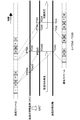
- FIG. 2 is a time chart illustrating an outline of an operation of synchronizing the broadcast stream and the communication stream by adjusting the STC in the receiving apparatus 300 according to the first embodiment of the present technology.
- the receiving apparatus 300 compares the time codes acquired from the broadcast stream and the communication stream at the time when the communication stream is first received after an instruction for synchronous reproduction of the broadcast stream and the communication stream is generated.
- the time code acquired from the broadcast stream is referred to as “first time code”
- the time code acquired from the communication stream is referred to as “second time code”.
- the first time code of the broadcast stream at the time when the communication stream is first received after the instruction of synchronous reproduction is generated is “TCb0”
- the communication stream received first after the instruction of synchronous reproduction It is determined whether the condition of TCb0> TCi00 is satisfied with the second time code of “TCi00”.
- the time code is originally expressed by four values (TCh, TCm, TCs, TCf) of hour, minute, second, and frame, but the above-mentioned TCb0 or TCi00 has the following four values. Assume that the value is converted to one value in millisecond units.
- TC (TCh ⁇ 60 + TCm) ⁇ 60 + TCs) ⁇ 1000 + TCf ⁇ 1000/60
- receiving apparatus 300 calculates offset ⁇ between “TCb0” and “TCi00” by the following equation.
- TCb0-TCi00 ⁇ (1)
- the receiving apparatus 300 adjusts the STC by the following equation with this offset ⁇ .
- STC ⁇ ⁇ 90 ⁇ m STC ′ (2)
- the reason why the offset ⁇ is multiplied by 90 is to map the offset ⁇ in milliseconds to the counter value of 90 KHz which is the same as STC.
- m is a predetermined margin.
- the receiving device 300 decodes the decoding target when the PTS included in the TS packet of the video of the broadcast stream coincides with the adjusted STC ′ at the time when the communication stream is first received.
- the video data of the communication stream having the second time code (TCi0) having the same value as the first time code (TCb0) is decoded. Thereafter, the synchronized playback of the broadcast stream and the communication stream is repeated in the same manner.
- the broadcast stream and the communication stream can be reproduced in synchronization.
- FIG. 3 is a diagram for explaining the time code of the MPEG2 video stream.
- Sequence_Header is described at the beginning of the picture layer which is the highest layer.
- Sequence_Header defines header data of a sequence of the MPEG2 bit stream.
- GOP_Header and Picture_Header are described after Sequence_Header.
- GOP_Header defines header data of the GOP (group_of_picture) layer of the MPEG bit stream. This GOP_Header is composed of group_start_code, time_code, closed_gop, broken_link, and the like.
- group_start_code is data indicating the start synchronization code of the GOP layer.
- time_code is a time code indicating the time from the start of the sequence of the first picture of the GOP. That is, time_code is a time code added for each GOP (first unit).
- closed_gop is flag data indicating that an image in a GOP can be reproduced independently from other GOPs.
- the broken_link is flag data indicating that the first B picture in the GOP cannot be accurately reproduced for editing or the like.
- the time_code is composed of data such as hour (hour), minute (minute), second (second), and frame (picture) indicating the presentation time of the first picture of the GOP.
- FIG. 4 is a diagram showing the configuration of the head access unit of the GOP of an MPEG4-AVC (Advanced Video Coding) video stream.
- the AU delimiter is information indicating a picture boundary position.
- SPS Sequence Parameter Set
- PPS Picture Parameter Set
- SEI Supplemental Enhancement Information
- Slice is data of one picture included in the access unit.
- Picture timing SEI includes Picture timing SEI.
- Picture timing SEI is timing information indicating the decoding and display timing of Slice (picture data).
- FIG. 5 is a diagram showing the configuration of an access unit other than the head of the GOP of the MPEG4-AVC video stream.
- Access units other than the head of the GOP include AU delimiter, PPS, SEI, and Slice.
- the SEI includes Picture timing SEI as in the top access unit of the GOP.
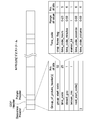
- Fig. 6 is a diagram showing the structure of Picture Timing SEI.
- Picture Timing SEI describes data of hour, minute, second and frame (n_frame). Therefore, in the MPEG4-AVC video stream, Picture Timing SEI is a time code indicating the presentation time for each picture. In other words, Picture Timing SEI is a time code added at least for each GOP.
- the MPEG2 video stream is used for video transmission by broadcasting
- the MPEG4-AVC video stream is used for video transmission by the Internet (communication). Therefore, in this case, time_code of the MPEG2 video stream is adopted as the first time code, and Picture timing SEI of the MPEG4-AVC video stream is adopted as the second time code.
- FIG. 7 is a block diagram illustrating a configuration of the receiving device 300 according to the present embodiment.
- the receiving apparatus 300 includes a tuner 301 (broadcast receiving unit), a broadcast DeMUX 302, a broadcast video buffer 303, a broadcast video decoder 304 (first video decoder), an STC generation unit 305 (reference time generation unit), Network I / F 307 (communication receiver), HTML browser 308, VOD player 309, communication streaming buffer 310, communication DeMUX 311, communication video buffer 312, STC adjustment unit 313 (adjustment unit), communication video A decoder 314 (second video decoder), a video merger 315, and a time code processing unit 316 are provided.
- the tuner 301 receives the broadcast stream (first video stream) of the channel selected by the user, generates a transport stream (TS: Transport Stream), and sends it to the broadcast DeMUX 302.
- TS Transport Stream
- the broadcast DeMUX 302 performs DeMUX processing of the transport stream, separates the video TS packets, supplies the video TS packets to the broadcast video buffer 303, and extracts the PCR from the video TS packets to generate the STC generation unit. 305 is supplied.
- the broadcast video buffer 303 buffers the video stream supplied to the broadcast video decoder 304.
- the broadcast video decoder 304 decodes the video stream read from the broadcast video buffer 303 using the STC of the STC generation unit 305 as a time base, and outputs a video signal to the video merger 315. More specifically, the broadcast video decoder 304 starts and outputs the decoding so that the video is presented at a timing when the PTS (Presentation Time Stamp) added to the video TS packet matches the STC value. Control the timing. Also, the broadcast video decoder 304 steadily supplies the time code (first time code) added to the video stream to be decoded to the time code processing unit 316 for the purpose of synchronous reproduction of broadcast and communication. .
- PTS Presentation Time Stamp
- the STC generation unit 305 generates a 27 megahertz STC based on the PCR extracted from the broadcast stream, and supplies it to the video decoder 304 for broadcasting.
- the STC generation unit 305 can adjust the STC based on the STC adjustment data from the STC adjustment unit 313.
- the network I / F 307 is a VOD player when a broadcast-linked application operating on an HTML (HyperText Markup Language) browser 308 issues an instruction for synchronous playback of a broadcast stream and a communication stream to a VOD (Video On Demand) player 309.
- the communication stream acquisition request given from 309 is transmitted to the distribution server of the broadcasting / communication facility 100 through the Internet, and the communication stream (second video) to be reproduced in synchronization with the broadcast stream as a response from the distribution server Stream).
- the communication streaming buffer 310 buffers the received communication stream.
- the communication streaming buffer 310 extracts the held communication stream and supplies it to the communication DeMUX 311.
- the communication DeMUX 311 separates the video TS packet from the communication stream extracted from the streaming buffer 310 and supplies the video TS packet to the communication video buffer 312 as a video stream.
- the communication video buffer 312 buffers the video stream supplied to the communication video decoder 314.
- the communication video decoder 314 decodes the video stream extracted from the communication video buffer 312 and supplies a communication video signal to the video merger 315. Further, the communication video decoder 314 adjusts the time code (second time code) included in the video data first acquired from the generation of the instruction for synchronous playback of the broadcast stream and the communication stream for the purpose of adjusting the STC.
- the code processing unit 316 is supplied. Further, after adjusting the STC, the video decoder for communication 314 uses the video data unit of the communication stream having the second time code having the same value as the first time code supplied from the time code processing unit 316 for communication.
- the video data is extracted from the video buffer 312, decoded, and output to the video merger 315 as a communication video signal.
- the video merger 315 merges the broadcast video signal and the communication video signal to generate a video signal for presentation, and outputs it to a display (not shown).
- the merging is performed by a method corresponding to a method for separating the program material into broadcasting and communication, such as a 3D program, a multi-view program, a high-resolution program, and an audio dubbing service program.
- the time code processing unit 316 first receives the second time code supplied from the communication video decoder 314 and the latest supplied from the broadcast video decoder 304 from the generation of an instruction for synchronous playback of the broadcast stream and the communication stream. Are compared with the first time code, and if the second time code is behind the first time code, the difference is supplied to the STC adjustment unit 313. After adjusting the STC, the time code processing unit 316 supplies the first time code supplied from the broadcast video decoder 304 to the communication video decoder 314 for the purpose of synchronous playback of the broadcast stream and the communication stream.
- the host controller 317 includes a CPU (Central Processing Unit), a ROM (Read Only Memory), a RAM (Random Access Memory), and the like. A program and data to be executed by the CPU are fixedly stored in the ROM.
- the RAM stores a program stored in the ROM, and the CPU executes the loaded program.
- the program loaded in the RAM causes the host controller 317 to operate as at least the STC generation unit 305, the HTML browser 308, the VOD player 309, the time code processing unit 316, and the STC adjustment unit 313.
- the host controller 317 can receive various instructions and data input from a user using a remote controller (not shown).
- the STC generation unit 305, the time code processing unit 316, and the STC adjustment unit 313 are not limited to being configured by software, and may be configured as hardware.
- the user of the receiving apparatus 300 selects a broadcast channel using a remote controller (not shown).
- the channel selection information from the user received by the remote controller or the like is processed by the host controller 317.
- the host controller 317 controls the tuner 301 based on channel selection information from the user.
- the broadcast stream of the channel received by the tuner 301 is sent to the broadcast DeMUX 302.
- the DeMUX 302 separates other TS packets such as video TS packets, audio TS packets, and SI (Service Information) from the broadcast stream.
- the video TS packet separated by the broadcast DeMUX 302 is supplied to the broadcast video buffer 303 as a video stream, and is temporarily held here.
- the broadcast DeMUX 302 regularly extracts the PCR from the video TS packet and supplies it to the STC generation unit 305.
- the STC generator 305 generates a 27 MHz STC (System Time Clock) based on this PCR.
- the broadcast video decoder 304 decodes the video stream read from the broadcast video buffer 303 and supplies the video signal to the video merger 315. At this time, the broadcast video decoder 304 displays the video stream in such a manner that the video is presented in a timing in which the PTS (Program Clock Reference) included in the video TS packet matches the STC provided from the STC generation unit 305. Control decode and output timing.
- the broadcast video decoder 304 supplies the time code added to the video stream to be decoded to the time code processing unit 316 for the purpose of synchronous playback of the broadcast stream and the communication stream.
- the receiving apparatus 300 acquires and executes an application (broadcast-linked application) associated with this channel or program through broadcasting or communication.
- This broadcast-linked application prompts the user to view, for example, a 3D program, a multi-view program, a high-resolution program, an audio dubbing service program, and the like by synchronized playback of a broadcast stream and a communication stream, and gives a viewing instruction (
- the reception apparatus 300 is caused to function so that the VOD player 309 transmits a communication stream acquisition request to the distribution server.
- this broadcast-linked application includes, for example, HTML (Hyper Text Markup Language) documents, BML documents (Broadcast Markup Language), MHEG documents (Multimedia and Hypermedia information coding), Java (registered trademark) scripts, still image files, and video files.
- HTML Hyper Text Markup Language
- BML documents Broadcast Markup Language
- MHEG documents Multimedia and Hypermedia information coding
- Java registered trademark
- the VOD player 309 When the VOD player 309 receives an instruction to synchronize playback of the broadcast stream and the communication stream, the VOD player 309 controls the network I / F 307 to transmit the communication stream (broadcast stream) associated with the channel or program being selected to the distribution server via the Internet. Request for transmission of a communication stream to be reproduced in synchronization with the time code, and gives an instruction to generate an offset ⁇ to the time code processing unit 316. When receiving this instruction, the time code processing unit 316 waits for the supply of the first time code from the video decoder 314 for communication.
- the communication stream transmitted from the distribution server in response to the request is accumulated in the communication streaming buffer 310 via the network I / F 307.
- the communication streaming buffer 310 holds the TS packet of the first video of the communication stream and immediately reads it and supplies it to the communication DeMUX 311.
- the communication DeMUX 311 separates the video TS packet from the communication stream read from the streaming buffer 310 and supplies it to the communication video buffer 312.
- the communication video decoder 314 decodes the video stream read from the communication video buffer 312 and supplies the video signal to the video merger 315. At this time, the communication video decoder 314 sends the second time code included in the video stream to the time code processing unit 316 as the first second time code from the generation of the instruction for synchronous playback of the broadcast stream and the communication stream. Supply.
- the first second time code supplied from the communication video decoder 314 is TCi00
- the first time code supplied from the broadcast video decoder 304 at the same timing as the second time code is TCb0.
- the time code processing unit 316 compares TCi00 and TCb0 and determines whether the condition of TCb0> TCi00 is satisfied.
- TCb0> TCi00 is established means that the video data of the communication stream to be reproduced in synchronization with the video data of the broadcast stream is actually received with a time delay. .
- the time code processing unit 316 calculates an offset ⁇ between TCb0 and TCi00 by the following equation.
- TCb0-TCi00 ⁇ (1)
- the value of the offset ⁇ is supplied to the STC adjustment unit 313.
- ⁇ ((TCbh ⁇ 60 + TCbm) ⁇ 60 + TCbs) ⁇ 1000 + TCbf ⁇ 1000/60 -((TCih x 60 + TCim) x 60 + TCis) x 1000 + TCif x 1000/60
- TCbh is a time code for broadcasting
- TCbm is a time code for broadcasting
- TCbs is a time code for broadcasting seconds
- TCbf is a time code for broadcasting frames.
- TCih is a time code for broadcasting
- TCim is a time code for minutes of communication
- TCis is a time code for communication seconds
- TCif is a time code for communication frames.
- the STC adjustment unit 313 Upon receiving the offset ⁇ , the STC adjustment unit 313 generates an STC adjustment value STC ′ according to the following equation.
- STC ⁇ ⁇ 90 ⁇ m STC ′ (2)
- the reason why the offset ⁇ is multiplied by 90 is to map the offset ⁇ in milliseconds to the counter value of 90 KHz which is the same as STC.
- m is a predetermined margin.
- the STC ′ generated as described above is supplied to the STC generation unit 305, and the STC generation unit 305 is reset by this STC ′, thereby completing the STC adjustment.
- the broadcast video decoder 304 extracts the first time code added to the video stream to be decoded and supplies the first time code to the time code processing unit 316, and also decodes the video stream and supplies the video signal to the video merger 315. To do.
- the receiving device 300 resumes the decoding and reproduction of the broadcast stream when the PTS included in the TS packet of the video of the broadcast stream matches STC ′.
- the communication video decoder 314 uses the video data unit of the video stream having the second time code (TCi0) having the same value as the first time code (TCb0) acquired from the time code processing unit 316 for communication. Are extracted from the video buffer 312 and decoded.
- the video signal obtained by the communication video decoder 314 is supplied to the video merger 315.
- the broadcast video signal and the communication video signal synchronized with each other are supplied to the video merger 315.
- the video merger 315 By supplying the video merger 315 with the broadcast video signal and the communication video signal synchronized with each other, the original 3D program, multi-view program, high-resolution program, audio dubbing service program, and the like are correctly restored.
- the adjusted STC ′ is returned to the original STC at the same time as the end of the broadcast program decoded by the STC ′.
- FIG. 8 is a time chart from the selection of the broadcast described above to the synchronization process between the broadcast stream and the communication stream, and further to the end of the synchronization process.
- the decoding start time of the video stream is shifted backward from T1 to T1 ′.
- the video is displayed in a frozen state from T1 to T1 ′.
- decoding of the video streams for broadcasting and communication is restarted at the same time from T1 ′.
- decoding is performed based on STC ′ until the program ends.
- STC ′ is returned to the STC, and the PTS jumps to the access unit that matches the STC to perform decoding.
- the broadcast video decoder 304 steadily supplies the first time code added to the video stream to be decoded to the time code processing unit 316.
- the time code processing unit 316 supplies the first time code supplied from the broadcast video decoder 304 to the communication video decoder 314 for the purpose of synchronous playback of the broadcast stream and the communication stream.
- the communication video decoder 314 extracts the video data unit of the communication stream having the second time code having the same value as the first time code supplied from the time code processing unit 316 from the communication video buffer 312. I decided to decode it.
- the video decoder for broadcasting and the video decoder for communication adjust the PTS (Presentation Time Stamp) added to each video TS packet.
- the decoding start and output timings may be controlled so that the video is presented at a timing that matches the later STC ′.
- FIG. 9 is a block diagram illustrating a configuration of a receiving device 300A according to the second embodiment.
- the time code processing unit 316 first receives the second time supplied from the video decoder for communication 314A from the generation of the instruction for synchronous playback of the broadcast stream and the communication stream. The code is compared with the latest first time code supplied from the broadcast video decoder 304A. When the second time code is delayed from the first time code, the time code processing unit 316 supplies the offset ⁇ to the STC adjustment unit 313.
- the STC adjustment unit 313 When receiving the offset ⁇ , the STC adjustment unit 313 generates an STC adjustment value STC ′, and gives the adjustment value STC ′ to the STC generation unit 305 to adjust the STC of the STC generation unit 305.
- the broadcast video decoder 304A is presented with the timing at which the PTS (Presentation Time Stamp) added to the TS packet of the broadcast stream video matches the adjusted STC ′ value.
- the decoding start and output timing are controlled.
- the video decoder for communication 314A similarly starts decoding and outputs so that the video is presented at a timing in which the PTS added to the TS packet of the video of the communication stream matches the adjusted STC ′ value. Control the timing.
- each stream can be reproduced with good synchronization.
- the STC is adjusted once before the start of the synchronized playback of the broadcast stream and the communication stream.
- the STC may be adjusted after the start of the synchronized playback.
- the STC adjustment after the start of the synchronous playback as described above is a synchronous transmission in which the program playback itself breaks down without the video of both the broadcast stream and the communication stream, particularly as in the 3D video Useful in the system.
- the margin m used when calculating the offset ⁇ may be variable according to the reception status of the communication stream. That is, if the margin is too large, the freeze time for displaying the broadcast stream becomes long, and the possibility of giving the viewer a sense of discomfort increases. On the other hand, if it is too short, there is a high possibility that playback of a 3D program or the like fails due to a lack of a communication stream. Therefore, it is desirable that the minimum necessary margin is dynamically set according to the reception status of the communication stream so that the program reproduction does not fail.
- the MPEG2 video stream is used for video transmission by broadcasting
- the MPEG4-AVC video stream is used for video transmission by the Internet (communication).
- the present technology is not limited to this.
- an MPEG2 video stream may be used for video transmission by broadcasting and communication
- an MPEG4-AVC video stream may be used for video transmission by broadcasting and communication.
- a video stream other than the MPEG2 video stream and the MPEG4-AVC video stream can be used as long as a time code is added for each predetermined unit of video data.
- this technique can also take the following structures.
- a broadcast receiving unit capable of receiving through broadcasting a first video stream to which a first time code is added for each first unit of first video data;
- a second video stream to which a second time code is added at least for each first unit of second video data to be reproduced in synchronization with the first video data can be received through a network.
- a reference time generation unit for generating a reference time for generating a timing of processing for presenting the first video data;
- the first time code added to the received first video stream and the second time code added to the second video stream are acquired at a predetermined timing, and the first time code is acquired.
- a time code processing unit for calculating a delay of the second time code with respect to the time code of An adjustment unit that adjusts the reference time in consideration of the delay.
- the receiving device is: A first video that is decoded so that the first video stream received by the broadcast receiving unit is presented at a timing when the presentation time information added to the first video stream matches the reference time.
- a decoder A second video decoder that decodes the second video stream received by the communication receiver;
- the time code processing unit obtains the first time code added to the first unit of the first video stream to be decoded by the first video decoder, and sends the first time code to the second video decoder.
- Supply The receiving device for decoding the first unit of the second video stream to which the second time code having the same value as the supplied first time code is added.
- the receiving apparatus adjusts the reference time with time data obtained by adding a predetermined margin to the delay.
- the receiving apparatus according to any one of (1) to (5), The first time code is added to the first picture of the GOP in the first video stream, and the second time code is added to each picture in the second video stream.
- Receiver device The first time code is added to the first picture of the GOP in the first video stream, and the second time code is added to each picture in the second video stream.
- the receiving device is: A first video that is decoded so that the first video stream received by the broadcast receiving unit is presented at a timing when the presentation time information added to the first video stream matches the reference time.
- a decoder A second video that is decoded so that the second video stream received by the communication receiver is presented at a timing when the presentation time information added to the second video stream matches the reference time.
- a decoder A receiving apparatus further comprising:
- the receiving device adjusts the reference time with time data obtained by adding a predetermined margin to the delay.
- the receiving device according to any one of (7) to (10), The first time code is added to the first picture of the GOP in the first video stream, and the second time code is added to each picture in the second video stream.
- Receiver device The first time code is added to the first picture of the GOP in the first video stream, and the second time code is added to each picture in the second video stream.
Landscapes
- Engineering & Computer Science (AREA)
- Signal Processing (AREA)
- Multimedia (AREA)
- Databases & Information Systems (AREA)
- Two-Way Televisions, Distribution Of Moving Picture Or The Like (AREA)
- Synchronisation In Digital Transmission Systems (AREA)
- Computer Security & Cryptography (AREA)
Abstract
Priority Applications (3)
| Application Number | Priority Date | Filing Date | Title |
|---|---|---|---|
| EP13806945.5A EP2866457B1 (fr) | 2012-06-22 | 2013-06-05 | Dispositif de réception, et procédé de traitement synchrone associé |
| JP2014520906A JP6313704B2 (ja) | 2012-06-22 | 2013-06-05 | 受信装置およびその同期処理方法 |
| US14/400,612 US10397633B2 (en) | 2012-06-22 | 2013-06-05 | Receiver apparatus and synchronization processing method thereof |
Applications Claiming Priority (2)
| Application Number | Priority Date | Filing Date | Title |
|---|---|---|---|
| JP2012140938 | 2012-06-22 | ||
| JP2012-140938 | 2012-06-22 |
Publications (1)
| Publication Number | Publication Date |
|---|---|
| WO2013190789A1 true WO2013190789A1 (fr) | 2013-12-27 |
Family
ID=49768404
Family Applications (1)
| Application Number | Title | Priority Date | Filing Date |
|---|---|---|---|
| PCT/JP2013/003527 Ceased WO2013190789A1 (fr) | 2012-06-22 | 2013-06-05 | Dispositif de réception, et procédé de traitement synchrone associé |
Country Status (5)
| Country | Link |
|---|---|
| US (1) | US10397633B2 (fr) |
| EP (1) | EP2866457B1 (fr) |
| JP (1) | JP6313704B2 (fr) |
| AR (1) | AR091450A1 (fr) |
| WO (1) | WO2013190789A1 (fr) |
Cited By (7)
| Publication number | Priority date | Publication date | Assignee | Title |
|---|---|---|---|---|
| WO2015098376A1 (fr) * | 2013-12-27 | 2015-07-02 | 日立マクセル株式会社 | Dispositif de réception de diffusion et procédé d'affichage de vidéo |
| CN105516118A (zh) * | 2015-12-03 | 2016-04-20 | Tcl集团股份有限公司 | 一种基于非rtc智能电视的时间同步方法及系统 |
| WO2017038481A1 (fr) * | 2015-09-01 | 2017-03-09 | ソニー株式会社 | Dispositif de réception, procédé de traitement de données, et programme |
| US20170208220A1 (en) * | 2016-01-14 | 2017-07-20 | Disney Enterprises, Inc. | Automatically synchronizing multiple real-time video sources |
| JP2018207505A (ja) * | 2018-07-27 | 2018-12-27 | マクセル株式会社 | 放送受信装置及び映像表示方法 |
| JP2020188497A (ja) * | 2019-03-26 | 2020-11-19 | ソニー株式会社 | 送信方法 |
| JP2021166396A (ja) * | 2020-07-29 | 2021-10-14 | ソニーグループ株式会社 | 送信方法 |
Families Citing this family (7)
| Publication number | Priority date | Publication date | Assignee | Title |
|---|---|---|---|---|
| US8560719B2 (en) * | 2011-09-14 | 2013-10-15 | Mobitv, Inc. | Fragment server directed device fragment caching |
| US20150109413A1 (en) * | 2013-10-21 | 2015-04-23 | Electronics And Telecommunications Research Institute | Video reception apparatus to provide hybrid service based on transport stream system target decoder model |
| KR20150057149A (ko) * | 2013-11-18 | 2015-05-28 | 한국전자통신연구원 | 재전송망에 기초한 3d 방송 서비스 제공 시스템 및 방법 |
| JP6127964B2 (ja) * | 2013-12-26 | 2017-05-17 | ソニー株式会社 | 信号切換装置および信号切換装置の動作制御方法 |
| US9344748B2 (en) * | 2014-03-31 | 2016-05-17 | Arris Enterprises, Inc. | Adaptive streaming transcoder synchronization |
| CN114598909B (zh) * | 2022-03-30 | 2023-12-01 | 青岛海信宽带多媒体技术有限公司 | 一种智能机顶盒及直播节目的时间轴显示方法 |
| JP2025079585A (ja) * | 2023-11-10 | 2025-05-22 | キヤノン株式会社 | 通信装置、通信装置の制御方法及びプログラム |
Citations (4)
| Publication number | Priority date | Publication date | Assignee | Title |
|---|---|---|---|---|
| JP2005159592A (ja) | 2003-11-25 | 2005-06-16 | Nippon Hoso Kyokai <Nhk> | コンテンツ送信装置およびコンテンツ受信装置 |
| JP2008252831A (ja) * | 2007-03-30 | 2008-10-16 | Sharp Corp | 放送受信装置、放送再送信装置、放送再送信方法、放送受信システム、制御プログラム、および制御プログラムを記録したコンピュータ読み取り可能な記録媒体 |
| JP2011166615A (ja) * | 2010-02-12 | 2011-08-25 | Nippon Telegr & Teleph Corp <Ntt> | 映像同期装置、映像表示装置、映像同期方法及びプログラム |
| JP2012010009A (ja) * | 2010-06-23 | 2012-01-12 | Nippon Hoso Kyokai <Nhk> | 送信装置、サーバ装置、および受信装置 |
Family Cites Families (31)
| Publication number | Priority date | Publication date | Assignee | Title |
|---|---|---|---|---|
| JPH1032815A (ja) * | 1996-07-16 | 1998-02-03 | Toshiba Corp | 画面合成装置 |
| US6587505B1 (en) * | 1998-08-31 | 2003-07-01 | Canon Kabushiki Kaisha | Image processing apparatus and method |
| US6512552B1 (en) * | 1999-03-29 | 2003-01-28 | Sony Corporation | Subpicture stream change control |
| EP1158799A1 (fr) * | 2000-05-18 | 2001-11-28 | Deutsche Thomson-Brandt Gmbh | Procédé et récepteur permettant de fournir des données de sous-titre en plusieurs langues à la demande |
| US7346698B2 (en) * | 2000-12-20 | 2008-03-18 | G. W. Hannaway & Associates | Webcasting method and system for time-based synchronization of multiple, independent media streams |
| JP4380930B2 (ja) * | 2001-03-19 | 2009-12-09 | 株式会社東芝 | オーディオ・ビデオ復号再生装置とその同期再生方法 |
| US9948977B2 (en) * | 2003-01-09 | 2018-04-17 | Avago Technologies General Ip (Singapore) Pte. Ltd. | System, method, and apparatus for determining presentation time for picture without presentation time stamp |
| EP1662793B1 (fr) * | 2003-09-02 | 2020-01-15 | Sony Corporation | Dispositif de reception de contenu, procede de synchronisation de sorties video/audio, et systeme de fourniture de contenu |
| JP2005123789A (ja) * | 2003-10-15 | 2005-05-12 | Matsushita Electric Ind Co Ltd | Av同期システム |
| KR100526189B1 (ko) * | 2004-02-14 | 2005-11-03 | 삼성전자주식회사 | 트랜스코딩 전후에 타이밍 파라미터를 일정하게유지시키는 트랜스코딩 시스템 및 방법 |
| JP4229035B2 (ja) * | 2004-09-28 | 2009-02-25 | ソニー株式会社 | 記録再生装置および方法、再生装置および方法、記録装置および方法、並びにプログラム |
| US8140954B2 (en) * | 2005-06-05 | 2012-03-20 | International Business Machines Corporation | System and method for providing on demand captioning of broadcast programs |
| JP2007013714A (ja) * | 2005-06-30 | 2007-01-18 | Toshiba Corp | 情報再生装置及び情報再生方法 |
| CN100442858C (zh) * | 2005-10-11 | 2008-12-10 | 华为技术有限公司 | 分组网络中多媒体实时传输的唇同步方法及其装置 |
| JP2008005112A (ja) * | 2006-06-21 | 2008-01-10 | Matsushita Electric Ind Co Ltd | ストリームエンコーダ及びストリームデコーダ |
| KR100905723B1 (ko) * | 2006-12-08 | 2009-07-01 | 한국전자통신연구원 | 비실시간 기반의 디지털 실감방송 송수신 시스템 및 그방법 |
| JP5212473B2 (ja) * | 2008-06-26 | 2013-06-19 | 富士通セミコンダクター株式会社 | 映像音声データ出力装置および映像音声データ出力方法 |
| JP4409611B2 (ja) * | 2008-08-04 | 2010-02-03 | シャープ株式会社 | 放送受信装置、放送受信方法、制御プログラム、および制御プログラムを記録したコンピュータ読み取り可能な記録媒体 |
| KR101535827B1 (ko) * | 2008-12-05 | 2015-07-27 | 삼성전자주식회사 | 무선 통신 네트워크에서 오디오 및 비디오 동기화 장치 및 방법 |
| KR101164857B1 (ko) * | 2008-12-19 | 2012-07-11 | 한국전자통신연구원 | 비실시간으로 3차원 입체 방송을 제공하기 위한 방송 송수신 시스템 및 방법 |
| JP2011066871A (ja) * | 2009-08-21 | 2011-03-31 | Sony Corp | コンテンツ伝送方法及び表示装置 |
| JP2011123195A (ja) | 2009-12-09 | 2011-06-23 | Fuji Xerox Co Ltd | 定着装置及び画像形成装置 |
| KR101797497B1 (ko) * | 2010-04-04 | 2017-11-15 | 엘지전자 주식회사 | 방송 신호로 전송되는 비실시간 방송 서비스 및 콘텐트 처리 방법 및 장치 |
| KR20120010785A (ko) * | 2010-07-27 | 2012-02-06 | 대양롤랜트 주식회사 | 하우징 일체형 다중 베어링 유닛 |
| KR101831775B1 (ko) * | 2010-12-07 | 2018-02-26 | 삼성전자주식회사 | 멀티미디어 컨텐츠를 송수신하는 송신 장치 및 수신 장치와, 그 재생 방법 |
| EP2498494A1 (fr) * | 2011-03-11 | 2012-09-12 | Thomson Licensing | Décodeur et procédé pour le décodeur pour synchroniser le rendu du contenu reçu par différents réseaux |
| CN103621102B (zh) * | 2011-05-12 | 2017-05-03 | 英特尔公司 | 用于音频与视频同步的方法、装置及系统 |
| US8773584B2 (en) * | 2011-08-11 | 2014-07-08 | Panasonic Corporation | Playback apparatus, playback method, integrated circuit, broadcast system, and broadcast method using a broadcast video and additional video |
| JP5121993B1 (ja) * | 2011-10-11 | 2013-01-16 | 株式会社東芝 | コンテンツ処理装置、及びコンテンツ同期方法 |
| JP5132808B1 (ja) * | 2011-10-11 | 2013-01-30 | 株式会社東芝 | デジタル放送録画再生装置およびデジタル放送録画再生方法 |
| JP5903924B2 (ja) | 2012-02-17 | 2016-04-13 | ソニー株式会社 | 受信装置および字幕処理方法 |
-
2013
- 2013-06-05 WO PCT/JP2013/003527 patent/WO2013190789A1/fr not_active Ceased
- 2013-06-05 US US14/400,612 patent/US10397633B2/en active Active
- 2013-06-05 JP JP2014520906A patent/JP6313704B2/ja active Active
- 2013-06-05 EP EP13806945.5A patent/EP2866457B1/fr active Active
- 2013-06-14 AR ARP130102103 patent/AR091450A1/es unknown
Patent Citations (4)
| Publication number | Priority date | Publication date | Assignee | Title |
|---|---|---|---|---|
| JP2005159592A (ja) | 2003-11-25 | 2005-06-16 | Nippon Hoso Kyokai <Nhk> | コンテンツ送信装置およびコンテンツ受信装置 |
| JP2008252831A (ja) * | 2007-03-30 | 2008-10-16 | Sharp Corp | 放送受信装置、放送再送信装置、放送再送信方法、放送受信システム、制御プログラム、および制御プログラムを記録したコンピュータ読み取り可能な記録媒体 |
| JP2011166615A (ja) * | 2010-02-12 | 2011-08-25 | Nippon Telegr & Teleph Corp <Ntt> | 映像同期装置、映像表示装置、映像同期方法及びプログラム |
| JP2012010009A (ja) * | 2010-06-23 | 2012-01-12 | Nippon Hoso Kyokai <Nhk> | 送信装置、サーバ装置、および受信装置 |
Non-Patent Citations (2)
| Title |
|---|
| KINJI MATSUMURA ET AL.: "Hybridcast no Gaiyo to Gijutsu", NHK SCIENCE AND TECHNICAL RESEARCH LABORATORIES R&D REPORT, 15 November 2010 (2010-11-15), pages 10 - 17, XP008175577 * |
| KINJI MATSUMURA ET AL.: "Implementation Study of An Extra Content Service for Broadcast Programs using Synchronized IP Streaming", NEN THE INSTITUTE OF IMAGE INFORMATION AND TELEVISION ENGINEERS NENJI TAIKAI KOEN YOKOSHU, 2 August 2010 (2010-08-02), pages 10 - 5, XP008175584 * |
Cited By (24)
| Publication number | Priority date | Publication date | Assignee | Title |
|---|---|---|---|---|
| US11134306B2 (en) | 2013-12-27 | 2021-09-28 | Maxell, Ltd. | Broadcast reception device and video display method |
| JP2015126464A (ja) * | 2013-12-27 | 2015-07-06 | 日立マクセル株式会社 | 放送受信装置及び映像表示方法 |
| US12279011B2 (en) | 2013-12-27 | 2025-04-15 | Maxell, Ltd. | Broadcast reception device and video display method |
| US12003813B2 (en) | 2013-12-27 | 2024-06-04 | Maxell, Ltd. | Broadcast reception device and video display method |
| EP3089465A4 (fr) * | 2013-12-27 | 2017-07-05 | Hitachi Maxell, Ltd. | Dispositif de réception de diffusion et procédé d'affichage de vidéo |
| US11716504B2 (en) | 2013-12-27 | 2023-08-01 | Maxell, Ltd. | Broadcast reception device and video display method |
| WO2015098376A1 (fr) * | 2013-12-27 | 2015-07-02 | 日立マクセル株式会社 | Dispositif de réception de diffusion et procédé d'affichage de vidéo |
| US11425455B2 (en) | 2013-12-27 | 2022-08-23 | Maxell, Ltd. | Broadcast reception device and video display method |
| US10321186B2 (en) | 2013-12-27 | 2019-06-11 | Maxell, Ltd. | Broadcast reception device and video display method |
| JPWO2017038481A1 (ja) * | 2015-09-01 | 2018-06-21 | ソニー株式会社 | 受信装置、データ処理方法、及び、プログラム |
| US10887644B2 (en) | 2015-09-01 | 2021-01-05 | Sony Corporation | Reception device, data processing method, and program |
| WO2017038481A1 (fr) * | 2015-09-01 | 2017-03-09 | ソニー株式会社 | Dispositif de réception, procédé de traitement de données, et programme |
| CN105516118A (zh) * | 2015-12-03 | 2016-04-20 | Tcl集团股份有限公司 | 一种基于非rtc智能电视的时间同步方法及系统 |
| CN105516118B (zh) * | 2015-12-03 | 2019-06-11 | Tcl集团股份有限公司 | 一种基于非rtc智能电视的时间同步方法及系统 |
| US10764473B2 (en) * | 2016-01-14 | 2020-09-01 | Disney Enterprises, Inc. | Automatically synchronizing multiple real-time video sources |
| US20170208220A1 (en) * | 2016-01-14 | 2017-07-20 | Disney Enterprises, Inc. | Automatically synchronizing multiple real-time video sources |
| JP2018207505A (ja) * | 2018-07-27 | 2018-12-27 | マクセル株式会社 | 放送受信装置及び映像表示方法 |
| JP2020188497A (ja) * | 2019-03-26 | 2020-11-19 | ソニー株式会社 | 送信方法 |
| JP2022159374A (ja) * | 2020-07-29 | 2022-10-17 | ソニーグループ株式会社 | 送信方法 |
| JP7120399B2 (ja) | 2020-07-29 | 2022-08-17 | ソニーグループ株式会社 | 送信方法 |
| JP7371734B2 (ja) | 2020-07-29 | 2023-10-31 | ソニーグループ株式会社 | 送信方法 |
| JP2023181254A (ja) * | 2020-07-29 | 2023-12-21 | ソニーグループ株式会社 | 送信方法 |
| JP2021166396A (ja) * | 2020-07-29 | 2021-10-14 | ソニーグループ株式会社 | 送信方法 |
| JP7605273B2 (ja) | 2020-07-29 | 2024-12-24 | ソニーグループ株式会社 | 送信方法 |
Also Published As
| Publication number | Publication date |
|---|---|
| EP2866457B1 (fr) | 2019-03-20 |
| EP2866457A4 (fr) | 2015-11-04 |
| AR091450A1 (es) | 2015-02-04 |
| JP6313704B2 (ja) | 2018-04-18 |
| US10397633B2 (en) | 2019-08-27 |
| JPWO2013190789A1 (ja) | 2016-02-08 |
| EP2866457A1 (fr) | 2015-04-29 |
| US20150135247A1 (en) | 2015-05-14 |
Similar Documents
| Publication | Publication Date | Title |
|---|---|---|
| JP6313704B2 (ja) | 受信装置およびその同期処理方法 | |
| US12192548B2 (en) | Reception method, transmission method, reception device, and transmission device | |
| JP6333173B2 (ja) | 受信装置および受信方法 | |
| JP5903924B2 (ja) | 受信装置および字幕処理方法 | |
| CA2554306C (fr) | Synchronisation et automatisation dans un environnement de television interactive | |
| US8760579B2 (en) | Video display apparatus, video display system and video display method | |
| EP1786209A1 (fr) | Recepteur de contenu, methode de controle de synchronisation de sortie audio/video et systeme de transmission de contenu | |
| KR20170074866A (ko) | 수신 장치, 송신 장치, 및 데이터 처리 방법 | |
| KR20060134911A (ko) | 콘텐츠 수신 장치, 비디오 오디오 출력 타이밍 제어 방법및 콘텐츠 제공 시스템 | |
| KR20140022716A (ko) | 화상 데이터 송신 장치, 화상 데이터 송신 방법 및 화상 데이터 수신 장치 | |
| EP2485501B1 (fr) | Solution de flux compagnon de changement rapide de canal avec optimisation de bande passante | |
| US20120173668A1 (en) | Content transmitting apparatus, content receiving apparatus, content transmission program, content reception program, content transmitting method, and content receiving method | |
| JP2004297628A (ja) | ストリーム切替装置およびその装置にコンテンツを提供する装置 | |
| US20150109411A1 (en) | Image playback apparatus for 3dtv and method performed by the apparatus | |
| EP2814256B1 (fr) | Procédé et appareil permettant de modifier un flux de contenu numérique | |
| US9426506B2 (en) | Apparatuses for providing and receiving augmented broadcasting service in hybrid broadcasting environment | |
| US8769562B2 (en) | Digital broadcast method, data receiving device, and data transmitting device | |
| CN114189737B (zh) | 一种数字电视快速切台方法及数字电视 | |
| CN108702533B (zh) | 发送装置、发送方法、接收装置和接收方法 | |
| KR100802133B1 (ko) | 오디오/비디오신호의 동기화를 위한 디지털신호 처리장치및 그의 방법 | |
| JP2005198105A (ja) | 同期信号発生装置 |
Legal Events
| Date | Code | Title | Description |
|---|---|---|---|
| 121 | Ep: the epo has been informed by wipo that ep was designated in this application |
Ref document number: 13806945 Country of ref document: EP Kind code of ref document: A1 |
|
| WWE | Wipo information: entry into national phase |
Ref document number: 14400612 Country of ref document: US |
|
| ENP | Entry into the national phase |
Ref document number: 2014520906 Country of ref document: JP Kind code of ref document: A |
|
| WWE | Wipo information: entry into national phase |
Ref document number: 2013806945 Country of ref document: EP |
|
| NENP | Non-entry into the national phase |
Ref country code: DE |