WO2014002224A1 - 上衣 - Google Patents
上衣 Download PDFInfo
- Publication number
- WO2014002224A1 WO2014002224A1 PCT/JP2012/066508 JP2012066508W WO2014002224A1 WO 2014002224 A1 WO2014002224 A1 WO 2014002224A1 JP 2012066508 W JP2012066508 W JP 2012066508W WO 2014002224 A1 WO2014002224 A1 WO 2014002224A1
- Authority
- WO
- WIPO (PCT)
- Prior art keywords
- arm
- shoulder
- wearer
- point
- upper garment
- Prior art date
- Legal status (The legal status is an assumption and is not a legal conclusion. Google has not performed a legal analysis and makes no representation as to the accuracy of the status listed.)
- Ceased
Links
Images



Classifications
-
- A—HUMAN NECESSITIES
- A41—WEARING APPAREL
- A41B—SHIRTS; UNDERWEAR; BABY LINEN; HANDKERCHIEFS
- A41B1/00—Shirts
- A41B1/08—Details
-
- A—HUMAN NECESSITIES
- A41—WEARING APPAREL
- A41D—OUTERWEAR; PROTECTIVE GARMENTS; ACCESSORIES
- A41D27/00—Details of garments or of their making
- A41D27/10—Sleeves; Armholes
-
- A—HUMAN NECESSITIES
- A41—WEARING APPAREL
- A41D—OUTERWEAR; PROTECTIVE GARMENTS; ACCESSORIES
- A41D2400/00—Functions or special features of garments
- A41D2400/38—Shaping the contour of the body or adjusting the figure
Definitions
- the present invention relates to an upper garment having a comfortable wearing feeling with little slippage even when intense exercise such as sports is performed by devising the shape of the armhole of the sleeve.
- Patent Document 1 Conventionally, upper garments that improve the feeling of wear by devising the shape of the sleeves are disclosed in Patent Document 1 and Patent Document 2.
- a conventional upper garment 11 used for a sports shirt or the like includes a front body 12, a back body 13, and a sleeve 14, and the sleeve 14 and the front body 12, and the sleeve 14 and the back body 13 are sewn together by an arm hole 15. Has been.
- the sleeve 14 having a standard shape in the upper garment 11 includes a set-in sleeve shown in FIGS. 4 to 6 and a raglan sleeve shown in FIGS. 7 to 9.
- the armhole 15 is designed so that the sleeve crest 16 passes through the shoulder point S.
- This set-in sleeve is as follows. 1) It is designed to be most comfortable with the arm lowered naturally. 2) The structure is simple and it is easy to handle any design.
- the raglan sleeve is a type in which the functionality is improved by developing from the set-in sleeve.
- This raglan sleeve is used especially when it is not desired to switch around the shoulder, and its features are as follows.
- the upper garment 11 such as a shirt worn when performing intense exercise such as sports is such that the arm A has a larger displacement than the trunk B when the arm is raised or the arm is turned.
- the sleeve 14 covering the large arm A is required to have a function (upward holding ability) to reduce the drag due to contact with the upper part of the arm so that the sleeve 14 does not hang down during operation.
- the body covering the trunk A having a small displacement needs to have a function (positional stability) to reduce the drag due to the body being displaced inward / outward / front / rear during operation.
- FIG. 4 raised to an angle of 90 °, FIG. as the distance from the trapezius muscle stop b 3 at an elevated arm a an angle of 150 ° as indicated by broken lines to ⁇ side point N 2 is called 45 mm, raised arms a from a state in which lower arms a As it goes on, the trapezius muscle stop portions b 1 , b 2 , b 3 move in the direction of the neck circumference side point N 2 .
- the arm hole 15 of the set-in sleeve is designed according to the shape of the arm A from the shoulder point S when the arm A is naturally lowered.
- the sleeve's upper retention is not taken into consideration in that the sleeve hangs down when the arm is raised and pulling occurs due to contact with the upper part of the arm. .
- the set-in sleeve has an arm hole 15 on the outer side of the boundary line (region indicated by light ink) between the trunk B having a small displacement and the arm A having a large displacement.
- the body contacts the arm A having a large displacement, the body does not fit the trunk B and moves to the body that the body does not want to move.
- the raglan sleeve is designed to fit to some extent the roundness of the shoulder of the human body in consideration of comfort. Therefore, since the cuffs are not as much as the set-in sleeves, the sleeves hang down when the arms are raised, and the upper retainability of the sleeves is taken into account in that they are pulled by contact with the upper arms. Absent.
- the raglan sleeve has an arm hole 15 extending over the boundary between the trunk B having a small displacement and the arm A having a large displacement.
- the body does not fit the trunk B, and even the body that is not intended to move moves.
- Patent Document 3 Goldwin product, adopting cutting design “AERO FORM”
- AERO FORM is an extra wrinkle when riding on the bicycle in consideration of static movement (posture maintenance). It is designed to prevent the feeling of tension and tightness of the shirt, and when the arm is lifted or turned, the sleeves hang down or the body moves unnecessarily large. To do.
- Patent Document 3 is also the same as the general set-in sleeve as shown in FIG. 10 and FIG. Since it is located outside the muscle stop b 1 , the sleeve 14 does not easily follow the movement of the arm when a dynamic movement (an action of raising or turning the arm) is performed. There is a problem that it moves even to the body that I do not want.
- the present invention prevents the sleeve from drooping or the body from moving unnecessarily large when strenuous exercise such as sports, especially when the arm is lifted or turned, and the slippage of wearing is prevented. It is an object to provide an upper garment having a small and comfortable wearing feeling.
- the upper garment according to the present invention includes a trapezoidal muscle stop portion on the shoulder ridge line of the wearer when the sleeve mountain point of the arm hole is lowered, and a trapezius muscle on the shoulder ridge line of the wearer with the arm raised. It is located between the stop part.
- the arm bending point and arm hole match when raising the arm, preventing the sleeve from drooping and the body from moving unnecessarily large when the arm is raised or turned. it can.
- the armhole is located at the boundary between the large displacement arm and the less displaced trunk. Therefore, the upper retention of the sleeve and the positional stability of the body are further improved.
- the lower part on the front body side of the armhole is passed through the wearer's front saddle point, the back body side of the armhole is passed through the scapular ridge of the wearer, and the lower part on the back body side of the armhole is further passed through.
- the wearer's rear saddle point By passing the wearer's rear saddle point, the arm hole is along the boundary between the arm having a large displacement and the trunk having a small displacement, so that the upper retention of the sleeve and the positional stability of the body are improved.
- the wearability can be further improved by denting the front body side of the armhole so as to conform to the depression of the deltoid major pectoral groove between the deltoid and great pectoral muscles of the wearer.
- the upper garment according to the present invention matches the arm flexion point when raising the arm with the armhole, so that even when exercising vigorously, such as sports, there is little slippage and a comfortable wearing feeling can be obtained.
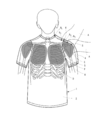
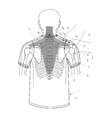
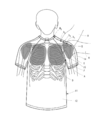
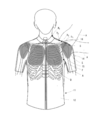
- the upper garment 1 includes a front body 2, a back body 3, and a sleeve 4.
- the sleeve 4 and the front body 2, and the sleeve 4 and the back body 3 are sewn together by arm holes 5.
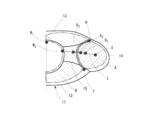
- the sleeve crest points 6 of the armhole 5 of the upper garment 1 include the trapezoidal muscle stop portion b 1 on the shoulder ridge line L of the wearer in a state where the arm A is lowered, and the state where the arm A is raised (see FIGS. located between the trapezius muscle stops b 3 on the wearer's shoulders ridgeline L in shown in broken lines) in FIG.
- C indicates the trapezius muscle.
- D indicates the great pectoral muscle
- E indicates the deltoid muscle
- the deltoid major pectoral muscle groove between the deltoid muscle E and the great pectoral muscle D is indicated by hatching.
- S indicates a shoulder point
- N 1 indicates a neck center point behind the neck.
- the distance from the neck side point N 2 to the trapezius muscle stop b 1 , b 2 , b 3 is 75 mm for the trapezius stop b 1 with the arm lowered.
- the trapezius stop b 2 with A raised to 90 ° is 60 mm
- the trapezius stop b 3 with A raised to 150 ° is 45 mm.
- the trapezius muscle stops b 1 , b 2 , b 3 move in the direction of the neck circumference point N 2 .
- the armhole 5 has a crest 6 in the range of 45 mm to 75 mm from the shoulder point S toward the neck circumference side point N 2. Look at the design.
- the lower part of the armhole 5 on the front body 2 side is passed through the wearer's front saddle point F, the armhole 5 is passed through the back body 3 side through the wearer's shoulder spine bulge portion G, Since the armhole 5 is located at the boundary between the arm A having a large displacement and the trunk B having a small displacement by passing the lower heel point H of the wearer through the lower part on the back body 3 side, Positional stability of the body is further improved.
- the front body 2 side of the armhole 5 is recessed so as to follow the recess of the deltoid major pectoral groove between the deltoid muscle E and the greater pectoral muscle D as shown by the arrow I in FIG. Thereby, a feeling of wear improves more.
- the position of the trapezius muscle stop b 3 on the shoulder ridge line L of the wearer with the arm A raised is the distance between the neck circumference back center point N 1 and the shoulder tip point S (half the shoulder width).
- the neck is behind the neck circumference center point N 1 side by 11% to 17%.
- the position of the trapezius muscle stop b 3 on the shoulder ridge line L of the wearer with the arm A raised is relative to the distance (half the shoulder width) between the neck circumference rear center point N 1 and the shoulder tip point S. Te, becomes a ⁇ behind the center point N 1 62% ⁇ 66% shoulder point S side.
- the trapezius position of stop b 3 on arms shoulder ridge of the wearer at an elevated A L for positioning the sleeve caps point 6 armhole 5 ependymal 1 according to the present invention ⁇ behind with respect to the distance between the center point N 1 and the shoulder point S (half shoulder width), it may be determined from ⁇ behind the center point N 1 62% ⁇ 66% shoulder point S side.
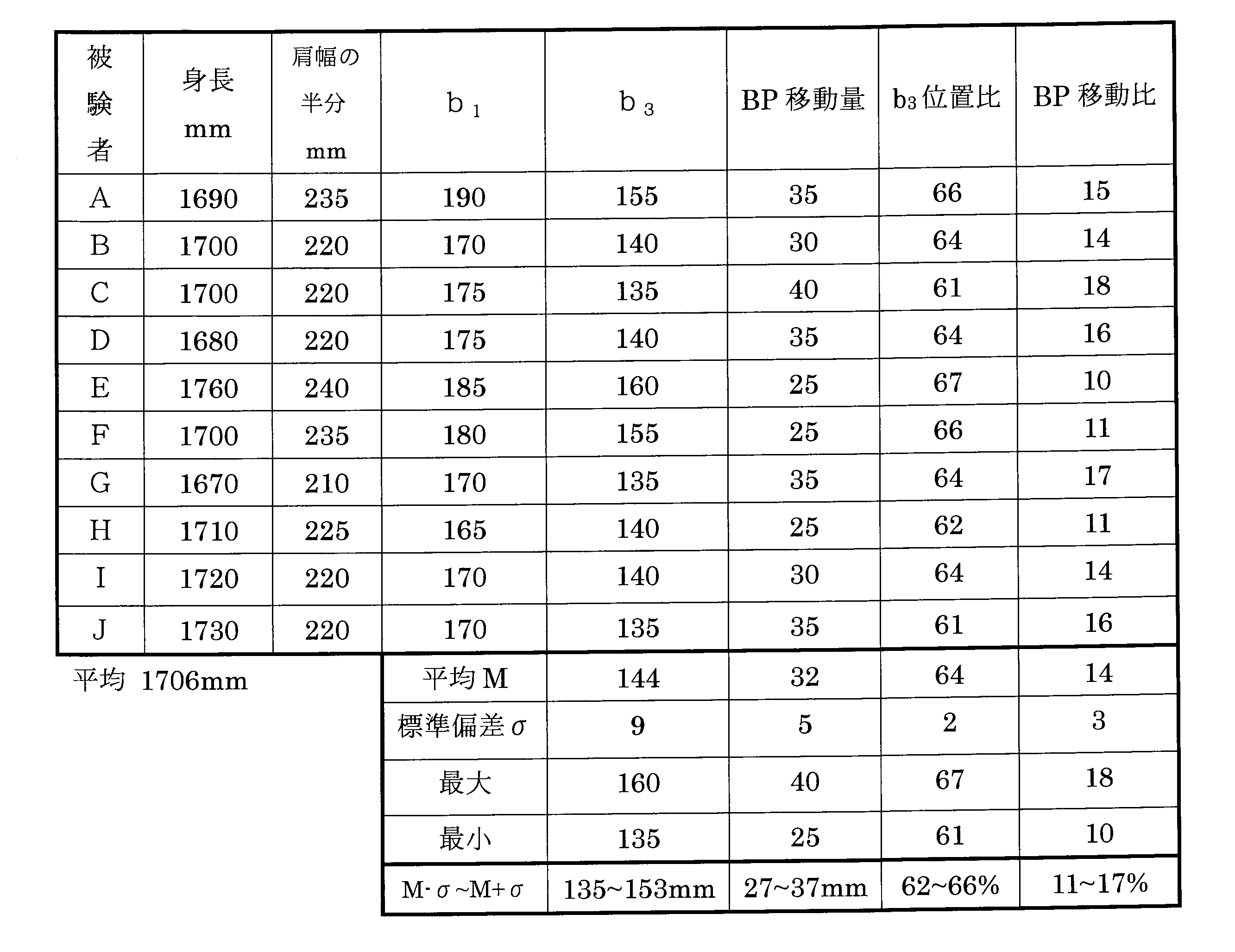
- Table 1 shows the measurement results regarding the position of the trapezius muscle stop, etc., with 10 adult males (average height: 170.6 cm) as subjects.
- an average value and a standard deviation of each parameter were calculated, and ““ average value ⁇ standard deviation ”to“ average value + standard deviation ”” was set as the range of each parameter.
- subjects A to J are 10 adult males, with an average height of 170.6 cm.
- the distance (mm) to the inner side of the trapezius muscle stop (between the neck circumference N 1 ) from b 1 to b 3 with the arm raised by 150 °, b 3 movement ratio is the shoulder width
- the ratio of the position of b 3 to the half of the position (%) [position of b 3 / half of the shoulder width] ⁇ 100
- the “BP movement amount” means the neck circumference back center point N 1 of the “trapezoidal muscle stop portions b 1 , b 2 , b 3 ” when the arm is lowered by 150 °. It is the distance moved to the side. Therefore, the sleeve caps point 6, trapezius muscle stops b 3 on shoulder ridge of the wearer at an elevated arm A L is, with respect to the distance between the ⁇ behind the center point N 1 and the shoulder point S
- the arm is raised by setting it to be 11% to 17% of the neck circumference back center point N 1 side from the trapezius muscle stop part b 1 on the shoulder ridge line L of the wearer with the arm A lowered.
- the arm bending point and the arm hole can be matched.
- b 3 Position ratio (the ratio of the "position of the b 3" to "half shoulder width”) is a 62% to 66%.
- the position of b 3 refers to the distance between the “neck circumference back center point N 1 ” and the “trapezoidal muscle stop portion” when the arm is raised by 150 °. Therefore, the sleeve caps point 6, trapezius muscle stops b 3 on shoulder ridge of the wearer at an elevated arm A L is, with respect to the distance between the ⁇ behind the center point N 1 and the shoulder point S Te, also by setting such that the ⁇ behind the center point N 1 to 62% ⁇ 66% shoulder point S side, it is possible to match the arm bending point and armhole during arm raising.
Landscapes
- Engineering & Computer Science (AREA)
- Textile Engineering (AREA)
- Details Of Garments (AREA)
- Professional, Industrial, Or Sporting Protective Garments (AREA)
Description
1)腕を自然に下した状態で最も着心地よく設計されている。
2)構造が単純で、あらゆるデザインに対応しやすい。
2)アームホールが広く、腕を通しやすい。
3)縫製線が肩回りにないので、縫代が皮膚に接触しにくい。
2 前身頃
3 後身頃
4 袖
5 アームホール
6 袖山点
A 腕
B 体幹部
C 僧帽筋
D 大胸筋
E 三角筋
F 前腋点
G 肩甲棘隆出部
H 後腋点
I 凹み
b1、b2、b3 僧帽筋停止部
N1 頸囲後ろ中心点
N2 頸囲側点
L 肩稜線
S 肩先点
Claims (8)
- アームホールの袖山点が、腕を下げた状態での着用者の肩稜線上の僧帽筋停止部と、腕を上げた状態での着用者の肩稜線上の僧帽筋停止部との間に位置することを特徴とする上衣。
- アームホールの前身頃側が、着用者の三角筋と大胸筋の間の三角筋大胸筋溝を通る請求項1記載の上衣。
- アームホールの前身頃側の下部が、着用者の前腋点を通る請求項2記載の上衣。
- アームホールの後身頃側が、着用者の肩甲棘隆出部を通る請求項1~3のいずれかに記載の上衣。
- アームホールの後身頃側の下部が、着用者の後腋点を通る請求項4記載の上衣。
- アームホールの前身頃側を、着用者の三角筋と大胸筋の間の三角筋大胸筋溝の凹みに沿うように凹ませた請求項1~5のいずれかに記載の上衣。
- 袖山点を、腕を上げた状態での着用者の肩稜線上の僧帽筋停止部が、頸囲後ろ中心点と肩先点との距離に対して、腕を下げた状態での着用者の肩稜線上の僧帽筋停止部から11%~17%頸囲後ろ中心点側になるように位置決めしている請求項1~6のいずれかに記載の上衣。
- 袖山点を、腕を上げた状態での着用者の肩稜線上の僧帽筋停止部が、頸囲後ろ中心点と肩先点との距離に対して、頸囲後ろ中心点から62%~66%肩先点側になるように位置決めしている請求項1~6のいずれかに記載の上衣。
Priority Applications (4)
| Application Number | Priority Date | Filing Date | Title |
|---|---|---|---|
| JP2013505266A JP5519860B1 (ja) | 2012-06-28 | 2012-06-28 | 上衣 |
| PCT/JP2012/066508 WO2014002224A1 (ja) | 2012-06-28 | 2012-06-28 | 上衣 |
| US14/411,488 US20150164148A1 (en) | 2012-06-28 | 2012-06-28 | Upper garment |
| EP12880261.8A EP2868220A4 (en) | 2012-06-28 | 2012-06-28 | APPAREL PIECE |
Applications Claiming Priority (1)
| Application Number | Priority Date | Filing Date | Title |
|---|---|---|---|
| PCT/JP2012/066508 WO2014002224A1 (ja) | 2012-06-28 | 2012-06-28 | 上衣 |
Publications (1)
| Publication Number | Publication Date |
|---|---|
| WO2014002224A1 true WO2014002224A1 (ja) | 2014-01-03 |
Family
ID=49782455
Family Applications (1)
| Application Number | Title | Priority Date | Filing Date |
|---|---|---|---|
| PCT/JP2012/066508 Ceased WO2014002224A1 (ja) | 2012-06-28 | 2012-06-28 | 上衣 |
Country Status (4)
| Country | Link |
|---|---|
| US (1) | US20150164148A1 (ja) |
| EP (1) | EP2868220A4 (ja) |
| JP (1) | JP5519860B1 (ja) |
| WO (1) | WO2014002224A1 (ja) |
Cited By (1)
| Publication number | Priority date | Publication date | Assignee | Title |
|---|---|---|---|---|
| JP2022092340A (ja) * | 2020-12-10 | 2022-06-22 | 国立大学法人お茶の水女子大学 | 防災服及び防災服の製造方法 |
Families Citing this family (3)
| Publication number | Priority date | Publication date | Assignee | Title |
|---|---|---|---|---|
| US10729187B2 (en) | 2013-09-20 | 2020-08-04 | John Inzer | Support shirt with sleeve reinforcement regions |
| US10721980B2 (en) * | 2015-03-13 | 2020-07-28 | John Inzer | Notch sleeve support shirt |
| TWI851488B (zh) * | 2023-11-29 | 2024-08-01 | 國立成功大學 | 可調式上肢穿戴式裝置 |
Citations (7)
| Publication number | Priority date | Publication date | Assignee | Title |
|---|---|---|---|---|
| JPH1161530A (ja) * | 1997-08-19 | 1999-03-05 | Mizuno Corp | 運動用シャツ |
| JP3064858U (ja) | 1999-06-14 | 2000-01-28 | 小郷産業株式会社 | 制服用ポロシャツ |
| JP2002088543A (ja) * | 2000-09-11 | 2002-03-27 | Mizuno Corp | ショートスリーブシャツ |
| JP2003129316A (ja) | 2001-10-22 | 2003-05-08 | Caitac Corp | 被 服 |
| JP2006291399A (ja) * | 2005-04-12 | 2006-10-26 | Wacoal Holdings Corp | 上半身部を有する衣類 |
| JP2011179148A (ja) * | 2010-03-02 | 2011-09-15 | Gunze Ltd | 袖付き衣類 |
| JP2011214184A (ja) * | 2010-03-31 | 2011-10-27 | Gunze Ltd | 袖付き衣類 |
Family Cites Families (17)
| Publication number | Priority date | Publication date | Assignee | Title |
|---|---|---|---|---|
| US2554940A (en) * | 1948-02-17 | 1951-05-29 | Flexsleev Inc | Sleeved garment |
| US2825067A (en) * | 1955-02-14 | 1958-03-04 | Johnson Armigene Roderick | Garment structure |
| US2820224A (en) * | 1956-11-06 | 1958-01-21 | Lyons Knitwear Inc | T shirt sleeve construction |
| US2943330A (en) * | 1959-04-09 | 1960-07-05 | Flexsleev Inc | Garment construction particularly dress shirts |
| US3049719A (en) * | 1960-01-04 | 1962-08-21 | E & R Inc | Garment with flexible sleeve joints |
| US3206762A (en) * | 1963-11-29 | 1965-09-21 | Robert D Smith | Ventilated jacket or suit coat for men and women |
| JPS62157911U (ja) * | 1986-03-24 | 1987-10-07 | ||
| DE8700161U1 (de) * | 1987-01-03 | 1987-02-12 | Giebenrath, Karl, 7470 Albstadt | Sporthemd, insbesondere Tennishemd |
| US4864655A (en) * | 1988-08-12 | 1989-09-12 | Lion Apparel, Inc. | Firefighter's turnout coat |
| US5165110A (en) * | 1991-06-03 | 1992-11-24 | William L. Grilliot | Firefighter's coat providing freedom of arm movement |
| US20030051286A1 (en) * | 2001-08-09 | 2003-03-20 | Ron Gregg | Volumetric shoulder for garments |
| US20060218693A1 (en) * | 2005-03-31 | 2006-10-05 | Sinohui Andres Jr | Shirt |
| US20070028351A1 (en) * | 2005-07-19 | 2007-02-08 | Coolik Michael A | Garment with improved sleeve movement |
| JP4705900B2 (ja) * | 2006-09-28 | 2011-06-22 | 株式会社アシックス | ウェア |
| US9402426B2 (en) * | 2008-04-10 | 2016-08-02 | Asics Corporation | Upper garment |
| CA131446S (en) * | 2009-01-15 | 2010-02-08 | Goldwin Technical Center Inc | Shirt for sports |
| JP5440919B2 (ja) * | 2009-09-07 | 2014-03-12 | 富士紡ホールディングス株式会社 | アンダーシャツの縫製方法 |
-
2012
- 2012-06-28 WO PCT/JP2012/066508 patent/WO2014002224A1/ja not_active Ceased
- 2012-06-28 EP EP12880261.8A patent/EP2868220A4/en not_active Withdrawn
- 2012-06-28 JP JP2013505266A patent/JP5519860B1/ja active Active
- 2012-06-28 US US14/411,488 patent/US20150164148A1/en not_active Abandoned
Patent Citations (7)
| Publication number | Priority date | Publication date | Assignee | Title |
|---|---|---|---|---|
| JPH1161530A (ja) * | 1997-08-19 | 1999-03-05 | Mizuno Corp | 運動用シャツ |
| JP3064858U (ja) | 1999-06-14 | 2000-01-28 | 小郷産業株式会社 | 制服用ポロシャツ |
| JP2002088543A (ja) * | 2000-09-11 | 2002-03-27 | Mizuno Corp | ショートスリーブシャツ |
| JP2003129316A (ja) | 2001-10-22 | 2003-05-08 | Caitac Corp | 被 服 |
| JP2006291399A (ja) * | 2005-04-12 | 2006-10-26 | Wacoal Holdings Corp | 上半身部を有する衣類 |
| JP2011179148A (ja) * | 2010-03-02 | 2011-09-15 | Gunze Ltd | 袖付き衣類 |
| JP2011214184A (ja) * | 2010-03-31 | 2011-10-27 | Gunze Ltd | 袖付き衣類 |
Non-Patent Citations (1)
| Title |
|---|
| See also references of EP2868220A4 |
Cited By (2)
| Publication number | Priority date | Publication date | Assignee | Title |
|---|---|---|---|---|
| JP2022092340A (ja) * | 2020-12-10 | 2022-06-22 | 国立大学法人お茶の水女子大学 | 防災服及び防災服の製造方法 |
| JP7620973B2 (ja) | 2020-12-10 | 2025-01-24 | 国立大学法人お茶の水女子大学 | 防災服の製造方法 |
Also Published As
| Publication number | Publication date |
|---|---|
| EP2868220A1 (en) | 2015-05-06 |
| US20150164148A1 (en) | 2015-06-18 |
| JP5519860B1 (ja) | 2014-06-11 |
| JPWO2014002224A1 (ja) | 2016-05-26 |
| EP2868220A4 (en) | 2016-01-20 |
Similar Documents
| Publication | Publication Date | Title |
|---|---|---|
| EP2952111A1 (en) | Cycling jersey sleeve pattern | |
| JP2007303024A (ja) | 自転車搭乗用衣服 | |
| KR20110068034A (ko) | 사이즈 조절형 의류 | |
| US11234467B1 (en) | Tuck no tuck apparel | |
| JP5519860B1 (ja) | 上衣 | |
| JP3143211U (ja) | 上半身用衣服 | |
| JP5420086B2 (ja) | スポーツ用上衣 | |
| JP6651181B2 (ja) | 衣類の上半身部 | |
| JP4629441B2 (ja) | 改善された快適性をもつモーターサイクリスト用衣服 | |
| JP2014198912A (ja) | 上半身用衣類 | |
| JP3145113U (ja) | 衣服及び小児用ジャケット | |
| JP6516315B2 (ja) | 衣類 | |
| JP3168478U (ja) | スポーツ用インナー | |
| JP5850325B2 (ja) | 簡単女着物 | |
| JP2011179148A (ja) | 袖付き衣類 | |
| JP2013007142A (ja) | 自転車用上着 | |
| JP6453809B2 (ja) | ショーツ等の衣料 | |
| JP3199637U (ja) | 上衣 | |
| JP5291262B1 (ja) | 姿勢矯正補助具 | |
| CN205072086U (zh) | 改良构造的调整型内衣 | |
| CN223730778U (zh) | 斗篷大衣 | |
| JP3175207U (ja) | 袖付き衣服 | |
| JP4141404B2 (ja) | 和服用雨除けモンペ | |
| JP7408126B2 (ja) | 衣服 | |
| JP3181723U (ja) | 襟の捲くれ上がりを防止したセーラー服 |
Legal Events
| Date | Code | Title | Description |
|---|---|---|---|
| ENP | Entry into the national phase |
Ref document number: 2013505266 Country of ref document: JP Kind code of ref document: A |
|
| 121 | Ep: the epo has been informed by wipo that ep was designated in this application |
Ref document number: 12880261 Country of ref document: EP Kind code of ref document: A1 |
|
| WWE | Wipo information: entry into national phase |
Ref document number: 14411488 Country of ref document: US |
|
| NENP | Non-entry into the national phase |
Ref country code: DE |
|
| WWE | Wipo information: entry into national phase |
Ref document number: 2012880261 Country of ref document: EP |