WO2014010175A1 - Dispositif et procédé de codage - Google Patents
Dispositif et procédé de codage Download PDFInfo
- Publication number
- WO2014010175A1 WO2014010175A1 PCT/JP2013/003814 JP2013003814W WO2014010175A1 WO 2014010175 A1 WO2014010175 A1 WO 2014010175A1 JP 2013003814 W JP2013003814 W JP 2013003814W WO 2014010175 A1 WO2014010175 A1 WO 2014010175A1
- Authority
- WO
- WIPO (PCT)
- Prior art keywords
- mode
- encoding
- hangover
- signal
- delay
- Prior art date
- Legal status (The legal status is an assumption and is not a legal conclusion. Google has not performed a legal analysis and makes no representation as to the accuracy of the status listed.)
- Ceased
Links
Images




Classifications
-
- G—PHYSICS
- G10—MUSICAL INSTRUMENTS; ACOUSTICS
- G10L—SPEECH ANALYSIS TECHNIQUES OR SPEECH SYNTHESIS; SPEECH RECOGNITION; SPEECH OR VOICE PROCESSING TECHNIQUES; SPEECH OR AUDIO CODING OR DECODING
- G10L19/00—Speech or audio signals analysis-synthesis techniques for redundancy reduction, e.g. in vocoders; Coding or decoding of speech or audio signals, using source filter models or psychoacoustic analysis
- G10L19/04—Speech or audio signals analysis-synthesis techniques for redundancy reduction, e.g. in vocoders; Coding or decoding of speech or audio signals, using source filter models or psychoacoustic analysis using predictive techniques
- G10L19/16—Vocoder architecture
- G10L19/18—Vocoders using multiple modes
- G10L19/22—Mode decision, i.e. based on audio signal content versus external parameters
-
- G—PHYSICS
- G10—MUSICAL INSTRUMENTS; ACOUSTICS
- G10L—SPEECH ANALYSIS TECHNIQUES OR SPEECH SYNTHESIS; SPEECH RECOGNITION; SPEECH OR VOICE PROCESSING TECHNIQUES; SPEECH OR AUDIO CODING OR DECODING
- G10L25/00—Speech or voice analysis techniques not restricted to a single one of groups G10L15/00 - G10L21/00
- G10L25/78—Detection of presence or absence of voice signals
- G10L25/81—Detection of presence or absence of voice signals for discriminating voice from music
Definitions
- the present invention relates to an encoding device and an encoding method for encoding an audio signal and a music signal.
- EVS Enhanced Voice Service
- EPS Evolved Packet System
- the requirements for EVS are determined in consideration of recent telephone service using portable terminals. For example, it is assumed that the hold sound of the mobile terminal is a voice with music, or the voice guidance with BGM from the call center is processed while listening to the mobile terminal, so the music is also required to be reproduced with good quality. It has been.
- Patent Document 1 discloses that VOX (Voice Operated Transmission) control is turned off when a hold is instructed in a portable terminal using VSELP (Vector Sum Excited Linear Prediction). A method is disclosed. Also, in Patent Document 2, when music is provided to a mobile terminal, the mobile terminal stores in advance a plurality of sound source files having different numbers of chords, which are the number of frequencies to be transmitted simultaneously, according to the codec used. A method for selecting a sound source file is disclosed.
- VSELP Vector Sum Excited Linear Prediction
- G. is a method for performing voice / music determination in units of frames. It is standardized by ITU-T as 720.1 (or GSAD: “Generic Sound Activity Detector”) (see Non-Patent Document 3).
- GSAD Generic Sound Activity Detector
- voice / music determination is performed using feature parameters for each frame, but the determination result becomes unstable, and frequent switching between voice / music may occur.
- hangover is a technique for forcibly using the determination result selected in the previous frame a specified number of times, and thus frequent switching can be avoided.
- Hangover is an effective technique for avoiding frequent voice / music switching, but there is a problem when making a voice call in an environment where music is flowing in the background.
- a BGM signal In the BGM signal, music flows in the non-voice section, and music is superimposed on the voice in the voice section.
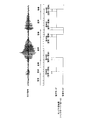
- FIG. 1 shows the determination result when the BGM signal, the signal component of each frame (speech or music), and the hangover value is 2 (that is, 2 frames forcibly use the previous determination result).
- the determination result is not switched immediately because there is a hangover. For this reason, there is a problem that an erroneous determination occurs and the sound quality deteriorates.
- An object of the present invention is to provide an encoding device and an encoding method that improve the accuracy of voice / music determination for a BGM signal and suppress deterioration in sound quality.
- the encoding apparatus includes a processing delay determining unit that determines a delay time allowed for encoding processing of an input signal, and determines whether the input signal is in a voice signal or music signal mode for each predetermined section. Comparing the mode of the previous section and the mode of the current section determined by the mode determination means, the mode determination means for performing, the hangover length determination means for determining the hangover length according to the delay time, and the comparison And a hangover means for determining the mode of the current section using the result and the hangover length, and an encoding means for encoding the input signal by an encoding method according to the determined mode. Take the configuration.
- the encoding method of the present invention includes a processing delay determination step for determining a delay time allowed for encoding processing of an input signal, and determines whether the input signal is in a voice signal mode or a music signal mode for each predetermined section. Comparing the mode determination step, the hangover length determination step for determining the hangover length according to the delay time, the mode of the previous section determined in the mode determination step and the mode of the current section, and the comparison And a hangover step for determining the mode of the current section using the hangover length and an encoding step for encoding the input signal by an encoding method according to the determined mode. I did it.
- the present invention it is possible to improve the accuracy of voice / music determination for a BGM signal and suppress deterioration in sound quality.
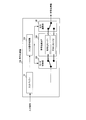
- FIG. 1 is a block diagram showing a configuration of an encoding apparatus according to Embodiment 1 of the present invention.
- the block diagram which shows the internal structure of the input signal determination part shown in FIG. Diagram showing correspondence between energy information and hangover length The block diagram which shows the internal structure of the hangover part shown in FIG.
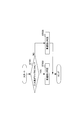
- the flowchart which shows the process sequence of the process delay determination part shown in FIG.
- FIG. 2 is a block diagram showing a configuration of coding apparatus 100 according to Embodiment 1 of the present invention.
- the configuration of the encoding apparatus 100 will be described with reference to FIG.
- the input buffer 101 outputs the input signal to the input signal determination unit 102, temporarily stores the input signal, and outputs it to the mode switching unit 103.
- the input signal determination unit 102 determines whether the input signal output from the input buffer 101 is an audio signal or a music signal, and outputs the determination result to the mode switching unit 103 and the output selection unit 105 as mode information. Note that. Details of the input signal determination unit 102 will be described later.
- the mode switching unit 103 Based on the mode information output from the input signal determination unit 102, the mode switching unit 103 connects the changeover switch to the encoding mode 1 or the encoding mode 2 of the encoding unit core 104, and is output from the input buffer 101. The input signal is output to encoding mode 1 or encoding mode 2 connected. Specifically, the mode switching unit 103 connects the changeover switch to the encoding mode 1 when the mode information indicates an audio signal, and sets the changeover switch to the encoding mode when the mode information indicates a music signal. Connect to 2.
- the encoding unit core 104 includes encoding modes 1 and 2, and the encoding mode 1 is, for example, G.
- the encoding mode 2 is an encoding method suitable for a music signal such as MP3 (MPEG Audio Layer-3) or AAC (Advanced Audio Coding).
- the encoding unit core 104 encodes the input signal output from the input buffer 101 in the encoding mode 1 or the encoding mode 2, and outputs the encoded information to the output selection unit 105.
- information indicating which one of the encoding mode 1 and the encoding mode 2 is used for encoding may be output as part of the encoding information. In this case, the decoding process can be performed only from the encoded information.
- the output selection unit 105 Based on the mode information output from the input signal determination unit 102, the output selection unit 105 connects to the encoding mode 1 or the encoding mode 2 of the encoding unit core 104, and from the encoding mode 1 or the encoding mode 2 The output encoded information is set as an output of the encoding apparatus 100.
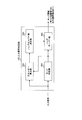
- FIG. 3 is a block diagram showing an internal configuration of the input signal determination unit 102 shown in FIG.
- the internal configuration of the input signal determination unit 102 will be described with reference to FIG.
- an input signal (framed input signal) divided by a predetermined time length is input to the mode determination unit 201 and the energy calculation unit 202.
- the mode determination unit 201 analyzes an input signal using an existing method to calculate a feature parameter, and determines whether the input signal is in a voice signal or music signal mode using the feature parameter.
- the mode determination unit 201 outputs a determination result (mode information) to the energy calculation unit 202 and the hangover unit 204.
- the energy calculation unit 202 calculates the average energy (or energy information) of the input signal included in the frame determined by the mode determination unit 201 as the music signal, and outputs the energy information to the hangover length determination unit 203.
- the following processing is performed.
- the energy calculation unit 202 has a buffer for storing the average energy of past frames determined as music signals, and when the current frame is determined as a music signal, the energy calculation unit 202 stores the energy of the current frame in the buffer. Update the stored value. The update is performed according to the following equation (1).
- E avg represents the average energy of past frames determined to be music signals stored in the buffer.
- E n represents the energy of the signal current frame is included in the current frame when it is determined that the music signal.
- the energy calculation unit 202 outputs the average energy E avg calculated in this way to the hangover length determination unit 203 as energy information.
- the hangover length determination unit 203 compares the energy information output from the energy calculation unit 202 with a predetermined threshold, and if the energy information is larger than the threshold, the hangover length is increased and output to the hangover unit 204. To do. On the other hand, when the energy information is smaller than the threshold value, the hangover length determination unit 203 shortens the hangover length and outputs it to the hangover unit 204.
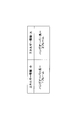
- the hangover length As a specific value of the hangover length, for example, as shown in FIG. 4, when the energy information is large, the hangover length is 2 frames. When the energy information is small, the hangover length is 1 frame. And so on.
- the hangover unit 204 stores the mode information determined in the previous frame, the mode information of the previous frame, the mode information of the current frame output from the mode determination unit 201, and the hangover length determination unit 203.
- the mode information of the current frame output from the mode determination unit 201 is determined and output using the hangover length.
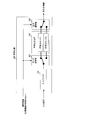
- FIG. 5 is a block diagram showing an internal configuration of the hangover unit 204 shown in FIG.
- the storage unit 301 stores the mode information output from the hangover unit 204 in the previous frame, and the mode information of the previous frame is output to the determination unit 302.
- the determination unit 302 compares the mode information of the previous frame output from the storage unit 301 with the mode information of the current frame output from the mode determination unit 201.
- the counter built in the determination unit 302 is reset to zero, and the switches 303 and 304 are switched so that the path (B) becomes valid.
- the path (B) is a path for outputting the mode information output from the mode determination unit 201 as it is. For this reason, the mode information output from the mode determination unit 201 is output from the hangover unit 204 without any processing.
- the determination unit 302 compares the counter value with the hangover length output from the hangover length determination unit 203. When the counter value is equal to or smaller than the hangover length, the determination unit 302 switches the switches 303 and 304 so that the hangover process is valid, that is, the path (A) is valid.
- the path (A) is a path in which mode information output from the mode determination unit 201 is corrected by the mode information correction unit 305 and output from the hangover unit 204. If the counter value exceeds the hangover length, the determination unit 302 resets the counter to zero and switches the switches 303 and 304 so that the path (B) is valid.
- the mode information correction unit 305 operates only when the path (A) is valid, replaces the mode information output from the mode determination unit 201 with the mode information of the previous frame stored in the storage unit 301, and outputs it. .
- the mode information of the current frame that is output from the hangover unit 204 through the path (A) or the path (B) is stored in the storage unit 301, thereby replacing the mode information that has been stored so far. Prepare for the processing of the next frame.
- FIG. 6 is a diagram illustrating the effect of the encoding device 100 described above.
- the same BGM signal as in FIG. 1 is input.
- the hangover length is fixed to 2
- the energy information calculated by the energy calculation unit 202 is obtained from the threshold value. For this reason, the state when the hangover length is 1 is shown.
- the hangover length is shortened so that the voice / music determination can be performed in a short section. It is possible to improve the accuracy of voice / music determination with respect to the BGM signal and suppress deterioration in sound quality.
- the audio signal is usually used in conversation with the other party, that is, in bidirectional communication. Therefore, since the conversation does not hold when the delay becomes long, it is necessary to encode the audio signal with a short delay (hereinafter referred to as “low delay”).
- the sound signal has a characteristic that the characteristics of the signal greatly change in a relatively short time, such as a silent interval, an unvoiced interval, and a voiced interval. Therefore, even if a long time signal is stored in the encoding buffer (that is, a long delay (hereinafter referred to as “high delay”)) and analyzed, the encoding efficiency is unlikely to be high. For this reason, low delay is suitable for encoding audio signals.
- the signal characteristics of a music signal rarely change significantly in a short time like an audio signal. For this reason, encoding efficiency is greatly improved by storing and analyzing a long time signal in the encoding analysis buffer.
- a streaming signal for transmitting data in one direction from a server to a terminal is a main application, a one-way communication is less demanding on delay than two-way communication. For this reason, it can be said that high delay is suitable for encoding music signals.
- FIG. 7 is a block diagram showing a configuration of coding apparatus 400 according to Embodiment 2 of the present invention.
- the configuration of encoding apparatus 400 will be described with reference to FIG.
- the user interface 401 is, for example, a keyboard, a touch panel, or the like, and an input source, that is, an input source switching signal for switching the ON operation of the microphone 402 and the data storage unit 403 to the microphone 402, the data storage unit 403, and the input source specifying unit 404. Output.
- the microphone 402 inputs sound according to the input source switching signal output from the user interface 401, converts the input sound into a sound signal, and outputs the sound signal to the encoding unit 406.
- the data storage unit 403 stores data such as a holding tone or a message, and outputs the stored data to the encoding unit 406 in accordance with the input source switching signal output from the user interface 401.
- the input source specifying unit 404 specifies an input source based on the input source switching signal output from the user interface 401, and outputs input source information indicating the specified input source to the processing delay determination unit 405.
- the processing delay determination unit 405 determines a delay time allowed for the encoding process according to the input source information output from the input source specifying unit 404. Specifically, as shown in FIG. 8, when the input source is a microphone (ST501: YES), the processing delay determination unit 405 determines that the data to be encoded is bidirectional, such as a voice call. It is determined that the data requires real-time processing, and the processing delay is determined to be low delay (ST502). On the other hand, when the input source is the data storage unit 403 (ST501: NO), the processing delay determination unit 405 does not need the bidirectional real-time processing such as hold tone or message for the data to be encoded. It is determined that the data is data, and the processing delay is determined to be a high delay (ST503). The processing delay determination unit 405 outputs the determination result (delay information) to the encoding unit 406.
- the encoding unit 406 Based on the delay information output from the processing delay determination unit 405, the encoding unit 406 converts the audio signal output from the microphone 402 or the data output from the data storage unit 403 by an encoding method suitable for each characteristic. Encode and output encoded information.
- FIG. 9 is a block diagram showing an internal configuration of the encoding unit 406 shown in FIG.
- the internal configuration of the encoding unit 406 will be described with reference to FIG.
- the encoding unit 406 in FIG. 9 deletes the input signal determination unit 102 from the encoding device 100 in FIG. 2, changes the mode switching unit 103 to the mode switching unit 601, and outputs the output selection unit 105. The difference is that the selection unit 602 is changed.
- the mode switching unit 601 Based on the delay information output from the processing delay determination unit 405, the mode switching unit 601 connects the changeover switch to the encoding mode 1 or the encoding mode 2 of the encoding unit core 104 and is output from the input buffer 101.
- the input signal is output to encoding mode 1 or encoding mode 2 connected.
- the mode switching unit 601 connects to the encoding mode 1 when the delay information indicates a low delay, and connects to the encoding mode 2 when the delay information indicates a high delay.
- the encoding mode 1 is, for example, G.
- the encoding mode 2 is an encoding method suitable for an audio signal such as 729, and the encoding mode 2 is an encoding method suitable for a music signal such as MP3 or AAC.
- the output selection unit 602 Based on the delay information output from the processing delay determination unit 405, the output selection unit 602 connects to the encoding mode 1 or the encoding mode 2 of the encoding unit core 104, and from the encoding mode 1 or the encoding mode 2 The output encoded information is set as an output of the encoding apparatus 400.
- the processing delay allowed for the encoding process is determined according to the input source, and the input signal is switched by changing the encoding method according to the delay information indicating the determination result.
- the hangover length is controlled according to the energy information of the input signal.
- the hangover length may be controlled according to the processing delay allowed for the encoding process. Good.
- the input signal can be stored in the buffer for a long time, so future data can be referenced. For this reason, the voice / music determination performance itself is improved. In this case, a long hangover is unnecessary, and the hangover length is shortened. As a result, it is possible to avoid deterioration in sound quality due to hangover and improve the overall sound quality.
- the hangover length may be increased when the frame length of the encoding method is short (for example, 10 msec or less), or when speech / music determination performance is poor because noise is superimposed on the input signal. Further, when the frame length of the encoding method is long (for example, 40 msec or more), the hangover length may be shortened.
- each functional block used in the description of each of the above embodiments is typically realized as an LSI which is an integrated circuit. These may be individually made into one chip, or may be made into one chip so as to include a part or all of them.
- the name used here is LSI, but it may also be called IC, system LSI, super LSI, or ultra LSI depending on the degree of integration.
- the method of circuit integration is not limited to LSI, and may be realized by a dedicated circuit or a general-purpose processor.
- An FPGA Field Programmable Gate Array
- a reconfigurable processor that can reconfigure the connection and setting of circuit cells inside the LSI may be used.
- the encoding device and the encoding method according to the present invention can be applied to a communication terminal such as a mobile phone having a call function, for example.
Landscapes
- Engineering & Computer Science (AREA)
- Computational Linguistics (AREA)
- Signal Processing (AREA)
- Health & Medical Sciences (AREA)
- Audiology, Speech & Language Pathology (AREA)
- Human Computer Interaction (AREA)
- Physics & Mathematics (AREA)
- Acoustics & Sound (AREA)
- Multimedia (AREA)
- Compression, Expansion, Code Conversion, And Decoders (AREA)
Abstract
L'invention concerne un dispositif de codage et un procédé de codage permettant de déterminer plus précisément si un signal BGM se trouve en mode signal vocal ou en mode signal musical, et de réduire au minimum la dégradation de la qualité sonore. Une unité de détermination de mode (201) détermine si un signal d'entrée est en mode signal vocal ou en mode signal musical, et une unité de calcul d'énergie (202) calcule l'énergie moyenne du signal d'entrée contenu dans une trame déterminée comme étant un signal musical. Une unité de détermination de longueur de transfert (203) augmente la longueur de transfert lorsque la quantité d'informations d'énergie calculée est grande et réduit la longueur de transfert lorsque la quantité d'informations d'énergie calculée est petite. Une unité de transfert (204) utilise les informations de mode de la trame précédente, les informations de mode de la trame courante, ainsi que la longueur de transfert déterminée et corrige les informations de mode pour la trame courante lorsqu'une condition déterminée est remplie.
Applications Claiming Priority (2)
| Application Number | Priority Date | Filing Date | Title |
|---|---|---|---|
| JP2012153563 | 2012-07-09 | ||
| JP2012-153563 | 2012-07-09 |
Publications (1)
| Publication Number | Publication Date |
|---|---|
| WO2014010175A1 true WO2014010175A1 (fr) | 2014-01-16 |
Family
ID=49915660
Family Applications (1)
| Application Number | Title | Priority Date | Filing Date |
|---|---|---|---|
| PCT/JP2013/003814 Ceased WO2014010175A1 (fr) | 2012-07-09 | 2013-06-19 | Dispositif et procédé de codage |
Country Status (1)
| Country | Link |
|---|---|
| WO (1) | WO2014010175A1 (fr) |
Cited By (2)
| Publication number | Priority date | Publication date | Assignee | Title |
|---|---|---|---|---|
| US20140188465A1 (en) * | 2012-11-13 | 2014-07-03 | Samsung Electronics Co., Ltd. | Coding mode determination method and apparatus, audio encoding method and apparatus, and audio decoding method and apparatus |
| KR20160125397A (ko) * | 2014-02-24 | 2016-10-31 | 삼성전자주식회사 | 신호 분류 방법 및 장치, 및 이를 이용한 오디오 부호화방법 및 장치 |
Citations (4)
| Publication number | Priority date | Publication date | Assignee | Title |
|---|---|---|---|---|
| US5410632A (en) * | 1991-12-23 | 1995-04-25 | Motorola, Inc. | Variable hangover time in a voice activity detector |
| US6202046B1 (en) * | 1997-01-23 | 2001-03-13 | Kabushiki Kaisha Toshiba | Background noise/speech classification method |
| JP2004301907A (ja) * | 2003-03-28 | 2004-10-28 | Matsushita Electric Ind Co Ltd | 音声符号化装置 |
| WO2008121035A1 (fr) * | 2007-03-29 | 2008-10-09 | Telefonaktiebolaget Lm Ericsson (Publ) | Procédé et codeur vocal avec un ajustement de longueur de la période de maintien de transmission discontinue |
-
2013
- 2013-06-19 WO PCT/JP2013/003814 patent/WO2014010175A1/fr not_active Ceased
Patent Citations (4)
| Publication number | Priority date | Publication date | Assignee | Title |
|---|---|---|---|---|
| US5410632A (en) * | 1991-12-23 | 1995-04-25 | Motorola, Inc. | Variable hangover time in a voice activity detector |
| US6202046B1 (en) * | 1997-01-23 | 2001-03-13 | Kabushiki Kaisha Toshiba | Background noise/speech classification method |
| JP2004301907A (ja) * | 2003-03-28 | 2004-10-28 | Matsushita Electric Ind Co Ltd | 音声符号化装置 |
| WO2008121035A1 (fr) * | 2007-03-29 | 2008-10-09 | Telefonaktiebolaget Lm Ericsson (Publ) | Procédé et codeur vocal avec un ajustement de longueur de la période de maintien de transmission discontinue |
Cited By (14)
| Publication number | Priority date | Publication date | Assignee | Title |
|---|---|---|---|---|
| US10468046B2 (en) | 2012-11-13 | 2019-11-05 | Samsung Electronics Co., Ltd. | Coding mode determination method and apparatus, audio encoding method and apparatus, and audio decoding method and apparatus |
| US11004458B2 (en) | 2012-11-13 | 2021-05-11 | Samsung Electronics Co., Ltd. | Coding mode determination method and apparatus, audio encoding method and apparatus, and audio decoding method and apparatus |
| US20140188465A1 (en) * | 2012-11-13 | 2014-07-03 | Samsung Electronics Co., Ltd. | Coding mode determination method and apparatus, audio encoding method and apparatus, and audio decoding method and apparatus |
| US10504540B2 (en) | 2014-02-24 | 2019-12-10 | Samsung Electronics Co., Ltd. | Signal classifying method and device, and audio encoding method and device using same |
| US10090004B2 (en) | 2014-02-24 | 2018-10-02 | Samsung Electronics Co., Ltd. | Signal classifying method and device, and audio encoding method and device using same |
| EP3109861A4 (fr) * | 2014-02-24 | 2017-11-01 | Samsung Electronics Co., Ltd. | Procédé et dispositif de classification de signal, et procédé et dispositif de codage audio les utilisant |
| JP2017511905A (ja) * | 2014-02-24 | 2017-04-27 | サムスン エレクトロニクス カンパニー リミテッド | 信号分類方法及びその装置、並びにそれを利用したオーディオ符号化方法及びその装置 |
| CN110992965A (zh) * | 2014-02-24 | 2020-04-10 | 三星电子株式会社 | 信号分类方法和装置以及使用其的音频编码方法和装置 |
| KR20160125397A (ko) * | 2014-02-24 | 2016-10-31 | 삼성전자주식회사 | 신호 분류 방법 및 장치, 및 이를 이용한 오디오 부호화방법 및 장치 |
| KR102354331B1 (ko) | 2014-02-24 | 2022-01-21 | 삼성전자주식회사 | 신호 분류 방법 및 장치, 및 이를 이용한 오디오 부호화방법 및 장치 |
| KR20220013009A (ko) * | 2014-02-24 | 2022-02-04 | 삼성전자주식회사 | 신호 분류 방법 및 장치, 및 이를 이용한 오디오 부호화방법 및 장치 |
| KR102457290B1 (ko) | 2014-02-24 | 2022-10-20 | 삼성전자주식회사 | 신호 분류 방법 및 장치, 및 이를 이용한 오디오 부호화방법 및 장치 |
| KR20220148302A (ko) * | 2014-02-24 | 2022-11-04 | 삼성전자주식회사 | 신호 분류 방법 및 장치, 및 이를 이용한 오디오 부호화방법 및 장치 |
| KR102552293B1 (ko) | 2014-02-24 | 2023-07-06 | 삼성전자주식회사 | 신호 분류 방법 및 장치, 및 이를 이용한 오디오 부호화방법 및 장치 |
Similar Documents
| Publication | Publication Date | Title |
|---|---|---|
| TWI499247B (zh) | 用於關鍵性臨限控制之系統、方法、裝置及電腦可讀媒體 | |
| US20230037845A1 (en) | Truncateable predictive coding | |
| JP6386376B2 (ja) | マルチレート・スピーチ/オーディオ・コーデックのためのフレーム損失隠匿 | |
| KR101699138B1 (ko) | 리던던트 프레임 코딩 및 디코딩을 위한 디바이스들 | |
| KR101036965B1 (ko) | 음성 믹싱 방법 및 그 방법을 이용하는 다지점 회의 서버와 컴퓨터 판독가능 기록 매체 | |
| JP5706445B2 (ja) | 符号化装置、復号装置およびそれらの方法 | |
| US7996217B2 (en) | Method for adaptive codebook pitch-lag computation in audio transcoders | |
| KR101427863B1 (ko) | 오디오 신호 코딩 방법 및 장치 | |
| US11869516B2 (en) | Voice processing method and apparatus, computer- readable storage medium, and computer device | |
| US20090099851A1 (en) | Adaptive bit pool allocation in sub-band coding | |
| JPWO2007116809A1 (ja) | ステレオ音声符号化装置、ステレオ音声復号装置、およびこれらの方法 | |
| JPWO2009081567A1 (ja) | ステレオ信号変換装置、ステレオ信号逆変換装置およびこれらの方法 | |
| KR20170082901A (ko) | 재생 지연 조절 방법 및 이를 적용한 전자 장치 | |
| JPWO2007063910A1 (ja) | スケーラブル符号化装置およびスケーラブル符号化方法 | |
| WO2014010175A1 (fr) | Dispositif et procédé de codage | |
| US20130155924A1 (en) | Coded-domain echo control | |
| KR20080054057A (ko) | 적응적 멀티 레이트 코덱 모드 디코딩 방법 및 장치 | |
| US20140114653A1 (en) | Pitch estimator | |
| JP2004301907A (ja) | 音声符号化装置 | |
| US8509460B2 (en) | Sound mixing apparatus and method and multipoint conference server | |
| RU2394284C1 (ru) | Способ сжатия и восстановления речевых сигналов для систем кодирования с переменной скоростью передачи | |
| Eksler et al. | Object-Based Audio Coding in Immersive Mobile Communications | |
| US20120041761A1 (en) | Voice decoding apparatus and voice decoding method | |
| CN1979639A (zh) | 静音处理装置及方法 | |
| HK40022645B (zh) | 语音处理方法、装置、计算机可读存储介质和计算机设备 |
Legal Events
| Date | Code | Title | Description |
|---|---|---|---|
| 121 | Ep: the epo has been informed by wipo that ep was designated in this application |
Ref document number: 13817145 Country of ref document: EP Kind code of ref document: A1 |
|
| NENP | Non-entry into the national phase |
Ref country code: DE |
|
| 122 | Ep: pct application non-entry in european phase |
Ref document number: 13817145 Country of ref document: EP Kind code of ref document: A1 |