WO2014013680A1 - Dispositif, procédé et programme de calcul de fonction de hachage universelle - Google Patents
Dispositif, procédé et programme de calcul de fonction de hachage universelle Download PDFInfo
- Publication number
- WO2014013680A1 WO2014013680A1 PCT/JP2013/004021 JP2013004021W WO2014013680A1 WO 2014013680 A1 WO2014013680 A1 WO 2014013680A1 JP 2013004021 W JP2013004021 W JP 2013004021W WO 2014013680 A1 WO2014013680 A1 WO 2014013680A1
- Authority
- WO
- WIPO (PCT)
- Prior art keywords
- bit
- message
- output
- cyclic
- key
- Prior art date
- Legal status (The legal status is an assumption and is not a legal conclusion. Google has not performed a legal analysis and makes no representation as to the accuracy of the status listed.)
- Ceased
Links
Images




Classifications
-
- H—ELECTRICITY
- H04—ELECTRIC COMMUNICATION TECHNIQUE
- H04L—TRANSMISSION OF DIGITAL INFORMATION, e.g. TELEGRAPHIC COMMUNICATION
- H04L9/00—Cryptographic mechanisms or cryptographic arrangements for secret or secure communications; Network security protocols
- H04L9/08—Key distribution or management, e.g. generation, sharing or updating, of cryptographic keys or passwords
- H04L9/0816—Key establishment, i.e. cryptographic processes or cryptographic protocols whereby a shared secret becomes available to two or more parties, for subsequent use
- H04L9/0838—Key agreement, i.e. key establishment technique in which a shared key is derived by parties as a function of information contributed by, or associated with, each of these
-
- H—ELECTRICITY
- H04—ELECTRIC COMMUNICATION TECHNIQUE
- H04L—TRANSMISSION OF DIGITAL INFORMATION, e.g. TELEGRAPHIC COMMUNICATION
- H04L9/00—Cryptographic mechanisms or cryptographic arrangements for secret or secure communications; Network security protocols
- H04L9/06—Cryptographic mechanisms or cryptographic arrangements for secret or secure communications; Network security protocols the encryption apparatus using shift registers or memories for block-wise or stream coding, e.g. DES systems or RC4; Hash functions; Pseudorandom sequence generators
- H04L9/0643—Hash functions, e.g. MD5, SHA, HMAC or f9 MAC
-
- G—PHYSICS
- G09—EDUCATION; CRYPTOGRAPHY; DISPLAY; ADVERTISING; SEALS
- G09C—CIPHERING OR DECIPHERING APPARATUS FOR CRYPTOGRAPHIC OR OTHER PURPOSES INVOLVING THE NEED FOR SECRECY
- G09C1/00—Apparatus or methods whereby a given sequence of signs, e.g. an intelligible text, is transformed into an unintelligible sequence of signs by transposing the signs or groups of signs or by replacing them by others according to a predetermined system
-
- H—ELECTRICITY
- H04—ELECTRIC COMMUNICATION TECHNIQUE
- H04L—TRANSMISSION OF DIGITAL INFORMATION, e.g. TELEGRAPHIC COMMUNICATION
- H04L9/00—Cryptographic mechanisms or cryptographic arrangements for secret or secure communications; Network security protocols
- H04L9/32—Cryptographic mechanisms or cryptographic arrangements for secret or secure communications; Network security protocols including means for verifying the identity or authority of a user of the system or for message authentication, e.g. authorization, entity authentication, data integrity or data verification, non-repudiation, key authentication or verification of credentials
- H04L9/3236—Cryptographic mechanisms or cryptographic arrangements for secret or secure communications; Network security protocols including means for verifying the identity or authority of a user of the system or for message authentication, e.g. authorization, entity authentication, data integrity or data verification, non-repudiation, key authentication or verification of credentials using cryptographic hash functions
- H04L9/3242—Cryptographic mechanisms or cryptographic arrangements for secret or secure communications; Network security protocols including means for verifying the identity or authority of a user of the system or for message authentication, e.g. authorization, entity authentication, data integrity or data verification, non-repudiation, key authentication or verification of credentials using cryptographic hash functions involving keyed hash functions, e.g. message authentication codes [MACs], CBC-MAC or HMAC
-
- H—ELECTRICITY
- H04—ELECTRIC COMMUNICATION TECHNIQUE
- H04L—TRANSMISSION OF DIGITAL INFORMATION, e.g. TELEGRAPHIC COMMUNICATION
- H04L2209/00—Additional information or applications relating to cryptographic mechanisms or cryptographic arrangements for secret or secure communication H04L9/00
- H04L2209/24—Key scheduling, i.e. generating round keys or sub-keys for block encryption
Definitions
- the present invention relates to a universal hash function calculation device, a universal hash function calculation, and a universal hash function calculation program for performing a calculation of a universal hash function with a key.
- the universal hash function is a function that converts an input in a predetermined input space into a fixed-length output. Unlike cryptographic hash functions such as SHA-1 (Secure Hash Algorithm 1) and MD5 (Message Digest 5), random keys are also used as input.
- the universal hash function H ⁇ ⁇ using the input x and the key k is formally expressed by Equation 1 shown below.
- the function set ⁇ H (k, *): k in D_key ⁇ is sometimes called a family of universal hash functions.
- the concept of the universal hash function was first proposed by Carter and Wegman, and has since been used as an elemental technology in various fields of cryptographic technology.
- MAC message authentication
- HMAC Keyed-Hashing for Message Authentication Code
- CW-MAC Carter-Wegman MAC
- Carter-Wegman MAC is known to be able to operate at very high speeds.
- D_key x D_in-> D_out is a hash function that satisfies the e-almost universal property (e-AU) It is said that there is.
- Equation 2 shown above indicates that when the key is a uniform random number on D_key, the probability that the output of H matches when there are two different inputs is at most e.
- H is said to be an e-AU hash function.
- H is said to be a hash function that satisfies the property of e-almost XOR universal (e-AXU).
- x xor y represents an exclusive OR (XOR) for each bit of x and y. If the input / output space is the same, e-AXU is stronger than e-AU. Similar to the e-AU hash function, when the keyed function H ⁇ ⁇ ⁇ ⁇ satisfies Equation 3 shown above, H is said to be an e-AXU hash function.
- Non-Patent Document 1 data of an arbitrary length can be processed by processing data in a binary tree using an e-AU hash function of 2 blocks input and 1 block output (for example, Non-Patent Document 1). reference). Therefore, in consideration of the 1-block input / output e-AXU hash function, in principle, a universal hash function of any length can be generated.
- Equation 5 K represents a uniform random number on GF (2 n ), and mult represents multiplication on GF (2 n ). Since there are 2 n elements of GF (2 n ), it can be uniquely expressed by an n-bit sequence. Therefore, H in Equation 5 shown above is a keyed function of n-bit input / output and is known to be (1/2 n ) -AXU. This value is the theoretical minimum for n-bit output. Further, for the same reason as shown in Equation 4, H in Equation 6 below is a keyed function with 2n-bit input and n-bit output, and (1/2 n )- You can also see that it is AU.
- Equation 6 represents an addition on GF (2 n ) (ie, xor). Other than that, it is the same as the content shown in Equation 5.
- Non-Patent Document 2 describes a method using a Toeplitz matrix proposed by Krawczyk.
- an i j j column component in an n rowm column binary Toeplitz matrix is expressed as c (i, j) in ⁇ 0,1 ⁇ , c (i, j) satisfies the relationship of Equation 7 shown below.
- Non-Patent Document 2 describes that, in the n-by-m binary Toeplitz matrix M, when the above n + m ⁇ 1 independent components are randomly given from the range of ⁇ 0, 1 ⁇ , the matrix It is described that a (1/2 n ) -AXU hash function can be constructed using m-bit input and n-bit output by product. That is, this function is defined by Equation 8 shown below.
- Equation 8 x represents m-bit, K represents a key of (n + m-1) -bit, and M ⁇ is a random value determined using K in the first column and the first row.
- M ⁇ x represents a matrix-vector product, and the result is n-bit.
- Bitwise operations are performed as Boolean variables. Specifically, when using a binary square Toeplitz matrix of n rows and n columns, the key is 2n-1 bits.
- Non-Patent Document 2 considers a case where m is much larger than n, and a linear feedback register (Linear Feedback Shift Register, LFSR) in which the initial value of the register is randomly set in the first column and the first row.
- LFSR Linear Feedback Shift Register
- n-bit input / output e-AXU hash function There are several methods that apply the above-mentioned n-bit input / output e-AXU hash function.
- This hash function is also applied to encryption and authentication in combination with a block cipher.
- an extended block cipher called Tweakable block cipher proposed by Liskov et al. Is known.
- Tweakable block ciphers have an external parameter called Tweak in addition to keys and messages (ie plaintext and ciphertext).
- Tweakable block ciphers where both message and Tweak are n-bit can be obtained by using a normal n-bit block cipher E such as AES (Advanced Encryption Standard) and an e-AXU hash function H with n-bit input / output. It is known that it can be created (see, for example, Non-Patent Document 3, Non-Patent Document 4, and Non-Patent Document 5).
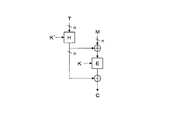
- FIG. 6 is an explanatory diagram showing an example of a method for constructing an n-bit block and an n-bit Tweak Tweakable block cipher from an n-bit block cipher E and an n-bit input / output e-AXU hash function H.
- the Tweakable block cipher described above can be generally configured by using the result of giving Tweak to H as a mask above and below E as shown in FIG.
- the Tweakable block cipher in which both the message and Tweak are n-bit is, for example, an authentication encryption method (see Patent Document 1 and Non-Patent Document 6), and an encryption method for storage (Non-Patent Document 7). Used for online encryption (see Non-Patent Document 8).
- Non-Patent Document 9 describes that a 128-bit input / output e-AXU hash function is composed of a Toeplitz matrix.
- Non-Patent Document 9 also describes that the e-AXU hash function is a 64-bit input 128-bit output and the matrix is a 128th order Toeplitz matrix.
- Non-Patent Document 10 describes a lemma regarding the rank of a matrix composed of elements of a finite field.
- Non-Patent Document 11 describes all-one-polynomial irreducible conditions.
- n the value of n will be 64, 128, 256, or 512, for example. It becomes a large number. In this case, there is a problem that the calculation cost is generally quite large.
- the bias e as the AXU decreases.
- the length of LFSR is n-bit
- the method combining the above Toeplitz matrix and LFSR is (n / 2 n ) -AXU.
- an n-bit key is required to randomly assign the initial value of the LFSR n-bit register.
- a 2n-bit key is required to randomly determine the irreducible feedback polynomial of LFSR.
- the key length becomes almost 2n-bit, regardless of whether LFSR is used or not.
- the key length of 2n-bit means that the cost for generating the key is increased compared to the case where the key length is n-bit.
- FIG. 7 is an explanatory diagram showing an example in which the n-bit input / output e-AXU hash function described in Non-Patent Document 2 is implemented without using LFSR.
- FIG. 8 is an explanatory diagram illustrating an example in which the n-bit / input / output e-AXU / hash function described in Non-Patent Document 2 is implemented by hardware using LFSR. The implementation illustrated in FIG. 8 is different from the implementation illustrated in FIG. 7 in that it is implemented using LFSR (n-bit LSFR in FIG. 8).
- the universal hash function using the Toeplitz matrix is generally a method suitable for hardware implementation.
- the method combining the Toeplitz matrix and the LFSR makes it possible to implement hardware very easily when the key is fixed.
- the method combining the Toeplitz matrix and the LFSR requires implementation that corresponds to the fact that the feedback polynomial changes depending on the key if the key cannot be fixed, which makes hardware implementation more complicated. There is a problem.
- the present invention can bring the bias close to the theoretical minimum value (1/2 n ) even when the key length is n-bit when using the n-bit input / output e-AXU hash function method.
- An object is to provide a universal hash function arithmetic unit.
- the universal hash function arithmetic unit stores a message whose length is a prime number and the minimum primitive root is 2 when the number of bits is modulo, and sequentially outputs the message bit by bit.
- a message register and a key having the same number of bits as the number of bits of the message, and cyclically permutating the key one bit at a time in either the left or right fixed direction, resulting in the cyclic permutation
- a cyclic key register that sequentially outputs a key vector, a cyclic key vector that is sequentially output from the cyclic key register, and a message bit that is sequentially output one bit at a time from the message register.
- the number of bits is a prime number
- the message is stored in one bit from a message register that stores a message having a minimum primitive root of 2. It outputs sequentially one by one and cyclically replaces the key one bit at a time in one fixed direction, either left or right, from the cyclic key register that stores the key with the same number of bits as the message.
- the cyclic key vector obtained as a result is sequentially output.
- the message bit is 1
- the cyclic key vector is sequentially output from the cyclic key register and the message bit is sequentially output bit by bit from the message register.
- Outputs a vector calculates the exclusive OR by accumulating the same number of operation results as the number of output bits, and outputs the result of calculating the exclusive OR when the same number of operation results as the number of bits are accumulated. It is characterized by doing.
- the universal hash function operation program stores a message from a message register that stores a message having a length of a minimum primitive root of 2 when the number of bits is a prime number and the number of bits is modulo.
- Message output processing that sequentially outputs bits one by one, from a cyclic key register that stores a key having the same number of bits as the number of bits in the message, and sequentially circulates the keys one bit at a time in either the left or right fixed direction
- cyclic key vector output processing that sequentially outputs a cyclic key vector obtained as a result of replacement and cyclic replacement, a cyclic key vector that is sequentially output from the cyclic key register, and message bits that are sequentially output bit by bit from the message register
- the message bit is 1
- the cyclic key vector is output and the message AND operation that outputs an all-zero vector with the same number of bits as the cyclic key vector when the sage bit is 0, and calculates the exclusive OR by accumulating the same number of operation results
- the bias when the e-AXU hash function method with n-bit input / output is used, the bias can be brought close to the theoretical minimum value (1/2 n ) even if the key length is n-bit. .
- FIG. 11 is an explanatory diagram illustrating an example of a method of configuring a Tweakable block cipher of n-bit block and n-bit block Tweak.
- + represents an exclusive OR for each bit.
- the length of one block is n bits.
- the i-bit left cyclic shift of the vector x is denoted as rot (i, x).
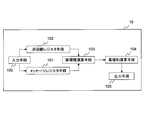
- FIG. 1 is a block diagram showing an embodiment of a universal hash function computing device according to the present invention.
- the universal hash function computing device 10 of the present embodiment includes an input unit 100, a message register unit 101, a cyclic key register unit 102, a logical product computing unit 103, a cumulative sum computing unit 104, and an output unit 105. ing.
- the universal hash function computing device 10 is realized by, for example, a CPU, a memory, a magnetic disk, and the like. Each unit of the universal hash function arithmetic unit is realized by, for example, operating a program stored on a magnetic disk on the CPU.
- the message register means 101, the cyclic key register means 102, the logical product operation means 103, and the cumulative sum operation means 104 are realized by a CPU of a computer that operates according to a program (universal hash function operation program). .
- the input unit 100 is realized by a character input device such as a keyboard, for example.
- the input unit 100 may be realized by an interface that receives a message input from another device.
- the bit unit information M [i] included in the message M is sometimes referred to as a message bit.
- n ⁇ ⁇ ⁇ (that is, the number of bits) is a prime number, and a primitive root modulo n satisfies 2 (primitive root of modulo n). Therefore, the message M has a prime number of 2 and the minimum primitive root when the number of bits is modulo is 2.
- the number of bits of the key K is the same as the number of bits of the message M (specifically, n).
- the input unit 100 causes the message register unit 101 to store the input message M. Further, the input unit 100 stores the input key K in the cyclic key register unit 102.
- the message register means 101 stores the input message, and sequentially outputs the stored message in 1-bit increments according to the external clock. Specifically, the clock moves from 1 ⁇ ⁇ to n, and the message register means 101 outputs M [i] when the clock is i.
- the cyclic key register means 102 records the input key K and outputs a value obtained by cyclically shifting the key K ⁇ according to the external clock. Specifically, it is assumed that the clock moves from 1 to n ⁇ , and the cyclic key register means 102 outputs rot (i ⁇ 1, K) when the clock is i.
- the cyclic key register means 102 performs cyclic permutation sequentially according to the clock one bit at a time in either the left or right fixed direction, and the cyclic key vector of n bits obtained as a result of the cyclic permutation is clocked. It outputs sequentially according to.
- the logical product operation means 103 calculates a logical product of vectors and bits from M [i] output from the message register means 101 and rot (i ⁇ 1, K) output from the cyclic key register means 102, and the calculation result Is output. That is, when the result output from the logical product operation means 103 when the clock is i is S (i), when M [i] is 1, S (i) becomes rot (i-1, K), When M [i] is 0, S (i) is an n-bit all zero value.
- the AND operation means 103 outputs the cyclic key vector rot (i ⁇ 1, K) when the message bit M [i] is 1, and the cyclic key vector when the message bit M [i] is 0. Outputs an all-zero vector with the same number of bits as (n bits).
- the cumulative sum operation means 104 outputs an exclusive logical sum of the outputs of all the logical product operation means 103 while the clock moves from 1 to n. Specifically, the cumulative sum calculation means 104 outputs S (1) + S (2) + ... + S (n).
- the cumulative sum operation means 104 outputs the same number of operation results as the number of bits output by the logical product operation means 103 (for example, from the operation result corresponding to the first clock to the operation result corresponding to the nth clock). Cumulatively, exclusive OR (for example, XOR) is calculated. Then, the cumulative sum calculation means 104 outputs the calculation result of the exclusive OR when the same number of calculation results as the number of bits described above are accumulated (for example, according to the nth clock). Note that the cumulative sum calculation means 104 may record all S (i) and calculate exclusive OR, or not record all S (i) and sequentially calculate exclusive OR. May be.
- the output means 105 outputs the output result (that is, S (1) + S (2) + ... + S (n)) of the cumulative sum operation means 104 to, for example, a computer display device or a printer. .
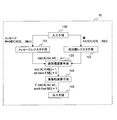
- FIG. 2 is an explanatory diagram showing an operation example of the universal hash function computing device of the present embodiment.
- FIG. 3 is a flowchart showing an operation example of the universal hash function computing device of the present embodiment.
- the inputted message M ⁇ ⁇ ⁇ ⁇ ⁇ ⁇ is inputted to the message register means 101, and the key K is inputted to the cyclic key register means 102.
- the logical product operation means 103 determines whether or not B is 1 (step G4). When B is 1 (y in step G4), the AND operation means 103 outputs V as it is. On the other hand, if B is not 1, that is, if B is 0 (n in step G4), the AND operation means 103 outputs V ⁇ ⁇ ⁇ with all zero values (step G5).
- the cumulative sum calculation means 104 calculates the sum of the previous cumulative sum S and V and updates S (step G6).
- the initial value of S is set to zero in advance in step G1.
- the cumulative sum calculation means 104 continues the update process of S until the clock i becomes n, and outputs the cumulative sum S when i becomes n.
- the message register means 101 sequentially outputs n bits of message M bit by bit.
- the bit number n is a prime number and satisfies the condition that the minimum primitive root modulo n is 2.
- the cyclic key register means 102 sequentially permutates the key K bit by bit in one fixed direction, either left or right, and sequentially outputs a cyclic key vector obtained as a result of the cyclic permutation.
- the AND operation means 103 outputs a cyclic key vector when M [i] is 1 based on the cyclic key vector and the message bit M [i], and a cyclic key vector when M [i] is 0 Outputs an all-zero vector with the same number of bits as.
- Cumulative sum operation means 104 accumulates n operation results to calculate an exclusive OR, and outputs nOR calculation results when n operation results are accumulated.
- the bias can be close to the theoretical minimum value (1/2 n ).
- the keyed function represented by Equation 9 can be an n-bit input / output (2/2 n ) -AXU hash function when n is a prime number and the minimum primitive root modulo n is 2. Recognize.
- FIG. 4 is an explanatory diagram showing an example in which the universal hash function is implemented by hardware.
- the n-bit initial LFSR 22 is used.
- a process of extracting the entire register (n-bit) for each clock may be performed using the value as a key.
- another n-bit key is required to randomly determine the LFSR feedback polynomial. Therefore, an n-bit register is required to hold this key information.
- the hardware implementation becomes more complicated because the feedback polynomial is key dependent. In this case, it is known that the bias e is n / 2 n slightly larger than the theoretical minimum value.
- the universal hash according to the present embodiment is obtained by using the n-bit ⁇ cyclic register 23 and extracting the entire register (n-bit) every clock using the initial value of n-bit ⁇ as a key. Function arithmetic processing can be realized. Therefore, the calculation method of this embodiment can shorten the register and can simplify the mounting method as compared with the mounting method shown in FIGS.
- n can be any positive integer, whereas in the universal hash function calculation method according to the present invention, n is a prime number and the minimum primitive root modulo n is 2 and The condition of becoming is necessary.
- the e-AXU hash function with n-bit input / output can be applied to various types of encryption and authentication by combining with an n-bit block encryption.
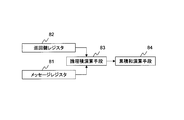
- FIG. 5 is a block diagram showing an outline of a universal hash function computing device according to the present invention.
- the universal hash function arithmetic unit when the number of bits (for example, n) is a prime number and the number of bits is modulo, the minimum primitive root is 2 (that is, the minimum primitive root modulo n is 2).
- a message register 81 to output for example, message register means 101
- the key is cyclically replaced one bit at a time in one fixed direction, either left or right (for example, according to the clock), and obtained as a result of the circular replacement (for example, n Bitwise cyclic key vector sequentially (eg according to clock)
- a cyclic key register 82 to be output for example, cyclic key register means 102), a cyclic key vector to be sequentially output from the cyclic key register 82, and a message bit to be sequentially output bit by bit from the message register 81 (for example, M Based on [i])
- an AND operation unit 83 outputs a cyclic key vector when the message bit is 1, and outputs
- the AND operation means 103 and the same number of operation results as the number of bits output by the AND operation means 83 are accumulated (for example, according to the nth clock from the operation result according to the first clock).
- an exclusive OR for example, XOR
- a cumulative sum calculating means 84 for outputting the calculation result of the exclusive OR e.g., cumulative sum operation means 104.
- the bias when using the e-AXU hash function method with n-bit input / output, the bias can be close to the theoretical minimum value (1/2 n ) even if the key length is n-bit. .
- the message register 81 sequentially outputs a message bit by bit according to the clock
- the cyclic key register 82 sequentially cyclically replaces the key bit by bit according to the clock, and the cyclic key obtained as a result of the cyclic replacement
- the vector is sequentially output according to the clock
- the logical product operation means 83 outputs the cyclic key vector or the all-zero vector based on the cyclic key vector and the message bit sequentially output according to the clock
- the cumulative sum operation means 84 calculates the exclusive OR by accumulating the calculation results up to the same number of clocks (for example, clocks 1 to n) as the number of bits of the message, and when the number of clocks is the same as the number of bits of the message (when clock n) ) May output the calculation result of the exclusive OR.
- the present invention is preferably applied to a universal hash function computing device that performs computation of a universal hash function with a key.
- the present invention is applied to uses such as authentication in data communication using wireless or wired communication, detection of falsification of a database, and verification of validity of a memory on a device.
Landscapes
- Engineering & Computer Science (AREA)
- Computer Security & Cryptography (AREA)
- Computer Networks & Wireless Communication (AREA)
- Signal Processing (AREA)
- Power Engineering (AREA)
- Physics & Mathematics (AREA)
- General Physics & Mathematics (AREA)
- Theoretical Computer Science (AREA)
- Information Retrieval, Db Structures And Fs Structures Therefor (AREA)
- Error Detection And Correction (AREA)
Priority Applications (3)
| Application Number | Priority Date | Filing Date | Title |
|---|---|---|---|
| US14/415,465 US9515830B2 (en) | 2012-07-18 | 2013-06-27 | Universal hash function computing device, method and program |
| EP13820116.5A EP2876626B1 (fr) | 2012-07-18 | 2013-06-27 | Dispositif, procédé et programme informatique de fonction de hachage universelle |
| JP2014525702A JP6187462B2 (ja) | 2012-07-18 | 2013-06-27 | ユニバーサルハッシュ関数演算装置、方法およびプログラム |
Applications Claiming Priority (2)
| Application Number | Priority Date | Filing Date | Title |
|---|---|---|---|
| JP2012159505 | 2012-07-18 | ||
| JP2012-159505 | 2012-07-18 |
Publications (1)
| Publication Number | Publication Date |
|---|---|
| WO2014013680A1 true WO2014013680A1 (fr) | 2014-01-23 |
Family
ID=49948524
Family Applications (1)
| Application Number | Title | Priority Date | Filing Date |
|---|---|---|---|
| PCT/JP2013/004021 Ceased WO2014013680A1 (fr) | 2012-07-18 | 2013-06-27 | Dispositif, procédé et programme de calcul de fonction de hachage universelle |
Country Status (4)
| Country | Link |
|---|---|
| US (1) | US9515830B2 (fr) |
| EP (1) | EP2876626B1 (fr) |
| JP (1) | JP6187462B2 (fr) |
| WO (1) | WO2014013680A1 (fr) |
Cited By (3)
| Publication number | Priority date | Publication date | Assignee | Title |
|---|---|---|---|---|
| JP2020024376A (ja) * | 2018-08-08 | 2020-02-13 | パナソニック インテレクチュアル プロパティ コーポレーション オブ アメリカPanasonic Intellectual Property Corporation of America | データ保護方法、認証サーバ、データ保護システム及びデータ構造 |
| US11349668B2 (en) | 2017-02-21 | 2022-05-31 | Mitsubishi Electric Corporation | Encryption device and decryption device |
| JP2024001347A (ja) * | 2018-08-08 | 2024-01-09 | パナソニック インテレクチュアル プロパティ コーポレーション オブ アメリカ | データ保護方法、データ保護システム、及び、データサーバ |
Families Citing this family (5)
| Publication number | Priority date | Publication date | Assignee | Title |
|---|---|---|---|---|
| EP2947814B1 (fr) * | 2013-01-17 | 2018-03-14 | Nippon Telegraph and Telephone Corporation | Dispositif de détection de falsification, procédé de détection de falsification et programme |
| JP6834771B2 (ja) * | 2017-05-19 | 2021-02-24 | 富士通株式会社 | 通信装置および通信方法 |
| CN111314053B (zh) * | 2018-12-12 | 2023-02-10 | 上海领甲数据科技有限公司 | 一种数据加密和解密方法 |
| CN113839772B (zh) * | 2021-09-18 | 2023-05-05 | 哲库科技(北京)有限公司 | 托普利茨哈希算法的处理电路、芯片和终端 |
| CN114662151B (zh) * | 2022-04-01 | 2025-10-03 | 矩阵时光数字科技有限公司 | 一种基于fpga实现生成不可约多项式和哈希算法的系统 |
Family Cites Families (9)
| Publication number | Priority date | Publication date | Assignee | Title |
|---|---|---|---|---|
| US2354951A (en) * | 1941-04-08 | 1944-08-01 | Adolph C Erisman | Operating mechanism for registering devices |
| JP2509563B2 (ja) * | 1986-03-28 | 1996-06-19 | 株式会社東芝 | イメ―ジサイズ変換回路 |
| JPH10301492A (ja) * | 1997-04-23 | 1998-11-13 | Sony Corp | 暗号化装置および方法、復号装置および方法、並びに情報処理装置および方法 |
| US6182216B1 (en) * | 1997-09-17 | 2001-01-30 | Frank C. Luyster | Block cipher method |
| US7046802B2 (en) | 2000-10-12 | 2006-05-16 | Rogaway Phillip W | Method and apparatus for facilitating efficient authenticated encryption |
| KR20070093963A (ko) * | 2004-09-24 | 2007-09-19 | 시냅틱 래버러토리즈 리미티드 | 대입 박스들 |
| WO2009128370A1 (fr) * | 2008-04-15 | 2009-10-22 | 日本電気株式会社 | Dispositif de chiffrement de blocs comportant des valeurs de réglage, procédé de production de chiffrement et support d'enregistrement |
| WO2011105367A1 (fr) * | 2010-02-24 | 2011-09-01 | 日本電気株式会社 | Dispositif de chiffrement par blocs, dispositif de déchiffrement de blocs, procédé de chiffrement par blocs, procédé de déchiffrement de blocs et programme associé |
| WO2014132664A1 (fr) * | 2013-02-28 | 2014-09-04 | パナソニック株式会社 | Système d'authentification, support d'enregistrement non volatil, ordinateur hôte et procédé d'authentification |
-
2013
- 2013-06-27 EP EP13820116.5A patent/EP2876626B1/fr not_active Not-in-force
- 2013-06-27 WO PCT/JP2013/004021 patent/WO2014013680A1/fr not_active Ceased
- 2013-06-27 US US14/415,465 patent/US9515830B2/en not_active Expired - Fee Related
- 2013-06-27 JP JP2014525702A patent/JP6187462B2/ja not_active Expired - Fee Related
Non-Patent Citations (14)
Cited By (3)
| Publication number | Priority date | Publication date | Assignee | Title |
|---|---|---|---|---|
| US11349668B2 (en) | 2017-02-21 | 2022-05-31 | Mitsubishi Electric Corporation | Encryption device and decryption device |
| JP2020024376A (ja) * | 2018-08-08 | 2020-02-13 | パナソニック インテレクチュアル プロパティ コーポレーション オブ アメリカPanasonic Intellectual Property Corporation of America | データ保護方法、認証サーバ、データ保護システム及びデータ構造 |
| JP2024001347A (ja) * | 2018-08-08 | 2024-01-09 | パナソニック インテレクチュアル プロパティ コーポレーション オブ アメリカ | データ保護方法、データ保護システム、及び、データサーバ |
Also Published As
| Publication number | Publication date |
|---|---|
| EP2876626A1 (fr) | 2015-05-27 |
| JPWO2014013680A1 (ja) | 2016-06-30 |
| US9515830B2 (en) | 2016-12-06 |
| JP6187462B2 (ja) | 2017-08-30 |
| US20150180666A1 (en) | 2015-06-25 |
| EP2876626B1 (fr) | 2016-10-12 |
| EP2876626A4 (fr) | 2016-02-24 |
Similar Documents
| Publication | Publication Date | Title |
|---|---|---|
| JP6187462B2 (ja) | ユニバーサルハッシュ関数演算装置、方法およびプログラム | |
| KR101246490B1 (ko) | 갈루아 폐체 암호 시스템 | |
| US10903978B2 (en) | Method of encryption with dynamic diffusion and confusion layers | |
| US20180205536A1 (en) | Stream cipher system | |
| US20120314857A1 (en) | Block encryption device, block decryption device, block encryption method, block decryption method and program | |
| CN112287333B (zh) | 一种轻量级可调分组密码实现方法、系统、电子设备以及可读存储介质 | |
| US10326589B2 (en) | Message authenticator generating apparatus, message authenticator generating method, and computer readable recording medium | |
| WO2004032098A1 (fr) | Procede de generation de nombres pseudo-aleatoires et generateur de nombres pseudo-aleatoires | |
| CN108141352B (zh) | 密码设备、方法、装置和计算机可读介质和编码设备、方法、装置和计算机可读介质 | |
| US20220382521A1 (en) | System and method for encryption and decryption using logic synthesis | |
| JP7136226B2 (ja) | 認証暗号化装置、認証復号装置、認証暗号化方法、認証復号方法、認証暗号化プログラムおよび認証復号プログラム | |
| KR101143041B1 (ko) | 리볼빙 버퍼들을 이용한 스트림 암호 설계 방법 | |
| Courtois et al. | Combined algebraic and truncated differential cryptanalysis on reduced-round simon | |
| JP7371757B2 (ja) | 認証暗号化装置、認証復号装置、認証暗号化方法、認証復号方法およびプログラム | |
| Ghazi et al. | Robust and efficient dynamic stream cipher cryptosystem | |
| Navneet et al. | AES algorithm with dynamic shift rows and bit permuted mix column | |
| Minematsu | A short universal hash function from bit rotation, and applications to blockcipher modes | |
| JP5528281B2 (ja) | ハッシュ値演算装置 | |
| US11791981B2 (en) | Generating cryptographic random data from raw random data | |
| Scripcariu et al. | Modified Advanced Encryption Standard | |
| Molland et al. | Linear properties in T-functions | |
| JP5818768B2 (ja) | マスク生成装置、情報処理装置、及びその方法、プログラム | |
| Naser et al. | Constructing of Analysis Mathematical Model for Stream Cipher Cryptosystems | |
| Kumar | Design and Analysis of Cryptographic Primitives based on Quasigroup | |
| Basha | A Dynamic Tabula-Substitution Cryptographic Model Integrating Column-Row Shift Encoding and Adaptive Table Permutation |
Legal Events
| Date | Code | Title | Description |
|---|---|---|---|
| 121 | Ep: the epo has been informed by wipo that ep was designated in this application |
Ref document number: 13820116 Country of ref document: EP Kind code of ref document: A1 |
|
| REEP | Request for entry into the european phase |
Ref document number: 2013820116 Country of ref document: EP |
|
| WWE | Wipo information: entry into national phase |
Ref document number: 2013820116 Country of ref document: EP |
|
| ENP | Entry into the national phase |
Ref document number: 2014525702 Country of ref document: JP Kind code of ref document: A |
|
| WWE | Wipo information: entry into national phase |
Ref document number: 14415465 Country of ref document: US |
|
| NENP | Non-entry into the national phase |
Ref country code: DE |