WO2014013794A1 - Nanoparticules d'argent, leur procédé de production, liquide de dispersion de nanoparticules d'argent et base dotée d'un matériau d'argent - Google Patents
Nanoparticules d'argent, leur procédé de production, liquide de dispersion de nanoparticules d'argent et base dotée d'un matériau d'argent Download PDFInfo
- Publication number
- WO2014013794A1 WO2014013794A1 PCT/JP2013/064946 JP2013064946W WO2014013794A1 WO 2014013794 A1 WO2014013794 A1 WO 2014013794A1 JP 2013064946 W JP2013064946 W JP 2013064946W WO 2014013794 A1 WO2014013794 A1 WO 2014013794A1
- Authority
- WO
- WIPO (PCT)
- Prior art keywords
- silver
- compound
- nanoparticles
- silver nanoparticles
- monomer
- Prior art date
- Legal status (The legal status is an assumption and is not a legal conclusion. Google has not performed a legal analysis and makes no representation as to the accuracy of the status listed.)
- Ceased
Links
- 0 *C(C(OCCNC(O*C(CO)O)=O)=O)=C Chemical compound *C(C(OCCNC(O*C(CO)O)=O)=O)=C 0.000 description 1
Images

Classifications
-
- H—ELECTRICITY
- H01—ELECTRIC ELEMENTS
- H01B—CABLES; CONDUCTORS; INSULATORS; SELECTION OF MATERIALS FOR THEIR CONDUCTIVE, INSULATING OR DIELECTRIC PROPERTIES
- H01B1/00—Conductors or conductive bodies characterised by the conductive materials; Selection of materials as conductors
- H01B1/20—Conductive material dispersed in non-conductive organic material
- H01B1/22—Conductive material dispersed in non-conductive organic material the conductive material comprising metals or alloys
-
- B—PERFORMING OPERATIONS; TRANSPORTING
- B22—CASTING; POWDER METALLURGY
- B22F—WORKING METALLIC POWDER; MANUFACTURE OF ARTICLES FROM METALLIC POWDER; MAKING METALLIC POWDER; APPARATUS OR DEVICES SPECIALLY ADAPTED FOR METALLIC POWDER
- B22F1/00—Metallic powder; Treatment of metallic powder, e.g. to facilitate working or to improve properties
- B22F1/05—Metallic powder characterised by the size or surface area of the particles
- B22F1/054—Nanosized particles
-
- B—PERFORMING OPERATIONS; TRANSPORTING
- B22—CASTING; POWDER METALLURGY
- B22F—WORKING METALLIC POWDER; MANUFACTURE OF ARTICLES FROM METALLIC POWDER; MAKING METALLIC POWDER; APPARATUS OR DEVICES SPECIALLY ADAPTED FOR METALLIC POWDER
- B22F1/00—Metallic powder; Treatment of metallic powder, e.g. to facilitate working or to improve properties
- B22F1/05—Metallic powder characterised by the size or surface area of the particles
- B22F1/054—Nanosized particles
- B22F1/0545—Dispersions or suspensions of nanosized particles
-
- B—PERFORMING OPERATIONS; TRANSPORTING
- B22—CASTING; POWDER METALLURGY
- B22F—WORKING METALLIC POWDER; MANUFACTURE OF ARTICLES FROM METALLIC POWDER; MAKING METALLIC POWDER; APPARATUS OR DEVICES SPECIALLY ADAPTED FOR METALLIC POWDER
- B22F1/00—Metallic powder; Treatment of metallic powder, e.g. to facilitate working or to improve properties
- B22F1/10—Metallic powder containing lubricating or binding agents; Metallic powder containing organic material
-
- B—PERFORMING OPERATIONS; TRANSPORTING
- B22—CASTING; POWDER METALLURGY
- B22F—WORKING METALLIC POWDER; MANUFACTURE OF ARTICLES FROM METALLIC POWDER; MAKING METALLIC POWDER; APPARATUS OR DEVICES SPECIALLY ADAPTED FOR METALLIC POWDER
- B22F9/00—Making metallic powder or suspensions thereof
- B22F9/16—Making metallic powder or suspensions thereof using chemical processes
- B22F9/18—Making metallic powder or suspensions thereof using chemical processes with reduction of metal compounds
- B22F9/20—Making metallic powder or suspensions thereof using chemical processes with reduction of metal compounds starting from solid metal compounds
-
- B—PERFORMING OPERATIONS; TRANSPORTING
- B22—CASTING; POWDER METALLURGY
- B22F—WORKING METALLIC POWDER; MANUFACTURE OF ARTICLES FROM METALLIC POWDER; MAKING METALLIC POWDER; APPARATUS OR DEVICES SPECIALLY ADAPTED FOR METALLIC POWDER
- B22F9/00—Making metallic powder or suspensions thereof
- B22F9/16—Making metallic powder or suspensions thereof using chemical processes
- B22F9/18—Making metallic powder or suspensions thereof using chemical processes with reduction of metal compounds
- B22F9/24—Making metallic powder or suspensions thereof using chemical processes with reduction of metal compounds starting from liquid metal compounds, e.g. solutions
-
- B—PERFORMING OPERATIONS; TRANSPORTING
- B22—CASTING; POWDER METALLURGY
- B22F—WORKING METALLIC POWDER; MANUFACTURE OF ARTICLES FROM METALLIC POWDER; MAKING METALLIC POWDER; APPARATUS OR DEVICES SPECIALLY ADAPTED FOR METALLIC POWDER
- B22F9/00—Making metallic powder or suspensions thereof
- B22F9/16—Making metallic powder or suspensions thereof using chemical processes
- B22F9/30—Making metallic powder or suspensions thereof using chemical processes with decomposition of metal compounds, e.g. by pyrolysis
-
- C—CHEMISTRY; METALLURGY
- C09—DYES; PAINTS; POLISHES; NATURAL RESINS; ADHESIVES; COMPOSITIONS NOT OTHERWISE PROVIDED FOR; APPLICATIONS OF MATERIALS NOT OTHERWISE PROVIDED FOR
- C09D—COATING COMPOSITIONS, e.g. PAINTS, VARNISHES OR LACQUERS; FILLING PASTES; CHEMICAL PAINT OR INK REMOVERS; INKS; CORRECTING FLUIDS; WOODSTAINS; PASTES OR SOLIDS FOR COLOURING OR PRINTING; USE OF MATERIALS THEREFOR
- C09D1/00—Coating compositions, e.g. paints, varnishes or lacquers, based on inorganic substances
-
- C—CHEMISTRY; METALLURGY
- C09—DYES; PAINTS; POLISHES; NATURAL RESINS; ADHESIVES; COMPOSITIONS NOT OTHERWISE PROVIDED FOR; APPLICATIONS OF MATERIALS NOT OTHERWISE PROVIDED FOR
- C09D—COATING COMPOSITIONS, e.g. PAINTS, VARNISHES OR LACQUERS; FILLING PASTES; CHEMICAL PAINT OR INK REMOVERS; INKS; CORRECTING FLUIDS; WOODSTAINS; PASTES OR SOLIDS FOR COLOURING OR PRINTING; USE OF MATERIALS THEREFOR
- C09D11/00—Inks
- C09D11/52—Electrically conductive inks
-
- C—CHEMISTRY; METALLURGY
- C09—DYES; PAINTS; POLISHES; NATURAL RESINS; ADHESIVES; COMPOSITIONS NOT OTHERWISE PROVIDED FOR; APPLICATIONS OF MATERIALS NOT OTHERWISE PROVIDED FOR
- C09D—COATING COMPOSITIONS, e.g. PAINTS, VARNISHES OR LACQUERS; FILLING PASTES; CHEMICAL PAINT OR INK REMOVERS; INKS; CORRECTING FLUIDS; WOODSTAINS; PASTES OR SOLIDS FOR COLOURING OR PRINTING; USE OF MATERIALS THEREFOR
- C09D5/00—Coating compositions, e.g. paints, varnishes or lacquers, characterised by their physical nature or the effects produced; Filling pastes
- C09D5/38—Paints containing free metal not provided for above in groups C09D5/00 - C09D5/36
-
- C—CHEMISTRY; METALLURGY
- C09—DYES; PAINTS; POLISHES; NATURAL RESINS; ADHESIVES; COMPOSITIONS NOT OTHERWISE PROVIDED FOR; APPLICATIONS OF MATERIALS NOT OTHERWISE PROVIDED FOR
- C09D—COATING COMPOSITIONS, e.g. PAINTS, VARNISHES OR LACQUERS; FILLING PASTES; CHEMICAL PAINT OR INK REMOVERS; INKS; CORRECTING FLUIDS; WOODSTAINS; PASTES OR SOLIDS FOR COLOURING OR PRINTING; USE OF MATERIALS THEREFOR
- C09D7/00—Features of coating compositions, not provided for in group C09D5/00; Processes for incorporating ingredients in coating compositions
- C09D7/40—Additives
- C09D7/66—Additives characterised by particle size
- C09D7/67—Particle size smaller than 100 nm
-
- C—CHEMISTRY; METALLURGY
- C22—METALLURGY; FERROUS OR NON-FERROUS ALLOYS; TREATMENT OF ALLOYS OR NON-FERROUS METALS
- C22C—ALLOYS
- C22C5/00—Alloys based on noble metals
- C22C5/06—Alloys based on silver
-
- H—ELECTRICITY
- H01—ELECTRIC ELEMENTS
- H01B—CABLES; CONDUCTORS; INSULATORS; SELECTION OF MATERIALS FOR THEIR CONDUCTIVE, INSULATING OR DIELECTRIC PROPERTIES
- H01B1/00—Conductors or conductive bodies characterised by the conductive materials; Selection of materials as conductors
- H01B1/02—Conductors or conductive bodies characterised by the conductive materials; Selection of materials as conductors mainly consisting of metals or alloys
-
- B—PERFORMING OPERATIONS; TRANSPORTING
- B82—NANOTECHNOLOGY
- B82Y—SPECIFIC USES OR APPLICATIONS OF NANOSTRUCTURES; MEASUREMENT OR ANALYSIS OF NANOSTRUCTURES; MANUFACTURE OR TREATMENT OF NANOSTRUCTURES
- B82Y30/00—Nanotechnology for materials or surface science, e.g. nanocomposites
-
- B—PERFORMING OPERATIONS; TRANSPORTING
- B82—NANOTECHNOLOGY
- B82Y—SPECIFIC USES OR APPLICATIONS OF NANOSTRUCTURES; MEASUREMENT OR ANALYSIS OF NANOSTRUCTURES; MANUFACTURE OR TREATMENT OF NANOSTRUCTURES
- B82Y40/00—Manufacture or treatment of nanostructures
Definitions
- the present invention provides a silver element such as a silver film or a silver wire, which is excellent in dispersibility in a solvent and exhibits excellent conductivity and substrate adhesion by low-temperature sintering at 150 ° C. or lower on the substrate.
- the present invention relates to a silver nanoparticle that can be produced, a method for producing the same, a dispersion containing the silver nanoparticle, and a silver element-forming substrate.
- a method for producing a metal film there is known a method in which a metal is made into a liquid ink or paste ink and heated after being applied or printed on a substrate.
- Gold, silver, copper, and aluminum are used as metals, and silver is widely used as a wiring material.
- ink using silver generally, an ink in which metallic silver is dispersed in a dispersion solvent is used, a pattern is formed on a wiring board, and the metallic silver in the ink is sintered to form a wiring.
- metallic silver as a conductive material, it is known that it is necessary to sinter at a low temperature by utilizing a melting point drop due to refinement of dispersed metallic silver.
- miniaturized nano-sized metal nanoparticles are expected as materials that can be sintered at low temperature.
- fine metallic silver particles exhibiting a melting point drop tend to agglomerate in contact with each other. Therefore, it is necessary to add a dispersant to the ink in order to prevent aggregation.
- the impurities derived from the dispersant remain, so it is desirable to remove the impurities by treatment at a high temperature or the like. .
- a general method for producing silver nanoparticles for example, there is a method of reducing a silver salt composed of an inorganic acid such as silver nitrate and silver in the presence of a dispersant.
- an inorganic acid such as silver nitrate and silver
- a method for forming metallic silver using a silver salt using an organic acid instead of the inorganic acid as described above has been reported.
- the organic acid silver for example, a method of thermally decomposing or reducing a silver salt of a long-chain carboxylic acid in the presence of an alkylamine has been reported (Patent Documents 1 to 5).
- carboxylic acid or silver carboxylate which is non-volatile and has a high thermal decomposition temperature
- silver nanoparticles made of any organic acid silver silver such as silver film or silver wire with good conductivity
- a heat treatment of 200 ° C. or more and a long time is necessary.
- a transparent resin substrate generally has a softening point lower than that of glass or the like, a low-temperature sinterable silver-forming material capable of producing metallic silver by heating at 150 ° C. or lower is desired.
- the dispersant adsorbed on the surface of the silver nanoparticles needs to be removed at a low temperature.
- the transparent resin substrate and the silver element need to be strongly bonded.
- Patent Document 6 a method for producing silver nanoparticles having a silver oxalate amine complex having a thermal decomposition temperature of 110 ° C. by mixing silver oxalate and an amine has been proposed (Patent Document 6).
- the silver nanoparticle obtained by this method can obtain a silver element such as a metal film exhibiting good conductivity by baking at 150 ° C. or lower, it does not describe durability including adhesion.
- the pure silver element obtained by the action mechanism in which the organic substance does not remain in the film has poor adhesion to the substrate.
- Patent Document 7 a method using a composition obtained by hybridizing an organic polymer containing a urethane diol group and an inorganic material has been reported (Patent Document 7).
- Patent Document 7 a method using a composition obtained by hybridizing an organic polymer containing a urethane diol group and an inorganic material.
- An object of the present invention is to form a silver element such as a silver film or a silver wire on a substrate, which has excellent dispersion stability in a solvent and has excellent conductivity and adhesion even at low temperature for a short time.
- An object of the present invention is to provide silver nanoparticles, a method for producing the same, and a silver nanoparticle dispersion. Moreover, it exists in using the said silver nanoparticle and silver nanoparticle dispersion liquid in order to form silver elements, such as a silver film and a silver wire excellent in electroconductivity and adhesiveness, on a base material.
- Another object of the present invention is to provide a silver element-forming substrate provided with a silver element such as a silver film or a silver wire having excellent conductivity and adhesion, and a method for producing the silver element-forming substrate. There is to do.
- a silver compound (A) represented by the formula (1), an amine compound (B) having a primary amino group, and a urethane bond-containing diol (meth) acrylate compound represented by the formula (2) (a monomer composition comprising c1) and at least one monomer (c2) selected from (meth) acrylic acid ester monomers, acrylamide monomers, vinyl monomers, vinyl ether monomers and epoxy group-containing monomers; Including the obtained polymer (C), the content of the amine compound (B) is 1 to 50 molar equivalents relative to the silver element in the silver compound (A), and the content of the polymer (C)
- a silver-containing composition having a ratio of 0.1 to 0.9 parts by mass with respect to 100 parts by mass of silver element in the silver compound (A) is obtained by reduction treatment (treatment with a reducing agent or heat treatment). Silver nanoparticles are provided.
- R 1 represents a hydrogen atom or a methyl group.
- R 2 represents — (CH 2 — (CH 2 —
- the content ratio is 1 to 50 molar equivalents relative to the silver element in the silver compound (A), and the content ratio of the polymer (C) is 100 parts by mass of silver element in the silver compound (A).
- a method for producing silver nanoparticles comprises subjecting a silver-containing composition of 0.1 to 0.9 parts by mass to a reduction treatment (treatment with a reducing agent or heat treatment).
- a silver nanoparticle dispersion liquid (hereinafter sometimes abbreviated as the dispersion liquid of the present invention) containing the silver nanoparticles and a solvent. Furthermore, according to this invention, the dispersion liquid of this invention is apply
- the silver nanoparticle of the present invention is obtained by reducing a silver-containing composition containing the silver compound (A), the amine compound (B), and the polymer (C) in specific ratios (treatment with a reducing agent or heat treatment). Thus, it is excellent in dispersion stability with respect to the solvent. Moreover, since the dispersion liquid of the present invention contains the silver nanoparticles and a solvent, it is possible to form a silver element such as a silver film or a silver wire having excellent conductivity and adhesion at a low temperature of 150 ° C. or less on a substrate. it can. Furthermore, since sintering is possible at a low temperature of 150 ° C. or lower, a silver element can be formed on a resin base material having low heat resistance. Since the silver element obtained in this way exhibits properties close to those of bulk silver, it can be expected to be applied not only to wiring materials using conductivity but also to various fields such as reflective materials and antibacterial materials.
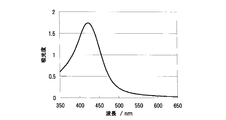
- Example 2 is a graph showing a UV-Vis spectrum of silver nanoparticles produced in Example 1-1. 2 is a graph showing the results of thermogravimetric analysis of silver nanoparticles produced in Example 1-1.
- the silver nanoparticle of the present invention comprises a silver compound (A) represented by the above formula (1), an amine compound (B) having a primary amino group, and a specific polymer (C) at a specific ratio. It is obtained by the production method of the present invention in which the silver-containing composition is reduced.
- the silver compound (A) is acetone dicarboxylate, and its form is usually a powder. Since the silver compound (A) has low solubility in a solvent and cannot perform a reduction reaction in a uniform system, it is difficult to obtain stably dispersed nanoparticles.
- the silver compound (A) when combined with the amine compound (B) having the primary amino group, the silver compound (A) is dissolved and the reduction reaction proceeds in a uniform system.
- the silver compound (A) is decomposed into acetone dicarboxylic acid having an organic structure into a volatile compound in the reaction system to give only silver.
- a silver element such as a metal silver film or wire can be formed by the following heat treatment. Therefore, the silver nanoparticle of the present invention can be used for forming a silver element such as a silver film or a silver wire excellent in conductivity and adhesion on a substrate.
- the content ratio of the amine compound (B) is in the range of 1 to 50 molar equivalents with respect to the silver element in the silver compound (A). If the amount is less than 1 molar equivalent, a uniform solution cannot be prepared, and precipitation is likely to occur during reduction. If the amount exceeds 50 molar equivalents, an effect commensurate with the content ratio cannot be obtained.
- the amine compound (B) is not particularly limited as long as it is a compound having in its structure a primary amino group that is easily coordinated to the silver compound (A).
- Examples of the amine compound (B) include 1-butylamine, 1-amylamine, 1-hexylamine, 1-heptylamine, 1-octylamine, 1-nonylamine, 1-decylamine, 1-undecylamine, 1-dodecyl.
- the amine compound (B) is preferably a compound having a structure that is easily removed from the film during firing, such as 1-butylamine, 1-amylamine, 1-hexylamine, 1-heptylamine, 1-octylamine, 2-ethylhexylamine, isobutylamine, isoamylamine, sec-butylamine, tert-butylamine, tert-amylamine, allylamine, 3-methoxypropylamine, 3-ethoxypropyl Examples thereof include amine, 3-isopropoxypropylamine, dimethylaminopropylamine, diethylaminopropylamine, and diisopropylaminoethylamine. When used, they can be used as one kind or a mixture of two or more kinds.
- the amine compound (B) is preferably a compound having a structure having a side chain capable of obtaining a steric repulsion effect.
- Examples thereof include amines, 3-decyloxypropylamine, dibutylaminopropylamine, and the like, and can be used as one kind or a mixture of two or more kinds.
- two or more amine compounds (B) can be used in combination.
- the content ratio is arbitrary and can be appropriately selected according to desired low-temperature sinterability and dispersion stability.
- the polymer (C) comprises a urethane bond-containing diol (meth) acrylate compound (c1) represented by the above formula (2) (hereinafter sometimes abbreviated as monomer (c1)), (meth) acrylic acid It is a copolymer obtained by polymerizing a monomer composition containing at least one monomer (c2) selected from ester monomers, acrylamide monomers, vinyl monomers, vinyl ether monomers and epoxy group-containing monomers.
- the polymer (C) has a polar urethane group and two hydroxyl groups (diol groups) derived from the structure of the monomer (c1).
- Urethane groups and hydroxyl groups are not so strongly interacted with silver by themselves, but they are present at adjacent sites, so they can be efficiently adsorbed on the surface of silver nanoparticles by three-point coordination.
- the dispersion stability can be improved by the steric repulsion of the remaining polymer chains.
- the silver nanoparticle of the present invention is applied as a dispersion on a substrate and subjected to heat treatment, the polymer (C) is detached from the surface of the silver nanoparticle and thus does not hinder the formation of silver elements. Furthermore, since the detached polymer (C) is oriented at the substrate interface, the resulting silver element such as a metallic silver film or wire and the substrate can be firmly adhered.
- R 1 represents a hydrogen atom or a methyl group, and a methyl group is preferable from the viewpoint of easy adjustment of the molecular weight.
- R 2 is — (CH 2 ) n —, where n is an integer of 1 to 4.
- R 2 is specifically -CH 2 -, - CH 2 CH 2 -, - CH 2 CH 2 CH 2 -, - CH 2 CH 2 CH 2 CH 2 - are either, from easy availability - CH 2 — or —CH 2 CH 2 — is preferred.
- Examples of the monomer (c1) include glycerol-1-methacryloyloxyethylurethane and glycerol-1-acryloyloxyethylurethane, and glycerol-1-methacryloyloxyethylurethane is preferred because of ease of synthesis. .
- the production of the monomer (c1) can be synthesized according to the method disclosed in Patent Document 7, for example.
- Examples of the (meth) acrylate monomer used as the monomer (c2) include methyl (meth) acrylate, butyl (meth) acrylate, isobutyl (meth) acrylate, lauryl (meth) acrylate, and stearyl (meth) acrylate.
- Examples of the acrylamide monomer used as the monomer (c2) include acrylamide, N-methylacrylamide, N-ethylacrylamide, N-methylolacrylamide, N-isopropylacrylamide, N, N-dimethylacrylamide, and N, N-diethyl. Examples include acrylamide and N, N-diisopropylacrylamide.
- Examples of the vinyl monomer used as the monomer (c2) include styrene, 2-chlorostyrene, ⁇ -bromostyrene, vinyl carbazole, and perfluorohexylethylene.
- Examples of the vinyl ether monomer used as the monomer (c2) include methyl vinyl ether.
- Examples of the epoxy-containing monomer used as the monomer (c2) include glycidyl (meth) acrylate, 3,4-epoxycyclohexylmethyl (meth) acrylate, and 4-hydroxybutyl acrylate glycidyl ether.
- the molar ratio of the monomer (c1) is less than 20%, the adsorption efficiency to the obtained silver nanoparticle may be lowered, and the dispersion stability may be lowered.
- the molar ratio of the monomer (c1) exceeds 90%, the affinity of the resulting polymer (C) may decrease due to the association between the polymers (C), and the dispersion stability in the solvent may decrease.
- the molecular weight of the polymer (C) is preferably in the range of 5000 to 50000 in weight average molecular weight, particularly preferably 7000 to 40000.
- weight average molecular weight is less than 5,000, the molecule is small and there is a possibility that the dispersion stability to the solvent cannot be sufficiently improved due to steric repulsion.
- weight average molecular weight exceeds 50000, the affinity for the solvent decreases due to the association of the polymers (C), and the dispersion stability in the solvent may decrease.
- Polymer (C) for example, the monomer composition, using a known method such as solution polymerization, bulk polymerization, emulsion polymerization, suspension polymerization, and the like, the polymerization system can be an inert gas, for example, , Nitrogen, carbon dioxide, helium, or radical polymerization under atmosphere.
- the polymerization temperature is usually 0 to 100 ° C., and the polymerization time is usually 1 to 48 hours.
- a polymerization initiator can be used.
- polymerization initiator examples include 2,2′-azobis (2-amidinopropane) dihydrochloride, 4,4′-azobis (4-cyanovaleric acid), 2,2′-azobis (2- (5 -Methyl-2-imidazolin-2-yl) propane) dihydrochloride, 2,2'-azobis (2- (2-imidazolin-2-yl) propane) dihydrochloride, 2,2'-azobisisobutyramide Dihydrate, ammonium persulfate, potassium persulfate, benzoyl peroxide, diisopropyl peroxydicarbonate, t-butylperoxy-2-ethylhexanoate, t-butylperoxypivalate, t-butylperoxydiisobutyrate, peroxide Lauroyl, azobisisobutyronitrile, 2,2'-azobis (2,4-dimethylvaleronitrile), t-butylperoxyneo
- redox accelerators may be used as the polymerization initiator.
- the amount of the polymerization initiator used is preferably 0.01 to 5.0 parts by mass with respect to 100 parts by mass of the monomer composition.
- the polymer can be purified by a general purification method such as a reprecipitation method, a dialysis method, or an ultrafiltration method.
- a solvent can be added as appropriate for the purpose of adjusting the silver concentration and the production rate of silver nanoparticles.
- the amount of the solvent is not particularly limited, but is preferably less than 3000 parts by mass with respect to 100 parts by mass of the silver compound (A) from the viewpoint of productivity and environmental load.
- the solvent is not particularly limited as long as silver nanoparticles are dispersed, and can be used alone or in combination depending on the application.
- the solvent include methanol, ethanol, 1-propanol, 2-propanol, 1-butanol, 2-butanol, tert-butanol, 1-pentanol, 2-pentanol, 3-pentanol, and tert-amyl alcohol.
- the content ratio of the polymer (C) is in the range of 0.1 to 0.9 parts by mass, preferably 0 with respect to 100 parts by mass of silver element in the silver compound (A).
- the range is from 2 to 0.7 parts by mass. If the amount is less than 0.1 part by mass, silver nanoparticles are generated, but the dispersion stability in a solvent is lowered and precipitation is likely to occur. Moreover, the adhesiveness of the silver element obtained by heat-processing the dispersion of this invention and a base material also becomes inadequate. When it exceeds 0.9 part by mass, the polymer (C) acts as a flocculant and precipitates.
- the mixing order of the silver compound (A), the amine compound (B) and the polymer (C) is not particularly limited.
- the silver nanoparticle of the present invention can be obtained by the production method of the present invention in which the silver-containing composition is subjected to a reduction treatment (treatment with a reducing agent or heat treatment).
- a reduction treatment thermal decomposition reduction of a silver compound, an amine and a complex can be used.
- the heating temperature is preferably 50 ° C. or higher, and particularly preferably in the range of 70 ° C. to 200 ° C.
- the treatment time is preferably 5 to 120 minutes. If the temperature is lower than 50 ° C., the progress of the pyrolytic reduction reaction is slow, and silver nanoparticles are not produced. If the temperature is higher than 200 ° C., the silver nanoparticles may be fused.
- the reducing agent include, but are not limited to, formic acid, hydrazine, ascorbic acid, hydroquinone, sodium borohydride, tertiary amine, and amino alcohol.
- the addition amount of the reducing agent is preferably in the range of 1.0 to 5.0 molar equivalents relative to elemental silver in the silver compound (A) of the silver-containing composition, and is in the range of 1.1 to 3.0 molar equivalents. Particularly desirable. If the amount is less than 1.0 molar equivalent, the amount of the reducing agent may be insufficient and the production rate of silver nanoparticles may be reduced. If the amount exceeds 5.0 molar equivalents, the production rate of silver nanoparticles may be too high to aggregate. May cause precipitation.
- the method for adding the reducing agent is not particularly limited, and may be adjusted according to the reducing power.
- the reducing power is high, it is diluted and slowly added to obtain silver nanoparticles that are stably dispersed without precipitation.
- a mild reducing agent it may be added at once or the reaction may be advanced by heating.
- the treatment with the reducing agent can be performed at about room temperature.
- the volume average particle size of the silver nanoparticles of the present invention is usually 1 to 100 nm. Moreover, the silver content of the silver nanoparticles is usually 90% by mass or more.
- the silver nanoparticles of the present invention can be suitably used as a conductive material, particularly for producing excellent silver elements such as metallic silver films and wires by heat treatment. Therefore, the silver nanoparticles can be used for the production of a silver element-forming substrate.
- the silver nanoparticles obtained by the production method of the present invention may be used as they are, but since there are excess amine compounds and reducing agents not involved in coordination to the silver nanoparticles, these are removed. It is desirable to purify. Examples of the purification method include precipitation by adding a highly polar solvent, but if purification by this method is not possible, purification may be performed by centrifugation, ultrafiltration, or the like.
- the silver nanoparticle dispersion of the present invention contains the silver nanoparticles of the present invention and a solvent, and the silver nanoparticles are dispersed in a solvent.
- the solvent is not particularly limited as long as the silver nanoparticles are dispersed.
- the silver content in the silver nanoparticle dispersion can be appropriately selected depending on the use of the dispersion, but is usually preferably 10 to 85% by mass, and in the range of 20 to 60% by mass when used as a conductive material. Is preferable from the viewpoints of low-temperature sinterability and dispersion stability with respect to a solvent.
- the silver nanoparticle dispersion of the present invention if necessary, for example, to adjust the leveling property to the substrate, for example, hydrocarbon, acetylene alcohol, silicone oil, and to adjust the viscosity characteristics of the dispersion, for example, a resin or a plasticizer can be appropriately blended. Furthermore, if necessary, for example, other conductor powders, glass powders, surfactants, metal salts, and other additives generally used in silver-containing compositions may be appropriately blended.
- the silver element-forming base material of the present invention is formed by applying the dispersion of the present invention on a base material such as a substrate and heating the base material to form a silver element in which metallic silver is formed into a film or a line. It is a substrate.
- the base material to which the dispersion liquid of the present invention is applied is not particularly limited as long as the dispersion liquid can be coated on the base material.
- a wiring board having a metal wiring such as gold, silver, copper, and aluminum.
- Examples of a method for producing a silver element-forming substrate using the silver nanoparticle dispersion liquid of the present invention and the above substrate include the following methods.
- the dispersion liquid of the present invention can be applied to the substrate by printing or the like.
- the method such as printing is not particularly limited, and examples thereof include inkjet printing, micro gravure printing, gravure offset printing, screen printing, roll coating method, air knife coating method, blade coating method, bar coating method, die coating method, and slide coating method. It is done.
- the heating temperature in the heating for forming the silver element on the substrate varies depending on the type of the substrate and can be appropriately selected.
- a silver element volume resistance value 1.0 ⁇
- the heating temperature at which 10 ⁇ 5 ⁇ ⁇ cm) is obtained is preferable, and specifically, the range of 100 to 200 ° C. is preferable.
- the heating time varies depending on the heating temperature, but may be any time as long as a silver element having excellent conductivity is formed, and is usually 1 to 120 minutes, preferably 10 to 60 minutes.
- the thickness of the silver element formed on the base material varies depending on the application, but when used as a wiring material, it is preferably 0.2 to 50 ⁇ m from the viewpoint of conductivity and durability, and it can be dried and heated when heated. From the viewpoint of cohesiveness, 0.5 to 30 ⁇ m is preferable.
- the use of the silver element-containing substrate of the present invention is not particularly limited, but exhibits conductivity close to that of bulk silver with a volume resistance of 10 ⁇ 6 ⁇ ⁇ cm order, and the silver element adheres firmly to the substrate and has durability. Therefore, for example, it can be used particularly in the field of electronic materials such as wiring of electronic equipment.
- Example 1-1 Production of Silver Nanoparticles 3.6 g (10.0 mmol) of acetone dicarboxylate silver compound (A), 7.8 g (60.0 mmol) of 2-ethylhexylamine, 3 molar equivalents relative to elemental silver ) And 36.0 g of toluene (10 times the weight of silver compound) were mixed to obtain a pale yellow transparent solution. To this, 11 mg of polymer (C1) (0.5 parts by mass with respect to 100 parts by mass of silver element) was added. Next, 1.4 g of formic acid (30.0 mmol, 1.5 molar equivalents relative to silver element) was slowly added dropwise, and then the reaction solution was stirred at room temperature (25 ° C.) for 1 hour to produce silver nanoparticles.
- the manufactured silver nanoparticle was evaluated by the following method. The results are shown in Table 2.
- the analysis of the absorption spectrum was performed using a UV-Vis spectrum spectrometer (manufactured by JASCO Corporation). As a result, a maximum absorption spectrum derived from the surface plasmon of the silver nanoparticle was observed at 420 nm (FIG. 1).
- the particle diameter of the silver nanoparticles was measured with a dynamic light scattering device (Malvern). As a result, the volume average particle size was 17.4 nm. Methanol was poured into the reaction solution in which the silver nanoparticles were synthesized, and silver nanoparticles were agglomerated and precipitated.
- the precipitated silver fine particles were filtered with a PTFE filter to obtain 2.0 g of silver nano fine particles.
- TG analysis was performed using this silver nanoparticle using a thermogravimetric analyzer (manufactured by SII Nanotechnology Co., Ltd.).
- the analysis conditions were a heating rate of 10 ° C./min and a measurement atmosphere in the air.
- the residue after thermogravimetric analysis was 92.0% (FIG. 2).
- Examples 1-2 to 1-40 Silver nanoparticles were produced in the same manner as in Example 1-1 with each component ratio shown in Tables 2 and 3. Evaluation of the silver nanoparticles was carried out in the same manner as in Example 1-1, and the maximum absorption derived from surface plasmons was confirmed by a UV-Vis spectrum spectrometer. The volume average particle size and the heated weight residue were also measured in the same manner. The results are shown in Tables 2 and 3.
- 2-EHA is 2-ethylhexylamine
- HA is hexylamine
- OA is octylamine
- 3-EPA is 3-ethoxypropylamine
- DMAPA is dimethylaminopropylamine
- LA is laurylamine
- OLA is oleylamine
- IPA is an abbreviation for isopropyl alcohol.
- Note 1 is a part by mass with respect to 100 parts by mass of silver element in the silver compound (A).
- Note 2 is the molar equivalent to the silver element in the silver compound (A).
- Note 3 is a part by mass with respect to 100 parts by mass of the silver compound (A).
- Example 1-41 The silver compound (A) silver acetone dicarboxylate 3.6 g (10.0 mmol), 2-ethylhexylamine 7.8 g (60.0 mmol, 3 molar equivalents with respect to silver element) and toluene 36.0 g (of the silver compound) 10 times weight) was mixed to obtain a light yellow transparent solution. To this, 11 mg of polymer (C1) (0.5 parts by mass with respect to 100 parts by mass of silver element) was added. Next, the mixed solution was stirred for 1 hour in an oil bath set at 70 ° C. to produce silver nanoparticles. Methanol was poured into the reaction solution in which the silver nanoparticles were synthesized, and silver nanoparticles were agglomerated and precipitated.
- the precipitated silver fine particles were filtered with a PTFE filter to obtain 2.1 g of silver nano fine particles.
- TG analysis was performed using this silver nanoparticle using a thermogravimetric analyzer (manufactured by SII Nanotechnology Co., Ltd.). The analysis conditions were a heating rate of 10 ° C./min and a measurement atmosphere in the air. The results are shown in Table 3.
- Examples 1-42 to 1-43 Silver nanoparticles were produced in the same manner as in Example 1-41 at the reaction temperatures shown in Table 3. Evaluation of the silver nanoparticles was carried out in the same manner as in Example 1-1, and the maximum absorption derived from surface plasmons was confirmed by a UV-Vis spectrum spectrometer. The volume average particle size and the heated weight residue were also measured in the same manner. The results are shown in Table 3.
- Example 1-44 Silver nanoparticles were produced in the same manner as in Example 1-41 except that no reaction solvent was used. Evaluation of the silver nanoparticles was carried out in the same manner as in Example 1-1, and the maximum absorption derived from surface plasmons was confirmed by a UV-Vis spectrum spectrometer. The volume average particle size and the heated weight residue were also measured in the same manner. The results are shown in Table 3.
- Comparative Examples 1-1 to 1-5 Silver nanoparticles were produced in the same manner as in Example 1-1 with each component ratio shown in Table 4. For the obtained silver nanoparticles, the maximum absorption derived from surface plasmons was confirmed by a UV-Vis spectrum spectrometer in the same manner as in Example 1-1. Moreover, the weight residue and volume average particle diameter of TG analysis were measured similarly. The results are shown in Table 4.
- Comparative Example 1-4 although silver particles were generated, the reaction system was non-uniform because of the absence of an amine compound having a primary amino group, resulting in precipitation of coarse particles, and silver nanoparticles were not obtained. It was. Therefore, evaluation was not possible.
- Comparative Example 1-5 since the reduction treatment by thermal decomposition and the treatment with the reducing agent were not performed, the production of silver particles did not proceed, and silver nanoparticles were not obtained. Therefore, evaluation was not possible.
- Example 2-1 Production and Storage Stability Evaluation of Silver Nanoparticle Dispersion Liquid Silver nanoparticles obtained in Example 1-1 were redispersed in toluene so that the silver concentration was 30% by mass, and silver nanoparticles were obtained. A dispersion was prepared. The storage stability of the obtained dispersion was confirmed by the presence or absence of precipitation when allowed to stand.
- the evaluation criteria were as follows: ⁇ : no precipitation for 6 months or more, ⁇ : no precipitation for 3 months or more and less than 6 months, ⁇ : no precipitation for 1 month or more and less than 3 months, and ⁇ : precipitation for less than 1 month. The results are shown in Table 5.
- Example 2-2 to 2-54 In the same manner as in Example 2-1, a silver nanoparticle dispersion liquid was prepared using the silver nanoparticles and the solvent shown in Table 5. The obtained dispersion was evaluated in the same manner as in Example 2-1. The results are shown in Table 5.
- Comparative Examples 2-1 to 2-3 In the same manner as in Example 2-1, a silver nanoparticle dispersion liquid was prepared using the silver nanoparticles and the solvent shown in Table 6. The obtained dispersion was evaluated in the same manner as in Example 2-1. The results are shown in Table 6. From the results shown in Table 6, regarding Comparative Example 2-2, since the polymer (C) was not contained, the stable period during storage was shortened. From this, it is considered that the polymer (C) contributes to the stabilization of dispersion of the silver nanoparticle even with a small addition amount.
- Example 3-1 Production of Substrate Formed with Silver Film and Conductivity and Adhesion Evaluation
- the silver nanoparticle dispersion liquid obtained in Example 2-1 was applied to Select-Roller (manufactured by OSG System Products Co., Ltd.). Then, it was applied to a polyethylene naphthalate film (hereinafter abbreviated as PEN) by a bar coating method and heat-treated at 150 ° C. for 30 minutes to obtain a substrate having a silver white film having a thickness of 1 ⁇ m.
- Conductivity evaluation was performed using a four-point needle type low resistivity meter (Lorestar GP: manufactured by Mitsubishi Chemical Corporation). As a result, the volume resistance value was 5.5 ⁇ ⁇ cm, indicating excellent conductivity.
- Adhesion evaluation was performed by making 100 squares of 1 mm squares with a cutter on a silver film, attaching an adhesive tape (manufactured by 3M) to this, and measuring the number of squares remaining after peeling. .
- the evaluation criteria for adhesion were: ⁇ : 100/100, ⁇ : 99-50 / 100, x: 49-0 / 100. The results are shown in Table 7.
- Examples 3-2 to 3-54 Using the silver nanoparticle dispersion shown in Table 7, a silver film was prepared on PEN in the same manner as in Example 3-1, and the conductivity and adhesion were evaluated. The results are shown in Table 7.
- Comparative Examples 3-1 to 3-3 Using the silver nanoparticle dispersion shown in Table 8, a silver film was produced on PEN by the same method as in Example 3-1, and the conductivity and adhesion were evaluated. The results are shown in Table 8. From the results shown in Table 8, regarding Comparative Example 3-1, the conductivity was poor and the resistance value could not be measured. This is presumably because silver dodecylate was used as a silver compound during the production of silver nanoparticles, and thus silver dodecylate, dodecylic acid and silver amine dodecylate complexes remained in the silver film as nonvolatile components. As for Comparative Example 3-2, the adhesion of the silver film was low and the result was easily peeled off.
- the adhesion with the PEN substrate could not be ensured because no polymer component was added during the production of silver nanoparticles.
- the polymer (C) of the example is improved in the adhesion between the silver film and the substrate by being separated from the surface of the silver nanoparticle during heating and adsorbed between the surface of the substrate. it is conceivable that.
- the resistance value increased by two orders of magnitude. This is presumably because the amount of the polymer component added was too large and the molecular chains were entangled, and the silver nanoparticles remained in the silver film without being able to leave the substrate surface.
Landscapes
- Chemical & Material Sciences (AREA)
- Engineering & Computer Science (AREA)
- Nanotechnology (AREA)
- Materials Engineering (AREA)
- Organic Chemistry (AREA)
- Life Sciences & Earth Sciences (AREA)
- Wood Science & Technology (AREA)
- Inorganic Chemistry (AREA)
- Chemical Kinetics & Catalysis (AREA)
- General Chemical & Material Sciences (AREA)
- Physics & Mathematics (AREA)
- Dispersion Chemistry (AREA)
- Spectroscopy & Molecular Physics (AREA)
- Crystallography & Structural Chemistry (AREA)
- Condensed Matter Physics & Semiconductors (AREA)
- General Physics & Mathematics (AREA)
- Composite Materials (AREA)
- Manufacturing & Machinery (AREA)
- Metallurgy (AREA)
- Mechanical Engineering (AREA)
- Manufacture Of Metal Powder And Suspensions Thereof (AREA)
- Conductive Materials (AREA)
- Powder Metallurgy (AREA)
- Non-Insulated Conductors (AREA)
Priority Applications (5)
| Application Number | Priority Date | Filing Date | Title |
|---|---|---|---|
| JP2014525746A JP6191606B2 (ja) | 2012-07-19 | 2013-05-29 | 銀ナノ微粒子、その製造方法、銀ナノ微粒子分散液及び銀要素形成基材 |
| EP13820453.2A EP2875883B1 (fr) | 2012-07-19 | 2013-05-29 | Procédé de production des nanoparticules d'argent et liquide de dispersion de nanoparticules d'argent |
| US14/415,216 US9496069B2 (en) | 2012-07-19 | 2013-05-29 | Silver nanoparticles, method for producing same, silver nanoparticle dispersion liquid, and base provided with silver material |
| KR1020157003516A KR101708132B1 (ko) | 2012-07-19 | 2013-05-29 | 은 나노 미립자, 그 제조 방법, 은 나노 미립자 분산액 및 은 요소 형성 기재 |
| CN201380037473.2A CN104470659B (zh) | 2012-07-19 | 2013-05-29 | 银纳米微粒及其制备方法、银纳米微粒分散液及形成银成分的基材 |
Applications Claiming Priority (2)
| Application Number | Priority Date | Filing Date | Title |
|---|---|---|---|
| JP2012160566 | 2012-07-19 | ||
| JP2012-160566 | 2012-07-19 |
Publications (1)
| Publication Number | Publication Date |
|---|---|
| WO2014013794A1 true WO2014013794A1 (fr) | 2014-01-23 |
Family
ID=49948630
Family Applications (1)
| Application Number | Title | Priority Date | Filing Date |
|---|---|---|---|
| PCT/JP2013/064946 Ceased WO2014013794A1 (fr) | 2012-07-19 | 2013-05-29 | Nanoparticules d'argent, leur procédé de production, liquide de dispersion de nanoparticules d'argent et base dotée d'un matériau d'argent |
Country Status (7)
| Country | Link |
|---|---|
| US (1) | US9496069B2 (fr) |
| EP (1) | EP2875883B1 (fr) |
| JP (1) | JP6191606B2 (fr) |
| KR (1) | KR101708132B1 (fr) |
| CN (1) | CN104470659B (fr) |
| TW (1) | TWI579242B (fr) |
| WO (1) | WO2014013794A1 (fr) |
Cited By (6)
| Publication number | Priority date | Publication date | Assignee | Title |
|---|---|---|---|---|
| JP2016051623A (ja) * | 2014-09-01 | 2016-04-11 | 日油株式会社 | 導電性組成物、並びにそれを用いた配線、電極、導電パターン及び導電膜 |
| CN106460175A (zh) * | 2014-02-28 | 2017-02-22 | 国立大学法人大阪大学 | 电介质基材表面的金属化方法以及附有金属膜的电介质基材 |
| JPWO2015190076A1 (ja) * | 2014-06-11 | 2017-04-20 | バンドー化学株式会社 | 銀微粒子分散体、銀微粒子及びその製造方法 |
| JP2018087297A (ja) * | 2016-11-29 | 2018-06-07 | 凸版印刷株式会社 | 塗液組成物、銀ナノ粒子積層体及び銀ナノ粒子積層体の製造方法 |
| JP2018154073A (ja) * | 2017-03-21 | 2018-10-04 | 凸版印刷株式会社 | 銀ナノ粒子積層体及び銀ナノ粒子積層体の製造方法 |
| JP2018535321A (ja) * | 2015-10-30 | 2018-11-29 | クラリアント・インターナシヨナル・リミテツド | 高められた安定性を有する金属分散体 |
Families Citing this family (12)
| Publication number | Priority date | Publication date | Assignee | Title |
|---|---|---|---|---|
| JP5960568B2 (ja) * | 2012-10-01 | 2016-08-02 | Dowaエレクトロニクス株式会社 | 銀微粒子の製造方法 |
| JP6099472B2 (ja) * | 2013-04-26 | 2017-03-22 | Dowaエレクトロニクス株式会社 | 金属ナノ粒子分散体、金属ナノ粒子分散体の製造方法および接合方法 |
| WO2015012264A1 (fr) * | 2013-07-23 | 2015-01-29 | 旭化成株式会社 | Dispersion de cuivre et/ou d'oxyde de cuivre, et membrane conductrice formée à l'aide de celle-ci |
| KR102300937B1 (ko) * | 2013-11-20 | 2021-09-10 | 국립대학법인 야마가타대학 | 은나노 입자, 은나노 입자의 제조 방법 및 은나노 입자 잉크 |
| TWI549705B (zh) * | 2014-12-26 | 2016-09-21 | 財團法人工業技術研究院 | 抗菌複合材料及其製造方法 |
| JP6659665B2 (ja) * | 2015-03-23 | 2020-03-04 | バンドー化学株式会社 | 導電性被膜複合体及びその製造方法 |
| JP6948764B2 (ja) * | 2015-06-05 | 2021-10-13 | Dowaエレクトロニクス株式会社 | 銀微粒子分散液 |
| JP6239067B2 (ja) * | 2015-08-24 | 2017-11-29 | Dowaエレクトロニクス株式会社 | 銀粉およびその製造方法、ならびに導電性ペースト |
| RU2618303C1 (ru) * | 2016-03-11 | 2017-05-03 | Федеральное Государственное Унитарное Предприятие "Государственный Ордена Трудового Красного Знамени Научно-Исследовательский Институт Химических Реактивов И Особо Чистых Химических Веществ" | Коллоидный раствор наносеребра в метилцеллозольве и способ его получения |
| US20180258305A1 (en) * | 2017-03-13 | 2018-09-13 | Eastman Kodak Company | Method of forming silver nanoparticles using cellulosic polymers |
| CN110494805A (zh) * | 2017-03-13 | 2019-11-22 | 伊斯曼柯达公司 | 含有纤维素聚合物的含银组合物和用途 |
| US20210062013A1 (en) * | 2018-01-09 | 2021-03-04 | Noritake Co., Limited | Method of producing silver nanoparticles, and silver paste containing silver nanoparticles |
Citations (10)
| Publication number | Priority date | Publication date | Assignee | Title |
|---|---|---|---|---|
| JP2004027347A (ja) | 2002-06-28 | 2004-01-29 | Toda Kogyo Corp | 金属コロイドオルガノゾル及びその製造方法 |
| WO2004012884A1 (fr) | 2002-08-01 | 2004-02-12 | Daiken Chemical Co., Ltd. | Nanoparticule metallique et son procede de fabrication |
| JP2005060824A (ja) | 2003-07-28 | 2005-03-10 | Mitsuboshi Belting Ltd | 合金微粒子の製造方法及び合金薄膜の製造方法 |
| JP2006124787A (ja) * | 2004-10-29 | 2006-05-18 | Hideaki Maeda | 高結晶性ナノ銀粒子スラリー及びその製造方法 |
| JP2006183072A (ja) * | 2004-12-27 | 2006-07-13 | Namics Corp | 銀微粒子、その製造方法及び銀微粒子を含有する導電ペースト |
| JP2007084879A (ja) | 2005-09-22 | 2007-04-05 | Nippon Shokubai Co Ltd | 金属ナノ粒子の製法および当該製法により得られた粒子のコロイド |
| WO2007148684A1 (fr) | 2006-06-20 | 2007-12-27 | Nof Corporation | Composition hybride inorganique-organique et son utilisation |
| JP2009185390A (ja) | 2009-05-11 | 2009-08-20 | Ulvac Japan Ltd | 金属ナノ粒子の製造方法、並びに金属細線及び金属膜及びその形成方法 |
| JP2010265543A (ja) | 2009-04-17 | 2010-11-25 | Yamagata Univ | 被覆銀超微粒子とその製造方法 |
| JP2012153634A (ja) * | 2011-01-25 | 2012-08-16 | Nof Corp | 銀含有組成物及び基材 |
Family Cites Families (5)
| Publication number | Priority date | Publication date | Assignee | Title |
|---|---|---|---|---|
| EP1905756B1 (fr) * | 2005-07-04 | 2013-02-27 | Osaka University | Derives de type beta-cetocarboxylate d'argent, et leur utilisation pour la production de metal argent |
| CN101528846A (zh) * | 2006-06-20 | 2009-09-09 | 日油株式会社 | 无机-有机混合组合物及其用途 |
| KR100881456B1 (ko) * | 2007-12-07 | 2009-02-06 | 주식회사 잉크테크 | 산화 은의 제조방법 |
| US8834965B2 (en) * | 2009-02-12 | 2014-09-16 | Xerox Corporation | Organoamine stabilized silver nanoparticles and process for producing same |
| KR20110139941A (ko) * | 2010-06-24 | 2011-12-30 | 삼성전기주식회사 | 금속 잉크 조성물 및 이를 이용한 금속 배선 형성 방법, 그리고 상기 금속 잉크 조성물로 형성된 도전성 패턴 |
-
2013
- 2013-05-29 JP JP2014525746A patent/JP6191606B2/ja active Active
- 2013-05-29 US US14/415,216 patent/US9496069B2/en active Active
- 2013-05-29 WO PCT/JP2013/064946 patent/WO2014013794A1/fr not_active Ceased
- 2013-05-29 KR KR1020157003516A patent/KR101708132B1/ko active Active
- 2013-05-29 CN CN201380037473.2A patent/CN104470659B/zh active Active
- 2013-05-29 EP EP13820453.2A patent/EP2875883B1/fr active Active
- 2013-06-10 TW TW102120472A patent/TWI579242B/zh active
Patent Citations (10)
| Publication number | Priority date | Publication date | Assignee | Title |
|---|---|---|---|---|
| JP2004027347A (ja) | 2002-06-28 | 2004-01-29 | Toda Kogyo Corp | 金属コロイドオルガノゾル及びその製造方法 |
| WO2004012884A1 (fr) | 2002-08-01 | 2004-02-12 | Daiken Chemical Co., Ltd. | Nanoparticule metallique et son procede de fabrication |
| JP2005060824A (ja) | 2003-07-28 | 2005-03-10 | Mitsuboshi Belting Ltd | 合金微粒子の製造方法及び合金薄膜の製造方法 |
| JP2006124787A (ja) * | 2004-10-29 | 2006-05-18 | Hideaki Maeda | 高結晶性ナノ銀粒子スラリー及びその製造方法 |
| JP2006183072A (ja) * | 2004-12-27 | 2006-07-13 | Namics Corp | 銀微粒子、その製造方法及び銀微粒子を含有する導電ペースト |
| JP2007084879A (ja) | 2005-09-22 | 2007-04-05 | Nippon Shokubai Co Ltd | 金属ナノ粒子の製法および当該製法により得られた粒子のコロイド |
| WO2007148684A1 (fr) | 2006-06-20 | 2007-12-27 | Nof Corporation | Composition hybride inorganique-organique et son utilisation |
| JP2010265543A (ja) | 2009-04-17 | 2010-11-25 | Yamagata Univ | 被覆銀超微粒子とその製造方法 |
| JP2009185390A (ja) | 2009-05-11 | 2009-08-20 | Ulvac Japan Ltd | 金属ナノ粒子の製造方法、並びに金属細線及び金属膜及びその形成方法 |
| JP2012153634A (ja) * | 2011-01-25 | 2012-08-16 | Nof Corp | 銀含有組成物及び基材 |
Non-Patent Citations (1)
| Title |
|---|
| See also references of EP2875883A4 |
Cited By (9)
| Publication number | Priority date | Publication date | Assignee | Title |
|---|---|---|---|---|
| CN106460175A (zh) * | 2014-02-28 | 2017-02-22 | 国立大学法人大阪大学 | 电介质基材表面的金属化方法以及附有金属膜的电介质基材 |
| JPWO2015129675A1 (ja) * | 2014-02-28 | 2017-03-30 | 国立大学法人大阪大学 | 誘電体基材表面の金属化方法及び金属膜付き誘電体基材 |
| EP3112499A4 (fr) * | 2014-02-28 | 2017-10-04 | Osaka University | Procédé de métallisation de surface de substrat diélectrique et substrat diélectrique pourvu d'un film métallique |
| CN106460175B (zh) * | 2014-02-28 | 2019-03-05 | 国立大学法人大阪大学 | 电介质基材表面的金属化方法以及附有金属膜的电介质基材 |
| JPWO2015190076A1 (ja) * | 2014-06-11 | 2017-04-20 | バンドー化学株式会社 | 銀微粒子分散体、銀微粒子及びその製造方法 |
| JP2016051623A (ja) * | 2014-09-01 | 2016-04-11 | 日油株式会社 | 導電性組成物、並びにそれを用いた配線、電極、導電パターン及び導電膜 |
| JP2018535321A (ja) * | 2015-10-30 | 2018-11-29 | クラリアント・インターナシヨナル・リミテツド | 高められた安定性を有する金属分散体 |
| JP2018087297A (ja) * | 2016-11-29 | 2018-06-07 | 凸版印刷株式会社 | 塗液組成物、銀ナノ粒子積層体及び銀ナノ粒子積層体の製造方法 |
| JP2018154073A (ja) * | 2017-03-21 | 2018-10-04 | 凸版印刷株式会社 | 銀ナノ粒子積層体及び銀ナノ粒子積層体の製造方法 |
Also Published As
| Publication number | Publication date |
|---|---|
| KR20150033722A (ko) | 2015-04-01 |
| EP2875883A1 (fr) | 2015-05-27 |
| EP2875883A4 (fr) | 2016-04-27 |
| CN104470659B (zh) | 2016-01-27 |
| EP2875883B1 (fr) | 2017-08-16 |
| TW201404722A (zh) | 2014-02-01 |
| TWI579242B (zh) | 2017-04-21 |
| KR101708132B1 (ko) | 2017-02-17 |
| JPWO2014013794A1 (ja) | 2016-06-30 |
| US20150206618A1 (en) | 2015-07-23 |
| CN104470659A (zh) | 2015-03-25 |
| US9496069B2 (en) | 2016-11-15 |
| JP6191606B2 (ja) | 2017-09-06 |
Similar Documents
| Publication | Publication Date | Title |
|---|---|---|
| JP6191606B2 (ja) | 銀ナノ微粒子、その製造方法、銀ナノ微粒子分散液及び銀要素形成基材 | |
| TWI553660B (zh) | 金屬奈米片、用於製備彼之方法、導電性印墨組成物及包含彼之導電性薄膜 | |
| EP2332883B1 (fr) | Nanobande métallique, son procédé de fabrication, et composition d'encre conductrice et film conducteur la comprenant | |
| CN105164183B (zh) | 金属纳米粒子保护聚合物和金属胶体溶液以及它们的制造方法 | |
| CN104540622B (zh) | 用于生产银纳米粒子的方法、银纳米粒子、涂覆的银纳米粒子、银涂覆组合物和银导电材料 | |
| CN104010752A (zh) | 银微粒及其制造方法、以及含有该银微粒的导电性糊、导电性膜和电子器件 | |
| CN105873986B (zh) | 金属纳米粒子保护聚合物和金属胶体溶液及制备其的方法 | |
| JP5629787B2 (ja) | 金属ナノベルトの製造方法 | |
| WO2018190397A1 (fr) | Procédé pour la production de nanoparticules d'argent ayant une large distribution granulométrique, et nanoparticules d'argent | |
| JP2013144822A (ja) | 金属ナノワイヤーの製造方法 | |
| KR20160120716A (ko) | 금속 나노 미립자의 제조 방법 | |
| CN103702786B (zh) | 银微颗粒以及含有该银微颗粒的导电性膏、导电性膜和电子器件 | |
| JP5578211B2 (ja) | 金属ナノ粒子保護ポリマー、金属コロイド溶液及びそれらの製造方法 | |
| TW201731587A (zh) | 具有增加穩定性之金屬分散液 | |
| JP6330322B2 (ja) | 被覆銅ナノ粒子の製造方法 | |
| TWI757412B (zh) | 銀奈米粒子的製造方法 | |
| TWI361196B (en) | Preparations of polymeric microspheres with multiple functional groups and with metallic nanoparticles deposited thereon | |
| TW201721657A (zh) | 導電性糊劑之製造方法 |
Legal Events
| Date | Code | Title | Description |
|---|---|---|---|
| 121 | Ep: the epo has been informed by wipo that ep was designated in this application |
Ref document number: 13820453 Country of ref document: EP Kind code of ref document: A1 |
|
| ENP | Entry into the national phase |
Ref document number: 2014525746 Country of ref document: JP Kind code of ref document: A |
|
| WWE | Wipo information: entry into national phase |
Ref document number: 14415216 Country of ref document: US |
|
| NENP | Non-entry into the national phase |
Ref country code: DE |
|
| WWE | Wipo information: entry into national phase |
Ref document number: 1020157003516 Country of ref document: KR |
|
| REEP | Request for entry into the european phase |
Ref document number: 2013820453 Country of ref document: EP |
|
| WWE | Wipo information: entry into national phase |
Ref document number: 2013820453 Country of ref document: EP |