WO2014016860A1 - Système de stockage raid et procédé de reconstruction - Google Patents
Système de stockage raid et procédé de reconstruction Download PDFInfo
- Publication number
- WO2014016860A1 WO2014016860A1 PCT/JP2012/004669 JP2012004669W WO2014016860A1 WO 2014016860 A1 WO2014016860 A1 WO 2014016860A1 JP 2012004669 W JP2012004669 W JP 2012004669W WO 2014016860 A1 WO2014016860 A1 WO 2014016860A1
- Authority
- WO
- WIPO (PCT)
- Prior art keywords
- rebuild
- data
- storage apparatus
- storage
- level storage
- Prior art date
- Legal status (The legal status is an assumption and is not a legal conclusion. Google has not performed a legal analysis and makes no representation as to the accuracy of the status listed.)
- Ceased
Links
Images















Classifications
-
- G—PHYSICS
- G06—COMPUTING OR CALCULATING; COUNTING
- G06F—ELECTRIC DIGITAL DATA PROCESSING
- G06F3/00—Input arrangements for transferring data to be processed into a form capable of being handled by the computer; Output arrangements for transferring data from processing unit to output unit, e.g. interface arrangements
- G06F3/06—Digital input from, or digital output to, record carriers, e.g. RAID, emulated record carriers or networked record carriers
- G06F3/0601—Interfaces specially adapted for storage systems
- G06F3/0602—Interfaces specially adapted for storage systems specifically adapted to achieve a particular effect
- G06F3/0614—Improving the reliability of storage systems
- G06F3/0619—Improving the reliability of storage systems in relation to data integrity, e.g. data losses, bit errors
-
- G—PHYSICS
- G06—COMPUTING OR CALCULATING; COUNTING
- G06F—ELECTRIC DIGITAL DATA PROCESSING
- G06F11/00—Error detection; Error correction; Monitoring
- G06F11/07—Responding to the occurrence of a fault, e.g. fault tolerance
- G06F11/08—Error detection or correction by redundancy in data representation, e.g. by using checking codes
- G06F11/10—Adding special bits or symbols to the coded information, e.g. parity check, casting out 9's or 11's
- G06F11/1076—Parity data used in redundant arrays of independent storages, e.g. in RAID systems
- G06F11/1092—Rebuilding, e.g. when physically replacing a failing disk
-
- G—PHYSICS
- G06—COMPUTING OR CALCULATING; COUNTING
- G06F—ELECTRIC DIGITAL DATA PROCESSING
- G06F3/00—Input arrangements for transferring data to be processed into a form capable of being handled by the computer; Output arrangements for transferring data from processing unit to output unit, e.g. interface arrangements
- G06F3/06—Digital input from, or digital output to, record carriers, e.g. RAID, emulated record carriers or networked record carriers
- G06F3/0601—Interfaces specially adapted for storage systems
- G06F3/0628—Interfaces specially adapted for storage systems making use of a particular technique
- G06F3/0662—Virtualisation aspects
- G06F3/0665—Virtualisation aspects at area level, e.g. provisioning of virtual or logical volumes
-
- G—PHYSICS
- G06—COMPUTING OR CALCULATING; COUNTING
- G06F—ELECTRIC DIGITAL DATA PROCESSING
- G06F3/00—Input arrangements for transferring data to be processed into a form capable of being handled by the computer; Output arrangements for transferring data from processing unit to output unit, e.g. interface arrangements
- G06F3/06—Digital input from, or digital output to, record carriers, e.g. RAID, emulated record carriers or networked record carriers
- G06F3/0601—Interfaces specially adapted for storage systems
- G06F3/0668—Interfaces specially adapted for storage systems adopting a particular infrastructure
- G06F3/0671—In-line storage system
- G06F3/0683—Plurality of storage devices
- G06F3/0689—Disk arrays, e.g. RAID, JBOD
-
- G—PHYSICS
- G06—COMPUTING OR CALCULATING; COUNTING
- G06F—ELECTRIC DIGITAL DATA PROCESSING
- G06F3/00—Input arrangements for transferring data to be processed into a form capable of being handled by the computer; Output arrangements for transferring data from processing unit to output unit, e.g. interface arrangements
- G06F3/06—Digital input from, or digital output to, record carriers, e.g. RAID, emulated record carriers or networked record carriers
- G06F3/0601—Interfaces specially adapted for storage systems
- G06F3/0668—Interfaces specially adapted for storage systems adopting a particular infrastructure
- G06F3/0671—In-line storage system
- G06F3/0673—Single storage device
Definitions
- the host 10 for example, is a computer for executing an application, and reads data used in the application from the higher-level storage apparatus 100 and writes data created by the application to the higher-level storage apparatus 100.
- the commands, which the MP 121 sends to the lower-level storage apparatus 180 via the BEPK 140 and sends to the external storage apparatus 40 via the FEPK 110, will be explained here.
- the lower-level storage apparatus 180 supports a SCSI command the following commands can be realized by using the vendor-unique field of the SCSI command.
- the transfer-source LBA # is configured as the argument, and in a case where the buffer mode for the transfer source in ON, the transfer-source buffer # is configured as the argument.
- the transfer-destination LBA # is the number of a transfer-destination sub-block.
- the transfer-destination buffer # is the number of a buffer in the transfer-destination lower-level storage apparatus.
- the transfer-destination LBA # is configured as the argument, and in a case where the buffer mode for the transfer destination in ON, the transfer-destination buffer # is configured as the argument.
- the TL # is the number of sub-blocks to be transferred.
- a buffer write command is for writing data, which is in the transfer buffer 142 of the higher-level storage apparatus 100, to a buffer of a storage apparatus (for example, a lower-level storage apparatus 180). That is, the buffer write command is for storing data, which has been stored in the transfer buffer 142 of the higher-level storage apparatus, in a storage apparatus buffer.
- the TL # is the number of sub-blocks to be transferred from the storage apparatus corresponding to the transfer-source device number.
- the number of pieces of write data is the number of operation results fetched from the transfer buffer 142 and transferred to the command-destination storage apparatus. More specifically, this represents the number of operation results based on a path group stored in the higher-level storage apparatus 100.
- all of the lower-level storage apparatuses 180 may be one huge path group 170, or an aggregate of lower-level storage apparatuses 180 whose relationship to one another is closely connected, that is, lower-level storage apparatuses 180, which either have large numbers of communication channels or have communication channels with high throughput, may be a path group 170.
- the lower-level storage apparatus 180 comprises a port 181, a processor 182 as an example of a third control device, a memory 183, a backend controller 184, and one or more flash memory chips 185.
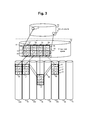
- Fig. 3 is a logical block diagram of data related to Example 1.
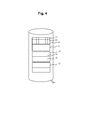
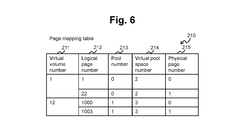
- Fig. 5 is a diagram showing the tables in a shared memory related to Example 1.
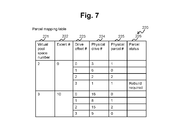
- the parcel mapping table 220 is for managing a physical parcel 54 allocated to an extent 53.
- the parcel mapping table 220 manages an entry comprising the fields of a virtual pool space number 221, an extent number (#) 222, a drive offset number (#) 223, a physical drive number (#) 224, a physical parcel number (#) 225, and a parcel status 226.
- a number (a virtual pool space number) of a virtual pool space is stored in the virtual pool space number 221.
- a number (an extent number) of an extent in the virtual pool space corresponding to the virtual pool space number in the virtual pool space number 221 of the entry is stored in the extent # 222.
- a number (a drive offset number) of a drive offset in the extent corresponding to the extent number in the extent # 222 of the entry is stored in the drive offset # 223.
- the drive offset number here is a number indicating any of the drives in the RAID group configuration (for example, 3D + 1P), and in this example, four drive offset numbers, i.e., 0 through 3, are correspondingly managed as the drive offset numbers with respect to one extent in one virtual pool space.
- the cache management table 240 manages an entry comprising the fields of a virtual volume number 241, a volume slot number 242, a cache slot number 243, a destage inhibit flag 244, and a dirty bitmap 245.
- the local memory 122 stores a read/write program 1220, a bulk writing program 1221, a normal write program 1222, a rebuild program 1223, a high-speed data rebuild program 1224, and a normal data rebuild program 1225.
- the read/write program 1220 is for executing a read/write process (refer to Fig. 11).
- the bulk writing program 1221 is for executing a bulk writing process (refer to Fig. 12).
- the normal write program 1222 is for executing a normal write process.
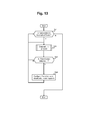
- the rebuild program 1223 is for executing a rebuild process (refer to Fig. 13).
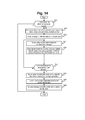
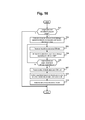
- the high-speed data rebuild program 1224 is for executing a high-speed data rebuild process (refer to Fig. 14).
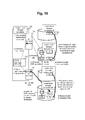
- the normal data rebuild program 1225 is for executing a normal data rebuild process (Fig. 16).
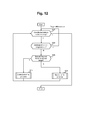
- Fig. 11 is a flowchart of a read/write process related to Example 1.
- the MP 121 determines whether or not a rebuild-required parcel exists within the access range of the storage apparatus (either a lower-level storage apparatus 180 or an external storage apparatus 40) targeted by the read command (Step S13).
- the read command comprises a virtual volume number and a logical page number, which are targeted for access.
- the parcel corresponding to the physical page can be identified by computing the drive offset based on a quotient obtained by dividing the virtual pool space address (the physical page number (for example, the LBA (the address of the sub-block unit))) by the size of the stripe data.
- the rebuild process is executed at an arbitrary timing.
- the MP 121 references the parcel mapping table 220, and determines whether or not there is a parcel for which a rebuild is incomplete, that is, whether or not a parcel having a parcel status of "rebuild required" exists (Step S41). In a case where the result thereof is that a rebuild-incomplete parcel does not exist (Step S41: N), the MP 121 ends the rebuild process. Alternatively, in a case where a rebuild-incomplete parcel exists (Step S41: Y), the MP 121 starts execution of a data rebuild process for the data of a single stripe (a stripe data element) of a single rebuild-incomplete parcel (Step S42).
- Step S57 N
- the MP 121 moves the processing to Step S54.
- the processor 182 upon receiving the parity-rebuild read command, starts the process conforming to the command, reserves a buffer in the memory 183 of the lower-level storage apparatus #1 ((a) in the drawing), acquires data element D1 from the lower-level storage apparatus #0 and copies this data element D1 to the buffer ((b) in the drawing), executes an exclusive OR with respect to the data element D1 and the P-parity of the same row of stripes stored in the lower-level storage apparatus #1, and sends the execution result (D1 + P) to the higher-level storage apparatus 100 ((d) in the drawing). Thereafter, the processor 182 releases the buffer, which had been reserved in the memory 183 ((e) in the drawing).
- the data sent to the transfer buffer 142 from a single path group is a single execution result, thereby making it possible to reduce the amount of data transferred between the lower-level storage apparatus 180 and the BEPK 140.
- the execution result, which is sent from the BEPK 140 to the rebuild-destination lower-level storage apparatus 180 is the number of the transfer-source path groups (one in this example), making it possible to reduce the amount of data transferred between the lower-level storage apparatus 180 and the BEPK 140.
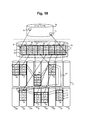
- Example 2 is such that the virtual pool space 52 in Example 1 is configured as a RAID6 RAID group. Explanations of parts that are the same as Example 1 will be omitted.
- Fig. 19 is a diagram showing an example of a Galois computation coefficient table related to Example 2.
- the Galois computation coefficient table 250 is for managing the Galois computation coefficient used in the operation utilized when creating the RAID6 Q-parity and when rebuilding a data element using the Q-parity.
- the Galois computation coefficient table 250 is stored in the shared memory 200, and physically, for example, in the LM 122 of the higher-level storage apparatus 100, and the MP 121 of the higher-level storage apparatus 100 stores the Galois computation coefficient table 250 in the memory 183 of the lower-level storage apparatus 180.
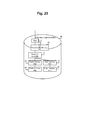
- Fig. 20 is a diagram illustrating a method for creating rebuild data in the RAID.
- This table shows the corresponding relationship among a number, a category, a loss category, a lost data type, and a method for creating rebuild data.
- the number (#) shows the number of an entry (row).
- the category shows the RAID level.
- the loss category shows the extent of the data loss. As the extent of loss, there is a single failure in which a single stripe data element in a row of stripes has been lost, and a double failure in which two stripe data elements in a row of stripes have been lost.
- the lost data type shows the type of data, which was lost.
- the data types include Dm and Dn, which indicate data elements, and P and Q, which indicate parity.
- the rebuild data creation method shows the method for creating rebuild data in a case where the extent of loss of the same row has occurred with respect to the RAID level of the same row, and data of the lost data type of the same row was lost.
- the MP 121 compares the number of transfers of the normal data rebuild process acquired in (2) to the number of transfers of the high-speed data rebuild process acquired in (3), and determines that the process with the fewer number of transfers is the effective data rebuild process.
- the data-rebuild effect estimate is not limited to this, and, for example, may be such that the normal data rebuild process is selected in accordance with the load status of the lower-level storage apparatus 180.
- Fig. 22 is a flowchart of a data rebuild process related to Example 4.
- the processor 42 upon receiving the parity-rebuild read command, the processor 42 starts the process conforming to the command, reserves a buffer in the memory 43 of the external storage apparatus #1 ((a) in the drawing), acquires the data element D1 from the external storage apparatus #0 and copies this data element D1 to the buffer ((b) in the drawing), executes an exclusive OR with respect to the data element D1 and the P-parity of the same row of stripes stored in the external storage apparatus #1, and sends the execution result (D1 + P) to the higher-level storage apparatus 100 ((d) in the drawing). Thereafter, the processor 42 releases the buffer, which had been reserved in the memory 43 ((e) in the drawing).
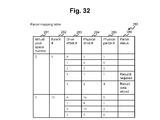
- the parcel mapping table 260 is for managing a physical parcel allocated to an extent.
- the parcel mapping table 260 manages an entry comprising the fields of a virtual pool space number 261, an extent number (#) 262, a drive offset number (#) 263, a physical drive number (#) 264, a physical parcel number (#) 265, a parcel status 266, and a rebuild data type 267.
- Each field is basically the same as the field of the same name shown in Fig. 7. The differences with the parcel mapping table 220 will be explained here.
- the parcel mapping table 280 is for managing a physical parcel allocated to an extent.
- the parcel mapping table 280 manages an entry comprising the fields of a virtual pool space number 281, an extent number (#) 282, a drive offset number (#) 283, a physical drive number (#) 284, a physical parcel number (#) 285, and a parcel status 286.
- Each field is basically the same as the field of the same name shown in Fig. 7. The differences with the parcel mapping table 220 will be explained here.
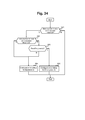
- Step S82: Y the MP 121 advances the processing to Step S84.
- the MP 121 determines whether or not the target lower-level storage apparatus 180, for example, is a ReadOnly media, such as a flash memory, which can be read even when a write is not possible (Step S83).
- the type of failure in the lower-level storage apparatus 180 is detected based on the number of read errors and the number of write errors, but the present invention is not limited to this, and, for example, the MP 121 may issue a command to the lower-level storage apparatus 180 for querying the lower-level storage apparatus 180 about the type of failure.
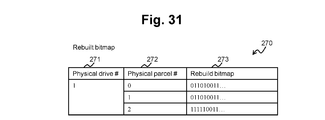
- the MP 121 references the rebuilt bitmap table 270 and determines whether or not the rebuild bit corresponding to the area for storing the unreflected data is ON ("1") (Step S95).
- Step S95 the MP 121 executes a normal write process (Step S98) and moves the processing to Step S91.
- Step S95: N the MP 121 reads old data in the area corresponding to the unreflected data from the lower-level storage apparatus 180 in the abnormal (W not possible) state, merges the relevant old data with the unreflected data (new data) in the CM 131 to create a rebuilt data, reserves a new parcel for storing rebuild data from non-failed drives to store the rebuild data in the parcel (Step S96), configures the rebuild bit corresponding to the parcel area for storing the unreflected data of the rebuild bitmap 273 in the rebuilt bitmap table 270 to ON (Step S97), and moves the processing to Step S91.
- the addition to the parcel mapping table 280 of an entry showing the parcel in which the rebuild data is being stored makes it possible to execute a host I/O with respect to the rebuild data-storing parcel.
- Example 8 rebuilds the data of a row of stripes, which is likely to be lost, on a priority basis.
- a configuration with redundancy of equal to or larger than two is not limited to RAID6, and, for example, may be a triple mirror configuration.
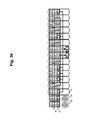
- Fig. 36 is a diagram illustrating a priority rebuild related to Example 8.
- Fig. 36 shows an example in which the virtual pool space comprises 16 lower-level storage apparatuses 180, and the virtual pool space is a RAID6 with a 6D + 2P configuration.
- reference signs which have the numeral following a "_" in common, such as D1_1, D2_1, D3_1, D4_1, D5_1,l D6_1, P_1, and Q_1, indicate data elements in the same data unit and parity, that is, that the data elements and parity are in the same row of stripes.
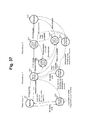
- Fig. 37 is a diagram illustrating a status transition in a higher-level storage apparatus related to Example 8.
- Fig. 37 shows a status transition in the higher-level storage apparatus 100, which manages a RAID group of RAID6 for each redundancy.
- the copy-back-in-progress state ST2 is a state in which processing is underway for returning data, which has been rebuilt in a spare area, to an area of a new drive from the spare area after a failed drive has been replaced with a new drive.
- the redundancy in the copy-back-in-progress state ST2 is two.
- the higher-level storage apparatus 100 transitions to the rebuild-in-progress state ST3.
- the rebuild-in-progress state ST3 is a state in which data (e.g., data elements) stored in a blocked drive is in the process of being rebuilt.
- the redundancy in the rebuild-in-progress state ST3 is one.
- the higher-level storage apparatus 100 transitions to the priority rebuild-in-progress state ST6. In a case where one drive is blocked in the copy-back-in-progress state ST8, the higher-level storage apparatus 100 transitions to the failure state ST9.
- Fig. 38 is a diagram showing an example of a stripe table related to Example 8.
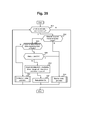
- Fig. 39 is a flowchart of a priority rebuild process related to Example 8.
- the priority rebuild process may be executed at each prescribed time, or may be executed when the MP 121 detects failures in two lower-level storage apparatuses 180.
- the MP 121 computes a virtual pool space #, an extent #, and a drive offset # corresponding to the relevant physical parcel for the entry of each physical parcel for which the parcel status 306 in the stripe table 300 is rebuild required (Step S101).
- the MP 121 executes a data rebuild process for rebuilding the unrebuilt data (Step S104), and advances the processing to Step S105, and, alternatively, in a case where either two or more failed drives are not included in the target extent, or the data is not unrebuilt (S103: N), ends the priority rebuild processing.
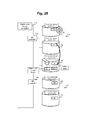
- Step S105 the MP 121 determines whether or not all the stripe data elements of the parcel to be rebuilt in the extent have been rebuilt (Step S105), and in a case where all the stripe data elements have not been rebuilt (Step S105: N), moves the processing to Step S104.
- Step S105 Y
- the MP 121 configures content (for example, a blank) indicating rebuild-not-required in the parcel status 226 of the process-target parcel entries in the parcel mapping table 220 and the stripe table 300 (Step S106), and moves the processing to Step S101.
- content for example, a blank
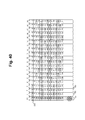
- Fig. 40 is a diagram illustrating a data placement method related to Example 8.
- Fig. 40 shows an example in which the virtual pool space comprises 16 lower-level storage apparatuses 180, and the virtual pool space is a RAID6 with a 2D + 2P configuration.
- reference signs which have the numeral such as 1, and 2, indicate extent number 222, which same number box is parcel include in same extent. Data placement in Fig. 40 is decided by formula.
- the drives which include gray parcels in Fig.40 are read accessed by rebuild process when lower-level storage apparatus 180 which physical drive number is 0 failed. Especially, if D/S is prime number, read accessed by rebuild process is finely distributed among the drives, parallel efficiency is increased, the rebuild processing time is shortened.
- Above formula is an example of efficient method, but the present invention is not limited to this example, it may also be implemented in shift some pattern of data layout based on the above formula by changing mapping of physical drive number (#) 224 and physical parcel number (#) 225, or limited lost data area to specific some drives when drives are failure by limiting the combination of drives which include parcel in extents by using parcel mapping table 220 described in Fig. 7.
- the priority rebuild process it is possible to rebuild on a priority basis data with a high likelihood of being lost, effectively enabling the prevention of data loss.
Landscapes
- Engineering & Computer Science (AREA)
- Theoretical Computer Science (AREA)
- Physics & Mathematics (AREA)
- General Engineering & Computer Science (AREA)
- General Physics & Mathematics (AREA)
- Human Computer Interaction (AREA)
- Quality & Reliability (AREA)
- Computer Security & Cryptography (AREA)
- Information Retrieval, Db Structures And Fs Structures Therefor (AREA)
- Techniques For Improving Reliability Of Storages (AREA)
Priority Applications (4)
| Application Number | Priority Date | Filing Date | Title |
|---|---|---|---|
| JP2014560978A JP6039699B2 (ja) | 2012-07-23 | 2012-07-23 | ストレージシステム及びデータ管理方法 |
| US13/696,370 US9047220B2 (en) | 2012-07-23 | 2012-07-23 | Storage system and data management method |
| PCT/JP2012/004669 WO2014016860A1 (fr) | 2012-07-23 | 2012-07-23 | Système de stockage raid et procédé de reconstruction |
| US14/721,608 US9411527B2 (en) | 2012-07-23 | 2015-05-26 | Storage system and data management method |
Applications Claiming Priority (1)
| Application Number | Priority Date | Filing Date | Title |
|---|---|---|---|
| PCT/JP2012/004669 WO2014016860A1 (fr) | 2012-07-23 | 2012-07-23 | Système de stockage raid et procédé de reconstruction |
Related Child Applications (2)
| Application Number | Title | Priority Date | Filing Date |
|---|---|---|---|
| US13/696,370 A-371-Of-International US9047220B2 (en) | 2012-07-23 | 2012-07-23 | Storage system and data management method |
| US14/721,608 Continuation US9411527B2 (en) | 2012-07-23 | 2015-05-26 | Storage system and data management method |
Publications (1)
| Publication Number | Publication Date |
|---|---|
| WO2014016860A1 true WO2014016860A1 (fr) | 2014-01-30 |
Family
ID=49947599
Family Applications (1)
| Application Number | Title | Priority Date | Filing Date |
|---|---|---|---|
| PCT/JP2012/004669 Ceased WO2014016860A1 (fr) | 2012-07-23 | 2012-07-23 | Système de stockage raid et procédé de reconstruction |
Country Status (3)
| Country | Link |
|---|---|
| US (2) | US9047220B2 (fr) |
| JP (1) | JP6039699B2 (fr) |
| WO (1) | WO2014016860A1 (fr) |
Cited By (2)
| Publication number | Priority date | Publication date | Assignee | Title |
|---|---|---|---|---|
| JP2015210658A (ja) * | 2014-04-25 | 2015-11-24 | 富士通株式会社 | 記憶制御装置、データ復旧プログラム、およびデータ復旧方法 |
| EP2921961A3 (fr) * | 2014-03-20 | 2015-12-23 | Xyratex Technology Limited | Procédé et appareil de récupération améliorée de données dans un système de stockage |
Families Citing this family (23)
| Publication number | Priority date | Publication date | Assignee | Title |
|---|---|---|---|---|
| WO2014079040A1 (fr) * | 2012-11-23 | 2014-05-30 | 华为技术有限公司 | Procédé et appareil de restauration de données |
| WO2014115320A1 (fr) * | 2013-01-25 | 2014-07-31 | 株式会社日立製作所 | Système de stockage et procédé de gestion de données |
| JP6273970B2 (ja) | 2014-03-28 | 2018-02-07 | 富士通株式会社 | ストレージ制御装置、ストレージ制御プログラム、及びストレージ制御方法 |
| KR102318478B1 (ko) | 2014-04-21 | 2021-10-27 | 삼성전자주식회사 | 스토리지 컨트롤러, 스토리지 시스템 및 상기 스토리지 컨트롤러의 동작 방법 |
| JP6228347B2 (ja) * | 2015-02-25 | 2017-11-08 | 株式会社日立製作所 | ストレージ装置及び記憶デバイス |
| US9766837B2 (en) * | 2015-06-10 | 2017-09-19 | Micron Technology, Inc. | Stripe mapping in memory |
| US10289507B1 (en) * | 2015-10-27 | 2019-05-14 | Pavilion Data Systems, Inc. | Distributed rebuild of failed storage device |
| JP6705255B2 (ja) * | 2016-03-30 | 2020-06-03 | 日本電気株式会社 | 制御装置、制御方法及びプログラム、および、ストレージシステム |
| US9921913B2 (en) * | 2016-05-12 | 2018-03-20 | Dell Products L.P. | Flushing host cache data before rebuilding degraded redundant virtual disk |
| TWI607303B (zh) * | 2016-10-14 | 2017-12-01 | 喬鼎資訊股份有限公司 | 具有虛擬區塊及磁碟陣列架構之資料儲存系統及其管理方法 |
| JP6253752B1 (ja) * | 2016-11-29 | 2017-12-27 | 株式会社東芝 | 階層化ストレージシステム |
| US10936206B1 (en) * | 2017-04-05 | 2021-03-02 | Tintri By Ddn, Inc. | Handling a device in a latency state in a redundant storage system |
| CN108733518B (zh) * | 2017-04-17 | 2021-07-09 | 伊姆西Ip控股有限责任公司 | 用于管理存储系统的方法、设备和计算机可读介质 |
| US10970204B2 (en) | 2017-08-29 | 2021-04-06 | Samsung Electronics Co., Ltd. | Reducing read-write interference by adaptive scheduling in NAND flash SSDs |
| US11221958B2 (en) | 2017-08-29 | 2022-01-11 | Samsung Electronics Co., Ltd. | System and method for LBA-based RAID |
| US11354058B2 (en) | 2018-09-06 | 2022-06-07 | Pure Storage, Inc. | Local relocation of data stored at a storage device of a storage system |
| CN108009041B (zh) * | 2017-12-17 | 2020-02-14 | 华中科技大学 | 一种基于数据关联性感知的闪存阵列校验更新方法 |
| JP6889742B2 (ja) * | 2019-03-04 | 2021-06-18 | 株式会社日立製作所 | ストレージシステム、データ管理方法、及びデータ管理プログラム |
| US11372555B2 (en) * | 2020-01-23 | 2022-06-28 | International Business Machines Corporation | Reconstructing data in a smart storage array |
| CN113391758B (zh) * | 2020-03-13 | 2024-06-07 | 伊姆西Ip控股有限责任公司 | 在存储系统中管理条带的方法、设备和计算机程序产品 |
| US20220137835A1 (en) * | 2020-10-30 | 2022-05-05 | Kioxia Corporation | Systems and methods for parity-based failure protection for storage devices |
| CN115080303B (zh) * | 2022-07-26 | 2023-01-06 | 苏州浪潮智能科技有限公司 | Raid6磁盘阵列的编码方法、解码方法、装置及介质 |
| US12346196B2 (en) * | 2022-10-04 | 2025-07-01 | Scality, S.A. | Extended protection storage system PUT operation |
Citations (7)
| Publication number | Priority date | Publication date | Assignee | Title |
|---|---|---|---|---|
| JPH09231015A (ja) | 1996-02-28 | 1997-09-05 | Hitachi Ltd | 記憶装置および記憶装置システム |
| US6516425B1 (en) * | 1999-10-29 | 2003-02-04 | Hewlett-Packard Co. | Raid rebuild using most vulnerable data redundancy scheme first |
| JP2008191966A (ja) | 2007-02-06 | 2008-08-21 | Hitachi Ltd | ストレージシステム及びその制御方法 |
| WO2009039336A2 (fr) * | 2007-09-21 | 2009-03-26 | Hewlett-Packard Development Company, L.P. | Génération d'un plan de récupération parallèle pour un système de stockage de données |
| US20090132851A1 (en) * | 2007-11-21 | 2009-05-21 | Arvind Pruthi | Parallel reed-solomon raid (rs-raid) architecture, device, and method |
| US20100107003A1 (en) | 2008-10-24 | 2010-04-29 | Tomohiro Kawaguchi | Fast Data Recovery From HDD Failure |
| EP2365439A1 (fr) * | 2010-03-11 | 2011-09-14 | LSI Corporation | Système et procédé pour optimiser le rétablissement de la redondance dans des environnements à agencement de données distribué |
Family Cites Families (17)
| Publication number | Priority date | Publication date | Assignee | Title |
|---|---|---|---|---|
| US5522032A (en) * | 1994-05-05 | 1996-05-28 | International Business Machines Corporation | Raid level 5 with free blocks parity cache |
| US5497457A (en) * | 1994-10-17 | 1996-03-05 | International Business Machines Corporation | Redundant arrays of independent libraries of dismountable media with parity logging |
| US7080278B1 (en) * | 2002-03-08 | 2006-07-18 | Network Appliance, Inc. | Technique for correcting multiple storage device failures in a storage array |
| US7246303B2 (en) * | 2002-03-25 | 2007-07-17 | Intel Corporation | Error detection and recovery of data in striped channels |
| US7024586B2 (en) * | 2002-06-24 | 2006-04-04 | Network Appliance, Inc. | Using file system information in raid data reconstruction and migration |
| US7246301B2 (en) * | 2003-06-13 | 2007-07-17 | Dell Products L.P. | Method for storage array error correction |
| US7149847B2 (en) * | 2003-06-26 | 2006-12-12 | Adaptec, Inc. | RAID 6 disk array architectures |
| US7073024B1 (en) * | 2003-09-30 | 2006-07-04 | Emc Corporation | Data protection method wherein data protection code is stored together with parity |
| JP4754852B2 (ja) * | 2005-03-15 | 2011-08-24 | 富士通株式会社 | ストレージ制御装置および方法 |
| US9734086B2 (en) * | 2006-12-06 | 2017-08-15 | Sandisk Technologies Llc | Apparatus, system, and method for a device shared between multiple independent hosts |
| US20090013213A1 (en) * | 2007-07-03 | 2009-01-08 | Adaptec, Inc. | Systems and methods for intelligent disk rebuild and logical grouping of san storage zones |
| CN102334093B (zh) * | 2009-03-18 | 2017-08-01 | 株式会社日立制作所 | 存储控制装置以及虚拟卷的控制方法 |
| JP2010267037A (ja) * | 2009-05-14 | 2010-11-25 | Fujitsu Ltd | ディスクアレイ装置 |
| US8689040B2 (en) * | 2010-10-01 | 2014-04-01 | Lsi Corporation | Method and system for data reconstruction after drive failures |
| US8990502B2 (en) * | 2010-11-23 | 2015-03-24 | International Business Machines Corporation | Write cache structure in a storage system |
| JP5887757B2 (ja) * | 2011-08-17 | 2016-03-16 | 富士通株式会社 | ストレージシステム、ストレージ制御装置およびストレージ制御方法 |
| US8799705B2 (en) * | 2012-01-04 | 2014-08-05 | Emc Corporation | Data protection in a random access disk array |
-
2012
- 2012-07-23 JP JP2014560978A patent/JP6039699B2/ja not_active Expired - Fee Related
- 2012-07-23 US US13/696,370 patent/US9047220B2/en not_active Expired - Fee Related
- 2012-07-23 WO PCT/JP2012/004669 patent/WO2014016860A1/fr not_active Ceased
-
2015
- 2015-05-26 US US14/721,608 patent/US9411527B2/en not_active Expired - Fee Related
Patent Citations (7)
| Publication number | Priority date | Publication date | Assignee | Title |
|---|---|---|---|---|
| JPH09231015A (ja) | 1996-02-28 | 1997-09-05 | Hitachi Ltd | 記憶装置および記憶装置システム |
| US6516425B1 (en) * | 1999-10-29 | 2003-02-04 | Hewlett-Packard Co. | Raid rebuild using most vulnerable data redundancy scheme first |
| JP2008191966A (ja) | 2007-02-06 | 2008-08-21 | Hitachi Ltd | ストレージシステム及びその制御方法 |
| WO2009039336A2 (fr) * | 2007-09-21 | 2009-03-26 | Hewlett-Packard Development Company, L.P. | Génération d'un plan de récupération parallèle pour un système de stockage de données |
| US20090132851A1 (en) * | 2007-11-21 | 2009-05-21 | Arvind Pruthi | Parallel reed-solomon raid (rs-raid) architecture, device, and method |
| US20100107003A1 (en) | 2008-10-24 | 2010-04-29 | Tomohiro Kawaguchi | Fast Data Recovery From HDD Failure |
| EP2365439A1 (fr) * | 2010-03-11 | 2011-09-14 | LSI Corporation | Système et procédé pour optimiser le rétablissement de la redondance dans des environnements à agencement de données distribué |
Cited By (3)
| Publication number | Priority date | Publication date | Assignee | Title |
|---|---|---|---|---|
| EP2921961A3 (fr) * | 2014-03-20 | 2015-12-23 | Xyratex Technology Limited | Procédé et appareil de récupération améliorée de données dans un système de stockage |
| US9606866B2 (en) | 2014-03-20 | 2017-03-28 | Xyratex Technology Limited | Method of, and apparatus for, improved data recovery in a storage system |
| JP2015210658A (ja) * | 2014-04-25 | 2015-11-24 | 富士通株式会社 | 記憶制御装置、データ復旧プログラム、およびデータ復旧方法 |
Also Published As
| Publication number | Publication date |
|---|---|
| JP2015525377A (ja) | 2015-09-03 |
| US9047220B2 (en) | 2015-06-02 |
| US9411527B2 (en) | 2016-08-09 |
| US20140025990A1 (en) | 2014-01-23 |
| JP6039699B2 (ja) | 2016-12-07 |
| US20150254016A1 (en) | 2015-09-10 |
Similar Documents
| Publication | Publication Date | Title |
|---|---|---|
| US9047220B2 (en) | Storage system and data management method | |
| US11941255B2 (en) | Storage system and data management method | |
| KR101411566B1 (ko) | Raid 그룹의 여러 스트라이핑을 갖는 메모리 및 그 수행방법 | |
| US7966471B2 (en) | Storage controller and method for control of a data storage device | |
| KR20180106867A (ko) | 키 밸류 솔리드 스테이트 드라이브 | |
| TWI865776B (zh) | 用於資料恢復之方法及系統、以及儲存陣列控制器 | |
| JP6663482B2 (ja) | 計算機システム、物理記憶デバイスの制御方法、および記録媒体 | |
| US9223655B2 (en) | Storage system and method for controlling storage system | |
| US20200285551A1 (en) | Storage system, data management method, and data management program | |
| WO2016142998A1 (fr) | Système informatique | |
| CN102164165B (zh) | 一种网络存储系统的管理方法及装置 | |
| RU2750645C1 (ru) | Способ хранения данных в избыточном массиве независимых дисков с повышенной отказоустойчивостью | |
| US11467904B2 (en) | Storage system and control method of the same | |
| CN102158538B (zh) | 一种存储资源的管理方法及装置 | |
| CN102147714B (zh) | 一种网络存储系统的管理方法及装置 | |
| JP7137612B2 (ja) | 分散型ストレージシステム、データ復旧方法、及びデータ処理プログラム | |
| HK1105695B (en) | Performing a preemptive reconstruct of a fault-tolerant raid array | |
| HK1105695A1 (zh) | 执行容错磁盘阵列的预先重建 |
Legal Events
| Date | Code | Title | Description |
|---|---|---|---|
| WWE | Wipo information: entry into national phase |
Ref document number: 13696370 Country of ref document: US |
|
| 121 | Ep: the epo has been informed by wipo that ep was designated in this application |
Ref document number: 12746395 Country of ref document: EP Kind code of ref document: A1 |
|
| ENP | Entry into the national phase |
Ref document number: 2014560978 Country of ref document: JP Kind code of ref document: A |
|
| NENP | Non-entry into the national phase |
Ref country code: DE |
|
| 122 | Ep: pct application non-entry in european phase |
Ref document number: 12746395 Country of ref document: EP Kind code of ref document: A1 |