WO2014058254A1 - Composition pour estimer le risque d'apparition d'un lupus érythémateux systémique, comprenant une amorce pour la détection de la variation du nombre de copies d'adn dans l'emplacement 1q25.1 (rabgap1l), l'emplacement 6p21.32 (c4) et l'emplacement 10.q21.3 - Google Patents
Composition pour estimer le risque d'apparition d'un lupus érythémateux systémique, comprenant une amorce pour la détection de la variation du nombre de copies d'adn dans l'emplacement 1q25.1 (rabgap1l), l'emplacement 6p21.32 (c4) et l'emplacement 10.q21.3 Download PDFInfo
- Publication number
- WO2014058254A1 WO2014058254A1 PCT/KR2013/009074 KR2013009074W WO2014058254A1 WO 2014058254 A1 WO2014058254 A1 WO 2014058254A1 KR 2013009074 W KR2013009074 W KR 2013009074W WO 2014058254 A1 WO2014058254 A1 WO 2014058254A1
- Authority
- WO
- WIPO (PCT)
- Prior art keywords
- primer
- copy number
- deletion
- composition
- pcr
- Prior art date
- Legal status (The legal status is an assumption and is not a legal conclusion. Google has not performed a legal analysis and makes no representation as to the accuracy of the status listed.)
- Ceased
Links
Images



Classifications
-
- C—CHEMISTRY; METALLURGY
- C12—BIOCHEMISTRY; BEER; SPIRITS; WINE; VINEGAR; MICROBIOLOGY; ENZYMOLOGY; MUTATION OR GENETIC ENGINEERING
- C12Q—MEASURING OR TESTING PROCESSES INVOLVING ENZYMES, NUCLEIC ACIDS OR MICROORGANISMS; COMPOSITIONS OR TEST PAPERS THEREFOR; PROCESSES OF PREPARING SUCH COMPOSITIONS; CONDITION-RESPONSIVE CONTROL IN MICROBIOLOGICAL OR ENZYMOLOGICAL PROCESSES
- C12Q1/00—Measuring or testing processes involving enzymes, nucleic acids or microorganisms; Compositions therefor; Processes of preparing such compositions
- C12Q1/68—Measuring or testing processes involving enzymes, nucleic acids or microorganisms; Compositions therefor; Processes of preparing such compositions involving nucleic acids
- C12Q1/6876—Nucleic acid products used in the analysis of nucleic acids, e.g. primers or probes
- C12Q1/6883—Nucleic acid products used in the analysis of nucleic acids, e.g. primers or probes for diseases caused by alterations of genetic material
-
- C—CHEMISTRY; METALLURGY
- C12—BIOCHEMISTRY; BEER; SPIRITS; WINE; VINEGAR; MICROBIOLOGY; ENZYMOLOGY; MUTATION OR GENETIC ENGINEERING
- C12Q—MEASURING OR TESTING PROCESSES INVOLVING ENZYMES, NUCLEIC ACIDS OR MICROORGANISMS; COMPOSITIONS OR TEST PAPERS THEREFOR; PROCESSES OF PREPARING SUCH COMPOSITIONS; CONDITION-RESPONSIVE CONTROL IN MICROBIOLOGICAL OR ENZYMOLOGICAL PROCESSES
- C12Q2600/00—Oligonucleotides characterized by their use
- C12Q2600/156—Polymorphic or mutational markers
Definitions
- the present invention relates to a composition for predicting the risk of developing systemic lupus erythematosus, and more specifically, to a systemic erythema when a DNA copy number mutation occurs at 1q25.1 (RABGAP1L) region, 6p21.32 (C4) region, and 10q21.3 region. It relates to a composition characterized in that it is seen as a high risk group for the development of reflective lupus.
- SLE Systemic lupus erythematosus
- SLE is a chronic disease that causes symptoms to improve and worsen over time. SLE patients are particularly prone to blood clotting and blood clots, which can cause coronary artery disease even at a young age, which increases the likelihood of developing angina or myocardial infarction. There is also a risk of stillbirth if you are pregnant. It is also vulnerable to respiratory infections such as influenza and pneumococci. Therefore, it is important to anticipate the risk of SLE in advance to delay or prevent the onset of disease, to reduce symptoms through proper treatment when the disease occurs, and to prevent damage to major organs such as the kidney, lung, and heart. Complications of SLE can be prevented by immunization against influenza and pneumococci and by controlling factors associated with atherosclerosis such as hypertension, blood sugar, and lipid metabolism disorders.
- the present inventors studied new markers capable of early diagnosis of the risk of developing SLE. As a result, deletion variants at the 1q25.1 and 10q21.3 loci of the chromosome were found. If present, the risk of developing SLE is significantly increased, thereby completing the present invention.
- the present invention has been made in the above background, composition for predicting the risk of developing systemic lupus erythematosus comprising primers for detecting DNA copy number mutations at positions 1q25.1, 6p21.32 (C4) and 10q21.3. It is intended to provide a kit.
- the present invention is a composition for predicting the development of Systemic Lupus Erythematosus, wherein the composition is DNA copy number variation of C4 position, 1q25.1 position and / or 10q21.3 position on the chromosome of the sample.
- a composition comprising a primer for detection.
- DNA copy number variations can be deletion-type (0 or 1 copy) and can be gain-type (> 2 copy), but is not limited thereto.
- RABGAPase activating protein 1-like (RABGAP1L) gene located at 1q25.1 encodes a GPTase-activating protein.
- the protein has a phosphotyrosine binding domain and is thought to be a tyrosine-kinase that acts in signaling, but it is not known whether it is involved in specific biological actions or etiology.
- CNV of C4 showed a significant correlation in the present invention.
- the present invention was completed for Korean women, but such copy number variation is highly likely to occur regardless of ethnicity.
- Yang et al.'S paper reported that Westerners reported a lower risk of developing SLE when the number of copies of C4 was small, and a higher risk of developing SLE when they were large, and the same result was observed for Han Chinese.
- the chromosome of the sample can be obtained from the cells of the sample derived from oral epithelium, hair, etc., the source of the cell is not limited thereto.
- the primer for detecting DNA copy number variation at position 1q25.1 is a primer pair for genomic quantitative PCR including DNA sequences of SEQ ID NOs: 1 and 2. It is done.
- the primer for detecting DNA copy number variation at position 10q21.3 is a primer pair for genomic quantitative PCR including DNA sequences of SEQ ID NOs: 3 and 4. It is done.
- the primer for detecting DNA copy number variation at position 1q25.1 includes deletion-typing comprising a DNA sequence selected from the group consisting of SEQ ID NOs: 5-8 Characterized in that it is a primer for PCR.
- the primer for detecting DNA copy number variation at the 10q21.3 position is a primer for deletion-typing PCR including a DNA sequence selected from the group consisting of SEQ ID NOs: 9 to 12.
- the present invention is a kit for predicting the risk of developing Systemic Lupus Erythematosus, wherein the kit is a DNA copy number variation (DNA copy number) at the C4 position, 1q25.1 position and / or 10q21.3 position on the chromosome of the sample. Variation) It provides a kit, characterized in that it comprises a primer (primer) for detection.
- the term 'kit' of the present invention refers to a set that can be commercialized into a configuration including a biomarker and all other materials necessary for various pretreatment and materials for analysis.
- the kit is characterized in that it comprises a primer comprising a DNA sequence selected from the group consisting of SEQ ID NO: 1 to 12.
- the present invention is a.
- A) PCR was performed by adding a primer for detecting DNA copy number variation to the sample DNA sample at the 6p21.32 (C4), 1q25.1 and / or 10q21.3 positions on the chromosome of the sample. Performing; And
- Primer for detecting DNA copy number variation at position 1q25.1 and / or 10q21.3 is a primer for genomic quantitative PCR comprising a DNA sequence selected from the group consisting of SEQ ID NOs: 1-4. It features.
- DNA copy number variation detection, sizing and border primers of the 1q25.1 position and / or 10q21.3 position of step A) is selected from the group consisting of SEQ ID NOs: 5-12 It is characterized in that the primer for deletion-typing PCR containing a DNA sequence.
- compositions of the present invention make it possible to predict the risk of onset by having a replication number variation at the C4, 1q25.1 and 10q21.3 positions having a synergistic effect on the development of systemic lupus erythematosus and is common in most hospital laboratories.
- the use of PCR is a clinically friendly way to reduce errors in analysis that can occur due to new equipment purchases or technical limitations.
- the present invention has the advantage that can be performed in a non-invasive way to the test subject.
- the present invention is expected to be important for early prediction of the possibility of developing systemic lupus erythematosus and for preventing or slowing the progression of the condition.
- FIG. 1 is a diagram illustrating an analysis process ranging from genome-wide CNV discovery to independent replication.
- FIG. 2 is a schematic diagram showing that a region containing a very small number of CNVs is not viewed as a CNVR.
- Fig. 3 shows the allele intensity and qPCR confirmation results of RABGAP1L CNV at 1q25.1 .
- FIG. 5 is a schematic diagram showing a strategy for determining deletion typing PCR and deletion-CNVR boundaries.
- White boxes indicate deleted areas.
- Red arrows in the deleted sites indicate a set to distinguish between HOM and HET.
- the upper diagram shows the strategy diagram of two CNVRs, the middle diagram shows the results of electrophoresis of the deletion-typing PCR product according to each strategy, and the lower diagram shows the deletion breakpoint (pointed by arrow) through DNA sequencing. to be.
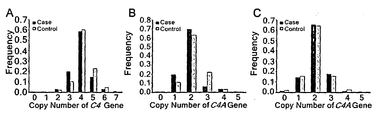
- Figure 6 shows the distribution number distribution for the entire C4, C4A and C4B genes identified by qPCR. Black bars represent patient groups and gray bars represent controls.
- Genotype analysis of the entire genome SNP was performed using Illumina's Human 610s Quad-Bead Chip platform (including 620,901 SNP markers). The average number of probes per known CNV is 37.7. Approximately 750 ng of genomic DNA per sample was used for genotyping. The sample we used showed an average SNP call rate of 99.89 ⁇ 0.16%. To minimize plate or batch effects, all procedures were performed in the same environment for the same period.
- the PennCNV algorithm uses HMM, so there was no threshold on the minimum number of consecutive CNVs (CVVs), but all of the SNPs found in this process were more than three consecutive SNPs (3-1988). A different number of SNPs were found, with the average number of probes per CNV being 13.42, with a median of 7.
- the boundary of each CNV is determined by the length from the linear position of the first SNP probe to the last probe (hg18). General characteristics of CNV are shown in Table 1 below.
- the size of the CNVR may be larger than the actual size (see FIG. 2). To minimize this possibility, areas containing only a small number of CNVs (less than 10% of the total CNVs) were not viewed as CNVRs.
- a total of 18,266 CNVs were identified in 573 samples.
- the median CNV number for an individual was 30 (range of 1-285) and the median size of CNV was 21.0 kb (range 14 bp-18 Mbp).
- Copy number-loss CNV was 1.4 times more frequent than copy number-gain CNV.
- 2,544 CNVRs were identified from 18,266 CNVs. Of those, 144 CNVR were present in over 5% of the individuals.
- Table 2 below shows 144 CNVRs found in 5% or more individuals.
- the OR of CNVRs was calculated based on the 2n individuals. In replication by deletion typing PCR, OR was calculated based on ⁇ 2n. Principal componet analysis (PCA) was performed to correct the effect of population distribution by age group. For regression analysis, the top two principal components derived from PCA analysis, PC1 and PC2, were used as covariates, and SNP-array batch information was also used as a covariate for regression analysis. FDR was calculated as the p-value of 144 CNVR.
- PCA Principal componet analysis
- Genomic qPCR was performed using a Viia 7 system (Life Technologies, Carlsbad, Calif.).
- C4 gene (C4A and C4B)
- the copy number was determined by performing genomic qPCR using two Taqman assays (Hs07226349_cn and Hs07226350_cn (Life Technologies)) designed specifically for C4 A and C4 B.
- a total of 10 ⁇ l of reaction mixture was used, including 10 ng of genomic DNA, TaqMan universal PCR master mix II (Life Technologies), C4A or C4B TaqMan probe, and RNaseP TaqMan probe.
- PCR conditions were carried out with 40 cycles of 1 cycle at 95 °C for 10 minutes, 15 seconds at 95 °C for 1 minute at 60 °C.
- PCR efficiency for the entire primer was determined by standard curve over serial 1: 5 dilution.
- the Ct value is determined by the number of PCR cycles required for the reference gene to reach the threshold of the standard curve.
- the copy number variation for each target was defined as 2 ⁇ CT .
- ⁇ Ct is the difference in threshold cycles for the values obtained from the reference gene (RNase P) and calibrator DNA (individual / calibrator) in the sample to be identified.
- the ratio data is then divided by the nearest integer.
- the frequency distribution of these three CNVRs is shown in the table below (Table 5). The left column is the frequency distribution of CNVR GWAS discovery results, the middle column is the qPCR verification result, and the right column is the deletion typing PCR verification.
- 3 is a genoplot image of the rs4480415 marker (173066744 position, hg18) obtained by Illumina GenomeStudio software.
- the signal strengths at these positions form six distinct clusters of 2X (A / A, A / B / B / B), 1X (A /-, B /-), and 0X (-/-), respectively.
- the figure in the center shows the signal strength ratio around the 1q25.1 region.
- 3 is a diagram confirming the estimated number of copies of the 1q25.1 region by genomic qPCR.
- the X axis represents the state of copy number by PennCNV
- the Y axis represents the estimated DNA copy number by qPCR.
- the frequency distribution of 6p21.32, a CNVR across C4, is shown in Table 6 below.
- the upper table of Table 6 shows CNV GWAS discovery results and the following table shows qPCR verification experiment results.
- Example 5 the inventors performed deletion-typing PCR in order to confirm the exact size and boundary of CNV of the two regions (1q25.1 and 10q21.3) showing significant association with SLE. Amplicons of deleted alleles were sequenced using PCR-direct sequencing. In the case of the C4 region, the deletion-typing PCR design was not possible.
- PCR was performed under the following conditions. 20 ⁇ l of a reaction mixture containing 20 ng of genomic DNA, 0.4 unit of FX DNA polymerase (TOYOBO, Osaka, Japan), 2% DNSO, and 6 pmol of primer was prepared. PCR was performed for 1 cycle at 94 ° C for 2 minutes, at 98 ° C for 10 seconds and at 69 ° C for 1 minute / Kb. After the PCR reaction, 10 ⁇ l of the PCR product was electrophoresed on 0.5% agarose gel. The deleted alleles were sequenced by PCR-direct sequencing method.
- the experiment strategy of FIG. 5 shows that if PCR is performed including a region of expected deletion, a PCR amplification product of the expected size appears in the absence of a deletion, whereas a PCR amplification product of which the length is reduced by that size appears. It is a principle.
- the amplicon size of the total allele of the 1q25.1 region designed by the inventors was 9.4 Kb, and the predicted size of the deletion region at 1q25.1 based on the start-end position of the SNP. was 3.8 Kb. Therefore, the magnitude of the amplification of the deletion allele was calculated to be 5.6 Kb. However, since the actual amplification size of the deleted allele was 4.2 Kb or less, the actual deletion size at 1q25.1 was calculated to be 5.2 Kb or less, not 3.8 Kb.
- a person who shows only 9.4Kb bands can be interpreted as 2n (diploid), a person who shows only 4.2Kb bands can be interpreted as homozygous deletion (HOM), and a person who shows both 9.4Kb and 4.2Kb bands as heterozygous deletion (HET). do.
- the predicted size of the deletion region based on the start-end position of the SNP in the 10q21.3 region was 2.4 Kb and the amplification size of the designed allele was 11.6 Kb. Therefore, a 9.2 Kb-sized deletion typing PCR amplification product is expected, but the size of the amplification product of the deletion allele was 3.3 Kb or less, so the amplification size of the actual deletion allele in the 10q21.3 region was 8.3 Kb or less, not 2.4 Kb. Was calculated.
- a person who shows only 11.6Kb band can be interpreted as 2n (diploid), a person who shows only 3.3 Kb band can be interpreted as homozygous deletion (HOM), and a person who shows 11.6 Kb and 3.3 Kb band at the same time can be interpreted as heterozygous deletion (HET).
- HOM homozygous deletion
- HET heterozygous deletion
- the region 1q25.1 includes Band 1, 9.4 Kb; Band 2, 4.2 Kb; Band 3, 2.3 Kb.
- the 10q21.3 region includes Band 1, 11.6 Kb; Band 2, 3.3 Kb; Band 3, 3.2 Kb.
- P1 and P2 mean primer sets 1 and 2, respectively.
- 5 bottom is an example of a DNA sequence showing deletion breakpoints (parts indicated by arrows) of 1q25.1 and 10q21.3.
- heterozygous samples must have two sizes of amplification (full size and size of deletion), full size amplification is preferred for small size PCR in both CNVRs. for small-sized PCR). Therefore, to distinguish homozygous and heterozygous deletions based on deletion mapping data, we sought to redesign the primers in the deleted sequences to test for the presence of short amplifications that represent the entire allele ( 5, Table 7). If the sample had a heterozygous deletion, the total allele would produce an amplified product of the expected size (2.3 Kb for 1q25.1, 3.2 Kb for 10q21.3), but not for the deletion allele. If the sample had a homozygous deletion, it was expected that no PCR amplification would be produced.
- homozygous deletions are 4.2 Kb band positive, 9.4 Kb band negative, 2.3 Kb band negative
- heterozygous deletions are 4.2 Kb band positive, 2.3 Kb band positive, and the 9.4 Kb band is positive but may not appear. If there is more than one copy number variation, it is 9.4 Kb band positive, 2.3 Kb band positive, 3.2 Kb band negative, 4.2 Kb band negative.
- homozygous deletion will be 3.3 Kb band positive, 3.2 Kb band negative, 11.6 Kb band negative
- heterozygous deletion will be 3.3 Kb band positive, 3.2 Kb band positive, and 11.6 Kb may be positive but may not appear. If there is more than one copy number variation, it will be 11.6 Kb band positive, 3.2 Kb band positive, 3.3 Kb band negative (FIG. 4).
- the present inventors wanted to know the effects of the deletion type CNVR occurring at the same time in three important positions in predicting the risk of developing SLE.
- compositions of the present invention make it possible to predict the risk of onset by having a replication number variation at the C4, 1q25.1 and 10q21.3 positions having a synergistic effect on the development of systemic lupus erythematosus and is common in most hospital laboratories.
- the PCR that is performed as a new device or to reduce the error of analysis that may occur due to technical limitations, there is an advantage that can be performed in a non-invasive way to the subject.
- the present invention can be used to predict the possibility of developing systemic lupus erythematosus early to prevent the worsening of the condition or to delay the onset.
Landscapes
- Chemical & Material Sciences (AREA)
- Life Sciences & Earth Sciences (AREA)
- Proteomics, Peptides & Aminoacids (AREA)
- Health & Medical Sciences (AREA)
- Organic Chemistry (AREA)
- Wood Science & Technology (AREA)
- Analytical Chemistry (AREA)
- Zoology (AREA)
- Genetics & Genomics (AREA)
- Engineering & Computer Science (AREA)
- Pathology (AREA)
- Immunology (AREA)
- Microbiology (AREA)
- Molecular Biology (AREA)
- Biotechnology (AREA)
- Biophysics (AREA)
- Physics & Mathematics (AREA)
- Biochemistry (AREA)
- Bioinformatics & Cheminformatics (AREA)
- General Engineering & Computer Science (AREA)
- General Health & Medical Sciences (AREA)
- Measuring Or Testing Involving Enzymes Or Micro-Organisms (AREA)
Abstract
La présente invention concerne une composition pour estimer le risque d'apparition d'un lupus érythémateux systémique, et plus particulièrement, une composition qui détermine une personne examinée comme ayant un risque élevé d'apparition d'un lupus érythémateux systémique lorsqu'une variation du nombre de copies d'ADN a eu lieu dans la région C4, la région 1q25.1 et la région 10q21.3. La composition de la présente invention peut estimer le risque d'apparition d'un lupus érythémateux systémique à l'aide du fait que la variation du nombre de copies dans l'emplacement C4, l'emplacement 1q25.1 et l'emplacement 10q21.3 a un effet synergique dans l'occurrence du lupus érythémateux systémique. La composition de la présente invention permet un procédé cliniquement facile qui peut réduire une erreur d'une analyse qui peut être provoquée par un dispositif nouvellement acheté ou par des limitations technologiques, par l'utilisation de PCR qui est en général réalisée dans la plupart des laboratoires d'hôpital. En outre, la composition de la présente invention présente les avantages d'être réalisée sur une personne à examiner à l'aide d'un procédé non invasif. Par conséquent, la composition de la présente invention peut estimer le risque d'apparition d'un lupus érythémateux systémique à un stade précoce, et par conséquent peut être utilisée dans la prévention d'un état aggravé ou dans le retardement de l'occurrence de la maladie.
Priority Applications (1)
| Application Number | Priority Date | Filing Date | Title |
|---|---|---|---|
| CN201380053236.5A CN104704121A (zh) | 2012-10-10 | 2013-10-10 | 含有1q25.1(RABGAP1L)位置、6P21.32(C4)位置及10q21.3位置DNA拷贝数变异检测用引物的全身性红斑狼疮发病危险度预测用组合物 |
Applications Claiming Priority (4)
| Application Number | Priority Date | Filing Date | Title |
|---|---|---|---|
| KR10-2012-0112495 | 2012-10-10 | ||
| KR20120112495 | 2012-10-10 | ||
| KR20120144720A KR101491214B1 (ko) | 2012-10-10 | 2012-12-12 | 1q25.1(RABGAP1L) 위치, 6p21.32 (C4) 위치 및 10q21.3위치의 DNA 복제 수 변이 검출용 프라이머를 포함하는 전신성 홍반성 루푸스 발병 위험도 예측용 조성물 |
| KR10-2012-0144720 | 2012-12-12 |
Publications (1)
| Publication Number | Publication Date |
|---|---|
| WO2014058254A1 true WO2014058254A1 (fr) | 2014-04-17 |
Family
ID=50477649
Family Applications (1)
| Application Number | Title | Priority Date | Filing Date |
|---|---|---|---|
| PCT/KR2013/009074 Ceased WO2014058254A1 (fr) | 2012-10-10 | 2013-10-10 | Composition pour estimer le risque d'apparition d'un lupus érythémateux systémique, comprenant une amorce pour la détection de la variation du nombre de copies d'adn dans l'emplacement 1q25.1 (rabgap1l), l'emplacement 6p21.32 (c4) et l'emplacement 10.q21.3 |
Country Status (1)
| Country | Link |
|---|---|
| WO (1) | WO2014058254A1 (fr) |
Citations (2)
| Publication number | Priority date | Publication date | Assignee | Title |
|---|---|---|---|---|
| KR20110081161A (ko) * | 2008-09-26 | 2011-07-13 | 제넨테크, 인크. | 루푸스의 치료, 진단 및 모니터링 방법 |
| KR20120100969A (ko) * | 2009-10-07 | 2012-09-12 | 제넨테크, 인크. | 루푸스의 치료, 진단 및 모니터링 방법 |
-
2013
- 2013-10-10 WO PCT/KR2013/009074 patent/WO2014058254A1/fr not_active Ceased
Patent Citations (2)
| Publication number | Priority date | Publication date | Assignee | Title |
|---|---|---|---|---|
| KR20110081161A (ko) * | 2008-09-26 | 2011-07-13 | 제넨테크, 인크. | 루푸스의 치료, 진단 및 모니터링 방법 |
| KR20120100969A (ko) * | 2009-10-07 | 2012-09-12 | 제넨테크, 인크. | 루푸스의 치료, 진단 및 모니터링 방법 |
Non-Patent Citations (1)
| Title |
|---|
| Y.L. WU ET AL.: "Phenotypes, genotypes and disease susceptibility associated with gene copy number variations : complement C4 CNVs in European American healthy subjects and those with systemic lupus erythematosus", CYTOGENET GONOME RES., vol. 123, 2008, pages 131 - 141 * |
Similar Documents
| Publication | Publication Date | Title |
|---|---|---|
| Souren et al. | DNA methylation signatures of monozygotic twins clinically discordant for multiple sclerosis | |
| Deng et al. | Clinical and molecular study of a pediatric patient with sodium taurocholate cotransporting polypeptide deficiency | |
| Guo et al. | Genotype and cardiovascular phenotype correlations with TBX1 in 1,022 velo‐cardio‐facial/digeorge/22q11. 2 deletion syndrome patients | |
| WO2019199105A1 (fr) | Procédé d'évaluation du risque de maladie d'alzheimer | |
| Handley et al. | ITPase deficiency causes a Martsolf-like syndrome with a lethal infantile dilated cardiomyopathy | |
| Jadeja et al. | A case-control study on association of proteasome subunit beta 8 (PSMB8) and transporter associated with antigen processing 1 (TAP1) polymorphisms and their transcript levels in vitiligo from Gujarat | |
| WO2020027569A1 (fr) | Composition pour le diagnostic de la maladie d'alzheimer par utilisation d'une altération de la méthylation des cpg dans le promoteur du gène ide dans des cellules de la peau, et son utilisation | |
| Tsai et al. | Identification of a CCG-enriched expanded allele in patients with myotonic dystrophy type 1 using amplification-free long-read sequencing | |
| WO2020209590A1 (fr) | Composition pour le diagnostic ou la prédiction pronostique d'un gliome, et procédé pour fournir des informations lui étant associées | |
| Solomon et al. | Applying genomic analysis to newborn screening | |
| WO2020204312A1 (fr) | Marqueur snp pour diagnostiquer un anévrisme cérébral comprenant un polymorphisme nucléotidique unique du gène arhgap32 | |
| WO2019078684A9 (fr) | Marqueur de tmem43 destiné au diagnostic de la perte d'audition neurosensorielle et son utilisation | |
| CN115109789B (zh) | 检测样本中lpl基因突变的试剂在制备筛查高脂血症患者的试剂盒中的应用 | |
| WO2023177056A1 (fr) | PROCÉDÉ POUR FOURNIR DES INFORMATIONS POUR PRÉDIRE LE GROUPE À RISQUE DE DÉVELOPPER LA MALADIE D'ALZHEIMER OU LE GROUPE À RISQUE D'APPARITION PRÉCOCE DES SYMPTÔMES DE L'ALZHEIMER, OU LE GROUPE À RISQUE POUR LE DÉVELOPPEMENT D'UN TROUBLE COGNITIF LÉGER DE TYPE AMNÉSIQUE ET/OU LE GROUPE À RISQUE POUR LE DÉPÔT DE β-AMYLOÏDE, FONDÉ SUR LES DONNÉES RELATIVES À LA POPULATION EUROPÉENNE | |
| WO2020060170A1 (fr) | Composition de marqueur pour le diagnostic de dermatite atopique et procédé, utilisant celle-ci, pour la prédiction ou le diagnostic de dermatite atopique | |
| WO2021172863A1 (fr) | Test de diagnostic moléculaire pour la maladie d'alzheimer | |
| WO2014058254A1 (fr) | Composition pour estimer le risque d'apparition d'un lupus érythémateux systémique, comprenant une amorce pour la détection de la variation du nombre de copies d'adn dans l'emplacement 1q25.1 (rabgap1l), l'emplacement 6p21.32 (c4) et l'emplacement 10.q21.3 | |
| WO2020204313A1 (fr) | Marqueur snp pour diagnostiquer un anévrisme cérébral, comprenant un polymorphisme monobasique du gène gba | |
| WO2024019556A1 (fr) | Marqueur de diagnostic prédictif pour la maladie d'alzheimer à l'aide d'un changement de méthylation d'adn dans le gène krt32 | |
| WO2023204381A1 (fr) | PROCÉDÉ POUR FOURNIR DES INFORMATIONS POUR PRÉDIRE UN GROUPE À RISQUE POUR LE DÉVELOPPEMENT DE LA MALADIE D'ALZHEIMER OU UN GROUPE À RISQUE POUR UNE APPARITION PRÉCOCE DES SYMPTÔMES DE LA MALADIE D'ALZHEIMER, OU UN GROUPE À RISQUE POUR LE DÉVELOPPEMENT D'UN TROUBLE COGNITIF LÉGER AMNÉSIQUE ET/OU UN GROUPE À RISQUE POSITIF AU PET POUR LE DÉPÔT DE β-AMYLOÏDE, SUR LA BASE DE DONNÉES D'EUROPE-ASIE DE L'EST | |
| JP2020058274A (ja) | Cyp2d6遺伝子に基づくレゴラフェニブの副作用予測 | |
| WO2019132581A1 (fr) | Composition de diagnostic du cancer, tel que du cancer du sein et du cancer de l'ovaire, et son utilisation | |
| CN115806997A (zh) | 扩张型心肌病变异基因lama4及其应用 | |
| WO2021107713A1 (fr) | Procédé de diagnostic de la sclérose latérale amyotrophique sur la base d'un marqueur de mutation du gène lats1 | |
| KR101491214B1 (ko) | 1q25.1(RABGAP1L) 위치, 6p21.32 (C4) 위치 및 10q21.3위치의 DNA 복제 수 변이 검출용 프라이머를 포함하는 전신성 홍반성 루푸스 발병 위험도 예측용 조성물 |
Legal Events
| Date | Code | Title | Description |
|---|---|---|---|
| 121 | Ep: the epo has been informed by wipo that ep was designated in this application |
Ref document number: 13845382 Country of ref document: EP Kind code of ref document: A1 |
|
| NENP | Non-entry into the national phase |
Ref country code: DE |
|
| 122 | Ep: pct application non-entry in european phase |
Ref document number: 13845382 Country of ref document: EP Kind code of ref document: A1 |