WO2014067598A1 - Aromatische azabicyclische komplexverbindungen mit cu, ag, au, zn, al zur verwendung in elektrolumineszensvorrichtungen - Google Patents

Aromatische azabicyclische komplexverbindungen mit cu, ag, au, zn, al zur verwendung in elektrolumineszensvorrichtungen Download PDF

Info

Publication number
WO2014067598A1
WO2014067598A1 PCT/EP2013/002749 EP2013002749W WO2014067598A1 WO 2014067598 A1 WO2014067598 A1 WO 2014067598A1 EP 2013002749 W EP2013002749 W EP 2013002749W WO 2014067598 A1 WO2014067598 A1 WO 2014067598A1
Authority
WO
WIPO (PCT)
Prior art keywords
formula
group
atoms
radicals
substituted
Prior art date
Legal status (The legal status is an assumption and is not a legal conclusion. Google has not performed a legal analysis and makes no representation as to the accuracy of the status listed.)
Ceased
Application number
PCT/EP2013/002749
Other languages
English (en)
French (fr)
Other versions
WO2014067598A8 (de
Inventor
Lars WIESEMANN
Matthias Kleih
Hermann August MAYER
Current Assignee (The listed assignees may be inaccurate. Google has not performed a legal analysis and makes no representation or warranty as to the accuracy of the list.)
Eberhard Karls Universitaet Tuebingen
Merck Patent GmbH
Original Assignee
Eberhard Karls Universitaet Tuebingen
Merck Patent GmbH
Priority date (The priority date is an assumption and is not a legal conclusion. Google has not performed a legal analysis and makes no representation as to the accuracy of the date listed.)
Filing date
Publication date
Application filed by Eberhard Karls Universitaet Tuebingen, Merck Patent GmbH filed Critical Eberhard Karls Universitaet Tuebingen
Priority to KR1020157012476A priority Critical patent/KR20150067367A/ko
Priority to CN201380053524.0A priority patent/CN104736544A/zh
Priority to US14/434,919 priority patent/US20150280147A1/en
Priority to EP13762410.2A priority patent/EP2906567A1/de
Priority to JP2015536006A priority patent/JP2016501830A/ja
Publication of WO2014067598A1 publication Critical patent/WO2014067598A1/de
Anticipated expiration legal-status Critical
Publication of WO2014067598A8 publication Critical patent/WO2014067598A8/de
Ceased legal-status Critical Current

Links

Classifications

    • CCHEMISTRY; METALLURGY
    • C07ORGANIC CHEMISTRY
    • C07FACYCLIC, CARBOCYCLIC OR HETEROCYCLIC COMPOUNDS CONTAINING ELEMENTS OTHER THAN CARBON, HYDROGEN, HALOGEN, OXYGEN, NITROGEN, SULFUR, SELENIUM OR TELLURIUM
    • C07F9/00Compounds containing elements of Groups 5 or 15 of the Periodic Table
    • C07F9/02Phosphorus compounds
    • C07F9/28Phosphorus compounds with one or more P—C bonds
    • C07F9/50Organo-phosphines
    • C07F9/5045Complexes or chelates of phosphines with metallic compounds or metals
    • CCHEMISTRY; METALLURGY
    • C09DYES; PAINTS; POLISHES; NATURAL RESINS; ADHESIVES; COMPOSITIONS NOT OTHERWISE PROVIDED FOR; APPLICATIONS OF MATERIALS NOT OTHERWISE PROVIDED FOR
    • C09KMATERIALS FOR MISCELLANEOUS APPLICATIONS, NOT PROVIDED FOR ELSEWHERE
    • C09K11/00Luminescent materials, e.g. electroluminescent or chemiluminescent
    • C09K11/06Luminescent materials, e.g. electroluminescent or chemiluminescent containing organic luminescent materials
    • CCHEMISTRY; METALLURGY
    • C07ORGANIC CHEMISTRY
    • C07FACYCLIC, CARBOCYCLIC OR HETEROCYCLIC COMPOUNDS CONTAINING ELEMENTS OTHER THAN CARBON, HYDROGEN, HALOGEN, OXYGEN, NITROGEN, SULFUR, SELENIUM OR TELLURIUM
    • C07F1/00Compounds containing elements of Groups 1 or 11 of the Periodic Table
    • C07F1/005Compounds containing elements of Groups 1 or 11 of the Periodic Table without C-Metal linkages
    • CCHEMISTRY; METALLURGY
    • C07ORGANIC CHEMISTRY
    • C07FACYCLIC, CARBOCYCLIC OR HETEROCYCLIC COMPOUNDS CONTAINING ELEMENTS OTHER THAN CARBON, HYDROGEN, HALOGEN, OXYGEN, NITROGEN, SULFUR, SELENIUM OR TELLURIUM
    • C07F1/00Compounds containing elements of Groups 1 or 11 of the Periodic Table
    • C07F1/08Copper compounds
    • CCHEMISTRY; METALLURGY
    • C07ORGANIC CHEMISTRY
    • C07FACYCLIC, CARBOCYCLIC OR HETEROCYCLIC COMPOUNDS CONTAINING ELEMENTS OTHER THAN CARBON, HYDROGEN, HALOGEN, OXYGEN, NITROGEN, SULFUR, SELENIUM OR TELLURIUM
    • C07F1/00Compounds containing elements of Groups 1 or 11 of the Periodic Table
    • C07F1/10Silver compounds
    • CCHEMISTRY; METALLURGY
    • C07ORGANIC CHEMISTRY
    • C07FACYCLIC, CARBOCYCLIC OR HETEROCYCLIC COMPOUNDS CONTAINING ELEMENTS OTHER THAN CARBON, HYDROGEN, HALOGEN, OXYGEN, NITROGEN, SULFUR, SELENIUM OR TELLURIUM
    • C07F3/00Compounds containing elements of Groups 2 or 12 of the Periodic Table
    • C07F3/06Zinc compounds
    • CCHEMISTRY; METALLURGY
    • C07ORGANIC CHEMISTRY
    • C07FACYCLIC, CARBOCYCLIC OR HETEROCYCLIC COMPOUNDS CONTAINING ELEMENTS OTHER THAN CARBON, HYDROGEN, HALOGEN, OXYGEN, NITROGEN, SULFUR, SELENIUM OR TELLURIUM
    • C07F5/00Compounds containing elements of Groups 3 or 13 of the Periodic Table
    • C07F5/06Aluminium compounds
    • CCHEMISTRY; METALLURGY
    • C07ORGANIC CHEMISTRY
    • C07FACYCLIC, CARBOCYCLIC OR HETEROCYCLIC COMPOUNDS CONTAINING ELEMENTS OTHER THAN CARBON, HYDROGEN, HALOGEN, OXYGEN, NITROGEN, SULFUR, SELENIUM OR TELLURIUM
    • C07F7/00Compounds containing elements of Groups 4 or 14 of the Periodic Table
    • C07F7/02Silicon compounds
    • C07F7/08Compounds having one or more C—Si linkages
    • C07F7/10Compounds having one or more C—Si linkages containing nitrogen having a Si-N linkage
    • CCHEMISTRY; METALLURGY
    • C09DYES; PAINTS; POLISHES; NATURAL RESINS; ADHESIVES; COMPOSITIONS NOT OTHERWISE PROVIDED FOR; APPLICATIONS OF MATERIALS NOT OTHERWISE PROVIDED FOR
    • C09BORGANIC DYES OR CLOSELY-RELATED COMPOUNDS FOR PRODUCING DYES, e.g. PIGMENTS; MORDANTS; LAKES
    • C09B19/00Oxazine dyes
    • CCHEMISTRY; METALLURGY
    • C09DYES; PAINTS; POLISHES; NATURAL RESINS; ADHESIVES; COMPOSITIONS NOT OTHERWISE PROVIDED FOR; APPLICATIONS OF MATERIALS NOT OTHERWISE PROVIDED FOR
    • C09BORGANIC DYES OR CLOSELY-RELATED COMPOUNDS FOR PRODUCING DYES, e.g. PIGMENTS; MORDANTS; LAKES
    • C09B57/00Other synthetic dyes of known constitution
    • CCHEMISTRY; METALLURGY
    • C09DYES; PAINTS; POLISHES; NATURAL RESINS; ADHESIVES; COMPOSITIONS NOT OTHERWISE PROVIDED FOR; APPLICATIONS OF MATERIALS NOT OTHERWISE PROVIDED FOR
    • C09BORGANIC DYES OR CLOSELY-RELATED COMPOUNDS FOR PRODUCING DYES, e.g. PIGMENTS; MORDANTS; LAKES
    • C09B57/00Other synthetic dyes of known constitution
    • C09B57/10Metal complexes of organic compounds not being dyes in uncomplexed form
    • HELECTRICITY
    • H10SEMICONDUCTOR DEVICES; ELECTRIC SOLID-STATE DEVICES NOT OTHERWISE PROVIDED FOR
    • H10KORGANIC ELECTRIC SOLID-STATE DEVICES
    • H10K85/00Organic materials used in the body or electrodes of devices covered by this subclass
    • H10K85/30Coordination compounds
    • H10K85/321Metal complexes comprising a group IIIA element, e.g. Tris (8-hydroxyquinoline) gallium [Gaq3]
    • H10K85/324Metal complexes comprising a group IIIA element, e.g. Tris (8-hydroxyquinoline) gallium [Gaq3] comprising aluminium, e.g. Alq3
    • HELECTRICITY
    • H10SEMICONDUCTOR DEVICES; ELECTRIC SOLID-STATE DEVICES NOT OTHERWISE PROVIDED FOR
    • H10KORGANIC ELECTRIC SOLID-STATE DEVICES
    • H10K85/00Organic materials used in the body or electrodes of devices covered by this subclass
    • H10K85/30Coordination compounds
    • H10K85/371Metal complexes comprising a group IB metal element, e.g. comprising copper, gold or silver
    • HELECTRICITY
    • H10SEMICONDUCTOR DEVICES; ELECTRIC SOLID-STATE DEVICES NOT OTHERWISE PROVIDED FOR
    • H10KORGANIC ELECTRIC SOLID-STATE DEVICES
    • H10K85/00Organic materials used in the body or electrodes of devices covered by this subclass
    • H10K85/30Coordination compounds
    • H10K85/381Metal complexes comprising a group IIB metal element, e.g. comprising cadmium, mercury or zinc
    • CCHEMISTRY; METALLURGY
    • C09DYES; PAINTS; POLISHES; NATURAL RESINS; ADHESIVES; COMPOSITIONS NOT OTHERWISE PROVIDED FOR; APPLICATIONS OF MATERIALS NOT OTHERWISE PROVIDED FOR
    • C09KMATERIALS FOR MISCELLANEOUS APPLICATIONS, NOT PROVIDED FOR ELSEWHERE
    • C09K2211/00Chemical nature of organic luminescent or tenebrescent compounds
    • C09K2211/10Non-macromolecular compounds
    • C09K2211/1003Carbocyclic compounds
    • C09K2211/1011Condensed systems
    • CCHEMISTRY; METALLURGY
    • C09DYES; PAINTS; POLISHES; NATURAL RESINS; ADHESIVES; COMPOSITIONS NOT OTHERWISE PROVIDED FOR; APPLICATIONS OF MATERIALS NOT OTHERWISE PROVIDED FOR
    • C09KMATERIALS FOR MISCELLANEOUS APPLICATIONS, NOT PROVIDED FOR ELSEWHERE
    • C09K2211/00Chemical nature of organic luminescent or tenebrescent compounds
    • C09K2211/10Non-macromolecular compounds
    • C09K2211/1018Heterocyclic compounds
    • C09K2211/1022Heterocyclic compounds bridged by heteroatoms, e.g. N, P, Si or B
    • CCHEMISTRY; METALLURGY
    • C09DYES; PAINTS; POLISHES; NATURAL RESINS; ADHESIVES; COMPOSITIONS NOT OTHERWISE PROVIDED FOR; APPLICATIONS OF MATERIALS NOT OTHERWISE PROVIDED FOR
    • C09KMATERIALS FOR MISCELLANEOUS APPLICATIONS, NOT PROVIDED FOR ELSEWHERE
    • C09K2211/00Chemical nature of organic luminescent or tenebrescent compounds
    • C09K2211/10Non-macromolecular compounds
    • C09K2211/1018Heterocyclic compounds
    • C09K2211/1025Heterocyclic compounds characterised by ligands
    • C09K2211/1029Heterocyclic compounds characterised by ligands containing one nitrogen atom as the heteroatom
    • CCHEMISTRY; METALLURGY
    • C09DYES; PAINTS; POLISHES; NATURAL RESINS; ADHESIVES; COMPOSITIONS NOT OTHERWISE PROVIDED FOR; APPLICATIONS OF MATERIALS NOT OTHERWISE PROVIDED FOR
    • C09KMATERIALS FOR MISCELLANEOUS APPLICATIONS, NOT PROVIDED FOR ELSEWHERE
    • C09K2211/00Chemical nature of organic luminescent or tenebrescent compounds
    • C09K2211/10Non-macromolecular compounds
    • C09K2211/1018Heterocyclic compounds
    • C09K2211/1025Heterocyclic compounds characterised by ligands
    • C09K2211/1029Heterocyclic compounds characterised by ligands containing one nitrogen atom as the heteroatom
    • C09K2211/1033Heterocyclic compounds characterised by ligands containing one nitrogen atom as the heteroatom with oxygen
    • CCHEMISTRY; METALLURGY
    • C09DYES; PAINTS; POLISHES; NATURAL RESINS; ADHESIVES; COMPOSITIONS NOT OTHERWISE PROVIDED FOR; APPLICATIONS OF MATERIALS NOT OTHERWISE PROVIDED FOR
    • C09KMATERIALS FOR MISCELLANEOUS APPLICATIONS, NOT PROVIDED FOR ELSEWHERE
    • C09K2211/00Chemical nature of organic luminescent or tenebrescent compounds
    • C09K2211/10Non-macromolecular compounds
    • C09K2211/1018Heterocyclic compounds
    • C09K2211/1025Heterocyclic compounds characterised by ligands
    • C09K2211/1029Heterocyclic compounds characterised by ligands containing one nitrogen atom as the heteroatom
    • C09K2211/1037Heterocyclic compounds characterised by ligands containing one nitrogen atom as the heteroatom with sulfur
    • CCHEMISTRY; METALLURGY
    • C09DYES; PAINTS; POLISHES; NATURAL RESINS; ADHESIVES; COMPOSITIONS NOT OTHERWISE PROVIDED FOR; APPLICATIONS OF MATERIALS NOT OTHERWISE PROVIDED FOR
    • C09KMATERIALS FOR MISCELLANEOUS APPLICATIONS, NOT PROVIDED FOR ELSEWHERE
    • C09K2211/00Chemical nature of organic luminescent or tenebrescent compounds
    • C09K2211/10Non-macromolecular compounds
    • C09K2211/1018Heterocyclic compounds
    • C09K2211/1025Heterocyclic compounds characterised by ligands
    • C09K2211/1029Heterocyclic compounds characterised by ligands containing one nitrogen atom as the heteroatom
    • C09K2211/104Heterocyclic compounds characterised by ligands containing one nitrogen atom as the heteroatom with other heteroatoms
    • CCHEMISTRY; METALLURGY
    • C09DYES; PAINTS; POLISHES; NATURAL RESINS; ADHESIVES; COMPOSITIONS NOT OTHERWISE PROVIDED FOR; APPLICATIONS OF MATERIALS NOT OTHERWISE PROVIDED FOR
    • C09KMATERIALS FOR MISCELLANEOUS APPLICATIONS, NOT PROVIDED FOR ELSEWHERE
    • C09K2211/00Chemical nature of organic luminescent or tenebrescent compounds
    • C09K2211/10Non-macromolecular compounds
    • C09K2211/1018Heterocyclic compounds
    • C09K2211/1025Heterocyclic compounds characterised by ligands
    • C09K2211/1044Heterocyclic compounds characterised by ligands containing two nitrogen atoms as heteroatoms
    • CCHEMISTRY; METALLURGY
    • C09DYES; PAINTS; POLISHES; NATURAL RESINS; ADHESIVES; COMPOSITIONS NOT OTHERWISE PROVIDED FOR; APPLICATIONS OF MATERIALS NOT OTHERWISE PROVIDED FOR
    • C09KMATERIALS FOR MISCELLANEOUS APPLICATIONS, NOT PROVIDED FOR ELSEWHERE
    • C09K2211/00Chemical nature of organic luminescent or tenebrescent compounds
    • C09K2211/10Non-macromolecular compounds
    • C09K2211/1018Heterocyclic compounds
    • C09K2211/1025Heterocyclic compounds characterised by ligands
    • C09K2211/1044Heterocyclic compounds characterised by ligands containing two nitrogen atoms as heteroatoms
    • C09K2211/1048Heterocyclic compounds characterised by ligands containing two nitrogen atoms as heteroatoms with oxygen
    • CCHEMISTRY; METALLURGY
    • C09DYES; PAINTS; POLISHES; NATURAL RESINS; ADHESIVES; COMPOSITIONS NOT OTHERWISE PROVIDED FOR; APPLICATIONS OF MATERIALS NOT OTHERWISE PROVIDED FOR
    • C09KMATERIALS FOR MISCELLANEOUS APPLICATIONS, NOT PROVIDED FOR ELSEWHERE
    • C09K2211/00Chemical nature of organic luminescent or tenebrescent compounds
    • C09K2211/10Non-macromolecular compounds
    • C09K2211/1018Heterocyclic compounds
    • C09K2211/1025Heterocyclic compounds characterised by ligands
    • C09K2211/1044Heterocyclic compounds characterised by ligands containing two nitrogen atoms as heteroatoms
    • C09K2211/1055Heterocyclic compounds characterised by ligands containing two nitrogen atoms as heteroatoms with other heteroatoms
    • CCHEMISTRY; METALLURGY
    • C09DYES; PAINTS; POLISHES; NATURAL RESINS; ADHESIVES; COMPOSITIONS NOT OTHERWISE PROVIDED FOR; APPLICATIONS OF MATERIALS NOT OTHERWISE PROVIDED FOR
    • C09KMATERIALS FOR MISCELLANEOUS APPLICATIONS, NOT PROVIDED FOR ELSEWHERE
    • C09K2211/00Chemical nature of organic luminescent or tenebrescent compounds
    • C09K2211/10Non-macromolecular compounds
    • C09K2211/1018Heterocyclic compounds
    • C09K2211/1025Heterocyclic compounds characterised by ligands
    • C09K2211/1074Heterocyclic compounds characterised by ligands containing more than three nitrogen atoms as heteroatoms
    • CCHEMISTRY; METALLURGY
    • C09DYES; PAINTS; POLISHES; NATURAL RESINS; ADHESIVES; COMPOSITIONS NOT OTHERWISE PROVIDED FOR; APPLICATIONS OF MATERIALS NOT OTHERWISE PROVIDED FOR
    • C09KMATERIALS FOR MISCELLANEOUS APPLICATIONS, NOT PROVIDED FOR ELSEWHERE
    • C09K2211/00Chemical nature of organic luminescent or tenebrescent compounds
    • C09K2211/10Non-macromolecular compounds
    • C09K2211/1018Heterocyclic compounds
    • C09K2211/1025Heterocyclic compounds characterised by ligands
    • C09K2211/1088Heterocyclic compounds characterised by ligands containing oxygen as the only heteroatom
    • CCHEMISTRY; METALLURGY
    • C09DYES; PAINTS; POLISHES; NATURAL RESINS; ADHESIVES; COMPOSITIONS NOT OTHERWISE PROVIDED FOR; APPLICATIONS OF MATERIALS NOT OTHERWISE PROVIDED FOR
    • C09KMATERIALS FOR MISCELLANEOUS APPLICATIONS, NOT PROVIDED FOR ELSEWHERE
    • C09K2211/00Chemical nature of organic luminescent or tenebrescent compounds
    • C09K2211/10Non-macromolecular compounds
    • C09K2211/1018Heterocyclic compounds
    • C09K2211/1025Heterocyclic compounds characterised by ligands
    • C09K2211/1092Heterocyclic compounds characterised by ligands containing sulfur as the only heteroatom
    • CCHEMISTRY; METALLURGY
    • C09DYES; PAINTS; POLISHES; NATURAL RESINS; ADHESIVES; COMPOSITIONS NOT OTHERWISE PROVIDED FOR; APPLICATIONS OF MATERIALS NOT OTHERWISE PROVIDED FOR
    • C09KMATERIALS FOR MISCELLANEOUS APPLICATIONS, NOT PROVIDED FOR ELSEWHERE
    • C09K2211/00Chemical nature of organic luminescent or tenebrescent compounds
    • C09K2211/18Metal complexes
    • C09K2211/186Metal complexes of the light metals other than alkali metals and alkaline earth metals, i.e. Be, Al or Mg
    • CCHEMISTRY; METALLURGY
    • C09DYES; PAINTS; POLISHES; NATURAL RESINS; ADHESIVES; COMPOSITIONS NOT OTHERWISE PROVIDED FOR; APPLICATIONS OF MATERIALS NOT OTHERWISE PROVIDED FOR
    • C09KMATERIALS FOR MISCELLANEOUS APPLICATIONS, NOT PROVIDED FOR ELSEWHERE
    • C09K2211/00Chemical nature of organic luminescent or tenebrescent compounds
    • C09K2211/18Metal complexes
    • C09K2211/188Metal complexes of other metals not provided for in one of the previous groups
    • HELECTRICITY
    • H10SEMICONDUCTOR DEVICES; ELECTRIC SOLID-STATE DEVICES NOT OTHERWISE PROVIDED FOR
    • H10KORGANIC ELECTRIC SOLID-STATE DEVICES
    • H10K2102/00Constructional details relating to the organic devices covered by this subclass
    • HELECTRICITY
    • H10SEMICONDUCTOR DEVICES; ELECTRIC SOLID-STATE DEVICES NOT OTHERWISE PROVIDED FOR
    • H10KORGANIC ELECTRIC SOLID-STATE DEVICES
    • H10K2102/00Constructional details relating to the organic devices covered by this subclass
    • H10K2102/10Transparent electrodes, e.g. using graphene
    • H10K2102/101Transparent electrodes, e.g. using graphene comprising transparent conductive oxides [TCO]
    • H10K2102/103Transparent electrodes, e.g. using graphene comprising transparent conductive oxides [TCO] comprising indium oxides, e.g. ITO
    • HELECTRICITY
    • H10SEMICONDUCTOR DEVICES; ELECTRIC SOLID-STATE DEVICES NOT OTHERWISE PROVIDED FOR
    • H10KORGANIC ELECTRIC SOLID-STATE DEVICES
    • H10K50/00Organic light-emitting devices
    • H10K50/10OLEDs or polymer light-emitting diodes [PLED]
    • H10K50/11OLEDs or polymer light-emitting diodes [PLED] characterised by the electroluminescent [EL] layers
    • H10K50/12OLEDs or polymer light-emitting diodes [PLED] characterised by the electroluminescent [EL] layers comprising dopants
    • HELECTRICITY
    • H10SEMICONDUCTOR DEVICES; ELECTRIC SOLID-STATE DEVICES NOT OTHERWISE PROVIDED FOR
    • H10KORGANIC ELECTRIC SOLID-STATE DEVICES
    • H10K50/00Organic light-emitting devices
    • H10K50/10OLEDs or polymer light-emitting diodes [PLED]
    • H10K50/14Carrier transporting layers
    • H10K50/15Hole transporting layers
    • H10K50/155Hole transporting layers comprising dopants
    • HELECTRICITY
    • H10SEMICONDUCTOR DEVICES; ELECTRIC SOLID-STATE DEVICES NOT OTHERWISE PROVIDED FOR
    • H10KORGANIC ELECTRIC SOLID-STATE DEVICES
    • H10K50/00Organic light-emitting devices
    • H10K50/10OLEDs or polymer light-emitting diodes [PLED]
    • H10K50/14Carrier transporting layers
    • H10K50/15Hole transporting layers
    • H10K50/156Hole transporting layers comprising a multilayered structure
    • HELECTRICITY
    • H10SEMICONDUCTOR DEVICES; ELECTRIC SOLID-STATE DEVICES NOT OTHERWISE PROVIDED FOR
    • H10KORGANIC ELECTRIC SOLID-STATE DEVICES
    • H10K50/00Organic light-emitting devices
    • H10K50/10OLEDs or polymer light-emitting diodes [PLED]
    • H10K50/14Carrier transporting layers
    • H10K50/16Electron transporting layers
    • HELECTRICITY
    • H10SEMICONDUCTOR DEVICES; ELECTRIC SOLID-STATE DEVICES NOT OTHERWISE PROVIDED FOR
    • H10KORGANIC ELECTRIC SOLID-STATE DEVICES
    • H10K50/00Organic light-emitting devices
    • H10K50/10OLEDs or polymer light-emitting diodes [PLED]
    • H10K50/17Carrier injection layers
    • H10K50/171Electron injection layers
    • HELECTRICITY
    • H10SEMICONDUCTOR DEVICES; ELECTRIC SOLID-STATE DEVICES NOT OTHERWISE PROVIDED FOR
    • H10KORGANIC ELECTRIC SOLID-STATE DEVICES
    • H10K50/00Organic light-emitting devices
    • H10K50/10OLEDs or polymer light-emitting diodes [PLED]
    • H10K50/18Carrier blocking layers
    • HELECTRICITY
    • H10SEMICONDUCTOR DEVICES; ELECTRIC SOLID-STATE DEVICES NOT OTHERWISE PROVIDED FOR
    • H10KORGANIC ELECTRIC SOLID-STATE DEVICES
    • H10K50/00Organic light-emitting devices
    • H10K50/80Constructional details
    • H10K50/805Electrodes
    • H10K50/81Anodes
    • HELECTRICITY
    • H10SEMICONDUCTOR DEVICES; ELECTRIC SOLID-STATE DEVICES NOT OTHERWISE PROVIDED FOR
    • H10KORGANIC ELECTRIC SOLID-STATE DEVICES
    • H10K50/00Organic light-emitting devices
    • H10K50/80Constructional details
    • H10K50/805Electrodes
    • H10K50/82Cathodes
    • HELECTRICITY
    • H10SEMICONDUCTOR DEVICES; ELECTRIC SOLID-STATE DEVICES NOT OTHERWISE PROVIDED FOR
    • H10KORGANIC ELECTRIC SOLID-STATE DEVICES
    • H10K85/00Organic materials used in the body or electrodes of devices covered by this subclass
    • H10K85/60Organic compounds having low molecular weight
    • H10K85/631Amine compounds having at least two aryl rest on at least one amine-nitrogen atom, e.g. triphenylamine
    • H10K85/633Amine compounds having at least two aryl rest on at least one amine-nitrogen atom, e.g. triphenylamine comprising polycyclic condensed aromatic hydrocarbons as substituents on the nitrogen atom
    • HELECTRICITY
    • H10SEMICONDUCTOR DEVICES; ELECTRIC SOLID-STATE DEVICES NOT OTHERWISE PROVIDED FOR
    • H10KORGANIC ELECTRIC SOLID-STATE DEVICES
    • H10K85/00Organic materials used in the body or electrodes of devices covered by this subclass
    • H10K85/60Organic compounds having low molecular weight
    • H10K85/649Aromatic compounds comprising a hetero atom
    • H10K85/657Polycyclic condensed heteroaromatic hydrocarbons
    • H10K85/6572Polycyclic condensed heteroaromatic hydrocarbons comprising only nitrogen in the heteroaromatic polycondensed ring system, e.g. phenanthroline or carbazole
    • YGENERAL TAGGING OF NEW TECHNOLOGICAL DEVELOPMENTS; GENERAL TAGGING OF CROSS-SECTIONAL TECHNOLOGIES SPANNING OVER SEVERAL SECTIONS OF THE IPC; TECHNICAL SUBJECTS COVERED BY FORMER USPC CROSS-REFERENCE ART COLLECTIONS [XRACs] AND DIGESTS
    • Y02TECHNOLOGIES OR APPLICATIONS FOR MITIGATION OR ADAPTATION AGAINST CLIMATE CHANGE
    • Y02EREDUCTION OF GREENHOUSE GAS [GHG] EMISSIONS, RELATED TO ENERGY GENERATION, TRANSMISSION OR DISTRIBUTION
    • Y02E10/00Energy generation through renewable energy sources
    • Y02E10/50Photovoltaic [PV] energy
    • Y02E10/549Organic PV cells

Definitions

  • the present invention relates to metal complexes which are suitable for use as emitters in organic electroluminescent devices, and to organic electroluminescent devices which contain these metal complexes.
  • OLEDs organic electroluminescent devices
  • organic semiconductors organic semiconductors
  • Organometallic complexes which exhibit phosphorescence instead of fluorescence are frequently used as emitting materials (MA Baldo et al., Appl. Phys. Lett. 1999, 75, 4-6) or the singlet harvesting (thermally activated delayed fluorescence) (eg B. WO 2010/006681).
  • OLEDs organic electroluminescent devices
  • iridium and platinum complexes are used in particular as phosphors in phosphorescent OLEDs.
  • improvements of these complexes are still desirable.
  • iridium and platinum are rare
  • Metals so that it would be desirable for a resource-saving use to be able to use metal complexes based on more widely used metals and to be able to avoid the use of Ir or Pt, and still be able to achieve high efficiencies.
  • WO 2006/061 182 discloses iridium and platinum complexes which contain ortho-metallated ligands which form a 6-ring chelate with the metal. Complexes with copper, silver, gold, ruthenium or main group elements are not disclosed.
  • Ligands L additionally bind to the metal M to form a tri- or tetradentate ligand; furthermore, the ligand L may be linked to a ligand L 'via one or two bridging units V to form a linear tri- or tetradentate ligand.
  • L is a monoanionic ligand.
  • this relates only to the structure of the ligand depicted in formula (2), that is, either the coordinating unit A or the coordinating atom Z is negatively charged. If, in addition, substituents R and / or R 1 coordinate to M, then these may also be negatively charged, so that overall a polyanionic ligand is formed.
  • L ' is a coordinating group bound to L via a group V. Again, this may be negatively charged, so that a total of a multi-anionic ligand is formed.
  • the indices n and m are chosen such that the coordination number on the metal M corresponds in total to the usual coordination number for this metal. This is usually the coordination number 2, 3, 4 or 6 for the metals of the present invention. It is generally known that metal coordination compounds have different coordination numbers depending on the metal and on the oxidation state of the metal, ie bind a different number of ligands.
  • An aryl group for the purposes of this invention contains 6 to 40 carbon atoms;
  • a heteroaryl group contains 2 to 40 C atoms and at least one heteroatom, with the proviso that the sum of C atoms and heteroatoms gives at least 5.
  • the heteroatoms are preferably selected from N, O and / or S.
  • aryl group or heteroaryl either a simple aromatic cycle, ie benzene, or a simple heteroaromatic cycle, for example pyridine, pyrimidine, thiophene, etc., or a fused aryl or heteroaryl group, for example naphthalene, anthracene, phenanthrene, quinoline, isoquinoline, etc., understood.
  • An aromatic ring system in the sense of this invention contains 6 to 60 carbon atoms in the ring system.
  • a heteroaromatic ring system in the sense of this invention contains 1 to 60 C atoms and at least one heteroatom in the ring system, with the proviso that the sum of C atoms and heteroatoms gives at least 5.
  • the heteroatoms are preferably selected from N, O and / or S.
  • An aromatic or heteroaromatic ring system in the sense of this invention is to be understood as meaning a system which does not necessarily contain only aryl or heteroaryl groups but in which also several aryl or heteroaryl groups Heteroaryl groups by a non-aromatic unit (preferably less than 10% of the atoms other than H), such as.
  • N or O atom or a carbonyl group may be interrupted.
  • systems such as 9,9'-spirobifluorene, 9,9-diarylfluorene, triarylamine, diaryl ethers, stilbene, etc. are to be understood as aromatic ring systems in the context of this invention, and also systems in which two or more aryl groups, for example by a linear or cyclic alkyl group or interrupted by a silyl group.
  • systems in which two or more aryl or heteroaryl groups are bound directly to each other, such.
  • biphenyl or terphenyl also be understood as an aromatic or heteroaromatic ring system.
  • a cyclic alkyl, alkoxy or thioalkoxy group is understood as meaning a monocyclic, a bicyclic or a polycyclic group.
  • a C 1 -C 40 -alkyl group in which individual H atoms or C 1 -C 4 groups may also be substituted by the abovementioned groups, for example the radicals methyl, ethyl, n-propyl, Propyl, cyclopropyl, n-butyl, i-butyl, s-butyl, t-butyl, cyclobutyl, 2-methylbutyl, n-pentyl, s-pentyl, tert-pentyl, 2-pentyl, neo-pentyl, cyclopentyl, n- Hexyl, s -hexyl, tert-hexyl, 2-hexyl, 3-hexyl, neo-hexyl, cyclohexyl, 1-methylcyclopentyl, 2-methylpentyl, n-heptyl, 2-hepty
  • Pentenyl cyclopentenyl, hexenyl, cyclohexenyl, heptenyl, cycloheptenyl, octenyl, cyclooctenyl or cyclooctadienyl understood.
  • alkynyl group is meant, for example, ethynyl, propynyl, butynyl, pentynyl, hexynyl, heptynyl or octynyl.
  • a C to C 0 alkoxy group is understood as meaning, for example, methoxy, trifluoromethoxy, ethoxy, n-propoxy, i-propoxy, n-butoxy, i-butoxy, s-butoxy, t-butoxy or 2-methylbutoxy.
  • aromatic or heteroaromatic ring system having 5-60 aromatic ring atoms, which may be substituted in each case with the abovementioned radicals R and which may be linked via any position on the aromatic or heteroaromatic, are understood, for example, groups which are derived from benzene, Naphthalene, anthracene, benzanthracene, phenanthrene, benzophenanthrene, pyrene, chrysene, perylene, fluoranthene, benzfluoranthene, naphthacene, pentacene, benzpyrene, biphenyl, biphenylene, terphenyl, terphenyls, fluorene, spiro bifluorene, dihydrophenanthrene, dihydropyrenes, tetrahydropyrenes, cis or trans indenofluorene, cis- or trans-monobenzoindenofluorene, cis-
  • Benzotriazole 1, 2,3-oxadiazole, 1, 2,4-oxadiazole, 1, 2,5-oxadiazole, 1, 3,4-oxadiazole, 1, 2,3-thiadiazole, 1, 2,4-thiadiazole, 1, 2,5-thiadiazole, 1, 3,4-thiadiazole, 1, 3,5-triazine, 2,4-triazine, 1, 2,3-triazine, tetrazole, 1, 2,4,5 Tetrazine, 1, 2,3,4-tetrazine, 1, 2,3,5-tetrazine, purine, pteridine, indolizine and benzothiadiazole.
  • M is selected from the group consisting of Cu (I), Ag (I), Au (I), Ru (II), Zn (II), Al (III), Ga (III) and In (III ), particularly preferably Cu (I) or Zn (II), very particularly preferably Cu (I).
  • the coordination number of Cu (I) is usually 2 or 4, of Ag (I) 2, 3 or 4, of Au (I) 2, of Ru (II) 6, of Zn (II) 4 or 6 and of Al (III), Ga (III) and ln (III) 6.
  • L ' is not an independent ligand, but a coordinating group which is bound to L via a group V.
  • At most one group X stands for N, and the other groups X stand for CR. Particularly preferably, all groups X stand for CR.
  • Preferred substructures of the formulas (2) are therefore the substructures of the following formulas (3) to (6),
  • A is a neutral group which coordinates to M
  • radicals R form a ring with one another, structures can result from this, as illustrated by way of example in the following formulas (3a), (4a), (5a), (6a) and (6b):
  • A is a heteroaryl group having 5 to 14 aromatic ring atoms, which coordinates to M via a heteroatom and which may be substituted by one or more radicals R.
  • the heteroaryl group has 5 to 0 aromatic ring atoms, completely
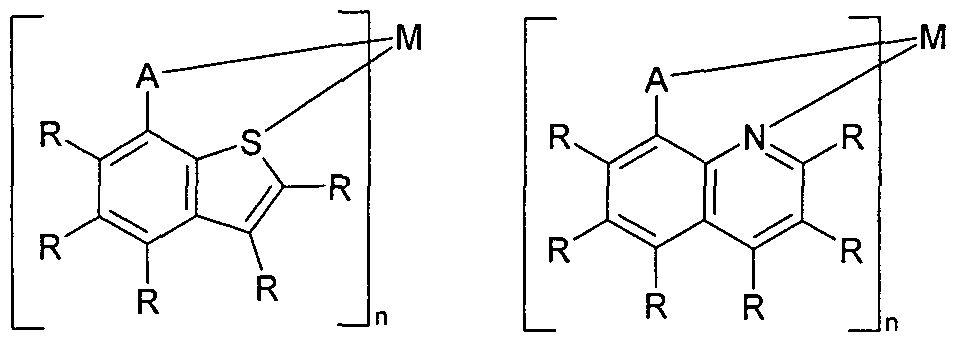
  • Preferred groups A which coordinate to M are selected from the structures of the following formulas (7) to (41), wherein the position indicated by # denotes the bond to the rest of the ligand L and the position to which the group is attached M coordinated, marked by *.
  • a maximum of three symbols X in each group stand for N, more preferably, at most two symbols X in each group stand for N, very particularly preferably at most one symbol X in each group stands for N. More preferably, all symbols X stand for CR.
  • coordinating groups A are carbenes, phosphines, phosphine oxides, phosphine sulfides, amines or imines.
  • carbene ligands An overview of suitable carbene ligands can be found in the literature (FE Hahn, MC Jahnke, Angew Chem, 2008, 120, 3166-3216). Particularly suitable carbenes are the structures of the following formulas (42) to (44),
  • Suitable phosphines, phosphine oxides and phosphine sulfides are the
  • Preferred groups Q are ortho-linked arylene or heteroarylene groups, which may be substituted by one or more radicals R 1 , such as. B. 1, 2-phenylene, 1, 2-pyrrole, etc., 2,2'-linked biaryl or
  • Suitable amines and imines are the structures of the following formulas (56) and (57),
  • the coordinating group A represents a group of the abovementioned formulas (7), (8), (10) to (18), (21) to (40) to ( 49), (53), (54), (56) or (57), if D represents a neutral group.
  • the coordinating group A is a group of the above-mentioned formulas (9), (19), (20), (41) (50) to (52) or (55), when D represents an anionic group.
  • radicals R on each occurrence are identically or differently selected from the group consisting of H, D, F, N (R 1 ) 2 , a straight-chain alkyl group having 1 to 6 C atoms or a branched or cyclic alkyl group having 3 to 10 C atoms, wherein one or more H atoms may be replaced by D or F, or an aromatic or heteroaromatic ring system having 5 to 24 aromatic ring atoms, each of which may be substituted by one or more radicals R 1 ; two adjacent radicals R may also together form a mono- or polycyclic, aliphatic or aromatic ring system.
  • substituents R and R 1 represent a group which also coordinates or binds to the metal M.
  • Preferred coordinating groups R are aryl or heteroaryl groups, for example phenyl or pyridyl, aryl or alkyl cyanides, aryl or alkyl isocyanides, amines or amides, alcohols or alcoholates, thio alcohols or thioalcoholates, phosphines, phosphites, carbonyl functions, carboxylates, carbamides or Aryl or alkyl acetylides.
  • the formulas (58) to (61) show, by way of example, how a substituent R can additionally coordinate to the metal.
  • substituent R can additionally coordinate to the metal.
  • other groups R coordinating with the metal are also accessible, for example other heteroaryl groups, but also phosphines, amines, etc.
  • the coordinating group R can be bonded to the group A.
  • a bridging unit V may also be present which links the ligand L to a further ligand L or L ', so that the ligands have an overall tridentate or tetradentate character.
  • L 'does not represent another ligand but a coordinating group, suitable coordinating groups being the groups of formulas (7) to (57) above.
  • Preferred structures with multidentate ligands are the metal complexes of the following formulas (62) to (67),
  • V preferably represents a single bond or a bridging unit containing 1 to 80 atoms from the third, fourth, fifth and / or sixth main group (group 13, 14, 15 or 16 according to IUPAC) or a 3- to 6-membered homo- or heterocycle which covalently connects the partial ligands L with each other or L with L '.
  • the bridging unit V can also be constructed asymmetrically, ie the combination of V to L or L 'does not have to be identical.
  • the bridging unit V may be neutral or charged.
  • V is neutral.
  • the charge of V is preferably chosen so that a total of a neutral complex is formed. In this case, the preferences mentioned above for the substructure ML n apply to the ligands and n is preferably 2.
  • ligands L ' are separate ligands and non-coordinating groups which are bonded to L via V.
  • Preferred neutral, monodentate ligands U are selected from the group consisting of carbon monoxide, nitrogen monoxide, alkyl cyanides, such as.
  • alkyl cyanides such as.
  • amines such as.
  • Trifluorophosphine trimethylphosphine, tricyclohexylphosphine, tri-tert-butylphosphine, triphenylphosphine, tris (pentafluorophenyl) phosphine, dimethylphenylphosphine, methyldiphenylphosphine, bis (tert-butyl) phenylphosphine, phosphites, such as. For example, trimethyl phosphite, triethyl phosphite, arsines, such as.
  • Carbenes in particular Arduengo carbenes, ethers, thioethers and O- or S-containing heteroaromatics, such as. Furan, benzofuran, thiophene or benzothiophene.
  • Preferred monoanionic, monodentate ligands L ' are selected from hydride, deuteride, the halides F - , CT, Br " and ⁇ , alkyl acetylides, such as, for example, methyl-CsC " , tert-butyl-CsC " , arylacetylidene, such as.
  • Phenyl- C C ⁇ , cyanide, cyanate, isocyanate, thiocyanate, isothiocyanate, aliphatic or aromatic alcoholates, such as, for example, methoxide, ethanolate,
  • Propanolate, so-propanolate, terf-butylate, phenolate, aliphatic or aromatic thioalcoholates such.
  • Carboxylates such as. Acetate, trifluoroacetate, propionate, benzoate,
  • Aryl groups such as. Phenyl, naphthyl, and anionic, nitrogen containing heterocycles, such as pyrrolidone, imidazolide, pyrazolide.
  • the alkyl groups in these groups are preferably C 2 -C 20 -alkyl groups,
  • aryl group is also understood to mean heteroaryl groups. These groups are as defined above.
  • Preferred neutral or monoanionic, bidentate ligands L ' are selected from diamines, such as. B. ethylenediamine, ⁇ , ⁇ , ⁇ ', ⁇ ' -Tetramethyl- ethylenediamine, propylenediamine, ⁇ , ⁇ , ⁇ ', ⁇ ' -Tetramethylpropylendiamin, cis- or trans-diaminocyclohexane, cis- or trans-N, N, N ⁇ N'-tetramethyldi- aminocyclohexane, imines, such as. B.
  • o-phenanthroline diphosphines such.
  • pyridine-2-carboxylic acid quinoline-2-carboxylic acid, glycine, N, N-dimethyl-glycine, alanine, ⁇ , ⁇ -dimethylaminoalanine, salicyliminates derived from salicylimines, such as.
  • the ligand L ' is particularly preferably a neutral, bidentate ligand, in particular a diphosphine.
  • metal complexes according to the invention are the structures listed in the following table:
  • the metal complexes according to the invention can in principle be prepared by various methods. However, the methods described below have been found to be particularly suitable.
  • another object of the present invention is a process for preparing the compounds of formula (1) by reacting the corresponding free ligands L, optionally in deprotonated form, and optionally further ligands L 'with suitable metal salts or metal complexes.
  • the deprotonation reaction of the ligand can be done either in situ, for example when a metal salt with a basic anion is used, or from the ligand, the corresponding anion is prepared from the ligand before the reaction with the metal by deprotonation.
  • Suitable copper starting materials are, for example, copper mesityl, various copper amides, copper phosphides, copper alkoxides, copper acetate, Cu 2 O, etc .
  • Suitable silver starting materials are for example silver-mesityl, various silver-amides, phosphides silver, silver-alkoxides, Ag 2 O, etc .
  • Suitable gold starting materials are for example gold-mesityl, various gold Amides, gold phosphides, gold alkoxides, etc.
  • Suitable zinc reactants are, for example, dimethylzinc, various zinc amides, zinc phosphides, zinc alkoxides, etc.
  • Suitable aluminum starting materials are, for example, trimethylaluminum, triethylaluminum, various combinations thereof
  • an alkali metal salt having a basic anion which, after its protonation, preferably has a low nucleophilic character and is particularly preferably a protonated form of a volatile compound.
  • a metal salt eg, [Cu (MeCN) 4 ] [BF 4 ]
  • Suitable salts for the deprotonation are, for example, sodium tert-butoxide, potassium tert-butoxide, lithium piperidide, bis (trimethylsilyl) amides (eg K [N (SiMe 3 ) 2 ]), etc.
  • the synthesis can be activated, for example, thermally, photochemically and / or by microwave radiation. Likewise, the synthesis can be carried out in an autoclave.
  • the compounds of the invention according to formula (1) can be obtained in high purity, preferably more than 99% (determined by 1 H-NMR and / or HPLC).
  • the compounds according to the invention can also be made soluble by suitable substitution, for example by longer alkyl groups (about 4 to 20 C atoms), in particular branched alkyl groups, or optionally substituted aryl groups, for example xylyl, mesityl or branched terphenyl or quaterphenyl groups become.
  • Such compounds are then dissolved in common organic solvents, such as, for example, toluene or xylene at room temperature in sufficient concentrations.
  • tion soluble in order to process the complexes from solution.
  • These soluble compounds are particularly suitable for processing from solution, for example by printing processes.
  • formulations of the compounds according to the invention are required. These formulations may be, for example, solutions, dispersions or emulsions. It may be preferable to use mixtures of two or more solvents for this purpose.
  • Suitable and preferred solvents are, for example, toluene, anisole, o-, m- or p-xylene, methyl benzoate, mesitylene, tetralin, veratrol, THF, methyl THF, THP, chlorobenzene, dioxane, phenoxytoluene, in particular 3-phenoxytoluene, ( -) - Fenchone, 1, 2,3,5-tetramethylbenzene, 1, 2,4,5-tetramethylbenzene, 1-methylnaphthalene, 2-methylbenzothiazole, 2-phenoxyethanol, 2-pyrrolidinone, 3-methylanisole, 4-methylanisole , 3,4-dimethylanisole, 3,5-dimethylanisole, acetophenone, ⁇ -terpineol, benzothiazole, butyl benzoate, cumene, cyclohexanol, cyclohexanone, cyclohexylbenzene, decalin,
  • a further subject of the present invention is therefore a formulation containing a compound according to the invention and at least one further compound.
  • the further compound may be for example a solvent, in particular one of the abovementioned solvents or a mixture of these solvents.
  • the further compound can also be a further organic or inorganic compound which is likewise used in the electronic device, for example a matrix material. Suitable matrix materials are listed in the background in the context of the organic electroluminescent device.
  • This further compound may also be polymeric.
  • the above-described complexes of the formula (1) and the above-mentioned preferred embodiments can be used in the electronic device as the active component.
  • An electronic device is understood to mean a device which contains anode, cathode and at least one layer, this layer containing at least one organic or organometallic compound.
  • the electronic device according to the invention thus contains anode, cathode and at least one layer which contains at least one compound of the above-mentioned formula (1).
  • preferred electronic devices are selected from the group consisting of organic
  • Electroluminescent devices OLEDs, PLEDs, organic integrated circuits (O-ICs), organic field-effect transistors (O-FETs), organic thin-film transistors (O-TFTs), organic light-emitting transistors (O-LETs), organic solar cells (O-FETs) SCs), organic optical detectors, organic photoreceptors, organic field quench devices (O-FQDs), light-emitting electrochemical cells (LECs) or organic laser diodes (O-lasers), containing in at least one layer at least one compound according to the formula given above (1). Particularly preferred are organic electroluminescent devices.
  • Active components are generally the organic or inorganic materials incorporated between the anode and cathode, for example, charge injection, charge transport or charge blocking materials, but especially emission materials and matrix materials.
  • the compounds according to the invention exhibit particularly good properties as emission material in organic electroluminescent devices.
  • a preferred embodiment of the invention are therefore organic electroluminescent devices.
  • the organic electroluminescent device includes cathode, anode and at least one emitting layer. In addition to these layers, they may also contain further layers, for example one or more hole injection layers, hole transport layers, hole blocking layers, electron transport layers, electron injection layers, exciton blocking layers, electron blocking layers, charge layers, respectively. production layers and / or organic or inorganic p / n transitions.
  • interlayers which have, for example, an exciton-blocking function and / or control the charge balance in the electroluminescent device can be introduced between two emitting layers. It should be noted, however, that not necessarily each of these layers must be present.
  • the organic electroluminescent device can be any organic electroluminescent device.
  • the organic electroluminescent device can be any organic electroluminescent device.
  • multiple emission layers may include multiple emissive layers. If multiple emission layers are present, they preferably have a total of several emission maxima between 380 nm and 750 nm, so that overall white emission results, ie. H.
  • various emitting compounds are used which can fluoresce or phosphoresce. Particular preference is given to three-layer systems, the three layers exhibiting blue, green and orange or red emission (for the basic structure see, for example, WO 2005/011013) or systems having more than three emitting layers. It may also be a hybrid system wherein one or more layers fluoresce and one or more other layers phosphoresce.
  • the organic electroluminescent device contains the compound of the formula (1) or the preferred embodiments listed above as the emitting compound in one or more emitting layers.
  • the compound of the formula (1) When used as an emitting compound in an emitting layer, it is preferably used in combination with one or more matrix materials.
  • Mixture of the compound according to formula (1) and the matrix material contains between 0.1 and 99 vol.%, Preferably between 1 and 90 vol.%, Particularly preferably between 3 and 40 vol.%, In particular between 5 and 15 vol. -% of the compound according to formula (1) based on the total mixture of emitter and matrix material. Accordingly, the mixture contains between 99.9 and 1% by volume, preferably between 99 and 10% by volume, particularly preferably between 97 and 60% by volume, in particular between 95 and 85% by volume of the matrix material based on the total mixture of emitter and matrix material.
  • the matrix material can be used as the matrix material.
  • the triplet level of the matrix material is higher than the triplet level of the emitter. This applies regardless of the emission mechanism of the compounds according to the invention, that is, regardless of whether the compounds show phosphorescence, fluorescence or delayed fluorescence.
  • Suitable matrix materials for the compounds according to the invention are ketones, phosphine oxides, sulfoxides and sulfones, for. B. according to WO 2004/013080, WO 2004/093207, WO 2006/005627 or WO
  • carbazole derivatives e.g. B. CBP (N, N-Biscarbazzolylbiphenyl), m-CBP or in WO 2005/039246, US 2005/0069729, JP 2004/288381, EP 1205527, WO 2008/086851 or US 2009/0134784 disclosed carbazole derivatives, indolocarbazole derivatives , z. B. according to WO 2007/063754 or WO 2008/056746, indenocarbazole derivatives, for. B.
  • a plurality of different matrix materials as a mixture, in particular at least one electron-conducting matrix material and at least one hole-conducting matrix material.
  • a preferred combination is, for example, the use of an aromatic ketone, a triazine derivative or a phosphine oxide derivative with a triarylamine derivative or a carbazole derivative as a mixed matrix for the metal complex according to the invention.
  • Also preferred is the use of a mixture of a charge-transporting matrix material and an electrically inert matrix material, which is not or not significantly involved in charge transport, such. As described in WO 2010/108579.
  • Another preferred embodiment of the compounds according to the invention is as matrix material for emitting compounds, in particular for triplet emitters or for other compounds according to the invention, in an emitting layer. This is especially true when M stands for Zn.
  • the compounds of the invention can also be used in others
  • low work function metals, metal alloys or multilayer structures of various metals are preferable, such as alkaline earth metals, alkali metals, main group metals or lanthanides (eg, Ca, Ba, Mg, Al, In, Mg, Yb, Sm, etc.).
  • alkaline earth metals alkali metals
  • main group metals or lanthanides eg, Ca, Ba, Mg, Al, In, Mg, Yb, Sm, etc.
  • alloys of an alkali metal or alkaline earth metal and silver for example an alloy of magnesium and silver.
  • metals which have a relatively high work function such as, for example, B. Ag, which then usually combinations of metals, such as Mg / Ag, Ca / Ag or Ba / Ag are used. It may also be preferred to introduce between a metallic cathode and the organic semiconductor a thin intermediate layer of a material with a high dielectric constant. Suitable examples of these are alkali metal or alkaline earth metal fluorides, but also the corresponding oxides or carbonates (eg LiF, L 12 O, BaF 2 , MgO, NaF, CsF, CS 2 CO 3, etc.). Likewise for this come organic alkali metal complexes in question, for. B. Liq (lithium quinolinate). The layer thickness of this layer is preferably between 0.5 and 5 nm.
  • the anode high workfunction materials are preferred.
  • the anode has a work function greater than 4.5 eV. Vacuum up.
  • metals with a high redox potential such as Ag, Pt or Au, are suitable for this purpose.
  • electrodes z. B. AI / Ni / NiO, AI / PtO x
  • metal / metal oxide may be preferred, metal / metal oxide.
  • at least one of the electrodes must be transparent or partially transparent to allow either the irradiation of the organic material (O-SC) or the outcoupling of light (OLED / PLED, O-LASER).
  • Preferred anode materials here are conductive mixed metal oxides. Particularly preferred are indium tin oxide (ITO) or indium zinc oxide (IZO). Also preferred are conductive, doped organic materials, in particular conductive doped polymers, for. B.
  • PEDOT PEDOT, PANI or derivatives of these polymers.
  • the device is structured accordingly (depending on the application), contacted and finally hermetically sealed because the life of such devices drastically shortened in the presence of water and / or air.
  • an organic electroluminescent device characterized in that one or more layers are coated with a sublimation process. In this case, 6 mbar, the materials in vacuum sublimation at an initial pressure of usually less than 10 "5 mbar, preferably less than 10" evaporated. It is also possible that the initial pressure is even lower or even higher, for example less than 10 "7 mbar. Also preferred is an organic electroluminescent device, characterized in that one or more layers are coated with the OVPD (Organic Vapor Phase Deposition) method or with the aid of a carrier gas sublimation. The materials are applied at a pressure between 10 "applied 5 mbar and 1 bar.
  • OVPD Organic Vapor Phase Deposition
  • a special case of this method is the OVJP (organic vapor jet printing) method in which the materials are applied directly through a nozzle and patterned (eg. BMS Arnold Appl. Phys. Lett., 2008, 92, 053301)
  • an organic electroluminescent device characterized in that one or more layers of solution, such as by spin coating, or with any printing method, such as For example, screen printing, flexographic printing, offset printing or nozzle printing, but particularly preferably LITI (light-induced thermal imaging, thermal transfer printing) or ink-jet printing (ink jet printing), are required for this purpose Substitution can be obtained.
  • the organic electroluminescent device can also be produced as a hybrid system by forming one or more layers
  • Solution are applied and one or more other layers are evaporated.
  • an emitting layer containing a compound of formula (1) and a solution matrix material and then vacuum evaporate a hole blocking layer and / or an electron transport layer.
  • Organic electroluminescent devices are distinguished by the following surprising advantages over the prior art: 1.
  • Organic electroluminescent devices containing compounds according to formula (1) as emitting materials have a very good lifetime.
  • Organic electroluminescent devices containing compounds according to formula (1) as emitting materials have a very good efficiency.
  • the metal complexes according to the invention also make it possible to obtain organic electroluminescent devices which luminesce in the blue color range.
  • blue luminescence according to the prior art is very difficult to realize with good efficiencies and lifetimes.
  • the complexes according to the invention are also to be realized in particular with copper, which makes it possible to dispense with the rare metals iridium and platinum.
  • the reaction mixture is taken up in 30 ml of dichloromethane and washed 3 times with H 2 O, then the aqueous phase is extracted 3 times with 30 ml of dichloromethane, the organic phase is dried over MgSO 4 , filtered off and concentrated in vacuo.
  • the reaction mixture is taken up in 30 ml of dichloromethane, washed twice with H 2 O and once with concentrated NaCl solution, then the aqueous phase is extracted 3 ⁇ with 30 ml of dichloromethane, the organic phase is dried over MgSO 4 , filtered off and concentrated in vacuo.
  • the reaction The mixture is taken up in 30 ml of dichloromethane and washed 3 times with H 2 O, then the aqueous phase extracted 3x with 30 ml of dichloromethane, the organic phase dried over MgSO 4 , filtered off and concentrated in vacuo.
  • the reaction mixture is taken up in 30 ml of dichloromethane and washed 3 times with H 2 0, then the aqueous phase 3x extracted with 30 ml of dichloromethane, the organic phase dried over MgS0 4 , filtered off and concentrated in vacuo.
  • Step a) In a 20 ml microwave glass vessel, 1, 06 g of N-Boc-6-methyl-2- (1 H-pyrrol-2-yl) -1, 3,6,2-dioxazaborocane-4,8- dion (3.28 mmol), 568 mg 8-bromoquinoline (2.73 mmol), 31 mg Pd (OAc) 2 (0.14 mmol) and 112 mg SPhos (0.28 mmol) were weighed, inerted, 17 ml dioxane added and 5 ml of 3 MK 3 P0 4 solution was added dropwise. The vessel is closed and the contents are stirred in the microwave at 60 ° C for 21 h.
  • the reaction mixture is taken up in 30 ml of dichloromethane, washed twice with H 2 0, the aqueous phase extracted 3 times with 30 ml of dichloromethane, the organic phase dried over MgSO 4 , filtered off and concentrated in vacuo.
  • reaction mixture is taken up in 30 ml DCM and washed 3 times with H 2 O, then the aqueous phase is extracted 3 times with 30 ml DCM each time, the org. Dried phase over MgSO 4 , filtered off and concentrated in vacuo.
  • Example 9 Synthesis of [Cu (7-BTpln) (PPh 3 ) 2 ] To 36.2 mg (0.15 mmol) of 7-BTpln and 76.2 mg (0.29 mmol) of PPh 3 , 26.5 mg of Cu mesityl and 3 ml of toluene are added in a glove box. The result is a yellow solution. This is covered with hexane. It produces yellow crystals. These glow intensely blue under the UV (356nm), the solution also shines intensively blue. Yield: 81%.
  • the luminescence spectrum of the solid has an emission maximum at 483 nm, the spectrum in solution in dichloromethane an emission maximum at 476 nm and the spectrum in polystyrene matrix an emission
  • the luminescence spectrum of the solid has an emission maximum at 487 nm, the spectrum in solution in dichloromethane an emission maximum at 480 nm and the spectrum in polystyrene matrix an emission maximum at 464 nm.
  • the luminescence spectrum of the solid has an emission maximum at 532 nm and the spectrum in polystyrene matrix has an emission maximum at 524 nm.
  • the luminescence spectrum of the solid has an emission maximum at 582 nm.
  • the luminescence spectrum of the solid has an emission maximum at 469 nm, the spectrum in solution in dichloromethane an emission maximum at 468 nm and the spectrum in polystyrene matrix an emission maximum at 457 nm.
  • the luminescence spectrum of the solid has an emission maximum at 645 nm, the spectrum in solution in dichloromethane an emission maximum at 617 nm and the spectrum in polystyrene matrix an emission maximum at 582 nm.
  • the luminescence spectrum of the toluene solution has an emission maximum at 618 nm and the spectrum in polystyrene matrix
  • the luminescence spectrum of the solid has an emission maximum at 506 nm, the spectrum in solution in dichloromethane an emission maximum at 499 nm and the spectrum in polystyrene matrix an emission maximum at 504 nm.
  • the luminescence spectrum of the solid has an emission maximum at 508 nm, the spectrum in solution in dichloromethane an emission maximum at 501 nm and the spectrum in polystyrene matrix an emission maximum at 495 nm.
  • Example 21 Synthesis of [Cu (7-BTpCa) (dppb)]
  • the luminescence spectrum of the solid has an emission maximum at 514 nm and the spectrum in polystyrene matrix has an emission maximum at 518 nm. Production of the OLEDs
  • the following examples introduce the results of different OLEDs.
  • Glass plates with structured ITO indium tin oxide form the substrates onto which the OLEDs are applied.
  • the OLEDs have in principle the following layer structure: substrate / hole transport layer 1 (HTL1) consisting of HTM doped with 3% NDP-9 (commercially available from Novaled), 20 nm / hole transport layer 2 (HTL2) / electron blocking layer (EBL) / Emission layer (EML) / optional hole blocking layer (HBL) / electron transport layer (ETL) / optional electron injection layer (EIL) and finally a cathode.
  • the cathode is formed by a 100 nm thick aluminum layer.
  • the emission layer always consists of at least one matrix material (host material, host material) and an emitting dopant (dopant, emitter), which is admixed to the matrix material or the matrix materials by co-evaporation in a specific volume fraction.
  • the electron transport layer may consist of a mixture of two materials.
  • Table 1 The materials used to make the OLEDs are shown in Table 4.
  • the OLEDs are characterized by default.
  • the electroluminescence spectra, the external quantum efficiency (in%) and the voltage (measured at 300 cd / m 2 in V) are determined from current-voltage-brightness characteristics (IUL characteristic curves).
  • the compounds according to the invention can be used inter alia as emitter materials in the emission layer in OLEDs.
  • the iridium complexes according to the invention can also be processed from solution and lead there to process technology significantly simpler OLEDs, in comparison to the vacuum-processed OLEDs, with nevertheless good properties.
  • the production of such components is based on the production of polymeric light-emitting diodes (PLEDs), which has already been described many times in the literature (eg in WO 2004/037887).
  • the structure is composed of substrate / ITO / PEDOT (80 nm) / interlayer (80 nm) / emission layer (80 nm) / cathode.
  • substrates from Technoprint Sodalimeglas
  • the ITO structure indium tin oxide, a transparent, conductive anode
  • the substrates are cleaned in the clean room with DI water and a detergent (Deconex 15 PF) and then activated by a UV / ozone plasma treatment. Thereafter, in the clean room as a buffer layer, an 80 nm layer of PEDOT (PEDOT is a polythiophene derivative (Baytron P VAI 4083sp.) Of HC Starck, Goslar, as the aqueous Dispersion is supplied) applied by spin coating. The required spin rate depends on the degree of dilution and the specific spin coater geometry (typically 80 nm: 4500 rpm). To remove residual water from the layer, the substrates are baked for 10 minutes at 180 ° C on a hot plate.
  • PEDOT is a polythiophene derivative (Baytron P VAI 4083sp.) Of HC Starck, Goslar, as the aqueous Dispersion is supplied
  • the required spin rate depends on the degree of dilution and the specific spin coater geometry (typically 80 n
  • the interlayer used is for hole injection, in this case HIL-012 from Merck is used.
  • the interlayer can also be replaced by one or more layers, which merely have to fulfill the condition that they will not be peeled off again by the downstream process step of the EML deposition from solution.
  • the emission layer For the production of the emission layer, the
  • inventive emitter dissolved together with the matrix materials in toluene.
  • the typical solids content of such solutions is between 16 and 25 g / L, if, as here, the typical for a device layer thickness of 80 nm is to be achieved by spin coating.
  • the solution-processed devices contain an emission layer made of (polystyrene): M5: M6: Ex. (25%: 25%: 40%: 0%).
  • the emission layer is spin-coated in an inert gas atmosphere, in this case argon, and baked at 130 ° C. for 30 minutes. Finally, a cathode of barium (5 nm) and then
  • Figure 1 Crystal structure of [Cu (7-Tpln) (Xantphos)].
  • Figure 2 Absorption and Luminezenzspektrum of [Cu (7-Tpln) (L ')].
  • FIG. 3 Crystal structure of [Cu (7-BTpln) (dppb)].
  • FIG. 4 Absorption and luminescence spectrum of [Cu (7-BTpln) (L ')].
  • FIG. 5 Crystal structure of [Cu (7-BTpCa) (PPh 3 ) 2 ].
  • FIG. 6 Absorption and luminescence spectrum of [Cu (7-BTpCa) (L ')].
  • FIG. 7 Crystal structure of [Cu (7-phenyl) (xanthphos)].
  • FIG. 8 Absorption and luminescence spectrum of [Cu (7-pyln) (L ')].
  • P (PPh 3 ) 2
  • D dppb.
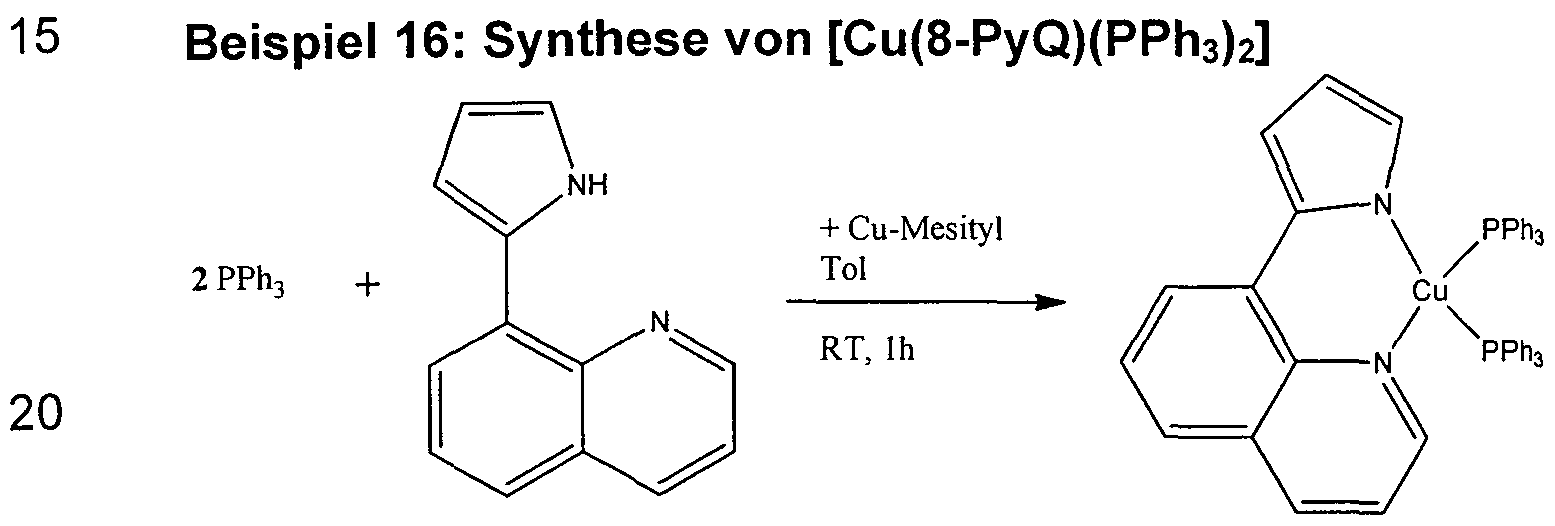
  • FIG. 9 Crystal structure of [Cu (8-PyQ) (dppb)].
  • FIG. 10 Absorption and luminescence spectrum of [Cu (8-PyQ) (L ')].
  • a solution spectrum in dichloromethane
  • b solid spectrum
  • c spectrum in polystyrene matrix

Landscapes

  • Chemical & Material Sciences (AREA)
  • Organic Chemistry (AREA)
  • Engineering & Computer Science (AREA)
  • Materials Engineering (AREA)
  • Inorganic Chemistry (AREA)
  • Health & Medical Sciences (AREA)
  • Life Sciences & Earth Sciences (AREA)
  • Biochemistry (AREA)
  • General Health & Medical Sciences (AREA)
  • Molecular Biology (AREA)
  • Electroluminescent Light Sources (AREA)
  • Plural Heterocyclic Compounds (AREA)

Abstract

Die vorliegende Erfindung betrifft Metallkomplexe sowie elektronische Vorrichtungen, insbesondere organische Elektrolumineszenzvorrichtungen wie z. B. OLED's, die diese Metallkomplexe enthalten. Beansprucht werden Verbindung gemäß Formel (1): M(L)n(L')m, wobei die Verbindung der allgemeinen Formel (1) eine Teilstruktur M(L)n der Formel (2) enthält, und L ein monoanionischer Ligand ist Formel (2). Die Variablen sind wie folgt definiert: M ist Cu, Ag, Au, Ru, Zn, AI, Ga oder In; A ist eine koordinierende Gruppe, die an M koordiniert und die durch einen oder mehrere Substituenten R substituiert sein kann; die anderen Variablen sind wie in den Ansprüchen definiert.

Description

AROMATISCHE AZABICYCLISCHE KOMPLEXVERBINDUNGEN MIT CU, AG, AU, ZN, AL ZUR VERWENDUNG IN
ELEKTROLUMINESZENSVORRICHTUNGEN
Die vorliegende Erfindung betrifft Metallkomplexe, welche sich für den Einsatz als Emitter in organischen Elektrolumineszenzvorrichtungen eignen, sowie organische Elektrolumineszenzvorrichtungen, welche diese Metall- komplexe enthalten.
Der Aufbau organischer Elektrolumineszenzvorrichtungen (OLEDs), in denen organische Halbleiter als funktionelle Materialien eingesetzt werden, ist beispielsweise in US 4539507, US 5151629, EP 0676461 und WO 98/27136 beschrieben. Dabei werden als emittierende Materialien häufig metallorganische Komplexe eingesetzt, die Phosphoreszenz statt Fluoreszenz zeigen (M. A. Baldo et al., Appl. Phys. Lett. 1999, 75, 4-6) oder die Singulett-Harvesting (thermisch aktivierte verzögerte Fluoreszenz) zeigen (z. B. WO 2010/006681 ). Aus quantenmechanischen Gründen ist unter Verwendung derartiger Verbindungen als Emitter eine bis zu vierfache Energie- und Leistungseffizienz möglich. Generell gibt es bei OLEDs immer noch Verbesserungsbedarf, insbesondere im Hinblick auf Effizienz, Betriebsspannung und Lebensdauer. Dies gilt insbesondere für OLEDs, welche im kürzerwelligen Bereich, also grün und insbesondere blau, emittieren.
Gemäß dem Stand der Technik werden in phosphoreszierenden OLEDs als Emitter insbesondere Iridium- und Platinkomplexe eingesetzt. Insbesondere für blaue Emission sind jedoch noch Verbesserungen dieser Komplexe wünschenswert. Weiterhin sind Iridium und Platin seltene
Metalle, so dass es für einen ressourcenschonenden Einsatz wünschenswert wäre, Metallkomplexe basierend auf weiter verbreiteten Metallen einsetzen zu können und die Verwendung von Ir bzw. Pt vermeiden zu können, und dennoch hohe Effizienzen erreichen zu können.
Aus WO 2006/061 182 sind Iridium- und Platinkomplexe bekannt, welche ortho-metallierte Liganden enthalten, welche mit dem Metall ein 6-Ring- Chelat bilden. Komplexe mit Kupfer, Silber, Gold, Ruthenium oder Hauptgruppenelementen sind nicht offenbart.
NICHT EINGEREICHT AM ANMELDEDATUM
ist bei jedem Auftreten gleich oder verschieden CR oder N; ist bei jedem Auftreten gleich oder verschieden CR oder N; oder genau eine Gruppe Y steht für -CR=CR- oder -CR=N-, so dass ein heteroaromatischer Sechsring entsteht; ist bei jedem Auftreten gleich oder verschieden N, O oder S, mit der Maßgabe, dass Z für N steht, wenn eine Gruppe Y für -CR=CR- oder -CR=N- steht; ist eine koordinierende Gruppe, die an M koordiniert und die durch einen oder mehrere Substituenten R substituiert sein kann; ist bei jedem Auftreten gleich oder verschieden H, D, F, Cl, Br, I, N(R1)2, P(R1)2, CN, N02, OH, COOH, C(=O)N(R )2, Si(R )3, B(OR1)2, C(=O)R1, P(=O)(R1)2, S(=O)R1, S(=O)2R1, OSO2R1, eine geradkettige Alkyl-, Alkoxy- oder Thioalkoxygruppe mit 1 bis 20 C-Atomen oder eine Alkenyl- oder Alkinylgruppe mit 2 bis 20 C-Atomen oder eine verzweigte oder cyclische Alkyl-, Alkoxy- oder Thioalkoxygruppe mit 3 bis 20 C-Atomen, die jeweils mit einem oder mehreren Resten R1 substituiert sein kann, wobei eine oder mehrere nicht benachbarte CH2-Gruppen durch R1C=CR1, C^C, Si(R1)2, C=O, NR1, O, S oder CONR1 ersetzt sein können und wobei ein oder mehrere H-Atome durch D, F, Cl, Br, I oder CN ersetzt sein können, oder ein aromatisches oder heteroaromatisches Ringsystem mit 5 bis 60 aromatischen Ringatomen, das jeweils durch einen oder mehrere Reste R substituiert sein kann, oder eine Aryloxy- oder Heteroaryloxygruppe mit 5 bis 40 aromatischen Ringatomen, die durch einen oder mehrere Reste R substituiert sein kann, oder eine Aralkyl- oder Heteroaralkyl- gruppe mit 5 bis 40 aromatischen Ringatomen, die durch einen oder mehrere Reste R1 substituiert sein kann, oder eine Diarylamino- gruppe, Diheteroarylaminogruppe oder Arylheteroarylaminogruppe mit 10 bis 40 aromatischen Ringatomen, welche durch einen oder mehrere Reste R1 substituiert sein kann; dabei können zwei benachbarte Reste R auch miteinander ein mono- oder polycyclisches, aromatisches oder aliphatisches Ringsystem bilden; ist bei jedem Auftreten gleich oder verschieden H, D, F, Cl, Br, I, N(R2)2, P(R2)2, CN, N02> Si(R2)3, B(OR2)2, C(=0)R2, P(=O)(R2)2, S(=0)R2, S(=0)2R2, OS02R2, eine geradkettige Alkyl-, Alkoxy- oder Thioalkoxygruppe mit 1 bis 20 C-Atomen oder eine Alkenyl- oder Alkinylgruppe mit 2 bis 20 C-Atomen oder eine verzweigte oder cyclische Alkyl-, Alkoxy- oder Thioalkoxygruppe mit 3 bis 20 C- Atomen, die jeweils mit einem oder mehreren Resten R2 substituiert sein kann, wobei eine oder mehrere nicht benachbarte CH2-Gruppen durch R2C=CR2, CEC, Si(R2)2, C=O, NR2, O, S oder CONR2 ersetzt sein können und wobei ein oder mehrere H-Atome durch D, F, Cl, Br, I, CN oder N02 ersetzt sein können, oder ein aromatisches oder heteroaromatisches Ringsystem mit 5 bis 60 aromatischen Ringatomen, das jeweils durch einen oder mehrere Reste R2 substituiert sein kann, oder eine Aryloxy- oder Heteroaryloxygruppe mit 5 bis 40 aromatischen Ringatomen, die durch einen oder mehrere Reste R2 substituiert sein kann, oder eine Aralkyl- oder Heteroaralkylgruppe mit 5 bis 40 aromatischen Ringatomen, die durch einen oder mehrere Reste R2 substituiert sein kann, oder eine Diarylaminogruppe, Diheteroarylaminogruppe oder Arylheteroarylaminogruppe mit 10 bis 40 aromatischen Ringatomen, welche durch einen oder mehrere Reste R2 substituiert sein kann; dabei können zwei oder mehrere benachbarte Reste R2 miteinander ein mono- oder polycyclisches, aromatisches oder aliphatisches Ringsystem bilden; ist bei jedem Auftreten gleich oder verschieden H, D, F oder ein aliphatischer, aromatischer und/oder heteroaromatischer Kohlenwasserstoffrest mit 1 bis 20 C-Atomen, in dem auch ein oder mehrere H-Atome durch F ersetzt sein können; dabei können zwei oder mehrere Substituenten R2 auch miteinander ein mono- oder polycyclisches, aromatisches oder aliphatisches Ringsystem bilden; ist gleich oder verschieden bei jedem Auftreten ein beliebiger
Coligand bzw. ist eine koordinierende Gruppe, wenn L' über V mit L verknüpft ist; n ist 1 , 2 oder 3; m ist 0, 1 , 2, 3 oder 4; dabei können auch ein oder zwei Substituenten R oder R1 an dem
Liganden L zusätzlich an das Metall M binden und so einen tri- oder tetra- dentaten Liganden bilden; weiterhin kann der Ligand L mit einem Liganden L' über eine oder zwei verbrückende Einheiten V verknüpft sein und so einen linearen tri- oder tetradentaten Liganden bilden.
Wie oben beschrieben, ist L ein monoanionischer Ligand. Dies bezieht sich erfindungsgemäß jedoch nur auf die Struktur des in Formel (2) gezeichneten Liganden, das heißt, entweder die koordinierende Einheit A oder das koordinierende Atom Z ist negativ geladen. Wenn zusätzlich Substituenten R und/oder R1 an M koordinieren, so können diese auch negativ geladen sein, so dass insgesamt ein mehrfach anionischer Ligand entsteht. Dasselbe gilt, wenn L' eine koordinierende Gruppe ist, die über eine Gruppe V an L gebunden ist. Auch diese kann negativ geladen sein, so dass insgesamt ein mehrfach anionischer Ligand entsteht.
Dabei werden die Indizes n und m so gewählt, dass die Koordinationszahl am Metall M insgesamt der für dieses Metall üblichen Koordinationszahl entspricht. Dies ist für die Metalle der vorliegenden Erfindung üblicher- weise die Koordinationszahl 2, 3, 4 oder 6. Es ist generell bekannt, dass Metallkoordinationsverbindungen abhängig vom Metall und von der Oxidationsstufe des Metalls unterschiedliche Koordinationszahlen aufweisen, also eine unterschiedliche Anzahl von Liganden binden. Da die bevorzugten Koordinationszahlen von Metallen bzw. Metallionen in ver- schiedenen Oxidationsstufen zum allgemeinen Fachwissen des Fachmanns auf dem Gebiet der metallorganischen Chemie bzw. der Koordinationschemie gehören, ist es für den Fachmann ein Leichtes, je nach Metall und dessen Oxidationsstufe und je nach genauer Struktur des Liganden L eine geeignete Anzahl Liganden zu verwenden und somit die Indizes n und m geeignet zu wählen. Dabei deutet der Kreis in der Struktur der Formel (2) ein aromatisches bzw. heteroaromatisches System an, wie in der organischen Chemie üblich. Auch wenn in dieser Struktur vereinfachend zwei Kreise eingezeichnet sind, bedeutet dies jedoch dennoch, dass es sich um ein einziges heteroaromatisches System handelt.
Eine Arylgruppe im Sinne dieser Erfindung enthält 6 bis 40 C-Atome; eine Heteroarylgruppe im Sinne dieser Erfindung enthält 2 bis 40 C-Atome und mindestens ein Heteroatom, mit der Maßgabe, dass die Summe aus C-Atomen und Heteroatomen mindestens 5 ergibt. Die Heteroatome sind bevorzugt ausgewählt aus N, O und/oder S. Dabei wird unter einer Arylgruppe bzw. Heteroarylgruppe entweder ein einfacher aromatischer Cyclus, also Benzol, bzw. ein einfacher heteroaromatischer Cyclus, beispielsweise Pyridin, Pyrimidin, Thiophen, etc., oder eine kondensierte Aryl- oder Heteroarylgruppe, beispielsweise Naphthalin, Anthracen, Phenanthren, Chinolin, Isochinolin, etc., verstanden.
Ein aromatisches Ringsystem im Sinne dieser Erfindung enthält 6 bis 60 C-Atome im Ringsystem. Ein heteroaromatisches Ringsystem im Sinne dieser Erfindung enthält 1 bis 60 C-Atome und mindestens ein Heteroatom im Ringsystem, mit der Maßgabe, dass die Summe aus C-Atomen und Heteroatomen mindestens 5 ergibt. Die Heteroatome sind bevorzugt ausgewählt aus N, O und/oder S. Unter einem aromatischen oder heteroaromatischen Ringsystem im Sinne dieser Erfindung soll ein System verstanden werden, das nicht notwendigerweise nur Aryl- oder Heteroaryl- gruppen enthält, sondern in dem auch mehrere Aryl- oder Heteroaryl- gruppen durch eine nicht-aromatische Einheit (bevorzugt weniger als 10 % der von H verschiedenen Atome), wie z. B. ein C-, N- oder O-Atom oder eine Carbonylgruppe, unterbrochen sein können. So sollen beispielsweise auch Systeme wie 9,9'-Spirobifluoren, 9,9-Diarylfluoren, Triarylamin, Diarylether, Stilben, etc. als aromatische Ringsysteme im Sinne dieser Erfindung verstanden werden, und ebenso Systeme, in denen zwei oder mehrere Arylgruppen beispielsweise durch eine lineare oder cyclische Alkylgruppe oder durch eine Silylgruppe unterbrochen sind. Weiterhin sollen Systeme, in denen zwei oder mehrere Aryl- oder Heteroarylgruppen direkt aneinander gebunden sind, wie z. B. Biphenyl oder Terphenyl, ebenfalls als aromatisches bzw. heteroaromatisches Ringsystem verstanden werden.
Unter einer cyclischen Alkyl-, Alkoxy- oder Thioalkoxygruppe im Sinne dieser Erfindung wird eine monocyclische, eine bicyclische oder eine poly- cyclische Gruppe verstanden.
Im Rahmen der vorliegenden Erfindung werden unter einer Ci- bis C40- Alkylgruppe, in der auch einzelne H-Atome oder Ch^-Gruppen durch die oben genannten Gruppen substituiert sein können, beispielsweise die Reste Methyl, Ethyl, n-Propyl, i-Propyl, Cyclopropyl, n-Butyl, i-Butyl, s-Butyl, t-Butyl, Cyclobutyl, 2-Methylbutyl, n-Pentyl, s-Pentyl, tert-Pentyl, 2- Pentyl, neo-Pentyl, Cyclopentyl, n-Hexyl, s-Hexyl, tert-Hexyl, 2-Hexyl, 3- Hexyl, neo-Hexyl, Cyclohexyl, 1-Methylcyclopentyl, 2-Methylpentyl, n-Heptyl, 2-Heptyl, 3-Heptyl, 4-Heptyl, Cycloheptyl, 1-Methylcyclohexyl, n-Octyl, 2-Ethylhexyl, Cyclooctyl, 1-Bicyclo[2,2,2]octyl, 2-Bicyclo[2,2,2]- octyl, 2-(2,6-Dimethyl)octyl, 3-(3,7-Dimethyl)octyl, Adamantyl, Trifluor- methyl, Pentafluorethyl oder 2,2,2-Trifluorethyl verstanden. Unter einer Alkenylgruppe werden beispielsweise Ethenyl, Propenyl, Butenyl,
Pentenyl, Cyclopentenyl, Hexenyl, Cyclohexenyl, Heptenyl, Cycloheptenyl, Octenyl, Cyclooctenyl oder Cyclooctadienyl verstanden. Unter einer Alkinylgruppe werden beispielsweise Ethinyl, Propinyl, Butinyl, Pentinyl, Hexinyl, Heptinyl oder Octinyl verstanden. Unter einer C bis C 0-Alkoxy- gruppe werden beispielsweise Methoxy, Trifluormethoxy, Ethoxy, n- Propoxy, i-Propoxy, n-Butoxy, i-Butoxy, s-Butoxy, t-Butoxy oder 2-Methyl- butoxy verstanden.
Unter einem aromatischen oder heteroaromatischen Ringsystem mit 5 - 60 aromatischen Ringatomen, welches noch jeweils mit den oben genannten Resten R substituiert sein kann und welches über beliebige Positionen am Aromaten bzw. Heteroaromaten verknüpft sein kann, werden beispielsweise Gruppen verstanden, die abgeleitet sind von Benzol, Naphthalin, Anthracen, Benzanthracen, Phenanthren, Benzophenanthren, Pyren, Chrysen, Perylen, Fluoranthen, Benzfluoranthen, Naphthacen, Pentacen, Benzpyren, Biphenyl, Biphenylen, Terphenyl, Terphenylen, Fluoren, Spiro- bifluoren, Dihydrophenanthren, Dihydropyren, Tetrahydropyren, eis- oder trans-lndenofluoren, eis- oder trans-Monobenzoindenofluoren, eis- oder trans-Dibenzoindenofluoren, Truxen, Isotruxen, Spirotruxen, Spiroiso- truxen, Furan, Benzofuran, Isobenzofuran, Dibenzofuran, Thiophen, Benzothiophen, Isobenzothiophen, Dibenzothiophen, Pyrrol, Indol, Iso- indol, Carbazol, Indolocarbazol, Indenocarbazol, Pyridin, Chinolin, Iso- chinolin, Acridin, Phenanthridin, Benzo-5,6-chinolin, Benzo-6,7-chinolin, Benzo-7,8-chinolin, Phenothiazin, Phenoxazin, Pyrazol, Indazol, Imidazol, Benzimidazol, Naphthimidazol, Phenanthrimidazol, Pyridimidazol, Pyrazin- imidazol, Chinoxalinimidazol, Oxazol, Benzoxazol, Naphthoxazol,
Anthroxazol, Phenanthroxazol, Isoxazol, 1 ,2-Thiazol, 1 ,3-Thiazol, Benzo- thiazol, Pyridazin, Benzopyridazin, Pyrimidin, Benzpyrimidin, Chinoxalin, 1 ,5-Diazaanthracen, 2,7-Diazapyren, 2,3-Diazapyren, 1 ,6-Diazapyren, 1 ,8-Diazapyren, 4,5-Diazapyren, 4,5,9, 10-Tetraazaperylen, Pyrazin, Phenazin, Phenoxazin, Phenothiazin, Fluorubin, Naphthyridin, Aza- carbazol, Benzocarbolin, Phenanthrolin, 1 ,2,3-Triazol, 1 ,2,4-Triazol,
Benzotriazol, 1 ,2,3-Oxadiazol, 1 ,2,4-Oxadiazol, 1 ,2,5-Oxadiazol, 1 ,3,4- Oxadiazol, 1 ,2,3-Thiadiazol, 1 ,2,4-Thiadiazol, 1 ,2,5-Thiadiazol, 1 ,3,4-Thia- diazol, 1 ,3,5-Triazin, ,2,4-Triazin, 1 ,2,3-Triazin, Tetrazol, 1 ,2,4,5-Tetrazin, 1 ,2,3,4-Tetrazin, 1 ,2,3,5-Tetrazin, Purin, Pteridin, Indolizin und Benzo- thiadiazol.
Bevorzugt sind Verbindungen gemäß Formel (1), dadurch gekennzeichnet, dass diese nicht geladen, d. h. elektrisch neutral, sind. Dies wird auf einfache Weise dadurch erreicht, dass die Ladungen der Liganden L und L' so gewählt werden, dass sie die Ladung des komplexierten Metallatoms M kompensieren. Wie oben beschrieben, ist der Ligand L erfindungsgemäß monoanionisch.
In einer bevorzugten Ausführungsform ist M ausgewählt aus der Gruppe bestehend aus Cu(l), Ag(l), Au(l), Ru(ll), Zn(ll), Al(lll), Ga(lll) und In(lll), besonders bevorzugt Cu(l) oder Zn(ll), ganz besonders bevorzugt Cu(l). Dabei ist die Koordinationszahl von Cu(l) üblicherweise 2 oder 4, von Ag(l) 2, 3 oder 4, von Au(l) 2, von Ru(ll) 6, von Zn(ll) 4 oder 6 und von Al(lll), Ga(lll) und ln(lll) 6. ln einer Ausführungsform der Erfindung ist M dreifach koordiniert und der Index n = 1. In diesem Fall ist m = 1 , und es ist noch ein weiterer monodentater Ligand U an M koordiniert.
In einer weiteren Ausführungsform der Erfindung ist M ein tetrakoordi- niertes Metall, und der Index n steht für 1 oder 2. Wenn der Index n = 1 ist, sind noch ein bidentater oder zwei monodentate Liganden L', bevorzugt ein bidentater Ligand L', an das Metall M koordiniert. Wenn der Index n = 2 ist, ist der Index m = 0. In einer weiteren Ausführungsform der Erfindung ist M ein hexakoordi- niertes Metall, und der Index n steht für 1 , 2 oder 3. Wenn der Index n = 1 ist, sind noch zwei bidentate oder vier monodentate oder ein bidentater und zwei monodentate Liganden L', bevorzugt zwei bidentate Liganden L', an das Metall M koordiniert. Wenn der Index n = 2 ist, sind noch ein bidentater oder zwei monodentate Liganden L', bevorzugt ein bidentater Ligand L', an das Metall M koordiniert. Wenn der Index n = 3 ist, ist der Index m = 0.
Entsprechendes gilt, wenn L' kein eigenständiger Ligand ist, sondern eine koordinierende Gruppe, die über eine Gruppe V an L gebunden ist.
In einer bevorzugten Ausführungsform der Erfindung steht maximal eine Gruppe X für N, und die anderen Gruppen X stehen für CR. Besonders bevorzugt stehen alle Gruppen X für CR.
In einer weiteren bevorzugten Ausführungsform der Erfindung steht maximal eine Gruppe Y für N. Besonders bevorzugt stehen entweder beide Gruppen Y für CR, oder eine Gruppe Y steht für CR, und die andere Gruppe Y steht für -CR=CR-.
Besonders bevorzugt steht insgesamt maximal eine der Gruppen X oder Y für N, oder alle Gruppen X und eine Gruppe Y stehen für CR und die andere Gruppe Y steht gleichzeitig für -CR=N-. Ganz besonders bevorzugt stehen alle Gruppen X und eine Gruppe Y für CR, und die andere Gruppe γ steht gleichzeitig für CR oder -CR=CR-. Bevorzugte Teilstrukturen der Formeln (2) sind daher die Teilstrukturen der folgenden Formeln (3) bis (6),
Figure imgf000012_0001
Formel (3) Formel (4)
Figure imgf000012_0002
Formel (5) Formel (6) wobei die verwendeten Symbole und Indizes die oben genannten
Bedeutungen aufweisen. Dabei koordiniert der Ligand in Formel (3) über ein negativ geladenes
Stickstoffatom und in den Formel (4), (5) und (6) über ein neutrales Sauerstoff- bzw. Schwefel- bzw. Stickstoffatom. Entsprechend ist in der Teilstruktur der Formel (3) A eine neutrale Gruppe, die an M koordiniert, während A in den Teilstrukturen der Formeln (4), (5) und (6) eine negativ geladene Gruppe darstellt, die an M koordiniert.
Wenn Reste R miteinander einen Ring bilden, so können sich daraus Strukturen ergeben, wie sie exemplarisch in den folgenden Formeln (3a), (4a), (5a), (6a) und (6b) dargestellt sind:
Figure imgf000013_0001
Formel (6b) wobei die verwendeten Symbole und Indizes die oben genannten
Bedeutungen aufweisen.
Die oben genannten Strukturen der Formeln (3a) bis (6b) stellen nur exemplarisch die Ringbildung dar. Ganz analog sind andere Ringbildungen zwischen benachbarten Resten R möglich, beispielsweise unter Bildung eines aliphatischen Rings.
Bevorzugt steht A für eine Heteroarylgruppe mit 5 bis 14 aromatischen Ringatomen, die über ein Heteroatom an M koordiniert und die durch einen oder mehrere Reste R substituiert sein kann. Besonders bevorzugt hat die Heteroarylgruppe 5 bis 0 aromatische Ringatome, ganz
besonders bevorzugt 5 oder 6 aromatische Ringatome, und kann jeweils durch einen oder mehrere Reste R substituiert sein.
Bevorzugte Gruppen A, die an M koordinieren, sind ausgewählt aus den Strukturen der folgenden Formeln (7) bis (41), wobei die mit # gekennzeichnete Position jeweils die Bindung an den Rest des Liganden L kennzeichnet und die Position, an der die Gruppe an M koordiniert, durch * gekennzeichnet ist.
Figure imgf000014_0001
Formel (7) Formel (8) Formel (9) Formel (10)
Figure imgf000014_0002
Formel (11) Formel (12) Formel (13) Formel (14)
Figure imgf000014_0003
Formel (15) Formel (16) Formel (17) Formel (18)
Figure imgf000014_0004
Formel (19) Formel (20) Formel (21 ) Formel (22)
Figure imgf000014_0005
Formel (23) Formel (24) Formel (25) Formel (26)
Figure imgf000014_0006
Formel (27) Formel (28) Formel <29) Formel (30) Formel (31)
Figure imgf000015_0001
Formel (32) Formel (34)
Formel (33)
Formel (35) Formel (36)
Figure imgf000015_0002
Formel (37) Formel (39)
Formel (38) Formel (40) Formel (41 ) wobei X und R dieselbe Bedeutung haben, wie oben beschrieben, und weiterhin gilt:
D ist O", S" NR", PR~, NR2, PR2, COO" S03 ", -C(=0)R, -CR(=NR) oder -N(=CR2).
Bevorzugt stehen maximal drei Symbole X in jeder Gruppe für N, beson- ders bevorzugt stehen maximal zwei Symbole X in jeder Gruppe für N, ganz besonders bevorzugt steht maximal ein Symbol X in jeder Gruppe für N. Insbesondere bevorzugt stehen alle Symbole X für CR.
Weitere bevorzugte koordinierende Gruppen A sind Carbene, Phosphine, Phosphinoxide, Phosphinsulfide, Amine oder Imine.
Eine Übersicht über geeignete Carbenliganden kann der Literatur entnommen werden (F. E. Hahn, M. C. Jahnke, Angew. Chem. 2008, 120, 3166-3216). Besonders geeignete Carbene sind die Strukturen der folgenden Formeln (42) bis (44),
Figure imgf000016_0001
Formel (42) Formel (43) Formel (44) wobei die verwendeten Symbole ie oben genannten Bedeutungen aufweisen.
Geeignete Phosphine, Phosphinoxide und Phosphinsulfide sind die
Strukturen der folgenden Formeln (45) bis (55),
Figure imgf000016_0002
Formel 45) Formel (46) Formel (47) Formel (48) Formel (49)
Figure imgf000016_0003
Formel (50) Formel (51 ) Formel (52) Formel (53) Formel (54) Rs
Np-s
#
Formel (55) wobei die verwendeten Symbole die oben genannten Bedeutungen aufweisen und Q für eine bivalente Gruppe steht, welche bei jedem Auftreten gleich oder verschieden ausgewählt ist aus der Gruppe bestehend aus einer geradkettigen Alkylengruppe mit 1 bis 8 C-Atomen oder einer
Alkenyl- oder Alkinylgruppe mit 2 bis 8 C-Atomen oder einer verzweigten oder cyclischen Alkylengruppe mit 3 bis 8 C-Atomen, die jeweils durch einen oder mehrere Reste R1 substituiert sein kann und wobei eine oder mehrere nicht benachbarte CH2-Gruppen durch R1C=CR1 , C=C, Si(R1)2, C=0, NR1, O, S, BR1 oder CONR1 ersetzt sein können, oder einem bivalenten aromatischen oder heteroaromatischen Ringsystem mit 5 bis 20 aromatischen Ringatomen, das jeweils durch einen oder mehrere Reste R1 substituiert sein kann, oder einer bivalenten Aryloxy- oder Heteroaryloxy- gruppe mit 5 bis 20 aromatischen Ringatomen, die durch einen oder mehrere Reste R substituiert sein kann, oder einer bivalenten Aralkyl- oder Heteroaralkylgruppe mit 5 bis 20 aromatischen Ringatomen, die durch einen oder mehrere Reste R1 substituiert sein kann, oder einer Kombination aus zwei der vorstehend genannten Gruppen.
Bevorzugte Gruppen Q sind ortho-verknüpfte Arylen- bzw. Heteroarylen- gruppen, die durch einen oder mehrere Reste R1 substituiert sein können, wie z. B. 1 ,2-Phenylen, 1 ,2-Pyrrol, etc., 2,2'-verknüpfte Biaryl- bzw.
Biheteroarylgruppen, wie z. B. 2,2'-Biphenyl, kondensierte Arylen- bzw. Heterorarylengruppen, wie z. B. ,7-lndol, oder Alkylengruppen mit 1 bis 3 C-Atomen, in denen CH2-Gruppen auch durch R1C=CR1, C=O, NR1, O oder S ersetzt sein können. Diese Gruppen können jeweils durch einen oder mehrere Reste R1 substituiert sein. Geeignete Amine und Imine sind die Strukturen der folgenden Formeln (56) und (57),
R
Q=N Q-N-R
# #
Formel (56) Formel (57) wobei die verwendeten Symbole die oben genannten Bedeutungen aufweisen.
Wie oben beschrieben, ist der Ligand L insgesamt negativ geladen. Es ist daher bevorzugt, wenn in der Struktur der Formel (3) die koordinierende Gruppe A für eine Gruppe der oben genannten Formeln (7), (8), (10) bis (18), (21) bis (40) bis (49), (53), (54), (56) oder (57), sofern D eine neutrale Gruppe darstellt, steht. Weiterhin ist es bevorzugt, wenn in der Struktur der oben genannten Formel (4), (5) und (6) die koordinierende Gruppe A für eine Gruppe der oben genannten Formeln (9), (19), (20), (41), (50) bis (52) oder (55), sofern D eine anionische Gruppe darstellt, steht.
In einer bevorzugten Ausführungsform der Erfindung sind die Substitu- enten R bei jedem Auftreten gleich oder verschieden ausgewählt aus der Gruppe bestehend aus H, D, F, Br, I, N(R1)2, CN, Si(R1)3, B(OR1)2, C(=0)R1, einer geradkettigen Alkylgruppe mit 1 bis 10 C-Atomen oder einer Alkenylgruppe mit 2 bis 10 C-Atomen oder einer verzweigten oder cyclischen Alkylgruppe mit 3 bis 10 C-Atomen, die jeweils mit einem oder mehreren Resten R1 substituiert sein kann, wobei ein oder mehrere H-Atome durch D oder F ersetzt sein können, oder einem aromatischen oder heteroaromatischen Ringsystem mit 5 bis 30 aromatischen Ringatomen, das jeweils durch einen oder mehrere Reste R1 substituiert sein kann; dabei können zwei benachbarte Reste R auch miteinander ein mono- oder polycyclisches, aliphatisches Ringsystem bilden. Besonders bevorzugt sind diese Reste R bei jedem Auftreten gleich oder verschieden ausgewählt aus der Gruppe bestehend aus H, D, F, N(R1)2, einer geradkettigen Alkylgruppe mit 1 bis 6 C-Atomen oder einer verzweigten oder cyclischen Alkylgruppe mit 3 bis 10 C-Atomen, wobei ein oder mehrere H-Atome durch D oder F ersetzt sein können, oder einem aromatischen oder heteroaromatischen Ringsystem mit 5 bis 24 aromatischen Ringatomen, das jeweils durch einen oder mehrere Reste R1 substituiert sein kann; dabei können zwei benachbarte Reste R auch miteinander ein mono- oder polycyclisches, aliphatisches oder aromatisches Ringsystem bilden.
Weiterhin ist es möglich, dass ein oder zwei Substituenten R bzw. R1 eine Gruppe darstellen, die ebenfalls an das Metall M koordiniert bzw. bindet. Bevorzugte koordinierende Gruppen R sind Aryl- bzw. Heteroarylgruppen, beispielsweise Phenyl oder Pyridyl, Aryl- oder Alkylcyanide, Aryl- oder Alkylisocyanide, Amine oder Amide, Alkohole oder Alkoholate, Thio- alkohole oder Thioalkoholate, Phosphine, Phosphite, Carbonylfunktionen, Carboxylate, Carbamide oder Aryl- oder Alkylacetylide.
Hier sind beispielsweise die Teilstrukturen ML der folgenden Formeln (58) bis (61) zugänglich:
Figure imgf000019_0001
wobei die verwendeten Symbole und Indizes die gleichen Bedeutungen aufweisen, wie oben beschrieben.
Die Formeln (58) bis (61) zeigen exemplarisch, wie ein Substituent R zusätzlich an das Metall koordinieren kann. Ganz analog sind ohne weiteres erfinderisches Zutun auch andere an das Metall koordinierende Gruppen R zugänglich, beispielsweise andere Heteroarylgruppen, aber auch Phosphine, Amine, etc.. Ebenso kann die koordinierende Gruppe R an die Gruppe A gebunden sein.
Wie oben beschrieben, kann auch statt einem der Reste R eine verbrückende Einheit V vorhanden sein, die den Liganden L mit einem weiteren Liganden L bzw. L' verknüpft, so dass die Liganden insgesamt dreizähnigen oder vierzähnigen Charakter aufweisen. Es können auch zwei solcher verbrückenden Einheiten V vorhanden sein. Dies führt zur Bildung makrocyclischer Liganden. In diesen Fällen steht L' nicht für einen weiteren Liganden, sondern für eine koordinierende Gruppe, wobei geeignete koordinierende Gruppen hier die Gruppen der oben genannten Formeln (7) bis (57) sind.
Bevorzugte Strukturen mit mehrzähnigen Liganden sind die Metallkomplexe der folgenden Formeln (62) bis (67),
Figure imgf000020_0001
Formel (62) Formel (63) Formel (64)
Figure imgf000020_0002
Formel (65) Forme, (66) Forme| (67) wobei die verwendeten Symbole die oben genannten Bedeutungen aufweisen, wobei V bevorzugt eine Einfachbindung oder eine verbrückende Einheit darstellt, enthaltend 1 bis 80 Atome aus der dritten, vierten, fünften und/oder sechsten Hauptgruppe (Gruppe 13, 14, 15 oder 16 gemäß IUPAC) oder einen 3- bis 6-gliedrigen Homo- oder Heterocyclus, die die Teilliganden L miteinander oder L mit L' miteinander kovalent verbindet. Dabei kann die verbrückende Einheit V auch unsymmetrisch aufgebaut sein, d. h. die Verknüpfung von V zu L bzw. L' muss nicht identisch sein. Die verbrückende Einheit V kann neutral oder geladen sein. Bevorzugt ist V neutral. Dabei wird die Ladung von V bevorzugt so gewählt, dass insgesamt ein neutraler Komplex entsteht. Dabei gelten für die Liganden die oben für die Teilstruktur MLn genannten Bevorzugungen und n ist bevorzugt 2.
Die genaue Struktur und chemische Zusammensetzung der Gruppe V hat keinen wesentlichen Einfluss auf die elektronischen Eigenschaften des Komplexes, da die Aufgabe dieser Gruppe im Wesentlichen darin liegt, durch die Verbrückung von zwei Liganden L miteinander bzw. von L mit L' die chemische und thermische Stabilität der Komplexe zu erhöhen. Geeignete Gruppen V sind gleich oder verschieden bei jedem Auftreten gewählt aus der Gruppe bestehend aus BR1, B(R1)2 ~, C(R1)2, C(=0), Si(R1)2, NR1 , PR1, P(R1)2 +, P(=0)(R2), O, S oder eine Einheit gemäß Formel 68 bis 77
Figure imgf000021_0001
Formel (68) Formel (69) Formel (70) Formel (71) 5)
Figure imgf000021_0002
Formel (76) Formel (77) wobei die gestrichelten Bindungen jeweils die Bindung zu den Teilliganden L bzw. L' andeuten, W bei jedem Auftreten gleich oder verschieden ausgewählt ist aus der Gruppe bestehend aus C(R1)2, BR1, Si(R1)2, NR1, PR1, P(=0)R1, O, S, 1 ,2-Vinylen, welches jeweils mit einem oder mehreren Resten R2 substituiert sein kann, und Y1 bei jedem Auftreten gleich oder verschieden für C(R2)2, N(R2), O oder S steht und die weiteren verwendeten Symbole jeweils die oben aufgeführten Bedeutungen haben.
Im Folgenden werden bevorzugte Liganden L' beschrieben, wie sie in Formel (1) vorkommen, wenn es sich dabei um separate Liganden und nicht um koordinierende Gruppen, die über V an L gebunden sind, handelt. Die Liganden L' sind bevorzugt neutrale oder monoanionische Liganden, besonders bevorzugt neutrale Liganden. Sie können monodentat oder bidentat sein und sind bevorzugt bidentat, weisen also bevorzugt zwei Koordinationsstellen auf. Wie oben beschrieben, können die Liganden L' auch über eine verbrückende Gruppe V an L gebunden sein.
Bevorzugte neutrale, monodentate Liganden U sind ausgewählt aus der Gruppe bestehend aus Kohlenmonoxid, Stickstoffmonoxid, Alkylcyaniden, wie z. B. Acetonitril, Arylcyaniden, wie z. B. Benzonitril, Alkylisocyaniden, wie z. B. Methylisonitril, Arylisocyaniden, wie z. B. Benzoisonitril, Aminen, wie z. B. Trimethylamin, Triethylamin, Morpholin, Phosphinen, insbesondere Halogenphosphine, Trialkylphosphine, Triarylphosphine oder Alkylarylphosphine, wie z. B. Trifluorphosphin, Trimethylphosphin, Tricyclo- hexylphosphin, Tri-terf-butylphosphin, Triphenylphosphin, Tris(pentafluor- phenyl)phosphin, Dimethylphenylphosphin, Methyldiphenylphosphin, Bis(tert-butyl)phenylphosphin, Phosphiten, wie z. B. Trimethylphosphit, Triethylphosphit, Arsinen, wie z. B. Trifluorarsin, Trimethylarsin, Tricyclo- hexylarsin, Tri-fe/f-butylarsin, Triphenylarsin, Tris(pentafluorphenyl)arsin, Stibinen, wie z. B. Trifluorstibin, Trimethylstibin, Tricyclohexylstibin, Tr -tert- butylstibin, Triphenylstibin, Tris(pentafluorphenyl)stibin, stickstoffhaltigen Heterocyclen, wie z. B. Pyridin, Pyridazin, Pyrazin, Pyrimidin, Triazin,
Carbenen, insbesondere Arduengo-Carbenen, Ethern, Thioethern und O- bzw. S-haltigen Heteroaromaten, wie z. B. Furan, Benzofuran, Thiophen oder Benzothiophen. Bevorzugte monoanionische, monodentate Liganden L' sind ausgewählt aus Hydrid, Deuterid, den Halogeniden F~, CT, Br" und Γ, Alkylacetyliden, wie z. B. Methyl-CsC", tert-Butyl-CsC", Arylacetyliden, wie z. B. Phenyl- C=C~, Cyanid, Cyanat, Isocyanat, Thiocyanat, Isothiocyanat, aliphatischen oder aromatischen Alkoholaten, wie z. B. Methanolat, Ethanolat,
Propanolat, so-Propanolat, terf-Butylat, Phenolat, aliphatischen oder aromatischen Thioalkoholaten, wie z. B. Methanthiolat, Ethanthiolat, Propanthiolat, /so-Propanthiolat, ferf-Thiobutylat, Thiophenolat, Amiden, wie z. B. Dimethylamid, Diethylamid, Di-/'so-propylamid, Morpholid,
Carboxylaten, wie z. B. Acetat, Trifluoracetat, Propionat, Benzoat,
Arylgruppen, wie z. B. Phenyl, Naphthyl, und anionischen, Stickstoff- haltigen Heterocyclen, wie Pyrrolid, Imidazolid, Pyrazolid. Dabei sind die Alkylgruppen in diesen Gruppen bevorzugt C -C2o-Alkylgruppen,
besonders bevorzugt Ci-Ci0-Alkylgruppen, ganz besonders bevorzugt CrC4-Alkylgruppen. Unter einer Arylgruppe werden auch Heteroaryl- gruppen verstanden. Diese Gruppen sind wie oben definiert.
Bevorzugte neutrale oder monoanionische, bidentate Liganden L' sind ausgewählt aus Diaminen, wie z. B. Ethylendiamin, Ν,Ν,Ν''-Tetramethyl- ethylendiamin, Propylendiamin, Ν,Ν,Ν''-Tetramethylpropylendiamin, cis- oder trans-Diaminocyclohexan, eis- oder trans-N,N,N\N'-Tetramethyldi- aminocyclohexan, Iminen, wie z. B. 2-[1-(Phenylimino)ethyl]pyridin, 2-[1-(2- Methylphenylimino)ethyl]pyridin, 2-[1-(2,6-Di-/'so-propylphenylimino)ethyl]- pyridin, 2-[1-(Methylimino)ethyl]pyridin, 2-[1-(ethylimino)ethyl]pyridin, 2-[1- (/so-Propylimino)ethyl]pyridin, 2-[1-(Terf-Butylimino)ethyl]pyridin, Diiminen, wie z. B. 1 ,2-Bis(methylimino)ethan, 1 ,2-Bis(ethylimino)ethan, 1 ,2-Bis(/so- propylimino)ethan, 1 ,2-Bis(ferf-butylimino)ethan, 2,3-Bis(methylimino)- butan, 2,3-Bis(ethylimino)butan, 2,3-Bis(/'so-propylimino)butan, 2,3-Bis(terf- butylimino)butan, ,2-Bis(phenylimino)ethan, 1 ,2-Bis(2-methylphenyl- imino)ethan, 1 ,2-Bis(2,6-di-/'so-propylphenylimino)ethan, 1 ,2-Bis(2,6-di-fe/f- butylphenylimino)ethan, 2,3-Bis(phenylimino)butan, 2,3-Bis(2-methyl- phenylimino)butan, 2,3-Bis(2,6-di-/'so-propylphenylimino)butan, 2,3-Bis- (2,6-di-fe f-butylphenylimino)butan, Heterocyclen enthaltend zwei Stickstoffatome, wie z. B. 2,2'-Bipyridin, o-Phenanthrolin, Diphosphinen, wie z. B. Bis(diphenylphosphino)methan, Bis(diphenylphosphino)ethan, Bis(di- phenylphosphino)propan, Bis(diphenylphosphino)butan, Bis(dimethyl- phosphino)methan, Bis(dimethylphosphino)ethan, Bis(dimethylphosphino)- propan, Bis(diethylphosphino)methan, Bis(diethylphosphino)ethan, Bis(di- ethylphosphino)propan, Bis(di-teri-butylphosphino)methan, Bis(di-reAf- butylphosphino)ethan, Bis(terf-butylphosphino)propan, ,3-Diketonaten abgeleitet von ,3-Diketonen, wie z. B. Acetylaceton, Benzoylaceton, 1 ,5-Diphenylacetylaceton, Dibenzoylmethan, Bis(1 ,1 ,1 -trifluoracetyl)- methan, 3-Ketonaten abgeleitet von 3-Ketoestern, wie z. B. Acetessig- säureethylester, Carboxylate, abgeleitet von Aminocarbonsäuren, wie z. B. Pyridin-2-carbonsäure, Chinolin-2-carbonsäure, Glycin, N,N-Dimethyl- glycin, Alanin, Ν,Ν-Dimethylaminoalanin, Salicyliminaten abgeleitet von Salicyliminen, wie z. B. Methylsalicylimin, Ethylsalicylimin, Phenylsalicyl- imin, Dialkoholaten abgeleitet von Dialkoholen, wie z. B. Ethylenglykol, 1 ,3-PropylengIykol und Dithiolaten abgeleitet von Dithiolen, wie z. B.
1 ,2-Ethylendithiol, 1 ,3-Propylendithiol.
Besonders bevorzugt handelt es sich bei dem Liganden L' um einen neutralen, bidentaten Liganden, insbesondere um ein Diphosphin.
Die oben genannten bevorzugten Ausführungsformen sind beliebig miteinander kombinierbar. In einer besonders bevorzugten Ausführungsform der Erfindung gelten die oben genannten bevorzugten Ausführungsformen gleichzeitig.
Beispiele für erfindungsgemäße Metallkomplexe sind die in der folgenden Tabelle aufgeführten Strukturen:
Figure imgf000024_0001
Figure imgf000025_0001
Figure imgf000026_0001
Figure imgf000027_0001
Figure imgf000028_0001
Figure imgf000029_0001
Figure imgf000030_0001

Figure imgf000031_0001
Die erfindungsgemäßen Metallkomplexe sind prinzipiell durch verschiedene Verfahren darstellbar. Es haben sich jedoch die im Folgenden beschriebenen Verfahren als besonders geeignet herausgestellt.
Daher ist ein weiterer Gegenstand der vorliegenden Erfindung ein Verfahren zur Herstellung der Verbindungen gemäß Formel (1) durch Umsetzung der entsprechenden freien Liganden L, gegebenenfalls in deproto- nierter Form, und gegebenenfalls weiterer Liganden L' mit geeigneten Metallsalzen oder Metallkomplexen. Die Deprotonierungsreaktion des Liganden kann entweder in situ erfolgen, beispielsweise wenn ein Metallsalz mit einem basischen Anion eingesetzt wird, oder aus dem Liganden wird bereits vor der Reaktion mit dem Metall durch Deprotonierung das entsprechende Anion hergestellt.
Soll die Deprotonierung des Liganden in situ erfolgen, wird beispielsweise ein Metallkomplex mit einem basischen Liganden, der nach seiner Proto- nierung bevorzugt einen wenig nukleophilen Charakter besitzt, verwendet. Geeignete Kupfer-Edukte sind beispielsweise Kupfer-Mesityl, verschiedene Kupfer-Amide, Kupfer-Phosphide, Kupfer-Alkoxide, Kupfer-Acetat, Cu2O, etc.. Geeignete Silber-Edukte sind beispielsweise Silber-Mesityl, verschiedene Silber-Amide, Silber-Phosphide, Silber-Alkoxide, Ag2O, etc.. Geeignete Gold-Edukte sind beispielsweise Gold-Mesityl, verschiedene Gold-Amide, Gold-Phosphide, Gold-Alkoxide, etc.. Geeignete Zink-Edukte sind beispielsweise Dimethylzink, verschiedene Zink-Amide, Zink- Phosphide, Zink-Alkoxide etc.. Geeignete Aluminium-Edukte sind beispielsweise Trimethylaluminium, Triethylaluminium, verschiedene
Aluminium-Alkoxide, etc..
Soll die Deprotonierung des Liganden vor der Umsetzung mit dem Metall M erfolgen, wird bevorzugt ein Alkalisalz mit basischem Anion, das nach seiner Protonierung bevorzugt einen wenig nukleophilen Charakter besitzt und besonders bevorzugt in protonierter Form eine flüchtige Verbindung ist, verwendet. Dadurch wird das entsprechende Alkali-Salz des Liganden erzeugt, welches dann mit einem Metallsalz (z. B. [Cu(MeCN)4][BF4]) zum Metallkomplex umgesetzt wird. Geeignete Salze für die Deprotonierung sind beispielsweise Natrium-tert-butanolat, Kalium-tert-butanolat, Lithium- piperidid, Bis(trimethylsilyl)amide (z. B. K[N(SiMe3)2]), etc..
Dabei kann die Synthese beispielsweise auch thermisch, photochemisch und/oder durch Mikrowellenstrahlung aktiviert werden. Ebenso kann die Synthese im Autoklaven durchgeführt werden.
Durch diese Verfahren, gegebenenfalls gefolgt von Aufreinigung, wie z. B. Umkristallisation, Sublimation oder, falls erforderlich, Chromatographie, lassen sich die erfindungsgemäßen Verbindungen gemäß Formel (1) in hoher Reinheit, bevorzugt mehr als 99 % (bestimmt mittels 1H-NMR und/oder HPLC) erhalten.
Die erfindungsgemäßen Verbindungen können auch durch geeignete Substitution, beispielsweise durch längere Alkylgruppen (ca. 4 bis 20 C- Atome), insbesondere verzweigte Alkylgruppen, oder gegebenenfalls substituierte Arylgruppen, beispielsweise Xylyl-, Mesityl- oder verzweigte Ter- phenyl- oder Quaterphenylgruppen, löslich gemacht werden. Solche Verbindungen sind dann in gängigen organischen Lösemitteln, wie beispiels- weise Toluol oder Xylol bei Raumtemperatur in ausreichender Konzentra- tion löslich, um die Komplexe aus Lösung verarbeiten zu können. Diese löslichen Verbindungen eignen sich besonders gut für die Verarbeitung aus Lösung, beispielsweise durch Druckverfahren.
Für die Verarbeitung der erfindungsgemäßen Verbindungen aus flüssiger Phase, beispielsweise durch Spin-Coating oder durch Druckverfahren, sind Formulierungen der erfindungsgemäßen Verbindungen erforderlich. Diese Formulierungen können beispielsweise Lösungen, Dispersionen oder Emulsionen sein. Es kann bevorzugt sein, hierfür Mischungen aus zwei oder mehr Lösemitteln zu verwenden. Geeignete und bevorzugte Lösemittel sind beispielsweise Toluol, Anisol, o-, m- oder p-Xylol, Methyl- benzoat, Mesitylen, Tetralin, Veratrol, THF, Methyl-THF, THP, Chlorbenzol, Dioxan, Phenoxytoluol, insbesondere 3-Phenoxytoluol, (-)- Fenchon, 1 ,2,3,5-Tetramethylbenzol, 1 ,2,4,5-Tetramethylbenzol, 1-Methyl- naphthalin, 2-Methylbenzothiazol, 2-Phenoxyethanol, 2-Pyrrolidinon, 3- Methylanisol, 4-Methylanisol, 3,4-Dimethylanisol, 3,5-Dimethylanisol, Acetophenon, α-Terpineol, Benzothiazol, Butylbenzoat, Cumol, Cyclo- hexanol, Cyclohexanon, Cyclohexylbenzol, Decalin, Dodecylbenzol, Ethylbenzoat, Indan, Methylbenzoat, NMP, p-Cymol, Phenetol, 1 ,4-Di- isopropylbenzol, Dibenzylether, Diethylenglycolbutylmethylether, Tri- ethylenglycolbutylmethylether, Diethylenglycoldibutylether, Triethylen- glycoldimethylether, Diethylenglycolmonobutylether, Tripropyleneglycol- dimethylether, Tetraethyleneglycoldimethylether, 2-lsopropylnaphthalin, Pentylbenzol, Hexylbenzol, Heptylbenzol, Octylbenzol, 1 ,1-Bis(3,4-di- methylphenyl)ethan oder Mischungen dieser Lösemittel.
Ein weiterer Gegenstand der vorliegenden Erfindung ist daher eine Formulierung, enthaltend eine erfindungsgemäße Verbindung und mindestens eine weitere Verbindung. Die weitere Verbindung kann beispielsweise ein Lösemittel sein, insbesondere eines der oben genannten Lösemittel oder eine Mischung dieser Lösemittel. Die weitere Verbindung kann aber auch eine weitere organische oder anorganische Verbindung sein, die ebenfalls in der elektronischen Vorrichtung eingesetzt wird, beispielsweise ein Matrixmaterial. Geeignete Matrixmaterialien sind hinten im Zusammenhang mit der organischen Elektrolumineszenzvornchtung aufgeführt. Diese weitere Verbindung kann auch polymer sein. Die oben beschriebenen Komplexe gemäß Formel (1) bzw. die oben aufgeführten bevorzugten Ausführungsformen können in der elektronischen Vorrichtung als aktive Komponente verwendet werden. Unter einer elektronischen Vorrichtung wird eine Vorrichtung verstanden, welche Anode, Kathode und mindestens eine Schicht enthält, wobei diese Schicht mindestens eine organische bzw. metallorganische Verbindung enthält. Die erfindungsgemäße elektronische Vorrichtung enthält also Anode, Kathode und mindestens eine Schicht, welche mindestens eine Verbindung der oben aufgeführten Formel (1) enthält. Dabei sind bevorzugte elektronische Vorrichtungen ausgewählt aus der Gruppe bestehend aus organischen
Elektrolumineszenzvorrichtungen (OLEDs, PLEDs), organischen integrierten Schaltungen (O-ICs), organischen Feld-Effekt-Transistoren (O-FETs), organischen Dünnfilmtransistoren (O-TFTs), organischen lichtemittierenden Transistoren (O-LETs), organischen Solarzellen (O-SCs), organischen optischen Detektoren, organischen Photorezeptoren, organischen Feld-Quench-Devices (O-FQDs), lichtemittierenden elektrochemischen Zellen (LECs) oder organischen Laserdioden (O-Laser), enthaltend in mindestens einer Schicht mindestens eine Verbindung gemäß der oben aufgeführten Formel (1). Besonders bevorzugt sind organische Elektrolumineszenzvorrichtungen. Aktive Komponenten sind generell die organischen oder anorganischen Materialien, welche zwischen Anode und Kathode eingebracht sind, beispielsweise Ladungsinjektions-, Ladungstransport- oder Ladungsblockiermaterialien, insbesondere aber Emissionsmaterialien und Matrixmaterialien. Die erfindungsgemäßen Ver- bindungen zeigen besonders gute Eigenschaften als Emissionsmaterial in organischen Elektrolumineszenzvorrichtungen. Eine bevorzugte Ausführungsform der Erfindung sind daher organische Elektrolumineszenz- vorrichtungen. Die organische Elektrolumineszenzvorrichtung enthält Kathode, Anode und mindestens eine emittierende Schicht. Außer diesen Schichten kann sie noch weitere Schichten enthalten, beispielsweise jeweils eine oder mehrere Lochinjektionsschichten, Lochtransportschichten, Lochblockierschichten, Elektronentransportschichten, Elektroneninjektionsschichten, Exzitonenblockierschichten, Elektronenblockierschichten, Ladungs- erzeugungsschichten und/oder organische oder anorganische p/n-Über- gänge. Ebenso können zwischen zwei emittierende Schichten Interlayers eingebracht sein, welche beispielsweise eine Excitonen-blockierende Funktion aufweisen und/oder die Ladungsbalance in der Elektrolumineszenzvorrichtung steuern. Es sei aber darauf hingewiesen, dass nicht notwendigerweise jede dieser Schichten vorhanden sein muss.
Dabei kann die organische Elektrolumineszenzvorrichtung eine
emittierende Schicht enthalten, oder sie kann mehrere emittierende Schichten enthalten. Wenn mehrere Emissionsschichten vorhanden sind, weisen diese bevorzugt insgesamt mehrere Emissionsmaxima zwischen 380 nm und 750 nm auf, so dass insgesamt weiße Emission resultiert, d. h. in den emittierenden Schichten werden verschiedene emittierende Verbindungen verwendet, die fluoreszieren oder phosphoreszieren können. Insbesondere bevorzugt sind Dreischichtsysteme, wobei die drei Schichten blaue, grüne und orange oder rote Emission zeigen (für den prinzipiellen Aufbau siehe z. B. WO 2005/011013) bzw. Systeme, welche mehr als drei emittierende Schichten aufweisen. Es kann sich auch um ein Hybrid-System handeln, wobei eine oder mehrere Schichten fluoreszieren und eine oder mehrere andere Schichten phosphoreszieren.
In einer bevorzugten Ausführungsform der Erfindung enthält die organische Elektrolumineszenzvorrichtung die Verbindung gemäß Formel (1) bzw. die oben aufgeführten bevorzugten Ausführungsformen als emittierende Verbindung in einer oder mehreren emittierenden Schichten.
Wenn die Verbindung gemäß Formel (1) als emittierende Verbindung in einer emittierenden Schicht eingesetzt wird, wird sie bevorzugt in Kombination mit einem oder mehreren Matrixmaterialien eingesetzt. Die
Mischung aus der Verbindung gemäß Formel (1) und dem Matrixmaterial enthält zwischen 0.1 und 99 Vol.-%, vorzugsweise zwischen 1 und 90 Vol.-%, besonders bevorzugt zwischen 3 und 40 Vol.-%, insbesondere zwischen 5 und 15 Vol.-% der Verbindung gemäß Formel (1) bezogen auf die Gesamtmischung aus Emitter und Matrixmaterial. Entsprechend enthält die Mischung zwischen 99.9 und 1 Vol.-%, vorzugsweise zwischen 99 und 10 Vol.-%, besonders bevorzugt zwischen 97 und 60 Vol.-%, insbesondere zwischen 95 und 85 Vol.-% des Matrixmaterials bezogen auf die Gesamtmischung aus Emitter und Matrixmaterial.
Als Matrixmaterial können generell alle Materialien eingesetzt werden, die gemäß dem Stand der Technik als Matrixmaterialien für Triplettemitter bekannt sind. Bevorzugt ist das Triplett-Niveau des Matrixmaterials höher als das Triplett-Niveau des Emitters. Dies gilt unabhängig vom Emissionsmechanismus der erfindungsgemäßen Verbindungen, also unabhängig davon, ob die Verbindungen Phosphoreszenz, Fluoreszenz oder verzögerte Fluoreszenz zeigen.
Geeignete Matrixmaterialien für die erfindungsgemäßen Verbindungen sind Ketone, Phosphinoxide, Sulfoxide und Sulfone, z. B. gemäß WO 2004/013080, WO 2004/093207, WO 2006/005627 oder WO
2010/006680, Triarylamine, Carbazolderivate, z. B. CBP (N,N-Biscarba- zolylbiphenyl), m-CBP oder die in WO 2005/039246, US 2005/0069729, JP 2004/288381 , EP 1205527, WO 2008/086851 oder US 2009/0134784 offenbarten Carbazolderivate, Indolocarbazolderivate, z. B. gemäß WO 2007/063754 oder WO 2008/056746, Indenocarbazolderivate, z. B.
gemäß WO 20 0/136 09 oder WO 201 /000455, Azacarbazole, z. B. gemäß EP 1617710, EP 1617711 , EP 1731584, JP 2005/347160, bipolare Matrixmaterialien, z. B. gemäß WO 2007/137725, Silane, z. B. gemäß WO 2005/111172, Azaborole oder Boronester, z. B. gemäß WO 2006/117052, Diazasilolderivate, z. B. gemäß WO 2010/054729, Diazaphospholderivate, z. B. gemäß WO 2010/054730, Triazinderivate, z. B. gemäß WO
2010/015306, WO 2007/063754 oder WO 2008/056746, Zinkkomplexe, z. B. gemäß EP 652273 oder WO 2009/062578, Dibenzofuranderivate, z. B. gemäß WO 2009/148015, oder verbrückte Carbazolderivate, z. B. gemäß US 2009/0136779, WO 2010/050778, WO 2011/042107 oder WO 2011/088877.
Es kann auch bevorzugt sein, mehrere verschiedene Matrixmaterialien als Mischung einzusetzen, insbesondere mindestens ein elektronenleitendes Matrixmaterial und mindestens ein lochleitendes Matrixmaterial. Eine bevorzugte Kombination ist beispielsweise die Verwendung eines aroma- tischen Ketons, eines Triazin-Derivats oder eines Phosphinoxid-Derivats mit einem Triarylamin-Derivat oder einem Carbazol-Derivat als gemischte Matrix für den erfindungsgemäßen Metallkomplex. Ebenso bevorzugt ist die Verwendung einer Mischung aus einem ladungstransportierenden Matrixmaterial und einem elektrisch inerten Matrixmaterial, welches nicht bzw. nicht in wesentlichem Maße am Ladungstransport beteiligt ist, wie z. B. in WO 2010/108579 beschrieben.
Weiterhin bevorzugt ist es, eine Mischung aus einem Triplettemitter und einer erfindungsgemäßen Verbindung zusammen mit einer Matrix einzusetzen.
Eine weitere bevorzugte Anwendungsform der erfindungsgemäßen Verbindungen ist als Matrixmaterial für emittierende Verbindungen, insbesondere für Triplettemitter oder für andere erfindungsgemäße Verbindungen, in einer emittierenden Schicht. Dies gilt insbesondere, wenn M für Zn steht. Die erfindungsgemäßen Verbindungen lassen sich auch in anderen
Funktionen in der elektronischen Vorrichtung einsetzen, beispielsweise als Lochtransportmaterial in einer Lochinjektions- oder -transportschicht, als Ladungserzeugungsmaterial oder als Elektronenblockiermaterial. Als Kathode sind Metalle mit geringer Austrittsarbeit, Metalllegierungen oder mehrlagige Strukturen aus verschiedenen Metallen bevorzugt, wie beispielsweise Erdalkalimetalle, Alkalimetalle, Hauptgruppenmetalle oder Lanthanoide (z. B. Ca, Ba, Mg, AI, In, Mg, Yb, Sm, etc.). Weiterhin eignen sich Legierungen aus einem Alkali- oder Erdalkalimetall und Silber, bei- spielsweise eine Legierung aus Magnesium und Silber. Bei mehrlagigen Strukturen können auch zusätzlich zu den genannten Metallen weitere Metalle verwendet werden, die eine relativ hohe Austrittsarbeit aufweisen, wie z. B. Ag, wobei dann in der Regel Kombinationen der Metalle, wie beispielsweise Mg/Ag, Ca/Ag oder Ba/Ag verwendet werden. Es kann auch bevorzugt sein, zwischen einer metallischen Kathode und dem organischen Halbleiter eine dünne Zwischenschicht eines Materials mit einer hohen Dielektrizitätskonstante einzubringen. Hierfür kommen beispielsweise Alkalimetall- oder Erdalkalimetallfluoride, aber auch die entsprechenden Oxide oder Carbonate in Frage (z. B. LiF, L12O, BaF2, MgO, NaF, CsF, CS2CO3, etc.). Ebenso kommen hierfür organische Alkali- metallkomplexe in Frage, z. B. Liq (Lithiumchinolinat). Die Schichtdicke dieser Schicht beträgt bevorzugt zwischen 0.5 und 5 nm.
Als Anode sind Materialien mit hoher Austrittsarbeit bevorzugt. Bevorzugt weist die Anode eine Austrittsarbeit größer 4.5 eV vs. Vakuum auf. Hierfür sind einerseits Metalle mit hohem Redoxpotential geeignet, wie beispielsweise Ag, Pt oder Au. Es können andererseits auch Metall/Metalloxid- Elektroden (z. B. AI/Ni/NiOx, AI/PtOx) bevorzugt sein. Für einige Anwendungen muss mindestens eine der Elektroden transparent oder teiltransparent sein, um entweder die Bestrahlung des organischen Materials (O-SC) oder die Auskopplung von Licht (OLED/PLED, O- LASER) zu ermöglichen. Bevorzugte Anodenmaterialien sind hier leitfähige gemischte Metalloxide. Besonders bevorzugt sind Indium-Zinn-Oxid (ITO) oder Indium-Zink-Oxid (IZO). Bevorzugt sind weiterhin leitfähige, dotierte organische Materialien, insbesondere leitfähige dotierte Polymere, z. B.
PEDOT, PANI oder Derivate dieser Polymere.
In den weiteren Schichten können generell alle Materialien verwendet werden, wie sie gemäß dem Stand der Technik für die Schichten verwendet werden, und der Fachmann kann ohne erfinderisches Zutun jedes dieser Materialien in einer elektronischen Vorrichtung mit den erfindungsgemäßen Materialien kombinieren.
Die Vorrichtung wird entsprechend (je nach Anwendung) strukturiert, kontaktiert und schließlich hermetisch versiegelt, da sich die Lebensdauer derartiger Vorrichtungen bei Anwesenheit von Wasser und/oder Luft drastisch verkürzt.
Weiterhin bevorzugt ist eine organische Elektrolumineszenzvorrichtung, dadurch gekennzeichnet, dass eine oder mehrere Schichten mit einem Sublimationsverfahren beschichtet werden. Dabei werden die Materialien in Vakuum-Sublimationsanlagen bei einem Anfangsdruck von üblicherweise kleiner 10"5 mbar, bevorzugt kleiner 10"6 mbar aufgedampft. Es ist auch möglich, dass der Anfangsdruck noch geringer oder noch höher ist, beispielsweise kleiner 10"7 mbar. Bevorzugt ist ebenfalls eine organische Elektrolumineszenzvorrichtung, dadurch gekennzeichnet, dass eine oder mehrere Schichten mit dem OVPD (Organic Vapour Phase Deposition) Verfahren oder mit Hilfe einer Trägergassublimation beschichtet werden. Dabei werden die Materialien bei einem Druck zwischen 10"5 mbar und 1 bar aufgebracht. Ein Spezialfall dieses Verfahrens ist das OVJP (Organic Vapour Jet Printing) Verfahren, bei dem die Materialien direkt durch eine Düse aufgebracht und so strukturiert werden (z. B. M. S. Arnold et al., Appl. Phys. Lett. 2008, 92, 053301). Weiterhin bevorzugt ist eine organische Elektrolumineszenzvorrichtung, dadurch gekennzeichnet, dass eine oder mehrere Schichten aus Lösung, wie z. B. durch Spincoating, oder mit einem beliebigen Druckverfahren, wie z. B. Siebdruck, Flexodruck, Offsetdruck oder Nozzle-Printing, besonders bevorzugt aber LITI (Light Induced Thermal Imaging, Thermo- transferdruck) oder Ink-Jet Druck (Tintenstrahldruck), hergestellt werden. Hierfür sind lösliche Verbindungen nötig, welche beispielsweise durch geeignete Substitution erhalten werden.
Die organische Elektrolumineszenzvorrichtung kann auch als Hybrid- system hergestellt werden, indem eine oder mehrere Schichten aus
Lösung aufgebracht werden und eine oder mehrere andere Schichten aufgedampft werden. So ist es beispielsweise möglich, eine emittierende Schicht enthaltend eine Verbindung gemäß Formel (1) und ein Matrixmaterial aus Lösung aufzubringen und darauf eine Lochblockierschicht und/oder eine Elektronentransportschicht im Vakuum aufzudampfen.
Diese Verfahren sind dem Fachmann generell bekannt und können von ihm ohne Probleme auf organische Elektrolumineszenzvorrichtungen enthaltend Verbindungen gemäß Formel (1 ) bzw. die oben aufgeführten bevorzugten Ausführungsformen angewandt werden.
Die erfindungsgemäßen elektronischen Vorrichtungen, insbesondere organische Elektrolumineszenzvorrichtungen, zeichnen sich durch folgende überraschende Vorteile gegenüber dem Stand der Technik aus: 1. Organische Elektrolumineszenzvorrichtungen enthaltend Verbindungen gemäß Formel (1) als emittierende Materialien weisen eine sehr gute Lebensdauer auf. . Organische Elektrolumineszenzvorrichtungen enthaltend Verbindungen gemäß Formel (1) als emittierende Materialien weisen eine sehr gute Effizienz auf.
3. Mit den erfindungsgemäßen Metallkomplexen sind auch organische Elektrolumineszenzvorrichtungen zugänglich, welche im blauen Farbbereich lumineszieren. Insbesondere blaue Lumineszenz ist gemäß dem Stand der Technik nur sehr schwierig mit guten Effizienzen und Lebensdauern zu verwirklichen.
4. Die erfindungsgemäßen Komplexe sind insbesondere auch mit Kupfer zu realisieren, was es ermöglicht, auf die seltenen Metalle Iridium und Platin zu verzichten.
Diese oben genannten Vorteile gehen nicht mit einer Verschlechterung der weiteren elektronischen Eigenschaften einher.
Die Erfindung wird durch die nachfolgenden Beispiele näher erläutert, ohne sie dadurch einschränken zu wollen. Der Fachmann kann aus den Schilderungen ohne erfinderisches Zutun weitere erfindungsgemäße Verbindungen herstellen und somit die Erfindung im gesamten beanspruchten Bereich ausführen.
Beispiele:
Die nachfolgenden Synthesen werden, sofern nicht anders angegeben, unter einer Schutzgasatmosphäre in getrockneten Lösungsmitteln durchgeführt. Die Metallkomplexe werden zusätzlich unter Ausschluss von Licht gehandhabt. Die Lösungsmittel und Reagenzien können z.B. von Sigma- ALDRICH bzw. ABCR bezogen werden. Teil 1 : Ligandensynthesen
Beis iel 1 : Synthese des Liganden 7-BTpln
Figure imgf000041_0001
In einem 70 ml Autoklaven werden 446,5 mg benzo[b]thiophen-2-ylboron- säure (2,51 mmol), 554,2 mg 7-lodindol (2,28 mmol), 20,9 mg [Pd2(dba)3] (0,023 mmol) und 15,3 mg PCy3 (0,055 mmol) eingewogen, inertisiert, 20 ml Dioxan zugegeben und 3,05 ml 1 ,27 M K3P04-Lsg. zugetropft. Der Autoklav wird verschlossen und der Inhalt 24 h bei 100 °C gerührt. Das Reaktionsgemisch wird in 30 ml Dichlormethan aufgenommen und 3x mit H2O gewaschen, dann die wässrige Phase 3x mit je 30 ml Dichlormethan extrahiert, die organische Phase über MgS04 getrocknet, abfiltriert und am Vakuum konzentriert. Das Produkt wird mit Hilfe einer Kieselgel-Säule isoliert (Dichlormethan : Hexan) 3:7, Rf = 0.25). Ausbeute 84%.
1H NMR (DCM-d2, 400.13 MHz): δ 8.73-8.92 (m, 1 H), 7.92-7.96 (m, 1 H), 7.87-7.90 (m, 1 H), 7.72-7.75 (m, 1 H), 7.61 (s, 1 H), 7.49-7.53 (m, 1 H), 7.44.7.49 (m, 1 H), 7.39-7.44 (m, H), 7.29-7.31 (m, H), 7.23-7.28 (m, 1 H), 6.68-6.71 (m, 1 H).
13C NMR (DCM-d2, 100.13 MHz): δ 142.09, 141.07, 139.86, 133.79, 129.38, 125.49, 125.28, 124.96, 124.06, 122.76, 122.72, 121.77, 121.49, 120.72, 1 18.83, 103.72.
Figure imgf000041_0002
ln einem 30 ml Glasgefäß werden 297,7 mg 2-(Furan-2-yl)-6-methyl- 1 ,3,6,2-dioxazaborolan-4,8-dion (1 ,33 mmol), 324,1 mg 7-lodindol (1 ,33 mmol), 15 mg Pd(OAc)2 (0,066 mmol) und 54,7 mg SPhos (0, 133 mmol) eingewogen, inertisiert, 16,5 ml Dioxan zugegeben und 3,5 ml 3 M K3P04- Lösung zugetropft. Der Autoklav wird verschlossen und der Inhalt 2 h bei 100 °C stark gerührt. Das Reaktionsgemisch wird in 30 ml Dichlormethan aufgenommen, 2x mit H2O und 1x mit konzentrierter NaCI-Lösung gewaschen, dann die wässrige Phase 3x mit je 30 ml Dichlormethan extrahiert, die organische Phase über MgS04 getrocknet, abfiltriert und am Vakuum konzentriert. Das Produkt wird mit Hilfe einer Kieselgel-Säule isoliert (Dichlormethan : Hexan 3:7, Rf = 0.31). Ausbeute 64%.
1H NMR(DCM-d2, 400.13 MHz): δ 9.40 (bs, W1 2 = 27.87 Hz, 1 H), 7.65 (d, 3JHH = 1.79 Hz, 1 H), 7.62 (d, 3JHH = 7.86 Hz, 1 H), 7.49 (dd, 3JHH = 7.45 Hz, 3JHH = 0.88 Hz, 1 H), 7.34 (t, 3JHH = 2.80 Hz, 1 H), 7.17 (t, 3JHH = 7.59 Hz, H), 6.83 (d, 3JHH = 3.44 Hz, 1 H), 6.60-6.63 (m, 2H).
13C NMR(DCM-d2, 100.13 MHz): δ 154.77, 142.14, 131.97, 129.69, 125.40, 120.89, 120.34, 1 18.27, 1 15.08, 1 12.23, 105.61 , 102.93.
Figure imgf000042_0001
Isopropanol 10 ml
In einem 70 ml Autoklaven werden 351 ,0 mg 6-methyl-2-(pyridin-2-yl)- 1 ,3,6,2-dioxazaborocan-4,8-dion (1 ,5 mmol), 243,0 mg 7-lodindol (1 mmol), 13,7 mg [Pd2(dba)3] (0,015 mmol), 16,8 mg PCy3 (0,06 mmol), 90,8 mg Cu(OAc)2 und 691 mg K2C03 eingewogen, inertisiert, 40 ml N,N-Di- methylmethanamid und 10 ml Isopropanol zugegeben. Der Autoklav wird verschlossen und der Inhalt 24 h bei 100°C gerührt. Das Reaktionsge- misch wird in 30 ml Dichlormethan aufgenommen und 3x mit H2O gewaschen, dann die wässrige Phase 3x mit je 30 ml Dichlormethan extrahiert, die organische Phase über MgSO4 getrocknet, abfiltriert und am Vakuum konzentriert. Das Produkt wird mit Hilfe einer Kieselgel-Säule isoliert (Dichlormethan : Hexan 4:6, Rf = 0.56). Ausbeute 76%.
Figure imgf000043_0001
In einem 70 ml Autoklaven werden 804 mg 2-Thienylboronsäure (5,71 mmol), 1 ,388 g 7-lodindol (6,28 mmol), 52 mg [Pd2(dba)3] (0,057 mmol) und 39 mg PCy3 (0,14 mmol) eingewogen, inertisiert, 50 ml Dioxan und 8 ml 1 ,27 M K3P04-Lösung zugegeben. Der Autoklav wird verschlossen und der Inhalt 24 h bei 100 °C gerührt. Das Reaktionsgemisch wird in 30 ml Dichlormethan aufgenommen und 3x mit H20 gewaschen, dann die wässrige Phase 3x mit je 30 ml Dichlormethan extrahiert, die organische Phase über MgS04 getrocknet, abfiltriert und am Vakuum konzentriert. Das Produkt wird mit Hilfe einer Kieselgel-Säule isoliert (Dichlormethan : Hexan 2:8, Rf = 0.17). Ausbeute 82 %.
1H NMR(DCM-d2, 400.13 MHz): δ 8.61-8.80 (m, 1 H), 7.67-7.71 (m, 1 H), 7.40-7.45 (m, 3H), 7.27-7.29 (m, 1 H), 7.23-7.25 (m, 1 H), 7.20-7.23 (m, 1 H), 6.67-6.69 (m, 1 H).
13C NMR(DCM-d2, 100.13 MHz): δ 141.79, 133.65, 129.26, 128.56, 125.41 , 125.34, 125.01 , 122.19, 121.06, 120.69, 118.93, 103.65. eispiel 5: Synthese des Liganden 8-PyQ (8-(1H-pyrrol-2-yl)chinolin)
Figure imgf000044_0001
Schritt a) In einem 20 ml Mikrowellen-Glasgefäß werden 1 ,06 g N-Boc-6- methyl-2-(1 H-pyrrol-2-yl)-1 ,3,6,2-dioxazaborocan-4,8-dion (3,28 mmol), 568 mg 8-Bromochinolin (2,73 mmol), 31 mg Pd(OAc)2 (0,14 mmol) und 112 mg SPhos (0,28 mmol) eingewogen, inertisiert, 17 ml Dioxan zugegeben und 5 ml 3 M K3P04-Lösung zugetropft. Das Gefäß wird verschlossen und der Inhalt 21 h in der Mikrowelle bei 60 °C gerührt. Das Reaktionsgemisch wird in 30 ml Dichlormethan aufgenommen, 2x mit H20 gewaschen, die wässrige Phase 3x mit je 30 ml Dichlormethan extrahiert, die organische Phase über MgSO4 getrocknet, abfiltriert und am Vakuum konzentriert. Das Produkt (N-Boc-8-PyQ ) wird mit Hilfe einer Kieselgel- Säule isoliert (Aceton : Hexan 3:7, Rf = 0.85).
Schritt b) In einem 30 ml Druckgefäß wird das in Schritt a) erhaltene N- Boc-8-PyQ unter Schutzgasatmosphäre in 8 ml THF gelöst und anschließend 12 ml NaOMe-Lsg. (0,57 M in Methanol) zugegeben. Das Gefäß wird druckdicht verschlossen und in einer Mikrowelle 3 h bei 150 °C gerührt. Der Druck steigt dabei kontinuierlich auf 18 bar an. Danach wird auf Raumtemperatur abgekühlt, das Reaktionsgemisch in 60 ml H2O gegeben, dann dreimal mit je 30 ml Diethylether extrahiert, über MgSO getrocknet und am Vakuum konzentriert. Das Produkt wird mit Hilfe einer Kieselgel-Säule isoliert (Aceton : Hexan 3:7, Rf = 0.91). Ausbeute 73%.
1H NMR(DCM-d2, 400.13 MHz): δ 12.41-12.83 (m, 1 H), 8.91-8.95 (m, 1 H), 8.20-8.23 (m, 1H), 8.11-8.15 (m, 1 H), 7.62-7.65 (m, 1H), 7.53-7.57 (m, 1 H), 7.43-7.47 (m, 1 H), 6.99-7.02 (m, 1 H), 6.87-6.91 (m, 1 H), 6.29-6.33 (m, 1 H).
13C NMR(DCM-d2, 100.13 MHz): δ 149.32, 145.08, 137.68, 131.97, 129.80, 129.55, 127.36, 125.61 , 125.44, 121.49, 119.53, 109.45, 107.57. Beispiel 6: Synthese des Liganden 7-BTpCa (1-(Benzo[b]thiophen-2- yl)-9H-carbazol)
Figure imgf000045_0001
In ein 250 ml Druckgefäß werden 1 ,59 g 2-Benzothienylborsäure (8,94 mmol), 2 g 1-Bromo-9H-carbazol (8,13 mmol), 74,0 mg [Pd2(dba)3] (0,08 mmol) und 54,0 mg PCy3 (0,20 mmol) eingewogen, inertisiert, 75 ml Dioxan und 11 ml 1 ,27 M K3P04-Lsg. zugetropft. Das Gefäß wird verschlossen und der Inhalt 24 h bei 140°C gerührt. Das Reaktionsgemisch wird mit 30 ml DCM aufgenommen und 3x mit H2O gewaschen, dann die wässrige Phase 3x mit je 30 ml DCM extrahiert, die org. Phase über MgSO4 getrocknet, abfiltriert und am Vakuum konzentriert. Das Produkt wird mit Hilfe einer Kieselgel-Säule isoliert (Dichlormethan : Hexan 3:7, Rf = 0.43). Ausbeute 76 %.
1H NMR(DCM-d2, 400.13 MHz): δ 8.79 (bs, 1 H), 8.13 (m, 2H), 7.94 (m, 1 H), 7.90 (m, 1 H), 7.66-7.71 (m, 2H), 7.54 (m, 1 H), 7.38-7.50 (m, 3H), 7.34 (m, 1 H), 7.29 (m, 1 H).
13C NMR(DCM-d2l 100.13 MHz): δ 141.78, 141.11 , 140.21 , 140.01,137.56, 126.86, 126.46, 125.36, 125.09, 124.72, 124.15, 123.85, 122.79, 121.93, 121.08, 120.97, 120.48, 120.41 , 118.37, 111.56. Teil 2: Komplexsynthesen
Figure imgf000046_0001
Zu 38,2 mg (0,19 mmol) 7-Tpln und 110,9 mg (0,19 mmol) Xantphos werden in einer Glovebox 35,0 mg Cu-Mesityl und 3 ml Toluol gegeben. Es entsteht eine gelbe/orange Lösung und ein gelber Feststoff. Der Feststoff wird abfiltriert, die Lösung am Vakuum getrocknet, in Dichlormethan gelöst und mit Hexan überschichtet. Es entstehen orange Kristalle. Diese leuchten unter dem UV (356 nm) intensiv weiß, die Lösung intensiv blau. Ausbeute: 92%.
1H NMR(DCM-d2, 400.13 MHz): δ 7.60-7.63 (m, 2H), 7.56-7.59 (m, 1 H), 7.23-7.28 (m, 2H), 7.15-7.20 (m, 2H), 6.95-7.15 (m, 20H), 6.84-6.89 (m, 2H), 6.43-6.50 (m, 3H), 6.35-6.37 (m, 1 H), 6.16-6.19 (m, 1 H), 1.73 (s, 6H).
13C{1H} NMR(DCM-d2, 100.13 MHz): δ 155.46, 144.58, 143.53, 138.32, 134.48, 134.16, 133.64, 131.76, 130.18, 129.83, 128.82, 128.61 , 126.99, 125.16, 123.33, 122.07, 121.60, 120.85, 120.24, 117.42, 116.01 , 100.24, 36.48, 28.47, 28.39.
31P{1H} NMR(DCM-d2, 161.98 MHz): δ -15.19.
Das Lösungslumineszenzspektrum von [Cu(7-Tpln)(Xantphos)] weist ein Emissionsmaximum bei 458 nm auf, das Feststoffspektrum ein Emissionsmaximum bei 475 nm und das Spektrum in Polystyrolmatrix ein Emissionsmaximum bei 457 nm. eispiel 8: Synthese von [Cu(7-BTpln)(dppb)]
Figure imgf000047_0001
Zu 34,0 mg (0,14 mmol) 7-BTpln und 60,9 mg (0,14 mmol) dppb werden in einer Glovebox 24,9 mg Cu-Mesityl und 3 ml Toluol gegeben. Es entsteht eine gelbe Lösung. Diese wird abfiltriert, im Vakuum getrocknet, in Dichlor- methan gelöst und mit Hexan überschichtet. Es entstehen gelbe Kristalle. Diese leuchten unter dem UV (356 nm) intensiv gelb. Ausbeute: 61 %.
1H NMR(DCM-d2, 400.13 MHz): δ 7.61-7.66 (m, 2H), 7.48-7.51 (m, 4H), 7.46-7.47 (m, 1 H), 7.45-7.46 (m, 1 H), 7.38-7.39 (m, 1 H), 7.21-7.23 (m, 1 H), 7.08-7.20 (m, 20H), 6.86-6.90 (m, 1 H), 6.80-6.84 (m, 1H), 6.56-6.57 (m, 1 H), 6.23-6.26 (m, 1 H).
13C{1H} NMR(DCM-d2, 100.13 MHz): δ 142.66, 142.34, 141.53, 139.68, 135.11 , 134.65, 133.51 , 132.09, 131.20, 130.14, 129.19, 125.69, 124.38, 124.08, 123.78, 122.42, 121.90, 121.17, 120.59, 120.23, 117.96, 116.16, 100.68.
3 P{1H} NMR(DCM-d2, 161.98 MHz): δ -9.38. Das Lumineszenzspektrum des Feststoffs weist ein Emissionsmaximum bei 501 nm auf und das Spektrum in Polystyrolmatrix ein Emissionsmaximum bei 526 nm.
Beispiel 9: Synthese von [Cu(7-BTpln)(PPh3)2] Zu 36,2 mg (0,15 mmol) 7-BTpln und 76,2 mg (0,29 mmol) PPh3 werden in einer Glovebox 26,5 mg Cu-Mesityl und 3 ml Toluol gegeben. Es entsteht eine gelbe Lösung. Diese wird mit Hexan überschichtet. Es entstehen gelbe Kristalle. Diese leuchten unter dem UV (356nm) intensiv blau, die Lösung leuchtet ebenfalls intensiv blau. Ausbeute: 81 %.
1H NMR(DCM-d2, 400.13 MHz): δ 7.65-7.67 (m, 1 H), 7.58-7.61 (m, 1 H), 7.28-7.35 (m, 8H), 7.18 (m, 1 H), 7.15-7.18 (m, 1 H), 7.09-7.14 (m, 13H), 6.96-7.03 (m, 12H), 6.86-6.93 (m, 2H), 6.52-6.53 (m, 1 H). 13C{1H} N R(DCM-d2, 100.13 MHz): δ 144.02, 143.79, 141.52, 138.96, 138.40, 134.09, 133.67, 132.37, 130.18, 129.05, 125.51 , 124.13, 123.79, 122.96, 121.06, 120.37, 120.18, 118.21 , 116.39, 100.89.
31P{1H} NMR(DCM-d2, 161.98 MHz): δ -1.98.
Das Lumineszenzspektrum des Feststoffs weist ein Emissionsmaximum bei 483 nm auf, das Spektrum in Lösung in Dichlormethan ein Emissionsmaximum bei 476 nm und das Spektrum in Polystyrolmatrix ein Emissions
Figure imgf000048_0001
Zu 37,8 mg (0,15 mmol) 7-BTpln und 87,7 mg (0,15 mmol) Xantphos werden in einer Glovebox 27,7 mg Cu-Mesityl und 3 ml Toluol gegeben. Es entsteht eine gelbe Lösung. Diese wird abfiltriert und mit Hexan überschichtet. Es entstehen gelbe Kristalle. Diese leuchten unter dem UV (356 nm) intensiv blau, die Lösung leuchtet ebenfalls intensiv blau. Ausbeute: 85 %. 1H NMR(DCM-d2, 400.13 MHz): δ 7.60-7.63 (m, 1 H), 7.54-7.57 (m, 2H), 7.40-7.44 (m, 1 H), 7.17-7.26 (m, 5H), 7.10-7.12 (m, 1 H), 6.98-7.09 (m, 12H), 6.87-6.96 (m, 10H), 6.77-6.80 (m, 1 H), 6.42-6.47 (m, 2H), 6.32-6.33 (m, 1 H), 1.78 (s, 3H), 1.59 (s, 3H). 13C{1H} NMR(DCM-d2, 100.13 MHz): δ 155.27, 144.24, 143.63, 141.35, 138.65, 133.90, 132.91 , 132.39, 132.03, 131.51 , 129.90, 129.53, 128.79, 128.75, 127.09, 125.19, 125.13, 123.98, 123.73, 122.54, 121.65, 120.98, 120.41 , 1 17.97, 1 16.05, 100.24, 36.42, 29.95, 26.86. 31P{1H} NMR(DCM-d2, 161.98 MHz): δ -15.67.
Das Lumineszenzspektrum des Feststoffs weist ein Emissionsmaximum bei 487 nm auf, das Spektrum in Lösung in Dichlormethan ein Emissionsmaximum bei 480 nm und das Spektrum in Polystyrolmatrix ein Emissions- maximum bei 464 nm.
Figure imgf000049_0001
Zu 48,5 mg (0,25 mmol) 7-Pyln und 11 1 ,5 mg (0,25 mmol) dppb werden in einer Glovebox 45,6 mg Cu-Mesityl und 3 ml Toluol gegeben. Es entsteht eine gelbe Lösung. Diese wird filtriert und mit Hexan überschichtet. Es entstehen orange-rote Kristalle. Diese leuchten unter dem UV (356 nm) intensiv orange. Ausbeute: 71 %.
1H NMR(DCM-d2, 400.13 MHz): δ 8.09-8.12 (m, 1 H), 7.71-7.73 (m, 1 H), 7.51-7.59 (m, 7H), 7.38-7.40 (m, 1 H), 7.17-7.35 (m, 20H), 6.90-6.94 (m, 1 H), 6.59-6.61 (m, 1 H), 6.38-6.43 (m, 1 H).
13C{1H} NMR(DCM-d2, 100.13 MHz): δ 159.88, 152.01 , 143.64, 143.32, 143.11 , 143.00, 140.47, 138.54, 136.98, 135.23, 133.61 , 130.92, 129.06, 122.84, 122.62, 122.04, 1 19.78, 1 19.07, 1 15.86, 99.81 . 31P{ H} NMR(DCM-d2, 161.98 MHz): δ -11.81.
Das Lumineszenzspektrum des Feststoffs weist ein Emissionsmaximum bei 532 nm auf und das Spektrum in Polystyrolmatrix ein Emissions- maximum bei 524 nm.
Beispiel 12: Synthese von [Cu(7-Pyln)(PPh3)2]
Figure imgf000050_0001
Zu 40,3 mg (0,21 mmol) 7-Pyln und 108,8 mg (0,42 mmol) PPh3 werden in einer Glovebox 37,9 mg Cu-Mesityl und 3 ml Toluoi gegeben. Es entsteht eine gelbe Lösung. Diese wird filtriert, am Vakuum getrocknet, in Dichlor- methan gelöst und mit Hexan überschichtet. Es entstehen orange Kristalle. Diese leuchten unter dem UV (356 nm) intensiv orange. Ausbeute: 77 %.
1H NMR(DCM-d2, 400.13 MHz): δ 8.20-8.23 (m, 1 H), 8.13-8.16 (m, 1 H), 7.76-7.79 (m, 1 H), 7.65-7.71 (m, 1 H), 7.56-7.59 (m, 1 H), 7.23-7.38 (m, 31 H), 6.99.7.03 (m, 1 H), 6.74-6.79 (m, 1 H), 6.53-6.54 (m, 1 H).
13C{1H} NMR(DCM-d2, 100.13 MHz): δ 159.85, 151.81 , 142.90, 140.28, 137.54, 135.33, 134.19, 133.39, 129.92, 129.06, 123.81 , 122.63, 121.90, 120.41 , 119.60, 116.25, 100.30.
31P{1H} NMR(DCM-d2, 161.98 MHz): δ -1.67.
Das Lumineszenzspektrum des Feststoffs weist ein Emissionsmaximum bei 565 nm auf. eispiel 13: Synthese von [Cu(7-Pyln)(Xantphos)]
Figure imgf000051_0001
Zu 17,8 mg (0,09 mmol) 7-Pyln und 53,0 mg (0,09 mmol) Xantphos werden in einer Glovebox 16,7 mg Cu-Mesityl und 3 ml THF gegeben. Es entsteht eine gelbe Lösung. Diese wird abfiltriert, am Vakuum konzentriert, in Dichlormethan gelöst und mit Hexan überschichtet. Es entstehen orange Kristalle. Diese leuchtet unter dem UV (356 nm) intensiv orange, die Lösung leuchtet ebenfalls intensiv orange. Ausbeute: 79 %.
1H NMR(DCM-d2, 400.13 MHz): δ 8.06-8.10 (m, 1 H), 8.02-8.06 (m, 1 H), 7.65-7.68 (m, 1 H), 7.60-7.63 (m, 2H), 7.55-7.59 (m, 1H), 7.43-7.46 (m, 1 H), 7.18-7.23 (m, 2H), 6.96-7.17 (m, 20H), 6.92-6.96 (m, 1H), 6.69-6.71 (m, 1 H), 6.56-6.59 (m, 1 H), 6.43-6.47 (m, 2H), 6.21-6.23 (m, 1 H), 1.77 (s, 6H).
13C{1H} NMR(DCM-d2, 100.13 MHz): δ 160.62, 155.87, 150.70, 139.46, 137.15, 134.43, 134.15, 133.81 , 131.41 , 129.69, 129.45, 128.70, 126.43, 124.98, 123.96, 123.00, 122.90, 122.82, 122.24, 120.10, 119.09, 1 5.64, 99.12, 36.70, 28.33, 28.05.
31P{1H} NMR(DCM-d2, 161.98 MHz): δ -16.04.
Das Lumineszenzspektrum des Feststoffs weist ein Emissionsmaximum bei 582 nm auf.
Beis iel 14: Synthese von [Cu(7-Tpln)(dppb)]
Figure imgf000051_0002
Zu 46,3 mg (0,23 mmol) 7-Tpln und 103,7 mg (0,23 mmol) dppb werden in einer Glovebox 42,5 mg Cu-Mesityl und 3 ml Toluol gegeben. Es entsteht eine gelbe Lösung. Diese wird im Vakuum getrocknet, in Dichlormethan gelöst und mit Hexan überschichtet. Es entstehen gelbe Kristalle. Diese leuchten unter dem UV (356 nm) gelb. Ausbeute: 68 %.
1H NMR(DCM-d2, 400.13 MHz): δ 7.53-7.56 (m, 1 H), 7.51-7.53 (m, 1 H), 7.45-7.46 (m, 1 H), 7.25-7.29 (m, 10H), 7.15-7.22 (m, 9H), 7.04-7.10 (m, 5H), 6.75-6.84 (m, 3H), 6.53-6.54 (m, 1 H), 6.16-618 (m, 1 H). 13C{1H} NMR(DCM-d2, 100.13 MHz): δ 142.27, 139.14, 135.06, 133.72, 132.09, 131.31 , 130.69, 130.27, 129.48, 129.19, 127.77, 125.66, 123.89, 123.20, 122.28, 120.36, 117.35, 116.10, 100.62.
31P{ H} NMR(DCM-d2, 161.98 MHz): δ -9.12.
Das Fluoreszenzspektrum des Feststoffs weist ein Emissionsmaximum bei 504 nm auf und das Spektrum in Polystyrolmatrix ein Emissionsmaximum bei 528 nm. Beispiel 15: Syntheses von [Cu(7-Tpln)(PPh3)2]
Figure imgf000052_0001
Zu 46,3 mg (0,23 mmol) 7-Tpln und 121 ,9 mg (0,46 mmol) PPh3 werden in einer Glovebox 42,5 mg Cu-Mesityl und 3 ml Toluol gegeben. Es entsteht eine gelbe Lösung. Diese wird filtriert, im Vakuum getrocknet, in Dichlormethan gelöst und mit Hexan überschichtet. Es entstehen gelbe Kristalle. Diese leuchten unter dem UV (356 nm) intensiv blau, die Lösung leuchtet ebenfalls intensiv blau. Ausbeute: 88 %. H NMR(DCM-d2, 400.13 MHz): δ 7.59-7.62 (m, 1 H), 7.31 -7.38 (m, 7H), .17-7.22 (m, 12H), 7.08-7.14 (m, 14H), 6.84-6.90 (m, 2H), 6.59-6.61 (m, 1 H), 6.51-6.52 (m, 1 H).
13C{1H} NMR(DCM-d2, 100.13 MHz): δ 144.40, 143.42, 138.70, 134.17, 133.97, 132.24, 130.19, 129.18, 129.07, 123.71 , 122.70, 120.50, 120.36, 117.65, 1 16.33, 100.88.
P{1H} NMR(DCM-d2, 161.98 MHz): δ -1.92.
Das Lumineszenzspektrum des Feststoffs weist ein Emissionsmaximum bei 469 nm auf, das Spektrum in Lösung in Dichlormethan ein Emissionsmaximum bei 468 nm und das Spektrum in Polystyrolmatrix ein Emissionsmaximum bei 457 nm.
Figure imgf000053_0001
Zu 40,8 mg (0,21 mmol) 8-PyQ und 1 10,2 mg (0,42 mmol) PPh3 werden in einer Glovebox 38,4 mg Cu-Mesityl und 3 ml Toluol gegeben. Es entsteht eine rote Lösung. Diese wird abfiltriert und das Lösemittel langsam ab- dampfen gelassen. Es entstehen rote Kristalle. Diese leuchten unter dem UV (356 nm) intensiv rot, die Lösung leuchtet ebenfalls intensiv rot. Ausbeute: 78 %.
1H NMR(DCM-d2, 400.13 MHz): δ 8.37-8.39 (m, 1 H), 8.26-8.29 (m, 1 H), 8.14-8.17 (m, 1 H), 7.50-7.55 (m, 1 H), 7.45-7.48 (m, 1 H), 7.30-7.39 (m,
30H), 7.03-7.07 (m, 1 H), 6.96-6.97 (m, 1 H), 6.91-6.93 (m, 1 H), 6.23-6.25 (m, 1 H). 13C{1H} NMR(DCM-d2, 100.13 MHz): δ 152.64, 143.06, 139.65, 137.13, 135.59, 135.30, 134.26, 133.67, 131.17, 129.98, 129.16, 128.07, 127.90, 123.30, 120.27, 109.55, 109.45.
31P{1H} NMR(DCM-d2, 161.98 MHz): δ -0.79.
Das Lumineszenzspektrum des Feststoffs weist ein Emissionsmaximum bei 645 nm auf, das Spektrum in Lösung in Dichlormethan ein Emissionsmaximum bei 617 nm und das Spektrum in Polystyrolmatrix ein Emissionsmaximum bei 582 nm.
Figure imgf000054_0001
Zu 37,8 mg (0,20 mmol) 8-PyQ und 112,6 mg (0,20 mmol) Xantphos werden in einer Glovebox 35,6 mg Cu-Mesityl und 3 ml Toluol gegeben. Es entsteht eine rote Lösung. Diese wird abfiltriert und das Lösemittel langsam abdampfen gelassen. Es entstehen rote Kristalle. Diese leuchten unter dem UV (356 nm) intensiv rot, die Lösung leuchtet ebenfalls intensiv rot. Ausbeute: 74 %.
1H NMR(DCM-d2, 400.13 MHz): δ 8.16-8.20 (m, 2H), 7.91-7.94 (m, 1 H), 7.58-7.61 (m, 2H), 7.48-7.52 (m, 1 H), 7.34-7.37 (m, 1 H), 7.10-7.22 (m, 8H), 7.06-7.08 (m, 2H), 6.96-7.05 (m, 12H), 6.81-6.82 (m, 1 H), 6.67-6.71 (m, 1 H), 6.40-6.45 (m, 2H), 6.32-6.33 (m, 1 H), 5.99-6.01 (m, 1 H) 1.79 (s, 3H), 1.73 (s, 3H). 3C{1H} N R(DCM-d2, 100.13 MHz): δ 155.82, 150.34, 138.20, 134.20, 133.84, 133.03, 132.76, 132.66, 131.70, 131.42, 129.68, 129.48, 128.69, 128.54, 128.41 , 127.97, 127.64, 126.47, 125.02, 122.61 , 119.70, 109.37, 108.89, 36.69, 30.27, 27.82.
31P{1H} NMR(DCM-d2l 161.98 MHz): δ -15.50. Das Lumineszenzspektrum des Feststoffs weist ein Emissionsmaximum bei 557 und 606 nm auf, das Spektrum in Lösung in Toluol ein Emissionsmaximum bei 603 nm und das Spektrum in Polystyrolmatrix ein Emissionsmaximum bei 568 und 618 nm.
Beispiel 18: Synthese von [Cu(8-PyQ)(dppb)]
Figure imgf000055_0001
Zu 34,6 mg (0,18 mmol) 8-PyQ und 79,5 mg (0,18 mmol) dppb werden in einer Glovebox 32,6 mg Cu-Mesityl und 3 ml Toluol gegeben. Es entsteht eine dunkelrote Lösung. Diese wird filtriert und mit n-Hexan überschichtet. Es entstehen rote Kristalle. Diese leuchten unter dem UV (356 nm) intensiv rot, die Lösung leuchtet ebenfalls intensiv rot. Ausbeute: 70%. H NMR(DCM-d2, 400.13 MHz): δ 8.24 (m, 1 H), 7.92 (m, 1 H), 7.51-7.55 (m, 4H), 7.44 (m, 1 H), 7.38 (m, 1 H), 7.36 (m, 1 H), 7.28-7.31 (m, 4H), 7.21 - 7.26 (m, 14H), 7.12 (m, 1 H), 7.07 (m, 1 H), 6.94-6.98 (m, 2H), 6.47 (m, 1 H), 6.31 (m, 1 H).
13C{1H} N R(DCM-d2, 100.13 MHz): δ 152.15, 143.42, 143.37, 138.24, 137.48, 135.30, 134.90, 133.55, 133.07, 131.01 , 130.70, 129.80, 129.54, 129.10, 127.65, 127.05, 122.85, 1 19.60, 109.31 , 109.19.
31P{1H} NMR(DCM-d2, 161.98 MHz): δ -9.43 (s).
Das Lumineszenzspektrum der Toluol-Lösung weist ein Emissionsmaximum bei 618 nm auf und das Spektrum in Polystyrolmatrix ein
Emissionsmaximum bei 580. Beispiel 19: Synthese von [Cu(7-BTpCa)(PPh3)2]
Figure imgf000056_0001
Zu 100,0 mg (0,33 mmol) 7-BTpCa und 175,2 mg (0,67 mmol) PPh3 werden in einer Glovebox 61 ,0 mg Cu-Mesityl und 3 ml Toluol gegeben. Es entsteht eine gelbe Suspension. Diese wird abfiltriert und mit Hexan überschichtet. Es entstehen gelbe Kristalle. Diese leuchten unter dem UV (356 nm) intensiv grün, die Lösung leuchtet ebenfalls intensiv grün.
Ausbeute: 85%.
1H NMR(DCM-d2, 400.13 MHz): δ 8.16 (m, 1H), 8.08-8.11 (m, 1 H), 7.64 (m, 1 H), 7.50 (m, 1 H), 7.29-7.34 (m, 7H), 7.21-7.24 (m, 2H), 7.11 (m, 12H), 7.00-7.06 (m, 14H), 6.94 (m, 2H), 6.76 (m, 1 H).
13C{1H} NMR(DCM-d2, 100.13 MHz): δ 148.52, 143.72, 141.55, 138.46, 134.18, 133.72, 130.22, 129.08, 125.58, 125.47, 124.18, 124.15, 123.90, 123.86, 123.80, 123.27, 120.97, 120.85, 120.73, 119.89, 116.61 , 115.79, 115.66, 115.27.
31P{1H} NMR(DCM-d2, 161.98 MHz): δ -1.81 (s).
Das Lumineszenzspektrum des Feststoffs weist ein Emissionsmaximum bei 506 nm auf, das Spektrum in Lösung in Dichlormethan ein Emissions- maximum bei 499 nm und das Spektrum in Polystyrolmatrix ein Emissionsmaximum bei 504 nm. eispiel 20: Synthese von [Cu(7-BTpCa)(Xantphos)]
Figure imgf000057_0001
Zu 100,0 mg (0,33 mmol) 7-BTpCa und 193,0 mg (0,33 mmol) Xantphos werden in einer Glovebox 61 ,0 mg Cu-Mesityl und 3 ml Toluol gegeben. Es entsteht eine gelbe Suspension. Diese wird abfiltriert, am Vakuum konzentriert, in DCM gelöst und mit Hexan überschichtet. Es entstehen gelbe Kristalle. Diese leuchten unter dem UV (356nm) intensiv grün, die Lösung leuchtet ebenfalls intensiv grün. Ausbeute: 86%.
1H NMR(DCM-d2, 400.13 MHz): δ 8.13 (m, 1 H), 7.99 (m, 1 H), 7.57 (m, 2H), 7.47 (m, 1 H), 7.14-7.35 (m, 8H), 6.81-7.08 (m, 21 H), 6.69-6.75 (m, 2H), 6.50 (m, 2H), 1.87 (s, 3H), 1.51 (s, 3H).
13C{ H} NMR(DCM-d2, 100.13 MHz): δ 155.12, 148.80, 134.48, 134.27, 133.83, 133.56, 132.38, 132.20, 131.69, 131.65, 130.12, 129.70, 128.84, 128.73, 127.36, 126.70, 125.42, 125.31 , 125.25, 124.26, 123.96, 123.46, 123.36, 121.99, 120.88, 1 19.79, 1 19.68, 1 15.64, 115.00, 1 14.78, 35.96, 32.17, 26.16.
31P{1H} NMR(DCM-d2, 161.98 MHz): δ -15.86 (s).
Das Lumineszenzspektrum des Feststoffs weist ein Emissionsmaximum bei 508 nm auf, das Spektrum in Lösung in Dichlormethan ein Emissionsmaximum bei 501 nm und das Spektrum in Polystyrolmatrix ein Emissionsmaximum bei 495 nm. eispiel 21 : Synthese von [Cu(7-BTpCa)(dppb)]
Figure imgf000058_0001
Zu 100,0 mg (0,33 mmol) 7-BTpCa und 149,3 mg (0,33 mmol) dppb werden in einer Glovebox 61 ,0 mg Cu-Mesityl und 3 ml Toluol gegeben. Es entsteht eine gelbe Lösung. Diese wird abfiltriert und mit Hexan überschichtet. Es entstehen gelbe Kristalle. Diese leuchten unter dem UV (356 nm) intensiv grün, die Lösung leuchtet ebenfalls intensiv grün. Ausbeute: 83%.
1H NMR(DCM-d2, 400.13 MHz): δ 8.17 (m, 1 H), 8.14 (m, 1 H), 7.70 (m, 1 H), 7.61 (m, 1 H), 7.54-7.57 (m, 2H), 7.44 (s, 1 H), 7.24-7.28 (m, 5H), 7.15 (m, 1 H), 7.04-7.11 (m, 18H), 6.99 (m, 1 H), 6.94-6.97 (m, 2H), 6.80 (m, 1H), 6.02 (m, 1 H).
13C{1H} NMR(DCM-d2, 100.13 MHz): δ 148.34, 143.09, 141.87, 141.47, 138.19, 133.86, 133.05, 131.39, 130.68, 130.15, 129.47, 129.11 , 127.00, 125.73, 125.37, 124.42, 123.95, 123.85, 123.77, 122.83, 121.09, 120.73, 119.93, 118.70, 117.04, 115.67, 114.91.
31P{1H} NMR(DCM-d2, 161.98 MHz): δ -10.01 (s).
Das Lumineszenzspektrum des Feststoffs weist ein Emissionsmaximum bei 514 nm auf und das Spektrum in Polystyrolmatrix ein Emissionsmaximum bei 518 nm. Herstellung der OLEDs
1) Vakuum-prozessierte Devices:
Die Herstellung erfindungsgemäßer OLEDs sowie OLEDs nach dem Stand der Technik erfolgt nach einem allgemeinen Verfahren gemäß
WO 2004/058911 , das auf die hier beschriebenen Gegebenheiten
(Schichtdickenvariation, verwendete Materialien) angepasst wird.
In den folgenden Beispielen werden die Ergebnisse verschiedener OLEDs vorgestellt. Glasplättchen, mit strukturiertem ITO (Indium Zinn Oxid) bilden die Substrate, auf weiche die OLEDs aufgebracht werden. Die OLEDs haben prinzipiell folgenden Schichtaufbau: Substrat / Lochtransportschicht 1 (HTL1) bestehend aus HTM dotiert mit 3 % NDP-9 (kommerziell erhältlich von der Fa. Novaled), 20 nm / Lochtransportschicht 2 (HTL2) / Elek- tronenblockierschicht (EBL) / Emissionsschicht (EML) / optionale Lochblockierschicht (HBL) / Elektronentransportschicht (ETL) / optionale Elektroneninjektionsschicht (EIL) und abschließend eine Kathode. Die Kathode wird durch eine 100 nm dicke Aluminiumschicht gebildet.
Zunächst werden vakuumprozessierte OLEDs beschrieben. Hierfür werden alle Materialien in einer Vakuumkammer thermisch aufgedampft. Dabei besteht die Emissionsschicht immer aus mindestens einem Matrixmaterial (Hostmaterial, Wirtsmaterial) und einem emittierenden Dotierstoff (Dotand, Emitter), der dem Matrixmaterial bzw. den Matrixmaterialien durch Coverdampfung in einem bestimmten Volumenanteil beigemischt wird. Eine Angabe wie M3:M2:Bsp. (55%:35%:10%) bedeutet hierbei, dass das Material M3 in einem Volumenanteil von 55%, M2 in einem Anteil von 35% und der Cu-Emitter gemäß Bsp. in einem Anteil von 0% in der Schicht vorliegt. Analog kann auch die Elektronentransportschicht aus einer Mischung zweier Materialien bestehen. Der genaue Aufbau der OLEDs ist Tabelle 1 zu entnehmen. Die zur Herstellung der OLEDs verwendeten Materialien sind in Tabelle 4 gezeigt.
Die OLEDs werden standardmäßig charakterisiert. Hierfür werden die Elektrolumineszenzspektren, die externe Quanteneffizienz (in %) und die Spannung (gemessen bei 300 cd/m2 in V) bestimmt aus Strom- Spannungs-Helligkeits-Kennlinien (IUL-Kennlinien). Verwendung von erfindungsgemäßen Verbindungen als Emittermaterialien
Die erfindungsgemäßen Verbindungen lassen sich unter anderem als Emittermaterialien in der Emissionsschicht in OLEDs einsetzen.
Tabelle 1 : Aufbau der OLED
HTL2 EBL EML HBL ETL
Bsp. Dicke Dicke Dicke Dicke Dicke
M1 :M4:Bsp.7
HTM EBM HBM ΕΤΜ1 ΈΤΜ2
D-Bsp.1 (65%:30%:5%) (50%:50%)
180 nm 20 nm 10 nm
25 nm 25 nm
M1 :M4:Bsp.8
HTM EBM ETM1 :ETM2
HBM
D-Bsp.2 (65%:30%:5%) (50%:50%)
180 nm 20 nm 10 nm
25 nm 25 nm
M2:M4:Bsp.10 ΕΤΜ1 ΈΤΜ2
HTM EBM HBM
D-Bsp.3 (65%: 30%: 5%) (50%:50%)
180 nm 20 nm 10 nm
25 nm 25 nm
M1 :M6:Bsp.11
HTM ETM1 :ETM2
D-Bsp.4 — HBM
(35%:40%:5%)
180 nm (50%: 50%)
10 nm
25 nm 25 nm
M1 :M4:Bsp.13 ΕΤΜ1 ΈΤΜ2
HTM EBM HBM
D-Bsp.5 (65%:30%:5%)
180 nm (50%:50%)
20 nm 10 nm
25 nm 25 nm
M1 :M3:Bsp.14 ΕΤΜ1 ΈΤΜ2
HTM EBM HBM
D-Bsp.6 (60%:35%:5%)
180 nm (50%:50%)
20 nm 10 nm
25 nm 25 nm
M1 :M3:Bsp.17 ΕΤΜ1 ΈΤΜ2
HTM EBM HBM
D-Bsp.7 (60%:35%:5%) (50%:50%)
180 nm 20 nm 10 nm
25 nm 25 nm
M1:M3:Bsp.18 ΕΤΜ1.ΈΤΜ2
HTM EBM HBM
D-Bsp.11 (60%:30%:10%)
180 nm (50%: 50%)
20 nm 10 nm
25 nm 25 nm M1 :M3:Bsp.20 ΕΤΜ1 ΈΤΜ2
HTM EBM HBM
D-Bsp.12 (60%:35%:5%) (50%:50%)
180 nm 20 nm 10 nm
25 nm 25 nm
M1 :M3:Bsp.21 ETM1 :ETM2
HTM EBM HBM
D-Bsp.13 (55%:35%:10%) (50%:50%)
180 nm 20 nm 10 nm
25 nm 25 nm
Tabelle 2: Er ebnisse der Vakuum- rozessierten OLEDs
Figure imgf000061_0001
2) Lösungs-prozessierte Devices:
A: Aus löslichen Funktionsmaterialien
Die erfindungsgemäßen Iridium-Komplexe können auch aus Lösung verarbeitet werden und führen dort zu prozesstechnisch wesentlich einfacheren OLEDs, im Vergleich zu den vakuumprozessierten OLEDs, mit dennoch guten Eigenschaften. Die Herstellung solcher Bauteile lehnt sich an die Herstellung polymerer Leuchtdioden (PLEDs) an, die in der Literatur bereits vielfach beschrieben ist (z.B. in der WO 2004/037887). Der Aufbau setzt sich aus Substrat / ITO / PEDOT (80 nm) / Interlayer (80 nm) / Emissionsschicht (80 nm) / Kathode zusammen. Dazu werden Substrate der Firma Technoprint (Sodalimeglas) verwendet, auf weiche die ITO- Struktur (Indium-Zinn-Oxid, eine transparente, leitfähige Anode) aufgebracht wird. Die Substrate werden im Reinraum mit DI Wasser und einem Detergens (Deconex 15 PF) gereinigt und dann durch eine UV/Ozon- Plasmabehandlung aktiviert. Danach wird ebenfalls im Reinraum als Pufferschicht eine 80 nm Schicht PEDOT (PEDOT ist ein Polythiophen- Derivat (Baytron P VAI 4083sp.) von H. C. Starck, Goslar, das als wässrige Dispersion geliefert wird) durch Spin-Coating aufgebracht. Die benötigte Spinrate hängt vom Verdünnungsgrad und der spezifischen Spin-Coater- Geometrie ab (typisch für 80 nm: 4500 rpm). Um Restwasser aus der Schicht zu entfernen, werden die Substrate für 10 Minuten bei 180 °C auf einer Heizplatte ausgeheizt. Die verwendete Interlayer dient der Lochinjek- tion, in diesem Fall wird HIL-012 von Merck verwendet. Die Interlayer kann alternativ auch durch eine oder mehrere Schichten ersetzt werden, die lediglich die Bedingung erfüllen müssen, durch den nachgelagerten Pro- zessierungsschritt der EML-Abscheidung aus Lösung nicht wieder abgelöst zu werden. Zur Herstellung der Emissionsschicht werden die
erfindungsgemäßen Emitter zusammen mit den Matrixmaterialien in Toluol gelöst. Der typische Feststoffgehalt solcher Lösungen liegt zwischen 16 und 25 g/L, wenn, wie hier, die für eine Device typische Schichtdicke von 80 nm mittels Spincoating erzielt werden soll. Die lösungsprozessierten Devices enthalten eine Emissionsschicht aus (Polystyrol):M5:M6:Bsp. (25%:25%:40%: 0%). Die Emissionsschicht wird in einer Inertgasatmosphäre, im vorliegenden Fall Argon, aufgeschleudert und 30 min bei 130 °C ausgeheizt. Zuletzt wird eine Kathode aus Barium (5 nm) und dann
Aluminium ( 00 nm) (hochreine Metalle von Aldrich, besonders Barium 99.99 % (Best-Nr. 4747 1); Aufdampfanlagen von Lesker o.a., typischer Aufdampfdruck 5 x 10~6 mbar) aufgedampft. Optional kann zunächst eine Lockblockierschicht und dann eine Eletronentransportschicht und dann erst die Kathode (z.B. AI oder LiF/AI) im Vakuum aufgedampft werden. Um das Device vor Luft und Luftfeuchtigkeit zu schützen, wird die Vorrichtung abschließend verkapselt und dann charakterisiert. Die genannten OLED- Beispiele sind noch nicht optimiert, Tabelle 3 fasst die erhaltenen Daten zusammen.
Tabelle 3: Ergebnisse mit aus Lösung prozessierten Materialien
Emitter-Bsp. EQE (%) Spannung (V) CIEx/y
Bsp. 300 cd/m2 300 cd/m2 300 cd/m2
D-Bsp.8 Bsp.9 6.4 5.0 0.17/0.34
D-Bsp.9 Bsp.12 7.6 4.9 0.59/0.35
D-Bsp.10 Bsp.15 4.9 5.4 0.17/0.29
D-Bsp.10 Bsp.16 5.5 5.1 0.66/0.33
D-Bsp.14 Bsp.19 9.5 4.8 0.26/0.59
Tabelle 4: Strukturformeln der verwendeten Materialien
Figure imgf000063_0001
M3 M4 = HB
M5 M6
ETM1 ETM2
Beschreibung der Figuren:
Figur 1 : Kristallstruktur von [Cu(7-Tpln)(Xantphos)].
Figur 2: Absorptions- und Luminezenzspektrum von [Cu(7-Tpln)(L')]. L': X = Xantphos, P = (PPh3)2, D = dppb. (a: Lösungsspektrum in Dichlor- methan, b: Feststoffspektrum, c: Spektrum in Polystyrolmatrix).
Figur 3: Kristallstruktur von [Cu(7-BTpln)(dppb)]. Figur 4: Absorptions- und Lumineszenzspektrum von [Cu(7-BTpln)(L')]. L': X = Xantphos, P = (PPh3)2, D = dppb. (a: Lösungsspektrum in Dichlor- methan, b: Feststoffspektrum, c: Spektrum in Polystyrolmatrix).
Figur 5: Kristallstruktur von [Cu(7-BTpCa)(PPh3)2]. Figur 6: Absorptions- und Lumineszenzspektrum von [Cu(7-BTpCa)(L')]. L': X = Xantphos, P = (PPh3)2, D = dppb. (a: Lösungsspektrum in Dichlor- methan, b: Feststoffspektrum, c: Spektrum in Polystyrolmatrix).
Figur 7: Kristallstruktur von [Cu(7-Pyln)(Xantphos)].
Figur 8: Absorptions- und Lumineszenzspektrum von [Cu(7-Pyln)(L')]. L': X = Xantphos, P = (PPh3)2, D = dppb. (a: Feststoffspektrum, b: Spektrum in Polystyrolmatrix). Figur 9: Kristallstruktur von [Cu(8-PyQ)(dppb)].
Figur 10: Absorptions- und Lumineszenzspektrum von [Cu(8-PyQ)(L')]. L': X = Xantphos, P = (PPh3)2, D = dppb. (a: Lösungsspektrum in Dichlor- methan, b: Feststoffspektrum, c: Spektrum in Polystyrolmatrix).

Claims

Patentansprüche
1. Verbindung gemäß Formel (1 ),
M(L)n(L')m Formel (1) wobei die Verbindung der allgemeinen Formel (1) eine Teilstruktur M(L)n der Formel (2) enthält, wobei L ein monoanionischer Ligand ist:
Figure imgf000066_0001
wobei für die verwendeten Symbole und Indizes gilt:
M ist Cu, Ag, Au, Ru, Zn, AI, Ga oder In;
X ist bei jedem Auftreten gleich oder verschieden CR oder N;
Y ist bei jedem Auftreten gleich oder verschieden CR oder N; oder genau eine Gruppe Y steht für -CR=CR- oder -CR=N-, so dass ein heteroaromatischer Sechsring entsteht;
Z ist bei jedem Auftreten gleich oder verschieden N, O oder S, mit der Maßgabe, dass Z für N steht, wenn eine Gruppe Y für
-CR=CR- oder -CR=N- steht;
A ist eine koordinierende Gruppe, die an M koordiniert und die durch einen oder mehrere Substituenten R substituiert sein kann;
R ist bei jedem Auftreten gleich oder verschieden H, D, F, Cl, Br, I, N(R1)2, P(R1)2, CN, N02, OH, COOH, C(=O)N(R1)2, Si(R1)3, B(OR1)2, C(=O)R1, P(=O)(R1)2, S(=O)R1, S(=O)2R1, OSO2R1, eine geradkettige Alkyl-, Alkoxy- oder Thioalkoxygruppe mit 1 bis 20 C-Atomen oder eine Alkenyl- oder Alkinylgruppe mit 2 bis 20 C- Atomen oder eine verzweigte oder cyclische Alkyl-, Alkoxy- oder Thioalkoxygruppe mit 3 bis 20 C-Atomen, die jeweils mit einem oder mehreren Resten R1 substituiert sein kann, wobei eine oder mehrere nicht benachbarte CH2-Gruppen durch R1C=CR1, C=C, Si(R )2, C=0, NR1 , O, S oder CONR1 ersetzt sein können und wobei ein oder mehrere H-Atome durch D, F, Cl, Br, I oder CN ersetzt sein können, oder ein aromatisches oder heteroaromatisches Ringsystem mit 5 bis 60 aromatischen Ringatomen, das jeweils durch einen oder mehrere Reste R1 substituiert sein kann, oder eine Aryloxy- oder Heteroaryloxygruppe mit 5 bis 40 aromatischen Ringatomen, die durch einen oder mehrere Reste R1 substituiert sein kann, oder eine Aralkyl- oder Heteroaralkylgruppe mit 5 bis 40 aromatischen Ringatomen, die durch einen oder mehrere Reste R1 substituiert sein kann, oder eine Diarylaminogruppe, Diheteroarylaminogruppe oder Arylheteroarylaminogruppe mit 10 bis 40 aromatischen Ringatomen, welche durch einen oder mehrere Reste R1 substituiert sein kann; dabei können zwei benachbarte Reste R auch miteinander ein mono- oder poly- cyclisches, aromatisches oder aliphatisches Ringsystem bilden;
R1 ist bei jedem Auftreten gleich oder verschieden H, D, F, Cl, Br, I, N(R2)2, P( 2)2, CN, N02, Si(R2)3, B(OR2)2, C(=0)R2, P(=O)(R2)2, S(=0)R2, S(=0)2R2, OS02R2, eine geradkettige Alkyl-, Alkoxy- oder Thioalkoxygruppe mit 1 bis 20 C-Atomen oder eine Alkenyl- oder Alkinylgruppe mit 2 bis 20 C-Atomen oder eine verzweigte oder cyclische Alkyl-, Alkoxy- oder Thioalkoxygruppe mit 3 bis 20 C-Atomen, die jeweils mit einem oder mehreren Resten R2 substituiert sein kann, wobei eine oder mehrere nicht benachbarte CH2- Gruppen durch R2C=CR2, C^C, Si(R2)2, C=0, NR2, O, S oder CONR2 ersetzt sein können und wobei ein oder mehrere H-Atome durch D, F, Cl, Br, I, CN oder N02 ersetzt sein können, oder ein aromatisches oder heteroaromatisches Ringsystem mit 5 bis 60 aromatischen Ringatomen, das jeweils durch einen oder mehrere Reste R2 substituiert sein kann, oder eine Aryloxy- oder Hetero- aryloxygruppe mit 5 bis 40 aromatischen Ringatomen, die durch einen oder mehrere Reste R2 substituiert sein kann, oder eine Aralkyl- oder Heteroaralkylgruppe mit 5 bis 40 aromatischen Ringatomen, die durch einen oder mehrere Reste R2 substituiert sein kann, oder eine Diarylaminogruppe, Diheteroarylaminogruppe oder Arylheteroarylaminogruppe mit 10 bis 40 aromatischen Ringatomen, welche durch einen oder mehrere Reste R2 substituiert sein kann; dabei können zwei oder mehrere benachbarte Reste R2 miteinander ein mono- oder polycyclisches, aromatisches oder aliphatisches Ringsystem bilden;
R2 ist bei jedem Auftreten gleich oder verschieden H, D, F oder ein aliphatischer, aromatischer und/oder heteroaromatischer Kohlenwasserstoffrest mit 1 bis 20 C-Atomen, in dem auch ein oder mehrere H-Atome durch F ersetzt sein können; dabei können zwei oder mehrere Substituenten R2 auch miteinander ein mono- oder polycyclisches, aromatisches oder aliphatisches Ringsystem bilden;
L' ist gleich oder verschieden bei jedem Auftreten ein beliebiger
Coligand bzw. ist eine koordinierende Gruppe, wenn L' über V mit L verknüpft ist; n ist 1 , 2 oder 3; m ist 0, 1 , 2, 3 oder 4; dabei können auch ein oder zwei Substituenten R oder R1 an dem Liganden L zusätzlich an das Metall M binden und so einen tri- oder tetradentaten Liganden bilden; weiterhin kann der Ligand L mit einem Liganden L' über eine oder zwei verbrückende Einheiten V verknüpft sein und so einen linearen trioder tetradentaten Liganden bilden.
2. Verbindung nach Anspruch 1 , dadurch gekennzeichnet, dass diese ungeladen ist.
3. Verbindung nach Anspruch 1 oder 2, dadurch gekennzeichnet, dass M ausgewählt ist aus der Gruppe bestehend aus Cu(l), Ag(l), Au(l), Ru(ll), Zn(ll), Al(lll), Ga(lll) und In(lll), bevorzugt Cu(l).
4. Verbindung nach einem oder mehreren der Ansprüche 1 bis 3,
dadurch gekennzeichnet, dass maximal eine Gruppe X für N steht und die anderen Gruppen X für CR stehen.
5. Verbindung nach einem oder mehreren der Ansprüche 1 bis 4,
dadurch gekennzeichnet, dass entweder beide Gruppen Y für CR stehen oder dass eine Gruppe Y für CR und die andere Gruppe Y für -CR=CR- steht.
6. Verbindung nach einem oder mehreren der Ansprüche 1 bis 5,
dadurch gekennzeichnet, dass die Teilstruktur der Formel (2) ausgewählt ist aus den Teilstrukturen der Formeln (3) bis (6),
Figure imgf000069_0001
Formel (3) Formel (4)
Figure imgf000069_0002
Formel (5) Formel (6) wobei die verwendeten Symbole und Indizes die in Anspruch 1 genannten Bedeutungen aufweisen.
7. Verbindung nach einem oder mehreren der Ansprüche 1 bis 6, dadurch gekennzeichnet, dass A für eine Heteroarylgruppe mit 5 bis 14 aromatischen Ringatomen, bevorzugt mit 5 bis 10 aromatischen Ringatomen, steht, die über ein Heteroatom an M koordiniert und die durch einen oder mehrere Reste R substituiert sein kann.
8. Verbindung nach einem oder mehreren der Ansprüche 1 bis 7,
dadurch gekennzeichnet, dass die Gruppe A, die an M koordiniert, ausgewählt ist aus den Strukturen der folgenden Formeln (7) bis (57), wobei die mit # gekennzeichnete Position jeweils die Bindung an den Rest des Liganden L kennzeichnet und die Position, an der die Gruppe an M koordiniert durch * gekennzeichnet ist,
Figure imgf000070_0001
Formel (7) Formel (8) Formel (9) Formel (10)
Figure imgf000070_0002
Formel (11 ) Formel (12) Formel (13) Formel (14)
Figure imgf000070_0003
Formel ( 5) Formel (16) Formel (17) Formel (18)
Figure imgf000070_0004
Formel (19) Formel (20) Formel (21)
Figure imgf000071_0001
Formel (23) Formel (24) Formel (25) Formel (26)
Figure imgf000071_0002
Formel (27) Formel (28) Formel (29) Formel (30) Formel (31 )
Figure imgf000071_0003
Formel (37) Formel (38) Formel (39) Formel (40) Formel (41)
Figure imgf000071_0004
Formel (42) Formel (43) Formel (44)
Figure imgf000072_0001
Formel (45) Formel (46) Formel (47) Formel (48) Formel (49)
R R
/ R
Q- Q-
P-0 Q— P~
# P=S
O S
* # *
Formel (50) Formel (51) Formel (52) Formel (53) Formel (54) R
P-S
Formel (55)
Q-N-R
# #
Formel (56) Formel (57) wobei X und R dieselbe Bedeutung haben, wie in Anspruch 1
beschrieben, und weiterhin gilt:
D ist O", S", NR", PR-, NR2> PR2, COO", S03 " -C(=0)R, -CR(=NR) oder -N(=CR2);
Q ist eine bivalente Gruppe, bei jedem Auftreten gleich oder verschieden ausgewählt aus der Gruppe bestehend aus einer geradkettigen Alkylengruppe mit 1 bis 8 C-Atomen oder einer Alkenyl- oder Alkinylgruppe mit 2 bis 8 C-Atomen oder einer verzweigten oder cyclischen Alkylengruppe mit 3 bis 8 C-Atomen, die jeweils durch einen oder mehrere Reste R1 substituiert sein kann und wobei eine oder mehrere nicht benachbarte CH2-Gruppen durch R1C=CR1, CEC, Si(R )2, C=0, NR1, O, S, BR1 oder CONR1 ersetzt sein können, oder einem bivalenten aromatischen oder heteroaromatischen Ringsystem mit 5 bis 20 aromatischen Ringatomen, das jeweils durch einen oder mehrere Reste R1 substituiert sein kann, oder einer bivalenten Aryloxy- oder Heteroaryloxygruppe mit 5 bis 20 aromatischen Ringatomen, die durch einen oder mehrere Reste R1 substituiert sein kann, oder einer bivalenten Aralkyi- oder Heteroaralkylgruppe mit 5 bis 20 aromatischen Ringatomen, die durch einen oder mehrere Reste R1 substituiert sein kann, oder einer Kombination aus zwei der vorstehend genannten Gruppen.
9. Verbindung nach einem oder mehreren der Ansprüche 1 bis 8,
ausgewählt aus den Strukturen der Formeln (62) bis (67),
Figure imgf000073_0001
Formel (62) Formel (63) Formel (64)
Figure imgf000073_0002
Formel (65) Forme| (66) Forme| (67) wobei die verwendeten Symbole die oben genannten Bedeutungen aufweisen, wobei V eine Einfachbindung oder eine verbrückende Einheit darstellt, enthaltend 1 bis 80 Atome aus der dritten, vierten, fünften und/oder sechsten Hauptgruppe (Gruppe 13, 14, 15 oder 16 gemäß IUPAC) oder einen 3- bis 6-gliedrigen Homo- oder Hetero- cyclus, die die Teilliganden L miteinander oder L mit L' miteinander kovalent verbindet.
10. Verbindung nach einem oder mehreren der Ansprüche 1 bis 9,
dadurch gekennzeichnet, dass die Liganden L' ausgewählt sind aus der Gruppe bestehend aus Kohlenmonoxid, Stickstoffmonoxid,
Alkylcyaniden, Arylcyaniden, Alkylisocyaniden, Arylisocyaniden, Aminen, Phosphinen, Phosphiten, Arsinen, Stibinen, stickstoffhaltigen Heterocyclen, sauerstoffhaltigen Heterocyclen, schwefelhaltigen Heterocyclen, Ethern, Thioethern, Carbenen, Hydrid, Deuterid, den Halogeniden F-, CI", Br~ und I", Alkylacetyliden, Arylacetyliden, Cyanid, Cyanat, Isocyanat, Thiocyanat, Isothiocyanat, aliphatischen oder aromatischen Alkoholaten, aliphatischen oder aromatischen Thio- alkoholaten, Amiden, Carboxylaten, anionischen, stickstoffhaltigen Heterocyclen, Diaminen, Iminen, Heterocyclen enthaltend zwei Stick- stoffatome, Diphosphinen, 1 ,3-Diketonaten abgeleitet von 1 ,3- Diketonen, 3-Ketonaten abgeleitet von 3-Ketoestern, Carboxylaten abgeleitet von Aminocarbonsäuren, Salicyliminaten abgeleitet von Salicyliminen, Dialkoholaten abgeleitet von Dialkoholen und Dithiolaten abgeleitet von Dithiolen.
11. Verfahren zur Herstellung einer Verbindung nach einem oder
mehreren der Ansprüche 1 bis 10 durch Umsetzung des freien
Liganden L, gegebenenfalls in deprotonierter Form, und gegebenenfalls weiteren Liganden L' mit einem Metallsalz oder Metallkomplex.
12. Formulierung enthaltend mindestens eine Verbindung nach einem
oder mehreren der Ansprüche 1 bis 10 und mindestens ein Lösemittel.
13. Verwendung einer Verbindung nach einem oder mehreren der
Ansprüche 1 bis 10 in einer elektronischen Vorrichtung.
14. Elektronische Vorrichtung, enthaltend eine oder mehrere Verbindungen nach einem oder mehreren der Ansprüche 1 bis 10, bevorzugt ausgewählt aus der Gruppe bestehend aus organischen Elektro- lumineszenzvorrichtungen, organischen integrierten Schaltungen, organischen Feld-Effekt-Transistoren, organischen Dünnfilmtransistoren, organischen lichtemittierenden Transistoren, organischen Solarzellen, organischen optischen Detektoren, organischen Photorezeptoren, organischen Feld-Quench-Devices, lichtemittierenden elektrochemischen Zellen oder organischen Laserdioden
15. Elektronische Vorrichtung nach Anspruch 14, wobei es sich um eine organische Elektrolumineszenzvorrichtung handelt, dadurch gekennzeichnet, dass die Verbindung nach einem oder mehreren der
Ansprüche 1 bis 10 als emittierende Verbindung und/oder als Matrixmaterial in einer oder mehreren emittierenden Schichten eingesetzt wird.
PCT/EP2013/002749 2012-10-13 2013-09-13 Aromatische azabicyclische komplexverbindungen mit cu, ag, au, zn, al zur verwendung in elektrolumineszensvorrichtungen Ceased WO2014067598A1 (de)

Priority Applications (5)

Application Number Priority Date Filing Date Title
KR1020157012476A KR20150067367A (ko) 2012-10-13 2013-09-13 전계발광 소자에서 사용하기 위한 cu, ag, au, zn, al 을 포함하는 방향족 아자비시클릭 착물 화합물
CN201380053524.0A CN104736544A (zh) 2012-10-13 2013-09-13 用于电致发光器件中的包含Cu、Ag、Au、Zn、Al的芳族氮杂双环化合物
US14/434,919 US20150280147A1 (en) 2012-10-13 2013-09-13 Aromatic aza-bicyclic compounds containing cu, ag, au, zn, al for use in electroluminescent devices
EP13762410.2A EP2906567A1 (de) 2012-10-13 2013-09-13 Aromatische azabicyclische komplexverbindungen mit cu, ag, au, zn, al zur verwendung in elektrolumineszensvorrichtungen
JP2015536006A JP2016501830A (ja) 2012-10-13 2013-09-13 エレクトロルミネッセント素子での使用のためのCu、Ag、Au、Zn、Alを含有する芳香族アザビシクロ錯体化合物

Applications Claiming Priority (2)

Application Number Priority Date Filing Date Title
DE102012020167.2A DE102012020167A1 (de) 2012-10-13 2012-10-13 Metallkomplexe
DE102012020167.2 2012-10-13

Publications (2)

Publication Number Publication Date
WO2014067598A1 true WO2014067598A1 (de) 2014-05-08
WO2014067598A8 WO2014067598A8 (de) 2015-05-14

Family

ID=49170653

Family Applications (1)

Application Number Title Priority Date Filing Date
PCT/EP2013/002749 Ceased WO2014067598A1 (de) 2012-10-13 2013-09-13 Aromatische azabicyclische komplexverbindungen mit cu, ag, au, zn, al zur verwendung in elektrolumineszensvorrichtungen

Country Status (7)

Country Link
US (1) US20150280147A1 (de)
EP (1) EP2906567A1 (de)
JP (1) JP2016501830A (de)
KR (1) KR20150067367A (de)
CN (1) CN104736544A (de)
DE (1) DE102012020167A1 (de)
WO (1) WO2014067598A1 (de)

Cited By (3)

* Cited by examiner, † Cited by third party
Publication number Priority date Publication date Assignee Title
US20150008402A1 (en) * 2013-07-03 2015-01-08 University Of Southern California Organic electroluminescent materials and devices
US20170229670A1 (en) * 2014-10-06 2017-08-10 Dow Global Technologies Llc Copper (i) pyrazolate dimers for electroluminescent devices
US10913758B2 (en) 2017-03-27 2021-02-09 Samsung Electronics Co., Ltd. Organometallic compound, organic light-emitting device including the organometallic compound, and diagnostic compound including the organometallic compound

Families Citing this family (7)

* Cited by examiner, † Cited by third party
Publication number Priority date Publication date Assignee Title
US9972795B2 (en) * 2014-05-14 2018-05-15 Presidents And Fellows Of Harvard College Organic light-emitting diode materials
KR102461250B1 (ko) * 2015-07-27 2022-10-31 삼성전자주식회사 유기금속 화합물 및 이를 포함한 유기 발광 소자
DE102015016016A1 (de) * 2015-12-10 2017-06-14 Eberhard Karls Universität Tübingen Metallkomplexe
JP2018174279A (ja) * 2017-03-31 2018-11-08 国立大学法人九州大学 有機半導体レーザー素子
KR20180137311A (ko) * 2017-06-16 2018-12-27 삼성전자주식회사 유기금속 화합물, 이를 포함한 유기 발광 소자 및 이를 포함한 진단용 조성물
KR102103449B1 (ko) * 2019-04-29 2020-04-22 한남대학교 산학협력단 Oled 전자 수송층용 리튬 착물의 제조방법
CN114591365B (zh) * 2022-03-22 2023-09-05 郑州大学 一种基于苯并咪唑膦氧配体的发光铜化合物及其制备方法和应用

Citations (4)

* Cited by examiner, † Cited by third party
Publication number Priority date Publication date Assignee Title
WO2006061182A1 (de) * 2004-12-09 2006-06-15 Merck Patent Gmbh Metallkomplexe und deren verwendung als die emittierende komponente in elektronischen bauteilen, besonders in elektrolumineszenten anzeigevorrichtungen
EP2182040A2 (de) * 2008-10-31 2010-05-05 Gracel Display Inc. Aromatische Verbindungen und organische elektronische Vorrichtung damit
WO2011066898A1 (de) * 2009-12-05 2011-06-09 Merck Patent Gmbh Elektronische vorrichtung enthaltend metallkomplexe
WO2012170461A1 (en) * 2011-06-08 2012-12-13 Universal Display Corporation Heteroleptic iridium carbene complexes and light emitting device using them

Family Cites Families (40)

* Cited by examiner, † Cited by third party
Publication number Priority date Publication date Assignee Title
US4539507A (en) 1983-03-25 1985-09-03 Eastman Kodak Company Organic electroluminescent devices having improved power conversion efficiencies
US5151629A (en) 1991-08-01 1992-09-29 Eastman Kodak Company Blue emitting internal junction organic electroluminescent device (I)
JPH07133483A (ja) 1993-11-09 1995-05-23 Shinko Electric Ind Co Ltd El素子用有機発光材料及びel素子
EP0676461B1 (de) 1994-04-07 2002-08-14 Covion Organic Semiconductors GmbH Spiroverbindungen und ihre Verwendung als Elektrolumineszenzmaterialien
DE19652261A1 (de) 1996-12-16 1998-06-18 Hoechst Ag Arylsubstituierte Poly(p-arylenvinylene), Verfahren zur Herstellung und deren Verwendung in Elektroluminszenzbauelementen
TW532048B (en) 2000-03-27 2003-05-11 Idemitsu Kosan Co Organic electroluminescence element
ITRM20020411A1 (it) 2002-08-01 2004-02-02 Univ Roma La Sapienza Derivati dello spirobifluorene, loro preparazione e loro uso.
US6963005B2 (en) * 2002-08-15 2005-11-08 E. I. Du Pont De Nemours And Company Compounds comprising phosphorus-containing metal complexes
DE10249723A1 (de) 2002-10-25 2004-05-06 Covion Organic Semiconductors Gmbh Arylamin-Einheiten enthaltende konjugierte Polymere, deren Darstellung und Verwendung
KR101030158B1 (ko) 2002-12-23 2011-04-18 메르크 파텐트 게엠베하 유기 전자발광 부품
DE10310887A1 (de) * 2003-03-11 2004-09-30 Covion Organic Semiconductors Gmbh Matallkomplexe
JP4411851B2 (ja) 2003-03-19 2010-02-10 コニカミノルタホールディングス株式会社 有機エレクトロルミネッセンス素子
US7345301B2 (en) 2003-04-15 2008-03-18 Merck Patent Gmbh Mixtures of matrix materials and organic semiconductors capable of emission, use of the same and electronic components containing said mixtures
JP4635870B2 (ja) 2003-04-23 2011-02-23 コニカミノルタホールディングス株式会社 有機エレクトロルミネッセンス素子、照明装置及び表示装置
DE10333232A1 (de) 2003-07-21 2007-10-11 Merck Patent Gmbh Organisches Elektrolumineszenzelement
US7795801B2 (en) 2003-09-30 2010-09-14 Konica Minolta Holdings, Inc. Organic electroluminescent element, illuminator, display and compound
US7790890B2 (en) 2004-03-31 2010-09-07 Konica Minolta Holdings, Inc. Organic electroluminescence element material, organic electroluminescence element, display device and illumination device
DE102004023277A1 (de) 2004-05-11 2005-12-01 Covion Organic Semiconductors Gmbh Neue Materialmischungen für die Elektrolumineszenz
JP4862248B2 (ja) 2004-06-04 2012-01-25 コニカミノルタホールディングス株式会社 有機エレクトロルミネッセンス素子、照明装置及び表示装置
ITRM20040352A1 (it) 2004-07-15 2004-10-15 Univ Roma La Sapienza Derivati oligomerici dello spirobifluorene, loro preparazione e loro uso.
WO2006117052A1 (de) 2005-05-03 2006-11-09 Merck Patent Gmbh Organische elektrolumineszenzvorrichtung und in deren herstellung verwendete boronsäure- und borinsäure-derivate
EP1956022B1 (de) 2005-12-01 2012-07-25 Nippon Steel Chemical Co., Ltd. Verbindung für organisches elektrolumineszentes element und organisches elektrolumineszentes element
DE102006025777A1 (de) 2006-05-31 2007-12-06 Merck Patent Gmbh Neue Materialien für organische Elektrolumineszenzvorrichtungen
EP2080762B1 (de) 2006-11-09 2016-09-14 Nippon Steel & Sumikin Chemical Co., Ltd. Verbindung für organische elektrolumineszenzvorrichtung und organische elektrolumineszenzvorrichtung
DE102007002714A1 (de) 2007-01-18 2008-07-31 Merck Patent Gmbh Neue Materialien für organische Elektrolumineszenzvorrichtungen
DE102007053771A1 (de) 2007-11-12 2009-05-14 Merck Patent Gmbh Organische Elektrolumineszenzvorrichtungen
US7862908B2 (en) 2007-11-26 2011-01-04 National Tsing Hua University Conjugated compounds containing hydroindoloacridine structural elements, and their use
US8221905B2 (en) 2007-12-28 2012-07-17 Universal Display Corporation Carbazole-containing materials in phosphorescent light emitting diodes
KR101523124B1 (ko) 2008-06-05 2015-05-26 이데미쓰 고산 가부시키가이샤 할로젠 화합물, 다환계 화합물 및 그것을 사용한 유기 전기발광 소자
DE102008033943A1 (de) 2008-07-18 2010-01-21 Merck Patent Gmbh Neue Materialien für organische Elektrolumineszenzvorrichtungen
DE102008036982A1 (de) 2008-08-08 2010-02-11 Merck Patent Gmbh Organische Elektrolumineszenzvorrichtung
DE102008056688A1 (de) 2008-11-11 2010-05-12 Merck Patent Gmbh Materialien für organische Elektrolumineszenzvorrichtungen
JP5701766B2 (ja) 2008-11-11 2015-04-15 メルク パテント ゲーエムベーハー 有機エレクトロルミネセント素子
DE102009007038A1 (de) 2009-02-02 2010-08-05 Merck Patent Gmbh Metallkomplexe
DE102009014513A1 (de) 2009-03-23 2010-09-30 Merck Patent Gmbh Organische Elektrolumineszenzvorrichtung
DE102009023155A1 (de) 2009-05-29 2010-12-02 Merck Patent Gmbh Materialien für organische Elektrolumineszenzvorrichtungen
DE102009031021A1 (de) 2009-06-30 2011-01-05 Merck Patent Gmbh Materialien für organische Elektrolumineszenzvorrichtungen
DE102009048791A1 (de) 2009-10-08 2011-04-14 Merck Patent Gmbh Materialien für organische Elektrolumineszenzvorrichtungen
DE102010005697A1 (de) 2010-01-25 2011-07-28 Merck Patent GmbH, 64293 Verbindungen für elektronische Vorrichtungen
EP2550691A1 (de) 2010-03-23 2013-01-30 Merck Patent GmbH Materialien für organische elektrolumineszenzvorrichtungen

Patent Citations (4)

* Cited by examiner, † Cited by third party
Publication number Priority date Publication date Assignee Title
WO2006061182A1 (de) * 2004-12-09 2006-06-15 Merck Patent Gmbh Metallkomplexe und deren verwendung als die emittierende komponente in elektronischen bauteilen, besonders in elektrolumineszenten anzeigevorrichtungen
EP2182040A2 (de) * 2008-10-31 2010-05-05 Gracel Display Inc. Aromatische Verbindungen und organische elektronische Vorrichtung damit
WO2011066898A1 (de) * 2009-12-05 2011-06-09 Merck Patent Gmbh Elektronische vorrichtung enthaltend metallkomplexe
WO2012170461A1 (en) * 2011-06-08 2012-12-13 Universal Display Corporation Heteroleptic iridium carbene complexes and light emitting device using them

Non-Patent Citations (3)

* Cited by examiner, † Cited by third party
Title
HONG MEI PENG ET AL: "Synthesis, Structures, and Solution Dynamics of Palladium Complexes of Quinoline-Functionalized N-Heterocyclic Carbenes", INORGANIC CHEMISTRY, vol. 47, no. 18, 15 September 2008 (2008-09-15), pages 8031 - 8043, XP055092647, ISSN: 0020-1669, DOI: 10.1021/ic800361v *
MAYUKO SHIBUE ET AL: "Ruthenium and Rhodium Complexes with Thiolate-Containing Pincer Ligands Produced by C-S Bond Cleavage of Pyridyl-Substituted Dibenzothiophenes", ORGANOMETALLICS, vol. 27, no. 17, 8 May 2008 (2008-05-08), pages 4475 - 4483, XP055092399, ISSN: 0276-7333, DOI: 10.1021/om8003916 *
MICHAEL JÄGER ET AL: "Facile Synthesis of Bistridentate Ru II Complexes Based on 2,6-Di(quinolin-8-yl)pyridyl Ligands: Sensitizers with Microsecond 3 MLCT Excited State Lifetimes", INORGANIC CHEMISTRY, vol. 48, no. 7, 6 April 2009 (2009-04-06), pages 3228 - 3238, XP055092393, ISSN: 0020-1669, DOI: 10.1021/ic802342t *

Cited By (4)

* Cited by examiner, † Cited by third party
Publication number Priority date Publication date Assignee Title
US20150008402A1 (en) * 2013-07-03 2015-01-08 University Of Southern California Organic electroluminescent materials and devices
US10121975B2 (en) * 2013-07-03 2018-11-06 Universal Display Corporation Organic electroluminescent materials and devices
US20170229670A1 (en) * 2014-10-06 2017-08-10 Dow Global Technologies Llc Copper (i) pyrazolate dimers for electroluminescent devices
US10913758B2 (en) 2017-03-27 2021-02-09 Samsung Electronics Co., Ltd. Organometallic compound, organic light-emitting device including the organometallic compound, and diagnostic compound including the organometallic compound

Also Published As

Publication number Publication date
DE102012020167A1 (de) 2014-04-17
US20150280147A1 (en) 2015-10-01
CN104736544A (zh) 2015-06-24
WO2014067598A8 (de) 2015-05-14
KR20150067367A (ko) 2015-06-17
EP2906567A1 (de) 2015-08-19
JP2016501830A (ja) 2016-01-21

Similar Documents

Publication Publication Date Title
EP3724202B1 (de) Metallkomplexe
DE112011102366B4 (de) Metallkomplexe
DE112010003663B4 (de) Metallkomplexe
DE112010004049B4 (de) Metallkomplexe
EP3768692A1 (de) Metallkomplexe
EP3658564A1 (de) Metallkomplexe
EP3328872B1 (de) Elektrolumineszierende überbrückte metallkomplexe zur verwendung in elektronischen vorrichtungen
EP3174890A1 (de) Metallkomplexe
EP3160976A1 (de) Metallkomplexe
EP3046927A1 (de) Polycyclische phenyl-pyridin iridiumkomplexe und derivate davon für oled
WO2014094962A2 (de) Metallkomplexe
EP2906567A1 (de) Aromatische azabicyclische komplexverbindungen mit cu, ag, au, zn, al zur verwendung in elektrolumineszensvorrichtungen
WO2010099852A1 (de) Metallkomplexe mit azaborol-liganden und elektronische vorrichtung damit
WO2012007088A1 (de) Metallkomplexe
EP2742054A1 (de) Metallkomplexe
WO2011066898A1 (de) Elektronische vorrichtung enthaltend metallkomplexe
EP2970197B1 (de) Kupfer-komplexe mit polypodalen liganden, die über ein gemeinsames stickstoff- oder phosphoratom miteindander verbunden sind sowie deren verwendung in oleds
WO2014044347A1 (de) Metallkomplexe
WO2020212296A1 (de) Metallkomplexe
EP4069709B1 (de) Metallkomplexe
DE102012021650A1 (de) Metallkomplexe
DE102013008189A1 (de) Metallkomplexe
DE102015006708A1 (de) Metallkomplexe
WO2017097397A1 (de) Metallkomplexe
DE102014012818A1 (de) Metallkomplexe

Legal Events

Date Code Title Description
121 Ep: the epo has been informed by wipo that ep was designated in this application

Ref document number: 13762410

Country of ref document: EP

Kind code of ref document: A1

WWE Wipo information: entry into national phase

Ref document number: 2013762410

Country of ref document: EP

WWE Wipo information: entry into national phase

Ref document number: 14434919

Country of ref document: US

ENP Entry into the national phase

Ref document number: 2015536006

Country of ref document: JP

Kind code of ref document: A

NENP Non-entry into the national phase

Ref country code: DE

ENP Entry into the national phase

Ref document number: 20157012476

Country of ref document: KR

Kind code of ref document: A