WO2014097750A1 - 炭酸コーヒー飲料 - Google Patents
炭酸コーヒー飲料 Download PDFInfo
- Publication number
- WO2014097750A1 WO2014097750A1 PCT/JP2013/079366 JP2013079366W WO2014097750A1 WO 2014097750 A1 WO2014097750 A1 WO 2014097750A1 JP 2013079366 W JP2013079366 W JP 2013079366W WO 2014097750 A1 WO2014097750 A1 WO 2014097750A1
- Authority
- WO
- WIPO (PCT)
- Prior art keywords
- coffee
- carbonated
- concentration
- beverage
- container
- Prior art date
- Legal status (The legal status is an assumption and is not a legal conclusion. Google has not performed a legal analysis and makes no representation as to the accuracy of the status listed.)
- Ceased
Links
Images

Classifications
-
- A—HUMAN NECESSITIES
- A23—FOODS OR FOODSTUFFS; TREATMENT THEREOF, NOT COVERED BY OTHER CLASSES
- A23F—COFFEE; TEA; THEIR SUBSTITUTES; MANUFACTURE, PREPARATION, OR INFUSION THEREOF
- A23F5/00—Coffee; Coffee substitutes; Preparations thereof
- A23F5/24—Extraction of coffee; Coffee extracts; Making instant coffee
- A23F5/243—Liquid, semi-liquid or non-dried semi-solid coffee extract preparations; Coffee gels; Liquid coffee in solid capsules
-
- A—HUMAN NECESSITIES
- A23—FOODS OR FOODSTUFFS; TREATMENT THEREOF, NOT COVERED BY OTHER CLASSES
- A23F—COFFEE; TEA; THEIR SUBSTITUTES; MANUFACTURE, PREPARATION, OR INFUSION THEREOF
- A23F5/00—Coffee; Coffee substitutes; Preparations thereof
- A23F5/24—Extraction of coffee; Coffee extracts; Making instant coffee
- A23F5/26—Extraction of water soluble constituents
- A23F5/262—Extraction of water soluble constituents the extraction liquid flowing through a stationary bed of solid substances, e.g. in percolation columns
-
- A—HUMAN NECESSITIES
- A23—FOODS OR FOODSTUFFS; TREATMENT THEREOF, NOT COVERED BY OTHER CLASSES
- A23F—COFFEE; TEA; THEIR SUBSTITUTES; MANUFACTURE, PREPARATION, OR INFUSION THEREOF
- A23F5/00—Coffee; Coffee substitutes; Preparations thereof
- A23F5/24—Extraction of coffee; Coffee extracts; Making instant coffee
- A23F5/26—Extraction of water soluble constituents
- A23F5/267—Extraction of water soluble constituents using additives, specific extraction media or specific coffee blends
-
- A—HUMAN NECESSITIES
- A23—FOODS OR FOODSTUFFS; TREATMENT THEREOF, NOT COVERED BY OTHER CLASSES
- A23L—FOODS, FOODSTUFFS OR NON-ALCOHOLIC BEVERAGES, NOT OTHERWISE PROVIDED FOR; PREPARATION OR TREATMENT THEREOF
- A23L2/00—Non-alcoholic beverages; Dry compositions or concentrates therefor; Preparation or treatment thereof
- A23L2/52—Adding ingredients
- A23L2/54—Mixing with gases
-
- A—HUMAN NECESSITIES
- A23—FOODS OR FOODSTUFFS; TREATMENT THEREOF, NOT COVERED BY OTHER CLASSES
- A23L—FOODS, FOODSTUFFS OR NON-ALCOHOLIC BEVERAGES, NOT OTHERWISE PROVIDED FOR; PREPARATION OR TREATMENT THEREOF
- A23L2/00—Non-alcoholic beverages; Dry compositions or concentrates therefor; Preparation or treatment thereof
- A23L2/52—Adding ingredients
- A23L2/56—Flavouring or bittering agents
Definitions
- the present invention relates to a carbonated coffee beverage, and more particularly, to a container-packed carbonated coffee beverage that is prevented from being spilled during opening.
- Coffee is a beverage with excellent flavor and is drunk in various scenes of daily life in anticipation of the refreshing effect of physiologically active substances such as caffeine. On the other hand, carbonated drinks are also drunk in anticipation of a refreshing effect due to the refreshing feeling.
- Patent Document 1 uses a product obtained by forming a floc by adjusting the pH of the coffee extract to 3 to 4.5 and removing it. A method for producing a gas-containing beverage is described. Further, Patent Document 2 produces a carbonated beverage containing coffee by adding an acid to a coffee aqueous solution as a raw material to lower the pH to produce an aggregated precipitate, clarifying this, and then carbonated it. It is described to do.
- the pH of the coffee extract is usually near neutral (pH 5 to 6), and when the pH is lowered to the acidic range (about pH 3 to 4.5) as in the above method, the original taste of coffee is obtained. There are problems such as being lost.
- Patent Document 3 describes that a carbonated beverage containing coffee is produced by filtering an aqueous coffee solution with an ultrafiltration membrane having a molecular weight cut-off in the range of 4000 to 50,000, and carbonated the resulting solution.
- an ultrafiltration membrane having a molecular weight cut-off in the range of 4000 to 50,000
- An object of the present invention is to provide a carbonated coffee drink that has both the characteristics of a coffee drink and the characteristics of a carbonated drink and is prevented from spilling at the time of filling or opening.
- the present inventors have improved the problem of spilled carbonated coffee beverages by keeping the ratio of the concentration of chlorogenic acids and the concentration of coffee solids within a predetermined range. As a result, the present invention was completed.
- a container-packed carbonated coffee beverage having a value obtained by dividing the concentration of chlorogenic acids (unit: ppm) by the concentration of coffee solids (unit: wt%) is 300 or more.
- a method for producing a containerized carbonated coffee drink i) The concentration of coffee solids is 0.17 to 2.33% by weight, and the value obtained by dividing the concentration of chlorogenic acids (unit: ppm) by the concentration of coffee solids (unit: wt%) is adjusted to 300 or more.
- a process for producing a carbonated coffee drink ii) filling the obtained carbonated coffee drink into a container using an aseptic filling device; Said method.
- a method for improving foaming of a coffee beverage comprising adjusting the value obtained by dividing the concentration of chlorogenic acids (unit: ppm) by the concentration of coffee solids (unit: wt%) to be 300 or more. .
- the ratio between the concentration of chlorogenic acids and the concentration of coffee solids is within a predetermined range, so that it has the characteristics of coffee drinks and carbonated drinks, and there is a problem of spillage at the time of filling and opening.
- An improved carbonated coffee beverage can be provided.
- it is not necessary to perform an operation of lowering the pH of the coffee extract to form a coagulation precipitate and removing it, or an operation of removing a component having a specific molecular weight by an ultrafiltration membrane, so that the original taste of the coffee extract is obtained.
- a carbonated coffee beverage that is not damaged and does not spill over can be obtained.
- the graph is shown on a graph with the vertical axis representing the coffee solid content concentration (% by weight).
- the present invention relates to a carbonated coffee beverage in which the ratio of the concentration of chlorogenic acids to the concentration of coffee solids is adjusted within a predetermined range.
- the carbonated coffee drink referred to in the present invention may be any carbonated drink containing a coffee component.
- a sweetener, a pH adjuster, a flavor component, a colorant, a preservative, etc. are added to a coffee extract as necessary to prepare a preparation liquid, and then a conventional method is applied so that a predetermined gas pressure is obtained. It can be prepared by a method of filling the container after applying carbon dioxide gas.
- Coffee beans used as a raw material for the coffee extract may be any seed without particular limitation.
- Arabica and Robusta are listed.
- the degree of roasting (usually expressed in the order of light roasting, medium roasting and deep roasting) is not particularly limited.
- a solution obtained by extracting roasted and crushed coffee beans with water or warm water, a solution obtained by diluting a concentrated coffee extract to a predetermined concentration, or instant coffee powder by freeze drying or spray drying is dissolved.
- a liquid etc. can be used. From these liquids, fine particles may be removed by a usual method such as filtration such as cross flow filtration or centrifugation. Insoluble solids may be solubilized by enzyme treatment or the like.
- the chlorogenic acids in the present invention include 3-caffeoylquinic acid, 4-caffeoylquinic acid, 5-caffeoylquinic acid, 3-ferlaquinic acid, 4-ferlaquinic acid, 5-ferlaquinic acid, and 3,4-dicaffee. Oil quinic acid, 3,5-dicaffeoyl quinic acid, and 4,5-dicaffeoyl quinic acid are used.
- the concentration of chlorogenic acids refers to the total concentration (ppm) of these compounds in carbonated coffee beverages.
- the concentration of chlorogenic acids can be measured by high performance liquid chromatography (HPLC).
- UV detection is generally used, but it can also be detected with higher sensitivity by CL (chemiluminescence) detection, EC (electrochemical) detection, LC-MS detection and the like.
- CL chemiluminescence
- EC electrochemical detection
- LC-MS detection LC-MS detection and the like.
- a carbonated coffee beverage is appropriately diluted with pure water, filtered through a 0.45 ⁇ m filter, and HPLC “LC10A” manufactured by Shimadzu Corporation is used, and a column “develosil C30 manufactured by Nomura Chemical Co., Ltd. is used. -UG-5 ".
- the concentration of chlorogenic acids in carbonated coffee drinks is not particularly limited, but is about 20 ppm to 2000 ppm.
- the concentration of chlorogenic acids can be adjusted by changing the roasting degree, extraction conditions, concentration conditions, and the like of the coffee beans as a raw material.
- the coffee solid content in the present invention is the mass obtained by calculating the solid content of a coffee extract (including a solution in which concentrated coffee extract or instant coffee is dissolved) as a raw material from a refractometer reading for sugar (Brix) at 20 ° C. (G). Specifically, the refractometer reading for sugar (Brix) of the coffee extract was measured using a sugar refractometer (Atago RX-5000 etc.), and the amount of coffee extract used for the measurement (g) To calculate the coffee solids (g). Moreover, the density
- the concentration of the coffee solid content is preferably 0.17 to 2.33% by weight, more preferably 0.33 to 2.00% by weight, from the viewpoint of the balance between the refreshing feeling peculiar to carbonated beverages and the original taste of coffee. 0.50 to 1.85% by weight is more preferable.
- a coffee extract is usually used to measure the concentration of coffee solids.
- carbonated coffee beverages with no addition of dairy ingredients and known addition amounts of sugar By subtracting the refractometer reading for sugar derived from a known sugar content from the refractometer reading, the refractometer reading for sugar in the coffee extract can be estimated and used to measure the coffee solids concentration can do.
- additives other than the milk component it is considered that the amount used for a normal coffee beverage has little influence on the refractometer reading for sugar.
- the carbonated coffee beverage of the present invention has a concentration (unit: ppm) of chlorogenic acids in the carbonated coffee beverage, the concentration of the coffee solids defined above (that is, the refractometer reading for sugar (Brix value) of the coffee extract). And the concentration obtained by multiplying the amount of coffee extract (g) used in the measurement (coffee solid content: unit g) and the weight (g) of the carbonated coffee beverage) (unit: weight) %) Is 300 or more.
- the upper limit of this value is not particularly limited, but is considered to be about 1200 from the point of taste of coffee beverages.
- the carbonated coffee beverage of the present invention preferably has pH and gas pressure within a predetermined range.
- the gas pressure refers to the carbon dioxide pressure
- the pH of the carbonated coffee beverage refers to the pH before the carbon dioxide is applied.
- a general pH adjuster can be used to adjust the pH.
- Examples of such a pH adjuster include bases such as sodium hydroxide and potassium hydroxide, sodium bicarbonate, sodium carbonate, potassium bicarbonate, and carbonate.
- bases such as sodium hydroxide and potassium hydroxide, sodium bicarbonate, sodium carbonate, potassium bicarbonate, and carbonate.
- Sodium, potassium salts of organic acids such as potassium, disodium hydrogen phosphate, sodium citrate, potassium citrate, sodium acetate, potassium acetate, sodium L-ascorbate, and other pH adjusters usable in the Food Sanitation Act Or a sour agent is mentioned.
- a base such as sodium hydroxide or potassium hydroxide. It is also possible to adjust to a predetermined pH by mixing coffee extracts with different pHs.
- the pH of a normal coffee extract is about 5 to 6, and it is preferable to set the pH to the same level in the beverage of the present invention from the viewpoint of taste.
- a beverage having a pH close to that of a normal coffee extract can be prepared.
- the pH is preferably in the range of 4.0 to 6.5, more preferably in the range of 4.2 to 6.5, still more preferably in the range of 4.5 to 6.5.
- a range of 0.5 is more preferable, and a range of 5.0 to 6.5 is more preferable.
- the pH of the carbonated coffee beverage is the pH before the carbon dioxide gas is applied, but the carbon dioxide gas is obtained by opening the container-packed beverage after filling and degassing it.
- the pH before application can be determined.
- the gas pressure of the carbonated coffee beverage of the present invention refers to the gas pressure in the container at 20 ° C., unless otherwise specified. Standard techniques well known to those skilled in the art can be used to measure the pressure. The measurement is not limited to this, but a gas volume measuring device GVA-500A manufactured by Kyoto Electronics Industry Co., Ltd. can be used. The measurement conditions at that time are preferably set as follows.
- the amount of carbon dioxide in the carbonated coffee beverage can be expressed not only by the gas pressure (kgf / cm 2 or MPa) but also by the gas volume at 20 ° C. (g / kg or w / w%).
- the gas pressure and the gas volume can be converted as appropriate.
- the gas pressure is preferably 0.8 ⁇ 4.0kgf / cm 2, more preferably 1.0 ⁇ 3.5kgf / cm 2, More preferred is 1.5 to 3.5 kgf / cm 2 .
- the carbonated coffee beverage of the present invention includes a step of supplying carbon dioxide in addition to each step of a method for producing a coffee beverage well known to those skilled in the art.
- a raw material usually blended in the beverage for example, a colorant or pigment such as caramel, an antifoaming agent, a thickener, and an emulsifier may be blended.
- the carbonated coffee beverage of the present invention is filled in a storable container (for example, a plastic bottle, a bottle, a can, or a pack).
- a storable container for example, a plastic bottle, a bottle, a can, or a pack.
- a container having a lid material that can be re-filled and examples thereof include a molded container mainly composed of polyethylene terephthalate (so-called PET bottle), and a bottle can made of metal such as aluminum and steel.
- PET bottle polyethylene terephthalate
- the carbonated coffee beverage of the present invention is packaged by an aseptic filling device.
- the aseptic filling device generally refers to a device that fills and seals the sterilized contents in a sterilized container in an aseptic environment.
- the present invention includes filling a container with a liquid such as a carbonated drink in which a back pressure is applied to the liquid storage part by carbon dioxide gas.
- the container is sterilized in advance, and the beverage liquid and carbon dioxide gas to be filled are prepared in a sterilized condition in advance to prepare a sterile carbonated drink. Fill and seal the filled contents while keeping them sterile.
- the carbonated coffee drink of the present invention is a drink that has both the characteristics of a coffee drink and the characteristics of a carbonated drink, and is suppressed from spilling at the time of filling or opening.
- the spillage at the time of filling or opening means a phenomenon in which when a carbonated coffee beverage is filled into a container or when a carbonated coffee beverage filled in a container is opened, the beverage violently foams and overflows outside the container. Such a phenomenon is occasionally seen in ordinary carbonated drinks, but is particularly noticeable in carbonated coffee drinks containing coffee components (Patent Documents 1 to 3).
- the ratio of the concentration of chlorogenic acids to the concentration of coffee solids is kept within a certain range, thereby reducing the problem of spillage that is remarkable in carbonated coffee beverages.
- the reason why the spillage of the carbonated coffee beverage is suppressed by setting the ratio of the concentration of the chlorogenic acids and the concentration of the coffee solids within a certain range is not clear, but the present inventors have determined the concentration of the chlorogenic acids derived from coffee beans.
- the ratio of the concentration of coffee solids within a certain range liquid immediately before carbon dioxide is applied
- the time from foam generation due to shaking or pouring to the disappearance of foam is short (that is, foam I found that it was good.
- foam I found that it was good.
- the goodness of foaming out of this blended liquid improvement of foaming out leads to the difficulty of spilling when carbonic acid gas is applied to make a carbonated coffee drink.
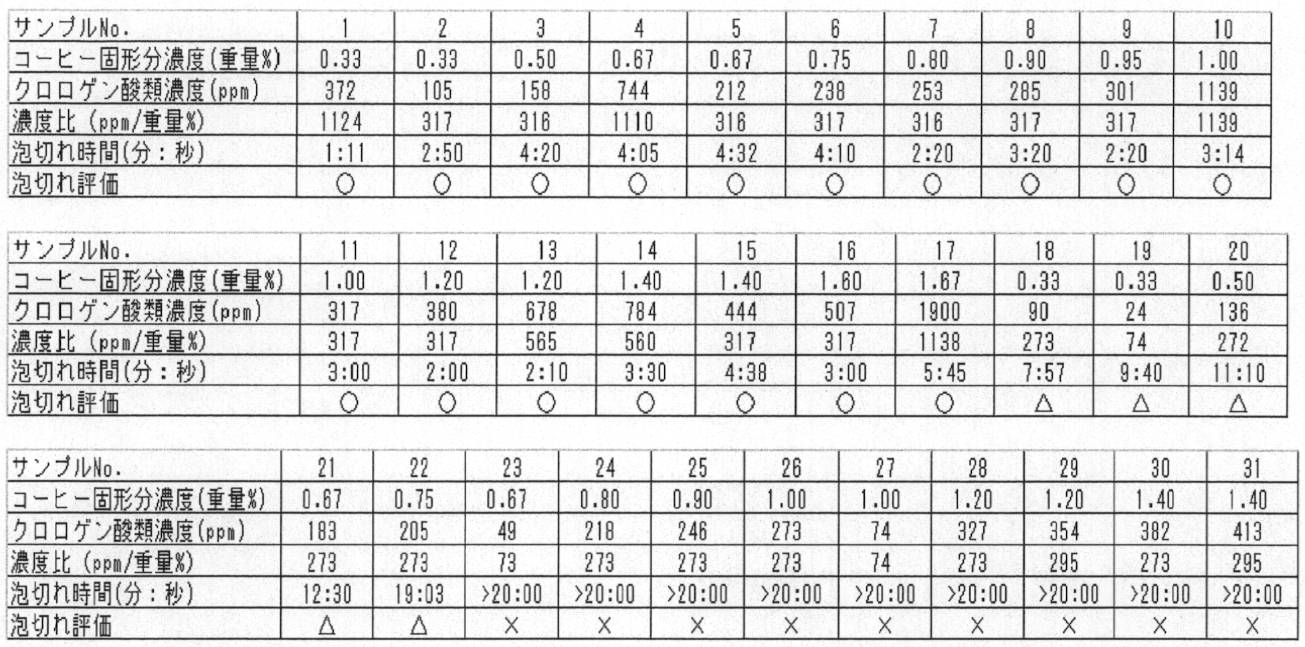
- Example 1 As a coffee material, instant coffee or coffee extract was used to obtain a coffee beverage by adding an appropriate amount of hot water to a predetermined coffee solid content (concentration of coffee solid content: 0.33 to 1.67% by weight) ). Since each raw material has a different concentration of chlorogenic acids depending on the roasting degree of coffee beans, extraction conditions, concentration conditions, etc., the obtained coffee beverages were measured for chlorogenic acid concentrations and subjected to a bubble breakage evaluation test. Carbon dioxide pressure may be involved as a spill factor at the time of filling and opening, but here, as a liquidity evaluation, evaluation was performed at a level where no carbon dioxide gas was applied.
- the bubble breakage evaluation test was conducted by the following method: A funnel was placed on the mouth of a 500 ml graduated cylinder, and 400 ml of the target sample was poured. At this time, the funnel to be used had an outer diameter of 20 to 22 mm, and the content liquid was 20 ° C. The funnel was adjusted so that the tip was at the top of the graduated cylinder. The time until the foam that foamed on the liquid surface by pouring disappeared was measured. The time until the bubbles disappeared was the time until a part of the liquid level became visible when viewed from above the graduated cylinder. The time until the bubbles disappeared was used as an indicator of bubble breakage, ⁇ within 6 minutes, ⁇ from 6 to 20 minutes, and ⁇ from 20 minutes or more. The results are shown in Table 1 and FIG.
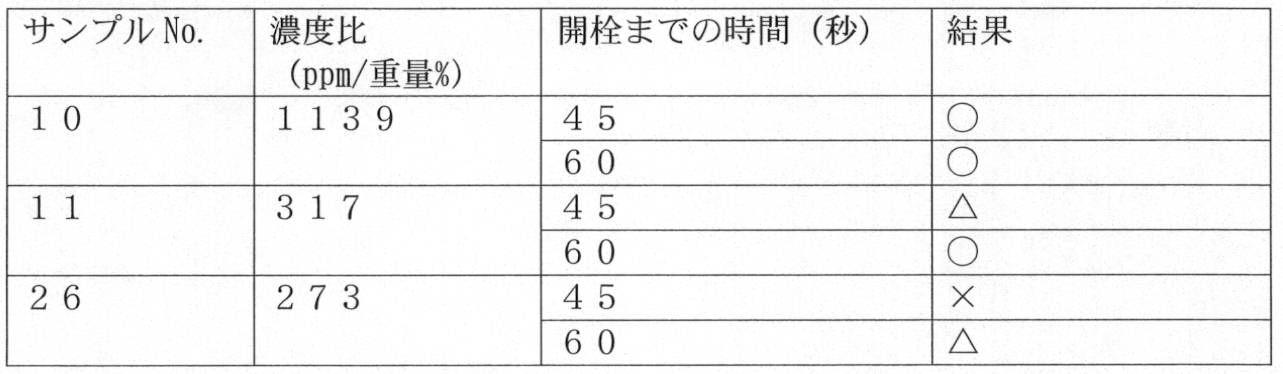
- Example 2 Carbon dioxide gas was added to the sample having a coffee solid content of 1.0% obtained in Example 1 to evaluate the spillage of the carbonated coffee beverage. Carbon dioxide was applied to the sample with a carbonator, and the gasified sample was stored in a 350 ml PET bottle container with 330 ml and then refrigerated overnight. The gas pressure at this time was 2.1 kgf / cm 2 .
- the content liquid was adjusted to room temperature (23 ° C.), and the following shaking test was performed. That is, a PET bottle as a test sample was fixed horizontally on a laboratory shaker (SHAKERKSA31 manufactured by Yamato Scientific Co., Ltd.) and shaken at 72 rpm for 5 minutes. At this time, the central axis of the PET bottle was made parallel to the amplitude direction of the shaker.
- a laboratory shaker SHAKERKSA31 manufactured by Yamato Scientific Co., Ltd.
Landscapes
- Life Sciences & Earth Sciences (AREA)
- Chemical & Material Sciences (AREA)
- Engineering & Computer Science (AREA)
- Food Science & Technology (AREA)
- Polymers & Plastics (AREA)
- Health & Medical Sciences (AREA)
- Nutrition Science (AREA)
- Tea And Coffee (AREA)
- Non-Alcoholic Beverages (AREA)
Abstract
コーヒー飲料の特徴および炭酸飲料の特徴を併せ持ち、かつ充填時および開栓時の吹きこぼれが抑制された炭酸コーヒー飲料を提供する。コーヒー固形分の濃度(単位:重量%)に対するクロロゲン酸類の濃度(単位:ppm)の比を300以上とする。
Description
本発明は、炭酸コーヒー飲料に関し、特に、開栓時等の吹きこぼれが防止された容器詰め炭酸コーヒー飲料に関する。
コーヒーは香味に優れた飲料であり、かつ含有するカフェインなどの生理活性物質によるリフレッシュ効果を期待して日常生活のさまざまな場面で飲用されている。一方、炭酸飲料もその清涼感からリフレッシュ効果を期待して飲用される。
炭酸とコーヒーとを含有する炭酸コーヒー飲料を摂取すれば両者による相乗効果が期待されるため、これまでにも炭酸コーヒー飲料の開発が試みられている。
しかしながら、コーヒーをベースとするガス含有飲料は、開栓時などに吹きこぼれが発生するという問題があることが知られている。コーヒーをベースとするガス含有飲料の吹きこぼれを防止する方法として、特許文献1には、コーヒー抽出液のpHを3~4.5に調整することによりフロックを形成させ、これを除去したものを用いてガス含有飲料を製造する方法が記載されている。また、特許文献2には、原料とするコーヒー水溶液に酸を添加してpHを低下させることにより凝集沈殿を生成させて、これを清澄化した後に炭酸水化することによりコーヒー入り炭酸飲料を製造することが記載されている。しかし、コーヒー抽出液のpHは通常、ほぼ中性付近(pH5~6)であり、上記の方法のようにpHを酸性領域(pH3~4.5程度)に低下させると、コーヒー本来の味わいが失われるなどの問題がある。
また、特許文献3には、コーヒー水溶液を分画分子量が4000~50000の範囲の限外ろ過膜によりろ過し、得られたものを炭酸水化することによりコーヒー入り炭酸飲料を製造することが記載されているが、やはり味わいが失われるなどの問題がある。
本発明は、コーヒー飲料の特徴および炭酸飲料の特徴を併せ持ち、充填時や開栓時の吹きこぼれが防止された炭酸コーヒー飲料を提供することを課題とする。
本発明者らは、上記課題を解決するために鋭意検討を重ねた結果、クロロゲン酸類の濃度とコーヒー固形分の濃度の比率を所定の範囲内とすることにより炭酸コーヒー飲料の吹きこぼれの問題を改善することができることを見出し、本発明を完成した。
すなわち、これに限定されるものではないが、本発明は以下に関する。
(1)クロロゲン酸類の濃度(単位:ppm)をコーヒー固形分の濃度(単位:重量%)で除した値が300以上である、容器詰め炭酸コーヒー飲料。
(2)コーヒー固形分の濃度が0.17~2.33重量%である、(1)に記載の容器詰め炭酸コーヒー飲料。
(3)無菌充填装置によって充填された、(1)又は(2)に記載の容器詰め炭酸コーヒー飲料。
(4)容器詰め炭酸コーヒー飲料の製造方法であって、
i) コーヒー固形分の濃度が0.17~2.33重量%、かつ、クロロゲン酸類の濃度(単位:ppm)をコーヒー固形分の濃度(単位:重量%)で除した値が300以上に調整された炭酸コーヒー飲料を製造する工程、
ii) 得られた炭酸コーヒー飲料を無菌充填装置を用いて容器に充填する工程、
を含む、前記方法。
(5)クロロゲン酸類の濃度(単位:ppm)をコーヒー固形分の濃度(単位:重量%)で除した値が300以上となるように調整することを含む、コーヒー飲料の泡切れをよくする方法。
(1)クロロゲン酸類の濃度(単位:ppm)をコーヒー固形分の濃度(単位:重量%)で除した値が300以上である、容器詰め炭酸コーヒー飲料。
(2)コーヒー固形分の濃度が0.17~2.33重量%である、(1)に記載の容器詰め炭酸コーヒー飲料。
(3)無菌充填装置によって充填された、(1)又は(2)に記載の容器詰め炭酸コーヒー飲料。
(4)容器詰め炭酸コーヒー飲料の製造方法であって、
i) コーヒー固形分の濃度が0.17~2.33重量%、かつ、クロロゲン酸類の濃度(単位:ppm)をコーヒー固形分の濃度(単位:重量%)で除した値が300以上に調整された炭酸コーヒー飲料を製造する工程、
ii) 得られた炭酸コーヒー飲料を無菌充填装置を用いて容器に充填する工程、
を含む、前記方法。
(5)クロロゲン酸類の濃度(単位:ppm)をコーヒー固形分の濃度(単位:重量%)で除した値が300以上となるように調整することを含む、コーヒー飲料の泡切れをよくする方法。
本発明によれば、クロロゲン酸類の濃度とコーヒー固形分の濃度の比率を所定の範囲内とすることにより、コーヒー飲料と炭酸飲料の特徴を併せ持ち、かつ充填時および開栓時の吹きこぼれの問題が改善された炭酸コーヒー飲料を提供することができる。本発明では、コーヒー抽出液のpHを低下させて凝集沈殿を形成させて取り除くといった操作や限外ろ過膜により特定の分子量の成分を取り除くといった操作を行う必要がなく、コーヒー抽出液本来の味わいを損なわず、かつ、吹きこぼれのしない、炭酸コーヒー飲料とすることができる。
本発明は、クロロゲン酸類の濃度とコーヒー固形分の濃度の比率が所定の範囲内に調整された炭酸コーヒー飲料に関する。
本発明でいう炭酸コーヒー飲料とは、コーヒー成分を含有する炭酸飲料であればどのようなものであってもよい。例えば、コーヒー抽出液に、必要に応じて甘味料、pH調整剤、フレーバー成分、着色料、保存料等を加えて調合液を作成し、次いで、これに所定のガス圧となるように常法により炭酸ガスを付与した後、容器に充填する方法で調製することができる。
コーヒー抽出液の原料となるコーヒー豆は、特に制限なくいずれの種であってもよい。例えばアラビカ種、ロブスタ種などが挙げられる。焙煎の度合(通常、浅煎り、中煎り、深煎りの順に表現される)についても、特に限定されない。
コーヒー抽出液としては、焙煎、粉砕されたコーヒー豆を水や温水などを用いて抽出した液、濃縮コーヒーエキスを所定濃度に希釈した液、フリーズドライ又はスプレードライなどによるインスタントコーヒー粉末を溶解した液などを使用することができる。これら液は、クロスフロー濾過などの濾過や遠心分離などの通常の方法により、微粒子の除去を行ってもよい。また、酵素処理などにより不溶性固形分を可溶化させてもよい。
本発明におけるクロロゲン酸類とは、3-カフェオイルキナ酸、4-カフェオイルキナ酸、5-カフェオイルキナ酸、3-フェルラキナ酸、4-フェルラキナ酸、5-フェルラキナ酸、3,4-ジカフェオイルキナ酸、3,5-ジカフェオイルキナ酸、及び4,5-ジカフェオイルキナ酸をいい、クロロゲン酸類の濃度とは、炭酸コーヒー飲料におけるこれら化合物の合計の濃度(ppm)をいう。クロロゲン酸類の濃度は、高速液体クロマトグラフィー(HPLC)により測定することができる。HPLCにおける検出手段としては、UV検出が一般的であるが、CL(化学発光)検出、EC(電気化学)検出、LC-MS検出などにより更に高感度で検出することもできる。具体的には、例えば、炭酸コーヒー飲料を純水にて適宜希釈した後、0.45μmのフィルタにてろ過し、島津製作所社製のHPLC「LC10A」で、野村化学社製のカラム「develosil C30-UG-5」を用いて測定することができる。
炭酸コーヒー飲料におけるクロロゲン酸類の濃度は、特に制限はないが、20ppm~2000ppm程度である。クロロゲン酸類の濃度は、原料であるコーヒー豆の焙煎度や抽出条件、濃縮条件などを変化させることにより調整することができる。
本発明におけるコーヒー固形分とは、原料となるコーヒー抽出液(濃縮コーヒーエキスやインスタントコーヒーを溶解させた溶液を含む)の固形分を20℃における糖用屈折計示度(Brix)より求めた質量(g)をいう。具体的には、糖用屈折計(アタゴRX-5000等)を用いてコーヒー抽出液の糖用屈折計示度(Brix)を測定し、これに、測定に使用したコーヒー抽出液量(g)を乗ずることによって、コーヒー固形分(g)を算出する。また、本発明におけるコーヒー固形分の濃度とは、上で求められたコーヒー固形分(g)の、炭酸コーヒー飲料に対する濃度(重量%)をいう。コーヒー固形分の濃度は、炭酸飲料に特有の爽快感とコーヒー本来の味わいとのバランスの観点から、0.17~2.33重量%が好ましく、0.33~2.00重量%がより好ましく、0.50~1.85重量%がさらに好ましい。
上記の通り、コーヒー固形分の濃度の測定には、コーヒー抽出液が通常用いられるが、乳成分の添加がなく、糖分の添加量が既知である炭酸コーヒー飲料に関しては、炭酸コーヒー飲料の糖用屈折計示度から、既知の糖分に由来する糖用屈折計示度を差し引くことにより、コーヒー抽出液の糖用屈折計示度を推定することができ、これを用いてコーヒー固形分濃度を測定することができる。なお、乳成分以外の添加料に関しては、通常のコーヒー飲料に使用される量であれば、糖用屈折計示度に殆ど影響を与えないと考えられる。
本発明の炭酸コーヒー飲料は、炭酸コーヒー飲料中のクロロゲン酸類の濃度(単位:ppm)を、上で定義したコーヒー固形分の濃度(すなわち、コーヒー抽出液の糖用屈折計示度(Brix値)に、測定に使用したコーヒー抽出液量(g)を乗ずることによって得られる値(コーヒー固形分:単位g)と、炭酸コーヒー飲料の重さ(g)とから算出される濃度)(単位:重量%)で除した値が、300以上である。この値の上限は特に限定されないが、コーヒー飲料の味わいの点からは、1200程度になると考えられる。
本発明の炭酸コーヒー飲料は、所定の範囲内のpHおよびガス圧を有することが好ましい。本明細書においてガス圧とは炭酸ガス圧のことをいい、また便宜上炭酸コーヒー飲料のpHは、炭酸ガスを付与する前の状態のpHをいう。
pHの調整には一般的なpH調整剤を使用することができ、そのようなpH調整剤としては水酸化ナトリウム、水酸化カリウムなどの塩基や、炭酸水素ナトリウム、炭酸ナトリウム、炭酸水素カリウム、炭酸カリウム、リン酸水素二ナトリウム、クエン酸ナトリウム、クエン酸カリウム、酢酸ナトリウム、酢酸カリウム、L-アスコルビン酸ナトリウムなどの有機酸のナトリウム又はカリウム塩、および、その他食品衛生法上使用可能なpH調整剤又は酸味料が挙げられる。飲料の味わいの観点からは、水酸化ナトリウム又は水酸化カリウムなどの塩基を使用することが好ましい。また、pHの異なるコーヒー抽出液を混合することにより所定のpHに調整することも可能である。
通常のコーヒー抽出液のpHは5~6程度であり、本発明の飲料においても、味わいの観点から、同程度のpHとすることは好ましい。本発明では、pHを低下させて凝集沈殿を形成させるといった操作を必要とせずに吹きこぼれを防止することができるので、通常のコーヒー抽出液のpHに近いpHを有する飲料を調製することができる。本発明において、pHは、4.0~6.5の範囲が好ましく、4.2~6.5の範囲がより好ましく、4.5~6.5の範囲がさらに好ましく、4.7~6.5の範囲がさらに好ましく、5.0~6.5の範囲がさらに好ましい。
ここで、上記の通り、便宜上炭酸コーヒー飲料のpHは、炭酸ガスを付与する前の状態のpHを記載しているが、充填後の容器詰め飲料を開栓して脱気することで炭酸ガス付与前のpHを求めることができる。
本発明の炭酸コーヒー飲料のガス圧は、特別な場合を除き、20℃における容器内のガス圧をいう。圧力の測定には、当業者によく知られた標準的な手法を用いることができる。測定には、これに限定されないが、京都電子工業株式会社製のガスボリューム測定装置GVA-500Aを使用することができる。その際の測定条件は下記のとおりに設定することが望ましい。

炭酸コーヒー飲料中の炭酸ガス量は、ガス圧(kgf/cm2又はMPa)で表わすほか、20℃におけるガスボリューム(g/kg又はw/w%)で表わすこともできる。ガス圧とガスボリュームとは適宜換算可能である。コーヒー飲料としての味わいと、炭酸の爽快感とのバランスの観点からは、ガス圧は、0.8~4.0kgf/cm2が好ましく、1.0~3.5kgf/cm2がより好ましく、1.5~3.5kgf/cm2がさらに好ましい。
本発明の炭酸コーヒー飲料は、当業者によく知られたコーヒー飲料の製造方法の各工程に加えて、炭酸ガスを供給する工程を含む。
本発明の炭酸コーヒー飲料には、必要に応じて、飲料に通常配合される原料、例えば、カラメル等の着色剤又は色素、消泡剤、増粘剤、乳化剤を配合してもよい。
本発明の炭酸コーヒー飲料は、保存可能な容器(例えば、プラスチックボトル、瓶、缶、パック)に充填される。好ましくは再栓できる蓋材を有する容器であり、ポリエチレンテレフタレートを主成分とする成形容器(いわゆるPETボトル)、アルミ、スチールなどの金属製のボトル缶を例示することができる。好ましくは、本発明の炭酸コーヒー飲料は無菌充填装置によって容器詰めされる。
無菌充填装置とは一般に、高温短時間殺菌した内容物を殺菌済み容器に無菌環境下で充填、密封する装置をいう。本発明においては、炭酸ガスにより液貯留部に背圧が加えられている炭酸飲料等の液を容器に充填することを含む。具体的には、容器を予め無菌状態とし、また、充填される飲料液と炭酸ガスを予め無菌状態として無菌の炭酸飲料を調製し、充填バルブ周辺を無菌加圧ガスで囲うなどして容器内面および充填内容物を無菌的に保ったまま充填、密封する。
本発明の炭酸コーヒー飲料は、コーヒー飲料の特徴および炭酸飲料の特徴を併せ持ち、充填時や開栓時の吹きこぼれが抑制された飲料である。充填時や開栓時の吹きこぼれとは、炭酸コーヒー飲料を容器に充填する際や、容器詰め炭酸コーヒー飲料を開栓する際に、飲料が激しく発泡し、容器外などに溢れ出る現象をいう。こうした現象は、通常の炭酸飲料でも時折見られるが、特に、コーヒー成分を含有する炭酸コーヒー飲料では顕著にみられる(特許文献1~3)。本発明は、クロロゲン酸類の濃度とコーヒー固形分の濃度の比率を一定の範囲とすることにより、炭酸コーヒー飲料で顕著である吹きこぼれの問題を低減させたものである。クロロゲン酸類の濃度とコーヒー固形分の濃度の比率を一定範囲とすることにより、炭酸コーヒー飲料の吹きこぼれが抑制される理由は明らかではないが、本発明者らは、コーヒー豆由来のクロロゲン酸類の濃度とコーヒー固形分の濃度の比率が一定範囲内にある調合液(炭酸ガスを付与する直前の液)では、振盪や注ぎ込みなどによる泡の発生から、泡の消失までの時間が短い(すなわち、泡切れがよい)ことを発見した。この調合液の泡切れのよさ(泡切れの向上)が、炭酸ガスを付与して炭酸コーヒー飲料とした際の吹きこぼれのしにくさにつながっている可能性がある。
以下、本発明を、実施例を挙げて説明するが、本発明はこれらに限定されるものではない。
[実施例1]
コーヒー原料としては、インスタントコーヒーやコーヒーエキスを用いて、所定のコーヒー固形分としたものに適量の温水を添加してコーヒー飲料を得た(コーヒー固形分濃度:0.33~1.67重量%)。各原料はコーヒー豆の焙煎度や抽出条件、濃縮条件などにより、クロロゲン酸類の濃度が異なるため、得られたコーヒー飲料はクロロゲン酸類濃度を測定し、泡切れ評価試験に供した。充填時、開栓時の吹きこぼれ因子としては、炭酸ガス圧も関与があるかもしれないが、ここでは液性の評価として、炭酸ガスを付与しない水準で評価を実施した。
コーヒー原料としては、インスタントコーヒーやコーヒーエキスを用いて、所定のコーヒー固形分としたものに適量の温水を添加してコーヒー飲料を得た(コーヒー固形分濃度:0.33~1.67重量%)。各原料はコーヒー豆の焙煎度や抽出条件、濃縮条件などにより、クロロゲン酸類の濃度が異なるため、得られたコーヒー飲料はクロロゲン酸類濃度を測定し、泡切れ評価試験に供した。充填時、開栓時の吹きこぼれ因子としては、炭酸ガス圧も関与があるかもしれないが、ここでは液性の評価として、炭酸ガスを付与しない水準で評価を実施した。
泡切れ評価試験は以下の方法で行った:500mlのメスシリンダー口部に漏斗を乗せ、対象とするサンプル400mlを注いだ。このとき、使用する漏斗は20~22mm足外径とし、中味液は20℃とした。漏斗は先端がメスシリンダー上端となるように調節した。注ぎ込みにより液面に起泡した泡が消失するまでの時間を計測した。泡が消失するまでの時間は、メスシリンダーの上からのぞいたときに液面の一部が見えるようになるまでの時間とした。この泡が消失するまでの時間を泡切れの指標とし、6分以内を○、6~20分を△、20分以上を×とした。
結果を表1および図1に示す。
結果を表1および図1に示す。
[実施例2]
実施例1で得られたコーヒー固形分1.0%のサンプルに炭酸ガスを付与して炭酸コーヒー飲料の吹きこぼれについて評価を実施した。サンプルへの炭酸ガス付与はカーボネーターによって行い、ガス付けしたサンプルは350mlのPETボトル容器に330mlを充填した後、一晩冷蔵保管した。このときのガス圧は2.1kgf/cm2であった。
実施例1で得られたコーヒー固形分1.0%のサンプルに炭酸ガスを付与して炭酸コーヒー飲料の吹きこぼれについて評価を実施した。サンプルへの炭酸ガス付与はカーボネーターによって行い、ガス付けしたサンプルは350mlのPETボトル容器に330mlを充填した後、一晩冷蔵保管した。このときのガス圧は2.1kgf/cm2であった。
翌日、中味液を室温(23℃)に調整し、以下のような振とう試験を行った。すなわち、実験用振とう機(ヤマト科学社製SHAKER SA31)に試験サンプルのPETボトルを水平にして固定し、72rpmで5分間振とうした。このとき、PETボトルの中心軸が振とう機の振幅方向と平行になるようにした。
振とう終了後すみやかに実験台に直立させ、規定時間が経過した時点で開栓して口部からの吹きこぼれの有無を観察した。以下の基準に基づき評価した結果を表2に示す。
○:吹きこぼれなし、
△:こぼれはないが、口部にドーム状の泡が形成される、
×:こぼれる。
○:吹きこぼれなし、
△:こぼれはないが、口部にドーム状の泡が形成される、
×:こぼれる。
Claims (5)
- クロロゲン酸類の濃度(単位:ppm)をコーヒー固形分の濃度(単位:重量%)で除した値が300以上である、容器詰め炭酸コーヒー飲料。
- コーヒー固形分の濃度が0.17~2.33重量%である、請求項1に記載の容器詰め炭酸コーヒー飲料。
- 無菌充填装置によって充填された、請求項1又は2に記載の容器詰め炭酸コーヒー飲料。
- 容器詰め炭酸コーヒー飲料の製造方法であって、
i) コーヒー固形分の濃度が0.17~2.33重量%、かつ、クロロゲン酸類の濃度(単位:ppm)をコーヒー固形分の濃度(単位:重量%)で除した値が300以上に調整された炭酸コーヒー飲料を製造する工程、
ii) 得られた炭酸コーヒー飲料を無菌充填装置を用いて容器に充填する工程、
を含む、前記方法。 - クロロゲン酸類の濃度(単位:ppm)をコーヒー固形分の濃度(単位:重量%)で除した値が300以上となるように調整することを含む、コーヒー飲料の泡切れをよくする方法。
Priority Applications (3)
| Application Number | Priority Date | Filing Date | Title |
|---|---|---|---|
| EP13864295.4A EP2856883B1 (en) | 2012-12-18 | 2013-10-30 | Carbonated coffee beverage |
| US14/397,559 US20150125587A1 (en) | 2012-12-18 | 2013-10-30 | Carbonated coffee beverage |
| ES13864295T ES2715825T3 (es) | 2012-12-18 | 2013-10-30 | Bebida de café carbonada |
Applications Claiming Priority (2)
| Application Number | Priority Date | Filing Date | Title |
|---|---|---|---|
| JP2012275746A JP5972778B2 (ja) | 2012-12-18 | 2012-12-18 | 炭酸コーヒー飲料 |
| JP2012-275746 | 2012-12-18 |
Publications (1)
| Publication Number | Publication Date |
|---|---|
| WO2014097750A1 true WO2014097750A1 (ja) | 2014-06-26 |
Family
ID=50978096
Family Applications (1)
| Application Number | Title | Priority Date | Filing Date |
|---|---|---|---|
| PCT/JP2013/079366 Ceased WO2014097750A1 (ja) | 2012-12-18 | 2013-10-30 | 炭酸コーヒー飲料 |
Country Status (5)
| Country | Link |
|---|---|
| US (1) | US20150125587A1 (ja) |
| EP (1) | EP2856883B1 (ja) |
| JP (1) | JP5972778B2 (ja) |
| ES (1) | ES2715825T3 (ja) |
| WO (1) | WO2014097750A1 (ja) |
Cited By (1)
| Publication number | Priority date | Publication date | Assignee | Title |
|---|---|---|---|---|
| DE102020002747A1 (de) | 2020-05-08 | 2021-11-11 | Sirin Leila Spindler | Kohlensäurehaltiges Erfrischungsgetränk auf Basis eines Kräuteraufgusses |
Families Citing this family (6)
| Publication number | Priority date | Publication date | Assignee | Title |
|---|---|---|---|---|
| CA3078545A1 (en) | 2017-10-06 | 2019-04-11 | Cargill, Incorporated | Stabilized steviol glycoside compositions and uses thereof |
| EP3952667A1 (en) | 2019-04-06 | 2022-02-16 | Cargill, Incorporated | Sensory modifiers |
| CN113784629B (zh) | 2019-04-06 | 2024-12-27 | 嘉吉公司 | 用于制备植物提取物组合物的方法 |
| JP7320984B2 (ja) * | 2019-05-15 | 2023-08-04 | アサヒ飲料株式会社 | 容器詰めコーヒー入り炭酸飲料および容器詰めコーヒー入り炭酸飲料の風味改善方法 |
| US12240745B2 (en) * | 2020-10-13 | 2025-03-04 | Pepsico, Inc. | Contactless beverage dispensing methods |
| JP7707229B2 (ja) * | 2023-04-28 | 2025-07-14 | 株式会社 伊藤園 | 発泡性コーヒー飲料およびその製造方法 |
Citations (9)
| Publication number | Priority date | Publication date | Assignee | Title |
|---|---|---|---|---|
| JPS5053570A (ja) * | 1973-09-20 | 1975-05-12 | ||
| JPS54110362A (en) | 1978-01-20 | 1979-08-29 | Nestle Sa | Treating of coffee extract |
| JPS5963137A (ja) | 1982-10-05 | 1984-04-10 | Soda Koryo Kk | コ−ヒ−入り炭酸飲料の製造法 |
| JPH07123921A (ja) | 1993-11-02 | 1995-05-16 | Pokka Corp | コーヒー入り炭酸飲料 |
| JP2001186859A (ja) * | 1999-12-29 | 2001-07-10 | Takasago Internatl Corp | 劣化しにくい水溶性シトラス系フレーバー、その製造方法およびそのフレーバーを含む飲食品 |
| JP2004267158A (ja) * | 2003-03-11 | 2004-09-30 | T Hasegawa Co Ltd | 機能性飲食品の風味劣化防止方法 |
| JP2007534301A (ja) * | 2003-09-12 | 2007-11-29 | カラマズー・ホールディングス・インコーポレイテッド | 飲料の泡増強にシソ科ハーブ調合物を使用する方法 |
| JP2010075183A (ja) * | 2001-06-13 | 2010-04-08 | Givaudan Sa | クロロゲン酸を含む味覚改変剤 |
| JP2013000011A (ja) * | 2011-06-13 | 2013-01-07 | Kirin Beverage Corp | 中性pH域に調整した容器詰め炭酸飲料 |
Family Cites Families (12)
| Publication number | Priority date | Publication date | Assignee | Title |
|---|---|---|---|---|
| JPS5133184B2 (ja) * | 1971-10-21 | 1976-09-17 | ||
| JPS63273460A (ja) * | 1986-12-26 | 1988-11-10 | Toyo Seikan Kaisha Ltd | 炭酸ガスを少量含有した飲料の製造法 |
| JPH01289450A (ja) * | 1988-05-16 | 1989-11-21 | Japan Foods Kk | エアゾール容器入りコーヒーおよびその製造法 |
| JPH04278072A (ja) * | 1991-03-04 | 1992-10-02 | Kanebo Ltd | 発酵コーヒー飲料の製法 |
| NL1000450C2 (nl) * | 1995-05-29 | 1996-12-02 | Sara Lee De Nv | Koolzuurhoudende drank. |
| EP1925208B1 (en) * | 2005-07-29 | 2011-12-21 | Kao Corporation | Container-packed milk coffee beverage |
| TWI396507B (zh) * | 2005-07-29 | 2013-05-21 | 花王股份有限公司 | Containers with black coffee drinks |
| ATE517556T1 (de) * | 2005-12-30 | 2011-08-15 | Ito En Ltd | Behälterverpacktes kaffeegetränk, und verfahren zu seiner herstellung |
| JP4953949B2 (ja) * | 2007-07-12 | 2012-06-13 | 花王株式会社 | 容器詰コーヒー飲料の製造方法 |
| JP5015759B2 (ja) * | 2007-12-27 | 2012-08-29 | 花王株式会社 | 容器詰コーヒー飲料の製造方法 |
| JP5015758B2 (ja) * | 2007-12-27 | 2012-08-29 | 花王株式会社 | 容器詰コーヒー飲料の製造方法 |
| KR20120012822A (ko) * | 2009-04-28 | 2012-02-10 | 네스텍 소시에테아노님 | 로스팅되지 않은 커피 고형물을 포함하는 식품 또는 음료 조성물 |
-
2012
- 2012-12-18 JP JP2012275746A patent/JP5972778B2/ja active Active
-
2013
- 2013-10-30 WO PCT/JP2013/079366 patent/WO2014097750A1/ja not_active Ceased
- 2013-10-30 EP EP13864295.4A patent/EP2856883B1/en not_active Not-in-force
- 2013-10-30 US US14/397,559 patent/US20150125587A1/en not_active Abandoned
- 2013-10-30 ES ES13864295T patent/ES2715825T3/es active Active
Patent Citations (9)
| Publication number | Priority date | Publication date | Assignee | Title |
|---|---|---|---|---|
| JPS5053570A (ja) * | 1973-09-20 | 1975-05-12 | ||
| JPS54110362A (en) | 1978-01-20 | 1979-08-29 | Nestle Sa | Treating of coffee extract |
| JPS5963137A (ja) | 1982-10-05 | 1984-04-10 | Soda Koryo Kk | コ−ヒ−入り炭酸飲料の製造法 |
| JPH07123921A (ja) | 1993-11-02 | 1995-05-16 | Pokka Corp | コーヒー入り炭酸飲料 |
| JP2001186859A (ja) * | 1999-12-29 | 2001-07-10 | Takasago Internatl Corp | 劣化しにくい水溶性シトラス系フレーバー、その製造方法およびそのフレーバーを含む飲食品 |
| JP2010075183A (ja) * | 2001-06-13 | 2010-04-08 | Givaudan Sa | クロロゲン酸を含む味覚改変剤 |
| JP2004267158A (ja) * | 2003-03-11 | 2004-09-30 | T Hasegawa Co Ltd | 機能性飲食品の風味劣化防止方法 |
| JP2007534301A (ja) * | 2003-09-12 | 2007-11-29 | カラマズー・ホールディングス・インコーポレイテッド | 飲料の泡増強にシソ科ハーブ調合物を使用する方法 |
| JP2013000011A (ja) * | 2011-06-13 | 2013-01-07 | Kirin Beverage Corp | 中性pH域に調整した容器詰め炭酸飲料 |
Cited By (1)
| Publication number | Priority date | Publication date | Assignee | Title |
|---|---|---|---|---|
| DE102020002747A1 (de) | 2020-05-08 | 2021-11-11 | Sirin Leila Spindler | Kohlensäurehaltiges Erfrischungsgetränk auf Basis eines Kräuteraufgusses |
Also Published As
| Publication number | Publication date |
|---|---|
| US20150125587A1 (en) | 2015-05-07 |
| ES2715825T3 (es) | 2019-06-06 |
| EP2856883A4 (en) | 2016-03-02 |
| EP2856883B1 (en) | 2019-03-06 |
| JP5972778B2 (ja) | 2016-08-17 |
| EP2856883A1 (en) | 2015-04-08 |
| JP2014117238A (ja) | 2014-06-30 |
Similar Documents
| Publication | Publication Date | Title |
|---|---|---|
| JP5972778B2 (ja) | 炭酸コーヒー飲料 | |
| JP5155435B2 (ja) | 焙煎コーヒー豆抽出物の製造方法 | |
| JP5777386B2 (ja) | 容器詰め炭酸飲料及びその製造方法 | |
| JP7198566B2 (ja) | 加圧液体を包装するシステムおよび方法 | |
| SG184708A1 (en) | Packaged coffee beverage | |
| JP7734731B2 (ja) | 香り立ちが増強されたノンアルコール炭酸飲料およびその製造方法 | |
| JP7686401B2 (ja) | コーヒー飲料 | |
| TW201505566A (zh) | 碳酸飲料 | |
| JP2014087359A (ja) | 容器詰め炭酸飲料及びその製造方法 | |
| TW202345704A (zh) | 咖啡飲料及改善該咖啡飲料的飲後滿足感與易飲性之方法 | |
| JP5449792B2 (ja) | 容器詰コーヒー飲料組成物 | |
| JP2004275112A (ja) | 容器入り飲料、その製造方法及び飲料の香味改善方法 | |
| JP7689028B2 (ja) | 容器詰めコーヒー飲料 | |
| TW202339627A (zh) | 咖啡飲料及該咖啡飲料的甜味質之改善方法 | |
| JP2014023482A (ja) | 炭酸コーヒー飲料 | |
| TW202345705A (zh) | 咖啡飲料及改善該咖啡飲料的清爽感與殘留感之方法 | |
| JP4286656B2 (ja) | 炭酸乳飲料 | |
| WO2018117081A1 (ja) | リモネン含有炭酸飲料 | |
| WO2009133392A1 (en) | Foam control | |
| JP7175633B2 (ja) | 容器入り発泡コーヒー飲料、容器入り発泡コーヒー飲料の製造方法および容器入り発泡コーヒー飲料の風味向上方法 | |
| JP2018153100A (ja) | 容器詰め濃縮コーヒー飲料 | |
| TW202137884A (zh) | 用以改善碳酸水或碳酸飲料之泡質的含礦物質之組成物 | |
| CN102665448B (zh) | 容器装低酸性饮料及其制备方法 | |
| JP2008022840A (ja) | 酸素含有容器詰飲料及びその製造方法 | |
| JP2020039292A (ja) | 容器詰め炭酸飲料、及び容器詰め炭酸飲料用の増粘剤 |
Legal Events
| Date | Code | Title | Description |
|---|---|---|---|
| 121 | Ep: the epo has been informed by wipo that ep was designated in this application |
Ref document number: 13864295 Country of ref document: EP Kind code of ref document: A1 |
|
| WWE | Wipo information: entry into national phase |
Ref document number: 14397559 Country of ref document: US |
|
| WWE | Wipo information: entry into national phase |
Ref document number: 2013864295 Country of ref document: EP |
|
| NENP | Non-entry into the national phase |
Ref country code: DE |