WO2014103884A1 - Alliage amortisseur - Google Patents
Alliage amortisseur Download PDFInfo
- Publication number
- WO2014103884A1 WO2014103884A1 PCT/JP2013/084119 JP2013084119W WO2014103884A1 WO 2014103884 A1 WO2014103884 A1 WO 2014103884A1 JP 2013084119 W JP2013084119 W JP 2013084119W WO 2014103884 A1 WO2014103884 A1 WO 2014103884A1
- Authority
- WO
- WIPO (PCT)
- Prior art keywords
- mass
- deformation
- alloy
- damping alloy
- less
- Prior art date
- Legal status (The legal status is an assumption and is not a legal conclusion. Google has not performed a legal analysis and makes no representation as to the accuracy of the status listed.)
- Ceased
Links
Images

Classifications
-
- C—CHEMISTRY; METALLURGY
- C22—METALLURGY; FERROUS OR NON-FERROUS ALLOYS; TREATMENT OF ALLOYS OR NON-FERROUS METALS
- C22C—ALLOYS
- C22C38/00—Ferrous alloys, e.g. steel alloys
-
- C—CHEMISTRY; METALLURGY
- C21—METALLURGY OF IRON
- C21D—MODIFYING THE PHYSICAL STRUCTURE OF FERROUS METALS; GENERAL DEVICES FOR HEAT TREATMENT OF FERROUS OR NON-FERROUS METALS OR ALLOYS; MAKING METAL MALLEABLE, e.g. BY DECARBURISATION OR TEMPERING
- C21D6/00—Heat treatment of ferrous alloys
- C21D6/004—Heat treatment of ferrous alloys containing Cr and Ni
-
- C—CHEMISTRY; METALLURGY
- C21—METALLURGY OF IRON
- C21D—MODIFYING THE PHYSICAL STRUCTURE OF FERROUS METALS; GENERAL DEVICES FOR HEAT TREATMENT OF FERROUS OR NON-FERROUS METALS OR ALLOYS; MAKING METAL MALLEABLE, e.g. BY DECARBURISATION OR TEMPERING
- C21D6/00—Heat treatment of ferrous alloys
- C21D6/005—Heat treatment of ferrous alloys containing Mn
-
- C—CHEMISTRY; METALLURGY
- C22—METALLURGY; FERROUS OR NON-FERROUS ALLOYS; TREATMENT OF ALLOYS OR NON-FERROUS METALS
- C22C—ALLOYS
- C22C38/00—Ferrous alloys, e.g. steel alloys
- C22C38/06—Ferrous alloys, e.g. steel alloys containing aluminium
-
- C—CHEMISTRY; METALLURGY
- C22—METALLURGY; FERROUS OR NON-FERROUS ALLOYS; TREATMENT OF ALLOYS OR NON-FERROUS METALS
- C22C—ALLOYS
- C22C38/00—Ferrous alloys, e.g. steel alloys
- C22C38/18—Ferrous alloys, e.g. steel alloys containing chromium
- C22C38/34—Ferrous alloys, e.g. steel alloys containing chromium with more than 1.5% by weight of silicon
-
- C—CHEMISTRY; METALLURGY
- C22—METALLURGY; FERROUS OR NON-FERROUS ALLOYS; TREATMENT OF ALLOYS OR NON-FERROUS METALS
- C22C—ALLOYS
- C22C38/00—Ferrous alloys, e.g. steel alloys
- C22C38/18—Ferrous alloys, e.g. steel alloys containing chromium
- C22C38/40—Ferrous alloys, e.g. steel alloys containing chromium with nickel
- C22C38/58—Ferrous alloys, e.g. steel alloys containing chromium with nickel with more than 1.5% by weight of manganese
-
- C—CHEMISTRY; METALLURGY
- C21—METALLURGY OF IRON
- C21D—MODIFYING THE PHYSICAL STRUCTURE OF FERROUS METALS; GENERAL DEVICES FOR HEAT TREATMENT OF FERROUS OR NON-FERROUS METALS OR ALLOYS; MAKING METAL MALLEABLE, e.g. BY DECARBURISATION OR TEMPERING
- C21D2211/00—Microstructure comprising significant phases
- C21D2211/001—Austenite
-
- C—CHEMISTRY; METALLURGY
- C21—METALLURGY OF IRON
- C21D—MODIFYING THE PHYSICAL STRUCTURE OF FERROUS METALS; GENERAL DEVICES FOR HEAT TREATMENT OF FERROUS OR NON-FERROUS METALS OR ALLOYS; MAKING METAL MALLEABLE, e.g. BY DECARBURISATION OR TEMPERING
- C21D2211/00—Microstructure comprising significant phases
- C21D2211/008—Martensite
-
- C—CHEMISTRY; METALLURGY
- C21—METALLURGY OF IRON
- C21D—MODIFYING THE PHYSICAL STRUCTURE OF FERROUS METALS; GENERAL DEVICES FOR HEAT TREATMENT OF FERROUS OR NON-FERROUS METALS OR ALLOYS; MAKING METAL MALLEABLE, e.g. BY DECARBURISATION OR TEMPERING
- C21D8/00—Modifying the physical properties of ferrous metals or ferrous alloys by deformation combined with, or followed by, heat treatment
Definitions
- the present invention relates to a vibration damping alloy capable of elastic-plastic deformation with low stress and having excellent fatigue characteristics.
- the damping damper is a damping device that absorbs the vibration energy input to the building due to wind or earthquake and prevents the vibration from reaching the structure body.
- the vibration dampers that have been proposed and developed so far can be broadly classified into viscous dampers (Patent Document 1), viscoelastic dampers (Patent Document 2), lead dampers (Patent Document 3), and elastic-plastic dampers (Patent Document 4). and so on.
- elasto-plastic dampers using low-yield point steel are particularly popular in recent years because they are superior in performance, cost, and maintainability as damping dampers that reduce the shaking of structures, especially during earthquakes. It is out.
- This elasto-plastic damper has a function of reducing vibration of the building by absorbing seismic energy input to the building mainly as thermal energy by plastic deformation of an alloy used as a core material for the damper.
- the plastic deformation characteristics of the damping alloy as the core material have an important effect on the performance of the damping damper. It is desirable that the yield stress or yield strength of the damping alloy is low in order to cause plastic deformation characteristics earlier than the structure body. In addition, after the earthquake occurs, the damper core itself is repeatedly elasto-plastically deformed. From the viewpoint of long-term use, changes in mechanical properties and metal fatigue due to repeated hardening are problems.
- the most widely used damping alloy is a low yield point steel whose yield stress or 0.2% proof stress is intentionally reduced to about 100 to 225 MPa.
- the lower the yield stress the more elastoplastic deformation occurs.
- the initial repeated hardening rate is high, and the fatigue life is naturally superior to the steel used for the main frame such as columns and beams of the structure, but there is no significant difference in fatigue characteristics and there is a clear advantage. Is hard to say.
- a mechanism for heating the damper member is required, but according to the above proposal, at least without providing such a heating mechanism, the curing rate due to repeated deformation is low, Because of its long fatigue life, it can be used as a high-performance damping alloy that works effectively against long-period ground motion.
- Patent Document 5 Although it is suggested in Patent Document 5 that the Fe—Mn—Si-based shape memory alloy is effective as a vibration damping alloy with almost the same composition, the progress as a result of subsequent research suggests that it is suitable as a shape memory alloy. It has also become clear that the component range and the proper component range as a damping alloy are not completely consistent.
- an alloy to which NbC is added to improve shape memory characteristics has an extremely high stress amplitude of 650 MPa or more with respect to repeated tensile compression deformation having an amplitude of 1%. If the core material for the elastoplastic damper is not elastoplastically deformed prior to the structure main body, the vibration absorbing effect for protecting the structure main body cannot be exhibited.
- the strength must be lower than the structure body such as a building. Therefore, when a material having high material strength is used for the core material for the damper, it is necessary to reduce the cross-sectional area of the damper so as not to exceed the strength of the structure.
- a damper with a small cross-sectional area has a high risk of buckling during compression deformation. Therefore, in order to secure a wide applicable range as a damper, it is advantageous that the core material for the damper has a certain low material strength. .
- the inventors further studied and tried to control the plastic deformation characteristics by adding Al based on a Fe-30Mn-6Si shape memory alloy containing no precipitate such as NbC.
- an alloy containing 1 to 3% by mass of Al is useful as a damping alloy capable of operating at a stress amplitude as low as about 300 MPa with respect to repeated tensile compression deformation having an amplitude of 1% (for example, , See Patent Document 6).
- Non-Patent Document 2 the addition of more than 1% by mass of Al to the Fe-30Mn-6Si shape memory alloy almost eliminates the shape memory effect. It is clear that the optimum component range of the damping alloy does not always match.
- the core material for elasto-plastic dampers can be produced at low cost using existing mass-production steel production equipment, which is an important requirement for promoting earthquake resistance of structures at an early stage. Since the known damping alloy disclosed in Patent Document 6 contains Mn at a high concentration of 30% by mass, it is difficult to make it with equipment for producing general steel materials such as arc furnace melting.
- Non-Patent Document 4 second phases such as ⁇ ferrite phase, silicide, ⁇ ′ martensite phase and the like are easily formed in the Fe—Mn—Si based alloy to which Cr or Ni is added. The effect of aging on fatigue properties is also unclear.
- the fatigue characteristics of Fe-Mn-Cr-Ni alloys are also examined from the same viewpoint, and the relationship between fatigue characteristics and structure is partially publicized (for example, see Non-Patent Document 6).
- the plastic deformation structure of these Fe-Mn alloys and Fe-Mn-Cr-Ni alloys is a complex combination of deformation twins, ⁇ 'martensite phase, ⁇ martensite phase, stacking faults, dislocations, etc. Yes, it cannot be said that the relationship between fatigue properties and structure has been fully elucidated.
- ⁇ -martensite is effective in improving fatigue properties.
- TWIP steel and Fe—Mn—Cr—Ni alloys ⁇ -martensite Little is known about the impact of sites on fatigue properties.
- austenitic structural steels such as TWIP steel are usually designed as components so that the yield strength is as high as possible as structural materials, and are not suitable as core materials for elastic-plastic dampers.
- an Fe—Mn—Cr—Si—Al—C alloy is disclosed as a damping alloy utilizing the ⁇ martensite phase (see, for example, Patent Document 7).
- this damping alloy improves the internal friction in the elastic deformation region by containing 15% or more of the ⁇ martensite phase in the ⁇ austenite phase in the state before deformation, and the fatigue characteristics against elastoplastic deformation are disclosed. It has not been.
- properties required for damping steel or damping alloy used mainly for the purpose of protecting the structure from earthquakes are: Low fatigue strength, low cure rate, large strain and long fatigue life (large number of repeated fractures).
- damping alloy as a core material for an elastoplastic damper having all these properties in a well-balanced manner.
- JP-A-5-263858 Japanese Patent Laid-Open No. 2001-146855 JP-A-5-106367 Japanese Patent Laid-Open No. 5-26274 JP 2006-194287 A JP 2008-56987 A JP 2011-214127 A
- the present invention eliminates the conventional problems from the background as described above, reduces the proof stress and the stress amplitude after repeated tensile and compressive deformation in Fe—Mn— (Cr, Ni) —Si based alloys, and repeats fracture.
- An object is to provide a damping alloy for an elasto-plastic damper that can be used without maintenance even after long-period ground motion and can be mass-produced.
- the damping alloy of the present invention is characterized by the following.
- the damping alloy according to the first aspect of the invention is characterized by containing 10% by mass ⁇ Mn ⁇ 20% by mass, 2% by mass ⁇ Ni ⁇ 10% by mass.
- the vibration-damping alloy of the first or second invention contains 2% by mass ⁇ Si ⁇ 6% by mass.
- the metal structure of the alloy after the plastic working and the solution heat treatment is less than 15% by volume of an ⁇ martensite phase (HCP structure).
- HCP structure ⁇ martensite phase
- the balance consists only of ⁇ -austenite phase (FCC structure), and after this state, after repeating tensile and compressive deformation with an amplitude of 1% for 100 cycles or more, an ⁇ -martensite phase of less than 50 volume%, 3 volumes % ⁇ 'martensite phase and the balance is ⁇ austenite phase.
- the stress amplitude is 400 MPa or less after a tensile strength deformation of 280 MPa or less and an amplitude of 1% is repeated for 100 cycles or more, and the fracture.
- the number of repetitions is 2000 cycles or more.
- the damping alloy of the present invention has an added amount of Mn of 28% by mass or less, it can be easily manufactured as compared with the conventional Fe-30Mn-Si-Al damping alloy.
- the amount of Mn added is less than 20% by mass, the conventional Fe-30Mn-Si-Al vibration-damping alloy could only be melted in a vacuum induction heating furnace, but could be melted in an arc furnace. Therefore, a significant cost reduction is expected.
- the number of repetitions of fracture is almost one digit longer and can be used for long-period ground motion.
- the damping alloy under the conditions defined in the present invention has a proof stress of 280 MPa or less, a stress amplitude after repeating tensile compression deformation of 1% amplitude 100 times or more, 400 MPa or less, and a number of repeated cycles of 2000 cycles or more, Compared to conventional NbC-containing Fe-Mn-Si shape memory / damping alloys, it has lower proof stress and stress amplitude, and can be operated at a low strength level. Can be applied to a wide range.
- a damping alloy refers to a structural material that absorbs mechanical vibrations in machine tools, precision equipment, automobiles, etc., mainly increasing internal friction in the elastic deformation region and achieving high strength as a metal material. .
- vibration suppression is also used in the present invention, but its main object is suppression of vibrations to structures during earthquakes.
- the suppression of relatively minute vibrations caused by wind fluctuations is included in the effect.
- the damping alloy of the present invention is a Fe—Mn— (Cr, Ni) —Si based alloy in which elastoplastic deformation is controlled by adjusting the contents of Mn, Cr, Ni, and Si so that ⁇ -austenite phase and ⁇ -martensite. Creates a situation that reversibly proceeds by phase interconversion and suppresses irreversible deformation such as the formation of ⁇ ′ martensite phase, and the stress amplitude after repeated tensile compression deformation with a yield strength of 280 MPa or less and an amplitude of 1%. It is a vibration-damping alloy having 400 MPa or less and a number of repeated fractures of 2000 cycles or more.
- the plastic deformation mechanism in an austenitic iron-based alloy is not only the lattice dislocation sliding motion, which is a general metal plastic deformation mechanism, but also the lattice dislocations decompose into two partial dislocations and a stacking fault sandwiched between them. It takes various forms such as sliding motion of moving dislocations, twin deformation, ⁇ martensitic transformation, ⁇ 'martensitic transformation, and usually multiple plastic deformation mechanisms are developed simultaneously.
- the structural change caused by the tensile and compressive plastic deformation is caused by repetitive hardening by creating a state in which the structural change proceeds reversibly by the bidirectional martensitic transformation of the ⁇ austenite phase and the ⁇ martensite phase. Increase the number of repeated fractures.
- the state before deformation is a ⁇ -austenite single phase
- the plastic deformation mechanism proceeds mainly by ⁇ -martensite transformation.
- ⁇ martensite transformation may contain some of the twin deformation, lattice dislocation slip, and extended dislocation slip that are inevitably simultaneously generated, but ⁇ 'martensite transformation significantly hardens the alloy. The occurrence must be suppressed.
- Mn An essential additive element that has a central influence on the plastic deformation mechanism of the Fe—Mn— (Cr, Ni) —Si alloy is Mn.
- Mn stabilizes the ⁇ austenite phase in the iron-based alloy and lowers the stacking fault energy to create a state in which martensitic transformation from the ⁇ austenite phase to the ⁇ martensite phase is likely to occur.
- austenite stabilizing action of Mn can be partially replaced by Ni, and the lowering effect of stacking fault energy can be partially replaced by Cr.
- Mn equivalent ([% Mn] eq) [% Mn] + [% Cr] +2 [% Ni] +5 [% Al] (1) [% Mn], [% Cr], [% Ni], and [% Al] in the formula mean mass% of Mn, Cr, Ni, and Al as chemical components of the damping alloy.
- the range of the Mn equivalent for expressing the bi-directional martensitic transformation between the ⁇ austenite phase and the ⁇ martensite phase is set to the condition expressed by the following formula (2). 37 ⁇ [% Mn] eq ⁇ 45 (2)
- the Mn equivalent is 37% by mass or less, the thermodynamic stability of the ⁇ -martensite phase becomes very high. Therefore, even if the ⁇ -martensite phase once induced to deform becomes a ⁇ -austenite phase even if deformed in the reverse direction thereafter. No reverse transformation.
- the volume fraction of the ⁇ -martensite phase monotonously increases due to repeated tensile and compressive deformation, and when the volume fraction reaches 50% by volume or more, the probability of crack occurrence and cracks at the locations where the formed ⁇ -martensite phases collide with each other.
- the extension speed increases and the number of repeated ruptures decreases.
- Si which is another essential additive element, hardly affects the Mn equivalent, but improves the reversibility of the bi-directional martensitic transformation between the ⁇ -austenite phase and the ⁇ -martensite phase and improves the number of repetitions of fracture. It was clarified by experiment. Even when Si is not added, the number of repetitions of breakage of about 2000 cycles can be achieved. However, the addition of Si greatly increases the number of repetitions of breakage, and is most effective in the vicinity of 4% by mass.
- the alloy when Si is added excessively, the number of repetitions of fracture is decreased, and particularly when 6.5% by mass or more is added, the alloy may be remarkably hardened, resulting in a problem that the stress amplitude of repeated tensile compression deformation increases. .
- the balance adjustment of the total amount of Si and Al is important. The higher the ferrite stabilizing element concentration and the lower the austenite stabilizing element concentration, the more easily the ⁇ ferrite phase is formed. When both the ferrite stabilizing element concentration and the austenite stabilizing element concentration are low, the ⁇ ′ martensite phase is easily formed. Become.
- Mn is an essential additive element that has two effects of stabilizing austenite and lowering stacking fault energy.
- the damping alloy of Patent Document 6 in which as much as 30% by mass of Mn is added, the Mn yield due to evaporation or oxidation of Mn. It is difficult to melt at a cost that can be put to practical use.
- the amount of Mn added is set to 28% by mass or less by adding Cr or Ni. Further, if the amount of Mn added is less than 20% by mass, an alloy can be produced by melting in an arc furnace suitable for mass production.
- the amount of Mn added is 5 mass% ⁇ Mn ⁇ 28 mass%, more preferably 10 mass% ⁇ Mn ⁇ 20 mass%.
- ⁇ Cr> Cr is an element that reduces the stacking fault energy of the ⁇ austenite phase and promotes the martensitic transformation to the ⁇ martensite phase to improve the fatigue characteristics of the vibration damping alloy of the present invention. Furthermore, it contributes to improving corrosion resistance and high-temperature oxidation resistance.
- the amount of Cr added is in the range of 0 mass% ⁇ Cr ⁇ 15 mass%.
- Ni is an element that substitutes for the austenite stabilizing action of Mn.
- the addition amount of Mn is less than 20% by mass, a ⁇ -austenite single phase cannot be obtained as a state before deformation unless Ni as an austenite stabilizing element is added by 2% by mass or more.
- Ni which is an expensive element, is preferably less than 10% by mass.
- the amount of Ni added is in the range of 0 mass% ⁇ Ni ⁇ 15 mass%, more preferably 2 mass% ⁇ Ni ⁇ 10 mass%.
- ⁇ Si> Si is an essential element of the Fe—Mn—Si-based shape memory alloy, and its component range is 3.5 to 8 mass%, but the industrially available Si concentration range is 5 to 6 mass%. It is as follows.
- the amount of Si to be added is 0 mass% ⁇ Si ⁇ 6.5 mass%, more preferably 2 mass% ⁇ Si in order to make the number of fracture repetitions 2000 cycles or more. ⁇ 6 mass%.
- Al is an element that affects the Mn equivalent by a factor of 5, it may be added as an alternative element for Mn.
- C and N have a function to solidify and harden the alloy, and increase the yield strength and impair the performance as a core material for an elastoplastic damper. %, N ⁇ 0.08% by mass.
- elements such as Nb, Ta, V, Ti, and Mo that have a high affinity with C and N are added to form carbides and nitrides. Forming objects is widely practiced in the field.
- Nb, Ta, V, Ti, and Mo may be added to remove solid solution C or solid solution N by applying a conventional method.
- Nb ⁇ 0.05 mass%
- Ta ⁇ 0.05 mass%
- V ⁇ 0.05 mass%
- Ti ⁇ 0.05 mass%
- Mo ⁇ 0.05 mass%
- the state before deformation is preferably a ⁇ austenite single phase, but may contain an ⁇ martensite phase as long as the amount is small.
- An alloy adjusted to a state in which ⁇ martensite transformation is likely to be induced by deformation may cause an ⁇ martensite phase to be formed unintentionally due to environmental temperature changes or processing effects.
- the tensile and compressive plastic deformation of the damping alloy of the present invention is mainly performed by alternately generating martensitic transformation from ⁇ austenite phase to ⁇ martensite phase and its reverse transformation.
- the ⁇ -martensite phase induced during tensile deformation reversely transforms into a ⁇ -austenite phase when the deformation direction is reversed to compression.
- compressive deformation produces a new epsilon martensite phase with a crystal orientation different from that at the time of tensile deformation as well as reverse transformation of the tensile-induced epsilon martensite phase.
- This compression-induced ⁇ martensite phase also reversely transforms into a ⁇ austenite phase when the deformation is reversed again to tension.
- the tensile-induced ⁇ and the compression-induced ⁇ are alternately generated and disappeared by repeated tensile compression, so that the cumulative volume fraction increase of the ⁇ martensite phase due to repeated tensile compression deformation is small. This is the reason why the damping alloy is excellent in fatigue characteristics.
- the volume fraction of the ⁇ -martensite phase gradually increases, but when it exceeds 50% by volume, the probability of crack generation and crack extension rate increase, leading to fracture. There is. Therefore, in order to set the number of repetitions of breakage to 2000 cycles or more with respect to a tensile compression deformation with an amplitude of 1%, it is desirable that the volume ratio of ⁇ -martensite after 2000 cycles deformation is less than 50% by volume.
- the ⁇ ′ martensite phase hardens the alloy, its volume ratio should be less than 3% by volume.
- the stress amplitude increases due to hardening, and the increase in the stress amplitude induces further ⁇ ′ martensite phase transformation in a chain, and therefore, the stress level increases. Not only does this reduce the damper performance, but it also leads to a reduction in the number of repeated fractures.
- the yield strength of the damping alloy of the present invention is 280 MPa or less. If the yield strength is higher than this, the cross-sectional area of the damper core material for optimizing the operation start strength of the damper becomes too small, and it becomes easy to buckle at the time of elastic-plastic deformation. In order to avoid buckling, a buckling stiffening jig must be installed. However, the installation of the buckling stiffening jig increases the manufacturing cost of the damper member.
- the stress amplitude after repeating the tensile and compressive deformation with an amplitude of 1% 100 times or more is 400 MPa or less.
- the damping alloy of the present invention is intended to be used for damping devices such as high-rise buildings as a core material for damping dampers that can cope with long-period ground motions.
- the number of repetitions is 2000 cycles or more.
- Examples 1 to 6 are also indicated by symbols 2S, 4S, 6S, 2A, 25M8N, and 25M15C to facilitate understanding of the characteristics of the blending components of Examples and Comparative Examples, and Comparative Examples 1 to 8 Are also shown as symbols 0S, 8S, 5M, 25M, 2N, 15N, PRE, 30M1A.
- Low cycle fatigue test pieces with a parallel part diameter of 8 mm were prepared from each ingot of Examples 1 to 6 and Comparative Examples 1 to 8 by lathe processing, and 0.1 Hz triangular wave, 1% amplitude strain control in room temperature atmosphere. A low cycle fatigue test was conducted.
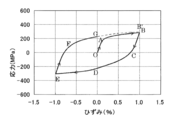
- FIG. 1 shows the relationship between stress and strain in the first cycle of tensile compression deformation of Example 2 (4S).
- the tensile plastic strain also decreases following the elastic deformation portion BC in which the tensile elastic stress decreases in proportion to the decrease in tensile strain, and the strain becomes zero at point D.
- compressive plastic strain occurs when compression deformation progresses.
- point E of -1% the deformation again turns from compression to tension, and then the elastic deformation EF and plastic deformation FG are followed, and the first cycle is completed.
- the second cycle starts along the curve GB ′ represented by a dotted line, and thereafter the same deformation as the first cycle is repeated.
- Curing rate (H) ( ⁇ a100 ⁇ a1) / ⁇ a1 (4)
- Table 2 shows the yield strength, the first cycle stress amplitude, the 100th cycle stress amplitude, the curing rate, and the final number of repetitions obtained from these results.
- Examples 1 to 6 (2S, 4S, 6S, 2A, 25M8N, 25M15C) all have a yield strength of 280 MPa or less, a stress amplitude of the 100th cycle of 400 MPa or less, and a final number of repetitions of 2000 cycles or more.
- the number of repetitions of fracture was slightly less than 2000.
- Comparative Example 2 8S in which Si was added in a larger amount than the component range of the present invention, a sample could not be prepared due to rolling cracks. The occurrence of cracking is thought to be due to the formation of a low melting intermetallic compound.
- Comparative Example 5 in which the amount of Ni added was reduced to 2% by mass as compared with the inventive material, and as a result, the Mn equivalent was reduced to 29, repetitive curing was remarkably high, and the number of repeated fractures was 1000 or less. This is considered to be due to the formation of 50 volume% or more of the ⁇ martensite phase and the ⁇ ′ martensite phase.
- Comparative Example 6 (15N) containing 15% by mass of Ni and higher in concentration than the Examples, cracks occurred during hot rolling, and a test piece could not be produced. This is considered to be because Ni formed a low melting point intermetallic compound with Si.
- Comparative Example 7 is an NbC precipitate addition type damping alloy disclosed in Patent Document 5.
- the number of repetitions of fracture is excellent at 3000 cycles or more, but the stress amplitude is extremely high at 620 MPa.
- Comparative Example 8 (30M1A) is an Al-added vibration damping alloy disclosed in Patent Document 6. Although the number of repeated fractures is 2000 or more and the stress amplitude is low, Mn is contained in an amount of 30% by mass, so that it is not suitable for mass production.
- the damping alloys of Examples 1 to 6 under the conditions specified in the present invention have lower proof stress and stress amplitude after repeated tensile and compressive deformation than the alloys of Comparative Examples 1 to 8 outside the conditions. It was confirmed that the damping alloy can be used without maintenance even after long-period ground motion and can be mass-produced.
- the damping alloy of the present invention is an elasto-plastic damper that suppresses the vibration of building structures due to earthquakes, wind fluctuations, etc., operates at low stress, and can be used maintenance-free even when repeatedly exposed to large earthquakes It becomes possible to manufacture a simple low-cost vibration damping device.
- a high-performance damper that does not impair the damping performance even if a long-amplitude vibration such as long-period ground motion continues for a long time, it can be used especially for damping high-rise buildings.
- building structures are places that are repeatedly deformed with large strains in all forms such as chemical plants, power plants, halls, towers, fuel tanks, elevated railways / roads, bridges, pipelines, tunnels, wind power generation facilities, etc. It is expected to be effective in suppressing vibrations.
Landscapes
- Chemical & Material Sciences (AREA)
- Engineering & Computer Science (AREA)
- Materials Engineering (AREA)
- Mechanical Engineering (AREA)
- Metallurgy (AREA)
- Organic Chemistry (AREA)
- Physics & Mathematics (AREA)
- Thermal Sciences (AREA)
- Crystallography & Structural Chemistry (AREA)
- Vibration Prevention Devices (AREA)
- Heat Treatment Of Steel (AREA)
- Buildings Adapted To Withstand Abnormal External Influences (AREA)
Abstract
L'invention porte sur un alliage amortisseur à base de Fe-Mn-(Cr,Ni)-Si qui contient du Cr et/ou du Ni et qui peut en outre contenir de l'Al, caractérisé en ce que : il contient, comme composants de composition, 5 à 28 % en masse de Mn, 0 à 15 % en masse de Cr, 0 à moins de 15 % en masse de Ni, de plus de 0 à moins de 6,5 % en masse de Si et de 0 à moins de 3 % en masse d'Al, le reste étant du Fe et des impuretés inévitables ; et il satisfait aux relations : [% Ni] + 0,5[% Mn] > 0,75[% Cr] + 1,125[% Si] + 2[% Al] ; et 37 < [% Mn] + [% Cr] + 2[% Ni] + 5[% Al] < 45 (où [% Ni], [% Mn], [% Cr], [% Si] et [% Al] représentent les teneurs (% en masse) en Ni, Mn, Cr, Si et Al respectivement). Ainsi, un alliage à base Fe-Mn-(Cr,Ni)-Si pouvant être produit en masse pour un amortisseur élastoplastique peut être obtenu, ledit alliage présentant une limite d'élasticité conventionnelle abaissée, une amplitude de la contrainte abaissée après déformation par traction et compression répétée et un nombre accru de cycles avant fracture et pouvant être utilisé sans entretien même après un mouvement du sol sismique de longue durée.
Priority Applications (2)
| Application Number | Priority Date | Filing Date | Title |
|---|---|---|---|
| EP13869412.0A EP2940175B1 (fr) | 2012-12-28 | 2013-12-19 | Alliage amortisseur |
| KR1020157015190A KR102144708B1 (ko) | 2012-12-28 | 2013-12-19 | 제진합금 |
Applications Claiming Priority (2)
| Application Number | Priority Date | Filing Date | Title |
|---|---|---|---|
| JP2012287955A JP6182725B2 (ja) | 2012-12-28 | 2012-12-28 | 制振合金 |
| JP2012-287955 | 2012-12-28 |
Publications (1)
| Publication Number | Publication Date |
|---|---|
| WO2014103884A1 true WO2014103884A1 (fr) | 2014-07-03 |
Family
ID=51020971
Family Applications (1)
| Application Number | Title | Priority Date | Filing Date |
|---|---|---|---|
| PCT/JP2013/084119 Ceased WO2014103884A1 (fr) | 2012-12-28 | 2013-12-19 | Alliage amortisseur |
Country Status (4)
| Country | Link |
|---|---|
| EP (1) | EP2940175B1 (fr) |
| JP (1) | JP6182725B2 (fr) |
| KR (1) | KR102144708B1 (fr) |
| WO (1) | WO2014103884A1 (fr) |
Cited By (2)
| Publication number | Priority date | Publication date | Assignee | Title |
|---|---|---|---|---|
| CN116292704A (zh) * | 2023-03-30 | 2023-06-23 | 上海材料研究所有限公司 | 一种能提供高阻尼力的抗疲劳弧形减震元件及应用 |
| CN117210756A (zh) * | 2023-10-12 | 2023-12-12 | 鞍钢集团北京研究院有限公司 | 一种超低屈强比低屈服点阻尼软钢及制备方法 |
Families Citing this family (7)
| Publication number | Priority date | Publication date | Assignee | Title |
|---|---|---|---|---|
| JP6696754B2 (ja) * | 2015-11-05 | 2020-05-20 | 株式会社ビー・ビー・エム | 構造物用複合制振ダンパー |
| JP2017193825A (ja) * | 2016-04-18 | 2017-10-26 | 株式会社ビービーエム | 座屈拘束型制振装置 |
| JP6887642B2 (ja) | 2017-04-04 | 2021-06-16 | 国立研究開発法人物質・材料研究機構 | 低サイクル疲労特性に優れるFe−Mn−Si系合金鋳造材 |
| JP7555733B2 (ja) | 2020-06-05 | 2024-09-25 | 株式会社竹中工務店 | 溶接組立鋼材 |
| EP4174204A4 (fr) | 2020-06-24 | 2024-10-30 | National Institute for Materials Science | Structure soudée et alliage à base de fe-mn-cr-ni-si |
| CN112029988B (zh) * | 2020-09-03 | 2022-02-18 | 成都科宁达材料有限公司 | 一种提高Fe-Cr-Mo基阻尼合金阻尼性能的方法 |
| KR20230073482A (ko) * | 2021-11-19 | 2023-05-26 | 한국재료연구원 | 고강도 고인성 중엔트로피 합금 및 그 제조 방법 |
Citations (10)
| Publication number | Priority date | Publication date | Assignee | Title |
|---|---|---|---|---|
| JPS62112751A (ja) * | 1985-11-09 | 1987-05-23 | Nippon Steel Corp | 鉄基形状記憶合金薄板・線の製造方法 |
| JPS6455361A (en) * | 1987-08-25 | 1989-03-02 | Takeshi Masumoto | Fe-base shape memory alloy |
| JPH0526274A (ja) | 1991-07-18 | 1993-02-02 | Kajima Corp | 弾塑性ダンパー |
| JPH05106367A (ja) | 1991-10-15 | 1993-04-27 | Kajima Corp | 鉛ダンパー |
| JPH05263858A (ja) | 1991-10-25 | 1993-10-12 | Honeywell Inc | 粘性ダンパー |
| JPH1036943A (ja) * | 1996-07-24 | 1998-02-10 | Taiheiyo Kinzoku Kk | Fe−Mn−Si系形状記憶合金の製造方法 |
| JP2001146855A (ja) | 1999-11-19 | 2001-05-29 | Shimizu Corp | 粘弾性ダンパー |
| JP2006194287A (ja) | 2005-01-11 | 2006-07-27 | National Institute For Materials Science | 鉄系形状記憶合金を用いた制振材料とこの材料を用いた制振・免震装置 |
| JP2008056987A (ja) | 2006-08-31 | 2008-03-13 | National Institute For Materials Science | 耐震合金 |
| JP2011214127A (ja) | 2010-03-31 | 2011-10-27 | Tk Techno Consulting:Kk | 制振・免震ダンパー装置 |
Family Cites Families (9)
| Publication number | Priority date | Publication date | Assignee | Title |
|---|---|---|---|---|
| JPH05186852A (ja) * | 1992-01-11 | 1993-07-27 | Sumitomo Metal Ind Ltd | 制振性鋼並びに制振性溶接鋼管とその製造法 |
| WO1997003215A1 (fr) * | 1995-07-11 | 1997-01-30 | Kari Martti Ullakko | Alliages ferreux a memoire de forme et amortissement de vibrations, contenant de l'azote |
| JP2003105438A (ja) * | 2001-09-27 | 2003-04-09 | National Institute For Materials Science | NbC添加Fe−Mn−Si系形状記憶合金の加工熱処理方法 |
| CN1158399C (zh) * | 2002-09-03 | 2004-07-21 | 四川大学 | 形变诱导时效型铁基形状记忆合金及其制备方法 |
| JP2009155719A (ja) * | 2007-12-25 | 2009-07-16 | Tk Techno Consulting:Kk | 制振性鋼管及びその製造方法 |
| JP2010043304A (ja) * | 2008-08-11 | 2010-02-25 | Daido Steel Co Ltd | Fe基制振合金 |
| JP2010156041A (ja) | 2008-12-04 | 2010-07-15 | Daido Steel Co Ltd | 双方向形状回復合金 |
| JP2012102391A (ja) | 2010-11-08 | 2012-05-31 | Tk Techno Consulting:Kk | 建造物外装材 |
| CN102435624B (zh) * | 2011-11-23 | 2013-10-30 | 天津大学 | 原位X射线衍射表征Fe-Mn-Si基记忆合金回复特性的方法 |
-
2012
- 2012-12-28 JP JP2012287955A patent/JP6182725B2/ja active Active
-
2013
- 2013-12-19 KR KR1020157015190A patent/KR102144708B1/ko active Active
- 2013-12-19 WO PCT/JP2013/084119 patent/WO2014103884A1/fr not_active Ceased
- 2013-12-19 EP EP13869412.0A patent/EP2940175B1/fr active Active
Patent Citations (10)
| Publication number | Priority date | Publication date | Assignee | Title |
|---|---|---|---|---|
| JPS62112751A (ja) * | 1985-11-09 | 1987-05-23 | Nippon Steel Corp | 鉄基形状記憶合金薄板・線の製造方法 |
| JPS6455361A (en) * | 1987-08-25 | 1989-03-02 | Takeshi Masumoto | Fe-base shape memory alloy |
| JPH0526274A (ja) | 1991-07-18 | 1993-02-02 | Kajima Corp | 弾塑性ダンパー |
| JPH05106367A (ja) | 1991-10-15 | 1993-04-27 | Kajima Corp | 鉛ダンパー |
| JPH05263858A (ja) | 1991-10-25 | 1993-10-12 | Honeywell Inc | 粘性ダンパー |
| JPH1036943A (ja) * | 1996-07-24 | 1998-02-10 | Taiheiyo Kinzoku Kk | Fe−Mn−Si系形状記憶合金の製造方法 |
| JP2001146855A (ja) | 1999-11-19 | 2001-05-29 | Shimizu Corp | 粘弾性ダンパー |
| JP2006194287A (ja) | 2005-01-11 | 2006-07-27 | National Institute For Materials Science | 鉄系形状記憶合金を用いた制振材料とこの材料を用いた制振・免震装置 |
| JP2008056987A (ja) | 2006-08-31 | 2008-03-13 | National Institute For Materials Science | 耐震合金 |
| JP2011214127A (ja) | 2010-03-31 | 2011-10-27 | Tk Techno Consulting:Kk | 制振・免震ダンパー装置 |
Non-Patent Citations (6)
| Title |
|---|
| A. GLAGE; A. WEIDNER; H. BIERMANN: "Cyclic Deformation Behaviour of Three Austenite Cast CrMnNi TRIP/TWIP Steels with Various Ni Content", STEEL RESEARCH INTERNATIONAL, vol. 82, 2011, pages 1040 |
| B. C. MAJI; M. KRISHNAN; V. V. R. RAO: "The microstructure of an Fe-Mn-Si Cr-Ni stainless steel shape memory alloy", MET. MAT. TRANS. A, vol. 34A, 2003, pages 1029, XP001228300, DOI: doi:10.1007/s11661-003-0124-y |
| H. OTSUKA; H. YAMADA; T. MARUYAMA; H. TANAHASHI; S. MATSUDA; M. MURAKAMI: "Effects ofAlloying Additions on Fe-Mn-Si Shape Memory Alloys", ISIJ INTERNATIONAL, vol. 30, 1990, pages 674 |
| M. KOYAMA; M. MURAKAMI; K. OGAWA; T KIKUCHI; T SAWAGUCHI: "Influence ofAl on Shape Memory Effect and Twinning Induced Plasticity of Fe-Mn-Si-Al System Alloy", MATER. TRANS., 2007 |
| T. NIENDORF; F. RUBITSCHEK; H. J. MAIER; J. NIENDORF; H. A. RICHARD; A. FREHN: "Fatigue crack growth-Microstructure relationships in a high-manganese austenite TWIP steel", MATERIALS SCIENCE AND ENGINEERING A-STRUCTURAL MATERIALS PROPERTIES MICROSTRUCTURE AND PROCESSING, vol. 527, 2010, pages 2412 |
| T. SAWAGUCHI; P. SAHU; T KIKUCHI; K. OGAWA; S. KAJIWARA; A. KUSHIBE; M. HIGASHINO; T. OGAWA: "Vibration mitigation by the reversible fcc/hcp martensitic transformation during cyclic tension-compression loading of an Fe-Mn-Si-based shape memory alloy", SCRIPTA MATERIALIA, vol. 54, 2006, pages 1885, XP025028364, DOI: doi:10.1016/j.scriptamat.2006.02.013 |
Cited By (2)
| Publication number | Priority date | Publication date | Assignee | Title |
|---|---|---|---|---|
| CN116292704A (zh) * | 2023-03-30 | 2023-06-23 | 上海材料研究所有限公司 | 一种能提供高阻尼力的抗疲劳弧形减震元件及应用 |
| CN117210756A (zh) * | 2023-10-12 | 2023-12-12 | 鞍钢集团北京研究院有限公司 | 一种超低屈强比低屈服点阻尼软钢及制备方法 |
Also Published As
| Publication number | Publication date |
|---|---|
| JP6182725B2 (ja) | 2017-08-23 |
| KR102144708B1 (ko) | 2020-08-14 |
| KR20150117637A (ko) | 2015-10-20 |
| JP2014129567A (ja) | 2014-07-10 |
| EP2940175A1 (fr) | 2015-11-04 |
| EP2940175A4 (fr) | 2016-08-24 |
| EP2940175B1 (fr) | 2021-02-03 |
Similar Documents
| Publication | Publication Date | Title |
|---|---|---|
| JP6182725B2 (ja) | 制振合金 | |
| RU2169786C2 (ru) | Азотсодержащие сплавы на основе железа, обладающие свойствами демпфирования и эффектом памяти формы | |
| JP5544633B2 (ja) | 衝撃吸収特性に優れた構造部材用オーステナイト系ステンレス鋼板 | |
| JP5837487B2 (ja) | 銅系合金及びそれを用いた構造材 | |
| CN101835917B (zh) | 高强度厚钢板及其制造方法 | |
| JP5597006B2 (ja) | 構造部材用高強度および高延性オーステナイト系ステンレス鋼板およびその製造方法 | |
| JP4926406B2 (ja) | 疲労き裂伝播特性に優れた鋼板 | |
| JP5385760B2 (ja) | 耐震性に優れた冷間成形角形鋼管 | |
| CN1227383C (zh) | 用作钢带的双相不锈钢带材 | |
| WO2011030853A1 (fr) | Boulon à résistance élevée | |
| JP4984272B2 (ja) | 制振性に優れた鋼その製造方法及び該鋼を含んで構成される制振体 | |
| CN110468341A (zh) | 一种1400MPa级耐延迟断裂高强度螺栓及制造方法 | |
| JP4687712B2 (ja) | 高周波焼入れ中空駆動軸 | |
| JP2010121191A (ja) | 耐遅れ破壊特性および溶接性に優れる高強度厚鋼板およびその製造方法 | |
| KR102835321B1 (ko) | 용접 구조체 및 이것에 사용되는 Fe-Mn-Cr-Ni-Si계 합금 | |
| KR20140119216A (ko) | 고망간강 및 그 제조방법 | |
| JP2011214127A (ja) | 制振・免震ダンパー装置 | |
| JP2008163358A (ja) | 衝撃吸収特性に優れた構造部材用ステンレス鋼板 | |
| JP4709555B2 (ja) | 鉄系形状記憶合金を用いた制振材料とこの材料を用いた制振装置及び鉄合金系制振材料の使用方法 | |
| JP4066908B2 (ja) | 制震ダンパー用焼戻し鋼材およびその製造方法 | |
| CN117210756A (zh) | 一种超低屈强比低屈服点阻尼软钢及制备方法 | |
| KR102460872B1 (ko) | 저사이클 피로 특성이 우수한 Fe-Mn-Si계 합금 주조재 | |
| JP2008156752A (ja) | 衝撃吸収部材の製造方法 | |
| CN116334500B (zh) | 一种高强度抗疲劳弹塑性阻尼钢及其制造方法与应用 | |
| JP5375241B2 (ja) | 高強度薄鋼板およびその製造方法 |
Legal Events
| Date | Code | Title | Description |
|---|---|---|---|
| 121 | Ep: the epo has been informed by wipo that ep was designated in this application |
Ref document number: 13869412 Country of ref document: EP Kind code of ref document: A1 |
|
| DPE1 | Request for preliminary examination filed after expiration of 19th month from priority date (pct application filed from 20040101) | ||
| ENP | Entry into the national phase |
Ref document number: 20157015190 Country of ref document: KR Kind code of ref document: A |
|
| NENP | Non-entry into the national phase |
Ref country code: DE |
|
| WWE | Wipo information: entry into national phase |
Ref document number: 2013869412 Country of ref document: EP |