WO2014103994A1 - ポリエステル樹脂組成物、接着剤、及びフィルム - Google Patents
ポリエステル樹脂組成物、接着剤、及びフィルム Download PDFInfo
- Publication number
- WO2014103994A1 WO2014103994A1 PCT/JP2013/084440 JP2013084440W WO2014103994A1 WO 2014103994 A1 WO2014103994 A1 WO 2014103994A1 JP 2013084440 W JP2013084440 W JP 2013084440W WO 2014103994 A1 WO2014103994 A1 WO 2014103994A1
- Authority
- WO
- WIPO (PCT)
- Prior art keywords
- resin composition
- polyester resin
- group
- film
- composition according
- Prior art date
- Legal status (The legal status is an assumption and is not a legal conclusion. Google has not performed a legal analysis and makes no representation as to the accuracy of the status listed.)
- Ceased
Links
Classifications
-
- C—CHEMISTRY; METALLURGY
- C09—DYES; PAINTS; POLISHES; NATURAL RESINS; ADHESIVES; COMPOSITIONS NOT OTHERWISE PROVIDED FOR; APPLICATIONS OF MATERIALS NOT OTHERWISE PROVIDED FOR
- C09J—ADHESIVES; NON-MECHANICAL ASPECTS OF ADHESIVE PROCESSES IN GENERAL; ADHESIVE PROCESSES NOT PROVIDED FOR ELSEWHERE; USE OF MATERIALS AS ADHESIVES
- C09J175/00—Adhesives based on polyureas or polyurethanes; Adhesives based on derivatives of such polymers
- C09J175/04—Polyurethanes
- C09J175/06—Polyurethanes from polyesters
-
- C—CHEMISTRY; METALLURGY
- C08—ORGANIC MACROMOLECULAR COMPOUNDS; THEIR PREPARATION OR CHEMICAL WORKING-UP; COMPOSITIONS BASED THEREON
- C08L—COMPOSITIONS OF MACROMOLECULAR COMPOUNDS
- C08L67/00—Compositions of polyesters obtained by reactions forming a carboxylic ester link in the main chain; Compositions of derivatives of such polymers
- C08L67/02—Polyesters derived from dicarboxylic acids and dihydroxy compounds
-
- C—CHEMISTRY; METALLURGY
- C08—ORGANIC MACROMOLECULAR COMPOUNDS; THEIR PREPARATION OR CHEMICAL WORKING-UP; COMPOSITIONS BASED THEREON
- C08K—Use of inorganic or non-macromolecular organic substances as compounding ingredients
- C08K3/00—Use of inorganic substances as compounding ingredients
-
- C—CHEMISTRY; METALLURGY
- C08—ORGANIC MACROMOLECULAR COMPOUNDS; THEIR PREPARATION OR CHEMICAL WORKING-UP; COMPOSITIONS BASED THEREON
- C08K—Use of inorganic or non-macromolecular organic substances as compounding ingredients
- C08K3/00—Use of inorganic substances as compounding ingredients
- C08K3/34—Silicon-containing compounds
-
- C—CHEMISTRY; METALLURGY
- C09—DYES; PAINTS; POLISHES; NATURAL RESINS; ADHESIVES; COMPOSITIONS NOT OTHERWISE PROVIDED FOR; APPLICATIONS OF MATERIALS NOT OTHERWISE PROVIDED FOR
- C09D—COATING COMPOSITIONS, e.g. PAINTS, VARNISHES OR LACQUERS; FILLING PASTES; CHEMICAL PAINT OR INK REMOVERS; INKS; CORRECTING FLUIDS; WOODSTAINS; PASTES OR SOLIDS FOR COLOURING OR PRINTING; USE OF MATERIALS THEREFOR
- C09D167/00—Coating compositions based on polyesters obtained by reactions forming a carboxylic ester link in the main chain; Coating compositions based on derivatives of such polymers
- C09D167/02—Polyesters derived from dicarboxylic acids and dihydroxy compounds
-
- C—CHEMISTRY; METALLURGY
- C09—DYES; PAINTS; POLISHES; NATURAL RESINS; ADHESIVES; COMPOSITIONS NOT OTHERWISE PROVIDED FOR; APPLICATIONS OF MATERIALS NOT OTHERWISE PROVIDED FOR
- C09D—COATING COMPOSITIONS, e.g. PAINTS, VARNISHES OR LACQUERS; FILLING PASTES; CHEMICAL PAINT OR INK REMOVERS; INKS; CORRECTING FLUIDS; WOODSTAINS; PASTES OR SOLIDS FOR COLOURING OR PRINTING; USE OF MATERIALS THEREFOR
- C09D175/00—Coating compositions based on polyureas or polyurethanes; Coating compositions based on derivatives of such polymers
- C09D175/04—Polyurethanes
- C09D175/06—Polyurethanes from polyesters
-
- C—CHEMISTRY; METALLURGY
- C09—DYES; PAINTS; POLISHES; NATURAL RESINS; ADHESIVES; COMPOSITIONS NOT OTHERWISE PROVIDED FOR; APPLICATIONS OF MATERIALS NOT OTHERWISE PROVIDED FOR
- C09J—ADHESIVES; NON-MECHANICAL ASPECTS OF ADHESIVE PROCESSES IN GENERAL; ADHESIVE PROCESSES NOT PROVIDED FOR ELSEWHERE; USE OF MATERIALS AS ADHESIVES
- C09J167/00—Adhesives based on polyesters obtained by reactions forming a carboxylic ester link in the main chain; Adhesives based on derivatives of such polymers
- C09J167/02—Polyesters derived from dicarboxylic acids and dihydroxy compounds
-
- C—CHEMISTRY; METALLURGY
- C08—ORGANIC MACROMOLECULAR COMPOUNDS; THEIR PREPARATION OR CHEMICAL WORKING-UP; COMPOSITIONS BASED THEREON
- C08K—Use of inorganic or non-macromolecular organic substances as compounding ingredients
- C08K2201/00—Specific properties of additives
- C08K2201/008—Additives improving gas barrier properties
-
- C—CHEMISTRY; METALLURGY
- C08—ORGANIC MACROMOLECULAR COMPOUNDS; THEIR PREPARATION OR CHEMICAL WORKING-UP; COMPOSITIONS BASED THEREON
- C08L—COMPOSITIONS OF MACROMOLECULAR COMPOUNDS
- C08L2312/00—Crosslinking
Definitions
- the present invention provides a resin composition capable of providing a film having excellent adhesive strength, gas barrier property or water vapor barrier property, a gas barrier property or water vapor barrier property film obtained by curing the resin composition, and the resin composition.
- the present invention relates to a gas barrier or water vapor barrier film laminate obtained by curing on a film.
- Packaging materials typically used for packaging foods and beverages protect the contents from various distributions, storage such as refrigeration and processing such as heat sterilization, so that the strength, resistance to cracking, retort resistance, heat resistance In addition to functions such as sexuality, a wide variety of functions are required, such as excellent transparency so that the contents can be confirmed.
- an unstretched polyolefin film having excellent heat processability is essential, but the unstretched polyolefin film has many functions that are insufficient as a packaging material.
- high barrier properties are required for the purpose of maintaining the quality of the contents and maintaining the content.
- Such a barrier packaging material is usually used as a composite flexible film in which different polymer materials and inorganic materials are laminated.
- a barrier function When imparting a barrier function to a multilayer film, it is difficult to impart a barrier function to the unstretched polyolefin films used for the inner layer (sealant side) by coating or vapor deposition. Therefore, a barrier function is often imparted to various films (polyester resins such as polyethylene terephthalate (hereinafter abbreviated as PET), polyamide resins, stretched polyolefin resins) used on the outer layer side.
- PET polyethylene terephthalate
- polyamide resins polyamide resins
- stretched polyolefin resins stretched polyolefin resins
- the barrier coating material vinylidene chloride having a high retort resistance and gas or water vapor barrier property has been frequently used, but dioxins are generated at the time of disposal firing, etc. There is a problem. Further, when a polyvinyl alcohol resin or ethylene-polyvinyl alcohol copolymer is used as a barrier coating material, the oxygen barrier property is high, but there is a problem that the water vapor barrier property is remarkably lowered.
- a film provided with a vapor-deposited layer of a metal oxide such as silica or alumina as a gas or water vapor barrier layer is expensive and has a problem that the gas / water vapor barrier performance varies due to cracks and pinholes due to poor flexibility.
- Patent Document 1 discloses a sheet excellent in water vapor barrier property, impact resistance, rigidity, and heat resistance containing a cyclic olefin in a resin composition, and a container formed of the sheet. ing.
- Patent Document 2 describes a material that is a film or sheet containing a vinylidene chloride copolymer.
- Patent Document 3 has an example using a maleimide compound having a condensed alicyclic structure, and describes that a water vapor barrier property can be imparted to the resulting sealant. .
- Patent Document 4 discloses that polyurethane is developed as an adhesive for transparent inorganic vapor-deposited film and an anchor coating agent, polyester polyol is used as a polyurethane raw material, and tricyclodecane dimethanol is used as a glycol component. Are listed.
- the problem to be solved by the present invention is a polyester resin composition for a water vapor barrier material mainly composed of a polyester resin having solubility in a general-purpose solvent in ethyl acetate, methyl ethyl ketone, etc., and excellent in water vapor barrier properties as a barrier property, And a film for a water vapor barrier material in which the resin composition is applied to the film, And a polyester resin composition for a gas barrier material mainly composed of a polyester resin having solubility in a general-purpose solvent in ethyl acetate, methyl ethyl ketone, etc. and excellent in gas barrier properties as a barrier property, and the resin composition was applied to a film
- the object is to provide a gas barrier film.
- the inventors of the present invention provide a polyester resin composition containing a polyester resin having glycerol as the center of the polyester resin skeleton and having a polyester skeleton having a specific structure in the branched chain, and a curing agent capable of reacting with the polyester resin. Solved the problem.
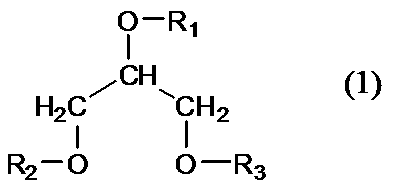
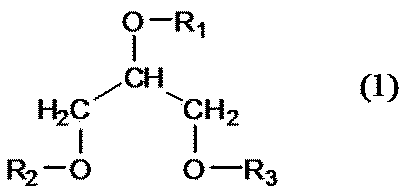
- the present invention provides a polyester resin composition containing a polyester polyol having a glycerol skeleton represented by the general formula (1) and a curing agent capable of reacting therewith, and a polyester resin composition containing a layered inorganic compound. provide.
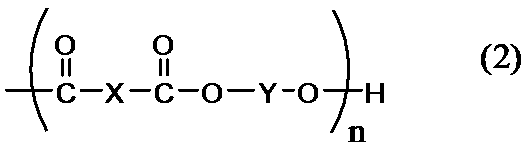
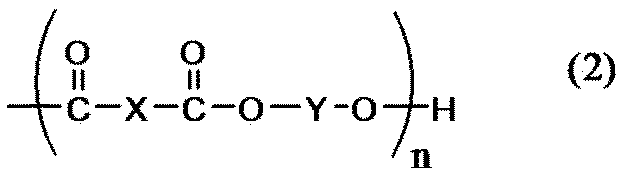
- R 1 to R 3 each independently represents a hydrogen atom, or a compound represented by the general formula (2)
- n represents an integer of 1 to 5
- X represents an optionally substituted 1,2-phenylene group, 1,2-naphthylene group, 2,3-naphthylene group, 2
- Y represents an alkylene group having 2 to 6 carbon atoms Represents a group represented by: However, at least one of R 1 to R 3 represents a group represented by the general formula (2).
- a polyester resin composition for a barrier material that is excellent in solubility in a general-purpose solvent in ethyl acetate, methyl ethyl ketone, and the like, and excellent in gas barrier properties or water vapor barrier properties.
- the present invention includes a water vapor barrier film composed of a resin layer obtained by curing the polyester resin composition for the water vapor barrier material.
- This film is not limited as long as it is a water vapor barrier composite film having at least a layer formed by curing the polyester resin composition for water vapor barrier material and a base film layer.
- the present invention includes a gas barrier film composed of a resin layer obtained by curing the polyester resin composition for gas barrier material. This film is not limited as long as it is a gas barrier composite film having at least a layer formed by curing the polyester resin composition for gas barrier material and a base film layer.
- a polyester resin composition comprising a polyester polyol represented by the general formula (1) and a curing agent;
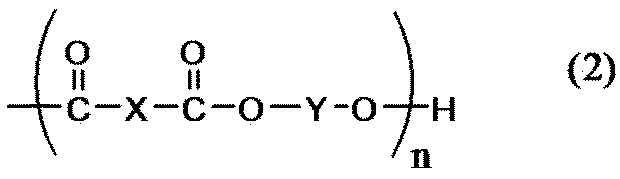
- R 1 to R 3 each independently represents a hydrogen atom, or a compound represented by the general formula (2)
- n represents an integer of 1 to 5
- X represents an optionally substituted 1,2-phenylene group, 1,2-naphthylene group, 2,3-naphthylene group, 2
- Y represents an alkylene group having 2 to 6 carbon atoms Represents a group represented by: However, at least one of R 1 to R 3 represents a group represented by the general formula (2).
- the polyester resin composition contains a glycerol residue of the polyester polyol represented by the general formula (1) in an amount of 5% by mass or more.
- the curing agent is an isocyanate compound. Or 2.
- the isocyanate compound is a reaction product of toluene diisocyanate, xylene diisocyanate, diphenylmethane diisocyanate, polymethylene polyphenyl polyisocyanate, toluene diisocyanate or xylene diisocyanate and a polyhydric alcohol having at least two hydroxyl groups in the molecule, or toluene diisocyanate, 2.
- the resin composition for a barrier material is a resin composition for a gas barrier material.
- the resin composition for a barrier material is a resin composition for an oxygen barrier material or a water vapor barrier material.
- the layered inorganic compound is nonionic between layers or non-swellable with respect to water.
- the layered inorganic compound contains particles having an average particle size of 0.1 ⁇ m or more. Or 9.
- the content of the layered inorganic compound is 5 to 50 parts by mass.
- ⁇ 10. A polyester resin composition according to any one of 12.1.
- ⁇ 11. A coating agent obtained by curing the polyester resin composition according to any one of 13.1.
- ⁇ 11 An adhesive formed by curing the polyester resin composition according to any one of 14.1. ⁇ 11.
- the “barrier material” is a material having a barrier property
- the “gas barrier material” is a material having a barrier property against gas
- the “water vapor barrier material” is a material having a barrier property against water vapor.
- water vapor refers to water vapor
- gas refers to a gaseous substance at room temperature and normal pressure
- examples of gas include oxygen, nitrogen, carbon dioxide, helium, and argon.
- the resin composition for gas barrier materials or the resin composition for water vapor barrier materials refers to the resin composition used for a gas barrier material or a water vapor barrier material.
- R 1 to R 3 are a hydrogen atom, or the general formula (2)
- n represents an integer of 1 to 5
- X represents an optionally substituted 1,2-phenylene group, 1,2-naphthylene group, 2,3-naphthylene group, 2
- Y represents an alkylene group having 2 to 6 carbon atoms Represents a group represented by: However, at least one of R 1 to R 3 represents a group represented by the general formula (2).
- the said polyester polyol can be used as the polyester resin composition for barrier materials containing a hardening
- n represents an integer of 1 to 5
- X represents a 1,2-phenylene group, 1,2-naphthylene group, 2,3-naphthylene group which may have a substituent.
- R 1 , R 2 and R 3 needs to be a group represented by the general formula (2). Among them, it is preferable that all of R 1 , R 2 and R 3 are groups represented by the general formula (2).
- R 1, any one of R 2 and R 3 is a group represented by the general formula (2) compound, R 1, R 2, and any two of the general formula R 3 (2) Any two or more compounds of the compound represented by the general formula (2) and the compound in which all of R 1 , R 2 and R 3 are groups represented by the general formula (2) are mixed. Also good.
- X is selected from the group consisting of 1,2-phenylene group, 1,2-naphthylene group, 2,3-naphthylene group, 2,3-anthraquinonediyl group, and 2,3-anthracenediyl group,
- An optionally substituted arylene group, or an optionally substituted 1,2-phenylene group, 1,2-naphthylene group, 2,3-naphthylene group, 2,3-anthraquinonediyl group, and 2 Represents a group obtained by a hydrogenation reaction of an arylene group selected from the group consisting of 3-anthracenediyl groups;
- X When X is substituted with a substituent, it may be substituted with one or more substituents, which are attached to any carbon atom on X that is different from the free radical.
- substituents examples include chloro group, bromo group, methyl group, ethyl group, i-propyl group, hydroxyl group, methoxy group, ethoxy group, phenoxy group, methylthio group, phenylthio group, cyano group, nitro group, amino group, Examples thereof include a phthalimide group, a carboxyl group, a carbamoyl group, an N-ethylcarbamoyl group, a phenyl group, and a naphthyl group.
- Y represents an ethylene group, propylene group, butylene group, neopentylene group, 1,5-pentylene group, 3-methyl-1,5-pentylene group, 1,6-hexylene group, methylpentylene.
- Y is preferably a propylene group or an ethylene group, and most preferably an ethylene group.
- the polyester resin compound having a glycerol skeleton represented by the general formula (1) is essential for glycerol, an aromatic polyvalent carboxylic acid in which the carboxylic acid is substituted in the ortho position, or an anhydride thereof, and a polyhydric alcohol component. Obtained by reacting as a component.
- the aromatic polyvalent carboxylic acid in which the carboxylic acid is substituted in the ortho position or its anhydride includes orthophthalic acid or its anhydride, naphthalene 2,3-dicarboxylic acid or its anhydride, naphthalene 1,2-dicarboxylic acid or its Anhydrides, anthraquinone 2,3-dicarboxylic acid or its anhydride, 2,3-anthracene carboxylic acid or its anhydride, etc., orthophthalic acid, naphthalene 2,3-dicarboxylic acid, naphthalene 1,2-dicarboxylic acid, anthraquinone 2 , 3-dicarboxylic acid and 2,3-anthracenecarboxylic acid aromatic hydrogenated dicarboxylic acid or anhydride thereof.
- These compounds may have a substituent on any carbon atom of an aromatic ring or an alicyclic ring obtained by hydrogenating an aromatic ring.
- substituents include chloro group, bromo group, methyl group, ethyl group, i-propyl group, hydroxyl group, methoxy group, ethoxy group, phenoxy group, methylthio group, phenylthio group, cyano group, nitro group, amino group, Examples thereof include a phthalimide group, a carboxyl group, a carbamoyl group, an N-ethylcarbamoyl group, a phenyl group, and a naphthyl group.
- examples of the polyhydric alcohol component include alkylene diols having 2 to 6 carbon atoms.
- diols such as ethylene glycol, propylene glycol, butylene glycol, neopentyl glycol, 1,5-pentanediol, 3-methyl-1,5-pentanediol, 1,6-hexanediol, methylpentanediol, dimethylbutanediol, etc. Can be illustrated.
- polyester resin compound having a glycerol (GLY) skeleton represented by the general formula (1) orthophthalic acid (oPA) anhydride is used as an aromatic polycarboxylic acid, and ethylene glycol is used as a polyhydric alcohol.
- Polyester resin using (EG) (abbreviated as GLY (oPAEG) m, m represents the total number of groups in parentheses contained in the polyester resin of the present invention), naphthalene 2,3- Examples thereof include polyester resins using dicarboxylic acid (oNA) and ethylene glycol as a polyhydric alcohol (abbreviated as GLY (oNAEG) m, where m is as defined above).
- Polyester resin using orthohexahydroxyphthalic acid (HHoPA) anhydride as the polyvalent carboxylic acid hydrogenated aromatic ring and ethylene glycol as the polyhydric alcohol (GLY (oHHPAEG) m is abbreviated as above, m is as defined above. is there.
- P represents a polyester resin compound having a glycerol skeleton.
- the present invention is characterized by having a glycerol residue of 5% by mass or more in the polyester resin composition in order to develop a high barrier property.
- the mass excluding the mass of the diluent solvent, the mass of the volatile component contained in the curing agent, and the inorganic component from the mass part of the polyester resin composition for a barrier material is defined as the mass of the total solid content of the adhesive resin.
- the hydrogenated alicyclic polycarboxylic acid or anhydride thereof has an asymmetric skeleton.
- polyhydric alcohol In the polyester resin compound used in the present invention, a polyhydric alcohol component other than an alkylene diol having 2 to 6 carbon atoms may be copolymerized as a polyhydric alcohol as long as the effects of the present invention are not impaired.
- aliphatic polyhydric alcohols such as glycerol, erythritol, pentaerythritol, dipentaerythritol, diethylene glycol, triethylene glycol, tetraethylene glycol, dipropylene glycol, tripropylene glycol, tetraethylene glycol, tripropylene glycol, Cycloaliphatic polyhydric alcohols such as cyclohexanedimethanol and tricyclodecanedimethanol, aromatic polyhydric phenols such as hydroquinone, resorcinol, catechol, naphthalene diol, biphenol, bisphenol A, hisphenol F, tetramethylbiphenol, or the like Examples thereof include ethylene oxide elongated products and hydrogenated alicyclic groups.
- the polyester resin of the present invention is an aromatic polyvalent carboxylic acid in which the carboxylic acid is substituted in the ortho position or an anhydride thereof, or an aromatic polyvalent carboxylic acid in which the carboxylic acid is substituted in the ortho position,
- An alicyclic polycarboxylic acid obtained by hydrogenating an aromatic ring of the anhydride or an anhydride thereof is essential, but other polyvalent carboxylic acid components may be copolymerized as long as the effects of the present invention are not impaired. .
- aliphatic polyvalent carboxylic acid succinic acid, adipic acid, azelaic acid, sebacic acid, dodecanedicarboxylic acid, etc.
- unsaturated bond-containing polyvalent carboxylic acid maleic anhydride, maleic acid, Fumaric acid, etc., 1,3-cyclopentanedicarboxylic acid, 1,4-cyclohexanedicarboxylic acid etc.
- succinic acid 1,3-cyclopentanedicarboxylic acid, isophthalic acid, 2,6-naphthalenedicarboxylic acid, 1,8-naphthalic acid and diphenic acid are preferred.
- glycerol used as a raw material, an aromatic polycarboxylic acid in which the carboxylic acid is substituted in the ortho position, or an anhydride thereof, and a polyhydric alcohol component are collectively charged,
- the temperature is raised while stirring and mixing to cause a dehydration condensation reaction.
- 1 mgKOH / g or less by the acid value measuring method described in JIS-K0070, and the hydroxyl value ZmgKOH / g obtained by the hydroxyl value measuring method described in JIS-K0070 is the numerical value on the right side of the following formula (b) (mgKOH /
- the desired polyester resin can be obtained by continuing the reaction until it is within ⁇ 5% of g).
- Mn represents a set number average molecular weight of a predetermined trifunctional polyester resin
- each raw material may be reacted in multiple stages. Moreover, you may prepare so that a hydroxyl value may enter into less than +/- 5%, adding the diol component volatilized at reaction temperature.
- Catalysts used in the reaction include acids such as tin-based catalysts such as monobutyltin oxide and dibutyltin oxide, titanium-based catalysts such as tetra-isopropyl-titanate and tetra-butyl-titanate, and zirconia-based catalysts such as tetra-butyl-zirconate.
- acids such as tin-based catalysts such as monobutyltin oxide and dibutyltin oxide
- titanium-based catalysts such as tetra-isopropyl-titanate and tetra-butyl-titanate
- zirconia-based catalysts such as tetra-butyl-zirconate.
- a catalyst is mentioned. It is preferable to use a combination of the titanium-based catalyst such as tetra-isopropyl-titanate or tetra-butyl-titanate, which has high activity for este
- the amount of the catalyst is 1 to 1000 ppm, more preferably 10 to 100 ppm, based on the total mass of the reaction raw material used. If it is less than 1 ppm, it is difficult to obtain an effect as a catalyst, and if it exceeds 1000 ppm, the subsequent urethanization reaction tends to be inhibited.
- the number average molecular weight of the polyester resin compound having a glycerol skeleton is preferably 450 to 5,000, and more preferably 450 to 2,000.
- polyisocyanate described below is most preferable, can give an appropriate reaction time, and is particularly excellent in solubility and water vapor barrier ability.
- the urethane group concentration at this time is preferably in the range of 1.0 to 6.0 mmol / g.
- the polyester resin compound having a glycerol skeleton used in the present invention preferably has a glass transition temperature in the range of ⁇ 30 ° C. to 70 ° C. More preferably, it is ⁇ 20 ° C. to 50 ° C.
- the glass transition temperature is too higher than 70 ° C., the flexibility of the polyester resin near room temperature tends to be low, and the adhesion to the substrate tends to be poor.
- the temperature is too low at about -30 ° C., there is a possibility that sufficient barrier properties may not be obtained due to the intense molecular motion of the polyester resin near room temperature.
- the curing agent used in the present invention is not particularly limited as long as it is a curing agent capable of reacting with the hydroxyl group of the polyester resin, and known curing agents such as polyisocyanates and epoxy compounds can be used. Among these, it is preferable to use polyisocyanate from the viewpoints of adhesiveness and retort resistance.
- Polyisocyanate compounds include aromatic and aliphatic diisocyanates and divalent or higher polyisocyanates, which may be either low molecular compounds or high molecular compounds.
- tetramethylene diisocyanate hexamethylene diisocyanate, toluene diisocyanate, diphenylmethane diisocyanate, hydrogenated diphenylmethane diisocyanate, xylylene diisocyanate, hydrogenated xylylene diisocyanate, isophorone diisocyanate or trimers of these isocyanate compounds, and excess of these isocyanate compounds Amount and, for example, ethylene glycol, propylene glycol, metaxylylene alcohol, 1,3-bishydroxyethylbenzene, 1,4-bishydroxyethylbenzene, trimethylolpropane, glycerol, pentaerythritol, erythritol, sorbitol, ethylenediamine, monoethanolamine, Diethanolamine, Trieta Adducts obtained by reacting with low molecular active hydrogen compounds such as uramine and metaxylylenediamine and
- the isocyanate compound may be a blocked isocyanate.
- the isocyanate blocking agent for example, phenols such as phenol, thiophenol, methylthiophenol, ethylthiophenol, cresol, xylenol, resorcinol, nitrophenol, chlorophenol, acetoxime, methyl ethyl ketoxime, cyclohexanone oxime oximes, methanol, Alcohols such as ethanol, propanol and butanol; halogen-substituted alcohols such as ethylene chlorohydrin and 1,3-dichloro-2-propanol; tertiary alcohols such as t-butanol and t-pentanol; Examples include lactams such as caprolactam, ⁇ -valerolactam, ⁇ -butyrolactam, ⁇ -propylolactam, and other aromatic amines, imides, acetylacetate.
- the blocked isocyanate can be obtained by subjecting the above isocyanate compound and an isocyanate blocking agent to an addition reaction by a conventionally known appropriate method.
- Epoxy compounds include diglycidyl ether of bisphenol A and oligomers thereof, diglycidyl ether of hydrogenated bisphenol A and oligomers thereof, orthoglycic acid diglycidyl ester, isophthalic acid diglycidyl ester, terephthalic acid diglycidyl ester, and p-oxybenzoic acid diglyceride.
- Glycidyl ester tetrahydrophthalic acid diglycidyl ester, hexahydrophthalic acid diglycidyl ester, succinic acid diglycidyl ester, adipic acid diglycidyl ester, sebacic acid diglycidyl ester, ethylene glycol diglycidyl ether, propylene glycol diglycidyl ether, 1 , 4-Butanediol diglycidyl ether, 1,6-hexanediol diglycidyl ether and polyalkylene Recall diglycidyl ethers, trimellitic acid triglycidyl ester, triglycidyl isocyanurate, 1,4-diglycidyloxybenzene, diglycidyl propylene urea, glycerol triglycidyl ether, trimethylolethane triglycidyl ether, trimethylolpropane triglycidyl
- a general-purpose known epoxy curing accelerator may be appropriately added for the purpose of accelerating curing as long as the barrier property which is the object of the present invention is not impaired.
- the curing agent is preferably the polyisocyanate, and when the polyisocyanate includes the metaxylene skeleton, the barrier property can be improved not only by the hydrogen bond of the urethane group but also by ⁇ - ⁇ stacking of aromatic rings. It is preferable because it can be done. Moreover, even if it is polyisocyanate containing the said toluene frame
- Examples of the polyisocyanate containing a meta-xylene skeleton or a toluene skeleton include xylylene diisocyanate, 2,4-toluene diisocyanate, or trimer of 2,6-toluene diisocyanate, a burette body synthesized by reaction with an amine, an alcohol, Although there exists an adduct formed by reaction, an adduct is more preferable because it is easy to obtain solubility in an organic solvent used for a dry laminate adhesive of polyisocyanate as compared with a trimer and a burette.
- an adduct obtained by reacting with an alcohol appropriately selected from the above low molecular active hydrogen compounds can be used. Among them, addition of ethylene oxide of trimethylolpropane, glycerol, triethanolamine, metaxylenediamine, etc. Adduct bodies with objects are particularly preferred.
- the polyester polyol having the glycerol skeleton and the curing agent are such that the ratio of the polyester polyol having the glycerol skeleton and the curing agent is a hydroxyl group of the polyester resin compound having the glycerol skeleton and a reaction component of the curing agent is 1 / 0.5 to It is preferable to blend so as to be 1/5 (equivalent ratio), and more preferably 1/1 to 1/3. If the curing agent component is excessive beyond this range, the surplus curing agent component may remain and bleed out from the adhesive layer after bonding. On the other hand, if the curing agent component is insufficient, the adhesive strength is insufficient. There is a fear.
- the above-mentioned curing agent can be used in combination with a known curing agent or accelerator selected according to the type.
- the adhesion promoter include silane coupling agents such as hydrolyzable alkoxysilane compounds, titanate coupling agents, aluminum coupling agents, and epoxy resins. Silane coupling agents and titanate coupling agents are also preferred in terms of improving the adhesive to various film materials.
- the polyester resin composition for a barrier material of the present invention may contain a layered inorganic compound.
- the layered inorganic compound used in the present invention has an effect of improving the barrier property.
- the polyester resin composition for barrier materials is used for a barrier adhesive, it has the effect of improving the laminate strength of the adhesive.
- the polyester resin composition for a barrier material is used as a barrier coating agent, it has an effect of improving the anti-blocking property of the coating agent.
- the layered inorganic compound used in the present invention has a feature of improving laminate strength and barrier properties due to its plate shape. At this time, these layered inorganic compounds are preferably non-swellable with respect to water. The reason is that water vapor tends to permeate through a portion where water is aggregated (that is, clustered), so that the addition of a swellable layered inorganic compound to water may lower the water vapor barrier function.
- a layered inorganic compound having no layer charge is kaolinite-serpentine clay mineral (halloysite, kaolinite, enderite, Dickite, nacrite, antigolite, chrysotile, etc.), pyrophyllite-talc group (pyrophyllite, talc, kerolai, etc.), magnesium hydroxide, aluminum hydroxide, water having a layered structure among various metal hydroxides
- barium oxide, iron hydroxide, zinc hydroxide, nickel hydroxide, layered barium sulfate, zeolite, aluminum polyphosphate, boehmite, glass flakes, aluminum flakes and the like can be mentioned.
- the non-swellable compounds although the layer has a negative charge include calcium montmorillonite and mica-based compounds having a potassium ion between layers, for example, muscovite, gold Mica, sericite, margarite, tetrasilic mica, teniolite and the like are preferably used.
- Hydrotalcites are known as materials having a positive charge in the layer, but these compounds are also preferably used because they do not have water swellability.
- These minerals may be natural clay minerals or synthetic clay minerals.
- An inorganic layered compound is used individually or in combination of 2 or more types.
- the average particle diameter in the present invention means a particle diameter having the highest appearance frequency when the particle size distribution of a certain layered inorganic compound is measured with a light scattering measurement device.
- the average particle size of the layered inorganic compound used in the present invention is not particularly limited, but is preferably 0.1 ⁇ m or more, and more preferably 1 ⁇ m or more. If the average particle size is 0.1 ⁇ m or less, the length of the long side is short, so that there are problems that it is difficult to improve the barrier ability without increasing the detour path of water molecules and the adhesive force.
- the side with a large average particle diameter is not particularly limited. When a large layered inorganic compound is contained by the coating method, when defects such as streaks occur on the coated surface, a material having an average particle diameter of 100 ⁇ m or less, more preferably 20 ⁇ m or less is preferably used.
- the aspect ratio of the layered inorganic compound used in the present invention is preferably high in order to improve the barrier ability due to the maze effect of water vapor. Specifically, it is preferably 10 or more, more preferably 50 or more, and most preferably 70 or more. Among these, for mica-based compounds, materials having an aspect ratio exceeding 100 are known and particularly preferably used.
- the content of the layered inorganic compound is not particularly limited as long as the barrier ability is improved, but it is 5 to 50 parts by mass. Preferably there is.
- the amount is 5 parts by mass or less, the barrier ability is difficult to improve, and when it is 50 parts by mass or more, when the application is an adhesive, the adhesiveness of the coating surface is lowered, so that the laminating operation becomes difficult or the laminate strength is insufficient. This is because there is a possibility of becoming.
- the content of the inorganic compound (PWC of the blend) can be obtained from the following formula (c).
- a known dispersion method can be used as a dispersion method of the layered inorganic compound used in the present invention.
- a known dispersion method include a dissolver, an ultrasonic homogenizer, a high-pressure homogenizer, a paint conditioner, a ball mill, a roll mill, a sand mill, a sand grinder, a dyno mill, a disperse mat, a nano mill, an SC mill, and a nanomizer.
- examples of equipment that can generate a high shearing force include a Henschel mixer, a pressure kneader, a Banbury mixer, a planetary mixer, a two-roll, and a three-roll. One of these may be used alone, or two or more devices may be used in combination.
- the following method is preferably used as a method for achieving better dispersion.
- the method is a method in which the layered inorganic compound is previously dispersed in water or a mixed solvent composed of water and an organic solvent, and after uniformly mixed with the polyester polyol, the water or water and the organic solvent are removed.
- a uniform good dispersion of the polyester polyol and the layered inorganic compound can be produced, and by curing the dispersion with a curing agent, a polyester resin composition having excellent barrier properties can be obtained.
- the polyester polyol is brought into a fluidized state by heating, and a layered inorganic compound dispersed in water or a mixed solution of water and an organic solvent is introduced into the polyester polyol and uniformly mixed by stirring.
- the heating temperature is adjusted while stirring.
- Water or organic solvent is removed by increasing or reducing the pressure. If the organic solvent used for dispersion
- distribution of a layered inorganic compound is uniformly mixed with water, there will be no restriction
- the polyester resin composition of the present invention may contain various additives as long as the barrier property is not impaired.
- additives include inorganic fillers such as silica, alumina, mica, talc, aluminum flakes, and glass flakes, stabilizers (antioxidants, heat stabilizers, ultraviolet absorbers, etc.), plasticizers, antistatic agents, Examples thereof include a lubricant, an antiblocking agent, a colorant, a filler, a crystal nucleating agent and the like.
- known acid anhydrides can be used in combination as a method for improving the acid resistance of the cured coating film.
- the acid anhydride include phthalic acid anhydride, succinic acid anhydride, het acid anhydride, hymic acid anhydride, maleic acid anhydride, tetrahydrophthalic acid anhydride, hexahydraphthalic acid anhydride, tetraprom phthalic acid Anhydride, tetrachlorophthalic anhydride, trimellitic anhydride, pyromellitic anhydride, benzophenotetracarboxylic anhydride, 2,3,6,7-naphthalenetetracarboxylic dianhydride, 5- (2 , 5-oxotetrahydrofuryl) -3-methyl-3-cyclohexene-1,2-dicarboxylic anhydride, styrene maleic anhydride copolymer and the like.
- a compound having an oxygen scavenging function may be added.
- the compound having an oxygen scavenging function include low molecular organic compounds that react with oxygen such as hindered phenols, vitamin C, vitamin E, organic phosphorus compounds, gallic acid, pyrogallol, cobalt, manganese, nickel, iron, Examples include transition metal compounds such as copper.
- a tackifier such as a xylene resin, a terpene resin, a phenol resin, or a rosin resin may be added as necessary.
- a tackifier such as a xylene resin, a terpene resin, a phenol resin, or a rosin resin may be added as necessary.
- the range of 0.01 to 5 parts by mass is preferable with respect to 100 parts by mass of the total amount of the epoxy resin and the epoxy resin curing agent.
- One of the characteristics of the present invention is to use a compound having a group obtained by hydrogenation reaction of an arylene group of the polyester polyol of the present invention or an arylene group of an isocyanate compound used as a curing agent.
- the hydrogenation reaction can be a known and commonly used method.
- the barrier film formed by curing the polyester resin composition of the present invention is obtained by applying and curing a polyester resin composition coating solution on a film serving as a substrate.
- the coating liquid may be either a solvent type or a solventless type.
- the solvent is used as a reaction medium during the production of the polyester resin and the curing agent, and is further used as a diluent during coating.
- solvents examples include esters such as ethyl acetate, butyl acetate and cellosolve acetate, ketones such as acetone, methyl ethyl ketone, isobutyl ketone and cyclohexanone, ethers such as tetrahydrofuran and dioxane, and aromatic hydrocarbons such as toluene and xylene. , Halogenated hydrocarbons such as methylene chloride and ethylene chloride, dimethyl sulfoxide, dimethyl sulfoamide and the like.
- polyester resin composition of the present invention is excellent in solubility in ethyl acetate or methyl ethyl ketone solvent, it is preferable to use ethyl acetate or methyl ethyl ketone.
- the method for applying the polyester resin of the present invention is not particularly limited, and may be performed by a known method.
- a solvent type whose viscosity can be adjusted, it is often applied by a gravure roll coating method or the like.
- it when it is a solventless type and has a high viscosity at room temperature and is not suitable for gravure roll coating, it can be coated with a roll coater while heating.
- the coating is preferably carried out while heating from room temperature to about 120 ° C. so that the viscosity of the polyester resin composition for a barrier material of the present invention is about 500 to 2500 mPa ⁇ s.
- the polyester resin composition of the present invention can also be used as a polyester resin composition for barrier materials for various applications that require barrier properties against polymers, paper, metals, etc. as a polyester resin composition for barrier materials.
- a polyester resin composition for a water vapor barrier material for film lamination will be described as one specific application.
- the water vapor barrier film obtained by curing the polyester resin composition of the present invention can be used as a water vapor barrier film for film lamination.
- the film for lamination used in the present invention is not particularly limited, and a thermoplastic resin film can be appropriately selected according to a desired application.
- a thermoplastic resin film can be appropriately selected according to a desired application.
- PET film polystyrene film, polyamide film, polyacrylonitrile film
- polyethylene film LLDPE: low density polyethylene film
- HDPE high density polyethylene film
- polypropylene film CPP: unstretched polypropylene film
- OPP examples thereof include polyolefin films such as biaxially stretched polypropylene film), polyvinyl alcohol films, and ethylene-vinyl alcohol copolymer films. These may be subjected to stretching treatment.
- the stretching treatment method it is common to perform simultaneous biaxial stretching or sequential biaxial stretching after the resin is melt-extruded by extrusion film forming method or the like to form a sheet. Further, in the case of sequential biaxial stretching, it is common to first perform longitudinal stretching and then perform lateral stretching. Specifically, a method of combining longitudinal stretching using a speed difference between rolls and transverse stretching using a tenter is often used.
- the surface of the film may be subjected to various surface treatments such as flame treatment and corona discharge treatment as necessary so that an adhesive layer free from defects such as film breakage and repellency is formed.
- the other thermoplastic resin film is laminated and bonded together by lamination to obtain a film for a water vapor barrier material.
- the lamination method known lamination such as dry lamination, non-solvent lamination, extrusion lamination, etc. can be used.
- the dry lamination method is such that the polyester resin composition for water vapor barrier material of the present invention is applied to one of the base films by a gravure roll method, and then the other base film is stacked to dry lamination (dry lamination). Method).
- the temperature of the laminate roll is preferably about room temperature to 60 ° C.
- Non-solvent lamination is performed immediately after applying the polyester resin composition for a barrier material of the present invention, which has been heated to a room temperature to about room temperature to about 120 ° C., with a roll such as a roll coater heated to about room temperature to about 120 ° C.
- a laminate film can be obtained by attaching a new film material to the surface.
- the laminating pressure is preferably about 10 to 300 kg / cm 2 .
- an organic solvent solution of the polyester resin composition for the water vapor barrier material of the present invention is applied to the base film as an adhesion assistant (anchor coating agent) by a roll such as a gravure roll, and the room temperature to 140 ° C. After the solvent is dried and cured, the laminate film can be obtained by laminating the polymer material melted by the extruder.
- the polymer material to be melted is preferably a polyolefin resin such as a low density polyethylene resin, a linear low density polyethylene resin, or an ethylene-vinyl acetate copolymer resin.
- steam barrier materials of this invention performs aging after preparation.
- the aging condition is from room temperature to 80 ° C. for 12 to 240 hours, during which the polyester resin and the curing agent react to produce adhesive strength.
- the gas barrier material resin composition can also be used in the same manner as described above.
- a film in which a vapor deposition layer of a metal such as aluminum or a metal oxide such as silica or alumina may be laminated as necessary.
- the polyester resin composition for a barrier material of the present invention can be preferably used as a polyester resin composition for a barrier material for a laminated film formed by bonding a plurality of the same or different resin films.
- the resin film may be appropriately selected depending on the purpose.
- the outermost layer is a thermoplastic resin film selected from PET, OPP, and polyamide, and the innermost layer is unstretched polypropylene.
- CPP a composite film consisting of two layers using a thermoplastic resin film selected from a low density polyethylene film (hereinafter abbreviated as LLDPE), or an outermost layer selected from, for example, PET, polyamide and OPP
- LLDPE low density polyethylene film
- a three-layer composite using a thermoplastic resin film, a thermoplastic resin film that forms an intermediate layer selected from OPP, PET, and polyamide, and a thermoplastic resin film that forms an innermost layer selected from CPP and LLDPE Heat to form an outermost layer selected from a film, for example, OPP, PET, polyamide Selected from a plastic film, a thermoplastic film forming a first intermediate layer selected from PET and nylon, and a thermoplastic film forming a second intermediate layer selected from PET and polyamide, LLDPE, and CPP
- a composite film composed of four layers using a thermoplastic resin film forming the innermost layer can be preferably used as a food packaging material as an oxygen and water vapor barrier film.
- a laminate film formed from the polyester resin composition for a barrier material is a PVDC coat layer or polyvinyl alcohol.
- Commonly used barrier materials such as (PVA) coat layer, ethylene-vinyl alcohol copolymer (EVOH) film layer, metaxylylene adipamide film layer, inorganic vapor deposited film layer deposited with alumina, silica, etc.
- PVA ethylene-vinyl alcohol copolymer
- EVOH ethylene-vinyl alcohol copolymer
- metaxylylene adipamide film layer metaxylylene adipamide film layer
- a very high level of gas barrier property or water vapor barrier property is exhibited without use.
- steam barrier property of the film obtained can also be improved significantly by using together as a polyester resin composition for barrier materials which bonds these conventional barrier materials and sealant materials together.
- polyester resin “GLY (oPAEG) 3” having a number average molecular weight of 668.60.
- the mass% of glycerol contained in this polyester resin was 13.32%.
- Polyester polyol “TMP (oPAEG) 6” composed of trimethylolpropane, orthophthalic anhydride and ethylene glycol Production method Production Example 4 was replaced with 134.17 parts of trimethylolpropane instead of 92.09 parts of glycerol.
- the polyester polyol “TMP (oPAEG) 6” having a number average molecular weight of 1287.18 was obtained in the same manner as in Production Example 4 except for the above.
- the mass% of glycerol contained in this polyester polyol was 0.0%.
- Production Example 12 Production Method of Polyester Resin “GLY5oPA8EG4” Consisting of Glycerol, Orthophthalic Acid, and Ethylene Glycol 460.45 parts of glycerol and phthalic anhydride in a polyester reaction vessel equipped with a stirrer, nitrogen gas introduction pipe, snider pipe, and condenser 1185 parts, 260.09 parts of ethylene glycol, and 0.19 part of titanium tetraisopropoxide were charged, and the inner temperature was kept at 220 ° C. by gradually heating so that the upper temperature of the rectifying tube did not exceed 100 ° C.
- an adduct body of trimethylolpropane and 2,6-tolylene diisocyanate was obtained.
- the non-volatile content of the adduct body solution determined according to JIS-K-6910 was 70.0%, and the NCO% determined according to JIS-K1603 was 13.40%.
- the non-volatile content of the curing agent a is 87.5% and NCO% 28.05%.
- (Curing agent d) The adduct body of 1,3-bis ⁇ bis- [2-hydroxyethyl] aminomethyl ⁇ benzene and XDI synthesized in Production Example 15 (nonvolatile content: 70%, NCO%: 9.6%) was used as the curing agent d. .
- polyester polyol obtained by the above production method is diluted with methyl ethyl ketone to obtain a resin solution having a nonvolatile content of 50%, and further, curing agents a, b, c, d, e, f, g, h, i, j, k are added. Blended as shown in Tables 1 and 2 and Table 5, polyester resin coating solutions used in the coating method described below were obtained.
- (Lamination method 1) Using a bar coater, apply the polyester resin coating solution to a 12 ⁇ m thick PET film (“E-5100” manufactured by Toyobo Co., Ltd.) so that the coating amount is 5.0 g / m 2 (solid content).
- the composite solvent and the unstretched PP film (“ZK-93KM” manufactured by Toray Film Processing Co., Ltd.) are then heated to a temperature of 40 ° C. and a pressure of 0.4 MPa. Then, dry lamination was performed at a lamination speed of 40 m / min to obtain a PET / polyester resin composition / CPP laminate.
- the laminate strength was measured at a peeling rate of 200 mm / min in a 180 ° peeling test using a method according to JIS K6854 after curing at 40 ° C. for 72 hours.
- the unit of intensity is N / 15 mm.
- the water vapor barrier film after aging is used in an atmosphere of 23 ° C., 0% RH and 90% RH in accordance with JIS-K7126 (isobaric method) using an oxygen permeability measuring device OX-TRAN2 / 21MH manufactured by Mocon. It was measured. Moreover, the oxygen barrier property of the resin coating film single-piece
- P Oxygen permeability of barrier laminated film
- P1 Oxygen permeability of coating film alone
- P2 Oxygen permeability of 12 ⁇ m PET film (0% RH: 130 cc / m 2 ⁇ 24 hours ⁇ atm, 90% RH: 100 cc / m 2 ⁇ Calculated as 24 hours / atm)
- P3 Water vapor transmission rate of 15 ⁇ m nylon film (calculated as 0% RH: 50 cc / m 2 ⁇ 24 hours ⁇ atm, 90% RH: 74 cc / m 2 ⁇ 24 hours ⁇ atm)
- the laminated film after the aging was evaluated in an atmosphere of 40 ° C. and 90% RH using a measuring apparatus manufactured by Illinois in accordance with a water vapor permeability test method conductivity method “ISO-15106-3”. Note that RH represents humidity. Further, the water vapor barrier property of the resin coating film obtained by curing the polyester resin composition was calculated from the measurement results of the water vapor barrier laminated film, the PET film, and the nylon film using the formula (d). About the measurement result, it converted as a transmittance
- P Water vapor transmission rate of water vapor barrier laminate film
- P1 Water vapor transmission rate of coating film alone
- P2 Water vapor transmission rate of 12 ⁇ m PET film (calculated as 46 g / m 2 ⁇ 24 hours)
- P3 Water vapor permeability of 15 ⁇ m nylon film (calculated as 260 g / m 2 ⁇ 24 hours)
- the resin layers obtained by curing the resin compositions of Examples 1 to 20 each had a thickness of 5 g / m 2 and a water vapor permeability of 60 g / m 2 ⁇ day or less and 110 ⁇ g / m 2 ⁇ day of 12 ⁇ m-stretched PET film.
- the thicknesses of the resin layers obtained by curing the resin compositions of Examples 1 to 20 were 5 g / m 2 , each having an oxygen permeability (23 ° C., 0% RH) of 70 cc / m 2 ⁇ day ⁇ atm or less, and an oxygen permeability. (23 °C 90% RH) was significantly lower than 240cc / m 2 ⁇ day ⁇ atm follows and 12 ⁇ m stretched PET film 50cc / m 2 ⁇ day ⁇ atm .
- layered inorganic compounds A to E The layered inorganic compounds used in each example are described as layered inorganic compounds A to E below.
- BARRISURF HX (manufactured by IMERYS, kaolin / non-swelling, interlayer nonionic, plate-like, average particle size / 1.5 ⁇ m, aspect ratio / about 50)
- Layered inorganic compound B MMICRO ACE K-1 (manufactured by Nippon Talc Co., Ltd., talc / non-swelling, interlayer nonionic, plate-like, average particle size 8 ⁇ m, aspect ratio / about 20)
- Layered inorganic compound C ⁇ PDM-10BY (manufactured by Topy Industries, Ltd., synthetic mica / non-swelling, plate-like, average particle size 12.8 ⁇ m, aspect ratio / about 70)
- Layered inorganic compound D BARRISURF HX (manufactured by IMERYS,
- the inorganic compound F which is not layered as an inorganic compound used in Comparative Example 4 is described below.
- (Non-layered inorganic compound F) # 5 made by Sakai Chemical, zinc oxide fine particles, spherical, average particle size 5 ⁇ m, aspect ratio, estimated to be about 1 because it is not plate-like
- polyester polyol resin coating solutions of Examples 21 to 31 and Comparative Example 8 As a polyester polyol resin coating solution containing an inorganic compound, the polyester polyol / inorganic compound dispersion in which the inorganic compound was dispersed by the above method was diluted with methyl ethyl ketone to obtain a polyester polyol / inorganic compound dispersion solution. Further, a curing agent was blended as shown in Table 7 to obtain a polyester polyol resin coating solution used in the coating method described later.
- the polyester polyol resin coating solution is applied to a PET film (“E-5100” manufactured by Toyobo Co., Ltd.) having a thickness of 12 ⁇ m so that the coating amount is 5.0 g / m 2 (solid content).
- the composite film and 15 ⁇ m thick nylon (Ny) film (“Emblem ON-BC” manufactured by Unitika Co., Ltd.) with a temperature of 40 ° C. Dry lamination was performed at a pressure of 0.4 MPa and a laminating speed of 40 m / min, and the composite film was cured at 40 ° C. for 3 days to obtain a PET / polyester polyol resin composition / Ny laminate.
- the glycerin skeleton-containing polyester polyol resin composition having 5 to 44 mass% of the layered inorganic compounds of Examples 21 to 31 is a thick adhesive layer corresponding to a coating amount of 5 g / m 2 , and all have water vapor permeability.
- the water vapor barrier function was 36 g / m 2 ⁇ day or less and well below 110 g / m 2 ⁇ day of the 12 ⁇ m stretched PET film.
- the oxygen permeability (23 ° C. 0% RH) is 31 cc / m 2 ⁇ day ⁇ atm or less, and the oxygen permeability (23 ° C.
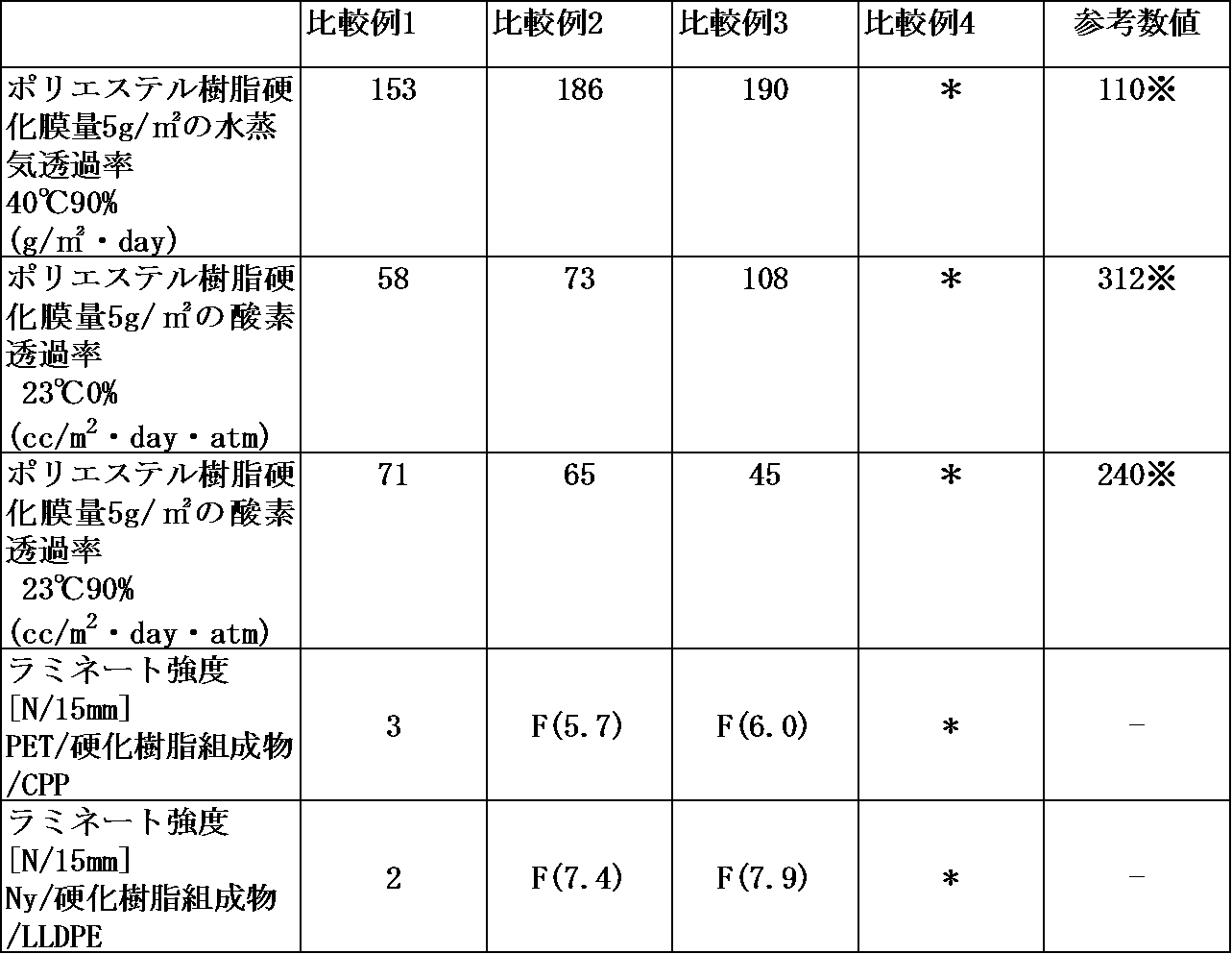
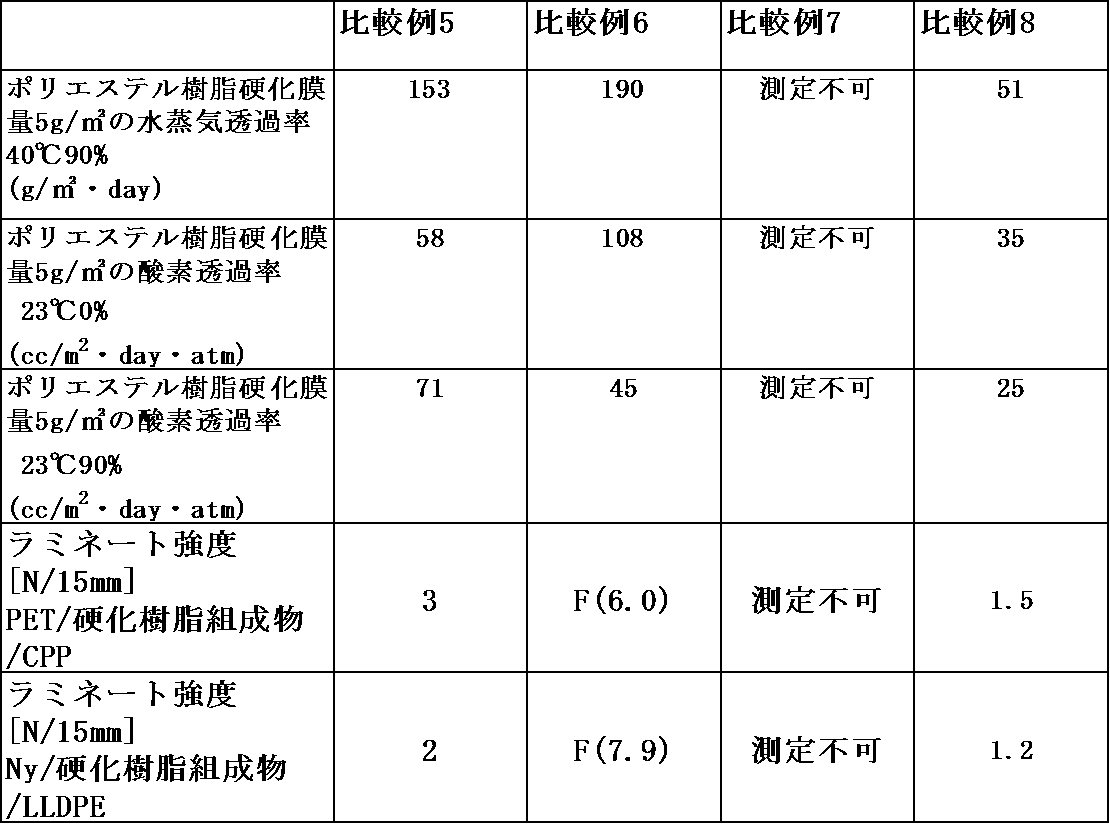
- Comparative Examples 5 and 6 did not contain glycerol, the water vapor transmission rate remained at 153 to 190 g / m 2 ⁇ day. Furthermore, in Comparative Example 7, when the phthalic acid of the polyester polyol resin was changed to isophthalic acid, the solvent solubility was lost, and the film could not be applied to the film and could not be evaluated. In addition, in Comparative Example 8 in which an inorganic compound that was not layered was added, the water vapor transmission rate and the oxygen transmission rate were not reduced (that is, the barrier was improved), and the laminate strength was reduced to less than half that before the addition of the inorganic compound. As a result.
- the resin composition for a barrier material of the present invention has a gas or water vapor barrier property, for example, an adhesive or a display for a protective film for a solar cell, in addition to the film laminating primer for the packaging material and the laminating adhesive.
- Coating materials and adhesives and sealants for electronic materials such as coating agents for water barrier substrates for devices, coating materials and adhesives for building materials, coating materials and adhesives and sealants for industrial materials, desired for barrier properties If it is a use used, it can be used conveniently.
Landscapes
- Chemical & Material Sciences (AREA)
- Organic Chemistry (AREA)
- Chemical Kinetics & Catalysis (AREA)
- Polymers & Plastics (AREA)
- Medicinal Chemistry (AREA)
- Health & Medical Sciences (AREA)
- Materials Engineering (AREA)
- Wood Science & Technology (AREA)
- Engineering & Computer Science (AREA)
- Life Sciences & Earth Sciences (AREA)
- Paints Or Removers (AREA)
- Laminated Bodies (AREA)
- Polyurethanes Or Polyureas (AREA)
- Compositions Of Macromolecular Compounds (AREA)
- Adhesives Or Adhesive Processes (AREA)
- Polyesters Or Polycarbonates (AREA)
- Dispersion Chemistry (AREA)
Abstract
Description
及び、酢酸エチル、メチルエチルケトン等への汎用溶剤への溶解性を有し、バリア性としてガスバリア性に優れるポリエステル樹脂を主体とするガスバリア材用ポリエステル樹脂組成物、及び該樹脂組成物をフィルムに塗布したガスバリアフィルムを提供することにある。
さらに、本発明には前記ガスバリア材用ポリエステル樹脂組成物を硬化させてなる樹脂層で構成されたガスバリアフィルムも含まれる。このフィルムは、例えば、少なくとも前記ガスバリア材用ポリエステル樹脂組成物を硬化させてなる層と基材フィルム層とを有するガスバリア複合フィルムであれば制限はない。
1.一般式(1)で表されるポリエステルポリオール、及び硬化剤を含有してなるポリエステル樹脂組成物、

2. 前記一般式(1)で表されるポリエステルポリオールのグリセロール残基を、ポリエステル樹脂組成物中に5質量%以上含有する1.に記載のポリエステル樹脂組成物、
3.前記硬化剤がイソシアネート化合物である請求項1.又は2.に記載のポリエステル樹脂組成、
4.前記イソシアネート化合物が、トルエンジイソシアネート、キシレンジイソシアネート、ジフェニルメタンジイソシアネート、ポリメチレンポリフェニルポリイソシアネート、トルエンジイソシアネート若しくはキシレンジイソシアネートと分子内に少なくとも2個の水酸基を有する多価アルコールとの反応生成物、又はトルエンジイソシアネート、キシレンジイソシアネート、ジフェニルメタンジイソシアネート、若しくはポリメチレンポリフェニルポリイソシアネートの水素添加反応により得られるイソシアネート化合物である3.に記載のポリエステル樹脂組成物、
5.1.~4.の何れかに記載のポリエステル樹脂組成物を、バリア材用樹脂組成物として用いるポリエステル樹脂組成物、
6.バリア材用樹脂組成物が、ガスバリア材用樹脂組成物である5.に記載のポリエステル樹脂組成物、
7.バリア材用樹脂組成物が、酸素バリア材用又は水蒸気バリア材用樹脂組成物である5.に記載のポリエステル樹脂組成物。
8.さらに層状無機化合物を含有する1.~7.の何れかに記載のポリエステル樹脂組成物、
9.層状無機化合物が、層間が非イオン性であるか、或いは水に対して非膨潤性である8.に記載のポリエステル樹脂組成物、
10.層状無機化合物が、平均粒径0.1μm以上の粒子を含有するものである8.又は9.に記載のポリエステル樹脂組成物、
11.ポリエステルポリオール、硬化剤、及び層状無機化合物の総質量を100質量部とした場合、層状無機化合物の含有量が5~50質量部である8.~10.の何れかに記載のポリエステル樹脂組成物、
12.1.~11.の何れかに記載のポリエステル樹脂組成物を硬化させてなるコーティング剤、
13.1.~11.の何れかに記載のポリエステル樹脂組成物を硬化させてなる接着剤、
14.1.~11.の何れかに記載のポリエステル樹脂組成物を硬化させた樹脂層を有するフィルム。
なお、本発明において「バリア材」とはバリア性を有する材料であり、「ガスバリア材」とはガスに対するバリア性を有する材料を、「水蒸気バリア材」とは水蒸気に対するバリア性を有する材料をいう。ここで、水蒸気とは水の蒸気を指し、ガスは常温常圧で気体状物質を指し、ガスを例示すれば、酸素、窒素、二酸化炭素、ヘリウム、アルゴン等を挙げることができる。また、ガスバリア材用樹脂組成物又は水蒸気バリア材用樹脂組成物は、ガスバリア材又は水蒸気バリア材に用いられる樹脂組成物をいう。
前記一般式(1)において、R1~R3は、水素原子、又は一般式(2)
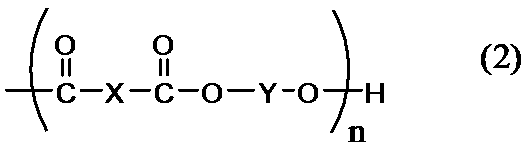
また、前記式(2)中、nは1~5の整数を表し、Xは、置換基を有してもよい1,2-フェニレン基、1,2-ナフチレン基、2,3-ナフチレン基、2,3-アントラキノンジイル基、及び2,3-アントラセンジイル基から成る群から選ばれるアリーレン基の水素添加反応により得られる基を表し、Yは炭素原子数2~6のアルキレン基を表す。

本発明では、高いバリア性を発現するため、ポリエステル樹脂組成物中に5質量%以上のグリセロール残基を有することに特徴がある。
バリア材用ポリエステル樹脂組成物の質量部から希釈溶剤質量、硬化剤に含まれる揮発成分質量、無機成分を除く質量を接着剤樹脂全固形分の質量とする。
一方、ポリエステル成分の原料であるアシル基がオルト位に置換された芳香族多価カルボン酸又はその無水物、アシル基がオルト位に置換された芳香族多価カルボン酸又はその無水物の芳香環を水素添加した脂環多価カルボン酸又はその無水物は、骨格が非対称構造である。従って、得られるポリエステルの分子鎖の回転抑制が生じると推定され、これによりバリア性に優れると推定している。また、この非対称構造に起因して基材密着性を阻害する結晶性が低いために酢酸エチルやメチルエチルケトン等の溶剤にも高い溶解性を示し且つバリア性に優れると推定される。
本発明で使用するポリエステル樹脂化合物は、多価アルコールとして、炭素原子数2~6のアルキレンジオール以外の多価アルコール成分を、本発明の効果を損なわない範囲において共重合させてもよい。具体的には、グリセロール、エリスリトール、ペンタエリトール、ジペンタエリスリトール、ジエチレングリコール、トリエチレングリコール、テトラエチレングリコール、ジプロピレングリコール、トリプロピレングリコール、テトラエチレングリコール、トリプロピレングリコール等の脂肪族多価アルコール、シクロヘキサンジメタノール、トリシクロデカンジメタノール等の脂環族多価アルコール、ヒドロキノン、レゾルシノール、カテコール、ナフタレンジオール、ビフェノール、ビスフェノールA、ヒスフェノールF、テトラメチルビフェノール等の芳香族多価フェノール、或いはこれらのエチレンオキサイド伸長物、水添化脂環族を例示することができる。
本発明のポリエステル樹脂は、多価カルボン酸成分としてカルボン酸がオルト位に置換された芳香族多価カルボン酸又はその無水物、又はカルボン酸がオルト位に置換された芳香族多価カルボン酸又はその無水物の芳香環を水素添加した脂環多価カルボン酸又はその無水物を必須とするが、本発明の効果を損なわない範囲において、他の多価カルボン酸成分を共重合させてもよい。具体的には、脂肪族多価カルボン酸としては、コハク酸、アジピン酸、アゼライン酸、セバシン酸、ドデカンジカルボン酸等を、不飽和結合含有多価カルボン酸としては、無水マレイン酸、マレイン酸、フマル酸等を、脂環族多価カルボン酸としては1,3-シクロペンタンジカルボン酸、1,4-シクロヘキサンジカルボン酸等を、芳香族多価カルボン酸としては、テレフタル酸、イソフタル酸、ピロメリット酸、トリメリット酸、1,4-ナフタレンジカルボン酸、2,5-ナフタレンジカルボン酸、2,6-ナフタレンジカルボン酸、ナフタル酸、ビフェニルジカルボン酸、ジフェン酸及びその無水物、1,2-ビス(フェノキシ)エタン-p,p’-ジカルボン酸及びこれらジカルボン酸の無水物或いはエステル形成性誘導体;p-ヒドロキシ安息香酸、p-(2-ヒドロキシエトキシ)安息香酸及びこれらのジヒドロキシカルボン酸のエステル形成性誘導体等の多塩基酸を単独で或いは二種以上の混合物で使用することができる。

本発明で使用する硬化剤は、前記ポリエステル樹脂の水酸基と反応しうる硬化剤であれば特に限定はなく、ポリイソシアネートやエポキシ化合物等の公知の硬化剤を使用できる。中でも、接着性や耐レトルト性の観点から、ポリイソシアネートを使用することが好ましい。
ポリイソシアネート化合物としては芳香族、脂肪族のジイソシアネート、2価以上のポリイソシアネートがあり、低分子化合物、高分子化合物のいずれでもよい。たとえば、テトラメチレンジイソシアネート、ヘキサメチレンジイソシアネート、トルエンジイソシアネート、ジフェニルメタンジイソシアネート、水素添加ジフェニルメタンジイソシアネート、キシリレンジイソシアネート、水素添加キシリレンジイソシアネート、イソホロンジイソシアネート或いはこれらのイソシアネート化合物の3量体、およびこれらのイソシアネート化合物の過剰量と、たとえばエチレングリコール、プロピレングリコール、メタキシリレンアルコール、1,3-ビスヒドロキシエチルベンゼン、1,4-ビスヒドロキシエチルベンゼン、トリメチロールプロパン、グリセロール、ペンタエリスリトール、エリスリトール、ソルビトール、エチレンジアミン、モノエタノールアミン、ジエタノールアミン、トリエタノールアミン、メタキシリレンジアミンなどの低分子活性水素化合物およびそのアルキレンオキシド付加物、各種ポリエステル樹脂類、ポリエーテルポリオール類、ポリアミド類の高分子活性水素化合物などと反応させて得られるアダクト体が挙げられる。
本発明のバリア材用ポリエステル樹脂組成物は、層状無機化合物を含有してもよい。
本発明に用いられる層状無機化合物は、バリア性を高める効果を有する。また、バリア材用ポリエステル樹脂組成物がバリア性接着剤に用いられる場合には接着剤のラミネート強度を向上させる効果を有する。加えて、バリア材用ポリエステル樹脂組成物がバリア性コーティング剤に用いられる場合には、コーティング剤の耐ブロッキング特性を向上させる効果を有する。
本発明での平均粒径とは、ある層状無機化合物の粒度分布を光散乱式測定装置で測定した場合の出現頻度が最も高い粒径を意味する。本発明で用いる層状無機化合物での平均粒径は特に限定はないが、好ましくは0.1μm以上であり、更に好ましくは1μm以上である。平均粒径が0.1μm以下であると、長辺の長さが短いことにより、水分子の迂回経路が長くならずにバリア能を向上させにくい問題や接着力を向上させにくい問題がでる。平均粒径の大きい側は特に限定されない。塗工の方法により大きな層状無機化合物を含有すると塗工面にスジ等の欠陥が生じる場合は、好ましくは平均粒径100μm以下、更に好ましくは20μm以下の材料を用いると良い。
本発明で使用される層状無機化合物のアスペクト比は水蒸気の迷路効果によるバリア能の向上のためには高い方が好ましい。具体的には10以上が好ましく、更に好ましくは50以上、最も好ましくは70以上である。中でも雲母系の化合物では、アスペクト比が100を超える材料も知られており特に好ましく用いられる。

本発明で用いる層状無機化合物の分散方法としては公知の分散方法が利用できる。例えば、ディゾルバー、超音波ホモジナイザー、高圧ホモジナイザー、ペイントコンディショナー、ボールミル、ロールミル、サンドミル、サンドグラインダー、ダイノーミル、ディスパーマット、ナノミル、SCミル、ナノマイザー等を挙げることができる。更により好ましくは、高い剪断力を発生させることのできる機器として、ヘンシェルミキサー、加圧ニーダー、バンバリーミキサー、プラネタリーミキサー、二本ロール、三本ロール等が上げられる。これらのうちの1つを単独で用いてもよく、2種類以上装置を組み合わせて用いてもよい。
(その他の成分)
本発明のポリエステル樹脂組成物は、バリア性を損なわない範囲で、各種の添加剤を配合してもよい。添加剤としては、例えば、シリカ、アルミナ、マイカ、タルク、アルミニウムフレーク、ガラスフレークなどの無機充填剤、安定剤(酸化防止剤、熱安定剤、紫外線吸収剤等)、可塑剤、帯電防止剤、滑剤、ブロッキング防止剤、着色剤、フィラー、結晶核剤等が例示できる。
本発明の特徴の一つは、本発明のポリエステルポリオールの有するアリーレン基、又は硬化剤として使用するイソシアネート化合物の有するアリーレン基の水素添加反応により得られる基を有する化合物を用いることにある。
ここで、水素添加反応は、公知慣用の方法を挙げることができる。
本発明のポリエステル樹脂組成物を硬化させてなるバリアフィルムは、ポリエステル樹脂組成物塗工液を基材となるフィルムに塗布、硬化させることによって得られる。塗工液は溶剤型又は無溶剤型のいずれの形態であってもよい。溶剤型の場合、溶剤はポリエステル樹脂及び硬化剤の製造時に反応媒体として使用され、更に塗装時に希釈剤として使用される。使用できる溶剤としては例えば酢酸エチル、酢酸ブチル、セロソルブアセテート等のエステル類、アセトン、メチルエチルケトン、イソブチルケトン、シクロヘキサノン等のケトン類、テトラヒドロフラン、ジオキサン等のエーテル類、トルエン、キシレン等の芳香族炭化水素類、メチレンクロリド、エチレンクロリド等のハロゲン化炭化水素類、ジメチルスルホキシド、ジメチルスルホアミド等が挙げられる。特に本発明のポリエステル樹脂組成物はこれらのうち酢酸エチルやメチルエチルケトン溶剤への溶解性に優れることから、酢酸エチルやメチルエチルケトンを使用するのが好ましい。
以下具体的用途の1つとしてフィルムラミネート用水蒸気バリア材用ポリエステル樹脂組成物について説明する。
ガスバリア材用樹脂組成物についても、前記説明と同様にして用いることができる。
攪拌機、窒素ガス導入管、スナイダー管、コンデンサーを備えたポリエステル反応容器に、グリセロールを92.09部、無水フタル酸148.1部、エチレングリコール64.57部、及びチタニウムテトライソプロポキシド0.03部を仕込み、精留管上部温度が100℃を超えないように徐々に加熱して内温を220℃に保持した。酸価が1mgKOH/g以下になったところでエステル化反応を終了し、数平均分子量284のポリエステル樹脂「GLY(oPAEG)1」を得た。このポリエステル樹脂が有するグリセロールの質量%は、89.07/284.26=31.33%であった。
攪拌機、窒素ガス導入管、スナイダー管、コンデンサーを備えたポリエステル反応容器に、グリセロールを92.09部、無水フタル酸296.2部、エチレングリコール124.1部、及びチタニウムテトライソプロポキシド0.05部を仕込み、精留管上部温度が100℃を超えないように徐々に加熱して内温を220℃に保持した。酸価が1mgKOH/g以下になったところでエステル化反応を終了し、数平均分子量476.43のポリエステル樹脂「GLY(oPAEG)2」を得た。このポリエステル樹脂が有するグリセロールの質量%は、18.69%であった。
攪拌機、窒素ガス導入管、スナイダー管、コンデンサーを備えたポリエステル反応容器に、グリセロールを92.09部、無水フタル酸444.36部、エチレングリコール186.21部、及びチタニウムテトライソプロポキシド0.07部を仕込み、精留管上部温度が100℃を超えないように徐々に加熱して内温を220℃に保持した。酸価が1mgKOH/g以下になったところでエステル化反応を終了し、数平均分子量668.60のポリエステル樹脂「GLY(oPAEG)3」を得た。このポリエステル樹脂が有するグリセロールの質量%は、13.32%であった。
攪拌機、窒素ガス導入管、スナイダー管、コンデンサーを備えたポリエステル反応容器に、グリセロールを92.09部、無水フタル酸888.72部、エチレングリコール372部、及びチタニウムテトライソプロポキシド0.13部を仕込み、精留管上部温度が100℃を超えないように徐々に加熱して内温を220℃に保持した。酸価が1mgKOH/g以下になったところでエステル化反応を終了し、数平均分子量1245.10のポリエステル樹脂「GLY(oPAEG)6」を得た。このポリエステル樹脂が有するグリセロールの質量%は、7.15%であった。
攪拌機、窒素ガス導入管、スナイダー管、コンデンサーを備えたポリエステル反応容器に、グリセロールを92.09部、無水2,3-ナフタレンジカルボン酸396.34部、エチレングリコール124.14部、及びチタニウムテトライソプロポキシド0.06部を仕込み、精留管上部温度が100℃を超えないように徐々に加熱して内温を220℃に保持した。酸価が1mgKOH/g以下になったところでエステル化反応を終了し、数平均分子量592.59のポリエステル樹脂「GLY(oNAEG)2」を得た。このポリエステル樹脂が有するグリセロールの質量%は、15.03%であった。
攪拌機、窒素ガス導入管、スナイダー管、コンデンサーを備えたポリエステル反応容器に、無水フタル酸396.34部、エチレングリコール173.73部、及びチタニウムテトライソプロポキシド0.05部を仕込み、精留管上部温度が100℃を超えないように徐々に加熱して内温を220℃に保持した。酸価が1mgKOH/g以下になったところでエステル化反応を終了し、数平均分子量600のポリエステル樹脂「oPAEG」を得た。このポリエステル樹脂が有するグリセロールの質量%は、0.0%であった。
攪拌機、窒素ガス導入管、スナイダー管、コンデンサーを備えたポリエステル反応容器に、グリセロールを92.09部、イソフタル酸498.39部、エチレングリコール186.21部、及びチタニウムテトライソプロポキシド0.07部を仕込み、精留管上部温度が100℃を超えないように徐々に加熱して内温を220℃に保持した。酸価が1mgKOH/g以下になったところでエステル化反応を終了し、数平均分子量668.6のポリエステル樹脂「GLY(iPAEG)3」を得た。このポリエステル樹脂が有するグリセロールの質量%は、13.32%であった。
製造例3におけるグリセロール92.09の代わりにトリメチロールプロパン134.17部へ置き換えた以外は製造例3と同様にして、数平均分子量710.68ポリエステルポリオール「TMP(oPAEG)3」を得た。
このポリエステルポリオールが有するグリセロールの質量%は0.0%であった。
製造例4におけるグリセロール92.09部の代わりにトリメチロールプロパン 134.17部へ置き換えた以外は製造例4と同様にして、数平均分子量1287.18のポリエステルポリオール「TMP(oPAEG)6」を得た。
このポリエステルポリオールが有するグリセロールの質量%は0.0%であった。
攪拌機、窒素ガス導入管、スナイダー管、コンデンサーを備えたポリエステル反応容器に、グリセロールを276.27部、無水フタル酸592.4部、エチレングリコール130.2部、及びチタニウムテトライソプロポキシド0.09部を仕込み、精留管上部温度が100℃を超えないように徐々に加熱して内温を220℃に保持した。酸価が1mgKOH/g以下になったところでエステル化反応を終了し、数平均分子量920.89のポリエステル樹脂「GLY3oPA4EG2」を得た。このポリエステル樹脂は1分子あたり平均3つのグリセロールを有するので、この樹脂が有するグリセロール質量%は、(89.07×3)/920.89=29.02%であった。
攪拌機、窒素ガス導入管、スナイダー管、コンデンサーを備えたポリエステル反応容器に、グリセロールを276.27部、無水フタル酸1036.84部、エチレングリコール325.87部、及びチタニウムテトライソプロポキシド0.16部を仕込み、精留管上部温度が100℃を超えないように徐々に加熱して内温を220℃に保持した。酸価が1mgKOH/g以下になったところでエステル化反応を終了し、数平均分子量1497。46のポリエステル樹脂「GLY3oPA7EG5」を得た。このポリエステル樹脂は1分子あたり平均3つのグリセロールを有するので、この樹脂が有するグリセロール質量%は、(89.07×3)/1497.46=17.84%であった。
攪拌機、窒素ガス導入管、スナイダー管、コンデンサーを備えたポリエステル反応容器に、グリセロールを460.45部、無水フタル酸1185部、エチレングリコール260.09部、及びチタニウムテトライソプロポキシド0.19部を仕込み、精留管上部温度が100℃を超えないように徐々に加熱して内温を220℃に保持した。酸価が1mgKOH/g以下になったところでエステル化反応を終了し、数平均分子量1749.70のポリエステル樹脂「GLY5oPA8EG4」を得た。このポリエステル樹脂は1分子あたり平均3つのグリセロールを有するので、この樹脂が有するグリセロール質量%は、(89.07×5)/1749.70=25.45%であった。
攪拌機、窒素ガス導入管、スナイダー管、コンデンサーを備えたポリエステル反応容器に、グリセロールを276.27部、無水ヘキサヒドロフタル酸616.64部、エチレングリコール130.2部、及びチタニウムテトライソプロポキシド0.19部を仕込み、精留管上部温度が100℃を超えないように徐々に加熱して内温を220℃に保持した。酸価が1mgKOH/g以下になったところでエステル化反応を終了し、数平均分子量945.05のポリエステル樹脂「GLY3oHHPA4EG2」を得た。このポリエステル樹脂は1分子あたり平均3つのグリセロールを有するので、この樹脂が有するグリセロール質量%は、(89.07×3)/945.05=28.27%であった。
攪拌機、窒素ガス導入管、スナイダー管、コンデンサーを備えたポリエステル反応容器に、グリセロールを276.27部、無水4-メチルヘキサヒドロフタル酸672.76部、エチレングリコール130.2部、及びチタニウムテトライソプロポキシド0.19部を仕込み、精留管上部温度が100℃を超えないように徐々に加熱して内温を220℃に保持した。酸価が1mgKOH/g以下になったところでエステル化反応を終了し、数平均分子量1001.17のポリエステル樹脂「GLY3oMHPA4EG2」を得た。このポリエステル樹脂は1分子あたり平均3つのグリセロールを有するので、この樹脂が有するグリセロール質量%は、(89.07×3)/1001.17=26.53%であった。
攪拌機、窒素ガス導入管、冷却コンデンサー、滴下漏斗を備えた反応容器にキシリレンジイソシアネート790.36部を入れて70℃に加熱しながら攪拌した。
前記1,3-ビス{ビス-[2-ヒドロキシエチル]アミノメチル}ベンゼン312.40部を1時間かけて滴下した。滴下後3時間70℃で攪拌を続け、あらかじめ水分量を1000ppmまで脱水したメチルエチルケトン473部を加えて攪拌し、室温まで徐冷後100メッシュの真鍮製の金網にて中に浮いたゲル物を分離し、メタキシレンジアミンにエチレンオキシドが4モル付加した化合物のXDIアダクト体を得た。JIS-K-6910にしたがって求めた上記アダクト体溶液の不揮発分は70.0%、JIS-K1603に従って求めたNCO%は9.6%であった。
トリメチロールプロパンと2,6―トリレンジイソシアネートとのアダクト体の製造
攪拌機、窒素ガス導入管、冷却コンデンサー、滴下漏斗を備えた反応容器に2,6―トリレンジイソシアネート522.48部を入れて70℃に加熱しながら攪拌した。
トリメチロールプロパン134.17部を1時間かけて滴下した。滴下後3時間70℃で攪拌を続け、あらかじめ水分量を1000ppmまで脱水したメチルエチルケトン284部を加えて攪拌し、室温まで徐冷後100メッシュの真鍮製の金網にて中に浮いたゲル物を分離し、トリメチロールプロパンと2,6―トリレンジイソシアネートとのアダクト体を得た。JIS-K-6910にしたがって求めた上記アダクト体溶液の不揮発分は70.0%、JIS-K1603に従って求めたNCO%は13.40%であった。
三井化学製「タケネートD-110N」(メタキシリレンジイソシアネートのトリメチロールプロパンアダクト体 不揮発成分75.0% NCO% 11.5%)と三井化学製「タケネート500」(メタキシリレンジイソシアネート不揮発分>99%,NCO% 44.6%)を50/50(質量比)の割合で混合し硬化剤aとした。
硬化剤aの不揮発分は、87.5%、NCO% 28.05%である。
三井化学製「タケネートD-110N」(メタキシリレンジイソシアネートのトリメチロールプロパンアダクト体 不揮発成分 75.0% NCO% 11.5%)を硬化剤bとした。
製造例16にて合成したトリメチロールプロパンと2,6―トリレンジイソシアネートとのアダクト体(不揮発分は70.0%、NCO%は9.4%)を硬化剤cとした。
製造例15にて合成した1,3-ビス{ビス-[2-ヒドロキシエチル]アミノメチル}ベンゼンとXDIとのアダクト体(不揮発分70%、NCO%9.6%)を硬化剤dとした。
(硬化剤e)
三井化学製「タケネートD-120N」(水素添加メタキシリレンジイソシアネートのトリメチロールプロパンアダクト体 不揮発成分 75.0% NCO% 11%)を硬化剤eとした。
(硬化剤f)
三井化学製「コスモネートNBDI」(ノルボルネンジイソシアネート 不揮発成分 100% NCO% 40.8%)を硬化剤fとした。
(硬化剤g)
BASF INOACポリウレタン製「ルプラネートMI」(ジフェニルメタンジイソシアネート 不揮発成分 100% NCO% 33.3%)を硬化剤gとした。
(硬化剤h)
住友バイエルウレタン製「スミジュール44V20L」(ポリメリックジフェニルメタンジイソシアネート 不揮発成分 100% NCO% 31.5%)を硬化剤hとした。
(硬化剤i)
Byer製「Desmodur W」(水添ジフェニルメタンジイソシアネート 不揮発成分 100% NCO% 31.8%)を硬化剤iとした。
(硬化剤j)
三井化学製「タケネート500」(キシリレンジイソシアネート 不揮発成分100% NCO% 44.7%)を硬化剤jとした。
(硬化剤k)
三井化学製「タケネート600」(水添キシリレンジイソシアネート 不揮発成分100% NCO% 43.2%))を硬化剤kとした。
前記製造方法で得たポリエステルポリオールをメチルエチルケトンで希釈して、不揮発分50%の樹脂溶液を得、更に硬化剤a、b、c、d、e、f、g、h、i、j、kを表1と2、表5に示す様に配合し、後述の塗工方法で使用するポリエステル樹脂塗工液を得た。
ポリエステル樹脂塗工液を、バーコーターを用いて、塗布量5.0g/m2(固形分)となるように厚さ12μmのPETフィルム(東洋紡績(株)製「E-5100」)に塗布し、温度70℃に設定したドライヤーで希釈溶剤を揮発させ乾燥し、次いで、この複合フィルムを40℃/3日間かけて硬化させ、本発明のバリアフィルムを得た。
ポリエステル樹脂塗工液を、バーコーターを用いて、塗布量5.0g/m2(固形分)となるように厚さ12μmのPETフィルム(東洋紡績(株)製「E-5100」)に塗布し、温度70℃に設定したドライヤーで希釈溶剤を揮発させ乾燥し、次いで、この複合フィルムと未延伸PPフィルム(東レフィルム加工株式会社製「ZK-93KM」)を温度40℃、圧力0.4MPa、ラミネート速度40m/minにてドライラミネートして、PET/ポリエステル樹脂組成物/CPP積層体を得た。
ポリエステル樹脂塗工液を、バーコーターを用いて、塗布量5.0g/m2(固形分)となるように厚さ15μmのナイロン(Ny)フィルム(ユニチカ(株)製「エンブレムON―BC」)に塗布し、温度70℃に設定したドライヤーで希釈溶剤を揮発させ乾燥し、次いで、この複合フィルムと未延伸LLDPEフィルム(東セロ社製TUX-HC 60μ)を温度40℃、圧力0.4MPa、ラミネート速度40m/minにてドライラミネートして、Ny/ポリエステル樹脂組成物/LLDPE積層体を得た。
ポリエステル樹脂塗工液を、バーコーターを用いて、塗布量5.0g/m2(固形分)となるように厚さ12μmのPETフィルム(東洋紡績(株)製「E-5100」)に塗布し、温度70℃に設定したドライヤーで希釈溶剤を揮発させ乾燥し、次いで、この複合フィルムと厚さ15μmのナイロン(Ny)フィルム(ユニチカ(株)製「エンブレムON―BC」)を温度40℃、圧力0.4MPa、ラミネート速度40m/minにてドライラミネートして、PET/ポリエステル樹脂組成物/Ny積層体を得た。
実施例にある積層体を作製後、40℃にて72時間硬化させた後にJIS K6854に準じる方法を用い、180°剥離試験にて200mm/minの剥離速度でラミネート強度を測定した。強度の単位はN/15mmである。
エージングが終了した水蒸気バリア性フィルムを、モコン社製酸素透過率測定装置OX-TRAN2/21MHを用いてJIS-K7126(等圧法)に準じ、23℃、0%RHおよび90%RHの雰囲気下で測定した。
また、ポリエステル樹脂組成物を硬化させた樹脂塗膜単体の酸素バリア性はバリア性積層フィルム、PETフィルムおよびナイロンフィルムの測定結果より、式(d)を用いて計算した。測定結果については塗布量5g/m2の透過率として換算した。

P1:塗膜単体の酸素透過率
P2:12μmPETフィルムの酸素透過率(0%RH:130cc/m2・24時間・atm、90%RH:100cc/m2・24時間・atmとして計算)
P3:15μmナイロンフィルムの水蒸気透過率(0%RH:50cc/m2・24時間・atm、90%RH:74cc/m2・24時間・atmとして計算)
エージングが終了した積層フィルムを、水蒸気透過度試験法 伝導度法「ISO-15106-3」に準じ、Illinois社製測定装置を用いて40℃、90%RHの雰囲気下で評価を行った。なおRHとは、湿度を表す。
また、ポリエステル樹脂組成物を硬化させた樹脂塗膜単体の水蒸気バリア性は水蒸気バリア性積層フィルム、PETフィルムおよびナイロンフィルムの測定結果より、式(d)を用いて計算した。測定結果については塗布量5g/m2の透過率として換算した。

P1:塗膜単体の水蒸気透過率
P2:12μmPETフィルムの水蒸気透過率(46g/m2・24時間として計算)
P3:15μmナイロンフィルムの水蒸気透過率(260g/m2・24時間として計算)
厚さ12μmのPET(2軸延伸ポリエチレンテレフタレート)フィルム(東洋紡績(株)製E-5100)の水蒸気透過率を測定し、フィルム厚み5g/m2の透過率として換算した。
結果を表3と4及び表6に示す。
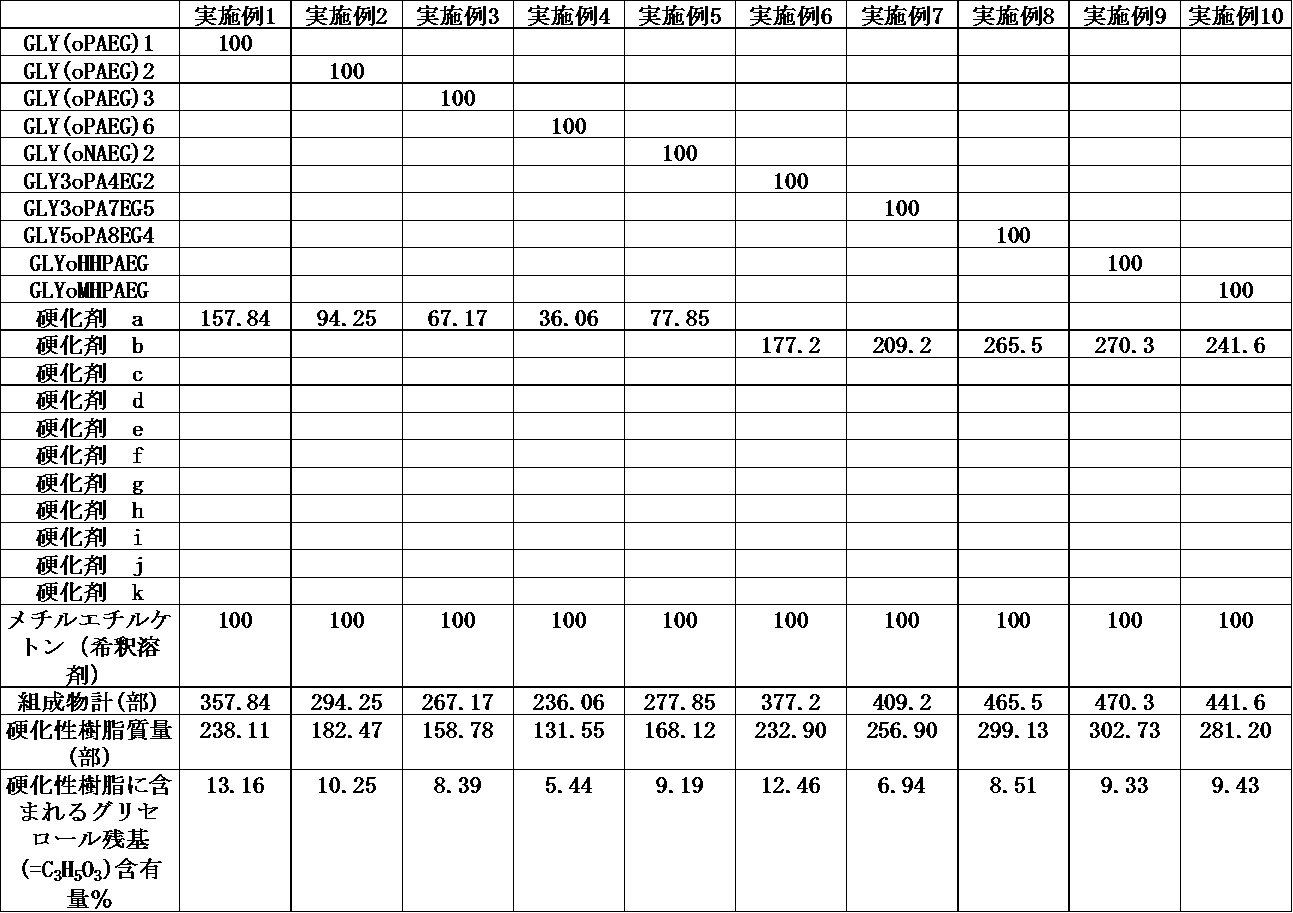

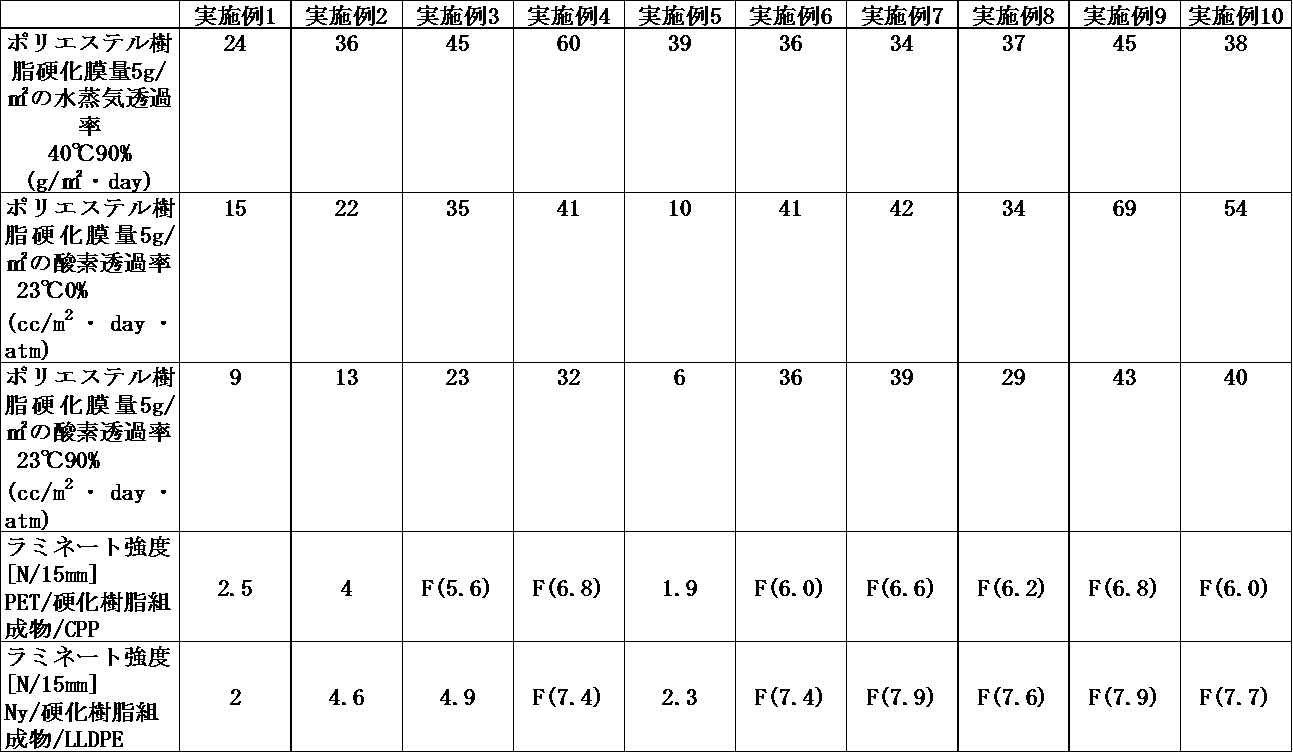


また、実施例1~20の樹脂組成物を硬化させた樹脂層5g/m2厚みは、いずれも酸素透過率(23℃0%RH)が70cc/m2・day・atm以下、酸素透過率(23℃90%RH)が50cc/m2・day・atm以下と12μm延伸PETフィルムの240cc/m2・day・atmを大きく下回った。
一方、比較例1~3はグリセロールを含まないために水蒸気透過率は153~190g/m2・dayに留まった。更に、比較例4ではポリエステル樹脂のフタル酸をイソフタル酸に変えたところ、溶剤溶解性が失われ、フィルムに塗布できなかった。
以下に層状無機化合物A~Eとして各実施例で用いた層状無機化合物を記す。
(層状無機化合物A)
・BARRISURF HX(IMERYS社製、カオリン/非膨潤性、層間非イオン性、板状、平均粒径/1.5μm、アスペクト比/約50)
(層状無機化合物B)
・MMICRO ACE K-1(日本タルク社製、タルク/非膨潤性、層間非イオン性、板状、平均粒径8μm、アスペクト比/約20)
(層状無機化合物C)
・PDM-10BY(トピー工業社製、合成マイカ/非膨潤性、板状、平均粒径12.8μm、アスペクト比/約70)
(層状無機化合物D)
・HM6025(HENGHAO社製、天然マイカ/非膨潤性、板状、平均粒径10μm、アスペクト比100以上)
(層状無機化合物E)
・STABIACE HT-7(堺化学製、ハイドロタルサイト/層間陰イオン性、板状、平均粒径/0.6μm、アスペクト比/約25)
(非層状無機化合物F)
・#5(堺化学製、酸化亜鉛微粒子、球状、平均粒径5μm、アスペクト比、板状でない為1程度と推定)
撹拌機を備えた容器に前記製造例により製造したポリエステルポリオール樹脂を仕込み、90℃で加熱撹拌しポリエステルポリオールが十分に流動性を保つ状態とした。撹拌しながら層状無機化合物A~Eまたは、非層状無機化合物Fを後述の表7、表11に示した配合で添加し、90℃で均一となるまで撹拌した。これを冷却することで無機化合物をポリエステルポリオールに分散させた分散体を得た。
無機化合物を含有するポリエステルポリオール樹脂塗工液として、前記方法で無機化合物を分散させたポリエステルポリオール/無機化合物分散体をメチルエチルケトンで希釈して、ポリエステルポリオール/無機化合物分散体溶液を得た。更に硬化剤を表7に示す様に配合し、後述の塗工方法で使用するポリエステルポリオール樹脂塗工液を得た。
無機化合物を含有しないポリエステルポリオール樹脂塗工液として、前記製造方法で得たポリエステルポリオールをメチルエチルケトンで希釈して、不揮発分50%の樹脂溶液を得、更に硬化剤を表9、表11に示す様に配合し、後述の塗工方法で使用するポリエステルポリオール樹脂塗工液を得た。
ポリエステルポリオール樹脂塗工液を、バーコーターを用いて、塗布量5.0g/m2(固形分)となるように厚さ12μmのPETフィルム(東洋紡績(株)製「E-5100」)に塗布し、温度70℃に設定したドライヤーで希釈溶剤を揮発させ乾燥し、この複合フィルムと厚さ15μmのナイロン(Ny)フィルム(ユニチカ(株)製「エンブレムON―BC」)を温度40℃、圧力0.4MPa、ラミネート速度40m/minにてドライラミネートしてこの複合フィルムとを40℃/3日間かけて硬化させ、PET/ポリエステルポリオール樹脂組成物/Ny積層体を得た。
エージングが終了した積層フィルムを、塗工方向と平行に15mm幅に切断し、PETフィルムとCPPフィルムとの間及び、NyフィルムとLLDPEフィルムとの間を、(株)オリエンテック製テンシロン万能試験機を用いて、雰囲気温度25℃、剥離速度を300mm/分に設定し、180度剥離方法で剥離した際の引っ張り強度をラミネート強度とした。ラミネート強度の単位はN/15mmとした。
以上の実施例での配合を表7、評価結果を表8に、参考例での配合を表9、評価結果を表10に、比較例での配合を表11、評価結果を表12に示す。
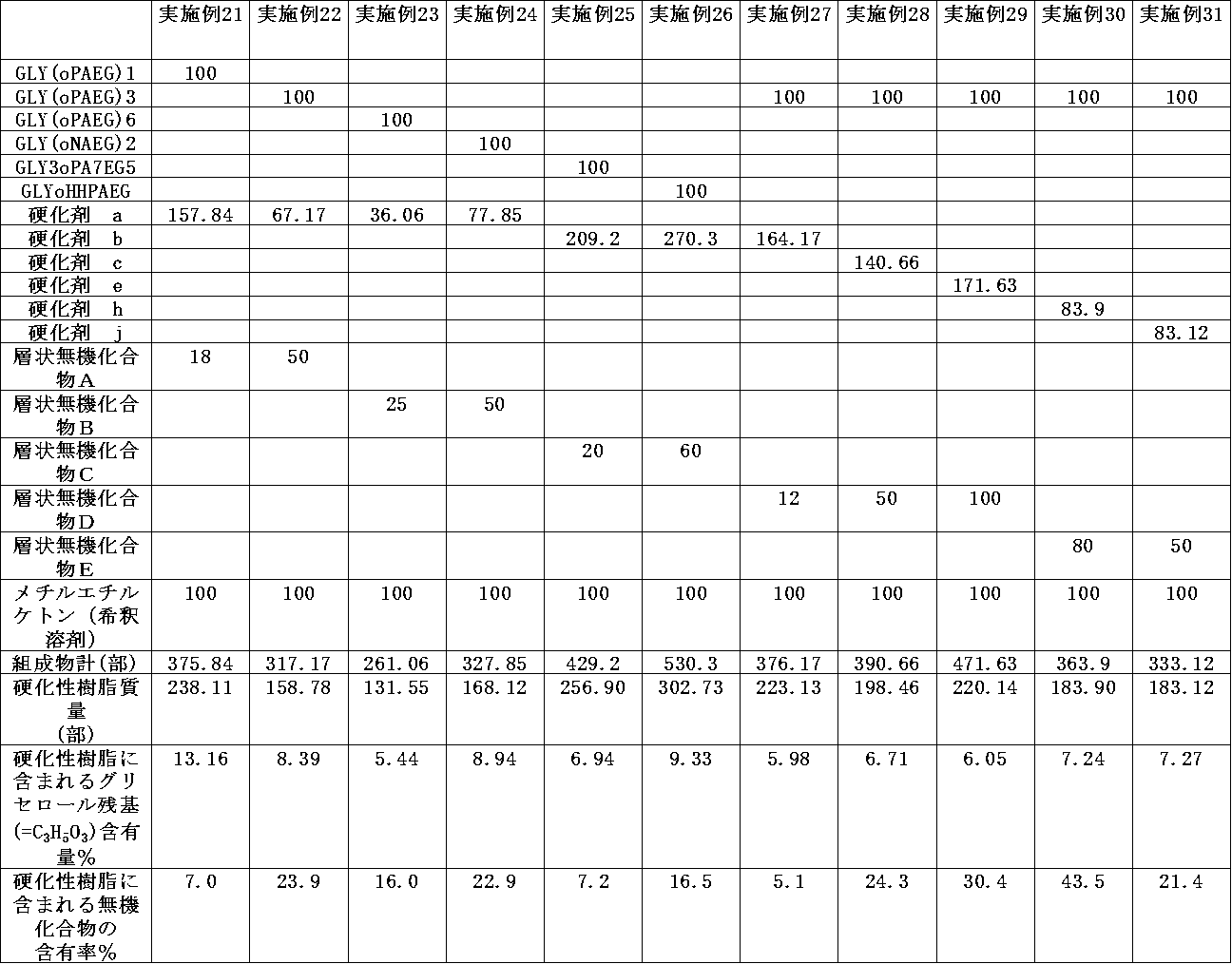

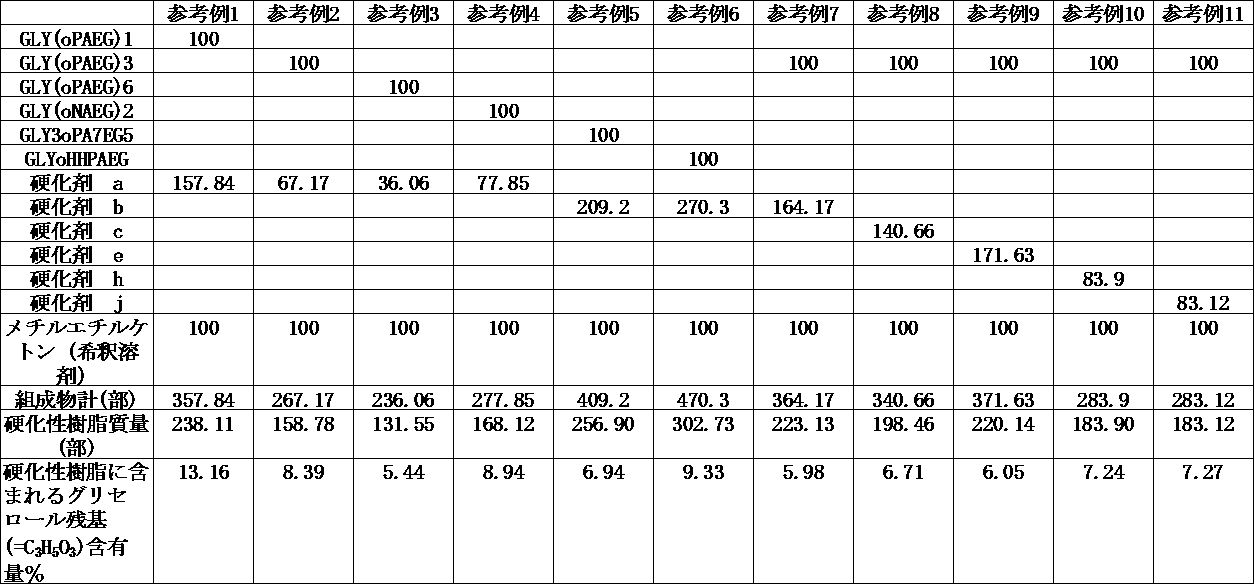

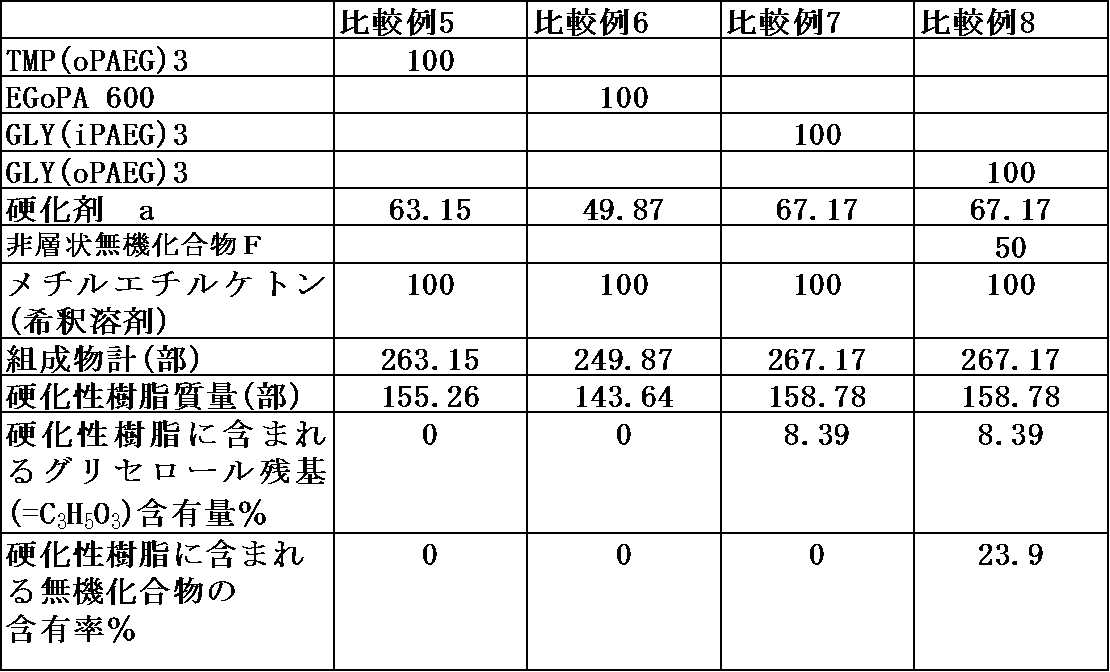
また、同実施例では、いずれも酸素透過率(23℃0%RH)が31cc/m2・day・atm以下、酸素透過率(23℃90%RH)が25cc/m2・day・atm以下と12μm延伸PETフィルムの240cc/m2・day・atmを大きく下回る優れた酸素バリア機能も有した。更に、実施例21~31の樹脂組成物を硬化させた樹脂をドライラミネート用接着剤としてPETフィルムとCPPフィルム、若しくはナイロン(Ny)フィルムとLLDPEフィルムを張り合わせた所、良好なラミネート性能を発揮した。
これら水蒸気透過率、酸素透過率、接着性能とも、樹脂組成は同様であるが層状無機化合物を含まない参考例1~11のポリエステルポリオール樹脂組成物に比べ優れる結果を示した。
Claims (14)
- 一般式(1)で表されるポリエステルポリオール、及び硬化剤を含有してなるポリエステル樹脂組成物。
- 前記一般式(1)で表されるポリエステルポリオールのグリセロール残基を、ポリエステル樹脂組成物中に5質量%以上含有する請求項1に記載のポリエステル樹脂組成物。
- 前記硬化剤がイソシアネート化合物である請求項1又は2に記載のポリエステル樹脂組成物。
- 前記イソシアネート化合物が、トルエンジイソシアネート、キシレンジイソシアネート、ジフェニルメタンジイソシアネート、ポリメチレンポリフェニルポリイソシアネート、トルエンジイソシアネート若しくはキシレンジイソシアネートと分子内に少なくとも2個の水酸基を有する多価アルコールとの反応生成物、又はトルエンジイソシアネート、キシレンジイソシアネート、ジフェニルメタンジイソシアネート、若しくはポリメチレンポリフェニルポリイソシアネートの水素添加反応により得られるイソシアネート化合物である請求項3に記載のポリエステル樹脂組成物。
- 請求項1~4の何れかに記載のポリエステル樹脂組成物を、バリア材用樹脂組成物として用いるポリエステル樹脂組成物。
- バリア材用樹脂組成物が、ガスバリア材用樹脂組成物である請求項5に記載のポリエステル樹脂組成物。
- バリア材用樹脂組成物が、酸素バリア材用又は水蒸気バリア材用樹脂組成物である請求項5に記載のポリエステル樹脂組成物。
- さらに層状無機化合物を含有する請求項1~7の何れかに記載のポリエステル樹脂組成物。
- 層状無機化合物が、水に対して非膨潤性である請求項8に記載のポリエステル樹脂組成物。
- 層状無機化合物が、平均粒径0.1μm以上の粒子を含有するものである請求項8又は9に記載のポリエステル樹脂組成物。
- ポリエステルポリオール、硬化剤、及び層状無機化合物の総質量を100質量部とした場合、層状無機化合物の含有量が5~50質量部である請求項8~10の何れかに記載のポリエステル樹脂組成物。
- 請求項1~11の何れかに記載のポリエステル樹脂組成物を硬化させてなるコーティング剤。
- 請求項1~11の何れかに記載のポリエステル樹脂組成物を硬化させてなる接着剤。
- 請求項1~11の何れかに記載のポリエステル樹脂組成物を硬化させた樹脂層を有するフィルム。
Priority Applications (4)
| Application Number | Priority Date | Filing Date | Title |
|---|---|---|---|
| CN201380068019.3A CN104870561B (zh) | 2012-12-26 | 2013-12-24 | 聚酯树脂组合物、胶粘剂和膜 |
| JP2014540260A JPWO2014103994A1 (ja) | 2012-12-26 | 2013-12-24 | ポリエステル樹脂組成物、接着剤、及びフィルム |
| US14/652,296 US9777149B2 (en) | 2012-12-26 | 2013-12-24 | Polyester resin composition, adhesive and film |
| EP13868625.8A EP2940075A4 (en) | 2012-12-26 | 2013-12-24 | POLYESTER RESIN COMPOSITION, ADHESIVE AND FOIL |
Applications Claiming Priority (4)
| Application Number | Priority Date | Filing Date | Title |
|---|---|---|---|
| JP2012282597 | 2012-12-26 | ||
| JP2012-282597 | 2012-12-26 | ||
| JP2013-001048 | 2013-01-08 | ||
| JP2013001048 | 2013-01-08 |
Publications (1)
| Publication Number | Publication Date |
|---|---|
| WO2014103994A1 true WO2014103994A1 (ja) | 2014-07-03 |
Family
ID=51021076
Family Applications (1)
| Application Number | Title | Priority Date | Filing Date |
|---|---|---|---|
| PCT/JP2013/084440 Ceased WO2014103994A1 (ja) | 2012-12-26 | 2013-12-24 | ポリエステル樹脂組成物、接着剤、及びフィルム |
Country Status (6)
| Country | Link |
|---|---|
| US (1) | US9777149B2 (ja) |
| EP (1) | EP2940075A4 (ja) |
| JP (1) | JPWO2014103994A1 (ja) |
| CN (1) | CN104870561B (ja) |
| TW (1) | TWI507434B (ja) |
| WO (1) | WO2014103994A1 (ja) |
Cited By (13)
| Publication number | Priority date | Publication date | Assignee | Title |
|---|---|---|---|---|
| JP2016029137A (ja) * | 2014-07-17 | 2016-03-03 | 積水化学工業株式会社 | 有機エレクトロルミネッセンス表示素子封止用樹脂組成物、有機エレクトロルミネッセンス表示素子封止用樹脂シート、及び、有機エレクトロルミネッセンス表示素子 |
| JP2016175973A (ja) * | 2015-03-19 | 2016-10-06 | Dic株式会社 | ラミネート用接着剤、及びこれを用いた積層体 |
| JP2016210867A (ja) * | 2015-05-07 | 2016-12-15 | 東ソー株式会社 | 耐紫外線吸収剤性ポリウレタン組成物、該組成物を用いたコーティング材、及び塗膜 |
| JP6075515B1 (ja) * | 2015-12-15 | 2017-02-08 | Dic株式会社 | バリア材用ポリエステル樹脂組成物、及びバリアフィルム |
| JP2017052853A (ja) * | 2015-09-08 | 2017-03-16 | 株式会社大林組 | 2液型木材塗料、及びその2液型木材塗料を用いた木材の難燃化処理方法 |
| US20170158928A1 (en) * | 2013-11-27 | 2017-06-08 | Dic Corporation | Resin composition for gas barrier adhesive, and adhesive |
| CN107636035A (zh) * | 2015-06-18 | 2018-01-26 | Dic株式会社 | 双液固化型组合物、双液型粘合剂、双液型涂布剂、层压体 |
| WO2018123734A1 (ja) * | 2016-12-26 | 2018-07-05 | Dic株式会社 | 樹脂組成物、成形体、積層体、ガスバリア材、コーティング材及び接着剤 |
| WO2020059748A1 (ja) * | 2018-09-21 | 2020-03-26 | 三菱瓦斯化学株式会社 | 樹脂組成物、成形体、および、その応用 |
| JP2021024109A (ja) * | 2019-07-31 | 2021-02-22 | 大日本印刷株式会社 | 積層体および包装体 |
| JPWO2021256340A1 (ja) * | 2020-06-18 | 2021-12-23 | ||
| US11292893B2 (en) | 2017-03-14 | 2022-04-05 | Dic Corporation | Resin composition, molded article, laminate, gas barrier material, coating material and adhesive |
| WO2024101165A1 (ja) * | 2022-11-10 | 2024-05-16 | Dic株式会社 | ガスバリア用組成物、コーティング剤および積層体 |
Families Citing this family (7)
| Publication number | Priority date | Publication date | Assignee | Title |
|---|---|---|---|---|
| KR102320463B1 (ko) * | 2016-04-15 | 2021-11-02 | 유니띠까 가부시키가이샤 | 접착제 조성물 |
| WO2018084102A1 (ja) * | 2016-11-02 | 2018-05-11 | 大日精化工業株式会社 | ポリヒドロキシウレタン樹脂の水分散体、該水分散体の製造方法、該水分散体を用いてなるガスバリア性樹脂フィルム、粘土鉱物含有のポリヒドロキシウレタン樹脂水分散体組成物、該組成物を用いてなるガスバリア性コーティング剤及びガスバリア性樹脂フィルム |
| WO2018143446A1 (ja) * | 2017-02-06 | 2018-08-09 | ユニチカ株式会社 | ポリエステル樹脂組成物、接着剤および積層体 |
| JP6551769B1 (ja) * | 2017-12-20 | 2019-07-31 | Dic株式会社 | 蒸着フィルム用コーティング剤、ガスバリア性フィルム、及び包装材 |
| USD1044825S1 (en) | 2018-09-14 | 2024-10-01 | Boxkingz | Display screen with a graphical user interface for a grid for an online gaming application |
| CN109679485B (zh) * | 2018-12-24 | 2020-07-17 | 江西明冠锂膜技术有限公司 | 一种锂电池铝塑膜用的外保护涂料及其制备方法 |
| CN112300743A (zh) * | 2020-11-09 | 2021-02-02 | 浙江离火新材料科技有限公司 | 薄膜复合用胶粘剂及其制备方法 |
Citations (14)
| Publication number | Priority date | Publication date | Assignee | Title |
|---|---|---|---|---|
| DD78100A (ja) * | ||||
| DD113923A1 (ja) * | 1974-09-10 | 1975-07-05 | ||
| GB2034726A (en) * | 1978-11-20 | 1980-06-11 | Ici Ltd | Polyester Polyol Compositions |
| JPS636013A (ja) * | 1986-06-24 | 1988-01-12 | バイエル・アクチエンゲゼルシヤフト | ヒドロキシ基を含むオリゴエステルの製造方法およびそれの使用法 |
| RU2074216C1 (ru) * | 1993-05-28 | 1997-02-27 | Научно-исследовательский институт полимерных материалов | Клей-расплав для склеивания деталей из тканей и кожи |
| JP2001316558A (ja) | 2000-05-01 | 2001-11-16 | Daicel Chem Ind Ltd | ゴム変性スチレン系樹脂組成物 |
| WO2006022431A1 (ja) * | 2004-08-27 | 2006-03-02 | National Institute For Materials Science | 有機-無機複合体および高分子複合材料ならびにその製造方法 |
| JP2006176576A (ja) | 2004-12-21 | 2006-07-06 | Dainippon Ink & Chem Inc | 液晶パネルシール用光硬化性組成物及び液晶パネル |
| JP2006213860A (ja) | 2005-02-04 | 2006-08-17 | Toyobo Co Ltd | ポリエステル樹脂、それを用いた水分散体および接着剤 |
| JP2011212983A (ja) | 2010-03-31 | 2011-10-27 | Asahi Kasei Chemicals Corp | フィルム、シート及びこれらの製造方法、並びに、ブリスター成形体、積層体 |
| WO2011162160A1 (ja) * | 2010-06-21 | 2011-12-29 | Dic株式会社 | 酸素バリア性フィルム、及び接着剤 |
| WO2013005767A1 (ja) * | 2011-07-06 | 2013-01-10 | Dic株式会社 | ガスバリア性多層フィルム、接着剤、及びコーティング材 |
| WO2013027609A1 (ja) * | 2011-08-24 | 2013-02-28 | Dic株式会社 | 板状無機化合物を含有する接着剤用樹脂組成物、および接着剤 |
| WO2013097057A1 (en) * | 2011-12-31 | 2013-07-04 | Dic Corporation | Mica-containing resin composition for adhesives and adhesive |
Family Cites Families (31)
| Publication number | Priority date | Publication date | Assignee | Title |
|---|---|---|---|---|
| JP3829526B2 (ja) | 1998-04-24 | 2006-10-04 | 凸版印刷株式会社 | バリアー性積層体およびこれを用いた包装材料およびこれを用いた包装体 |
| JP2000096030A (ja) | 1998-09-22 | 2000-04-04 | Dainippon Printing Co Ltd | 接着剤 |
| JP2001107015A (ja) | 1999-10-08 | 2001-04-17 | Kansai Paint Co Ltd | 熱硬化型接着剤 |
| US6846532B1 (en) | 2001-02-15 | 2005-01-25 | Sonoco Development, Inc. | Laminate packaging material |
| JP2003013032A (ja) | 2001-06-26 | 2003-01-15 | Dainippon Ink & Chem Inc | レトルト耐性に優れるラミネート用接着剤組成物 |
| JP4092549B2 (ja) | 2002-06-04 | 2008-05-28 | 三菱瓦斯化学株式会社 | 2液硬化型ポリウレタン樹脂組成物およびガスバリア性ラミネート用接着剤 |
| JP4054972B2 (ja) | 2002-06-04 | 2008-03-05 | 三菱瓦斯化学株式会社 | 熱硬化型ガスバリア性ポリウレタン樹脂および該樹脂を含むガスバリア性フィルム |
| EP1369443B1 (en) | 2002-06-04 | 2007-04-04 | Mitsubishi Gas Chemical Company, Inc. | Gas-barrier polyurethane resin, and adhesive for laminate, film and paint containing the same |
| JP2004292664A (ja) * | 2003-03-27 | 2004-10-21 | Toyobo Co Ltd | 塗料用ポリエステル樹脂、樹脂組成物およびこれを塗布した塗装金属板 |
| EP1674529A4 (en) * | 2003-10-15 | 2007-09-12 | Mitsui Takeda Chemicals Inc | AQUEOUS RESIN COMPOSITION WITH GAS BARRIER PROPERTIES AND LAYER MANUFACTURED THEREWITH |
| US20090148640A1 (en) | 2005-08-24 | 2009-06-11 | Sakata Inx Corp. | Gas barrier composite film for hydrothermally processable package and packaging bag obtained by using same |
| JP5252803B2 (ja) | 2006-12-25 | 2013-07-31 | 日立化成ポリマー株式会社 | 二液硬化型接着剤 |
| JP5142820B2 (ja) | 2008-05-23 | 2013-02-13 | 三井化学株式会社 | 一液硬化型無溶剤接着剤 |
| EP2186839A1 (de) * | 2008-11-13 | 2010-05-19 | Bayer MaterialScience AG | Polyurethandispersionen für Beschichtungen mit Barriereeigenschaften |
| JP5432740B2 (ja) * | 2010-01-19 | 2014-03-05 | 株式会社 ミックウェア | 地図情報表示装置、地図情報表示方法、及びプログラム |
| JP5842817B2 (ja) * | 2010-08-31 | 2016-01-13 | Dic株式会社 | 2液型ラミネート用接着剤組成物 |
| TWI496862B (zh) | 2011-03-28 | 2015-08-21 | Toyo Boseki | Weatherability Adhesive composition |
| JP5273219B2 (ja) * | 2011-07-13 | 2013-08-28 | Dic株式会社 | 酸素バリア性接着剤用樹脂組成物、及び接着剤 |
| JP5201429B2 (ja) * | 2011-07-13 | 2013-06-05 | Dic株式会社 | 酸素バリア性接着剤用樹脂組成物、接着剤、及び積層体 |
| JP5743149B2 (ja) * | 2011-08-24 | 2015-07-01 | Dic株式会社 | 無溶剤型接着剤用樹脂組成物、及び接着剤 |
| JP5875023B2 (ja) * | 2011-10-25 | 2016-03-02 | Dic株式会社 | 保香用多層フィルム |
| JP2013103434A (ja) * | 2011-11-15 | 2013-05-30 | Dic Corp | 不活性ガスバリア用多層フィルム |
| JP2013107925A (ja) * | 2011-11-17 | 2013-06-06 | Dic Corp | アルコールバリア用多層フィルム |
| JP5982800B2 (ja) * | 2011-12-02 | 2016-08-31 | Dic株式会社 | 非石油由来成分を用いたガスバリア性接着剤、及びガスバリア性多層フィルム、容器、及びチューブ |
| JP5891766B2 (ja) * | 2011-12-13 | 2016-03-23 | Dic株式会社 | バリア性ラミネートフィルム及びこれを用いる包装材 |
| JP6065460B2 (ja) * | 2011-12-20 | 2017-01-25 | Dic株式会社 | アルミ蒸着層若しくはアルミ箔を含む層を有するガスバリア性多層フィルム |
| JP5835615B2 (ja) * | 2011-12-21 | 2015-12-24 | Dic株式会社 | バリア性易開封ラミネートフィルム及びこれを用いる包装材 |
| JP5979433B2 (ja) * | 2011-12-22 | 2016-08-24 | Dic株式会社 | 透明蒸着層を含む層を有するガスバリア性多層フィルム |
| JP6002984B2 (ja) * | 2011-12-22 | 2016-10-05 | Dic株式会社 | ハイソリッド型接着剤用樹脂組成物、及び接着剤 |
| JP5962004B2 (ja) * | 2011-12-22 | 2016-08-03 | Dic株式会社 | ガスバリア性硬化物用樹脂組成物、及び接着剤 |
| JP5979417B2 (ja) * | 2012-05-11 | 2016-08-24 | Dic株式会社 | 多層フィルム、及びスタンディングパウチ |
-
2013
- 2013-12-24 US US14/652,296 patent/US9777149B2/en not_active Expired - Fee Related
- 2013-12-24 JP JP2014540260A patent/JPWO2014103994A1/ja active Pending
- 2013-12-24 CN CN201380068019.3A patent/CN104870561B/zh not_active Expired - Fee Related
- 2013-12-24 EP EP13868625.8A patent/EP2940075A4/en not_active Withdrawn
- 2013-12-24 WO PCT/JP2013/084440 patent/WO2014103994A1/ja not_active Ceased
- 2013-12-25 TW TW102148107A patent/TWI507434B/zh not_active IP Right Cessation
Patent Citations (14)
| Publication number | Priority date | Publication date | Assignee | Title |
|---|---|---|---|---|
| DD78100A (ja) * | ||||
| DD113923A1 (ja) * | 1974-09-10 | 1975-07-05 | ||
| GB2034726A (en) * | 1978-11-20 | 1980-06-11 | Ici Ltd | Polyester Polyol Compositions |
| JPS636013A (ja) * | 1986-06-24 | 1988-01-12 | バイエル・アクチエンゲゼルシヤフト | ヒドロキシ基を含むオリゴエステルの製造方法およびそれの使用法 |
| RU2074216C1 (ru) * | 1993-05-28 | 1997-02-27 | Научно-исследовательский институт полимерных материалов | Клей-расплав для склеивания деталей из тканей и кожи |
| JP2001316558A (ja) | 2000-05-01 | 2001-11-16 | Daicel Chem Ind Ltd | ゴム変性スチレン系樹脂組成物 |
| WO2006022431A1 (ja) * | 2004-08-27 | 2006-03-02 | National Institute For Materials Science | 有機-無機複合体および高分子複合材料ならびにその製造方法 |
| JP2006176576A (ja) | 2004-12-21 | 2006-07-06 | Dainippon Ink & Chem Inc | 液晶パネルシール用光硬化性組成物及び液晶パネル |
| JP2006213860A (ja) | 2005-02-04 | 2006-08-17 | Toyobo Co Ltd | ポリエステル樹脂、それを用いた水分散体および接着剤 |
| JP2011212983A (ja) | 2010-03-31 | 2011-10-27 | Asahi Kasei Chemicals Corp | フィルム、シート及びこれらの製造方法、並びに、ブリスター成形体、積層体 |
| WO2011162160A1 (ja) * | 2010-06-21 | 2011-12-29 | Dic株式会社 | 酸素バリア性フィルム、及び接着剤 |
| WO2013005767A1 (ja) * | 2011-07-06 | 2013-01-10 | Dic株式会社 | ガスバリア性多層フィルム、接着剤、及びコーティング材 |
| WO2013027609A1 (ja) * | 2011-08-24 | 2013-02-28 | Dic株式会社 | 板状無機化合物を含有する接着剤用樹脂組成物、および接着剤 |
| WO2013097057A1 (en) * | 2011-12-31 | 2013-07-04 | Dic Corporation | Mica-containing resin composition for adhesives and adhesive |
Non-Patent Citations (1)
| Title |
|---|
| See also references of EP2940075A4 |
Cited By (23)
| Publication number | Priority date | Publication date | Assignee | Title |
|---|---|---|---|---|
| US20170158928A1 (en) * | 2013-11-27 | 2017-06-08 | Dic Corporation | Resin composition for gas barrier adhesive, and adhesive |
| JP2016029137A (ja) * | 2014-07-17 | 2016-03-03 | 積水化学工業株式会社 | 有機エレクトロルミネッセンス表示素子封止用樹脂組成物、有機エレクトロルミネッセンス表示素子封止用樹脂シート、及び、有機エレクトロルミネッセンス表示素子 |
| JP2016175973A (ja) * | 2015-03-19 | 2016-10-06 | Dic株式会社 | ラミネート用接着剤、及びこれを用いた積層体 |
| JP2016210867A (ja) * | 2015-05-07 | 2016-12-15 | 東ソー株式会社 | 耐紫外線吸収剤性ポリウレタン組成物、該組成物を用いたコーティング材、及び塗膜 |
| CN107636035A (zh) * | 2015-06-18 | 2018-01-26 | Dic株式会社 | 双液固化型组合物、双液型粘合剂、双液型涂布剂、层压体 |
| CN107636035B (zh) * | 2015-06-18 | 2021-03-12 | Dic株式会社 | 双液固化型组合物、双液型粘合剂、双液型涂布剂、层压体 |
| US20180297344A1 (en) * | 2015-06-18 | 2018-10-18 | Dic Corporation | Two-component curable composition, two-component adhesive, two-component coating agent, and laminate |
| EP3312208A4 (en) * | 2015-06-18 | 2019-02-20 | DIC Corporation | CURABLE TWO-COMPONENT COMPOSITION, TWO-COMPONENT ADHESIVE, TWO-COMPONENT COATING AGENT AND LAMINATE |
| JP2017052853A (ja) * | 2015-09-08 | 2017-03-16 | 株式会社大林組 | 2液型木材塗料、及びその2液型木材塗料を用いた木材の難燃化処理方法 |
| JP6075515B1 (ja) * | 2015-12-15 | 2017-02-08 | Dic株式会社 | バリア材用ポリエステル樹脂組成物、及びバリアフィルム |
| JPWO2018123734A1 (ja) * | 2016-12-26 | 2019-10-31 | Dic株式会社 | 樹脂組成物、成形体、積層体、ガスバリア材、コーティング材及び接着剤 |
| WO2018123734A1 (ja) * | 2016-12-26 | 2018-07-05 | Dic株式会社 | 樹脂組成物、成形体、積層体、ガスバリア材、コーティング材及び接着剤 |
| US11015013B2 (en) | 2016-12-26 | 2021-05-25 | Dic Corporation | Resin composition, molded body, laminate, gas barrier material, coating material, and adhesive |
| US11292893B2 (en) | 2017-03-14 | 2022-04-05 | Dic Corporation | Resin composition, molded article, laminate, gas barrier material, coating material and adhesive |
| WO2020059748A1 (ja) * | 2018-09-21 | 2020-03-26 | 三菱瓦斯化学株式会社 | 樹脂組成物、成形体、および、その応用 |
| KR20210060457A (ko) * | 2018-09-21 | 2021-05-26 | 미쯔비시 가스 케미칼 컴파니, 인코포레이티드 | 수지 조성물, 성형체, 및, 그의 응용 |
| JPWO2020059748A1 (ja) * | 2018-09-21 | 2021-09-24 | 三菱瓦斯化学株式会社 | 樹脂組成物、成形体、および、その応用 |
| JP7322888B2 (ja) | 2018-09-21 | 2023-08-08 | 三菱瓦斯化学株式会社 | 樹脂組成物、成形体、および、その応用 |
| KR102875328B1 (ko) | 2018-09-21 | 2025-10-24 | 미쯔비시 가스 케미칼 컴파니, 인코포레이티드 | 수지 조성물, 성형체, 및, 그의 응용 |
| JP2021024109A (ja) * | 2019-07-31 | 2021-02-22 | 大日本印刷株式会社 | 積層体および包装体 |
| JPWO2021256340A1 (ja) * | 2020-06-18 | 2021-12-23 | ||
| WO2024101165A1 (ja) * | 2022-11-10 | 2024-05-16 | Dic株式会社 | ガスバリア用組成物、コーティング剤および積層体 |
| JP7533813B1 (ja) * | 2022-11-10 | 2024-08-14 | Dic株式会社 | ガスバリア用組成物、コーティング剤および積層体 |
Also Published As
| Publication number | Publication date |
|---|---|
| TW201431894A (zh) | 2014-08-16 |
| CN104870561A (zh) | 2015-08-26 |
| US9777149B2 (en) | 2017-10-03 |
| CN104870561B (zh) | 2017-09-22 |
| JPWO2014103994A1 (ja) | 2017-01-12 |
| TWI507434B (zh) | 2015-11-11 |
| EP2940075A1 (en) | 2015-11-04 |
| EP2940075A4 (en) | 2016-08-03 |
| US20160053110A1 (en) | 2016-02-25 |
Similar Documents
| Publication | Publication Date | Title |
|---|---|---|
| WO2014103994A1 (ja) | ポリエステル樹脂組成物、接着剤、及びフィルム | |
| JP4962666B2 (ja) | 酸素バリア性フィルム、及び接着剤 | |
| JP5440892B2 (ja) | 板状無機化合物を含有する接着剤用樹脂組成物、および接着剤 | |
| JP5743149B2 (ja) | 無溶剤型接着剤用樹脂組成物、及び接着剤 | |
| JP6002966B2 (ja) | リン酸変性化合物含有接着剤用樹脂組成物、及び接着剤 | |
| JP6075623B2 (ja) | ガスバリア性ポリエステル樹脂組成物、及びガスバリア性フィルム | |
| JP5831778B2 (ja) | 水蒸気バリア用樹脂組成物、接着剤、及びコーティング剤 | |
| JP5821826B2 (ja) | 接着剤 | |
| JP6217967B2 (ja) | ガスバリア多層フィルム | |
| WO2015079924A1 (ja) | ガスバリア性接着剤用樹脂組成物、及び接着剤 | |
| WO2013005767A1 (ja) | ガスバリア性多層フィルム、接着剤、及びコーティング材 | |
| JP5273219B2 (ja) | 酸素バリア性接着剤用樹脂組成物、及び接着剤 | |
| WO2016006125A1 (ja) | シーラントフィルムを有する積層体 | |
| CN107636035A (zh) | 双液固化型组合物、双液型粘合剂、双液型涂布剂、层压体 | |
| JP5861923B2 (ja) | ガスバリア性多層フィルム | |
| JP5626587B2 (ja) | ガスバリア性フィルム | |
| JP2016175973A (ja) | ラミネート用接着剤、及びこれを用いた積層体 | |
| JP2012201731A (ja) | 接着剤及びそれを使用した酸素バリア性フィルム | |
| JP5543408B2 (ja) | ガスバリア性ポリエステル樹脂組成物、及びガスバリア性フィルム | |
| JP6405874B2 (ja) | ポリアミドポリエステルを含有する樹脂組成物、及び接着剤 | |
| JP6075515B1 (ja) | バリア材用ポリエステル樹脂組成物、及びバリアフィルム | |
| JP2016011324A (ja) | バリア材用ポリエステル樹脂組成物、及びバリアフィルム | |
| WO2018105440A1 (ja) | ガスバリア性接着剤用樹脂組成物、接着剤、及び積層体 | |
| JP2013234220A (ja) | 樹脂分散体の製造方法、接着剤、及びコーティング剤 | |
| JP5761460B2 (ja) | 水蒸気バリア性接着剤用樹脂組成物、及び積層体 |
Legal Events
| Date | Code | Title | Description |
|---|---|---|---|
| ENP | Entry into the national phase |
Ref document number: 2014540260 Country of ref document: JP Kind code of ref document: A |
|
| 121 | Ep: the epo has been informed by wipo that ep was designated in this application |
Ref document number: 13868625 Country of ref document: EP Kind code of ref document: A1 |
|
| NENP | Non-entry into the national phase |
Ref country code: DE |
|
| WWE | Wipo information: entry into national phase |
Ref document number: IDP00201504573 Country of ref document: ID Ref document number: 2013868625 Country of ref document: EP |
|
| WWE | Wipo information: entry into national phase |
Ref document number: 14652296 Country of ref document: US |