WO2014104004A1 - 非水電解液二次電池およびその製造方法 - Google Patents
非水電解液二次電池およびその製造方法 Download PDFInfo
- Publication number
- WO2014104004A1 WO2014104004A1 PCT/JP2013/084465 JP2013084465W WO2014104004A1 WO 2014104004 A1 WO2014104004 A1 WO 2014104004A1 JP 2013084465 W JP2013084465 W JP 2013084465W WO 2014104004 A1 WO2014104004 A1 WO 2014104004A1
- Authority
- WO
- WIPO (PCT)
- Prior art keywords
- positive electrode
- secondary battery
- lithium
- electrolyte secondary
- acid
- Prior art date
- Legal status (The legal status is an assumption and is not a legal conclusion. Google has not performed a legal analysis and makes no representation as to the accuracy of the status listed.)
- Ceased
Links
Classifications
-
- H—ELECTRICITY
- H01—ELECTRIC ELEMENTS
- H01M—PROCESSES OR MEANS, e.g. BATTERIES, FOR THE DIRECT CONVERSION OF CHEMICAL ENERGY INTO ELECTRICAL ENERGY
- H01M4/00—Electrodes
- H01M4/02—Electrodes composed of, or comprising, active material
- H01M4/13—Electrodes for accumulators with non-aqueous electrolyte, e.g. for lithium-accumulators; Processes of manufacture thereof
- H01M4/137—Electrodes based on electro-active polymers
-
- H—ELECTRICITY
- H01—ELECTRIC ELEMENTS
- H01M—PROCESSES OR MEANS, e.g. BATTERIES, FOR THE DIRECT CONVERSION OF CHEMICAL ENERGY INTO ELECTRICAL ENERGY
- H01M4/00—Electrodes
- H01M4/02—Electrodes composed of, or comprising, active material
- H01M4/13—Electrodes for accumulators with non-aqueous electrolyte, e.g. for lithium-accumulators; Processes of manufacture thereof
- H01M4/136—Electrodes based on inorganic compounds other than oxides or hydroxides, e.g. sulfides, selenides, tellurides, halogenides or LiCoFy
-
- H—ELECTRICITY
- H01—ELECTRIC ELEMENTS
- H01M—PROCESSES OR MEANS, e.g. BATTERIES, FOR THE DIRECT CONVERSION OF CHEMICAL ENERGY INTO ELECTRICAL ENERGY
- H01M4/00—Electrodes
- H01M4/02—Electrodes composed of, or comprising, active material
- H01M4/13—Electrodes for accumulators with non-aqueous electrolyte, e.g. for lithium-accumulators; Processes of manufacture thereof
- H01M4/139—Processes of manufacture
- H01M4/1399—Processes of manufacture of electrodes based on electro-active polymers
-
- H—ELECTRICITY
- H01—ELECTRIC ELEMENTS
- H01M—PROCESSES OR MEANS, e.g. BATTERIES, FOR THE DIRECT CONVERSION OF CHEMICAL ENERGY INTO ELECTRICAL ENERGY
- H01M4/00—Electrodes
- H01M4/02—Electrodes composed of, or comprising, active material
- H01M4/36—Selection of substances as active materials, active masses, active liquids
- H01M4/58—Selection of substances as active materials, active masses, active liquids of inorganic compounds other than oxides or hydroxides, e.g. sulfides, selenides, tellurides, halogenides or LiCoFy; of polyanionic structures, e.g. phosphates, silicates or borates
- H01M4/5825—Oxygenated metallic salts or polyanionic structures, e.g. borates, phosphates, silicates, olivines
-
- H—ELECTRICITY
- H01—ELECTRIC ELEMENTS
- H01M—PROCESSES OR MEANS, e.g. BATTERIES, FOR THE DIRECT CONVERSION OF CHEMICAL ENERGY INTO ELECTRICAL ENERGY
- H01M4/00—Electrodes
- H01M4/02—Electrodes composed of, or comprising, active material
- H01M4/36—Selection of substances as active materials, active masses, active liquids
- H01M4/60—Selection of substances as active materials, active masses, active liquids of organic compounds
- H01M4/602—Polymers
- H01M4/606—Polymers containing aromatic main chain polymers
- H01M4/608—Polymers containing aromatic main chain polymers containing heterocyclic rings
-
- H—ELECTRICITY
- H01—ELECTRIC ELEMENTS
- H01M—PROCESSES OR MEANS, e.g. BATTERIES, FOR THE DIRECT CONVERSION OF CHEMICAL ENERGY INTO ELECTRICAL ENERGY
- H01M4/00—Electrodes
- H01M4/02—Electrodes composed of, or comprising, active material
- H01M4/62—Selection of inactive substances as ingredients for active masses, e.g. binders, fillers
- H01M4/624—Electric conductive fillers
-
- H—ELECTRICITY
- H01—ELECTRIC ELEMENTS
- H01M—PROCESSES OR MEANS, e.g. BATTERIES, FOR THE DIRECT CONVERSION OF CHEMICAL ENERGY INTO ELECTRICAL ENERGY
- H01M10/00—Secondary cells; Manufacture thereof
- H01M10/05—Accumulators with non-aqueous electrolyte
- H01M10/052—Li-accumulators
- H01M10/0525—Rocking-chair batteries, i.e. batteries with lithium insertion or intercalation in both electrodes; Lithium-ion batteries
-
- H—ELECTRICITY
- H01—ELECTRIC ELEMENTS
- H01M—PROCESSES OR MEANS, e.g. BATTERIES, FOR THE DIRECT CONVERSION OF CHEMICAL ENERGY INTO ELECTRICAL ENERGY
- H01M4/00—Electrodes
- H01M4/02—Electrodes composed of, or comprising, active material
- H01M2004/026—Electrodes composed of, or comprising, active material characterised by the polarity
- H01M2004/028—Positive electrodes
-
- Y—GENERAL TAGGING OF NEW TECHNOLOGICAL DEVELOPMENTS; GENERAL TAGGING OF CROSS-SECTIONAL TECHNOLOGIES SPANNING OVER SEVERAL SECTIONS OF THE IPC; TECHNICAL SUBJECTS COVERED BY FORMER USPC CROSS-REFERENCE ART COLLECTIONS [XRACs] AND DIGESTS
- Y02—TECHNOLOGIES OR APPLICATIONS FOR MITIGATION OR ADAPTATION AGAINST CLIMATE CHANGE
- Y02E—REDUCTION OF GREENHOUSE GAS [GHG] EMISSIONS, RELATED TO ENERGY GENERATION, TRANSMISSION OR DISTRIBUTION
- Y02E60/00—Enabling technologies; Technologies with a potential or indirect contribution to GHG emissions mitigation
- Y02E60/10—Energy storage using batteries
-
- Y—GENERAL TAGGING OF NEW TECHNOLOGICAL DEVELOPMENTS; GENERAL TAGGING OF CROSS-SECTIONAL TECHNOLOGIES SPANNING OVER SEVERAL SECTIONS OF THE IPC; TECHNICAL SUBJECTS COVERED BY FORMER USPC CROSS-REFERENCE ART COLLECTIONS [XRACs] AND DIGESTS
- Y02—TECHNOLOGIES OR APPLICATIONS FOR MITIGATION OR ADAPTATION AGAINST CLIMATE CHANGE
- Y02P—CLIMATE CHANGE MITIGATION TECHNOLOGIES IN THE PRODUCTION OR PROCESSING OF GOODS
- Y02P70/00—Climate change mitigation technologies in the production process for final industrial or consumer products
- Y02P70/50—Manufacturing or production processes characterised by the final manufactured product
-
- Y—GENERAL TAGGING OF NEW TECHNOLOGICAL DEVELOPMENTS; GENERAL TAGGING OF CROSS-SECTIONAL TECHNOLOGIES SPANNING OVER SEVERAL SECTIONS OF THE IPC; TECHNICAL SUBJECTS COVERED BY FORMER USPC CROSS-REFERENCE ART COLLECTIONS [XRACs] AND DIGESTS
- Y10—TECHNICAL SUBJECTS COVERED BY FORMER USPC
- Y10T—TECHNICAL SUBJECTS COVERED BY FORMER US CLASSIFICATION
- Y10T29/00—Metal working
- Y10T29/49—Method of mechanical manufacture
- Y10T29/49002—Electrical device making
- Y10T29/49117—Conductor or circuit manufacturing
Definitions
- the present invention relates to a non-aqueous electrolyte secondary battery and a method for manufacturing the same, and more particularly, to a non-aqueous electrolyte secondary battery having excellent weight energy density and small dependency on the amount of electrolyte, and a method for manufacturing the same. .
- lithium-ion secondary batteries that use lithium-containing transition metal oxides such as lithium manganate and lithium cobaltate for the positive electrode and carbonaceous materials that can insert and desorb lithium ions for the negative electrode are used as the electrode active material. Secondary batteries are widely used.
- the lithium ion secondary battery is an electricity storage device that obtains electric energy by an electrochemical reaction.
- the rate of the electrochemical reaction is high. Due to the small size, there is a serious problem that the power density is low. Moreover, since the specific gravity of the lithium-containing transition metal oxide is large, there is still room for improvement in the capacity density per unit weight.
- a non-aqueous electrolyte secondary battery using a conductive polymer such as polyaniline having a dopant as a positive electrode active material in order to improve output density is also known (Patent Document 1).
- a secondary battery having a conductive polymer as a positive electrode active material is an anion transfer type in which an anion is doped into the positive electrode polymer during charging and the anion is dedoped from the positive electrode polymer during discharging. It becomes a so-called reserve type secondary battery in which the ion concentration in the electrolytic solution changes during discharge. Therefore, a non-aqueous electrolyte secondary battery using a conductive polymer as a positive electrode active material basically requires a large amount of electrolyte, and thus has a problem that it cannot contribute to battery size reduction.
- a conductive polymer having a polymer anion such as polyvinyl sulfonic acid as a dopant is used for the positive electrode to be a cation transfer type so that the ion concentration in the electrolytic solution does not substantially change.
- An attempted secondary battery has also been proposed (see Patent Document 2).
- JP-A-3-129679 Japanese Patent Laid-Open No. 1-132052
- the secondary battery in Patent Document 2 does not contain lithium in advance in the positive electrode material. Therefore, even if the polymer anion is included in the positive electrode as a dopant, the positive electrode does not contain lithium to be supplied from the positive electrode into the electrolyte even when the reaction that occurs at the positive electrode is made a cation transfer type. Therefore, the lithium ion concentration in the electrolytic solution is lowered. Accordingly, the secondary battery using the positive electrode as described above requires a large amount of electrolyte to obtain the battery capacity, resulting in a problem that the energy density per battery volume is reduced. That is, when the amount of the electrolytic solution involved in the charge / discharge reaction is large, the battery capacity is increased, but when the amount of the electrolytic solution is small, the battery capacity is decreased.
- the present invention has been made in view of such circumstances, and provides a non-aqueous electrolyte secondary battery having excellent weight energy density and small dependency on the amount of electrolyte, and a method for manufacturing the same.
- the present invention is a non-aqueous electrolyte secondary battery comprising a positive electrode, a negative electrode, a separator disposed between the positive electrode and the negative electrode, and an electrolyte containing a support salt having ionic conductivity
- the positive electrode is composed of a composition containing the following components (a) and (b) and satisfying the following requirement ( ⁇ ), and the negative electrode is selected from materials capable of inserting / extracting metallic lithium and lithium ions:
- a non-aqueous electrolyte secondary battery including at least one of the above is a first gist.
- A Conductive polymer.
- B A lithium salt in which a part of the polyanionic acid is substituted with lithium.
- the lithium element content of the component (b) with respect to the content of the element involved in the charge / discharge reaction of the component (a) is in the range of 0.1 to 1.0 in molar ratio.
- the present invention also provides a method for producing a non-aqueous electrolyte secondary battery, which is the first gist of the invention, comprising the following steps (I) to (III): This is the second gist.
- (I) The process of preparing a positive electrode and a negative electrode, arrange
- the present inventors have eagerly obtained a non-aqueous electrolyte secondary battery that is excellent in weight energy density and has a small dependency on the amount of the electrolyte, resulting in a small increase in volume when it is used as a storage element.
- the present inventors have used, as the positive electrode material, a composition containing a conductive polymer (a) and a lithium salt (b) in which a part of the polyanionic acid is replaced with lithium. It was recalled that lithium in the positive electrode is desorbed from the positive electrode during charging and occluded in the positive electrode during discharging.
- the non-aqueous electrolyte secondary battery of the present invention includes a positive electrode, a negative electrode, a separator disposed between the positive electrode and the negative electrode, and an electrolyte containing a support salt having ion conductivity.
- the negative electrode contains a material that can insert and desorb metallic lithium and lithium ions.
- the charge / discharge reaction at the positive electrode comes to show a cation transfer type reaction, and the lithium ion concentration in the electrolyte does not decrease due to charge / discharge,
- the dependency on the amount of electrolyte is small, and a desired battery capacity can be obtained even with a small amount of electrolyte.
- the nonaqueous electrolyte secondary battery excellent in volume energy density can be obtained.
- the conductive polymer (a) constituting the positive electrode is at least one selected from polyaniline and a polyaniline derivative, battery performance such as weight energy density can be further improved.
- the polyanionic acid constituting the lithium salt (b) as the positive electrode material is composed of polyacrylic acid, polymethacrylic acid, polyvinylbenzoic acid, polyallylbenzoic acid, polymethallylbenzoic acid, polymaleic acid, polyfumaric acid, and polyglutamic acid. When it is at least one selected from the group, further improvement in weight energy density can be obtained.
- a non-aqueous electrolyte secondary battery manufacturing method including the following steps (I) to (III) has an excellent weight energy density as described above, and an electrolyte solution
- a non-aqueous electrolyte secondary battery having a small amount dependency and excellent volume energy density can be obtained efficiently.
- (I) A step of preparing a positive electrode and a negative electrode, arranging a separator between the two, and producing a laminate composed of the positive electrode, the separator, and the negative electrode.
- III A step of injecting an electrolytic solution into the battery container.
- a nonaqueous electrolyte secondary battery includes a positive electrode, a negative electrode, a separator disposed between the positive electrode and the negative electrode, and an electrolyte containing a support salt having ionic conductivity.
- A Conductive polymer.
- B A lithium salt in which a part of the polyanionic acid is substituted with lithium.
- the lithium element content of the component (b) with respect to the content of the element involved in the charge / discharge reaction of the component (a) is in the range of 0.1 to 1.0 in molar ratio.
- the positive electrode of the nonaqueous electrolyte secondary battery of the present invention contains a conductive polymer.
- the conductive polymer means that an ionic species is inserted into or desorbed from a polymer in order to compensate for a change in charge generated or lost by an oxidation reaction or reduction reaction of the polymer main chain.
- a state with high conductivity is referred to as a doped state
- a state with low conductivity is referred to as a dedope state.
- an inorganic acid anion, a fatty acid sulfonate anion, an aromatic sulfonate anion, a polymer sulfonate anion, and a polyvinyl sulfate anion are used as one of the conductive polymers preferable as the positive electrode material of the non-aqueous electrolyte secondary battery of the present invention.
- another conductive polymer preferable in the present invention is a polymer in a dedope state obtained by dedoping the conductive polymer.
- the conductive polymer include, for example, polyacetylene, polypyrrole, polyaniline, polythiophene, polyfuran, polyselenophene, polyisothianaphthene, polyphenylene sulfide, polyphenylene oxide, polyazulene, and poly (3,4-ethylenedioxythiophene). And various derivatives thereof.
- polyaniline, polyaniline derivatives, polypyrrole, and polypyrrole derivatives having a large electrochemical capacity are preferably used, and polyaniline and polyaniline derivatives are more preferably used.
- the polyaniline means a polymer obtained by electrolytic polymerization or chemical oxidative polymerization of aniline
- the polyaniline derivative is obtained by electrolytic polymerization or chemical oxidative polymerization of an aniline derivative, for example. Refers to the polymer produced.
- aniline As a derivative of aniline, more specifically, substitution of alkyl group, alkenyl group, alkoxy group, aryl group, aryloxy group, alkylaryl group, arylalkyl group, alkoxyalkyl group, etc. at positions other than 4-position of aniline Examples having at least one group can be given.
- Preferred examples include, for example, o-substituted anilines such as o-methylaniline, o-ethylaniline, o-phenylaniline, o-methoxyaniline, o-ethoxyaniline, m-methylaniline, m-ethylaniline, m And m-substituted anilines such as -methoxyaniline, m-ethoxyaniline, m-phenylaniline and the like. These may be used alone or in combination of two or more.
- p-phenylaminoaniline having a substituent at the 4-position can be suitably used as an aniline derivative because polyaniline can be obtained by oxidative polymerization.
- aniline or a derivative thereof may be simply referred to as “aniline”, and “at least one of polyaniline and polyaniline derivatives” may be simply referred to as “polyaniline”. Therefore, even when the polymer constituting the conductive polymer is obtained from an aniline derivative, it may be referred to as “conductive polyaniline”.
- the positive electrode which concerns on the non-aqueous-electrolyte secondary battery of this invention contains the lithium salt (b) by which a part of polyanionic acid was substituted with lithium in addition to the said conductive polymer (a).
- the lithium salt (b) in which a part of the polyanionic acid is replaced with lithium may be simply referred to as “lithium salt (b)”.
- the polyanionic acid is a polymer having an anionic group. And what substituted a part or all of the anionic group in the polyanionic acid molecule with lithium is the said lithium salt (b).
- the substitution rate to lithium is particularly preferably 100%, but the substitution rate may be low depending on the situation, and is preferably 40 to 100%.
- the polyanionic acid constituting the lithium salt (b) is preferably a polycarboxylic acid.
- the polycarboxylic acid refers to a polymer having a carboxyl group in the molecule.
- polyacrylic acid, polymethacrylic acid, polyvinylbenzoic acid, polyallylbenzoic acid, polymethallylbenzoic acid, polymaleic acid, polyfumaric acid, and polyglutamic acid are more preferable, and polyacrylic acid and polymethacrylic acid are more preferable. These may be used alone or in combination of two or more.
- composition used for forming the positive electrode according to the non-aqueous electrolyte secondary battery of the present invention contains the conductive polymer (a) and the lithium salt (b), and the conductive property.
- a composition is used in which the lithium element content of the lithium salt (b) relative to the content of the element involved in the charge / discharge reaction of the polymer (a) is in the range of 0.1 to 1.0. .
- the molar ratio is preferably in the range of 0.3 to 0.6. That is, by doing so, lithium is supplied from the positive electrode during charging, and the lithium ion concentration in the electrolytic solution does not decrease.
- the non-aqueous electrolyte secondary battery is excellent in weight energy density and less dependent on the amount of electrolyte, resulting in a small increase in volume when used as a storage element. Can be obtained.
- the element involved in the charge / discharge reaction of the conductive polymer (a) refers to an element having a large change in charge amount when the positive electrode conductive polymer causes the charge / discharge reaction.
- the element involved in the charge / discharge reaction of the conductive polymer (a) refers to an element having a large change in charge amount when the positive electrode conductive polymer causes the charge / discharge reaction.
- it is nitrogen element.
- polythiophene it is a sulfur element.
- lithium (Li) of nitrogen atom (N) of polyaniline when 0.1 mol of lithium (Li) is contained with respect to 1 mol of nitrogen atom (N) of polyaniline, lithium (Li) of nitrogen atom (N) of polyaniline is contained.
- the molar ratio (Li / N ratio) is 0.1.
- the lithium salt (b) is usually 1 to 100 parts by weight of the conductive polymer (a). It is used in the range of 100 parts by weight, preferably 2 to 70 parts by weight, and most preferably 5 to 40 parts by weight. That is, if the amount of the lithium salt (b) relative to the conductive polymer (a) is too small, it tends to be impossible to obtain a non-aqueous electrolyte secondary battery excellent in weight energy density.
- a conductive agent In addition to the components (a) and (b), a conductive agent, a binder, and the like are added to the composition as necessary.
- the conductive auxiliary agent is excellent in conductivity, is effective for reducing electrical resistance between battery active materials, and is a conductive material whose properties do not change depending on the potential applied during battery discharge. desirable.
- conductive carbon black for example, acetylene black, ketjen black and the like, and fibrous carbon materials such as carbon fiber and carbon nanotube are used.
- the conductive assistant is preferably 1 to 30 parts by weight, more preferably 4 to 20 parts by weight, and particularly preferably 8 to 18 parts by weight with respect to 100 parts by weight of the conductive polymer.
- the blending amount of the conductive aid is within this range, the shape and characteristics as the active material can be prepared without abnormality, and the rate characteristics can be effectively improved.
- binders other than the lithium salt (b) include vinylidene fluoride.
- the positive electrode according to the nonaqueous electrolyte secondary battery of the present invention is composed of the positive electrode forming composition, and is preferably formed into a porous sheet.
- the thickness of the positive electrode is preferably 1 to 500 ⁇ m, more preferably 10 to 300 ⁇ m.
- the thickness of the positive electrode is obtained by measuring the positive electrode using a dial gauge (manufactured by Ozaki Mfg. Co., Ltd.) whose tip shape is a flat plate having a diameter of 5 mm, and obtaining the average of 10 measured values with respect to the surface of the electrode. .
- a dial gauge manufactured by Ozaki Mfg. Co., Ltd.
- the thickness of the composite is measured in the same manner as described above, the average of the measured values is obtained, and the thickness of the current collector is subtracted.
- the thickness of the positive electrode can be obtained.
- the positive electrode according to the nonaqueous electrolyte secondary battery of the present invention is produced, for example, as follows.
- the lithium salt (b) is dissolved or dispersed in water, and a conductive polymer (a) powder and, if necessary, a conductive assistant such as conductive carbon black are added thereto.
- a paste having a solution viscosity of about 0.1 to 50 Pa ⁇ s is prepared.
- the conductive polymer (a) and the lithium salt (b) are contained on the current collector by evaporating water, and if necessary, a conductive auxiliary agent and the like.
- An electrode can be obtained as a composite (porous sheet) having a positive electrode active material-containing layer.
- the negative electrode according to the non-aqueous electrolyte secondary battery of the present invention is composed of a material including at least one selected from materials capable of inserting / extracting metallic lithium and lithium ions.
- a material capable of inserting / extracting lithium ions a known carbonaceous material used as a negative electrode active material of a lithium ion secondary battery can be used. Specific examples include calcined bodies such as coke, pitch, phenol resin, polyimide, and cellulose, artificial graphite, and natural graphite.
- Examples of the material for the positive and negative electrode current collectors include metal foils such as nickel, aluminum, stainless steel, and copper, and meshes. Note that the positive electrode current collector and the negative electrode current collector may be formed of the same material or different materials.
- electrolyte salt which comprises the electrolyte solution used for the nonaqueous electrolyte secondary battery of this invention
- lithium hexafluorophosphate, lithium tetrafluoroborate, lithium perchlorate etc. are used suitably, for example.
- the solvent constituting the electrolytic solution for example, at least one nonaqueous solvent such as carbonates, nitriles, amides, ethers, that is, an organic solvent is used.
- organic solvents include ethylene carbonate, propylene carbonate, butylene carbonate, dimethyl carbonate, diethyl carbonate, ethyl methyl carbonate, acetonitrile, propionitrile, N, N'-dimethylacetamide, N-methyl-2- Examples include pyrrolidone, dimethoxyethane, diethoxyethane, and ⁇ -butyrolactone. These may be used alone or in combination of two or more.
- the electrolyte content in the electrolyte solution a normal amount is used as the electrolyte content of the non-aqueous electrolyte secondary battery. That is, the electrolyte content in the electrolytic solution is usually used in the concentration range of 0.1 to 2.5 mol / L, preferably 0.5 to 1.5 mol / L in the electrolytic solution. . If the amount of the electrolyte is too small, there is a tendency that a non-aqueous electrolyte secondary battery having excellent weight energy density cannot be obtained.On the other hand, if the amount of the electrolyte is too large, insertion / separation of ions does not function well. There is a tendency that a non-aqueous electrolyte secondary battery excellent in density cannot be obtained.
- the separator can prevent an electrical short circuit between the positive electrode and the negative electrode arranged to face each other, Any insulating porous sheet that is electrochemically stable, has a large ion permeability, and has a certain degree of mechanical strength may be used. Therefore, for example, a porous film made of a resin such as paper, nonwoven fabric, polypropylene, polyethylene, or polyimide is preferably used, and these may be used alone or in combination of two or more.
- a porous film made of a resin such as paper, nonwoven fabric, polypropylene, polyethylene, or polyimide is preferably used, and these may be used alone or in combination of two or more.
- the method for producing a non-aqueous electrolyte secondary battery of the present invention using the above material is characterized by comprising the following steps (I) to (III).
- steps (I) to (III) this manufacturing method will be described in detail.
- (I) A step of preparing a positive electrode and a negative electrode, arranging a separator between the two, and producing a laminate composed of the positive electrode, the separator, and the negative electrode.
- (II) A step of accommodating at least one of the laminates in a battery container.
- III A step of injecting an electrolytic solution into the battery container.
- lamination is performed so that a separator is disposed between the positive electrode and the negative electrode described above, thereby producing a laminate.
- this laminate is placed in a battery container such as an aluminum laminate package and then dried in a vacuum.
- an electrolytic solution is poured into the vacuum-dried battery container.
- the package that is the battery container is sealed to complete the nonaqueous electrolyte secondary battery of the present invention.
- the non-aqueous electrolyte secondary battery of the present invention is formed into various shapes such as a film type, a sheet type, a square type, a cylindrical type, and a button type in addition to the laminate cell.
- conductive polyaniline powder using hydrochloric acid as a dopant was prepared as follows.
- ammonium peroxodisulfate made by Wako Pure Chemical Industries, Ltd., reagent grade 1 having a concentration of 35% by weight as an oxidizing agent was added little by little to the aniline aqueous solution, and the mixture in the beaker was added. The temperature of was not allowed to exceed 10 ° C. Thus, by adding an oxidizing agent to the aniline aqueous solution, the aniline aqueous solution immediately turned black-green. Thereafter, when stirring was continued for a while, a black-green solid started to be formed.
- the obtained powder was vacuum-dried at room temperature (25 ° C.) for 10 hours to obtain 11.8 g of conductive polyaniline (conductive polymer) using hydrochloric acid as a dopant.
- the conductive polyaniline was a bright green powder.
- the above defoamed paste was applied at a coating thickness of 360 ⁇ m and a coating speed of 10 mm / second using a doctor blade type applicator with a micrometer. It apply
- a tabletop automatic coating apparatus manufactured by Tester Sangyo Co., Ltd.
- This electrode contains 0.1 mol of lithium (Li) with respect to 1 mol of nitrogen atom (N) of polyaniline. That is, the molar ratio (Li / N ratio) of lithium (Li) to the nitrogen atom (N) of polyaniline is 0.1.
- Example 1 ⁇ Production of laminate cell>
- the positive electrode I sheet is cut into a size of 35 mm ⁇ 27 mm, a part of the active material layer is removed so that the active material layer (polyaniline sheet portion) has an area of 27 mm ⁇ 27 mm, and the removed portion is removed.
- a positive electrode was prepared as a tab electrode mounting location for current extraction. The positive electrode was dried in a vacuum dryer at 80 ° C. for 2 hours.
- a metal lithium (Honjo Metal Co., Ltd., thickness: 50 ⁇ m) bonded to a SUS mesh was used.
- the dimension of the negative electrode active material layer was 29 mm x 29 mm, and was larger than the active material layer of the positive electrode.
- a nonwoven fabric manufactured by Nippon Kogyo Paper Industries, TF40-50, thickness 50 ⁇ m, porosity 70%
- the separator was vacuum-dried at 100 ° C. for 5 hours.
- the electrolytic solution a solution in which LiPF 6 was dissolved at a concentration of 1 mol / L in a solvent containing ethylene carbonate and dimethyl carbonate at a volume ratio of 1: 1 was used.
- a laminate was assembled using the positive electrode, negative electrode, and separator in a glove box with a dew point of ⁇ 90 ° C. Specifically, lamination was performed so that three separators were disposed between the positive electrode and the negative electrode, thereby obtaining a laminate. After the laminate was put into an aluminum laminate package, the opening was left at one place, the remaining peripheral portion was sealed with a laminator, and then the electrolyte was injected into the package from the opening. Finally, the package was sealed to produce a laminate cell (non-aqueous electrolyte secondary battery).
- Example 2 to 14 The type of positive electrode (positive electrodes I to VII described in Table 1 above), the type of separator, the number of sheets, and the drying conditions were changed to those shown in Table 2 below. Other than that was carried out similarly to Example 1, and produced the lamination cell (nonaqueous electrolyte secondary battery).
- a polypropylene porous membrane shown in the following Table 2 a polypropylene porous membrane (manufactured by Celgard, Celgard 2400, thickness 25 ⁇ m, porosity 38%, air permeability 620 seconds / 100 cm 3 ) was used.
- This paste was further defoamed using a vacuum suction bell and a rotary pump. Then, using a tabletop automatic coating apparatus (manufactured by Tester Sangyo Co., Ltd.), the above defoamed paste was applied at a coating thickness of 360 ⁇ m and a coating speed of 10 mm / second using a doctor blade type applicator with a micrometer. It apply
- Comparative Example 2 As a separator, two polypropylene porous membranes (Celgard, Celgard 2400, thickness 25 ⁇ m, porosity 38%, air permeability 620 sec / 100 cm 3 ) were used, and the drying conditions were vacuum drying at 80 ° C. for 2 hours. It was. Other than that was carried out similarly to the comparative example 1, and produced the lamination cell (nonaqueous electrolyte secondary battery).
- Example 3 The positive electrode was replaced with the positive electrode XI produced as follows. Other than that was carried out similarly to Example 1, and produced the lamination cell (nonaqueous electrolyte secondary battery).
- SBR Styrene butadiene rubber
- the above defoamed paste was applied at a coating thickness of 360 ⁇ m and a coating speed of 10 mm / second using a doctor blade type applicator with a micrometer. It apply
- a nonaqueous electrolyte secondary battery is placed in a constant temperature bath at 25 ° C., and measurement is performed in a constant current / constant voltage charge / constant current discharge mode using a battery charge / discharge device (TOSCAT, manufactured by Toyo System Co., Ltd.). It was. Charging is performed at a constant current corresponding to 0.05 C until reaching 3.8 V, and after reaching 3.8 V, the current value is increased to 20% corresponding to 0.05 C at a constant voltage of 3.8 V. The battery is charged until it decays, this is set as 1 charge, and then the battery is discharged until the voltage reaches 2.0 V at a current value corresponding to 0.05 C, and these are charged and discharged with a charge upper limit of 3.8 V. did.
- TOSCAT battery charge / discharge device
- 0.05 C indicates a 20 hour rate
- the 20 hour rate means a current value that requires 20 hours to charge or discharge a battery.
- the cell was activated by performing 5 cycles of charging and discharging at the charging upper limit of 3.8 V.
- the battery is charged with a constant current equivalent to 0.05C until reaching 4.2V, and after reaching 4.2V, the current value is attenuated to 20% equivalent to 0.05C with a constant voltage of 4.2V.
- the voltage reaches 2.0 V at a current value corresponding to 0.05 C, and these are charged and discharged with a charge upper limit of 4.2 V.
- the weight energy density with respect to the net weight of polyaniline was calculated
- the electrolyte that can participate in the reaction is mainly an electrolyte present in a gap between the positive electrode and the negative electrode. It is conceivable that. Most of the electrolyte is present in the voids in the positive electrode and the negative electrode and in the voids in the separator disposed between the positive electrode and the negative electrode. Therefore, the amount of the electrolyte solution that can participate in the reaction can be changed by using separators having different porosity or by changing the thickness or number of separators. In Table 3 above, the amount of electrolyte solution involved in the reaction is larger in the case of three nonwoven fabrics than in the case of two polypropylene porous membranes.
- the nonaqueous electrolyte secondary battery of the present invention is a non-aqueous electrolyte secondary battery in which a decrease in weight energy density per volume in the entire cell is suppressed.
- the nonaqueous electrolyte secondary battery of the present invention can be suitably used as a nonaqueous electrolyte secondary battery such as a lithium ion secondary battery.
- the non-aqueous electrolyte secondary battery of the present invention can be used for the same applications as conventional secondary batteries.
- portable electronic devices such as portable PCs, cellular phones, and personal digital assistants (PDAs), Widely used in driving power sources for hybrid electric vehicles, electric vehicles, fuel cell vehicles and the like.
Landscapes
- Chemical & Material Sciences (AREA)
- Chemical Kinetics & Catalysis (AREA)
- Electrochemistry (AREA)
- General Chemical & Material Sciences (AREA)
- Engineering & Computer Science (AREA)
- Inorganic Chemistry (AREA)
- Materials Engineering (AREA)
- Crystallography & Structural Chemistry (AREA)
- Manufacturing & Machinery (AREA)
- Secondary Cells (AREA)
- Battery Electrode And Active Subsutance (AREA)
Abstract
正極と負極と、上記正極と上記負極の間に配置されたセパレータと、イオン伝導性を有する支持塩を含む電解液とを備えた非水電解液二次電池であって、上記正極が、下記の(a)および(b)成分を含有し、かつ下記(α)の要件を満たす組成物からなり、上記負極が、金属リチウムおよびリチウムイオンを挿入・脱離し得る材料から選ばれた少なくとも一つを含む。このため、重量エネルギー密度に優れるとともに、電解液量依存性を小さくすることができる。 (a)導電性ポリマー。 (b)ポリアニオン酸の一部がリチウムで置換されたリチウム塩。 (α)上記(a)成分の、充放電反応に関与する元素の含有量に対する、上記(b)成分のリチウム元素含有量が、モル比で0.1~1.0の範囲である。
Description
本発明は、非水電解液二次電池およびその製造方法に関し、詳しくは、重量エネルギー密度に優れるとともに、電解液量依存性の小さい、非水電解液二次電池およびその製造方法に関するものである。
近年、携帯型PC、携帯電話、携帯情報端末(PDA)等における電子技術の進歩、発展に伴い、これら電子機器の蓄電デバイスとして、繰り返し充放電することができる二次電池等が広く用いられている。
二次電池のなかでも、電極活物質として正極にマンガン酸リチウムやコバルト酸リチウムのようなリチウム含有遷移金属酸化物を用い、負極にリチウムイオンを挿入・脱離し得る炭素質材料を用いるリチウムイオン二次電池が広く普及している。
しかし、上記リチウムイオン二次電池は、電気化学反応によって電気エネルギーを得る蓄電デバイスであり、上述したリチウム含有遷移金属酸化物を正極に用いたようなリチウムイオン電池では、上記電気化学反応の速度が小さいために、出力密度が低いという重大な問題がある。また、上記リチウム含有遷移金属酸化物の比重が大きいため、単位重量当たりの容量密度には、なお改善の余地がある。
そこで、出力密度を向上させるため、ドーパントを有するポリアニリンのような導電性ポリマーを正極活物質に用いる非水電解液二次電池も知られている(特許文献1)。しかしながら、一般に、導電性ポリマーを正極活物質として有する二次電池は、充電時には正極のポリマーにアニオンがドープされ、放電時にはそのアニオンが正極のポリマーから脱ドープされるアニオン移動型であるため、充放電中に電解液中のイオン濃度が変化する、いわゆるリザーブ型の二次電池となる。そのため、導電性ポリマーを正極活物質に用いた非水電解液二次電池は、基本的に多量の電解液を必要とするため、電池の小型化に寄与することができないという問題がある。
このような問題を解決するために、正極に、ポリビニルスルホン酸のようなポリマーアニオンをドーパントとして有する導電性ポリマーを用いて、カチオン移動型とし、電解液中のイオン濃度が実質的に変化しないよう試みた二次電池も提案されている(特許文献2参照)。
しかしながら、上記特許文献2における二次電池は、正極材料中にあらかじめリチウムを含んでいない。そのため、たとえ正極中にポリマーアニオンをドーパントとして含むことにより、正極で起きる反応をカチオン移動型にしたとしても、初回の充電時に正極から電解液中へ供給されるべきリチウムが正極に含まれていないため、電解液中のリチウムイオン濃度の低下を招いてしまう。それにより、上記のような正極を用いた二次電池は、電池容量を得るのに多量の電解液を必要とし、結果、電池体積当りのエネルギー密度が低下するといった問題が生じる。すなわち、充放電反応に関与する電解液量が多い場合は電池容量が大きくなるが、上記電解液量が少ない場合は、電池容量が小さくなってしまう。
本発明は、このような事情に鑑みなされたもので、重量エネルギー密度に優れるとともに、電解液量依存性の小さい、非水電解液二次電池およびその製造方法を提供する。
本発明は、正極と負極と、上記正極と上記負極の間に配置されたセパレータと、イオン伝導性を有する支持塩を含む電解液とを備えた非水電解液二次電池であって、上記正極が、下記の(a)および(b)成分を含有し、かつ下記(α)の要件を満たす組成物からなり、上記負極が、金属リチウムおよびリチウムイオンを挿入・脱離し得る材料から選ばれた少なくとも一つを含む非水電解液二次電池を第一の要旨とする。
(a)導電性ポリマー。
(b)ポリアニオン酸の一部がリチウムで置換されたリチウム塩。
(α)上記(a)成分の、充放電反応に関与する元素の含有量に対する、上記(b)成分のリチウム元素含有量が、モル比で0.1~1.0の範囲である。
(a)導電性ポリマー。
(b)ポリアニオン酸の一部がリチウムで置換されたリチウム塩。
(α)上記(a)成分の、充放電反応に関与する元素の含有量に対する、上記(b)成分のリチウム元素含有量が、モル比で0.1~1.0の範囲である。
また、本発明は、上記第一の要旨である非水電解液二次電池の製造方法であって、下記(I)~(III)の工程を備える非水電解液二次電池の製造方法を第二の要旨とする。
(I)正極と負極とを準備し、両者の間に、セパレータを配置し、正極、セパレータおよび負極からなる積層体を作製する工程。
(II)電池容器内に上記積層体を少なくとも一つ収容する工程。
(III)上記電池容器内に、電解液を注入する工程。
(I)正極と負極とを準備し、両者の間に、セパレータを配置し、正極、セパレータおよび負極からなる積層体を作製する工程。
(II)電池容器内に上記積層体を少なくとも一つ収容する工程。
(III)上記電池容器内に、電解液を注入する工程。
すなわち、本発明者らは、重量エネルギー密度に優れるとともに、電解液量依存性が小さく、結果的に蓄電素子にした時の体積増加が小さくて済む非水電解液二次電池を得るために鋭意研究を重ねた。その研究の過程で、本発明者らは、正極材料に、導電性ポリマー(a)と、ポリアニオン酸の一部がリチウムで置換されたリチウム塩(b)とを含有する組成物を用いることにより、正極中のリチウムを、充電時には正極から脱離させ、放電時には正極に吸蔵させるようにすることを想起した。そして、上記組成物における、導電性ポリマー(a)中の充放電反応に関与する元素の含有量に対し、リチウム塩(b)中のリチウム元素含有量が特定の範囲となるよう、上記(a),(b)の割合を設定したところ、電解液中のリチウムイオン濃度が低下しなくなり、より高い電池容量が得られるようになり、その結果、所期の目的が達成できることを見いだした。
このように、本発明の非水電解液二次電池は、正極と負極と、上記正極と上記負極の間に配置されたセパレータと、イオン伝導性を有する支持塩を含む電解液とを備えた非水電解液二次電池であって、上記正極が、導電性ポリマー(a)と、ポリアニオン酸の一部がリチウムで置換されたリチウム塩(b)とを含有し、かつ前記特定の要件(α)を満たす組成物からなり、上記負極が、金属リチウムやリチウムイオンを挿入・脱離し得る材料を含む。したがって、本発明の非水電解液二次電池は、その正極での充放電反応がカチオン移動型の反応を示すようになり、また充放電により電解液中のリチウムイオン濃度が低下しなくなるため、重量エネルギー密度に優れるとともに、電解液量依存性が小さく、少ない電解液量でも所望の電池容量を得ることができる。そして、このことから、体積エネルギー密度に優れる非水電解液二次電池を得ることができる。
特に、上記正極を構成する導電性ポリマー(a)が、ポリアニリンおよびポリアニリン誘導体から選ばれた少なくとも一つであると、重量エネルギー密度等の電池性能の一層の向上が得られるようになる。
また、上記正極の材料であるリチウム塩(b)を構成するポリアニオン酸が、ポリアクリル酸、ポリメタクリル酸、ポリビニル安息香酸、ポリアリル安息香酸、ポリメタリル安息香酸、ポリマレイン酸、ポリフマル酸およびポリグルタミン酸からなる群から選ばれた少なくとも一つであると、より一層の重量エネルギー密度の向上が得られるようになる。
そして、上記非水電解液二次電池の製造方法であって、下記(I)~(III)の工程を備える製造方法であると、上記のように優れた重量エネルギー密度を有するとともに、電解液量依存性が小さくて、体積エネルギー密度に優れる非水電解液二次電池を効率的に得ることができる。
(I)正極と負極とを準備し、両者の間に、セパレータを配置して、正極、セパレータおよび負極からなる積層体を作製する工程。
(II)電池容器内に上記積層体を少なくとも一つ収容する工程。
(III)上記電池容器内に、電解液を注入する工程。
(I)正極と負極とを準備し、両者の間に、セパレータを配置して、正極、セパレータおよび負極からなる積層体を作製する工程。
(II)電池容器内に上記積層体を少なくとも一つ収容する工程。
(III)上記電池容器内に、電解液を注入する工程。
以下、本発明の実施の形態について詳細に説明するが、以下に記載する説明は、本発明の実施態様の一例であり、本発明は、以下の内容に限定されない。
本発明の非水電解液二次電池は、正極と負極と、上記正極と上記負極の間に配置されたセパレータと、イオン伝導性を有する支持塩を含む電解液とを備えた非水電解液二次電池であって、上記正極が、下記の(a)および(b)成分を含有し、かつ下記(α)の要件を満たす組成物からなり、上記負極が、金属リチウムおよびリチウムイオンを挿入・脱離し得る材料から選ばれた少なくとも一つを含むことを特徴とする。
(a)導電性ポリマー。
(b)ポリアニオン酸の一部がリチウムで置換されたリチウム塩。
(α)上記(a)成分の、充放電反応に関与する元素の含有量に対する、上記(b)成分のリチウム元素含有量が、モル比で0.1~1.0の範囲である。
(a)導電性ポリマー。
(b)ポリアニオン酸の一部がリチウムで置換されたリチウム塩。
(α)上記(a)成分の、充放電反応に関与する元素の含有量に対する、上記(b)成分のリチウム元素含有量が、モル比で0.1~1.0の範囲である。
以下、上記各部材および使用材料等について順を追って説明する。
<正極について>
〔導電性ポリマー(a)〕
上記のように、本発明の非水電解液二次電池の正極は、導電性ポリマーを含有する。本発明における導電性ポリマーとは、ポリマー主鎖の酸化反応または還元反応によって生成し、または消失する電荷の変化を補償するために、イオン種がポリマーに挿入し、またはポリマーから脱離することによって、ポリマー自身の導電性が変化する一群のポリマーをいう。
〔導電性ポリマー(a)〕
上記のように、本発明の非水電解液二次電池の正極は、導電性ポリマーを含有する。本発明における導電性ポリマーとは、ポリマー主鎖の酸化反応または還元反応によって生成し、または消失する電荷の変化を補償するために、イオン種がポリマーに挿入し、またはポリマーから脱離することによって、ポリマー自身の導電性が変化する一群のポリマーをいう。
このようなポリマーにおいて、導電性が高い状態をドープ状態といい、低い状態を脱ドープ状態という。導電性を有するポリマーが酸化反応または還元反応によって導電性を失い、絶縁性(すなわち、脱ドープ状態)となっても、そのようなポリマーは、酸化還元反応によって再度、可逆的に導電性を有することができるので、このように脱ドープ状態にある絶縁性のポリマーも、本発明においては、導電性ポリマーの範疇に入れることとする。
また、本発明の非水電解液二次電池の正極材料として好ましい導電性ポリマーの一つとしては、無機酸アニオン、脂肪酸スルホン酸アニオン、芳香族スルホン酸アニオン、ポリマースルホン酸アニオンおよびポリビニル硫酸アニオンからなる群から選ばれた少なくとも一つのプロトン酸アニオンをドーパントとして有するポリマーである。また、本発明において好ましい別の導電性ポリマーとしては、上記導電性ポリマーを脱ドープした脱ドープ状態のポリマーである。
上記導電性ポリマーの具体例としては、例えば、ポリアセチレン、ポリピロール、ポリアニリン、ポリチオフェン、ポリフラン、ポリセレノフェン、ポリイソチアナフテン、ポリフェニレンスルフィド、ポリフェニレンオキシド、ポリアズレン、ポリ(3,4-エチレンジオキシチオフェン)等や、これらの種々の誘導体があげられる。なかでも、電気化学的容量の大きなポリアニリン、ポリアニリン誘導体、ポリピロール、およびポリピロール誘導体が好ましく用いられ、ポリアニリンおよびポリアニリン誘導体がさらに好ましく用いられる。
本発明において、上記ポリアニリンとは、アニリンを電解重合させ、または化学酸化重合させて得られるポリマーをいい、ポリアニリンの誘導体とは、例えば、アニリンの誘導体を電解重合させ、または化学酸化重合させて得られるポリマーをいう。
ここで、アニリンの誘導体として、より詳しくは、アニリンの4位以外の位置にアルキル基、アルケニル基、アルコキシ基、アリール基、アリールオキシ基、アルキルアリール基、アリールアルキル基、アルコキシアルキル基等の置換基を少なくとも一つ有するものを例示することができる。好ましい具体例としては、例えば、o-メチルアニリン、o-エチルアニリン、o-フェニルアニリン、o-メトキシアニリン、o-エトキシアニリン等のo-置換アニリン、m-メチルアニリン、m-エチルアニリン、m-メトキシアニリン、m-エトキシアニリン、m-フェニルアニリン等のm-置換アニリンがあげられる。これらは単独でもしくは2種以上併せて用いられる。また、本発明においては、4位に置換基を有するものでも、p-フェニルアミノアニリンは、酸化重合によってポリアニリンが得られるので、アニリン誘導体として好適に用いることができる。
以下、本発明において、「アニリンまたはその誘導体」を単に「アニリン」ということがあり、また、「ポリアニリンおよびポリアニリン誘導体の少なくとも一方」を単に「ポリアニリン」ということがある。したがって、導電性ポリマーを構成するポリマーがアニリン誘導体から得られる場合であっても、「導電性ポリアニリン」ということがある。
〔ポリアニオン酸の一部がリチウムで置換されたリチウム塩(b)〕
また、本発明の非水電解液二次電池に係る正極は、上記導電性ポリマー(a)に加え、ポリアニオン酸の一部がリチウムで置換されたリチウム塩(b)を含有する。以下、ポリアニオン酸の一部がリチウムで置換されたリチウム塩(b)を単に「リチウム塩(b)」ということがある。本発明において、ポリアニオン酸とは、アニオン性基を有するポリマーのことである。そして、そのポリアニオン酸分子中のアニオン性基の一部もしくは全部がリチウムに置換されたものが、上記リチウム塩(b)である。このリチウムへの置換率は、特に好ましくは100%であるが、状況に応じで置換率は低くてもよく、好ましくは40~100%である。
また、本発明の非水電解液二次電池に係る正極は、上記導電性ポリマー(a)に加え、ポリアニオン酸の一部がリチウムで置換されたリチウム塩(b)を含有する。以下、ポリアニオン酸の一部がリチウムで置換されたリチウム塩(b)を単に「リチウム塩(b)」ということがある。本発明において、ポリアニオン酸とは、アニオン性基を有するポリマーのことである。そして、そのポリアニオン酸分子中のアニオン性基の一部もしくは全部がリチウムに置換されたものが、上記リチウム塩(b)である。このリチウムへの置換率は、特に好ましくは100%であるが、状況に応じで置換率は低くてもよく、好ましくは40~100%である。
上記リチウム塩(b)を構成するポリアニオン酸としては、ポリカルボン酸が好ましい。本発明において、上記ポリカルボン酸とは、分子中にカルボキシル基を有するポリマーを言う。なかでも、ポリアクリル酸、ポリメタクリル酸、ポリビニル安息香酸、ポリアリル安息香酸、ポリメタリル安息香酸、ポリマレイン酸、ポリフマル酸、ポリグルタミン酸がより好ましく、さらに好ましくは、ポリアクリル酸やポリメタクリル酸である。これらは単独でもしくは二種以上併せて用いられる。
〔正極形成用組成物〕
本発明の非水電解液二次電池に係る正極を形成するのに用いられる組成物としては、前記導電性ポリマー(a)と、上記リチウム塩(b)とを含有し、かつ、上記導電性ポリマー(a)の、充放電反応に関与する元素の含有量に対する、上記リチウム塩(b)のリチウム元素含有量が、モル比で0.1~1.0の範囲である組成物が用いられる。上記モル比は、好ましくは0.3~0.6の範囲である。すなわち、このようにすることにより、充電時に正極からリチウムが供給され、電解液中のリチウムイオン濃度が低下しなくなる。そのため、より高い電池容量が得られるようになり、重量エネルギー密度に優れるとともに、電解液量依存性が小さく、結果的に蓄電素子にした時の体積増加が小さくて済む非水電解液二次電池を得ることができる。
本発明の非水電解液二次電池に係る正極を形成するのに用いられる組成物としては、前記導電性ポリマー(a)と、上記リチウム塩(b)とを含有し、かつ、上記導電性ポリマー(a)の、充放電反応に関与する元素の含有量に対する、上記リチウム塩(b)のリチウム元素含有量が、モル比で0.1~1.0の範囲である組成物が用いられる。上記モル比は、好ましくは0.3~0.6の範囲である。すなわち、このようにすることにより、充電時に正極からリチウムが供給され、電解液中のリチウムイオン濃度が低下しなくなる。そのため、より高い電池容量が得られるようになり、重量エネルギー密度に優れるとともに、電解液量依存性が小さく、結果的に蓄電素子にした時の体積増加が小さくて済む非水電解液二次電池を得ることができる。
上記要件における、導電性ポリマー(a)の、充放電反応に関与する元素とは、正極の導電性ポリマーが充放電反応を起こす際に、電荷量の変化が大きい元素のことを言う。例えば、ポリアニリンおよびその誘導体においては、窒素元素である。また、ポリチオフェンの場合は硫黄元素である。
したがって、ポリアニリンを例にあげると、ポリアニリンの窒素原子(N)1モルに対して、リチウム(Li)が0.1モル含まれている場合、ポリアニリンの窒素原子(N)に対するリチウム(Li)のモル比(Li/N比)は0.1を示す。
なお、本発明の非水電解液二次電池に係る正極を形成するのに用いられる組成物として、リチウム塩(b)は、導電性ポリマー(a)100重量部に対して、通常、1~100重量部、好ましくは、2~70重量部、最も好ましくは、5~40重量部の範囲で用いられる。すなわち、上記導電性ポリマー(a)に対するリチウム塩(b)の量が少な過ぎると、重量エネルギー密度に優れる非水電解液二次電池を得ることができない傾向にあり、逆に、リチウム塩(b)の量が多過ぎると、正極活物質以外の部材重量が増大することによる正極重量の増大によって、電池全体の重量を考慮した時、高エネルギー密度の非水電解液二次電池を得ることができない傾向にあるからである。
上記組成物には、上記(a),(b)の各成分とともに、必要に応じ、導電剤、バインダー等が添加される。
上記導電助剤は、導電性に優れるとともに、電池の活物質間の電気抵抗を低減するために有効であり、さらに、電池の放電時に印加する電位によって性状の変化しない導電性材料であることが望ましい。通常、導電性カーボンブラック、例えば、アセチレンブラック、ケッチェンブラック等や、炭素繊維、カーボンナノチューブ等の繊維状炭素材料が用いられる。
上記導電助剤は、上記導電性ポリマー100重量部に対して1~30重量部であることが好ましく、さらに好ましくは4~20重量部であり、特に好ましくは8~18重量部である。導電助剤の配合量がこの範囲内であれば、活物質としての形状や特性に異常なく調製でき、効果的にレート特性を向上させることが可能となる。
上記リチウム塩(b)以外のバインダーとしては、例えば、フッ化ビニリデン等があげられる。
〔正極の外形について〕
本発明の非水電解液二次電池に係る正極は、上記正極形成用組成物からなるものであり、好ましくは多孔質シートに形成される。通常、正極の厚みは、1~500μmであることが好ましく、10~300μmであることがさらに好ましい。
本発明の非水電解液二次電池に係る正極は、上記正極形成用組成物からなるものであり、好ましくは多孔質シートに形成される。通常、正極の厚みは、1~500μmであることが好ましく、10~300μmであることがさらに好ましい。
上記正極の厚みは、正極を先端形状が直径5mmの平板であるダイヤルゲージ(尾崎製作所社製)を用いて測定し、電極の面に対して10点の測定値の平均をもとめることにより得られる。集電体上に正極(多孔質層)が設けられ複合化している場合には、その複合化物の厚みを、上記と同様に測定し、測定値の平均をもとめ、集電体の厚みを差し引いて計算することにより正極の厚みが得られる。
〔正極の作製について〕
本発明の非水電解液二次電池に係る正極は、例えば、つぎのようにして作製される。例えば、前記リチウム塩(b)を水に溶解させ、または分散させ、これに導電性ポリマー(a)粉末と、必要に応じて、導電性カーボンブラックのような導電助剤を加え、これを充分に分散させて、溶液粘度が0.1~50Pa・s程度であるペーストを調製する。これを集電体上に塗布した後、水を蒸発させることによって、集電体上に上記導電性ポリマー(a)とリチウム塩(b)と、必要に応じて導電助剤等とを含有する正極活物質含有層を有する複合体(多孔質シート)として電極を得ることができる。
本発明の非水電解液二次電池に係る正極は、例えば、つぎのようにして作製される。例えば、前記リチウム塩(b)を水に溶解させ、または分散させ、これに導電性ポリマー(a)粉末と、必要に応じて、導電性カーボンブラックのような導電助剤を加え、これを充分に分散させて、溶液粘度が0.1~50Pa・s程度であるペーストを調製する。これを集電体上に塗布した後、水を蒸発させることによって、集電体上に上記導電性ポリマー(a)とリチウム塩(b)と、必要に応じて導電助剤等とを含有する正極活物質含有層を有する複合体(多孔質シート)として電極を得ることができる。
<負極について>
本発明の非水電解液二次電池に係る負極としては、金属リチウムおよびリチウムイオンを挿入・脱離し得る材料から選ばれた少なくとも一つを含む材料から構成される。上記「リチウムイオンを挿入・脱離し得る材料」としては、リチウムイオン二次電池の負極活物質として用いられている公知の炭素質材料を使用できる。具体的には、コークス、ピッチ、フェノール樹脂、ポリイミド、セルロース等の焼成体、人造黒鉛、天然黒鉛等があげられる。
本発明の非水電解液二次電池に係る負極としては、金属リチウムおよびリチウムイオンを挿入・脱離し得る材料から選ばれた少なくとも一つを含む材料から構成される。上記「リチウムイオンを挿入・脱離し得る材料」としては、リチウムイオン二次電池の負極活物質として用いられている公知の炭素質材料を使用できる。具体的には、コークス、ピッチ、フェノール樹脂、ポリイミド、セルロース等の焼成体、人造黒鉛、天然黒鉛等があげられる。
<集電体>
上記正極や負極の集電体の材料としては、例えば、ニッケル、アルミ、ステンレス、銅等の金属箔や、メッシュ等があげられる。なお、正極集電体と負極集電体とは、同じ材料で構成されていても、異なる材料で構成されていても差し支えない。
上記正極や負極の集電体の材料としては、例えば、ニッケル、アルミ、ステンレス、銅等の金属箔や、メッシュ等があげられる。なお、正極集電体と負極集電体とは、同じ材料で構成されていても、異なる材料で構成されていても差し支えない。
<電解液について>
本発明の非水電解液二次電池に用いられる電解液を構成する電解質塩としては、例えば、ヘキサフルオロリン酸リチウム、テトラフルオロホウ酸リチウム、過塩素酸リチウム等が好適に用いられる。
本発明の非水電解液二次電池に用いられる電解液を構成する電解質塩としては、例えば、ヘキサフルオロリン酸リチウム、テトラフルオロホウ酸リチウム、過塩素酸リチウム等が好適に用いられる。
また、上記電解液を構成する溶媒としては、例えば、カーボネート類、ニトリル類、アミド類、エーテル類等の少なくとも1種の非水溶媒、すなわち、有機溶媒が用いられる。このような有機溶媒の具体例としては、エチレンカーボネート、プロピレンカーボネート、ブチレンカーボネート、ジメチルカーボネート、ジエチルカーボネート、エチルメチルカーボネート、アセトニトリル、プロピオニトリル、N,N'-ジメチルアセトアミド、N-メチル-2-ピロリドン、ジメトキシエタン、ジエトキシエタン、γ-ブチロラクトン等をあげることができる。これらは単独でもしくは2種以上併せて用いられる。
上記電解液中の電解質の含有量としては、非水電解液二次電池の電解質含有量として通常の量が用いられる。すなわち、上記電解液中の電解質の含有量は、通常、上記電解液中に0.1~2.5mol/Lの濃度範囲で用いられ、好ましくは0.5~1.5mol/Lで用いられる。上記電解質が少なすぎると、重量エネルギー密度に優れる非水電解液二次電池を得られない傾向にあり、他方、電解質が多すぎると、イオンの挿入・剥離が上手く機能しないことから、やはり重量エネルギー密度に優れる非水電解液二次電池が得られない傾向にある。
<セパレータについて>
また、本発明の非水電解液二次電池においてセパレータを用いる場合、セパレータは、これを挟んで対向して配設される正極と負極の間の電気的な短絡を防ぐことができ、さらに、電気化学的に安定であり、イオン透過性が大きく、ある程度の機械強度を有する絶縁性の多孔質シートであればよい。したがって、例えば、紙、不織布や、ポリプロピレン、ポリエチレン、ポリイミド等の樹脂からなる多孔質性のフィルムが好ましく用いられ、これらは単独でもしくは2種以上併せて用いられる。
また、本発明の非水電解液二次電池においてセパレータを用いる場合、セパレータは、これを挟んで対向して配設される正極と負極の間の電気的な短絡を防ぐことができ、さらに、電気化学的に安定であり、イオン透過性が大きく、ある程度の機械強度を有する絶縁性の多孔質シートであればよい。したがって、例えば、紙、不織布や、ポリプロピレン、ポリエチレン、ポリイミド等の樹脂からなる多孔質性のフィルムが好ましく用いられ、これらは単独でもしくは2種以上併せて用いられる。
<非水電解液二次電池の製造方法について>
上記材料を用いた本発明の非水電解液二次電池の製造方法としては、下記(I)~(III)の工程を備えることを特徴とする。以下、この製造方法について詳述する。
(I)正極と負極とを準備し、両者の間に、セパレータを配置して、正極、セパレータおよび負極からなる積層体を作製する工程。
(II)電池容器内に上記積層体を少なくとも一つ収容する工程。
(III)上記電池容器内に、電解液を注入する工程。
上記材料を用いた本発明の非水電解液二次電池の製造方法としては、下記(I)~(III)の工程を備えることを特徴とする。以下、この製造方法について詳述する。
(I)正極と負極とを準備し、両者の間に、セパレータを配置して、正極、セパレータおよび負極からなる積層体を作製する工程。
(II)電池容器内に上記積層体を少なくとも一つ収容する工程。
(III)上記電池容器内に、電解液を注入する工程。
具体的には、上述した正極と負極との間にセパレータが配置されるように積層し、積層体を作製する。つぎに、この積層体をアルミニウムラミネートパッケージ等の電池容器内に入れた後、真空乾燥する。ついで、真空乾燥した電池容器内に電解液を注入する。最後に、電池容器であるパッケージを封口して、本発明の非水電解液二次電池が完成する。
<非水電解液二次電池について>
本発明の非水電解液二次電池は、上記ラミネートセル以外に、フィルム型、シート型、角型、円筒型、ボタン型等種々の形状に形成される。
本発明の非水電解液二次電池は、上記ラミネートセル以外に、フィルム型、シート型、角型、円筒型、ボタン型等種々の形状に形成される。
つぎに、実施例について比較例と併せて説明する。ただし、本発明は、その要旨を超えない限り、これら実施例に限定されるものではない。
まず、実施例,比較例となる非水電解液二次電池の作製に先立ち、以下に示す材料および構成部材の、調製・作製・準備を行った。
[導電性ポリマーの調製]
導電性ポリマーとして、塩酸をドーパントとする導電性ポリアニリン粉末を下記のように調製した。
導電性ポリマーとして、塩酸をドーパントとする導電性ポリアニリン粉末を下記のように調製した。
すなわち、まず、イオン交換水95gを入れた300mL容量のガラス製ビーカーに、濃度36重量%の塩酸水溶液(和光純薬工業社製、試薬特級)38.0g(0.375mol)を加え、磁気スターラーにて撹拌しながら、これにアニリン10.0g(0.107mol)を加えた。塩酸水溶液にアニリンを加えた当初は、アニリンは、塩酸水溶液に油状の液滴として分散していたが、その後、数分以内に水に溶解し、均一で透明なアニリン水溶液になった。このようにして得られたアニリン水溶液を、低温恒温槽を用いて-4℃以下に冷却した。
つぎに、酸化剤として濃度35重量%のペルオキソ二硫酸アンモニウム(和光純薬工業社製、試薬1級)70.0g(0.107mol)を、上記アニリン水溶液中に少量ずつ加えて、ビーカー内の混合物の温度が10℃を超えないようにした。このようにして、アニリン水溶液に酸化剤を加えることによって、アニリン水溶液は直ちに黒緑色に変化した。その後、しばらく撹拌を続けたとき、黒緑色の固体が生成し始めた。
このようにして、60分間かけて酸化剤を加えた後、生成した反応生成物を含む反応混合物を冷却しながら、さらに、100分間、撹拌した。その後、ブフナー漏斗と吸引瓶を用いて、得られた固体をNo.2濾紙(ADVANTEC社製)にて吸引濾過して、粉末を得た。この粉末を約2mol/dm3の塩酸水溶液中にて磁気スターラーを用いて撹拌、洗浄した。ついで、メタノールにて数回、撹拌、洗浄し、これを減圧濾過した。得られた粉末を室温(25℃)で10時間真空乾燥することにより、塩酸をドーパントとする導電性ポリアニリン(導電性ポリマー)11.8gを得た。この導電性ポリアニリンは鮮やかな緑色粉末であった。
(導電性ポリマーの電導度)
上記導電性ポリアニリン粉末130mgを瑪瑙製乳鉢で粉砕した後、赤外スペクトル測定用KBr錠剤成形器を用い、300MPaの圧力下に10分間真空加圧成形して、直径13mm、厚み720μmの導電性ポリアニリンのディスクを得た。ファン・デル・ポー法による4端子法電導度測定にて測定した上記ディスクの電導度は、4.8S/cmであった。
上記導電性ポリアニリン粉末130mgを瑪瑙製乳鉢で粉砕した後、赤外スペクトル測定用KBr錠剤成形器を用い、300MPaの圧力下に10分間真空加圧成形して、直径13mm、厚み720μmの導電性ポリアニリンのディスクを得た。ファン・デル・ポー法による4端子法電導度測定にて測定した上記ディスクの電導度は、4.8S/cmであった。
(脱ドープ状態の導電性ポリマーの調製)
上記により得られたドープ状態である導電性ポリアニリン粉末を、2mol/dm3水酸化ナトリウム水溶液中に入れ、3Lセパラブルフラスコ中にて30分間撹拌し、中和反応によりドーパントの塩酸を脱ドープした。濾液が中性になるまで脱ドープしたポリアニリンを水洗した後、アセトン中で撹拌洗浄し、ブフナー漏斗と吸引瓶を用いて減圧濾過し、No.2濾紙上に、脱ドープしたポリアニリン粉末を得た。これを室温下、10時間真空乾燥して、茶色の脱ドープ状態のポリアニリン粉末を得た。
上記により得られたドープ状態である導電性ポリアニリン粉末を、2mol/dm3水酸化ナトリウム水溶液中に入れ、3Lセパラブルフラスコ中にて30分間撹拌し、中和反応によりドーパントの塩酸を脱ドープした。濾液が中性になるまで脱ドープしたポリアニリンを水洗した後、アセトン中で撹拌洗浄し、ブフナー漏斗と吸引瓶を用いて減圧濾過し、No.2濾紙上に、脱ドープしたポリアニリン粉末を得た。これを室温下、10時間真空乾燥して、茶色の脱ドープ状態のポリアニリン粉末を得た。
(還元脱ドープ状態の導電性ポリマーの調製)
つぎに、フェニルヒドラジンのメタノール水溶液中に、上記脱ドープ状態のポリアニリン粉末を入れ、撹拌下30分間還元処理を行った。ポリアニリン粉末の色は、還元により、茶色から灰色に変化した。反応後、メタノール洗浄、アセトン洗浄し、濾別後、室温下真空乾燥し、還元脱ドープ状態のポリアニリンを得た。
つぎに、フェニルヒドラジンのメタノール水溶液中に、上記脱ドープ状態のポリアニリン粉末を入れ、撹拌下30分間還元処理を行った。ポリアニリン粉末の色は、還元により、茶色から灰色に変化した。反応後、メタノール洗浄、アセトン洗浄し、濾別後、室温下真空乾燥し、還元脱ドープ状態のポリアニリンを得た。
(還元脱ドープ状態の導電性ポリマーの電導度)
上記還元脱ドープ状態のポリアニリン粉末130mgを瑪瑙製乳鉢で粉砕した後、赤外スペクトル測定用KBr錠剤成形器を用い、75MPaの圧力下に10分間真空加圧成形して、直径13mm、厚み720μmの還元脱ドープ状態のポリアニリンのディスクを得た。ファン・デル・ポー法による4端子法電導度測定にて測定した上記ディスクの電導度は、1.0×10⁻⁵S/cmであった。これより、ポリアニリン化合物は、イオンの挿入・脱離により導電性の変化する活物質化合物であるといえる。
上記還元脱ドープ状態のポリアニリン粉末130mgを瑪瑙製乳鉢で粉砕した後、赤外スペクトル測定用KBr錠剤成形器を用い、75MPaの圧力下に10分間真空加圧成形して、直径13mm、厚み720μmの還元脱ドープ状態のポリアニリンのディスクを得た。ファン・デル・ポー法による4端子法電導度測定にて測定した上記ディスクの電導度は、1.0×10⁻⁵S/cmであった。これより、ポリアニリン化合物は、イオンの挿入・脱離により導電性の変化する活物質化合物であるといえる。
(ポリアクリル酸のリチウム塩水溶液の調製)
ポリアクリル酸(和光純薬工業社製、重量平均分子量100万)18.48gをイオン交換水175.38gに加え、一夜静置して膨潤させた。この後、超音波式ホモジナイザーを用いて1分間処理して溶解させ、均一で粘稠なポリアクリル酸水溶液193.86gを得た。次いで、得られたポリアクリル酸水溶液193.86gに、ポリアクリル酸の有するカルボキシル基の全量をリチウム塩化する量の水酸化リチウム粉末6.14gを加えて、ポリアクリル酸のリチウム塩水溶液(濃度10重量%)200gを調製した。更に、これにイオン交換水225.5gを加えて、濃度を4.7重量%に調整した。
ポリアクリル酸(和光純薬工業社製、重量平均分子量100万)18.48gをイオン交換水175.38gに加え、一夜静置して膨潤させた。この後、超音波式ホモジナイザーを用いて1分間処理して溶解させ、均一で粘稠なポリアクリル酸水溶液193.86gを得た。次いで、得られたポリアクリル酸水溶液193.86gに、ポリアクリル酸の有するカルボキシル基の全量をリチウム塩化する量の水酸化リチウム粉末6.14gを加えて、ポリアクリル酸のリチウム塩水溶液(濃度10重量%)200gを調製した。更に、これにイオン交換水225.5gを加えて、濃度を4.7重量%に調整した。
(ポリアニリン粉末を用いた、ポリアニオン酸を含む正極(正極I)の作製)
前記還元脱ドープ状態のポリアニリン粉末4gと、導電性カーボンブラック(電気化学工業社製、デンカブラック)粉末0.43gとを混合した後、これを上記4.7重量%濃度のポリアクリル酸リチウム塩水溶液7.29g中に加え、スパチュラでよく練った。ついで、さらにイオン交換水13.96gを加え、超音波式ホモジナイザーにて1分間超音波処理を施した後、薄膜旋回型高速ミキサー(プライミックス社製、フィルミックス40-40型)を用いて高剪断力を加えマイルド分散させ、流動性を有するペーストを得た。このペーストを、さらに真空吸引鐘とロータリーポンプを用いて脱泡した。
前記還元脱ドープ状態のポリアニリン粉末4gと、導電性カーボンブラック(電気化学工業社製、デンカブラック)粉末0.43gとを混合した後、これを上記4.7重量%濃度のポリアクリル酸リチウム塩水溶液7.29g中に加え、スパチュラでよく練った。ついで、さらにイオン交換水13.96gを加え、超音波式ホモジナイザーにて1分間超音波処理を施した後、薄膜旋回型高速ミキサー(プライミックス社製、フィルミックス40-40型)を用いて高剪断力を加えマイルド分散させ、流動性を有するペーストを得た。このペーストを、さらに真空吸引鐘とロータリーポンプを用いて脱泡した。
そして、卓上型自動塗工装置(テスター産業社製)を用い、マイクロメーター付きドクターブレ-ド式アプリケータによって、上記脱泡ペーストを、塗工厚み360μm、塗布速度10mm/秒にて、電気二重層キャパシタ用エッチングアルミニウム箔(宝泉社製、30CB)上に塗布した。次いで、このものを、室温で45分間放置した後、温度100℃のホットプレート上で乾燥させて、ポリカルボン酸を含むポリアニリンシート電極(正極I)を作製した。この電極は、ポリアニリンの窒素原子(N)1モルに対して、リチウム(Li)が0.1モル含まれている。つまり、ポリアニリンの窒素原子(N)に対するリチウム(Li)のモル比(Li/N比)が0.1を示す。
(ポリアニリンの窒素原子に対するリチウムのモル比が異なる、ポリアニオン酸を含む正極(正極II~VII)の作製)
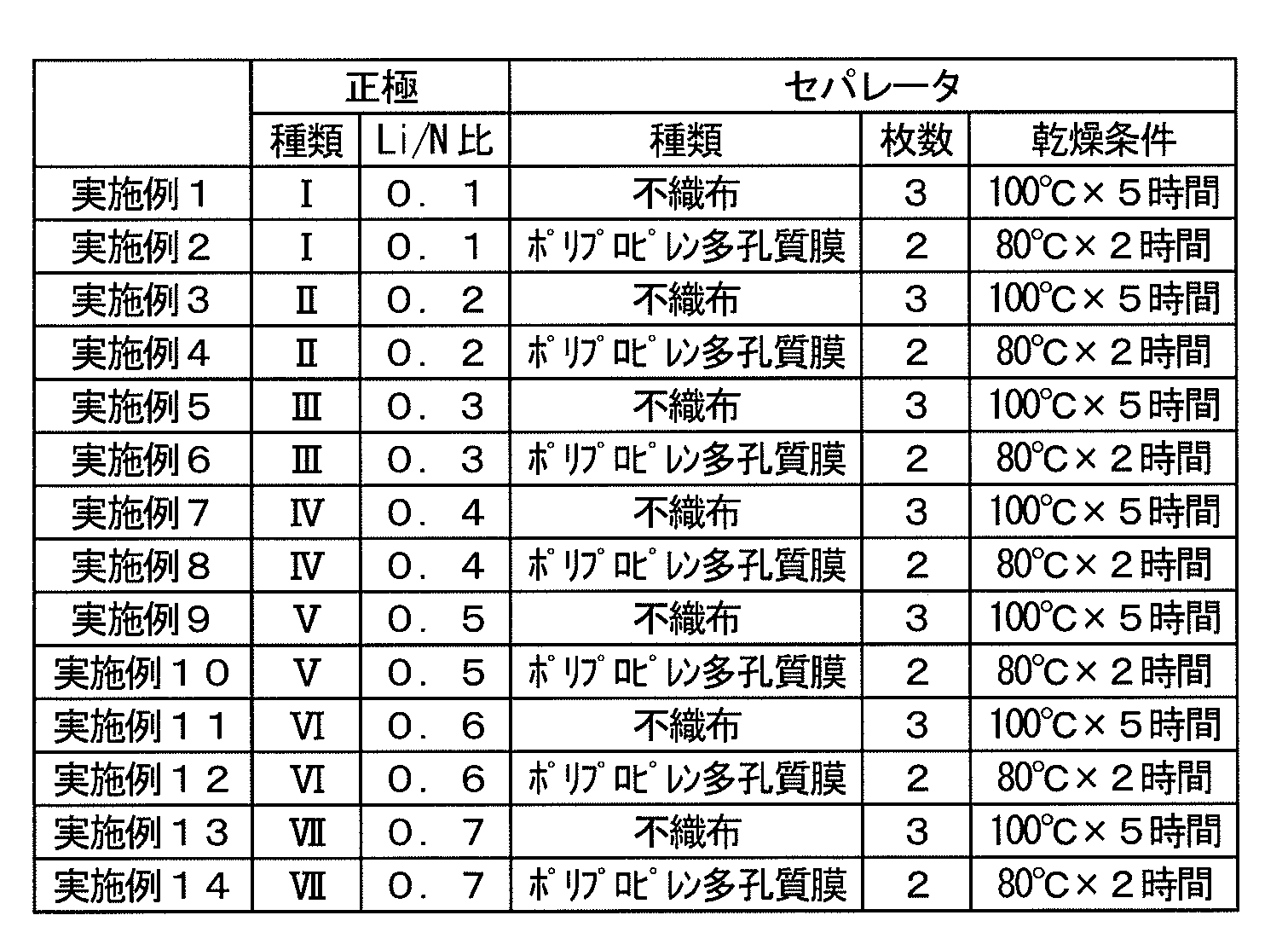
上記正極I作製時に用いた各材料の割合を、下記の表1のように変更し、Li/N比を下記の表1のようにした。それ以外は、正極Iと同様にして、正極II~VIIを作製した。
上記正極I作製時に用いた各材料の割合を、下記の表1のように変更し、Li/N比を下記の表1のようにした。それ以外は、正極Iと同様にして、正極II~VIIを作製した。

〔実施例1〕
<ラミネートセルの作製>
正極Iのシートを、35mm×27mmの寸法に裁断し、その活物質層(ポリアニリンシート部分)が27mm×27mmの面積になるように活物質層の一部を除去して、その除去した部分を電流取り出し用のタブ電極取り付け場所とする正極を作製した。正極は、真空乾燥機にて80℃で2時間、真空乾燥させた。
また、負極としては、金属リチウム(本城金属社製、厚み50μm)をSUSメッシュに圧着させたものを用いた。そして、負極活物質層(金属リチウム層部分)の寸法は、29mm×29mmとして、正極の活物質層よりも大きくした。
また、セパレータとしては、不織布(ニッポン高度紙工業社製、TF40-50、厚み50μm、空隙率70%)を用いた。そして、セパレータは、100℃で5時間、真空乾燥させた。
また、電解液としては、エチレンカーボネートとジメチルカーボネートとを1:1の体積比で含む溶媒にLiPF6を1mol/Lの濃度で溶解させたものを用いた。
次に、露点-90℃のグローブボックス内で、上記正極、負極及びセパレータを用いて積層体を組み立てた。具体的には、上記正極と負極の間にセパレータ3枚が配置されるように積層し、積層体を得た。積層体をアルミニウムラミネートパッケージに入れた後、1か所開口部を残して、残りの周辺部をラミネーターでシールし、次いで開口部からパッケージ内に上記電解液を注入した。最後に、パッケージを封口して、ラミネートセル(非水電解液二次電池)を作製した。
<ラミネートセルの作製>
正極Iのシートを、35mm×27mmの寸法に裁断し、その活物質層(ポリアニリンシート部分)が27mm×27mmの面積になるように活物質層の一部を除去して、その除去した部分を電流取り出し用のタブ電極取り付け場所とする正極を作製した。正極は、真空乾燥機にて80℃で2時間、真空乾燥させた。
また、負極としては、金属リチウム(本城金属社製、厚み50μm)をSUSメッシュに圧着させたものを用いた。そして、負極活物質層(金属リチウム層部分)の寸法は、29mm×29mmとして、正極の活物質層よりも大きくした。
また、セパレータとしては、不織布(ニッポン高度紙工業社製、TF40-50、厚み50μm、空隙率70%)を用いた。そして、セパレータは、100℃で5時間、真空乾燥させた。
また、電解液としては、エチレンカーボネートとジメチルカーボネートとを1:1の体積比で含む溶媒にLiPF6を1mol/Lの濃度で溶解させたものを用いた。
次に、露点-90℃のグローブボックス内で、上記正極、負極及びセパレータを用いて積層体を組み立てた。具体的には、上記正極と負極の間にセパレータ3枚が配置されるように積層し、積層体を得た。積層体をアルミニウムラミネートパッケージに入れた後、1か所開口部を残して、残りの周辺部をラミネーターでシールし、次いで開口部からパッケージ内に上記電解液を注入した。最後に、パッケージを封口して、ラミネートセル(非水電解液二次電池)を作製した。
〔実施例2~14〕
正極の種類(前記表1に記載の正極I~VII)、セパレータの種類,枚数,乾燥条件を、下記の表2に示すものに代えた。それ以外は、実施例1と同様にして、ラミネートセル(非水電解液二次電池)を作製した。なお、下記の表2に示すポリプロピレン多孔質膜としては、ポリプロピレン多孔質膜(セルガード社製、Celgard2400、厚さ25μm、空孔率38%、通気度620秒/100cm3)を用いた。
正極の種類(前記表1に記載の正極I~VII)、セパレータの種類,枚数,乾燥条件を、下記の表2に示すものに代えた。それ以外は、実施例1と同様にして、ラミネートセル(非水電解液二次電池)を作製した。なお、下記の表2に示すポリプロピレン多孔質膜としては、ポリプロピレン多孔質膜(セルガード社製、Celgard2400、厚さ25μm、空孔率38%、通気度620秒/100cm3)を用いた。
〔比較例1〕
正極を、下記のようにして作製した正極VIIIに代えた。それ以外は、実施例1と同様にして、ラミネートセル(非水電解液二次電池)を作製した。
<正極VIIIの作製>
濃度48重量%のスチレンブタジエンゴム(SBR)エマルジョン(JSR社製、TRD2001)1.125gと、濃度19.8重量%のポリビニルピロリドン(PVP)水溶液(日本触媒社製、K-90W)6.54gとを混合し、さらにイオン交換水1.5gを加えて、バインダー溶液を作製した。ついで、前記還元脱ドープ状態のポリアニリン粉末8gと、導電性カーボンブラック(電気化学工業社製、デンカブラック)粉末1gとを混合した後、上記作製のバインダー溶液を加え、さらにイオン交換水13.2gを加えて、スパチュラでよく練った。このものを、超音波式ホモジナイザーにて1分間超音波処理を施した後、薄膜旋回型高速ミキサー(プライミックス社製、フィルミックス40-40型)を用いて、高剪断力を加えてマイルド分散させ、流動性を有するペーストを得た。このペーストを、さらに真空吸引鐘とロータリーポンプを用いて脱泡した。そして、卓上型自動塗工装置(テスター産業社製)を用い、マイクロメーター付きドクターブレ-ド式アプリケータによって、上記脱泡ペーストを、塗工厚み360μm、塗布速度10mm/秒にて、電気二重層キャパシタ用エッチングアルミニウム箔(宝泉社製、30CB)上に塗布した。次いで、このものを、室温で45分間放置した後、温度100℃のホットプレート上で乾燥させて、ポリアニリンシート電極(正極VIII)を作製した。
正極を、下記のようにして作製した正極VIIIに代えた。それ以外は、実施例1と同様にして、ラミネートセル(非水電解液二次電池)を作製した。
<正極VIIIの作製>
濃度48重量%のスチレンブタジエンゴム(SBR)エマルジョン(JSR社製、TRD2001)1.125gと、濃度19.8重量%のポリビニルピロリドン(PVP)水溶液(日本触媒社製、K-90W)6.54gとを混合し、さらにイオン交換水1.5gを加えて、バインダー溶液を作製した。ついで、前記還元脱ドープ状態のポリアニリン粉末8gと、導電性カーボンブラック(電気化学工業社製、デンカブラック)粉末1gとを混合した後、上記作製のバインダー溶液を加え、さらにイオン交換水13.2gを加えて、スパチュラでよく練った。このものを、超音波式ホモジナイザーにて1分間超音波処理を施した後、薄膜旋回型高速ミキサー(プライミックス社製、フィルミックス40-40型)を用いて、高剪断力を加えてマイルド分散させ、流動性を有するペーストを得た。このペーストを、さらに真空吸引鐘とロータリーポンプを用いて脱泡した。そして、卓上型自動塗工装置(テスター産業社製)を用い、マイクロメーター付きドクターブレ-ド式アプリケータによって、上記脱泡ペーストを、塗工厚み360μm、塗布速度10mm/秒にて、電気二重層キャパシタ用エッチングアルミニウム箔(宝泉社製、30CB)上に塗布した。次いで、このものを、室温で45分間放置した後、温度100℃のホットプレート上で乾燥させて、ポリアニリンシート電極(正極VIII)を作製した。
〔比較例2〕
セパレータとして、ポリプロピレン多孔質膜(セルガード社製、Celgard2400、厚さ25μm、空孔率38%、通気度620秒/100cm3)を2枚用い、その乾燥条件を、80℃で2時間の真空乾燥とした。それ以外は、比較例1と同様にして、ラミネートセル(非水電解液二次電池)を作製した。
セパレータとして、ポリプロピレン多孔質膜(セルガード社製、Celgard2400、厚さ25μm、空孔率38%、通気度620秒/100cm3)を2枚用い、その乾燥条件を、80℃で2時間の真空乾燥とした。それ以外は、比較例1と同様にして、ラミネートセル(非水電解液二次電池)を作製した。
〔比較例3〕
正極を、下記のようにして作製した正極XIに代えた。それ以外は、実施例1と同様にして、ラミネートセル(非水電解液二次電池)を作製した。
<正極XIの作製>
濃度48重量%のスチレンブタジエンゴム(SBR)エマルジョン(JSR社製、TRD2001)0.35gと、濃度4.4重量%のポリアクリル酸(和光純薬工業社製、重量平均分子量100万)水溶液8.14gとを混合し、さらにイオン交換水6gを加えて、バインダー溶液を作製した。ついで、前記還元脱ドープ状態のポリアニリン粉末4.5gと、導電性カーボンブラック(電気化学工業社製、デンカブラック)粉末0.5gとを混合した後、上記作製のバインダー溶液を加えて、スパチュラでよく練った。このものを、超音波式ホモジナイザーにて1分間超音波処理を施した後、薄膜旋回型高速ミキサー(プライミックス社製、フィルミックス40-40型)を用いて、高剪断力を加えてマイルド分散させ、流動性を有するペーストを得た。このペーストを、さらに真空吸引鐘とロータリーポンプを用いて脱泡した。そして、卓上型自動塗工装置(テスター産業社製)を用い、マイクロメーター付きドクターブレ-ド式アプリケータによって、上記脱泡ペーストを、塗工厚み360μm、塗布速度10mm/秒にて、電気二重層キャパシタ用エッチングアルミニウム箔(宝泉社製、30CB)上に塗布した。次いで、このものを、室温で45分間放置した後、温度100℃のホットプレート上で乾燥させて、ポリアニリンシート電極(正極XI)を作製した。
正極を、下記のようにして作製した正極XIに代えた。それ以外は、実施例1と同様にして、ラミネートセル(非水電解液二次電池)を作製した。
<正極XIの作製>
濃度48重量%のスチレンブタジエンゴム(SBR)エマルジョン(JSR社製、TRD2001)0.35gと、濃度4.4重量%のポリアクリル酸(和光純薬工業社製、重量平均分子量100万)水溶液8.14gとを混合し、さらにイオン交換水6gを加えて、バインダー溶液を作製した。ついで、前記還元脱ドープ状態のポリアニリン粉末4.5gと、導電性カーボンブラック(電気化学工業社製、デンカブラック)粉末0.5gとを混合した後、上記作製のバインダー溶液を加えて、スパチュラでよく練った。このものを、超音波式ホモジナイザーにて1分間超音波処理を施した後、薄膜旋回型高速ミキサー(プライミックス社製、フィルミックス40-40型)を用いて、高剪断力を加えてマイルド分散させ、流動性を有するペーストを得た。このペーストを、さらに真空吸引鐘とロータリーポンプを用いて脱泡した。そして、卓上型自動塗工装置(テスター産業社製)を用い、マイクロメーター付きドクターブレ-ド式アプリケータによって、上記脱泡ペーストを、塗工厚み360μm、塗布速度10mm/秒にて、電気二重層キャパシタ用エッチングアルミニウム箔(宝泉社製、30CB)上に塗布した。次いで、このものを、室温で45分間放置した後、温度100℃のホットプレート上で乾燥させて、ポリアニリンシート電極(正極XI)を作製した。
このようにして得られた実施例および比較例の非水電解液二次電池に関し、下記の基準に従い、重量エネルギー密度の測定を行った。その結果を後記の表3に併せて示す。
≪重量エネルギー密度の測定≫
非水電解液二次電池を25℃の恒温槽内に静置し、電池充放電装置(東洋システム社製、TOSCAT)を用いて、定電流一定電圧充電/定電流放電モードにて測定を行った。充電は、3.8Vに到達するまでは、0.05Cに相当する定電流で充電し、3.8Vに到達した後は、3.8V定電圧で電流値が0.05C相当の20%に減衰するまで充電を行って、これを1充電とし、ついで0.05Cに相当する電流値で電圧が2.0Vに到達するまで放電を行って、これらを充電上限3.8Vの充放電サイクルとした。
非水電解液二次電池を25℃の恒温槽内に静置し、電池充放電装置(東洋システム社製、TOSCAT)を用いて、定電流一定電圧充電/定電流放電モードにて測定を行った。充電は、3.8Vに到達するまでは、0.05Cに相当する定電流で充電し、3.8Vに到達した後は、3.8V定電圧で電流値が0.05C相当の20%に減衰するまで充電を行って、これを1充電とし、ついで0.05Cに相当する電流値で電圧が2.0Vに到達するまで放電を行って、これらを充電上限3.8Vの充放電サイクルとした。
ここで0.05Cとは、20時間率を示しており、20時間率とは、電池を充電あるいは放電するのに20時間を要する電流値という意味である。この充電上限3.8Vの充放電を5サイクル行って、セルの活性化を行った。次いで、4.2Vに到達するまでは、0.05Cに相当する定電流で充電し、4.2Vに到達した後は、4.2V定電圧で電流値が0.05C相当の20%に減衰するまで充電を行って、これを1充電とし、ついで0.05Cに相当する電流値で電圧が2.0Vに到達するまで放電を行って、これらを充電上限4.2Vの充放電サイクルとした。充電上限4.2Vの充放電の3サイクル目に得られた放電容量から、ポリアニリンの正味重量に対する重量エネルギー密度を求めた。
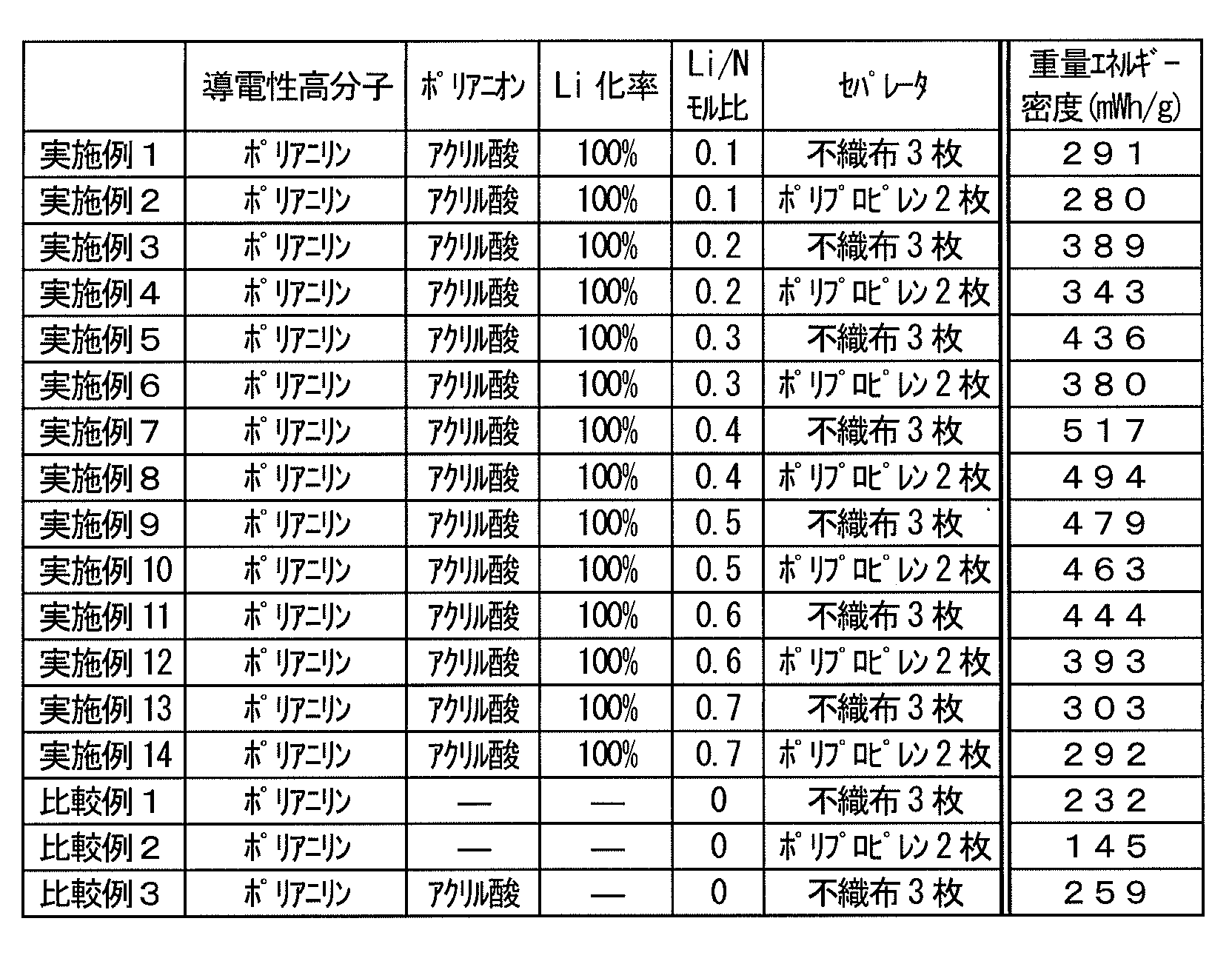
正極と負極と、その間にセパレータを挟んだ積層体からなる非水電解液二次電池において、反応に関与しうる電解液は、主に、正極と負極間の空隙部分に存在する電解液であると考えられる。その電解液の多くは、正極および負極中の空隙部分と、正極と負極間に配置されたセパレータ内の空隙部分に存在する。そのため、空隙率が異なるセパレータを用いた場合や、セパレータの厚みや枚数を変えることによって、反応に関与しうる電解液の量を変えることができる。上記表3においては、ポリプロピレン多孔質膜2枚の場合と比較して、不織布3枚の場合の方が、反応に関与する電解液量が多くなっている。
そして、上記表3における実施例と比較例との対比より、ポリアニオンを含む正極を有する実施例の非水電解液二次電池のほうが、比較例の非水電解液二次電池に比べ、明らかに放電重量エネルギー密度が大きい。また、実施例では、正極中にリチウムを含むことから、正極中にリチウムを含まない比較例の非水電解液二次電池と比べ、セパレータが変更されて反応に関与する電解液量が少なくなった際の放電容量の減少が抑制されている。すなわち液量に対する放電容量の依存性が低下している。このことから、本発明の非水電解液二次電池は、セル全体での体積当りの重量エネルギー密度の低下が抑制された非水電解液二次電池であることがわかる。
上記実施例においては、本発明における具体的な形態について示したが、上記実施例は単なる例示にすぎず、限定的に解釈されるものではない。当業者に明らかな様々な変形は、本発明の範囲内であることが企図されている。
本発明の非水電解液二次電池は、リチウムイオン二次電池等の非水電解液二次電池として好適に使用できる。また、本発明の非水電解液二次電池は、従来の二次電池と同様の用途に使用でき、例えば、携帯型PC、携帯電話、携帯情報端末(PDA)等の携帯用電子機器や、ハイブリッド電気自動車、電気自動車、燃料電池自動車等の駆動用電源に広く用いられる。
Claims (6)
- 正極と負極と、上記正極と上記負極の間に配置されたセパレータと、イオン伝導性を有する支持塩を含む電解液とを備えた非水電解液二次電池であって、上記正極が、下記の(a)および(b)成分を含有し、かつ下記(α)の要件を満たす組成物からなり、上記負極が、金属リチウムおよびリチウムイオンを挿入・脱離し得る材料から選ばれた少なくとも一つを含むことを特徴とする非水電解液二次電池。
(a)導電性ポリマー。
(b)ポリアニオン酸の一部がリチウムで置換されたリチウム塩。
(α)上記(a)成分の、充放電反応に関与する元素の含有量に対する、上記(b)成分のリチウム元素含有量が、モル比で0.1~1.0の範囲である。 - 上記導電性ポリマー(a)が、ポリアニリンおよびポリアニリン誘導体から選ばれた少なくとも一つである請求項1記載の非水電解液二次電池。
- 上記導電性ポリマー(a)の、充放電反応に関与する元素の含有量に対する、上記リチウム塩(b)のリチウム元素含有量が、モル比で0.3~0.6の範囲である請求項1または2に記載の非水電解液二次電池。
- 上記導電性ポリマー(a)の、充放電反応に関与する元素が、窒素元素および硫黄元素体から選ばれた少なくとも一つである請求項1~3のいずれか一項に記載の非水電解液二次電池。
- 上記リチウム塩(b)を構成するポリアニオン酸が、ポリアクリル酸、ポリメタクリル酸、ポリビニル安息香酸、ポリアリル安息香酸、ポリメタリル安息香酸、ポリマレイン酸、ポリフマル酸およびポリグルタミン酸からなる群から選ばれた少なくとも一つである請求項1~4のいずれか一項に記載の非水電解液二次電池。
- 請求項1~5のいずれか一項に記載の非水電解液二次電池の製造方法であって、下記(I)~(III)の工程を備えることを特徴とする非水電解液二次電池の製造方法。
(I)正極と負極とを準備し、両者の間に、セパレータを配置し、正極、セパレータおよび負極からなる積層体を作製する工程。
(II)電池容器内に上記積層体を少なくとも一つ収容する工程。
(III)上記電池容器内に、電解液を注入する工程。
Priority Applications (3)
| Application Number | Priority Date | Filing Date | Title |
|---|---|---|---|
| CN201380066915.6A CN104885270B (zh) | 2012-12-27 | 2013-12-24 | 非水电解液二次电池及其制造方法 |
| EP13866580.7A EP2919306B1 (en) | 2012-12-27 | 2013-12-24 | Nonaqueous electrolyte secondary battery and method for producing same |
| US14/653,909 US10230097B2 (en) | 2012-12-27 | 2013-12-24 | Nonaqueous electrolyte secondary battery and method for manufacturing same |
Applications Claiming Priority (2)
| Application Number | Priority Date | Filing Date | Title |
|---|---|---|---|
| JP2012-285795 | 2012-12-27 | ||
| JP2012285795A JP6103521B2 (ja) | 2012-12-27 | 2012-12-27 | 非水電解液二次電池およびその製造方法 |
Publications (1)
| Publication Number | Publication Date |
|---|---|
| WO2014104004A1 true WO2014104004A1 (ja) | 2014-07-03 |
Family
ID=51021085
Family Applications (1)
| Application Number | Title | Priority Date | Filing Date |
|---|---|---|---|
| PCT/JP2013/084465 Ceased WO2014104004A1 (ja) | 2012-12-27 | 2013-12-24 | 非水電解液二次電池およびその製造方法 |
Country Status (6)
| Country | Link |
|---|---|
| US (1) | US10230097B2 (ja) |
| EP (1) | EP2919306B1 (ja) |
| JP (1) | JP6103521B2 (ja) |
| CN (1) | CN104885270B (ja) |
| TW (1) | TWI621292B (ja) |
| WO (1) | WO2014104004A1 (ja) |
Families Citing this family (2)
| Publication number | Priority date | Publication date | Assignee | Title |
|---|---|---|---|---|
| SE1750397A1 (en) * | 2017-03-31 | 2018-03-13 | An electrochemical device and method for charging the electrochemical device | |
| US11830680B2 (en) * | 2020-04-03 | 2023-11-28 | Pacesetter, Inc. | Reduction of charging time in capacitors |
Citations (5)
| Publication number | Priority date | Publication date | Assignee | Title |
|---|---|---|---|---|
| JPH01132052A (ja) | 1987-08-10 | 1989-05-24 | Nitto Denko Corp | 導電性有機重合体電池 |
| JPH03129679A (ja) | 1989-06-23 | 1991-06-03 | Hitachi Maxell Ltd | ポリアニリン電池 |
| JPH04306560A (ja) * | 1991-04-03 | 1992-10-29 | Matsushita Electric Ind Co Ltd | 固形電極組成物 |
| JP2001266885A (ja) * | 2000-03-23 | 2001-09-28 | Matsushita Electric Ind Co Ltd | 複合電極組成物、その製造方法およびリチウム電池 |
| JP2010044951A (ja) * | 2008-08-12 | 2010-02-25 | Nippon Chemicon Corp | 電極活物質及びこれを用いた電極 |
Family Cites Families (12)
| Publication number | Priority date | Publication date | Assignee | Title |
|---|---|---|---|---|
| DE3484403D1 (de) * | 1983-05-04 | 1991-05-16 | Showa Denko Kk | Batterie mit elektrode aus polymermaterial mit konjugierten doppelbindungen. |
| US4939050A (en) * | 1987-11-12 | 1990-07-03 | Bridgestone Corporation | Electric cells |
| US5340368A (en) * | 1993-08-04 | 1994-08-23 | Valence Technology, Inc. | Method for in situ preparation of an electrode composition |
| US6071489A (en) * | 1996-12-05 | 2000-06-06 | Samsung Display Device Co., Ltd. | Methods of preparing cathode active materials for lithium secondary battery |
| JP4390226B2 (ja) * | 1998-07-10 | 2009-12-24 | アオイ電子株式会社 | 積層型二次電池の製造方法 |
| WO2002101869A1 (en) * | 2001-06-07 | 2002-12-19 | Mitsubishi Chemical Corporation | Lithium secondary cell |
| JP4640915B2 (ja) | 2004-01-28 | 2011-03-02 | 日本曹達株式会社 | 電極及び電極製造方法 |
| US7875388B2 (en) * | 2007-02-06 | 2011-01-25 | 3M Innovative Properties Company | Electrodes including polyacrylate binders and methods of making and using the same |
| CN101302341B (zh) * | 2007-05-09 | 2010-11-17 | 郑州泰达电子材料科技有限公司 | 导电性复合材料、复合电极和使用复合电极的超大电容及锂电池 |
| JP2010275378A (ja) * | 2009-05-27 | 2010-12-09 | Nec Tokin Corp | 導電性高分子懸濁液およびその製造方法、導電性高分子材料並びに、固体電解コンデンサおよびその製造方法 |
| EP3057170B1 (en) | 2011-06-29 | 2017-04-26 | Nitto Denko Corporation | Nonaqueous electrolyte secondary battery and cathode sheet therefor |
| JP6153124B2 (ja) | 2012-12-13 | 2017-06-28 | 日東電工株式会社 | 非水電解液二次電池およびその製造方法 |
-
2012
- 2012-12-27 JP JP2012285795A patent/JP6103521B2/ja active Active
-
2013
- 2013-12-24 CN CN201380066915.6A patent/CN104885270B/zh active Active
- 2013-12-24 EP EP13866580.7A patent/EP2919306B1/en active Active
- 2013-12-24 TW TW102147948A patent/TWI621292B/zh active
- 2013-12-24 WO PCT/JP2013/084465 patent/WO2014104004A1/ja not_active Ceased
- 2013-12-24 US US14/653,909 patent/US10230097B2/en active Active
Patent Citations (5)
| Publication number | Priority date | Publication date | Assignee | Title |
|---|---|---|---|---|
| JPH01132052A (ja) | 1987-08-10 | 1989-05-24 | Nitto Denko Corp | 導電性有機重合体電池 |
| JPH03129679A (ja) | 1989-06-23 | 1991-06-03 | Hitachi Maxell Ltd | ポリアニリン電池 |
| JPH04306560A (ja) * | 1991-04-03 | 1992-10-29 | Matsushita Electric Ind Co Ltd | 固形電極組成物 |
| JP2001266885A (ja) * | 2000-03-23 | 2001-09-28 | Matsushita Electric Ind Co Ltd | 複合電極組成物、その製造方法およびリチウム電池 |
| JP2010044951A (ja) * | 2008-08-12 | 2010-02-25 | Nippon Chemicon Corp | 電極活物質及びこれを用いた電極 |
Also Published As
| Publication number | Publication date |
|---|---|
| JP2014127447A (ja) | 2014-07-07 |
| US20150318540A1 (en) | 2015-11-05 |
| JP6103521B2 (ja) | 2017-03-29 |
| CN104885270A (zh) | 2015-09-02 |
| EP2919306A1 (en) | 2015-09-16 |
| TWI621292B (zh) | 2018-04-11 |
| TW201432981A (zh) | 2014-08-16 |
| EP2919306A4 (en) | 2016-10-26 |
| US10230097B2 (en) | 2019-03-12 |
| CN104885270B (zh) | 2019-01-11 |
| EP2919306B1 (en) | 2018-10-03 |
Similar Documents
| Publication | Publication Date | Title |
|---|---|---|
| CN105958011B (zh) | 非水电解液二次电池和用于其的正极片 | |
| JP6153124B2 (ja) | 非水電解液二次電池およびその製造方法 | |
| JP2014035836A (ja) | 非水電解液二次電池およびその製造方法 | |
| WO2014104006A1 (ja) | 非水電解液二次電池用正極、それを用いた非水電解液二次電池およびその製造方法 | |
| JP6241911B2 (ja) | 活物質粒子、蓄電デバイス用正極、蓄電デバイスおよび活物質粒子の製造方法 | |
| JP2014123449A (ja) | 蓄電デバイス用電極およびその製造方法、並びに蓄電デバイス | |
| WO2015115242A1 (ja) | 非水電解液二次電池 | |
| JP2014120453A (ja) | 非水電解液二次電池 | |
| WO2014104005A1 (ja) | 非水電解液二次電池 | |
| WO2014103779A1 (ja) | 非水電解液二次電池、およびそれに用いる正極 | |
| JP6103521B2 (ja) | 非水電解液二次電池およびその製造方法 | |
| WO2015115243A1 (ja) | 非水電解液二次電池 | |
| JP2015225753A (ja) | 蓄電デバイス | |
| WO2014006973A1 (ja) | 蓄電デバイス用電極、それを用いた蓄電デバイスおよびその製法 | |
| WO2014024941A1 (ja) | 蓄電デバイス用正極およびその製造方法、蓄電デバイス用正極活物質およびその製造方法、ならびに蓄電デバイス | |
| WO2014084182A1 (ja) | 蓄電デバイス、およびそれに用いる電極並びに多孔質シート | |
| JP2014072129A (ja) | 蓄電デバイス用電極およびそれを用いた蓄電デバイス | |
| WO2014103780A1 (ja) | 非水電解液二次電池、およびそれに用いる正極シート | |
| JP2014072128A (ja) | 蓄電デバイス正極用活物質粒子、それを用いた蓄電デバイス用正極並びに蓄電デバイス、および蓄電デバイス正極用活物質粒子の製造方法 | |
| JP2013239304A (ja) | 蓄電デバイスの製法およびそれにより得られる蓄電デバイス | |
| WO2014065198A1 (ja) | カチオン移動型蓄電デバイス、それに用いる電極並びに多孔質シート、およびドープ率向上方法 | |
| JP2014127446A (ja) | 蓄電デバイス用電極の製法およびそれにより得られる電極並びに蓄電デバイス |
Legal Events
| Date | Code | Title | Description |
|---|---|---|---|
| 121 | Ep: the epo has been informed by wipo that ep was designated in this application |
Ref document number: 13866580 Country of ref document: EP Kind code of ref document: A1 |
|
| WWE | Wipo information: entry into national phase |
Ref document number: 2013866580 Country of ref document: EP |
|
| WWE | Wipo information: entry into national phase |
Ref document number: 14653909 Country of ref document: US |
|
| NENP | Non-entry into the national phase |
Ref country code: DE |