WO2014104219A1 - アルミニウムフレークペーストの製造方法 - Google Patents
アルミニウムフレークペーストの製造方法 Download PDFInfo
- Publication number
- WO2014104219A1 WO2014104219A1 PCT/JP2013/084949 JP2013084949W WO2014104219A1 WO 2014104219 A1 WO2014104219 A1 WO 2014104219A1 JP 2013084949 W JP2013084949 W JP 2013084949W WO 2014104219 A1 WO2014104219 A1 WO 2014104219A1
- Authority
- WO
- WIPO (PCT)
- Prior art keywords
- aluminum
- flakes
- aluminum flakes
- aluminum flake
- paste
- Prior art date
- Legal status (The legal status is an assumption and is not a legal conclusion. Google has not performed a legal analysis and makes no representation as to the accuracy of the status listed.)
- Ceased
Links
Images
Classifications
-
- C—CHEMISTRY; METALLURGY
- C09—DYES; PAINTS; POLISHES; NATURAL RESINS; ADHESIVES; COMPOSITIONS NOT OTHERWISE PROVIDED FOR; APPLICATIONS OF MATERIALS NOT OTHERWISE PROVIDED FOR
- C09D—COATING COMPOSITIONS, e.g. PAINTS, VARNISHES OR LACQUERS; FILLING PASTES; CHEMICAL PAINT OR INK REMOVERS; INKS; CORRECTING FLUIDS; WOODSTAINS; PASTES OR SOLIDS FOR COLOURING OR PRINTING; USE OF MATERIALS THEREFOR
- C09D17/00—Pigment pastes, e.g. for mixing in paints
- C09D17/004—Pigment pastes, e.g. for mixing in paints containing an inorganic pigment
- C09D17/006—Metal
-
- C—CHEMISTRY; METALLURGY
- C08—ORGANIC MACROMOLECULAR COMPOUNDS; THEIR PREPARATION OR CHEMICAL WORKING-UP; COMPOSITIONS BASED THEREON
- C08K—Use of inorganic or non-macromolecular organic substances as compounding ingredients
- C08K3/00—Use of inorganic substances as compounding ingredients
- C08K3/02—Elements
- C08K3/08—Metals
-
- C—CHEMISTRY; METALLURGY
- C08—ORGANIC MACROMOLECULAR COMPOUNDS; THEIR PREPARATION OR CHEMICAL WORKING-UP; COMPOSITIONS BASED THEREON
- C08K—Use of inorganic or non-macromolecular organic substances as compounding ingredients
- C08K5/00—Use of organic ingredients
- C08K5/04—Oxygen-containing compounds
- C08K5/05—Alcohols; Metal alcoholates
-
- C—CHEMISTRY; METALLURGY
- C08—ORGANIC MACROMOLECULAR COMPOUNDS; THEIR PREPARATION OR CHEMICAL WORKING-UP; COMPOSITIONS BASED THEREON
- C08K—Use of inorganic or non-macromolecular organic substances as compounding ingredients
- C08K5/00—Use of organic ingredients
- C08K5/04—Oxygen-containing compounds
- C08K5/09—Carboxylic acids; Metal salts thereof; Anhydrides thereof
-
- C—CHEMISTRY; METALLURGY
- C08—ORGANIC MACROMOLECULAR COMPOUNDS; THEIR PREPARATION OR CHEMICAL WORKING-UP; COMPOSITIONS BASED THEREON
- C08K—Use of inorganic or non-macromolecular organic substances as compounding ingredients
- C08K5/00—Use of organic ingredients
- C08K5/16—Nitrogen-containing compounds
- C08K5/17—Amines; Quaternary ammonium compounds
-
- C—CHEMISTRY; METALLURGY
- C09—DYES; PAINTS; POLISHES; NATURAL RESINS; ADHESIVES; COMPOSITIONS NOT OTHERWISE PROVIDED FOR; APPLICATIONS OF MATERIALS NOT OTHERWISE PROVIDED FOR
- C09C—TREATMENT OF INORGANIC MATERIALS, OTHER THAN FIBROUS FILLERS, TO ENHANCE THEIR PIGMENTING OR FILLING PROPERTIES ; PREPARATION OF CARBON BLACK ; PREPARATION OF INORGANIC MATERIALS WHICH ARE NO SINGLE CHEMICAL COMPOUNDS AND WHICH ARE MAINLY USED AS PIGMENTS OR FILLERS
- C09C1/00—Treatment of specific inorganic materials other than fibrous fillers; Preparation of carbon black
- C09C1/62—Metallic pigments or fillers
- C09C1/64—Aluminium
- C09C1/644—Aluminium treated with organic compounds, e.g. polymers
- C09C1/646—Aluminium treated with organic compounds, e.g. polymers concomitant with mechanical comminution, shaping or abrasion of the particles
-
- C—CHEMISTRY; METALLURGY
- C09—DYES; PAINTS; POLISHES; NATURAL RESINS; ADHESIVES; COMPOSITIONS NOT OTHERWISE PROVIDED FOR; APPLICATIONS OF MATERIALS NOT OTHERWISE PROVIDED FOR
- C09D—COATING COMPOSITIONS, e.g. PAINTS, VARNISHES OR LACQUERS; FILLING PASTES; CHEMICAL PAINT OR INK REMOVERS; INKS; CORRECTING FLUIDS; WOODSTAINS; PASTES OR SOLIDS FOR COLOURING OR PRINTING; USE OF MATERIALS THEREFOR
- C09D17/00—Pigment pastes, e.g. for mixing in paints
- C09D17/002—Pigment pastes, e.g. for mixing in paints in organic medium
-
- C—CHEMISTRY; METALLURGY
- C01—INORGANIC CHEMISTRY
- C01P—INDEXING SCHEME RELATING TO STRUCTURAL AND PHYSICAL ASPECTS OF SOLID INORGANIC COMPOUNDS
- C01P2006/00—Physical properties of inorganic compounds
- C01P2006/60—Optical properties, e.g. expressed in CIELAB-values
- C01P2006/62—L* (lightness axis)
-
- C—CHEMISTRY; METALLURGY
- C08—ORGANIC MACROMOLECULAR COMPOUNDS; THEIR PREPARATION OR CHEMICAL WORKING-UP; COMPOSITIONS BASED THEREON
- C08K—Use of inorganic or non-macromolecular organic substances as compounding ingredients
- C08K3/00—Use of inorganic substances as compounding ingredients
- C08K3/02—Elements
- C08K3/08—Metals
- C08K2003/0812—Aluminium
Definitions
- the present invention relates to a method for producing an aluminum flake paste used for metallic paints and the like.
- Aluminum flakes are used in a wide range of fields as metallic pigments contained in paint compositions, ink compositions, resin compositions and cosmetics.
- aluminum flakes are made by using a grinding apparatus having grinding media such as a ball mill or an attritor and using aluminum powder as a raw material (also referred to as “raw aluminum powder”) and grinding aids in an organic solvent. It is obtained by wet-grinding the agent and flaking aluminum powder as a raw material.
- a grinding apparatus having grinding media such as a ball mill or an attritor and using aluminum powder as a raw material (also referred to as “raw aluminum powder”) and grinding aids in an organic solvent. It is obtained by wet-grinding the agent and flaking aluminum powder as a raw material.
- the metallic feeling of the coating film obtained by applying a paint containing aluminum flakes to the substrate is mainly the shape, surface smoothness, average particle size, particle size distribution, average thickness, thickness distribution, aspect ratio of the aluminum flakes. These parameters are adjusted by a combination of the characteristics of the raw aluminum powder and the grinding conditions.
- Patent Document 1 WO2003 / 022934 pamphlet (hereinafter referred to as Patent Document 1), a technique for obtaining an aluminum flake pigment having high brightness by adjusting these parameters has been developed.
- the metallic feeling is visually recognized by a combination of brightness, brightness, and glitter, but there is a strong tendency to desire a coating film with high brightness.
- the time required for flaking is short if the impact applied to the raw aluminum powder from the grinding media is strong.
- the time required for flaking tends to increase.
- the solvent used for producing aluminum flakes (also referred to as “grinding solvent”) is also changed.
- an organic solvent containing an aromatic hydrocarbon as a main component is used as a grinding solvent
- an organic solvent containing an aliphatic hydrocarbon as a main component typically mineral spirit
- solubility of fatty acids such as oleic acid and stearic acid in grinding solvents is increased.
- Fatty acids such as oleic acid and stearic acid are added as a grinding aid during flaking (grinding) and adhere to the surface of aluminum flakes after flaking, imparting parallel alignment of aluminum flakes and agglomeration. It plays the role of suppression, protection of the aluminum flake surface, etc.
- the higher the solubility of the grinding solvent in these compounds the less fatty acid will adhere to the aluminum flake surface.
- the present invention has been made in view of the above-described present situation, and an object of the present invention is to provide a method for producing an aluminum flake paste that provides high luminance while maintaining storage stability.
- the present inventors have examined the factors that cause high brightness in the aluminum flake paste produced by a production method using an organic solvent containing an aromatic hydrocarbon as a main component as a grinding solvent. did. And the difference in shape between aluminum flakes obtained using an organic solvent containing aromatic hydrocarbon as a main component as a grinding solvent and aluminum flakes obtained using conventional mineral spirit as a grinding solvent. As a result of measuring the roundness, it was found that aluminum flakes obtained by using an organic solvent containing an aromatic hydrocarbon as a main component as a grinding solvent are closer to a perfect circle. Moreover, it discovered that the aluminum flake near a perfect circle gave a high brightness
- the present invention provides a first step for obtaining aluminum flakes by flaking raw material aluminum powder in an organic solvent containing an aromatic hydrocarbon as a main component, and the aluminum flakes obtained in the first step A second step of treating with an organic compound having a group and forming a paste, and a method for producing an aluminum flake paste.
- the organic compound having a polar group may be at least one selected from the group consisting of fatty acids, aliphatic amines, fatty acid amides, aliphatic alcohols, and esters composed of fatty acids and aliphatic alcohols.
- the present invention provides an aluminum flake paste containing aluminum flakes, wherein the water surface diffusion area (cm 2 / g) of the entire aluminum flakes contained in the aluminum flake paste is A, and the true surface of the aluminum flakes having a surface area of 250 ⁇ m 2 or more.
- the circularity is B
- the aluminum flake paste has a ratio A / B of 6000 (cm 2 / g) or more.
- the aluminum flake paste preferably contains 0.5% by mass or more of an organic compound having a polar group in terms of carbon amount.
- the organic compound having a polar group may be at least one selected from the group consisting of fatty acids, aliphatic amines, fatty acid amides, aliphatic alcohols, and esters composed of fatty acids and aliphatic alcohols.
- the present invention is a metallic color product using the aluminum flake paste described above.
- the method for producing an aluminum flake paste of the present invention has an excellent effect that, by having the above-described configuration, it is possible to provide an aluminum flake paste that provides high brightness while maintaining storage stability.
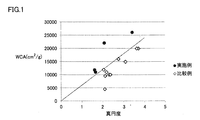
- FIG. 6 is a scatter diagram showing the relationship between the water surface diffusion area (WCA) and the roundness in Examples 1 to 4 and Comparative Examples 1 to 10.
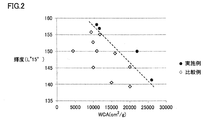
- FIG. 6 is a scatter diagram showing the relationship between water surface diffusion area (WCA) and luminance in Examples 1 to 4 and Comparative Examples 1 to 10.
- the method for producing an aluminum flake paste of the present invention includes a first step for obtaining aluminum flakes by flaking raw material aluminum powder in an organic solvent containing an aromatic hydrocarbon as a main component, and the aluminum flakes obtained in the first step. And a second step of treating with an organic compound having a polar group and forming a paste.
- the production method of the present invention may include other steps as long as it includes the first step and the second step. Examples of such other processes include a solid-liquid separation process such as a filtration operation or a screen operation.
- the first step of the production method of the present invention is a step of obtaining aluminum flakes by flaking raw material aluminum powder in an organic solvent containing an aromatic hydrocarbon as a main component.
- raw materials used in the first step, conditions of the first step, and the like will be described.
- a grinding device with grinding media is used for flaking the raw aluminum powder.
- flaking means forming particulate powder into a flake shape (scale shape) using a grinding device or the like.
- a conventionally well-known grinding apparatus can be used conveniently.
- an attritor-type grinding device having a rotating arm inside, or a cylindrical ball mill can be preferably used.
- a cylindrical ball mill is particularly preferable because aluminum flakes with higher luminance can be obtained.
- the rotation speed of a ball mill when using a ball mill, it is preferable that the rotation speed of a ball mill shall be 95% or less of critical rotation speed.
- the critical rotational speed referred to here is the rotational speed at which the ball (grinding media) is fixed to the inner wall of the ball mill by centrifugal force when the rotational speed is further increased, and is represented by the following formula (1).
- n [1 / (2 ⁇ )] ⁇ (g / r) 1/2 (1)
- n represents the number of revolutions (rpm)
- g represents the acceleration of gravity (3528000 cm / min 2 )
- r represents the ball mill radius (cm).
- the grinding time is not particularly limited, and may be appropriately determined according to the diameter of the grinding media, the mass of the grinding media, the amount of grinding solvent, the number of rotations, and the like. Usually between 3 and 48 hours.
- the grinding media used in the grinding device as described above are not particularly limited, and various materials such as steel balls, stainless steel balls, glass balls, and ceramic balls can be used, but from the viewpoint of specific gravity and economy.
- Spherical media made of a material containing steel is preferable.
- the grinding media to be used are preferably spherical, but are not necessarily spherical grinding media, and may be substantially spherical grinding media.
- the size of the grinding media may be appropriately selected depending on the aluminum flakes to be finally obtained. For example, the diameter is preferably in the range of 0.3 mm to 5.0 mm.
- the diameter is particularly large when using a grinding media of a steel ball so that a fine raw material aluminum powder can be flaked. Is preferably in the range of 0.3 mm to 1.0 mm, and more preferably in the range of 0.5 to 0.8 mm. When the diameter exceeds 1.0 mm, fine raw material aluminum powder is trapped between the grinding media, and the raw material aluminum powder becomes difficult to be ground and may not be efficiently flaked. On the other hand, when the diameter is less than 0.3 mm, the mass of the grinding media is too light and the grinding power is inferior, and it takes too much time to flake, so that the raw material aluminum powder cannot be substantially flaked.
- grinding media you may use it, mixing 2 or more types of grinding media from which a diameter differs. Further, grinding media having a diameter exceeding 1.0 mm may be included in the grinding device used in the present invention. What is necessary is just to change the quantity of grinding media according to the quantity of the raw material aluminum powder thrown into a grinding apparatus so that it may mention later.
- the raw material aluminum powder used as the raw material for the aluminum flake paste is not particularly limited, and the composition thereof may be composed only of aluminum or may be composed of an aluminum-based alloy.
- the purity of is not particularly limited. In order to further increase the gloss of the coating film and the printed matter, it is usually preferable to use pure aluminum, and it is more preferable to use pure aluminum having a purity of 99.9% by mass or more.
- the amount of oxygen contained in the raw material aluminum powder varies depending on the particle size or shape of the raw material aluminum powder and is not particularly limited, but is preferably 0.5% by mass or less. When the amount of oxygen exceeds 0.5% by mass, the oxide film becomes strong, and it tends to be difficult to produce thin flakes due to a decrease in ductility.
- the raw material aluminum powder used in the production method of the present invention can be obtained by any manufacturing method, it is preferably an atomized aluminum powder from the viewpoint of availability or cost.
- the atomized aluminum powder is a raw material aluminum powder obtained by a conventionally known atomization method, and the atomizing medium is not particularly limited.
- air, nitrogen, argon gas, carbon dioxide gas, helium gas, and these gases A mixed gas containing at least one of the above can be used.
- liquids, such as water can also be used as a spray medium.
- the raw material aluminum powder obtained by the atomization method using argon gas or nitrogen gas as a spray medium has a nearly spherical shape, and the aluminum flakes obtained using the raw material aluminum powder have high roundness. This is particularly preferable because it is easy to obtain.
- the shape of the raw material aluminum powder used in the production method of the present invention is not particularly limited, and may be any of, for example, a spherical shape, a flat shape, a plate shape, a teardrop shape, a needle shape, a spheroid shape, an indefinite shape, and the like.
- the near-spherical shape is more preferable because the roundness increases and aluminum flakes with high brightness are easily obtained.
- the average particle diameter of the raw material aluminum powder used in the production method of the present invention is not particularly limited, but is preferably in the range of 1.0 ⁇ m to 50.0 ⁇ m, and preferably in the range of 1.0 to 10.0 ⁇ m. More preferably, it is more preferably in the range of 1.0 to 6.0 ⁇ m.
- the average particle diameter (D50) can be obtained by calculating the volume average from the particle size distribution measured by the laser diffraction method.
- the ratio (D50 Al / D B ) between the average particle diameter (D50 Al ) of the raw aluminum powder and the diameter (D B ) of the grinding media is not particularly limited.
- it is preferably in the range of 0.001 to 0.02, more preferably in the range of 0.0015 to 0.008.
- D50 Al / D B it is in the above range, because the finer the raw material aluminum powder becomes possible to flaking, to improve the brightness of the aluminum flake paste.
- the value of D50 Al / D B is less than 0.001, since the gap of the steel Kuma grinding media is too large compared to the raw aluminum powder can not be efficiently flaked raw aluminum powder, is less flaked
- the aluminum flake paste has a tendency to decrease in brightness because it contains a small amount of fine aluminum flakes or requires a long period of grinding to promote flaking, during which large aluminum flakes are shredded.
- D50 when the value of Al / D B exceeds 0.02 since the steel Kuma grinding media is too small for the raw material aluminum powder, milled in correlation with the individual steel Kuma grinding media mass The raw material aluminum powder cannot be flaked efficiently due to insufficient power, and the brightness of the coating film tends to decrease.
- the ratio (W B / W Al ) between the mass (W B (g)) of the grinding media during flaking (grinding) and the mass (W Al (g)) of the raw aluminum powder. ) Is not particularly limited, but is preferably in the range of 20 to 200. When the ratio is less than 20, productivity tends to decrease. Moreover, when said ratio exceeds 200, while grinding time will become very long, slurry viscosity will rise too much during grinding, and the tendency of flaking efficiency will show the tendency.
- Organic solvent containing aromatic hydrocarbon as main component is used as a grinding solvent.
- organic solvents called mineral spirits mainly composed of aliphatic hydrocarbons are used as grinding solvents.
- the present invention uses aluminum flakes that give higher brightness than those obtained by conventional methods by using an organic solvent containing aromatic hydrocarbon as a main component instead of mineral spirit as a grinding solvent. It has the feature that can be obtained.
- the production method of the present invention shows an excellent effect that a high-brightness aluminum flake paste can be obtained.
- an organic solvent containing an aromatic hydrocarbon as a main component for the grinding solvent, the grinding impact imparted to the aluminum flakes from the grinding media is weakened, and the aluminum flakes are less likely to be broken. it is conceivable that.
- containing aromatic hydrocarbons as a main component means containing 50 mass% or more of aromatic hydrocarbons with respect to the total mass of the organic solvent. More preferably, it is 70 mass% or more, More preferably, it is 90 mass% or more, and all of the organic solvent may be an aromatic hydrocarbon.
- aromatic hydrocarbon is not particularly limited, but in general, those having a high boiling point of 120 ° C. or higher are preferably used in consideration of safety problems such as flammability to grinding solvents.
- aromatic hydrocarbons that can be used include, but are not limited to, 1,2,4-trimethylbenzene, 1,3,5-trimethylbenzene, xylene, cumene, naphthalene, and the like. . It may have a substituent such as nitro group or halogen.
- the organic solvent containing aromatic hydrocarbon as a main component is used even if it contains other organic solvent as long as it contains aromatic hydrocarbon as a main component. Is possible.
- sol (kg / L)) is not particularly limited, but is preferably in the range of 0.1 to 0.3 kg / L, and more preferably in the range of 0.14 to 0.20 kg / L.
- the raw aluminum powder is preferably flaked in the presence of a grinding aid.
- the grinding aid is not particularly limited, and conventionally known grinding aids can be used.
- fatty acids such as oleic acid and stearic acid, or fatty amines, fatty acid amides, fatty alcohols and esters composed of fatty acids and fatty alcohols can be suitably used.
- Such a grinding aid has the effect of suppressing unnecessary oxidation of the aluminum flake surface and improving the brightness of the aluminum flake paste.
- the amount of the grinding aid added during flaking (grinding) is not particularly limited, but is preferably in the range of 0.1 to 20 parts by weight, and 0.5 to 10 parts by weight with respect to 100 parts by weight of the raw aluminum powder. If it is the range, it is still more preferable. If the addition amount of the grinding aid is less than 0.1 parts by mass, agglomeration of the aluminum flakes may occur and the brightness of the aluminum flake paste may be lowered, and the lubricity is insufficient to make the aluminum flakes into flakes. In some cases, the aluminum flakes may be broken to lower the luminance.
- the addition amount of the grinding aid exceeds 20 parts by mass, there is a risk that the physical properties of the paint, particularly the adhesion, may be lowered, and the aluminum flakes are not easily formed into flakes, which is disadvantageous in that the grinding time becomes longer. It may become.
- a solid-liquid separation operation such as a filtration operation or a screen operation may be performed in order to take out the aluminum flakes.
- a solid-liquid separation operation such as a filtration operation or a screen operation
- the slurry containing aluminum flakes in the ball mill is washed out with mineral spirits and applied to a vibrating screen, and the passed slurry is solid-liquid separated with a pan filter to obtain aluminum flakes (but as filter cake).
- the operation to obtain can be performed.
- the “filter cake” refers to a semi-solid substance remaining after removing an organic solvent containing an aromatic hydrocarbon.
- the grinding media can be removed from the organic solvent containing the aromatic hydrocarbon.
- filtration operation or the screen operation is not limited to the first step, and can be appropriately performed in each step described later.
- the organic solvent containing aromatic hydrocarbon as a main component may be changed to a different solvent by solvent replacement or solvent addition.
- the organic solvent containing an aromatic hydrocarbon as a main component can be changed to a solvent having lower solubility in an “organic compound having a polar group” described later.
- the organic compound having a polar group has an effect of improving the storage stability of the aluminum flake paste regardless of whether it is attached to the surface of the aluminum flake or contained in the solvent.
- the second step of the production method of the present invention is a step of treating the aluminum flakes obtained in the first step with an organic compound having a polar group and forming a paste.
- “treating with an organic compound having a polar group” is a process aimed at attaching an organic compound having a polar group to the surface of the aluminum flakes.
- the 2nd process is performed in the state which added the pasting solvent to the aluminum flakes, while the organic compound which has this polar group adheres to the aluminum flake surface, it is contained in the pasting solvent. Also good.
- raw materials and conditions used in the second step will be described.
- olein is used compared to the case where an aliphatic hydrocarbon (typically mineral spirit) is used as a grinding solvent.
- Solubility in fatty acids such as acids and stearic acid is increased.
- Fatty acids such as oleic acid and stearic acid are added as a grinding aid during flaking (grinding) and adhere to the surface of aluminum flakes after flaking, imparting parallel alignment of aluminum flakes and agglomeration. It plays the role of suppression, protection of the aluminum flake surface, etc.
- increasing the solubility in the grinding solvent results in a decrease in the amount of fatty acid adhering to the aluminum flake surface.
- the storage stability of the aluminum flake paste can be improved by treating the aluminum flakes obtained in the first step with an organic compound having a polar group.
- the production method of the present invention exhibits an excellent effect that an aluminum flake paste having good storage stability can be obtained. This is because the treatment with the organic compound having a polar group suppresses the occurrence of aggregation of aluminum flakes in the aluminum flake paste.
- the organic compound having a polar group has an effect of improving storage stability regardless of whether it is attached to the surface of the aluminum flake or contained in the pasting solvent.
- it is more preferable that the organic compound having a polar group is attached to the surface of the aluminum flakes.
- the organic compound having a polar group used in the production method of the present invention is an organic compound having a polar group such as a hydroxy group, a carboxyl group, an amino group, an amide group (amide bond), an ester group (ester bond), etc. Although it is a compound, its chemical structure is not particularly limited. Preferably, at least one organic compound selected from the group consisting of fatty acids, aliphatic amines, fatty acid amides, fatty alcohols, and esters composed of fatty acids and fatty alcohols may be used.
- the organic compound having a polar group may be the same as or different from the compound added as a grinding aid in the first step.
- fatty acids examples include caprylic acid, capric acid, lauric acid, myristic acid, oleic acid, stearic acid, linoleic acid, arachidonic acid, and behenic acid.
- aliphatic amine examples include laurylamine, myristylamine, palmitylamine, stearylamine and the like.
- fatty acid amide examples include lauric acid amide, palmitic acid amide, oleic acid amide, stearic acid amide, and behenic acid amide.
- aliphatic alcohols examples include capryl alcohol, lauryl alcohol, myristyl alcohol, oleyl alcohol, stearyl alcohol, and behenyl alcohol.
- esters comprising fatty acids and fatty alcohols include methyl laurate, methyl oleate, methyl stearate, octyl stearate, isopropyl myristate, butyl stearate, octyl palmitate, octyl oleate, isopropyl palmitate, etc. Can be mentioned.
- fatty acids having 12 or more carbon atoms aliphatic amines, fatty acid amides, aliphatic alcohols and esters composed of fatty acids and fatty alcohols are preferable.
- Storage stability can be further improved by using a thing with 12 or more carbon atoms. More preferably, the number of carbon atoms is 14 or more.
- the amount of the organic compound having the polar group used in the second step is not particularly limited, but is preferably in the range of 0.5 to 20 parts by mass with respect to 100 parts by mass of the aluminum flakes.
- the amount is less than 0.5 parts by mass, the effect of improving the storage stability of the aluminum flake paste is small, and the luminance may decrease due to a decrease in storage stability over time.
- said amount exceeds 20 mass parts, there exists a possibility that the adhesiveness of the coating film at the time of mix
- the operation method of treating aluminum flakes with an organic compound having a polar group is not particularly limited.
- Examples thereof include a method of attaching an organic compound having a polar group to the surface.
- the second step is performed in a state where aluminum flakes are contained in the solvent, the polar group is dispersed simultaneously with or after the aluminum flakes are dispersed in a slurry in a large amount of solvent.
- a method of adding an organic compound having a polar group and attaching an organic compound having a polar group to the surface of the aluminum flakes can be exemplified.
- the method of contacting or mixing is not particularly limited, and examples thereof include a method of mixing in a paste state using a kneader such as a kneader mixer. .
- a kneader such as a kneader mixer.
- the powdered or pasty aluminum flakes are used without being dispersed in the solvent or the aluminum flakes dispersed in the solvent are used, they are polished during the flaking in the first step.
- the organic compound having a polar group can be brought into contact with aluminum flakes at a higher concentration. Therefore, an organic compound having a polar group can be attached to the aluminum flake surface more efficiently.
- the organic compound having a polar group has an effect of improving the storage stability of the aluminum flake paste regardless of whether it is attached to the surface of the aluminum flake or contained in the solvent. It is more preferable to improve storage stability. Therefore, the storage stability of the aluminum flake paste can be improved by efficiently attaching an organic compound having a polar group to the aluminum flake surface.
- the time for treating the aluminum flakes with the organic compound having a polar group is not particularly limited, but when the powdery or pasty aluminum flakes are used without being dispersed in the solvent, and when the aluminum flakes are dispersed in the solvent. In any case where is used, it is preferably in the range of 5 minutes to 10 hours. Within this range, each aluminum flake is processed uniformly, which is advantageous in that the storage stability is improved and the brightness of the flakes can be maintained.
- the type of the solvent is not particularly limited.
- polar solvents such as water, alcohol and ether can be used, and nonpolar solvents such as aromatic hydrocarbons and aliphatic hydrocarbons can also be used.
- nonpolar solvents such as aromatic hydrocarbons and aliphatic hydrocarbons can also be used.
- non-polar solvent aliphatic hydrocarbons, aromatic hydrocarbons and mixtures thereof having a boiling point in the range of about 120 ° C. to 250 ° C.
- Specific examples include normal paraffin, isoparaffin, xylene, solvent naphtha, kerosene, mineral spirit, and petroleum benzine, but are not limited thereto.
- “to make a paste” means to increase the viscosity of the slurry containing the aluminum flakes in the first step (if the aluminum flakes are obtained as a filter cake, make it a highly viscous fluid. That).
- This operation is usually performed by adding a pasting solvent. If the viscosity of the mixed system is high when an organic compound having a polar group is added to the aluminum flakes, the solvent constituting the mixed system is changed. It is regarded as a pasting solvent and it is not necessary to add a pasting solvent separately.
- pasting solvent refers to a compound that is mixed with aluminum flakes to form a paste.
- an organic solvent containing an aromatic hydrocarbon as a main component used in the first step, or when the second step contains a solvent the solvent may be used as a pasting solvent as it is, Another solvent may be used as a pasting solvent by adding a solvent or replacing a solvent.
- the material for the pasting solvent is not particularly limited, but an aliphatic hydrocarbon (for example, mineral spirit), an organic solvent containing an aromatic hydrocarbon as a main component, a glycol ether solvent, or the like can be used.
- the content of the pasting solvent in the aluminum flake paste is not particularly limited, but if it is in the range of 15% by mass to 50% by mass, the storage stability can be further improved. It is preferable at the point which can improve the dispersibility of the aluminum flake in it. A range of 25% by mass to 40% by mass is more preferable.
- organic compounds having a grinding aid such as fatty acid or polar group attached to the surface of aluminum flakes or having a polar group those having an unsaturated double bond in the structure cause a radical reaction and may be modified. It has the property of being polymerized (modified). Due to this alteration, the aluminum flakes may agglomerate, or the parallel arrangement of the aluminum flakes may be adversely affected, resulting in a decrease in luminance.
- antioxidants that can be used in the present invention, as long as it has a function of stopping the radical chain reaction by supplying an electron or a hydrogen atom to the radical generated by the alteration such as the unsaturated fatty acid, Any compound can be used.
- Typical antioxidants that can be used in the present invention include synthetic antioxidants such as phenolic compounds, alicyclic compounds having a carbonyl group and a hydroxy group, aromatic amino compounds, organic sulfur compounds, phosphite compounds, and natural antioxidants. Mention may be made of antioxidants.
- the aluminum flake paste of the present invention can contain an aluminum flake and a pasting solvent.
- the water surface diffusion area (cm 2 / g) of the entire aluminum flake contained in the aluminum flake paste is A and the roundness of the aluminum flake having a surface area of 250 ⁇ m 2 or more is B, the ratio A / B is 6000. (Cm 2 / g) or more.
- Such an aluminum flake paste can be produced by the method for producing an aluminum flake paste described above.
- the composition of the aluminum flakes is the same as that of the raw material aluminum powder in the above-described method for producing the aluminum flake paste. That is, the composition of the aluminum flakes is not particularly limited, but may be composed only of aluminum or may be composed of an aluminum-based alloy.
- the purity of the aluminum is not particularly limited, but in order to further increase the gloss of the coating film containing aluminum flake paste and the printed matter, it is usually preferably pure aluminum, and may be pure aluminum having a purity of 99.9% by mass or more. More preferred.
- the content of aluminum flakes in the aluminum flake paste is not particularly limited, but the storage stability can be improved as long as it is 50% by mass or more and 85% by mass or less with respect to the aluminum flake paste.
- the effect that the dispersibility of the aluminum flakes in the inside can be improved is preferable. In addition, it is more preferable if it is 60 to 75 mass%.
- the aluminum flakes of the present invention include aluminum flakes having a surface area of 250 ⁇ m 2 or more.
- the ratio A / B is required to be 6000 (cm 2 / g) or more.
- the roundness is a measure showing how close the shape of the surface of the aluminum flake is to the perfect circle shape with respect to the surface having the largest area. If it is a perfect circle, 1 is shown, and the further away from 1, the farther away from a perfect circle shape.
- the roundness of aluminum flakes having a surface area of 250 ⁇ m 2 or more can be calculated as follows. That is, varnish (trade name: “Autoclear”, manufactured by Nippon Paint Co., Ltd.) was added to aluminum flake paste (solid content: 0.2 g) and stirred, and the resulting coating composition was concealed with a 1 mil doctor blade. A coated paper is obtained by applying to the measuring paper.
- the range of roundness of aluminum flakes having a surface area of 250 ⁇ m 2 or more contained in the aluminum flake paste of the present invention is not particularly limited, but the closer to 1, the better. 1.0 to 1.8 is more preferable.
- the value of the water surface diffusion area is determined not only by the aluminum flakes having a surface area of 250 ⁇ m 2 or more but also by the characteristics of the entire aluminum flakes contained in the aluminum flake paste.
- the water surface diffusion area can be determined according to JIS K 5906: 1998 after a certain preliminary treatment (collecting aluminum flake paste on a glass filter, washing with hexane four times and drying) on the aluminum flake paste.
- the method for measuring the water surface diffusion area described in JIS is that of the leafing type, whereas the aluminum flake paste of the present invention includes that of the non-leafing type.
- a sample of aluminum flakes is pretreated (leafing treatment) with a 5% stearic acid mineral spirit solution. Except for performing this pretreatment, all other measurements were performed in the same manner as the leafing type described in JIS K 5906: 1998.
- the scope of the water covering area is not particularly limited, preferably 5000 cm 2 / g or more 800000cm 2 / g, more preferably not more than 6000 cm 2 / g or more 50000 cm 2 / g. Within this range, it is advantageous in terms of luminance. When this value is less than 5000 cm 2 / g, the hiding power of the aluminum flake paste becomes small, which may be disadvantageous for improving the luminance. On the other hand, if the value exceeds 800,000 cm 2 / g, although there is a hiding power, the aluminum flakes become too thin when grinding and the aluminum flakes tend to be broken, which is disadvantageous for improving the luminance. There is a case.
- the water surface diffusion area (cm 2 / g) of the entire aluminum flakes contained in the aluminum flake paste is A
- the roundness of the aluminum flakes having a surface area of 250 ⁇ m 2 or more is B.
- the ratio A / B is 6000 (cm 2 / g) or more, preferably 6500 (cm 2 / g) or more.
- the upper limit of the ratio A / B is not particularly limited, but it is preferably 30000 (cm 2 / g) or less, because the properties of the aluminum flake paste are sufficiently close to a perfect circle, resulting in an increase in luminance.
- the aluminum flake paste of the present invention has individual aluminum flake particles having a shape close to a perfect circle compared to a conventional aluminum flake paste having a similar water surface diffusion area, and thus gives high brightness. is there.
- the reason why aluminum flakes having a shape close to a perfect circle give high brightness is not clear, but there are many aluminum flakes that are close to a perfect circle.
- the reason is considered to be that aluminum flakes having a shape whose roundness deviates from 1 due to cutting is reduced in the aluminum flake paste.
- the average particle diameter of the aluminum flakes of the present invention can be determined by calculating the volume average from the particle size distribution measured by the laser diffraction method.
- the average particle diameter of the aluminum flakes of the present invention is not particularly limited, but is preferably in the range of 1 ⁇ m to 50 ⁇ m. If it is within the above range, it is advantageous in that it can further improve the brightness, aluminum flakes are more difficult to protrude from the coating film containing the aluminum flake paste, and there is no fear that the appearance is impaired, especially in automobile applications etc. preferable.
- the average particle diameter of the aluminum flakes is more preferably in the range of 3 ⁇ m to 20 ⁇ m, and further preferably in the range of 5 ⁇ m to 15 ⁇ m.
- the average thickness ( ⁇ m) of the aluminum flakes of the present invention is calculated by the following equation by measuring the water surface diffusion area (WCA) per gram of aluminum flakes.
- WCA water surface diffusion area
- the measuring method of a water surface diffusion area (WCA) is as above-mentioned.
- Average thickness ( ⁇ m) 10 4 /[2.5 (g / cm 3 ) ⁇ WCA (cm 2 / g)]
- the reason for setting to 2.5 (g / cm 3 ) is as follows.
- the metal density (specific gravity) of aluminum is 2.7 (g / cm 3 )
- the aluminum flakes have a nearly circular shape. Since a gap is formed, 2.5 (g / cm 3 ) is used instead of 2.7 (g / cm 3 ) as the correction value.
- the average thickness of the aluminum flakes of the present invention obtained as described above is not particularly limited, but is preferably 0.01 ⁇ m or more and 5 ⁇ m or less. Within the above range, it is more advantageous in terms of luminance. On the other hand, if it is less than 0.01 ⁇ m, it is disadvantageous in terms of circulation, and if it exceeds 5 ⁇ m, in the coating film containing aluminum flake paste, there is a problem that the aluminum flakes protrude from the coating film and the appearance deteriorates. .
- the average thickness of the aluminum flakes is more preferably 0.03 ⁇ m or more and 1 ⁇ m or less.
- the aluminum flakes used in the present invention preferably have a shape factor (denoted as “aspect ratio”) obtained by dividing the average particle diameter by the average thickness of 50 or more and 200 or less. This is because it is more advantageous in terms of luminance within the above range.
- the aspect ratio is more preferably 60 or more and 150 or less.
- the aluminum flake paste of the present invention contains an organic compound having a polar group.
- the organic compound having such a polar group is the same as the organic compound having a polar group mentioned in the description of the method for producing the aluminum flake paste. That is, the organic compound having a polar group contained in the aluminum flake paste of the present invention is at least selected from the group consisting of fatty acids, aliphatic amines, fatty acid amides, fatty alcohols, and esters composed of fatty acids and fatty alcohols.
- the amount of the organic compound having a polar group contained in the aluminum flake paste is expressed in terms of carbon amount.
- a method for measuring the amount of carbon a method for measuring the amount of carbon contained in the aluminum flake paste with an attached carbon analyzer (trade name: “K0918”, manufactured by Kojima Seisakusho Co., Ltd.) can be employed. Specifically, a certain amount of aluminum flake paste is weighed and then dried to obtain powdered aluminum flakes. Thereafter, the obtained powdered aluminum flakes can be measured by using the attached carbon analyzer and measuring the amount of carbon contained therein.
- the amount of the organic compound having a polar group contained in the aluminum flake paste of the present invention is preferably 0.5% by mass or more and 1.2% by mass in terms of the carbon amount with respect to the entire aluminum flake paste. More preferably, it is more preferably 1.5% by mass or more.
- the aluminum flake paste of the present invention can maintain high storage stability while enabling high brightness.
- the upper limit of the content is not particularly limited as long as the storage stability is not affected, but from the viewpoint of the adhesion of the coating film containing the aluminum flake paste, it is 3.0% by mass or less in terms of carbon content. Preferably there is.
- the surface of the aluminum flake is treated with an organic compound having a polar group. Therefore, the aluminum flakes in the finally obtained aluminum flake paste have an organic compound having a polar group attached to the surface.
- the organic compound which has a polar group in an aluminum flake paste exists in the state adhering to the aluminum flake surface, it is not restricted to this, You may exist in a pasting solvent.
- the aluminum flake paste of the present invention can further contain other additives as long as the effects of the present invention are not impaired.
- Such an additive may adhere to the surface of the aluminum flakes or may be contained in the aluminum flake paste.
- an antioxidant for example, as described in the above-described method for producing an aluminum flake paste, an antioxidant can be used, and various additives for imparting water resistance, chemical resistance, and weather resistance can be used. Can be mentioned.
- the present invention also relates to a metallic color product using the aluminum flake paste of the present invention.
- the metallic coloring material include a coating composition, an ink composition (including inkjet ink), a resin molded product, and a cosmetic.
- Examples of the coating composition or the ink composition include a composition containing an aluminum flake paste, a resin component, and a solvent.
- examples of the resin molded product include a resin molded product in which aluminum flakes are kneaded by using an aluminum flake paste.
- the resin molded product referred to here includes not only the final molded product but also a synthetic resin coloring masterbatch containing aluminum flakes used for the purpose of blending with the base resin, and the synthetic resin metallic coloring master.
- An intermediate work-in-process such as a metallic colored pellet obtained by kneading a batch and a base material resin in a pellet form is also included.
- examples of the base resin include acrylic resins, polypropylene resins, polyethylene resins, polyester resins, alkyd resins, epoxy resins, polyurethane resins, and polyvinyl resins.
- cosmetics are not particularly limited.
- makeup cosmetics such as lipstick, foundation, blusher, eye shadow, nail enamel and mascara, hair gel, hair wax, hair treatment, shampoo and hair.
- hair cosmetics such as nail polish and basic cosmetics such as lotion, base cream and sunscreen.
- the present invention will be described in more detail with reference to examples, but the present invention is not limited thereto.
- the average particle diameter (D50) of the raw material aluminum powder used by the Example and the comparative example was measured with the below-mentioned laser diffraction type particle size distribution measuring apparatus.
- Example 1 In a cylindrical ball mill with a diameter of 500 mm and a length of 180 mm, 50 kg of steel balls with a diameter of 0.7 mm as grinding media, 1000 g of raw aluminum powder with an average particle size of 7.8 ⁇ m, the main component as a grinding solvent As an organic solvent containing aromatic hydrocarbon, 4L of 100% aromatic hydrocarbon solvent containing 42% trimethylbenzene (trade name: “SS-100”, manufactured by JX Nippon Mining & Energy Corporation) 100 g of oleic acid was added as a grinding aid, and the raw aluminum powder was flaked at a rotation speed of 50 rpm (84% of the critical rotation speed) for 1 hour to obtain a slurry containing aluminum flakes.
- an organic solvent containing aromatic hydrocarbon 4L of 100% aromatic hydrocarbon solvent containing 42% trimethylbenzene (trade name: “SS-100”, manufactured by JX Nippon Mining & Energy Corporation) 100 g of oleic acid was added as a grinding aid, and the raw aluminum powder was flaked at
- the slurry containing aluminum flakes in the ball mill was washed out with mineral spirits, applied to 150 mesh, 350 mesh, and 400 mesh vibrating screens in sequence, and the passed slurry was solid-liquid separated with a pan filter to obtain aluminum flakes ( However, as a filter cake) was obtained (first step).
- this filter cake contained 85 mass% of aluminum flakes as a non-volatile component, and the remainder contained mineral spirit.
- the filter cake obtained above was transferred into a kneader mixer. Thereafter, 2% by mass of oleic acid as an organic compound having a polar group is added to the solid content of the aluminum flake in the kneader mixer, the aluminum flake is treated with the aromatic hydrocarbon having the polar group, and the kneader The mixture was kneaded with a mixer for 1 hour to obtain a paste, thereby obtaining an aluminum flake paste (containing 70 mass% of aluminum flakes as a non-volatile content) using mineral spirit as a pasting solvent (second step).
- Example 2 Except that the flaking time by the ball mill was 17 hours, the first step was performed in the same manner as in Example 1 to obtain aluminum flakes (but as a filter cake). In addition, this filter cake contained 85 mass% of aluminum flakes as a non-volatile component, and the remainder contained mineral spirit. Thereafter, the filter cake obtained was subjected to the second step in the same manner as in Example 1 to obtain an aluminum flake paste (containing 70% by mass of aluminum flakes as a nonvolatile content) using mineral spirit as a pasting solvent.
- an aluminum flake paste containing 70% by mass of aluminum flakes as a nonvolatile content
- Example 3 Except that the average particle diameter of the raw material aluminum powder was 4.2 ⁇ m and the flaking time by the ball mill was 17 hours, the first step was performed in the same manner as in Example 1, and aluminum flakes ( But as a filter cake). In addition, this filter cake contained 85 mass% of aluminum flakes as a non-volatile component, and the remainder contained mineral spirit. Thereafter, the filter cake obtained was subjected to the second step in the same manner as in Example 1 to obtain an aluminum flake paste (containing 70% by mass of aluminum flakes as a nonvolatile content) using mineral spirit as a pasting solvent.
- an aluminum flake paste containing 70% by mass of aluminum flakes as a nonvolatile content
- Example 4 Except that the average particle diameter of the raw material aluminum powder was set to 2.7 ⁇ m and the time for flaking by a ball mill was set to 17 hours, the first step was performed in the same manner as in Example 1, and aluminum flakes ( But as a filter cake). In addition, this filter cake contained 85 mass% of aluminum flakes as a non-volatile component, and the remainder contained mineral spirit. Thereafter, the filter cake obtained was subjected to the second step in the same manner as in Example 1 to obtain an aluminum flake paste (containing 70% by mass of aluminum flakes as a nonvolatile content) using mineral spirit as a pasting solvent.
- an aluminum flake paste containing 70% by mass of aluminum flakes as a nonvolatile content
- Examples 5 to 9> Except that the average particle diameter of the raw material aluminum powder was 4.2 ⁇ m and the flaking time by the ball mill was 17 hours, the first step was performed in the same manner as in Example 1, and aluminum flakes ( But as a filter cake). In addition, this filter cake contained 85 mass% of aluminum flakes as a non-volatile component, and the remainder contained mineral spirit. Each of the filter cakes obtained thereafter was subjected to the second step in the same manner as in Example 1 except that the “organic compound having a polar group in the second step” shown in Table 1 was used in the second step. The aluminum flake paste (containing 70 mass% of aluminum flakes as a non-volatile content) was obtained using mineral spirit as a pasting solvent.
- ⁇ Comparative Example 2> In a cylindrical ball mill with a diameter of 500 mm and a length of 180 mm, 50 kg of steel balls with a diameter of 1/8 inch as grinding media, 1000 g of raw aluminum powder with an average particle size of 17.0 ⁇ m, and mineral spirit as grinding solvent 4 L of (main component: aliphatic hydrocarbon) and 100 g of oleic acid as a grinding aid were added, respectively, and the raw aluminum powder was flaked at a rotation speed of 50 rpm (84% of the critical rotation speed) for 5 hours. A slurry containing was obtained.
- the slurry containing aluminum flakes in the ball mill was washed out with mineral spirits, applied to 150 mesh, 350 mesh, and 400 mesh vibrating screens in sequence, and the passed slurry was solid-liquid separated with a pan filter to obtain aluminum flakes ( However, as a filter cake) was obtained (corresponding to the first step).
- this filter cake contained 85 mass% of aluminum flakes as a non-volatile component, and the remainder contained mineral spirit.
- the filter cake obtained above was transferred into a kneader mixer.
- the mixture was kneaded with a kneader mixer for 1 hour to obtain a paste, and an aluminum flake paste (containing 71 mass% of aluminum flakes as a non-volatile content) using mineral spirit as a pasting solvent was obtained (corresponding to the second step).
- the slurry containing aluminum flakes in the ball mill was washed out with mineral spirits, applied to 150 mesh, 350 mesh, and 400 mesh vibrating screens in sequence, and the passed slurry was solid-liquid separated with a pan filter to obtain aluminum flakes ( However, as a filter cake) was obtained (corresponding to the first step).
- this filter cake contained 85 mass% of aluminum flakes as a non-volatile component, and the remainder contained mineral spirit.
- the filter cake obtained above was transferred into a kneader mixer.
- the mixture was kneaded with a kneader mixer for 1 hour to obtain a paste, thereby obtaining an aluminum flake paste containing mineral spirits as a pasting solvent (including 75% by mass of aluminum flakes as a nonvolatile content) (corresponding to the second step).
- ⁇ Comparative example 4> In a cylindrical ball mill having a diameter of 500 mm and a length of 180 mm, 50 kg of steel balls having a diameter of 2.0 mm as grinding media, 1000 g of raw aluminum powder having an average particle size of 8.0 ⁇ m, and mineral spirit ( 4L of main component: aliphatic hydrocarbon) and 100g of oleic acid as grinding aid were added, respectively, and the raw aluminum powder was flaked for 7 hours at 50rpm (84% of critical rotation) to produce aluminum flakes. A slurry containing was obtained.
- the slurry containing aluminum flakes in the ball mill was washed out with mineral spirits, passed through 150 mesh, 350 mesh, and 400 mesh vibrating screens in order, and the passed slurry was separated into solid and liquid by a pan filter to obtain aluminum flakes ( However, as a filter cake) was obtained (corresponding to the first step).
- this filter cake contained 85 mass% of aluminum flakes as a non-volatile component, and the remainder contained mineral spirit.
- the filter cake obtained above was transferred into a kneader mixer.
- the mixture was kneaded with a kneader mixer for 1 hour to obtain a paste, and an aluminum flake paste (containing 71 mass% of aluminum flakes as a non-volatile content) using mineral spirit as a pasting solvent was obtained (corresponding to the second step).
- ⁇ Comparative Example 5> In a cylindrical ball mill having a diameter of 500 mm and a length of 180 mm, 50 kg of steel balls having a diameter of 2.0 mm as grinding media, 1000 g of raw aluminum powder having an average particle size of 5.7 ⁇ m, and mineral spirit ( 4L of main component: aliphatic hydrocarbon) and 100g of oleic acid as grinding aid are added respectively, and the raw aluminum powder is flaked at a rotation speed of 50rpm (84% of the critical rotation speed) for 8 hours to obtain aluminum flakes. A slurry containing was obtained.
- the slurry containing aluminum flakes in the ball mill was washed out with mineral spirits, applied to 150 mesh, 350 mesh, and 400 mesh vibrating screens in sequence, and the passed slurry was solid-liquid separated with a pan filter to obtain aluminum flakes ( However, as a filter cake) was obtained (corresponding to the first step).
- this filter cake contained 85 mass% of aluminum flakes as a non-volatile component, and the remainder contained mineral spirit.
- the filter cake obtained above was transferred into a kneader mixer.
- the mixture was kneaded with a kneader mixer for 1 hour to obtain a paste, and an aluminum flake paste (containing 71 mass% of aluminum flakes as a non-volatile content) using mineral spirit as a pasting solvent was obtained (corresponding to the second step).
- the slurry containing aluminum flakes in the ball mill was washed out with mineral spirits, passed through 150 mesh, 350 mesh, and 400 mesh vibrating screens in order, and the passed slurry was separated into solid and liquid by a pan filter to obtain aluminum flakes ( However, as a filter cake) was obtained (corresponding to the first step).
- this filter cake contained 85 mass% of aluminum flakes as a non-volatile component, and the remainder contained mineral spirit.
- the filter cake obtained above was transferred into a kneader mixer.
- the mixture was kneaded for 1 hour in a kneader mixer to obtain a paste, and an aluminum flake paste containing 70% by mass of aluminum flakes as a non-volatile content was obtained (corresponding to the second step).
- the slurry containing aluminum flakes in the ball mill was washed out with mineral spirits, applied to 150 mesh, 350 mesh, and 400 mesh vibrating screens in sequence, and the passed slurry was solid-liquid separated with a pan filter to obtain aluminum flakes ( However, as a filter cake) was obtained (corresponding to the first step).
- this filter cake contained 85 mass% of aluminum flakes as a non-volatile component, and the remainder contained mineral spirit.
- the filter cake obtained above was transferred into a kneader mixer.
- the mixture was kneaded with a kneader mixer for 1 hour to obtain a paste, and an aluminum flake paste (containing 71 mass% of aluminum flakes as a non-volatile content) using mineral spirit as a pasting solvent was obtained (corresponding to the second step).
- ⁇ Comparative Example 8> In a cylindrical ball mill having a diameter of 500 mm and a length of 180 mm, 50 kg of steel balls having a diameter of 0.7 mm as grinding media, 1000 g of raw aluminum powder having an average particle size of 7.0 ⁇ m, and mineral spirit ( 4L of main component: aliphatic hydrocarbon) and 100g of oleic acid as grinding aid were added, respectively, and the raw aluminum powder was flaked for 12 hours at a rotation speed of 50rpm (84% of the critical rotation speed). A slurry containing was obtained.
- the slurry containing aluminum flakes in the ball mill was washed out with mineral spirits, applied to 150 mesh, 350 mesh, and 400 mesh vibrating screens in sequence, and the passed slurry was solid-liquid separated with a pan filter to obtain aluminum flakes ( However, as a filter cake) was obtained (corresponding to the first step).
- this filter cake contained 85 mass% of aluminum flakes as a non-volatile component, and the remainder contained mineral spirit.
- the filter cake obtained above was transferred into a kneader mixer.
- the mixture was kneaded with a kneader mixer for 1 hour to obtain a paste, thereby obtaining an aluminum flake paste containing mineral spirit as a pasting solvent (including 74% by mass of aluminum flakes as a nonvolatile content) (corresponding to the second step).
- the slurry containing aluminum flakes in the ball mill was washed out with mineral spirits, applied to 150 mesh, 350 mesh, and 400 mesh vibrating screens in sequence, and the passed slurry was solid-liquid separated with a pan filter to obtain aluminum flakes ( However, as a filter cake) was obtained (corresponding to the first step).
- this filter cake contained 85 mass% of aluminum flakes as a non-volatile component, and the remainder contained mineral spirit.
- the filter cake obtained above was transferred into a kneader mixer.
- the mixture was kneaded with a kneader mixer for 1 hour to obtain a paste, and an aluminum flake paste (containing 71 mass% of aluminum flakes as a non-volatile content) using mineral spirit as a pasting solvent was obtained (corresponding to the second step).
- the slurry containing aluminum flakes in the ball mill was washed out with mineral spirits, applied to 150 mesh, 350 mesh, and 400 mesh vibrating screens in sequence, and the passed slurry was solid-liquid separated with a pan filter to obtain aluminum flakes ( However, as a filter cake) was obtained (corresponding to the first step).
- this filter cake contained 85 mass% of aluminum flakes as a non-volatile component, and the remainder contained mineral spirit.
- the filter cake obtained above was transferred into a kneader mixer.
- the mixture was kneaded for 1 hour in a kneader mixer to obtain a paste, and an aluminum flake paste containing 70% by mass of aluminum flakes as a non-volatile content was obtained (corresponding to the second step).
- the amount of aromatic hydrocarbons contained in the mineral spirit used as the grinding solvent in Comparative Examples 1 to 10 was about 30% by mass with respect to the total amount of the organic solvent as the grinding solvent.
- the obtained coating composition was applied to a concealment rate measuring paper (trade name: “Concealment Rate Measuring Paper”, manufactured by TP Giken Co., Ltd.) with a 1 mil doctor blade, and dried to obtain a coated paper.
- a photograph of aluminum flakes in the coated paper was taken using a digital microscope (trade name: “VHX-1000”, manufactured by KEYENCE).
- the surface area and roundness of all aluminum flakes are measured by analyzing the images of aluminum flakes using image analysis measurement processing software (trade name: “Image-Pro Plus version 4.0”, manufactured by Planetron). It was done.
- image analysis measurement processing software trade name: “Image-Pro Plus version 4.0”, manufactured by Planetron
- a coating composition precursor was obtained by stirring and dispersing with a disper at 1000 rpm for 15 minutes. And the coating composition was obtained by adding the same amount of diluent to the obtained coating composition precursor.
- the above coating composition and topcoat agent were sequentially applied to a 0.3 ⁇ 200 ⁇ 300 mm tin plate (trade name: “P-32 plate”, manufactured by Nippon Route Service Co., Ltd.) with intermediate coating applied. Coating was performed with an automatic spray coater (trade name: “P903 Gun”, manufactured by ABB) to prepare a coated plate.
- P-32 plate manufactured by Nippon Route Service Co., Ltd.
- P903 Gun manufactured by ABB
- the above coating is performed in a coating room having an indoor temperature of 22 ⁇ 1 ° C. and an indoor relative humidity of 55 ⁇ 5% RH.
- Reciprocator speed 50 m / min
- conveyor moving speed 2 m / min
- spraying distance 30 cm
- atomization pressure After coating the coating composition so that the dry film thickness becomes 12 ⁇ 2 ⁇ m under the condition of 0.35 MPa, flash-off is performed at 80 ° C. for 5 minutes, and then the top coat agent is further dried at 45 ⁇ 5 ⁇ m. It was done by the method of painting. Baking was performed at 140 ° C. for 30 minutes.
- the prepared coated plate was measured using an L value (L * ) at an incident angle of 45 ° and an offset angle of 15 ° from the regular reflection direction .
- the brightness of the coating film was evaluated by measuring 15 °.
- the higher the L value the higher the luminance. The results are shown in Table 1.
- ⁇ Average particle size> The raw material aluminum powder used in Examples 1 to 9, Reference Example 1 and Comparative Examples 1 to 10 and aluminum flakes in the aluminum flake pastes obtained in Examples 1 to 9, Reference Example 1 and Comparative Examples 1 to 10
- the average particle size (D50) was measured with a laser diffraction particle size distribution measuring device (trade name: “Microtrack HRA”, manufactured by Honeywell) under the following conditions.
- WCA (cm 2 / g) [ ⁇ upper length of aluminum flake film (cm) + lower length of aluminum flake film (cm) ⁇ ⁇ longitudinal length of aluminum flake film (cm) ⁇ 2] / Sample amount (g) ⁇ Ratio between water surface diffusion area (cm 2 / g) and roundness> The ratio of the water surface diffusion area (cm 2 / g) and roundness obtained in Examples 1 to 9, Reference Example 1 and Comparative Examples 1 to 10 was calculated. The results are shown in Table 1.
- the amount of the organic compound having a polar group (including the organic compound having a polar group attached to the aluminum flake surface) contained in each aluminum flake paste obtained in Examples 1 to 9 is as follows. It was measured. That is, 2.0 g of aluminum flake paste was dried at 140 ° C. for 1 hour to obtain powdered aluminum flakes. The obtained powdered aluminum flakes are set in an adhesion carbon analyzer (trade name: “K0918”, manufactured by Kojima Seisakusho Co., Ltd.), the amount of carbon contained in the aluminum flakes is measured, and contained in the aluminum flake paste. It was set as the quantity of the organic compound which has a polar group.
- Table 1 shows the measurement results of carbon amounts of Examples 1 to 9, Reference Example 1 and Comparative Example 1.
- FIG. 1 shows the relationship between the water surface diffusion area (WCA) and roundness in Examples 1 to 4 and Comparative Examples 1 to 10, and
- FIG. 2 shows the relationship between the water surface diffusion area (WCA) and luminance.
- the straight line in FIG. 1 shows the straight line which makes inclination 6000cm ⁇ 2 > / g (ratio of a water surface diffusion area and roundness).
- Example 1 As is clear from Table 1, with respect to storage stability, the difference between each of Example 1, Examples 5 to 9 and Comparative Example 1 immediately after production and after storage for 3 months was within 3%. Further, as the organic compound having a polar group, not only when a fatty acid is used as in Examples 1, 5, 7, and 8, but also when an aliphatic alcohol is used as in Example 6, and in Example 9 Thus, even when an aliphatic amine was used, it was confirmed that the storage stability of the obtained aluminum flake paste was improved.
- the production methods are different only in that fatty acids having different carbon numbers are used as the organic compound having a polar group, Examples 5, 7,
- the difference in storage stability in Example 8 using capric acid having 10 carbon atoms was 2.3% immediately after production and after storage for 3 months.
- Example 5 using oleic acid having 18 carbon atoms and Example 7 using lauric acid having 12 carbon atoms the difference between immediately after production and after storage for 3 months is different. It became smaller than 2.0%. Therefore, it can be seen that if the fatty acid has 12 or more carbon atoms, the difference between immediately after production and after storage for 3 months is within 2%, and the storage stability is further improved.
- the aluminum flake paste of the present invention showed good storage stability.
- Examples 1 to 9 have a ratio A / B of 6000 (cm 2 / g) or more, and Comparative Examples 1 to 10 have a ratio A / B of less than 6000 (cm 2 / g). It is clear to have. Therefore, it was confirmed that the aluminum flake paste produced by the method for producing an aluminum flake paste of the present invention had a ratio A / B of 6000 (cm 2 / g) or more.
Landscapes
- Chemical & Material Sciences (AREA)
- Organic Chemistry (AREA)
- Health & Medical Sciences (AREA)
- Polymers & Plastics (AREA)
- Medicinal Chemistry (AREA)
- Chemical Kinetics & Catalysis (AREA)
- Materials Engineering (AREA)
- Wood Science & Technology (AREA)
- Life Sciences & Earth Sciences (AREA)
- Engineering & Computer Science (AREA)
- Inorganic Chemistry (AREA)
- Pigments, Carbon Blacks, Or Wood Stains (AREA)
- Powder Metallurgy (AREA)
Abstract
Description
<アルミニウムフレークペーストの製造方法>
本発明のアルミニウムフレークペーストの製造方法は、主成分として芳香族系炭化水素を含む有機溶媒中で原料アルミニウム粉末をフレーク化してアルミニウムフレークを得る第1工程と、第1工程で得られたアルミニウムフレークを、極性基を有する有機化合物で処理し、かつペースト化する第2工程と、を含むことを特徴とする。本発明の製造方法は、第1工程と第2工程とを含む限り、他の工程を含んでいてもよい。このような他の工程としては、濾過操作またはスクリーン操作などの固液分離工程などを挙げることができる。
本発明の製造方法の第1工程は、主成分として芳香族系炭化水素を含む有機溶媒中で原料アルミニウム粉末をフレーク化してアルミニウムフレークを得る工程である。以下、第1工程で使用する原材料、および第1工程の条件などについて説明する。
(なお、式(1)において、nは回転数(rpm)、gは重力加速度(3528000cm/min2)、rはボールミル半径(cm)を表わす。)
ボールミルの回転数が臨界回転数の95%を超える場合には、磨砕効果よりも粉砕効果が強くなり、十分なフレーク化ができず、逆に大きなフレーク粒子が分断されて極微細粒子ができるため、アルミニウムフレークペーストを含む塗膜の輝度が低下する傾向を示す。また、特に直径が1mm以下の鋼球の磨砕メディアを用いる場合には、ボールミルの回転数が臨界回転数に近くなれば、磨砕メディア同士の衝突による衝撃力が大きくなるために磨砕メディアの寿命が短くなり、連続使用が困難となる傾向がある。その原因は、直径が1mm以下の鋼球の磨砕メディアには、一般的に当該表面に硬化処理皮膜が形成されていないためである。ボールミルの回転数を臨界回転数の95%以下に保つことにより、磨砕メディアの寿命を延ばすことができる。
上記のような磨砕装置で用いられる磨砕メディアとしては、特に限定されず、鋼球、ステンレス球、ガラス球、セラミック球など種々の材質のものが使用できるが、比重と経済性の観点から、鋼を含む材質からなる球状メディアが好ましい。なお、用いる磨砕メディアは、球状であることが好ましいが、必ずしも真球状の磨砕メディアである必要は無く、実質的に球状の磨砕メディアであれば良い。また、磨砕メディアの大きさは、最終的に得ようとするアルミニウムフレークにより適宜選択すればよいが、たとえば、直径が0.3mm~5.0mmの範囲であることが好ましい。最終的に得ようとするアルミニウムフレークが比較的小粒子径でかつ輝度の高いものである場合、微細な原料アルミニウム粉末をフレーク化できるように、特に鋼球の磨砕メディアを用いる場合、その直径は0.3mm~1.0mmの範囲が好ましく、0.5~0.8mmの範囲がより好ましい。直径が1.0mmを超える場合、磨砕メディア間に微細な原料アルミニウム粉末がトラップされ、当該原料アルミニウム粉末は磨砕されにくくなり効率よくフレーク化されなくなる場合がある。一方、直径が0.3mm未満の場合、磨砕メディアの質量が軽すぎて磨砕力が劣り、フレーク化に時間がかかりすぎて、実質的に原料アルミニウム粉末をフレーク化できない場合がある。また、上記の磨砕メディアとしては、直径の異なる二種以上の磨砕メディアを混合して使用してもよい。また、直径が1.0mmを超える磨砕メディアが、本発明に用いる磨砕装置の中に含まれていてもよい。磨砕メディアの量は、後述のように、磨砕装置に投入する原料アルミニウム粉末の量に従って変化させればよい。
本発明の製造方法において、アルミニウムフレークペーストの原料となる原料アルミニウム粉末は、特に限定されず、その組成はアルミニウムのみから構成されていてもよいし、アルミニウム基合金から構成されていてもよく、アルミニウムの純度は特に限定されない。塗膜および印刷物の光沢をより高くするためには、通常純アルミニウムの使用が好ましく、純度99.9質量%以上の純アルミニウムであればさらに好ましい。
本発明の製造方法では、原料アルミニウム粉末の平均粒子径(D50Al)と、磨砕メディアの直径(DB)との比(D50Al/DB)は特に限定されないが、鋼球の磨砕メディアを用いる場合、0.001~0.02の範囲にあることが好ましく、0.0015~0.008の範囲にあればさらに好ましい。D50Al/DBの値が上記の範囲にあることにより、より微細な原料アルミニウム粉末をフレーク化することが可能となり、アルミニウムフレークペーストの輝度が向上するからである。D50Al/DBの値が0.001未満の場合は、鋼球磨砕メディアの間隙が原料アルミニウム粉末に比較して大きすぎるため、原料アルミニウム粉末を効率よくフレーク化できず、あまりフレーク化されていない微細なアルミニウムフレークが含まれたり、フレーク化を進めるために長時間の磨砕が必要となり、その間に大きなアルミニウムフレークの千切れが生じたりして、アルミニウムフレークペーストの輝度が低下する傾向を示す。一方で、D50Al/DBの値が0.02を超える場合には、原料アルミニウム粉末に対して鋼球磨砕メディアが小さすぎるため、個々の鋼球磨砕メディアの質量と相関関係にある磨砕力が不足して原料アルミニウム粉末を効率よくフレーク化できず、塗膜の輝度が低下する傾向を示す。
本発明の製造方法においては、フレーク化(磨砕)時の磨砕メディアの質量(WB(g))と原料アルミニウム粉末の質量(WAl(g))との比(WB/WAl)は、特に限定されないが、20~200の範囲にあることが好ましい。上記の比が20未満では生産性が低下する傾向を示す。また、上記の比が200を超えると磨砕時間が非常に長くなるとともに、磨砕中にスラリー粘度が上がりすぎて、フレーク化の効率が低下する傾向を示す。
本発明の製造方法では、磨砕溶剤として、主成分として芳香族系炭化水素を含む有機溶媒を使用する。
本発明の製造方法では、原料アルミニウム粉末の質量(WAl(kg))と、主成分として芳香族系炭化水素を含む有機溶媒の体積(Wsol(L))との比(WAl/Wsol(kg/L))は特に限定されないが、0.1~0.3kg/Lの範囲にあることが好ましく、0.14~0.20kg/Lの範囲にあればさらに好ましい。WAl/Wsolが0.1kg/L未満では、フレーク化時のスラリー粘度が低くなって、過剰な有機溶媒の存在により磨砕メディアの原料アルミニウム粉末への磨砕衝撃が弱くなり、フレーク化の効率が低下するため、原料アルミニウム粉末を均一にフレーク化できない傾向を示す。一方で、WAl/Wsolが0.3kg/Lを超えると、磨砕時のスラリーの粘度が高くなりすぎて磨砕メディアの動きが抑制され、原料アルミニウム粉末を均一にフレーク化できない傾向を示す。
本発明の製造方法において、原料アルミニウム粉末のフレーク化は、磨砕助剤の存在下で行なうことが好ましい。磨砕助剤としては、特に限定されず、従来公知のものを使用可能である。たとえば、オレイン酸、ステアリン酸、などの脂肪酸、または脂肪族アミン、脂肪酸アミド、脂肪族アルコールおよび脂肪酸と脂肪族アルコールとからなるエステルなどを好適に使用可能である。
第1工程では、原料アルミニウム粉末をフレーク化してアルミニウムフレークを得た後に、アルミニウムフレークを取り出すために、濾過操作またはスクリーン操作などの固液分離操作を行なってもよい。たとえば、フレーク化(磨砕)の後に、ボールミル内のアルミニウムフレークを含むスラリーをミネラルスピリットで洗い出して振動スクリーンにかけ、通過したスラリーをパンフィルターで固液分離し、アルミニウムフレーク(ただしフィルターケーキとして)を得る操作を行なうことができる。ここで、「フィルターケーキ」とは、芳香族系炭化水素を含む有機溶媒を除去した後に残る半固形の物質を言う。濾過操作またはスクリーン操作において、芳香族系炭化水素を含む有機溶媒中から磨砕メディアを除くこともできる。
第1工程では、原料アルミニウム粉末をフレーク化してアルミニウムフレークを得た後に、溶媒置換または溶媒添加によって、主成分として芳香族系炭化水素を含む有機溶媒を、異なる溶媒に変更してもよい。このとき、主成分として芳香族系炭化水素を含む有機溶媒を、後述の「極性基を有する有機化合物」に対する溶解性がより低い溶媒に変更することができる。これにより、後述の第2工程において、溶媒に対する極性基を有する有機化合物の溶解をより抑えることができる。後述のとおり、極性基を有する有機化合物は、アルミニウムフレーク表面に付着していても、溶媒中に含まれていても、いずれの場合であってもアルミニウムフレークペーストの貯蔵安定性を向上させる効果を有するが、アルミニウムフレーク表面に付着した状態にあることが、貯蔵安定性を向上させる上で、より好ましい。そのため、溶媒の変更を行なうことにより、極性基を有する有機化合物の溶媒中での溶解を抑え、アルミニウムフレーク表面への付着量を高めることができ、アルミニウムフレーク表面を保護する効果を向上させることができる。
本発明の製造方法の第2工程は、第1工程で得られたアルミニウムフレークを、極性基を有する有機化合物で処理し、かつペースト化する工程である。ここで、「極性基を有する有機化合物で処理」するとは、アルミニウムフレーク表面に極性基を有する有機化合物を付着させることを目的とする工程である。なお、第2工程が、アルミニウムフレークにペースト化溶剤を加えた状態で実行される場合は、この極性基を有する有機化合物は、アルミニウムフレーク表面に付着するとともに、ペースト化溶剤中に含有されていてもよい。以下、第2工程で使用する原材料、条件などについて説明する。
本発明の製造方法の第2工程では、第1工程で得られたアルミニウムフレークを、極性基を有する有機化合物で処理する操作を行なう。
本発明の第2工程において、「ペースト化する」とは、第1工程におけるアルミニウムフレークを含むスラリーの粘度を上昇させること(アルミニウムフレークをフィルターケーキとして得た場合は、それを高粘性流体とすること)をいう。この操作は通常ペースト化溶剤を添加することにより行なわれるが、アルミニウムフレークに極性基を有する有機化合物を添加して処理する際の混合系の粘度が高い場合は、その混合系を構成する溶媒をペースト化溶剤とみなし、別途ペースト化溶剤を添加する必要はない。アルミニウムフレークに極性基を有する有機化合物を添加して処理する際の混合系の粘度が低い場合、その混合系にペースト化溶剤を添加するか、混合系を構成する溶媒をペースト化溶剤と置き換えることにより、混合系の粘度を上昇させることもできる。
本発明の製造方法において、抗酸化剤を添加する操作を含んでいてもよい。
抗酸化剤を添加する操作を製造工程のどの段階で行なうかは、アルミニウムフレークへ加えた磨砕助剤および極性基を有する有機化合物の種類によって、適宜決定することができる。具体的には、不飽和脂肪酸など、その構造中に不飽和二重結合を有してラジカル反応を起こしやすいものを磨砕助剤として用いたときには、第1工程でのフレーク化中に抗酸化剤を添加すればよい。また、第2工程で極性基を有する有機化合物としてその構造中に不飽和二重結合を有してラジカル反応を起こしやすいものを用いたときには、当該第2工程中または第2工程終了後に抗酸化剤を添加すればよい。
本発明においては、第1工程と第2工程とを含む限り、種々の他の工程を含んでもよい。例として、濾過操作またはスクリーン操作などの固液分離工程などの工程等を挙げることができる。
本発明のアルミニウムフレークペーストは、アルミニウムフレークを含むとともに、ペースト化溶剤を含むことができる。そして、このアルミニウムフレークペーストに含まれるアルミニウムフレーク全体の水面拡散面積(cm2/g)をAとし、表面積が250μm2以上のアルミニウムフレークの真円度をBとする場合、比A/Bが6000(cm2/g)以上であることを特徴とする。このようなアルミニウムフレークペーストは、上記で説明したアルミニウムフレークペーストの製造方法によって、作製することができる。
<アルミニウムフレーク>
アルミニウムフレークの組成は、上述のアルミニウムフレークペーストの製造方法における原料アルミニウム粉末の組成と同一である。即ち、アルミニウムフレークの組成は特に限定されないが、アルミニウムのみから構成されていてもよいし、アルミニウム基合金から構成されていてもよい。アルミニウムの純度についても特に限定されないが、アルミニウムフレークペーストを含む塗膜および印刷物の光沢をより高くするためには、通常純アルミニウムであることが好ましく、純度99.9質量%以上の純アルミニウムであればさらに好ましい。
本発明のアルミニウムフレークペーストにおいて、アルミニウムフレークペーストに含まれるアルミニウムフレーク全体の水面拡散面積(cm2/g)をAとし、表面積が250μm2以上のアルミニウムフレークの真円度をBとする場合、比A/Bは6000(cm2/g)以上となることを要する。
本発明のアルミニウムフレークの平均粒子径は、レーザー回折法によって測定された粒度分布より体積平均を算出して求めることができる。本発明のアルミニウムフレークの平均粒子径は、特に限定されないが、1μm以上50μm以下の範囲であることが好ましい。上記の範囲内であれば、より輝度を向上できる点で有利である他、アルミニウムフレークがアルミニウムフレークペーストを含む塗膜からより突き出しにくくなり、外観が損なわれる心配がないため、自動車用途などでは特に好ましい。なお、アルミニウムフレークの平均粒子径は、3μm以上20μm以下の範囲であればより好ましく、5μm以上15μm以下の範囲であればさらに好ましい。
ここで、2.5(g/cm3)としている理由は以下のとおりである。アルミニウムの金属密度(比重)は2.7(g/cm3)ではあるが、アルミニウムフレークをそれぞれ並べたときにアルミニウムフレークは円状に近い形状を有しているので、各アルミニウムフレーク同士には隙間ができるため、その補正値として2.7(g/cm3)ではなく2.5(g/cm3)を使用している。
本発明のアルミニウムフレークペーストは、極性基を有する有機化合物を含む。このような極性基を有する有機化合物は、上記アルミニウムフレークペーストの製造方法の説明にて挙げた、極性基を有する有機化合物と同一である。即ち、本発明のアルミニウムフレークペーストに含まれる極性基を有する有機化合物とは、脂肪酸、脂肪族アミン、脂肪酸アミド、脂肪族アルコール、および脂肪酸と脂肪族アルコールとからなるエステルからなる群より選ばれる少なくとも1種である。
本発明のアルミニウムフレークペーストにおいては、本発明の効果を阻害しない範囲であれば、さらに他の添加剤を含むことができる。その様な添加剤は、アルミニウムフレークの表面に付着していてもよく、またアルミニウムフレークペースト中に含有されていてもよい。
本発明は、本発明のアルミニウムフレークペーストを使用したメタリック着色物にも係る。ここで、メタリック着色物としては、たとえば、塗料組成物、インキ組成物(インクジェット用も含む)、樹脂成形品、化粧料などを挙げることができる。
直径500mm、長さ180mmの円筒状ボールミルの中に、磨砕メディアとして直径が0.7mmの鋼球を50kg、平均粒子径が7.8μmの原料アルミニウム粉末を1000g、磨砕溶剤である主成分として芳香族系炭化水素を含む有機溶媒として、トリメチルベンゼンを42%含む芳香族系炭化水素100%の溶媒(商品名:「SS-100」、JX日鉱日石エネルギー株式会社製)を4L、磨砕助剤としてオレイン酸を100g、それぞれ投入し、回転数50rpm(臨界回転数の84%)で1時間原料アルミニウム粉末をフレーク化してアルミニウムフレークを含むスラリーを得た。フレーク化終了後、ボールミル内のアルミニウムフレークを含むスラリーをミネラルスピリットで洗い出し、150メッシュ、350メッシュ、400メッシュの振動スクリーンに順次かけ、通過したスラリーをパンフィルターで固液分離することによりアルミニウムフレーク(ただしフィルターケーキとして)を得た(第1工程)。なお、このフィルターケーキは、不揮発成分としてアルミニウムフレークを85質量%含み、残部はミネラルスピリットを含んでいた。
実施例1の第1工程で使用した、磨砕溶剤である主成分として芳香族系炭化水素を含む有機溶媒を、ミネラルスピリット(主成分:脂肪族系炭化水素)に変更したこと、および第2工程においてオレイン酸の添加を行なわなかったことを除き、他は実施例1と同様の方法で、ミネラルスピリットをペースト化溶剤とするアルミニウムフレークペースト(不揮発分としてアルミニウムフレークを70質量%含む)を得た。
ボールミルによるフレーク化の時間を17時間としたことを除き、他は実施例1と同様の方法で第1工程を行い、アルミニウムフレーク(ただしフィルターケーキとして)を得た。なお、このフィルターケーキは、不揮発成分としてアルミニウムフレークを85質量%含み、残部はミネラルスピリットを含んでいた。その後得られたフィルターケーキについて、実施例1と同様の方法で第2工程を行い、ミネラルスピリットをペースト化溶剤とするアルミニウムフレークペースト(不揮発分としてアルミニウムフレークを70質量%含む)を得た。
原料アルミニウム粉末の平均粒子径を4.2μmとしたこと、およびボールミルによるフレーク化の時間を17時間としたことを除き、他は実施例1と同様の方法で第1工程を行い、アルミニウムフレーク(ただしフィルターケーキとして)を得た。なお、このフィルターケーキは、不揮発成分としてアルミニウムフレークを85質量%含み、残部はミネラルスピリットを含んでいた。その後得られたフィルターケーキについて、実施例1と同様の方法で第2工程を行い、ミネラルスピリットをペースト化溶剤とするアルミニウムフレークペースト(不揮発分としてアルミニウムフレークを70質量%含む)を得た。
原料アルミニウム粉末の平均粒子径を2.7μmとしたこと、およびボールミルによるフレーク化の時間を17時間としたことを除き、他は実施例1と同様の方法で第1工程を行い、アルミニウムフレーク(ただしフィルターケーキとして)を得た。なお、このフィルターケーキは、不揮発成分としてアルミニウムフレークを85質量%含み、残部はミネラルスピリットを含んでいた。その後得られたフィルターケーキについて、実施例1と同様の方法で第2工程を行い、ミネラルスピリットをペースト化溶剤とするアルミニウムフレークペースト(不揮発分としてアルミニウムフレークを70質量%含む)を得た。
原料アルミニウム粉末の平均粒子径を4.2μmとしたこと、およびボールミルによるフレーク化の時間を17時間としたことを除き、他は実施例1と同様の方法で第1工程を行い、アルミニウムフレーク(ただしフィルターケーキとして)を得た。なお、このフィルターケーキは、不揮発成分としてアルミニウムフレークを85質量%含み、残部はミネラルスピリットを含んでいた。その後得られたフィルターケーキについて、それぞれ、第2工程において、表1に示す「第2工程の極性基を有する有機化合物」を用いたこと以外は、実施例1と同様の方法で第2工程を行い、ミネラルスピリットをペースト化溶剤とするアルミニウムフレークペースト(不揮発分としてアルミニウムフレークを70質量%含む)を得た。
第2工程において、極性基を有する有機化合物としてオレイン酸の添加を行わなかったことを除き、他は実施例3と同様の方法で、ミネラルスピリットをペースト化溶剤とするアルミニウムフレークペースト(不揮発分としてアルミニウムフレークを70質量%含む)を得た。
直径500mm、長さ180mmの円筒状ボールミルの中に、磨砕メディアとして直径が1/8インチの鋼球を50kg、平均粒子径が17.0μmの原料アルミニウム粉末を1000g、磨砕溶剤としてミネラルスピリット(主成分:脂肪族系炭化水素)を4L、磨砕助剤としてオレイン酸を100g、それぞれ投入し、回転数50rpm(臨界回転数の84%)で5時間原料アルミニウム粉末をフレーク化してアルミニウムフレークを含むスラリーを得た。フレーク化終了後、ボールミル内のアルミニウムフレークを含むスラリーをミネラルスピリットで洗い出し、150メッシュ、350メッシュ、400メッシュの振動スクリーンに順次かけ、通過したスラリーをパンフィルターで固液分離することによりアルミニウムフレーク(ただしフィルターケーキとして)を得た(第1工程に相当)。なお、このフィルターケーキは、不揮発成分としてアルミニウムフレークを85質量%含み、残部はミネラルスピリットを含んでいた。
直径500mm、長さ180mmの円筒状ボールミルの中に、磨砕メディアとして直径が1.5mmの鋼球を50kg、平均粒子径が5.7μmの原料アルミニウム粉末を1000g、磨砕溶剤としてミネラルスピリット(主成分:脂肪族系炭化水素)を4L、磨砕助剤としてオレイン酸を100g、それぞれ投入し、回転数50rpm(臨界回転数の84%)で8時間原料アルミニウム粉末をフレーク化してアルミニウムフレークを含むスラリーを得た。フレーク化終了後、ボールミル内のアルミニウムフレークを含むスラリーをミネラルスピリットで洗い出し、150メッシュ、350メッシュ、400メッシュの振動スクリーンに順次かけ、通過したスラリーをパンフィルターで固液分離することによりアルミニウムフレーク(ただしフィルターケーキとして)を得た(第1工程に相当)。なお、このフィルターケーキは、不揮発成分としてアルミニウムフレークを85質量%含み、残部はミネラルスピリットを含んでいた。
直径500mm、長さ180mmの円筒状ボールミルの中に、磨砕メディアとして直径が2.0mmの鋼球を50kg、平均粒子径が8.0μmの原料アルミニウム粉末を1000g、磨砕溶剤としてミネラルスピリット(主成分:脂肪族系炭化水素)を4L、磨砕助剤としてオレイン酸を100g、それぞれ投入し、回転数50rpm(臨界回転数の84%)で7時間原料アルミニウム粉末をフレーク化してアルミニウムフレークを含むスラリーを得た。フレーク化終了後、ボールミル内のアルミニウムフレークを含むスラリーをミネラルスピリットで洗い出し、150メッシュ、350メッシュ、400メッシュの振動スクリーンに順次かけ、通過したスラリーをパンフィルターで固液分離することによりアルミニウムフレーク(ただしフィルターケーキとして)を得た(第1工程に相当)。なお、このフィルターケーキは、不揮発成分としてアルミニウムフレークを85質量%含み、残部はミネラルスピリットを含んでいた。
直径500mm、長さ180mmの円筒状ボールミルの中に、磨砕メディアとして直径が2.0mmの鋼球を50kg、平均粒子径が5.7μmの原料アルミニウム粉末を1000g、磨砕溶剤としてミネラルスピリット(主成分:脂肪族系炭化水素)を4L、磨砕助剤としてオレイン酸を100g、それぞれ投入し、回転数50rpm(臨界回転数の84%)で8時間原料アルミニウム粉末をフレーク化してアルミニウムフレークを含むスラリーを得た。フレーク化終了後、ボールミル内のアルミニウムフレークを含むスラリーをミネラルスピリットで洗い出し、150メッシュ、350メッシュ、400メッシュの振動スクリーンに順次かけ、通過したスラリーをパンフィルターで固液分離することによりアルミニウムフレーク(ただしフィルターケーキとして)を得た(第1工程に相当)。なお、このフィルターケーキは、不揮発成分としてアルミニウムフレークを85質量%含み、残部はミネラルスピリットを含んでいた。
直径500mm、長さ180mmの円筒状ボールミルの中に、磨砕メディアとして直径が0.5mmの鋼球を50kg、平均粒子径が4.2μmの原料アルミニウム粉末を1000g、磨砕溶剤としてミネラルスピリット(主成分:脂肪族系炭化水素)を4L、磨砕助剤としてオレイン酸を100g、それぞれ投入し、回転数50rpm(臨界回転数の84%)で13時間原料アルミニウム粉末をフレーク化してアルミニウムフレークを含むスラリーを得た。フレーク化終了後、ボールミル内のアルミニウムフレークを含むスラリーをミネラルスピリットで洗い出し、150メッシュ、350メッシュ、400メッシュの振動スクリーンに順次かけ、通過したスラリーをパンフィルターで固液分離することによりアルミニウムフレーク(ただしフィルターケーキとして)を得た(第1工程に相当)。なお、このフィルターケーキは、不揮発成分としてアルミニウムフレークを85質量%含み、残部はミネラルスピリットを含んでいた。
直径500mm、長さ180mmの円筒状ボールミルの中に、磨砕メディアとして直径が1.2mmの鋼球を50kg、平均粒子径が7.6μmの原料アルミニウム粉末を1000g、磨砕溶剤としてミネラルスピリット(主成分:脂肪族系炭化水素)を4L、磨砕助剤としてオレイン酸を100g、それぞれ投入し、回転数50rpm(臨界回転数の84%)で9時間原料アルミニウム粉末をフレーク化してアルミニウムフレークを含むスラリーを得た。フレーク化終了後、ボールミル内のアルミニウムフレークを含むスラリーをミネラルスピリットで洗い出し、150メッシュ、350メッシュ、400メッシュの振動スクリーンに順次かけ、通過したスラリーをパンフィルターで固液分離することによりアルミニウムフレーク(ただしフィルターケーキとして)を得た(第1工程に相当)。なお、このフィルターケーキは、不揮発成分としてアルミニウムフレークを85質量%含み、残部はミネラルスピリットを含んでいた。
直径500mm、長さ180mmの円筒状ボールミルの中に、磨砕メディアとして直径が0.7mmの鋼球を50kg、平均粒子径が7.0μmの原料アルミニウム粉末を1000g、磨砕溶剤としてミネラルスピリット(主成分:脂肪族系炭化水素)を4L、磨砕助剤としてオレイン酸を100g、それぞれ投入し、回転数50rpm(臨界回転数の84%)で12時間原料アルミニウム粉末をフレーク化してアルミニウムフレークを含むスラリーを得た。フレーク化終了後、ボールミル内のアルミニウムフレークを含むスラリーをミネラルスピリットで洗い出し、150メッシュ、350メッシュ、400メッシュの振動スクリーンに順次かけ、通過したスラリーをパンフィルターで固液分離することによりアルミニウムフレーク(ただしフィルターケーキとして)を得た(第1工程に相当)。なお、このフィルターケーキは、不揮発成分としてアルミニウムフレークを85質量%含み、残部はミネラルスピリットを含んでいた。
直径500mm、長さ180mmの円筒状ボールミルの中に、磨砕メディアとして直径が0.7mmの鋼球を50kg、平均粒子径が5.0μmの原料アルミニウム粉末を1000g、磨砕溶剤としてミネラルスピリット(主成分:脂肪族系炭化水素)を4L、磨砕助剤としてオレイン酸を100g、それぞれ投入し、回転数50rpm(臨界回転数の84%)で12時間原料アルミニウム粉末をフレーク化してアルミニウムフレークを含むスラリーを得た。フレーク化終了後、ボールミル内のアルミニウムフレークを含むスラリーをミネラルスピリットで洗い出し、150メッシュ、350メッシュ、400メッシュの振動スクリーンに順次かけ、通過したスラリーをパンフィルターで固液分離することによりアルミニウムフレーク(ただしフィルターケーキとして)を得た(第1工程に相当)。なお、このフィルターケーキは、不揮発成分としてアルミニウムフレークを85質量%含み、残部はミネラルスピリットを含んでいた。
直径500mm、長さ180mmの円筒状ボールミルの中に、磨砕メディアとして直径が0.7mmの鋼球を50kg、平均粒子径が3.6μmの原料アルミニウム粉末を1000g、磨砕溶剤としてミネラルスピリット(主成分:脂肪族系炭化水素)を4L、磨砕助剤としてオレイン酸を100g、それぞれ投入し、回転数50rpm(臨界回転数の84%)で13時間原料アルミニウム粉末をフレーク化してアルミニウムフレークを含むスラリーを得た。フレーク化終了後、ボールミル内のアルミニウムフレークを含むスラリーをミネラルスピリットで洗い出し、150メッシュ、350メッシュ、400メッシュの振動スクリーンに順次かけ、通過したスラリーをパンフィルターで固液分離することによりアルミニウムフレーク(ただしフィルターケーキとして)を得た(第1工程に相当)。なお、このフィルターケーキは、不揮発成分としてアルミニウムフレークを85質量%含み、残部はミネラルスピリットを含んでいた。
<真円度>
実施例1~9、参考例1および比較例1~10より得られた各アルミニウムフレークペースト中のアルミニウムフレークの真円度を以下のようにして測定した。即ち、実施例および比較例より得られた各アルミニウムフレークペースト(固形分0.2gとして)にワニス(商品名:「オートクリア」、日本ペイント社製)を合計50gになるように加えて、攪拌脱泡機(商品名:「MAZERUSTAR」、クラボウ社製)にて攪拌を行ない、塗料組成物を得た。次いで、この得られた塗料組成物を1ミルドクターブレードにて隠蔽率測定紙(商品名:「隠蔽率測定紙」、TP技研社製)に塗布し、乾燥することにより塗紙を得た。続いて、デジタルマイクロスコープ(商品名:「VHX-1000」、KEYENCE社製)を用いて、塗紙中のアルミニウムフレークの写真を撮影した。引き続き、アルミニウムフレークの写真を画像解析測定処理ソフト(商品名:「Image-Pro Plus version 4.0」、プラネトロン社製)を用いて画像解析することにより、全てのアルミニウムフレークの表面積と真円度が測定された。測定された全てのアルミニウムフレークのうち、表面積が250μm2以上のアルミニウムフレークを選別し、表面積が250μm2以上のアルミニウムフレークの真円度の平均値を求めた。結果を表1に示す。
実施例1~9、参考例1および比較例1~10より得られた各アルミニウムフレークペーストの輝度を以下のようにして測定した。即ち、各アルミニウムフレークペーストの、金属分換算質量で14.58gを、希釈剤(商品名:「naxアドミラ500スタンダードシンナー」、日本ペイント社製)41.67gに加えてガラス棒で分散させた後、アクリルクリヤー樹脂(商品名:「naxアドミラ280補正用クリヤー」、日本ペイント社製)213.68gおよび合成樹脂クリヤー塗料(商品名:「naxアドミラ901バインダー」、日本ペイント社製)35.77gとともに、ディスパーにて、15分間1000rpmで撹拌分散させることにより、塗料組成物前駆体を得た。そして得られた塗料組成物前駆体に同量の希釈剤を加えることにより、塗料組成物を得た。
実施例1~9、参考例1および比較例1~10にて使用した原料アルミニウム粉末および実施例1~9、参考例1および比較例1~10によって得られたアルミニウムフレークペースト中のアルミニウムフレークの平均粒子径(D50)を以下の条件でレーザー回折式粒度分布測定装置(商品名:「マイクロトラックHRA」、Honeywell社製)にて測定した。
原料アルミニウム粉末0.5g、10%ヘキサメタリン酸水溶液0.1g、イオン交換水30gを混合して、その混合物をガラス棒で撹拌し、測定系内循環水に投入し、超音波で2分間分散させた後、D50の粒子径を測定した。
実施例1~9、参考例1および比較例1~10によって得られたアルミニウムフレークペ-スト0.5gとトルエン5.0gを混合して、その混合物をガラス棒で撹拌し、測定系内循環水に投入し、超音波で30秒間分散させた後、アルミニウムフレークのD50の粒子径を測定した。アルミニウムフレークの平均粒子径の測定結果を表1に示す。なお、ここでのアルミニウムフレークの平均粒子径は、後述の貯蔵安定性評価における、「作製直後」の平均粒子径に相当する。
実施例1、実施例5~9、参考例1および比較例1のアルミニウムフレークペーストの貯蔵安定性を以下のようにして確認した。即ち、まず作製直後のアルミニウムフレークペーストについて、アルミニウムフレークの粒度分布を測定した。次いで、そのアルミニウムフレークペーストを50℃の恒温室に3ヶ月間保管し、保管後のアルミニウムフレークペースト中のアルミニウムフレークの粒度分布を測定した。そして、作製直後のアルミニウムフレークの粒度分布と3ヶ月保管後のアルミニウムフレークの粒度分布とを比較した。
実施例1~9、参考例1および比較例1~10にて得られたアルミニウムフレークペースト中のアルミニウムフレークの水面拡散面積は、JIS K 5906:1998に従って求めた。即ち、まずアルミニウムフレークペーストの2.0g固形分量をグラスフィルターに量り取った。次いで、そのグラスフィルターを吸引瓶にセットし、40mlのn-ヘキサンを加えながらガラス棒で分散させ、分散液とした。続いて、分散液を吸引し、グラスフィルターを通過させることにより濾過洗浄した。その後、このn-ヘキサンを加えて分散させ、吸引によって洗浄する作業を4回繰り返すことにより、アルミニウムフレークの粉末を得た。引き続き、得られたアルミニウムフレークの粉末1.0gを、5質量%ステアリン酸ミネラルスピリット溶液2mlとともに100mlビーカーに加えて、ガラス棒にて分散した。次に、ミネラルスピリットを50ml加えて、オーブンにて45℃で2時間加温した。その後、別のグラスフィルターにて溶液を吸引濾過した。続いて、n-ヘキサンを加えて分散し、1時間吸引し、乾燥させることにより、測定試料を得た。
<水面拡散面積(cm2/g)と真円度との比>
実施例1~9、参考例1および比較例1~10について得られた水面拡散面積(cm2/g)と真円度との比を算出した。結果を表1に示す。
実施例1~9にて得られた各アルミニウムフレークペースト中に含有される極性基を有する有機化合物(アルミニウムフレーク表面に付着した極性基を有する有機化合物を含む)の量は、以下のようにして測定した。即ち、アルミニウムフレークペースト2.0gを、140℃にて1時間乾燥し、粉末状のアルミニウムフレークを得た。得られた粉末状のアルミニウムフレークを付着炭素分析装置(商品名:「K0918」、株式会社小島製作所製)にセットし、アルミニウムフレークに含まれる炭素量を測定し、アルミニウムフレークペースト中に含有される極性基を有する有機化合物の量とした。
実施例1~4および比較例1~10における水面拡散面積(WCA)と真円度との関係を図1に、水面拡散面積(WCA)と輝度との関係を図2に示す。なお、図1における直線は、傾きを6000cm2/g(水面拡散面積と真円度との比)とする直線を示す。

Claims (6)
- 主成分として芳香族系炭化水素を含む有機溶媒中で原料アルミニウム粉末をフレーク化してアルミニウムフレークを得る第1工程と、
前記第1工程で得られた前記アルミニウムフレークを、極性基を有する有機化合物で処理し、かつペースト化する第2工程と、を含む、アルミニウムフレークペーストの製造方法。 - 前記極性基を有する有機化合物は、脂肪酸、脂肪族アミン、脂肪酸アミド、脂肪族アルコール、および脂肪酸と脂肪族アルコールとからなるエステルからなる群より選ばれる少なくとも1種である、請求項1に記載のアルミニウムフレークペーストの製造方法。
- アルミニウムフレークを含むアルミニウムフレークペーストであって、前記アルミニウムフレークペーストに含まれるアルミニウムフレーク全体の水面拡散面積(cm2/g)
をAとし、表面積が250μm2以上のアルミニウムフレークの真円度をBとする場合、
比A/Bは6000(cm2/g)以上である、アルミニウムフレークペースト。 - 前記アルミニウムフレークペーストは、極性基を有する有機化合物を含み、
前記極性基を有する有機化合物は、炭素量に換算して0.5質量%以上含まれる、請求項3に記載のアルミニウムフレークペースト。 - 前記極性基を有する有機化合物は、脂肪酸、脂肪族アミン、脂肪酸アミド、脂肪族アルコール、および脂肪酸と脂肪族アルコールとからなるエステルからなる群より選ばれる少なくとも1種である、請求項4に記載のアルミニウムフレークペースト。
- 請求項3~5のいずれかに記載のアルミニウムフレークペーストを使用した、メタリック着色物。
Priority Applications (5)
| Application Number | Priority Date | Filing Date | Title |
|---|---|---|---|
| EP13868962.5A EP2940083A4 (en) | 2012-12-28 | 2013-12-26 | METHOD FOR PRODUCING AN ALUMINUM PLATE PASTE |
| US14/758,155 US10351723B2 (en) | 2012-12-28 | 2013-12-26 | Method for producing aluminum flake paste |
| JP2014554557A JP6352813B2 (ja) | 2012-12-28 | 2013-12-26 | アルミニウムフレークペーストの製造方法 |
| KR1020157019979A KR101735980B1 (ko) | 2012-12-28 | 2013-12-26 | 알루미늄 플레이크 페이스트의 제조 방법 |
| CN201380068042.2A CN104884540B (zh) | 2012-12-28 | 2013-12-26 | 鳞片状铝粉糊剂的制造方法 |
Applications Claiming Priority (2)
| Application Number | Priority Date | Filing Date | Title |
|---|---|---|---|
| JP2012287330 | 2012-12-28 | ||
| JP2012-287330 | 2012-12-28 |
Publications (1)
| Publication Number | Publication Date |
|---|---|
| WO2014104219A1 true WO2014104219A1 (ja) | 2014-07-03 |
Family
ID=51021293
Family Applications (1)
| Application Number | Title | Priority Date | Filing Date |
|---|---|---|---|
| PCT/JP2013/084949 Ceased WO2014104219A1 (ja) | 2012-12-28 | 2013-12-26 | アルミニウムフレークペーストの製造方法 |
Country Status (6)
| Country | Link |
|---|---|
| US (1) | US10351723B2 (ja) |
| EP (1) | EP2940083A4 (ja) |
| JP (1) | JP6352813B2 (ja) |
| KR (1) | KR101735980B1 (ja) |
| CN (1) | CN104884540B (ja) |
| WO (1) | WO2014104219A1 (ja) |
Cited By (3)
| Publication number | Priority date | Publication date | Assignee | Title |
|---|---|---|---|---|
| JP2021528042A (ja) * | 2018-07-05 | 2021-10-21 | ケーティー・アンド・ジー・コーポレーション | 金属粒子を含むラッパ |
| JP2023148582A (ja) * | 2022-03-30 | 2023-10-13 | 旭化成株式会社 | アルミニウム顔料及びその製造方法 |
| WO2025040016A1 (en) * | 2023-08-18 | 2025-02-27 | Ppg Coatings (Tianjin) Co., Ltd. | Coating system |
Families Citing this family (6)
| Publication number | Priority date | Publication date | Assignee | Title |
|---|---|---|---|---|
| JP3310185B2 (ja) | 1996-11-21 | 2002-07-29 | 松下電器産業株式会社 | 誤り訂正装置 |
| JP3286205B2 (ja) | 1997-04-08 | 2002-05-27 | 東芝デジタルメディアエンジニアリング株式会社 | データ伝送システム、誤り訂正装置、誤り訂正方法及びdvd再生装置 |
| JP5923677B1 (ja) | 2016-03-09 | 2016-05-24 | 長瀬産業株式会社 | コーティング液組成物、コーティング膜の形成方法、コーティング液組成物の製造方法、コーティング液組成物の製造装置、及び、二酸化炭素含有コーティング液組成物調製用組成物 |
| KR101670416B1 (ko) * | 2016-05-11 | 2016-10-28 | 주식회사 태명알텍 | 논리핑 알루미늄 페이스트의 연속식 제조 방법 |
| KR102414657B1 (ko) * | 2018-09-12 | 2022-06-29 | 주식회사 케이티앤지 | 불연성을 갖는 래퍼 |
| CN112038009B (zh) * | 2020-09-17 | 2021-06-11 | 江西瑞顺超细铜线科技协同创新有限公司 | 一种合金铜线的制备方法 |
Citations (13)
| Publication number | Priority date | Publication date | Assignee | Title |
|---|---|---|---|---|
| JPS56166309A (en) * | 1980-05-22 | 1981-12-21 | Toyo Alum Kk | Manufacture of flaky metallic powder |
| JPH03294360A (ja) * | 1990-04-11 | 1991-12-25 | Asahi Kasei Metals Kk | アルミニウム顔料 |
| JPH10130545A (ja) * | 1996-10-29 | 1998-05-19 | Asahi Chem Ind Co Ltd | 水性アルミニウム顔料組成物 |
| JPH10306232A (ja) | 1997-05-07 | 1998-11-17 | Toyo Alum Kk | アルミニウム顔料組成物 |
| WO2003022934A1 (en) | 2001-09-06 | 2003-03-20 | Toyo Aluminium Kabushiki Kaisha | Method of producing aluminum flake pigment, aluminum flake pigment produced by the method, grinding media for use in the method |
| JP2004169039A (ja) * | 1998-04-20 | 2004-06-17 | Asahi Kasei Metals Kk | メタリック塗料組成物 |
| JP2004196838A (ja) * | 2002-12-16 | 2004-07-15 | Toyo Aluminium Kk | アルミニウム顔料、それを用いた塗料 |
| JP2005240013A (ja) * | 2004-01-30 | 2005-09-08 | Asahi Kasei Chemicals Corp | 配向性に優れた自動車用メタリック塗料組成物 |
| JP2006522192A (ja) * | 2003-04-04 | 2006-09-28 | エッカルト ゲゼルシャフト ミット ベシュレンクテル ハフツング ウント コンパニー コマンディートゲゼルシャフト | 薄層被覆アルミニウム顔料、その製造方法、およびそのアルミニウム顔料の使用 |
| JP2007169378A (ja) * | 2005-12-20 | 2007-07-05 | Toyo Aluminium Kk | メタリック塗料組成物およびその製造方法 |
| JP2007254256A (ja) * | 2005-04-28 | 2007-10-04 | Hitachi Maxell Ltd | 水素発生材料、水素発生材料の製造方法、水素の製造方法、水素の製造装置および燃料電池 |
| WO2010100893A1 (ja) * | 2009-03-06 | 2010-09-10 | 東洋アルミニウム株式会社 | 導電性ペースト組成物およびそれを用いて形成された導電性膜 |
| JP2011012223A (ja) * | 2009-07-06 | 2011-01-20 | Toyo Aluminium Kk | 金属顔料、その製造方法、およびそれを含む水性メタリック樹脂組成物 |
Family Cites Families (6)
| Publication number | Priority date | Publication date | Assignee | Title |
|---|---|---|---|---|
| US3901688A (en) * | 1972-03-27 | 1975-08-26 | Int Nickel Co | Highly reflective aluminum flake |
| JPH11152423A (ja) | 1997-11-21 | 1999-06-08 | Toyo Alum Kk | アルミニウムフレーク顔料、それを含む塗料組成物及び塗膜 |
| DE69931912T2 (de) | 1998-04-20 | 2007-01-18 | Asahi Kasei Metals Ltd. | Aluminiumpigment |
| JP4610812B2 (ja) | 2001-09-06 | 2011-01-12 | 東洋アルミニウム株式会社 | アルミニウムフレーク顔料の製造方法 |
| JP4188726B2 (ja) | 2003-03-05 | 2008-11-26 | 東洋アルミニウム株式会社 | アルミニウムフレーク顔料、その製造方法、それを用いた塗料およびインキ |
| US7695709B2 (en) | 2005-03-25 | 2010-04-13 | Hitachi Maxell, Ltd. | Hydrogen generating material and method for producing the same, and method for producing hydrogen |
-
2013
- 2013-12-26 WO PCT/JP2013/084949 patent/WO2014104219A1/ja not_active Ceased
- 2013-12-26 CN CN201380068042.2A patent/CN104884540B/zh active Active
- 2013-12-26 JP JP2014554557A patent/JP6352813B2/ja active Active
- 2013-12-26 US US14/758,155 patent/US10351723B2/en active Active
- 2013-12-26 KR KR1020157019979A patent/KR101735980B1/ko active Active
- 2013-12-26 EP EP13868962.5A patent/EP2940083A4/en active Pending
Patent Citations (13)
| Publication number | Priority date | Publication date | Assignee | Title |
|---|---|---|---|---|
| JPS56166309A (en) * | 1980-05-22 | 1981-12-21 | Toyo Alum Kk | Manufacture of flaky metallic powder |
| JPH03294360A (ja) * | 1990-04-11 | 1991-12-25 | Asahi Kasei Metals Kk | アルミニウム顔料 |
| JPH10130545A (ja) * | 1996-10-29 | 1998-05-19 | Asahi Chem Ind Co Ltd | 水性アルミニウム顔料組成物 |
| JPH10306232A (ja) | 1997-05-07 | 1998-11-17 | Toyo Alum Kk | アルミニウム顔料組成物 |
| JP2004169039A (ja) * | 1998-04-20 | 2004-06-17 | Asahi Kasei Metals Kk | メタリック塗料組成物 |
| WO2003022934A1 (en) | 2001-09-06 | 2003-03-20 | Toyo Aluminium Kabushiki Kaisha | Method of producing aluminum flake pigment, aluminum flake pigment produced by the method, grinding media for use in the method |
| JP2004196838A (ja) * | 2002-12-16 | 2004-07-15 | Toyo Aluminium Kk | アルミニウム顔料、それを用いた塗料 |
| JP2006522192A (ja) * | 2003-04-04 | 2006-09-28 | エッカルト ゲゼルシャフト ミット ベシュレンクテル ハフツング ウント コンパニー コマンディートゲゼルシャフト | 薄層被覆アルミニウム顔料、その製造方法、およびそのアルミニウム顔料の使用 |
| JP2005240013A (ja) * | 2004-01-30 | 2005-09-08 | Asahi Kasei Chemicals Corp | 配向性に優れた自動車用メタリック塗料組成物 |
| JP2007254256A (ja) * | 2005-04-28 | 2007-10-04 | Hitachi Maxell Ltd | 水素発生材料、水素発生材料の製造方法、水素の製造方法、水素の製造装置および燃料電池 |
| JP2007169378A (ja) * | 2005-12-20 | 2007-07-05 | Toyo Aluminium Kk | メタリック塗料組成物およびその製造方法 |
| WO2010100893A1 (ja) * | 2009-03-06 | 2010-09-10 | 東洋アルミニウム株式会社 | 導電性ペースト組成物およびそれを用いて形成された導電性膜 |
| JP2011012223A (ja) * | 2009-07-06 | 2011-01-20 | Toyo Aluminium Kk | 金属顔料、その製造方法、およびそれを含む水性メタリック樹脂組成物 |
Non-Patent Citations (1)
| Title |
|---|
| See also references of EP2940083A4 * |
Cited By (5)
| Publication number | Priority date | Publication date | Assignee | Title |
|---|---|---|---|---|
| JP2021528042A (ja) * | 2018-07-05 | 2021-10-21 | ケーティー・アンド・ジー・コーポレーション | 金属粒子を含むラッパ |
| JP7074403B2 (ja) | 2018-07-05 | 2022-05-24 | ケーティー アンド ジー コーポレイション | 金属粒子を含むラッパ |
| JP2023148582A (ja) * | 2022-03-30 | 2023-10-13 | 旭化成株式会社 | アルミニウム顔料及びその製造方法 |
| JP7821019B2 (ja) | 2022-03-30 | 2026-02-26 | 旭化成株式会社 | アルミニウム顔料及びその製造方法 |
| WO2025040016A1 (en) * | 2023-08-18 | 2025-02-27 | Ppg Coatings (Tianjin) Co., Ltd. | Coating system |
Also Published As
| Publication number | Publication date |
|---|---|
| JP6352813B2 (ja) | 2018-07-04 |
| US20150353754A1 (en) | 2015-12-10 |
| US10351723B2 (en) | 2019-07-16 |
| JPWO2014104219A1 (ja) | 2017-01-19 |
| CN104884540A (zh) | 2015-09-02 |
| KR20150099600A (ko) | 2015-08-31 |
| EP2940083A4 (en) | 2016-07-13 |
| EP2940083A1 (en) | 2015-11-04 |
| KR101735980B1 (ko) | 2017-05-15 |
| CN104884540B (zh) | 2017-05-10 |
Similar Documents
| Publication | Publication Date | Title |
|---|---|---|
| JP6352813B2 (ja) | アルミニウムフレークペーストの製造方法 | |
| JP3954024B2 (ja) | アルミニウムフレーク顔料の製造方法、その製造方法により得られるアルミニウムフレーク顔料、その製造方法に用いられる磨砕メディア | |
| JP5510913B2 (ja) | 粉体塗料組成物の製造方法 | |
| JP4188726B2 (ja) | アルミニウムフレーク顔料、その製造方法、それを用いた塗料およびインキ | |
| KR101939604B1 (ko) | 판상 산화세륨과 그 집합체인 꽃잎 형상 산화세륨 분말체, 그 제조 방법, 피복 처리한 판상 산화세륨과 그 집합체인 꽃잎 형상 산화세륨 분말체, 및 화장료 | |
| CN102002266B (zh) | 银元形铝颜料的制造方法 | |
| JP2017206711A (ja) | カラートラベル酸化アルミニウム顔料 | |
| JPH0668121B2 (ja) | アルミフレ−ク顔料 | |
| JP2011525555A (ja) | Pvdアルミニウム効果顔料と摩砕法からの薄いアルミニウム効果顔料との顔料混合物、それを調製するためのプロセスおよびその使用 | |
| JP7698456B2 (ja) | 複合金属顔料組成物及びその製造方法 | |
| JP4536075B2 (ja) | アルミニウムフレーク顔料の製造方法 | |
| JP7642416B2 (ja) | 金属顔料組成物 | |
| US12110398B2 (en) | Metallic bismuth pigments | |
| WO2022154001A1 (ja) | 金属顔料、その用途、及び金属顔料の製造方法 | |
| JP5260587B2 (ja) | 異種金属含有亜鉛フレークの製造方法およびそれを用いた自己犠牲型防錆防食剤の製造方法 | |
| WO2022196441A1 (ja) | 塗料組成物 | |
| JP2024081131A (ja) | 複合金属顔料組成物及びその製造方法 | |
| JP2004298981A (ja) | 片状金属粉の研磨方法及びそれにより得られた金属粉 | |
| JP2004002707A (ja) | 水分散型粉体塗料およびその製法 | |
| JPH01170666A (ja) | チタン箔顔料 | |
| HK1181740B (en) | Sheet-shaped cerium oxide and petal-shaped cerium oxide powder which is aggregate of the sheet-shaped cerium oxide, process for production of the sheet-shaped cerium oxide and the petal-shaped cerium oxide powder, coated sheet-shaped cerium oxide and petal-shaped cerium oxide powder which is aggregate of the coated sheet-shaped cerium oxide, and cosmetic |
Legal Events
| Date | Code | Title | Description |
|---|---|---|---|
| DPE2 | Request for preliminary examination filed before expiration of 19th month from priority date (pct application filed from 20040101) | ||
| 121 | Ep: the epo has been informed by wipo that ep was designated in this application |
Ref document number: 13868962 Country of ref document: EP Kind code of ref document: A1 |
|
| ENP | Entry into the national phase |
Ref document number: 2014554557 Country of ref document: JP Kind code of ref document: A |
|
| WWE | Wipo information: entry into national phase |
Ref document number: 14758155 Country of ref document: US |
|
| NENP | Non-entry into the national phase |
Ref country code: DE |
|
| WWE | Wipo information: entry into national phase |
Ref document number: 2013868962 Country of ref document: EP |
|
| ENP | Entry into the national phase |
Ref document number: 20157019979 Country of ref document: KR Kind code of ref document: A |