WO2014104331A1 - 高分子アクチュエータ素子 - Google Patents
高分子アクチュエータ素子 Download PDFInfo
- Publication number
- WO2014104331A1 WO2014104331A1 PCT/JP2013/085189 JP2013085189W WO2014104331A1 WO 2014104331 A1 WO2014104331 A1 WO 2014104331A1 JP 2013085189 W JP2013085189 W JP 2013085189W WO 2014104331 A1 WO2014104331 A1 WO 2014104331A1
- Authority
- WO
- WIPO (PCT)
- Prior art keywords
- amount
- carbon
- actuator element
- polymer actuator
- electrode layer
- Prior art date
- Legal status (The legal status is an assumption and is not a legal conclusion. Google has not performed a legal analysis and makes no representation as to the accuracy of the status listed.)
- Ceased
Links
Images

Classifications
-
- B—PERFORMING OPERATIONS; TRANSPORTING
- B81—MICROSTRUCTURAL TECHNOLOGY
- B81B—MICROSTRUCTURAL DEVICES OR SYSTEMS, e.g. MICROMECHANICAL DEVICES
- B81B3/00—Devices comprising flexible or deformable elements, e.g. comprising elastic tongues or membranes
- B81B3/0018—Structures acting upon the moving or flexible element for transforming energy into mechanical movement or vice versa, i.e. actuators, sensors, generators
- B81B3/0021—Transducers for transforming electrical into mechanical energy or vice versa
-
- F—MECHANICAL ENGINEERING; LIGHTING; HEATING; WEAPONS; BLASTING
- F03—MACHINES OR ENGINES FOR LIQUIDS; WIND, SPRING, OR WEIGHT MOTORS; PRODUCING MECHANICAL POWER OR A REACTIVE PROPULSIVE THRUST, NOT OTHERWISE PROVIDED FOR
- F03G—SPRING, WEIGHT, INERTIA OR LIKE MOTORS; MECHANICAL-POWER PRODUCING DEVICES OR MECHANISMS, NOT OTHERWISE PROVIDED FOR OR USING ENERGY SOURCES NOT OTHERWISE PROVIDED FOR
- F03G7/00—Mechanical-power-producing mechanisms, not otherwise provided for or using energy sources not otherwise provided for
- F03G7/008—Mechanical-power-producing mechanisms, not otherwise provided for or using energy sources not otherwise provided for characterised by the actuating element
- F03G7/012—Electro-chemical actuators
- F03G7/0121—Electroactive polymers
-
- B—PERFORMING OPERATIONS; TRANSPORTING
- B81—MICROSTRUCTURAL TECHNOLOGY
- B81B—MICROSTRUCTURAL DEVICES OR SYSTEMS, e.g. MICROMECHANICAL DEVICES
- B81B2201/00—Specific applications of microelectromechanical systems
- B81B2201/03—Microengines and actuators
- B81B2201/032—Bimorph and unimorph actuators, e.g. piezo and thermo
Definitions
- the present invention relates to a polymer actuator element provided with an electrolyte layer and an electrode layer.
- Patent Document 1 discloses an invention relating to a polymer actuator element including an electrolyte layer and an electrode layer.
- the electrode layer contains carbon nanotubes and carbon nanohorns at a predetermined ratio. Thus, it is described that a large driving force and a displacement amount can be generated.
- polymer actuator elements including an electrolyte layer and an electrode layer are required to have excellent durability.
- an object of the present invention is to provide a polymer actuator element that is excellent in responsiveness with a large amount of displacement and generated force while maintaining good durability.
- the present invention provides a polymer actuator element having an electrolyte layer and an electrode layer.
- the electrode layer includes activated carbon nanofibers and carbon nanohorns.
- the carbon nanofiber is preferably produced by a melt spinning method using an aromatic mesophase pitch. Thereby, durability can be improved more effectively.
- the weight of the carbon nanohorn is not less than the weight of the carbon nanofiber. Effectively, the displacement amount and the generated force can be increased, and excellent responsiveness can be obtained. More specifically, the weight ratio of the carbon nanohorn to the total carbon amount (carbon nanohorn amount / total carbon amount) is preferably 0.5 to 0.7. Thereby, the displacement amount and the generated force can be increased more effectively, and excellent responsiveness can be obtained.
- the electrolyte layer and the electrode layer contain an ionic liquid, and the weight ratio of the ionic liquid in the electrode layer to the total carbon amount (ionic liquid amount (electrode layer) / total carbon amount) is 1. It is preferably 3 to 1.7.
- the electrolyte layer and the electrode layer contain a base polymer, and the weight ratio of the base polymer in the electrode layer to the total carbon amount (base polymer amount (electrode layer) / total carbon amount) is 0.00. It is preferably 7 to 1.1.
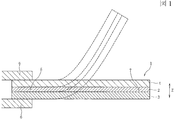
- FIG. 1 is a partial cross-sectional view of a polymer actuator element in an embodiment of the present invention.
- FIG. 2A is a graph showing experimental results of displacement amounts of the comparative example, example 1, example 2, and example 3, and
- FIG. 2B is a graph showing comparative example, example 1, and example.
- 2 and FIG. 2C are graphs showing experimental results of the responsiveness of Comparative Example, Example 1, Example 2, and Example 3.
- FIG. is there.
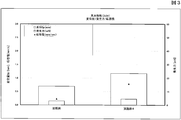
- FIG. 3 is a graph showing experimental results of the displacement amount, generated force, and responsiveness of the comparative example and Example 4.
- FIG. 1 shows a partial cross-sectional view of the polymer actuator element of the present embodiment.
- the structure of the polymer actuator element will be described with reference to FIG.
- the polymer actuator element 1 in this embodiment includes an electrolyte layer (ion conductive layer) 2 and electrode layers 3 and 4 formed on both side surfaces in the thickness direction (Z) of the electrolyte layer 2. It is configured with.
- a polymer actuator element 1 includes an electrolyte layer 2 having an ionic liquid and a base polymer, activated carbon nanofiber (ACNF), carbon nanohorn (CNH), an ionic liquid, and a base polymer. It has electrode layers 3 and 4.
- the electrolyte layer 2 is formed with a thickness of about 10 ⁇ m to 30 ⁇ m.
- the total thickness of the electrode layer 3 and the electrode layer 4 is about 50 to 150 ⁇ m.
- PVdF polyvinylidene fluoride
- PMMA polymethyl methacrylate
- EMIBF4 ethylmethylimidazolium tetrafluoroborate
- EMITFSI ethylmethylimidazolium bis (trifluoromethanesulfonyl) imide
- EMITfO ethylmethylimidazolium trifluoromethanesulfonate
- the base end portion 5 of the polymer actuator element 1 is a fixed end portion, and the base end portion 5 of the polymer actuator element 1 is fixedly supported by fixed support portions 6 and 6. As shown in FIG. 1, for example, the polymer actuator element 1 is supported in a cantilever manner.
- a driving voltage is applied between the electrode layers 3 and 4 on both sides, as shown by the dotted line in FIG. 1, the ion layer 3 moves between the electrode layer 3 and the electrode layer 4 due to ion movement between the electrode layer 3 and the electrode layers 3 and 4.
- a volume difference is generated and a bending stress is generated, so that the distal end portion 7 which is a free end portion of the polymer actuator element 1 can be bent and deformed.
- the principle that the difference in volume between electrodes due to ion transfer is generally not unambiguous, but one of the typical principle factors is that the difference in volume occurs due to the difference in ion size between cation and anion. It is known.
- the carbon materials contained in the electrode layers 3 and 4 are activated carbon nanofibers (ACNF) and carbon nanohorns (CNH).
- carbon nanofibers can be activated by an activation treatment (preferably an alkali activation treatment).
- an activation treatment preferably an alkali activation treatment.
- the activation treatment a known method such as gas activation using water vapor or the like, chemical activation using a chemical such as zinc chloride, or alkaline activation using an alkali metal compound can be used.
- the carbon nanofibers preferably use pitch as the carbon precursor polymer, and in particular, it is preferable to use an aromatic mesophase pitch that is expected to have high strength and high elasticity.
- a carbon nanofiber can be produced by melt spinning a polymer blend in which an aromatic mesophyse pitch is dispersed in a matrix polymer, and then subjecting the spun fiber to infusibilization, carbonization heating, activation treatment, and graphitization.
- carbon nanofibers manufactured by Teijin Limited can be used.
- the electrode layers 3 and 4 contain carbon nanohorn (CNH) as a conductive additive material.
- the electrode layers 3 and 4 include activated carbon nanofibers (ACNF) and carbon nanohorns, so that the electrode layers include carbon nanofibers, but are equivalent to the comparative example that does not include carbon nanohorns. While maintaining the durability, the displacement amount and the generated force are larger than those of the comparative example, and excellent responsiveness can be obtained.
- the weight of the carbon nanohorn is preferably equal to or greater than the weight of the carbon nanofiber. More specifically, the weight ratio of carbon nanohorns to the total carbon amount (carbon nanohorn amount / total carbon amount) is preferably 0.5 to 0.7. “Total carbon content” is a value obtained by adding the weights of carbon nanohorn and carbon nanofiber. However, when carbon materials other than carbon nanohorns and carbon nanofibers are included, the total carbon amount is determined by adding the weights of all the carbon materials.
- the electrode layer has the same durability as the comparative example that contains carbon nanofibers but does not contain carbon nanohorns. As compared with the comparative example, the displacement amount and the generated force can be effectively increased and excellent responsiveness can be obtained while maintaining.
- the time from the maximum displacement to half the displacement can be used as an index.
- the longer the half time the longer the displacement can be maintained for a longer time, and the better the DC durability.
- the electrode layer includes carbon nanofibers, but the comparative example does not include carbon nanohorns. Excellent DC durability equal to or better than that of the molecular actuator element can be obtained.
- the weight ratio of the ionic liquid in the electrode layers 3 and 4 to the total carbon amount is 1.3 to 1.7. It is preferable.
- the amount of the ionic liquid here is evaluated by the weight of the ionic liquid contained in the electrode layers 3 and 4. Note that it is preferable to select EMI-TfO as the ionic liquid.
- the weight ratio of the base polymer in the electrode layers 3 and 4 to the total carbon amount is 0.7 to 1.1. Is preferred.
- the amount of the base polymer is evaluated based on the weight of the base polymer contained in the electrode layers 3 and 4. At this time, PVdF is preferably selected as the base polymer.
- the polymer actuator element 1 is not limited to the three-layer structure of electrode layer 3 / electrolyte layer 2 / electrode layer 4 shown in FIG.
- an existing method can be used for manufacturing the polymer actuator element. That is, it is manufactured through preparation of an electrode solution, preparation of an electrode layer (casting method), preparation of an electrolyte solution, preparation of an electrolyte layer (casting method), and preparation of a polymer actuator element (stacking each layer and thermocompression bonding). Can do.
- the polymer actuators of Examples and Comparative Examples having a three-layer structure of electrode layer / electrolyte layer / electrode layer shown in FIG. 1 were prepared.
- the electrode layer was formed of a carbon material, an ionic liquid, and a base polymer
- the electrolyte layer was formed of an ionic liquid and a base polymer.
- EMI-TfO was used for the ionic liquid
- PVdF was used for the base polymer.
- the element thickness was about 100 ⁇ m.
- activated carbon nanofibers hereinafter referred to as ACNF
- CNH carbon nanohorn
- ACNF was used as a carbon material. That is, the polymer actuator element of the comparative example does not contain CNH.
- Table 1 shows the amount of ionic liquid (mg), the amount of base polymer (BP amount) (mg), the amount of ACNF (mg), and the comparative examples used in the experiment, Example 1, Example 2 and Example 3.
- CNH amount (mg), total carbon amount (mg), ionic liquid amount / total carbon amount, BP amount / total carbon amount, CNH amount / total carbon amount are listed.
- the amount of ionic liquid and the amount of base polymer are both in the electrode layer.
- the displacement amount is a maximum at a position of 1 mm from the most distal position of the polymer actuator element shown in FIG. 1 toward the proximal end portion 5 (a position of 4 mm from the most proximal end position toward the distal end portion 7).
- the amount of displacement was used.
- the generated force is indicated by a force when a driving voltage is applied to the polymer actuator element in the reference state drawn by a solid line shown in FIG.
- the responsiveness is the speed required to reach the maximum displacement from the reference state drawn by the solid line shown in FIG.
- Table 1 shows the measurement results of the displacement, generated force, and responsiveness of each polymer actuator element of Comparative Example, Example 1, Example 2, and Example 3. Further, based on Table 1, the displacement amount of each sample is shown in FIG. 2A, the generated force of each sample is shown in FIG. 2B, and the responsiveness of each sample is shown in FIG. 2C.
- each of the polymer actuator elements of each example has a larger displacement and generated force and better responsiveness than the polymer actuator element of the comparative example. I understood.
- the CNH amount was set to be equal to or greater than the ACNF amount.
- the CNH amount / total carbon amount is set within the range of 0.5 to 0.7
- the ionic liquid amount (electrode layer) / total carbon amount is set within the range of 1.3 to 1.7.
- the BP amount (electrode layer) / total carbon amount was set within the range of 0.7 to 1.1.
- Example 4 was manufactured under the same conditions as Example 2. However, due to manufacturing variations, Example 4 was slightly thinner than Example 2 in terms of element thickness. As a result, the displacement amount in Example 4 is larger than that in Example 2, and the generated force is reduced.
- FIG. 3 shows the displacement amounts of the comparative example and the embodiment example 4 shown in Table 2 (here, the displacement amount pp means that the polymer actuator element shown in FIG. 1 is displaced upward from the reference state shown by the solid line in FIG. 1).
- the displacement amount obtained by adding the displacement amount 0p at the time and the displacement amount when the reference state is displaced downward in the figure is shown), and the generated force and the responsiveness are graphed.
- Example 4 As shown in Table 2 and FIG. 3, it was found that the polymer actuator element of Example 4 had a larger displacement and generated force and superior responsiveness than the polymer actuator element of the comparative example. Regarding the responsiveness, it was found that Example 4 was about three times higher than the comparative example.
- the polymer actuator of the example including both the carbon nanofiber and the carbon nanohorn activated in the electrode layer includes the carbon nanofiber in the electrode layer.
Landscapes
- Chemical & Material Sciences (AREA)
- Engineering & Computer Science (AREA)
- Analytical Chemistry (AREA)
- Combustion & Propulsion (AREA)
- Computer Hardware Design (AREA)
- Microelectronics & Electronic Packaging (AREA)
- Mechanical Engineering (AREA)
- General Engineering & Computer Science (AREA)
- Compositions Of Macromolecular Compounds (AREA)
- Carbon And Carbon Compounds (AREA)
Abstract
【目的】 特に、良好な耐久性を維持しつつ変位量や発生力が大きく、応答性に優れた高分子アクチュエータ素子を提供することを目的としている。 【解決手段】 電解質層2と電極層3,4とを有する高分子アクチュエータ素子1において、前記電極層3、4には、活性化処理されたカーボンナノファイバーとカーボンナノホーンを含むことを特徴とする。
Description
本発明は、電解質層と電極層とを備えた高分子アクチュエータ素子に関する。
下記の特許文献1には、電解質層と電極層とを備えた高分子アクチュエータ素子に関する発明が開示されている。特許文献1では、電極層にカーボンナノチューブとカーボンナノホーンが所定割合で含まれていることが記載されている。これにより、大きな駆動力及び変位量を発生させることができると記載されている。
ところで電解質層と電極層とを備えた高分子アクチュエータ素子には、変位量、発生力、応答性といった基本特性に加えて、優れた耐久性が求められた。
しかしながら従来では、大きな変位量が得られても耐久性に課題があった。特に、素子に直流電圧を印加し続けた際、最大変位量から変位量が半減するまでの時間が短くなりやすく、良好なDC耐久性を得ることができない問題があった。
本発明は、上記従来の課題を解決するものであり、特に、良好な耐久性を維持しつつ変位量や発生力が大きく、応答性に優れた高分子アクチュエータ素子を提供することを目的としている。
本発明は、電解質層と電極層とを有する高分子アクチュエータ素子において、
前記電極層には、活性化処理されたカーボンナノファイバーとカーボンナノホーンを含むことを特徴とするものである。これにより、良好な耐久性(特にDC耐久性)を維持しつつ変位量や発生力が大きく、応答性に優れた高分子アクチュエータ素子にできる。
前記電極層には、活性化処理されたカーボンナノファイバーとカーボンナノホーンを含むことを特徴とするものである。これにより、良好な耐久性(特にDC耐久性)を維持しつつ変位量や発生力が大きく、応答性に優れた高分子アクチュエータ素子にできる。
本発明では、前記カーボンナノファイバーは、芳香族メソフェーズピッチを用い溶融紡糸法により作製されたものであることが好ましい。これにより、耐久性をより効果的に改善できる。
また本発明では、前記カーボンナノホーンの重量は、前記カーボンナノファイバーの重量以上であることが好ましい。効果的に、変位量や発生力を大きくでき、優れた応答性を得ることができる。より具体的には、全炭素量に対する前記カーボンナノホーンの重量比率(カーボンナノホーン量/全炭素量)は、0.5~0.7であることが好ましい。これにより、より効果的に、変位量や発生力を大きくでき、優れた応答性を得ることができる。
また本発明では、前記電解質層及び前記電極層はイオン液体を含み、全炭素量に対する前記電極層中における前記イオン液体の重量比率(イオン液体量(電極層)/全炭素量)は、1.3~1.7であることが好ましい。
また本発明では、前記電解質層及び前記電極層はベースポリマーを含み、全炭素量に対する前記電極層中における前記ベースポリマーの重量比率(ベースポリマー量(電極層)/全炭素量)は、0.7~1.1であることが好ましい。
本発明によれば、良好な耐久性(特にDC耐久性)を維持しつつ変位量や発生力が大きく、応答性に優れた高分子アクチュエータ素子にできる。
図1は本実施形態の高分子アクチュエータ素子の部分断面図を示す。図1を用いて高分子アクチュエータ素子の構造を説明する。
図1に示すように、本実施形態における高分子アクチュエータ素子1は、電解質層(イオン伝導層)2と、電解質層2の厚さ方向(Z)の両側表面に形成される電極層3,4を備えて構成される。
本発明における実施形態の高分子アクチュエータ素子1は、イオン液体とベースポリマーを有する電解質層2と、活性化処理されたカーボンナノファイバー(ACNF)、カーボンナノホーン(CNH)、イオン液体及びベースポリマーを有する電極層3,4とを有して構成される。
電解質層2は、10μm~30μm程度の厚みにて形成される。また電極層3と電極層4を合わせた総厚は、50~150μm程度である。
ベースポリマーとしては、ポリフッ化ビニリデン(PVdF)系ポリマーや、ポリメチルメタクリレート(PMMA)系ポリマー等を提示できる。このうち、特に、PVdF系ポリマーを用いることが好ましい。
イオン液体には、エチルメチルイミダゾリウム テトラフルオロボレート(EMIBF4)や、エチルメチルイミダゾリウムビス(トリフルオロメタンスルホニル)イミド(EMITFSI)、エチルメチルイミダゾリウム トリフルオロメタンスルホナート(EMITfO)等を用いることが可能である。
高分子アクチュエータ素子1の基端部5は固定端部であり、高分子アクチュエータ素子1の基端部5は、固定支持部6,6にて固定支持されている。図1に示すように例えば、高分子アクチュエータ素子1は、片持ちで支持されている。そして両面の電極層3,4間に駆動電圧を印加すると、図1の点線に示すように、電解質層2と電極層3,4間のイオン移動などによって電極層3と電極層4の間に容積差が生じ、曲げ応力が発生して、高分子アクチュエータ素子1の自由端部である先端部7を湾曲変形させることができる。イオン移動で電極間に容積の差が生じる原理は一般に一義的ではないとされているが、代表的な原理要因の1つに、陽イオンと陰イオンのイオンサイズの差で容積に差が生じることが知られている。
本実施形態では、電極層3,4に含まれる炭素材は、活性化処理されたカーボンナノファイバー(ACNF)とカーボンナノホーン(CNH)である。
例えば、カーボンナノファイバーを、賦活処理(アルカリ賦活処理が好ましい)することで活性化させることができる。賦活処理としては、水蒸気等を用いたガス賦活、塩化亜鉛等の薬剤を用いた薬剤賦活、アルカリ金属化合物を用いたアルカリ賦活等の公知の方法を用いることが可能である。
例えば、カーボンナノファイバーを、賦活処理(アルカリ賦活処理が好ましい)することで活性化させることができる。賦活処理としては、水蒸気等を用いたガス賦活、塩化亜鉛等の薬剤を用いた薬剤賦活、アルカリ金属化合物を用いたアルカリ賦活等の公知の方法を用いることが可能である。
本実施形態では特に、カーボンナノファイバーは、カーボン前駆体ポリマーとしてピッチを用いることが好ましく、特にその中でも高強度、高弾性等が期待される芳香族メソフィーズピッチを用いることが好適である。芳香族メソフィーズピッチをマトリックスポリマー中に分散したポリマーブレンドを溶融紡糸後、紡糸繊維の不融化処理、炭素化加熱、さらに賦活処理、黒鉛化処理することで、カーボンナノファイバーを作製できる。例えば、帝人株式会社のカーボンナノファイバーを用いることができる。
また電極層3,4中には、導電性添加材料としてカーボンナノホーン(CNH)を含む。このように、電極層3,4に、活性化処理されたカーボンナノファイバー(ACNF)と、カーボンナノホーンを含むことで、電極層にカーボンナノファイバーを含むが、カーボンナノホーンを含まない比較例と同等の耐久性を維持しつつ、比較例よりも変位量及び発生力が大きく、優れた応答性を得ることが出来る。
本実施形態では、カーボンナノホーンの重量は、カーボンナノファイバーの重量以上であることが好ましい。より具体的には、全炭素量に対するカーボンナノホーンの重量比率(カーボンナノホーン量/全炭素量)は、0.5~0.7であることが好適である。「全炭素量」とは、カーボンナノホーン及びカーボンナノファイバーの各重量を足した値である。ただし、カーボンナノホーン及びカーボンナノファイバー以外の炭素材を含む場合には、それら全ての炭素材の重量を足して全炭素量が決定される。
上記のように、全炭素量に対するカーボンナノホーンの重量比率を調整することで、後述する実験に示すように、電極層にカーボンナノファイバーは含むがカーボンナノホーンは含まない比較例と同等の耐久性を維持しつつ、比較例に比べて、効果的に、変位量及び発生力を大きくでき、優れた応答性を得ることが出来る。
耐久性については、DC連続駆動させたとき、最大変位量から変位量が半減するまでの時間を指標とすることができる。半減時間が長ければ長いほど、大きな変位量を長い時間、維持でき、DC耐久性が優れた状態にある。電極層3,4に活性化処理されたカーボンナノファイバーとカーボンナノホーンを含む本実施形態の高分子アクチュエータ素子によれば、電極層にカーボンナノファイバーは含むが、カーボンナノホーンを含まない比較例の高分子アクチュエータ素子と同等以上の優れたDC耐久性を得ることが出来る。
また、本実施形態では、全炭素量に対する電極層3,4中におけるイオン液体の重量比率(イオン液体量(電極層3,4)/全炭素量)は、1.3~1.7であることが好ましい。ここでのイオン液体量は、電極層3,4に含まれるイオン液体の重量により評価される。なお、イオン液体にはEMI-TfOを選択することが好適である。
また本実施形態では、全炭素量に対する電極層3,4中におけるベースポリマーの重量比率(ベースポリマー量(電極層3,4)/全炭素量)は、0.7~1.1であることが好ましい。ここでのベースポリマー量は、電極層3,4に含まれるベースポリマーの重量
により評価される。なお、このとき、ベースポリマーには、PVdFを選択することが好適である。
により評価される。なお、このとき、ベースポリマーには、PVdFを選択することが好適である。
このように、全炭素量に対する電極層3,4中に占めるイオン液体量やベースポリマー量を調整することで、変位量、発生力、及び応答性を安定して向上させることができる。高分子アクチュエータ素子1は、図1に示す電極層3/電解質層2/電極層4の3層構造に限定されない。
また高分子アクチュエータ素子の製造には既存の方法を用いることができる。すなわち電極液の調製、電極層の作製(キャスト法)、電解質液の調製、電解質層の作製(キャスト法)、高分子アクチュエータ素子の作製(各層を積層して熱圧着)を経て、製造することができる。
図1に示す電極層/電解質層/電極層の3層構造からなる実施例及び比較例の高分子アクチュエータを作製した。実施例及び比較例ともに、電極層を、炭素材、イオン液体、及びベースポリマーにより、電解質層を、イオン液体及びベースポリマーにより形成した。またイオン液体にはEMI-TfOを用い、ベースポリマーにはPVdFを用いた。また、実施例、比較例ともに、素子厚を約100μmとした。
実施例の高分子アクチュエータ素子には、炭素材として、活性化処理されたカーボンナノファイバー(以下、ACNFと言う)とカーボンナノホーン(CNH)を用いた。また比較例の高分子アクチュエータ素子には、炭素材として、ACNFを用いた。すなわち比較例の高分子アクチュエータ素子には、CNHが含有されていない。
以下の表1には、実験で使用した比較例、実施例1、実施例2及び実施例3のイオン液体量(mg)、ベースポリマー量(BP量)(mg)、ACNF量(mg)、CNH量(mg)、全炭素量(mg)、イオン液体量/全炭素量、BP量/全炭素量、CNH量/全炭素量が掲載されている。なおイオン液体量及びベースポリマー量は、いずれも電極層中における量である。

そして表1に示す各構成材料の重量、及び全炭素量に対する重量比率を備えた比較例、実施例1、実施例2及び実施例3の各高分子アクチュエータ素子に2.0Vの駆動電圧を印加して、変位量、発生力、及び応答性を測定した。変位量は、図1に示す高分子アクチュエータ素子の最先端位置から基端部5の方向に向けて1mmの位置(最基端位置から先端部7の方向に向けて4mmの位置)での最大変位量とした。また、発生力は、図1に示す実線で描かれた基準状態の高分子アクチュエータ素子に駆動電圧を印加して変位するときの力で示される。応答性は、図1に示す実線で描かれた基準状態から最大変位に到達するのに要するスピードである。
表1に、比較例、実施例1、実施例2及び実施例3の各高分子アクチュエータ素子の変位量、発生力、及び応答性の測定結果を掲載した。また表1に基づいて、図2(a)では、各試料の変位量、図2(b)では、各試料の発生力、図2(c)では、各試料の応答性をグラフにした。
表1及び図2に示すように、各実施例の高分子アクチュエータ素子は、いずれも比較例の高分子アクチュエータ素子に比べて、変位量及び発生力が大きくなり、また応答性が良好であることがわかった。
実施例ではいずれも、CNH量をACNF量以上に設定した。また実施例では、CNH量/全炭素量を0.5~0.7の範囲内に設定し、イオン液体量(電極層)/全炭素量を1.3~1.7の範囲内に設定し、BP量(電極層)/全炭素量を0.7~1.1の範囲内に設定した。
続いて実施例2と同じ条件で実施例4を作製した。
続いて実施例2と同じ条件で実施例4を作製した。
実験では、実施例4及び比較例(表1で使用したのと同じ試料)の各高分子アクチュエータ素子の電極層間に電圧を印加し(2.0V AC50mHz)、変位量、発生力及び応答性について測定した。その実験結果が以下の表2に示されている。
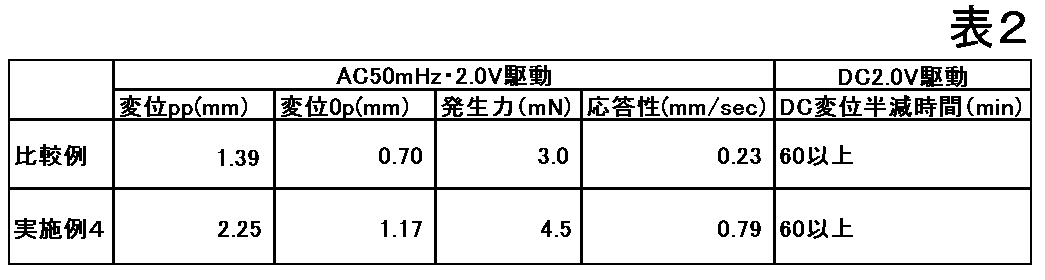
なお、上記したように実施例4は、実施例2と同条件で製造されたものであるが、製造上のばらつきにより、素子厚については実施例4のほうが実施例2よりもやや薄くなり、その結果、実施例4のほうが実施例2よりも変位量が大きく、発生力が小さくなる。
図3は表2に示す比較例及び実施例4の変位量(ここで変位量ppとは、図1に示す高分子アクチュエータ素子が図1の実線で示した基準状態から図示上方向に変位した際の変位量0pと基準状態から図示下方向に変位したときの変位量とを足した変位量を示す)、発生力、応答性をグラフ化したものである。
表2及び図3に示すように、実施例4の高分子アクチュエータ素子は、比較例の高分子アクチュエータ素子に比べて、変位量、発生力が大きく且つ応答性に優れることがわかった。応答性については、実施例4が比較例に比べて約3倍に高くなることがわかった。
またDC2.0Vの駆動電圧を連続印加し、変位量が半減するまでの時間を測定した。表2に示すように半減時間は、実施例、比較例ともに60分以上であった。
表1、表2、図2及び図3の実験結果から、電極層に活性化処理されたカーボンナノファイバーとカーボンナノホーンの双方を含む実施例の高分子アクチュエータは、電極層にカーボンナノファイバーは含むがカーボンナノホーンを含まない比較例の高分子アクチュエータ素子と同等の耐久性を維持できるとともに、比較例に比べて、変位量及び発生力を大きくでき、且つ優れた応答性を得ることができるとわかった。
1 高分子アクチュエータ素子
2 電解質層
3、4 電極層
2 電解質層
3、4 電極層
Claims (6)
- 電解質層と電極層とを有する高分子アクチュエータ素子において、
前記電極層には、活性化処理されたカーボンナノファイバーとカーボンナノホーンを含むことを特徴とする高分子アクチュエータ素子。 - 前記カーボンナノファイバーは、芳香族メソフェーズピッチを用い溶融紡糸法により作製されたものである請求項1記載の高分子アクチュエータ素子。
- 前記カーボンナノホーンの重量は、前記カーボンナノファイバーの重量以上である請求項1又は2に記載の高分子アクチュエータ素子。
- 全炭素量に対する前記カーボンナノホーンの重量比率(カーボンナノホーン量/全炭素量)は、0.5~0.7である請求項3記載の高分子アクチュエータ素子。
- 前記電解質層及び前記電極層はイオン液体を含み、全炭素量に対する前記電極層中における前記イオン液体の重量比率(イオン液体量(電極層)/全炭素量)は、1.3~1.7である請求項1ないし4のいずれか1項に記載の高分子アクチュエータ素子。
- 前記電解質層及び前記電極層はベースポリマーを含み、全炭素量に対する前記電極層中における前記ベースポリマーの重量比率(ベースポリマー量(電極層)/全炭素量)は、0.7~1.1である請求項1ないし5のいずれか1項に記載の高分子アクチュエータ素子。
Priority Applications (3)
| Application Number | Priority Date | Filing Date | Title |
|---|---|---|---|
| JP2014554607A JP6083052B2 (ja) | 2012-12-27 | 2013-12-27 | 高分子アクチュエータ素子 |
| EP13868579.7A EP2945276A4 (en) | 2012-12-27 | 2013-12-27 | POLYMERAKTORELEMENT |
| US14/752,496 US9873609B2 (en) | 2012-12-27 | 2015-06-26 | Polymer actuator element |
Applications Claiming Priority (2)
| Application Number | Priority Date | Filing Date | Title |
|---|---|---|---|
| JP2012-284032 | 2012-12-27 | ||
| JP2012284032 | 2012-12-27 |
Related Child Applications (1)
| Application Number | Title | Priority Date | Filing Date |
|---|---|---|---|
| US14/752,496 Continuation US9873609B2 (en) | 2012-12-27 | 2015-06-26 | Polymer actuator element |
Publications (1)
| Publication Number | Publication Date |
|---|---|
| WO2014104331A1 true WO2014104331A1 (ja) | 2014-07-03 |
Family
ID=51021395
Family Applications (1)
| Application Number | Title | Priority Date | Filing Date |
|---|---|---|---|
| PCT/JP2013/085189 Ceased WO2014104331A1 (ja) | 2012-12-27 | 2013-12-27 | 高分子アクチュエータ素子 |
Country Status (4)
| Country | Link |
|---|---|
| US (1) | US9873609B2 (ja) |
| EP (1) | EP2945276A4 (ja) |
| JP (1) | JP6083052B2 (ja) |
| WO (1) | WO2014104331A1 (ja) |
Cited By (6)
| Publication number | Priority date | Publication date | Assignee | Title |
|---|---|---|---|---|
| JP2016180068A (ja) * | 2015-03-24 | 2016-10-13 | アルプス電気株式会社 | 炭素含有フィルムおよび炭素含有フィルムの製造方法ならびに高分子アクチュエータ素子および高分子アクチュエータ素子の製造方法 |
| WO2017033836A1 (ja) * | 2015-08-21 | 2017-03-02 | 国立研究開発法人産業技術総合研究所 | ナノカーボン高分子アクチュエータ |
| JP2017070138A (ja) * | 2015-10-01 | 2017-04-06 | アルプス電気株式会社 | 高分子アクチュエータ |
| WO2018211981A1 (ja) | 2017-05-18 | 2018-11-22 | 東レ・ダウコーニング株式会社 | フルオロアルキル基含有硬化性オルガノポリシロキサン組成物、その硬化物および当該硬化物を備えたトランスデューサー等 |
| WO2020116440A1 (ja) | 2018-12-07 | 2020-06-11 | ダウ・東レ株式会社 | 硬化性オルガノポリシロキサン組成物、その硬化物および当該硬化物を備えたトランスデューサー等 |
| WO2024075661A1 (ja) | 2022-10-05 | 2024-04-11 | ダウ・東レ株式会社 | トランスデューサー用硬化性オルガノポリシロキサン組成物、その硬化物および当該硬化物を備えたトランスデューサー等 |
Families Citing this family (1)
| Publication number | Priority date | Publication date | Assignee | Title |
|---|---|---|---|---|
| US10813257B2 (en) * | 2016-09-05 | 2020-10-20 | Nec Corporation | Electromagnetic wave absorbing material |
Citations (5)
| Publication number | Priority date | Publication date | Assignee | Title |
|---|---|---|---|---|
| JP2005163229A (ja) * | 2003-12-03 | 2005-06-23 | Japan Science & Technology Agency | カーボンナノファイバーとその製造方法 |
| JP2005223025A (ja) * | 2004-02-03 | 2005-08-18 | Shinshu Univ | カーボンナノファイバーを用いる高分子アクチュエータ |
| WO2010029992A1 (ja) | 2008-09-12 | 2010-03-18 | アルプス電気株式会社 | 高分子アクチュエータ |
| JP2011114140A (ja) * | 2009-11-26 | 2011-06-09 | Teijin Ltd | 電極材料、その製造方法、およびその電極材料を用いた電気化学キャパシタ |
| JP2012095520A (ja) * | 2010-10-01 | 2012-05-17 | Canon Inc | アクチュエータ |
Family Cites Families (7)
| Publication number | Priority date | Publication date | Assignee | Title |
|---|---|---|---|---|
| EP2416488B1 (en) * | 2009-03-31 | 2019-03-06 | Daikin Industries, Ltd. | Electrode film for polymer actuator element, and polymer actuator element comprising same |
| JP5733938B2 (ja) * | 2009-12-08 | 2015-06-10 | キヤノン株式会社 | アクチュエータ |
| JP5523553B2 (ja) * | 2010-03-24 | 2014-06-18 | アルプス電気株式会社 | 高分子アクチュエータおよびその製造方法 |
| EP2400573A1 (de) * | 2010-06-23 | 2011-12-28 | Bayer MaterialScience AG | Elektromechanischer Wandler, Verfahren zu dessen Herstellung und Verwendung desselben |
| JP2012135156A (ja) * | 2010-12-22 | 2012-07-12 | Canon Inc | アクチュエータ |
| JP6128508B2 (ja) * | 2011-07-07 | 2017-05-17 | 国立研究開発法人産業技術総合研究所 | カーボンナノファイバーアクチュエータ |
| WO2014119166A1 (ja) * | 2013-01-30 | 2014-08-07 | 東海ゴム工業株式会社 | 柔軟なトランスデューサ |
-
2013
- 2013-12-27 JP JP2014554607A patent/JP6083052B2/ja active Active
- 2013-12-27 WO PCT/JP2013/085189 patent/WO2014104331A1/ja not_active Ceased
- 2013-12-27 EP EP13868579.7A patent/EP2945276A4/en not_active Withdrawn
-
2015
- 2015-06-26 US US14/752,496 patent/US9873609B2/en active Active
Patent Citations (5)
| Publication number | Priority date | Publication date | Assignee | Title |
|---|---|---|---|---|
| JP2005163229A (ja) * | 2003-12-03 | 2005-06-23 | Japan Science & Technology Agency | カーボンナノファイバーとその製造方法 |
| JP2005223025A (ja) * | 2004-02-03 | 2005-08-18 | Shinshu Univ | カーボンナノファイバーを用いる高分子アクチュエータ |
| WO2010029992A1 (ja) | 2008-09-12 | 2010-03-18 | アルプス電気株式会社 | 高分子アクチュエータ |
| JP2011114140A (ja) * | 2009-11-26 | 2011-06-09 | Teijin Ltd | 電極材料、その製造方法、およびその電極材料を用いた電気化学キャパシタ |
| JP2012095520A (ja) * | 2010-10-01 | 2012-05-17 | Canon Inc | アクチュエータ |
Non-Patent Citations (1)
| Title |
|---|
| See also references of EP2945276A4 |
Cited By (6)
| Publication number | Priority date | Publication date | Assignee | Title |
|---|---|---|---|---|
| JP2016180068A (ja) * | 2015-03-24 | 2016-10-13 | アルプス電気株式会社 | 炭素含有フィルムおよび炭素含有フィルムの製造方法ならびに高分子アクチュエータ素子および高分子アクチュエータ素子の製造方法 |
| WO2017033836A1 (ja) * | 2015-08-21 | 2017-03-02 | 国立研究開発法人産業技術総合研究所 | ナノカーボン高分子アクチュエータ |
| JP2017070138A (ja) * | 2015-10-01 | 2017-04-06 | アルプス電気株式会社 | 高分子アクチュエータ |
| WO2018211981A1 (ja) | 2017-05-18 | 2018-11-22 | 東レ・ダウコーニング株式会社 | フルオロアルキル基含有硬化性オルガノポリシロキサン組成物、その硬化物および当該硬化物を備えたトランスデューサー等 |
| WO2020116440A1 (ja) | 2018-12-07 | 2020-06-11 | ダウ・東レ株式会社 | 硬化性オルガノポリシロキサン組成物、その硬化物および当該硬化物を備えたトランスデューサー等 |
| WO2024075661A1 (ja) | 2022-10-05 | 2024-04-11 | ダウ・東レ株式会社 | トランスデューサー用硬化性オルガノポリシロキサン組成物、その硬化物および当該硬化物を備えたトランスデューサー等 |
Also Published As
| Publication number | Publication date |
|---|---|
| JP6083052B2 (ja) | 2017-02-22 |
| US20150298963A1 (en) | 2015-10-22 |
| JPWO2014104331A1 (ja) | 2017-01-19 |
| US9873609B2 (en) | 2018-01-23 |
| EP2945276A1 (en) | 2015-11-18 |
| EP2945276A4 (en) | 2016-07-27 |
Similar Documents
| Publication | Publication Date | Title |
|---|---|---|
| JP6083052B2 (ja) | 高分子アクチュエータ素子 | |
| JP6128508B2 (ja) | カーボンナノファイバーアクチュエータ | |
| JP5110574B2 (ja) | 高アスペクト比のカーボンナノチューブとイオン液体から構成される導電性薄膜、アクチュエータ素子 | |
| JP5733938B2 (ja) | アクチュエータ | |
| JP5252405B2 (ja) | 高分子アクチュエータ | |
| US8994246B2 (en) | Actuator | |
| JP5734064B2 (ja) | アクチュエータ | |
| JP5004078B2 (ja) | 高アスペクト比のカーボンナノチューブを用いた高配向性電極によるアクチュエータ素子 | |
| JP5332027B2 (ja) | 導電補助剤を添加したカーボンナノチューブ電極を用いたアクチュエータ素子 | |
| JP6270273B2 (ja) | 高分子アクチュエータ素子、高分子アクチュエータ素子用電極層、高分子アクチュエータ素子用電極層の製造方法、及び、高分子アクチュエータ素子の製造方法 | |
| JP4568885B2 (ja) | 高強度、高導電性薄膜によるアクチュエータ素子及びその製造方法 | |
| JP5831926B2 (ja) | 高分子アクチュエータ素子及びその製造方法 | |
| JP4863297B2 (ja) | カーボンナノチューブを用いた高強度、高導電性薄膜およびアクチュエータ素子製造方法 | |
| JP2011239604A (ja) | 高分子アクチュエータ素子の製造方法 | |
| JP6542092B2 (ja) | 高分子アクチュエータ | |
| JP6870835B2 (ja) | 積層アクチュエータ | |
| JP6619875B2 (ja) | 積層構造体、高分子アクチュエータ素子、センサ素子、および機器 | |
| JP6562319B2 (ja) | ナノカーボン高分子アクチュエータ |
Legal Events
| Date | Code | Title | Description |
|---|---|---|---|
| 121 | Ep: the epo has been informed by wipo that ep was designated in this application |
Ref document number: 13868579 Country of ref document: EP Kind code of ref document: A1 |
|
| ENP | Entry into the national phase |
Ref document number: 2014554607 Country of ref document: JP Kind code of ref document: A |
|
| NENP | Non-entry into the national phase |
Ref country code: DE |
|
| WWE | Wipo information: entry into national phase |
Ref document number: 2013868579 Country of ref document: EP |