WO2018211981A1 - フルオロアルキル基含有硬化性オルガノポリシロキサン組成物、その硬化物および当該硬化物を備えたトランスデューサー等 - Google Patents
フルオロアルキル基含有硬化性オルガノポリシロキサン組成物、その硬化物および当該硬化物を備えたトランスデューサー等 Download PDFInfo
- Publication number
- WO2018211981A1 WO2018211981A1 PCT/JP2018/017480 JP2018017480W WO2018211981A1 WO 2018211981 A1 WO2018211981 A1 WO 2018211981A1 JP 2018017480 W JP2018017480 W JP 2018017480W WO 2018211981 A1 WO2018211981 A1 WO 2018211981A1
- Authority
- WO
- WIPO (PCT)
- Prior art keywords
- group
- fluoroalkyl group
- carbon atoms
- component
- curable organopolysiloxane
- Prior art date
- Legal status (The legal status is an assumption and is not a legal conclusion. Google has not performed a legal analysis and makes no representation as to the accuracy of the status listed.)
- Ceased
Links
Images


Classifications
-
- C—CHEMISTRY; METALLURGY
- C08—ORGANIC MACROMOLECULAR COMPOUNDS; THEIR PREPARATION OR CHEMICAL WORKING-UP; COMPOSITIONS BASED THEREON
- C08L—COMPOSITIONS OF MACROMOLECULAR COMPOUNDS
- C08L83/00—Compositions of macromolecular compounds obtained by reactions forming in the main chain of the macromolecule a linkage containing silicon with or without sulfur, nitrogen, oxygen or carbon only; Compositions of derivatives of such polymers
- C08L83/04—Polysiloxanes
- C08L83/08—Polysiloxanes containing silicon bound to organic groups containing atoms other than carbon, hydrogen and oxygen
-
- C—CHEMISTRY; METALLURGY
- C08—ORGANIC MACROMOLECULAR COMPOUNDS; THEIR PREPARATION OR CHEMICAL WORKING-UP; COMPOSITIONS BASED THEREON
- C08G—MACROMOLECULAR COMPOUNDS OBTAINED OTHERWISE THAN BY REACTIONS ONLY INVOLVING UNSATURATED CARBON-TO-CARBON BONDS
- C08G77/00—Macromolecular compounds obtained by reactions forming a linkage containing silicon with or without sulfur, nitrogen, oxygen or carbon in the main chain of the macromolecule
- C08G77/04—Polysiloxanes
- C08G77/06—Preparatory processes
- C08G77/08—Preparatory processes characterised by the catalysts used
-
- C—CHEMISTRY; METALLURGY
- C08—ORGANIC MACROMOLECULAR COMPOUNDS; THEIR PREPARATION OR CHEMICAL WORKING-UP; COMPOSITIONS BASED THEREON
- C08G—MACROMOLECULAR COMPOUNDS OBTAINED OTHERWISE THAN BY REACTIONS ONLY INVOLVING UNSATURATED CARBON-TO-CARBON BONDS
- C08G77/00—Macromolecular compounds obtained by reactions forming a linkage containing silicon with or without sulfur, nitrogen, oxygen or carbon in the main chain of the macromolecule
- C08G77/04—Polysiloxanes
- C08G77/12—Polysiloxanes containing silicon bound to hydrogen
-
- C—CHEMISTRY; METALLURGY
- C08—ORGANIC MACROMOLECULAR COMPOUNDS; THEIR PREPARATION OR CHEMICAL WORKING-UP; COMPOSITIONS BASED THEREON
- C08G—MACROMOLECULAR COMPOUNDS OBTAINED OTHERWISE THAN BY REACTIONS ONLY INVOLVING UNSATURATED CARBON-TO-CARBON BONDS
- C08G77/00—Macromolecular compounds obtained by reactions forming a linkage containing silicon with or without sulfur, nitrogen, oxygen or carbon in the main chain of the macromolecule
- C08G77/04—Polysiloxanes
- C08G77/20—Polysiloxanes containing silicon bound to unsaturated aliphatic groups
-
- C—CHEMISTRY; METALLURGY
- C08—ORGANIC MACROMOLECULAR COMPOUNDS; THEIR PREPARATION OR CHEMICAL WORKING-UP; COMPOSITIONS BASED THEREON
- C08G—MACROMOLECULAR COMPOUNDS OBTAINED OTHERWISE THAN BY REACTIONS ONLY INVOLVING UNSATURATED CARBON-TO-CARBON BONDS
- C08G77/00—Macromolecular compounds obtained by reactions forming a linkage containing silicon with or without sulfur, nitrogen, oxygen or carbon in the main chain of the macromolecule
- C08G77/04—Polysiloxanes
- C08G77/22—Polysiloxanes containing silicon bound to organic groups containing atoms other than carbon, hydrogen and oxygen
- C08G77/24—Polysiloxanes containing silicon bound to organic groups containing atoms other than carbon, hydrogen and oxygen halogen-containing groups
-
- C—CHEMISTRY; METALLURGY
- C08—ORGANIC MACROMOLECULAR COMPOUNDS; THEIR PREPARATION OR CHEMICAL WORKING-UP; COMPOSITIONS BASED THEREON
- C08G—MACROMOLECULAR COMPOUNDS OBTAINED OTHERWISE THAN BY REACTIONS ONLY INVOLVING UNSATURATED CARBON-TO-CARBON BONDS
- C08G77/00—Macromolecular compounds obtained by reactions forming a linkage containing silicon with or without sulfur, nitrogen, oxygen or carbon in the main chain of the macromolecule
- C08G77/80—Siloxanes having aromatic substituents, e.g. phenyl side groups
-
- C—CHEMISTRY; METALLURGY
- C08—ORGANIC MACROMOLECULAR COMPOUNDS; THEIR PREPARATION OR CHEMICAL WORKING-UP; COMPOSITIONS BASED THEREON
- C08J—WORKING-UP; GENERAL PROCESSES OF COMPOUNDING; AFTER-TREATMENT NOT COVERED BY SUBCLASSES C08B, C08C, C08F, C08G or C08H
- C08J5/00—Manufacture of articles or shaped materials containing macromolecular substances
- C08J5/18—Manufacture of films or sheets
-
- C—CHEMISTRY; METALLURGY
- C08—ORGANIC MACROMOLECULAR COMPOUNDS; THEIR PREPARATION OR CHEMICAL WORKING-UP; COMPOSITIONS BASED THEREON
- C08L—COMPOSITIONS OF MACROMOLECULAR COMPOUNDS
- C08L83/00—Compositions of macromolecular compounds obtained by reactions forming in the main chain of the macromolecule a linkage containing silicon with or without sulfur, nitrogen, oxygen or carbon only; Compositions of derivatives of such polymers
- C08L83/04—Polysiloxanes
-
- C—CHEMISTRY; METALLURGY
- C09—DYES; PAINTS; POLISHES; NATURAL RESINS; ADHESIVES; COMPOSITIONS NOT OTHERWISE PROVIDED FOR; APPLICATIONS OF MATERIALS NOT OTHERWISE PROVIDED FOR
- C09D—COATING COMPOSITIONS, e.g. PAINTS, VARNISHES OR LACQUERS; FILLING PASTES; CHEMICAL PAINT OR INK REMOVERS; INKS; CORRECTING FLUIDS; WOODSTAINS; PASTES OR SOLIDS FOR COLOURING OR PRINTING; USE OF MATERIALS THEREFOR
- C09D183/00—Coating compositions based on macromolecular compounds obtained by reactions forming in the main chain of the macromolecule a linkage containing silicon, with or without sulfur, nitrogen, oxygen, or carbon only; Coating compositions based on derivatives of such polymers
- C09D183/04—Polysiloxanes
-
- C—CHEMISTRY; METALLURGY
- C09—DYES; PAINTS; POLISHES; NATURAL RESINS; ADHESIVES; COMPOSITIONS NOT OTHERWISE PROVIDED FOR; APPLICATIONS OF MATERIALS NOT OTHERWISE PROVIDED FOR
- C09D—COATING COMPOSITIONS, e.g. PAINTS, VARNISHES OR LACQUERS; FILLING PASTES; CHEMICAL PAINT OR INK REMOVERS; INKS; CORRECTING FLUIDS; WOODSTAINS; PASTES OR SOLIDS FOR COLOURING OR PRINTING; USE OF MATERIALS THEREFOR
- C09D183/00—Coating compositions based on macromolecular compounds obtained by reactions forming in the main chain of the macromolecule a linkage containing silicon, with or without sulfur, nitrogen, oxygen, or carbon only; Coating compositions based on derivatives of such polymers
- C09D183/04—Polysiloxanes
- C09D183/08—Polysiloxanes containing silicon bound to organic groups containing atoms other than carbon, hydrogen, and oxygen
-
- H—ELECTRICITY
- H10—SEMICONDUCTOR DEVICES; ELECTRIC SOLID-STATE DEVICES NOT OTHERWISE PROVIDED FOR
- H10N—ELECTRIC SOLID-STATE DEVICES NOT OTHERWISE PROVIDED FOR
- H10N30/00—Piezoelectric or electrostrictive devices
- H10N30/50—Piezoelectric or electrostrictive devices having a stacked or multilayer structure
-
- H—ELECTRICITY
- H10—SEMICONDUCTOR DEVICES; ELECTRIC SOLID-STATE DEVICES NOT OTHERWISE PROVIDED FOR
- H10N—ELECTRIC SOLID-STATE DEVICES NOT OTHERWISE PROVIDED FOR
- H10N30/00—Piezoelectric or electrostrictive devices
- H10N30/80—Constructional details
- H10N30/85—Piezoelectric or electrostrictive active materials
- H10N30/857—Macromolecular compositions
-
- C—CHEMISTRY; METALLURGY
- C08—ORGANIC MACROMOLECULAR COMPOUNDS; THEIR PREPARATION OR CHEMICAL WORKING-UP; COMPOSITIONS BASED THEREON
- C08L—COMPOSITIONS OF MACROMOLECULAR COMPOUNDS
- C08L2203/00—Applications
- C08L2203/20—Applications use in electrical or conductive gadgets
-
- C—CHEMISTRY; METALLURGY
- C08—ORGANIC MACROMOLECULAR COMPOUNDS; THEIR PREPARATION OR CHEMICAL WORKING-UP; COMPOSITIONS BASED THEREON
- C08L—COMPOSITIONS OF MACROMOLECULAR COMPOUNDS
- C08L2205/00—Polymer mixtures characterised by other features
- C08L2205/02—Polymer mixtures characterised by other features containing two or more polymers of the same C08L -group
-
- C—CHEMISTRY; METALLURGY
- C08—ORGANIC MACROMOLECULAR COMPOUNDS; THEIR PREPARATION OR CHEMICAL WORKING-UP; COMPOSITIONS BASED THEREON
- C08L—COMPOSITIONS OF MACROMOLECULAR COMPOUNDS
- C08L2312/00—Crosslinking
Definitions
- the present invention relates to a fluoroalkyl group-containing curable organopolysiloxane composition having a high dielectric constant and having excellent electrical and mechanical properties of a cured product, and the cured product, and the cured product is used as an electroactive silicone material. It can be suitably used for a dielectric layer of a transducer. Furthermore, the present invention relates to a method for producing an electroactive polymer material using the curable organopolysiloxane composition, and a member for a transducer, an electronic material or a display device containing the electroactive polymer material. The present invention relates to a transducer, an electronic component, or a display device to be used.
- the electroactive silicone material can achieve a high energy density by having its mechanical and / or electrical properties, specifically, high dielectric constant, high dielectric strength, low Young's modulus, and Excellent mechanical strength when used as a dielectric layer of a transducer (specifically, tensile strength, tear strength, elongation, etc.), so that durability and practical displacement can be achieved. It can be suitably used as a material for use.
- a cured product of a fluoroalkyl group-containing organopolysiloxane has a high relative dielectric constant and is useful as a transducer material (Patent Document 1 or Patent Document 2).
- electroactive silicone materials can be easily processed into films, and there is a need for materials that have both a high relative dielectric constant and mechanical strength. Therefore, there is a strong demand for further improvement of mechanical characteristics and electrical characteristics.
- the present invention has been made to solve the above-mentioned problems, can be easily processed into a film, and can achieve a high energy density by having a high dielectric constant, a high dielectric breakdown strength, and a low Young's modulus. And a fluoroalkyl group-containing curable organopolysiloxane composition that is excellent in mechanical strength (specifically, tensile strength, tear strength, elongation, etc.) when used as a dielectric layer of a transducer. For the purpose.
- an object of the present invention is to provide a use of the fluoroalkyl group-containing organopolysiloxane composition as a transducer material such as an actuator.
- the present inventors have as a main component an organopolysiloxane containing an alkenyl group and a fluoroalkyl group, and at least two silicon bonds at both ends of the molecular chain as a crosslinking agent.
- Fluorine curable by addition reaction using an organohydrogenpolysiloxane having a hydrogen atom and no fluoroalkyl group and a branched or fluoroalkyl group-containing organohydrogenpolysiloxane having a linear or T unit The present inventors have found that the above problems can be solved by an alkyl group-containing curable organopolysiloxane composition, and have reached the present invention.
- the cured product of the fluoroalkyl group-containing curable organopolysiloxane composition can be used as an electroactive silicone material having excellent mechanical properties and electrical properties, particularly as a film or sheet-shaped transducer member.
- the present inventors can solve the above problem more favorably when the fluoroalkyl group is a trifluoropropyl group, and that the organohydrogenpolysiloxane has a linear shape having a trifluoropropyl group in the molecule.
- the resinous organohydrogenpolysiloxane having a T unit is found, the present inventors have found that the above problems can be solved more suitably, and have reached the present invention.
- the first object of the present invention is to [1] (A) One type or two or more types having at least two alkenyl groups having 2 to 12 carbon atoms in the molecule, and 10 mol% or more of all substituents on the silicon atom are (C fluoroalkyl group-containing organopolysiloxane which is a fluoroalkyl group represented by p F 2p + 1 ) —R— (wherein R is an alkylene group having 1 to 10 carbon atoms, and p is an integer of 1 to 8), (B) An organohydrogenpolysiloxane composed of the following components (B1) and (B2), the number of silicon atom-bonded hydrogen atoms in component (B1): the number of silicon atom-bonded hydrogen atoms in component (B2) In the range of 10:90 to 85:15: (B1) Organohydrogenpolysiloxane having at least two silicon-bonded hydrogen atoms at both ends of the molecular chain and having no fluor
- R 0 is the same or independently an alkyl group having 1 to 12 carbon atoms, an aryl group having 6 to 20 carbon atoms, an aralkyl group having 7 to 20 carbon atoms, a hydroxyl group, an alkoxy group having 1 to 6 carbon atoms, or a silicon atom.
- R 5 is a fluoroalkyl group represented by (C p F 2p + 1 ) -R- (wherein R is the same group as described above, p is the same number as described above), and R 6 is the same.
- F3 and f7 are positive numbers
- f4, f5, f6 and f8 are 0 or positive numbers
- f3 + f4 + f5 + f6 + f7 + f8 is the weight average molecular weight of the organohydrogenpolysiloxane represented by the formula (III) Is a number in the range of 400 to 10,000.
- a fluoroalkyl group-containing curable organopolysiloxane composition comprising: It is solved by.
- the first object of the present invention is solved by the following composition.
- [2] The fluoroalkyl group-containing curable organopolysiloxane composition according to [1], wherein the average degree of polymerization of the component (A) is in the range of 5 to 300.
- R Vi is an alkenyl group having 2 to 12 carbon atoms
- R 2 is the same group as described above
- R 3 is (C p F 2p + 1 ) -R- (R is the same group as described above).
- p is the same number as described above)
- e is a number satisfying 20 ⁇ e ⁇ 298.
- the fluoroalkyl group represented by (C p F 2p + 1 ) —R— (wherein R is the same group as described above and p is the same number as described above) is trifluoro
- the fluoroalkyl group-containing curable organopolysiloxane composition according to any one of [1] to [6], wherein the component (A) is the following component (A1) or component (A2).
- A1 The molecule has at least two alkenyl groups having 2 to 12 carbon atoms in the molecule, and 10 mol% or more of all substituents on the silicon atom are (C p F 2p + 1 ) —R— (R is carbon An alkylene group having 1 to 10 atoms, and p is an integer of 1 to 8, and an average degree of polymerization of 50 to 300 and an organopolysiloxane having a degree of polymerization of 200 or more.
- Fluoroalkyl group-containing organopolysiloxane having a volume content of 10% or more (A2) Fluoroalkyl group-containing organopolysiloxane comprising the components (a1) and (a2) having different molecular weight distributions and having an average polymerization degree of 50 to 300 in the entire mixture: (A1) It has at least two alkenyl groups having 2 to 12 carbon atoms in the molecule, and 10 mol% or more of all substituents on the silicon atom are (C p F 2p + 1 ) —R— (R is carbon Fluoroalkyl group-containing organopolysiloxane (a2) molecule having an average polymerization degree of 200 or more, and an alkylene group having 1 to 10 atoms and p is an integer of 1 to 8.
- a second object of the present invention is a cured product obtained by curing the above-described fluoroalkyl group-containing curable organopolysiloxane composition, its use as a member for a transducer, an electronic material, or a member for a display device, and And is achieved by the following invention.
- a cured product obtained by curing the fluoroalkyl group-containing curable organopolysiloxane composition according to any one of [1] to [7].
- a transducer member obtained by curing the fluoroalkyl group-containing curable organopolysiloxane composition according to any one of [1] to [7] and having a film shape or a sheet shape.
- a member for an electronic material or a display device which is formed by curing the fluoroalkyl group-containing curable organopolysiloxane composition according to any one of [1] to [7], and is in the form of a film or a sheet.
- a transducer member obtained by curing the fluoroalkyl group-containing curable organopolysiloxane composition according to any one of [1] to [7] and being a gel or an elastomer.
- a transducer having a dielectric layer obtained by curing the fluoroalkyl group-containing curable organopolysiloxane composition according to any one of [1] to [7].
- the fluoroalkyl group-containing curable organopolysiloxane composition according to any one of [1] to [7] is cured between at least a pair of electrode layers, or a part of the curing reaction of the composition is performed.
- Transducer with an intermediate layer made to advance.
- a cured product obtained by curing the fluoroalkyl group-containing curable organopolysiloxane composition according to any one of [1] to [7] is laminated as one or more intermediate layers.
- the cured product is excellent in transparency and can be easily processed into a film, and a high energy density can be realized by having a high relative dielectric constant, a high dielectric breakdown strength, and a low Young's modulus.
- a fluoroalkyl group-containing curable organopolysiloxane composition having excellent mechanical strength when used as a dielectric layer of a transducer can be provided.
- the fluoroalkyl group-containing organopolysiloxane composition is an addition-curing type and has the advantages that it hardly undergoes shrinkage during molding, has a high curing rate, and can easily set desired curing conditions.
- the cured product of the fluoroalkyl group-containing organopolysiloxane of the present invention has a high dielectric constant and a high mechanical strength (specifically, a tensile strength, a tear strength, an elongation rate, etc.).
- a high dielectric constant specifically, a tensile strength, a tear strength, an elongation rate, etc.
- a practical displacement amount and high responsiveness are realized, so that it can be suitably used for a transducer material such as an actuator.
- the fluoroalkyl group-containing curable organopolysiloxane composition of the present invention comprises the following components (A) to (C), an optional (D) hydrosilylation reaction inhibitor, and (E) a filler. First, each component will be described.
- Component (A) is the main component of the curable composition, has at least two alkenyl groups having 2 to 12 carbon atoms in the molecule, and 10 mol% or more of all substituents on the silicon atom are ( C p F 2p + 1 ) —R— (R is an alkylene group having 1 to 10 carbon atoms, and p is an integer of 1 to 8) Siloxane.
- the component (A) Since the component (A) has a certain amount or more of fluoroalkyl groups and has at least two alkenyl groups in the molecule, it is crosslinked by an addition reaction (hydrosilylation reaction) with the component (B).
- a cured product having excellent moldability, reaction controllability, and transparency and having a relatively high relative dielectric constant is provided.
- the structure is not particularly limited, and a linear, branched, cyclic, or R 3 SiO 3/2 unit (trifunctional siloxy unit) or SiO 2 unit (tetrafunctional siloxy unit) is essential. It may be a resinous organopolysiloxane.
- the component (A) is a linear fluoroalkyl group-containing organopolysiloxane.
- Component (A) is composed of 10 mol% or more, preferably 20 mol% or more, more preferably 40 mol% or more of all substituents on the silicon atom, and (C p F 2p + 1 ) —R— ( R is an alkylene group having 1 to 10 carbon atoms, and p is an integer of 1 or more and 8 or less. If the fluoroalkyl group content is less than the lower limit, the relative permittivity of a cured product obtained by curing the curable organopolysiloxane composition is unsuitable.
- the content of fluorine atoms in the fluoroalkyl group represented by (C p F 2p + 1 ) —R— is high, that is, the value of p is large, for example, p ⁇ 4, and carbon of the alkylene group that is R
- the content of fluorine atoms in the component (A) is preferably 10% by mass or more.
- a trifluoropropyl group as a fluoroalkyl group it can also be 40 mol% or more of all the substituents on the silicon atom in (A) component.
- fluoroalkyl group represented by -R- is an essential functional groups in component (A) of the present invention, a suitable functional group in component (B).
- a fluoroalkyl group gives a cured product having an excellent relative dielectric constant, and each component has a fluorine atom, thereby improving the compatibility of each component and giving a cured product having excellent transparency.
- fluoroalkyl group examples include trifluoropropyl group, pentafluorobutyl group, heptafluoropentyl group, nonafluorohexyl group, undecafluoroheptyl group, tridecafluorooctyl group, pentadecafluorononyl group, It is a heptadecafluorodecyl group.
- a group of p 1, that is, a trifluoropropyl group is a preferred group from the viewpoints of dielectric properties, economy, ease of production, and molding processability of the resulting curable organopolysiloxane composition.
- the component (A) has at least two alkenyl groups having 2 to 12 carbon atoms in the molecule.
- alkenyl group having 2 to 12 carbon atoms a vinyl group, an allyl group, a hexenyl group, and an octenyl group are preferable from the viewpoint of economy and reactivity, and a vinyl group and a hexenyl group are more preferably used.
- Other silicon atom-bonded functional groups in component (A) are not particularly limited, but include alkyl groups having 1 to 12 carbon atoms, aryl groups having 6 to 20 carbon atoms, and aralkyl groups having 7 to 20 carbon atoms. , A hydroxyl group, or an alkoxy group having 1 to 6 carbon atoms.
- alkyl group having 1 to 12 carbon atoms a methyl group is preferable in consideration of economy and heat resistance.
- the aryl group having 6 to 20 carbon atoms is preferably a phenyl group, a methylphenyl (tolyl) group, or a naphthyl group from the viewpoint of economy.
- aralkyl group having 7 to 20 carbon atoms a benzyl group or a phenethyl group is preferably used.
- the alkoxy group having 1 to 6 carbon atoms is preferably a methoxy group, an ethoxy group, or an n-propoxy group.
- a certain amount or more of all the substituents on the silicon atom in the component (A) is the above-described fluoroalkyl group, and has two or more alkenyl groups having 2 to 12 carbon atoms in the molecule.
- the other silicon-bonded functional group is preferably a methyl group, a phenyl group or a hydroxyl group, and particularly preferably selected from a methyl group and a phenyl group.
- the component (A) of the present invention is not limited in terms of the average degree of polymerization, but from the viewpoint of handling workability of the composition before curing and mechanical strength of the cured product, the average degree of polymerization of the siloxane unit ( Hereinafter, simply referred to as “average degree of polymerization”) may be less than 500, less than 450, less than 400, less than 350, or less than 300. Similarly, the lower limit of the average degree of polymerization is not limited, but may be 7 or more, 10 or more, 15 or more, or 20 or more.
- the component (A) may be a mixture of the above-mentioned fluoroalkyl group-containing organopolysiloxanes having different average degrees of polymerization.
- the fluoroalkyl group-containing organopolysiloxane having a relatively low degree of polymerization (ex. 10 to 90).
- a mixture of a polysiloxane and a relatively high degree of polymerization (ex. 100 to 300) of the above-mentioned fluoroalkyl group-containing organopolysiloxane (which has a multi-modal peak shape in the molecular weight distribution described later) may be used.
- the average degree of polymerization of the siloxane unit of component (A) is determined based on the degree of polymerization and the mass ratio of each fluoroalkyl group-containing organopolysiloxane constituting the mixture.
- the average degree of polymerization of the component (A) is in the range of 10 to 300, 15 to 250, and it is easy to obtain a gel-like or elastomer-like cured product molded into a film / sheet,
- the cured product exhibits good mechanical and electrical properties (high dielectric constant). Note that the cured product of the present invention can realize stable performance in a wide temperature range because the change in physical properties is small even at a low temperature of, for example, 0 ° C. or lower.
- the degree of polymerization of the organopolysiloxane as component (A) can be determined by the integration ratio of peak intensity using 29 Si NMR, and the “average degree of polymerization” in the present invention refers to the ratio in component (A) When the molecular weight distribution of 1 or more exists, the average degree of polymerization is indicated.
- the component (A) may be an organopolysiloxane having a molecular weight distribution of 1, or a mixture of two or more organopolysiloxanes having different molecular weight distributions, and the peak shape of the molecular weight distribution is unimodal. It may be multimodal.
- the selection of raw materials at the time of composition design is expanded, and the composition of the present invention is used.
- the physical properties of the resulting cured product may be further improved.
- the component (A) is one or more kinds of linear organoorganisms having a certain amount or more of a fluoroalkyl group represented by the average unit formula (I) and having at least two alkenyl groups.
- the substituents represented by R 1 are the same or independently the fluoroalkyl group or the alkenyl group having 2 to 12 carbon atoms, and specific examples thereof are the same as those described above.
- the substituents represented by R 2 may be the same or independently an alkyl group having 1 to 12 carbon atoms, an aryl group having 6 to 20 carbon atoms, an aralkyl group having 7 to 20 carbon atoms, a hydroxyl group, or a carbon number of 1
- at least two of all R 1 are alkenyl groups having 2 to 12 carbon atoms.
- the content of the alkenyl group having 2 to 12 carbon atoms in the component (A) is 0.01 to 10.00% by mass, may be 0.01 to 2.00% by mass. It may be 02 to 1.50% by mass.
- R 2 is preferably a methyl group, a phenyl group or a hydroxyl group, particularly preferably a methyl group or a phenyl group.
- fluoroalkyl group 10 mol% or more, preferably 20 mol% or more, more preferably 40 mol% or more of all substituents (R 1 and R 2 ) on all silicon atoms are contained in the fluoroalkyl group, A trifluoropropyl group is preferred. If the fluoroalkyl group content is less than the lower limit, the relative permittivity of a cured product obtained by curing the curable organopolysiloxane composition is unsuitable.
- the values of e1 and e2 are the average degree of polymerization of each siloxane unit in the component (A), e1 is a positive number, e2 is 0 or a positive number, and 5 ⁇ e1 + e2 ⁇ It is preferable to satisfy 498. These values are average degrees of polymerization, and when the component (A) is a mixture composed of two or more components, the average degree of polymerization e1 + e2 + 2 of the component (A) is preferably less than 500 as the whole mixture. The other values are the same as the preferred range of the average degree of polymerization of the component (A).
- the degree of polymerization of the organopolysiloxane as component (A) can be determined by the integration ratio of peak intensity using 29 Si NMR, and the preferred range of the average degree of polymerization is the same as described above.
- (A) component of this invention may be 1 type of organopolysiloxane which satisfy
- the average polymerization degree of the mixture is preferably in the above range, and each organopolysiloxane has 2 or more alkenyl groups having 2 to 12 carbon atoms in the molecule. More preferably, the organopolysiloxane is such that 10 mol% or more of all the substituents on the silicon atom are the fluoroalkyl group.
- the fluoroalkyl group may be present in the side chain or at the molecular chain end, and particularly preferably the side chain represented by the following average unit formula (II): Is a homopolymer type organopolysiloxane having the above-mentioned fluoroalkyl group and an alkenyl group having 2 to 12 carbon atoms at both ends of the molecular chain.
- R Vi is an alkenyl group having 2 to 12 carbon atoms, and examples thereof are the same as those described above.
- R 2 is the same group as described above, and R 3 is a fluoroalkyl group represented by (C p F 2p + 1 ) —R— (where R is the same group as described above, and p is the same number as described above).
- R 3 is a fluoroalkyl group represented by (C p F 2p + 1 ) —R— (where R is the same group as described above, and p is the same number as described above).
- the same groups as described above are exemplified.
- R Vi is a vinyl group or hexenyl group
- R 2 is a methyl group, a phenyl group or a hydroxyl group
- the fluoroalkyl group is preferably a trifluoropropyl group.
- the value of e is the average degree of polymerization of the side chain siloxane units in the component (A), is 0 or a positive number, and preferably satisfies 5 ⁇ e ⁇ 498.
- these values are average polymerization degrees, and when the (A) component is a mixture composed of two or more components, the average polymerization degree e + 2 of the (A) component is less than 500 as the whole mixture.
- the degree of polymerization of the organopolysiloxane as component (A) can be determined by the integration ratio of peak intensity using 29 Si NMR, and the preferred range of the average degree of polymerization is the same as described above.
- component (A) of the present invention include trimethylsilyl-polydimethylmethylvinylmethyltrifluoropropylsiloxane copolymer at both ends, trimethylsilyl-polymethylvinylmethyltrifluoropropylsiloxane copolymer at both ends, and dimethylvinyl at both ends.
- Silyl-polydimethylmethylvinylmethyl trifluoropropyl siloxane copolymer both ends dimethyl vinyl silyl-polydimethyl methyl trifluoropropyl siloxane copolymer, both ends hydroxy dimethyl silyl-polymethyl vinyl methyl trifluoropropyl siloxane copolymer, Both ends hydroxydimethylsilyl-polydimethylmethylvinylmethyltrifluoropropylsiloxane copolymer, Both ends dimethylphenylsilyl-polymethylvinylmethyltrifluoropropylene Siloxane copolymer, dimethylphenylsilyl-polydimethylmethylvinylmethyltrifluoropropylsiloxane copolymer at both ends, dimethylvinylsilyl-polydimethylmethylvinylmethylphenylmethyltrifluoropropylsiloxane copolymer at both ends, dimethylvinylsily
- the molecular weight distribution of the component (A) of the present invention is as described above, and may be an organopolysiloxane whose peak shape of the molecular weight distribution is substantially unimodal and whose average degree of polymerization is less than 500.
- component (A) of the present invention may be the following component (A1) or component (A2).
- [(A1) component] It has at least two alkenyl groups having 2 to 12 carbon atoms in the molecule, and 10 mol% or more of all substituents on the silicon atom are (C p F 2p + 1 ) -R— (R is 1 carbon atom Is an alkylene group of ⁇ 10, and p is an integer of 1 or more and 8 or less), an average degree of polymerization of 50 to 300, and a volume content of organopolysiloxane having a degree of polymerization of 200 or more.
- [(A2) component] Fluoroalkyl group-containing organopolysiloxane comprising the components (a1) and (a2) having the following molecular weight distribution and different average polymerization degrees, wherein the average polymerization degree of the whole mixture is 50 to 300: (A1) It has at least two alkenyl groups having 2 to 12 carbon atoms in the molecule, and 10 mol% or more of all substituents on the silicon atom are (C p F 2p + 1 ) —R— (R is carbon An alkylene group having 1 to 10 atoms and p is an integer of 1 to 8, and the average degree of polymerization is 200 or more, preferably 200 to 400.
- Fluoroalkyl group-containing organopolysiloxane (a2) having at least two alkenyl groups having 2 to 12 carbon atoms in the molecule, and 10 mol% or more of all substituents on the silicon atom are (C p F 2p + 1 ) -R- (wherein R is an alkylene group having 1 to 10 carbon atoms, p is an integer of 1 to 8), and the average degree of polymerization is 50 or less, preferably Full range from 5 to 40 An oroalkyl group-containing organopolysiloxane.
- the component (A2) includes (a1) one or more fluoroalkyl group-containing organopolysiloxanes having an average degree of polymerization of 200 or more, and (a2) one or more types of fluoroalkyl groups having an average degree of polymerization of 50 or less.
- a multimodal molecular weight distribution having a peak of the molecular weight distribution in each of a region having an average polymerization degree of 50 or less and a region having an average polymerization degree of 200 or more is obtained.
- It is a mixture of a fluoroalkyl group-containing organopolysiloxane.
- the average degree of polymerization of the entire mixture is preferably in the range of 50 to 300, and the preferred range of the average degree of polymerization as a whole is the same as described above.
- Component (A) of the present invention is used in an amount of 20 to 99% by mass, preferably 30%, based on the sum of components (A) to (C) (the total is 100% by mass). It is ⁇ 80 mass%, more preferably 40 to 70 mass%.
- the amount is not more than the upper limit of the above range, the cured product obtained by curing the composition has a sufficiently high mechanical strength, and when it is not less than the lower limit of the above range, the cured product is preferably a low-adhesive elastic gel. This is because it functions as a layer.
- Component (B) is a characteristic cross-linking agent of the composition of the present invention, and has an organohydrogenpolysiloxane having at least two silicon-bonded hydrogen atoms at both ends of the molecular chain and having no fluoroalkyl group, It is an organohydrogenpolysiloxane containing a linear or branched fluoroalkyl group-containing organohydrogenpolysiloxane having a T unit in a specific ratio.
- the component (B) is an organohydrogenpolysiloxane composed of the components (B1) and (B2) described later, and the number of silicon atom-bonded hydrogen atoms in the component (B1): (B2) component
- the ratio of the number of silicon atom-bonded hydrogen atoms in the range is 10:90 to 85:15.
- the component (B1) is an organohydrogenpolysiloxane having at least two silicon-bonded hydrogen atoms at both ends of the molecular chain and having no fluoroalkyl group. Since the component (B1) is an organohydrogenpolysiloxane having SiH at both ends, it functions as a chain extender between polysiloxane structures in the cured product by addition reaction with the component (A). It is an ingredient.
- Such component (B1) is preferably an organohydrogenpolysiloxane having a siloxane polymerization degree of 3 to 200 having diorganohydrogensiloxy units at both ends of the molecular chain. For example, the following average unit formula: HR 2 2 Si (OSiHR 2 ) e3 (OSiR 2 2 ) e4 OSiR 2 2 H It is represented by
- the substituents represented by R 2 are the same or independently an alkyl group having 1 to 12 carbon atoms, an aryl group having 6 to 20 carbon atoms, an aralkyl group having 7 to 20 carbon atoms, a hydroxyl group, or a carbon number. 1 to 6 alkoxy groups, preferably a methyl group, a phenyl group or a hydroxyl group, and particularly preferably a methyl group or a phenyl group.
- the values of e3 and e4 are the average degree of polymerization of each siloxane unit in the component (B1) represented by the above average unit formula, which is 0 or a positive number, and the value of e3 + e4 is 0 to 198. Is preferable, and a range of 0 to 10 is particularly preferable.
- Such component (B1) is composed of bis (dimethylhydrogensiloxy) diphenylsilane, molecular chain both ends dimethylhydrogensiloxy group-blocked polydiphenylsiloxane, or its hydrogensiloxane copolymer, molecular chain both ends dimethylhydrogensiloxy group-blocked poly. Examples thereof include dimethylsiloxane or its hydrogensiloxane copolymer, tetramethyldihydrogendisiloxane, and the like.
- the sum of the number of siloxane units or siloxy units in the component (B1) is preferably in the range of 2 to 12, particularly preferably in the range of 2 to 10.
- the component (B2) is a resinous fluoroalkyl group-containing organohydrogenpolysiloxane that is linear or branched by T units, and is represented by the following average unit formula (III) or (IV).
- organohydrogenpolysiloxane gives a cured product by a crosslinking reaction with the component (A) and improves the relative dielectric constant of the cured product.
- the organohydrogenpolysiloxane as the component (B2) preferably has the above-described fluoroalkyl group, particularly, a trifluoropropyl group in the molecule.
- the content of the fluoroalkyl group is not particularly limited, but is preferably 5 to 75 mol%, more preferably 5 to 70 mol%, and still more preferably 10 to 60 mol in the entire organic group in one molecule. % Trifluoropropyl group.
- R 0 is a silicon atom-bonded hydrogen atom, a methyl group or a phenyl group
- f1 is a number in the range of 10 ⁇ f1 + f2 ⁇ 100, and at least 5 mol% or more of all R 4
- the remaining R 4 is preferably a silicon-bonded hydrogen atom.
- such component (B2) include trimethylsilyl-polydimethylmethylhydrogenmethyltrifluoropropylsiloxane copolymer at both terminals, trimethylsilyl-polymethylhydrogenmethyltrifluoropropylsiloxane copolymer at both terminals, Terminal dimethylhydrogensilyl-polydimethylmethyltrifluoropropylsiloxane copolymer, both ends dimethylhydrogensilyl-polymethylhydrogenmethyl trifluoropropylsiloxane copolymer, both ends dimethylhydrogensilyl-polydimethylmethylhydrogenmethyl Trifluoropropylsiloxane copolymer, both ends dimethylhydrogensilyl-polymethyltrifluoropropylsiloxane, both ends hydroxydimethylsilyl-polymethyl Hydrogenmethyl trifluoropropylsiloxane copolymer, both terminal hydroxydimethylsilyl-polydimethyl, both
- R— (wherein R is the same group as described above, and p is the same number as described above), and R 6 is the same or independently an alkyl group having 1 to 12 carbon atoms, a carbon number
- f3 and f7 are positive numbers
- f4, f5, f6 and f8 are 0 or a positive number
- f3 + f4 + f5 + f6 + f7 + f8 is a weight average molecular weight of 400 to 1 for the organohydrogenpolysiloxane represented by the formula (IV) It is a number in the range to be 000.
- R 6 is preferably a methyl group or a phenyl group, and the weight average molecular weight of the organohydrogenpolysiloxane represented by the formula (IV) is preferably in the range of 500 to 5000, more preferably 500 to 2000. Range.
- the branched fluoroalkyl group-containing organohydrogenpolysiloxane is a fluoroalkyl group-containing organohydrogenpolysiloxane composed of a diorganohydrogensiloxy unit and a fluoroalkylsiloxy unit represented by the following formula: It is preferable. (HR 6 2 SiO 1/2 ) f3 (R 5 SiO 3/2 ) f7
- R 6 is the same group as described above, and is preferably a methyl group or a phenyl group.
- R 5 is the same group as described above, and is preferably a trifluoropropyl group.
- such a component (B2) is a polysiloxane composed of (Me 3 SiO 1/2 ) unit, (Me 2 HSiO 1/2 ) unit, and (TfpSiO 3/2 ) unit, (Me 2 Polysiloxane composed of HSiO 1/2 ) units and (TfpSiO 3/2 ) units, polysiloxane composed of (Me 3 SiO 1/2 ) units, (MeHSIO 2/2 ) units, and (TfpSiO 3/2 ) units , (Me 2 HSiO 1/2 ) units, (MeHSIO 2/2 ) units, and (TfpSiO 3/2 ) units, polysiloxane, (Me 2 HSIO 1/2 ) units, (TfpSiO 3/2 ) units, And a polysiloxane composed of (MeSiO 3/2 ) units, a (Me 2 HSiO 1/2 ) unit, a (TfpSiO 3/2
- the component (B2) is most preferably composed of (Me 2 HSIO 1/2 ) units and (TfpSiO 3/2 ) units, and these units are included in a weight ratio of 2: 1 to 1: 2.
- (B) component of this invention consists of said (B1) component and (B2) component,
- other organohydrogen polysiloxane may be used arbitrarily. Good.
- Other organohydrogenpolysiloxanes may be any of linear, cyclic, resinous, and partially branched linear unless they correspond to the above components (B1) and (B2), It may have a T unit (that is, YSiO 3/2 , Y is a silicon atom-bonded hydrogen atom, a monovalent organic group, a hydroxyl group or an alkoxy group) or a Q unit (that is, SiO 4/2 ).
- the viscosity is not particularly limited, and the viscosity at 25 ° C. is measured using a B-type viscometer in accordance with JIS K7117-1 because of easy mixing with the component (A) and ease of handling.
- it is preferably liquid at normal temperature, and organohydrogenpolysiloxane having 2 to 300 silicon atoms is particularly suitable.
- organohydrogenpolysiloxanes include trimethylsilyl-polymethylhydrogensiloxane at both ends, hydroxydimethylsilyl-polymethylhydrogenmethylphenylsiloxane copolymer at both ends, dimethylmethylhydrogencyclopolysiloxane, methylhydrogencyclopolysiloxane , Methylhydrogenmethyltrifluoropropylcyclopolysiloxane, dimethylmethylhydrogenmethyltrifluoropropylcyclopolysiloxane, methylphenylmethylhydrogenmethyltrifluoropropylcyclopolysiloxane, 1,1,3,5,5-pentamethyl-3 - trifluoropropyl trisiloxane, tris (dimethylsiloxy silyl) trifluoropropyl silane, (Me 3 SiO 1 / ) Units, (Me 2 HSiO 1/2) units, and (polysiloxanes consisting of
- the amount of the component (B) used in the composition of the present invention is the entire amount of the component (B), that is, silicon in the component (B1) and the component (B2) with respect to 1 mol of the total amount of alkenyl groups in the composition.
- the amount is such that the total number of atomically bonded hydrogen atoms is 0.1 to 2.5 mol.
- the alkenyl group in the composition is mainly derived from the component (A) and the like.
- the amount of component (B) used is less than the above lower limit, the composition may be insufficiently cured.
- component (B) is used in an amount of 0.2 to 2.00 mol of silicon-bonded hydrogen atoms in this component, 0.2 to 2.0 mol, based on 1 mol of the total amount of alkenyl groups in the composition.
- the amount is 1.80 mol, 0.25 to 1.75 mol, and more preferably 0.35 to 1.50 mol.
- the hydrosilylation reaction catalyst as the component (C) is not limited to a specific one as long as the hydrosilylation reaction can be promoted. Many metals and compounds have been known as hydrosilylation reaction catalysts so far, and they can be appropriately selected from them and used in the present invention.
- hydrosilylation reaction catalysts specifically, finely divided platinum adsorbed on silica fine powder or carbon powder support, chloroplatinic acid, alcohol-modified chloroplatinic acid, olefin complexes of chloroplatinic acid, chloroplatinic acid and Examples include vinylsiloxane coordination compounds, platinum-alkenylsiloxane complexes, platinum-olefin complexes, and platinum-carbonyl complexes, including platinum black, palladium, and rhodium catalysts. In particular, 1,3-divinyl-1,1,3,3-tetramethyldisiloxane is preferable because the stability of the platinum-alkenylsiloxane complex is good.
- a non-platinum metal catalyst such as iron, ruthenium, iron / cobalt, etc. may be used.
- the usage-amount of the catalyst for hydrosilylation reaction is an effective amount, and will not be specifically limited if it is the quantity which accelerates
- the metal atoms in the catalyst are 0.01 to 1,000 ppm by mass, preferably ( C)
- the amount of platinum metal atoms in the component is in the range of 0.1 to 500 ppm. If the content of the component (C) is less than the lower limit of the above range, curing may be insufficient, and if it exceeds the upper limit of the above range, it is generally uneconomical.
- the hydrosilylation reaction inhibitor is an optional compound added to suppress the cross-linking reaction that occurs between the component (A) and the component (B), extend the pot life at room temperature, and improve the storage stability. It is an ingredient. Therefore, the curable composition of the present invention is a component that is inevitably blended practically.
- hydrosilylation reaction inhibitor examples include acetylene compounds, eneyne compounds, organic nitrogen compounds, organic phosphorus compounds, and oxime compounds. Specifically, 3-methyl-1-butyn-3-ol, 3,5-dimethyl-1-hexyn-3-ol, 3-methyl-1-pentyn-3-ol, 1-ethynyl-1-cyclo Alkyne alcohols such as hexanol and phenylbutynol; Enyne compounds such as 3-methyl-3-penten-1-yne and 3,5-dimethyl-1-hexyne-3-in; 1,3,5,7-tetramethyl -1,3,5,7-tetravinylcyclotetrasiloxane, methylalkenylcyclosiloxanes such as 1,3,5,7-tetramethyl-1,3,5,7-tetrahexenylcyclotetrasiloxane; benzotriazole Is done.
- the compounding amount of the hydrosilylation reaction inhibitor is an amount effective for extending the pot life at room temperature of the fluoroalkyl group-containing curable organopolysiloxane composition of the present invention and improving the storage stability. Usually, it is in the range of 0.001 to 5% by mass, preferably in the range of 0.01 to 2% by mass, per 100% by mass of component (A).
- the content may be suitably selected according to the amount of alkenyl groups in component (A), the amount of silicon-bonded hydrogen atoms in component (B), and the like.
- the filler may or may not be used as desired.
- a filler either or both of an inorganic filler and an organic filler can be used.
- the kind of filler to be used is not particularly limited, for example, a high dielectric filler, a conductive filler, an insulating filler, and a reinforcing filler can be used, and one or more of these can be used.
- a high dielectric filler for the purpose of adjusting viscosity or imparting functionality within a range not impairing its transparency, coating property and handling workability
- One or more fillers selected from the group consisting of insulating fillers and reinforcing fillers can be contained.
- at least one reinforcing filler is used. It is preferable to mix.
- part or all of the filler may be surface-treated with one or more kinds of surface treatment agents.
- the filler may be one type or two or more types, and the shape thereof is not particularly limited, and those having any shape such as a particle shape, a plate shape, a needle shape, and a fiber shape can be used. .
- the shape of the filler is particles
- the particle diameter of the filler is not particularly limited. However, when measured by a laser light diffraction method or a dynamic light scattering method, the volume average particle diameter is, for example, 0.001. It can be in the range of ⁇ 500 ⁇ m.
- the volume average particle size of the filler can be 300 ⁇ m or less, 200 ⁇ m or less, 100 ⁇ m or less, 10 ⁇ m or less, or 0.01 ⁇ m or more, 0.1 ⁇ m or more, 1 ⁇ m or more.
- the shape of the filler is anisotropic such as a plate shape, a needle shape, or a fiber shape
- the aspect ratio of the filler can be 1.5 or more, 5 or more, or 10 or more.
- fine particles having a volume average particle size of 0.01 ⁇ m or less and a maximum particle size of 0.02 ⁇ m or less can be used to produce a substantially highly transparent cured product, particularly a dielectric layer film There is.
- a preferable filler is one or more reinforcing inorganic fine particles having an average primary particle diameter of less than 50 nm from the viewpoint of the mechanical strength of the cured product, fumed silica, wet silica, pulverized silica, carbonic acid.
- examples include calcium, diatomaceous earth, finely pulverized quartz, various metal oxide powders other than alumina / zinc oxide, glass fibers, carbon fibers, and the like.
- silica is recommended.
- hydrophilicity having an average primary particle diameter of 10 nm or less, partially agglomerated, and a specific surface area of 50 m 2 / g or more and 300 m 2 / g or less.
- examples include hydrophobic fumed silica.
- fumed silica treated with silazane or a silane coupling agent described later is preferable.
- cured product Mechanical strength of a cured organopolysiloxane obtained by curing the fluoroalkyl group-containing curable organopolysiloxane composition of the present invention (hereinafter simply referred to as “cured product”) by incorporating reinforcing inorganic fine particles into the composition. It becomes possible to increase the dielectric breakdown strength.
- the compounding amount of these reinforcing inorganic fine particles is preferably in the range of 0.1 to 30% by mass and more preferably in the range of 0.1 to 10% by mass with respect to the curable organopolysiloxane composition. If the blending amount is outside the above preferred range, the effect of blending inorganic particles may not be obtained, or the moldability of the curable organopolysiloxane composition may be reduced.
- Some or all of the inorganic fine particles (regardless of particle diameter, function, etc.) used in the curable organopolysiloxane composition according to the present invention may be surface-treated with one or more kinds of surface treatment agents.
- the type of the surface treatment is not particularly limited, and examples thereof include a hydrophilic treatment or a hydrophobic treatment, and a hydrophobic treatment is preferable.
- the inorganic fine particles subjected to the hydrophobic treatment are used, they can be dispersed in the organopolysiloxane composition at a high filling rate. Moreover, the increase in the viscosity of the composition is suppressed and the molding processability is improved.
- the surface treatment can be performed by treating (or coating) inorganic fine particles with a surface treatment agent.
- the surface treating agent for hydrophobizing include at least one surface treating agent selected from the group consisting of an organic titanium compound, an organosilicon compound, an organozirconium compound, an organoaluminum compound, and an organophosphorus compound.
- the surface treatment agents may be used alone or in combination of two or more.
- organosilicon compounds particularly silazanes, silanes, siloxanes, and polysiloxanes are preferred, and silazanes, alkyltrialkoxysilanes, and one-end trialkoxysilyl polydimethylsiloxanes are most preferred. Is done.
- the ratio of the surface treatment agent to the total amount of the inorganic fine particles is preferably in the range of 0.1% by mass to 10% by mass, and more preferably in the range of 0.3% by mass to 5% by mass.
- processing amount it is a preparation ratio of an inorganic particle and a surface treating agent, and it is preferable to remove an excess processing agent after a process.
- Examples of other functional fillers include dielectric inorganic fine particles, conductive inorganic fine particles, insulating inorganic fine particles, and thermally conductive inorganic fine particles. One or more selected from these fine particles can be used in the composition of the present invention. Note that these inorganic fine particles sometimes have two or more types of functions such as a function as a reinforcing filler.
- Examples of preferable dielectric inorganic fine particles include titanium oxide, barium titanate, strontium titanate, lead zirconate titanate, and barium and a part of the titanium portion of titanate calcium, strontium, yttrium, neodymium, samarium, dysprosium.
- One or more inorganic fine particles selected from the group consisting of complex metal oxides substituted with alkaline earth metals, zirconium, or rare earth metals such as titanium oxide, barium titanate, barium calcium zirconate titanate, And strontium titanate are more preferable, and titanium oxide and barium titanate are more preferable.
- the dielectric inorganic fine particles are dielectric inorganic fine particles having a relative dielectric constant of 10 or more at room temperature and 1 kHz.
- the upper limit of the preferred size (average primary particle size) of the inorganic fine particles is 20,000 nm (20 ⁇ m), but considering the processability to a transducer thin film described later, 10,000 nm (10 ⁇ m) is More preferred.
- Use of the dielectric inorganic fine particles may further improve the mechanical properties and / or electrical properties, particularly the relative dielectric constant, of the cured organopolysiloxane.
- the conductive inorganic fine particles are not particularly limited as long as they can impart conductivity to the cured organopolysiloxane.
- conductive carbon such as conductive carbon black, graphite, vapor grown carbon (VGCF); metal powder such as platinum, gold, silver, copper, nickel, tin, zinc, iron, aluminum, etc.
- tin oxide doped with antimony tin oxide doped with phosphorus
- acicular titanium oxide coated with tin oxide / antimony tin oxide, indium oxide, antimony oxide, zinc antimonate, carbon and graphite whiskers Pigment whose surface is coated with tin oxide or the like; coated with at least one conductive metal oxide selected from the group consisting of tin-doped indium oxide (ITO), fluorine-doped tin oxide (FTO), phosphorus-doped tin oxide and nickel oxide Pigment; Examples include a conductive pigment containing tin oxide and phosphorus on the surface of titanium dioxide particles. Or it may be treated with later-described various surface treating agents. These can be used alone or in combination of two or more.
- the conductive inorganic fine particles include glass fibers, silica alumina fibers, alumina fibers, carbon fibers and the like, and needle-shaped reinforcing materials such as aluminum borate whiskers and potassium titanate whiskers, glass beads, talc, mica,
- the surface of an inorganic filler such as graphite, wollastonite, or dolomite may be coated with a conductive material such as metal.
- the insulating inorganic fine particles usable in the present invention are not particularly limited as long as they are generally known insulating inorganic materials, that is, particles of an inorganic material having a volume resistivity of 10 10 to 10 18 ⁇ ⁇ cm. Any shape of flakes and fibers (including whiskers) can be used. Specific examples include ceramic spherical particles, plate-like particles, or fibers, and particles such as alumina, iron oxide, copper oxide, metal silicates such as mica and talc, quartz, amorphous silica, and glass are preferably used. Take as an example. Moreover, what processed these with the various surface treating agent mentioned later may be used. These can be used alone or in combination of two or more. By blending the insulating inorganic fine particles in the composition, it is possible to increase the mechanical strength and dielectric breakdown strength of the cured organopolysiloxane, and the relative dielectric constant may be increased.
- the blending amount of these insulating inorganic particles is preferably in the range of 0.1 to 20% by mass, more preferably in the range of 0.1 to 5% by mass, based on the curable organopolysiloxane composition, depending on the application. If the blending amount is out of the above preferred range, the blending effect may not be obtained, or the mechanical strength of the cured organopolysiloxane may be reduced.
- thermally conductive inorganic fine particles examples include metal oxide particles such as magnesium oxide, zinc oxide, nickel oxide, vanadium oxide, copper oxide, iron oxide, silver oxide, and aluminum nitride, boron nitride, silicon carbide.
- Inorganic compound particles such as silicon nitride, boron carbide, titanium carbide, diamond, diamond-like carbon, and the like, and zinc oxide, boron nitride, silicon carbide, and silicon nitride are preferable. It becomes possible to increase the thermal conductivity of the cured organopolysiloxane by blending one or more of these thermally conductive inorganic fine particles in the composition.
- the average particle diameter of these inorganic particles can be measured by a normal measurement method in this field. For example, when the average particle diameter is 50 nm or more and about 500 nm or less, a transmission electron microscope (TEM), a field emission transmission electron microscope (FE-TEM), a scanning electron microscope (SEM), a field emission scanning electron
- TEM transmission electron microscope
- FE-TEM field emission transmission electron microscope
- SEM scanning electron microscope
- the average primary particle diameter can be measured by measuring the particle diameter by microscopic observation with a microscope (FE-SEM) or the like and determining the average value.
- the average particle diameter is about 500 nm or more
- the value of the average primary particle diameter can be directly obtained by a laser diffraction / scattering type particle size distribution measuring apparatus or the like.
- the curable organopolysiloxane composition according to the present invention may further contain an additive for improving the releasability or dielectric breakdown characteristics, an adhesion improver, and the like.
- a film-like or sheet-like cured product obtained by curing the fluoroalkyl group-containing curable organopolysiloxane composition of the present invention into a thin film is suitable for an electroactive film (dielectric layer or electrode layer) constituting a transducer.
- the dielectric film may be damaged due to mold separation, particularly when a dielectric film is produced at a high speed.
- a dielectric layer used for an actuator, a touch panel, or the like there is a case where reduction of adhesiveness is required in order to improve sensitivity under a low pressure.
- the fluoroalkyl group-containing curable organopolysiloxane composition of the present invention can improve the production rate of the film without damaging the film, and further reduces the adhesiveness by adding other release agents. There are cases where it is possible.
- the dielectric breakdown property improver is preferably an electrical insulation improver, and is a hydroxide or salt of aluminum or magnesium, a clay mineral, and a mixture thereof, specifically, aluminum silicate, aluminum sulfate, water. It can be selected from the group consisting of aluminum oxide, magnesium hydroxide, calcined clay, montmorillonite, hydrotalcite, talc, and mixtures thereof.
- the insulation improver may be treated by a known surface treatment method. Specific examples thereof are the same as in Patent Document 1 (International Patent Publication No. 2014-105959).
- the adhesion improver is for improving the adhesion to the substrate with which the fluoroalkyl group-containing curable organopolysiloxane composition of the present invention is in contact during curing. This additive is effective when the dielectric layer, which is a cured product of the composition, is not re-peeled.
- organofunctional alkoxysilane compounds such as vinyltriethoxysilane, allyltrimethoxysilane, allyltriethoxysilane, 3-glycidoxypropyltrimethoxysilane, 3-methacryloxypropyltrimethoxysilane, and the siloxane Derivatives, particularly chain or three-dimensional resinous siloxane derivatives substituted with fluorine-containing organic groups are exemplified.
- antioxidants such as phenols, quinones, amines, phosphoruss, phosphites, sulfurs, and thioethers; triazoles, benzophenones, etc.
- antistatic agents composed of phosphate ester, halogen, phosphorus, antimony and other flame retardants; cationic surfactants, anionic surfactants, nonionic surfactants, etc.
- the agent include dyes and pigments.
- the fluoroalkyl group-containing curable organopolysiloxane composition of the present invention can be subjected to a curing reaction as it is.
- the composition is solid or viscous, its miscibility.
- an organic solvent can be used as necessary.
- the viscosity can be adjusted using a solvent in the range where the total viscosity is 100 to 10,000 mPa ⁇ s.
- the fluoroalkyl group-containing curable organopolysiloxane composition of the present invention can be designed to be solvent-free because a polymer having a low polymerization degree is selected, and fluorine can be contained in a film obtained by curing.
- the system solvent, the organic solvent, etc. do not remain, and the problem of environmental burden and the influence of the solvent on the electronic device can be eliminated.
- the organic solvent used here is not particularly limited as long as it is a compound that can dissolve all or some of the components in the composition, and those having a boiling point of 80 ° C. or more and less than 200 ° C.
- the viscosity at 25 ° C. of the present composition is not particularly limited, but can be adjusted to a viscosity range such that the present composition can be coated on a thin film, preferably in the range of 100 to 500,000 mPa ⁇ s, More preferably, it is in the range of 300 to 50,000 mPa ⁇ s, and particularly preferably in the range of 1,000 to 10,000 mPa ⁇ s.
- a preferable viscosity range it is possible to adjust the amount of the organic solvent used.
- the fluoroalkyl group-containing curable organopolysiloxane composition of the present invention can be uniformly mixed by mixing the above components (A) to (C) uniformly and, if necessary, adding other optional components. It can be prepared by mixing. What is necessary is just to mix at normal temperature using various stirrers or kneaders, but if it is the combination of the component which does not harden
- the reactive organopolysiloxane component, the filler and the surface treatment agent are used by using a twin screw extruder having a free volume of 5,000 (L / hour) or more.
- a twin screw extruder having a free volume of 5,000 (L / hour) or more.
- inorganic fine particles at a high concentration (for example, 80% by mass or more)
- other reactive organopolysiloxane components, curing catalysts, and other components May be added and kneaded to produce a curable organopolysiloxane composition.
- the curing reaction of the fluoroalkyl group-containing curable organopolysiloxane composition of the present invention is usually achieved by heating or exposing the composition to active energy rays.
- the curing reaction temperature by heat is not particularly limited, but is preferably 50 ° C. or higher and 200 ° C. or lower, more preferably 60 ° C. or higher and 200 ° C. or lower, and further preferably 80 ° C. or higher and 180 ° C. or lower.
- the time required for the curing reaction is usually 1 second or more and 3 hours or less, although it depends on the structures of the components (A), (B), and (C).
- a cured product can be obtained by maintaining the temperature in the range of 90 to 180 ° C. for 10 seconds to 30 minutes.
- active energy rays examples include ultraviolet rays, electron beams, and radiation, but ultraviolet rays are preferred in terms of practicality.
- hydrosilylation reaction catalysts having high activity against ultraviolet rays to be used for example, bis (2,4-pentanedionato) platinum complexes, (methylcyclopentadienyl) trimethylplatinum complexes, It is desirable to add.
- the ultraviolet ray generation source a high-pressure mercury lamp, a medium-pressure mercury lamp, a Xe—Hg lamp, a deep UV lamp, or the like is suitable, and the irradiation amount at that time is preferably 100 to 8,000 mJ / cm 2 .
- the cured product of the present invention is formed by curing the fluoroalkyl group-containing curable organopolysiloxane composition.
- the shape of the cured product is not particularly limited, and examples thereof include a sheet shape, a film shape, and a tape shape.
- the fluoroalkyl group-containing curable organopolysiloxane composition has a high curing rate, good processability for producing a molded article such as a film, and efficiently produces a cured product having a desired thickness and shape. Can be produced.
- an electroactive silicone elastomer sheet or an electroactive silicone gel sheet obtained by curing the organopolysiloxane composition into a thin film is an electronic material, a display device member or a transducer member (sensor, speaker, actuator, and Including a generator), and in particular, can be suitably used as an electroactive film (dielectric layer or electrode layer) constituting a transducer.
- the cured organopolysiloxane obtained by at least partially curing the curable organopolysiloxane composition according to the present invention is measured based on JIS K 6249 when thermoformed into a 2.0 mm thick sheet. It can be designed to have the following mechanical properties.
- Young's modulus (MPa) can be 10 MPa or less at room temperature, and a particularly preferred range is 0.1 to 2.5 MPa.
- the tear strength (N / mm) can be 1 N / mm or more at room temperature, and a particularly preferred range is 2 N / mm or more.
- the tensile strength (MPa) can be 1 MPa or more at room temperature, and a particularly preferred range is 2 MPa or more.
- the elongation at break (%) can be 200% or more, and from the viewpoint of the amount of displacement of the transducer, a particularly preferred range is the range of 200-1000%.
- the cured organopolysiloxane (elastomer or gel) obtained by curing the curable organopolysiloxane composition according to the present invention can be designed to have the following dielectric properties.
- the dielectric breakdown strength (V / ⁇ m) can be set to 20 V / ⁇ m or more.
- the preferred breakdown strength varies depending on the use of the transducer, but a particularly preferred range is 30 V / ⁇ m or more.
- the relative dielectric constant measured under conditions of a measurement temperature of 25 ° C. and a measurement frequency of 100 KHz can be set to 3.0 or more.
- the suitable dielectric constant varies depending on the type of transducer and the required shape of the dielectric layer, but a particularly preferred range is 5.0 or more under the above measurement conditions.
- the cured organopolysiloxane obtained by curing or semi-curing the curable organopolysiloxane composition according to the present invention is a transducer selected from artificial muscles, actuators, sensors, and power generation elements, particularly from its dielectric properties and mechanical properties. It can be suitably used as a member for use. Specifically, it is common to form a curable organopolysiloxane composition into a sheet or film and then cure it by heating or irradiation with high energy rays.
- the method of forming the curable organopolysiloxane composition into a film is not particularly limited.
- a method of applying a curable organopolysiloxane composition onto a substrate by a conventionally known coating method to form a coating film And a method of forming through an extruder provided with a slot having a predetermined shape.
- the thickness of such a film-like curable organopolysiloxane composition can be, for example, in the range of 0.1 ⁇ m to 5,000 ⁇ m. Depending on the application method and the presence or absence of a volatile solvent, the thickness of the cured product may be thinner than the thickness applied by the composition.
- the cured organopolysiloxane film or sheet is preferably substantially flat.
- the difference between the thickness at the end and the thickness at the center is within 5.0% in the width direction of the film, and the thickness at the center of the film is in the range of 50 to 1000 ⁇ m.
- It may be a high dielectric film of a cured product of a fluoroalkyl group-containing organopolysiloxane.
- Such a film or sheet of cured organopolysiloxane and its manufacturing technology are as proposed in the international patent application (PCT / JP2017 / 15028) by the applicant, and the cured organopolysiloxane according to the present invention. Is also applicable.
- a magnetic field or an orientation of the target dielectric inorganic fine particles is optionally added to the film-like curable organopolysiloxane composition.
- the curable organopolysiloxane composition may be cured by heat curing, room temperature curing, or high energy ray irradiation after applying an electric field or applying a magnetic field or electric field for a certain period of time to orient the filler.
- Each curing or curing condition is not particularly limited, but when the curable organopolysiloxane composition is an addition curable organopolysiloxane composition, it is maintained within a range of 90 ° C. to 180 ° C. for 30 seconds to 30 minutes. Is done.
- the cured layer formed by curing the fluoroalkyl group-containing curable organopolysiloxane composition of the present invention is a dielectric layer, particularly a dielectric film member for a transducer such as an actuator, the cured layer has a release coating ability. It is preferable to handle it as a laminate film arranged in a peelable state on a film substrate provided with a release layer having the above.
- the thickness of the cured organopolysiloxane that is the transducer member is not particularly limited, but is, for example, 1 to 2,000 ⁇ m.
- the cured organopolysiloxane according to the present invention is a laminate in which one layer or two or more layers are laminated, and further, an electrode layer is provided at both ends of the dielectric layer, and the transducer includes the electrode layer and the dielectric layer.
- a structure in which the layers themselves are highly stacked may be used.
- the thickness of the cured organopolysiloxane per layer is 0.1 ⁇ m to 1,000 ⁇ m, and a thickness of 0.2 to 2,000 ⁇ m may be obtained by laminating two or more layers.
- the method of forming the laminated organopolysiloxane cured layer is not particularly limited.
- a cured organopolysiloxane composition is coated on a substrate and cured to cure the organopolysiloxane cured layer.
- a curable organopolysiloxane composition is applied to a substrate by die coating and cured to form two or more types of laminated silicone elastomer cured layers, and the obtained silicone elastomer cured It can be produced by adhering the layer to the electrode.
- the two or more types of cured silicone elastomer layers are dielectric layers and the electrodes are conductive layers.
- the transducer having a multilayer structure of the present invention may be manufactured by applying a single layer containing an organopolysiloxane composition and then applying a layer containing another organopolysiloxane composition. Moreover, it can also manufacture by carrying out multilayer coating of the layer containing each organopolysiloxane composition simultaneously.
- the cured organopolysiloxane that is a transducer member is obtained by applying the curable organopolysiloxane composition onto a substrate and curing it at room temperature, under heating, or under irradiation with high energy rays such as ultraviolet rays. be able to.
- an uncured curable organopolysiloxane composition may be coated on the cured layer and sequentially cured, or the uncured curable organopolysiloxane composition may be cured. Multiple layers may be layered and cured simultaneously.
- the above-mentioned cured organopolysiloxane is particularly useful as a dielectric layer of a transducer, and a transducer can be formed by providing electrode layers on both ends thereof.
- the “electrode layer” may be simply referred to as “electrode”.
- One form of the above-mentioned transducer member is a thin film, which is a sheet or a film.
- the film thickness is generally 1 ⁇ m to 2,000 ⁇ m and includes a structure in which a single layer, two or more layers, or more layers are stacked.
- the electroactive organopolysiloxane cured layer laminated as desired can be formed to a thickness of 5 ⁇ m to 10,000 ⁇ m or more by using a multilayer when used as a dielectric layer.
- the cured organopolysiloxane cured material layer which is the transducer member, may be overlaid with the same thin-film silicone elastomer, or overlaid with two or more different thin-film silicone elastomers with different physical properties or pre-curing compositions. May be.
- the function of the thin-film organopolysiloxane cured product layer may be a dielectric layer or an electrode layer.
- a transducer member having a dielectric layer thickness of 1 to 1,000 ⁇ m and an electrode layer thickness of 0.05 ⁇ m to 100 ⁇ m is preferably exemplified.
- the transducer of the present invention is characterized by having the transducer member formed by curing the curable organopolysiloxane composition according to the present invention, and particularly includes a highly laminated structure, that is, including two or more dielectric layers. It may have a structure. Further, it may have a structure including three or more dielectric layers. A transducer having such a highly laminated structure can generate a larger force by including a plurality of layers. Further, by stacking, a larger displacement can be obtained as compared with a single layer.
- the electrodes can be included at both ends of the dielectric layer of the transducer of the present invention.
- metals such as gold, platinum, silver, palladium, copper, nickel, aluminum, titanium, zinc, zirconium, iron, cobalt, tin, lead, indium, chromium, molybdenum, and manganese, and alloys thereof;
- Metal oxides such as indium-tin composite oxide (ITO), antimony-tin composite oxide (ATO), ruthenium oxide, titanium oxide, zinc oxide, and tin oxide; carbon nanotube, carbon nanohorn, carbon nanosheet, carbon fiber, And carbon materials such as carbon black; and conductive resins such as poly (ethylene-3,4-dioxythiophene) (PEDOT), polyaniline and polypyrrole can be used.
- PEDOT poly (ethylene-3,4-dioxythiophene)
- PEDOT polyaniline and polypyrrole
- the electrode may contain one of the above conductive substances alone or may contain two or more kinds.
- the electrode includes two or more kinds of conductive materials, at least one of them can be functioned as an active material, and can be functioned as a conductive material for reducing the resistance of the remaining electrode.
- the total thickness of the dielectric layers of the transducer of the present invention can be in the range of 10 ⁇ m to 2,000 ⁇ m (2 mm), and in particular can be 200 ⁇ m or more.
- the thickness per dielectric silicone elastomer forming the dielectric layer is preferably 0.1 to 500 ⁇ m, and particularly preferably 0.1 to 200 ⁇ m.
- a transducer refers to an element, device, or device that converts a certain type of energy into another energy.
- a power generation element, a speaker that converts electrical energy into acoustic energy, a microphone, and headphones are examples of the elements, devices, or devices that converts a certain type of energy into another energy.
- an artificial muscle and an actuator that convert electrical energy into mechanical energy, or a sensor that converts mechanical energy into electrical energy.
- a power generation element a speaker that converts electrical energy into acoustic energy, a microphone, and headphones.
- the transducer of the present invention can be used particularly as an artificial muscle, an actuator, a sensor, and a power generation element because of its dielectric properties and mechanical properties. Artificial muscles are expected to be applied to robots, care devices, rehabilitation devices, and the like. As an example, an embodiment of an actuator will be described below.
- FIG. 1 shows a cross-sectional view of the actuator 1 of the present embodiment when a dielectric layer is laminated.
- the actuator 1 includes dielectric layers 10a and 10b, electrode layers 11a and 11b, a wiring 12, and a power source 13.
- the electrode layers 11 a and 11 b cover one surface of the dielectric layer in contact with each other, and are connected to the power supply 13 through the wiring 12.
- the actuator 1 can be driven by applying a voltage between the electrode layer 11a and the electrode layer 11b.
- a voltage By applying a voltage, the dielectric layers 10a and 10b become thinner due to their dielectric properties and extend parallel to the surfaces of the electrode layers 11a and 11b. That is, electrical energy can be converted to mechanical energy of force, variation or displacement.
- FIG. 2 shows a cross-sectional view of the actuator 2 of the present embodiment when a dielectric layer and an electrode layer are laminated.
- the actuator 2 includes dielectric layers 20a, 20b, and 20c, electrode layers 21a, 21b, 21c, and 21d, a wiring 22, and a power source 23.
- the electrode layers 21 a, 21 b, 21 c, and 21 d cover one surface of the dielectric layers that are in contact with each other, and are connected to the power source 23 through the wirings 22.
- the electrode layers are alternately connected to different voltage sides, and the electrode layers 21a and 21c and the electrode layers 21b and 21d are connected to different sides.
- the actuator 2 can be driven by applying a voltage between the electrode layer 21a and the electrode layer 21b, between the electrode layer 21b and the electrode layer 21c, and between the electrode layer 21c and the electrode layer 21d.
- a voltage By applying a voltage, the dielectric layers 20a, 20b, and 20c become thinner due to their dielectric properties, and extend in parallel to the surfaces of the electrode layers 21a, 21b, 21c, and 21d. That is, electrical energy can be converted to mechanical energy of force, variation or displacement.
- the embodiment of the actuator as an example of the transducer of the present invention is as described above. However, when mechanical energy such as pressure is applied to the transducer of the present invention from the outside, the dielectric layer is deformed. Since the capacitance between the electrode layers changes, it can also be used as a sensor for reading the change. An embodiment of this sensor is described below.
- FIG. 3 shows the configuration of the sensor 3 of the present embodiment.
- the sensor 3 has a structure in which the dielectric layer 30 is disposed between the upper electrode layers 31a, 31b and 31c arranged in a matrix and the lower electrode layers 32a, 32b and 32c.
- the electrode layers are arranged in a matrix of three rows in the vertical direction and the horizontal direction. Each electrode layer can protect the surface not in contact with the dielectric layer 30 with an insulating layer.
- the dielectric layer 30 includes two or more identical dielectric layers containing organopolysiloxane.
- the thickness of the dielectric layer 30 between the upper electrode layer and the lower electrode layer where the force is applied changes, and the capacitance between the electrode layers changes with this change.
- an external force can be detected by measuring a voltage change accompanying a change in capacitance between the electrode layers.
- the number, size, arrangement, and the like of the electrode layers can be appropriately determined according to the application. it can.
- the power generation element is a transducer that converts mechanical energy into electrical energy, and can be applied to devices that generate power by vibration, impact, pressure change, etc., as well as power generation by natural energy such as wave power, hydraulic power, and hydraulic power. it can.
- An embodiment of this power generation element will be described below.
- FIG. 4 shows a cross-sectional view of the power generating element 4 of the present embodiment when dielectric layers are stacked.
- the power generating element 4 includes dielectric layers 40a and 40b and electrode layers 41a and 41b, and the electrode layers 41a and 41b cover one surface of the contacting dielectric layer.
- the electrode layers 41a and 41b are electrically connected to a load (not shown), and the power generation element 4 changes the electrostatic capacity by changing the distance between the electrode layers 41a and 41b, thereby increasing the electric energy.
- power is generated by changing the element shape while the electrode layers 41a and 41b are electrostatically induced by the electrostatic field formed by the dielectric layers 40a and 40b.
- a state in which a compressive force is applied in the direction parallel to the surfaces of the electrode layers 41a and 41b of the power generating element 4 shown in FIG. For example, a capacitance change occurs between the electrode layers 41a and 41b, and mechanical energy can be converted into electrical energy.
- a power generation apparatus in which a plurality of elements are arranged on a substrate and connected in series or in parallel to improve the amount of power generation can be configured.
- the transducer of the present invention can operate in air, water, vacuum, and organic solvents. Further, a sealing process may be appropriately performed according to the use environment.
- the sealing method is not particularly limited, and examples thereof include sealing with a resin material.
- the fluoroalkyl group-containing curable organopolysiloxane composition of the present invention and a cured product obtained by curing the composition are used for applications requiring an elastomer or a gel-like member having excellent mechanical properties and electrical properties, for example, for producing a transducer. It can be preferably used.
- the curable organopolysiloxane composition of the present invention not only the uncured curable composition but also the reactive organopolysiloxane partially reacts, but is not yet cured. So-called B-stage materials are also included. Examples of the B stage material of the present invention include a gel or a material having fluidity.
- the aspect of the present invention includes a transducer member in a gel or fluid state in which the curing reaction of the curable organopolysiloxane composition has partially progressed.
- a semi-cured transducer member may have a structure in which a thin film-like organopolysiloxane cured material is laminated or laminated.
- the above-mentioned cured product is a gel or elastomer excellent in electrical and mechanical properties, and has a high relative dielectric constant and mechanical strength (specifically, tensile strength, tear strength, elongation rate, etc.).
- the electroactive silicone elastomer sheet or electroactive silicone gel sheet obtained by curing the organopolysiloxane composition into a thin film can be suitably used for an electroactive film (dielectric layer or electrode layer) constituting a transducer. .
- the present invention can also be applied to a transducer device using a dielectric elastomer other than silicone without any particular limitation.
- the dielectric elastomer layer can be designed by replacing part or all of the dielectric elastomer layer with the cured product.
- Many structures of such transducers (including actuators) have been proposed. For example, International Patent Publication No. WO2011 / 118315; Japanese Patent Publication No.
- the above cured product can be used in place of an electrolyte layer or a dielectric layer in an actuator element structure known as a so-called “polymer actuator” or “polymer actuator”.
- a polymer actuator or “polymer actuator”.
- it has an electrolyte layer (including an electrolyte layer containing an ionic liquid in a polymer) and an electrode layer formed on the electrolyte layer, and is deformed according to a voltage applied to the electrolyte layer.
- a part or all of the electrolyte layer can be used instead. Many structures of such polymer actuators have been proposed.
- the cured organopolysiloxane according to the present invention can be designed to have a desired shape such as an elastomer or a gel, and is particularly useful for structural design that requires lamination or high displacement. Therefore, it is possible to perform structural design or design change reflecting the above-described mechanical characteristics and dielectric characteristics in existing polymer actuators by ordinary creation by those skilled in the art, and the present invention strongly strengthens such creation. It is a suggestion.
- Dielectric layer film comprising a cured product obtained by curing a functional organopolysiloxane composition is a television receiver, computer monitor, personal digital assistant monitor, surveillance monitor, video camera, digital camera, mobile phone, mobile information Various flat panel displays for displaying characters, symbols, and images, such as terminals, displays for instrument panels of automobiles, displays for instrument panels of various facilities, devices and equipment, automatic ticket vending machines, automatic teller machines, etc. (FPD).
- FPD automatic ticket vending machines
- Devices include display devices such as CRT displays, liquid crystal displays, plasma displays, organic EL displays, inorganic EL displays, LED displays, surface electrolytic displays (SEDs), field emission displays (FEDs), and touch panels using these devices. Application is possible.
- the film of the present invention may be used for such purposes as preventing damage to the display surface, preventing dirt, preventing fingerprint adhesion, preventing charging, preventing reflection, and preventing peeping.
- Component (a1) Vinyldimethylsiloxy group-blocked at both terminals, 3,3,3-trifluoropropylmethylsiloxane polymer (degree of siloxane polymerization including terminal: about 268) -Component (a2): Vinyldimethylsiloxy group-blocked at both ends, 3,3,3-trifluoropropylmethylsiloxane polymer (degree of siloxane polymerization including terminal: about 33)
- Component (B1-1) Bis (dimethylhydrogensiloxy) diphenylsilane
- Component (B2-1) dimethylhydrosiloxy unit ( MH unit) and TF3Pr unit having a 3,3,3-trifluoropropyl group (trifunctional
- Component (B2-2) Trimethylsiloxy group-blocked at both ends, 3,3,3-trifluoropropylmethylmethylhydrosiloxane copolymer (degree of siloxane polymerization including terminal: about 12)
- the silicon atom-bonded hydrogen atom of component (B2-2) is about 0.53% by weight.
- Component (C1) Platinum-1,3-divinyl 1,1,3,3-tetramethyldisiloxane complex, vinyl dimethylsiloxy group-blocked dimethylsiloxane polymer solution at both ends (platinum concentration of about 0.6% by weight) ⁇ Hydrosilylation reaction inhibitor>
- Tables 1 and 2 show compositions as examples.
- the amount of silicon atom-bonded hydrogen atoms (Si—H) in the components (B1) and (B2) was 1.3 mol per mol of vinyl group in the composition.
- the ratio of Si—H in (B1) and (B2) is shown as B1 H / B2 H.
- the polymerization degree of the component (A) was calculated by the following formula. [NAA1 / (NAA1 + NAA2)] DPA1 + [NAA2 / (NAA1 + NAA2)] DPA2
- NAA1 and NAA2 are obtained by dividing the weight ratio of (A1) and (A2) in component (A) by the number average molecular weight, respectively.
- DPA1 and DPA2 are the respective polymerizations of (A1) and (A2). Represents degrees.
- the silicone composition was press-cured at 150 ° C. for 15 minutes and further post-cured in an oven at 150 ° C. for 60 to 120 minutes to obtain a cured product. Based on JIS-K6249, the tear strength of the resulting cured product was measured, and the tensile strength and elongation at break were measured to determine the Young's modulus (modulus). In addition, the thickness of the sheet
- a sheet having a thickness of about 0.1 mm was produced under the above conditions, and the dielectric breakdown strength was measured using an electrical insulating oil breakdown voltage test apparatus PORTATEST 100A-2 manufactured by Soken Denki Co., Ltd.
- a sheet having a thickness of 1 mm was prepared, and a relative dielectric constant was measured in a range of a temperature of 25 ° C. and a frequency of 20 Hz to 1 MHz with an LCR meter, Weinker 6530P / D2. Of these, the value at 100 KHz was used in the examples and comparative examples.
- Various physical property values are shown in Tables 1 to 3.
- a combination of components (B1) and (B2) at a specific ratio can be used to form various film-like cured products having different hardnesses from gel to elastomer. It forms a cured product with high electrical properties. Furthermore, the elongation at break of these cured products exceeds 300%, and it is possible to design fluoroalkyl group-containing curable organopolysiloxane compositions that give cured products with excellent mechanical properties, particularly stretchability. It has been shown.
- cured products obtained using such fluoroalkyl group-containing curable organopolysiloxane compositions according to examples of the present invention can be designed with various hardness / Young's modulus as desired. It is possible and can be widely used for various transducer applications including actuators because it is excellent in mechanical properties such as stretchability.
Landscapes
- Chemical & Material Sciences (AREA)
- Chemical Kinetics & Catalysis (AREA)
- Organic Chemistry (AREA)
- Health & Medical Sciences (AREA)
- Medicinal Chemistry (AREA)
- Polymers & Plastics (AREA)
- Engineering & Computer Science (AREA)
- Materials Engineering (AREA)
- Physics & Mathematics (AREA)
- Spectroscopy & Molecular Physics (AREA)
- Manufacturing & Machinery (AREA)
- Life Sciences & Earth Sciences (AREA)
- Wood Science & Technology (AREA)
- Compositions Of Macromolecular Compounds (AREA)
Abstract
Description
[1](A)1種類または2種類以上の、分子中に少なくとも2個の炭素数2~12のアルケニル基を有し、ケイ素原子上の全ての置換基の10モル%以上が、(CpF2p+1)-R- (Rは炭素原子数1~10のアルキレン基であり、pは1以上8以下の整数である)で表されるフルオロアルキル基であるフルオロアルキル基含有オルガノポリシロキサン、
(B)以下の(B1)成分および(B2)成分からなるオルガノハイドロジェンポリシロキサンであって、(B1)成分中のケイ素原子結合水素原子数:(B2)成分中のケイ素原子結合水素原子数の比率が10:90~85:15となる範囲であるもの:
(B1)分子鎖両末端に少なくとも2個のケイ素結合水素原子を有し、フルオロアルキル基を有さないオルガノハイドロジェンポリシロキサン
(B2)下記平均単位式(III)で表される直鎖状オルガノハイドロジェンポリシロキサンおよび平均単位式(IV)で表される分岐状オルガノハイドロジェンポリシロキサンから選ばれる1種類以上のフルオロアルキル基含有オルガノハイドロジェンポリシロキサン
R0 3Si(OSiR4R0)f1(OSiR0 2)f2OSiR0 3 (III)
{式中、R4は、(CpF2p+1)-R- (Rは前記同様の基であり、pは前記同様の数である)で表されるフルオロアルキル基またはケイ素原子結合水素原子であり、R0は同一または独立に、炭素数1~12のアルキル基、炭素数6~20のアリール基、炭素数7~20のアラルキル基、水酸基、炭素数1~6のアルコキシ基またはケイ素原子結合水素原子であり、かつ、全てのR0のうち、少なくとも2個はケイ素原子結合水素原子であり、f1は正の数でありf2は0または正の数であり、5<f1+f2<150を満たす数である。}
(HR6 2SiO1/2)f3(R6 3SiO1/2)f4(HR6SiO2/2)f5(R6 2SiO2/2)f6(R5SiO3/2)f7(SiO4/2)f8 (IV)
{式中、R5は、(CpF2p+1)-R- (Rは前記同様の基であり、pは前記同様の数である)で表されるフルオロアルキル基であり、R6は同一または独立に、炭素数1~12のアルキル基、炭素数6~20のアリール基、炭素数7~20のアラルキル基、水酸基、または炭素数1~6のアルコキシ基または前記のフルオロアルキル基であり、かつ、f3およびf7は正の数であり、f4,f5,f6およびf8は、0または正の数であり、かつf3+f4+f5+f6+f7+f8は、式(III)で示されるオルガノハイドロジェンポリシロキサンの重量平均分子量が400~10000となる範囲の数である。}
組成物中のアルケニル基の合計量1モルに対して、(B)成分中のケイ素原子結合水素原子の和が0.1~2.5モルとなる量、
(C)有効量のヒドロシリル化反応用触媒、
を含有する、フルオロアルキル基含有硬化性オルガノポリシロキサン組成物。
により解決される。
[2]前記の(A)成分の平均重合度が5~300の範囲である、[1]に記載のフルオロアルキル基含有硬化性オルガノポリシロキサン組成物。
[3]前記(A)が下記平均単位式(I)で表されるオルガノポリシロキサンである、[1]または[2]に記載のフルオロアルキル基含有硬化性オルガノポリシロキサン組成物。
R1R2 2Si(OSiR1R2)e1(OSiR2 2)e2OSiR1R2 2 (I)
{式中、R1は、(CpF2p+1)-R- (Rは前記同様の基であり、pは前記同様の数である)で表されるフルオロアルキル基または炭素数2~12のアルケニル基であり、R2は、同一または独立に、炭素数1~12のアルキル基、炭素数6~20のアリール基、炭素数7~20のアラルキル基、水酸基、もしくは炭素数1~6のアルコキシ基であり、かつ、全てのR1のうち、少なくとも2個は炭素数2~12のアルケニル基であり、全てのR1およびR2のうち10モル%以上は、前記のフルオロアルキル基であり、e1は正の数であり、e2は0または正の数であり、5<e1+e2<298を満たす数である。}
[4]前記(A)が下記平均単位式(II)で表されるオルガノポリシロキサンである、[1]~[3]のいずれか1項記載のフルオロアルキル基含有硬化性オルガノポリシロキサン組成物。
RViR2 2Si(OSiR2R3)eOSiRViR2 2 (II)
{式中、RViは、炭素数2~12のアルケニル基であり、R2は前記同様の基であり、R3は、(CpF2p+1)-R- (Rは前記同様の基であり、pは前記同様の数である)で表されるフルオロアルキル基であり、かつ、eは20<e<298を満たす数である。}
[5]前記(A)成分中の、(CpF2p+1)-R-(Rは前記同様の基であり、pは前記同様の数である)で表されるフルオロアルキル基が、トリフルオロプロピル基である、[1]~[4]のいずれか1項記載のフルオロアルキル基含有硬化性オルガノポリシロキサン組成物。
[6]前記(B2)成分が、分子中にトリフルオロプロピル基を有するオルガノハイドロジェンポリシロキサンである、[1]~[5]のいずれか1項記載のフルオロアルキル基含有硬化性オルガノポリシロキサン組成物。
[7]前記(A)成分が、下記(A1)成分または(A2)成分である、[1]~[6]のいずれか1項記載のフルオロアルキル基含有硬化性オルガノポリシロキサン組成物。
(A1) 分子中に少なくとも2個の炭素数2~12のアルケニル基を有し、ケイ素原子上の全ての置換基の10モル%以上が、(CpF2p+1)-R- (Rは炭素原子数1~10のアルキレン基であり、pは1以上8以下の整数である)で表されるフルオロアルキル基であり、平均重合度が50~300であり、重合度200以上のオルガノポリシロキサンの体積含有率が10%以上である、フルオロアルキル基含有オルガノポリシロキサン
(A2) 下記分子量分布の異なる(a1)成分および(a2)成分からなり、混合物全体の平均重合度が50~300であるフルオロアルキル基含有オルガノポリシロキサン:
(a1) 分子中に少なくとも2個の炭素数2~12のアルケニル基を有し、ケイ素原子上の全ての置換基の10モル%以上が、(CpF2p+1)-R- (Rは炭素原子数1~10のアルキレン基であり、pは1以上8以下の整数である)で表されるフルオロアルキル基であり、平均重合度が200以上のフルオロアルキル基含有オルガノポリシロキサン
(a2) 分子中に少なくとも2個の炭素数2~12のアルケニル基を有し、ケイ素原子上の全ての置換基の10モル%以上が、(CpF2p+1)-R- (Rは炭素原子数1~10のアルキレン基であり、pは1以上8以下の整数である)で表されるフルオロアルキル基であり、平均重合度が50以下のフルオロアルキル基含有オルガノポリシロキサン
[8][1]~[7]のいずれか1項記載のフルオロアルキル基含有硬化性オルガノポリシロキサン組成物を硬化してなる硬化物。
[9][1]~[7]のいずれか1項記載のフルオロアルキル基含有硬化性オルガノポリシロキサン組成物を硬化してなり、フィルム状もしくはシート状である、トランスデューサー用部材。
[10][1]~[7]のいずれか1項記載のフルオロアルキル基含有硬化性オルガノポリシロキサン組成物を硬化してなり、フィルム状もしくはシート状である、電子材料または表示装置用部材。
[11][1]~[7]のいずれか1項記載のフルオロアルキル基含有硬化性オルガノポリシロキサン組成物を硬化してなり、ゲルまたはエラストマーである、トランスデューサー用部材。
[12][1]~[7]のいずれか1項記載のフルオロアルキル基含有硬化性オルガノポリシロキサン組成物を硬化してなる誘電層を有するトランスデューサー。
[13]少なくとも一対の電極層間に、[1]~[7]のいずれか1項記載のフルオロアルキル基含有硬化性オルガノポリシロキサン組成物を硬化させて、または前記組成物の硬化反応を一部進行させてなる中間層を介装してなるトランスデューサー。
[14]中間層がゲルまたはエラストマーである、[12]または[13]のトランスデューサー。
[15]中間層が、[1]~[7]のいずれか1項記載のフルオロアルキル基含有硬化性オルガノポリシロキサン組成物を硬化させてなる硬化物を、1層または2層以上積層してなることを特徴とする、[12]~[14]のいずれか1項記載のトランスデューサー。
[16][1]~[7]のいずれか1項記載のフルオロアルキル基含有硬化性オルガノポリシロキサン組成物を硬化させて、または前記組成物の硬化反応を一部進行させてなる硬化物層を有する電子部品または表示装置。
(A)成分は、硬化性組成物の主剤であり、分子中に少なくとも2個の炭素数2~12のアルケニル基を有し、ケイ素原子上の全ての置換基の10モル%以上が、(CpF2p+1)-R- (Rは炭素原子数1~10のアルキレン基であり、pは1以上8以下の整数である)で表されるフルオロアルキル基である、フルオロアルキル基含有オルガノポリシロキサンである。
平均単位式:
R1R2 2Si(OSiR1R2)e1(OSiR2 2)e2OSiR1R2 2 (I)
平均単位式:
RViR2 2Si(OSiR2R3)eOSiRViR2 2 (II)
式中、RViは、炭素数2~12のアルケニル基であり、前記同様の基が例示される。
R2は前記同様の基であり、R3は、(CpF2p+1)-R- (Rは前記同様の基であり、pは前記同様の数である)で表されるフルオロアルキル基であり、前記同様の基が例示される。なお、上記構造において、5<e<498の範囲において、全てのRVi、R2およびR3のうち10モル%以上は、前記のフルオロアルキル基(R3)であるという条件は、自動的に満たされる。すなわち、e>5なので、[R3]=e/(2e+6)×100モル%の値は、5/16×100 =31.25モル%より必ず大きい。
分子中に少なくとも2個の炭素数2~12のアルケニル基を有し、ケイ素原子上の全ての置換基の10モル%以上が、(CpF2p+1)-R- (Rは炭素原子数1~10のアルキレン基であり、pは1以上8以下の整数である)で表されるフルオロアルキル基であり、平均重合度が50~300であり、重合度200以上のオルガノポリシロキサンの体積含有率が10%以上である、実質的に単峰性の分子量分布を有するフルオロアルキル基含有オルガノポリシロキサン。アルケニル基等の具体例は前記同様である。
下記分子量分布および平均重合度の異なる(a1)成分および(a2)成分からなり、混合物全体の平均重合度が50~300であるフルオロアルキル基含有オルガノポリシロキサン:
(a1) 分子中に少なくとも2個の炭素数2~12のアルケニル基を有し、ケイ素原子上の全ての置換基の10モル%以上が、(CpF2p+1)-R- (Rは炭素原子数1~10のアルキレン基であり、pは1以上8以下の整数である)で表されるフルオロアルキル基であり、平均重合度が200以上、好適には、200~400の範囲である、フルオロアルキル基含有オルガノポリシロキサン
(a2) 分子中に少なくとも2個の炭素数2~12のアルケニル基を有し、ケイ素原子上の全ての置換基の10モル%以上が、(CpF2p+1)-R- (Rは炭素原子数1~10のアルキレン基であり、pは1以上8以下の整数である)で表されるフルオロアルキル基であり、平均重合度が50以下、好適には、5~40の範囲である、フルオロアルキル基含有オルガノポリシロキサン。
(B)成分は、本発明組成物の特徴的な架橋剤であり、分子鎖両末端に少なくとも2個のケイ素結合水素原子を有し、フルオロアルキル基を有さないオルガノハイドロジェンポリシロキサンと、直鎖状またはT単位を有する分岐状のフルオロアルキル基含有オルガノハイドロジェンポリシロキサンとを特定の比率で含有するオルガノハイドロジェンポリシロキサンである。(B)成分として、フルオロアルキル基を有さない両末端SiHを有するオルガノハイドロジェンポリシロキサンを、フルオロアルキル基含有オルガノハイドロジェンポリシロキサンと一定の比率で併用することにより、硬化物の高い比誘電率と、良好な機械的特性を両立することができる。
(B1)成分は、分子鎖両末端に少なくとも2個のケイ素結合水素原子を有し、フルオロアルキル基を有さないオルガノハイドロジェンポリシロキサンである。(B1)成分は、両末端SiHを有するオルガノハイドロジェンポリシロキサンであるので、(A)成分との付加反応により、硬化物中のポリシロキサン構造間の鎖長延長剤(Chain Extender)として機能する成分である。このような(B1)成分は、分子鎖両末端にジオルガノハイドロジェンシロキシ単位を有する、シロキサン重合度3~200のオルガノハイドロジェンポリシロキサンであることが好ましく、例えば、下記の平均単位式:
HR2 2Si(OSiHR2)e3(OSiR2 2)e4OSiR2 2H
で表される。
(B2)成分は、直鎖状またはT単位により分岐された樹脂状のフルオロアルキル基含有オルガノハイドロジェンポリシロキサンであり、下記平均単位式(III)または(IV)により表される。このようなオルガノハイドロジェンポリシロキサンは、(A)成分との架橋反応により硬化物を与え、かつ、硬化物の比誘電率を向上させる。このような(B2)成分であるオルガノハイドロジェンポリシロキサンは、分子中に前記のフルオロアルキル基、特に、トリフルオロプロピル基を有することが好ましい。フルオロアルキル基の含有量は特に限定されるものではないが、1分子中に、全有機基中、好ましくは5~75モル%、より好ましくは5~70モル%、さらに好ましくは10~60モル%のトリフルオロプロピル基を有してよい。
平均単位式:
R0 3Si(OSiR4R0)f1(OSiR0 2)f2OSiR0 3 (III)
上記の平均単位式(III)で表されるものは、直鎖状のフルオロアルキル基含有オルガノハイドロジェンポリシロキサンであり、式中、R4は、(CpF2p+1)-R- (Rは前記同様の基であり、pは前記同様の数である)で表されるフルオロアルキル基またはケイ素原子結合水素原子であり、R0は同一または独立に、炭素数1~12のアルキル基、炭素数6~20のアリール基、炭素数7~20のアラルキル基、水酸基、炭素数1~6のアルコキシ基またはケイ素原子結合水素原子であり、かつ、全てのR0のうち、少なくとも2個はケイ素原子結合水素原子であり、f1は正の数であり、f2は0または正の数であり、5<f1+f2<150を満たす数である。好適なフルオロアルキル基の種類及び含有量は前記のとおりである。より好適には、R0はケイ素原子結合水素原子、メチル基またはフェニル基であり、f1は10<f1+f2<100の範囲の数であり、全てのR4のうち、少なくとも5モル%以上が前記のフルオロアルキル基であり、残りのR4がケイ素原子結合水素原子であることが好ましい。
平均単位式:
(HR6 2SiO1/2)f3(R6 3SiO1/2)f4(HR6SiO2/2)f5(R6 2SiO2/2)f6(R5SiO3/2)f7(SiO4/2)f8 (IV)
上記の平均単位式(IV)で表されるものは、T単位により分岐された樹脂状のフルオロアルキル基含有オルガノハイドロジェンポリシロキサンであり、式中、R5は、(CpF2p+1)-R- (Rは前記同様の基であり、pは前記同様の数である)で表されるフルオロアルキル基であり、R6は同一または独立に、炭素数1~12のアルキル基、炭素数6~20のアリール基、炭素数7~20のアラルキル基、水酸基、または炭素数1~6のアルコキシ基または前記のフルオロアルキル基であり、かつ、f3およびf7は正の数であり、f4,f5,f6およびf8は、0または正の数であり、かつf3+f4+f5+f6+f7+f8は、式(IV)で示されるオルガノハイドロジェンポリシロキサンの重量平均分子量が400~10000となる範囲の数である。好適なフルオロアルキル基の種類及び含有量は前記のとおりである。R6は好適にはメチル基またはフェニル基であり、式(IV)で示されるオルガノハイドロジェンポリシロキサンの重量平均分子量は500~5000の範囲であることが好ましく、より好適には、500~2000の範囲である。
(HR6 2SiO1/2)f3(R5SiO3/2)f7
式中、R6は前記同様の基であり、好適にはメチル基またはフェニル基である。また、R5は、前記同様の基であり、好適にはトリフルオロプロピル基である。
本発明の(B)成分は、上記の(B1)成分及び(B2)成分からなるものであるが、本発明の効果を妨げない限り、任意で、その他のオルガノハイドロジェンポリシロキサンを用いてもよい。その他のオルガノハイドロジェンポリシロキサンは、上記の(B1)成分及び(B2)成分に該当しないかぎり、直鎖状、環状、樹脂状、及び一部分岐を有する直鎖状のいずれであってもよく、T単位(すなわちYSiO3/2、Yはケイ素原子結合水素原子、一価有機基、水酸基またはアルコキシ基)またはQ単位(すなわちSiO4/2)を有するものであってよい。また、その粘度も特に限定されず、(A)成分との混合容易性および取り扱いの容易さから、25℃における粘度は、JIS K7117-1に準拠し、B型粘度計を用いて測定した場合に、常温で液状であることが好ましく、ケイ素原子数2~300のオルガノハイドロジェンポリシロキサンが特に好適である。
本発明の組成物における(B)成分の使用量は、組成物中のアルケニル基の合計量1モルに対して、(B)成分全体、すなわち、(B1)成分および(B2)成分中のケイ素原子結合水素原子の総和が0.1~2.5モルとなる量である。ここで、組成物中のアルケニル基は、主として(A)成分等に由来する。(B)成分の使用量が上記下限未満であると、本組成物の硬化が不十分となる場合がある。一方、(B)成分の使用量が上記上限を超えると、本発明の組成物を硬化させた場合に弾性ゲルまたは弾性エラストマーを得ることができない場合があり、特に、機械的強度が不十分となる場合がある。より好適な(B)成分の使用量は、組成物中のアルケニル基の合計量1モルに対して、本成分中のケイ素原子結合水素原子が0.2~2.00モル、0.2~1.80モル、0.25~1.75モル、さらに好適には、0.35~1.50モルとなる量である。
(C)成分であるヒドロシリル化反応用触媒は、ヒドロシリル化反応を促進することができる限り特定のものに限定されない。ヒドロシリル化反応触媒として、これまでに多くの金属及び化合物が知られており、それらの中から適宜選択して本発明に用いることができる。ヒドロシリル化反応触媒の例として、具体的には、シリカ微粉末又は炭素粉末担体上に吸着させた微粒子状白金、塩化白金酸、アルコール変性塩化白金酸、塩化白金酸のオレフィン錯体、塩化白金酸とビニルシロキサンの配位化合物、白金-アルケニルシロキサン錯体、白金-オレフィン錯体、白金-カルボニル錯体が例示され、白金黒、パラジウム、及びロジウム触媒を挙げることができる。特に、白金-アルケニルシロキサン錯体の安定性が良好であることから、1,3-ジビニル-1,1,3,3-テトラメチルジシロキサンであることが好ましい。なお、ヒドロシリル化反応を促進する触媒としては、鉄、ルテニウム、鉄/コバルトなどの非白金系金属触媒を用いてもよい。
ヒドロシリル化反応抑制剤は、(A)成分および(B)成分との間で起こる架橋反応を抑制して、常温での可使時間を延長し、保存安定性を向上するために配合する任意の成分である。従って、本発明の硬化性組成物にとって、実用上、必然的に配合されることが好ましい成分である。
本発明にかかる組成物において、充填材は、所望により用いても、用いなくてもよい。充填剤を用いる場合には無機充填剤及び有機充填剤のいずれか又は両方を用いることができる。用いる充填剤の種類は特に限定されないが、例えば、高誘電性充填剤、導電性充填剤、絶縁性充填剤および補強性充填剤が挙げられ、これらの1種以上を用いることができる。特に、本発明の組成物には、その透明性、塗工性および取扱作業性を損なわない範囲で、粘度の調整または機能性の付与を目的として、高誘電性充填剤、導電性充填剤、絶縁性充填剤および補強性充填剤からなる群から選択される1種以上の充填剤を含有することができ、特に、機械的強度の向上の見地から、少なくとも1種類以上の補強性充填剤を配合することが好ましい。特に、充填剤の一部または全部は、1種類以上の表面処理剤により表面処理されていてもよい。
本発明において、好ましい充填材は、硬化物の機械的強度の見地から、平均一次粒子径が50nm未満である1種以上の補強性無機微粒子であり、ヒュームドシリカ、湿式シリカ、粉砕シリカ、炭酸カルシウム、珪藻土、微粉砕石英、アルミナ・酸化亜鉛以外の各種金属酸化物粉末、ガラス繊維、炭素繊維等が例示される。また、これらを後述する各種表面処理剤で処理したものであってもよい。中でもシリカが推奨される。
その他の機能性充填材として、誘電性無機微粒子、導電性無機微粒子、絶縁性無機微粒子、および熱伝導性無機微粒子が例示される。これらの微粒子から選択される1種以上を本発明の組成物に用いることができる。なお、これらの無機微粒子は、補強性充填材としての機能等、2種類以上の機能を併せ持つ場合がある。
本発明に係る硬化性オルガノポリシロキサン組成物は、さらに離型性または絶縁破壊特性の改善のための添加剤、接着性向上剤等を含有することができる。
本発明のフルオロアルキル基含有硬化性オルガノポリシロキサン組成物は、そのまま硬化反応に供することができるが、一方、該組成物が固形状である場合や粘ちょう液状である場合には、その混和性および取り扱い性を向上させるため、必要に応じて有機溶媒を使用することもできる。特に、本発明のフルオロアルキル基含有硬化性オルガノポリシロキサン組成物をフィルム状に塗工する場合、全体粘度が100~10,000mPa・sとなる範囲に、溶媒を用いて粘度調整をすることが好ましく、溶媒で希釈する場合、上記の固形分の和(100質量部)に対して、0~2000質量部の範囲で用いることができる。すなわち、本発明組成物において、溶媒は、0質量部であってもよい。特に、本発明のフルオロアルキル基含有硬化性オルガノポリシロキサン組成物は、低重合度のポリマーを選択しているために、溶媒フリーとする設計が可能であり、硬化して得られるフィルム中にフッ素系溶媒、有機溶媒等が残留せず、環境負荷の問題および電子デバイスへの溶媒の影響を解消できる利点がある。
本組成物の25℃における粘度は、特に限定されないが、本組成物を薄膜上に塗工できる程度の粘度範囲に調整することができ、好ましくは、100~500,000mPa・sの範囲内、さらに好ましくは300~50,000mPa・s、特に好ましくは1,000~10,000mPa・sの範囲内である。好ましい粘度範囲に設定する目的で、上記の有機溶媒の使用量を調整することも可能である。
上記の硬化物は、電気的特性および機械的特性に優れたゲルまたはエラストマーであり、高い比誘電率および機械的強度(具体的には、引っ張り強度、引き裂き強度、伸び率等)を有する。このため、当該オルガノポリシロキサン組成物を薄膜状に硬化して得られる電気活性シリコーンエラストマーシートまたは電気活性シリコーンゲルシートは、電子材料、表示装置用部材またはトランスデューサー用部材(センサー、スピーカー、アクチュエータ、およびジェネレーター用を含む)として使用でき、特に、トランスデューサーを構成する電気活性フィルム(誘電層または電極層)として好適に利用できる。
本発明に係る硬化性オルガノポリシロキサン組成物を少なくとも部分的に硬化して得られる、オルガノポリシロキサン硬化物は、2.0mm厚のシート状に加熱成形した場合、JIS K 6249に基づいて測定される以下の力学物性を有するように設計可能である。
(1)ヤング率(MPa)は、室温下において、10MPa以下とすることができ、特に好適な範囲は、0.1~2.5MPaである。
(2)引き裂き強さ (N/mm) は、室温下において、1N/mm以上とすることができ、特に好適な範囲は、2N/mm以上である。
(3)引っ張り強さ (MPa) は、室温下において、1MPa以上とすることができ、特に好適な範囲は、2MPa以上である。
(4)破断伸び (%) は、200%以上とすることができ、トランスデューサーの変位量の見地から、特に好適な範囲は、200-1000%の範囲である。
本発明に係る硬化性オルガノポリシロキサン組成物を硬化して得られる、オルガノポリシロキサン硬化物(エラストマーまたはゲル)は、以下の誘電特性を有するように設計可能である。
(1)0.10mm厚のシート状に加熱成形した場合、その絶縁破壊強度(V/μm)を、20V/μm以上とすることができる。好適な絶縁破壊強度は、トランスデューサーの用途に応じて変わるが、特に好適な範囲は、30V/μm以上である。
(2)1mm厚のシート状に加熱成形した場合、測定温度25℃、測定周波数100KHzの条件下で測定された比誘電率を、3.0以上とすることができる。好適な比誘電率は、トランスデューサーの種類および求められる誘電層の形態に応じて変わるが、特に好適な範囲は、上記測定条件下で5.0以上である。
・成分(a2):両末端ビニルジメチルシロキシ基封鎖、3,3,3-トリフルオロプロピルメチルシロキサンポリマー(末端を含むシロキサン重合度:約33)
・成分(B1-1):ビス(ジメチルハイドロジェンシロキシ)ジフェニルシラン
・成分(B1-2):両末端ジメチルハイドロジェンシロキシ基封鎖ジフェニルシロキサンポリマー(シロキサン重合度:約2.5)
・成分(B1-3):テトラメチルジヒドロジシロキサン
・成分(B2-1):ジメチルヒドロシロキシユニット(MH単位)と3,3,3-トリフルオロプロピル基を有するTF3Pr単位(3官能シロキシ単位)で構成されるシロキサン(Mw=1.11×10³、ケイ素原子結合水素原子は約0.59重量%である。)
なお、成分(B2-1)の重量平均分子量(Mw)は、テトラヒドロフラン(THF)を溶媒に用いて、GPC(ゲルパーミエーションクロマトグラフィ)で測定したポリスチレン換算の重量平均分子量である。
・成分(B2-2):両末端トリメチルシロキシ基封鎖、3,3,3-トリフルオロプロピルメチルメチルヒドロシロキサンコポリマー(末端を含むシロキサン重合度:約12)
なお、成分(B2-2)のケイ素原子結合水素原子は約0.53重量%である。
・成分(C1):白金-1,3-ジビニル1,1,3,3-テトラメチルジシロキサン錯体の両末端ビニルジメチルシロキシ基封鎖ジメチルシロキサンポリマー溶液(白金濃度で約0.6重量%)
<ヒドロシリル化反応抑制剤>
・成分(D1):1,3,5,7-テトラメチル-1,3,5,7-テトラビニル-シクロテトラシロキサン
<充填材>
・成分(E1):表面処理したCAB-O-SIL(R)MS75D
[NAA1/(NAA1+NAA2)]DPA1+[NAA2/(NAA1+NAA2)]DPA2
ここでNAA1およびNAA2は、成分(A)中(A1)および(A2)の重量比率をそれぞれ数平均分子量で割り返したものであり、DPA1およびDPA2は(A1)および(A2)のそれぞれの重合度を表す。
シリコーン組成物を150℃で15分間プレスキュアし、更に150℃で60分~120分間オーブン中ポストキュアを施し、硬化物を得た。JIS-K6249に基づき、得られた硬化物の引裂強さを測定し、また引張強さおよび破断伸びを測定し、ヤング率(モジュラス)を求めた。なお、機械的強度の測定のため、シートの厚さは2mmとした。また、厚さ6mmシートのデュロメータA硬度を測定した。ただし、硬化物が柔らかすぎる場合には測定不可とした。
また、上記条件にて厚さ約0.1mmのシートを作製し、電気絶縁油破壊電圧試験装置 総研電気株式会社製PORTATEST 100A-2で絶縁破壊強さを測定した。同様に、厚さ1mmのシートを作製し、LCRメーター ウェインカー社製6530P/D2で温度25℃、周波数20Hz~1MHzの範囲で比誘電率を測定した。そのうち100KHzでの値を実施例および比較例に使用した。各種物性値を表1~表3に示した。
前記(B1)以外の成分を用い、表3に示す組成で実施例と同様に硬化性オルガノポリシロキサン組成物を作製し、上述した各種測定を行なった。

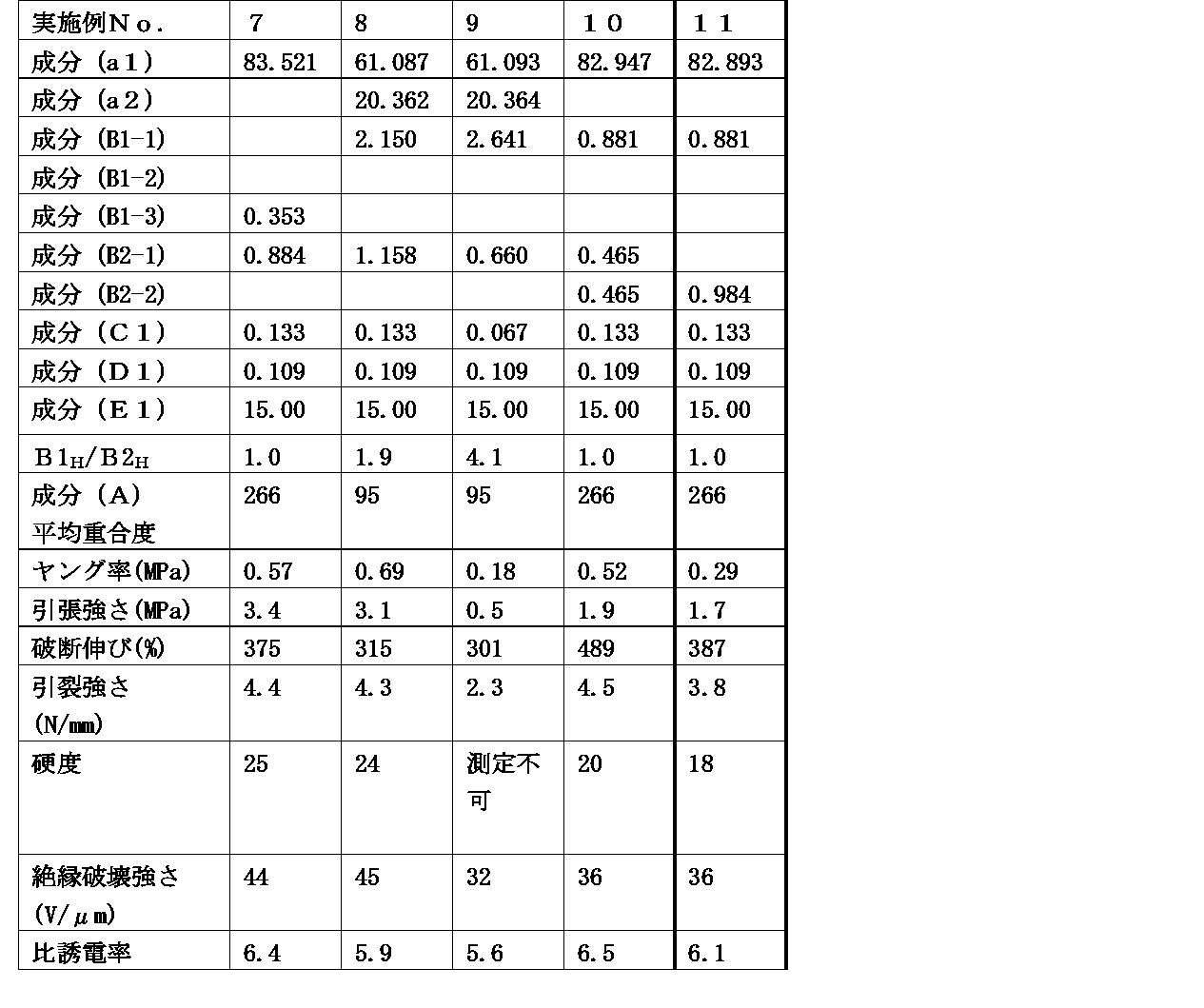
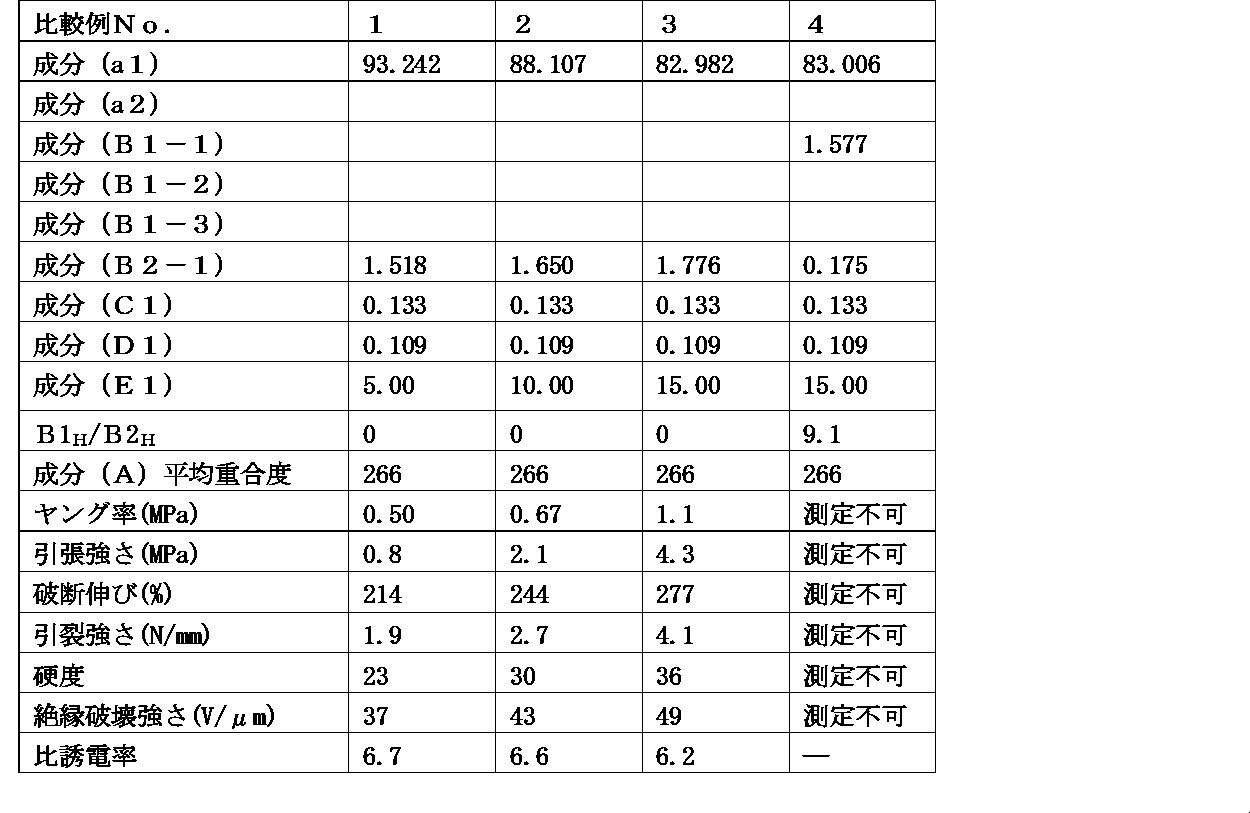
10a、10b、20a、20b、20c 誘電層
11a、11b、21a、21b、21c、21d 電極層(導電層)
12、22 配線
13、23 電源
3 センサ
30 誘電層
31a、31b、31c 上部電極層
32a、32b、32c 下部電極層
4 発電素子
40a、40b 誘電層
41a、41b 電極層
Claims (16)
- (A)1種類または2種類以上の、分子中に少なくとも2個の炭素数2~12のアルケニル基を有し、ケイ素原子上の全ての置換基の10モル%以上が、(CpF2p+1)-R- (Rは炭素原子数1~10のアルキレン基であり、pは1以上8以下の整数である)で表されるフルオロアルキル基であるフルオロアルキル基含有オルガノポリシロキサン、
(B)以下の(B1)成分および(B2)成分からなるオルガノハイドロジェンポリシロキサンであって、(B1)成分中のケイ素原子結合水素原子数:(B2)成分中のケイ素原子結合水素原子数の比率が10:90~85:15となる範囲であるもの:
(B1)分子鎖両末端に少なくとも2個のケイ素結合水素原子を有し、フルオロアルキル基を有さないオルガノハイドロジェンポリシロキサン
(B2)下記平均単位式(III)で表される直鎖状オルガノハイドロジェンポリシロキサンおよび平均単位式(IV)で表される分岐状オルガノハイドロジェンポリシロキサンから選ばれる1種類以上のフルオロアルキル基含有オルガノハイドロジェンポリシロキサン
R0 3Si(OSiR4R0)f1(OSiR0 2)f2OSiR0 3 (III)
{式中、R4は、(CpF2p+1)-R- (Rは前記同様の基であり、pは前記同様の数である)で表されるフルオロアルキル基またはケイ素原子結合水素原子であり、R0は同一または独立に、炭素数1~12のアルキル基、炭素数6~20のアリール基、炭素数7~20のアラルキル基、水酸基、炭素数1~6のアルコキシ基またはケイ素原子結合水素原子であり、かつ、全てのR0のうち、少なくとも2個はケイ素原子結合水素原子であり、f1は正の数であり、f2は0または正の数であり、5<f1+f2<150を満たす数である。}
(HR6 2SiO1/2)f3(R6 3SiO1/2)f4(HR6SiO2/2)f5(R6 2SiO2/2)f6(R5SiO3/2)f7(SiO4/2)f8 (IV)
{式中、R5は、(CpF2p+1)-R- (Rは前記同様の基であり、pは前記同様の数である)で表されるフルオロアルキル基であり、R6は同一または独立に、炭素数1~12のアルキル基、炭素数6~20のアリール基、炭素数7~20のアラルキル基、水酸基、または炭素数1~6のアルコキシ基または前記のフルオロアルキル基であり、かつ、f3およびf7は正の数であり、f4,f5,f6およびf8は、0または正の数であり、かつf3+f4+f5+f6+f7+f8は、式(IV)で示されるオルガノハイドロジェンポリシロキサンの重量平均分子量が400~10000となる範囲の数である。}
組成物中のアルケニル基の合計量1モルに対して、(B)成分中のケイ素原子結合水素原子の和が0.1~2.5モルとなる量、
(C)有効量のヒドロシリル化反応用触媒、
を含有する、フルオロアルキル基含有硬化性オルガノポリシロキサン組成物。 - 前記の(A)成分の平均重合度が5~300の範囲である、請求項1に記載のフルオロアルキル基含有硬化性オルガノポリシロキサン組成物。
- 前記(A)が下記平均単位式(I)で表されるオルガノポリシロキサンである、請求項1または請求項2に記載のフルオロアルキル基含有硬化性オルガノポリシロキサン組成物。
R1R2 2Si(OSiR1R2)e1(OSiR2 2)e2OSiR1R2 2 (I)
{式中、R1は、(CpF2p+1)-R- (Rは前記同様の基であり、pは前記同様の数である)で表されるフルオロアルキル基または炭素数2~12のアルケニル基であり、R2は、同一または独立に、炭素数1~12のアルキル基、炭素数6~20のアリール基、炭素数7~20のアラルキル基、水酸基、もしくは炭素数1~6のアルコキシ基であり、かつ、全てのR1のうち、少なくとも2個は炭素数2~12のアルケニル基であり、全てのR1およびR2のうち10モル%以上は、前記のフルオロアルキル基であり、e1は正の数およびe2は0または正の数であり、5<e1+e2<298を満たす数である。} - 前記(A)が下記平均単位式(II)で表されるオルガノポリシロキサンである、請求項1~3のいずれか1項記載のフルオロアルキル基含有硬化性オルガノポリシロキサン組成物。
RViR2 2Si(OSiR2R3)eOSiRViR2 2 (II)
{式中、RViは、炭素数2~12のアルケニル基であり、R2は前記同様の基であり、R3は、(CpF2p+1)-R- (Rは前記同様の基であり、pは前記同様の数である)で表されるフルオロアルキル基であり、かつ、eは20<e<298を満たす数である。} - 前記(A)成分中の、(CpF2p+1)-R-(Rは前記同様の基であり、pは前記同様の数である)で表されるフルオロアルキル基が、トリフルオロプロピル基である、請求項1~4のいずれか1項記載のフルオロアルキル基含有硬化性オルガノポリシロキサン組成物。
- 前記(B2)成分が、分子中にトリフルオロプロピル基を有するオルガノハイドロジェンポリシロキサンである、請求項1~5のいずれか1項記載のフルオロアルキル基含有硬化性オルガノポリシロキサン組成物。
- 前記(A)成分が、下記(A1)成分または(A2)成分である、請求項1~6のいずれか1項記載のフルオロアルキル基含有硬化性オルガノポリシロキサン組成物。
(A1) 分子中に少なくとも2個の炭素数2~12のアルケニル基を有し、ケイ素原子上の全ての置換基の10モル%以上が、(CpF2p+1)-R- (Rは炭素原子数1~10のアルキレン基であり、pは1以上8以下の整数である)で表されるフルオロアルキル基であり、平均重合度が50~300であり、重合度200以上のオルガノポリシロキサンの体積含有率が10%以上である、フルオロアルキル基含有オルガノポリシロキサン
(A2) 下記分子量分布の異なる(a1)成分および(a2)成分からなり、混合物全体の平均重合度が50~300であるフルオロアルキル基含有オルガノポリシロキサン:
(a1) 分子中に少なくとも2個の炭素数2~12のアルケニル基を有し、ケイ素原子上の全ての置換基の10モル%以上が、(CpF2p+1)-R- (Rは炭素原子数1~10のアルキレン基であり、pは1以上8以下の整数である)で表されるフルオロアルキル基であり、平均重合度が200以上のフルオロアルキル基含有オルガノポリシロキサン
(a2) 分子中に少なくとも2個の炭素数2~12のアルケニル基を有し、ケイ素原子上の全ての置換基の10モル%以上が、(CpF2p+1)-R- (Rは炭素原子数1~10のアルキレン基であり、pは1以上8以下の整数である)で表されるフルオロアルキル基であり、平均重合度が50以下のフルオロアルキル基含有オルガノポリシロキサン - 請求項1~7のいずれか1項記載のフルオロアルキル基含有硬化性オルガノポリシロキサン組成物を硬化してなる硬化物。
- 請求項1~7のいずれか1項記載のフルオロアルキル基含有硬化性オルガノポリシロキサン組成物を硬化してなり、フィルム状もしくはシート状である、トランスデューサー用部材。
- 請求項1~7のいずれか1項記載のフルオロアルキル基含有硬化性オルガノポリシロキサン組成物を硬化してなり、フィルム状もしくはシート状である、電子材料または表示装置用部材。
- 請求項1~7のいずれか1項記載のフルオロアルキル基含有硬化性オルガノポリシロキサン組成物を硬化してなり、ゲルまたはエラストマーである、トランスデューサー用部材。
- 請求項1~7のいずれか1項記載のフルオロアルキル基含有硬化性オルガノポリシロキサン組成物を硬化してなる誘電層を有するトランスデューサー。
- 少なくとも一対の電極層間に、請求項1~7のいずれか1項記載のフルオロアルキル基含有硬化性オルガノポリシロキサン組成物を硬化させて、または前記組成物の硬化反応を一部進行させてなる中間層を介装してなるトランスデューサー。
- 中間層がゲルまたはエラストマーである、請求項12または請求項13のトランスデューサー。
- 中間層が、請求項1~7のいずれか1項記載のフルオロアルキル基含有硬化性オルガノポリシロキサン組成物を硬化させてなる硬化物を、1層または2層以上積層してなることを特徴とする、請求項12~14のいずれか1項記載のトランスデューサー。
- 請求項1~7のいずれか1項記載のフルオロアルキル基含有硬化性オルガノポリシロキサン組成物を硬化させて、または前記組成物の硬化反応を一部進行させてなる硬化物層を有する電子部品または表示装置。
Priority Applications (5)
| Application Number | Priority Date | Filing Date | Title |
|---|---|---|---|
| US16/613,781 US11479670B2 (en) | 2017-05-18 | 2018-05-02 | Fluoroalkyl group-containing curable organopolysiloxane composition, cured product thereof, and transducer or the like provided with cured product |
| EP18802915.1A EP3626781B1 (en) | 2017-05-18 | 2018-05-02 | Fluoroalkyl group-containing curable organopolysiloxane composition, cured product thereof, and transducer or the like provided with cured product |
| JP2019519171A JP7100631B2 (ja) | 2017-05-18 | 2018-05-02 | フルオロアルキル基含有硬化性オルガノポリシロキサン組成物、その硬化物および当該硬化物を備えたトランスデューサー等 |
| CN201880027438.5A CN110573576B (zh) | 2017-05-18 | 2018-05-02 | 含氟烷基的固化性有机聚硅氧烷组合物、其固化物以及具备该固化物的换能器 |
| KR1020197035411A KR102561358B1 (ko) | 2017-05-18 | 2018-05-02 | 플루오로알킬기 함유 경화성 오가노폴리실록산 조성물, 이의 경화물 및 당해 경화물을 구비한 트랜스듀서 등 |
Applications Claiming Priority (2)
| Application Number | Priority Date | Filing Date | Title |
|---|---|---|---|
| JP2017099138 | 2017-05-18 | ||
| JP2017-099138 | 2017-05-18 |
Publications (1)
| Publication Number | Publication Date |
|---|---|
| WO2018211981A1 true WO2018211981A1 (ja) | 2018-11-22 |
Family
ID=64273629
Family Applications (1)
| Application Number | Title | Priority Date | Filing Date |
|---|---|---|---|
| PCT/JP2018/017480 Ceased WO2018211981A1 (ja) | 2017-05-18 | 2018-05-02 | フルオロアルキル基含有硬化性オルガノポリシロキサン組成物、その硬化物および当該硬化物を備えたトランスデューサー等 |
Country Status (7)
| Country | Link |
|---|---|
| US (1) | US11479670B2 (ja) |
| EP (1) | EP3626781B1 (ja) |
| JP (1) | JP7100631B2 (ja) |
| KR (1) | KR102561358B1 (ja) |
| CN (1) | CN110573576B (ja) |
| TW (1) | TWI768041B (ja) |
| WO (1) | WO2018211981A1 (ja) |
Cited By (5)
| Publication number | Priority date | Publication date | Assignee | Title |
|---|---|---|---|---|
| CN110746784A (zh) * | 2019-10-22 | 2020-02-04 | 湖北兴瑞硅材料有限公司 | 一种液体硅橡胶及其制备方法 |
| WO2020166692A1 (ja) * | 2019-02-14 | 2020-08-20 | ダウ・東レ株式会社 | オルガノポリシロキサン硬化物フィルム、その用途、製造方法および製造装置 |
| EP3904082A4 (en) * | 2018-12-27 | 2022-12-28 | Dow Toray Co., Ltd. | CURABLE SILICONE COMPOSITION, RELEASE COATING AGENT COMPRISING SUCH COMPOSITION, RELEASE FILM OBTAINED WITH SUCH RELEASE COATING AGENT AND LAMINATE PRODUCT COMPRISING SUCH RELEASE FILM |
| WO2023282270A1 (ja) * | 2021-07-05 | 2023-01-12 | ダウ・東レ株式会社 | トランスデューサー用オルガノポリシロキサン組成物、その硬化物フィルムからなる積層体、その用途、およびその製造方法 |
| US12129379B2 (en) | 2018-12-27 | 2024-10-29 | Dow Toray Co., Ltd. | Curable silicone composition, release coating agent comprising said composition, release film obtained using said release coating agent, and layered product including said release film |
Families Citing this family (4)
| Publication number | Priority date | Publication date | Assignee | Title |
|---|---|---|---|---|
| WO2020116440A1 (ja) * | 2018-12-07 | 2020-06-11 | ダウ・東レ株式会社 | 硬化性オルガノポリシロキサン組成物、その硬化物および当該硬化物を備えたトランスデューサー等 |
| EP3904085B1 (en) | 2018-12-27 | 2024-05-08 | Dow Toray Co., Ltd. | Curable silicone composition, release coating agent comprising said composition, release film obtained using said release coating agent, and layered product including said release film |
| EP4079811A4 (en) | 2019-12-20 | 2024-01-10 | Dow Toray Co., Ltd. | HARDENED ELASTOMER COMPOSITION, HARDENED PRODUCT THEREOF, FILM PROVIDED WITH A HARDENED PRODUCT, MULTI-LAYER BODY WITH A FILM, METHOD FOR PRODUCING THE MULTI-LAYER BODY, ELECTRONIC COMPONENT AND DISPLAY DEVICE, EACH CONTAINING A HARDENED PRODUCT, AND METHOD OF DESIGNING A TRANSDUCER DEVICE |
| CN112280303A (zh) * | 2020-10-12 | 2021-01-29 | 北京国电富通科技发展有限责任公司 | 一种用于带电作业机器人的外绝缘固化料及其制备方法 |
Citations (38)
| Publication number | Priority date | Publication date | Assignee | Title |
|---|---|---|---|---|
| JPS63205359A (ja) * | 1987-02-20 | 1988-08-24 | Shin Etsu Chem Co Ltd | 硬化性フツ素シリコ−ン組成物 |
| JPH0718183A (ja) * | 1993-06-30 | 1995-01-20 | Toray Dow Corning Silicone Co Ltd | 硬化性シリコーン組成物 |
| JPH1081825A (ja) * | 1996-05-20 | 1998-03-31 | Dow Corning Corp | 白金族金属硬化性フルオロシリコーン組成物の硬化開始時間、硬化時間の制御方法 |
| JP2001524278A (ja) | 1997-02-07 | 2001-11-27 | エス アール アイ・インターナショナル | 弾性誘電体ポリマフィルム音波アクチュエータ |
| JP2004282992A (ja) | 2003-02-28 | 2004-10-07 | Eamex Co | アクチュエータ素子及び駆動方法 |
| JP2007502346A (ja) * | 2003-08-14 | 2007-02-08 | ダウ・コーニング・コーポレイション | 改良された耐薬品性を有する接着剤及び接着剤を調製するための硬化性シリコーン組成物 |
| JP2007502345A (ja) * | 2003-08-14 | 2007-02-08 | ダウ・コーニング・コーポレイション | 改良された表面特性を有するシリコーン及び該シリコーンを調製するための硬化性シリコーン組成物 |
| JP2008187079A (ja) | 2007-01-31 | 2008-08-14 | Tokai Rubber Ind Ltd | 電歪型アクチュエータ用誘電体エラストマー膜およびその製造方法 |
| JP2008251697A (ja) | 2007-03-29 | 2008-10-16 | Tdk Corp | 高分子アクチュエータ |
| JP2008277729A (ja) | 2007-03-30 | 2008-11-13 | Tokai Rubber Ind Ltd | アクチュエータ |
| JP2009059856A (ja) | 2007-08-31 | 2009-03-19 | Tokai Rubber Ind Ltd | 柔軟電極およびそれを用いたアクチュエータ |
| JP2009219302A (ja) | 2008-03-12 | 2009-09-24 | Tokai Rubber Ind Ltd | アクチュエータ |
| JP2010003553A (ja) | 2008-06-20 | 2010-01-07 | Alps Electric Co Ltd | 発光性高分子アクチュエータ |
| WO2010029992A1 (ja) | 2008-09-12 | 2010-03-18 | アルプス電気株式会社 | 高分子アクチュエータ |
| WO2010100907A1 (ja) | 2009-03-04 | 2010-09-10 | パナソニック株式会社 | ポリマーアクチュエータ |
| WO2010110417A1 (ja) | 2009-03-27 | 2010-09-30 | アルプス電気株式会社 | アクチュエータ装置及び入力装置 |
| WO2011114965A1 (ja) | 2010-03-16 | 2011-09-22 | アルプス電気株式会社 | 高分子アクチュエータを用いた駆動装置 |
| WO2011118315A1 (ja) | 2010-03-23 | 2011-09-29 | 東海ゴム工業株式会社 | 導電性架橋体、およびその製造方法、並びにそれを用いたトランスデューサ、フレキシブル配線板、電磁波シールド |
| JP2012055153A (ja) | 2010-08-05 | 2012-03-15 | Canon Inc | アクチュエータおよびアクチュエータ構造体 |
| JP2012065427A (ja) | 2010-09-15 | 2012-03-29 | Toyoda Gosei Co Ltd | アクチュエータ |
| JP2013106491A (ja) | 2011-11-16 | 2013-05-30 | Tdk Corp | 高分子アクチュエータ |
| WO2013118628A1 (ja) | 2012-02-08 | 2013-08-15 | アルプス電気株式会社 | 高分子アクチュエータ素子及び前記高分子アクチュエータ素子の駆動装置ならびに駆動方法 |
| JP2013251942A (ja) | 2012-05-30 | 2013-12-12 | Sony Corp | 高分子アクチュエーター、アクチュエーター装置、高分子アクチュエーターの製造方法及びアクチュエーター装置の製造方法 |
| JP2013255397A (ja) | 2012-06-08 | 2013-12-19 | Alps Electric Co Ltd | 高分子アクチュエータデバイスシステム |
| WO2014105959A1 (en) | 2012-12-28 | 2014-07-03 | Dow Corning Corporation | Curable organopolysiloxane composition for transducers and applications of such curable silicone composition for transducers |
| WO2014104331A1 (ja) | 2012-12-27 | 2014-07-03 | アルプス電気株式会社 | 高分子アクチュエータ素子 |
| JP2014139292A (ja) * | 2012-12-21 | 2014-07-31 | Shin Etsu Chem Co Ltd | 硬化性シリコーン樹脂組成物、その硬化物及び光半導体デバイス |
| WO2015098072A1 (en) | 2013-12-27 | 2015-07-02 | Dow Corning Toray Co., Ltd. | Curable organopolysiloxane composition, member for transducers |
| JP2015126597A (ja) | 2013-12-26 | 2015-07-06 | カシオ計算機株式会社 | アクチュエータ |
| JP2015186301A (ja) | 2014-03-20 | 2015-10-22 | アルプス電気株式会社 | 高分子アクチュエータ素子、高分子アクチュエータ素子用電極層、高分子アクチュエータ素子用電極層の製造方法、及び、高分子アクチュエータ素子の製造方法 |
| WO2016031242A1 (ja) * | 2014-08-29 | 2016-03-03 | 東レ・ダウコーニング株式会社 | フッ素含有重合体-フッ素含有オルガノポリシロキサン複合材料、その製造方法、その用途、及びその製造方法に用いる前駆体組成物 |
| WO2016098334A1 (ja) * | 2014-12-16 | 2016-06-23 | 東レ・ダウコーニング株式会社 | フルオロアルキル基含有硬化性オルガノポリシロキサン組成物、その硬化物および当該硬化物を備えた電子部品または表示装置 |
| WO2016163069A1 (ja) * | 2015-04-10 | 2016-10-13 | 東レ・ダウコーニング株式会社 | フルオロアルキル基含有硬化性オルガノポリシロキサン組成物、その硬化物および当該硬化物を備えた電子部品または表示装置 |
| JP2016189651A (ja) | 2015-03-30 | 2016-11-04 | アルプス電気株式会社 | 積層型アクチュエータ |
| JP2016226258A (ja) | 2015-05-28 | 2016-12-28 | 本田技研工業株式会社 | アクチュエータ |
| JP2017064836A (ja) | 2015-09-29 | 2017-04-06 | 本田技研工業株式会社 | 力制御装置 |
| JP2017114983A (ja) * | 2015-12-22 | 2017-06-29 | モメンティブ・パフォーマンス・マテリアルズ・ジャパン合同会社 | 付加硬化性ポリフルオロオルガノシロキサン組成物 |
| WO2017183541A1 (ja) * | 2016-04-22 | 2017-10-26 | 東レ・ダウコーニング株式会社 | 高誘電性フィルム、その用途および製造方法 |
Family Cites Families (7)
| Publication number | Priority date | Publication date | Assignee | Title |
|---|---|---|---|---|
| US5082706A (en) * | 1988-11-23 | 1992-01-21 | Dow Corning Corporation | Pressure sensitive adhesive/release liner laminate |
| JP2012512315A (ja) * | 2008-12-17 | 2012-05-31 | スリーエム イノベイティブ プロパティズ カンパニー | ブレンドフルオロシリコーン剥離物質 |
| US9206317B2 (en) * | 2009-11-16 | 2015-12-08 | 3M Innovative Properties Company | Fluorosilicone blend release materials |
| KR101526463B1 (ko) | 2013-02-25 | 2015-06-05 | 손정률 | 자동차의 제동 보조 장치 |
| US9951186B2 (en) | 2013-09-03 | 2018-04-24 | Dow Corning Toray Co., Ltd | Silicone gel composition and use thereof |
| CN105829465A (zh) * | 2013-12-16 | 2016-08-03 | 3M创新有限公司 | 共混剥离材料 |
| KR20150098072A (ko) | 2014-02-19 | 2015-08-27 | 엘지전자 주식회사 | 디스플레이 장치 |
-
2018
- 2018-05-02 KR KR1020197035411A patent/KR102561358B1/ko active Active
- 2018-05-02 JP JP2019519171A patent/JP7100631B2/ja active Active
- 2018-05-02 US US16/613,781 patent/US11479670B2/en active Active
- 2018-05-02 WO PCT/JP2018/017480 patent/WO2018211981A1/ja not_active Ceased
- 2018-05-02 CN CN201880027438.5A patent/CN110573576B/zh active Active
- 2018-05-02 EP EP18802915.1A patent/EP3626781B1/en active Active
- 2018-05-10 TW TW107115881A patent/TWI768041B/zh active
Patent Citations (39)
| Publication number | Priority date | Publication date | Assignee | Title |
|---|---|---|---|---|
| JPS63205359A (ja) * | 1987-02-20 | 1988-08-24 | Shin Etsu Chem Co Ltd | 硬化性フツ素シリコ−ン組成物 |
| JPH0718183A (ja) * | 1993-06-30 | 1995-01-20 | Toray Dow Corning Silicone Co Ltd | 硬化性シリコーン組成物 |
| JPH1081825A (ja) * | 1996-05-20 | 1998-03-31 | Dow Corning Corp | 白金族金属硬化性フルオロシリコーン組成物の硬化開始時間、硬化時間の制御方法 |
| JP2001524278A (ja) | 1997-02-07 | 2001-11-27 | エス アール アイ・インターナショナル | 弾性誘電体ポリマフィルム音波アクチュエータ |
| JP2004282992A (ja) | 2003-02-28 | 2004-10-07 | Eamex Co | アクチュエータ素子及び駆動方法 |
| JP2007502346A (ja) * | 2003-08-14 | 2007-02-08 | ダウ・コーニング・コーポレイション | 改良された耐薬品性を有する接着剤及び接着剤を調製するための硬化性シリコーン組成物 |
| JP2007502345A (ja) * | 2003-08-14 | 2007-02-08 | ダウ・コーニング・コーポレイション | 改良された表面特性を有するシリコーン及び該シリコーンを調製するための硬化性シリコーン組成物 |
| JP2008187079A (ja) | 2007-01-31 | 2008-08-14 | Tokai Rubber Ind Ltd | 電歪型アクチュエータ用誘電体エラストマー膜およびその製造方法 |
| JP2008251697A (ja) | 2007-03-29 | 2008-10-16 | Tdk Corp | 高分子アクチュエータ |
| JP2008277729A (ja) | 2007-03-30 | 2008-11-13 | Tokai Rubber Ind Ltd | アクチュエータ |
| JP2009059856A (ja) | 2007-08-31 | 2009-03-19 | Tokai Rubber Ind Ltd | 柔軟電極およびそれを用いたアクチュエータ |
| JP2009219302A (ja) | 2008-03-12 | 2009-09-24 | Tokai Rubber Ind Ltd | アクチュエータ |
| JP2010003553A (ja) | 2008-06-20 | 2010-01-07 | Alps Electric Co Ltd | 発光性高分子アクチュエータ |
| WO2010029992A1 (ja) | 2008-09-12 | 2010-03-18 | アルプス電気株式会社 | 高分子アクチュエータ |
| WO2010100907A1 (ja) | 2009-03-04 | 2010-09-10 | パナソニック株式会社 | ポリマーアクチュエータ |
| WO2010110417A1 (ja) | 2009-03-27 | 2010-09-30 | アルプス電気株式会社 | アクチュエータ装置及び入力装置 |
| WO2011114965A1 (ja) | 2010-03-16 | 2011-09-22 | アルプス電気株式会社 | 高分子アクチュエータを用いた駆動装置 |
| WO2011118315A1 (ja) | 2010-03-23 | 2011-09-29 | 東海ゴム工業株式会社 | 導電性架橋体、およびその製造方法、並びにそれを用いたトランスデューサ、フレキシブル配線板、電磁波シールド |
| JP2012055153A (ja) | 2010-08-05 | 2012-03-15 | Canon Inc | アクチュエータおよびアクチュエータ構造体 |
| JP2012065427A (ja) | 2010-09-15 | 2012-03-29 | Toyoda Gosei Co Ltd | アクチュエータ |
| JP2013106491A (ja) | 2011-11-16 | 2013-05-30 | Tdk Corp | 高分子アクチュエータ |
| WO2013118628A1 (ja) | 2012-02-08 | 2013-08-15 | アルプス電気株式会社 | 高分子アクチュエータ素子及び前記高分子アクチュエータ素子の駆動装置ならびに駆動方法 |
| JP2013251942A (ja) | 2012-05-30 | 2013-12-12 | Sony Corp | 高分子アクチュエーター、アクチュエーター装置、高分子アクチュエーターの製造方法及びアクチュエーター装置の製造方法 |
| JP2013255397A (ja) | 2012-06-08 | 2013-12-19 | Alps Electric Co Ltd | 高分子アクチュエータデバイスシステム |
| JP2014139292A (ja) * | 2012-12-21 | 2014-07-31 | Shin Etsu Chem Co Ltd | 硬化性シリコーン樹脂組成物、その硬化物及び光半導体デバイス |
| WO2014104331A1 (ja) | 2012-12-27 | 2014-07-03 | アルプス電気株式会社 | 高分子アクチュエータ素子 |
| JP2016503108A (ja) * | 2012-12-28 | 2016-02-01 | ダウ コーニング コーポレーションDow Corning Corporation | トランスデューサーのための硬化性オルガノポリシロキサン組成物及びかかる硬化性シリコーン組成物のトランスデューサーへの使用 |
| WO2014105959A1 (en) | 2012-12-28 | 2014-07-03 | Dow Corning Corporation | Curable organopolysiloxane composition for transducers and applications of such curable silicone composition for transducers |
| JP2015126597A (ja) | 2013-12-26 | 2015-07-06 | カシオ計算機株式会社 | アクチュエータ |
| WO2015098072A1 (en) | 2013-12-27 | 2015-07-02 | Dow Corning Toray Co., Ltd. | Curable organopolysiloxane composition, member for transducers |
| JP2015186301A (ja) | 2014-03-20 | 2015-10-22 | アルプス電気株式会社 | 高分子アクチュエータ素子、高分子アクチュエータ素子用電極層、高分子アクチュエータ素子用電極層の製造方法、及び、高分子アクチュエータ素子の製造方法 |
| WO2016031242A1 (ja) * | 2014-08-29 | 2016-03-03 | 東レ・ダウコーニング株式会社 | フッ素含有重合体-フッ素含有オルガノポリシロキサン複合材料、その製造方法、その用途、及びその製造方法に用いる前駆体組成物 |
| WO2016098334A1 (ja) * | 2014-12-16 | 2016-06-23 | 東レ・ダウコーニング株式会社 | フルオロアルキル基含有硬化性オルガノポリシロキサン組成物、その硬化物および当該硬化物を備えた電子部品または表示装置 |
| JP2016189651A (ja) | 2015-03-30 | 2016-11-04 | アルプス電気株式会社 | 積層型アクチュエータ |
| WO2016163069A1 (ja) * | 2015-04-10 | 2016-10-13 | 東レ・ダウコーニング株式会社 | フルオロアルキル基含有硬化性オルガノポリシロキサン組成物、その硬化物および当該硬化物を備えた電子部品または表示装置 |
| JP2016226258A (ja) | 2015-05-28 | 2016-12-28 | 本田技研工業株式会社 | アクチュエータ |
| JP2017064836A (ja) | 2015-09-29 | 2017-04-06 | 本田技研工業株式会社 | 力制御装置 |
| JP2017114983A (ja) * | 2015-12-22 | 2017-06-29 | モメンティブ・パフォーマンス・マテリアルズ・ジャパン合同会社 | 付加硬化性ポリフルオロオルガノシロキサン組成物 |
| WO2017183541A1 (ja) * | 2016-04-22 | 2017-10-26 | 東レ・ダウコーニング株式会社 | 高誘電性フィルム、その用途および製造方法 |
Cited By (11)
| Publication number | Priority date | Publication date | Assignee | Title |
|---|---|---|---|---|
| EP3904082A4 (en) * | 2018-12-27 | 2022-12-28 | Dow Toray Co., Ltd. | CURABLE SILICONE COMPOSITION, RELEASE COATING AGENT COMPRISING SUCH COMPOSITION, RELEASE FILM OBTAINED WITH SUCH RELEASE COATING AGENT AND LAMINATE PRODUCT COMPRISING SUCH RELEASE FILM |
| US12129379B2 (en) | 2018-12-27 | 2024-10-29 | Dow Toray Co., Ltd. | Curable silicone composition, release coating agent comprising said composition, release film obtained using said release coating agent, and layered product including said release film |
| US12454632B2 (en) | 2018-12-27 | 2025-10-28 | Dow Toray Co., Ltd. | Curable silicone composition, release coating agent comprising said composition, release film obtained using said release coating agent, and layered product including said release film |
| WO2020166692A1 (ja) * | 2019-02-14 | 2020-08-20 | ダウ・東レ株式会社 | オルガノポリシロキサン硬化物フィルム、その用途、製造方法および製造装置 |
| CN113631281A (zh) * | 2019-02-14 | 2021-11-09 | 陶氏东丽株式会社 | 有机聚硅氧烷固化物膜、其用途、制备方法及制备装置 |
| JPWO2020166692A1 (ja) * | 2019-02-14 | 2021-12-23 | ダウ・東レ株式会社 | オルガノポリシロキサン硬化物フィルム、その用途、製造方法および製造装置 |
| CN113631281B (zh) * | 2019-02-14 | 2023-08-25 | 陶氏东丽株式会社 | 有机聚硅氧烷固化物膜、其用途、制备方法及制备装置 |
| JP7485497B2 (ja) | 2019-02-14 | 2024-05-16 | ダウ・東レ株式会社 | オルガノポリシロキサン硬化物フィルム、その用途、製造方法および製造装置 |
| US12503598B2 (en) | 2019-02-14 | 2025-12-23 | Dow Toray Co., Ltd. | Organopolysiloxane cured product film and usage, manufacturing method, and manufacturing apparatus therefor |
| CN110746784A (zh) * | 2019-10-22 | 2020-02-04 | 湖北兴瑞硅材料有限公司 | 一种液体硅橡胶及其制备方法 |
| WO2023282270A1 (ja) * | 2021-07-05 | 2023-01-12 | ダウ・東レ株式会社 | トランスデューサー用オルガノポリシロキサン組成物、その硬化物フィルムからなる積層体、その用途、およびその製造方法 |
Also Published As
| Publication number | Publication date |
|---|---|
| US11479670B2 (en) | 2022-10-25 |
| CN110573576A (zh) | 2019-12-13 |
| EP3626781A4 (en) | 2021-03-03 |
| TWI768041B (zh) | 2022-06-21 |
| TW201917174A (zh) | 2019-05-01 |
| KR102561358B1 (ko) | 2023-08-01 |
| EP3626781B1 (en) | 2024-06-26 |
| JP7100631B2 (ja) | 2022-07-13 |
| EP3626781A1 (en) | 2020-03-25 |
| CN110573576B (zh) | 2021-09-24 |
| US20200071527A1 (en) | 2020-03-05 |
| JPWO2018211981A1 (ja) | 2020-03-19 |
| KR20200008128A (ko) | 2020-01-23 |
Similar Documents
| Publication | Publication Date | Title |
|---|---|---|
| JP7100631B2 (ja) | フルオロアルキル基含有硬化性オルガノポリシロキサン組成物、その硬化物および当該硬化物を備えたトランスデューサー等 | |
| EP2938679B1 (en) | Curable organopolysiloxane composition for transducers and applications of such curable silicone composition for transducers | |
| WO2016163069A1 (ja) | フルオロアルキル基含有硬化性オルガノポリシロキサン組成物、その硬化物および当該硬化物を備えた電子部品または表示装置 | |
| TWI845567B (zh) | 薄膜形成用固化性有機聚矽氧烷組成物以及有機聚矽氧烷固化物薄膜之製造方法 | |
| TWI823971B (zh) | 有機聚矽氧烷固化物薄膜、其用途及製造方法 | |
| JP7534060B2 (ja) | 硬化性オルガノポリシロキサン組成物、その硬化物および当該硬化物を備えたトランスデューサー等 | |
| CN113330073B (zh) | 膜形成用固化性聚有机硅氧烷组合物以及聚有机硅氧烷固化物膜的制造方法 | |
| CN115038757B (zh) | 固化性弹性体组合物及换能器设备的设计方法 | |
| TWI914297B (zh) | 固化性有機聚矽氧烷組成物、其固化物以及具備該固化物之換能器等 | |
| US20260078222A1 (en) | Curable organopolysiloxane composition for transducers, cured product of same, and transducer and others each provided with said cured product |
Legal Events
| Date | Code | Title | Description |
|---|---|---|---|
| 121 | Ep: the epo has been informed by wipo that ep was designated in this application |
Ref document number: 18802915 Country of ref document: EP Kind code of ref document: A1 |
|
| ENP | Entry into the national phase |
Ref document number: 2019519171 Country of ref document: JP Kind code of ref document: A |
|
| NENP | Non-entry into the national phase |
Ref country code: DE |
|
| ENP | Entry into the national phase |
Ref document number: 20197035411 Country of ref document: KR Kind code of ref document: A |
|
| ENP | Entry into the national phase |
Ref document number: 2018802915 Country of ref document: EP Effective date: 20191218 |