WO2014106949A1 - 無電解めっき下地膜形成用組成物 - Google Patents
無電解めっき下地膜形成用組成物 Download PDFInfo
- Publication number
- WO2014106949A1 WO2014106949A1 PCT/JP2014/000007 JP2014000007W WO2014106949A1 WO 2014106949 A1 WO2014106949 A1 WO 2014106949A1 JP 2014000007 W JP2014000007 W JP 2014000007W WO 2014106949 A1 WO2014106949 A1 WO 2014106949A1
- Authority
- WO
- WIPO (PCT)
- Prior art keywords
- group
- electroless plating
- base film
- plating base
- plating
- Prior art date
- Legal status (The legal status is an assumption and is not a legal conclusion. Google has not performed a legal analysis and makes no representation as to the accuracy of the status listed.)
- Ceased
Links
Images

Classifications
-
- C—CHEMISTRY; METALLURGY
- C23—COATING METALLIC MATERIAL; COATING MATERIAL WITH METALLIC MATERIAL; CHEMICAL SURFACE TREATMENT; DIFFUSION TREATMENT OF METALLIC MATERIAL; COATING BY VACUUM EVAPORATION, BY SPUTTERING, BY ION IMPLANTATION OR BY CHEMICAL VAPOUR DEPOSITION, IN GENERAL; INHIBITING CORROSION OF METALLIC MATERIAL OR INCRUSTATION IN GENERAL
- C23C—COATING METALLIC MATERIAL; COATING MATERIAL WITH METALLIC MATERIAL; SURFACE TREATMENT OF METALLIC MATERIAL BY DIFFUSION INTO THE SURFACE, BY CHEMICAL CONVERSION OR SUBSTITUTION; COATING BY VACUUM EVAPORATION, BY SPUTTERING, BY ION IMPLANTATION OR BY CHEMICAL VAPOUR DEPOSITION, IN GENERAL
- C23C18/00—Chemical coating by decomposition of either liquid compounds or solutions of the coating forming compounds, without leaving reaction products of surface material in the coating; Contact plating
- C23C18/16—Chemical coating by decomposition of either liquid compounds or solutions of the coating forming compounds, without leaving reaction products of surface material in the coating; Contact plating by reduction or substitution, e.g. electroless plating
- C23C18/18—Pretreatment of the material to be coated
- C23C18/20—Pretreatment of the material to be coated of organic surfaces, e.g. resins
- C23C18/2006—Pretreatment of the material to be coated of organic surfaces, e.g. resins by other methods than those of C23C18/22 - C23C18/30
- C23C18/2046—Pretreatment of the material to be coated of organic surfaces, e.g. resins by other methods than those of C23C18/22 - C23C18/30 by chemical pretreatment
- C23C18/2053—Pretreatment of the material to be coated of organic surfaces, e.g. resins by other methods than those of C23C18/22 - C23C18/30 by chemical pretreatment only one step pretreatment
- C23C18/2066—Use of organic or inorganic compounds other than metals, e.g. activation, sensitisation with polymers
Definitions
- the present invention relates to a composition for forming an electroless plating base film, a thin film obtained therefrom, a plating laminate, a method for producing an electroless plating base film, and a method for producing an electroless plating laminate.
- the present invention also relates to a method for producing an electroless plated product.
- Conductive polymers are used for electrolytic capacitors, backup batteries for electronic devices, electrodes for lithium ion batteries used in mobile phones and notebook computers, and the like.
- polyaniline which is a kind of conductive polymer
- polyaniline can be synthesized relatively easily from inexpensive aniline in addition to its electrical characteristics, and exhibits excellent stability against oxygen and the like in a state of conductivity. Has advantages and characteristics.
- a highly conductive polyaniline can be easily obtained by the method described in Patent Document 1.
- Patent Documents 2 to 8 An electroless plating base film made of a polyaniline complex alone has not been sufficiently adhered to various substrates such as polycarbonate (PC) and polyethylene terephthalate (PET). Moreover, the adhesiveness with a plating layer was not enough.
- PC polycarbonate
- PET polyethylene terephthalate
- An object of the present invention is to provide a composition for forming a base film that has sufficient adhesion to a substrate such as polycarbonate (PC) in electroless plating and also has sufficient adhesion to a plating layer. It is.
- a substrate such as polycarbonate (PC) in electroless plating and also has sufficient adhesion to a plating layer. It is.
- the following composition for forming an electroless plating base film is provided.
- a composition for forming an electroless plating base film comprising a conductive polymer and a urethane resin.
- the conductive polymer is a polyaniline composite in which substituted or unsubstituted polyaniline is doped with a dopant.
- the dopant is a sulfosuccinic acid derivative represented by the following formula (III).
- M is a hydrogen atom, an organic free radical or an inorganic free radical.
- M ′ is a valence of M.
- R 13 and R 14 are each a hydrocarbon group or — (R 15 O) r —R 16 group, wherein R 15 is a hydrocarbon group or a silylene group, R 16 is a hydrogen atom, a hydrocarbon group or an R 17 3 Si— group, and r is an integer of 1 or more. R 17 is each a hydrocarbon group.) 4).
- the dopant is a sulfosuccinic acid derivative represented by the following formula (III).
- M is a hydrogen atom, an organic free radical or an inorganic free radical.
- M ′ is a valence of M.
- R 13 and R 14 are each a hydrocarbon group or — (R 15 O) r —R 16 group, wherein R 15 is a hydrocarbon group or a silylene group, R 16 is a hydrogen atom, a hydrocarbon group or an R 17 3 Si— group, and r is an integer of 1 or more. R 17 is each a hydrocarbon group.) 10. 10. The plated laminate according to 8 or 9, wherein the dopant is sodium di-2-ethylhexyl sulfosuccinate. 11. The plating laminate according to any one of 7 to 10, wherein the ratio of the urethane resin to the total of the conductive polymer and the urethane resin is 20 to 80% by weight.
- a step of forming an electroless plating base film using the composition for forming an electroless plating base film according to any one of 1 to 5 on a substrate; and electroless containing a metal on the electroless plating base film The manufacturing method of the electroless-plating laminated body including the process of forming a plating layer. 17. 17. The method for producing an electroless plating laminate according to 16, wherein the electroless plating base film is supported with palladium and then contacted with an electroless plating solution to form the electroless plating layer. 18. 18. The method for producing an electroless plating laminate according to 17, wherein palladium is supported by bringing a palladium chloride solution into contact with the electroless plating base film. 19. The method for producing an electroless plating laminate according to any one of 16 to 18, wherein the electroless plating solution contains one or more metals selected from Cu, Ni, Au, Pd, Ag, Sn, Co, and Pt.
- composition for forming a base film that has sufficient adhesion to a substrate such as PC and has sufficient adhesion to a plating layer in electroless plating.
- Another object of the present invention is to provide a method for producing an electroless plating product capable of selectively and stably forming a uniform plating film on an electroless plating base film portion using a conductive polymer.
- the manufacturing method of the electroless-plated product of 1 or 2 whose pH of the said reducing agent aqueous solution is 5 or less. 4). 4. The method for producing an electroless plated product according to any one of 1 to 3, wherein the pH of the reducing agent aqueous solution is 3 or more. 5. 5. The method for producing an electroless plated product according to any one of 1 to 4, wherein a standard electrode potential E 0 of the reducing agent aqueous solution is E 0 ⁇ 0.80 V to ⁇ 0.20 V. 6). 6. The method for producing an electroless plated product according to any one of 1 to 5, wherein the reducing agent aqueous solution is a sodium hydrogen sulfite aqueous solution. 7).
- M is a hydrogen atom, an organic free radical or an inorganic free radical.
- M ′ is a valence of M.
- R 13 and R 14 are each a hydrocarbon group or — (R 15 O) r —R 16 group, wherein R 15 is a hydrocarbon group or a silylene group, R 16 is a hydrogen atom, a hydrocarbon group or an R 17 3 Si— group, and r is an integer of 1 or more.
- R 17 is each a hydrocarbon group.
- Production method. 11 The method according to any one of 1 to 10, further comprising a supporting step of supporting a catalyst metal for an electroless plating solution on the electroless plating base film after the contact step with the reducing agent aqueous solution and before the electroless plating layer forming step. Method for producing electroless plating. 12
- 14 The method for producing an electroless plated product according to 13, wherein the solution containing palladium ions is a palladium chloride solution.
- 15. The method for producing an electroless plating product according to any one of 1 to 14, wherein the electroless plating layer is formed by bringing an electroless plating solution into contact with the electroless plating base film after contact with the reducing agent aqueous solution. 16. 16.
- an electroless plating product capable of selectively and stably forming a uniform plating film on an electroless plating base film portion using a conductive polymer.
- composition for forming electroless plating base film, thin film obtained therefrom, plating laminate, method for producing electroless plating base film, and method for producing electroless plating laminate The composition for forming electroless plating base film of the present invention
- the object includes a conductive polymer and a urethane resin.
- Electroless plating is a method of plating a metal having an autocatalytic action that does not perform electrolysis and uses a reducing agent. For example, in the case of electroless copper plating, a copper ion in a solution is replaced with a reducing agent such as formaldehyde.
- composition of the present invention is used to form an underlayer for an electroless plating layer.
- composition of the present invention is mixed with a urethane resin as a binder for improving the adhesion, the adhesion with various substrates such as PC and PET becomes sufficient, and the adhesion with the plating layer is also excellent. It can be set as the plating laminated body with favorable adhesiveness.
- Examples of the conductive polymer include a ⁇ -conjugated polymer complex in which a ⁇ -conjugated polymer is doped with a dopant.
- a polyaniline complex in which a substituted or unsubstituted polyaniline is doped with a dopant, a substituted or non-substituted polyaniline.
- Polypyrrole composites in which substituted polypyrrole is doped with a dopant as well as polythiophene composites in which substituted or unsubstituted polythiophene is doped with a dopant, and polyaniline composites in which substituted or unsubstituted polyaniline is doped with a dopant
- the body is preferred.
- the weight average molecular weight of polyaniline (hereinafter referred to as molecular weight) is preferably 20,000 or more. If the molecular weight is less than 20,000, the strength and stretchability of the conductive article obtained from the composition may be reduced.
- the molecular weight is preferably 20,000 to 500,000, more preferably 20,000 to 300,000, and still more preferably 20,000 to 200,000.
- the molecular weight is, for example, 50,000 to 200,000, 53,000 to 200,000.
- the above weight average molecular weight is not the molecular weight of the polyaniline complex but the molecular weight of polyaniline.
- the polydispersity (that is, “weight average molecular weight” / “number average molecular weight”) is preferably 1.5 or more and 10.0 or less. From the viewpoint of conductivity, it is preferable that the polydispersity is small (that is, the molecular weight distribution is narrow), but from the viewpoint of solubility in solvents and moldability, the polydispersity is large (that is, the molecular weight distribution is wide). May be preferred.
- the weight average molecular weight, number average molecular weight, and polydispersity are measured in terms of polystyrene by gel permeation chromatography (GPC).
- Examples of the substituent of the substituted polyaniline include linear or branched hydrocarbon groups such as methyl group, ethyl group, hexyl group and octyl group; alkoxy groups such as methoxy group and ethoxy group; aryloxy groups such as phenoxy group; And halogenated hydrocarbon groups such as a fluoromethyl group (—CF 3 group).
- the polyaniline is preferably unsubstituted polyaniline from the viewpoints of versatility and economy.
- the substituted or unsubstituted polyaniline is preferably a polyaniline obtained by polymerization in the presence of an acid containing no chlorine atom.
- the acid containing no chlorine atom is, for example, an acid composed of atoms belonging to Group 1 to Group 16 and Group 18. Specific examples include phosphoric acid.
- Examples of the polyaniline obtained by polymerization in the presence of an acid not containing a chlorine atom include polyaniline obtained by polymerization in the presence of phosphoric acid.
- the polyaniline obtained in the presence of an acid containing no chlorine atom can lower the chlorine content of the polyaniline complex.
- the chlorine content of the polyaniline complex is preferably 0.6% by weight or less, more preferably 0.1% by weight or less, still more preferably 0.04% by weight or less, and most preferably 0.0001%. % By weight or less.
- the chlorine content of the polyaniline complex is measured by combustion-ion chromatography.
- Examples of the dopant of the polyaniline complex include Bronsted acid ions generated from Bronsted acid or Bronsted acid salts, preferably organic acid ions generated from organic acids or salts of organic acids, and more preferably the following formula: It is an organic acid ion generated from the compound (proton donor) represented by (I).
- the dopant when the dopant is expressed as a specific acid, and when the dopant is expressed as a specific salt, the specific acid ion generated from the specific acid or the specific salt may be used.
- the above-mentioned ⁇ -conjugated polymer is doped.
- M in the formula (I) is a hydrogen atom, an organic radical or an inorganic radical.
- the organic free radical include a pyridinium group, an imidazolium group, and an anilinium group.
- the inorganic free radical include lithium, sodium, potassium, cesium, ammonium, calcium, magnesium, and iron ions.
- X in the formula (I) is an anion group, for example, —SO 3 — group, —PO 3 2- group, —PO 4 (OH) 2 — group, —OPO 3 2- group, —OPO 2 (OH) — Group, —COO 2 — group, and —SO 3 — group is preferable.
- a in formula (I) is a substituted or unsubstituted hydrocarbon group.
- the hydrocarbon group is a chain or cyclic saturated aliphatic hydrocarbon group, a chain or cyclic unsaturated aliphatic hydrocarbon group, or an aromatic hydrocarbon group.
- Examples of the chain saturated aliphatic hydrocarbon group include a linear or branched alkyl group.
- Examples of the cyclic saturated aliphatic hydrocarbon group include cycloalkyl groups such as a cyclopentyl group, a cyclohexyl group, a cycloheptyl group, and a cyclooctyl group.
- the cyclic saturated aliphatic hydrocarbon group may be a condensation of a plurality of cyclic saturated aliphatic hydrocarbon groups. Examples thereof include a norbornyl group, an adamantyl group, and a condensed adamantyl group.
- Examples of the aromatic hydrocarbon group include a phenyl group, a naphthyl group, and an anthracenyl group.
- Examples of the chain unsaturated aliphatic hydrocarbon group include a linear or branched alkenyl group.
- A is a substituted hydrocarbon group
- the substituent is alkyl group, cycloalkyl group, vinyl group, allyl group, aryl group, alkoxy group, halogen group, hydroxy group, amino group, imino group, nitro group.
- R in formula (I) is bonded to A, and each represents —H, —R 1 , —OR 1 , —COR 1 , —COOR 1 , — (C ⁇ O) — (COR 1 ), or — A substituent represented by (C ⁇ O) — (COOR 1 ), wherein R 1 is a hydrocarbon group, silyl group, alkylsilyl group, or — (R 2 O) x—R 3 group which may contain a substituent. Or-(OSiR 3 2 ) x-OR 3 .
- R 2 is an alkylene group
- R 3 is a hydrocarbon group
- x is an integer of 1 or more.
- hydrocarbon group for R 1 examples include a methyl group, an ethyl group, a linear or branched butyl group, a pentyl group, a hexyl group, a heptyl group, an octyl group, a nonyl group, a decyl group, a dodecyl group, a pentadecyl group, and an eicosanyl group. Is mentioned.
- the substituent of the hydrocarbon group is an alkyl group, a cycloalkyl group, a vinyl group, an allyl group, an aryl group, an alkoxy group, a halogen group, a hydroxy group, an amino group, an imino group, a nitro group, or an ester group.
- the hydrocarbon group for R 3 is the same as R 1 .
- Examples of the alkylene group for R 2 include a methylene group, an ethylene group, and a propylene group.
- N in the formula (I) is an integer of 1 or more, and m in the formula (I) is a valence of M / a valence of X.
- dialkylbenzenesulfonic acid dialkylnaphthalenesulfonic acid, or a compound containing two or more ester bonds is preferable.
- the compound containing two or more ester bonds is more preferably a sulfophthalic acid ester or a compound represented by the following formula (II).
- M and X are the same as in formula (I).
- X is preferably a —SO 3 — group.
- R 4 , R 5 and R 6 are each a hydrogen atom, a hydrocarbon group or an R 9 3 Si— group.
- each of three R 9 is a hydrocarbon group.
- Examples of the hydrocarbon group when R 4 , R 5 and R 6 are hydrocarbon groups include linear or branched alkyl groups having 1 to 24 carbon atoms, aryl groups, and alkylaryl groups.
- the hydrocarbon group for R 9 is the same as in the case of R 4 , R 5 and R 6 .
- R 7 and R 8 in the formula (II) are each a hydrocarbon group or a — (R 10 O) q —R 11 group.
- R 10 is a hydrocarbon group or a silylene group
- R 11 is a hydrogen atom, a hydrocarbon group or R 12 3 Si—
- q is an integer of 1 or more.
- Three R ⁇ 12 > is a hydrocarbon group, respectively.
- hydrocarbon group when R 7 and R 8 are hydrocarbon groups include linear or branched alkyl groups having 1 to 24 carbon atoms, preferably 4 or more carbon atoms, aryl groups, and alkylaryl groups.
- specific examples of the hydrocarbon group when R 7 and R 8 are hydrocarbon groups include, for example, a linear or branched butyl group, pentyl group, hexyl group, octyl group, decyl group, and the like. .
- Examples of the hydrocarbon group in the case where R 10 in R 7 and R 8 is a hydrocarbon group include a linear or branched alkylene group having 1 to 24 carbon atoms, an arylene group, an alkylarylene group, and an arylalkylene group. is there.
- R 7 and R 8 when R 11 and R 12 are hydrocarbon groups, the hydrocarbon group is the same as in R 4 , R 5 and R 6 , and q is 1 to 10 Preferably there is.
- the compound represented by the above formula (II) is more preferably a sulfosuccinic acid derivative represented by the following formula (III).
- M is the same as in formula (I).
- m ′ is the valence of M.
- R 13 and R 14 are each a hydrocarbon group or a — (R 15 O) r —R 16 group.
- R 15 is a hydrocarbon group or a silylene group
- R 16 is a hydrogen atom, a hydrocarbon group or an R 17 3 Si— group
- r is an integer of 1 or more.
- Each of the three R 17 is a hydrocarbon group.
- the hydrocarbon group when R 13 and R 14 are hydrocarbon groups is the same as R 7 and R 8 .
- the hydrocarbon group when R 15 is a hydrocarbon group is the same as R 10 described above.
- the hydrocarbon group in the case where R 16 and R 17 are hydrocarbon groups is the same as R 4 , R 5 and R 6 described above.
- r is preferably from 1 to 10.
- R 13 and R 14 are a — (R 15 O) r —R 16 group are the same as those for — (R 10 O) q —R 11 in R 7 and R 8 .
- the hydrocarbon group for R 13 and R 14 is the same as R 7 and R 8 and is preferably a butyl group, a hexyl group, a 2-ethylhexyl group, or a decyl group.
- the conductivity of the polyaniline complex and the solubility in a solvent can be controlled by changing the structure of the dopant (Japanese Patent No. 338466).
- an optimum dopant can be selected according to required characteristics for each application.
- the compound represented by the formula (I) is preferably di-2-ethylhexylsulfosuccinic acid or sodium di-2-ethylhexylsulfosuccinate (aerosol OT).
- the dopant of the present invention is preferably di-2-ethylhexyl sulfosuccinate ion.
- the dopant of the polyaniline complex is doped to the substituted or unsubstituted polyaniline by ultraviolet / visible / near-infrared spectroscopy or X-ray photoelectron spectroscopy. As long as it has sufficient acidity to generate odor, it can be used without any restriction on the chemical structure.
- the dopant doping ratio with respect to polyaniline is preferably 0.35 or more and 0.65 or less, more preferably 0.42 or more and 0.60 or less, and further preferably 0.43 or more and 0.57 or less. Preferably they are 0.44 or more and 0.55 or less.
- the doping rate is defined by (number of moles of dopant doped in polyaniline) / (number of moles of monomer unit of polyaniline).
- a doping ratio of a polyaniline complex containing unsubstituted polyaniline and a dopant of 0.5 means that one dopant is doped with respect to two monomer unit molecules of polyaniline.
- the doping rate can be calculated if the number of moles of the dopant and the polyaniline monomer unit in the polyaniline complex can be measured.
- the dopant is an organic sulfonic acid
- the number of moles of sulfur atoms derived from the dopant and the number of moles of nitrogen atoms derived from the monomer unit of polyaniline are quantified by organic elemental analysis, and the ratio of these values is calculated.
- the doping rate can be calculated.
- the calculation method of the dope rate is not limited to the means.
- the polyaniline complex preferably contains unsubstituted polyaniline and a sulfonate ion as a dopant, and satisfies the following formula (5). 0.42 ⁇ S 5 / N 5 ⁇ 0.60 (5) (In the formula, S 5 is the total number of moles of sulfur atoms contained in the polyaniline complex, and N 5 is the total number of moles of nitrogen atoms contained in the polyaniline complex.) The number of moles of nitrogen and sulfur atoms is a value measured by, for example, an organic elemental analysis method.
- the polyaniline complex may or may not further contain phosphorus.
- the phosphorus content is, for example, not less than 10 ppm by weight and not more than 5000 ppm by weight.
- phosphorus content is 2000 weight ppm or less, 500 weight ppm or less, and 250 weight ppm or less, for example.
- the phosphorus content can be measured by ICP emission spectrometry.
- it is preferable that a polyaniline composite does not contain a Group 12 element (for example, zinc) as an impurity.
- the polyaniline complex can be produced by a known production method. For example, it can be produced by chemical oxidative polymerization of a substituted or unsubstituted aniline in a solution containing a proton donor, phosphoric acid, and an emulsifier different from the proton donor and having two liquid phases. Moreover, it can manufacture by adding an oxidation polymerization agent in the solution which contains the emulsifier different from a substituted or unsubstituted aniline, a proton donor, phosphoric acid, and a proton donor, and has two liquid phases. In addition, it is thought that the emulsifier plays the role which prevents the phase inversion mentioned later.
- phase inversion is a phenomenon in which the liquid phase that was a continuous phase changes to a dispersed phase, and the other liquid phase that was a dispersed phase changes to a continuous phase.
- the “solution having two liquid phases” means a state in which two liquid phases that are incompatible with each other exist in the solution. For example, it means a state in which a “high polarity solvent phase” and a “low polarity solvent phase” exist in the solution.
- a solution having two liquid phases includes a state in which one liquid phase is a continuous phase and the other liquid phase is a dispersed phase. For example, a state where the “high polarity solvent phase” is a continuous phase and the “low polarity solvent phase” is a dispersed phase, and the “low polarity solvent phase” is a continuous phase and the “high polarity solvent phase” is a dispersed phase.
- a highly polar solvent used for the manufacturing method of the said polyaniline complex water is preferable and aromatic hydrocarbons, such as toluene and xylene, are preferable as a low polarity solvent, for example.
- the proton donor is preferably a compound represented by the above formula (I).
- the amount of the proton donor used is preferably 0.1 to 0.5 mol, more preferably 0.3 to 0.45 mol, and still more preferably 0.35 to 0.005 mol per mol of aniline monomer. 4 mol.
- the amount of the proton donor used is larger than the above range, for example, there is a possibility that the “high-polar solvent phase” and the “low-polar solvent phase” cannot be separated after completion of the polymerization.
- the emulsifier can be either an ionic emulsifier whose hydrophilic part is ionic or a nonionic emulsifier whose non-ionic hydrophilic part is used, or a mixture of one or more emulsifiers. May be used.
- the ionic emulsifier examples include a cationic emulsifier, an anionic emulsifier, and a zwitter emulsifier.
- Specific examples of the anionic emulsifier include fatty acids, disproportionated rosin soaps, higher alcohol esters, polyoxyethylene alkyl ether phosphates, alkenyl succinic acids, sarcosinates, and salts thereof.
- Specific examples of the cationic emulsifier (cationic emulsifier) include alkyl dimethyl benzyl ammonium salt and alkyl trimethyl ammonium salt.
- zwitterionic emulsifier both ion emulsifier
- alkyl betaine type alkyl betaine type
- alkyl amide betaine type amino acid type
- amine oxide type alkyl betaine type
- nonionic emulsifier include polyoxyethylene alkyl ether, polypropylene glycol polyethylene glycol ether, polyoxyethylene glycerol borate fatty acid ester, and polyoxyethylene sorbitan fatty acid ester.
- anionic emulsifiers and nonionic emulsifiers are preferred.
- anionic emulsifier an anionic emulsifier having a phosphate ester structure is more preferable.
- nonionic emulsifier a nonionic emulsifier having a polyoxyethylene sorbitan fatty acid ester structure is more preferable.
- the amount of the emulsifier used is preferably 0.001 to 0.1 mol, more preferably 0.002 to 0.02 mol, and still more preferably 0.003 to 0.01 mol with respect to 1 mol of the aniline monomer. is there.
- the “high polar solvent phase” and the “low polar solvent phase” may not be separated after the completion of the polymerization.
- the concentration of phosphoric acid used is 0.3 to 6 mol / L, more preferably 1 to 4 mol / L, still more preferably 1 to 2 mol / L with respect to the highly polar solvent.
- Oxidizing agents used for chemical oxidative polymerization include sodium persulfate, potassium persulfate, persulfates such as ammonium persulfate, peroxides such as hydrogen peroxide, ammonium dichromate, ammonium perchlorate, iron iron sulfate (III), iron trichloride (III), manganese dioxide, iodic acid, potassium permanganate, iron paratoluenesulfonate, etc. can be used, and persulfates such as ammonium persulfate are preferred.
- These oxidizing agents may be used alone or in combination of two or more.
- the amount of the oxidizing agent used is preferably 0.05 to 1.8 mol, more preferably 0.8 to 1.6 mol, and still more preferably 1.2 to 1.4 mol with respect to 1 mol of the aniline monomer. It is. A sufficient degree of polymerization can be obtained by setting the amount of the oxidizing agent used within the above range. Further, since aniline is sufficiently polymerized, it is easy to recover the liquid separation, and there is no possibility that the solubility of the polymer is lowered.
- the polymerization temperature is usually ⁇ 5 to 60 ° C., preferably ⁇ 5 to 40 ° C. The polymerization temperature may be changed during the polymerization reaction. Side reactions can be avoided when the polymerization temperature is within this range.
- the polyaniline complex can be produced by the following method.
- a solution in which a proton donor and an emulsifier are dissolved in toluene is placed in a separable flask placed in a stream of inert atmosphere such as nitrogen, and a substituted or unsubstituted aniline is added to the solution. Thereafter, phosphoric acid containing no chlorine as an impurity is added to the solution, and the solution temperature is cooled.
- the molecular weight of polypyrrole, the molecular weight distribution, and the substituent of the substituted polypyrrole are the same as those of the polyaniline.
- Typical examples include polystyrene sulfonic acid, paratoluene sulfonic acid, methane sulfonic acid, trifluoromethane sulfonic acid, anthraquinone sulfonic acid, benzene sulfonic acid, naphthalene sulfonic acid, sulfosalicylic acid, dodecyl benzene sulfonic acid, allyl sulfonic acid.
- Sulfonic acids such as perchloric acid, halogens such as chlorine and bromine, Lewis acids, proton acids and the like. These may be in the acid form or in the salt form.
- tetrabutylammonium perchlorate Preferred from the viewpoint of solubility in monomers, tetrabutylammonium perchlorate, tetraethylammonium perchlorate, tetrabutylammonium tetrafluoroborate, tetrabutylammonium trifluoromethanesulfonate, tetrabutylammonium trifluorosulfonimide, dodecylbenzene Examples thereof include sulfonic acid and p-toluenesulfonic acid.
- the amount of the dopant used is preferably an amount of 0.01 to 0.3 molecules of dopant per pyrrole polymer unit unit.
- the amount is 0.01 molecule or less, the amount of dopant necessary to form a sufficient conductive path is insufficient, and it is difficult to obtain high conductivity.
- addition of 0.3 molecule or more does not improve the doping rate, so the addition of 0.3 molecule or more dopant is not economically preferable.
- the pyrrole polymer unit unit refers to a repeating portion corresponding to one molecule of a pyrrole polymer monomer obtained by polymerizing a pyrrole monomer.
- the molecular weight of polythiophene, the molecular weight distribution, and the substituent of the substituted polythiophene are the same as those of the above polyaniline.
- the substituted polythiophene polyethylenedioxythiophene (PEDOT) is preferable.
- Examples of the dopant of the polythiophene complex include organic acid ions and inorganic acid ions of an anionic surfactant.
- Examples of the organic acid ions of the anionic surfactant include sulfonic acid ions and esterified sulfate ions.
- Examples of inorganic acid ions include sulfate ions, halogen ions, nitrate ions, perchlorate ions, hexacyanoferrate ions, phosphate ions, and phosphomolybdate ions.
- urethane resin for example, those obtained by reacting polyisocyanate and polyol can be used.
- the polyisocyanate is not particularly limited as long as it is a compound having at least two isocyanate groups, and known ones can be used. Specifically, for example, TDI (tolylene diisocyanate), MDI (diphenylmethane diisocyanate), XDI (xylylene diisocyanate), NDI (naphthylene 1,5-diisocyanate), TMXDI (tetramethylene xylylene diisocyanate) Aromatic isocyanates such as IPDI (isophorone diisocyanate), H12MDI (hydrogenated MDI, dicyclohexylmethane diisocyanate), H6XDI (hydrogenated XDI), etc., HDI (hexamethylene diisocyanate), DDI There are aliphatic isocyanates such as (dimer acid diisocyanate) and NBDI (norbornene diisocyanate). These may be used alone or
- Polyols include polyether polyols such as polyoxyethylene glycol, polyoxypropylene glycol, and polyoxytetramethylene glycol, polyester polyols such as polyethylene adipate, polyethylene-butylene adipate, and polycaprolactone, acrylic polyols, and polycarbonate series. Examples thereof include polyols, polydimethylsiloxane-ethylene oxide adducts, polydimethylsiloxane-propylene oxide adducts, and castor oil. These may be used alone or in combination of two or more.
- the content of the urethane resin in the coating film that is, the ratio of the urethane resin to the total of the conductive polymer and the urethane resin in the composition is preferably 10 wt% to 90 wt%, more preferably 20 wt% to 80 wt%. Preferably, it is 30 wt% to 60 wt%, and most preferably 40 wt% to 60 wt%.
- the ratio of polyaniline will fall when there is too much, there exists a possibility that the precipitation of plating may deteriorate.
- urethane resins include hydran series (manufactured by DIC) such as hydran AP-20, AP-30F, AP-40F, WLS-213, UCOAT UX-150, UX-200, UX-310, UWS.
- U-Coat series manufactured by Sanyo Chemical Co., Ltd.
- ACRITT series manufactured by Taisei Fine Chemical Co., Ltd.
- PTG-RSN manufactured by DIC Graphics
- the urethane resin usually has a structure represented by the following formula.
- R and X are each a substituted or unsubstituted divalent aromatic hydrocarbon group, a substituted or unsubstituted divalent aliphatic hydrocarbon group derived from a monomer for the synthesis of a urethane resin, or A divalent group in which one or more substituted or unsubstituted divalent aromatic hydrocarbon groups and one or more substituted or unsubstituted divalent aliphatic hydrocarbon groups are bonded in any order.
- the divalent aromatic hydrocarbon group include an aromatic hydrocarbon group having 6 to 50 ring carbon atoms. Specific examples include a phenylene group and a naphthylene group.
- divalent aliphatic hydrocarbon group examples include a linear aliphatic hydrocarbon group having 6 to 50 carbon atoms and a branched aliphatic hydrocarbon group having 6 to 50 carbon atoms. Specific examples include a methylene group, an ethylene group, and a propylene group.
- divalent group in which one or more divalent aromatic hydrocarbon groups and one or more divalent aliphatic hydrocarbon groups are bonded in any order a group in which a phenylene group and a methylene group are bonded, a naphthylene group And a group in which an ethylene group is bonded.
- substituent in the case of having a substituent include a hydroxyl group, a carboxyl group, a nitro group, a cyano group, and an amino group.
- the composition of the present invention may contain other components other than the conductive polymer, the urethane resin and the solvent within the range not impairing the effects of the present invention, and substantially contains the conductive polymer, the urethane resin and the solvent. Or a conductive polymer, a urethane resin and a solvent alone.
- substantially means that 95% to 100% by weight (preferably 98% to 100% by weight) of the composition is a conductive polymer, a urethane resin, and a solvent.
- examples of other components include phenolic compounds and heat stabilizers described later.
- the composition of the present invention may further contain a phenolic compound.
- the phenolic compound is not particularly limited as long as it is a compound having a phenolic hydroxyl group.
- the compound having a phenolic hydroxyl group is a polymer compound composed of a compound having one phenolic hydroxyl group, a compound having a plurality of phenolic hydroxyl groups, and a repeating unit having one or more phenolic hydroxyl groups.
- the compound having one phenolic hydroxyl group is preferably a compound represented by the following formulas (A), (B) and (C). (Wherein n is an integer of 1 to 5, preferably 1 to 3, more preferably 1.
- R is an alkyl group, alkenyl group, cycloalkyl group, aryl group, alkylaryl group or arylalkyl group having 1 to 20 carbon atoms. )
- the —OR substitution position is preferably a meta position or a para position with respect to the phenolic hydroxyl group.
- phenolic compound represented by the formula (A) examples include methoxyphenol (for example, 4-methoxyphenol), ethoxyphenol, propoxyphenol, isopropoxyphenol, butyloxyphenol, isobutyloxyphenol, and tertiary butyloxyphenol. Can be mentioned.
- n is an integer of 0 to 7, preferably 0 to 3, more preferably 1.
- R is an alkyl group having 1 to 20 carbon atoms, an alkenyl group, an alkylthio group, a cycloalkyl group having 3 to 10 carbon atoms, an aryl group having 6 to 20 carbon atoms, an alkylaryl group, or an arylalkyl group.
- Specific examples of the phenolic compound represented by the formula (B) include hydroxynaphthalene.
- R is an alkyl group having 1 to 20 carbon atoms, an alkenyl group, an alkylthio group, a cycloalkyl group having 3 to 10 carbon atoms, an aryl group having 6 to 20 carbon atoms, an alkylaryl group, or an arylalkyl group.
- Specific examples of the compound represented by the formula (C) include o-, m- or p-cresol, o-, m- or p-ethylphenol, o-, m- or p-propylphenol (for example, 4-isopropyl Phenol), o-, m- or p-butylphenol, o-, m- or p-pentylphenol (for example, 4-tert-pentylphenol).
- examples of the alkyl group having 1 to 20 carbon atoms include methyl, ethyl, propyl, isopropyl, butyl, isobutyl, and tertiary butyl.
- examples of the alkenyl group include groups having an unsaturated bond in the molecule of the alkyl group described above.
- examples of the cycloalkyl group include cyclopentane and cyclohexane.
- examples of the aryl group include phenyl and naphthyl.
- examples of the alkylaryl group and the arylalkyl group include groups obtained by combining the above-described alkyl group and aryl group.
- Examples of the compound having one phenolic hydroxyl group are shown.
- Specific examples of the substituted phenols include phenol, o-, m- or p-chlorophenol, salicylic acid, and hydroxybenzoic acid.
- Specific examples of the compound having a plurality of phenolic hydroxyl groups include catechol, resorcinol, and a compound represented by the following formula (D).
- R is a hydrocarbon group, a hetero atom-containing hydrocarbon group, a halogen atom, a carboxylic acid group, an amino group, an SH group, a sulfonic acid group, or a hydroxyl group.
- N may be an integer of 0 to 6)
- the phenolic compound represented by the formula (D) preferably has two or more hydroxyl groups that are not adjacent to each other.
- Specific examples of the phenolic compound represented by the formula (D) include 1,6-naphthalenediol, 2,6-naphthalenediol, and 2,7-naphthalenediol.
- polymer compound composed of a repeating unit having one or more phenolic hydroxyl groups include phenol resin, polyphenol, and poly (hydroxystyrene).
- the phenolic compound content is preferably such that the molar concentration of the phenolic compound is 0.01 [mmol / g] or more per 1 g of the polyaniline complex. 100 [mol / g] or less, more preferably 0.05 [mmol / g] or more and 1 [mol / g] or less, further preferably 0.1 [mmol / g] or more and 500 [mmol / g] or less, particularly preferably Is in the range of 0.2 [mmol / g] to 80 [mmol / g].
- the composition of the present invention may further contain a heat resistance stabilizer.
- the heat resistance stabilizer is an acidic substance or a salt of an acidic substance, and the acidic substance may be either an organic acid (an acid of an organic compound) or an inorganic acid (an acid of an inorganic compound).
- the conductive polymer layer may contain a plurality of heat stabilizers.
- the acidic substance is preferably a compound different from the proton donor of the polyaniline complex, and the composition of the present invention is used as a heat stabilizer.
- the salt of the acidic substance is preferably a compound different from the proton donor of the polyaniline complex.
- the composition of the present invention contains both an acidic substance and an acidic substance salt as a heat stabilizer, preferably at least one of the acidic substance and the acidic substance salt is a compound different from the proton donor. It is.
- the acidic substance is preferably different from a phenolic compound
- the composition of the present invention is a salt of an acidic substance as a heat stabilizer.
- the salt of the acidic substance is different from the phenolic compound.
- the composition of the present invention contains both an acidic substance and an acidic substance salt as a heat stabilizer, preferably at least one of the acidic substance and the acidic substance salt is a phenolic compound and Different.
- the acidic substance that is a heat-resistant stabilizer is preferably an organic acid, more preferably an organic acid having one or more sulfonic acid groups, carboxy groups, phosphoric acid groups, or phosphonic acid groups, and more preferably sulfonic acid.
- the organic acid having one or more sulfonic acid groups is preferably a cyclic, chain or branched alkyl sulfonic acid, substituted or unsubstituted aromatic sulfonic acid, or polysulfonic acid having one or more sulfonic acid groups.
- alkylsulfonic acid include methanesulfonic acid, ethanesulfonic acid, and di-2-ethylhexylsulfosuccinic acid.
- the alkyl group here is preferably a linear or branched alkyl group having 1 to 18 carbon atoms.
- aromatic sulfonic acid examples include a sulfonic acid having a benzene ring, a sulfonic acid having a naphthalene skeleton, a sulfonic acid having an anthracene skeleton, a substituted or unsubstituted benzenesulfonic acid, a substituted or unsubstituted naphthalenesulfonic acid, and a substituted
- unsubstituted anthracene sulfonic acid may be mentioned, and naphthalene sulfonic acid is preferable.
- the substituent is, for example, a substituent selected from the group consisting of an alkyl group, an alkoxy group, a hydroxy group, a nitro group, a carboxy group, and an acyl group, and one or more substituents may be substituted.
- the polysulfonic acid is a sulfonic acid in which a plurality of sulfonic acid groups are substituted on the main chain or side chain of the polymer chain. For example, polystyrene sulfonic acid is mentioned.
- the organic acid having one or more carboxy groups is preferably a cyclic, linear or branched alkyl carboxylic acid, substituted or unsubstituted aromatic carboxylic acid, or polycarboxylic acid having one or more carboxy groups.
- alkyl carboxylic acid include undecylenic acid, cyclohexane carboxylic acid, and 2-ethylhexanoic acid.
- the alkyl group is preferably a linear or branched alkyl group having 1 to 18 carbon atoms.
- the substituted or unsubstituted aromatic carboxylic acid include substituted or unsubstituted benzene carboxylic acid and naphthalene carboxylic acid.
- the substituent is, for example, a substituent selected from the group consisting of a sulfonic acid group, an alkyl group, an alkoxy group, a hydroxy group, a nitro group, and an acyl group, and one or more substituents may be substituted.
- substituents include salicylic acid, benzoic acid, naphthoic acid, and trimesic acid.
- the organic acid having at least one phosphoric acid group or phosphonic acid group is preferably a cyclic, linear or branched alkylphosphoric acid or alkylphosphonic acid having at least one phosphoric acid group or phosphonic acid group; substituted or unsubstituted aromatic A phosphoric acid or aromatic phosphonic acid; polyphosphoric acid or polyphosphonic acid.
- Examples of the alkyl phosphoric acid or alkylphosphonic acid include dodecyl phosphoric acid and bis (2-ethylhexyl) hydrogen phosphate.
- the alkyl group is preferably a linear or branched alkyl group having 1 to 18 carbon atoms.
- aromatic phosphoric acid and aromatic phosphonic acid examples include substituted or unsubstituted benzene sulfonic acid or phosphonic acid, and naphthalene sulfonic acid or phosphonic acid.
- the substituent is, for example, a substituent selected from the group consisting of an alkyl group, an alkoxy group, a hydroxy group, a nitro group, a carboxy group, and an acyl group, and one or more substituents may be substituted.
- An example is phenylphosphonic acid.
- Examples of the salt of the acidic substance contained in the composition of the present invention include the salt of the acidic substance.
- the composition of the present invention may contain two or more acidic substances and / or salts of acidic substances that are heat-resistant stabilizers.
- the composition of the present invention may include different acidic substances and / or salts of different acidic substances.
- the acidic substance may be the same or different sulfonic acid as the proton donor.
- the salt of the acidic substance may be the same or different sulfonic acid salt as the proton donor of the polyaniline complex. preferable.
- composition of the present invention includes an acidic substance and a salt of the acidic substance as a heat stabilizer
- at least one of the acidic substance and the salt of the acidic substance is a sulfonic acid or a sulfonic acid that is the same as or different from the proton donor.
- a salt is preferred.
- composition of the present invention contains only sulfonic acid as the heat stabilizer, preferably satisfies the formula (12), and when the composition of the present invention contains only the salt of sulfonic acid as the heat stabilizer.
- formula (13) is satisfied and the composition of the present invention contains a sulfonic acid and a sulfonic acid salt as a heat stabilizer, the formula (14) is preferably satisfied.
- S 2 is the total number of moles of sulfur atoms of all acidic substances contained in the composition of the present invention
- N 2 is all polyaniline complexes contained in the composition of the present invention. Is the sum of the number of moles of nitrogen atoms
- S 3 is the sum of the number of moles of sulfur atoms of the salts of all acidic substances contained in the composition of the present invention
- N 3 is the composition of the present invention.
- N 4 means the total number of moles of nitrogen atoms of all polyaniline complexes contained in the composition of the present invention.
- composition of the present invention satisfies any of the above formulas (12), (13), or (14), the composition preferably further satisfies the following formula (11). 0.36 ⁇ S 1 / N 1 ⁇ 1.15 (11) (Here, S 1 is the number of moles of sulfur atoms contained in the composition of the present invention, and N 1 represents the number of moles of nitrogen atoms contained in the composition of the present invention.)
- the acidity (pKa) of the said acidic substance is 5.0 or less.
- the lower limit of the acidity is not particularly limited. For example, when an acidic substance having an acidity of ⁇ 4.0 or less is contained, the polyaniline complex may be deteriorated.
- the acidity of the salt of the said acidic substance is 5.0 or less. About the minimum of acidity, it is the same as that of the said acidic substance.
- composition of the present invention includes both an acidic substance and an acidic substance salt
- at least one of the acidic substance salts having an acidity of 5.0 or less and an acidity of 5.0 or less is included. It is preferable to satisfy.
- the lower limit of acidity is the same as described above.
- Acidity is defined by computational chemistry methods. A. Journal of Physical Chemistry 1995, Vol. 99, p. 50, which calculates the charge density on the surface of a molecule by quantum chemical calculation developed by Klamt et al. The method described in 2224 is used. Specifically, using “TURBOMOLE Version 6.1” (manufactured by COSMO logic), the structure is optimized using TZVP as a basis function, and the COSMO-RS method calculation is performed using this structure using “COSMO therm version C2”. .1 Release 01.10 "(manufactured by COSMO logic).
- the pKa is calculated by inputting the conditions of 25 ° C. in an aqueous solvent, the chemical formula of the molecule, and the chemical formula of the deprotonated molecule in “COSMO thermion C2.1 Release 01.10”. be able to.
- the content of the heat stabilizer is preferably 1 to 1000 parts by mass, more preferably 10 to 100 parts by mass with respect to 100 parts by mass of the polyaniline complex.
- the solvent may be an organic solvent or an inorganic solvent such as water, or may be a single type or a mixed solvent of two or more types.
- An organic solvent is preferable.
- the organic solvent may be a water-soluble organic solvent or an organic solvent that is substantially immiscible with water (water-immiscible organic solvent).
- the water-soluble organic solvent may be a protic polar solvent or an aprotic polar solvent, for example, alcohols such as isopropanol, 1-butanol, 2-butanol, 2-pentanol and benzyl alcohol; ketones such as acetone; Ethers such as tetrahydrofuran and dioxane; and aprotic polar solvents such as N-methylpyrrolidone.
- alcohols such as isopropanol, 1-butanol, 2-butanol, 2-pentanol and benzyl alcohol
- ketones such as acetone
- Ethers such as tetrahydrofuran and dioxane
- aprotic polar solvents such as N-methylpyrrolidone.
- water-immiscible organic solvent examples include hydrocarbon solvents such as benzene, toluene, xylene, ethylbenzene, and tetralin; halogen-containing solvents such as methylene chloride, chloroform, carbon tetrachloride, dichloroethane, and tetrachloroethane; ethyl acetate, Examples thereof include ester solvents such as isobutyl acetate and n-butyl acetate; ketone solvents such as methyl isobutyl ketone, methyl ethyl ketone, cyclopentanone and cyclohexanone; ether solvents such as cyclopentyl methyl ether.
- hydrocarbon solvents such as benzene, toluene, xylene, ethylbenzene, and tetralin
- halogen-containing solvents such as methylene chloride, chloroform,
- toluene, xylene, methyl isobutyl ketone (MIBK), chloroform, trichloroethane, and ethyl acetate are preferable in that the solubility of the doped polyaniline is excellent.
- a mixed organic solvent in which a water-immiscible organic solvent and a water-soluble organic solvent are mixed at a ratio of 99 to 50: 1 to 50 (mass ratio) can generate gels during storage. This is preferable because it can be prevented and stored for a long time.
- a low-polar organic solvent can be used, and the low-polar organic solvent is preferably toluene or chloroform.
- a highly polar organic solvent can be used, for example, methanol, ethanol, isopropyl alcohol, 2-methoxyethanol, 2-ethoxyethanol, diacetone alcohol, 3-methoxy-1- Butanol, 3-methyl-3-methoxy-1-butanol, ethyl carbitol, butyl carbitol, acetone, methyl ethyl ketone, methyl isobutyl ketone, tetrahydrofuran or diethyl ether are preferred.
- the proportion of the conductive polymer in the solvent is usually 900 g / kg or less, preferably 0.01 g / kg or more and 300 g / kg or less, more preferably 10 g / kg or more and 300 g / kg depending on the type of the solvent. It is below, More preferably, it is the range of 30 g / kg or more and 300 g / kg or less. If the content of the conductive polymer is too large, the solution state cannot be maintained, and handling during molding becomes difficult, the uniformity of the molded body is impaired, and consequently the electrical properties and mechanical strength of the molded body. There is a risk of lowering transparency. On the other hand, if the content of the conductive polymer is too small, only a very thin film can be produced when the film is formed by the method described later, which may make it difficult to produce a uniform conductive film.
- composition of the present invention may further contain additives such as other resins, inorganic materials, curing agents, plasticizers, and organic conductive materials.
- additives such as other resins, inorganic materials, curing agents, plasticizers, and organic conductive materials.
- other resins include a binder substrate, a plasticizer, and a matrix substrate.
- resins include, for example, polyolefins such as polyethylene and polypropylene, chlorinated polyolefins, polystyrene, polyester, polyamide, polyacetal, polyethylene terephthalate, polycarbonate, polyethylene glycol, polyethylene oxide, polyacrylic acid, polyacrylic acid ester, Examples thereof include polymethacrylic acid ester and polyvinyl alcohol.
- thermosetting resin such as an epoxy resin, a urethane resin, or a phenol resin, or a precursor capable of forming these thermosetting resins may be included.
- the inorganic material is added, for example, for the purpose of improving strength, surface hardness, dimensional stability and other mechanical properties, or improving electrical properties such as conductivity.
- Specific examples of the inorganic material include, for example, silica (silicon dioxide), titania (titanium dioxide), alumina (aluminum oxide), Sn-containing In 2 O 3 (ITO), Zn-containing In 2 O 3 , and In 2 O 3 .
- Examples include co-substituted compounds (oxides in which tetravalent elements and divalent elements are substituted with trivalent In), Sb-containing SnO 2 (ATO), ZnO, Al-containing ZnO (AZO), and Ga-containing ZnO (GZO). .
- the curing agent is added for the purpose of, for example, improving strength, surface hardness, dimensional stability, and other mechanical properties.
- Specific examples of the curing agent include a thermosetting agent such as a phenol resin, and a photocuring agent using an acrylate monomer and a photopolymerization initiator.
- the plasticizer is added for the purpose of improving mechanical properties such as tensile strength and bending strength.
- specific examples of the plasticizer include phthalic acid esters and phosphoric acid esters.
- examples of the organic conductive material include carbon materials such as carbon black and carbon nanotubes, and conductive polymers other than the polyaniline obtained in the present invention.
- the electroless plating base film (layer) of the present invention is obtained from the above composition.
- the method for forming the electroless plating base film of the present invention is as described later.
- the dry film thickness of the electroless plating base film is preferably 0.1 ⁇ m or more, more preferably 0.2 ⁇ m or more. If the film thickness is less than 0.1 ⁇ m, the adhesion between the base material and the plating film cannot be maintained, so that the film is easily peeled off. Further, there is a possibility that the area where the Pd metal is not supported increases, and there is a possibility that the area where electroless plating is not performed increases.
- the upper limit of the dry film thickness is not particularly limited, but is, for example, 100 ⁇ m or less, 10 ⁇ m or less, 5.0 ⁇ m or less.
- the method for producing an electroless plating base film of the present invention uses the composition for forming an electroless plating base film of the present invention.
- This manufacturing method will not be specifically limited if the composition of this invention is used, For example, the coating method of apply
- the plating laminate of the present invention includes an electroless plating layer containing a metal, an electroless plating base layer containing a conductive polymer and a urethane resin, and a substrate layer, one surface of the electroless plating layer, and electroless One surface of the plating underlayer is in contact.
- FIG. 1 is a schematic view showing a layer configuration of an embodiment of the plated laminate of the present invention.
- the plating laminate 1 includes an electroless plating base layer 20 and an electroless plating layer 30 laminated on a substrate 10 in this order.
- the plating laminated body of this invention can be manufactured with the manufacturing method of the plating laminated body of this invention mentioned later.
- the substrate is not particularly limited, and may be a metal, an inorganic material (ceramics, glass, or the like), or a resin.
- substrate which covered the metal completely with resin, the composite material (For example, FRP, glass epoxy composite material) of an inorganic type material and resin, etc. may be sufficient.
- the resin include polycarbonate resin, acrylic resin, nylon resin, polyimide resin, polyester resin, styrene resin, phenol resin, and PPS (polyphenylene sulfide) resin.
- Specific examples of the substrate include easy-adhesion-treated PET (A4300 manufactured by Toyobo).
- the electroless plating underlayer includes a conductive polymer and a urethane resin.
- the conductive polymer and the urethane resin are as described above.
- the electroless plating underlayer can be produced using the composition of the present invention. The formation method is as described above.
- Electroless plating layer examples of the metal species of the electroless plating layer include copper, nickel, cobalt, palladium, silver, gold, platinum, and tin. In addition to these, elements such as phosphorus, boron, and iron may be contained. The forming method is as described later.
- the method for producing an electroless plating laminate of the present invention includes a step of forming an electroless plating base film on a substrate using the electroless plating base film forming composition of the present invention, and an electroless plating base film And a step of forming an electroless plating layer containing a metal.
- the formation of the electroless plating base film can be performed by the above-described method for manufacturing an electroless plating base film. It is preferable to perform a degreasing step after forming the base film and before forming the electroless plating layer.
- the surface of the polyaniline layer is degreased and washed with a solvent such as a surfactant or alcohol to improve wettability.
- a surfactant an anionic, cationic or nonionic surfactant can be appropriately used, and a cationic surfactant is preferable.
- a cationic surfactant is used, it is diluted to 1 to 3% with, for example, ion exchange water.
- a Pd compound solution is usually brought into contact with the base film in order to support Pd metal (catalyst metal) responsible for the electroless plating catalytic action.
- Pd metal catalyst metal
- a conductive polymer such as a polyaniline complex adsorbs Pd ions, and Pd ions are reduced to Pd metal by the reduction action.
- Pd adhesion amount (including Pd ions and Pd metal) per unit area is preferably 1.7 ⁇ g / cm 2 or more, and more preferably 2.5 ⁇ g / cm 2 or more.
- Pd compound palladium chloride is preferable.
- solvent hydrochloric acid is generally used.
- Pd is only required to be present in an aqueous solution in an ionic state, and is not limited to a hydrochloric acid aqueous solution.
- Pd compound solution include 0.02% palladium chloride-0.01% hydrochloric acid aqueous solution (pH 3).
- the contact temperature with the Pd compound solution is usually 20 to 50 ° C., preferably 30 to 40 ° C., and the contact time is usually 0.1 to 10 minutes, preferably 1 to 5 minutes.
- the film obtained above is brought into contact with an electroless plating solution.
- the supported Pd metal acts as a catalyst, and a plating layer is formed on the polyaniline layer.
- the metal species contained in the electroless plating solution include copper, nickel, cobalt, palladium, silver, gold, platinum, and tin.
- the electroless plating solution may include one or more metals selected from Cu, Ni, Au, Pd, Ag, Sn, Co, and Pt.
- elements such as phosphorus, boron, and iron may be contained.
- the contact temperature with the electroless plating solution varies depending on the type and thickness of the plating bath, but is, for example, about 20 to 50 ° C. for a low temperature bath and 50 to 90 ° C. for a high temperature.
- the contact time with the electroless plating solution varies depending on the type and thickness of the plating bath, but is, for example, 1 to 30 minutes and 5 to 15 minutes. It is possible to use only electroless plating, or it is possible to provide a metal film of the same type or different by electrolytic plating after providing a metal thin film by electroless plating.
- the method for producing an electroless plating product according to the present invention comprises a step of forming an electroless plating base film containing a conductive polymer on a substrate, the electroless plating base film being a standard electrode.
- the plating base film By contacting (impregnating) the above reducing agent aqueous solution in place of the surfactant with the electroless plating base film, even if the plating base film contains a binder or is thick, the plating base film A uniform plating film can be formed thereon.
- a plating layer can be formed (deposited) only on the plating base film. That is, the plating layer is not formed on the surface of the base material (the plating unnecessary portion) on which the plating base film is not provided, so that the plating can be selectively performed on the base material. This effect is particularly useful when a plated metal circuit is formed on a substrate.
- Electroless plating base film forming step In this step, an electroless plating base film containing a conductive polymer is formed on a substrate.
- the conductive polymer is preferably a ⁇ -conjugated polymer composite in which a ⁇ -conjugated polymer is doped with a dopant.
- a polyaniline composite in which a substituted or unsubstituted polyaniline is doped with a dopant a polypyrrole composite in which a substituted or unsubstituted polypyrrole is doped with a dopant, and a substituted or unsubstituted polythiophene with a dopant.
- An example is a doped polythiophene complex.
- a polyaniline composite in which substituted or unsubstituted polyaniline is doped with a dopant is preferable.
- the weight average molecular weight (hereinafter referred to as molecular weight) of polyaniline is preferably 20,000 or more. If the molecular weight is less than 20,000, the strength and stretchability of the layer may be reduced.
- the molecular weight is preferably 20,000 to 500,000, more preferably 20,000 to 300,000, and still more preferably 20,000 to 200,000.
- the molecular weight is, for example, 50,000 to 200,000, 53,000 to 200,000.
- the above weight average molecular weight is not the molecular weight of the polyaniline complex but the molecular weight of polyaniline.
- the polydispersity (that is, “weight average molecular weight” / “number average molecular weight”) is preferably 1.5 or more and 10.0 or less. From the viewpoint of conductivity, it is preferable that the polydispersity is small (that is, the molecular weight distribution is narrow), but from the viewpoint of solubility in solvents and moldability, the polydispersity is large (that is, the molecular weight distribution is wide). May be preferred.
- the weight average molecular weight, number average molecular weight, and polydispersity are measured in terms of polystyrene by gel permeation chromatography (GPC).
- Examples of the substituent of the substituted polyaniline include linear or branched hydrocarbon groups such as methyl group, ethyl group, hexyl group and octyl group; alkoxy groups such as methoxy group and ethoxy group; aryloxy groups such as phenoxy group; And halogenated hydrocarbon groups such as a fluoromethyl group (—CF 3 group).
- the polyaniline is preferably unsubstituted polyaniline from the viewpoints of versatility and economy.
- the substituted or unsubstituted polyaniline is preferably a polyaniline obtained by polymerization in the presence of an acid containing no chlorine atom.
- the acid containing no chlorine atom is, for example, an acid composed of atoms belonging to Group 1 to Group 16 and Group 18. Specific examples include phosphoric acid.
- Examples of the polyaniline obtained by polymerization in the presence of an acid not containing a chlorine atom include polyaniline obtained by polymerization in the presence of phosphoric acid.
- the polyaniline obtained in the presence of an acid containing no chlorine atom can lower the chlorine content of the polyaniline complex.
- the chlorine content of the polyaniline complex is preferably 0.6% by weight or less. More preferably, it is 0.1 weight% or less, More preferably, it is 0.04 weight% or less, Most preferably, it is 0.0001 weight% or less.
- the chlorine content of the polyaniline complex is measured by combustion-ion chromatography.
- Examples of the dopant of the polyaniline complex include Bronsted acid ions generated from Bronsted acid or Bronsted acid salts, preferably organic acid ions generated from organic acids or salts of organic acids, and more preferably the following formula: It is an organic acid ion generated from the compound (proton donor) represented by (I).
- the dopant when expressed as a specific acid, and when the dopant is expressed as a specific salt, the specific acid ions generated from the specific acid or the specific salt are both described above.
- the doped ⁇ -conjugated polymer shall be doped.
- M in the formula (I) is a hydrogen atom, an organic radical or an inorganic radical.
- the organic free radical include a pyridinium group, an imidazolium group, and an anilinium group.
- the inorganic free radical include lithium, sodium, potassium, cesium, ammonium, calcium, magnesium, and iron ions.
- X in the formula (I) is an anion group, for example, —SO 3 — group, —PO 3 2- group, —PO 4 (OH) 2 — group, —OPO 3 2- group, —OPO 2 (OH) — Group, —COO 2 — group, and —SO 3 — group is preferable.
- a in formula (I) is a substituted or unsubstituted hydrocarbon group.
- the hydrocarbon group is a chain or cyclic saturated aliphatic hydrocarbon group, a chain or cyclic unsaturated aliphatic hydrocarbon group, or an aromatic hydrocarbon group.
- Examples of the chain saturated aliphatic hydrocarbon group include a linear or branched alkyl group.
- Examples of the cyclic saturated aliphatic hydrocarbon group include cycloalkyl groups such as a cyclopentyl group, a cyclohexyl group, a cycloheptyl group, and a cyclooctyl group.
- the cyclic saturated aliphatic hydrocarbon group may be a condensation of a plurality of cyclic saturated aliphatic hydrocarbon groups. Examples thereof include a norbornyl group, an adamantyl group, and a condensed adamantyl group.
- Examples of the aromatic hydrocarbon group include a phenyl group, a naphthyl group, and an anthracenyl group.
- Examples of the chain unsaturated aliphatic hydrocarbon group include a linear or branched alkenyl group.
- A is a substituted hydrocarbon group
- the substituent is alkyl group, cycloalkyl group, vinyl group, allyl group, aryl group, alkoxy group, halogen group, hydroxy group, amino group, imino group, nitro group.
- R in formula (I) is bonded to A, and each independently represents —H, —R 1 , —OR 1 , —COR 1 , —COOR 1 , — (C ⁇ O) — (COR 1 ).
- a substituent represented by-(C O)-(COOR 1 ), wherein R 1 is a hydrocarbon group, silyl group, alkylsilyl group,-(R 2 O) x- R 3 group, or — (OSiR 3 2 ) x—OR 3
- R 2 is independently an alkylene group
- R 3 is each independently a hydrocarbon group
- x is an integer of 1 or more).
- hydrocarbon group for R 1 examples include a methyl group, an ethyl group, a linear or branched butyl group, a pentyl group, a hexyl group, a heptyl group, an octyl group, a nonyl group, a decyl group, a dodecyl group, a pentadecyl group, and an eicosanyl group. Is mentioned.
- the substituent of the hydrocarbon group is an alkyl group, a cycloalkyl group, a vinyl group, an allyl group, an aryl group, an alkoxy group, a halogen group, a hydroxy group, an amino group, an imino group, a nitro group, or an ester group.
- the hydrocarbon group for R 3 is the same as R 1 .
- Examples of the alkylene group for R 2 include a methylene group, an ethylene group, and a propylene group.
- N in the formula (I) is an integer of 1 or more, and m in the formula (I) is a valence of M / a valence of X.
- dialkylbenzenesulfonic acid dialkylnaphthalenesulfonic acid, or a compound containing two or more ester bonds is preferable.
- the compound containing two or more ester bonds is more preferably a sulfophthalic acid ester or a compound represented by the following formula (II).
- M, m and X are the same as in formula (I).
- X is preferably a —SO 3 — group.
- R 4 , R 5 and R 6 in the formula (II) are each independently a hydrogen atom, a hydrocarbon group or an R 9 3 Si— group (where R 9 is a hydrocarbon group, and three R 9 are They may be the same or different).
- Examples of the hydrocarbon group when R 4 , R 5 and R 6 are hydrocarbon groups include linear or branched alkyl groups having 1 to 24 carbon atoms, aryl groups, and alkylaryl groups.
- the hydrocarbon group for R 9 is the same as in the case of R 4 , R 5 and R 6 .
- R 7 and R 8 in the formula (II) are each independently a hydrocarbon group or — (R 10 O) q —R 11 group [wherein R 10 is a hydrocarbon group or a silylene group, and R 11 is A hydrogen atom, a hydrocarbon group or R 12 3 Si— (wherein R 12 is a hydrocarbon group, and three R 12 may be the same or different), and q is an integer of 1 or more] .
- hydrocarbon group when R 7 and R 8 are hydrocarbon groups examples include linear or branched alkyl groups, aryl groups, alkylaryl groups having 1 to 24 carbon atoms, preferably 4 or more carbon atoms.
- Specific examples of the hydrocarbon group when R 7 and R 8 are hydrocarbon groups include, for example, a linear or branched butyl group, pentyl group, hexyl group, octyl group, decyl group, and the like. .
- Examples of the hydrocarbon group in the case where R 10 in R 7 and R 8 is a hydrocarbon group include a linear or branched alkylene group having 1 to 24 carbon atoms, an arylene group, an alkylarylene group, and an arylalkylene group. is there.
- R 7 and R 8 when R 11 and R 12 are hydrocarbon groups, the hydrocarbon group is the same as in R 4 , R 5 and R 6 , and q is 1 to 10 Preferably there is.
- the compound represented by the above formula (II) is more preferably a sulfosuccinic acid derivative represented by the following formula (III).
- M is the same as in formula (I).
- m ′ is the valence of M.
- R 13 and R 14 in the formula (III) are each independently a hydrocarbon group or — (R 15 O) r —R 16 group [wherein R 15 is independently a hydrocarbon group or a silylene group, R 16 is a hydrogen atom, a hydrocarbon group or an R 17 3 Si— group (wherein R 17 is independently a hydrocarbon group, and r is an integer of 1 or more).
- the hydrocarbon group when R 13 and R 14 are hydrocarbon groups is the same as R 7 and R 8 .
- the hydrocarbon group when R 15 is a hydrocarbon group is the same as R 10 described above.
- the hydrocarbon group in the case where R 16 and R 17 are hydrocarbon groups is the same as R 4 , R 5 and R 6 described above.
- r is preferably from 1 to 10.
- R 13 and R 14 are a — (R 15 O) r —R 16 group are the same as those for — (R 10 O) q —R 11 in R 7 and R 8 .
- the hydrocarbon group for R 13 and R 14 is the same as R 7 and R 8 and is preferably a butyl group, a hexyl group, a 2-ethylhexyl group, or a decyl group.
- the conductivity of the polyaniline complex and the solubility in a solvent can be controlled by changing the structure of the dopant (Japanese Patent No. 338466).
- an optimum dopant can be selected according to required characteristics for each application.
- the compound represented by the formula (I) is preferably di-2-ethylhexylsulfosuccinic acid or sodium di-2-ethylhexylsulfosuccinate.
- the dopant of the present invention is preferably di-2-ethylhexyl sulfosuccinate ion.
- the dopant of the polyaniline complex is doped to the substituted or unsubstituted polyaniline by ultraviolet / visible / near-infrared spectroscopy or X-ray photoelectron spectroscopy. As long as it has sufficient acidity to generate odor, it can be used without any restriction on the chemical structure.
- the dopant doping ratio with respect to polyaniline is preferably 0.35 or more and 0.65 or less, more preferably 0.42 or more and 0.60 or less, and further preferably 0.43 or more and 0.57 or less. Preferably they are 0.44 or more and 0.55 or less.
- the doping rate is defined by (number of moles of dopant doped in polyaniline) / (number of moles of monomer unit of polyaniline).
- a doping ratio of a polyaniline complex containing unsubstituted polyaniline and a dopant of 0.5 means that one dopant is doped with respect to two monomer unit molecules of polyaniline.
- the doping rate can be calculated if the number of moles of the dopant and the polyaniline monomer unit in the polyaniline complex can be measured.
- the dopant is an organic sulfonic acid
- the number of moles of sulfur atoms derived from the dopant and the number of moles of nitrogen atoms derived from the monomer unit of polyaniline are quantified by organic elemental analysis, and the ratio of these values is calculated.
- the doping rate can be calculated.
- the calculation method of the dope rate is not limited to the means.
- the polyaniline complex preferably contains unsubstituted polyaniline and a sulfonate ion as a dopant, and satisfies the following formula (5). 0.42 ⁇ S 5 / N 5 ⁇ 0.60 (5) (In the formula, S 5 is the total number of moles of sulfur atoms contained in the polyaniline complex, and N 5 is the total number of moles of nitrogen atoms contained in the polyaniline complex. The number of moles of nitrogen and sulfur atoms is a value measured by, for example, an organic elemental analysis method. )
- the polyaniline complex may or may not further contain phosphorus.
- the phosphorus content is, for example, not less than 10 ppm by weight and not more than 5000 ppm by weight.
- phosphorus content is 2000 weight ppm or less, 500 weight ppm or less, and 250 weight ppm or less, for example.
- the phosphorus content can be measured by ICP emission spectrometry.
- it is preferable that a polyaniline composite does not contain a Group 12 element (for example, zinc) as an impurity.
- the polyaniline complex can be produced by a known method (for example, polymerization of aniline in the presence of hydrochloric acid), but is preferably substituted or substituted in a solution containing a proton donor and phosphoric acid and having two liquid phases. It is produced by chemical oxidative polymerization of unsubstituted aniline.
- the “solution having two liquid phases” means a state in which two liquid phases that are incompatible with each other exist in the solution. For example, it means a state in which a “high polarity solvent phase” and a “low polarity solvent phase” exist in the solution.
- a solution having two liquid phases includes a state in which one liquid phase is a continuous phase and the other liquid phase is a dispersed phase. For example, a state where the “high polarity solvent phase” is a continuous phase and the “low polarity solvent phase” is a dispersed phase, and the “low polarity solvent phase” is a continuous phase and the “high polarity solvent phase” is a dispersed phase.
- a highly polar solvent used for the manufacturing method of the said polyaniline complex water is preferable and aromatic hydrocarbons, such as toluene and xylene, are preferable as a low polarity solvent, for example.
- the proton donor is preferably a compound represented by the above formula (I).
- the amount of the proton donor used is preferably 0.1 to 0.5 mol, more preferably 0.3 to 0.45 mol, and still more preferably 0.35 to 0.005 mol per mol of aniline monomer. 4 mol.
- the amount of the proton donor used is larger than the above range, for example, there is a possibility that the “high-polar solvent phase” and the “low-polar solvent phase” cannot be separated after completion of the polymerization.
- the concentration of phosphoric acid used is 0.3 to 6 mol / L, more preferably 1 to 4 mol / L, still more preferably 1 to 2 mol / L with respect to the highly polar solvent.
- Oxidizing agents used for chemical oxidative polymerization include peroxides such as sodium persulfate, potassium persulfate, ammonium persulfate, hydrogen peroxide; ammonium dichromate, ammonium perchlorate, potassium iron (III) sulfate, trichloride Iron (III), manganese dioxide, iodic acid, potassium permanganate, iron paratoluenesulfonate, etc. can be used, and persulfates such as ammonium persulfate are preferred. These oxidizing agents may be used alone or in combination of two or more.
- the amount of the oxidizing agent used is preferably 0.05 to 1.8 mol, more preferably 0.8 to 1.6 mol, and still more preferably 1.2 to 1.4 mol with respect to 1 mol of the aniline monomer. It is. A sufficient degree of polymerization can be obtained by setting the amount of the oxidizing agent used within the above range. Further, since aniline is sufficiently polymerized, it is easy to recover the liquid separation, and there is no possibility that the solubility of the polymer is lowered.
- the polymerization temperature is usually ⁇ 5 to 60 ° C., preferably ⁇ 5 to 40 ° C. The polymerization temperature may be changed during the polymerization reaction. Side reactions can be avoided when the polymerization temperature is within this range.
- the polyaniline complex can be produced by the following method.
- a solution in which a proton donor and an emulsifier are dissolved in toluene is placed in a separable flask placed in a stream of inert atmosphere such as nitrogen, and a substituted or unsubstituted aniline is added to the solution. Thereafter, phosphoric acid containing no chlorine as an impurity is added to the solution, and the solution temperature is cooled.
- the electroless plating base film can be manufactured using a solution (coating liquid) containing a conductive polymer such as a polyaniline composite.
- the coating liquid preferably contains a phenolic compound.
- the phenolic compound is not particularly limited as long as it is a compound having a phenolic hydroxyl group.
- the compound having a phenolic hydroxyl group is a polymer compound composed of a compound having one phenolic hydroxyl group, a compound having a plurality of phenolic hydroxyl groups, and a repeating unit having one or more phenolic hydroxyl groups.
- the compound having one phenolic hydroxyl group is preferably a compound represented by the following formulas (A), (B) and (C). (Wherein n is an integer of 1 to 5, preferably 1 to 3, more preferably 1.
- R is an alkyl group, alkenyl group, cycloalkyl group, aryl group, alkylaryl group or arylalkyl group having 1 to 20 carbon atoms. )
- the —OR substitution position is preferably a meta position or a para position with respect to the phenolic hydroxyl group.
- phenolic compound represented by the formula (A) examples include methoxyphenol (for example, 4-methoxyphenol), ethoxyphenol, propoxyphenol, isopropoxyphenol, butyloxyphenol, isobutyloxyphenol, and tertiary butyloxyphenol. Can be mentioned.
- n is an integer of 0 to 7, preferably 0 to 3, more preferably 1.
- R is an alkyl group having 1 to 20 carbon atoms, an alkenyl group, an alkylthio group, a cycloalkyl group having 3 to 10 carbon atoms, an aryl group having 6 to 20 carbon atoms, an alkylaryl group, or an arylalkyl group.
- Specific examples of the phenolic compound represented by the formula (B) include hydroxynaphthalene.
- R is an alkyl group having 1 to 20 carbon atoms, an alkenyl group, an alkylthio group, a cycloalkyl group having 3 to 10 carbon atoms, an aryl group having 6 to 20 carbon atoms, an alkylaryl group, or an arylalkyl group.
- Specific examples of the compound represented by the formula (C) include o-, m- or p-cresol, o-, m- or p-ethylphenol, o-, m- or p-propylphenol (eg, 4-isopropyl Phenol), o-, m- or p-butylphenol, o-, m- or p-pentylphenol (for example, 4-tert-pentylphenol).
- examples of the alkyl group having 1 to 20 carbon atoms include methyl, ethyl, propyl, isopropyl, butyl, isobutyl, and tertiary butyl.
- examples of the alkenyl group include groups having an unsaturated bond in the molecule of the alkyl group described above.
- examples of the cycloalkyl group include cyclopentane and cyclohexane.
- examples of the aryl group include phenyl and naphthyl.
- examples of the alkylaryl group and the arylalkyl group include groups obtained by combining the above-described alkyl group and aryl group.
- Examples of the compound having one phenolic hydroxyl group are shown.
- Specific examples of the substituted phenols include phenol, o-, m- or p-chlorophenol, salicylic acid, and hydroxybenzoic acid.
- Specific examples of the compound having a plurality of phenolic hydroxyl groups include catechol, resorcinol, and a compound represented by the following formula (D).
- R is a hydrocarbon group, a hetero atom-containing hydrocarbon group, a halogen atom, a carboxylic acid group, an amino group, an SH group, a sulfonic acid group, or a hydroxyl group.
- N may be an integer of 0 to 6)
- the phenolic compound represented by the formula (D) preferably has two or more hydroxyl groups that are not adjacent to each other.
- Specific examples of the phenolic compound represented by the formula (D) include 1,6 naphthalenediol, 2,6 naphthalenediol, and 2,7 naphthalenediol.
- polymer compound composed of a repeating unit having one or more phenolic hydroxyl groups include phenol resin, polyphenol, and poly (hydroxystyrene).
- the content of the phenolic compound in the coating solution containing the polyaniline complex and the phenolic compound is preferably such that the molar concentration of the phenolic compound is 0.01 [mmol / g] or more and 100 [g] relative to 1 g of the polyaniline complex.
- mol / g] or less more preferably 0.05 [mmol / g] or more and 1 [mol / g] or less, further preferably 0.1 [mmol / g] or more and 500 [mmol / g] or less, particularly preferably 0. .2 [mmol / g] or more and 80 [mmol / g] or less.
- the conductive polymer is polypyrrole
- the molecular weight of polypyrrole, the molecular weight distribution, and the substituent of the substituted polypyrrole are the same as those of the polyaniline.
- Typical examples include polystyrene sulfonic acid, paratoluene sulfonic acid, methane sulfonic acid, trifluoromethane sulfonic acid, anthraquinone sulfonic acid, benzene sulfonic acid, naphthalene sulfonic acid, sulfosalicylic acid, dodecyl benzene sulfonic acid, allyl sulfonic acid.
- Sulfonic acids such as perchloric acid, halogens such as chlorine and bromine, Lewis acids, proton acids and the like. These may be in the acid form or in the salt form.
- tetrabutylammonium perchlorate Preferred from the viewpoint of solubility in monomers, tetrabutylammonium perchlorate, tetraethylammonium perchlorate, tetrabutylammonium tetrafluoroborate, tetrabutylammonium trifluoromethanesulfonate, tetrabutylammonium trifluorosulfonimide, dodecylbenzene Examples thereof include sulfonic acid and p-toluenesulfonic acid.
- the amount of the dopant used is preferably an amount of 0.01 to 0.3 molecules of dopant per pyrrole polymer unit unit.
- the amount is 0.01 molecule or less, the amount of dopant necessary to form a sufficient conductive path is insufficient, and it is difficult to obtain high conductivity.
- addition of 0.3 molecule or more does not improve the doping rate, so the addition of 0.3 molecule or more dopant is not economically preferable.
- the pyrrole polymer unit unit refers to a repeating portion corresponding to one molecule of a pyrrole polymer monomer obtained by polymerizing a pyrrole monomer.
- the conductive polymer is polythiophene
- the molecular weight of the polythiophene, the molecular weight distribution, and the substituent of the substituted polythiophene are the same as those of the polyaniline.
- the substituted polythiophene polyethylenedioxythiophene (PEDOT) is preferable.
- Examples of the dopant of the polythiophene complex include organic acid ions and inorganic acid ions of an anionic surfactant.
- Examples of the organic acid ions of the anionic surfactant include sulfonic acid ions and esterified sulfate ions.
- Examples of inorganic acid ions include sulfate ions, halogen ions, nitrate ions, perchlorate ions, hexacyanoferrate ions, phosphate ions, and phosphomolybdate ions.
- the substrate is not particularly limited, and may be a metal, an inorganic material (ceramics, glass, or the like), or a resin.
- the base material which covered the metal completely with resin the composite material (For example, FRP, glass epoxy composite material) of an inorganic type material and resin, etc. may be sufficient.
- the resin include polycarbonate, acrylic, nylon, polyimide, polyester, styrene, and phenol.
- SPS syndiotactic polystyrene
- PEN polyethylene naphthalate
- PET polyethylene terephthalate
- the thickness of the base material is preferably 2 ⁇ m or more.
- it is 10 ⁇ m or more, 20 ⁇ m or more, 50 ⁇ m or more.
- an upper limit is not specifically limited, For example, it is 100 mm or less, 10 mm or less, and 1 mm or less.
- the formation method of the electroless plating base film is not particularly limited.
- a coating method in which a solution (coating solution) obtained by dissolving a conductive polymer in a solvent is coated on a substrate by a bar coating method and dried.
- aromatic, ketone, aliphatic, alcohol, amide, ester and the like can be used as appropriate. Specific examples include toluene, cresol, hexane, methyl isobutyl ketone, 2-butanone. 2-propanol, methanol, dimethylformamide, butyl acetate, ethyl acetate and the like. These may be used alone or in combination.
- the coating liquid may contain a binder for improving the adhesion with the substrate.
- a binder for improving the adhesion with the substrate.
- the binder include acrylic, urethane, epoxy, polyamide, vinyl, polyester, and polycarbonate.
- UV ultraviolet
- EB electron beam
- the dry film thickness of the electroless plating base film is preferably 0.1 ⁇ m or more, more preferably 0.2 ⁇ m or more. If the film thickness is less than 0.1 ⁇ m, the adhesion between the base material and the plating film cannot be maintained, so that the film is easily peeled off. Further, there is a possibility that the area where the Pd metal is not supported increases, and there is a possibility that the area where electroless plating is not performed increases. There is no particular upper limit on the dry film thickness.
- the reducing agent aqueous solution in the present invention is acidic, and the pH of the reducing agent aqueous solution is preferably 6 or less, more preferably 5 or less.
- the pH of the reducing agent aqueous solution is preferably 3 or more. Such a so-called weakly acidic range is preferable.
- the pH is measured using a pH meter.
- the standard electrode potential is calculated based on the value measured with an oxidation-reduction potentiometer (ORP meter) under the condition of 25 ° C.
- ORP meter oxidation-reduction potentiometer
- sodium bisulfite is most preferable.
- the concentration (weight ratio) of the reducing agent aqueous solution is preferably 2% to 20%, more preferably 3 to 18%, more preferably 4% to 16%, and most preferably 8 to 16%. If the concentration is too low, the conductive polymer such as polyaniline may not be completely reduced. In addition, you may process with surfactant in order to arrange the surface state before a reducing agent process.
- the catalyst metal can be supported by bringing a catalyst metal simple substance or compound solution, that is, a solution containing catalyst metal ions into contact with the electroless plating base film.
- a catalyst metal simple substance or compound solution that is, a solution containing catalyst metal ions
- the conductive polymer such as the polyaniline complex adsorbs the catalytic metal ion, and the catalytic metal ion is reduced to the catalytic metal by the reducing action of the conductive polymer.
- the catalytic metal does not exhibit a catalytic action in electroless plating unless it is in a reduced state, that is, a metallic state.
- the catalyst metal adhesion amount (including catalyst metal ions and catalyst metal) per unit area is preferably 1.7 ⁇ g / cm 2 or more, and more preferably 2.5 ⁇ g / cm 2 or more.
- palladium (Pd) is preferable.
- Pd compound palladium chloride is preferable.
- hydrochloric acid is generally used as the solvent, it is not limited to hydrochloric acid because Pd only needs to be present in an aqueous solution in an ionic state. Examples of the Pd compound solution include 0.02% palladium chloride-0.01% hydrochloric acid aqueous solution (pH 3).
- the contact temperature between the Pd compound solution and the electroless plating base film is usually 20 to 50 ° C., preferably 30 to 40 ° C., and the contact time is usually 0.1 to 10 minutes, preferably 1 to 5 minutes. .
- Step of forming electroless plating layer an electroless plating layer is formed on the electroless plating base film subjected to the above treatment.
- the electroless plating layer can be formed by bringing an electroless plating solution into contact with the plating base film. When the plating base film comes into contact with the electroless plating solution, a plating layer is formed on the plating base film by the catalytic action of the supported catalytic metal.
- Electroless plating is electroless plating of a metal having a self-catalytic action performed using a reducing agent.
- a metal having a self-catalytic action performed using a reducing agent.
- the copper ion in the solution is reduced using a reducing agent such as formaldehyde to deposit a metallic copper film, and the deposited metallic copper becomes an autocatalyst to further metallize the copper ion, It is a chemical process for precipitation.
- the electroless plating solution a normal electroless plating solution can be used.
- the electroless plating metal species include nickel, cobalt, palladium, silver, gold, platinum, and tin in addition to copper.
- the electroless plating solution can include one or more metal ions selected from copper, nickel, cobalt, palladium, silver, gold, platinum, and tin. In addition to these, elements such as phosphorus, boron, and iron may be contained.
- the contact temperature with the electroless plating solution varies depending on the type and thickness of the plating bath, but is, for example, about 20 to 50 ° C. for a low temperature bath and about 50 to 90 ° C. for a high temperature.
- the contact time with the electroless plating solution varies depending on the type and thickness of the plating bath, but is, for example, 1 to 30 minutes, preferably 5 to 15 minutes.
- Plating may be performed by electroless plating, or it is possible to further provide the same or different metal film by electrolytic plating after providing a metal thin film by electroless plating.
- Production Example 1 [Production of polyaniline complex] 37.8 g of aerosol OT (sodium di-2-ethylhexylsulfosuccinate) (AOT) and 1.47 g of sorbon T-20 (manufactured by Toho Chemical Co., Ltd.) which is a nonionic emulsifier having a polyoxyethylene sorbitan fatty acid ester structure are added to toluene. The solution dissolved in 600 mL was placed in a 6 L separable flask placed under a nitrogen stream, and 22.2 g of aniline was further added to this solution. Thereafter, 1800 mL of 1M phosphoric acid was added to the solution, and the temperature of the solution having two liquid phases of toluene and water was cooled to 5 ° C.
- aerosol OT sodium di-2-ethylhexylsulfosuccinate
- sorbon T-20 manufactured by Toho Chemical Co., Ltd.
- toluene phase 1500 ml of toluene was added, washed once with 500 mL of 1M phosphoric acid and three times with 500 mL of ion-exchanged water, the toluene phase was allowed to stand and concentrated to adjust the concentration, and the polyaniline complex (Polyaniline / AOT complex) 900 g of a toluene solution was obtained.
- the polyaniline complex concentration of this polyaniline complex toluene solution was 5.7% by weight.
- Production Example 2 The polyaniline / AOT complex toluene solution obtained in Production Example 1 was dried under reduced pressure in a 60 ° C. hot water bath and dried to obtain 51.3 g of a polyaniline complex (powder).
- Example 1 [Plating foundation film forming process] 2.8 g of the polyaniline composite powder obtained in Production Example 2 was dissolved in 17 g of methyl isobutyl ketone (MIBK: manufactured by Wako Pure Chemical Industries) and 8.5 g of isopropanol (manufactured by Wako Pure Chemical Industries, Ltd.). Thereafter, 5.7 g of ASPU112 (made by DIC Corporation, solid content concentration 30%), which is a urethane resin, was added and stirred to prepare a uniform coating solution for forming a plating base.
- MIBK methyl isobutyl ketone
- ASPU112 made by DIC Corporation, solid content concentration 30%
- the obtained coating solution was applied onto a carbo glass film C110C (PC film, manufactured by Asahi Glass Co., Ltd.), which is a polycarbonate film, using a bar coater and dried at 120 ° C. for 30 minutes to form a plating base film.
- the thickness of the plating base film was 1 ⁇ m.
- the polyaniline complex concentration in the plating base film was 62.5 wt%, and the urethane resin concentration was 37.5 wt%.
- the obtained film (plating base film) is degreased by immersing it in an aqueous solution of 3% Dianol CDE (coconut oil fatty acid diethanolamide; nonionic surfactant, manufactured by Daiichi Kogyo Seiyaku Co., Ltd.) for 5 minutes at room temperature. Went.
- this degreasing process aims at the improvement of wettability.
- Example 2 A coating solution for forming a plating base and a plating base film were prepared in the same manner as in Example 1 except that 6.8 g of Juliano U301 (made by Arakawa Chemical Co., Ltd., solid concentration 25%), which is a urethane resin, was added instead of ASPU112. Produced.
- the polyaniline complex concentration in the plating base film was 62.5 wt%, and the urethane resin concentration was 37.5 wt%.
- degreasing, carrying Pd and plating were performed in the same manner as in Example 1, and a cross-cut test was conducted. As a result, no peeling was observed and the adhesion was good.
- Example 3 A coating solution for forming a plating base and a plating base film were prepared in the same manner as in Example 1 except that 6.8 g of TSP3301 (made by Arakawa Chemical Co., Ltd., solid concentration 25%), which is a urethane resin, was added instead of ASPU112. .
- the polyaniline complex concentration in the plating base film was 62.5 wt%, and the urethane resin concentration was 37.5 wt%.
- degreasing, carrying Pd and plating were performed in the same manner as in Example 1, and a cross-cut test was conducted. As a result, no peeling was observed and the adhesion was good.
- Example 4 A coating solution for forming a plating base and a plating base film in the same manner as in Example 1 except for adding 5.7 g of diferamin MAU1008 (manufactured by Dainichi Seika Co., Ltd., solid content concentration: 30%) instead of adding ASPU112.
- the polyaniline complex concentration in the plating base film was 62.5 wt%, and the urethane resin concentration was 37.5 wt%.
- degreasing, carrying Pd and plating were performed in the same manner as in Example 1, and a cross-cut test was conducted. As a result, no peeling was observed and the adhesion was good.
- Example 5 a coating solution for forming a plating base and a plating base film are the same as in Example 1 except for adding 5.7 g of urethane resin Diferamin MAU1005 (manufactured by Dainichi Seika Co., Ltd., solid content concentration 30%).
- the polyaniline complex concentration in the plating base film was 62.5 wt%, and the urethane resin concentration was 37.5 wt%.
- degreasing, carrying Pd and plating were performed in the same manner as in Example 1, and a cross-cut test was conducted. As a result, no peeling was observed and the adhesion was good.
- Example 6 A coating solution for forming a plating base and a plating base film were prepared in the same manner as in Example 1 except that 4.8 g of diferamin MAU4308HV (made by Dainichi Seika Co., Ltd., solid content concentration 35%), which is a urethane resin, was added instead of ASPU112. did.
- the polyaniline complex concentration in the plating base film was 62.5 wt%, and the urethane resin concentration was 37.5 wt%.
- degreasing, carrying Pd and plating were performed in the same manner as in Example 1, and a cross-cut test was conducted. As a result, no peeling was observed and the adhesion was good.
- Example 7 Instead of ASPU112, 2.8 g of urethane resin Daiferamin MAU1008 (manufactured by Dainichi Seika Co., Ltd., solid content concentration 30%) and 2.8 g of urethane resin ASPU112 (DIC Corporation, solid content concentration 30%)
- a coating solution for forming a plating base and a plating base film were prepared in the same manner as in Example 1 except for the addition.
- Example 8 Example except that 2.8 g of urethane resin ASPU112 (manufactured by DIC Corporation, solid content concentration 30%) and 0.85 g of polyvinyl butyral KS-10 (manufactured by Sekisui Chemical Co., Ltd.) were added instead of ASPU112.
- a coating solution for forming a plating base and a plating base film were prepared.
- the polyaniline complex concentration in the plating base film was 62.5 wt%
- the urethane resin concentration was 18.75 wt%
- the polyvinyl butyral concentration was 18.75 wt%.
- degreasing, carrying Pd and plating were performed in the same manner as in Example 1, and a cross-cut test was conducted. As a result, no peeling was observed and the adhesion was good.
- Comparative Example 1 A coating solution for forming a plating base and a plating base film were prepared in the same manner as in Example 1 except that the ASPU 112 was not added. The concentration of the polyaniline complex in the plating base film was 100 wt%. Thereafter, degreasing, carrying Pd and plating were performed in the same manner as in Example 1, and a cross-cut test was conducted. As a result, the entire test part was peeled off at the interface between the plating base film and the Cu plating layer. Moreover, as a result of performing the crosscut test similarly in the part which the plating base film exposed, the test part peeled whole surface also in the PC film and the plating base film interface.
- Comparative Example 2 A coating solution for forming a plating base and a plating base film were prepared in the same manner as in Example 1 except that 5.7 g of Byron 20SS (manufactured by Toyobo Co., Ltd., solid content concentration 30%), which is a polyester resin, was added instead of ASPU112.
- the polyaniline complex concentration in the plating base film was 62.5 wt%, and the polyester resin concentration was 37.5 wt%.
- the compatibility between the polyaniline composite and Byron 20SS was poor, and the plating base film became non-uniform and fragile.
- Comparative Example 3 A coating solution for forming a plating base and a plating base film were prepared in the same manner as in Example 1 except that 1.7 g of Byron 50DS (Toyobo Co., Ltd.), which is a polyester resin, was added instead of ASPU112. When the plating base film was observed, the compatibility between the polyaniline composite and Byron 50DS was poor, and the plating base film was uneven and brittle. Thereafter, degreasing, carrying Pd and plating were performed in the same manner as in Example 1, and a cross-cut test was conducted. As a result, since the plating base film was brittle, peeling from the middle of the plating base film was confirmed.
- Byron 50DS Toyobo Co., Ltd.
- Comparative Example 4 In the same manner as in Example 1, except that 8.5 g of Super Clone 822 (Nippon Paper Chemical Co., Ltd., solid content concentration: 20%), which is a chlorinated polyolefin, was added instead of ASPU112, a plating base forming coating solution and a plating base film were used. Was made. The polyaniline complex concentration in the plating underlayer was 62.5 wt%, and the chlorinated polyolefin concentration was 37.5 wt%. Thereafter, degreasing, carrying Pd and plating were performed in the same manner as in Example 1, and a cross-cut test was conducted. As a result, the adhesion between the plating base film and the Cu layer interface was good, but the entire test part was peeled off at the plating base film and PC film interface.
- Super Clone 822 Nippon Paper Chemical Co., Ltd., solid content concentration: 20%
- Comparative Example 5 A coating solution for forming a plating base and a plating base film were prepared in the same manner as in Example 1 except that 5.7 g of GDP 6140 (manufactured by Gunei Chemical Co., Ltd., solid content concentration 30%), which is a phenol resin, was added instead of ASPU112. .
- the polyaniline complex concentration in the plating base film was 62.5 wt%, and the phenol resin concentration was 37.5 wt%.
- degreasing, carrying Pd and plating were performed in the same manner as in Example 1, and a cross-cut test was conducted. As a result, the adhesion between the plating base film and the Cu layer interface was good, but the entire test part was peeled off at the plating base film and PC film interface.
- Comparative Example 6 A plating base forming coating solution and a plating base film were prepared in the same manner as in Example 1 except that 1.7 g of KS-10 (Sekisui Chemical Co., Ltd.), which is a polyvinyl butyral resin, was added instead of ASPU112.
- the polyaniline complex concentration in the plating base film was 62.5 wt%, and the polyvinyl butyral resin concentration was 37.5 wt%.
- degreasing, carrying Pd and plating were performed in the same manner as in Example 1, and a cross-cut test was conducted. As a result, the adhesion between the plating base film and the Cu layer interface was good, but part of the test portion was peeled off at the plating base film and PC film interface.
- Comparative Example 7 A coating solution for forming a plating base and a plating base film were prepared in the same manner as in Example 1 except that 1.7 g of Toresin EF-30T (manufactured by Nagase ChemteX Corporation), which is a polyamideimide resin, was added instead of ASPU112.
- the polyaniline complex concentration in the plating base film was 62.5 wt%, and the polyamideimide resin concentration was 37.5 wt%.
- degreasing, carrying Pd and plating were performed in the same manner as in Example 1, and a cross-cut test was conducted. As a result, the entire test part was peeled off at the interface between the plating base film and the Cu layer.
- Comparative Example 8 A coating solution for forming a plating base and a plating base film were prepared in the same manner as in Example 1 except that 1.7 g of Toresin F-30K (manufactured by Nagase ChemteX Corporation), which is a polyamideimide resin, was added instead of ASPU112.
- the polyaniline complex concentration in the plating base film was 62.5 wt%, and the polyamideimide resin concentration was 37.5 wt%.
- degreasing, carrying Pd and plating were performed in the same manner as in Example 1, and a cross-cut test was conducted. As a result, the entire test part was peeled off at the interface between the plating base film and the Cu layer.
- Comparative Example 9 A coating solution for forming a plating base and a plating base film in the same manner as in Example 1 except that 6.8 g of Bilomax HR-87TD (manufactured by Toyobo Co., Ltd., solid content concentration 25%), which is a polyamide-imide resin, is added instead of ASPU112. Was made.
- the polyaniline complex concentration in the plating base film was 62.5 wt%, and the polyamideimide resin concentration was 37.5 wt%.
- degreasing, carrying Pd and plating were performed in the same manner as in Example 1, and a cross-cut test was conducted. As a result, the adhesion between the plating base film and the Cu layer interface was good, but part of the test portion was peeled off at the plating base film and PC film interface.
- Example 9 3.75 g of the polyaniline powder obtained in Production Example 2 was dissolved in 17 g of MIBK (manufactured by Wako Pure Chemical Industries, Ltd.) and 8.5 g of isopropanol (manufactured by Wako Pure Chemical Industries, Ltd.). Thereafter, 2.5 g of ASPU112 (manufactured by DIC Corporation, solid content concentration 30%), which is a urethane resin, was added and stirred to prepare a uniform coating solution for forming a plating base. The obtained coating solution was applied to a Carboglass film C110C (PC film, manufactured by Asahi Glass Co., Ltd.), which is a polycarbonate film, with a bar coater and dried at 120 ° C.
- MIBK manufactured by Wako Pure Chemical Industries, Ltd.
- ASPU112 manufactured by DIC Corporation, solid content concentration 30%
- plating base film The thickness of the plating base film was 1 ⁇ m.
- the polyaniline complex concentration in the plating base film was 83 wt%, and the urethane resin concentration was 17 wt%.
- plating was performed in the same manner as in Example 1, and a cross-cut test was performed. As a result, no peeling was observed and the adhesion was good.
- Example 10 1.5 g of the polyaniline powder obtained in Production Example 2 was dissolved in 17 g of MIBK (manufactured by Wako Pure Chemical Industries, Ltd.) and 8.5 g of isopropanol (manufactured by Wako Pure Chemical Industries, Ltd.). Thereafter, 10 g of ASPU112 (made by DIC Corporation, solid content concentration 30%), which is a urethane resin, was added and stirred to prepare a uniform coating solution for forming a plating base. The obtained coating solution was applied to a Carboglass film C110C (PC film, manufactured by Asahi Glass Co., Ltd.), which is a polycarbonate film, with a bar coater and dried at 120 ° C.
- MIBK manufactured by Wako Pure Chemical Industries, Ltd.
- ASPU112 made by DIC Corporation, solid content concentration 30%
- the obtained coating solution was applied to a Carboglass film C110C (PC film, manufactured by Asahi Glass Co., Ltd.), which is a
- plating base film The thickness of the plating base film was 1 ⁇ m.
- the polyaniline complex concentration in the plating base film was 33 wt%, and the urethane resin concentration was 67 wt%.
- plating was performed in the same manner as in Example 1, and a cross-cut test was performed. As a result, no peeling was observed and the adhesion was good.
- Example 11 Instead of ASPU112 (5.7 g), 2.8 g of urethane resin, diferamin MAU1008 (manufactured by Dainichi Seika Co., Ltd., solid content concentration 30%), and ASPU112 (made by DIC Corporation, solid content concentration 30%), urethane resin ) was added in the same manner as in Example 1 except that 2.8 g was added. Moreover, the plating base film was produced similarly to Example 1 except having used the cosmo shine (PET film, Toyobo Co., Ltd.) which is a polyester resin instead of C110C.
- the cosmo shine PET film, Toyobo Co., Ltd.
- Example 12 A plated laminate was obtained in the same manner as in Example 11 except that Kapton (made by Toray DuPont), which is a polyimide resin, was used instead of Cosmo Shine (PET film, produced by Toyobo Co., Ltd.). Then, degreasing, carrying Pd and plating were performed in the same manner as in Example 11 to obtain a plated laminate.
- Kapton made by Toray DuPont
- Visco Shine PET film, produced by Toyobo Co., Ltd.
- Example 13 A plated laminate was obtained in the same manner as in Example 11 except that Torelina (PPS film, manufactured by Toray Industries, Inc.), which is a PPS resin, was used instead of Cosmo Shine (PET film, manufactured by Toyobo Co., Ltd.). Then, degreasing, carrying Pd and plating were performed in the same manner as in Example 11 to obtain a plated laminate.
- Torelina PPS film, manufactured by Toray Industries, Inc.
- Cosmo Shine PET film, manufactured by Toyobo Co., Ltd.
- Table 1 below shows the results of evaluation of adhesion in Examples and Comparative Examples.
- Example 11 [Plating foundation film forming process] 2.8 g of the polyaniline powder obtained in Production Example 2 was dissolved in 17 g of MIBK (manufactured by Wako Pure Chemical Industries, Ltd.) and 8.5 g of isopropanol (manufactured by Wako Pure Chemical Industries, Ltd.). Thereafter, 5.7 g of ASPU112 (made by DIC Corporation, solid content concentration of 30%), which is a urethane resin, was added and stirred to prepare a uniform coating solution for forming a plating base.
- MIBK manufactured by Wako Pure Chemical Industries, Ltd.
- ASPU112 made by DIC Corporation, solid content concentration of 30%
- the obtained coating solution is applied to a part of the surface of a carbo glass film C110C (PC film, PC film, manufactured by Asahi Glass Co., Ltd.), which is a polycarbonate film, with a bar coater, and dried at 120 ° C. for 30 minutes to form a plating base film Formed.
- the thickness of the plating base film was 1 ⁇ m.
- the polyaniline concentration in the plating base film was 62.5 wt%, and the urethane resin concentration was 37.5 wt%.
- Pretreatment process 10 g of sodium hydrogen sulfite (manufactured by Wako Pure Chemical Industries, Ltd.) was dissolved in 90 g of ion-exchanged water to prepare a 10 wt% sodium hydrogen sulfite aqueous solution. The entire base material provided with the plating base film was immersed in this 10 wt% sodium hydrogen sulfite aqueous solution at 30 ° C. for 5 minutes for degreasing treatment.
- Example 12 The same procedure as in Example 11 was used except that in the pretreatment step, a 15 wt% sodium hydrogen sulfite aqueous solution prepared by dissolving 15 g of sodium bisulfite in 85 g of ion exchange water was used instead of the 10 wt% sodium hydrogen sulfite aqueous solution. Electrolytic plating treatment was performed. As a result, it was confirmed that uniform copper plating was formed on the plating base film. Moreover, copper plating was not formed in parts other than a plating base film.
- Example 13 In the pretreatment step, electroless electrolysis was carried out in the same manner as in Example 11 except that 4 wt% sodium hydrogen sulfite aqueous solution prepared by dissolving 4 g of sodium hydrogen sulfite in 96 g of ion-exchanged water instead of 10 wt% sodium hydrogen sulfite aqueous solution was used. Plating treatment was performed. As a result, it was confirmed that uniform copper plating was formed on the plating base film. Moreover, copper plating was not formed in parts other than a plating base film.
- Comparative Example 10 In the pretreatment step, except that a 4 wt% sodium thiosulfate aqueous solution prepared by dissolving 4 g of sodium thiosulfate (manufactured by Wako Pure Chemical Industries, Ltd.) in 96 g of ion-exchanged water was used instead of the 10 wt% sodium hydrogen sulfite aqueous solution.
- the electroless plating treatment was performed in the same manner as in Example 11. As a result, no copper plating was formed on the plating base film.
- Comparative Example 11 Example 11 except that in the pretreatment step, a 4 wt% sodium sulfite aqueous solution prepared by dissolving 4 g of sodium sulfite (manufactured by Wako Pure Chemical Industries, Ltd.) in 96 g of ion-exchanged water instead of the 10 wt% sodium hydrogen sulfite aqueous solution was used.
- the electroless plating treatment was performed in the same manner as described above. As a result, a portion where copper plating was not formed and a portion where copper plating was not formed were confirmed on the plating base film, and uniform copper plating was not formed.
- Comparative Example 12 In the pretreatment step, 0.5 wt% sodium borohydride prepared by dissolving 0.5 g of sodium borohydride (Wako Pure Chemical Industries, Ltd.) in 99.5 g of ion-exchanged water instead of 10 wt% sodium hydrogen sulfite aqueous solution The electroless plating treatment was performed in the same manner as in Example 11 except that the aqueous solution was used. As a result, the copper plating was deposited even to the portion without the plating base film, and the copper plating could not be selectively formed only on the plating base film portion.
- the pH of the reducing agent aqueous solution used in Examples and Comparative Examples is shown below.
- the pH was measured using a pH meter. 10 wt% sodium bisulfite: pH 4.3 15 wt% sodium bisulfite: pH 4.1 4 wt% sodium bisulfite: pH 4.3 4 wt% sodium thiosulfate: pH 6.5 4 wt% sodium sulfite: pH 9.6 0.5 wt% sodium borohydride: pH 13.2
- the standard electrode potential E 0 of the reducing agent used in the examples and comparative examples is shown below.
- the standard electrode potential E 0 was calculated based on the value measured with an oxidation-reduction potentiometer (ORP meter) at 25 ° C.
- Sodium bisulfite: E 0 ⁇ 0.45V
- Sodium thiosulfate: E 0 0.08V
- Sodium sulfite: E 0 ⁇ 0.93 V
- Sodium borohydride: E 0 ⁇ 1.24V
- Table 2 shows the evaluation results in Examples and Comparative Examples.
- “ ⁇ ” indicates that uniform copper plating has been formed on the plating base film, and copper on the plating base film.
- the case where the plating is formed and the portion where the plating is not formed is confirmed and the uniform copper plating is not formed is indicated as “ ⁇ ”, and the case where no copper plating is formed on the plating base film is indicated as “ ⁇ ”. did.
- Comparative examples 10 to 12 are considered as follows.
- Sodium thiosulfate used in Comparative Example 10 has a low reducing power, and polyaniline could not be completely reduced.
- the sodium sulfite used in Comparative Example 11 had a reducing power under basic conditions, but the solution gradually became acidic as the reaction proceeded, so that it did not have a reducing ability and the plating ability was lowered.
- the sodium borohydride used in Comparative Example 12 has a very strong reducing power, it eroded the substrate and the base film. Even if a small amount of sodium borohydride remained on the surface of the base material, Pd was supported on the portion other than the base film, thereby causing out-of-range precipitation.
- composition for forming an electroless plating base film of the present invention can be used for electroless plating.
- manufacturing method of the electroless-plated product of this invention can be used for electroless plating.
Landscapes
- Chemical & Material Sciences (AREA)
- Inorganic Chemistry (AREA)
- General Chemical & Material Sciences (AREA)
- Chemical Kinetics & Catalysis (AREA)
- Engineering & Computer Science (AREA)
- Materials Engineering (AREA)
- Mechanical Engineering (AREA)
- Metallurgy (AREA)
- Organic Chemistry (AREA)
- Chemically Coating (AREA)
Abstract
本発明は、無電解めっきにおいて、ポリカーボネート等の基材との密着性が十分であり、かつめっき層との密着性も十分である下地膜形成用の組成物を提供することを目的とする。本発明によれば、導電性ポリマー及びポリウレタン樹脂を含む無電解めっき下地膜形成用組成物が提供される。
Description
本発明は、無電解めっき下地膜形成用組成物、それから得られる薄膜、めっき積層体、無電解めっき下地膜の製造方法及び無電解めっき積層体の製造方法に関する。
また、本発明は、無電解めっき物の製造方法に関する。
導電性高分子は、電解コンデンサや電子機器のバックアップ用電池、携帯電話やノート型パソコンに使用されているリチウムイオン電池の電極等に使用されている。
例えば導電性高分子の一種であるポリアニリンは、その電気的な特性に加え、安価なアニリンから比較的簡便に合成でき、かつ導電性を示す状態で酸素等に対して優れた安定性を示すという利点及び特性を有する。また、特許文献1に記載の方法によって簡便に、かつ高導電のポリアニリンを得ることができる。
また、導電性高分子には還元力を有するものも多く、この特性を活かして無電解めっきの下地膜として注目されている(特許文献2~8)。
ポリアニリン複合体単体からなる無電解めっき下地膜では、ポリカーボネート(PC)やポリエチレンテレフタラート(PET)等の各種基材との密着性が十分ではなかった。また、めっき層との密着性も十分ではなかった。
ポリアニリン複合体単体からなる無電解めっき下地膜では、ポリカーボネート(PC)やポリエチレンテレフタラート(PET)等の各種基材との密着性が十分ではなかった。また、めっき層との密着性も十分ではなかった。
本発明の目的は、無電解めっきにおいて、ポリカーボネート(PC)等の基材との密着性が十分であり、かつめっき層との密着性も十分である下地膜形成用の組成物を提供することである。
本発明によれば、以下の無電解めっき下地膜形成用組成物等が提供される。
1.導電性ポリマー及びウレタン樹脂を含む無電解めっき下地膜形成用組成物。
2.前記導電性ポリマーが置換又は無置換のポリアニリンがドーパントによってドープされたポリアニリン複合体である1に記載の無電解めっき下地膜形成用組成物。
3.前記ドーパントが下記式(III)で表されるスルホコハク酸誘導体である2に記載の無電解めっき下地膜形成用組成物。

(式(III)中、Mは、水素原子、有機遊離基又は無機遊離基である。m’は、Mの価数である。R13及びR14は、それぞれ炭化水素基又は-(R15O)r-R16基である。R15は、それぞれ炭化水素基又はシリレン基であり、R16は水素原子、炭化水素基又はR17
3Si-基であり、rは1以上の整数である。R17は、それぞれ炭化水素基である。)
4.前記ドーパントがジ-2-エチルヘキシルスルホコハク酸ナトリウムである2又は3に記載の無電解めっき下地膜形成用組成物。
5.前記導電性ポリマー及び前記ウレタン樹脂の合計に対する前記ウレタン樹脂の割合が20~80重量%である1~4のいずれかに記載の無電解めっき下地膜形成用組成物。
6.1~5のいずれかに記載の無電解めっき下地膜形成用組成物から得られる無電解めっき下地膜。
7.金属を含む無電解めっき層と、
導電性ポリマー及びウレタン樹脂を含む無電解めっき下地膜と、
基板とを含み、
前記無電解めっき層の一方の面と前記無電解めっき下地膜の一方の面が接しているめっき積層体。
8.前記導電性ポリマーが置換又は無置換のポリアニリンがドーパントによってドープされたポリアニリン複合体である7に記載のめっき積層体。
9.前記ドーパントが下記式(III)で表されるスルホコハク酸誘導体である8に記載のめっき積層体。

(式(III)中、Mは、水素原子、有機遊離基又は無機遊離基である。m’は、Mの価数である。R13及びR14は、それぞれ炭化水素基又は-(R15O)r-R16基である。R15は、それぞれ炭化水素基又はシリレン基であり、R16は水素原子、炭化水素基又はR17
3Si-基であり、rは1以上の整数である。R17は、それぞれ炭化水素基である。)
10.前記ドーパントがジ-2-エチルヘキシルスルホコハク酸ナトリウムである8又は9に記載のめっき積層体。
11.前記導電性ポリマー及び前記ウレタン樹脂の合計に対する前記ウレタン樹脂の割合が20~80重量%である7~10のいずれかに記載のめっき積層体。
12.前記金属が銅である7~11のいずれかに記載のめっき積層体。
13.前記基板が樹脂である7~12のいずれかに記載のめっき積層体。
14.前記基板がポリカーボネート樹脂、ポリエステル樹脂、ポリイミド樹脂、又はポリフェニレンサルファイド樹脂である13に記載のめっき積層体。
15.1~5のいずれかに記載の無電解めっき下地膜形成用組成物を用いる無電解めっき下地膜の製造方法。
16.基板上に、1~5のいずれかに記載の無電解めっき下地膜形成用組成物を用いて無電解めっき下地膜を形成する工程、及び
前記無電解めっき下地膜上に、金属を含む無電解めっき層を形成する工程を含む
無電解めっき積層体の製造方法。
17.前記無電解めっき下地膜にパラジウムを担持させ、その後無電解めっき液に接触させることにより前記無電解めっき層を形成する16に記載の無電解めっき積層体の製造方法。
18.前記無電解めっき下地膜に塩化パラジウム溶液を接触させることによりパラジウムを担持させる17に記載の無電解めっき積層体の製造方法。
19.前記無電解めっき液がCu、Ni、Au、Pd、Ag、Sn、Co及びPtから選択される1以上の金属を含む16~18のいずれかに記載の無電解めっき積層体の製造方法。
1.導電性ポリマー及びウレタン樹脂を含む無電解めっき下地膜形成用組成物。
2.前記導電性ポリマーが置換又は無置換のポリアニリンがドーパントによってドープされたポリアニリン複合体である1に記載の無電解めっき下地膜形成用組成物。
3.前記ドーパントが下記式(III)で表されるスルホコハク酸誘導体である2に記載の無電解めっき下地膜形成用組成物。
4.前記ドーパントがジ-2-エチルヘキシルスルホコハク酸ナトリウムである2又は3に記載の無電解めっき下地膜形成用組成物。
5.前記導電性ポリマー及び前記ウレタン樹脂の合計に対する前記ウレタン樹脂の割合が20~80重量%である1~4のいずれかに記載の無電解めっき下地膜形成用組成物。
6.1~5のいずれかに記載の無電解めっき下地膜形成用組成物から得られる無電解めっき下地膜。
7.金属を含む無電解めっき層と、
導電性ポリマー及びウレタン樹脂を含む無電解めっき下地膜と、
基板とを含み、
前記無電解めっき層の一方の面と前記無電解めっき下地膜の一方の面が接しているめっき積層体。
8.前記導電性ポリマーが置換又は無置換のポリアニリンがドーパントによってドープされたポリアニリン複合体である7に記載のめっき積層体。
9.前記ドーパントが下記式(III)で表されるスルホコハク酸誘導体である8に記載のめっき積層体。
10.前記ドーパントがジ-2-エチルヘキシルスルホコハク酸ナトリウムである8又は9に記載のめっき積層体。
11.前記導電性ポリマー及び前記ウレタン樹脂の合計に対する前記ウレタン樹脂の割合が20~80重量%である7~10のいずれかに記載のめっき積層体。
12.前記金属が銅である7~11のいずれかに記載のめっき積層体。
13.前記基板が樹脂である7~12のいずれかに記載のめっき積層体。
14.前記基板がポリカーボネート樹脂、ポリエステル樹脂、ポリイミド樹脂、又はポリフェニレンサルファイド樹脂である13に記載のめっき積層体。
15.1~5のいずれかに記載の無電解めっき下地膜形成用組成物を用いる無電解めっき下地膜の製造方法。
16.基板上に、1~5のいずれかに記載の無電解めっき下地膜形成用組成物を用いて無電解めっき下地膜を形成する工程、及び
前記無電解めっき下地膜上に、金属を含む無電解めっき層を形成する工程を含む
無電解めっき積層体の製造方法。
17.前記無電解めっき下地膜にパラジウムを担持させ、その後無電解めっき液に接触させることにより前記無電解めっき層を形成する16に記載の無電解めっき積層体の製造方法。
18.前記無電解めっき下地膜に塩化パラジウム溶液を接触させることによりパラジウムを担持させる17に記載の無電解めっき積層体の製造方法。
19.前記無電解めっき液がCu、Ni、Au、Pd、Ag、Sn、Co及びPtから選択される1以上の金属を含む16~18のいずれかに記載の無電解めっき積層体の製造方法。
本発明によれば、無電解めっきにおいて、PC等の基材との密着性が十分であり、かつめっき層との密着性も十分である下地膜形成用の組成物が提供できる。
また、ポリアニリンを無電解めっき下地剤として用いる場合、従来は、下地剤の前処理工程(脱脂工程)には界面活性剤を用いていた。しかしながら、密着性向上のために下地膜中にバインダーを添加した場合や、下地膜の膜厚が厚い場合、脱脂工程の効果が薄れてめっきの析出性が低下し、均一なめっき皮膜が形成できないという問題があった。
本発明の別の目的は、導電性高分子を用いた無電解めっき下地膜部分に選択的かつ安定的に均一なめっき皮膜を形成できる、無電解めっき物の製造方法を提供することである。
本発明の別の目的は、導電性高分子を用いた無電解めっき下地膜部分に選択的かつ安定的に均一なめっき皮膜を形成できる、無電解めっき物の製造方法を提供することである。
本発明によれば、以下の無電解めっき物の製造方法が提供される。
1.導電性ポリマーを含む無電解めっき下地膜を基材上に形成する工程、
前記無電解めっき下地膜を、標準電極電位E0がE0=-1.00V~-0.10Vである酸性の還元剤水溶液に接触させる工程、及び
前記還元剤水溶液との接触後の無電解めっき下地膜上に無電解めっき層を形成する工程を含む、
無電解めっき物の製造方法。
2.前記還元剤水溶液のpHが6以下である1に記載の無電解めっき物の製造方法。
3.前記還元剤水溶液のpHが5以下である1又は2に記載の無電解めっき物の製造方法。
4.前記還元剤水溶液のpHが3以上である1~3のいずれかに記載の無電解めっき物の製造方法。
5.前記還元剤水溶液の標準電極電位E0がE0=-0.80V~-0.20Vである1~4のいずれかに記載の無電解めっき物の製造方法。
6.前記還元剤水溶液が亜硫酸水素ナトリウム水溶液である1~5のいずれかに記載の無電解めっき物の製造方法。
7.導電性ポリマーを含む無電解めっき下地膜を基材上に形成する工程、
前記無電解めっき下地膜を、2wt%以上20wt%以下の還元剤水溶液である亜硫酸水素ナトリウム水溶液に接触させる工程、及び
前記還元剤水溶液との接触後の無電解めっき下地膜上に無電解めっき層を形成する工程を含む、
無電解めっき物の製造方法。
8.前記導電性ポリマーが置換又は無置換のポリアニリンがドーパントによってドープされたポリアニリン複合体である1~7のいずれかに記載の無電解めっき物の製造方法。
9.前記ドーパントが下記式(III)で表される8に記載の無電解めっき物の製造方法。
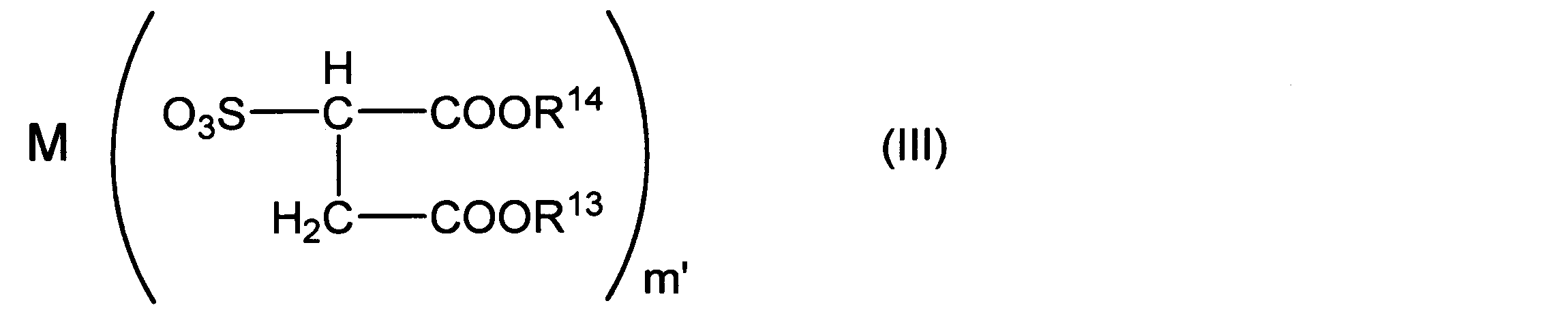
(式(III)中、Mは、水素原子、有機遊離基又は無機遊離基である。m’は、Mの価数である。R13及びR14は、それぞれ炭化水素基又は-(R15O)r-R16基である。R15は、それぞれ炭化水素基又はシリレン基であり、R16は水素原子、炭化水素基又はR17
3Si-基であり、rは1以上の整数である。R17は、それぞれ炭化水素基である。)
10.前記無電解めっき下地膜を、前記基材表面の一部に形成し、形成した無電解めっき下地膜上にのみ無電解めっき層を形成する1~9のいずれかに記載の無電解めっき物の製造方法。
11.前記還元剤水溶液との接触工程後、前記無電解めっき層形成工程前に、前記無電解めっき下地膜に無電解めっき液用触媒金属を担持させる担持工程を含む1~10のいずれかに記載の無電解めっき物の製造方法。
12.前記無電解めっき液用触媒金属がパラジウムである11に記載の無電解めっき物の製造方法。
13.前記担持工程を、前記無電解めっき下地膜にパラジウムイオンを含む溶液を接触させて行う11又は12に記載の無電解めっき物の製造方法。
14.前記パラジウムイオンを含む溶液が塩化パラジウム溶液である13に記載の無電解めっき物の製造方法。
15.前記無電解めっき層の形成を、前記還元剤水溶液との接触後の無電解めっき下地膜に無電解めっき液を接触させて行う1~14のいずれかに記載の無電解めっき物の製造方法。
16.前記無電解めっき液が、銅、ニッケル、コバルト、パラジウム、銀、金、白金及びスズから選択される1以上の金属イオンを含む15に記載の無電解めっき物の製造方法。
1.導電性ポリマーを含む無電解めっき下地膜を基材上に形成する工程、
前記無電解めっき下地膜を、標準電極電位E0がE0=-1.00V~-0.10Vである酸性の還元剤水溶液に接触させる工程、及び
前記還元剤水溶液との接触後の無電解めっき下地膜上に無電解めっき層を形成する工程を含む、
無電解めっき物の製造方法。
2.前記還元剤水溶液のpHが6以下である1に記載の無電解めっき物の製造方法。
3.前記還元剤水溶液のpHが5以下である1又は2に記載の無電解めっき物の製造方法。
4.前記還元剤水溶液のpHが3以上である1~3のいずれかに記載の無電解めっき物の製造方法。
5.前記還元剤水溶液の標準電極電位E0がE0=-0.80V~-0.20Vである1~4のいずれかに記載の無電解めっき物の製造方法。
6.前記還元剤水溶液が亜硫酸水素ナトリウム水溶液である1~5のいずれかに記載の無電解めっき物の製造方法。
7.導電性ポリマーを含む無電解めっき下地膜を基材上に形成する工程、
前記無電解めっき下地膜を、2wt%以上20wt%以下の還元剤水溶液である亜硫酸水素ナトリウム水溶液に接触させる工程、及び
前記還元剤水溶液との接触後の無電解めっき下地膜上に無電解めっき層を形成する工程を含む、
無電解めっき物の製造方法。
8.前記導電性ポリマーが置換又は無置換のポリアニリンがドーパントによってドープされたポリアニリン複合体である1~7のいずれかに記載の無電解めっき物の製造方法。
9.前記ドーパントが下記式(III)で表される8に記載の無電解めっき物の製造方法。
10.前記無電解めっき下地膜を、前記基材表面の一部に形成し、形成した無電解めっき下地膜上にのみ無電解めっき層を形成する1~9のいずれかに記載の無電解めっき物の製造方法。
11.前記還元剤水溶液との接触工程後、前記無電解めっき層形成工程前に、前記無電解めっき下地膜に無電解めっき液用触媒金属を担持させる担持工程を含む1~10のいずれかに記載の無電解めっき物の製造方法。
12.前記無電解めっき液用触媒金属がパラジウムである11に記載の無電解めっき物の製造方法。
13.前記担持工程を、前記無電解めっき下地膜にパラジウムイオンを含む溶液を接触させて行う11又は12に記載の無電解めっき物の製造方法。
14.前記パラジウムイオンを含む溶液が塩化パラジウム溶液である13に記載の無電解めっき物の製造方法。
15.前記無電解めっき層の形成を、前記還元剤水溶液との接触後の無電解めっき下地膜に無電解めっき液を接触させて行う1~14のいずれかに記載の無電解めっき物の製造方法。
16.前記無電解めっき液が、銅、ニッケル、コバルト、パラジウム、銀、金、白金及びスズから選択される1以上の金属イオンを含む15に記載の無電解めっき物の製造方法。
本発明によれば、導電性高分子を用いた無電解めっき下地膜部分に選択的かつ安定的に均一なめっき皮膜を形成できる、無電解めっき物の製造方法が提供できる。
[1]無電解めっき下地膜形成用組成物、それから得られる薄膜、めっき積層体、無電解めっき下地膜の製造方法及び無電解めっき積層体の製造方法
本発明の無電解めっき下地膜形成用組成物は、導電性ポリマー及びウレタン樹脂を含む。
無電解めっきとは、電気分解を行わず、還元剤を用いる、自己触媒作用を有する金属のめっき方法であり、例えば無電解銅めっきの場合、溶液中の銅イオンを、ホルムアルデヒド等の還元剤を用いて還元して金属銅皮膜を析出させ、析出した金属銅が自己触媒となってさらに銅イオンを金属化し、析出させる化学的プロセスである。
本発明の組成物は無電解めっき層の下地層の形成に用いる。
本発明の無電解めっき下地膜形成用組成物は、導電性ポリマー及びウレタン樹脂を含む。
無電解めっきとは、電気分解を行わず、還元剤を用いる、自己触媒作用を有する金属のめっき方法であり、例えば無電解銅めっきの場合、溶液中の銅イオンを、ホルムアルデヒド等の還元剤を用いて還元して金属銅皮膜を析出させ、析出した金属銅が自己触媒となってさらに銅イオンを金属化し、析出させる化学的プロセスである。
本発明の組成物は無電解めっき層の下地層の形成に用いる。
本発明の組成物は、密着性を向上させるバインダーとしてウレタン樹脂を混合することで、PCやPET等の各種基材との密着性が十分となり、かつめっき層との密着性にも優れるため、密着性良好なめっき積層体とすることができる。
[導電性ポリマー]
導電性ポリマーとしては、π共役ポリマーがドーパントによってドープされているπ共役ポリマー複合体が挙げられ、具体的には、置換又は無置換のポリアニリンがドーパントによってドープされているポリアニリン複合体、置換又は無置換のポリピロールがドーパントによってドープされているポリピロール複合体、並びに置換又は無置換のポリチオフェンがドーパントによってドープされているポリチオフェン複合体が挙げられ、置換又は無置換のポリアニリンがドーパントによってドープされているポリアニリン複合体が好ましい。
導電性ポリマーとしては、π共役ポリマーがドーパントによってドープされているπ共役ポリマー複合体が挙げられ、具体的には、置換又は無置換のポリアニリンがドーパントによってドープされているポリアニリン複合体、置換又は無置換のポリピロールがドーパントによってドープされているポリピロール複合体、並びに置換又は無置換のポリチオフェンがドーパントによってドープされているポリチオフェン複合体が挙げられ、置換又は無置換のポリアニリンがドーパントによってドープされているポリアニリン複合体が好ましい。
ポリアニリンの重量平均分子量(以下、分子量という)は、好ましくは20,000以上である。分子量が20,000未満であると、組成物から得られる導電性物品の強度や延伸性が低下する恐れがある。分子量は、好ましくは20,000~500,000であり、より好ましくは20,000~300,000であり、さらに好ましくは20,000~200,000である。分子量は、例えば50,000~200,000、53,000~200,000である。ここで、上記の重量平均分子量はポリアニリン複合体の分子量ではなく、ポリアニリンの分子量である。
多分散度(即ち、「重量平均分子量」/「数平均分子量」)は、好ましくは1.5以上10.0以下である。導電率の観点からは多分散度は小さい(即ち、分子量分布は狭い)方が好ましいが、溶剤への溶解性や成形性の観点では、多分散度が大きい(即ち、分子量分布が広い)方が好ましい場合もある。
重量平均分子量、数平均分子量及び多分散度は、ゲルパーミェションクロマトグラフィ(GPC)によりポリスチレン換算で測定する。
重量平均分子量、数平均分子量及び多分散度は、ゲルパーミェションクロマトグラフィ(GPC)によりポリスチレン換算で測定する。
置換ポリアニリンの置換基としては、例えばメチル基、エチル基、ヘキシル基、オクチル基等の直鎖又は分岐の炭化水素基;メトキシ基、エトキシ基等のアルコキシ基;フェノキシ基等のアリールオキシ基;トリフルオロメチル基(-CF3基)等のハロゲン化炭化水素基が挙げられる。
ポリアニリンは、汎用性及び経済性の観点から無置換のポリアニリンが好ましい。
ポリアニリンは、汎用性及び経済性の観点から無置換のポリアニリンが好ましい。
置換又は無置換のポリアニリンは、好ましくは塩素原子を含まない酸の存在下で重合して得られるポリアニリンである。塩素原子を含まない酸とは、例えば1族~16族及び18族に属する原子からなる酸である。具体的には、リン酸が挙げられる。塩素原子を含まない酸の存在下で重合して得られるポリアニリンとして、リン酸の存在下で重合して得られるポリアニリンが挙げられる。
塩素原子を含まない酸の存在下で得られたポリアニリンは、ポリアニリン複合体の塩素含有量をより低くすることができる。
塩素原子を含まない酸の存在下で得られたポリアニリンは、ポリアニリン複合体の塩素含有量をより低くすることができる。
ポリアニリン複合体の塩素含有量は、好ましくは0.6重量%以下であり、より好ましくは0.1重量%以下であり、さらに好ましくは0.04重量%以下であり、最も好ましくは0.0001重量%以下である。
ポリアニリン複合体の塩素含有量が0.6重量%超の場合、ポリアニリン複合体と接触する金属部分が腐食するおそれがある。
上記塩素含有量は、燃焼-イオンクロマト法によって測定する。
ポリアニリン複合体の塩素含有量が0.6重量%超の場合、ポリアニリン複合体と接触する金属部分が腐食するおそれがある。
上記塩素含有量は、燃焼-イオンクロマト法によって測定する。
ポリアニリン複合体のドーパントとしては、例えばブレンステッド酸又はブレンステッド酸の塩から生じるブレンステッド酸イオンが挙げられ、好ましくは有機酸又は有機酸の塩から生じる有機酸イオンであり、さらに好ましくは下記式(I)で示される化合物(プロトン供与体)から生じる有機酸イオンである。
尚、本発明において、ドーパントが特定の酸であると表現する場合、及びドーパントが特定の塩であると表現する場合があるが、いずれも特定の酸又は特定の塩から生じる特定の酸イオンが、上述したπ共役ポリマーにドープするものとする。
尚、本発明において、ドーパントが特定の酸であると表現する場合、及びドーパントが特定の塩であると表現する場合があるが、いずれも特定の酸又は特定の塩から生じる特定の酸イオンが、上述したπ共役ポリマーにドープするものとする。
M(XARn)m (I)
式(I)のMは、水素原子、有機遊離基又は無機遊離基である。
上記有機遊離基としては、例えば、ピリジニウム基、イミダゾリウム基、アニリニウム基が挙げられる。また、上記無機遊離基としては、例えば、リチウム、ナトリウム、カリウム、セシウム、アンモニウム、カルシウム、マグネシウム、鉄のイオンが挙げられる。
式(I)のXは、アニオン基であり、例えば-SO3 -基、-PO3 2-基、-PO4(OH)-基、-OPO3 2-基、-OPO2(OH)-基、-COO-基が挙げられ、好ましくは-SO3 -基である。
式(I)のMは、水素原子、有機遊離基又は無機遊離基である。
上記有機遊離基としては、例えば、ピリジニウム基、イミダゾリウム基、アニリニウム基が挙げられる。また、上記無機遊離基としては、例えば、リチウム、ナトリウム、カリウム、セシウム、アンモニウム、カルシウム、マグネシウム、鉄のイオンが挙げられる。
式(I)のXは、アニオン基であり、例えば-SO3 -基、-PO3 2-基、-PO4(OH)-基、-OPO3 2-基、-OPO2(OH)-基、-COO-基が挙げられ、好ましくは-SO3 -基である。
式(I)のAは、置換又は無置換の炭化水素基である。
上記炭化水素基は、鎖状もしくは環状の飽和脂肪族炭化水素基、鎖状もしくは環状の不飽和脂肪族炭化水素基、又は芳香族炭化水素基である。
上記炭化水素基は、鎖状もしくは環状の飽和脂肪族炭化水素基、鎖状もしくは環状の不飽和脂肪族炭化水素基、又は芳香族炭化水素基である。
鎖状の飽和脂肪族炭化水素基としては、直鎖もしくは分岐状のアルキル基が挙げられる。
環状の飽和脂肪族炭化水素基としては、シクロペンチル基、シクロヘキシル基、シクロヘプチル基、シクロオクチル基等のシクロアルキル基が挙げられる。環状の飽和脂肪族炭化水素基は、複数の環状の飽和脂肪族炭化水素基が縮合していてもよい。例えば、ノルボルニル基、アダマンチル基、縮合したアダマンチル基が挙げられる。
環状の飽和脂肪族炭化水素基としては、シクロペンチル基、シクロヘキシル基、シクロヘプチル基、シクロオクチル基等のシクロアルキル基が挙げられる。環状の飽和脂肪族炭化水素基は、複数の環状の飽和脂肪族炭化水素基が縮合していてもよい。例えば、ノルボルニル基、アダマンチル基、縮合したアダマンチル基が挙げられる。
芳香族炭化水素基としては、フェニル基、ナフチル基、アントラセニル基が挙げられる。鎖状の不飽和脂肪族炭化水素基としては、直鎖もしくは分岐状のアルケニル基が挙げられる。
ここで、Aが置換の炭化水素基である場合の置換基は、アルキル基、シクロアルキル基、ビニル基、アリル基、アリール基、アルコキシ基、ハロゲン基、ヒドロキシ基、アミノ基、イミノ基、ニトロ基、シリル基又はエステル基である。
式(I)のRは、Aと結合しており、それぞれ、-H、-R1、-OR1、-COR1、-COOR1、-(C=O)-(COR1)、又は-(C=O)-(COOR1)で表わされる置換基であり、R1は、置換基を含んでもよい炭化水素基、シリル基、アルキルシリル基、-(R2O)x-R3基、又は-(OSiR3
2)x-OR3である。R2はそれぞれアルキレン基、R3はそれぞれ炭化水素基であり、xは1以上の整数である。
R1の炭化水素基としては、メチル基、エチル基、直鎖もしくは分岐のブチル基、ペンチル基、ヘキシル基、ヘプチル基、オクチル基、ノニル基、デシル基、ドデシル基、ペンタデシル基、エイコサニル基等が挙げられる。また、上記炭化水素基の置換基は、アルキル基、シクロアルキル基、ビニル基、アリル基、アリール基、アルコキシ基、ハロゲン基、ヒドロキシ基、アミノ基、イミノ基、ニトロ基又はエステル基である。R3の炭化水素基もR1と同様である。
R2のアルキレン基としては、例えばメチレン基、エチレン基、プロピレン基等が挙げられる。
式(I)のnは1以上の整数であり、式(I)のmは、Mの価数/Xの価数である。
式(I)のnは1以上の整数であり、式(I)のmは、Mの価数/Xの価数である。
式(I)で示される化合物としては、ジアルキルベンゼンスルフォン酸、ジアルキルナフタレンスルフォン酸、又はエステル結合を2以上含有する化合物が好ましい。
上記エステル結合を2以上含有する化合物は、スルホフタール酸エステル、又は下記式(II)で表される化合物がより好ましい。

式(II)中、M及びXは、式(I)と同様である。Xは、-SO3
-基が好ましい。
R4、R5及びR6は、それぞれ水素原子、炭化水素基又はR9 3Si-基である。ここで、3つのR9はそれぞれ炭化水素基である。
R4、R5及びR6が炭化水素基である場合の炭化水素基としては、炭素数1~24の直鎖もしくは分岐状のアルキル基、アリール基、アルキルアリール基等が挙げられる。
R9の炭化水素基としては、R4、R5及びR6の場合と同様である。
上記エステル結合を2以上含有する化合物は、スルホフタール酸エステル、又は下記式(II)で表される化合物がより好ましい。
R4、R5及びR6は、それぞれ水素原子、炭化水素基又はR9 3Si-基である。ここで、3つのR9はそれぞれ炭化水素基である。
R4、R5及びR6が炭化水素基である場合の炭化水素基としては、炭素数1~24の直鎖もしくは分岐状のアルキル基、アリール基、アルキルアリール基等が挙げられる。
R9の炭化水素基としては、R4、R5及びR6の場合と同様である。
式(II)のR7及びR8は、それぞれ、炭化水素基又は-(R10O)q-R11基である。R10は炭化水素基又はシリレン基であり、R11は水素原子、炭化水素基又はR12
3Si-であり、qは1以上の整数である。3つのR12は、それぞれ炭化水素基である。
R7及びR8が炭化水素基である場合の炭化水素基としては、炭素数1~24、好ましくは炭素数4以上の直鎖もしくは分岐状のアルキル基、アリール基、アルキルアリール基等が挙げられ、R7及びR8が炭化水素基である場合の炭化水素基の具体例としては、例えば、直鎖又は分岐状のブチル基、ペンチル基、ヘキシル基、オクチル基、デシル基等が挙げられる。
R7及びR8における、R10が炭化水素基である場合の炭化水素基としては、例えば炭素数1~24の直鎖もしくは分岐状のアルキレン基、アリーレン基、アルキルアリーレン基、アリールアルキレン基である。また、R7及びR8における、R11及びR12が炭化水素基である場合の炭化水素基としては、R4、R5及びR6の場合と同様であり、qは、1~10であることが好ましい。
R7及びR8が-(R10O)q-R11基である場合の式(II)で表わされる化合物の具体例としては、下記式で表わされる2つの化合物である。
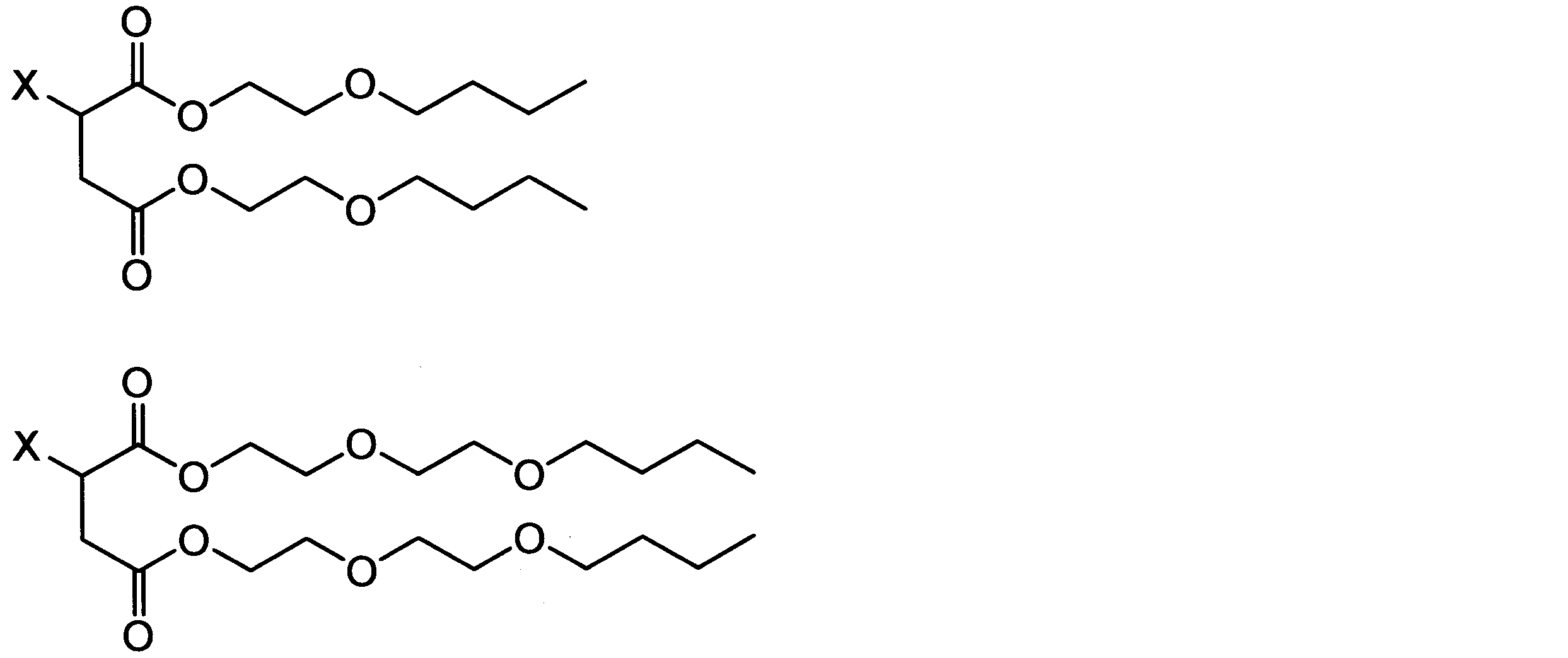
(式中、Xは式(I)と同様である。)
上記式(II)で表わされる化合物は、下記式(III)で示されるスルホコハク酸誘導体であることがさらに好ましい。

式(III)中、Mは、式(I)と同様である。m’は、Mの価数である。
R13及びR14は、それぞれ、炭化水素基又は-(R15O)r-R16基である。R15はそれぞれ炭化水素基又はシリレン基であり、R16は水素原子、炭化水素基又はR17 3Si-基であり、rは1以上の整数である。3つのR17はそれぞれ炭化水素基である。
R13及びR14は、それぞれ、炭化水素基又は-(R15O)r-R16基である。R15はそれぞれ炭化水素基又はシリレン基であり、R16は水素原子、炭化水素基又はR17 3Si-基であり、rは1以上の整数である。3つのR17はそれぞれ炭化水素基である。
R13及びR14が炭化水素基である場合の炭化水素基としては、R7及びR8と同様である。
R13及びR14において、R15が炭化水素基である場合の炭化水素基としては、上記R10と同様である。また、R13及びR14において、R16及びR17が炭化水素基である場合の炭化水素基としては、上記R4、R5及びR6と同様である。
rは、1~10であることが好ましい。
R13及びR14において、R15が炭化水素基である場合の炭化水素基としては、上記R10と同様である。また、R13及びR14において、R16及びR17が炭化水素基である場合の炭化水素基としては、上記R4、R5及びR6と同様である。
rは、1~10であることが好ましい。
R13及びR14が-(R15O)r-R16基である場合の具体例としては、R7及びR8における-(R10O)q-R11と同様である。
R13及びR14の炭化水素基としては、R7及びR8と同様であり、ブチル基、ヘキシル基、2-エチルヘキシル基、デシル基が好ましい。
R13及びR14の炭化水素基としては、R7及びR8と同様であり、ブチル基、ヘキシル基、2-エチルヘキシル基、デシル基が好ましい。
上記ドーパントはその構造を変えることにより、ポリアニリン複合体の導電性や、溶剤への溶解性をコントロールできることが知られている(特許第3384566号)。本発明においては、用途毎の要求特性によって最適なドーパントを選択できる。本発明において、式(I)で示される化合物としては、ジ-2-エチルヘキシルスルホコハク酸、ジ-2-エチルヘキシルスルホコハク酸ナトリウム(エーロゾルOT)が好ましい。本発明のドーパントとしては、ジ-2-エチルヘキシルスルホコハク酸イオンが好ましい。
ポリアニリン複合体のドーパントが、置換又は無置換のポリアニリンにドープしていることは、紫外・可視・近赤外分光法やX線光電子分光法によって確認することができ、当該ドーパントは、ポリアニリンにキャリアを発生させるに十分な酸性を有していれば、特に化学構造上の制限なく使用できる。
ポリアニリンに対するドーパントのドープ率は、好ましくは0.35以上0.65以下であり、より好ましくは0.42以上0.60以下であり、さらに好ましくは0.43以上0.57以下であり、特に好ましくは0.44以上0.55以下である。ドープ率が0.35未満である場合、ポリアニリン複合体の有機溶剤への溶解性が高くならないおそれがある。
尚、ドープ率は(ポリアニリンにドープしているドーパントのモル数)/(ポリアニリンのモノマーユニットのモル数)で定義される。例えば無置換ポリアニリンとドーパントを含むポリアニリン複合体のドープ率が0.5であることは、ポリアニリンのモノマーユニット分子2個に対し、ドーパントが1個ドープしていることを意味する。
尚、ドープ率は(ポリアニリンにドープしているドーパントのモル数)/(ポリアニリンのモノマーユニットのモル数)で定義される。例えば無置換ポリアニリンとドーパントを含むポリアニリン複合体のドープ率が0.5であることは、ポリアニリンのモノマーユニット分子2個に対し、ドーパントが1個ドープしていることを意味する。
尚、ドープ率は、ポリアニリン複合体中のドーパントとポリアニリンのモノマーユニットのモル数が測定できれば算出可能である。例えば、ドーパントが有機スルホン酸の場合、ドーパント由来の硫黄原子のモル数と、ポリアニリンのモノマーユニット由来の窒素原子のモル数を、有機元素分析法により定量し、これらの値の比を取ることでドープ率を算出できる。但し、ドープ率の算出方法は、当該手段に限定されない。
ポリアニリン複合体は、無置換ポリアニリンとドーパントであるスルホン酸イオンとを含み、下記式(5)を満たすことが好ましい。
0.42≦S5/N5≦0.60 (5)
(式中、S5はポリアニリン複合体に含まれる硫黄原子のモル数の合計であり、N5はポリアニリン複合体に含まれる窒素原子のモル数の合計である。)
尚、上記窒素原子及び硫黄原子のモル数は、例えば有機元素分析法により測定した値である。
0.42≦S5/N5≦0.60 (5)
(式中、S5はポリアニリン複合体に含まれる硫黄原子のモル数の合計であり、N5はポリアニリン複合体に含まれる窒素原子のモル数の合計である。)
尚、上記窒素原子及び硫黄原子のモル数は、例えば有機元素分析法により測定した値である。
ポリアニリン複合体は、さらにリンを含んでも含まなくてもよい。
ポリアニリン複合体がリンを含む場合、リンの含有量は例えば10重量ppm以上5000重量ppm以下である。またリンの含有量は、例えば2000重量ppm以下、500重量ppm以下、250重量ppm以下である。
上記リンの含有量は、ICP発光分光分析法で測定することができる。
また、ポリアニリン複合体は、不純物として第12族元素(例えば亜鉛)を含まないことが好ましい。
ポリアニリン複合体がリンを含む場合、リンの含有量は例えば10重量ppm以上5000重量ppm以下である。またリンの含有量は、例えば2000重量ppm以下、500重量ppm以下、250重量ppm以下である。
上記リンの含有量は、ICP発光分光分析法で測定することができる。
また、ポリアニリン複合体は、不純物として第12族元素(例えば亜鉛)を含まないことが好ましい。
ポリアニリン複合体は、周知の製造方法で製造することができる。例えば、プロトン供与体、リン酸、及びプロトン供与体とは異なる乳化剤を含み、2つの液相を有する溶液中で、置換又は無置換のアニリンを化学酸化重合することにより製造できる。また、置換又は無置換のアニリン、プロトン供与体、リン酸、及びプロトン供与体とは異なる乳化剤を含み、2つの液相を有する溶液中に、酸化重合剤を加えることにより製造できる。
尚、乳化剤は、後述する転相を防ぐ役割を担っていると考えられる。プロトン供与体及びリン酸を含み2つの液相を有する溶液中で、置換又は無置換のアニリンを化学酸化重合してポリアニリン複合体を製造すると、リン酸ではなく塩酸を用いていた場合に比べて、低分子量成分が増えてしまう。ここでリン酸を用いた際の重合中の様子から、上記2つの液相は重合中に転相を起こしていると考えられる。そして、この転相が低分子量成分を増やす理由と考えられる。この転相という現象は、連続相であった液相が分散相へ、分散相であった他方の液相が連続相へ変化する現象である。
尚、乳化剤は、後述する転相を防ぐ役割を担っていると考えられる。プロトン供与体及びリン酸を含み2つの液相を有する溶液中で、置換又は無置換のアニリンを化学酸化重合してポリアニリン複合体を製造すると、リン酸ではなく塩酸を用いていた場合に比べて、低分子量成分が増えてしまう。ここでリン酸を用いた際の重合中の様子から、上記2つの液相は重合中に転相を起こしていると考えられる。そして、この転相が低分子量成分を増やす理由と考えられる。この転相という現象は、連続相であった液相が分散相へ、分散相であった他方の液相が連続相へ変化する現象である。
ここで「2つの液相を有する溶液」とは、溶液中に相溶しない2つの液相が存在する状態を意味する。例えば、溶液中に「高極性溶媒の相」と「低極性溶媒の相」が存在する状態、を意味する。
また、「2つの液相を有する溶液」は、片方の液相が連続相であり、他方の液相が分散相である状態も含む。例えば「高極性溶媒の相」が連続相であり「低極性溶媒の相」が分散相である状態、及び「低極性溶媒の相」が連続相であり「高極性溶媒の相」が分散相である状態が含まれる。
上記ポリアニリン複合体の製造方法に用いる高極性溶媒としては、水が好ましく、低極性溶媒としては、例えばトルエン、キシレン等の芳香族炭化水素が好ましい。
また、「2つの液相を有する溶液」は、片方の液相が連続相であり、他方の液相が分散相である状態も含む。例えば「高極性溶媒の相」が連続相であり「低極性溶媒の相」が分散相である状態、及び「低極性溶媒の相」が連続相であり「高極性溶媒の相」が分散相である状態が含まれる。
上記ポリアニリン複合体の製造方法に用いる高極性溶媒としては、水が好ましく、低極性溶媒としては、例えばトルエン、キシレン等の芳香族炭化水素が好ましい。
上記プロトン供与体は、好ましくは上記式(I)で表わされる化合物である。
プロトン供与体の使用量は、アニリン単量体1molに対して好ましくは0.1~0.5molであり、より好ましくは0.3~0.45molであり、さらに好ましくは0.35~0.4molである。
プロトン供与体の使用量が当該範囲より多い場合、重合終了後に例えば「高極性溶剤の相」と「低極性溶剤の相」を分離することができないおそれがある。
プロトン供与体の使用量は、アニリン単量体1molに対して好ましくは0.1~0.5molであり、より好ましくは0.3~0.45molであり、さらに好ましくは0.35~0.4molである。
プロトン供与体の使用量が当該範囲より多い場合、重合終了後に例えば「高極性溶剤の相」と「低極性溶剤の相」を分離することができないおそれがある。
上記乳化剤は、親水性部分がイオン性であるイオン性乳化剤、及び親水性部分が非イオン性である非イオン性乳化剤のどちらでも使用でき、また、1種又は2種以上の乳化剤を混合して使用してもよい。
イオン性乳化剤としては、カチオン性乳化剤、アニオン性乳化剤及び双性乳化剤が挙げられる。
アニオン性乳化剤(陰イオン乳化剤)の具体例としては、脂肪酸、不均化ロジン石けん、高級アルコールエステル、ポリオキシエチレンアルキルエーテルリン酸、アルケニルコハク酸、ザルコシネート、及びそれらの塩が挙げられる。
カチオン性乳化剤(陽イオン乳化剤)の具体例としては、アルキルジメチルベンジルアンモニウム塩、アルキルトリメチルアンモニウム塩が挙げられる。
双性乳化剤(両イオン乳化剤)の具体例としては、アルキルベタイン型、アルキルアミドベタイン型、アミノ酸型、アミンオキサイド型が挙げられる。
非イオン乳化剤の具体例としては、ポリオキシエチレンアルキルエーテル、ポリプロピレングリコールポリエチレングリコールエーテル、ポリオキシエチレングリセロールボレート脂肪酸エステル、ポリオキシエチレンソルビタン脂肪酸エステルが挙げられる。
アニオン性乳化剤(陰イオン乳化剤)の具体例としては、脂肪酸、不均化ロジン石けん、高級アルコールエステル、ポリオキシエチレンアルキルエーテルリン酸、アルケニルコハク酸、ザルコシネート、及びそれらの塩が挙げられる。
カチオン性乳化剤(陽イオン乳化剤)の具体例としては、アルキルジメチルベンジルアンモニウム塩、アルキルトリメチルアンモニウム塩が挙げられる。
双性乳化剤(両イオン乳化剤)の具体例としては、アルキルベタイン型、アルキルアミドベタイン型、アミノ酸型、アミンオキサイド型が挙げられる。
非イオン乳化剤の具体例としては、ポリオキシエチレンアルキルエーテル、ポリプロピレングリコールポリエチレングリコールエーテル、ポリオキシエチレングリセロールボレート脂肪酸エステル、ポリオキシエチレンソルビタン脂肪酸エステルが挙げられる。
上記乳化剤のうち、アニオン性乳化剤及び非イオン乳化剤が好ましい。
アニオン性乳化剤としては、リン酸エステル構造を有するアニオン性乳化剤がさらに好ましい。また、非イオン乳化剤としては、ポリオキシエチレンソルビタン脂肪酸エステル構造を有する非イオン乳化剤がさらに好ましい。
アニオン性乳化剤としては、リン酸エステル構造を有するアニオン性乳化剤がさらに好ましい。また、非イオン乳化剤としては、ポリオキシエチレンソルビタン脂肪酸エステル構造を有する非イオン乳化剤がさらに好ましい。
乳化剤の使用量は、アニリン単量体1molに対して好ましくは0.001~0.1molであり、より好ましくは0.002~0.02molであり、さらに好ましくは0.003~0.01molである。
乳化剤の使用量が当該範囲より多い場合、重合終了後に「高極性溶剤の相」と「低極性溶剤の相」を分離することができないおそれがある。
乳化剤の使用量が当該範囲より多い場合、重合終了後に「高極性溶剤の相」と「低極性溶剤の相」を分離することができないおそれがある。
リン酸の使用濃度は、高極性溶媒に対して0.3~6mol/Lであり、より好ましくは1~4mol/Lであり、さらに好ましくは1~2mol/Lである。
化学酸化重合に用いる酸化剤としては、過硫酸ナトリウム、過硫酸カリウム、過硫酸アンモニウムのような過硫酸塩、過酸化水素のような過酸化物、二クロム酸アンモニウム、過塩素酸アンモニウム、硫酸カリウム鉄(III)、三塩化鉄(III)、二酸化マンガン、ヨウ素酸、過マンガン酸カリウム、あるいはパラトルエンスルホン酸鉄等が使用でき、好ましくは過硫酸アンモニウム等の過硫酸塩である。
これら酸化剤は単独で使用しても、2種以上を併用してもよい。
これら酸化剤は単独で使用しても、2種以上を併用してもよい。
酸化剤の使用量は、アニリン単量体1molに対して好ましくは0.05~1.8molであり、より好ましくは0.8~1.6molであり、さらに好ましくは1.2~1.4molである。酸化剤の使用量を当該範囲とすることで、十分な重合度が得られる。また、アニリンが十分に重合しているので、分液回収が容易であり、また重合体の溶解性が低下するおそれもない。
重合温度は通常-5~60℃で、好ましくは-5~40℃である。また、重合温度は重合反応の途中に変えてもよい。重合温度が当該範囲であることで、副反応を回避することができる。
重合温度は通常-5~60℃で、好ましくは-5~40℃である。また、重合温度は重合反応の途中に変えてもよい。重合温度が当該範囲であることで、副反応を回避することができる。
ポリアニリン複合体は、具体的には以下の方法で製造することができる。
プロトン供与体及び乳化剤をトルエンに溶解した溶液を、窒素等の不活性雰囲気の気流下においたセパラブルフラスコに入れ、さらにこの溶液に、置換又は無置換のアニリンを加える。その後、不純物として塩素を含まないリン酸を溶液に添加し、溶液温度を冷却する。
プロトン供与体及び乳化剤をトルエンに溶解した溶液を、窒素等の不活性雰囲気の気流下においたセパラブルフラスコに入れ、さらにこの溶液に、置換又は無置換のアニリンを加える。その後、不純物として塩素を含まないリン酸を溶液に添加し、溶液温度を冷却する。
溶液内温を冷却した後、撹拌を行う。過硫酸アンモニウムをリン酸に溶解した溶液を、滴下ロートを用いて滴下し、反応させる。その後、溶液温度を上昇させ、反応を継続する。反応終了後、静置することで二相に分離した水相側を分液する。有機相側にトルエンを追加し、リン酸及びイオン交換水で洗浄を行うことでポリアニリン複合体(プロトネーションされたポリアニリン)トルエン溶液が得られる。
得られた複合体溶液に含まれる若干の不溶物を除去し、ポリアニリン複合体のトルエン溶液を回収する。この溶液をエバポレーターに移し、加温及び減圧することにより、揮発分を蒸発留去し、ポリアニリン複合体が得られる。
得られた複合体溶液に含まれる若干の不溶物を除去し、ポリアニリン複合体のトルエン溶液を回収する。この溶液をエバポレーターに移し、加温及び減圧することにより、揮発分を蒸発留去し、ポリアニリン複合体が得られる。
ポリピロールの分子量、分子量分布、置換ポリピロールの置換基は上記ポリアニリンと同様である。
ポリピロール複合体のドーパントとしては、特に制限はなく、一般的にピロール及び/又はピロール誘導体の重合体を含んでなる導電性ポリマーに好適に用いられるアクセプター性ドーパントを適宜使用できる。
代表的なものとしては、例えば、ポリスチレンスルホン酸、パラトルエンスルホン酸、メタンスルホン酸、トリフルオロメタンスルホン酸、アントラキノンスルホン酸、ベンゼンスルホン酸、ナフタレンスルホン酸、スルホサリチル酸、ドデシルベンゼンスルホン酸、アリルスルホン酸等のスルホン酸類、過塩素酸、塩素、臭素等のハロゲン類、ルイス酸、プロトン酸等がある。これらは、酸形態であってよいし、塩形態にあることもできる。モノマーに対する溶解性の観点から好ましいものは、過塩素酸テトラブチルアンモニウム、過塩素酸テトラエチルアンモニウム、テトラフルオロホウ酸テトラブチルアンモニウム、トリフルオロメタンスルホン酸テトラブチルアンモニウム、トリフルオロスルホンイミドテトラブチルアンモニウム、ドデシルベンゼンスルホン酸、パラトルエンスルホン酸等である。
代表的なものとしては、例えば、ポリスチレンスルホン酸、パラトルエンスルホン酸、メタンスルホン酸、トリフルオロメタンスルホン酸、アントラキノンスルホン酸、ベンゼンスルホン酸、ナフタレンスルホン酸、スルホサリチル酸、ドデシルベンゼンスルホン酸、アリルスルホン酸等のスルホン酸類、過塩素酸、塩素、臭素等のハロゲン類、ルイス酸、プロトン酸等がある。これらは、酸形態であってよいし、塩形態にあることもできる。モノマーに対する溶解性の観点から好ましいものは、過塩素酸テトラブチルアンモニウム、過塩素酸テトラエチルアンモニウム、テトラフルオロホウ酸テトラブチルアンモニウム、トリフルオロメタンスルホン酸テトラブチルアンモニウム、トリフルオロスルホンイミドテトラブチルアンモニウム、ドデシルベンゼンスルホン酸、パラトルエンスルホン酸等である。
ドーパントを使用する場合のドーパントの使用量は、ピロール重合体単位ユニット当たりドーパント0.01~0.3分子となる量が好ましい。0.01分子以下では、十分な導電性パスを形成するに必要なドーパント量としては不十分であり、高い導電性を得ることが難しい。一方、0.3分子以上加えてもドープ率は向上しないから、0.3分子以上のドーパントの添加は経済上好ましくない。ここでピロール重合体単位ユニットとは、ピロールモノマーが重合して得られるピロール重合体のモノマー1分子に対応する繰返し部分のことを指す。
ポリチオフェンの分子量、分子量分布、置換ポリチオフェンの置換基は上記ポリアニリンと同様である。置換ポリチオフェンとしては、ポリエチレンジオキシチオフェン(PEDOT)が好ましい。
ポリチオフェン複合体のドーパントとしては、アニオン系界面活性剤の有機酸イオン、無機酸イオンが挙げられる。アニオン系界面活性剤の有機酸イオンとしては、スルホン酸系イオン、エステル化された硫酸イオン等が挙げられる。無機酸イオンとしては、硫酸イオン、ハロゲンイオン、硝酸イオン、過塩素酸イオン、ヘキサシアノ鉄酸イオン、リン酸イオン、リンモリブデン酸イオン等が挙げられる。
[ウレタン樹脂]
ウレタン樹脂としては、例えば、ポリイソシアネートとポリオールを反応させて得られるもの等を用いることができる。
ウレタン樹脂としては、例えば、ポリイソシアネートとポリオールを反応させて得られるもの等を用いることができる。
ポリイソシアネートとしては、少なくとも2つ以上のイソシアネート基を有する化合物であれば、特に限定されず公知のものを使用することができる。
具体的には、例えば、TDI(トリレンジイソシアネート)系、MDI(ジフェニルメタンジイソシアネート)系、XDI(キシリレンジイソシアネート)系、NDI(ナフチレン1,5-ジイソシアネート)系、TMXDI(テトラメチレンキシリレンジイソシアネート)系等の芳香族系イソシアネート、IPDI(イソホロンジイソシアネート)系、H12MDI(水添MDI、ジシクロヘキシルメタンジイソシアネート)系、H6XDI(水添XDI)系等の脂環族系イソシアネート、HDI(ヘキサメチレンジイソシアネート)系、DDI(ダイマー酸ジイソシアネート)系、NBDI(ノルボルネン・ジイソシアネート)系等の脂肪族系イソシアネート等がある。これらは1種を単独で用いても2種以上を併用してもよい。
具体的には、例えば、TDI(トリレンジイソシアネート)系、MDI(ジフェニルメタンジイソシアネート)系、XDI(キシリレンジイソシアネート)系、NDI(ナフチレン1,5-ジイソシアネート)系、TMXDI(テトラメチレンキシリレンジイソシアネート)系等の芳香族系イソシアネート、IPDI(イソホロンジイソシアネート)系、H12MDI(水添MDI、ジシクロヘキシルメタンジイソシアネート)系、H6XDI(水添XDI)系等の脂環族系イソシアネート、HDI(ヘキサメチレンジイソシアネート)系、DDI(ダイマー酸ジイソシアネート)系、NBDI(ノルボルネン・ジイソシアネート)系等の脂肪族系イソシアネート等がある。これらは1種を単独で用いても2種以上を併用してもよい。
また、ポリオールとしては、ポリオキシエチレングリコール、ポリオキシプロピレングリコール、ポリオキシテトラメチレングリコール等のポリエーテルポリオール類、ポリエチレンアジペート、ポリエチレン-ブチレンアジペート、ポリカプロラクトン等のポリエステルポリオール類、アクリル系ポリオール、ポリカーボネート系ポリオール、ポリジメチルシロキサン-エチレンオキサイド付加物、ポリジメチルシロキサン-プロピレンオキサイド付加物、ひまし油等を挙げることができる。これらは1種を単独で用いても2種以上を併用してもよい。
ウレタン樹脂は柔らかく延伸性があるため、ポリアニリンと混合してもポリアニリンが有する延伸追随性を損ねることはない。
塗膜中のウレタン樹脂の含有量、即ち、組成物中の導電性ポリマー及びウレタン樹脂の合計に対するウレタン樹脂の割合は10wt%~90wt%が好ましく、より好ましくは20wt%~80wt%であり、さらに好ましくは30wt%~60wt%であり、最も好ましくは40wt%~60wt%である。
含有量が少なすぎると、基材への密着性が発現せず容易に剥離してしまうおそれがある。また、多すぎるとポリアニリンの割合が低下するため、めっきの析出性が悪化するおそれがある。
塗膜中のウレタン樹脂の含有量、即ち、組成物中の導電性ポリマー及びウレタン樹脂の合計に対するウレタン樹脂の割合は10wt%~90wt%が好ましく、より好ましくは20wt%~80wt%であり、さらに好ましくは30wt%~60wt%であり、最も好ましくは40wt%~60wt%である。
含有量が少なすぎると、基材への密着性が発現せず容易に剥離してしまうおそれがある。また、多すぎるとポリアニリンの割合が低下するため、めっきの析出性が悪化するおそれがある。
ウレタン樹脂としては、具体的に、ハイドランAP-20、AP-30F、AP-40F、WLS-213等のハイドランシリーズ(DIC社製)、ユーコートUX-150、UX-200、UX-310、UWS-145等のユーコートシリーズ(三洋化成社製)、アクリットWBR-2018、WBR-016U、WEM-3008等のアクリットシリーズ(大成ファインケミカル社製)、PTG-RSN(DICグラフィックス社製)等が挙げられる。
ウレタン樹脂は、通常、下記式で表される構造を有する。

式中、R及びXは、それぞれウレタン樹脂を合成する際のモノマーに由来する、置換もしくは無置換の2価の芳香族炭化水素基、置換もしくは無置換の2価の脂肪族炭化水素基、又は1以上の置換もしくは無置換の2価の芳香族炭化水素基と1以上の置換もしくは無置換の2価の脂肪族炭化水素基とを任意の順で結合した2価の基である。
2価の芳香族炭化水素基としては、環形成炭素数6~50の芳香族炭化水素基等が挙げられる。具体的には、フェニレン基、ナフチレン基等が挙げられる。
2価の脂肪族炭化水素基としては、炭素数6~50の直鎖状脂肪族炭化水素基、炭素数6~50の分岐状脂肪族炭化水素基等が挙げられる。具体的には、メチレン基、エチレン基、プロピレン基等が挙げられる。
1以上の2価の芳香族炭化水素基と1以上の2価の脂肪族炭化水素基とを任意の順で結合した2価の基としては、フェニレン基とメチレン基が結合した基、ナフチレン基とエチレン基が結合した基等が挙げられる。
置換基を有する場合の置換基としては、ヒドロキシル基、カルボキシル基、ニトロ基、シアノ基、アミノ基等が挙げられる。
2価の芳香族炭化水素基としては、環形成炭素数6~50の芳香族炭化水素基等が挙げられる。具体的には、フェニレン基、ナフチレン基等が挙げられる。
2価の脂肪族炭化水素基としては、炭素数6~50の直鎖状脂肪族炭化水素基、炭素数6~50の分岐状脂肪族炭化水素基等が挙げられる。具体的には、メチレン基、エチレン基、プロピレン基等が挙げられる。
1以上の2価の芳香族炭化水素基と1以上の2価の脂肪族炭化水素基とを任意の順で結合した2価の基としては、フェニレン基とメチレン基が結合した基、ナフチレン基とエチレン基が結合した基等が挙げられる。
置換基を有する場合の置換基としては、ヒドロキシル基、カルボキシル基、ニトロ基、シアノ基、アミノ基等が挙げられる。
本発明の組成物は、本発明の効果を損ねない範囲において、導電性ポリマー、ウレタン樹脂及び溶媒以外の他の成分を含有していてもよいし、実質的に導電性ポリマー、ウレタン樹脂及び溶媒のみ、又は導電性ポリマー、ウレタン樹脂及び溶媒のみからなっていてもよい。
ここで、「実質的」とは、組成物の95重量%以上100重量%以下(好ましくは98重量%以上100重量%以下)が導電性ポリマー、ウレタン樹脂及び溶媒であることを意味する。
他の成分としては、後述するフェノール性化合物、耐熱安定化剤等が挙げられる。
ここで、「実質的」とは、組成物の95重量%以上100重量%以下(好ましくは98重量%以上100重量%以下)が導電性ポリマー、ウレタン樹脂及び溶媒であることを意味する。
他の成分としては、後述するフェノール性化合物、耐熱安定化剤等が挙げられる。
本発明の組成物は、導電性ポリマーとしてポリアニリン複合体を含む場合、さらにフェノール性化合物を含んでいてもよい。
フェノール性化合物は、フェノール性水酸基を有する化合物であれば特に限定されない。フェノール性水酸基を有する化合物とは、フェノール性水酸基を1つ有する化合物、フェノール性水酸基を複数有する化合物、及びフェノール性水酸基を1つ又は複数有する繰り返し単位から構成されるポリマー化合物である。
フェノール性化合物は、フェノール性水酸基を有する化合物であれば特に限定されない。フェノール性水酸基を有する化合物とは、フェノール性水酸基を1つ有する化合物、フェノール性水酸基を複数有する化合物、及びフェノール性水酸基を1つ又は複数有する繰り返し単位から構成されるポリマー化合物である。
フェノール性水酸基を1つ有する化合物は、好ましくは下記式(A)、(B)及び(C)で表わされる化合物である。

(式中、nは1~5の整数であり、好ましくは1~3であり、より好ましくは1である。
Rは、炭素数1~20のアルキル基、アルケニル基、シクロアルキル基、アリール基、アルキルアリール基又はアリールアルキル基である。)
Rは、炭素数1~20のアルキル基、アルケニル基、シクロアルキル基、アリール基、アルキルアリール基又はアリールアルキル基である。)
式(A)で表されるフェノール性化合物において、-ORの置換位置はフェノール性水酸基に対し、メタ位、又はパラ位であることが好ましい。-ORの置換位置をメタ位又はパラ位とすることにより、フェノール性水酸基の立体障害が低減され、組成物の導電性をより高めることができる。
式(A)で表わされるフェノール性化合物の具体例としては、メトキシフェノール(例えば4-メトキシフェノール)、エトキシフェノール、プロポキシフェノール、イソプロポキシフェノール、ブチルオキシフェノール、イソブチルオキシフェノール、ターシャルブチルオキシフェノールが挙げられる。

Rは、それぞれ炭素数1~20のアルキル基、アルケニル基、アルキルチオ基、炭素数3~10のシクロアルキル基、炭素数6~20のアリール基、アルキルアリール基又はアリールアルキル基である。)
式(B)で表わされるフェノール性化合物の具体例としては、ヒドロキシナフタレンが挙げられる。

Rは、それぞれ炭素数1~20のアルキル基、アルケニル基、アルキルチオ基、炭素数3~10のシクロアルキル基、炭素数6~20のアリール基、アルキルアリール基又はアリールアルキル基である。)
式(C)で表わされる化合物の具体例としては、o-,m-もしくはp-クレゾール、o-,m-もしくはp-エチルフェノール、o-,m-もしくはp-プロピルフェノール(例えば4-イソプロピルフェノール)、o-,m-もしくはp-ブチルフェノール、o-,m-もしくはp-ペンチルフェノール(例えば、4-tert-ペンチルフェノール)が挙げられる。
式(A)、(B)及び(C)のRについて、炭素数1~20のアルキル基としては、メチル、エチル、プロピル、イソプロピル、ブチル、イソブチル、ターシャルブチル等が挙げられる。
アルケニル基としては、上述したアルキル基の分子内に不飽和結合を有する基が挙げられる。
シクロアルキル基としては、シクロペンタン、シクロヘキサン等が挙げられる。
アリール基としては、フェニル、ナフチル等が挙げられる。
アルキルアリール基、及びアリールアルキル基としては、上述したアルキル基とアリール基を組み合わせて得られる基等が挙げられる。
アルケニル基としては、上述したアルキル基の分子内に不飽和結合を有する基が挙げられる。
シクロアルキル基としては、シクロペンタン、シクロヘキサン等が挙げられる。
アリール基としては、フェニル、ナフチル等が挙げられる。
アルキルアリール基、及びアリールアルキル基としては、上述したアルキル基とアリール基を組み合わせて得られる基等が挙げられる。
上記フェノール性水酸基を1つ有する化合物の例を示したが、置換フェノール類の具体例としてはフェノール、o-,m-もしくはp-クロロフェノール、サリチル酸、ヒドロキシ安息香酸が挙げられる。フェノール性水酸基を複数有する化合物の具体例としてはカテコール、レゾルシノール、下記式(D)で表される化合物が挙げられる。

(式中、Rは炭化水素基、ヘテロ原子含有炭化水素基、ハロゲン原子、カルボン酸基、アミノ基、SH基、スルホン酸基、又は水酸基であり、複数のRはそれぞれ互いに同一であっても異なっていてもよい。nは0~6の整数である。)
式(D)で表わされるフェノール性化合物は、互いに隣接しない2以上の水酸基を有することが好ましい。
また、式(D)で表されるフェノール性化合物の具体例としては、1,6-ナフタレンジオール、2,6-ナフタレンジオール、2,7-ナフタレンジオールが挙げられる。
また、式(D)で表されるフェノール性化合物の具体例としては、1,6-ナフタレンジオール、2,6-ナフタレンジオール、2,7-ナフタレンジオールが挙げられる。
フェノール性水酸基を1つ又は複数有する繰り返し単位から構成されるポリマー化合物の具体例としては、フェノール樹脂、ポリフェノール、ポリ(ヒドロキシスチレン)が挙げられる。
本発明の組成物が導電性ポリマーとしてポリアニリン複合体を含む場合、フェノール性化合物の含有量は、好ましくはポリアニリン複合体1gに対してフェノール性化合物のモル濃度が0.01[mmol/g]以上100[mol/g]以下、より好ましくは0.05[mmol/g]以上1[mol/g]以下、さらに好ましくは0.1[mmol/g]以上500[mmol/g]以下、特に好ましくは0.2[mmol/g]以上80[mmol/g]以下の範囲である。
フェノール性化合物の含有量が少なすぎる場合、電気伝導率の改善効果が得られないおそれがある。一方、フェノール性化合物の含有量が多すぎる場合、膜質が悪くなるおそれがある。また、揮発除去する際に多大な熱や時間等の労力を必要としコスト増となる。
フェノール性化合物の含有量が少なすぎる場合、電気伝導率の改善効果が得られないおそれがある。一方、フェノール性化合物の含有量が多すぎる場合、膜質が悪くなるおそれがある。また、揮発除去する際に多大な熱や時間等の労力を必要としコスト増となる。
本発明の組成物は、導電性ポリマーとしてポリアニリン複合体を含む場合、さらに耐熱安定化剤を含んでいてもよい。
耐熱安定化剤とは、酸性物質又は酸性物質の塩であり、酸性物質は有機酸(有機化合物の酸)、無機酸(無機化合物の酸)のいずれでもよい。また、導電性ポリマー層は、複数の耐熱安定化剤を含んでいてもよい。
耐熱安定化剤とは、酸性物質又は酸性物質の塩であり、酸性物質は有機酸(有機化合物の酸)、無機酸(無機化合物の酸)のいずれでもよい。また、導電性ポリマー層は、複数の耐熱安定化剤を含んでいてもよい。
本発明の組成物が耐熱安定化剤として酸性物質のみを含む場合は、当該酸性物質は、好ましくはポリアニリン複合体のプロトン供与体と異なる化合物であり、本発明の組成物が耐熱安定化剤として酸性物質の塩のみを含む場合には、当該酸性物質の塩は、好ましくはポリアニリン複合体のプロトン供与体と異なる化合物である。
また、本発明の組成物が耐熱安定化剤として酸性物質及び酸性物質の塩の両方を含む場合は、好ましくは当該酸性物質及び酸性物質の塩のうち、少なくとも1つはプロトン供与体と異なる化合物である。
また、本発明の組成物が耐熱安定化剤として酸性物質及び酸性物質の塩の両方を含む場合は、好ましくは当該酸性物質及び酸性物質の塩のうち、少なくとも1つはプロトン供与体と異なる化合物である。
本発明の組成物が、耐熱安定化剤として酸性物質のみを含む場合には、好ましくは当該酸性物質はフェノール性化合物とは異なり、本発明の組成物が、耐熱安定化剤として酸性物質の塩のみを含む場合には、好ましくは当該酸性物質の塩は、フェノール性化合物とは異なる。
また、本発明の組成物が、耐熱安定化剤として酸性物質及び酸性物質の塩の両方を含む場合には、好ましくは当該酸性物質及び酸性物質の塩のうち少なくとも1つは、フェノール性化合物と異なる。
また、本発明の組成物が、耐熱安定化剤として酸性物質及び酸性物質の塩の両方を含む場合には、好ましくは当該酸性物質及び酸性物質の塩のうち少なくとも1つは、フェノール性化合物と異なる。
耐熱安定化剤である酸性物質は、好ましくは有機酸であり、より好ましくはスルホン酸基、カルボキシ基、リン酸基、又はホスホン酸基を1以上有する有機酸であり、さらに好ましくは、スルホン酸基を1以上有する有機酸である。
上記スルホン酸基を1以上有する有機酸は、好ましくはスルホン酸基を1以上有する、環状、鎖状もしくは分岐のアルキルスルホン酸、置換もしくは無置換の芳香族スルホン酸、又はポリスルホン酸である。
上記アルキルスルホン酸としては、例えば、メタンスルホン酸、エタンスルホン酸、ジ2-エチルヘキシルスルホコハク酸が挙げられる。ここでのアルキル基は、好ましくは炭素数が1~18の直鎖又は分岐のアルキル基である。
上記アルキルスルホン酸としては、例えば、メタンスルホン酸、エタンスルホン酸、ジ2-エチルヘキシルスルホコハク酸が挙げられる。ここでのアルキル基は、好ましくは炭素数が1~18の直鎖又は分岐のアルキル基である。
上記芳香族スルホン酸としては、例えば、ベンゼン環を有するスルホン酸、ナフタレン骨格を有するスルホン酸、アントラセン骨格を有するスルホン酸、置換又は無置換のベンゼンスルホン酸、置換又は無置換のナフタレンスルホン酸及び置換又は無置換のアントラセンスルホン酸が挙げられ、好ましくはナフタレンスルホン酸である。具体例としては、ナフタレンスルホン酸、ドデシルベンゼンスルホン酸、アントラキノンスルホン酸が挙げられる。
置換基としては、例えば、アルキル基、アルコキシ基、ヒドロキシ基、ニトロ基、カルボキシ基、アシル基からなる群から選択される置換基であり、1以上置換していてもよい。
上記ポリスルホン酸は、高分子鎖の主鎖又は側鎖に複数のスルホン酸基が置換したスルホン酸である。例えば、ポリスチレンスルホン酸が挙げられる。
置換基としては、例えば、アルキル基、アルコキシ基、ヒドロキシ基、ニトロ基、カルボキシ基、アシル基からなる群から選択される置換基であり、1以上置換していてもよい。
上記ポリスルホン酸は、高分子鎖の主鎖又は側鎖に複数のスルホン酸基が置換したスルホン酸である。例えば、ポリスチレンスルホン酸が挙げられる。
上記カルボキシ基を1以上有する有機酸は、好ましくはカルボキシ基を1以上有する、環状、鎖状もしくは分岐のアルキルカルボン酸、置換もしくは無置換の芳香族カルボン酸、又はポリカルボン酸である。
上記アルキルカルボン酸としては、例えばウンデシレン酸、シクロヘキサンカルボン酸、2-エチルヘキサン酸が挙げられる。ここでアルキル基は好ましくは炭素数が1~18の直鎖又は分岐のアルキル基である。
上記置換もしくは無置換の芳香族カルボン酸としては、例えば、置換又は無置換のベンゼンカルボン酸及びナフタレンカルボン酸が挙げられる。ここで置換基は、例えば、スルホン酸基、アルキル基、アルコキシ基、ヒドロキシ基、ニトロ基、アシル基からなる群から選択される置換基であり、1以上置換していてもよい。具体例としては、サリチル酸、安息香酸、ナフトエ酸、トリメシン酸が挙げられる。
上記アルキルカルボン酸としては、例えばウンデシレン酸、シクロヘキサンカルボン酸、2-エチルヘキサン酸が挙げられる。ここでアルキル基は好ましくは炭素数が1~18の直鎖又は分岐のアルキル基である。
上記置換もしくは無置換の芳香族カルボン酸としては、例えば、置換又は無置換のベンゼンカルボン酸及びナフタレンカルボン酸が挙げられる。ここで置換基は、例えば、スルホン酸基、アルキル基、アルコキシ基、ヒドロキシ基、ニトロ基、アシル基からなる群から選択される置換基であり、1以上置換していてもよい。具体例としては、サリチル酸、安息香酸、ナフトエ酸、トリメシン酸が挙げられる。
上記リン酸基又はホスホン酸基を1以上有する有機酸は、好ましくはリン酸基又はホスホン酸基を1以上有する環状、鎖状もしくは分岐のアルキルリン酸もしくはアルキルホスホン酸;置換もしくは無置換の芳香族リン酸もしくは芳香族ホスホン酸;ポリリン酸もしくはポリホスホン酸である。
上記アルキルリン酸又はアルキルホスホン酸としては、例え、ドデシルリン酸、リン酸水素ビス(2-エチルヘキシル)が挙げられる。ここでアルキル基は好ましくは炭素数が1~18の直鎖又は分岐のアルキル基である。
上記芳香族リン酸及び芳香族ホスホン酸としては、置換又は無置換のベンゼンスルホン酸又はホスホン酸、及びナフタレンスルホン酸又はホスホン酸等が挙げられる。置換基としては、例えば、アルキル基、アルコキシ基、ヒドロキシ基、ニトロ基、カルボキシ基、アシル基からなる群から選択される置換基であり、1以上置換していてもよい。例えば、フェニルホスホン酸が挙げられる。
上記アルキルリン酸又はアルキルホスホン酸としては、例え、ドデシルリン酸、リン酸水素ビス(2-エチルヘキシル)が挙げられる。ここでアルキル基は好ましくは炭素数が1~18の直鎖又は分岐のアルキル基である。
上記芳香族リン酸及び芳香族ホスホン酸としては、置換又は無置換のベンゼンスルホン酸又はホスホン酸、及びナフタレンスルホン酸又はホスホン酸等が挙げられる。置換基としては、例えば、アルキル基、アルコキシ基、ヒドロキシ基、ニトロ基、カルボキシ基、アシル基からなる群から選択される置換基であり、1以上置換していてもよい。例えば、フェニルホスホン酸が挙げられる。
本発明の組成物が含む酸性物質の塩としては、上記酸性物質の塩が挙げられる。
本発明の組成物は、耐熱安定化剤である酸性物質及び/又は酸性物質の塩を2つ以上含んでもよい。具体的には、本発明の組成物は、異なる複数の酸性物質及び/又は異なる複数の酸性物質の塩を含んでいてもよい。
本発明の組成物は、耐熱安定化剤である酸性物質及び/又は酸性物質の塩を2つ以上含んでもよい。具体的には、本発明の組成物は、異なる複数の酸性物質及び/又は異なる複数の酸性物質の塩を含んでいてもよい。
ポリアニリン複合体のプロトン供与体がスルホン酸であり、本発明の組成物が耐熱安定化剤として酸性物質のみを含む場合には、当該酸性物質がプロトン供与体と同一又は異なるスルホン酸であることが好ましい。また、本発明の組成物が耐熱安定化剤として酸性物質の塩のみを含む場合には、その酸性物質の塩が、ポリアニリン複合体のプロトン供与体と同一又は異なるスルホン酸の塩であることが好ましい。
本発明の組成物が耐熱安定化剤として酸性物質及び前記酸性物質の塩を含む場合には、酸性物質及び酸性物質の塩のうち少なくとも1つがプロトン供与体と同一又は異なるスルホン酸又はスルホン酸の塩であることが好ましい。
本発明の組成物が耐熱安定化剤として酸性物質及び前記酸性物質の塩を含む場合には、酸性物質及び酸性物質の塩のうち少なくとも1つがプロトン供与体と同一又は異なるスルホン酸又はスルホン酸の塩であることが好ましい。
本発明の組成物が耐熱安定化剤としてスルホン酸のみを含む場合には、好ましくは式(12)を満たし、本発明の組成物が耐熱安定化剤としてスルホン酸の塩のみを含む場合には、好ましくは式(13)を満たし、本発明の組成物が耐熱安定化剤としてスルホン酸及びスルホン酸の塩を含む場合には、好ましくは式(14)を満たす。
0.01≦S2/N2≦0.5 (12)
0.01≦S3/N3≦0.5 (13)
0.01≦S4/N4≦0.5 (14)
(ここで、S2は本発明の組成物に含まれている全ての酸性物質の硫黄原子のモル数の合計であり、N2は本発明の組成物に含まれている全てのポリアニリン複合体の窒素原子のモル数の合計を意味し、S3は本発明の組成物に含まれている全ての酸性物質の塩の硫黄原子のモル数の合計であり、N3は本発明の組成物に含まれている全てのポリアニリン複合体の窒素原子のモル数の合計を意味し、S4は本発明の組成物に含まれている全ての酸性物質及び酸性物質の塩の硫黄原子のモル数の合計であり、N4は本発明の組成物に含まれている全てのポリアニリン複合体の窒素原子のモル数の合計を意味する。)
0.01≦S2/N2≦0.5 (12)
0.01≦S3/N3≦0.5 (13)
0.01≦S4/N4≦0.5 (14)
(ここで、S2は本発明の組成物に含まれている全ての酸性物質の硫黄原子のモル数の合計であり、N2は本発明の組成物に含まれている全てのポリアニリン複合体の窒素原子のモル数の合計を意味し、S3は本発明の組成物に含まれている全ての酸性物質の塩の硫黄原子のモル数の合計であり、N3は本発明の組成物に含まれている全てのポリアニリン複合体の窒素原子のモル数の合計を意味し、S4は本発明の組成物に含まれている全ての酸性物質及び酸性物質の塩の硫黄原子のモル数の合計であり、N4は本発明の組成物に含まれている全てのポリアニリン複合体の窒素原子のモル数の合計を意味する。)
本発明の組成物が上記式(12)、(13)又は(14)のいずれかを満たす場合、当該組成物は、好ましくはさらに下記式(11)を満たす。
0.36≦S1/N1≦1.15 (11)
(ここで、S1は本発明の組成物に含まれる硫黄原子のモル数であり、N1は本発明の組成物に含まれる窒素原子のモル数を意味する。)
0.36≦S1/N1≦1.15 (11)
(ここで、S1は本発明の組成物に含まれる硫黄原子のモル数であり、N1は本発明の組成物に含まれる窒素原子のモル数を意味する。)
本発明の組成物が酸性物質のみを含む場合、当該酸性物質の酸性度(pKa)が5.0以下であることが好ましい。尚、酸性度の下限は特に制限されないが、例えば、酸性度が-4.0以下の酸性物質を含む場合では、ポリアニリン複合体が劣化するおそれがある。
本発明の組成物が酸性物質の塩のみを含む場合、当該酸性物質の塩の酸性度が5.0以下であることが好ましい。酸性度の下限については、上記酸性物質と同様である。
本発明の組成物が酸性物質及び酸性物質の塩の両方を含む場合、当該酸性物質の酸性度が5.0以下及び酸性度が5.0以下の酸性物質の塩のうち、少なくとも1つを満たすことが好ましい。酸性度の下限については、上記と同様である。
本発明の組成物が酸性物質の塩のみを含む場合、当該酸性物質の塩の酸性度が5.0以下であることが好ましい。酸性度の下限については、上記酸性物質と同様である。
本発明の組成物が酸性物質及び酸性物質の塩の両方を含む場合、当該酸性物質の酸性度が5.0以下及び酸性度が5.0以下の酸性物質の塩のうち、少なくとも1つを満たすことが好ましい。酸性度の下限については、上記と同様である。
酸性度(pKa)は、計算化学法によって定義される。即ちA.Klamtらが開発した量子化学計算により分子表面の電荷密度を計算し、異種分子間の相互作用を活量係数として算出するJournal of Physical Chemistryの1995年、第99巻、p.2224に記載された方法を用いる。
具体的には、「TURBOMOLE Version 6.1」(COSMO logic社製)を用いて、基底関数にTZVPを用いて構造を最適化し、この構造を用いてCOSMO-RS法計算を「COSMO therm Version C2.1 Release 01.10」(COSMO logic社製)により行う。
ここで、「COSMO therm Version C2.1 Release 01.10」に25℃の水溶媒中との条件と、分子の化学式と、脱プロトンした分子の化学式と、を入力することで、pKaを算出することができる。
具体的には、「TURBOMOLE Version 6.1」(COSMO logic社製)を用いて、基底関数にTZVPを用いて構造を最適化し、この構造を用いてCOSMO-RS法計算を「COSMO therm Version C2.1 Release 01.10」(COSMO logic社製)により行う。
ここで、「COSMO therm Version C2.1 Release 01.10」に25℃の水溶媒中との条件と、分子の化学式と、脱プロトンした分子の化学式と、を入力することで、pKaを算出することができる。
本発明の組成物において、耐熱安定化剤の含有量は、好ましくはポリアニリン複合体100質量部に対して1~1000質量部であり、より好ましくは10~100質量部である。
溶剤は、有機溶剤でも水等の無機溶剤でもよく、また1種単独でも2種以上の混合溶媒でもよい。好ましくは有機溶剤である。
また、有機溶剤は、水溶性有機溶剤でも、実質的に水に混和しない有機溶剤(水不混和性有機溶剤)でもよい。
また、有機溶剤は、水溶性有機溶剤でも、実質的に水に混和しない有機溶剤(水不混和性有機溶剤)でもよい。
上記水溶性有機溶剤は、プロトン性極性溶媒でも非プロトン性極性溶媒でもよく、例えばイソプロパノール、1-ブタノール、2-ブタノール、2-ペンタノール、ベンジルアルコール等のアルコール類;アセトン等のケトン類、;テトラヒドロフラン、ジオキサン等のエーテル類;Nメチルピロリドン等の非プロトン性極性溶剤等が挙げられる。
上記水不混和性有機溶剤としては、例えばベンゼン、トルエン、キシレン、エチルベンゼン、テトラリン等の炭化水素系溶剤;塩化メチレン、クロロホルム、四塩化炭素、ジクロロエタン、テトラクロロエタン等の含ハロゲン系溶剤;酢酸エチル、酢酸イソブチル、酢酸n-ブチル等のエステル系溶剤;メチルイソブチルケトン、メチルエチルケトン、シクロペンタノン、シクロヘキサノン等のケトン類溶剤;シクロペンチルメチルエーテル等のエーテル類溶剤等が挙げられる。これらの中では、ドープされたポリアニリンの溶解性に優れる点でトルエン、キシレン、メチルイソブチルケトン(MIBK)、クロロホルム、トリクロロエタン及び酢酸エチルが好ましい。
溶剤として有機溶剤を用いる場合、水不混和性有機溶剤と水溶性有機溶剤を99~50:1~50(質量比)で混合した混合有機溶剤を用いることにより、保存時のゲル等の発生を防止でき、長期保存できることから好ましい。
上記混合有機溶剤の水不混和性有機溶剤としては、低極性有機溶剤が使用でき、当該低極性有機溶剤は、トルエンやクロロホルムが好ましい。また、混合有機溶剤の水溶性有機溶剤としては、高極性有機溶剤が使用でき、例えば、メタノール、エタノール、イソプロピルアルコール、2-メトキシエタノール、2-エトキシエタノール、ジアセトンアルコール、3-メトキシ-1-ブタノール、3-メチル-3-メトキシ-1-ブタノール、エチルカルビトール、ブチルカルビトール、アセトン、メチルエチルケトン、メチルイソブチルケトン、テトラヒドロフラン又はジエチルエーテルが好ましい。
上記混合有機溶剤の水不混和性有機溶剤としては、低極性有機溶剤が使用でき、当該低極性有機溶剤は、トルエンやクロロホルムが好ましい。また、混合有機溶剤の水溶性有機溶剤としては、高極性有機溶剤が使用でき、例えば、メタノール、エタノール、イソプロピルアルコール、2-メトキシエタノール、2-エトキシエタノール、ジアセトンアルコール、3-メトキシ-1-ブタノール、3-メチル-3-メトキシ-1-ブタノール、エチルカルビトール、ブチルカルビトール、アセトン、メチルエチルケトン、メチルイソブチルケトン、テトラヒドロフラン又はジエチルエーテルが好ましい。
溶剤中の導電性ポリマーの割合は、溶剤の種類によるが、通常、900g/kg以下であり、好ましくは0.01g/kg以上300g/kg以下であり、より好ましくは10g/kg以上300g/kg以下であり、さらに好ましくは30g/kg以上300g/kg以下の範囲である。
導電性ポリマーの含有量が多すぎると、溶液状態が保持できなくなり、成形体を成形する際の取り扱いが困難になり、成形体の均一性が損なわれ、ひいては成形体の電気特性や機械的強度、透明性の低下を生じるおそれがある。一方、導電性ポリマーの含有量が少なすぎると、後述する方法により成膜したとき、非常に薄い膜しか製造できず、均一な導電性膜の製造が難しくなるおそれがある。
導電性ポリマーの含有量が多すぎると、溶液状態が保持できなくなり、成形体を成形する際の取り扱いが困難になり、成形体の均一性が損なわれ、ひいては成形体の電気特性や機械的強度、透明性の低下を生じるおそれがある。一方、導電性ポリマーの含有量が少なすぎると、後述する方法により成膜したとき、非常に薄い膜しか製造できず、均一な導電性膜の製造が難しくなるおそれがある。
本発明の組成物は、さらに他の樹脂、無機材料、硬化剤、可塑剤、有機導電材料等の添加剤を含んでもよい。
他の樹脂としては、例えば、バインダー基材、可塑剤、マトリックス基材等が挙げられる。
他の樹脂としては、例えば、バインダー基材、可塑剤、マトリックス基材等が挙げられる。
他の樹脂の具体例としては、例えば、ポリエチレンやポリプロピレン等のポリオレフィン、塩素化ポリオレフィン、ポリスチレン、ポリエステル、ポリアミド、ポリアセタール、ポリエチレンテレフタレート、ポリカーボネート、ポリエチレングリコール、ポリエチレンオキサイド、ポリアクリル酸、ポリアクリル酸エステル、ポリメタクリル酸エステル、ポリビニルアルコールが挙げられる。
また上記樹脂の代わりに、また上記樹脂と共に、エポキシ樹脂、ウレタン樹脂、フェノール樹脂等の熱硬化性樹脂、もしくはこれら熱硬化性樹脂を形成し得る前駆体を含んでもよい。
無機材料は、例えば、強度、表面硬度、寸法安定性その他の機械的物性の向上、あるいは導電性等の電気特性を向上する目的で添加される。
無機材料の具体例としては、例えば、シリカ(二酸化ケイ素)、チタニア(二酸化チタン)、アルミナ(酸化アルミニウム)、Sn含有In2O3(ITO)、Zn含有In2O3、In2O3の共置換化合物(4価元素及び2価元素が3価のInに置換した酸化物)、Sb含有SnO2(ATO)、ZnO、Al含有ZnO(AZO)、Ga含有ZnO(GZO)等が挙げられる。
無機材料の具体例としては、例えば、シリカ(二酸化ケイ素)、チタニア(二酸化チタン)、アルミナ(酸化アルミニウム)、Sn含有In2O3(ITO)、Zn含有In2O3、In2O3の共置換化合物(4価元素及び2価元素が3価のInに置換した酸化物)、Sb含有SnO2(ATO)、ZnO、Al含有ZnO(AZO)、Ga含有ZnO(GZO)等が挙げられる。
硬化剤は、例えば、強度、表面硬度、寸法安定性その他の機械的物性の向上等の目的で添加される。硬化剤の具体例としては、例えば、フェノール樹脂等の熱硬化剤、アクリレート系モノマーと光重合性開始剤による光硬化剤が挙げられる。
可塑剤は、例えば、引張強度や曲げ強度等の機械的特性の向上等の目的で添加される。
可塑剤の具体例としては、例えば、フタル酸エステル類やリン酸エステル類が挙げられる。
有機導電材料としては、カーボンブラック、カーボンナノチューブのような炭素材料、あるいは、本発明で得られるポリアニリン以外の、導電性ポリマー等が挙げられる。
可塑剤の具体例としては、例えば、フタル酸エステル類やリン酸エステル類が挙げられる。
有機導電材料としては、カーボンブラック、カーボンナノチューブのような炭素材料、あるいは、本発明で得られるポリアニリン以外の、導電性ポリマー等が挙げられる。
[無電解めっき下地膜]
本発明の無電解めっき下地膜(層)は、上記の組成物から得られる。本発明の無電解めっき下地膜の形成方法は後述する通りである。
無電解めっき下地膜の乾燥膜厚は0.1μm以上が好ましく、より好ましくは0.2μm以上である。膜厚が0.1μm未満であると、基材とめっき膜の密着力が保持できないため、剥離しやすくなってしまう。また、Pd金属が担持されない領域が多くなる恐れがあり、無電解めっきされない領域が多くなる恐れがある。
乾燥膜厚の上限は特にないが、例えば100μm以下、10μm以下、5.0μm以下である。
本発明の無電解めっき下地膜(層)は、上記の組成物から得られる。本発明の無電解めっき下地膜の形成方法は後述する通りである。
無電解めっき下地膜の乾燥膜厚は0.1μm以上が好ましく、より好ましくは0.2μm以上である。膜厚が0.1μm未満であると、基材とめっき膜の密着力が保持できないため、剥離しやすくなってしまう。また、Pd金属が担持されない領域が多くなる恐れがあり、無電解めっきされない領域が多くなる恐れがある。
乾燥膜厚の上限は特にないが、例えば100μm以下、10μm以下、5.0μm以下である。
[無電解めっき下地膜の製造方法]
本発明の無電解めっき下地膜の製造方法は、本発明の無電解めっき下地膜形成用組成物を用いる。本製造方法は、本発明の組成物を用いていれば特に限定されず、例えば、基材の上に本発明の組成物をバーコート法により塗工し、乾燥する塗工方法が挙げられる。
本発明の無電解めっき下地膜の製造方法は、本発明の無電解めっき下地膜形成用組成物を用いる。本製造方法は、本発明の組成物を用いていれば特に限定されず、例えば、基材の上に本発明の組成物をバーコート法により塗工し、乾燥する塗工方法が挙げられる。
[めっき積層体]
本発明のめっき積層体は、金属を含む無電解めっき層と、導電性ポリマー及びウレタン樹脂を含む無電解めっき下地層と、基板層とを含み、無電解めっき層の一方の面と、無電解めっき下地層の一方の面が接している。
本発明のめっき積層体は、金属を含む無電解めっき層と、導電性ポリマー及びウレタン樹脂を含む無電解めっき下地層と、基板層とを含み、無電解めっき層の一方の面と、無電解めっき下地層の一方の面が接している。
図1は、本発明のめっき積層体の一実施形態の層構成を示す概略図である。
めっき積層体1は、基板10上に、無電解めっき下地層20及び無電解めっき層30をこの順に積層して含む。
本発明のめっき積層体は、後述する本発明のめっき積層体の製造方法により製造できる。
めっき積層体1は、基板10上に、無電解めっき下地層20及び無電解めっき層30をこの順に積層して含む。
本発明のめっき積層体は、後述する本発明のめっき積層体の製造方法により製造できる。
[基板]
基板は特に限定されず、金属、無機素材(セラミックス、ガラス等)、又は樹脂であってもよい。また、金属を樹脂で完全に覆った基板や、無機系素材と樹脂との複合材(例えば、FRP,ガラスエポキシ複合材)等であってもよい。樹脂の種類としては、ポリカーボネート樹脂、アクリル樹脂、ナイロン樹脂、ポリイミド樹脂、ポリエステル樹脂、スチレン樹脂、フェノール樹脂、PPS(ポリフェニレンサルファイド)樹脂等が挙げられる。
基板の具体例として、例えば易接着処理PET(東洋紡製A4300)が挙げられる。
基板は特に限定されず、金属、無機素材(セラミックス、ガラス等)、又は樹脂であってもよい。また、金属を樹脂で完全に覆った基板や、無機系素材と樹脂との複合材(例えば、FRP,ガラスエポキシ複合材)等であってもよい。樹脂の種類としては、ポリカーボネート樹脂、アクリル樹脂、ナイロン樹脂、ポリイミド樹脂、ポリエステル樹脂、スチレン樹脂、フェノール樹脂、PPS(ポリフェニレンサルファイド)樹脂等が挙げられる。
基板の具体例として、例えば易接着処理PET(東洋紡製A4300)が挙げられる。
[無電解めっき下地層]
無電解めっき下地層は、導電性ポリマー及びウレタン樹脂を含む。導電性ポリマー及びウレタン樹脂は上述した通りである。
無電解めっき下地層は、本発明の組成物を用いて製造することができる。また、形成方法は上述した通りである。
無電解めっき下地層は、導電性ポリマー及びウレタン樹脂を含む。導電性ポリマー及びウレタン樹脂は上述した通りである。
無電解めっき下地層は、本発明の組成物を用いて製造することができる。また、形成方法は上述した通りである。
[無電解めっき層]
無電解めっき層の金属種としては、銅、ニッケル、コバルト、パラジウム、銀、金、白金及びスズ等が挙げられる。また、これらの他にリン、ホウ素、鉄等の元素が含有されていてもよい。また、形成方法は後述する通りである。
無電解めっき層の金属種としては、銅、ニッケル、コバルト、パラジウム、銀、金、白金及びスズ等が挙げられる。また、これらの他にリン、ホウ素、鉄等の元素が含有されていてもよい。また、形成方法は後述する通りである。
[無電解めっき積層体の製造方法]
本発明の無電解めっき積層体の製造方法は、基板上に、本発明の無電解めっき下地膜形成用組成物を用いて無電解めっき下地膜を形成する工程、及び無電解めっき下地膜上に、金属を含む無電解めっき層を形成する工程を含む。
本発明の無電解めっき積層体の製造方法は、基板上に、本発明の無電解めっき下地膜形成用組成物を用いて無電解めっき下地膜を形成する工程、及び無電解めっき下地膜上に、金属を含む無電解めっき層を形成する工程を含む。
無電解めっき下地膜の形成は、上述した無電解めっき下地膜の製造方法により行うことができる。
下地膜を形成した後、無電解めっき層を形成する前に脱脂工程を行うことが好ましい。脱脂工程は、界面活性剤やアルコール等の溶剤でポリアニリン層表面を脱脂洗浄して濡れ性を改善する。
界面活性剤は、アニオン性、カチオン性又は非イオン性のものを適宜使用でき、カチオン性界面活性剤が好ましい。カチオン性界面活性剤を用いる場合は、例えばイオン交換水等で1~3%に希釈して用いる。
下地膜を形成した後、無電解めっき層を形成する前に脱脂工程を行うことが好ましい。脱脂工程は、界面活性剤やアルコール等の溶剤でポリアニリン層表面を脱脂洗浄して濡れ性を改善する。
界面活性剤は、アニオン性、カチオン性又は非イオン性のものを適宜使用でき、カチオン性界面活性剤が好ましい。カチオン性界面活性剤を用いる場合は、例えばイオン交換水等で1~3%に希釈して用いる。
上記無電解めっき下地膜を形成後、好ましくは脱脂工程後、通常、下地膜上に無電解めっきの触媒作用を担うPd金属(触媒金属)を担持させるために、Pd化合物溶液を接触させる。
Pd化合物溶液を接触させると、ポリアニリン複合体等の導電性ポリマーはPdイオンを吸着し、その還元作用により、PdイオンがPd金属に還元される。尚、還元されたPd、即ち金属状態のPdでなければ、無電解めっきにおける触媒作用を発現しない。
上記単位面積当たりのPd付着量(Pdイオン及びPd金属を含む)は1.7μg/cm2以上であることが好ましく、2.5μg/cm2以上であることがさらに好ましい。
Pd化合物溶液を接触させると、ポリアニリン複合体等の導電性ポリマーはPdイオンを吸着し、その還元作用により、PdイオンがPd金属に還元される。尚、還元されたPd、即ち金属状態のPdでなければ、無電解めっきにおける触媒作用を発現しない。
上記単位面積当たりのPd付着量(Pdイオン及びPd金属を含む)は1.7μg/cm2以上であることが好ましく、2.5μg/cm2以上であることがさらに好ましい。
Pd化合物としては、塩化パラジウムが好ましい。溶媒としては、塩酸が一般に用いられる。しかしながら、Pdがイオン状態で水溶液中に存在していればよく、塩酸水溶液に限定されない。Pd化合物溶液としては、例えば、0.02%塩化パラジウム-0.01%塩酸水溶液(pH3)が挙げられる。
Pd化合物溶液との接触温度は、通常20~50℃、好ましくは30~40℃であり、接触時間は、通常0.1~10分、好ましくは1~5分である。
次に、金属を含む層(めっき層)を下地層上に形成するために、上記で得られたフィルムを無電解めっき液に接触させる。下地層と無電解めっき液が接触すると、担持させたPd金属が触媒として働き、ポリアニリン層上にめっき層が形成される。
無電解めっき液に含まれる金属種としては、銅、ニッケル、コバルト、パラジウム、銀、金、白金及びスズ等が挙げられる。無電解めっき液は、Cu、Ni、Au、Pd、Ag、Sn、Co及びPtから選択される1以上の金属を含むことができる。また、これらの他にリン、ホウ素、鉄等の元素が含有されていてもよい。
無電解めっき液との接触温度は、めっき浴種類や厚み等で異なるが、例えば低温浴であれば20~50℃程度、高温では50~90℃である。
また、無電解めっき液との接触時間もめっき浴種類や厚み等で異なるが、例えば1~30分、5~15分である。無電解めっきのみでもよく、または無電解めっきで金属薄膜を設けた後で電解めっきによりさらに同種、または異なる金属膜を設けることも可能である。
また、無電解めっき液との接触時間もめっき浴種類や厚み等で異なるが、例えば1~30分、5~15分である。無電解めっきのみでもよく、または無電解めっきで金属薄膜を設けた後で電解めっきによりさらに同種、または異なる金属膜を設けることも可能である。
[2]無電解めっき物の製造方法
本発明の無電解めっき物の製造方法は、導電性ポリマーを含む無電解めっき下地膜を基材上に形成する工程、無電解めっき下地膜を、標準電極電位E0がE0=-1.00V~-0.10Vである酸性の還元剤水溶液に接触させる工程、及び還元剤水溶液との接触後の無電解めっき下地膜上に無電解めっき層を形成する工程を含む。
本発明の無電解めっき物の製造方法は、導電性ポリマーを含む無電解めっき下地膜を基材上に形成する工程、無電解めっき下地膜を、標準電極電位E0がE0=-1.00V~-0.10Vである酸性の還元剤水溶液に接触させる工程、及び還元剤水溶液との接触後の無電解めっき下地膜上に無電解めっき層を形成する工程を含む。
無電解めっき下地膜に、界面活性剤の代わりに上記の還元剤水溶液を接触(含浸)させることにより、めっき下地膜がバインダーを含む場合や、膜厚が厚い場合であっても、めっき下地膜上に均一なめっき皮膜を形成することができる。
また、本発明の製造方法によれば、基材表面の一部にめっき下地膜を形成した場合であっても、そのめっき下地膜上にのみめっき層を形成(析出)することができる。即ち、めっき下地膜を設けていない基材表面(めっき不要部分)にはめっき層は形成されないため、基材上に選択的にめっきをすることができる。この効果は、基材上にめっき金属回路を形成する場合等に特に有用である。
1.無電解めっき下地膜形成工程
本工程では、導電性ポリマーを含む無電解めっき下地膜を基材上に形成する。
導電性ポリマーとしては、π共役ポリマーがドーパントによってドープされているπ共役ポリマー複合体が好ましい。具体的には、置換又は無置換のポリアニリンがドーパントによってドープされているポリアニリン複合体、置換又は無置換のポリピロールがドーパントによってドープされているポリピロール複合体、及び、置換又は無置換のポリチオフェンがドーパントによってドープされているポリチオフェン複合体が挙げられる。なかでも、置換又は無置換のポリアニリンがドーパントによってドープされているポリアニリン複合体が好ましい。
本工程では、導電性ポリマーを含む無電解めっき下地膜を基材上に形成する。
導電性ポリマーとしては、π共役ポリマーがドーパントによってドープされているπ共役ポリマー複合体が好ましい。具体的には、置換又は無置換のポリアニリンがドーパントによってドープされているポリアニリン複合体、置換又は無置換のポリピロールがドーパントによってドープされているポリピロール複合体、及び、置換又は無置換のポリチオフェンがドーパントによってドープされているポリチオフェン複合体が挙げられる。なかでも、置換又は無置換のポリアニリンがドーパントによってドープされているポリアニリン複合体が好ましい。
ポリアニリンの重量平均分子量(以下、分子量という)は好ましくは20,000以上である。分子量が20,000未満であると、層の強度や延伸性が低下するおそれがある。分子量は、好ましくは20,000~500,000であり、より好ましくは20,000~300,000であり、さらに好ましくは20,000~200,000である。分子量は、例えば50,000~200,000、53,000~200,000である。ここで、上記の重量平均分子量はポリアニリン複合体の分子量ではなく、ポリアニリンの分子量である。
多分散度(即ち、「重量平均分子量」/「数平均分子量」)は好ましくは1.5以上10.0以下である。導電率の観点からは多分散度は小さい(即ち、分子量分布は狭い)方が好ましいが、溶剤への溶解性や成形性の観点では、多分散度が大きい(即ち、分子量分布が広い)方が好ましい場合もある。
重量平均分子量、数平均分子量及び多分散度は、ゲルパーミェションクロマトグラフィ(GPC)によりポリスチレン換算で測定する。
重量平均分子量、数平均分子量及び多分散度は、ゲルパーミェションクロマトグラフィ(GPC)によりポリスチレン換算で測定する。
置換ポリアニリンの置換基としては、例えばメチル基、エチル基、ヘキシル基、オクチル基等の直鎖又は分岐の炭化水素基;メトキシ基、エトキシ基等のアルコキシ基;フェノキシ基等のアリールオキシ基;トリフルオロメチル基(-CF3基)等のハロゲン化炭化水素基が挙げられる。
ポリアニリンは、汎用性及び経済性の観点から無置換のポリアニリンが好ましい。
ポリアニリンは、汎用性及び経済性の観点から無置換のポリアニリンが好ましい。
置換又は無置換のポリアニリンは、好ましくは塩素原子を含まない酸の存在下で重合して得られるポリアニリンである。塩素原子を含まない酸とは、例えば1族~16族及び18族に属する原子からなる酸である。具体的には、リン酸が挙げられる。塩素原子を含まない酸の存在下で重合して得られるポリアニリンとして、リン酸の存在下で重合して得られるポリアニリンが挙げられる。
塩素原子を含まない酸の存在下で得られたポリアニリンは、ポリアニリン複合体の塩素含有量をより低くすることができる。
塩素原子を含まない酸の存在下で得られたポリアニリンは、ポリアニリン複合体の塩素含有量をより低くすることができる。
ポリアニリン複合体の塩素含有量は、0.6重量%以下が好ましい。より好ましくは0.1重量%以下であり、さらに好ましくは0.04重量%以下であり、最も好ましくは0.0001重量%以下である。
ポリアニリン複合体の塩素含有量が0.6重量%超の場合、ポリアニリン複合体と接触する金属部分が腐食するおそれがある。
上記塩素含有量は、燃焼-イオンクロマト法によって測定する。
ポリアニリン複合体の塩素含有量が0.6重量%超の場合、ポリアニリン複合体と接触する金属部分が腐食するおそれがある。
上記塩素含有量は、燃焼-イオンクロマト法によって測定する。
ポリアニリン複合体のドーパントとしては、例えばブレンステッド酸又はブレンステッド酸の塩から生じるブレンステッド酸イオンが挙げられ、好ましくは有機酸又は有機酸の塩から生じる有機酸イオンであり、さらに好ましくは下記式(I)で示される化合物(プロトン供与体)から生じる有機酸イオンである。
尚、本発明において、ドーパントが特定の酸であると表現する場合、及びドーパントが特定の塩であると表現する場合は、いずれも特定の酸又は特定の塩から生じる特定の酸イオンが、上述したπ共役ポリマーにドープするものとする。
尚、本発明において、ドーパントが特定の酸であると表現する場合、及びドーパントが特定の塩であると表現する場合は、いずれも特定の酸又は特定の塩から生じる特定の酸イオンが、上述したπ共役ポリマーにドープするものとする。
M(XARn)m (I)
式(I)のMは、水素原子、有機遊離基又は無機遊離基である。
上記有機遊離基としては、例えば、ピリジニウム基、イミダゾリウム基、アニリニウム基が挙げられる。また、上記無機遊離基としては、例えば、リチウム、ナトリウム、カリウム、セシウム、アンモニウム、カルシウム、マグネシウム、鉄のイオンが挙げられる。
式(I)のXは、アニオン基であり、例えば-SO3 -基、-PO3 2-基、-PO4(OH)-基、-OPO3 2-基、-OPO2(OH)-基、-COO-基が挙げられ、好ましくは-SO3 -基である。
式(I)のMは、水素原子、有機遊離基又は無機遊離基である。
上記有機遊離基としては、例えば、ピリジニウム基、イミダゾリウム基、アニリニウム基が挙げられる。また、上記無機遊離基としては、例えば、リチウム、ナトリウム、カリウム、セシウム、アンモニウム、カルシウム、マグネシウム、鉄のイオンが挙げられる。
式(I)のXは、アニオン基であり、例えば-SO3 -基、-PO3 2-基、-PO4(OH)-基、-OPO3 2-基、-OPO2(OH)-基、-COO-基が挙げられ、好ましくは-SO3 -基である。
式(I)のAは、置換又は無置換の炭化水素基である。
上記炭化水素基は、鎖状若しくは環状の飽和脂肪族炭化水素基、鎖状若しくは環状の不飽和脂肪族炭化水素基、又は芳香族炭化水素基である。
上記炭化水素基は、鎖状若しくは環状の飽和脂肪族炭化水素基、鎖状若しくは環状の不飽和脂肪族炭化水素基、又は芳香族炭化水素基である。
鎖状の飽和脂肪族炭化水素基としては、直鎖若しくは分岐状のアルキル基が挙げられる。
環状の飽和脂肪族炭化水素基としては、シクロペンチル基、シクロヘキシル基、シクロヘプチル基、シクロオクチル基等のシクロアルキル基が挙げられる。環状の飽和脂肪族炭化水素基は、複数の環状の飽和脂肪族炭化水素基が縮合していてもよい。例えば、ノルボルニル基、アダマンチル基、縮合したアダマンチル基が挙げられる。
環状の飽和脂肪族炭化水素基としては、シクロペンチル基、シクロヘキシル基、シクロヘプチル基、シクロオクチル基等のシクロアルキル基が挙げられる。環状の飽和脂肪族炭化水素基は、複数の環状の飽和脂肪族炭化水素基が縮合していてもよい。例えば、ノルボルニル基、アダマンチル基、縮合したアダマンチル基が挙げられる。
芳香族炭化水素基としては、フェニル基、ナフチル基、アントラセニル基が挙げられる。鎖状の不飽和脂肪族炭化水素基としては、直鎖若しくは分岐状のアルケニル基が挙げられる。
ここで、Aが置換の炭化水素基である場合の置換基は、アルキル基、シクロアルキル基、ビニル基、アリル基、アリール基、アルコキシ基、ハロゲン基、ヒドロキシ基、アミノ基、イミノ基、ニトロ基、シリル基又はエステル基である。
式(I)のRは、Aと結合しており、それぞれ独立して、-H、-R1、-OR1、-COR1、-COOR1、-(C=O)-(COR1)、又は-(C=O)-(COOR1)で表わされる置換基であり、R1は、置換基を含んでもよい炭化水素基、シリル基、アルキルシリル基、-(R2O)x-R3基、又は-(OSiR3
2)x-OR3(R2はそれぞれ独立にアルキレン基、R3はそれぞれ独立に炭化水素基であり、xは1以上の整数である)である。
R1の炭化水素基としては、メチル基、エチル基、直鎖若しくは分岐のブチル基、ペンチル基、ヘキシル基、ヘプチル基、オクチル基、ノニル基、デシル基、ドデシル基、ペンタデシル基、エイコサニル基等が挙げられる。また、上記炭化水素基の置換基は、アルキル基、シクロアルキル基、ビニル基、アリル基、アリール基、アルコキシ基、ハロゲン基、ヒドロキシ基、アミノ基、イミノ基、ニトロ基又はエステル基である。R3の炭化水素基もR1と同様である。
R2のアルキレン基としては、例えばメチレン基、エチレン基、プロピレン基等が挙げられる。
式(I)のnは1以上の整数であり、式(I)のmは、Mの価数/Xの価数である。
式(I)のnは1以上の整数であり、式(I)のmは、Mの価数/Xの価数である。
式(I)で示される化合物としては、ジアルキルベンゼンスルフォン酸、ジアルキルナフタレンスルフォン酸、又はエステル結合を2以上含有する化合物が好ましい。
上記エステル結合を2以上含有する化合物は、スルホフタール酸エステル、又は下記式(II)で表される化合物がより好ましい。

式中、M、m及びXは、式(I)と同様である。Xは、-SO3
-基が好ましい。
上記エステル結合を2以上含有する化合物は、スルホフタール酸エステル、又は下記式(II)で表される化合物がより好ましい。
式(II)のR4、R5及びR6は、それぞれ独立して水素原子、炭化水素基又はR9
3Si-基(ここで、R9は炭化水素基であり、3つのR9は同一又は異なっていてもよい)である。
R4、R5及びR6が炭化水素基である場合の炭化水素基としては、炭素数1~24の直鎖若しくは分岐状のアルキル基、アリール基、アルキルアリール基等が挙げられる。
R9の炭化水素基としては、R4、R5及びR6の場合と同様である。
R4、R5及びR6が炭化水素基である場合の炭化水素基としては、炭素数1~24の直鎖若しくは分岐状のアルキル基、アリール基、アルキルアリール基等が挙げられる。
R9の炭化水素基としては、R4、R5及びR6の場合と同様である。
式(II)のR7及びR8は、それぞれ独立に、炭化水素基又は-(R10O)q-R11基[ここで、R10は炭化水素基又はシリレン基であり、R11は水素原子、炭化水素基又はR12
3Si-(R12は、炭化水素基であり、3つのR12は同一又は異なっていてもよい)であり、qは1以上の整数である]である。
R7及びR8が炭化水素基である場合の炭化水素基としては、炭素数1~24、好ましくは炭素数4以上の直鎖若しくは分岐状のアルキル基、アリール基、アルキルアリール基等が挙げられ、R7及びR8が炭化水素基である場合の炭化水素基の具体例としては、例えば、直鎖又は分岐状のブチル基、ペンチル基、ヘキシル基、オクチル基、デシル基等が挙げられる。
R7及びR8における、R10が炭化水素基である場合の炭化水素基としては、例えば炭素数1~24の直鎖若しくは分岐状のアルキレン基、アリーレン基、アルキルアリーレン基、アリールアルキレン基である。また、R7及びR8における、R11及びR12が炭化水素基である場合の炭化水素基としては、R4、R5及びR6の場合と同様であり、qは、1~10であることが好ましい。
R7及びR8が-(R10O)q-R11基である場合の式(II)で表わされる化合物の具体例としては、下記式で表わされる2つの化合物である。

(式中、Xは式(I)と同様である。)
上記式(II)で表わされる化合物は、下記式(III)で示されるスルホコハク酸誘導体であることがさらに好ましい。

式(III)中、Mは、式(I)と同様である。m’は、Mの価数である。
式(III)のR13及びR14は、それぞれ独立に、炭化水素基又は-(R15O)r-R16基[ここで、R15はそれぞれ独立に炭化水素基又はシリレン基であり、R16は水素原子、炭化水素基又はR17
3Si-基(ここで、R17はそれぞれ独立に炭化水素基である)であり、rは1以上の整数である]である。
R13及びR14が炭化水素基である場合の炭化水素基としては、R7及びR8と同様である。
R13及びR14において、R15が炭化水素基である場合の炭化水素基としては、上記R10と同様である。また、R13及びR14において、R16及びR17が炭化水素基である場合の炭化水素基としては、上記R4、R5及びR6と同様である。
rは、1~10であることが好ましい。
R13及びR14において、R15が炭化水素基である場合の炭化水素基としては、上記R10と同様である。また、R13及びR14において、R16及びR17が炭化水素基である場合の炭化水素基としては、上記R4、R5及びR6と同様である。
rは、1~10であることが好ましい。
R13及びR14が-(R15O)r-R16基である場合の具体例としては、R7及びR8における-(R10O)q-R11と同様である。
R13及びR14の炭化水素基としては、R7及びR8と同様であり、ブチル基、ヘキシル基、2-エチルヘキシル基、デシル基が好ましい。
R13及びR14の炭化水素基としては、R7及びR8と同様であり、ブチル基、ヘキシル基、2-エチルヘキシル基、デシル基が好ましい。
上記ドーパントはその構造を変えることにより、ポリアニリン複合体の導電性や、溶剤への溶解性をコントロールできることが知られている(特許第3384566号)。本発明においては、用途毎の要求特性によって最適なドーパントを選択できる。本発明において、式(I)で示される化合物としては、ジ-2-エチルヘキシルスルホコハク酸、ジ-2-エチルヘキシルスルホコハク酸ナトリウムが好ましい。本発明のドーパントとしては、ジ-2-エチルヘキシルスルホコハク酸イオンが好ましい。
ポリアニリン複合体のドーパントが、置換又は無置換のポリアニリンにドープしていることは、紫外・可視・近赤外分光法やX線光電子分光法によって確認することができ、当該ドーパントは、ポリアニリンにキャリアを発生させるに十分な酸性を有していれば、特に化学構造上の制限なく使用できる。
ポリアニリンに対するドーパントのドープ率は、好ましくは0.35以上0.65以下であり、より好ましくは0.42以上0.60以下であり、さらに好ましくは0.43以上0.57以下であり、特に好ましくは0.44以上0.55以下である。ドープ率が0.35未満である場合、ポリアニリン複合体の有機溶剤への溶解性が高くならないおそれがある。
尚、ドープ率は(ポリアニリンにドープしているドーパントのモル数)/(ポリアニリンのモノマーユニットのモル数)で定義される。例えば無置換ポリアニリンとドーパントを含むポリアニリン複合体のドープ率が0.5であることは、ポリアニリンのモノマーユニット分子2個に対し、ドーパントが1個ドープしていることを意味する。
尚、ドープ率は(ポリアニリンにドープしているドーパントのモル数)/(ポリアニリンのモノマーユニットのモル数)で定義される。例えば無置換ポリアニリンとドーパントを含むポリアニリン複合体のドープ率が0.5であることは、ポリアニリンのモノマーユニット分子2個に対し、ドーパントが1個ドープしていることを意味する。
尚、ドープ率は、ポリアニリン複合体中のドーパントとポリアニリンのモノマーユニットのモル数が測定できれば算出可能である。例えば、ドーパントが有機スルホン酸の場合、ドーパント由来の硫黄原子のモル数と、ポリアニリンのモノマーユニット由来の窒素原子のモル数を、有機元素分析法により定量し、これらの値の比を取ることでドープ率を算出できる。但し、ドープ率の算出方法は、当該手段に限定されない。
ポリアニリン複合体は、無置換ポリアニリンとドーパントであるスルホン酸イオンとを含み、下記式(5)を満たすことが好ましい。
0.42≦S5/N5≦0.60 (5)
(式中、S5はポリアニリン複合体に含まれる硫黄原子のモル数の合計であり、N5はポリアニリン複合体に含まれる窒素原子のモル数の合計である。
尚、上記窒素原子及び硫黄原子のモル数は、例えば有機元素分析法により測定した値である。)
0.42≦S5/N5≦0.60 (5)
(式中、S5はポリアニリン複合体に含まれる硫黄原子のモル数の合計であり、N5はポリアニリン複合体に含まれる窒素原子のモル数の合計である。
尚、上記窒素原子及び硫黄原子のモル数は、例えば有機元素分析法により測定した値である。)
ポリアニリン複合体は、さらにリンを含んでも含まなくてもよい。
ポリアニリン複合体がリンを含む場合、リンの含有量は例えば10重量ppm以上5000重量ppm以下である。またリンの含有量は、例えば2000重量ppm以下、500重量ppm以下、250重量ppm以下である。
上記リンの含有量は、ICP発光分光分析法で測定することができる。
また、ポリアニリン複合体は、不純物として第12族元素(例えば亜鉛)を含まないことが好ましい。
ポリアニリン複合体がリンを含む場合、リンの含有量は例えば10重量ppm以上5000重量ppm以下である。またリンの含有量は、例えば2000重量ppm以下、500重量ppm以下、250重量ppm以下である。
上記リンの含有量は、ICP発光分光分析法で測定することができる。
また、ポリアニリン複合体は、不純物として第12族元素(例えば亜鉛)を含まないことが好ましい。
ポリアニリン複合体は、公知の方法(例えば塩酸存在下でのアニリンの重合)で製造することができるが、好ましくはプロトン供与体、リン酸を含み、2つの液相を有する溶液中で、置換又は無置換のアニリンを化学酸化重合することにより製造する。
ここで「2つの液相を有する溶液」とは、溶液中に相溶しない2つの液相が存在する状態を意味する。例えば、溶液中に「高極性溶媒の相」と「低極性溶媒の相」が存在する状態、を意味する。
また、「2つの液相を有する溶液」は、片方の液相が連続相であり、他方の液相が分散相である状態も含む。例えば「高極性溶媒の相」が連続相であり「低極性溶媒の相」が分散相である状態、及び「低極性溶媒の相」が連続相であり「高極性溶媒の相」が分散相である状態が含まれる。
上記ポリアニリン複合体の製造方法に用いる高極性溶媒としては、水が好ましく、低極性溶媒としては、例えばトルエン、キシレン等の芳香族炭化水素が好ましい。
また、「2つの液相を有する溶液」は、片方の液相が連続相であり、他方の液相が分散相である状態も含む。例えば「高極性溶媒の相」が連続相であり「低極性溶媒の相」が分散相である状態、及び「低極性溶媒の相」が連続相であり「高極性溶媒の相」が分散相である状態が含まれる。
上記ポリアニリン複合体の製造方法に用いる高極性溶媒としては、水が好ましく、低極性溶媒としては、例えばトルエン、キシレン等の芳香族炭化水素が好ましい。
上記プロトン供与体は、好ましくは上記式(I)で表わされる化合物である。
プロトン供与体の使用量は、アニリン単量体1molに対して好ましくは0.1~0.5molであり、より好ましくは0.3~0.45molであり、さらに好ましくは0.35~0.4molである。
プロトン供与体の使用量が当該範囲より多い場合、重合終了後に例えば「高極性溶剤の相」と「低極性溶剤の相」を分離することができないおそれがある。
プロトン供与体の使用量が当該範囲より多い場合、重合終了後に例えば「高極性溶剤の相」と「低極性溶剤の相」を分離することができないおそれがある。
リン酸の使用濃度は、高極性溶媒に対して0.3~6mol/Lであり、より好ましくは1~4mol/Lであり、さらに好ましくは1~2mol/Lである。
化学酸化重合に用いる酸化剤としては、過硫酸ナトリウム、過硫酸カリウム、過硫酸アンモニウム、過酸化水素のような過酸化物;二クロム酸アンモニウム、過塩素酸アンモニウム、硫酸カリウム鉄(III)、三塩化鉄(III)、二酸化マンガン、ヨウ素酸、過マンガン酸カリウム、あるいはパラトルエンスルホン酸鉄等が使用でき、好ましくは過硫酸アンモニウム等の過硫酸塩である。
これら酸化剤は単独で使用しても、2種以上を併用してもよい。
これら酸化剤は単独で使用しても、2種以上を併用してもよい。
酸化剤の使用量は、アニリン単量体1molに対して好ましくは0.05~1.8molであり、より好ましくは0.8~1.6molであり、さらに好ましくは1.2~1.4molである。酸化剤の使用量を当該範囲とすることで、十分な重合度が得られる。また、アニリンが十分に重合しているので、分液回収が容易であり、また重合体の溶解性が低下するおそれもない。
重合温度は通常-5~60℃で、好ましくは-5~40℃である。また、重合温度は重合反応の途中に変えてもよい。重合温度が当該範囲であることで、副反応を回避することができる。
重合温度は通常-5~60℃で、好ましくは-5~40℃である。また、重合温度は重合反応の途中に変えてもよい。重合温度が当該範囲であることで、副反応を回避することができる。
ポリアニリン複合体は、具体的には以下の方法で製造することができる。
プロトン供与体及び乳化剤をトルエンに溶解した溶液を、窒素等の不活性雰囲気の気流下においたセパラブルフラスコに入れ、さらにこの溶液に、置換又は無置換のアニリンを加える。その後、不純物として塩素を含まないリン酸を溶液に添加し、溶液温度を冷却する。
プロトン供与体及び乳化剤をトルエンに溶解した溶液を、窒素等の不活性雰囲気の気流下においたセパラブルフラスコに入れ、さらにこの溶液に、置換又は無置換のアニリンを加える。その後、不純物として塩素を含まないリン酸を溶液に添加し、溶液温度を冷却する。
溶液内温を冷却した後、撹拌を行う。過硫酸アンモニウムをリン酸に溶解した溶液を、滴下ロートを用いて滴下し、反応させる。その後、溶液温度を上昇させ、反応を継続する。反応終了後、静置することで二相に分離した水相側を分液する。有機相側にトルエンを追加し、リン酸及びイオン交換水で洗浄を行うことでポリアニリン複合体(プロトネーションされたポリアニリン)トルエン溶液が得られる。
得られた複合体溶液に含まれる若干の不溶物を除去し、ポリアニリン複合体のトルエン溶液を回収する。この溶液をエバポレーターに移し、加温及び減圧することにより、揮発分を蒸発留去し、ポリアニリン複合体が得られる。
得られた複合体溶液に含まれる若干の不溶物を除去し、ポリアニリン複合体のトルエン溶液を回収する。この溶液をエバポレーターに移し、加温及び減圧することにより、揮発分を蒸発留去し、ポリアニリン複合体が得られる。
後述するように、無電解めっき下地膜は、ポリアニリン複合体等の導電性ポリマーを含む溶液(塗工液)を用いて製造することができる。塗工液はフェノール性化合物を含むと好ましい。
フェノール性化合物は、フェノール性水酸基を有する化合物であれば特に限定されない。フェノール性水酸基を有する化合物とは、フェノール性水酸基を1つ有する化合物、フェノール性水酸基を複数有する化合物、及びフェノール性水酸基を1つ又は複数有する繰り返し単位から構成される高分子化合物である。
フェノール性化合物は、フェノール性水酸基を有する化合物であれば特に限定されない。フェノール性水酸基を有する化合物とは、フェノール性水酸基を1つ有する化合物、フェノール性水酸基を複数有する化合物、及びフェノール性水酸基を1つ又は複数有する繰り返し単位から構成される高分子化合物である。
フェノール性水酸基を1つ有する化合物は、好ましくは下記式(A)、(B)及び(C)で表わされる化合物である。

(式中、nは1~5の整数であり、好ましくは1~3であり、より好ましくは1である。
Rは、炭素数1~20のアルキル基、アルケニル基、シクロアルキル基、アリール基、アルキルアリール基又はアリールアルキル基である。)
Rは、炭素数1~20のアルキル基、アルケニル基、シクロアルキル基、アリール基、アルキルアリール基又はアリールアルキル基である。)
式(A)で表されるフェノール性化合物において、-ORの置換位置はフェノール性水酸基に対し、メタ位、又はパラ位であることが好ましい。-ORの置換位置をメタ位又はパラ位とすることにより、フェノール性水酸基の立体障害が低減され、組成物の導電性をより高めることができる。
式(A)で表わされるフェノール性化合物の具体例としては、メトキシフェノール(例えば4-メトキシフェノール)、エトキシフェノール、プロポキシフェノール、イソプロポキシフェノール、ブチルオキシフェノール、イソブチルオキシフェノール、ターシャルブチルオキシフェノールが挙げられる。

Rは、それぞれ炭素数1~20のアルキル基、アルケニル基、アルキルチオ基、炭素数3~10のシクロアルキル基、炭素数6~20のアリール基、アルキルアリール基又はアリールアルキル基である。)
式(B)で表わされるフェノール性化合物の具体例としては、ヒドロキシナフタレンが挙げられる。

Rは、それぞれ炭素数1~20のアルキル基、アルケニル基、アルキルチオ基、炭素数3~10のシクロアルキル基、炭素数6~20のアリール基、アルキルアリール基又はアリールアルキル基である。)
式(C)で表わされる化合物の具体例としては、o-,m-若しくはp-クレゾール、o-,m-若しくはp-エチルフェノール、o-,m-若しくはp-プロピルフェノール(例えば4-イソプロピルフェノール)、o-,m-若しくはp-ブチルフェノール、o-,m-若しくはp-ペンチルフェノール(例えば、4-tert-ペンチルフェノール)が挙げられる。
式(A)、(B)及び(C)のRについて、炭素数1~20のアルキル基としては、メチル、エチル、プロピル、イソプロピル、ブチル、イソブチル、ターシャルブチル等が挙げられる。
アルケニル基としては、上述したアルキル基の分子内に不飽和結合を有する基が挙げられる。
シクロアルキル基としては、シクロペンタン、シクロヘキサン等が挙げられる。
アリール基としては、フェニル、ナフチル等が挙げられる。
アルキルアリール基、及びアリールアルキル基としては、上述したアルキル基とアリール基を組み合わせて得られる基等が挙げられる。
アルケニル基としては、上述したアルキル基の分子内に不飽和結合を有する基が挙げられる。
シクロアルキル基としては、シクロペンタン、シクロヘキサン等が挙げられる。
アリール基としては、フェニル、ナフチル等が挙げられる。
アルキルアリール基、及びアリールアルキル基としては、上述したアルキル基とアリール基を組み合わせて得られる基等が挙げられる。
上記フェノール性水酸基を1つ有する化合物の例を示したが、置換フェノール類の具体例としてはフェノール、o-,m-若しくはp-クロロフェノール、サリチル酸、ヒドロキシ安息香酸が挙げられる。フェノール性水酸基を複数有する化合物の具体例としてはカテコール、レゾルシノール、下記式(D)で表される化合物が挙げられる。

(式中、Rは炭化水素基、ヘテロ原子含有炭化水素基、ハロゲン原子、カルボン酸基、アミノ基、SH基、スルホン酸基、又は水酸基であり、複数のRはそれぞれ互いに同一であっても異なっていてもよい。nは0~6の整数である。)
式(D)で表わされるフェノール性化合物は、互いに隣接しない2以上の水酸基を有することが好ましい。
また、式(D)で表されるフェノール性化合物の具体例としては、1,6ナフタレンジオール、2,6ナフタレンジオール、2,7ナフタレンジオールが挙げられる。
また、式(D)で表されるフェノール性化合物の具体例としては、1,6ナフタレンジオール、2,6ナフタレンジオール、2,7ナフタレンジオールが挙げられる。
フェノール性水酸基を1つ又は複数有する繰り返し単位から構成される高分子化合物の具体例としては、フェノール樹脂、ポリフェノール、ポリ(ヒドロキシスチレン)が挙げられる。
ポリアニリン複合体及びフェノール性化合物を含む、塗工液中のフェノール性化合物の含有量は、好ましくはポリアニリン複合体1gに対してフェノール性化合物のモル濃度が0.01[mmol/g]以上100[mol/g]以下、より好ましくは0.05[mmol/g]以上1[mol/g]以下、さらに好ましくは0.1[mmol/g]以上500[mmol/g]以下、特に好ましくは0.2[mmol/g]以上80[mmol/g]以下の範囲である。
フェノール性化合物の含有量が少なすぎる場合、電気伝導率の改善効果が得られないおそれがある。一方、フェノール性化合物の含有量が多すぎる場合、膜質が悪くなるおそれがある。また、揮発除去する際に多大な熱や時間等の労力を必要としコスト増となる。
フェノール性化合物の含有量が少なすぎる場合、電気伝導率の改善効果が得られないおそれがある。一方、フェノール性化合物の含有量が多すぎる場合、膜質が悪くなるおそれがある。また、揮発除去する際に多大な熱や時間等の労力を必要としコスト増となる。
導電性高分子がポリピロールの場合、ポリピロールの分子量、分子量分布、置換ポリピロールの置換基は上記ポリアニリンと同様である。
ポリピロール複合体のドーパントとしては、特に制限はなく、一般的にピロール及び/又はピロール誘導体の重合体を含んでなる導電性ポリマーに好適に用いられるアクセプター性ドーパントを適宜使用できる。
代表的なものとしては、例えば、ポリスチレンスルホン酸、パラトルエンスルホン酸、メタンスルホン酸、トリフルオロメタンスルホン酸、アントラキノンスルホン酸、ベンゼンスルホン酸、ナフタレンスルホン酸、スルホサリチル酸、ドデシルベンゼンスルホン酸、アリルスルホン酸等のスルホン酸類、過塩素酸、塩素、臭素等のハロゲン類、ルイス酸、プロトン酸等がある。これらは、酸形態であってよいし、塩形態にあることもできる。モノマーに対する溶解性の観点から好ましいものは、過塩素酸テトラブチルアンモニウム、過塩素酸テトラエチルアンモニウム、テトラフルオロホウ酸テトラブチルアンモニウム、トリフルオロメタンスルホン酸テトラブチルアンモニウム、トリフルオロスルホンイミドテトラブチルアンモニウム、ドデシルベンゼンスルホン酸、パラトルエンスルホン酸等である。
代表的なものとしては、例えば、ポリスチレンスルホン酸、パラトルエンスルホン酸、メタンスルホン酸、トリフルオロメタンスルホン酸、アントラキノンスルホン酸、ベンゼンスルホン酸、ナフタレンスルホン酸、スルホサリチル酸、ドデシルベンゼンスルホン酸、アリルスルホン酸等のスルホン酸類、過塩素酸、塩素、臭素等のハロゲン類、ルイス酸、プロトン酸等がある。これらは、酸形態であってよいし、塩形態にあることもできる。モノマーに対する溶解性の観点から好ましいものは、過塩素酸テトラブチルアンモニウム、過塩素酸テトラエチルアンモニウム、テトラフルオロホウ酸テトラブチルアンモニウム、トリフルオロメタンスルホン酸テトラブチルアンモニウム、トリフルオロスルホンイミドテトラブチルアンモニウム、ドデシルベンゼンスルホン酸、パラトルエンスルホン酸等である。
ドーパントを使用する場合のドーパントの使用量は、ピロール重合体単位ユニット当たりドーパント0.01~0.3分子となる量が好ましい。0.01分子以下では、十分な導電性パスを形成するに必要なドーパント量としては不十分であり、高い導電性を得ることが難しい。一方、0.3分子以上加えてもドープ率は向上しないから、0.3分子以上のドーパントの添加は経済上好ましくない。ここでピロール重合体単位ユニットとは、ピロールモノマーが重合して得られるピロール重合体のモノマー1分子に対応する繰返し部分のことを指す。
導電性高分子がポリチオフェンの場合、ポリチオフェンの分子量、分子量分布、置換ポリチオフェンの置換基は上記ポリアニリンと同様である。置換ポリチオフェンとしては、ポリエチレンジオキシチオフェン(PEDOT)が好ましい。
ポリチオフェン複合体のドーパントとしては、アニオン系界面活性剤の有機酸イオン、無機酸イオンが挙げられる。アニオン系界面活性剤の有機酸イオンとしては、スルホン酸系イオン、エステル化された硫酸イオン等が挙げられる。無機酸イオンとしては、硫酸イオン、ハロゲンイオン、硝酸イオン、過塩素酸イオン、ヘキサシアノ鉄酸イオン、リン酸イオン、リンモリブデン酸イオン等が挙げられる。
基材は特に限定されず、金属、無機素材(セラミックス、ガラス等)、又は樹脂であってもよい。また、金属を樹脂で完全に覆った基材や、無機系素材と樹脂との複合材(例えば、FRP、ガラスエポキシ複合材)等であってもよい。樹脂の種類としては、ポリカーボネート系、アクリル系、ナイロン系、ポリイミド系、ポリエステル系、スチレン系、フェノール系等が挙げられる。また、耐熱性が要求される場合には、シンジオタクチックポリスチレン(SPS)、ポリイミド、ポリエチレンナフタレート(PEN)等が挙げられる。
基材として、ポリエチレンテレフタレート(PET)フィルムが好ましい。
基材の可撓性、印刷時の寸法安定性、及びフィルムの入手性の観点から、基材の厚さは2μm以上であることが好ましい。例えば、10μm以上、20μm以上、50μm以上である。上限は特に限定されないが、例えば100mm以下、10mm以下、1mm以下である。
基材として、ポリエチレンテレフタレート(PET)フィルムが好ましい。
基材の可撓性、印刷時の寸法安定性、及びフィルムの入手性の観点から、基材の厚さは2μm以上であることが好ましい。例えば、10μm以上、20μm以上、50μm以上である。上限は特に限定されないが、例えば100mm以下、10mm以下、1mm以下である。
無電解めっき下地膜の形成方法は、特に限定されない。例えば、導電性ポリマーを溶媒に溶解した溶液(塗液)を用いて、バーコート法により基材上に塗工し、乾燥する塗工方法が挙げられる。
上記溶媒としては、芳香族系、ケトン系、脂肪族系、アルコール系、アミド系、エステル系等から適宜使用できるが、具体的にはトルエン、クレゾール、ヘキサン、メチルイソブイチルケトン、2-ブタノン、2-プロパノール、メタノール、ジメチルホルムアミド、酢酸ブチル、酢酸エチル等が挙げられる。これらを単独で用いても、複数を組合せて用いてもよい。
上記塗液は、基材との密着性向上のため、バインダーを含んでもよい。バインダーとしては、アクリル系、ウレタン系、エポキシ系、ポリアミド系、ビニル系、ポリエステル系、ポリカーボネート系等が挙げられる。
さらに、末端にアクリレート、メタクリレート等の反応性官能基を有し、UV(紫外線)やEB(電子線)等で硬化するモノマー、オリゴマー、ポリマーをバインダーとすることも可能である。この場合、上記溶剤に代え、モノマーやオリゴマーを添加して粘度等液性を調整した無溶媒系として用いることも可能である。
無電解めっき下地膜の乾燥膜厚は0.1μm以上が好ましく、より好ましくは0.2μm以上である。膜厚が0.1μm未満であると、基材とめっき膜の密着力が保持できないため、剥離しやすくなってしまう。また、Pd金属が担持されない領域が多くなる恐れがあり、無電解めっきされない領域が多くなる恐れがある。乾燥膜厚の上限は特にないが、例えば100μm以下、10μm以下、5.0μm以下である。
2.酸性還元剤水溶液との接触工程
本工程では、上記で得られた無電解めっき下地膜を、標準電極電位E0がE0=-1.00V~-0.10Vである酸性の還元剤水溶液に接触させる。
本発明における還元剤水溶液は酸性であり、還元剤水溶液のpHは、好ましくは6以下、より好ましくは5以下である。また、還元剤水溶液のpHは、好ましくは3以上である。このような、いわゆる弱酸性の範囲であると好ましい。pHはpHメーターを使用して測定する。
本工程では、上記で得られた無電解めっき下地膜を、標準電極電位E0がE0=-1.00V~-0.10Vである酸性の還元剤水溶液に接触させる。
本発明における還元剤水溶液は酸性であり、還元剤水溶液のpHは、好ましくは6以下、より好ましくは5以下である。また、還元剤水溶液のpHは、好ましくは3以上である。このような、いわゆる弱酸性の範囲であると好ましい。pHはpHメーターを使用して測定する。
また、還元剤水溶液の標準電極電位E0は、好ましくはE0=-0.20V~-0.80Vである。標準電極電位は、25℃の条件で、酸化還元電位計(ORP計)で測定した値に基づき算出する。尚、本発明における還元剤水溶液は酸性であるので、酸化還元電位計の測定も酸性環境下で行う。
還元剤としては、亜硫酸水素ナトリウムが最も好ましい。
還元剤水溶液の濃度(重量比)は2%~20%が好ましく、3~18%がさらに好ましく、4%~16%がより好ましく、8~16%が最も好ましい。濃度が低すぎると、ポリアニリン等の導電性ポリマーを完全還元状態にすることができない恐れがある。
尚、還元剤処理の前に、表面の状態を整えるために界面活性剤によって処理を行ってもよい。
尚、還元剤処理の前に、表面の状態を整えるために界面活性剤によって処理を行ってもよい。
上記接触工程の後、通常、無電解めっき下地膜に触媒金属を担持させる工程を含む。
触媒金属の担持は、触媒金属の単体又は化合物の溶液、即ち触媒金属イオンを含む溶液を、無電解めっき下地膜に接触させて行うことができる。
触媒金属イオンを含む溶液を接触させると、ポリアニリン複合体等の導電性ポリマーは触媒金属イオンを吸着し、導電性ポリマーの還元作用により、触媒金属イオンが触媒金属に還元される。
尚、触媒金属は、還元された状態、即ち金属状態でなければ無電解めっきにおける触媒作用を発現しない。
触媒金属の担持は、触媒金属の単体又は化合物の溶液、即ち触媒金属イオンを含む溶液を、無電解めっき下地膜に接触させて行うことができる。
触媒金属イオンを含む溶液を接触させると、ポリアニリン複合体等の導電性ポリマーは触媒金属イオンを吸着し、導電性ポリマーの還元作用により、触媒金属イオンが触媒金属に還元される。
尚、触媒金属は、還元された状態、即ち金属状態でなければ無電解めっきにおける触媒作用を発現しない。
上記単位面積当たりの触媒金属付着量(触媒金属イオン及び触媒金属を含む)は1.7μg/cm2以上であることが好ましく、2.5μg/cm2以上であることがさらに好ましい。
触媒金属としては、パラジウム(Pd)が好ましい。また、Pd化合物としては、塩化パラジウムが好ましい。
溶媒としては、塩酸が一般に用いられるが、Pdがイオン状態で水溶液中に存在していればよいため、塩酸に限定されない。Pd化合物溶液としては、例えば、0.02%塩化パラジウム-0.01%塩酸水溶液(pH3)が挙げられる。
溶媒としては、塩酸が一般に用いられるが、Pdがイオン状態で水溶液中に存在していればよいため、塩酸に限定されない。Pd化合物溶液としては、例えば、0.02%塩化パラジウム-0.01%塩酸水溶液(pH3)が挙げられる。
Pd化合物溶液と無電解めっき下地膜との接触温度は、通常20~50℃、好ましくは30~40℃であり、接触時間は、通常0.1~10分、好ましくは1~5分である。
3.無電解めっき層の形成工程
本工程では、上記処理を行った無電解めっき下地膜上に無電解めっき層を形成する。
無電解めっき層の形成は、めっき下地膜に無電解めっき液を接触させて行うことができる。めっき下地膜と無電解めっき液が接触すると、担持した触媒金属の触媒作用により、めっき下地膜上にめっき層が形成される。
本工程では、上記処理を行った無電解めっき下地膜上に無電解めっき層を形成する。
無電解めっき層の形成は、めっき下地膜に無電解めっき液を接触させて行うことができる。めっき下地膜と無電解めっき液が接触すると、担持した触媒金属の触媒作用により、めっき下地膜上にめっき層が形成される。
無電解めっきとは、還元剤を用いて行う、自己触媒作用を有する金属の無電解めっきである。例えば無電解銅めっきの場合、溶液中の銅イオンを、ホルムアルデヒド等の還元剤を用いて還元して金属銅皮膜を析出させ、析出した金属銅が自己触媒となってさらに銅イオンを金属化し、析出させる化学的プロセスである。
無電解めっき液としては、通常の無電解めっき液を用いることができる。無電解めっきの金属種は、銅の他にニッケル、コバルト、パラジウム、銀、金、白金及びスズ等が挙げられる。無電解めっき液は、銅、ニッケル、コバルト、パラジウム、銀、金、白金及びスズから選択される1以上の金属イオンを含むことができる。また、これらの他にリン、ホウ素、鉄等の元素が含有されていてもよい。
無電解めっき液との接触温度は、めっき浴種類、厚み等によって異なるが、例えば低温浴であれば20~50℃程度、高温では50~90℃程度である。また無電解めっき液との接触時間もめっき浴種類や厚み等によって異なるが、例えば1~30分、好ましくは5~15分である。
無電解めっきでめっきを行ってもよく、または無電解めっきで金属薄膜を設けた後で電解めっきにより、さらに同種又は異なる金属膜を設けることも可能である。
無電解めっきでめっきを行ってもよく、または無電解めっきで金属薄膜を設けた後で電解めっきにより、さらに同種又は異なる金属膜を設けることも可能である。
製造例1
[ポリアニリン複合体の製造]
エーロゾルOT(ジ-2-エチルヘキシルスルホコハク酸ナトリウム)(AOT)37.8g及びポリオキシエチレンソルビタン脂肪酸エステル構造を有する非イオン乳化剤であるソルボンT-20(東邦化学工業株式会社製)1.47gをトルエン600mLに溶解した溶液を、窒素気流下においた6Lのセパラブルフラスコに入れ、さらにこの溶液に、22.2gのアニリンを加えた。その後、1Mリン酸1800mLを溶液に添加し、トルエンと水の2つの液相を有する溶液の温度を5℃に冷却した。
[ポリアニリン複合体の製造]
エーロゾルOT(ジ-2-エチルヘキシルスルホコハク酸ナトリウム)(AOT)37.8g及びポリオキシエチレンソルビタン脂肪酸エステル構造を有する非イオン乳化剤であるソルボンT-20(東邦化学工業株式会社製)1.47gをトルエン600mLに溶解した溶液を、窒素気流下においた6Lのセパラブルフラスコに入れ、さらにこの溶液に、22.2gのアニリンを加えた。その後、1Mリン酸1800mLを溶液に添加し、トルエンと水の2つの液相を有する溶液の温度を5℃に冷却した。
溶液内温が5℃に到達した時点で、毎分390回転で撹拌を行った。65.7gの過硫酸アンモニウムを1Mリン酸600mLに溶解した溶液を、滴下ロートを用いて2時間かけて滴下した。滴下開始から18時間、溶液内温を5℃に保ったまま反応を実施した。その後、反応温度を40℃まで上昇させ、1時間反応を継続した。その後、静置し、トルエン相を分離した。得られたトルエン相にトルエンを1500ml添加し、1Mリン酸500mLで1回、イオン交換水500mLで3回洗浄し、トルエン相を静置分離し、濃度調整のための濃縮を行い、ポリアニリン複合体(ポリアニリン/AOT複合体)トルエン溶液900gを得た。このポリアニリン複合体トルエン溶液のポリアニリン複合体濃度は5.7重量%であった。
製造例2
製造例1で得たポリアニリン/AOT複合体トルエン溶液を、60℃の湯浴で減圧乾燥し、乾固しポリアニリン複合体(粉末)を51.3g得た。
製造例1で得たポリアニリン/AOT複合体トルエン溶液を、60℃の湯浴で減圧乾燥し、乾固しポリアニリン複合体(粉末)を51.3g得た。
実施例1
[めっき下地膜形成工程]
製造例2で得たポリアニリン複合体粉末2.8gをメチルイソブチルケトン(MIBK:和光純薬製)17gとイソプロパノール(和光純薬製)8.5gに溶解した。その後、ウレタン樹脂であるASPU112(DIC株式会社製、固形分濃度30%)を5.7g添加し、撹拌を行い、均一なめっき下地形成用塗液を作製した。
得られた塗液を、バーコーターを用いてポリカーボネートフィルムであるカーボグラスフィルムC110C(PCフィルム、旭硝子株式会社製)上に塗布し、120℃で30分乾燥してめっき下地膜を形成した。めっき下地膜の厚みは1μmであった。めっき下地膜中のポリアニリン複合体濃度は62.5wt%、ウレタン樹脂濃度は37.5wt%であった。
[めっき下地膜形成工程]
製造例2で得たポリアニリン複合体粉末2.8gをメチルイソブチルケトン(MIBK:和光純薬製)17gとイソプロパノール(和光純薬製)8.5gに溶解した。その後、ウレタン樹脂であるASPU112(DIC株式会社製、固形分濃度30%)を5.7g添加し、撹拌を行い、均一なめっき下地形成用塗液を作製した。
得られた塗液を、バーコーターを用いてポリカーボネートフィルムであるカーボグラスフィルムC110C(PCフィルム、旭硝子株式会社製)上に塗布し、120℃で30分乾燥してめっき下地膜を形成した。めっき下地膜の厚みは1μmであった。めっき下地膜中のポリアニリン複合体濃度は62.5wt%、ウレタン樹脂濃度は37.5wt%であった。
[脱脂工程]
得られたフィルム(めっき下地膜)を、3%ダイヤノールCDE(ヤシ油脂肪酸ジエタノールアミド;非イオン界面活性剤、第一工業製薬株式会社製)水溶液中へ室温で5分間浸漬して、脱脂処理を行った。尚、この脱脂処理は、濡れ性の向上を目的としている。
得られたフィルム(めっき下地膜)を、3%ダイヤノールCDE(ヤシ油脂肪酸ジエタノールアミド;非イオン界面活性剤、第一工業製薬株式会社製)水溶液中へ室温で5分間浸漬して、脱脂処理を行った。尚、この脱脂処理は、濡れ性の向上を目的としている。
[Pd化合物溶液に接触させる工程]
脱脂処理後のフィルムを、レッドシューマー(パラジウム水溶液、日本カニゼン株式会社製)の5倍希釈液中に30℃で5分間浸漬し、金属Pd担持処理を行った。
脱脂処理後のフィルムを、レッドシューマー(パラジウム水溶液、日本カニゼン株式会社製)の5倍希釈液中に30℃で5分間浸漬し、金属Pd担持処理を行った。
[無電解めっき液に接触させる工程]
Pd金属担持処理後のフィルムについて、無電解銅めっき液「ATSアドカッパーIW」(奥野製薬工業株式会社製)を用いて33℃で15分間めっき処理を行った。
Pd金属担持処理後のフィルムについて、無電解銅めっき液「ATSアドカッパーIW」(奥野製薬工業株式会社製)を用いて33℃で15分間めっき処理を行った。
[クロスカット試験]
得られためっき部分について、JIS-5600に準じて、めっき膜にカッターで格子状の傷をつけ、セロテープ(登録商標)(ニチバン株式会社製)をはり、勢いよくはがし、クロスカット試験を行った。その結果、剥離は観測されず、密着性が良好であった。
得られためっき部分について、JIS-5600に準じて、めっき膜にカッターで格子状の傷をつけ、セロテープ(登録商標)(ニチバン株式会社製)をはり、勢いよくはがし、クロスカット試験を行った。その結果、剥離は観測されず、密着性が良好であった。
実施例2
ASPU112の代わりにウレタン樹脂であるユリアーノU301(荒川化学株式会社製、固形分濃度25%)を6.8g添加した以外は、実施例1と同様にしてめっき下地形成用塗液及びめっき下地膜を作製した。めっき下地膜中のポリアニリン複合体濃度は62.5wt%、ウレタン樹脂濃度は37.5wt%であった。
その後、実施例1と同様にして脱脂、Pd担持及びめっき処理を行い、クロスカット試験を行った。その結果、剥離は観測されず、密着性が良好であった。
ASPU112の代わりにウレタン樹脂であるユリアーノU301(荒川化学株式会社製、固形分濃度25%)を6.8g添加した以外は、実施例1と同様にしてめっき下地形成用塗液及びめっき下地膜を作製した。めっき下地膜中のポリアニリン複合体濃度は62.5wt%、ウレタン樹脂濃度は37.5wt%であった。
その後、実施例1と同様にして脱脂、Pd担持及びめっき処理を行い、クロスカット試験を行った。その結果、剥離は観測されず、密着性が良好であった。
実施例3
ASPU112の代わりにウレタン樹脂であるTSP3301(荒川化学株式会社製、固形分濃度25%)を6.8g添加した以外は実施例1と同様にしてめっき下地形成用塗液及びめっき下地膜を作製した。めっき下地膜中のポリアニリン複合体濃度は62.5wt%、ウレタン樹脂濃度は37.5wt%であった。
その後、実施例1と同様にして脱脂、Pd担持及びめっき処理を行い、クロスカット試験を行った。その結果、剥離は観測されず、密着性が良好であった。
ASPU112の代わりにウレタン樹脂であるTSP3301(荒川化学株式会社製、固形分濃度25%)を6.8g添加した以外は実施例1と同様にしてめっき下地形成用塗液及びめっき下地膜を作製した。めっき下地膜中のポリアニリン複合体濃度は62.5wt%、ウレタン樹脂濃度は37.5wt%であった。
その後、実施例1と同様にして脱脂、Pd担持及びめっき処理を行い、クロスカット試験を行った。その結果、剥離は観測されず、密着性が良好であった。
実施例4
ASPU112を添加する代わりにウレタン樹脂であるダイフェラミンMAU1008(大日精化株式会社製、固形分濃度30%)を5.7g添加した以外は実施例1と同様にめっき下地形成用塗液及びめっき下地膜を作製した。めっき下地膜中のポリアニリン複合体濃度は62.5wt%、ウレタン樹脂濃度は37.5wt%であった。
その後、実施例1と同様にして脱脂、Pd担持及びめっき処理を行い、クロスカット試験を行った。その結果、剥離は観測されず、密着性が良好であった。
ASPU112を添加する代わりにウレタン樹脂であるダイフェラミンMAU1008(大日精化株式会社製、固形分濃度30%)を5.7g添加した以外は実施例1と同様にめっき下地形成用塗液及びめっき下地膜を作製した。めっき下地膜中のポリアニリン複合体濃度は62.5wt%、ウレタン樹脂濃度は37.5wt%であった。
その後、実施例1と同様にして脱脂、Pd担持及びめっき処理を行い、クロスカット試験を行った。その結果、剥離は観測されず、密着性が良好であった。
実施例5
ASPU112を添加する代わりにウレタン樹脂であるダイフェラミンMAU1005(大日精化株式会社製、固形分濃度30%)を5.7g添加した以外は実施例1と同様にめっき下地形成用塗液及びめっき下地膜を作製した。めっき下地膜中のポリアニリン複合体濃度は62.5wt%、ウレタン樹脂濃度は37.5wt%であった。
その後、実施例1と同様にして脱脂、Pd担持及びめっき処理を行い、クロスカット試験を行った。その結果、剥離は観測されず、密着性が良好であった。
ASPU112を添加する代わりにウレタン樹脂であるダイフェラミンMAU1005(大日精化株式会社製、固形分濃度30%)を5.7g添加した以外は実施例1と同様にめっき下地形成用塗液及びめっき下地膜を作製した。めっき下地膜中のポリアニリン複合体濃度は62.5wt%、ウレタン樹脂濃度は37.5wt%であった。
その後、実施例1と同様にして脱脂、Pd担持及びめっき処理を行い、クロスカット試験を行った。その結果、剥離は観測されず、密着性が良好であった。
実施例6
ASPU112の代わりにウレタン樹脂であるダイフェラミンMAU4308HV(大日精化株式会社製、固形分濃度35%)を4.8g添加した以外は実施例1と同様にめっき下地形成用塗液及びめっき下地膜を作製した。めっき下地膜中のポリアニリン複合体濃度は62.5wt%、ウレタン樹脂濃度は37.5wt%であった。
その後、実施例1と同様にして脱脂、Pd担持及びめっき処理を行い、クロスカット試験を行った。その結果、剥離は観測されず、密着性が良好であった。
ASPU112の代わりにウレタン樹脂であるダイフェラミンMAU4308HV(大日精化株式会社製、固形分濃度35%)を4.8g添加した以外は実施例1と同様にめっき下地形成用塗液及びめっき下地膜を作製した。めっき下地膜中のポリアニリン複合体濃度は62.5wt%、ウレタン樹脂濃度は37.5wt%であった。
その後、実施例1と同様にして脱脂、Pd担持及びめっき処理を行い、クロスカット試験を行った。その結果、剥離は観測されず、密着性が良好であった。
実施例7
ASPU112の代わりにウレタン樹脂であるダイフェラミンMAU1008(大日精化株式会社製、固形分濃度30%)を2.8g、ウレタン樹脂であるASPU112(DIC株式会社製、固形分濃度30%)を2.8g添加した以外は実施例1と同様にめっき下地形成用塗液及びめっき下地膜を作製した。めっき下地膜中のポリアニリン複合体濃度は62.5wt%、ウレタン樹脂濃度は37.5wt%(MAU1008:ASPU=1:1)であった。
その後、実施例1と同様にして脱脂、Pd担持及びめっき処理を行い、クロスカット試験を行った。その結果、剥離は観測されず、密着性が良好であった。
ASPU112の代わりにウレタン樹脂であるダイフェラミンMAU1008(大日精化株式会社製、固形分濃度30%)を2.8g、ウレタン樹脂であるASPU112(DIC株式会社製、固形分濃度30%)を2.8g添加した以外は実施例1と同様にめっき下地形成用塗液及びめっき下地膜を作製した。めっき下地膜中のポリアニリン複合体濃度は62.5wt%、ウレタン樹脂濃度は37.5wt%(MAU1008:ASPU=1:1)であった。
その後、実施例1と同様にして脱脂、Pd担持及びめっき処理を行い、クロスカット試験を行った。その結果、剥離は観測されず、密着性が良好であった。
実施例8
ASPU112の代わりにウレタン樹脂であるASPU112(DIC株式会社製、固形分濃度30%)を2.8g、ポリビニルブチラールであるKS-10(積水化学株式会社製)を0.85g添加した以外は実施例1と同様にめっき下地形成用塗液及びめっき下地膜を作製した。めっき下地膜中のポリアニリン複合体濃度は62.5wt%、ウレタン樹脂濃度は18.75wt%、ポリビニルブチラール濃度は18.75wt%であった。
その後、実施例1と同様にして脱脂、Pd担持及びめっき処理を行い、クロスカット試験を行った。その結果、剥離は観測されず、密着性が良好であった。
ASPU112の代わりにウレタン樹脂であるASPU112(DIC株式会社製、固形分濃度30%)を2.8g、ポリビニルブチラールであるKS-10(積水化学株式会社製)を0.85g添加した以外は実施例1と同様にめっき下地形成用塗液及びめっき下地膜を作製した。めっき下地膜中のポリアニリン複合体濃度は62.5wt%、ウレタン樹脂濃度は18.75wt%、ポリビニルブチラール濃度は18.75wt%であった。
その後、実施例1と同様にして脱脂、Pd担持及びめっき処理を行い、クロスカット試験を行った。その結果、剥離は観測されず、密着性が良好であった。
比較例1
ASPU112を添加しなかった以外は実施例1と同様にめっき下地形成用塗液及びめっき下地膜を作製した。めっき下地膜中のポリアニリン複合体濃度は100wt%であった。
その後、実施例1と同様にして脱脂、Pd担持及びめっき処理を行い、クロスカット試験を行った。その結果、めっき下地膜とCuめっき層の界面で試験部分が全面剥離した。また、めっき下地膜が露出した部分でも同様にクロスカット試験を行った結果、PCフィルムとめっき下地膜界面でも試験部分が全面剥離した。
ASPU112を添加しなかった以外は実施例1と同様にめっき下地形成用塗液及びめっき下地膜を作製した。めっき下地膜中のポリアニリン複合体濃度は100wt%であった。
その後、実施例1と同様にして脱脂、Pd担持及びめっき処理を行い、クロスカット試験を行った。その結果、めっき下地膜とCuめっき層の界面で試験部分が全面剥離した。また、めっき下地膜が露出した部分でも同様にクロスカット試験を行った結果、PCフィルムとめっき下地膜界面でも試験部分が全面剥離した。
比較例2
ASPU112の代わりにポリエステル樹脂であるバイロン20SS(東洋紡株式会社製、固形分濃度30%)を5.7g添加した以外は実施例1と同様にめっき下地形成用塗液及びめっき下地膜を作製した。めっき下地膜中のポリアニリン複合体濃度は62.5wt%、ポリエステル樹脂濃度は37.5wt%であった。このとき、めっき下地膜を観察するとポリアニリン複合体とバイロン20SSの相溶性が悪く、めっき下地膜が不均一となり脆くなっていた。
その後、実施例1と同様にして脱脂、Pd担持及びめっき処理を行い、クロスカット試験を行った。その結果、めっき下地膜が脆くなっていたため、めっき下地膜の中間からの剥離が確認された。
ASPU112の代わりにポリエステル樹脂であるバイロン20SS(東洋紡株式会社製、固形分濃度30%)を5.7g添加した以外は実施例1と同様にめっき下地形成用塗液及びめっき下地膜を作製した。めっき下地膜中のポリアニリン複合体濃度は62.5wt%、ポリエステル樹脂濃度は37.5wt%であった。このとき、めっき下地膜を観察するとポリアニリン複合体とバイロン20SSの相溶性が悪く、めっき下地膜が不均一となり脆くなっていた。
その後、実施例1と同様にして脱脂、Pd担持及びめっき処理を行い、クロスカット試験を行った。その結果、めっき下地膜が脆くなっていたため、めっき下地膜の中間からの剥離が確認された。
比較例3
ASPU112の代わりにポリエステル樹脂であるバイロン50DS(東洋紡株式会社製)を1.7g添加した以外は実施例1と同様にめっき下地形成用塗液及びめっき下地膜を作製した。めっき下地膜を観察するとポリアニリン複合体とバイロン50DSの相溶性が悪く、めっき下地膜が不均一となり脆くなっていた。
その後、実施例1と同様にして脱脂、Pd担持及びめっき処理を行い、クロスカット試験を行った。その結果、めっき下地膜が脆くなっていたため、めっき下地膜の中間からの剥離が確認された。
ASPU112の代わりにポリエステル樹脂であるバイロン50DS(東洋紡株式会社製)を1.7g添加した以外は実施例1と同様にめっき下地形成用塗液及びめっき下地膜を作製した。めっき下地膜を観察するとポリアニリン複合体とバイロン50DSの相溶性が悪く、めっき下地膜が不均一となり脆くなっていた。
その後、実施例1と同様にして脱脂、Pd担持及びめっき処理を行い、クロスカット試験を行った。その結果、めっき下地膜が脆くなっていたため、めっき下地膜の中間からの剥離が確認された。
比較例4
ASPU112の代わりに塩素化ポリオレフィンであるスーパークロン822(日本製紙ケミカル株式会社製、固形分濃度20%)を8.5g添加した以外は実施例1と同様にめっき下地形成用塗液及びめっき下地膜を作製した。めっき下地膜中のポリアニリン複合体濃度は62.5wt%、塩素化ポリオレフィン濃度は37.5wt%であった。
その後、実施例1と同様にして脱脂、Pd担持及びめっき処理を行い、クロスカット試験を行った。その結果、めっき下地膜とCu層界面の密着性は良好であったが、めっき下地膜とPCフィルム界面で試験部分が全面剥離した。
ASPU112の代わりに塩素化ポリオレフィンであるスーパークロン822(日本製紙ケミカル株式会社製、固形分濃度20%)を8.5g添加した以外は実施例1と同様にめっき下地形成用塗液及びめっき下地膜を作製した。めっき下地膜中のポリアニリン複合体濃度は62.5wt%、塩素化ポリオレフィン濃度は37.5wt%であった。
その後、実施例1と同様にして脱脂、Pd担持及びめっき処理を行い、クロスカット試験を行った。その結果、めっき下地膜とCu層界面の密着性は良好であったが、めっき下地膜とPCフィルム界面で試験部分が全面剥離した。
比較例5
ASPU112の代わりにフェノール樹脂であるGDP6140(群栄化学株式会社製、固形分濃度30%)を5.7g添加した以外は実施例1と同様にめっき下地形成用塗液及びめっき下地膜を作製した。めっき下地膜中のポリアニリン複合体濃度は62.5wt%、フェノール樹脂濃度は37.5wt%であった。
その後、実施例1と同様にして脱脂、Pd担持及びめっき処理を行い、クロスカット試験を行った。その結果、めっき下地膜とCu層界面の密着性は良好であったが、めっき下地膜とPCフィルム界面で試験部分が全面剥離した。
ASPU112の代わりにフェノール樹脂であるGDP6140(群栄化学株式会社製、固形分濃度30%)を5.7g添加した以外は実施例1と同様にめっき下地形成用塗液及びめっき下地膜を作製した。めっき下地膜中のポリアニリン複合体濃度は62.5wt%、フェノール樹脂濃度は37.5wt%であった。
その後、実施例1と同様にして脱脂、Pd担持及びめっき処理を行い、クロスカット試験を行った。その結果、めっき下地膜とCu層界面の密着性は良好であったが、めっき下地膜とPCフィルム界面で試験部分が全面剥離した。
比較例6
ASPU112の代わりにポリビニルブチラール樹脂であるKS-10(積水化学株式会社製)を1.7g添加した以外は実施例1と同様にめっき下地形成用塗液及びめっき下地膜を作製した。めっき下地膜中のポリアニリン複合体濃度は62.5wt%、ポリビニルブチラール樹脂濃度は37.5wt%であった。
その後、実施例1と同様にして脱脂、Pd担持及びめっき処理を行い、クロスカット試験を行った。その結果、めっき下地膜とCu層界面の密着性は良好であったが、めっき下地膜とPCフィルム界面で試験部分が一部剥離した。
ASPU112の代わりにポリビニルブチラール樹脂であるKS-10(積水化学株式会社製)を1.7g添加した以外は実施例1と同様にめっき下地形成用塗液及びめっき下地膜を作製した。めっき下地膜中のポリアニリン複合体濃度は62.5wt%、ポリビニルブチラール樹脂濃度は37.5wt%であった。
その後、実施例1と同様にして脱脂、Pd担持及びめっき処理を行い、クロスカット試験を行った。その結果、めっき下地膜とCu層界面の密着性は良好であったが、めっき下地膜とPCフィルム界面で試験部分が一部剥離した。
比較例7
ASPU112の代わりにポリアミドイミド樹脂であるトレジンEF-30T(ナガセケムテックス株式会社製)を1.7g添加した以外は実施例1と同様にめっき下地形成用塗液及びめっき下地膜を作製した。めっき下地膜中のポリアニリン複合体濃度は62.5wt%、ポリアミドイミド樹脂濃度は37.5wt%であった。
その後、実施例1と同様にして脱脂、Pd担持及びめっき処理を行い、クロスカット試験を行った。その結果、めっき下地膜とCu層界面で試験部分が全面剥離した。また、めっき下地膜が露出した部分にて同様のクロスカット試験を行った結果、めっき下地膜とPCフィルム界面での剥離はなく、密着性は良好であった。
ASPU112の代わりにポリアミドイミド樹脂であるトレジンEF-30T(ナガセケムテックス株式会社製)を1.7g添加した以外は実施例1と同様にめっき下地形成用塗液及びめっき下地膜を作製した。めっき下地膜中のポリアニリン複合体濃度は62.5wt%、ポリアミドイミド樹脂濃度は37.5wt%であった。
その後、実施例1と同様にして脱脂、Pd担持及びめっき処理を行い、クロスカット試験を行った。その結果、めっき下地膜とCu層界面で試験部分が全面剥離した。また、めっき下地膜が露出した部分にて同様のクロスカット試験を行った結果、めっき下地膜とPCフィルム界面での剥離はなく、密着性は良好であった。
比較例8
ASPU112の代わりにポリアミドイミド樹脂であるトレジンF-30K(ナガセケムテックス株式会社製)を1.7g添加した以外は実施例1と同様にめっき下地形成用塗液及びめっき下地膜を作製した。めっき下地膜中のポリアニリン複合体濃度は62.5wt%、ポリアミドイミド樹脂濃度は37.5wt%であった。
その後、実施例1と同様にして脱脂、Pd担持及びめっき処理を行い、クロスカット試験を行った。その結果、めっき下地膜とCu層界面で試験部分が全面剥離した。また、めっき下地膜が露出した部分にて同様のクロスカット試験を行った結果、めっき下地膜とPCフィルム界面での剥離はなく、密着性は良好であった。
ASPU112の代わりにポリアミドイミド樹脂であるトレジンF-30K(ナガセケムテックス株式会社製)を1.7g添加した以外は実施例1と同様にめっき下地形成用塗液及びめっき下地膜を作製した。めっき下地膜中のポリアニリン複合体濃度は62.5wt%、ポリアミドイミド樹脂濃度は37.5wt%であった。
その後、実施例1と同様にして脱脂、Pd担持及びめっき処理を行い、クロスカット試験を行った。その結果、めっき下地膜とCu層界面で試験部分が全面剥離した。また、めっき下地膜が露出した部分にて同様のクロスカット試験を行った結果、めっき下地膜とPCフィルム界面での剥離はなく、密着性は良好であった。
比較例9
ASPU112の代わりにポリアミドイミド樹脂であるバイロマックスHR-87TD(東洋紡株式会社製、固形分濃度25%)を6.8g添加した以外は実施例1と同様にめっき下地形成用塗液及びめっき下地膜を作製した。めっき下地膜中のポリアニリン複合体濃度は62.5wt%、ポリアミドイミド樹脂濃度は37.5wt%であった。
その後、実施例1と同様にして脱脂、Pd担持及びめっき処理を行い、クロスカット試験を行った。その結果、めっき下地膜とCu層界面の密着性は良好であったが、めっき下地膜とPCフィルム界面で試験部分が一部剥離した。
ASPU112の代わりにポリアミドイミド樹脂であるバイロマックスHR-87TD(東洋紡株式会社製、固形分濃度25%)を6.8g添加した以外は実施例1と同様にめっき下地形成用塗液及びめっき下地膜を作製した。めっき下地膜中のポリアニリン複合体濃度は62.5wt%、ポリアミドイミド樹脂濃度は37.5wt%であった。
その後、実施例1と同様にして脱脂、Pd担持及びめっき処理を行い、クロスカット試験を行った。その結果、めっき下地膜とCu層界面の密着性は良好であったが、めっき下地膜とPCフィルム界面で試験部分が一部剥離した。
実施例9
製造例2で得たポリアニリン粉末3.75gをMIBK(和光純薬製)17gとイソプロパノール(和光純薬製)8.5gに溶解した。その後、ウレタン樹脂であるASPU112(DIC株式会社製、固形分濃度30%)を2.5g添加し、撹拌を行い均一なめっき下地形成用塗液を作製した。得られた塗液をバーコーターにてポリカーボネートフィルムであるカーボグラスフィルムC110C(PCフィルム、旭硝子株式会社製)に塗布し、120℃30分乾燥してめっき下地膜を形成した。めっき下地膜の厚みは1μmであった。めっき下地膜中のポリアニリン複合体濃度は83wt%、ウレタン樹脂濃度は17wt%であった。
以降は実施例1と同様にめっきを行い、クロスカット試験を行った。その結果、剥離は観測されず、密着性が良好であった。
製造例2で得たポリアニリン粉末3.75gをMIBK(和光純薬製)17gとイソプロパノール(和光純薬製)8.5gに溶解した。その後、ウレタン樹脂であるASPU112(DIC株式会社製、固形分濃度30%)を2.5g添加し、撹拌を行い均一なめっき下地形成用塗液を作製した。得られた塗液をバーコーターにてポリカーボネートフィルムであるカーボグラスフィルムC110C(PCフィルム、旭硝子株式会社製)に塗布し、120℃30分乾燥してめっき下地膜を形成した。めっき下地膜の厚みは1μmであった。めっき下地膜中のポリアニリン複合体濃度は83wt%、ウレタン樹脂濃度は17wt%であった。
以降は実施例1と同様にめっきを行い、クロスカット試験を行った。その結果、剥離は観測されず、密着性が良好であった。
実施例10
製造例2で得たポリアニリン粉末1.5gをMIBK(和光純薬製)17gとイソプロパノール(和光純薬製)8.5gに溶解した。その後、ウレタン樹脂であるASPU112(DIC株式会社製、固形分濃度30%)を10g添加し、撹拌を行い均一なめっき下地形成用塗液を作製した。得られた塗液をバーコーターにてポリカーボネートフィルムであるカーボグラスフィルムC110C(PCフィルム、旭硝子株式会社製)に塗布し、120℃30分乾燥してめっき下地膜を形成した。めっき下地膜の厚みは1μmであった。めっき下地膜中のポリアニリン複合体濃度は33wt%、ウレタン樹脂濃度は67wt%であった。
以降は実施例1と同様にめっきを行い、クロスカット試験を行った。その結果、剥離は観測されず、密着性が良好であった。
製造例2で得たポリアニリン粉末1.5gをMIBK(和光純薬製)17gとイソプロパノール(和光純薬製)8.5gに溶解した。その後、ウレタン樹脂であるASPU112(DIC株式会社製、固形分濃度30%)を10g添加し、撹拌を行い均一なめっき下地形成用塗液を作製した。得られた塗液をバーコーターにてポリカーボネートフィルムであるカーボグラスフィルムC110C(PCフィルム、旭硝子株式会社製)に塗布し、120℃30分乾燥してめっき下地膜を形成した。めっき下地膜の厚みは1μmであった。めっき下地膜中のポリアニリン複合体濃度は33wt%、ウレタン樹脂濃度は67wt%であった。
以降は実施例1と同様にめっきを行い、クロスカット試験を行った。その結果、剥離は観測されず、密着性が良好であった。
実施例11
ASPU112(5.7g)の代わりにウレタン樹脂であるダイフェラミンMAU1008(大日精化株式会社製、固形分濃度30%)を2.8g、ウレタン樹脂であるASPU112(DIC株式会社製、固形分濃度30%)を2.8g添加した以外は実施例1と同様にめっき下地形成用塗液を調製した。また、C110Cの代わりにポリエステル樹脂であるコスモシャイン(PETフィルム、東洋紡株式会社製)を用いた他は実施例1と同様にめっき下地膜を作製した。めっき下地膜中のポリアニリン複合体濃度は62.5wt%、ウレタン樹脂濃度は37.5wt%(MAU1008:ASPU=1:1)であった。
その後、実施例1と同様にして脱脂、Pd担持及びめっき処理を行い、めっき積層体を得た。
ASPU112(5.7g)の代わりにウレタン樹脂であるダイフェラミンMAU1008(大日精化株式会社製、固形分濃度30%)を2.8g、ウレタン樹脂であるASPU112(DIC株式会社製、固形分濃度30%)を2.8g添加した以外は実施例1と同様にめっき下地形成用塗液を調製した。また、C110Cの代わりにポリエステル樹脂であるコスモシャイン(PETフィルム、東洋紡株式会社製)を用いた他は実施例1と同様にめっき下地膜を作製した。めっき下地膜中のポリアニリン複合体濃度は62.5wt%、ウレタン樹脂濃度は37.5wt%(MAU1008:ASPU=1:1)であった。
その後、実施例1と同様にして脱脂、Pd担持及びめっき処理を行い、めっき積層体を得た。
実施例12
コスモシャイン(PETフィルム、東洋紡製株式会社製)の代わりに、ポリイミド樹脂であるカプトン(東レ・デュポン株式会社製)を用いた他は、実施例11と同様にめっき積層体を得た。
その後、実施例11と同様にして脱脂、Pd担持及びめっき処理を行い、めっき積層体を得た。
コスモシャイン(PETフィルム、東洋紡製株式会社製)の代わりに、ポリイミド樹脂であるカプトン(東レ・デュポン株式会社製)を用いた他は、実施例11と同様にめっき積層体を得た。
その後、実施例11と同様にして脱脂、Pd担持及びめっき処理を行い、めっき積層体を得た。
実施例13
コスモシャイン(PETフィルム、東洋紡製株式会社製)の代わりに、PPS樹脂であるトレリナ(PPSフィルム、東レ株式会社製)を用いた他は、実施例11と同様にめっき積層体を得た。
その後、実施例11と同様にして脱脂、Pd担持及びめっき処理を行い、めっき積層体を得た。
コスモシャイン(PETフィルム、東洋紡製株式会社製)の代わりに、PPS樹脂であるトレリナ(PPSフィルム、東レ株式会社製)を用いた他は、実施例11と同様にめっき積層体を得た。
その後、実施例11と同様にして脱脂、Pd担持及びめっき処理を行い、めっき積層体を得た。
実施例及び比較例における密着性の評価結果を下記表1に示す。

実施例及び比較例における密着性の評価基準は下記の通りである。即ち、界面に剥離が観測されず密着性が良好であった場合を「○」、界面の一部に剥離が観測された場合を「△」、全界面に剥離が発生した場合又はめっき下地膜中間で剥離が発生した場合を「×」とした。
実施例11
[めっき下地膜形成工程]
製造例2で得たポリアニリン粉末2.8gをMIBK(和光純薬製)17gとイソプロパノール(和光純薬製)8.5gに溶解した。その後、ウレタン樹脂であるASPU112(DIC株式会社製、固形分濃度30%)を5.7g添加し、撹拌を行い均一なめっき下地形成用塗液を作製した。得られた塗液をバーコーターにてポリカーボネートフィルムであるカーボグラスフィルムC110C(PCフィルム、PCフィルム、旭硝子株式会社製)の表面の一部に塗布し、120℃で30分乾燥してめっき下地膜を形成した。このとき、めっき下地膜の厚みは1μmであった。めっき下地膜中のポリアニリン濃度は62.5wt%、ウレタン樹脂濃度は37.5wt%であった。
[めっき下地膜形成工程]
製造例2で得たポリアニリン粉末2.8gをMIBK(和光純薬製)17gとイソプロパノール(和光純薬製)8.5gに溶解した。その後、ウレタン樹脂であるASPU112(DIC株式会社製、固形分濃度30%)を5.7g添加し、撹拌を行い均一なめっき下地形成用塗液を作製した。得られた塗液をバーコーターにてポリカーボネートフィルムであるカーボグラスフィルムC110C(PCフィルム、PCフィルム、旭硝子株式会社製)の表面の一部に塗布し、120℃で30分乾燥してめっき下地膜を形成した。このとき、めっき下地膜の厚みは1μmであった。めっき下地膜中のポリアニリン濃度は62.5wt%、ウレタン樹脂濃度は37.5wt%であった。
[前処理工程]
亜硫酸水素ナトリウム(和光純薬株式会社製)10gをイオン交換水90gに溶解し、10wt%亜硫酸水素ナトリウム水溶液を調製した。
めっき下地膜を設けた基材全体を、この10wt%亜硫酸水素ナトリウム水溶液中へ30℃で5分間浸漬して、脱脂処理を行った。
亜硫酸水素ナトリウム(和光純薬株式会社製)10gをイオン交換水90gに溶解し、10wt%亜硫酸水素ナトリウム水溶液を調製した。
めっき下地膜を設けた基材全体を、この10wt%亜硫酸水素ナトリウム水溶液中へ30℃で5分間浸漬して、脱脂処理を行った。
[Pd金属担持工程]
脱脂処理後のフィルムを、レッドシューマー(パラジウム水溶液、日本カニゼン株式会社製)の5倍希釈液中に30℃で5分間浸漬し、金属Pd担持処理を行った。
脱脂処理後のフィルムを、レッドシューマー(パラジウム水溶液、日本カニゼン株式会社製)の5倍希釈液中に30℃で5分間浸漬し、金属Pd担持処理を行った。
[めっき層形成工程]
Pd金属担持処理後のフィルムについて、無電解銅めっき液「ATSアドカッパーIW」(奥野製薬工業株式会社製)を用いて33℃で15分間めっき処理を行った。
その結果、めっき下地膜上に均一な銅めっきの形成が確認できた。また、めっき下地膜以外の部分には銅めっきは形成されなかった。
Pd金属担持処理後のフィルムについて、無電解銅めっき液「ATSアドカッパーIW」(奥野製薬工業株式会社製)を用いて33℃で15分間めっき処理を行った。
その結果、めっき下地膜上に均一な銅めっきの形成が確認できた。また、めっき下地膜以外の部分には銅めっきは形成されなかった。
実施例12
前処理工程において、10wt%亜硫酸水素ナトリウム水溶液の代わりに、亜硫酸水素ナトリウム15gをイオン交換水85gに溶解して調製した15wt%亜硫酸水素ナトリウム水溶液を用いた以外は、実施例11と同様にして無電解めっき処理を行った。
その結果、めっき下地膜上に均一な銅めっきの形成が確認できた。また、めっき下地膜以外の部分には銅めっきは形成されなかった。
前処理工程において、10wt%亜硫酸水素ナトリウム水溶液の代わりに、亜硫酸水素ナトリウム15gをイオン交換水85gに溶解して調製した15wt%亜硫酸水素ナトリウム水溶液を用いた以外は、実施例11と同様にして無電解めっき処理を行った。
その結果、めっき下地膜上に均一な銅めっきの形成が確認できた。また、めっき下地膜以外の部分には銅めっきは形成されなかった。
実施例13
前処理工程において、10wt%亜硫酸水素ナトリウム水溶液の代わりに亜硫酸水素ナトリウム4gをイオン交換水96gに溶解して調製した4wt%亜硫酸水素ナトリウム水溶液を用いた以外は、実施例11と同様にして無電解めっき処理を行った。
その結果、めっき下地膜上に均一な銅めっきの形成が確認できた。また、めっき下地膜以外の部分には銅めっきは形成されなかった。
前処理工程において、10wt%亜硫酸水素ナトリウム水溶液の代わりに亜硫酸水素ナトリウム4gをイオン交換水96gに溶解して調製した4wt%亜硫酸水素ナトリウム水溶液を用いた以外は、実施例11と同様にして無電解めっき処理を行った。
その結果、めっき下地膜上に均一な銅めっきの形成が確認できた。また、めっき下地膜以外の部分には銅めっきは形成されなかった。
比較例10
前処理工程において、10wt%亜硫酸水素ナトリウム水溶液の代わりにチオ硫酸ナトリウム(和光純薬株式会社製)4gをイオン交換水96gに溶解して調製した4wt%チオ硫酸ナトリウム水溶液を用いた以外は、実施例11と同様にして無電解めっき処理を行った。
その結果、めっき下地膜上に銅めっきが全く形成されなかった。
前処理工程において、10wt%亜硫酸水素ナトリウム水溶液の代わりにチオ硫酸ナトリウム(和光純薬株式会社製)4gをイオン交換水96gに溶解して調製した4wt%チオ硫酸ナトリウム水溶液を用いた以外は、実施例11と同様にして無電解めっき処理を行った。
その結果、めっき下地膜上に銅めっきが全く形成されなかった。
比較例11
前処理工程において、10wt%亜硫酸水素ナトリウム水溶液の代わりに亜硫酸ナトリウム(和光純薬株式会社製)4gをイオン交換水96gに溶解して調製した4wt%亜硫酸ナトリウム水溶液を用いた以外は、実施例11と同様にして無電解めっき処理を行った。
その結果、めっき下地膜上に銅めっきが形成されている部分とされていない部分が確認され、均一な銅めっきが形成されなかった。
前処理工程において、10wt%亜硫酸水素ナトリウム水溶液の代わりに亜硫酸ナトリウム(和光純薬株式会社製)4gをイオン交換水96gに溶解して調製した4wt%亜硫酸ナトリウム水溶液を用いた以外は、実施例11と同様にして無電解めっき処理を行った。
その結果、めっき下地膜上に銅めっきが形成されている部分とされていない部分が確認され、均一な銅めっきが形成されなかった。
比較例12
前処理工程において、10wt%亜硫酸水素ナトリウム水溶液の代わりに水素化ホウ素ナトリウム(和光純薬株式会社製)0.5gをイオン交換水99.5gに溶解して調製した0.5wt%水素化ホウ素ナトリウム水溶液を用いた以外は、実施例11と同様にして無電解めっき処理を行った。
その結果、めっき下地膜がない部分までも銅めっきが析出され、めっき下地膜部分のみに選択的に銅めっきを形成させることはできなかった。
前処理工程において、10wt%亜硫酸水素ナトリウム水溶液の代わりに水素化ホウ素ナトリウム(和光純薬株式会社製)0.5gをイオン交換水99.5gに溶解して調製した0.5wt%水素化ホウ素ナトリウム水溶液を用いた以外は、実施例11と同様にして無電解めっき処理を行った。
その結果、めっき下地膜がない部分までも銅めっきが析出され、めっき下地膜部分のみに選択的に銅めっきを形成させることはできなかった。
実施例及び比較例で用いた還元剤水溶液のpHを以下に示す。尚、pHはpHメーターを使用して測定した。
10wt%亜硫酸水素ナトリウム:pH4.3
15wt%亜硫酸水素ナトリウム:pH4.1
4wt%亜硫酸水素ナトリウム:pH4.3
4wt%チオ硫酸ナトリウム:pH6.5
4wt%亜硫酸ナトリウム:pH9.6
0.5wt%水素化ホウ素ナトリウム:pH13.2
10wt%亜硫酸水素ナトリウム:pH4.3
15wt%亜硫酸水素ナトリウム:pH4.1
4wt%亜硫酸水素ナトリウム:pH4.3
4wt%チオ硫酸ナトリウム:pH6.5
4wt%亜硫酸ナトリウム:pH9.6
0.5wt%水素化ホウ素ナトリウム:pH13.2
また、実施例及び比較例で用いた還元剤の標準電極電位E0を以下に示す。尚、標準電極電位E0は、25℃の条件で、酸化還元電位計(ORP計)で測定した値に基づき算出した。
亜硫酸水素ナトリウム:E0=-0.45V
チオ硫酸ナトリウム:E0=0.08V
亜硫酸ナトリウム:E0=-0.93V
水素化ホウ素ナトリウム:E0=-1.24V
亜硫酸水素ナトリウム:E0=-0.45V
チオ硫酸ナトリウム:E0=0.08V
亜硫酸ナトリウム:E0=-0.93V
水素化ホウ素ナトリウム:E0=-1.24V
実施例及び比較例における評価結果を表2に示す。
めっき下地膜の領域にめっきが形成されたか否かの評価(領域内めっき形成)において、めっき下地膜上に均一な銅めっきの形成が確認できた場合を「○」、めっき下地膜上に銅めっきが形成されている部分とされていない部分が確認され、均一な銅めっきが形成されなかった場合を「△」、めっき下地膜上に銅めっきが全く形成されなかった場合を「×」とした。
また、めっき下地膜以外の領域に余計なめっきが形成されたか否かの評価(領域外めっき形成)において、めっき下地膜以外の領域に銅めっきの形成が確認されなかった場合を「○」、めっき下地膜以外の領域に銅めっきの形成が確認された場合を「×」とした。
めっき下地膜の領域にめっきが形成されたか否かの評価(領域内めっき形成)において、めっき下地膜上に均一な銅めっきの形成が確認できた場合を「○」、めっき下地膜上に銅めっきが形成されている部分とされていない部分が確認され、均一な銅めっきが形成されなかった場合を「△」、めっき下地膜上に銅めっきが全く形成されなかった場合を「×」とした。
また、めっき下地膜以外の領域に余計なめっきが形成されたか否かの評価(領域外めっき形成)において、めっき下地膜以外の領域に銅めっきの形成が確認されなかった場合を「○」、めっき下地膜以外の領域に銅めっきの形成が確認された場合を「×」とした。

比較例10~12について、以下のように考察される。
比較例10で用いたチオ硫酸ナトリウムは還元力が低く、ポリアニリンを完全還元状態にすることはできなかった。
比較例11で用いた亜硫酸ナトリウムは、塩基性条件下では還元力を有するが、反応が進むにつれて徐々に溶液が酸性になるため還元能を有さなくなり、めっき性が低下した。
比較例12で用いた水素化ホウ素ナトリウムは還元力が非常に強いため、基材や下地膜を侵食した。基材表面上に少量でも水素化ホウ素ナトリウムが残留すると、下地膜以外の部分でもPdを担持してしまうため、範囲外析出を引き起こした。
比較例10で用いたチオ硫酸ナトリウムは還元力が低く、ポリアニリンを完全還元状態にすることはできなかった。
比較例11で用いた亜硫酸ナトリウムは、塩基性条件下では還元力を有するが、反応が進むにつれて徐々に溶液が酸性になるため還元能を有さなくなり、めっき性が低下した。
比較例12で用いた水素化ホウ素ナトリウムは還元力が非常に強いため、基材や下地膜を侵食した。基材表面上に少量でも水素化ホウ素ナトリウムが残留すると、下地膜以外の部分でもPdを担持してしまうため、範囲外析出を引き起こした。
本発明の無電解めっき下地膜形成用組成物は、無電解めっきに用いることができる。
また、本発明の無電解めっき物の製造方法は、無電解めっきに用いることができる。
また、本発明の無電解めっき物の製造方法は、無電解めっきに用いることができる。
上記に本発明の実施形態及び/又は実施例を幾つか詳細に説明したが、当業者は、本発明の新規な教示及び効果から実質的に離れることなく、これら例示である実施形態及び/又は実施例に多くの変更を加えることが容易である。従って、これらの多くの変更は本発明の範囲に含まれる。
本願のパリ優先の基礎となる日本出願明細書の内容を全てここに援用する。
本願のパリ優先の基礎となる日本出願明細書の内容を全てここに援用する。
Claims (19)
- 導電性ポリマー及びウレタン樹脂を含む無電解めっき下地膜形成用組成物。
- 前記導電性ポリマーが置換又は無置換のポリアニリンがドーパントによってドープされたポリアニリン複合体である請求項1に記載の無電解めっき下地膜形成用組成物。
- 前記ドーパントが下記式(III)で表されるスルホコハク酸誘導体である請求項2に記載の無電解めっき下地膜形成用組成物。

- 前記ドーパントがジ-2-エチルヘキシルスルホコハク酸ナトリウムである請求項2又は3に記載の無電解めっき下地膜形成用組成物。
- 前記導電性ポリマー及び前記ウレタン樹脂の合計に対する前記ウレタン樹脂の割合が20~80重量%である請求項1~4のいずれかに記載の無電解めっき下地膜形成用組成物。
- 請求項1~5のいずれかに記載の無電解めっき下地膜形成用組成物から得られる無電解めっき下地膜。
- 金属を含む無電解めっき層と、
導電性ポリマー及びウレタン樹脂を含む無電解めっき下地膜と、
基板とを含み、
前記無電解めっき層の一方の面と前記無電解めっき下地膜の一方の面が接しているめっき積層体。 - 前記導電性ポリマーが置換又は無置換のポリアニリンがドーパントによってドープされたポリアニリン複合体である請求項7に記載のめっき積層体。
- 前記ドーパントが下記式(III)で表されるスルホコハク酸誘導体である請求項8に記載のめっき積層体。

- 前記ドーパントがジ-2-エチルヘキシルスルホコハク酸ナトリウムである請求項8又は9に記載のめっき積層体。
- 前記導電性ポリマー及び前記ウレタン樹脂の合計に対する前記ウレタン樹脂の割合が20~80重量%である請求項7~10のいずれかに記載のめっき積層体。
- 前記金属が銅である請求項7~11のいずれかに記載のめっき積層体。
- 前記基板が樹脂である請求項7~12のいずれかに記載のめっき積層体。
- 前記基板がポリカーボネート樹脂、ポリエステル樹脂、ポリイミド樹脂、又はポリフェニレンサルファイド樹脂である請求項13に記載のめっき積層体。
- 請求項1~5のいずれかに記載の無電解めっき下地膜形成用組成物を用いる無電解めっき下地膜の製造方法。
- 基板上に、請求項1~5のいずれかに記載の無電解めっき下地膜形成用組成物を用いて無電解めっき下地膜を形成する工程、及び
前記無電解めっき下地膜上に、金属を含む無電解めっき層を形成する工程を含む
無電解めっき積層体の製造方法。 - 前記無電解めっき下地膜にパラジウムを担持させ、その後無電解めっき液に接触させることにより前記無電解めっき層を形成する請求項16に記載の無電解めっき積層体の製造方法。
- 前記無電解めっき下地膜に塩化パラジウム溶液を接触させることによりパラジウムを担持させる請求項17に記載の無電解めっき積層体の製造方法。
- 前記無電解めっき液がCu、Ni、Au、Pd、Ag、Sn、Co及びPtから選択される1以上の金属を含む請求項16~18のいずれかに記載の無電解めっき積層体の製造方法。
Applications Claiming Priority (4)
| Application Number | Priority Date | Filing Date | Title |
|---|---|---|---|
| JP2013-000573 | 2013-01-07 | ||
| JP2013000573A JP2014132104A (ja) | 2013-01-07 | 2013-01-07 | 無電解めっき下地膜形成用組成物 |
| JP2013001249A JP6050687B2 (ja) | 2013-01-08 | 2013-01-08 | 無電解めっき物の製造方法 |
| JP2013-001249 | 2013-01-08 |
Publications (1)
| Publication Number | Publication Date |
|---|---|
| WO2014106949A1 true WO2014106949A1 (ja) | 2014-07-10 |
Family
ID=51062268
Family Applications (1)
| Application Number | Title | Priority Date | Filing Date |
|---|---|---|---|
| PCT/JP2014/000007 Ceased WO2014106949A1 (ja) | 2013-01-07 | 2014-01-06 | 無電解めっき下地膜形成用組成物 |
Country Status (2)
| Country | Link |
|---|---|
| TW (2) | TWI622641B (ja) |
| WO (1) | WO2014106949A1 (ja) |
Cited By (5)
| Publication number | Priority date | Publication date | Assignee | Title |
|---|---|---|---|---|
| JPWO2014192287A1 (ja) * | 2013-05-28 | 2017-02-23 | 出光興産株式会社 | 無電解めっき下地膜形成用組成物 |
| US10151035B2 (en) | 2016-05-26 | 2018-12-11 | Rohm And Haas Electronic Materials Llc | Electroless metallization of through-holes and vias of substrates with tin-free ionic silver containing catalysts |
| CN110914471A (zh) * | 2017-07-11 | 2020-03-24 | 出光兴产株式会社 | 无电镀基底膜形成用组合物 |
| JPWO2020195905A1 (ja) * | 2019-03-27 | 2020-10-01 | ||
| US20210238350A1 (en) * | 2018-05-08 | 2021-08-05 | Idemitsu Kosan Co.,Ltd. | Composition, method for producing conductive film, conductive film, capacitor |
Citations (5)
| Publication number | Priority date | Publication date | Assignee | Title |
|---|---|---|---|---|
| JP2008260897A (ja) * | 2007-04-13 | 2008-10-30 | Yokohama Rubber Co Ltd:The | 導電性組成物、導電性材料の製造方法および帯電防止材 |
| JP2011190483A (ja) * | 2010-03-12 | 2011-09-29 | Teijin Dupont Films Japan Ltd | 金属積層板 |
| JP2011208174A (ja) * | 2010-03-29 | 2011-10-20 | Achilles Corp | ポリカーボネイト樹脂を基材とするめっき物 |
| JP2012062462A (ja) * | 2010-08-17 | 2012-03-29 | Idemitsu Kosan Co Ltd | ポリアニリン導電性組成物 |
| WO2013031846A1 (ja) * | 2011-08-31 | 2013-03-07 | ナガセケムテックス株式会社 | メッキ物の製造方法及びメッキ物 |
Family Cites Families (2)
| Publication number | Priority date | Publication date | Assignee | Title |
|---|---|---|---|---|
| JP5181231B2 (ja) * | 2007-01-12 | 2013-04-10 | アキレス株式会社 | めっき物及びその製造方法 |
| JP5327429B2 (ja) * | 2008-06-18 | 2013-10-30 | アキレス株式会社 | めっき物の製造方法及びそれにより製造されるめっき物 |
-
2014
- 2014-01-06 WO PCT/JP2014/000007 patent/WO2014106949A1/ja not_active Ceased
- 2014-01-07 TW TW103100531A patent/TWI622641B/zh not_active IP Right Cessation
- 2014-01-07 TW TW107106251A patent/TWI682023B/zh not_active IP Right Cessation
Patent Citations (5)
| Publication number | Priority date | Publication date | Assignee | Title |
|---|---|---|---|---|
| JP2008260897A (ja) * | 2007-04-13 | 2008-10-30 | Yokohama Rubber Co Ltd:The | 導電性組成物、導電性材料の製造方法および帯電防止材 |
| JP2011190483A (ja) * | 2010-03-12 | 2011-09-29 | Teijin Dupont Films Japan Ltd | 金属積層板 |
| JP2011208174A (ja) * | 2010-03-29 | 2011-10-20 | Achilles Corp | ポリカーボネイト樹脂を基材とするめっき物 |
| JP2012062462A (ja) * | 2010-08-17 | 2012-03-29 | Idemitsu Kosan Co Ltd | ポリアニリン導電性組成物 |
| WO2013031846A1 (ja) * | 2011-08-31 | 2013-03-07 | ナガセケムテックス株式会社 | メッキ物の製造方法及びメッキ物 |
Cited By (11)
| Publication number | Priority date | Publication date | Assignee | Title |
|---|---|---|---|---|
| JPWO2014192287A1 (ja) * | 2013-05-28 | 2017-02-23 | 出光興産株式会社 | 無電解めっき下地膜形成用組成物 |
| US10151035B2 (en) | 2016-05-26 | 2018-12-11 | Rohm And Haas Electronic Materials Llc | Electroless metallization of through-holes and vias of substrates with tin-free ionic silver containing catalysts |
| CN110914471A (zh) * | 2017-07-11 | 2020-03-24 | 出光兴产株式会社 | 无电镀基底膜形成用组合物 |
| US11421115B2 (en) | 2017-07-11 | 2022-08-23 | Idemitsu Kosan Co., Ltd. | Composition for electroless plating underlying membrane |
| US20210238350A1 (en) * | 2018-05-08 | 2021-08-05 | Idemitsu Kosan Co.,Ltd. | Composition, method for producing conductive film, conductive film, capacitor |
| EP3792315A4 (en) * | 2018-05-08 | 2022-03-16 | Idemitsu Kosan Co.,Ltd. | COMPOSITION, METHOD OF MAKING CONDUCTIVE FILM, CONDUCTIVE FILM AND CAPACITOR |
| US11767399B2 (en) | 2018-05-08 | 2023-09-26 | Idemitsu Kosan Co., Ltd. | Composition, method for producing conductive film, conductive film, capacitor |
| JPWO2020195905A1 (ja) * | 2019-03-27 | 2020-10-01 | ||
| WO2020195905A1 (ja) * | 2019-03-27 | 2020-10-01 | 出光興産株式会社 | 導電性高分子を含む溶液組成物 |
| CN113573899A (zh) * | 2019-03-27 | 2021-10-29 | 出光兴产株式会社 | 包含导电性高分子的溶液组合物 |
| JP7438192B2 (ja) | 2019-03-27 | 2024-02-26 | 出光興産株式会社 | 防錆剤の製造方法 |
Also Published As
| Publication number | Publication date |
|---|---|
| TWI622641B (zh) | 2018-05-01 |
| TW201819584A (zh) | 2018-06-01 |
| TWI682023B (zh) | 2020-01-11 |
| TW201441351A (zh) | 2014-11-01 |
Similar Documents
| Publication | Publication Date | Title |
|---|---|---|
| EP2669315B1 (en) | Polyaniline composite, method for producing same, and composition | |
| KR102405380B1 (ko) | 폴리아닐린 복합체 조성물의 제조 방법 및 폴리아닐린 복합체 조성물 | |
| JP6357151B2 (ja) | 無電解めっき下地膜形成用組成物 | |
| WO2014106949A1 (ja) | 無電解めっき下地膜形成用組成物 | |
| JP6437438B2 (ja) | 無電解めっき下地膜形成用組成物 | |
| JP5710388B2 (ja) | ポリアニリン導電性組成物 | |
| JP7144414B2 (ja) | 無電解めっき下地膜形成用組成物 | |
| JP6178659B2 (ja) | 無電解めっき下地膜形成用組成物 | |
| JP6050687B2 (ja) | 無電解めっき物の製造方法 | |
| US20220186377A1 (en) | Electroless plating undercoat film | |
| JP2014132104A (ja) | 無電解めっき下地膜形成用組成物 | |
| JP5912502B2 (ja) | めっき積層体の製造方法 | |
| JP2015010240A (ja) | 無電解めっき下地転写フィルム、及び当該無電解めっき下地転写フィルムを用いためっき方法 | |
| JP6018896B2 (ja) | 導電性高分子の積層体 | |
| JP2022084020A (ja) | 無電解めっき下地膜形成用組成物 | |
| JP2025101461A (ja) | 金属蒸着フィルムおよび金属蒸着フィルムの製造方法 |
Legal Events
| Date | Code | Title | Description |
|---|---|---|---|
| 121 | Ep: the epo has been informed by wipo that ep was designated in this application |
Ref document number: 14735398 Country of ref document: EP Kind code of ref document: A1 |
|
| NENP | Non-entry into the national phase |
Ref country code: DE |
|
| WWE | Wipo information: entry into national phase |
Ref document number: IDP00201508145 Country of ref document: ID |
|
| 122 | Ep: pct application non-entry in european phase |
Ref document number: 14735398 Country of ref document: EP Kind code of ref document: A1 |