WO2014122695A1 - Procédé d'analyse de formage sous pression - Google Patents
Procédé d'analyse de formage sous pression Download PDFInfo
- Publication number
- WO2014122695A1 WO2014122695A1 PCT/JP2013/000704 JP2013000704W WO2014122695A1 WO 2014122695 A1 WO2014122695 A1 WO 2014122695A1 JP 2013000704 W JP2013000704 W JP 2013000704W WO 2014122695 A1 WO2014122695 A1 WO 2014122695A1
- Authority
- WO
- WIPO (PCT)
- Prior art keywords
- analysis
- shape
- distribution
- temperature
- pressed
- Prior art date
- Legal status (The legal status is an assumption and is not a legal conclusion. Google has not performed a legal analysis and makes no representation as to the accuracy of the status listed.)
- Ceased
Links
Images







Classifications
-
- G—PHYSICS
- G01—MEASURING; TESTING
- G01N—INVESTIGATING OR ANALYSING MATERIALS BY DETERMINING THEIR CHEMICAL OR PHYSICAL PROPERTIES
- G01N25/00—Investigating or analyzing materials by the use of thermal means
-
- B—PERFORMING OPERATIONS; TRANSPORTING
- B21—MECHANICAL METAL-WORKING WITHOUT ESSENTIALLY REMOVING MATERIAL; PUNCHING METAL
- B21D—WORKING OR PROCESSING OF SHEET METAL OR METAL TUBES, RODS OR PROFILES WITHOUT ESSENTIALLY REMOVING MATERIAL; PUNCHING METAL
- B21D22/00—Shaping without cutting, by stamping, spinning, or deep-drawing
- B21D22/02—Stamping using rigid devices or tools
- B21D22/022—Stamping using rigid devices or tools by heating the blank or stamping associated with heat treatment
-
- B—PERFORMING OPERATIONS; TRANSPORTING
- B21—MECHANICAL METAL-WORKING WITHOUT ESSENTIALLY REMOVING MATERIAL; PUNCHING METAL
- B21D—WORKING OR PROCESSING OF SHEET METAL OR METAL TUBES, RODS OR PROFILES WITHOUT ESSENTIALLY REMOVING MATERIAL; PUNCHING METAL
- B21D22/00—Shaping without cutting, by stamping, spinning, or deep-drawing
- B21D22/20—Deep-drawing
- B21D22/208—Deep-drawing by heating the blank or deep-drawing associated with heat treatment
-
- G—PHYSICS
- G01—MEASURING; TESTING
- G01B—MEASURING LENGTH, THICKNESS OR SIMILAR LINEAR DIMENSIONS; MEASURING ANGLES; MEASURING AREAS; MEASURING IRREGULARITIES OF SURFACES OR CONTOURS
- G01B21/00—Measuring arrangements or details thereof, where the measuring technique is not covered by the other groups of this subclass, unspecified or not relevant
- G01B21/20—Measuring arrangements or details thereof, where the measuring technique is not covered by the other groups of this subclass, unspecified or not relevant for measuring contours or curvatures, e.g. determining profile
-
- G—PHYSICS
- G01—MEASURING; TESTING
- G01L—MEASURING FORCE, STRESS, TORQUE, WORK, MECHANICAL POWER, MECHANICAL EFFICIENCY, OR FLUID PRESSURE
- G01L1/00—Measuring force or stress, in general
-
- G—PHYSICS
- G06—COMPUTING OR CALCULATING; COUNTING
- G06F—ELECTRIC DIGITAL DATA PROCESSING
- G06F30/00—Computer-aided design [CAD]
- G06F30/10—Geometric CAD
- G06F30/17—Mechanical parametric or variational design
-
- G—PHYSICS
- G06—COMPUTING OR CALCULATING; COUNTING
- G06F—ELECTRIC DIGITAL DATA PROCESSING
- G06F30/00—Computer-aided design [CAD]
- G06F30/20—Design optimisation, verification or simulation
-
- G—PHYSICS
- G06—COMPUTING OR CALCULATING; COUNTING
- G06F—ELECTRIC DIGITAL DATA PROCESSING
- G06F2119/00—Details relating to the type or aim of the analysis or the optimisation
- G06F2119/08—Thermal analysis or thermal optimisation
Definitions
- the present invention relates to a press molding analysis method (method of analysis, press molding), and more particularly, to a press molding analysis method for predicting the shape after cooling when a heated material to be pressed is press molded.
- the press molding analysis method in the present specification includes a press molding analysis that analyzes the material to be pressed and analyzes the state before release, a springback analysis that analyzes a springback after release, and Includes shape analysis to analyze shape change due to temperature change after springback.
- Press molding is a method in which a die is pressed against a material to be pressed (metal material), which is the object, and the shape of the die is transferred to the material to be pressed and processed. .
- the press-molded product after the press-molded product is taken out from the mold (after mold release), the press-molded product often springs back (elastically deforms), resulting in a problem that differs from the desired shape.
- Such springback is known to be caused by residual stress of the molding object before mold release, and is conventionally analyzed using a numerical analysis method such as the finite element method. As a result, prediction of the shape after springback and analysis of the cause have been made.
- Patent Document 1 As a conventional example relating to the factor analysis of springback, there is a “press forming analysis method” disclosed in Patent Document 1.
- the “press molding analysis method” disclosed in Patent Document 1 includes the following three processes.
- Process 1 A process for calculating data such as the shape of a molded product before mold release. Based on the data before mold release, data such as the shape of a molded product after mold release is calculated, and a certain definition relating to springback is defined. Calculate the amount.
- Process 2 The residual stress distribution for a certain region in the molded product before mold release is changed, and the data such as the shape of the molded product after mold release is calculated based on the changed data. Calculate a defined amount of springback after the distribution change.
- Process 3 Calculate how a defined amount changes before and after changing the residual stress distribution for a certain region.
- the “press molding analysis method” of Patent Document 1 predicts in a short time and accurately which region of residual stress in a molded product after press molding (before mold release) affects the springback. To investigate springback measures.
- the conventional springback analysis method is cold press forming in which the target press forming is press forming without heating the material to be pressed, as typified by Patent Document 1 above.
- High-tensile steel sheet has high deformation resistance, so cold press forming of high-strength steel sheet has a problem that the mold life is reduced, and processing that does not undergo strong processing such as deep drawing and high stretch flange forming There is a problem that it is limited to. Therefore, in order to avoid such a problem, so-called warm press forming, in which the material to be pressed is heated to a predetermined temperature and then press-formed, is applied to the high-tensile steel plate.
- Warm press forming is a technique for preventing defects such as press cracks by forming at a higher temperature than cold press forming, thereby reducing the deformation resistance of the high-tensile steel sheet and improving the deformability.
- Such a warm press molding technique is disclosed in Patent Document 2, for example.
- Inventors performed the springback analysis after mold release by the finite element method in order to examine the shape defect after warm press forming of high-tensile steel.
- the shape obtained by the springback analysis was compared with the shape of a molded product actually obtained by warm press molding, a large divergence was observed. Therefore, in warm press forming, the temperature of the molded product is high immediately after release, and if the thermal shrinkage during cooling is not taken into account, the final shape will be analyzed, or the cause of it will be analyzed I found out I could't.
- the conventional technology that examines countermeasures against shape defects by press molding analysis and spring back analysis assumes cold press molding, so the temperature distribution generated in the material to be pressed is not taken into account. It is impossible to analyze the shape defect countermeasure in molding.
- the present invention has been made to solve such a problem, and an object of the present invention is to provide a press forming analysis method capable of predicting the shape after cooling in warm press forming.
- the inventor believes that the temperature of the molded product immediately after mold release is high in warm press molding, and the shape defect that occurs in warm press molding is affected not only by the residual stress at the bottom dead point but also by the temperature distribution. Furthermore, it was found that it is necessary to consider thermal shrinkage during cooling based on this temperature distribution. Based on this knowledge, we further examined the temperature distribution when the heated material to be pressed was press-molded and spring-backed, and analyzed deformation due to thermal shrinkage during cooling based on this temperature distribution. By doing so, I thought that the above-mentioned problems could be solved.
- the present invention is based on such an idea, and specifically comprises the following configuration.
- the initial temperature distribution is set for the heated material to be pressed, and temperature analysis and structural analysis are combined to perform press forming analysis.
- shape information, temperature distribution, and stress distribution before release And press forming analysis process for acquiring strain distribution, Based on the shape information, temperature distribution, stress distribution and strain distribution obtained in the press molding analysis process, and coupled temperature analysis and structural analysis without considering contact heat transfer between the mold and the material to be pressed
- a springback analysis process for performing springback analysis and obtaining shape information, temperature distribution, stress distribution and strain distribution after springback; Based on the shape information, temperature distribution, stress distribution and strain distribution acquired in the springback analysis step, the shape change during and after cooling until the temperature distribution of the material to be pressed is within ⁇ 5 ° C.
- a shape analysis process that analyzes by combining analysis and structural analysis, A press molding analysis method.
- the initial temperature distribution is set for the heated material to be pressed, and temperature analysis and structural analysis are combined to perform press forming analysis.
- shape information, temperature distribution, and stress distribution before release And press forming analysis process for acquiring strain distribution
- the temperature analysis and the structural analysis are combined in consideration of the contact heat transfer between the mold and the material to be pressed, and the spring
- a springback analysis process for performing back analysis and obtaining shape information, temperature distribution, stress distribution and strain distribution after springback; Based on the shape information, temperature distribution, stress distribution and strain distribution acquired in the springback analysis step, the shape change during and after cooling until the temperature distribution of the material to be pressed is within ⁇ 5 ° C.
- a shape analysis process that analyzes by combining analysis and structural analysis, A press molding analysis method.
- the initial temperature distribution is set for the heated material to be pressed, and the temperature analysis and structural analysis are combined to perform the press forming analysis, and the shape information, temperature distribution, stress distribution and strain distribution before release are determined.
- Press molding analysis process to be acquired; Based on the shape information, temperature distribution, stress distribution and strain distribution obtained in the press molding analysis process, and coupled temperature analysis and structural analysis without considering contact heat transfer between the mold and the material to be pressed
- a springback analysis process for performing springback analysis and obtaining shape information, temperature distribution, stress distribution and strain distribution after springback; Based on the shape information, temperature distribution, stress distribution and strain distribution acquired in the springback analysis step, the shape change during and after cooling until the temperature distribution of the material to be pressed is within ⁇ 5 ° C.
- a first shape analysis step for performing analysis by coupling analysis and structural analysis;
- the temperature distribution of the material to be pressed is changed based on the temperature distribution after the change and the shape information, the stress distribution, and the strain distribution acquired in the springback analysis process by changing the temperature distribution acquired in the springback analysis process.
- a second shape analysis step for analyzing the shape change during and after cooling until the distribution is within ⁇ 5 ° C. by combining temperature analysis and structural analysis;
- a shape comparison step for comparing the shape of the material to be pressed after cooling obtained by the analysis of the second shape analysis step and the first shape analysis step;
- a press molding analysis method for performing analysis by coupling analysis and structural analysis.
- the initial temperature distribution is set for the heated material to be pressed, and the temperature analysis and structural analysis are combined to perform the press forming analysis, and the shape information, temperature distribution, stress distribution and strain distribution before release are determined.
- Press molding analysis process to be acquired; Based on the shape information, temperature distribution, stress distribution, and strain distribution obtained in the press molding analysis process, the temperature analysis and the structural analysis are combined in consideration of the contact heat transfer between the mold and the material to be pressed, and the spring
- a springback analysis process for performing back analysis and obtaining shape information, temperature distribution, stress distribution and strain distribution after springback; Based on the shape information, temperature distribution, stress distribution and strain distribution acquired in the springback analysis step, the shape change during and after cooling until the temperature distribution of the material to be pressed is within ⁇ 5 ° C.
- a first shape analysis step for performing analysis by coupling analysis and structural analysis;
- the temperature distribution of the material to be pressed is changed based on the temperature distribution after the change and the shape information, the stress distribution, and the strain distribution acquired in the springback analysis process by changing the temperature distribution acquired in the springback analysis process.
- a second shape analysis step for analyzing the shape change during and after cooling until the distribution is within ⁇ 5 ° C. by combining temperature analysis and structural analysis;
- a shape comparison step for comparing the shape of the material to be pressed after cooling obtained by the analysis of the second shape analysis step and the first shape analysis step;
- a press molding analysis method for performing analysis by coupling analysis and structural analysis.
- the shape after cooling in warm press molding can be predicted, it becomes possible to take measures against shape defects in warm press molding, and there are effects such as reduction in test man-hours and costs in the design stage of press-formed products. I can expect.
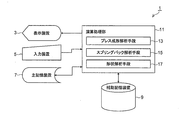
- press molding analysis device 1 Since the press molding analysis method according to the first embodiment is performed by a device such as a PC (personal computer) that executes program processing, first, the configuration of the device (hereinafter referred to as “press molding analysis device 1”). An outline will be given based on the block diagram shown in FIG.
- the press forming analysis apparatus 1 is configured by a PC (personal computer) or the like, and as shown in FIG. 2, a display device 3, an input device 5, a main storage device 7, an auxiliary storage device 9, and an arithmetic operation. And a processing unit 11.
- the arithmetic processing unit 11 is connected to the display device 3, the input device 5, the main storage device 7, and the auxiliary storage device 9, and performs each function according to commands from the arithmetic processing unit 11.
- the display device 3 is used for displaying calculation results, and is composed of a liquid crystal monitor or the like.
- the input device 5 is used for input from an operator, and is composed of a keyboard, a mouse, and the like.
- the main storage device 7 is used for temporary storage and calculation of data used in the arithmetic processing unit 11, and is constituted by a RAM or the like.
- the auxiliary storage device 9 is used for data storage and the like, and is composed of a hard disk or the like.
- the arithmetic processing unit 11 includes a CPU such as a PC, and the arithmetic processing unit 11 includes a press forming analysis unit 13, a springback analysis unit 15, and a shape analysis unit 17. These means are realized by a CPU or the like executing a predetermined program. These means will be described below.
- the press molding analysis means 13 sets the initial temperature distribution for the heated material to be pressed, combines the temperature analysis and the structural analysis to perform the press molding analysis, and the shape information after press molding (before mold release), A temperature distribution, a stress distribution, and a strain distribution are acquired.
- the springback analysis means 15 performs the springback analysis by coupling the temperature analysis and the structural analysis based on the information obtained by the press forming analysis means 13, and performs shape information, temperature distribution, stress distribution and strain distribution after the springback. Is something to get.
- the shape analysis means 17 is during and after cooling until the temperature distribution of the material to be pressed is within ⁇ 5 ° C. based on the shape information, temperature distribution, stress distribution and strain distribution acquired by the springback analysis means 15.
- the shape change is analyzed by combining temperature analysis and structural analysis.
- the press molding analysis method according to the first embodiment is performed by each of the above-mentioned “press molding analysis means”, “spring back analysis means”, and “shape analysis means” executing the respective processes.
- the process consists of the following steps. That is, in the press forming analysis method according to the first embodiment, an initial temperature distribution is set for a heated material to be pressed, and temperature analysis and structural analysis are combined to perform press forming analysis, and after press forming (release)
- the press forming analysis process for acquiring the shape information, temperature distribution, stress distribution and strain distribution of the previous), the mold information and the mold based on the shape information, temperature distribution, stress distribution and strain distribution obtained in the press forming analysis process.
- Springback analysis process that obtains shape information, temperature distribution, stress distribution, and strain distribution after springback by combining temperature analysis and structural analysis without considering contact heat transfer between press molding materials. And the temperature distribution of the material to be pressed is within ⁇ 5 ° C. based on the shape information, temperature distribution, stress distribution and strain distribution acquired in the springback analysis step. The shape change during cooling and after cooling until by formed continuously the temperature analysis and structural analysis having a shape analysis step of analyzing.
- the press forming analysis method in the first embodiment performs the analysis by coupling the temperature analysis and the structure analysis in each step as described above.
- the analysis that combines the temperature analysis and the structural analysis is to analyze the temperature distribution of the material to be pressed in consideration of air cooling and contact heat transfer between the mold and the material to be pressed (temperature analysis). Based on the obtained temperature distribution, stress state using temperature dependent data (Young's modulus, Poisson's ratio, thermal expansion coefficient, yield stress, stress-strain diagram, specific heat, thermal conductivity, etc.) corresponding to the temperature This is an analysis for performing analysis (structural analysis).
- the initial temperature distribution is set for the heated material to be pressed, the temperature analysis and the structural analysis are combined, the press forming analysis is performed, and the shape information and temperature after press forming (before release) A distribution, a stress distribution, and a strain distribution are acquired (step S1).
- the material to be pressed is sufficiently heated in an electric furnace so as to reach a uniform temperature, and is then transported to a press machine by a transport robot for press molding. Therefore, in the press molding analysis step, a uniform temperature (for example, 600 ° C.) is set for the entire material to be pressed as an initial temperature, assuming that the actual material to be pressed is heated. In order to obtain more accuracy, the temperature distribution may be calculated in consideration of air cooling in the middle of conveyance after heating the electric furnace to obtain the initial temperature distribution.
- a uniform temperature for example, 600 ° C.
- the press molding analysis process is a process performed by the press molding analysis means 13, in the press molding analysis process, temperature-dependent data required by the press molding analysis means 13 (Young's modulus, Poisson's ratio, thermal expansion coefficient, yield) Input stress, stress-strain diagram, specific heat, thermal conductivity, etc.) and give initial temperature distribution to the material to be pressed and the mold.
- the material to be pressed is cooled while being held at the bottom dead center of the press for a certain period of time. May be better. Therefore, also in the present press molding analysis step, the material to be pressed may be held in a mold for a predetermined time to be cooled.
- increasing the cooling time leads to deterioration of production efficiency, so when setting the cooling time in this press forming analysis process, set it considering the production efficiency in actual operation It is preferable to do so.
- Necessary data such as shape information, temperature distribution, stress distribution, and strain distribution of the material to be pressed and the mold immediately before the mold release calculated in the press molding analysis process are carried over to the next spring back analysis process.
- the springback analysis process is based on the shape information, temperature distribution, stress distribution, and strain distribution obtained in the press forming analysis process, and temperature analysis and structural analysis without considering contact heat transfer between the mold and the material to be pressed. Are combined to obtain shape information, temperature distribution, stress distribution and strain distribution after the spring back (step S3).
- a specific analysis method for performing the springback analysis without considering the contact heat transfer between the mold and the material to be pressed is the material to be pressed using the information obtained in the press forming analysis process as an initial condition.
- One or a plurality of nodes is constrained so that the material to be pressed does not move, and the stress is released from the state of the bottom dead center. The time for releasing the stress is assumed to be constant. Necessary data such as shape information, temperature distribution, stress distribution, strain distribution, etc. of the material to be pressed after springback is carried over to the next shape analysis step.
- the temperature analysis need not be performed.
- the temperature distribution of the material to be pressed after the press molding analysis is used as it is as the temperature distribution after the spring back, and is passed on to the next shape analysis step.
- the structural analysis is performed based on the temperature distribution and temperature-dependent data after the press forming analysis.
- ⁇ Shape analysis process> In the shape analysis step, during and after cooling until the temperature distribution of the material to be pressed is within ⁇ 5 ° C. based on the shape information, temperature distribution, stress distribution and strain distribution acquired in the springback analysis step.
- the shape change is analyzed by coupling temperature analysis and structural analysis (step S5).
- the shape analysis step is performed using the shape analysis means 17, and changes in the temperature distribution due to cooling are performed with initial information such as shape information, temperature distribution, stress distribution, and strain distribution of the material to be pressed after the springback analysis. And structural analysis considering heat shrinkage.
- one or a plurality of nodes of the pressed material is constrained so that the pressed material does not move during cooling.
- the node constraint condition used in the springback analysis step can also be used.
- the temperature analysis may be performed assuming air cooling, but if the analysis is performed considering the contact heat transfer between the cooling table and the material to be pressed, assuming that it is cooled on the cooling table in actual operation. Thus, temperature analysis results closer to actual operation can be obtained.
- the shape change during and after cooling until the temperature distribution of the material to be pressed is within ⁇ 5 ° C. is analyzed, for the following reason.
- the temperature distribution of the entire press-molded material is within ⁇ 5 ° C (more preferably within ⁇ 1 ° C) in the process where the temperature of the press-molded material decreases toward the ambient temperature such as room temperature.
- the shape analysis step should be performed with a sufficient cooling time so as to satisfy the temperature distribution condition.
- the structural analysis of the shape analysis process can be performed dynamically or statically in principle.
- dynamic analysis the time can be compressed and handled by time scaling, which has the advantage that calculation time is shortened.
- the calculation accuracy decreases due to the influence of the inertial force remaining. Therefore, when it is desired to obtain a more accurate calculation result, it is preferable to perform all of the structural analysis in the shape analysis process statically.
- the shape analysis process may be divided into two stages, the first stage being performed dynamically and the last stage being performed statically.
- the temperature analysis and the structural analysis are performed in combination for the press molding analysis process and the spring back analysis process, and are obtained in the spring back analysis process.
- the shape analysis process that analyzes the shape change due to the temperature change by combining the temperature analysis and the structural analysis based on the shape and temperature distribution, so that the shape after cooling in warm press forming can be predicted Therefore, it is possible to take measures against shape defects in warm press molding, and to expect effects such as test man-hours and cost reduction at the design stage of press-molded products.
- the initial temperature distribution is set for the heated material to be pressed, the temperature analysis and the structural analysis are combined, the press forming analysis is performed, and the shape information and temperature after the press forming are performed.
- Press molding analysis process for obtaining distribution, stress distribution and strain distribution, and contact heat between the mold and the material to be pressed based on the shape information, temperature distribution, stress distribution and strain distribution obtained in the press molding analysis process
- the springback analysis process that obtains the shape and temperature distribution after the springback by combining the temperature analysis and the structural analysis in consideration of transmission, and the shape information and temperature acquired in the springback analysis process Based on the distribution, stress distribution and strain distribution, the shape change during and after cooling until the temperature distribution of the material to be pressed is within ⁇ 5 ° C. is analyzed with temperature analysis. Having a shape analysis step of analyzing by formed continuously analyzed.
- the press molding analysis method according to the second embodiment takes into account the fact that contact heat transfer between the mold and the material to be pressed was not considered in the springback analysis step of the press molding analysis method according to the first embodiment.
- the other points are the same as the press molding analysis method of the first embodiment. Therefore, in the following, consideration will be given to the consideration of contact heat transfer between the mold and the material to be pressed in the springback analysis step of the second embodiment.
- the effect of considering the contact heat transfer between the mold and the material to be pressed is as follows.
- the temperature change due to mold release can be taken into account more accurately, and the temperature distribution of the molding material after springback can be obtained more accurately.
- the shape of the molded product after cooling obtained by the shape analysis process can be more accurately determined.
- the springback analysis process there is a merit that it is easier to obtain convergence without considering the contact heat transfer between the mold and the material to be pressed. do it.
- the springback analysis process as a specific method of analysis considering contact heat transfer between the mold and the material to be pressed, one or more nodes of the material to be pressed are constrained and the material to be pressed is Simulate mold release by moving the mold without moving.
- the temperature analysis is performed by accurately considering heat removal due to contact with the mold and air cooling of a portion not in contact with the mold.
- the initial conditions in the springback analysis process and the data transfer after the springback are the same as in the first embodiment.
- the temperature change due to the mold release can be more accurately taken into account, and the temperature distribution of the molding material after the springback can be obtained more accurately.
- the effect that the shape of the molded product after cooling obtained by the shape analysis step can be obtained more accurately is obtained.
- the method of analyzing a material to be pressed heated to 600 ° C. has been described assuming warm press molding. However, even when analyzing cold press forming, it is also possible to analyze by applying the present invention when considering the effects of heat such as processing heat generation and frictional heat generation.
- press molding analysis device 1 Since the press molding analysis method according to the third embodiment is performed by a device such as a PC (personal computer) that executes program processing, first, the configuration of the device (hereinafter referred to as “press molding analysis device 1”). An outline will be given based on the block diagram shown in FIG.
- a press forming analysis apparatus 1 is configured by a PC (personal computer) or the like, and as shown in FIG. 7, a display device 3, an input device 5, a main storage device 7, an auxiliary storage device 9, and an arithmetic operation. And a processing unit 11.
- the arithmetic processing unit 11 is connected to the display device 3, the input device 5, the main storage device 7, and the auxiliary storage device 9, and performs each function according to commands from the arithmetic processing unit 11.
- the display device 3 is used for displaying calculation results, and is composed of a liquid crystal monitor or the like.
- the input device 5 is used for input from an operator, and is composed of a keyboard, a mouse, and the like.
- the main storage device 7 is used for temporary storage and calculation of data used in the arithmetic processing unit 11, and is constituted by a RAM or the like.
- the auxiliary storage device 9 is used for data storage and the like, and is composed of a hard disk or the like.
- the arithmetic processing unit 11 is configured by a CPU such as a PC, and the arithmetic processing unit 11 includes a press forming analysis unit 13, a springback analysis unit 15, a shape analysis unit 17, a temperature distribution change unit 19, and a shape. And a comparison means 20. These means are realized by a CPU or the like executing a predetermined program. These means will be described below.
- the press molding analysis means 13 sets the initial temperature distribution for the heated material to be pressed, combines the temperature analysis and the structural analysis to perform the press molding analysis, and the shape information after press molding (before mold release), A temperature distribution, a stress distribution, and a strain distribution are acquired.
- the springback analysis means 15 performs the springback analysis by coupling the temperature analysis and the structural analysis based on the information obtained by the press forming analysis means 13, and performs shape information, temperature distribution, stress distribution and strain distribution after the springback. Is something to get.
- the shape analysis means 17 is during and after cooling until the temperature distribution of the material to be pressed is within ⁇ 5 ° C. based on the shape information, temperature distribution, stress distribution and strain distribution acquired by the springback analysis means 15.
- the shape change is analyzed by combining temperature analysis and structural analysis.
- the shape analysis means 17 processes the process of both a 1st shape analysis process and a 2nd shape analysis process so that it may demonstrate below.
- the temperature distribution changing unit 19 changes the temperature distribution acquired by the springback analyzing unit 15. Specifically, the temperature distribution of a predetermined part of the molding material is changed according to an operator instruction.
- the shape comparison means 20 is for comparing the shapes of the plurality of cooled molding materials obtained by the shape analysis means 17. Specifically, it has a function of displaying the shape of the material to be pressed after cooling on the display device 3 in a state in which the operator can visually compare.
- each of the “press forming analyzing means”, “spring back analyzing means”, “shape analyzing means”, “temperature distribution changing means”, and “shape comparing means” The process is performed and includes the following steps.
- the initial temperature distribution is set for the heated material to be pressed, the temperature analysis and the structural analysis are coupled, the press molding analysis is performed, and the shape information before mold release Press forming analysis process for acquiring temperature distribution, stress distribution and strain distribution; Based on the shape information, temperature distribution, stress distribution and strain distribution obtained in the press molding analysis process, and coupled temperature analysis and structural analysis without considering contact heat transfer between the mold and the material to be pressed A springback analysis process for performing springback analysis and obtaining shape information, temperature distribution, stress distribution and strain distribution after springback; Based on the shape information, temperature distribution, stress distribution and strain distribution acquired in the springback analysis step, the shape change during and after cooling until the temperature distribution of the material to be pressed is within ⁇ 5 ° C.
- a first shape analysis step for performing analysis by coupling analysis and structural analysis;
- the temperature distribution of the material to be pressed is changed based on the temperature distribution after the change and the shape information, the stress distribution, and the strain distribution acquired in the springback analysis process by changing the temperature distribution acquired in the springback analysis process.
- a second shape analysis step for analyzing the shape change during and after cooling until the distribution is within ⁇ 5 ° C. by combining temperature analysis and structural analysis;
- the press forming analysis method performs analysis by coupling temperature analysis and structural analysis in each analysis step.
- the analysis that combines the temperature analysis and the structural analysis is to analyze the temperature distribution of the material to be pressed in consideration of air cooling and contact heat transfer between the mold and the material to be pressed (temperature analysis). Based on the obtained temperature distribution, stress state using temperature dependent data (Young's modulus, Poisson's ratio, thermal expansion coefficient, yield stress, stress-strain diagram, specific heat, thermal conductivity, etc.) corresponding to the temperature This is an analysis for performing analysis (structural analysis).
- the initial temperature distribution is set for the heated material to be pressed, the temperature analysis and the structural analysis are combined, the press forming analysis is performed, and the shape information and temperature after press forming (before release) A distribution, a stress distribution, and a strain distribution are acquired (step S1).
- the material to be pressed is sufficiently heated in an electric furnace so as to reach a uniform temperature, and is then transported to a press machine by a transport robot for press molding. Therefore, in the press molding analysis step, a uniform temperature (for example, 600 ° C.) is set for the entire material to be pressed as an initial temperature, assuming that the actual material to be pressed is heated. In order to obtain more accuracy, the temperature distribution may be calculated in consideration of air cooling in the middle of conveyance after heating the electric furnace to obtain the initial temperature distribution.
- a uniform temperature for example, 600 ° C.
- the press molding analysis process is a process performed by the press molding analysis means 13, in the press molding analysis process, temperature-dependent data required by the press molding analysis means 13 (Young's modulus, Poisson's ratio, thermal expansion coefficient, yield) Input stress, stress-strain diagram, specific heat, thermal conductivity, etc.) and give initial temperature distribution to the material to be pressed and the mold.
- the material to be pressed is cooled while being held at the bottom dead center of the press for a certain period of time. May be better. Therefore, also in the present press molding analysis step, the material to be pressed may be held in a mold for a predetermined time to be cooled.
- increasing the cooling time leads to deterioration of production efficiency, so when setting the cooling time in this press forming analysis process, set it considering the production efficiency in actual operation It is preferable to do so.
- Necessary data such as shape information, temperature distribution, stress distribution, and strain distribution of the material to be pressed and the mold immediately before the mold release calculated in the press molding analysis process are carried over to the next spring back analysis process.
- the springback analysis process is based on the shape information, temperature distribution, stress distribution, and strain distribution obtained in the press forming analysis process, and temperature analysis and structural analysis without considering contact heat transfer between the mold and the material to be pressed. Are combined to obtain shape information, temperature distribution, stress distribution and strain distribution after the spring back (step S3).
- the analysis is performed without considering contact heat transfer between the mold and the material to be pressed. Therefore, in the spring back process, the temperature of the material to be pressed is not decreased due to contact with the mold, and is calculated considering only the temperature decrease due to air cooling. By doing so, the calculation is simplified, and convergence is easily obtained as compared with the case where the analysis is performed in consideration of contact heat transfer.
- the specific analysis method for performing the springback analysis without considering the contact heat transfer between the mold and the material to be pressed is the material to be pressed using the information obtained in the press forming analysis process as an initial condition. One or a plurality of nodes is constrained so that the material to be pressed does not move, and the stress is released from the state of the bottom dead center. The time for releasing the stress is assumed to be constant. Necessary data such as shape information, temperature distribution, stress distribution, and strain distribution of the material to be pressed after the springback is passed on to the next first shape analysis step.
- the temperature analysis need not be performed.
- the temperature distribution of the material to be pressed after the press molding analysis is used as it is as the temperature distribution after the spring back, and is passed on to the next first shape analysis step.
- the structural analysis is performed based on the temperature distribution and temperature-dependent data after the press forming analysis.
- FIG. 8 is a graph for explaining an example of the temperature distribution of a specific part of the material to be pressed obtained by the springback analysis process.
- the vertical axis represents the temperature of the material to be pressed (° C.)
- the horizontal axis represents the distance (mm) measured along the cross section of the material to be pressed.
- the graph of FIG. 8 shows the temperature distribution of the cross section in the vicinity including the base of the wrinkle centered on the top of the generated wrinkle, and the solid line is the temperature distribution obtained by the springback analysis process.
- the solid line graph in FIG. 8 When the solid line graph in FIG. 8 is seen, two peaks are connected, and a valley appears between them. This valley is the top of the wrinkle. The top of the wrinkle is in contact with the mold, causing a temperature drop.
- temperature distribution occurs in the material to be pressed due to the occurrence of wrinkles.
- ⁇ First shape analysis step> In the first shape analysis step, cooling and cooling until the temperature distribution of the material to be pressed is within ⁇ 5 ° C. based on the shape information, temperature distribution, stress distribution, and strain distribution acquired in the springback analysis step.
- the subsequent shape change is analyzed by coupling temperature analysis and structural analysis (step S5).
- the temperature distribution in the first shape analysis step is performed based on the temperature distribution including the temperature distribution of the wrinkle portion indicated by the solid line in FIG.
- the first shape analysis step is performed by using the shape analysis means 17, and the temperature distribution by cooling using the shape information, temperature distribution, stress distribution, strain distribution, and the like of the material to be pressed after the springback analysis as initial conditions. Analyzes changes in the structure and conducts structural analysis considering thermal shrinkage.
- one or a plurality of nodes of the material to be pressed are constrained so that the material to be pressed does not move during cooling.
- the node constraint the node constraint condition used in the springback analysis step can also be used.
- the temperature analysis may be performed assuming air cooling, but if the analysis is performed in consideration of the contact heat transfer between the cooling table and the material to be pressed, assuming that it is cooled on the cooling table in actual operation. Thus, temperature analysis results closer to actual operation can be obtained.
- the shape change during and after cooling until the temperature distribution of the material to be pressed is within ⁇ 5 ° C. is analyzed.
- the reason is as follows.
- the temperature distribution of the entire press-molded material is within ⁇ 5 ° C (more preferably within ⁇ 1 ° C) in the process where the temperature of the press-molded material decreases toward the ambient temperature such as room temperature.
- the first shape analysis process should be performed with a sufficient cooling time so as to satisfy the condition of the temperature distribution.
- ⁇ Second shape analysis step> modifies the temperature distribution acquired in the springback analysis step, and based on the changed temperature distribution and the shape information, stress distribution, and strain distribution acquired in the springback analysis step.
- the shape change during and after cooling until the temperature distribution of the material to be pressed is within ⁇ 5 ° C. is analyzed by coupling temperature analysis and structural analysis (steps S7 and S9).
- the second shape analysis step is the same as the first shape analysis step except that the shape distribution is analyzed by changing the temperature distribution acquired in the springback analysis step.
- the temperature distribution at the site where the wrinkles are generated is as shown by the dotted line in FIG. That is, the temperature distribution is such that there is no temperature distribution generated at the site where wrinkles are generated, in other words, the temperature distribution can be estimated that it would have been obtained if wrinkles were not generated.
- the change in temperature distribution due to cooling is analyzed using the shape analysis means 17 based on the changed temperature distribution and the shape information, stress distribution and strain distribution acquired in the springback analysis step, Perform structural analysis considering shrinkage.
- the shape comparison step compares the shapes of the pressed molding materials after cooling obtained by the analysis of the first shape analysis step and the second shape analysis step (step S11).
- the shape comparison step is a state in which the shapes of the pressed molding materials after cooling obtained by the analysis of the second shape analysis step and the first shape analysis step can be compared on the display device 3 (for example, a state in which both are arranged in parallel) Alternatively, they are displayed in a superimposed state), and the operator visually compares them.
- the temperature distribution change described above is the shape of the press-molded material after cooling. It can be seen that there is no effect on. From this, it can be seen that there is no particular problem that the temperature distribution before the temperature distribution change occurs after the springback. On the contrary, when there is a difference in the shape of the pressed molding material after cooling obtained by the analysis of the first shape analysis step and the second shape analyzing step, the temperature distribution change described above is the pressed molding material after cooling. It can be seen that this affects the shape.
- the third embodiment it is possible to know how the temperature distribution after the springback has an influence on the shape after cooling, thereby preventing the shape defect in the warm press forming. This makes it possible to obtain effects such as test man-hours and cost reduction at the design stage of the press-formed product.
- the method is to change the temperature distribution of a part (wrinkled part) of the material to be pressed. Changes may be made so that In the following, the case where the temperature distribution is changed so as to make the temperature of the entire press-molded material uniform will be described as an example of the case where the press-molded material has a hat cross-sectional shape.
- FIG. 9 is a graph showing a temperature distribution after a hat cross-sectional shape is drawn and spring-backed.
- the vertical axis represents the temperature of the molding material to be pressed (° C.)
- the horizontal axis represents the length (mm) from the center in the width direction measured along the cross section, and half the width direction in the hat cross section Only showing.
- the structural analysis of the first shape analysis step and the second shape analysis step can be performed dynamically or statically in principle.
- dynamic analysis the time can be compressed and handled by time scaling, which has the advantage that calculation time is shortened.
- the calculation accuracy decreases due to the influence of the inertial force remaining. Therefore, when it is desired to obtain a more accurate calculation result, it is preferable to perform all of the structural analysis in the shape analysis process statically.
- the first shape analysis process and / or the second shape analysis process is divided into two stages, and the first stage is performed dynamically and the last stage is performed statically. Good.
- the calculation time can be reduced while reducing the calculation time. Improvements can be made. More preferably, the static implicit method is used for the last stage of the structural analysis in the first shape analysis step and the second shape analysis step.
- the initial temperature distribution is set for the heated press-molding material, the temperature analysis and the structural analysis are combined, the press forming analysis is performed, and the shape information and temperature before release.
- Press forming analysis process to obtain distribution, stress distribution and strain distribution Based on the shape information, temperature distribution, stress distribution, and strain distribution obtained in the press molding analysis process, the temperature analysis and the structural analysis are combined in consideration of the contact heat transfer between the mold and the material to be pressed, and the spring A springback analysis process for performing back analysis and obtaining shape information, temperature distribution, stress distribution and strain distribution after springback; Based on the shape information, temperature distribution, stress distribution and strain distribution acquired in the springback analysis step, the shape change during and after cooling until the temperature distribution of the material to be pressed is within ⁇ 5 ° C.
- a first shape analysis step for performing analysis by coupling analysis and structural analysis;
- the temperature distribution of the material to be pressed is changed based on the temperature distribution after the change and the shape information, the stress distribution, and the strain distribution acquired in the springback analysis process by changing the temperature distribution acquired in the springback analysis process.
- a second shape analysis step for analyzing the shape change during and after cooling until the distribution is within ⁇ 5 ° C. by combining temperature analysis and structural analysis;
- a shape comparison step for comparing the shape of the material to be pressed after cooling obtained by the analysis of the second shape analysis step and the first shape analysis step; It is what has.
- the press molding analysis method according to the fourth embodiment takes into account the fact that contact heat transfer between the mold and the material to be pressed was not considered in the springback analysis step of the press molding analysis method according to the third embodiment.
- the other points are the same as the press molding analysis method of the third embodiment. Therefore, in the following, consideration will be given to the consideration of contact heat transfer between the mold and the material to be pressed in the springback analysis step of the present embodiment.
- the effect of considering the contact heat transfer between the mold and the material to be pressed is as follows.
- the temperature change due to mold release can be taken into account more accurately, and the temperature distribution of the material to be pressed after springback can be obtained more accurately.
- the shape of the molded product after cooling obtained by the shape analysis process can be obtained more accurately.
- the springback analysis process as a specific method of analysis considering contact heat transfer between the mold and the material to be pressed, one or more nodes of the material to be pressed are constrained and the material to be pressed is Simulate mold release by moving the mold without moving.
- the temperature analysis is performed by accurately considering heat removal due to contact with the mold and air cooling of a portion not in contact with the mold.
- the initial conditions in the springback analysis process and the data transfer after the springback are the same as in the third embodiment.
- the temperature change due to mold release can be more accurately taken into account, and the temperature distribution of the material to be pressed after springback can be determined more accurately.
- an effect is obtained that the shape of the molded product after cooling obtained by the shape analysis step can be obtained more accurately.
- the method of analyzing a material to be pressed heated to 600 ° C. has been described assuming warm press molding. However, even when analyzing cold press forming, it is also possible to analyze by applying the present invention when considering the effects of heat such as processing heat generation and frictional heat generation.
- the material to be pressed was 980 MPa high-tensile steel, the initial shape was a parallelogram with a base of 650 mm and a height of 300 mm, and the plate thickness was 1.4 mm.
- the material to be pressed was heated to 680 ° C. in an electric furnace, the material to be pressed was mounted between molds of a press machine by a transfer robot, and press molding was performed.
- the press molding start temperature is 600 ° C. (A thermocouple was previously mounted in the center of the material to be pressed and the temperature change under the same conditions was measured.
- the material temperature when the mounting on the press machine was completed was 600 ° C. C.).
- the mold As the mold, a model obtained by modeling the surface of the mold used in the actual warm press molding with a shell element was used. In addition, it is assumed that the material to be pressed is a deformable body and the mold is a rigid body. In the press molding analysis, when the distance between the surface of the material to be pressed and the surface of the mold is less than 0.01 mm, it is considered that the material to be pressed and the die are in contact, and the heat flux is calculated by contact heat transfer. . Further, when the distance is 0.01 mm or more, radiation and convection are taken into consideration that the material to be pressed is air-cooled. The emissivity of the material to be pressed was set to 0.75. The initial temperature of the material to be pressed was fixed at 600 ° C.
- shape analysis was performed on the shape change due to cooling using the shape analysis means 17.
- the shape analysis is first performed by air cooling for 1000 seconds.
- the structural analysis is performed by a dynamic explicit method considering the inertial force, and then the shape analysis for 1 second is performed by the static implicit method. Elimination of the effect of reduced accuracy due to inertial force.
- the temperature distribution of the material at the end of the shape analysis was within a range of ⁇ 1 ° C.
- the measurement shape on the surface of the actual press product and the shape obtained by the simulation analysis are shapes at different positions of the material to be pressed as described above. Therefore, for comparison, a shape processed so as to be in contact with the mold surface was used so that they could be compared with each other. Processing was performed as follows. Since the measurement shape of the surface of the actual press product was measured from the shape visible from above, the actual press product shape was created by offsetting by 1.4 mm corresponding to the plate thickness on the lower side. In addition, since the material to be pressed handled in the simulation analysis is a model of the center of the plate thickness, each shape obtained in the simulation analysis is offset downward by 0.7 mm, which is half the plate thickness. Created.
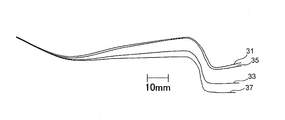
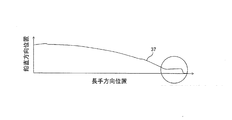
- FIG. 4 shows a cross-sectional shape of the mold surface shape 37.
- FIG. 5 shows an enlarged and overlapped portion corresponding to the portion in each shape.
- 31 is an actual press-molded shape
- 37 is a mold surface shape
- 33 is a shape after springback analysis
- 35 is a shape after shape analysis.
- Example 1 An experiment for confirming the effects of Embodiments 3 and 4 was performed, and will be described below.
- Example 1 the actual warm press molding and press molding to which the present invention is applied to the B-pillar (column between the front seat and the rear seat) upper part 21 of the automobile shown in FIG.
- a simulation analysis using an analysis method is performed, and these results are compared.
- the material to be pressed was 980 MPa high-tensile steel, the initial shape was a parallelogram with a base of 650 mm and a height of 300 mm, and the plate thickness was 1.4 mm.
- the material to be pressed was heated to 680 ° C. in an electric furnace, the material to be pressed was mounted between molds of a press machine by a transfer robot, and press molding was performed.
- the press molding start temperature is 600 ° C. (A thermocouple was previously mounted in the center of the material to be pressed and the temperature change under the same conditions was measured.
- the material temperature when the mounting on the press machine was completed was 600 ° C. C.).
- the mold As the mold, a model obtained by modeling the surface of the mold used in the actual warm press molding with a shell element was used. In addition, it is assumed that the material to be pressed is a deformable body and the mold is a rigid body. In the press molding analysis, when the distance between the surface of the material to be pressed and the surface of the mold is less than 0.01 mm, it is considered that the material to be pressed and the die are in contact, and the heat flux is calculated by contact heat transfer. . Further, when the distance is 0.01 mm or more, radiation and convection are taken into consideration that the material to be pressed is air-cooled. The emissivity of the material to be pressed was set to 0.75. The initial temperature of the material to be pressed was fixed at 600 ° C.
- FIG. 11 is a graph showing the temperature distribution of the material to be pressed after the springback analysis in the cross section taken along the line BB in FIG.
- the vertical axis represents the temperature of the material to be pressed (° C.)
- the horizontal axis represents the distance (mm) measured from one end of the material to be pressed along the cross section.
- the material to be pressed after the springback analysis has a non-uniform temperature distribution. Such non-uniform temperature distribution is caused by a difference in time of contact with the mold during the press molding process.
- Shape analysis was performed on the shape change due to cooling based on the temperature distribution, shape information, stress distribution, and strain distribution after springback.
- the shape analysis is first performed by air cooling for 1000 seconds.
- the structural analysis is performed by a dynamic explicit method considering the inertial force, and then the shape analysis for 1 second is performed by the static implicit method. Elimination of the effect of reduced accuracy due to inertial force.
- the temperature distribution of the material at the end of the shape analysis was within a range of ⁇ 1 ° C.
- the shape after cooling obtained by the first shape analysis step will be described in comparison with the actual press product shape.
- the measurement shape on the surface of the actual press product and the shape obtained by the simulation analysis are shapes at different positions of the material to be pressed as described above. Therefore, for comparison, a shape processed so as to be in contact with the mold surface was used so that they could be compared with each other. Processing was performed as follows. Since the measurement shape of the surface of the actual press product was measured from the shape visible from above, the actual press product shape was created by offsetting by 1.4 mm corresponding to the plate thickness on the lower side. In addition, since the material to be pressed handled in the simulation analysis is a model of the center of the plate thickness, each shape obtained in the simulation analysis is offset downward by 0.7 mm, which is half the plate thickness. Created.
- FIG. 13 shows an enlarged and overlapped portion corresponding to the portion in each shape.
- 31 is an actual press-molded shape
- 37 is a mold surface shape
- 33 is a shape after springback analysis
- 35 is a shape after shape analysis.
- ⁇ Second shape analysis step> the non-uniform temperature distribution in the pressed material after analysis was changed so that the temperature distribution of the entire pressed material became uniform at 510 ° C.
- the temperature distribution after the change is shown by a dotted line graph in FIG.
- a shape analysis was performed on the change in the shape due to the cooling, and the shape of the pressed molding material after the cooling was obtained.
- the analysis conditions other than the temperature distribution in the second shape analysis step are the same as those in the first shape analysis step.
- FIG. 14 shows a first shape-analyzed shape 35 and a second shape-analyzed shape 39 in a portion corresponding to the portion indicated by a circle in FIG.
- FIG. 14 also shows a post-springback analysis shape 33 and a mold surface shape 37 for comparison.
- the first shape-analyzed shape 35 is a shape deviating from the mold surface shape 37, but the second shape-analyzed shape 39 is a shape close to the mold surface shape 37 and is a spring.
- the shape is close to the post-analysis shape 33. This means that the temperature distribution after the spring back is made uniform so that the shape change does not occur much by the subsequent cooling. This suggests that the shape defect that occurs during cooling can be improved if the temperature distribution after the springback is made closer to uniform. As a method of making the temperature distribution after the spring back closer to uniform, for example, increasing the average press forming speed can be considered.
- the average press molding speed was set to 150 mm / s, which is 1.5 times that performed in the above-mentioned example, and the warm press molding was actually performed under the same conditions. As a result, an effect of improving the shape defect was obtained.
- Shape analysis means 19 Temperature distribution change means 20 Shape comparison means 21 B pillar upper part Parts 23 Bead 31 Actual press-molded shape 33 Shape after springback analysis 35 Shape after shape analysis (shape after first shape analysis) 37 Shape of mold surface 39 Shape after second shape analysis
Landscapes
- Physics & Mathematics (AREA)
- Engineering & Computer Science (AREA)
- General Physics & Mathematics (AREA)
- Geometry (AREA)
- Theoretical Computer Science (AREA)
- Mechanical Engineering (AREA)
- Thermal Sciences (AREA)
- Computer Hardware Design (AREA)
- Evolutionary Computation (AREA)
- General Engineering & Computer Science (AREA)
- Mathematical Optimization (AREA)
- Pure & Applied Mathematics (AREA)
- Mathematical Analysis (AREA)
- Computational Mathematics (AREA)
- Health & Medical Sciences (AREA)
- Life Sciences & Earth Sciences (AREA)
- Chemical & Material Sciences (AREA)
- Analytical Chemistry (AREA)
- Biochemistry (AREA)
- General Health & Medical Sciences (AREA)
- Immunology (AREA)
- Pathology (AREA)
- Shaping Metal By Deep-Drawing, Or The Like (AREA)
Abstract
Priority Applications (6)
| Application Number | Priority Date | Filing Date | Title |
|---|---|---|---|
| MX2015010085A MX362269B (es) | 2013-02-08 | 2013-02-08 | Metodo de analisis de la estampacion. |
| PCT/JP2013/000704 WO2014122695A1 (fr) | 2013-02-08 | 2013-02-08 | Procédé d'analyse de formage sous pression |
| US14/766,682 US10161892B2 (en) | 2013-02-08 | 2013-02-08 | Method of analyzing press forming |
| KR1020157021668A KR101718470B1 (ko) | 2013-02-08 | 2013-02-08 | 프레스 성형 해석 방법 |
| EP13874279.6A EP2954961B1 (fr) | 2013-02-08 | 2013-02-08 | Procédé d'analyse de formage sous pression |
| CN201380072444.XA CN105188978B (zh) | 2013-02-08 | 2013-02-08 | 冲压成型解析方法 |
Applications Claiming Priority (1)
| Application Number | Priority Date | Filing Date | Title |
|---|---|---|---|
| PCT/JP2013/000704 WO2014122695A1 (fr) | 2013-02-08 | 2013-02-08 | Procédé d'analyse de formage sous pression |
Publications (1)
| Publication Number | Publication Date |
|---|---|
| WO2014122695A1 true WO2014122695A1 (fr) | 2014-08-14 |
Family
ID=51299314
Family Applications (1)
| Application Number | Title | Priority Date | Filing Date |
|---|---|---|---|
| PCT/JP2013/000704 Ceased WO2014122695A1 (fr) | 2013-02-08 | 2013-02-08 | Procédé d'analyse de formage sous pression |
Country Status (6)
| Country | Link |
|---|---|
| US (1) | US10161892B2 (fr) |
| EP (1) | EP2954961B1 (fr) |
| KR (1) | KR101718470B1 (fr) |
| CN (1) | CN105188978B (fr) |
| MX (1) | MX362269B (fr) |
| WO (1) | WO2014122695A1 (fr) |
Cited By (1)
| Publication number | Priority date | Publication date | Assignee | Title |
|---|---|---|---|---|
| WO2019187864A1 (fr) * | 2018-03-28 | 2019-10-03 | Jfeスチール株式会社 | Procédé d'amélioration de rigidité pour article moulé à la presse, matrice de moulage à la presse, article moulé à la presse, et procédé de production d'article moulé à la presse |
Families Citing this family (10)
| Publication number | Priority date | Publication date | Assignee | Title |
|---|---|---|---|---|
| JP5910224B2 (ja) * | 2012-03-26 | 2016-04-27 | Jfeスチール株式会社 | プレス成形解析方法 |
| KR102142092B1 (ko) * | 2016-04-27 | 2020-08-06 | 주식회사케이에스엠 | 고강도 저비중 경량강재를 이용한 차량용 판재 제조방법 |
| JP6717090B2 (ja) * | 2016-07-11 | 2020-07-01 | 日本製鉄株式会社 | 試験装置及び試験方法 |
| JP6794823B2 (ja) * | 2016-12-27 | 2020-12-02 | 日本製鉄株式会社 | 解析装置、解析方法、及びコンピュータプログラム |
| JP6519639B1 (ja) * | 2017-12-07 | 2019-05-29 | Jfeスチール株式会社 | スプリングバック量変動要因部位特定方法 |
| US10956634B2 (en) * | 2018-01-15 | 2021-03-23 | Ford Motor Company | Method for predicting plastic strain ratio from stamping simulation |
| CN110756641B (zh) * | 2019-10-29 | 2021-02-23 | 上汽大众汽车有限公司 | 汽车翼子板全型面回弹补偿的约束方法 |
| JP7255632B2 (ja) * | 2021-05-06 | 2023-04-11 | Jfeスチール株式会社 | プレス成形方法及びプレス成形品の形状評価方法 |
| CN114769390B (zh) * | 2022-06-17 | 2022-09-09 | 南通瑞卓不锈钢制品有限公司 | 大容量不锈钢水箱冲压工艺自适应调节方法 |
| CN115846554B (zh) * | 2022-11-28 | 2026-03-31 | 上海电机学院 | 一种精密超导腔加工检测系统及其模锻工艺 |
Citations (6)
| Publication number | Priority date | Publication date | Assignee | Title |
|---|---|---|---|---|
| JPH07155853A (ja) * | 1993-12-01 | 1995-06-20 | Honda Motor Co Ltd | 金属板のプレス成形方法 |
| JP2001314923A (ja) | 2000-05-02 | 2001-11-13 | Nippon Steel Corp | 高張力鋼板の温間プレス成形方法 |
| JP2004270006A (ja) * | 2003-03-11 | 2004-09-30 | Jfe Steel Kk | 形状凍結性に優れた部品の製造方法 |
| JP2007229724A (ja) | 2006-02-27 | 2007-09-13 | Jfe Steel Kk | プレス成形解析方法 |
| JP2008055476A (ja) * | 2006-08-31 | 2008-03-13 | Nippon Steel Corp | スプリングバック発生原因部位特定方法、その装置、及びそのプログラム |
| JP2010207910A (ja) * | 2009-02-16 | 2010-09-24 | Nippon Steel Corp | ホットプレス成形シミュレーションの境界条件設定方法 |
Family Cites Families (11)
| Publication number | Priority date | Publication date | Assignee | Title |
|---|---|---|---|---|
| CN1178143A (zh) | 1996-09-19 | 1998-04-08 | Trw乘员约束系统公司 | 承载的异形部件及制造这种异形部件的方法 |
| US6947809B2 (en) | 2003-03-05 | 2005-09-20 | Ford Global Technologies | Method of modifying stamping tools for spring back compensation based on tryout measurements |
| CN102708222B (zh) | 2006-08-31 | 2014-11-26 | 新日铁住金株式会社 | 回弹发生原因特定方法、回弹发生原因部位特定方法、回弹对策位置特定方法以及它们的装置 |
| JP4865489B2 (ja) | 2006-10-04 | 2012-02-01 | 本田技研工業株式会社 | 成形速度決定方法 |
| JP4854586B2 (ja) | 2007-05-01 | 2012-01-18 | 大阪府 | 光学素子のプレス成形シミュレーション方法及びプログラム |
| CN100507776C (zh) | 2007-11-30 | 2009-07-01 | 江苏大学 | 差厚高强度钢激光拼焊板曲线焊缝布置和成形方法 |
| DE102008034996B4 (de) | 2008-07-25 | 2010-11-18 | Benteler Automobiltechnik Gmbh | Vorrichtung zum Warmformen, Presshärten und Schneiden eines Halbzeugs aus härtbarem Stahl |
| BRPI0923582B8 (pt) | 2008-12-25 | 2021-08-17 | Nippon Steel & Sumitomo Metal Corp | método e dispositivo para análise de uma causa de recuperação elástica em um produto formado |
| JP2011107759A (ja) | 2009-11-12 | 2011-06-02 | Jfe Steel Corp | 部材の弾塑性変形解析方法 |
| JP5304678B2 (ja) | 2010-02-09 | 2013-10-02 | 新日鐵住金株式会社 | 熱間プレス方法、および成形品の製造方法 |
| JP5910224B2 (ja) * | 2012-03-26 | 2016-04-27 | Jfeスチール株式会社 | プレス成形解析方法 |
-
2013
- 2013-02-08 WO PCT/JP2013/000704 patent/WO2014122695A1/fr not_active Ceased
- 2013-02-08 CN CN201380072444.XA patent/CN105188978B/zh not_active Expired - Fee Related
- 2013-02-08 US US14/766,682 patent/US10161892B2/en active Active
- 2013-02-08 KR KR1020157021668A patent/KR101718470B1/ko active Active
- 2013-02-08 MX MX2015010085A patent/MX362269B/es active IP Right Grant
- 2013-02-08 EP EP13874279.6A patent/EP2954961B1/fr active Active
Patent Citations (6)
| Publication number | Priority date | Publication date | Assignee | Title |
|---|---|---|---|---|
| JPH07155853A (ja) * | 1993-12-01 | 1995-06-20 | Honda Motor Co Ltd | 金属板のプレス成形方法 |
| JP2001314923A (ja) | 2000-05-02 | 2001-11-13 | Nippon Steel Corp | 高張力鋼板の温間プレス成形方法 |
| JP2004270006A (ja) * | 2003-03-11 | 2004-09-30 | Jfe Steel Kk | 形状凍結性に優れた部品の製造方法 |
| JP2007229724A (ja) | 2006-02-27 | 2007-09-13 | Jfe Steel Kk | プレス成形解析方法 |
| JP2008055476A (ja) * | 2006-08-31 | 2008-03-13 | Nippon Steel Corp | スプリングバック発生原因部位特定方法、その装置、及びそのプログラム |
| JP2010207910A (ja) * | 2009-02-16 | 2010-09-24 | Nippon Steel Corp | ホットプレス成形シミュレーションの境界条件設定方法 |
Non-Patent Citations (1)
| Title |
|---|
| See also references of EP2954961A4 |
Cited By (2)
| Publication number | Priority date | Publication date | Assignee | Title |
|---|---|---|---|---|
| WO2019187864A1 (fr) * | 2018-03-28 | 2019-10-03 | Jfeスチール株式会社 | Procédé d'amélioration de rigidité pour article moulé à la presse, matrice de moulage à la presse, article moulé à la presse, et procédé de production d'article moulé à la presse |
| JPWO2019187864A1 (ja) * | 2018-03-28 | 2020-04-30 | Jfeスチール株式会社 | プレス成形品の剛性向上方法、プレス成形金型、プレス成形品およびプレス成形品の製造方法 |
Also Published As
| Publication number | Publication date |
|---|---|
| EP2954961A1 (fr) | 2015-12-16 |
| EP2954961B1 (fr) | 2022-11-30 |
| KR20150107805A (ko) | 2015-09-23 |
| MX2015010085A (es) | 2016-01-25 |
| EP2954961A4 (fr) | 2016-06-08 |
| CN105188978A (zh) | 2015-12-23 |
| KR101718470B1 (ko) | 2017-03-21 |
| MX362269B (es) | 2019-01-10 |
| US20150377806A1 (en) | 2015-12-31 |
| CN105188978B (zh) | 2017-03-29 |
| US10161892B2 (en) | 2018-12-25 |
Similar Documents
| Publication | Publication Date | Title |
|---|---|---|
| WO2014122695A1 (fr) | Procédé d'analyse de formage sous pression | |
| JP5910224B2 (ja) | プレス成形解析方法 | |
| EP3960320B1 (fr) | Méthode et dispositif d'identification d'une portion de facteur de divergence de quantité de rappel élastique | |
| Sun et al. | Longitudinal strain development in Chain-die forming AHSS products: Analytical modelling, finite element analysis and experimental verification | |
| JP5861344B2 (ja) | プレス成形解析方法 | |
| CN104550496B (zh) | 一种模具动态配合精度补偿的工作方法 | |
| JP5834665B2 (ja) | プレス成形解析方法 | |
| JP2015223613A (ja) | 鍛造割れ予測方法、鍛造割れ予測プログラム、および記録媒体 | |
| JP5210085B2 (ja) | デフォーム発生予測方法 | |
| JP5765013B2 (ja) | 多工程プレス成形におけるスプリングバック要因分析方法 | |
| JP5797594B2 (ja) | プレス成形解析システムおよびそのプログラム | |
| TWI589367B (zh) | 衝壓成形解析方法 | |
| JP7422040B2 (ja) | 鍛造シミュレーション方法 | |
| JP6248769B2 (ja) | 成形時の金型への凝着部位の予測方法 | |
| JP7216913B2 (ja) | 形状不良修正方法、形状不良発生原因分析装置、形状不良発生原因を分析するためのプログラムおよび記録媒体 | |
| KR102599529B1 (ko) | 복합 드로잉을 이용한 테일게이트 익스텐션 제조방법 | |
| Khamis et al. | Mild steel sheet metal forming using Abaqus software: influence of drawbeads in minimize springback | |
| JP4032969B2 (ja) | 成形加工シミュレーションにおける面形状不良有無判定方法及びその装置 | |
| Chen et al. | Experimental and Simulation Analysis of Effect of Fillet Radius of Micro Square Hole on Copper Sheets in Deep Drawing of Sheets. | |
| Koşar et al. | Structural design of an auto panel die component based on the contact pressure using topology optimization | |
| Jirasko et al. | A coupled temperature-displacement numerical analysis of hydraulic press workspace | |
| CN115688313A (zh) | 一种拼焊板高温变形下焊缝本构模型的计算方法 | |
| Chen et al. | On the die face design for stamping an automotive engine hood |
Legal Events
| Date | Code | Title | Description |
|---|---|---|---|
| WWE | Wipo information: entry into national phase |
Ref document number: 201380072444.X Country of ref document: CN |
|
| 121 | Ep: the epo has been informed by wipo that ep was designated in this application |
Ref document number: 13874279 Country of ref document: EP Kind code of ref document: A1 |
|
| WWE | Wipo information: entry into national phase |
Ref document number: IDP00201504731 Country of ref document: ID |
|
| WWE | Wipo information: entry into national phase |
Ref document number: MX/A/2015/010085 Country of ref document: MX |
|
| WWE | Wipo information: entry into national phase |
Ref document number: 14766682 Country of ref document: US |
|
| NENP | Non-entry into the national phase |
Ref country code: DE |
|
| ENP | Entry into the national phase |
Ref document number: 20157021668 Country of ref document: KR Kind code of ref document: A |
|
| WWE | Wipo information: entry into national phase |
Ref document number: 2013874279 Country of ref document: EP |
|
| NENP | Non-entry into the national phase |
Ref country code: JP |