WO2014123247A1 - Poudre de nitrure d'aluminium - Google Patents
Poudre de nitrure d'aluminium Download PDFInfo
- Publication number
- WO2014123247A1 WO2014123247A1 PCT/JP2014/053389 JP2014053389W WO2014123247A1 WO 2014123247 A1 WO2014123247 A1 WO 2014123247A1 JP 2014053389 W JP2014053389 W JP 2014053389W WO 2014123247 A1 WO2014123247 A1 WO 2014123247A1
- Authority
- WO
- WIPO (PCT)
- Prior art keywords
- aluminum nitride
- crystal particles
- particles
- nitride crystal
- powder
- Prior art date
- Legal status (The legal status is an assumption and is not a legal conclusion. Google has not performed a legal analysis and makes no representation as to the accuracy of the status listed.)
- Ceased
Links
Images


Classifications
-
- C—CHEMISTRY; METALLURGY
- C01—INORGANIC CHEMISTRY
- C01B—NON-METALLIC ELEMENTS; COMPOUNDS THEREOF; METALLOIDS OR COMPOUNDS THEREOF NOT COVERED BY SUBCLASS C01C
- C01B21/00—Nitrogen; Compounds thereof
- C01B21/06—Binary compounds of nitrogen with metals, with silicon, or with boron, or with carbon, i.e. nitrides; Compounds of nitrogen with more than one metal, silicon or boron
- C01B21/072—Binary compounds of nitrogen with metals, with silicon, or with boron, or with carbon, i.e. nitrides; Compounds of nitrogen with more than one metal, silicon or boron with aluminium
-
- C—CHEMISTRY; METALLURGY
- C08—ORGANIC MACROMOLECULAR COMPOUNDS; THEIR PREPARATION OR CHEMICAL WORKING-UP; COMPOSITIONS BASED THEREON
- C08K—Use of inorganic or non-macromolecular organic substances as compounding ingredients
- C08K3/00—Use of inorganic substances as compounding ingredients
- C08K3/28—Nitrogen-containing compounds
-
- C—CHEMISTRY; METALLURGY
- C01—INORGANIC CHEMISTRY
- C01B—NON-METALLIC ELEMENTS; COMPOUNDS THEREOF; METALLOIDS OR COMPOUNDS THEREOF NOT COVERED BY SUBCLASS C01C
- C01B21/00—Nitrogen; Compounds thereof
- C01B21/06—Binary compounds of nitrogen with metals, with silicon, or with boron, or with carbon, i.e. nitrides; Compounds of nitrogen with more than one metal, silicon or boron
- C01B21/072—Binary compounds of nitrogen with metals, with silicon, or with boron, or with carbon, i.e. nitrides; Compounds of nitrogen with more than one metal, silicon or boron with aluminium
- C01B21/0726—Preparation by carboreductive nitridation
-
- C—CHEMISTRY; METALLURGY
- C04—CEMENTS; CONCRETE; ARTIFICIAL STONE; CERAMICS; REFRACTORIES
- C04B—LIME, MAGNESIA; SLAG; CEMENTS; COMPOSITIONS THEREOF, e.g. MORTARS, CONCRETE OR LIKE BUILDING MATERIALS; ARTIFICIAL STONE; CERAMICS; REFRACTORIES; TREATMENT OF NATURAL STONE
- C04B35/00—Shaped ceramic products characterised by their composition; Ceramics compositions; Processing powders of inorganic compounds preparatory to the manufacturing of ceramic products
- C04B35/515—Shaped ceramic products characterised by their composition; Ceramics compositions; Processing powders of inorganic compounds preparatory to the manufacturing of ceramic products based on non-oxide ceramics
- C04B35/58—Shaped ceramic products characterised by their composition; Ceramics compositions; Processing powders of inorganic compounds preparatory to the manufacturing of ceramic products based on non-oxide ceramics based on borides, nitrides, i.e. nitrides, oxynitrides, carbonitrides or oxycarbonitrides or silicides
- C04B35/581—Shaped ceramic products characterised by their composition; Ceramics compositions; Processing powders of inorganic compounds preparatory to the manufacturing of ceramic products based on non-oxide ceramics based on borides, nitrides, i.e. nitrides, oxynitrides, carbonitrides or oxycarbonitrides or silicides based on aluminium nitride
-
- C—CHEMISTRY; METALLURGY
- C04—CEMENTS; CONCRETE; ARTIFICIAL STONE; CERAMICS; REFRACTORIES
- C04B—LIME, MAGNESIA; SLAG; CEMENTS; COMPOSITIONS THEREOF, e.g. MORTARS, CONCRETE OR LIKE BUILDING MATERIALS; ARTIFICIAL STONE; CERAMICS; REFRACTORIES; TREATMENT OF NATURAL STONE
- C04B35/00—Shaped ceramic products characterised by their composition; Ceramics compositions; Processing powders of inorganic compounds preparatory to the manufacturing of ceramic products
- C04B35/622—Forming processes; Processing powders of inorganic compounds preparatory to the manufacturing of ceramic products
- C04B35/626—Preparing or treating the powders individually or as batches ; preparing or treating macroscopic reinforcing agents for ceramic products, e.g. fibres; mechanical aspects section B
- C04B35/62605—Treating the starting powders individually or as mixtures
- C04B35/62645—Thermal treatment of powders or mixtures thereof other than sintering
- C04B35/6265—Thermal treatment of powders or mixtures thereof other than sintering involving reduction or oxidation
-
- C—CHEMISTRY; METALLURGY
- C04—CEMENTS; CONCRETE; ARTIFICIAL STONE; CERAMICS; REFRACTORIES
- C04B—LIME, MAGNESIA; SLAG; CEMENTS; COMPOSITIONS THEREOF, e.g. MORTARS, CONCRETE OR LIKE BUILDING MATERIALS; ARTIFICIAL STONE; CERAMICS; REFRACTORIES; TREATMENT OF NATURAL STONE
- C04B35/00—Shaped ceramic products characterised by their composition; Ceramics compositions; Processing powders of inorganic compounds preparatory to the manufacturing of ceramic products
- C04B35/622—Forming processes; Processing powders of inorganic compounds preparatory to the manufacturing of ceramic products
- C04B35/626—Preparing or treating the powders individually or as batches ; preparing or treating macroscopic reinforcing agents for ceramic products, e.g. fibres; mechanical aspects section B
- C04B35/62605—Treating the starting powders individually or as mixtures
- C04B35/62645—Thermal treatment of powders or mixtures thereof other than sintering
- C04B35/6268—Thermal treatment of powders or mixtures thereof other than sintering characterised by the applied pressure or type of atmosphere, e.g. in vacuum, hydrogen or a specific oxygen pressure
-
- C—CHEMISTRY; METALLURGY
- C08—ORGANIC MACROMOLECULAR COMPOUNDS; THEIR PREPARATION OR CHEMICAL WORKING-UP; COMPOSITIONS BASED THEREON
- C08L—COMPOSITIONS OF MACROMOLECULAR COMPOUNDS
- C08L101/00—Compositions of unspecified macromolecular compounds
-
- C—CHEMISTRY; METALLURGY
- C09—DYES; PAINTS; POLISHES; NATURAL RESINS; ADHESIVES; COMPOSITIONS NOT OTHERWISE PROVIDED FOR; APPLICATIONS OF MATERIALS NOT OTHERWISE PROVIDED FOR
- C09K—MATERIALS FOR MISCELLANEOUS APPLICATIONS, NOT PROVIDED FOR ELSEWHERE
- C09K5/00—Heat-transfer, heat-exchange or heat-storage materials, e.g. refrigerants; Materials for the production of heat or cold by chemical reactions other than by combustion
- C09K5/08—Materials not undergoing a change of physical state when used
- C09K5/14—Solid materials, e.g. powdery or granular
-
- C—CHEMISTRY; METALLURGY
- C01—INORGANIC CHEMISTRY
- C01P—INDEXING SCHEME RELATING TO STRUCTURAL AND PHYSICAL ASPECTS OF SOLID INORGANIC COMPOUNDS
- C01P2004/00—Particle morphology
- C01P2004/01—Particle morphology depicted by an image
- C01P2004/03—Particle morphology depicted by an image obtained by SEM
-
- C—CHEMISTRY; METALLURGY
- C01—INORGANIC CHEMISTRY
- C01P—INDEXING SCHEME RELATING TO STRUCTURAL AND PHYSICAL ASPECTS OF SOLID INORGANIC COMPOUNDS
- C01P2004/00—Particle morphology
- C01P2004/30—Particle morphology extending in three dimensions
- C01P2004/40—Particle morphology extending in three dimensions prism-like
-
- C—CHEMISTRY; METALLURGY
- C01—INORGANIC CHEMISTRY
- C01P—INDEXING SCHEME RELATING TO STRUCTURAL AND PHYSICAL ASPECTS OF SOLID INORGANIC COMPOUNDS
- C01P2004/00—Particle morphology
- C01P2004/30—Particle morphology extending in three dimensions
- C01P2004/42—(bi)pyramid-like
-
- C—CHEMISTRY; METALLURGY
- C01—INORGANIC CHEMISTRY
- C01P—INDEXING SCHEME RELATING TO STRUCTURAL AND PHYSICAL ASPECTS OF SOLID INORGANIC COMPOUNDS
- C01P2004/00—Particle morphology
- C01P2004/51—Particles with a specific particle size distribution
- C01P2004/52—Particles with a specific particle size distribution highly monodisperse size distribution
-
- C—CHEMISTRY; METALLURGY
- C01—INORGANIC CHEMISTRY
- C01P—INDEXING SCHEME RELATING TO STRUCTURAL AND PHYSICAL ASPECTS OF SOLID INORGANIC COMPOUNDS
- C01P2004/00—Particle morphology
- C01P2004/54—Particles characterised by their aspect ratio, i.e. the ratio of sizes in the longest to the shortest dimension
-
- C—CHEMISTRY; METALLURGY
- C01—INORGANIC CHEMISTRY
- C01P—INDEXING SCHEME RELATING TO STRUCTURAL AND PHYSICAL ASPECTS OF SOLID INORGANIC COMPOUNDS
- C01P2004/00—Particle morphology
- C01P2004/60—Particles characterised by their size
- C01P2004/61—Micrometer sized, i.e. from 1-100 micrometer
-
- C—CHEMISTRY; METALLURGY
- C01—INORGANIC CHEMISTRY
- C01P—INDEXING SCHEME RELATING TO STRUCTURAL AND PHYSICAL ASPECTS OF SOLID INORGANIC COMPOUNDS
- C01P2006/00—Physical properties of inorganic compounds
- C01P2006/10—Solid density
-
- C—CHEMISTRY; METALLURGY
- C01—INORGANIC CHEMISTRY
- C01P—INDEXING SCHEME RELATING TO STRUCTURAL AND PHYSICAL ASPECTS OF SOLID INORGANIC COMPOUNDS
- C01P2006/00—Physical properties of inorganic compounds
- C01P2006/32—Thermal properties
-
- C—CHEMISTRY; METALLURGY
- C04—CEMENTS; CONCRETE; ARTIFICIAL STONE; CERAMICS; REFRACTORIES
- C04B—LIME, MAGNESIA; SLAG; CEMENTS; COMPOSITIONS THEREOF, e.g. MORTARS, CONCRETE OR LIKE BUILDING MATERIALS; ARTIFICIAL STONE; CERAMICS; REFRACTORIES; TREATMENT OF NATURAL STONE
- C04B2235/00—Aspects relating to ceramic starting mixtures or sintered ceramic products
- C04B2235/02—Composition of constituents of the starting material or of secondary phases of the final product
- C04B2235/30—Constituents and secondary phases not being of a fibrous nature
- C04B2235/32—Metal oxides, mixed metal oxides, or oxide-forming salts thereof, e.g. carbonates, nitrates, (oxy)hydroxides, chlorides
- C04B2235/3205—Alkaline earth oxides or oxide forming salts thereof, e.g. beryllium oxide
- C04B2235/3206—Magnesium oxides or oxide-forming salts thereof
-
- C—CHEMISTRY; METALLURGY
- C04—CEMENTS; CONCRETE; ARTIFICIAL STONE; CERAMICS; REFRACTORIES
- C04B—LIME, MAGNESIA; SLAG; CEMENTS; COMPOSITIONS THEREOF, e.g. MORTARS, CONCRETE OR LIKE BUILDING MATERIALS; ARTIFICIAL STONE; CERAMICS; REFRACTORIES; TREATMENT OF NATURAL STONE
- C04B2235/00—Aspects relating to ceramic starting mixtures or sintered ceramic products
- C04B2235/02—Composition of constituents of the starting material or of secondary phases of the final product
- C04B2235/30—Constituents and secondary phases not being of a fibrous nature
- C04B2235/32—Metal oxides, mixed metal oxides, or oxide-forming salts thereof, e.g. carbonates, nitrates, (oxy)hydroxides, chlorides
- C04B2235/3224—Rare earth oxide or oxide forming salts thereof, e.g. scandium oxide
- C04B2235/3225—Yttrium oxide or oxide-forming salts thereof
-
- C—CHEMISTRY; METALLURGY
- C04—CEMENTS; CONCRETE; ARTIFICIAL STONE; CERAMICS; REFRACTORIES
- C04B—LIME, MAGNESIA; SLAG; CEMENTS; COMPOSITIONS THEREOF, e.g. MORTARS, CONCRETE OR LIKE BUILDING MATERIALS; ARTIFICIAL STONE; CERAMICS; REFRACTORIES; TREATMENT OF NATURAL STONE
- C04B2235/00—Aspects relating to ceramic starting mixtures or sintered ceramic products
- C04B2235/02—Composition of constituents of the starting material or of secondary phases of the final product
- C04B2235/30—Constituents and secondary phases not being of a fibrous nature
- C04B2235/38—Non-oxide ceramic constituents or additives
- C04B2235/3852—Nitrides, e.g. oxynitrides, carbonitrides, oxycarbonitrides, lithium nitride, magnesium nitride
- C04B2235/3865—Aluminium nitrides
-
- C—CHEMISTRY; METALLURGY
- C04—CEMENTS; CONCRETE; ARTIFICIAL STONE; CERAMICS; REFRACTORIES
- C04B—LIME, MAGNESIA; SLAG; CEMENTS; COMPOSITIONS THEREOF, e.g. MORTARS, CONCRETE OR LIKE BUILDING MATERIALS; ARTIFICIAL STONE; CERAMICS; REFRACTORIES; TREATMENT OF NATURAL STONE
- C04B2235/00—Aspects relating to ceramic starting mixtures or sintered ceramic products
- C04B2235/02—Composition of constituents of the starting material or of secondary phases of the final product
- C04B2235/30—Constituents and secondary phases not being of a fibrous nature
- C04B2235/38—Non-oxide ceramic constituents or additives
- C04B2235/3895—Non-oxides with a defined oxygen content, e.g. SiOC, TiON
-
- C—CHEMISTRY; METALLURGY
- C04—CEMENTS; CONCRETE; ARTIFICIAL STONE; CERAMICS; REFRACTORIES
- C04B—LIME, MAGNESIA; SLAG; CEMENTS; COMPOSITIONS THEREOF, e.g. MORTARS, CONCRETE OR LIKE BUILDING MATERIALS; ARTIFICIAL STONE; CERAMICS; REFRACTORIES; TREATMENT OF NATURAL STONE
- C04B2235/00—Aspects relating to ceramic starting mixtures or sintered ceramic products
- C04B2235/02—Composition of constituents of the starting material or of secondary phases of the final product
- C04B2235/50—Constituents or additives of the starting mixture chosen for their shape or used because of their shape or their physical appearance
- C04B2235/54—Particle size related information
- C04B2235/5409—Particle size related information expressed by specific surface values
-
- C—CHEMISTRY; METALLURGY
- C04—CEMENTS; CONCRETE; ARTIFICIAL STONE; CERAMICS; REFRACTORIES
- C04B—LIME, MAGNESIA; SLAG; CEMENTS; COMPOSITIONS THEREOF, e.g. MORTARS, CONCRETE OR LIKE BUILDING MATERIALS; ARTIFICIAL STONE; CERAMICS; REFRACTORIES; TREATMENT OF NATURAL STONE
- C04B2235/00—Aspects relating to ceramic starting mixtures or sintered ceramic products
- C04B2235/02—Composition of constituents of the starting material or of secondary phases of the final product
- C04B2235/50—Constituents or additives of the starting mixture chosen for their shape or used because of their shape or their physical appearance
- C04B2235/54—Particle size related information
- C04B2235/5418—Particle size related information expressed by the size of the particles or aggregates thereof
- C04B2235/5436—Particle size related information expressed by the size of the particles or aggregates thereof micrometer sized, i.e. from 1 to 100 micron
-
- C—CHEMISTRY; METALLURGY
- C04—CEMENTS; CONCRETE; ARTIFICIAL STONE; CERAMICS; REFRACTORIES
- C04B—LIME, MAGNESIA; SLAG; CEMENTS; COMPOSITIONS THEREOF, e.g. MORTARS, CONCRETE OR LIKE BUILDING MATERIALS; ARTIFICIAL STONE; CERAMICS; REFRACTORIES; TREATMENT OF NATURAL STONE
- C04B2235/00—Aspects relating to ceramic starting mixtures or sintered ceramic products
- C04B2235/02—Composition of constituents of the starting material or of secondary phases of the final product
- C04B2235/50—Constituents or additives of the starting mixture chosen for their shape or used because of their shape or their physical appearance
- C04B2235/54—Particle size related information
- C04B2235/5463—Particle size distributions
- C04B2235/5481—Monomodal
-
- C—CHEMISTRY; METALLURGY
- C04—CEMENTS; CONCRETE; ARTIFICIAL STONE; CERAMICS; REFRACTORIES
- C04B—LIME, MAGNESIA; SLAG; CEMENTS; COMPOSITIONS THEREOF, e.g. MORTARS, CONCRETE OR LIKE BUILDING MATERIALS; ARTIFICIAL STONE; CERAMICS; REFRACTORIES; TREATMENT OF NATURAL STONE
- C04B2235/00—Aspects relating to ceramic starting mixtures or sintered ceramic products
- C04B2235/65—Aspects relating to heat treatments of ceramic bodies such as green ceramics or pre-sintered ceramics, e.g. burning, sintering or melting processes
- C04B2235/656—Aspects relating to heat treatments of ceramic bodies such as green ceramics or pre-sintered ceramics, e.g. burning, sintering or melting processes characterised by specific heating conditions during heat treatment
-
- C—CHEMISTRY; METALLURGY
- C04—CEMENTS; CONCRETE; ARTIFICIAL STONE; CERAMICS; REFRACTORIES
- C04B—LIME, MAGNESIA; SLAG; CEMENTS; COMPOSITIONS THEREOF, e.g. MORTARS, CONCRETE OR LIKE BUILDING MATERIALS; ARTIFICIAL STONE; CERAMICS; REFRACTORIES; TREATMENT OF NATURAL STONE
- C04B2235/00—Aspects relating to ceramic starting mixtures or sintered ceramic products
- C04B2235/65—Aspects relating to heat treatments of ceramic bodies such as green ceramics or pre-sintered ceramics, e.g. burning, sintering or melting processes
- C04B2235/66—Specific sintering techniques, e.g. centrifugal sintering
- C04B2235/666—Applying a current during sintering, e.g. plasma sintering [SPS], electrical resistance heating or pulse electric current sintering [PECS]
-
- C—CHEMISTRY; METALLURGY
- C04—CEMENTS; CONCRETE; ARTIFICIAL STONE; CERAMICS; REFRACTORIES
- C04B—LIME, MAGNESIA; SLAG; CEMENTS; COMPOSITIONS THEREOF, e.g. MORTARS, CONCRETE OR LIKE BUILDING MATERIALS; ARTIFICIAL STONE; CERAMICS; REFRACTORIES; TREATMENT OF NATURAL STONE
- C04B2235/00—Aspects relating to ceramic starting mixtures or sintered ceramic products
- C04B2235/65—Aspects relating to heat treatments of ceramic bodies such as green ceramics or pre-sintered ceramics, e.g. burning, sintering or melting processes
- C04B2235/66—Specific sintering techniques, e.g. centrifugal sintering
- C04B2235/668—Pressureless sintering
-
- C—CHEMISTRY; METALLURGY
- C04—CEMENTS; CONCRETE; ARTIFICIAL STONE; CERAMICS; REFRACTORIES
- C04B—LIME, MAGNESIA; SLAG; CEMENTS; COMPOSITIONS THEREOF, e.g. MORTARS, CONCRETE OR LIKE BUILDING MATERIALS; ARTIFICIAL STONE; CERAMICS; REFRACTORIES; TREATMENT OF NATURAL STONE
- C04B2235/00—Aspects relating to ceramic starting mixtures or sintered ceramic products
- C04B2235/70—Aspects relating to sintered or melt-casted ceramic products
- C04B2235/74—Physical characteristics
- C04B2235/78—Grain sizes and shapes, product microstructures, e.g. acicular grains, equiaxed grains, platelet-structures
-
- C—CHEMISTRY; METALLURGY
- C04—CEMENTS; CONCRETE; ARTIFICIAL STONE; CERAMICS; REFRACTORIES
- C04B—LIME, MAGNESIA; SLAG; CEMENTS; COMPOSITIONS THEREOF, e.g. MORTARS, CONCRETE OR LIKE BUILDING MATERIALS; ARTIFICIAL STONE; CERAMICS; REFRACTORIES; TREATMENT OF NATURAL STONE
- C04B2235/00—Aspects relating to ceramic starting mixtures or sintered ceramic products
- C04B2235/70—Aspects relating to sintered or melt-casted ceramic products
- C04B2235/74—Physical characteristics
- C04B2235/78—Grain sizes and shapes, product microstructures, e.g. acicular grains, equiaxed grains, platelet-structures
- C04B2235/787—Oriented grains
-
- C—CHEMISTRY; METALLURGY
- C04—CEMENTS; CONCRETE; ARTIFICIAL STONE; CERAMICS; REFRACTORIES
- C04B—LIME, MAGNESIA; SLAG; CEMENTS; COMPOSITIONS THEREOF, e.g. MORTARS, CONCRETE OR LIKE BUILDING MATERIALS; ARTIFICIAL STONE; CERAMICS; REFRACTORIES; TREATMENT OF NATURAL STONE
- C04B2235/00—Aspects relating to ceramic starting mixtures or sintered ceramic products
- C04B2235/70—Aspects relating to sintered or melt-casted ceramic products
- C04B2235/96—Properties of ceramic products, e.g. mechanical properties such as strength, toughness, wear resistance
-
- C—CHEMISTRY; METALLURGY
- C04—CEMENTS; CONCRETE; ARTIFICIAL STONE; CERAMICS; REFRACTORIES
- C04B—LIME, MAGNESIA; SLAG; CEMENTS; COMPOSITIONS THEREOF, e.g. MORTARS, CONCRETE OR LIKE BUILDING MATERIALS; ARTIFICIAL STONE; CERAMICS; REFRACTORIES; TREATMENT OF NATURAL STONE
- C04B2235/00—Aspects relating to ceramic starting mixtures or sintered ceramic products
- C04B2235/70—Aspects relating to sintered or melt-casted ceramic products
- C04B2235/96—Properties of ceramic products, e.g. mechanical properties such as strength, toughness, wear resistance
- C04B2235/9607—Thermal properties, e.g. thermal expansion coefficient
-
- Y—GENERAL TAGGING OF NEW TECHNOLOGICAL DEVELOPMENTS; GENERAL TAGGING OF CROSS-SECTIONAL TECHNOLOGIES SPANNING OVER SEVERAL SECTIONS OF THE IPC; TECHNICAL SUBJECTS COVERED BY FORMER USPC CROSS-REFERENCE ART COLLECTIONS [XRACs] AND DIGESTS
- Y10—TECHNICAL SUBJECTS COVERED BY FORMER USPC
- Y10T—TECHNICAL SUBJECTS COVERED BY FORMER US CLASSIFICATION
- Y10T428/00—Stock material or miscellaneous articles
- Y10T428/29—Coated or structually defined flake, particle, cell, strand, strand portion, rod, filament, macroscopic fiber or mass thereof
- Y10T428/2982—Particulate matter [e.g., sphere, flake, etc.]
Definitions
- the present invention relates to aluminum nitride crystal particles, aluminum nitride powder containing the same, a production method thereof, an organic polymer composition containing the aluminum nitride crystal particles, and a sintered body.
- aluminum nitride Since aluminum nitride has high thermal conductivity and excellent electrical insulation, it is expected to be used as a filler for insulating and radiating heat, including a high thermal conductive substrate and a heat radiating component.
- the heat-dissipating filler improves thermal conductivity by being dispersed in a matrix such as resin or rubber, and is used for applications such as a heat-dissipating sheet, film-like spacer, heat-dissipating grease, and heat-dissipating adhesive.
- the fillers need to contact each other in the matrix to form a heat conduction path.
- the production method of aluminum nitride powder includes a reduction nitriding method in which alumina and carbon are fired in a nitrogen atmosphere, a direct nitriding method in which metal aluminum and nitrogen are directly reacted, and a reaction in which alkyl aluminum and ammonia are reacted and then heated.
- the phase method is known.
- the particle size of the aluminum nitride powder obtained by the reduction nitriding method and the vapor phase method is about submicron, and relatively large aluminum nitride particles of several ⁇ m to several tens of ⁇ m required as the large particle size filler are used. It is difficult to obtain.
- the direct nitriding method pulverizes and classifies, the particle size control is relatively easy, and aluminum nitride particles of several ⁇ m to several tens ⁇ m can be obtained.
- the pulverization step is essential, and thus it can be obtained.
- the particles of aluminum nitride powder have an angular shape, and the particle size also varies, so there is room for improvement in the filling performance into the resin and the stability of the performance of the heat conductive resin obtained by adding it. there were.
- a sintering aid, a binder and a solvent are added to the aluminum nitride powder and spray-dried, and the resulting spherical structure is obtained.
- sinters particles Japanese Patent Laid-Open No. 3-295853
- the obtained sintered product of granulated powder has a polycrystalline structure in which particles are bonded by sintering, and there is room for improvement in thermal conductivity, and the particle shape is also constant. It is difficult to obtain, and there is a problem in the filling property to the resin and the stability of the performance of the heat conductive resin obtained by adding it. Further, since the particles filled in the resin are spherical, it is difficult to form a heat conduction path. Furthermore, the use of aluminum nitride powder as a raw material makes the raw material expensive and has economic problems.
- a method for obtaining a single crystal having a large particle size there is a method in which aluminum nitride is sublimated, grown on a seed crystal in a columnar shape, and cut to obtain columnar aluminum nitride crystal particles (W02009 / 066663). Publication). Since the aluminum nitride crystal particles obtained by this method are single crystals, they have the characteristics of higher thermal conductivity and uniform particle shape than polycrystals. However, the obtained aluminum nitride crystal particles have a columnar shape having angular ridges, and have a problem that kneadability is lowered when used as a filler.
- the thermal interface material is a composite material in which a thermally conductive filler is filled in an organic polymer component, and silica or alumina is often used as the filler.
- the thermal conductivity of silica is about 1 W / m ⁇ K
- the thermal conductivity of alumina is about 36 W / m ⁇ K.
- the thermal conductivity is 1 to 5 W / m ⁇ K.
- proposals have been made to fill the organic polymer component with aluminum nitride having higher thermal conductivity than silica and alumina.
- whiskers having a fiber diameter of 1 ⁇ m or less and a length of 5 to 500 ⁇ m are also known (see Electrochemistry, vol. 10, p743, 1972 and Journal of the Ceramic Society of Japan, vol. 97, p864, 1989). ).
- these whiskers are asbestos-like, workability is poor, and there are concerns about effects on the human body.
- These whiskers are produced by a sublimation recrystallization method (see Electrochemistry, vol. 10, p743, 1972) or a gas phase synthesis method (see Journal of the Ceramic Society of Japan, vol. 97, p874, 1989).
- an aluminum nitride sintered body When such an aluminum nitride sintered body is used as a mounting substrate or a circuit substrate, it is indispensable to form a metal layer constituting an element mounting portion or a circuit portion on the surface.
- a method for forming the metal layer a method in which an aluminum nitride sintered body and a metal substrate are joined via a brazing material to form a joined body is performed.
- the aluminum nitride sintered body has insufficient mechanical properties, particularly fracture toughness and Vickers hardness, and further improvements are required.
- the fracture toughness or Vickers hardness is small, the aluminum nitride sintered body is damaged by stress or heat when mounting the semiconductor element on the metal circuit layer formed on the surface of the aluminum nitride sintered body, Due to the repetition of the thermal cycle accompanying the operation of the semiconductor element, there is a problem that cracks are likely to occur in the aluminum nitride sintered body in the vicinity of the joint portion of the metal circuit layer, and heat cycle characteristics and reliability are deteriorated.
- recent ceramic substrates for power modules are increasingly used under severer heat cycles than before, and there is a strong demand for improvement in thermal shock resistance, as well as fracture toughness and Vickers hardness.
- An object of the present invention is to provide novel aluminum nitride crystal particles having a relatively large particle diameter and having specificity in shape. Another object of the present invention is to contain the above aluminum nitride crystal particles and exhibit good kneadability when added to a resin as a heat conductive filler, and has excellent heat conductivity with respect to the resulting resin composition. An object of the present invention is to provide an aluminum nitride powder capable of imparting properties. Still another object of the present invention is to provide a method for producing the aluminum nitride crystal particles. Still another object of the present invention is to provide an organic polymer composition containing the aluminum nitride crystal particles.
- the above objects and advantages of the present invention are: First, it has an octahedral shape that is flat in the opposite direction of the hexagonal surface, which is composed of two opposing hexagonal surfaces and six rectangular surfaces, The average distance D between two opposing corners in the hexagonal surface is in the range of 3 to 110 ⁇ m, the short side length L of the rectangular surface is in the range of 2 to 45 ⁇ m, and L / D is 0. Between 05 and 0.8, The hexagonal surface and the rectangular surface intersect with each other by forming a curved surface without forming one ridge, and the true density is in the range of 3.20 to 3.26 g / cm 3 .
- the above objects and advantages of the present invention are: Secondly, the aggregated alumina particles having an average particle size of 5 to 100 ⁇ m in which the alumina particles having an average particle size of 0.1 to 3 ⁇ m are aggregated have the following concentration (1): carbon monoxide gas concentration of 20 to 50% by volume and / or ( 2) Nitrogen gas concentration 10-80% by volume It is achieved by the above-mentioned method for producing aluminum nitride crystal particles, characterized by carrying out reduction nitriding in the presence of a liquid phase forming agent in a reaction atmosphere satisfying the above.
- the above objects and advantages of the present invention are: Third, it is achieved by an organic polymer composition comprising 100 to 600 parts by mass of the aluminum nitride crystal particles and 100 parts by mass of the organic polymer in which the aluminum nitride crystal particles are dispersed.
- a sintered body of the aluminum nitride crystal particles wherein at least a part of the hexagonal surface of the aluminum nitride crystal particles is oriented in substantially the same direction as a flat plane of the sintered body,
- an aluminum nitride sintered body characterized by having a toughness of 5 MPa ⁇ m 1/2 or more, a thermal conductivity of 150 to 230 W / m ⁇ k, and a Vickers hardness of 11 to 16 GPa.
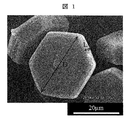
- the specific AlN crystal particle of the present invention has a flat octahedral shape composed of two hexagonal surfaces and six rectangular surfaces, and the hexagonal surface and the rectangular surface form one ridge. Instead, they form curved surfaces and intersect. Such a shape can be confirmed by a microphotograph having a magnification of 1,000 times.
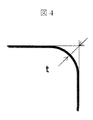
- the curved surface is preferably formed between the one ridge and the curved surface when it is assumed that the hexagonal surface and the rectangular surface intersect with each other to form one ridge. The distance t between them is formed so as to satisfy the relationship of 0 ⁇ t ⁇ 0.1 ⁇ m.
- the opposed planes are generally parallel.
- the specific AlN crystal particles have no sharp corners at all ridges confirmed by a micrograph of a magnification of 1,000 times in the cross section, and have so-called chamfered corners.
- the rounded corners of the ridges are achieved by producing specific AlN crystal grains by the production method described later, by producing aluminum nitride by reduction nitriding of alumina aggregates and by grain growth. Accordingly, it is clearly distinguished from crystal grains obtained by a method of growing and cutting an aluminum nitride single crystal and having sharp angles on the cut surface. Since the specific AlN crystal particles of the present invention have ridges with rounded corners, they have better fluidity than crystal grains with sharp corners.
- the aluminum nitride powder of the present invention can be used together with a known aluminum nitride powder, and aluminum nitride particles other than the specific AlN crystal particles are part or all of the aluminum nitride powder. It can also be used. However, the aluminum nitride particles other than the specific AlN crystal particles generated in the manufacturing process may be used as they are depending on the application, and in some applications, the effects of the specific AlN crystal particles may be exhibited. In applications where the effect is reduced or other aluminum nitride powders are used in combination, the effect of the specific AlN crystal particles may be made unstable, so the ratio is preferably as high as possible.
- the hexagonal flat surface of the specific aluminum nitride crystal particles is oriented in the same direction as the surface of the sintered body.
- the orientation ratio obtained by the above method is 70. % Or more, and particularly preferably 75% or more.
- the aluminum nitride sintered body of the present invention can remarkably improve mechanical strength, particularly fracture toughness, and also improve thermal conductivity by the orientation of the specific aluminum nitride crystal particles.
- oxides such as SrO and BaO
- alkaline earth compounds such as various salts
- rare earth compounds that do not inhibit the thermal conductivity.
- the alkaline earth compound or rare earth compound is preferably added in an amount of 3 to 7% by mass based on the total mass of the specific aluminum nitride crystal particles and the small-diameter aluminum nitride particles.
- the addition amount of the alkaline earth compound or the rare earth compound is less than 3% by mass, a liquid phase is not sufficiently formed, and a portion with insufficient densification tends to occur.
- the improvement of the thermal conductivity becomes insufficient, and the characteristics of the aluminum nitride sintered body cannot be sufficiently exhibited.
- the amount is more than 7% by mass, an excessive liquid phase is generated, so that the auxiliary agent is easily transferred to the outside of the sintered body, and uneven color tone may occur as the auxiliary agent is discharged.
- it can be a factor that decreases the bondability and adhesion to a metal or the like.
- the method of mixing the specific aluminum nitride crystal particles and the small-diameter aluminum nitride particles contained in a specific ratio and the sintering aid added in a specific ratio may be carried out by a known method, in particular. Not limited. Examples of a general mixing method include a ball mill, a vibration mill, a mixer, and an attritor.
- the aluminum nitride powder for sintering containing the specific aluminum nitride crystal particles has a hexagonal plane of the specific aluminum nitride crystal particles in the same direction as the surface of the obtained sintered body. It is desirable and important to shape to be oriented.
- the aluminum nitride sintered body is obtained by firing so that the hexagonal plane of the specific aluminum nitride crystal particles is oriented in the same direction as the surface of the obtained sintered body.
- a degreasing treatment may be performed prior to firing.
- known conditions are employed without any particular limitation.
- a general method is a treatment in an oxidizing atmosphere or a non-oxidizing atmosphere at a temperature of 300 to 1,000 ° C.
- Typical sintering methods include atmospheric pressure sintering and pressure sintering such as hot pressing and HIP (Hot Isostatic Pressing), and plasma sintering such as SPS (Spark Plasma Sintering).
- a firing time of 2 to 10 hours can be applied.
- known conditions are not particularly limited for the firing atmosphere, but it is particularly preferable to perform in a non-oxidizing atmosphere such as nitrogen or in a vacuum.
- a weight may be appropriately placed. According to the method for producing an aluminum nitride sintered body of the present invention described above, a novel aluminum nitride sintered body having high thermal conductivity and high mechanical strength can be stably obtained.
- the crystal particles were observed with a scanning electron microscope (S-2600, manufactured by Hitachi, Ltd.). About one kind of obtained aluminum nitride powder, 20 samples were collected from an arbitrary location, and 10 fields of view were taken for each sample at a magnification of 1,000 times, and the crystal particles in the field of view were rounded at the ridges. Confirmed whether or not. Similarly, the average distance D between two opposing corners in the hexagonal plane and the distance L between the planes of the crystal grains in the field of view were measured to determine the aspect ratio (L / D). . In addition, each value was shown as an average value of all the measurement data.
- the specific aluminum nitride crystal particles approximate a regular hexagonal shape, and the aluminum nitride fine powder approximates a spherical shape.
- the volume was determined from the measured values of the above, and the ratio of the volume of the specific aluminum nitride crystal particles to the volume of all the particles was calculated and shown as the average value of all data.
- (5) True density The true density of the specific aluminum nitride crystal particles is a dry automatic densimeter (AccuPyc1330 manufactured by Shimadzu Corporation) obtained by sieving the aluminum nitride powder and the specific aluminum nitride crystal particles having a volume% of 99% or more.
- He gas purity: 99.995% or more was used as a carrier gas.
- Specific surface area The specific surface area was determined by the BET method by N 2 adsorption using a flow type surface area automatic measuring apparatus, Flowsorb 2300, manufactured by Shimadzu Corporation.
- the CO ratio was obtained by measuring the exhaust gas from the firing furnace, and the ratio was controlled by adjusting the flow rates of N 2 and CO introduced into the firing furnace.
- the nitrided powder was oxidized in an air atmosphere at 700 ° C. for 10 hours to obtain an aluminum nitride powder.
- the distance (D), the average value of L / D, and the true density were measured.
- the results are shown in Table 1.
- the obtained aluminum nitride powder was filled in an epoxy resin to prepare a resin composition, and the thermal conductivity was evaluated.
- Example 2 Aluminum nitride powder was obtained in the same manner as in Example 1 except that 1 part by weight of magnesium oxide was added to the raw material mixed powder in Example 1. About the obtained aluminum nitride powder, the specific surface area, average particle diameter, aluminum nitride conversion, volume% of specific aluminum nitride crystal particles, average major axis (D), average value of L / D and true density were measured. The results are shown in Table 1. Moreover, about the aluminum nitride powder obtained by the present Example, an electron micrograph (SEM photograph) is shown in FIG. 1, and the particle size distribution curve measured with the laser diffraction particle size distribution apparatus is shown in FIG.
- SEM photograph electron micrograph
- Example 3 An aluminum nitride powder was obtained in the same manner as in Example 1 except that 1 part by weight of sulfur was added to the raw material mixed powder in Example 1. About the obtained aluminum nitride powder, specific surface area, average particle diameter, aluminum nitride conversion rate, volume% of specific aluminum nitride crystal particles, average distance (D) between two opposing corners in the hexagonal plane, L / The average value and true density of D were measured. The results are shown in Table 1.
- Example 5 Aluminum nitride powder was obtained in the same manner as in Example 2 except that the average particle size of the alumina fine powder aggregate in Example 2 was 3.6 ⁇ m. About the obtained aluminum nitride powder, specific surface area, average particle diameter, aluminum nitride conversion rate, volume% of specific aluminum nitride crystal particles, average distance (D) between two opposing corners in the hexagonal plane, L / The average value and true density of D were measured. The results are shown in Table 1.
- Example 6 An aluminum nitride powder was obtained in the same manner as in Example 2 except that the average particle size of the alumina fine powder aggregate in Example 2 was 10.8 ⁇ m. About the obtained aluminum nitride powder, specific surface area, average particle diameter, aluminum nitride conversion rate, volume% of specific aluminum nitride crystal particles, average distance (D) between two opposing corners in the hexagonal plane, L / The average value and true density of D were measured. The results are shown in Table 1.
- Example 7 An aluminum nitride powder was obtained in the same manner as in Example 1 except that the average particle size of the alumina fine powder aggregate in Example 1 was 10.8 ⁇ m, and 2 parts by weight of magnesium oxide was added to the raw material mixed powder. About the obtained aluminum nitride powder, specific surface area, average particle diameter, aluminum nitride conversion rate, volume% of specific aluminum nitride crystal particles, average distance (D) between two opposing corners in the hexagonal plane, L / The average value and true density of D were measured. The results are shown in Table 1.
- Example 8 Aluminum nitride powder was obtained in the same manner as in Example 2 except that the N 2 ratio in the atmosphere in Example 2 was 80% and the CO ratio was 20%. About the obtained aluminum nitride powder, specific surface area, average particle diameter, aluminum nitride conversion rate, volume% of specific aluminum nitride crystal particles, average distance (D) between two opposing corners in the hexagonal plane, L / The average value and true density of D were measured. The results are shown in Table 1.
- Example 9 The aluminum nitride powder produced in Example 8 was classified using a sieve having an opening of 20 ⁇ m to reduce the amount of fine powder in the aluminum nitride powder. About the obtained aluminum nitride powder, specific surface area, average particle diameter, aluminum nitride conversion rate, volume% of specific aluminum nitride crystal particles, average distance (D) between two opposing corners in the hexagonal plane, L / The average value and true density of D were measured. The results are shown in Table 1.
- Example 10 An alumina fine powder aggregate having an average particle size of 5.6 ⁇ m obtained by agglomerating fine powder having an average particle size of 1.5 ⁇ m and carbon black having a specific surface area of 125 m 2 / g were mixed.
- the mixed powder was fired under the conditions of a firing temperature of 1,750 ° C. and a firing time of 10 hours. At the time of firing, the N 2 ratio in the atmosphere was 70% by volume, and the CO ratio was 30% by volume.
- the CO ratio was obtained by measuring the exhaust gas from the firing furnace, and the ratio was controlled by adjusting the flow rates of N 2 and CO introduced into the firing furnace.
- the nitrided powder was oxidized in an air atmosphere at 700 ° C. for 10 hours to obtain an aluminum nitride powder containing specific AlN crystal particles.
- the specific AlN crystal particles in the aluminum nitride powder obtained by the above method are single crystals, the average major axis (D) is 10 ⁇ m, the average distance (L) between planes is 5.6 ⁇ m, and the average value of L / D is 0.56 and the true density was 3.23 g / cm 3 .
- Example 11 Specific AlN crystal particles were obtained in the same manner as in Example 10 except that 1 part by weight of magnesium oxide was added to the raw material mixed powder in Example 10.
- the specific AlN crystal particles in the aluminum nitride powder obtained by the above method are single crystals, the average distance (D) between two opposing corners in the hexagonal plane is 28 ⁇ m, and the average distance (L ) was 6.4 ⁇ m, the average L / D value was 0.23, and the true density was 3.24 g / cm 3 .
- the ratio of the specific AlN crystal particles in the obtained aluminum nitride powder was 96% by volume (the ratio (volume) of AlN particles other than the specific AlN crystal to the specific AlN crystal particles was 4.2% by volume).
- Example 13 100 parts by weight of silicone oil (KF-96-1000CS manufactured by Shin-Etsu Silicone Co., Ltd.) and an aluminum nitride powder obtained in the same manner as Example 10 were heated with a stirring device so that the specific AlN crystal particles were 140 parts by weight. And homogenized by heating and kneading. The mixture was allowed to cool to room temperature and mixed with a paint roll to prepare a grease. The results of measuring the thermal conductivity of the obtained grease are shown in Table 3.
- Example 20 An aluminum nitride powder for sintering was obtained in the same manner as in Example 15 except that 60 parts by weight of the specific aluminum nitride crystal particles and 40 parts by weight of the small-diameter aluminum nitride particles were used. Next, this aluminum nitride powder for sintering was pressed at room temperature at about 80 MPa to obtain a molded body. Thereafter, this molded body was fired at 1,800 ° C. for 5 hours in a nitrogen gas atmosphere at normal pressure to obtain an aluminum nitride sintered body.
- Comparative Example 8 The same operation as in Example 15 was performed, except that the specific aluminum nitride crystal particles were 0 parts by weight and the small-diameter aluminum nitride particles were 100 parts by weight. Comparative Example 9 The same operation as in Example 15 was performed except that the specific chambered aluminum crystal particles were 100 parts by weight and the small-diameter aluminum nitride particles were 0 parts by weight. Comparative Example 10 The same operation as in Example 15 was performed, except that the specific aluminum nitride crystal particles were 50 parts by weight and the small-diameter aluminum nitride particles were 50 parts by weight.
Landscapes
- Chemical & Material Sciences (AREA)
- Engineering & Computer Science (AREA)
- Organic Chemistry (AREA)
- Ceramic Engineering (AREA)
- Manufacturing & Machinery (AREA)
- Materials Engineering (AREA)
- Inorganic Chemistry (AREA)
- Structural Engineering (AREA)
- Chemical Kinetics & Catalysis (AREA)
- Physics & Mathematics (AREA)
- Thermal Sciences (AREA)
- Health & Medical Sciences (AREA)
- Medicinal Chemistry (AREA)
- Polymers & Plastics (AREA)
- Combustion & Propulsion (AREA)
- Compositions Of Macromolecular Compounds (AREA)
- Ceramic Products (AREA)
Abstract
Priority Applications (5)
| Application Number | Priority Date | Filing Date | Title |
|---|---|---|---|
| KR1020157018381A KR102185730B1 (ko) | 2013-02-08 | 2014-02-06 | 질화알루미늄 분말 |
| US14/759,998 US10508035B2 (en) | 2013-02-08 | 2014-02-06 | Aluminum nitride powders |
| CN201480006112.6A CN104955769B (zh) | 2013-02-08 | 2014-02-06 | 氮化铝粉末 |
| JP2014560833A JP6261050B2 (ja) | 2013-02-08 | 2014-02-06 | 窒化アルミニウム粉末 |
| EP14749001.5A EP2955156A4 (fr) | 2013-02-08 | 2014-02-06 | Poudre de nitrure d'aluminium |
Applications Claiming Priority (8)
| Application Number | Priority Date | Filing Date | Title |
|---|---|---|---|
| JP2013023829 | 2013-02-08 | ||
| JP2013-023829 | 2013-02-08 | ||
| JP2013118115 | 2013-06-04 | ||
| JP2013-118115 | 2013-06-04 | ||
| JP2013-118223 | 2013-06-04 | ||
| JP2013118223 | 2013-06-04 | ||
| JP2013201810 | 2013-09-27 | ||
| JP2013-201810 | 2013-09-27 |
Publications (1)
| Publication Number | Publication Date |
|---|---|
| WO2014123247A1 true WO2014123247A1 (fr) | 2014-08-14 |
Family
ID=51299836
Family Applications (1)
| Application Number | Title | Priority Date | Filing Date |
|---|---|---|---|
| PCT/JP2014/053389 Ceased WO2014123247A1 (fr) | 2013-02-08 | 2014-02-06 | Poudre de nitrure d'aluminium |
Country Status (7)
| Country | Link |
|---|---|
| US (1) | US10508035B2 (fr) |
| EP (1) | EP2955156A4 (fr) |
| JP (1) | JP6261050B2 (fr) |
| KR (1) | KR102185730B1 (fr) |
| CN (1) | CN104955769B (fr) |
| TW (1) | TWI610884B (fr) |
| WO (1) | WO2014123247A1 (fr) |
Cited By (18)
| Publication number | Priority date | Publication date | Assignee | Title |
|---|---|---|---|---|
| US20170036303A1 (en) * | 2014-04-23 | 2017-02-09 | Ngk Insulators, Ltd. | Porous plate-shaped filler, method for producing same, and heat insulation film |
| KR101734831B1 (ko) * | 2015-03-12 | 2017-05-12 | 한국세라믹기술원 | (002) 우선 배향의 판상 질화알루미늄 분말의 제조방법 |
| WO2017131239A1 (fr) * | 2016-01-29 | 2017-08-03 | 株式会社トクヤマ | Particule de nitrure d'aluminium |
| WO2017170856A1 (fr) * | 2016-03-30 | 2017-10-05 | 新日鉄住金マテリアルズ株式会社 | Procédé de fabrication de particules sphériques de nitrure d'aluminium, et dispositif de fabrication de particules sphériques de nitrure d'aluminium |
| WO2017170857A1 (fr) * | 2016-03-30 | 2017-10-05 | 新日鉄住金マテリアルズ株式会社 | Dispositif de fabrication de particules sphériques de nitrure d'aluminium |
| JP6346718B1 (ja) * | 2017-03-22 | 2018-06-20 | 日本碍子株式会社 | 窒化アルミニウム粒子 |
| WO2018117161A1 (fr) * | 2016-12-21 | 2018-06-28 | 日本碍子株式会社 | Corps fritté d'aln orienté et son procédé de production |
| WO2018117162A1 (fr) * | 2016-12-21 | 2018-06-28 | 日本碍子株式会社 | Corps fritté d'aln transparent, et son procédé de production |
| WO2018199322A1 (fr) * | 2017-04-27 | 2018-11-01 | 株式会社トクヤマ | Particules de nitrure d'aluminium |
| WO2019017451A1 (fr) * | 2017-07-21 | 2019-01-24 | 東洋アルミニウム株式会社 | Poudre à base de nitrure d'aluminium et procédé de fabrication de celle-ci |
| WO2019180937A1 (fr) * | 2018-03-23 | 2019-09-26 | 日本碍子株式会社 | Particules de nitrure d'aluminium |
| JPWO2020195776A1 (fr) * | 2019-03-22 | 2020-10-01 | ||
| JP2020176222A (ja) * | 2019-04-19 | 2020-10-29 | 株式会社トクヤマ | 窒化アルミニウム複合フィラー |
| JP2020180221A (ja) * | 2019-04-25 | 2020-11-05 | 株式会社トクヤマ | 複合フィラー |
| JP2020196861A (ja) * | 2019-05-31 | 2020-12-10 | 京セラ株式会社 | 熱伝導性グリース組成物およびそれを用いた物品 |
| JP2023065458A (ja) * | 2017-05-22 | 2023-05-12 | 東洋アルミニウム株式会社 | 窒化アルミニウム系粉末及びその製造方法 |
| WO2024190746A1 (fr) | 2023-03-13 | 2024-09-19 | コスモ石油ルブリカンツ株式会社 | Composition de graisse thermoconductrice |
| WO2024190747A1 (fr) | 2023-03-13 | 2024-09-19 | コスモ石油ルブリカンツ株式会社 | Composition de graisse thermoconductrice |
Families Citing this family (8)
| Publication number | Priority date | Publication date | Assignee | Title |
|---|---|---|---|---|
| CN108395255A (zh) * | 2018-02-07 | 2018-08-14 | 牧星航空传感器技术(太仓)有限公司 | 一种氮化铝复合材料及其制备方法以及在汽车尾气温度传感器中的应用 |
| WO2019189378A1 (fr) * | 2018-03-27 | 2019-10-03 | 日本碍子株式会社 | Feuille de nitrure d'aluminium |
| JP7308636B2 (ja) * | 2019-03-27 | 2023-07-14 | 株式会社トクヤマ | 窒化アルミニウムからなる複合構造体 |
| CN110790244B (zh) * | 2019-10-30 | 2022-07-15 | 大连海事大学 | 一种碳热还原氮化法制备AlN陶瓷粉体的方法 |
| KR102474898B1 (ko) | 2019-12-19 | 2022-12-05 | 정장윤 | 마이크로 웨이브 가열장치 및 이를 이용한 질화알루미늄의 제조방법 |
| CN110963800A (zh) * | 2019-12-31 | 2020-04-07 | 广东华科新材料研究院有限公司 | 一种氮化铝陶瓷基片及其制备方法 |
| US20230303455A1 (en) * | 2020-08-07 | 2023-09-28 | U-Map Co., Ltd. | Ceramic substrate, aln single crystal, aln whisker, and aln whisker composite |
| CN115353081B (zh) * | 2022-08-24 | 2024-03-19 | 中铝郑州有色金属研究院有限公司 | 一种氮化铝粉体及其制备方法 |
Citations (6)
| Publication number | Priority date | Publication date | Assignee | Title |
|---|---|---|---|---|
| JPH03295853A (ja) | 1990-04-12 | 1991-12-26 | Sumitomo Metal Mining Co Ltd | 施釉用成形体並びに施釉用成形体の製造方法及び施釉成形体の製造方法 |
| JPH06191807A (ja) * | 1992-12-28 | 1994-07-12 | Tokuyama Soda Co Ltd | 窒化アルミニウム粉末の製造方法 |
| JPH06321511A (ja) * | 1993-03-16 | 1994-11-22 | Takeshi Masumoto | 窒化アルミニウム超微粒子及びその製造方法と超微粒子焼結体 |
| JP2001002474A (ja) | 1999-06-17 | 2001-01-09 | Denki Kagaku Kogyo Kk | 窒化アルミニウム焼結体とその製造方法、及び用途 |
| WO2009066663A1 (fr) | 2007-11-22 | 2009-05-28 | Meijo University | Matière colonnaire polygonale de monocristal de nitrure d'aluminium et procédé de fabrication d'un monocristal de nitrure d'aluminium de type lamelle à l'aide de la matière colonnaire polygonale |
| WO2012029868A1 (fr) * | 2010-09-03 | 2012-03-08 | 株式会社トクヤマ | Poudre de nitrure d'aluminium à particules sphériques |
Family Cites Families (18)
| Publication number | Priority date | Publication date | Assignee | Title |
|---|---|---|---|---|
| DE3333406A1 (de) * | 1982-09-17 | 1984-03-22 | Tokuyama Soda K.K., Tokuyama, Yamaguchi | Feines aluminiumnitridpulver, verfahren zu seiner herstellung und es enthaltendes mittel |
| US5154907A (en) * | 1986-10-15 | 1992-10-13 | The Carborundum Company | Process for the continuous production of high purity, ultra-fine, aluminum nitride powder by the carbo-nitridization of alumina |
| US5049367A (en) * | 1988-10-05 | 1991-09-17 | Sumitomo Chemical Co., Limited | Aluminum nitride powder and process for preparation of the same |
| US4983553A (en) | 1989-12-07 | 1991-01-08 | The Dow Chemical Company | Continuous carbothermal reactor |
| EP0615952B1 (fr) | 1993-03-16 | 1999-07-28 | Ykk Corporation | Procédé de fabrication de particules composites ultrafines en nitrure d'aluminium et nitrure de terres rares |
| FR2710047B1 (fr) * | 1993-09-17 | 1995-10-13 | Atochem Elf Sa | Procédé de préparation en continu de nitrure d'aluminium par carbonitruration d'alumine dans un réacteur à lit coulant. |
| FR2715169B1 (fr) * | 1994-01-14 | 1996-04-05 | Atochem Elf Sa | Macrocristaux renfermant du nitrure d'aluminium sous forme de plaquettes, leur procédé de préparation et leurs utilisations. |
| JP2967094B2 (ja) * | 1995-11-02 | 1999-10-25 | 工業技術院長 | 窒化アルミニウム焼結体、及び窒化アルミニウム粉末の製造方法 |
| CA2268859C (fr) * | 1999-04-13 | 2001-01-23 | Steve Lohnes | Structures de beton de resine |
| JP4089398B2 (ja) | 2002-03-14 | 2008-05-28 | 住友金属工業株式会社 | AlN単結晶の製造方法 |
| CN100372639C (zh) * | 2004-07-08 | 2008-03-05 | 三井化学株式会社 | 氮化铝粉末及其制造方法和用途 |
| JP4753851B2 (ja) * | 2005-12-19 | 2011-08-24 | 日本碍子株式会社 | 窒化アルミニウム粉末、窒化アルミニウム質セラミックス焼結体、半導体製造装置用部材、窒化アルミニウム発光材料、及び窒化アルミニウム粉末の製造方法 |
| WO2008018302A1 (fr) * | 2006-08-07 | 2008-02-14 | Tokuyama Corporation | Corps fritté en nitrure d'aluminium et son procédé de production |
| JP5560528B2 (ja) * | 2008-01-28 | 2014-07-30 | 住友電気工業株式会社 | Iii族窒化物単結晶インゴットの製造方法、及びiii族窒化物単結晶基板の製造方法 |
| JP2010042980A (ja) * | 2008-07-17 | 2010-02-25 | Sumitomo Electric Ind Ltd | Iii族窒化物結晶の製造方法およびiii族窒化物結晶 |
| KR101545776B1 (ko) | 2010-01-29 | 2015-08-19 | 가부시끼가이샤 도꾸야마 | 구 형상 질화 알루미늄 분말의 제조 방법 및 상기 방법에 의해 얻어진 구 형상 질화 알루미늄 분말 |
| JP2012087392A (ja) | 2010-10-22 | 2012-05-10 | Shin-Etsu Chemical Co Ltd | 窒化アルミニウム膜の成膜方法 |
| JP5875525B2 (ja) | 2010-12-06 | 2016-03-02 | 株式会社トクヤマ | 窒化アルミニウム粉末の製造方法 |
-
2014
- 2014-02-06 KR KR1020157018381A patent/KR102185730B1/ko active Active
- 2014-02-06 JP JP2014560833A patent/JP6261050B2/ja active Active
- 2014-02-06 WO PCT/JP2014/053389 patent/WO2014123247A1/fr not_active Ceased
- 2014-02-06 US US14/759,998 patent/US10508035B2/en active Active
- 2014-02-06 EP EP14749001.5A patent/EP2955156A4/fr active Pending
- 2014-02-06 CN CN201480006112.6A patent/CN104955769B/zh active Active
- 2014-02-07 TW TW103104096A patent/TWI610884B/zh active
Patent Citations (6)
| Publication number | Priority date | Publication date | Assignee | Title |
|---|---|---|---|---|
| JPH03295853A (ja) | 1990-04-12 | 1991-12-26 | Sumitomo Metal Mining Co Ltd | 施釉用成形体並びに施釉用成形体の製造方法及び施釉成形体の製造方法 |
| JPH06191807A (ja) * | 1992-12-28 | 1994-07-12 | Tokuyama Soda Co Ltd | 窒化アルミニウム粉末の製造方法 |
| JPH06321511A (ja) * | 1993-03-16 | 1994-11-22 | Takeshi Masumoto | 窒化アルミニウム超微粒子及びその製造方法と超微粒子焼結体 |
| JP2001002474A (ja) | 1999-06-17 | 2001-01-09 | Denki Kagaku Kogyo Kk | 窒化アルミニウム焼結体とその製造方法、及び用途 |
| WO2009066663A1 (fr) | 2007-11-22 | 2009-05-28 | Meijo University | Matière colonnaire polygonale de monocristal de nitrure d'aluminium et procédé de fabrication d'un monocristal de nitrure d'aluminium de type lamelle à l'aide de la matière colonnaire polygonale |
| WO2012029868A1 (fr) * | 2010-09-03 | 2012-03-08 | 株式会社トクヤマ | Poudre de nitrure d'aluminium à particules sphériques |
Non-Patent Citations (4)
| Title |
|---|
| CERAMIC SOCIETY OF JAPAN, vol. 97, 1989, pages 864 |
| CERAMIC SOCIETY OF JAPAN, vol. 97, 1989, pages 874 |
| ELECTROCHEMISTRY, vol. 10, 1972, pages 743 |
| See also references of EP2955156A4 |
Cited By (49)
| Publication number | Priority date | Publication date | Assignee | Title |
|---|---|---|---|---|
| US20170036303A1 (en) * | 2014-04-23 | 2017-02-09 | Ngk Insulators, Ltd. | Porous plate-shaped filler, method for producing same, and heat insulation film |
| US10464287B2 (en) * | 2014-04-23 | 2019-11-05 | Nkg Insulators, Ltd. | Porous plate-shaped filler, method for producing same, and heat insulation film |
| KR101734831B1 (ko) * | 2015-03-12 | 2017-05-12 | 한국세라믹기술원 | (002) 우선 배향의 판상 질화알루미늄 분말의 제조방법 |
| KR20180109863A (ko) * | 2016-01-29 | 2018-10-08 | 가부시끼가이샤 도꾸야마 | 질화알루미늄 입자 |
| WO2017131239A1 (fr) * | 2016-01-29 | 2017-08-03 | 株式会社トクヤマ | Particule de nitrure d'aluminium |
| KR102653651B1 (ko) | 2016-01-29 | 2024-04-03 | 가부시끼가이샤 도꾸야마 | 질화알루미늄 입자 |
| JPWO2017131239A1 (ja) * | 2016-01-29 | 2018-11-22 | 株式会社トクヤマ | 窒化アルミニウム粒子 |
| WO2017170856A1 (fr) * | 2016-03-30 | 2017-10-05 | 新日鉄住金マテリアルズ株式会社 | Procédé de fabrication de particules sphériques de nitrure d'aluminium, et dispositif de fabrication de particules sphériques de nitrure d'aluminium |
| WO2017170857A1 (fr) * | 2016-03-30 | 2017-10-05 | 新日鉄住金マテリアルズ株式会社 | Dispositif de fabrication de particules sphériques de nitrure d'aluminium |
| JP2017178668A (ja) * | 2016-03-30 | 2017-10-05 | 新日鉄住金マテリアルズ株式会社 | 球状窒化アルミニウム粒子の製造方法及び球状窒化アルミニウム粒子製造装置 |
| JP2017178667A (ja) * | 2016-03-30 | 2017-10-05 | 新日鉄住金マテリアルズ株式会社 | 球状窒化アルミニウム粒子製造装置 |
| JPWO2018117161A1 (ja) * | 2016-12-21 | 2019-10-31 | 日本碍子株式会社 | 配向AlN焼結体及びその製法 |
| WO2018117162A1 (fr) * | 2016-12-21 | 2018-06-28 | 日本碍子株式会社 | Corps fritté d'aln transparent, et son procédé de production |
| JP7027338B2 (ja) | 2016-12-21 | 2022-03-01 | 日本碍子株式会社 | 透明AlN焼結体及びその製法 |
| US11059753B2 (en) | 2016-12-21 | 2021-07-13 | Ngk Insulators, Ltd. | Oriented ALN sintered body and method for producing the same |
| US11014855B2 (en) | 2016-12-21 | 2021-05-25 | Ngk Insulators, Ltd. | Transparent AlN sintered body and method for producing the same |
| WO2018117161A1 (fr) * | 2016-12-21 | 2018-06-28 | 日本碍子株式会社 | Corps fritté d'aln orienté et son procédé de production |
| JPWO2018117162A1 (ja) * | 2016-12-21 | 2019-10-31 | 日本碍子株式会社 | 透明AlN焼結体及びその製法 |
| US11136271B2 (en) | 2017-03-22 | 2021-10-05 | Ngk Insulators, Ltd. | Aluminum nitride particles |
| JP6346718B1 (ja) * | 2017-03-22 | 2018-06-20 | 日本碍子株式会社 | 窒化アルミニウム粒子 |
| WO2018173170A1 (fr) | 2017-03-22 | 2018-09-27 | 日本碍子株式会社 | Particules de nitrure d'aluminium |
| WO2018199322A1 (fr) * | 2017-04-27 | 2018-11-01 | 株式会社トクヤマ | Particules de nitrure d'aluminium |
| KR20190139211A (ko) * | 2017-04-27 | 2019-12-17 | 가부시끼가이샤 도꾸야마 | 질화알루미늄 입자 |
| JPWO2018199322A1 (ja) * | 2017-04-27 | 2020-03-12 | 株式会社トクヤマ | 窒化アルミニウム粒子 |
| KR102459174B1 (ko) | 2017-04-27 | 2022-10-27 | 가부시끼가이샤 도꾸야마 | 질화알루미늄 입자 |
| JP7153640B2 (ja) | 2017-04-27 | 2022-10-14 | 株式会社トクヤマ | 窒化アルミニウム粒子 |
| JP2023065458A (ja) * | 2017-05-22 | 2023-05-12 | 東洋アルミニウム株式会社 | 窒化アルミニウム系粉末及びその製造方法 |
| JP7464767B2 (ja) | 2017-05-22 | 2024-04-09 | 東洋アルミニウム株式会社 | 窒化アルミニウム系粉末及びその製造方法 |
| WO2019017451A1 (fr) * | 2017-07-21 | 2019-01-24 | 東洋アルミニウム株式会社 | Poudre à base de nitrure d'aluminium et procédé de fabrication de celle-ci |
| JP2019019045A (ja) * | 2017-07-21 | 2019-02-07 | 東洋アルミニウム株式会社 | 窒化アルミニウム系粉末及びその製造方法 |
| JPWO2019180937A1 (ja) * | 2018-03-23 | 2020-12-03 | 日本碍子株式会社 | 窒化アルミニウム粒子 |
| JP7033191B2 (ja) | 2018-03-23 | 2022-03-09 | 日本碍子株式会社 | 窒化アルミニウム粒子 |
| WO2019180937A1 (fr) * | 2018-03-23 | 2019-09-26 | 日本碍子株式会社 | Particules de nitrure d'aluminium |
| JP7355810B2 (ja) | 2019-03-22 | 2023-10-03 | 株式会社トクヤマ | 窒化アルミニウム粒子、窒化アルミニウム粉末、窒化アルミニウム粉末の製造方法、樹脂用フィラーおよび樹脂組成物 |
| KR20210138560A (ko) * | 2019-03-22 | 2021-11-19 | 가부시끼가이샤 도꾸야마 | 질화알루미늄 입자 |
| KR102727394B1 (ko) | 2019-03-22 | 2024-11-08 | 가부시끼가이샤 도꾸야마 | 질화알루미늄 입자 |
| WO2020195776A1 (fr) * | 2019-03-22 | 2020-10-01 | 株式会社トクヤマ | Particules de nitrure d'aluminium |
| JPWO2020195776A1 (fr) * | 2019-03-22 | 2020-10-01 | ||
| US11661494B2 (en) | 2019-03-22 | 2023-05-30 | Tokuyama Corporation | Aluminum nitride particles |
| JP2020176222A (ja) * | 2019-04-19 | 2020-10-29 | 株式会社トクヤマ | 窒化アルミニウム複合フィラー |
| JP7292941B2 (ja) | 2019-04-19 | 2023-06-19 | 株式会社トクヤマ | 窒化アルミニウム複合フィラー |
| JP7257866B2 (ja) | 2019-04-25 | 2023-04-14 | 株式会社トクヤマ | 複合フィラー |
| JP2020180221A (ja) * | 2019-04-25 | 2020-11-05 | 株式会社トクヤマ | 複合フィラー |
| JP7335840B2 (ja) | 2019-05-31 | 2023-08-30 | 京セラ株式会社 | 熱伝導性グリース組成物およびそれを用いた物品 |
| JP2020196861A (ja) * | 2019-05-31 | 2020-12-10 | 京セラ株式会社 | 熱伝導性グリース組成物およびそれを用いた物品 |
| WO2024190746A1 (fr) | 2023-03-13 | 2024-09-19 | コスモ石油ルブリカンツ株式会社 | Composition de graisse thermoconductrice |
| WO2024190747A1 (fr) | 2023-03-13 | 2024-09-19 | コスモ石油ルブリカンツ株式会社 | Composition de graisse thermoconductrice |
| EP4682221A1 (fr) | 2023-03-13 | 2026-01-21 | Cosmo Oil Lubricants Co., Ltd. | Composition de graisse thermoconductrice |
| EP4682222A1 (fr) | 2023-03-13 | 2026-01-21 | Cosmo Oil Lubricants Co., Ltd. | Composition de graisse thermoconductrice |
Also Published As
| Publication number | Publication date |
|---|---|
| TW201446642A (zh) | 2014-12-16 |
| US20150353355A1 (en) | 2015-12-10 |
| TWI610884B (zh) | 2018-01-11 |
| CN104955769B (zh) | 2018-07-20 |
| JPWO2014123247A1 (ja) | 2017-02-02 |
| US10508035B2 (en) | 2019-12-17 |
| EP2955156A1 (fr) | 2015-12-16 |
| CN104955769A (zh) | 2015-09-30 |
| JP6261050B2 (ja) | 2018-01-17 |
| KR102185730B1 (ko) | 2020-12-02 |
| EP2955156A4 (fr) | 2016-09-21 |
| KR20150114468A (ko) | 2015-10-12 |
Similar Documents
| Publication | Publication Date | Title |
|---|---|---|
| JP6261050B2 (ja) | 窒化アルミニウム粉末 | |
| JP7207384B2 (ja) | 窒化ホウ素凝集粒子、窒化ホウ素凝集粒子の製造方法、該窒化ホウ素凝集粒子含有樹脂組成物、成形体、及びシート | |
| CN103140436B (zh) | 氮化铝粉末及其制造方法 | |
| TWI715729B (zh) | 六方晶氮化硼粉末、其製造方法、樹脂組成物及樹脂薄片 | |
| TWI832978B (zh) | 氮化硼凝集粉末、散熱片及半導體裝置 | |
| JP7334763B2 (ja) | 窒化アルミニウム-窒化ホウ素複合凝集粒子およびその製造方法 | |
| JP6262522B2 (ja) | 樹脂含浸窒化ホウ素焼結体およびその用途 | |
| JP2019116401A (ja) | 六方晶窒化ホウ素粉末及びその製造方法、並びにそれを用いた組成物及び放熱材 | |
| TW201722848A (zh) | 六方晶體氮化硼粉末、其製造方法、樹脂組成物及樹脂薄片 | |
| JP6826544B2 (ja) | 熱伝導性フィラー組成物、その利用および製法 | |
| JP2012072013A (ja) | 球状窒化アルミニウム粉末 | |
| JP2013147403A (ja) | 金属化合物含有窒化ホウ素、及びそれを含有する複合材組成物 | |
| JP2017036190A (ja) | 窒化ホウ素凝集粒子組成物、bn凝集粒子含有樹脂組成物及びそれらの成形体、並びに窒化ホウ素凝集粒子の製造方法、 | |
| KR20230139295A (ko) | 육방정계 질화붕소를 이용한 열전도성 복합소재 | |
| JP3685629B2 (ja) | ホウ酸塩粒子、その粒子を含む無機粉末の製法及び用途 | |
| JP5987322B2 (ja) | 金属酸化物含有窒化ホウ素の製造方法 | |
| JP7804810B1 (ja) | 窒化ホウ素粉末、無機フィラー及び窒化ホウ素粉末の製造方法 | |
| JP7438442B1 (ja) | 窒化ホウ素凝集粒子、シート部材および窒化ホウ素凝集粒子の製造方法 | |
| JP7438443B1 (ja) | 窒化ホウ素凝集粒子、シート部材および窒化ホウ素凝集粒子の製造方法 |
Legal Events
| Date | Code | Title | Description |
|---|---|---|---|
| 121 | Ep: the epo has been informed by wipo that ep was designated in this application |
Ref document number: 14749001 Country of ref document: EP Kind code of ref document: A1 |
|
| ENP | Entry into the national phase |
Ref document number: 2014560833 Country of ref document: JP Kind code of ref document: A |
|
| ENP | Entry into the national phase |
Ref document number: 20157018381 Country of ref document: KR Kind code of ref document: A |
|
| WWE | Wipo information: entry into national phase |
Ref document number: 14759998 Country of ref document: US |
|
| WWE | Wipo information: entry into national phase |
Ref document number: 2014749001 Country of ref document: EP |
|
| NENP | Non-entry into the national phase |
Ref country code: DE |