WO2014125799A1 - Analyseur de mazout - Google Patents
Analyseur de mazout Download PDFInfo
- Publication number
- WO2014125799A1 WO2014125799A1 PCT/JP2014/000627 JP2014000627W WO2014125799A1 WO 2014125799 A1 WO2014125799 A1 WO 2014125799A1 JP 2014000627 W JP2014000627 W JP 2014000627W WO 2014125799 A1 WO2014125799 A1 WO 2014125799A1
- Authority
- WO
- WIPO (PCT)
- Prior art keywords
- fuel oil
- temperature
- weight
- unit
- change
- Prior art date
- Legal status (The legal status is an assumption and is not a legal conclusion. Google has not performed a legal analysis and makes no representation as to the accuracy of the status listed.)
- Ceased
Links
Images




Classifications
-
- G—PHYSICS
- G01—MEASURING; TESTING
- G01N—INVESTIGATING OR ANALYSING MATERIALS BY DETERMINING THEIR CHEMICAL OR PHYSICAL PROPERTIES
- G01N5/00—Analysing materials by weighing, e.g. weighing small particles separated from a gas or liquid
- G01N5/04—Analysing materials by weighing, e.g. weighing small particles separated from a gas or liquid by removing a component, e.g. by evaporation, and weighing the remainder
-
- G—PHYSICS
- G01—MEASURING; TESTING
- G01N—INVESTIGATING OR ANALYSING MATERIALS BY DETERMINING THEIR CHEMICAL OR PHYSICAL PROPERTIES
- G01N25/00—Investigating or analyzing materials by the use of thermal means
- G01N25/50—Investigating or analyzing materials by the use of thermal means by investigating flash-point; by investigating explosibility
- G01N25/52—Investigating or analyzing materials by the use of thermal means by investigating flash-point; by investigating explosibility by determining flash-point of liquids
-
- G—PHYSICS
- G01—MEASURING; TESTING
- G01N—INVESTIGATING OR ANALYSING MATERIALS BY DETERMINING THEIR CHEMICAL OR PHYSICAL PROPERTIES
- G01N33/00—Investigating or analysing materials by specific methods not covered by groups G01N1/00 - G01N31/00
- G01N33/26—Oils; Viscous liquids; Paints; Inks
- G01N33/28—Oils, i.e. hydrocarbon liquids
- G01N33/2829—Mixtures of fuels
Definitions
- the present invention relates to a fuel oil analyzer suitable for simple analysis of fuel oil.
- fuel oils are classified according to standards. For example, heavy oil is classified into A heavy oil, B heavy oil, and C heavy oil according to kinematic viscosity. Further, A heavy oil is further subdivided into Nos. 1 and 2 by the sulfur content, and C heavy oil is subdivided into Nos. 1, 2, and 3 by the kinematic viscosity.
- a heavy oil is further subdivided into Nos. 1 and 2 by the sulfur content
- C heavy oil is subdivided into Nos. 1, 2, and 3 by the kinematic viscosity.
- fuel oils with different flammability are circulated because the mixture and the like differ depending on the way of the essential oil and the manufacturer.
- the kinematic viscosity of the fuel oil that can be used is set according to the specifications of the main engine, but the suitability of the fuel oil varies depending on the type and size of the main engine. Moreover, even if it is the main machine of the same specification, the suitability of fuel oil may change with individual differences. Therefore, even if a ship uses fuel with the same kinematic viscosity, a fuel oil suitable for a certain ship is not necessarily a fuel oil suitable for another ship. That is, even if the fuel oil of the same classification has the same specifications, it is not necessarily a fuel oil suitable for all ships.
- Fuel oil combustibility is generally represented by an estimated cetane number (hereinafter also referred to as “ECN”) based on the British Standard (IP541 / 06).
- ECN estimated cetane number
- IP541 / 06 British Standard
- this quality analyzer attempts to determine the ignitability of fuel oil by calculating the CCAI value using the density of fuel oil at 15 ° C. and the kinematic viscosity at 50 ° C. ( For example, see Patent Document 1).
- this quality analyzer analyzes whether the fuel oil quality is suitable by analyzing the proportion of polymer components contained in the fuel oil, analyzing the proportion of insoluble fine particles, and analyzing the proportion of sulfur. Is determined.
- the volatile substance content is measured from the change in the weight of the sample, or the asphalt content is calculated by reducing the weight by burning the asphalt component in the sample. It is not possible to analyze fuel oil combustibility.
- an object of the present invention is to provide a fuel oil analyzer that can easily and quickly estimate the combustibility of fuel oil with a simple device configuration.
- the present invention provides a sample container for containing a fuel oil sample, a main body case having an internal space for accommodating the sample container, and a heating unit for heating the sample container in the main body case.
- a temperature control unit for controlling the temperature in the main body case to a predetermined temperature range, a temperature measuring unit for measuring a temperature change in the main body case, and a weight measuring unit for measuring a weight change of the fuel oil in the sample container
- a recording unit that records the temperature change measured by the temperature measuring unit and the weight change measured by the weight measuring unit, and the combustibility of the fuel oil is estimated from the temperature change and weight change recorded in the recording unit
- an analysis unit for controlling the temperature in the main body case to a predetermined temperature range
- a temperature measuring unit for measuring a temperature change in the main body case
- a weight measuring unit for measuring a weight change of the fuel oil in the sample container
- a recording unit that records the temperature change measured by the temperature measuring unit and the weight change measured by the weight measuring unit, and the combustibility of the fuel oil
- the weight of the fuel oil gradually decreases by heating the fuel oil in the sample container in a predetermined temperature range in the main body case, and the change in the weight and the temperature change in the main body case. From this relationship, the combustibility of the fuel oil can be estimated. Therefore, in the case of a ship, the crew can easily estimate the combustibility of the fuel oil in a short time when the fuel oil is loaded, and can quickly determine the suitability of the fuel oil. . For this reason, it is possible to quickly start using the fuel oil that has been loaded, or in some cases to refuse loading, without waiting for an analysis result by a specialist.
- the analysis unit may be configured to estimate the ignition temperature of the fuel oil from the temperature change and weight change recorded in the recording unit, and to estimate the estimated cetane number of the fuel oil from the ignition temperature. .
- the flammability can be estimated by estimating the estimated cetane number of the fuel oil from the ignition temperature of the fuel oil estimated based on the weight change of the fuel oil and the temperature change in the main body case. .
- the analysis unit may be configured to estimate an estimated cetane number based on a weight change in a predetermined temperature range recorded in the recording unit.
- the analysis unit may be configured to create a weight change curve with respect to the heating temperature as a combustion characteristic curve of the fuel oil from the temperature change and the weight change recorded in the recording unit.
- the combustion characteristic curve of fuel oil can be obtained from the weight change of fuel oil and the temperature change in a main body case, and the combustibility of fuel oil can be estimated based on this combustion characteristic curve it can.
- the recording unit may include a storage unit that stores the combustion characteristic curve.
- the combustion characteristic curve can be stored in the storage unit, and the past combustion characteristic curve can be easily referred to as necessary.
- the analysis unit may include a comparison unit that compares the created combustion characteristic curve with a past combustion characteristic curve.
- the newly created combustion characteristic curve and the past combustion characteristic curve are compared in the comparison unit, and the combustibility of the fuel oil of the combustion characteristic curve newly created from the past combustion characteristic curve is suitable. It can be estimated whether or not.
- the analysis unit may be configured to display a plurality of past combustion characteristic curves on the display unit for comparison.
- the temperature measuring unit may be configured to measure temperatures at a plurality of locations around the sample container.
- the temperature change in the main body case can be measured at a plurality of locations, and the temperature when the weight change occurs in the fuel oil can be measured more accurately.
- the combustibility of the fuel oil can be estimated easily and in a short time with a simple device configuration, so that troubles caused by the fuel oil can be avoided and the fuel oil can be loaded. It becomes possible to quickly determine whether or not it is possible.
- FIG. 1 is a longitudinal sectional view showing a fuel oil analyzer according to an embodiment of the present invention.
- FIG. 2 is a block diagram showing functions in the control device of the fuel oil analyzer shown in FIG.
- FIG. 3 is a graph showing the results of measuring the temperature change and weight change of A heavy oil by the fuel oil analyzer shown in FIG.
- FIG. 4 is a graph showing a result of measuring a temperature change and a weight change of C heavy oil (180 cSt) by the fuel oil analyzer shown in FIG.
- FIG. 5 is a graph showing the results of measuring the temperature change and weight change of C heavy oil (380 cSt) using the fuel oil analyzer shown in FIG.
- FIG. 6 is a graph showing the results of measuring temperature change and weight change of C heavy oil (500 cSt) by the fuel oil analyzer shown in FIG.
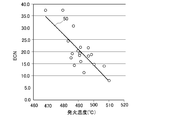
- FIG. 7 is a graph showing the relationship between the ECN of the fuel oil and the ignition temperature when the fuel oil analyzer ignites.
- FIG. 8 is a graph showing the relationship between the ECN of the fuel oil and the ignition temperature as a tendency for each viscosity.
- FIG. 9 is a graph showing a part of the result of measuring the temperature change and the weight change shown in FIGS. 3 to 6 in relation to the weight change in a predetermined temperature range.
- FIG. 10 is a graph showing the tendency by plotting the relationship between the ECN estimated value calculated from the weight loss value using the ECN estimation formula and the actual ECN.
- the fuel oil analyzer 1 of this embodiment includes a sample container 20 into which a fuel oil sample is placed, a main body case 2 that houses the sample container 20, and a sample container in the main body case 2.
- a heater 3 as a heating unit for heating 20, a plurality of temperature sensors 5 to 8 as temperature measuring units for measuring the temperature in the main body case 2, and a temperature control unit 9 for controlling the temperature in the main body case 2 to a predetermined temperature range.
- a balance 15 as a weight measuring unit for measuring a change in the weight of the fuel oil in the sample container 20.
- the sample container 20 is a dish-like container having a recess 22 formed in the center, and a collar part 21 is provided around the container.
- the recess 22 has a capacity for containing a predetermined amount of the fuel oil sample 25.
- the main body case 2 has an internal space 12 in which the sample container 20 is disposed.
- the main body case 2 has a vertical shape and the inner space 12 has a cylindrical shape so that the temperature rises uniformly around the sample container 20.
- a lid 10 that can be opened and closed is provided on the upper part of the main body case 2.
- the lid 10 can be brought into close contact with the upper surface of the main body case 2, but the figure shows a state where a small gap before contact is made.
- the sample container 20 is placed on the upper part of the support member 16 supported by the balance 15 which is a weight measuring unit. By setting the weight at this time to “zero”, only the weight change of the fuel oil thereafter is measured by the balance 15. It can be measured.
- a cylindrical portion 14 having an exhaust port 13 through which air in the internal space 12 formed in the central portion of the main body case 2 is released is provided at the central portion of the lid body 10.
- the heater 3 is provided at the periphery so as to heat the inner space 12 in which the sample container 20 is arranged from the entire circumference.
- the heater 3 is embedded in the heat insulating material 4 so that the heater wires do not contact each other.
- the heater 3 is controlled by the temperature control unit 9 and can heat the inside of the main body case 2 at a predetermined temperature.
- a plurality of the temperature sensors 5 to 8 are provided at the upper and lower positions of the internal space 12 of the main body case 2.
- the temperature change in the internal space 12 of the main body case 2 is measured by the temperature sensors 5 and 7 provided above the sample container 20 and the temperature sensors 6 and 8 provided below the sample container 20. ing.
- Temperature sensors 5 and 6 are provided relatively close to the upper and lower positions of the sample container 20, and temperature sensors 7 and 8 are provided at remote positions.
- the temperature sensors 5 to 8 should be at least the temperature sensors 5 and 6 provided above and below the sample container 20. However, in order to accurately measure the temperature in the main body case 2, the temperature sensors 7 and 8 are provided. Yes.
- These temperature sensors 5 to 8 can use thermocouples.
- the temperature control unit 9 is configured to control the temperature of the heater 3.
- the temperature control unit 9 controls the heating temperature of the heater 3 so as to control the temperature of the internal space 12 to a predetermined temperature range.
- the scale 15 has a structure that supports the support member 16 on which the sample container 20 is placed from below.
- the scale 15 measures the change in weight reduction of the sample container 20 containing the fuel oil sample 25.
- an air pump 17 for supplying air from the outside to the internal space 12 is provided.
- the air pump 17 is driven by a motor 18. Air is sent to the internal space 12 via the pipe 19 by the air pump 17.
- the air pump 17 is provided as necessary.
- the main body case 2 is a vertical type and the internal space 12 is cylindrical, so that the air supplied to the internal space 12 by the air pump 17 is evenly convected around the sample container 20. It flows to the exhaust port 13 of the lid 10 while generating the above.
- the fuel oil analyzer 1 includes an input unit that includes a temperature measured by the temperature sensors (temperature measuring units) 5 to 8 and a weight measured by the scale (weight measuring unit) 15.
- a temperature / weight recording unit (recording unit) 32 recorded via the reference numeral 31, and an analysis unit 33 for estimating the combustibility of the fuel oil from the temperature change and the weight change recorded in the temperature / weight recording unit 32.
- a control device 30 is provided.
- the analysis unit 33 is configured to estimate the ECN of the fuel oil from the temperature change and the weight change recorded in the temperature / weight recording unit 32 and to estimate its combustibility as will be described later.
- the analysis unit 33 is, for example, a CPU that can perform numerical calculation.
- the temperature / weight recording unit 32 has a storage unit 36 for storing the combustion characteristic curve.
- the storage unit 36 can easily refer to the combustion characteristic curve as a past combustion characteristic curve.
- the analysis part 33 of this embodiment has the comparison part 34, and can compare the combustion characteristic curve of the obtained fuel oil with the past combustion characteristic curve so that it may mention later.
- a display unit 35 for displaying the result analyzed by the analysis unit 33 is provided.
- the display unit 35 is a monitor or the like.
- the display unit 35 displays, for example, graphs shown in FIGS. 7 and 8, an ECN estimated value obtained from an ECN estimation formula described later, and combustion characteristic curves as shown in FIGS. 3 to 6 described later. May be.
- the temperature / weight recording unit (recording unit) 32 is shown as a single configuration, but the temperature recording unit and the weight recording unit may be configured separately.
- the temperature / weight recording unit 32 and the analysis unit 33 may be a personal computer, for example. In this case, the temperature and weight measurement results may be sent to a personal computer and analyzed by the personal computer to display the results.
- the combustibility of the fuel oil can be analyzed as follows.
- a predetermined amount of fuel oil sample 25 is placed in the sample container 20, the sample container 20 is placed on the support member 16 of the scale 15, and the lid 10 is closed.
- the heater 3 is energized, and the internal space 12 of the main body case 2 is heated.
- the temperature sensors 5 to 8 which are temperature measuring units.
- the measured temperature is recorded in the temperature / weight recording unit 32 via the input unit 31.
- the weight decrease is measured by the scale 15 which is a weight measuring unit.
- the measured weight reduction is recorded in the temperature / weight recording unit 32 via the input unit 31.
- the fuel oil is analyzed by the analysis unit 33 as described below.
- the combustibility of the sample 25 is estimated.
- the temperature at which the weight of the fuel oil is greatly reduced and the internal temperature of the main body case 2 is greatly increased is estimated as the ignition temperature of the fuel oil, and the ECN of the fuel oil is estimated from the ignition temperature. By doing so, the combustibility of the fuel oil may be estimated. As this estimation, for example, whether ECN exceeds 20 or not may be displayed and estimated at the same time.
- the analysis unit 33 measures the internal temperature change of the main body case 2 and the weight reduction amount of the fuel oil in the temperature range. Then, the combustibility of the fuel oil may be estimated by estimating the ECN of the fuel oil from the weight reduction amount using an ECN estimation formula described later. As this estimation, it may be possible to estimate by simultaneously displaying whether ECN exceeds 20, for example.
- the analysis unit 33 creates a weight change curve with respect to the heating temperature as a combustion characteristic curve of the fuel oil from the temperature change and the weight change recorded in the temperature / weight recording unit 32, and the fuel oil is calculated from the combustion characteristic curve. May be estimated. For this estimation, for example, good fuel oil loses its weight from a low temperature, but bad fuel oil loses its weight slowly, and the weight decreases rapidly at a high temperature. Can do.
- the comparison unit 34 of the analysis unit 33 displays the combustion characteristic curve of the fuel oil just tested and the combustion characteristic curve of the past fuel oil of the same classification as the display unit 35. May be displayed, and the combustibility may be estimated by comparing the combustion characteristic curves.
- the combustibility for example, the combustion characteristic curve of the fuel oil that has been tested, the fuel oil that has not been problematic in the past, and the combustion characteristic curve that has been problematic are displayed on the display unit 35 at the same time. Then, the combustibility of the fuel oil just tested is estimated by comparing which combustion characteristic curve of the fuel oil just tested is similar to the past one.
- a graph showing the temperature change and weight change of the fuel oil measured by the fuel oil analyzer 1 will be described.
- the combustion characteristic curve of the relationship between the temperature change and the weight change is shown for each of three types of samples having different kinematic viscosities of A heavy oil and C heavy oil.
- Each sample of A heavy oil is given a number 1 to 3
- a sample of C heavy oil is given a kinematic viscosity and a number.
- three types of fuel oil are shown so that the difference between the lines can be seen, but more types may be shown.
- the graphs of FIGS. 3 to 6 are prepared based on the results of tests performed on the above-described fuel oil analyzer for 26 types of fuel oils with known flammability.
- the ECNs of the 26 types of fuel oil used in the test are actually measured by a dedicated measuring device and can be compared with the estimated ECN values obtained as described later. Further, the ignition temperature and the amount of weight reduction due to evaporation or ignition as a result of the test by the fuel oil analyzer 1 are also measured.
- FIG. 3 is a graph showing the temperature change and weight change of heavy fuel oil A measured by the fuel oil analyzer 1.
- the fuel oil of the combustion characteristic curve A-1 shown by the two-dot chain line, the fuel oil of the combustion characteristic curve A-2 shown by the broken line, and the fuel oil of the combustion characteristic curve A-3 shown by the solid line Although the combustion characteristic curves are substantially the same even when the temperatures are different, the weight gradually decreases as the temperature rises after the weight gradually decreases to around 390 ° C. as the temperature increases.
- FIG. 4 is a graph showing temperature change and weight change of C heavy oil (180 cSt) measured by the fuel oil analyzer 1.
- the fuel oil of the combustion characteristic curve 180-1 shown by a two-dot chain line and the fuel oil of the combustion characteristic curve 180-5 shown by a broken line are slightly different curves due to different components.
- the weight gradually decreases, and after the weight has decreased slightly from around 400 ° C and then greatly reduced at around 500 ° C, the weight gradually increases as the temperature rises. Is decreasing.
- the fuel oil of the combustion characteristic curve 180-9 shown by a solid line the weight gradually decreases to about 500 ° C. as the temperature rises, and after the weight is greatly decreased at a temperature exceeding about 500 ° C., As the temperature rises, the weight gradually decreases.
- FIG. 5 is a graph showing temperature change and weight change of C heavy oil (380 cSt) measured by the fuel oil analyzer 1.
- the weight gradually decreases with the temperature rise, and the weight decreases slightly from around 400 ° C. After the weight is greatly reduced in the vicinity of about 500 ° C., the weight gradually decreases as the temperature rises.
- the weight gradually decreases to about 500 ° C. as the temperature rises, and after the weight is greatly reduced at about 500 ° C., the temperature rises. Along with this, the weight is gradually decreasing.
- the weight is greatly decreased as compared with other fuel oils as the temperature rises. As the temperature rises, the weight gradually decreases.
- FIG. 6 is a graph showing temperature change and weight change of C heavy oil (500 cSt) measured by the fuel oil analyzer 1.
- the weight gradually decreases with the temperature rise, and the weight decreases slightly from around 400 ° C. When the temperature exceeds about 500 ° C., the weight gradually decreases as the temperature rises.
- the weight gradually decreases to about 500 ° C. as the temperature rises, and when the temperature exceeds about 500 ° C., the weight gradually increases as the temperature rises. is decreasing.
- the weight gradually decreases to a temperature exceeding about 500 ° C., and after the weight is largely decreased above about 500 ° C., the temperature rises.
- the weight is gradually decreasing.
- the combustion characteristic curve which is the change in the weight of the sample oil as the temperature rises, is clearly different between A heavy oil and C heavy oil.
- sample oil shown by a solid line
- evaporation curve of the sample oil with good combustibility which had been gentle until then, suddenly increases in the gradient from around 400 ° C. and is ignited.
- sample oil with poor flammability In the case of 500 cSt C heavy oil, sample oil with poor flammability (shown by a solid line) generally has a gentle slope in the evaporation curve, and sample oil with good flammability (sample oil that does not ignite) becomes steep from around 400 ° C. ing.
- the combustibility of the fuel oil to be used (analysis target) can be estimated from the combustion characteristic curve.
- the combustion characteristic curve of the fuel oil obtained in this way is recorded in the storage unit 36 of the control device 30 together with information such as “calling place”, “name”, “commercial company”, and stored as a database. It is easy to keep. By storing this combustion characteristic curve as a database, it can be used later as a sample for estimating the quality of fuel oil in comparison with the combustion characteristic curves of other fuel oils.
- the combustion characteristic curve to be displayed on the display unit 35 the combustion characteristic curve in the fuel oil of the same classification is selectively displayed from the past database, and compared with the combustion characteristic curve of the fuel oil just tested. Thus, it is possible to estimate the suitability of the fuel oil just tested.
- the display unit 35 displays the combustion characteristic curve of the fuel oil that has been problematic in the past and the combustion characteristic curve of the fuel oil that had no problem in the past. Then, it is confirmed which combustion characteristic curve of the fuel oil just tested is close to which combustion characteristic curve. As a result, there is a problem if the combustion characteristic curve of the fuel oil just tested approximates the combustion characteristic curve of the fuel oil that had a problem in the past, and it approximates the combustion characteristic curve of the fuel oil that had no problem. If so, we can estimate the flammability of the fuel oil we just tested.
- FIG. 7 is a graph showing the relationship between the ignition temperature obtained from the test results of the fuel oil analyzer 1 and ECN. From this graph, the relationship between the ignition temperature and ECN can be estimated as a linear 50 relationship indicated by a solid line.
- the fuel oil analyzer 1 heats the sample 25 for C heavy oil, and the ignition temperature is estimated from the temperature change and weight change.
- the ECN of the fuel oil can be easily estimated from the ignition temperature based on the relationship shown in FIG.
- the estimation of ECN is performed by the analysis unit 33 shown in FIG. 2 described above and can be displayed on the display unit 35.
- the graph shown in FIG. 8 organizes the relationship between the ignition temperature and ECN shown in FIG. 7 for each kinematic viscosity of C heavy oil.
- This graph shows the results plotted for each kinematic viscosity of C heavy oil.
- the C heavy oil (180 cSt) is indicated by “ ⁇ ”, and the line is indicated by the solid line 51.
- C heavy oil (380 cSt) is indicated by “ ⁇ ”, and the line is indicated by a broken line 52.
- C heavy oil (500 cSt) is indicated by “ ⁇ ”, and the line is indicated by a two-dot chain line 53.
- FIG. 9 shows a predetermined temperature range for determining the flammability parameter from the change in the weight of the fuel oil in order to obtain the evaporation characteristics.
- a low temperature range of T1 to T2 and a high temperature range of T2 to T3 are set.
- This predetermined temperature range is set to a portion where the weight change is large due to evaporation or ignition, and the weight decrease amount in the low temperature region is W1, and the weight decrease amount in the high temperature region is W2.
- W1 indicates the amount of evaporation before the fuel becomes main combustion. Due to the priming effect, the larger the value, the better the flammability. W2 corresponds to a decrease in fuel due to main combustion.
- A, B. C represents a coefficient calculated by multiple regression analysis.
- FIG. 10 shows the relationship between the ECN actual measurement value and the ECN estimation value based on the ECN estimation formula for each kinematic viscosity. From this figure, it can be considered that there is a relationship like a linear 60 between the ECN actual measurement value and the ECN estimation value. And when calculating the correlation coefficient when the ECN was estimated by this method, it was found that the estimation accuracy was almost the same as the ECN estimation based on the ignition temperature.
- the fuel oil analyzer 1 if the weight reduction amount of the fuel oil in a predetermined temperature range is measured and calculated using the ECN estimation formula from the weight reduction amount, the ECN of the fuel oil of the sample is calculated. Can be estimated.
- the fuel oil analyzer 1 As described above, according to the fuel oil analyzer 1, a predetermined amount of fuel oil is put into the sample container 20, the sample container 20 is heated to a predetermined temperature in the internal space 12 of the main body case 2, and the internal space
- the combustion characteristic curve is created by measuring the temperature change of 12 and the weight reduction change of the fuel oil obtained in the process of the temperature change, and analyzing the measurement results. From the combustion characteristic curve, the combustibility of the fuel oil can be estimated by comparing with the combustion characteristic curve of the fuel that has already been evaluated for combustibility.
- the combustibility of the fuel oil can be easily estimated from the estimated ECN.
- the ECN can be estimated from the weight reduction amount of the heated fuel oil, and the combustibility of the fuel oil can be easily estimated from the estimated ECN.
- the fuel oil analyzer 1 of the said embodiment is an example,
- the structure provided with the analysis part (personal computer etc.) 33 in the main body case 2 may be sufficient, and the form of the fuel oil analyzer 1 is in the said embodiment. It is not limited.
- C heavy oil was mainly demonstrated to the example as fuel oil, it can analyze if it is a fuel oil which needs to estimate combustibility similarly, and fuel oil is limited to C heavy oil. It is not something.
- the fuel oil analyzing apparatus can be used as a simple fuel oil analyzing apparatus for easily and quickly analyzing whether or not fuel oil such as heavy oil has suitable combustibility. .
Landscapes
- Chemical & Material Sciences (AREA)
- Health & Medical Sciences (AREA)
- Life Sciences & Earth Sciences (AREA)
- Immunology (AREA)
- Analytical Chemistry (AREA)
- Biochemistry (AREA)
- General Health & Medical Sciences (AREA)
- General Physics & Mathematics (AREA)
- Physics & Mathematics (AREA)
- Pathology (AREA)
- Engineering & Computer Science (AREA)
- Chemical Kinetics & Catalysis (AREA)
- General Chemical & Material Sciences (AREA)
- Oil, Petroleum & Natural Gas (AREA)
- Food Science & Technology (AREA)
- Medicinal Chemistry (AREA)
- Combined Controls Of Internal Combustion Engines (AREA)
- Investigating Or Analyzing Materials Using Thermal Means (AREA)
Abstract
La présente invention porte sur un analyseur (1) de mazout qui est équipé de : un récipient (20) d'échantillon dans lequel un échantillon de mazout est introduit ; un boîtier (2) de corps destiné à stocker le récipient (20) d'échantillon à l'intérieur de celui-ci ; un élément chauffant (3) destiné à chauffer le récipient (20) d'échantillon à l'intérieur du boîtier (2) de corps ; une unité (9) de commande de température destinée à commander la température de l'intérieur du boîtier (2) de corps de manière à être dans une plage de température prescrite ; des capteurs (5-8) de température destinés à mesurer des changements de température à l'intérieur du boîtier (2) de corps ; une échelle (15) destinée à mesurer des changements de poids du mazout à l'intérieur du récipient (20) d'échantillon ; une unité (32) d'enregistrement de température/poids destinée à enregistrer les changements de température mesurés par les capteurs (5-8) de température et les changements de poids mesurés par l'échelle (15) ; et une unité (33) d'analyse destinée à analyser la combustibilité du mazout sur la base des changements de température et des changements de poids enregistrés par l'unité (32) d'enregistrement de température/poids.
Priority Applications (3)
| Application Number | Priority Date | Filing Date | Title |
|---|---|---|---|
| EP14751870.8A EP2957902A4 (fr) | 2013-02-18 | 2014-02-06 | Analyseur de mazout |
| CN201480005060.0A CN104919308B (zh) | 2013-02-18 | 2014-02-06 | 燃料油分析装置 |
| KR1020157024013A KR101713889B1 (ko) | 2013-02-18 | 2014-02-06 | 연료 오일 분석 장치 |
Applications Claiming Priority (2)
| Application Number | Priority Date | Filing Date | Title |
|---|---|---|---|
| JP2013029175A JP6190123B2 (ja) | 2013-02-18 | 2013-02-18 | 燃料油分析装置 |
| JP2013-029175 | 2013-02-18 |
Publications (1)
| Publication Number | Publication Date |
|---|---|
| WO2014125799A1 true WO2014125799A1 (fr) | 2014-08-21 |
Family
ID=51353812
Family Applications (1)
| Application Number | Title | Priority Date | Filing Date |
|---|---|---|---|
| PCT/JP2014/000627 Ceased WO2014125799A1 (fr) | 2013-02-18 | 2014-02-06 | Analyseur de mazout |
Country Status (5)
| Country | Link |
|---|---|
| EP (1) | EP2957902A4 (fr) |
| JP (1) | JP6190123B2 (fr) |
| KR (1) | KR101713889B1 (fr) |
| CN (1) | CN104919308B (fr) |
| WO (1) | WO2014125799A1 (fr) |
Cited By (1)
| Publication number | Priority date | Publication date | Assignee | Title |
|---|---|---|---|---|
| CN112196514A (zh) * | 2020-09-30 | 2021-01-08 | 中国海洋石油集团有限公司 | 一种利用热重分析仪测量稠油注空气开发燃料沉积量的方法 |
Families Citing this family (2)
| Publication number | Priority date | Publication date | Assignee | Title |
|---|---|---|---|---|
| CN108802270B (zh) * | 2018-06-25 | 2021-07-06 | 中国石油大学(华东) | 一种甲烷水合物燃烧特性测试装置 |
| CN110412058B (zh) * | 2019-06-20 | 2023-01-24 | 新疆海纳同创智能科技有限公司 | 一种多通道原油化验分析系统 |
Citations (9)
| Publication number | Priority date | Publication date | Assignee | Title |
|---|---|---|---|---|
| JPS4880096A (fr) * | 1972-01-29 | 1973-10-26 | ||
| JPS5876496A (ja) * | 1981-10-30 | 1983-05-09 | Matsushita Electric Ind Co Ltd | 固形燃料 |
| US4549815A (en) * | 1983-11-21 | 1985-10-29 | Mobil Oil Corporation | Measurement of ignition characteristics of distillate fuels |
| JPH0259645A (ja) * | 1988-08-25 | 1990-02-28 | Kawasaki Steel Corp | 試料中の水分測定方法 |
| JPH053982U (ja) * | 1991-07-05 | 1993-01-22 | 財団法人シツプ・アンド・オーシヤン財団 | 熱重量分析装置 |
| JPH05126878A (ja) * | 1991-11-07 | 1993-05-21 | Matsushita Electric Ind Co Ltd | 低周波信号測定装置 |
| JP2002071541A (ja) | 2000-08-25 | 2002-03-08 | Toho Gas Co Ltd | アスファルト含有量の測定方法 |
| JP2011007809A (ja) | 1998-09-17 | 2011-01-13 | Cem Corp | 揮発性物質含有量を測定する方法及び装置 |
| JP2011112362A (ja) | 2009-11-24 | 2011-06-09 | Ship Partners Ltd | 液体の品質分析方法及び液体の品質分析装置 |
Family Cites Families (11)
| Publication number | Priority date | Publication date | Assignee | Title |
|---|---|---|---|---|
| JPS60133366A (ja) * | 1983-12-22 | 1985-07-16 | Mitsubishi Heavy Ind Ltd | 石炭灰中未燃分測定方法 |
| JP3140099B2 (ja) * | 1991-08-26 | 2001-03-05 | セイコーインスツルメンツ株式会社 | 熱重量測定装置 |
| CN2161922Y (zh) * | 1993-06-15 | 1994-04-13 | 中国石油化工总公司石油化工科学研究院 | 石油产品低温性能测定仪 |
| JP3338694B2 (ja) * | 2000-05-22 | 2002-10-28 | 米国石油化学株式会社 | 燃焼特性解析装置 |
| JP4181465B2 (ja) * | 2003-09-04 | 2008-11-12 | 三菱電機株式会社 | グリース油分率測定法 |
| CN1959392B (zh) * | 2005-11-04 | 2010-11-10 | 鸿富锦精密工业(深圳)有限公司 | 测量导热片随温度变化其结构变化状况的装置及方法 |
| CN101271053B (zh) * | 2007-12-07 | 2011-01-26 | 辽宁工程技术大学 | 煤的自燃危险性判定方法 |
| JP5130065B2 (ja) * | 2008-01-28 | 2013-01-30 | Jx日鉱日石エネルギー株式会社 | オフロード用予混合圧縮着火エンジン用の燃料油組成物 |
| CN101349688B (zh) * | 2008-08-26 | 2013-05-29 | 东北大学 | 一种多功能通用煤粉燃烧试验装置及方法 |
| CN101487808B (zh) * | 2008-12-26 | 2011-08-31 | 中国人民解放军第五七一九工厂 | 检测航空润滑油中轻质燃油成分含量的试验方法 |
| JP6185785B2 (ja) * | 2013-08-09 | 2017-08-23 | 川崎重工業株式会社 | 燃料油分析装置 |
-
2013
- 2013-02-18 JP JP2013029175A patent/JP6190123B2/ja not_active Expired - Fee Related
-
2014
- 2014-02-06 EP EP14751870.8A patent/EP2957902A4/fr not_active Withdrawn
- 2014-02-06 WO PCT/JP2014/000627 patent/WO2014125799A1/fr not_active Ceased
- 2014-02-06 KR KR1020157024013A patent/KR101713889B1/ko not_active Expired - Fee Related
- 2014-02-06 CN CN201480005060.0A patent/CN104919308B/zh not_active Expired - Fee Related
Patent Citations (9)
| Publication number | Priority date | Publication date | Assignee | Title |
|---|---|---|---|---|
| JPS4880096A (fr) * | 1972-01-29 | 1973-10-26 | ||
| JPS5876496A (ja) * | 1981-10-30 | 1983-05-09 | Matsushita Electric Ind Co Ltd | 固形燃料 |
| US4549815A (en) * | 1983-11-21 | 1985-10-29 | Mobil Oil Corporation | Measurement of ignition characteristics of distillate fuels |
| JPH0259645A (ja) * | 1988-08-25 | 1990-02-28 | Kawasaki Steel Corp | 試料中の水分測定方法 |
| JPH053982U (ja) * | 1991-07-05 | 1993-01-22 | 財団法人シツプ・アンド・オーシヤン財団 | 熱重量分析装置 |
| JPH05126878A (ja) * | 1991-11-07 | 1993-05-21 | Matsushita Electric Ind Co Ltd | 低周波信号測定装置 |
| JP2011007809A (ja) | 1998-09-17 | 2011-01-13 | Cem Corp | 揮発性物質含有量を測定する方法及び装置 |
| JP2002071541A (ja) | 2000-08-25 | 2002-03-08 | Toho Gas Co Ltd | アスファルト含有量の測定方法 |
| JP2011112362A (ja) | 2009-11-24 | 2011-06-09 | Ship Partners Ltd | 液体の品質分析方法及び液体の品質分析装置 |
Non-Patent Citations (1)
| Title |
|---|
| See also references of EP2957902A4 * |
Cited By (2)
| Publication number | Priority date | Publication date | Assignee | Title |
|---|---|---|---|---|
| CN112196514A (zh) * | 2020-09-30 | 2021-01-08 | 中国海洋石油集团有限公司 | 一种利用热重分析仪测量稠油注空气开发燃料沉积量的方法 |
| CN112196514B (zh) * | 2020-09-30 | 2024-03-29 | 中国海洋石油集团有限公司 | 一种利用热重分析仪测量稠油注空气开发燃料沉积量的方法 |
Also Published As
| Publication number | Publication date |
|---|---|
| JP6190123B2 (ja) | 2017-08-30 |
| KR101713889B1 (ko) | 2017-03-09 |
| CN104919308B (zh) | 2017-06-09 |
| CN104919308A (zh) | 2015-09-16 |
| JP2014157130A (ja) | 2014-08-28 |
| KR20150114562A (ko) | 2015-10-12 |
| EP2957902A1 (fr) | 2015-12-23 |
| EP2957902A4 (fr) | 2016-10-05 |
Similar Documents
| Publication | Publication Date | Title |
|---|---|---|
| Ren et al. | Adiabatic oxidation study on the propensity of pulverised coals to spontaneous combustion | |
| Hoxie et al. | Microexplosive combustion behavior of blended soybean oil and butanol droplets | |
| Jenft et al. | Experimental and numerical study of pool fire suppression using water mist | |
| CN108223228B (zh) | 用于燃油喷射系统的试验装置和试验方法 | |
| JP6190123B2 (ja) | 燃料油分析装置 | |
| Martin et al. | Low temperature autoignition of Jet A and surrogate jet fuel | |
| Niculescu et al. | On the determination of the distillation curve of fatty acid methyl esters by gas chromatography | |
| JP2003215078A (ja) | 石炭の発熱性の試験方法 | |
| Li et al. | Lean flammability limits of alternative aviation fuels | |
| JP6185785B2 (ja) | 燃料油分析装置 | |
| Lattimer et al. | Measuring properties for material decomposition modeling | |
| Shen et al. | Photothermal characterization of biodiesel and petroleum diesel fuels—A review and perspective | |
| JP2001329905A (ja) | 燃焼特性解析装置 | |
| JP7692636B2 (ja) | 組成特定プログラム、組成特定装置及び組成特定システム | |
| de Carvalho Rocha et al. | Laser-driven calorimetry and chemometric quantification of standard reference material diesel/biodiesel fuel blends | |
| Hu et al. | Ignition and burning behaviors of automobile oil in engine compartment | |
| CN115825672A (zh) | 绝缘纸板击穿测试方法、装置、计算机设备和存储介质 | |
| Joshi et al. | Effect of weathering of coal and organic dusts on their spontaneous ignition | |
| Hmood et al. | Localized ignition delay prediction from temperature measurements of n-heptane in the combustion chamber of the ignition quality tester | |
| Rychlý et al. | Burning of thermally thin polyethylene mixtures: Cone calorimeter study | |
| JP2648375B2 (ja) | ディーゼル条件下の重油の自己着火能力の測定方法及び装置 | |
| CN223940846U (zh) | 耐火测试装置 | |
| Ebersole et al. | Hot surface ignition of gasoline-ethanol fuel mixtures | |
| Ha | The Evaluation of Hazard by Measurement of Combustible Characteristics of n-Tetradecane | |
| Presser et al. | Thermochemical characterization of bio-and petro-diesel fuels using a novel laser-heating technique |
Legal Events
| Date | Code | Title | Description |
|---|---|---|---|
| 121 | Ep: the epo has been informed by wipo that ep was designated in this application |
Ref document number: 14751870 Country of ref document: EP Kind code of ref document: A1 |
|
| NENP | Non-entry into the national phase |
Ref country code: DE |
|
| WWE | Wipo information: entry into national phase |
Ref document number: 2014751870 Country of ref document: EP |
|
| ENP | Entry into the national phase |
Ref document number: 20157024013 Country of ref document: KR Kind code of ref document: A |