WO2014128148A2 - Optical component made of quartz glass for use in arf excimer laser lithography, and method for producing the component - Google Patents
Optical component made of quartz glass for use in arf excimer laser lithography, and method for producing the component Download PDFInfo
- Publication number
- WO2014128148A2 WO2014128148A2 PCT/EP2014/053199 EP2014053199W WO2014128148A2 WO 2014128148 A2 WO2014128148 A2 WO 2014128148A2 EP 2014053199 W EP2014053199 W EP 2014053199W WO 2014128148 A2 WO2014128148 A2 WO 2014128148A2
- Authority
- WO
- WIPO (PCT)
- Prior art keywords
- quartz glass
- wavelength
- hydrogen
- optical component
- content
- Prior art date
- Legal status (The legal status is an assumption and is not a legal conclusion. Google has not performed a legal analysis and makes no representation as to the accuracy of the status listed.)
- Ceased
Links
Classifications
-
- C—CHEMISTRY; METALLURGY
- C03—GLASS; MINERAL OR SLAG WOOL
- C03C—CHEMICAL COMPOSITION OF GLASSES, GLAZES OR VITREOUS ENAMELS; SURFACE TREATMENT OF GLASS; SURFACE TREATMENT OF FIBRES OR FILAMENTS MADE FROM GLASS, MINERALS OR SLAGS; JOINING GLASS TO GLASS OR OTHER MATERIALS
- C03C3/00—Glass compositions
- C03C3/04—Glass compositions containing silica
- C03C3/06—Glass compositions containing silica with more than 90% silica by weight, e.g. quartz
-
- C—CHEMISTRY; METALLURGY
- C03—GLASS; MINERAL OR SLAG WOOL
- C03B—MANUFACTURE, SHAPING, OR SUPPLEMENTARY PROCESSES
- C03B19/00—Other methods of shaping glass
- C03B19/14—Other methods of shaping glass by gas- or vapour- phase reaction processes
- C03B19/1453—Thermal after-treatment of the shaped article, e.g. dehydrating, consolidating, sintering
-
- C—CHEMISTRY; METALLURGY
- C03—GLASS; MINERAL OR SLAG WOOL
- C03B—MANUFACTURE, SHAPING, OR SUPPLEMENTARY PROCESSES
- C03B32/00—Thermal after-treatment of glass products not provided for in groups C03B19/00, C03B25/00 - C03B31/00 or C03B37/00, e.g. crystallisation, eliminating gas inclusions or other impurities; Hot-pressing vitrified, non-porous, shaped glass products
-
- C—CHEMISTRY; METALLURGY
- C03—GLASS; MINERAL OR SLAG WOOL
- C03B—MANUFACTURE, SHAPING, OR SUPPLEMENTARY PROCESSES
- C03B32/00—Thermal after-treatment of glass products not provided for in groups C03B19/00, C03B25/00 - C03B31/00 or C03B37/00, e.g. crystallisation, eliminating gas inclusions or other impurities; Hot-pressing vitrified, non-porous, shaped glass products
- C03B32/02—Thermal crystallisation, e.g. for crystallising glass bodies into glass-ceramic articles
-
- C—CHEMISTRY; METALLURGY
- C03—GLASS; MINERAL OR SLAG WOOL
- C03C—CHEMICAL COMPOSITION OF GLASSES, GLAZES OR VITREOUS ENAMELS; SURFACE TREATMENT OF GLASS; SURFACE TREATMENT OF FIBRES OR FILAMENTS MADE FROM GLASS, MINERALS OR SLAGS; JOINING GLASS TO GLASS OR OTHER MATERIALS
- C03C4/00—Compositions for glass with special properties
- C03C4/04—Compositions for glass with special properties for photosensitive glass
-
- G—PHYSICS
- G02—OPTICS
- G02B—OPTICAL ELEMENTS, SYSTEMS OR APPARATUS
- G02B1/00—Optical elements characterised by the material of which they are made; Optical coatings for optical elements
-
- G—PHYSICS
- G02—OPTICS
- G02B—OPTICAL ELEMENTS, SYSTEMS OR APPARATUS
- G02B1/00—Optical elements characterised by the material of which they are made; Optical coatings for optical elements
- G02B1/02—Optical elements characterised by the material of which they are made; Optical coatings for optical elements made of crystals, e.g. rock-salt, semi-conductors
-
- C—CHEMISTRY; METALLURGY
- C03—GLASS; MINERAL OR SLAG WOOL
- C03B—MANUFACTURE, SHAPING, OR SUPPLEMENTARY PROCESSES
- C03B2201/00—Type of glass produced
- C03B2201/06—Doped silica-based glasses
- C03B2201/07—Impurity concentration specified
-
- C—CHEMISTRY; METALLURGY
- C03—GLASS; MINERAL OR SLAG WOOL
- C03B—MANUFACTURE, SHAPING, OR SUPPLEMENTARY PROCESSES
- C03B2201/00—Type of glass produced
- C03B2201/06—Doped silica-based glasses
- C03B2201/07—Impurity concentration specified
- C03B2201/075—Hydroxyl ion (OH)
-
- C—CHEMISTRY; METALLURGY
- C03—GLASS; MINERAL OR SLAG WOOL
- C03B—MANUFACTURE, SHAPING, OR SUPPLEMENTARY PROCESSES
- C03B2201/00—Type of glass produced
- C03B2201/06—Doped silica-based glasses
- C03B2201/20—Doped silica-based glasses doped with non-metals other than boron or fluorine
- C03B2201/21—Doped silica-based glasses doped with non-metals other than boron or fluorine doped with molecular hydrogen
-
- C—CHEMISTRY; METALLURGY
- C03—GLASS; MINERAL OR SLAG WOOL
- C03B—MANUFACTURE, SHAPING, OR SUPPLEMENTARY PROCESSES
- C03B2201/00—Type of glass produced
- C03B2201/06—Doped silica-based glasses
- C03B2201/20—Doped silica-based glasses doped with non-metals other than boron or fluorine
- C03B2201/23—Doped silica-based glasses doped with non-metals other than boron or fluorine doped with hydroxyl groups
-
- C—CHEMISTRY; METALLURGY
- C03—GLASS; MINERAL OR SLAG WOOL
- C03B—MANUFACTURE, SHAPING, OR SUPPLEMENTARY PROCESSES
- C03B2201/00—Type of glass produced
- C03B2201/06—Doped silica-based glasses
- C03B2201/20—Doped silica-based glasses doped with non-metals other than boron or fluorine
- C03B2201/24—Doped silica-based glasses doped with non-metals other than boron or fluorine doped with nitrogen, e.g. silicon oxy-nitride glasses
-
- C—CHEMISTRY; METALLURGY
- C03—GLASS; MINERAL OR SLAG WOOL
- C03C—CHEMICAL COMPOSITION OF GLASSES, GLAZES OR VITREOUS ENAMELS; SURFACE TREATMENT OF GLASS; SURFACE TREATMENT OF FIBRES OR FILAMENTS MADE FROM GLASS, MINERALS OR SLAGS; JOINING GLASS TO GLASS OR OTHER MATERIALS
- C03C2201/00—Glass compositions
- C03C2201/06—Doped silica-based glasses
- C03C2201/08—Doped silica-based glasses containing boron or halide
- C03C2201/11—Doped silica-based glasses containing boron or halide containing chlorine
-
- C—CHEMISTRY; METALLURGY
- C03—GLASS; MINERAL OR SLAG WOOL
- C03C—CHEMICAL COMPOSITION OF GLASSES, GLAZES OR VITREOUS ENAMELS; SURFACE TREATMENT OF GLASS; SURFACE TREATMENT OF FIBRES OR FILAMENTS MADE FROM GLASS, MINERALS OR SLAGS; JOINING GLASS TO GLASS OR OTHER MATERIALS
- C03C2201/00—Glass compositions
- C03C2201/06—Doped silica-based glasses
- C03C2201/08—Doped silica-based glasses containing boron or halide
- C03C2201/12—Doped silica-based glasses containing boron or halide containing fluorine
-
- C—CHEMISTRY; METALLURGY
- C03—GLASS; MINERAL OR SLAG WOOL
- C03C—CHEMICAL COMPOSITION OF GLASSES, GLAZES OR VITREOUS ENAMELS; SURFACE TREATMENT OF GLASS; SURFACE TREATMENT OF FIBRES OR FILAMENTS MADE FROM GLASS, MINERALS OR SLAGS; JOINING GLASS TO GLASS OR OTHER MATERIALS
- C03C2201/00—Glass compositions
- C03C2201/06—Doped silica-based glasses
- C03C2201/20—Doped silica-based glasses containing non-metals other than boron or halide
- C03C2201/21—Doped silica-based glasses containing non-metals other than boron or halide containing molecular hydrogen
-
- C—CHEMISTRY; METALLURGY
- C03—GLASS; MINERAL OR SLAG WOOL
- C03C—CHEMICAL COMPOSITION OF GLASSES, GLAZES OR VITREOUS ENAMELS; SURFACE TREATMENT OF GLASS; SURFACE TREATMENT OF FIBRES OR FILAMENTS MADE FROM GLASS, MINERALS OR SLAGS; JOINING GLASS TO GLASS OR OTHER MATERIALS
- C03C2201/00—Glass compositions
- C03C2201/06—Doped silica-based glasses
- C03C2201/20—Doped silica-based glasses containing non-metals other than boron or halide
- C03C2201/23—Doped silica-based glasses containing non-metals other than boron or halide containing hydroxyl groups
-
- C—CHEMISTRY; METALLURGY
- C03—GLASS; MINERAL OR SLAG WOOL
- C03C—CHEMICAL COMPOSITION OF GLASSES, GLAZES OR VITREOUS ENAMELS; SURFACE TREATMENT OF GLASS; SURFACE TREATMENT OF FIBRES OR FILAMENTS MADE FROM GLASS, MINERALS OR SLAGS; JOINING GLASS TO GLASS OR OTHER MATERIALS
- C03C2201/00—Glass compositions
- C03C2201/06—Doped silica-based glasses
- C03C2201/20—Doped silica-based glasses containing non-metals other than boron or halide
- C03C2201/24—Doped silica-based glasses containing non-metals other than boron or halide containing nitrogen, e.g. silicon oxy-nitride glasses
-
- C—CHEMISTRY; METALLURGY
- C03—GLASS; MINERAL OR SLAG WOOL
- C03C—CHEMICAL COMPOSITION OF GLASSES, GLAZES OR VITREOUS ENAMELS; SURFACE TREATMENT OF GLASS; SURFACE TREATMENT OF FIBRES OR FILAMENTS MADE FROM GLASS, MINERALS OR SLAGS; JOINING GLASS TO GLASS OR OTHER MATERIALS
- C03C2203/00—Production processes
- C03C2203/50—After-treatment
- C03C2203/52—Heat-treatment
- C03C2203/54—Heat-treatment in a dopant containing atmosphere
-
- C—CHEMISTRY; METALLURGY
- C03—GLASS; MINERAL OR SLAG WOOL
- C03C—CHEMICAL COMPOSITION OF GLASSES, GLAZES OR VITREOUS ENAMELS; SURFACE TREATMENT OF GLASS; SURFACE TREATMENT OF FIBRES OR FILAMENTS MADE FROM GLASS, MINERALS OR SLAGS; JOINING GLASS TO GLASS OR OTHER MATERIALS
- C03C2204/00—Glasses, glazes or enamels with special properties
-
- Y—GENERAL TAGGING OF NEW TECHNOLOGICAL DEVELOPMENTS; GENERAL TAGGING OF CROSS-SECTIONAL TECHNOLOGIES SPANNING OVER SEVERAL SECTIONS OF THE IPC; TECHNICAL SUBJECTS COVERED BY FORMER USPC CROSS-REFERENCE ART COLLECTIONS [XRACs] AND DIGESTS
- Y02—TECHNOLOGIES OR APPLICATIONS FOR MITIGATION OR ADAPTATION AGAINST CLIMATE CHANGE
- Y02P—CLIMATE CHANGE MITIGATION TECHNOLOGIES IN THE PRODUCTION OR PROCESSING OF GOODS
- Y02P40/00—Technologies relating to the processing of minerals
- Y02P40/50—Glass production, e.g. reusing waste heat during processing or shaping
- Y02P40/57—Improving the yield, e-g- reduction of reject rates
Definitions
- Quartz glass optical component for use in ArF excimer laser lithography and method of manufacturing the component Description
- the invention relates to an optical component of synthetic quartz glass for use in ArF excimer laser lithography with a use wavelength of 193 nm, having a glass structure substantially without oxygen defect sites, a hydrogen content in the range of 0.1 x 10 16 molecules / cm 3 to 1 , 0 x 10 18 molecules / cm 3 and a content of SiH groups of less than 2 x 10 17 molecules / cm 3 and having a content of hydroxyl groups in the range between 0.1 and 100 ppm by weight, wherein the glass structure a fictitious temperature of less than 1070 ° C.
- the invention relates to a method for producing such an optic see component.
- optical component of synthetic quartz glass and a method for its production are known from WO 2009/106134 A1.
- the optical component has a glass structure substantially free of chlorine, oxygen deficiency sites and SiH groups (below the detection limit of 5 x 10 16 molecules / cm 3 ). Within a diameter of 280 mm (CA range), it shows an average hydrogen content of about 3 ⁇ 10 16 molecules / cm 3 and a hydroxyl group content of 25 ppm by weight.
- an SiO 2 soot body is dried in such a way that an average hydroxyl group content of less than 60 ppm by weight is established in the quartz glass produced therefrom.
- the soot body is subjected to a conditioning treatment comprising a treatment with nitric oxide.
- the quartz glass blank is subjected to an annealing treatment and finally loaded in an atmosphere of 80 vol .-% nitrogen and 20 vol .-% hydrogen at 400 ° C at an absolute pressure of 1 bar for a period of 80 h with hydrogen.
- the synthetic quartz glass produced in this way can contain nitrogen, which is chemically bound in the glass network. It shows a favorable damage behavior with short-wave UV laser radiation, in particular with regard to the so-called "compaction".
- the damage behavior of the "compaction” causes a local density increase in the irradiated volume, which causes a local increase in the refractive index, which proceeds with continuous irradiation and thus an increasing deterioration of the imaging properties of the optical component
- the changes in refractive index distribution due to compaction are often not at the wavelength of use, such as at 193 nm, but using a helium-neon laser-equipped Fizeau interferometer with a measurement wavelength of 633 nm (more precisely: at a wavelength of 632.8 nm)
- quartz glass surprisingly fails their compaction at a measuring wavelength of 633 nm at a measuring wavelength of 193 nm can show harmful damage behavior. This is particularly problematical if the quartz glass to be measured suggests a quite acceptable compaction behavior at a measurement wavelength of 633 nm, but when used at the wavelength of use
- the invention is therefore based on the object, an optical component for use in ArF excimer laser lithography with an operating wavelength of 193 nm to provide a reliable prediction of the compacting behavior when used with UV laser radiation of the operating wavelength starting from a measurement of the compaction behavior at a measuring wavelength of 633 nm. Furthermore, the invention has for its object to provide a method which is suitable for producing such an optical component.
- this object is achieved on the basis of a component of the type mentioned above in that its glass structure irradiation with radiation of a wavelength of 193 nm with 5 x 10 9 pulses with a pulse width of 125 ns and an energy density of 500 ⁇ / cm 2 and a pulse repetition frequency of 2000 Hz with a laser-induced change in refractive index, the amount of which measured at the operating wavelength of 193 nm a first measurement ⁇ 9 3 ⁇ and measurement with a measurement wavelength of 633 nm results in a second measurement M 6 33nm, where: Mi93nm M 6 33nm ⁇ 1 -
- the dose of irradiation with radiation of the use wavelength is defined by the number of pulses of the laser pulses, their pulse width and energy density and the pulse repetition frequency.
- the component according to the invention exhibits a compaction behavior with the following characteristic features: (a) The respective measured values Mi 93 nm and M 6 33 nm of the measurements of the compaction behavior at 193 nm and at 633 nm show, after the irradiation dose specified above, a ratio Mi93nm M 6 33 nm which is less than 1, 7.
- condition (a) If the knowledge of the fulfillment of condition (a) is clearly known, it is possible, as a result of condition (b), to reliably predict the compacting behavior when using the quartz glass with UV laser radiation of 193 nm by measurements at a wavelength of 633 nm.
- the glass structure is essentially free of oxygen deficiency sites. This is understood to mean a glass structure in which the concentrations of oxygen deficiency defects and oxygen excess defects are below the detectability limit of the Shelby method.
- the content of SiH groups is also determined, with a calibration based on the chemical reaction: Si-O-Si + H 2 -> Si-H + Si-OH.
- SiH groups and hydrogen are in thermodynamic equilibrium.
- the content of SiH groups in the quartz glass of the component according to the invention is less than 2 ⁇ 10 17 molecules / cm 3 , and the hydrogen content in the range of 0.1 ⁇ 10 16 molecules / cm 3 to 1, 0 ⁇ 10 18 molecules / cm 3 .
- SiH groups are thus formed by reaction with molecular hydrogen with splitting of the SiO 2 network. They are undesirable because they With energy-rich UV light a so-called E'-center and atomic hydrogen can arise.
- the E 'center causes an increased absorption at a wavelength of 210 nm and is also unfavorable in the adjacent UV wavelength range.
- the hydrogen content is determined by Raman measurement as proposed in: "Khotimchenko et al .; Determining the Content of Hydrogen Disolved in Quartz Glass Using the Methods of Raman Scattering and Mass Spectrometry; Zhurnal Prikladnoi Spektroskopii, Vol. 46, no. 6 (June 1987), pp. 987-991.
- the content of hydroxyl groups is in the range between 0.1 and 100 ppm by weight, preferably between 10 and 60 ppm by weight. It is obtained by measuring the IR absorption by the method of D. M. Dodd et al. ("Optical Determinations of OH in Fused Silica", (1966), p. 391 1).
- the viscosity of silica glass increases.
- the low hydroxyl group content of less than 100 ppm by weight leads to a more rigid glass structure and improves the behavior towards a local anisotropic density change, especially with linearly polarized UV radiation. It has also been suggested that the density change in compaction is accompanied by a rearrangement of hydroxyl groups, which rearrangement mechanism is all the more likely and easier the more hydroxyl groups are available.
- the fictitious temperature of the glass structure is lower than 1070 ° C, preferably lower than 1055 ° C.
- Their measuring method based on a Raman scattering intensity measurement at a wavenumber of about 606 cm -1, is described in Ch. Pfleiderer et al., The UV-induced 210 nm absorption band in fused silica with differen- tial thermal history and stoichiometry "; J. Non-Cryst. Solids 159 (1993) 145-143 ".
- the content of fluorine is preferably less than 10 ppm by weight and that of chlorine is preferably less than 0.1 ppm by weight.
- Halogens can react with splitting with the SiO2 glass network and thereby weaken it. It has been found that the smaller the ratio of the first and the second measured value, the more reliable the predictability of the compaction behavior when using the quartz glass with UV laser radiation of 193 nm by the measurement at a wavelength of 633 nm.
- an embodiment of the component is particularly preferred in which in the measurement of the laser-induced refractive index change for the ratio of first measured value Mi 93 nm and second measured value M 6 33nm Mi93nm M 6 33nm ⁇ 1, 6 and preferably: Mi93nm / M 6 33nm ⁇ 1, 55.
- the quartz glass for the optical component according to the invention is produced by the so-called "soot method.”
- the intermediate product is a porous one Its porosity makes it possible to modify the chemical composition and thus also directly the S1O2 network structure and adapt it to special requirements, in particular the concentrations of hydroxyl groups and halogens can be reduced and set to preset values or add components such as oxygen or nitrogen.
- the soot body is dried by heating below the glazing temperature either in a halogen-containing atmosphere or-preferably-under vacuum. Drying leads to the most uniform possible reduction of the hydroxyl groups contained in the soot body due to production to the predetermined value.
- the subsequent treatment steps ideally have no significant influence on the hydroxyl group content.
- Essential for the compaction behavior of the quartz glass is a treatment step of the porous soot body in an oxidizing atmosphere containing N 2 O.
- Nitrous oxide decomposes at high temperature into oxygen and reactive nitrogen atoms or compounds, which are able to react with the defect sites of the quartz glass network structure to saturate and thus eliminate them.
- the glass network is thus solidified.
- post-treatments of the quartz glass blank obtained from the soot body after vitrification provide a further significant contribution to this effect.
- a mean fictive temperature of less than 1070 ° C is set, and on the other hand, the blank is loaded by heating in a hydrogen-containing atmosphere with hydrogen.
- the soot body is vitrified under vacuum to form a cylindrical quartz glass blank.
- the vacuum removes molecular hydrogen which is introduced into the quartz glass during the flame hydrolysis process, and which would otherwise react further in subsequent hot treatment steps to form undesirable SiH groups.
- a quartz glass blank having a hydroxyl group content in the range between 0.1 and 100 ppm by weight, which is essentially free of SiH groups and of hydrogen (the content of these two components is below the detection limit).
- the quartz glass blank is subjected to an annealing treatment, which is carried out so that measured over the volume a mean fictive temperature of less than 1070 ° C., preferably less than 1055 ° C. , sets. It has been found that this creates a comparatively dense network structure which counteracts further local compaction by UV irradiation.
- the defect-healing effect of hydrogen is known. Depending on the application and projected life of an optical component, therefore, a certain hydrogen content is often given, even if other disadvantages are to be accepted.
- the hydrogen content of the quartz glass is below the resolution limit of the measuring method.
- the quartz glass is subsequently loaded with hydrogen. It has proven to be particularly important that the loading with hydrogen takes place at a temperature below 400 ° C., preferably below 350 ° C. For in thermodynamic equilibrium SiH groups are formed at higher temperatures in quartz glass in the presence of hydrogen. The particularly low loading temperature avoids or reduces this.
- SiH groups Upon irradiation with high-energy UV light, SiH groups can form so-called E'-centers, which in turn cause an increased absorption at a wavelength of 210 nm, which also has an unfavorable effect in the adjacent wavelength range of the incident radiation.
- an average hydrogen content in the range of 0.1 ⁇ 10 16 molecules / cm 3 to 1, 0 ⁇ 10 18 molecules / cm 3 is set. Because of the low loading temperature, a high partial pressure of hydrogen is helpful to obtain a sufficient Hydrogen loading within economically reasonable treatment periods to achieve.
- the hydrogen partial pressure is therefore preferably between 1 and 150 bar.
- Increased pressure not only accelerates hydrogen loading but may also contribute to a more compact glass structure of higher density, more resistant to local anisotropic density change.
- the result of the manufacturing process is a quartz glass cylinder with a specific compaction behavior.
- the quartz glass After irradiation with the specific radiation dose of the wavelength of 193 nm - with 5 ⁇ 10 9 pulses with a pulse width of 125 ns and an energy density of 500 ⁇ / cm 2 and a pulse repetition frequency of 2000 Hz - the quartz glass reacts with a maximum value of laser-induced refractive index change, the amount of which, measured at the operating wavelength of 193 nm, gives a first measured value Mi 9 3n m and when measured with a measuring wavelength of 633 nm a second measured value M 6 33nm, where Mi 93nm M 6 is 33nm ⁇ 1, preferably it is less than 1, 6 and most preferably less than 1, 55.
- Mi 93nm M 6 33nm is significantly influenced by the maximum loading temperature during the treatment under hydrogen and by the mean hydrogen concentration generated in the quartz glass.
- the temperature of the hydrogen loading can be considered as a measure of the number of defect sites and SiH groups.
- drying of the soot body according to process step (b) preferably takes place purely thermally under vacuum or under inert gas and comprises treating the soot body at a drying temperature in the range between 1100 ° C. and 1350 ° C, preferably at a maximum of 1300 ° C.
- the treatment of the soot body in N 2 O-containing atmosphere takes place.
- Treatment temperatures of less than 600 ° C, preferably below 500 ° C have proven to be particularly useful.
- the N 2 O content of the atmosphere is between 0.1 and 10 vol .-%, preferably between 0.5 and 5 vol .-%, the treatment time is at least 10h.
- Figure 1 is a diagram in which the ratio of measures (namely, the maximum refractive index increase) damage by compaction at
- FIG. 2 shows a diagram in which the ratio Mi93nm M 6 33 nm determined on the basis of a model calculation is plotted against measured values of the ratio
- Figure 3 is a result of the model calculation, the dependence of the ratio
- Mi 93nm M 6 shows 33nm of the hydrogen content of the quartz glass and the hydrogen loading temperature in three-dimensional representation.
- Sample Preparation A soot body is prepared by flame hydrolysis of SiCI 4 using the OVD
- the soot body is dehydrated under vacuum at a temperature of 1200 ° C. for 50 hours in a heating furnace with a graphite heating element.
- the graphite present in the heating furnace produces reducing conditions (if the soot body is directly vitrified after this treatment stage, quartz glass is obtained which contains oxygen vacancies on the order of 1.7 ⁇ 10 16 cm -3 ).
- the thermally dried soot body is then treated in an oxidizing atmosphere.
- the soot body is heated in a treatment chamber continuously with a treatment gas of nitrous oxide (N 2 O, 1, 5 vol .-%) in a carrier gas stream of nitrogen to a temperature of 450 ° C and held at this temperature for 20h.
- a treatment gas of nitrous oxide N 2 O, 1, 5 vol .-%
- the dried and after-treated soot body is ( "2 mbar 10) vitrified in a sintering furnace at a temperature of about 1400 ° C under vacuum to a transparent quartz glass blank.
- thermal mechanical homogenization tilting
- formation of a quartz glass cylinder homo - geniated is followed by thermal mechanical homogenization (twisting) and formation of a quartz glass cylinder homo - geniated.
- the hydroxyl group content of the soot body is about 25 ppm by weight.
- the quartz glass cylinder is subjected to an annealing treatment in which the quartz glass cylinder is heated to 1 190 ° C. under air and atmospheric pressure for a holding time of 8 hours and then is cooled at a cooling rate of 4 ° C / h to a temperature of 1050 ° C and held at this temperature for 4 hours. Thereafter, the quartz glass cylinder is cooled at a higher cooling rate of 50 ° C / h to a temperature of 300 ° C, whereupon the furnace is turned off and the quartz glass cylinder is left to free cooling of the furnace.
- the quartz glass cylinder thus treated has an outer diameter of 350 mm and a thickness of 60 mm. Measured across the thickness, a mean fictitious temperature of 1065 ° C is established. Thereafter, the quartz glass cylinder is charged with hydrogen.
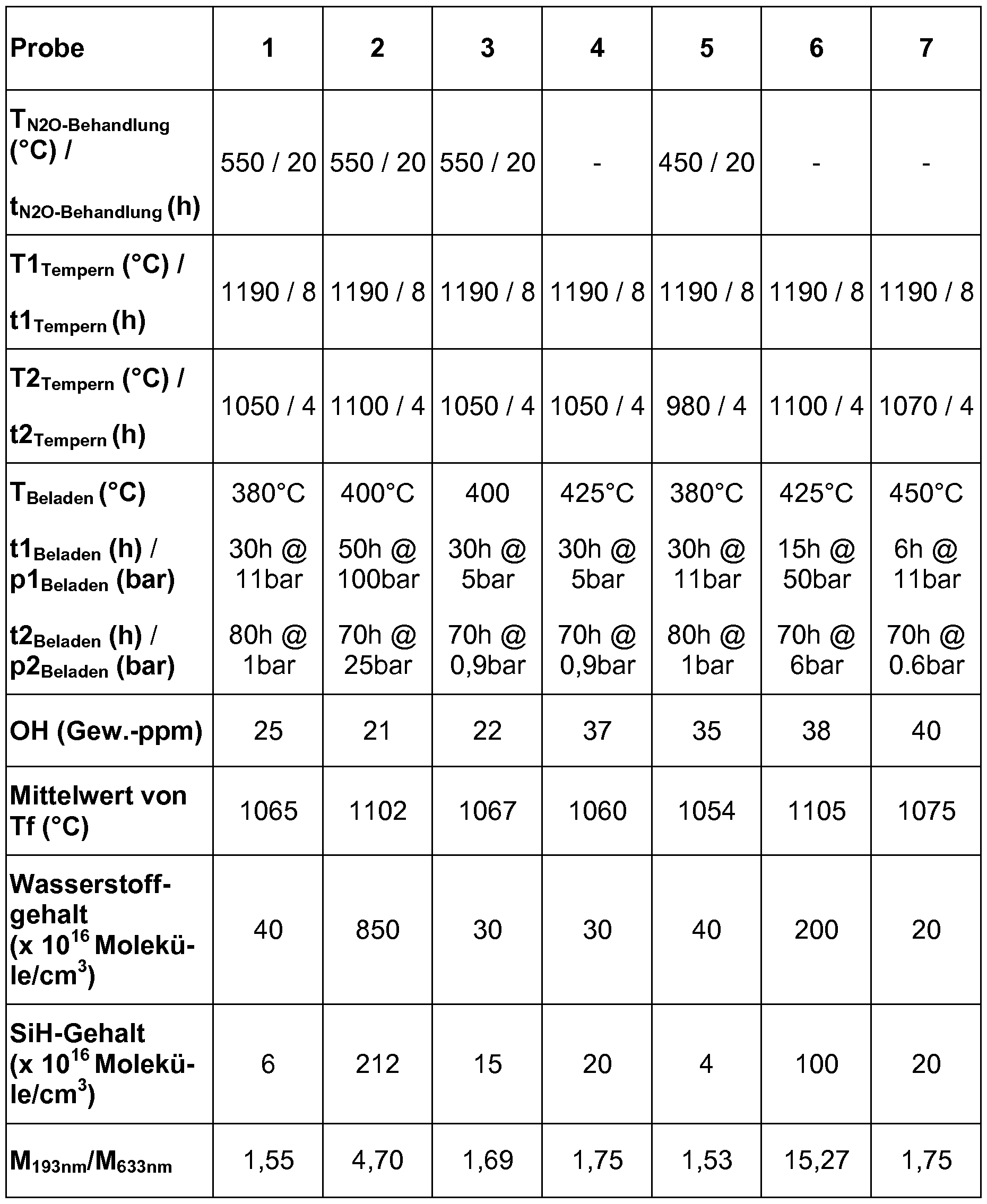
- the two-stage treatment is carried out in an atmosphere of 100 vol .-% hydrogen by heating at a temperature T Be iaden of 380 ° C, first at a pressure p1 Beiaden of 1 1 bar and a holding time t1 Be iaden of 30h, and then at a pressure p2 Be iaden of 1 bar and a holding period t2 Be iaden of 80h.
- the quartz glass cylinder obtained thereafter is substantially free of chlorine, oxygen defect sites and SiH groups (below the detection limit of 5 ⁇ 10 16 molecules / cm 3 ), and is characterized by a diameter of 280 mm (CA range) average hydrogen content of 40 x 10 16 molecules / cm 3 and a hydroxyl group content of 25 ppm by weight.
- Table 1 summarizes the parameters of the individual process steps and the measurement results for sample 1 and for further similarly prepared samples 2 to 7.
- Pulse rate 5 x 10 9 pulses; Pulse width: 125 ns; Energy density: 500 ⁇ / cm 2 in each case; Pulse repetition frequency: 2000 Hz
- the amount of the local maximum refractive index change compared to the non-irradiated glass is determined both by
- the measurement results show that the ratio Mi93nm M 6 33nm can be regarded as a quality indicator for a low and predictable compaction, apparently significantly influenced by the parameters in the aftertreatment of the soot body in N 2 O-containing atmosphere and after-treatment of the vitrified quartz glass blank in H 2 -containing Atmosphere is determined.
- the intensity of N 2 treatment for the removal of oxygen defect sites and the temperature during hydrogen loading seem to play a crucial role in the prevention of SiH groups. This is also shown by the further measurement results discussed below with reference to the diagrams of FIGS. 1 to 4.
- Figure 1 shows for sample 3 the evolution of the ratio V (M193nm / M633nm) with the dose of irradiation (dose) as product of squared energy density and pulse rate divided by the temporal pulse width in ns (in unit (J / cm 2 ) 2 / ns )
- V M193nm / M633nm
- dose dose
- temporal pulse width in ns (in unit (J / cm 2 ) 2 / ns )
- the temperature during the loading of the quartz glass with hydrogen is decisive for the formation of SiH groups.
- FIG. 2 also shows that this model assumption is correct.
- the final value of the ratio Mi93nm M 6 33 determined from the above-mentioned model calculation (1) is plotted against the actual measured final values after irradiation with the above-specified irradiation dose , It can be seen that the measured values lie almost exactly on a straight line with slope 1, which can be regarded as proof of the correctness of the model according to equation (1).
- the final value of the ratio Mi93nm M 6 33 (as a measure of the compaction tendency of the quartz glass) plotted against the hydrogen content of the quartz glass CH 2 in 1 0 17 molecules / cm 3 ( x-axis) and temperature T ⁇ in ° C at the hydrogen loading (z-axis).
- the loading temperature Tßeiaden is at the same time a measure of the SiH concentration. Accordingly, the compaction tendency generally increases strongly with the loading temperature, and slightly increases with the hydrogen concentration. Often a certain hydrogen concentration is given. This requirement can be met in principle at high loading temperature within a short time or at low loading temperature in a long time. In the former case inevitably results in a higher Kompakt istsneist, in the second case, a more expensive manufacturing process.
- the model can be used to determine the highest, just still permissible loading temperature, thus shortening the loading time to a minimum.
Landscapes
- Chemical & Material Sciences (AREA)
- Engineering & Computer Science (AREA)
- Physics & Mathematics (AREA)
- Organic Chemistry (AREA)
- Materials Engineering (AREA)
- Chemical Kinetics & Catalysis (AREA)
- Thermal Sciences (AREA)
- General Chemical & Material Sciences (AREA)
- Geochemistry & Mineralogy (AREA)
- Life Sciences & Earth Sciences (AREA)
- Optics & Photonics (AREA)
- General Physics & Mathematics (AREA)
- Crystallography & Structural Chemistry (AREA)
- Manufacturing & Machinery (AREA)
- Ceramic Engineering (AREA)
- Glass Compositions (AREA)
- Exposure And Positioning Against Photoresist Photosensitive Materials (AREA)
- Glass Melting And Manufacturing (AREA)
Abstract
Description
Optisches Bauteil aus Quarzglas zur Verwendung in der ArF-Excimerlaser- Lithographie sowie Verfahren zur Herstellung des Bauteils Beschreibung Quartz glass optical component for use in ArF excimer laser lithography and method of manufacturing the component Description
Technisches Gebiet der Erfindung Technical field of the invention
Die Erfindung betrifft ein optisches Bauteil aus synthetischem Quarzglas zur Verwendung in der ArF-Excimerlaser-Lithographie mit einer Einsatzwellenlänge von 193 nm, mit einer Glasstruktur im Wesentlichen ohne Sauerstoffdefektstellen, einem Wasserstoffgehalt im Bereich von 0,1 x 10¹⁶ Molekülen/cm3 bis 1 ,0 x 1018 Molekülen/cm3 und einem Gehalt an SiH-Gruppen von weniger als 2 x 10¹⁷ Molekülen/cm3 und mit einem Gehalt an Hydroxylgruppen im Bereich zwischen 0,1 und 100 Gew.- ppm, wobei die Glasstruktur eine fiktive Temperatur von weniger 1070 °C aufweist. The invention relates to an optical component of synthetic quartz glass for use in ArF excimer laser lithography with a use wavelength of 193 nm, having a glass structure substantially without oxygen defect sites, a hydrogen content in the range of 0.1 x 10 16 molecules / cm 3 to 1 , 0 x 10 18 molecules / cm 3 and a content of SiH groups of less than 2 x 10 17 molecules / cm 3 and having a content of hydroxyl groups in the range between 0.1 and 100 ppm by weight, wherein the glass structure a fictitious temperature of less than 1070 ° C.
Weiterhin betrifft die Erfindung ein Verfahren zur Herstellung eines derartigen opti- sehen Bauteils. Furthermore, the invention relates to a method for producing such an optic see component.
Stand der Technik State of the art
Ein derartiges optisches Bauteil aus synthetischem Quarzglas und ein Verfahren für seine Herstellung sind aus der WO 2009/106134 A1 bekannt. Das optische Bauteil hat eine Glasstruktur im Wesentlichen frei von Chlor, Sauerstoffdefektstellen und SiH-Gruppen (unterhalb der Nachweisgrenze von 5 x10¹⁶ Molekülen/cm3). Innerhalb eines Durchmessers von 280 mm (CA-Bereich) zeigt es einen mittleren Wasser- stoffgehalt von etwa 3 x 10¹⁶ Molekülen/cm3 sowie einen Hydroxylgruppengehalt von 25 Gew.-ppm. Such an optical component of synthetic quartz glass and a method for its production are known from WO 2009/106134 A1. The optical component has a glass structure substantially free of chlorine, oxygen deficiency sites and SiH groups (below the detection limit of 5 x 10 16 molecules / cm 3 ). Within a diameter of 280 mm (CA range), it shows an average hydrogen content of about 3 × 10 16 molecules / cm 3 and a hydroxyl group content of 25 ppm by weight.
Zur Herstellung des Bauteils wird ein SiO2-Sootkörper so getrocknet, dass sich im daraus erzeugten Quarzglas ein mittlerer Hydroxylgruppengehalt von weniger als 60 Gew.-ppm einstellt. Vor dem Verglasen wird der Sootkörper einer Konditionie- rungsbehandlung unterzogen, die eine Behandlung mit Stickoxid umfasst. Zum Abbau mechanischer Spannungen wird der Quarzglasrohling einer Temperbehandlung unterzogen und abschließend in einer Atmosphäre aus 80 Vol.-% Stickstoff und 20 Vol.-% Wasserstoff bei 400 °C bei einem Absolutdruck von 1 bar während einer Dauer von 80 h mit Wasserstoff beladen. To produce the component, an SiO 2 soot body is dried in such a way that an average hydroxyl group content of less than 60 ppm by weight is established in the quartz glass produced therefrom. Before vitrification, the soot body is subjected to a conditioning treatment comprising a treatment with nitric oxide. To reduce mechanical stresses, the quartz glass blank is subjected to an annealing treatment and finally loaded in an atmosphere of 80 vol .-% nitrogen and 20 vol .-% hydrogen at 400 ° C at an absolute pressure of 1 bar for a period of 80 h with hydrogen.
Herstellungsbedingt kann das so hergestellte synthetische Quarzglas Stickstoff ent- halten, der im Glasnetzwerk chemisch gebunden ist. Es zeigt ein günstiges Schädigungsverhalten bei kurzwelliger UV-Laserstrahlung insbesondere hinsichtlich der sogenannten„Kompaktierung". For reasons of production, the synthetic quartz glass produced in this way can contain nitrogen, which is chemically bound in the glass network. It shows a favorable damage behavior with short-wave UV laser radiation, in particular with regard to the so-called "compaction".
Technische Aufgabenstellung Technical task
Beim Schädigungsverhalten der„Kompaktierung" tritt während oder nach energierei- eher UV-Laserbestrahlung des Glases eine lokale Dichteerhöhung im durchstrahlten Volumen auf. Diese verursacht eine lokale Erhöhung des Brechungsindex, die bei andauernder Bestrahlung fortschreitet und damit zu einer zunehmenden Verschlechterung der Abbildungseigenschaften des optischen Bauteils und letztlich zum frühzeitigen Ausfall des Bauteils führt. Der Einfachheit halber wird die Änderungen der Brechungsindexverteilung infolge Kompaktierung häufig nicht bei der Einsatzwellenlänge, wie etwa bei 193 nm, sondern unter Einsatz eines mit einem Helium-Neon-Laser ausgestatteten Fizeau- Interferometers mit einer Messwellenlänge von 633 nm ermittelt (genauer: bei einer Wellenlänge von 632,8 nm). Es hat sich nun gezeigt, dass Quarzgläser trotz gleicher oder ähnlicher Messwerte ihrer Kompaktierung bei einer Messwellenlänge von 633 nm, bei einer Messwellenlänge bei 193 nm überraschend unterschiedliche Schädigungsverhalten zeigen können. Dies ist besonders dann problematisch, wenn das zu messende Quarzglas bei einer Messwellenlänge von 633 nm ein durchaus akzeptables Kompaktierungsver- halten nahelegt, beim Einsatz mit der Einsatzwellenlänge aber unerwartet deutlich schlechtere Werte zeigt oder sogar unbrauchbar ist. During or after energy-efficient UV laser irradiation of the glass, the damage behavior of the "compaction" causes a local density increase in the irradiated volume, which causes a local increase in the refractive index, which proceeds with continuous irradiation and thus an increasing deterioration of the imaging properties of the optical component For the sake of simplicity, the changes in refractive index distribution due to compaction are often not at the wavelength of use, such as at 193 nm, but using a helium-neon laser-equipped Fizeau interferometer with a measurement wavelength of 633 nm (more precisely: at a wavelength of 632.8 nm) It has now been shown that, despite identical or similar measured values, quartz glass surprisingly fails their compaction at a measuring wavelength of 633 nm at a measuring wavelength of 193 nm can show harmful damage behavior. This is particularly problematical if the quartz glass to be measured suggests a quite acceptable compaction behavior at a measurement wavelength of 633 nm, but when used at the wavelength of use unexpectedly shows markedly poorer values or is even useless.
Der Erfindung liegt daher die Aufgabe zugrunde, ein optisches Bauteil zur Verwendung in der ArF-Excimerlaser-Lithographie mit einer Einsatzwellenlänge von 193 nm bereit zu stellen, das ausgehend von einer Messung des Kompaktierungsverhaltens bei einer Messwellenlänge von 633 nm eine verlässliche Prädiktion zum Kompaktie- rungsverhalten beim Einsatz mit UV-Laserstrahlung der Einsatzwellenlänge ermöglicht. Weiterhin liegt der Erfindung die Aufgabe zugrunde, ein Verfahren anzugeben, welches zur Herstellung eines derartigen optischen Bauteils geeignet ist. The invention is therefore based on the object, an optical component for use in ArF excimer laser lithography with an operating wavelength of 193 nm to provide a reliable prediction of the compacting behavior when used with UV laser radiation of the operating wavelength starting from a measurement of the compaction behavior at a measuring wavelength of 633 nm. Furthermore, the invention has for its object to provide a method which is suitable for producing such an optical component.
Allgemeine Beschreibung der Erfindung General description of the invention
Hinsichtlich des optischen Bauteils wird diese Aufgabe ausgehend von einem Bauteil der eingangs genannten Gattung erfindungsgemäß dadurch gelöst, dass seine Glasstruktur auf Bestrahlung mit Strahlung einer Wellenlänge von 193 nm mit 5 x 10⁹ Pulsen mit einer Pulsbreite von 125 ns und einer Energiedichte von jeweils 500 μϋ/cm2 sowie einer Pulswiederholfrequenz von 2000 Hz mit einer laserinduzierten Brechzahländerung reagiert, deren Betrag bei Vermessung mit der Einsatzwellenlänge von 193 nm einen ersten Messwert Μΐ93ηπι und bei Vermessung mit einer Messwellenlänge von 633 nm einen zweiten Messwert M633nm ergibt, wobei gilt: Mi93nm M633nm < 1 - With regard to the optical component, this object is achieved on the basis of a component of the type mentioned above in that its glass structure irradiation with radiation of a wavelength of 193 nm with 5 x 10 9 pulses with a pulse width of 125 ns and an energy density of 500 μϋ / cm 2 and a pulse repetition frequency of 2000 Hz with a laser-induced change in refractive index, the amount of which measured at the operating wavelength of 193 nm a first measurement Μΐ9 3ππι and measurement with a measurement wavelength of 633 nm results in a second measurement M 6 33nm, where: Mi93nm M 6 33nm <1 -
Die Dosis der Bestrahlung mit Strahlung der Einsatzwellenlänge ist definiert durch Pulsanzahl der Laserpulse, deren Pulsbreite und Energiedichte sowie die Pulswiederholfrequenz. Das erfindungsgemäße Bauteil zeigt bei dieser Bestrahlungsdosis ein Kompaktierungsverhalten mit folgenden charakteristischen Merkmalen: (a) Die jeweiligen Messwerte Mi93nm und M633nm der Messungen des Kompaktierungsverhaltens bei 193 nm und bei 633 nm zeigen nach der oben spezifizierten Bestrahlungsdosis ein Verhältnis Mi93nm M633nm, das kleiner ist als 1 ,7. The dose of irradiation with radiation of the use wavelength is defined by the number of pulses of the laser pulses, their pulse width and energy density and the pulse repetition frequency. The component according to the invention exhibits a compaction behavior with the following characteristic features: (a) The respective measured values Mi 93 nm and M 6 33 nm of the measurements of the compaction behavior at 193 nm and at 633 nm show, after the irradiation dose specified above, a ratio Mi93nm M 6 33 nm which is less than 1, 7.
Dabei handelt es sich um ein vergleichsweise kleines Verhältnis This is a relatively small ratio
Mi 93nm M633nm- Es hat sich gezeigt, dass das kleine Verhältnis nicht nur für ei- ne gute Kompaktierungsresistenz des Glases steht, sondern auch unverzichtbare Bedingung für die Vorhersagbarkeit der Kompaktierung selbst ist. Mi 93nm M 6 33nm- It has been shown that the small ratio not only stands for good compaction resistance of the glass, but is also an indispensable condition for the predictability of the compaction itself.
(b) Denn es hat sich gezeigt, dass beim erfindungsgemäßen Quarzglas dieses kleine Verhältnis Mi93nm M633nm - das die Bedingung (a) erfüllt - auch dann na- hezu konstant bleibt, wenn die Bestrahlungsdosis die oben spezifizierte Dosis überschreitet. (b) Because it has been shown that in the quartz glass according to the invention, this small ratio Mi93nm M 6 33nm - which satisfies the condition (a) - even then remains constant when the irradiation dose exceeds the dose specified above.
Die Kenntnis dieses konstanten Verhältnisses ermöglicht es, die Kompaktie- rung infolge Bestrahlung mit der Einsatzwellenlänge auch für jede höhere Be- strahlungsdosis als die oben spezifizierte exakt oder zumindest mit hinreichender Genauigkeit zu berechnen, und zwar auf Basis einer Messung bei 633 nm. The knowledge of this constant ratio makes it possible to compute the compaction due to irradiation with the use wavelength also for each higher irradiation dose than specified above exactly or at least with sufficient accuracy, on the basis of a measurement at 633 nm.
Bei gesicherter Kenntnis der Erfüllung von Bedingung (a) ist es somit infolge von Bedingung (b) möglich, durch Messungen bei einer Wellenlänge von 633 nm das Kom- paktierungsverhalten beim Einsatz des Quarzglases mit UV-Laserstrahlung von 193 nm verlässlich vorherzusagen. If the knowledge of the fulfillment of condition (a) is clearly known, it is possible, as a result of condition (b), to reliably predict the compacting behavior when using the quartz glass with UV laser radiation of 193 nm by measurements at a wavelength of 633 nm.
Die Glasstruktur ist im Wesentlichen frei von Sauerstoffdefektstellen. Darunter wird eine Glasstruktur verstanden, bei der die Konzentrationen von Sauerstoff- Unterschussdefekten und von Sauerstoff-Überschussdefekten unterhalb der Nach- weisbarkeitsgrenze der Methode von Shelby liegen. The glass structure is essentially free of oxygen deficiency sites. This is understood to mean a glass structure in which the concentrations of oxygen deficiency defects and oxygen excess defects are below the detectability limit of the Shelby method.
Diese Nachweismethode ist veröffentlicht in„Reaction of hydrogen with hydroxyl-free vitreous silica" (J. Appl. Phys., Vol. 51 , No. 5 (Mai 1980), S. 2589-2593). Quantitativ ergibt sich dabei eine Anzahl an Sauerstoff-Unterschussdefekten oder an Sauerstoff- Überschussdefekten in der Glasstruktur von nicht mehr als etwa 1017 pro Gramm Quarzglas. This detection method is published in "Reaction of hydrogen with hydroxyl-free vitreous silica" (J. Appl Phys., Vol 51, No. 5 (May 1980), pp. 2589-2593) Oxygen deficiency defects or oxygen excess defects in the glass structure of not more than about 10 17 per gram of fused silica.
Anhand dieser Methode wird auch der Gehalt an SiH-Gruppen ermittelt, wobei eine Kalibrierung anhand der chemischen Reaktion erfolgt: Si-O-Si + H2 -> Si-H + Si-OH. Based on this method, the content of SiH groups is also determined, with a calibration based on the chemical reaction: Si-O-Si + H 2 -> Si-H + Si-OH.
SiH-Gruppen und Wasserstoff stehen im thermodynamischen Gleichgewicht miteinander. Der Gehalt an SiH-Gruppen liegt im Quarzglas des erfindungsgemäßen Bau- teils bei weniger als 2 x 10¹⁷ Molekülen/cm3, und der Wasserstoffgehalt im Bereich von 0,1 x 10¹⁶ Molekülen/cm3 bis 1 ,0 x 1018 Molekülen/cm3. SiH groups and hydrogen are in thermodynamic equilibrium. The content of SiH groups in the quartz glass of the component according to the invention is less than 2 × 10 17 molecules / cm 3 , and the hydrogen content in the range of 0.1 × 10 16 molecules / cm 3 to 1, 0 × 10 18 molecules / cm 3 .
SiH-Gruppen entstehen somit durch Reaktion mit molekularem Wasserstoff unter Aufspaltung des SiO2-Netzwerks. Sie sind unerwünscht, da aus ihnen bei Bestrah- lung mit energiereichem UV-Licht ein sogenanntes E'-Zentrum und atomarer Wasserstoff entstehen kann. Das E'-Zentrum bewirkt eine erhöhte Absorption bei einer Wellenlänge von 210 nm und macht sich auch im angrenzenden UV- Wellenlängenbereich ungünstig bemerkbar. Der Wasserstoffgehalt (H2-Gehalt) wird anhand einer Raman-Messung ermittelt, wie vorgeschlagen in:„Khotimchenko et al.; Determining the Content of Hydrogen Dis- solved in Quartz Glass Using the Methods of Raman Scattering and Mass Spectro- metry; Zhurnal Prikladnoi Spektroskopii, Vol. 46, No. 6 (Juni 1987), S. 987-991 ". SiH groups are thus formed by reaction with molecular hydrogen with splitting of the SiO 2 network. They are undesirable because they With energy-rich UV light a so-called E'-center and atomic hydrogen can arise. The E 'center causes an increased absorption at a wavelength of 210 nm and is also unfavorable in the adjacent UV wavelength range. The hydrogen content (H 2 content) is determined by Raman measurement as proposed in: "Khotimchenko et al .; Determining the Content of Hydrogen Disolved in Quartz Glass Using the Methods of Raman Scattering and Mass Spectrometry; Zhurnal Prikladnoi Spektroskopii, Vol. 46, no. 6 (June 1987), pp. 987-991.
Der Gehalt an Hydroxylgruppen liegt im Bereich zwischen 0,1 und 100 Gew.-ppm, vorzugsweise zwischen 10 bis 60 Gew.-ppm. Er ergibt sich durch Messung der IR- Absorption nach der Methode von D. M. Dodd et al. („Optical Determinations of OH in Fused Silica", (1966), S. 391 1 ). The content of hydroxyl groups is in the range between 0.1 and 100 ppm by weight, preferably between 10 and 60 ppm by weight. It is obtained by measuring the IR absorption by the method of D. M. Dodd et al. ("Optical Determinations of OH in Fused Silica", (1966), p. 391 1).
Mit abnehmendem Hydroxylgruppengehalt nimmt die Viskosität von Quarzglas zu. Der geringe Hydroxylgruppengehalt von weniger als 100 Gew.-ppm führt zu einer rigideren Glasstruktur und verbessert das Verhalten gegenüber einer lokalen anisotropen Dichteänderung, insbesondere bei linear polarisierter UV-Strahlung. Es wurde auch vermutet, dass die Dichteänderung bei der Kompaktierung mit einer Umlage- rung von Hydroxylgruppen einhergeht, wobei dieser Umlagerungsmechanismus umso wahrscheinlicher und leichter abläuft, je mehr Hydroxylgruppen zur Verfügung stehen. As the hydroxyl group content decreases, the viscosity of silica glass increases. The low hydroxyl group content of less than 100 ppm by weight leads to a more rigid glass structure and improves the behavior towards a local anisotropic density change, especially with linearly polarized UV radiation. It has also been suggested that the density change in compaction is accompanied by a rearrangement of hydroxyl groups, which rearrangement mechanism is all the more likely and easier the more hydroxyl groups are available.
Die fiktive Temperatur der Glasstruktur liegt niedriger als 1070 °C, vorzugsweise niedriger als 1055 °C. Deren Messverfahren, beruhend auf einer Messung der Ra- man-Streuintensität bei einer Wellenzahl von etwa 606 cm"1 ist beschrieben in„Ch. Pfleiderer et. al.;„The UV-induced 210 nm absorption band in fused Silica with differ- ent thermal history and stoichiometry"; J. Non-Cryst. Solids 159 (1993) 145-143". The fictitious temperature of the glass structure is lower than 1070 ° C, preferably lower than 1055 ° C. Their measuring method, based on a Raman scattering intensity measurement at a wavenumber of about 606 cm -1, is described in Ch. Pfleiderer et al., The UV-induced 210 nm absorption band in fused silica with differen- tial thermal history and stoichiometry "; J. Non-Cryst. Solids 159 (1993) 145-143 ".
Der Gehalt an Fluor beträgt bevorzugt weniger als 10 Gew.-ppm und der an Chlor vorzugsweise weniger als 0,1 Gew.-ppm. Halogene können unter Aufspaltung mit dem SiO2-Glasnetzwerk reagieren und dieses dadurch schwächen. Es hat sich gezeigt, dass die Vorhersagbarkeit des Kompaktierungsverhaltens beim Einsatz des Quarzglases mit UV-Laserstrahlung von 193 nm durch die Messung bei einer Wellenlänge von 633 nm umso verlässlicher ist, je kleiner das Verhältnis von erstem und zweitem Messwert ist. Daher wird eine Ausführungsform des Bauteil besonders bevorzugt, bei dem bei der Vermessung der laserinduzierten Brechzahländerung für das Verhältnis von erstem Messwert Mi93nm und zweitem Messwert M633nm gilt: Mi93nm M633nm < 1 ,6 und bevorzugt: Mi93nm/M633nm < 1 ,55. The content of fluorine is preferably less than 10 ppm by weight and that of chlorine is preferably less than 0.1 ppm by weight. Halogens can react with splitting with the SiO2 glass network and thereby weaken it. It has been found that the smaller the ratio of the first and the second measured value, the more reliable the predictability of the compaction behavior when using the quartz glass with UV laser radiation of 193 nm by the measurement at a wavelength of 633 nm. Therefore, an embodiment of the component is particularly preferred in which in the measurement of the laser-induced refractive index change for the ratio of first measured value Mi 93 nm and second measured value M 6 33nm Mi93nm M 6 33nm <1, 6 and preferably: Mi93nm / M 6 33nm <1, 55.
Hinsichtlich des Verfahrens wird die oben angegebene Aufgabe erfindungsgemäß durch ein Verfahren gelöst, das die folgenden Verfahrensschritte umfasst: With regard to the method, the above-mentioned object is achieved according to the invention by a method comprising the following method steps:
(a) Erzeugen eines porösen Sootkörpers aus S1O2 durch Flammenhydrolyse einer Silizium enthaltenden Ausgangssubstanz, (a) producing a porous soot body from S1O2 by flame hydrolysis of a silicon-containing starting substance,
(b) Trocknen des Sootkörpers, (b) drying the soot body,
(c) Behandeln es Sootkörpers in einer oxidierend wirkenden Atmosphäre, die N2O enthält, mit der Maßgabe, dass durch das Trocknen nach Verfahrensschritte (b) und durch das Behandeln gemäß Verfahrensschritt (c) ein Hydroxylgruppengehalt im Sootkörper eingestellt wird, derart, dass durch (c) treating soot bodies in an oxidizing atmosphere containing N 2 O, with the proviso that by drying according to process steps (b) and by the treatment according to process step (c), a hydroxyl group content in the soot body is adjusted such that by
(d) anschließendes Sintern des Sootkörpers ein Halbzeug aus Quarzglas erhalten wird, das einen mittleren Hydroxylgruppengehalt im Bereich zwischen 0,1 und 100 Gew.-ppm aufweist, und (D) subsequent sintering of the soot body is a semi-finished quartz glass is obtained, which has a mean hydroxyl group content in the range between 0.1 and 100 ppm by weight, and
(e) Formen des Halbzeugs zu einem Rohling aus Quarzglas und Tempern des Rohlings derart, dass er eine mittlere fiktive Temperature von weniger als 1070 °C aufweist, (e) forming the semifinished product into a blank made of quartz glass and annealing the blank such that it has an average fictitious temperature of less than 1070 ° C.,
(f) Beladen des Rohlings mit Wasserstoff durch Erhitzen in einer Wasserstoff ent- haltenden Atmosphäre bei einer Temperatur unterhalb von 400 °C unter Erzeugung eines mittleren Wasserstoffgehalts im Bereich von 0,1 x 10¹⁶ Molekülen/cm3 bis 1 ,0 x 1018 Molekülen/cm3. (f) Loading the blank with hydrogen by heating in a hydrogen-containing atmosphere at a temperature below 400 ° C to produce an average hydrogen content in the range of 0.1 x 10 16 molecules / cm 3 to 1, 0 x 10 18 Molecules / cm 3 .
Das Quarzglas für das erfindungsgemäße optische Bauteil wird nach dem so genannten„Sootverfahren" hergestellt. Dabei fällt als Zwischenprodukt ein poröser Körper aus SiO2-Ruß an (hier als„Sootkorper" bezeichnet). Dessen Porosität ermöglicht es, die chemische Zusammensetzung und damit auch direkt die S1O2- Netzwerkstruktur zu verändern und an besondere Anforderungen anzupassen; insbesondere können die Konzentrationen an Hydroxylgruppen und Halogenen redu- ziert und auf vorgegebene Werte eingestellt oder Komponenten wie Sauerstoff oder Stickstoff hinzugefügt werden. The quartz glass for the optical component according to the invention is produced by the so-called "soot method." In this case, the intermediate product is a porous one Its porosity makes it possible to modify the chemical composition and thus also directly the S1O2 network structure and adapt it to special requirements, in particular the concentrations of hydroxyl groups and halogens can be reduced and set to preset values or add components such as oxygen or nitrogen.
Das Trocknen des Sootkorpers erfolgt durch Erhitzen unterhalb der Verglasungs- temperatur entweder in einer halogenhaltigen Atmosphäre oder - vorzugsweise - unter Vakuum. Das Trocknen führt zu einer möglichst gleichmäßigen Reduzierung der herstellungsbedingt im Sootkorper enthaltenen Hydroxylgruppen auf den vorgegebenen Wert. Die nachfolgenden Behandlungsschritte haben im Idealfall auf den Hydroxylgruppengehalt keinen nennenswerten Einfluss mehr. The soot body is dried by heating below the glazing temperature either in a halogen-containing atmosphere or-preferably-under vacuum. Drying leads to the most uniform possible reduction of the hydroxyl groups contained in the soot body due to production to the predetermined value. The subsequent treatment steps ideally have no significant influence on the hydroxyl group content.
Als wesentlich für das Kompaktierungsverhalten des Quarzglases ist ein Behandlungsschritt des porösen Sootkorpers in einer oxidierend wirkenden Atmosphäre, die N2O enthält. Essential for the compaction behavior of the quartz glass is a treatment step of the porous soot body in an oxidizing atmosphere containing N 2 O.
Distickstoffmonoxid (N2O) zerfällt bei hoher Temperatur in Sauerstoff und reaktive Stickstoffatome oder -Verbindungen, die in der Lage sind, mit den Defektstellen der Quarzglas-Netzwerkstruktur zu reagieren und diese abzusättigen und so zu eliminieren. Das Glasnetzwerk wird so verfestigt. Neben der oxidativen Behandlung mit N2O liefern Nachbehandlungen des aus dem Sootkorper nach Verglasen erhaltenen Quarzglas-Rohlings einen weiteren wesentlichen Beitrag für diesen Effekt. Dabei wird einerseits durch Tempern des Rohlings eine mittlere fiktive Temperatur von weniger als 1070 °C eingestellt, und andererseits wird der Rohling durch Erhitzen in einer Wasserstoff enthaltenden Atmosphäre mit Wasserstoff beladen. Nitrous oxide (N 2 O) decomposes at high temperature into oxygen and reactive nitrogen atoms or compounds, which are able to react with the defect sites of the quartz glass network structure to saturate and thus eliminate them. The glass network is thus solidified. In addition to the oxidative treatment with N 2 O, post-treatments of the quartz glass blank obtained from the soot body after vitrification provide a further significant contribution to this effect. In this case, on the one hand by annealing the blank, a mean fictive temperature of less than 1070 ° C is set, and on the other hand, the blank is loaded by heating in a hydrogen-containing atmosphere with hydrogen.
Anschließend wird der Sootkorper unter Vakuum zu einem zylinderförmigen Quarzglasrohling verglast. Durch das Vakuum wird molekularer Wasserstoff entfernt, der beim Flammhydrolyseverfahren in das Quarzglas eingebracht wird, und der andernfalls bei nachfolgenden Heißbehandlungsschritten zu unerwünschten SiH-Gruppen weiter reagieren würde. Nach dem Verglasen liegt ein Quarzglasrohling mit einem Hydroxylgruppengehalt im Bereich zwischen 0,1 und 100 Gew.-ppm vor, der im Wesentlichen frei von SiH- Gruppen und von Wasserstoff ist (der Gehalt dieser beiden Komponenten liegt unterhalb der Nachweisgrenze). Zum Abbau mechanischer Spannungen und zur Verminderung der Doppelbrechung sowie zur Erzeugung einer kompaktierungsresistenten Glasstruktur wird der Quarzglasrohling einer Temperbehandlung unterzogen, die so geführt wird, dass sich über das Volumen gemessen eine mittlere fiktive Temperatur von weniger als 1070 °C, vorzugsweise weniger als 1055 °C, einstellt. Es hat sich gezeigt, dass dadurch eine vergleichsweise dichte Netzwerkstruktur erzeugt wird, die einer weiteren - lokalen - Kompaktierung durch UV-Bestrahlung entgegenwirkt. Subsequently, the soot body is vitrified under vacuum to form a cylindrical quartz glass blank. The vacuum removes molecular hydrogen which is introduced into the quartz glass during the flame hydrolysis process, and which would otherwise react further in subsequent hot treatment steps to form undesirable SiH groups. After vitrification there is a quartz glass blank having a hydroxyl group content in the range between 0.1 and 100 ppm by weight, which is essentially free of SiH groups and of hydrogen (the content of these two components is below the detection limit). In order to reduce mechanical stresses and to reduce birefringence and to produce a compacting-resistant glass structure, the quartz glass blank is subjected to an annealing treatment, which is carried out so that measured over the volume a mean fictive temperature of less than 1070 ° C., preferably less than 1055 ° C. , sets. It has been found that this creates a comparatively dense network structure which counteracts further local compaction by UV irradiation.
Die defektausheilende Wirkung von Wasserstoff ist bekannt. Je nach Anwendung und projektierter Lebensdauer eines optischen Bauteils ist daher häufig ein gewisser Wasserstoffgehalt vorgegeben, selbst wenn dafür andere Nachteile in Kauf zu neh- men sind. Nach dem Tempern liegt der Wasserstoffgehalt des Quarzglases jedoch unterhalb der Auflösungsgrenze des Messverfahrens. Das Quarzglas wird nachträglich mit Wasserstoff beladen. Als besonders wichtig hat sich dabei erwiesen, dass das Beladen mit Wasserstoff bei einer Temperatur unterhalb von 400 °C erfolgt, bevorzugt unterhalb von 350 °C. Denn im thermodynamischen Gleichgewicht entstehen bei höheren Temperaturen in Quarzglas bei Gegenwart von Wasserstoff SiH-Gruppen. Die besonders niedrige Beladungstemperatur vermeidet oder vermindert dies. SiH-Gruppen können bei Bestrahlung mit energiereichem UV-Licht so genannte E'-Zentren bilden, die wiederum eine erhöhte Absorption bei einer Wellenlänge von 210 nm bewirken, die sich auch im angrenzenden Wellenlängenbereich der Einsatzstrahlung ungünstig bemerkbar macht. The defect-healing effect of hydrogen is known. Depending on the application and projected life of an optical component, therefore, a certain hydrogen content is often given, even if other disadvantages are to be accepted. After tempering, however, the hydrogen content of the quartz glass is below the resolution limit of the measuring method. The quartz glass is subsequently loaded with hydrogen. It has proven to be particularly important that the loading with hydrogen takes place at a temperature below 400 ° C., preferably below 350 ° C. For in thermodynamic equilibrium SiH groups are formed at higher temperatures in quartz glass in the presence of hydrogen. The particularly low loading temperature avoids or reduces this. Upon irradiation with high-energy UV light, SiH groups can form so-called E'-centers, which in turn cause an increased absorption at a wavelength of 210 nm, which also has an unfavorable effect in the adjacent wavelength range of the incident radiation.
Es wird dabei ein mittlerer Wasserstoffgehalt im Bereich von 0,1 x 10¹⁶ Molekülen/cm3 bis 1 ,0 x 1018 Molekülen/cm3 eingestellt. Wegen der niedrigen Beladungstemperatur ist ein hoher Wasserstoff-Partialdruck hilfreich, um eine hinreichende Wasserstoffbeladung innerhalb wirtschaftlich vernünftiger Behandlungsdauern zu erzielen. Der Wasserstoffpartialdruck liegt daher bevorzugt zwischen 1 und 150 bar. In this case, an average hydrogen content in the range of 0.1 × 10 16 molecules / cm 3 to 1, 0 × 10 18 molecules / cm 3 is set. Because of the low loading temperature, a high partial pressure of hydrogen is helpful to obtain a sufficient Hydrogen loading within economically reasonable treatment periods to achieve. The hydrogen partial pressure is therefore preferably between 1 and 150 bar.
Ein erhöhter Druck beschleunigt nicht nur die Wasserstoffbeladung, sondern kann auch zu einer etwas kompakteren und gegen lokale anisotrope Dichteänderung re- sistenteren Glasstruktur höherer Dichte beitragen. Increased pressure not only accelerates hydrogen loading but may also contribute to a more compact glass structure of higher density, more resistant to local anisotropic density change.
Ergebnis des Herstellungsverfahrens ist ein Zylinder aus Quarzglas mit einem spezifischen Kompaktierungsverhalten. Nach Bestrahlung mit der spezifischen Strahlungsdosis der Wellenlänge von 193 nm - mit 5 x 10⁹ Pulsen mit einer Pulsbreite von 125 ns und einer Energiedichte von jeweils 500 μϋ/cm2 sowie einer Pulswiederhol- frequenz von 2000 Hz - reagiert das Quarzglas mit einem Maximalwert der laserinduzierten Brechzahländerung, deren Betrag bei Vermessung mit der Einsatzwellenlänge von 193 nm einen ersten Messwert Mi 93nm und bei Vermessung mit einer Messwellenlänge von 633 nm einen zweiten Messwert M633nm ergibt, wobei gilt: Mi 93nm M633nm < 1 , vorzugsweise beträgt es weniger als 1 ,6 und besonders bevor- zugt weniger als 1 ,55. The result of the manufacturing process is a quartz glass cylinder with a specific compaction behavior. After irradiation with the specific radiation dose of the wavelength of 193 nm - with 5 × 10 9 pulses with a pulse width of 125 ns and an energy density of 500 μϋ / cm 2 and a pulse repetition frequency of 2000 Hz - the quartz glass reacts with a maximum value of laser-induced refractive index change, the amount of which, measured at the operating wavelength of 193 nm, gives a first measured value Mi 9 3n m and when measured with a measuring wavelength of 633 nm a second measured value M 6 33nm, where Mi 93nm M 6 is 33nm <1, preferably it is less than 1, 6 and most preferably less than 1, 55.
Wichtig dabei ist - dies scheint sich bei einem genügend kleinen Verhältniswert automatisch zu ergeben, dass das Verhältnis bei weiterer Bestrahlung unter denselben Bestrahlungsbedingungen konstant bleibt. Die Kenntnis dieses konstanten Verhältnisses ermöglicht eine zuverlässige Prädiktion der Schädigung bei weiterer Bestrah- lung mit der Einsatzstrahlung, auf Basis einer Messung bei 633 nm. It is important - this seems to automatically result with a sufficiently small ratio, that the ratio remains constant under further irradiation under the same irradiation conditions. The knowledge of this constant ratio enables a reliable prediction of the damage on further irradiation with the incident radiation, based on a measurement at 633 nm.
Es hat sich gezeigt, dass die Höhe des konstanten Werts des Verhältnisses It has been shown that the height of the constant value of the ratio
Mi 93nm M633nm besonders deutlich von der maximalen Beladetemperatur bei der Behandlung unter Wasserstoff und von der dabei im Quarzglas erzeugten mittleren Wasserstoff-Konzentration beeinflusst wird. Die Temperatur der Wasserstoffbela- dung kann dabei als Maß für die Anzahl an Defektstellen und SiH-Gruppen betrachtet werden. Mi 93nm M 6 33nm is significantly influenced by the maximum loading temperature during the treatment under hydrogen and by the mean hydrogen concentration generated in the quartz glass. The temperature of the hydrogen loading can be considered as a measure of the number of defect sites and SiH groups.
Aus dem Quarzglaszylinder wird durch übliche Nachbehandlungsschritte, wie Schneiden, Schleifen, Polieren das optische Bauteil für den Einsatz in der Mikrolitho- graphie für die Einsatzwellenlänge von 193 nm erhalten. Um den Kontakt des SiO2-Netztwerks mit halogenhaltigen Trocknungsreagenzien zu vermeiden, erfolgt das Trocknen des Sootkorpers gemäß Verfahrensschritt (b) vorzugsweise rein thermisch unter Vakuum oder unter Inertgas und umfasst eine Behandlung des Sootkorpers bei einer Trocknungstemperatur im Bereich zwischen 1 100 °C und 1350 °C, vorzugsweise bei maximal 1300 °C. The optical component for use in microlithography for the operating wavelength of 193 nm is obtained from the quartz glass cylinder by conventional after-treatment steps, such as cutting, grinding, polishing. In order to avoid contact of the SiO 2 network with halogen-containing drying reagents, drying of the soot body according to process step (b) preferably takes place purely thermally under vacuum or under inert gas and comprises treating the soot body at a drying temperature in the range between 1100 ° C. and 1350 ° C, preferably at a maximum of 1300 ° C.
Durch Verzicht auf halogenhaltige Trocknungsreagenzien wird ein Eintrag von Halogenen in den Sootkorper vermieden, so dass diese nicht nachträglich wieder entfernt werden müssen. Andererseits entstehen durch die langwierige thermische Behandlung unter reduzierenden Bedingungen Sauerstoff-Fehlstellen, da für die entfernten OH-Gruppen ein geeigneter Substituent nicht unmittelbar zur Verfügung steht. Die Sauerstoff-Fehlstellen beeinträchtigen die UV-Strahlenbeständigkeit des Quarzglases. By dispensing with halogen-containing drying reagents, an input of halogens into the soot body is avoided so that they do not have to be removed again afterwards. On the other hand, caused by the lengthy thermal treatment under reducing conditions oxygen defects, since a suitable substituent is not immediately available for the removed OH groups. The oxygen defects affect the UV radiation resistance of the quartz glass.
Aus diesem Grund erfolgt nach Abschluss der Trocknungsbehandlung bei gleicher oder bei niedrigerer Temperatur das Behandeln des Sootkorpers in N2O enthaltender Atmosphäre. Behandlungstemperaturen von weniger als 600 °C, vorzugsweise unterhalb von 500 °C haben sich dabei besonders bewährt. Der N2O-Gehalt der Atmosphäre beträgt dabei zwischen 0,1 und 10 Vol.-%, vorzugsweise liegt er zwischen 0,5 und 5 Vol.-%, die Behandlungsdauer beträgt mindestens 10h. For this reason, after completion of the drying treatment at the same or lower temperature, the treatment of the soot body in N 2 O-containing atmosphere takes place. Treatment temperatures of less than 600 ° C, preferably below 500 ° C have proven to be particularly useful. The N 2 O content of the atmosphere is between 0.1 and 10 vol .-%, preferably between 0.5 and 5 vol .-%, the treatment time is at least 10h.
Bei Stickoxidgehalten unterhalb von 0,1 Vol.-% ergibt sich eine geringe oxidative Wirkung und bei Stickoxidgehalten oberhalb von 10 Vol.-% kann es zu einer Überbeladung des SiO2-Netzwerks mit Stickstoff und zu einer Blasenbildung beim nachfolgenden Verglasen kommen. Da Behandlung erfolgt bei so niedriger Temperatur, dass die Porosität des Sootkorpers erhalten bleibt. Bei Behandlungstemperaturen von weniger als 200 °C ist die Reaktivität von N2O jedoch sehr gering und sind lange Behandlungsdauern erforderlich, bis sich ein merklicher Effekt in Bezug auf die Ab- sättigung von Sauerstofffehlstellen ergibt. Ausführungsbeispiel At nitrogen oxide contents of less than 0.1% by volume, a slight oxidative effect results and with nitrogen oxide contents above 10% by volume, overcharging of the SiO 2 network with nitrogen and blistering during the subsequent vitrification may occur. Since treatment takes place at such a low temperature that the porosity of the soot body is maintained. However, at treatment temperatures less than 200 ° C, the reactivity of N 2 O is very low and long treatment times are required until there is a significant effect on the oxygen vacancy saturation. embodiment
Nachfolgend wird die Erfindung anhand von Ausführungsbeispielen und einer Zeichnung näher erläutert. In der Zeichnung zeigen The invention will be explained in more detail with reference to embodiments and a drawing. In the drawing show
Figur 1 ein Diagramm, in dem das Verhältnis von Maßzahlen (nämlich die maxi- male Brechzahlerhöhung) einer Schädigung durch Kompaktierung beiFigure 1 is a diagram in which the ratio of measures (namely, the maximum refractive index increase) damage by compaction at
Vermessung mit einer Messwellenlänge von 193 nm und mit einer Messwellenlänge von 633 nm gegen die Bestrahlungsdosis aufgetragen ist, Measurement with a measurement wavelength of 193 nm and with a measurement wavelength of 633 nm is plotted against the radiation dose,
Figur 2 ein Diagramm, in dem das aufgrund einer Modellrechnung ermittelte Verhältnis Mi93nm M633nm gegen Messwerte des Verhältnisses aufgetragen ist, und FIG. 2 shows a diagram in which the ratio Mi93nm M 6 33 nm determined on the basis of a model calculation is plotted against measured values of the ratio, and
Figur 3 ein Ergebnis der Modellrechnung, das die Abhängigkeit des Verhältnisses Figure 3 is a result of the model calculation, the dependence of the ratio
Mi 93nm M633nm vom Wasserstoffgehalt des Quarzglases und der Wasserstoff-Beladungstemperatur in dreidimensionaler Darstellung zeigt. Mi 93nm M 6 shows 33nm of the hydrogen content of the quartz glass and the hydrogen loading temperature in three-dimensional representation.
Probenherstellung Es wird ein Sootkorper durch Flammenhydrolyse von SiCI4 anhand des OVD-Sample Preparation A soot body is prepared by flame hydrolysis of SiCI 4 using the OVD
Verfahrens hergestellt. Der Sootkorper wird bei einer Temperatur von 1200 °C 50 h lang in einem Heizofen mit einem Heizelement aus Grafit unter Vakuum dehydrati- siert. Das im Heizofen vorhandene Grafit erzeugt reduzierende Bedingungen (wird der Sootkorper nach diesem Behandlungsstadium unmittelbar verglast, so wird Quarzglas erhalten, das Sauerstoff-Fehlstellen in einer Größenordnung von 1 ,7 x 1016 cm"3 enthält). Process produced. The soot body is dehydrated under vacuum at a temperature of 1200 ° C. for 50 hours in a heating furnace with a graphite heating element. The graphite present in the heating furnace produces reducing conditions (if the soot body is directly vitrified after this treatment stage, quartz glass is obtained which contains oxygen vacancies on the order of 1.7 × 10 16 cm -3 ).
Der thermisch getrocknete Sootkorper wird anschließend in einer oxidierend wirkenden Atmosphäre behandelt. Dabei wird der Sootkorper in einer Behandlungskammer kontinuierlich mit einem Behandlungsgas von Distickstoffmonoxid (N2O; 1 ,5 Vol.-%) in einem Trägergasstrom aus Stickstoff auf eine Temperatur von 450 °C aufgeheizt und bei dieser Temperatur 20h lang gehalten. Danach wird der getrocknete und nachbehandelte Sootkörper in einem Sinterofen bei einer Temperatur von ca. 1400 °C unter Vakuum (10"2 mbar) zu einem transparenten Quarzglasrohling verglast. Dieser wird anschließend durch thermisch mechanische Homogenisierung (Verdrillen) und Bildung eines Quarzglas-Zylinders homo- genisiert. The thermally dried soot body is then treated in an oxidizing atmosphere. The soot body is heated in a treatment chamber continuously with a treatment gas of nitrous oxide (N 2 O, 1, 5 vol .-%) in a carrier gas stream of nitrogen to a temperature of 450 ° C and held at this temperature for 20h. Thereafter, the dried and after-treated soot body is ( "2 mbar 10) vitrified in a sintering furnace at a temperature of about 1400 ° C under vacuum to a transparent quartz glass blank. This is followed by thermal mechanical homogenization (twisting) and formation of a quartz glass cylinder homo - geniated.
Nach Abschluss der Homogenisierungsbehandlung liegt der Hydroxylgruppengehalt des Sootkörpers bei etwa 25 Gew.-ppm. After completion of the homogenization treatment, the hydroxyl group content of the soot body is about 25 ppm by weight.
Zum Abbau mechanischer Spannungen und zur Verminderung der Doppelbrechung sowie zur Erzeugung einer kompaktierungsresistenten Glasstruktur wird der Quarz- glas-Zylinder einer Temperbehandlung unterzogen, bei der der Quarzglas-Zylinder während einer Haltezeit von 8 Stunden unter Luft und Atmosphärendruck auf 1 190 °C erhitzt und anschließend mit einer Abkühlrate von 4 °C/h auf eine Temperatur von 1050 °C abgekühlt und bei dieser Temperatur 4 Stunden lang gehalten wird. Daraufhin wird der Quarzglas-Zylinder mit einer höheren Abkühlrate von 50°C/h auf eine Temperatur von 300 °C abgekühlt, woraufhin der Ofen abgestellt und der Quarzglas-Zylinder der freien Abkühlung des Ofens überlassen wird. To reduce mechanical stresses and to reduce birefringence and to produce a compacting-resistant glass structure, the quartz glass cylinder is subjected to an annealing treatment in which the quartz glass cylinder is heated to 1 190 ° C. under air and atmospheric pressure for a holding time of 8 hours and then is cooled at a cooling rate of 4 ° C / h to a temperature of 1050 ° C and held at this temperature for 4 hours. Thereafter, the quartz glass cylinder is cooled at a higher cooling rate of 50 ° C / h to a temperature of 300 ° C, whereupon the furnace is turned off and the quartz glass cylinder is left to free cooling of the furnace.
Der so behandelte Quarzglaszylinder hat einen Außendurchmesser von 350 mm und eine Dicke von 60 mm. Über die Dicke gemessen stellt sich eine mittlere fiktive Temperatur von 1065 °C ein. Danach wird der Quarzglaszylinder mit Wasserstoff beladen. Die zweistufige Behandlung erfolgt in einer Atmosphäre aus 100 Vol.-% Wasserstoff durch Erhitzen bei einer Temperatur TBeiaden von 380°C, zunächst bei einem Druck p1 Beiaden von 1 1 bar und einer Haltedauer t1 Beiaden von 30h, und anschließend bei einem Druck p2Beiaden von 1 bar und einer Haltedauer t2Beiaden von 80h. Der danach erhaltene Quarzglaszylinder ist im Wesentlichen frei von Chlor, Sauer- stoffdefektstellen und SiH-Gruppen (unterhalb der Nachweisgrenze von 5 x 10¹⁶ Molekülen/cm3), und er zeichnet sich innerhalb eines Durchmessers von 280 mm (CA- Bereich) durch einen mittleren Wasserstoffgehalt von 40 x 1016 Molekülen/cm3 und einen Hydroxylgruppengehalt von 25 Gew.-ppm aus. In Tabelle 1 sind die Parameter der einzelnen Verfahrensschritte und die Messergebnisse für Probe 1 und für weitere ähnlich hergestellte Proben 2 bis 7 zusammen- gefasst. The quartz glass cylinder thus treated has an outer diameter of 350 mm and a thickness of 60 mm. Measured across the thickness, a mean fictitious temperature of 1065 ° C is established. Thereafter, the quartz glass cylinder is charged with hydrogen. The two-stage treatment is carried out in an atmosphere of 100 vol .-% hydrogen by heating at a temperature T Be iaden of 380 ° C, first at a pressure p1 Beiaden of 1 1 bar and a holding time t1 Be iaden of 30h, and then at a pressure p2 Be iaden of 1 bar and a holding period t2 Be iaden of 80h. The quartz glass cylinder obtained thereafter is substantially free of chlorine, oxygen defect sites and SiH groups (below the detection limit of 5 × 10 16 molecules / cm 3 ), and is characterized by a diameter of 280 mm (CA range) average hydrogen content of 40 x 10 16 molecules / cm 3 and a hydroxyl group content of 25 ppm by weight. Table 1 summarizes the parameters of the individual process steps and the measurement results for sample 1 and for further similarly prepared samples 2 to 7.
Messergebnisse Measurement results
Tabelle 1 Table 1
Alle Proben wurden mit Strahlung einer Wellenlänge von 193 nm bestrahlt, die durch folgende Dosis gekennzeichnet ist: All samples were irradiated with radiation of a wavelength of 193 nm, which is characterized by the following dose:
Pulszahl: 5 x 10⁹ Pulse; Pulsbreite:125 ns; Energiedichte: jeweils 500 μϋ/cm2; Puls- wiederholfrequenz: 2000 Hz Pulse rate: 5 x 10 9 pulses; Pulse width: 125 ns; Energy density: 500 μϋ / cm 2 in each case; Pulse repetition frequency: 2000 Hz
An der so bestrahlten Probe wird der Betrag der lokalen maximalen Brechzahländerung gegenüber dem nicht bestrahlten Glas ermittelt und zwar sowohl durch On the thus irradiated sample, the amount of the local maximum refractive index change compared to the non-irradiated glass is determined both by
Vermessung mit einer Messwellenlänge von 193 nm (Betrag der maximalen Brechzahländerung: Mi93nm) und durch Vermessung mit einer Messwellenlänge von 633 nm (Betrag der maximalen Brechzahländerung: M633nm)- Das Verhältnis der Messwerte Mi93nm M633nm ist in der letzten Zeile von Tabelle 1 wiedergegeben. Measurement with a measurement wavelength of 193 nm (amount of maximum refractive index change: Mi93nm) and by measurement with a measurement wavelength of 633 nm (amount of maximum refractive index change: M 6 33nm) - The ratio of readings Mi93nm M 6 33nm is in the last row of table 1 reproduced.
Die Messergebnisse zeigen, dass das Verhältnis Mi93nm M633nm als Qualitätshinweis für eine geringe und vorhersagbare Kompaktierung angesehen werden kann, offenbar maßgeblich von den Parametern bei der Nachbehandlung des Sootkörpers in N2O-haltiger Atmosphäre und Nachbehandlung des verglasten Quarzglasrohlings in H2-haltiger Atmosphäre bestimmt wird. Dabei scheinen insbesondere die Intensität der N2-Behandlung für die Beseitigung von Sauerstoffdefektstellen und die Temperatur bei der Wasserstoffbeladung für die Vermeidung von SiH-Gruppen eine entscheidende Rolle zu spielen. Dies zeigen auch die weiteren, nachfolgend anhand der Diagramme der Figuren 1 bis 4 erörterten Messergebnisse. The measurement results show that the ratio Mi93nm M 6 33nm can be regarded as a quality indicator for a low and predictable compaction, apparently significantly influenced by the parameters in the aftertreatment of the soot body in N 2 O-containing atmosphere and after-treatment of the vitrified quartz glass blank in H 2 -containing Atmosphere is determined. In particular, the intensity of N 2 treatment for the removal of oxygen defect sites and the temperature during hydrogen loading seem to play a crucial role in the prevention of SiH groups. This is also shown by the further measurement results discussed below with reference to the diagrams of FIGS. 1 to 4.
Figur 1 zeigt für Probe 3 die Entwicklung des Verhältnisses V (M193nm/M633nm) mit der Bestrahlungsdosis (Dosis) als Produkt von Energiedichte zum Quadrat und Pulszahl geteilt durch die zeitliche Pulsbreite in ns (in der Einheit (J/cm2)2/ns) Demnach steigt das Verhältnis M193nm/M633nm zu Beginn der Bestrahlung zunächst steil von 1 ,0 auf etwa 1 ,69 an und bleibt danach (nach einer Pulszahl von etwa 3x10⁸ Pulsen; beziehungsweise nach einer Dosis D von etwa 3 J/cm2)2/ns etwa konstant auf diesem Wert (im Folgenden auch als„Endwert" bezeichnet). Entsprechende Versuche wurden für andere Quarzglas-Qualitäten durchgeführt. Ähnliche Verläufe des Verhältnisses Mi93nm M633nm mit der Bestrahlungsdosis zeigten die Proben 1 und 5. Bei den übrigen Proben zeigte sich ein anfänglich stärkerer Anstieg des Verhältnis Mi93nm M633nm auf mehr als 1 ,7 und auch ein weniger konstanter Verlauf mit zunehmender Bestrahlungsdosis. Hierbei handelt es sich um Vergleichsproben (das sind die Proben 2, 4, 6 und 7). Figure 1 shows for sample 3 the evolution of the ratio V (M193nm / M633nm) with the dose of irradiation (dose) as product of squared energy density and pulse rate divided by the temporal pulse width in ns (in unit (J / cm 2 ) 2 / ns ) Thus, increases the ratio M193nm / M633nm at the beginning of the irradiation initially steeply from 1, 0 to about 1, 69, and then remains (after a number of pulses of about 3x10⁸ pulses; or after a dose D of about 3 J / cm 2) 2 / ns approximately constant at this value (hereinafter also referred to as "end value"). Corresponding experiments were carried out for other qualities of quartz glass. Similar courses of the ratio Mi9 3n m M633nm with the irradiation dose showed the samples 1 and 5. The other samples showed an initially stronger increase of the ratio Mi9 3n m M633nm to more than 1, 7 and also a less constant course with increasing irradiation dose. These are comparative samples (these are samples 2, 4, 6 and 7).
Bei den Proben 1 , 3 und 5 ist es wegen der weitgehenden Konstanz des Verhältnis Mi 93nm M633nm möglich, durch laufende Messungen bei einer Wellenlänge von 633 nm den Grad der Kompaktierung durch den Einsatz des Quarzglases mit UV- Laserstrahlung von 193 nm verlässlich anzugeben. In samples 1, 3 and 5, it is possible to reliably indicate the degree of compaction by the use of quartz glass with UV laser radiation of 193 nm because of the constant constancy of the ratio Mi 93nm M 6 33nm by continuous measurements at a wavelength of 633 nm ,
Auf Basis der Ergebnisse zahlreicher derartiger Messungen wurde gefunden, dass unter der Bedingung, dass das Quarzglas einer hinreichenden oxidativen Behandlung unter N2O unterzogen worden ist, diejenigen Parameter, die den Endwert des besagten Verhältnisses beeinflussen letztlich in der Beladungstemperatur bei der Wasserstoffbeladung (TBeiaden in °C) und der dabei im Quarzglas erzeugten mittleren Wasserstoff-Konzentration (CH2 in 1017 Moleküle/cm3) zusammengefasst werden können. Based on the results of numerous such measurements, it was found that under the condition that the silica glass was subjected to sufficient oxidative treatment under N 2 O, those parameters which affect the final value of said ratio would ultimately be in the loading temperature at the hydrogen loading (T Be iaden in ° C) and the mean hydrogen concentration (CH2 in 10 17 molecules / cm 3 ) generated in the quartz glass.
So ist für die Bildung von SiH-Gruppen unter anderem die Temperatur beim Beladen des Quarzglases mit Wasserstoff maßgeblich. Je geringer die Temperatur ist, umso geringer ist die im thermischen Gleichgewicht sich einstellende SiH-Gruppen-For example, the temperature during the loading of the quartz glass with hydrogen is decisive for the formation of SiH groups. The lower the temperature, the lower the thermal equilibrium SiH group
Konzentration. Andererseits erfolgt die Beladung mit Wasserstoff diffusionsgesteuert, so dass geringe Beladungstemperaturen - abhängig von der Diffusionslänge und einem akzeptablen Konzentrationsgradienten - lange Behandlungsdauern erfordern. Concentration. On the other hand, the loading with hydrogen is diffusion-controlled, so that low loading temperatures - depending on the diffusion length and an acceptable concentration gradient - require long treatment periods.
Der Beladungsprozess ist energie- und zeitaufwändig und daher so kurz und„kalt" wie möglich, jedoch so lange wie nötig zu führen, um ein vorgegebenes Kompaktie- rungsverhalten des Quarzglases zu gewährleisten. Diese Abschätzung wurde bisher empirisch vorgenommen. Es hat sich aber gezeigt, dass sich zur Abschätzung des Endwertes für das Verhältnis Mi93nm M633nm folgende Gleichung eignet: The loading process is energy and time consuming and therefore as short and "cold" as possible, but as long as necessary to ensure a given compaction behavior of the quartz glass.This estimate has been made empirically so far, but it has been shown that the following equation is suitable for estimating the final value for the ratio Mi93nm M 6 33nm:
Mi 93nm/M633nm = 1 ,47+0,0345 X 2 ((TBe'adUng " X CH2 (1 ) Demnach hat der Endwert bei 1 ,47 derzeit ein Limit, das nicht unterschritten wird. Zusätzliche Beiträge ergeben sich durch die Parameter der Wasserstoff-Beladung. Auf Basis des Rechenmodells (1 ) kann somit der Endwert für das Verhältnis Mi 93nm / M 63 3nm = 1, 47 + 0.0345 X 2 ((TBe ' adUng " XC H 2 (1) Accordingly, the final value at 1, 47 currently has a limit that is not undershot. Additional contributions result from the parameters of hydrogen loading. On the basis of the calculation model (1) can thus the final value for the ratio
Mi 93nm M633nm und damit die Kompaktierungsneigung des Quarzglases gegenüber UV-Strahlung einer Wellenlänge von 1 93 nm, insbesondere bei linear polarisierter Strahlung, abgeschätzt und dadurch die Wasserstoffbeladung optimiert werden. Mi 93nm M 6 33nm and thus the Kompaktierungsneigung the quartz glass to UV radiation of a wavelength of 1 93 nm, especially in linearly polarized radiation estimated, and thereby the hydrogen loading can be optimized.
Dass diese Modellannahme zutrifft zeigt auch Figur 2. Hier ist für einige der Proben aus Tabelle 1 der anhand der oben angegebenen Modellrechnung (1 ) ermittelte Endwert des Verhältnisses Mi93nm M633 aufgetragen gegen die tatsächlich gemesse- nen Endwerte nach Bestrahlung mit der oben spezifizierten Bestrahlungsdosis. Es zeigt sich, dass die Messwerte nahezu exakt auf einer Geraden mit der Steigung 1 liegen, was als Beleg für die Richtigkeit des Modells gemäß Gleichung (1 ) angesehen werden kann. FIG. 2 also shows that this model assumption is correct. Here, for some of the samples from Table 1, the final value of the ratio Mi93nm M 6 33 determined from the above-mentioned model calculation (1) is plotted against the actual measured final values after irradiation with the above-specified irradiation dose , It can be seen that the measured values lie almost exactly on a straight line with slope 1, which can be regarded as proof of the correctness of the model according to equation (1).
Das Ergebnis wird verständlicher bei Betrachtung der dreidimensionalen Modellie- rung von Figur 3. Hier ist der Endwert des Verhältnisses Mi93nm M633 (als Maßzahl für die Kompaktierungsneigung des Quarzglases) aufgetragen gegen den Wasserstoffgehalt des Quarzglases CH2 in 1 017 Molekülen/cm3 (x-Achse) und gegen die Temperatur Tßeiaden in °C bei der Wasserstoffbeladung (z-Achse). Die Beladungstemperatur Tßeiaden ist dabei gleichzeitig ein Maß für die SiH-Konzentration. Demnach steigt die Kompaktierungsneigung mit der Beladungstemperatur grundsätzlich stark, und mit der Wasserstoff-Konzentration leicht an. Häufig ist eine gewisse Wasserstoff-Konzentration vorgegeben. Diese Vorgabe kann grundsätzlich bei hoher Beladungstemperatur innerhalb kurzer Zeit oder bei niedriger Beladungstemperatur in längerer Zeit erfüllt werden. Im erstgenannten Fall ergibt sich zwangsläufig eine höhere Kompaktierungsneigung, im zweiten Fall ein wirtschaftlich aufwändigerer Herstellungsprozess. The result is more understandable when considering the three-dimensional modeling of FIG. 3. Here, the final value of the ratio Mi93nm M 6 33 (as a measure of the compaction tendency of the quartz glass) plotted against the hydrogen content of the quartz glass CH 2 in 1 0 17 molecules / cm 3 ( x-axis) and temperature Tβ in ° C at the hydrogen loading (z-axis). The loading temperature Tßeiaden is at the same time a measure of the SiH concentration. Accordingly, the compaction tendency generally increases strongly with the loading temperature, and slightly increases with the hydrogen concentration. Often a certain hydrogen concentration is given. This requirement can be met in principle at high loading temperature within a short time or at low loading temperature in a long time. In the former case inevitably results in a higher Kompaktierungsneigung, in the second case, a more expensive manufacturing process.
Wird ergänzend zur Wasserstoff-Konzentration auch die maximal zulässige Kompaktierungsneigung vorgegeben, so kann anhand des Modells die höchste, gerade noch zulässige Beladetemperatur bestimmt und so die Beladedauer auf ein Minimum ver- kürzt werden. If, in addition to the hydrogen concentration, the maximum permissible compaction tendency is specified, then the model can be used to determine the highest, just still permissible loading temperature, thus shortening the loading time to a minimum.
Claims
Priority Applications (6)
| Application Number | Priority Date | Filing Date | Title |
|---|---|---|---|
| EP14705187.4A EP2958869B1 (en) | 2013-02-20 | 2014-02-19 | Optical component made of quartz glass for use in ar-f excimer laser lithography, and method for producing the component |
| US14/769,382 US9834468B2 (en) | 2013-02-20 | 2014-02-19 | Optical component made of quartz glass for use in ArF excimer laser lithography and method for producing the component |
| JP2015557469A JP6346624B2 (en) | 2013-02-20 | 2014-02-19 | Quartz glass optical parts used for ArF excimer laser lithography and method for producing the parts |
| CN201480009659.1A CN104995145B (en) | 2013-02-20 | 2014-02-19 | Optical component made of quartz glass for use in ArF excimer laser lithography and method for manufacturing the component |
| KR1020157022805A KR102086673B1 (en) | 2013-02-20 | 2014-02-19 | Optical component made of quartz glass for use in arf excimer laser lithography, and method for producing the component |
| US15/797,061 US20180057391A1 (en) | 2013-02-20 | 2017-10-30 | OPTICAL COMPONENT MADE OF QUARTZ GLASS FOR USE IN ArF EXCIMER LASER LITHOGRAPHY AND METHOD FOR PRODUCING THE COMPONENT |
Applications Claiming Priority (2)
| Application Number | Priority Date | Filing Date | Title |
|---|---|---|---|
| DE201310101687 DE102013101687B3 (en) | 2013-02-20 | 2013-02-20 | Quartz glass optical component for use in ArF excimer laser lithography and method of making the component |
| DE102013101687.1 | 2013-02-20 |
Related Child Applications (2)
| Application Number | Title | Priority Date | Filing Date |
|---|---|---|---|
| US14/769,382 A-371-Of-International US9834468B2 (en) | 2013-02-20 | 2014-02-19 | Optical component made of quartz glass for use in ArF excimer laser lithography and method for producing the component |
| US15/797,061 Division US20180057391A1 (en) | 2013-02-20 | 2017-10-30 | OPTICAL COMPONENT MADE OF QUARTZ GLASS FOR USE IN ArF EXCIMER LASER LITHOGRAPHY AND METHOD FOR PRODUCING THE COMPONENT |
Publications (2)
| Publication Number | Publication Date |
|---|---|
| WO2014128148A2 true WO2014128148A2 (en) | 2014-08-28 |
| WO2014128148A3 WO2014128148A3 (en) | 2014-11-27 |
Family
ID=50115904
Family Applications (1)
| Application Number | Title | Priority Date | Filing Date |
|---|---|---|---|
| PCT/EP2014/053199 Ceased WO2014128148A2 (en) | 2013-02-20 | 2014-02-19 | Optical component made of quartz glass for use in arf excimer laser lithography, and method for producing the component |
Country Status (8)
| Country | Link |
|---|---|
| US (2) | US9834468B2 (en) |
| EP (1) | EP2958869B1 (en) |
| JP (1) | JP6346624B2 (en) |
| KR (1) | KR102086673B1 (en) |
| CN (1) | CN104995145B (en) |
| DE (1) | DE102013101687B3 (en) |
| TW (1) | TWI546268B (en) |
| WO (1) | WO2014128148A2 (en) |
Families Citing this family (23)
| Publication number | Priority date | Publication date | Assignee | Title |
|---|---|---|---|---|
| FR3028371B1 (en) * | 2014-11-06 | 2016-11-18 | Bull Sas | METHOD FOR MONITORING AND CONTROLLING DEPORTS OF A CLUSTER USING AN INFINIBAND-TYPE COMMUNICATION NETWORK AND COMPUTER PROGRAM USING SAID METHOD |
| EP3390303B1 (en) | 2015-12-18 | 2024-02-07 | Heraeus Quarzglas GmbH & Co. KG | Production of quartz glass bodies with dewpoint control in a melting furnace |
| CN109153593A (en) | 2015-12-18 | 2019-01-04 | 贺利氏石英玻璃有限两合公司 | Preparation of Synthetic Quartz Glass Particles |
| WO2017103153A1 (en) | 2015-12-18 | 2017-06-22 | Heraeus Quarzglas Gmbh & Co. Kg | Glass fibers and preforms made of quartz glass having low oh, cl, and al content |
| CN108698880B (en) | 2015-12-18 | 2023-05-02 | 贺利氏石英玻璃有限两合公司 | Preparation of opaque quartz glass bodies |
| TWI840318B (en) | 2015-12-18 | 2024-05-01 | 德商何瑞斯廓格拉斯公司 | Quartz glass body, light guide, illuminant, formed body, and process for preparing the same, and use of silicon component |
| JP6940235B2 (en) | 2015-12-18 | 2021-09-22 | ヘレウス クワルツグラス ゲーエムベーハー ウント コンパニー カーゲー | Preparation of quartz glass in a melting crucible of refractory metal |
| EP3390304B1 (en) | 2015-12-18 | 2023-09-13 | Heraeus Quarzglas GmbH & Co. KG | Spray granulation of silicon dioxide in the production of quartz glass |
| US11339076B2 (en) | 2015-12-18 | 2022-05-24 | Heraeus Quarzglas Gmbh & Co. Kg | Preparation of carbon-doped silicon dioxide granulate as an intermediate in the preparation of quartz glass |
| JP6981710B2 (en) | 2015-12-18 | 2021-12-17 | ヘレウス クワルツグラス ゲーエムベーハー ウント コンパニー カーゲー | Preparation of Fused Quartz from Silicon Dioxide Granules |
| KR20180095618A (en) | 2015-12-18 | 2018-08-27 | 헤래우스 크바르츠글라스 게엠베하 & 컴파니 케이지 | Preparation of silica glass bodies in multi-chamber furnaces |
| EP3205630B1 (en) * | 2016-02-12 | 2020-01-01 | Heraeus Quarzglas GmbH & Co. KG | Diffuser material made of synthetically produced quartz glass, method for preparing a shaped body made fully or partially from same |
| CN110040942B (en) * | 2018-01-16 | 2021-10-12 | 中天科技集团有限公司 | Method for dehydroxylating powder and method for preparing quartz glass |
| CN110655305A (en) * | 2018-06-28 | 2020-01-07 | 中天科技集团有限公司 | Heat treatment method of quartz glass |
| WO2020018285A1 (en) | 2018-07-16 | 2020-01-23 | Corning Incorporated | Methods of ceramming glass articles having improved warp |
| US12071367B2 (en) | 2018-07-16 | 2024-08-27 | Corning Incorporated | Glass substrates including uniform parting agent coatings and methods of ceramming the same |
| WO2020018408A1 (en) | 2018-07-16 | 2020-01-23 | Corning Incorporated | Methods for ceramming glass with nucleation and growth density and viscosity changes |
| EP3823935A1 (en) | 2018-07-16 | 2021-05-26 | Corning Incorporated | Glass ceramic articles having improved properties and methods for making the same |
| CN111417602A (en) * | 2018-07-16 | 2020-07-14 | 康宁股份有限公司 | Glass-ceramic article with increased shatter resistance and method of making the same |
| US12077464B2 (en) | 2018-07-16 | 2024-09-03 | Corning Incorporated | Setter plates and methods of ceramming glass articles using the same |
| CN111087179B (en) * | 2019-12-03 | 2021-09-21 | 连云港海源石英制品有限公司 | Preparation method of colorless transparent low-hydroxyl ultraviolet-filtering quartz glass tube for car lamp |
| CN112484905B (en) * | 2020-12-04 | 2022-03-29 | 中国航空工业集团公司北京长城计量测试技术研究所 | High-precision pressure optical measurement method in variable temperature environment |
| CN113415978B (en) * | 2021-07-03 | 2022-06-24 | 四川神光石英科技有限公司 | Preparation method of irradiation-resistant quartz glass, crucible and material rack for preparation |
Citations (1)
| Publication number | Priority date | Publication date | Assignee | Title |
|---|---|---|---|---|
| WO2009106134A1 (en) | 2008-02-27 | 2009-09-03 | Heraeus Quarzglas Gmbh & Co. Kg | Method for producing an optical component of quartz glass |
Family Cites Families (4)
| Publication number | Priority date | Publication date | Assignee | Title |
|---|---|---|---|---|
| US4595500A (en) * | 1983-07-28 | 1986-06-17 | Mauro Galbiati | Filter for purifying drinkable and non-drinkable water |
| DE10159962A1 (en) * | 2001-12-06 | 2003-07-03 | Heraeus Quarzglas | Quartz glass blank for an optical component and method for producing and using the same |
| DE102005017752B4 (en) * | 2005-04-15 | 2016-08-04 | Heraeus Quarzglas Gmbh & Co. Kg | Quartz glass optical component, method of making the component and use thereof |
| US8263511B2 (en) | 2008-12-31 | 2012-09-11 | Corning Incorporated | High purity fused silica with low absolute refractive index |
-
2013
- 2013-02-20 DE DE201310101687 patent/DE102013101687B3/en active Active
-
2014
- 2014-01-29 TW TW103103371A patent/TWI546268B/en active
- 2014-02-19 KR KR1020157022805A patent/KR102086673B1/en active Active
- 2014-02-19 CN CN201480009659.1A patent/CN104995145B/en active Active
- 2014-02-19 EP EP14705187.4A patent/EP2958869B1/en active Active
- 2014-02-19 US US14/769,382 patent/US9834468B2/en active Active
- 2014-02-19 WO PCT/EP2014/053199 patent/WO2014128148A2/en not_active Ceased
- 2014-02-19 JP JP2015557469A patent/JP6346624B2/en active Active
-
2017
- 2017-10-30 US US15/797,061 patent/US20180057391A1/en not_active Abandoned
Patent Citations (1)
| Publication number | Priority date | Publication date | Assignee | Title |
|---|---|---|---|---|
| WO2009106134A1 (en) | 2008-02-27 | 2009-09-03 | Heraeus Quarzglas Gmbh & Co. Kg | Method for producing an optical component of quartz glass |
Non-Patent Citations (4)
| Title |
|---|
| "Reaction of hydrogen with hydroxyl-free vitreous silica", J. APPL. PHYS., vol. 51, no. 5, May 1980 (1980-05-01), pages 2589 - 2593 |
| D. M. DODD ET AL., OPTICAL DETERMINATIONS OF OH IN FUSED SILICA, 1966, pages 3911 |
| KHOTIMCHENKO ET AL.: "Determining the Content of Hydrogen Dissolved in Quartz Glass Using the Methods of Raman Scattering and Mass Spectrometry", ZHURNAL PRIKLADNOI SPEKTROSKOPII, vol. 46, no. 6, June 1987 (1987-06-01), pages 987 - 991, XP009149953, DOI: doi:10.1007/BF00661243 |
| PFLEIDERER: "The UV-induced 210 nm absorption band in fused Silica with different thermal history and stoichiometry", J. NON-CRYST. SOLIDS, vol. 159, 1993, pages 145 - 143 |
Also Published As
| Publication number | Publication date |
|---|---|
| DE102013101687B3 (en) | 2014-05-22 |
| US20180057391A1 (en) | 2018-03-01 |
| US20160002092A1 (en) | 2016-01-07 |
| KR102086673B1 (en) | 2020-03-09 |
| KR20150138170A (en) | 2015-12-09 |
| EP2958869A2 (en) | 2015-12-30 |
| US9834468B2 (en) | 2017-12-05 |
| EP2958869B1 (en) | 2019-06-12 |
| TWI546268B (en) | 2016-08-21 |
| WO2014128148A3 (en) | 2014-11-27 |
| JP6346624B2 (en) | 2018-06-20 |
| CN104995145B (en) | 2019-04-23 |
| CN104995145A (en) | 2015-10-21 |
| TW201434778A (en) | 2014-09-16 |
| JP2016511735A (en) | 2016-04-21 |
Similar Documents
| Publication | Publication Date | Title |
|---|---|---|
| EP2958869B1 (en) | Optical component made of quartz glass for use in ar-f excimer laser lithography, and method for producing the component | |
| DE102005062916B4 (en) | Process for the production of synthetic silica glass with high transmission | |
| DE102007017004A1 (en) | Optical component used in micro-lithographic exposure and projection systems for producing highly integrated circuits consists of synthetic quartz glass containing hydroxyl groups and chemically bound nitrogen | |
| EP1982963B1 (en) | Method for producing an optical component of synthetic quartz glass with enhanced radiation resistance, and blank for producing the component | |
| DE102005017752B4 (en) | Quartz glass optical component, method of making the component and use thereof | |
| EP3000791B1 (en) | Method for manufacturing a blank made of fluoride and titanium doped, highly-silicate glass for use in EUV lithography and blank manufactured according to said method | |
| EP3033306B1 (en) | Method for producing titanium-doped silica glass for use in euv lithography | |
| EP1586544B1 (en) | Optical element made from silica glass, method of its manufacture and its use | |
| EP1327612B1 (en) | Quartz glass blank for preparing an optical component as well as its preparation and application | |
| DE10159961C2 (en) | Quartz glass blank for an optical component and method of making and using same | |
| DE102007041151A1 (en) | F-doped quartz glass and method of making the same | |
| DE29813318U1 (en) | Optical component | |
| EP1327613B1 (en) | Quartz glass blank for preparing an optical component and its application | |
| DE102010009589B4 (en) | Process for producing a blank made of titanium-doped, high-silica glass for a mirror substrate for use in EUV lithography | |
| DE19850736A1 (en) | Core glass for a preform for an optical fiber, preform made using the core glass, and methods of manufacturing the core glass and an optical fiber | |
| EP1049654A1 (en) | Optical component made of silica glass and method for the production thereof | |
| DE112008003728B4 (en) | Method for producing an optical component made of quartz glass | |
| DE102006022303B4 (en) | Process for the preparation of synthetic quartz glass with predetermined hydroxyl group content | |
| DE102010052685A1 (en) | Process for the production of radiation-resistant quartz glass material and quartz glass body produced therefrom |
Legal Events
| Date | Code | Title | Description |
|---|---|---|---|
| WWE | Wipo information: entry into national phase |
Ref document number: 2014705187 Country of ref document: EP |
|
| ENP | Entry into the national phase |
Ref document number: 2015557469 Country of ref document: JP Kind code of ref document: A |
|
| 121 | Ep: the epo has been informed by wipo that ep was designated in this application |
Ref document number: 14705187 Country of ref document: EP Kind code of ref document: A2 |
|
| WWE | Wipo information: entry into national phase |
Ref document number: 14769382 Country of ref document: US |
|
| ENP | Entry into the national phase |
Ref document number: 20157022805 Country of ref document: KR Kind code of ref document: A |