WO2014129104A1 - 二酸化マンガンおよびそれを用いたアルカリ乾電池 - Google Patents
二酸化マンガンおよびそれを用いたアルカリ乾電池 Download PDFInfo
- Publication number
- WO2014129104A1 WO2014129104A1 PCT/JP2014/000119 JP2014000119W WO2014129104A1 WO 2014129104 A1 WO2014129104 A1 WO 2014129104A1 JP 2014000119 W JP2014000119 W JP 2014000119W WO 2014129104 A1 WO2014129104 A1 WO 2014129104A1
- Authority
- WO
- WIPO (PCT)
- Prior art keywords
- manganese dioxide
- negative electrode
- peak intensity
- positive electrode
- particle size
- Prior art date
- Legal status (The legal status is an assumption and is not a legal conclusion. Google has not performed a legal analysis and makes no representation as to the accuracy of the status listed.)
- Ceased
Links
Images

Classifications
-
- H—ELECTRICITY
- H01—ELECTRIC ELEMENTS
- H01M—PROCESSES OR MEANS, e.g. BATTERIES, FOR THE DIRECT CONVERSION OF CHEMICAL ENERGY INTO ELECTRICAL ENERGY
- H01M4/00—Electrodes
- H01M4/02—Electrodes composed of, or comprising, active material
- H01M4/36—Selection of substances as active materials, active masses, active liquids
- H01M4/48—Selection of substances as active materials, active masses, active liquids of inorganic oxides or hydroxides
- H01M4/50—Selection of substances as active materials, active masses, active liquids of inorganic oxides or hydroxides of manganese
-
- C—CHEMISTRY; METALLURGY
- C01—INORGANIC CHEMISTRY
- C01G—COMPOUNDS CONTAINING METALS NOT COVERED BY SUBCLASSES C01D OR C01F
- C01G45/00—Compounds of manganese
- C01G45/02—Oxides
-
- H—ELECTRICITY
- H01—ELECTRIC ELEMENTS
- H01M—PROCESSES OR MEANS, e.g. BATTERIES, FOR THE DIRECT CONVERSION OF CHEMICAL ENERGY INTO ELECTRICAL ENERGY
- H01M6/00—Primary cells; Manufacture thereof
- H01M6/04—Cells with aqueous electrolyte
- H01M6/06—Dry cells, i.e. cells wherein the electrolyte is rendered non-fluid
-
- C—CHEMISTRY; METALLURGY
- C01—INORGANIC CHEMISTRY
- C01P—INDEXING SCHEME RELATING TO STRUCTURAL AND PHYSICAL ASPECTS OF SOLID INORGANIC COMPOUNDS
- C01P2002/00—Crystal-structural characteristics
- C01P2002/80—Crystal-structural characteristics defined by measured data other than those specified in group C01P2002/70
- C01P2002/82—Crystal-structural characteristics defined by measured data other than those specified in group C01P2002/70 by IR- or Raman-data
-
- C—CHEMISTRY; METALLURGY
- C01—INORGANIC CHEMISTRY
- C01P—INDEXING SCHEME RELATING TO STRUCTURAL AND PHYSICAL ASPECTS OF SOLID INORGANIC COMPOUNDS
- C01P2004/00—Particle morphology
- C01P2004/60—Particles characterised by their size
- C01P2004/61—Micrometer sized, i.e. from 1-100 micrometer
-
- C—CHEMISTRY; METALLURGY
- C01—INORGANIC CHEMISTRY
- C01P—INDEXING SCHEME RELATING TO STRUCTURAL AND PHYSICAL ASPECTS OF SOLID INORGANIC COMPOUNDS
- C01P2004/00—Particle morphology
- C01P2004/60—Particles characterised by their size
- C01P2004/62—Submicrometer sized, i.e. from 0.1-1 micrometer
-
- C—CHEMISTRY; METALLURGY
- C25—ELECTROLYTIC OR ELECTROPHORETIC PROCESSES; APPARATUS THEREFOR
- C25B—ELECTROLYTIC OR ELECTROPHORETIC PROCESSES FOR THE PRODUCTION OF COMPOUNDS OR NON-METALS; APPARATUS THEREFOR
- C25B1/00—Electrolytic production of inorganic compounds or non-metals
- C25B1/01—Products
- C25B1/21—Manganese oxides
-
- H—ELECTRICITY
- H01—ELECTRIC ELEMENTS
- H01M—PROCESSES OR MEANS, e.g. BATTERIES, FOR THE DIRECT CONVERSION OF CHEMICAL ENERGY INTO ELECTRICAL ENERGY
- H01M4/00—Electrodes
- H01M4/02—Electrodes composed of, or comprising, active material
- H01M2004/023—Gel electrode
-
- H—ELECTRICITY
- H01—ELECTRIC ELEMENTS
- H01M—PROCESSES OR MEANS, e.g. BATTERIES, FOR THE DIRECT CONVERSION OF CHEMICAL ENERGY INTO ELECTRICAL ENERGY
- H01M4/00—Electrodes
- H01M4/02—Electrodes composed of, or comprising, active material
- H01M4/06—Electrodes for primary cells
-
- Y—GENERAL TAGGING OF NEW TECHNOLOGICAL DEVELOPMENTS; GENERAL TAGGING OF CROSS-SECTIONAL TECHNOLOGIES SPANNING OVER SEVERAL SECTIONS OF THE IPC; TECHNICAL SUBJECTS COVERED BY FORMER USPC CROSS-REFERENCE ART COLLECTIONS [XRACs] AND DIGESTS
- Y10—TECHNICAL SUBJECTS COVERED BY FORMER USPC
- Y10T—TECHNICAL SUBJECTS COVERED BY FORMER US CLASSIFICATION
- Y10T428/00—Stock material or miscellaneous articles
- Y10T428/29—Coated or structually defined flake, particle, cell, strand, strand portion, rod, filament, macroscopic fiber or mass thereof
- Y10T428/2982—Particulate matter [e.g., sphere, flake, etc.]
Definitions
- the present invention relates to manganese dioxide, and more particularly to manganese dioxide used as a positive electrode active material for alkaline dry batteries.
- Alkaline batteries are used in various devices. In recent years, with an increase in the load of equipment in which alkaline dry batteries are used, batteries having excellent high-load discharge characteristics have been demanded.
- the positive electrode of an alkaline battery usually contains a mixture (positive electrode mixture) of powder of electrolytic manganese dioxide (hereinafter may be simply referred to as manganese dioxide), graphite powder, and alkaline electrolyte.
- the positive electrode mixture is formed into a hollow cylindrical pellet (positive electrode pellet) at a high pressure and stored in an alkaline battery.
- Electrolytic manganese dioxide may have structural defects due to micro-tuning (folding in the growth direction) that occurs during crystal growth. This structural defect is said to consist of Mn deficiency and protons included as charge compensation thereof, and is known to affect the heavy load discharge performance of alkaline dry batteries. Since the amount of structural defects due to micro-twining varies depending on the electrolytic conditions such as the electrolyte concentration and the electrolytic current density, efforts have been made to increase the structural defects by variously changing the electrolytic conditions. For example, by reducing the weight loss at 200 to 400 ° C. when heating the electrolytic manganese dioxide to 2.7% by weight or more, the internal defects in the electrolytic manganese dioxide are increased and the diffusion of hydrogen ions is facilitated. A technique for improving the heavy load discharge performance has been proposed (see Patent Document 1).
- Patent Document 1 when the heavy load discharge performance is improved by a method of increasing the internal defects of manganese dioxide, the crystallinity decreases with an increase in the amount of defects in manganese dioxide. Therefore, the shape of the obtained particles becomes non-uniform, and the filling property of the positive electrode mixture decreases when the positive electrode pellet is formed. That is, the density or filling amount of the positive electrode active material is lowered, and it is difficult to obtain an alkaline dry battery having a high energy density. In order to improve the performance of an alkaline battery, it is important how much manganese dioxide contained in the positive electrode can be filled in a battery of a certain volume.
- This invention is made
- the place made into the objective provides the alkaline dry battery which has a high energy density, and shows the outstanding heavy load discharge performance, and manganese dioxide used for it. For the purpose.
- the present invention provides a peak intensity ratio between the peak intensity I ⁇ near 525 cm ⁇ 1 and the peak intensity I ⁇ near 580 cm ⁇ 1 measured by Raman spectroscopy spectrum: I ⁇ / I ⁇ is 0.62 or less. Regarding manganese. Thereby, while having a high energy density, the alkaline dry battery which shows the outstanding heavy load discharge performance can be obtained.
- the peak intensity ratio: I ⁇ / I ⁇ is preferably 0.35 to 0.58. Thereby, the heavy load discharge performance is further improved.
- the proportion of particles having a particle size of 0.5 ⁇ m or less is preferably 5% by volume or less, and more preferably 1.2 to 3.8% by volume. This is because the peak intensity ratio: I ⁇ / I ⁇ can be easily controlled.
- the present invention also includes a hollow cylindrical positive electrode containing manganese dioxide as a positive electrode active material, a gelled negative electrode filled in a hollow portion of the positive electrode and containing a negative electrode active material, the positive electrode and the gelled negative electrode.
- the present invention relates to an alkaline dry battery including a separator disposed therebetween, a negative electrode current collector inserted into the gelled negative electrode, a negative electrode terminal plate electrically connected to the negative electrode current collector, and an electrolytic solution.
- Manganese dioxide is usually a mixed crystal of a phase having a Ramsdellite structure and a phase having a pyrolusite structure (hereinafter sometimes referred to as ⁇ phase).
- the ⁇ phase is known to be inactive because it has a very stable crystal structure.
- efforts have been made to increase the proportion of the phase of the Akhtenskit structure (hereinafter sometimes referred to as the ⁇ phase) that further activates the ramsdellite structure, which is an active crystal structure.
- the method of Patent Document 1 is an example. However, as described above, when the proportion of the ⁇ phase is increased, the crystallinity is lowered, so that the filling amount of the positive electrode mixture is lowered.
- the present inventors have found that the ratio between the ramsdellite structure and the pyrolsite structure ( ⁇ phase) easily changes due to various factors at the production site of electrolytic manganese dioxide.
- the inactive ⁇ phase increases due to unavoidable fluctuations in electrolytic current, local potential increase due to cracks generated on the surface of manganese dioxide deposited on the anode of the electrolytic cell, and the like.
- the content ratio of the ramsdellite structure and pyrolsite structure ( ⁇ phase) differs greatly between manganese dioxide deposited on the anode of the electrolytic cell and fine particles appearing on the surface and inside of the manganese dioxide. I stopped. That is, this fine particle contains a pyrolsite structure ( ⁇ phase) in a larger proportion than usual, and manganese dioxide deposited on the anode contains a phase having a ramsdellite structure in a larger proportion than usual. It is.
- the manganese dioxide of the present invention has a peak intensity ratio I ⁇ / I ⁇ between the peak intensity I ⁇ in the vicinity of 525 cm ⁇ 1 and the peak intensity I ⁇ in the vicinity of 580 cm ⁇ 1 measured by Raman spectroscopy spectrum is 0.62 or less. is there.
- Peak intensity ratio By using manganese dioxide having I ⁇ / I ⁇ of 0.62 or less, an alkaline dry battery having high energy density and excellent heavy load discharge performance can be obtained.
- the peak intensity ratio: I ⁇ / I ⁇ is preferably 0.35 to 0.58, more preferably 0.35 to 0.53 or 0.35 to 0.46. When the peak intensity ratio is within this range, a further improvement effect of the heavy load discharge performance can be obtained.
- the peak intensity ratio: I ⁇ / I ⁇ is calculated from the peak height, not the peak area ratio.
- FIG. 1 shows three types of electrolytic manganese dioxide currently produced and sold industrially (conventional example 1: HH-TF grade manufactured by Tosoh Corporation, conventional example 2: MS10 grade manufactured by Quintal).
- FIG. 2 shows a Raman spectroscopic spectrum of Conventional Example 3: Cegasa general battery grade).
- shaft in FIG. 1 has shown the relative intensity
- the Raman spectrum of manganese dioxide, 525 cm -1, 580 cm -1, near 650 cm -1, peak respectively is observed.
- These peaks include peaks derived from phases having different crystal structures.
- 525 cm -1, the peak of 580 cm -1 and 650 cm -1 vicinity is a peak derived from the phase of the ramsdellite structure, 525 cm -1 and 650 cm -1 near the peak phase of pyrolusite structure (beta phase) It is a peak derived from. That is, the peak in the vicinity of 580 cm ⁇ 1 is a peak derived only from the phase of the ramsdellite structure. Also, among the peaks of 525 cm -1 and 650 cm -1 vicinity from phase (beta phase) of pyrolusite structure, the peak of 525 cm -1 vicinity is relatively sharp.
- the peak intensity in the peak intensity I ⁇ in the vicinity 525 cm -1, near 580 cm -1 derived from the phase of the ramsdellite structure Peak intensity ratio with I ⁇ : I ⁇ / I ⁇ is defined.
- “in the vicinity” of the peak position in the Raman spectrum means that the range of ⁇ 15 cm ⁇ 1 is included.
- the peak intensity ratio I ⁇ / I ⁇ in Conventional Examples 1 to 3 was 0.63 to 0.64.
- the peak intensity ratio: I ⁇ / I ⁇ can be determined as follows, for example. First, about 100 mg of manganese dioxide as a sample is put in a tablet molding machine having an inner diameter of 5 mm, and pressed at about 100 kgf / cm 2 to produce pellets. Using a Raman spectroscopic analyzer (for example, NRS-5100, manufactured by JASCO Corporation), before measuring the sample, metal silicon is measured, and the wave number is calibrated so that the peak is 520 cm ⁇ 1 .
- a Raman spectroscopic analyzer for example, NRS-5100, manufactured by JASCO Corporation
- the amount of structural defects due to micro-twinning is not increased, that is, a phase having a ramsdellite structure. Even if the ⁇ phase is not changed, the high-load discharge performance of the obtained alkaline dry battery can be improved. Therefore, it can suppress that the crystallinity of manganese dioxide falls and the filling amount of a positive electrode mixture becomes small.
- one of the parameters affected by the crystallinity of manganese dioxide is the density of manganese dioxide in the positive electrode pellet.
- the density of manganese dioxide in the positive electrode pellet in the AA type battery can be 2.7 to 3.2 g per cm 3 . This is equivalent to the case where the conventional examples 1 to 3 having the peak intensity ratio: I ⁇ / I ⁇ of 0.63 to 0.64 are used.
- the peak intensity ratio I ⁇ / I ⁇ can be easily controlled by controlling the particle diameter of manganese dioxide.
- a titanium plate as an anode and a carbon plate as a negative electrode are placed facing each other in an electrolytic cell having an internal volume of 20 liters provided with a heating device.
- An electrolytic cell provided with a tube was prepared.
- the anode titanium plate on which manganese dioxide was deposited and fixed was taken out and washed with pure water, and the manganese dioxide on the anode titanium plate was peeled off.
- the obtained massive manganese dioxide was coarsely pulverized to about 10 mm, further finely pulverized with a roller mill pulverizer, and further finely pulverized with a mortar.
- the manganese dioxide powder thus obtained was washed with pure water, and the washed fine particles were dry-classified, and the maximum particle size was 10.0 ⁇ m, 1.0 ⁇ m, 0.7 ⁇ m, 0.5 ⁇ m, 0.3 ⁇ m.
- the manganese dioxide powders of Reference Examples 1 to 5 were obtained. About each obtained manganese dioxide, the Raman spectroscopic analysis was performed by the said method, and peak intensity ratio: I (beta) / I (gamma) was computed.
- the peak intensity ratio I ⁇ / I ⁇ of manganese dioxide having a maximum particle diameter of 0.7 ⁇ m to 10.0 ⁇ m was almost the same.
- the peak intensity ratio: I ⁇ / I ⁇ was larger. From this, it is considered that particles having a maximum particle size of 0.5 ⁇ m or less have an influence on the peak intensity ratio: I ⁇ / I ⁇ . This is probably because manganese dioxide inactivated due to excessive potential concentration during electrolysis cannot continue to precipitate on the electrode surface, so that crystallites do not grow sufficiently and appear as fine particles.
- the proportion of particles having a particle size of 0.5 ⁇ m or less is preferably 5% by volume or less, more preferably 1.2 to 3.8% by volume. I can say.
- the proportion of particles having a particle size of 0.5 ⁇ m or less is 3.2% by volume, 2.3% by volume, and 2.9% by volume, respectively.
- the peak intensity ratio: I ⁇ / I ⁇ by Raman spectroscopic analysis is 0.63 to 0.64. That is, the peak intensity ratio: I ⁇ / I ⁇ is not determined only by the ratio of particles having a particle diameter of 0.5 ⁇ m or less.
- the ratio of the ⁇ phase of the obtained manganese dioxide is larger than that obtained by a normal production method, and the ratio of the phase having a ramsdellite structure and the ⁇ phase has a particle size of It seems to be different.
- the heavy load discharge performance of the alkaline dry batteries using the manganese dioxides of Reference Examples 4 and 5 is significantly lowered as the peak intensity ratio: I ⁇ / I ⁇ is increased. That is, it is considered that the heavy load discharge performance was lowered because a large amount of inactive ⁇ phase was contained.
- the maximum particle diameter of the manganese dioxide of the present invention is preferably 100 to 160 ⁇ m, and the average particle diameter D50 is preferably 25 to 40 ⁇ m. When the maximum particle diameter or average particle diameter D50 of manganese dioxide is within this range, a sufficient amount of manganese dioxide can be filled in the positive electrode pellet.
- the average particle diameter D50 is a median diameter in a volume particle size distribution obtained by a laser diffraction particle size distribution measuring apparatus (hereinafter the same).
- the particle size and particle size distribution can be measured, for example, as follows. Using a laser diffraction / scattering type particle size distribution measuring device (for example, LA-920 manufactured by HORIBA), 120 ml of a 0.05 mass% sodium hexametaphosphate aqueous solution is charged into the measuring device as a dispersion medium for manganese dioxide powder as a sample. After circulating the dispersion medium at the maximum circulation speed of the measurement device, operating the ultrasonic transmitter built in the measurement device, introducing about 20 mg of manganese dioxide as a sample, and continuing the dispersion by ultrasonic waves for 3 minutes, Start measuring particle size and particle size distribution. The measurement is performed three times per sample, the average value is calculated, and the particle size and particle size distribution are obtained.
- a laser diffraction / scattering type particle size distribution measuring device for example, LA-920 manufactured by HORIBA
- 120 ml of a 0.05 mass% sodium hexametaphosphate aqueous solution is charged into the
- manganese dioxide When manganese dioxide is taken out from the alkaline battery and the particle size and particle size distribution are measured, it is performed as follows. About 1 g of the positive electrode pellet taken out by disassembling the alkaline dry battery is pulverized and put into a sodium polytungstate aqueous solution having a specific gravity adjusted to about 3.0 to 4.0 g / cm 3 . Thereafter, manganese dioxide and graphite are separated by centrifugation to obtain manganese dioxide powder. As described above, the obtained manganese dioxide powder is dispersed in 120 ml of a 0.05 mass% sodium hexametaphosphate aqueous solution, and measured with a laser diffraction / scattering particle size distribution analyzer.
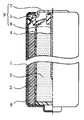
- FIG. 2 is a front view, partly in section, of an AA alkaline battery according to an embodiment of the present invention.
- the alkaline dry battery includes a hollow cylindrical positive electrode 2 disposed in a bottomed cylindrical battery case 1, and a negative electrode such as zinc or zinc alloy powder filled in the hollow portion of the positive electrode 2.
- a gelled negative electrode 3 including an active material, and a separator 4 disposed between the positive electrode 2 and the gelled negative electrode 3 are provided.
- the opening part of the battery case 1 is sealed with the sealing unit 9 comprised by the gasket 5 and the negative electrode terminal plate 7 to which the negative electrode collector 6 was connected.
- the outer surface of the battery case 1 is covered with an exterior label 8.
- the positive electrode 2, the separator 4, and the gelled negative electrode 3 contain an alkaline electrolyte.
- the alkaline electrolyte is, for example, an aqueous potassium hydroxide solution.
- the concentration of potassium hydroxide in the electrolytic solution is preferably 30 to 40% by mass.
- the electrolytic solution may further contain zinc oxide.
- the concentration of zinc oxide in the electrolytic solution is preferably 1 to 3% by mass.
- the positive electrode 2 contains at least manganese dioxide as a positive electrode active material.
- the positive electrode 2 is made of, for example, a mixture of manganese dioxide, a conductive agent, and an alkaline electrolyte. Graphite powder is used as the conductive agent.
- the gelled negative electrode 3 may contain zinc or a zinc alloy as a negative electrode active material.
- the gelled negative electrode 3 is made of, for example, a gelled electrolyte obtained by adding a gelling agent to an alkaline electrolyte and a powdered negative electrode active material dispersed in the gelled electrolyte.
- a gelling agent for example, sodium polyacrylate is used.
- the gasket 5 is obtained, for example, by injection molding nylon or polypropylene into a predetermined size and shape.
- the opening end of the battery case 1 is caulked to the peripheral edge (the flange) of the negative electrode terminal plate 7 via the gasket 5. Thereby, the opening part of the battery case 1 is sealed.
- Procedure (1) Manganese dioxide production In a 20 liter internal electrolytic tank provided with a heating device, a titanium plate as an anode and a carbon plate as a cathode are positioned to face each other, and a manganese sulfate solution (electrolysis) from the upper part of the electrolytic cell An electrolytic cell provided with a pipe for supplying a replenisher was prepared. While maintaining the temperature of the electrolytic cell at 95 ° C.
- the anode titanium plate on which manganese dioxide was deposited and fixed was taken out and washed with pure water, and then the manganese dioxide on the anode titanium plate was peeled off.
- the obtained massive manganese dioxide of about 10 cm square was washed with hot water at 80 to 90 ° C. using a drum washer, and fine particles adhering to the manganese dioxide surface were washed away with hot water.
- the washed lump was dried with a drier maintained at 60 to 80 ° C. Subsequently, the lump was roughly pulverized to about 10 mm, further pulverized with a roller mill pulverizer, washed with water and neutralized, and then filtered with a filter. After preliminarily drying the filtered manganese dioxide, this manganese dioxide was put into an airflow dryer equipped with a cyclone and a bag filter as a recovery device and dried. Next, fine particles collected by the bag filter were mixed with the powder collected by the cyclone at a predetermined ratio, and sufficiently mixed and stirred using a Nauter mixer. Thus, manganese dioxide powders each having a ratio of fine particles having a particle diameter of 0.5 ⁇ m or less and a peak intensity ratio: I ⁇ / I ⁇ having predetermined values shown in Table 2 were prepared.
- manganese dioxide was produced under conditions that caused an electrolysis current fluctuation during electrolysis, and the ratio of particles having a particle diameter of 0.5 ⁇ m or less was changed to obtain a peak intensity ratio: I ⁇ / Although I ⁇ is adjusted, it is not limited to this method.
- Procedure (2) Production of Positive Electrode
- graphite powder (average particle size 8 ⁇ m) as a conductive agent was added to obtain a mixture. .
- the mass ratio of the manganese dioxide powder and the graphite powder was 92.4: 7.6.
- An alkaline electrolyte was added to the mixture, and after sufficiently stirring, the mixture was compression molded into flakes to obtain a positive electrode mixture.
- the mass ratio of the mixture and the alkaline electrolyte was 100: 1.5.
- An alkaline aqueous solution containing 35 mass% potassium hydroxide and 2 mass% zinc oxide was used as the alkaline electrolyte.
- the average particle diameter D50 of the manganese dioxide powder used in Examples 1 to 6 was 26 to 40 ⁇ m.
- the flaky positive electrode mixture was pulverized into granules and classified with a sieve.
- a 10-100 mesh granule is formed into a hollow cylinder with a constant pressure of 3 tons, and a constant volume positive electrode pellet (outer diameter: 13.5 mm, inner diameter: 9.2 mm, height: 22.2 mm) is formed.
- Table 2 shows the filling amounts of two positive electrode pellets (corresponding to one battery) that could be formed with a constant pressure and a constant volume.
- Step (3) Production of Negative Electrode Zinc alloy powder, which is a negative electrode active material, the above alkaline electrolyte, and a gelling agent are mixed at a mass ratio of 200: 100: 2.1 to obtain a gelled negative electrode 3.
- a zinc alloy a zinc alloy containing 0.02 mass% indium, 0.01 mass% bismuth, and 0.005 mass% aluminum was used.
- Step (4) Assembling the alkaline battery
- the bunny height made by Nippon Graphite Co., Ltd. was applied to the inner surface of the bottomed cylindrical battery case made of nickel-plated steel sheet to form a carbon film with a thickness of about 10 ⁇ m. 1 was obtained.
- Two positive electrode pellets produced in the procedure (2) were inserted into the battery case 1 and then pressed to form the positive electrode 2 in close contact with the inner surface of the battery case 1. After placing the bottomed cylindrical separator 4 inside the positive electrode 2, 1.50 g of the same alkaline electrolyte used in the procedure (2) was injected, and the separator 4 was impregnated.
- the peak intensity ratio: I ⁇ / I ⁇ was calculated by the method described above. According to the above procedures (1) to (4), AA alkaline batteries of Examples 1 to 6 and Comparative Examples 1 to 2 were produced and evaluated. The results are shown in Table 2. Moreover, the Raman spectrum of the manganese dioxide used in Example 3 is also shown in FIG.
- the filling property of the positive electrode pellet will be considered.
- the batteries of Examples 1 to 6 using manganese dioxide having a peak intensity ratio: I ⁇ / I ⁇ of 0.62 or less when forming positive electrode pellets of the same size with a constant applied pressure, almost the same as Comparative Examples 1 and 2
- the same amount of positive electrode mixture could be filled. That is, it can be seen that even if the proportion of ⁇ phase in manganese dioxide is reduced, the crystallinity is not greatly changed, and the filling property of the positive electrode pellet is not lowered.
- the alkaline dry battery using manganese dioxide according to the present invention has excellent heavy load discharge characteristics, it is suitably used for devices with high current consumption. While this invention has been described in terms of the presently preferred embodiments, such disclosure should not be construed as limiting. Various changes and modifications will no doubt become apparent to those skilled in the art to which the present invention pertains after reading the above disclosure. Accordingly, the appended claims should be construed to include all variations and modifications without departing from the true spirit and scope of this invention.
Landscapes
- Chemical & Material Sciences (AREA)
- Chemical Kinetics & Catalysis (AREA)
- Electrochemistry (AREA)
- General Chemical & Material Sciences (AREA)
- Inorganic Chemistry (AREA)
- Organic Chemistry (AREA)
- Engineering & Computer Science (AREA)
- Manufacturing & Machinery (AREA)
- Battery Electrode And Active Subsutance (AREA)
- Primary Cells (AREA)
- Inorganic Compounds Of Heavy Metals (AREA)
- Electrolytic Production Of Non-Metals, Compounds, Apparatuses Therefor (AREA)
Priority Applications (3)
| Application Number | Priority Date | Filing Date | Title |
|---|---|---|---|
| EP14754072.8A EP2811556A4 (de) | 2013-02-19 | 2014-01-14 | Mangandioxid und alkali-trockenbatterie damit |
| JP2014542030A JP5899456B2 (ja) | 2013-02-19 | 2014-01-14 | 二酸化マンガンおよびそれを用いたアルカリ乾電池 |
| US14/383,075 US20140377608A1 (en) | 2013-02-19 | 2014-01-14 | Manganese dioxide and alkaline dry battery |
Applications Claiming Priority (2)
| Application Number | Priority Date | Filing Date | Title |
|---|---|---|---|
| JP2013029607 | 2013-02-19 | ||
| JP2013-029607 | 2013-02-19 |
Publications (1)
| Publication Number | Publication Date |
|---|---|
| WO2014129104A1 true WO2014129104A1 (ja) | 2014-08-28 |
Family
ID=51390914
Family Applications (1)
| Application Number | Title | Priority Date | Filing Date |
|---|---|---|---|
| PCT/JP2014/000119 Ceased WO2014129104A1 (ja) | 2013-02-19 | 2014-01-14 | 二酸化マンガンおよびそれを用いたアルカリ乾電池 |
Country Status (4)
| Country | Link |
|---|---|
| US (1) | US20140377608A1 (de) |
| EP (1) | EP2811556A4 (de) |
| JP (1) | JP5899456B2 (de) |
| WO (1) | WO2014129104A1 (de) |
Cited By (2)
| Publication number | Priority date | Publication date | Assignee | Title |
|---|---|---|---|---|
| WO2016181589A1 (ja) * | 2015-05-14 | 2016-11-17 | パナソニックIpマネジメント株式会社 | 正極材料およびその製造方法、その正極材料を用いたマンガン乾電池 |
| JP2018076222A (ja) * | 2016-10-31 | 2018-05-17 | 東ソー株式会社 | 電解二酸化マンガン及びその用途 |
Families Citing this family (1)
| Publication number | Priority date | Publication date | Assignee | Title |
|---|---|---|---|---|
| WO2019044771A1 (ja) * | 2017-08-28 | 2019-03-07 | 株式会社村田製作所 | 非水電解液電池および通信機器 |
Citations (6)
| Publication number | Priority date | Publication date | Assignee | Title |
|---|---|---|---|---|
| JPH02145434A (ja) * | 1988-11-25 | 1990-06-04 | Chuo Denki Kogyo Kk | 結晶構造が調整された二酸化マンガンとその製造方法 |
| JP2002289186A (ja) * | 2001-03-23 | 2002-10-04 | Tosoh Corp | 電解二酸化マンガン粉末およびその製造法 |
| JP2002348693A (ja) * | 2000-09-01 | 2002-12-04 | Tosoh Corp | 電解二酸化マンガン粉末及びその製造法 |
| JP2004186127A (ja) | 2002-10-11 | 2004-07-02 | Mitsui Mining & Smelting Co Ltd | 電池用正極活物質及び電解二酸化マンガンの製造方法並びに電池 |
| JP2008066100A (ja) * | 2006-09-07 | 2008-03-21 | Matsushita Electric Ind Co Ltd | アルカリ電池 |
| JP2010251221A (ja) * | 2009-04-20 | 2010-11-04 | Tosoh Corp | 優れたハイレート特性を有する電解二酸化マンガン組成物 |
Family Cites Families (4)
| Publication number | Priority date | Publication date | Assignee | Title |
|---|---|---|---|---|
| US6630065B2 (en) * | 2000-09-01 | 2003-10-07 | Tosoh Corporation | Powder of electrolytic manganese dioxide and process for producing the same |
| CA2453266A1 (en) * | 2001-07-19 | 2003-01-30 | Matsushita Electric Industrial Co., Ltd. | Alkaline dry battery |
| EP2471976B1 (de) * | 2009-08-24 | 2019-10-02 | Tosoh Corporation | Elektrolytisches mangandioxid, verfahren zu seiner herstellung und seine verwendung |
| WO2012111766A1 (ja) * | 2011-02-18 | 2012-08-23 | 東ソー株式会社 | 電解二酸化マンガン及びその製造方法、並びにリチウムマンガン系複合酸化物の製造方法 |
-
2014
- 2014-01-14 JP JP2014542030A patent/JP5899456B2/ja active Active
- 2014-01-14 EP EP14754072.8A patent/EP2811556A4/de not_active Withdrawn
- 2014-01-14 US US14/383,075 patent/US20140377608A1/en not_active Abandoned
- 2014-01-14 WO PCT/JP2014/000119 patent/WO2014129104A1/ja not_active Ceased
Patent Citations (6)
| Publication number | Priority date | Publication date | Assignee | Title |
|---|---|---|---|---|
| JPH02145434A (ja) * | 1988-11-25 | 1990-06-04 | Chuo Denki Kogyo Kk | 結晶構造が調整された二酸化マンガンとその製造方法 |
| JP2002348693A (ja) * | 2000-09-01 | 2002-12-04 | Tosoh Corp | 電解二酸化マンガン粉末及びその製造法 |
| JP2002289186A (ja) * | 2001-03-23 | 2002-10-04 | Tosoh Corp | 電解二酸化マンガン粉末およびその製造法 |
| JP2004186127A (ja) | 2002-10-11 | 2004-07-02 | Mitsui Mining & Smelting Co Ltd | 電池用正極活物質及び電解二酸化マンガンの製造方法並びに電池 |
| JP2008066100A (ja) * | 2006-09-07 | 2008-03-21 | Matsushita Electric Ind Co Ltd | アルカリ電池 |
| JP2010251221A (ja) * | 2009-04-20 | 2010-11-04 | Tosoh Corp | 優れたハイレート特性を有する電解二酸化マンガン組成物 |
Non-Patent Citations (1)
| Title |
|---|
| See also references of EP2811556A4 |
Cited By (3)
| Publication number | Priority date | Publication date | Assignee | Title |
|---|---|---|---|---|
| WO2016181589A1 (ja) * | 2015-05-14 | 2016-11-17 | パナソニックIpマネジメント株式会社 | 正極材料およびその製造方法、その正極材料を用いたマンガン乾電池 |
| JP2018076222A (ja) * | 2016-10-31 | 2018-05-17 | 東ソー株式会社 | 電解二酸化マンガン及びその用途 |
| JP7039927B2 (ja) | 2016-10-31 | 2022-03-23 | 東ソー株式会社 | 電解二酸化マンガン及びその用途 |
Also Published As
| Publication number | Publication date |
|---|---|
| JP5899456B2 (ja) | 2016-04-06 |
| US20140377608A1 (en) | 2014-12-25 |
| JPWO2014129104A1 (ja) | 2017-02-02 |
| EP2811556A1 (de) | 2014-12-10 |
| EP2811556A4 (de) | 2014-12-10 |
Similar Documents
| Publication | Publication Date | Title |
|---|---|---|
| Zhao et al. | Improving the Ni-rich LiNi0. 5Co0. 2Mn0. 3O2 cathode properties at high operating voltage by double coating layer of Al2O3 and AlPO4 | |
| US9440861B2 (en) | Method for modification of lithium ion battery positive electrode material | |
| JP6493853B2 (ja) | リチウムニッケルコバルトアルミニウム酸化物複合正極材料、その製造方法及びリチウムイオン二次電池 | |
| CN104681795B (zh) | 一种磷酸铁锰锂/碳复合材料的制备方法 | |
| CN104716303B (zh) | 球形羟基氧化钴‑四氧化三钴复合材料的制备方法 | |
| CN105826521B (zh) | 聚阴离子化合物KTi2(PO4)3及其碳包覆物的制备及其产品和应用 | |
| CN104979541B (zh) | 一种钛酸锂复合材料及其制备方法 | |
| CN104393286A (zh) | 一种高电压钴酸锂正极材料的水系包覆方法 | |
| Nie et al. | Using Prussian blue as a self-sacrificial template to construct MnO/MnFe2O4 microcubes as anodes for lithium-ion batteries | |
| TWI651272B (zh) | 一種富鋰-鋰鎳錳氧化物陰極複合材料的製備方法及其用途 | |
| JP5899456B2 (ja) | 二酸化マンガンおよびそれを用いたアルカリ乾電池 | |
| Idris et al. | Effects of polypyrrole on the performance of nickel oxide anode materials for rechargeable lithium-ion batteries | |
| CN104617285B (zh) | 锂离子电池负极材料Li2ZnTi3O8的制备方法 | |
| CN104505502B (zh) | 锂离子电池用钛酸锂复合负极材料及其制备方法 | |
| CN103440996A (zh) | 一种纳米四氧化三锰/碳复合储能材料的制备方法 | |
| KR102240050B1 (ko) | 리튬 이온 전지의 애노드 | |
| CN105810910A (zh) | 一种Na2-2xFe1+xP2O7/碳复合材料及其制备方法和应用 | |
| Yao et al. | Preparation and electrochemical properties of Co–Si3N4 nanocomposites | |
| CN105609746B (zh) | 一种同时电化学贮钠和贮锂的复合电极及其制备方法 | |
| JP2008210746A (ja) | 二酸化マンガンおよびそれを用いた電池 | |
| CN103560245A (zh) | 石墨烯包覆的磷酸钒锂正极材料及其制备方法 | |
| Yao et al. | Lithium storage performance of zinc ferrite nanoparticle synthesized with the assistance of triblock copolymer P123 | |
| CN108933252A (zh) | 锂离子电池用钛酸锂和二氧化钛复合材料及其制备方法 | |
| Cui et al. | Pore size modulation for mesoporous MnO2/acetylene black with superior rate performance as lithium-ion battery anode material | |
| Li et al. | Doping of manganese hexacyanoferrate with cobalt for improving electrochemical performance in high-energy sodium-ion batteries |
Legal Events
| Date | Code | Title | Description |
|---|---|---|---|
| ENP | Entry into the national phase |
Ref document number: 2014542030 Country of ref document: JP Kind code of ref document: A |
|
| WWE | Wipo information: entry into national phase |
Ref document number: 2014754072 Country of ref document: EP |
|
| WWE | Wipo information: entry into national phase |
Ref document number: 14383075 Country of ref document: US |
|
| 121 | Ep: the epo has been informed by wipo that ep was designated in this application |
Ref document number: 14754072 Country of ref document: EP Kind code of ref document: A1 |
|
| NENP | Non-entry into the national phase |
Ref country code: DE |